Discover the artistry of deer hide: Unleash your creativity and explore endless possibilities with this versatile material. From crafting exquisite leather goods to creating stunning home decor, learn the secrets of transforming a deer hide into unique pieces that reflect your personal style. Let your imagination run wild as you delve into the world of deer hide projects and unlock its true potential.
A Step-by-Step Guide: How to Tan and Use a Deer Hide
Tanning a deer hide is a rewarding skill that allows you to utilize every part of the animal and create high-quality leather for various projects. While it may take time and effort, the process is satisfying and worth learning. In this article, we will discuss the steps for tanning using a store-bought tanning solution.
To begin, you will need a tanning oil (such as NuTan) and several substances to adjust the pH of the hide throughout the tanning process. These include white vinegar, salt, baking soda, hydrated lime or lye, and a large plastic tub or bucket.
If you plan on tanning your hide right away, start by removing it from the deer without cutting into the skin. Trim any uneven edges or tough portions of the hide to ensure even tanning. If you need to save the hide for later, roll it up in a plastic bag and freeze it or salt it to prevent rotting.
The first step in tanning is fleshing the hide, which involves scraping off any bits of flesh or gristle. This can be messy and smelly, so protective clothing is recommended. Use a very dull blade or a fleshing knife to scrape off the flesh.
Next, remove the hair from the hide by submerging it in an alkaline solution called a “bucking” solution. You can use hydrated lime or lye to make this solution. Leave the hide submerged for a couple of days until you can easily pull out a small section of hair.
Once the hair has been removed, scrape off the grain layer underneath with firm pressure using your fleshing tool. Flip over the hide and repeat this process on the flesh side to remove any remaining bits of flesh or membrane.
After scraping, soak your hide in fresh water until it returns to a soft and flexible state. You can add ammonium sulfate to speed up this process. Once the hide is ready, prepare a pickling solution using white distilled vinegar, water, and salt. Submerge the hide in this solution for 2-3 days.
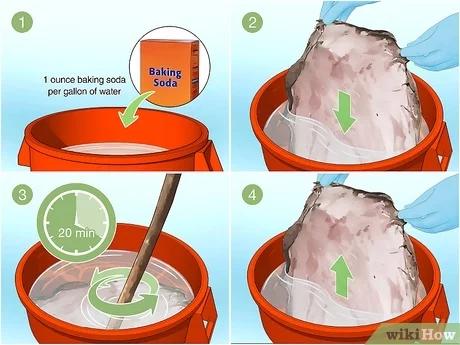
Remove the hide from the pickling solution and neutralize it by soaking it in a mixture of water and baking soda. Rinse thoroughly with fresh water and wring out any excess moisture.
Apply your tanning oil generously to both sides of the hide and let it soak in for 30 minutes. Fold the hide with the flesh side on the inside, wrap it in a tarp, and leave it overnight. The next day, wipe off any excess oil with a clean rag.
To keep the hide soft and flexible as it dries, stretch and work it every 5-10 minutes until completely dry. Hang it up or nail it to a sheet of plywood for this process.
Once dry, you will have a soft but strong piece of deer leather that can be used for various projects such as bags, gloves, tool straps, knife sheaths, and more.
Learning how to tan your own deer hides allows you to fully utilize your harvest and create unique items with your own two hands. While there are specialized tools available for tanning, you can start with basic equipment like a dull blade or hatchet. With practice and experience, you can refine your tanning skills and explore other tanning methods such as brain tanning or vegetable tanning.
Remember to always wear protective gear when working with chemicals or sharp tools during the tanning process.
Maximizing Your Harvest: Creative Uses for Deer Hides
Maximizing Your Harvest: Creative Uses for Deer Hides
Deer hunting is not just about filling the freezer with meat. It’s also an opportunity to learn new skills and make use of every part of the animal, including the hide. Learning how to tan your own deer hides can be a rewarding way to create high-quality material for various projects.
While there are services available for taxidermy or turning deer hides into wall hangings, many hunters enjoy being part of the process themselves. Tanning with a store-bought tanning solution is a great way to start, as it requires less specialized knowledge and materials compared to other methods like brain tanning or vegetable tanning.
To begin the tanning process, you will need a tanning oil (such as NuTan) and some common household items like white vinegar, salt, baking soda, hydrated lime or lye, and a large plastic tub or bucket. Specialized tools like a fleshing knife or fleshing beam can make the job easier but are not necessary.
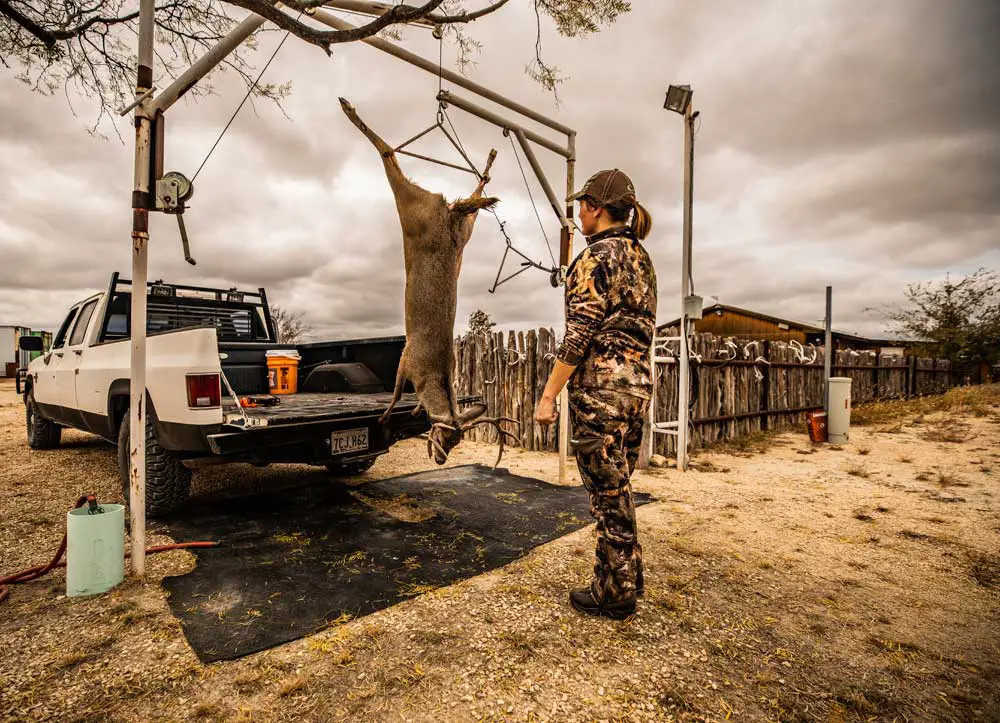
The first step after a successful deer hunt is to skin the deer carefully. By hanging the deer and using gravity to pull the hide off, you can avoid cutting into it. Trim off any uneven edges or tough neck portions of the hide for even tanning.
If you plan to tan your hide right away, proceed with fleshing it. However, if you have other tasks to attend to first, you can preserve the hide by freezing it in a plastic bag or salting it until you’re ready.
Fleshing involves scraping off any bits of flesh and gristle from the hide’s surface. This step can be messy and smelly, so protective clothing is recommended. Any dull blade will work as a fleshing tool.
After fleshing, it’s time to remove the hair from the hide. This can be done by submerging the hide in an alkaline solution called a “bucking” solution. Hydrated lime or lye can be used to make the solution, but caution must be taken as these substances are caustic. Agitate the solution daily for a couple of days until the hair comes off easily.
Once the hair is removed, scrape off the grain layer underneath it using a fleshing tool. Flip the hide over and remove any remaining bits of flesh or membrane from the flesh side.
To return the hide to a neutral state, rinse it in fresh water and change the water regularly until it becomes soft and flexible again. Adding ammonium sulfate to the water can speed up this process.
Next, preserve the hide by submerging it in a pickling solution of vinegar and salt for 2-3 days. Then, neutralize the acidity by soaking it in a baking soda solution before rinsing thoroughly.
After wringing out excess water, apply tanning oil generously to both sides of the hide. Let it soak in overnight before wiping off any excess oil with a clean rag.
To keep the hide soft and flexible as it dries, stretch and work it every 5-10 minutes while hanging or nailed to a surface. This will open up the fibers and prevent stiffness.
Once completely dry, you’ll have a soft yet strong piece of deer leather that can be used for various projects like bags, gloves, tool straps, knife sheaths, or ax strops.
By learning how to tan your own deer hides, you can maximize your harvest and create unique items while honoring the animal you harvested.
From Field to Finished Product: Making the Most of Your Deer Hide
From Field to Finished Product: Making the Most of Your Deer Hide
When it comes to hunting, many hunters focus on filling their freezers with meat and overlook the potential of the deer hide. However, learning how to tan your own deer hides can be a rewarding skill that allows you to use every part of the animal and create beautiful, high-quality materials for various projects.
Tanning a deer hide using a store-bought tanning solution is a great starting point for beginners. You will need some common household items such as white vinegar, salt, baking soda, hydrated lime or lye, and a large plastic tub or bucket. Additionally, specialized tools like a fleshing beam and knife can make the process easier.
The first step is to remove the hide from the deer without cutting into it. Hanging the deer and using gravity to pull off the hide is recommended. Once you have the hide free, trim any uneven edges and tough neck portions for even tanning.
If you’re not planning to tan the hide immediately, you can either freeze it in a plastic bag or salt it to prevent rotting. Salting involves covering the flesh side with non-iodized salt and tightly rolling it with fur side out.
To start tanning, fleshing is necessary to scrape off any bits of flesh and gristle from the hide. This step can be messy and smelly, so protective clothing is recommended. Any dull blade or tool can be used for fleshing.
After fleshing, removing the hair from the hide is done by submerging it in an alkaline solution called “bucking.” Hydrated lime or lye can be used to make this solution. The hide should be fully submerged in the solution and agitated regularly until hair removal becomes easy.
Once all hair has been removed, scraping off the grain underneath is important for even tanning. Flip the hide over and use firm pressure with your fleshing tool to remove the grain. Rinse the hide thoroughly with fresh water.
The next step is pickling, where the hide is submerged in a solution of vinegar and salt for 2 to 3 days. This process preserves the hide. After pickling, neutralizing the acidity is necessary by soaking the hide in a baking soda solution.
After rinsing, wring out excess water and let the hide air dry until it is moist but no longer dripping. Apply tanning oil generously on both sides of the hide and let it sit overnight wrapped in a tarp. The next day, wipe off any excess oil with a clean rag.
To prevent stiffness during drying, move and stretch the hide every few minutes until it dries completely. This helps keep the fibers flexible and results in a soft but strong piece of deer leather.
Tanned deer hides can be used for various projects such as bags, gloves, tool straps, knife sheaths, and ax strops. By learning how to tan your own deer hides, you can fully utilize your harvest and create unique items with your own two hands.
Note: This information is provided as a general guide. It’s important to follow specific instructions provided by tanning solution manufacturers or seek guidance from experienced tanners for best results.
Unlocking the Potential: Practical and Unique Ways to Utilize a Deer Hide
Deer hunting is not just about filling the freezer with meat; it’s also an opportunity to learn new skills and make use of every part of the animal. One often overlooked part is the deer hide, which can be transformed into beautiful, high-quality leather for various projects. While there are services available for taxidermy or turning the hide into wall hangings, learning how to tan your own deer hides allows you to be a part of the process and provide for yourself with your own two hands.
Tanning using a store-bought tanning solution is a great starting point for beginners. You’ll need some common household items like white vinegar, salt, baking soda, hydrated lime or lye, and a large plastic tub or bucket. Specialized tools like a fleshing knife and fleshing beam can make the process easier but are not necessary.
The first step after a successful deer hunt is skinning the deer. It’s important to do this carefully to avoid cutting into the hide. Once you have the hide free, trim off any uneven edges and tough neck portions so that it tans evenly.
If you’re not planning on tanning right away, you can either freeze the hide or salt it to prevent rotting. Rolling it up in a plastic bag and labeling it before freezing is an easy option. Salting involves covering the flesh side of the hide with non-iodized salt and rolling tightly with fur side out. Store in an airtight container until ready for tanning.
The next step is fleshing the hide by scraping off any bits of flesh or gristle. This can be messy and smelly, so protective clothing is recommended. Any dull blade will work as a fleshing tool.
After fleshing, it’s time to remove the hair from the hide by soaking it in an alkaline solution called a “bucking” solution. Hydrated lime or lye can be used to make the solution, but caution should be taken as these are caustic substances. Agitating the hide in the solution for a couple of days will loosen the hair fibers, making it easier to remove.
Once the hair is removed, the hide needs to be neutralized and rinsed. This involves soaking it in fresh water until it returns to a soft and flexible state. Adding ammonium sulfate can speed up this process.
To preserve the hide, it needs to be pickled in an acid and salt solution. White distilled vinegar and salt are commonly used for this step. After pickling, the hide is neutralized again with a baking soda solution and thoroughly rinsed.
Finally, tanning oil is applied to the hide to preserve and soften it. The hide is folded with the flesh side on the inside and left overnight for the oil to soak in. Excess oil is wiped off, and then the hide is stretched and worked while drying to keep it soft and flexible.
Tanned deer hides can be used for various projects like bags, gloves, tool straps, knife sheaths, or ax strops due to their toughness and flexibility. By utilizing every part of the deer you harvest, you not only gain valuable skills but also feel a sense of satisfaction knowing that nothing goes to waste.
Preserving Memories: Transforming a Deer Hide into Meaningful Keepsakes
Preserving Memories: Transforming a Deer Hide into Meaningful Keepsakes
One of the first steps after a successful deer hunt is skinning your deer, but often the skin itself becomes an afterthought as you focus on processing the meat. However, learning how to tan your own deer hides can be a rewarding way to use every part of the animal and create beautiful, high-quality material for various projects.
Tanning with a store-bought tanning solution is a great starting point for beginners. You will need some common household items like white vinegar, salt, baking soda, hydrated lime or lye, and a large plastic tub or bucket. Specialized tools like a fleshing beam and knife can make the process easier but are not necessary.
The first step is to remove the hide from the deer without cutting into it. Once you have the hide free, trim off any uneven edges and tough portions so it tans evenly. If you’re not tanning right away, you can freeze the hide or salt it to preserve it.
To tan the hide, start by fleshing it to remove bits of flesh and gristle. This can be messy and smelly, so protective clothing is recommended. Next, use a “bucking” solution with an alkaline substance like hydrated lime or lye to remove the hair from the hide easily.
After scraping off all the hair and grain from both sides of the hide, return it to a neutral state by soaking it in fresh water. You can add ammonium sulfate as a deliming agent to speed up this process. Once neutralized, pickle the hide in an acidic solution of vinegar and salt for 2-3 days.
After pickling, neutralize the hide again with baking soda solution and rinse thoroughly. Wring out excess water and apply tanning oil generously on both sides of the hide. Let it sit overnight before wiping off any excess oil.
To dry the hide, stretch and work it regularly to keep the fibers flexible. Hang it up or nail it to a surface and continue stretching and working it until completely dry. Once dry, you will have a soft yet strong piece of deer leather that can be used for various projects.
Tanning your own deer hides allows you to be part of the process and create meaningful keepsakes from your hunts. From bags and gloves to tool straps and knife sheaths, tanned deerskin can be used for a wide range of applications. So embrace the opportunity to learn this skill and make the most of your harvest.
The Art of Tanning: Discover the Rewards of Processing Your Own Deer Hide
The art of tanning your own deer hide is a rewarding and fulfilling process that allows you to utilize every part of the animal. While many hunters may send their hides to be taxidermied or turned into wall hangings, there is something special about being able to make something with your own two hands. Learning how to tan your own deer hides not only allows you to use every part of the animal but also results in a beautiful, high-quality material that can be used for various projects.
Tanning with a store-bought tanning solution is considered the perfect “gateway” tanning process as it requires less specialized knowledge, time, and material gathering compared to other methods such as brain tanning or vegetable tanning. You can easily purchase a tanning solution online or at hunting gear stores.
In addition to the tanning oil, you will need several substances to alter the pH of your hide throughout the tanning process. These include white vinegar, salt, baking soda, hydrated lime or lye, and a large plastic tub or bucket. While there are specialized tools available for tanning, such as a fleshing beam and fleshing knife, you can use alternatives like a sawhorse and dull blade if needed.
The first step in tanning your deer hide is removing it from the deer without cutting into the hide itself. Hanging the deer and using gravity to pull off the hide is recommended. Once removed, trim any uneven edges and tough neck portions for even thickness during tanning.
If you plan on tanning immediately, proceed with fleshing the hide by scraping off any bits of flesh and gristle. This step can be messy and smelly, so protective clothing is advised. If you have other tasks to attend to before tanning, you can either freeze the hide in a plastic bag or salt it to prevent rotting until you’re ready.
After fleshing, it’s time to remove the hair from the hide. This can be done by placing the hide in an alkaline solution, known as a “bucking” solution, which causes the hair fibers to slide out easily. Hydrated lime or lye can be used to make the solution alkaline. The hide should be fully submerged and agitated regularly for a couple of days until the hair comes out easily when tested.
Once the hair is removed, you will need to scrape off the grain underneath using a fleshing knife or alternative tool. Flip the hide over and remove any remaining bits of flesh or membrane from the flesh side. Afterward, soak the hide in fresh water until it returns to a soft and flexible state.
To preserve the hide, it needs to be pickled by submerging it in an acidic and salt solution. White distilled vinegar mixed with water and salt is commonly used for this step. Leave the hide in the pickling solution for 2-3 days before neutralizing it with a baking soda solution and rinsing thoroughly.
Finally, apply your tanning oil to both sides of the hide and let it soak in overnight. Remove any excess oil with a clean rag before drying your hide while stretching and working it periodically to keep it soft and flexible.
Once completely dry, your deer hide will be ready for use in various projects such as bags, gloves, tool straps, knife sheaths, or ax strops. The process may take time and effort but knowing that you have utilized every part of your harvest is incredibly satisfying.
In conclusion, there are several options for what to do with a deer hide. It can be tanned and turned into various useful products such as clothing, bags, or rugs. Alternatively, it can be donated to organizations that use animal hides for educational purposes or conservation efforts. Whatever the choice may be, recycling and repurposing deer hides helps ensure that no part of the animal goes to waste.
Author of The Resiliency Advantage: Master Change, Thrive Under Pressure and Bounce Back From Setbacks (2006 Independent Publisher’s Best Self-Help book), and best seller The Survivor Personality: Why Some People Are Stronger, Smarter, and More Skillful at Handling Life’s Difficulties…and How You Can Be, Too.
(A condensed version titled “The Survivor Personality” was published in the AHP Newsletter, Aug.-Sept., 1983, and used as the source of material quoted in chapter eight in Love, Medicine, & Miracles, by Bernie Siegel, M.D.)
Abstract
Introduction
Four Criteria
Method
Biphasic Traits
Synergy Motivation
Need for Good Synergy
The Competence Imparitive
The Role of Learning
Learning What No One Can Teach
Conclusion and Hypothesis
Footnotes
References
Permission to Reprint Information
Bottom of Page
Abstract:
A curiosity which started in 1953 about life’s best survivors led to the identification of a small subgroup within the population who will probably be the normal or typical human of the future. Such persons can be described as having “survivor” or “synergistic personalities.”
Abraham Maslow’s later writings reflected a strong interest in synergy. He assisted Margaret Mead in publishing Ruth Benedict’s descriptions of high synergy and low synergy cultures. Maslow wrote about high synergy and low synergy organizations and their effects on self-actualization. His listing of the motivations and gratifications of self-actualizing people includes nine items indicative of needing to have things work well.
To place the need for high synergy in context it is suggested that the traditional pyramid drawing of Maslow’s hierarchy of needs be inverted and that the need for synergy be added as the next need above self-actualization.
The synergistic personality is characterized as having been able to sustain into adulthood the playful curiosity of childhood. As a consequence, the life-long activity of learning carries such persons beyond their teachers. To make important aspects of their lives function well they engage in self- motivated, self-managed learning derived directly from experience. As adults they exhibit the neurogenic motive that Robert B. White described as “effectance motivation.” Thus as the years go by they become increasingly life competent or “life smart.”
Central to the development of a synergistic personality is the integration of paradoxical personality traits. Such persons are comfortable with and value their inner counter-balanced dimensions. They appreciate the benefits derived from being able to engage in pessimistic optimism, cooperative non-conformity, selfish altruism, extroverted introversion, playful seriousness, and more.
It is hypothesized that the synergistic personality reflects the emergence of a new level of human development and brain functioning that is fundamentally different and more advanced than that of Cro-Magnon humans.
Introduction
When I enlisted in the paratroopers in 1953 the training cadre were all seasoned combat veterans. They were the few survivors from the 11th Airborne Division, a unit that had fought in the Pacific during WWII and later in Korea. Being around them I saw that it wasn’t just fate or luck that these were the few still alive. Something about them as people had made a difference.
Four Criteria
After my discharge I returned to college and majored in psychology. In graduate school I chose clinical psychology as my major field but as time went by I became dissatisfied with the emphasis on mental illness and became increasingly curious about people who are best at handling life’s toughest challenges. My main focus over the years has been to try to understand life’s best survivors. To organize my efforts I developed a list of four criteria or qualifiers. The criteria are as follows:
People with survivor personalities are those who…
have survived a major crisis
surmounted the crisis through personal effort
emerged from the experience with previously unknown strengths and abilities
in retrospect find value in the experience (A)
A good indicator that a person meets the four criteria is a statement such as, “I would never willingly go through anything like that again, but it was the best thing that ever happened to me.”
Method
Ken Keyes, Jr. once wrote: “It is impossible for you to learn what you think you already know.” Instead of studying survivors by using existing concepts of human personality, motivation, physiology and learning, I let myself learn about people as they really are. Instead of trying to make the territory fit the maps that others had constructed, I wandered as an observer with a curious and silent mind through the territory allowing it to create its own map for me.
Using the four criteria as a frame of reference, I worked backward. Over the years I asked myself such questions as:
“Is there a basic pattern of traits that survivors share? If so, what are the traits?”
“What about their uniqueness? How can a person be similar to others and yet be a unique individual?”
“What are survivors like when they aren’t surviving?”
“Is the survivor personality inborn or can it be learned? If it can be learned, what are the learning parameters?”
To find answers to my questions, I interviewed many people, read extensively and developed a questionnaire (B) for collecting information from people who identify themselves as having survivor personalities. Once the picture started to become clarified, I sought feedback from experienced survivors about the accuracy of my descriptions.
Biphasic Traits
Survivors puzzled me at first. Survivors are both serious and playful, they are hard-working and lazy, self-confident and self-critical.
The historic mode of thinking in psychology has been to conceptualize personality traits as unidimensional and as either present or absent in a person. Individuals were thought of as being one way or another, as introverted or extroverted, for example. Yet, many survivors show characteristics of both introversion and extroversion.
What is the relationship between being a survivor and being paradoxical?
An article on biphasic patterns of behavior by T.C. Schneirla led to the answer. In this article, Schneirla described his experiments in attempting to understand how living creatures survive in the world. The basic purpose of his research was to find out how “animals generally manage to reach beneficial conditions and stay away from harmful, that is, how survivors do this.” (1)
After much research, he concluded that a creature’s ability to survive is derived from being able to approach or withdraw from anything near it. To survive on this planet a creature must be able to move toward life- sustaining conditions and away from poisonous or other life-destroying conditions. The ability to approach or withdraw was described by Schneirla as being a “biphasic pattern of adjustment.”
Biphasic patterns are possible because of opposing muscular systems in our bodies. Animals have physical control over themselves because the cerebral cortex coordinates flexor and extensor muscles working against each other in controlled opposition.
Similarly, the ability of humans to consciously influence their emotional states is largely a function of the sympathetic and parasympathetic nervous systems working in counterbalanced opposition to each other.
Opposing nervous systems give creative response choices. Consciously controlled, counterbalanced systems free humans from being stimulus bound. Moshe Feldenkrais, the originator of movement techniques that lead to better physical integration, has observed that “reversibility is the mark of voluntary movement.” (2) An action that cannot be reversed is involuntary. It is reflective and not under cortical control.
Biphasic personality traits increase survivability by allowing a person to respond in one way or its opposite in any situation. To have biphasic traits is to be both one way and another rather than either one way or another. Thus, complexity and stability are derived from being tough and sensitive, proud and humble, selfish and unselfish, cooperative and rebellious, analytic and metaphoric, shy and bold, etc.
The people involved in my survivor personality research project say that being flexible and adaptable, more than anything else, is central to being a survivor. Having a variety of responses available is what makes possible the handling of chaotic, unpredictable or unexpected conditions.
Respondents also indicate, by the way, that learning about the value of biphasic or paradoxical traits is emotionally reassuring. For example, a woman who worked as a head nurse in a county hospital and was recognized for her outstanding skills wrote to me saying: “appreciate the paradoxes — it’s good to know it’s not weird-I used to puzzle myself about being conservative-liberal, generous-stingy, serious-silly, quiet-gregarious, interested-bored, involved-aloof.”
What the specific pairs of counterbalanced traits are seems to be less important than having many such pairs. The longer the list of pairs of paradoxical or biphasic personality traits (C) that are descriptive of a person, the more complex the person is and, thus, the person is usually better at successfully dealing with a variety of situations.
Evidence establishing the relationship between response choices and survival is available from many sources. Two biologists, in commenting upon successful patterns of survival in the animal and plant world, have stated: “the plants and animals that survive in their progeny are the lucky ones. They hold the winning combination: A successful pattern filling one place and time, and the ability to modify the pattern in the correct direction as fast as the environment changes. The luckiest of all have an adaptation ready, still unused, as though prepared for alteration that has not yet come. They gain a head start in the altered world. Less fortunate are those whose pattern limits them to a single situation. They vanish forever….” (3)
Synergy Motivation
Biphasic traits make flexibility possible; but being complex is not enough. Some complex people do not handle life’s problems well. If having biphasic traits provides options about ways to respond, what determines choices? What gives paradoxical people a sense of direction? How do they know what to do in unique situations? How is it that they handle emergencies so well? How do they know what not to do? How do they know what would not work? Why are they good people to have around?
These are motivation questions. They are questions about the occurrence, direction, and persistence of a behavior. Answers to these questions can be found by examining a major motive in life’s best survivors: It is the need to have things work well for themselves and others.
The need to have things work well explains much about survivors. This need is a central, organizing, motivational principle in their lives. It helps explain why, when necessary, they can successfully handle a situation that no other human being has faced before.
A diagram of the hierarchy of needs that Abraham Maslow described is usually drawn this way:
Visualizing the hierarchy as organized in the form of a pyramid is not conceptually accurate, however. (D) The more basic tissue needs are simple and satisfied quickly. Eating food or bandaging a cut takes only minutes. At each higher level the need is more complex than the one before it. Emotional and mental needs take longer to satisfy. Actualization takes many years.
In addition, the concept of self-actualization does not handle very well the need of people with survivor personalities to have things work well. Maslow recognized the existence of this motivational force in self- actualizing people, although he did not separate it out as another motive.
To make sense out of what I have observed and what Maslow actually described, therefore, I find that I have to turn his pyramid on its apex and add another motivational force beyond self-actualization. The drawing looks like this:
Maslow learned about synergy from Ruth Benedict, who introduced the concept in 1941 in some lectures she unfortunately never published. Maslow later obtained some of her lecture notes and had them published several years after her death.
Having studied many different cultures, Benedict felt the need to develop a concept which would help communicate some significant differences between cultures in regard to the quality of life for a person living in one culture or another. She stated:
I shall need a term for the gamut, a gamut that runs from one pole, where any act or skill that advantages the individual at the same time advantages the group, to the other pole, where every act that advantages the individual is at the expense of others. I shall call this gamut Synergy, the old term used in medicine and theology to mean combined action. In medicine it means the combined action of nerve centers, muscles, mental activities, remedies, which by combining produced a result greater than the sum of their separate actions.
I shall speak of cultures with low synergy, where the social structure provides for acts that are mutually opposed and counteracted and of cultures with high synergy, where it provides for acts that are mutually reinforcing. (4)
Ruth Benedict’s ideas are applicable to groups as well as cultures. High synergy exists in an organization or agency when minimum effort results in cooperative, effective action. Low synergy exists when excessive effort results in little useful action.
Trying to get something done in a low synergy organization is like driving a heavily loaded truck and trailer down the highway with all the tires flat. Working in a high synergy organization is like cruising along the highway in a well-tuned Porsche.
Maslow devoted a great deal of attention to the concept of synergy during the latter part of his career.
He recognized that some people do not merely self-actualize and then stop. Some people transcend being “merely healthy.” (5) They resolve, master and integrate conflicting forces and are motivated to create a good society for themselves and others. Maslow, in referring to the possible desirable state of affairs, coined the term “eupsychia” and defined it as “the culture that would be generated by 1,000 self-actualizing people on some sheltered island where they would not be interfered with.” (6)The central purpose of his book titled Eupsychian Management was to show organizational managers what they need to understand to create an environment conducive to optimum psychological health for workers.
The “need to have things work well” is clearly present in Maslow’s listing of the “Motivations and Gratifications of Self-Actualizing People.” (7) Nine of the 40 items in his list refer to this need:
They seem to like happy endings, good completions.
They try to set things right, to clean up bad situations.
They generally pick out their own causes, which are apt to be few in number, rather than responding to advertising or to campaigns or to other people’s exhortations.
They manage somehow simultaneously to love the world as it is and try to improve it.
In all cases there was some hope that people and nature and society could be improved.
A change to improve the situation where the operation is a big reward. They enjoy improving things.
They enjoy bringing about law and order in the chaotic situation, or in the messy or confused situation, or in the dirty and unclean situation.
They like doing things well, “doing a good job,” “to do well what needs doing.” Many such phrases add up to “bringing about good workmanship.”
They enjoy greater efficiency, making an operation more neat, compact, simple, faster, less expensive, turning out a better product, doing with less parts, a smaller number of operations, less clumsiness, less effort, more foolproof, safer, more “elegant,” less laborious.
Thus, taking into account Maslow’s great interest in synergy, knowing of his clear awareness that people who are self-actualizing become very involved in making things work well, and taking into account that Maslow was a great teacher who encouraged people to think for themselves, I do not feel that Maslow would be greatly distressed to find that I find it practical to invert the pyramid and add synergy as a higher level need. (E)
The link between survivorship and being a competent, synergistic human is as follows: When things are working well, a person:
can sit back and let things run themselves.
expends much less energy than people who are struggling.
has chunks of optional time for being curious about the early signs of new developments.
can devote attention to the little things that count.
can spot early indications of potential trouble and take action to prevent it.
can work on future happenings so that when they occur things fall into place easily.
is more relaxed, feels better and enjoys “working” as good exercise.
can put high quality time and energy into emergency developments without having other basic matters interrupted.
responds to an emergency or crisis with an attitudinal reflex of both expecting and needing for things to work out well.
The Need for Good Synergy
One of the most noticeable qualities of people in whom the synergy motive is strong is that they volunteer to help out when there is trouble. People with survivor personalities are foul-weather friends. When things are working well, they may drift around, apparently uninvolved; but, when there is trouble, they show up.
Their efforts to eliminate problems or reduce pain or distress in another person are partly selfish. Their sensitivity and sympathy for people who are in pain effects them. They feel it when other people are in pain.
The need for synergy is as selfish a motive as any other. The more well integrated a person’s thoughts, feelings and actions become the more the person needs a pleasantly functioning world to live in. Being exposed to discordant, unstabilizing, energy draining, disruptive people or conditions can be painful. Working to make things better is not an unselfish activity.
The selfishness in people with survivor personalities is paradoxical. When they do nice things for others, it is partly because it’s fun to have other people enjoy themselves and partly because it feels good. They have resolved what Maslow calls the selfish-unselfish dichotomy. They have achieved a state of selfish altruism. They can act unselfishly for selfish reasons. In commenting about fusing the selfish-unselfish dichotomy, Maslow states:
Here I would like to take a jump beyond Benedict….In highly developed, psychiatrically healthy people, self-actualizing people, whichever you choose to call them, you will find, if you try to rate them, that they are extraordinarily unselfish in some ways, and yet also they are extraordinarily selfish in other ways…
Somehow the polarity, the dichotomy, the assumption that more of one means less of the other, all this fades. They melt into each other and you now have a single concept for which we have no word yet. High synergy from this point of view can represent a transcending of the dichotomizing, a fusion of the opposites into a single concept. (8)
Since all psychological activities have physiological correlates, such a “fusion” of opposites must reflect the establishment of integrated neurological connections between the various brain centers and neurological systems. If this is indeed the case, then questions about the synergy motive, the need to have things work well, must include attention to neurological variables.
The Competence Imperative
The really competent, synergistic people in every sphere of human activity are those individuals who have gone beyond their teachers. They have learned what no one can teach them. Competence results from self- motivated, self-managed learning. People who follow instructions on how to function successfully are never as skillful as people who are self- motivated learners. Every teacher knows that the students who gain the most from a course are the ones who are self-motivated. Students who passively cooperate in doing as instructed may pass the tests, but they lack the self motivation that leads to mastery.
The motivational forces underlying the learning (F) that results in competence / mastery / effectiveness / skillfulness in making things work well in a variety of conditions cannot be accounted for by external forces such as reinforcers, punishers, social pressures or anticipated rewards. Neither can the self-motivated learning be accounted for by internal tensions or deficits. The self-motivated learning so strongly present in adults who function in synergistic ways is that same as that of small children. The motivational force is neurogenic and has been described by Robert W. White as “effectance motivation.” (9) White, in his classic paper “Motivation Reconsidered: The Concept of Competence,” summarized decades of motivation research by saying:
Later in his paper he stated:
In support of his position, White observed that a healthy, adequately fed child or animal “is by no means at the mercy of transient stimulus fields. He selects for continuous treatment those aspects of his environment which he finds it possible to affect in some way.” (12) What is called child’s play “involves discovering the effects he can have on the environment and the effect the environment will have on him. To the extent that these results are preserved by learning, they build up an increased competence in dealing with the environment.” (13) White defined competence as “an organism’s capacity to interact effectively with its environment.” (14) He says that, “In higher animals and especially in man, where so little is innately provided and so much has to be learned about dealing with the environment, effectance motivation independent of primary drives can be seen as having high adaptive value.” (15) White conceived of effectance motivation as characterized by satisfactions derived from explanatory, varying, experimental behaviors and conceptualized the activities which lead to competence as linked to feelings of efficacy. (16)
The synergy motive can be understood as having two motivational dimensions. First, a discordant, energy-draining situation may upset, irritate, or bother the person and may stimulate activities to improve things; and, second, there is the feeling of enjoyment and satisfaction from being able to take actions which results in things working well.
The Role of Learning
Linking the motivation for competence to internal, neurogenic processes helps explain how and why people who learn directly from life’s experiences are synergistic and handle life’s difficulties better than people who try to function as directed by others. It is not that people with survivor personalities have learned how to learn; instead, it is more accurate to say that they have managed to maintain the way of learning that enhances ongoing neurological development and leads to ever increasing personal abilities.
My own rough model of the circumstances in which people learn is this:
Ways in which humans learn:
trained or conditioned to act, think, feel, speak as told.
in structured experiences designed to teach predetermined thoughts, feelings and actions.
working as an apprentice with a skilled person who helps “educe” useful learning.
assisted in learning how to successfully deal with unique and unexpected challenges by a mentor.
unsocialized, self-motivated, self-managed learning directly from experience.
Some people make it through the training, educational and other experiences forced on them by others with the motivation and ability to learn directly from experiences still strong. In some cases, the competency flourishes in spite of the efforts of parents, trainers and educators; in other cases, the competency flourishes because the parents, teachers and educators did not interfere with the self-motivated learning.
Many people do not make it through the training, educational and other experiences forced on them by others with much self-motivation left. Some are victims of severe, although usually well-intentioned, mental and emotional abuse, others seem addicted to “educements.”
Learning What No One Can Teach
The benefits derived from years of self-motivated, self-managed learning include becoming increasingly competent in dealing effectively with real life events and acquiring skills to learn what no one can teach. Everyone encounters difficulties they were not prepared for. Those happen at work, in marriages, with life changes and changes in the external world. Survival responses and synergistic actions both usually depend on the person being able to assess a situation quickly and invent a workable plan of action without asking for approval or waiting for help. The pattern of activities associated with the development of synergistic skills and a survivor personality include the following: As adults, such persons:
play in the way that happy children do.
may play aimlessly with no purpose other than for the enjoyment of the activity.
can become deeply absorbed in an activity, losing all contact with time and external events. While so absorbed, they may talk with themselves, hum or whistle absent-mindedly.
have the curiosity of a long-time child who asks: “How does this work?” “What if I did such and such?” “What would happen if I acted in another way?”
allow their feelings to guide their curiosity.
have an observing, nonjudgmental perceptual style.
are willing to be foolish, make mistakes, get hurt and laugh at themselves.
may test the limits, break rules or disobey laws to find out what happens.
appreciate unpleasant information about themselves.
carry on conversations with themselves, day dream and have active imaginations. They play in and with their minds.
Indicators that developmental processes are enhanced by these spontaneous, self-motivated activities include observations that such people:
have empathy for individuals and groups, particularly for opponents / enemies / adversaries.
have empathy for clusters or systems of relationships such as organizations or equipment.
use subliminal perception as a valid, useful source of information.
have good timing, especially when speaking or taking an original action.
recognize early clues about possible developments and take meaningful action.
rapidly assimilate new or unexpected experiences and facilitate being changed by them.
get smarter and enjoy life more as they get older.
are comfortable in and even amused by ambiguous situations that may frighten or bewilder others.
exercise conscious choices over biphasic response alternatives.
maintain a positive direction and show surprising self-confidence against sustained adverse circumstances.
fall back to and successfully rely on inner resources in disruptive, chaotic circumstances.
can be a cooperative nonconformist, i.e. not being controlled by social mores, laws or standards, and yet choose to abide by the laws and rules.
have a talent for serendipity; able to convert accidents or what others would regard as misfortune into good luck.
Such indicators allow us to infer that self-motivated, self-managed learning can lead to advanced levels of neurological development. With some people, however, learning may only play a minor role in the development of the survivor personality.
A few people are born survivors. They are the natural athletes in the game of life. Just as some people are born musicians, writers, artists or singers, some people are gifted at coping well. This ability is so strongly inborn in a few children that even the most adverse home conditions and neighborhoods cannot break them. Julius Segal refers to such children as “invulnerables” and describes them as “an enigma.” They are “children who should be psychological casualties but aren’t.” (17)
E. James Anthony says about invulnerable children: “They deal with life with an excellence and adaptive capacity that doesn’t seem to come from anywhere, as if they had carved these qualities by themselves.” (18)
Nature provides a few people with such a strong inborn capacity for survival that even as children they apparently need minimum help or support from their world. The majority of others follow along lines that would be predicted by the normal distribution curve of human abilities. For most others, the potential for developing a survivor personality is present or absent to a greater or lesser extent. For them, it takes more time and more experience. Thus, for the majority of people, life’s circumstances (nurture) can enhance or diminish the probabilities that they will learn how to take control of their ongoing development.
The extent to which a person can function in ways aligned with deeper, neurological, organic processes is revealed in extreme circumstances. Terrance Des Pres, in summarizing his research into the survivors of the Nazi Death Camps, concluded when people are stripped of all their usual supports and even their health, “when the external props collapse, survivors fall back on life itself.” (19)
It may be that a significant, although subtle, force operating within human behavior and human functions is a species motive rather than an individual one. In the 1840s, Arthur Schopenhauer stated:
The inmost nature of every brute, and also of man, accordingly lies in the species; thus the will to live which is so powerfully active is rooted in this, not really in the individual. (20)
Ex-POWs have told me that, during some of the worst times in captivity, “dying is as easy as letting go a rope.” They would even joke about deciding to stay alive by saying: “We must be crazy to stay alive. Any horse treated like this would have died long ago.”
Conclusion and Hypothesis
Highly stressful situations, ambiguity, unwanted changes, and torturous conditions reveal that some individuals have more capacity to survive and make things turn out well than others. From studying people who successfully survive
and gain strength from extreme circumstances, I hypothesize that:
the survivor personality cannot be taught but it can be learned.
those motives, activities and experiences enhancing the emergency of survival abilities are the same as those which enhance the emergence of synergistic abilities.
neurological maturation can continue in humans throughout their lives.
for those persons who discover and facilitate the life and growth forces within them, life gets better and better decade after decade.
The methodological problems in testing the hypotheses are considerable. Since an ideal anything can only exist in the abstract, how can individuals with unique abilities be compared-especially when taking into account that one person’s way of solving and surviving real life problems may be quite different from another? To make such comparisons would be more like trying to judge an art competition than doing scientific research.
How can the ability to survive extreme conditions be tested? Humans cannot, for research purposes, be thrown into major, life disrupting conditions.
Even if methods such as those were used by research teams during natural disasters could be used to verify the observed correlations, what could be done to determine whether or not neurological development has occurred and is a significant variable? Can psychologists develop assessment devices that measure advanced levels of neurological functioning in the same way they assess neurological impairment?
Despite the methodological research problems, my observations of life’s best survivors leads me to conclude that the human species is in a transformation to its next level of development. A more developmentally advanced human being is emerging who will compare to the Cro-Magnon way of thinking and living at about the same level of comparison that Cro- Magnon compared to Neanderthal.
Comments and reactions are invited.
Footnotes:
(A) The “survivor personality” is, thus, an operational definition. It is a description of an abstracted system as distinguished from the hypothetical construct “mental health.” Such persons could just as well be described as having “synergistic” or “serendipity” personalities because these are also core attributes of exceptional mental health.
(B) What follows, then, is a preliminary report in which those variables and principles observed to be most central to the survivor personality are described. Research issues are discussed at the conclusion of the paper.
(C) The term “androgynous” is being specifically avoided here for the following reason. I have been using the terms “biphasic,” “paradoxical” and “counterbalanced” in reference to personality traits since the early 1960s and prefer them because they are gender neutral. “Androgynous” is a sexist concept implying that a complete person is a mixture of both male and female traits. I view people with survivor personalities as humans whose traits make them good survivors and that their sexual identities are relatively superficial when compared to more fundamental personality dimensions. Besides, the terms counterbalanced and paradoxical teach better. Try telling a room full of city maintenance department employees that they may be able to handle life’s challenges better by becoming androgynous.
(D) See the diagram in The Third Force by Frank Goble, on page 50, and notice how difficult it was to include the self-actualization growth needs in the space at the top of the pyramid.
(E) Another human need which Maslow hierarchy does not cover well is sexual activity, so even my revised version of his model may be considered to have limitations.
(F) Learning being defined as “a change in behavior that results from experience.”
References
(1) T.C. Schneirla, “An Evolutionary and Developmental Theory of Biphasic Process Underlying Approach and Withdrawal.” Nebraska Symposium on Motivation, Vol. 7, Marshall R. Jones, ed. (1959). Reprinted in Selected Writings of T. C. Schneirla (W.H. Freeman, 1972).
(2) Moshe Feldenkrais, Awareness through Movement (Harper & Row, 1972), p. 85.
(3) Lorus J. Milne and Margery Milne, Patterns of Survival (Prentice-Hall, 1967), p. 4.
(4) Abraham Maslow and John J. Honigmann, eds., “Synergy: Some Notes of Ruth Benedict, American Anthropologist, Vol. 72, (1970), pp. 320-333.
(5) Abraham Maslow, The Farther Reaches of Human Nature, pp. 282-292.
(6) Abraham Maslow, Eupsychian Management, (Dorsey Press, 1965), p. xi.
(7) Abraham H. Maslow, The Farther Reaches of Human Nature, (Viking Press, 1971), pp. 308-309.
(8) Ibid, pp. 43 and 210.
(9) Robert W. White, “Motivation Reconsidered: The Concept of Competence, ” Psychological Review, Vol. 66, Sept. 1959, p. 329.
(10) Ibid, p. 305.
(11) Ibid, p. 32.
(12) Ibid, p. 320.
(13) Ibid, p. 321.
(14) Ibid, p. 297.
(15) Ibid, p. 329.
(16) Ibid, p. 329.
(17) Julius Segal, A Child’s Journey, Chapter 12 “Children Who Will Not Break” (McGraw-Hill, 1978), p. 282.
(18) E. James Anthony and Bertram J. Cohler, The Invulnerable Child (Guilford Press, 1987).
(19) Terrance Des Pres, The Survivor: Anatomy of Life in Death Camps (Oxford University Press, 1976).
(20) The Will to Live: Selected Writing of Arthur Schopenhauer, Richard Taylor, ed. (Doubleday & Company, 1962), p. 140.
The Resiliency Center was founded by the late Al Siebert, PhD who studied highly resilient survivors for over fifty years. He authored the award-winning book The Resiliency Advantage: Master Change, Thrive Under Pressure and Bounce Back From Setbacks (2006 Independent Publisher’s Best Self-Help book), and best seller The Survivor Personality: Why Some People Are Stronger, Smarter, and More Skillful at Handling Life’s Difficulties…and How You Can Be, Too.
Pressurized air is also not affected by temperature changes like CO2 is.
These rifles are powerful, consistent, and accurate.
The gas piston air rifles have attempted to reduce the recoil effect by eliminating the double hit and spring torque associated with steel spring air rifles.
However, the recoil effect is still a little bit greater than that of PCP air rifles.
For the variable pump air rifles, you have to master the cocking action since the power of the shot depends on how strong your pump is.
This is not the case with the PCPs – once filled with air to the maximum fill pressure, all you have to do is pull the trigger, and the pellet fires.
However, a PCP air rifle tends to be more expensive than a CO2 or spring-powered air rifle, and more expensive to refill too .
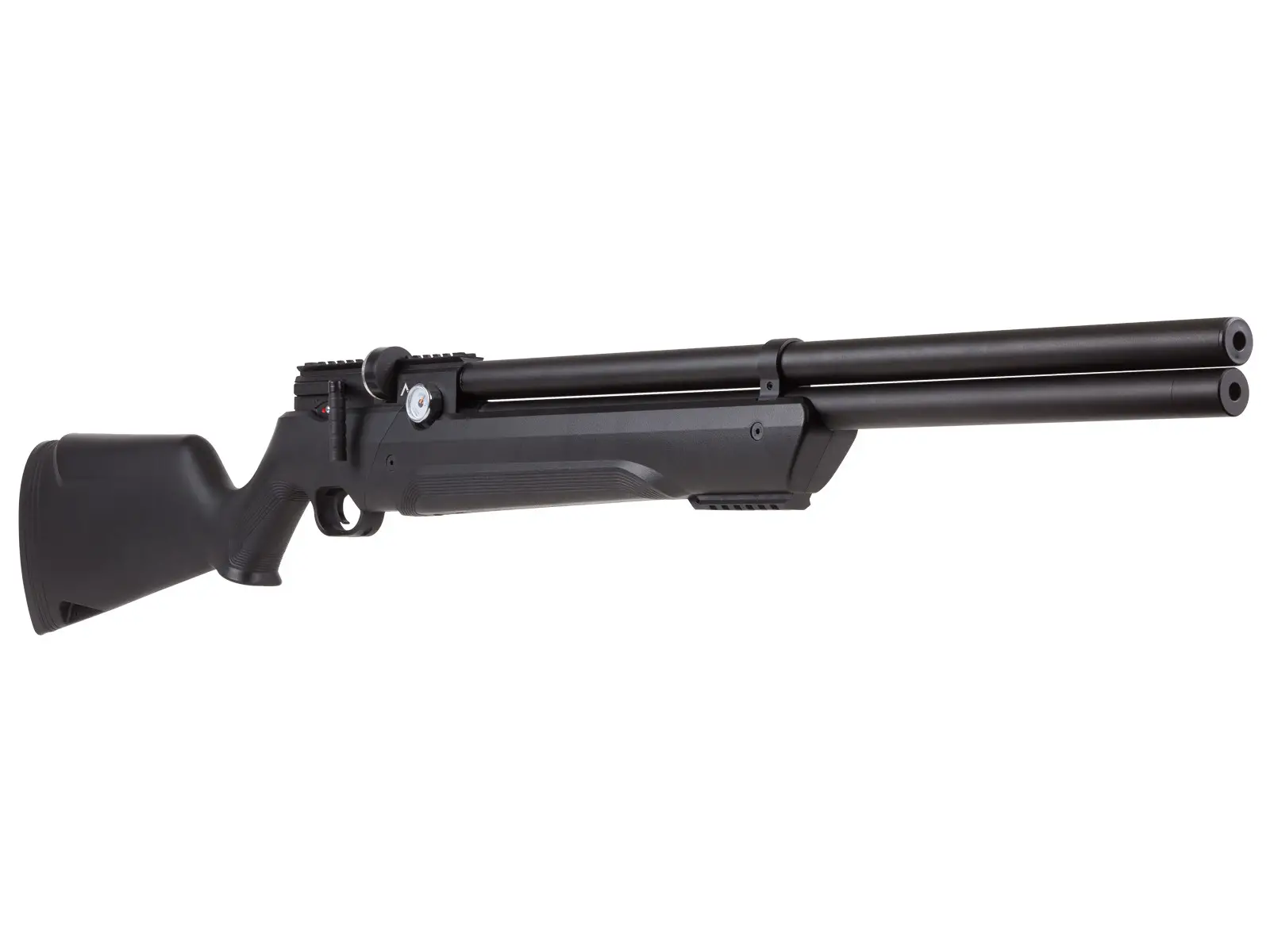
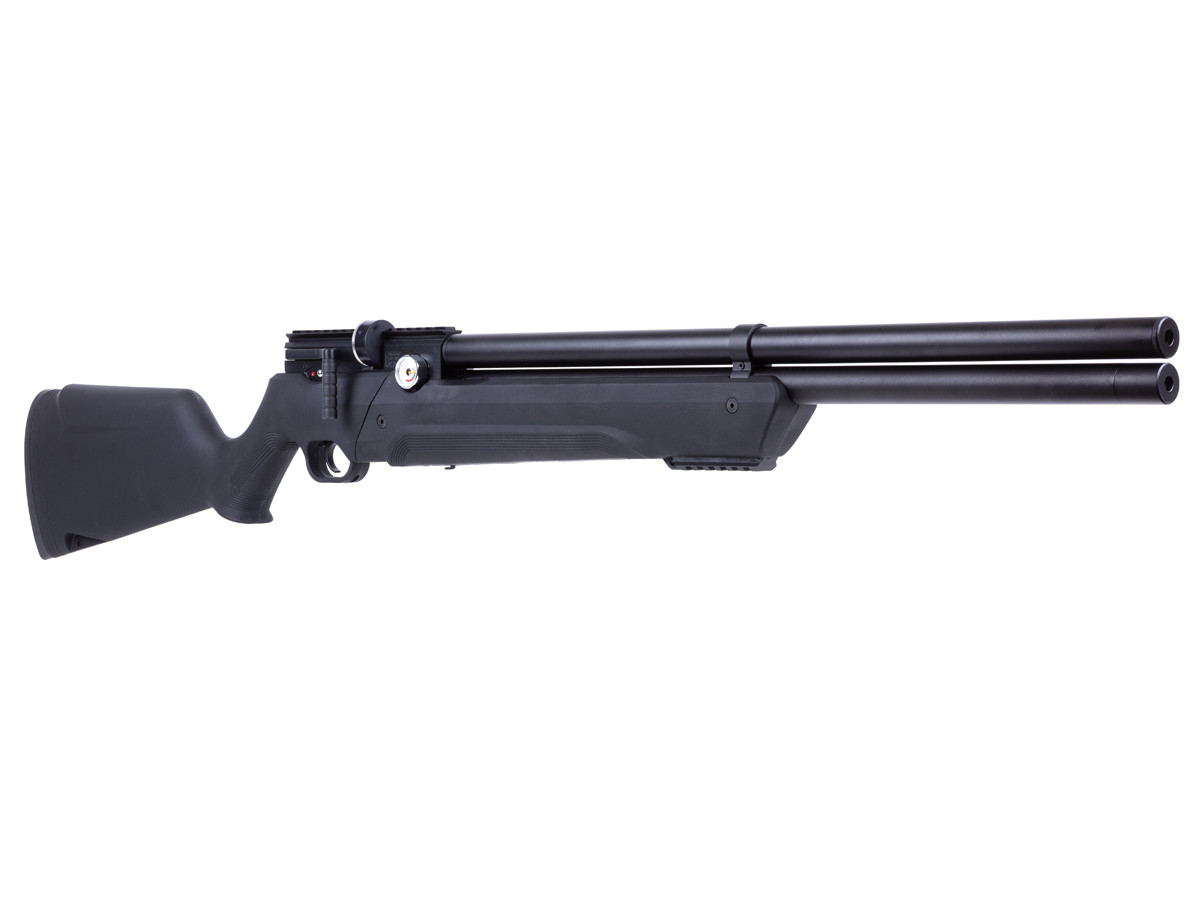
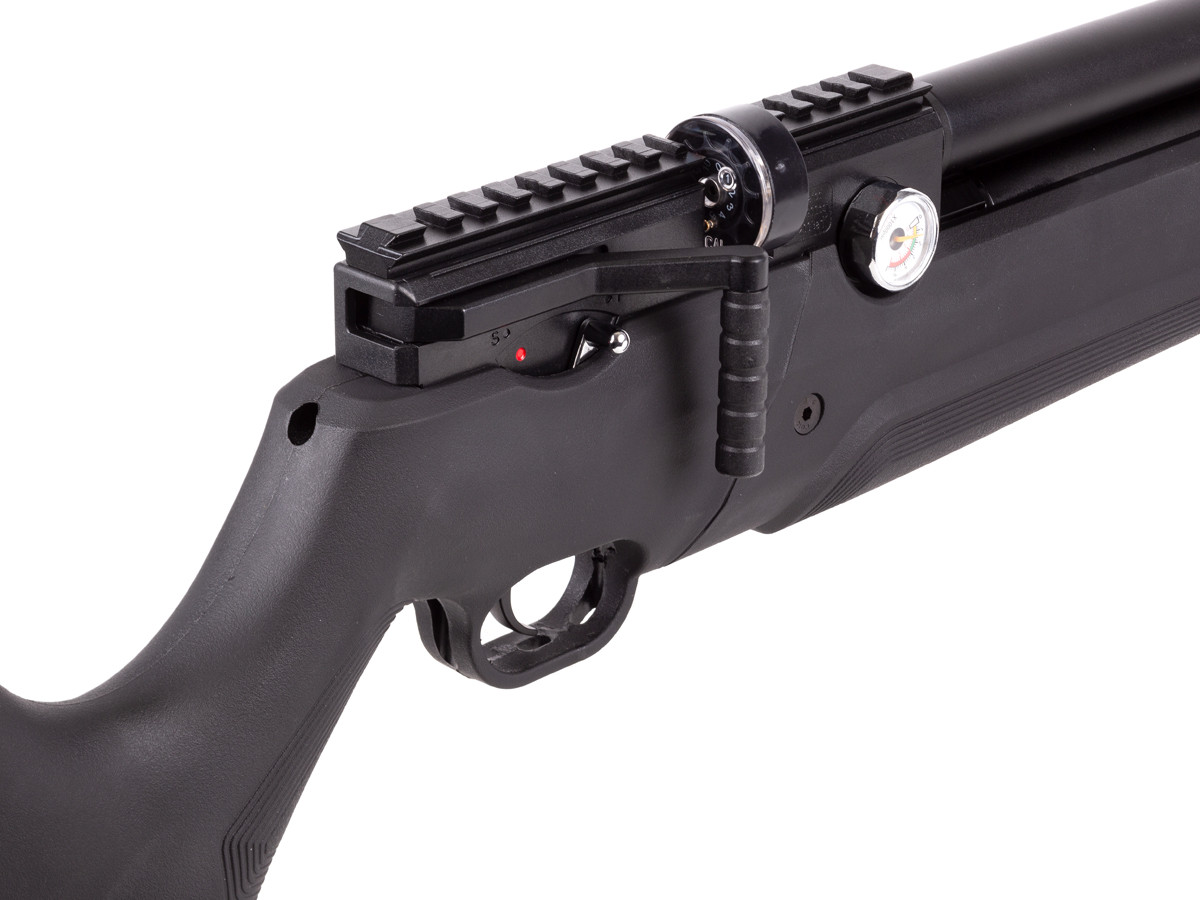
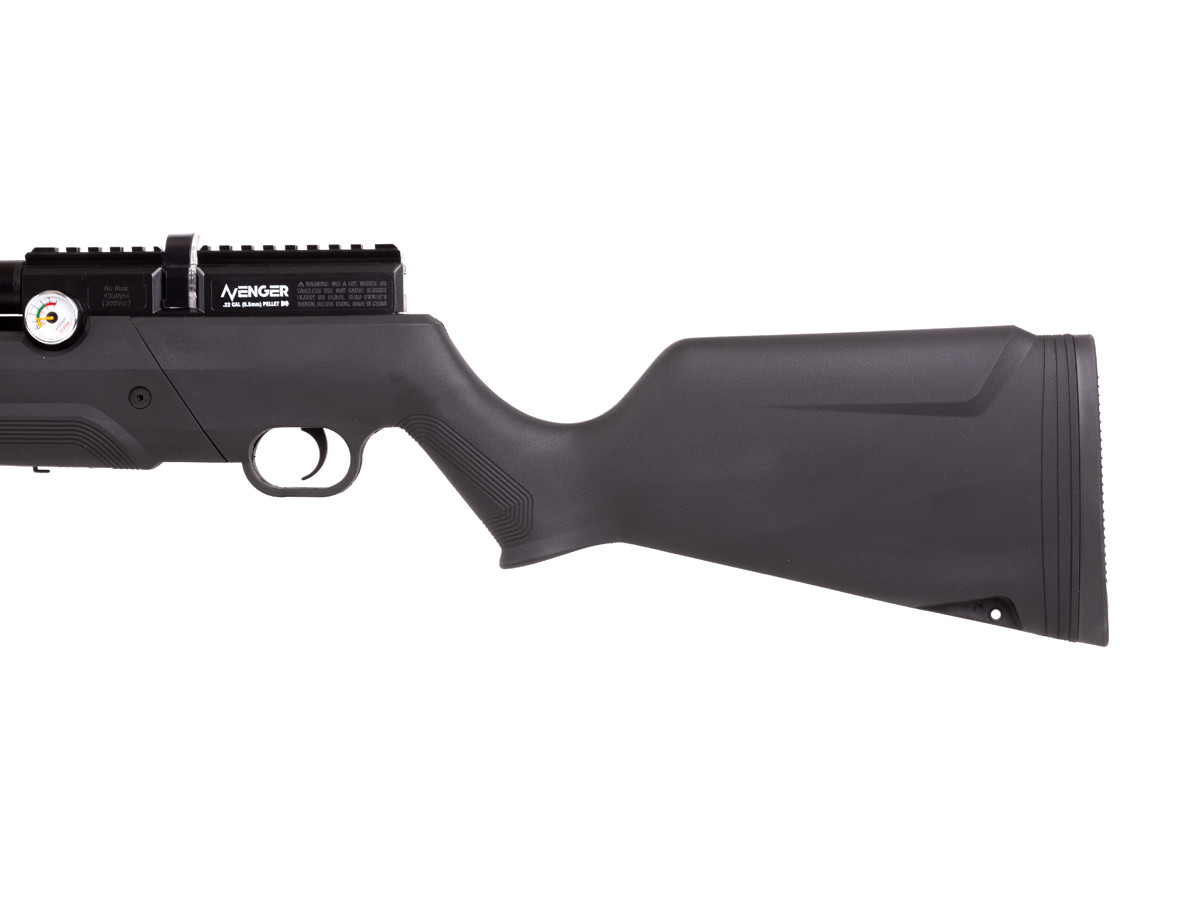
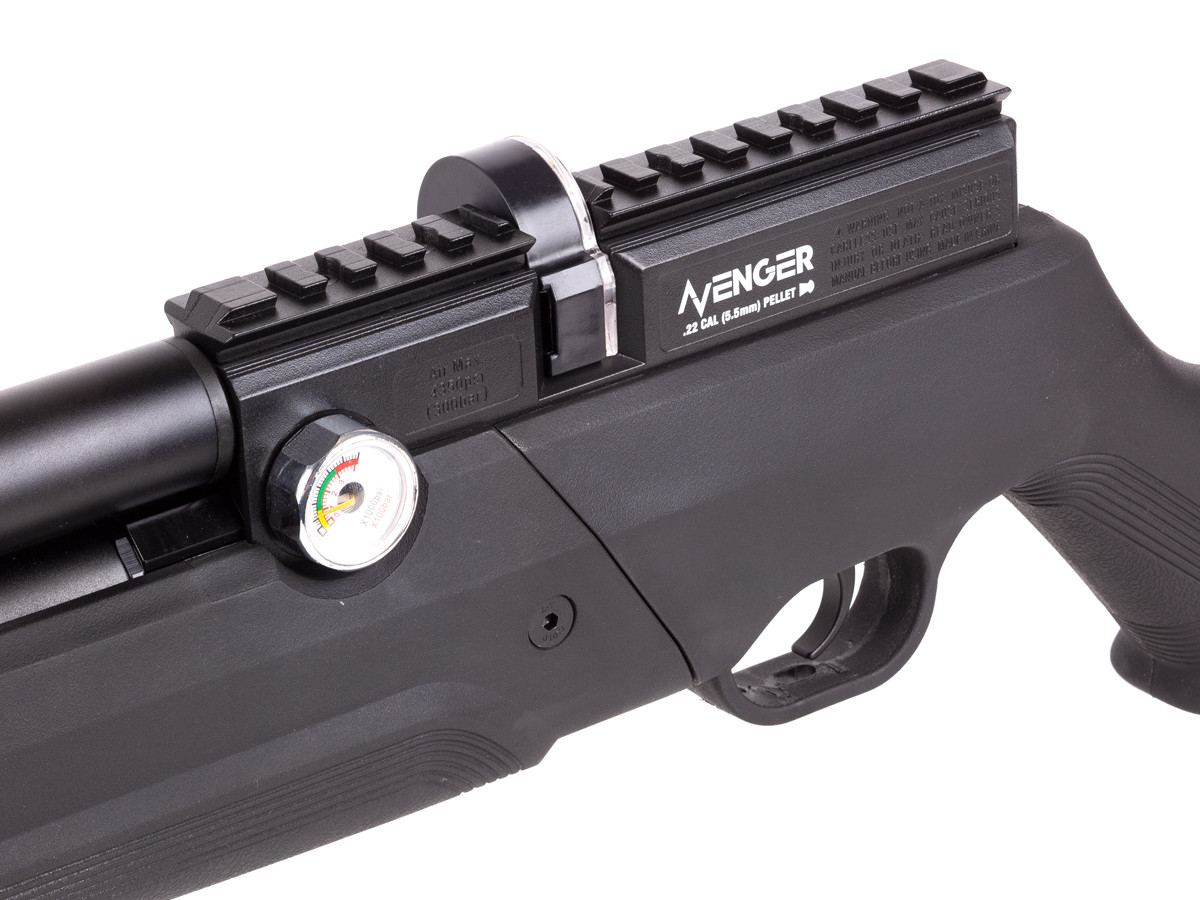
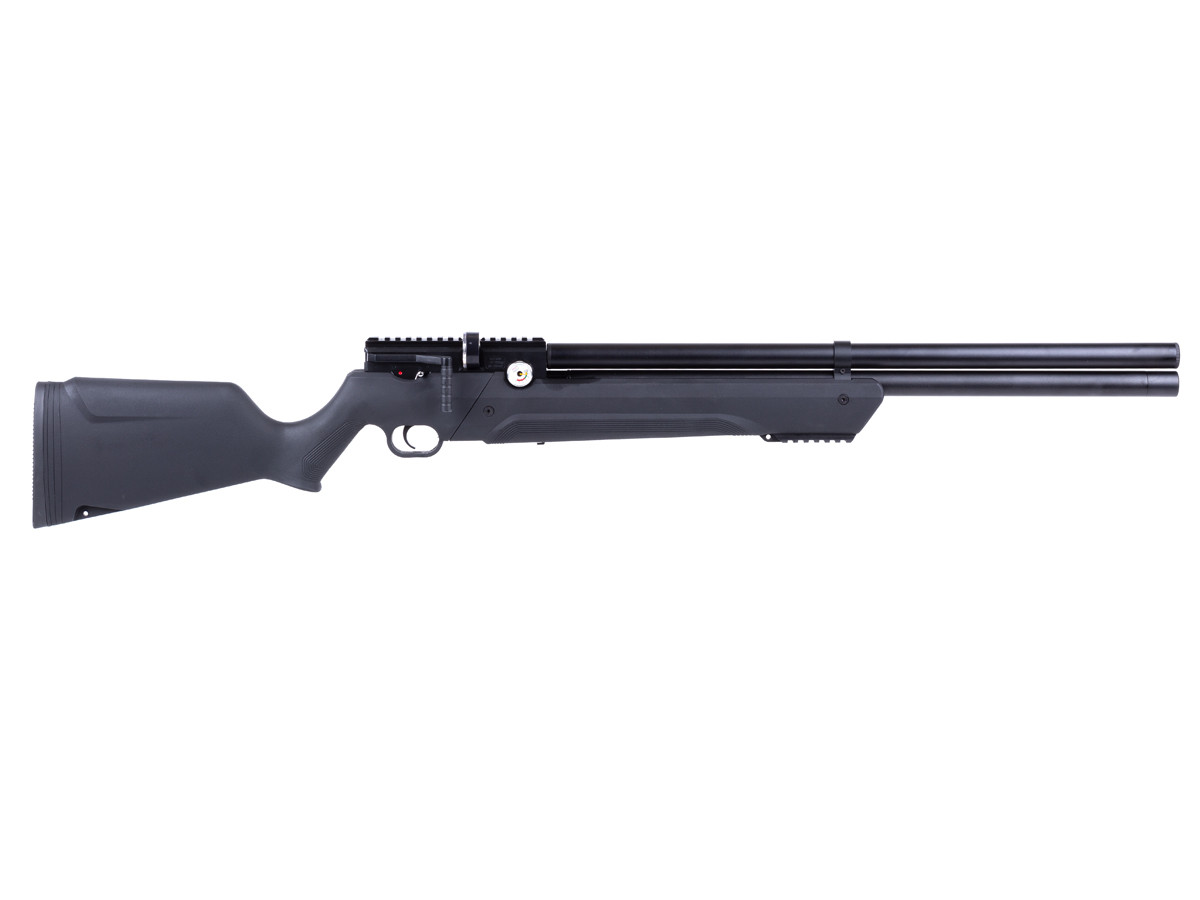
With high-end features at an entry-level price, the Avenger sets a new standard for similarly priced PCPs to live up to.
Featuring an externally adjustable regulator and externally adjustable hammer spring, the Avenger provides the user with a seemingly infinite amount of performance adjustability never seen at this price point.
A smooth side lever action allows for quick follow-up shots, and the fully shrouded barrel keeps your shooting quiet. Available in .177, .22 and .25 caliber.
Features
Pre-Charged Pneumatic
Sidelever Cocking
Synthetic Stock
Externally Adjustable Regulator (Up to 3,000 PSI / 210 BAR)
Easily accessible Hammer Spring Adjustment Screw
Two-Stage Adjustable Trigger
Max Fill Pressure: 4,351 PSI (300 BAR)
Fully Shrouded Barrel
Picatinny Rail on Fore-end of stock
Holes in front and rear of stock for mounting swivel studs for a sling
Dual Gauges – Reg Pressure (RH Side) and Fill Pressure (LH Side)
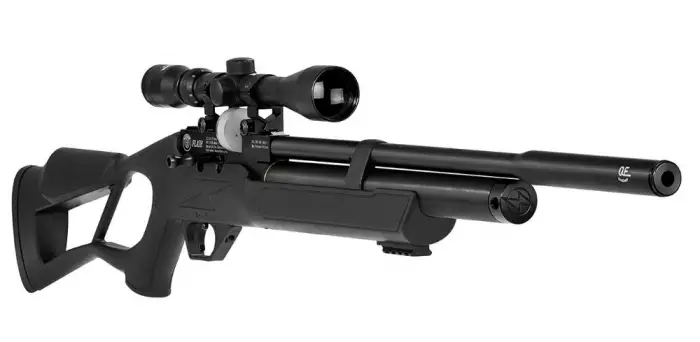
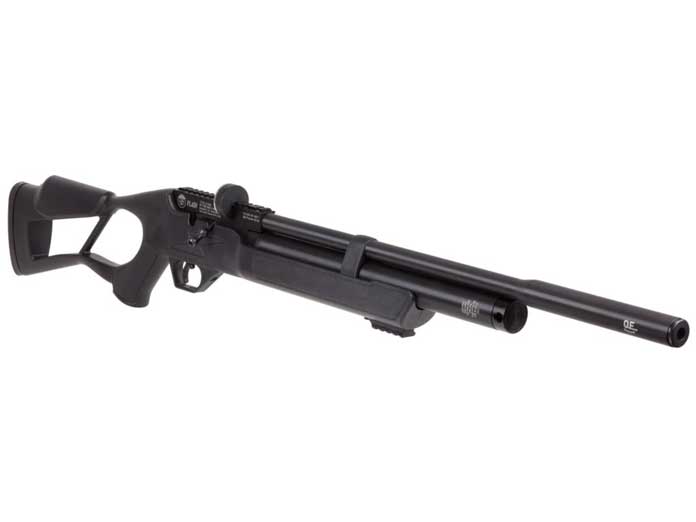
Its weight of 5.9 lbs is simply the best as you try your hand on PCP air rifles.
Even young shooters can handle this rifle with great prowess.
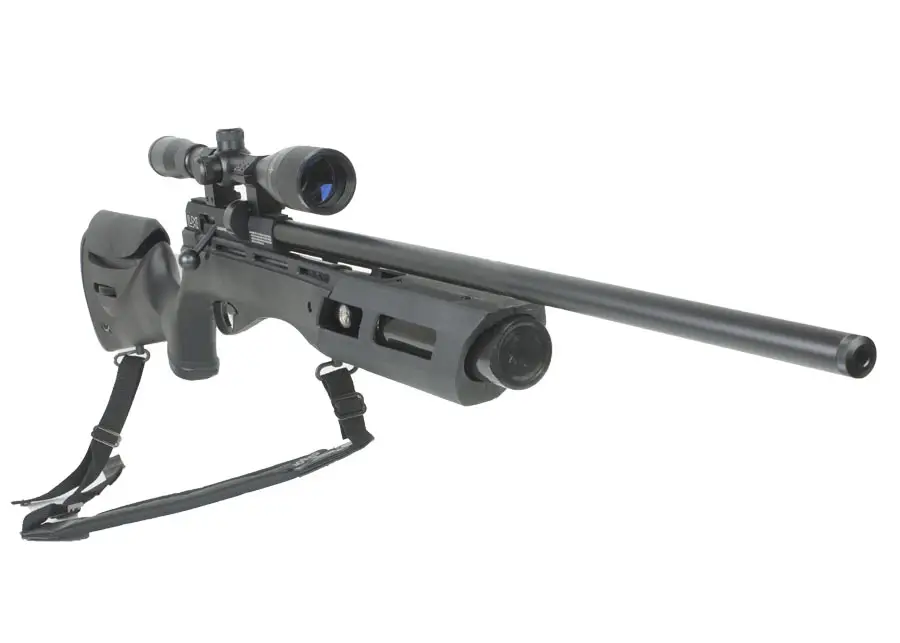
In addition to the lightweight, the Hatsan Flash features the popular Picatinny rail which allows you to mount the rifle on a bipod .
This will guarantee you much-needed stability when shooting.
Hatsan did not take any chances regarding the safety of the air rifle.
With the 2-stage Quattro trigger fitted on the Hatsan Flash, there are very little or no chances of misfiring the rifle.
Also of importance to the beginner is the Dovetail mount for fitting a compatible scope.
With this, you can easily master the basics of sighting and be the pro you desire within a few days of practice.
Accuracy
Calibers
Pellets
Distances
Groups
.22
JSB Match Diabolo Hades 15.89 Gr
45 yards
1/2"
.22
Air Arms Diabolo Field Heavy 18 Gr
30 yards
one hole
.22
JSB Diabolo Exact Jumbo Express 14.35 gr
50 yards
0.6"
.22
JSB Diabolo Exact Jumbo 15.89 Gr
25 yards
3/4"
.22
Beeman Crow Magnum 18.21 Gr
20 yards
0.317"
.22
JSB Diabolo Exact Jumbo Heavy 18.13 gr
40 yards
5/8"
.25
JSB Exact King Heavy 33.95 Gr
50 yards
quarter size
.22
JSB Exact Jumbo 15.89 gr
30 yards
dime size
.25
JSB Exact King Heavy 33.95 Gr
35 yards
0.9"
.25
H&N Baracuda Hunter 27.47 Gr
50 yards
quarter size
.22
H&N Baracuda 21.14 gr
10 yards
one hole
.25
JSB Match Diabolo Exact 25.39 gr
20 yards
one hole
.25
JSB Match Diabolo Exact 25.39 gr
37 yards
3/4"
.22
H&N Baracuda 21.14 gr
45 yards
1.15"
.22
Crosman Premier Domed 14.3 gr
45 yards
1"
.22
JSB Exact Jumbo Domed 15.89 gr
45 yards
5/8"
.25
JSB Exact King 25.39 Gr
50 yards
0.38"
.25
JSB Exact King Heavy MKII 33.95gr
50 yards
0.65"
.25
H&N Baracuda Hunter 27.47 gr
50 yards
0.78"
.25
JSB Exact King 25.39 Gr
100 yards
1.97"
Chrony tests
Calibers
Pellets
FPS
FPE
.25
JSB Match Diabolo Exact King 25.39 Gr
854
41.13
.22
Crosman Premier Hollow Point 14.3 Gr
960
29.27
.25
H&N Baracuda Hunter 27.47 Gr
815
40.53
.25
JSB Match Diabolo Exact King 25.39 Gr
837
39.51
.25
H&N Grizzle 31gr
763
40.08
.25
H&N Field Target Trophy 20.06 gr
877
34.27
.22
Crosman Premier 14.3 Gr
970
29.88
.22
JSB Diabolo Exact Jumbo 15.89 Gr
902
28.71
.177
Crosman Premier Ultra Magnum 10.5 gr
918
19.65
.177
JSB Exact Monster Diablo 13.43 gr
845
21.3
.25
H&N Baracuda Hunter 27.47gr
825
41.53
.25
JSB Exact King Heavy MKII 33.95gr
760
43.55
.177
JSB Exact Monster 13.4 Gr
820
20.01
.22
JSB Exact Jumbo Domed 15.89 gr
925
30.2
.25
JSB Exact King 25.39 Gr
691
26.93
.25
JSB Exact King Heavy MKII 33.95gr
627
29.64
.25
H&N Baracuda Hunter 27.47 gr
787
37.79
Coming to its power, the Hassan Flash will shoot pellets at a speed of 1250 fps for the .177 caliber, 1120 fps for the .22 caliber, and 900 fps for the .25 caliber.
In terms of muzzle energy, the air rifle manages up to 29, 38, and 40 FPE for the .177, .22, and .25 caliber respectively.
Such energy is enough to bring down the fox-sized games and other smaller games, including the rabbit, squirrel, raccoon, birds, and possum.
What’s more, this air rifle is relatively quiet, thanks to Hatsan’s QE
Suppression technology, so you won’t scare away every other animal before taking them out.
Fill the 165 cc air cylinder to a maximum of 2900 psi and you are good to go with this best starter PCP air rifle.
Features
Precharged Pneumatic
Bolt action
Skeletonized synthetic stock
QuietEnergy fully shrouded barrel
Includes 2 indexing magazines and single-shot tray
Includes quick-fill nozzle
Precision rifled and choked barrel
Anti-knock system prevents gas wastage when rifle is knocked or bounced
Combo Picatinny and 11mm dovetail rail
Quattro Trigger: 2-stage fully-adjustable match trigger
Fixed 165cc air cylinder, 200 BAR, 2,900 psi
Recommended uses:
Target shooting/plinking
Pest control/small game hunting: pigeons, starlings, grackles, squirrels, rabbits, raccoons, groundhogs, snakes, armadillos
Pros and Cons
Pros
Cons
Great entry level rifle
Lightweight and portable (6 lbs without rings and scope)
This is one of the best-rated PCP air rifles at $500.
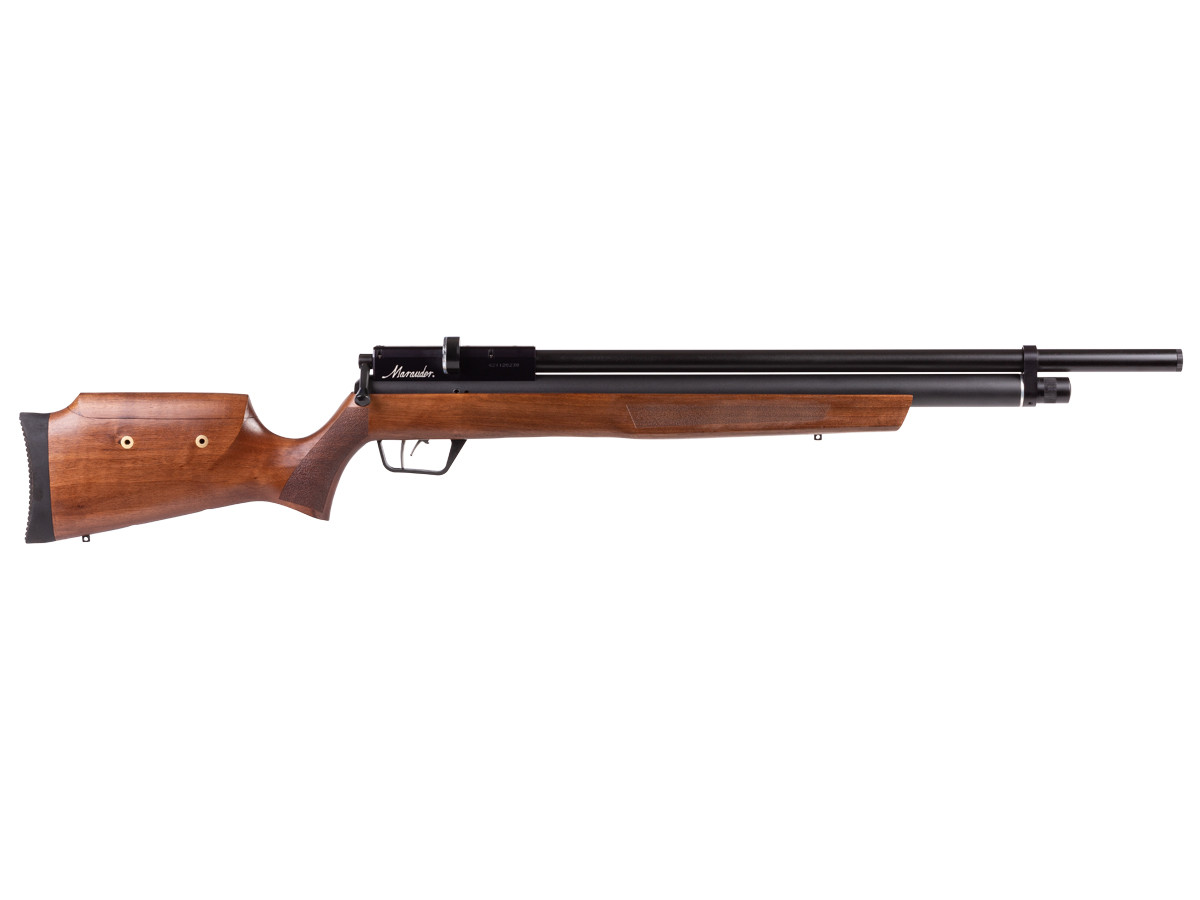
Features:
10-shot repeater with auto-indexing feature
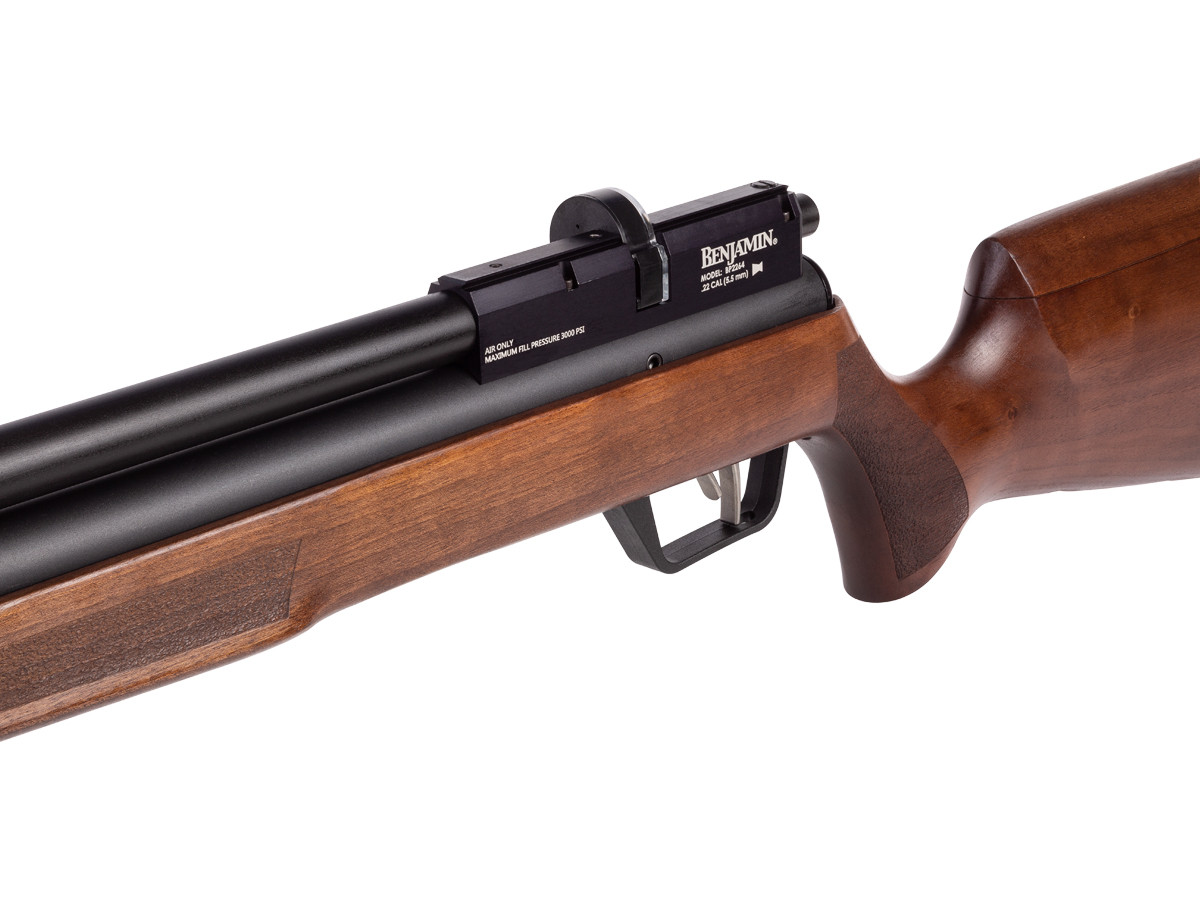
Uses compressed air: 2,000 to 3,000 psi (make adjustments as shown in the owner’s manual)
Can be adjusted for different velocities
Internal shroud makes this a VERY quiet gun
Choked barrel delivers superior accuracy
2-stage adjustable match trigger…and the trigger is metal!
Raised aluminum breech for easier loading of circular magazine
11mm dovetail on original/ Lothar Walther Barrels include a Weaver/Picatinny Rail
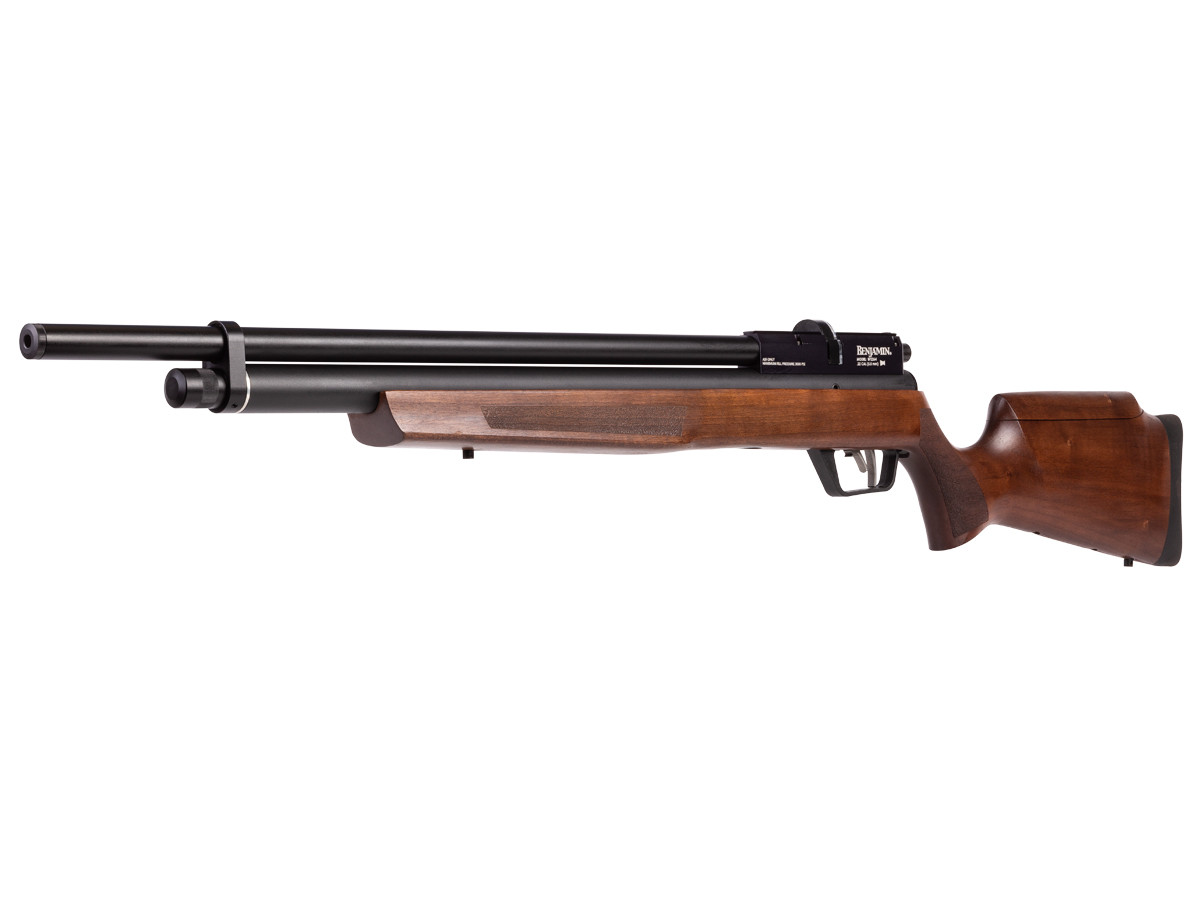
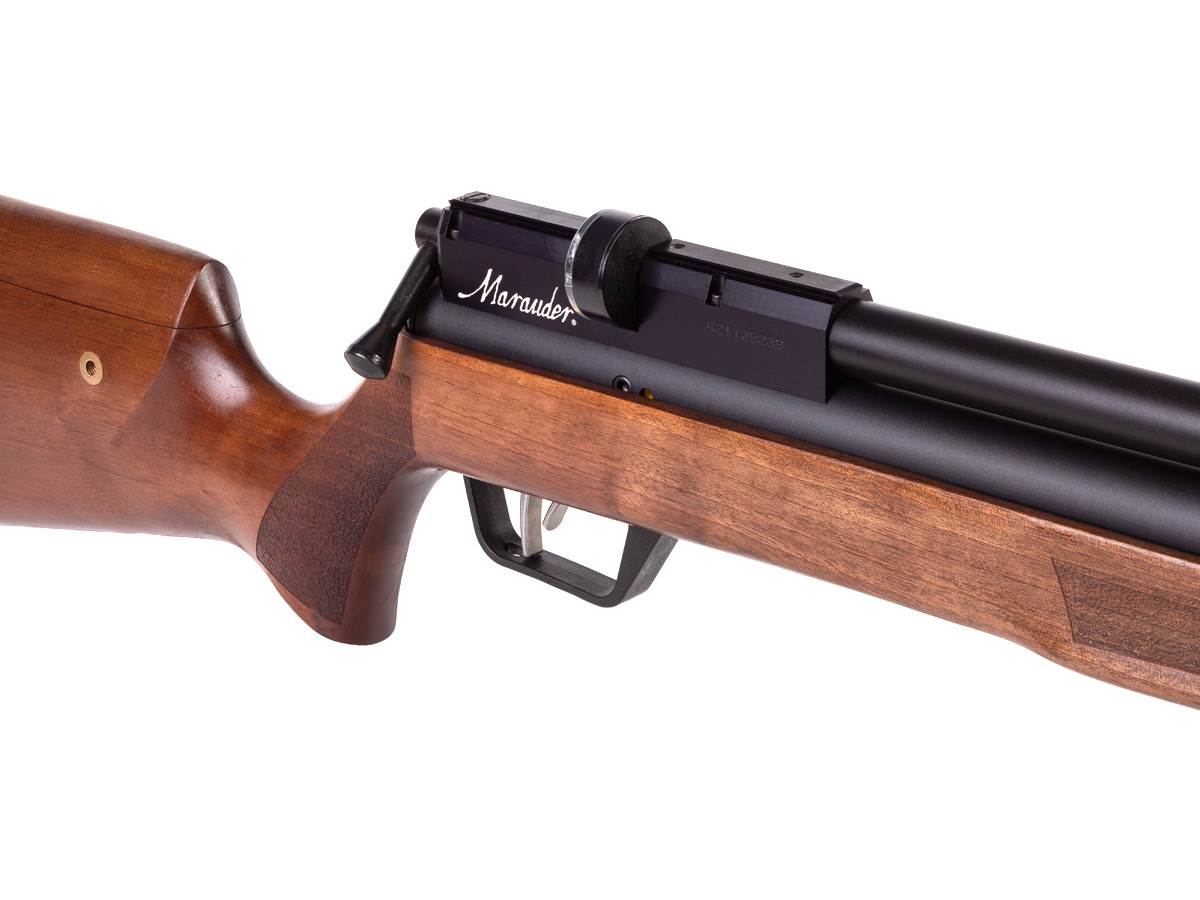
Turkish Walnut stock with adjustable comb
Reversible bolt — switch from right to left side (with our special service)
Built-in air pressure gauge (manometer)
215cc air reservoir
42.8″ long*
8.2 lbs.*
Air reservoir ends with a male quick-disconnect Foster fitting for fast refills (requires a female Foster quick-disconnect adapter to fill from a scuba tank or hand pump)
Includes one magazine and sling swivel studs
Recommended uses:
Target shooting/plinking
Pest control/small game hunting: squirrels, rabbits, crows, starlings, groundhogs, raccoons, tree rats.
6. Best regulated PCP air rifle: Umarex Gauntlet 2
It is worth pointing out that most PCP air rifles do not operate at the peak value of pressure of the gas tanks.
If the capacity of the gas tank is 3000 psi, the rifle may work best at around 2000 psi.
This means that the rifle will fire the first set of shots at varying velocities until the optimum pressure is reached.
With a regulated air rifle, the pressure of the reservoir is lowered before it gets to the valve.
This way, the air rifle works at the ideal pressure right after refill.
You can therefore fire shots at a relatively constant velocity.
The regulator also increases the capacity of the gas tank to some level.
This increases the number of shots you can fire before having to refill the gas tank.
Regulators can be added to PCP air rifles, but again not all of them.
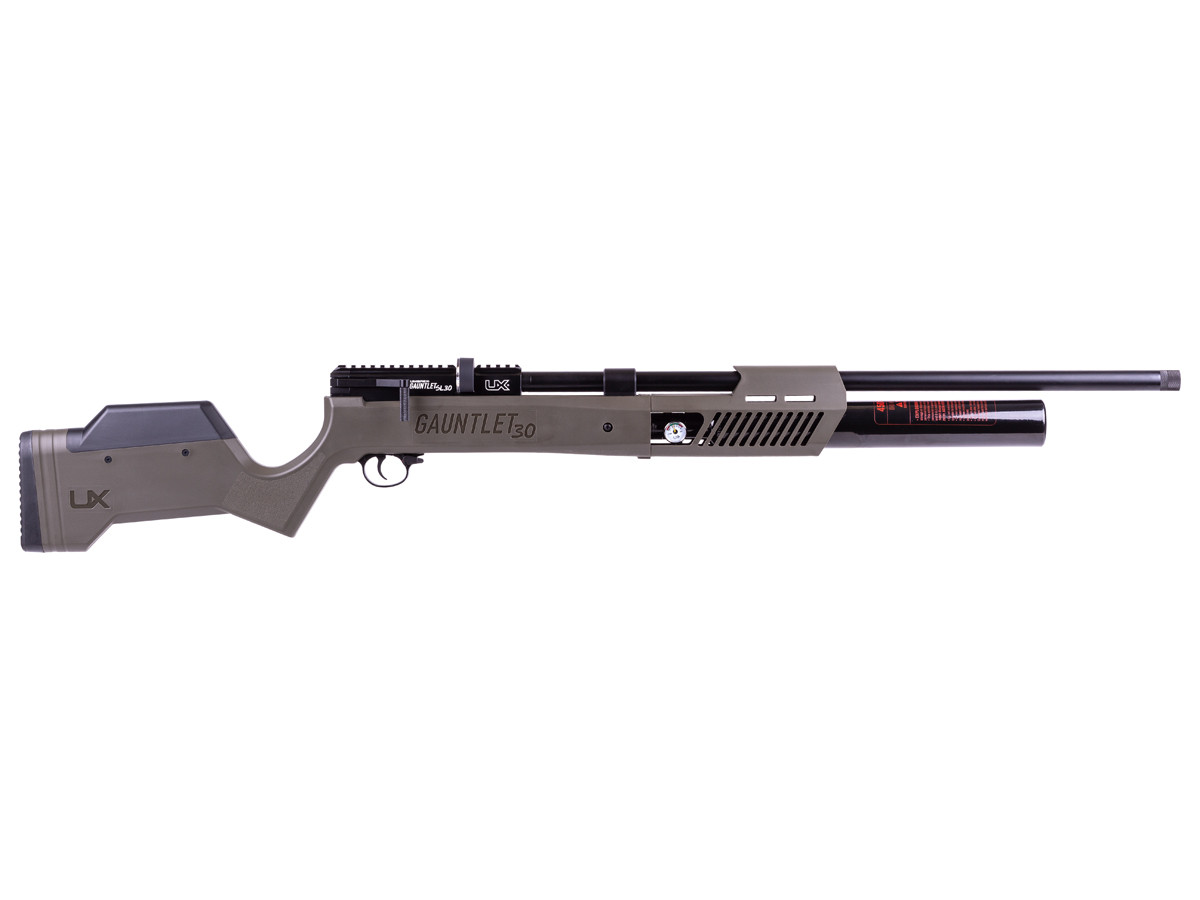
The Umarex Gauntlet 2 comes specifically regulated by the manufacturer.
The manufacturer once claimed that their Gauntlet model has similar capabilities to other rifles over $1000.
At a retail price of less than $300, you may doubt their claim, but let the features speak for themselves.
The 3000 psi capacity gas tank shoots up to 70 pellets in .177 caliber, and 60 shots for the .22 caliber.
Using the JSB Jumbo Exact 14.35 grain pellets, the Gauntlet air rifle achieves muzzle velocities of up to 807 fps, with an energy outcome of about 21 FPE.
This is certainly enough power in your hands for simple target shooting.
Lighter pellets can achieve speeds of up to 1000 fps, but with reduced energy.
Tests with the Umarex Gauntlet 2 reveal great accuracy up to 80 yards. Quite a great value for money.
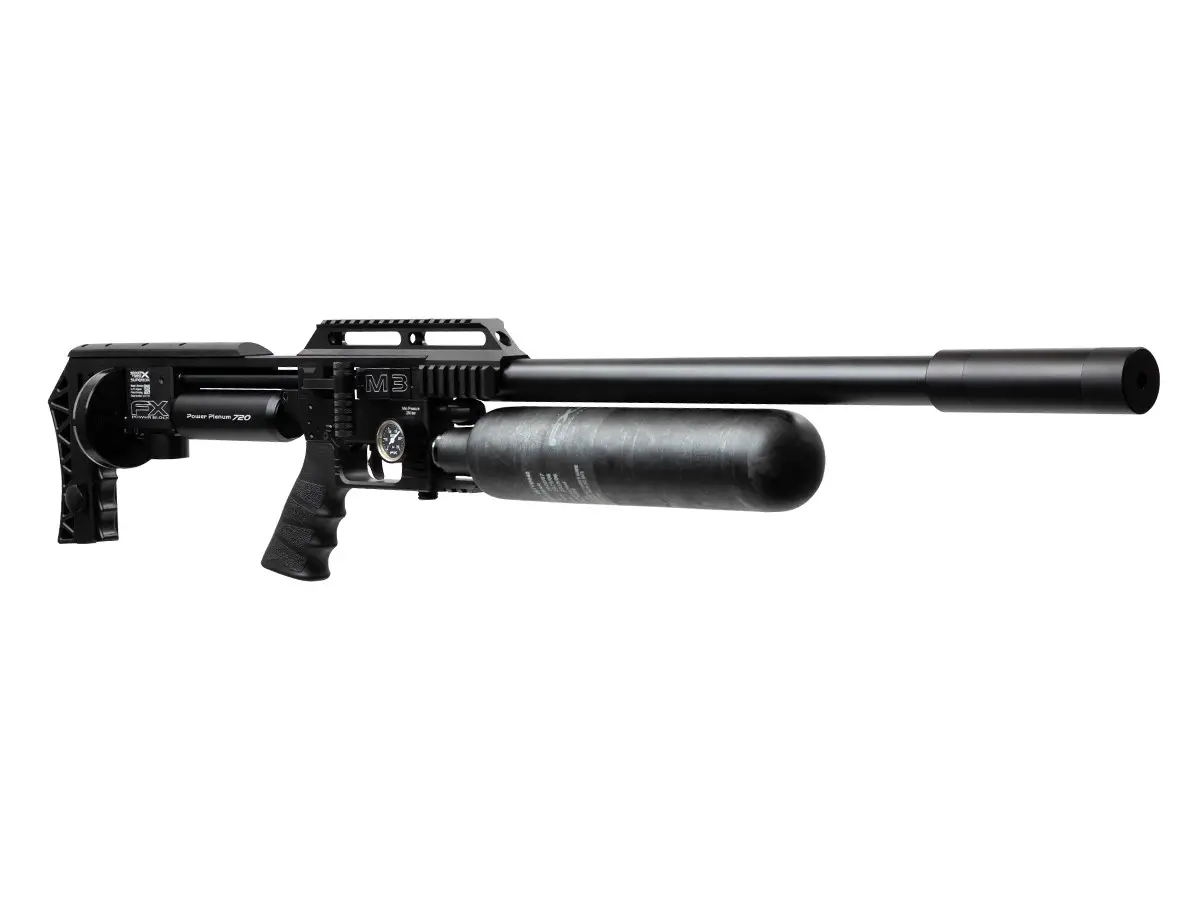
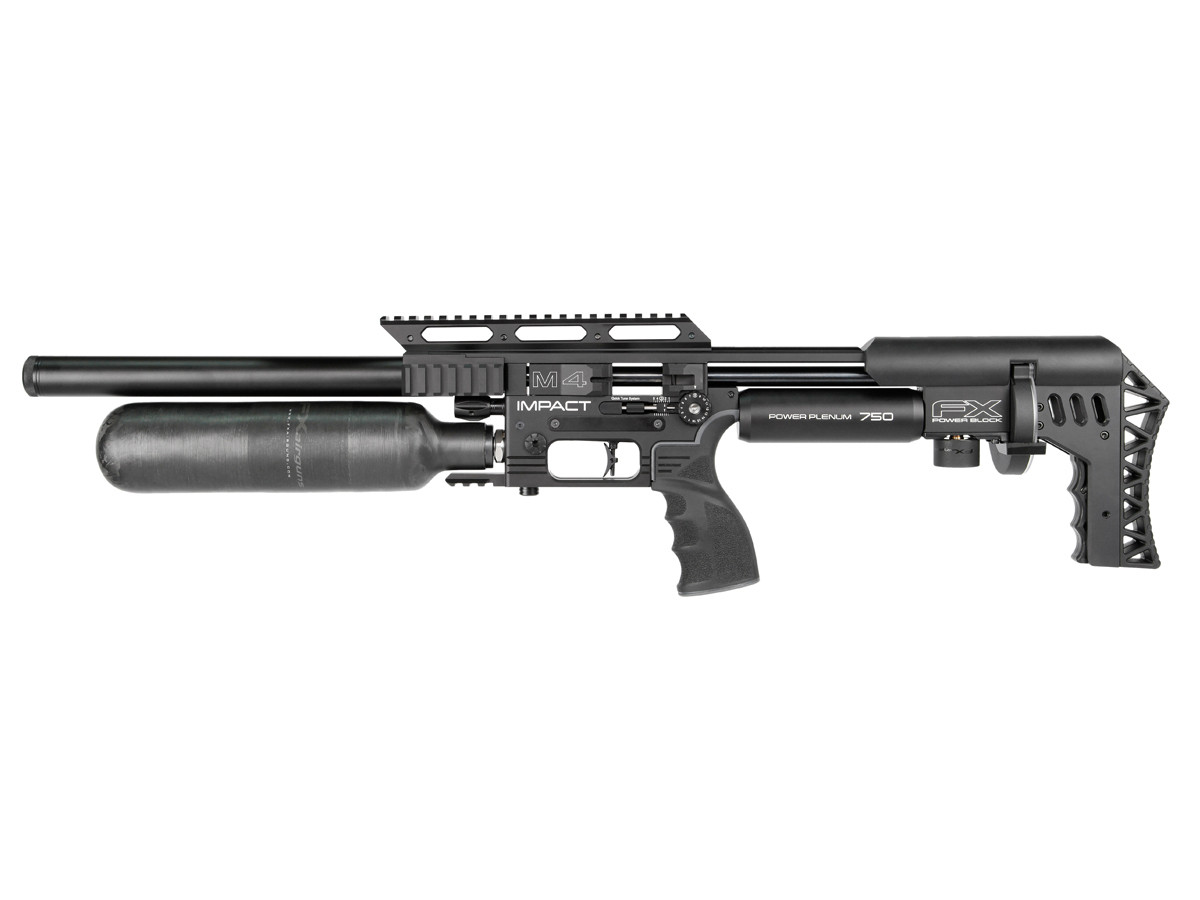
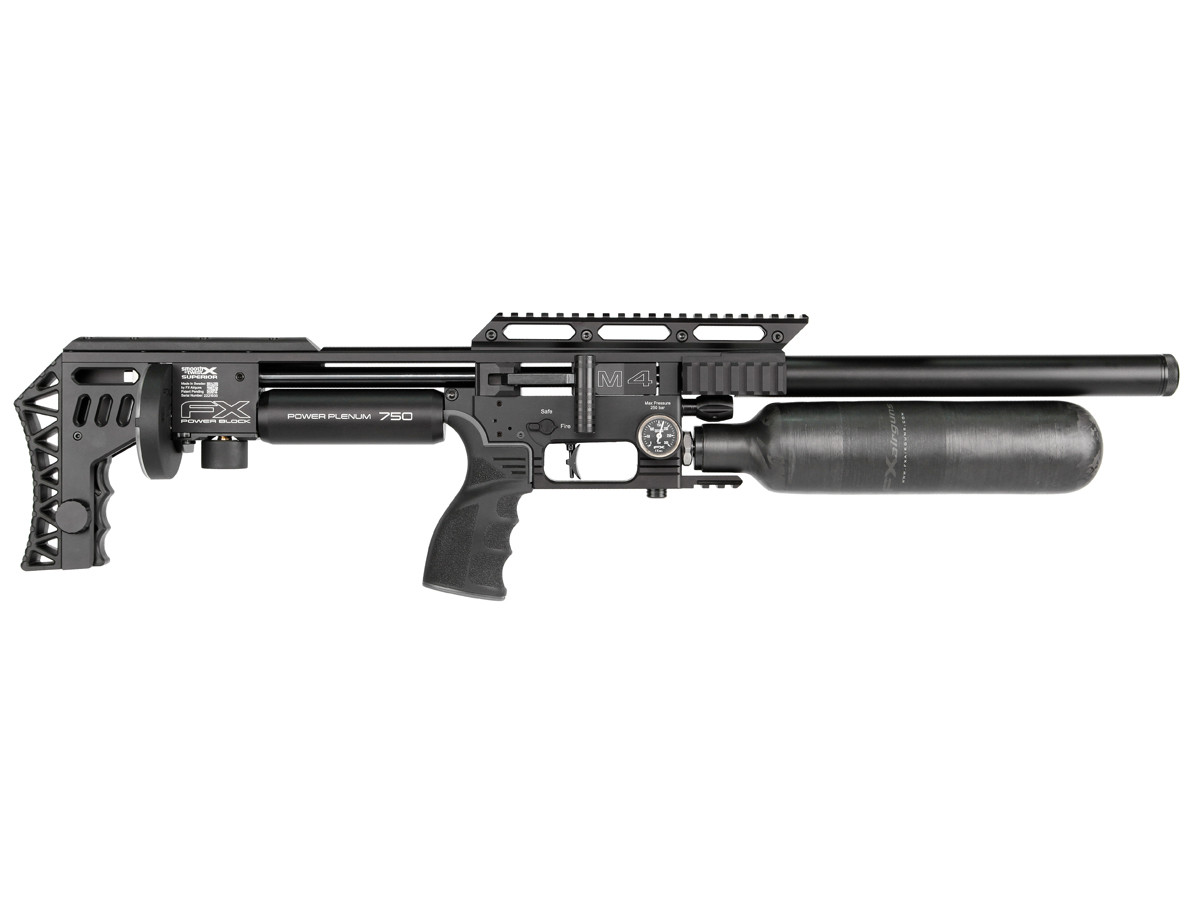
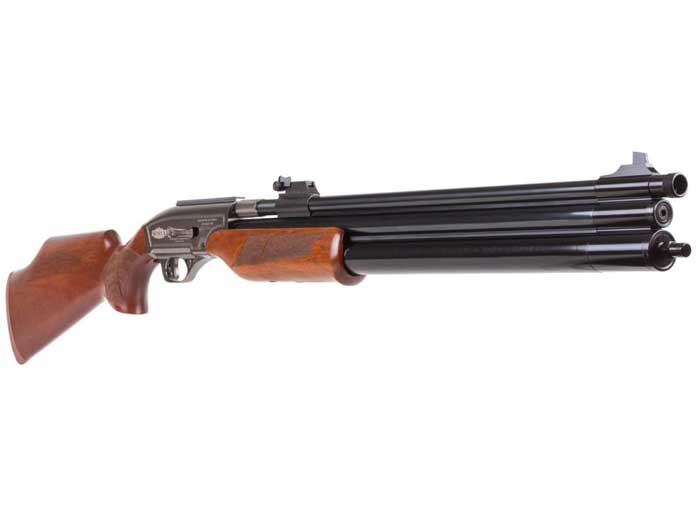
Introducing the FX Airguns Impact M4 PCP Air Rifle – a cutting-edge air gun manufactured by Swedish experts.
The Impact M4 breaks through industry boundaries, boasting unmatched precision and performance like no other.
Perfect for precision shooters or anyone looking to improve their rifle’s accuracy, the Impact M4 contains dual Adjustable Match Precision (AMP) regulators for effortless adjustment based on your shooting needs.
Its external micro- and macro-hammer spring tension adjustments allow you to customize the optimal setting for each round of shots you take.
For maximum control, try out the valve control adjustment system which is externally accessible so you can always monitor the internal pressure systems and make tweaks whenever needed.
Furthermore, the new FX Airguns Impact M4 PCP air rifle is the latest breakthrough in airgun technology.
The new dual regulator system pre-reduces air pressure, providing superior regulated power and consistency with fewer standard deviations from shot to shot – a must-have for any serious shooter.
In addition, the unique Power Plenum 720 offers an increased diameter and 72cc volume for efficient and powerful projectiles every time.
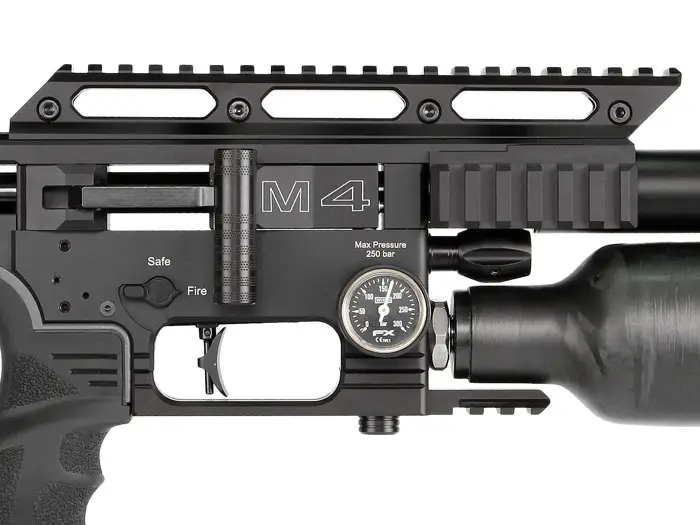
Combined with the rifle’s specially designed porting and valving system, the FX Airguns Impact M4 is perfect for precision performance in competition or out on the field. With its maximum output pressure of 250 bar, this top-of-the-line rifle ensures the accuracy you need when it matters most.
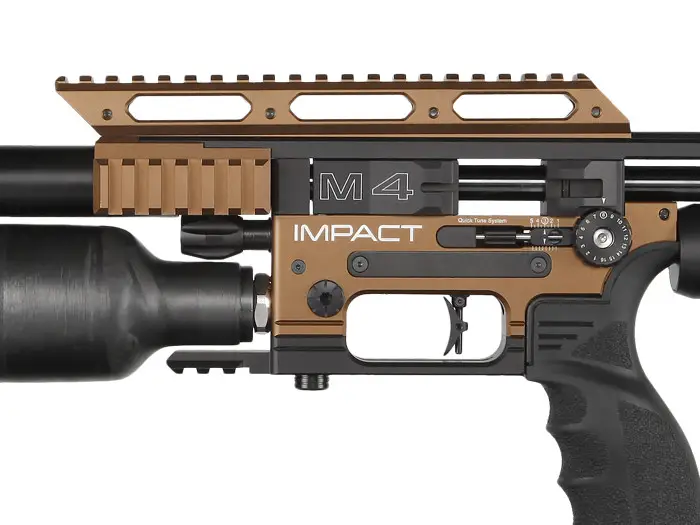
The FX Impact M4 comes in 5 different calibers available: .177, .22, .25, .30, .35 , with Black/Bronze colors.
Accuracy
Calibers
Pellets
Distances
Groups
.177
JSB Match Diabolo Exact 8.4 Gr
50 yards
3/4"
.30
Slugs 67 Gr
50 yards
3/4"
.30
Slugs 67 Gr
100 yards
1 1/2"
.30
JSB Match Diabolo Hades 44.75 gr
50 yards
.557"
.25
JSB King Heavy Mark II 33.95 gr
100 yards
1"
.30
Nielson Slug 47 gr.
50 yards
one hole
.22
JSB Diabolo Exact Jumbo Heavy 18.13 gr
50 yards
one hole
.30
JSB Diabolo Exact 50.15 Gr
60 yards
one hole
.25
JSB Match Diabolo Hades 26.54gr
35 yards
one hole
.35
JSB Match Diabolo Exact 81.02 Gr
100 yards
1"
.22
JSB Diabolo Exact Jumbo Heavy 18.13 gr
95 yards
3/4"
.177
NSA Slugs 12.5 gr
50 yards
nickel size
.22
JSB Match Diabolo Exact Jumbo Heavy 18.13gr
50 yards
dime size
.25
JSB Exact King 25.39gr
50 yards
3/4"
.22
JSB Exact Jumbo 15.89gr
50 yards
1/2"
.25
JSB Exact King Diabolo 25.39gr
50 yards
0.37"
.25
Air Arms Diabolo Field 25.4gr
50 yards
0.47"
.25
JSB Diabolo King Heavy MKII 33.95gr
50 yards
0.71"
.25
JSB Exact King Diabolo 25.39gr
100 yards
1.34"
.30
JSB Exact 44.75 gr
50 yards
0.557"
.177
NSA Slugs 12.5 gr
50 yards
Nickel-size
.25
JSB King Heavy Mark II 33.95 gr
100 yards
1.5"
.30
JTS Dead Center 45.06 gr
45 yards
5/8"
.30
FX Hybrid Slugs 44.5 gr
45 yards
5/8"
.30
H&N Slug HP II 50 gr
45 yards
3/4"
.30
Zan Projectile 45.5 gr
45 yards
3/8"
Chrony tests
Calibers
Pellets
FPS
FPE
.35
JSB Match Diabolo Exact 81.02 Gr
845
128.49
.30
JSB Match Diabolo Hades 44.75 gr
870
75.23
.177
JSB Exact Heavy 10.34g
900
18.6
.25
JSB Diabolo Exact King Heavy 33.95 gr
875
57.73
.35
JSB Match Diabolo Exact 81.02 Gr
915
150.66
.35
JSB Match Diabolo Exact 81.02 Gr
877
138.4
.22
JSB Diabolo Exact Jumbo Heavy 18.13 gr
940
35.58
.177
NSA 12.5 gr
977
26.5
.22
JSB Diabolo Exact Jumbo 15.89 gr
940
31.18
.22
JSB Jumbo Express 14.35gr
1003
32.06
.22
JSB Jumbo Heavies 18.13gr
863
29.99
.25
JSB Exact King 25.4 gr
893
44.99
.25
JSB King Heavies MKII 33.95gr
849
54.35
.30
JSB Exact 44.75 gr
829
68.31
.25
Air Arms Diabolo Field 25.4gr
938
49.64
.25
JSB Exact King Diabolo 25.39gr
907
46.39
.25
Air Arms Diabolo Field 25.4gr
897
45.39
.25
JSB Diabolo King Heavy MKII 33.95gr
816
50.21
.25
JSB Exact King 25.39 Gr
1100
68.23
.30
JSB Exact 44.75 gr
675
45.29
.177
NSA Slugs 12.5 gr
977
26.5
.25
JSB King Heavy Mark II 33.95
748
42.19
.22
JSB Exact Jumbo Diablo 15.89 gr
940
31.18
.30
Zan Projectile 45.5 gr
813
66.8
Recommended uses:
Pest control and Small/medium/large game hunting: coyotes, iguanas, groundhogs, rabbits, squirrels, gooses, woodchucks, prairie dogs.
Texas is a state in the South Central region of the United States. It’s the second-largest state based on both area and population and is often called “The Lone Star State”.
When it comes to hunting, it’s not hard to find accounts of award-winning large-antlered whitetail deer and record-setting wild pigs in the Lone Star State. The phrase “everything’s bigger in Texas” seems to hold true even to their game animals.
Other huntable game species include alligators, javelinas, mule deer, pronghorn, squirrels, turkeys, waterfowl, and upland birds, especially quail. You can also find hunting opportunities for more exotic game species being offered in some of the state’s fine hunting ranches.
Big Hunts in the Lone Star State
With so many fine hunting opportunities abound, finding quality hunting opportunities in Texas can be difficult. Read through this article to find our suggestions for the best places to hunt in Texas, what game you can expect, and who you can contact for guides hunts and hunting opportunities.
1. San Angelo: Whitetail Deer
The City of San Angelo is the county seat for Tom Green County, Texas. The city, and its territory, cover an area of about 59 square miles and is located in the Concho Valley with an elevation of 1,844 feet.
When it comes to the city’s climate, San Angelo has hot and cold seasons. Its hot season lasts from May to September and can see average temperatures of up to 95 °F in July. Its cold season lasts from November to February when cooler temperatures go down to an average of 36 °F in January.
Whitetail deer is the main big game animal around San Angelo. To score some choice animals, you can contact Bar None Hunts. This company offers accommodations and guided hunts on over 50,000 acres of West Texas whitetail habitat.
2. Menard: Deer, Hog, Turkey, and More
Menard County is located on the Edwards Plateau in Texas. Covering a total area of 902 square miles, the county’s highest point sits at 2,432 feet of elevation.
The county gets just 26 inches of rain (compared to the US average of 36 inches) and only 1 inch of snow (compared to the US average of 28 inches) per year. Temperatures can go up to 93 °F in July and dip down to 31 °F in January.
Menard County has a variety of huntable game species including hog, turkey, and deer. Real Outfitters offers hunting opportunities for the above-mentioned animals plus a chance to hunt more exotic game like Blackbuck Antelope.
3. Coleman: Dove, Quail, Deer, and More
Coleman is another county located in the state of Texas. It covers a total area of 1,281 square miles, with its highest point standing at 1,702 feet of elevation. The county was named after Robert M. Coleman, a signer of the Texas Declaration of Independence and soldier at the Battle of San Jacinto.
Summer is hot and humid in Coleman county while winters are windy, short, and cold. Temperatures usually fall between 35 °F to 97 °F and are rarely below 23 °F or above 103 °F.
Coleman is known for its big game like whitetail deer and hog but you can also find smaller game like dove, quail, duck, and spring turkey. First Shot Hunts offers lodging and opportunities to hunt the above-mentioned animals. The company operates on over 600,000 acres of prime hunting land throughout Central Texas.
4. Lubbock: Goose, Crane, Deer, Hog, and More
Lubbock is a city in the Estacado region of northwestern Texas. The city is ecologically part of the southern end of the High Plains subregion and sits at an elevation of about 3,200 feet.
The city and the areas surrounding it have a cool semi-arid climate. The area receives around 18 inches of rain and around 7 inches of snow per year.
Crooked Wing Outfitters offers some of the finest hunting in all of West Texas. This company offers lodging as well as hunting opportunities for several game species including hog, deer, turkey, waterfowl, pheasant, quail, dove, duck, crane, and goose.
5. Ingram: Deer, Sheep, Antelope, and A Whole Lot More
The city of Ingram lies in Kerr County, Texas. Nestled in the geographic region known as Texas Hill Country, the city sits at an elevation of about 1,700 feet.
Ingram receives about 31 inches of rain and just 1 inch of snow per year. The hottest days are in July with temperatures going up to 92 °F while winter temperatures can dip down to 33 °F in January.
The city of Ingram is where you can find Texas Hunt Lodge. This award-winning company offers accommodations and hunts for over 80 game species year-round. Feel free to check out their site for more information.
6. Quanah: Deer, Turkey, Quail, and Hog
The city of Quanah is the county seat of Hardeman County, Texas. It covers an area of just 3.48 square miles and sits at an elevation of about 1,500 feet.
Quanah summers are mostly clear, hot, and humid while its winters are partly cloudy, windy, dry, and cold. Temperatures usually fall between 31 °F to 98 °F and are rarely below 20 °F or above 105 °F.
For opportunities to hunt deer, hog, turkey, and quail in Quanah, you can contact Red River Valley Outfitters. This company specializes in hunting the above-mentioned animals on 10,000 acres of land. They also added hunting opportunities for duck, goose, and Sandhill crane.
7. Eldorado: Deer, Elk, and Much More
The city of Eldorado is the county seat of Schleicher County, Texas. The city covers an area of about 1.4 square miles and sits at an elevation of about 2,400 feet.
Eldorado gets about 24 inches of rain and just 1 inch of snow per year. Temperatures can go up to 93 °F in July and drop down to 30 °F in January.
If you’re looking to hunt the native Texas game and more, you can contact Magnum Guide Service LLC. This company offers full-time guided hunts for Texas whitetail deer, mule deer, and elk as well as more exotic game like kudu, sable, and wildebeest.
8. Brady: Whitetail, Blackbuck Antelope, Oryx, & Much More
Brady is a city located in McCulloch County near the very heart of Texas. This small yet self-sufficient city sits at the outermost edge of Texas Hill Country at an elevation of about 1,600 feet.
The area experiences hot humid summers and mild to cool winters. Temperatures in July can go up to 94 °F and dip down to around 32 °F in January.
For opportunities to hunt whitetail deer and more exotic game, feel free to contact Cross Oaks Ranch. This company is located just outside Brady and offers lodging as well as guided hunts for whitetail deer, Blackbuck Antelope, Oryx, and more.
9. Austin: Deer, Hogs, Turkey, and More
Austin is the capital city of the state of Texas. It’s situated where the Colorado River crosses the Balcones Escarpment, separating the Texas Hill Country from the Blackland prairies.
The city has a humid subtropical climate which gives it long hot summers and short mild winters. Temperatures usually fall between 43 °F to 97 °F and are rarely below 30 °F or above 102 °F.
There are many fine hunting outfitters in Austin, Texas and Sisco D Ranch is one of them. This company offers lodging and hunting opportunities for whitetail deer, hogs, turkey as well as more exotic game like aoudad, Blackbuck, and fallow deer.
10. Mountain Home: Deer, Hogs, Aoudad, & Much More
Mountain Home is an unincorporated community in Kerr County, Texas and one of my favorite Texas hunting locations. Being located in Texas Hill Country, Mountain Home sits at an elevation of about 1,900 feet.
Mountain Home gets just 29 inches of rain a year. Temperatures can go up to 91 °F in July and drop down to 32 °F in January.
Being on the Edwards Plateau, Mountain Home is a prime habitat for whitetail deer, hogs, and turkey.
West Kerr Ranch offers lodging and guided hunts for the above-mentioned animals as well as year-round hunts for more exotic game like:
Axis
Fallow
Aoudad
Elk
Blackbuck Antelope
Sika
Aoudad
Scimitar-Horned Oryx
Mouflon rams
More Adventure Related Reading:
10 Best Places for Hunting in Montana
10 Best Places For Hunting In North America
10 Tips for How to Protect Yourself from Mosquitoes & Ticks While Hiking
An Adventurers Top 20 Essential Travel Items
Backpacking Meal Planning 101
Like This Article On The Best Places to Hunt in Texas?
I am a new shotgun enthusiast from the R3 era – Recruitment, Retention, and Reactivation.
I do not come from a family of outdoorsy people or firearm owners. Exposures and accessibility to equipment were rough getting started. Had it not been for the mentors and friendships during my process, I am not sure my love and respect for conservation and hunting would have developed.
After a few seasons of sporting clays and falling in love with upland hunting, I took an interest in learning how to hunt waterfowl. I did not know what was needed to attempt it. I thought I needed a well-trained dog and to master waterfowl calls, but all I needed was a 2 a.m. alarm and a reliable shotgun that suited my frame. When I started hunting waterfowl, I owned one 12-gauge shotgun mainly used for sporting clay.
I am not sure when waterfowl hunting became an obsession, but I was soon in a blind for more than four days a month. I felt my activity level was enough to justify needing an additional shotgun just in case mine malfunctioned. The problem was that shotguns are unavailable in my area to try before you invest in a new one. I made it a personal mission to try out different shotguns and determine my fit, ergonomics, and price range. My first shotgun was on a lucky sale, it was not a perfect fit, but I adjusted to it. After some trial and error, I learned that the feel and fit of a shotgun contributes to successful shooting.
As my hunting adventures increased in frequency, so did my observation of my hunting environment and the desire to blend more in the open. My hunting buddies had “upgraded” to camo-finished stocked shotguns, leaving me with camo envy. Having heard, “ducks do not care what color your gun is,” did not reduce the desire for a camo-clad shotgun.
Luck would have it that I was invited to review a Franchi Affinity 3.5 Waterfowl Elite. Now, the kicker was that I had not shot a Franchi at this point in my outdoor life. It never crossed my mind to consider one, and nobody within my circle owned one. I was set on a specific brand, and honestly, I was a little aloof about the Franchi. My only request was that it had a 28-inch barrel length, 12 gauge, and capable of loading 3 ½ inch shotshells. The 3 ½ inch, non-toxic, #2 shot shotshells were much easier to come by during my region’s 2021-2022 season. I was determined that the next shotgun I purchased would be able to handle 3 ½-inch shells in case that was all I could get.
The Franchi Affinity 3.5 Waterfowl Elite was shipped to me. It arrived a few weeks before I was heading out for my second attempt at a snow goose hunt. The day I picked up the Franchi, a new found excitement was activated. When I opened the box and saw that it sported the perfect camo pattern for the environment and surrounding areas I hunt
I sent out a group text letting the ladies of my sporting clay league and waterfowl hunting circles know I had a new shotgun to demo. I invited them for a clay date to try it too. I was shocked at how well I handled a 50-target run of sporting clays before sharing it with multiple ladies and a few guys.
I had a few weeks to prepare for my snow goose hunt, so it gave me ample time to practice and become intimate with the Franchi Affinity 3.5 Waterfowl Elite. Next, I purchased some inexpensive 3 ½ inch turkey loads to do an ill-advised “mag dump.” I was told by numerous seasoned wing and clay shooters that it had to be the craziest idea I have ever expressed out loud.
They wanted proof that I went through with it. Bets were placed on my shoulder being bruised, and me complaining about aches and pains for a few days. I had one witness that recorded my shenanigans, and we posted it on my social media. Next, I shared a picture of my comfortable, non-bruised shoulder. I was shocked at how soft the recoil felt with those turkey loads. I felt so confident with the Franchi Affinity 3.5 Waterfowl Elite in hand that if snow geese flew overhead, I would land a few. The Franchi was balanced and reduced felt recoil. If I could not shoot ten 3 ½ inch shotshells consecutively without discomfort, I would have needed to rush-order 2 ¾-inch shells.
Snow Goose Revenge
The previous season, only one goose showed up. My entire hunting squad was taking a stretch break at the time, and none of us could take a safe shot at the solo goose. This season, I was prepared with a camo shotgun that broke many clays. With a snack-packed blind bag filled with 12-gauge, 3 1/2 inch shells with BBB shot, I was determined to come home with a full cooler.
What a memorable weekend! With the Franchi Affinity 3.5 Waterfowl Elite, I had my first successful snow goose hunt. My hunting squad harvested 32 snow geese in total within a few hours.
Maintenance
I needed to tackle cleaning the shotgun. It hunted hard in extremely cold temperatures and muddy, wet, dusty environments. I surface wiped it and bore snaked after every other shoot, but after my snow goose hunt, it was time for a deep clean and inspection. It was a little different than the shotguns I had cleaned. However, it was not difficult to figure out how to remove the forward grip and disassemble and reassemble the components quickly.
I Need One
At the time of my initial review, this shotgun made my potential wish list. Not the I WANT list, but the I NEED list for a dedicated waterfowl gun. The managed recoil, handling, ergonomic structure, and weight worked in my favor. The price point is fair and economically feasible compared to others.
I am still new to the world of hunting, yet I am immersed enough to understand what I need, why I need it, and how much I want to invest in a product. I want reliable, generational products, but I also do not want to spend an ample amount of money this early in my hunting journey or spend a ton of money on a firearm that I have not been able to try out before buying it. This shotgun proved to me that it would be a great dedicated waterfowl gun to add to my staple gear pieces.
Franchi Affinity 3.5 Waterfowl Elite
I received the Franchi Affinity 3.5 Waterfowl Elite with the Gore Optifade Waterfowl Marsh Stock finish and a Burnt Bronze Cerakote barrel finish. The MSRP is $1449.00, and retail chains average roughly $1249.99. Here are the features you will have right out of the box:
Optional Gore Optifade choice of Waterfowl Marsh or Waterfowl Timber stock finish
Weighs 7 lbs
TruGlo Dual Color Fiber optics
Standard 28″ inch barrel
Franchi Affinity Waterfowl 12 gauge Trulock choke tube set
Do you know what terrifies me more than any other violent encounter?
A knife fight.
Knives may look simple, but they’re not to be underestimated.
I heard someone once say the loser of a knife fight leaves in a hearse, and the winner goes in an ambulance.
It seems, in general, a knife fight is over before it ever starts.
Knife fights…they’ve been happening for awhile. (Streit beim Kartenspiel by Jan Steen)
It’s a terrifying proposition to find yourself in any violent situation. But, as Americans, we carry firearms to bridge the gap and protect ourselves against violent attacks.
However, sometimes we can’t have a gun…or a gun might not be the best choice…or maybe the attack happened so fast you can’t access your firearm.
That is where a knife comes into play.
Is it likely you’ll ever use your knife in a self-defense situation?
No, not very likely.
It’s also not statistically likely you’ll use your firearm or tourniquet.
May not ever use one of these in a self-defense situation, but that doesn’t mean you don’t pack one just in case.
But that doesn’t mean you shouldn’t be prepared to defend yourself with anything on hand.
With that in mind, I’ve gathered some of the best self-defense knives on the market priced under $300.
For many, a knife that costs $50 is too much. For most, anything over $300 seems crazy.
However, in the knife world, knife guys and gals pay way more than that for some knives.
In truth, the world of knives is massive.
Knives from companies like Microtech can go for as much as $1,000. So, $300 seems a bit more friendly.
This list compiles blades from $20 to $200, ensuring there’s something for just about everyone’s price range.
What to Consider
Before throwing down money on a knife, there are a few things to consider.
Access
How is the knife carried, and how fast can you access it?
Accessing the blade should be rapid and easy to do without much difficulty.
Drawing the knife and getting it into action should be second nature and without complication.
Deployment
Fixed blade knives do not have deployment issues, but folding knives and automatic knives need blades that easily deploy with a single hand. Ambidexterity is a bonus as well.
Concealability
How easily does the knife conceal in regular clothing?
Hidden Neck Knife
It’s tough to carry a Ka-Bar with a t-shirt to cover it.
A normal person’s defensive blade will need to be concealed. Sadly, that eliminates bowie knives but still opens up some decent fixed blade options.
Get Training!
Like a firearm, you should get some serious training for defensive knives.
Companies like Shiv Works and Active Response Training will get you the skills you need to employ a knife in a defensive situation.
Best Self Defense Knives Under $300
1. Emerson Mini CQC 15
Emerson rose to prominence by making knives for special operations troops.
Ernest Emerson’s small shop became the favorite knifemaker for the Navy SEALs, and word about his fine knives quickly spread.
I carried an Emerson CQC 7 for years as a Marine and became a huge fan of these knives.
While the CQC 7 is great, the Mini CQC 15 is better.
The Mini CQC 15 is a combination of the CQC 7 and Commander models.
Emerson Mini CQC 15
It mixes the penetration capability of the CQC 7’s tanto tip with the deep and slash-friendly belly of the Commander.
It allows the user to slash and stab with equal effectiveness.
Emerson knives also sport the wave feature that allows you to open the blade as you draw it from your pocket.
It takes a little practice, but once you’ve mastered it, the Emerson jumps into action.
Your hand won’t slip off the roughly textured G-10 panels.
In fact, if you have a tight grip on the knife and something yanks it from you, some skin is coming with it.
It’s rough but provides a good grip, even when wearing gloves.
As a bonus, it’s also a great knife for EDC tasks and tough enough for camping and general outdoors use.
As far as folding fighting knives go, the Mini CQC 15 is quite versatile.
2. Ka-Bar TDI Investigator
Ka-Bar’s Master series takes numerous knife users’ expertise and boils it into a few purpose-built designs.
Tactical Defense Institute owner and lead instructor John Brenner designed the TDI to be the ultimate police self-defense knife — with firearm retention being the knife’s primary goal.
John’s 33-year police career drove the design, and the end result was a simple but very effective fighting knife.
The Investigator is the compact model and makes concealed carry easier.
Ka-Bar TDI Investigator
As a civilian concealed carrier, I like simplicity, and the TDI makes things very simple.
The somewhat curve to the handle provides you a simplistic design.
Slashing and stabbing with the Investigator is easy as well.
In a hand-to-hand fight, fancy techniques are unlikely. But, if you can punch, you can use the TDI Investigator.
The short blade is unlikely to reach vital organs in the torso, but the sight of your own blood and a large gaping wound would likely deter further violence.
Ka-Bar TDI Investigator
If an attacker gets in knife range, I’d prefer to attack, take the fight out of them, and then beat feet.
Something simple like the Investigator allows that.
As a fixed blade, deployment isn’t an issue, and the sheath allows for a multitude of carry options.
3. Cold Steel Hide Out
Neck knives are all the rage for those looking to carry a fixed blade in the most convenient way possible.
Hide Out turns out to be a rather appropriate name for this neck knife.
Cold Steel designed the Hide Out to be a deep conceal fixed blade dagger design with a 3-inch blade but weighing a mere 1.9-ounces.
A dagger design allows you to stick and stab easily and slash when necessary.
Cold Steel Hideout
The tip is painfully sharp and will dig in without remorse when told to.
Fixed blades don’t break, or at least they don’t break as often as folding or automatic knives.
Our edge provides a slight belly for slashing, but this is more of a poker than a slasher: more Freddy and less Jason.
A weatherproof material called Kray-Ex adorns the handle and provides a rubberized-like grip with an aggressive texture.
Kray-Ex ensures the knife stays in your hand and provides some degree of comfort as well.
The sheath is polymer and complete with many lashing points to make a necklace or to attach the knife nearly anywhere.
You might say that guy is a little small to be a dagger.
Well, right now, he’s Luke, and you’re a jailed Princess Leia. So, you take what you can get.
It’s small but easy to use and carry.
It’s also relatively affordable and very well made.
4. Hogue OTF
Switchblades are clearly as dangerous as machine guns; at least the regulations regarding them would make it seem so.
Sadly, lots of state laws prohibit the sale and carry of automatic knives. So, before you run out and buy one, it’s worth investigating your local laws.
In short, research before you buy!
If you can carry an automatic knife, then the Hogue OTF might be the one for you.
Hogue OTF
OTF knives tend to be pricey.
John Wick’s Microtech costs more than a Glock on average.
The Hogue OTF comes in at less than $250. It’s not a budget blade that will fall apart after a few uses, either.
I’ve used mine for years now and carry it all the time.
As an OTF blade, the Hogue deploys with the press of a button, so one-handed deployment is quite simple.
Hearing that schwick as blade deploys is oh so satisfying.
The blade is a clip point with a might swedge for easy cutting and stabbing. It uses a premium grade 154 CM steel that is incredibly tough and quite durable for defensive tasks.
A big grip fills your hand for an effective hammer grip.
Getting slashy and stabbing with the Hogue OTF proves simple, and it will double as a very effective EDC blade.
One-handed deployment will never be easier than with an automatic knife.
Give one a spin, and it’s tough to go back to a standard folder.
But again, local laws supersede the love of a cool tool. Always research your local laws before buying an auto.
5. Toor Knives Jank Shank
Shank is absolutely the best term to describe the Jank Shank.
Look at the simplicity of the little knife and tell me it doesn’t look like a refined prison shank.
The Jank Shank is a simple, lightweight, and ultra-thin fixed blade knife.
Toor Knives Jank Shank in black
Toor Knives is a small company doing big things, and the Jank Shank is a small thing that does big things.
This minimalist design is made for shiving, slashing, and shankin’ with a needle-like blade.
It’s made from CPM 35 VN, a tough tool steel, falling in the premium category of knife blades.
The 3-inch blade is nothing to fuss at and will penetrate deep enough to change someone’s mind when it comes to attacking you.
While it lacks a belly, it will still slice when needed. Ultimately, it’s all about jabs with the Jank Shank.
The Jank Shank has a rear pinky hole to increase retention and make drawing from the sheath easy.
Toor Knives has a multitude of sheath and carry options.
So, you can go traditional IWB, horizontal, or whatever else you need to conceal your shank.
6. Ka-Bar LDK
Another Ka-Bar in the TDI family in the LDK. Kind of. The LDK was designed by a friend of the website, Greg Ellifritz.
LDK stands for Last Ditch Knife, and this fella is teeny tiny.
It’s small enough to work as a neck knife, be laced into a boot, or even stash in a wallet.
Truly, it qualifies as a last-ditch weapon, offering you minimal blade.
Ka-Bar LDK
That said, the blade is designed to replicate the design of a scalpel. So, even though it’s small, it’s quite effective at cutting flesh.
Like the TDI-style knives, it works well as a punch dagger and is superbly simple to use.
When held, it allows you to add an additional sting to every punch.
At super close quarters, the little blade will open a bad guy up with rapid slashes and punches.
Ka-Bar LDK
It’s small but mighty and insanely easy to carry and conceal. It can be carried in nearly any style of dress.
It’s friendly to cargo pants and sundresses.
There is no reason ever to be unarmed when something like the LDK exists.
Plus, it’s super cheap and affordable. At less than $20, it’s the cheapest knife on this list by a large margin.
Sometimes simple and small is enough.
Have you tried the Ka-Bar LDK? If so, rate it below!
7. Benchmade SOCP
Finally, we reach the SOCP.
The SOCP is a compact and ultra-thin dagger that was initially designed for military use.
This knife is far from traditional but is inherently modern and easy to use.
While it’s rather long, it is thin, and the included sheath makes it easy to conceal and carry.
Benchmade SOCP
The ring at the end of the handle ensures a sure draw and excellent retention.
Users are inclined to use an ice pick grip that allows downward stabs and slashes.
The idea behind the SOCP is simple.
When someone gets on top of you and starts grappling and fighting with you, the SOCP allows you to slash and stab, creating distance between you and the bad guy.
Let the SOCP take the steam out of a violent attacker and retreat.
With how thin the knife is, you can draw your firearm and engage without ditching the knife — very Solid Snake in its design.
The SOCP blade is rather long and will provide some serious sting to the bad guy when needed.
Admittedly it’s not a very good utility knife for EDC purposes.
It’s a bit much to open a piece of mail or to cut through some cardboard.
For creating distance and escaping a threat, though, it’s perfect. Plus, as a fixed blade, there are no deployment worries.
Benchmade also makes a training blade for safe practice. A knife is like a gun, and training is required to be proficient with it.
Conclusion
While the prospect of using a knife defensively is terrifying, it’s still wise to consider a knife as a viable weapon. Not as an alternative to a firearm, but to compliment it, or as a force multiplier in a gun-free zone.
Knives are just plain handy, let’s be real.
We’ll say it one last time: before you run off half-cocked and buy an automatic knife or a dagger, research your local laws.
If you think gun laws are confusing, wait until you read about knife laws. In some states, it’s easier to carry a gun than specific types of knives.
Do your due diligence, folks.
Agree with my picks? Have your own? Let us know below! Ready for more knife recommendations? We have the 10 Best Tactical Knives and the 4 Best Survival Knives ready for you to read.
Introducing our revolutionary air rifle pellet removal tool! Designed to effortlessly remove pellets stuck in your air rifle’s barrel, this innovative device ensures quick and efficient cleaning. Say goodbye to frustrating jams and hello to smoother shooting experiences. Experience hassle-free maintenance with our reliable pellet removal tool.
air rifle pellet removal tool
Introducing the ultimate solution for removing pellets from your air rifle – the air rifle pellet removal tool. Designed with precision and functionality in mind, this innovative tool allows shooters to effortlessly extract stuck or misfired pellets from their air rifles. Say goodbye to frustrating jams and wasted ammunition, as this tool ensures a smooth and efficient shooting experience.
Featuring a durable construction and ergonomic design, the air rifle pellet removal tool is easy to handle and provides optimal grip for effective pellet extraction. Its specialized mechanism safely grips the lodged pellet without causing any damage to the barrel or surrounding components. With this tool in your arsenal, you can quickly resolve any issues that may arise during shooting sessions, enabling you to focus on improving your accuracy and performance.
Don’t let a stuck pellet ruin your shooting experience – invest in the air rifle pellet removal tool today and enjoy hassle-free shooting like never before. Whether you are a novice shooter or an experienced marksman, this tool is a must-have accessory that guarantees peace of mind and enhances the overall enjoyment of using an air rifle.
In conclusion, the air rifle pellet removal tool proves to be a valuable accessory for airgun enthusiasts. Its ease of use, effectiveness in removing lodged pellets, and durability make it an essential tool for maintaining optimal performance of air rifles. Whether for target practice or hunting purposes, this handy tool ensures smooth shooting experiences without causing any damage to the rifle.
Minnesota Deer Season runs from September 16, 2024 – December 31, 2024. Whether you are a seasoned hunter, or this is your first time, it’s always smart to make sure you have a plan and understand the hunting regulations for the year. This blog will provide you with several resources so that you have all the information you need!
Archery Deer Season: September 16, 2024 – December 31, 2024
Youth Deer Season: October 19, 2024 – October 23, 2024
Early Antlerless Season: October 19, 2024 – October 22, 2024
Firearms (Season A) 100 Series permit areas: November 4th-19th, 2024
Firearms (Season A) 200 & 300 Series permit areas: November 4th-12th, 2024
Firearms (Season B) 300 Series permit areas: November 18th-26th, 2024
Deer Season Muzzleloader: November 25th, 2024 – December 10th, 2024
Crossbow regulations for MN Archery Season have changed.
The first step to buying your hunting license is figuring out the permit area you will be hunting in. A person with an archery license can hunt within any permit area except for 287 (Itasca State Park). It is important to understand that different permit areas also have different bag limits. Click here to view the Minnesota 2024 Deer Season Area Map. (WILL BE UPDATED ONCE 2024 MAP IS RELEASED)
***2024 BAG LIMITS***
BUY $2000+ of hunting blinds and get FREE delivery within 40 miles of any Archery Country Location!
BUYING YOUR LICENSE
Now that you’ve figured out what permit area you are hunting in, it’s time to buy your license. You can purchase a license online, via phone or in-person at an approved location.
PURCHASE A HUNTING LICENSE ONLINE
Click here to purchase a hunting license online. When purchasing a hunting license online, it is important to make sure that you only purchase from the DNR website. Make sure to allow 5-10 business days for license tags, permits and passes to arrive via U.S. postal mail.
PURCHASE A HUNTING LICENSE BY PHONE
You can purchase licenses by phone at 1-888-665-4236. This toll-free line is open 24/7 and provides immediate licensing. At the end of the call, you will receive your license number, which will be valid until you receive an actual license via mail.
PURCHASE A HUNTING LICENSE IN-PERSON
Click here to view approved locations to buy your license in-person.
ARCHERY EQUIPMENT REGULATIONS
Bows and arrows for big game in Minnesota must meet the following criteria:
Bows must have a pull of no less than 30 pounds at or before full draw. (Bows with low draw weight may not effectively kill big game.)
Arrowheads used for taking big game must have a minimum of two metal cutting edges, be of barbless broadhead design, with a diameter of at least 7/8 inch.
“expandable” broadheads may be used to take big game if they meet requirements above and 1) are at least 7/8 inch in width and no more than 2 inches in width at or after impact; and 2) are of a barbless design and function in a barbless manner.
A hand-held mechanical release attached to the bowstring may be used if the person’s own strength draws and holds the bowstring.
Click here to download the 2024 Minnesota Hunting and Trapping Regulations
Thinking about trying archery hunting this year? Read this blog: 5 Things to Know Before You Buy a Bow
Yes, BSA still make air rifles in Birmingham, in their original factory.
BSA air rifles are a superior choice for your shooting arsenal. These highly respected and tradition-rich weapons were created in Britain, where they have been manufactured locally since 1861 by the Birmingham Small Arms Company LTD – or simply “B Sag” as it is known to its fans!
The company’s trademarked logo shows three crossed guns which signify exceptional performance at only one glance; something no other brand can match because of their premium reputation among shooters all over the world who want nothing but excellence from what they use for shooting.
BSA, or Birmingham Small Arms, is a gun company formed in 1861.
The company won its first government contract in 1864 and has been a pillar of the gun industry ever since.
Its operations were critical to the WW1 and WW2 war efforts, making 1.25 million Lee Enfield .303 rifles, over half a million .303 Browning machine guns, and 60,000 7.92mm BESA machine guns.
Since 1985 it has been owned by Spanish company Gamo which sensibly elected to keep the BSA brand which today encompasses some of the best spring, gas ram, and pre-charged pneumatic air rifles available.
WHICH BSA AIR RIFLE IS FOR ME?
BSA’s range is one of the widest on the market covering PCP, spring, and gas-powered models to suit just about budget and shooting discipline from target shooting and hunting to back garden plinking. Its PCP range includes both buddy bottle and air cylinder rifles, single-shot and multi-shot options, and traditional rifle and bullpup designs with plenty of stock options on all models.
BEST BSA AIR RIFLE ALTERNATIVES
When it comes to PCPs, BSA’s main competition comes from other established brands like Air Arms, Brocock, Daystate, Benjamin, Gamo, Air Venturi, FX, and Weihrauch.
Testing with the Gamo Raptor 9.7 grain pellets in the .22 caliber yields muzzle velocities of up to 1040 fps, with a muzzle energy of 23 FPE.
For heavier pellets, such as the H&N Baracuda Match 21.14 grain pellets, the muzzle velocity drops to 843 fps, which is equivalent to a muzzle energy of 33 FPE.
These energy values are more than enough to kill small and medium-sized games such as pigeons, raccoons, and rabbits or for pest control purposes.
As mentioned earlier, you have the option to adjust the trigger pull weight, and the position of the trigger blade and make changes to the first and second stages of pulling the trigger.
Just make sure you keep all things safe.
Accuracy
Calibers
Pellets
Distances
Groups
.25
JSB Match Diabolo Heavies 33.95 Gr
50 yards
dime size
.25
JSB Match Diabolo Heavies 33.95 Gr
30 yards
3/8"
.177
H&N Baracuda Match 10.65gr
30 yards
1/4"
.177
JSB Match Diabolo Exact 8.44 Gr
27 yards
one hole
.22
JSB Diabolo Exact Jumbo Heavy 18.13 gr
30 yards
1/4"
.25
JSB Match Diabolo Exact King 25.39 Gr
40 yards
1/4"
.22
JSB Diablo 18.13 gr
40 yards
dime size
.25
JSB Exact King 25.4 Gr
50 yards
quarter size
.22
H&N Field Target 16.36 Gr
10 yards
one hole
.22
RWS Meisterkugeln 14.0 Gr
10 yards
one hole
.177
Crosman Premiers 10.5 gr
30 yards
dime size
.25
JSB Exact King 25.39 gr
35 yards
one hole
.177
JSB 10.3 gr
50 yards
dime size
.22
Crosman Premier 14.3 Gr
50 yards
0.5"
.22
Crosman Premier Domed 14.3 Gr
50 feet
one hole
.22
JSB Jumbo Heavy 18.13 gr
50 yards
0.6"
.22
Crosman Premier Domed 14.3 Gr
40 yards
1/2"
.22
Crosman Premier Ultra Magnum 14.3 gr
48 yards
0.45"
.177
Crosman Premier 7.9 gr
45 yards
1/2"
.22
Crosman Premier Domed 14.3 Gr
20 yards
0.16"
.22
Crosman Premier Domed 14.3 Gr
75 yards
3/4"
.22
Crosman Premier Domed 14.3 Gr
100 yards
1.5"
.25
JSB Match Diabolo Exact King 25.39gr
30 yards
3/4"
.22
Crosman Premier pointed 14.3gr
22 yards
1/16"
.25
JSB Match Diabolo Exact King 25.39 Gr
45 yards
dime size
.25
JSB Match Diabolo Exact King 25.39 Gr
25 yards
3/8"
.25
JSB Match Diabolo Exact King 25.39 Gr
50 yards
dime size
.25
JSB Match Diabolo Exact King 25.39 Gr
45 yards
1/4"
.22
JSB Diabolo Exact Jumbo 14.35 gr
43 yards
one hole
.25
JSB Match Diabolo Exact King 25.39 Gr
50 yards
quarter size
.25
Air Arms Diabolo Field 25.4 gr
50 yards
0.74"
.25
JSB Match Diabolo Exact King 25.39 Gr
50 yards
0.61"
.25
JSB Match Diabolo Exact King 25.39 Gr
100 yards
3/4"
.22
Air Arms Diabolo Field 16 gr
50 yards
0.57"
.22
JSB Exact Jumbo 14.35 gr
50 yards
0.77"
.22
Crosman Premier Dome 14.3gr
50 yards
0.62"
.22
Crosman Premier Dome 14.3gr
100 yards
2.38"
.22
Air Arms Diabolo Field 16 gr
100 yards
1.96"
.25
JSB Match Diabolo Exact King 25.39 Gr
50 yards
3/4"
.22
Crosman Premier Hollow Point Pellets 14.3 Gr
30 yards
0.3"
.25
JSB Match Diabolo Exact King 25.39 Gr
30 yards
one hole
.25
JSB Match Diabolo Exact King 25.39 Gr
50 yards
0.75"
.22
JSB Match Diabolo Exact Jumbo Heavy 18.13gr
30 yards
1/4"
.22
Crosman Premier 14.3 Gr
35 yards
dime size
.22
JSB Match Diabolo Exact Jumbo Heavy 18.13gr
50 yards
0.5"
.25
JSB Match Diabolo Exact King 25.39 Gr
55 yards
0.5"
.25
JSB Match Diabolo Exact King 25.39 Gr
50 yards
one hole
.22
Crosman Premier 14.3 Gr
40 yards
one hole
.25
JSB Match Diabolo Exact King 25.39 Gr
35 yards
one hole
.177
JSB Diabolo Exact Heavy 10.34 Gr
48 yards
0.87
.25
JSB Match Diabolo Exact King 25.39 Gr
100 yards
1.4"
.25
JSB Match Diabolo Exact King 25.39 Gr
50 yards
one hole
.25
JSB Match Diabolo Exact King 25.39 Gr
75 yards
0.75"
.25
Predator Polymag 26 Gr
50 yards
3/4"
.177
Crosman Premier 10.5 Gr
50 yards
0.75"
.25
JSB Match Diabolo Exact King 25.39 Gr
75 yards
0.5"
.25
Air Arms Diabolo Fields 25.4 gr
50 yards
0.74"
.25
JSB Match Diabolo Exact King 25.39 Gr
50 yards
0.61"
.22
Air Arms Diabolo Field 16gr
50 yards
0.57"
Chrony tests
Calibers
Pellets
FPS
FPE
.177
H&N Baracuda Match 10.65gr
887
18.61
.22
JSB Jumbo Monster 25.39 gr
815
37.46
.22
JSB Diablo 18.13 gr
950
36.34
.177
JSB Diabolo Exact 8.44 Gr
1010
19.12
.177
Crosman Premiers 10.5 gr
915
19.52
.22
JSB Jumbo Express 14.35 gr
910
26.39
.177
JSB 10.3 gr
890
18.12
.177
Crosman Premier Domed 10.5 Gr
960
21.49
.177
Crosman Premier 7.9 gr
1050
19.34
.22
H&N Crow Magnum 18.21 Gr
775
24.29
.22
Predator Polymag 15.89 gr
815
23.44
.22
JSB Diabolo Exact Jumbo 14.35 gr
910
26.39
.22
Crosman Premiere 14.3 gr
882
24.71
.25
Air Arms Diabolo Field 25.4 gr
879
43.59
.25
JSB Match Diabolo Exact King 25.39 Gr
874
43.08
.22
Air Arms Diabolo Field 16 gr
757
20.36
.22
JSB Exact Jumbo 14.35 gr
792
19.99
.22
Crosman Premier Dome 14.3gr
786
19.62
.22
Crosman Premier Dome 14.3gr
1015
32.72
.25
JSB Match Diabolo Exact King 25.39 Gr
860
41.71
.22
JSB Diabolo Exact Jumbo Heavy 18.13 gr
875
30.83
.25
JSB Exact Kings 25.39 grain
838
39.6
.22
RWS Hobby 11.9 Gr
920
22.37
.177
H&N Baracuda 10.65 gr
908
19.5
.22
Crosman Premier Hollow Point 14.3 Gr
845
22.68
.25
JSB Match Diabolo Exact King 25.39 Gr
900
45.68
.25
Predator Polymag 26 Gr
874
44.11
.22
H&N Baracuda Match 21.14 gr
853
34.16
.25
Air Arms Diabolo Fields 25.4 gr
880
43.69
.25
JSB Diabolo King 25.39 gr
875
43.18
Recommended uses:
Target shooting/plinking
Pest control/small game hunting: squirrels, rabbits, crows, starlings, groundhogs, raccoons, tree rats.
Best air rifle for medium game hunting: FX Impact M3
Designed to advance and evolve beyond traditional limitations to push the boundaries of accuracy and power capabilities, the FX Impact M3 will take your shooting experience to the next level.
Beginning with its dual regulator system, the smooth transfer of air from the first regulator to the second provides outstanding consistency in output pressure, as well as greater accuracy for hunters, outdoor enthusiasts, and serious air rifle shooters alike.
The versatility of this weapon also extends to features such as its integrated universal moderator, a handy fill probe device that comes standard with an extended high-capacity magazine.
As if that weren’t enough, users can configure this adaptable platform according to their specifications with multiple user-changeable parts and accessories available.
From barrels in various calibers to an array of stocks – designed specifically to deliver ergonomic manipulation while allowing you precise control over your shot velocity – you have a choice when it comes to customizing your impact.
All told, compared to competing models on the market today, there is no substitute for the masterful engineering behind this iconic compressed air rifle – packed dueling power and precision into one attractive piece of machinery.
The heart of the Impact M3 is the Power Plenum 720 – a 72cc chamber that’s more spacious than your average airgun powerplant, allowing for more precise airflow that propels the projectile further and with greater accuracy.
With energy-dense compressed air, you have resolute confidence when taking shots from far distances – perfect for those long hunting trips.
But what really sets the Impact M3 apart is its Quick Tune System, which allows for nearly limitless adjustment capabilities to get precisely tuned performance no matter your skill level or preferred type of shooting.
This tool-free system gives users complete control over their rifle’s accuracy without having to do any complex work. It truly is a remarkable feature you won’t find on other air rifles today.
This powerhouse of an air rifle allows you to adjust the air pressure with dual regulators, adjust the length of time the valve stays open with a front valve adjuster, and adjust the strength of the hammer even further with its redesigned Micro and Macro Power Adjustments.
Experience incredible accuracy that was never before possible thanks to 16-step power wheel adjustments on the Rear Macro Power Wheel, allowing you to tailor your firepower from 5-15 FPS depending on caliber and regulator pressure.
It even gets better with the Micro Fine Adjustment, offering incredibly precise increments of 1-2 FPS per click of the barrel roller – the possibilities are endless with this exquisite piece of engineering.
With an ambidextrous short throw cocking lever and enlarged handle, dual transfer ports on most calibers, barrel housing tolerances that are tightened for a snugger fit and better accuracy, breech adjustments to house the Side-Shot Magazine, a crisp trigger, 20 MOA built into the scope rail and Dual Wika manometers as well as more forthcoming accessories available today – all these improvements make the FX Impact an ideal choice not only for shooting enthusiasts but also for hunters looking for maximum power with each shot.
Features:
FX Smooth Twist X Superior (STX) barrel system
Interchangeable calibers and barrel liners (sold separately)
Externally adjustable dual AMP (Adjustable Match Precision) regulators
Externally adjustable hammer spring tension with macro and micro adjustments
Externally adjustable valve control
Quick Tune System for virtually tool-free adjustments
Power Block, redesigned rear block
Improved, Wika dual pressure gauges: one for air cylinder pressure, one for second regulator pressure. First regulator has a standard FX gauge.
Forward-mounted reversible side lever cocking
250 BAR (3,625 PSI) max. fill pressure
Equipped with improved 72cc Power Plenum 720 – allowing for an even wider range of power adjustment
.22 and .25 cal M3’s feature Dual transfer ports – one optimized for pellets, one for slugs
Male Quick Disconnect fitting
Picatinny/Weaver optics mounting rail with 20 MOA compensation
Picatinny accessory rails below the cylinder and on each side of the forearm
Two-stage adjustable match trigger
Height adjustable rubber buttpad
AR15 style Hogue pistol grip
AR15 style manual safety
Side Shot magazine capacity: 38 rds. in .177, 28 rds. in .22, 25 rds. in .25, 21 rds. in .30
Maximum muzzle energy*: 35 FPE in .177, 79 FPE in .22, 89 FPE in .25, 124 FPE in .30
Includes one side-shot magazine and 3 year transferable warranty
Accuracy
Calibers
Pellets
Distances
Groups
.177
JSB Match Diabolo Exact 8.4 Gr
50 yards
3/4"
.30
Slugs 67 Gr
50 yards
3/4"
.30
Slugs 67 Gr
100 yards
1 1/2"
.30
JSB Match Diabolo Hades 44.75 gr
50 yards
.557"
.25
JSB King Heavy Mark II 33.95 gr
100 yards
1"
.30
Nielson Slug 47 gr.
50 yards
one hole
.22
JSB Diabolo Exact Jumbo Heavy 18.13 gr
50 yards
one hole
.30
JSB Diabolo Exact 50.15 Gr
60 yards
one hole
.25
JSB Match Diabolo Hades 26.54gr
35 yards
one hole
.35
JSB Match Diabolo Exact 81.02 Gr
100 yards
1"
.22
JSB Diabolo Exact Jumbo Heavy 18.13 gr
95 yards
3/4"
.177
NSA Slugs 12.5 gr
50 yards
nickel size
.22
JSB Match Diabolo Exact Jumbo Heavy 18.13gr
50 yards
dime size
.25
JSB Exact King 25.39gr
50 yards
3/4"
.22
JSB Exact Jumbo 15.89gr
50 yards
1/2"
.25
JSB Exact King Diabolo 25.39gr
50 yards
0.37"
.25
Air Arms Diabolo Field 25.4gr
50 yards
0.47"
.25
JSB Diabolo King Heavy MKII 33.95gr
50 yards
0.71"
.25
JSB Exact King Diabolo 25.39gr
100 yards
1.34"
.30
JSB Exact 44.75 gr
50 yards
0.557"
.177
NSA Slugs 12.5 gr
50 yards
Nickel-size
.25
JSB King Heavy Mark II 33.95 gr
100 yards
1.5"
.30
JTS Dead Center 45.06 gr
45 yards
5/8"
.30
FX Hybrid Slugs 44.5 gr
45 yards
5/8"
.30
H&N Slug HP II 50 gr
45 yards
3/4"
.30
Zan Projectile 45.5 gr
45 yards
3/8"
Chrony tests
Calibers
Pellets
FPS
FPE
.35
JSB Match Diabolo Exact 81.02 Gr
845
128.49
.30
JSB Match Diabolo Hades 44.75 gr
870
75.23
.177
JSB Exact Heavy 10.34g
900
18.6
.25
JSB Diabolo Exact King Heavy 33.95 gr
875
57.73
.35
JSB Match Diabolo Exact 81.02 Gr
915
150.66
.35
JSB Match Diabolo Exact 81.02 Gr
877
138.4
.22
JSB Diabolo Exact Jumbo Heavy 18.13 gr
940
35.58
.177
NSA 12.5 gr
977
26.5
.22
JSB Diabolo Exact Jumbo 15.89 gr
940
31.18
.22
JSB Jumbo Express 14.35gr
1003
32.06
.22
JSB Jumbo Heavies 18.13gr
863
29.99
.25
JSB Exact King 25.4 gr
893
44.99
.25
JSB King Heavies MKII 33.95gr
849
54.35
.30
JSB Exact 44.75 gr
829
68.31
.25
Air Arms Diabolo Field 25.4gr
938
49.64
.25
JSB Exact King Diabolo 25.39gr
907
46.39
.25
Air Arms Diabolo Field 25.4gr
897
45.39
.25
JSB Diabolo King Heavy MKII 33.95gr
816
50.21
.25
JSB Exact King 25.39 Gr
1100
68.23
.30
JSB Exact 44.75 gr
675
45.29
.177
NSA Slugs 12.5 gr
977
26.5
.25
JSB King Heavy Mark II 33.95
748
42.19
.22
JSB Exact Jumbo Diablo 15.89 gr
940
31.18
.30
Zan Projectile 45.5 gr
813
66.8
Recommended uses:
Pest control and Small/medium/large game hunting: coyotes, iguanas, groundhogs, rabbits, squirrels, gooses, woodchucks, prairie dogs.
With high-end features at an entry-level price, the Avenger sets a new standard for similarly priced PCPs to live up to.
Featuring an externally adjustable regulator and externally adjustable hammer spring, the Avenger provides the user with a seemingly infinite amount of performance adjustability never seen at this price point.
A smooth side lever action allows for quick follow-up shots, and the fully shrouded barrel keeps your shooting quiet. Available in .177, .22, and .25 caliber.
The Air Venturi Avenger PCP Air Rifle is the perfect addition to any outdoors enthusiast’s arsenal.
Combining power and affordability, this high-powered PCP air rifle weighs about 6 lbs., and features a fully shrouded barrel with either a synthetic or wooden stock.
It even has an 11-millimeter dovetail/weaver combo rail to fit most scope mounts, so you can customize your mount to your specific needs.
The Avenger comes with a Picatinny rail section on the fore-end of the stock for adding bipods, lights, and lasers.
The externally adjustable regulator goes up to 3,000 psi/210 bar and boasts a max-fill pressure of 4,351 psi/300 bar – making it more than capable enough for even the toughest jobs.
Plus, thanks to its two-stage adjustable trigger and manual safety you can be sure that it’ll fire accurately and safely time after time!
The Air Venturi Avenger PCP Air Rifle is the ideal air rifle to take you from novice shooters to experts.
Whether you’re an avid hunter or an air gunner, this sleek and agile PCP air rifle is the perfect fit. It sports a unique design with front and rear swivel studs for mounting a sling, making it easy to maneuver through the woods for an enjoyable hunting experience.
Features:
Shoots up to 100 FPS (.177), 930 FPS (.22), 900 FPS (.177)
Side lever Cocking
Externally Adjustable Regulator (Up to 3,000 PSI / 210 BAR)
Easily accessible Hammer Spring Adjustment Screw and Degassing Screw
Two-Stage Adjustable Trigger
Max Fill Pressure: 4,351 PSI (300 BAR) , Male Quick Disconnect Fill Fitting
Fully Shrouded Barrel
Dual Gauges – Reg Pressure (RH Side) and Fill Pressure (LH Side)
Accuracy
Calibers
Pellets
Distances
Groups
.22
JSB Diabolo Exact Jumbo Heavy 18.13 gr
50 yards
1/2"
.25
JSB Match Diabolo Exact King 25.39 Gr
35 yards
nickel size
.22
JSB Diabolo Exact Jumbo Heavy 18.13 gr
10 yards
one hole
.22
JSB Match Diabolo Hades 15.89 Gr
25 yards
0.41"
.22
JSB Match Diabolo Hades 15.89 Gr
50 yards
one hole
.25
JSB Match Diabolo Exact King 25.39 Gr
30 yards
one hole
.22
Air Arms Diabolo Field Heavy 18 grain
50 yards
1"
.177
JSB Exact heavy Diablo 10.34 gr
25 yards
1/4"
.177
JSB Exact heavy Diablo 10.34 gr
50 yards
1/2"
.177
JSB Exact heavy Diablo 10.34 gr
100 yards
1 1/2"
.177
JSB Exact heavy Diablo 10.34 gr
27 yards
0.26"
.22
JSB Match Diabolo Hades 15.89 Gr
107 yards
2"
.22
JSB Diabolo Exact Jumbo Heavy 18.13 gr
50 yards
3/4"
.22
H&N Barracuda Match 21.14 gr
25 yards
one hole
.22
H&N Barracuda Match 21.14 gr
50 yards
1/4"
.22
JSB 18 gr
50 yards
one hole
.22
JSB Diabolo Exact Jumbo Heavy 18.13 gr
40 yards
dime size
.22
JSB Diabolo Exact Jumbo Heavy 18.13 gr
50 yards
nickel size
.22
JSB Match Diabolo Exact Jumbo Monster 25.39gr
30 yards
one hole
.22
JSB Beast Jumbo 34 Gr
50 yards
dime size
.22
Crosman Premier Hollow Point 14.3 Gr
20 yards
one hole
.22
JSB Diabolo Exact Jumbo Heavy 18.13 gr
50 yards
0.5"
.22
JSB Diabolo Exact Jumbo Heavy 18.13 gr
75 yards
.688"
.22
JSB Diabolo Exact Jumbo Heavy 18.13 gr
100 yards
1.25"
.25
JSB Match Diabolo Exact King 25.39 Gr
50 yards
one hole
.22
Crosman Premier 14.3 Gr
45 yards
one hole
.25
JSB Match Diabolo Exact King 25.39 Gr
50 yards
0.45"
.22
JSB Exact Jumbo Monster 25.39 gr
50 yards
0.33"
.22
JSB Diabolo Exact Jumbo Heavy 18.13 gr
50 yards
0.38"
.22
NSA Slugs 20.2 gr
50 yards
0.59"
.22
FX Hybrid Slugs 22gr
50 yards
0.48"
.22
H&N Slug HP 21 gr
50 yards
0.62"
.22
FX Hybrid Slugs 22gr
100 yards
1.55"
.22
FX Hybrid Slugs 22gr
50 yards
0.42"
.22
Jumbo Exact 16 gr
50 yards
1.07"
.22
Patriot Javelin Slugs 23 gr
50 yards
0.63"
.22
Patriot Javelin Slugs 23 gr
100 yards
1.67"
Chrony tests
Calibers
Pellets
FPS
FPE
.25
JSB Diablo MKII Heavies, 33.95 gr
843
53.59
.22
JSB Diabolo Exact Jumbo Heavy 18.13 gr
865
30.13
.22
JSB Monster 25.39 gr
873
42.98
.22
JSB Match Diabolo Hades 15.89 Gr
850
25.5
.25
JSB Match Diabolo Exact King 25.39 Gr
910
46.7
.25
JSB Match Diabolo Exact King 25.39 Gr
900
45.68
.25
H&N Barracuda 31.02 gr
833
47.81
.22
JSB Match Diabolo Hades 15.89 Gr
880
27.33
.22
JSB Monster 25.39 gr
912
46.9
.22
JSB Match Diabolo Hades 15.89 Gr
890
27.96
.22
JSB Diabolo Exact Jumbo Heavy 18.13 gr
900
32.62
.25
Slug 41 gr
785
56.12
.22
Slug 25 gr
825
37.79
.22
JSB Diabolo Exact Jumbo Heavy 18.1 Gr
932
34.92
.22
Crosman Premier 14.3 Gr
950
28.66
.25
JSB Hades 26.54 gr
917
49.57
.22
JSB Beast Jumbo 34 Gr
850
54.56
.22
Crosman Premier Hollow Point 14.3 Gr
822
21.46
.25
NSA Slugs 26.8gr
902
48.43
.25
JSB Match Diabolo Exact King 25.39 Gr
944
50.25
.25
JSB Match Diabolo Hades 26.54gr
875
45.13
.22
Crosman Premier Hollow Point 14.3 Gr
976
30.25
.22
JSB Exact Jumbo Monster 25.39 gr
890
44.67
.22
JSB Diabolo Exact Jumbo Heavy 18.13 gr
867
30.27
.22
NSA Slugs 20.2 gr
948
40.32
.22
FX Hybrid Slugs 22gr
908
40.29
.22
H&N Slug HP 21 gr
846
33.38
Recommended uses:
Target shooting/plinking
Pest control/small game hunting: squirrels, raccoons, jackrabbits.
Pros and Cons
Pros
Cons
Excellent value for the money
Lightweight and well-balanced
Powerful and easy-to-use
Light weight and easy to load magazines
Easy to cycle the bolt for loading
Great trigger adjustment and regulator pressure adjustment
The Gamo Swarm Magnum 10X GEN3i Gas piston Air Rifle is an impressive piece of gear that makes firing your shots quick and accurate.
This high-powered air rifle can fire alloy .177 caliber pellets at up to 1,650 FPS.
With a horizontal inertia-fed magazine, you’ll get lightning-fast follow-up shots with a 10-shot capacity.
Furthermore, enjoy complete peace of mind knowing you won’t annoy anyone in the vicinity thanks to Gamo’s Whole Fusion noise-dampening technology – one of the quietest technologies designed by Gamo.
The Gamo Swarm Magnum 10X GEN3i Air Rifle is the latest in advanced air rifle technology.
Featuring a 33-millimeter IGT Mach1 Gas Piston, the Swarm Magnum has superior velocity and terminal penetration compared to other standard spring power plants.
The Custom Action Trigger (CAT) allows users to independently adjust both stages of the trigger so they can customize their rifle’s trigger pull and crispness to their exact specifications.
The Recoil Reducing Rail (RRR) has been specifically designed to dampen the intense recoil of high-powered rifles and also reduce the stress placed on your scope.
As a testament to its durability, the Swarm Magnum is backed by 5 Year Warranty and proudly made in Barcelona, Spain.
Features
10X GEN 2 Quick-Shot inertia-fed magazine
Max velocity: 1300 fps with alloy, 975 fps with lead
The cheekpiece is a bit raised for added stability when aiming.
It is professionally blued which further adds to the beauty of the gun.
For added safety, the Air Arms TX200 includes an automatic safety and a two-stage trigger.
Testing this air rifle with the pellets supplied with it, the maximum muzzle velocity for the .177 caliber comes to 930 fps, and 755 fps for the .22 caliber.
The only thing that may discourage you from purchasing this air rifle is the fact that it does not come with either a scope or open sights.
Make sure to get yourself a good quality one so as to fully realize the great accuracy of the rifle.
Best variable pump pneumatic air rifle: Seneca Dragonfly MKII
The Seneca Dragonfly MKII Multi-Pump Air Rifle is the perfect choice for outdoor enthusiasts, hunters, and air rifle shooters.
Its sleek design and patented butterfly pump high-efficiency system make it a desirable gun for anyone looking for quality performance without having to put in too much effort.
It is designed to reduce the amount of effort needed per pump by half compared to the older model, and the effort stays consistent from pump stroke to pump stroke.
Equipped with variable power capabilities, this air rifle can reach velocities up to 950 FPS in .177 and 800 FPS in .22 making it powerful enough for a variety of uses including plinking, pest control, or small-game hunting.
With an elevation and windage adjustable rear sight, an 11-millimeter dovetail optics rail, and a fixed fiber-optic front sight to make it easy to line up your target with precision accuracy every time – this air rifle is the perfect tool for hunters and outdoors enthusiasts.
This pistol grip-style action makes it ideal for long hours in the field or at the shooting range, so you can enjoy accuracy and reliability every time.
Built for safety and security, the Seneca Dragonfly MKII also comes fitted with a manual safety mechanism and single-shot tray that helps make loading a breeze. Each package also includes one magazine and a single-shot tray, so you’ll always have your ammo ready to go.
Best air rifle under $100: Crosman Diamonback SBD NP Elite
The Crosman® Diamondback .22 Break Barrel Air Rifle offers the perfect combination of power, accuracy, and convenience.
With Nitro Piston Elite technology, this gun is up to 70% quieter than other models in its class.
It also delivers a noticeably lighter, smoother cocking force.
Featuring a durable synthetic stock that stands up to any weather conditions and a rifled steel barrel for longer-range shooting, this rifle is fit for even the most serious hunter or outdoors enthusiast.
Equipped with QuietFire sound suppression technology and an adjustable two-stage CleanBreak Trigger, you can make your shot cleanly and quietly time after time with the Diamondback air rifle.
And with velocities of up to 1100 FPS, this gun has the power and accuracy needed for both short and long-range shooting. Outfitted with adjustable rear and front sights for easy target acquisition, this makes this one package that you’ll be sure to love!
The Umarex AirJavelin is the perfect choice for any serious outdoorsman.
This high-powered and accurate CO2-powered air rifle launches cutting-edge Straight Flight Technology arrows at an impressive 300 FPS, packing a punch with 34 foot pounds of energy!
With easy to install open sights, shooters have the option of coupling it with their favorite dot sight or scope for an incredibly precise shooting experience.
The AirJavelin’s full-length Picatinny rail on top and M-LOK slots on both sides provide plenty of attachment opportunities so you can customize your setup to your hearts’ content.
And best of all, you don’t need to worry about refilling frequently either – the AirJavelin accepts 88-gram CO2 tanks which will launch dozens of arrows downrange in a single filling; for shorter shooting sessions, a Umarex 2x12g adapter (not included) can also be installed.
Features
CO2 Powered Arrow Gun
Powered by (1) 88 gram CO2 Cartridge
Straight Pull Bolt Action
120 Grain Carbon Fiber Shaft Arrow with 50 grain Field Tip
Straight Flight Technology Arrows
M-LOK Slots
Top integrated accessory rail
Bottom Accessory Rail
Arrows Accept Broadheads
Manual Safety
Multi-Position Adjustable Stock
Accepts 2x12g CO2 Adapter (sold separately)
Fixed Front & Rear Sights
Comes with 3 Umarex AirJavelin Arrows with field tips
Chrony tests
Calibers
Pellets
FPS
FPE
170 gr
338
43.14
Recommended uses
Target shooting/plinking
Pest control/small game hunting
Pros and Cons
Pros
Cons
Easy to shoot and handle
Powerful and accurate
Light and compact
Full-length Picatinny Rail
Easily readable and conveniently located manometer
Enjoy the legendary precision and quality of a Diana airgun with the RWS 460 Magnum spring-piston air rifle. Powered by a spring piston mechanism and made in Germany by the renowned Diana company, this rifle is designed to offer exceptional performance.
The 460 Magnum offers outstanding power, firing lead pellets at 900 fps in .22 caliber while delivering unbeatable accuracy. With a fixed barrel and underlever cocking system, hold small groups with each shot.
The right-handed Monte Carlo stock crafted from beech wood gives you a comfortable grip and provides you with checkering on both the pistol grip and forearm.
Iron sights come standard with this model but mount up your favorite scope onto the 11mm dovetails for even better results.
Even if you’re new to shooting rifles, this one offers an easy 36 lbs cocking effort so you don’t have to shell out for weights or accessories for extra strength. For pest control or varmint hunting this is the perfect tool for conveniently dispatching vermin without delay!
Featuring an under-lever cocking mechanism for effortless operation, this premium spring-piston airgun has a top-side loading port for easy loading and micro-adjustable sights to ensure accuracy when firing.
With a fixed barrel providing stability and a supple rubber butt pad for comfort, you will experience the performance, power, and grace expected from a valuable RWS rifle. For those who prefer to use a scope, it can be easily added as an accessory.
Features
Underlever action
1100 FPS (.177), 900 FPS (.22)
Loudness: 3 – medium
Single shot
Cocking effort: 36 lbs.
Blade & ramp front sight
Micrometer adjustable rear sight
11mm dovetail scope mount
Two-stage, adjustable T06 trigger
Rifled steel barrel
Ventilated rubber buttplate
3.3-lb. trigger pull
Automatic safety
Spring piston power plant
Hardwood stock
Checkered forestock and grip
Monte Carlo stock with raised right-hand cheekpiece
Accuracy
Calibers
Pellets
Distances
Groups
.22
Crosman Premier Hollow Point Pellets 14.3 Gr
20 yards
nickel size
.22
JSB Diabolo Exact Jumbo 15.89 Gr
30 yards
dime size
.22
Predator Polymag 15.89 gr
30 yards
3/4"
.22
Predator Polymag 15.89 gr
50 yards
1.5"
.22
JSB Diabolo Exact Jumbo Heavy 18.13 gr
20 meters
dime size
.22
RWS Super H Point 14.2 Gr
60 yards
1.5"
.22
JSB Diabolo Exact Jumbo 15.89 Gr
25 yards
quarter size
.22
JSB Diabolo Exact Jumbo 15.89 Gr
10 meters
one hole
.22
JSB Diabolo Exact Jumbo 15.89 Gr
25 meters
0.5"
.22
JSB Diabolo Exact Jumbo 15.89 Gr
45 yards
0.5"
Chrony tests
Calibers
Pellets
FPS
FPE
.22
Crosman Premier Hollow Point Pellets 14.3 Gr
890
25.16
.22
JSB Diabolo Exact Jumbo Heavy 18.13 gr
775
24.19
.22
JSB Diabolo Exact Jumbo 15.89 Gr
749
19.8
.22
Gamo Raptor 9.9 Gr
911
18.25
.22
H&N Sniper Light 14 gr
825
21.16
.22
RWS Superdome 14.5 Gr
815
21.39
.22
Beeman FTS Copper Plated 14.72 gr
905
26.78
.22
RWS Hobby 11.9 gr
897
21.27
.22
RWS Superpoint 14.5 Gr
820
21.65
.22
RWS Super H Point 14.2 Gr
801
20.24
.22
JSB Diabolo Exact Jumbo 15.89 Gr
777
21.31
.22
Beeman Kodiak 21.14 Gr
585
16.07
Pros and Cons
Pros
Cons
Beautiful and well-made construction
Excellent trigger
Extremely easy to be accurate
You don't need a scope for shooting up to 30 yards
I hope this detailed review has given you great insight into choosing air rifles.
Generally, you first have to identify your needs.
Are you after hunting or plinking? If hunting, are you looking at small or big game?
If plinking, what distances are you looking at?
Additionally, what are the state guidelines for owning air rifles?
What is your budget?
If you can answer these, and several other questions, you will make an informed decision that won’t make you regret later.
"Understanding the Legalities: Felon Ownership of Air Rifles in Tennessee"
can a felon own an air rifle in tennessee?
In the state of Tennessee, the ownership...