Home Blog Page 213

Leah Cutter – Writer/Traveler

0

As some of you may remember, I did the majority of the electrical work in the tiny house. I had a professional help me initially set up the breaker box, as well as wire in the tankless water heater. But I did the rest of the work.

I’ve been having problems recently with one of the GFCI outlets tripping.

Outside the tiny house are two pine trees. I have lights strung across them that are on a timer, so they turn on at dusk every evening. It’s quite delightful.

The timer is connected to an extension cord that has room for three plugs in it. It’s made for outdoors, for plugging in Christmas tree lights. The extension cord is plugged into the troublesome GFCI.

When I took the box holding the GFCI apart, I did see some water damage. So I figured the outlet had been exposed to water and had possibly shorted out. I replaced it with a new outlet.

However, I couldn’t get the circuit to work.

So I started checking everything else.

Guess what I found in one of the plug holes of the extension cord?

Half of a crispy fried slug.

No wonder that GFCI outlet had been tripping! So I think I found the initial cause of my problems. Hadn’t figured out everything though.

I have six outlets on that circuit/fuse. When I flipped the power on, the first outlet still showed as live, with power running through it. (I have a voltage detector for outlets.) The second outlet did not have any power running through it.

Hmmmm.

So I took that outlet apart.

Because there are six outlets, I have wires coming in as well as going out of the outlet (line and load). This also means two ground wires. But there’s only the one green ground screw on an outlet. And it’s a pain in the ass to try to connect both wires to the single green ground screw.

Instead, I “pigtail” the ground wires together, generally using a wire nut. Basically, I connect the line and the load wires together with a third short wire, called the pigtail wire. You use an electric wing nut to twist the three wires together. Then you connect the singular pigtail wire to the green ground screw on the outlet.

Seemed that current had run up the ground wire from the faulty GFCI outlet and fried the pigtail wire in the wing nut. This is a good thing. Much better to fry that then to fry the outlet. Or the house.

So I replaced the pigtail wire and wing nut, reconnected the outlet, and ta dah! The circuit works and I have power again on that side of the tiny house.

I have also now covered up the extra plug holes on the extension cord with duct tape. No more crispy fried slug!

Electrical work always takes longer than I think it will. But I’m quite pleased that I can do it and figure this stuff out.

What have you done recently that was complicated, but worth the effort?

How To Skin and Gut a Squirrel in Under a Minute

0

Small game hunting is a time-honored tradition, and it’s the perfect way to get first-time hunters into the woods. Squirrels are everywhere, and they don’t require specialized equipment, scent maskers, hunting blinds or 4 am wake-up calls.

They also don’t require half a day to clean and dress. With a little practice, you can clean and gut a squirrel in under a minute.

Cleaned Squirrel Meat

Generally, large grey squirrels are hunted for meat. Red squirrels are much smaller, but they still have a substantial amount of meat for such a small body.

I have yet to weigh a squirrel before and after dressing, but I’d guess they dress out to about 60% of live weight. By comparison, woodchucks dress out to less than 30% live weight.

If you’re a small landowner or homesteader, the size of the squirrel isn’t always correlated with the damage they cause. We’ve had a bumper crop of red squirrels this year, and they’ve destroyed more than one crop. When they tore into the side of the house and started noisily defending our attached greenhouse as their territory, they quickly added themselves to the menu.

A few days later, a well-placed shot with a .22 took out this particular squirrel after he left the greenhouse. I’ll be honest, I wasn’t looking forward to cleaning this particular catch. I assumed it’d take forever to skin a squirrel, but a bit of quick internet research showed me differently.

For the most part, we process hogs here on the homestead, and the hides on those beasts are well attached. It takes a lot of work with a knife to tease meat away from the hide.

Squirrels are different, and you can more or less pull the whole pelt off in one clean piece.

Squirrel Shot with 22

I watched a few youtube videos on skinning squirrels in particular, and all of them showed the same technique. Start by removing the feet, and then cut loose the skin at the base of the tail. Step on the tail and pull up.

The whole pelt should come off in one piece, except for the back legs. Those are peeled off after the fact, by hand or with a pair of catfish skinners.

Sounds simple enough. I ended up using a slightly different technique that’s very fast, and once I got the process down it takes about 1 minute to clean and gut a squirrel. I’ve written up the detailed instructions below, but I also made a quick video showing the process at full speed.

The first step is to remove the feet. My 3-year-old daughter wanted to help, so I gave her a pair of scissors to remove the feet, but a knife works well too.

The bones are delicate, and it doesn’t take much pressure to remove them. Since there are so few cuts, you could clean and gut a squirrel start to finish with a small pair of scissors in a pinch.

Removing Squirrel Feet

After the feet are removed, it’s time to make the first (and only) cut into the hide.

Grab the squirrel by the tail and locate the anus.

Squirrel Hind End

Take a sharp knife and slice just above the anus to sever the tailbone. The idea is to sever the tailbone, but leave it attached by a flap of squirrel pelt. Cut up along the back short ways so that there’s a good-sized flap of skin.

Be sure to remove any meat attached to the pelt. If you’ve cut into the squirrel hind quarter meat and left it on the pelt, it’ll pull the squirrel apart when you go to strip the squirrel pelt.

Skinning a Squirrel Tail Pulled Back

The next step is where my instructions differ from the experts. Perhaps it’s because I’m skinning a red squirrel instead of a larger grey squirrel, but “stepping on the tail and pulling up on the body” didn’t skin the squirrel.

All it did was skin the tail. I now have a piece of tail pelt and a fully stripped tailbone.

Squirrel Tail Removed

So I tried again, this time I stepped up higher on the tail, closer to the base.

The whole tail just ripped right off.

Squirrel Tail Completely Removed

That’s been my experience in general with red squirrels, and they don’t require stepping to come apart. A small amount of finger pressure and the whole squirrel suit comes off in one clean piece.

No need to step on a tail, or get out the catfish skinners. Pulling Back Squirrel Skin

Just slip your fingers into the skin and in around the hips. Pull the base of the tail toward the scruff of the neck.

The skin will easily pull up off the entire back of the squirrel.

Pulling Squirrel Skin off

When you get up to the shoulders, slip your finger in and help free the upper arms.

Skinning Squirrel Front Legs

Then go down to the back end and slide the squirrel pelt off of the hind legs.

Squirrel Skin Removed From Torso

Removing Fur from Squirrel Back Legs

At this point, the only thing holding the squirrel pelt on is the head.

Since this squirrel, I’ve cut off the head at the same time as the feet at the beginning. That allows for a much smoother process.

Skinning Squirrel

And there you have it, with just one cut at the base of the tail (and a few more to remove the feet and head), the squirrel is completely skinned.

Skinned Squirrel

The next step is gutting, which goes just as quickly.

Make a shallow knife cut down the center of the squirrel, starting just below the rib cage. Avoid puncturing any of the gut.

Gutting a Squirrel

Pull out the organs, and then be sure to use a finger to remove the organs in the chest cavity. Those include the lungs and heart, and they’re separated from the other guts by the diaphragm.

If you’ve never gutted an animal before you might miss this part because it’s in a separate internal chamber.

Once all the organs are removed, split the pelvis and remove any last bits of intestine hiding within the pubic bone.

Split Squirrel Pelvis

Since the squirrel is so small, it’s easy enough to leave it whole. But if you’d like, squirrel meat also breaks down easily into parts.

Dusting the pieces of the squirrel in flour and browning the meat will help retain moisture, just like they do in this squirrel stew with paprika and greens recipe.

Cleaned Squirrel Meat

Since making this original tutorial, I made a quick video showing the whole process.

After the initial setup, I do talk you through the whole process in just about 1 minute of video time.

Now that you’ve cleaned and gutted a squirrel, how on earth do you cook it? For the most part, a squirrel is cooked like a rabbit. I’ll have a few squirrel recipes up on the blog soon, but here are a few to get you started.

  • Cider Braised Squirrel from Bon Appetit
  • Braised Squirrel With Bacon, Mushrooms, and Pinot Noir from Field and Stream
  • Instant Pot Squirrel
  • Buttermilk Fried Squirrel

Crosman Nitro Venom Dusk Review

0

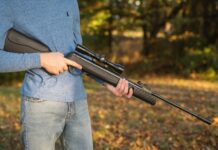
The Crosman Nitro Venom Dusk .22 is the twin brother of the Nitro Venom rifle.

As the twins, they share lots of common features such as powerplant, caliber, design style, and so on.

But the things that differentiate this one from its brother also are the plus points that make it stand out in the market.

Crosman Nitro Venom Dusk – Guntype

This airgun is powered by Nitro Piston technology.

You can read more about its pros and cons in this post for more detail.

Crosman Nitro Venom Dusk has a caliber(the internal diameter of the bore) of .22 (5.5 millimeters).

While .177 only has enough power to shoot rats, mice, chipmunks, and rabbits, .22 is more than enough to handle raccoons, possums, and groundhogs.

For more on how to choose the right air gun caliber for your game, see this post.

The barrel is rifled with helical grooves inside the bore to make the bullet spin.

Besides, the barrel is fluted (cutting out material from the cylindrical surface), so it is lighter and dissipates heat quicker.

Moreover, there is the muzzle brake at the tip of the bore that redirects propellant gas to counter recoil.

Remember why your rifle kicks back:

It’s because the gas pushes the pellet in one way and also moves the barrel in the opposite direction.

So if you want to reduce recoil, you have to change the direction of the released gas .

The muzzle brake takes the form of a 2 inches tube located on the muzzle and diverts gas 90 degrees around the barrel.

The result?

Muzzle brake cuts the recoil up to 50 percent which is a no-brainer for most shooters.

Stock

The stock is black synthetic stock.

The modern synthetic stock is robust, durable, and easy to stand up against the rigor of the field use

So it’s best for hunters who go hunting a lot and for shooters who want to own a maintenance-free air rifle.

For more on the in-depth comparison between synthetic and wood stock, see this post.

The stock has dual raised cheekpieces (dual-comb), which are located on both the left side and right side of the stock.

A dual-comb is helpful if you are a left-handed shooter.

Also, this gun has deep grooves on the grip and forearm that add friction to your hands when shooting, prevent slippage from the shooter’s sweat and improve stability in aiming.

What makes the stock stand out in the market is its special forearm.

The foregrip is designed in a beaver-tail style to promote the artillery hold shooting position.

The wider surface area of the forearm is designed to rest on the palm of your hand .

And let it “float” naturally so you can let the gun recoil in any way it wants and achieve improved accuracy.

Ammo

Crosman Nitro Venom Dusk uses a .22 pellet as its only source of ammunition.

While the .177 pellet is lighter and often doesn’t have enough knockdown power to take out an animal in 1 shot,

.22 is heavier, more stable on its trajectory, and hits the target with serious authority so it’s a go-to pellet of field hunters and pest eliminators.

For more on the differences between .177 & .22 and which jobs they do best, see this post.

Cocking and loading

Cocking the gun:

First, put the gun ON SAFE, hold the gun by your side, then firmly tap the muzzle end to expose the breech.

Let the gun rest on your upper thigh and grasp the muzzle end.

Continue to pull the barrel down to its limitation to perform cocking action.

Loading the pellet:

With the breech opened after cocking, put the pellet (with the pellet’s nose lying forward) into the breech.

Then pull the barrel up to its original position until it locks and you are ready to fire.

Check Price on PyramydAir

Sight

This gun doesn’t come with traditional iron sight: no front sight, no rear sight.

But it does have a 4×32 scope to help you get accurate shots.

In case you want to upgrade the scope, Crosman has installed the accessory rail to help you do just that.

The rail is manufactured in the Picatinny style.

The Picatinny rail gives you more mounting options and you can swap scope from one gun to another.

Velocity, accuracy and power

This nitro piston rifle has a velocity of up to 950 FPS with alloy pellet and 800 FPS with lead.

This is high velocity compared to other .22 air guns on the market.

These kinds of velocity combined with .22 caliber give you a whopping 20 FPE in muzzle energy

Which is more than enough to deal with raccoons, rabbits, squirrels, chipmunk, possum, etc in 1 quick, clean shot.

Chrony test gives us the following results:

This break barrel rifle delivers:

  • 644 FPS and 16.7 FPE with 18.1 grains JSB pellet,
  • 800 FPS with JSB Match diabolo Exact Jumbo,
  • and 705 FPS and 15.79 FPE with 14.3 gr Crosman Premier hollow point.

That’s pretty close to the manufacturer’s numbers and the muzzle energy’s still lethal to deal with pests and small varmints in 1 neat shot.

For Crosman Nitro Venom Dusk, various shooting tests have been conducted by different shooters with positive results.

The common shooting groups are:

  • 5/8 at 10 meters,
  • 1/4″ at 10 yards,
  • 1/4″ at 23 yards with Crosman Premier hollow point,
  • dime size at 60 feet,
  • 0.25” at 25 feet,
  • 1/2″ at 20 yards,
  • 3/8” at 10 meters with RWS field line superdome,
  • 1/4″ at 50 yards,
  • less than 1” at 25 yards,
  • dime size at 10 yards,
  • 1/2” at 30 yards,
  • 1-1.5” at 40 yards,
  • 1” at 20 yards,
  • 1” at 40 yards with Crosman Hollow point,
  • dime size at 25 feet,
  • 1/4″ at 50 feet,
  • silver dollar size at 75 feet,
  • 1.25” at 35yards,
  • 1/4″ at 35 yards,
  • 1” at 25 yards,
  • 0.5” at 10 yards,
  • 3/4″ at 25 yards.

Some shooters can even manage to get:

  • a dime size group at 40 yards,
  • 0.5” at 50 yards
  • and hit target at 150 yards.

Obviously, this is an extremely accurate air rifle with a shooting range of up to 50 yards.

Shooting Ability

The effective shooting range for this break-barrel gun is up to 50 yards.

You can use it to shoot spinners, pop the heads of the dandelions, blow up tin cans and dispatch small garden pests

Loudness

The Crosman Nitro Venom Dusk .22 produces very little noise thanks to nitro piston technology and the muzzle brake.

You can shoot this gun in your backyard without bothering your neighbors or take it to the hunt with all the stealth you need.

Specifications

  • Caliber: 0.22”
  • Velocity: 950 FPS with alloy, 800 FPS with lead.
  • Loudness: 3- Medium
  • Barrel Length: 18.63”
  • Overall Length: 44.75”
  • Shot Capacity: 1
  • Barrel: Rifled
  • Front Sight: None
  • Rear Sight: None
  • Scopeable: Picatinny
  • Trigger: Two-stage adjustable
  • Buttplate: Ventilated rubber
  • Suggested for: Target shooting/Plinking/Small game hunting/Pest control
  • Action: Break barrel
  • Safety: Manual
  • Powerplant: Gas-piston
  • Function: Single-shot
  • Body Type: Rifle
  • Weight: 7.4 lbs

Customer review

There are plenty of customer reviews for Crosman Nitro Venom Dusk.

Positive reviews show that people love its power, accuracy, great stock, and advanced technology.

On the other hand, there are some issues shown in negative reviews with this gun.

The first problem is many buyers complain that the gun is inaccurate out of the box.

However, if you clean the barrel and apply Blue Loctite to the stock screw to maintain consistent accuracy then this is a not serious problem.

The second issue is the trigger: unhappy buyers say that the trigger takes too long to pull and is unstable to shoot.

You can fix this by inserting a small washer into the trigger mechanism as shown in this video and it really smooths everything out in this air rifle.

Pros and Cons

ProsCons
  • Sturdy, durable stock
  • Remarkable slipping-proof grooves
  • Amazing muzzle brake
  • Remarkable beaver tail style
  • Stunning accuracy after break-in period
  • Mind-blowing power
  • Incredible, proven technology
  • Unstable accuracy out of the box
  • Trigger takes too long to pull

Price

The price for Nitro Venom Dusk .22 is about 150 dollars.

It’s a reasonable price for the break barrel gun that integrates proven technology, delivers awesome power and accuracy.

click for the lowest price

Conclusion

The Nitro Venom Dusk .22 is a fabulous gun for the money.

It’s the turnkey pest extermination kit for your backyard or you can use it simply for target shooting or plinking.

If you want a powerful and quiet rifle at the same time, this is the lethal powerhouse that you will love for the rest of your life.

Alaska Salmon Fishing Techniques

0

Need a salmon fishing primer (or refresher)? Here’s the short take on the types of salmon you can pursue and the various methods that are used to target each species.

King SalmonSilver SalmonRed Salmon

King Salmon

Probably the most prized fish in Alaska, Kings are also one of the most difficult to catch. King salmon tend to swim in the deepest part of the river, which is typically right down the center. In places like the Kenai River, this makes it very difficult for shore anglers to catch them. However, for the patient and experimental shoreline angler, there are many opportunities to catch kings. Fish for kings a couple hours before and after a tidal change. Often, flies are used on low tides, and bait/lures are used on high tide. Before fishing for kings, make sure to get a king tag! This is the only species which requires an additional tag for legal fishing.

Flies: Use large, bright flies. Let these flow down the river at the same pace as the current (adjust weight as necessary). Kings are notoriously light biters, so if your fly stops, set the hook and hold on!

Spinning/Casting: Use large, bright lures (Vibrax size 5-6, Pixies, in pink, orange, chartreuse, blue, etc). For bait, you can use herring (near salt water) or salmon roe (all situations). This can be fished under a bobber, or from the bottom up. If you’re fishing from the bottom up, put your weight about 24” above the hook. Use any weight you’re comfortable with, but you want enough on there to either hold the bait in place under the water, or to bounce along at the same pace of the current. Use a “double mooch” (two hooks, one tied a couple inches above the other. You can buy them as premade rigs or set them up yourself. Put a golfball-sized piece of bait on the TOP hook, using the egg knot line to secure it down. Let the second hook dangle empty. Just cast this setup at your 10 o’clock position, and drift through your 2 o’clock position. Repeat.

Silver Salmon/Pink Salmon/Chum Salmon

The technique here is pretty much exactly the same as it was for King Salmon. The difference is where these fish swim. These salmon species tend to sit either in clear water or just on the edge of clear water. Clear water occurs when a small stream flows into a murky-colored stream. If there is no clear spots (or they are all clear), look for deep holes where the water slows down. This occurs around bends, behind big rocks, near trees, etc. Keep in mind that the reason fish will sit right outside of clear water is that they can be spooky. If there is a lot of bright sunlight, try using dark fly/lure patterns. These spooky fish will be less scared, and more inclined to bite.

Red Salmon

Red salmon (Sockeye) are one of Alaska’s most popular salmon. The best locations are typically the Kenai River, Russian River, and Kasilof River. These fish swim very close to the shore in medium swift currents. Don’t be the unaware fisherman who wades out 20ft only to block everyone else from catching the fish that are swimming behind you! Reds are not aggressive biters, so the common method of catching them is called “flossing”. The idea is that if you lay your line low in the water, the salmon will pick up the line in their mouth. At this point you “set the hook,” which draws the hook into the corner of the fish’s mouth. This requires using the right amount of weight so that the line and hook move along the bottom of the river at the same pace of the current (This is important***). You can use any type of weight you feel comfortable with. Splitshot, slinkies, and sinklines are all common types. Leader lengths (the line between your weight and your fly) will vary based on water conditions. On the Russian River, where the stream is narrow and quick, typical leader lengths are between 18” and 24”. On the Kenai River, where the water is deep and wide, leader length is more often between 3’ and 5’. Adjust the leader length when needed. The goal is to ensure that the line and fly lay flat along the bottom. The standard fly to use is called the Russian River Fly (~.35 cents), but more effective alternatives are the #4 sockeye special and polar shrimp. These are more effective because they have a shorter shank. In the lower/middle Kenai River you can use larger hooks (a popular option is the 2/0 Octopus hook). You can use any sort of fly, as long as you can visibly see it in the water (this helps target fish and drift speed of the fly) and is legal (see the current regulations) – this usually means smaller than size 2 or 4).

The technique is fairly simple, and if you follow it, you have a great chance to land lots of fish. First, determine where you want to fish. Pull out enough line that you can “flip” your fly out about 15-20 ft (adjust this based on where fish are). Flip your line as far as it will go to your “10 o’clock position”, which should be past and upstream of your fish. Keeping your line taught, drift the line through the water at the same pace of the current until your line points to your “2 o’clock position”. Repeat. Remember, adjust your weight if your line is moving too quickly or slowly. This will be the difference between catching and not catching fish.

The Massachusetts Coyote: Bigger, Wolfier, But Not To Be Feared

0

Judy Place describes a scene straight out of a horror movie. She was being stalked by a rabid animal, in her case, a coyote.

The deranged creature had wandered out of the woods around the river that runs behind the trailer park complex where Place lives with her mother. The coyote had been menacing her and other neighbors, turning over lawn furniture and attacking random objects.

Then one evening, she heard a couple of loud banging sounds, like something was trying to get underneath her trailer home. She went to the window, where she “saw something scurrying away. I said, ‘Oh boy, I think that’s the coyote!’”

She called the North Attleboro police, who sent over two officers. When they arrived, their flashlights revealed a large section of siding that had been pulled away, leaving a gaping hole under the house.

“I said, ‘oh my gosh, she’s in there, I’m going in the house.’”

But the coyote had slipped around the side of the house, where it was waiting for her.

Place backed away, avoiding eye contact, but the coyote came after her. “She just latched right on to my leg,” she said.

Place says that in the shock of the moment, she didn’t feel the pain from the bite. Amazingly, she managed to keep calm, and stay still.

“I don’t know what I was thinking at the time, ‘cause you know, you’re in shock. So I basically thought to myself, ‘Don’t move too much,’ because she might think I was trying to fight her…things are going through my head like I don’t even know.”

The officers shot the animal twice with a Taser. The electroshock gun can take down a large man, but the coyote would not let go. Finally one of the officers fired a shot in the air, which, “scared the coyote enough to get off of me. So I beelined back into my house.”

Once inside, Place heard another two shots. The first wounded the coyote, which then turned on one of the officers who had to fire the second, fatal shot.

Testing confirmed rabies was the reason for the coyote’s bizarre behavior and attack. Place is now getting a series of shots to prevent her from contracting the fatal disease.

The incident was terrifying, but it’s important to know that Coyote attacks are extremely rare. Place is only the ninth person bitten in Massachusetts since the state started keeping records in the 1950s. The fact is, you’re more likely to get killed by lightning than injured by a coyote.

Still, they can be intimidating animals — the Eastern Coyote is a bigger, more robust animal than its Western cousin. That’s because they’re part wolf.

“As they came east and interbred with the wolf, they became larger,” said Christine Schadler, a wild canid ecologist and the author of Becoming Wolf: The Eastern Coyote in New England.

“Our animals are 35 to 60 pounds. The largest [Eastern] coyote documented is 62 pounds, which is the same size as a small Eastern Wolf,” said Schadler.

“All the animals in New England are this hybrid animal,” said Jon Way, a researcher involved with some of the recent studies that revealed the genetic makeup of Eastern Coyotes in Massachusetts. They found that “about 25 or 30 percent of its DNA is Eastern Wolf. And a little bit of gray wolf. A total of 25 to 30 percent Wolf, and maybe 60 to 65 percent coyote, and then about 10 percent dog.” Way thinks it’s more correct to refer to this animal as a ‘coywolf,’ to recognize its uniqueness as a species.

Schadler says that the wolf DNA is behind “significant differences in the eastern coyote that makes this animal unique. One is the ability to live in a pack, which is very different than the coyote out west.”

Combined with their larger size, living in packs could make the coywolves, as Way calls them, better predators of large animals like deer. “They’re kind of genetically plastic, where they can survive on small prey,” like rodents, that typically make up the majority of the coyote’s diet. But thanks to their body size, the Eastern Coyote may be “more able to prey on deer than western coyotes are,” said Way.

Place says she could see the wolf in the coyote that attacked her.

“The face of it looked exactly like a wolf. I kept saying, ‘I don’t think we have wolves in this area,’ so thought I was losing it,” she laughed. “But yeah, it did — it resembled a wolf.”

Place says she remains spooked by the attack, and now feels a little scared outside, but still loves living near abundant wildlife, including the coyotes.

She has two more rabies shots to go before she’s in the clear.

Fishing Superstitions: A Lucky Charm or Just a Myth?

0

Superstitions (noun):: A belief or practice resulting from ignorance, fear of the unknown, trust in magic or chance, or a false conception of causation – Merriam Webster

I just returned home from a fishing trip and heard about the banana superstition for the first time. Apparently bringing a banana along is bad luck and some captains won’t even allow you on their boat if they are aware of you possessing the fruit. This was interesting to me and got me thinking about other fishing superstitions.

fishing superstitions

Here are 10 common fishing superstitions or “old wives’ tales:”

No bananas on the boat.

They bring bad luck, but pineapples bring you good luck. This is one of the most common and oldest superstitions in the sailing and fishing world. This tale is believed to have derived from sailors who experienced diseased pests from rotten fruits – particularly bananas. Another belief is that banana peeling acts as a natural fish repellent. Whatever the case may be, most captains are serious about not allowing bananas on their boats.

Bribing the water.

Fishermen throw quarters of half dollars over their shoulders to “buy up” some wind when crews are overworked. It is also believed that tossing a coin into the water will bring good luck and bountiful fishing. While I do not personally recommend anyone throwing anything into our waters – it is said bribing the ocean with a coin will bring good luck and a safe return home.

Cows laying down.

This fishing superstition means the fishing will be difficult but if they are standing, prepare for a good day of fishing. Many believe that cattle react to barometric pressure changes the same way that fish do.

The first cast omen.

If you catch a fish on the first cast, you will jinx yourself for the rest of the day. Some professional fishermen will purposely cast off to the side of their boat where they do not believe fish are in hopes of not catching a fish on the first cast.

Never tell an angler “good luck” before they head out.

This fishing superstition will bring them bad luck. “Tight lines” is a safer way to wish the angler well.

Never whistle while on a boat.

Whistling was believed to challenge the wind bringing in a storm therefore, whistling is frowned upon during fishing.

Avoid saying “rabbit.”

If you must talk about these cute floppy-eared animals, superstitious anglers refer to them as “the name of the beast” or “the animal with big ears.” A rabbit’s foot is considered lucky on land but not so much while on the water.

Don’t step over rods or bring them into the house before going fishing.

This is said to bring a bad day of fishing. A common belief is that either of these things will ruin a fisherman’s day.

Kissing the fish will bring you luck.

Some say this started as a sign of respect for the fish. Some say the fish will share and attract others. Whatever the reason, kissing fish especially the first catch is still done by many anglers.

My personal favorite…women onboard will bring bad luck.

Sailors believed that women onboard would anger the sea causing rough and stormy conditions. Coincidentally, a naked woman or one exposing bare chest would bring good luck which is why you may have observed the figure of a woman on the bow of ships. Sounds like a man made this one up. Kidding, kind of… 😊

Commonly Asked Questions About Fishing Superstitions:

What is the superstition about fish?

The superstition about fish revolves around the belief that speaking the word “fish” while on a fishing trip will jinx the chance of catching any. Anglers avoid mentioning the word to avoid bad luck.

What are good luck rituals for fishing?

Anglers have various good luck rituals, like spitting on the bait, wearing lucky fishing hats, or performing a “first catch” ritual. These practices are believed to bring luck and abundance.

Why is a pineapple good luck on a boat?

A pineapple is considered good luck on a boat because of its historical association with hospitality and prosperity. Carrying a pineapple on board is thought to attract good vibes and successful fishing trips.

What brings good luck on a boat?

Various items are believed to bring good luck on a boat, such as horseshoes, acorns, or certain coins. Additionally, the presence of dolphins or albatrosses is seen as auspicious signs for fishermen.

While these fishing superstitions may sound silly, I was amazed at how widely known these are and how so many still believe and practice these tales. I have to say, on this ladies’ fishing trip, we did adhere to each of these rules except for the women on the boat (obviously) and we had two days of very successful bass fishing on the well-known Guntersville Lake in Alabama.

This event organized by Wildlife Women who are some of the coolest and most encouraging outdoor women.

*If looking for a fishing guide on Lake Guntersville, I highly recommend Captain John Maner.

Best Air Rifle Deals

Popular Posts

How Does an Air Rifle Work?

0
Discover the inner workings of an air rifle with our comprehensive guide! From the mechanics behind its powerful shots to the intricate process of...

Air gun 101: What is a PCP air rifle? Is PCP gun the best...

0
A PCP air gun is one of five types of air rifles in the market today. PCP air guns have become more and more...

Can a 22 air rifle kill a deer?

0
"Debate over whether a 22 air rifle can effectively take down a deer has sparked curiosity among hunting enthusiasts. With its lower muzzle velocity...