Home Blog Page 212

Trotline tactics to fill the freezer with catfish

0

Popularity of this tuna among recreational fishing community growing.

I’m sure everyone knows how to set a trotline, but there could be some easy tricks you’re missing out on that will put more fish in the boat. I’ve been setting trotlines all my life but, through the years, my methods have improved immensely through trial and error.

To begin, think big catfish don’t taste good? Then think again. It’s all about the way you cook ’em up. Even at most restaurants when you think you’re eating small catfish, its usually big ones sliced thin. The most important factor is to cut out all the red meat.

After filleting I like to soak them in a half vinegar, half ice-water solution, and then rinse thoroughly with water before packing.

For pan frying in olive oil or deep frying, slice them really thin and marinate them with olive oil and seasonings. Baking them in the oven coated with Panko bread crumb crust works well, too.

My favorite way to eat them is in a good, spicy, slow-cooked catfish courtbouillon along with a few pounds of crabmeat and other seafood thrown in as well. If cooked down, the catfish will fall apart and blend perfectly with the crabmeat.

So try these methods before throwing that tasty fish back in the water.

The first step for a trotline is cutting your pickets. I like to have one around 10 to 12 feet and another around 15 to 18 feet depending on the depth of the water. The best way to position your pickets is to find the back of a bend in a bayou where the current cuts the bottom deep within just a few feet of the bank. The catfish are usually on these hard drop-offs.

Don’t waste your time putting the line across the canal, because as soon as a big log drifts with the current your line will break, plus you won’t have as many hooks in the prime spot.

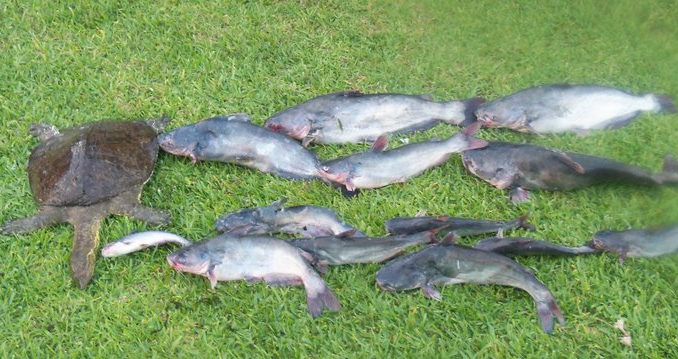
Put the short pole close to the bank and put the longer one about a third of the way out toward the middle, stretching the line up and down the canal bank. A benefit of some of the shallower hooks is that you can catch choupic, garfish and softshell turtles, as well.

After the first few runs you’ll see if you’re catching near the deeper or shallow end of the line, and then you can reposition a picket so the majority of the line is in the most-productive area.

You may be pleasantly surprised when nearly all your hooks have a catfish on them just because of proper depth placement of the line.

I like to keep the line around 20 to 40 yards long so you keep a good, solid tension. Longer lines tend to lose their hook-setting power.

I also like to keep hooks about 3 to 4 feet from one another. I don’t like to space them too far apart in case a fish steals one bait; another bait will be close, and you’ll probably have many hooks in the best drop-off position instead of only a couple.

Tie the main line about halfway down the picket before setting it in the mud so that the line is suspended instead of too high or on the bottom. I find a bait on the bottom will be less productive because the fish won’t pull downward like with a suspended hook. When a fish takes the bait on a suspended hook and flees downward, it becomes hooked.

Next, a pull string makes checking the line a breeze. Since the main line is tied down the picket, forget trying to reach under the water with a paddle, just tie a line to the top the picket and connect it a few feet down the main line before or to the swivel leaving some slack. This quick tip will save tons of time reaching for the main line.

Always remember to set the main line before putting the hooks on.

I use a 5/0 trotline hook, which is strong enough to hold a monster fish if my pickets have enough give. But it still can straighten if I pull on a main line that is caught on a log; that way, I don’t have to cut the line.

Forget using too much terminal tackle and swivels on every hook. I use heavy rope for the main line, using a quick loop knot. For the hook line, I use a smaller nylon rope with a loop knot on the end. You quickly put the hook-line loop through the main-line loop and pull the hook through the hook-line loop, and the hook is on in a second and can be taken off just as quickly.

To keep the fish from twisting themselves on the line, I tie a big heavy-duty swivel to the main line about 3 to 4 feet away from each picket. Nothing can get twisted this way, and it makes removing the main line a breeze. I use a floating noodle to put all of my hooks on so nothing ever gets tangled.

Everyone knows catfish eat just about any bait, but what is the best? In my experience, cut mullet and perch catches big ones but not as many, while small poggies and other oily shad catch the most.

The problem is that these poggies fall off too easy, so I use the best of both worlds. I hook a small piece of cut fish, making sure to go through the tough skin, and then I take a small poggies and bury the point of the hook in it. Even if the poggie gets nibbled off that chunk of fish will remain until one bites.

Two or three throws with the cast net will usually land me several hundred small poggies. I precut the fish chunk and poggies, and freeze them in Ziplocs so my bait is always ready to go. If catching perch or mullets is a problem, I recommend cutting belly meat into 1-inch chunks, leaving the skin on, while cleaning fish. This normally wasted portion of the carcass can help you catch many catfish.

Try setting out a few trotlines this way, and your freezer can stay full of catfish filets all year long. And don’t forget to bring the landing net with you!

World record Albacore Tuna: An 88lb Monster – Tackle Village

0

Albacore tuna may be known for its tasty fillets that is sold in stores all over the United States, but it is also a species of Tuna that can grow to some pretty impressive sizes.

Although it is one of the smaller tuna species, the International Game Fish Association world record albacore tuna might be bigger than you first expect. On average, this species of fish might not sound like giants of the deep, but there are some large specimens out there.

It’s some of these large tuna specimens that we are talking about in this article. In it, we look at a couple of the world records associated with albacore tuna and the anglers who have managed to catch some of the big ones!

All Tackle World Record Albacore Tuna

Siegfried Dickemann was drifting a mackerel when his eventual record-breaking fish took a bite.
  • Date: 19th November 1977
  • Weight: 88 pounds 2 ounces
  • Angler: Siegfried Dickemann
  • Location: Gran Canaria, Canary Islands, Spain

Most fish of this species weigh in somewhere between 10 and 30 pounds. While they can get much bigger than this, it’s pretty rare to catch one that goes much beyond 60 or 70 pounds. That is unless you are angler Siegfried Dickemann on a fishing trip all the way back in November 1977.

On the trip, Siegfried was using a Noris-Shakespeare rod and an Osea line 900 9/0 with an 80-pound line. He was drifting a mackerel when his eventual record-breaking fish took a bite.

Despite the impressive size of this fish, there has actually been an albacore that was bigger and successfully caught with a rod and reel too. The fish in question holds the California state record and weighed 90 pounds 4 ounces. Unfortunately, for the angler who caught it, they were using a type of hook that the International Game Fish Association doesn’t approve so, therefore, the world record still stands at 88 pounds 2 ounces.

Whether you look at the world record or state record, these sea creatures are some of the biggest tuna specimens caught of the species. Despite their relatively small size compared to other world record tuna (the biggest yellowfin tuna ever caught was over 400 pounds and the world record bluefin tuna was over 1000 pounds), these fish are still big fish for the size the majority of their species grow to.

An 88-pound albacore tuna is certainly an impressive fish to behold.

All Tackle Length World Record Albacore Tuna

  • Date: 6th February 2022
  • Length: 29.92 inches (76 cm) and 30.31 inches (77cm) – TIE
  • Angler: Scott Tindale and Sue Tindale
  • Location: Bay of Islands, New Zealand

When husband and wife, Scott and Sue Tindale, set out on a fishing trip together, they probably didn’t think that one of them would end up as a new world record holder, let alone both of them!

Scott’s fish was slightly smaller than Sue’s fish but there wasn’t enough of a difference for the record to be broken. This means that both Scott and Sue hold the all-tackle length world record for albacore.

Scott was using a Kilwell rod, a Shimano reel, and he was trolling a Black Magic Freedom lure.

Sue was using a Kilwell rod, a Shimano reel, Black Magic line, and she was trolling a Pakula lure.

It’s an interesting story that this husband and wife can share together – a fishing trip in New Zealand led them both to catch the largest tuna of this type and both becoming world record holders.

About Albacore Tuna

Scientific name

Thunnus alalunga. Albacore are also known as longfin tuna too.

Distribution

Albacore can be found in tropical and warm temperate waters of the Pacific, Atlantic, and Indian Oceans. It is worth bearing in mind that these fish can swim up to 50 miles per hour and they can cover vast distances during their migrations.

Size range

While you can get Albacore that weigh up to 90 pounds and that are up to more than 30 inches long, most will weigh somewhere around 50 pounds or under and will be somewhere around 20 inches in length.

Fishing Techniques

Albacore can be caught using bait or a lure. They are usually found by trolling and can sometimes be bought closer by chumming small baitfish.

It’s worth keeping in mind that if the trolled fish gets unhooked, it will swim away and the rest of the school will likely follow so you need to be careful to prevent losing a whole load of fish.

These fish have good eyesight so a fluorocarbon leader might be useful too.

Eating Quality

Albacore are tasty fish and are the only tuna that can be sold as white meat tuna in the USA.

The flesh is light and has a mild flavor. The meat holds together pretty well so grilling Albacore can be a great option for cooking.

Hunting Traditions: The Good, the Bad and the Ugly

0
Could you imagine Midwest hunters doing this?

With hunting being such a long-standing, time-honored tradition in this country and around the world, it only stands to reason that over time, a number of practices or “traditions within the tradition” have developed among regions, cultures and particularly among individual groups of hunters.

Some are serious and revered, while others are, well, just plain strange to the uninitiated. Here’s a short list of traditions that run the spectrum of good, bad and just plain ugly.

— The Good —

Prayer

As in many aspects of life, prayer figures prominently in the hunt where sportsmen of faith – though often varying degrees of practicing it – can all agree that the time outdoors we enjoy, the friendships forged through a common love of hunting and nature, and particularly, the game we take are all blessed events that reflect the Lord’s grace.

As such, as soon as the game has hit the ground, there are many hunters who, before any game is moved or even tagged, will kneel or bow before the fallen creature and recite a prayer, honoring the animal with both blessings and remembrance.

Holding of Court

In the Southeast, where the deer hunting with hounds culture still reigns in shrinking rural pockets as it has since colonial times, a tradition that is also dying with the rush of modern culture is the “holding of court” at the end of the day when organized hunts are held.

Growing up hunting at the former United Hunt Club in Southampton County, Va., I have fond memories as a boy standing among the men in the freezing night air and gathered around the open skinning shed as court came into session. In all my years there, I only remember two different men serving as judge and they would open court allowing any hunter who had missed a deer that day to throw himself on the mercy of the court.

Few did as the banter that ensued was much more entertaining for everyone when an accused attempted to deny that he had missed and blame the shots on somebody else. Ultimately, those found guilty of missing often had to pay a fine by having their shirt tail cut – typically an inch for each fired shot – though on rare occasions, the hijinks got so animated that I saw the hat brims removed, entire shirts slashed, and once, a removed boot chopped by a meat cleaver!

This tradition played out through varying degrees throughout the South and underscored the social nature of this type of club hunting. Even though the old clubhouse sits largely unused these days, shirt tails, many more than 40 years old, still blow in the breeze beneath that skinning shed roof.

Lighting the Fire

Missouri outdoor writer Tony Kalna Jr. grew up hunting the Ozarks with his dad, grandfather and uncle, and they would pitch deer or turkey camp, depending on the season, and hunt for a whole week every year.

While in camp, they would use pine wood collected from old stumps that remained from past forest fires or had become almost petrified and formed fast burning lightered wood to always start their fire in camp. In 1983, family members bought a farm closer to where they lived and quit hunting the mountains shortly after. But on their final hunt, a turkey hunt, Tony and one of his relatives hauled one of these huge pine stumps out of the woods and back to their farm.

Every year since, they have chopped a small piece of wood from the stump and used it to build the first fire at each season’s deer camp. The stump is half gone by now, but because it takes so little of the flammable wood to ignite a good burning fire, Tony figures it will outlive him.

— The Bad —

First Deer

There are a number of long held – and sometimes odd – traditions surrounding the taking of a person’s first deer and the blood, or more rarely consumed organs, of that deer.

Some are really kind of cool, including a “blooding” rite as it is sometimes called whereby the lucky hunter’s forehead and/or cheeks are dabbed or smeared with blood to initiate them among them among the ranks of accomplished hunters. If not all hunters have celebrated their first kill in that manner, they have likely at least heard of it. A twisted twist on that experience is to remove the heart or liver from the still warm animal and take a bite from it.

“…a number of practices or “traditions within the tradition” have developed among regions, cultures and particularly among individual groups of hunters.”

That one may be a little too Legends of the Fall for most folks, and with concerns over blood-contaminating illnesses such as CDW or hemorrhagic disease, may not be the best way to continue that tradition. Some people even drink some of the deer’s blood, which unless you’re auditioning for a scene in the next Twilight movie, is just a bit ick.

A cool twist on the practice comes from Brian McCombie in Wisconsin, who says successful hunters will sometimes simmer the deer’s heart in water, along with celery, onion and beer, then slice and eat it. That’s one many of us could work with.

Drinking Night Before the Opener

For all the ink and genuine acceptance of women among the ranks of hunters, by and large, many hunting camps remain a “boys only” affair, where friends and male relatives annually gather to not only hunt, but also enjoy the camaraderie of men with a shared interest in hunting.

Nowhere is this more prevalent than in deer hunting where, as with most male-oriented activities, social time is spent drinking an alcoholic beverage or eight the night before opening day. This can lead to ready laughter and a plenty of good stories of stupidity that will be shared for years to come, but on more than a few of these occasions, I’ve personally witnessed hunters too hung over the next day to even crawl out of bed and hunt – or on rare occasions, were still inebriated so where they weren’t allowed to hunt. Enjoy a frosty beverage, or even a few, but try not to get so wild you miss opening morning. That’s just plain out stupid.

Clearing Out the Camper

Not so sure this counts as a tradition, but in researching this article, I came across this one in a thread on camp traditions. One hunter posted how his and his buddies’ hunt camp consists of many trailers, and on the Friday night before the deer opener, they all gather to B.S. in one of the campers.

However, as often occurs when among a group of dudes, someone “cuts the cheese,” as this hunter explained, at which point, everyone would get up and gather in another trailer. The conversation would resume until another “airing out” instance occurred and then they would move on to the next. Not sure what you do if you only have one cabin or tent for everyone to hang out in. Could be an unpleasant tradition to start on your camp.

— The Ugly —

Buck Sign

One Alabama hunter shared this tradition with me – a throwback to her dad’s younger days before there were cell phones, texting and even walkie-talkies. To this day, her dad and some of his contemporaries still follow the practice, but when they kill a buck and field dress it, they hang the severed genitals from a tree so anyone who happens past the gut pile will know the deer taken there was a buck. They can then excitedly hurry back to camp to see how big the trophy was taken by one of their hunting partners.

No Razors, Please

Another extremely individualized tradition among deer camps includes the resistance to shaving while hunting. On a message board, I found one hunter whose entire camp of guys doesn’t shave for the entire two-month long hunting season.

It worked for Robert Redford as Jeremiah Johnson – until his squaw trimmed him – and everyone knows how well it has worked for the Duck Commander boys. “Best marketing strategy ever thought of and it doesn’t cost us anything,”

Willie Robertson once told me concerning his father Phil’s decision to let the beards grow. Of course, if you still spend the majority of your time during hunting season in an office or shop instead of the woods or filming a hunting show, the ZZ Top look might garner you more Deliverance-minded stares of fear than smiles of admiration.

Horn Dance

Could you imagine Midwest hunters doing this?

I apologize, but I had to go out of country for this one, and it really is kind of a cool tradition once you know the history behind it. But at first glance, anytime you catch a video of men in knickers and lederhosen dancing in circles with each other sporting heavy racks above their heads, you have to stop and wonder.

What I’m talking about is the Abbots Bromley Horn Dance in Staffordshire, England, this year to be celebrated Sept. 10 in the village of, where else, Abbots Bromley. The dance was first performed as part of the Barthelmy Fair in August 1226. That means for 786 years, each year, dudes have been dressing up and dancing with antlers to celebrate the hunt.

Not sure if it blesses a hunt or just serves a rural curiosity among visitors these days (most likely the latter), but I can imagine me trying to get a bunch of hardened Dale Earnhardt-looking Midwestern hunters to dress like the sky ride attendant at Busch Gardens and dance daintily with antlers above their heads to the sound of a gonging chime.

Blog

0

At Mid-Valley Clays & Shooting School, we take pride in providing family-friendly shooting experiences that bring loved ones together in the great outdoors. Clay shooting isn’t just a sport; it’s a chance for families to bond, create memories, and share the thrill of hitting targets as a team. In this blog, we invite families to discover the joy of clay shooting at our Gervais, Oregon shooting school, conveniently located only 35 minutes outside of Portland and 21 minutes from Salem.

1. An Adventure for All Ages: Clay shooting is an inclusive sport that can be enjoyed by family members of all ages. From young teens to grandparents, everyone can participate and have a blast at our shooting range. Our experienced instructors are here to guide beginners, ensuring that everyone feels comfortable and confident on the shooting line.

2. Safety First, Always: The safety of our guests is our top priority, especially when families are involved. Our shooting school has strict safety protocols in place, and our instructors will brief you on all safety measures before you begin. You can rest assured that we provide a safe and controlled environment for your family’s shooting adventure.

3. Quality Time Outdoors: Clay shooting takes you away from screens and technology, allowing your family to reconnect with nature and each other. Spend quality time outdoors, breathing in the fresh air, and appreciating the beautiful surroundings of our Gervais, Oregon shooting range.

4. Friendly Competition and Teamwork: Clay shooting creates friendly competition and fosters teamwork among family members. Root for each other’s success, celebrate every successful shot, and share in the excitement of hitting those flying targets together.

5. Life Skills and Focus: Clay shooting not only enhances shooting skills but also teaches valuable life skills, such as focus, discipline, and patience. As shooters step onto the range, they enter an environment that demands unwavering attention to detail and a calm, composed mind. Whether it’s analyzing the trajectory of a clay target, mastering proper shooting techniques, or adapting to various shooting scenarios, sport shooting cultivates mental acuity and sharpens concentration.

Participating in clay shooting at Mid-Valley Clays & Shooting School challenges individuals to set goals, measure progress, and practice perseverance. Shooters learn to overcome challenges and accept both successes and setbacks with grace. The sport instills a sense of responsibility, as safety protocols must always be observed and adhered to during shooting sessions.

Beyond the shooting range, these life skills translate into personal and professional endeavors. Focus and concentration become powerful tools for success in various aspects of life, whether it’s academic achievements, work performance, or managing daily challenges. The discipline cultivated on the range reinforces dedication and commitment in all pursuits, making clay shooting a transformative experience that enriches lives beyond the sport itself.

By embracing sport shooting as a means to foster essential life skills, participants not only enjoy an exciting and rewarding hobby but also prepare themselves for success in life’s diverse journeys.

Sport shooting at Mid-Valley Clays & Shooting School offers an array of benefits that extend beyond the sport. From promoting camaraderie to enhancing physical and mental well-being, and fostering valuable life skills, clay shooting is an activity that continues to capture the hearts of enthusiasts and newcomers alike. As you embark on your clay shooting journey at our Gervais, Oregon shooting range, you’re bound to find an experience that is both exhilarating and transformative. Whether you’re aiming to improve your shooting prowess, bond with family and friends, or simply enjoy the thrill of hitting clay targets under the wide Oregon sky, Mid-Valley Clays has something to offer everyone. So, grab your shotgun, bring your enthusiasm, and join us for an unforgettable clay shooting adventure. Let’s aim high and shatter expectations together!

St. Lawrence River Fishing: 2024 Thousand Islands Angler’s Guide

0

Sharing is caring!

Offering some of the best fishing in New York for bass, muskellunge, walleye and several other species, the St. Lawrence River provides world-class angling on a grand scale. Few places in the Empire State have such a broad array of fishing options.

The river originates at the eastern end of Lake Ontario and drains the entire Great Lakes system into the Atlantic Ocean. Much of the river also forms the border between the United States and Canada.

The initial stretch of the river from Cape Vincent to around Morristown—about 60 miles, though measurements vary—is referred to as the Thousand Islands region. It is here that anglers will find much of the best fishing in the St. Lawrence River.

The Thousand Islands (a.k.a. 1000 Islands) region actually includes over 1,500 islands, ranging in size from a few square feet to several square miles.

A vast complex of rocky shoals, deep ledges and weedy embayments, the Thousand Islands supply virtually endless fishing opportunities.

Smallmouth Bass

The bass fishing in the St. Lawrence River is nothing short of spectacular, with smallmouth bass dominating most anglers’ catches.

Smallmouths ranging up to 4 pounds are abundant, and a 5-pounder barely raises an eyebrow.

The river is a frequent setting for bass tournaments, and it almost always takes a five-fish limit weighing over 20 pounds to win here. The St. Lawrence ranked number one on Bassmaster’s annual list of America’s best bass lakes in 2022.

Smallmouth bass abound on the river’s many rocky ledges and shoals. The St. Lawrence offers an endless supply of precisely the type of rocky structure that smallmouths love.

A good depth map is a very useful tool for identifying likely spots in this vast region, but you don’t usually have to go far to find great smallmouth habitat. Spring and fall are the best seasons to catch them in relatively shallow water.

Fishing in bays and around the rocky island shorelines is productive in May and June. In accordance with New York’s bass season, the fishing is catch-and-release-only until the third Saturday in June, by which time bass will be in post-spawn mode.

Summer bass fishing can be extraordinary, but be prepared to fish a little deeper than you’re accustomed to.

Ever since invasive zebra mussels arrived in the early ’90s, the water has become much clearer, and smallmouths are commonly found over 25 feet deep.

At times, they may be as deep as 50 feet, but they’re also known to feed in shallower spots or even suspend over deeper areas early in the morning and on overcast days. On days with a stiff breeze, bass will likely follow it toward windward shorelines.

River currents also drive bass movements and behavior. Although the current may seem imperceptible in many areas, bass still position themselves below current breaks, including islands and rock piles.

Jigs and finesse soft plastics on drop-shot rigs are the baits of choice for fishing deep structure.

A 5″ wacky worm is a great option for shallower areas, with darker, natural colors faring best.

The introduction of round gobies in the last 20 years has been a major change. Bass have increased in size, and studies suggest that gobies now make up 80% of smallmouths’ diet.

Any bait that resembles a goby is a good bet, with dark-colored tube jigs continuing to excel.

Largemouth Bass

With such an excellent smallmouth fishery at their fingertips, it’s unsurprising that many anglers overlook largemouth bass in the St. Lawrence River. But largemouths are also abundant, even if their populations are more localized.

Largemouths thrive in weedy shallows, bays and backwater areas all along the river. Bays like Goose Bay and Chippewa Bay are among the best spots, along with Lake of the Isles, a not-quite-closed-off embayment on Wellesley Island.

There can be great sight-fishing for bedding largemouths in early June—again, it’s catch and release only until the third Saturday. Largemouths continue to bite throughout the summer months, generally in shallower water than smallmouths.

Mouths of bays and channels between islands are good areas to find summer largemouths. Some of the best spots are where rocky structure and weed beds meet.

A very common feature throughout the Thousand Islands is rocky shorelines that drop off toward a weed bed at a depth of 6 to 10 feet. The margin between the rocky drop-off and the weed edge is a prime spot to find largemouths, especially first thing in the morning.

Casting around docks and boathouses is also productive in areas where the shoreline is more developed.

Wacky worms and soft plastic jerkbaits are great largemouth lures, along with spinnerbaits and crankbaits.

Walleye

Walleye in the St. Lawrence River are both large and abundant. The population is maintained through natural reproduction as well as generous stocking by the DEC, which has given walleye fishing a significant boost in the last 20 years or so.

The walleye season in New York begins the first Saturday in May and runs until March 15 the following year. The current state record, weighing 18 pounds 2 ounces, was caught on the St. Lawrence River on opening day of walleye season in 2018.

Various parts of the river offer different walleye fishing opportunities in different seasons. A few hardy anglers do very well fishing rocky shoals during the final, chilly weeks of walleye season in early March.

But the season opener in May is the date that most walleye fanatics look forward to.

By this time, walleye have usually finished spawning, and some of the best spots are mouths of rivers that empty into the St. Lawrence, including the Oswegatchie and Grass rivers.

The best walleye fishing in spring is generally in the section of the St. Lawrence downriver from the region considered to be the Thousand Islands. The Ogdensburg area and below the Moses-Saunders Power Dam in Massena are prime spots in May and June.

Jigging and dragging crawler harness spinner rigs are good tactics in spring, and depths around 20 to 25 feet are often productive. Walleye may be even shallower at night, and some of the best fishing takes place after dark.

Springtime anglers catch a lot of healthy, eating-size walleye in the 18- to 24-inch range, along with the occasional trophy (as the opening-day state record catch will attest to). But the summer months produce some of the biggest walleye of the year.

By summer, the bite shifts up into the Thousand Islands, though the areas below the dams farther downriver can still be productive.

Trolling deep shoals, island points and drop-offs in the Thousand Islands produces some of the biggest walleye from late summer into fall.

This is a great time to catch big ‘eyes, but the action can be slow. Depths in the 30- to 40-foot range are often best.

The Carleton Island area, not far from the mouth of the river in Cape Vincent, is a prime spot.

Try black-colored jigs or live minnows.

Muskellunge

The St. Lawrence River has a longstanding reputation as one of the best places to fish for muskellunge in the world. New York’s state record muskie, a 67-inch fish weighing 69 pounds, 15 ounces, was caught here in 1957.

Along with Lake Erie and the Niagara River, the St. Lawrence remains one of New York’s best places to catch a coveted muskellunge over 50 pounds. That being said, there’s reason to be extremely cautious about the future of the St. Lawrence River muskie fishery.

Muskellunge numbers have dropped precipitously since around 2005, with blame usually directed at round gobies.

These invaders eat muskellunge eggs and can potentially spread a deadly virus. A prominent muskellunge fish kill in 2022 was especially worrying.

But it’s not all doom and gloom. Anglers still catch muskies in the river and have an honest shot at a trophy. Going out with a guide is highly recommended for anyone unfamiliar with the river.

Muskellunge are widespread throughout the Thousand Islands region, and many are also caught farther downriver to the Ogdensburg area and beyond. Trolling is the best way to cover water and maximize potential strikes.

Edges of shoals are the top areas to troll for muskies, with August and September being peak months. Anglers also land some big ones later in the fall as these big predators feed heavily in anticipation of winter.

Ledges and drop-offs provide muskies with easy access to both deep and shallow water, allowing them to follow schools of baitfish in either direction. Depths between 20 and 40 feet are ideal.

Plugs and cranks like Radtke Pike Minnows, Cisco Kids, Jakes and Depth Raiders are favored by many, with 10″ models being standard. Oversized spinners like Mepps Muskie Killers are also excellent options.

Check out all of the best muskellunge fishing lakes and rivers in New York.

Northern Pike

Northern pike are exceptionally common in the St. Lawrence River. Although musky anglers sometimes view them as a nuisance, plenty of folks go out of their way to target pike. And with good reason.

Known for their fierce battles and line-slicing teeth, northern pike are capable of topping 25 pounds. Fish measuring 30 to 36 inches are common in the St. Lawrence.

Pike season opens in May, and the first month is the best time of year to find them in shallow water.

Having just spawned in April, pike will still be in weedy bays all along the river. Button Bay and Chippewa Bay are a couple of the best-known spots, but there are many, many others.

Large pike gradually transition to deeper haunts by summer, particularly favoring weed lines, shoals and points. However, anglers will still catch many at larger bays’ deep mouths, while smaller pike mostly populate the shallows..

The best pike lures for the St. Lawrence River are those that produce some metallic flash, including spinners and spoons. Gold-colored Doctor Spoons are a local favorite, along with Mepps #5 Aglia Bucktails.

Yellow perch are a major forage species for pike, and spoons with some yellow on them tend to draw a lot of strikes.

Spinner crawler rigs, more commonly used for walleye, also catch a lot of pike. Most anglers bait the rigs with either a live nightcrawler or minnow.

Ice fishing for pike is also very popular. Baiting tip-ups with live minnows around submerged islands and weed beds in the river’s bays is the perfect approach in January and February.

Eel Bay and Lake of the Isles on Wellesley Island, the bays around the village of Alexandria Bay, Goose Bay and Chippewa Bay are all excellent ice fishing areas for pike. Wheathouse Bay, a bit farther downriver near Ogdensburg, is also excellent.

Find more northern pike fishing hot spots in New York.

Other Game Fish

The St. Lawrence offers outstanding fishing for many additional species, including some that aren’t traditionally considered to be game fish.

For example, bullhead catfish invade shallow bays in extraordinary numbers every spring, and freshwater drum weighing over 10 pounds are common.

Bluegill and sunfish abound in shallow weed beds as well.

Long story short, don’t forget about these other fish species that also provide excellent fishing in the Thousand Islands.

Here are a few of those additional species we’d like to spotlight:

Yellow Perch

Yellow perch are some of the most abundant fish in the St. Lawrence River, inhabiting reefs and weed beds in prolific numbers. The ice fishing season is an especially popular time to fish for them.

As soon as safe ice forms on bays, anglers start catching great numbers of perch using jigging spoons, grub-tipped teardrop jigs and Jigging Raps.

Big “jack” perch in the 10- to 13-inch range are not hard to come by, though you may have to catch 100 dinks for every 10 jumbos.

Another great time to fish for perch is during the weeks immediately after ice-out, usually from late March to early April. Perch spawn this time of year in protected shallows, and anglers catch a bunch using live minnows.

Emerald shiners are the ideal bait if you can get your hands on some, but fathead minnows will also do the trick, along with bits of nightcrawler and small jigs.

Perch will be found in the backs of practically every bay and protected harbor areas and marinas.

Lots of quality perch will continue to be caught from docks and shorelines in Cape Vincent, Clayton, Alexandria Bay and Ogdensburg from late spring into summer. However, the best fishing for larger perch shifts to shoals on the main river in somewhat deeper water.

Crappie

Bays and backwaters along the St. Lawrence River offer excellent fishing for black crappies.

Even though fun to catch and delicious to eat, anglers often overlook this species to target other fish that are easier to find and catch reliably.

Crappies are notorious for vanishing like ghosts after the spring spawn.

Ice anglers catch their fair share of crappies in the Thousand Islands, with Lake of the Isles arguably the region’s premier crappie haunt. Goose Bay and other bays also have ample crappie populations.

Spring crappie fishing starts to pick up in April after the ice has receded from the bays and the shallowest backwaters begin to warm up. A good string of warm days can bring crappies flocking to the warmest available water.

Lots of scrappy 9- to 12-inch crappies are caught throughout the spawn, which is usually wrapping up by late May. After that, schools of crappies are nomadic and hard to pin down.

There can still be a good bite on summer evenings, as crappies emerge from weed beds just as the sun goes down.

Boat docks and marina areas can also continue to produce in summer, with crappies often seeking shade under structures that reach into deep water.

Common Carp

The St. Lawrence River has been called America’s carp capital, and few places in the country offer more or bigger carp. Anglers commonly catch carp weighing 20 pounds here, and 40-pound fish are available.

Carp are amazing fighters, and battling a carp that big is something you won’t soon forget.

Methods used to catch them vary widely. The presentation is often as simple as a few kernels of sweet corn threaded onto a hook and fished on the bottom. But serious carp anglers often go to greater lengths to target big carp.

Specialized European-style carp fishing gear and techniques have started catching on in the region, including 12-foot carp rods.

Boilies—hard-boiled baits made using grains and a variety of scents and flavors—are the top carp baits for serious anglers.

The months of June, July and August are the peak of the carp fishing season.

These fish inhabit areas throughout the river and are easily targeted from shore.

Planning Your Trip

The Thousand Islands region has been a major tourism hub in New York going back to the 19th century, and a wide range of amenities are available.

More than a dozen state parks line the shoreline of the river, and several towns offer shopping, dining and lodging.

Alexandria Bay, roughly in the center of the Thousand Islands, is widely considered to be the gateway to the region. Cape Vincent is another major hub at the mouth of the St. Lawrence River as it drains Lake Ontario.

Farther downriver, small cities and towns like Ogdensburg and Waddington also provide access. The river gets quite busy with anglers, campers and recreational boat traffic in summer, but the region’s vast size generally allows elbow room for all.

Getting to the Thousand Islands

The Thousand Islands region is easily accessible from most directions.

Interstate 81 takes drivers on a straight course from Syracuse to Alexandria Bay in about 90 minutes. State Routes 12, 12E and 37 run alongside the river, connecting many towns along its shoreline.

Bank & Boat Access

Anglers have countless options for enjoying the St. Lawrence River.

In addition to the 14 state parks along the river, there are 12 state and municipal public boat launch sites, to say nothing of dozens of privately owned marinas and campgrounds.

Some of the best public access sites, starting at the mouth of the river at Lake Ontario’s eastern end, are located in the following communities:

Cape Vincent

Located at the mouth of the St. Lawrence River, the town of Cape Vincent offers excellent bank fishing and free public boat launch facilities at East End Park, which is also a popular scuba diving site.

Burnham Point State Park offers additional fishing, boating and camping opportunities nearby. This park is the closest access to the excellent fishing areas around Carleton Island.

Clayton

Cedar Point State Park includes a fishing pier, campground and boat launch facilities just west of Clayton. The Clayton Municipal Docks has an additional public launch site and 200-foot floating dock complex.

Alexandria Bay

Alexandria Bay, often referred to as Alex Bay, offers the widest range of access options on the American side of the river.

Bank and boat access is available at the Village Docks and Scenic View Park.

Several excellent state parks are just a few minutes away, including Keewaydin State Park and Kring Point State Park, The latter sits on a peninsula between the main river and Goose Bay. Both offer camping, boat launch facilities, docking and bank fishing.

Another great option is Wellesley Island State Park, just across the Thousand Island Bridge from the mainland. The largest camping complex in the region, this park offers boat launch facilities and excellent fishing access on both the river and Lake of the Isles.

Chippewa Bay

Overlooking the bay of the same name, the hamlet of Chippewa Bay provides a free public boat launch at the end of Denner Road, next to the Chippewa Bay General Store. Cedar Island State Park, accessible only from the water, is a short boat ride away.

Morristown

In addition to a public boat ramp and bank fishing access at Bayside Park, Morristown is a short drive from Jacques Cartier State Park. The latter offers excellent launch and docking facilities, as well as bank fishing, campgrounds, and a swimming beach.

Ogdensburg

The city of Ogdensburg, located at the mouth of the Oswegatchie River, offers ample public river frontage for bank fishing at Morrisette Park and public boat ramps at the neighboring Patterson Street Boat Launch. Additional bank access is available on the Oswegatchie River.

Waddington

The town of Waddington has several excellent options for bank fishing, including ample open shoreline near Waddington Beach. Additional bank fishing and a public boat launch are available at Whittaker Park.

Massena

Several public parks in Massena offer fishing and boating access. The town operates the Fish Massena website, providing a handy guide to getting on the water.

Nearby Robert Moses State Park also offers camping, fishing access and boating facilities. The park is located on Barnhart Island, the northernmost point in New York State, and is accessible by car across Barnhart Island Bridge.

Know Before You Go

The Canadian border bisects the St. Lawrence River, and officials on both sides take the boundary seriously. A Province of Ontario fishing license is required to fish on the Canadian side.

How to Get Rid of Rabbits in Your Yard & Garden

0

While rabbits may be cute to look at, they’re not animals you want to share your garden with.

In addition to reproducing rapidly, rabbits will destroy your plants and can wreak havoc on your landscaping, yard, and flowerbeds.

Fortunately, you don’t have to resign your property to rabbit damage. In fact, there are many humane removal methods that can stop rabbits from eating your plants.
In this blog, we’ll discuss how to get rid of rabbits without killing them. Our tips will help you remove wild, cottontail, and European rabbits from your backyard, garden, or lawn.

Safety Considerations

  1. Apply repellents and baits in areas away from children and pets.
  2. If using products that contain chemicals, read the product labels carefully to ensure safe application.
  3. If using live traps, handle any captured rabbits with care. Wear heavy gloves and protective clothing to avoid contact with diseases. Be aware of local laws regarding the relocation or euthanization of trapped animals.

How to Get Rid of Rabbits in Your Yard

Natural & Humane Methods

Want to get rid of rabbits for good? Try these home remedies:

1. Repellents

Rabbits have a strong sense of smell, and they use it to guide them to safe, tasty food sources. Fortunately, you can use that sense of smell in your favor if you’re trying to repel rabbits.

To keep these pests from returning, try using various homemade deterrents.

Here are our top suggestions:

    • Use repellents like dried blood meal or sulfur to keep bunnies from entering your garden in the first place. Sprinkle your repellent of choice in the parts of your yard that you want rabbits to stay out of. Make sure to re-apply the repellent after every heavy rain or anytime you water your lawn or garden. If you have dogs, be wary of using this method since they may be attracted to the blood meal.
    • Sprinkle cayenne pepper around the garden or near plants that rabbits love to eat.
    • Use a small, mesh bag to contain shavings of strong-smelling bar soap, and place it in high-traffic rabbit areas.
    • Grind together three hot peppers, three large onions, and a whole bunch of garlic. Add water to cover, let the mixture sit overnight, strain it, and add water to make a gallon of homemade rabbit deterrent. Spray it anywhere you’ve noticed rabbit activity.
    • Apply a light coating of animal lard to the stalks and base area of new seeding replacements to repel rabbits.

We recommend Liquid Fence Deer and Rabbit Repellent Concentrate if you’re looking for a more powerful repellent. This long-lasting, rain-resistant repellent is safe for use on landscaping, ornamental gardens, flowers, trees, vines, and shrubs and is harmless to plants and animals when used as directed.

Remember that repellents are only effective if you use them repeatedly and frequently since they can wear off quickly.

Pros: Easy, effective, affordable, non-toxic, gets rid of rabbits without killing them or harming dogs and other pets

Cons: These DIY deterrents require re-application after every heavy watering or rain (except for fencing of course)

2. Fencing

Use repellents and exclusion methods together to keep rabbits out of your garden for maximum effectiveness.

While fencing is time-consuming to install, it is the best way to control rabbits.

To prevent their entry, install chicken wire fencing or wire mesh around your lawn, garden, flower beds, and other areas you’d like to protect.

To ensure the fencing is rabbit-proof, we recommend using 15” tall poultry or bird netting (this product is a great option), although anything taller than 12” will work well. To prevent bunnies from digging under the fence, bury it at least 6” underground.

The top of the fence should be bent away from the garden bed, so rabbits can’t jump over it. You can protect bulbs with a dome or cage of chicken wire.

Pros: Fencing is affordable and humane and can keep other pests out of your garden.

Cons: Fencing can be difficult to install and requires routine repairs and maintenance.

3. Mesh hardware cloth

Create a second line of protection to keep rabbits away from your plants by using cylinders of ¼ inch-mesh hardware cloth to protect young fruit and ornamental trees.

For maximum protection, ensure the cylinders extend higher up the trees than a rabbit can reach while standing on its hind legs. The cylinders should be at least 1-2” off the tree trunk.

You can also use individual tin calls to create “collars” around plants so that they can grow to a less vulnerable size.

Pros: Easy, effective, inexpensive, nontoxic

Cons: Requires a good deal of manual work to install these barrier methods

4. Chicken Wire

Use chicken wire to protect your plants and keep rabbits out of your garden.

Simply wrap the wire around the garden. To prevent rabbits from burrowing underneath, dig the wire several inches into the ground.

You can also use netting to drape over your plants and prevent rabbits from nibbling on vulnerable growth.

Pros: Effective at preventing predation

Cons: Can be unsightly

5. Live traps

While rabbits are intelligent animals that are very difficult to lure into traps, you can do it.

To use live trapping as an effective rabbit control method, you must invest time and patience into determining the rabbits’ daily habits and routes of travel.

Well-placed live traps can catch and contain rabbits without harming them. Commonly used by rabbit control companies, live traps are a great way to quickly reduce rabbit populations without using lethal methods.

Not sure which live trap to use? We recommend Wilco’s Collapsible Live Trap, which is safe for rabbits, humane, and easy to set.

To make your live traps extra-effective, we recommend adding Wilco Rabbit Lure and placing the traps in the rabbit’s normal path of travel. This bait is a non-toxic paste that’s made from food-grade ingredients. While it attracts rabbits to the trap, it won’t harm them if they ingest it.

If you’re going to use live traps, you must treat the animals ethically.

  • All traps should be checked at least once a day.
  • Any trapped animals should be handled with care.
  • You should wear heavy gloves and protective clothing to avoid contact with diseases transmitted through the animal’s feces and urine.

If you choose to live-trap animals, you’ll need to understand your area’s relevant trapping rules and regulations, as it is generally illegal to relocate live-trapped animals.

If you choose to euthanize the animals, you must only use humane methods. Drowning is not an acceptable option.

While shooting can be an effective solution, it’s illegal in most municipalities and can be dangerous. DO NOT try to shoot rabbits unless you’re a skilled marksman capable of doing so safely and responsibly.

Pros: Effective, fast-acting, humane

Cons: Can be time-consuming to set up and manage, poses a risk of disease

Lethal Methods

If you want to eliminate rabbits, there are lethal methods you can use. That said, we always recommend using humane approaches and avoiding deadly techniques as much as possible.

6. Poison

If you want to kill rabbits, poison is one of the fastest methods. There are many store-bought rabbit positions designed to kill rabbits fast.

There are also jackrabbit baits on the market, but they’re highly restricted and come with many risks.

We advise caution with all poisons since these poisons contain dangerous toxins and are likely not safe for kids, pets, or non-target species.

Pros: Effective, fast-acting.

Cons: These products are highly toxic and inhumane and are not approved for use around kids, pets, or food.

7. Lethal traps

While there are a variety of non-lethal traps available to help you get rid of rabbits, some people prefer lethal traps.

Lethal traps kill rabbits quickly and can be used to cut down large rabbit populations.

Pros: Non-toxic, safer than poisons

Cons: Requires re-baiting and re-setting of traps, and disposing of dead rabbits, inhumane. Live trapping is also dangerous: live trapping can pose a risk of injury for the trapper and animals and may distress rabbits.

How do Wildlife Removal Companies Get Rid of Rabbits?

wildlife removal company inspection

Interested in hiring a wildlife removal company to get rid of your rabbits? Here’s what you can expect:

Step 1: Inspection

When you hire a wildlife removal company, most teams will start with an inspection of your property.

During this inspection, they’ll arrive at your property, identify rabbit burrows, and assess current rabbit damage.

Next, they’ll make treatment recommendations. During this inspection, they’ll evaluate your property, identify the source and severity of the infestation, and discuss treatment options.

Step 2: Treatment

Next, the wildlife removal company will deliver the treatment method they’ve deemed most appropriate for your property.

Since rabbits reproduce rapidly, getting rid of them usually requires multiple treatments rather than a single appointment.

Step 3: Follow-up

Once the pest control experts have completed their initial phase of treatments, they may move on to exclusion recommendations designed to keep rabbits from returning to your property.

Keeping Rabbits Away

Keep bunnies off your property with these simple prevention tips:

  • Plant onions, garlic, marigold, and other strong-smelling plants around the border of your garden to deter rabbits. While there are no truly “rabbit-proof” plants, rabbits tend to stay away from strongly-scented herbs and plants like oregano, basil, and rhubarb.
  • Keep your yard as tidy as possible. Habitat modification is one of the best ways to get rid of bunnies. Remove hiding spaces by trimming back landscaping, raking up piles of brushes and leaves, and keeping your lawn mowed to limit shelter.
  • Let your domestic pets outside often. Rabbits see pets as predators and will be hesitant to visit a yard with pets.
  • Use scare tactics to startle rabbits. Motion-activated lights, shiny aluminum pie tins, old mirrors, and motion-activated scare devices can all help keep rabbits out of your garden without hurting them.
  • Use store-bought ultrasonic spikes. These spikes emit a noise that’s too high-pitch for people to hear, but that creates an intolerable racket for rabbits.

Need Additional Help? Turn to Pest Dude!

Rabbits can be tough pests to eliminate. If your DIY options have failed or you want expert help, it may be time to find a reputable, local wildlife removal company in your area.

Fortunately, we have a broad network of reputable partners in your area that can help you get rid of rabbits quickly and humanely.

How to make a break barrel air rifle more powerful

0

“Unleash the Power: Mastering Break Barrel Air Rifles for Maximum Performance. Discover expert tips and techniques to enhance the power and precision of your break barrel air rifle, taking your shooting experience to new heights. From selecting the right pellets to optimizing spring tension, this guide provides valuable insights to empower you in achieving greater velocity and accuracy.”

how to make a break barrel air rifle more powerful

Break barrel air rifles are popular among shooting enthusiasts for their ease of use and accuracy. However, some users may desire more power from their air rifle to improve its performance. Luckily, there are a few steps you can take to make your break barrel air rifle more powerful.

Firstly, one of the easiest ways to increase the power of your break barrel air rifle is by upgrading the pellets you use. Opt for heavier pellets as they tend to have more impact and carry more energy. This change in ammunition can significantly enhance the power and range of your shots. Additionally, ensuring that your rifle is properly lubricated can also contribute to increased power. Regularly clean and oil the moving parts of your air rifle to ensure smooth operation and maximize its potential.

Another crucial factor in boosting the power of a break barrel air rifle is adjusting the spring tension. By increasing the spring tension, you can increase the force with which the piston slams forward, resulting in greater muzzle velocity. However, it is important to note that tinkering with spring tension should be done cautiously and preferably with guidance from an experienced shooter or gunsmith to avoid damaging your rifle or compromising safety.

In conclusion, increasing the power of a break barrel air rifle can be achieved through several simple modifications. By upgrading the spring, piston, and sealing components, as well as optimizing the air flow and choosing the right pellets, shooters can enhance the rifle’s performance. However, it is essential to prioritize safety and consult with experts or manufacturers before making any modifications to avoid potential risks or damage to the air rifle.


8.6 Blackout: A complete ballistics profile (with pros and cons)

0

When considering the 8.6 Blackout, the wrong question to ask is “Is it better than what we already have?” The right question to ask is “Is this the coolest cartridge design on the market?” The answer to the first question is “only for specific use cases.” The answer to the second question is, unquestionably, “YES!”

In essence, 8.6 Blackout is designed to shoot heavy .338 caliber bullets at modest supersonic or quiet subsonic speeds for hunting or self defense. The cartridge is unique for its radical 1:3 twist rate which produces extreme rotational energy to aid its terminal performance and allows it to shoot accurately with subsonic ammunition. The design allows for shorter barrels and subsonic ammunition to be used.

Despite its uniqueness, the western hunter will struggle mightily to understand the 8.6 Blackout after seeing the following table.

8.6 Blackout.338 Win Mag.308 Win

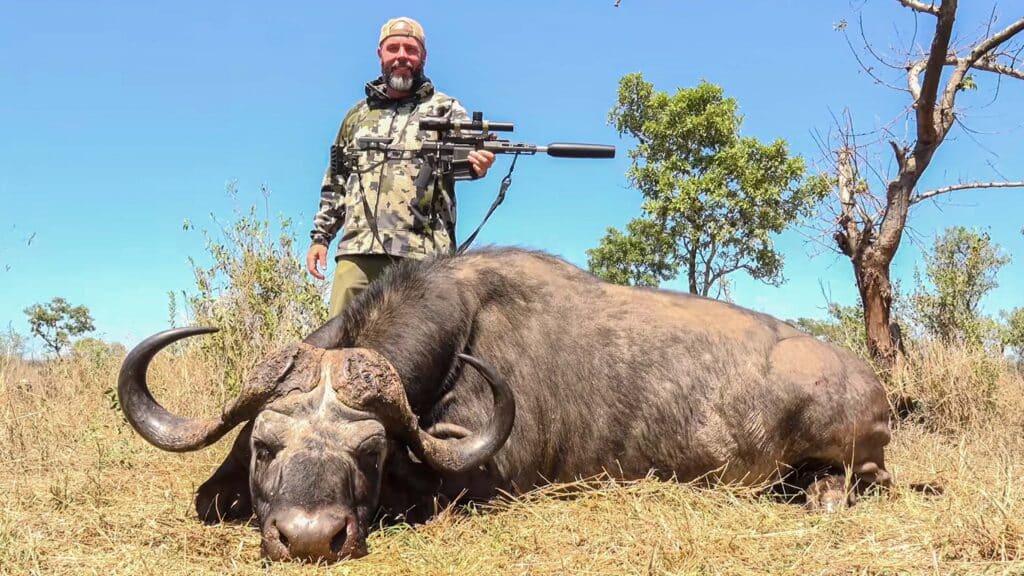
If you value flat-shooting traditional hunting rounds, then the above table would end your interest in 8.6 Blackout. Then, you see photos like one below, and you say. Wait, what? That guy killed a CAPE BUFFALO with a semi-auto rifle with a tiny 12-inch barrel? Suddenly, any hunter’s interest is piqued.

Kevin Brittingham from Q took a cape buffalo with a tiny 12″ barreled rifle chambered in 8.6 Blackout

There are many advantages of the 8.6 Blackout which have never been possible with existing cartridge designs, but they only make sense if you’re willing to take a non-traditional look at what a hunting rifle could become.

Pros and Cons of 8.6 Blackout

Case Design

1 – A typical 6.5 Creedmoor case is the parent case for the 8.6 Blackout

2 – Put a 6.5 Creedmoor case in an 8.6 Blackout reloading die, and drop the press. You end up with a much expanded neck to fit the large bullet, and a shoulder pushed quite a bit lower

3 – Trim the case from step 2, and you have a fully prepared 8.6 Blackout case (that might require some neck turning)

4 – Grab a gigantic bullet to put in your 8.6 Blackout. Notice that this Sierra 225 MatchKing bullet is even longer than the case

5 – A completed 8.6 Blackout cartridge

Comparing 8.6 Blackout to Similar Cartridges

Not surprisingly, the most comparable cartridge to the 8.6 Blackout is its little sister-the .300 Blackout. The .300 Blackout is essentially a .223 case necked up for a giant bullet that allows the cartridge to shoot supersonic or subsonic with heavy-weight penetration.

The 8.6 Blackout essentially accomplishes a similar purpose, but in a much more powerful platform.

Rifles Available in 8.6 Blackout

So far, only three companies produce rifles in the 8.6 Blackout cartridge: Q, Faxon, and Gorilla.

Most people looking to get an 8.6 Blackout rifle will likely end up looking at Faxon Firearms. They make relatively inexpensive barrels for the AR-10 platform (commissions earned). If you already have an AR-10, you can simply screw on one of their barrels and you’re done.

For complete rifles, Faxon has two options: their bolt-action Overwatch, and the AR-10 Sentinel. I personally have their Sentinel AR-10 rifle, and I can confidently say it’s the nicest AR-10 I’ve ever owned.

Q makes high-end rifles with the “cool factor.” They have produced some very innovative suppressors, rifles like “The Fix” and now a cartridge. Looking through their website, the only model I could currently see being produced in 8.6 Blackout is The Fix as a 12″ SBR (meaning you’ll need a tax stamp and enough patience to wait for the ATF).

Gorilla Ammo also produces complete firearms. They have their GF10 Lightweight Hunting Rifle as well as their GF Bolt Action Rifle available in very limited quantities.

Prediction: Will 8.6 Blackout Take Off?

I see 8.6 Blackout is a boutique cartridge.

As a hunting cartridge, it isn’t flat shooting enough to whet the appetite of western hunters. They want cartridges like the new 7mm PRC. Eastern hunters shooting whitetail aren’t exactly clamoring for more power to kill a whitetail. They want cartridges like the 6.5 Creedmoor, or even a lever action 30-30. It frankly isn’t that hard to kill a whitetail at short range. Midwest Hunters are looking to straight-wall cartridges to follow strict state laws.

There is, however, one huge factor that may help to push 8.6 Blackout. It’s the Hornady factor. Hornady manufactures a giant amount of 6.5 Creedmoor ammunition and has worked with Q to produce brass for early production. When Hornady sorts through its backlog, I would expect them to begin producing 8.6 Blackout since they already do production runs for 6.5 Creedmoor brass, and I doubt they’ll miss an opportunity to play with a cartridge that opens up a completely new engineering need for unique bullet designs.

If the last 20 years teaches us anything, it’s that if Hornady touches a cartridge, it’s probably going to take off.

Reloading 8.6 Blackout

Since I had a bucket of 6.5 Creedmoor brass, I chose to convert that brass to 8.6 Blackout rather than waiting for brass to become available. I’m glad I didn’t wait, because it ended up being a rather enjoyable process.

I was informed by others online that Hornady 6.5 Creedmoor brass was the best option for converting, so I blindly obeyed like a sheep.

I used the Lyman dies in 8.6 Blackout which were very inexpensive. I tried other Lyman dies before that I didn’t like, but this one worked out perfectly.

I kept the expander ball in the die and went down slowly into the case, backing off and coming back down every few millimeters since it is quite a stretch from 6.5mm to 8.6mm. It would have been much better to use an expander mandrel and slowly step up each caliber to 8.6mm, but I wasn’t reloading for precision and wanted quicker results.

The brass looked pretty good at this point. The brass around the shoulder had tiny waves, but it was minimal enough for me not to be concerned.

This left a large neck on the case, which I simply ran through my Frankford Arsenal Case Trim and Prep Center to shave down. I used a trim to length of 1.675″ given that the specified case length was 1.685.” I wish there were more detailed reloading data available, but that was my best estimate for a good “trim to” length. Please, however, don’t rely on my data because I’m a layman and not a ballistician.

The next issue is the neck thickness. Unfortunately, my first batch of ammo produced too thick of a neck, so it wouldn’t fully chamber. I highly recommend the Sheridan case gauge checker for 8.6 Blackout, which was recommended to me originally on the AP2020 Youtube channel.

Next, I loaded the case with Accurate 1680 powder, which was a new powder for me. It’s extremely fine-so fine that I found it very difficult to meter and pour because the fine powder would stick in my funnel no matter what I tried.

I followed the load recommendations from Q which are published on the Faxon website. They are included below.

When doing load development, only use information from the powder or firearms manufacturer-not random blogs like this one. Always start load development low when working with supersonic rounds and work up, or vice-versa for subsonic rounds. Do not use this information for developing loads. It is for academic purposes only and may contain errors.

PurposeBulletCOALPowderVelocity

The New Era – All about Sweet Home since 1929

0

The antlers of a Union County bull elk have been officially scored at 406 6/8, which would make it the second-place record for a typical Rocky Mountain elk in Oregon.

The bull’s skull and antlers were found by a cone collecting crew on private timberland in the Catherine Creek Unit during the summer and turned in to ODFW.

Mark Penninger, a certified scorer for Northwest Big Game Records Inc, officially scored the elk in early November after waiting the required 60 days.

(An animal must undergo a minimum of 60-day drying period before it is officially scored as skulls and antlers will shrink some after their first “green” score immediately after harvest or pick-up.)

“Bull elk of this caliber are incredibly rare in Oregon but it’s great to see that they are still around,” said Penninger, who described the antlers as “jawdropping.”

“This bull is testament that age, good genetics, and high-quality habitat can produce truly world class elk,” he said.

ODFW does not track trophy records but will be submitting the score to Northwest Big Game Records for official placement.

Northwest Big Game Records is one organization that keeps records of game animals including both those that are harvested by hunters and those that are found dead.

(In Oregon, due to poaching concerns, it is unlawful to possess or transport found dead game mammals or their parts, except for naturally shed antlers or certain parts when salvaging roadkill.)

The last time an elk with typical antlers scoring higher than 400 was found or harvested was 1984 by Randy Ryerse in Crook County, an elk now bumped to the #4 record with a 400 0/8 score.

The #1 Rocky Mountain elk was a 418 2/8 bull taken in Crook County in 1942 or earlier and attributed to Hugh Evans.

Until now, the second largest was a bull taken in Grant County by Jim Sproul with antlers measuring 401 1/8. This bull was displayed in the John Day Elks Lodge until it was lost in a fire when the building burned down, according to Penninger. The bull had the longest main beam of any bull anywhere for a long time, he says.

With this Catherine Creek elk, the top four Rocky Mountain elk will all score higher than 400. After that, antler scores drop into the high 300s.

The two Tafts

The top 10 for typical Rocky Mountain elk still includes “Taft,” a Wallowa Lake bull that was scored at 391 4/8 for a typical Rocky Mountain elk in 1930. This bull is ranked even higher in the non-typical category-it’s the No. 3 state record with an official score of 411 0/8.

“In fairly rare cases, an animal meets minimum qualifications for both typical and non-typical categories for the species,” said Penninger. “Typical scores subtract non-typical points.” (Learn more about how elk and other big game are scored by listening to this week’s Beaver State Podcast with Penninger.)

According to David Morris of Northwest Big Game, this record setting bull is often mixed up with another one of the same name (both are named after William H Taft who served as U.S. President 1909-1913). But there were actually two different Rocky Mountain elk that came to be called “Taft” in northeast Oregon in the early 20th century.

While historic records indicate elk were abundant in the Wallowa Mountains and Blue Mountain Plateau, market hunting had reduced numbers to a few small herds by the late 1800s/early 20th century, so elk were transplanted into the state to restore the population.

(The Oregon Legislature provided protection for elk in 1899 by making it illegal to sell meat from wild animals and by closing elk season from 1909 through 1932, and the Rocky Mountain elk population has since rebounded to more than 70,000 today.)

The first “Taft” was one of the original elk relocated from the Jackson Hole area to Oregon in the early 20th century. In 1912, 15 elk from Wyoming were released at Billy Meadows in Wallowa County followed by another 15 in 1913, and one of those was the first “Taft.”

The first Taft’s shed antlers are still displayed at the Enterprise Elks Lodge. Sheds from the second Taft (the 1930 record-setting bull) were displayed at La Grande’s Elks Lodge and are now at the Baker City Elks Lodge, according to Morris. Their antlers look different.

Morris spent several years researching the two Tafts and the story about what he found is in his book (The Record Book for Oregon’s Big Game Animals, 6th Edition).

Based on his research, Morris says the second Taft was likely one of a handful of elk born in one of the enclosures at Billy Meadows where the transplanted elk lived for several years; the fences were taken down in 1922.

ODFW hopes to eventually display the Catherine Creek bull’s record antlers in one of our offices and thanks taxidermist Brody Turner for working with us to get them ready for display.

See https://www.nwbiggame.com/top_10.cfm for Rocky Mountain elk and other big game records.

Stock Up And Stay Prepared With The Best Emergency Food Supplies

0

Whether we’re ready to admit it or not, the number of natural disasters that occur each year has steadily increased over time. From flash floods and wildfires to heat waves and hurricanes, major events are plaguing the planet more consistently, which puts us at risk when help is hours, days or even weeks away. To prepare for such events, the Federal Emergency Management Agency (FEMA) recommends we put together an emergency supply kit that contains batteries, first aid supplies, water and food. But a kit filled with perishable foods won’t do you good—any kit worth its salt should contain the best emergency food supplies.

The best emergency food supplies provide long-lasting nourishment for days or weeks at a time.

Illustration: Forbes / Photo: Retailers

Thanks to their astoundingly long shelf life—up to 30 years in some cases—emergency food supplies are perfectly suited for your preparedness kit. They’re typically offered in larger quantities with individually packaged meals that take minutes to prepare. And while some kits require hot water (in which case, you’ll need to add a camp stove to your kit), others can be rehydrated with nothing more than cold, bottled water (though you should still have a water filter handy just in case).

Non-perishable food kits have long been associated with campers and travelers, but for many of us, keeping long-lasting food on hand just makes good sense. These emergency food supplies tend to be affordable, convenient, easy to use and they last forever, which is why you should keep some in your pantry, garage or basement should you need it.

With this in mind, we’ve rounded up the best emergency food supplies for your basement stockpile, backcountry survival kit or dedicated bug out bag. This list includes options for people with dietary restrictions or specific preferences, and it includes kits that actually taste good, which makes it easier to literally weather the storm.

  • Best Emergency Food Supplies For Families: ReadyWise Emergency Food Supply
  • Best Emergency Food Supplies For Vegetarians: Survive2Thrive Vegetarian Preparedness Pail
  • Best Gluten-Free Emergency Food Supplies: Mountain House Essential Bucket
  • Best Emergency Food Supplies For Appetizing Fare: Good To-Go Emergency Food Kit
  • Best For Variety: Augason Farms Emergency Supply Food Kit
  • Best Emergency Food Bars: S.O.S. Rations Emergency Food Bars
  • Best Splurge-Worthy Emergency Food Supplies: Momofuku Noodle Variety Pack
  • Best Emergency Canned Food Supplies: Scout Smoked Wild Pink Salmon
  • Best emergency Hydration Supplements: Protekt Hydration Supplements

How We Chose The Best Emergency Food Supplies

As backpackers, homeowners and family members, we understand the unique challenges that come with sourcing food in the midst of unpredictable circumstances. We’ve camped in the backcountry for weeks at a time, just as we’ve endured long-term periods without power, and were it not for emergency survival foods and other dehydrated meal kits, we likely would have found ourselves in tough situations. As such, we know what to look for when testing, reviewing and researching emergency food supply options, and we know how to source credible options that speak to quality and extended shelf life.

When assembling this review, we considered each meal kit’s serving size, shelf life, total weight and nutritional value before weighing these factors against their respective reviews. We scoured the web for options, spoke with experts, poured over hundreds of reviews and tested many of these products ourselves. Only the best survived our rigorous testing.

Why Trust Forbes Vetted

At Forbes Vetted, we know how frustrating and time consuming it can be to spend hours sifting through a seemingly endless list of survival products and online reviews. That’s why we took the headache out of the process by testing and reviewing many of these products ourselves. And because the emergency food landscape is changing in accordance with the times, we update this list regularly to reflect the best options and up-to-date information. This list was last updated September 2024.

What To Consider When Shopping For Emergency Food Supplies

Investing in emergency food supplies is a crucial step in ensuring you and your family are prepared for unexpected scenarios. To find the right emergency food for your needs, consider these essential variables:

Nutritional Content

Look for foods that offer a balanced nutritional profile, including protein, carbohydrates, fats, vitamins and minerals, and check for allergen information, especially if anyone in your household has dietary restrictions.

Shelf Life

Longer shelf life ensures that your supplies remain edible for an extended period, so be sure to evaluate both freeze-dried and canned options, as they often have different shelf lives.

Storage Requirements

Determine whether the food requires special storage conditions, such as cool, dry places, and consider space limitations when storing bulk supplies. If live in a home with a garage or basement, storage won’t likely be an issue, but if you live in a smaller apartment you may need to take kit size into consideration.

Caloric Value

Calculate the daily caloric needs of your household members to ensure you have enough food to sustain everyone—some emergency food supply kits are designed to provide a specific number of calories per day.

Food Variety

Aim for variety to prevent flavor fatigue during extended emergencies, and to do this, look for kits that offer a mix of entrees, sides, snacks and beverages.

Special Dietary Needs

Consider any dietary restrictions, allergies or preferences within your household when selecting supplies. Be sure to seek out options that cater to specific diets, such as vegetarian, vegan, gluten-free or kosher, as these dietary restrictions will limit which foods you can store.

Ease Of Preparation

Examine the simplicity of cooking or rehydrating the food, especially if you don’t have access to elaborate cooking equipment. Some emergency meals only require hot water, while others may need additional ingredients or equipment.

Taste And Quality

Emergency food supplies don’t generally taste all that good, but you can still read reviews (or sample products if possible) to assess the taste and quality of the emergency food supplies. If it tastes good, there’s a better chance you’ll be willing to eat it, even in the midst of an emergency.

Are Survival Food Kits Worth It?

Survival food kits represent a low-cost, risk-free means of preparing for the unpredictable, which makes them a worthwhile investment. While we can’t recommend replacing your normal diet with survival food options (these kits don’t offer a number of essential nutrients, despite claims that suggest otherwise), we can recommend keeping a kit in your basement on the off-chance that you need it.

Should I Stock Up On Emergency Food?

According to the FEMA, your emergency kit should contain at least a three-day supply of nonperishable food. The agency also recommends choosing foods your family will eat and paying attention to special dietary needs. Common non-perishable foods include protein or fruit bars, dry cereal, ready-to-eat canned options and high-energy foods.

What Is The Best Survival Food Supply?

The answer to this question depends on your personal situation and what sort of emergency, natural disaster or food shortage you’re preparing for. If you live in a part of the country that isn’t prone to natural disasters, you may be able to get by with a stockpile of peanut butter, granola bars, water and canned beans and vegetables. But if you live in an area that tends to experience hurricanes, earthquakes, tornadoes or wildfires, you may need to invest in larger quantities of emergency foods that can be prepared with only water and are highly portable should you have to leave your home.

Best Air Rifle Deals

Popular Posts

Can you dry fire a gamo air rifle?

0
Unveiling the truth behind dry firing a Gamo air rifle, this intriguing headline delves into the possibility of safely practicing without ammunition. Join us...

Air Gun 101: What You Should Know about Air Rifle Barrels Before Buying

0
Have you ever heard the phrase: “Imitation is the sincerest form of flattery”? The Chinese must have been very sincere in emulating this proverb. I...

How to make a break barrel air rifle more powerful

0
"Unleash the Power: Mastering Break Barrel Air Rifles for Maximum Performance. Discover expert tips and techniques to enhance the power and precision of your...