Home Blog Page 142

7MM PRC Cartridge Guide

0

DISCLAIMER: This is a guide. Everything listed within is for information purposes only. All loads should be worked up carefully. We have seen loads that require as much as two grains of charge weight adjustment from one powder lot to another. We have seen as much as five grains of powder adjustment required between different brands of brass. Failure to start low could result in damaged equipment or injury. USE AT YOUR OWN RISK.

7 MM PRC Cartridge Guide

Here we go again. Hornady announced the 7 PRC. In a market with many similar options, why do we need another? The short answer is that the others are poor designs by today’s standards. I imagine the design goals for the 7 PRC were much the same as the 6.5 and 300 PRC. Like the other PRCs, the parent case of the 7 PRC is the 375 Ruger. Hornady surprised everyone by splitting the difference between the other PRCs. The 2.28″ case length is perfect for a 7mm magnum cartridge. The number one selling point of the PRC cartridges is the modern throat design. The 7 PRC’s freebore of .233” makes it very flexible. It is not too long for the shorter bearing surface 180s and not too short for the larger bullets like the 195 Berger. At SAAMI length, the 7mm PRC will fit inside the 3.4” magazine boxes of last century’s design in SAAMI form. With the larger bullets, it will exceed the 3.4” magazine, but will not need a Wyatt’s box.

190 ATIP

190 BERGER

195 BERGER

180 ELD-M

180 HYBRID
7MM Cartridge Options

There are numerous other options when considering a 7mm rifle. On the larger side, we have the 7mm Remington Magnum, the 7mm LRM, the 7mm RUM, and the 28 Nosler. You have the 7mm Winchester Short mag with identical case capacity. Then the 7 RSAUM is on the smaller side. So, what does the 7 PRC offer that the others do not? Let me rule out the 7 RUM and 28 Nosler right off the bat. They are too overbore for me. They wear throats out very quickly, are more prone to carbon rings, and are more difficult to keep in tune. They have short throats and need a custom reamer to make full use of the case’s abilities.

Let’s focus on the 7 RSAUM, 7 WSM, 7 Rem mag, and 7 LRM. Of the bunch, the 7 RSAUM is going to be the most accurate on average and will stay in tune with less work, yet it suffers from a few problems. At SAAMI length, longer bullets occupy too much case capacity. This is a major reason why it has disappeared from factory offerings. When built with a custom reamer and rifle, it is still a great option. The 7 WSM has the same capacity as the 7 PRC, but it suffers from the same shortcomings as the RSAUM. The 7mm Remington Magnum has anywhere from 1-3 grains more H2O capacity than the PRC. Once again, it suffers from a throat that is too short for modern bullets. It remains a great cartridge but has room for improvement. This is the main cartridge the PRC will have to outperform, as far as sales go, to stay around. The 7 LRM is a nearly perfect cartridge for the caliber and the bullets we currently have available. The only issue with it is it is not SAAMI-approved. This makes it a non-starter for production rifles. When compared to these options, the 7 PRC leaves little to be desired in a 7mm cartridge. The case capacity is perfect and the freebore is forgiving. These reasons are why the 7 PRC is going to be the best 7mm cartridge available in factory chamberings. If the success of the 6.5 and 300 PRC is any sign, this cartridge will get tons of aftermarket support. Hornady’s marketing will make this cartridge very popular. The anticipated aftermarket support will be what ensure this cartridge sticks around.

Why Choose The 7MM PRC?

Ok, so none of this tells you why you would build a custom rifle chambered in this cartridge. I have always loved the 7mm cartridges, with the 7 WSM being one of my favorites. Its capacity seems to be the sweet spot. The 7 PRC has the same capacity as the 7 WSM. It is slimmer and longer. This should make it easier to feed from a long-action magazine. I have found the short magnum cartridges don’t feed well from short actions. Because of this, I don’t see the point of short magnums in short actions. The 7 PRC will not quite compete with the 7 RSAUM in the raw accuracy department, but it is close. It will yield more velocity on average. This will translate to smaller horizontal dispersion in adverse conditions at long range. On average, it should also shoot flatter. It will run right with the 7 Rem Mag without needing a custom chamber. These are the reasons this cartridge is likely to be a success. Let’s get into the load information.

LEFT TO RIGHT ALL WITH 180 BERGER HYBRIDS SEATED WITH BOATTAIL JUNCTION AT NECK SHOULDER JUNCTION: 28 NOSLER, 7LRM, 7 REM MAG, 7 PRC, 7 WSM, 7-270WSM, 7 SHERMAN MAX, 7 RSAUM.
Bullets

We are choosing to focus on 175 and larger bullets for now. When time permits, I will work on some 168 Berger data. I don’t see the point of shooting smaller in a .284 when you could shoot the 156 Bergers from a .264. Any of the 168-180 grain bullets will be right at home in this case. My favorites are the Berger 180 VLD and Hybrids, as well as the 180 ELDM. Testing with the 190s and 195s will continue and this guide will be updated when more data is collected. Hornady kindly provided us with the load data provided below. I checked it with 180 Bergers and 180 ELDMs, except for the RL22 loads. This is because RL22 was too temperature sensitive in my previous testing.

Left to right: Hornady 180 ELDM, Hornady 190 ATIP, Berger 195 Elite Hunter, Berger 190 LRHT, Berger 180 Hybrid

******The loads in the above chart are all max loads. WORK UP!******

Powders

The 180s will do very well with the normal powders for this sized case. H4831SC and RL23 should offer good accuracy and low extreme spreads in velocity. They generally will be on the faster side in burn rate, which will yield lower max velocities. Retumbo, N565, and RL26 will perform well and will yield the fastest velocities. My barrel did not yield great accuracy with Retumbo or N565. If I were set on using these two powders, I would try some different primers. RL26 was accurate in my rifle but is not quite as stable as H1000. My favorite powder for the case is H1000. It provides great accuracy and extreme spreads. Velocity will fall right in between the other powders. I have settled on the low node with H1000 and 180 Hybrids at 2895 fps out of a 26” barrel. The case can go quite a bit faster, but the node was just too wide and stable to ignore. The larger bullets will still do great with these powders and will allow the use of slower powders like N570.

******While these may work in our rifles, they may be too hot in yours. WORK UP!******

Primers

Any of the large rifle primers should work in this case. In my experience, with this case capacity, the faster powders do best with Federal 210Ms and CCI BR2s. The slower powders do well with CCI 250s or Federal 215Ms. Don’t be afraid to experiment. Most of my testing was done with CCI 250s. Forum member 8nbait was having better luck with Federal 210Ms.

At the time of launch, the only case options will be Hornady and RCC. My testing was done with Hornady brass. Forum members 8nbait and Weatherbyfan were using RCC.

Comparing 6.5 vs 7 vs 30

Bullet mass and impact velocity should be heavily considered when choosing a cartridge. The correct choice will ensure ethical kills at your maximum range. The bullet mass is going to have a direct impact on the recoil. For some, this needs to be considered. I will never advocate shooting elk with calibers smaller than .308. However, 30-caliber magnums are not needed for deer and antelope-sized game. The 7mm caliber is a great choice for deer and smaller game. Too many people focus on energy as a killing power indicator. Based on countless instances of anecdotal evidence, this is just not the case. Bullet mass and impact velocity are better predictors of how fast an animal will go down. This mainly applies to frangible bullets, which we prefer over bonded bullets. Below is a comparison between a few different cartridges in each caliber. You will see they look very similar on paper. Just keep in mind bullet mass means more shrapnel to destroy the vitals of your target.

6.5vs7vs30 energy

6.5vs7vs30 drift

6.5vs7vs30 drops

7MM PRC Conclusion

If you take a look at a reloading manual, you will not see much of a difference between the 7 PRC, the 7WSM, and the 7 Rem mag. What you are gaining is a better-designed factory chamber. The longer freebore will allow a reloader to make better use of modern bullets. The 7 PRC’s modern design will lead to a much better selection of factory ammunition. However, if the success of the other PRCs is an indicator, this cartridge will continue to grow. It will be a hit with those using factory ammunition as well as reloaders. The cartridge will be great for all hunters. Whether you choose a factory rifle or go the custom route, the 7 PRC is worthy of your consideration. The link below will take you to a thread on the forum with members’ input on loads that have worked for them.

Comment or ask Ryan questions here.

Watch the 7mm PRC Cartridge Guide Video here.

Test: CZ Tactical Sports 2 – The new generation of the classic IPSC pistol from Ceská Zbrojovka

0

CZ has hit the big time in the IPSC Production and Production Optics divisions: the Shadow 2/Shadow 2 OR models clearly dominate these two divisions of dynamic pistol shooting. This is not surprising, since successful ergonomics and high reliability coupled with an unbeatable price-performance ratio are compelling arguments.

In addition, there are the countless successes that have been achieved with the Czech all-steel pistol in recent years. The Czech manufacturer has long been committed to the dynamic IPSC discipline, as Tactical Sports has been part of the product range since 1996. So it looks as if CZ is once again on the attack with the brand-new single-action all-steel TS 2 pistol that should stand up for itself against the 2011 models that have dominated the standard class to date.

Czech triumvirate: CZ Tactical Sports 2 in three versions

Three different models were presented for the future at the online press conference, which also featured CZ team shooter and multiple world champion Eric Grauffel. In addition to the entry-level model for €1750, which was introduced and tested here for the first time, there will also be the TS 2 Racing Green for €2049, which is better equipped in detail, and the top model TS 2 Deep Bronze for €2649 (see also our original news article).Whether the new TS 2 models, like the Shadow 2, will be available in the young CZ online configurator, so that they can be customized according to individual wishes, is unfortunately not exactly known at the moment. The trio is of course not only available in 9mm Luger, but also in the “IPSC Major Power Factor” .40 S&W caliber.

You can discover the CZ configurator here.Time will tell if the previous flagship in the form of the TS Orange will continue to be available for around 2400 euros. At the very least, the first generation Shadow will continue to be in the lineup.

Features of the CZ Tactical Sports 2 pistol in detail

A typical feature is the muzzle-length dust cover, which is now angular in profile compared to its TS predecessor. The undercut at the transition area between the front strap and the trigger guard, as well as under the beavertail, are now a bit more pronounced to allow the gun to sink even deeper into the hand for maximum control when firing.Also new are the recesses on both sides above the trigger, which give the elongated trigger finger better access to the trigger blade. Unfortunately, the trigger blade is made of cheap and elastic plastic, which also applies to the magazine floors. Trigger pull is a low 730 grams with minimal creep before break, but this should go unnoticed, especially in dynamic disciplines. Of course, the trigger is equipped with an adjustable trigger stop. The reset travel of around 1.7 millimeters is short and easily manageable.

As with the Shadow 2, the slide contour of the CZ TS 2 tapers upward, which incidentally means 14 grams less mass to move when firing. The total weight is 48.67 oz/1380 grams, a good 1.05 oz/30 grams more than the TS Orange. The moving mass has thus been further reduced, but the overall weight has increased somewhat, which again contributes to a better shooting feel.To change the point of impact laterally, the rear sight can only be drifted and then fixed with two Torx screws. A point of impact shift in elevation can only be achieved by replacing the fiber optic front sight. In our opinion, this is a bit of a shame, as the less expensive Shadow 2 at least has a height-adjustable rear sight. However, the “Racing Green” and “Deep Bronze” models seem to have a height-adjustable version. Likewise, a left hand thumb rest will be available here, with which many a shooter will achieve greater gun control.

The safety on the entry-level model has a large thumb lever on the left side only. However, an enlarged safety lever for the right side is also available in the CZ accessories store. In our experience, however, this is not absolutely necessary, since the CZ Tactical Sports 2 can be operated perfectly well even in the standard configuration.

The magazine button sticks out far, so that it already pressed a bit into the author’s support hand. Nevertheless, at no time was the magazine accidentally released, although the release resistance was not very high. However, this is also very dependent on the shooter’s grip technique and hand size, so other shooters will not even notice this possible, marginal ergonomics problem.

Even if some aesthetes and material lovers may turn up their noses at the rational production of the frame and slide by means of investment casting, it must be acknowledged without envy that CZ seems to have this process perfectly under control. For one looks in vain for obvious blowholes or exposed seams. The frame/slide tolerances were quite tight.

The 5.25″/131 mm long barrel is formed by rational swaging – better known as hammering – and has the typical European twist of 1-10″/1-250 mm. The barrel is guided at the front by a pressed-in bushing. Under the barrel sits the one-piece spring guide rod with plastic buffer. A 13-lb spring has also been fitted here, which represents a good compromise in terms of reliability and good shooting behavior.If you want, you can also get springs with a lower power in the aftermarket, which promise an even more pleasant shooting behavior. However, based on practical experience, Eric Grauffel recommends not going below 10 lb, otherwise the gun could be too heavily stressed. At least two spare magazines can be found in the hard case.

Benjamin Varmint Powerpack Review

0

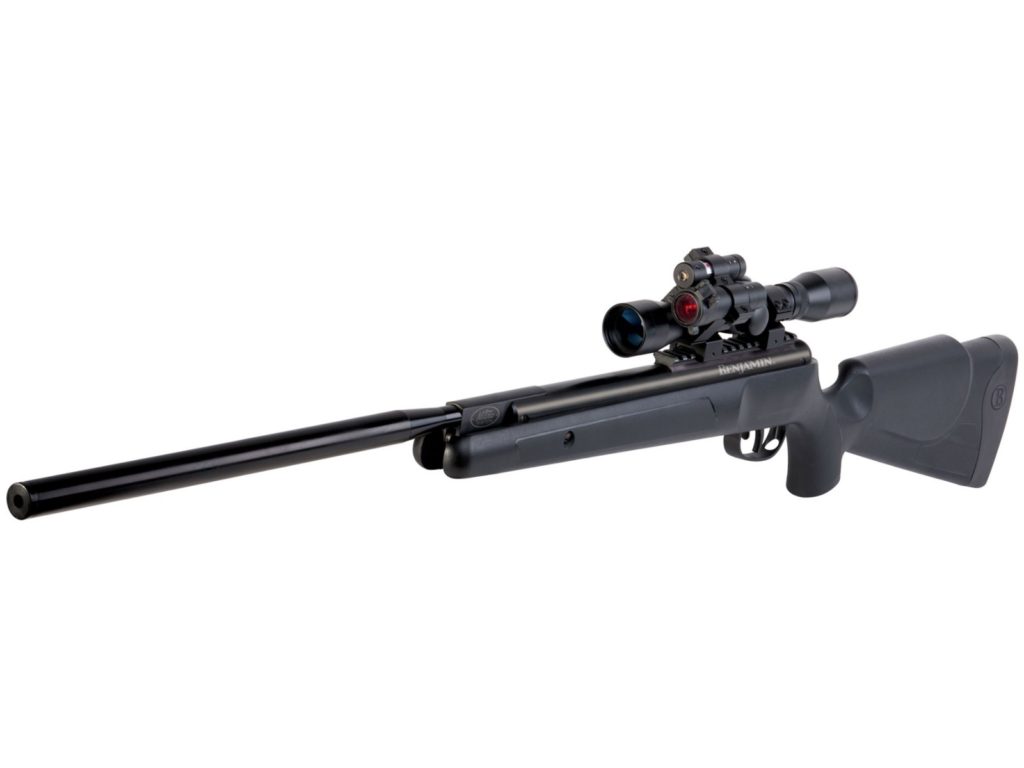
The Benjamin Varmint .22 air rifle has the word “varmint” in its name,

Implying that the manufacturer’s vision was to bring back peace into your invaded property

By making a gun that could eliminate those pesky and sneaky critters with ease.

But is it a great gun for the job?

Read more to find out.

Benjamin Varmint Powerpack – Guntype

This airgun is powered by nitro piston technology.

A nitro piston gun (or gas piston gun) works the same as the spring gun but it has a nitrogen-filled cylinder instead of a coiled spring.

If you like smoother-shooting guns that don’t have spring fatigue because you left the gun cocked

While waiting for the next critter to cross your path, then a nitro piston rifle is your gun of choice.

Read more about it in this post to see how nitro piston technology can make your gun sport even more awesome.

The barrel has a caliber (the diameter of the bore, measured in inches) of .177 (4.5 millimeters).

It has helical grooves inside the bore to make the bullet spin.

Spin stabilizes pellets, improving accuracy and enhancing shooting range.

(For more on things you should know about air rifle barrels before buying, see this post.)

This gun is a single shot, break barrel air rifle so you can only shoot one shot at a time.

It gives you control over your ammunition, and you can find out what pellet works best with your gun in the shortest amount of time.

The barrel is a shrouded bull barrel, which means that it has a jacket enclosing the barrel

And containing the violent release of compressed air from the muzzle.

It lets the pellet escape but forces the air to use up as much of its energy before it leaves the shroud, thus reducing the noise.

For more on how to choose the right air gun caliber for your game, see this post.

Stock

The stock is synthetic.

The synthetic stock is best for hunters hunting in the field with different kinds of weather.

For more on the in-depth comparison between synthetic and wood stock, see this post.

Benjamin Varmint Powerpack .22

This stock has comfortable dual-raised cheekpieces on both the left and right sides of the gun.

Raised cheek pieces are designed to provide you with firm control during the shot cycle.

Moreover, this pellet gun has a rubber buttpad that helps reduce recoil.

Also, it has a textured grip and forearm that adds friction to your hands when shooting, prevents slippage from the shooter’s sweat, and increases stability in aiming.

Ammo

The Benjamin Varmint .22 Powerpack uses .22 pellets as its only source of ammunition.

For more on the differences between .177 & .22 and which jobs they do best, see this post.

Cocking and loading

Cocking the gun:

First, put the gun ON SAFE, hold the gun by your side, then firmly tap the muzzle end to expose the breach.

Let the gun rest on your upper thigh and grasp the muzzle end.

Continue to pull the barrel down to its limitation to perform cocking action.

Loading the pellet:

With the breech opened after cocking, put the pellet (with the pellet’s nose lying forward) into the breech.

Then pull the barrel up to its original position until it locks and you are ready to fire.

As you can see, the operation of this break barrel rifle is easy and straightforward.

So you will learn how to handle this gun in just a few hours.

Velocity, accuracy and power

The 1200 FPS Amazon description is a misprint;

This pellet gun actually produces up to 950 FPS with alloy pellets, a high velocity compared to other .22 on the market.

The high speed combined with a large .22 caliber makes lethal killing power, so a successful day of pest control is within your reach.

(For more on the best air rifle for rabbits, see this post)

For Crosman Varmint .22, various shooting tests have been conducted by different shooters with positive results.

The common shooting groups are:

  • 1/4” at 20 yards,
  • 1” at 30 meters,
  • 1 1/2″ at 30 meters,
  • 1/4″ at 15 yards,
  • 1.5” at 40 yards,
  • 1/4″ 25 yards,
  • dime size at 30 yards
  • and dime sized at 70 yards.

This is an extremely accurate gun up to 70 yards .

The accuracy is great, but how about power?

Let’s take a closer look: at 33 yards, this gun can shoot through 7/16” plywood; it also damages a patio block at 10 yards.

And with 13.12 gr Hatsan Vortex pellet, it shoots right through a deer skull at 35 yards.

What a powerhouse gun – something you can trust in your quest to bring peace and beauty back to your backyards.

Sight

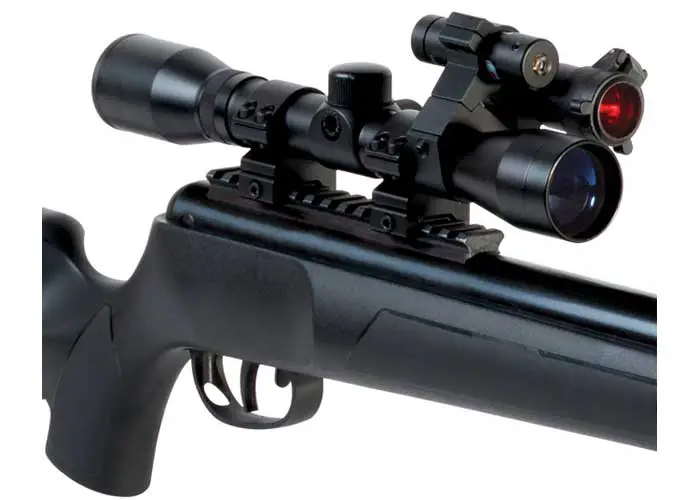
Benjamin Varmint Powerpack .22 scope

This gun doesn’t have a traditional iron sight: no front sight, no rear sight.

But this gun does come with 3-9×32 scop.

As if the variable scope is not enough for a successful shooting day, Crosman has installed a lot of optics including a Red Class III fast acquisition laser

With a push on/off or remote tape switch, 90-lumen flashlight, and mounts (the flashlight has a red flip-up filter).

This optic combo lets you hunt anytime, anywhere, from day to night with great visibility.

(For more on how many types of air gun sights are out there and which one is suitable for you, see this post.)

The rail is manufactured in the Picatinny style.

This type of rail gives you lots of benefits:

You have more mounting options and you can swap the scope from one gun to another and use the different scope in one air rifle as well.

And yes, no more worrying about tube length, eye relief, etc since you can place the scope ring at any point you want.

Shooting Ability

The effective shooting range of this gun is up to 70 yards.

You can use it for plinking, target shooting, small game hunting, and pest control.

Specifications

  • Caliber: 0.22”
  • Velocity: 950 FPS with alloy
  • Loudness: 3- Medium
  • Overall Length: 44.5”
  • Shot Capacity: 1
  • Barrel: Rifled
  • Front Sight: None
  • Rear Sight: None
  • Scopeable: Weaver mounts
  • Trigger: Two-stage adjustable
  • Buttplate: Rubber
  • Suggested for : target shooting/small game hunting/ pest control
  • Action: Break barrel
  • Safety: Manual
  • Powerplant: Gas-piston
  • Function: Single-shot
  • Body Type: Rifle
  • Weight: 7.38 lbs
  • Optics: Scope, Class III laser, 90-lumen flashlight and mounts.

Pros and Cons

ProsCons
  • Hefty and sturdy feel
  • Well-built and great craftsmanship
  • Extreme power and accuracy
  • High velocity
  • Impressive design
  • Awesome optic combo package.
  • Advanced nitro piston technology
  • Quiet and recoilless
  • Not easy to service and modify

Price

The Crosman Varmint .22 Powerpack is 180 dollars.

It’s a reasonable price in my opinion when you consider the great build, quality craftsmanship, modern technology, fantastic power and pinpoint accuracy .

Conclusion

So far, the Benjamin Varmint .22 has proved that it deserves its name as the pest exterminator.

This air rifle will perform reliably and hit hard, and do so quieter than what you’d expect from a similar magnum spring gun.

It’s the perfect gun for shooters who are busy all day and only have free time at night to take care of annoying varmints in their property.

PSE: 50 Years of Innovation – An Inside Archery Cover Story

0

By Daniel Allred

Click the image below to read the story in the original layout.

There’s no easy way to sum up a company as legendary as PSE. After all, the history of PSE goes hand in hand with the history of the compound bow itself.

Established in 1970, PSE was one of the five original companies that developed and manufactured compound bows. Today, half a century later, it is the only one of those five original companies that’s still developing products and pushing the limits of archery technology.

Pete Shepley has made countless contributions to the archery industry. Some of the contributions were technical advancements, and others were for the betterment of archery in general. Today, Shepley remains the leader of his company, and he is as dedicated as ever to improving archery technology and supporting the industry at large.

Much of PSE’s enduring success is thanks to its renowned founder and CEO, Pete Shepley. Under the guidance of this industry pioneer, PSE has evolved into a definitive leader of compound bow technology. Shepley has continually elevated his products and improved his manufacturing techniques to stay ahead of the curve. He didn’t just adapt to the changing bow market—he helped define it.

Now, with 50 years of growth and innovation behind it, PSE is entering a new era. Pete Shepley and his team continue to deliver the engineering expertise and industry knowledge that served them well in the past, and the company has also made modern updates that will ensure its continued success for the next 50 years and beyond.

Lonnie Workman (left) and David Kronengold are key players in PSE’s senior leadership team. Much like Pete Shepley, they both fell in love with archery at a young age and went on to pursue it professionally.

A Blueprint for the Modern Bow – From Then to Now

Pete Shepley’s relationship with archery and bow building began long before he was making compound bows with PSE. Here’s how he described the beginning in his own words:

“Archery started for me in the mid 1940s,” Shepley said. “I spent summers on a farm in Rockford, Illinois, with my grandpa, and he was a real outdoorsman. We fished and hunted and everything else, but more importantly, we made bows out of Osage orange. Those bows would dry out and break every 30 days or so, so we were always making new ones. He also bought me a new wooden arrow every week when I was working on the farm, and I deeply treasured each one of those arrows.”

Pete Shepley has remained an avid completive shooter since his teens. This deep passion for the sport has been a major factor behind PSE’s enduring success.

From this early introduction to the sport, Shepley went on to compete in archery tournaments in his teens. Shepley’s first tournament was in 1949, and he has remained a diehard competitor ever since. In fact, Shepley was recently a competitor in the 2020 Vegas Shoot.

An avid tinkerer by nature, Shepley graduated from high school and then earned a mechanical engineering degree. From there, Shepley took a job at Magnavox, where he developed missiles and other weapon systems for the U.S. government for 10 years. His passion for archery never faded during this early stage of his career, though. With cutting-edge tools and materials at his disposal, Shepley used his knowledge of engineering and archery to create a handful of revolutionary items that we take for granted today.

“I worked on a lot of military projects at Magnavox, but all of that time I was also making archery products,” Shepley said. “There was a machine shop set up for us engineering guys, and when everyone else went to lunch I would build things. I made arrow rests and sights, and that’s also where plastic vanes came from. I also made one of the first release aids in those days, and a lot of other little toys.”

In addition to being a devoted target shooter, Pete Shepley is also a diehard and prolific bowhunter. His bowhunting adventures have taken him around the world many times to pursue unique game.

All of these “toys” were developed in the days of recurve bows, and as history has clearly shown, everything changed for Shepley with the advent of the compound bow.

Shepley left Magnavox to establish his own business, and soon PSE became the fifth company to lease Holless Wilbur Allen’s patent for the compound bow. PSE’s first compound bow design was an almost instant hit. Shepley, along with two of his friends, unveiled the first PSE compound at an archery tournament in Indiana. The three of them placed first, second and third, and Shepley sold 200 bows in that weekend alone. In the following months, archers all over the country were trying to get their hands on a PSE compound.

Over the years, Shepley continued to prove again and again that he was a brilliant engineer of archery products. PSE became an internationally acclaimed manufacturer, and it has remained a top player in the industry until the modern day.

Under One Big Roof

But Shepley is also the first to admit that he didn’t do it all alone. As his company grew, so did his staff, and after so many years in business, his staff has become incredibly gifted. Today, PSE employs around 175 employees at the company’s 150,000-square-foot manufacturing facility in Tucson, Arizona, and an increasing number of these employees have been with the company for decades.

Shepley has also assembled a dedicated leadership team with the same values, work ethic and passion for archery as him. Two prime examples are David Kronengold, general manager; and Lonnie Workman, vice president of sales and marketing. Much like Pete Shepley, David Kronengold and Lonnie Workman fell in love with archery at a young age. Also much like Shepley, their passion eventually led them to a career in the archery industry.

This humble building in Mahomet, Illinois, was PSE’s original facility. After steady growth, the company relocated to Tucson, Arizona, in 1982, where it remains to this day.

David Kronengold was born and raised in New Jersey, where he first tried archery at a summer camp. This taste of the sport prompted Kronengold to seek professional coaching and pursue Olympic-style shooting. Intent on working in the archery industry, Kronengold then earned a mechanical engineering degree at MIT and was hired by PSE shortly after graduation.

Lonnie Workman took a different path, but he arrived at a very similar location. Born and raised in West Virginia, Workman considered bowhunting as a rite of passage. He went on to earn an economics degree and work in banking for 10 years, but bowhunting remained his true passion. One day, he sent an application to PSE out of the blue, and he was hired 24 hours later.

For Pete Shepley, a passionate workforce has been a key part of his company’s lasting success.

PSE’s manufacturing facility is also equipped with a spacious event center and outdoor range. The company uses these areas to host events and offer advanced coaching.

“They know bows and arrows as well as I do, and they also just love archery and want to be involved,” Shepley said. “They aren’t just looking for a dollar—they’re in it for the long haul. They want to make the sport grow, and they want to make truly great equipment. If they don’t enjoy it, then we will find out. Manufacturing is difficult. They won’t last long, and they will just move on and find something else that’s easier.”

As a fellow mechanical engineer and diehard archer, David Kronengold has a deep appreciation for the many technical milestones that Shepley and PSE have achieved over the years. For him, PSE’s legacy is a point of pride and proof of the company’s highly innovative approach.

“The fact that PSE has been making compound bows since the early days is a major achievement on its own,” Kronengold said. “But then PSE stayed on the forefront of technology in the 80s, 90s and 2000s. We weren’t the first, but we were one of the first to have CNC-machined aluminum risers. After that, we developed our patented extruded aluminum riser, which brought our technology down to a lower price point. In the mid-1990s, PSE had the first commercially available mass-manufactured carbon riser. Although we were not the first, we were on the front line of bringing single cams to the market, and we were also one of the first to use highly pre-loaded limbs, which are now very common in the market. On top of all that, we have regularly led the speed game. We’ve always had—if not the fastest bow—the most shootable fast bow in the industry.”

As PSE’s bows have improved, so has the company’s manufacturing facility. PSE remains dedicated to U.S. manufacturing, and the facility has grown over the last five decades to fulfill a wide variety of needs. Today, PSE’s Tucson facility has everything required to build a modern bow from scratch.

A proud U.S. manufacturer, PSE creates its bows from scratch at the company’s 150,000-square-foot manufacturing facility in Tucson, Arizona. The company currently employs about 175 employees, and many of these workers have been with the company for decades.

“We’ve always been pushing the limits of our manufacturing technologies,” Kronengold explained. “We started using CNC machines in the early days, and now we have a very large CNC department. In the mid-2000s, we started cutting fiberglass and manufacturing pultruded limbs. Just this last year, we brought our carbon riser manufacturing in house. We also manufacture our Livewire bowstrings here, and we do injection molding, anodizing, powder coating, dye-sublimation and hydrographic decoration—pretty much everything that’s involved in the process. We bring the raw materials in, and we do everything here.”

Other key aspects of the company are also found here, allowing PSE to operate as a truly streamlined machine.

“Pete has always promoted vertical integration,” Kronengold said. “All of these manufacturing technologies give us the ability to quickly and precisely manufacture the designs that are coming from our advanced engineering department. All of our marketing is also done here in house, and we have sales reps who work for the company. They are not independent reps; they are PSE employees. We handle our customer service here in house, too. Pretty much everything we do takes place under one roof.”

The fact that the company is making its own carbon risers is particularly important to PSE’s leadership team. It serves as a testament to the company’s dedicated staff and manufacturing expertise.

“We have an incredibly engaged workforce that is willing to go the extra mile,” Kronengold said. “Last year they proved that when we asked them to do something that seemed impossible: to start manufacturing carbon risers here in the building. It took a while to learn the process, but we are now the only domestic manufacturer of carbon risers in the industry, and by bringing that process in-house, we have even more control over it. We’ve been doing it for about five months, and now we are just keeping up with the demand. We just hired a second shift and we are still hiring for a third shift, so we will be making carbon risers 24 hours a day, 7 days a week.”

For 2020, PSE is using its state-of-the-art facility to bring some powerful new innovations to the market. In addition to a cutting-edge lineup of compound bows, PSE also unveiled its new Warhammer crossbow.

“Pete actually invented the compound crossbow in 1978, and we’ve made crossbows ever since,” Workman said. “Some years we have been more innovative than others, but we are really getting back into it with the new Warhammer. It is a 100 percent domestic-manufactured high-end crossbow. It’s compact—with a 6.125-inch axle-to-axle measurement at full draw. It’s lightweight, balanced and extremely maneuverable. It’s also very accurate and easy to shoot. A lot of testing has been done on this crossbow. It is truly top-of-the-line, and it’s made from scratch right here in Tucson.”

As a vertically integrated manufacturer, PSE creates, assembles, packages and ships its products after starting out with raw materials.

An Industry Advocate

Excellent engineering has clearly been central to PSE’s lasting success, but behind the scenes, Pete Shepley has also always been a devoted advocate for the industry.

This is only fitting for one of the archery’s greatest pioneers. Shepley has dedicated his life to archery, and he wants archery to grow and succeed in all of its forms.

To that end, PSE acknowledges that both bowhunting and target shooting play their own vital roles. For Pete Shepley, PSE’s recent investment in target archery has been a full-circle experience.

“In the beginning, we focused pretty much exclusively on target archery, because that’s just what I was really interested in,” Shepley explained. “I used to have a lot of conversations with Fred Bear. He would call me in his later days, and we would talk about what I was up to. He always said, ‘Pete, target archery is a lot of fun, but you’re not going to get anyone recognizing you until you start shooting some big animals.’ That kind of changed my direction, and we started focusing a lot more on hunting.

“Recently, though, target archery has come back to the forefront for PSE,” Shepley continued. “I have always thought that target archery was great for pro-shops and the industry. I think if you start ten people in target archery, nine of them will go bowhunting. But if you start ten people in bowhunting, very few of them will get into target shooting. We like customers who do both, because then they are in shops all year—instead of just during hunting season. Today we are focused on tournament shooting every bit as much as hunting.”

In addition to developing revolutionary target bows, PSE has also partnered with top professional shooters and supported important organizations like S3DA and World Archery.

“We realized that PSE could have a lot more presence in target archery, so we have made some transitions in the last 18 months or so,” Kronengold said. “We are pushing products in that direction. We are pushing marketing efforts in that direction. We are also doing promotional events and even partnerships in that direction. We recently partnered with S3DA, and we have just signed a partnership with World Archery while we were at the Vegas Shoot. It’s very important for us to seek out and support these organizations. We want more archers to show up and play the game, and we want to make sure that PSE is an obvious choice when they buy their first bow or next bow.”

PSE’s robust collection of partnerships also gives the company ample access to industry experts.

“All of our partners bring value to the team, and everyone brings different value,” Kronengold said. “Some of our pro-staff members are incredibly technical, and they engage in a lot of conversations with our product development team. Others are not as technical, but they are tremendous influencers, and they understand that their job is to spread the word by going to events and winning, or showing up to a hunt and killing the biggest animal. We are constantly having conversations with the best hunters and the best shooters, and we make them actual members of our team. We don’t just sponsor them and give away products. We speak with them on a daily basis. They are our eyes, ears and mouth. They give us critical feedback, and they also get the message out and drive consumer demand.”

With 50 years in the business, PSE also understands that a thriving industry requires thriving dealers. Accordingly, PSE considers its dealers as essential partners.

“I still talk with dealers on a daily basis,” Workman said. “That’s extremely important to me. I want to know what they are seeing in the industry, and I want to know what they are looking for. I want to know what PSE is doing right, and I want to know what we can do better. That’s why I talk to dealers personally on a daily basis. They’re our main customers, and they are paramount to our success. We are always listening, and they have a ton of influence on our buying programs, products and everything else we do.”

Altogether, PSE has a long list of benefits for its pro-shop partners.

“We make a bow at every price point, from entry-level bows all the way up to high-end target bows and carbon bows,” Workman said. “At every price point, we offer very shootable, high-quality bows, and they provide the best value for the money. Our lower-price bows have less bells and whistles, but they are extremely good products. We are also focused on providing our dealers with the best margins possible in the industry. We need to help them make money, so we are very aggressive with our pricing and buying programs. We need shops out there with ranges, classes, JOAD, S3DA, etc. Those shops are truly the lifeblood and future of the industry, and we’re doing everything we can to support them.”

Ultimately, PSE’s partnership efforts play into the company’s big-picture strategy of protecting and growing the industry itself.

“We acknowledge that the industry has challenges, and we make it our day-to-day mission to find solutions,” Kronengold said. “Some of those solutions are straightforward, and others are incredibly challenging, but we are not and we have never been the type of organization that sits and waits for other people to do something for us. That’s why our manufacturing is vertically integrated, and that’s why we take an aggressive stance on the things that we feel passionately about. The industry is in a hard place, but we are not going to wait for anyone else to fix it for us. We are going to make it part of PSE’s business strategy to drive improvements and fix everything we can. And we are doing all of this while fully acknowledging that if we are successful, then we are also benefiting our competitors.”

Conclusion

You can’t argue with 50 years of success. Pete Shepley and his dedicated team clearly know something that others do not.

Perhaps PSE’s lasting success is the product of excellent engineering, or perhaps it is the company’s ability to constantly stay ahead of the curve. Maybe it’s the company’s veteran employees and commitment to American manufacturing, or maybe it’s because industry legend Pete Shepley remains at the helm.

The obvious answer is that PSE’s success is a combination of all these factors, but there is something else at play. Beneath all the company’s engineering breakthroughs and industry-focused decisions, there is a deep sense of love for archery.

“Archery has been my whole life,” Shepley said. “It’s been David’s whole life and Lonnie’s whole life, too. Everyone here loves the sport and loves the people in it. It’s fun to make the equipment and introduce it, but all we want to do is grow the sport. We figure that we will get our piece of the pie if we succeed. We are going to keep working hard every day, and we are going to stick together with the rest of the industry to grow the sport. I want to see more hunters getting into target archery and more target shooters getting into hunting. I want to see families shooting together, and I want to see a lot more kids doing it. The industry can support thousands of new archers. We need more participation, and we are going to keep doing everything we can to grow participation.”

Barnyard Grass

0

Product Description

Barnyard grass (Echinochloa crusgalli) is an annual grass weed most commonly found in newly established turf. Barnyard grass tends to be more prevalent when turf is newly seeded during the hot conditions of summer. It grows faster than the desirable grasses that need cooler temperatures to germinate.

Barnyard grass is a coarse annual grass reaching 1 to 4 feet tall, if not mowed. Stems are thick, coarse, mostly upright branching at the base with a purplish-green color. Flower head or seed head is reddish, purplish or greenish color.

Fortunately, coarse Barnyard grass will be killed by the first frost in Fall. The coarse brown grass decomposes in the Spring and the desirable thin bladed grasses fill in the areas with Spring rains and an application of slow release fertilizer.

Planting Rate: 25 lbs/acre

Barnyard Grass Seeds

Barnyard Grass (Echinochloa crus-galii) is the wild millet that ducks have been eating since the beginning of time. It is easy to grow and ducks love it. It does great in wetlands. Other names it is called are Wild Millet, Barnyard Millet, and Common Barnyard Grass.

Barnyard Grass Planting Guide

Barnyard Grass is a prolific seeder. It makes a small seed that ducks love. It will volunteer several years after the initial planting with proper management. It grows 1’-3’ tall. In wetlands, it performs best with late-growing season water drawdowns. The combination of heat, wet soil, and day length getting shorter puts the plant into high gear! When planting Barnyard Grass seed, it is best to plant it late in the growing season to mimic nature. Plus, it has a short maturity, often 45-60 days. When planted too early in the growing season the first crop may grow and produce seed too early for the ducks to use. You want the seed available for when the ducks show up.

The seeding rate is 12 lbs. – 15 lbs. per acre. There are approximately 175,000 seeds per pound. It does not take much seed per acre to get a good stand of Barnyard Grass.

Barnyard Grass can be planted with a seed drill or by broadcasting. The most common method is broadcasting onto a well-prepared seed bed and covering the seed lightly. Do not cover the seed too deep as it is a small seed. ½” deep is plenty.

There are a few herbicides that can be used to control broad leaves in Barnyard Grass. 2,4-D, Aim and Blazer work well on millets. It is important to spray the weeds when they are young (<4” tall) and actively growing. In drought situations, weeds may not be actively growing and will not uptake the herbicides as well as when they are actively growing. Be sure to follow the herbicide’s label.

Does Barnyard Grass need fertilizer? Barnyard Grass does not require a lot of fertilizer. Waterfowl impoundments are naturally rich due to them being in low-lying areas. They can be high in organic material creating natural fertilizer. It is recommended to pull a soil sample and amend the soil with lime and fertilize per the soil test recommendations. Without a soil sample, a rule of thumb would be to fertilize with 20 units of Nitrogen. So for a fertilizer like 13-13-13 that has 13 units of nitrogen per 100 lbs., the rate would be 154 lbs of 13-13-13 per acre.

Barnyard Grass for Waterfowl

When Barnyard Grass is planted, it cannot be manipulated and hunted over or near for ducks and geese. If a volunteer crop is produced in subsequent years, it can be manipulated and hunted over per Federal rule. It is recommended to contact your state wildlife agency to be sure management actions do not violate any hunting regulations.

Barnyard Grass seed has a high percentage of “hard” seed. This hard seed characteristic is what preserves the seed, keeping it from deteriorating. The seed will persist for a long time under water which is good for feeding ducks. It will also last a long time in the seed bank which will allow it to grow for many years after the initial planting with proper management.

In the following years after the initial planting of Barnyard Grass, keep the water on the impoundment late into the growing season. For example, in the southeast United States holding water until August can produce good stands of wild barnyard grass. In August, if your impoundment is at full pool, you would want to release the water slowly. This may be 4″ per week. A lot of times evaporation can do this for you if you have kept all the boards in. You may need to disk the impoundment once every 3rd year to set back succession. Barnyard grass is a great moist soil plant for ducks.

Barnyard Grass Seeds for Sale

If you’re looking to add Barnyard Grass to an impoundment or food plot for waterfowl or other game, check out our selection at Specialty Seeds Inc. We have everything you’ll need for successful Barnyard Grass planting.

Top 10 Reasons Why King Crabs Are So Expensive

0

You can find mouthwateringly delicious king crab at almost every top-rated seafood restaurant. Still, dishes containing king crab tend to cost $50 or more! But Alaskan king crabs populations are thriving, so why are king crabs so expensive?

Harvesting king crabs is dangerous, which is the primary reason why they’re expensive. Anglers who fish for king crabs tend to earn higher-than-average annual salaries due to the hazards of fishing for king crabs. Also, king crabs live in remote, cold waters. Reaching these areas can be costly.

Let’s explore the many reasons king crabs are more expensive than other types of seafood. When you’re familiar with the costs that influence a king crab’s price, you might have a new appreciation for the effort it takes to get this crab from the ocean to your plate.

Here Are the Top 10 Reasons Why King Crabs Are So Expensive:

  1. Harvesting king crabs is dangerous
  2. Some harvesting locations are more desirable
  3. King crabs live in remote environments
  4. All king crabs are wild
  5. Fresh king crab is only available during specific seasons
  6. Transporting fresh king crab is expensive
  7. King crab tastes like high-quality lobster
  8. Quotas prevent overfishing and limit supply
  9. People prefer large king crab legs
  10. There are several king crab dishes

10. There Are Several King Crab Dishes

King-Crab-Dishes

Unlike some types of expensive seafood, like high-cost sea urchins, king crab is used in various dishes.

Steamed king crab legs are a popular way to enjoy king crab. But king crab leg meat is also used to make crab cakes, crab rolls, and savory seafood soups.

Because king crab is used to create many tasty dishes, there’s a higher demand for king crab meat, raising prices. It’s also worth noting that king crab legs come in different sizes. And the bigger the portion, the higher the price.

9. People Prefer Large King Crab Legs

Large-King-Crab-Legs

Generally, king crab legs fall into one of several size categories:

  • Jumbo
  • Giant
  • Colossal
  • Super Colossal

The largest size, Super Colossal, is the most expensive. That’s because larger crab legs contain more meat!

So, while a pound of Jumbo king crab legs might cost about $20, a pound of Super Colossal legs typically retails for $100. Seafood lovers who enjoy steamed crab legs tend to gravitate toward the larger sizes, increasing the demand (and the price) for these heftier portions.

While king crabs aren’t endangered, the supply of fresh king crab is extremely limited. After all, many countries adhere to strict fishing quotas to prevent overfishing.

8. Quotas Prevent Overfishing and Limit Supply

The three countries with the highest king crab output are the United States, Norway, and Canada. These countries have strict harvesting quotas to prevent anglers from overfishing, keeping king crab population numbers high.

While this practice is an excellent way to ensure that wild king crab populations continue to thrive, it also means that demand for king crab always outpaces supply, resulting in higher prices.

Additionally, anglers cannot harvest king crabs below a specific weight limit. For example, legally harvested king crabs must weigh more than seven pounds. This rule keeps juvenile king crabs in the water, encouraging further population growth over time.

But diners love the savory taste of king crab legs. Their taste is often compared to the flavor of a high-quality lobster, making them a popular choice among seafood lovers around the world. This desirable flavor profile is another reason why king crabs are so expensive.

7. King Crab Tastes Like High-Quality Lobster

Tasting-King-Crab-Legs

Many of the world’s most expensive foods have outrageously high price tags because they’re delicious! King crab is no exception, with a complex flavor profile that can please even the most particular palates.

King crab legs are slightly sweet, so they feature a balance of natural saltiness and unique sugariness. They’re also full of tender, melt-in-your-mouth meat. As a result, these crab legs are often compared to the highest-quality lobster meats.

But while lobster populations suffer from overfishing, leading to severe shortages, king crabs are protected by several fishing regulations and laws. This difference in fishing practices has altered public opinion, leading to a higher demand for king crab and lower demand for lobster.

As the law of supply and demand dictates, any high-demand good will enjoy a price boost. But the increased call for king crab is just one of the many reasons this seafood is so pricey. Transportation issues also affect prices.

6. Transporting Fresh King Crab Is Expensive

Transporting-Fresh-King-Crab-in-box

The finest seafood restaurants only order live crustaceans and fresh fish. By avoiding frozen ingredients, world-class chefs can ensure that every meal that leaves their kitchen is of the best possible quality. But this need for fresh ingredients comes at a high cost.

Transporting live seafood can be exceptionally challenging. Not only do countries have strict rules about shipping and handling live animals, especially those from other regions of the world, but keeping aquatic creatures alive and healthy as they travel across the globe can be tricky.

A king crab needs a cold saltwater tank to survive. They also have high-maintenance diets, as adults are primarily carnivorous. Consequently, in-transit live king crabs need a regular diet of fish, clams, snails, or small crabs.

Keeping a king crab’s tank cold and clean during transit requires plenty of planning, a refrigeration unit, and extra care. These requirements significantly increase the price of a live king crab, especially during the off-peak seasons.

King crabs are only harvested during the fall and early winter months, and keeping them alive for an extended period during spring and summer can quickly add hundreds of dollars to a live crab’s price tag.

5. Fresh King Crab Is Only Available During Specific Seasons

Frozen king crab legs are slightly more affordable than fresh ones, but not by much. That’s because the annual haul of king crab is limited.

Anglers can only harvest these crustaceans during the fall and early winter. Whatever they catch during this time must last for the remainder of the off-peak season. This limited availability significantly affects the price of a king crab.

The best time of the year to invest in king crab legs is during the late winter and early spring season. In January and February, the harvest of king crabs is at its highest level and is incredibly fresh.

After this point, the supply begins to run low. As a result, prices tend to hit their highest point during the summer and fall, often increasing by 60%.

But, you may be wondering, “Why don’t aquaculturists build farms to keep the king crab supply constant throughout the year?” After all, there are plenty of seafood farms around the world, many of which produce fish, shellfish, and crustaceans all year long.

4. All King Crabs Are Wild

wild-king-crab

Unfortunately, you can’t farm king crabs. These creatures live in deep ocean environments and can take decades to reach a harvestable size. They also require plenty of space to roam around and reproduce.

Consequently, all king crabs that make it to the dinner table come from wild populations. As you might suspect, wild-caught seafood is almost always pricier than farmed versions.

King crabs will remain a wild-caught delicacy until fish farming techniques and technology improve. And because these crabs live in remote, freezing waters deep beneath the ocean’s surface, harvesting them is a constant challenge.

3. King Crabs Live in Remote Environments

Like some of the world’s most expensive mushrooms, king crabs live in remote environments that can be challenging to access. Anglers harvest Alaskan king crabs from the Gulf of Alaska, Bristol Bay, and Norton Sound. Ice floes are common in these areas, and they can destroy fishing vessels.

Fishing locations are often hundreds of miles away from the nearest coastline or shipyard. As a result, anglers working on fishing vessels may work 20-hour days and spend weeks or months harvesting crabs, with virtually no days off.

Additionally, Alaskan king crabs often live about 600 feet beneath the ocean’s surface. Reaching these areas requires advanced fishing equipment. If this equipment breaks while anglers are out on the water, crews might be unable to harvest any crabs for the season, raising the overall price for king crabs.

But traveling back to shore for a quick repair is out of the question. The time and energy it would take to sail into harvesting locations, return to land, and sail back out again would negatively impact a vessel’s haul.

Thanks to the restricted time limit allocated for harvesting these crabs, anglers are stuck in the remote environments where king crabs live until the end of the harvest season. The fishing vessels and equipment required to transport a crew to these faraway fishing spots are costly, and this expense is eventually added to the initial cost of a king crab.

While consumers could choose to purchase king crabs from other, less remote locations, the demand for Alaskan king crabs is far higher than the demand for Norwegian king crabs. For better or worse, some harvesting locations are more desirable than others.

2. Some Harvesting Locations Are More Desirable

The Gulf of Alaska may be the oldest known king crab habitat. While these crabs have proliferated in the Murmansk Fjord in Norway, they’ve only lived there since the 1960s. On the other hand, Alaskan king crabs have been thriving off the coast of Alaska for hundreds, potentially thousands of years.

They’re also the only domestic source of king crab in the United States. For these reasons, many diners prefer Alaskan king crabs over Norwegian king crabs. Besides, North American restaurants can spend slightly less on king crabs harvested from the ocean surrounding Alaska, which is a significant benefit.

However, because Alaskan king crabs are preferable, there’s a higher demand for them. And, as we’ve mentioned before, higher demand almost always means higher prices.

Still, fishing for Alaskan king crabs isn’t a walk in the park. Many people have died trying to harvest these delicious crustaceans. The inherent danger of harvesting king crabs might be the primary reason these crabs are so expensive.

1. Harvesting King Crabs Is Dangerous

Alaskan-King-Crab-Fishing

Though supply and demand are some of the most significant factors influencing king crab prices, harvesting challenges might be even more influential. In particular, anglers who harvest king crabs tend to face life-threatening hazards.

Remember, Alaskan king crabs, one of the most popular types of king crabs, live in freezing waters off the coast of remote areas. As a result, anglers who sail into these areas to harvest king crabs can suffer from hypothermia after prolonged exposure to icy winds and low temperatures.

Storms and strong winds can also make this job dangerous. For example, when ice-cold waves pound the decks of a fishing vessel, the anglers aboard the ship are often drenched to the bone.

If they cannot dry off and get warm quickly, their heart rate can slow to a dangerous level, potentially resulting in death.

These turbulent waves can also wash anglers overboard into deep, unforgiving waters. When visibility is poor, it’s almost impossible for crew members to rescue anglers. Sadly, drowning risks are quite high for those who decide to fish for king crabs.

But low temperatures and rough waves aren’t the only dangers anglers face when harvesting king crabs. Heavy equipment, falling ice, and capsized fishing vessels are also potentially fatal risks that anglers encounter.

Fortunately, these brave anglers are compensated for the dangers they face. The average annual salary of someone who fishes for Alaskan king crabs is more than $314,000. But this higher-than-average salary also means that consumers tend to pay higher prices for Alaskan king crabs.

How Much Do King Crabs Cost?

The price for a pound of king crab legs varies depending on harvesting location, leg size, and season. That said, the average cost for a pound of king crab legs ranges between $60 and $75.

Whole king crabs are far more expensive. A live Alaskan king crab can cost $675 for those living in the continental United States.

But they can cost $1,000 or more when transported to international destinations, making them one of the most expensive types of seafood.

Why Are King Crabs So Expensive?

So, why are king crabs so expensive? First, catching these hefty crustaceans is incredibly dangerous. King crab anglers often put their lives on the line to harvest them.

Of course, king crab anglers also enjoy exceptional salaries to compensate for the job hazards. Anglers who harvest Alaskan king crabs earn an average salary of about $314,000. Consumers help pay this salary each time they purchase expensive king crab legs.

Are you interested in learning more about the world’s most expensive foods? If so, check out these related articles now!

Beaver Trapping Sets

0

There have been many different beaver trapping sets used throughout the years that work really well.

Most are simple and straight forward since beaver are rarely trap-shy.

Four types of traps are commonly used for trapping beavers.

They are the #3 or #4 long spring, coil springs like the Bridger #5 or the MB-750, the 330 conibear and the snare.

When setting leg holds for beaver, try to place them in the water.

Look for a spot where the beaver enters or exits, and set the trap about six inches or so deep under the water.

You may miss a few beavers setting this deep, but you will have fewer sprung traps and fewer front leg pull-outs or twist-off’s than setting just below the surface.

When a beaver swims up to the shore, many times its chest will spring a trap that’s been set too shallow.

If you set it deeper, you can get a good solid rear foot catch.

A conibear trap should be set and braced solidly so it won’t be accidentally knocked over instead of making a catch.

Guide sticks are usually a good idea to funnel the beaver through the trap.

Snares can be set under water or on dry land.

I prefer dry land sets since they always seem to get pushed out of position when I put them in the water.

On dry land a 10”-12” loop set 2” or 3” off the ground will catch most beaver.

One drawback to snares is hide damage.

I haven’t seen one yet that doesn’t leave a ring mark on the hide when you skin it.

Some fur buyers don’t seem to care but I know at least one of mine docked me for that mark.

Anchoring Your Traps

Beavers can twist off a front foot just like a muskrat, so you don’t want to stake a beaver trap down on dry land.

If you have the time and resources, you can put in a drowning wire so the beaver slides down the wire into deep water to drown.

An “L” shaped lock will keep the trap from sliding back up the line.

Use heavy gauged wire or cable that’s staked down near your set location.

Attach the other end to a heavy weight or sack of rocks.

A cement block works really well, the only disadvantage is carrying the heavy weight with you on the trapline.

Instead of cable you can also use a drowning rod which is basically a 10 foot long piece of metal rod that’s driven into the deep water on one end and staked down with a T stake on the other end near your set location.

The trap slides on the bar just like it would on the wire but the drowning rod has a few advantages.

First, you don’t have to carry the heavy cement block with you through the woods and second the rods won’t kink like the wire will, allowing you to use it time and time again.

A disadvantage would be carrying the 10 foot long piece of steel rod with you through the swamp.

Another option is to wire a leg hold to a large log that the beaver can move, kind of like using a drag in coyote trapping.

You might think the beaver would chew through the log and escape but they are usually drowned in deep water or tangled up nearby.

I have lost exactly one trap in all the years I have trapped like this.

Conibears should be wired to something solid, just in case the dying throes of the beaver move it to deep water where you wouldn’t be able to find it.

Den Sets – Beaver Trapping Sets

The simplest of all is the den set.

Simply set a conibear in the den entrance (where legal) and you will most likely connect.

Most lodges in open water will have 2 entrances.

Some lodges built partially on land may only have one entrance. Place a 330 conibear at each entrance.

Beavers can den up in a river bank like muskrats or more commonly build a hut or lodge out in the pond they create.

Many huts will have areas that show where the beavers come out of the water and sit on the hut.

This is another good set location especially if you can’t locate the den entrance for some reason.

You will have a higher chance of catching kits in this type of set, but I have caught kits almost 100 yards from huts before.

Castor Mound Set – Beaver Trapping Sets

The castor mound set or scent mound set is a productive springtime set.

In the spring beavers are in a mating mood and they will scoop up mud, twigs and leaves from the bottom of the pond to build a small mound on the bank and then put their scent on it to try to attract a mate.

It should be pretty obvious where the beaver are traveling to and from these little mounds.

If the conditions are right, you can put a conibear in a run or usually set a leg hold in the slide where they exit the water.

Dam Run Sets – Beaver Trapping Sets

I have read of other beaver trappers cautioning about setting dam runs for various reasons. Setting the dam run is my favorite set location.

Where I trap, this is a sure-fire place the beavers will be traveling from one pond to another.

In my area, any active beaver pond will have a well worn trail over the dam heading down into the outlet stream.

A leg hold set in the pond side water leading up to the trail is a good set. A snare suspended half way down is another.

If you can legally set a conibear on dry land, this trail is a wonderful place for it.

Any other run or trail that looks like the beaver are using is a good place for a set, either on dry ground or runs in the water.

Baited Sets – Beaver Trapping Sets

If you have a difficult time finding a good natural set location you can try baiting the beaver into your set.

A small pile of fresh partially peeled sticks from the trees the beaver are using for food may draw them into your set.

This beaver trapping set works best when food is on the scarce side or right before freeze up when the beavers are trying to stash their winter supply of food.

Overall – Beaver Trapping Sets

You can get fancy and experiment with your beaver trapping sets or you can stick with the basics and just keep it simple.

For me, the easy to construct sets listed above have worked great in a variety of different locations.

Whether you choose to use one set or try them all, I hope you enjoy beaver trapping as much as I do.

7 Deadly Techniques to Catch Chinook Salmon in Rivers

0

Chinook Salmon are the king of our rivers. They are the largest salmon we catch on the Pacific Coast. And once they travel out of the ocean feeding grounds back to the river to spawn, can offer one of the most exciting fishing experiences in the Pacific Northwest. Whether you have a boat or want to fish for these giants from the river bank, I have a few winning techniques to share with you!

How to Catch Chinook Salmon in Rivers

Fishing for Chinook Salmon in rivers from the remote reaches of Alaska southbound down the Pacific Coast gives us plenty to get excited for. The northern reaches of their range brings great fishing as early as June. And as we move south towards my neck of the woods in Washington, September to November is the peak time for river fishing. Each region hosts its own favored techniques. But I can say that Oregon Chinook aren’t that much different from British Columbia Chinook. And you can’t go wrong with any of these fishing techniques throughout their entire Pacific Coast range.

Backtrolling Plugs for Chinook Salmon

Of all the boat fishing tactics, fishing with plugs is one of the most popular. A plug like a Kwikfish, Flatfish or Maglip really draws the eye of a Chinook. They wiggle and dive in the river current. Most of the time, the best fishermen will take bait wrapping thread and tie on a sliver of sardine fillet to the underside. This slows down the action of the lure and releases a heavenly scent for Chinook.

Wrapping Plugs

Chinook really get to biting when there is the perfect match of lure attraction and smell. Throughout most of their range, the wrapped bait of choice is sardine. But many of the best river Chinook fishermen will also use herring, anchovy, albacore tuna belly or sand shrimp wraps. I usually don’t deviate from sardines, but it’s worth following the local trend. Wherever you may be back trolling plugs for Chinook.

How to Fish Plugs for Chinook Salmon

Every river section can host travelling Chinook, holding Chinook or both. You can either anchor your boat in a run or hole, or slowly back troll down the stretch. You will need to judge the situation and determine what is best. If they are travelling, you can anchor with confidence and wait for them to come to you. In other situations, maneuvering your drift boat, raft or jet sled slowly down with the currents can put the plugs directly in front of Chinook and force them to either back down river or strike. Back trolling requires steady boat control, as you don’t want your plugs swinging from side to side. You want a straight track line down the current seam.

Your guys just let the wrapped Kwikfish out 40′. Why 40′? Because that’s what you decided, and of course you are the captain so they better damned well do as you say! You slowly back down the current through the run. The right rod closest to the steep bank starts pulling hard from a Chinook! Your buddy Darryl is patient and waits (what seems an eternity but in reality is only 5 seconds). The rod is doubled over and once the Chinook has turned downriver to race back to the safety of the ocean, pulling line out of the reel, Darryl grabs the rod and the battle is on! Well done Darryl! Many a weaker man would fold under pressure and yank on the fish before it is hooked properly.

Backbouncing for Chinook Salmon

You have just found a spot that looks like Chinook mecca. You anchor your boat ahead of where you think Chinook will be stacking up. Or set your guys up and slowly back down current into the zone.

The anglers have a juicy cluster of eggs, with a sliding dropper to a sinker. If the lead is too heavy it won’t back down into the zone. If it’s too light the bait won’t be in the Chinook zone along the river bottom for very long. This technique is all about the slow play. You need your bait to slowly back down right in front of the fish and give them plenty of time to see, smell and munch. You drop it down, lift the rod slightly to allow the sinker to back down another foot. Hold, lift, back down, and repeat until you are past the holding zone or get bit. The bight can feel subtle.

If the process seems painstakingly slow, you are doing it right. You let them munch. Let them eat. Then once you know they are committed, you hammer back and give the biggest hook set of your life! It’s a really fun technique and one of my favorites.

  • 2/0 to 5/0 Gamakatsu Octopus Hooks
  • 20 to 40 Pound Fluorocarbon Leader
  • Swivels and a dropper with a 1 to 6 ounce cannonball sinker, depending on current and depth
  • Salmon eggs put up with a good Egg Cure

Float Fishing for Chinook Salmon

Bobber fishing with cured salmon eggs is one of the best Chinook Salmon fishing techniques in the river’s deepest and slowest pools. Chinook will often hold in those deep spots. Most of the time, you want to have your bait as close to the river bottom as possible. Some of my favorite Chinook holes are as deep as 20′ and I want my cured eggs dredging the bottom where they are holding. A floating braided mainline is key, and you will be mending it and give control as so it doesn’t pull or push the natural drift of your float and bait. As soon as the float pulls under, I reel as fast as I can to catch up to it. I’ll follow up with a hefty hook set once the rod is bent and loaded over on a Chinook.

Drift Fishing for Chinook Salmon

I love and hate drift fishing for Chinook. I love when I find a deep and gentle run that allows me to bounce bottom with a cluster of cured salmon eggs and get bit by a Chinook. However, I hate seeing people drift fishing with beads or yarn for Chinook, where they know as well as I do that they are essentially snagging them. Drift fish with something they are going to bite! Use just enough lead to occasionally tap bottom. Knowing that your presentation is near the river bottom, in the zone. If you are trying to drag a hook into a Chinook without having them bite… Shame! Much shame! And may a curse be placed on your fishing career!

Plunking for Chinook Salmon

Plunking for Chinook is a little bit of a dying art, but in certain areas can be very effective. You find a lower river spot where you know they will be pushing up with the next high tide. You rig a juicy bait presentation. Maybe top it off with a little added float and attraction such as a Spin N Glo. The pyramid sinker is rigged off a sliding dropper. Just enough weight to anchor it in the current. The rod gets placed in a riverside rod holder. Then you sit back, sip the coffee, and wait for a grab. Best done with friends for some chit chat and jovial conversation.

Twitching Jigs for Chinook Salmon

Twitching marabou jigs used to be a very hush-hush proposition for Coho Salmon. Then the word got out. Now it’s rare to float down a river in the fall and not see everyone twitching for salmon. Chinook Salmon can be coaxed to bite if the jig is right.

Once you pitch in that jig, let it fall and then pop it up with a lift of the rod tip. Lift and fall, lift and fall. That is the name of the game. Purples and pinks tend to be the winning choice. Black and chartreuse are also a crowd favorite.

Rolling Spinners in the River for Chinook Salmon

Washington’s rivers are prime areas to roll large spinners for Coho. Chinook often times surprise us by biting them as well. Alaska anglers use spinners as a mainstay for Chinook Salmon river fishing. Down in the lower 48, a size 4 or 5 spinner is the ticket. Up North, feel free to pitch a size 5 or 6 spinner for the big boys. Cast that spinner into a slow pool or run, let it sink, and retrieve it back as slow as you possibly can. Just fast enough to get that spinner blade to spin, but no faster! Blue Fox Vibrax and Steelhead Slammer Spinners are great options!

300 PRC vs 300 Win Mag: 30-Caliber Magnums Collide

0

300 prc vs 300 win magHunters and shooters across North America love their 30-caliber cartridges. With the popularization of the 30-06 Springfield, the .308” diameter bullet became synonymous with stopping power and long range precision.

However, hunters and shooters wanted more power, muzzle velocity, and a flatter trajectory – and so, the magnum craze began.

Two extremely popular 30-caliber magnum cartridges are the 300 Win Mag and the 300 PRC (Precision Rifle Cartridge). The 300 PRC is a relatively new cartridge as it was released in 2018 while the 300 Win Mag was released in 1962. Both are capable of sub-MOA level accuracy at extreme long range and can take down elk and moose at well over 500 yards.

Although the 300 PRC has been optimized for use with heavier bullets with a high ballistic coefficient, the 300 Win Mag will be more than sufficient for most shooters.

Is it worth it to get a new rifle in 300 PRC? What advantages does it bring to the table?

In this article, we will examine both rifle cartridges to help you determine which will best fit your shooting needs.

What’s the Difference Between 300 PRC vs 300 Win Mag?

The 300 Winchester Magnum was developed in 1962 using a 375 H&H Magnum belted case necked down to accept a 30-caliber bullet. It was designed to fit inside a long action rifle and maintain supersonic flight well past 1,000 yards. At the time, the use of long, aerodynamic, heavier 30-caliber bullets was not something shooters were looking for, as most hunters didn’t really care about ballistic coefficient and were more concerned with penetration and stopping power.

In 2018, the ballistics team at Hornady looked to create a highly optimized 30-caliber magnum cartridge that could utilize longer bullets that were ideal for extreme long range (ELR) shooting. Hornady built the 300 PRC from the ground up, creating the ideal precision rifle cartridge to compete with the 338 Lapua Magnum with considerably lower recoil.

Both the 300 Win Mag and the 300 PRC can shoot past 1,000 yards and maintain accuracy. However, the 300 PRC will be better suited for shooting out past 1,500 yards and out to 2,000. This caught the eye of the Department of Defense (DoD) in 2019 and they ordered an undisclosed number of Barret MRAD rifles chambered in 300 PRC for their Advanced Sniper Rifle course.

The ELR accuracy that the 300 PRC offers are only matched by the 300 Norma Magnum, 30 Nosler, and 338 Lapua at this point. Does that mean you need to run out and get a new rifle or rebarrel your 300 Win Mag for 300 PRC?

Probably not.

For most target shooters or hunters, the 300 Win Mag will be more than sufficient to fell any game or punch out the 10-ring that dare enter their crosshairs.

However, if you shoot F-Class and/or T-Class competitions, the 300 PRC might give you an edge over some of your competition using a 338 Lapua or a different 30-caliber magnum cartridge.

In the following sections, we will break down the advantages and disadvantages of the 300 PRC and the 300 Winchester Magnum so you can understand the benefits and limits of each precision rifle cartridge.

Cartridge Specs

When evaluating a precision rifle cartridge, it’s a good idea to analyze the cartridge specs to gain more knowledge of each.

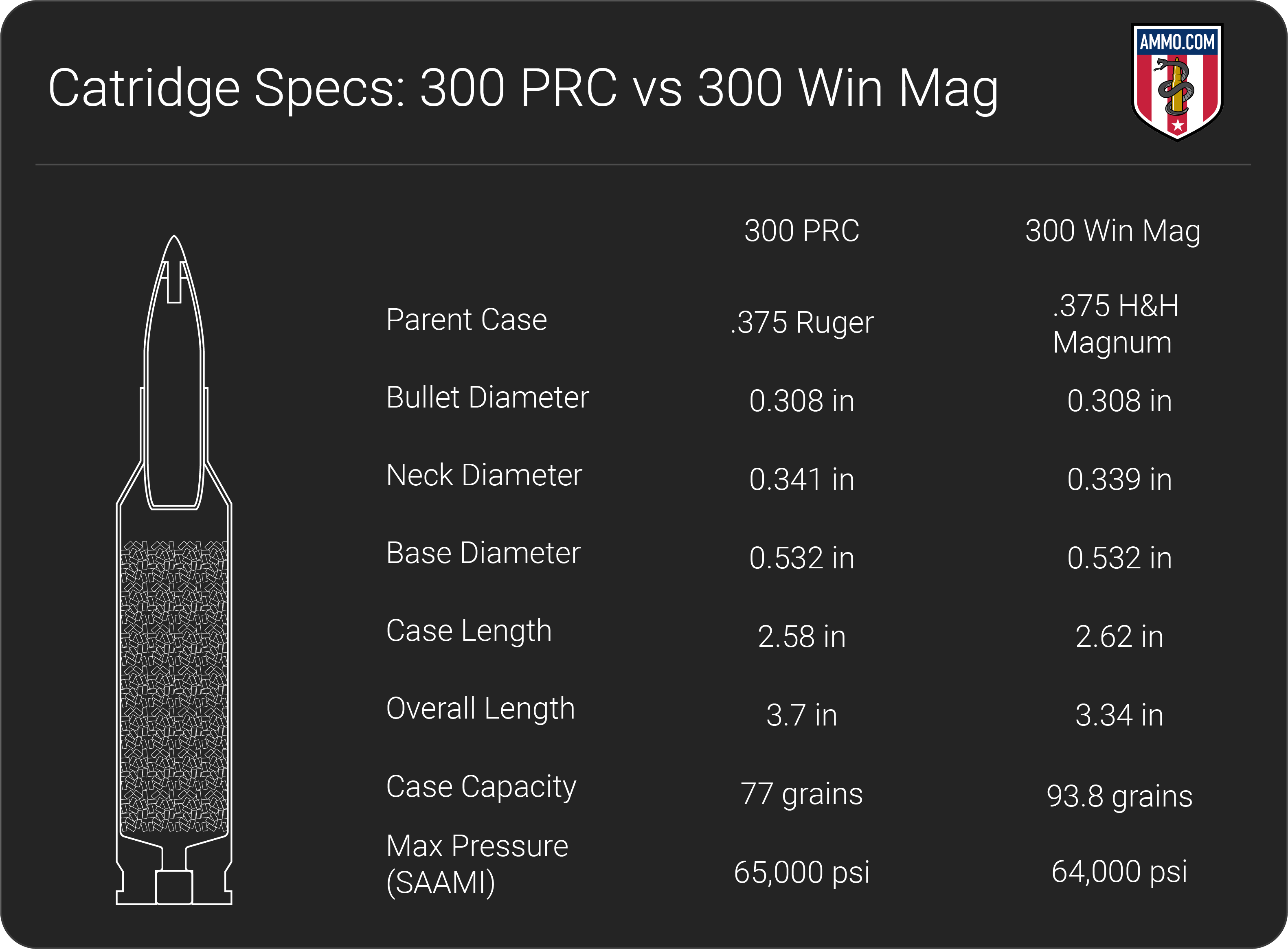
The first thing to notice is that both rifle cartridges have the same base diameter, 0.532”. This means that they both utilize a magnum bolt face. So, if you ever wanted to do a conversion, a simple barrel swap is all that would be required.

The next similarity to notice is the case length and the cartridge capacity, as both the 300 PRC and 300 Win Mag are virtually identical in these two categories.
300 PRC vs 300 Win Mag dimension chart

However, the main difference that you’ll note is the massive difference in overall length. The 3.34” overall length for the 300 Win Mag allows it to be loaded in a long action rifle, whereas the 3.7” overall length of the 300 PRC requires a magnum action rifle.

Hornady specifically designed the 300 PRC for the magnum action as they wanted their cartridge to have as long a “head height” as possible. Head height is simply the overall length minus the case length. A longer head height allows for longer, more aerodynamic projectiles with a higher ballistic coefficient (BC) to be used. A high BC is preferred when shooting long range and the 1.12” head height of the 300 PRC allows for this. In contrast, the 300 Win Mag has a head height of 0.72”.

The additional head height for the 300 PRC translates to more room outside the case for longer bullets than the 300 Win Mag can accommodate. Furthermore, the 300 PRC can fire these longer, slender, higher BC bullets without disrupting the powder column inside the cartridge case. In contrast, similar bullets fired in a 300 Win Mag would intrude on the powder column or contact the rifling upon chambering the round.

But does having an unobstructed powder column inside the case really matter? For long range precision shooting, yes it does.

An unobstructed powder column will have an extremely consistent burn, whereas a compressed powder charge or having a bullet seated in the middle of it will change the dynamics of the powder burn. For precision shooters, consistency is the key to accuracy.

With so many variables going into shots over 1,000 yards, shooters need to eliminate as many variables as possible. A consistent powder burn will mean a smooth pressure curve and low standard deviation in muzzle velocity. A compressed powder column or one that is obstructed by a bullet adds new variables into the equation, and inconsistencies can be seen in the point of impact downrange for these loads.

This difference showcases the disparity in design concept between the 300 PRC and 300 Win Mag. The 300 PRC was designed form the ground up to be a highly precise and consistent long range shooting cartridge. On the other hand, the 300 Win Mag was designed first as a big game hunting cartridge and was adopted as a long range competitor later in its life.

Although the 300 PRC has clearly been optimized for long range efficiency, those benefits come at the cost of added recoil.

Recoil

Recoil is the energy directed towards the shooter when a cartridge is fired from a firearm. It is dependent on several factors, but firearm weight, powder charge, and bullet weight are three of the primary factors that affect felt recoil.

Many competitive shooters and big game hunters will not be concerned with recoil as any shooter can adapt to it with proper training and a concrete focus on the fundamentals of marksmanship.

However, for most shooters recoil will be a serious issue that they need to consider, as developing recoil anticipation is extremely detrimental to downrange accuracy.

For the purpose of this example, we will consider the Weatherby Vanguard hunting rifle weighting in at 7.5 lbs.

The chosen bullets and loadings will be the 300 Win Mag 200 gr Hornady ELD-X bullet being fired at 2850 FPS and the Hornady Precision Hunter 212-grain ELD-X traveling at 2875 FPS for the 300 PRC. This is about as close to an apples-to-apples comparison for both rifle cartridges. With these parameters, the felt recoil for 300 PRC will be 42 ft-lbs compared to 37 ft-lbs for 300 Win Mag. This translates to about a 13% difference.

The 300 Win Mag is already considered to have rather stout recoil, so this increase is something to consider when looking to add a 300 PRC to your collection. Although we are not in shoulder bruising 338 Lapua territory, neither cartridge is a slouch when it comes to recoil.

Barrel Life

For precision shooters who demand the pinnacle of accuracy and consistency from their rifles, barrel life is something these marksmen will track meticulously. The largest factor that affects barrel life is the powder charge of the ammo being fired.

A higher powder charge will typically reduce barrel life.

Cartridges like the 300 Norma Magnum or the 300 Remington Ultra Magnum are often referred to as “barrel burners” as their 95+ grain powder charges are notorious for being hard on barrels. These heavy powder charges will quickly erode the rifling at the throat of the barrel, reducing downrange accuracy.

Hornady had this in mind when the developed the 300 PRC, as they did not want the cartridge burning out barrels quickly.

The general rule for the 300 Win Mag is that a barrel will maintain peak accuracy for somewhere between 2500 to 2000 rounds.

Barrel life data on the 300 PRC is a more difficult to come by as it is a newer cartridge, however 2000 rounds seem to be the current consensus in the long range shooting community.

Trajectory

Trajectory is how we quantify a bullet’s flight path as it travels downrange measured in inches of bullet drop.

Both the 300 Win Mag and 300 PRC have very flat trajectories, which makes them ideal for long range shooting.

For this example, we will consider shots taken at 1,500 yards with a 195 gr Hornady ELD-M 300 Win Mag and a 225 gr ELD-M for the 300 PRC.

At 1,500 yards, the 300 Win Mag will have experienced -885” of bullet drop while the 300 PRC will have dropped -776”. Clearly the 300 PRC has the flatter trajectory at longer distances.

However, I also wanted to compare the mid-range trajectory as this is more important for hunters. At 600 yards, the 300 Win Mag has dropped -74” while the 300 PRC has dropped -73”. Essentially, they are identical at intermediate ranges.

Accuracy

Usually for caliber comparisons, there is little difference in accuracy between two cartridges. However, the 300 PRC has several advantages over the 300 Win Mag that will help the PRC perform better at long range.

The first benefit is that the 300 PRC is a beltless design whereas the 300 Win Mag has a belted case.

At the time of development, the group think was that a magnum cartridge needed the belt to aid in case rigidity. This has been proven to be a false presumption, however upon chambering in the rifle, headspacing occurs off the belt. This can cause for as much as 0.009” of room for error when pushing the bullet into the chamber.

This might not sound like much, but all that added slop can have the bullet entering the chamber off center. That fraction of a degree may cause the bullet to enter the rifling off axis, and at 1,500 yards can have a massive effect on point of impact.

By comparison, headspacing for the 300 PRC occurs off the 30-degree shoulders Hornady designed for the cartridge. This aids in chamber alignment when the cartridge is loaded into the chamber, meaning that the bullet will be more consistently aligned on axis with the barrel rifling. The 300 PRC also has a longer case neck, which helps hold longer projectiles securely and concentrically, which also aids in consistency and accuracy.

Finally, the 300 PRC was designed with a shorter freebore diameter than the 300 Win Mag. Freebore is the smooth portion of the chamber closes to the cartridge. A tighter freebore space means there is less opportunity for a bullet to yaw when entering the rifling, also increasing consistency and accuracy.

Although the accuracy of a cartridge is most often a reflection of the ability of the shooter and their shooting platform, most long range precision shooters will find that the 300 PRC is more accurate and consistent with ELR shots than the 300 Win Mag.

Ballistic Coefficient

Ballistic coefficient (BC) is a measure of how well a bullet resists wind and air resistance. Put another way, it’s a numeric representation of how aerodynamic a bullet is. A high BC is preferred as this means the bullet will buck the wind easier.

Generally, a heavier bullet will have a higher BC as it takes more force to disrupt the flight of a heavier bullet than a lighter one.

The 300 PRC was specifically designed to fire heavier bullets, so it should come as no surprised that the 300 Win Mag falls behind the 300 PRC in terms BC.

The two primary factory loads for 300 PRC are the 212-grain ELD-X and the 225 gr ELD match, which have a BC of 0.663 and 0.777, respectively.

The 300 Win Mag just cannot compete with the heavier bullets fired by the 300 PRC. The heaviest projectiles the 300 Win Mag can reliably fire would be 200 gr bullets, as the slower twist rate of the barrel cannot stabilize heavier bullets reliably. For example, a 200 gr Berger Hybrid Target will have a BC of 0.64.

The ballistic coefficient for both cartridges is extremely good, but the 300 PRC is just better as it can fire heavier bullets.

Sectional Density

Sectional Density (SD) is the measure of how well a bullet penetrates a target. This is extremely important when hunting big game, as you need a bullet that can punch through thick hide, bone, and sinew.

Sectional density is calculated by comparing the bullet weight and the bullet diameter. The higher the SD the deeper the bullet will penetrate into the target.

As both rifle cartridges fire the same diameter bullet, they will have very similar sectional densities with a very slight advantage towards the 300 PRC as it fires heavier bullets.

Hunting

When hunting, shot placement is always the most important factor between an ethical kill and wounding the animal. Therefore, you might assume that you want the most accurate cartridge possible when hunting.

However, I contest that the 300 Win Mag is the superior option for hunting.

Don’t get me wrong, those 212-grain ELD-X 300 PRC cartridges will do a number on an elk or whitetail. However, at ethical hunting distances (500 yards for most hunters), there is little difference between the 300 Win Mag and the 300 PRC.

However, the one major difference between the two is recoil. Lower recoil will often translate into greater precision and accuracy downrange. Therefore, the 300 Win Mag will be easier to handle at shorter ranges and result in better shot placement.

Furthermore, 300 Win Mag factory ammo is easy to find, cheaper, and comes in more varieties than 300 PRC.

As it is unlikely that a moose or elk will be able to detect any fractional differences in internal ballistics between the two rounds, it’s clear that the 300 Win Mag is the better choice for hunting.

Rifle and Ammo Cost/Availability

This is another category where the 300 Win Mag reigns supreme as it has been on the market for over 50 years.

The 300 Win Mag is considered the gold standard when it comes to hunting big game. Therefore, virtually every firearm manufacturer has a rifle chambered in the cartridge. Entry models are also available such as the Savage Axis or the Ruger American for under $700.

As the 300 PRC is the new kid on the block, there are fewer rifle options available. Rifles from Savage, Bergara, Ruger, Barrett, and other custom manufacturers will start at nothing short of a grand and go up from there. In terms of ammo for 300 PRC, there are fewer varieties available…And they are not cheap! The least expensive PRC ammo I could find ran around $3/round while match ammo ran around $6-7/round.

To complicate matters, there are not many bullet weights available for 300 PRC at this time. The 212 gr ELD-X line from Hornady are the most popular factory loads for hunting while the 225 grain ELD Match is their match-grade round. And that’s about all that’s available at the time of writing!

On the other hand, 300 Win Mag ammo can run as low as $2/round for cheap FMJ practice ammo and about $5/round for the high-quality hunting varieties.

The 300 Win Mag is easier to find in your local firearms shop or hunting outlet store, whereas 300 PRC is a lot less common to see in these stores.

Reloading

Reloading or handloading is the process of recycling fired brass and to be fired again. This not only offers a wide range of ammo customization, but it also reduces your overall cost per round. Reloading is one way to bring the cost per round of 300 PRC back into the realm of practicality. However, the heavier bullets that it fires are not often compatible with other 30-caliber cartridges except for the likes of the 300 Norma Magnum.

In contrast, the lighter bullets fired by the 300 Win Mag can be loaded into 30-06 Springfield, 308 Winchester, and 300 WSM and allows you to purchase in bulk if you reload for these cartridges as well.

Powder selection you’ll want to prioritize slower burning, temperature stable powders such as Retumbo, Reloader 26, Reloader 23, H4831, and H1000.

All major bullet manufacturers like Berger, Barnes, Nosler, and Hornady make 30-caliber bullets that will mate beautiful with both cartridges.

300 Win Mag Ballistics

A Brief History of 300 PRC

The Hornady 300 Precision Rifle Cartridge (PRC) was specifically designed with long range precision shooting in mind. Hornady developed the cartridge to fire long, aerodynamic, and high BC 30-caliber bullets to be everything long range shooters want but haven’t heard about yet.

The 300 PRC began when the ballisticians at Hornady wanted to bridge the gap between the 300 Winchester Magnum and 338 Lapua Magnum for extreme long range (ELR) shooters who wanted to air it out past 1,500 yards but not have to endure the shoulder punishing recoil of the 338.

Other cartridges had attempted this but fell slightly short of the mark, namely the 30 Nosler and 300 Norma Magnum. Barrel life for these cartridges is painfully short, and Hornady wanted to provide shooters with a cartridge that could fire 200+ grain 0.308” diameter bullet while maintaining an acceptable lifespan of the barrel.

Using the 375 Ruger as a parent case, Hornady necked down the cartridge to accept a 30-caliber bullet and set the shoulder angle at 30 degrees, and thusly the 300 PRC was born.

Hornady specifically built the 300 PRC to be a magnum cartridge and did not constrain themselves by using a long action like what happened with the 300 Winchester Magnum.

Instead, they build the rifle around the cartridge, and what they got was an extremely accurate long range cartridge that can easily compete with the 338 Lapua in terms of trajectory.

The 300 PRC embodies everything amazing about the 6.5 Creedmoor and adapts it to 30 caliber. Hornady rolled out their new cartridge at 2019 SHOT Show and received SAAMI approval in August of 2018.

The initial design for the 300 PRC fires a 212 gr bullet at 2860 fps and 3850 ft-lbs of energy at the muzzle. Hornady also offers factory loads with 220, 225, and 250 grain bullets.

Although the 300 PRC is still somewhat of an obscure chambering, it is quickly becoming more popular in the long range competition circuit and is also garnering some attention from US SOCOM for military application.

A Brief History of 300 Win Mag

In 1963, Winchester introduced the 300 Win Mag in its long-action Winchester Model 70 bolt action rifle.

Remington quickly followed suit, introducing a 300 Win Mag offering in its popular Rem 700 bolt action rife. Since then, the 300 Winchester Magnum has quickly become one of the most successful magnum rifle cartridges on the market today.

The 300 Winchester Magnum was developed from the belted 375 H&H Magnum cartridge and sports a whopping case capacity of 91.5 gr of water and a max pressure of 64,000 psi based on SAAMI specifications.

This voluminous case capacity allows the 300 Win Mag to pack in the powder and push the .308” diameter bullet to its limits.

At the muzzle, a 150-grain bullet is screaming down range at about 3300 fps with a back-breaking 3600 ft-lbs of energy. That is some serious power! Standard loadings for the 300 Win Mag range between bullet weights of 150 and 220 gr.

Many shooters believe that the belted case is required to contain the “case-splitting” pressure that the 300 Win Mag must exude. However, this is a common misconception.

Based on the case design, the belted cartridge is superfluous. However, Winchester retained the designed as a marketing strategy to link the cartridge to its heavy hitting predecessor, the 375 H&H Magnum.

The strategy was wildly successful as the 300 Winchester Magnum has become one of the most popular magnum cartridges on the market, surpassing the 300 WSM, 7mm Rem Mag, and 270 Weatherby Magnum.

Final Shots: 300 Win Mag vs 300 PRC

The ballisticians at Hornady did an exceptional job designing the 300 PRC, focusing on optimizing the cartridge design and then building the rifle around it. Although many have criticized the 300 PRC for being another boutique cartridge that offers only marginal improvements over current designs, US SOCOM seems to disagree with their purchase of an unknown quantity of Barrett MRAD rifles in 300 PRC.

It’s hard to say if the 300 PRC will gain mainstream acceptance and adoption by other ammo and rifle manufacturers, however Hornady has changed many perspectives in the past like they did with the 6.5 Creedmoor.

The benefits that the 300 PRC offers cannot be ignored, as it is truly a precision rifle cartridge in every sense of the word.

The 300 Winchester Magnum is big game hunting mainstay and has taken every animal on North America. It is powerful, accurate, and has a trajectory that military snipers, sportsmen, and target shooters have grown to love.

However, the 300 Win Mag cannot accommodate heaver .308” bullets with higher ballistic coefficients like the 300 PRC was designed for. The 300 Win Mag also has less recoil than the 300 PRC, which can make a difference if follow-up shots are needed.

For most shooters, the 300 Win Mag will be more than enough to handle all their shooting needs. However, for long range F-Class and T-Class competitions, the 300 PRC is clearly the ideal choice.

As the 300 PRC and 300 Win Mag have almost identical ballistic properties at hunting ranges, there is not a compelling argument for using the more expensive 300 PRC at these ranges when the 300 Win Mag can do the same thing at lower cost and recoil.

But if you just love the idea of having the most accurized 30-caliber magnum cartridge out there, then go get yourself a 300 PRC and enjoy that sub-MOA accuracy that the cartridge offers!

Parts of a Crossbow Explained

0

Are you a newcomer to the world of crossbow hunting. Or have you been away from the sport for a few years and just need a refresher on the basics? Either way, having a working knowledge of all the components of your crossbow is both useful and critical.

Being familiar with the parts that make up your crossbow and how each part works will make it easier to maintain your bow. Proper maintenance will help you get optimal performance from your crossbow when you need it.

Main Parts of a Crossbow

Two different styles of crossbows exist – compound bows and recurve bows. These crossbows do share some common basic parts. In its simplest form, a crossbow resembles a rifle with a horizontal bow mounted to the stock. It launches a bolt (or arrow) from the rail fixed on top of the barrel instead of firing a bullet.

How does each component of a crossbow work? Here’s an overview of each part and how it functions:

A. Stock

The portion of the crossbow you hold, away from any danger points, when you shoot a bolt. It rests against a shooter’s shoulder when in use. A stock is usually composed of wood or is injection molded from plastic or other composite materials. It serves as the functional base of the crossbow, tying the barrel, trigger and sight bridge together. Stocks are available in many configurations.

B. Foregrip

Your aiming hand rests under this part of the crossbow. Foregrips help give you better control of your shot so that you don’t fire off an errant bolt as easily. It helps you steady your aim and keep lined up with your target. Some crossbows feature removable foregrips or collapsible foregrips.

C. Trigger & Safety

The trigger is what releases the string and fires your bolt. Trigger mechanisms utilize two basic designs. It is either located directly underneath the latch that holds the string in a cocked position or the latch mounted behind the trigger. A safety prevents accidental release of a bolt and may engage manually or automatically once a crossbow is cocked. Some crossbows feature a dual safety system.

D. Barrel

A component also known as a rail or track, the barrel features a grooved track on top that aligns a bolt with the string. This creates consistent accuracy each time you shoot. Barrels can be composed of multiple materials. Polymers or plastic are common material for barrels in cheaper bows. Aluminum barrels are more common in higher end crossbows. It is light and stronger than plastic and stays straight. Carbon fiber barrels are also becoming more popular because they reduce overall weight on the crossbow.

E. Risers

This is the section of the crossbow where the limbs attach. Risers come in multiple configurations. It serves a primary purpose of holding the limbs of the bow at a certain angle. Typically risers are made from cast aluminum or machined aluminum. Some crossbows will feature a magnesium riser. Carbon fiber risers are also becoming an option.

F. Limbs

These are the ends of a horizontally mounted bow. Limbs are longer in recurve bows than compound bows because the length is needed to create similar power to that generated in a compound crossbow. The string connects to the end of each limb. Limbs on a crossbow are much heavier than on a vertical bow because the power stroke in a crossbow can be more than half as short as a typical vertical bow.

G. Cams

In a compound crossbow, cams are wheels mounted at the end of each limb. The string is attached to the cams and when it is pulled back, the wheels turn. This motion bends the limbs and stores a large amount of kinetic energy, which is then released once the trigger is pulled. These wheels can be round or oval shaped. The shape dictates the draw force curve of a bow and how much energy is transferred and stored when the string is pulled back.

H. Cable

Another component that is exclusively found on compound crossbows. The cable works in tandem with the cams for the purpose of reinforcing the crossbow and adjusting its firing power. Cams act like pulleys in keeping the cable taut underneath the barrel as the string is pulled back.

I. String

The most essential crossbow component. It is what propels a bolt forward. A string will influence the crossbow’s firing power and performance. It determines the feet per second (FPS) that a crossbow launches a bolt. Commonly used string materials include polyester fiber, synthetic fiber, and natural fiber. The material is chosen based on breaking strength, weight, and stretch capability. A string must be both light and durable in order to effectively transfer maximum energy from the bow to the bolt.

J. Serving

Wound tightly around the string, a serving protects a string from the arrow retention spring which holds it in the cocked position. The serving is approximately four inches long. It contacts and rides across the rail once the trigger is activated and the crossbow is fired at its intended target. It should always be centered on either side of the latch to assure that each shot will be consistent.

K. Flight Groove

A grooved track on top of the barrel between bow and latch. The flight groove serves an extremely important purpose. It allows the arrow to lie in perfect alignment with the bow’s string. This creates consistent accuracy each time a bolt is shot at an intended target. The flight groove goes right down the center of the barrel and allows the fletching to glide down the barrel without interference.

L. Arrow Retention Spring

A metal bar designed to hold the bolt in the flight groove until the trigger releases the latch. It keeps the bolt from slipping out so that you can transport the crossbow from one location to another and keep it cocked so it is ready to fire if an animal suddenly emerges. You can flip it over or point it straight down without jarring the bolt loose. The retention spring is typically molded using steel or plastic.

M. Latch

This is the mechanism that’s designed to capture the string when the crossbow is drawn. The latch works by holding the string in place and keeps it taut until it is released by pressing the trigger.

N. Sight

Aids in aligning the bolt with the intended target to improve accuracy when a shot is fired. Three types of crossbow sights include pin and peep, red dot and scope. Pin and peep sights feature an adjustable pin as a front aiming point and a rear sight peep hole molded from metal or plastic. This type of sight does not fog up or require batteries. Red dot sights are battery operated and have one to three aiming points. Scopes are the most widely used sighting method and offer multiple options in aiming points and magnification. Crossbow specific scopes vary from a rifle scope in that they are specially designed to meet ballistic performance and vibration of a crossbow.

O. Sight Bridge

This is where you mount a sight on the crossbow and hold it in place. It is a vital feature for any crossbow. A sturdy sight bridge gives a sight a solid base and that is so crucial for achieving consistent accuracy with each shot. Some crossbows connected the sight bridge to the trigger housing. Others bolt it to the stock. Sight bridges are typically made from a strong lightweight metal like aluminum.

P. Cocking Stirrup

A metal foothold used to aid in cocking the crossbow. It is a hoop-shaped piece of metal at the front of the crossbow. You place your foot directly inside the stirrup to prevent the bow from slipping while you draw back the string into cocking position. It is mounted to the end of the barrel or riser. The stirrup also protects the end of the bolt from being damaged while on the move.

Q. Quiver

Container for carrying bolts. Quivers are available in multiple shapes, sizes, and configurations. You can mount a quiver under the bow or on top of it. Some quivers can also be mounted parallel to the bow itself or mounted parallel to the barrel. A typical quiver holds 3 to 4 bolts and includes a plastic hood to protect broadhead blades from getting damaged or causing damage.

Parts of a Crossbow Bolt

Crossbow bolts are hunting arrows specifically designed to use with a crossbow. A traditional compound bow cannot fire a bolt. They work exclusively with crossbows. The design is similar to hunting arrows, but bolts are shorter in length because of the power stroke difference with a crossbow. Most bolts range from 16 inches to 22 inches long. 20 inches is the average length.

Bolts are composed of these specific elements:

A. Shaft

This is the main body of a bolt. The shaft is typically composed of aluminum or carbon fiber. These materials are lightweight and do not splinter like wood or cheap plastic. They are also highly resistant to bending.

B. Spine

Each shaft offers varying degrees of stiffness or resistance to bending. This stiffness is termed as the shaft’s spine. Greater resistance to bending means a shaft has more spine.

C. Grains

This is the unit used to measure the weight of the shaft. Manufacturers will either list the total weight of grains on a bolt or list a grains per inch (GPI) value for the bolt. To calculate the total weight of a bolt from its GPI value, just multiply the GPI value by the length of the shaft. You can covert the weight from grains to grams simply by multiplying the total number by 0.0648.

D. Nock

A plastic or aluminum attachment that fits directly onto the back of the shaft. The nock serves the purpose of keeping the bolt in place while you line up to take a shot. Multiple varieties of nocks are available. The primary types are the half-moon nock or flat nock. Capture nocks, multi-groove nocks, and Omni nocks are other options. Different nocks carry different requirements. With a half-moon nock, for example, it has a groove you need to align with the bow’s string before firing a bolt.

E. Fletching

The vanes or wings at the back of a bolt. Arrow fletching is located in close proximity to the nock. It helps stabilize the bolt during flight. The fletching keeps the bolt from pitching or swaying in the air and keeps it going in the right direction toward the intended target. It causes the bolt to spin on its axis after it is released from the bow in order to increase stability. Bolts typically come pre-fletched with vanes molded from plastic and varying in length. Longer fletching is used with longer bolts.

F. Head

Crossbow bolts use two types of heads: field points and broadheads. Field points are ideal for target practice. They offer a pointy tip and no sharp edges. Field points aren’t recommended for hunting anything except some small game because they won’t strike with enough force and do enough damage to quickly kill larger prey. Most field points weigh from 125 to 150 grains and can be screwed into the front of the bolt shaft. Broadheads possess a sharp blade and are used for hunting. Crossbow shafts can utilize three different types of broadheads – fixed blade, removable blade, and expandable blade. Just like field points, they weigh from 125 to 150 grains. You can shoot regular compound bow broadheads, but you’ll get the very best performance with the specialized crossbow heads.

Time to Go Shoot!

One of the best parts of using a crossbow is learning how each component works. It helps you understand how to properly use it and care for it. Now that you know every inch of your crossbow from top to bottom, there’s only one thing left to do. Time to get it tuned up and get yourself ready to enjoy hunting season!

Best Air Rifle Deals

Popular Posts

How far can an air rifle shoot accurately?

0
An air rifle's effective shooting range depends on various factors, including the type of rifle, the caliber, and the power source. Generally speaking, most...

Synthetic vs Wood Stock: The Final Showdown Between Brunette And Blonde

0
I understand that you’re here to get some quick facts on synthetic vs wood stocks Probably to guide your purchase.  Quick alert - the debate...

Air gun 101: Everything you need to know about air rifle accuracy

0
Wyatt Earp has said: Fast is fine, but accuracy is everything And I just thought how many airgunners are obsessed with muzzle velocity and muzzle energy,...