

Home Blog Page 114

How to choose the right Air Gun Caliber for your game?

0

A story is told of three Native American hunters.

Two are smart, the other somewhat ignorant.

On the first day of the hunting season, one of the smart ones sets out to hunt.

He comes back home with a dead deer. 

The ignorant one asks, “How’d you do it?”

The one Indian replies, “I simply followed the deer tracks, shot the deer, and here it is.”

On Day 2, the other smart one goes hunting and comes home with a dead bear. 

The ignorant one inquires once more, “How’d you do it?” 

The smart one answers, “I followed the bear tracks, shot the bear, and here it is.” 

Lastly, it is his own turn to go hunting.

After several hours without the ignorant Indian showing up home again, his two friends embark on a search.

They find him wounded and on the verge of death.

“What happened?” They ask in shock. 

“Well, … I followed the… elephant tracks, shot… the elephant several times, bu- but it kept coming…”

And you can easily guess why the elephant was not perturbed.

Fighting such a monster with a small-caliber airgun is quite risky, if not insane. 

So, what is caliber?

In a simple definition, caliber refers to the internal diameter or bore of a gun barrel.

And it follows that the ammo used must snuggly fit inside the barrel.

Therefore, caliber also applies to the external diameter of pellets and BBs. 
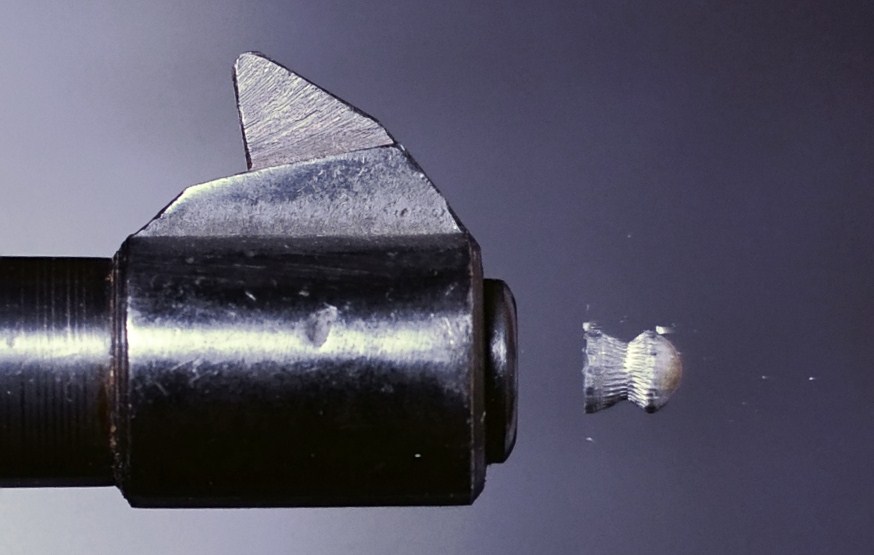
Having said that, the most popular caliber in the airgun world are .177, .20, .22, and .25. 

FYI, the figures above are given in inches.

Simple conversion to metric units will help you visualize the size of ammo we are talking about.

Caliber (Inches)Caliber (mm)
.1774.5
.205
.225.6 
.256.35 

And so, let us delve deeper into each of these calibers.

.177 caliber

I bet the .177 is the most popular caliber among hunters and shooters alike.

Perhaps people like it for its budget-friendly nature.

Or maybe for the availability in almost every airgun store.

Others definitely love it since they will spend less on pellets and BBs for the rest of the airgun’s lifespan.

And even if the prices for a typical tin of .22 and .177 ammo are the same, be sure you will have more .177 pellets.
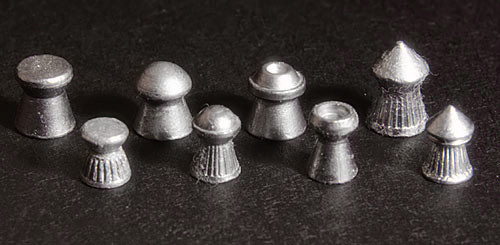
The .177 caliber is most popular with target shooters.

It also finds great use in small-game hunting.

You won’t go wrong with muzzle velocity while using the .177 caliber. 

Most .177 caliber airguns boast muzzle velocities of more than 1,000 fps.

Others even exceed the speed of sound, which is roughly 1,100 fps. 

(For more on the best .177 air rifles in 2021, see this post)

This has the advantage of yielding a perfectly straight trajectory from the airgun to the target.

At least it saves you the burden of figuring out how much under or over you should aim the airgun so as to take care of the curved trajectory.   

One downside you may experience with the .177 ammo is air resistance.

You see, most .177 ammo weighs between 7.0 and 20.0 grains.

If it is windy at the time you are shooting, there is a high likelihood that the pellets will be swayed by the wind, which leads to you missing the target.

When it comes to shooting, the .177 caliber should purely be reserved for small games like rats, rabbits, squirrels, geese, quails, cranes, swans, etc.

The reason for this is the relatively low punching power, or rather muzzle energy, associated with the .177 ammo. 

Recall this formula:

Muzzle Energy in FPE = [(Velocity in fps)2 X Pellet Weight] / 450,240

From the above, it follows that the heavier the pellet, the greater the muzzle energy, which is in essence the killing power.

And as previously stated, .177 pellets only go to a maximum of 20 grains.

More so, .177 pellets have the tendency of penetrating the flesh of the prey from one end to the other without necessarily killing it .

That brings us to our next caliber, the .20.

.20 Caliber

Not so popular! Perhaps you don’t even know it exists.

And that’s it – it simply didn’t gain ground in many parts of the world.

As such, you have a limited number of air rifles made in this caliber.

Likewise, the choice of .20 pellets is somewhat limited.
Nevertheless, if you land your hands on one, you have all the reasons to boast.

You have something more powerful than the .177 but cheaper than the .22 and .25.

You can also expect the accuracy and range to be better than that of the .25 air rifles.   

(Groundhog vs. Woodchuck: What’s the Difference? Find out here)

.22 Caliber

For almost 75 years before the 1950s, the .22 caliber was the most popular pellet in America.

On the contrary, most Europeans used the .177 caliber during this period.

And so the strong influence of the .177 rolled over to the US. But old will always be gold. 
First and foremost, many hunters prefer the .22 for hunting.

This is for the basic reason just outlined above – killing power. .22 pellets are obviously heavier than the .177 pellets.

Plugging the larger pellet weight into the muzzle energy formula yields a bigger value.

.22 Pellets weigh between 12 and 30 grains. 

And that is exactly what you need for hunting.

Remember no prey will freely accept being shot.

They will normally fight to the last of their strength.

Be humane and kill them with one blow of the ammo, rather than wound it several times as it scampers for dear life.

(For more on the best .22 air rifles in 2020, see this post)

What you will need to note with the .22 caliber is the reduced muzzle velocity.

While the .177 can easily achieve speeds of up to 1200 fps, the .22 can manage an average of 850 fps.

Again, the range for the .22 is obviously reduced compared to the .177 caliber.  

(Do Raccoons Eat Cats? See this post for more)

.25 caliber

On to the .25 caliber.

For multiple decades, this was the largest caliber for air rifles. 

With pellet weight ranging from 19.91 to 43 grains, you can be sure the impact at the target is increased with such air rifles.

But get this straight – an air rifle made for the .177 pellets may not be powerful enough to drive .25 pellets, even if the barrel is changed.

The need for a more powerful firing mechanism tells you the .25 airguns come with increased costs. 
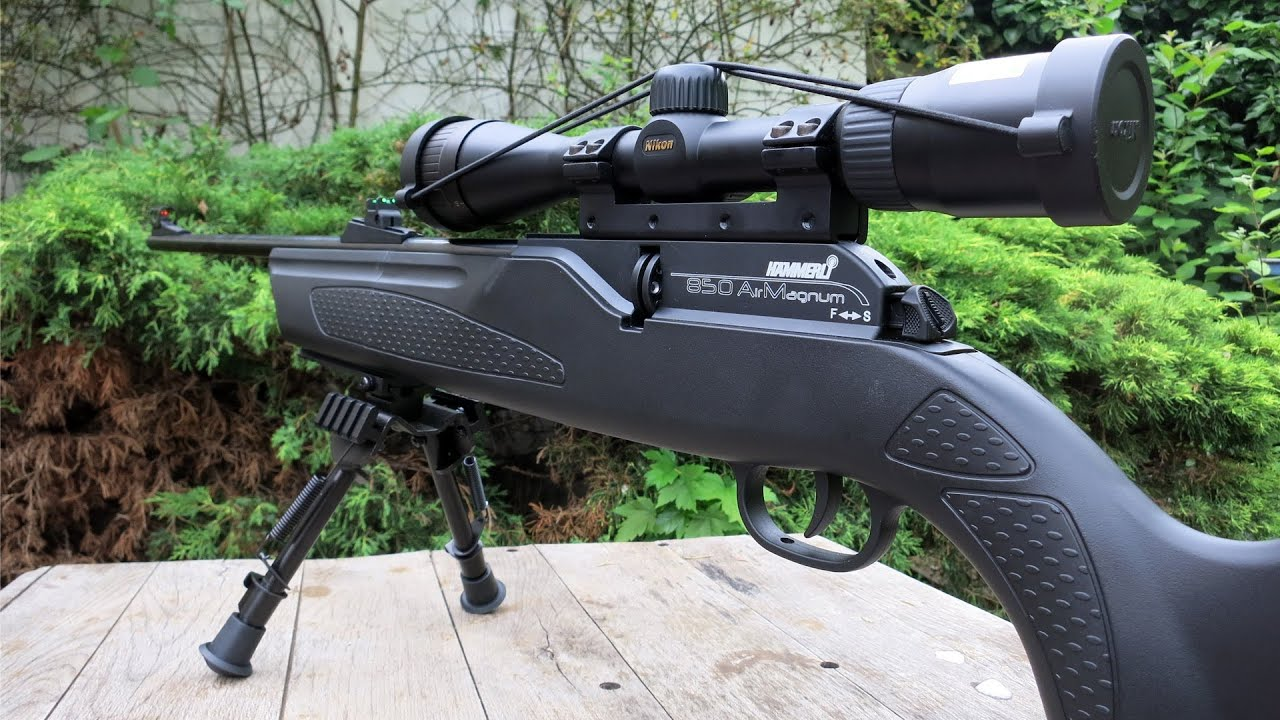
For instance, the popular Hammerli 850 AirMagnum, one of the most powerful CO2 air rifles on the market, comes only in the .177 and .22 models. (see this post for more)

So, can the CO2 power plant fire a .25?

Read on to the last section to find out.

Most .25 air rifles use either PCP, Spring, Nitro Piston, or Gas Piston firing mechanisms. 

Additionally, .25 air rifles use up quite an amount of air to fire a single shot.

Take the example of the Air Arms S510 XS Xtra FAC Regulated air rifle.

The .177 model yields 60 shots per fill while the .25 model offers only 35 shots per fill.

So if you have the .25 for your hunting session, consider investing in the less tiresome scuba tank for refilling the air cylinders rather than a hand pump. 

The .25 is your go-to air rifle if you are after medium-sized games such as deers, foxes, bobcats, coyotes, and pronghorns. 

(Does Walmart Sell Hunting Licenses? – see this post for more)

For large games, the .25 may at times not be impactful enough to ethically kill the animal.

And that is the very reason for the existence of larger calibers, as we shall see below.

Other calibers

You’ve no doubt heard of big-bore air rifles.

Below are the calibers associated with these air rifles:

  • .257
  • .30
  • .357
  • .45
  • .50

As airguns increased in popularity, manufacturers saw the need to produce air rifles that would humanely kill animals such as bison, buffalo, grizzly bear, polar bear, elk, moose, muskox, and cougar.
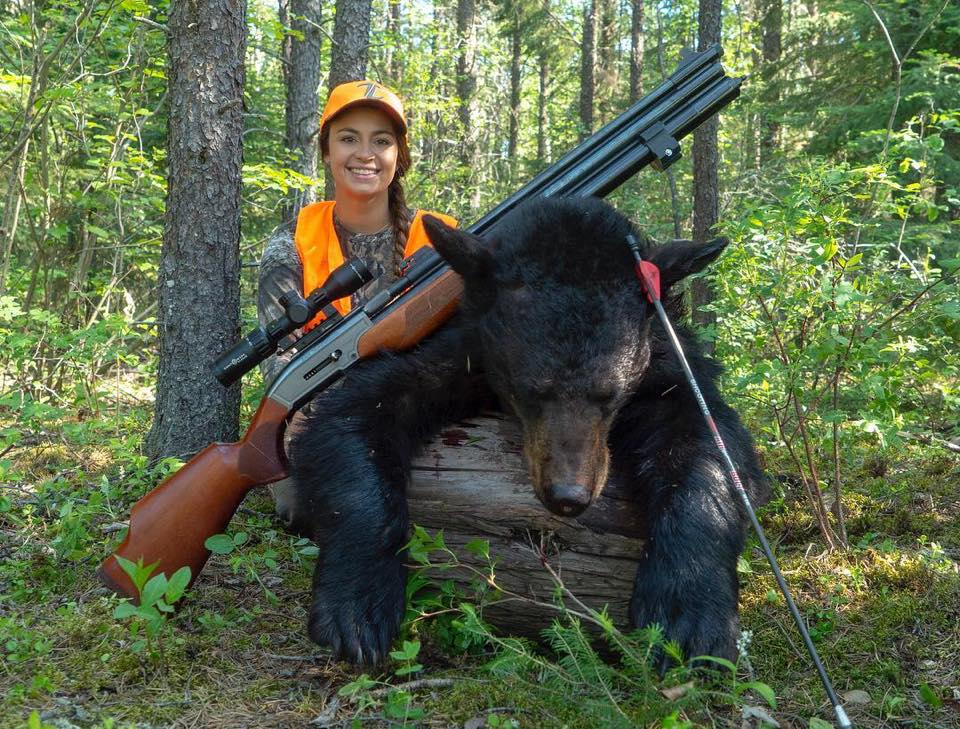
With the big bores, you expect unmatched punching power.

For instance, the Seneca Dragon Claw of .50 caliber yields 230 FPE.

Deadly indeed. The .357 model of the Airforce Texan Big Bore air rifle yields 300 ft/lbs

While the .50 model of the same air rifle yields 700 ft/lbs.  

(For more on the best .50 air rifles, see this post)

These are of course PCPs – the technology that added incredible power to air rifles.  

(Deer, Elk, Moose: What’s the Difference? See this post for more)

Frequently Asked Questions

1. What is the biggest caliber air rifle?

The biggest caliber air rifle produced is the .50.

One of the most popular big-bore air rifles is the Airforce Texan Big Bore Air Rifle (with .257, .30, .357, .45, and .50 models).

Other equally popular big-bore air guns include:

i) Seneca Dragon Claw – .50 caliber (see its review in this post)

ii) Benjamin Bulldog – .357 caliber

iii) Hatsan Hercules Bully – .45 caliber

iv) Umarex Hammer – .50 caliber   

v) Winchester Model 70 – .45 caliber
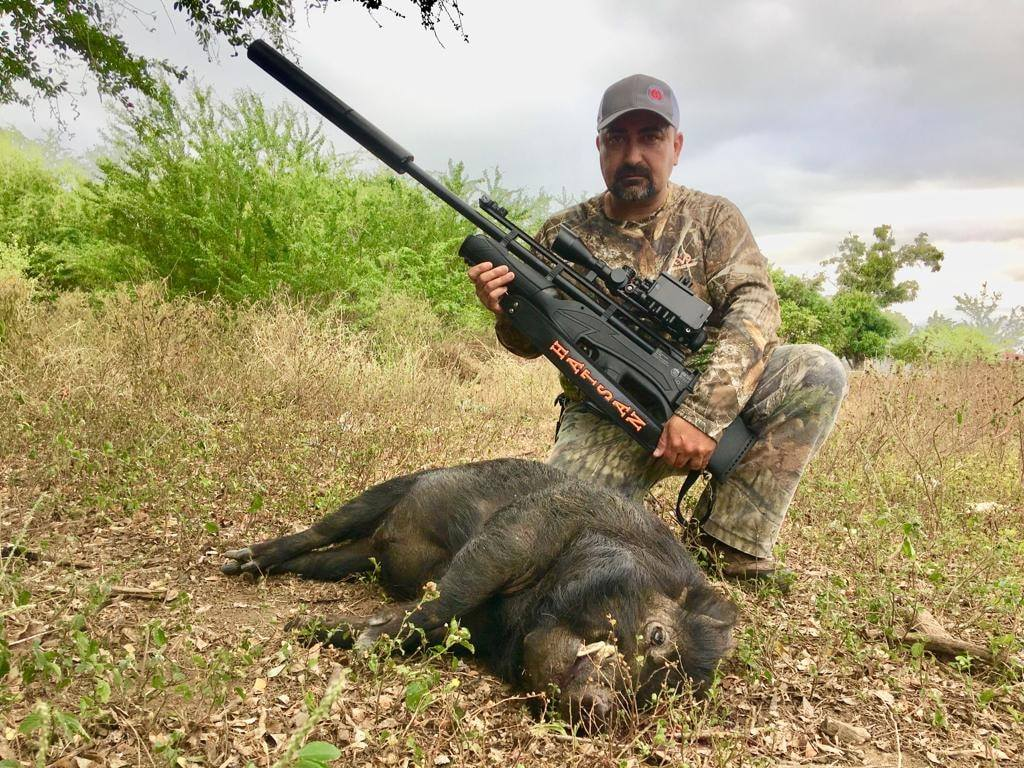
2. How many FPS does it take to kill a squirrel?

I would say anything between 300 and 1200 FPS.

It’s quite a large range but there is a reason for that.

First of all, FPS alone is not a good measure of the killing power of a pellet or air rifle.

The punching power is better evaluated using the muzzle energy.

Here is the Muzzle Energy Formula again:

Muzzle Energy in FPE = [(Velocity in fps)2 X Pellet Weight] / 450,240

We can rightly deduce that the higher the FPS, the higher the killing power.

But don’t forget the pellet weight. .177 pellets are much lighter than .25 pellets.

While a .177 air rifle will yield higher muzzle velocity in fps, the muzzle energy will be way less than that of the .25 air rifle. 

In this sense, a .25 air rifle with say 500 fps may have the same killing power as a .177 air rifle with 1100 fps.

In this regard, consider the following conventional muzzle energies required for different animals.

GameMinimum acceptable caliberMinimum energy (FPE)
Small birds.177+5
Medium birds.177+7
Large Birds.22+11
Squirrel-sized prey.22+9
Rabbit-sized prey.22+9
Raccoon-sized prey.25+25
Possum-sized prey.25+25
Fox-sized prey.30+35
Coyote-sized prey.30+50
Javelina-sized prey.357+90
Small deer.357+100
Medium deer.40+150
Large deer.45+200
Hog.45+200

=> Want to get rid of squirrels in your garden fast? Read Garden Rescue: best air rifles for squirrels

3. What caliber air gun is best for hunting?

I’ll be forced to add another question – Hunting what?

Squirrel or Buffalo?

These two are evidently worlds apart in terms of size and toughness of the skin.

And therefore we cannot generalize matters and settle on one good caliber for hunting.

As a simple guide, consider the following:

  • .177 for small rodents like rats, and birds like pigeons, quails
  • .22 for small game like rabbits and squirrels
  • .25 for medium-sized games like the bobcats
  • .30 medium-sized game like deer, coyote, foxes
  • .357 for javelina
  • .457 for large deer
  • .50 for buffalo, grizzly bear

9. What is the difference between a .177 caliber air gun and a .22 gun?

In a nutshell, see the following major differences between the .22 and .177:

Categories.22.177
PowerMore powerfulLess powerful
AccuracySame for both calibers, depending on the quality of the barrel
UseMostly for huntingMostly for target shooting
CostMore expensive pelletsLess expensive pellets

10. Which is better –  .22 or .177 air rifle?

Having established the facts, it boils down to personal preference.

I’m largely a hunter, and so my favorite is the .22

Are you likewise a small game hunter? Emulate me.

But if your specialty is target shooting, go no further than the .177.

For more on the differences between .177 & .22 and which jobs they do best, see this post.

11. Can a .177 pellet kill a deer?

It sure can, but that is definitely not the route to take when it comes to the choice of an air rifle. 

One hunter friend of mine shot a deer with his .177 Airforce Condor, which boasts a muzzle energy of about 40 FPE.

Note that this was straight into the head and at a close range of about 40 yards. 

If by chance the shot had slightly missed the targeted spot, the deer would have probably fled, having been badly wounded.

Infections would later have led to its death, and that’s as sad as it sounds.

So, DON’T use the .177 for deer hunting. 

Other unethical hunters suggest paralyzing the deer with the .177 through a well-placed shot on the back then strangling it using other means.

Why burden yourself with all this when there are better options?

Be smart and go for big-bore air rifles built for the job.

12. How loud is a .22 rifle?

Straight Shooters conducted loudness tests with a number of air rifles at different distances and came up with the following results:

Zero meters9 meters23 meters46 meters
Air RiflesCaliberDecibelsDecibelsDecibelsDecibels
R7/HW3OS.17788766864
RWS 34.2290807169
R11/HW98.17790837166
HW97.17790827265
Kodiak/Patriot.2591828070
TX200.17791847367
R1/HW80.2091827369
RX-1/RX-2.17791827268
R9/HW95.17791837168
Kodiak/Patriot.2292857774
R1.17792837168
RWS 48.2293837468
Pro Elite.17794837669
RX-1/RX-2 .2094847469

Maybe this does not ring a bell in your ears as to how loud 140 dB is.

Let’s list a number of scenarios and the typical levels of sound produced.

NoiseAverage decibels (dB)
Leaves rustling, soft music, whisper, watch ticking30
Average home noise, Quiet rural area40
Quiet suburban area or nearby dishwasher50
Normal conversation, background music60
Office noise, inside a car at 60 mph70
Vacuum cleaner, the average radio75
Heavy traffic, window air conditioner, noisy restaurant, power lawnmower80-89
Subway, shouted conversation90-95
Boom box, ATV, motorcycle96-100
School dance101-105
Chainsaw, leaf blower, snowmobile106-115
Night club with a band playing110
Sports crowd, rock concert, loud symphony120-129
Stock car races130
Siren at 100 feet140

We can now place the average loudness of air rifles next to that of shouted conversation.

To put it better, all the above air rifles tested can be classified as medium-quiet airguns.

Any airgun producing more than 100 dB is considered loud.

But still, the 100 dB produced by air rifles is not as loud compared to that from other sources given that it is not sustained over some period of time.

It is always instantaneous, lasting just a couple of seconds.  

16. What caliber air gun should I use for a survival weapon?

I have personally not fallen into serious survival situations.

Perhaps a word from an expert in the same will do us good.

Creek of Willow Haven Outdoor upholds the .22 caliber air rifle as an excellent inclusion in his survival kit.

And the reasons are as follows:

  • .22 air rifles are excellent for small game hunting, which is very necessary for eliminating hunger during such situations
  • .22 ammo is very cheap. You can purchase a tin of 500 pellets for less than 40 bucks.
    • That can last you months if you’re economical with your ammo. 
  • .22 air rifles are effectively silent to allow you to hunt for survival without drawing uncalled-for attention.
  • .22 air rifles are available in the multi-pump and break-barrel models, which need air for operation, and the air is always there, free for all.
19. What is the most powerful air gun caliber?

The most lethal of all is the .50 caliber.

Remember the 700 FPE attained with the .50 Airforce Texan Big Bore? 

20. How lethal is a .22 caliber air gun?

Very lethal! Always remember: guns are not toys.

Always treat air rifles as lethal weapons and engage all the safety precautions required in handling them.   

Key Takeaways

Taking all things into account, you certainly need to consider the caliber in your choice of an airgun.

First, know the use you intend for the air rifle.

If it is target shooting, settle with the .177.

For small critters within your yard, a .177 will equally do you good.

For small-game hunting, advance to the .22, which assures you of a clean kill.

For raccoon-sized prey and above, go for the .25 caliber air rifles. 

The big-bore air rifles may be quite powerful for most of your hunting needs unless your purpose is hunting big games like buffaloes, bears, and the like.

Even so, the caliber should not be considered in isolation.

Doing that would be like looking at the waist only when choosing a dress.

Who does that? There are a lot of other considerations to make like the color of the dress, material, style, quality of the dye, sleeve length, height above or below the knees, etc.

Likewise, for air rifles, consider aspects such as loudness, barrel length, weight, stock type, powering mechanism, shots per fill, included accessories, and the brand.  

Science & Behavior of Whitetail Scrapes

0

Cover photo courtesy of grandviewoutdoors.com

If you hunt whitetails, it should be no secret to you that whitetails communicate through scent they leave behind. Whether detecting danger, bucks seeking a breeding doe or a doe locating a hiding fawn, whitetail deer use scent for much of their survival and social interaction. Scraping behavior of whitetails, is one of the CHIEF ways whitetail bucks leave scent behind throughout the year.

Bucks work scrape’s overhanging branches, called a licking branch, throughout the year, often times more than they work the scrape itself. But their most aggressive scraping of these areas occur from October to December when testosterone levels are highest. When a whitetail buck makes a scrape he does so where there is an attractive branch hanging along a roadway, at the edge of a field, on a well-worn trail, or in a random area he’s walking through. In most cases a buck begins the scraping process by rubbing his forehead, preorbital, and nasal glands on the branch and in some cases will actually lick and chew on the overhanging branch. Once done, most bucks will paw the leaves and other debris from the ground under the branch, then urinate into the pawed-out earth.

americanhunter.org

Photo Courtesy of americanhunter.org

The process usually takes less than two minutes. During this time, however, a buck will leave liberal amounts of scent behind. Scraping, like rubbing, allows a buck to make his presence known. It’s a calling card of sorts; a post on a whitetail bulletin board. Research suggests that scraping is primarily a buck activity. Does have been known to work a scrape from time to time but they most frequently work the licking branch above the scrape. Bucks almost always work both.

Scrapes can be broken down into 3 different categories, though the names or classification of these are often debated. The are Boundary, Secondary and Primary Scrapes.

Boundary scrapes: Boundary scrapes are made by traveling bucks moving through his territory. These scrapes will show up along field edges, fence rows and roads that aren’t too busy.

Secondary scrapes: Secondary scrapes are made my bucks as more of an impulse. These are far more random and a result of the buck “feeling the need” to make a scrape. Call it impulse, hormones or whatever you’d like but these scrapes are less frequent, spiritic and typically not a good target for hunting over.

Primary scrapes: These are the scrapes that hunters need to target. These scrapes are the epitome of whitetail scrapes, with some having the potential of becoming very attractive to whitetail bucks. These scrapes can be found in strategic locations—inside corners of agriculture fields, ridge lines, pinch points and especially along well-worn trails between bedding and feeding areas during the rut. Find these primary scrapes and hang a stand!

Bucks work licking branches 365 days to leave their scent, scraping behavior peaks during the 30 day window leading up to peak rut, especially during the last 10 days. Once breeding kicks in scraping behavior drops off drastically. Scraping will continue during the post rut but at a significantly lower rate than occurs leading up to that point.

MOA vs MRAD Rifle Scopes (Explained in Plain English)

0

Which one is better: MOA or MRAD?

The short answer: it’s your preference. If you use the metric system (meters/centimeters) then go for MRAD. But if you measure in the empirical system (yards/inches) then MOA may be easier.

If you want a more thorough answer along with an explanation of MOA vs MRAD, then keep on reading!

MOA vs MRAD: Why do we care?

Suppose you’re headed out on a hunting trip with your buddies.

You did your research, you read the best rifle scope guide, and you’re ready to go. But then your buddy starts talking in meters and your MOA turrets are adjusting in yards.

His numbers don’t match your turrets, your turrets don’t match your reticle, and now your target has bounded off to another state.

The problem: he was using MRAD while you were using MOA.

MOA and MRAD are basically two different systems of measurement.

When sighting rifle scopes, the reticle and turrets are used together to reach the most accurate shot possible. The turrets change the position of your reticle while your reticle provides an aiming point.

Your turret clicks and the hashes on your reticle can use one of two different systems of scope alignment: MOA or MRAD.

You can have the best long range scope on the market, but if you don’t sight it in using either system, it’s useless.

If you’re looking for help choosing between rifle scopes, here’s the only guide you’ll need to read.

What’s an MOA Scope?

M.O.A. stands for Minutes of Angle; a system based on degrees and minutes. This type of angle measurement is used to calculate the distance to a target and MOA turrets correction for the bullet trajectory.

Basically the math breaks down to this: there are 360 degrees in a circle, and 60 minutes in a degree for a total of 21,600 degrees.

You can find your MOA measurement by multiplying the distance in yards by 1.047, then dividing by 100. You can thank the Ancient Egyptians and Mesopotamians later.

At 200 yards, one MOA equals 2.094 inches. Out to 1,000 yards, 1 MOA equals 10.47 inches, and so on.

For those of us who aren’t Einstein, the easiest way I’ve found is to use a quick-reference conversion chart. That way you don’t miss your prize buck while scribbling away on math problems.

MOA scopes aren’t a perfect system though.

Often calculations are made with 1 MOA at 100 yards (91.4 meters), but you need to count on 100 yards with 1.05 MOA. Up to 100 yards there will be no problem with 1 to 100 comparison, but when shooting over longer distances you’ll be 5% off base and this could mean missing a shot.

This isn’t a problem if you’re only shooting at medium ranges. Read my 4×32 scope guide for more details.

I use an MOA reticle scope on my AR-15 A2 after I removed the front sights for added cool guy points. I’ll show you how to remove the AR-15 A2 sights here.

What’s an MRAD Rifle Scope?

MRAD stands for milliradians (or MIL for short), and was originally developed for artillery in the late 1800s. It’s still the preferred method for military and police force operations to this day, where you’ll commonly here it referred to as a MIL-dot reticle.

Based on a radial line, a unit of angular measurement that is equal to roughly 57.3 degrees, a milliradian is one thousandth of a radian.

This system does not come out to make a perfect circle like the MOA system. Instead, milliradians divide the circumference of a circle into 6.28 equal sections measuring 57.3 degrees each in an MRAD scope.

Thus, every circle has a circle circumference that is 6.28 radians long. Then each radian is going to be divided into 1,000 parts more, which is called Milliradians.

When calculating MRAD in a MIL-based scope, you will be calling it MIL, which is 3.6 inches at 100 yards (91.4m using the metric system) equal to 1 MIL.

I tried an MRAD scope on my M1A that happens to have the best M1A scope mount ever.

MOA vs MRAD: Which is better?

The short answer: neither. The argument is as old as time, but it’s really just the shooter’s preference of rifle scope.

The fight between MOA vs MRAD boils down to a difference in how we format degrees of angular measure. It’s fancy math terminology that basically asks if you use yards or meters.

Technically, the 1/4 MOA clicks are slightly more accurate than the 1/10 MIL, but the MIL values are somewhat easier to communicate.

Reference cards with MIL are easier to read because they are indicated by 2 numbers only, while the cards with MOA are indicated with four numbers. We could go back and forth all day, but you get the idea.

If you like other comparisons, check out my Nightforce SHV vs. Vortex PST guide.

Which do you need?

Choosing between the MOA or MRAD system will take some self reflection, so buckle up.

If you normally think in meters or centimeters, then it is easier to calculate distance with a MOA. If you normally think in yards or inches, then MRAD should be your go-to.

And if you’re not going to calculate distances, it doesn’t matter between the MRAD vs MOA. Do your thing, both types are equally effective for medium- and long-range shooting.

Another thing to take into account is that you also have to consider your hunting partners, teammates, friends, and so on. You’ll want to have a common language so you can communicate together without having to do conversions between the two systems.

Or you could be an absolute rebel and have a scope for each system, swapping it out in the field with the best quick detach scope mounts. Live your life to the fullest.

Most importantly, choose the same system for your turrets and scope reticles. I have a guide on first focal planes vs. second focal planes to help you choose the right reticle as well.

Regardless of all the math, the decision between MOA and MRAD isn’t that important. Clicks with an MOA turret are slightly more precise than clicks with a MIL turret, but at the end of the day it’s a style choice between rifle scopes.

FAQ

Review: Panzer Arms BP-12 Bullpup Shotgun

0

Sometimes nostalgia corrupts your remembrances. Things I enjoyed in my youth are fondly remembered, but I no longer have to deal with them.

My new six-speed automatic Jeep is so much more reliable and easier to drive than my Dad’s old Jeep panel truck, but I fondly remember the old jeep.

I grew up with double-barrel and pump-action shotguns. While they were useful and still are, the Panzer Arms BP-12 Bullpup is something from a different century.

Standout Features

This shotgun is a self-loader with a five-round detachable box magazine. I have several shotguns that do not even accept a light or optics mount of any type.

The BP-12 has several inches of real estate for mounting lights or optics. The bullpup configuration was first used in rifles and only much later has it become popular in shotguns.

The design places the receiver behind the shooter’s face and the firing grip forward. This allows for a relatively long barrel in a short package.

The BP-12 doesn’t point like a standard shotgun, as the balance of the piece is very different than a standard-design shotgun. The shotgun’s natural point is quite different than a bullpup.

The bullpup must be handled like a rifle and driven toward the target like a rifle and aimed with more care than the usual shotgun.

While modern and effective, a bullpup must be learned and handled decisively to be effective.

Panzer Arms BP-12 Specifications:

Action: Self-Loading Chamber: 12-Gauge, Three-Inch Overall Length: 30.7 Inches Capacity: 5+1 (10rd Magazines Available) Weight Unloaded: 7.8 lbs Weight Loaded: 8.6 lbs Barrel Length: 20 Inches Finish: Blued

Panzer Arms BP-12 shotgun
This is one interesting and formidable shotgun.

How It Shoots

When you are firing the shotgun, your cheek is closer to the receiver than with most shotguns. Muzzle signature is more evident.

The Panzer Arms BP-12 shotgun isn’t difficult to use well, but these differences simply must be understood. The person who learns to use the shotgun well will find it a very effective firearm.

Those who do not care to practice and learn should choose a simpler firearm. The primary difference between this shotgun and others is that the firing grip is far ahead of the action.

The trigger bar goes through some tangents and this means the trigger will never be as nice as a standard-design shotgun, but then a crisp trigger is part of very few shotgun designs.

Learning to use the bolt release and magazine release isn’t difficult. Simply put aside time for dry-fire practice.

A few words on the shotgun’s quality of manufacture: the fit, finish and machining impress. The hardware fits well and the finish is always even.

The shotgun is delivered with AR-15 type sights, two magazines that hold five 12-gauge shells, and a cheek riser to allow the use of optical sights.

If you are using iron sights, then remove the cheek riser. There are two adjustment rings supplied with the shotgun that must be fitted after partial disassembly in order to change between standard and high-velocity loads.

The cocking handle may be reversed to allow racking from either side. Most right-handed shooters will have the cocking handle on the left side of the receiver.

The bolt handle allows plenty of leverage, racking the bolt isn’t difficult at all.

Panzer Arms BP-12 bullpup shotgun
The fit, finish and function of the shotgun are all impressive.

Other Performance Notes

Simply load the magazine with shells, slipping the shells under the feel lips and pressing them straight to the rear. I always tap magazines on a boot heel or hard surface to seat the shells.

This ensures feed reliability. Then, angle the magazines in the magazine well and be certain it is properly seated. Rack bolt to load the first shell and you are good to go for firing.

The safety lever is easy enough to manipulate. When firing the shotgun, it seems recoil is easier to manage than with a standard-configuration shotgun.

Fire, get the sights back on target and hit the target again. The large peep sights make for excellent high probability. The shotgun was fired with a variety of loads.

Some did not function properly. Panzer Arms states that a break-in period of up to 100 full-power shells may be needed. This seems reasonable.

Winchester PDX 12-Gauge Ammo
There are a number of truly formidable 12-gauge shotgun loadings.

Other tightly-fitted firearms require a modest break-in. Some full-power shells did not function properly, with the occasional short cycle, while some types came out of the box running.

Fiocchi full-power Aero slugs functioned and so did Remington full-power buckshot. Reduced-recoil loads will not function, at least with the full-power ring installed and during the initial break-in period.

Incidentally, during the test, I dropped a fully-loaded all-steel magazine on the concrete walk of the firing range. The magazine was scuffed of course, but not dented and it never failed to feed properly.

After the initial test, I would load full-power Remington Power Piston loads and rest easy. The shotgun is supplied with three choke tubes for open, modified and full choke use.

I like this option in a combat shotgun. I like to have a shotgun that delivers a solid hit with the buckshot load to at least 20 yards. These choke tubes are Mobil types and are nice to have.

Conclusion: Panzer Arms BP-12

I like the Panzer Arms shotgun. It is well-made and should prove to be a formidable defender for the home or ranch.

What do you think of the Panzer Arms BP-12? Do you like bullpup shotguns? Let us know in the comments below!

(Like this shotgun? You might also like the Kel-Tec KSG Pump-Action Shotgun. Read our range report on the firearm here.)

Air Rifle Trigger System

0

Introducing the Revolutionary Air Rifle Trigger System: Enhancing Accuracy and Control. Discover the cutting-edge technology behind our state-of-the-art trigger system, designed to optimize shooting performance. Experience unparalleled precision and responsiveness, as this groundbreaking innovation revolutionizes the world of air rifle shooting.

air rifle trigger system

air rifle trigger system

An air rifle trigger system is a crucial component that determines the accuracy and precision of a shot. It is responsible for initiating the firing mechanism, allowing the release of compressed air or gas to propel the pellet forward. The design and quality of an air rifle’s trigger system significantly impact the shooter’s ability to control and manipulate the firearm.

The trigger system of an air rifle comprises several essential elements, including the sear, hammer, and springs. The sear is a small piece that latches onto the hammer, holding it in place until the trigger is pulled. When pressure is applied to the trigger, it releases the sear, causing the hammer to strike against a valve or piston assembly, releasing compressed air or gas. The springs within the trigger system ensure smooth operation and proper reset after each shot.

Ensuring a high-quality and sensitive air rifle trigger system is vital for accuracy during shooting competitions or hunting activities. A well-designed trigger system with adjustable settings can provide shooters with improved control over their shots, allowing them to achieve consistent results. Additionally, having a reliable and responsive trigger can greatly enhance overall shooting experience by reducing strain on fingers and improving user comfort.

In conclusion, the air rifle trigger system plays a crucial role in determining accuracy, reliability, and overall shooting experience. The advancement of technology has led to the development of sophisticated trigger systems that minimize trigger pull weight, provide crisp breaks, and enhance safety features. As shooters continue to seek improved performance and precision, manufacturers are continually innovating trigger designs to meet these demands. Ultimately, selecting the right trigger system is essential for maximizing shooting potential and achieving optimal results in air rifle sports.

Make your own pellets for air rifle

0

“Unlocking Precision and Economy: Effortlessly Craft Your Own Air Rifle Pellets with Ease! Discover the ultimate solution to optimize your shooting experience by producing custom-made pellets for your air rifle. Save on costs and tailor your ammunition to achieve unparalleled accuracy and precision. Embrace the art of pellet-making today!”

make your own pellets for air rifle

make your own pellets for air rifle

If you are an avid air rifle shooter, you may have considered making your own pellets instead of relying on store-bought options. Making your own pellets can offer several advantages, such as cost savings and the ability to customize the shape and weight of the pellet. However, it is important to approach this process with caution and ensure that you have the necessary knowledge and equipment to do so safely.

One option for making your own pellets is to invest in a pellet-making kit. These kits typically include a mold, which allows you to create pellets of various shapes and sizes. Additionally, they often come with lead wire or alloy that can be melted down and poured into the mold. This method requires careful attention to detail, as temperature control is crucial for achieving consistent results. It is also important to note that working with lead or other melting materials can be hazardous if proper safety precautions are not taken.

Another approach for making your own pellets is to use a pellet swaging tool. This tool essentially compresses soft lead into a pellet shape by applying high pressure. The advantage of this method is that it eliminates the need for melting materials, making it safer and easier to use. However, it may require more effort and time compared to using a mold and pouring molten material.

In conclusion, making your own pellets for air rifles can be a cost-effective and efficient alternative to purchasing them. With the right equipment and materials, you can create customized pellets that suit your shooting needs. This process allows for greater control over pellet quality, weight, and design, ultimately enhancing your shooting experience. So why not explore the possibilities and start producing your own pellets today?

Black Ops Tactical Sniper Spring Piston Review

0

Ever feel like this?

You look at the online listings of air rifles.

You see 2 items with similar names:

One is Black Ops Tactical Sniper

And the other is Black Ops Tactical Sniper Spring Piston.

They both look almost identical.

And one item is $40 cheaper than the other.

Confused, huh?

Don’t worry. I’m here to help you.

There are two guns with the same name, except that one is powered by a spring piston and the other uses a gas strut as its powerplant.

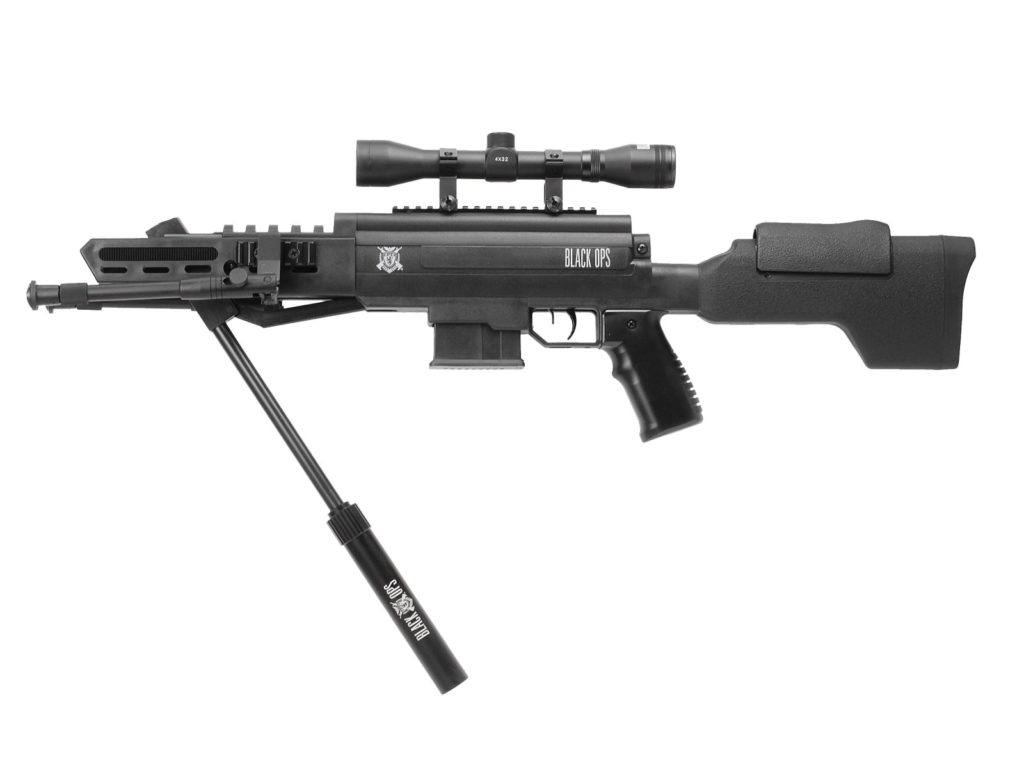
And this review is about the cheaper one: Black Ops Tactical Sniper Spring piston air gun.

Black Ops Tactical Sniper- Guntype

Black Ops Tactical Sniper spring piston guntype

This is a spring-piston gun.

You can read more about spring-piston gun’s pros and cons, and how spring powered gun compares to other types of air guns in this post.

Black ops Tactical Sniper is a single shot, break barrel gun.

In order to cock it, you need to slap the barrel downward while holding the gun upward, insert the pellet and swing it into its original position.

It may sound complicated at first but when you get used to it, it will become your second nature.

Besides, a break barrel gun gives you unlimited shooting capacity.

You can shoot tens of thousands of rounds without worrying about running out of gun power like CO2 or PCP air rifle.

In addition, this gun is single-shot action which means that you can only shoot 1 shot at a time.

Single-shot action gives you control over the ammunition and makes you a better shooter because you know you have to make your first shot count.

The rifled barrel has a caliber (the internal diameter of the bore, measured in inches) of .177 (4.5 millimeters).

(For more on things you should know about air rifle barrels before buying, see this post.)

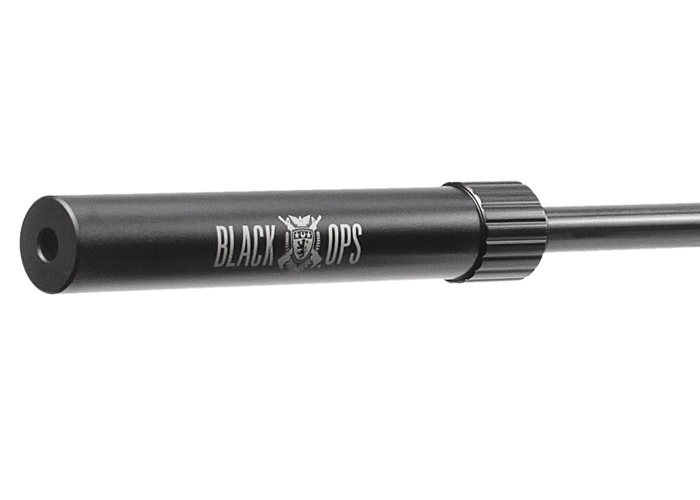
Also, it has a muzzle brake at the tip hence you have more leverage added to your hands when cocking.

Black Ops Tactical Sniper Stock

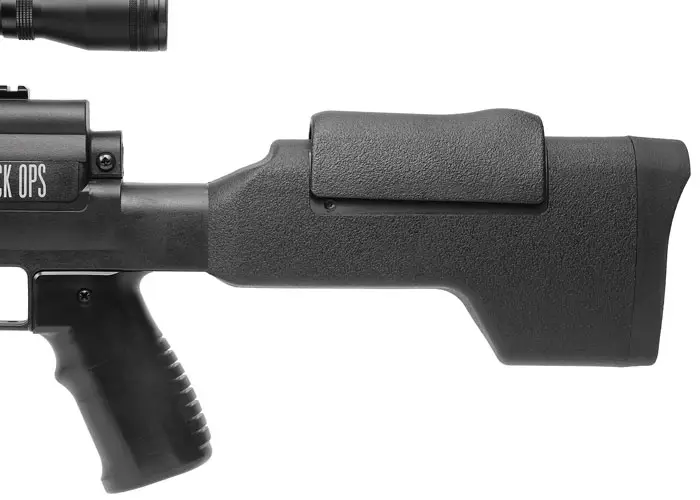
Black Ops Tactical Sniper spring piston stock

This gun is made of synthetic material.

Unlike wood stock which is heavy and easily affected by outside conditions, the synthetic stock is much lighter and is durable in any weather condition.

Therefore, the synthetic stock is a great choice for shooters hunting in the fields or for gunners who don’t want to bother with stock preservation.

For more on the in-depth comparison between synthetic and wood stock, see this post.

The bolt in this gun is non-functional.

The manufacturer Black Ops puts it there to give the gun a more authentic tactical look.

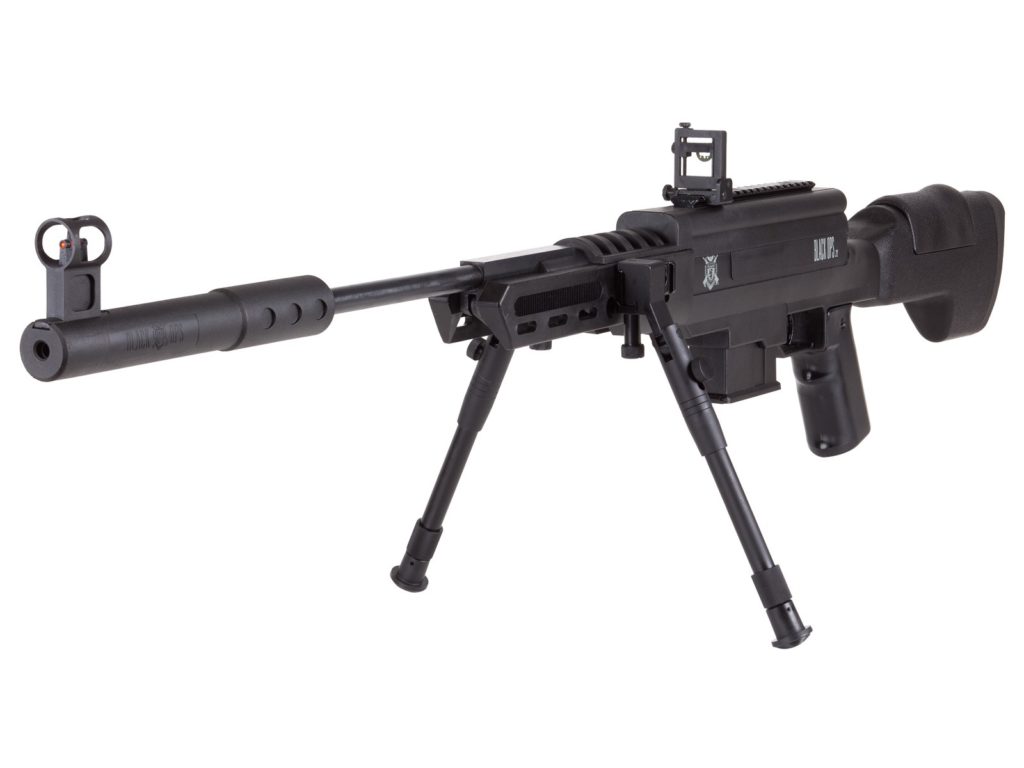
Black Ops also adds an awesome bipod to the forearm.

Now you have more stabilization when shooting at the led shed or in your backyard .

This bipod can extend from 8” to 10” and can be folded out of the way when you don’t need it or when you want to put it into your gun case.

This rifle has an adjustable comb in the stock which lets you adjust the comb vertically and customize your line of sight according to your own needs.

Besides, the stock is adjustable so you can customize it according to your own need.

The trigger safety of Tactical Sniper gun is automatic: It automatically engages when you cock the gun so your firearm safety is guaranteed 100%.

Ammo

Black Ops tactical sniper uses .177 pellets as sources of ammunition.

.177 pellet is dirt cheap compared to .22 or .25 pellets on the market:

You can buy thousands of .177 rounds for just a few bucks and save your money while enjoying the fun of shooting at the same time.

=> For more on the differences between .177 & .22 and which jobs they do best, see this post.

Velocity, Accuracy and Power

Black Ops Tactical Sniper spring piston barrel

The maximum velocity is 1250 FPS (Feet per second).

Since the speed of sound is 1100 FPS (may vary with different temperatures and altitudes), this gun provides supersonic velocity and belongs to the magnum class of air rifle.

With this jaw-dropping power, small animals and pests like squirrels, groundhogs, rabbits, crows, magpies, etc don’t stand a chance.

You can finish those annoying critters in 1 clean shot.

For Black Ops Tactical Sniper air rifle, various shooting tests have been conducted from various shooters with positive results.

The common shooting groups are:

  • 0.2” at 10 meters,
  • dime sized group at 55 feet,
  • and 2” at 75 yards.

This gun is exceptionally accurate up to 75 yards.

Black Ops Tactical Sniper Sight

Black Ops Tactical Sniper spring piston scope

This gun doesn’t have any traditional open sight.

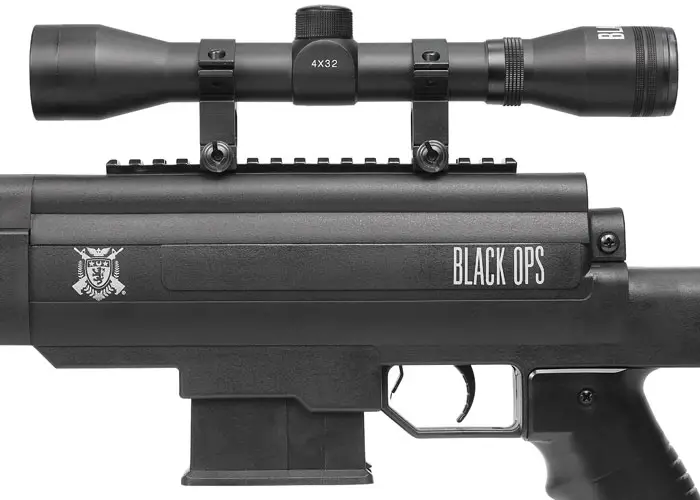
Instead, the manufacture put the 4×32 scope on it for best shooting precision.

32 is the diameter of the objective lens (the front lens), measured in millimeters.

4 is the magnification ability of the scope.

It magnifies the picture 4 times when you look through it than when you look with your own eyes.

The 4×32 scope has a crosshair so you can see clearer, aim better, and shoot more accurately at long distances.

The optic rail is made in a Picatinny style.

A Picatinny rail is almost identical to the weaver rail, except that it has a series of ridges located at precise intervals along the rail.

The Picatinny rail gives you a lot of benefits.

First, you have more mounting options.

Second, you can swap the scope from one gun to another and use the different scopes on the same gun as well.

Last but not least, no more worrying about eye relief, tube length, etc because you can mount the scope at any place that you want.

In conclusion, Picatinny rail is the handiest and flexible of all optic rails.

Noise

This is a supersonic gun that makes a loud crack sound because it breaks the sound barrier,

If you want a quiet shooting session, I recommend you use heavy pellet-like RWS 8.3 grain

Since a heavy pellet goes subsonic and only makes a small sound.

Shooting range and intended use

Black Ops Tactical Sniper spring piston review

The effective shooting range for this gun is up to 75 yards.

It is suggested for plinking, target shooting, pest control, and small game hunting.

Check Price on PyramydAir

Accesssories

This gun has a 4×32 scope and an adjustable bipod as its accessories.

Maintenance

This gun requires little to no maintenance.

Just a few drops of the pellet gun oils every couple of hundred shots and you can use it for years to come.

Black Ops Tactical Sniper Specification

  • Caliber: .177
  • Powerplant: Spring piston
  • Velocity: 1250 FPS
  • Loudness: 3- Medium
  • Barrel Length: 18”
  • Overall Length: 44”
  • Capacity: single shot
  • Cocking effort: 44 lbs
  • Barrel: Rifled
  • Front sight: None
  • Rear sight: None
  • Optic: 4×32
  • Optic Rail: Picatinny style
  • Stock : Synthetic
  • Comb: Vertically Adjustable
  • Action: Break barrel
  • Safety: automatic
  • Weight: 9.6 lbs

With a weight of near 10 lbs, heavy cocking effort of 44 lbs (while many guns on the market have only 30 lbs of cocking effort),

and supersonic velocity and magnum power, the Black Ops Tactical Sniper air rifle is not the gun for kids or inexperienced shooters.

It’s a great choice for adults and experienced gunners who know how to handle a heavy-duty gun properly.

Warranty

As of this date, the Black Ops Tactical Sniper air rifle has a one-year limited guarantee from the date of purchase.

Pros and Cons

ProsCons
  • Awesome tactical looking
  • Unbelievable fiber optic sight
  • Durable synthetic stock
  • Good scope
  • Lightweight
  • Quiet
  • Impressive double function
  • Pumping action takes time to practice
  • Pumping can be tedious experience at some points

Price

Black Ops Tactical Sniper air rifle is very cheap, a little bit more than 100 dollars.

It’s a wonderful price for high velocity and heavy-duty power. This is undoubtedly a great air rifle for the money.

Check Price on PyramydAir

Customer Reviews

There are plenty of customers reviews online about this gun.

Positive reviews show that people love its power, accuracy, and cool looking.

Negative reviews come from several buyers who complain about the noise of this gun.

They say it’s too loud for shooting.

There are several ways to deal with this issue:

First, make sure you clean the barrel.

Second, the gun will be quiet down after a break-in period.

Third, you can use heavy pellets that go subsonic and don’t break the sound barrier .

Conclusion

This is an air rifle you will fall in love at the first place.

It has a cool tactical design, supersonic velocity, heavy-duty power, awesome stock, and amazing scope.

This gun is a perfect choice for adults and experienced shooters who want to own a gun they can trust and have fun for a long time.

How to Build a Hog Pit from Concrete Blocks

0

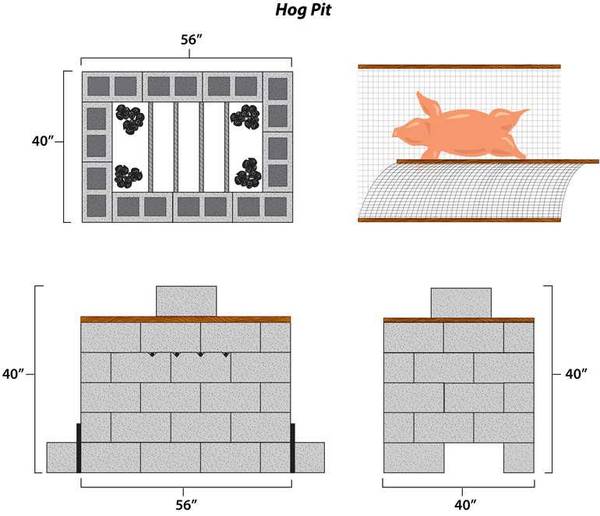
Above are some of the old school concrete block pits at Jackie Hite’s Bar-B-Q in Batesburg-Leesville, SC. Below are plans for building your own no-frills pit suitable for a butterflied 75 pound hog, enough to feed about 35 people. It is designed so it can be a temporary structure or you can make it permanent. If you cut the head and remove the trotters at the knees and elbows, you can fit a 100 pounder or more on this rig. But don’t throw away the head and trotters. Just place them on the stretcher next to the torso. If you plan on cooking larger hogs, you can scale this plan up. You must cook with indirect heat. Click here for instructions on how to prep and cook the hog.

illustration of dimensions for hog pit constructed from concrete blocks

Materials

  • SIDES: 54 concrete blocks 16″ x 8″ x 8″ (actually 15.75 x 7.75 x 7.75″). This will get your hog 32 ” above the embers, plus a course to hold the lid. Cost about $54.
  • LID: 4 x 8′ sheet of 1/4″ plywood, cut down to about 44 x 60″ for the lid. Note that Hite uses sheets of cardboard for his lids as seen in the photo above, but I strongly advise against this. He is a master of fire control, and if yours burn, they could ruin the hog. And then you have no lid. Cost about $10. Usually the lid will not be a tight fit. If it is you can crack it open with a stone or make a vent by cutting a hole in it.
  • HEAT SHIELD: Half of a 4 x 8′ sheet of 1/4″ plywood cut down to 20 x 36″ for the optional heat shield. Cost about $10.
  • PROTECTION: 2 rolls heavy duty aluminum foil. Cost about $30.
  • COOKING GRATE: 4 lengths of 48″ each of 3/8″ rebar. You can use a sheet of expanded metal rather than rebar if you wish. Cost about $5 per 10′ bar, 3 bars needed.
  • STRETCHER: Non-climbable uncoated fence wire or rabbit wire at least 14 gauge, 46 x 72″. Do not use galvanized metal because it can give off noxious gases. Cost about $30 for a 50′ roll.
  • STRETCHER HANDLES: 2 boards 1″ x 2″ x 6′ each. Cost about $2.
  • STRETCHER HANDLES: 100 bare wire loop ties, 6″ each. Cost about $2.50.
  • DAMPERS: 2 pieces lightweight sheet metal, about 20″ x 10″ each or you can use sheet pans. They will go over the openings in the sides to help you control oxygen to the coals if it runs too hot. Cost about $15.

Optional

  • More rebar to pound from the top down into the ground to prevent the blocks from shifting. Cost about $15.
  • Mortar to lock the blocks permanently into place. Cost about $10.
  • Lightweight sheet metal for the lid, about 44 x 60″. Cost about $30.
  • Lightweight sheet metal for the heat shield, about 30 x 48″. Cost about $30.
  • 20 bags (40 pounds each) premix concrete for a 3″ thick slab FOR THE BASE AND BOTTOM. Cost about $40.

Tools

  • Fire extinguisher.
  • Wire cutter.
  • Level.
  • Hack saw.
  • Hammer.
  • Chisel.
  • Utility stapler and plenty of staples.
  • Wheel barrow, steel drum, or charcoal grill to start coals.
  • Shovel.
  • Garden hose or buckets of water or fire extinguisher.
  • Good digital oven thermometer.

About the pit

Keep the pit at least 10′ from buildings and overhanging trees in case there is a grease fire. Keep a fire extinguisher rated for grease on hand. Fire extinguishers rated ABC can handle most everything except combustible metals. Beware, they contain a yellow powder that can damage electrical devices.

Start by clearing a base that is 4′ x 5′ by removing grass and prepare an all dirt or sand base at least 2″ thick. You will need to discard some of it when you are done because fat and meat drippings may get in the dirt. The dogs will roll in it and it will attract insects, mice, you name it. If needed, you can buy sand at a hardware store. I recommend lining the pit with aluminum foil.

Make sure the ground is level. Stack the concrete blocks 4 rows high, 3 full lengths and then turn one block on each course, staggering the blocks so they overlap as in the illustration. Notice that I have left out a block on the head and tail side so you can add coals and wood and rake them around. Cover these wholes with a board and a concrete block when they are not in use.

Make notches in the blocks with a hammer and chisel deep enough to hold the rebar so the next course of blocks will lie flat on the course below. Put the rebar on top of the fourth course of blocks. Don’t put the top course of blocks on yet.

The stretcher

To carry the hog and hold it in place on the pit, you need to build a stretcher. It is two poles for the stretcher bearers on either side, and a wire mesh sling in between for the hog. Non-climbable fence wire is heavier gauge and sturdier than chicken wire. You can use chicken wire for but it would be a good idea to use two layers. Make sure the wire is not coated with plastic. For something more permanent, use heavy duty expanded metal mesh. Do not use galvanized, it can create toxins.

Make the sling of the wire wide enough to rest on the rebar and hang over the edges of the pit by at least 1′ on either side. Attach two 6′ lengths of 1″ x 2″ boards for handles with staples and reinforce them with the wire loop ties. Then lay another section of mesh over the top of the first and fasten it to one of the handles, but leave the other open. Attach a handle to the open edge. You then have a reversible stretcher so you can flip the hog.

About the heat shield

I specified a sheet of plywood cut down to 20 x 36″ for an optional heat shield. If you bank your coals to the sides and corners properly you may not need it, but I recommend you have it on hand in case something starts to burn or overcook. This goes on top of the rebar and beneath the stretcher to shield the hog from direct heat. This size leaves space between the shield and the inside of the pit so hot air can rise alongside the shield and bounce off the lid. You will remove it late in the cook when it is time to crisp the skin. Wrap it in aluminum foil and staple down the foil. Don’t worry, it won’t burn unless you have a grease fire because the pig-sitter fell asleep or spent too much time in the toilet. If the pit is to be a permanent structure, make your heat shield from sheet metal, preferably aluminum because it won’t rust.

The cover

Cover the bottom of the plywood lid with foil. If you wish, you can use a sheet metal top instead of plywood.

Other designs for whole hog cookers from readers

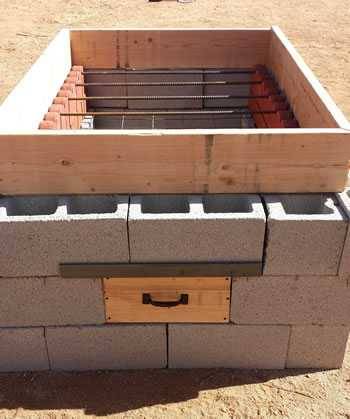
Here’s the “Hog Cabin” built by Jacob Hanson of Tucson, AZ. Notice the innovation : He used half width blocks along the sides and put scalloped garden edging to hold the rebar. He also put an access door with an angle iron header. The wood frame holds a removable pitched roof, not shown.

concrete block hog pit with rebar and scalloped garden edging

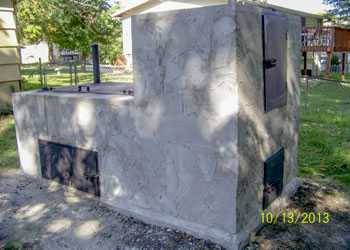
James Brownfield of Kansas City built this beauty from concrete blocks. On the left is the hog pit and on the right he tacked on a separate vertical smoker. The hog pit side is a little larger than my design: 66″ long (4 blocks), 47″ wide (3 blocks) and 35″ tall (4 blocks) with a 2″ top cap. The interior measures 52″ long by 32″ wide. The cooking grate is 20″ above the coals and he has another grate 10″ under the cooking grate on which he can cover with foil and/or cheap catering pans to catch the grease. Both grates are simply expanded metal that rest on rebar. There’s some pretty nifty metalwork for the pit top, chimney, doors, and smoker shelving. The whole shebang sits on a concrete slab he poured.

concrete block hog pit and vertical smoker

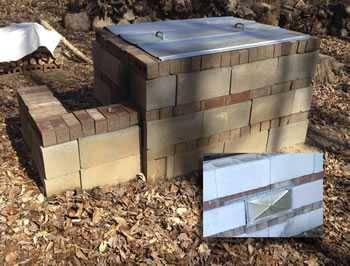
Carl Herbert built this pit. The insert shows the access door on the other side.

concrete and brick hog pit with detail showing access door on other side

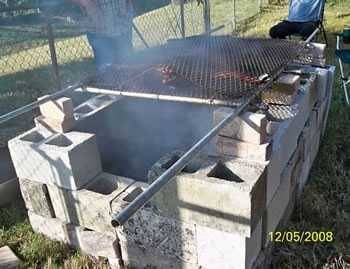
From Jim S. This guy built a simple quick and dirty pit, below.

simple concrete hog pit with a chain link fence as a cooking grate

David Wm. Reed of Texas A&M has a good article on roasting cochon au lait, French for suckling pig, and a novel design for a pig roaster with the hog hanging by his hind legs.

As Easy As It Gets: Bowhunting Mountain Lions with Dogs

0

Twenty years of chasing cougars with my own dogs have taught me that we in the outdoor media do a lousy job of explaining lion hunting. Even experienced hunters with good dogs finish second much of the time, a fact that too many stories ignore. Even on successful chases, magazine articles and TV programs commonly cut quickly to the tree, the shot, and the dead cat, which makes the process look pretty easy.

Now I invite you to tag along on a real-world lion chase. When we’re done, you can draw your own conclusions.

There are more late-crossing lions in the imagination than in the woods. The term refers to a cat that has crossed the road behind you after you’ve driven up a canyon, searching for a track left the night before. Sign from a late-crosser is a welcome sight because it guarantees a fresh track. Most days, the possibility of spotting tracks made behind you does little more than help you stay awake at the start of a long drive home.

But these tracks were clear, coming down off a bank we’d passed just an hour before.

First spotting them in the headlights, I wrote them off as elk tracks we’d seen on the way in. But something didn’t look right.

I stood on the brakes, and my hunting partner, John, and I jumped out. No doubt about it – we were looking at a tom’s track right on top of our tire tread.

After waiting 20 minutes for legal shooting light – a requirement for turning dogs out in Montana – we walked to the back of the truck for Robbie, John’s bluetick, and Sadie, my walker. As the pair yapped off through the gloom, I fully expected to hear them barking treed before we left the vehicle.

“This one should be about as easy as it gets,” I commented while squirming into my backpack.

Yeah, right.

Although I’d treed cats for others, I hadn’t shot one myself in five years. Now I was the designated hitter, and although I like to downplay the shooting of a cat at the end of a hunt, I confess that the hunt is always more exciting when that role falls to you. As the sound of the chase crossed a creek and disappeared over a ridge, I felt especially eager as we set off in pursuit.

More than a foot of fresh powder snow had fallen that week, and I’d thought about strapping snowshoes to my pack before leaving the truck. But not wanting to pack them through the brush on the mountainside, I decided against it, which seemed like a good idea at the time. Of course, that’s probably what Custer said about his decision at the Little Bighorn.

By the time we’d crossed the first ridge and descended into another creek bottom, the dogs were out of earshot. The track led up a steep mountainside, where deep snow wasn’t a problem under the tree canopy. However, the layer closest to the ground had frozen, and the loose powder on top of it was as slick as grease. We took two steps forward and one step back all the way to the top.

A mile down the ridge, the trail took a confusing turn as we ran into a chaotic jumble of tracks going in different directions. We did find bounding lion tracks where the dogs had jumped the cat, but rocky cliffs below made it impossible to see what had gone where, and blowing snow blurred dog and cat tracks. To complete the confusion, John found lion prints disappearing back into the timber where we’d just come out – with no dog tracks on top of them.

Last December, John, Sadie, and I put our friend Scott, left, who was visiting from Alaska, on the track of his first lion.

One possible explanation for such confusion is multiple lions. Despite inherently low population densities, cats have a way of finding each other in those lonely hills. It was also possible that a lion kill lay nearby. In any case, fresh lion tracks would do us no good without dogs. So we hunkered down in the timber and waited for them to show up.

But they didn’t. As much as we hated the thought of losing the elevation we had gained, we split up and picked our way down the far hillside, trying to work out the muddle. The blowing snow wasn’t helping, but at one point I was sure I had running lion tracks with dog tracks on top of them. At the bottom, John found the same going on up the next mountain. Although something didn’t feel right, we decided to follow the track.

The second mountainside wasn’t as demanding as the one we’d climbed earlier until we approached the top, where we encountered a maze of steep, rocky cliffs. Ascending one vertical chimney proved nearly impossible without technical climbing gear, but somehow we powered our way up through it.

Another mile down this ridge we encountered more bounding cat tracks; the dogs had caught up with the lion again. Then we entered an area of blowing snow and got separated as we tried to work out the track. By the time I finally picked it up again down in the timber, John’s boot tracks were on top of it, but we were out of earshot. We wouldn’t see each other again for hours.

The chase led back downhill in the direction from which we’d just come. If the dogs had a cat treed on the hillside, I should have been able to hear them. The track I was following led right back toward the spot where we’d first got confused.

A sinking feeling hit me in the pit of my stomach as I finally deduced what had happened. By the time we were waiting on the last ridge, the cat and dogs had already run the loop we’d just spent three bruising hours following! The lone track sneaking back across the ridge had been our cat, and the dogs were lost somewhere on the mountainside.

Back at the creek bottom we’d crossed earlier, I paused to take stock. Our lion hunt was over. I’d been on the trail for seven hours. The dogs were lost, the weather was deteriorating, and limited light remained. It was time to consider priorities. The first order of business was planning my route out of the woods. The dogs came second. I didn’t know where John was, but he would take care of himself.

The wisest choice in these situations is usually to return the way you came, but I knew the creek bottom eventually led to the road. Even though that route was longer, it would save me a long climb.

Then the faint sound of a lost dog’s barking rose above the wind down the creek. That finalized my decision, and after slogging through a mile of snow, I was overjoyed to find dog tracks. Then Robbie and Sadie appeared from the trees. The team was nearly reassembled. All I had to do was get us home, which should have been easy, given the open terrain along the bottom.

However, snow had blown, drifted, and settled on the open ground. Worse yet, the crusted snow was almost, but not quite, firm enough to support my weight. The conditions were perfect for snowshoes – but you know where mine were.

I will admit to being one tired pup by the time I reached the side road that would eventually lead back to the vehicle. Even the well-conditioned hounds were dragging, and we were still two miles from the truck.

Then the most welcome sight imaginable appeared – John had taken the shorter route out, and using the ESP that hunting partners develop after years together in the field, he had figured out exactly where I’d be. The sight of both hounds was probably as welcome to him as the warm truck was to me.

The cat may have won that chess match, but we knew we’d been on an honest lion hunt, with no help from snow machines or radio tracking collars. And that’s the simple tale of a lion chase that was supposed to be as easy as it gets.

It’s a year later now, and the new lion season has just begun. On opening day, the alternator on my truck went out in the middle of nowhere right after we spotted the first cat track of the season. Rather than risk more confusion, John and Scott, a friend visiting from Alaska, stayed with the dead vehicle while I spent eight hours hiking out of the woods to a telephone from which I could call my wife Lori to come rescue us. My 60-year-old legs were already aching, and I had yet to turn Sadie out on a cat.

But yesterday’s events perfectly illustrate the other side of lion hunting. We crossed a smoking fresh tom track right at sunrise, and the dogs were barking at the tree by the time we’d slipped on our packs. Scott drove the arrow home with his recurve, and less than an hour later we were back at my resurrected truck with Scott’s first lion.

“You’re a lucky hunter,” I told Scott as we loaded the dogs back into the vehicle. “That chase was about as easy as they get.”

“I know,” he replied. “I almost wish it had been harder.”

“Are you sure?” I asked with a laugh, and then we were bouncing back down the road looking for the next set of tracks.

Adventuresome Bowman Don Thomas lives in rural Montana with his bowhunting wife, Lori. Don’s 15 outdoor books are available through www.donthomasbooks.com.

Top 10 Reloaded Rifle Cartridges #8: .300 AAC Blackout

0
©2018 Matthew West photo

With the popularity these days of cartridges for long-range this and long-range that, it’s surprising the .300 Blackout has become one of the more popular rifle cartridges since its commercial introduction in 2010. Timing may have played a hand in the Blackout’s acceptance, as it was introduced by Advanced Armament Corporation (AAC) and its sister company, Remington, when the trend of tactical shooting started to build. The Blackout, though, has many positive attributes. For one, the short cartridge fits in any gun design that accepts the .223/5.56, from single-shot handguns and compact bolt-action rifles to autoloading carbines, where it has been most successful. The Blackout shoots the complete range of .30-caliber bullets – from light bullets acceptably fast for hunting to 200-grain and heavier bullets plodding along at subsonic velocities. The Blackout’s story goes back much farther than 2010. AAC had been working on a military cartridge when it was bought by Remington, backed by the Freedom Group, in 2009. The following year AAC and Remington introduced the .300 Blackout. That year I toured the Remington ammunition plant in Lonake, Arkansas, mainly to observe the production of shotshells. At the nearby Remington shooting range, a couple of Remington engineers uncased an AR-15 and showed around the cartridge for which it was chambered. “It’s the .300 Blackout,” they said. “It’s the .300 Whisper,” I replied.

Bullets handloaded for the .300 Blackout include the (1) Berger 110-grain FB Target, (2) Berger 125 FB Target, (3) Speer 165 boat-tail, (4) Lehigh Defense 194 Maximum Expansion and the (5) Berger 210-grain VLD Target.

The Blackout is indeed the .300 Whisper designed by J.D. Jones in 1992 by necking up .221 Fireball cases to accept .30-caliber bullets. The only difference between the Blackout and Whisper is Blackout chambers have a slightly longer leade. Jones states on his website (sskindustries.com) that the “Whisper series of cartridges was developed as specific military, police, competition and recreational cartridges . . . ” The website also states, “A Whisper cartridge must be capable of sub-sonic extreme accuracy with very heavy bullets for its caliber, i.e. 240 grains in 30, as well as moderate to high velocity while maintaining excellent accuracy with light bullets for the caliber, i.e. 125 at 2300 FPS in the 30.

Some heavier bullets are longer than the .300 Blackout case. At left is a Berger 210-grain VLD Target, and at right is a Lehigh Defense 194-grain Maximum Expansion.

“. . . the cartridge was designed as a multi-purpose cartridge from the beginning. Its design parameters, in addition to the ballistics quoted above, were that it must be capable of being used in the AR-15/M16 family of rifles, contenders and bolt action rifles as well as being easily suppressed.” Quite a number of carbine bolt actions are chambered in Blackout. Most have 16-inch barrels. They range from Kimber’s Adirondack that weighs 4 pounds, 13 ounces, to the Ruger American Ranch rifle and Remington Model 700 Tactical. Pretty much every AR-type rifle chambered in .223/5.56 NATO is also chambered in Blackout. A different barrel is the only requirement to change from .223 to Blackout, as both cartridges operate at the same 55,000 psi and use the same magazine and bolt face. A SIG Sauer MCX VIRTUS Patrol was used to shoot the loads in the accompanying load table. The carbine is chambered in 5.56 or .300 Blackout. Only a barrel swap was required to change between the cartridges. Turning out two Torx screws loosened the barrel clamps, and the 5.56 barrel originally on the carbine pulled free of the upper receiver. After inserting a Blackout barrel and tightening the barrel clamp screws, I was in business shooting the Blackout.

CFE BLK powder and Speer 165-grain bullets provided this 100-yard group.

I first shot SIG Sauer factory ammunition through the VIRTUS. Ammunition options are nearly unending, with Blackout ammunition also available from Barnes, Federal, Fiocchi, Gorilla, Hornady, HSM, Magtech, Nosler, Noveske, Remington, Silver State Armory, Streak, Underwood and Winchester. I’m sure there are others. It seems someone is always comparing the Blackout to the .223/5.56, 7.62×39 and .30-30. So, ballistics-wise, let’s measure the Blackout against these three cartridges. The .30-30 beats the Blackout every which way. The .30-30 shoots Sierra 150-grain bullets at 2,367 fps with 36.3 grains of CFE 223, and the Speer 125-grain TNT with 33.0 grains of H-335 at 2,587 fps when fired from the 20-inch barrel of my Winchester Model 94. Those velocities are an additional 300 fps faster than Blackout velocities with the same bullet weights. The Blackout is America’s version of the 7.62×39 Russian, and the tactical crowd calls the Blackout the 7.62×35. I have been able to shoot Sierra 110-grain bullets at 2,511 fps loaded with Reloder 7, and Speer 125-grain bullets at 2,500 fps with CFE BLK powder from the 18.5-inch barrel of my CZ 527 Carbine 7.62×39. Tulammo is the fastest factory ammunition I have shot through a CZ, with its 124-grain FMJ bullets registering 2,405 fps at the muzzle. Advantage for the Russian round is 200 plus fps. Ballistic charts show there is not much difference between the energy carried by 125-grain bullets fired at 2,235 fps from the Blackout and the .223 shooting 69-grain bullets at 3,000 fps, and 80-grain bullets existing the muzzle at 2,750 fps. The .22-caliber bullets carry about 50 foot-pounds of additional energy than the .30-caliber bullet by the time the three bullets have reached 100 yards. The .22-caliber bullets hang on to that energy advantage at 200 yards and enlarge the difference as distance increases. Both bullets fired from a .223 drop half the distance of the .30-caliber bullets at distances from 150 to 400 yards when all three bullets are zeroed at 100 yards. The Blackout launching 165-grain bullets at 1,850 fps does not improve on those figures. A 220-grain bullet fired at 1,000 fps from the Blackout carries only about half the energy as 165-grain bullets. The heavy bullet drops like a hand-thrown brick.

To go out on a half-sawn limb, the Blackout was never designed to improve on the .223’s ballistics. The Blackout’s value is that it provides acceptable velocity from a 16-inch barrel with bullets that carry some persuasive weight. Bullets for the Blackout run the gamut of lightweight projectiles traveling somewhat over 2,000 fps to heavy bullets plodding along at 1,000 fps. To determine how well light and heavy bullets expanded, I shot all the bullets listed in the accompanying load table into stacks of dry paper placed 35 yards from the muzzle of the SIG carbine. SIG-loaded Sierra 125-grain MatchKing bullets hit the paper at 2,080 fps, and handloaded Berger 110- and 125-grain bullets impacted at about 2,000 fps. All three bullets fragmented.

These cartridges show the overall loaded lengths of the (1) .223 Remington, (2) 7.62×39 and the (3) .300 AAC Blackout, all of which seem short compared to the (4) .30-30 Winchester.

SIG 120-grain HT Solid Copper loads hit the paper at 2,150 fps. The hollowpoint peeled back into four petals to the bullet’s solid shank. The bullets expanded to nearly twice their original diameter, just like SIG advertises. The HT would make a great hunting bullet. I doubted Speer 165-grain bullets would expand with a slow impact velocity of a 1,700 fps. But the jacket of the bullets ripped apart down to the base and lost their lead core. Berger 210-grain bullets were marginally stable when fired at 1,100 fps from the SIG’s barrel with its 1:6 rifling twist. A few of the bullets hit sideways on targets at 100 yards. The Bergers hit the paper going 960 fps. Recovered bullets looked like they had immediately turned sideways when they hit. The bullets bent in half and fairly well lost their lead core. SIG-loaded Sierra 220-grain MatchKing bullets plowed into the paper at just under 1,000 fps. Their hollow points opened up, and the bullets expanded halfway down their length, doubling their initial width. The MatchKings would make a great bullet for shooting hogs. Lehigh Defense has a great selection of bullets for all uses of the Blackout. Those bullets range from a 78-grain Close Quarters bullet, with an aluminum core and prestressed jacket designed to violently expand and limit penetration no more than 18 inches, to Maximum Expansion 194-grain Subsonic Bullets. Lehigh states Maximum Expansion bullets do not expand in dry mediums like wood or drywall. Their hollowpoints are designed to expand at 750 to 1,200 fps upon contact with a fluid-based medium through hydraulic energy. I shot the bullets into the paper at 1,400 fps. The .60-inch-deep hollowpoints peeled back into four petals down to their solid copper base. It seemed only a sprinkle of powder balanced my scale when weighing charges to handload the Blackout. Powder weights for 210-grain bullets looked especially light; how could those small amounts of powder even push those big bullets out the bore?

Powders for the Blackout are relatively fast burning, such as Accurate No. 11FS, 1680, 5744, LT-30 and No. 9, Alliant Reloder 7 and 10X, IMR-4227 and 4198, Hodgdon Lil’Gun and CFE BLK. CFE BLK worked well with the 110- to 210-grain bullets I used for the Blackout. CFE BLK traded back and forth with Lil’Gun for highest velocities. Accurate No. 11FS provided good accuracy with Berger 125-grain FB Target bullets with a velocity 200 fps faster than Lil’Gun. Vertical spread of impact points of the different bullet weights was tremendous. With the SIG carbine sighted in to shoot 125-grain bullets on aim at 100 yards, Berger 110-grain bullets hit way over point of aim at 100 yards. In contrast, 210- and 220-grain bullets at subsonic velocities hit about 20 inches lower than the 125s.

Lehigh Defense 194-grain Maximum Expansion bullets expanded down to their solid copper shank when fired into stacks of paper.

Across the board, the Blackout produced low extreme velocity spreads that most likely resulted from powder charges held tightly in place by bullets in the Blackout case to promote a uniform powder burn. Over nine shots, SIG ammunition loaded with 120-grain HT bullets had an extreme velocity spread of 27 fps, Sierra 125-grain bullets provided a spread of 24 fps and Sierra 220-grain MatchKing bullets had an extreme spread of 16 fps. Handloads also produced even velocities. Berger 125-grain bullets shot with three different powders had an average extreme spread of 17 fps, Speer 165-grain bullets had a 29-fps velocity spread for three powders, and Lehigh Defense 194-grain bullets averaged 22 fps using three powders. There is some concern that the small powder charges the Blackout burns may fail to generate enough gas to cycle an autoloader’s action. The SIG MCX VIRTUS Patrol is equipped with a two-position gas valve to meter the correct amount of gas used to cycle the rifle. Adjustments are made by pushing down a lever on either side of the valve through “windows” in the sides of the handguard. The left-side lever on the handguard has a “minus” and the right side a “plus” mark. SIG suggests setting the valve on “minus” for loads that generate supersonic velocities and “plus” for subsonic loads. I left the valve on the latter setting for all shooting. Every one of several hundred loads cycled without a hitch.

The Blackout uses very little powder. This 11.5-grain charge of CFE BLK was all that was required to fire a 210-grain bullet.

Handloading the Blackout was straightforward. A few loads resulted in compressed powder charges when seating bullets. The cartridges remained the same length after sitting for a day. Some handloaders have reported the Blackout’s rather thin case necks fail to adequately hold bullets in place. A combination of compressed powder and the thrust of an autoloader’s bolt slamming closed can cause bullets to partially slide out of cases. Solutions include using a slightly narrower expander button in the sizing die, or loading bullets with a crimping cannelure to crimp case mouths. Most .30-caliber bullets, though, do not have a crimping groove. Those with a crimping groove most likely have it in the wrong place, unless they are specifically intended for the Blackout. Redding National Match dies come with a taper crimp die that solves all such problems. If I can theorize why the .300 Blackout has become so popular, it is because it’s a great informal target and everyday-shooting cartridge. Cartridges, handloads at least, are relatively inexpensive, and recoil is negligible. I shot the SIG carbine at targets, and my son shot it at ground squirrels. The back-and-forth slam of the bolt created more recoil than the actual firing of cartridges. From there the Blackout readily adapts to short-range hunting with an assortment of bullet weights and styles.

Best Air Rifle Deals

Popular Posts

How Far Can a .22 Air Rifle Pellet Travel?

0
"Unveiling the Power: Exploring the Distance Capabilities of a 22 Air Rifle Pellet. Discover the fascinating journey of a 22 air rifle pellet as...

Air Gun 101: How many types of Air Gun Sights are there and which...

0
The former American president, Joe Biden, was recently quoted saying: If you need more than ten rounds to hunt, you better stop that business and...

How far can an air rifle shoot accurately?

0
An air rifle's effective shooting range depends on various factors, including the type of rifle, the caliber, and the power source. Generally speaking, most...