Home Blog Page 113

About Us | Grand Slam Club – Ovis – WildSheep.org

0

2005

GSCO GOES INTO THE CONVENTION BUSINESS

With the vote of the board in early 2004, Campbell, Hollis and two new employees, along with some very dedicated volunteers, went to work preparing for the first GSCO convention to be held in early 2005. The venue chosen was a beautiful facility, the Beau Rivage in Biloxi, Mississippi.

To say that the first GSCO convention was successful is really an understatement. Truthfully, it was wildly successful, which is extremely uncommon for international conventions. Every square inch of convention space was filled to the limit with exhibitors, and the banquets were packed. The auctions raised well over $500,000 to not only help GSCO stabilize financially but to make it possible to expand conservation efforts.

It had already been decided that the GSCO convention would stay at the Beau Rivage for at least two years. Mother Nature decided to change those plans in a rather dramatic way. Hurricane Katrina all but obliterated the Gulf Coast, including the Beau Rivage in Biloxi, in late August 2005, and suddenly GSCO had to go on an emergency shopping trip to find a location for the convention that was to take place six months later.

The search committee was very fortunate in simply moving further up the Mississippi River to Tunica, which was a relatively unknown location but had experienced extreme growth as a gambling town. GSCO signed a two-year contract with the Grand Hotel and Casino in Tunica. The facilities were not nearly as lavish as the Beau Rivage, but were sufficient and obviously GSCO had very few choices at the time.

The 2006 and 2007 conventions in little Tunica, Mississippi, were also amazingly successful. GSCO experienced huge growth in all aspects of a hunting convention. It became apparent that if GSCO wanted to continue to grow, it had to “go west.”

GSCO signed a contract with the Riviera in Las Vegas for 2008 and had a fantastic convention there … the largest and most successful to date. The next two years were spent at Bally’s, also in Las Vegas. The 2011 convention at the Paris Hotel in Las Vegas was very successful as far as monies raised, but that hotel was far too expensive and had so many hidden costs that it created a big dilemma for GSCO.

GSCO was very fortunate then to sign a contract for a much more convention-friendly city, Reno, Nevada, for 2012 through 2015. These years were great, as the Grand Sierra facility there was absolutely perfect for a convention the size GSCO had chosen to hold. The staff at the Grand Sierra and its facilities were as good as one could ever hope to have. Also in 2015, GSCO renamed what had formerly been its “Hunter and Outfitter Convention” to the more comprehensive “Slam Quest Convention.” (More about the Slam Quest name later.)

However, the Grand Sierra went through several management changes during GSCO’s years there. By 2015, it became apparent that they could not continue with the Grand Sierra and the other venues in Reno were not conducive to a GSCO-sized convention.

GSCO was very hesitant to move back to Las Vegas because of being burned in 2011 by the Paris facility. But with a lot of negotiations, the leadership was able to secure an amazing contract back at the Riviera again for 2016. This facility was old but had been remodeled, and was a perfect size. The leadership and staff were stable and easy to work with. GSCO signed a multi-year contract with them.

However, before that 2016 convention could take place, GSCO found itself in almost the same circumstance as back in 2005, when the hurricane hit the Beau Rivage. The Riviera was purchased by the city of Las Vegas and closed later that year. This turned out to be extremely fortuitous for GSCO.

The Westgate Hotel, just down the street from the Riviera, decided to honor the contracts of its now-closed rival. In fact, much of the Riviera management simply transferred to the Westgate. GSCO was able to not only get the same financial contract with the Westgate, but improved upon it. The Westgate is an upscale Las Vegas facility and much better than the Riviera in every way. It was “the place” for a GSCO convention, which has been held there each year since 2016. In fact, GSCO has signed with the Westgate through 2020. Maybe a hurricane will not hit Las Vegas and change those plans!

3 Glassing Tips For Western Rookies

0

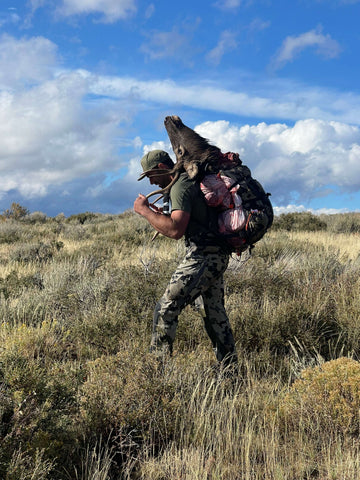
Coming from the eastern whitetail woods and objectively entered my first broken country western elk hunt I looked at glassing as a simplistic way to locate animals. Find a vantage point, setup, and scan the mountain sides. I focused having the best gear I could afford when it came to glassing but overlooked the actual art. I very quickly learned that there’s more to being successful behind glass than just spending time looking through a spotter or binoculars. While I continue to hone my western skill set I’ve come a long ways over the last 4 years.

Being a successful western hunter, at some point will entail working glass as long as the habitat allows for the opportunity. Glassing is an planned and learned skill. In this article I’ll cover all the mistakes I’ve made and lessons I’ve learned glassing out west.

Have a Plan

As I mentioned in the opening paragraph, spending hours behind glass does not guarantee anything but time spent. With most western hunts being plan around a 5-7 day hunt, eastern guys heading west need to be efficient with time. It’s difficult to find animals in new vast territory and locating animals to hunt is often where hunters will spending the most of their time. However, it’s also where the least amount of planning is spent for most new hunter.

When it comes to glassing, there’s more to planning than just marking vantage points on onX. You need to identify glassing points based on where elk will be, sun position, access, and vantage points. Morning, afternoon, and evening glass spots will likely all be different. Once you have boots on the ground be sure you use your tracking tool on onX to find your way out in the dark….Yes, I’ve made that mistake and found myself “cliffed” out resulting in a longer hike out and little sleep.

Morning Glassing Spots – Focus on areas that elk will be moving back from feeding areas. From my experiences of hunting elk with a bow in September, it takes time for elk to transition from major destination food sources back to bed. Sometimes hours! Find destination food sources and transition routes back to bed that have broken ground. Mark these areas on onX with a specific color. Next find vantage points that are in a workable distance with the glass you have. Lastly, you need to think about where the sun will be. I’ve made the mistake of doing the first two steps to only be blinded by staring into the sun. Keep the sun to your back.

Afternoon Glassing Spots – Focus on bedding areas. At times this can be difficult as from my experience, elk enjoy dark timber as the September sun is high in sky. Also, keep in mind, as hunting pressure increases elk will shift accordingly. In my opinion, while elk are not as cagey as a whitetail they will shift when pressured. Attempt to identify bedding areas with broken timber or pockets of timber and focus your efforts on the edges. Considering you’re probably not an elk expert if you’re reading this, picking a bedding area off a map is highly unlikely. I’ve found good success locating bugling elk in the mornings and simply following them back to bed while maintaining some distance. Location bugles are your best friend here. Keep in mind, the distance between food and bed will vary. I’ve witnessed elk moving less than .5 mile up into a drainage off an alfa field and I’ve also seen where elk move 5 miles back to a bedding area. Anyway you can locate a bedding area, mark it on your map and plan to spend the afternoons, which are typically slow, glassing to gain intel for an evening hunt or even a hunt the follow morning. Again, find your vantage point and maintain a safe distance based on the wind.

Evening Glassing Spots – Much like morning spots you’ll be focusing on the bed to food pattern. If you’ve been glassing bedding areas during the afternoon, it may make sense to stay put if your vantage point still works. If you’re taking a blind stab and it’s your first setup glassing, focus on transition areas and pick a vantage point that offers the most coverable ground while keeping the setting sun at your back. Points, saddles, and openings not far from bedding have all worked for me in the past. Use your tracker on the way in to have a clear cut access plan for the way out under the stars.

Before you go into the hunt, it does pay to have vantage points marked on your map with areas of focus for each part of the day. It will likely change once you lay your eyes on the first herd of animals but that’s the game. Without a plan you’ll start to feel the pressure of filling your tag and end up doing more work than needed during your time in the field. Creating a glassing plan is a necessity for western rookies, I’ve went into hunts with plans and without plans. Each hunt is different but it seems the more prep and work committed to the hunt the better and more enjoyable the trips turn out.

Sun Direction

I’ve discreetly mention sun direction in with your glassing plan but it very well deserves it’s own place in this article. It’s not rocket science but it does need to be top of mind. I’ve learned this lesson the hard way, spending entire afternoons climbing to a marked vantage point only to find it totally useless because I was blinded by the sun. The real issue here is simply wasted time. When you’re in vast territory spending countless calories and time climbing you can’t just jump over one ridge and make it work….at least not in my experience. You don’t always need the sun to your back but you DEFINITELY do not want it directly at your face. If you take one thing from this article, this is it!

Comfort and Steady Base

glassing for elk

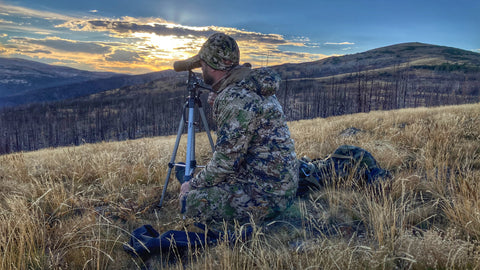
The entire point of glassing is to breakdown an area by spending TIME observing from a distance. Glassing is a skill and it’s not something you learn without doing. The majority of the time when you do spot an animal you will only be catching glimpses of movement if you lucky. More often than not, you’re trying to locate something out of place, an antler, leg, etc. To pull that off you need to go slow and create a systematic approach to cover an area. I personally like to break areas down into a grid and cover it horizontally first before moving back down or up. For example, I’ll start at A1 move to F1 and then return back to A1 before moving vertically and repeat the process over and over and over.

The point here is that to be successful you’ll need to go slow, which takes time. So you need to get comfortably. When you first get setup, take the time to dig out a spot to sit and get a decent backrest, even if you have to carry a few rocks or logs to create it. In effort to save weight in my pack, I usually do not carry a glassing pad because I typically have layers of clothing with me. I’ll use those layers to sit on.

Having a solid tripod is one of the things I personally overlooked on my first couple elk hunts. You cannot be effective behind glass without a solid base. It’s really that simple. Beyond having quality gear, you need to learn how to get it setup solid. Once you begin to glass you WILL inevitably bump your tripod leaving you wondering where you were looking. Diggin in your tripod legs or setting something of weight (rocks, sticks, pack, etc) on each leg will save you some frustrations. In addition to having a solid base, get familiar with your fluid head and it’s adjustments. You don’t want to have them too loose but you also don’t want them cranked too tight. The perfect medium is where you can loosen your pan or tilt with one head without torque on the tripod so much that you’re moving it.

Binos or Spotter or Both?

As I continue to grow as an elk hunter I reflect back to earlier hunts. Things I did wrong, things I did right, lessons I’ve learned and often wondered about how each hunt would play out if I executed things differently. One of the biggest mistakes I make during glassing is going to fast and taking my eyes away from my spotter. For someone who has never spent hours in one place behind glass, it may seem easy. It’s not! It’s mentally exhausting and your eyes will be strained. Something I picked up from Cliff Gray, a lifetime guide and elk hunter, is to use both binoculars and a spotter. Utilize your binoculars to scan and then use your spotter to get a better look at whatever you see. This one thing has drastically increased my glassing success.

While the thoughts of glassing up a giant muley or elk may seem like easy work for those who have never done it, those who have know better. Just like the digital scouting we do for whitetails, creating a plan and considering these tips to glass will pay dividends in aiding to a successful western hunt. I can almost guarantee you won’t be good at it the first go round but with conscious efforts through preparation and execution you can find success and become better with each western experience. You may even find yourself implementing glassing more and more in the whitetail woods!

Author: Chad Sylvester, Exodus Co-Founder/Owner

How to Find, Clean, Store and Display Native American Artifacts

0

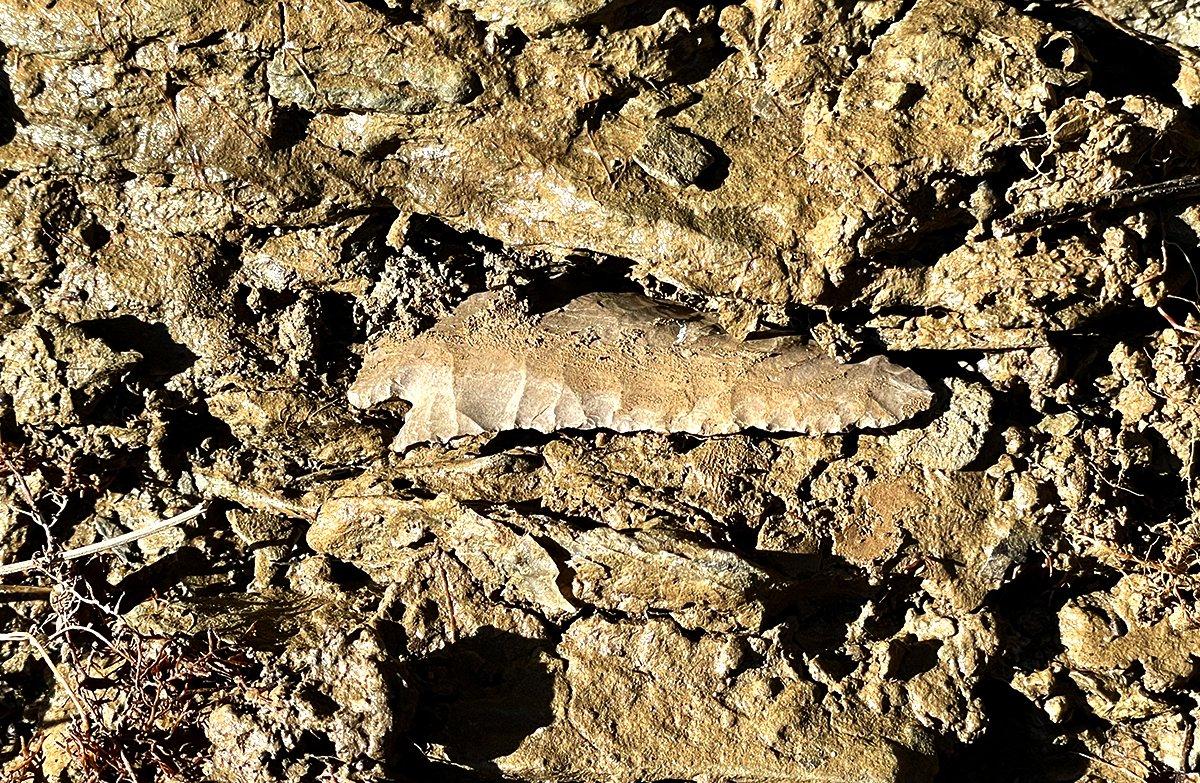
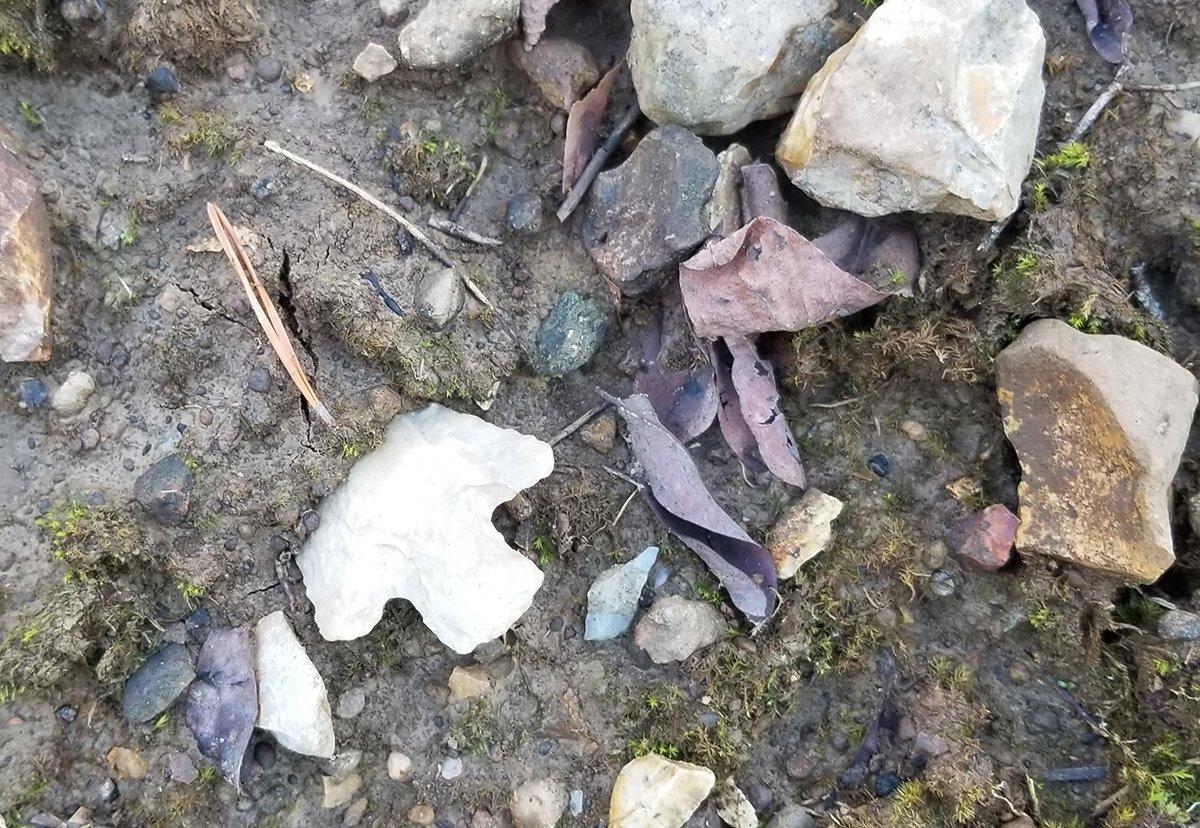
I wasn’t the first hunter who had been there. Even though I was miles from the nearest road, the glint of gray rock shining on the muddy creek bank told me at least one other hunter had walked this valley in the past 13,000 years. It was a stone point, carefully knapped to a razor’s edge when hunting gear meant the difference between life and death.

Undercut banks in the bends of creeks are great places to search. Photo by Michael Pendley

Searching for and collecting Native American artifacts is a popular hobby among folks who love the outdoors. It’s a great way to spend the off-season and will help to keep you in shape. Keeping your eyes on the ground while you’re hunting will often turn up evidence of past civilizations and people who lived and hunted the same ground thousands of years ago.

Getting Started

If searching for artifacts sounds interesting, artifact collector Les Hatton of Kentucky said some reading will help you become a better collector.

I always tell people to read through a good reference book or two to familiarize themselves with the types of artifacts that might be in their area — who made them and how old they may be,” he said. “One of the best out there is The Official Overstreet Indian Arrowheads Identification and Price Guide.”

Now on its 15th edition, the Overstreet guide is a hands-on reference to arrowhead types, manufacturing, grading, materials and values. The current edition contains 12,000 actual-size photographs covering hundreds of point types, and has information on how to grade, identify and catalog points. The guide covers points found throughout the United States, including Alaska.

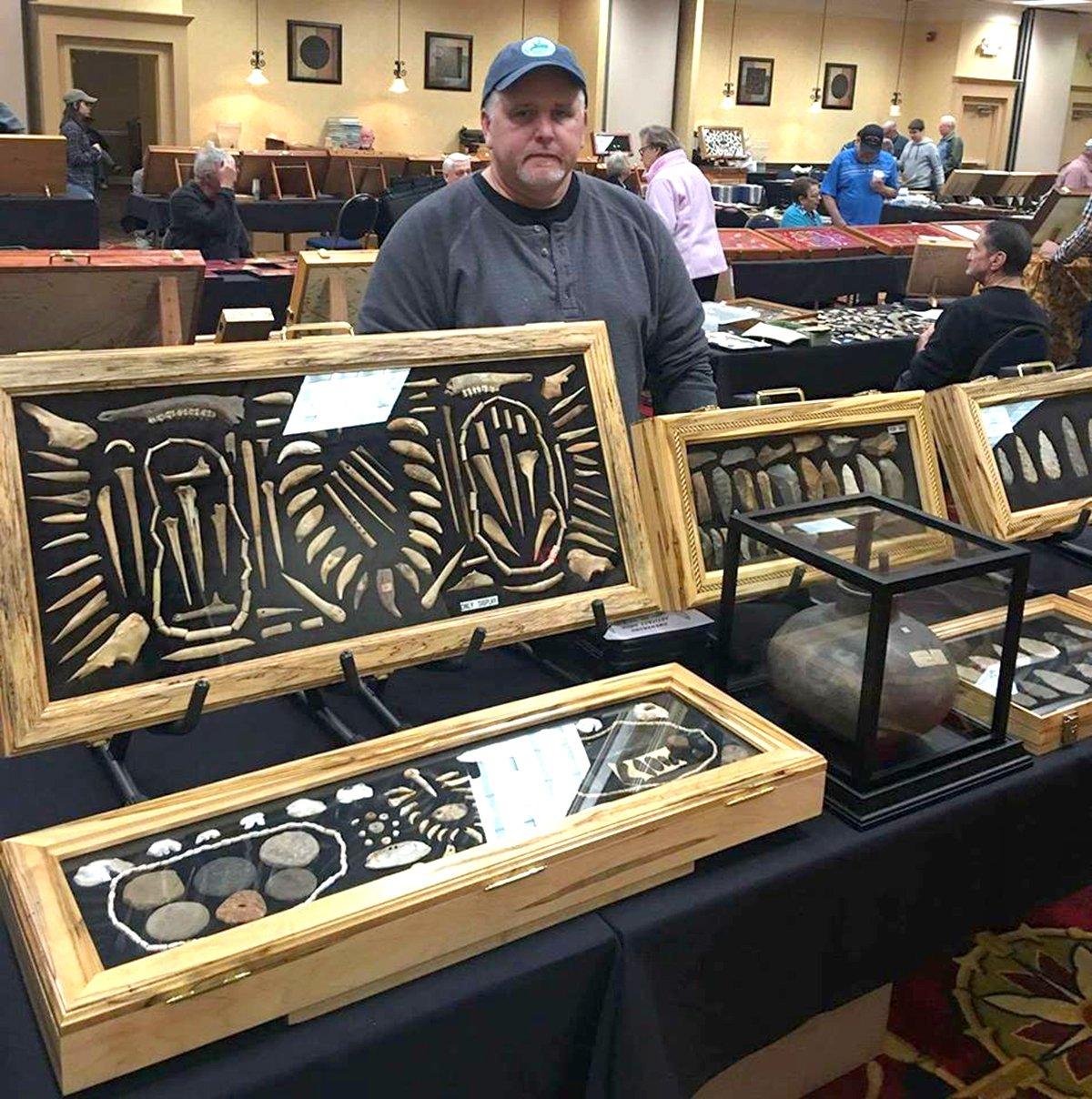
Storing and displaying points in lined cases protects them from chipping. Photo courtesy of Les Hatton

(Don’t Miss: 15 Ways to Bag More Late Season Small Game)

Where to Look

Travis Hood is on a constant search for artifacts around his Indiana home.

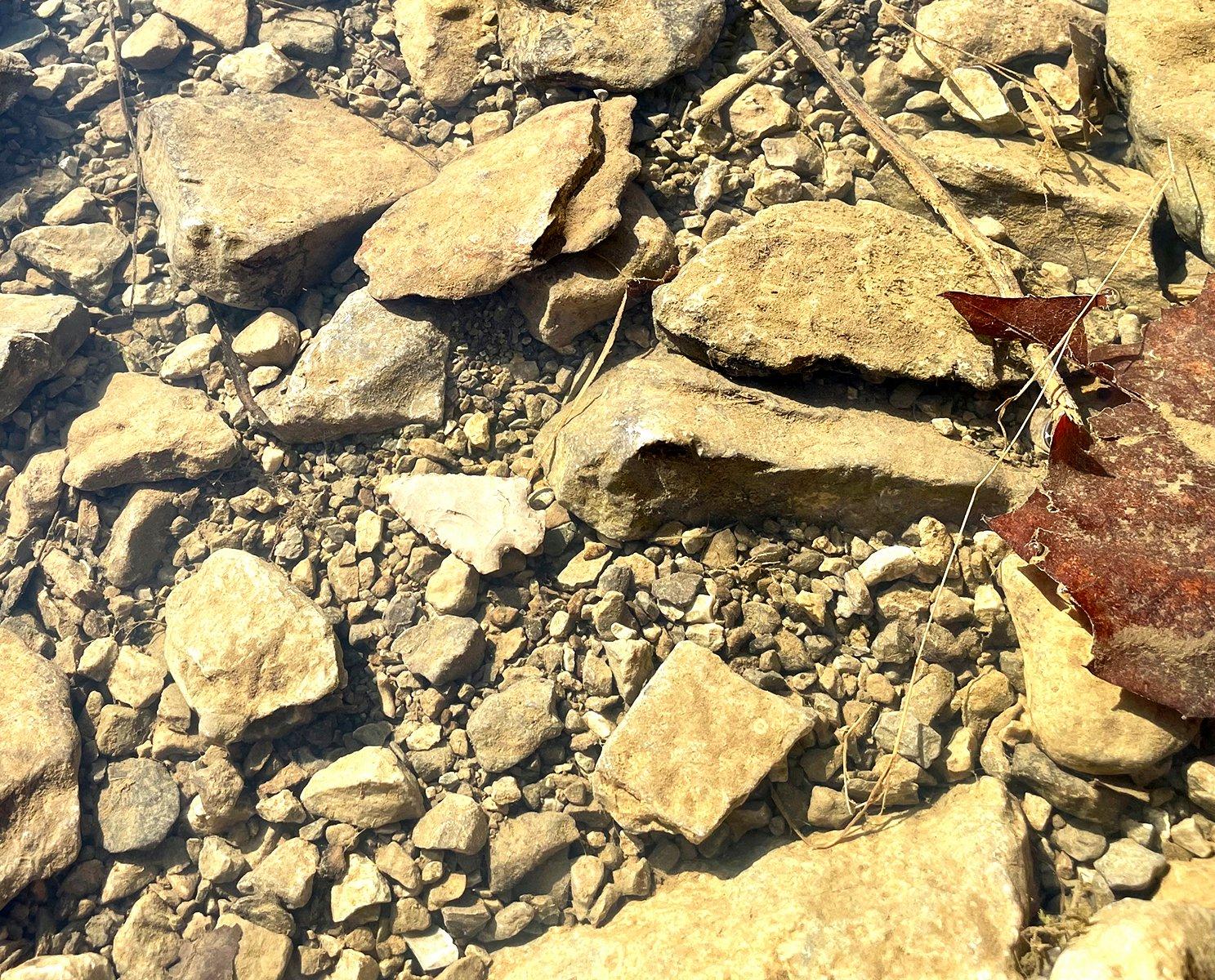
My favorite places to look are plowed fields, high ground around 200 yards from the outer bends of waterways, and along creeks and streams — both on the bottom and on the shore, especially if there are washed-out steep creek banks, he said. I’ve even had good luck artifact hunting in areas where pigs are pastured because their constant rooting often turns up points.

Plowed fields are top producers of points and other artifacts. Photo by Michael Pendley

If I am in a new area, my rule of thumb is to look around and ask myself, ‘Where would I live if I were here thousands of years ago?’ I’d want nearby access to fresh water, but be high enough and far enough away that my camp wouldn’t wash away in a flood or have constant standing water on the ground. The neat part about finding a good spot where a village once stood is that you might find artifacts from a civilization as current as a thousand years ago and some from as old as 10,000 years ago just feet from each other. Man’s basic needs didn’t change that much over 15,000 years, and a good spot to live is a good spot to live.

Always keep an eye on creek bottoms for points exposed by moving water. Photo by Michael Pendley

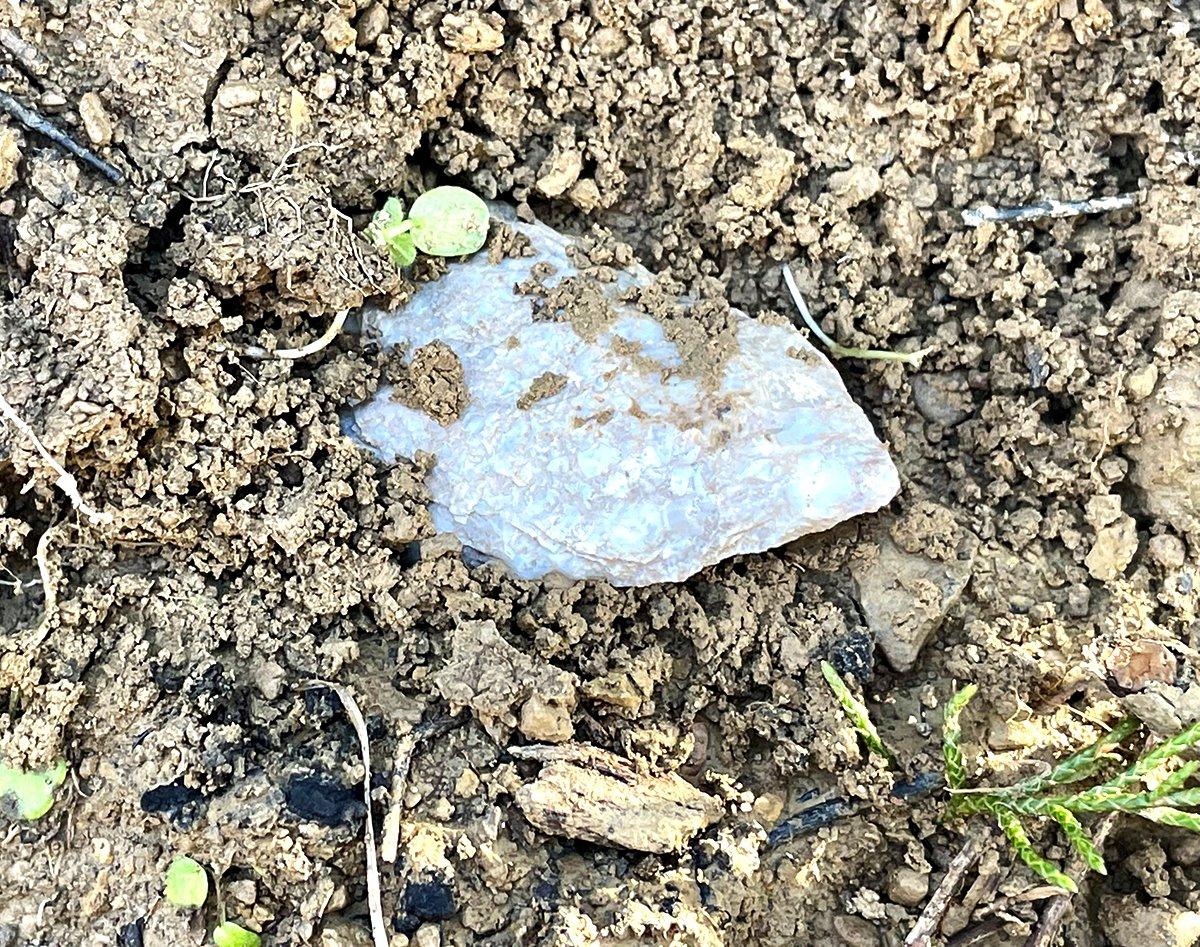
Hood and Hatton said old fire pits, often still visible as dark rings of charcoal and carbon in otherwise light-colored soil, are excellent places to find points and other artifacts.

The campfire is where they spent their time and where they did most of their point knapping, Hood said.

What to Look For

You know you’re in a good spot if you start finding small flakes of flint scattered around, especially if flint isn’t common in the area.

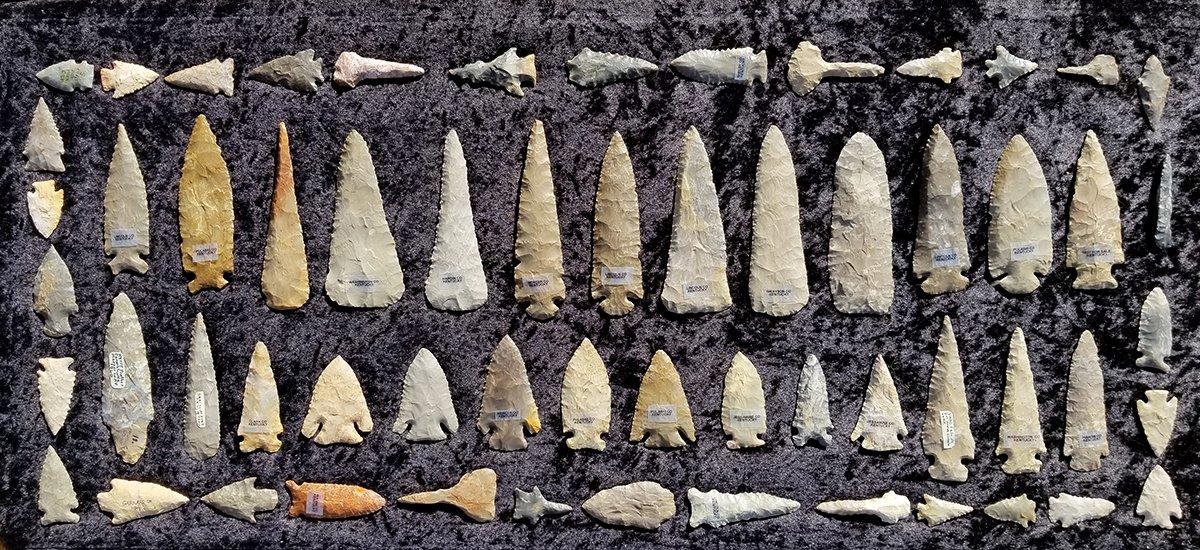
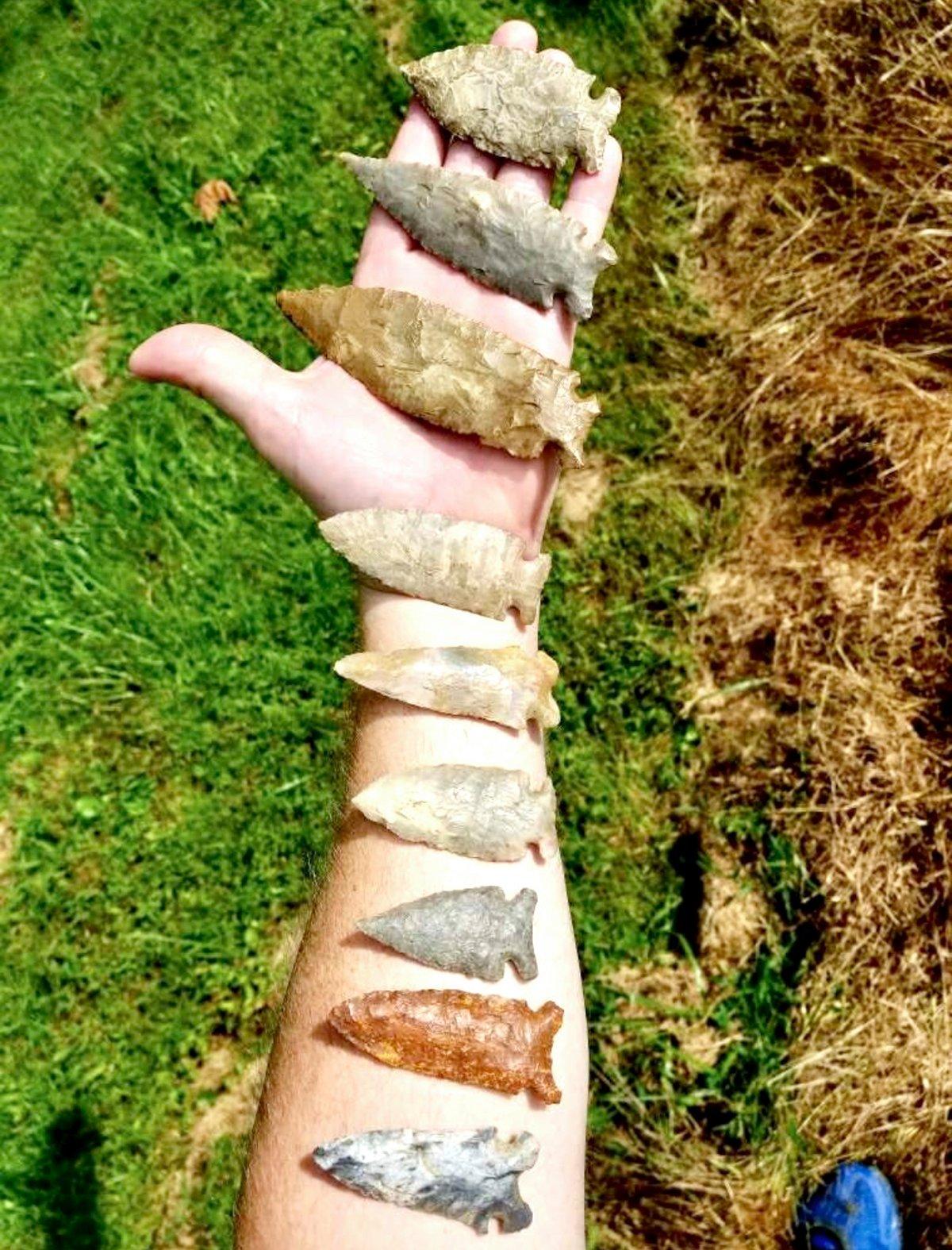
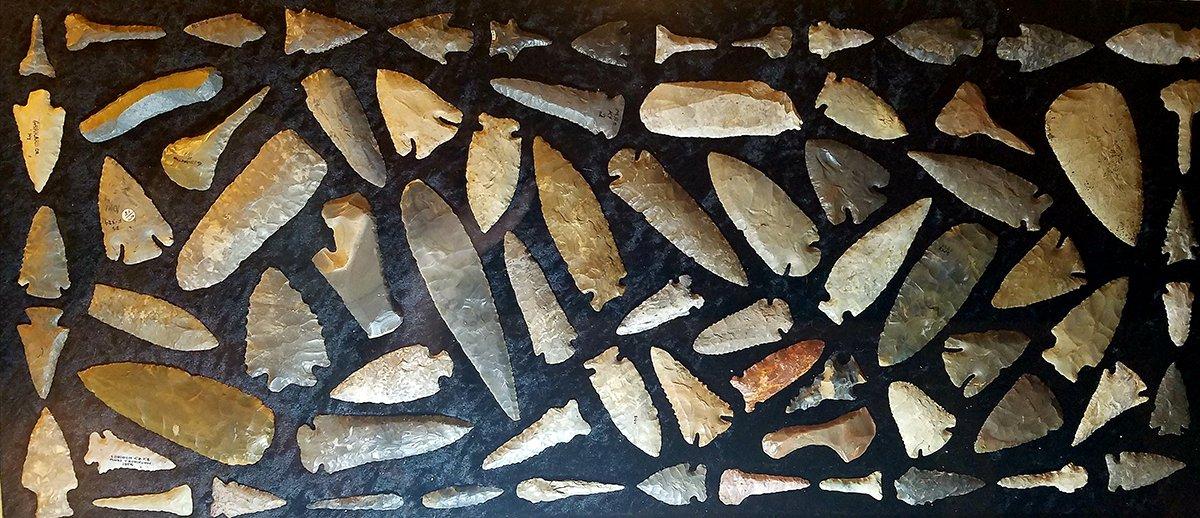
Once I start noticing flint flakes, called debitage, I start looking for whole or partial points,” Hood said. “While nearly everyone generally calls any knapped projectile an ‘arrowhead,’ most of the stuff you find was probably something else. It could be an ax or celt, a digging hoe, a blade, scraping tool or even a drill. Sure, they made arrowheads, but before bows were commonly used, they made atlatl points and lots of other tools. Some of the earliest stone tools were crude stone blades from the Clovis culture — made by people that lived in the desert Southwest between 11,000 and 13,000 years ago.”

Points can vary in size, shape and material depending on age and the maker. Photo courtesy of Les Hatton

Hatton said aging points gets easier with experience, but referencing guide books will help you figure out who made it and when. You might think the more intricate and detailed the point, the more modern it is, but that isn’t always the case.

It’s interesting, Hood said. Points and tools like those from the Clovis period started out crude and on the large side. Over time, new techniques and experience allowed the tool makers to turn out finer and more intricate points. What’s fascinating to me is that the finest points come from the middle period of stone tool making. Up until around 8,000 to 10,000 years ago, points were crude. Then, from 8,000 up to about 2,000 years ago, they got increasingly finer and more advanced. Then, starting a couple of thousand years ago, they regressed into cruder, less finished points. Maybe they were mass producing these points by then and needed to turn out a more disposable, quickly made point or something.

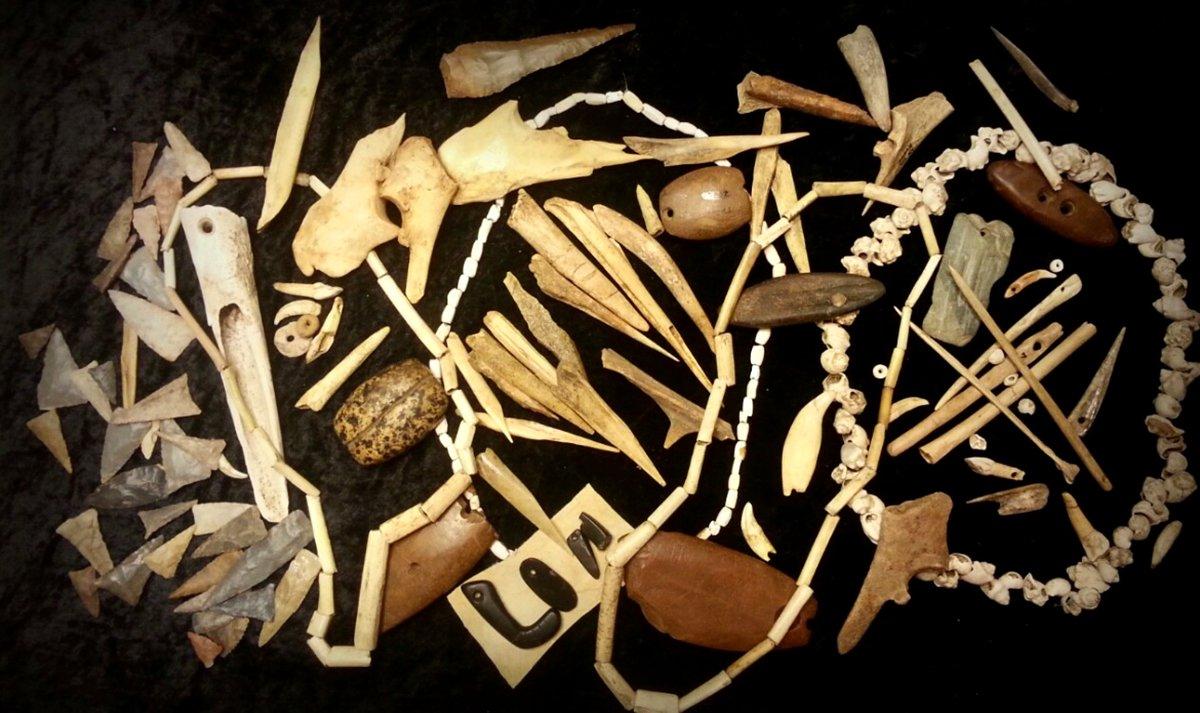
Besides stone points, watch for bone tools and jewelry. Photo courtesy of Les Hatton

Besides stone tools and points, you might also find whole or pieces of stone pottery or beads, as well as bone tools, jewelry, clay pipes and other remnants of everyday life. If you are lucky enough to find something like that, keep looking. You are probably near a village or long-term camping spot, and there will likely be more artifacts in the area.

Realtree Store

You Found Something, Now What?

So you went out looking and found a point. Now what? Hatton recommended taking a bit of time to record some details, especially if it’s a whole tool or point, or possibly a really valuable artifact.

Snap a quick photo of the artifact on the ground before you pick it up,” he said. “Note where the artifact was found, how deep in the soil and the coordinates or at least a nearby street address. All of this information will be helpful for you to figure out when and by whom the artifact was made, and having as much historical information, known as provenance, with your find as possible might make it more valuable as a collectable.”

Plus, keeping information on find locations will act as a guide for future searches.

Always note the exact location of finds to help with future identification. Photo courtesy of Les Hatton

Cleaning and Storage

When you locate a point or other artifact, what do you do with it?

The first thing to do is leave it alone, Hatton said. You can use a soft brush or toothbrush to remove loose soil from the point, but don’t get too rough with it, and don’t scrub it clean with soap and water or any other solvents. When experts look at a point under a magnifying glass or microscope, they are looking for certain mineral or soil deposits that help to verify the age. If those deposits are gone, it gets a lot harder to certify that a point is the real thing.

A good identification book will help you with age and maker information for many artifacts. Photo courtesy of Les Hatton

Although avid collectors might have buckets full of partial, unfinished or broken points, Hatton said whole points or anything else that might be valuable need to be stored carefully.

When you toss a stone point into a bucket with other points, they beat against one another to the point that they can chip or break, destroying their value,” he said. “The best way to store them is in a flat display case that you can set on a shelf or hang on a wall, or in flat boxes with layers of paper or cloth between the points to prevent them from touching one another.

Some of these points can be extremely valuable. I’ve personally witnessed one sell for $45,000, and I know of another rare Clovis point right now that is valued at over $100,000. You might find something that is worth a lot of money to the right collector, so treat them gently until you can have them looked at by an expert if you think you have something that might be valuable. That’s another area where the reference books come in handy. By comparing size, shape, flaking style, material and notch methods from your point to the reference books, you can get a pretty good idea how much a point is worth and whether or not you should get it appraised.

Artifacts are often bought and sold at large shows, where you can get your points appraised. Photo courtesy of Les Hatton

Keep it Legal

Before you head out to find your own artifacts, Hood and Hatton recommend familiarizing yourself with state and federal laws that apply to artifact hunting. As a rule, private lands require only the permission of the landowner to collect artifacts. But depending on the state, there might be exceptions, such as burial sites, caves and even certain deep stone overhangs that might have been used as religious sites.

When it comes to federally owned lands, removal of artifacts is generally not allowed. The Archeological Resources Protection Act of 1979, which protects any item of archeological interest that is more than 100 years old, and Title 36 of the U.S. Code of Federal Regulations, which deals with theft or destruction of public property, state that anyone found digging or removing artifacts from publicly owned lands can face fines, jail time or both.

On your next hunt, glance down at the ground from time to time. Chances are good that the same wildlife trail you’re watching has been used for thousands of years. Perhaps another hunter sat in a nearby location, doing the same thing. Maybe he or she left behind a sign that they were there.

How To Stop Buck Fever: Learn How to Calm Nerves and Stay Focused While Hunting

0

If you’ve been hunting for some time, chances are, you’re familiar with buck fever. Or that you know of another hunter who has experienced buck fever.

It’s what causes you to miss a giant deer from close range, even though you can regularly hit the bullseye during target practice. It’s also the reason why you feel your heart rate go up, and your hands to start trembling when you’re out there, and you catch sight of that deer, or any other animal that you’re hunting.

But what is buck fever, and why do so many hunters experience it? And are there ways that you can overcome the jittery feeling when it’s time to take the shot?

Here, we’ll learn more about buck fever, it’s symptoms, and what causes it. We’ll also cover some remedies to help you stay calm and focused during your next hunt.

What is buck fever?

Buck fever is a term that describes the nervousness that many hunters experience when they see a deer, and it’s time to take the shot.

buck fever for hunters is real

According to a 2016 article published by Texas A&M University, buck fever is real, and it can even cause some experienced hunters to miss the broadside of a deer from close range [1].

The article also goes on to say that there is no real cure for buck fever. Fortunately, however, there are ways to keep buck fever under control, as we will discuss below.

But first, let’s take a look at some of the symptoms and explain why it happens.

What are the symptoms of buck fever?

Here are some of the potential symptoms of buck fever.

  • Rapid heart rate
  • Excessive sweating
  • Trembling hands
  • Narrow vision
  • A perception that time is speeding up/slowing down

These physical symptoms, and in some severe cases, symptoms like nausea or loss of hearing, can present a real challenge for you as a hunter when it comes to taking an accurate shot on the animal.

Why do I experience buck fever?

When you’ve been out there, patiently waiting for hours, and you finally catch the sight of a buck, it is a thrilling moment. But it can also put a lot of pressure on you.

You might think of it as a rare moment for you to capitalize on the opportunity and deliver the kill shot, so you can provide nutritious food for your family. And as an ethical hunter, you also want to get it right the first time. You want the shot to be effective and lethal to minimize the animal’s suffering.

The added pressure of accuracy within a very small window of time can cause a spike in adrenaline hormone.

Adrenaline and buck fever

The elevated adrenaline is not necessarily a bad thing. Many hunters feel more alert and a greater sense of awareness because of the adrenaline spike, and they use it to their advantage to shoot more accurately.

But if adrenaline kicks into too much of an overdrive when you catch sight of that big-racked buck, it can exert too much on your cardiovascular system. It can cause your heart to pump blood with too much force, which is why you may feel like you’re losing control over your motor skills, and experience various symptoms of buck fever [2].

As we mentioned before, there isn’t really a “cure” for buck fever. And in a way, that’s a good thing, because you may not want it to go away completely.

Many hunters thrive on the adrenaline rush as it elevates intensity, and they cherish the increased awareness of the various emotions.

But if you feel like buck fever gets in your way of taking the best shot, whether it’s at the shooting range, or during an actual hunt, then you will benefit from learning how to control your emotions and calm your nerves.

5 tips to suppress buck fever and remain calm while hunting

Let’s examine five tips to help you remain calm and focused during your next hunting trip.

1. Are beta-blockers really effective against buck fever?

You might have tried beta-blockers in the past, or heard of another hunter who has used them to stave off the jitters.

Beta-blockers are a type of pharmaceutical drug that works by blocking the effects of adrenaline. They are typically prescribed by doctors in the form of Metoprolol & Propranolol in order to treat conditions like hypertension and irregular heartbeats.

Since adrenaline spikes are one of the primary factors behind buck fever, beta-blockers can be effective in preventing the physical symptoms.

But beta-blockers will always be a temporary solution. They do nothing as far as training you to become more resilient against buck fever. Additionally, they can have harmful side effects, and you can become dependent on them if you use them frequently [3]. And in the United States, you will need a prescription.

2. “Tactical breathing” to deactivate fight-or-flight mode

tactical breathing is a tool to fight buck fever

When you’re under intense pressure or stress, your body often switches to what is called the fight-or-flight, or survival mode. The survival mode prepares you to deal with any potential danger by increasing your alertness and awareness, and it is associated with the spike in adrenaline [2].

One of the most simple, yet effective, tools you have at your disposal to deactivate the fight or flight mode is “tactical breathing,” a trick used by Navy Seals to perform better under pressure [4].

Done right, “tactical breathing” can switch your nervous system back to a relaxed mode, and essentially act as a natural beta-blocker. You will feel your heart rate slow down back to normal, and the jitteriness disappear.

You can try it during your target practice, as well as when you’re getting ready to shoot during an actual hunt.

  • Step 1: Take a deep breath into your stomach to a count of four.
  • Step 2: Hold your breath and count to four.
  • Step 3: Exhale slowly to a count of four.
  • Step 4: Repeat the process till you feel calmer and in control.

3. Visualize the perfect shot (yes, it really works)

Imagining and practicing the perfect shot in your mind can help you remain calm and improve your performance under pressure.

If that sounds a bit too new-age-y, you should know that elite Olympians like Michael Phelps and Lindsay Vonn have used visualization techniques to improve their athletic performance when it mattered most [5][6].

Think of visualization as mental preparation for your next hunting trip. Take a few minutes each day to sit quietly, put yourself in a relaxed state through the breathing exercises mentioned earlier, and then imagine yourself taking the perfect shot at the deer.

Try to make it as vivid as possible. Involve all the senses. Imagine what it smells like, your hand on the trigger or the bow and arrow, the deer emerging, and anything else that you would experience in the real-life situation. You could even imagine yourself beginning to experience buck fever, and then overcoming it.

A visualization practice, along with all the regular preparations, will leave you better mentally prepared and more confident during your next hunt. It will make taking the shot less stressful and may diminish buck fever symptoms.

4. Mimic “real” hunting scenarios to gain confidence

When you practice, if you can mimic a real hunting scenario, it will prepare you better for the real deal.

Maybe you can practice with a 3-D deer and a treestand in the woods near where you live. Try to practice shooting from all kinds of distances that you might have to potentially shoot from when you’re hunting for a deer.

Although it will never be able to fully recreate the real situation, practicing enough in a mimicked environment can make you more familiar, and it might help you build greater confidence in your ability to shoot.

If you’re more confident about your shooting, then you’ll feel less stressed, and your buck fever won’t be as severe.

5. Try PerformZen to remain calm and collected under pressure

Along with breathing exercises, PerformZen can provide an extra boost in calmness and cognitive function.

PerformZen is a natural supplement designed to help performers remain calm under pressure. It is used by public speakers, actors during an audition, musicians who perform for live audiences, students preparing for important tests, professional athletes, and many others.

It can also help hunters suppress buck fever and remain calm when they have to take the perfect shot under extreme pressure.

PerformZen works by boosting GABA in your brain, a neurotransmitter associated with greater calmness [7]. It also contains L-theanine, an amino acid also proven to promote relaxation and calmness [8].

Not only will PerformZen help you remain calm under pressure, but it will also improve your mental focus. It contains magnesium and vitamin B6, the combination of which has been shown by research to improve cognitive function [9].

PerformZen also contains Theacrine and Ginkgo Biloba, both of which will further assist you with shaking off the jitters and in providing you with a clean boost of energy.

Unlike beta-blockers, a natural supplement like PerformZen works by supplying your brain with beneficial nutrients so that it can better handle stressful situations.

So is it possible to overcome buck fever?

Buck fever is a real phenomenon that is quite common among hunters, even experienced ones.

While you want your adrenaline levels to rise so you can elevate your intensity and awareness when taking the shot, you want to make sure that it doesn’t kick into overdrive and make you jittery.

Try some of the tips mentioned in this article, like “tactical breathing”, visualization, and real-life practice scenarios. And if you’re looking for an extra boost in calmness and mental focus, be sure to give PerformZen a try.

Best Goose Decoys of 2022

0
Best Goose Decoys of 2022

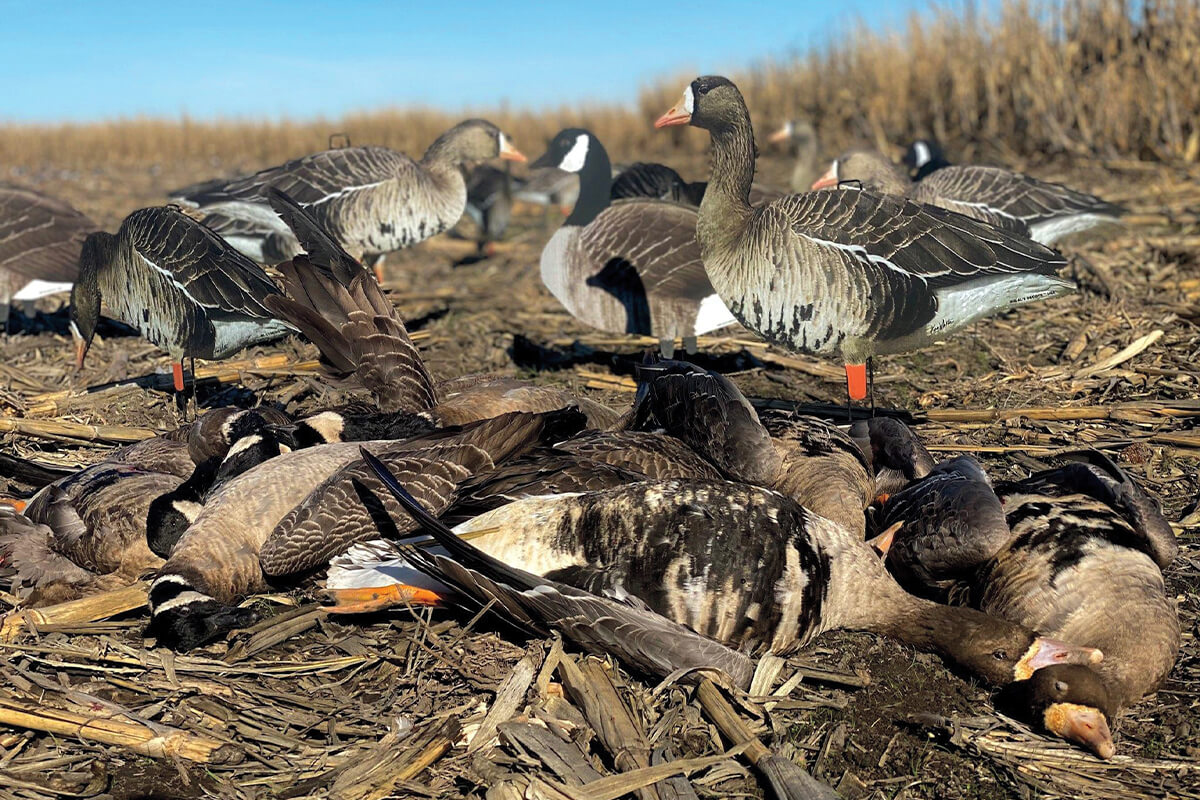
Our top pick goose decoys of 2022. (Photo courtesy of Big Al’s Decoys)

Wildfowl Podcast Episode 34

DON’T MISS Episode 34 – 2022 Giant Gear Issue Series – Decoys with MOJO and Big Al’s

Big Al’s Decoys – Ken White Super Speck Pack Silos

Big Al
Big Al’s Decoys – Ken White Super Speck Pack Silos

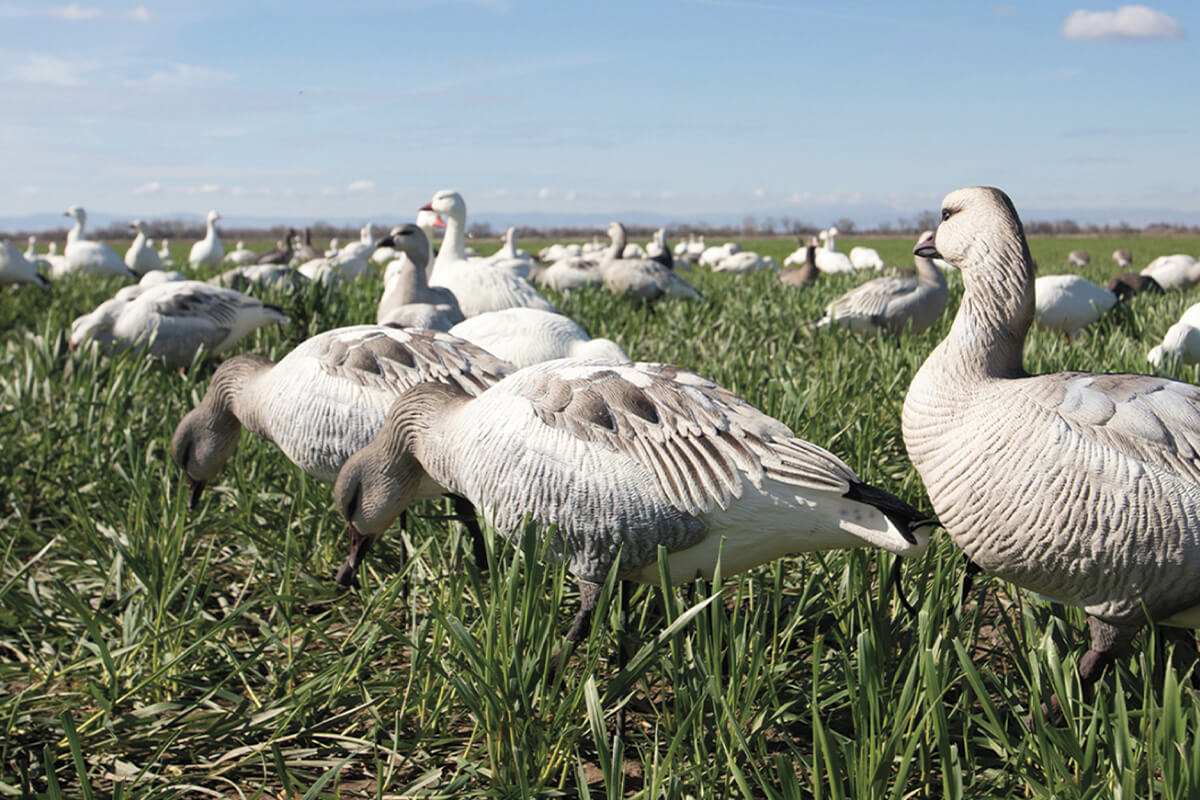
Big Al’s Silhouette Decoys has teamed up with former World Speck Calling Champion Ken White to develop the Super Speck pack. Ken has spent decades hunting specks on his home turf in California, learning decoying tactics that pull specks in close to the guns. These highly portable and lightweight decoys feature photo-print realism, tough fluted plastic bodies, ultra-flat low shine finish and the choice of basic or spring steel stakes. Packed in dozens with 4 searcher, 4 feeder and 4 alert body postures included.

$66 per 12 | bigalsdecoys.com

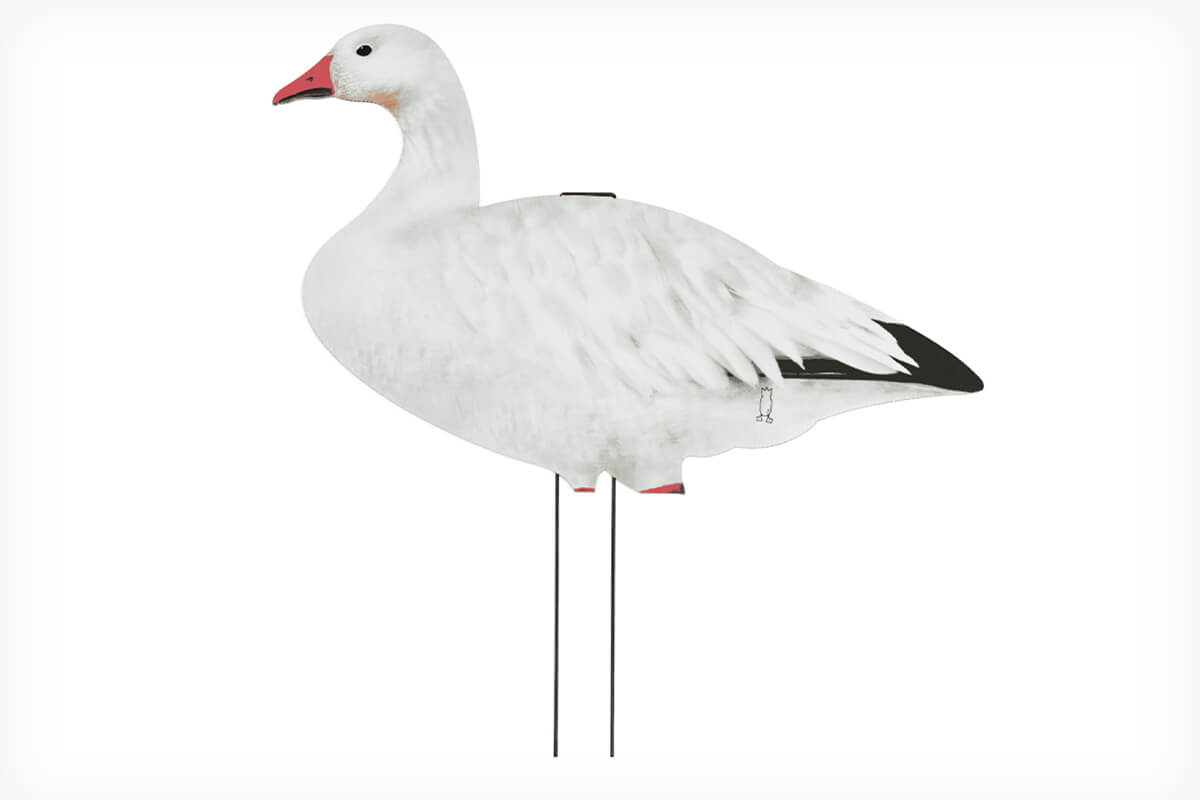
Dive Bomb Industries – V2 Snow Goose Silhouettes

Dive Bomb Industries - V2 Snow Goose Silhouettes
Dive Bomb Industries – V2 Snow Goose Silhouettes

The winner, winner chicken dinner of silhouette decoys, Dive Bomb Industries’ V2 Snows, are painted with pure black and white colors that boost realism. Each decoy is crafted from a 4mm thick corrugated material that is durable and rigid. The images are printed using non-glare ink additives, and DPI (dots per inch) printing means each side of the decoy features the same quality look, and the one-piece powder-coated spring steel stake resists rust and ensures rapid setup and take-down. You can haul these decoys anywhere.

$70/dozen | divebombindustries.com

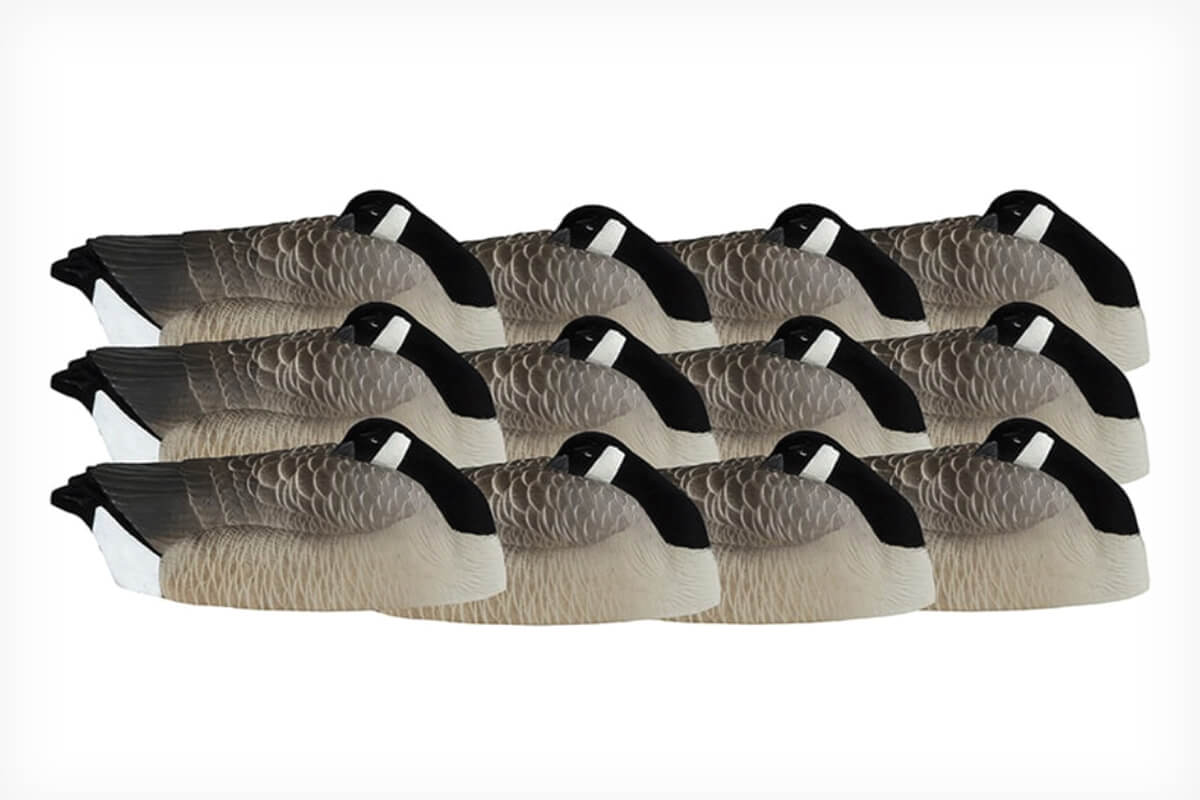
Dakota Decoys – X-Treme Sleeper Shells

Dakota Decoys - X-Treme Sleeper Shells
Dakota Decoys – X-Treme Sleeper Shells

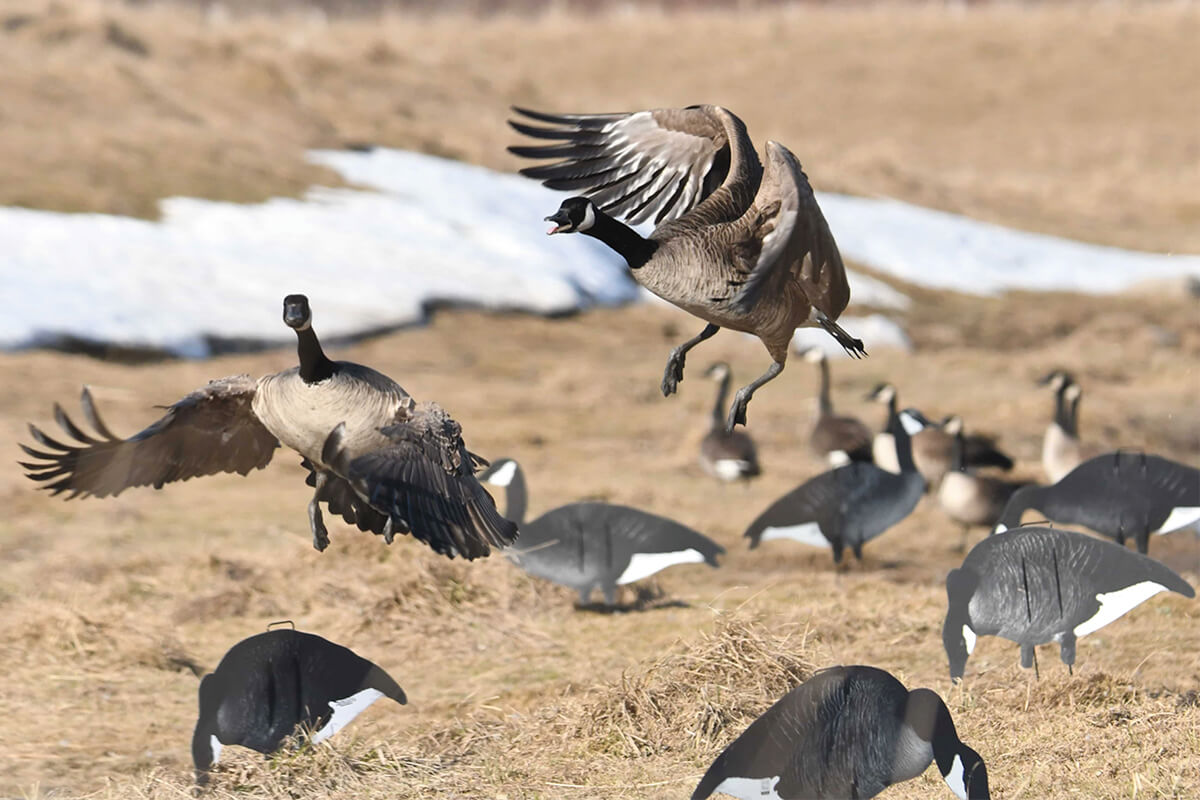
Great for those cold, snowy day sets when honkers hit the field and go into nap mode, Dakota’s X-Treme Sleeper Shells are single-piece sleepers, which means no heads to hassle with. They are constructed of polyethylene to guarantee seasons of use, and there is no seam line for cold-weather outings to crack. The decoys come in packs of 12 and are available in a painted version with flocked heads and tails and a full-body flock.

$250-$310 | dakotadecoy.com

SX Decoys – Lesser Combo Canada Goose Flocked

SX Decoys - Lesser Combo Canada Goose Flocked
SX Decoys – Lesser Combo Canada Goose Flocked

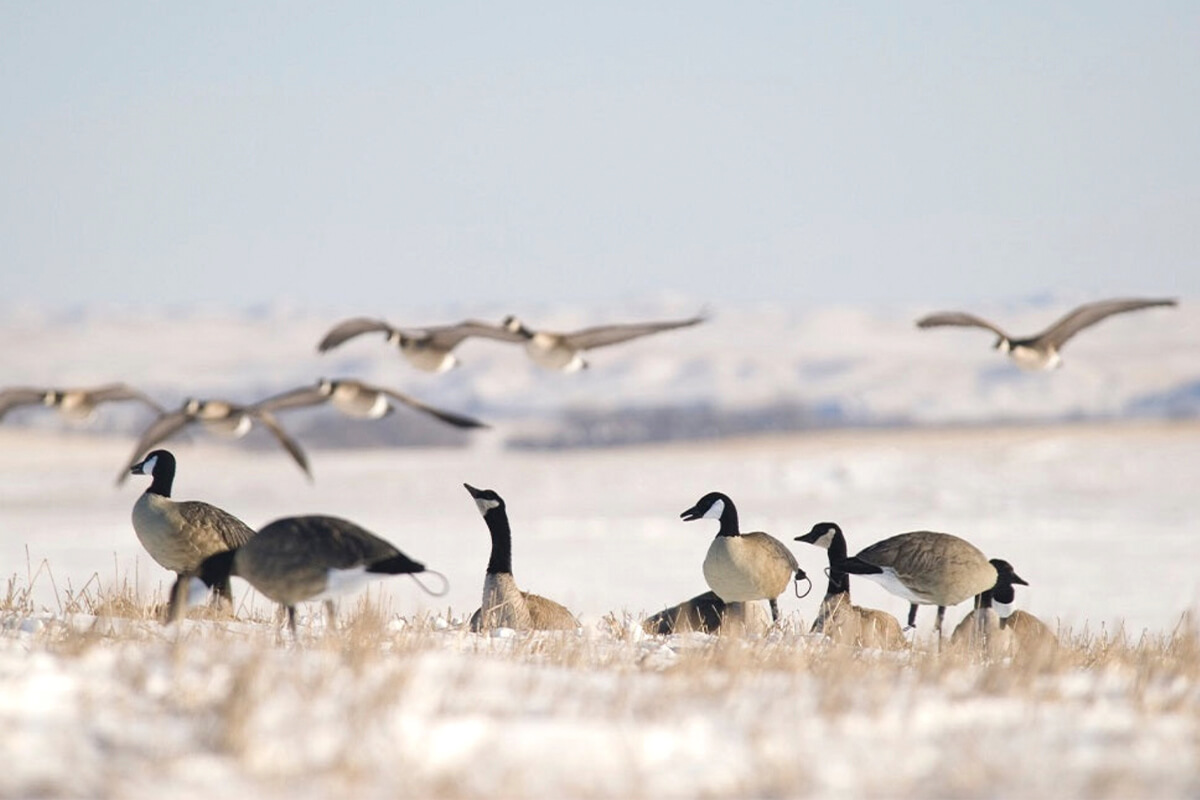
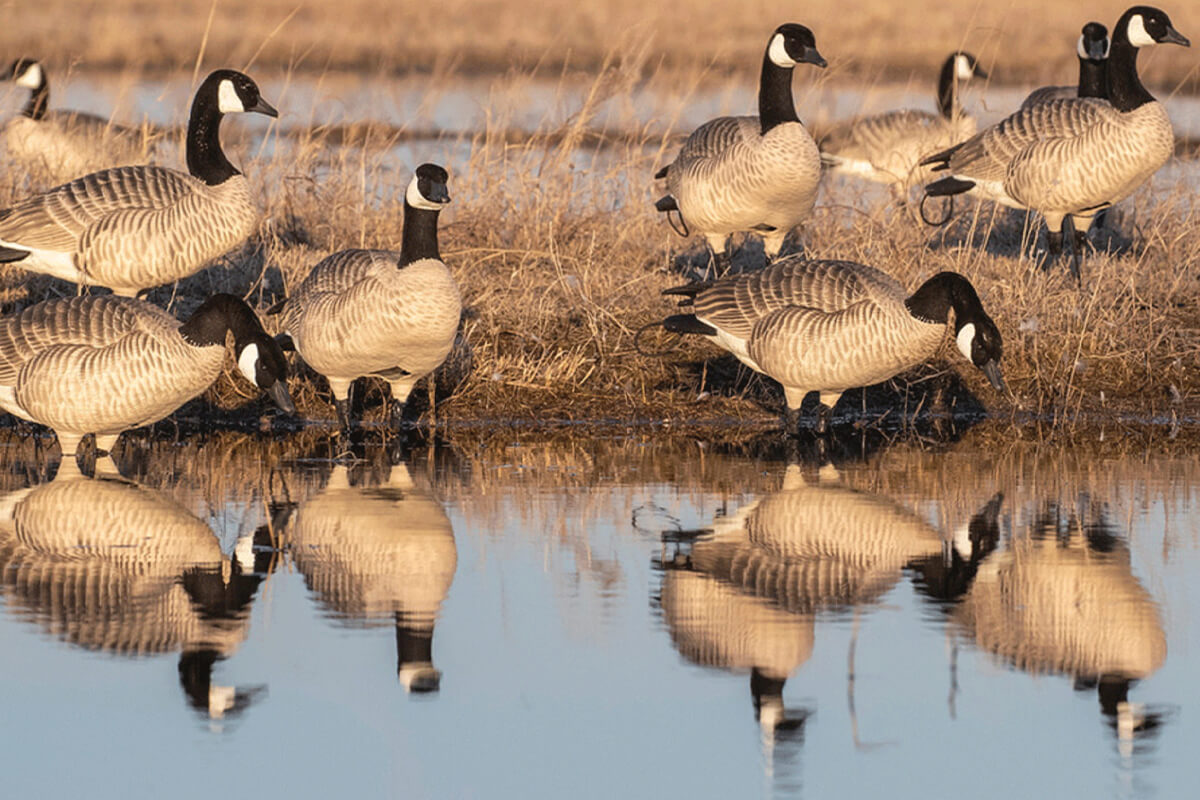
From the minds at SX comes the fully-flocked Lesser Canada. Not only are these Canada imposters flocked, but they are built using Flocked Bird Vision color correction and Bird Vision UV flocking to ensure maximum realism. Available in packs of 6, 12, and 24, these fakes come with SX’s patent-pending motion system and loop kits installed.

$195-$770 | sxdecoys.com

Dave Smith Decoys – Snow Goose Juvie Combo

Dave Smith Decoys - Snow Goose Juvie Combo
Dave Smith Decoys – Snow Goose Juvie Combo

Fooling a flock of snows is getting harder and harder, but when you add a few of these 10-packs to your spread, wings will cup, and body counts will go up. The realistic fold-away legs make storage easy, and the newly designed motion cone gives these juvies just-right movement. Feather matched and showcasing a two-tone paint scheme, these ultra-realistic decoys are built tough and will provide you with years of use.

$390/10-pack | davesmithdecoys.com

GHG – XD Series Full-Body Honkers Active 4-Pack

GHG - XD Series Full-Body Honkers Active 4-Pack
GHG – XD Series Full-Body Honkers Active 4-Pack

GHG’s XD Mallards are well established in waterfowl lore, and this savvy decoy maker has taken the best characteristics of this mallard series and poured them into the XD Series Full-Body Honkers. A new RealMotion System married with FlexLock Technology perfectly combines realistic movement with an integrated locking system that secures the motion bases and decoys together. This means a one-piece decoy that is a breeze to set and pick up. The detail is elaborate, and flocked heads add extra realism.

$160/4-pack | banded.com

Real-Geese – Xclipse Shadow Series

Real-Geese - Xclipse Shadow Series
Real-Geese – Xclipse Shadow Series

An affordable, custom silhouette, Real-Geese’s latest addition to its impressive decoy line — the Xclipse Shadow Series — is winning waterfowling hearts. These two-sided silhouettes showcase a non-reflective, textured surface, and the lightweight plastic boosts durability while keeping weight down. Use these dekes as stand-alone-style or sprinkle them in with shells and full-body imposters. The Xclipse comes with 20-inch powder-coated stakes that drive into any ground, and these goose-dupers are available in one and three dozen packs.

$85-$255 | webfootdecoys.com

Higdon Outdoors – Clone Snow Goose

Higdon Outdoors - Clone Snow Goose
Higdon Outdoors – Clone Snow Goose

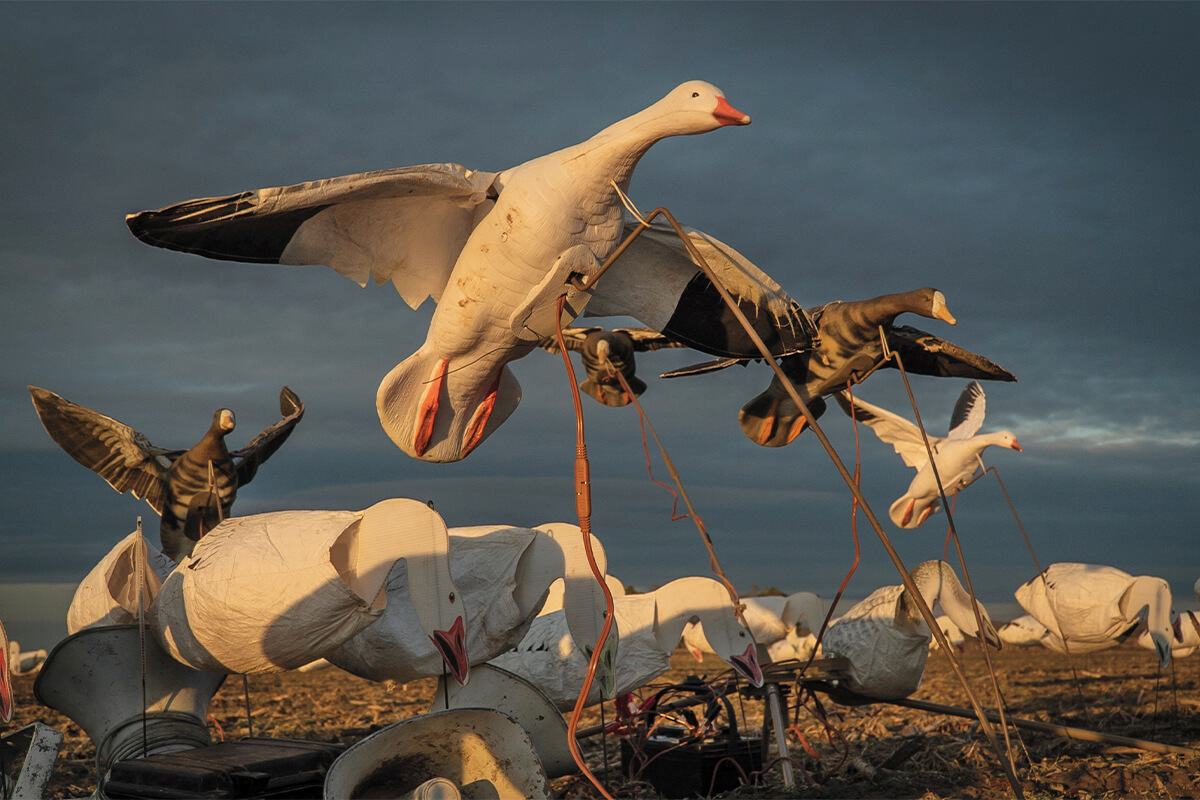
We love stacking up snows, but doing it regularly is getting more difficult. Many waterfowl biologists’ credit this to the lack of juvenile birds, which is a result of poor hatches. Fooling snows that have survived many migrations is complex, and Higdon’s Clone Snow Goose Decoy is what the Goose Doctor ordered to pull the dupe on flocks of mature snows. This fake mimics live birds’ realistic wing beat and accurate body posture. Plus, it’s bomb-proof and performs brilliantly no matter the conditions. This motorized snow goose imposter comes with a remote, stand, power cord, storage case, and requires a 12V battery—not included.

$300 | higdonoutdoors.com

Diana RWS 34 – T06 Trigger Review

0

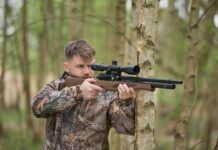
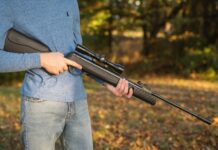
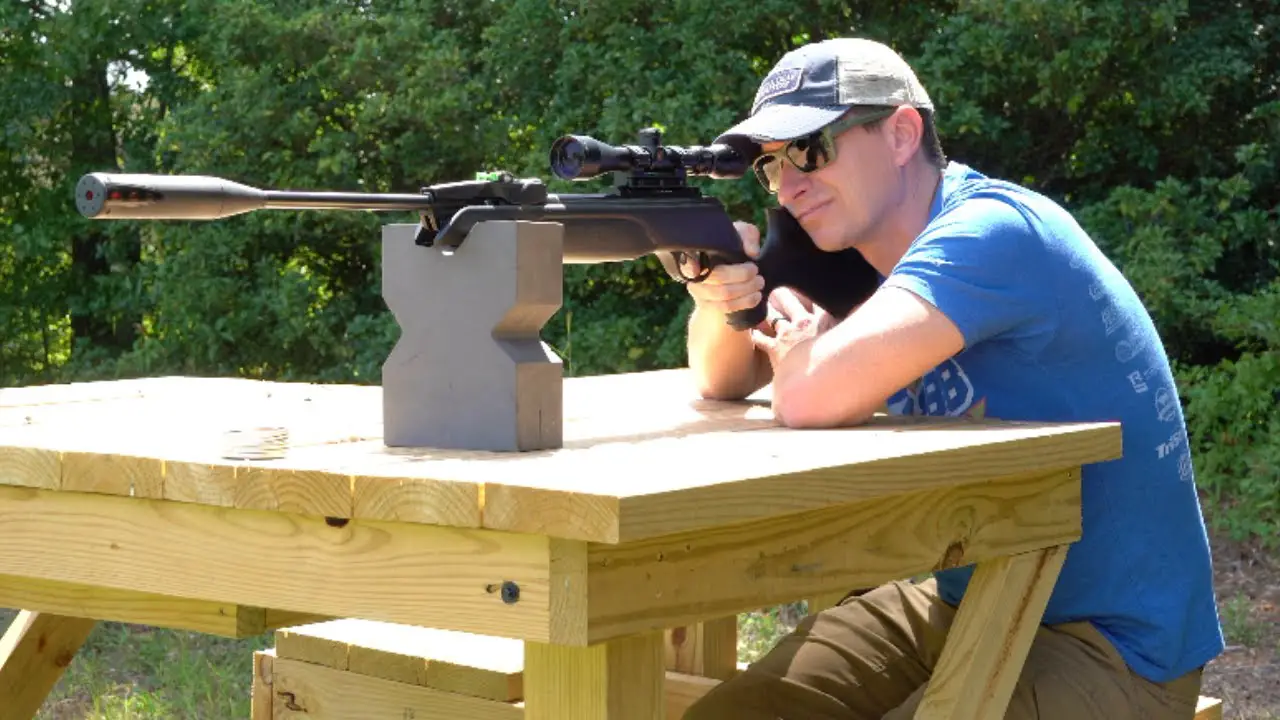
Here we go, the most popular air rifle sold by RWS – the Diana RWS 34.

This gun has had a decades-long great reputation, and air gunners all over the world simply love it when they witness its awesomeness with their own eyes.

Although RWS 34 doesn’t have some of the fancy features of modern guns in the market today, it still stays on top of the best-seller lists in air rifle stores in the USA.

Fun fact: A few years ago, the New York State Field Championship (target distance 55 yards), was won with an RWS 34.

And we are talking about shooting against more powerful and expensive air rifles that cost thousands of dollars, yet the RWS 34 still manages to beat them all!

Diana RWS 34 – Guntype

This is a spring-piston gun.

Read more about spring-piston guns’ pros and cons, and how spring-powered guns compare to other types of air guns in this post.

(For more on the in-depth comparison between gas and spring piston, see this post.)

Diana RWS 34 is a break barrel gun. In order to cock it, you need to slap the barrel downward while holding the gun upward, insert the pellet and swing it into its original position.

It may sound complicated at first but when you get used to it, it will become second nature.

Besides, break barrel guns give you unlimited shooting capacity.

You can shoot tens of thousands of rounds without worrying about running out of power like CO2 or PCP air rifle.

In addition, this is a single-shot action gun i.e. you can only shoot once at a time.

Single-shot action gives you control over the type of pellet you shoot and, in fact, it makes you a better shooter as you get used to having to make your first shot count.

The barrel has 2 types of caliber (the internal diameter of the bore, measured in inches):.177 (4.5 millimeters) and .22 (5.5 millimeters).

Both calibers are ideal for plinking paper targets and spinners.

The .22 cal should be your choice for small game hunting and pest control.

=> For more on the differences between .177 & .22 and which jobs they do best, see this post.

Furthermore, the barrel is rifled with helical grooves inside so it makes the bullet spin before it exits the barrel

(For more on things you should know about air rifle barrels before buying, see this post.)

Check Price on PyramydAir

Stock

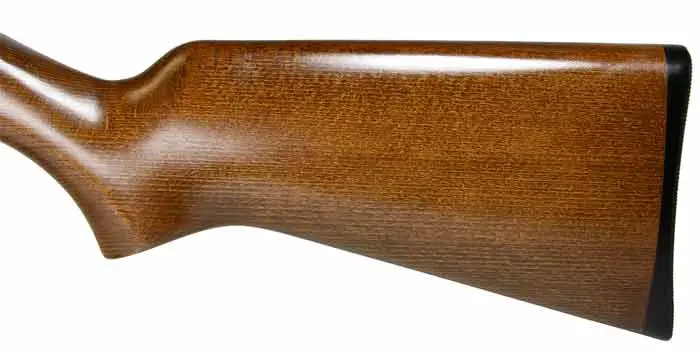
diana rws 34 stock

The stock is made of handsome beech wood.

Beech stock gives you lots of advantages:

First, beech stock is heavier, denser, and harder than other types of hardwood so it has good impact resistance.

Second, it has a beautiful wooden texture.

When looking at the beech stock, you will notice that its texture is uniform and gorgeous.

Meanwhile, the hue is soft and smooth and it looks great too.

For more on the in-depth comparison between synthetic and wood stock, see this post: https://airgunmaniac.com/synthetic-vs-wood-stock/

The stock is ambidextrous so you will have no problem shooting it whether you are a lefty or righty.

Moreover, this rifle has a Monte Carlo stock with a raised comb and low heel.

Monte Carlo stock has lots of advantages including improved accuracy ( the shooter’s eyes are lined up more naturally with the sight), some recoil absorption, and therefore faster follow-up shots .

Sight

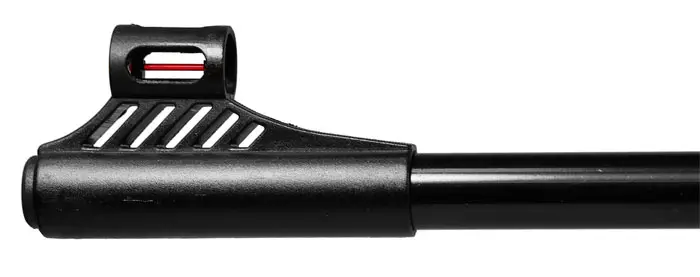
diana rws 34 sight

If you are a fan of traditional open sight, you’re going to love the RWS 34.

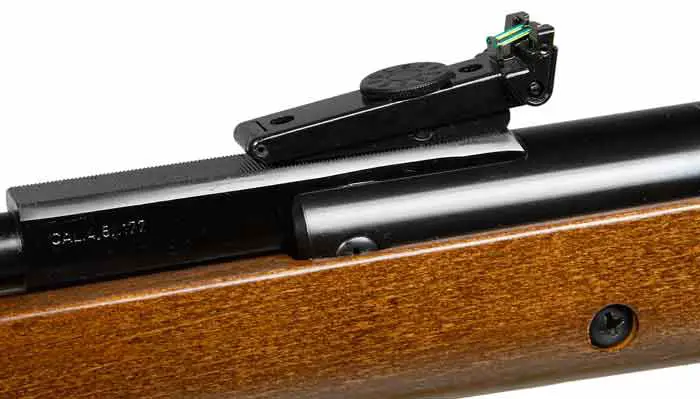
The front sight is Trugglo fiber optic.

Moreover, the rear sight is fiber optic, too.

It is fully adjustable for windage (allowing you to adjust the sight left and right) and for elevation (allowing you to adjust t up and down).

You don’t need a scope when a useful fiber optic sight is already there!

(For more on how many types of air gun sights are out there and which one is suitable for you, see this post.)

Trigger

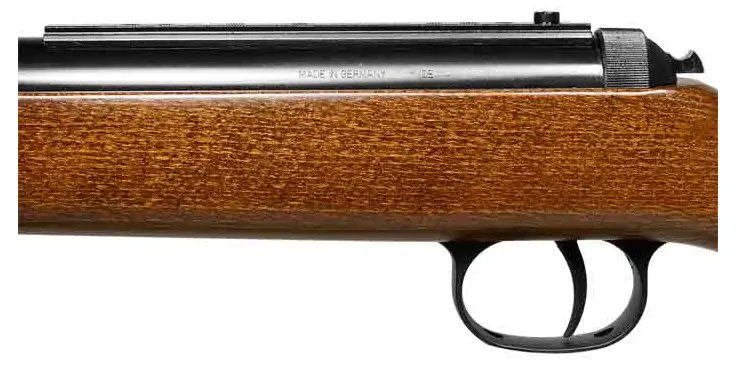
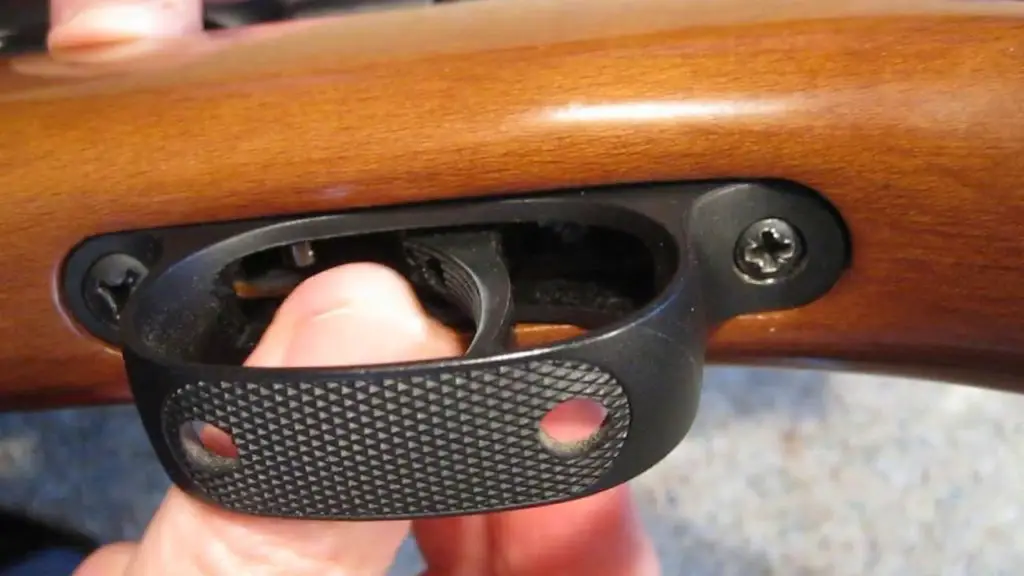
diana rws  34 trigger

The real jewel of the RWS 34 is the redesigned trigger, now named TO6.

The TO6 is so smooth and exceptionally light.

With a trigger pull of only 1 lb 3.6 oz, it is the best trigger you can find.

The trigger alone is worth all the money spent.

It’s very light travel, nice clean break, and light pull, and is adjustable, too.

In other words, the evolution of the T06 trigger is the icing on the cake.

It’s hard to improve upon perfection and I don’t see where any changes would be necessary.

Velocity, accuracy and power

The maximum velocity of this gun is 1000 FPS in .177 cal and 800 FPS in .22.

These are high-end velocities compared to other air guns on the market.

The Chrony Test gives us the results as follows:

In .177 caliber:

.177 PelletFPS
8.8 grains pellet880
Crosman Premiere 10.5 gr domed and Benjamin 10.5 gr HP790
Crosman Premiere pointed1016
JSB Exact RS917
H&N Field Target Trophy886
H&N Baracuda787
Gamo PBA Raptor1010
Beeman Crow-Magnum730

In .22 cal:

.22 PelletFPSFPE
11.9 gr RWS Hobbies724 13.86
RWS Superdome 14.5 gr68515.14
RWS Super H-point 14.2 gr67814.49
 15 gr pellet680 15.41 
Crosman Premiere 14.3 gr65413.58
RWS Superdome 14.5 gr65913.99
JSB Exact heavy 18.13 gr55712.49

As you can see, the actual numbers meet the advertised velocities and are quite consistent among different pellets.

(For more on the in-depth comparison between .22 and .25 caliber, see this post.)

diana rws 34 scope

How about accuracy and power? To answer this question, let’s look at the shooting tests.

The common shooting groups are: 

  • 0.185” at 10 yards with RWS Super H-point, 
  • 0.556” at 20 yards with RWS Super-H Point, 
  • Dime size at 20 yards, 
  • 0.247” at 10 yards with RWS Super H-point 14.2 gr, 
  • 0.26” at 10 yards with RWS Super H –point 14.2 gr, 
  • 0.615” at 20 yards with RWS Super H-point 14.2 gr, 
  • 0.556” at 20 yards with RWS Super H-point 14.2 gr, 
  • dime size at 25 yards, 
  • 1” at 45 meters, 
  • dime size at 25 yards, 
  • 1/4″ at 40 feet, 
  • 1-2” at 100 feet, 
  • 3” at 35 yards, 
  • 1” at 20 yards, 
  • 2” at 50 yards with RWS Superdomed, 
  • nickel size at 50 yards, 
  • dime to quarter size at 20 yards,  
  • 1/4” at 10 yards, 
  • half-dollar group at 30 yards, 
  • 1 1/2” at 20 yards, 
  • ickel size at 50 yards, 
  • less than 1/4″ at 40 feet, 
  • 1/4” at 20 yards with JSB Diabolo 13.43 gr, 
  • 1/4″ at 20 yards with RWS Super dome 14.5 gr.
  • 1” at 50 feet, 
  • nickel size at 10 meters, 
  • 1/4″ at 15 yards, 
  • same hole at 30 yards, 
  • 1.5” at 35 yards, 
  • 1” at 50 yards and 1.5” at 72 yards with JSB Heavy, 
  • 1/4″ at 60 feet with H&N FTT, 
  • dime group at 25 yards, 
  • dime size at 20 meters, 
  • bull’s eye at 40 yards, 
  • dime size at 20 yards, 
  • 5/8” at 20 yards. 

Moreover, this gun can:

  • go over 12cm in depth into the raw meat at a distance of 6 meters with H&N Baracuda .177
  • blow a Coke can up at 20 meters with H&N Baracuda
  • kill birds at 30 yards
  • kill squirrels at 50 yards
  • punch a Meisterkulgen pellet through both sides of a metal coffee can at 10 yards
  • shoot soft drink cans at 70 yards
  • kill prairie dogs at 25-40 yards
  • put a nice size dimple on a solid brass padlock
  • nail a squirrel at 35 yards with JSB Exact 7.8 gr dome
  • and punch through 0.5” ply board with RWS Superdome. 

Bottom line: this gun is extremely accurate and hits with serious authority so it has more than enough power to deal with common pests like squirrels, possums, skunks, etc.

Loudness

This rifle is very quiet.

It has hundreds of customer reviews without a single complaint about noise,

So you can shoot this gun on your property without bothering the neighbors or bring it to the hunting field for a stealthy hunt.

Shooting Ability

The effective shooting range of RWS 34 is up to 50 yards .

It can be used for target shooting, small game hunting, and pest control.

Warranty

As of this date, the Diana RWS has a lifetime warranty.

Specifications

  • Caliber: .22/.177
  • Velocity: 800 FPS with .22, 1000 FPS with .177
  • Loudness: 3- Medium
  • Barrel Length: 19.5”
  • Overall Length: 45.0”
  • Shot Capacity: 1
  • Cocking Effort: 33lbs
  • Barrel: Rifled
  • Front Sight: Fiber Optic
  • Rear Sight: Adjustable for windage and elevation
  • Scopeable: 11mm dovetail
  • Trigger: Two-stage adjustable
  • Buttplate: plastic
  • Suggested for: Small game hunting/Plinking
  • Trigger Pull: 33 lbs
  • Action: Break barrel
  • Safety: Automatic
  • Powerplant: Spring-piston
  • Function: Single-shot
  • Body Type: Rifle
  • Weight: 7.5 lbs
  • Length of Pull: 13.75″

Customer review

There are bunches of positive reviews on the Diana RWS 34.

They love its accuracy, power, and fantastic design.

Besides, shooters really emphasize the solid construction of this gun.

It’s excellently fitted and finished and better than most air guns.

For example, one shooter comments that you cannot feel any joint between the buttplate and the stock – evidence that lots of care are taken during the sanding process.

The bluing on this rifle is dark and even, and the overall metal finish is perfect as well.

The aesthetic design makes this gun look very slender, smooth, and beautiful.

That’s not all, many people tell interesting stories about how Diana RWS stands the tests of time.

Those owners have had Diana for 20,30 years and it holds on to its original velocity over the Chrony test after a few decades.

One shooter’s story is about how his friend has used the RWS to shoot squirrels and bats for 15 years

And it continues to do amazingly well under the extreme African climate.

Do you think the lifetime warranty is just for fun?

Nope, one customer somehow managed to bend the barrel into a C shape after 15 years of use

And Diana not only replaced the damaged barrel but also performed the overall checkup and returned it for free!

Pros and Cons

ProsCons
  • Beautiful Beech stock
  • Ergonomic Monte Carlo design
  • Amazing fiber optic sight
  • Awesome trigger
  • Consistent velocities with different kinds of pellets
  • Breath-taking power
  • Remarkable accuracy
  • QuietGuaranteed lifetime warranty
  • Stands the test of time
  • Excellent customer service from manufacturer
  • It would be nice if RWS added a hunting scope on it for badly-sighted shooters.

Price

The RWS 34 has a price of about 200 dollars.

It is a reasonable price for a gun that has an attractive design, is hard-hitting, extremely accurate, and can last for decades.

If you are not an air gun collector and just want a one-size-fits-all rifle that gets the job done, this is an excellent choice for the money.

Check Price on PyramydAir

Conclusion

Diana RWS 34 is one of the best air rifles in the market.

RWS is known for standing behind their air gun, their warranty is always viewed as the best in the business, and their well-made rifle sells like hotcakes.

RWS could cheapen up this $200 gun with a lawyer trigger, plastic adjustable rear sight, and crappier wooden finish but they didn’t.

It has an awesome trigger, luxurious fiber optic sight that breeds confidence, and great construction with a beautiful finish.

This is a gun you enjoy bragging about to other shooting pals!

Does Fly Fishing Catch More Fish? We Think So & Why

0

There are many different types of fishing, yet which is the most effective? In this guide, we will explain everything you need to know about fly fishing, including whether you will catch more fish and how to catch as many fish as possible. We believe that fly fishing can be one of the most productive forms of fishing.

One of the unique things about fly fishing is that every detail of your cast can be customized to specifically target the sort of fish you’re aiming for. You can utilize a general-use fly rod, or you can opt to purchase a rod that has been designed to assist you in specific ways. Combined with the endless amount of techniques and combinations it gives you the most optimal approach at catching large amounts of fish.

What is fly fishing?

Before we delve deeper into fly fishing and just how effective it is, it is essential to explain what this method involves. When fishing via traditional means, a cast is made that will use some sort of bait or lure, which is attached to the end of the line. The line is typically one of the newer braided lines or a monofilament.

One thing that is noticeable about this type of setup is that the line is a lightweight and very thin material, with the bait or lure being the heaviest part. This makes it so that when the cast is let loose, your bait or lure is what will carry momentum through the air, trailing the lightweight line behind.

Now, if you were to cast an object that was light in weight, you would have noticed that making the cast go very far is a challenge! In all traditional types of fishing, it is the weight of the lure that is vital.

Traditional Lure Casting Method

If you have ever seen someone fly cast, you will have probably noticed some distinctive differences between traditional lure casting and fly casting. Specialized fly fishing equipment is used by the angler to achieve this cast. This includes a purpose-built fly rod, as well as fly, tippet, leader, and a fly line.

The main difference when it comes to fly casting is that the artificial flies utilized to catch the fish are very lightweight. Even when you use much larger flies for pike or bass fishing, the weight is going to be minimal when compared with traditional bait, such as casting a spinning lure.

Fly Casting Method

With this approach, the key to getting the fly out to where the fish are is with the right fly line. In this casting method, the fly line is the weight. Through the use of a casting method that enables the fly line and the fly roof to work in unison, the weight of lined is utilized for carrying the fly out in front of you through the energy being transferred that has been built up in the line, down through the line, and out toward the end of it.

The most important aspect of fly fishing is knowing how to fly cast. There are some specific techniques in fly fishing that are not going to need much casting. However, the vast majority of what you will do in fly fishing will incorporate casting.

So, now let’s get into fly fishing and what it actually is. This revolves around the presentation of an artificial lure called a fly to a fish, which will typically imitate some sort of insect. This is the basic concept of fly fishing. The aim here is attempting to mimic the natural food base for a fish, getting them to take the fly. You are mostly trying to trick the fish.

The flies that you use for this can vary to insects that live under the water’s surface to those that float on the surface, from caddis to mayflies. Different approaches to fly fishing are required based on the type of fly you use. Some of the materials that tend to be used are as follows:

  • Feathers from birds, such as pheasants and ducks
  • Hairs and furs from animals, like moose, elk, deer, muskrats, and beavers
  • Wires, tinsel, and other types of ribbing materials
  • Tungsten beads, brass, and glass
  • Artificially created synthetic materials

The Main Differences Between Spin Fishing and Fly Fishing

In order to give you a true reflection of the differences between spin fishing and fly fishing, we have put together the main differences in a table below.

Differences

Spin Fishing

Fly Fishing

Lures vs. flies

Spin fishing utilizes heavier lures, which frequently imitate fish.

Fly fishing uses flies – including streamers, emergers, nymphs, and dry flies – to imitate all of the different types of food that fish feed one.

Rod type

Spin rods are used. They are heavier lines, which are cast monofilament lines that have a single cast.

Fly rods are used. These use false casting to cast the line, which is lightweight.

Lakes vs. rivers

Spin fishing tends to mainly be done on Stillwater.

Fly fishing tends to be done on moving water. However, it can also be done on Stillwater as well.

Line type

A monofilament line or another sort of line is used to cast lures that are heavier and do not require a heavier line to cast.

To cast the lightweight flies, a fly line, tippet, and leader are used.

Presentation

Spin fishing works effectively when imitating crawdads or baitfish. They are presented in the water at all depths, after which they are retrieved and then brought to you.

Fly fishing enables you to have a stealthier and upstream presentation. When you are fly fishing, you can also work in tighter quarters.

Some other differences do exist between the two types of fishing. However, we hope that the table above will help you to clearly understand the main differences between the two.

Does Fly Fishing Catch More Fish?

While each of the fishing styles is different, they all offer unique advantages in specific situations. However, there are a number of reasons why people believe that you can catch more fish with fly fishing, so let’s take a look at them below…

You can customize your fishing experience.

One of the unique things about fly fishing is that every detail of your cast can be customized to specifically target the sort of fish you’re aiming for. You can utilize a general-use fly rod, or you can opt to purchase a rod that has been designed to assist you in specific ways.

Once your rod has been personalized, this gives you the ability to customize your line. The weight, style, and length can be adjusted. This means your line is going to more significant meet your needs; you can amend the tippet and the leader. With fly fishing, you can quickly achieve a shorter or longer leader.

When it comes to tippets, there are several different styles of tippets that can be utilized with your line. The leader and the tippet are utilized so that the line is virtually invisible to the fish. They also make it a lot easier for the flies to be attached and detached from your line, enabling easy and quick transitions between casts.

One of the most customized parts of fly fishing is the flies. There are a number of different flies that you can buy that can help you with attracting the sort of fish you want to catch. You can do some research, watch your surroundings, and tie your own flies. This means that your fishing experience is ultra-customized, and it also means that you are going to be able to increase your chances of catching as many fish as possible.

The fly is delivered to the fish in a manner that is inconspicuous

Aside from the benefits that have been mentioned so far, there are a number of other advantages that are associated with fly fishing that tend to make it more beneficial. This includes the fact that the fly is delivered to the fish in a manner that is inconspicuous when the cast is done properly. The fly will be cast against the current, and then it is allowed to drift for a distance, in the same manner, that a typical bug falling into moving water would. Your goal here is to make sure the fly is delivered in a manner that the fish does not think there is something unnatural about it. If you are able to fool them, they will take a bite on the line.

You can catch a wide range of species

Last but not least, another reason why people believe you can catch more fish with fly fishing is that you will be able to catch all types of species. This includes bluegills, bass, trout, and many more.

Some of the main species of fish that fly fishing are successful with are as follows:

  • Bonefish
  • Tuna
  • Tarpon
  • Carp
  • Panfish
  • Bass
  • Pike
  • Salmon
  • Grayling
  • Trout

How to catch even more fish with fly fishing

As discussed, there are a lot of different characteristics that are associated with fly fishing that result in it being more successful than conventional fishing. However, this is only going to be the case if you get your technique down. With that being said, below, we are going to reveal some of the different tips that you can use in order to catch more fish with fly fishing.

Watch the bugs

The first step you need to take when fly fishing is to be observant and watch the bugs! Before you begin to cast away, you need to pay attention to the bugs that are near the water or on the water. Take a look at what kind of bugs the fish are eating. By doing this, you will be able to determine what sort of fly is going to be the most effective and result in you catching the most fish. You also need to think about what trout could be eating under the surface of the water. Try some of your wet flies or nymphs that match the most common underwater snacks. Simply choosing a fly without thought is not the way to go if you want to catch as many fish as possible while trout fly fishing!

Test the length of your leader

The next tip to ensuring you catch as many fish as possible when fly fishing is to test the leader’s length. Depending on the technique and fly you use, you may want either a shorter or longer leader length. For wet or dry flies, try using a longer leader. This should be anywhere between 12 and 20 feet. A shorter leader is going to be more beneficial if you are utilizing a streamer, so go for something between seven and eight feet. It is more than okay for you to try out different lengths on your leader so that you can figure out which is going to be the most effective for you and the fish you are trying to catch.

For more information on leader length check out our full article here:

Approach fish carefully

When you are stalking fish, make sure you approach low and make the most of any cover that you can, for example, bushes and long grass rushes. If you can, make sure you keep a low profile, especially when you are on a high bank with the skyline behind you. Remember, when a fish is deep, it is going to be able to see you from further away than fish that are close to the surface. This is because of the way in which fish see. They have an impeccable vision. They have the ability to uniquely adapt their vision to distinguish predators and locate food. This is why you need to do everything in your effort to blend into your surroundings. You may not think so but wearing bright clothes is only going to lower your success rates.

Walk softly and be as quiet as possible

Once you are in pole position, it is important to walk softly and to be as quiet as possible. This is something a lot of people take for granted. Nevertheless, fish are as sensitive to vibration and noise as they are to visual warnings. If you walk softly on the banks of the river and you try to wade as quietly and slowly as you can, you will definitely notice better results. Of course, trout don’t have ears, but what they do have is lateral lines that they use for detecting vibration and movement in the surrounding water.

Avoid overcasting to the fish

This is one mistake we see a lot of people make when it comes to fly fishing. Catching a fish does not always demand that you use a long cast. After all, you never know what fish could be right in front of you, do you? Before you attempt to catch any fish that are further away, make sure you check the area close to you. Not only do you never know what sort of fish are going to be near you, but it is going to be a lot easier for the hook to be set from a shorter distance rather than one that is far away.

Use the entire rod

Another tip that is important when it comes to fly fishing success is to use the full rod. A lot of fishermen think that they are more likely to win a fight against a fish if the rod is as straight in the air as possible. However, the outcome is not usually a positive one when this happens. Instead, the line either breaks, or the rod does. Instead, you should make sure your rod is nearer to a 45-degree angle instead. This will mean that you are not just using the tip of the rod; you are going to be using the entire rod. When it comes to fighting a fish, it is not all about strength. In fact, it is skill that is most important.

Stay safe

We also have to stress just how important it is to stay safe! After all, if you hurt yourself, you are not going to be able to catch as many fish as possible, are you? There are lots of different steps that can be taken here. For example, you need to wear a hat and some sunglasses so that your eyes are protected. When spotting fish, premium quality polarized sunglasses are always going to provide you with help. Plus, only wade if you need to, and make sure you are always careful when you do. Use a wading belt as well; this is a must.

Cast from your elbow and wrist

Last but not least, our final tip when it comes to getting your technique right in order to catch as many fish as possible is to make sure you cast from the elbow and wrist. A good cast does not mean that the whole arm must be utilized. Instead, it focuses more on the movements of your wrist. Your wrist needs to be straight, yet it should also be relaxed. It is the rod that needs to be doing the vast majority of the work for you. It takes a lot of practice in order to get the perfect cast. Therefore, the best thing that you can do in this regard is to practice, practice, and practice some more!

More Fish, and More Consistent Results

Not only do you have the potential to catch a greater number of fish with fly fishing but you can expect more consistent results as well. This comes down to the tactics that are involved in fly fishing. When you are spin fishing, the lure, whether it is biological or artificial, is put into the water’s depths in order to try and allure the fish into biting it. The lure needs to look like a source of food in order to tempt the fish so that they bite it. Some people have stated that the fish need to be in a certain type of feeding mood in order for this type of fishing to be successful.

When it comes to fly fishing, the end goal is to try and trick the fish into biting a fly that looks like one of their food sources. This can be a fly, as mentioned, or another type of aquatic insect. This is done on top of the water, at the bottom or anywhere that the fish are feeding. The key here is to try and mimic the natural behaviors of the food source as closely as possible, so that is presented in a way that fools the fish and they take the bait.

If you have ever tried fishing before, you will have probably experienced the instance whereby your lure is presented and the fish end up being spooked on the impact of the lure entering the water. This is something that does not happen with fly fishing because the presentation is on the water and above the fish. Because of this, you are unlikely to spook the fish, and this is how you end up with results that are a lot more consistent.

Other Reasons Why Fly Fishing is More Productive

Aside from being able to catch a greater number of fish, because you can personalize your fishing experience, there are a number of other reasons why fly fishing is considered better than spin fishing, and so we are going to take a look at these below.

You will enjoy the experience

Not only can you customize your fishing experience to ensure you catch more fish but there is no denying that fly fishing is much more experienced orientated as well. There are more factors that go into fly fishing and a lot of different things that need to be considered. This is why fly fishing is more fun. It can also be more challenging and more practice is needed in order to get it right. However, isn’t this what the thrill of fishing is all about?

It’s extremely rewarding

The former

16+ Strongest Bite Force in the Animal Kingdom

0

Animal bite force is a complex science and you’re likely to find all kinds of conflicting figures, regardless of whether you measure in PSI (pounds per square inch), Newtons of force, or pounds of force. On top of this, conducting bite force tests is difficult and rarely a top priority for scientists studying animals.
If that’s true, how can we be sure which animals have the strongest bites in the world? Thanks to the testing some scientists have conducted and sophisticated computer modeling, we can determine a credible estimate of what an animal’s peak biting power could be.

Before we get to the top ten strongest bite forces in the animal kingdom, we’ll explain how bite forces are measured, why it matters for animals, and how we can model them.

What is Bite Force?

close up shot of a lion roaring and showing teeth

Why Does Bite Force Matter?

image of a crocodile in a lake showing its bite force with a Kruger in mouth

How Do People Calculate Or Test Bite Force?

image of a woman biting on a toast of bread

What Determines Bite Force?

skull of a Siberian tiger

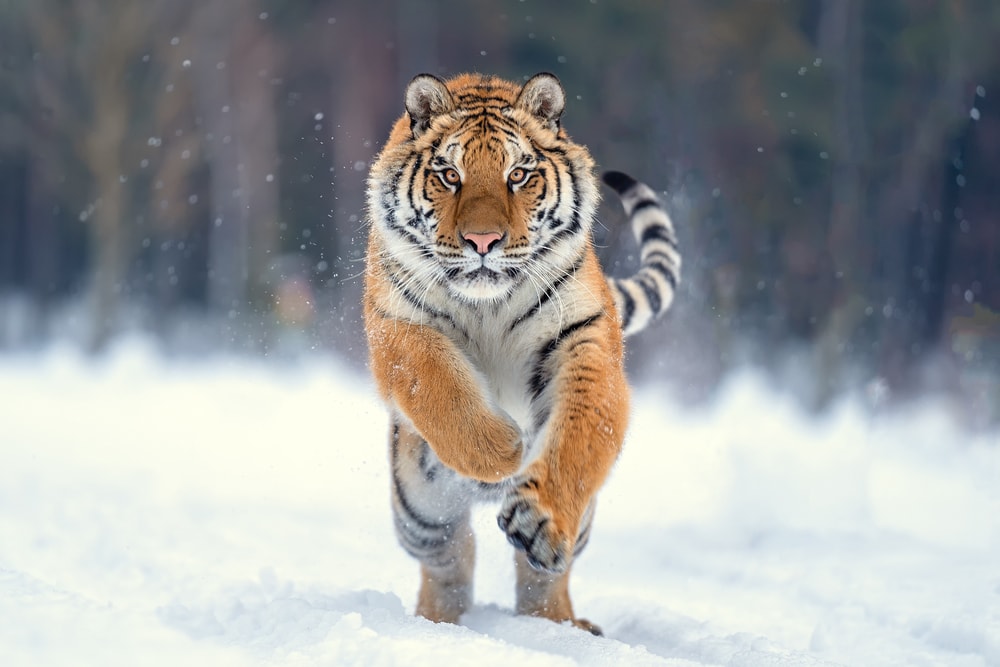
10. Tiger (1,050 psi)

Image of a Siberian tiger jumping on the snow

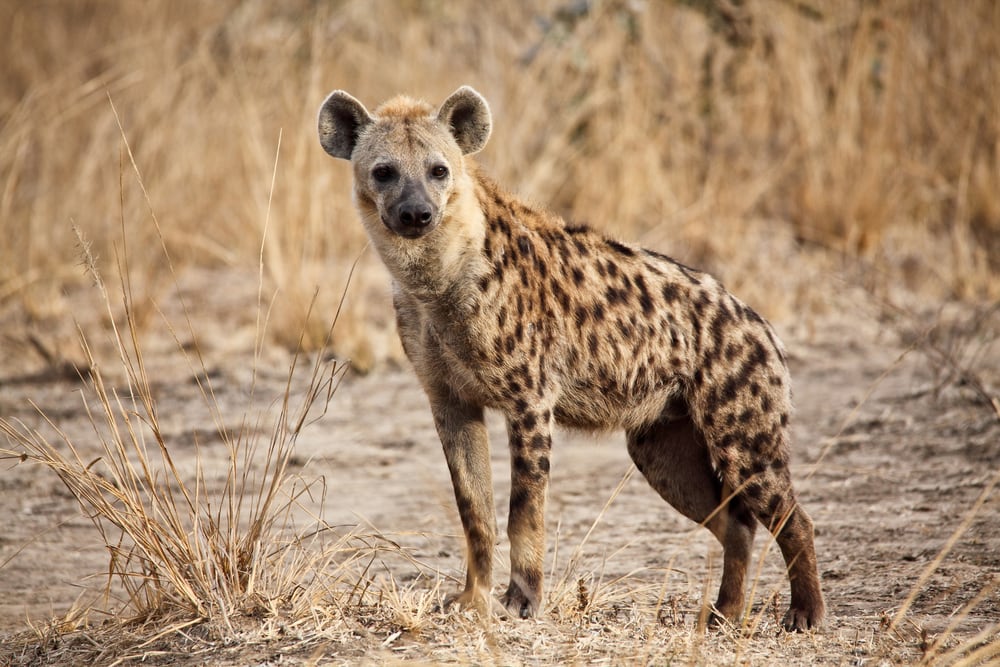
9. Spotted Hyena (1,100 psi)

one of the top animals with the strongest bite force, the spotted hyena pictured in uangwa national park zambia

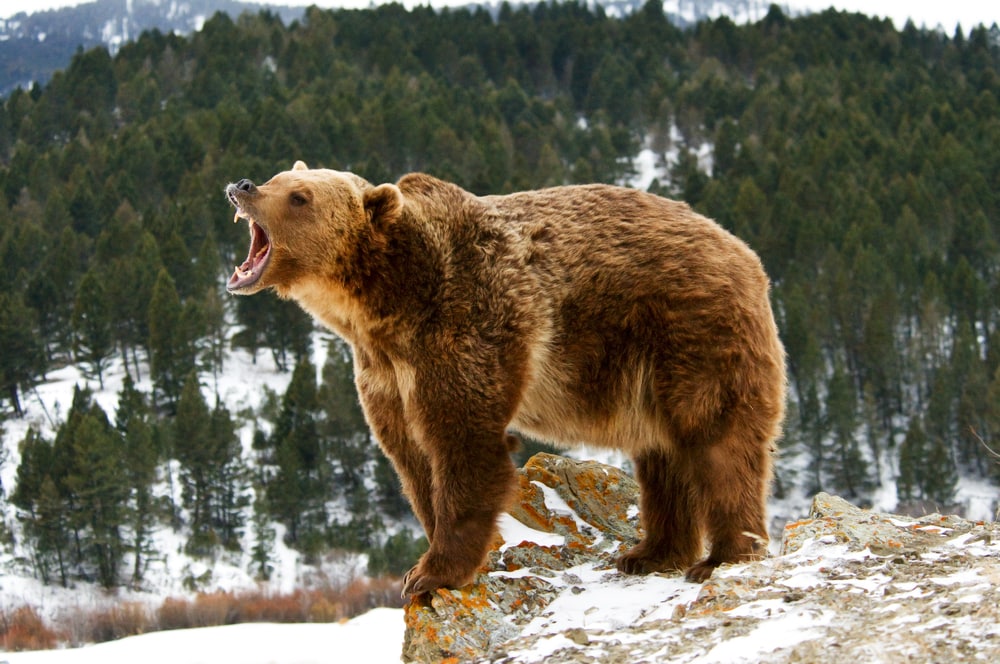
8. Grizzly Bear (1,000 to 1,200 psi)

image of a grizzly bear, one of the animals with the strongest bite force, growling on a snowy cliff

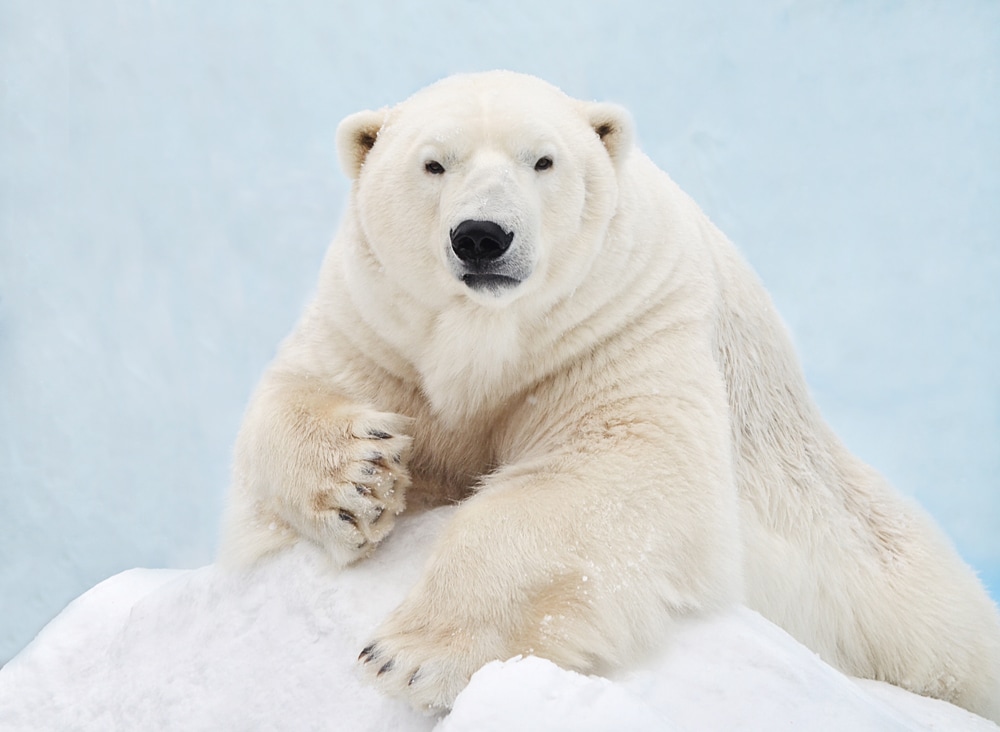
7. Polar Bear (1,200 psi)

Close up portrait of a polar bear laying on snow

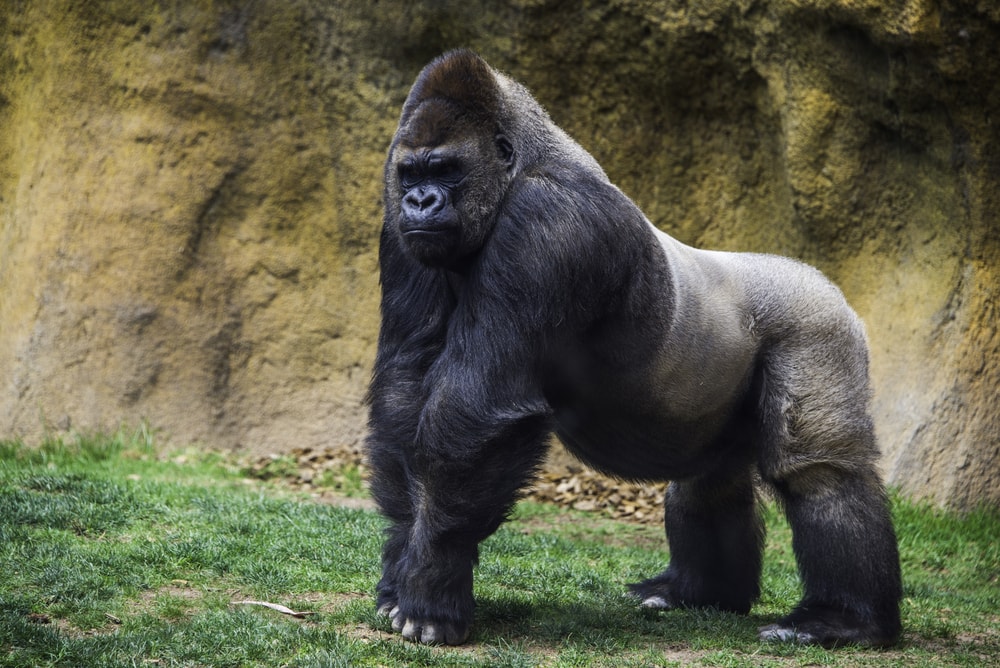
6. Gorilla (1,300 psi)

image of a lone male gorilla, one of the animals with strongest bite force

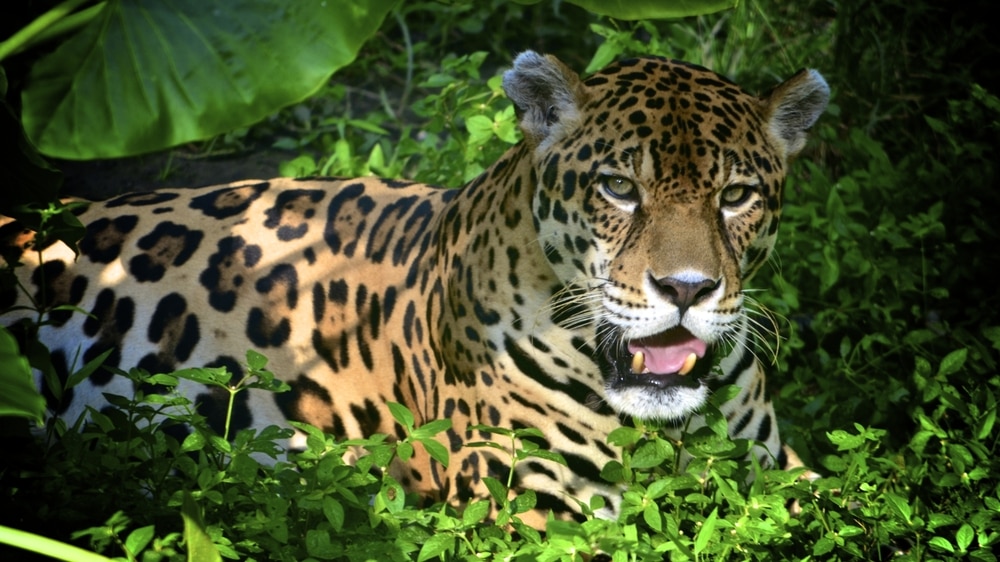
5. Jaguar (1,500 psi)

Jaguar lying in the grass and leaves in Amazon forest. Jaguar has the strongest bite force of all big cats.

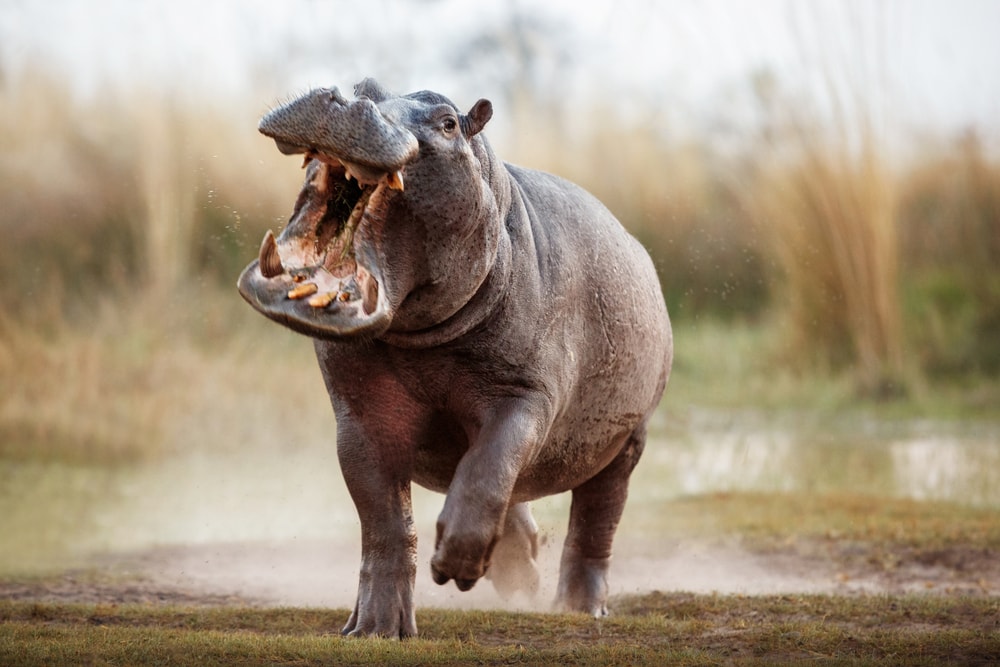
4. Hippopotamus (1,800 psi)

Image of a hippopotamus running aggressively with mouth opened. hippos have the strongest bite force of all living mammals.

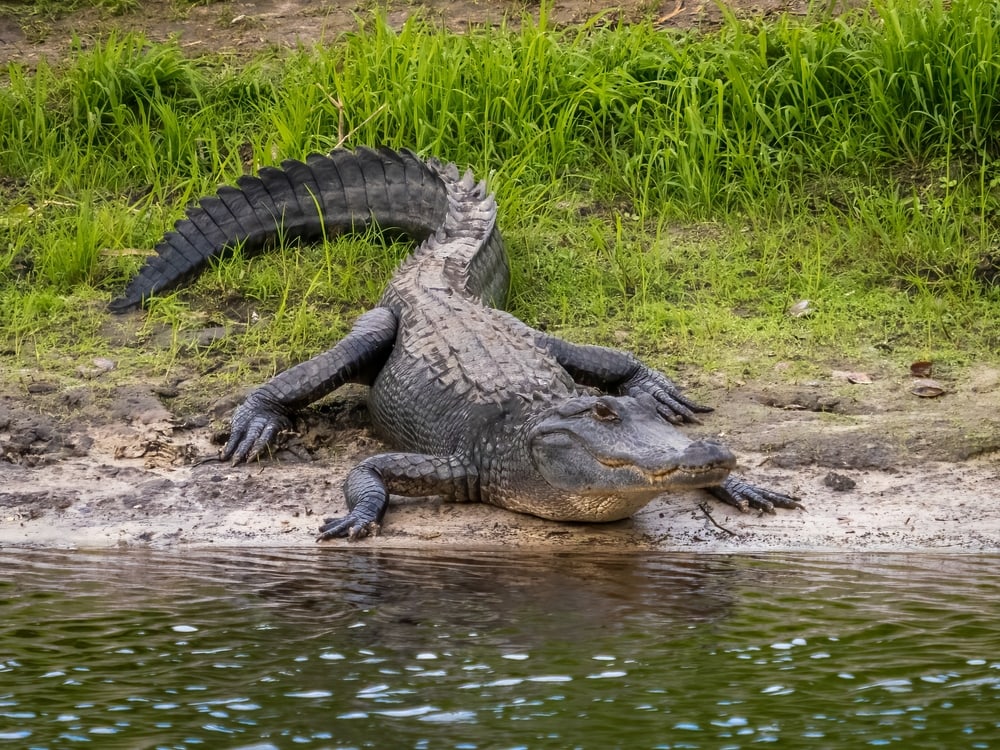
3. American Alligator (2,150 psi)

image of an American alligator along Myakka River in Myakka River State Park in Sarasota Florida USA

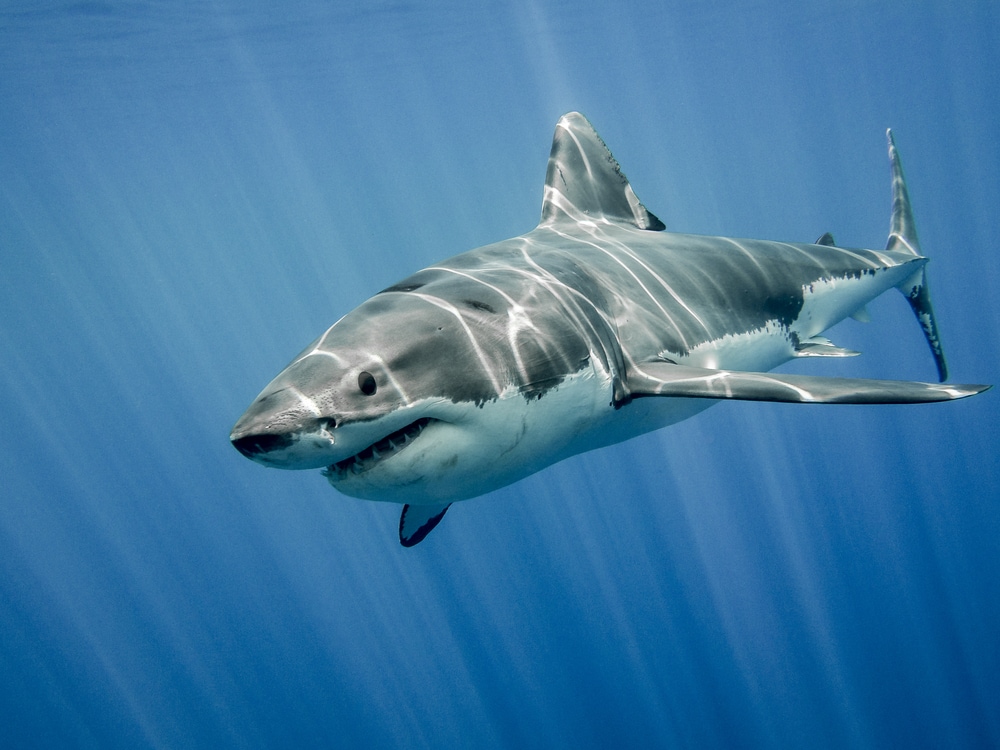
2. Great White Shark (4,000 psi)

one of the animals with strongest bite force, great white shark swimming on the ocean

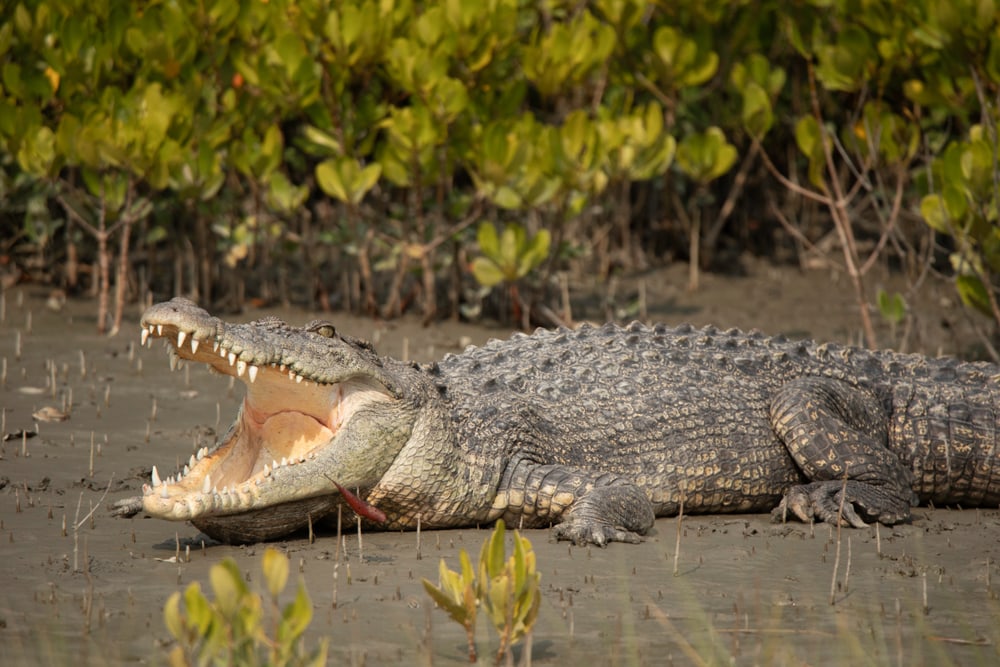
1. Saltwater Crocodile (3,700 psi)

the animal with the strongest bite force, the saltwater crocodile pictured with mouth opened

Other Bite Forces

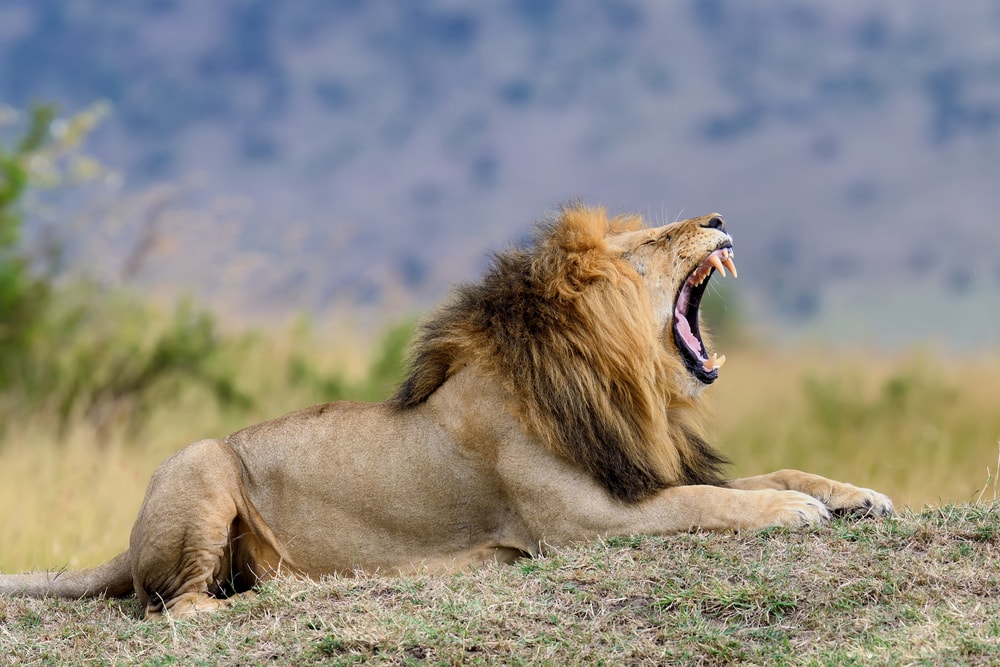
11. Lion (650 psi)

image of a roaring lion in Kenya

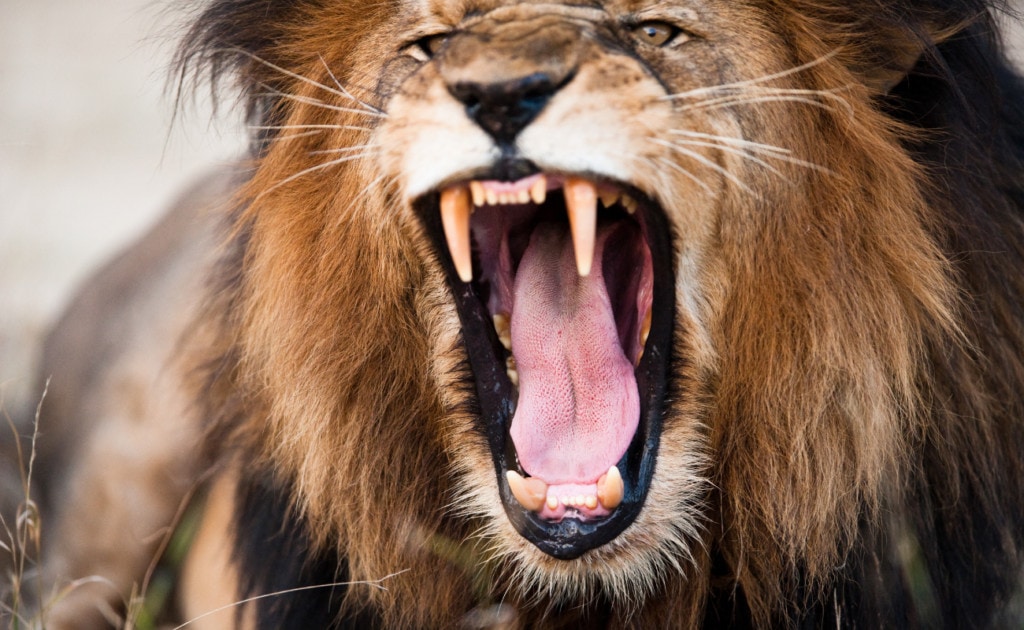
Despite their fearsome reputation and iconic status, lions only have a slightly higher bite force than mastiff dogs. They rely on hunting in groups, dragging down and suffocating prey, so they never needed a bite force as strong as the solitary tigers and jaguars.

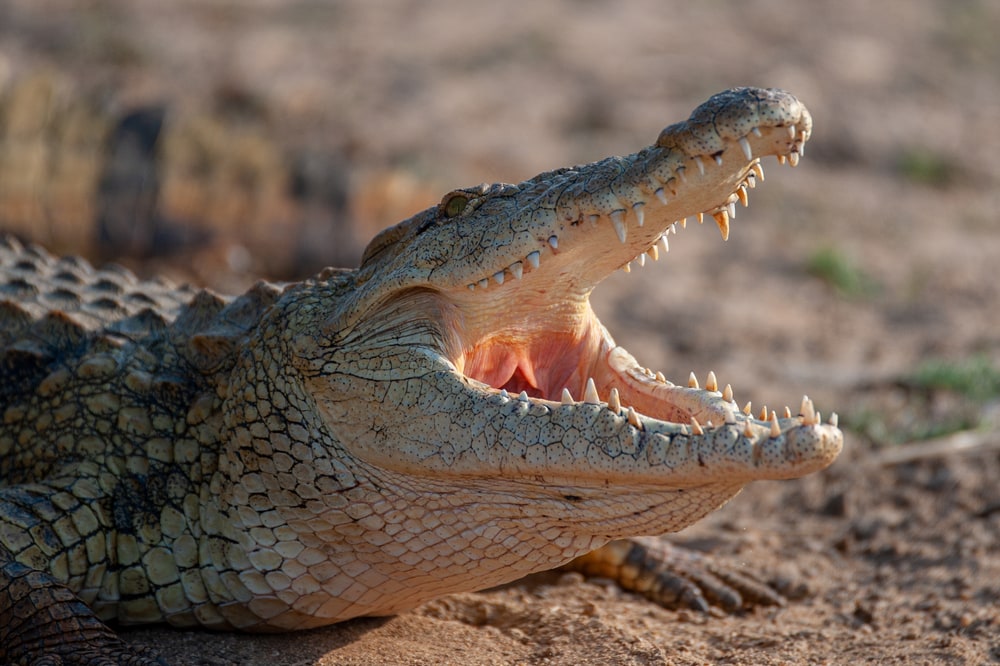
12. Nile Crocodile (3,000 – 5,000 psi)

one of the animals with the strongest bite force, the Nile crocodile was photographed on a safari in Africa with mouth opened

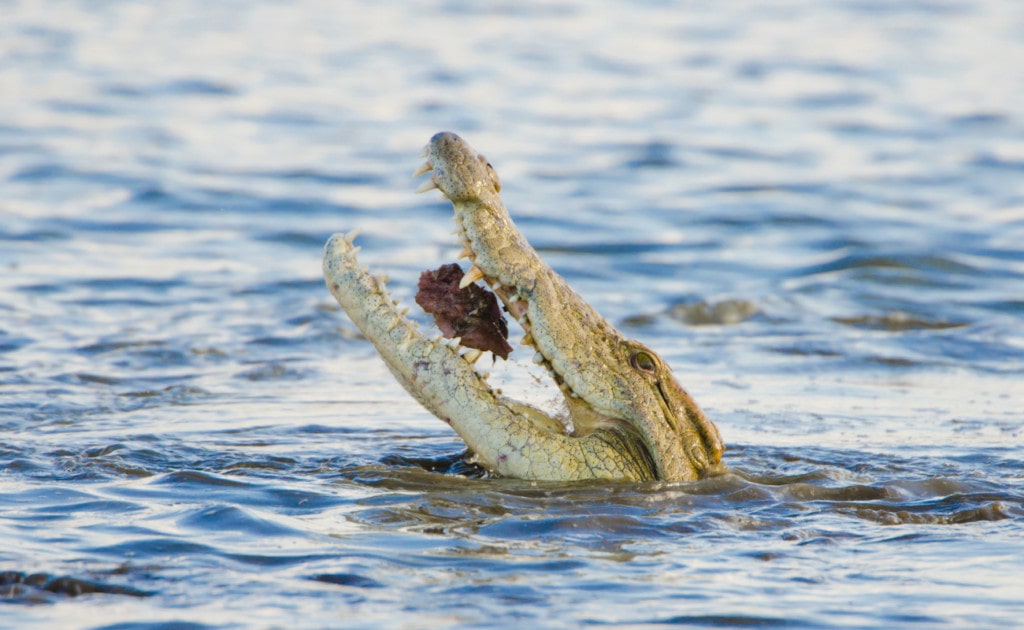
I’ve found conflicting numbers when it comes to Nile crocodiles. The one study I found only used an eight-foot (2.43 m) specimen and extrapolated that a 16-foot (4.87 m) specimen would have a bite around 3,000 PSI. I also found people who believed the bite could exceed 5,000 PSI. In the end, it was too murky to include them in the above top ten, but they likely have the strongest bite force behind saltwater crocodiles and white sharks.

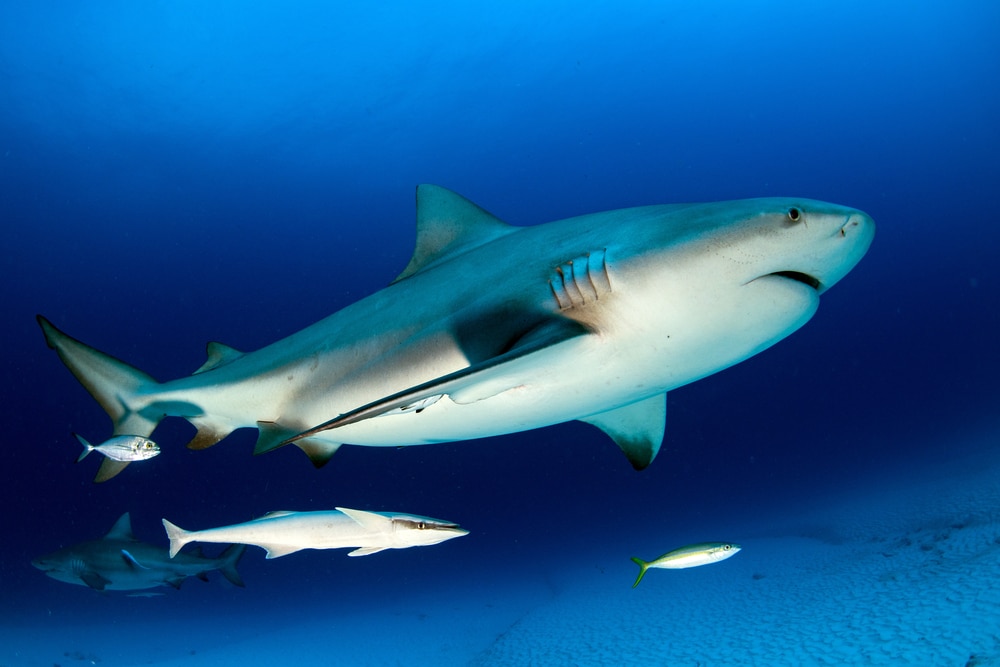
13. Bull Shark (478 psi)

a bull shark swimming with other fish species in the ocean

Bull sharks have the strongest bite of any shark when you factor in body size. They’re much smaller than white sharks, reaching typical sizes of nine feet and around 800 pounds. White sharks of a similar size would only be capable of around 360 PSI.

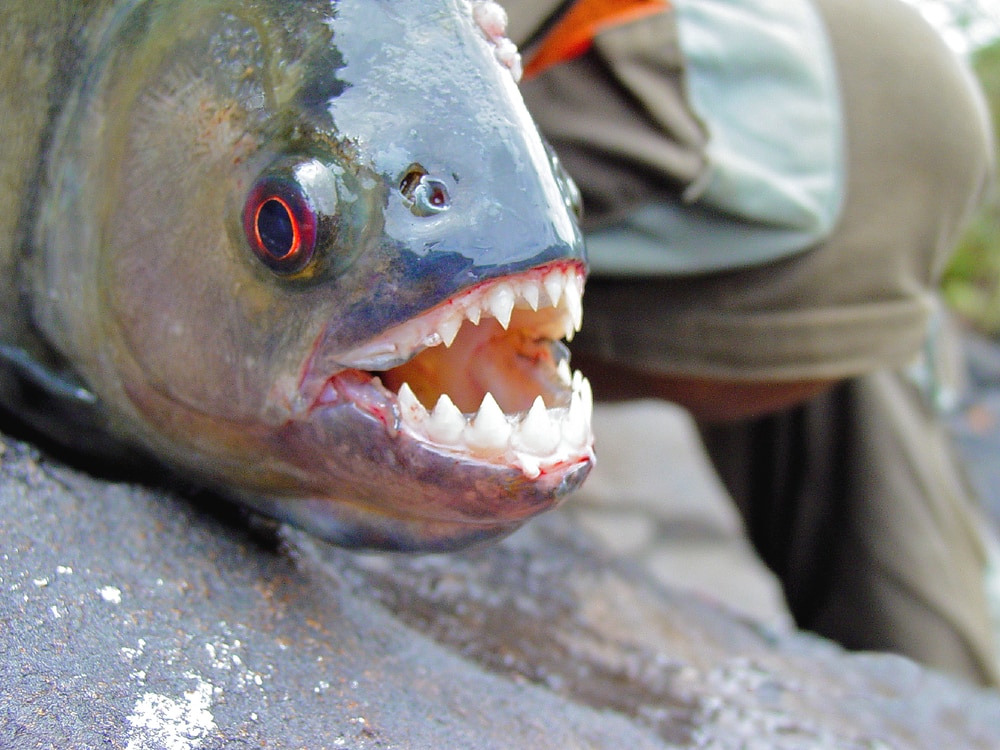
14. Black Piranha (72 psi)

close up image of a black piranha showing its teeth

You’re probably looking at the measly 72 PSI bite force of a black piranha and wondering why it got mentioned here. Black piranhas grow to around a foot in length and at most weigh in around eight pounds (3.62 kg). Their bite force of 72 PSI is massive in comparison to their body weight, and this measurement came from a fish weighing only around 2 ½ pounds (1.13 kg).

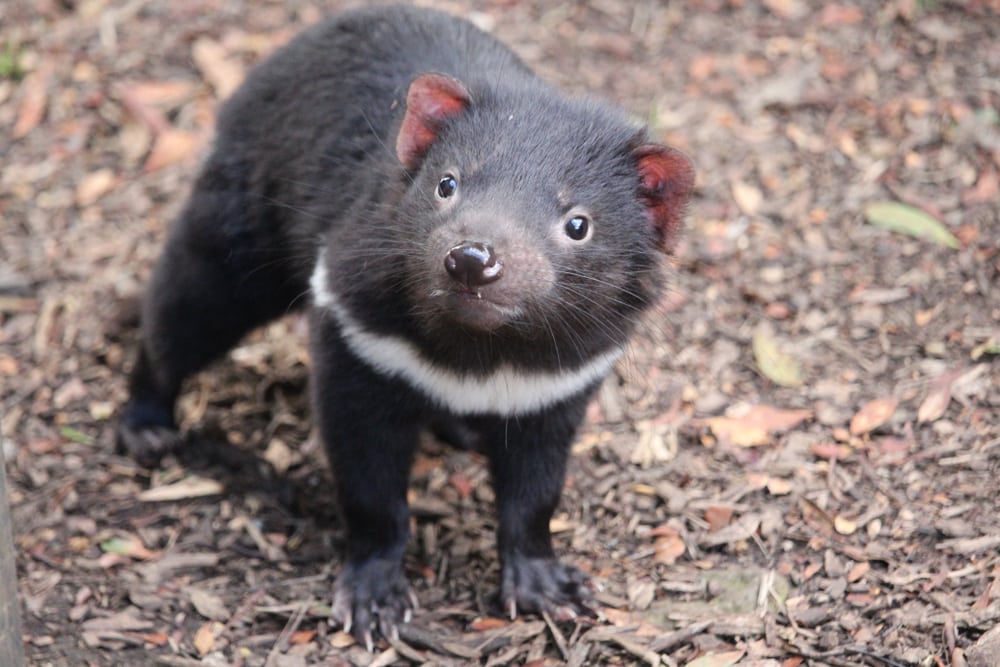
15. Tasmanian Devil (200 psi)

image of a Tasmanian devil who is thought to have the strongest bite force when you factor the animal

16. Orcas (19,000 psi)

image of a pair of orca jumping from the ocean

While also untested, a killer whale can theoretically exert 19,000 psi in bite force. This is mainly due to their sheer size, as they can weigh up to six tons (6096.28 kg) and reach thirty feet (9.14 m) in length. Most evidence is based on simulations, theory, and captive whale studies, so it did not merit a spot on the list.

You may also like: Learn the 21 Amazing Types of Whale Found on the Ocean: Complete with Images, Facts, and More!

Strongest Bite Force By Type of Animal

Mammal

Reptile

Fish

You may also like: Meet the 25 Amazing Types of Sharks: Complete with Images, Fun Facts, Infographic, and More!

Human Bite Force: Comparison With Humans

a kid trying to bite his arm

What About Dinosaurs?

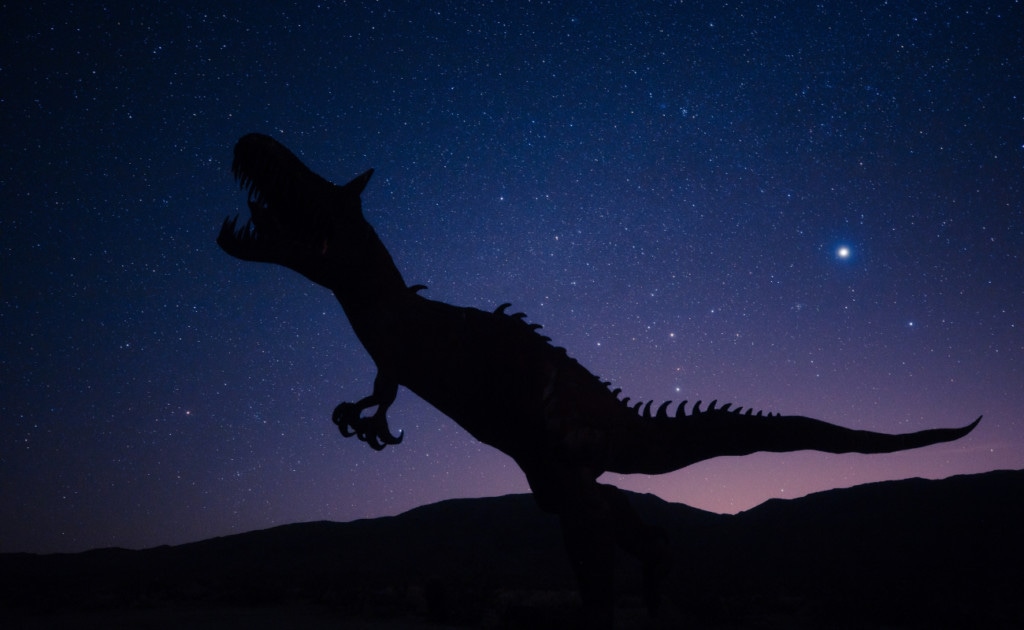
silhouette of a T-rex under a starry sky

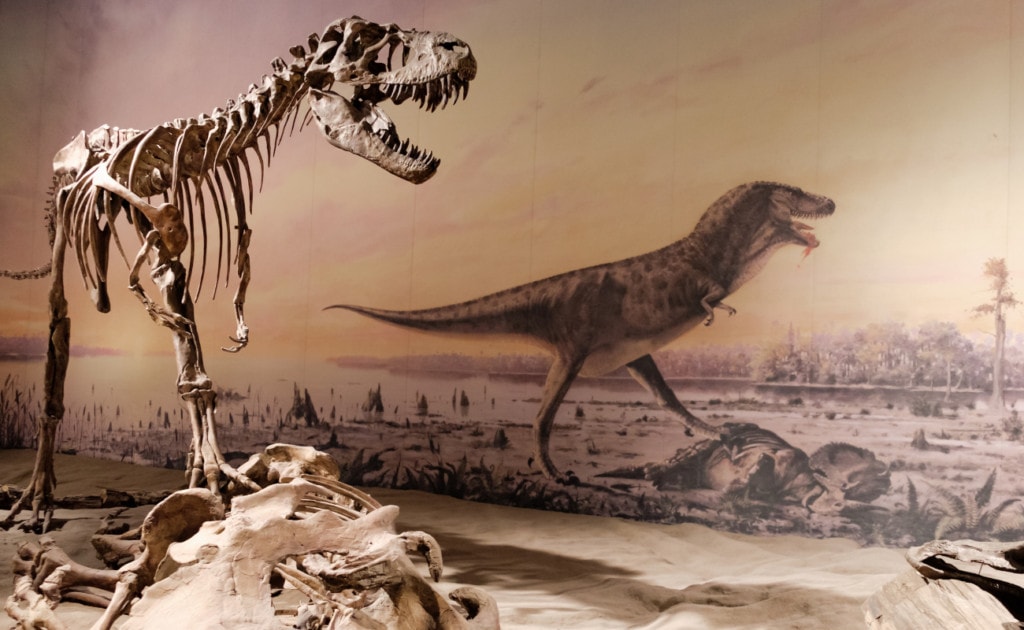
Some of the largest and most powerful creatures to ever roam the Earth are now extinct. Apex predator dinosaurs like the Tyrannosaurus Rex and unmatched marine predators like the megalodon had incredibly strong jaws and crushing bite forces.

How Would We Even Know?

image of a fossil of a T-rex on a musuem

Strongest Dinosaur Bite Force

1. Megapiranha

The now extinct relative of modern-day piranhas, mega piranha, grew to around thirty pounds. Just like its ancestors living among us today, it had an incredibly strong bite for its size. In theory, mega piranha was capable of a bite between 279 and 1,067 psi.

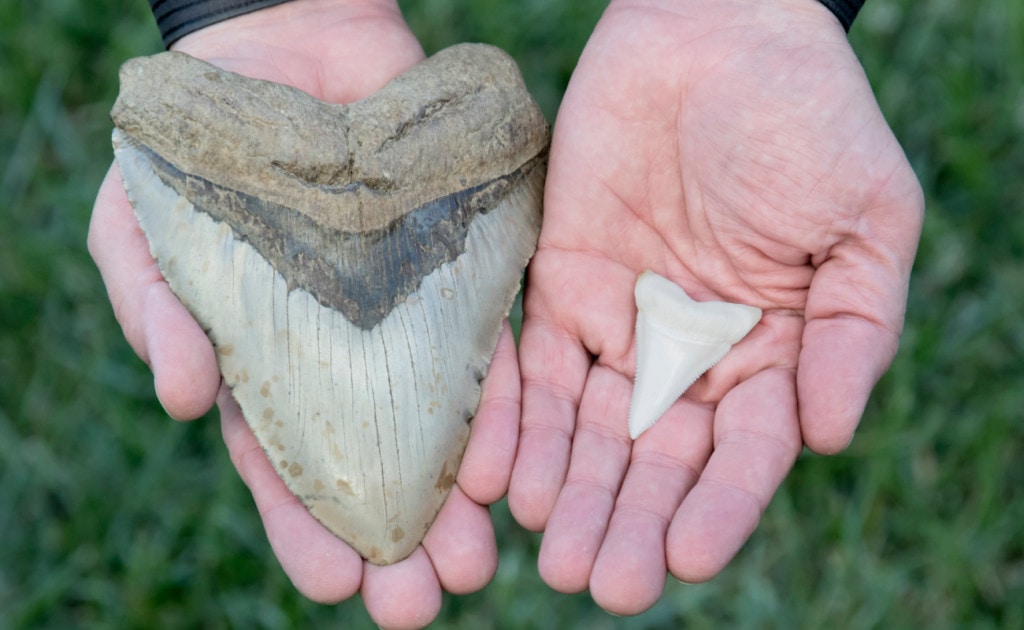
2. Megalodon

image of a tooth of a megalodon compared to a tooth of a modern great white shark

3. T-Rex

Image of a T-rex, the most likely one to have the strongest bite force of any land animals to ever exists, during the dinosaur age

The infamous T-rex boasts likely one of the strongest overall bite forces of any land animal to ever exist. Their jaws were capable of putting out a force of over 35,0000 psi. This would have been extra helpful to take down the large megafauna it coexisted with and preyed on.

Deer Hunting With Dogs: An Old and Controversial Tradition

0

People have used canine hunting companions since the first wolf nervously took a slice of meat from an ancient human hand. Deer hunting with dogs is a natural extension of that aboriginal relationship.

Still, modern hunters have mixed feelings about the practice. Some are ardent supporters of the method. Others consider it unfair and outdated. Let’s take a look at the history of deer hunting with dogs and why hunters are often so divided on the issue today.

A Rich Hunting History

Ancient cave paintings show images of dogs and humans hunting together, and when European settlers reached North America in the early 17th century, they brought their hunting dogs with them. Historians believe the first pack of hunting dogs in the American colonies was owned and hunted by Robert Brooke of Maryland as early as 1650.

In Europe, hunting was a pursuit exclusive to the wealthy ruling class. However, once colonists crossed the pond, hunting became a common man’s pastime that was essential for putting food on the family dinner table.

GOOD GEAR – Keep Your Drink Hot or Cold With the BRCC YETI Reticle Rambler Bottle

How Hunting Deer With Dogs Works

Although a solo hunter can tramp through the woods with a dog and shoot whitetails on the jump, most dog hunting (a term that doesn’t at all infer shooting dogs, but rather refers to the practice of using hounds to jump and chase whitetail deer) happens in groups.

A group of hunters (or “standers”) surrounds a piece of property before the dog handlers (usually called “dog drivers”) release hounds onto the parcel. The drivers and their dogs work toward the standers until they either jump a deer or pick up a fresh scent.

A good jump dog will squall when he’s on a track, and the rest of the pack will chime in like a chorus. There are few things more adrenaline-thumping than the braying of hot hounds echoing through thick woods, especially when that sound is hastily heading your way.

Experience usually influences the exact positions of the standers. Many hunt clubs use the same blocks of land, sometimes for generations, for so long that hunters know the deer’s preferred escape routes. Those spots will be either numbered or named, and hunters draw for a stand or grab them on a first-come-first-serve basis to cut off the deer as they try to evade the dogs.

RELATED – A Big Buck Expert on Deer Hunting in the Rain

Is It Fair Chase or Not?

One reason hunting deer with dogs is so controversial is because some think the practice unfairly swings the odds in the hunters’ favor.

It’s true to an extent. Dogs will flush deer off their noonday beds and bust them out of swampland so thick that most humans wouldn’t dare venture into it, even with snake boots and brush chaps. When deer turn nocturnal in the late season, dogs often provide hunters the only chance of glimpsing big bucks bent on tucking in until nightfall.

However, both the Boone and Crockett and Pope and Young record books, which have detailed rules of fair chase, recognize bucks taken in front of dogs in states where the practice is not prohibited.

Anyone who thinks deer hunting with dogs is “cheating” seriously underestimates whitetail deer’s intelligence and wily survival instincts. Every hunter with deer dog experience has a story of a whitetail that “gave the dogs the slip.”

Deer in areas with active hunting clubs and trained dogs seem to pick up “dog smarts” early on. Whitetails chased by piles of canines learn how to trick the hounds as a matter of survival. They probably picked up the skills from Mom.

I once watched a big mammy doe and her button-head fawn hoodwink some hounds during the Virginia bucks-only season. I saw them trot across a dirt road well ahead of a braying tussle of dogs. A full minute later, both deer sailed back across the path straight in the direction of the approaching pack. Not so much as a whiff of a hoof touching the lane. Not 30 seconds later, the dogs came through hot, wailing and yapping their way across the path in the same spot the two deer had initially crossed. Unlike the deer that had circled back, the dogs kept going. Eventually, their yowls grew slower, less sure, and spaced apart. They’d lost both deer.

It’s what Terry Jones calls “the old double-back trick.” Jones was a dog driver for decades before he was elected huntmaster for Bacon’s Castle Hunt Club, one of the oldest clubs in Virginia that encourages deer hunting with dogs.

“I’ve seen that one more times than I can count,” Jones told Free Range American. “It’s harder than anybody thinks it is to kill a deer in front of a dog. The deer learn the tricks because if they don’t learn, they don’t make it to the next hunting season.”

Successfully shooting a deer running for his life is no easy feat. Shot opportunities in front of dogs rarely last more than seconds and almost always involve a fast-moving target. Wounded deer are an unfortunate part of the process.

GOOD GEAR – Wear This Must-Have Hat for Your Hat Collection With the BRCC Mini RWB AR Flag Dad Hat

The Southern Tradition of Deer Hunting With Dogs

While deer hunting with dogs was once a fairly common practice across the U.S., the practice is dwindling. Most states have laws that either severely restrict or outright ban the use of dogs to hunt deer.

The Deep South, known for holding tight to tradition, is the last haven for dog hunters. Florida, Mississippi, Louisiana, Alabama, Arkansas, Georgia, South Carolina, North Carolina, and Virginia are the only states where hunters can use dogs during deer hunting season.

Whether you agree or disagree with the use of deer dogs largely depends on where you call home.

Dog hunting in the South intertwines with southern identity, woven into the fabric of Southern culture, and a porch-sitting deerhound is as much a Southern icon as tobacco fields and southern drawls. For many Southerners, asking them to give up their deer dogs is like asking them to quit grits cold turkey. It just ain’t happening.

Some folks consider hunting whitetails over bait unethical. However, there are plenty of areas where the practice is perfectly legal, and a good number of deer hunters fill their tags over a pile of corn without feeling an ounce of guilt.

Hunting with dogs is the same way.

Hunting culture is an awful lot like culture in general — the practices we grew up with are generally considered acceptable. I was raised in the South, which explains my affinity for sweet tea, my overuse of the words “y’all” and “yonder,” and why I have no beef with dog hunters.

RELATED – How To Make the Most of a 2-Day North Dakota Deer Hunting Trip

Drawing the Line

Deer seldom pay attention to property lines, and neither do dogs. While responsible hunters will respect them, dogs don’t understand arbitrary boundaries and will blow right past a posted sign when they’re hot on a trail.

According to the Virginia Department of Game and Inland Fisheries, hound hunts for deer historically took place on “farms with contiguous areas in excess of 20,000 acres.” Modern hunt clubs in the Old Dominion typically have access to smaller fragmented parcels.

As large swaths of rural farmland are carved into smaller plots, managing and containing a group of scent-drunk hounds inside invisible borders is practically impossible.

Most modern hunters keep track of their deer dogs with pricey GPS collars. However, many property owners frown upon crossing onto private property to retrieve their hounds.

“Today, dog hunting is so high-tech. With tracking collars and GPS, every dog driver is watching his dogs go through the woods on a screen on his dashboard,” Jones said. “We used to lose dogs or spend days looking for them, but with the new technology, the guys can see the dogs heading towards the roads or pieces of private property and then cut them off before they get there.”

GOOD GEAR – Meet the Cat in the Hat’s Worst Nightmare With the BRCC Gat Rat T-Shirt

What Breeds Are Used to Hunt Deer

You’re most likely to find hound breeds with hot noses and a strong prey drive, thrumming with electric anticipation in a truckbed dog box on any given weekend of whitetail deer season in the South. Most are treeing walkers, foxhounds, blueticks, beagles, or some mongrelized combination of all four.

Hunting with dogs is an intimate affair, and dog drivers sometimes understand their hounds better than their wives. A good handler can pick out each individual voice in a bawl-and-chop chorus, and he can tell by the pitch and rhythm of the song whether that dog is running hot or following a cold trail.

A good number of hunters bond with their hounds like they bond with their hunting buddies, building relationships in the field that can’t be duplicated anywhere else.

Old-timers tell tales of their best-running hounds long after those companions lie cold in a grave, the dogs who “could run a two-day trail” or “would run a deer three counties over without falling off.” They tell the stories with affection and a sense of deep respect that borders on awe.

Those relationships, with both the hounds and the hunters, are why seasoned sportsmen like Jones stick with dog hunting.

“I stay at Bacon’s Castle for one reason: dog hunting,” Jones said. “Because I love it; I love hearing the dogs run, and I love the camaraderie, plain and simple.”

RELATED – Whitetail Institute: The Staying Power of the Food Plot King

Young Hunters

I used my daddy’s Remington Wingmaster to shoot my first deer in front of two loudmouthed Virginia beagles named Herman and Big Girl. I was 12 and wiggly, with an attention span that would make a goldfish seem focused in comparison. Both of my sons also shot their first deer in front of dogs.

Young hunters often have a hard time sitting still and quiet long enough to see the game, but dog hunting can be an exciting introduction to the sport.

The fast pace of the hunt and the dogs’ excitement work well for the short attention spans of some young hunters. And hooking youngsters on the sport is crucial as deer populations rise and hunter numbers decline.

GOOD GEAR – Enjoy the Perfect Costa Rican Light Roast With the BRCC Flying Elk Roast

Deer Dogs Under Attack

Although hunting deer with dogs is a long-standing tradition, it certainly doesn’t appeal to everyone, which is apparent in the historic chipping away of the practice spanning almost 300 years.

The Virginia House of Burgesses passed the first deer dog restrictions in 1738, requiring owners to confine their canines except when hunting deer.

In 1876, Wisconsin was the first state to ban deer hunting with dogs completely. By 1920, every state not below the Mason-Dixon line had outlawed deer hunting with dogs.

As dog hunting makes its last stand in the Deep South, not all Southerners are keen on the practice. A 2015 survey of North Carolina hunters indicated that 46% of more than 5,000 deer hunters questioned believed dog hunting should be illegal.

Interestingly, most hunters opposed to the practice had never hunted with dogs.

Perhaps because once you’ve heard a choir of deer dogs singing their way up a river bottom, you’ll be hooked for life.

READ NEXT – Learn About the Gestation Period for Whitetail Deer To Kill Bucks

Guide to find Best Scope for Break Barrel Air Rifles

0

“Unlock the Perfect Shot: Discover the Best Scope for Break Barrel Air Rifles. Enhance your shooting experience with precision and accuracy, as we delve into the top scopes designed specifically for break barrel air rifles. From crystal-clear optics to adjustable magnification, find the ideal scope to take your shooting skills to new heights. Explore our comprehensive guide now!”

Best scope for break barrel air rifle

A break barrel air rifle is a popular choice among shooting enthusiasts for its power and accuracy. To enhance your shooting experience, it is important to find the best scope that suits your needs. The right scope can greatly improve your aim, allowing you to hit targets with precision.

When choosing a scope for your break barrel air rifle, there are several factors to consider. Firstly, the magnification power of the scope is crucial. It determines how close you can see your target and how accurately you can aim. A higher magnification is ideal for long-range shooting, while lower magnifications are suitable for shorter distances or hunting in dense areas.

In addition to magnification, the quality of optics and durability of the scope are important considerations. Look for scopes with high-quality lenses that provide clear and sharp images even in low light conditions. Optics with multiple coatings can reduce glare and improve visibility. Furthermore, a durable construction with shockproof and waterproof features will ensure that your scope withstands the rugged conditions of outdoor shooting.

To conclude, finding the best scope for your break barrel air rifle is crucial in improving your shooting accuracy and overall experience. Consider factors such as magnification power, optics quality, and durability when making your choice. With the right scope mounted on your rifle, you’ll be able to take precise shots and enjoy a more fulfilling shooting session.

In conclusion, break barrel air rifles offer the best scope for various shooting activities. Their versatility, power, and accuracy make them ideal for target practice, small game hunting, and pest control. With proper maintenance and skillful handling, these rifles can provide an enjoyable shooting experience for beginners and experienced shooters alike.


Best Air Rifle Deals

Popular Posts

Gas vs Spring Piston: Which One is Better?

0
Today, you can find 5 different types of air rifles available in the industry. They are: spring pistons, gas pistons, PCP air rifles, variable...

Synthetic vs Wood Stock: The Final Showdown Between Brunette And Blonde

0
I understand that you’re here to get some quick facts on synthetic vs wood stocks Probably to guide your purchase.  Quick alert - the debate...

How to make a break barrel air rifle more powerful

0
"Unleash the Power: Mastering Break Barrel Air Rifles for Maximum Performance. Discover expert tips and techniques to enhance the power and precision of your...