Hunters who share access and hunt together tend to name treestands and blinds. It’s fun and necessary, especially when trying to identify where someone is going for the day. So, if you’re slapping a handle on a spot, why not make it creative, funny or even weird? Here are 20 real-life honey holes that fall into those categories.
Kentucky hunter Logan Beach once planted a food plot close to bedding cover. We would have bucks bed on the edge off about 30 yards and wait on does, he said. We thought of it as a hotel bed and breakfast. Thus, it became Rut Roof Inn.
2. Yellow Brick Road
Another Beach special, Yellow Brick Road is self-explanatory. It’s a set on a main corridor between a major food source and a corn pile, he said. (There was) constant deer movement, and whichever way they turned off dictated which spot they would end up at for the day.
3. Crash Site
Kyle Culbreth, another Kentucky hunter, had a scare several seasons ago. In 2009, he fell from an elevated platform. I had a treestand break and fell 25-plus feet, he said. That stand location is now called Crash Site.”
4. Church
Deer diehard Luke Koch has a spot he calls going to Church. It’s at the end of a long draw, and an old, white country church is nearby. At 9 a.m., the bells toll, and you can hear it well from the treestand.
5. Easy Pickens
Big-game hunter extraordinaire Jonathan Losli hunts a lot. And this past season, he had a treestand produce in a big way. It relinquished one elk and two deer on the opener. Now, he calls that spot Easy Pickens.
6. Maternity Ward
Audrey Pfaffe is another serious whitetail hunter, and a spot she used to hunt is aptly named. There was a wooded hillside at my grandpa’s old dairy farm that the cows would always sneak off into to have their calves, she said. We call it the Maternity Ward, as a lot of bucks would bed in there since it was so thick.
7. The Penthouse
Kate Sanford is a big-buck slayer, and one of his spots is comfortable. We have an enclosed stand that a friend built, and we call it The Penthouse because it was the fanciest we had ever had, she said.
8. Cat Gut
Dave Skinner is a hunting land real estate agent and a longtime deer hunter. A spot a friend of his hunts is called Cat Gut. I’m not creative enough to come up with good names, but Cat Gut was named after the shape the river made as it winds through the property, he said. Looks like an intestinal tract.
9. Control Tower
Zack Smith hunts the outskirts of a major international airport. We have a ladder stand on a big ridge that overlooks a huge draw, and it’s way up there, he said. So, in true airport fashion, we’ve dubbed it the Control Tower.
10. Droptine Hotel
Jason Kidd had never killed a droptine deer. Then, he wrote it into existence. When Dad and I built our first shooting houses for the farm, I came up with a name for mine, he said. I took a Sharpie and wrote on the inside of the blind that it was the Droptine Hotel. I had never killed a deer with a droptine, but it sounded cool. The next year, I killed my first deer out of that old shooting house, and it had a 4-inch droptine.
11. Terror Tower
Tommy Warder’s scariest hunting spot is called Terror Tower, and for good reason. We had a 15-foot open-topped tower stand in a brushy field, he said. The stand was wired to a tree that would sway back and forth when the wind blew.
12. The Hangover Stand
Realtree’s Will Brantley is an outdoor editor, writer, and hunting outfitter. One spot that might not get hunted often is called The Hangover Stand. It’s about 100 yards from the back door of the cabin.
13. Coke Bottle Stand
Sid Herring Jr. has tagged many deer from The Coke Bottle Stand. It got the name after he found a great treestand location in a well-traveled draw. It had an old glass Coke bottle placed in a fork, and the tree had grown around it, he said. Killed many deer out of that stand on that tree.
14. Freezer Foray
Someone once unceremoniously and disrespectfully dumped an old freezer on Kevin Thayer’s property. He decided to make the best of it and shot a big 10-point buck from it. Someone else’s massive litter worked out well for him.
15. Death Bunker
Deer hunter Aaron Mudd calls one spot Death Bunker, in respect to the many whitetails and turkeys taken from it. The name comes from all the blood shed on it in years past, he said. It’s the one spot on the farm that if someone needs a deer, we go to (it). It has never failed to produce.
16. Melting Pot
Seth Martin hunts a spot called Melting Pot, because it gets hot during early archery season. The sun bakes you, he said. But if you can stand it, it’s going to produce. Later, I put a box stand there. The name stuck.
17. Buzzard Blind
Outdoor writer Darron McDougal hunted in Georgia this past season and sat in one blind a few times. He called it Buzzard Blind because of the heavy sign of buzzards frequenting it. Eventually, toward the end of the hunt, he shot a good buck from it.
18. The Land Strip
Kyle Campbell dubbed one of his favorite spots The Landing Strip. It’s on a creek crossing, and they cleared up the brush and made the crossing so wide it looks like you can land a plane in there, he said.
19. Sunglasses
One of the deadliest treestand locations on a farm I hunt gets blasted by the sunrise. On cloudless mornings, you can’t look eastward without a set of sunglasses. Thus, it came to be known as Sunglasses. But man, it’s a killer spot, and I can think of at least 10 mature bucks taken from it since 2015.
20. Dead Man Stand
Another great stand location on a property I hunt is on the edge of an old cemetery. At first, I called it Dead Man Stand. However, out of respect to those who rest there, I later changed it to Cemetery Stand. Afterward, we started knocking down some big deer from it, and it has relinquished several 4-½-plus-year-old bucks since.
Do you have some unique, funny or downright weird treestand and ground blind location names? If so, drop them in the comments section, and tell us all about them.
(Don’t Miss: 20 Deer Hunting Lies Your Granddaddy Told You)
For those unfamiliar with the world of collecting, it may be surprising to discover that anything can become a valuable collectible.
Value is ultimately determined by the demand for an item among collectors. Hence, regardless of an item’s intrinsic value, if that particular item is rare, unique, or holds sentimental or historical significance, it can become highly desirable among collectors, driving up its market value. This is the case with rare antique fishing lures.
Editor’s Note
Additionally, cultural trends and shifts in popular taste can also contribute to the value of collectibles. For example, a particular type of vintage clothing may suddenly become popular among a new generation of consumers, increasing its value among collectors.
As long as there is collector demand for a particular item, it has the potential to become a valuable collectible.
Rare antique fishing lures are vintage fishing lures that were produced in limited quantities, have unique features or designs, and are highly sought after by collectors.
These lures were often handcrafted by individual artisans or small companies and are now considered to be valuable collectibles due to their rarity, historical significance, and aesthetic appeal.
Some of the most valuable antique fishing lures were produced in the late 19th and early 20th centuries by companies such as Heddon, Pflueger, and Creek Chub. These lures were often made from wood, metal, or early plastics and were designed to mimic the movement and appearance of live bait.
One reason why rare antique fishing lures are valuable is that they are highly collectible among fishing enthusiasts and antique collectors.
In addition, many of these lures are considered to be works of art, with intricate designs and details that make them highly sought after by collectors.
Another reason why rare antique fishing lures are valuable is that they are often associated with important historical events or figures. For example, some antique fishing lures were used by famous anglers or were produced during important periods in fishing history.
In this article, we take a look at some of the most valuable antique fishing lures from the rich history of fishing tool development.
Fishing lures have been used for thousands of years as a way to attract fish.
Early fishing lures were often made of natural materials such as feathers, animal fur, and bone and were designed to mimic the appearance and movement of live bait.
Editor’s Note: What are Fishing Lures?
Fishing lures are artificial baits or imitations of natural prey that are used to attract fish. They are typically made of various materials, such as plastic, metal, wood, or feathers, and are designed to mimic the appearance, movement, and scent of live bait.
Fishing lures come in a wide variety of shapes, sizes, colors, and styles and are often explicitly designed to target specific species of fish or fishing conditions. Common types of fishing lures include spinners, jigs, spoons, plugs, and soft plastic baits.
The lures are attached to the end of fishing lines and are cast out into the water to attract fish.
When a fish strikes the lure, the angler feels a tug on the line and can then reel in the fish. Fishing lures can be used in a variety of fishing techniques, including freshwater, saltwater, fly fishing, and ice fishing.
In the 19th century, the development of industrial manufacturing techniques led to the mass production of fishing lures made from materials such as metal, wood, and early plastics. Many of these early lures were simple designs, such as metal spoons and spinners, that were effective at attracting fish.
By the early 20th century, the development of new materials and manufacturing techniques led to the production of more complex and realistic fishing lures.
Companies such as Heddon, Creek Chub, and Pflueger began producing lures with intricate designs and details, such as the Creek Chub Pikie and the Heddon Frog, which are now highly collectible antique fishing lures.
During this time, fishing also became an increasingly popular recreational activity, and the demand for high-quality fishing lures grew. As a result, many small-scale artisanal lure makers also began producing handmade lures, many of which are now highly sought after by collectors.
In the mid-20th century, the introduction of new materials such as silicone and rubber led to the development of soft plastic baits, which revolutionized the fishing industry. Soft plastics allowed anglers to create lifelike imitations of natural prey, and quickly became a popular and effective way to catch fish.
Today, fishing lures continue to evolve and improve, with new materials and designs constantly being developed.
However, antique fishing lures remain highly collectible and sought after by collectors and anglers alike and are considered an essential part of fishing history.
Some antique fishing lures have sold for thousands or even tens of thousands of dollars at auction, making them some of the most valuable collectibles in the fishing industry.
World’s Most Valuable Fishing Lure: Giant Haskell Minnow
Finalized Auction Price: $101,200
Source
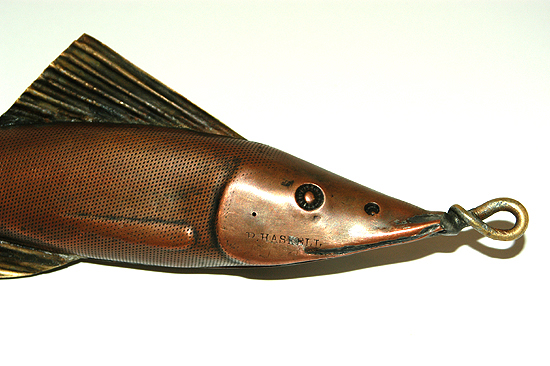
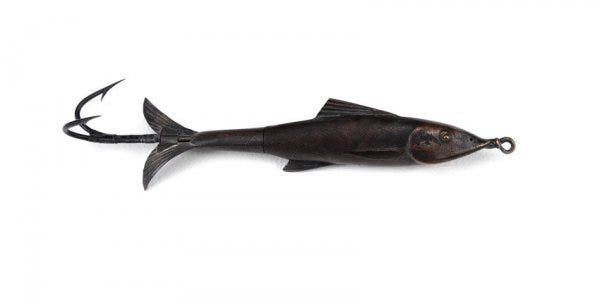
No discussion of the most valuable rare antique fishing lures can be completed without a mention of this giant copper Haskell Minnow which currently holds the record of the most expensive fishing lure in the world to ever be sold.
The Haskell series is a small line of antique lures created in the late 19th century by Riley Haskell, a jeweler from Painesville, Ohio, that represents some of the most iconic and highly sought-after antique fishing lures in the world.
Editor’s Note
Riley Haskell was a highly skilled gunsmith who lived in Painesville, Ohio, in the mid-19th century. He was known for his finely crafted guns, which were highly sought-after by sportsmen and collectors alike.
However, Haskell had another passion besides gun making: fishing. He loved nothing more than spending time on the water, casting his line, and trying to catch the biggest fish he could find. And as with his guns, he wanted his fishing gear to be of the highest quality.
So, Haskell decided to try his hand at making fishing lures. He began experimenting with different materials and designs, trying to create lures that would mimic the appearance and movement of live fish. He quickly discovered that his expertise in metalworking could be applied to lure-making as well, and he began producing highly detailed and realistic lures made from copper and brass.
Haskell’s lures were quickly recognized for their quality and effectiveness. They were highly sought-after by fishermen, and Haskell soon found himself making lures full-time.
One of Haskell’s most famous creations was the Haskell Minnow, a fish-shaped lure with a hollow body and finely sculpted details. The lure was designed to mimic the movements of a live minnow, and it quickly became a favorite among anglers.
Haskell continued to make fishing lures for many years, even as his gun business thrived. He remained passionate about fishing and always strove to improve his lure designs.
However, Haskell’s fishing lures were never produced in large quantities and were only sold for a short period of time, making them extremely rare and valuable antique fishing lures. Haskell’s focus was primarily on producing high-quality lures rather than mass production, and as a result, only a limited number of his lures were ever made.
It is believed that Haskell produced only a few thousand of these lures during his lifetime. Many were likely lost or destroyed over time, and only a small number of examples have survived to the present day. Of these surviving examples, most are in the hands of private collectors or museums, making them even more difficult to come by.
Furthermore, due to the fact that many of these lures were used for fishing, few of them have survived to this day. Those that have survived are highly prized by collectors and are often worth a significant amount of money.
Today, Riley Haskell is remembered as one of the pioneers of the modern fishing lure industry.
His lures are highly collectible and are prized by anglers and collectors around the world. Haskell’s legacy lives on, and his influence can be seen in the countless fishing lures that are still being produced today.
Today, this giant bronze-colored lure, a Haskell Minnow, is regarded as the crowning piece of them all after setting the all-time record for a fishing lure sold through public auction, in 2003, when it was purchased for $101,200 by an anonymous bidder.
The lure had been part of a private collection for many years before being put up for auction, and its sale generated widespread excitement among collectors and fishing enthusiasts.
The Haskell Minnow’s record-breaking sale price was a testament to its rarity and historical significance, as well as its appeal as a work of art. Today, the Haskell Minnow remains one of the most coveted antique fishing lures in the world, and its sale continues to be a benchmark for the value of rare and collectible fishing lures.
The Haskell Minnow was designed to mimic the appearance and movement of a live minnow, with a jointed body that allowed it to move realistically through the water. The lure was also hand-painted with intricate details, including scales, fins, and eyes, which made it highly attractive to fish.
Measuring at a length of 10 inches, the “Giant Haskell” is indeed a rarity among Haskell Minnows. This particular lure is nearly double the size of all other known Haskell Minnows, which are already highly sought-after and collectible among fishing enthusiasts and collectors alike.
The giant Haskell is made of thick sheets of copper and brass and features a hollow body with finely sculpted details.
The lure is fish-shaped, with textured scales and a pair of tandem angular hooks that extend from the revolving tail section and curve upward. It is believed that Haskell created this particular lure for trolling or casting, and it was intended to lure in larger fish such as bass, pike, and musky.
Although this giant Haskell minnow is incredibly rare, it is not the only oversized Haskell Minnow to have been discovered. Other examples have been found that measure up to 8 inches in length, which is still significantly larger than most other Haskell Minnows.
These larger lures are even more highly prized by collectors than the smaller-sized options due to their rarity and the skill required to create them.
Most Valuable Rare Antique Fishing Lures
Aside from the Giant Haskell, there are several other antique fishing lures that are highly valued by collectors and fishing enthusiasts everywhere. Some of the most valuable and sought-after antique fishing lures include:
Editor’s Note
The specimens we have highlighted in this list are from the records of auctions carried out by Lang’s Auction House, the world’s leading fishing tackle auction service. Lang’s first auction debuted in 1991 with the distinction of being the only auction house dedicated solely to the field of antique and collectible fishing tackle.
Since its inception in 1991, Lang’s, Inc. has become a premier auction house in the field of antique and collectible fishing tackle. Its founder Bob Lang’s vision for a specialized auction house dedicated to this niche market proved successful, and his legacy continues today under the leadership of John Ganung, who purchased the company in 2002.
Under Ganung’s stewardship, Lang’s has expanded to include three selling venues and has attracted collectors from around the globe. Lang’s has also achieved numerous world record auction prices for antique and collectible tackle, as well as for Derrydale Press books and items related to the famed author Zane Grey.
What started as a humble venture has now become a go-to destination for collectors and enthusiasts alike, offering comprehensive services for consignors and buyers at every level.
Lang’s, Inc. remains committed to its founding principles of expertise, integrity, and exceptional service, making it a trusted leader in the field of antique and collectible fishing tackle.
Unidentified Prehistoric American Wooden Minnow
Finalized Auction Price: $42,560
Source
In the world of fishing lure collecting, there are few things more exciting than discovering a previously unknown piece of angling history. And that is exactly what happened when an unidentified wooden minnow went up for auction in 2006, selling for an incredible $42,560.
Considered the “single most historic and important wooden minnow to ever come to auction,” this lure is believed to be a predecessor of all American wooden underwater lures.
The piece was found in the tackle box of an Ohio angler, Hiram Rice, who lived in an area famous for early fishing lure makers like Pflueger and Pardee.
Despite not being able to trace the manufacture of this rare and possibly one-of-a-kind lure, historians note that it is practically identical to early Trory minnows. This particular lure is described as being in very good condition despite dating from the late 1890s.
The lure’s design is a testament to the craftsmanship and innovation of early fishing lure makers in America. It is believed to be the earliest example of an American wooden underwater minnow, which makes it a true piece of angling history.
The lure’s value is not just in its historical significance but also in its rarity and beauty. The fact that it was found in the tackle box of Hiram Rice, alongside an assortment of antique fishing tackle, only adds to its allure.
This mysterious and unidentified wooden minnow remains a highly sought-after item among antique fishing lure collectors, and its sale in 2006 set a new record for the most expensive fishing lure sold at a public auction at the time.
Chautauqua Minnow
Finalized Auction Price: $37,400
Source
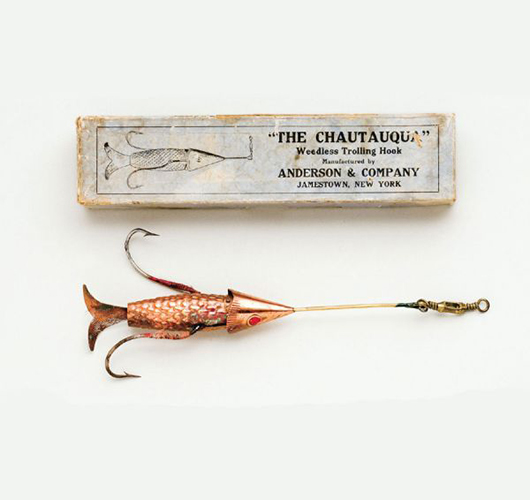
The Chautauqua Minnow, created by Krantz & Smith of New York in 1908, had a rocky start in the fishing lure market.
Anglers quickly discovered that the lure was not very effective at catching fish, and as a result, the demand for it was low. Production was eventually cut off shortly after the first few Chautauqua Minnows were made, making them exceptionally rare for collectors.
Despite the initial failure of the lure, some recognized its potential value as a line with an extremely limited supply and saved at least this one specimen from being thrown away. This particular Chautauqua Minnow was later discovered and sold for an impressive $37,400, demonstrating the incredible value of extremely rare antique fishing lures.
Collectors prize the Chautauqua Minnow not only for its rarity but also for its unique design. The lure features a unique curved, wooden body with a metal lip that creates a wobbling action when retrieved. It also has two treble hooks attached to the bottom of the body, making it suitable for both trolling and casting.
The Chautauqua Minnow may not have been successful in its time, but its rarity and design have made it a valuable piece of fishing history. It serves as a reminder that even failed products can become extremely valuable collectibles when paired with the right demand.
Rare Musky Haskell Minnow
Finalized Auction Price: $32,000
Source
The Haskell Minnow is a highly sought-after antique fishing lure known for its intricate design and craftsmanship. But among the many variations of the Haskell Minnow available today, this Rare Dark Haskell Musky Minnow stands out as a true gem of early American craftsmanship.
Measuring 7 1/2 inches in overall length, the Rare Minnow is finely crafted down to the smallest details, from its textured scales to its finely sculpted fins.
This lure is a testament to the skill and artistry of Riley Haskell, a highly skilled gunsmith who decided to try his hand at making fishing lures in the mid-19th century.
Patented on September 20, 1859, the Rare Dark Haskell Musky Minnow is a prime example of the early American fishing lures that are highly prized by collectors today. Despite its age, this lure remains in excellent condition, a testament to the care with which it was made and the care with which it has been preserved over the years.
In 2007, this specimen went up for auction and sold for over $32,000, unsurprising, considering its rarity and the high demand among collectors for early American fishing lures.
It is not surprising that the Haskell Minnows are considered to be some of the most desirable lures in the world, given their intricate design and the limited numbers in which they were produced.
Musky Charmer Minnow
Finalized Auction Price: $25,000
Source
The world of antique fishing lures is full of surprises, and the Musky Charmer Minnow is no exception. This unique and rare fishing lure is highly sought after by collectors due to its impressive design and rarity.
The Musky Charmer Minnow was produced by the Charmer Minnow Company, which was known for creating high-quality fishing lures in the early 20th century. However, the Musky Charmer Minnow stands out from the rest due to its larger size and distinctive design.
Measuring just over 5 inches in length, the Musky Charmer Minnow is considered the rarest of all the Charmers. What sets this lure apart from the others is its striped tail, which is unlike any other design from the Charmer Minnow Company.
It’s believed that only a few Musky-sized Charmers still exist today, making this one of the most valuable and highly sought-after lures in the world of antique fishing tackle.
In 2018, an excellent-condition Musky Charmer Minnow was sold at auction for just over $25,000, making it one of the most expensive fishing lures ever sold. This high price tag is a testament to the lure’s rarity and desirability among collectors.
For serious antique fishing lure collectors, the Musky Charmer Minnow is a must-have addition to any collection. Its unique design and rarity make it a true treasure for those who appreciate the artistry and history of vintage fishing tackle.
Shakespeare Muskellunge Minnow
Finalized Auction Price: $23,100
Source
The Shakespeare Muskellunge Minnow, sold at auction for a whopping $23,100, is a testament to the innovative mind of William Shakespeare, Jr. As the son of a banker, Shakespeare had a passion for fishing and sought to create the perfect lure. His “Revolution” lure, introduced in the late 1890s, was a game-changer for the industry.
Equipped with three treble hooks and a propeller, the “Revolution” was one of the earliest wooden baits sold in the United States.
Over the years, Shakespeare continued to refine and improve his lures, producing several new successor variants to the Revolution, including the Muskellunge Minnow, which is now one of the most valuable in existence.
What makes this particular lure so valuable is its pristine condition. It has been carefully preserved over the years, with every detail of its construction still intact. The attention to detail and quality of materials used in its creation is a testament to Shakespeare’s commitment to excellence.
The Shakespeare Muskellunge Minnow was estimated to sell for $5,500, but auctioneers were surprised when it sold for more than four times that amount. Its high value is a testament to its rarity, as well as the skill and craftsmanship that went into its creation.
For collectors and fishing enthusiasts, the Shakespeare Muskellunge Minnow is a piece of history representing the early days of lure-making in America. Its value is not just in its price tag but in the legacy that it represents.
Heddon Dowagiac Expert
Finalized Auction Price: $19,000
Source
The story of the Heddon Dowagiac Expert is one of perseverance and ingenuity. James Heddon, a beekeeper, and newspaperman from Michigan, revolutionized the fishing industry with his creation of the Dowagiac Casting Bait in the early 1900s. The lure was named after the town where Heddon worked, Dowagiac, and was later shortened to the Dowagiac Expert.
This lure was originally marketed as the Dowagiac Casting Bait in the early 1900s. Over time, Heddon shortened its name to the “Dowagiac Expert,” and it quickly became a favorite among anglers.
Despite being a game-changing invention, few copies of the Dowagiac Expert survived to this day, and even fewer are in good condition. It is a testament to its popularity and rarity that the white cardboard box it came in can sell for as much as $1,000 without the lure itself.
Measuring almost 6 inches long with large glass eyes, a front spinner, and an intact tail, this wooden beauty is a stunning example of the Dowagiac Expert in its natural scale finish. Produced by Heddon himself out of Dowagiac, Michigan, it is likely the best-known example of the very few of its kind.
Heddon Mohawk Minnow
Finalized Auction Price: $18,400
Source
The world of antique and collectible fishing tackle is full of rare and valuable items, and the Heddon Mohawk Minnow is definitely one of them.
This beautiful lure, believed to have been made around 1905, is the only known example of its kind to come with a matching wooden box from the Mohawk, Florida, Heddon location. It is in spectacular condition, and the box is also in fine shape.
What makes this particular lure so special, however, is the complete paperwork that comes with it. This documentation helps to date and confirm the significance of the find, adding to its historical and collectible value. When this lure went up for auction in 2013, it fetched an impressive $18,400, a testament to its rarity and desirability among collectors.
The Heddon Company has a long history of producing quality fishing lures, and the Jeanette Hawley “Mohawk” Minnow is no exception.
With its intricate design and attention to detail, it’s easy to see why this lure is so sought after by collectors. Whether you’re a seasoned angler or a passionate collector, the Heddon Jeanette Hawley “Mohawk” Minnow is a true treasure from fishing world history.
Little Wonder Minnow
Finalized Auction Price: $18,000
Source
The Little Wonder Minnow in Box is a true rarity among fishing lure collectors.
Produced by the Clinton Wilt Manufacturing Company in Springfield, Missouri, this lure and box combination dates back to 1910 and is the only known example of a complete two-piece cardboard box for this lure to exist.
With this specimen, the lure itself is in excellent condition, and the box is also in great shape, which is unusual for an item of this age. Consequently, for a Missouri lure collector, this piece is a must-have, as it is a one-of-a-kind specimen that represents a significant part of the state’s fishing lure history.
At a 2019 auction, this Little Wonder Minnow in Box fetched an impressive price of over $18,000, which is a testament to its rarity and the value that collectors place on such unique and historically significant pieces.
For collectors, it is not just about the lure itself but also the story and history behind it, making this Little Wonder Minnow in Box a true treasure for any serious fishing lure collector.
The Clinton Wilt Manufacturing Company was a fishing lure manufacturer based in Springfield, Missouri, that was in operation in the early 1900s and was one of the more prominent names in the state at that time.
The company was founded by Clinton Wilt, who started out making lures as a hobby before turning it into a full-fledged business. Wilt was known for his attention to detail and his use of high-quality materials in his lures, which quickly earned him a reputation as a skilled craftsman.
The Little Wonder Minnow, which was first introduced in 1909, is one of the most famous lures produced by the Clinton Wilt Manufacturing Company.
This small, slender lure was designed to imitate the movement of a live minnow in the water and quickly became a favorite of anglers in the region. It was made from high-quality wood and featured a painted finish that was both durable and attractive.
In addition to the Little Wonder Minnow, the Clinton Wilt Manufacturing Company produced a variety of other lures, including the Wilt’s Economy Minnow, the Springfield Bait Company Minnow, and the Clinton Wilt Weedless Minnow. Although the company was relatively small, it quickly gained a loyal following among anglers who appreciated the quality and craftsmanship of its products.
The .22LR is the favored weapon for shooting squirrels across North America. Some people prefer scoped, and some prefer iron sights, but most people will agree that the .22LR is probably the best tool for killing squirrels.
The great thing about using the .22LR for squirrels is that it has just enough stopping power. A misplaced shot on a squirrel with anything bigger than a .22LR is likely to damage a large amount of meat.
Anything smaller than a .22LR, and it’s most likely you will only injure the squirrel if you misplace the shot. While a misplaced shot with a .22LR will still kill the squirrel with minimal damage to the meat. With that being said, you still want your shot to be on target, and with a .22LR, that target is the head.
The head is the best place to shoot a squirrel with a .22LR for three reasons.
It’s the fastest kill
It doesn’t damage the meat
It doesn’t damage the pelt
Unlike hunting a deer where it is easier to aim for the vitals, this is not really practical with a squirrel. A squirrel’s vital area is much too small, and they move too often and too fast to aim for the vitals. A headshot usually signifies instant death for a squirrel, and it’s a good size target to aim for.
With this being said, a well-placed body shot with a .22LR will kill a squirrel, but if you are hunting for meat, why take the risk of damaging the meat and, more importantly, inuring the squirrel.
Where to Shoot a Squirrel With an Air Rifle
If using an air rifle for hunting squirrels, there is only one place to aim, and that is at the head. With a shotgun, a bow, or the .22LR or you can aim for a body shot.
The idea of a body shot really shouldn’t cross your mind with an air rifle. They usually don’t offer enough power to warrant a body shot on a squirrel.
There have been times when I’ve hit squirrels in the body with a .22LR or only to have to follow it up with another shot quickly.
Squirrels are tougher than they look and have a tough hide. Hitting a squirrel anywhere other than the head with an air rifle will most likely just injure them to a point where they will die a slow death in their nest.
Where to Shoot a Squirrel With a Shotgun
While there are a lot of fans for the .22LR when it comes to squirrel hunting, there are still quite a few people who will use nothing but a shotgun for squirrels.
The huge draw for using shotguns when out squirrel hunting is the ability to take a mixed bag.
Many people will claim that using a shotgun on squirrels will ruin the meat. However, most people who have used shotguns on squirrels contest otherwise.
Large squirrels like big fox squirrels have tough hides, and with a well-placed shot from a shotgun, only a few pellets will make it through to the meat. The force from being hit with a shotgun load is enough to knock a squirrel from a tree.
Shotguns serve great for squirrel hunting in the early season when there is still plenty of foliage on the tree, and it’s hard to get a headshot with a rifle this time of year.
When using a shotgun for squirrel hunting, a headshot is still the best shot you can take. This allows you to get a quick kill without putting too many pellets towards the body.
Where to Shoot a Squirrel With a Bow
Things begin to change when bow hunting for squirrels. No longer are you only limited to a well-placed headshot. While a headshot is still a perfectly fine shot with a bow, you are offered another option.
Choosing a body shot with a bow is perfectly fine as you’re not at risk of ruining too much meat, and there is little chance for the squirrel to escape.
If aiming for a head shot with a bow, it’s best to use judo points or blunts for a quick kill. If aiming for a body shot, it’s the same as a large game animal; you will want to aim just behind the shoulder.
This will put your arrow in contact with the squirrel’s vitals, with a small game head, it will quickly and humanely dispatch the squirrel.
Conclusion
When hunting squirrels, nine times out of ten, it’s best to aim for the head. This offers the cleanest kill and does not harm the meat or the pelt.
The only time you would not aim for the head is when using a bow which offers you the option of aiming for the body.
It wasn’t long after we first got into camping that we realized there must be a better solution for carrying propane for our Coleman stove than in the disposable one-pound cylinders. After finding out that fifty million of the steel canisters are disposed of each year by campers like us, and that a quarter-million of them simply become litter, we decided it was time for a better solution.
Full Disclosure: This post includes affiliate links to the adapters we use. Our readers never pay any extra when using these links and we may earn a small commission.
Thinking that we were doing the environmentally responsible thing, we bought a small brass adapter on eBay and began refilling our own 1 lb propane bottles, only to learn later that doing so makes them illegal to transport. One-time use, disposable propane cylinders aren’t designed to the same specifications as refillable ones, and thus aren’t lawfully transportable, according to the Department of Transportation. Thankfully, we never had any accidents while transporting our refilled bottles, yet if we had, we might have been liable for any damages and paid a hefty fine.
One Incident in 10 Years Was Enough
After about a decade of refilling used one-pound Coleman and Bernzomatic propane bottles, we only had one of them develop a leaking valve, after it had been re-used about ten times. About halfway down Old Monarch Pass, west of Salida, CO, we smelled propane wafting from our cooking gear box in the back of the Jeep and had to pull over to deal with a leaking 1 lb Coleman bottle. Gas wasn’t leaking from the small relief valve on the side of the cylinder (as sometimes happens with abrupt temperature changes) but rather from its main valve, which had probably began to wear out with reuse.
This incident was enough to convince us that (in addition to being illegal to transport) refilling our used one-pound propane canisters probably wasn’t the safest alternative.
From the DOT Website:
From the DOT’s website. At least one fatality has resulted from refilling DOT 39 cylinders (disposable 1 lb. type)Adapter for one lb. propane cylinder to 20 lb. tank.
Refilling 1 lb Propane Cylinders (For Emergency Use Only)
If a situation ever arises where you really need to re-fill a Coleman or other one-pound disposable propane cylinder (for use in a Mr. Buddy portable heater during a blackout, for example) the simple process we used does work. However, there’s even a better way than this, which we’ll get to later.
Whichever method you use, always remember that propane is a dangerous, flammable gas, so performing this process carefully and safely is very important. The photos above show some of the steps we used to refill our disposable Coleman one-pound propane bottles.
There are many videos showing how to do this and our post isn’t meant to be a tutorial on how to do so, but we’ll explain the basic principle of how it works.
Turning to the left to tighten the bottle adapter onto the 20 lb. tank.
How We Once Refilled Our One-Pound Disposable Propane Canisters
Disclaimer: The following is not to be used as instructions and is for illustrative purposes only.
Back when we used to refill our used Coleman propane cylinders using the old method, we’d find a clear spot outside on a cool day when there was some breeze blowing. After purging the remaining gas from our one-pound cylinder, we attached it to an inverted 20 lb. tank, and slowly opened the main valve. After about thirty minutes, we’d close the main valve, return the tank to its normal upright position and unscrew the 1 lb. canister. A better description of the whole process can be found here, on a website that sells a tank adapter similar to the one we used.
(Some people chill their 1 lb. propane canisters in a small bucket of ice water, etc. This condenses the gas and lowers the pressure so you can refill with a bit more propane. Careful not to overfill!)
To make sure we hadn’t overfilled them, we’d always perform a quick check using an old postal scale to see that our newly refilled 1 lb. propane bottles wasn’t any heavier than a new store-bought one, as well as to check for leaks before storing it away.
Downsides of This Method
You typically can’t ever fill a 1 lb. bottle to the same level as when it was new. *
Unless you’re using a special stand, the upturned tank is awkward and can tip over.
Disposable 1 lb. bottles and their internal valves aren’t made to same standards as refillable ones.
DOT-39 cylinders (disposable type like Coleman, Bernzomatic) are illegal to transport if refilled.
* There is a way do get more gas into a cylinder, but it requires loosening the pressure-relief valve and/or chilling the bottle.
The Flame King kit includes this easy to use valve system, which is much simpler to work with than the one-piece brass fitting that we had been using – no wrench needed.
Two Better Alternatives To Refilling Used 1 Pound Propane Bottles.
Option 1 – Flame King 1 lb. Refillable Cylinders
Since learning that owner-refilled disposable cylinders aren’t legal to transport, and that they’re not made to the same specifications as refillable ones are, we switched to carrying a couple of DOT approved refillable one-pound propane cylinders, made by Flame King. This simple system uses a special filling valve with a long extension, along with an optional propane tank stand, which solved the problem we once had of inverting the 20 lb. tank during the refilling process.
Option 2 – 5 lb Refillable Mini Tanks
The Gas Growler holds lbs of propane, lasting that much longer than a one lb bottle.
A five pound refillable propane cylinder also works very well for fueling camping stoves, with the added benefit of lasing five times longer than 1 lb. bottles, and being refillable anywhere larger tanks are filled. The Gas Growler is one example of a five pound mini-tank that is easily stored in the back of a vehicle in it’s padded carrying case. Many in the overlanding community like to carry this size propane tank since one can last as long as a month, depending on how many meals you cook a day.
The Bottom Line: Should You Ever Refill a 1. lb Propane Cylinder?
Coleman, Bernzomatic and other brands of disposable propane cylinders don’t feature heavy-duty brass tank fittings or long-life internal valves. Disposable cylinders aren’t made with the same thickness of steel (just pick one up and you’ll feel the difference) nor do they have the DOT seal of approval for reuse which would make them legal for transport. However, when making the decision to refill a cylinder, the real reason you should avoid this practice is for your own safety and that of others, not for fear of being caught by the DOT.
Benefits of Refilling Your Disposable 1 lb Propane Bottles With a Flame King or Similar System
When it comes to saving money, using some kind of reusable, refillable propane cylinder for your Coleman stove is really a no-brainier. There are the environmental benefits as well, plus not having to deal with properly disposing of all the empty canisters at the end of the camping season. In terms of savings, it currently costs about $20 to fill a 20 lb tank, while a 1 lb bottle costs us around $5 at Walmart. It’s easy math, and you can clearly see that refilling an approved tank can save a lot of money over the long run.
This 5′ extension hose features an adapter that allows you to use a 20 lb. bottle to fuel your Coleman or other camping stove which uses 1 lb. bottles.
In addition to sometimes running our Coleman camping stove directly from a 20 lb. tank, using a 5′ propane adapter hose, we’ve also been using two 16.4 ounce Flame King propane cylinders. Because these are so easy to refill, we normally don’t bring a 20 lb bottle unless we plan on being gone for more than a week.
At about $52 for the Flame King Refill Kit, which includes one refillable cylinder, we estimate that we’ve saved enough this camping season so far to pay for it already.
Disclaimer: We don’t advocate refilling used disposable propane bottles. This article does not constitute instruction. When using any approved system to refill a re-usable 1 lb cylinder, be sure to follow all of the manufacturer’s instructions to the letter. Full Disclosure: This post may include affiliate links to products we recommend. Our readers never pay any extra when using those links.
“Do deer indulge in soybeans? Discover the feeding habits of these graceful creatures. Unveil the truth about whether soybeans are part of their diet or if they prefer other foliage. Explore the intriguing relationship between deer and soybeans as we delve into their dietary preferences.”
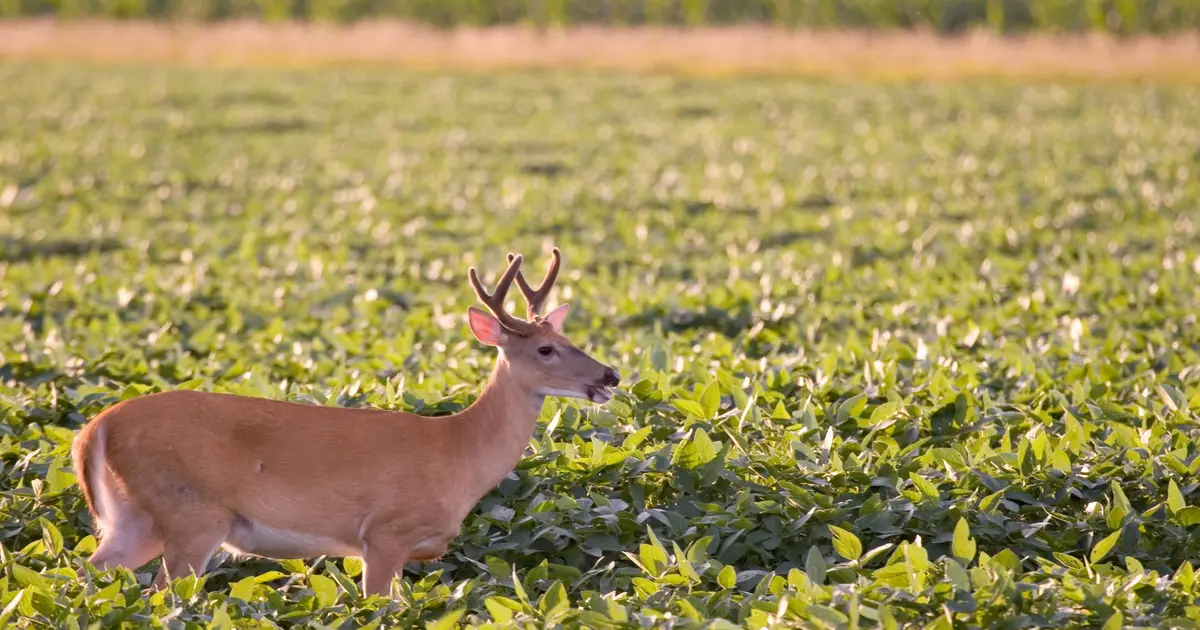
Soybeans are a popular food source for deer, especially during the winter months when other vegetation is scarce. The fuzzy bean pods that stay on the plant provide a high-quality food source for deer throughout the winter. These pods contain essential nutrients and proteins that help sustain deer during the harsh winter conditions.
When considering planting soybeans as a food plot for deer, it is important to choose the right variety. Some varieties of soybeans are specifically bred for wildlife consumption and have higher protein content than traditional agricultural varieties. It is also recommended to select soybean seeds that have been inoculated and coated, as this can provide a fast start to planting and increase the chances of successful growth.
In addition to being a nutritious food source, soybeans also offer other benefits for deer management. They can attract and hold deer in specific areas, making them easier to monitor and manage. Soybeans can also be used strategically to create travel corridors or funneling areas, directing deer movement in desired directions.
Overall, soybeans can be an excellent choice for providing deer with a winter feast. Their high nutritional value and ability to attract and hold deer make them a valuable addition to any food plot strategy. By selecting the right variety of soybeans and ensuring proper planting techniques, landowners can help support healthy deer populations during the challenging winter months.
2. “Exploring Deer’s Dietary Preferences: Are Soybeans on the Menu?”
In the article “Exploring Deer’s Dietary Preferences: Are Soybeans on the Menu?” the focus is on understanding whether soybeans are a preferred food source for deer.
One of the main points discussed in the article is the high nutritional value of soybeans. Soybeans are rich in protein, which is essential for deer’s growth and development. They also contain important minerals such as calcium and phosphorus, which contribute to healthy bone formation. Additionally, soybeans provide a good source of energy for deer, helping them maintain their body condition during harsh winter months.
The article also highlights that soybeans can be an attractive food source for deer due to their palatability. Deer have been observed to readily consume soybean plants and pods when available. This preference may be attributed to the taste and texture of soybeans, making them a desirable option for deer seeking nourishment.
Furthermore, it is mentioned that planting crimson clover alongside soybeans can enhance their appeal to deer. The fuzzy bean pods of crimson clover stay on the plant throughout winter, providing a high-quality food source for deer during this time when other natural food options may be scarce.
Overall, the article emphasizes that incorporating soybeans into food plots can potentially benefit both deer populations and hunters alike by providing a nutritious and appealing food source.
3. “Soybeans as a Nutritional Delight for Deer: What You Need to Know”
Soybeans are an excellent source of nutrition for deer, providing them with essential proteins and carbohydrates. These legumes are highly palatable to deer and can be a great addition to any food plot. One of the key benefits of soybeans is their high protein content, which is crucial for antler growth and overall body condition in deer. By planting soybeans in your food plot, you can ensure that deer have access to a high-quality food source throughout the year.
In addition to their nutritional value, soybeans also offer other advantages for both hunters and deer. The plant’s foliage provides excellent cover for deer, allowing them to feel secure while feeding. This can be especially beneficial during hunting season when deer are more cautious and tend to seek out areas with ample cover. Furthermore, soybeans produce bean pods that remain on the plant even into the winter months. These fuzzy bean pods provide an additional food source for deer during the colder seasons when other vegetation may be scarce.
When considering planting soybeans in your food plot, it is important to choose the right variety and prepare the soil properly. There are several different types of soybean varieties available, each with its own characteristics and maturity dates. It is recommended to select a variety that is specifically bred for wildlife use, as these varieties tend to have higher protein content and better tolerance to browsing by deer. Additionally, preparing the soil by removing weeds and ensuring proper drainage will help promote healthy growth of soybeans.
Overall, incorporating soybeans into your food plot can greatly benefit both hunters and deer alike. The nutritional value they provide, along with the added advantages of cover and extended food availability, make them an excellent choice for attracting and supporting a healthy deer population on your property.
4. “Unveiling the Truth: Do Deer Find Soybeans Irresistible?”
Soybeans have long been considered a popular food source for deer, but do they truly find them irresistible? This question has sparked much debate among hunters and wildlife enthusiasts. Some believe that soybeans are highly attractive to deer due to their high protein content and palatability, while others argue that deer may not be as fond of soybeans as previously thought.
One argument in favor of soybeans being irresistible to deer is their nutritional value. Soybeans are known for their high protein content, which is crucial for deer during the winter months when other food sources may be scarce. Additionally, soybeans are rich in carbohydrates and fats, providing a valuable energy source for deer. These nutrient-rich qualities make soybeans an appealing food option for deer seeking to meet their dietary needs.
On the other hand, there are factors that suggest deer may not find soybeans as irresistible as believed. One consideration is the availability of alternative food sources. In areas with abundant natural vegetation or other agricultural crops, deer may have a variety of options to choose from. This could potentially reduce their preference for soybeans and lead them to select other available foods instead.
Furthermore, the taste preferences of individual deer can vary. Just like humans have different food preferences, it is possible that some deer simply do not find soybeans as palatable as others do. Factors such as soil conditions, weather patterns, and plant maturity can also influence the taste and quality of soybean plants, potentially impacting their attractiveness to deer.
In conclusion, while soybeans are undoubtedly a nutritious food source for deer due to their high protein content and energy value, whether or not they are truly irresistible remains a subject of debate. The availability of alternative food sources and individual taste preferences may play a role in determining how attractive soybeans are to deer in a particular area. Understanding these factors can help hunters and land managers make informed decisions when planning food plots and managing deer populations.
5. “Discovering Deer’s Palate: The Attraction of Soybeans”
Soybeans have long been recognized as one of the most attractive food sources for deer. These legumes offer a high protein content, making them an excellent choice for promoting antler growth and overall health in deer populations. Additionally, soybeans are highly palatable to deer due to their rich flavor and aroma.
One of the main reasons why soybeans are so appealing to deer is their high energy content. This makes them an ideal food source for deer during the fall and winter months when they need to build up fat reserves to survive the harsh conditions. The high energy provided by soybeans helps deer maintain their body temperature and stay active during these colder periods.
Furthermore, soybeans provide essential nutrients such as carbohydrates, fats, and proteins that are crucial for deer’s overall health and development. These nutrients support muscle growth, bone strength, and reproductive functions in deer populations. By consuming soybeans, deer can enhance their physical condition and increase their chances of survival.
Benefits of Soybean Food Plots for Deer:
– High protein content promotes antler growth
– Rich flavor and aroma make them highly palatable
– High energy content helps deer survive winter conditions
– Essential nutrients support overall health and development
In conclusion, soybeans are a highly attractive food source for deer due to their nutritional value, taste, and energy content. Planting soybean food plots can greatly benefit local deer populations by providing them with the necessary nutrients for optimal growth and survival.
6. “Feeding Frenzy or Passé Preference? Examining Deer’s Taste for Soybeans”
Paragraph 1:
Deer have long been known to have a preference for soybeans as a food source. These legumes provide a high protein content that is essential for the growth and development of deer, especially during the winter months when other food sources may be scarce. However, recent studies have shown that deer’s taste for soybeans may be changing.
Paragraph 2:
Researchers have found that deer are becoming less inclined to feed on soybeans compared to other available food sources. This change in preference could be due to several factors, including changes in agricultural practices and the availability of alternative food options. As farmers increasingly use genetically modified soybean varieties and herbicides, the taste and nutritional composition of soybeans may have altered, making them less appealing to deer.
List:
– Genetic modification: The use of genetically modified soybean varieties in agriculture has increased over the years. These modifications aim to improve crop yield and resistance to pests and diseases. However, these changes may also affect the taste and nutritional value of soybeans, potentially making them less attractive to deer.
– Herbicide use: Farmers often use herbicides to control weeds in their fields, including those growing alongside soybean plants. While herbicides can effectively eliminate unwanted vegetation, they may also impact the flavor and quality of soybeans. Deer may be able to detect these changes and choose alternative food sources instead.
– Availability of alternative food options: As agricultural practices evolve, other crops such as corn, alfalfa, and clover are being grown alongside or instead of soybeans. These alternative food sources may offer different nutritional profiles or flavors that are more appealing to deer.
Overall, while soybeans have traditionally been a favorite food source for deer, their taste for these legumes may be declining. Understanding the factors influencing deer’s food preferences can help landowners and hunters make informed decisions when planning food plots or hunting strategies.
In conclusion, while deer can and sometimes do eat soybeans, it is not their preferred choice of food. Other crops and plants are more appealing to them, making soybeans a less likely target for deer consumption.
The Remington Model Seven Rifle makes a nifty, thrifty, and swift little hunting set-up.
I squeezed off shot #3, and it made a tight cloverleaf on my target. And then I got nervous, knowing what had happened too many times before: three rounds downrange, a half-inch group, and then I start pulling shots.
I was testing the new Remington Model Seven rifle in the Mossy Oak Bottomland finish, topped with Trijicon’s new Huron 2.5-10×40 rifle scope. My ammunition for this phase of my shooting was Federal Premium Vital Shok .308 Win., launching a 168-grain Trophy Copper bullet. I shot from a rest at my outdoor range, my target set up at 100 yards.
I opened the bolt on the rifle to let in the 20-degree Fahrenheit Wisconsin air, and took a short walk to ease my nerves. From there, I got back behind the rifle, did some slow breathing exercises, and took my next shot. It touched the holes left by the previous three bullets!
At 100 yards, the Model Seven Bottomland provided outstanding accuracy in a hunting rifle, with the four-group cluster measuring just .44-inches
And Shot #5? I pulled it. A little. But the whole group still came in at just .97-inches, with my first four shots an outstanding .44-inches.
One accurate little rifle, I decided, this Model Seven Bottomland, and a great option for the hunter. Yet, the Model Seven is also a rifle line that’s generally been ignored.
Light and maneuverable, the Model Seven Bottomland is a great choice for the hunter in a blind, a tree stand or in thicker timber. PHOTO: Joe Schuh
A Gun Long In Production
Remington launched the Model Seven line in 1983. It was made and marketed as a more compact option to Remington’s flagship Model 700 bolt. It is roughly 2.5-inches shorter than a standard 700, and Remington sells some of these smallish rifles every year, keeps coming out with different versions.
Yet, I rarely see the rifle reviewed in the shooting and outdoor media. And, while it’s admittedly a small empirical sample, I do travel around the country rather extensively on hunts and shooting events; and, I have never seen someone with a Model Seven.
Model 700’s? All over the country.
However, if you hunt from a tree stand or an enclosed blind, need a gun for close-in hunting in thick country and/or want a nimble truck gun? You should take a serious look at a Model Seven Bottomland with its 16.5-inch barrel.
My Set-Up
For my shooting with the Model Seven Bottomland model, I also used .308 Win hunting ammunition from Dynamic Research Technologies (DRT) , with their 175-grain frangible bullet, and Hornady’s Full Boar firing a 165-grain GMX projectile.
I had no problem getting MOA and SUB-MOA groups with all three brands of ammunition—if I let the rifle cool a bit after the third shot. The slim-profile barrel of the Model Seven Bottomland heats up quickly, and when I fired off five shots too quickly, either (or both) shot #4 or #5 would go .5- to 1.0-inch wide.
On average, the Hornady came in right at 1.00-inch groups for five shots, the DRT at 1.15-inches, and the Federal at .90-inches. Each ammunition brand also pegged .5-inch groups of three and four shots within those five-shot strings.
The X Mark Pro Trigger, standard on the Model Seven Bottomland, is user adjustable from 3 to 5 pounds with a 1/16” Allen wrench.
The Model Seven features Remington’s own X-Mark Pro Trigger. The trigger can be externally adjusted from 3 to 5 pounds of trigger pull with a 1/16” Allen wrench. However, my Lyman Electronic Digital Trigger Pull Gauge measured the pull on my rifle at a crisp 2 pounds, 7 ounces.
Magazine, Stock, & Recoil
The Model Seven’s internal magazine holds four rounds and features a hinged floor plate. The barrel is factory threaded at 5/8”-24 for a suppressor or muzzle break; a Picatinny rail section mounted atop the receiver makes for easy optics mounting.
As noted, the synthetic stock is finished in Mossy Oak’s popular Bottomland camouflage pattern. Which may strike some as a little dark. But you certainly won’t have to worry about the stock catching the attention of a sharp-eyed deer.
The recoil on the Model Seven was rather snappy. Not a surprise for a rifle that weighs just six pounds, with a short barrel and chambered in .308 Win. The recoil was not terrible; but if I was buying this rifle for a younger shooter or someone a little recoil shy? I’d opt for the 6.5 Creedmoor or 300 BLK chambering, the other two calibers available for the model Seven Bottomland.
All in all? A first-rate and nicely compact hunting rifle.
SPECS: Remington Model Seven Bottomland
Caliber as tested: .308 Win
Barrel Length: 16 1/2″
Twist Rate: 1:10, Right
Barrel Material: Carbon Steel
Threaded: 5/8”-24
Magazine Capacity: 4
Total Length: 34 1/4″
Avg. Wt. (Lbs.): 6
Length of Pull: 13 3/8”
Drop (Comb): 1 ¼”
Drop (Heel): 1 ½”
Barrel Finish: Matte Black
Stock Material: Synthetic
Stock Finish: Mossy Oak Bottomland
Misc.: Rail on Receiver, Push Tang Safety, Super Cell recoil pad.
A shocking video of mating pythons crashing through a ceiling in Malaysia, in Southeast Asia, has stunned people online.
The appearance of any snake in someone’s home would likely shock most people, but this particular case would test even the most hardened person.
In a viral video shared by the TikTok account baju_skoda, members of the Pertahanan Awam, the Malaysia Civil Defense Department, can be seen attempting to coax a long snake from a gap in the ceiling.
Another worker uses a pole with a hook on the end to make a hole in the ceiling in a bid to get the snake out.
Stock image of a python. The snakes crashed through the ceiling. Getty
The ceiling came crashing down following a few more pokes at the hole, revealing an entangled group of three giant snakes.
Malaysian news outlet Sinar Harian said two of the reticulated pythons were believed to have been mating and that another was also found.
Civil Defense Officer Azizah Hussain, who works for the Bentong district, just northeast of the capital Kuala Lumpur, said the mating snakes weighed about 70.5 pounds each and were about 16 feet 4 inches long.
Another python, weighing 55.1 pounds and measuring 13 feet 1 inch long, was also found at the home.
Hussain told Sinar Harian the snakes were captured, adding that the two mating snakes would be released in a safe place.
“We also want to advise the public to be careful because summer is almost here, causing snakes to look for cooler places,” Hussain said.
According to Zoo Atlanta, the reticulated python is one of the largest snakes in the world and has been recorded to grow as long as 20 feet, although they regularly grow to 16 feet.
The zoo said about the snakes’ reproduction: “These snakes may reach ages beyond 20 years. Sexual maturity is reached within two to four years but is dependent on size. Males breed once they’ve reached lengths of seven to nine feet, while females begin breeding once they attain a length of about 11 feet.
“Reticulated pythons are oviparous, with females laying 25 to 80 eggs that they incubate for about 80 to 90 days. During the incubation time, the mother goes through a fasting period and will produce muscular shivers to raise the temperature of the eggs during cooler periods.”
Since being shared on Monday, February 13, the video has been seen by some 34.2 million people and has been liked more than 21,700 times.
Many people who commented on the video were stunned by what they saw and claimed they would have left the home and never returned if it had happened where they live.
TikTok user Erasmus said: “And this is how I abandon my house and become homeless. The snakes can enjoy the house now.”
Gentlemarra added: “No sir. I would for sure sell this house, there could be more.”
Simply_V414 commented: “The way I screamed and threw my phone as if I was there when that ceiling came down.”
Gio Raphael posted: “Even though those snakes will be caught, I would definitely not live [in] that house forevermore.”
For someone who, to hear him tell it, had been “painting like a madman,” 2024 DU Artist of the Year Richard Clifton seemed remarkably relaxed. The 60-year-old Clifton, who lives on a 115-acre farm adjoining the Prime Hook National Wildlife Refuge in southeastern Delaware, was preparing for his turn as the featured artist at the Waterfowl Festival in Easton, Maryland, and a production crew was arriving soon to get footage of him for a festival video.
Plus, as if he didn’t already have enough on his plate, Clifton’s furnace had stopped working, and his repair guy, like repair guys everywhere these days, was having trouble finding the parts he needed.
But if Clifton was feeling stressed, you couldn’t detect it in his voice. A native son of Delaware who grew up on a farm just a few miles from the one he owns today, he talks the way farmers do-softly, evenly, and without an excess of emotion, as if he were describing the weather. You can hear it in the way he drops the g in words like “thinking” and “working,” and you can hear his Tidewater accent in the way a word like oil comes out sounding like ohl.
His roots in the region run deep. “On my mom’s side they were carpenters,” he related, “and on my dad’s side they were farmers. So I’ve got both those things in my blood. I can actually do a little bit of carpentry. I’ve built a deck around our swimming pool twice now-it got more extravagant the second time. And I know how to drive a tractor, work ground, and do those kinds of things.”
At the moment Clifton farms some of his ground himself and rents the rest, but he’s leaning toward taking over the entire operation. As he put it, “I want to see if I can get my farmin’ legs back and make a little money off the place.” He’s thinking, too, of a crop rotation that will allow him to harvest a short-season corn variety in early August, then plant Japanese millet. “Lord willin’ and the creek don’t rise,” Clifton explained, “the millet would make heads by mid-October.”
In other words, just in time for the waterfowl season.
The tradition of waterfowl hunting also runs deep in Clifton’s family. A good portion of the property now encompassed by the Prime Hook refuge was originally “Clifton land,” and while he missed out on some of the marsh gunning his father and uncles enjoyed when he was growing up, he took full advantage of the field hunting opportunities available to him. To the best of Clifton’s knowledge, in fact, he was the first person in those parts to hunt snow geese with a rag-style decoy spread.
“I had this idea,” he recalled with a little laugh, “that I could drape white kitchen trash bags over corn stubble. The first time I tried it I went by myself, so if it turned out to be really dumb no one else would know. But it turned out that the geese fell for it. I killed a limit of snows and a couple of Canadas that first day, and after that it was game on for several years until the birds got wise to it.”
At the same time that the teenaged Clifton was getting his legs under him as a waterfowler, the art he saw in the pages of magazines like Ducks Unlimited, Sports Afield, and Field & Stream planted the seed of another idea. He began thinking that it might be possible to emulate the likes of David Maass and Jim Killen, to name a couple of the artists whose work inspired him, and carve out a career painting ducks and geese.
“I was starting to have that dream,” he told me. “And I wondered if I was capable of doing something like that. It turned out that I was, but way back then it was just a dream. You’re thinking, lsquo;Man, it would really be something if I could be like one of those guys.’
“And now I’m a four-time DU Artist of the Year, which is pretty exciting. I also just learned that I won the Delaware duck stamp contest for the 10th time. If you’re counting, and some people are, that gives me 54 duck stamps altogether, including two federal duck stamps.”
Not bad for an artist who’s entirely self-taught and, in his own words, “figured things out mostly by trial and error.”
For his 2024 DU Artist of the Year image, Green-Wings Across the Bow, Clifton chose to fill the frame with a small flock of vividly realized American green-winged teal buzzing the bow of an ancient wooden boat-a boat that, over the years, has become as much a part of the marsh as the cattails themselves. It’s the second time he’s depicted greenwings for his Artist of the Year painting. When I asked him about that he replied, “To me they’re an iconic duck-hunting species. I have old photos of my dad and uncles after a day of hunting on land that’s now part of the refuge. They’re holding their double-barreled shotguns, and most of the ducks in their bags are green-winged teal.
“I’ve always felt a special pull from greenwings. They’re emblematic of the tradition of waterfowl hunting in my family. That’s why I wanted to incorporate the boat into the image, to include a piece of that tradition.”
To see more of Richard Clifton’s work, visit richardclifton.com.
Ducks Unlimited’s 2024 National Art Package Contributing Artists
Manitoba Morning by Bruce Miller
Bruce Miller is a native Minnesotan and a passionate sportsman, and his art is inspired by his experiences in the outdoors. Miller has won over 50 awards for his work, and his paintings have been featured in many art shows in both the United States and Canada. His work has been featured in the DU National Art Package more than 10 times. This year’s print features a regal black Lab focused on ducks circling below an overcast sky.
Droppin’ In by Scot Storm
Scot Storm’s artwork reflects his efforts to re-create the excitement and drama of encounters with wildlife in the great outdoors. Storm has won the federal duck stamp competition twice and has been named DU’s Artist of the Year three times. His love of hunting and the outdoors inspired him to step away from a successful architecture career and pursue his love of wildlife art. Storm’s painting Droppin’ In depicts two groups of pintails descending into a marsh in front of a rainbow-lit sky. In the background, a flock of American green-winged teal buzz the surface of the wetland.
2022/2024 Federal Duck Stamp Print by Jim Hautman
Jim Hautman has won the federal duck stamp contest a record-setting six times. He and his brothers, Joe and Bob, are probably the most famous family in the world of wildlife art. Each brother is an accomplished painter, and they owe their inspiration to their mother, who is also a talented artist, and their father, who instilled in his sons a love for the outdoors. Jim’s latest duck stamp painting features a pair of redheads in rough water under a menacing sky. DU is offering a gorgeous print of this historic painting framed, double matted, and inlaid with a DU crest medallion and a carved feather.
2024 DU Stamp Print by Adam Grimm
In 1999, at the age of 21, Adam Grimm became the youngest person to ever win the federal duck stamp competition. Since then, he has attained widespread recognition as one of the country’s most talented wildlife artists. His painting of a pair of green-winged teal graces the 40th Ducks Unlimited stamp. The stunning package, which is available at DU events, includes a mint stamp, an artist-signed stamp, a matching print, and a stamp medallion.
Ducks Unlimited’s Guns of the Year
DU’s 2024 Rifle of the Year is a Christensen Arms Mesa bolt-action rifle chambered in .308. It has a custom-colored bronze stock with a black Cerakoted barrel and action and comes with a mounted Leupold VX Freedom 3-9×50 scope with Leupold’s proprietary Firedot illumination technology. This handsome rifle also includes the Ducks Unlimited logo on the floor plate and bolt knob and comes with a hard plastic gun case and gun lock.
DU’s Shotgun of the Year for 2024 is a Benelli Super Black Eagle 3 (SBE3) in 28-gauge. This semiautomatic shotgun has a 3-inch chamber, 28-inch highly polished blued barrel, coin-finished receiver, DU exclusive oil-finished walnut stock, and engraving featuring a gold-inlaid waterfowl scene and the DU logo. The engraving complements that of DU’s Guns of the Year from 2019 and 2022-a 12-gauge SBE3 and a 20-gauge SBE3, respectively. This beautiful firearm comes with five extended choke tubes, a special DU serial number, and a gun lock.
The 2024 Handgun of the Year is a Springfield Garrison 1911 semiautomatic pistol chambered in .45 ACP. This eye-catching pistol features a carbon steel frame and slide, custom 24-karat gold engraving, a five-inch barrel, and additional custom DU engraving on wooden grips. Made in the United States, this firearm comes with a hard case and gun lock.
Today, we embark on an exhilarating journey to explore one of the ocean’s most fearsome predators – the barracuda. Known for its powerful speed, sharp teeth, and stunning silver appearance, the barracuda is a formidable sight beneath the waves. However, what truly sets this creature apart is its jaw-dropping record – the title of the biggest barracuda ever caught.
In this article, we’ll present the compelling facts and figures surrounding this colossal catch, providing an insightful look into the world of barracudas and the thrill of angling for these remarkable fish. So, fasten your seatbelts as we unravel the tale of the largest barracuda ever recorded!
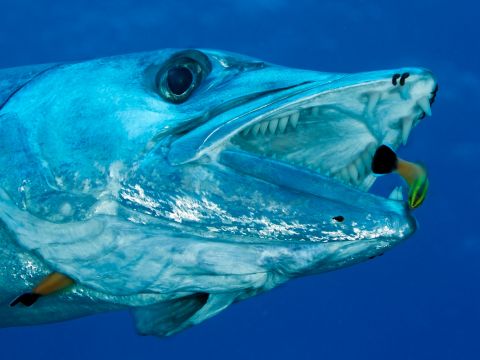
A barracuda is a predatory fish belonging to the Sphyraenidae family, found in warm, tropical, and subtropical waters across the globe. These fierce marine predators are known for their streamlined, elongated bodies, equipped with razor-sharp teeth, making them one of the most formidable hunters in the ocean. With a reputation as aggressive and fast swimmers, barracudas are at the top of the food chain in their aquatic habitats.
Physical characteristics
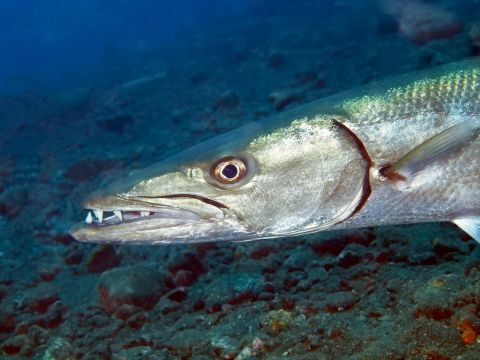
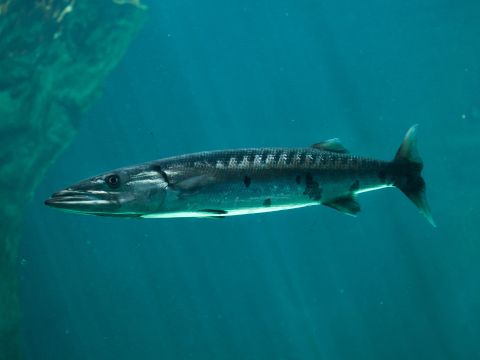
Barracudas typically have a silvery or grayish appearance with dark markings on their upper bodies, aiding in camouflage while hunting. They possess a long, cylindrical shape, which allows them to reach impressive speeds in pursuit of prey. These fish can grow to various sizes, with some species reaching lengths of up to six feet or more.
Feeding habits
As carnivorous predators, barracudas have a diverse diet, primarily consisting of small fish like anchovies, herrings, and mullets. They are ambush predators, often lying in wait near reefs, drop-offs, or underwater structures and using their incredible speed to strike unsuspecting prey.
Range and habitat
Barracudas inhabit many marine environments, including coral reefs, coastal waters, and open seas. They are commonly found in the Atlantic, Indian, Pacific Oceans, the Caribbean Sea, and the Gulf of Mexico. These fish prefer warm waters, typically 25 to 30 degrees Celsius (77 to 86 degrees Fahrenheit).
Behavior and threats
Though barracudas are generally solitary hunters, they can occasionally be seen in loose groups, especially around areas teeming with food sources. While they rarely threaten humans, barracuda attacks have been reported, often involving the fish mistaking shiny objects or dangling jewelry for prey.
Importance in ecosystems
Barracudas play a vital role in maintaining the balance of marine ecosystems. As apex predators, they help control the population of smaller fish, preventing them from overwhelming their environments. Additionally, barracudas prey on larger predators, contributing to the intricate web of life beneath the ocean’s surface.
What is the average size of barracudas?
Barracudas, renowned for their impressive size and fearsome appearance, exhibit considerable variability in their dimensions depending on the species and the environment in which they reside. On average, barracudas range from relatively modest lengths to strikingly large proportions. Let’s delve into the typical size specifications of these powerful predators.
The average size of barracudas can vary significantly across species. Generally, the smaller species, such as the pick handle Barracuda (Sphyraena jello) and Guinean Barracuda (Sphyraena afra), measure around 1.5 to 3 feet (45 to 90 centimeters) in length. On the other hand, larger species like the Great Barracuda (Sphyraena barracuda) can grow to formidable lengths, often reaching 4 to 6 feet (120 to 180 centimeters).
What is the largest barracuda ever caught?
In the world of angling, an astonishing record is held by a massive barracuda. On July 8th, 2019, in the waters off the coast of Fort Dodge, Florida, American fisherman Arin Long was stunned when he reeled in what would become the biggest barracuda ever caught!
Weighing in at a whopping 78 pounds (35.3 kilograms) and measuring a staggering 5 feet 8 inches (176 centimeters), this colossal catch beat the previous record previously held by an angler in Texas, which weighed 68 pounds (30.8 kilograms).
After reeling in his impressive haul, Long had to enlist the help of several onlookers to lift the massive fish onto shore. He then proudly posed for a photo with the monstrous catch, and his epic tale quickly gained traction on social media.
While Long’s feat is certainly an incredible accomplishment, it serves as a testament to the awesome power of these remarkable fish. As one of nature’s most intimidating predators, barracudas are known for their impressive size and strength, making them a thrilling challenge for any angler.
So, if you’re lucky enough to find yourself in the waters near Fort Dodge, keep an eye out – who knows, you are the one to best Arin Long’s record!
How to catch a barracuda
Catching a barracuda can be an exhilarating challenge for anglers across the world. With their formidable strength and lightning-fast speed, these marine predators will test any fisherman’s mettle! To help you get started, here are a few tips and tricks for catching barracudas:
Equipment
Since barracudas possess tremendous strength, it’s important to use appropriate tackle when angling for these fish. Your best bet is to select a sturdy rod-and-reel combo with a fast action, matched with a strong braided line in the 20-40 pound (9-18 kilogram) range. You’ll also want heavy-duty hooks and lures to stand up to the barracuda’s powerful jaws.
Set-up and bait
Since these predators are ambush hunters, you’ll want to set up your tackle in areas where they can easily hide and surprise their prey. This could include deep channels, rocky outcrops, coral reefs, or even manmade structures like sunken boats or pilings. To attract the barracudas ‘ attention, you’ll want live bait such as pilchards, herring, or mackerel.
Techniques
Once you’ve set up your tackle and bait, it’s time to start fishing! Cast your line out into the water and pay close attention to any signs of movement – a telltale sign of a barracuda nearby. If you’re lucky, the fish will strike, and the fight is on! When battling a barracuda, you’ll want to use steady pressure to tire it out and avoid any sudden jerks that could break your line.
As with fishing, patience and practice are key when angling for barracudas. With the right equipment and techniques, you should be able to catch your first barracuda in no time. So, grab your tackle and head out into the waters – who knows what kind of adventure! Good luck!
Where are barracudas found?
Barracudas are found in warm, tropical waters around the world. These fierce predators inhabit many marine environments, from coral reefs to coastal areas and open seas. They can be commonly found in the Atlantic, Indian, and Pacific Oceans, the Caribbean Sea, and the Gulf of Mexico. Barracudas have also been spotted in the Mediterranean and Red Seas.
In addition to their range, barracudas are found at various depths, from shallow coastal waters to deeper offshore locations. Though they prefer murky areas where they can easily hide from prey, they can likely be encountered in almost any marine habitat. So, if you plan on fishing for barracudas, you’ll find them wherever the waters are warm!
The presence of barracudas in an area usually indicates a healthy marine environment. As apex predators, they help maintain balance in their ecosystems by controlling the population sizes of smaller fish and serving as prey for larger animals. In this way, they keep oceans and other aquatic habitats flourishing – a reminder of these remarkable creatures’ invaluable contributions to the life beneath the ocean’s surface.
Can you eat barracuda?
Although barracudas have razor-sharp teeth and powerful jaws, they are not considered a threat to humans. There has never been a recorded instance of an unprovoked attack on a human by a barracuda.
If you encounter one in the wild, it’s best to avoid handling them. Barracudas are strong and wild animals, so respecting their space and leaving them alone is important. It should also be noted that barracudas can become aggressive if they feel threatened or if you try to feed them, so it’s best not to do either.
In terms of eating barracuda, the answer is a bit more complicated. While they are considered delicious and nutritious fish, barracudas can contain levels of ciguatera toxin that can cause serious health issues in humans if eaten. It’s important only to consume barracuda caught in safe, clean waters and thoroughly cooked before eating.
Overall, barracudas are an intriguing species with fascinating behaviors and fascinating appearances. And while they can be a thrilling catch for experienced anglers, it’s important to take the proper safety precautions when fishing for or handling these powerful predators!
How can people help conserve barracudas?
Barracudas are an integral part of marine ecosystems. Yet, human activities such as overfishing and habitat destruction often threaten them. To help conserve these powerful predators, there are a few things that people can do:
Support sustainable fisheries
One of the easiest ways to help conserve barracudas is to buy seafood from sustainable sources. By ensuring that your seafood comes from fisheries that practice responsible fishing methods, you can help preserve the barracuda populations.
Reduce pollution
Pollution from runoff and oil spills can devastate marine life, including barracudas. To help prevent this, try to reduce your use of plastic materials and dispose of any hazardous waste properly. Additionally, you can support organizations working to protect oceans from pollution.
Engage in conservation activities
Engaging in conservation activities is a great way to help barracudas and other marine species. This could be as simple as joining a beach cleanup or volunteering with an organization dedicated to ocean conservation. You can also spread the word about the importance of conserving barracudas by talking to your friends and family about the threats they face and how to protect them.
By following these simple steps, we can all help to ensure that barracudas remain a part of our world’s marine ecosystems for generations to come. It’s up to us to be their guardians – let’s do our best!
5 Best Shooting Tripods for Long-Range Precision Rifles (Photo by Ben LaLonde)
Early on in life, I learned the value of a quality tripod. Originally a photographer by trade, I knew even the slightest movement in the wrong conditions would ruin a shot. As I learned to shoot rifles from tripods, especially at extended ranges, I found the same to be true. Tripods can level the playing field, making difficult shots in awkward positions a lot more manageable. They’re not limited to tradition front-rifle support, but can be used as rear supplementary support as well. When looking at tripods for shooting, I personally have a few “must haves,” as well as a few, “prefer to haves.” Anything more is icing on the cake.
Stout legs – Strong legs and stiff legs often go hand-in-hand. It needs to support my rifle and any weight I put onto it while stabilizing my shot.
Easy adjustments – Holding a rifle for a precise shot is enough to think about. I want knobs, levers, and dials I can quickly operate one-handed without stressing.
Counterweight point – Every tripod I tested for this write-up features one, most often in the form of a hook or loop located directly under the head. To make my shot more stable, I can tie off to heavy objects, or even myself if need be.
Multiple leg angles – again, all tripods tested featured three angle positions. These can be used in any combination for variations of prone, kneeling, and standing shots.
Big rubber feet – rubber is a shock absorber, and as such, rubber feet on the ground help absorb and distribute recoil.
ARCA-Swiss style clamps – Clamps to secure the 1.5-inch wide dovetail rails provide fast and secure mounting options for rifles. There are a few variations of it on the market, but at its core, it is the gold standard for rifle mounting.
Prefer-to-Haves
Vented hinges – At the top of the legs, vent holes make deployment of the legs fast and worry-free.
Spring-loaded ratcheting angle locks – Again, my preference. It’s one less thing I have to think about when changing shooting positions quickly.
Bubble levels – Most every rifle I own has a bubble on the scope or action itself, but having one more to reference never hurts.
Those aren’t exhaustive lists, but they’re there to be thought provoking when looking for your next shooting support. Without further ado, let’s get into 5 of the best shooting tripods of the year.
Really Right Stuff S.O.A.R. TFCT 34L with Anvil 30 ARC
(Photo courtesy of Really Right Stuff)
RRS began as a photography equipment company in 1990, designing and creating more consistent and well-thought-out quick-release plates, tripods, and other accessories. Their Sport Optics and Rifle division has kept ahead of the curve with highly engineered, durable, and lightweight tripods capable of supporting even the heaviest of rifle platforms. Every single part of each tripod is designed, made, and hand-assembled right here in the USA.
Their compact but lightweight Anvil-30 ARC head is both ergonomic and feature packed. It has seen a few iterations over the last few years. The most up-to date version still features RRS’s easy to use lever-release, but it is now repositionable for tailoring to your preference. It also features the all-new R-Lock System. The R-lock provides supplemental security to your rifle mount in the form of a pin that locks into holes machined along the underside of RRS’s quick-release ARCA-Swiss Style plates. Even if you have ARCA plates without holes for the pin, the rail clamp can still be used in its traditional configuration. The newest ARC head also features toolless tension adjustment for the Patent-pending dual-rail style clamp. This allows you to set the jaws to the appropriate tension needed for your ARCA or Picatinny rails. Lastly, the throw lever now features a paddle style safety lock to prevent accidental release of the clamp.
As for the legs, The US-made carbon fiber legs are incredibly stout, even for their comfortably narrow dimensions. Because of the way the legs are offset in their hinges, they are able to fold in nice and tight to each other, keeping their packing dimensions to a minimum. The hinges are also vented, preventing airlock when deploying and collapsing the legs. This particular model, the TCFT 34L with the Anvil 30 ARC, extends to over six feet tall at its highest point, and can support anywear from 45 to 85lbs, depending on how high you extend its four sections. Even at its tallest, 45lbs is generous, and will cover most heavy long range platforms. The legs have three adjustable positions with ratcheting locks that automatically engage when adjusting from horizontal to vertical positions. The TFCT 34-L with Anvil-30 ARC head comes in with an MSRP of $1,580.00, making it the highest-priced option on our list.
Two-Vets Sporting Goods – Recon V2 with 55mm Dual Tension Ballhead and Area 419 Arcalock Clamp
(Photo by Ben LaLonde)
The first word that comes to mind when I see the Recon V2 is clean. The Recon V2 brings in a lot of features you should expect to find in premium carbon fiber tripods, at a more mid-level price point. The 38mm main tube is made of a stout and tightly woven carbon fiber, while the center section, hinges, and twist locks are all CNC machined from high strength aluminum. The grooved aluminum twist locks only require a quarter turn to loosen and retighten, making for fast and solid adjustments in the field. The hinge locks are able to ratchet and can lock out at 3 angles, giving you shots anywhere from prone to fully standing. At its full height, the Recon V2 with the 55mm Ballhead is just a couple inches shy of six feet tall, making standing shots a breeze, even at high angles.
The center section has been narrowed for the V2, giving a minimal profile when legs are collapsed against each other. The hinges are vented to allow for easy deployment and compression of the leg sections. The center section also features a rubber-tipped set screw, which lets the user snug it into whatever head they decide to use, eliminating the need for any sort of threadlock on the ⅜”-16 main screw. They also feature multiple ¼”-20 threaded holes around the center section and hinges for accessory mounting. The wide rubber feet provide support and stability in most environments, but when needed, simply unscrew the feet to reveal a steel spike in each. Spinning the threaded spikes from the inside to the outside gives you even more traction in soft terrain. The price of the Recon V2 alone is $605.00.
As for the head itself, the 55mm ballhead features a dual-tension system for ball adjustments. Set the smaller of the knobs to the level of tension you like, then use the large main knob to lock and unlock the head quickly. The third small knob on the tripod allows the user to loosen and tighten the panning portion of the head, giving glass-smooth horizontal movement. The Area 419 Arcalock Clamp features three steel pins that lock into Area 419 Arcalock scalloped rails. This pin/scallop combo prevents unwanted movement of the rifle in addition to the friction tension of the clamp. If you prefer to run smooth sided ARCA rail, this isn’t a problem. A set screw under each pin can be backed out, and the pins removed. Simply unwinding the oversized knob loosens the spring-loaded clamp and allows for ease of movement. The knob isn’t as fast as a throw lever, but does allow the user to adjust the tension in the ARCA plate exactly where they want it. The price of the ballhead in that configuration is $235.00. Combined with the price of the tripod, tax included, the full setup can be gotten right around $900.
Despite being a relatively new company, Two Vets has come out swinging with a wide product line covering the bases from competition to hunting. Their customer service has, in my experience been top-notch, and I often found my questions being answered by the owner of the company himself. They’re always working to improve their products and have a few exciting plans for 2024.
BOG Deathgrip Infinite
(Photo by Ben LaLonde)
The new Deathgrip Infinite from BOG comes down from their long line of affordable, thought-out hunting products. This latest model contains a number of features that make it better than ever. They started by separating the Deathgrip Clamp from the head, and put an ARCA-Swiss style plate on the bottom. The head itself now has an adjustable ARCA compatible clamp, making swaps between spotting scopes, cameras, and the Deathgrip head itself a breeze. That ARCA clamp tops a lined socket which tilts and rotates freely on the 45mm Aluminum ballhead. The polymer lining keeps the movements both smooth and quiet.
The Deathgrip Ultralite head is made from magnesium to remain lightweight but strong. It weighs less than 1lb, and features a patent-pending dual jaw clamp with rubber inserts to give you a secure, yet non-marring hold on your rifle stock. Clamping adjustments are made with a single oversized, rubberized knob. The dual jaw clamps move quickly, and keep the rifle centered over the tripod, ensuring the best balance. The ARCA-Swiss style plate is securely mounted on the bottom by four steel screws and two indexing pins. Testing the Deathgrip on different platforms, I didn’t have a single rifle it wouldn’t hold securely. From my heaviest AR-10s, to my lightest bolt actions, the clamp held solid through the firing cycle time and again. The jaws open to almost 2.5”, and can tighten to just under 1.3”. The Ballhead itself features overmolded knobs that are large enough to easily manipulate with or without gloves. The ARCA clamp itself can open more than wide enough to accommodate not only the Deathgrip head, but most any ARCA-style rail on the market.
(Photo courtesy of BOG)
Utilizing lighter materials like Magnesium and Carbon Fiber, BOG was able to drop the weight of the tripod with Deathgrip head to only 6.5lbs. Without the Deathgrip, the carbon fiber tripod comes in under six pounds. Twist locks on the stout carbon fiber legs are fast and easy to use, thanks to being rubberized. Steel spikes stored in the rubber feet are out of the way when you don’t need them, but easy enough to install when you do. The leg hinges feature three settings to adjust them to 20, 45, or 85 degrees. When splayed out to 85 degrees, shots can easily be taken in the prone. The tripod also features a retention strap to keep the legs held together when in transit. The kit comes with a soft carrying case, and an additional ARCA plate for optics.
Fat Boy Tripods Traverse Three Section with Invert60 Ballhead
(Photo courtesy of Fat Boy Tripods)
The Fat Boy Traverse tripod with their Invert60 Ballhead is flashy to say the least. The carbon fiber weave looks like snake skin, and the mossy green anodizing on the upper section stands out. The legs are a stout 42.5mm, and collapsed with the Invert60 Ballhead, it stands 32 inches tall at the ARCA Clamp. This is our bulkiest tripod tested, and with a total weight of 7lbs 11.5oz, it is also our heaviest. The legs have little to no flex, and when folded, integrated stops in the hinge prevent the legs from crossing over in the way of each other.
The hinges feature similar ratcheting technology we saw in a couple previous models, with the three leg positions allowing for shots anywhere from prone to standing. The center section is wider than previous models, and the ⅜”-16 threaded top platform can be swapped out for an aftermarket bowl adapter and 75mm leveling base. The hinges and center section also feature ¼”-20 threaded holes for mounting accessories. The rubberized twist locks on the legs require only a quarter of a turn to loosen or tighten, and the rubber feet feature integrated steel spikes. The spikes stay out of the way, but can be accessed by extending the shortest leg, then spinning the rubber foot up to expose the spike.
(Photo courtesy of Fat Boy Tripods)
The Invert60 Ball Head features a combination picatinny and ARCA rail clamp with an adjustable quick throw lever to loosen or tighten onto your rail of choice. One single rubberized knob controls tension on the 60mm ball head. The “Invert” name comes from the ball itself being mounted to the tripod, and the socket moving around it, opposite of a typical ball head. The grippy knob doesn’t take much of a rotation at all to go from very tight, to quite loose. This makes on the fly adjustments quick, and since the mount is inverted, the adjustment knob stays in the same spot relative to the rifle, making panning and tilting simultaneously a one-stop shop. The threaded plate under the ball features a set screw to prevent the head from coming loose.
The rubberized knobs and twist locks all feature aggressive texturing, ensuring ease of operation in any condition. When fully extended, the three-section legs bring the Invert60 ARCA clamp to 69 inches off the ground. While this option may be a bit big and heavy for backcountry hunts, it is sure to be a solid platform for predator hunting, competition, and regular range day shenanigans. Fat Boy offers the Traverse three section for $750.00, and the Invert60 Ball Head for $375.00, bringing the total cost for this setup to $1,125.00 plus tax.
Vortex Radian Carbon Fiber Tripod + Ballhead
(Photo courtesy of Vortex)
The design of the Radian Carbon tripod from Vortex is very reminiscent of my early photography days using Leofoto tripods and heads. Dimensions, shape, even placement of levers and knobs was very familiar. After offering optic-specific tripods in the past, Vortex has taken the dive into purpose-built, heavy duty shooting tripods. This model is offered as a complete package with your choice of a ball head or a leveling head. I chose the ball head for this review. Like their other products, the Radian Carbon tripod is covered under Vortex’s VIP Warranty. In the package is the set of legs, the head of your choice, a counterweight hook, soft case, ARCA plate for optics, stainless steel spike feet, and all tools and manuals you will need to get started and maintain your tripod.
The legs are stiff, with the main tube having a diameter of 36mm. When all four sections are fully extended, the tripod stands 67 inches at the ARCA clamp on the ball head. The rubber feet must be fully spun off before spinning on the spike feet. The twist locks only require a quarter turn, and the rubberized knob is generously sized, giving sure grip in any conditions. The center section has a metal loop for a sling, as well as a bubble to check level of the legs themselves. I would be remiss if I didn’t say I found myself wanting with some of the design on this tripod. The hinges for the legs are not vented, so I find myself pulling each section to fully extend it. This is a bit cumbersome when speed is of the essence. The hinge locks also do not ratchet in. It was an extra step I needed to take to ensure my legs would be locked out at the position of my choice. It’s not a make or break of course, but I definitely was expecting it as a premium tripod option.
The 55mm ball head features the three knob tension system I spoke about earlier in this review. Two for the ball, and one for the pan. The knobs are aggressively textured and easy to manipulate, despite not being rubberized. The ARCA clamp itself features a twist knob for securing the ARCA plates, and has its own small bubble level, ensuring you can keep the ball level. The maximum load of the tripod with that head is 55lbs. In this configuration, it comes in at a hefty 7lbs, 2.4oz. At it’s widest point when folded, the tripod is 6 inches in diameter, but the feet can come together at the bottom, so it still packs a bit easier than if the legs went straight out. The Vortex name and warranty carry a lot of weight, and despite my misgivings, it is still a solid option. For the premium price (MSRP $1,299.00), I do wish it had a few more of those features that I’ve really found make shooting from a tripod more pleasant.
Final Thoughts
When considering these five models, I looked for what was both solid and fast. Whether hunting or competing, speed matters. The fastest head to operate was by far the Anvil 30 ARC from RRS. The whole RRS setup was the lightest too, and as such, most versatile of the models tested. It’s also the most tested and fielded of any of the above models. The price for me, however, was a breaking point. I personally found myself drawn to the Recon V2 from Two Vets Sporting goods. Whether shooting rifles or even photos, it has been, more times than not, the one I reach for. In my time spent with it, it punched well above the price point at which it is offered. The Deathgrip Infinite Carbon Fiber from BOG was most budget friendly option. It comes with the tools needed to run any rifle, whether it had a rail or not. This past deer season, my good friend was due for neck surgery and couldn’t physically hold up his rifle. I sent this tripod with him for the season, and it gave him the support he needed to take the shot when it mattered. BOG built this one with a purpose. Speaking of dedicated purpose, the big and heavy Traverse from Fat Boy begs to be run in competition or out on a coyote hunt. The Vortex Radian Carbon, while a bit hefty, still finds a home in the worlds of competition and hunting.
These I tested are only a small batch of the wide range of tripods on the market. From even bigger competition models to the smallest and lightest backcountry tripods, there is sure to be one that fits your needs at the price point you want to work with. If you can try one before you buy one, even better. Whether hunting or competing, be sure you have the tools you need to make the shot count when it matters.
"Debate over whether a 22 air rifle can effectively take down a deer has sparked curiosity among hunting enthusiasts. With its lower muzzle velocity...