Home Blog Page 3

Ruger .380 ACP LCP MAX Pocket Pistol: Full Review

0
Ruger .380 ACP LCP MAX Pocket Pistol: Full Review

(Michael Anschuetz photo)

First, let’s get the biggest news about the new LCP MAX out of the way. It has a magazine capacity of 10 rounds, and an optional 12-round magazine is offered as an accessory. That’s twice the capacity of the previous .380 ACP LCP and LCP II pistols, which, by the way, are still in production. Ruger accomplished this increase in firepower by developing a double-stack magazine that is, surprisingly, not much wider than the original single-stack magazine.

Fine Features

Like the other LCP pistols, the new LCP MAX’s slide has cocking ears, grasping grooves (front and rear), and an external extractor. The top edges and the muzzle end are beveled for concealment and a smooth draw.

According to Ruger’s website, the LCP MAX has a 2.8-inch barrel, but according to my Stanley tape measure, the sample barrel measures closer to 2.75 inches, which is the specified length for the LCP and LCP II pistols. Either way, the barrel is finished in black, and the muzzle is crowned. The recoil guide rod is full length. And the chamber has view ports on both sides that serve as loaded-chamber indicators; they are not on top of the chamber like on many other pistols.

Whenever a .380 ACP pocket pistol is reviewed, readers ask whether it is blowback or recoil-operated because a lot of the older small-caliber, small-size semiautomatic pistols are blowback. The LCP MAX is a recoil-operated autoloader.

Like its predecessor, the LCP MAX utilizes a tilting-breech design. When a cartridge is fired, the steel barrel and steel slide remain locked together for a short distance of slide travel, after which the breech end of the barrel cams down, out of engagement with the slide. The slide then moves fully rearward, extracting and ejecting the fired case. Then the dual recoil springs return the slide to its forward position, picking up a cartridge from the magazine and chambering it. As the cycle is completed, the breech-end of the barrel cams up and locks into the slide.

The LCP MAX uses Ruger’s Secure Action fire-control system similar to the Ruger-57 and Security-9 semiautomatic pistols. When the slide cycles, the recessed hammer is cocked fully. Squeezing the trigger (which involves pressing the built-in safety lever to allow the trigger to move fully to the rear) releases the hammer to strike the firing pin. The slide automatically locks back on an empty magazine.

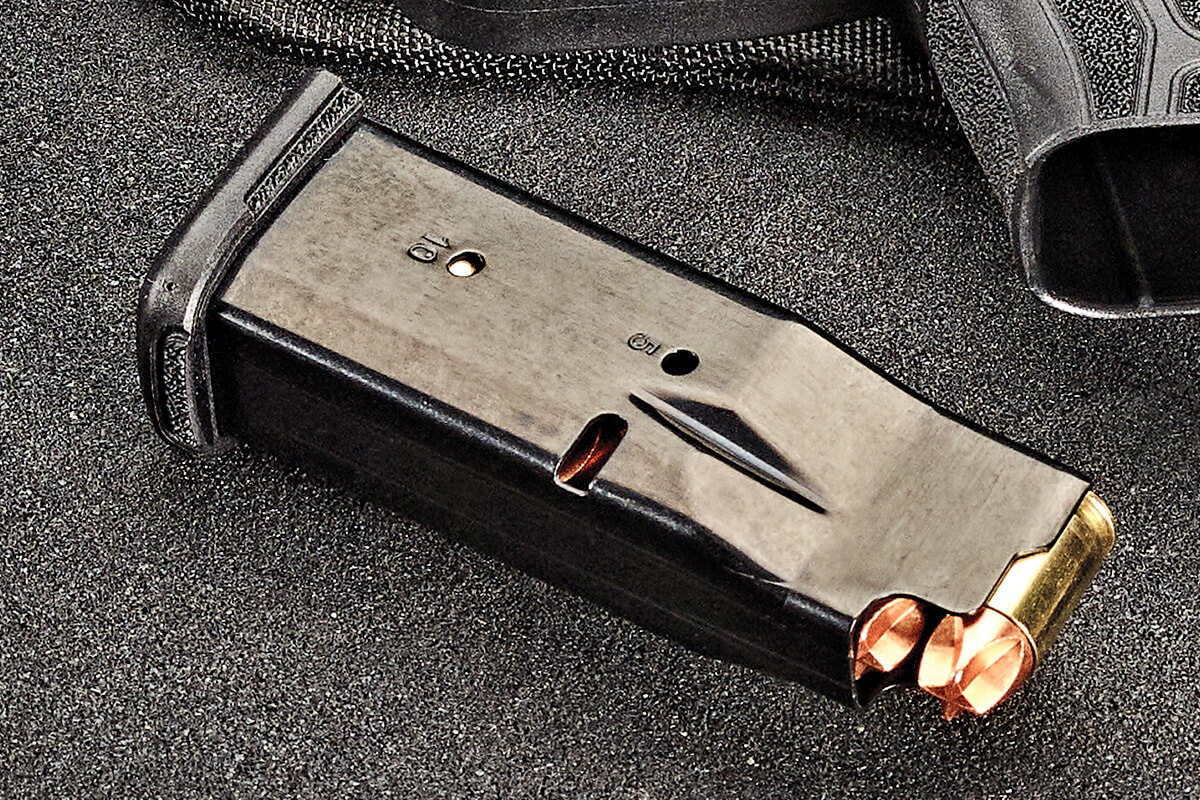
Ruger .380 ACP LCP MAX Pocket Pistol Double-Stack Magazine
The biggest news about the .380 ACP LCP MAX is it has a newly developed double-stack magazine that increases capacity to 10 rounds, almost doubling the capacity of the original LCP. (Michael Anschuetz photo)

Speaking of magazines, the double-stack 10-round magazine that comes standard with the LCP MAX also comes with an interchangeable finger-extension baseplate. It doesn’t increase the magazine capacity, but it offers a bit more to grab onto. I didn’t use it in my shootout because I had a secure purchase using the flush-fitting magazine baseplate. (For the record, I wear medium-size gloves.)

But switching the baseplates is easy. Just push a pin punch or similar tool into the magazine seat where it protrudes into the hole on the baseplate. Slide the baseplate forward toward the front of the magazine. Use caution because the magazine spring is under heavy tension and can cause the forcible ejection of the magazine spring seat and the spring. The magazine spring seat, the spring, and the follower can be removed for cleaning at this juncture. Then just reassemble the parts, switching the baseplates.

The magazine’s metal tube has two witness holes on the right side; one has the number 5 near it, and the other has the number 10, indicating the round counts. The LCP MAX does not have a magazine disconnect safety, so that means it will fire with the magazine removed just like the earlier LCP and LCP II pistols.

The magazine release on the pistol’s frame can be switched from the left-hand side to the right-hand side. This procedure is a bit more complicated but still fairly user-friendly. The pistol needs to be disassembled, so let’s go through those steps first.

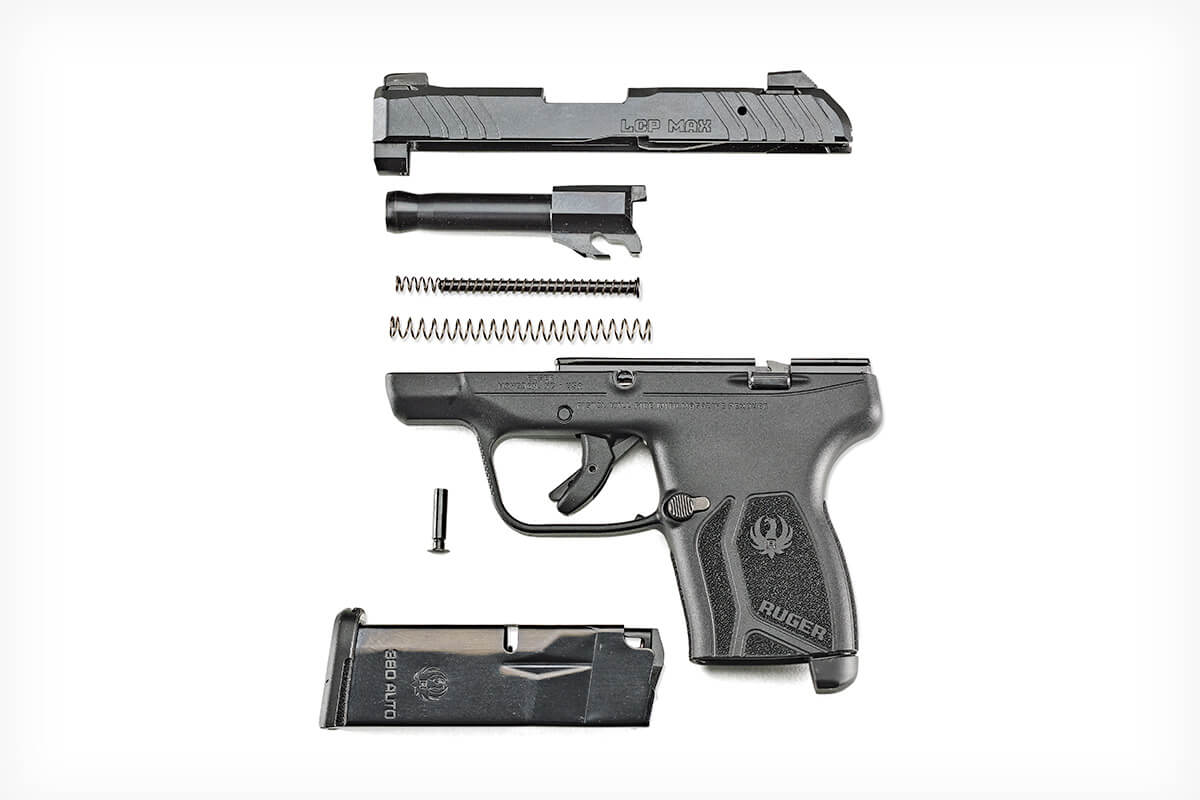
Once you’re certain the pistol is not loaded and the magazine has been ejected, pull the slide fully to the rear and engage the slide stop. Visually check the chamber one more time to be sure it is empty. Retract the slide and release it. Pry loose the takedown pin with a flat-head screwdriver or other blunt tool, then remove the takedown pin entirely with your fingers. Move the slide assembly forward and off the frame. The recoil spring guide rod assembly and barrel can then be removed from the slide.

Ruger .380 ACP LCP MAX Pocket Pistol Field Strip
(Michael Anschuetz photo)

To switch the magazine latch, first look down into the front of magazine well and locate the magazine latch. A wire coming up from the lower part of the magazine well engages the magazine latch, and it serves as the magazine latch spring and retainer. Use a pointed steel rod, such as a scribe, to approach the spring from the bottom of the magazine well. Push the wire to the side it is bent towards while prying it towards the rear of the magazine well until the wire comes free of the latch. The spring does not need to be removed.

Remove the magazine latch by pushing on the striated button side and pushing it all the way through the grip frame. Rotate the striated edge up to get around the end of the magazine latch spring and then down again to remove it from the frame.

Reinstall the magazine latch by starting the striated end into the opposite side of the grip frame. When the latch reaches the spring, rotate it past the spring and then rotate it back to reach the opposite side of the frame. The spring should lie against the flat on the magazine latch.

Use the pointed scribe to manipulate the wire magazine latch spring sideways, away from the striated button, until it locks itself into the magazine latch.

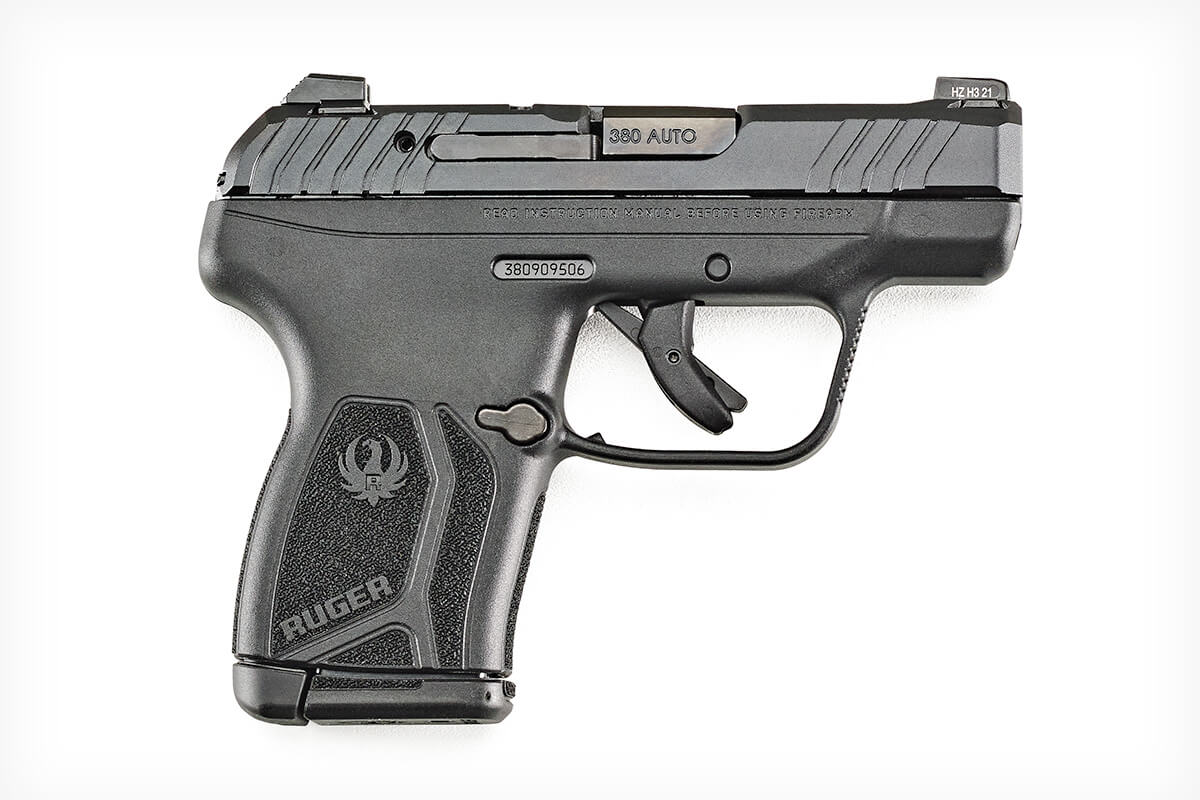
Ruger .380 ACP LCP MAX Pocket Pistol Full View
(Michael Anschuetz photo)

Reassemble the barrel and recoil spring guide rod assembly in the slide and install the slide onto the frame. Always check for proper function after reassembly before firing live ammunition. The company states it is safe to dry-fire an empty LCP MAX in moderation without damaging the firing pin or other components, but using a snap cap is recommended for continued dry-firing.

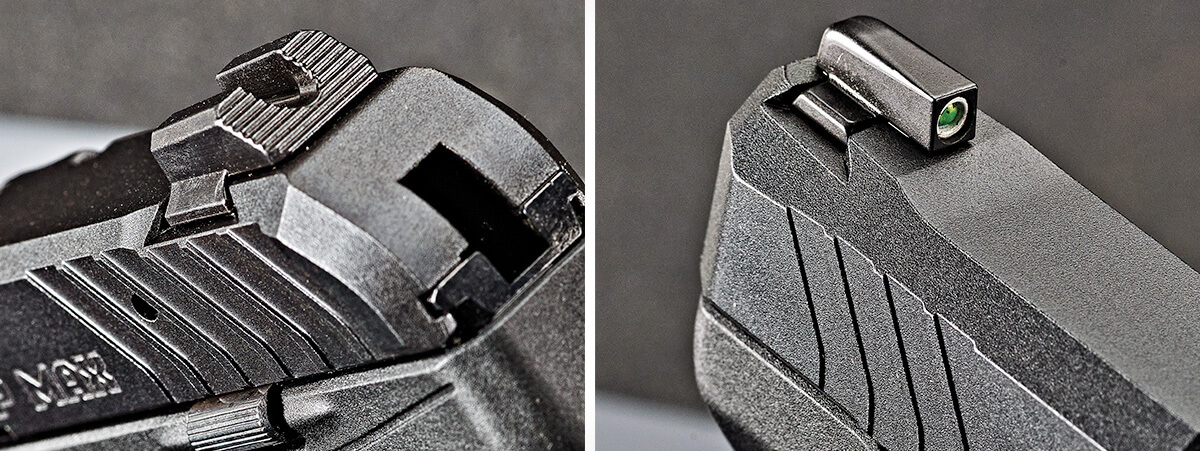
The pistol’s rear sight is all black with horizontal striations on the face and a U-shaped notch. The front sight has a green tritium dot with a white-outline ring around it. It and the rear sight are dovetailed into the slide. If windage adjustment is desired, drift the rear sight in the direction you want to move the point of impact on the target.

The high-performance glass-filled nylon frame has an aluminum insert and a rounded trigger guard that has coarse horizontal texturing on the front. The grip portion has fine texturing on the sides, the frontstrap, and the backstrap.

The LCP MAX comes with a pocket holster, a trigger padlock, and a polymer magazine loader.

Ruger .380 ACP LCP MAX Pocket Pistol Rear and Front Sights
The all-black rear sight has a U-shaped notch, and the front sight has a green tritium dot surrounded by a white ring. (Michael Anschuetz photos)

Range Results

I fired the new LCP MAX with eight .380 ACP factory loads ranging in bullet weight from 60 to 100 grains. The pistol functioned perfectly with all loads. Overall average accuracy for three, five-shot groups with each load at 25 yards was 4.49 inches. Its best single five-shot group measured 2.50 inches, and it came with Federal 99-grain HST ammunition. That load’s average accuracy was 4.00 inches. Shooting offhand at 10 yards with the Federal 99-grain HST ammo placed a full magazine of 10 rounds into a gaping ragged hole with all shots nearly touching.

The LCP MAX weighs just 10.6 ounces, so some recoil is expected even with the low-recoiling .380 ACP round. Some loads were pretty snappy in terms of felt recoil, but none were uncomfortable. The trigger pull averaged 6 pounds, 14 ounces for a series of 10 measurements with an RCBS trigger pull scale.

The only complaint I have from my shooting session doesn’t really have anything to do with the gun’s quality or function, but the sights were a tad fuzzy. But that is due to my poor eyesight.

Obviously, it’s time for me to get some new eyeglasses!

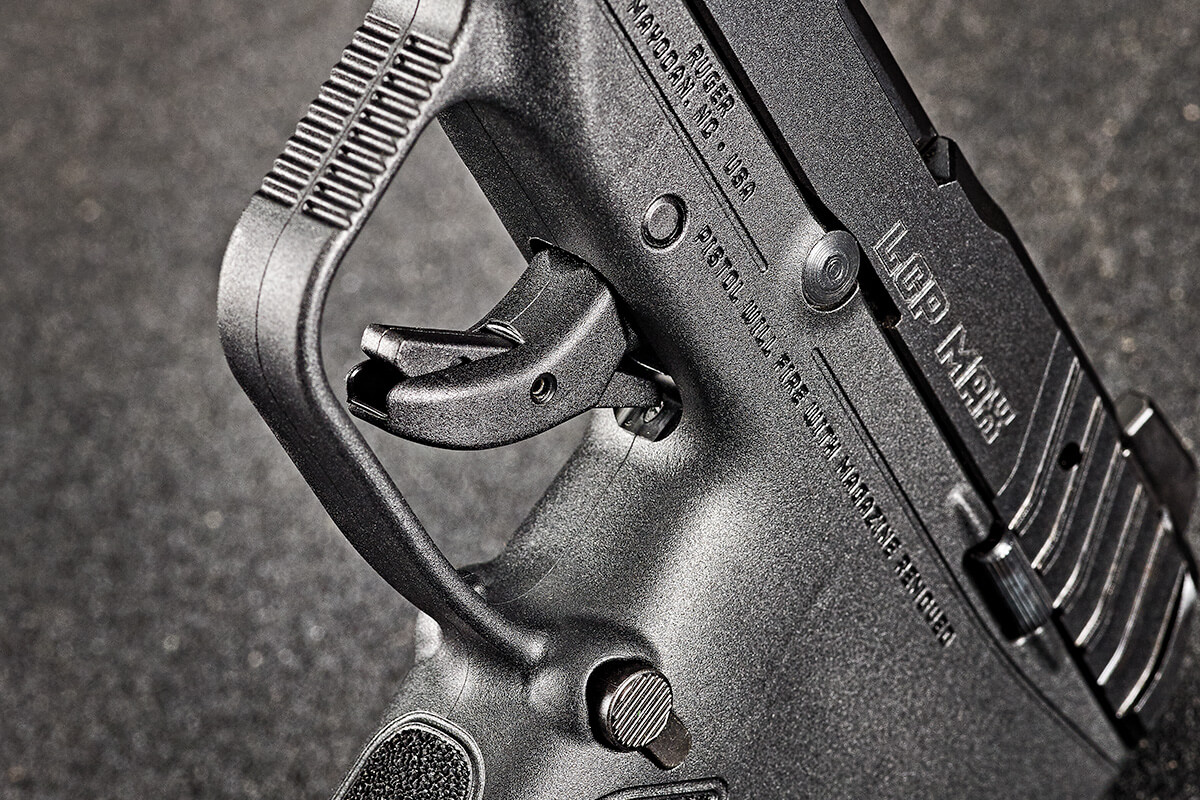
Ruger .380 ACP LCP MAX Pocket Pistol Trigger
The LCP MAX features Ruger’s Secure Action Trigger and a reversible magazine latch. (Michael Anschuetz photo)

Ruger LCP MAX Specifications

  • Manufacturer: Sturm, Ruger & Co., ruger.com
  • Type: Recoil-operated, hammer-fired autoloader
  • Caliber: .380 ACP
  • Magazine Capacity: 10 rounds
  • Barrel: 2.8 in.
  • Overall Length: 5.17 in.
  • Width: 0.94 in. (slide is 0.81 in.)
  • Height: 4.12 in.
  • Weight, Empty: 10.6 oz.
  • Grips: Integral to polymer frame
  • Finish: Black oxide
  • Sights: U-notch, drift-adjustable rear; tritium/white-outline front
  • Trigger: 6.85-lb. pull (as tested)
  • Safety: Safety lever trigger, internal striker block
  • MSRP: $449
Ruger .380 ACP LCP MAX Pocket Pistol Accuracy and Velocity Chart

The Best Elk Hunting in Montana – A Guide

0

Montana is one of the most popular places for elk hunting. With elk populations that exceed 150,000 animals throughout the state, it is a prime place to consider an elk hunting vacation. However, there are certain things to consider before planning your elk hunting in Montana trip.

Each state that allows hunting of elk and other game animals has its own rules and regulations that are designed to protect animal populations and ensure that hunting activities are safe for both hunters and the ecosystem.

Like other states, elk hunting in Montana carries its own rules and regulations for hunting game animals, and understanding these rules will make it easier to plan a hunting trip.

If you are considering elk hunting in Montana, it is good to remember that just because you have a license and permit, and have all the plans in place, you may not actually take an animal.

So, it is a good idea to manage your expectations. In some more popular hunting spots, the rate of success is only about 2%, so be prepared to come home empty-handed.

However, if you are successful, Montana has the potential for taking some massive, trophy-worthy bull elk. If you’re patient and well prepared, your chance of success is good.

Elk Hunting in Montana – A Guide

Northwest Montana is where you will find the best Elk Hunting under Big Sky Country. Combine this with the high success rate for hunters, 17.4 success rate as reported by FWP, and it is easy to see why hunting in Montana is so desirable- there are over 132 outfitters in the state with many offering hunting trips.

winter bull elk standing

When is the Montana Elk Hunting Season?

It is important to understand the hunting season for each game animal that you are interested in collecting, no matter which state you visit. Hunting game animals outside of their designated hunting seasons is considered poaching and can land you in hot water.

Hunting for elk in Montana is no different, and you should be well aware of their hunting seasons and limitations. Each year Montana puts out a complete booklet of rules and regulations for the antelope, deer, and elk seasons. You should read this before you plan your trip.

In Montana, deer and elk season run at the same time. This may not be the case in other states. In 2022 the elk hunting season is as follows:

Archery Season runs from September 3 – October 16, Youth Season (deer only) from October 20th to the 21st, General (rifle and archery) from October 22 until November 27, and Muzzleloader runs from December 10 – 18.

For Backcountry (Districts 150, 280, 316), Archery runs September 3 – 14 while General hunting runs September 15 – November 27.

What is the Best Time to go Elk Hunting in Montana?

Montana elk season is pretty robust, running longer than in neighboring states like Colorado and Wyoming. So, there really isn’t a bad time within Montana’s elk hunting season.

However, if you are looking for the best chance of taking an animal under your license, experienced hunters suggest that during the first few weeks of the general season. As such, the entirety of the archery season offers the first chance to hunt for elk in Montana.

There are also shoulder seasons for Montana elk hunting, and these may give you an even better opportunity to snag a great elk. Shoulder seasons and their regulations change each year, so make sure you know when and where you can hunt for elk during the shoulder seasons.

herd rocky mountain elk cervus canadensis

What is the Difference Between a License and Permit?

In order to hunt in Montana, you will need both a hunting license and a permit. They are two different things, and without one or the other, you cannot legally hunt for elk in Montana.

The first thing you need to get to elk hunting in Montana is a license. The license gives you the legal right to hunt and kill an elk in the state of Montana. There are different licenses for residents, non-residents, youth, disabled, and even former residents. Knowing what you need is the first step to hunting in Montana.

Once you have a hunting license in Montana, you will need to apply for an elk permit. The permit allows you to hunt in a particular area of the state. The state is divided into numerous hunting areas.

You’ll need to know which areas you want to hunt in and apply for those locations. Once you have your permit, remember, that hunting outside of the designated area of your permit is illegal and can result in serious consequences.

How do Non-Residents Get an Elk License?

If you are planning a hunting trip to Montana to hunt elk, it is important that you understand the process for acquiring a hunting license for non-residents of Montana. Montana residents can buy a license from a variety of locations throughout the state, so long as they are available.

However, that is not the case for non-residents. If you do not live in Montana and would like to hunt for elk, you will need to apply for a license.

Each year Montana issues a limited number of non-resident elk licenses through a lottery system. To have your name added to the lottery, you will need to submit an application to Montana Fish Wildlife and Parks, by March 1 of each year.

2022 Elk Hunting In Montana Rates for Non-Residents

Montana residents can buy their Elk licenses over the counter at a reduced fee of $10-$20. For non-residents, you can check the 2022 elk-hunting rates below.

Please note, that all combination license prices include the required Base Hunting License, Conservation License, Aquatic Invasive Species Prevention Pass, and Application Fees.

  • Licenses & Permits Fee
    • Big Game Combination License (Elk & Deer) – $1,145.50
    • Elk Combination License – $971.50
    • Youth Big Game Combination License – $584
    • Youth Elk Combination License – $497
    • Special Elk Permit Application – $9
    • Bow and Arrow License – (mandatory for all archery hunts) $10
    • Preference Point Fee for Combination License (optional) – $100
    • Outfitter Preference Point Fee for Combination License (optional but must hunt with an outfitter) – $100
    • Bonus Point Fee per Species (optional) – $20

Explaining the Draw System for Elk Hunting in Montana

The draw system for elk hunting in Montana is considered to be one of the more complex across all the states, draw allocation, point system, application choices, combination licenses, limited entry draw, application fees, party applications, and points only period all need to be taken into consideration.

To better understand the system, we recommend checking out the video below by magazine and hunter networking site Huntin’ Fool before applying through Montana Fish and Wildlife Parks.

Where is the Best Place to Hunt Elk in Montana?

Most of Montana’s elk populations reside in the western and southwestern parts of the state. Hunters acquiring permits for units in these parts of the state tend to be more successful, simply due to the number of elk available.

The west and southwest parts of the state are also the most popular for permit applications, so your chances of getting a permit in these areas are lower.

If you don’t mind doing a little work and want to hunt where there are plenty of elk but not so many hunters, consider applying for permits in units on the eastern half of the state.

Are There Places in Montana Where Hunting is Not Allowed?

There are a number of places in Montana where you are not allowed to hunt for any game animals, including elk.

In general, these areas are the state’s two national parks (Glacier and Yellowstone), and all the tribal reservations in the state. If your permit borders one of these areas, make sure you are well aware of the boundaries.

How Many Elk Can Be Taken with a General License and Permit?

The general elk license for both residents and non-residents will allow you to harvest one elk per year.

However, you may be able to harvest one additional animal if you can acquire a Montana “B” hunting license. This license allows you to harvest one elk without antlers on particular management units within the state.

These units change from year to year. If you want to try to get a “B” license, you will need to know where you are allowed to hunt.

Beware of Predators!

Montana is home to some of the largest and most dangerous predator animals in the United States. Each year elk hunters cross paths with grizzly bears, black bears, wolves, and mountain lions.

These animals are less interested in you than they are in the carcass of the elk you’ve killed.

Grizzlies cause the most problems in Montana, with hunters and guides being attacked, harassed, mauled, or killed by grizzly bears each year.

You should know how to be safe and avoid encounters with grizzly bears and other predatory wildlife if you are planning an elk hunting trip to Montana.

Related Articles

  • The Best Trout Fishing in Montana
  • How Hot Does It Get in Montana? Important Things You Need to Know
  • How Cold Does It Get in Montana? Things You Should Know

The Dangers Of Iguanas: Can They Really Kill A Dog?

0

Iguanas are large lizards native to Central and South America. They can grow to be over 6 feet long and weigh up to 20 pounds. Iguanas are not typically aggressive, but they can be if they feel threatened. They have long, sharp claws that they can use to defend themselves. Iguanas also have long, sharp teeth that they can use to bite. Can an iguana kill a dog? It is possible, but it is unlikely. Iguanas are not typically aggressive animals and will only attack if they feel threatened. If an iguana does attack a dog, the dog could be seriously injured or even killed.

There is no social aspect to iguanas, and they are not instinctively affectionate toward humans or other animals. During a cold snap, it is possible for a dog to become ill if he or she eats a fallen tree limb. According to the RSPCA, iguanas should not be kept as pets. Digging lizards are native to Central and South America, and they are one of the most popular lizards on the planet. Their teeth are designed to break down plants, but they can be extremely painful to humans. Even iguanas are known to climb human enclosures, though their claws are less impressive than their teeth when digging into the skin. A iguana can grow to be as large as a house lizard and resembles a mini dragon.

Unlike many other reptiles, iguanas do not harbor salmonella. As iguanas get older, they require more humidity in their cages and rooms (70-80%), two mistings per day, and bathing twice a day to stay hydrated. The iguana has distinct personalities that can range from calm and laid-back to aggressive and domineering. In the day, iguanas rely heavily on leaf, flower, and fruit consumption, with their primary food sources being leaves, flowers, and fruits. Salmonellosis and botulism are two of the most common iguana illnesses.

A green iguana‘s teeth are intended to shear plant material while also delivering a painful bite to humans and pets.

Despite having no predators in the wild, iguanas are not fond of dogs.

In accordance with the law, iguanas must be slaughtered in a humane manner and their bodies disposed of properly. If iguanas do not suffer during removal, they can be shot with a pellet gun, stabbed in the brain, or even be decapitated. It is illegal to kill, drown, or freeze iguanas.

Most people believe that dogs and cats are at risk of contracting iguana feces, but this is not the case.

Can Iguanas Hurt Dogs?

There is no definitive answer to this question as it depends on the individual iguana and the dog. Some iguanas may be docile and not pose a threat to dogs, while others may be aggressive and attack dogs. If an iguana does attack a dog, it is possible for the iguana to cause serious injury.

Humans are rarely spotted by the iguana, but the reptile will defend itself against any animal that attempts to catch it or corner it. When iguanas are attacked, they defend themselves by biting humans. Despite the fact that iguanas lack the same mannerisms and behavior as cats and dogs, they are friendly pets. Because iguanas are venomous, they are the least dangerous of all venomous lizards. How can you tell if your dog and reptile are compatible? They’re just sitting around, playing with one another, and nuzzling each other like family. Adult iguanas can bite, scratch, and slap each other with their powerful tails.

Despite its avoidance, the iguana will defend itself against any and all animals who approach it. Can dogs get sick from iguanas? A number of the dogs have died as a result of the test.

They are not the best pets for people who have children, but iguanas can be trained to be good pets. Buddy, like many other iguanas, has been known to live with children for years, and they all get along well. Other iguanas, such as Leo, may attack children and make them less tolerant of them. There are some people who will make excellent pets, and iguanas are a great choice for those who have the time and resources to properly care for them, but they are not a great choice for people who do not have either.

Do Iguanas Go After Dogs?

In an adult iguana, there is a large, powerful animal that can bite, scratch, and slap, as well as cause severe scratch wounds with its extremely sharp claws. The iguana will generally avoid people, but will defend itself against those who attempt to catch it or corner it.

Iguanas: Why They Make Bad Pets

Iguanas are lizards that can grow to be 20 feet long and live in the Patagonian region of South America. Their diet is not made up of mammals, making them one of the few animals on the planet that does not do so. As a result, iguanas are not fond of dogs. Iguanas are common as pets, but they aren’t the right pets for most people. Because iguanas dislike humans, training them to become friendly is difficult. An iguana may not be the best pet for you if you’re looking for something to spend time with.

What Happens If An Iguana Bites A Dog?

The Dangers Of Iguanas: Can They Really Kill A Dog?Credit: davidcordelldesigns.blogspot.com

If an iguana bites or scratches your dog, it is possible that it will develop botulism toxin. This can result in paralysis in an animal. The animal will no longer be able to walk or eat normally in the near future.

Bacteria that cause botulism poisoning can live on crusty skin on iguanas. If you have an iguana that is very large, it can cause fractures in both your dog’s and your own bones. Contrary to popular belief, iguana feces are not harmful to dogs or cats. The iguanas will sometimes attack pet owners or people who try to catch them or corner them, but they are more likely to avoid humans. Salmonella bacteria can be carried by some reptiles, and dogs can become ill from bacteria on a regular basis. The green iguana causes damage to landscape vegetation, and some property owners consider it a nuisance.

It is not as serious as it may appear for iguana bites. There is no need for reptiles to bite to defend themselves; instead, it is a natural part of the reptiles. The teeth of a iguana are designed to tear apart plant matter, but they can also cause pain in some cases. If your dog or cat becomes aggressive or has difficulty eating, it is critical that you bring it to the vet for an examination. If you’ve been bitten by an iguana, don’t wait to seek medical attention.

Can A Dog Get Sick From Biting An Iguana?

Dogs can become ill after eating iguanas. Because iguanas lack toxins or venom, they can develop worms or flukes in their internal organs that can be passed on to their owner.

What Happens If A Iguana Bites You?

Salmonella bacteria can be carried and spread by iguanas, in addition to causing a painful bite. They are especially dangerous if they sustain a bite to the skin that causes blood loss. Because iguanas are pleurodonts, they can also shed their teeth while biting.

Can A Dog Get Sick From Killing An Iguana?

The Dangers Of Iguanas: Can They Really Kill A Dog?Credit: YouTube

It is not only lethal, but it can also cause serious bodily harm. Anxious veterinarians are still treating dogs that may have contracted botulism after eating iguana carcasses as a result of the cold snap that killed thousands of reptiles throughout South Florida. It resulted in paralysis so severe that a few of the paralyzed had to be euthanized.

In South Florida, dozens of dogs have died from paralysis. The veterinarians may have been able to identify a culprit: dead iguanas. The iguana population plummeted in recent weeks as a result of a lengthy cold snap. As a result, their toxic entrails could cause them to become ill. Each affected dog bears a distinct suburban provenance. Why are not dogs coming down with a dreaded, dead iguana disease? It isn’t exactly like botulism. Why are iguanas cute? There is no information about them, so it’s possible that we’d mistake them for being able to produce Botulism toxin after death.

Salmonella can be transmitted to humans as well as causing serious injury to iguanas when bitten. If you’re thinking about getting an iguana as a pet, you should make sure to do some research on its safety.

Can Dogs Get Salmonella From Iguanas?

Salmonellosis has been linked to a variety of pet iguana infections, including fatal ones.

How To Treat Salmonella In Your Pet

You might be wondering what you should do if your pet develops Salmonella. Salmonella, a bacteria, can cause serious illness if consumed. When Salmonella infections are treated promptly, it can be difficult to treat them. Severe Salmonella infections that cannot be treated with antibiotics may require hospitalization in a veterinarian’s office. You can get a good idea of the health of your pet by going to the veterinarian. Although Salmonella may affect all of these animals, it is especially important to be aware of the risk in turtles, frogs, iguanas, snakes, geckos, horned toads, salamanders, and chameleons. Salmonella, a bacteria that can cause serious illness in humans, is frequently found in these animals. If you suspect your pet has salmonella, you should consult with your veterinarian as soon as possible.

Can Reptiles Make Dogs Sick?

Toads and lizards secrete poison on their skin in order to protect them from predators, while venomous bites can occur in other lizards as well. According to Daily Puppy, even a nonvenomous or nonpoisonous reptile can spread bacteria and parasites like salmonella to your dog, causing him to become ill.

Lizards And Dogs: A Risky Combination

There are numerous harmful bacteria that lizards can carry, but it is not usually dangerous to dogs to catch them. However, salmonella bacteria can be transmitted by lizards in Florida, posing a serious risk to humans. If your dog consumes one of these lizards, they may become extremely ill. Even in Florida, small lizards are not harmful to dogs, and if swallowed, salmonella can easily spread to them.

Can An Iguana Kill You

The Dangers Of Iguanas: Can They Really Kill A Dog?Credit: USA Today

Despite the fact that iguanas are not aggressive or dangerous to humans, they can dig long tunnels, damage pavements, and build foundations. Salmonella bacteria can sometimes infect them. Females can lay nearly 80 eggs per year and can grow to be 5 feet tall ( 1.5 metres) and weigh 9 kilograms (20 pounds).

The iguana population in South Florida has grown dramatically, as have complaints from residents. A pellet gun can be used to shoot them, stab them in the brain, or decapitate them if they do not suffer. It is against the law to freeze, drown, or poison them; otherwise, you may face criminal charges. Net-baiting, cage traps, and noose poles are just a few of the methods used to capture iguanas alive. Except at firing ranges, most cities prohibit firearms on private property. According to state guidelines, homeowners are responsible for any animals caught in traps. Animals captured at the site are required to be released as soon as possible.

Only doctors and other professionals with the proper licenses are permitted to inject lethal drugs into humans. Workshops have begun where wildlife commission members can provide residents with tips for living in harmony with nature. In fact, Deborah Millman, outreach director at the wildlife center, says he’s a feisty guy.

Feeding wild animals, including iguanas, is dangerous. The best thing we can do for our children and pets is to stop feeding them food or putting them in the wrong situation. A wild animal is neither a food nor a toy. There is no reason why these animals should not be kept as pets. They should not be viewed as something else when they are seen as such.

Why You Shouldn’t Kill Iguanas

Do iguanas kill anything besides turtles? When an iguana is an adult, it eats foliage, flowers, and fruit. Their diet consists of various animal foods, including insects, lizards, and other small animals, as well as nestling birds and eggs. Are you supposed to eat iguanas? If iguanas continue to invade your property, trapping and catching them may be the best solution. You don’t have to kill them, but you can try to trap them. If you want to capture one, you can use one of these do-it-yourself traps. How aggressive can iguanas be? Some iguanas may exhibit aggressive behavior. It is commonly assumed that behavioral changes in green iguanas that occur during their breeding season and territorial aggression are related to male aggression in general.

What To Do If Your Dog Eats An Iguana

If your dog eats an iguana, the first thing you should do is call your veterinarian. If your dog is showing any signs of illness, such as vomiting or diarrhea, you should bring them to the vet immediately. If your dog is not showing any signs of illness, you should still call your vet to ask for their advice on what to do next.

Pets are notorious for consuming the most bizarre items, including toys, rings, and small creatures. Your dog may die if he eats iguanas because they are reptiles. If your dog has an unusual situation that may result in serious consequences, having a plan is critical. If your dog has eaten a lizard, you should keep an eye on him for any changes in his behavior, such as vomiting, weakness, and loss of appetite. Most commonly, dogs develop an intestinal blockage when they swallow items such as toys or paper clips that they cannot digest. In the United States, if the condition is not diagnosed and treated as soon as possible, it can quickly kill.

Are Iguanas Poisonous To Cats

There is some debate over whether iguanas are poisonous to cats or not. Some people believe that they are, while others believe that they are not. There is no scientific evidence to support either claim.

If a dog eats one that fell from a tree during a cold snap, he may contract salmonella or botulism. Hawks, owls, egrets, herons, cats, and dogs are among the predators that prey on the majority of newborn and juvenile iguanas. An antibiotic may be required to prevent opportunistic infections in cats. According to Iowa State University researchers, catnip is 100 times more effective at repelling cockroaches than DEET. Pets are not poisonous, but they can become extremely ill if they vomit or drool excessively as a result of gastrointestinal irritation. Nausea, illness, or stress can cause cats to salivate excessively and foam at the mouth, just as dogs do.

Iguanas And Cats Can Be Best Friends

If you have cats, iguanas can be an excellent house pet. Although iguanas can sometimes be unsuitable pets for scratching or biting cats, they are gentle creatures that are not harmful to humans. Raccoons, snakes, hawks, owls, egrets, herons, and cats are among the most common predators of iguanas, but they have few natural enemies. If you have a cat, you can keep your iguana in a separate enclosure and give it lots of toys and chew toys to keep it busy.

Are Iguanas Good Pets

There is no definitive answer to this question as everyone has different opinions on what makes a good pet. Some people may find iguanas to be intriguing and low-maintenance, while others may find them to be aggressive and difficult to care for. Ultimately, it is up to the individual to decide whether or not an iguana would make a good pet for them.

IGNITION: Despite their striking appearance and distinct personalities, iguanas are among the most popular exotic pets. Despite being considered good pets by reptile enthusiasts, iguanas are not ideal pets for everyone. If you’re looking for a long-lasting reptile, a iguana can be a good option. The iguanas are diurnal, which means they rise whenever the sun rises. A iguana will not sustain any injuries if he falls from 50 feet. It’s not a problem to feed iguanas live crickets or creepy crawlies because their diet is entirely herbivorous. If you are looking for a pet that is not only fun to watch, but also unique and long-lasting, the iguana might be the one for you.

It is critical to understand that your iguana should not be kept as a pet and that it will require a lot of care and money to care for. A iguana, in general, is a good pet for reptile enthusiasts. It is harmful to keep them as pets for those who cannot afford to do so. Furthermore, iguanas are not suitable for children. It’s up to you to decide whether or not these cute little dinosaurs will fit in with your home.

An iguana is a green iguana or a red iguana. The green iguana is found in the Amazon rainforest, whereas the red iguana lives in the Andes Mountains. In terms of their ecological niches, the two types of iguana differ. A green iguana is a prey species, while a red iguana is a predator species. The green iguana is a prey species that can be found in abundance in the wild. Green iguanas are herbivorous herbivores that consume leaves, flowers, and fruit. The red iguana is a predator that is native to the Americas. It eats both reptiles and birds, and it is a carnivore that eats both mammals and reptiles. A green iguana will require time to be with his owner. They begin to associate with their owners and even fall in love with them. There is no need to potty train your iguana.

Do Iguanas Like Being Petted?

Can iguanas be affectionate? The iguana is not affectionate; however, if you tame and bond with it, it will become more attached to you. As a result, you will need to be hands-on and spend time with your iguana every now and then as a young adult. Owners can interact with and pet tame iguanas as they become more accustomed to handling and petting them.

Iguana Care When You’re Not Home

Furthermore, while you are away, you can crate your iguana. While it is acceptable to occasionally chastise your iguana for a short period of time during the day, it will not harm it. When you’re away, make sure your iguana is well cared for.

Are Iguanas Friendly To Humans?

The iguana is not dangerous or aggressive to humans, but it can cause damage to seawalls, sidewalks, landscape foliage, and burrow tunnels in and around your home. Male taslings can grow to be 5 feet 1.5 meters tall and weigh around 20 pounds (9 kilograms).

Do Not Attempt To Pet Or Handle A Red Iguana

A red iguana, on the other hand, is less territorial and more social, so when threatened, it may become aggressive, and attacks can be fatal. If an iguana bites you, do not pet it or handle it; seek medical attention if you get bitten.

Do Iguanas Like To Cuddle?

Even if their chubby little bodies may shout the phrase “cuddle me, human,” iguanas aren’t cats and aren’t interested in being cuddled up.

Iguanas: Why They’re So Scared

It is no surprise that iguanas are extremely scared of a variety of things. They are also scared of loud noises and bright lights. The fact that water makes iguanas sound so scared is one of the reasons they are so scared. When water is sprayed, iguanas find it very frightening because it makes a rushing sound. When it comes to light, iguanas are also scared of it. Lights, such as flashlight batteries, can be quite dangerous for iguanas.

Do Iguanas Get Attached To Their Owners?

Many iguanas are unique in that they have personalities ranging from calm and reserved to aggressive and domineering. It can be difficult to live with and care for the latter. A more calm iguana, on the other hand, is more likely to bond with its owner while also remaining peaceful.

Herbivores At Heart: The Best Food For Your Iguana

A variety of fresh fruits and vegetables, as well as a variety of fresh vegetables and fruit, should be provided to your iguana to help it adapt to life as an herbivore. If you cut it up into small pieces, your iguana will eat it. It is best to feed your iguana twice a day in the morning and evening, but not at the same time during the day.

Can Dogs Eat Cooked Iguanas

There is no one definitive answer to this question. Some experts say that cooked iguanas are safe for dogs to eat, while other experts caution against it. The best advice is to speak with your veterinarian about whether or not feeding your dog cooked iguana is right for your pet.

I’m willing to try anything. The pellets I ordered will arrive Monday. To see if the pieces taste good, I’ll put them on a salad with some healthy ingredients. Her habits mirror that of Chance, who loves dog food and will eat anything she can get her hands on. The only thing I could do was to remove the bowl when she fell down; nothing else could stop it. The only thing I will say about them is that I do not believe they will harm Luna, but I would love to give them as a replacement for dog food; the food is processed and fresh, so what a fantastic idea. Regardless of what someone says, iguanas are strictly herbivores, and no matter what they say or eat, they should not be fed meat.

My goal is to see some videos. The iguana is one of the most fascinating animals on the planet. Flowers and leaves are the only foods available to iguanas in their natural habitat. When a dog’s bottom teeth are clean, they’re great for scraping any debris off of them. Cleaning after the event is a breeze. It can be difficult to find a suitable diet for home terrarium reptiles because they require a large amount of nutrients. The iguana may lack some substances in its diet, so it should be given some fruits and vegetables. They are not designed to handle meat or meat products in any way.

Iguanas And Dogs Don’t Mix

They are quite adaptable, despite their small size; however, if you keep them away from your dog, they will find it difficult to coexist. Botulism poisoning is a serious and fatal condition in dogs caused by iguanas, and iguanas have been linked to it. It is safe to eat iguana meat, but the skin and other parts of the iguana can be poisonous.

Are Iguanas Dangerous To Humans

There is no definitive answer to this question as it depends on the individual iguana and the situation. Some iguanas can be aggressive and may bite or scratch if they feel threatened, while others may be more docile. In general, however, iguanas are not considered to be dangerous to humans.

Although iguanas are not dangerous, they can cause harm and pose a risk to humans. A dog is not typically aggressive toward its owner, but if necessary, he or she may bite, scratch, or even whip his or her tail in self-defense. Salmonella can also be found on iguana skin, so it’s critical to avoid handling them. The genes of wild iguanas are what determine how they behave; they are born instinctively. They will be instinctively wild animals if you take care of them correctly, regardless of how you care for them. When they are threatened or in fear, they are more likely to overreact and engage in self-defense. A iguana is a large iguana that can climb and hang from trees in the wild and has evolved sharp and long claws.

They have developed a sophisticated set of claws that they use to combat a variety of predators. The tails of iguanas are frequently whipped with great force, and they are not uncommon. Salmonella, a common bacterial disease, can cause severe illness in humans. Salmonella is naturally present in iguanas on their skin. You can still interact with and socialize with your iguana, which is naturally voracious eaters. A good anti-bacterial soap should be used on a regular basis to keep your hands clean. The best way to prepare and take care of an iguana is to learn what it requires, how it needs to be cared for, and what are the best safe practices.

They will actually bite to help them get out of danger. Knowing where they are most vulnerable when biting is critical to preventing biting. Wearing gloves is usually a good idea if your iguana has long nails for the first few times, or if they are quite rough. It is impossible to ignore the fact that iguanas can bite at any time during their lives; be careful not to bite them at any time. Because iguanas can carry Salmonella, it is critical that the wound be cleaned as soon as possible. Trimming an iguana’s claws is an excellent way to improve its health. Salmonella can be prevented through a number of strategies, including good hygiene and contamination control.

The best thing you can do to keep your iguana healthy is to wash your hands on a regular basis and frequently, especially after each time you pet it. This species of iguana is not overly dangerous and does not appear to pose any risk to its owner. Salmonella, a dangerous bacteria, cannot cause harm to iguanas unless you maintain proper and effective hygiene practices. The information and considerations required to determine whether a pet iguana poses a significant threat to its owner are sufficient. You should, however, take precautions in order to keep your iguana and you safe at all times. Salmonella is most commonly found in bites, scratches, tail whipping, and other forms of eating.

It does not mind biting humans if they pose a threat to its reptile. An iguana bite is typically caused by an iguana’s defense mechanism, such as when a human intrudes on its territory or when it defends its young. It is possible for iguanas to bite humans if they are threatened. A bite from an iguana is highly painful because it has teeth that are specifically designed to tear apart vegetation. The iguana is also scared of loud noises, such as water spraying, so if you try to scare it away with a loud noise, it will run away. Furthermore, iguanas are scared of bright light, such as those produced by products marketed to them. When it comes to iguanas in your yard, it is best to be cautious not to scare them too much.

Iguanas 101: How To Tame And Handle Your New Pet

It is absolutely necessary to handle iguanas on a regular, consistent, and gentle basis in order to keep them tame and manageable. When the iguana becomes more accepting of your attention, you will be able to respond better to its moods. A properly cared-for iguana can be an exciting and delightful addition to any home.

Pet Iguana

An iguana makes a great pet if you have the right setup and are prepared to care for it properly. Iguanas are very active and require a large enclosure with plenty of branches or other structures to climb on. They also need a basking spot with a heat lamp to keep them warm. Iguanas are omnivores and need a diet that includes both vegetables and fruits, as well as a calcium supplement to keep their bones healthy.

There are approximately 40 iguana species in the Iguanidae suborder, but only a few of them can be kept as pets. The adult green iguana, on the other hand, can weigh between 15 and 20 pounds when it is fully grown. Despite being the smallest of the aforementioned species, the desert iguana can grow to be more than 15 inches long on average. If you’re interested in adopting an iguana, here are the most important things you should know before bringing it home. Because iguanas are omnivorous, they require fresh greens, vegetables, and fruits on a daily basis. In general, an iguana’s price varies greatly due to the wide variety of species available. A home with an iguana enclosure can cost anywhere between $100 and $500. If you buy fresh food for your iguana once a month, you should expect to spend $50 to $100. The reptile vet should come to your iguana’s house at least once a year for a checkup.

Iguanas: Great Pets For Those Who Want To Learn About Reptiles

Those who are interested in reptiles but are not ready for a more aggressive animal will find iguanas to be a great pet. Because they are easily handled and can interact with other animals, they are safe to be around children. However, iguanas can become aggressive during mating season, so you should be aware of their behavior and prepared to deal with them if necessary.

Duck hunting with a night vision device

0

One of the most popular targets for hunters is the duck. Various species of this waterfowl are widespread in most countries, so everyone has the opportunity to shoot a large number of individuals. There is a wide variety of types of duck hunting. In some of them, hunters will need night optics. It will allow you to do what you love after sunset and in the pre-dawn hours, when natural light is not enough for high-quality aiming and making accurate shots.

Features of duck hunting with NVDs

Duck hunting is an exciting activity that gives each participant unforgettable emotions and allows them to show their hunting abilities. The secret to the success of such an event lies in the details. The hunter must use carefully prepared weapons and the highest quality auxiliary devices to achieve his goals. The latter always includes NVDs. They can provide good visibility in the early morning and late evening and at other times of the day when there is a lack of natural light (for example, in adverse weather conditions). With their help, duck hunting will become more accessible, exciting, and safer.

For this type of hunting, you need an adequately selected weapon. It must comply with legal regulations and all hunter requirements. The same rule applies to ammunition used for shooting ducks. The third important aspect to pay special attention to is the selection of NVDs. Some scopes, binocular or monocular, are suitable for a duck hunter. To qualify as such, the chosen device must meet several criteria that make it possible to shoot waterfowl. The main one is the equipment’s ability to provide the user with an image that quickly changes in real-time. The selected night optics must process the image as soon as possible and display it on the screen with a minimum delay. Compliance with this criterion will make it possible to see the goal, regardless of the actions it performs. This will simplify the task even in cases where the hunter’s only chance of success is to kill the duck on takeoff or while lowering into the water. Not all NVDs have the ability to process images quickly. Only the best and most reliable manufacturers can create models with these options and provide them to hunting enthusiasts at an affordable price.

Hunting ducks with night vision equipment is always fun. For this activity to not only give positive emotions but also allow you to get good trophies, you need to consider the behavior of birds at each moment in time. NVDs are often used in the early morning, when the sun has not yet risen, and late evening. At this time, they compensate for the lack of natural light and enable the hunter to see well. Before sunrise, ducks become more active. They are full of strength and energy after rest, so all their actions are fast and sharp. This creates specific difficulties for the hunter since shooting an actively moving bird is much more complex than a stationary target. If you use NVDs, the task will be a little more straightforward. The hunter will be able to see ducks’ behavior and predict their actions. At the same time, most waterfowl are more predictable in the morning than in the evening. They perform the same daily activities and rarely change their usual feeding places. It is this feature that is important for a hunter to take into account when choosing the optimal point for shooting. After sunset, ducks become less active. They move pretty slowly and, in some cases, remain entirely motionless. The latter occurs in cases where there is very little daylight and the birds are preparing for rest. At this time, shooting a duck is relatively easy. However, the hunter needs high-quality night optics from a reliable and time-tested manufacturer for this. Only she can cope well with the assigned tasks and will not let the user down at the most crucial moment.

Using various NVDs during duck hunting opens up new opportunities for the hunter. With their help, he can see all the birds in the pond and accurately determine their species. In addition, night optics will also come in handy when searching for a suitable place to set up a shelter. It will allow you to clearly see the surrounding area and safely move even along the most challenging paths near the reservoir. If hunting is carried out from a boat, then night optics will be helpful. It will help you safely swim to a predetermined place and quickly inspect the territory, finding each feathered target.

When hunting ducks, it is essential to remember that these waterfowl are never alone. They live in large flocks, which can number several hundred individuals. In this regard, if you find at least one duck, the rest of the community will be somewhere nearby. Ducks choose relatively small bodies of water as their home sites, with plenty of food for them. They feed mainly on plants but can also enjoy various small aquatic inhabitants. Considering the above, the hunter needs to look for ducks in places that meet all these criteria. If searches are carried out in the dark or poor daylight, then various types of NVDs will help increase the efficiency of such work. They will significantly improve visibility and help you spot potential prey faster.

Benefits of duck hunting with NVDs

Early morning and late evening are excellent times not only for nature walks but also for duck hunting. In this case, hunters will definitely need night optics that can compensate for the lack of natural light during the event. Its capabilities will provide users with many advantages, increasing the chances of completing the hunt.

Advantages of hunting in the wee hours:

  1. Early activity of birds. During the first hours allotted by law for the legal shooting of ducks, these waterfowl are very active. Thanks to this, the hunter has many potential targets from which he can choose the most accessible one. In case of poor visibility, various NVDs will come to the rescue. They will help you correctly assess the situation and find optimal goals.
  2. Long-term activity of birds. Ducks are active before sunrise and throughout the next few hours. This time will be enough for the hunter to enjoy hunting and get several good trophies. It can be pretty dark on cloudy days, in the predawn hours, and during sunrise, so seeing a potential target is not always possible. Modern night optics from a trusted manufacturer will help solve this problem, providing the hunter with a high-quality and clear picture of the area.
  3. Birds’ employment. Before dawn and just after sunrise, ducks are busy searching for food. In this regard, they pay little attention to the events around them, allowing the hunter to get as close as possible. In this case, the only problem for successful shooting may be the lack of natural light. Various modern NVDs designed for hunters can compensate for this.

Benefits of hunting after sunset:

  1. Reduced bird activity. After sunset, most waterfowl begin preparing for the night. They become less active during this period, and their movements slow down. This simplifies the hunter’s task since shooting a duck during the day is much easier. Just after sunset, there will be enough light to track prey. However, suppose the bird activity is slightly prolonged (for example, due to favorable weather). In that case, the optimal time for hunting will be late evening, when there may not be enough natural light to make accurate shots. In this situation, the only correct solution would be to use various night optics, the characteristics of which meet the requirements of duck hunting.
  2. A large concentration of birds. In the evening, ducks gradually gather in their roosting areas. On large bodies of water, the concentration of birds at this time of day can be pretty high, which is why the probability of a miss becomes minimal. The longer you can wait to shoot, the larger the concentration of ducks you can see. Therefore, to increase the chances of success, most hunters prefer to start hunting as late as possible. In this case, it will only be possible to do with NVDs. They compensate for the lack of vision of a person who cannot see usually in the dark.
  3. Decrease in temperature. After sunset, the air temperature inevitably begins to drop. This circumstance creates a certain discomfort for lovers of evening walks but becomes an essential factor in the success of a duck hunter. Due to the decrease in temperature, the birds are forced to stay closer to each other, making them an ideal target. The more time passes since sunset, the lower the temperature becomes. Therefore, hunters try to start shooting as late as possible to be able to shoot at large concentrations of ducks. In this case, natural light will not be enough for regular aiming. However, this will be fine with modern NVDs from a reliable manufacturer.

Types of NVDs used during duck hunting

You can use different types of night optics when hunting in the dark for any waterfowl. All of them will expand the hunter’s capabilities, making available those actions that were previously impossible. By correctly using all the privileges, you can maximize your chances of success and get great pleasure from the hunting process. Each device has its purpose and is used by the hunter to achieve specific goals. Therefore, combining different NVDs to maximize capabilities is the most correct solution.

NVDs used by duck hunters:

  1. Monocular. For hunters who prefer to target a variety of waterfowl as their primary target, one of the most valuable NVDs is a monocular. It will help you quickly inspect the pond and the surrounding area, finding ducks and birds there. Modern monoculars from a top manufacturer will provide good visibility even in meager light. All of them are characterized by a minimal delay in image processing, which makes it possible to see events occurring in real-time. Many types of monoculars can be helpful for duck hunters. They are equipped with thermal sensors or an electro-optical converter. Models of the first type capture the heat emanating from birds and allow you to see their outlines. In contrast, the second type amplifies the light due to its transformation in an electron-optical converter, creating a brighter and clearer image. Some combined models combine the capabilities of night optics of both types.
  2. Binoculars. This NVD is a must-have for duck and other waterfowl hunters. It is similar to a monocular but allows the user to observe with two eyes. This increases the efficiency of such work and makes it more comfortable for the user. There are many types of binoculars designed for night duck hunting. Each of them has its advantages and disadvantages, so choosing one depends on the hunter’s needs. Modern models of such night optics have excellent performance characteristics, thanks to which they create a high-quality image that helps to detect ducks quickly. In most cases, binoculars from top manufacturers are supplemented with many useful options that will come in handy for a waterfowl hunter (for example, the presence of a built-in rangefinder will make it possible to determine the distance to ducks and make certain adjustments to the aiming process).
  3. Sight. The most important NVD for a hunter is the night vision scope. It is a must-have weapon for anyone who intends to hunt ducks and other waterfowl. Thanks to its capabilities, it will be possible to observe potential prey, aim well, and shoot with a minimal probability of making a mistake. Modern models of such optics, produced by well-known manufacturers, can transmit images with a minimum time delay. Thanks to this, the hunter sees everything that happens on the pond in real-time and can kill ducks, even during their takeoff or landing on the water. Like binoculars/monoculars, scopes from the NVDs category have many valuable additions that allow you to maximize a hunter’s capabilities and increase the likelihood of success.
  4. Goggles. One of the most valuable NVDs for hunting is goggles. They work on the same principle as monoculars, binoculars, and sights but are more convenient. They do not occupy the hunter’s hands and allow him to perform several actions simultaneously. Such glasses are often used to find the optimal place for shooting. They are also used to detect ducks and determine their approximate distance. For waterfowl hunting, only glasses from a well-known manufacturer are suitable. Such optics will always be as reliable as possible, and everyone will feel comfortable using them. All modern models of night vision goggles have their strengths and weaknesses. Having studied them thoroughly, you can choose the most suitable device for hunting ducks in certain environmental conditions.

Classic night optics and thermal imaging models are equally suitable for duck hunting. The former will be the optimal solution in cases with a slight lack of natural light. Most often, this happens in the pre-dawn hours or after sunset. Thermal imaging NVDs are ideal for nights or terrible weather. They can work effectively even in complete darkness, making duck hunting accessible anywhere and anytime. Another essential feature of such night optics is the ability to see through grass, bushes, and tree branches. Thanks to this, hunters can even detect those ducks that have set up a roosting site in dense thickets. Thermal imaging optics will also be helpful during the day. It will improve visibility in adverse weather conditions that can ruin the hunt. Thus, devices that support thermal imaging technology will benefit from fog, heavy rain, and other natural anomalies.

Safety regulations

Any type of hunting, including those involving different NVDs, requires maximum caution and strict adherence to basic safety rules from each participant. This approach will allow you to enjoy what you love without fear of trouble.

Safety regulations:

  1. Any hunting with or without NVDs is always a potentially dangerous activity. The greatest threat comes from the weapons in the hands of each participant in the hunt. To avoid various troubles, operating it strictly with the rules is necessary. It is also recommended to pay attention to the safety measures specified by the weapon manufacturer. When using NVDs, the risk of accidentally shooting another hunter is minimized (due to good visibility of the surrounding area).
  2. Very often, ducks and other waterfowl live on the pond. Hunting some of them may be prohibited by law, making it essential to shoot only after accurately identifying the target. If you do not follow this simple rule, you can accidentally shoot a rare bird for killing, and you will have to pay a hefty fine. To reduce the likelihood of such a negative outcome, it is essential to use NVDs. They will help determine the type of bird observed even in deplorable lighting conditions.
  3. Most often, small shot is used for duck hunting. It scatters in different directions, which increases the chances of hitting the bird. However, it is always important to remember that such a fraction has a relatively small weight. Because of this, it can ricochet off large stones and other hard surfaces. The hunter needs to shoot from a long distance to prevent such a situation and not injure himself. This is quite difficult to do in poor visibility conditions, so you must use various NVDs. In their absence, shooting only at flying ducks that have reached a certain height will be possible.
  4. If hunting is carried out from a boat or other watercraft, then for personal safety, it is essential to consider the weapon’s recoil force when shooting. If you neglect it, then after the first shot, you can end up in the water with your gun and the night vision device you are using. This can scare away the ducks and completely ruin the hunt.
  5. If there is insufficient lighting, you must carefully inspect where you will hunt ducks. In this case, it will be possible to detect the presence of other hunters in the given territory and prevent accidentally hitting them during shooting. This security measure is straightforward but effective. It virtually eliminates the risk of injuring or killing a fellow hobbyist. To inspect the area, you need to use NVDs. They will improve visibility and help detect even a well-camouflaged person.
  6. When hunting ducks from a pre-arranged shelter, it is essential to ensure that it is inaccessible to various representatives of the fauna. Otherwise, the inhabitants of the reservoir and the adjacent territory may pose a danger to humans. For example, there are many poisonous snakes near many bodies of water whose bite can be fatal. Also, remember insects that carry various diseases and predators that come to drink.
  7. From dusk to dawn, the weather can have a severe negative impact on the hunter. In addition to sudden changes in temperature, various precipitation and other natural phenomena (for example, fog, which impairs visibility and increases the likelihood of shooting at another hunter) can be hazardous to health. In this regard, you need to protect your body with adequately selected clothing that will not get wet and prevent hypothermia. In the event of precipitation, various NVDs will help improve hunting safety. They will enhance visibility, thereby reducing the risk of many troubles.
  8. When hunting on a pond, it is essential to consider every little detail. In this regard, a hunter’s backpack should contain many valuable items to help him if specific problems arise. These items include medications, navigation aids, spare or rechargeable batteries for NVDs, a knife, a flashlight, and more. Each hunter creates his own set of accessories based on the characteristics of the hunt he is going on.
  9. Anything can happen while hunting, so lovers of this activity should always be prepared for various unpleasant surprises. This attitude of the hunter will increase his vigilance and allow him to take a more responsible approach to every action he takes. The result will be increased safety and reduced risk of various problems.
  10. It’s best to go duck hunting with friends or relatives. Having other people nearby will not only allow you to have a good time preparing for the hunt but will also increase the safety of everyone involved. So, in case of any troubles, a person will always be nearby who will quickly come to the rescue and help avoid the worst consequences.

Duck hunting is a traditional activity that is popular in different countries of the world. Most often, it is carried out during the daytime, when the most significant movement of birds is observed. However, in addition to this classic hunting method, an alternative one is becoming more popular every year. It involves searching and tracking prey in the pre-dawn hours or after sunset when the available light is insufficient for average visibility. In this case, various night optics come to the aid of hunters. It helps you find even well-hidden birds, aim well, and shoot with minimal misses. Moreover, only the best optics from a top manufacturer can provide such a result. If you make the right choice, you can avoid various difficulties and fully enjoy the hunting process.

Light & Accurate: Winchester Model 70 Extreme Weather SS Review

0

Writer Kevin Reese puts the Winchester Model 70 Extreme Weather SS through its paces. Verdict? Worth it.

The Winchester Model 70 Extreme Weather SS I tested was manufactured by Browning in Viana, Portugal, and like all performance rifles, it begins with great bones.

Winchester Model 70 Extreme Weather SS Review

The Model 70 Extreme Weather SS boasts a Bell & Carlson stock constructed via a “hand lay-up” process in which each composite ingredient is meticulously applied. Internal to the stock is an aluminum bedding block system designed to ensure the barreled action remains perfectly stable, balanced, and bedded for exceptional accuracy.

The Winchester Model 70 Extreme’s action and barrel form the backbone of the rifle’s performance. As a starting point, both components consist of stainless steel with a rich matte finish. True to desirable pre-1964 Model 70s, today’s iterations feature Winchester’s iconic claw extractor with controlled-round feed and a three-position safety. The safety’s middle position allows the bolt to be cycled while still on safe—perfect to safely check if a rifle is unloaded.

The Model 70 Extreme’s 26-inch .300 Win. Mag. barrel is fluted and free-floating with a 1:10 twist, recessed crown to protect rifling, and is capped by a pepperbox-style muzzle brake. The assembled barreled action delivers the consistent sub-MOA accuracy hunters demand and reliability they can trust. Additional features include precision-machined bottom metal with a hinged-plate magazine and Winchester’s M.O.A. Trigger.

Trigger Time

For testing, I used a Brownells Model 70 Long-Action single-piece scope base and Accu-Tac’s medium-height, 30mm scope rings. On top, I mounted a Sightmark Citadel 3-18×50 LR2 first-focal-plane riflescope with a mil-dash reticle and .1-MRAD turret adjustments. Underneath, I employed a Firefield Stronghold 6-9-in. bipod and my trusty Tactical Tailor squeeze bag. For ammo, I chose Black Hills Ammunition’s 212-grain ELD-X.

With the rifle setup for hunting conditions, I headed to the Arlington Sportsman Club, a local shooting range on the western edge of Mansfield, Texas. To begin, I visually boresighted to a paper target just 50 yards away, made quick adjustments, settled down behind the rifle, and squeezed the trigger. Up front, the trigger seemed a tad stiff, but the shot rang out sooner than I expected. My first lesson—the trigger has short travel and is incredibly crisp. I had expected a longer pull, and it felt as though it hovered around 3 lbs. Later testing with a Wheeler gauge resulted in a 20-pull average break-weight of 3 lbs., 6.8 oz.

At 100 yards, I employed my LabRadar chronograph and shot for groups. The Winchester Model 70 Extreme Weather SS and Black Hills Ammunition’s 212-grain ELD-X .300 Win. Mag. ammo did not disappoint! I managed a .585-MOA 5-shot group. Soon after, I also scored a .75-MOA at 200 yards. Black Hills Ammunition’s ballistic data was equally impressive. Average muzzle velocity was 2810 fps with a standard deviation of 9.7. Extreme spread was 31, and muzzle energy was 3718 ft.-lbs.

The Final Shot

With the Model 70 Extreme’s Pachmayr Declerator buttpad and muzzle brake, recoil was quite manageable, even comfortable for the caliber size and lighter rifle weight. Loaded, with a riflescope, the Model 70 Extreme SS weighs about 10 pounds.

Empty, the rifle weighs seven pounds four ounces. Considering shooting and carrying comfort, as well as accuracy and the Model 70’s proven reliability, I’m a big fan of the Winchester 70 Extreme Weather SS.

Thanks for supporting us! We may earn a modest commission from affiliate links in our articles.

How to Clean a Snapping Turtle

0

I was down on the creek fishing a few weeks ago and what did my wondering eyes see? Yep, a snapping turtle trying to hurry and get to deeper water because he knew he had been spotted. I didn’t bother jumping down the bank and grabbing him this time but I usually do that once or twice a year. Snapping turtles are prevalent here in Kansas. You’ll see them walking through pastures or crossing the road. You may catch one on the end of your fishing line or just see one up in the shallows like I did. So the hard part isn’t catching one but rather cutting into it. At least it was for me. The shell is a nightmare to get off if you don’t know where to cut and when. I’ll walk you through the process so if you’ve never tried snapping turtle, you can now!

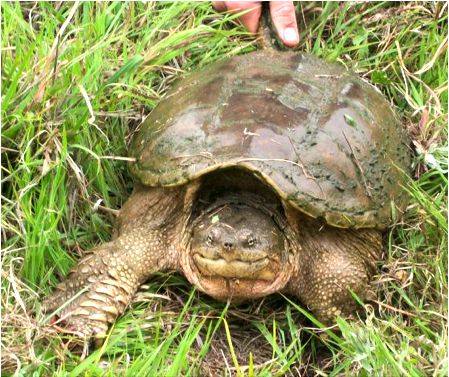
Step 1: Get a snapper. They can be easily handled by the tail, just stay away from their head. Snapper1

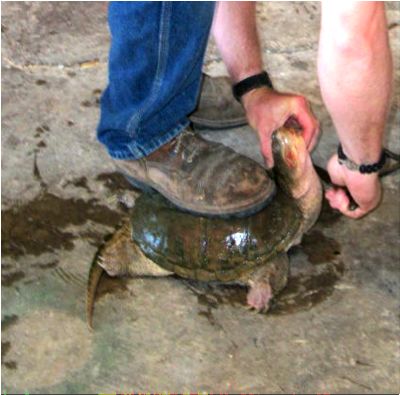
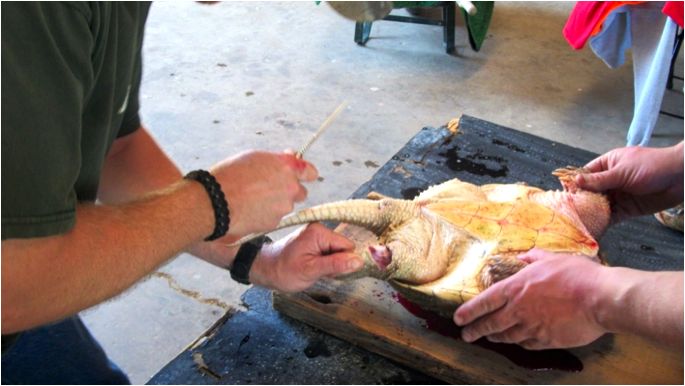
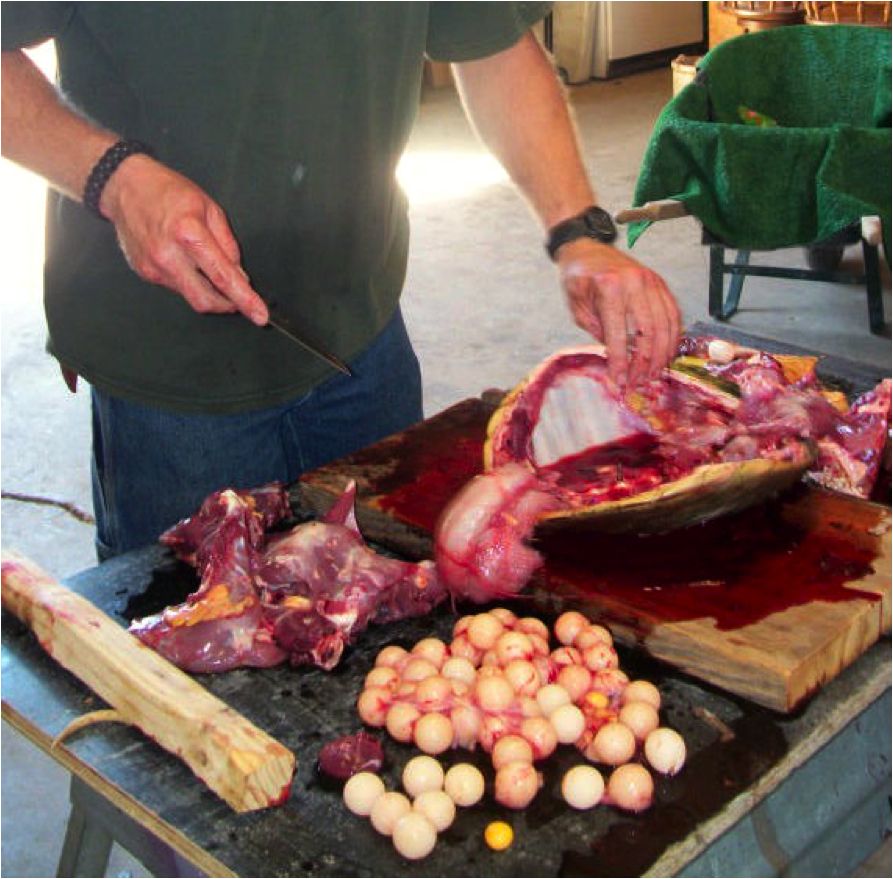
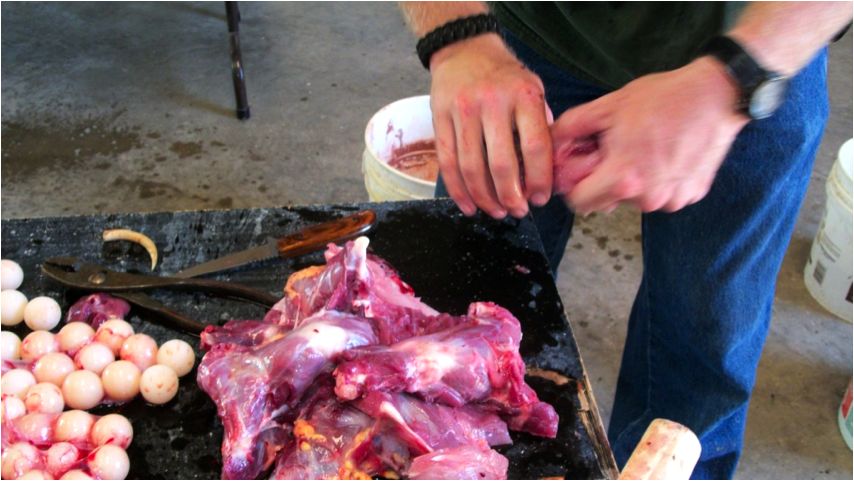
Step 2: Stand on the back of its shell and give it a good smack in the nose, driving its head back towards its shell. This will render the turtle stunned for a bit. While the turtle is still out of its wits grab its head with a pliers or your hand and pull up. Make a quick clean cut from its throat, navigating through its spine, and finally cut the head off. This method, if done right, will make a very quick and clean dispatch for the turtle. Snapper2 Step 3: I use a 2×12 with a 16 penny nail drove through the bottom sticking up to hold my turtle in place. Simply drop the turtle upside down on the nail and it’ll stay in place while you cut it up. This way also allows you to spin the turtle as you work. Begin by cutting off each foot. The joints are about an inch behind the claws. Use your knife to gently find your way between joints. This will prevent the turtle from clawing and scratching you during the butchering process. Snapper3

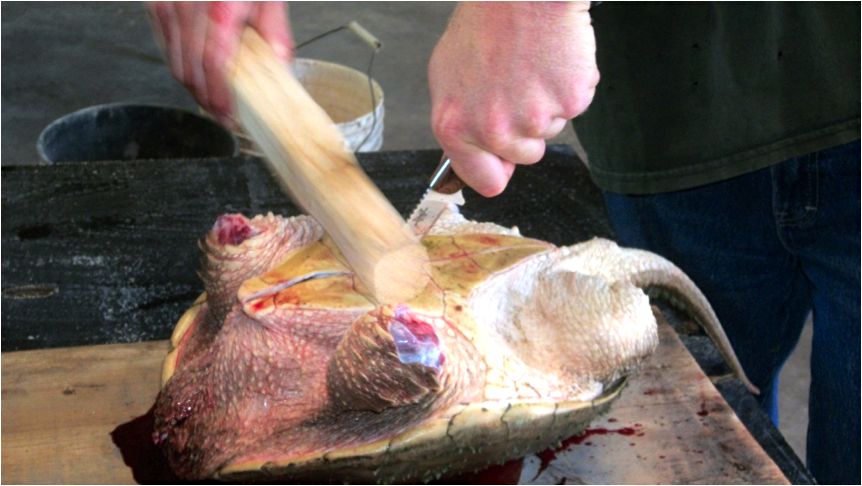
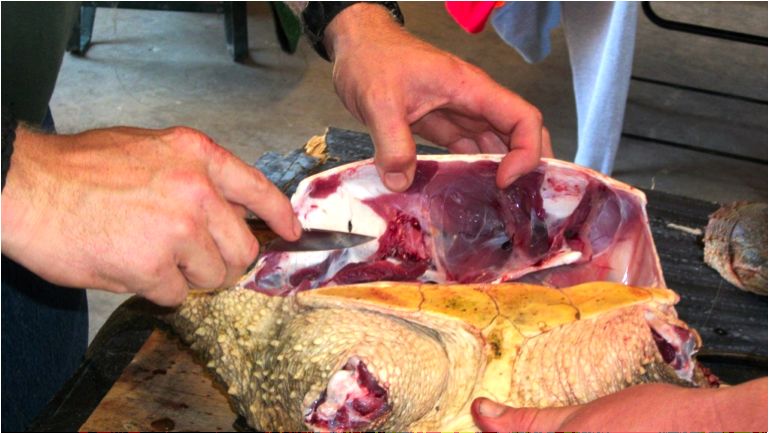
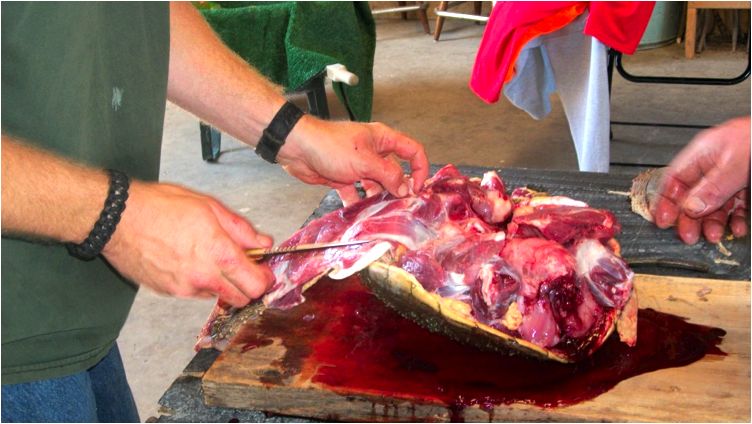
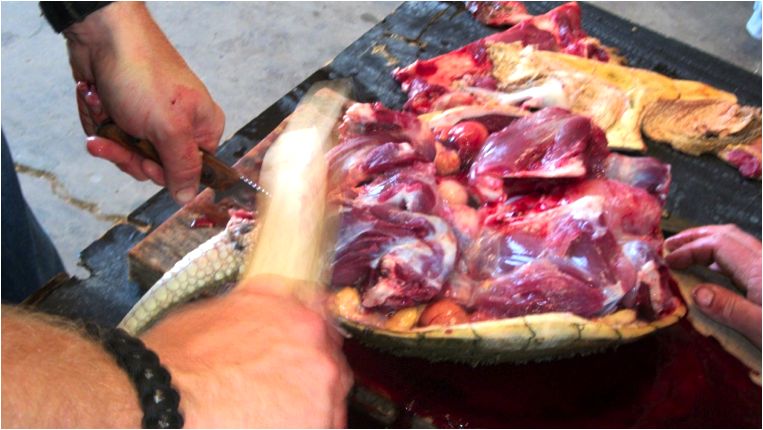
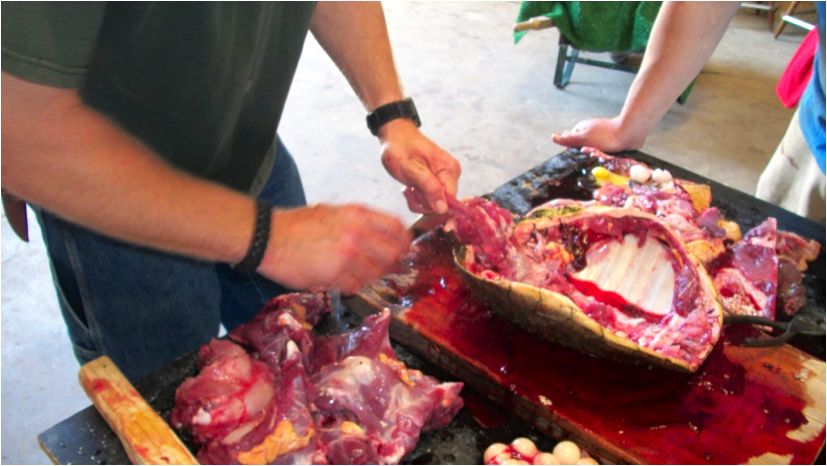
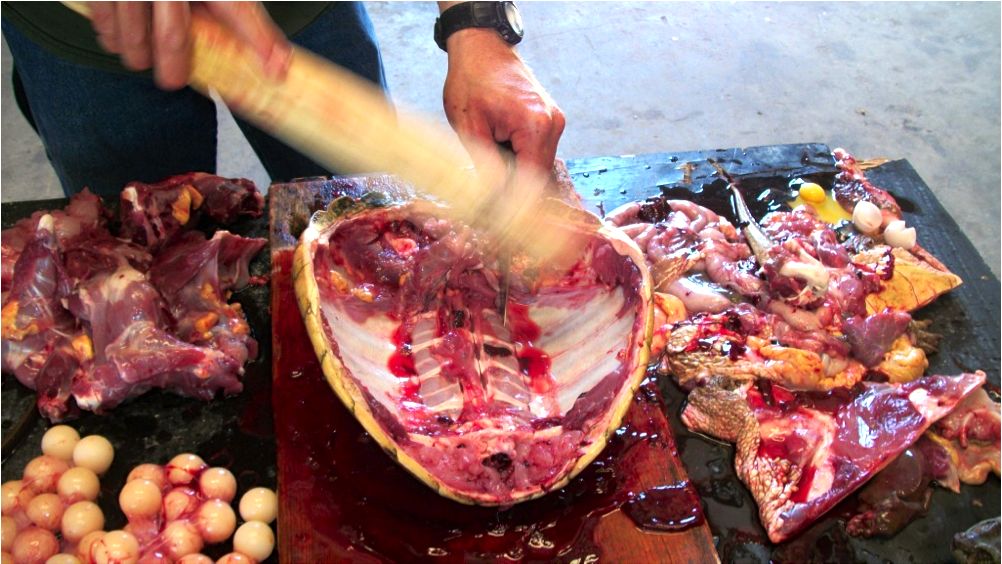
Step 4: Now to get the shell off. Cut right down the center of the bottom plate to its vent; use a wooden baton if needed. Then cut around the perimeter of the shell. Snapper4 Step 5: Skin the turtle from the middle out. Be careful when starting because the front shoulder blade is right next to the bottom shell. Once again, let your knife “feel” its way through. Snapper5

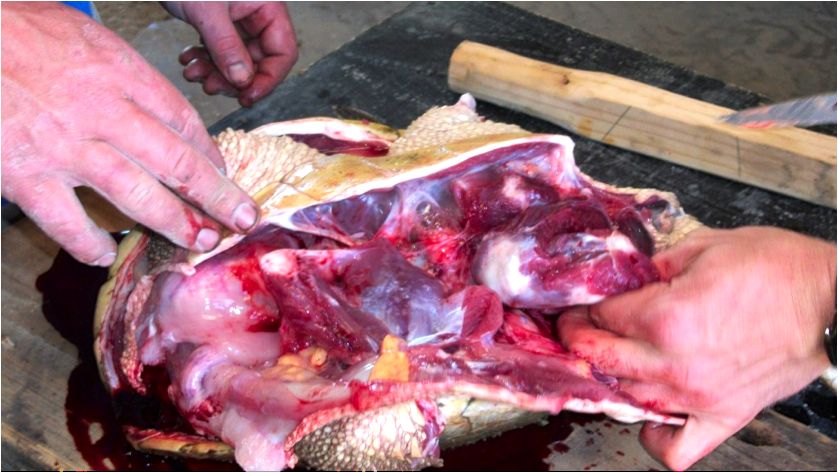
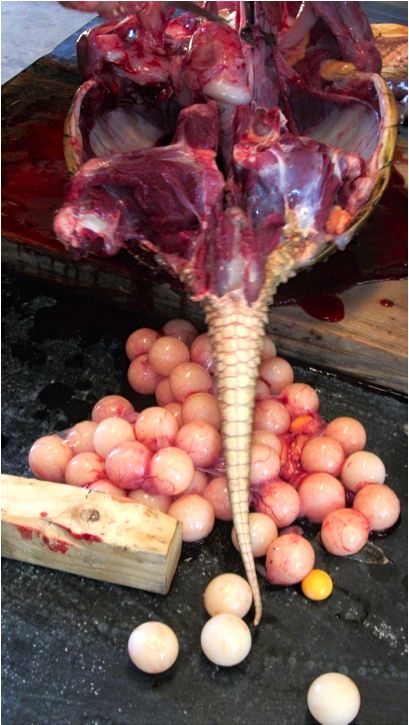
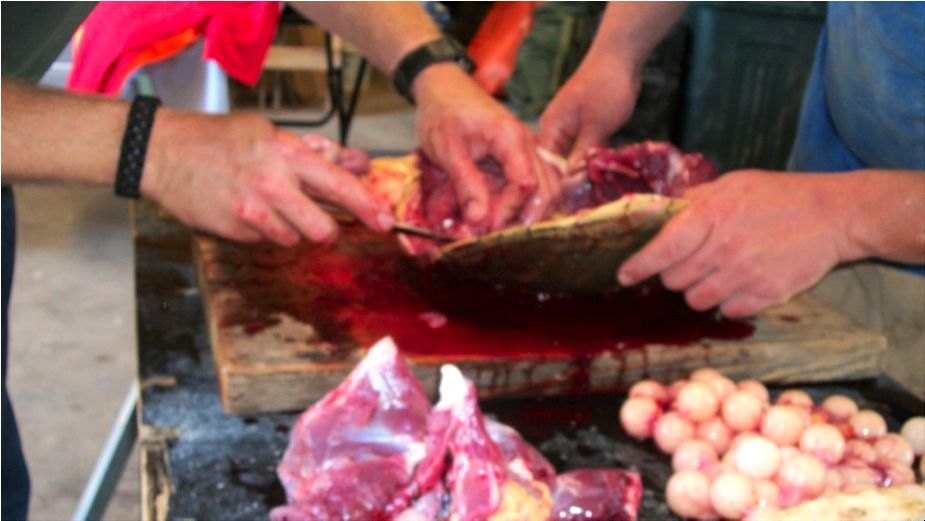
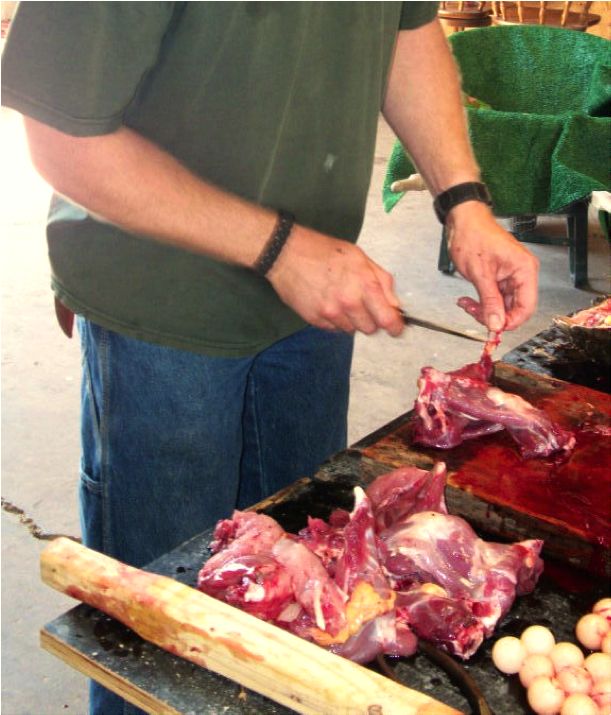
Step 6: Work your way around the legs. Right now you are skinning the turtle just as you would with any other animal. Do both sides the same. Snapper6 Step 7: Once the skin and bottom portion of the shell are removed. You’ll now quarter out the limbs. Turtles have a different bone structure then other animals so it’ll take some trial and error to get the quarters off. Snapper7 Snapper8 This one happened to be a female, not a bad thing for here. Notice all the eggs, which can also be eaten. Snapper9 Step 8: Work out the rest of the quarters. Snapper10

Once the 4 quarters are out, cut off the neck and tail. As you can see, there’s a lot of meat on one turtle! Snapper11 Snapper12 Step 9: Using your baton again, gently cut down each side of the backstrap. Remove each side and trim off the cartilage. Snapper13 Snapper14 Step 10: From this point, trim the meat; cutting off any damaged parts, yellow linings, or other unwanted parts. Snapper15 Step 11: Rinse the meat and soak in salt water overnight in the refrigerator. What’s left over from butchering can be used for fishing bait or trapping bait (where legal).The shell works as a good attractor for trapping. Snapper16 Step 12: Lastly, when I make turtle I boil the meat for about 90 mins. This will tenderize it and cook it. For flavoring I’ll then throw it into the cast iron skillet with a little oil and seasoning. Brown each side and you’ll be good to go. Turtle is very good and cutting one up is a skill worth knowing.

Five of the Best Boa Snowmobile Boots

0

Freezing cold toes are no fun when you are out for a ride. These boa snowmobile boots will protect your little piggies when the mercury drops.

No one likes to get cold feet, especially when snowmobiling, and maybe when getting married. Picking the right pair of snowmobile boots is vital to the enjoyment of the ride. Not only do you need warm boots, but also supportive boots that function just as well off the sled as they do on.

While not absolutely essential, the boa closure system is ideally suited to snowmobilers. Lacing up your boots, or simply tightening or loosening them a little, can be done with the turn of a dial. You can even do it with a gloved hand – perfect for those cold winter morning rides. Boa snowmobile boots make it faster and easier to take them off or put them on. Plus, they are laced with stainless steel wire that is built to last, so you won’t have to worry about breaking a lace before you get out and ride. The boa closure system adds some cost to your snowmobiling boots, but when you consider you may own a pair for many years, the added convenience makes up for it – at least in our opinion.

Here are some staff favorite boa snowmobile boots that pass the test of being warm, functional, comfortable and ready to take on the adventure that you have in mind.

Lead Photo Courtesy Shuttestock/Wlad Go

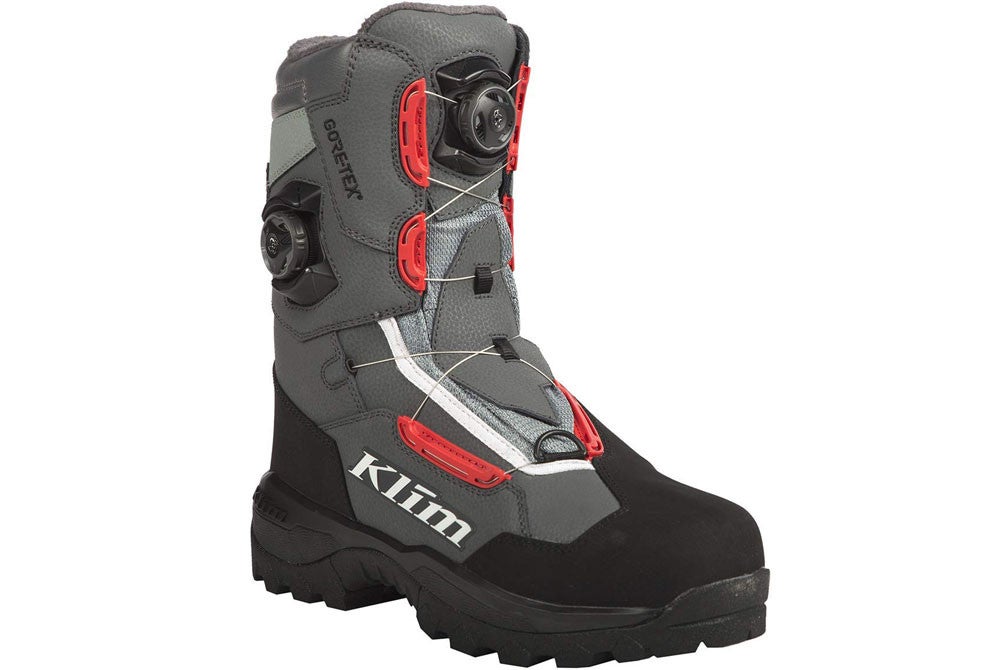
1. Editor’s Choice: KLIM Adrenaline Pro GTX BOA

Klim Adrenaline Pro GTX Boa

Of course, you know Klim is going to bring it when it comes to technical riding gear. The all-new Adrenaline Pro GTX boot is Klim’s latest advancement in comfortable boots made for extremely technical conditions. The plan going into the these boa snowmobile boots was to tweak their previous design to add more support for your foot and for you as you tackle the terrain. The GTX boots have an advanced Boa closure and 600g Thinsulate insulation. They are guaranteed to keep you dry with complete GORE-TEX outers. They recommend a technical sock be worn to get the most out of the boot, which isn’t a bad idea anyway. These boots also have a forward design with stiff support against movement that aren’t going forward. This helps keep you planted and protected, while at the same time, being comfortable – Just as you’d expect from Klim.

Check Price

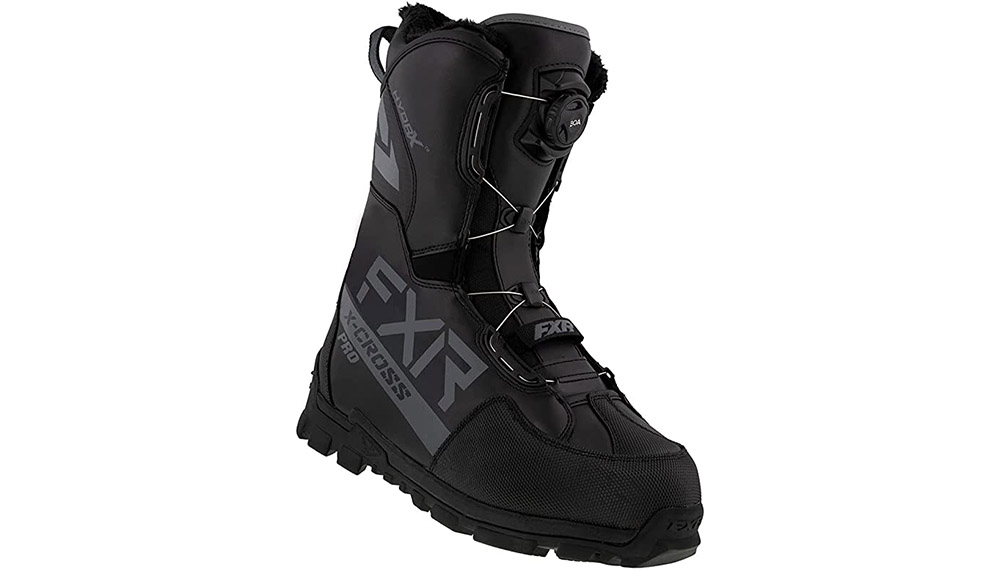
2. Runner Up: FXR Black Ops X-Cross Pro

black fxr black ops x-cross pro boa snowmobile boot

Boa technology is something you’ll see with many of the top boots. It is a simple system that has replaced standard tie-laces and lets you really get a snug and secure fit. FXR Racing created the Black Ops X-Cross Pro for those wanting the ultimate in extreme terrain riding and warmth. They are rated to -40° C with 600-gram insulation, but there’s so much more to these boots. The 2-piece tongue provides a positive fit for maximum comfort so you get the best flexibility, stability and protection while on your sled. Additionally, this boot has a fixed liner with fur lining for further comfort and warmth, while minimal seams in the sled-contact areas minimize possible damage from high contact points. When you’re off the sled, the 20mm thick EVA midsole gives you plenty of traction in the snow, and the 2mm rubber reinforced toe cap provides protection from cold and whatever you might stumble across under the snow.

Check Price

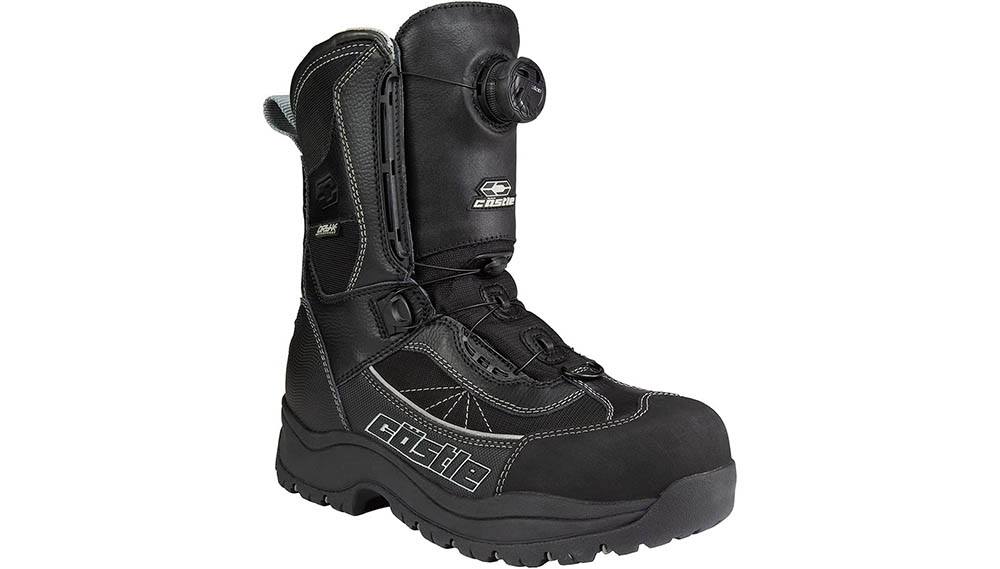
3. CastleX Charge Atop

Castle X Charge Atop Boa

As one of the leaders in performance snowmobile gear, CastleX has a boot that comes in at a close second on our list of best BOA snowmobile boots. This rugged snowmobile boot features a 3-layer Merino Wool blend that provides plenty of insulation to keep you warm, while providing plenty of moisture wicking air mesh to keep your feet dry. Furthermore, the CastleX Charge Atop has a fully integrated Castle DRY-X waterproof membrane to keep your feet dry even in deep snow, and the ColdShield Technology from CastleX helps to keep your feet comfortable with the removable insole that is manufactured from wool with a metallic heat reflecting layer.

Check Price

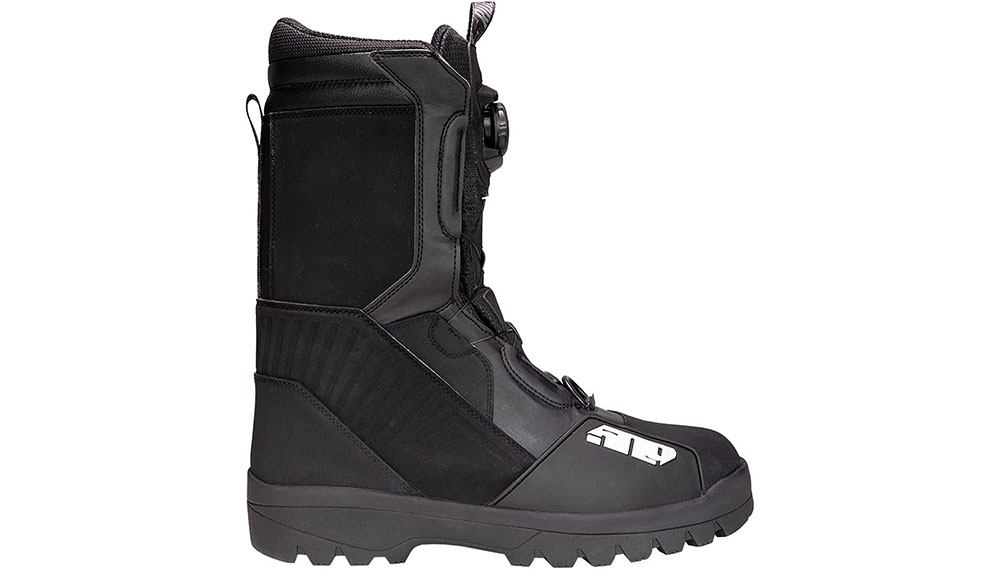
4. 509 Raid Single Boa

Black 509 Raid Single Boa snowmobile boot

Probably best known for its lineup of snowmobile goggles, 509 has some other gear worth looking into. The 509 Raid Boa snowmobile boot comes with 600g of Thinsulate insulation, 5TECH waterproof and breathable liner, Raid rubber reinforcements engineered to stand up to sharp running boards, and a dual boa lacing system with quick release M3 Lace reels and aircraft stainless wire. That dual boa lacing system lets you fine tune the upper and lower zone fit with the turn of a dial. All of this combines to make the 509 Raid Boa one of the best snowmobiling boots available.

Check Price

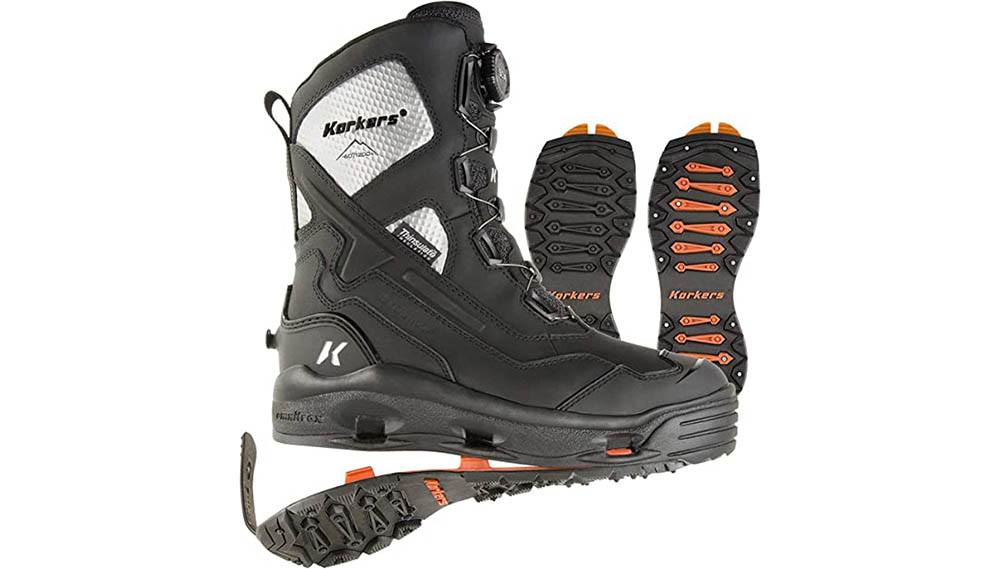
5. Korker Polar Vortex 1200

black and white korker polar vortex 1200 winter boots

While not a traditional snowmobile boot, these boots from Korker are something you should look at for a warm, dry boot that has tremendous support for activities on the sled and off. These boots feature 1200g of 3M Thinsulate insulation for maximum warmth of your feet while out on your sled, and the 100% waterproof construction ensures that your tootsies stay dry. If you venture out and feel a little chill in your feet, don’t fret because for additional warmth, Korker has integrated Farenheight Heat Warmer compatibility into their premium aerogel frost barrier footbed. One of the best selling points of these comfy winter boots is that they’re available with their OmniTrax 3.0 Interchangeable soles. You’ll get one set of Winter Rubber Lug soles and for those icy days, you can swap the soles out for the IceTrac Studded Rubber Lug soles that feature a total of 332 carbide studs to give you solid traction on the slippery stuff.

Check Price

Why is the Boa lace system better than traditional laces?

In one word, simplicity. The Boa lace system allows for tightening of your boots with simple turn of a knob, quickly and evenly. No more fiddling around with two laces, trying to pull them together with frostbitten fingers. Even with gloves on, you can secure and even tighten the boots if they settle after a little bit. They’re just easy and convenient.

What are the most important factors to look for in boots?

First and foremost for us, you want your boots to be warm. Why bother spending the money on them if you end up with frostbitten toes at the end of your riding day. Your boots should have plenty of insulation in addition to being 100% waterproof that helps to keep your feet warm, and of course with all of this you want your boots to be comfortable. Think that you’ll be in these for hours and how much can you really enjoy your riding if your feet are killing you. Finally we like our boots to have a good sturdy sole with plenty of traction. Remember that you’re not on your sled the entire time of your riding adventures. You want to have good traction while you’re taking your breaks as well.

Additional Resources

  • Best Snowmobile Gloves To Keep Your Fingers Warm
  • Best Snowmobile Jackets

Recent Updates

10/18/2022: Removed obsolete product, added new product (Korkers Polar Vortex 1200, FXR Black Ops X-Cross Pro, and CastleX Charge Atop), Added FAQ

We are committed to finding, researching, and recommending the best products. We earn commissions from purchases you make using the retail links in our product reviews. Learn more about how this works.

Best Air Rifles For Hunting Medium Games – Top 10 powerful guns for the money (Reviews and Buying Guide 2025)

0

Getting into the world of hunting can seem like a herculean task.

There is so much to know about the different types of guns to use, the different games and which season to hunt in, the regulations in your region, and a lot more.

But none of it compares to the thrill and adventure of hunting.

Carefully observing the movements of an animal, aiming for a precise shot, knowing where exactly to aim, and the joy that you feel afterward – are some of the reasons why so many people love to hunt.

It doesn’t matter if you are a beginner or a highly experienced hunter, everyone could go for a better air rifle to improve their skills.

Top 10 Best-rated Air Rifles For Hunting Medium Games

If you are in a hurry, here is an overview of the highlight candidates in our list of best air rifles for hunting medium games 2025:

IMAGEPRODUCTDETAILSLINK
Most Powerful
FX Impact M3
  • Calibers: .177, .22, .25, .30
  • Max Velocity: 1020 FPS
  • Max Muzzle Energy: 128 FPE

check price on Pyramydair


check price on airgundepot

High FPE
Seneca Sumatra
  • Calibers:  .22
  • Max Velocity: 1100 FPS
  • Max Muzzle Energy: 37 FPE

check price on Pyramydair


check price on airgundepot

Best Synthetic
Benjamin Marauder Gen 2
  • Calibers: .177, .22, .25
  • Max Velocity: 1100 FPS
  • Max Muzzle Energy: 34 FPE

check price on Pyramydair


check price on airgundepot

Most Versatile
Seneca Dragon Claw
  • Calibers: .50
  • Max Velocity: 679 FPS
  • Max Muzzle Energy: 230 FPE

check price on Pyramydair


check price on airgundepot

Best Long Range
Airforce Condor SS
  • Calibers:  .177, .20, .22, .25
  • Max Velocity: 1300 FPS
  • Max Muzzle Energy: 75 FPE

check price on Pyramydair


check price on airgundepot

Most Accurate
Gamo Swarm Maxxim G2
  • Calibers: .177, .22
  • Max Velocity: 1300 FPS
  • Max Muzzle Energy: 26 FPE

check price on Pyramydair


check price on airgundepot

Best Self-supported
Seneca Aspen
  • Calibers:  .22, .25
  • Max Velocity: 900 FPS
  • Max Muzzle Energy: 26 FPE

check price on Pyramydair


check price on airgundepot

Best Repeater
Umarex Gauntlet
  • Calibers: .22, .25, .30
  • Max Velocity: 900 FPS
  • Max Muzzle Energy: 110 FPE

check price on Pyramydair


check price on airgundepot

Best Big Bore
Airforce Texan
  • Calibers:  .257,.30,.357,.457, .510
  • Max Velocity: 960 FPS
  • Max Muzzle Energy: 700 FPE

check price on Pyramydair


check price on airgundepot

Best Value
Air Venturi Avenger
  • Calibers: .177, .22, .25
  • Max Velocity: 1000 FPS
  • Max Muzzle Energy: 45 FPE

check price on Pyramydair


check price on airgundepot

Things to Consider Before Buying Air Rifle For Hunting Medium Game

Before we get into the best options for air rifles for hunting medium game, let’s discuss some factors to consider before making this choice:

1. Types of Medium Game

The most important factor to consider is whether the air rifle you purchase is suitable for the game you want to hunt.

Medium game is considered to be animals that weigh over 50 pounds and less than 350 pounds, such as raccoons, woodchucks, red foxes, bobcats, deer, wild sheep, antelope, feral hogs, warthog, caribou, impala, etc . 

(Are raccoon rodents? See this post for more)

2. Sound Produced

The loudness of an air rifle is an important factor to consider before making the final purchase.

An air rifle with a lower sound will not scare away animals, make it easy for you to shoot, and not disturb the people in your surroundings.

Many of the air rifles you will find in the market have a sound suppression system but it is still important to check how many decibels of sound an air gun makes upon shooting.

(What meat is venison? Find out here)

3. Repeater Mechanism

The repeater mechanism is especially important for medium games. It lets you shoot multiple times without reloading your gun.

This is useful as it can be difficult to kill a medium game with a single shot.

The time that you save with a repeater mechanism ensures that the animal doesn’t escape .

4. Easy Usage and Lightweight Nature

Apart from technicalities, easy usage, and lightweight are the most important factors while purchasing any gun.

Most air rifles weigh six to seven pounds but you can find many good options that are lightweight.

On the other hand, you can also find air rifles that weigh up to 8 pounds.

So, for your own ease, make sure to consider the weight and manageability of the air rifle you purchase.

(Does Walmart Sell Hunting Licenses? – see this post for more)

Best Air Rifles For Hunting Medium Games – Top-rated guns in 2025

Now that you know what to consider before making the final decision, to take your hunting experience and skills up a notch, I present to you, some of the best air rifles for hunting medium game.

1. FX Impact M4: Powerful PCP Air Rifle For Hunting Medium Game

The FX Impact M4 is my top recommendation when it comes to a powerful PCP air rifle that you can use for hunting medium game.

This air rifle has many impressive features that put it on top of my list.

Not only is this gun the most powerful option you can find within its price range, but it is also extremely comfortable and convenient to use.

First, you need to know that this air rifle is available in .177 cal, .22 cal, .25 cal and .30 cal.

Each of these air rifles has 375, 270, and 85 shots per fill respectively.

But the best part is that the FX Impact M4 has an interchangeable caliber to suit your needs.

Moreover, this air rifle has a dual transfer port and a reversible side lever.

You can even adjust the valve control, match trigger, and the hammer spring tension of this air rifle externally.

What more can you want in a rifle? The FX Impact M4 will not only give you a good velocity but can also be adjusted to function exactly how you want.

The length of this rifle is 34.25 inches and it comes with an AR15-style manual safety system. 

Moreover, you will get a 3-year transferable warranty if you choose this PCP gun.

Chrony tests:

PelletMuzzle Energy (FPS)Velocity (FPE)
8.44-grain pellet950 FPS16.92 FPE
16-grain pellet920 FPS30 FPE
25.4-grain pellet900 FPS44 FPE
46.3-grain pellet870 FPS77 FPE
81-grain pellet860 FPS133 FPE

read review here

Pros & Cons

ProsCons
  • Many adjustable features to choose between
  • Externally controllable settings
  • No sound suppression system

2. Sumatra 2500, 500cc Reservoir

The Sumatra 2500 is the best air rifle for groundhogs that I have come across.

It has a 500cc air reservoir and is only produced with a .22 caliber.

But you will be impressed to know that this air rifle can give you a velocity of 1260 FPS.

Another impressive feature that you won’t find in many other rifles is that the Sumatra 2500 has an adjustable back sight and a fixed front sight Cialis.

Moreover, this air rifle has an adjustable power wheel with as many as 13 different types of settings for you to choose between.

Safe to say, there are very few options in the market that are as versatile as the Sumatra 2500.

You would also be impressed to know that the trigger of this air rifle has two-stage adjustability and its muzzle energy goes up to 78.41 ft-lbs.

(What is a 10-point buck? See this post for more)

read review here

Chrony tests:

Pellet Energy (FPE)Muzzle Velocity (FPS)Accuracy 
Gamo Raptor Platinum (9.7 Grain)39 FPE1356.7 FPSAverage
H&N Field Target Trophy Green (14.66 Grain)40 FPE1345.29 FPSGood 
Rws Hobby (11.9 Grain)43 FPE1286.53 FPSGood
Crosman Premier Hp (14.3 Grain)48 FPE1232.71 FPSGood
JSB Jumbo Exact (14.35 Grain)47 FPE1225.59 FPSGood
H&N Field Target Trophy (14.66 Grain)49 FPE1231.82 FPSGood
H&N Baracuda Match (21.14 Grain)57. FPE1110. FPSGood 

Pros & Cons

ProsCons
  • Many features allow easy use
  • Power wheel with 13 different settings
  • Only has a .22 cal option

3. Benjamin Marauder Gen 2 – Synthetic Stock

If you know anything about the hunting world, then you must be no stranger to the Benjamin Marauder air rifle.

So, you will be happy to know that the famous Benjamin Marauder Air Rifle now comes with an ambidextrous synthetic stock.

With a caliber of .177 and a velocity of 1100 FPS, it is one of the most powerful PCP air rifles that you could find in the market.

Benjamin Marauder Air Rifle has a vertically adjustable comb, a reversible bolt, and a tray that can be adjusted for achieving different velocities.

Apart from the different stock, this air rifle now has more features that make it easier to use, such as a raised aluminum breach that makes it easy to load this powerful rifle.

Like the older Benjamin Marauder Air Rifle, this model is 42.80 inches in length, has a manual safety, and has a magazine capacity of 10 pellets.

read review here

Chrony tests:

Pellet Energy (FPE)Muzzle Velocity (FPS)Accuracy 
Gamo Raptor Platinum (9.7 Grain)23 FPE1041 FPSGood
H&N Field Target Trophy Green (14.66 Grain)25 FPE1024 FPSPoor
Rws Hobby (11.9 Grain)25.40 FPE980.30 FPSGood
Crosman Premier Hp (14.3 Grain)27.81 FPE935.83 FPSGood
Jsb Jumbo Exact (14.35 Grain)28.26 FPE941.99 FPSGood
H&N Field Target Trophy (14.66 Grain)28.89 FPE941.99 FPSGood
H&N Baracuda Match (21.14 Grain)33.43 FPE843.85 FPSGood 

Pros & Cons

ProsCons
  • Adjustable velocity
  • Ambidextrous synthetic stock
  • Magazine capacity is relatively low

4. Dragon Claw Air Rifle

The Dragon Claw Air Rifle is the best air rifle for woodchucks in the market.

You can easily hunt any hunting medium game including feral hogs, coyotes, foxes, possums, woodchucks, and raccoons with this .50 caliber air rifle.

Perhaps the most impressive feature of this air rifle is that it has dual air chambers with a total 500cc air capacity.

It has a single-shot fire mode which will give you a velocity close to 700 FPS.

The Dragon Claw Air Rifle also has a fixed front side and a fully adjustable rear sight which can also be removed as per your wish.

Pros & Cons

ProsCons
  • Highly adjustable to suit a better grip
  • Lower velocity than other air rifle options

5. AirForce Condor SS

The AirForce Condor is not exclusively a medium game air rifle.

With a velocity of 1000 FPS, this powerful air rifle can be used for all types of hunting.

It is made with aircraft-grade aluminum alloy and has .177,.20, .22, and .25 calibers.

The AirForce Condor also has a two-stage non-adjustable trigger, bolt action, and a single-shot fire mode.

There are many features that will compel you to choose this versatile air gun.

This PCP rifle has a special valve system, automatic safety, and a whopping number of 50 shots per fill.

With an overall length of 38.13 inches, the AirForce Condor has a relatively lightweight of 6.10 lbs.

So, along with power and adaptability, this gun will also feel easy in your hand.

Pros & Cons

ProsCons
  • Multiple features to make accessibility easy
  • Provides 50 shots per fill
  • No sound reduction mechanism

6. Gamo Swarm Fusion 10X Gen3i: Best Break Barrel Air Rifle For Hunting Medium Games

If you are looking specifically for a break barrel air rifle for hunting medium game, there is no better option than the Gamo Swarm Fusion 10X Gen3i

With a .177 caliber, this air rifle will give you a velocity of 1300 FPS.

If you opt for Gamo Swarm Fusion 10X Gen3i with a .22 caliber, you can enjoy an impressive velocity of 1000 FPS.

Not only is this air rifle extremely powerful, but it is also designed to allow shooting in all seasons with an all-weather stock.

It has a textured grip that allows improved cold-weather performance as well as quieter cocking and shooting.

Along with all these features, this air rifle also has an impressive total length of 45.3 inches while only having a weight of 5 lbs.

Another interesting feature of this PCP air gun is that it has a horizontal magazine orientation.

Clearly, Gamo Swarm Fusion 10X Gen3i is one of the most impressive air rifle options that you can find in the market.

Pros & Cons

ProsCons
  • All-weather stock
  • Lightweight
  • Air pressure can be inconsistent

7. Seneca Aspen: Best Self-Supported PCP For Medium Game Hunting

If you prefer a self-supported PCP air gun while hunting medium game, I have the perfect suggestion for you.

If you are a beginner when it comes to hunting, the Seneca Aspen is one of the best choices to start your hunting journey with.

This air rifle has a .22 caliber with a two-stage velocity adjustment option along with features like an onboard pressure gauge, and automatic overpressure air release.

Not only will this gun be very convenient for you to use, but it is also easy for you to carry as the latest model features a new synthetic stock.

Although it is slightly heavier than other PCP air guns at a weight of 8 lbs, the overall length of this rifle is 43 inches.

The new edition of the Seneca Aspen air gun features a fully shrouded rifled steel barrel along with a fill probe and a single-shot tray.

Pros & Cons

ProsCons
  • Beginner-friendly
  • Adjustable velocity
  • Heavier than other air rifles
  • Might be uncomfortable to grip

8. Umarex Gauntlet 2

The Umarex Gauntlet 2 is one of the most popular PCP air rifle choices.

What you might not have known is that the Umarex Gauntlet 2 has many new features that have taken this air rifle to another level.

The new Umarex Gauntlet 2 feels much more comfortable in your hand, thanks to its new all-weather synthetic stock and textured rubber buttpad.

You can either choose the .22 caliber Umarex Gauntlet which has a velocity of 1075 FPS and 70 shots per fill.

Or you can go for the .25 caliber Umarex Gauntlet 2 which has a velocity of 985 FPS and 50 shots per fill.

Both of these models now have an 8 dB sound reduction, an aircraft-grade aluminum receiver, as well as an onboard pressure gauge.

So, if you are already familiar with the Umarex Gauntlet 2, you can be assured that you won’t regret choosing their new model of PCP air rifle.

Chrony tests:

Pellet Energy (FPE)Muzzle Velocity (FPS)Accuracy
Gamo Raptor Platinum (9.7 Grain)18.71 FPE931.86 FPSVery Good
H&N Field Target Trophy Green (10.03 Grain)18.52 FPE911.89 FPSGood
RWS Hobby (11.9 Grain)18.76 FPE864.63 FPSGood
Crosman Premier HP (14.3 Grain)19.73 FPE788.16 FPSExcellent.
JSB Jumbo Exact (14.35 Grain)20.75 FPE806.91 FPSExcellent
H&N Field Target Trophy (14.66 Grain)22.20 FPE787.71 FPSExcellent
H&N Baracuda Match (21.14 Grain)18.72 FPE631.44 FPSExcellent

Pros & Cons

ProsCons
  • Very comfortable to use 
  • Good accuracy with consistent air supply
  • The trigger is not very firm

9. Airforce Texan

The Airforce Texan is one of the most widely talked about guns recently.

You might have already heard that this air gun is the best choice when it comes to hunting bores.

The Airforce Texan has .45-caliber bullets and provides a high velocity of 1040 FPS.

This gun is one of the most powerful air rifle choices that you can go with.

With a single-shot fire mode, the Airforce Texan is 48 inches in length and provides easy access through a two-stage non-adjustable trigger.

It has an automatic safety measure as well as a lifetime warranty.

However, one disadvantage of this gun is that it does not have a sound repression system, so it might be too loud for some people’s liking.

read review here

Chrony tests:

Pellet Energy (FPE)Muzzle Velocity (FPS)
143 grain265 FPE22.30 FPS
200 grain319 FPE28.34 FPS
350 grain469 FPE170.99 FPS
405 grain505 FPE229.40 FPS

Pros & Cons

ProsCons
  • High velocity and power
  • Lifetime warranty
  • Does not have a sound reduction mechanism 

10. Air Venturi Avenger: Best Value PCP Air Rifle For Medium Game

The Air Venturi Avenger rifle is easily the best-value PCP air rifle for medium games. 

You might have even heard many fellow hunters talk about this air rifle recently.

It provides perhaps the best velocity and accuracy for its price range.

The .177 caliber Air Venturi Avenger rifle has a velocity of 1000 FPS; the .22 caliber rifle has a velocity of 930 FPS, whereas the .25 caliber rifle has a velocity of 900 FPS.

Not only is this PCP air rifle powerful, but it also has many features that make hunting easy for you.

In fact, the Air Venturi Avenger rifle was designed with keeping target practice in mind, so it is an excellent choice for those who are new at hunting.

This highly sought-after air gun has a two-stage adjustable trigger, a magazine capacity of 8, and 24 pellet shots per fill.

Moreover, it has a repeater fire mode that will assume a clear and accurate shot for you, whether you are honing your aiming skills or shooting small and medium games. 

read review here

Pros & Cons

ProsCons
  • Excellent velocity and accuracy
  • Beginner-friendly
  • Does not offer as many features as other air rifles

Frequently Asked Questions

Now that you know all about the best medium-game air rifle options, let us take a look at some related questions:

What Is Considered a Medium Hunting Game?

Medium hunting game is usually considered to be between 50 to 300 pounds in weight.

This includes animals like deer, antelope, feral hogs and raccoons, woodchucks, red foxes, bobcats, wild sheep, warthog, etc.

(Groundhog vs. Woodchuck: What’s the Difference? Find out here)

Medium game is usually hunted with .22, .25, .30, or bigger caliber air rifles.

But there are many factors you need to consider when it comes to restrictions.

I suggest that a silenced medium-game air rifle is the way to go for such animals.

(Are Deer Nocturnal, Diurnal, or Crepuscular? See this post)

What To Aim for When Hunting Raccoons? Best Place To Hit Raccoon When Hunting?

It can be quite difficult to aim while hunting raccoons, especially if you are not a highly experienced hunter.

One easy spot to aim for while hunting raccoons is the chest area. 

Shooting raccoons in the chest gives you a larger area to shoot at and also reduces the likelihood of wounding them.

If you are a skilled hunter, you can also go for the back of the year.

This area is the softest part of the cranium and is guaranteed to reduce any risk of wounding the raccoon.

When Does Raccoon Hunting Season Start?

The raccoon hunting season starts from October 1 to the last day of January of the following year.

What Gun Should You Use When Raccoon Hunting?

Any .22 caliber gun would be suitable for raccoon hunting.

More specifically, you should choose a medium game hunting air rifle for raccoons.

The best pellet gun for raccoons is Air Venturi Avenger.

When Does Red Fox Hunting Season Start?

Red fox hunting season depends on which region you are from.

In most places, the best time to hunt red fox starts in November and ends in March.

However, southern states might find red foxes to hunt until warm months like May.

When Is Bobcat Hunting Season?

Bobcat hunting season begins from December 20 to March 8 of the following year.

Depending upon which region you are from, the peak season for hunting bobcats can differ.

Some places only experience peak bobcat hunting season from December to January while others can find bobcats lurking up until mid-February.

Does dry-firing damage air rifles?

0

For those who are unfamiliar, dry-firing is the practice of pulling the trigger on an airgun without any pellets in the chamber. It can be done with CO2 guns, pump guns, precharged pneumatic (PCP) air rifles, and air pistols. Many people believe that dry-firing is bad for airguns and will damage them, but is this actually true? Let’s take a look at the pros and cons of dry-firing to find out.

Are there good points to dry-firing?

Yes, there are several good points to dry-firing your airgun. First, it’s a good way to check if your gun is loaded without having to chamber a pellet. Second, it allows you to practice your aim without wasting pellets. And third, some people believe that it actually extends the life of your gun by “exercising” the internal parts.

does-dry-firing-damage-air-rifles

Don’t dry-fire most springers!

While there are some benefits to dry-firing, it’s important to note that you should never do it with most spring-piston guns. This is because the piston seal can be damaged by the impact of the piston when it hits the end of the compression chamber. If you own a springer, check your owner’s manual before dry-firing to see if it’s okay or not.

Springers that are more forgiving

There are some springers on the market that are designed to be more forgiving when it comes to dry-firing. These guns typically have a thicker piston seal that can better withstand the impact of dry-firing. Guns with PTFE (Teflon) seals are extremely tolerant.

Conclusion

So, should you dry-fire your airgun? It depends. If you own a springer, chances are you shouldn’t do it as it could damage your gun. But if you have a different type of airgun, there are some benefits to dry-firing such as being able to practice your aim without wasting pellets.

Read more >>> What can you hunt with a .22 air rifle?

21 Great Early Season Treestand Locations

0

Whitetails use the land differently throughout the year. From bedding and feeding perspectives, whitetails have different needs in spring, summer, fall, and winter. Core areas shift. Different parts of home ranges are utilized. But for now, it’s the early season, and there are certain things to know.

First, let’s define “early season” as the portion of deer season leading up to the pre rut. In most states, this generally falls between August and mid-October.

Every good whitetail treestand location should be chosen with careful thought and consideration. Wind direction, proximity to bedding, food, water, or security cover — it’s important to give yourself as many options as possible as deer patterns shift. But there’s another way to categorize stand locations. These two groups include topography-specific or habitat- and terrain-specific hotspots.

Once a hunter knows what characteristics to look for, HuntStand helps reveal these gems. That’s true for brand-new properties, and even those you’ve hunted forever. As someone who’s hunted some of the same properties for 25 years, sometimes you learn new things about tracts, even when you thought you had them completely figured out.

Topography-Specific Hotspots

Topography is best defined as change in elevation. Hills, hollows, bottomlands, ridges — these and more are characteristics of changing topography. In short, it’s the opposite of pancake-flat ground. And if I’ve learned anything in my 25 years of deer hunting, it’s that topography can make or break a hunt. It can also create and present excellent early season treestand locations.
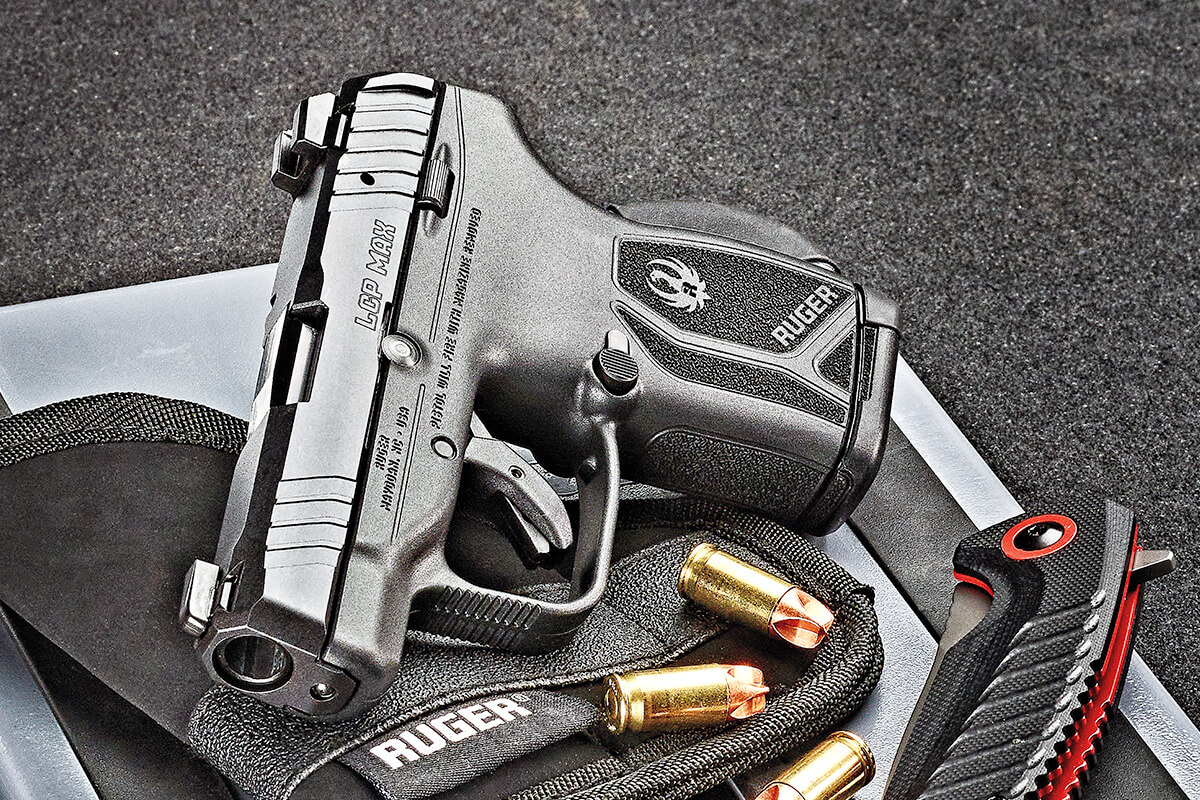

1. Leeward Ridges: The downwind sides of ridgelines oftentimes have bucks, and other deer, bedded on them. This is true even in the early season, especially if hunting pressure is already ramping up.

2. Low Spots: During the early season, deer like low spots for multiple reasons. First, scent gathers here. Second, it’s cooler. Third, water is more likely to be present. And fourth, green food sources are more likely.

3. Near Water: Water is important all year, but especially when it’s hot. Not just for drinking, though. Usually, it means lush growth for eating, and cooler air for comfort.

4. Watering Holes: Focus on secluded, stagnant (or slow moving) water sources to see mature bucks.

5. Ridge Lines: Oftentimes, ridge lines have hard or soft mast, including oaks. When these start dropping, be there.

6. Ridge Points: Deer commonly bed on ridge points (endings), especially if a hot food source is down below.

7. Thermal Hubs: Also referred to as crow’s feet, thermal hubs are where multiple ridge endings taper down (from multiple directions) in the same spot. Here, thermals collect, and deer use that to their advantage.

8. Solar Bedding: Pinpoint northern-facing slopes, which receive less sunlight. (Pro tip: You usually see more daylight walking by mature bucks here.)

Fortunately for HuntStand users, key HuntStand layers help identify topography specific hotspots. Some of these include 3D, Contour, Quad Topo, Terrain, etc.

Hanging Stands: Choosing the Best Treestand Tree on the Property

Habitat and Terrain-Specific Hotspots

While topography-specific stand locations tend to have greater effect on reliable deer movement, there are many more habitat- and terrain-specific spots to consider. These too can create an excellent opportunity for stands.

9. Ag Field Edges: Alfalfa, clover (in hay fields), soybeans, and others, are all great ag field options.

10. Appearing Rub Lines: As bucks come out of velvet, and start to establish their travel routes, rubs will appear. Use these markers to help choose stand locations.

11. Draws: U-shaped fields and openings with timber on three sides attract deer. If good bedding areas and food sources are present, expect deer movement.

12. Crossings: Pinch points are relevant all year, especially for bowhunters. Keep creek, fence, and other crossings at the forefront.

13. Hidden Fields: Secluded fields are excellent options for deer hunters. Mature bucks are more likely to use these than fields that are more exposed.

14. Inside Field Corners: Anywhere a field creates an L shape in the timber is an inside field corner. If a relevant bedding area is close to it, give it bonus points.

15. Mast Trees: Hard and soft mast trees are important elements of the early season. Hard mast trees, such as chestnuts, red oaks, and white oaks, are key trees to pinpoint. Soft mast trees, such as apples, pears, and persimmons, are hot food sources, too.

16. Micro Food Plots: Small food plots positioned in strategic locations can be incredible plays during the early season. Of course, this requires a plant species that hits peak attractiveness at this time, though.

17. Scrapes and Mock Scrapes: Whitetails hit scrapes (and mock scrapes) all year long. But this action really starts to ramp up during the early season and pre-rut.

18. Staging Areas: Anywhere that deer tend to congregate at last light is a staging area. Find these that are located between early season bedding areas and food sources.

19. Thermal Bedding: Throughout the year, deer use different types of bedding cover. During the early season, that’s oftentimes thermal bedding, such as cedar thickets. These hold cooler air in the heat of the year and warmer air in the cool of the year.

20. Trail Emergences: Anywhere a trail leads from a bedding area to a food or water source can be a solid bet for killing a target deer.

21. Trail Intersections: Don’t quite have your deer patterned yet? Consider trail intersections. This increases the odds of seeing the deer you are after.

As with topography-centric areas, key HuntStand layers help identify habitat and terrain specific hotspots, too. Some of these include 3D Map, Hybrid, Mapbox Satellite, Natural Atlas, National Aerial Imagery, Satellite, Tree Cover, Whitetail Habitat Map, and more.

How to Speed Scout with HuntStand Pro’s Monthly Satellite Imagery

Patterns Change Quickly

Now that you’re equipped with plenty of target treestand location types, understand that these spots aren’t guarantees. You still must scout in the field, study the situation, and determine if deer are currently using these spots, or not. Deer have short-, mid-, and long-term patterns. Each of these are driven by bedding needs, changing food sources, hunting pressure, and more.

Naturally, the most recent info is most important. Things change quickly. If running trail cameras, or glassing deer in the field, focus on that. Also, property conditions and layout being similar as past years, reflect on historical trail camera photos and in-the-field encounters to see how, when, and where deer used the land.

For those interested in knowing what bedding areas are being used by target bucks (or deer in general) at a given time, consider soaking cellular trail cameras on the fringes of these. Pair these with external battery sources to maximize battery life. Because, once these cameras go dead, you won’t want to invade bedding areas to revitalize these during the season.

Next-Level Deer Hunting with HuntStand Pro Whitetail

Prepare for the Pre-Rut Shift

As we move closer to some opening days, and deeper into seasons already open, expect disbursement to happen. Eventually, as many as 50% of bucks will shift into their fall ranges, which might not overlap with early season stand locations.

So, as you begin to see new bucks on the landscape, work to identify bucks as new or returning. When trying to determine who a specific buck is, pay attention to physical identifiers, including antler mass, antler spread, antler structure, body markings, body scars, body size, brow tine characteristics, facial coloration, fur coloration, fur patterns, tine length, unique points, and more. Also, pay attention to behavioral tendencies.
Once we transition out of the early season, and ease into the pre-rut, consider looking to treestand locations for that period. Focus on key food sources at that time. Generally, these are geographic specific. Solid picks include seasonal bedding area edges, food sources edges, pockets of falling mast crops, staging areas, micro food plots, and more. Additionally, under the right circumstances, don’t overlook all-season locations, including funnels, inside field corners, isolated watering holes, pinch-points, saddles, scrapes, mock scrapes, and more.

But until then, continue to focus all efforts on great early season treestand locations. And keep using HuntStand to dial in on those early season hotspots.

Find Public-Land Deer Hotspots on the Fly with HuntStand Pro

HuntStand Pro vs. HuntStand Pro Whitetail

HuntStand is a valuable tool for deer hunters. It’s offered on multiple levels, including Pro and Pro Whitetail. Each of these offers more options than the last, and it’s important for deer hunters to determine which of these best fits their needs, style of hunting, and more.

HuntStand Pro

Those who choose HuntStand Pro will have access to powerful app tools and incredibly useful layers. Each of these will aid in the pursuit of successful land management, public land hunting, communication with hunting partners, and much more. Unlike the free version of HuntStand, it’s an ad-free experience.

Includes: Advanced property search, monthly satellite imagery, offline mapping, premium map layers, property data, real 3D maps, stand reservations, trail camera management, treestand (and other gear) deployment management, weather overlays, and more.

Layers: 3D (true 3D viewing), Mapbox (Color-Corrected) Satellite, National Aerial Imagery, Natural Atlas, (General) Public Hunting Lands, (Detailed) Public Hunting Lands, TerraPulse Tree Cover, and more.

Price: $29.99 (per year)

UPGRADE TO PRO

Early Season Stand Locations 6

HuntStand Pro Whitetail

While Pro is a very efficient subscription level, Pro Whitetail is a must for serious deer hunters.

Includes: In addition to what’s include at the HuntStand Pro level, Pro Whitetail also features Crop History, Whitetail Activity Forecast (detailing weather, wind and other conditions, plus daily hunt-quality scores), Whitetail Habitat Map (showcasing likely habitat-based hotspots), Nationwide Whitetail Rut Map (individualized data for each county), and more.

Layers: HuntStand Pro layers plus additional layers: Nationwide Whitetail Rut Map, Whitetail Habitat Map, Crop History

Price: $69.99 (per year)

UPGRADE TO HUNTSTAND PRO WHITETAIL

Best Air Rifle Deals

Popular Posts

Air Rifle vs BB Gun: Understanding the Key Differences and Choosing the Best Option

0
"Air Rifle vs BB Gun: Unveiling the Key Differences and Choosing the Perfect Weapon for Your Shooting Needs. Delve into this comprehensive guide to...

Best Distance for Sighting In an Air Rifle

0
Shooting with an air rifle always seems like a thrilling experience, but if you are a newbie then you have lots to learn. One...

Air gun 101: Everything you need to know about air rifle accuracy

0
Wyatt Earp has said: Fast is fine, but accuracy is everything And I just thought how many airgunners are obsessed with muzzle velocity and muzzle energy,...