The short answer: it’s your preference. If you use the metric system (meters/centimeters) then go for MRAD. But if you measure in the empirical system (yards/inches) then MOA may be easier.
If you want a more thorough answer along with an explanation of MOA vs MRAD, then keep on reading!
Suppose you’re headed out on a hunting trip with your buddies.
You did your research, you read the best rifle scope guide, and you’re ready to go. But then your buddy starts talking in meters and your MOA turrets are adjusting in yards.
His numbers don’t match your turrets, your turrets don’t match your reticle, and now your target has bounded off to another state.
The problem: he was using MRAD while you were using MOA.
MOA and MRAD are basically two different systems of measurement.
When sighting rifle scopes, the reticle and turrets are used together to reach the most accurate shot possible. The turrets change the position of your reticle while your reticle provides an aiming point.
Your turret clicks and the hashes on your reticle can use one of two different systems of scope alignment: MOA or MRAD.
You can have the best long range scope on the market, but if you don’t sight it in using either system, it’s useless.
If you’re looking for help choosing between rifle scopes, here’s the only guide you’ll need to read.
What’s an MOA Scope?
M.O.A. stands for Minutes of Angle; a system based on degrees and minutes. This type of angle measurement is used to calculate the distance to a target and MOA turrets correction for the bullet trajectory.
Basically the math breaks down to this: there are 360 degrees in a circle, and 60 minutes in a degree for a total of 21,600 degrees.
You can find your MOA measurement by multiplying the distance in yards by 1.047, then dividing by 100. You can thank the Ancient Egyptians and Mesopotamians later.
At 200 yards, one MOA equals 2.094 inches. Out to 1,000 yards, 1 MOA equals 10.47 inches, and so on.
For those of us who aren’t Einstein, the easiest way I’ve found is to use a quick-reference conversion chart. That way you don’t miss your prize buck while scribbling away on math problems.
MOA scopes aren’t a perfect system though.
Often calculations are made with 1 MOA at 100 yards (91.4 meters), but you need to count on 100 yards with 1.05 MOA. Up to 100 yards there will be no problem with 1 to 100 comparison, but when shooting over longer distances you’ll be 5% off base and this could mean missing a shot.
This isn’t a problem if you’re only shooting at medium ranges. Read my 4×32 scope guide for more details.
I use an MOA reticle scope on my AR-15 A2 after I removed the front sights for added cool guy points. I’ll show you how to remove the AR-15 A2 sights here.
What’s an MRAD Rifle Scope?
MRAD stands for milliradians (or MIL for short), and was originally developed for artillery in the late 1800s. It’s still the preferred method for military and police force operations to this day, where you’ll commonly here it referred to as a MIL-dot reticle.
Based on a radial line, a unit of angular measurement that is equal to roughly 57.3 degrees, a milliradian is one thousandth of a radian.
This system does not come out to make a perfect circle like the MOA system. Instead, milliradians divide the circumference of a circle into 6.28 equal sections measuring 57.3 degrees each in an MRAD scope.
Thus, every circle has a circle circumference that is 6.28 radians long. Then each radian is going to be divided into 1,000 parts more, which is called Milliradians.
When calculating MRAD in a MIL-based scope, you will be calling it MIL, which is 3.6 inches at 100 yards (91.4m using the metric system) equal to 1 MIL.
I tried an MRAD scope on my M1A that happens to have the best M1A scope mount ever.
MOA vs MRAD: Which is better?
The short answer: neither. The argument is as old as time, but it’s really just the shooter’s preference of rifle scope.
The fight between MOA vs MRAD boils down to a difference in how we format degrees of angular measure. It’s fancy math terminology that basically asks if you use yards or meters.
Technically, the 1/4 MOA clicks are slightly more accurate than the 1/10 MIL, but the MIL values are somewhat easier to communicate.
Reference cards with MIL are easier to read because they are indicated by 2 numbers only, while the cards with MOA are indicated with four numbers. We could go back and forth all day, but you get the idea.
If you like other comparisons, check out my Nightforce SHV vs. Vortex PST guide.
Which do you need?
Choosing between the MOA or MRAD system will take some self reflection, so buckle up.
If you normally think in meters or centimeters, then it is easier to calculate distance with a MOA. If you normally think in yards or inches, then MRAD should be your go-to.
And if you’re not going to calculate distances, it doesn’t matter between the MRAD vs MOA. Do your thing, both types are equally effective for medium- and long-range shooting.
Another thing to take into account is that you also have to consider your hunting partners, teammates, friends, and so on. You’ll want to have a common language so you can communicate together without having to do conversions between the two systems.
Or you could be an absolute rebel and have a scope for each system, swapping it out in the field with the best quick detach scope mounts. Live your life to the fullest.
Most importantly, choose the same system for your turrets and scope reticles. I have a guide on first focal planes vs. second focal planes to help you choose the right reticle as well.
Regardless of all the math, the decision between MOA and MRAD isn’t that important. Clicks with an MOA turret are slightly more precise than clicks with a MIL turret, but at the end of the day it’s a style choice between rifle scopes.
Here are the best choices for hunting ear protection that hunters can use to safeguard their hearing.
I think we can all agree that we’d love to keep our sense of hearing for our entire life. After all, I’m sure you know someone who has a tough time hearing and can barely carry on a conversation. There are many different things that can damage your ears, but if you do a lot of hunting with firearms, there’s one simple thing you can do to avoid hearing loss and make sure you don’t have to wear hearing aids later in life: wear hunting ear protection.
Any noise louder than 85 decibels can cause permanent hearing loss. I cannot state this strongly enough: if it is loud enough, a single gunshot can cause immediate hearing damage. For reference, a gunshot is about 130-180 decibels (give or take).
While noise induced hearing loss and tinnitus are both permanent, the good news is that it’s also preventable.
The Noise Reduction Rating (NRR) of ear protection describes how effective it is. Basically, a higher NRR means that hearing protection does a better job reducing your exposure to really loud noises.
However, you should keep in mind that some firearms produce a pressure wave strong enough cause hearing loss by damaging the bones behind the ear, even if the ear canal is protected by an ear plug. This is particularly true for people shooting indoors or those exposed to repeated shots from shotguns or rifles (such as waterfowl hunters or hunting guides). While ear plugs are certainly better than nothing, ear muffs are actually the most effective shooting and hunting ear protection you can wear.
So, to avoid permanent damage to your hearing, it is important that you wear appropriate ear protection when shooting or when exposed to other noisy environments. Luckily, this task is much easier than many people assume and there are a lot more good quality options for hearing protection while hunting than there used to be.
In this post, I’m going go over some of the best hunting ear protection products that you should be wearing afield to safeguard your hearing.
Note: some of the links below are affiliate links. This means I will earn a small commission (at no extra cost to you) if you make a purchase. This helps support the blog and allows me to continue to create free content that’s useful to hunters like yourself. Thanks for your support.
AXIL XCOR
What’s the best hunting ear protection? Hands down, it’s AXIL XCOR electronic ear buds. They amplify quiet noises, block loud noises, and have 5.0 bluetooth connectivity. They are also extremely comfortable to wear for long periods of time and won’t affect your cheek weld when shooting a long gun.
These electronic ear buds are a more expensive than basic electronic ear muffs and some other electronic ear buds, but are also similar in price to (or maybe even a little LESS expensive than) some of the electronic ear plugs I also recommend in this article.
AXIL XCOR ear buds provide excellent performance by digitally compressing loud noises over 85 dB back to safe levels and amplifying quieter sounds. AXIL advertises that the XCOR provide up to 6x hearing enhancement along with a NRR of up to 29.
So, not only will they protect your hearing from loud noises, but they actually improve it as well. This is the best of both worlds when it comes to hunting ear protection.
At the range, electronic ear buds protect the hearing of the shooter, but still allow him or her to hold a normal conversation with another person. While hunting, this allows the user to hear all the little sounds he or she needs to hear, like the snap of a twig made by an approaching deer.
The XCOR ear buds comes with several different foam tips of varying sizes. It is very important that you take the time to read the instructions and choose the tips that fit your ear properly. However, they work GREAT and are very comfortable to wear for hours at a time if you use the correct tips for your individual ear size.
Just slip them on at the beginning of a hunting trip and wear them until you’re done hunting. You’ll get hearing enhancement that will help you hear an approaching animal and won’t have to fumble around and put on ear protection before taking a shot.
I’ve worn the XCOR ear buds for up to 10 hours of hunting in a single day (with a short break around lunch) for over a week at a time without issues. I’ve never used any other hearing protection that comfortable.
The fact that they also offer bluetooth connectivity is also awesome because that gives you the option of listening to music or podcasts on your phone with them. I wouldn’t necessarily recommend doing that while you’re out hunting, but it’s a nice feature when doing something like mowing the lawn.
Finally, it’s important to realize that the XCORs are wireless digital ear buds, which makes them a somewhat unique form of hunting ear protection (most other models are analog). The fact that they’re digital hear protection means the XCOR ear buds provide excellent sound quality with minimal distortion. In fact, I think they have the best sound quality of all the ear protection on this list. Plus, they do that without having wires or sticks coming out of your ears.
All things considered, I consider AXIL XCOR wireless ear buds to be the absolute best hunting ear protection.
Click the button below to receive discounted pricing on these ear buds ($50+ off MSRP) along with free shipping to most locations.
BUY AXIL XCOR EAR BUDS HERE
AXIL GS Extreme
Next up on this list of the best hunting ear protection are AXIL GS Extreme electronic ear buds. These were my previous favorite ear protection model until AXIL released the XCOR wireless ear buds in 2024.
Like the XCOR ear buds, the GS Extreme ear buds amplify quiet noises, block loud noises, and also have 5.0 bluetooth connectivity. So, they have many of the same strengths as the XCOR ear buds that also make them excellent forms of hunting ear protection.
However, they’re not wireless and they’re analog ear protection, so the sound quality isn’t quite as good. While they’re still comfortable to wear, I don’t think they’re quite as comfortable as the XCOR wireless ear buds though.
On the other hand, GS Extreme electronic ear buds are a little less expensive and are still excellent hunting ear protection.
AXIL advertises 6x hearing enhancement with the GS Extreme and a NRR of up to 29.
All things considered, I consider AXIL GS Extreme ear buds to be well worth the money as hunting ear protection, especially considering the fact that they only cost a little more than traditional electronic ear protection.
Click the button below to receive discounted pricing on these ear buds (35-50% off MSRP).
BUY AXIL GS EXTREME EAR BUDS HERE
AXIL TRACKR BLU
While I think the AXIL GS Extreme is the best hunting ear protection, not everybody likes wearing ear buds. If you prefer wearing over the ear muffs instead, then you should definitely check out the the AXIL TRACKR BLU.
Like the AXIL GS Extreme, these muffs block loud noises and amplify quiet noises. However, AXIL TRACKR BLU electronic ear muffs also protect the bones of hearing behind your eardrum from damage caused by the pressure wave produced by gunshots.
Like other forms of electronic hearing protection, TRACKR BLU electronic ear muffs provide excellent performance by blocking loud noises and amplifying all other sounds. AXIL advertises that the TRACKR BLU will provide up to 40 decibels of hearing amplification, which can be easily adjusted with a simple volume wheel on the side of the muffs.
Most importantly, they provide excellent hearing protection with a NRR of 27. I’ve compared them side by side and the AXIL TRACKR BLU provides noticeably more protection than the Howard Leight Impact Sport. The TRACKR BLU also has an ultra fast reaction time of just .02 seconds and will protect your ears from sounds 85 decibels or louder.
Additionally, they may also be combined with ear plugs for extra protection in extremely loud environments. This makes them an incredibly effective form of shooting or hunting ear protection.
So, not only will they protect your hearing from loud noises, but they actually improve it as well. This is the best of both worlds when it comes to hunting ear protection.
The sound quality of the TRACKR BLU ear muffs is also significantly better than the Howard Leight Impact Sport and it also uses AAA batteries.
Some people do not like to use ear muffs when shooting a rifle or shotgun because they think they’ll get in the way. Personally, I have not had this problem with the AXIL TRACKR BLU muffs.
They are designed specifically for hunters and shooters and therefore have a low profile design that does not interfere with my cheek weld when I’m shooting rifles and shotguns. They’re also very easy and simple to properly use and have adjustable headband that will fit a wide range of users.
So, many hunters use them for their shooting and hunting trips (including both big game and waterfowl hunting).
Finally, the TRACKR BLU muffs also offer bluetooth connectivity, so you can listen to music or podcasts on your phone with them.
All things considered, I consider AXIL TRACKR BLU ear muffs to be well worth the money as hunting ear protection, especially for those who just prefer to use ear muffs.
Click the button below to get the best pricing on these ear muffs (up to 50% off MSRP).
BUY AXIL TRACKR BLU EAR MUFFS HERE
Pro Ear Gold II
Hunters desiring high end over the ear muffs should definitely look at the Pro Ear Gold II. Like the AXIL models, these muffs block loud noises and amplify quiet noises (about 8x sound enhancement for this model).
With a NRR of 26, they provide a similar level of protection to the AXIL models. However, the Pro Ear muffs do have a little better sound quality. I think they’re also a little more comfortable than the AXIL TRACKR BLU.
They’re also made in the USA and have separate volume controls for each ear so the user can fine tune their adjustments for best performance.
Pro Ear Gold II earmuffs also have a low profile to avoid interfering with cheek weld, but without compromising hearing protection.
That said, Pro Ear Gold II muffs are quite a bit more expensive than the other over the ear muffs on this list and do NOT have any bluetooth functionality.
All things considered though, the Pro Ear Gold II ear muffs are an excellent for those who don’t mind spending a little extra money for the best possible electronic ear muffs for hunting or for use at the range.
BUY PRO EAR GOLD II EAR MUFFS HERE
Howard Leight Impact Sport
While I think the AXIL GS Extreme and TRACKR BLU are the best hunting ear protection options, I think Howard Leight Impact Sport electronic ear muffs are a great value option. Like the AXIL models and the Pro Ear Gold II, these muffs block loud noises and amplify quiet noises.
The Howard Leight Impact Sport is slightly more expensive than ear plugs or regular ear muffs, but they are still pretty reasonably priced.
With a NRR of 22, they don’t provide as much protection as the AXIL models, but the Howard Leight Impact Sport still provides ample hearing protection under most circumstances. I definitely recommend combining them with ear plugs for extra protection in extremely loud environments though (like shooting indoors or near especially loud rifles).
I bought my first set of Howard Leight Impact Sport ear muffs over 10 years ago. They were cutting edge then and still work fine now, but there are definitely better options for shooting and hunting ear protection these days.
Their price is their best selling point these days and they remain good choices for hearing protection for those on a more strict budget, especially considering the fact that they only cost a little more than a traditional pair of ear muffs.
BUY IMPACT SPORT EAR MUFFS HERE
Walker’s Razor
Very similar to the Howard Leight Impact Sport, Walker’s Razor electronic ear muffs are another great choice for hunting hearing protection. They also amplify quiet noises, but shut off to block loud sounds above 85 decibels.
With a NRR of 23, they also provide ample electronic ear protection under most circumstances. You can also combine them with ear plugs for extra protection in extremely loud environments.
Just like the name says, the Walker ‘Razor’ shooting earmuffs have a very low profile to avoid interfering with cheek weld, but without compromising hearing protection. The Razor series also comes in a bunch of color options (including camo).
BUY WALKER’S RAZOR EAR MUFFS HERE
Howard Leight Quiet Band
Designed to be worn around your neck when not in use, the Quiet Band is well suited for hunters: wear the band around your neck while you’re trying to find game, the just simply pop the plugs in your ears right before taking the shot. This gives you the best of both worlds by having full use of your hearing most of the time while still protecting your ears at the moment of truth.
Since it only protects the ear canal and not the bones of hearing behind the ear, the Quiet Band suffers from the same drawbacks as other ear plugs though. For this reason, I don’t advise using it for situations where you’ll be exposed to high levels of continuous gunfire for long periods of time (like waterfowl hunting or shooting at an indoor range). The design of the Quiet Band also prevents it from being used in conjunction with over the ear muffs like traditional foam plugs.
All that being said though, the Howard Leight Quiet Band is inexpensive, lightweight, easy to use, and will provide good hearing protection for most hunting situations. These characteristics make it a great choice for hunters on a budget. Yes, this is the same ear protection Hickock45 wears in his YouTube videos.
For what it’s worth, Peltor also makes a very similar product called the Peltor Banded Hearing Protector that works very well too.
BUY A HOWARD LEIGHT QUIET BAND HERE
Impulse Ear Plugs
Impulse ear plugs are a significant step up in capability when compared to traditional foam ear plugs, but still go for a reasonable price. I have a set of Safariland Pro Impulse Plugs that work well for me.
Unlike the Howard Leight Quiet Band, impulse plugs are designed to be worn all the time. The big advantage to these plugs is that they allow the user to hear ambient noise relatively well while still providing protection against gunfire and explosions when they’re used in the noise activated mode.
That is why similar ear plugs are issued to Soldiers in combat zones.
Since impulse ear plugs allow you to hear the much of the noise present in the environment around you, this also makes them good choices for hunting ear plugs.
While they are a good product, impulse ear plugs do not provide a very high level of protection overall (they claim to have a Noise Reduction Rating of 33, but that seems high). With that in mind, they aren’t the best form of hunting ear protection if you’ll be spending a lot of time at an indoor shooting range or shooting short barreled rifles. Use some higher end ear plugs or ear buds (or over the ear muffs) for that sort of shooting.
However, they are a pretty good choice for protecting your hearing while hunting if you’re on a budget (they’re the least expensive of the group).
BUY IMPULSE EAR PLUGS HERE
In addition to the ones made by Rooth, Earmonyx, Safariland, and Surefire also make similar impulse ear plugs.
Howard Leight Impact Pro
For those that want to spend a little more money for a significant increase in performance in a set of hunting ear protection, you should really consider a set of top of the line over-the-head electronic ear muffs. In addition to the Impact Sport model previously discussed, the same company also produces the Impact Pro.
The Impact Sport model is great, but the Impact Pro headset has a higher noise reduction rating noise reduction rating of 30, which makes them a better choice for hearing protection in really loud environments. At the same time, they are a little larger and bulkier than the Impact Sport electronic muffs.
BUY IMPACT PRO EAR MUFFS HERE
The two Howard Leight ear muffs models are by far the best value choices for hunting ear protection. The Impact Sport muffs also made cut for my holiday gift recommendations. To see what other stuff is on the list, check out the following article:
101 Best Gifts For Hunters
Electronic Ear Plugs
For those that want the performance of electronic ear muffs in a smaller package, there are several different types of electronic ear plugs on the market today that are good choices for use as hunting ear protection. Etymotic Gunsport Pro electronic ear plugs are one really good choice. The same goes for Walker’s Game Ears and Walker’s Silencer Digital Earbuds.
Like electronic ear muffs, they block loud noises and amplify all other sounds. However, since they are similar in size to old school hearing aids (or even smaller in the case of the Gunsport Pro), they are much smaller and more portable than electronic ear muffs.
Since they are ear plugs, they do not protect the outside of your ears. As a result, they are designed more for hunters than for shooters (though they may be used for both). On the other hand, they have the advantage of not getting in the way of a rifle or shotgun and they can be worn with any headgear. I have a pair of Walker’s HD Pro Elite plugs and I’ve used them successfully on multiple hunting trips.
Walker’s Game Ears, Walker’s Silencer Digital Earbuds, and Etymotic Gunsport Pro earbuds are all great choices for hunting ear plugs. You’ll probably find that one of those models fits you a little better and is more comfortable to wear than the others though.
Once I got them adjusted properly, the Walker’s Game Ears were fairly comfortable to wear for hours at a time (even when wearing shooting glasses or headgear) and did a good job of amplifying and blocking the proper noises. That said, the AXIL earbuds at the beginning of this article were much more comfortable (and less expensive).
While they are good choices for hearing protection while hunting, electronic ear plugs have two significant drawbacks: their cost (they are by far the most expensive option for protecting your hearing while hunting) and the fact that they do not protect the bones of hearing.
The price is a bit steep for a casual hunter or shooter but they are well worth the money for a serious hunter who will frequently use them and take advantage of their awesome features.
BUY WALKER PRO ELECTRONIC EAR PLUGS HERE
BUY ETYMOTIC GUNSPORT PRO ELECTRONIC EAR PLUGS HERE
BUY WALKER’S SILENCER DIGITAL EARBUDS HERE
I hope that you’ve found this article on the best hunting ear protection choices both helpful and informative. As long as you take the right precautions, it is possible preserve your sense of hearing despite exposure to noisy environments. Trust me, you will be glad that you wore proper hunting ear protection many years from now.
Enjoy this article on the best options for hunting ear protection? Please share it with your friends on Facebook and Twitter.
Make sure you follow The Big Game Hunting Blog on Facebook, Instagram, Twitter, and YouTube.
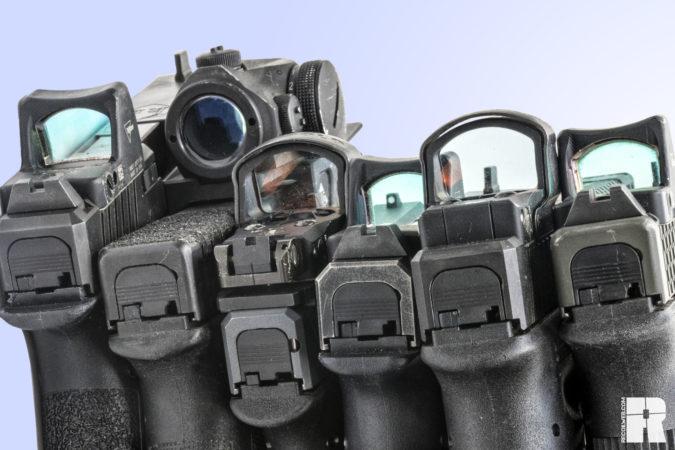
In 2020, the term Reflex Sight sounds a little out of date. There’s something of a late-80’s to Operation Desert Storm alure hovering about the old name. Often now referred to as a Red Dot Sight, the current nomenclature of the tactically proficient inundate themselves with words like Optic, or obscure the subject with codewords like “glass.” Growing up in tandem with the internet, many remember the day they graduated from the brain-melting phase of arguing AR vs AK, through the troublesome years of 9mm vs .45 into the sure sign of adulthood: the classic Red Dot vs Holographic arguments of the early 2010’s. In those days one was forced into what could only be understood as a binary decision: do you favor the indestructibility of the Aimpoint M68 CCO, or that big-as-a-Navy-SEAL’s-ego field-of-view unique at that time to the EOTECH Holo sight?
Before we dig into the characteristics, qualities, and varieties of reflex sights, a little bit of history must come first. As time passes, the integration of digital technology into projectile weapons only continues to increase, and one should expect it to continue. While Red Dot Sights are still being accepted and integrated into handguns, it didn’t take long for Iron Sights to become a secondary option to an aiming device not designed for ranged magnification. The spiritual ancestor to what is now the norm for close range combat and defense carbines came about through the use of tritium and a curious understanding of the human brain.
The OEG, or Occluded Eye Gunsight emerged around the Vietnam war and gained recognition during the Son Tay prison raid. Unlike the conventional U.S. Armed forces of the day, the soldiers in the Special Operations could be found sporting what looked like a scope with a small red object protruding out where the objective lens would sit. However, if one looked into the OEG like a rifle scope, all they would see would be a red dot in a field of black. The OEG required the shooter to keep both eyes open, manifesting a phenomenon called collimating where one eye would see the dot the target, the other eye the dot, and the brain would superimpose the two images together. This same concept when applied to the ACOG and other prismatic optics is called the Bindon Aiming Concept.
But by 1975, Aimpoint had launched their electronic Reflex Sight by bringing battery-illuminated lighting to a bloodline of engineering dating back to 1902. By reflecting a point of light off of a layer of glass, the term “reflex sight” was born. The name stuck, however, largely due to the way it was perceived to grant lightning reflexes to the shooter.
Function and Operation
The Reflex Sight plays fewer tricks on your mind than its predecessors, but holds onto the genetic development all the same. While the OEG didn’t reflect light toward the eye of the shooter, a reflex sight uses a light-emitting diode to project a small point onto a sheet of curved glass which corresponds to the desired point of impact of the shooter. This glass has a special coating that allows most frequencies of light to pass through but reflects red light back to the shooter. The wider the frequency of reflected light, the more discolored the lens will appear.
The simplicity of a single-reference point of aim as opposed to lining up a front and rear sight allows not only for easing strain on the eyes transitioning through focal planes, but also reduces the dependency of the shooter to have perfect form. The angle of the reflection functionally affords the shooter grace when aiming, for so long as the optic was zeroed, the shooter can move their head shifting the apparent location of the dot in the optic, with minimal effect on their point of impact. There is debate, however, about how much this affects the placement of the shot, if at all.
Short comment on Parallax:
Parallax is the apparent displacement of an object when viewed from two different angles. A simple example we’ve all experienced is a speedometer in a car: viewing a speedometer from the driver’s seat will give you the correct reading, whereas when it’s seen from the passenger seat it will be wrong.
The same applies to optics, regardless of marketing claims of “parallax free”. The only time a scope or red dot will not have parallax error is if the eye is perfectly centered behind the reticle, or if the reticle is focused exactly on the targeted distance. Parallax error is largely unnoticeable at magnifications under 10x, which is why you’ll have a parallax adjustment knob on any quality scope above that magnification level.
The reflex sight developed along three main paths from there: ruggedness, size, and field of view. The rugged genome gave birth to the Aimpoint T-1 Micro, and was followed by a whole list of contenders as time passed on. Micro red dot sights (MRDS) eventually could fit on a pistol and now have surpassed trending and quickly are becoming the new normal. Contending with the EOTECH for field of view are options like the Trijicon MRO that feature a design attempting to minimize how much the body of the sight blocks the shooter’s view.
The name Red Dot Sight should not be deceiving, however. Young soldiers are probably still spreading the idea that the infamous “they” chose red because of how easy the eye picks up the dot. We’re not here to comment on that at the moment, but those for those who play Call of Duty or have some colorblindness, not every reflex sight comes exclusively in Red, and with new models arriving each year, a greater variety of reticles are appearing on the market.
Even as the technology behind optics and sights continues to explore new directions, the qualities typically found in reflex sights gives them a certain dominance in the field. Most options boast nearly excessive battery life, often marketed in the years. In trunks, closets, and gun safes across the country a T-1 Micro can be found with the light on, left that way on purpose with the confidence that the car’s battery will likely need changing first.
Few alternatives can beat a Reflex Sight in weight and durability. At the same time, Low Power Variable Optics (LPVO’s) are beginning to creep in with generous fields of view, all the while offering magnification at the turn of a dial. Holographic sights still pose a threat to the hegemony of red dots by creeping down in price with the Vortex UH-1.
The State of Reflex Sights in 2021
There’s nothing like having choices, but in 2020, we’re no longer gambling with cheap knock-offs with so many legitimate contenders on the field. Remember the three main paths from earlier? In similar fashion, the three categories of reflector-type red dot sights presented are full-size prioritizing field of view, the rugged compact optics typically featuring a 20mm aperture, and the self-defined micro section popular on pistols.
Full-Size / Field of View
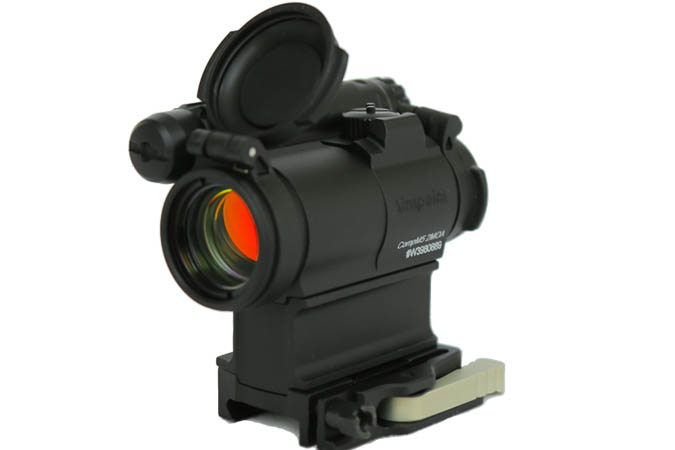
From the battlefield to a boar hunt, the heart and soul of reflex sights rests in the hands of these options. Old enough to be found on retro clone builds, relics like the Aimpoint M68 CCO still garner respect, and with years of use before options like the EOTECH reached the military, the design had gone through evolutions of improvement. Spiritual successors such as the AIMPOINT PRO and Vortex SPARC have survived house fires, which is more than most of us will go through, hopefully.
Even as some evolutions sought to get smaller, the desire for full-size reflex sights remains prominent as multiple companies continue to offer reputable and dependable red dot optics with aperture hovering around that 30 mm mark.
More on Full Size Reflex Sights
This Aimpoint PRO survived a House Fire.
Another full-cruelty demonstration of the failing to kill a Vortex Sparc.
Rugged / Compact
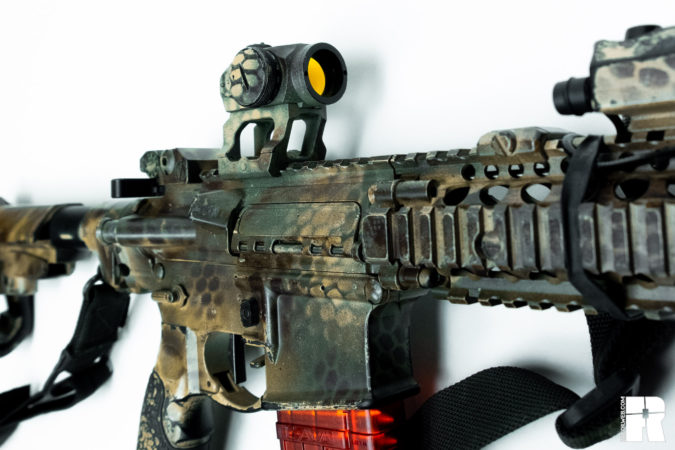
Perhaps it was timing, perhaps by design, when the Aimpoint T-1 Micro hit the scene in 2007, it brought with it the YouTube torture test. Millions watched in horror and anticipation as the Reflex Sight was dropped, smashed, thrown across concrete parking lots, submerged in water, and the like, only to be returned to the rifle with minimal shift in point of impact. Number crunchers claimed a 5-year battery life and quickly the optic was spotted on carbines, pistols, and shotguns. The category-defining durability spawned a host of options, with features like solar panels, reticle choices, and a steady creep towards more and more affordable options.
The trend had caught on, and rightly deserved a place in the pantheon of excellent red dot designs. Even as Aimpoint’s T-1 and T-2 Micro continue to hold a venerable place as the category progenitor, new offshoots have arrived offered with a range of dot colors, reticles, and features like solar panels to extend battery life can be found on SIG ROMEO4T and various models by HOLOSUN. In 2020, those interested in topping a defense carbine should not overlook the whole list of contenders including the STRIIKER by Atibal, Liberator by Swampfox, SPARC AR or Crossfire by VORTEX, and the TSR by U.S. Optics, just to name a few. There was a day when the naysayers could say nay, but today is not that day.
Vortex SPARC AR as low as $199 at Optics Planet
MICRO
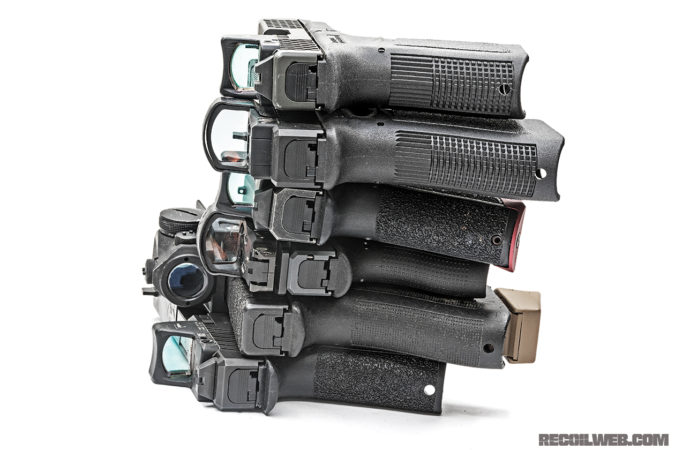
Distinctly miniature, Micro Red Dots were not the first ones to make it on a pistol, but their popularity as a handgun optic has multiple histories. In 1970, Jerry Barnhart Before the days of sending a pistol off to get an optic cut, the most common place to find a micro reflex sight would be on a military or competition rifle mounted in tandem with some form of magnified glass. For a time, the combination of a Trijicon ACOG accompanied with an RMR caught the envy of those outside special military units, and for those interested in 3 gun, choosing to mount a second optic on your rifle will secure you a place in the high speed and punishing open devision.
In order to achieve their size, most Micro Reflex Sights feature an exposed emitter, sacrificing durability for reduced weight and size. Subject to the elements, MRDS’s require regular cleaning and maintenance, and both water and debris threaten to put them out of commission.
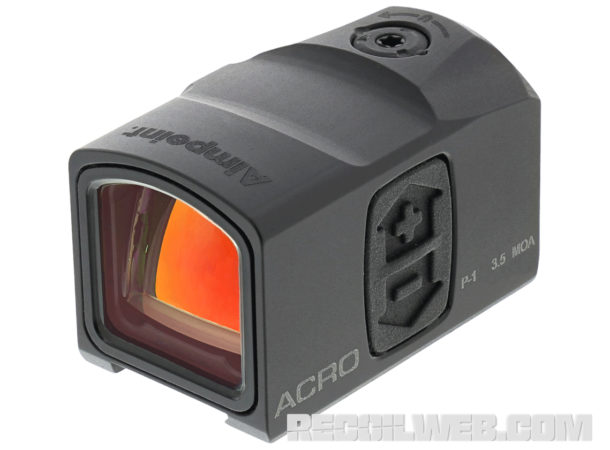
The Aimpoint ACRO and Holosun HE509T-RD were both designed as a sealed system, with the intent of topping common handguns. When sorting through the many options of micro reflex sights, one must pay special attention to the footprint: the pattern of bottom face of the optic that attaches to either a pistol slide or mount for use on long guns. Some share footprints, but that’s dicy business and often a point of friction between competing manufacturers.
Shop Holosun at Optics Planet
More on Pistol Mounted Micro Red Dot Sights:
Learn how to Master Red Dot Equipped Pistols with Mike Pannone.
For more on the history of red dots on handguns, as well as what to do when they break, read here from Concealment 9.
For techniques on transitioning from irons to an MRDS, read more.
Holographic Sights
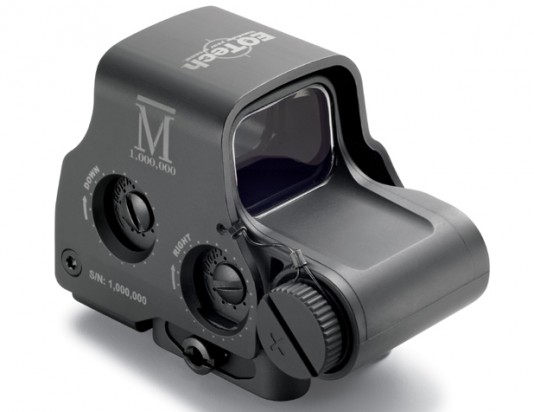
In 2020, no one should be faulted for mistaking an EOTech XPS series or Vortex UH-1 as a reflex sight. The distinction between a holo sight and more traditional reflex optics is found in how they go about getting a reticle to appear for the shooter. From the outside, they look and act similar, but holographic sights bring their own characteristics to the table. Though shorter battery life and wider field of view are typical of the category, that’s not all we’ll have to say on them. Keep current and we’ll let you know when there’s more content on holographic sights.
Closing Off
Having come so far, we expect the future of the reflex sight to develop in two directions: either a constant pursuit of making them smaller, lighter, and less occluding of the shooter’s vision, or ultimately relinquishing ties to their old name by giving up the dependency on reflecting light off glass all together. We’re not sure how this second option will manifest, but if it’s anything like the video games, we’d be more than interested.
For now, reflex sights continue to dominate the trend and market of close-range, quick-draw inspiring aiming devices, at least in daylight hours. Tying them into night vision operations is still a work in progress, as a red-dot mounted pistol feel like cheating they’re so easy, while the experience is opposite when trying to line up an NVG tube with a sight sitting atop a carbine. Most, in that case, opt to use IR lasers to accommodate night vision dependent military operations.
Finally, the ecosystem of available reflex sights can quick spark more than one heated debate over which is “best.” That argument, thankfully, is waning as the level of quality found across the industry continues to rise. There was a time when one ventured onto dubious ground when looking at anything other than the higher-priced names typically known to secure government contracts, but those days are passing quickly by as more and more manufacturers continue offer reliable quality optics backed up by honest warranties. Owning a dependable reflex sight need not come at a luxury cost.
More on Optics
LPVO vs Magnifier, Pick your Poison.
Red Dot Sight Buyer’s Guide.
Many of the Best 9mm Pistols for 2020 come optics-ready.
EOTech Magnifier: Force Multipliers.
The Holographic Sight Advantage of EOTech.
Vortex Red Dot Sight Guide.
Aimpoint Acro vs Holosun 509T: Battle of Sealed MRDS Optics.
Prism Scope Versatility: The Battlefield and Beyond.
The tank wall is made of thicker tube material for sustaining 2000 psi.
They figured out the formula for keeping the budget on point and avoiding the fill pressure of 3000psi,
Which would have required an even thicker tube wall resulting in an increase in the price of the product.
Besides, the 136cc reservoir can be filled with 2000 psi air pressure by a hand pump easily
The hardwood stock gives it a classic authentic look which is much more preferred among the hunters than the black sleek look of common synthetic stocks.
Besides, Beeman QB Chief offers an open sight that has an optical fiber element,
But this comes in the updated QB78 model popularly known as the deluxe model.
Here we can see certain added features in stock as well.
The sleek Monte Carlo look is always celebrated among shooters, and the cheek rest offered by this model ensures better alignment of scope.
The regular Beeman QB Chief comes with one 11 mm dovetail ring for the mounting scope of your choice.
The QB79 is more flexible than QB78 as it allows greater accuracy and a higher degree of consistency.
Another striking feature of this updated model is that you can detach the gas bottle after using the gun.
It will eliminate the work you had to do for degassing the gun as co2 air rifles should be degassed always after use for the durability of the product.
Apart from that, what is worth mentioning here is the claim by the manufacturers of shots per fill.
They claim it to be 50 shots per fill for .177 caliber and 35 in the case of .22 calibers.
The metal part also has a great surface finish, and the bluing is not only remarkable but also very effective.
A lot of rough handling will leave no impact on it.
Though this Beeman QB Chief is a pre-production gun, there is no visible machine mark on it about which you should be worried particularly.
With a little higher position of the stock comb, Beeman QB Chief will be one sleek stylish gun and way more attractive than the modern black synthetic stocks.
Sight
Beeman QB Chief does everything right with the sight.
It comes with an open sight that is fiber optic in nature, which is somewhat one of the best types of sight available in the market.
The rear-view sight can be adjusted like all other sights available in popular air guns.
The adjustment can be done for elevation and windage usually.
However, most of the shooters desire clearer vision and go with mounting a scope.
This results in higher accuracy and the manufacturers kept it in mind while making Beeman QR Chief.
There is a standard 11mm dovetail rail grooved on the breech.
Beeman QB Chief has a typical 3-9*40 AO scope.
You can use equipment like Leapers high ring for adjusting any scope if you are not willing to remove the rear sight.
There is not much space, and you have to make the necessary arrangements for mounting the scope.
However, if you decide to take the rear sight off, you must know that it is a one-time thing.
You can take it off but do not think of reattaching again.
The detaching process of rear sight could be easy but reversing is tricky and messy so you know any step after making everything sure.
Velocity, accuracy and power
The accuracy and performance are the reason Beeman QR Chief is still popular among the shooters in spite of lacking some of the cool features that modern rifles today offer.
The air gun was tested with different pellets of different weights to know, which would be the best to use with this air gun.
THE MOST ACCURATE PELLET FOR A BEEMAN QB CHIEF AIR GUN IS H&N FIELD TARGET TROPHY GREEN 5.56 GRAIN.
The pellet weight varied from 4.7 to 10.65 whereas the average energy of the muzzle ranged from 13.03 ft/lbs to 19.86 ft/lbs
And the average velocity range was between 1117.27 FPS and 982.85 ft/lbs.
Pellet name
Weight
First muzzle velocity
Fifth muzzle velocity
Tenth muzzle velocity
Average muzzle velocity
Average muzzle energy
Accuracy
Gamo Raptor platinum
4.7Grain
1137.68FPS
1122.39FPS
1100.65FPS
1117.27FPS
13.03 ft/lbs
Poor
H&N field target trophy green
5.56Grain
1097.55FPS
1061.65FPS
1061.56FPS
1077.42FPS
14.34ft/lbs
Excellent. Best among tested.
RWS Hobby
7.0Grain
1044.43FPS
1033.20FPS
1016.20FPS
1032.21FPS
16.56ft/lbs
Very good
Crosman premier
7.9Grain
1006.48FPS
1004.14FPS
982.06FPS
996.62FPS
17.43ft/lbs
Very good
JSB Exact Diabolo
8.44Grain
999.00FPS
988.32FPS
962.77FPS
982.85FPS
18.11ft/lbs
Very good
H&N field target trophy
8.64Grain
974.55FPS
962.01FPS
942.53FPS
960.29FPS
17.7ft/lbs
Very good
H&N Baracuda match
10.65 Grain
937.49FPS
918.92FPS
896.33FPS
916.40 FPS
19.86ft/lbs
Very good
From the above table, we can see that the most accurate pellet for this Beeman QB Chief air gun is the H&N Field Target Trophy Green 5.56 grain.
Except in the deluxe model, Beeman QB Chief offers a single-stage trigger that is, which breaks around 3lb and 11oz.
The setting is conservative, but I suggest you don’t tamper with it before understanding the settings properly.
The test result that I have shown above is also done with the factory-made setting.
The trigger is quite unpredictable as it is with most single-stage triggers
But considering the price, I can say it is better than most air guns available in the market.
You can adjust the trigger according to overtravel, sear engagement, and pull weight easily.
All you need for this adjustment is set to screw controlling and profound knowledge; you can even remove it from the stock.
However, I repeat, do not tamper with the trigger setting without proper knowledge.
The safety present in Beeman QB Chief is manual.
In the QB78 deluxe version, we see a two-stage trigger with adjustable settings leading to instant higher accuracy and safety with the higher trigger pull.
Cocking and loading
The Beeman QB Chief has a cock on opening action, which is really easy to pull back.
While chambering a pellet it is very easy and smooth to push forward and load.
The loading could be quite tricky though as it has a smaller place for long pellets, and a little modification is needed in the adjustment.
Loudness
It would be useless to waste many words on this.
To be honest, in every sense, a Beeman QB chief is a loud rifle.
This does not come with a shrouded barrel which eliminates all hopes of a silent shooting with Beeman QB Chief.
The absence of any suppressor is quite vivid in this system, and we have to consider the power as well which contributes a great deal to the loudness.
While testing the shooters are mostly using high-quality earplugs in the shooting environment.
Shooting Ability
Shooting with QB78 deluxe is pleasant but basic QB78 could be difficult because of its low comb.
Testers are claiming that the cheek weld actually works as the chin weld in the basic models
Though the manufacturers assured that it will change before mass production.
They will offer a higher comb.
The higher comb the more accuracy will increase positively.
The weight is also not too much, which makes it easier to carry and better hand position while shooting.
With a typical 3 9*40 AO scope Beeman QR Chief weighs around 8lb 6oz.
It is easier to reach the air pressure than that of 3000psi of usual PCP guns.
Being a PCP gun, the first thing you will need for your Beeman QB Chief is a hand pump or compressor to fill the tank in order to generate the operative pressure.
Here I am going to chip in some real advice.
If you are buying Beeman QB Chief because it’s pocket-friendly, and you want something simple and cheap I don’t see why you should spend much on a scuba tank.
The fill pressure of Beeman QB Chief is 2000psi, and the reservoir is 136cc.
There are several decent hand pumps available in the market such as UZWELL top quality high-pressure hand pumps, mini air compressor high pressure, etc.
However, if you already own some other guns or plan to buy the next one soon, you can buy an air compressor or scuba tank.
Air venturi is one name you can trust but there are other good air compressors that are also available in the market like Crossman.
You already have a fiber-optic open sight with an air gun, but you can always get your favorite scope, which fits your requirements.
The sight is sometimes claimed as not so bright, and you may want to replace it as well.
This is a really lightweight air gun so a sling hoop or sling would not be necessary and will completely depend on your choice.
Maintenance
Beeman QB Chief is not an air gun that takes too much to stay functional for years.
You do not have to worry about much when you have Beeman QB Chief in your hand.
You can just wipe any grease or lead building off the gun with simple wipes available in the market.
One such useful and handy single-use wipes come from LS1, which is a familiar name in the industrial lubricant market.
You can also get them in spray cans.
To keep seals and O rings lubricated you may opt for popular lubricants like Ultrair CO2 lubrication or Pellgun oil.
One important thing that I have to mention here is that you have your O ring and seals replacements ready.
In case you are going for a tuning set, it would be wise to order two sets of them.
These are all your Beeman QB Chief needs to serve you for a really long time.
Specifications
Beeman QB Chief is a pre-charged pneumatic air gun.
This is a cock open on bolt action gun.
Beeman QB chief is a single-shot gun.
The safety is manual.
Two-stage adjustable trigger makes the gun safer and more accurate.
Monte Carlo hardwood stock.
Fiber optic front and rear sight provided with the gun.
11mm dovetail ring for mounting scopes.
The barrel is rifled and without any shroud making it impossibly loud.
The fill pressure prescribed by the company is 2000 psi.
The air tank reservoir is 136 cc.
Manufacturers claim 50 shots per fill in case of 0177 and for 0.22 that would be 35 shots.
The male quick disconnect makes it easier to fill the tank with a quick female disconnect.
Pros and Cons
Pros
Cons
Perfect budget price.
Somewhat light weight in nature.
Wooden stock for authentic touch.
Great performance and accuracy.
Male quick disconnect could make the filling easy with a female quick disconnect.
Made in China.
According to customers, the product is cheaply made.
Single shot gun requiring more effort and time.
Very low comb position.
Price
The Beeman QB Chief comes with an extraordinary price tag in the world of air guns.
A PCP air gun that costs only around $180 was a myth at some point, but Beeman has made a miracle come true.
It is actually cheaper than many break barrel guns available in the market. To say it’s a steal is an understatement!
Most people would not find a plate of fried larvae appealing.
However, there are many ethnicities across the world who consume insects on a regular basis.
These groups of people will tell you that edible insects are extraordinarily flavourful and delicious.
There’s also a current trend in the US where people are switching to edible grubs as a protein source since they are energy-packed and nutrient-rich.
They are also easy to grow or find and relatively straightforward to prepare.
If you’re one of the many, who wish to make a conscious effort towards sustainable methods of living and are wondering what do grubs taste like, keep reading to find out.
These white worm-like creatures are often mistaken for worms, but they are actually the larval stages of several species of beetles, like the scarab or June beetles.
If you find it hard to identify these creatures, you can look at their color; most larvae are white or off-white.
Their legs and appendages are located near the head, and they can grow up to ¼ or more than an inch long.
The larvae have a C-shaped body that is wrinkled and soft to the touch.
Many of these baby beetles are considered pests that destroy the natural vegetation grown around homes.
These insects are found buried in the ground.
They feed on the roots of plants until they mature into a pupa.
Many insects are eaten worldwide, and grubs are just one variety of bugs considered edible.
Although, once the pupae have completed the chrysalis stage, most adult beetles cannot be consumed.
What Do Grubs Taste Like?
Grubs are a very non-conventional ingredient to have in your pantry, and many might not be aware that such a product is available for consumption.
So, what does it taste like? Well, many have compared it to chicken or even beef.
Some have even said the grubs have fruity flavors.
These creatures are soft and pack a whole lot of flavor in their tiny bodies.
Most people will agree that the larvae taste like soft, tender beef bone marrow.
Some have said the taste resembles bacon when roasted over an open flame.
The bugs can be cooked in many ways and with various ingredients.
Depending on the cooking method, you can improve the flavor of the larvae immensely.
Some communities that consume bugs regularly are known to eat the grub raw.
If you’re bold enough to try them fresh and uncooked, be prepared for a bit of bitterness.
However, that does not last because most grubs have a nutty aftertaste with a cheesy texture.
Not only are they delicious, but grubs are also known to be highly nutritional.
They come packed with protein and all sorts of minerally goodness.
They are rich in Vitamin C, healthy fats, iron, zinc, phosphorus, etc.
Nowadays, many people, even in the west, have accepted these little critters as part of their diet.
Once you get over the fact that they are considered ‘pests,’ you’ll be surprised by how delicious they can be and how easy it is to prepare them.
Can You Eat Grubs?
Before trying anything new, you’re bound to ask, is it good? Or what does it taste like? You may even be asking whether you can eat it.
The latter may be an appropriate question to ask when it comes to this particular food group.
The answer is a resounding yes.
You can undoubtedly consume grubs.
These pasty white creatures are part of a larger group of insects that are considered edible.
If you’re reading this article, you’re most likely venturing into new, unusual culinary territories.
Bugs are definitely a different gastronomic experience.
They aren’t that appealing to look at, but they have intense flavors that will whet your taste buds.
There are places where these small umami-filled edibles are a common item at a dinner table and are enjoyed by the entire family.
Grubs can be cooked and served in several different ways, and people all over the world will claim that their method is the best.
Nonetheless, deep frying, steaming, and roasting are the most popular ways to prepare insects.
So, the next time you come across a plate of creepy crawlies, why not give them a taste?
Conclusion
A lot of research and study is going towards finding alternative protein sources for a sustainable lifestyle.
Grubs, mealworms, and maggots have all been deemed worthy of being served as a dinner menu item.
They are nutritious, filling, and high in calories.
Even though the idea of having worms on your table may be offbeat, you might actually enjoy eating them.
Here’s your sign to go and try out some grubs for your next meal; you will not be disappointed.
Entomophagy might be the change you need to shake up the monotony of life.
Howa Super Lite Hunting Rifle 6.5 Creedmoor (RifleShooter photo)
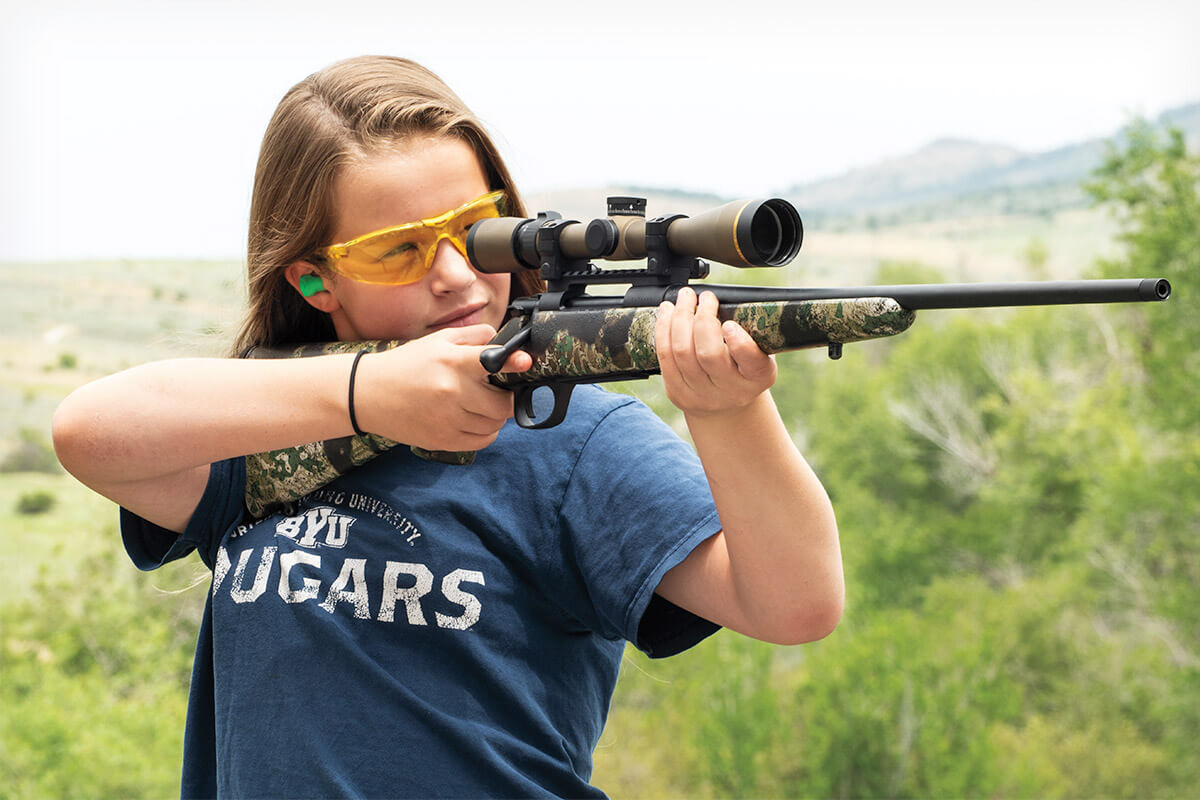
Light is in. Crazy, obscenely light. In the production-rifle realm, Howa’s svelte little rifle built on its “reduced” short action is the lightest of the light. It follows that it’s also extraordinarily nimble and lively in the hands. Built with a compact 20-inch barrel, the Super Lite is easy to strap to a backpack or stow behind the truck seat. It’s particularly appealing to small-framed shooters and kids, who may lack the strength to hold up traditional-weight centerfire hunting rifles.
The Super Lite is built on a slenderized version of Howa’s proven turn-bolt rifle action. The receiver is machined with an integral recoil lug, and it houses a forged bolt featuring dual, opposing locking lugs up front. A backup lug is machined where the rear-swept bolt handle merges with the bolt body. A robust M16-type extractor hauls cases out of the chamber, and a plunger-type ejector hurls them out the port. The bolt release button and the safety are both of stamped sheet steel. Although the safety doesn’t appeal to me visually, I like it because it’s a three-position version that allows the shooter to lock the bolt closed when on Safe if desired.
The action features a Picatinny rail, which von Benedikt felt places a scope too too high. The safety is a three-position rocker, and the H.A.C.T. trigger was crisp and clean. (RifleShooter Photo)
Up top, the action is fit with a one-piece, bridge-style optic rail. Such rails are currently popular, but I’m not a fan of them on stocks without adjustable cheekpieces because they invariably place the scope way too high above the action. More on that in a bit. The Howa’s action is built with a polymer magazine well and trigger guard, which keeps weight to a minimum. The bottom “metal” works well with the provided single-stack magazine, but the fit to the stock around it isn’t exemplary. Edges of the bottom metal are about 0.1 inch proud in the middle area, and at the front end the magazine itself protrudes nearly 0.1 inch below the bottom metal. On the plus side, the profile and shaping of the trigger bow are sleek and attractive.
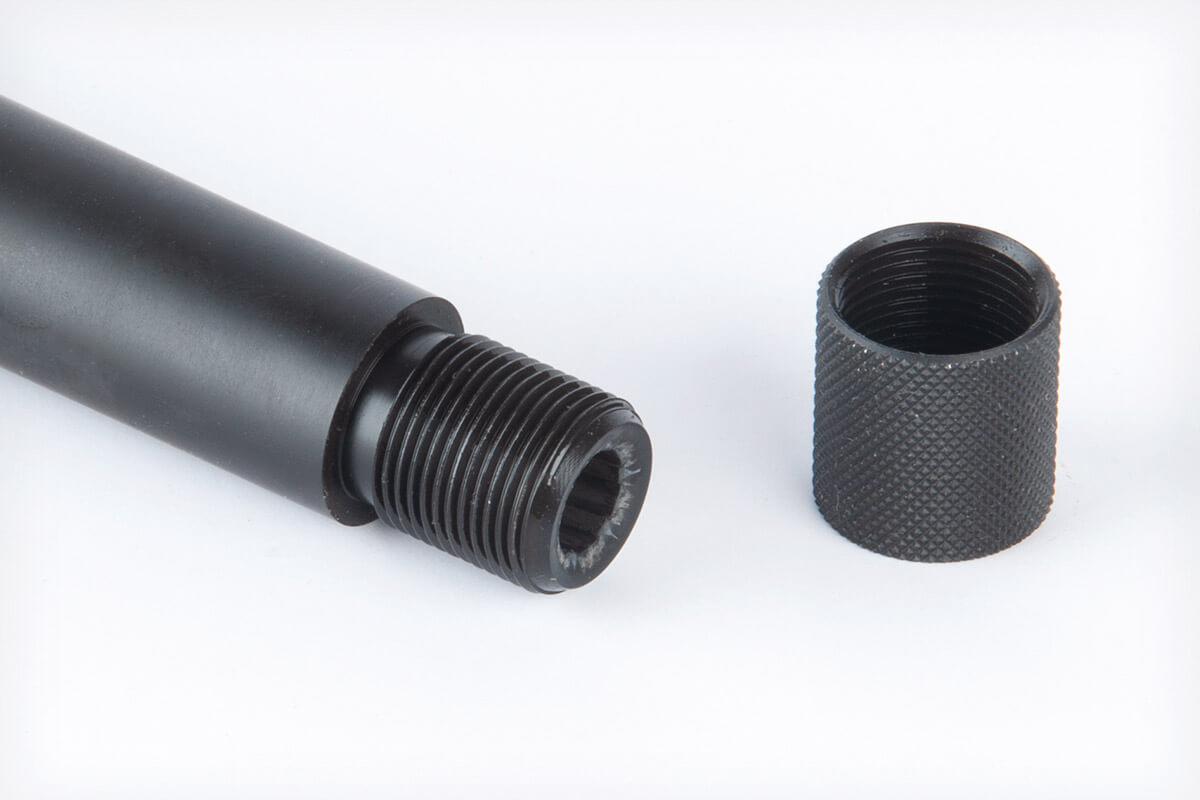
Howa opted to use its Howa Actuator Controlled Trigger (H.A.C.T.) two-stage trigger on the Super Lite. Its first stage is smooth and light; the second stage is crisp. It’s factory-adjustable only. My test sample’s trigger tripped nice and clean at three pounds, three ounces. The action and barrel are blued chrome-moly steel. Up front, the muzzle of the ultra-slender barrel is threaded and is billed as “suppressor ready.” However, even though the Super Lite is chambered to 6.5 Creedmoor and .308 Win., the barrel is threaded 1/2×28 due to its tiny diameter.
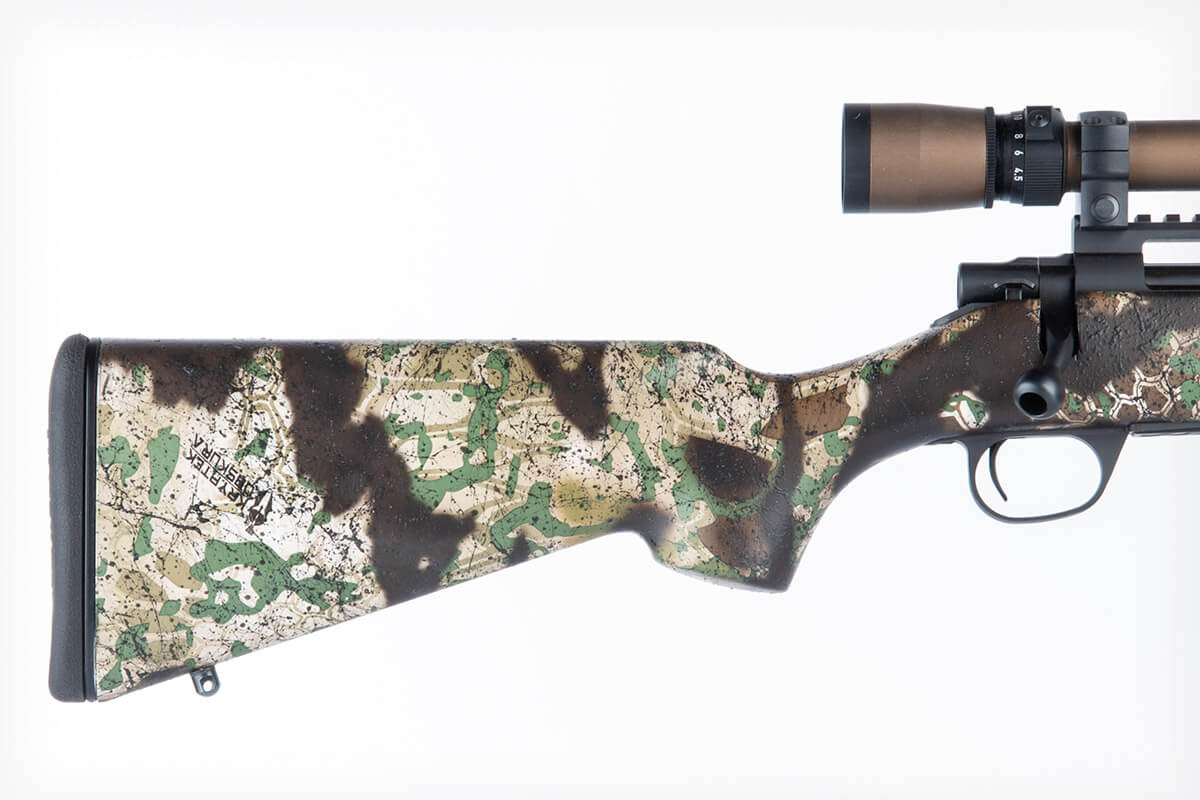
The nicely profiled Stocky’s stock is made of carbon fiber and available in two different camo patterns. This sample was in Kryptek Obskura. (RifleShooter Photo)
That’s a thread pitch commonly reserved for rimfires and .22 caliber centerfire rifles rather than the 5/8×24 pitch standard on centerfires of 6mm and up. Have no fear, though. Adapters are available from Silencer Central, Brownells and other sources, so if you own or are considering owning an appropriate-caliber suppressor that’s threaded 5/8×24, you can make it work on the Super Lite.
Howa’s barreled action is mated with a carbon-fiber stock by Stocky’s. Said stock is nicely finished with multicolored paint in Kryptek Altitude or Kryptek Obskura Transitional camo. My sample featured the latter. It’s a good-looking, good-feeling stock. It’s fitted with a LimbSaver pad, and sling swivel studs are installed fore and aft. Inside the fore-end, the barrel is free-floated except for a pressure point at the fore-end tip.
Great Stock
Many modern stocks have completely lost touch with the fundamentals of aesthetic stock design. Thankfully, Howa’s Super Lite isn’t one of them. It’s easy on the eyes and in the hands. I pulled the action from the stock and examined it. The action inlet is nicely cut, although it’s not what I’d call a snug fit because it’s not glass-bedded. I think spot-bedding the front recoil lug, an easy DIY task, would undoubtedly benefit accuracy. I installed a 4.5-14×40 Leupold VX-3i scope in super-low profile aluminum rings in an effort to get the scope as close to the action as the too-tall scope rail allowed. The setup looked good, mounted naturally and felt great at the shoulder.
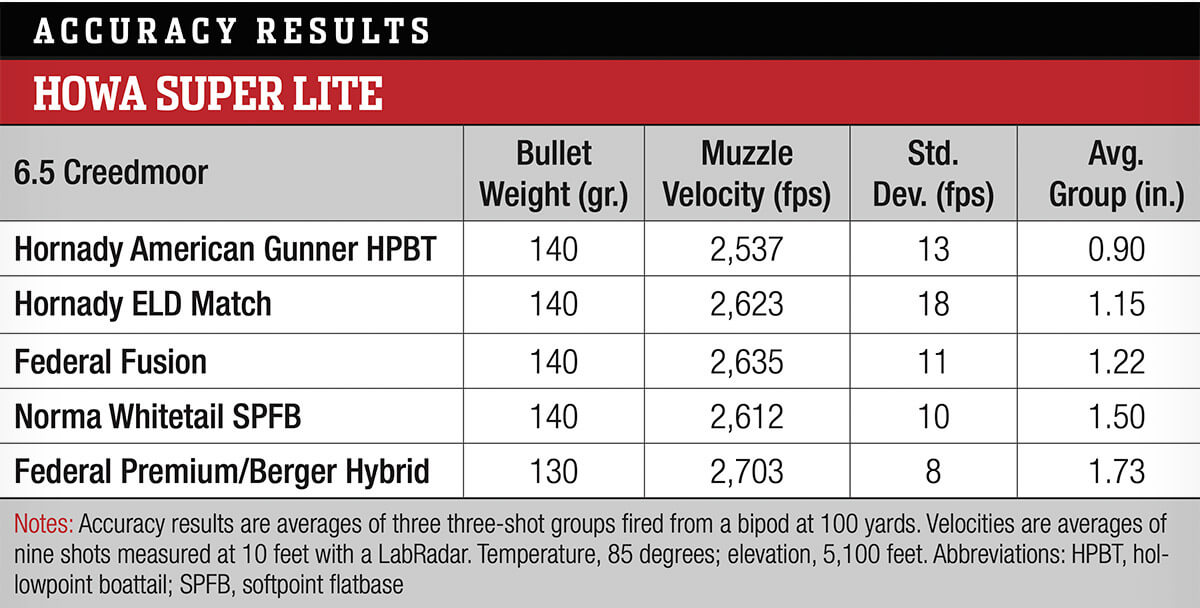
Recoil of a 6.5 Creedmoor is never heavy, but in such a light rifle, it’s sprightly. To my surprise, the scope migrated in the rings—something I’d never seen in a 6.5 Creedmoor before. Suspecting the inexpensive rings were the culprit, I switched to heavy-duty steel Leupold Mark 4 rings. That solved the problem, although in this case it detracted from the looks and placed the scope too high above the action for my taste. At least the Mark 4 rings held the scope securely. With a Harris bipod attached to the front sling swivel stud, I rested the toe of the stock on a leather bunny-ear sandbag and took my time in 85-degree temperatures, allowing the barrel to cool completely between three-shot groups for the accuracy results shown in the accompanying table.
Nearly all noodle-barreled, ultralight rifles are quite picky about ammunition, and the Howa is no exception. I tried four different loads that usually provide excellent accuracy, but they did not meet Howa’s sub-m.o.a. guarantee. What with the rifle’s extremely light weight, I’d have questioned whether the issue was me that day, but at that same range session I also test-fired another rifle, and it regularly produced sub-m.o.a. groups. The last load I tested through the Howa—Hornady’s American Gunner 140-grain hollowpoint—hit paydirt. Three consecutive three-shot groups averaged exactly 0.90 inch and validated Howa’s accuracy claim.
Because of the slender barrel diameter, muzzles are threaded 1/2×28 rather than the standard 5/8×24 used on most center- fire hunting-caliber rifles, so you’ll need an adapter to mount a 5/8×24 can. (RifleShooter Photo)
Now, the Super Lite is a hunting rifle and American Gunner is a target load. However, it just goes to show that with ammo the rifle likes, it will shoot. Of the rest of the factory loads I tested, Fusion’s 140-grain bonded softpoint produced a 1.22-inch average and certainly would be adequate for most hunting purposes. Besides, Fusion bullets provide outstanding terminal performance. As I mentioned, glass-bedding the action into the carbon-fiber stock would increase accuracy and improve consistency. Aside from one failure to feed, the Super Lite functioned perfectly. The way I run the bolt, I feel a slight hesitation just before the Howa’s bolt reaches its rearmost travel, and I suspect I short-stroked the action that one time it didn’t feed.
Light Weight Range Time
Balance is great, and predictably, the little Super Lite is super-responsive. My favorite characteristic is the way it carries in one hand. The stock is slender and easy to grasp, weight is nothing, and length and size are so small it feels sleeker than many modern .22 rimfires. However, it’s worth pointing out that the light weight that is such a selling point inevitably is also a detriment to accurate field shooting. Why? Heavier rifles are naturally more stable because their weight dampens muzzle movement caused by excitement, stress and physical exertion.
Being easy to heft, the Super Lite is sure to be a hit among kids and small-framed shooters. (RifleShooter Photo)
Light rifles unfortunately exacerbate this muzzle movement, and that can induce errors during shot execution. It’s something to consider if you’re not familiar with super-light rifles or are considering it for a young or small-statured hunter. Suggested retail is right at $1,400, and real-world cost will be less than that. The carbon-fiber stock is a huge benefit: rigid, light, strong and impervious to extremes in moisture and temperature. If I were to list one primary gripe, it would be the lack of refined fit around the bottom metal and the rear of the action tang. Were I to purchase one for myself, I’d pull off the one-piece Picatinny rail and replace it with high-quality, lightweight, low rings. I’d glass-bed the action. Then I’d tune a handload with a good hunting bullet to shoot as well as Hornady’s American Gunner factory load did, and I’d hunt happy.
Howa’s Super Lite is the lightest factory-production centerfire hunting rifle I’m aware of. It looks good, feels good and is capable of shooting well. Kids and small-framed shooters “ooh” and “aah” when they handle it. While it’s not of the same quality as some high-end competing production rifles, it’s lighter and available at half the price.
Roy Weatherby was a visionary in the firearms industry. From his early experiments with ultra-velocity rounds to the development of his supremely safe action and his early adoption of polymer stocks, Weatherby was always at the leading edge of hunting rifle innovation. He was also a brilliant marketer. I still recall the images of a tree blown into so many matchsticks by a single .300 Wby. round and Roy palling around with famous actors like John Wayne and Roy Rogers.
Dressed in fancy Monte Carlo stocks and chambered for hard-hitting magnums, the Weatherby Mark V became the “it” hunting rifle of the mid-20th century. But all that fancy walnut came at a price, one many hunters simply couldn’t afford.
Roy Weatherby understood the need for a workingman’s Mark V, and in 1970 the company announced the Vanguard. Vanguard rifles were—and are—built on Japanese Howa push-feed actions. At the time of their inception, they rivaled popular rifles like the Remington 700 and Winchester Model 70, and Vanguard guns remain a popular option for big game hunters.
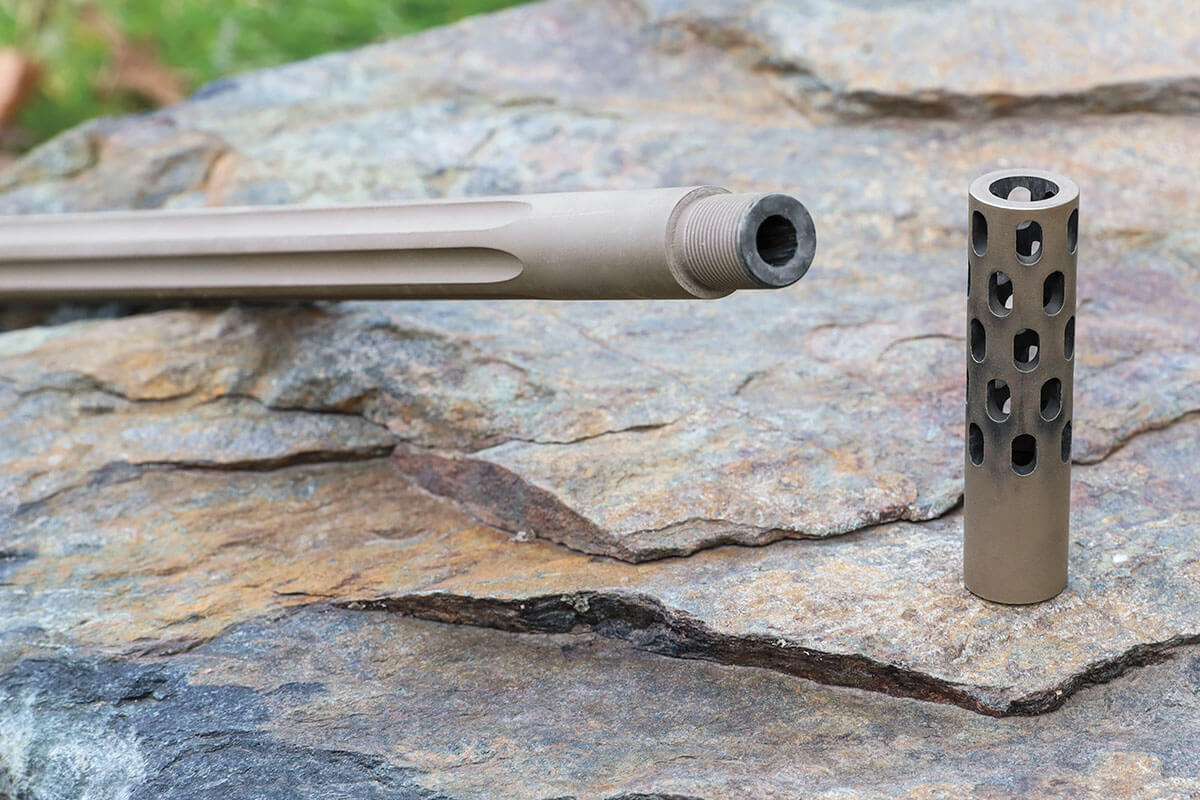
Vanguard High Country rifles are equipped with Weatherby’s removable Accubrake ST, which significantly reduces felt recoil.
Recently, the bolt-action rifle market has been flooded with inexpensive, sometimes coarsely built, budget rifles that provide good accuracy but lackluster aesthetics. But Vanguard rifles have always been a step above those basic entry-level guns, combining solid construction with modern good looks at a price that the working hunter can afford.
As of this writing, there are 19 different Vanguard models currently available, ranging from .22-250 to .375 H&H Mag. There are Vanguards for smaller-statured shooters on up to rifles meant for dangerous game. There are Vanguards with wood stocks and synthetic stocks and package deals that include a Leupold 3-9x40mm scope. Suggested retail prices range from the mid-$500 mark up to $1,149.
“While originally launched in only a few configurations, the Weatherby Vanguard now boasts value-added features such as Cerakoting, barrel fluting, custom stock painting, barrel threading and custom floorplates,” said Adam Weatherby, Roy’s grandson and Weatherby’s current CEO. “Although the barreled action is still manufactured in Japan, these new features are all applied at our new facility in Sheridan, Wyoming.”
Over the years I’ve tested or hunted with seven different Vanguard models and have been impressed with every one of them. Vanguard rifles feature sub-m.o.a. accuracy and are backed with an accuracy guarantee—one of the first rifles at this price point to offer such a guarantee. A Vanguard Backcountry in .257 Wby. Mag. I once tested produced average groups around a half-inch with two different Weatherby loads, and I regret not buying that gun when I had the chance.
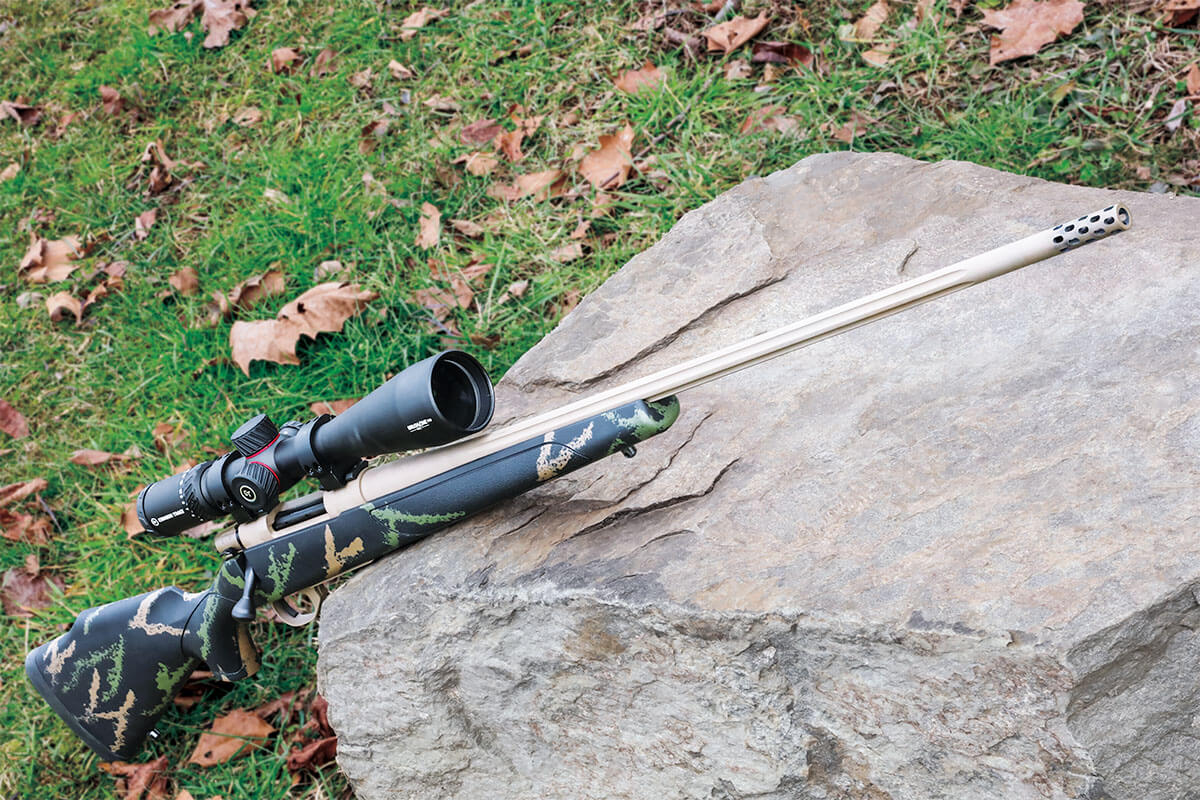
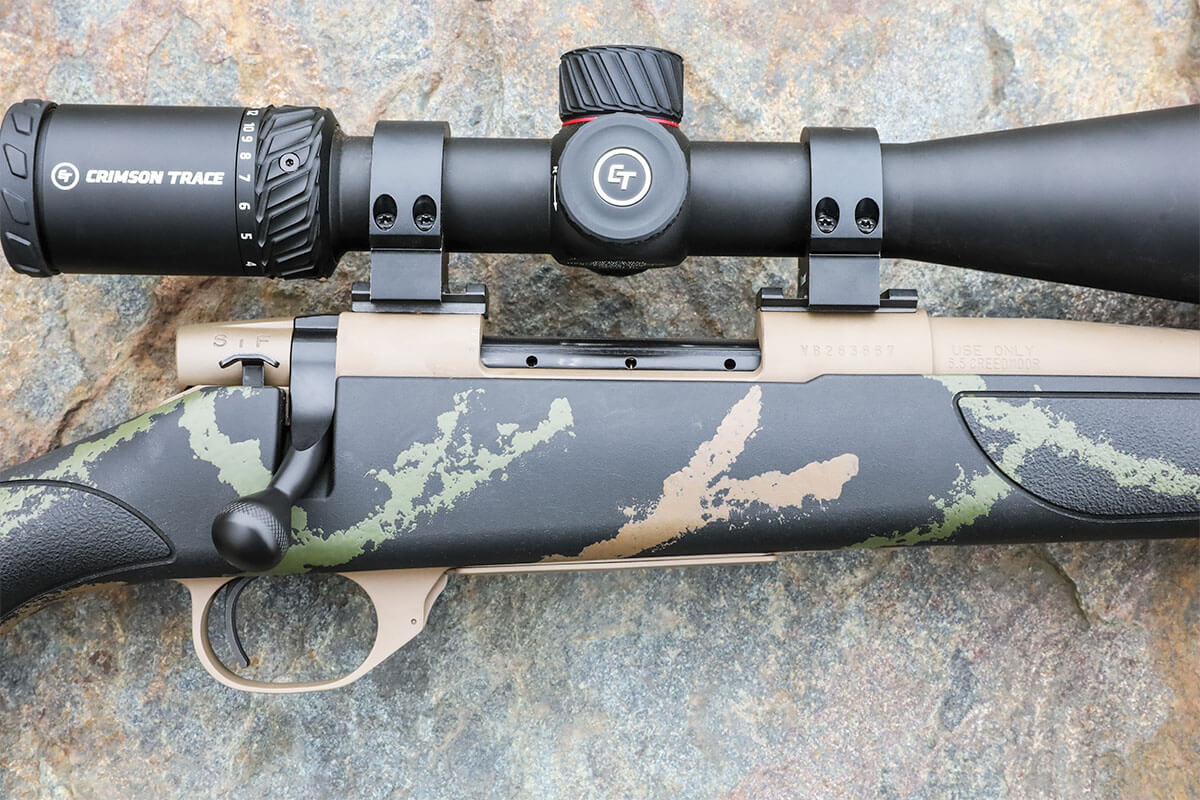
The Vanguard’s machined bolt features three gas ports. The flat dark earth Cerakote on the barreled action is nicely complemented by a green and tan stock.
The newest member of the Vanguard family is the High Country model. As the name suggests, the High Country is designed to be light enough to carry on big game hunts at high elevations where the oxygen is thin and every ounce of rifle weight is a burden. The High Country I tested in 6.5 Creedmoor weighed just 7.15 pounds with its 24-inch fluted barrel.
The cold-hammer-forged barrel is finished in flat dark earth Cerakote for corrosion resistance, and it’s threaded 1/2×28. It comes with Weatherby’s Accubrake ST muzzle brake, which adds two inches to the barrel, as well as a seamless thread protector. The barreled action is free-floated and incorporates an integral recoil lug.
The synthetic stock features Weatherby’s trademark Monte Carlo comb. It’s black with green and tan sponge-paint accents, and the stock is equipped with textured grip panels and a right-hand palm swell. I’m a fan of the grip angle, which puts my shooting hand in the correct position.
High Country rifles are available in nine chamberings—five standard rounds and four magnums. Standard cartridges, including the 6.5 PRC, have 24-inch barrels while magnum chamberings sport 26-inch barrels and weigh a couple ounces more. The Vanguard High Country rifle carries a suggested retail price of $949, which places it in competition with Browning’s X-Bolt Composite Stalker ($910) and Bergara’s B-14 Wilderness Ridge ($975).
All Vanguard guns share the same push-feed bolt action with a small claw extractor and plunger ejector. Like the Mark V, the Vanguard rifles come with three gas ports in the one-piece machined bolt, as well as a fully enclosed bolt shroud, to help prevent injury in the event of a case failure. The bolt body is fluted to shave weight.
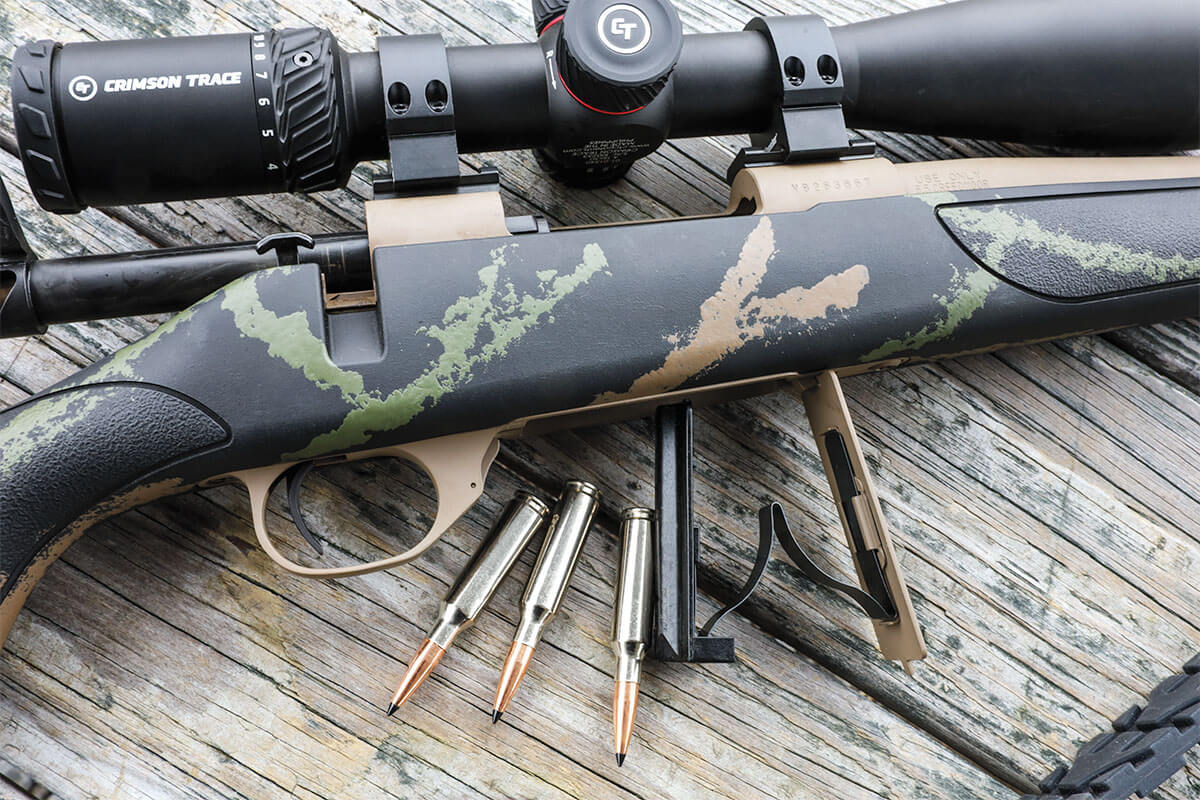
Most Vanguard rifles, including the new High Country, come with internal box magazines and hinged floorplates. Capacity for standard cartridges is 4+1.
The Vanguard High Country is easy to top-load through the generous ejection port. Unlike some bolt-action hunting rifles that are finicky about loading and feeding, the Vanguard isn’t. A floorplate release is recessed into the front of the trigger guard. The release on my gun was a bit tight, but that’s not a bad thing, as the odds of an inadvertent mag dump are exceedingly low.
All current Vanguard rifles are equipped with a two-stage trigger. That has resulted in some shooters mistakenly calling Vanguard triggers “creepy,” but the take-up is intentional and acts as a safety mechanism without employing a blade. Initial take-up is smooth and light, and after that it it requires minimal finger pressure to drop the sear.
Weatherby Vanguard triggers average between two and four pounds, and they are user adjustable. The one on my sample averaged 3.4 pounds for 10 pulls on a Wheeler gauge.
The three-position safety is the rocker-type design and is easy to manipulate. In the rearward position the trigger is deactivated and the bolt is locked. In the middle position the bolt can be manipulated with the safety engaged. Pressing the safety rocker forward allows the gun to be fired.
I like three-position safeties because the bolt can be locked when walking so that brush and limbs don’t inadvertently open the action and the rifle can be loaded and unloaded with the safety engaged. Weatherby safeties can also be manipulated silently so if you suddenly find yourself close to game, the metallic “snick” of the rifle’s safety won’t catch the animal’s attention.
The bolt stop is located on the left rear side of the receiver, and it’s easy to operate. A small cocking indicator tab that extends under the rear bolt shroud lets you know the gun’s condition.
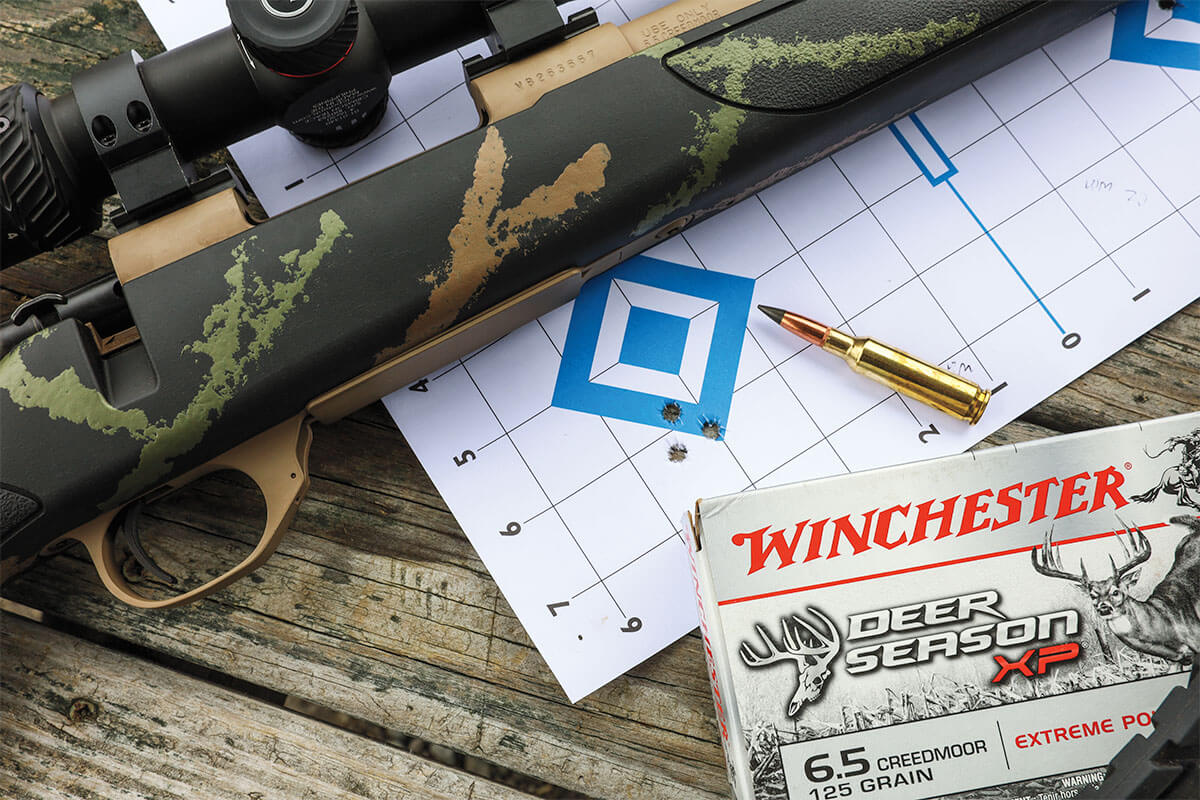
The test rifle managed to print sub-m.o.a. groups with all three loads, including this 0.44-inch cluster with Winchester’s Deer Season XP.
The High Country is drilled and tapped to accept Weatherby Vanguard/Remington 700 bases, which simplifies scope mounting. I topped the High Country with a Crimson Trace 4-16×42 Brushline Pro riflescope with BDC reticle. The Monte Carlo stock placed my eye in correct position behind the optic.
4-16×42 Brushline Pro: Check Price & Buy Now
I tested the High Country at the range with three different 6.5 Creedmoor loads. All three produced at least one three-shot group under an inch at 100 yards, and the best group of the day measured just 0.44 inch. A tack-driver, in other words, and well in line with the rifle’s guarantee for sub-m.o.a. accuracy.
The 6.5 Creedmoor produces mild recoil, which is one of its benefits, but having the removable Accubrake ST is a nice touch—and will be very much appreciated on the .300 Wby. Mag. version of the gun. This relatively new brake from Weatherby promises recoil reduction of up to 53 percent. All Vanguard rifles handle recoil well, and the dense black Vanguard recoil pad does a good job of absorbing kick.
In addition to range testing, I also got to use the Vanguard while hunting hogs and deer at a field-to-table event in Texas, and the High Country had no issues gathering meat. My first shot came when an old, heavy whitetail buck followed a group of does out of the oaks during late afternoon. A doe at the edge of the oaks caught the old buck’s attention, and he trotted away from the harem into the cover of the trees.
At any moment the buck might disappear from view, and since it’s difficult to have a field-to-table event without meat, I decided to try to make a shot on the deer before he vanished into the deep woods. There was a narrow window between two oak trunks through which I would have to weave the bullet, but I had confidence in the High Country rifle and took the shot. The buck was quartering away, and after the rifle cracked, I heard the thwop of the 129-grain Hornady bullet. The buck dropped.
The next shot came the following morning when I spooked a group of hogs at a feeder. My guide Ray and I had crept into a position on a hill overlooking the feeders and the hogs scattered. Because we wanted a pig for the table, I chose a small sow, and as she ran through the broken brush I led her by a half-body length and touched off the Weatherby. The same distinct bullet slap echoed up the canyon, and we found the hog 30 yards from where she had been when the bullet struck her shoulder.
The modern crop of affordable sub-m.o.a. hunting rifles means more challengers for Weatherby’s Vanguard guns. But the Vanguard has something that few of its competitors can boast about: five decades of experience redefining the affordable bolt-action hunting rifle segment.
“My grandfather first introduced the Vanguard as a lower-cost alternative to the Mark V rifle,” Adam Weatherby said. “From its hammer-forged barrel to consistent tight tolerances and an accuracy guarantee, it grew to become a wildly successful project that is now its 50th year of existence.”
There are guns less expensive than the Vanguard, and a few of them carry an accuracy guarantee that matches Weatherby’s. But very, very few guns offer the combination of high build quality, consistent accuracy and bang-for-your-buck value that Vanguard rifles promise. That was the case five decades ago when this model made its debut, and it remains so today.
Weatherby Vanguard High Country Rifle Specifications
This post may contain affiliate links. If you make a purchase through a link, we could earn a commission – at no additional cost to you. This helps us stay afloat ⛵. It is appreciated.
If you’re new to archery or want to get into archery, you’ll eventually ask the question, “Should I buy a compound bow or recurve bow?”
Most people should buy a recurve bow when starting out in archery because most people who can shoot a compound bow find it somewhat difficult to switch to a recurve bow. On the other hand, if you can learn to shoot a recurve bow well then you will be able to shoot a compound bow well too.
That’s my short recommendation.
However, here are a few more pros and cons to help you decide whether you should buy a compound bow or a recurve bow. We’ll do cons first, then pros, and finish strong with some recommendations.
You can expect to pay between $200 to $600 for a decent compound bow…and that’s JUST for the bow itself. Some higher-end compound bows can be more than $2000.
Assuming the same arrows for a recurve bow, you will still have to buy a compound bow release and the least expensive one will run you about $20 to $40. The average price for a good thumb release is around $100 and above. The higher-end releases can be upwards of $200! For more info, check out my article about What is the Best Compound Bow Release?
Compound Bows Are Harder to Adjust on Your Own
In general, compound bows should only be adjusted by someone who really knows what they are doing.
There are 2 functions that can be adjusted on pretty much all compound bows: draw weight and draw length.
In order to adjust draw, most compound bows have bolts that can be tightened or loosened with an allen wrench. The user manual describes exactly what steps need to be followed and each bow will be different.
In order to adjust draw length, there is usually a system of screws in the cams that must be configured to increase or decrease the string length. Again, the user manual will have detailed instructions and each bow is different.
The downside is that if the manual is not clear or you just don’t understand for whatever reason, you won’t be able to adjust things safely and will have to go to your local pro shop to get your bow adjusted.
Compound Bows Can be Heavier and Awkwardly Shaped
This is big generalisation since you will be able to find some compound bows that a lighter than some recurve bows. But in general, compound bows average around 3.6 lbs to 4.0 lbs in weight.
Not terribly heavy, but when you’re hunting and carrying around a pack all day wherever you go, every ounce counts.
The other aspect is shape. Compound bows cannot be unstrung for storage and shouldn’t be for that matter. They typically run around 30 inches in length and should usually be kept in some kind of case.
Most compound bow cases can be bulky and this is so you can store arrows and all your other gear in there as well. This makes for an awkwardly shaped case that some people may find difficult to store away or transport.
Why is a Compound Bow Better?
Compound Bows Are Easier to shoot
There.
I said it.
And it’s true! Once a person gets used to the seemingly unnatural surprise of the let-off, compound bows are easier to hold at full draw and, therefore, easier to aim accurately.
For example, many compound bows have a 80% let-off. That means that for a 70 lb draw weight, at full draw, you will only be holding 20% of 70 lbs (14 lbs); 80% will be “let-off”.
You still have to pull 70 lbs until the cams rotate passed the “hump”, but once it lets off, you can hold it for much longer than a recurve bow.
This fact may be tempting for some people but we’ll see below why this may not be the be-all and end-all if you plan on ever shooting recurve in the future..
Compound Bows Produce Fast Arrow Velocity
This is one of the reasons why compound bows are easier to shoot. The speed at which the cams rotate and launch the arrow on release makes the arrow less susceptible to flinching or wind drift.
Typical arrow velocity is around 310 fps or faster!
Compound Bows Are Very Accurate
High draw weight compound bows are actually much easier to hold at full draw than one might expect. This makes it easier for a person to aim just right. As stated above, the high velocity makes the arrow less impacted by wind and form.
The combination of these 2 factors (more time to aim and high arrow velocity) make compound bows inherently accurate.
Being inherently very accurate, the arrow will generally impact where you want it to go (provided your sight is zeroed in properly). This can give new archers a confidence boost and make archery much more fun.
Compound Bows Have Adjustable Draw Weight and Draw Length
Above, I said that adjusting the draw weight and draw length on a compound bow can be difficult on your own. That’s true.
But the fact that you CAN adjust the draw weight and draw length? That’s huge!
It may take some learning and practice to figure out how to do it properly and safely, but there’s a clear advantage to being able to make those adjustments. It basically means that you can have 1 bow to do many tasks.
For example, you could lower the draw weight so that you can practice your form and hold your aim longer to develop muscle memory. Then, when hunting season rolls around, you can increase the draw weight to meet the minimum required by the regulations (or higher if you prefer).
Also, if you ever sell your bow to someone, that person will be able to tune the bow to fit their draw length and preferred draw weight.
Compound Bows Are Extremely Satisfying to Shoot
In my opinion, the best part of shooting a compound bow is the sound:
The whisper-slap of the release (and I mean WHISPER).
The swoosh of the arrow as you watch it rise and fall through the air in a perfect arch.
And the “thwack!” of the arrow impacting the target.
There’s nothing like it.
Satisfying.
Compound Bow Recommendation
I currently shoot a recurve bow: the PSE Mustang Heritage with a 40 lb draw weight. However, I recently had the chance to shoot a Diamond by Bowtech Edge SB-1 (available from Bass Pro).
It was my father-in-law’s bow and he didn’t do anything to it since he bought it and I’m pretty sure the sight was way off. Not my draw length, 70 lb draw weight, and no practice with a compound bow in 20 years.
This thing was a dream to shoot!
The very first arrow went a little left (about a foot) and the next 2 arrows were on target. Like riding a bike!
It’s not crazy expensive either and comes ready to shoot with a good sight, a brush arrow rest (aka. whisker biscuit), hunting length stabiliser, peep installed, wrist strap, and D-loop.
Recurve Bow: Cons
Recurve Bows Are Less Accurate than Compound Bows
I consider this a Con for a specific reason and it has to do with fun factor.
The main reason anybody does archery is for fun. When someone is new to archery and they keep missing the target, it isn’t very fun and they begin to lose interest.
Recurve bows are less accurate mainly because they produce lower arrow velocities (around 180 fps). This lower velocity means the arrow is more susceptible to wind drift and issues with bad form.
That means new archers have to work a bit harder to develop good form and become more accurate shooting a recurve bow…but in the long run that is actually a GOOD THING.
So, this “Con” can actually be a Pro depending on how you look at it.
Recurve BowsCan be slightly more difficult to learn proper form
The reason it can be more difficult to learn proper archery form with a recurve bow is because you have to hold the full draw weight of the bow at full draw. With a recurve bow, you don’t get the benefit of let-off that you get with a compound bow.
When you’re just starting out in archery, you haven’t developed the muscles you didn’t know you had that are involved with proper archery form. Developing those muscles and proper form can ONLY come with lots of practice.
Recurve Bow Draw weight not adjustable
There are 2 kinds of recurve bows: one-piece recurve bows and takedown recurve bows.
One-piece bows are made from a single piece of wood or laminated “single piece” to form the limbs and riser of the bow. A good example of this is the Bear Grizzly. This kind of recurve has a set draw weight and it cannot be changed (except by changing how far to draw back the bowstring).
Takedown recurve bows have detachable limbs. This give you the ability to purchase different sets of limbs with different draw weights.
BUT if all you have is the one set of limbs then you are stuck with that draw weight until you get another set.
If you want more information on which recuvre bow limbs are interchangeable, check out my article here.
Why is a Recurve Bow Better?
Recurve Bows Are Less expensive
The typical recuve bow will run you around $150…less than half the cost of a typical compound bow!
And nowadays, since there has been heavy competition among entry-level bow manufacturers, you can find really high quality recurve bows for that price with everything you need to start shooting in minutes.
Recurve Bows Are Easy and Instinctive for Beginners to Learn
Most people have at least some exposure to archery. Whether through movies, TV shows, or wherever it’s pretty hard to go through life without at least seeing someone shoot a bow and arrow.
That’s why most people are able to pick up a recurve bow and just know instinctively how it’s supposed to function.
Literally anyone can learn to shoot a recurve bow.
This is proved from the fact that you can get bow packages for children as young as 4 years old!
Recurve Bows Develop your Archery Muscles Fast
As stated above, when you draw back a recuve bowstring, you are holding the full weight of the bow. You do not get any let-off like with a compound bow.
That means your muscles get a better workout when you shoot a recurve bow versus a compound bow.
When starting out, it is better to get a bow with a lower draw weight like 30 lbs or less. This will make it easier and more enjoyable when learning proper archery form.
Once you get good at it, you should increase the draw weight with higher draw weight limbs for your bow.
Recurve Bows Are Easier to Adjust on Your Own
This comes from the fact that there’s not very much to adjust at all!
For a takedown recurve bow, the most you will have to adjust is swapping out sets of limbs to change the draw weight.
That procedure is as simple as unscrewing a couple bolts, fitting the new limbs, and screwing the bolt back in.
If you have ILF limbs, it’s even easier than that!
Recurve Bows Weigh Less and Are Easier to Transport
A takedown recurve bow, as the name suggests, can be disassembled to remove the limbs from the riser.
This makes for a very compact package and can be transported very easily.
Recurve Bows Are More Satisfying to Shoot!
This one is directly linked with the difficulty in mastering the recurve bow.
It is precisely because it takes a little more effort and more practice to get really good at shooting a recurve bow that is is so satisfying.
When you get a perfect release, watch the arrow fly perfectly through the air and then impact exactly where you wanted it to hit…then all of the hard work makes the feeling so much more satisfying.
Recurve Bow Skills Transfer to Compound Bows
That is exactly what I observed this past weekend.
My 2 brothers-in-law (we’ll call them Jeff and Mark) had never shot a bow and arrow until last weekend. It was Father’s Day and I brought my PSE Mustang Heritage recurve bow out to my father-in-law’s ranch for the day.
He has a Diamond Edge SB-1 that he doesn’t shoot very often so after lunch we all went out back to break in the new target I had bought him for his birthday.
After some basic instruction, Jeff and Mark each had a turn shooting both of the bows (about a dozen arrows each).
The results were very interesting.
Both of them were able to hit the target (as opposed to the back stop) with the compound bows. Both of them struggled a bit more with my recurve bow BUT they were able to get arrows on target within 3 or 4 shots. In both cases, they knew instinctively how to shoot a bow.
One reason they struggled with the recurve was because it has a 40 lb draw weight. Even Jeff, who works constructing oil and gas pipelines and works out regularly, had a tough time holding the bow at full draw.
If the bow had been a lower draw weight, perhaps 25 – 30 lbs, then they probably would have been more comfortable shooting the recurve bow.
All that being said, here’s the kicker:
BOTH of them said that they would probably buy a low-draw-weight recurve bow to start so that they could get their shooting form down perfect, and then level up to a compound bow.
Two brand new archers could quickly see that:
Archery form is absolutely important, and
Recurve bows are better tools to learn archery form.
To me, this is a huge reason in favor of buying a recurve bow over a compound bow because even though both Jeff and Mark agreed that shooting the compound bow was easier they thought the recurve bow would be more beneficial to start.
Recurve Bow Recommendation
Having been shooting my PSE Mustang Heritage for a while now, I’ve grown accustomed to the heavier draw weight at 40 lbs. But still, after about 2 dozen arrows my fingers start hurting real bad and my form begins to get worse.
If I could do it all again, I would definitely purchase a lighter draw weight bow so that I could pretty much shoot all day and not get tired. The more you practice, the better your form becomes.
That’s why I highly recommend the Vista Monarch Take-Down Recurve Bow (available from Bass Pro Shops) specifically in a 25 lb draw weight.
This particular set comes complete with the arrowrest installed and also includes a black padded case with pockets, nock set installed, armguard, tab and a bow stringer.
All you’ll need is some arrows and a target and you’re ready to go!
Find this useful? Then you may want to take a look at my other bow guides:
“Understanding Felon Firearm Possession in Oklahoma: Unraveling the Legality of Owning Air Rifles for Convicted Individuals”
can a felon own an air rifle in oklahoma
In the state of Oklahoma, the ownership and possession of firearms by felons is heavily regulated. However, when it comes to air rifles, the laws are slightly different. According to Oklahoma law, felons are allowed to own and possess air rifles as long as they have completed their sentence and have had their firearm rights restored. This means that if a convicted felon has gone through the necessary legal process to regain their firearm rights, they can legally own an air rifle in Oklahoma.
It is important to note that while felons may be able to own an air rifle in Oklahoma, there are still restrictions and regulations that apply. For example, they must comply with all federal laws regarding firearms, including restrictions on possessing firearms near schools or committing certain crimes while in possession of a firearm. Additionally, any individual who is subject to domestic violence restraining orders or has been convicted of domestic violence offenses may be prohibited from owning any type of firearm, including air rifles.
In conclusion, felons in Oklahoma can legally own an air rifle if they have completed their sentence and had their firearm rights restored. However, it is essential for them to understand and comply with all relevant federal and state laws regarding firearms ownership and possession. It is advisable for individuals with felony convictions to consult with legal professionals to ensure they are fully aware of their rights and responsibilities when it comes to owning an air rifle in Oklahoma.
In Oklahoma, felons are prohibited from owning firearms, including air rifles. State law does not differentiate between different types of firearms. Therefore, it is illegal for a felon to possess an air rifle in this state.
Other than shot placement, movement, and camo the only other thing that can ruin a good hunt is wind. Most big game animals have an amazing ability to smell and that can make getting close enough to them to take a shot very difficult. We thought we’d run through the scent control options that we carry here at Archery Country and how to use them so you have the best chance of going undetected while bowhunting.
Ozone from an ozone generator can be an extremely effective tool to attack and reduce the viruses, bacteria, odors and other contaminants that build up.
Ozone molecules (O3) are inherently volatile and look for every opportunity to return to the natural state of oxygen (O2). When an OZ generator emits a powerful stream of ozone molecules into an environment they seek out and destroy odors, bacteria, viruses, mold, mildew, and more. Ozone is drawn to these odor compounds and micro-organisms and destroys them through the oxidation process (O3 loses one oxygen molecule and reverts back into O2).
After Ozone oxidizes, the odor compound that was once a nuisance is now broken apart – resulting in a clean and refreshed environment! The oxygen molecules can then be used over and over again in this cycle. This means no refillable cartridges, additional filters, or any other repeat-purchase accessories. Just turn on and refresh time and time again! ScentLok offers a great variety of ozone products for protection during your next hunt.
Our favorite ScentLok Ozone products:
These products are intended to be used prior to hunting.
ScentLok OZ 8K Ozone Rolling Bag & Radial IQ Combo
Storing your hunting clothing in an ozone storage container is a vital step for success in the field. Our products are constantly adsorbing odors and contaminants in the air that surrounds them. Keeping your gear in the OZ 8K Ozone Rolling Bag + Radial IQ Combo allows the new Radial IQ ozone generator to destroy lingering odors and keep them from contaminating your gear.
ScentLok OZ NFuse Ozone Sprayer
The OZ NFuse Ozone Sprayer transforms tap water into a powerful, effective and highly economical means of destroying odor-causing bacteria – deodorizing virtually any surface or area and reducing odor-causing bacteria by up to 99% in minutes!
ScentLok OZ Radial EZ
The OZ Radial EZ is ideal for your odor control needs, a perfect fit for camping, closets, medium-sized rooms, cabins, and more. This portable ozone generator was specifically designed to quietly seek out and destroy odors and bacteria in its path.
Odor Eliminating Enzyme Products
What are enzymes and how do they work?
Enzymes are active proteins found in all living matter, people, animals and plants. They are not living organisms themselves. The only things that are alive are the cells that create or produce the enzymes. Enzymes are crucial to basic life processes. If you could look into a cell, you would find a multitude of enzymes directing traffic or processes to keep that cell alive. Enzymes are nature’s way of processing, kick starting or breaking things down. Dead Down Wind offers several options for odor eliminating enzyme products.
Our favorite odor eliminating enzyme products:
These products are intended to be used before or right before hunting.
Dead Down Wind Laundry Bombs
Laundry Bombs are new easy-to-use, water soluble multi-chamber packs that consist of Dead Down Wind’s proven enzyme-based detergent, now with 50% more enzymes. Place a Dead Down Wind Laundry Bomb into the washing machine drum before adding hunting garments to remove stains, odors and even increase the longevity of your gear.
Dead Down Wind Dryer Sheets
Dead Down Wind’s Dryer Sheets deliver odor elimination coupled with anti-static performance – that’s why they are wet coming out of the package. If you are using a regular dry sheet, then it probably isn’t doing anything for odor elimination. DDW’s Dryer Sheets are the only biodegradable dryer sheet on the market.
Dead Down Wind Antiperspirant
The second phase to the complete scent prevention system is hygiene. This is a crucial step that allows you to stop odor right at the source. The Dead Down Wind™ Antiperspirant focuses on eliminating odor right at the source so you can stay field-ready when it matters most.
In The Field Products
These products are intended for wild game to smell so that their olfactory systems are manipulated. We offer two different kinds of products that do this.
Nose Jammer
Nose Jammer contains Vanillin and other natural aromatic compounds that have the ability to effectively jam an animal’s sense of smell. The compounds used in Nose Jammer are not alarming to game animals because they are found in lignin, a major support structure for all trees, grasses, and shrubs. The key is taking these prolific compounds game animals are conditioned to and delivering them at concentrated levels to overload the olfactory gland found in an animal’s nose.
Our favorite Nose Jammer Products:
Nose Jammer Gear-N-Rear Wipes
Nose Jammer Gear-N-Rear Wipes make cleaning up in the field easy. Our wipes are made with the same secret formula found in all Nose Jammer products. They are formulated to be used on your body as well as your hunting gear. Each package contains 20 – 7″ x 6″ wipes.
Nose Jammer Aerosol Field Spray
Nose Jammer creates a cloud around you which jams big game’s ability to detect and track human odor. Nose Jammer should be sprayed on clothes, boots, tree stands, blinds and brush. When the wind swirls, critters olfactory gets jammed and they stay unalarmed. Works on all critters with a nose!
Scent Thief
Scent Thief is a formula that relaxes the olfactory epithelium of animals and shuts down their ability to smell. The evaporation of Scent Thief into the air is how the formula enters the animals nose. We interviewed Russell Epperson, the inventor of Scent Thief of our podcast and he suggested applying it liberally throughout your hunt for the best results.
Our favorite Scent Thief Products:
Scent Thief Field Spray 24oz
Scent Thief’s revolutionary formula is the first and only hunting scent blocker product to completely eliminate an animal’s sense of threatening odors. Our patented No Smell Technologyrelaxes the olfactory epithelium, temporarily shutting down an animal’s sense of smell. When an animal gets Scent Thief Field Spray in their nose, they won’t be able to smell anything else. Guaranteed. The wind can now act in your favor. All natural, all organic ingredients are safe for skin, clothing and the environment.
Scent Thief Wafer
The Scent Thief Wafer is the next evolution in No Smell Technology™. Use the Wafer in the field by hanging it in a tree, up-wind of where your treestand is located. The wind will help carry the Wafer scent and create a “No Smell Area” around you. Use alongside the other hunting scent blocker products to eliminate an animals ability to smell you.
No matter which scent control options you choose, being prepared for a shift in wind while hunting is always a good idea. Shop all of our scent control products here.