



Home Blog Page 132

Lowrance Hook Reveal 7 Review: Highlighting the Good and the Bad

0

How Does the Lowrance Hook Reveal 7 Perform When Used in Practice? (Experiences)

To deliver a trustworthy Lowrance Hook Reveal 7 Review, we gave the fish finder a test ourselves. It took us about an hour to install the device. If this is your first fish finder, you’ll find the manual easy to follow.

What also caught our attention was the TripleShot sonar which can locate fish at 150 feet around the boat and 300 feet below the surface. Navigating during our kayak fishing was also easier with this fish finder compared to other models out there. One final great thing about Lowrance Hook Reveal 7 is that you can use it in direct sunlight and rain since it’s waterproof.

Display

Hook Reveal 7 display is on a whole other level. It offers a Splitscreen option where you can customize the screen to your preferences.

If you opted for the SplitShot or TrippleShot Sonars, you can include mapping, SideScan imaging, Chirp Sonar, and DownScan imaging – all at once.

The display also introduces a new color specter in the Hook Reveal 7 series, which easily distinguishes underwater structures and provides better target separation. You can customize the colors of your sonar charts and StructureScan to suit your needs.

The 7-inch display comes at the perfect size for a solo fishing trip but also a group one. Up to 5 people can catch a good angle of the screen with this one.

Interface

The interface aspect of this Hook Reveal 7 review is not the shiniest. The Hook Reveal 7 has a basic touchpad with a few buttons to help you navigate the device and adjust the settings easily.

The interface is not complicated nor time-consuming and menu options are well-organized. What you get from this interface is as follows:

  • Home Key. It takes to you to a homepage.
  • Exit Key. You need this key to exit a page.
  • Select Key. This key has the same purpose as an “OK” button.
  • Arrows. Use them to navigate in all directions.
  • Waypoints Keys. These mark a waypoint.
  • Zoom Keys: Two keys for zooming in and out.

As you can tell, it’s a self-explanatory interface, and you won’t need too much time to get used to the device.

But, we do realize that some anglers are either used to touch screens or would prefer a similar interface over a touchpad. If that’s the case, then this Hook Reveal 7 fish finder might not be the best option for you.

Mapping

The mapping features of Hook Reveal 7 outdo any fish finders for the price it comes at. Initially, you can use the C-MAP Countour+ option to navigate through 24,000 US and Canadian lakes using a foot contour. So, you have pre-loaded maps to get you started and you can navigate freely in many US and Canadian waters.

However, if you need this fish finder for a local lake where you have a fruitful route you want to save, you can do it on Hook Reveal 7. The mapping features allow you to create a custom map. Here, you can mark waypoints and fish arches, or learn which places to avoid. But, the best custom maps option is Genesis Live, a feature that allows you to make contour maps – and chart them while at it.

The Sonar

All Lowrance Hook Reveal 7 models employ the CHIRP technology and support it with a DownScan. However, not all models are capable of side scanning. The HDI transducer’s capacity is caped on 83/200/455/800 kHz, meaning it’s far from enough for side scanning. The hook transducer offers a temperature sensor, transom mount, and 20-foot power cord.

Otherwise, the CHIRP sonar picks up various information from below the lake surface. Such include objects, fish, vegetation, and aspects of the underwater structure. You have an entire scope of the lake, with readable visuals for both beginner and advanced anglers.

Not to forget, the sonar features of Lowrance Hook 7 include an advanced signal processing Split Flasher that allows you a superb ice fishing experience and Fish ID. You don’t need to be an expert sonar reader to navigate toward the more prolific fish spots. With this feature, the fish finder will detect any fish-dense area and show you the way there.

Networking

Inspecting the networking features as part of our Lowrance Hook Reveal 7 review was a must. And, as it turns out, a network connection is a deal breaker for some anglers. Sadly, the Lowrance Hook Reveal 7 comes without Wi-Fi, Bluetooth, or Ethernet sharing option.

Essentially, if you want to share data on your Hook Reveal, you have to it old-school. That is, by removing the Micro SD card and transferring it to the desired device.

Who is Lowrance Hook Reveal 7 for?

Lowrance Hook 7 offers a series of products for both recreational and serious anglers. If you have a particular feature in mind, like side imaging or contour, preselect your preferences before you order a product.

The Verdict on this Premium Fish Finder

All things considered, what makes the Hook Reveal 7 a premium fish finder is the C Map contour. Many anglers enjoy creating their own contour maps because it’s adventurous. Plus, there’s the neat option to save the sonar logs, and share them with other devices.

The final say is yours – we hope our Lowrance Hook Reveal 7 Review satisfied your curiosity.

FAQ

Does Lowrance Hook Reveal 7 have maps?

Yes. All Lowrance Hook Reveal 7 products offer map options that include 4,000 US lakes, C-Map countour+, GPS only, or preloaded maps.

Does Lowrance Hook reveal 7 have a side scan?

Yes. Lowrance Hook 7 TripleShot, for instance, comes in 2D and down imaging.

Elk Tracks Vs. Moose Tracks: Differences Explained

0

Fact checked by Steven Lines, lifelong Hunter, and Outdoorsman.

The elk (Cervus Canadensis) is one of the largest members of the deer family that you may encounter. The tracks and signs are similar to other deer, but a few features still set them apart. Learning to distinguish between very similar species can be tricky initially, but it will come with time.

The main difference between elk and moose tracks is their number. Usually, elk travel in a herd (large groups), while moose travel alone. Another feature that differentiates moose and elk is the shape of the toes.

It’s important to mention that you should check which animal you have a license for before pursuing the hunt. Moose (Alces Alces) and elk are two of the most prominent members of the deer family, so it is easy to tell them apart if you know what you need to look out for.

When you can learn how to identify the elk tracks and distinguish them from moose tracks, the chances of viewing and hunting this animal are much higher.

How to Identify Elk Tracks?

Elk are usually active at dusk and dawn, and they can be frequently seen feeding in prairies during the day. These animals can also be nocturnal. They inhabit woods and pastures. Elk are similar to moose and deer as they belong to one family, but their toes are much rounder and not as sharply tapered at the tips.

These are the main features to differentiate elk tracks from other animals. If the elk are galloping, the dewclaws may appear in the tracks.

Before learning to identify the elk track, it’s good to know that elk have cloven hooves. Deer tracks are smaller than elk tracks. Elk tracks are noticeably round. The length of the tracks is usually 4 inches long. Elk have two dewclaws on each foot that are situated higher on the leg. The tracks may also have prints from dewclaws if the animal was running.

Elk usually travel with a step distance of one and a half to three feet. Elk are social animals, which means they travel in big groups. That’s why you may usually find a mess of tracks left by multiple elk rather than clear tracks of a single animal.

There is a possibility that domesticated cattle left the tracks. This may concern you if you are informed that there are cattle in the area. Cattle tracks have a more circular appearance compared to elk tracks.

The widest point in elk trace is lower from the center, while cattle tracks have this point in the middle of the track. Adult cattle tracks are large and blocky and as well as quite distinct. But young cattle leave a track that is often very similar to what an adult elk can leave.

It’s recommended to look around for more distinctive tracks and possible cow chips or other characteristic features of elk tracks in those cases.

The spacing of the toes can also help you to identify elk. The elk most likely left the track if the toes are close at the back. Other animals, which tracks you may initially misidentify as elk, have evenly spaced toes. These animals include deer, moose, and cattle.

How to Identify Moose Tracks?

Measuring the size of the tracks will help you identify what animal is in the area. This is also relevant for moose, as their tracks are particularly long. Moose is the largest member of the deer family. Mature bull moose can make tracks that are at least 6 inches long. To compare, the tracks of cows are one inch shorter, and elk tracks are 2 inches shorter.

Elk tracks are 4 inches long, while deers are just 3 inches long. So if you see unknown large tracks, you’ll be easily able to tell that moose left them. Moose can create tracks that have a different shape than those that elk leave. Moose tracks are narrower than elk’s and heart-shaped.

Looking closely, you can also notice dewclaw imprints, which help determine which legs left certain prints. The dewclaws on the hind feet are in the direction of the animal’s travel. The front feet are pointing out to the sides.

Compared to deer tracks, moose leave deeper tracks than others due to the animal’s size and weight. In snow or soft soil, moose tracks may even look like holes in the ground.

It’s also interesting that you can even determine the moose’s age by its tracks. The shape of hooves can show you that. Younger bulls or female moose have pointy and sharp hooves, while older and mature bulls leave wider, heart-shaped prints. The distance between each print can also help you determine if it was left by moose or not.

An adult moose creates a stride that is 30-40 inches long. If the strides are smaller, then other animals in the area probably made them. If the track size fits the descriptions above, but the stride is much longer than 40 inches, then it’s a sign that the moose may have been running.

If the tracks are messy, or there’s a lot of upturned earth, it’s a sign of running moose. And lastly, the print itself can show you that moose made it if you know how the moose hooves are built. There should be two hooves and two smaller toes behind them.

What Is the Difference Between Tracking Elk and Tracking Moose?

Elk and moose both have very similar features. Elk and moose both have their antlers shed from November till March. Their tracks are also very similar. However, several key features make them easy to differentiate.

Moose have more heart-shaped hooves, while elk have more tooth-shaped, which makes their tracks different. Moose are much heavier, meaning their tracks are deeper. There are also other important features in tracks of moose and elk. For example, elk hooves have rounded toes, and each segment of the hoof is parallel to the other.

The number of tracks is also important, as it helps define what animal was on the trail. If you see hundreds of tracks on the trail, you will likely find the elk tracks as they travel in large groups. It’s a moose sign when you don’t see many tracks, as they travel alone or in small groups, such as a mother and her calf.

Last update on 2024-11-14 / Affiliate links / Images from Amazon Product Advertising API

Other Animals That Have Similar Tracks to Elk

Ungulate is a clade of primarily large mammals with hooves, and the members of this clade have similar tracks. There are two main groups of ungulates based on the shape of their toes. In one group, the members have toes that form heart-shaped tracks, while the other members have rounded toes.

Moose, deers, elk, bison, cattle, and cows are all ungulate members, meaning they share some similarities in their tracks. However, each animal has some unique features that help hunters see which animal left the tracks easily.

As a renowned outdoorsman and tracker, Tom Brown, Jr. said: “A track is a window to the past of an animal. Look at the ground as if it were a manuscript of the animal’s life.” So if you know what you’re looking for and know the characteristic features of elk’s tracks, you will have no problems identifying the tracks.

It can be pretty challenging to detect the prints of wild animals. This is because of their instinctive behavior. Reading the tracks is not easy as well. Because each situation during the bow hunt can be somewhat different, that’s why you must be prepared to use your intuition. In that way, you will be able to interpret what you see on the ground.

It would help if you understood that what you see in images and drawing online can be different from what you find outdoors. A track in the mud or wallow may look much different from one left in the dust or snow, even if the same wild animal has left them. Moreover, it’s essential to understand that animal tracks left in snow can change after the sun’s warmth distorts it.

Also, differences in tracks may appear if animals of different ages and sex leave them. There will be many cases when you may not identify the track on the ground, as no main characteristic features are present.

For example, the track doesn’t show all the toes. In this situation, it would be great to find other tracks on the trail or identify the possible direction where the animals went.

Steven Lines is a hunter and outdoorsman from Safford, Arizona, USA. Since he was a child, he has been hunting and fishing and has over 20 years of outdoor experience. Steven works as a hunting guide in Arizona during his spare time and runs a Youtube channel dedicated to sharing his outdoor adventures with others.

Sources

  • “Moose track” by KatmaiNPS is marked with CC PDM 1.0
  • https://www.livescience.com/54313-elk-facts.html
  • https://www.eduscapes.com/nature/moose/index1.htm
  • https://outdooraction.princeton.edu/nature/guide-animal-tracking

How to Clean Gizzards

0

When life gives you gizzards, you need to learn how to clean gizzards. Amiright? Yeah, yeah, I can hear you thinking: “Ew, why would I eat that?”

Because they’re good. One of the more unloved giblets, gizzards are both an internal organ and dense nuggets of deep burgundy meat. That’s right, I said meat. A gizzard is made of muscle, just like the breast or thigh meat. You just have to get to it first.

A duck gizzard ready for cleaning
Photo by Hank Shaw

Most gizzards are sold partially cleaned — you normally only need to remove the silverskin membrane on either side of the meat nugget before you put them in the pot or fry them up. But what if you get a whole gizzard? It happens a lot in Asian markets, where they sell them just as they come out of the bird. And of course hunters get whole gizzards with every bird we bring home.

Cleaning gizzards is a necessary skill both for hunters and for those interested in nose-to-tail eating. So here’s how to clean gizzards.

It’s stupid easy. So easy, I need to tell you a quick story first. Years ago, when I was writing my cookbook Duck, Duck, Goose, I included instructions on how to clean duck gizzards. These instructions had you split the gizzard, carefully clean out all the grit, and then slice the grinder plates away.

When I toured to promote this book, I did some cooking demonstrations. At one, I was cleaning gizzards. A woman from Arkansas piped up. “I don’t mean to be rude, but…” No, go ahead, I said. “Well… that’s a stupid way to clean gizzards.” She was embarrassed to call me out, but I was all ears. Only idiots are set in their ways.

So she stood up, took a gizzard, and with two quick slices, had it cleaned. Dayum! Well, hell, I said, that’s much better!

And so here you go.

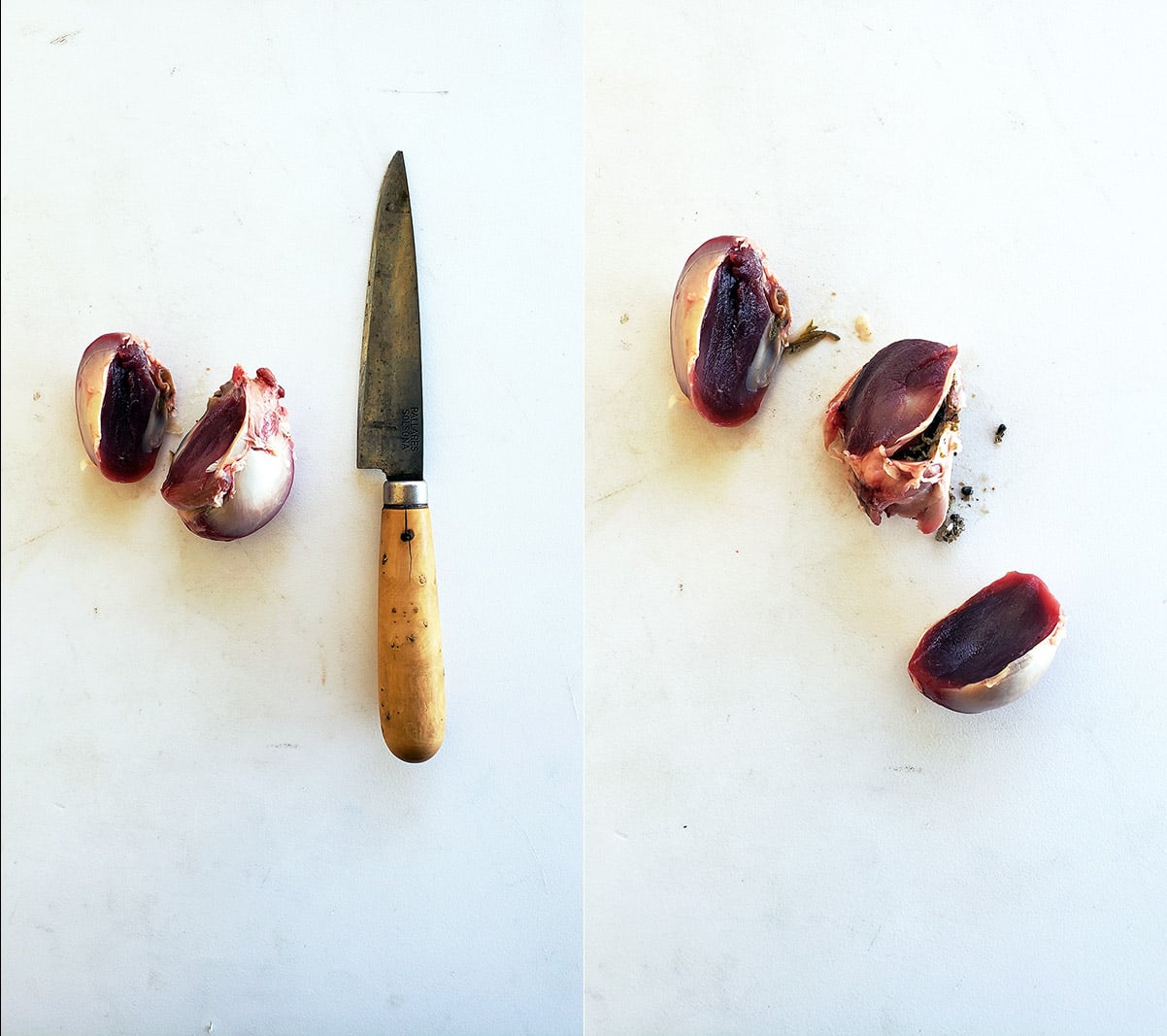
Take a small sharp knife and slice the two lobes of meat off the grinder plate. The only things you need so remember are that one lobe is almost always larger than the other, and that they arc over the grinder plate, so you slice not straight down, but in an arcing motion to get the most meat.

How to clean gizzards with two knife cuts
Photo by Hank Shaw

There. That’s how to clean gizzards.

What about the silverskin? Well, you don’t really need to care about it if you are cooking them all day in a crockpot, which is what I mostly do. The silverskin melts away and you don’t notice it after many hours of slow cooking.

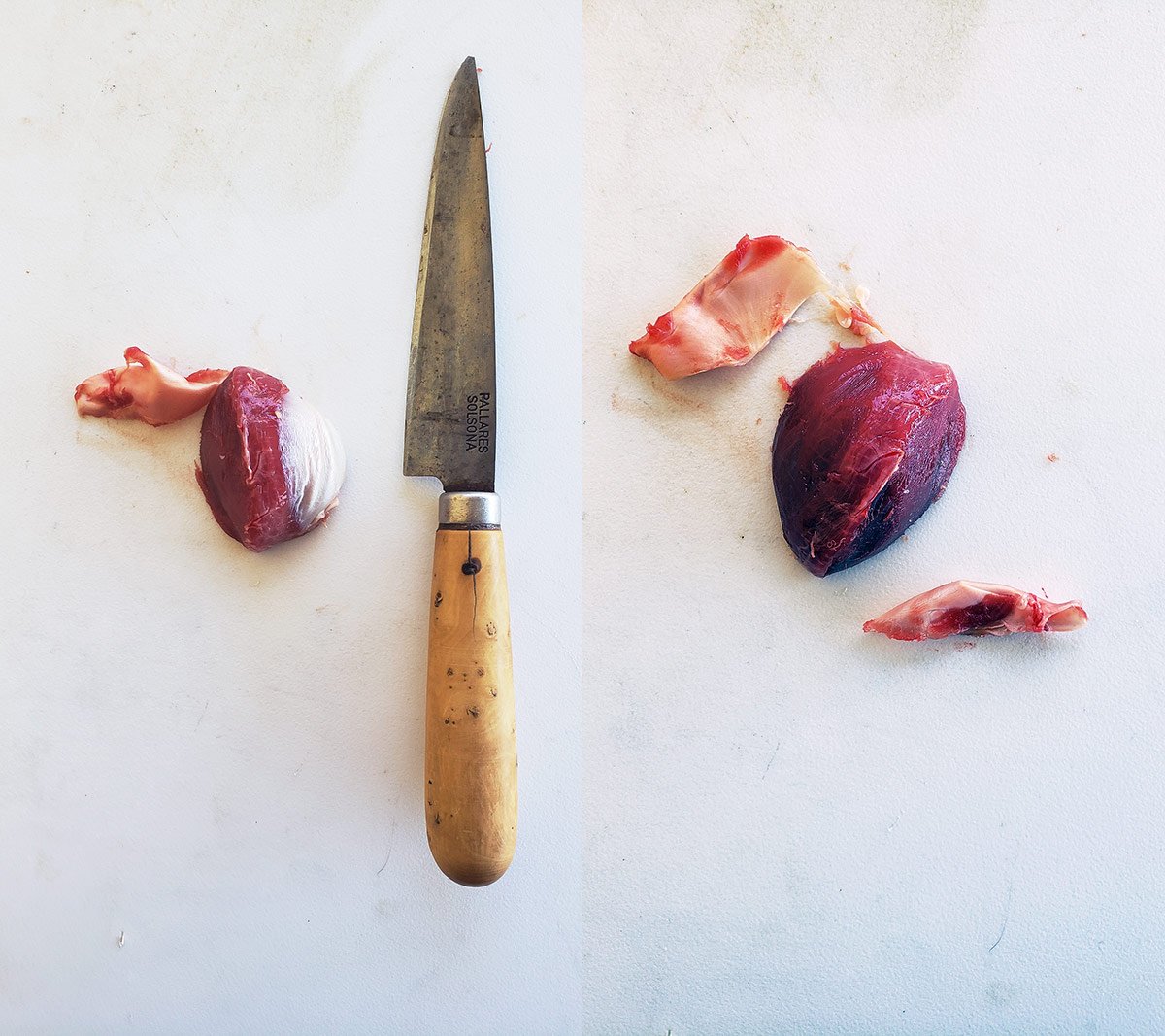
That said, fried gizzards are a thing, and I’ve even made gizzard carpaccio, which was weird, but very good. In that case, you need to remove the silverskin. This is easy. Use the tip of the knife to dislodge where it attaches at the outer end of the lobe — farthest away from where you sliced it off the grinder plate — then use the edge of the knife to scrape it straight down to the base.

Then, a quick slice and it’s out of your life.

removing silverskin from gizzards
Photo by Hank Shaw

Super easy. Pro tip: Wait to remove silverskin on gizzards until you are ready to cook. It comes off way easier from a thawed gizzard than a fresh one.

Now that you know how to clean gizzards, what do you do with them? Hands down the best way to cook gizzards is to slow cook them. I prefer to cure them exactly like my corned venison, then cook them in homemade duck stock (or any stock, really), in a slow cooker for… wait for it… 24 hours.

Why this long? Because then you can squash the gizzards with a fork. And they taste almost exactly like corned beef. Seriously. Here is how I love to make corned gizzards. Follow the technique in that recipe and you can modify the ingredients to suit your taste.

Different gizzards cook differently. Mostly I work with duck and pheasant gizzards, and can accumulate lots of them, vac sealed in the freezer, for meals. Goose gizzards, as well as turkey gizzards, can be huge.

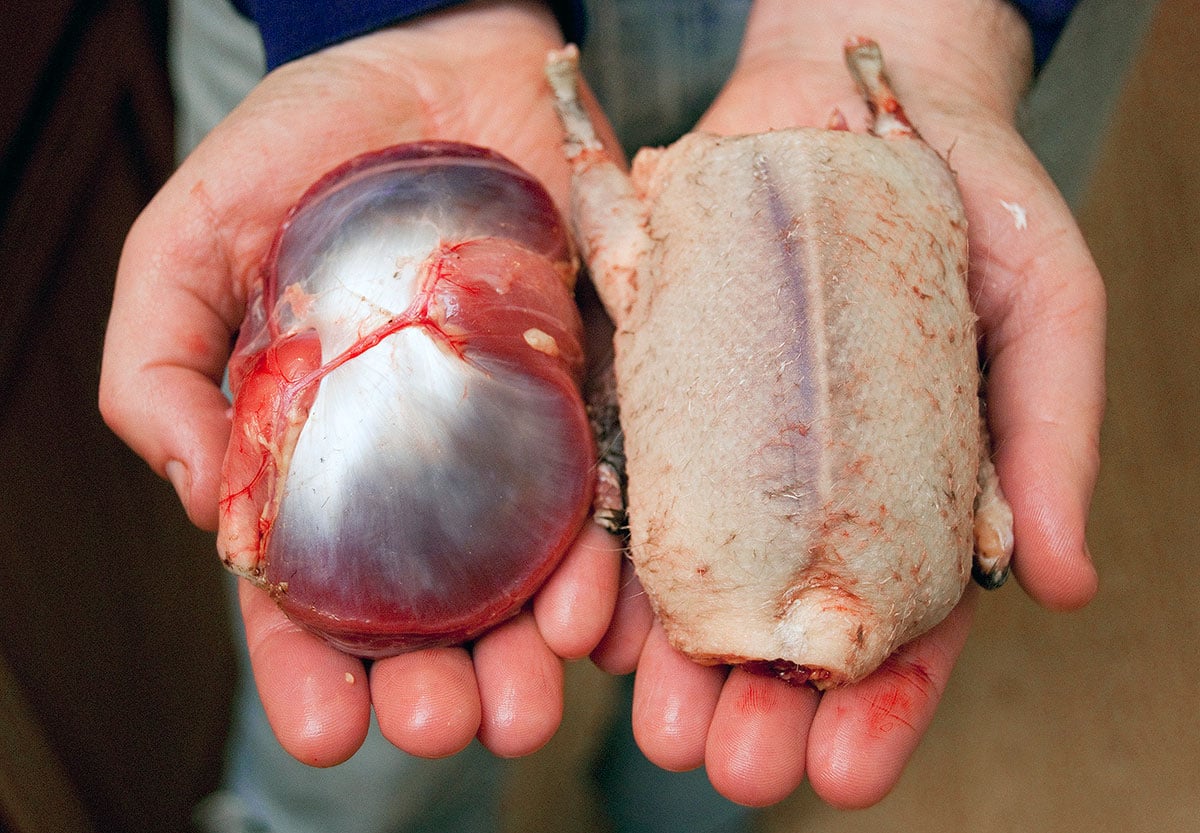
A goose gizzard next to a plucked hen teal.
Photo by Holly A. Heyser

See that? That’s a snow goose gizzard next to an entire hen teal. Crazy, eh?

You can certainly corn or confit these the way you would smaller gizzards, but I often grind them. It’s a lot of good, healthy meat to add to a grind pile for whatever you want to make, from picadillo to meatballs to my all time favorite: Giblet bolognese sauce.

A plate of giblet bolognese with spaghetti.
Photo by Holly A. Heyser

Yeah, you want to make this. Yes you do.

Now that you know how to clean gizzards, you can.

REVIEW: CZ-USA’s Upland Ultralight All-Terrain

0

The “git ‘r done with one” shotgun

by Larry Case

“Hey, boy…hand me that scattergun,” he said in a low growl. I carefully handed him the double-barrel, a Fox Sterlingworth that I greatly coveted. We were hiding in his old corncrib and he slid the barrels out the hole in the wall he had selected. Four crows had just landed in the end of his garden where the sweet corn was planted, I heard the snick of the safety and knew they were about to have a bad day.

I watched for a few minutes as he waited for them to cluster together. This guy did not believe in wasting shells. Three of the crows mostly stayed together while one wandered off a little. At the shot, those three stayed. The lone crow left for parts unknown and I doubt if he ever came back.

My gruff mountaineer mentor eased out of his seat and opened the door to the corncrib. His work for the morning was done. Crows had been ravaging his corn, he took care of the problem and that was that. He used a tool for the job, in this case, a shotgun, just like he would use a shovel or a hammer for different jobs on the farm. The old double-barrel was the same gun he used for rabbits, ducks, squirrels, or anything else he hunted with a shotgun.

Things were a lot simpler back then.

Time was when most hunters used one shotgun for about everything. Like my long-gone friend on the mountain, one gun did the job from ducks to squirrels to grouse, and usually with one choke. Now don’t get me wrong, I like shotguns and I have several, but there is something to be said for the simplicity of one gun that does it all.

The CZ-USA Upland Ultralight All-Terrain

It has been several years ago since I went to my first NRA Convention in the capacity of a gun writer. I stopped by the CZ-USA booth and was handed an Upland Ultralight model in 12-gauge. It was love at first heft. This is a 12-gauge shotgun that weighs six pounds. The 20-gauge is less than 5 ½. Many times since then, I have said, “you carry a shotgun a lot more than you shoot it.” And to me, for a hunting shotgun, the lighter the better.

The Upland Ultralight has been a lightweight, fast handling shotgun since its inception, but when CZ-USA came up with the All-Terrain line, they just made a good thing better.

Daniel Holder, the Special Project and Event Coordinator at CZ-USA, gave me his take on the Upland Ultralight.

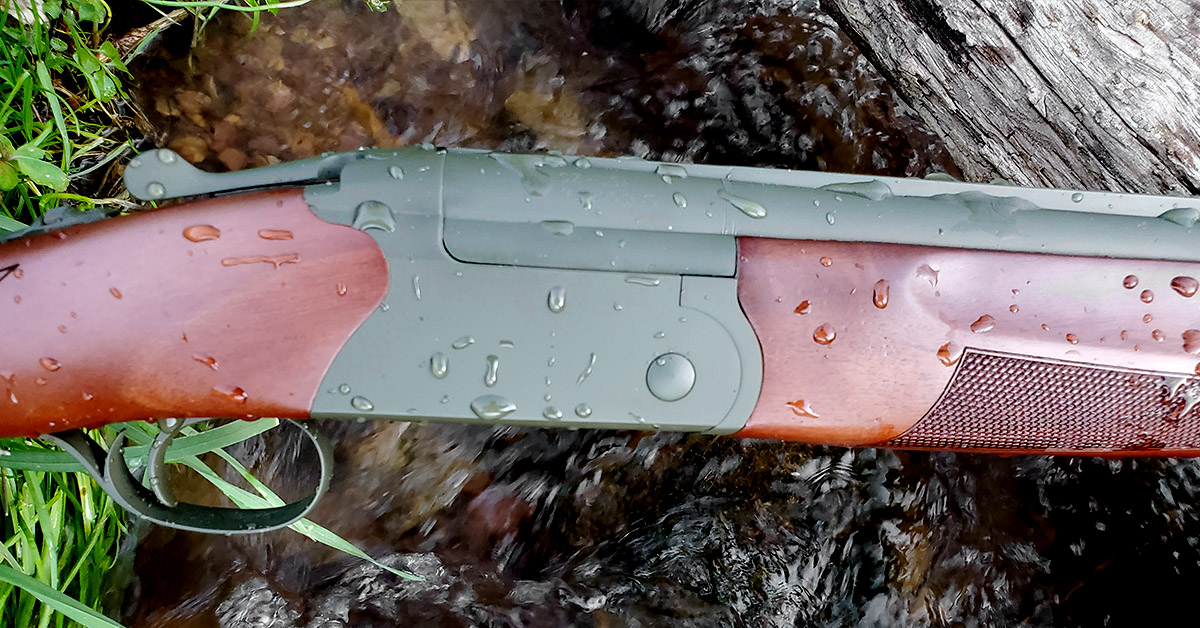
“I refer to the Upland Ultralight as a ‘guide’s gun.’ What I mean by this is some upland guides will often carry a shotgun, especially if they want to get a little hunting in. That person is going to be carrying that gun a lot more than they will be shooting it. Having an over/under that is close to six pounds makes it a lot easier to carry in the field. Upland hunters, in general, are not going to shoot a lot but, boy, do we walk! I would rather carry a 6.5-pound gun two miles and deal with a little bit of recoil than do the same with an 8- or 9-pound gun. The All-Terrain Upland Ultra-light is the ultimate upland gun. It’s light, rugged, and almost impervious to the elements. How many times have you been walking a field and gotten caught in rain, snow, sleet, et cetera? With the Cerakote finish on that gun, I never worry about it getting wet. The magnets in the extractor are a big plus as well.”

The Four-Wheel Drive of Shotguns

First thing you will notice in the differences between the standard Upland Ultralight and the All-Terrain models is the barrels and receiver boast a Cerakote finish. Cerakote is a hard-coat ceramic and polymer finish. Developed in the 1980s, Cerakote protects against abrasions and is a virtually bombproof shield against corrosion.

So, let’s talk about one of my least favorite topics in the gun world, and that is cleaning them. If you love to clean guns, I truly envy you. I don’t, and whether this can be chalked up to just plain laziness or an inherent character flaw, I don’t know. Bottom line is hunting shotguns take more abuse than any other gun around. Does any shotgun get banged around and exposed to more water, mud, snow, and Labrador drool than one that belongs to an avid duck hunter? Turkey hunters can be rough on a shotgun, and grouse and other upland bird hunters drag their scatterguns through some places not fit for man or beast.

The point is, unless you immediately grab your shotgun and tear it apart for cleaning after a long day in the hinterlands, especially if it got wet, a protective coating like Cerakote can be heaven-sent.

REVIEW: CZ-USA’s Upland Ultralight All-Terrain

A unique feature of this series of scatterguns is a small but revolutionary addition to the ejector/extractor of the break-open variants. To make them more ideal for use in a duck blind or while handling dogs and equipment in the field, each of the All-Terrain over/under and side-by-sides has a set of rare earth magnets installed in their extractor or ejectors. With these magnets in place, most modern shells are retained in the gun even when the gun is open and turned upside down. This makes loading them easy in a pit blind or a boat, and never will a dog-handler accidentally dump shells out of their gun while bending over to work with their dog.

Why hasn’t someone thought of this before? I don’t know, but CZ-USA Shotgun Product Manager Dave Miller did and believe you me, it is handy. Lots of over and under fans (and fans of side by sides) will routinely break down the shotgun and put it over the shoulder. It is a handy way to carry the gun during a break and it ensure safety as the gun cannot fire. The magnets holding the shells just makes it handier.

Rounding out the features on the All-Terrain models is factory-installed studs to install a sling. Probably all my shotguns that I carry afield now have slings on them. Once again, we carry the gun a lot more than we shoot it. The All-Terrain guns also feature extended choke tubes, making changing chokes in the field easier and it opens a world of aftermarket options that are out there.

I think of the All-Terrain line of shotguns from CZ-USA as the four-wheel drive of shotguns. Cerakote coating in the muted green tone makes these guns nearly impervious to the elements. (Great camo for ducks and turkeys, too). Add the sling studs to install a sling and carry it everywhere. The screw-in choke options will get you ready for most any type of shooting you may come across.

This shotgun will be equally comfortable in the duck blind, turkey woods, pheasant prairies, or grouse thickets. And you will not have to worry about babying it one bit.

More All-Terrain models

CZ-USA didn’t stop at making the Upland Ultralight a four-wheel drive shotgun. Maybe you would rather have a semi-auto? The CZ 1012 is an inertia-driven shotgun that was fired well over 5,000 times in testing with no cleaning or malfunctions. I saw this gun used last fall by Dave Miller and his team to set the Guinness Book of World Records for the greatest number of clays broken by a five-man team in 12 hours. Miller and his crew of young shooters shot these guns almost continuously and broke 14,167 targets. One young man used the same 1012 the entire time — a few others used only two guns that day. Believe me, there were some hot barrels out there that day. So, you can have the inherent ruggedness of the 1012 semi-auto in the Cerakote finish and sling studs.

CZ-USA also made the Redhead Premier, the Bobwhite G2 double-barrel, and the Drake model shotgun with the All-Terrain features. All these shotguns except for the 1012 are available in 12 and 20 gauge.

“The product development team at CZ-USA is comprised of hunters,” said Daniel Holder. “What I mean by this is that we not only design and build the products we put out, but we all use them, extensively. Whether it is hunting ducks at Reelfoot Lake in Tennessee or chasing Easterns in the woods of the “black belt” region of Alabama, we use our products. Because of this experience, we make products that fit the lifestyle of hunters. We know that often the conditions are not favorable to metal guns. Out of the demands we put on our products, the All-Terrain series was born. We wanted to design the “Mack truck” of shotguns. Our goal was to create a product line that no matter what we encountered, the guns would function year in and year out. These guns are also remarkably diverse and can be used on a wide range of game. In the 2019/2020 hunting season, they took pheasants in South Dakota, quail in Texas, snow geese in Missouri, and a turkey in Alabama with one of the Redhead Premier All-Terrains in 20 gauge.”

You may never use your CZ-USA All-Terrain shotgun for as many different things as my old friend on that mountain farm, and then again, you might. Whatever you need a shotgun for, the All-Terrain models are there, like a four-wheel drive truck, sitting in your driveway gassed up and ready to go.

REVIEW: CZ-USA’s Upland Ultralight All-Terrain

Smooth, Bump Bump, To The Pump

0

YOU ARE OPERATING INSIDE A fire building when suddenly you discover that you are lost, disoriented, and separated from your crew. As you attempt to locate a wall or a window, you come in contact with a hoseline. Which way is out? If you locate the coupling, you can determine which direction leads to the exit. Or can you?

The procedure for following the hoseline to safety in Essentials of Fire Fighting states, “Follow the hoseline out if possible (the male coupling is the closest to the exit; the female is the closest to the fire).”1

Yet time and again during training, when firefighters find the hoseline and follow it to the coupling, they become hesitant and indecisive: Which coupling leads out? I have seen firefighters attempt to uncouple a hoseline to determine which coupling has the swivel. I have seen too many firefighters turn toward the fire and wind up at the nozzle when they could have been out of the building had they gone in the opposite direction. When members are questioned about the problems encountered at the coupling, many times the response is that they just didn’t remember or fully understand the way it was explained in the text.

1. Photos by author. Click here to enlarge image

If the firefighter does remember to follow the male coupling out, there may still be confusion once the coupling is located. If the firefighter is at the midpoint of the hose between couplings, the first coupling he will encounter on the way toward the exit will be the female. The firefighter understood that he was to follow the male end to the exit, so that firefighter turns in the other direction and heads toward the male end, toward the fire. Many have stated that they have a good grasp of the concept until their face piece is obscured.

2. Click here to enlarge image

Here’s a simple memory aid I learned and have shared that seems to have helped firefighters remember the proper direction toward the exit: Bumps to the pumps. If the firefighter finds the hoseline and follows it to the coupling, the bumps (lugs) lead to the pumps (engine on the exterior) (photos 1, 2). It’s easy to remember and understand and reduces or eliminates the confusion and hesitation at the coupling. When a firefighter is low on air, disoriented and alone, the time spent at the coupling may be more time than he can afford to be able to get out safely. It also reduces the anxiety of being unable to determine the proper way out. This translates into better air management for the firefighter in distress.

Of course, this method is not a cure-all for every situation and every circumstance. It works best with threaded couplings that have rocker lugs. The male coupling has lugs on the shank. The female coupling has a smooth shank with lugs on the swivel (photo 3). The firefighter can feel the rocker lugs with a gloved hand under zero visibility conditions and determine the proper direction to the exit.

3. Click here to enlarge image

Some may ask about a situation in which the hose is advanced into a structure with the female end first. If this is the situation, the firefighter will have to identify this situation prior to entering the building. Some departments may use attack hose with storz-type couplings. In this situation, there will be no male or female couplings (photo 4). In this case, it will be difficult to determine the direction of the exit. However, devices that indicate the way toward the exit are commercially available. For example, one such device that can be slipped over a hose has a raised arrow marking a firefighter can feel to determine the direction of the exit. This may be a good alternative for your situation.

4. Click here to enlarge image

A quick drill on this technique involves using a single length of hose and a firefighter wearing gloves. Connect the couplings to create a continuous loop (photo 5). Place the firefighter at the midpoint of the hoseline, and have him follow the hose to the coupling. When the member reaches the coupling, ask him to determine, without looking at the coupling, whether he is headed in the direction of the exit.

5. Click here to enlarge image

As with all other firefighter survival techniques, this method needs to be practiced to develop and maintain a high level of proficiency. A thorough knowledge of your department’s equipment and procedures is important. Being familiar with any mutual-aid department’s equipment is equally important.

• • •

Perhaps you have heard of this method before. Perhaps you do not like it or feel more comfortable with your own. I’ve found that this works for me and has helped those who have had problems during training evolutions. What is most important is that if things go wrong, you are able to determine which way is out. ■

Endnote

1. Essentials of Fire Fighting, fourth edition. Stillwater, OK: Fire Protection Publications, 1998, 108.

ABOUT THE AUTHOR- ■ MICHAEL ALLORA is a lieutenant and a 10-year veteran with the Clifton (NJ) Fire Department. He is a Level 2 fire instructor at the Passaic and Sussex counties’ public safety academies. Allora has an associate’s degree in fire science from Passaic County Community College.

ORIGINAL POST: http://www.fireengineering.com/articles/print/volume-159/issue-2/departments/training-notebook/following-hose-couplings.html

Best Saddles for Hunting? – 2024 Guide

0

The world of hunting has witnessed an unparalleled revolution since the first introduction of hunting saddles in the 1960s. With an ever-increasing demand for reliable, comfortable, and adjustable hunting gear, the saddle market has transformed and adapted to offer some of the most versatile solutions for contemporary hunters. At the heart of this evolution, Trophyline® has carved a niche for itself, setting the gold standard in hunting saddles and creating a legacy that outshines many.

Trophyline’s® primary objective, since its inception, has always been to design a quality product that ensures the hunter remains both mobile and safe during the pursuit of their game. This commitment is reflected in the impressive range of saddles they’ve developed over the years, with a particular emphasis on the needs of hunters, Comfort, Adjustability, Customization, Mobility, Weight, Dependability, and above all, Safety. Let’s dive into the factors you should consider when finding the best saddle in 2024:

Video: Deciding on a new saddle or an upgrade to your current saddle hunting setup? Robert from Trophyline ® walks you through a a detailed guide on what saddle might be best for you.

Comfort-This factor is slightly subjective and also obvious. Can you sit in your saddle all day? Is it comfortable? Does it support you in all the right places and eliminate things like hip pinch?

Adjustability/Customization-You want to be able to streamline the saddle to your individual figure. Can you adjust it to fit your body? Are the Pouches and attachment points easy to reach? Are there enough places to attach your needed accessories?

Mobility- Can you wear your saddle when walking in miles deep? Is it cumbersome? Loud? Or too bulky to get into your hunting zone stealthily and comfortably?

Weight –At the end of the day you’re either wearing or packing a saddle in, and if it seems too heavy or bulky you won’t take it. Weight is one of the largest contributing factors for a lot of people diving into saddle hunting, so it is in the list of considerations. Too heavy? Too Light? Goldilocks zone?

Dependability-What materials are used to build the saddle and how were they tested? This is the actual physical construction of the saddle. Will it break, rip or come apart? Or was it all built to stay together.

Safety-Safety factors are the features built into the saddle, separate linemans loops, bridge loops, leg straps, fully adjustable belts. These are the things that keep you safe in the tree and should be looked at when considering your safety in a saddle.

Saddle Hunting – It’s a System Not Just a Saddle

Today, saddle hunting is no longer just about having a simple piece of gear. It’s about creating an integrated system that molds to your specific hunting style and scenario, providing an unparalleled level of adjustability and customization. A saddle is the pivot point around which your hunting experience revolves, and Trophyline® understands this better than anyone.

Whether you are walking through the woods or packing your saddle in your backpack, mobility plays a critical role. With the relaunch and introduction of the renowned Ambush saddle (which is no longer available), Trophyline® redefined the standards of mobility and safety. The Ambush saddle was a leap forward in design and technology, merging comfort and convenience seamlessly, thus simplifying the hunt and making it more efficient.

Continuing our commitment to innovation, Trophyline® has launched new additions to our saddle range, such as the Covert Lite 2.0, the Covert Pro 2.0 , and the Venatic. Each of these models has been designed keeping in mind the varying demands of hunters, from the beginner to the veteran. All three models have been rigorously third-party tested, ensuring they uphold the highest standards of safety and quality that Trophyline is synonymous with.

Engage Youth with Sailors for the Sea

0

This species is known for its long bill that grows from the front of its head. Blue marlin use this bill to stun their prey by slashing their heads in a side-to-side motion, knocking potential prey unconscious, and making it easier to catch. The blue marlin’s bill differs from the swordfish’s and the sailfish‘s by being round and pointed, rather than flat and blunt. Like many open ocean bony fishes, blue marlin start out as extremely tiny larvae, no more than a few millimeters long and weighing only a few hundredths of a gram. Soon after hatching, they already have a visible bill. Blue marlin grow rapidly, and in the course of their lives they may increase their body weight by at least one million times.

Because blue marlin undergo such an amazing transformation in size (from being nearly microscopic to being one of the largest open ocean predators), they eat a wide variety of prey, throughout their lifetimes. At a young age, they eat tiny zooplankton, and their prey increases in size as they do. As adults, they eat fairly large bony fishes and squids. Similarly, blue marlin are eaten by a wide variety of predators. When they are newly hatched, they are eaten by other fishes that specialize on eating plankton. The size of their predators increases as they grow, and adult blue marlin are not eaten by anything other than large open ocean shark species.

The blue marlin is a highly migratory species, with individuals migrating across entire ocean basins and even between oceans. One individual, for example, was tagged off the east coast of the United States (western Atlantic Ocean) and recaptured in the Indian Ocean. Like many migratory species, the females are larger than males. In fact, adult female blue marlin are as much as four times the size of the largest males. All of the largest individuals are female. blue marlin reproduce through external (rather than internal) fertilization, where the female releases her eggs into the water column while the male releases his sperm. Once the sperm find the eggs, fertilization occurs. While spawning, a single female may release several million eggs, increasing the likelihood that some will be fertilized and that at least one hatched larva will grow to reach adulthood. Though almost all fishes are cold blooded, blue marlin and the other billfishes have a specialized blood vessel structure – called a countercurrent exchanger – that allows them to warm their brains and eyes. This adaptation provides them with a major advantage when hunting, by allowing them to think more quickly and see more clearly.

The blue marlin is a targeted fishery species in only a limited number of areas but is captured as accidental bycatch in fisheries targeting other species throughout its range. In some areas, this accidental capture is threatening blue marlin populations, and scientists consider the species vulnerable to extinction. Generally speaking, blue marlin populations are decreasing in numbers. Though it is not targeted commercially throughout much of its range, the blue marlin is one of the most highly sought after big game fishes in the world. Sport fishing enthusiasts spend tens of thousands of dollars to catch large blue marlin, and they are typically released alive (though recent data suggests that released individuals may frequently die after the fact). If numbers continue to decline, this highly valuable sport fishery may be in danger of collapse.

Taxonomy note: Several times throughout the history of studying marine fishes, researchers have divided the blue marlin into multiple species, but recent genetic studies leads scientists to believe that all blue marlin around the world are the same species.

Oceana joined forces with Sailors for the Sea, an ocean conservation organization dedicated to educating and engaging the world’s boating community. Sailors for the Sea developed the KELP (Kids Environmental Lesson Plans) program to create the next generation of ocean stewards. Click here or below to download hands-on marine science activities for kids.

Additional Resources:

IUCN Red List

NOAA Fisheries

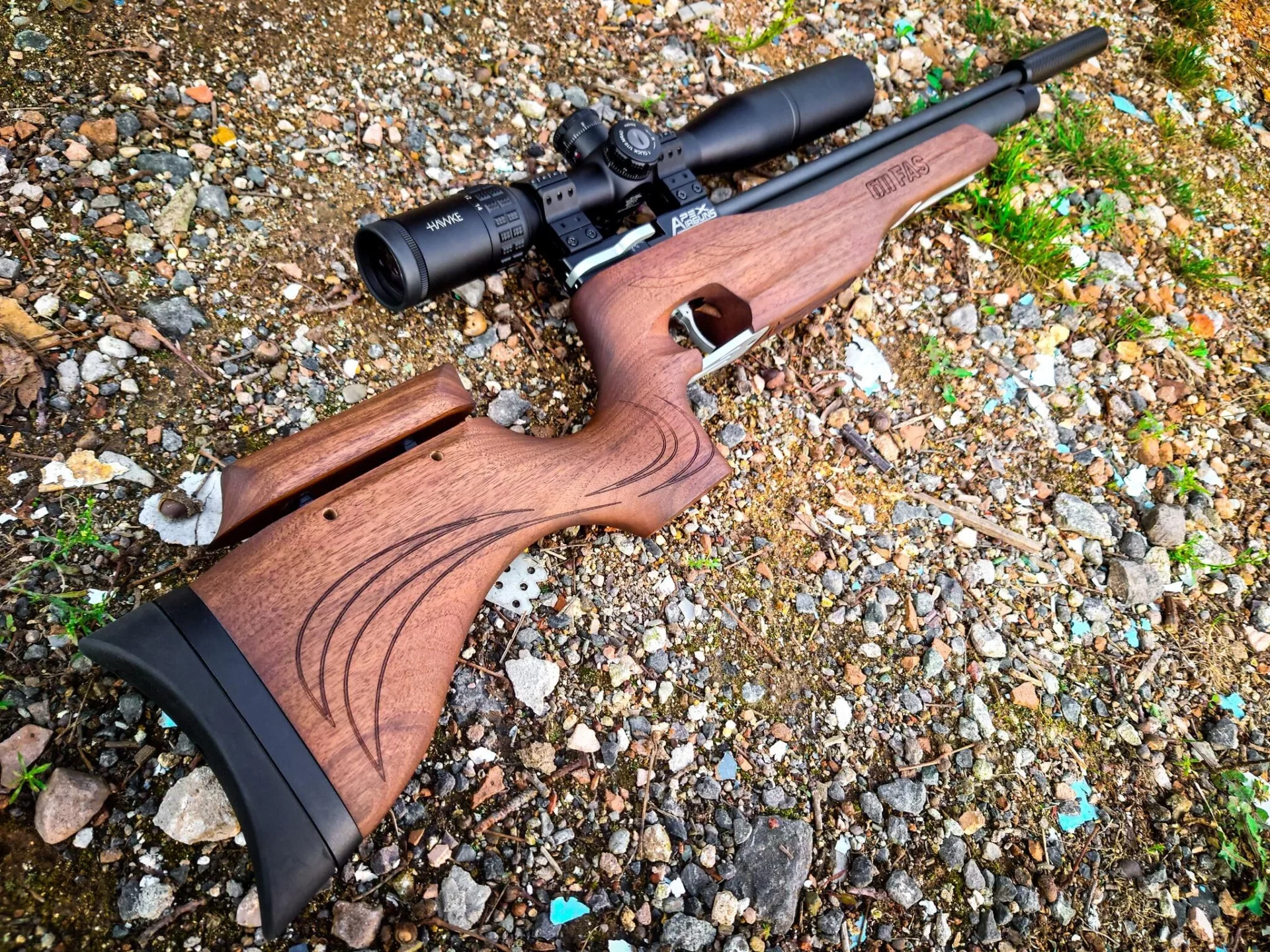
Air gun 101: What is a PCP air rifle? Is PCP gun the best choice for you?

0

A PCP air gun is one of five types of air rifles in the market today.

PCP air guns have become more and more popular and are sought-after due to their versatility, ease, low maintenance, and power at affordable levels.

(For more on the best PCP air rifles on the market, see this post)

In this post, we will take an in-depth look at a PCP rifle, what it is, how it works, its pros and cons, and whether you should buy one at all.

Where did PCP Come From?

Contrary to common beliefs that PCP rifles are a recent invention, PCP rifles have been around since the mid-1500s.

The first who made the most of them are Austrians.

The Austrians had thousands of PCP guns for their army in the war between them and France.

Their guns were .26 caliber and shot 24 shots-per-minute repeaters in a time when a repeating firearm didn’t even exist.

It gave them a huge advantage over Napoleon’s army who only could shoot three shots per minute due to the loading difficulty of the gunpowder.

After that time, PCP guns continued to be made.

The manufacture of PCP air guns stopped after World War I and they were revived as .177 and .22 caliber around 1980.

PCP air rifle meaning

A PCP air rifle is a type of air gun that uses a pre-filled reservoir of compressed air to propel projectiles. They are known for their consistent power and accuracy, making them popular choices for many airgun enthusiasts.

How does it work?

PCP stands for pre-charged pneumatic, which means that the compressed air is put into the gun prior to it being shot.

Basically, it is an air gun with a hollow tube containing high-pressurized air.

Typically, the air is compressed to 3,000 psi (pounds per square inch), although it can be pressurized more than or less than 3,000 psi. 

The pre-pressurized air in a PCP can drain, and with most PCP rifles you will need to refill the air reservoir.

There are multiple ways to fill the air reservoir, such as with hand pumps, scuba tanks, or carbon fiber tanks.

Once the gun is filled to a certain pressure level, it is ready to use. 

The firing cycle of PCP happens rather fast.

When you pull the trigger, the firing valve opens and releases compressed air inside the barrel.

The compressed air has nowhere else to go but behind the pellet.

This forces the pellet out of the barrel due to the propellant force of the compressed air.

After that, a small amount of air and pressure in the reservoir is reduced.

How long till you need to fill the gun?

PCP air rifles have a gauge that tells you how much pressure is in the air reservoir so you know when you drop out of the optimum pressure curve.

A lot of gauges have red, green, and yellow color marks on them.

Green is good, yellow is okay, and red means that you need to refill your gun as soon as possible.

Shot capacity

A PCP air gun allows you to have many shots per fill.

Depending on the rifle type, you can have around 20-30 shots before the air reservoir needs to be filled again.

Performance

Similar to a belt curve, a PCP air gun filled with high pressure usually starts with low velocity.

It will then increase in speed before dropping back down again to a low level of velocity.

Therefore, you usually need to shoot several times to find the “sweet spot” so you can adjust the fill to get consistent performance.

If you want to bypass this “sweet spot” testing and get consistent shots immediately, then all you need to do is use your PCP’s air regulator.

An air regulator will work to manage the pressure for the firing valves.

As a result, you have a gun with high pressure but the firing valve always receives the same pressure.

These guns often have a flatter, more consistent trajectory compared to those that don’t have regulators. 

An air regulator is usually an addition and will be more expensive.

However, this added expense is worth it.

With an air regulator, you can control the amount of pressure and have consistent shots and power shot after shot. 

What types of caliber PCP guns can you shoot?

A PCP gun can shoot .46, .58, or even .72 caliber bullets.

Rossi of American Airgunner TV shoots a helium air rifle that fires a whopping .82 caliber PCP air rifle in Michigan here (yes, a 20 mm air rifle!)

A PCP gun can even handle a higher caliber pellet than a CO2 air gun and that’s because a PCP puts more air behind the projectile whereas a CO2 is temperature dependant.

(For more on the best CO2 air rifle on the market, see this post)

You can’t shoot a bigger caliber with a CO2 gun but a PCP will end up putting a lot of air behind the projectile so you can get very high velocity with a large caliber pellet. 

Recoil and Noise

A PCP air gun produces very little recoil and is also very quiet compared to other types of air rifles.

If you are a recoil hater then PCP may be a great way to go.

With its quietness and virtually recoilless performance, a PCP is an excellent choice for younger and novice shooters, although experienced shooters can benefit from it as well.

How about accuracy?

A PCP gun is the most accurate air gun out there.

And PCP is also the easiest air gun to shoot with the most accuracy.

The average shooter can pick up a PCP gun and be just as accurate as a firearm.

With a PCP, you can enjoy accurate shooting as soon as possible without going through any complicated learning process.

Contrarily, if you decide to shoot with a spring-piston gun, then you must accommodate the learning curve that comes with it.

Unlike the spring piston, a PCP requires no holding techniques. 

Disadvantages of PCP

The biggest disadvantage of a PCP is its higher expense.

The cost of a PCP can range from as much as several hundred dollars to more than $1,000 dollars for a single gun.

Added to buying filling equipment, some potential buyers have turned away from PCP simply for this reason.

Depending on the type of gun and the type of filling equipment, then purchasing your PCP should be considered an investment.

Additionally, after you buy an air tank and filling equipment for your first gun, you won’t need to repurchase refilling equipment. 

The second major disadvantage is that a PCP gun requires support tails: scuba tank or hand pump or carbon fiber tank or air compressor.

(See this post for more)

Then you have to find a way to fill the tank like finding an air filling station, for example.

Besides, sometimes when traveling by a PCP air gun, the airport authorities may require to look inside the air reservoir which is almost impossible.

For these reasons, having a spring-piston gun on hand would be more convenient. 

(For more on the best break barrel air rifle that hits like a champ, see this post)

Conclusion

Although a PCP gun has some disadvantages, it still gains attraction from shooters all over the world.

A PCP gun is a great choice if you want to enjoy the quietness, minimal recoil, high power, multiple-shot capacity, and high accuracy at the beginning of your shooting journey.

Can you shoot squirrels with an air rifle?

0

“Air rifles for squirrel hunting: A comprehensive guide to legality, safety, and effectiveness. Discover the ins and outs of using air rifles as a humane method for controlling squirrel populations while adhering to regulations and ensuring responsible shooting practices.”

can you shoot squirrels with an air rifle

can you shoot squirrels with an air rifle

When it comes to shooting squirrels with an air rifle, there are a few important considerations to keep in mind. While it is technically possible to shoot squirrels with an air rifle, the legality and ethics surrounding this activity vary depending on your location and local regulations. In some areas, it may be legal to shoot squirrels as a means of pest control or for hunting purposes. However, in other regions, it may be illegal or strictly regulated.

Additionally, the effectiveness of using an air rifle to shoot squirrels depends on various factors such as the caliber of the rifle, distance from the target, and shot placement. Air rifles typically have lower muzzle velocities compared to firearms, which means they may not provide enough power to deliver a humane and instant kill for larger game like squirrels. This can result in wounded animals that suffer unnecessarily.

Before considering shooting squirrels with an air rifle, it is essential to research and understand the laws and regulations specific to your area. It is also crucial to prioritize ethical hunting practices by using appropriate equipment and aiming for clean kills. Consulting with local hunting authorities or experienced hunters can provide valuable guidance on whether using an air rifle for squirrel hunting is suitable and responsible in your particular circumstances.

In conclusion, shooting squirrels with an air rifle is a controversial topic. While some argue it can be an effective method for pest control or hunting, others believe it is unnecessary and inhumane. It is important to consider local laws, ethical considerations, and alternative solutions before making a decision on this matter.

.20 caliber air rifle pellets guide

0

Introducing the power-packed .20 caliber air rifle pellets, designed to revolutionize your shooting experience. With superior accuracy and exceptional velocity, these pellets deliver maximum impact on targets. Ideal for hunting, target practice, or competitive shooting, embrace precision and performance with our top-notch .20 caliber air rifle pellets.

.20 caliber air rifle pellets

.20 caliber air rifle pellets

.20 caliber air rifle pellets are a popular choice for shooting enthusiasts due to their accuracy and versatility. These pellets, also known as.20 caliber pellets or 5mm pellets, are designed specifically for use with air rifles and offer several advantages over other calibers.

One of the main benefits of.20 caliber air rifle pellets is their superior accuracy. The smaller size of these pellets allows for tighter groupings and increased precision, making them ideal for target shooting or small game hunting. Additionally, the reduced weight of.20 caliber pellets results in less wind drift, further enhancing their accuracy even at longer distances.

Another advantage of.20 caliber air rifle pellets is their versatility. They can be used for a variety of purposes including target shooting, pest control, and small game hunting. The kinetic energy delivered by these pellets is sufficient to take down pests such as rodents or birds while still being safe enough for backyard plinking or target practice.

In conclusion,.20 caliber air rifle pellets offer a promising option for enthusiasts seeking accuracy and precision in their shooting activities. With their smaller size, these pellets provide higher velocities and improved long-range performance. Additionally, they offer reduced noise levels and are suitable for various shooting applications, making them a popular choice among experienced shooters.

Best Air Rifle Deals

Popular Posts

Air gun 101: How Nitro Piston technology can make your shooting sport more exciting?

0
In the air gun market today, there are many air rifles made with nitro-piston technology Even the best-selling lists on gun retailer's sites have a...

How to choose the right Air Gun Caliber for your game?

0
A story is told of three Native American hunters. Two are smart, the other somewhat ignorant. On the first day of the hunting season, one of...

PCP vs Gas Piston: Which One is Better?

0
The perfect airgun is a difficult pick when you are new to gun-hunting. There are a lot of things to keep in mind, starting...