


Home Blog Page 70

Saugeye Vs Walleye (How Are They Different?)

0

UPDATED 03 NOVEMBER 2024

by Robert Ceran

Many anglers have a hard time telling saugeye apart from walleye, due to their very close resemblance.

However, it’s important to be able to tell the difference between walleye and saugeye, since the two species have different limits in most fisheries.

So if you don’t know what fish you’re holding in your hand, you can’t be sure if you’re allowed to keep it or not.

Saugeye vs walleye

That’s why we put together this detailed guide on the primary differences between saugeye and walleye, to help you identify them easily on your next fishing trip.

What is a saugeye?

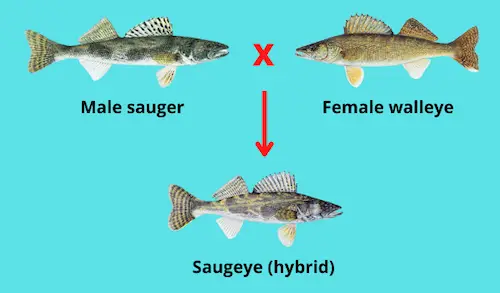
Diagram showing that a saugeye is a hybrid between sauger and walleye

A saugeye is a hybrid resulting from a cross between a male sauger (Sander canadensis) and a female walleye (Sander vitreus). Saugeye closely resemble walleye, which can make it hard to identify them as hybrid walleye.

A study conducted in the Illinois River in 1995 showed that 4% of fish belonging to the genus Sander (ie., walleye, sauger, and saugeye) were saugeye. This suggests that hybridization between walleye and sauger happens quite frequently in the wild.

Saugeye occur naturally in many lakes and rivers in North America that have breeding populations of both walleye and sauger.

In addition to naturally occurring in these locations, saugeye are also stocked in increasing numbers of reservoirs in several states of the midwest, including Ohio and Kansas.

A key difference in biology between walleye and saugeye is that saugeye can thrive in reservoirs with turbid water, whereas walleye only thrive in clear water bodies.

Walleye vs saugeye identification guide
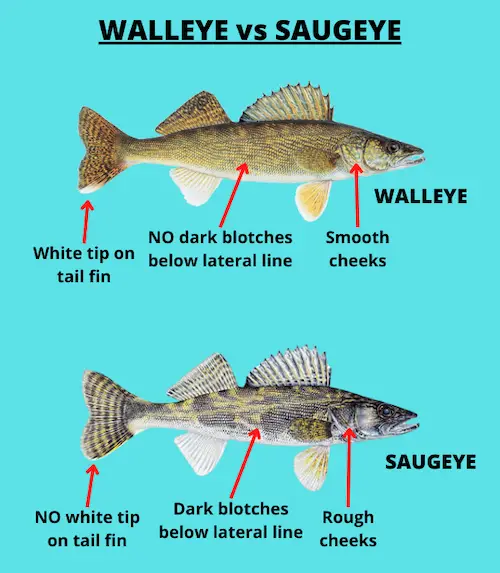
Diagram showing key differences between walleye and saugeye

Saugeye have the same basic body shape as walleye, and can be hard to tell apart from walleye, especially if it’s not possible to compare both fish species side by side.

However, with a little practice, telling walleye apart from saugeye can become fairly easy.

The primary difference between saugeye and walleye is that saugeye have distinct dark blotches on their flanks, which extend well below the lateral line, while the dark blotches on the flanks of walleye are less distinct, and don’t extend below the lateral line.

In fact, the dark body markings of saugeye are actually more similar to those of sauger than walleye (more on that below).

A second difference between walleye and saugeye is that walleye have smooth cheeks with few scales on them, while saugeye have rough cheeks with many scales.

Finally, another difference is that walleye come with a white patch at the bottom of their tail fin, and saugeye usually don’t have this white patch on their caudal fin.

However, this difference is less reliable than the other two, as some saugeye do have a white patch on their tail fin that looks pretty similar to that of walleye.

How do you tell the difference between a saugeye and a sauger?
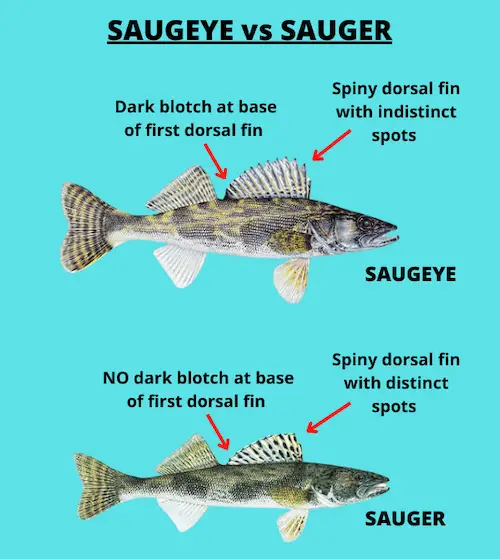
Diagram showing key differences between saugeye and sauger

Next, let’s talk about the difference between saugeye and sauger (Sander canadensis), since you also need to be able to tell these two species apart in any water body where saugeye, walleye, and sauger co-occur.

Overall, sauger tend to be smaller and have a more slender body shape than saugeye. Also the body color of saugeye is generally of a lighter color than the body color of sauger.

The best way to tell sauger and saugeye apart is by examining their spiny dorsal fins (the first dorsal fin). While saugeye have a dark blotch at the base of their spiny dorsal fin, sauger do not.

In addition to this, sauger also have more distinct round dark spots covering the whole dorsal fin, while saugeye have less distinct black dots that are confined to the bottom part of the dorsal fin.

Key saugeye facts

Now let’s talk about the most important saugeye facts that are good to know.

Can saugeye reproduce?

Scientists originally thought that saugeye can’t reproduce (since most hybrid species are sterile). However, a study conducted in Tennessee in 2011 showed that saugeye can indeed reproduce with both saugeye and walleye.

Due to this revelation, saugeye are no longer stocked in bodies of water that have either native walleye or sauger populations, in order to avoid affecting the gene pool of the native species.

Instead, they are now only introduced into reservoirs where there is a minimal chance of mixing with either walleye or sauger populations.

Finally, even though saugeye are capable of reproducing, their reproductive success is not high enough to maintain a strong population without regular stocking efforts (due to a low survival rate of their offspring).

How big do saugeye get?

Saugeye can get as big as 30 inches long and reach a maximum weight of 14 pounds. However, fish this big are very rare, and their average size is much smaller.

Saugeye have an average length of 14 to 22 inches, and their average weight is 2 to 4 pounds. In other words, they generally tend to be smaller than walleye, but larger than sauger.

In some fisheries, it’s very rare to catch saugeye over 5 pounds, while double digit walleye are relatively common in most lakes where they occur.

What do saugeye eat?

Adult saugeye are predatory fish that feed primarily on smaller freshwater fish, including yellow perch, shad, and minnows. Similar to sauger and walleye, they also feed on invertebrates, including worms, leeches, and crayfish.

And while the diet of saugeye is very similar to that of walleye, saugeye tend to be more aggressive in their feeding behavior, which makes them easier to catch.

Where can you find saugeye?

Saugeye can be found in any lake or river that has breeding populations of both sauger and walleye.

Saugeye distribution map

The map above shows the distribution of saugeye in North America. They are mostly found in water bodies of the northern midwest.

In addition to naturally occurring in these locations, saugeye are also stocked in an increasing number of reservoirs in the midwest, especially in reservoirs where walleye stocking has been unsuccessful.

Why are saugeye stocked in some lakes?

Saugeye are stocked in reservoirs where walleye stocking has been unsuccessful. Walleye generally require a high degree of water clarity, and don’t do well in stained or turbid water bodies.

Saugeye, on the other hand, thrive in turbid waters, and have done very well in many of the water bodies into which they were introduced.

In addition to this, saugeye also feed much more aggressively than walleye, which makes them easier to catch. Saugeye also often feed in more shallow waters than walleye, which means you can readily catch them from shore.

Due to their advantages for sportfishing, saugeye have become increasingly popular among fishermen, and some anglers now prefer targeting saugeye over walleye. This has led to greater saugeye stocking efforts by several state authorities in the midwest.

Are saugeye good eating fish?

Yes, saugeye are very popular eating fish, and taste delicious. However, similar to other types of freshwater fish, the taste of saugeye can be negatively affected by its environment if it lives in a polluted water body.

What does saugeye taste like?

Saugeye has a delicate flavor that is similar to walleye, but slightly milder. Saugeye meat has a flaky consistency and comes with a mild flavor that has almost no fishy taste to it.

A great way to cook saugeye is by frying it, though baked and deep fried saugeye also tastes delicious.

Saugeye vs walleye taste compared

There are two camps on this topic: While many anglers claim that saugeye taste better than walleye, others say that both fish taste the same.

A friend of mine once did a blind taste test where he asked a group of his friends to taste both saugeye and walleye that had been caught in the same lake, and that were freshly prepared. The guests did not know which was which.

Most of his friends expressed a preference for saugeye over walleye, which would suggest that under the right circumstances, saugeye can indeed taste better than walleye.

Saugeye fishing tips

In general, most methods that work for walleye fishing also work for saugeye. However, since they feed more aggressively than walleye, saugeye fishing is generally easier than targeting walleye.

That means you can catch saugeye with many different artificial lures or natural baits, and with a wide variety of fishing tactics. And since saugeye are less finicky than walleye, you’ll need to spend less time worrying about finesse applications to entice shy fish to bite.

Personally, I like to fish for saugeye with jigs, soft plastics, or live bait rigged with a slip bobber. In the most productive fisheries, it’s not uncommon for anglers to catch bags of more than 20 saugeye per day.

When fishing for saugeye, keep in mind that they stay very close to the bottom, and don’t suspend higher in the water column (which walleye like to do sometimes).

If you find a productive saugeye location, mark it with a waypoint, as you’ll probably be able to find saugeye there again on your next fishing trip.

What is the best time to catch saugeye?

Since saugeye are most active around dusk and dawn, these are the best times to catch them. However, saugeye also feed intermittently throughout the whole day, which means you can get lucky at other times as well.

During spring and summer, saugeye often hunt in very shallow water, and can be caught just a few feet away from the bank in 2 or 3 feet of water. This distinguishes them from walleye, which generally prefer deeper water.


Deer Heart

0

I’ve always associated the plant called deer heart with my times hunting Sitka blacktail deer in Southeast Alaska high country, which is something I’ve done pretty much every August since I was a kid. It’s a small, fragile plant that consists of a single heart-shaped leaf attached to a stem that usually doesn’t grow much higher than six inches. Deer heart grows from sea level, where it’s most tender and nutritious early in the summer, to mountain tops, where it’s best to eat late in the season. Deer follow it and other vegetation up mountains as summer advances. By mid-September, when deer heart is all but dead in the high country, deer descend to lower elevations for better browsing.

Last August, during a hunt, I came upon a deer I’d shot lying on a deer heart-covered bench, with semi-pulverized pieces of the plant in its mouth. There was an ethereal slant to the evening light, the sort that illuminates subtle, hard-to-see details of the landscape. I was surrounded everywhere by deer heart, except where there were cliffs, rockfaces, and the occasional clump of stunted mountain hemlock. I am frequently caught off guard by how something as seemingly simple as shifting light can reveal in an instant how miraculous the world is. I plucked a heart-shaped leaf and stuck it in my mouth. It’s peppery, like arugula, but has an aftertaste that oscillates between good and a little strong. I’d never thought a lot about deer heart, other than using the amount of it browsed as a gauge for where to hunt deer, and to try not to slip on it when it’s raining. I looked from the fields of deer heart to the dead animal, wondering why it’s so easy to become preoccupied with certain things while being blind to so much. I thanked and apologized to the deer, then sliced my knife through the hide along the backbone from the base of the skull to the tail. I cut one side of quarters free, peeled off a backstrap and, before removing a side of ribs, severed the heart and lay it upon its namesake plant.

It was dark by the time I hung my heavy game bags from a branch of a mountain hemlock. During the night I listened as the wind made the tent shudder and bushes crackle. I thought about brown bears. I washed off the deer’s blood the best I could and peed and spat around the tent, but I still smelled “delicious.” Years before, I left a trail camera on a salmon stream that had a high number of bears fishing on it a few miles from where I was hunting. As an experiment, I peed in front of where the camera was pointed to see how animals would react. I returned a few days later and found that most of the images showed bears running away, looking terrified. A young bear even dropped the salmon it was carrying in its rush to get away. One large bear, however, behaved differently. It came during the night and, instead of fleeing, crawled like a cat toward the camera. I imagined that animal crawling toward the tent and thought about becoming meat.

At home, I organized the deer meat in trays divided by roasts, steak, and scraps I’d grind into burger. I trimmed the bones; later, I’d render broth from them. My two young sons—one a toddler and the other three and a half years old—“helped” by sawing on meat with butter knives and dropping pieces of burger meat into the grinder. I sliced a heart thin and doused it with sesame oil and Montreal steak seasoning. When it was done, we snacked as I wrapped meat in freezer paper. Some people do not like the taste or texture of heart. It’s always the first part of the animal I eat, which is in a large part because it does not freeze well. It’s also delicious and, more than that, evocative of much of what I love about life in Southeast Alaska.

Three years prior, my wife and I gave our eldest son his first solid food. We wanted our kids’ first tastes of food to be of something we loved, that came from the streams and forests where we live. First we mashed up blueberries, then we tried coho salmon. It had not gone over well. Not long after, I brought a deer home and fed our son small bits of fried heart. He devoured them.

Once we had a couple of deer, as well as a good supply of salmon in the freezer, it was time to go berry picking. When the next sunny day came, we headed to one of our favorite blueberry patches in the mountains. I carried our toddler in a backpack. As we hiked a trail to a field of deer heart, his brother demanded, and constantly added details to, a story about dragons from his mother. Though it was only the third week of August, most of the plants were showing the first signs of brown. After placing the boys on drier ground where they could play and pick berries, my wife and I set to filling our buckets.

Food gathering, whether hunting or berry picking, is probably the most meditative activity I know. For a while I picked alone, my thoughts quieting as I focused on filling my bucket. Occasionally, the boys would punch or bite each other and scream and cry. Other times they giggled as they wrestled and popped blueberries into each other’s mouth. When I checked on them, they were taking turns smashing blueberries on each other’s heads, both of their smiling faces stained purplish red, sitting amidst deer heart.

The pickings were pretty good and after a couple hours we had a few gallons. I joined the boys and their mother on a small plateau covered in deer heart fringed with bushes heavily laden with blueberries. The light on the mountains had that same ethereal quality, revealing cracks and fissures worn by time in rockfaces and millions of deer hearts surrounding us.

It was hard to walk away from something so good. I placed my younger son in his backpack and, before leaving, searched for a tender looking deer heart. Near where a deer had been browsing, I plucked a leaf and then placed it in my mouth. I slowly chewed, its enigmatic taste engulfing my taste buds, as I followed my wife and older son down the mountain.

Originally published in Issue No. 26, Winter 2022

About Ethan Smith

0

I came to this world towards the close of 1988. This was at Mountain Vista Medical Center located in Mesa, Arizona. It’s not that I recall the events that transpired. My mom shared the details with me when I grew bigger.

For about one year to the time I was born, my dad had been jobless after his employment as a Walmart cashier was terminated. You can imagine the kind of strain my parents had to endure. Mom was running her dry cleaning business. The little earnings she got from the business is what sustained us. Luckily, I was the only child then. My one and only sister arrived some four years later. 

Nevertheless, my dad kept an open eye for whatever job opportunity he could grab. He had a degree in Forest and Rangeland Stewardship. The Walmart stint was just a by-the-way. That happens when you have to fend for yourself and others but no opportunity knocks along your career line. 

I count myself as one blessing in disguise. You see, on my first birthday, dad received a long-awaited call from the USDA forest service. He had landed a job as a game warden at the Apache-Sitgreaves National Forests. The days that followed were perhaps the most exciting my parents had experienced since their honeymoon. 

We soon set camp at the little known Miami town in Gila County, Arizona. That’s about three and a half hours drive drive to dad’s reporting station. Mom generously sacrificed her business for our sake. But she soon teamed up with some new found friends to run one of the most popular eateries in Miami town.

So, there I was! A forest ranger’s son without the slightest idea of what a forest is. 

Table of Contents

Education

The first years at our new residence passed hastily. All I can remember was child play. We had great neighbors who made childhood worthwhile. 

I was soon enrolled in kindergarten at Dr. Charles A. Bejarano Elementary School, just a walking distance from our home. As I graduated from grade to grade, I soon started getting into real terms with what my father was doing. Occasional trips to his workplace did all the magic.

Now, you think of Arizona as a desert. True! I don’t dispute that the Great Basin, Chihuahuan, Mojave, and Sonoran deserts are all in Arizona. In actual fact, Arizona is the only state in the US that partly hosts all the four famous North American Deserts.

But on the other side of the coin, Arizona hosts a whopping 6 national forests namely Apache-Sitgreaves National Forest, Coconino National Forest, Coronado National Forest, Kaibab National Forest, Prescott National Forest, and Tonto National Forest. I grew up knowing only the Apache-Sitgreaves National Forest, and that meant the world to me. 

My dad would occasionally sneak me and mom into the 2.76-million-acre forest to witness hunters doing their thing. I got to see game animals like antelopes, black bears, elk, mountain lions, mule deer, doves, tree squirrels, and waterfowls in their natural habitat. I saw licensed hunters walk away with huge antelopes after successful hunting trips. I got to understand how guns are used for hunting

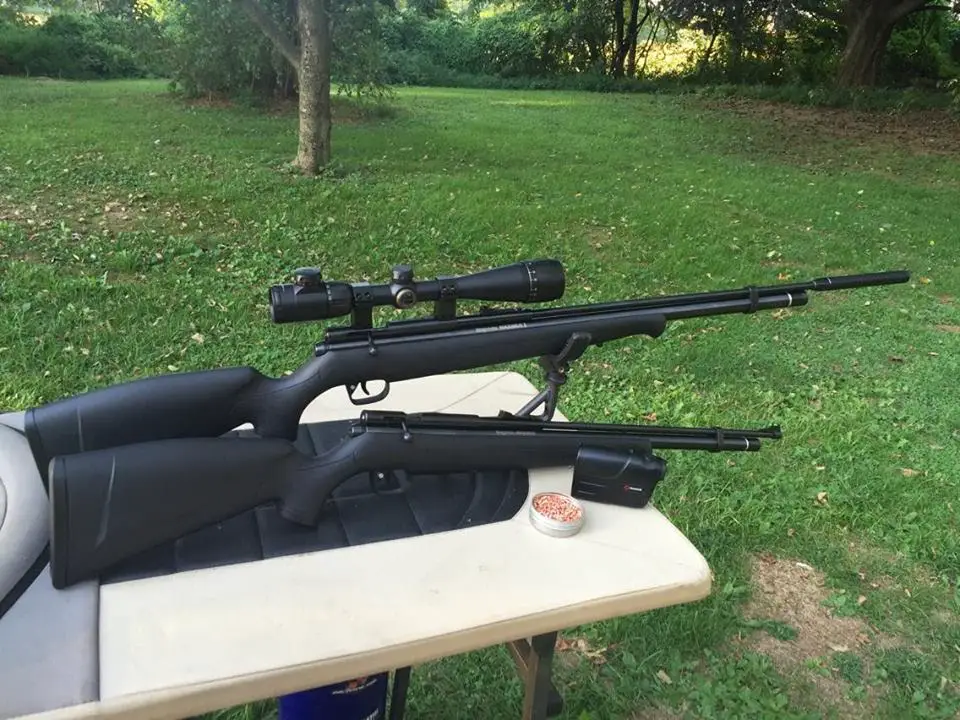
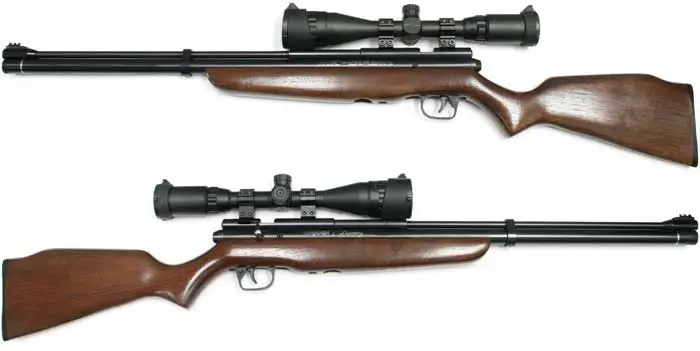
I would closely watch my dad load his .25 Benjamin Marauder and fire accurate shots at unsuspecting game animals. The resulting fall of the animals really captivated my young mind. 

I really felt that the authorities responsible for the local kids and youth hunting programs made a grave mistake by setting the minimum enrollment age at 14 years. Rules aside, my only solace was sneaking in with dad. And that’s the privilege of being a game warden’s son.

Fast forward to my highschool years at Payson High School. The very day I turned 14, I registered with the Arizona Elk Society. The best thing about this group was teaming up with fellow teens to go hunting in the woods. The exposure it gave me was deeper than what my dad had offered earlier. 

Let not the name of the club mislead you that we only hunted elk. We hunted virtually every animal you can find in the wilderness and forests of Arizona. Also note that Apache-Sitgreaves has 34 lakes and reservoirs and over 1100 km of rivers and streams. We never ran short of fishing opportunities. 

I got so immersed in the activities of the club that I never viewed high school as a burden. As long as weekends were fun-filled, I got the push to study hard. I always topped my class in the English subject. And for that reason, they made me a frequent writer on the school’s bi-annual magazine. I had nothing else to write other than on outdoor adventures.

Work

I’m really grateful for the foundation I got in my first 20 years of life. That gave me a solid grounding on what I currently do and what I plan to do for the rest of my life. My love for the outdoors influenced me to take a Bachelor of Science in Forestry at Northern Arizona University. 

I successfully graduated after 4 years and soon after landed a job with the US Marine Corps as a Combat Correspondent. That has been my main job since that time. My main task is gathering Marine Corps news and stories to generate news stories for distribution via television broadcasts or writings. As such, I travel widely across the US for interviews and minor investigative work. 

As a side hustle, I’m a professional blogger with thousands of articles so far under my name. When not writing, I go hunting. I’m still young and I want to use my time well before old age knocks.

Why I hunt with air guns (not crossbow, real rifle)? 

My first hunting weapon was the .22 Diana Storm Rider air rifle. While working with the US Marine Corps, I came to dread owning and using a firearm because of the legal restrictions associated with them. 

The fact that .22 rounds can shoot as far as 1.5 miles makes the use of firearms quite dangerous around residential areas. Gunshots also unnecessarily cause panic when the noise reaches residents. Conversely, air rifles have a limited range and I could use them in my backyard without threatening anyone’s safety or causing panic.

I also like air rifles for the fact that most states don’t classify them as firearms. Carrying around firearms has its fair share of concerns among citizens and authorities . 

Another advantage of air rifles is that pellets will never go bad, no matter how long they’re stored. For real rifles, there’s the usual worry about cases, powder, and primer.

On the other hand, hunting with crossbows is not my thing given the high cost of good quality crossbows and how cumbersome it is to hunt with them. It’s easier to carry air rifles and load ammo for shooting than it is with crossbows.

For these reasons, I have so far amassed a wide collection of airguns as listed below:

  • Hatsan BT Carnivore QE .30 cal
  • Hatsan Bullboss QE .25 cal
  • Hatsan AT44-10S QE .25 cal
  • Benjamin Marauder .25 cal
  • Hatsan Galatian .177 cal with Wolf LDC
  • Mrodair Varmint .22 cal with Wolf LDC
  • Diana Stormrider .22 cal
  • Gamo Urban .22 cal
  • Hatsan AT P2 .22 cal with Wolf LDC

These keep me busy throughout the hunting seasons for the hunting areas I frequent. I’ve come to love:

  • Mattamuskeet Wildlife Refuge in North Carolina
  • Arkansas’ Piney Creek WMA
  • The Green Swamp Wildlife Management Area near Tampa, Florida
  • The Cheyenne Bottoms Wildlife Area in Kansas
  • West Virginia’s Charleston-Beckley corridor

And of course, my most beloved Apache-Sitgreaves National Forest.

Family

Perhaps I should have started with this info. But I’m glad you made it to this point and are reading this. I took Texas-bred Laura for a wife back in 2016. The Wild West blood runs through her veins. I’ve thoroughly coached her in gun handling. Don’t mess with her. Here she is modelling for pneumatic air rifles.

We travel with her to most of the hunting trips I just mentioned. The arrival of our first born son, Dickson, slightly slowed our outdoor life, but we’ll soon be able to travel with the little kid. I’d like him to take after me as I took after my dad. The current sedentary lifestyle in front of screens most of the day is not my thing. I love it out there in nature. Nothing fascinates me more than that. 

Review: Winchester Model 70 Long Range MB

0

It is not uncommon for useful technical improvements in one arena to be adopted by and integrated into another. Materials and manufacturing processes originally devised for the aerospace industry are now commonly used to manufacture firearms. Pistol optics and triggers that began as competition upgrades have become standard options for many defensive handguns. Features developed for precision, benchrest-style rifles are being incorporated into bolt-actions suitable for harvesting big game.

In 2021, Winchester Repeating Arms introduced the Long Range MB version of the Model 70 as a contribution to the growing extended-range hunting rifle market. The features are configured to balance top-end accuracy and recoil management without the rifle being too heavy to be carried comfortably in the field. This Model 70 is available in eight short-action chamberings ranging from .22-250 Rem. to .300 WSM. The rifle tested for this review was chambered for the popular, flat-shooting 6.5 mm Creedmoor, which tends to generate only moderate levels of felt recoil.

The right-hand Model 70 Long Range MB sports the popular Pre-’64-type claw extractor with controlled-round feeding. One benefit of the design is that it locks onto the cartridge rim in order to properly align the cartridge with the chamber, thereby reducing the chances of bullet tip damage. The extractor also makes withdrawing the cartridge from the chamber more positive.

The bolt body is treated to a handsome jeweled finish, and the bolt knob features a knurled band to improve control. Of course, the assembly is fitted with Winchester’s classic three-position safety. In addition to the typical Fire and Safe modes, the lever has a central position that locks the firing pin while allowing the bolt to be cycled—a feature intended to provide added safety when checking the state of the chamber or when unloading the rifle.

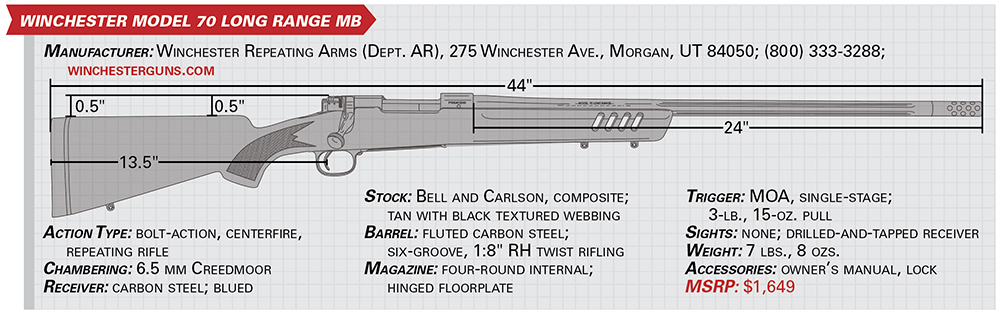
The carbon steel of the Model 70 receiver and barrel are treated with a non-reflective, matte-blue finish. The top of the receiver is drilled and tapped to accept optic mounts. The 24″-long, free-floated barrel has a fluted light varmint contour, and a recessed target crown works to protect the rifling from being damaged at the muzzle.

The MB in this rifle’s name stands for muzzle brake; the end of the barrel is threaded 5/8×24 TPI to accept a variety of popular accessories, including sound suppressors, compensators and muzzle brakes. The rifle is fitted at the factory with a 2.5″-long removable muzzle brake contoured and finished to match the barrel. A knurled thread protector is also provided for those who wish to shoot without a muzzle device installed.

This rifle has Winchester’s MOA trigger group, which is marketed as having “triple zero advantages,” including zero take-up, trigger creep or overtravel. The trigger tested lived up to these claims; a smooth-faced, curved steel trigger exhibited an exceptionally clean trigger pull of 3 lbs., 15 ozs., with a short arc of travel and a crisp break with no overtravel. For those who prefer a single-stage trigger, this one deserves consideration. It is protected by a rounded aluminum trigger guard. A hinged steel floorplate supports an internal four-round magazine that is loaded through the ejection port.

Once again, Winchester has teamed up with Bell and Carlson to outfit this rifle with a well-made, weather-resistant composite stock. Using a proprietary molding system and a blend of fibers, resins and polyurethane reinforcement, the Extreme Weather stock maintains its shape in cold and hot environments. At the heart of the stock is an aluminum bedding block extending from the grip to the front sling-swivel stud for a firm, stable lock-up between the rifle’s action and stock.

The Model 70 Long Range MB’s composite stock is tan with a drizzled black “spider web” paint job to break up its outline. A set of flow-through cooling vents are cut into the fore-end that has a wide, comfortable gripping surface with a flat bottom for improved stability when shooting off sandbags. The grip has molded-in checkering to give the shooting hand added purchase. The shoulder stock is capped with a soft, textured rubber Pachmayr Decelerator recoil pad with a length of pull measuring 13.5″.

Our sample proved to be utterly reliable on the range, operating smoothly without any mechanical or ammunition-related issues. The fit and finish were top-notch throughout, with the bolt assembly and controls cycling smoothly. The composite stock provides reliable gripping surfaces with a more solid feel than an injection-molded polymer stock. The rifle balanced nicely with an easy heft that simplified standing shots.

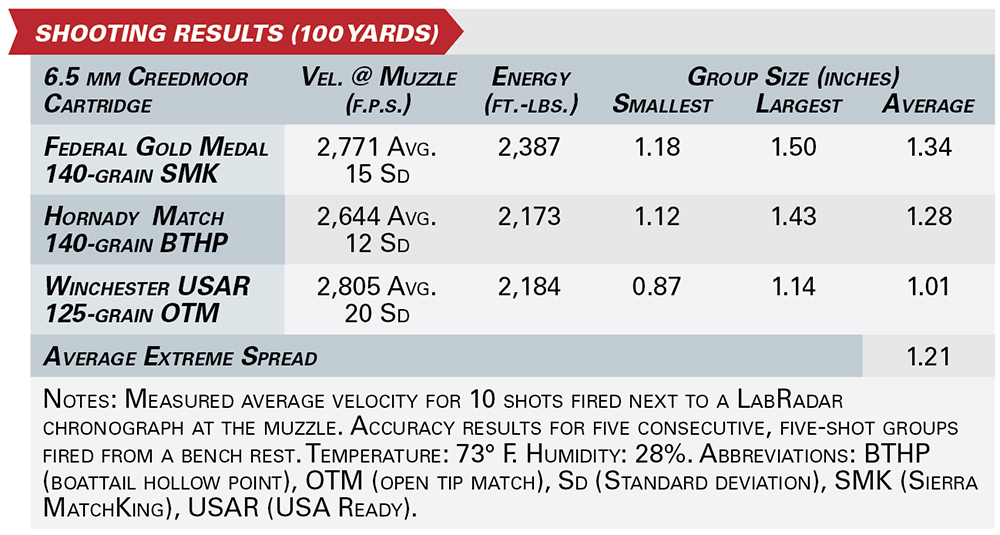
The rifle was test-fired with the factory muzzle brake installed. As expected, the brake noticeably increases the volume of the rifle’s report, but, in conjunction with the recoil pad and the 6.5 mm Creedmoor cartridge, it made for moderate levels of felt recoil comfortable to work with in and out of a benchrest. Formal benchrested accuracy testing was conducted using factory match-grade loads fired at 100 yards. Groups were shot with a Leupold Mark 3HD 3-9X 40 mm optic secured by a Leupold scope mount ring set.Winchester Model 70 Long Range MB shooting results

Winchester lists this rifle as being capable of one-m.o.a. accuracy, or approximately 1″ at 100 yards. This rifle did print a smallest single group of 0.87″, with a five-group average of 1.01″, using Winchester’s USA Ready load topped with a 125-grain OTM bullet. The average extreme spread across all three loads fired was 1.21″.

When attempting to blend two different types of platforms, finding a recipe that works can be tricky. In the case of Winchester’s Model 70 Long Range MB, however, the preferred elements of a hunting rifle mix with features that allow it to comfortably ride the bench for extended-range shooting sessions. This is a well-thought-out rifle with a variety of upgrades that make it stand out from the bolt-action rifle crowd—but it’s the MOA trigger system that unifies this rifle’s features and makes it an excellent option for those in the market for a firearm that fills a variety of shooting roles.Winchester Model 70 Long Range MB specs

Everyday Carry (EDC) Flashlights: The Complete Guide

0

EDC Flashlight

If you’re looking for a quality flashlight but are unsure where to start, it’s likely that an EDC flashlight is exactly what you need.

Long-lasting, powerful and compact in size, EDC flashlights are perfect for shedding light on everyday scenarios, including life-saving emergency situations.

Reliable light is of high value in unforeseen circumstances and an EDC flashlight is the best way to stay prepared.

Quick Takeaways

– EDC, or everyday carry, flashlights are ideal for feeling prepared for the various types of situations you may encounter, including personal safety and emergency standby- Compact, EDC units typically offer between 20-2000 lumens of light, sufficient for both casual daily activities and law enforcement needs- The best high quality EDC flashlights are equipped with a long battery life, impact resistant materials and an Ingress Protection rating of IP66 or higher

EDC flashlights are the perfect source of convenient, accessible light when encountering unexpected situations and are easily obtainable with a well-known name brand like Fenix.

What Is An EDC Flashlight?

EDC is an acronym for “everyday carry”, meaning that EDC flashlights refer to units that can be easily carried for everyday use, typically small enough to store in your pocket.

Although there is some overlap, EDC flashlights are defined by one’s lifestyle, as opposed to other units designed specifically for activities and destinations, such as camping or biking lights.

Everyday carry units are intended to help with anything you find useful. Whether it’s personal safety, emergency situations or shining extra light in a dimly lit closet, EDC units are ideal for feeling prepared for the various types of situations you may encounter.

What To Expect

There are many benefits to EDC flashlights since they are specifically designed to be convenient without sacrificing power. Here’s 5 qualities to look for when you’re on the hunt for a quality EDC flashlight.

Compact

One of the important characteristics of an EDC flashlight is its compact size, allowing for easy portability and accessibility. When shopping for a new unit, look for something that’s small enough to fit into your pocket or purse and the palm of your hand for quick use.

The weight of your flashlight is also important to consider. A heavy unit will feel like a burden to carry and defeat the purpose of having an EDC flashlight. At Fenix, finding a small, lightweight unit without sacrificing functionality and efficiency is easy.

Brightness

The best EDC flashlights use LED bulbs because they are brighter and more efficient than incandescent bulbs. Their light output, or brightness, is measured in lumens and can have anywhere from 20 to 2000 lumens, or more.

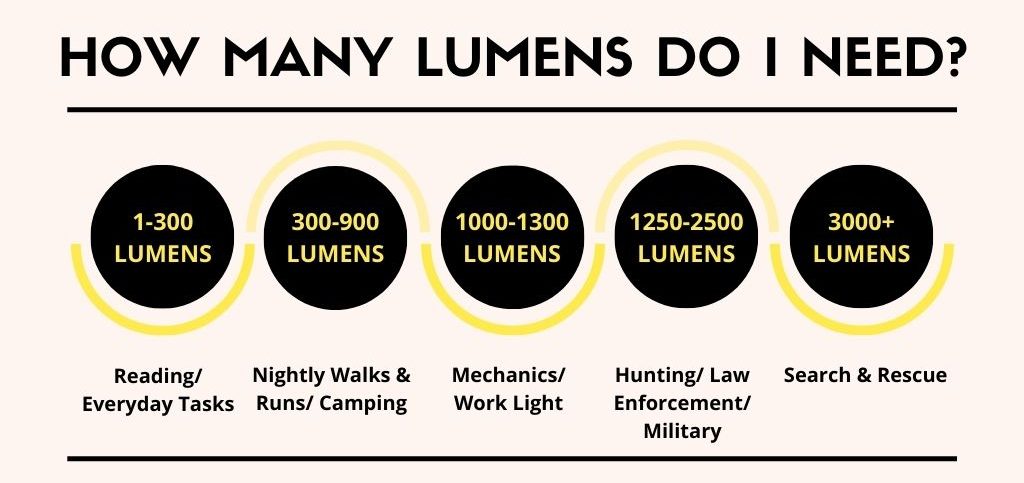
lumens guide

When determining the right amount of lumens for your EDC flashlight, consider how you plan to use your unit. If you only need accessible light for reading in the dark, 300-500 lumens is more than enough.

Long Battery Life

Although compact in size, quality EDC flashlights have impressively long run times due to their compatibility with rechargeable batteries.

EDC units that run on lithium or lithium-ion rechargeable batteries will not only appear brighter than those running on alkaline batteries, but also last longer due to a higher capacity for stored power.

In addition, different brightness settings and external battery level indicators found on EDC flashlights make it easy to preserve power for when you need it most.

High IP Rating

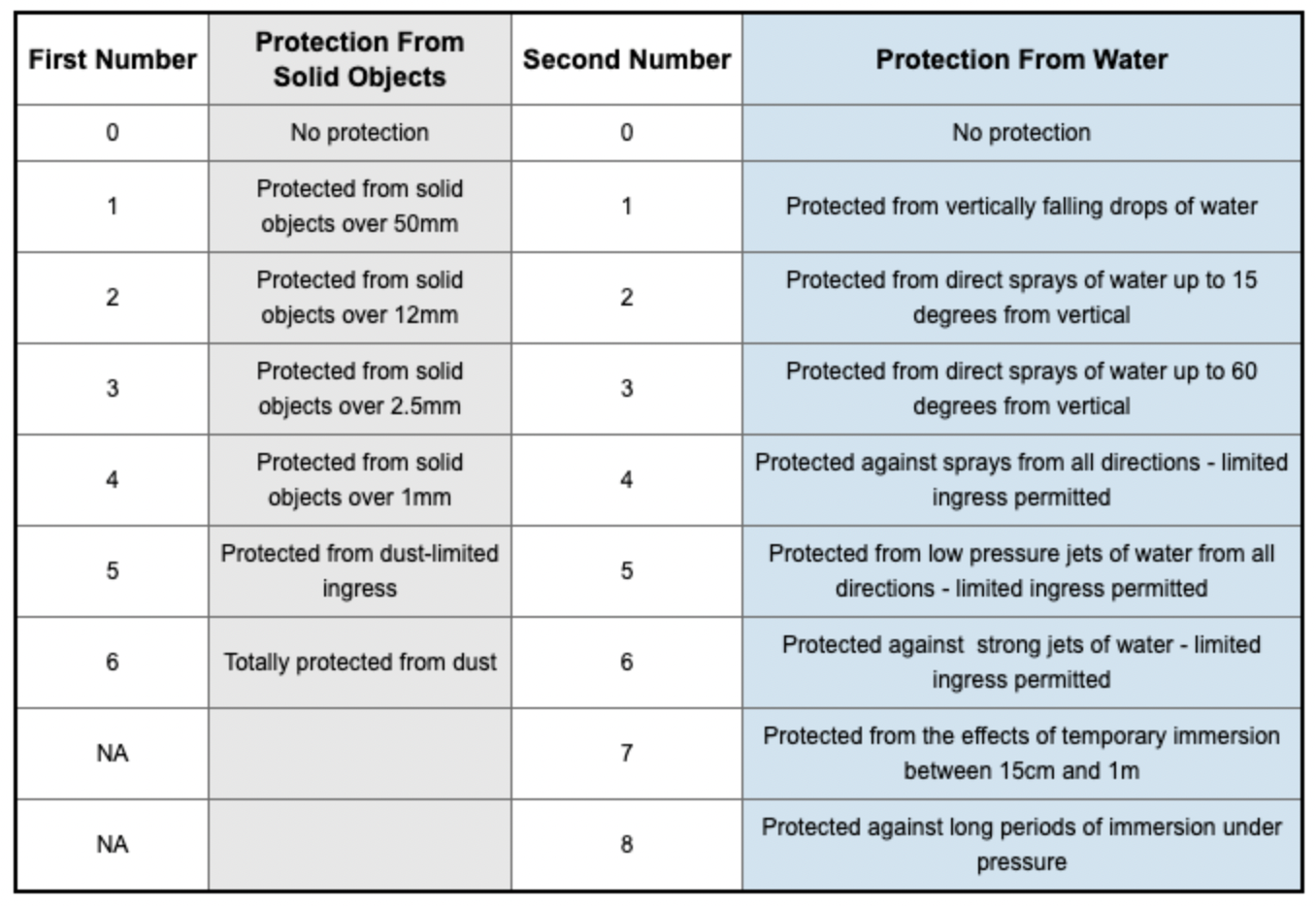
An IP rating, or Ingress Protection Rating, is a pair of numbers that represents the level of protection an object has against foreign bodies and moisture, such as dust and water.

To fully understand the different levels of protection an EDC flashlight can have, assess the chart below:

IP rating scale

Image Source: www.budind.com

An EDC flashlight with the highest level of protection will have an Ingress Protection rating of IP68, demonstrating quality and likelihood to survive a rainy day or dust storm. A rating of IP66 or higher is ideal for units intended for everyday use.

Impact Resistance

Units intended for frequent use need to be tough in the face of the unknown. High-quality EDC flashlights are made from impact resistant materials, such as:

– High strength aluminum- Toughened glass- Stainless steel

Daily use of your EDC flashlight can take a toll on inexpensive, poorly made devices, ultimately making them unreliable. When you’re shopping for an EDC unit, avoid gear made from easily breakable plastic and low-quality lens material.

Best EDC Flashlights

EDC flashlights are specifically designed to fit every carrying need. Whether you’re looking for a super bright unit or one that clips onto your pocket, Fenix offers one of the best options.

Lightweight

Fenix E03R Keychain Flashlight

Fenix E03R Keychain Flashlight

Weighing in at only 0.78 oz (22 grams), the Fenix E03R keychain flashlight shines when it comes to ultra-lightweight units. This compact flashlight is less than 2 inches in size and equipped with 260 lumens of bright light.

Latch this undetectable EDC flashlight onto your keychain to benefit from 5 different light settings and a high Ingress Protection rating of IP66.

Clip On

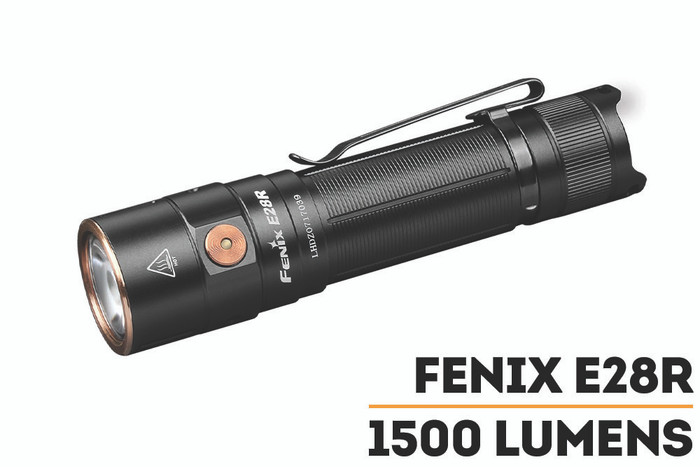
Fenix E28R Rechargeable 18650 EDC Flashlight

Fenix E28R Rechargeable 18650 EDC Flashlight

Although almost every Fenix flashlight features a convenient body clip, the E28R’s high output, durability and size make this unit one of the best.

This powerful EDC flashlight offers 1500 lumens of light and 5 different brightness settings in a size small enough to fit in the palm of your hand. With a protection rating of IP68, the E28R has everything you need in an EDC flashlight.

Brightness

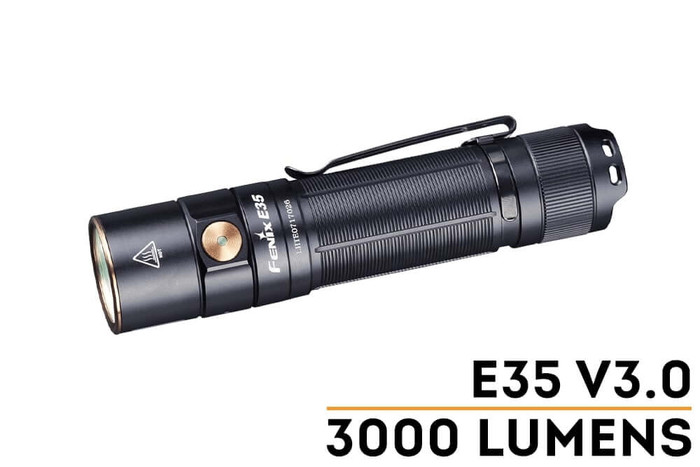
Fenix E35 V3.0 EDC Flashlight

EDC Flashlight

Fenix’s E35 V3.0 EDC flashlight gives portable and powerful a whole new definition. This unit offers up to 3000 lumens of light with a beam distance of 787 feet with less than 5 inches of length. That’s enough light to conduct Search & Rescue!

When all you need is to illuminate the pages of your latest read, dim this EDC unit down to the lowest of 5 light settings, offering just 50 lumens of light. With its durable aluminum body and 100% resistance to water and dust, no other EDC unit compares to the offerings of Fenix’s E35 V3.0.

Compact

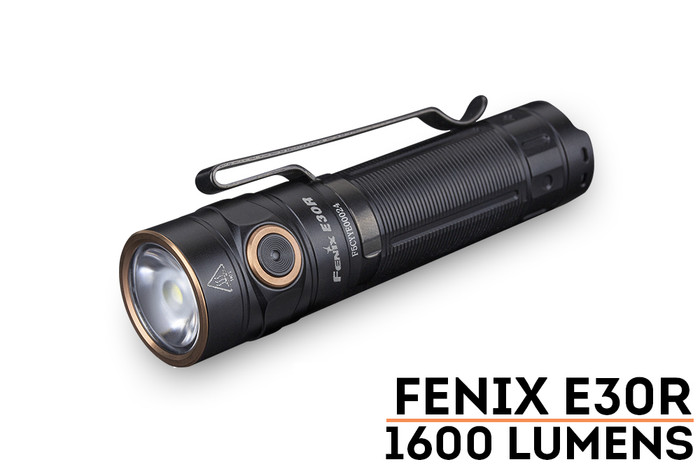
Fenix E30R Rechargeable EDC Flashlight

Fenix E30R Rechargeable EDC Flashlight

Rechargeable, long-lasting and fully waterproof, Fenix’s E30R provides big power in a small package. Less than 4 inches in size and weighing under 2oz, this EDC unit goes undetected in your pocket or purse.

Use one of 5 brightness settings to benefit from anywhere between 30-1600 lumens of light and know exactly when it is time to recharge with the 4-level battery indicator.

Self Defense

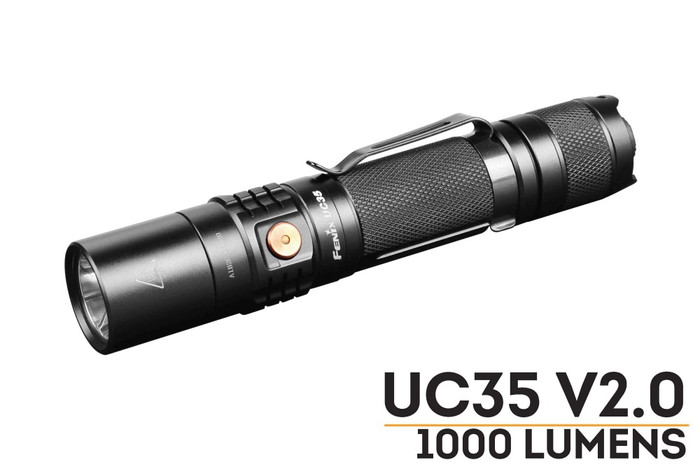
Fenix UC35 V2.0 LED Rechargeable Flashlight

Fenix UC35 V2.0 LED Rechargeable Flashlight

One of the most comforting features of carrying a quality EDC flashlight is accessibility to a reliable means of self-defense. Fenix’s UC35 V2.0 is not only pocket-sized and far-reaching, but also features a self-defense strobe light setting and an extreme impact resistant body.

This anti-roll and anti-slip design makes reaching for and handling this unit effortless and comfortable. Rechargeable and long-lasting, the UC35 is the perfect unit for military, policing and emergency standby.

Fenix Flashlights For Every Need

EDC flashlights quickly prove their usefulness once you start to carry one. With so many durable and dedicated options, finding the best EDC flashlight is easy with Fenix.

Find the best EDC flashlight for your needs and benefit from long-lasting, compact power by visiting Fenix Store today!

Benjamin Maximus Review

0

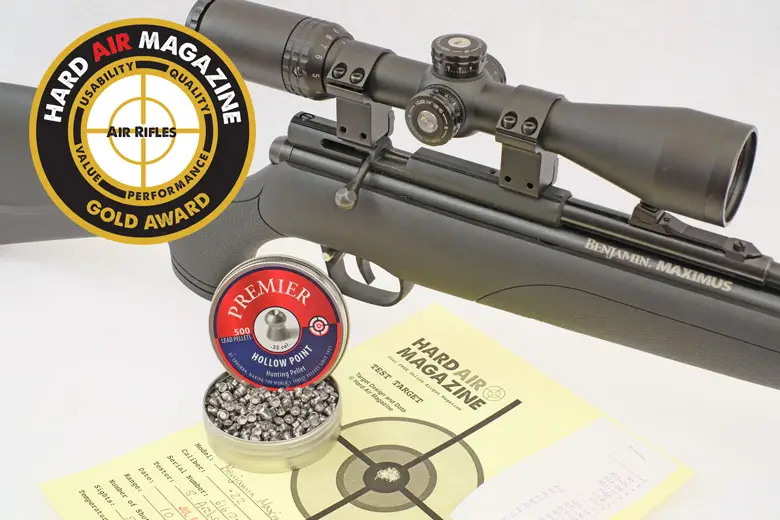
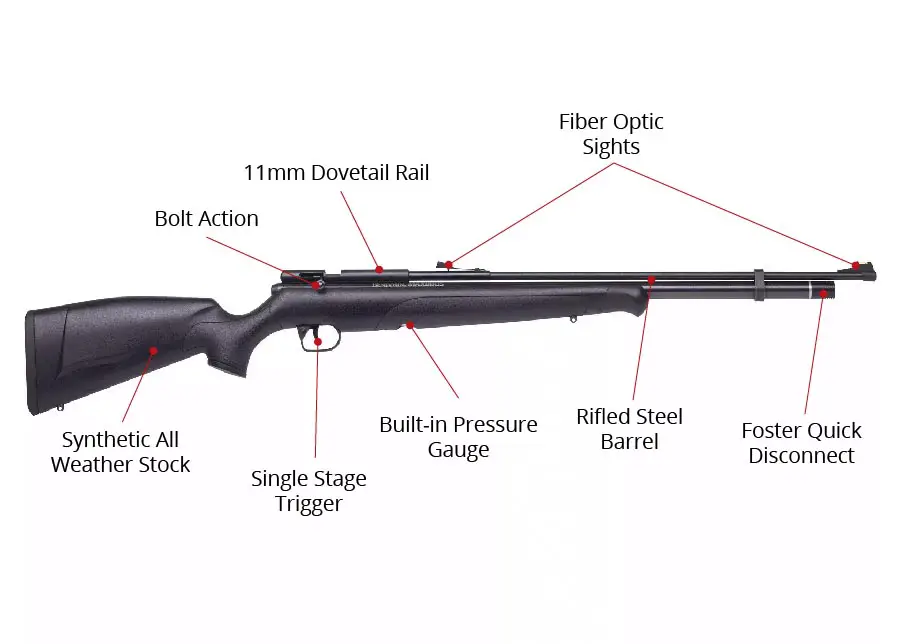
Built-in the United States, Benjamin Maximus is the most affordable, accurate, and powerful air rifle for the money.

Available in both .177 Caliber and .22 Caliber, the air rifle is a pre-charged pneumatic, single-shot bolt-action,

And features an all-weather stock available in black.

(For more on the differences between .177 & .22 and which jobs they do best, see this post.)

Additionally, the rifle delivers 30 shots per fill and is able to be quickly filled with a hand pump.

For those who are searching for an air rifle for small game hunting, target practice, and plinking,

The Benjamin Maximus air rifle is the most accurate and affordable option.

(For the best air rifles for hunting, see this post)

Likewise, if you’re after a good entry-level air rifle for target shooting, Benjamin Maximus .177 is a very reliable option.

In fact, it’s probably best known for being just that – a wonderful entry-level target air rifle.

Benjamin Maximus air rifle is pretty imposing in size as it was conceived to attract people

Who were on the fence about PCP air rifles and were unsure about the value for money, real-feel, and ease of use.

The manufacturers gave a lot of consideration to young shooters during the R&D phase,

Particularly those interested in sport shooting in the likes of the Olympics,

And would need high performance but not an overly complicated weapon.

If you are a beginner, you can save your time and effort with our list of top air rifles for under $100 for beginners.

Quickly filled with the hand pump or high-pressure tank, the Maximus can contain 2000 psi

And allows 30 shots per fill in .177 or 20 shots at .22 Caliber.

The rifle features an onboard 200-bar manometer to check pressure filling.

It’s charged for action by a two-piece 11mm optic mount and compatible accessories.

If you are thinking of starting target shooting practice in your backyard

And are trying to find the best reasonably priced air rifle, the Benjamin Maximus has to be in the mix given its $200 price tag.

Although the Benjamin Maximus air rifle weighs a bit more than average, the feel of the rifle is smooth and it is still lighter than it looks.

This is the reason that the air rifle is a good fit for people of all ages.

However, there is a warning from the manufacturing company to only use it if you are 18+.

Even if you are looking for an air rifle as a gift, Benjamin Maximus, with its tremendous out-of-the-box accuracy, would be the best option for you.

benjamin maximus details

However, the Benjamin Maximus is a pretty loud rifle, with no silencer and no way to lower the volume.

If you’re looking for something for backyard use, you’d better hope to have pretty understanding neighbors!

In this review, we will be discussing the features of Benjamin Maximus and comparing its performance to Benjamin Discovery, so that you can decide which to add to your collection.

Benjamin Maximus Air Rifle Review

Trigger And Cocking Effort

benjamin maximus trigger

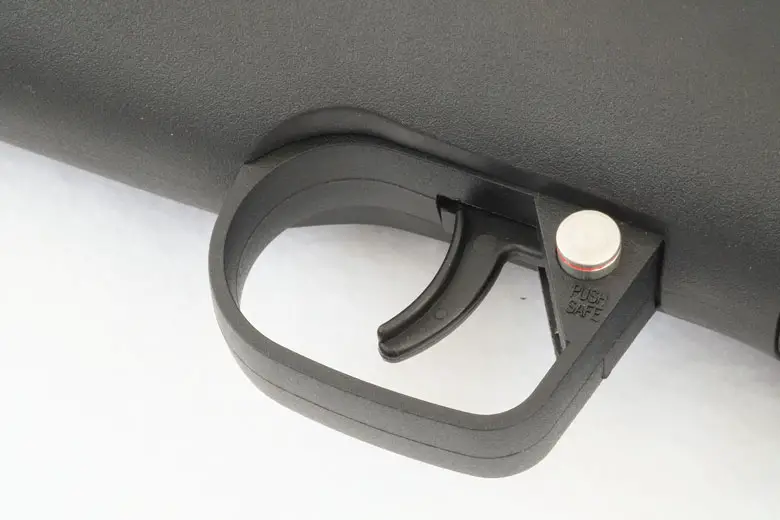
Benjamin Maximus trigger mod comes with a synthetic trigger blade.

In this way, the standard trigger pull weight was too weighty at an average weight of 5 pounds, 13 ounces.

However, the single-stage trigger, though being heavy, did not appear to affect the accuracy of the rifle at all.

There is a manual safety catch for the trigger in its trigger guard,

And the non-automatic characteristics give full control of the air rifle to the shooter.

Talking about the cocking effort, it requires a firm pull back adjacent to the hammer spring to set the trigger sear.

However, the small-sized bolt handles help amplify the effort.

You do not have any aftermarket options for the Benjamin Maximus trigger, so it’s just a bit heavier full stop.

During the HAM test, it was surprising to note that the bolt handles of the Benjamin Maximus PCP were very tight.

Appearance

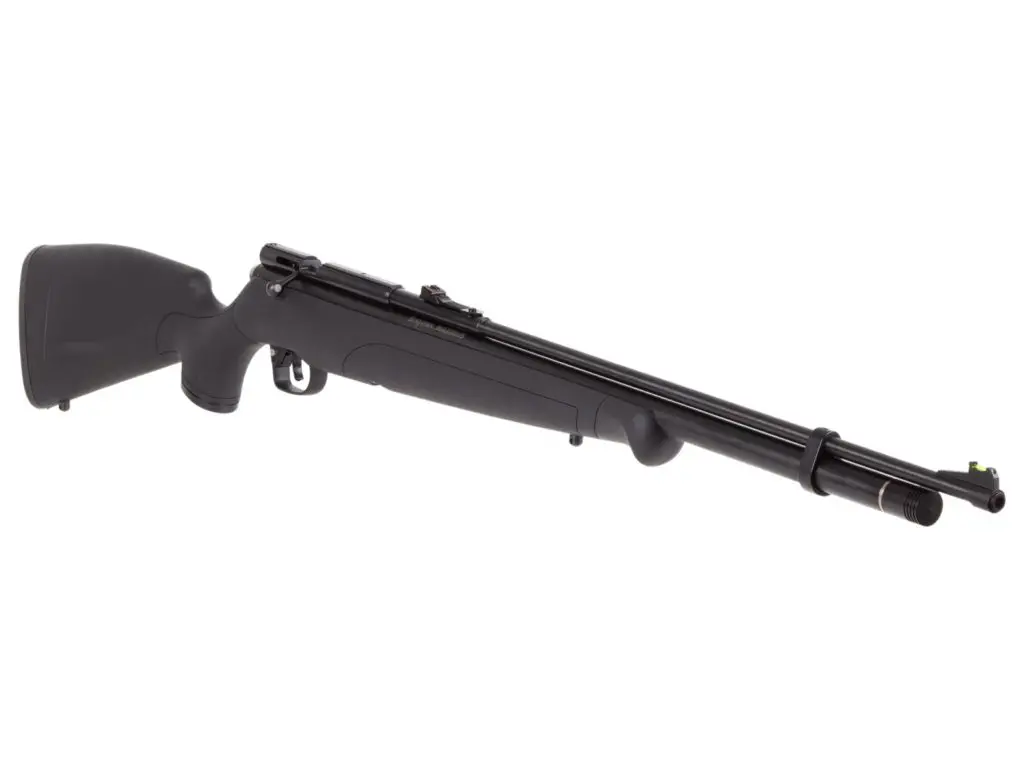
The Maximus air rifle has a synthetic stock and is quite long and thin.

Having said that, it’s still only 2 inches longer than the Discovery.

The black, synthetic stock is pleasing to the eye.

(For more on the in-depth comparison between synthetic and wood stock, see this post.)

There is a molded stippling to help with handgrip if the weather turns wet, making it pretty user-friendly.

The finish of the stock is outstanding, with minimal molding marks, and the added provision of a sling swivel stud is well finished.

The Benjamin Maximus valve is red, unlike the Discovery.

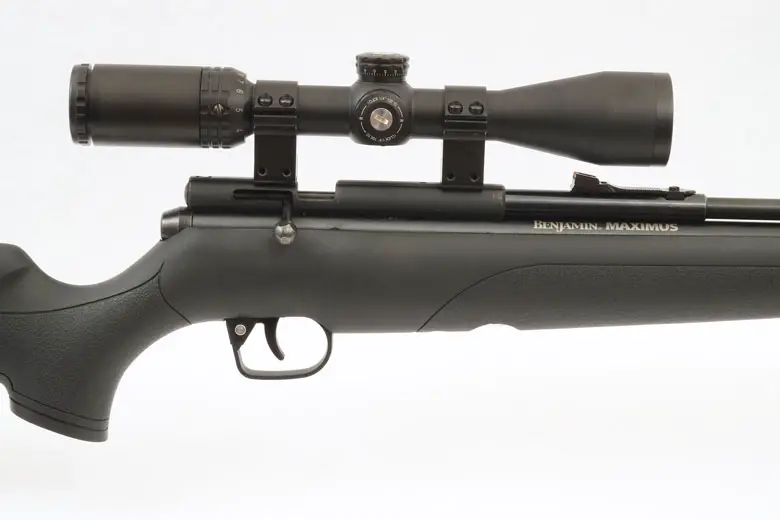
If you look at the cheek weld, the 3 – 9 X scope meets the shooter’s eye quite naturally.

The metal finish is pretty fetching too.

However, since the air rifle is nowhere close to the $1000 mark, it’s unrealistic to expect far too much here.

After the HAM test, it is evident that Benjamin Maximus does, unfortunately, have a poorly finished breech.

The surface of the Benjamin Maximus is a bit dull in its matt black style, however, this doesn’t cover the whole metal area.

In summary, the Benjamin Maximus air rifle is pretty good in terms of appearance, but it’s still far from amazing.

Shooting Ability

The Benjamin Maximus is long, light, and easy to handle.

It weighs only 6 pounds, 5 ounces, which is pretty light for an air rifle with this power.

The magazine has the most comfortable PCP, with 2000 PSI fill pressure which can be done easily with a hand pump.

Without any doubt, this would be the best option for shooters who struggle to make a more usual fill of 3000 PSI, which is required by most other PCP rifles.

Benjamin Maximus Air Rifle

Here is the good news for shooters who are in search of perfection and accuracy.

The HAM test revealed that the RATEAGUN score of just 4.5, confirmed the Benjamin Maximus air rifle is very easy to shoot accurately.

Minimal space is afforded when loading pellets into the breach due to its restrictive, compact design.

Therefore, reloading can be a little bit tricky.

Likewise, the small bolt handle also makes the air rifle cocking effort feel rather heavy.

Power, Accuracy And Velocity

The Benjamin Maximus air rifle can fire both .177 and .22 Caliber rounds.

The former is more suitable for target shooting, while the latter is best for small game hunting or pest control.

(For more on how to choose the right air gun caliber for your game, see this post.)

The Benjamin Maximus air rifle HAM test showed a maximum of 943.77 FPS muzzle velocity

While shooting alloy pellets like Gamo Raptor Platinum pellet.

Moreover, a higher muzzle velocity of 875.52 FPS can be reached with 11.9 Hobby pellets from Grain RWS.

Accuracy was excellent during the test, but the HAM test revealed that light pellets (under 14 grams) did not shoot well.

However, once you reach the pellet weight of 14.3 grains or above, you can get outstanding accuracy.

Nevertheless, the HAM test claimed after much study that the Benjamin Maximus air rifle has the best in accuracy for such a low cost.

Below is the table to show the muzzle velocity, muzzle energy for measurement of the best result for accuracy of Benjamin Maximus air rifle:

PelletMuzzle velocity-AverageMuzzle energy- AverageAccuracy
Gamo Raptor Platinum 9.7 Grain943.77 FPS19.19 Ft/Lbs.Fair
H&N Field target trophy grain 10.03934.90 FPS19.47 Ft/Lbs.Fair
RWS Hobby 11.9 grain875.52 FPS20.26 Ft/Lbs.Very Good
Crossman Premier HP 14.3 Grain827.77 FPS21.76 Ft/Lbs.Excellent
JSB Jumbo exact 14.35 grain832.38 FPS22.08Excellent
H&N Field target trophy 14.66 grain820.35 FPS21.91 Ft/Lbs.Excellent
H&N Baracuda match 21.14 grain705.83 FPS21.14 FPSExcellent (best tested)

For these results, the shooting took place from 50 yards with the Benjamin Maximus air rifle.

The H&N Baracuda match 21.14-gram pellet, which fired at 705.83 FPS, gave the best accuracy for the Benjamin Maximus air rifle.

Loudness

The Benjamin Maximus air rifle does not come with any kind of sound suppression system.

Furthermore, there are no aftermarket options, so you’ll just have to get used to the noise.

In all honesty, it makes a pretty thunderous bang for an air rifle!

As the model used for the HAM test was .22 Caliber, the muzzle velocity was approximately 1100 FPS, which at least doesn’t cross the sound barrier!

It should be noted that the .177 Caliber version possibly does not have the same result as lightweight alloy pellets.

Consistency

The Benjamin Maximus air rifle is not a synchronized PCP. Consequently, the muzzle velocity plunges as the gun fires.

Without any doubt, you would experience this drop quite often, but it is less rapid,

And as a result more controllable than that of Benjamin Discovery.

The trigger pull mass was a hefty standard of 5 Lb 13 Oz.

The accuracy was constant, as well — HAM tested 14.3 Grains pellets and higher shot with consistency and accuracy.

Sight And Scope

The most attractive air rifle, Benjamin Maximus, is fitted with iron sights.

The sights are modifiable and feature fiber-optic dots.

(For more on how many types of air gun sights are out there and which one is suitable for you, see this post.)

benjamin maximus

Benjamin Maximus VS Discovery

If you’re having a hard time choosing between the Maximus and the Discovery, please know that there are some important differences.

Physically, the Maximus valve is red, and the Discovery valve is silver.

The Discovery is made with wood stock. Internally, there is a difference in the diameter of the sleeves.

benjamin discovery air rifle

Crossman claims that the Benjamin Maximus has a maximum muzzle velocity with lead pellets of 85 FPS in .22 Calibers.

However, in the HAM test, it actually shot much faster with alloy pellets.

While testing, for every 30 shots taken with the Maximus, the muzzle velocity dropped by approximately 100FPS.

The test was taken with 14.35-grain JSB Exact Jumbo Express Diabolo pellets.

The muzzle velocity drop is not as radical as the Discovery, and it is more accurate.

So, can you say that Maximus gives up to 30 effective shots per fill?

The answer is yes, so long as you accept that a 100FPS drop from first to last shot is effective (That’s a 23% reduction).

Market Availability

The Benjamin Maximus air rifle is available online and is trouble-free to buy, while Crosman is aiming to bring it to most sport shooting stores.

The Benjamin Maximus offers a distinctive twelve-month warranty, as the manufacturer is well known for its customer care for having replacement parts available.

In case of any problems, their team is highly qualified and knowledgeable to support the customer with any query or confusion.

Most owners will be shooting their Maximus air rifle with hollow-point pellets from Crosman Premier,

Which are available everywhere, and give the best performance.

A trouble-free pump that loads to 2000 psi, the standard foster Q/D pack nozzle, and a great look,

It’s these characteristics that make the Maximus a top PCP air rifle.

(For more on the best PCP air rifles in 2021, see this post)

The HAM test found that the air pressure gauge was not situated in the pressure tube end, but rather it was inside the underside of the stock.

It is clear that while you are checking the pressure, it would not be necessary to look down the barrel.

This makes it perfect from a safety point of view.

This feature shows that Crosman does not compromise on safety to lower the cost for the air rifle.

However, the fiber optic sight could potentially harm the user as the open front is not protective.

The shooter can install the replacement, which is cheap and can easily be changed.

Anyhow, everyone who will be utilizing Benjamin Maximus will prefer to use the scope.

The Maximus has no de-gassing capability, so should you wish to eliminate air tube pressure

Then it is mandatory to remove the pressure by dry firing the gun.

As a whole, the Benjamin Maximus accessories are easily bought on the market.

Specifications

  • Manufacturer is Benjamin
  • Ammo type is pellets
  • 1-year warranty
  • .177 Calibers, .22 Calibers
  • Maximum velocity is 1000 fps
  • Muzzle velocity is 18ft/lbs.
  • 4-medium-high loudness
  • Barrel length is 26.25.”
  • Overall length 41.7.”
  • The shot capacity is 1
  • Barrel rifled
  • Front sight – fiber sight
  • Rear right – fiber optic
  • 11mm dovetail is scope
  • Single-stage trigger
  • Plastic butt plate
  • Suggested for small game hunting/plinking
  • Trigger pull is 3.75 lbs.
  • Bolt action
  • Manual safety
  • Pre-charged pneumatic
  • Single-shot function
  • Maximum shots per fill are 30
  • Body type is a rifle
  • Weight is 5 lbs.
  • The cylinder size is 135cc
  • Color is black
  • Ambi grip
  • Built-in pressure gauge
  • Metal breech
  • 2000 psi

Pros & Cons

ProsCons
  • Thumb-hole, all-weather synthetic stock
  • Gas piston-powered (second-generation design)
  • Decent velocity in both Calibers
  • Smooth cocking action
  • Picatinny rail optics mounting
  • Reasonable price
  • Great consistency
  • Great power and accuracy
  • 30 consistent shots per fill
  • A bit dull in appearance
  • High magnification power on a rifle with a range of 100 yards or less is not necessary
  • Stock is not that durable
  • The trigger is heavy to load
  • Loud in sound, therefore; noisy air rifle
  • Bolt action can be broken if not handled properly or loaded heavily again and again

Price

The Benjamin Maximus is considered so highly among customers for being so low in price.

The Maximus is the first PCP air rifle to break the sub $200 street price.

This feature alone makes it more valuable and outstanding.

The low price doesn’t always come with low quality.

The main issue here is that, like any of the PCP air rifles, it requires a consistent supply of high-pressure air.

The hand pump for the Benjamin air rifle is the lowest cost suitable pressure supply, and it costs around $180.

It is impressive to note that the price of the air rifle is close to the same as that of the pump!

You should note here that the price of air rifles is falling all the time, but the cost of the equipment to fill them is staying about the same.

Customer Reviews

The customer reviews for Benjamin Maximus are mostly favorable. 80% of customers are satisfied with the usability of the rifle.

Benjamin Maximus is famous for its reasonable price, of course.

However, the high accuracy of the air rifle is also deeply appreciated.

As the Benjamin Maximus kit comes with its pump, target, and a can of ammo, it has saved buyers a lot of money.

In the Benjamin Maximus air rifle review, shooters have found the air rifle to be lighter than they expected, so it is an appropriate choice for less physically strong shooters.

It does not feel that heavy on shoulders and allows you to have an excellent shooting experience without any significant barricade.

The stock of the air rifle feels natural and not too bulky.

Though the manufacturers allow warranty claims to be made in case of dropping, most customers haven’t needed it.

It shots H&N 10.65gr, pellets into a9/16’ group at a measure of 25 yards, and there is no complaint about the air leakage of the air rifle.

Reviewers have also lauded the power of the air rifle, which is way above expectations given the low price.

The appearance of the air rifle is also discussed and concurs that it has a lovely shape and color, but with time, the air rifle loses its attraction and becomes a bit faded in color.

For those who are in search of an attractive-looking air rifle that will keep its luster over time, perhaps a second thought is required.

Customers have even recommended many extras of the Benjamin Maximus air rifle;

First is the air pump that must not be disconnected without the drainage of the tank.

Secondly, the air must not stay in the air gun.

One customer complained in their review that the cocking mechanism broke off after only a few uses.

Though the air rifle is loud, there is no such complaint about the noise of Benjamin Maximus among the customer reviews.

Lastly, one widely made criticism of Benjamin Maximus is that the trigger is a bit heavy but still crisp and predictable.

Some customers regret that the air rifle is unavailable in .25 Caliber.

The design of the air rifle is a cause for consternation among customers, for the durability we mentioned above.

There have also been some claims that the bolt actions broke while loading, tying into the above point.

Conclusion

In summary, customers are mostly satisfied with the Benjamin Maximus air rifle for being so powerful at such a reasonable price.

If you are comfortable with the loud sound, then the Benjamin Maximusair rifle is the best choice to have in your hands!

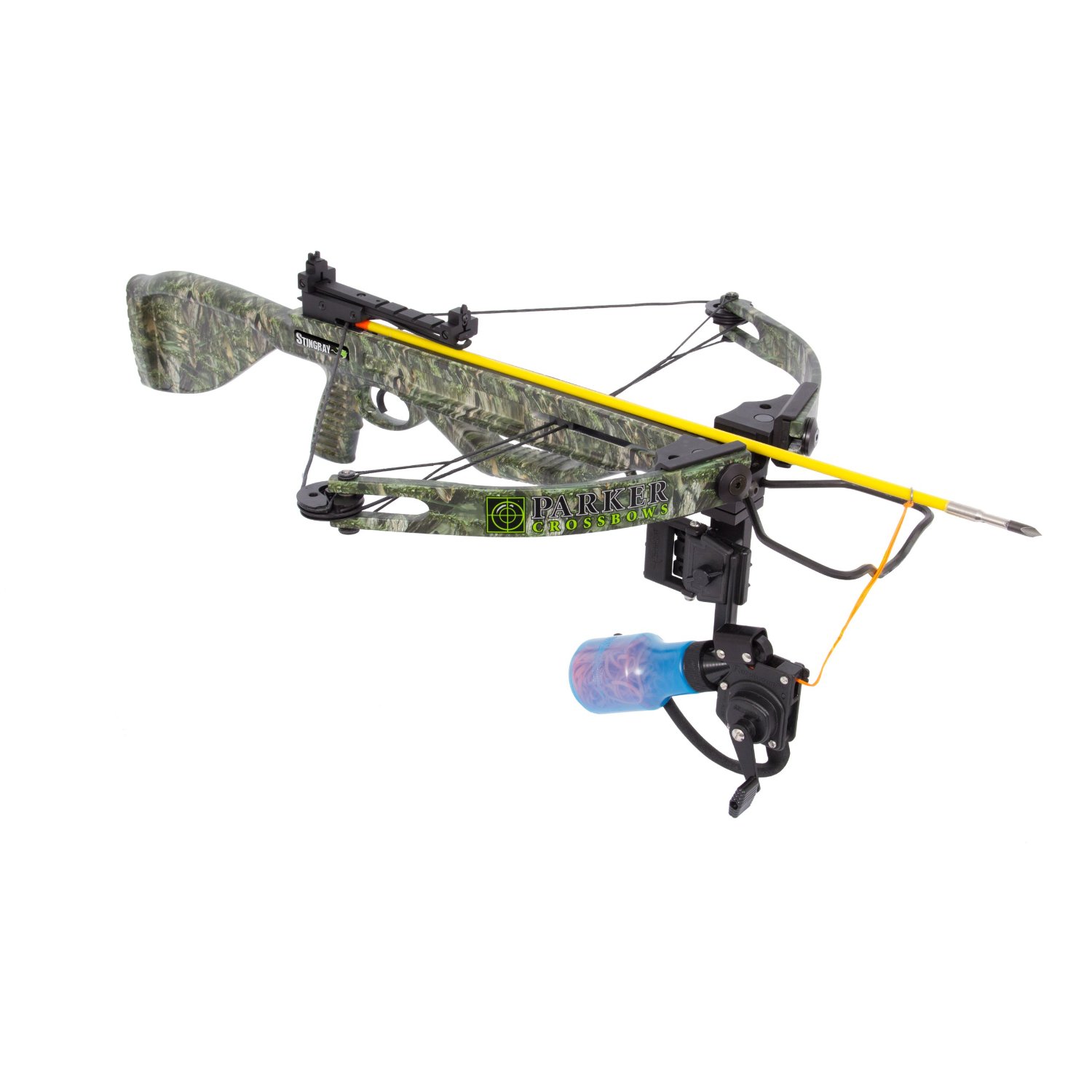
Parker StingRay Review – Compound Crossbow

0

ModelDraw WeightStrokeVelocitySuggested Arrow LengthCrossbow Length / Weight Parker StingRay Check price on Amazon.com 100-125 lbs.11″135-150 FPS Crossbow Academy: ballistics, sighting, tuning20″34.25″ / 7.5 lbs.

What Comes in the Box?

Welcome to our review of the Parker StingRay bowfishing crossbow. Each package delivered by Parker includes the following items:

  • The Parker Stingray crossbow
  • Open sight
  • Assembly hardware and tools
  • AMS Retriever Pro Bowfishing Reel
  • 200 feet of Hi-Vis Braided Dacron Line
  • 2 AMS Safety Slide kits
  • 1 Bowfishing Arrow
  • Muzzy Gator Getter 1600-gr broadhead
  • Owner’s manual
  • Warranty card

Crossbow Assembly

parker1Putting the StingRay together is amazingly simple for such a complex hunting package. The riser, or what Parker calls the front-end assembly, attaches to the stock once you’ve installed the cable slide. If your Stingray comes with a scope, it will be premounted for you, so there is no work to be done to get the scope onto the crossbow. Once you’ve attached the riser to the stock, you attach the AMS Retriever Pro Bowfishing Reel, which includes an integrated arrow quiver for storing your bowfishing arrow.
After putting your bow together, you should set the draw weight to whatever you want it to be, between 100# and 125#. The beauty of this design is that you don’t need any special tools or a bow press to set the draw weight. Once the assembly and tuning is complete, you’re ready to move on to sighting in your crossbow.

Accuracy And Power

Whether you have the open sight or the 1X scope with your x-bow, you’ll want to sight in your bow before you hit the water. I was able to have my open sights fine-tuned within a couple of shots, and then I tested the accuracy of the Stingray. The Stingray delivers arrows between 135fps and 150fps, depending on the draw weight you have set. Mine is set to the maximum 125 pounds, so the 1600-gr bowfishing arrow was hitting the target at 150 fps with almost 80 ft. lbs. of kinetic energy.

From 25 yards, I was able to maintain a 1/2″ grouping with this crossbow, and held the same grouping from 35 yards. From 50 yards, I could hold a pattern just 1-1/2” in diameter, which is more than accurate enough for serious bowfishing. With the Stingray sighted in and tested, I was ready to hit the water.

Will Hunters Enjoy the Parker Stingray?

This x-bow is designed for bowfishing, so you won’t take this up against a deer. With that said, it has the stopping power for a deer, but the speed of the arrows is probably too slow to account for the tendency of deer to string jump. I didn’t even try this bow land hunting, using it instead for what it was designed for—bowfishing.

For fishing purposes, this is an excellent crossbow. You can easily penetrate and nab the largest fish, whether you’re in fresh water or salt water. The reel works flawlessly, and the included 200 feet of high visibility line makes it easy to see where your arrow has gone. An illuminated nock will also help tremendously.

What was really exciting about this crossbow was the inclusion of the Muzzy Gator Getter arrow point. I had the good fortune of getting in on an alligator hunt, and chose the Stingray as my tool of choice for hunting gator. During my gator hunt, I was able to fill my limit of gator easily, with the Stingray performing exactly as I expected it to on this once-in-a-lifetime hunting opportunity.

Cocking The Stingray

The Stingray has an adjustable draw weight of 100 lbs. to 125 lbs., and the adjustment can be made without any special tools or a bow press. For some, this light draw weight might mean hand-cocking the crossbow, but I definitely would not recommend this. While it’s easy enough to draw by hand, using a rope cocking device makes your draw much more even and consistent, helping your accuracy considerably. Unfortunately, Parker does not include a rope cocking device with the Stingray, so I would recommend picking one up at your local archery shop when you get your Stingray.

The Crossbow Scope

Parker delivers this crossbow with either an open sight or a 1X scope. I chose the open sight, but I’ve also used the 1X scope in the past. This scope is very good quality, with coated optics for fog-resistance, and excellent light gathering capabilities for use in dark swampy areas. It sights in easily and quickly, and holds true almost indefinitely.

Bolts

Your purchase of the Parker Stingray will net you one bowfishing arrow, which many will say is all that you need. That’s probably true, because the hassle of switching your retrieval line from one arrow to another is more trouble than just pulling your arrow back in and reusing it, but you may want to invest in additional arrows in case yours becomes damaged. Parker recommends 1600-grain arrows for use with the Stingray, and attempting to use a lighter arrow than that could result in some serious problems and injuries for you and your crossbow.

Safety and Design

The Stingray is designed with boat fishing in mind, so it is small and compact. It is also lightweight, and almost perfectly balanced. It features a G2 Bull-Pup trigger with an auto-engaging ambidextrous safety and auto-engaging anti-dry fire mechanism, both of which operate reliably for each and every shot. The vented forearm’s safety finger flange is perfectly sized and positioned to keep you safe when firing your x-bow.

The AMS Retriever Pro bowfishing reel that comes with the Stingray is set up with a right-side crank, so if you are left-handed you may struggle with the retriever reel. It works perfectly, though, and serves wonderfully for reeling in that big catch when you nail it.

Warranty

All Parker crossbows are covered by a 5-year limited warranty, and Parker’s customer service representatives are easy to work with, friendly, and knowledgeable. Make sure to register your warranty within 15 days of your purchase, though, or your warranty may not be valid.

What Crossbow Case Fits the Parker StingRay?

If you use a smaller scope, the Carbon Express Deluxe Case is a nice soft carrycase for $66. If your StingRay is equipped with a bigger scope, opt for the Allen Company case. It is a $30, soft carrycase which offers more space.

Crossbow Review – Summary

Thanks for reading my review of the Parker Stingray. This is an exciting crossbow with excellent potential for hunting alligators and use in bowfishing. If you want to get involved in bowfishing, but would rather use a crossbow than a bow, the Stingray is the crossbow for you. Take a look at today’s amazon.com price on this crossbow and check out our top 10 crossbows rankings for more.

9 Best Hunting Rifles Available in 7mm PRC

0

I love 7mm PRC. I built a custom 7mm PRC two months before the cartridge was ever even announced to the public, and have been shooting it constantly. I’ve learned a lot about what does and doesn’t work well for this platform.

7mm PRC is a unique cartridge. The more experience I have with it, the more I realize that it matches some rifles extremely well, and others less well. Because of that, I’m going to be straightforward in this post in saying some rifles that I simply can’t recommend for 7mm PRC.

Why You Can Trust This Review

  • I have reviewed many dozens of hunting rifles to compare the best rifles at each price point.
  • No rifle maker pays me for my opinions, which is why Backfire is one of few places you’ll see NEGATIVE as well as positive reviews. Most reviewers only talk about the good things because they want to please the manufacturers.
  • I’ve been shooting 7mm PRC since before the cartridge was even announced. I own two 7mm PRC rifles.
  • I have a somewhat rounded face, which research shows increases public trust in a person. Just kidding on this one 🙂

Later in this post, I’ll discuss some things to specifically look for in choosing a 7mm PRC rifle, but first, let’s dive in to some cool guns.

Option #1: Ruger American Go Wild!

This is a Ruger American Predator. It’s NOT the Go Wild Edition.

The Ruger American has become a beloved rifle at the low end of the market. Compared to dozens of other cheap rifles I’ve reviewed for the Backfire Youtube Channel, the Ruger American is one of the only ones that I’ve found to shoot reliably accurate groups. However, one early reviewer of the RA in 7mm PRC did have some accuracy issues.

The “Go Wild!” edition of this gun adds a few features such as burnt bronze Cerakote on the barrel and action, a camo-printed stock, and a muzzle brake. The biggest upgrade to the “Go Wild!” models is the magazine, which is far more reliable than Ruger’s old rotary mag. The feeding still isn’t 100% perfect, but it’s a substantial improvement over the standard Ruger American.

Overall, the Ruger American Go Wild is an excellent choice for a budget 7mm PRC rifle. You’ll likely have good accuracy, the manufacturing consistency is reliable, and you’ll have a durable gun that will last a long time. Plus, you can always upgrade the stock down the road because there is a robust accessory market for the Ruger American.

However, I the increased price of the Go Wild edition of this rifle puts it in a price point that competes with the Bergara B14 Hunter, Tikka T3x, Franchi Momentum, and CVA Cascade. Once those rifles are released in 7mm PRC, I would easily adjust my recommendation to move to one of those options that I think are better rifles in this price bracket.

It’s important to note that while the Ruger American is the only budget 7mm PRC rifle I can recommend right now, it’s NOT the only budget option out there. The Mossberg Patriot has also been released in 7mm PRC, but I wouldn’t touch it with a 39.5′ pole. Later in this post, I’ll discuss the rifles I DON’T recommend in 7mm PRC.

Option #2: Savage 110 Ultralite

Savage 110 Ultralite

Savage was one of the first rifle makers to embrace the 7 PRC. While many companies announced support at the launch of the cartridge, Savage is actually shipping rifles and brought it to no less than 11 different models immediately.

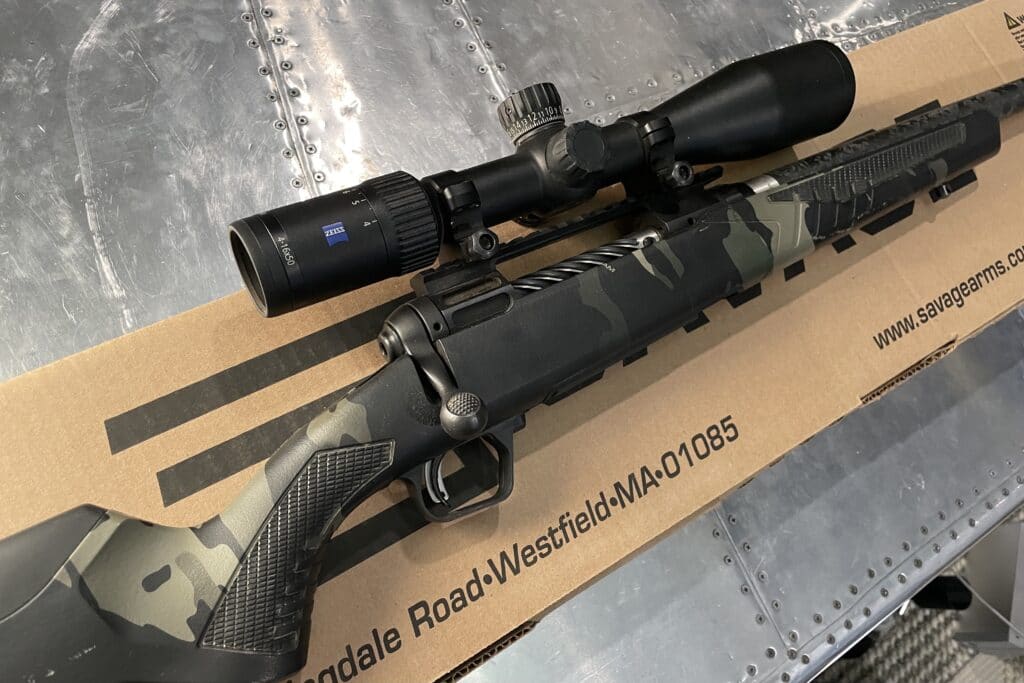
The Savage 110 Ultralite is universally very accurate. The real selling feature of the rifle is that it utilizes a Proof Research carbon fiber barrel. That’s a very high-end precision barrel for a rifle in a factory rifle. It felt like I couldn’t miss when I did my full review of the Savage 110 Ultralite.

The knock on the Savage 110 Ultralite is that it uses a clumsy Savage action and an unreliable plastic magazine and mag catch. I was once told that a Savage 110 Ultralite is a “$1,000 barrel attached to a $400 gun.” It’s a funny comment, but honestly it’s a very functional stock. It has an adjustable cheek piece and length of pull, and is decently rigid in the forend. Plus, because so many stocks are inletted for the Savage 110, it’s a piece you could replace with a carbon fiber stock at some point in the future and you’d have an extremely fine rifle.

Still, if you can look past the Tupperware stock, you’ll have a sinfully accurate rifle that is incredibly lightweight for a reasonable price. When I purchased the Savage 110 Ultralite a few years ago, I got it for $1,195, but now they run closer to $1,500. Still, it’s a fair price for what the rifle is.

Here is a full list of rifles that Savage will be releasing in 7mm PRC:

  • 110 Ultralite (HD or Camo) – $1,649 – $1,699
  • 110 High Country – $1,239
  • 110 Timberline (Right or left hand) – $1,239
  • Impulse Big Game – $1,449
  • Impulse Mountain Hunter – $2,437
  • 110 Apex Hunter XP (Right or left hand) – $709
  • 110 Apex Storm XP – $819

Option #3: Browning X-Bolt

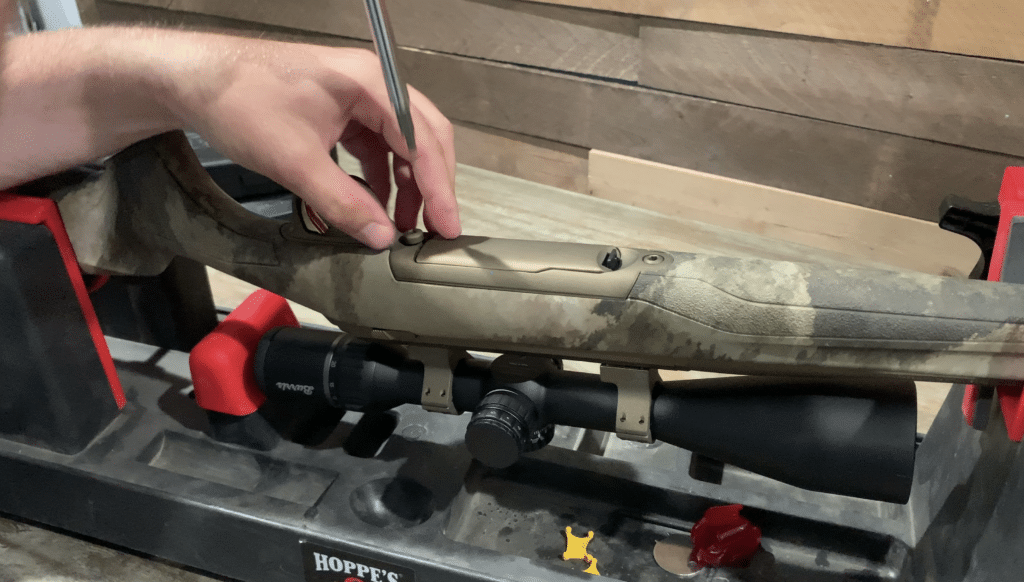
The bottom of a Browning X-Bolt Hell's Canyon Speed rifle showing the bottom metal and magazine being removed by a gunsmith on a Hoppe's 9 gun vice.
The browning X-Bolt is a great gun, but plan to take out the trigger and put in a Timney.

The Browning X-Bolt line is a very compelling option for 7mm PRC. X-Bolt rifles are always styled to look cool, and I’ve found the manufacturing quality to be very reliable. Plus, they use a quality action with some cool features like the ability to pull the bolt back while still in safe.

If I were buying an X-Bolt in 7mm PRC, I would definitely look to their “SR” line. The “SR” line means “Suppressor Ready”, so you’ll get the muzzle threaded 5/8×24, and barrels that are 4″ shorter. Both of those are a great match for 7mm PRC, which does well in a shorter rifle, and also having a threaded barrel can help to reduce recoil by adding a brake or suppressor. Unfortunately, I haven’t seen the SR line yet available in 7mm PRC.

But no rifle is perfect. Here are a few issues I have with X-Bolt rifles:

  • Metric Patterns – They stubbornly still thread many parts of the rifle using metric patterns, which means you can’t add a suppressor or brake without an adapter. (Note: Their SR models have standard 5/8×24 muzzle threads, but still use metric threads in other areas).
  • Lawyer Triggers – Browning puts very heavy triggers in their rifles. It’s ironically called the “Feather Trigger.” I would not buy an X-Bolt without also buying a Timney replacement trigger for the X-Bolt. It’s a 2-minute install and you’ll have a much better gun.
  • Price – Price points aren’t competitive anymore. It’s tough to recommend an X-Bolt when you can get a Bergara B14 with a much stiffer stock and better action, or a Savage Ultralite with a high-end carbon fiber wrapped barrel for the same price.

Option #4: Fierce Carbon Rogue

Fierce Carbon Rogue

Fierce Firearms is a smaller rifle maker who creates all of their firearms in Utah. They stick out to me for a few reasons: (1) They are experts with carbon fiber so they’re rifles are usually very light, and (2) they make the coolest looking rifles on the market.

The Rogue is a hybrid rifle. It has a carbon stock and carbon-wrapped barrel. It has modern touches like a picatinny rail for mounting a bipod, and QD flush cups. Yet, it has a more traditional grip rather than a vertical pistol grip.

In my review of the Carbon Rogue, I found it to be accurate, extremely well-built, perfect at feeding, and it looks great. It’s a premium rifle at just over $2,000, but it can honestly compete with a full custom rifle that costs twice as much.

Watch my full review of the Rogue on Youtube.

Option #5: Fierce Mountain Reaper

Fierce Firearms has been one of my favorite manufacturers of high-end rifles for a while. They seem to understand that shooters want cool-looking, lightweight, shootable rifles.

While Fierce has had their Reaper model for quite a while, it was a little heavy. Now, they’ve started making the Mountain Reaper which takes all the best features of the Reaper, but puts them in a lightweight package.

It has a magnesium chassis, a titanium action, and weighs less than 6 lbs in many chamberings. Fierce rifles generally mitigate recoil well due to their stock designs and Limbsaver recoil pads, but I still might recommend a muzzle brake or suppressor to shoot 7 PRC in this light of a package. The recoil of the 7 PRC

The Fierce Mountain Reaper is available in 7 PRC with 20″ and 22″ barrels with a 1:8 twist, and personally I’d pick the 20″. My custom 7 PRC uses a 20″ barrel and I’m happy to see 2,950 fps with 150gr copper bullets for hunting.

Check out the Fierce Mountain Reaper.

Option #6: Put a 7mm PRC Barrel on a Rifle You Already Own

My custom-built 7mm PRC rifle

The fastest and cheapest way to start shooting 7mm PRC is to simply rebarrel one of your existing rifles. If you have a suitable rifle, such as a Tikka T3x, Bergara B14, Remington 700, or even a Ruger American, you can get a prefit barrel ordered and just screw it on. Done!

There are a few caveats, though. You’ll need a properly sized bolt face (the front part of the bolt that grabs on to the cartridge). The 7mm PRC uses the same bolt face as a 7mm Remington Magnum, 300 Win Mag, or a 300PRC or 6.5 PRC. If your rifle is already chambered to use that magnum bolt face, you’re set.

If your rifle doesn’t have that bolt face, you can either order a new bolt, or some actions have replaceable bolt faces which are cheap and easy to change out.

The next issue is you’ll need to make sure the rifle action is long enough. 7mm PRC has a cartridge overall length of 3.34″, so a long action is needed. If your rifle was chambered in .30-06, 300 Win Mag, 7mm Rem Mag or any other long-action cartridge, you’re set on this regard as well. If your rifle was configured for long action, you’ll probably also have a long enough magazine length for the cartridge as well.

Next, you’ll need a barrel. I like working with Preferred Barrel Blanks. They are already doing prefits for the 7 PRC, and have gone through a few reamers to find one that’s really reliable in a cartridge with extremely tight tolerances. I also found that they had many chassis options and other components available, which was nice.

Once you get your barrel, it’s just a matter of torquing it on in 5 minutes and you’re ready to go!

Option #7: Remington 700 Long Range

Remington absolutely destroyed its brand as a rifle maker over the last 20 years. Frankly, I was surprised that the owners of the new “Rem Arms” manufactured rifles even decided to bring the brand back. It seemed to me that the brand reputation was so destroyed that it would have been easier to start from scratch under a new name.

Yet, the reports I’ve heard so far from gun industry professionals that I trust has been positive. I still haven’t had my hands on one to review for the Backfire Youtube channel, but I’m eager to see if they’ve turned things around. I’ll believe it when I see it.

Prices for the new Remington in 7mm PRC are expected to be around the $1,000 price point.

Option #8: Christensen Arms MPR (And other models)

MPR stands for “Modern Precision Rifle.” It is a modern chassis design with adjustability in the stock, M-lok everywhere for attachments, and a pistol grip. It’s the type of rifle that most advanced shooters want.

I’ve reviewed a Christensen MPR on the Backfire Youtube channel and gave it mixed results. The mag well was so loose that I couldn’t believe it wasn’t a defect in the particular rifle I was using. The accuracy was okay, but not notable for a rifle in this price point. Plus, it was a little heavy for taking out into the woods.

In talking with other shooters, the MPR is a little polarizing. Some people get a good one that shoots very well and rave about it. I’ve talked with many others who have had poor accuracy or build quality issues.

Christensen is also chambering their other rifle models in 7 PRC, including:

  • Ridgeline FFT – Order it from Midway USA –
  • Mesa FFT – Order it from Midway USA –
  • Traverse – Order it from Midway USA –
  • ELR – Order it from MidwayUSA – A 7.5lbs rifle for long range shooting.
  • MHR (coming soon)
  • MPR

Option #9: Gunwerks Magnus Rifle System

If you are willing to shell out the big bucks (a little less than $6,000 for the bare rifle), then Gunwerks would be happy to take your money. They make extremely fine hunting rifles for shooters who value accuracy and a system that makes long-range shooting more streamlined.

Personally, if I were to spec out a new Gunwerks rifle today, I’d go with a Magnus rifle with these specs. I am naturally drawn to the lightweight hunting rifles, so I may be tempted to go with a Clymr, but after holding and playing with a Clymr stock, I found the comb was just too low to get a decent cheek weld. I can’t imagine paying that much for a rifle and having a stock that doesn’t fit.

The Magnus stock is only half a pound heavier, but provides much better ergonomics.

Gunwerks was very quick to jump on the 7mm PRC cartridge. They had their own 7 LRM cartridge for many years that was extremely similar to the 7 PRC’s design, so it wasn’t difficult for them to begin manufacturing the new cartridge.

Rifles in 7mm PRC That I Do NOT Recommend

  • Mossberg Patriot – I bought a Patriot in 308. Shot some of the worst groups I’ve ever seen out of a rifle (over 5″ at 100 yards). Sent it to Mossberg for repairs and it came back shooting terrible again. Then I got a second Mossberg Patriot in 308. It also is incredibly inaccurate. I know some people have a good experience with theirs, but TWO lemons AND I sent it in for repairs and I still can’t get it to shoot? Can’t recommend.
  • Savage Impulse (and Mountain Impulse) – I’m a big fan of the straight pull. It’s a really cool feature on a rifle; however, I’ve shot Savage’s Impulse twice and found it to be very clunky and heavy. Even their Mountain Impulse that is supposed to be a lightweight rifle is still a little obese for mountain hunters.
  • Christensen MPR – So much of this rifle speaks to me. I love a folding stock, modern stock design with adjustable comb, and a carbon fiber design; however, I didn’t get great accuracy on the ones I’ve reviewed, and found the build quality to be okay at best. It’s an amazing design, but I don’t feel it has the polish of a gun in this price point.

What Guns Will NOT Be Available in 7mm PRC?

Surprisingly, some gun makers are noticeably absent from the list above.

The following gun makers have no imminent plans to add 7mm PRC to their lineups:

  • Bergara – They told me it will likely come first in the Bergara Premier line, and then will eventually go into their less expensive guns. No models have been released yet in 7mm PRC.
  • CVA – No news thus far.
  • Springfield – No plans for 2020 Waypoint coming any time soon in 7mm PRC. I asked them at Shot Show and they were actually really rude about it. Totally gave me the cold shoulder for even bringing it up.
  • Sig – No plans for a 7mm PRC Sig Cross coming any time soon.
  • Tikka – Tikka/Sako have not announced any support for the 7mm PRC yet. Their reasoning is that they are members of CIP (basically a European version of SAAMI), which has not yet approved the 7mm PRC cartridge. I spoke with Hornady and they said they’ve already sent all information to CIP to get approved, but they work slowly.
  • Weatherby – No news thus far.
  • Howa – No news thus far.

List of Currently Available Rifles in 7mm PRC

The following table has a full list of the rifles that are currently announced and imminently available in 7mm PRC. There are over 20 rifle manufacturers who have announced they’ll be supporting the cartridge, but I haven’t yet seen listings for some of the volume manufacturers yet.

ModelPriceAvailabilityNotes

What to Look for in a 7mm PRC Rifle

Indulge me for a moment as we look at some of the very unique aspects of the cartridge, and what kind of rifle we would ideally have to take advantage of those unique features.

  • Built for Long Range Shooting – 7mm bullets, if all else is equal have the highest BC’s of any other caliber in the most common bullets for hunting. Because of the high BC’s, you’ll have great resistance to drop and drift-making this a long-range shooter. Pick a rifle platform that matches that capability with a good adjustable comb and modern stock design to help you stretch this thing out.
  • A Good Track Record of Attention to Detail and a Good Warranty – 7mm PRC uses very tight chamber tolerances. Several manufacturers I’ve worked with have spoken to me about struggling to not have their guns go over pressure if they slightly undersize the chamber, or having brass not fit properly. The PRC line can be tough for gun makers to get right, so pick a manufacturer with a good track record of customer service and attention to detail.
  • Built for a Hybrid of Hunting and Range Shooting – One of the unique things about 7mm PRC is how versatile it is. The faster twist enables it to shoot heavy bullets suitable for hunting larger game, but its balance of speed and recoil also makes it a good fit for target shooting. Pick a rifle platform that allows you to take advantage of both-lightweight for hunting, but stock fitment features (like adjustable cheek piece and a good trigger) to make it do well on the range.
  • 20″ or 22″ Barrel Lengths – Some shooters may want long 26″ barrels to take advantage of all of the speed available, but hunters generally want shorter barrel lengths to make the gun more packable. The 7mm PRC is well-suited to shorter barrel lengths because it has a moderate powder supply, and a fat case. For me, I went with a 20″ barrel, because I usually shoot suppressed and like the “handiness” of a short gun.
  • Quality Recoil Pad, Threaded Muzzle – I’m picky about recoil pads. It makes a big difference in the felt recoil, but so many manufacturers use cheap, junky products. Because the recoil is on the upper end of what most adult shooters can shoot well, having a good recoil pad and a threaded muzzle so you can add a suppressor or muzzle brake, can make a big difference.
  • Not Overly Light Weight – Because 7 PRC is built for longer range shooting and it has noticeable recoil, I’d suggest not going into an ultralight platform under 6.5 pounds unless you’ll be using a muzzle brake or suppressor.

List of Rifle Makers Supporting 7mm PRC

The following list comes from Hornady of rifle makers who have announced support for 7mm PRC rifles.

Where to Shoot a Hog With a 30-06

0

The 30-06 is used for a lot of different things, and hog hunting is one of them. Hogs are hoofed game that can weigh anywhere from a few dozen pounds to over 300 pounds. There have even been documented kills of wild pigs weighing more than 1000 pounds in the United States. It all comes down to knowing where to shoot a hog with a 30-06.

Proper shot placement is vital when hunting feral hogs. When using a well-balanced, versatile, affordable hunting cartridge like the 30-06, targeting any of the vital organs (lungs, heart, brain, and the spinal column) will give you a kill shot.

Wild pigs are tough, from their thick skulls to the cartilage shoulder shields that protect their upper bodies. If you have been looking for recommendations on ammo to use when hunting hogs, here’s a bit about the .30-06.

The 30-06: A Brief Introduction

For nearly 50 years, the.30-06 was the primary rifle and machine-gun cartridge used by the United States Army before being replaced by higher calibers.308 Winchester. The “.30” refers to the bullet’s caliber, and the “06” refers to the year the cartridge was introduced – 1906.

The “thirty-oh-six” caliber is widely used in bolt action rifles, machine guns, the BAR (Browning Automatic Rifle), and the Famage Mauser. The 30-06 is one of the most versatile cartridges ever designed in terms of ballistics.

Many hunting loads have over 3,000 foot-pounds (4,100 J) of energy at the muzzle and use expanding bullets capable of transferring energy to targets quickly. The .30-06 is still one of the world’s most popular sporting cartridges. Another advantage of the 30-06 is its widespread availability.

Where to Shoot a Hog With a 30-06

While feral pigs are invasive and vexing, shooting one in the back, front legs, or guts and letting it run away will cause undue suffering. It is cruel and inhumane.

Proper hog shot placement is imperative because it minimizes the prey’s suffering, reduces damage to the meat, and preserves your ammo. Typically, when deciding where to shoot a hog with a 30-06, several factors come into play, such as:

  • The bullet’s grain weight
  • The firearm’s physical condition
  • The size of the wild hog
  • Wind conditions in the area
  • The shooter’s marksman skills (expected accuracy)
  • The distance from the hog to the downrange.
  • The ethics of the optimal number of shots allowed

Despite these variables, you will never go wrong if you know where to target your shots.

The Vitals

Forget all you know about the deer anatomy while hunting deer. Applying the exact shot placement will get you nowhere. You’ll end up spending precious time trying to track a wounded animal.

The Heart, Lungs, and Liver

Unlike the North American deer, the vital parts of hogs are located in a much lower position. When the hog is in a broadside position, shots to the heart, lungs, and liver are aimed at the hog’s front shoulder zone. Some experts recommend aiming for the heart (the area immediately behind and above the shoulder). Aim for just above the shoulder because the lungs are located above the shoulders. Hitting the shoulder area will immediately put the hog down.

However, keep in mind that the lungs, liver, and heart are all protected by thick shoulder cartilage. It usually is densest at the top and thins slightly toward the top of the front leg.

The Central Nervous System

The CNS consists of the brain and spinal column. If the hog is front-facing, this is the best shot placement. Aim for the center of the forehead, directly above the midline of the eyes. A bullet between the ear and the eye effectively penetrates the brain, resulting in instant death!

Hitting the spinal column will also bring the prey down. The hog’s spinal cord center is located in the neck region. As a result, a neck shot will result in an instant kill. However, aiming for the brain isn’t recommended for noobs unless you are an excellent marksman. This is because hogs’ brains are tiny and are protected by a hard bone.

The Ear Hole

The ear hole serves as a gateway to the animal’s neck area. This shot works best with stationary hogs. Because this wild game rarely stands still, a little patience and a good scope will also come in handy. A well-placed shot to a boar’s ear hole will cause the neck to snap, resulting in swift death.

Through the Eye

Similar to the ear hole, shooting a hog in the eye will cause it to drop dead. You are most likely to hit the brain, just like the earshot. Most hunters prefer the ear to the eye but go for it if that’s the only option.

How Far Can I Shoot With a 30-06?

Although the maximum effective range varies depending on load and rifle, the .30-06 Springfield is certified for an extreme reach of 4.75 miles and an effective firing range of 1,000 yards with its original 150-grain spire point bullet 2,700 fps. A flip-up rear leaf sight with a range of 2,850 yards was graduated. You can effortlessly hit a standing, mid-sized target at a point-blank range of 500 yards.

In Summary

If you were wondering where to shoot a hog with a 30-06, you have the answers. However, other factors are worth considering (like the quality of the firearm and your marksmanship) shot placement to the vital organs, neck, head, ear hole, or through the eye. If you are confident in your shot accuracy, you can try aiming at the chest area. The 30-06 caliber dissipates enough energy to deliver a center-punch kill shot.

All in all, I would say any 30-06 rifle will get the job done, whether you’re stalking hogs in woodlands or using bait in the fields.

Snake Poem: Red Touch Yellow, Kill a Fellow

0

Need snake removal in your hometown? We service over 500 USA locations! Click here to hire us in your town and check prices – updated for year 2020. One of the things that separates human beings from any other animal on the planet is their ability to create acronyms and pneumonic devices that help them to be able to memorize key pieces of information. This is used by biologists to remember the classification system, soldiers to remember ranks, and astronomers to remember the different galaxies. However, the ability to use memory devices like this are not limited to pneumonic and acronym options. One of the best ways to remember something is through the use of a story or poem. Because of the manner in which they are written they can become very useful techniques to be able to help a person to remember important dates, like the War of 1812 or Paul Revere’s ride. One that has become quite successful in helping people to identify snakes is a poem that was written that not only tells how one can identify if something is a coral snake, King snake, or Florida scarlet snake, but whether those snakes are venomous to people. It is a beautifully written poem based on the three primary colors of these animals: read, black, and yellow. What is so amazing about this poem is that it accurately depicts the exact way that a person is able to tell which one of these snakes a person comes upon, and whether that snake is poisonous or venomous to you. Because of the fact that the coral snake is quite venomous and extremely dangerous to you, it is important to be able to distinguish it from the other two kinds of snakes, especially when you only have a few moments to be able to make a determination. This poem is written beautifully to ensure that you can do just that. It isn’t written in any kind of like the pentameter, like you are reading a story from Homer, but is instead written so that you can make a quick decision about whether this snake is to be of concern to you or not. According to the tail, this rhyme was first created in 1862 by a man known as “Fat” Jack Loticus. While there have been variations of it that had been developed over the years, the fact remains that this poem has been helpful for over 150 years in helping people to be able to identify what kind of snake they are looking at. While it is clearly a great way to learn how to identify the snake, what separates it and makes it such a beneficial tool is that it helps children to be able to learn more about the world around them. The fact remains that the more that we understand our ecosystem in the different species of animals that live within it, the better off we are in the better it is for the ecosystem itself. We all live together in this big blue marble in the sky, and it makes sense to be able to get to know our fellow species on this planet a little better. Here is that poem in its entirety. Red touches yellow, kills a fellow. Red touches black, friend of Jack Red touch yellow, kills a fellow. Red touch black, venom lack. Red touch yellow, death says hello. Black touch red, keep your head. Yellow touch red, you be dead. Red touch black, eat Cracker Jack. Red and yellow mingle, bite feel a tingle. Red and black hug, sing a song, you lug. Red and yellow cohabitate, soon you will suffocate. Red and black together, in for sunny weather. Red leans on yellow, legs turn to jell-o. Red leans on black, keep a strong back. Yellow brushes red, snake gets fed. Red brushes black, snake gets no snack. Snake of black and yellow and red, soon a stupid rhyme is said. Need snake removal in your hometown? We service over 500 USA locations! Click here to hire us in your town and check prices- updated for year 2020.

The snake poem — red touch yellow killed a fellow — commonly refers to two snakes that look very much alike. One of them is venomous and one of them isn’t. The rhyme helps you to work out which one is which and, hopefully, prevent yourself from becoming a snake dinner. Or, at the very least, a snake victim. The coral snake is the actual venomous snake, although various other snakes try to mimic the bright patterns and colors to make themselves look more frightening to predatory attacks. The Florida scarlet snake is a prime example of this, and another is the scarlet king snake. The shovel-nose snake is another non-venomous snake that is often confused with a venomous snake, but sadly this rhyme doesn’t work in this case. In both species of snake, the red bands are touched by the yellow bands. This makes the shovel-nose snake appear venomous even when it is not, but that’s not a bad thing. You’ll be more inclined to steer clear, and we’d highly recommend that with ANY species of snake, whether you think it’s a venomous one or not. There is another case where the rhyme doesn’t work, and in this case, the fact that the rhyme doesn’t work actually makes it incredibly dangerous. The South American coral snake has black bands that touch red bands, which would make them seem entirely harmless. This is NOT the case. The South American coral snake is venomous and should be avoided at all costs. The rhyme — red touches yellow, kills a fellow, red touches black, friend of Jack – doesn’t work in every case, and that’s we do not recommend using it as a reliable way of identifying venomous or dangerous snake species. Although there are ways that you can identify venomous from non-venomous snakes, the tricks and tips aren’t entirely foolproof and there will always be cases where there are exceptions to the rule. If you are faced with a snake on your property or in your home, don’t get close enough to it to work out what kind of snake it is. Try to keep the creature confined to one room and call for help. This is not the kind of job you’ll want to tackle on your own. For more information, you may want to click on one of these guides that I wrote:How much does snake removal cost? – get the lowdown on prices.How to get rid of snakes – my main snake removal info guide.Example snake trapping photographs – get do-it-yourself ideas.Snake job blog – learn from great examples of snake jobs I’ve done.

Best Air Rifle Deals

Popular Posts

PCP vs CO2 Guns: Which One is Better?

0
The most talked-about debate between hunters and gun enthusiasts is what the best power source of a gun is.  The five main sources of power...

How Do Break Barrel Air Rifles Work?

0
A break barrel air rifle is a type of airgun where the barrel breaks open at a hinge point just above the breech. This...

Guide to find Best Scope for Break Barrel Air Rifles

0
"Unlock the Perfect Shot: Discover the Best Scope for Break Barrel Air Rifles. Enhance your shooting experience with precision and accuracy, as we delve...