



Home Blog Page 38

Leupold VX-1 3-9X40mm Rifle Scope with Duplex Reticle (Model #113874)

0

Magnification: 3-9XPower Variability: VariableObjective Diameter: 40 mmLength/Weight/Tube Diameter: 12.3 inches/13.3 ounces/1 inchField of View: 34.10 – 14.10 feet/100 yardsEye Relief/Exit Pupil: 4.20 – 3.60 inches/13.3 – 4.4 mmReticle: Duplex, Wide Duplex, LR DuplexAdjustment Info: 1/4 MOA/ClickOptics Coatings: Fully Multi-CoatedFinish: Black MatteWaterproof/Shockproof: Yes/YesParallax Setting: 150 yardsAirgun rated: NoIlluminated Reticle: NoMounting Rings Included: No

Best Uses: Big Game Hunting, Varmint Hunting, Target Shooting

Update: Leupold has discontinued their VX-1 range of rifle scopes but have released the VX-Freedom line with the aim to provide affordable, US made optics to hunters and shooters. The VX-Freedom 3-9×40 is a great, affordable alternative to the discontinued VX-1 3-9×40. Check it out at Optics Planet and Amazon.

Leupold VX-1 Scope Review

The Leupold VX-1 3-9X40 rifle scope is the all-purpose big game hunting scope that’ll perform exceptionally well for a variety of hunters. It doesn’t matter that this scope is on the lower price end for Leupold, you’re getting excellent value for your buck. It is waterproof, fog-proof and recoil-proof and features Leupold’s Quantum Optical System. ‘What is that?’ I hear you ask, you will have to keep reading to get the answer.

Reviewers are chirping the same high praises I have for this scope, with a stunning rating from loads of feedback to date. In fact, many reviewers gave this VX-1 a perfect score. This scope is far from being a bottom-barrel scope considering it is one of Leupold’s most affordable optics.

Out of the four models in the VX-1 series, I had to go with the most versatile and practical 3-9X40 scope for this review. It’s no debate that these dimensions are the most commonly used among hunters, that and the fact that the price is well-suited for most hunters budgets, is what made this scope an obvious pick.

Although this Leupold is the first of the VX series and is at the bottom end for their line, it’s still better quality and a better buy than other brands high end scopes. Take a peek at the Q&A to get a full rundown of what this great value scope has to offer.

Pros:

  • Price
  • Aesthetic appeal
  • Eco-friendly glass
  • Excellent quality coatings
  • Made in USA

Cons:

  • No complex ballistic reticle

VX-1 3-9X40 Rifle Scope Q&A:

What is the Quantum Optical System on the VX-1 rifle scope?

This rifle scope, and all of the the VX (Variable Power) series scopes, have Leupold’s Quantum Optical System that combines sophisticated mechanisms, engineering and science expertise, and industry-leading optical designs to create a whole new experience with a variable power rifle scope.

They’re made with lead-free, environmentally-friendly glass compositions that’s undergone a thorough and scrutinous refining process to ensure the glass produces as much of a razor-sharp image quality as possible.

The short answer? It’s a souped-up and pimped-out system that gets you the best glass for the best image and best light transmission possible. You see better, you shoot better, you hunt better.

Is this a low budget rifle scope?

While the VX-1 has a low budget price, it’s actually a mid-range rifle scope that looks more like a premium one. I say low budget because you can get it for less than $200 when you buy online, in fact, we named it one of our top picks for a rifle scope under $200. Otherwise, you’re going to find it in the price range of anywhere between $200 to $450.

The sleek feature that also makes it look like a premium scope is the lack of slapping on intrusive brand labels and the like with contrasting white lettering. Leupold keeps it classy and simple with bare minimum gold accents on the black matte finish.

Where is the Leupold rifle scope made?

All of Leupold rifle scopes are designed, manufactured, assembled, and packaged in their factory in Oregon, USA. They haven’t been outsourced overseas to Japan, China, Germany, or the Philippines – not that outsourced rifle scopes aren’t good, but it’s satisfying to own American-made products that are unmatched.

What style reticles are available with the VX-1?

This Leupold VX-1 rifle scope has the popular, clean, and non-distracting reticle there is – the classic Duplex cross-hair.

The only other available reticle with this rifle scope is the LR Duplex that features two dots on the elevation cross hair below the center to serve as a basic bullet drop compensator.

Noteworthy Features:

  • Quantum Optical System for the most advanced variable power ranging scope
  • Leupold’s Multicoat 4 for 92% light transmission and pristine, crystal clear images
  • 1/4 MOA clicks that are finger-adjustable for easy rotations
  • Fully waterproof, recoil-proof, and fog-proof
  • Available with the LR Duplex reticle for long distance shots
  • American classic style eyepiece with low profile lockable ring
  • Light-weight and compact for field hunting and scouting
  • Easy to mount, super fast and simple to sight in
  • Made in the USA

Our Verdict on the VX1 3-9X40

According to the bull’s-eye, the Leupold VX-1 3-9X40 rifle scope has more reach than you think – it’s all in the glass. The glass is world-class, the coatings are top-notch, and the quality is unbeatable. The only thing that it’s missing is a more advanced ballistic reticle option. It is available with a simple LR Duplex reticle, but it would be nice to see something that can match its quality and potential.

However, doubling your budget can land you the VX-3i 3.5-10X40 where you have the option of buying the Boone & Crockett reticle. Or, you could just sneak your way online into Leupold’s Custom Shop and upgrade your VX-1 with any of the 18 available reticles like the super-cool TMOA reticle. Ouch, we can already feel the penny pinching going on!

Moving on and staying on budget, the Redfield Revolution 3-9X40 scope would be the VX-1’s closest alternative. Maybe it has something to do with its relationship to Leupold? If you pay close attention to the full Revolution review, you’ll know exactly what we’re talking about!

The VX-1 has earned it’s place in the hunting world, and it’s on the Top 100 Best Seller’s List as a very popular and in-demand scope. To sum it up, we’ve already said it perfectly. With the VX-1, “You see better, you shoot better, you hunt better.” ‘Nuff said.

Update: Leupold has discontinued their VX-1 range of rifle scopes but have released the VX-Freedom line with the aim to provide affordable, US made optics to hunters and shooters. The VX-Freedom 3-9×40 is a great, affordable alternative to the discontinued VX-1 3-9×40. Check it out at Optics Planet and Amazon.

Further Reading

  • 27 Tips to Help You Understand Rifle Scope Parallax Adjustments Today
  • Atibal XP8 1-8×24 Riflescope Review (Second Focal Plane)
  • ATN THOR LT 320 3-6X Thermal Rifle Scope Review
  • ATN X-Sight 4K Buckhunter 5-20x Riflescope Review
  • ATN X-Sight II 5-20X Night Vision Scope Review – HD Resolution (Day/Night Compatible)
Aimpoint Micro S-1 Red Dot Sight Perfect for Shotguns

0
Aimpoint Micro S-1 Red Dot Sight Perfect for Shotguns
Photos by Brad Fitzpatrick

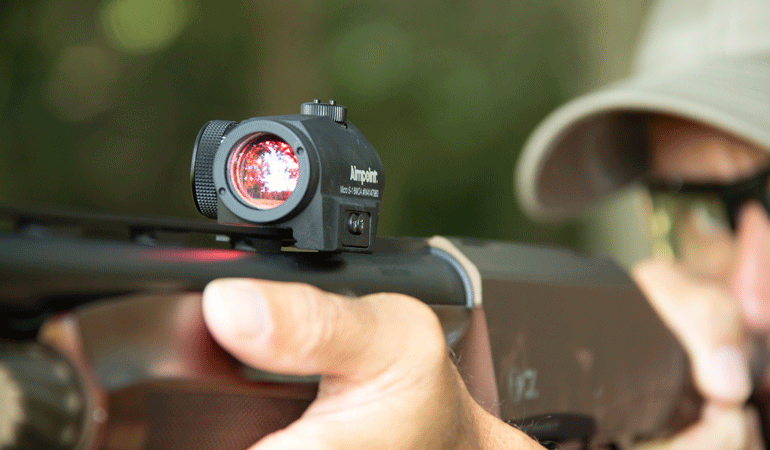
Optics have become standard equipment for most hunting applications with one exception—wingshooting. It’s still relatively rare to see a waterfowl or upland gun that’s equipped with an optic, but that’s changing thanks in part to sights like the Aimpoint Micro S-1 red dot.

The Aimpoint Micro S-1’s miniaturized dimensions and light weight make it an ideal optic for use on a shotgun. With a length of 2.5 inches, a height of 1.6 inches and a weight (with battery) of just 3.5 ounces, the Micro S-1 doesn’t take up a great deal of space on the rib of a shotgun. With a high-strength aluminum housing featuring a semi-matte anodized finish and an integrated carbon fiber-reinforced polymer base, it doesn’t significantly change the balance point of the gun, either.

Unlike traditional shotgun optics that require shooters to purchase aftermarket bases and attach them to the gun’s receiver the Micro S-1’s integrated base fits onto the rib of virtually any gun. By measuring the height and width of your shotgun rib you can determine which base/plate combination is required, and Aimpoint offers an easy-to-follow diagram that helps you determine the right combo for your firearm.

The base secures to the sides and bottom of the rib and, when it’s tightened in place, holds zero even while firing magnum loads. It’s a simple installation process and, unlike traditional shotgun optics, you can quickly and easily install or remove the optic as desired. The Micro S-1 can be positioned at any point along the rib of the shotgun, and the low (.55 inches) optical axis makes it easy to view the 6 MOA red dot from a natural shooting position without having to lift your head from the gun. Eye relief is unlimited and there’s no parallax error with these sights.

The Aimpoint Micro S-1 red dot operates using a reflex collimator with LED display. This offers shooters the ability to adjust point of impact, a major advantage for shotgun shooters. Traditionally, shotguns ribs were designed with different points of impact (POI) based on the application. Trap guns, for instance, have a higher point of impact, from 70/30 (where 70% of the pattern rises above the rib) and up. Skeet, sporting clays, and field guns usually shoot “flat” with a 50/50 POI. Some high-end competition shotguns offer interchangeable ribs to adjust POI, but swapping ribs is a hassle. The Micro S-1 allows shooters to adjust POI quickly in the field using the provided tool and you can also adjust windage — something that’s difficult on guns without an optic. The ability to change POI is a major benefit for shooters and this feature increases the versatility of your shotgun.

Using a reflex sight on a shotgun has traditionally been a challenge because a bright sky can wash out the dot. To compensate for this, Aimpoint offers additional brightness settings. Illuminance is measured in lux (lx), and the Micro S-1’s red dot is visible from .1 lx (the equivalent of a moonlit night) to 55,000 lx (full sun). With 12 separate brightness settings, you can match the intensity of the dot to the light conditions regardless and you won’t lose sight of the dot even when you’re shooting clay targets or birds in full, bright sunlight.

Aimpoint Micro S-1 reflex optics are powered by a single CR2032 3V lithium battery that lasts for 50,000 hours of continuous use. Operating temperatures range from -20 to 140 degrees Fahrenheit and the unit is submersible to 15 meters which means if you drop your gun in shallow water while duck hunting your optic will still function properly. The durable Aimpoint sight is also resistant to shock, humidity, vibration and is resistant to occasional chemical exposure from gun cleaners, lubricants, fuel and insect repellents.

Aimpoint Micro S-1 Red Dot Sight Applications

I mounted the Aimpoint Micro S-1 red dot on the rib of a CZ 1012 12-gauge semiauto shotgun and zeroed the unit for a flat POI at 20 yards. The polymer base holds firmly onto the gun’s rib and even after multiple rounds of skeet and five stand there was no shift in point of impact. Despite having used shotguns with traditional beads throughout my shooting career I found that transitioning to the Micro S-1 was seamless. The aluminum housing is compact enough that it doesn’t distract the shooter and the 6 MOA dot offers a reference point regarding muzzle position even when the shooter is focused on the target. When I transitioned to trap targets, I had the option of adjusting POI to 70/30 in seconds. Additionally, I fired a full box of 3-inch magnum turkey loads through the CZ 1012 and the Micro S-1 withstood the heavy recoil without shaking loose or shifting POI.

The Aimpoint Micro S-1 improved my accuracy when shooting moving targets, especially on very bright days, and science shows that I’m not alone. Research conducted in Sweden in 2018 indicates that shooters who used Micro S-1-equipped shotguns performed markedly better than shooters who used guns with traditional bead sights on the country’s mandatory hunter exam. Two separate trials demonstrated that hunters using Micro S-1 optics hit a combined average of 24% more targets on the portions of the exam that simulates running hare and flying upland birds that shooters who didn’t use an optic. That’s an impressive jump in accuracy and lends credit to Aimpoint’s claim that shotgun performance improves with a reflex sight in place.

The unit’s innovative base design makes it the most versatile shotgun optic available. You can attach it to your upland shotgun while hunting birds or braking clays and then quickly transition the Micro S-1 to a waterfowl or turkey gun. It also improves the accuracy potential when shooting smoothbore slugs and its low-light capabilities make the Aimpoint Micro S-1 red dot a superb option for home defense scatterguns. Never before has a single optic offered this level of versatility for shotgun shooters in such a compact, durable platform. MSRP: $820

How Far Can a 270 Shoot: The Distance of a 270 Rifle

0

A 270 rifle is a great choice for hunting game in the mid-sized to large range. It can shoot accurately up to about 500 yards, making it perfect for taking down big game animals like deer or elk. In this blog post, we will take a closer look at the distance that a 270 rifle can shoot and what you need to consider when choosing one for your next hunting trip.

So How Far Can a 270 Shoot?

When shopping for a 270 rifle, it is important to consider the barrel length. The longer the barrel, the greater the distance that the rifle can shoot accurately. A good choice for hunting big game animals is a rifle with a 24-inch barrel.

In addition to choosing the right barrel length, you also need to consider the caliber of the rifle. The 270 Winchester cartridge has a muzzle velocity of 2960 feet per second and can penetrate up to an inch and a half of ballistic gel at 100 yards. This makes it an excellent choice for taking down large game animals.

So, how far can a 270 rifle actually shoot? Depending on the barrel length and caliber of your rifle, you should be able to comfortably take down game animals at distances of up to 500 yards. Make sure to do your research and select the right rifle for your next hunting trip!

Is a 270 good for long range shooting?

The answer to this question is a resounding yes. In fact, many experts believe that the 270 is one of the best long-range rifle calibers available. With its combination of accuracy and power, it can easily take down game at extended distances.

So, how far can a 270 shoot? The answer depends on the specific rifle and load you are using, but most shooters can expect to get good results out to around 500 yards. Of course, with practice and experience you may be able to extend that range even further.

If you’re looking for a great long-range rifle caliber, the 270 should definitely be at the top of your list. It’s accurate, powerful, and versatile enough to handle any situation you might encounter in the field. Give it a try and see for yourself how far a 270 can shoot!

How far will a .270 travel?

The average 270 rifle can shoot up to 500 yards with relative ease. With the right ammunition and a skilled shooter, it’s not unheard of for a 270 to travel up to 600 yards or more. It’s important to remember that these distances are maximums – in most cases, you’ll be able to achieve better results by shooting at closer ranges.

When choosing a rifle chambered in .270, it’s important to consider the game you’ll be hunting and the terrain you’ll be shooting in. Deer may only require shots within 200 yards or so, but elk can often be taken much farther out. Similarly, if you’re hunting in dense forestland, you’ll need to adjust your shot distance accordingly.

Can a 270 take down a deer?

The 270 rifle is a popular choice for deer hunting and it can bring down most animals if you’re using the right bullet. But in order to get the best results, you need to choose your ammunition wisely. The .270 Winchester cartridge has been around since 1925 but even today it remains one of the most used cartridges among hunters all over the world.

This round delivers maximum performance at close ranges due to its high velocity (upwards of 2700 fps). However, when shooting at longer distances – past 500 yards – other factors become important such as trajectory drop rate or wind drift. To find out how far does a 270 shoot, we have compiled some data from our tests which should give you an idea about what this weapon system is capable of.

When using a 150-grain bullet at an elevation of 2500 feet, the 270 has a ballistic coefficient (BC) of .505 and will maintain its velocity up to 850 yards before it starts to drop significantly. With this information in mind, you can confidently take down game at longer ranges; but always remember to factor in environmental conditions such as wind speed and direction.

How much does a 270 drop at 200 yards?

A 270 rifle will drop about 13 inches at 200 yards. This means that you will need to aim higher to hit your target. Depending on the distance between you and your target, you may need to adjust your shot accordingly.

At 300 yards, a 270 rifle will drop about 27 inches. This means that you will need to aim even higher to hit your target. Again, depending on the distance between you and your target, you may need to adjust your shot accordingly.

A 270 rifle is capable of shooting up to 500 yards with proper accuracy. However, it’s important to remember that the further the distance between you and your target, the more difficult it becomes to hit your mark. If you’re unsure of your abilities to shoot accurately at longer distances, it’s best not to attempt it. Instead, focus on targets within closer ranges. With practice and patience, you can become a successful long-distance shooter with a 270 rifle.

What’s a better gun 270 or 30-06?

The 30-06 has a bigger bullet, but the 270 has a faster one. This is also why both are so popular with hunters: they hit harder and penetrate deeper than most other rifle cartridges. Both deliver devastating terminal ballistics at ranges well beyond 300 yards.

What grain 270 bullet is best?

A 270 rifle can shoot a range of different grain bullets. The most popular is the 130-grain bullet, but a shooter may also use a 150-grain or 165-grain bullet. For smaller game, such as deer or antelope, the 130-grain bullet is ideal. Heavier animals, like elk or moose, will require a larger caliber bullet. A hunter should always consult with an experienced gunsmith to select the best grain bullet for his specific hunting situation.

The 130-grain bullet offers a great balance of weight and power, making it the most popular choice for hunters. The extra energy that is put behind this bullet allows it to drop farther than any other 270 bullet with comparable velocity. This makes perfect sense when you consider how much more force there is behind a large caliber rifle compared to a small one. If you’re going after larger game like elk or moose, then go with the heavier grain bullets as they will give your rifle more punch and penetration into those animals’ hides.

If hunting at high altitudes (over 5000 feet), then choose lighter grains such as 90-110 instead because these offer better ballistics over long distances due to wind resistance being lower in elevation. The best choice would be 90-110 grains if you’re going after deer or antelope, and up to 130 grains for larger animals like elk/moose.

Dicks Sporting Goods Return Policy In (2024) – Get Refunds Now!

0

Dicks Sporting Goods offers a generous return policy for their customers, however, there are a number of things to be aware of which we’ll cover below.

The company was established by Richard Dick Stack in 1948. Dicks Sports return policy is very generous in its terms and conditions, which is very convenient for its users.

We’ll discuss the terms outlined in their return policy, including refunds, exchanges and how to return your goods.

dicks sporting goods

Dicks Sporting Goods Returns

Customers can return their goods within 60 days of purchase, either by mail or in-store, according to the company’s terms in the Dicks Sporting Goods return policy. Dicks Sporting Good return policy allows you to return unworn, unwashed, undamaged, or defective merchandise purchased online or in-store.

Moreover, the company has extended its return period to 90 days for both online and in-store orders from the previous 60 days. This has also extended for Calia and Field, Golf Galaxy and Stream.

Most products are returnable within 30 days at Dick’s Sporting Goods Warehouse stores, which has a separate policy in place.

How To return Products at Dick’s Sporting Goods

Dicks returns gives you two options to return its product – by mail or by visiting any of the Dicks stores. We have provided the details of both the return policies below

Dicks Sporting store return policy

Before returning your products, make sure that it is unworn, unwashed, and undamaged.

Here are some easy steps to go through, if one wants to return the merchandise by paying a visit to the nearest store:

  • You can locate your nearest store by visiting this link.
  • When you know your local store to return your product, pack your product in the original packing.
  • Accompany your product with an original slip.
  • Store personnel will help you in processing your return.
  • Your refund will be immediately processed to your original form of payment.

You can also contact your local store operator to know more.

return policy for online Via mail

Are you too lazy to walk-in to your nearest store, Dicks provides you the option to return the items by mailing it to them.

The company will issue a refund for the purchase price of the item within 60 days of return.

To return items by mail, you need to go through the following steps:

  • To start your return with Dick’s Sporting, visit the website.
  • Go to the return page by visiting this link.
  • Fill in the order details and Zip code and proceed as per given instructions, and you will get the return label.
  • Click on the “Find order” tab to go to your order details.
  • The return label has a return department address (place of returning), and the packing slip contains the specific instructions to return.
  • Attest the return label to your package.
  • Now you can schedule a pickup or drop off at the carrier of your choice or UPS drop-off location.

Shipping and handling charges are not refundable.

Exchange Policy

Dicks Sporting exchange policy for the company is the same as its return policy, you need to return your items within 90 days to get the product exchanged.

Follow the below steps to get your product returned:

  • Start your return by visiting the website and follow the instructions as given in the ‘return by mail’ process.
  • Place the new order for the replacement.

See Also: Wayfair Return Policy

Refund Policy

Returns are generally directed to the original mode of payment by Dicks, make sure that the items are in original condition.

  • If you return your item in the store, it can take up to 14 business days for the refund to be processed to your original form of payment. If it’s been more than 14 days, you should first reach out to your bank or aggregator.
  • If you have returned your item by online mode, it usually takes 2—3 weeks from DICK’S Sporting Goods to receive your return for a credit to be issued. Dicks will issue Refunds to the original form of payment for the purchase price of the item, including sales tax
Type of paymentThe Number of days you will get a refund in:Refund and Credit PolicyCredit card/debit cardCashPayPal

Exclusions

They have a different policy for different products like dicks shoe return policy, dicks bike return policy, dicks sporting goods kayak return policy, dicks sporting goods return policy for online stuff, etc.

Dicks sporting goods return policy is pretty favorable for its customers; it requires you to return the items before 90 days to get a full refund. It takes 14 days for processing of your return:

Products and purchasesProduct ConditionReturn PolicyGiftYeezy productsDICK’S Sporting Goods, Golf Galaxy and Field & Stream’s all productsBaseball bats, electronic scooters and bikesElectronicsPre-owned golf clubs and demo clubs

If you wish to return without receipt, you can do so without an original sales receipt or pack slip, but the product must be returned using a valid ID, and you will receive a store credit for the lowest selling price.

FAQs

Can I return Items To Dicks Without a Receipt?

Returning goods to Dicks Sporting Goods without a receipt is possible, however, you may only be eligible for store credit and are required to present your ID. It may be possible to receive an email copy of your receipt. All decisions are final and at the discretion of management.

Conclusion

Do you know that Dick’s sporting entered into women’s athletics in 2015 and into team sports in 2016?

Dick’s Sporting Goods offer quality products, but then also you end up getting a damaged item… Hard luck! Don’t worry and file a return request immediately.

Don’t forget to check these out – GameStop, and Nike Return Policy.

For further queries about Dicks Sporting Goods return policy, I’d suggest you comment down below and our experts are more than happy to answer.

Related: Kroger Return Policy

What are the Best Trout Lures for Ponds

0

This is a very extensive list of the best trout lures for pond fishing and gives you, the angler, an opportunity to try new lures. There are a few more things to consider when fishing ponds for trout:

What is the best bait for trout in a pond?

Catch and Release Fishing has covered lures extensively in this blog, and we have considered some baits as well with the Gulp line of products. The one thing Catch and Release Fishing has not talked about are the actual, natural baits. There are plenty of natural bait options for trout in ponds. Here are the best baits compiled by the team at Catch and Release Fishing.

  • Nightcrawlers – The humble worm found all over the world is one of the absolute best baits you can use for trout. Buy, or dig your own in soft earth like your home garden. Either way works equally well for trout. Some anglers have nightcrawler beds at home as well. You can too.

  • Corn – Plain, yellow corn from a can is something people use frequently for trout in ponds and on rivers. Corn is cheap, and you can cook the leftovers with your creel full of trout.

  • Salmon eggs – There are plenty of brands available. Check out the Gulp Salmon Eggs. These work as well or better than the actual salmon egg and are considerably more durable on the end of the line.

What do you use to catch trout in a pond?

Most people who fish for trout in a pond use conventional rod and reel gear and leave the fly rods at home. This is not to say you cannot use a fly rod if the angler chooses to do so. Conventional tackle simply works better.

That is why Catch and Release Fishing recommends the QUDRAKAST Fishing Rod and Reel Combo. This combo features everything needed to start fishing for trout and other species as well. The telescopic rod collapses down for convenient storage and carry.

This combo is also ideal for new anglers learning the sport. The reel is very easy to learn to use and casts exceptional distances.

What color lure is best for trout?

Trout can be incredibly finicky when it comes to what they will and will not strike in terms of a lure presentation. There are three things to consider when looking for the best lure for trout:

  • Current feeding – Trout in streams and rivers feed on what is hatching. Trout in ponds are after different forage like minnows. Match your colors to what the trout are eating in the pond

  • Water clarity – Clear water calls for colors like red and orange. Stained water means contrasting colors like pinks and chartreuse. Silver and black are good no matter what the water clarity looks like.

  • Light penetration – Water in ponds can be very deep. In deeper water, use black, blue and green. Metallic colors – silver and gold work well in full sun and in deep water.

It is always a good idea to take a selection of lures with you when heading for a pond, stream or river. This way you can find what the trout are after.

Catch and Release Fishing has always had better luck with conventional tackle than with fly fishing gear. These lures have always produced for us as well.

Some of these lures do have treble hooks and are much more likely to provide a solid hook up and get more trout to the bank. However, this also means there is a better chance of doing harm to the fish when trying to get the hooks out and release the trout back into the water.

Any treble hook can be replaced with a single trout hook, and if you plan on releasing the fish, please consider using barbless trout hooks.

Catch and Release Fishing is about good practices and conservation. It is a hope you will do the same.

We look forward to seeing you on the water!

Check out our fly fishing hook size chart

PVC vs. Rubber Air Hose: What’s the Difference?

0

Finding the right air hose for your air compressor or other air tool can be challenging. Because there are so many choices on the market today, it can be difficult to know which ones are best for you and your needs. In order to narrow things down, we have prepared a handy guide to two of the most common and highly recommended air hose materials: PVC and Rubber.

Below, we delve into the advantages and disadvantages each type brings to the table, what you should be looking for in an air hose, and hopefully you can end this article with a much clearer perspective as to which one you want to invest in.

What Is The Best Air Hose For Me?

Since an air hose can be used for multiple types of tools and tasks, you want to choose one that is versatile, durable, and made to last so that you can make the most out of your purchase. In relation to that, these 5 factors are what you should consider when looking for an air hose that is perfect for your personal needs and activities.

Length Of Hose

Standard sized air hoses are usually offered at 25 feet, 50 feet, and 100 feet. Air hoses that come in longer lengths result in lesser control but not enough to deem it ineffective. The length of the hose matters since this can affect how you can utilize it. For instance, if you will need the hose while moving from station to station, you may require one of longer length to allow greater mobility.

However, if you will just be working in one area, keeping a short hose may be easier in terms of moving around and also in terms of storage.

Diameter Of Hose

Most air hoses come in either one of two diameters, namely ¼” (6.33 mm) and 3/8” (9.5mm). The wider the diameter, the more compressed air it can hold, which allows for more strength. However, in order to maximize it, you will need to have a sizable compressor.

The narrow diameter is better for tasks that do not need as much fuel, such as when you are pumping a tire, air bed, or inflatable pool.

Weight Of Hose

To determine if you need a lighter or a heavier hose, you will first need to establish your main purpose for purchasing one. If your activities revolve around operating in one place, then heavier hoses can be more beneficial since they are less likely to kink. However, if you will need to move around often, a lighter hose may be better suited. Just keep in mind that these are more susceptible to kinking, so you will need to take more precaution when storing them after every use.

Who Manufactured The Hose

An air hose is not necessarily a household tool that you want to repurchase every now and then. To guarantee a longer lifespan, we highly suggest purchasing only from trusted companies with great warranties and even better customer support. Some of the best air hose manufacturers today are:

  • FlexZilla
  • Amflo
  • Hitachi
  • TekTon
  • Goodyear

Material Of Hose

Air hoses also come in a variety of materials, with the two most common ones being PVC and rubber. To better understand which one of the leading materials is best for you, we put a detailed list of their benefits and disadvantages up against one another in the section below.

What is the better air hose: rubber or PVC

Below we discuss what exactly makes up each material and where do they function best?

PVC Air Hose

PVC stands for PolyVinyl Chloride, and is the 3rd most widely used plastic rubber across the globe. It can be used in a variety of materials – from tubing, wires, signs, flooring, and yes, hoses!

Apart from its versatility, another reason that PVC is so common is because of its affordability. It is also very lightweight, portable, and easy to handle. However, we do not suggest using the in colder climates or the winter season because they are prone to freezing up. Aside from that, another disadvantage is that they are susceptible to kinking quickly.

Rubber Air Hose

Rubber is made of natural material as it is extracted from the rubber plant. It starts off as a white, dense, and somewhat gooey liquid, which is then taken to manufacturers and turned into the many rubberized products you see today.

Just like PVC, rubber can also be used in a wide range of things, such as tires of vehicles, tubes, household items, and much more. Rubber is incredibly durable and can last a long time, but it does not come cheap.

Rubber air hoses are quite heavy, but they are very resilient, sturdy, and well worth the investment due to its long lifespan. Because of how much they weigh, they are best used for static workstations such as in a garage or at a workshop. They are also fairly simple to coil up and store away, with little to no risk of kink.

What are other air hose materials to consider?

While rubber and PVC hoses are the most common and widely available air hoses today, they are not the only ones on the market. You may also opt to purchase a Polyurethane Air Hose or a Hybrid Air Hose instead.

Polyurethane Air Hose

Air hoses made of polyurethane are very lightweight and do very well in extreme temperatures. They are also highly resistant to abrasive wear, tearing, or puncturing. Moreover air hoses made of polyurethane are highly flexible and smooth, which allows them to easily glide across varying surfaces. One flaw it may have is that it is more susceptible to kinking when compared to the more robust rubber air hose.

Hybrid Air Hose

As its name suggests, hybrid air hoses are made from a mix of material, namely PVC, polyurethane, and rubber. It was specifically designed to give you the best of all the materials by merging their positive features such as its resiliency against kinking. However, it does lack quite a bit in durability when compared to the pure rubber hoses, and are more likely to kink in the long run.

What Factors Should I Look For in An Air Hose?

The length, diameter, manufacturer, material, and weight of the hose are important when determining which hose is best for your specific activities and needs. However, the 5 additional factors below should also be weighed in as it can affect the overall quality of the hose you choose.

Coiling Capabilities

Air hoses usually either coil in a standard method or in a recoil method. With standard, the hose would lie flat without any bends, which makes them a breeze to unroll. Recoils, however, have small twists within the structure to make them recoil backwards once you let go.

Connections

It is important to consider the right sized connector that is also a quick release for your own set of tools. We recommend getting brass connectors as these are much more resistant compared to aluminum and are also resistant to corroding.

Kink Resistance

Similar to how you would weigh out garden hoses, consider the kink resistance of your air hoses as well. Investing in material that is less likely to kink can go a long way and prevent any disruption in your work.

Pressure Rating

All air hoses have their own maximum pressure rating, which is indicated by PSI (pounds per square inch). You must first determine how much pressure you would need for your tasks and then find a hose that is capable of handling it. Hoses with higher pressure ratings are usually only needed in much tougher jobs such as inflating truck tires.

Temperature Compatibility

It is important to find a hose that would not deteriorate or lessen in efficiency when the temperature shifts. PVC air hoses have a harder time in cold temperatures because it reduces their flexibility. A rubber hose keeps a stable flexibility level even in freezing temperatures, so does polyurethane air hoses and hybrid variants.

You’re All Set!

Knowing what to look for in an air hose can help you in making a more informed decision, and take home a hose you can use for many years to come.

If you are looking for other gardening equipment, check our best selling collections below:

Yard Butler Hose Reels

Yard Butler Hose Reel Carts

Yard Butler Hose Hangers

Yard Butler Irrigation Tools

Slugs, Snails and Fresh Water Mollusks

0

Are Slugs edible? What about Snails?

There is only one rule you have to remember: When it comes to land snails, land slugs, and fresh water mollusks you must cook them thoroughly or they can kill you. Got that? Taste is a secondary consideration.

Okay, why cook them? People do eat slugs raw on a dare, and the Indians used live slugs to numb gums, tongues and toothache. These common little creatures aren’t too bad unto themselves, but some of the land crawlers especially in warmer areas have parasites, one of which they can get from rat feces. That parasite, normally infecting a rat’s lung, goes from your stomach to your brain, crawling there over time — yes, crawling there — and causes your brain to swell. That big head folks have accused you of having will come to pass and kill you. Thorough cooking will kill the parasites.

Some of the freshwater mollusks (clams, snails et cetera) are in water with bacterial waste, be it beavers’ or Butt Head’s. Cooking thoroughly kills all bacteria and parasites. It is recommended you collect said, especially slugs and land snails, while wearing gloves and or be careful, have no cuts on your hands, and wash your hands immediately and until then keep them away from your eyes, nose and mouth… the same precautions you would do if you handling raw chicken. The chances of you getting the disease are really low should you eat a slug raw. A few have been sickened that way, but the possibility is there: Avoid it.

Now what about taste? Some taste good, like escargot, some taste bad regardless of preparation, some have no taste. But there are no truly poisonous slugs or snails. Once cleaned and cooked, or cooked and cleaned, it is a matter or preparation and personal taste. Slugs are just snails with no shells, and snails are really just specialized clams that moved from water to land. By the way, all of this applies only to land slugs, land snails and freshwater mollusks, not slugs and snails and mollusks in salt water. (Salt water slugs tend to be toxic.)

Here in central Florida we’ve had a gourmet invasion of Apple Snails. Thirty years ago they were introduced to such places as Taiwan and Japan as delicacies. They were also favored among aquarium owners because of their looks and speed of growth. They never caught on big with Asian gourmets and some how got released into Florida lakes. One lake near here, Lake Brantley, went from no Apple Snails in 2003 to being overwhelmed in 2004. The battle has been on going since and the fear is from that lake the snails will invade the Weikva River, just a few wet miles away. And the Weikiva leads to virtually half the state. Personally, I haven’t seen any non-native Apple Snail eggs in the Weikiva basin but it’s like having an open gallon of gasoline next to a roaring fireplace. It only takes one bird to drop one uneaten snail in the river.

Let’s hear from an expert on the edibility of snails, Dr. Tim Pearce, Assistant Curator and Head, section of Mollusks, Carnegie Museum of Natural History, Pittsburgh, Pennsylvania:

“As far as I know, any land snail is edible. Although I don’t know any land snails that are poisonous, I do know one species that tastes very bad (Anguispira alternata, the tiger snail). Most species of land snails are very small (less than 1/8 inch or 3 mm), so eating them would be a challenge. But (despite being a vegetarian) I have eaten some of the native snails with shells 3/4 inch (20 mm) diameter. Maybe you want to know where to find the snails that are commonly eaten as escargots. Those species are from Europe. Some of them have been introduced into the United States, but most of them are considered pests. For example, Helix aspersa, one of the most commonly eaten land snail species, is a very abundant garden and agricultural pest in California. I think Cepaea nemoralis is also eaten; it is another introduced species and not generally considered a garden pest. There are populations of C. nemoralis in eastern New York, and a few populations in Pennsylvania in the Philadelphia area. Be sure to get permission from the land owner. Note also that transporting living land snails is now regulated by the federal government . Also, if you collect the native species, be careful not to over collect. The native species generally reproduce more slowly than the introduced species, so over collecting could wipe out a population.”

Locally, the easiest way to identify snails in a given body of water is to look at their eggs, their size and color, usually found on stems of water plants above the water line. You can also find their empty shells on shore where they’ve been dinner already. Native Florida Apple Snails lay white eggs on the large size, like peas. Island Apple Snails lay small pink eggs that turn white. The Skipped Topped Apple Snail lays salmon colored eggs and the Titian Apple Snail lays eggs that are pastel green or sea foam green.

How do you get the snails? You can noodle around for them or use a trap. There are commercial traps or you can make one out of an oil drain pan.

So snails are edible, you’ve got that. You’ve heard of escargot, but what about slugs? Dr. Pearce again.

According to Dr. Pearce, counting all gastropods in the sea, freshwater, and land, a good estimate is that there are about 80,000 species. For just the land snails, they estimate about 35,000 species in the whole world. In North America north of Mexico, there are about 1,000 species of land snails. Pearce says he can almost guarantee that in eastern North America, all the slugs in your garden are non-native species from Europe. Incidentally, the gigantic land snails native to Africa and now found in Florida are edible.

“Species that are successful invaders tend to have fast reproductive rates, probably explaining why there are so many of them in your garden. For some reason, slugs seem to be better invaders than snails do,” he said.

So, we know slugs are edible, unless they been feeding on some poisonous plant. Ray Mears, best known of the professional bush crafters, does not recommend eating slugs because they often feed on mushrooms, and most of them are toxic, and Mears is an expert on edible mushrooms.

To avoid getting mushroom poison from a slug it is usual to either starve the slug before eating or feed them for several days before serving them up. The Romans used to fatten their snails with meal and wine until they got huge and tasty. In Italy they are sometimes kept in bran for several days before eating. In many places in Europe people have home-made snail-preserves, or escargotieres, little corners of gardens enclosed with boards and netted over the top. In these enclosures hundreds of snails are kept and fed vegetables and herbs to flavor them. The same could be done with slugs.

Before I move on to cooking snails, how do you collect them, other than snorkeling? Do what those who capture snails to get rid of them do: Trap them. There are two simple traps. Take a small crayfish trap and either lay it in the water/reeds half in the water, half out. Or in deeper water arrange the tap vertically half in, half out of the water. Surprisingly traps work with or without bait. The second trap looks like an old tire with a grate in the middle and a stake through it. Imagine the grate slightly smaller than the opening and set a couple of inches lower as well. The snail crawls over the tire, on to the grate then off the grate into the trap below. This should be done in water just reaching the top of the tire. An inexpensive alternative is a plastic oil drip pan with the grate cut smaller than the opening and a piece of PVC put through it and the pan to hold it at the right height.

Cooking snails: Put some water into a saucepan, and when it begins to boil throw in the snails and let them boil a quarter of an hour; then take them out of their shells, wash them several times, clean them thoroughly, place them in clean water, and boil them again for a quarter of an hour. Then take them out, rinse them, dry them, and place them with a little butter in a frying-pan, and fry them gently for a few minutes sufficient to brown them.

To cook snails the French way crack the shells and throw them into boiling water, with a little salt and herbs, sufficient to make the whole lot savory. In 15 minutes take them out, pick the snails from the shells, and boil them again; then put them into a saucepan, with butter, parsley, pepper, thyme, a bay-leaf and a little flour. When sufficiently done, add the yolk of an egg well beaten, and the juice of a lemon or some vinegar. Snails have about 90 calories per 100 grams of meat. They are high in protein (12 to 16 percent) and rich in minerals.

Cooking slugs: Slugs, far more than snails, eat toxic mushrooms. If it is the season of toxic mushrooms the slugs should be kept for many days and fed meal or brand or lettuce to purge them. Put pre-fed slugs into a 50/50 mixture of water and vinegar. This will kill the slugs and force them to release mucus. Simmer five minutes it boiling water. Change the water and boil again for ten minutes. Change the water a third time and boil again for fifteen minutes (so you have three changes of water and a total of 30 minutes boiling time.) If the slug has a foul tasting digestive organ remove and rinse. The cooked slug is now ready to eat or use in other dishes.

Another way to cook snails is to put them upside down next to your fire and leave them there until they bubble vigorously.

Slug Fritters

Ingredients

10 cooked and cleaned large slugs

1/2 cup of cornmeal

1/2 cup of flour

3 eggs

1/4 cup of heavy cream

4 tbs. Of butter

4tsp.of sour cream

Instructions

First chop the slugs into fine mince, then beat the eggs with the heavy cream together. Sift the dry ingredients and then cut two tablespoons of butter into that mixture. Add the egg and cream mixture to the dry ingredients and whip with a whisk vigorously for one to two minutes. Melt one tablespoon of butter in a sauté pan and pure the batter into 2 1/2 inch cakes in two batches. Serve warm with a dollop of sour cream. Yields four servings.

Slugs that are still in palatable after boiling can be fried until crisp and tried, or ground into a flour and added to other meals for nutrition.

According to the Journal of Experimental Biology, August 2006, slugs are 5.1% carbohydrates, 0.5% fat, 7.1% protein and 85% moisture. When cooked they are probably lower in carbs because that is contained in the mucus which is lost in cooking. Slugs were on the diet of many Native Americans in the northwest US, where they have some 27 different kinds. German immigrants to that area gutted them and fried them in batter.

Incidentally, freshwater clams can make “pearls” and they command a high price. When I was a kid I use to use freshwater clams for bait and collected a few black pearls at the same time. I had a girlfriend at the time who was quite fond of them… probably still is, and she didn’t have to get wet to get them.

Also, check with your local authorities and do not collect endangered species or exceed harvesting limits. Many exotic species have no limit.

Australian doctors issued a warning in October 2003 about eating slugs after a Sydney college student contracted a potentially fatal brain disease when he swallowed some slugs on a dare. Tests found the man’s meningitis was caused by a worm normally seen in rat lungs but carried as larvae in slugs and snails. The worm caused the brain lining to swell, forcing doctors to drain fluid from inside the man’s skull. He was hospitalized for 17 days with brain lesions. It was five months before he could resume his studies. A friend of the student also ate some raw slugs as part of the dare but threw them up, losing the bet.

The doctors said there had been numerous cases of meningitis since 1971 caused by people eating garden snails or slugs. One child died after eating snails and one patient contracted meningitis after eating lettuce covered with snail slime, according to a report in the Medical Journal of Australia.

To watch a video on eating slugs, go here.

Hardhead Catfish Vs. Gafftopsail Catfish: What To Know – Anchors Up Carolina

0

There is a common misconception that catfish are strictly freshwater fish. In coastal Georgia, South Carolina, and North Carolina, two species of catfish are prevalent. Anglers catch saltwater catfish regularly in these three states. Despite the two species living amongst each other, each has unique characteristics. Here is what you need to know about a hardhead catfish vs. a gafftopsail catfish.

Hardhead Catfish

The hardhead is along the east coast of the United States. Anglers catch a significant of hardheads when fishing the bottom.

What Is The Range Of A Hardhead Catfish

When it comes to range, the hardhead is widely distributed. Anglers catch the species as far north as New England but more frequently between Maryland and Florida.

What Is The Habitat Of A Hardhead Catfish

It is unlikely to find hardheads offshore of the Atlantic ocean except for the waters off the beaches.

The hardhead catfish prefers soft mud or sand bottoms along the coast, rivers, and brackish waters.

How To Identify A Hardhead Catfish

When it comes to identifying a hardhead, they are easy to distinguish from a gafftopsail catfish. The upper half of the sides and top range between gray and black depending on the habitat. The belly of the hardhead is silver to white.

When removing the hook, look closely at the mouth. Barbels extend from the bottom lip. Lastly, the condensed tail is deeply forked.

How Big Do Hardhead Catfish Grow

The hardhead catfish exceeds three pounds; however, it is most frequently caught between half a pound and a pound in weight. When comparing hardhead to other saltwater catfish, the hardhead is of a small size.

How Do You Catch Hardhead Catfish

Hardheads are not picky eaters. Catfish are bottom dwellers; therefore, you must present the bait on the seafloor.

When targeting hardhead, rig a hook beneath a lead weight heavy enough to hold the bottom. Tip the hook with shrimp, squid, cut fish, or chicken, and allow the bait to soak until the fish strikes. Rember to focus on soft seabeds, including sand and mud.

Are Hardhead Catfish Good To Eat

When filleting and eating catfish, the hardhead produces good fillets but is rarely eaten due to its size. The yield is minuscule.

Is A Hardhead Catfish Poisonous

Unfortunately, the dorsal and pectoral fin is covered in a protective slime. The slime layering assists in keeping fish out of harm’s ways. However, the slime results in anglers becoming stung by catfish.

The dorsal and pectoral fin are sharp. Avoid touching the and upper and lower fins when handling the catfish. What is most important is understanding that a venomous slime coats the fish. When the skin becomes punctured by a fin, the slime injects into the skin, causing extreme pain to the person handling the fish.

Gafftopsail Catfish

Despite the similarities, gafftopsail catfish differ from hardheads in many ways. Here is what to know about the gafftopsail catfish.

What Is The Range Of A Gafftopsail Catfish

The range of Gafftopsial catfish is the same as the hardhead. Gafftopsails extend between Florida and the northeast; however, they are less prevalent than the hardhead.

What Is The Habitat Of A Gafftopsail Catfish

The gafftopsail roams widely about the water column in search of food compared to the bottom-dwelling hardhead.

Gafftopsails scavenge for the next meal despite the depth of the water. The fish is caught in rivers, flats, and channels but predominantly in deep waters.

How To Identify A Gafftopsail Catfish

Despite the hardhead and gafftopsail falling under the catfish category, they two are significantly difference in appearance.

The mouth and head of a gafftopsail are significantly larger than a hardhead. As the name implies, the dorsal fin is sail-shaped and extends well above the body. Lastly, the dorsal and pectoral fins feature trailing streamers.

How Big Do Gafftopsail Catfish Grow

When it comes to size, gafftopsails are most frequently caught in the one-pound range; however, they are known to reach up to ten pounds.

How Do You Catch Gafftopsail Catfish

The best gear to target gafftopsail catfish are spinning rod and reel combinations. Like hardheads, use a lead weight and hook to reach the bottom. However, the best bait presentation is live fish.

Are Gafftopsail Catfish Good To Eat

The gafftopsail makes excellent table fare. Cut the flesh into chunks when filleting, douse them in flour, egg wash, and bread crumbs before frying.

Is A Gafftopsail Catfish Poisonous

Similar to the hardhead, gafftopsail are poisonous. Pay close attention to the spines on the dorsal and pectoral fins. A jab with any of the three fins leads to a painful wound that you would wish to have avoided.

Next Time You Head Out Saltwater Fishing You Will Know A Hardhead From A Gafftopsail Catfish

Both the hardhead and gafftopsail catfish are widely distributed across the east coast of the United States. The fish are excellent fighters on light tackle and are suitable for cooking up for dinner. To avoid becoming stung, we suggest wearing gloves when handling the fish. Lastly, remember to obtain a saltwater fishing license.

6 Best Pronghorn Antelope Hunting States

0

There are many adventures to add to your hunting bucket list, and pronghorn antelope hunting should be one of them. They provide hunters a good opportunity to fill a tag and have lots of fun during their spot-and-stalk hunt along the way. Pronghorn antelope live in regions with wide-open and expansive fields, grasslands, and rolling sage brush. They are common in many locations across the American West, but the following six states are our picks as the best states to hunt for pronghorn antelope.

Wyoming

pronghorn hunting states

The top pick for the best place for pronghorn antelope hunting is Wyoming. There are more pronghorn antelope in Wyoming than in any other state in the country. Of the approximated 1,100,000 pronghorn roaming throughout the country, the Wyoming Game & Fish estimates that 500,000 are in Wyoming. This means there’s a very stable population and excellent odds for a successful pronghorn hunt there.

Public land access is abundant in the western half of the state, thanks to a large amount of Bureau of Land Management (BLM) Federal lands. These tracts support a lot of antelope. Because of this, the demand for tags in western Wyoming is high. It might take a few years of applying before a hunter can draw a tag. It is a different story on the other side of the state. In the eastern half of Wyoming, antelope tags are much easier to draw, but public land access is more scarce. Most of the land in that part of Wyoming is privately owned. There are some pockets, however, where the state has arranged public hunting access into private property via the Walk-In-Only and Hunter Management Areas programs.

Arizona

Arizona is home to approximately 10,000 pronghorn, which are found mostly in the north-central portion of the state. Despite this lower number (relative to Wyoming), the pronghorn hunting in Arizona has been called the best in the world. Arizona is also consistently the top producer for record-class pronghorn. Prior to 2013, the pronghorn world record was shared by two bucks, both harvested in Arizona. Drawing a coveted Arizona pronghorn buck tag can be tricky, though. As in other states, hunters may have to apply for a tag year after year before finally drawing one.

New Mexico

pronghorn

Another place known for big pronghorn bucks is New Mexico. The Boone & Crockett world record came from New Mexico in 2013, when a buck harvested there surpassed the previous record by a decent margin of an inch and a half.

There is ample access to public land thanks to wide swaths of BLM lands. The biggest challenge in New Mexico isn’t finding big bucks or public land—instead, it is getting ahold of a non-resident pronghorn tag. In New Mexico, only 6 percent of the state’s tag allocation is set aside for hunters from out of state. The state’s lottery draw system gives everyone a fair chance, but the odds are not in their favor. One way to get around this is to hire a private guide or an outfitter. This is a good option for hunters who are unsuccessful in the lottery draw.

Texas

Pronghorn Antelope Conservation

Texas has a sustainable population of pronghorn in the Trans-Pecos, Permian Basin, and Panhandle regions. As in other warm southern states, the pronghorn here get large. That is because they don’t have to expend so much energy to survive the cold winter months. In Texas, the hunting season for pronghorn is short, only one week. Don’t count Texas out, though—it is a great place to squeeze in some pronghorn hunting.

Colorado

Colorado has a healthy pronghorn antelope population of around 70,000. Pronghorn can be found in most areas throughout the state. The situation in Colorado is similar to that in Wyoming: On one end of the state, public land is plentiful but tags are difficult to acquire; and on the other end, tags are easy to get but access to land is not.

Montana

6 Best Pronghorn Antelope Hunting States

Montana is a solid option for pronghorn hunting. Access to public lands in most regions is plentiful. Hunters have a lot of options, including BLM lands, state lands and Montana’s Block Management Access system parcels. Montana Fish, Wildlife, and Parks estimates a statewide population of 158,000 pronghorn antelope. That makes it second only to Wyoming. Plus, the hunting season is longer than in many other states.

Non-resident tags can take a few years to draw; but unlike in some other states, hunters don’t typically have to wait decades to draw a Montana pronghorn tag. The bucks do not get quite as big as in some Southern states, but hunters have a decent chance to harvest.

READ MORE: 5 BEST STATES FOR BLACK BEAR HUNTING

Why Do Deer Like Salt Blocks and crave salt? How to Attract Deer With a Salt Block

0

Yes, deer really like salt blocks and salt blocks are among the most used deer attractants around. And the reason is that deer can’t seem to get enough of salt or salt blocks in the wild. But why are deer so hooked on salt? This is the question we will be looking to answer in this article.

Why Do Deer Like Salt Blocks?

Why Do Deer crave Salt?

There is a heated debate among hunters and even biologists as to why deer love licking salt blocks. And the debate centers on whether salt is necessary for deer growth or not. But, regardless of which side of the argument you fall, there is no denying that sodium is rare in nature. So sodium deficiency creates more craving for salt.

Why Do Deer crave Salt

Also, there is no denying that deer and other animals, humans included, can get addicted to salt. I am sure you know a friend who can’t seem to get enough of salty foods. This is because salt causes a spike in the brain’s dopamine, known as the pleasure hormone.

Because of this, deer typically get a strong urge to lick salt blocks. And since sodium is a rare compound in nature, salt blocks provide a constant supply of salt for deer. This is why deer are so hooked on salt; salt blocks are such effective attractants.

Do Deer Really Need Salt?

This is the question that elicits heated debate among hunters and biologists. However, research on the subject reveals that deer are attracted to sodium chloride and calcium chloride salt licks.

And for those unaware, sodium chloride is the scientific term used to describe table salt. Researchers have also found that calcium and sodium are important to deer bodily functions.

For instance, deer antlers comprise 20% calcium and 10% phosphorous. As such, in one way or form, calcium and sodium are essential to deer. Thus researchers and scientists recommend a salt concentration of 16% calcium and 8% phosphorous.

deer need salt for meeting calcium and phosphorus

Why You Should Add Calcium And Phosphorus In Salt attraction Areas?

Deer are known for their impressive antlers. But how do deer get the calcium they need to grow them? For example, bucks extract 40% of their needs from their skeletal structure and apply it to growing antlers. This is why many people recommend adding about 16 to 20 percent calcium, and eight to ten percent phosphorus in deer feeders or salt attraction areas for deer. In these ways, you actually help supply the deer with what they need and help maintain their habitat.

Types Of Salt Attractants

When you decide to use salt to attract deer, there are different varieties to choose from. Some come with additional minerals, such as proteins. You can also find flavored salt attractants such as apple-scented attractants.

But where salt attractants vary significantly in their physical forms. For example, you can get attractants in the form of either powder or a rock-like block.

Which Is Better, Powder Or Salt Blocks

So should you go for powder salt attractants or solid salt blocks? Well, both have their pros and cons. Powder salt attractants are easier to use for attracting a herd of deer. You can spread the powder attractant over a wider area to attract more deer.

With a salt block, only one deer at a time can lick the block, depending on size. This means attracting a herd of deer using a salt block is a bit tricky. Also, salt blocks can be heavy, making them challenging to transport and set up.

However, salt blocks, which typically look like rocks, have one thing going for them. Because they look like natural rocks, they blend in better with natural surroundings.

How to Attract Deer With a Salt Block

Research shows that deer get attracted to salt during spring and summer. This is when the vegetation is lush, and deer are growing their antlers. Also, this is the time of year when most does are rising their fawns.

When To Put Out Salt Blocks For Deer: Best Time To Use Salt Attractants

The best moths to use salt attractants seem to be the months of April, May, and June. This is because usage and the need for salt among deer gradually decrease after June.

Where And How To Apply Salt Attractants

To attract deer with salt attractants, you must know how and where best to do it. Here are some Tips

  1. Using powder attractants, the best soil to spread it over is heavy clay soil.
  2. Salt leaches into the soil and disappears. Therefore powder salt attractants do not work well in sandy soils.
  3. Also, you want to apply your attractant on flat ground. Typically you cant to place the attractant in a ridgetop in a shallow depression.
  4. Also, I will advise you to place the salt brick under any kind of cover because if you do not so after a few rainfalls the brick will dissolve which is just a waste of money. If you can’t cover the brick then just rely upon the block.
  5. You can also apply the attractant on a known deer trail, where you know deer pass frequently.
  6. As for when to use the attractant, the best month is March. This will ensure the attractant will be fresh when the deer demand for salt peaks in the summer and spring.
  7. When placing a salt block, choose areas surrounded by bushes or trees. Ideally, a place where you can hide and stalk deer without being detected. Salt blocks have a hole drilled into one end.
  8. Take a wooden or steel post, drive it into the ground, and mount the block onto it using the hole drilled into it. The pole should be about 3 feet tall, so the block is 3 feet from the ground.

Regular Salt Licks Vs. Mineral Blocks

Mineral blocks differ from salt licks because they have additional nutrients such as proteins. Salt licks, on the other hand, contain salt only. So which ones are better? Salt licks may be a good option during summer or spring when deer crave salt.

But come winter, their appetite for salt will have decreased. Using mineral blocks instead will be a good idea. These blocks can be scented to attract deer all year round. Therefore mineral blocks can attract deer all year round, while salt leaks are suited to summer and spring.

Thus for the best results, you are better off going with mineral blocks over salt licks. The best place to place mineral blocks is along a trail leading to a food source. So you can use mineral blocks with food plots, where you put the blocks on a trail to the plot.

FAQ

Conclusion

There is a lot of information and debate about whether salt is essential to deer growth. But all parties agree, though, that deer, like most other animals, love licking salt. Therefore salt attractants in particular mineral blocks will be a good choice if you want to attract deer.

Salt attractants come in a variety of types, and there are many options available for you to choose from.

Best Air Rifle Deals

Popular Posts

How to make a break barrel air rifle more powerful

0
"Unleash the Power: Mastering Break Barrel Air Rifles for Maximum Performance. Discover expert tips and techniques to enhance the power and precision of your...

How Does an Air Rifle Work?

0
Discover the inner workings of an air rifle with our comprehensive guide! From the mechanics behind its powerful shots to the intricate process of...

Air Gun 101: What You Should Know about Air Rifle Barrels Before Buying

0
Have you ever heard the phrase: “Imitation is the sincerest form of flattery”? The Chinese must have been very sincere in emulating this proverb. I...