Home Blog Page 35

20+ Wild Edible Roots, Tubers and Bulbs

0

Wild edible roots and tubers can form the basis for a wild foods diet, providing more calories and nutrition than a few wild foraged weeds.

A while back I was having lunch with my little ones in a park, and a young couple, seemingly on a first date was not too far off. They were having an animated conversation about, of all things…foraging!

I couldn’t help but listen, giggling to myself that the world of dating has come a long way since I was younger, and now these two are trying to woo each other with their foraging prowess.

One of them would brag about their haul of wild leeks (aka. ramps) earlier in the season, and the other was quick to drop every fact they knew about those tasty wild bulbs.

I don’t often meet other foragers out and about in the world and it was tricky for me to bite my tongue as they talked about my passion just a few yards away. Not my place, not my date…but I do hope it works out for that pair!

Right before they headed out, they both vehemently agreed that you never, under any circumstances forage wild roots! Never! That’s just so incredibly dangerous!

Anything below ground has to be off-limits….which I’ll admit is kind of ironic, given the previous brag about wild leeks, though they’re probably only harvesting the leaves.

Irony aside, I was kind of surprised. I dig plenty of wild roots, though I’m no expert on the subject. Of course, there are toxic species, that’s true of leaves, fruit, and anything else.

For some reason, people are intimidated by foraging roots and tubers, partially because it involves a bit more work than plucking edible wild berries off a bush. But also I think a lot of the reluctance stems from fear.

It’s true, there are some incredibly toxic roots out there. But there are also some incredibly poisonous berries, and that doesn’t stop just about everyone from picking blackberries along the hiking trail.

Why? Well, a blackberry looks like a blackberry of course! There’s really nothing that looks like a blackberry, except other edible rubus species, which are also tasty and delicious.

That’s true of many roots as well, and if you learn them, they’ll be no less intimidating than trailside berries.

Wild Edible Roots and Tubers

That experience got me thinking, and I really want to write more about the dense calorie sources that are available in the form of wild roots and tubers. There’s a handful that I forage regularly, but still, there are more that I know but rarely bother with.

I consider myself an adventurous forager, but ya know, sometimes I get lazy like anybody. I know cattail roots make excellent flour, but sometimes lounging by the pond is nicer than wading into the muck to harvest pancake ingredients.

Still, I need a new challenge, and this is enough to spur me into it. A few years back, I decided to try to find every edible berry and fruit in my local landscape, and I came up with more than 50 different species.

Next, I’m going underground to try to find as many edible wild roots as possible.

This obviously isn’t an exhaustive list, and I’m sure there are plenty of tasty roots that I haven’t tried (yet). I’ll work to add to it over time, and please do leave me a note in the comments if you see any that definitely should make the list.

I’ll add links as I write about each one, but for now, I’m posting this as a starting point mainly because I’d like feedback.

What’s your experience foraging wild roots and tubers? What are your favorites? What’s missing from my list?

(Leave me a note below in the comments.)

I did some quick research, and here’s what I found for edible roots. Most I knew, but some I had never heard of, and I have no verification of their edibility beyond spotty online sources, so please verify with other sources and don’t just take my word for this (or anything really, you should always double-check).

  • Arrowroot (Sagittaria latifolia)
  • Bistort (Polygonum bistortoides)
  • Bull Thistle (Cirsium vulgare)
  • Burdock (Arctium sp.)
  • Cattails (Typha sp.)
  • Chickory (Cichorium intybus)
  • Chufa (Cyperus esculentus)
  • Cucumber Root (Medeola virginiana)
  • Dandelion (Taraxacum officinale)
  • Daylily (Hemerocallis sp.)
  • Evening Primrose (Oenothera sp.)
  • Garlic Mustard (Alliaria petiolata)
  • Ground Nut (Apios americana)
  • Lesser Celandine (Ficaria verna)
  • Lotus, American (Nelumbo lutea)
  • Pignut (Conopodium majus)
  • Ramps or Wild Leeks (Allium tricoccum)
  • Sego Lily (Calochortus nuttallii)
  • Shepherd’s Purse (Capsella bursa-pastoris)
  • Spring Beauty (Claytonia lanceolata)
  • Solomon’s Seal (Polygonatum sp.)
  • Sunchokes or Jerusalem Artichokes (Helianthus tuberosus)
  • Trout Lily (Erythronium pudica)
  • Wild Carrot or Queen Anne’s Lace (Daucus carota)
  • Wild Parsnip (Pastinaca sativa)
  • Wild Potato (Orogenia linearifolia)

Be aware that many of these require processing to consume, and are not edible raw straight from the ground. Beyond that, others have toxic or dangerous parts.

The leaves of wild parsnip, for example, can cause a rash from contact with skin. Wild carrot has a deadly toxic look alike too.

Be careful, and do your research before attempting to forage any of these wild roots. Always consult multiple sources, and always be 100% sure of your ID before eating any wild plant.

This is, as I said, just a jumping-off point for further research…and a bucket list of sorts for myself.

Medicinal Roots

Beyond the edible roots, there are a few wild roots and tubers that are “edible” but generally consumed in small quantities for medicinal benefit. You can harvest them and they’re definitely useful, but you’re not exactly going to cook a meal from them.

I’m just adding these here for completeness, given that they are eaten medicinally, even if in small quantities. Know that while they may be edible in small doses, that doesn’t mean they’re not problematic or even toxic in large doses.

  • Barberry (Berberis vulgaris) – An upright invasive bush in the US, and I commonly eat the berries. Haven’t yet harvested roots.
  • Comfrey (Symphytum officinale) – Most sources suggest sticking to external uses only, since even small doses may be toxic, though it has a history of internal use historically.
  • Dock (Rumex Sp.) – Reportedly edible, but I have a reaction to it, and it tastes horrible. Plenty of people use it for both food and medicine though.
  • Echinacea (Echinacea purpurea) – We regularly make echinacea tincture and echinacea tea.
  • Elecampane (Inula helenium) – We use this for homemade cough syrup, and I personally find it extremely effective.
  • Marshmallow (Althaea officinalis) – Marshmallow root tea is incredibly soothing for sore throats and cough, and I keep it on the shelf for winter remedies.
  • Mullein (Verbascum thapsus) – I use the leaves and flowers, and only recently learned the root is used medicinally as well.
  • Japanese Knotweed (Reynoutria japonica) – Traditionally used for Lyme disease.
  • Valerian (Valeriana Officinalis) – Used as a sleep aid, often as a herbal tincture.
  • Wild Ginger (Asarum canadense) – Small doses, and use caution as it may be toxic.

Poisonous Roots

Though obviously you’re not just going to dig up any root and eat it out there in the wild, there are a few to really avoid while foraging roots.

This is definitely not an exhaustive list, but just a few of the most common poisonous roots, especially those that have edible look-alikes.

As always, make sure you’re 100% positive on your identification before eating any wild plant, and always consult more than one source when trying to identify a plant.

  • Belladonna (Atropa belladonna) ~ Most poisonings are from the berries, which are really beautiful and especially attractive to kids. The whole plant is deadly toxic though.
  • Bloodroot (Sanguinaria canadensis) ~ Sometimes used medicinally in external preparations, I don’t think it’s worth the risk. It can cause extreme contact burns and I avoid it altogether. Still a beautiful spring ephemeral to appreciate in the forest, just enjoy with your eyes.
  • Elderberry Root (Sambucus sp.) ~ Though the berries are edible and medicinal when cooked, all other parts of the plant at considered toxic.
  • False Hellebore (Veratrum viride) ~ Occasionally confused for ramps by novice foragers since they appear at the same time in the early spring. Other than being low-growing green leaves, they don’t really look anything like ramps in my opinion. Still, avoid them as a toxic plant.
  • Greater Celandine (Chelidonium majus)
  • Jack in the Pulpit (Arisaema triphyllum)
  • Mandrake (Mandragora sp.)
  • Pokeweed (Phytolacca americana) ~ Leaves are sometimes consumed with the right preparation, even though some sources list the whole plant as toxic. Avoid the roots and berries though.
  • Water Hemlock (Cicuta sp.) ~ A close look-alike with Queen Anne’s lace, but deadly toxic. I avoid Queen Anne’s Lace roots for this reason.

Foraging Guides

Looking for more foraging guides? Read on…

  • 60+ Dandelion Recipes
  • 50+ Ways to Use Yarrow
  • 12+ Chokecherry Recipes
  • 100+ Medicinal Plants and Their Uses

Wild Edible Roots

Lojack Your Dog: Garmin Alpha 10 GPS Dog Collar First Look

0

The Garmin Alpha 10 device allows you to closely track up to 20 dogs’ movement in the field at a range of up to 9 miles. I put a prerelease model to the test with one German Shorthaired Pointer.

Dog-tracking collars are nothing new. Garmin has a fleet of advanced dog tracking and training systems available. Embraced by hunters who run dogs over vast expanses yet need the ability to monitor each dog’s behavior, these GPS tracking devices are powerful tools in the field.

Today, Garmin added a new tool to the box with the Alpha 10. And while the Alpha 10 might be the newest, it isn’t the biggest hammer in the box.

Instead, the Alpha 10 gives hunters (and anyone else who may want to leverage the power of real-time dog tracking) a versatile, light, effective tracker with trimmed-back features at an attractive price ($400 for the handheld; $650-700 for the handheld plus a collar).

No, that’s still not cheap. But compared with models with more robust onboard GPS mapping, it saves hundreds of dollars. So, I put one to the test way off the grid in the Colorado mountains.

In short: The Alpha 10 performs most of the functions of higher-cost GPS trackers at a lower price. The easy-to-use, accurate tool is a great option for hunters who tend to use phone apps for navigation. Finally, the training collar works well for hunters who have trained their dogs on e-collars.

Garmin Alpha 10 Review

I took the Alpha 10 into some big mountains to scout for the upcoming elk season. As it was still a month away, my wife and I took our GSP along to see if we could wrangle up some grouse for practice.

German Shorhaired Pointer in dog tracking collar

The Alpha 10 unit was pretty easy to set up initially. The instructions outlined everything from charging to pairing and basic use, and most of this was intuitive enough to do just from inspecting the product.

I paired the Alpha 10 with the TT15 Mini training collar. It allows you to communicate with the dog through tone, vibration, and electric stimulation. Thankfully, my dog is already trained to understand these, and it made for a smooth transition.

In my first use, I had the collar figured out in about 10 minutes out of the car. It took a few minutes to understand the menu system and user interface. But once I’d found and scrolled around all the screens, the product was second nature.

Garmin Alpha 10 GPS dog tracker

As my pup wove a pattern through the forest and meadows, I could follow her range and direction from the device. It displays an arrow pointing to the dog, and a distance. This makes it very easy to know your dog’s exact location.

Garmin says you can do this with up to 20 dogs at once. I haven’t tried!

In a quick first use, the Alpha 10 seems like a solid system. It allowed me to monitor my dog. And it tells me when she points, sits, lays down, or trees (more applicable to hounds than GSPs). My dog never ranged more than 200 yards during my use, but the device seemed accurate.

The only thing I disliked about the collar and handheld is that it doesn’t come with a hard case to organize the parts. For a product that costs double that of non-GPS dog-training collars from Dogtra, I’d love to see a nice case to keep your investment safe.

Alpha 10 Dog Tracker: Other Features

I got a good first look at the product. But due to its preproduction status, I couldn’t test all the features.

For instance, the Alpha 10 will pair with phones. This allows you to use the Garmin Explore app to track your hunts and even monitor dogs or other buddies who have Garmin products — all from your smartphone.

Here’s the brand’s pitch about these features, which I have not tested.

Mobile Solution

Hunters can pair the Alpha 10 with the Garmin Explore smart device app for enhanced mapping solutions. When paired, users can stow the Alpha 10 handheld in their pack and use their compatible smartphone or tablet to view their dogs’ location and track in real-time.

Garmin Explore provides added relevant information, such as hunt replay to relive your favorite moments of the hunt, robust off-grid navigation, customizable tracking lines, and saved hunt collections for easy access when you need it.

Companion Tracking

Alpha 10 users can pair their unit to a companion’s compatible Garmin dog-tracking device, such as Alpha 200i, to view their companion and companion’s dog location. Once paired, the Alpha 10 operator can make real-time decisions based on at-a-glance information, instead of waiting for verbal communication from the dog’s handler.

The two-way connectivity allows the dog handler and Alpha 10 users to view each other’s location for enhanced awareness when not in visual contact. Additionally, compatible devices can share predefined messages between units for rapid communication.

Ecosystem Compatibility

Individuals can pair the Alpha 10 with optional Garmin devices, including a compatible Garmin smartwatch, such as Instinct, fēnix, or tactix, using the built-in dog-tracking app.

For in-vehicle tracking, the Alpha 10 is also compatible with the Garmin DriveTrack system.

Also, UTV/ATV enthusiasts can pair the Alpha 10 to the Montana 700 or Tread series for additional dog-tracking capabilities.

Visit Garmin’s website to learn more or buy now.

Why Are Deer So Dumb? (9 Reasons Why)

0

If anyone has ever hit a deer with their car that seemed to jump straight in front of their vehicle, you might be wondering exactly how dumb deer are.

There are several reasons why deer come across as dumb compared to humans or other intelligent animals like dogs and cats. Keep reading to learn about why deer are so dumb.

Why Are Deer So Dumb?

1. Deer Don’t Understand Traffic

While deer might come across as dumb when they stand in the middle of traffic, this isn’t necessarily lack of intelligence. Deer just don’t understand the context of roads or vehicles.

For thousands of years, deer have evolved to evade predators like wolves, coyotes, hunters, and wild dogs.

Some smarter deer have been observed waiting for breaks in traffic, but many don’t get how it works on a fundamental level.

Deer also have a limited ability to tell how fast a car is going or how close it is to them in the road. This can cause them to be struck by cars when they misjudge how close cars are to them.

2. Deer Get Distracted During Rut

A situation that can make deer act reckless and dumb is when deer go into rut. This is a deer’s mating season where male deers compete with each other for sexual attention from females.

When bucks get excited about sparring and mating during rut, it overrides their survival instincts. This can lead bucks into risky situations they normally wouldn’t engage with outside of rut.

For example, deer that normally bed down during the day will be active during rut. This can lead them to run into trouble that they normally wouldn’t run into if they were hiding normally.

Along with becoming more careless, rut also makes deer more aggressive. While most normal deer would never be dumb enough to attack a human hunter, a buck in rut becomes aggressive.

3. Deer Evolve Slowly

It might seem like deer have been exposed to cars and other human obstacles like fences for a long time.

However, in the history of a deer’s evolution over several thousand years, traffic and human hunters are recent developments.

Many animals can evolve faster than the millions of years humans initially guessed that they could.

Deer have made large leaps to adapt to human encroachment, but they still make mistakes when it comes to dealing with stimuli they haven’t evolved to evade.

4. Deer Are Freeze Or Flight

When it comes to deer survival instinct, deer fall back quickly on two major modes of operation: freezing in place or escaping as quickly as possible.

For problems that aren’t solved by camouflage or flight, deer are woefully underprepared. This makes them seem dumb to people who are able to easily assess dangers that deer can’t.

Freezing in place might save a deer that is trying to hide from a hunter or another predator, but will kill a deer that freezes in response to a car’s headlights.

5. Limited Problem Solving Skills

Limited Problem Solving Skills

Deer have been shown to have some problem solving abilities, but they are still limited in how they can react to situations with reason.

On an objective level, deer have been shown to have fewer problem solving abilities than domesticated intelligent animals like dogs and cats.

This limited problem solving skill in deer is a direct result of their environment. Since deer don’t have to manage much except find food and escape predators, they are designed for that.

Deer do have some capacity to solve problems. Deer often won’t return to an area where they have encountered hunters or humans before.

The ability of deer to learn long-term lessons from these encounters is limited compared to other animals.

6. Bright Lights Stun Deer

Deer might appear dumb when they stand directly in the headlights of an oncoming car without moving, but this doesn’t actually reflect on their intelligence.

What actually happens when deer stare into car headlights and become frozen is that they are hypnotized by the lights and become disoriented.

The few seconds it takes deer to realize that the bright lights are an incoming car are long enough for many deer to be struck. This isn’t lack of intelligence, but sensory confusion.

A big problem that deer have with being spotlighted in bright light is that they have evolved strong night vision to fend off predators in the dark.

This heightened vision makes them extra vulnerable to being blinded by bright lights at ight.

7. Deer Have Specialized Intelligence

Deer aren’t as dumb as many people believe they are based on videos of them breaking through bay windows or jumping straight into oncoming traffic.

Rather than putting cognitive energy into learning how to solve problems, deer use their intelligence to pursue their two most important goals: food and safety.

8. Deer Are Sensory Animals

Deer don’t have a lot of intelligence dedicated to higher or abstract thinking, but that doesn’t mean they’re dumb. Instead, deer are geared towards processing sensory input.

Deer have much stronger senses of smell, hearing, and sight than people do. Their sense of smell is equivalent to a dog’s.

Deer can hear higher frequency sounds than humans and can see as well at 100 feet as humans can see at 20 feet.

These sensory capabilities leave them in a better position to protect themselves in the wild than higher problem solving skills would.

Since many of the problems deer face on a day-to-day basis are simple, simple thinking and sharp senses are the solution to many of the trials they face in survival.

To learn more, you can also read our posts on why there are so many spiders in Australia, why photographers can’t touch animals, and why alligators roll.

9. Deer Are Built To Adapt

Even though deer are considered dumb by many people, the ability of deer to adapt to their environments should not be underestimated.

Deer have adapted to many different settings. These include deserts with little access to food and water as well as urban environments where they have to compete with humans.

Deer may have some habits that make them seem dumb to human observers, but there’s no denying that they’ve evolved over thousands of years to live and thrive in varied environments.

The Flattest-Shooting Rifle Cartridges: A handy table

0

Right now, shooters are obsessed with flat-shooting rifle cartridges. The advent of precision rifle competitions and the laser rangefinder has increased the public’s desire to go long. But what are the flattest shooting rifle cartridges?

The flattest-shooting popular rifle cartridge at 1,000 yards is the 6.5-300 Weatherby Magnum, followed by the .26 Nosler, the .28 Nosler, the .22 Creedmoor, and the 6.5 Weatherby RPM. These cartridges all drop less than 255″ at 1,000 yards.

The following table averages multiple loads for each cartridge and shows an average amount of drop at 500 yards and 1,000 yards for each cartridge.

Cartridge500 yd Drop (inches)1000 yd Drop (in)Muzzle Velocity (fps)

The flattest-shooting cartridges usually have Nosler or Weatherby in their name, and the top three flat-shooting cartridges were created by those respected companies. As much talk as there is about the .270 Winchester’s ability to shoot flatly, it does not compare with these three flat-shooting options.

6.5mm and 7mm projectiles offer very high ballistic coefficients, meaning they offer excellent ability to overcome drag and wind deflection over longer distances. When considering cartridges for their ability to shoot flat, overcoming drag is critical.

When a bullet is fired, many forces are immediately working against it: gravity, wind, and atmospheric drag.

As soon as a projectile leaves the muzzle, the earth’s gravity instantly begins to affect the trajectory of the round. Equally, cutting through the air slows the projectile down, eating away at its energy. Wind also affects bullets differently, and a cartridge’s ability to overcome these three forces makes it better or worse for shooting flat and far.

Spinning high B.C. bullets at faster speeds allows the projectile to get to the target sooner, minimizing the amount of time all three forces have to affect the bullet’s trajectory.

The way in which cartridge manufacturers develop rounds to overcome these forces is the twist rates of the barrels in the rifles the cartridges are chambered in, developing longer, more aerodynamic bullets with narrower ogives and case capacity.

Barrel twist rates spin the bullet out of the muzzle in a spiral much akin to a quarterback throwing a football. The spin rate helps to stabilize the projectile along its path, cut through drag and higher case capacities give the projectile more velocity thus delivering the bullet to the target more quickly.

The 26 and 28 Nosler as well as the 6.5×300 Weatherby Magnum all utilize heavy for caliber bullets with high ballistic coefficients that are stabilized by barrels with fast twist rates. All three cartridges also offer ample case capacity, allowing enough powder to send bullets at drag-defying velocities.

Below is a chart indicating the three best flat-shooting cartridges and their muzzle velocity, drop, energy levels, and felt recoil. Recoil statistics are offered for reference.

The three best flat-shooting cartridges all drop less than 40″ at 500 yards

You can compare these numbers with your favorite cartridge using Backfire’s own table of flat shooting cartridges and you will see that the numbers indicated are in the absolute upper tiers. But let’s take a quick look at a historically popular “flat-shooting” cartridge, the .270 Winchester.

At nearly 100 years old, the .270 Win cannot compete with today’s flat shooting stars.

As you can see, one of our gold standard flat-shooting cartridges (.270 Winchester) does not compare favorably with either of the Noslers or the Weatherby Magnum. Of course, the .270 Win was developed in 1925 when 1000 yard shots were effectively unheard of.

This is not just a product of the .27 caliber bullet and its ballistic coefficient numbers. Case capacity is literally and figuratively the driving force here:

Both Nosler offerings are based on the 300 Remington Ultra Magnum and both boast case capacities of 93.5 grains of water. The 6.5×300 Weatherby magnum, as its name suggests, is based on the 300 Weatherby mag and has a case capacity of 98 grains of water. By way of comparison, the .270 Winchester (based on the .30-06 Springfield) offers a case capacity of 67 grains.

Deciding on the three best flat-shooting cartridges does not come down simply to one statistic, but a combination of all the factors inherent to a cartridge. Velocity, drop, energy and the use of bullets with their own factors which create their ballistic coefficients all should be considered.

Any cartridge that drops less than 40 inches at 500 yards or close to 200 inches at 1000 yards should be considered a flat shooting cartridge. The amount of drop is directly influenced by velocity, energy, rifle barrel, and bullet design.

With those thoughts in mind, it is easy to see why the 26 Nosler, 28 Nosler and the 6.5×300 Weatherby Magnums are the best flat-shooting cartridges offered to rifle shooters today.

Does Flat Shooting Even Matter?

Since nearly all long-distance shooters today use a laser rangefinder, does it even matter which cartridges shoot the flattest? Does it matter if there are -30″ of drop or -40″ of drop if the answer is simply to spin the turret a few extra clicks?

One argument for a flat-shooting cartridge is that it covers mistakes. I was once hunting plains game in Africa when my PH told me, holding a rangefinder, that the wildebeest was 155 yards away. I took the shot prone and then stood up after the wildebeest tipped over after a perfect shot.

I was surprised at the distance, so I asked my PH “That’s just 155 yards?” He got a stunned look on his face and said, “No, TWO hundred fifty-five yards!” Our miscommunication during the shot sequence didn’t matter a bit, because I was shooting a .28 Nosler, which put the shot only 2.8″ low at that distance. A flat shooting cartridge matters.

However, I fully admit that that a flat shooting cartridge is not nearly as important as a cartridge which is resistant to wind deflection. Still, a flat-shooting cartridge will often perform well with wind as well, because it is in the air for less time between the shot and hitting the target.

The Elements That Impact How Flat a Bullet’s Trajectory Is

Gravity impacts all objects the same. The longer the bullet is in the air, the longer gravity can pull on the object. Time of flight impacts bullet drop more than anything else. In fact, we may say that it’s the only thing that matters; however, factors that lead to time of flight changes are important to consider.

The ballistics coefficient of the bullet (a formula which considers the mass, diameter, and aerodynamic drag of a bullet to understand its ability to fight wind and continue on its path) greatly impacts time of flight because it keeps the bullet from slowing down due to inefficiency of flight.

Muzzle velocity certainly makes a difference in how fast the bullet reaches the target, but it is by no means the only factor to consider. For example, the .50BMG and the 6.5 Creedmoor both launch bullets at approximately the same muzzle velocity of 2,700fps.

However, the .50BMG bullet will reach the target with 143″ less drop than the 6.5 Creedmoor, because it has more mass which leads to a higher BC, and that higher BC given the same velocity, makes it slow down less during flight. Thus, the .50BMG drops less at 1,000 yards than the 6.5 Creedmoor.

Make hay the old-fashioned way with this homemade hay baler (built for under $150)

0

During the week Jason Price is a management consultant and efficiency expert. At the weekend he has an odd fascination with doing things by hand, like baling hay.

Words: Jason Price Images: Jason Price, Andrew Ward

Who: Jason Price & Bella the Corporate Dog Akatarawa Valley, 40km north-east of Wellington What: 1.2ha Twitter: @Corporate_Dog, @Jason_E_Price Web: Check out Jason’s other passion, Norwegian round wood stacks

It’s important to know what you’re getting into when it comes to managing your first-ever lifestyle block. Alternatively, you can say to yourself “oooh, that’s a lovely spot” and just move to your dream property. That’s what I did.

One of my first problems was what to do with the fast-growing spring pasture on my hilly paradise. I did get some helpful advice from block-owning friends.

“Seriously, you haven’t got sheep yet?”

That began my journey into land management and sheep. A few weeks later, three enthusiastic lambs arrived and promptly disappeared into the long grass. The stunned expression on their woolly little faces matched my own.

My first thought was to make hay. The sun was shining. Machine mowing the steep gradient of my block makes that too dangerous. A small budget meant hiring a contractor wasn’t a viable option either.

Hay has been cut, dried and baled by hand since medieval times. How hard could the old-fashioned way of doing things be? Project DIY Hay Baler began. Google provided a range of articles. I quickly clicked past the one entitled “don’t buy a lifestyle block until you’ve done your homework” and moved on to the traditional haymaking results.

The basic method of making hay is cut, rake, turn, dry, bale.

The North Carolina Forestry Service’s leaflet on how to build a simple box baler got me enthused about what they called: “A low-cost, simple-to-operate-and-build solution that is ideal for small-scale/start-up operations.” I ignored the drawbacks column with its pessimistic talk: • cumbersome • labour-intensive • limited production

And the most pertinent to someone in my profession: • inefficient

DOWNLOAD THE NCFS BOX BALER BUILD INSTRUCTIONS

STEP ONE: CUT AND RAKE YOUR GRASS (THE HARD WAY)

I did make one concession to modernity and common-sense. I admire the many people on YouTube who show such enthusiasm for cutting grass with a traditional scythe. But learning to scythe on a hilly section of the Akatarawa Valley would be more likely to result in a trip to the hospital. Scythes are also surprisingly expensive to buy and require a high level of skill to use efficiently. A petrol brushcutter with a grass cutting blade would do the job.

The grass was knee-height, the weather forecast was for a week of sun, and I had time off work. Manually cutting a hillside field of grass is as labour-intensive, cumbersome, and inefficient as you’d imagine. Once cut, the grass needed to be raked up into windrows. These long lines help the piled-up grass to dry out. Work methodically across the field, raking the cut grass up into mounded rows.

This is a nice way to spend a sunny day but it’s easier if you can find others to help you. My helpers were bull terrier-cross Beanie and white German Shepherd Kujo. Their definition of ‘help’ was to repeatedly crash through the neatly-raked rows. Occasionally they would wee on it.

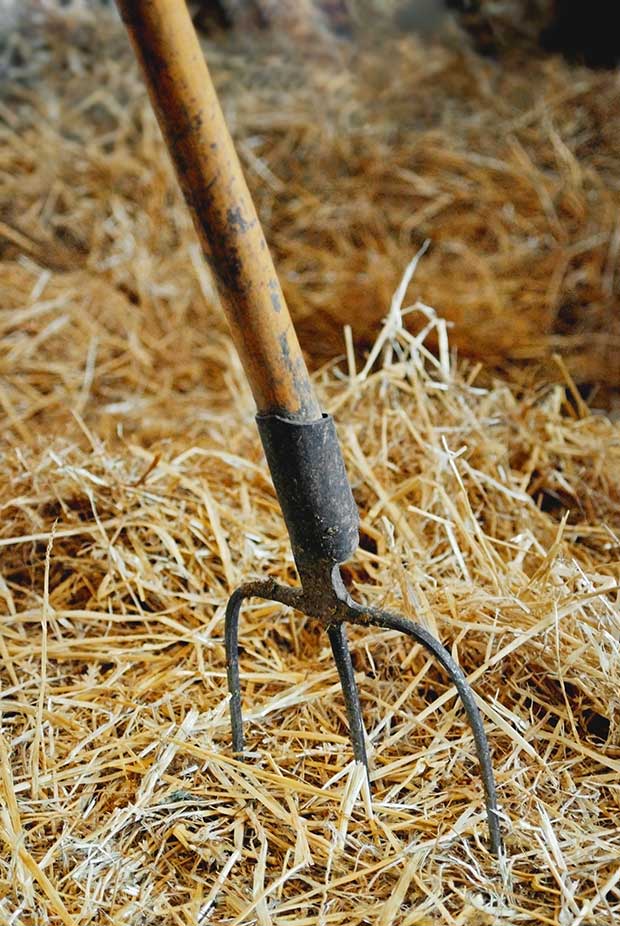
One essential investment is a decent pitchfork. You need to turn each windrow twice a day, about lunchtime and again in the late afternoon-early evening, to dry the hay. You want to turn and spread it out to expose any hidden green grass to ensure it is evenly sun-baked. Too green and wet and your hay will go mouldy, or worse, get so hot it starts a fire in your barn.

JASON’S TIPS FOR MAKING A HAY RAKE

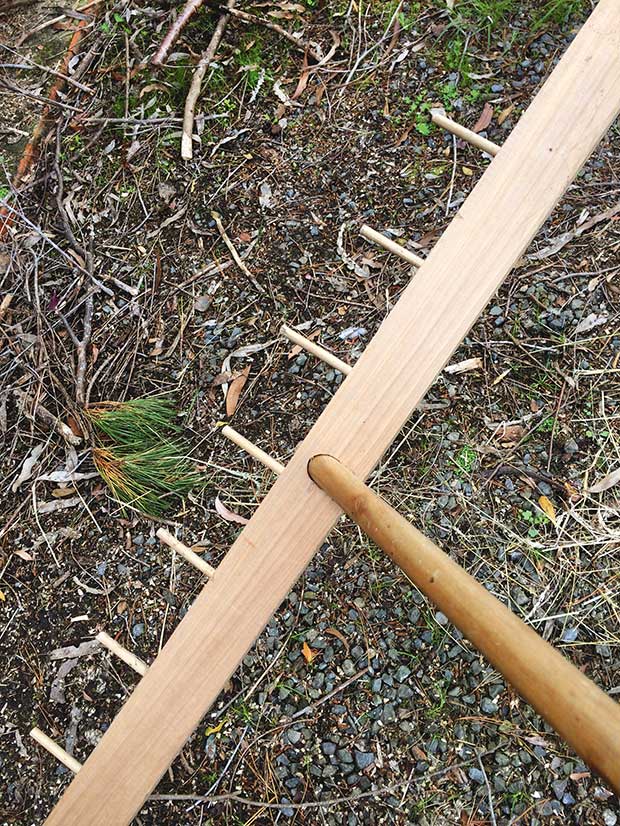
I didn’t have a suitable hay rake, so I made one out of a broom handle, a length of scrap timber and some 8mm dowelling. This was a lot cheaper than those for sale online. Miraculously, it also works well. Don’t glue the dowel ‘teeth’ in place. It’s a lot easier to pull them out and replace them when they break. If you want to be efficient, cut yourself some spare dowels and take them with you when you’re raking.

STEP TWO: BUILD A BOX BALER

You will need to print the instructions to make this baler. The following is my commentary on my project as I followed (and sometimes didn’t follow) those instructions.

I bought the timber, plywood, coach bolts, screws, door hinges, and eye hooks from Mitre 10 for under $110.

1. The box baler is a square loading box with a lever system to compress the hay. It’s attached to a loading platform, providing stability to balance the lever arm. The loading platform frame and the loading box are constructed from 4×2 timber, with sheets of plywood in between. Start by constructing the base platform from two long and one short length of 4×2”.

2. The rear corners of the loading box are two pieces of 4×2” timber attached to one another at right angles and fixed to the base platform. Screw a sheet of plywood between these and fix the central 4×2” length to the centre to hold the lever arm.

3. Fix another piece of 4×2” to the base to form the front of the loading box. Connect across the top with a shorter length of 4×2”, holding the side plywood sheeting. On the front, below the cross beam, cut a plywood piece for the door.

You’ll notice I went for a two-door front-opening model as opposed to the single door version in the reference plans. There was no strategy behind this; I cut a bit of plywood in the wrong place and had to adapt it to get the baler finished in a day. It works fine, but in practice, I think the single door model would be more robust during the baling process. Fix the door to the side upright with hinge or hinges and add a secure closing mechanism (either a bolt or a hook on the far side).

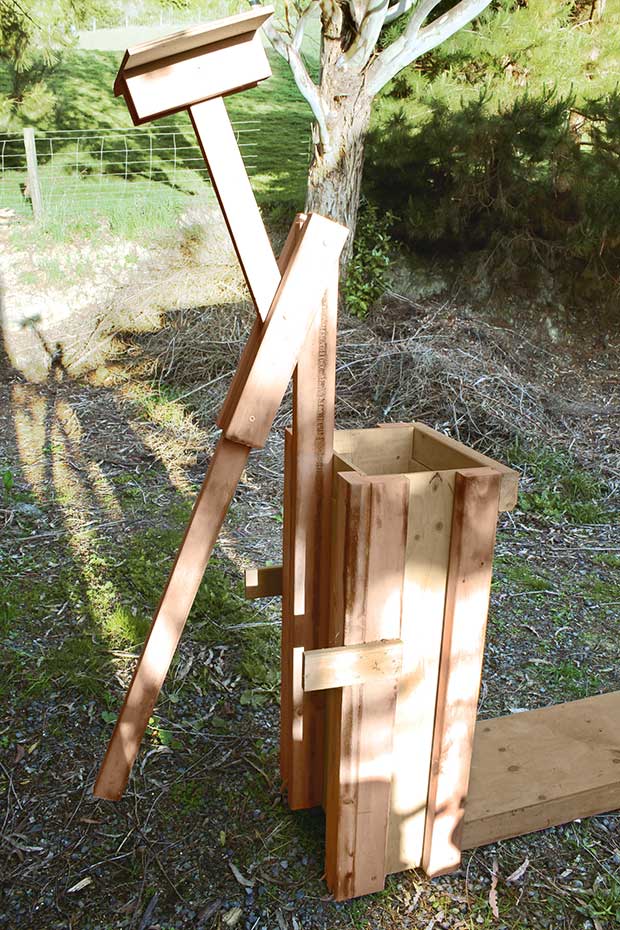
4. Make the lever arm and compression platform. The lever arm is made up of two shorter lengths of 4×2” and a long central length. Use coach bolts to secure these at the top of the central pillar on the back. In the centre of the space between the two shorter lengths, use a coach bolt to fix the vertical 4×2” that holds the compression platform (the bit that goes into the box baler top). The compression platform itself is a square of plywood, the same dimensions as your box, attached by two pieces of 4×2 (in photo 4 you can see it where it inserts into the loading box). When the arm is lowered, this compresses your hay inside the box.

5. The floor of the loading box has two pieces of wood fixed to it, with eye hooks sitting next to them. These are the runners that hold your baling twine in place. Fix these into the floor of your baler and screw in the eye hooks so the side of the eye is touching the wood.

5a. Fix two eye hooks to the outside back of the baler. Position a little way down from the top, and keep them in line with the floor runners. These hold the baler twine ends during loading.

6. You’ll notice the doors have slits cut into them. These should be at the same distance as the floor runners. The slits allow you to tie the baler twine.

I discovered two things from this experience: • human beings can improvise if they need to; • the woodworking adage of ‘measure twice, cut once’ is correct and it’s better to pay attention the first time around.

STEP THREE: GATHER AND BALE YOUR HAY

At this point, you will definitely need help from others. This is also when you learn why the original article had the word ‘cumbersome’ in its list of disadvantages. Carrying the baler down to the field is a two-person job.

You also discover an oversight in the plans. Robust carrying handles would be a good addition.

Gathering the hay was relatively straightforward. We used a large blue tarpaulin. One person was on pitchfork duties and two more people dragged the tarpaulin. We also had three dogs to disrupt the process and liberally scatter hay. It’s a great team-building exercise. You’ll quickly find yourself with a large haystack on a tarpaulin that you can slide easily around your field. Move the hay to sit beside the baler.

HOW TO USE THE BALER

This is an important health and safety message. If you take the easy option of resting the compression platform on top of the loading box frame, it can slip off and you’ll get a nasty bump on the head.

The moving parts can trap a finger, so be careful when you’re using it. We worked out that folding the level arm right back (as seen in the image below) after making each bale was worth the few seconds to avoid it falling and causing injuries.

1. Set up the hay baler with twine, ready for loading. Put a loop of twine over the eye hook on the back of the baler and run it down the inside of the loading box. Run it under the gap between the eye hooks and wooden strip on the baler floor. Don’t put it through the eye hooks – it needs to go between them and the wooden strip (see 1A, below).

This allows the twine to slip out once you’ve tightened it. If you run it through the eye hook, you’ll just fix your finished bale to the floor of the box and have to start again.

2. Bring the end of the twine through the slot in the front door, leaving enough length to tie it off later.

3. Repeat these steps on the other side so you have two lines of twine set up.

4. Close and bolt the door, then fill the baler with hay from your haystack. Press it down by hand after each addition of hay. Keep loading until the hay sits level with the top of the baler box.

5. Take your bailer twine off the eye hook at the back. Bring it over the top of the hay in the baler.

Find the top of the slit in the front door and bring the twine through, ready for tying off in a moment (see 5A).

6. Carefully bring the baler arm over and insert the flat plate into the top space of the baler.

7. Pull down on the arm to compress the hay inside into a tight bale. If, like me, you opt for the two-door model, you might need to put your foot in front of the door to stop it bursting open. This is a good reminder to accurately follow the plans next time.

8. Once the hay is compressed, take the ends of the baler twine from the top and bottom of each slot and tie them up tightly together. This holds your compressed bale together when you open the door. If you break the twine, you’ll have to unload the baler, re-set it and start again.

9. Lift up the compression arm so it’s clear of the baler. You can rest it on the top, but it’s better to put it back in the ‘safe’ position ready to start again.

10. Open the front door to reveal your compressed hay bale.

11. Give the twine a tug and pull forward your compressed bale onto the loading platform. Practice makes perfect. Our processing time for the first bale was 12 minutes. We got to a final production-line-efficiency time of under five minutes to re-set, fill, tie, compress, unload and stack a neatly-packed bale.

We’re not going to win any awards for farm efficiency compared to machine baling, but it does have some advantages: • it’s an oddly entertaining way to spend a day with friends in a field; • it’s low-cost if you live on a block that is too small to warrant investment in machinery or a contractor, or not accessible for a tractor; • it gives you a satisfying sense of achievement as you innovate new ways to speed up your production line process; • I got a lot fitter.

Our productivity could have been increased further by not having dogs barrelling through the haystack. However, that would have cut back on a lot of the fun. My knee-length grass problem was turned into around 40 bales of hay. You do need to factor in the cost of beers and a barbecue to thank the raking, moving and baling team. Hay baling by hand is an experience to remember.

Love this story? Subscribe now!

Best Clay Pigeon Throwers [Manual & Automatic]

0

Dusting clay pigeons is a great way to spend time with your shooting buddies.

Most ranges probably have a trap range, a skeet range and maybe even a sporting clays set-up of some sort. But what about the casual day out at your backyard range? How do you get those clay pigeons sailing through the air so you can smoke them?

Today we’ll take a look at some options that will allow you and your shooting buds to set up a fun clays range for the afternoon.

Types of Throwers

There are really two main types of throwers available. Manual and automatic.

The manual throwers can be as simple as this MTM Clay Target Thrower. If you practice a bit and have someone with a decent arm, this option will work. However, for a better shooting experience let’s stick to the throwers with a spring activated throwing arm.

Manual throwers are classified as “full-cock” or “3/4-cock” mechanisms. The full-cock machines mean you have to manually pull the lever back to reset it against the full force of the spring.

On the other hand, the 3/4-cock machines have a gear or clutch mechanism that only lets the arm travel in one direction and the momentum of the arm partially cocks the machine so you have much less effort required to reset the machine.

Check out this video from Do All Outdoors showing how easy the 3/4-cock traps are to reset.

Got all that? Now we’ll go into the best clay throwers.

1. Do All Outdoors – Backyard Clayhawk 3/4-Cock Trap

This trap is a great entry level 3/4-cock thrower. It has a tripod-type base that can be staked to the ground or mounted on a piece of plywood something else to make it more stable.

The trap can launch clays up to 70 yards and is adjustable up and down and side to side. It can also be configured to launch rabbit targets. These are meant to mimic a bouncing, running rabbit and roll on their edge along the ground.

2. Trius One-Step Trap

If you can’t talk someone into some range time, the One-Step allows the shooter to launch clays and shoot by themselves. This is a full-cock thrower, so the reset effort is a bit more.

However, you can load singles or doubles and also launch high-angle clays. To launch the bird simply step on the lever to release the throwing arm.

3. Do All Full-Cock Competitor Trap

For $29 you can hardly go wrong with this basic trap. The trap allows you to launch singles, stacked doubles and or side-by-side doubles. Clays can be launched up to 55 yards with this little machine. I borrowed my brother-in-law’s Competitor to teach my nephew the basics of shotgun shooting.

By easing up the spring tension a bit you can slow the targets down and allow them to “float” a bit and get new shooters into the groove and learning how to engage moving targets. A great entry level trap.

Note: this trap needs to be staked securely or mounted to something heavy so it doesn’t jump around too much.

Automatic Throwers

When you’re ready to spend more time on the range and want speed up your shooting it’s time to look at getting an automatic trap. These traps will generally be powered by a 12-volt battery and allow you to load 50 or more clay targets in the magazine.

The trap is released remotely by a wired switch or a wireless set-up depending on the model. Most of the remote switches are designed to be foot operated so you can launch targets when shooting by yourself.

The coolest thing about automatic traps is that they are available with options that move side-to-side, up and down or both so you never know exactly how the target will be launched!

4. Champion WheelyBird 2.0

The WheelyBird 2.0 is the upgraded model of the WheelyBird – and the upgrades are nice! The cycle time is only 1.75 seconds and there is now a wireless remote and a foot pedal to allow for more variation and shooting angles.

Best of all, the WheelyBird 2.0 can launch targets up to 75 yards.

5. Do-All Outdoors Fowl Play Automatic Clay Pigeon Skeet Thrower Trap

The Fowl Play trap has a lot of great features for practicing your wing shooting skills. The trap will throw targets up to 55 yards and can be adjusted from 5 to 35 degrees of elevation.

To really add some challenge to your practice just bolt on the Adjustable Wobbler Kit. The Wobbler allows targets to launch from random left to right angles as well as changing the elevation. The Fowl Play trap comes with a 25 foot wired foot pedal, but a wireless upgrade is available.

This is a great thrower, to begin with, and the optional upgrades allow you to continue to improve over time.

What’s your take on it?

Closing Thoughts

If you are an aspiring wing-shooter having your own trap makes a lot of sense. As long as you have a safe area to practice these traps allow you to shoot anytime you want and will likely save you a fair amount of money over time.

If I were to purchase a manual trap today I’d definitely be looking at 3/4-cock models because of their ease of resetting.

I really like the Fowl Play automatic thrower from Do-All Outdoors because as a base model you get everything you need plus the option to upgrade and continue challenging your shooting abilities.

No matter which one you choose, you’re sure to have a blast every time the shooter yells “Pull!”.

Want more shotguns in your life? Check out our 5 Best Home-Defense Tactical Shotguns!

Do you shoot trap? What’s your favorite shotgun? Let us know in the comments! Then check out our Best Trap, Skeep, & Clay Shotguns.

Top Tier — Top 5 Mississippi WMAs for deer hunting

0
Like her husband, Mikki Hoff of Enid has found success hunting on U.S. Army Corps of Engineers’ public land around Enid Lake. The key is scouting and lots of study.

With 2 million acres, Mississippi deer hunters keep scoring big. Here are details on the WMAs most likely to produce.

All deer hunters have a lot in common, including the consistent desire to harvest a nice buck for bragging rights with friends and a wall display at home or at the office.

When it comes to deer hunting on public lands like state wildlife management areas, however, on the surface it might seem like achieving such goals is pretty unrealistic. Yet, hunters across the state prove that statement wrong every eer season in Mississippi on WMAs.

The 2013-14 Mississippi Outdoor Digest from the Mississippi Department of Wildlife Fisheries and Parks lists 53 wildlife management areas in the MDWFP system. Some are state owned, others are federally owned, such as U.S. Forest Service and U.S. Army Corps of Engineers lands, under the management of the MDWFP through memorandums of understanding.

Situated around the state and requiring only a $15 annual WMA permit for non-exempt sportsmen, there is reasonable access to any resident.

The WMAs range in size from the tiny 891-acre Trim Cane WMA near Starkville to the overwhelming 58,480-acre Sunflower WMA just east of Rolling Fork.

In between are WMAs of all sizes, and several offer plenty of acreage. There are 13 other WMAs in the state with over 20,000 acres and eight more over 10,000 acres. Consult the MDWFP website at mdwfp.com and click under Deer Program and a second click on Wildlife Management Areas at the bottom of the deer page for complete information on WMAs, including a statewide map and a lot of helpful information on draw hunts (see feature on draw hunts by David Hawkins in this edition of Mississippi Sportsman).

The bottom line is that there are more than enough quality open public land options in this state to satisfy any deer hunter, providing a tremendously valuable resource.

Deer hunting habitats vary widely across these lands as does the topography and terrain. Literally there is something here for every deer hunter.

Also don’t forget the many thousands of other acres open to the public for hunting as well on property identified as National Wildlife Refuges, and lands controlled by the U.S. Army Corps of Engineers situated around the several water resource reservoirs dotted around the state, as well as 10,000 acres of state land around Barnett Reservoir near Jackson.

All total, there’s nearly two million acres of public hunting lands in the Magnolia State.

Targeting a Big Buck WMA

Unless you just happen to personally know or have experienced deer hunting on a particular WMA how do you choose one for hunting bucks? As you can read further in the associated sidebar to this feature, there is a wealth of information about all state WMAs in the annual Deer Program Report.

Paramount in the listing of harvest data and other information on all WMAs are the numbers for bucks taken on each individual property.

Is this a guarantee that you will take a trophy buck on that WMA? Hardly, so let’s get real. The laws of averages improve in the deer hunter’s favor when they select a site to hunt that has a proven record for yielding decent numbers of bucks. The odds for taking exceptional bucks go up when you compare the average antlers of bucks taken at the different WMAs.

By hunting these top buck harvest WMAs you elevate your chances, all else being equal.

Fortunately, we have already condensed the available data from the most currently available Deer Program Report. We have selected for further detailing the top five WMAs for buck hunting based on the total buck harvests from those lands. It’s a darn good place to start.

Top Five Buck WMAs

1. Bienville WMA. This 26,136-acre area is located north of Morton in Bienville National Forest.

Its last reported buck harvest was 119, the largest yield since the 2007 season. Habitat conditions have been improving due to increased area management work. The average inside spread on 3½-year-old bucks was 13.4 inches with average main beams of 16.4 inches.

Mean conception dates for Bienville WMA are from Dec. 21 to Jan. 24. Watch the weather and monitor the rut activity to hunt the peak rut. Man-day use on this WMA was 3169 days. Twelve deer were taken for each man-day.

2. Sunflower WMA. The largest WMA in the state at 58,480 acres, it is near Rolling Fork. The buck harvest was 116. Average inside spreads were 14.4 inches with main beams of 17.4 inches for 3½-year-old bucks. The most bucks taken on Sunflower were aged at 3.5 years.

Sunflower is a wetlands area as well and is often considered an excellent area for waterfowl hunting. During duck season, deer hunters should expect to see and hear the duck hunters. This apparently has little to no impact on the deer hunting on this WMA. Man-day use was 7761 days, which could have been a lot of duck hunting as well as deer hunting.

3. Leaf River WMA. At nearly 40,000 acres, this WMA is big, too. It lies in Perry County within the Desoto National Forest. The buck harvest was 115 which was well over the 42 bucks taken back in the 2007-08 season. The 3 ½-year-old bucks averaged main beams of 14.7 inches.

Eighty-seven percent of the bucks taken met the antler criteria; youth hunters under age 16 could take any antlered buck. Leaf River’s habitat can be thick and tough to get through in areas. Its timberland is mostly pines with hardwood bottoms. The man-days use here was 7,552 total days, and the harvest rate was one buck per 363 acres.

4. Mahannah WMA. Located off Highway 61 north of Vicksburg, Mahannah’s acreage runs 12,675. The land is owned by the U.S. Army Corps of Engineers, but managed by the MDWFP. Deer hunting is by draw permit only, but it is worth the risk and wait. Usually there is a January archery hunt open to the public.

Buck harvest was 86 with a man-day use of 2,487 days. Average inside spreads went 14.8 inches with 18.1 inches average main beams on 3½-year-old bucks, making it very desirable to hunters.

“We put in for Mahannah deer permits every year; sometimes we get them, sometimes not, but it is a great place to hunt,” say brothers Jay and Ben Harper of Vicksburg.

The conception dates on Mahannah ran from Dec. 8 to Jan. 7. Buck harvest rates are up since the 2007-08 season, but man-day use is up, too. The main reason for this seems to be the ever increasing reputation for big bucks. Several have been taken on Mahannah over the past few years.

5. Copiah and Sandy Creek WMAs. These two WMAs tied for the same buck yields at 82 apiece. This is significant given the two areas are nowhere near each other — Copiah is located just south of Jackson and west of Hazlehurst, while Sandy Creek is in Adams County in the Homochitto National Forest.

Copiah’s land mass is 6,583 acres, with gently rolling wheat grass hills, scattered pines and hardwood stands in the bottoms. To look at it you would think it was perfect quail habitat.

By contrast Sandy Creek is 16,407 acres of tall pines and equally tall ridges with fast falling slopes into thick bottoms.

Man-day use on these areas were similar — 4,007 on Copiah and 4,050 on Sandy Creek. Copiah like Mahannah is slowly gaining a history of producing some very nice bucks.

Sandy Creek should show more use given its hunter base includes a lot of Louisiana deer hunters. Know that going in.

Acres per buck on Copiah as 80, but on Sandy Creek it was 200. Copiah is a good WMA to put a doe in the freezer as well.

Are there other WMAs worthy of a dedicated buck hunt? You bet.

As you further study the detailed area information from the Deer Program Report on the top five areas listed above, also be sure to check out Upper Sardis, Tallahala, Marion County, Chickasaw, Caney Creek, and O’Keefe WMAs. Of course, any of the 53 state WMAs could yield a record book buck any day. It is just a matter of pinpointing the right one to be hunting at on the right day.

Ruger Air Hawk Review

0

You already know that Ruger makes some of the best quality guns in the world.

Ruger is a recognized brand name with good reason, and this is no letdown.

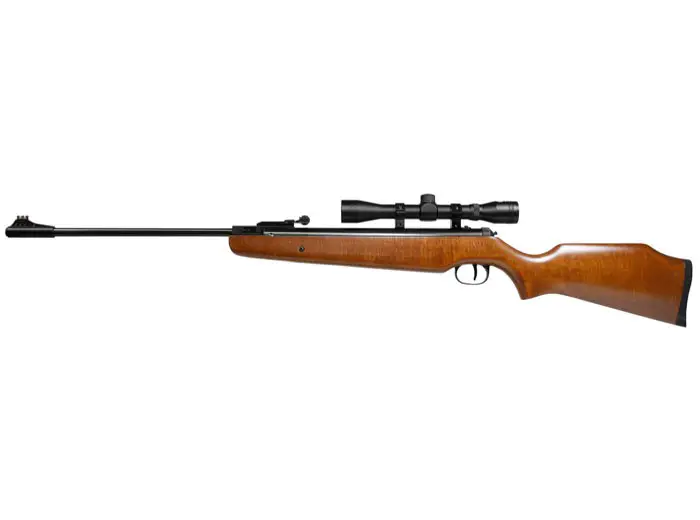
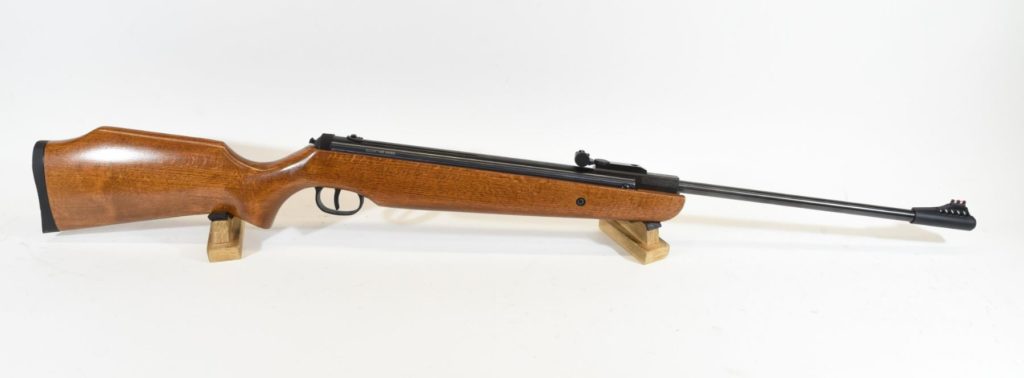
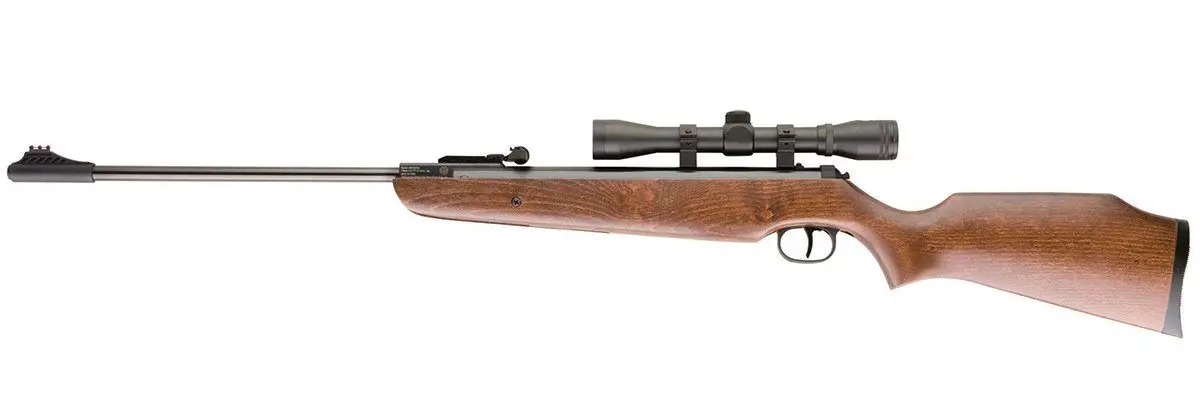
The Air Hawk is an imitation of the legendary Diana RWS 34 but with a cheaper price tag.

It has received lots of rave reviews and stands at the top of the best 5 air rifles under $100.

Let’s find out if this air rifle is overrated or not in this review.

Ruger Air Hawk – Guntype

This is a spring-piston gun.

Spring piston guns tend to be cheap and have amazing accuracy.

You can read more about spring-piston guns’ pros and cons in this post.

The Ruger Air Hawk is a break barrel gun which means that you have to cock it each time you want to shoot.

Break barrel guns are easy to load pellets into because the breech is exposed when it breaks open.

Furthermore, it gives you an unlimited shooting capacity and the convenience to repair it, because the mechanism is so simple.

Finally, a break barrel gun is easy to clean because you have direct access to the bore.

This is a single-shot gun: you can shoot only once at a time.

Single-shot guns give you control over the ammunition and make you a better shooter .

Because you know you have to make your first shot count before the required reload.

The barrel has a caliber of .177 inches (4.5 millimeters) .

.177 is a popular caliber for target practice and plinking but this gun promises to do well in the pest control field, and we’ll get into that later.

(For more on the differences between .177 & .22 and which jobs they do best, see this post.)

The barrel is rifled with helical grooves inside so it makes the bullet spin before it exits the barrel.

The barrel and compression tube are made of semi-gloss bluing steel to prevent it from rusting .

(For more on things you should know about air rifle barrels before buying, see this post.)

Check Price on PyramydAir

Stock

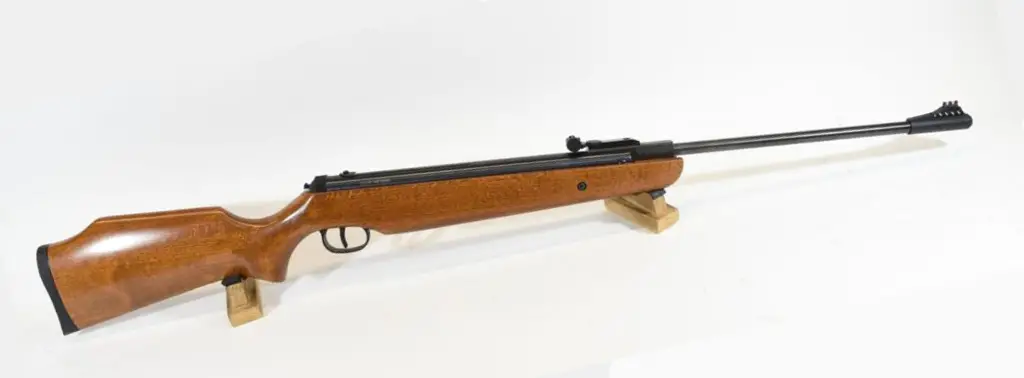
The stock is made of hardwood so it brings an intimate, authentic feel to your hand and withstands impact, shock, and abrasion.

It can be refinished easily at any time so it has a very long life span.

For more on the in-depth comparison between synthetic and wood stock, see this post.

The stock is ambidextrous so you will have the same shooting experience whether you are left-handed or right-handed.

Also, the stock has a rubber recoil pad to reduce kickback in the shooting.

The stock is designed in a Monte Carlo style with a raised comb and low heel.

The Monte Carlo stock has lots of advantages including improved accuracy.

Since the shooter’s eyes are lined up more naturally with the sight, it absorbs a small amount of recoil and therefore allows faster follow-up shots.

Sight

The front sight is fiber optic: it uses optical fibers for the dots and channels the ambient light to the rear sight so that it’s brighter than the dark surroundings.

Fiber optic sight comes in handy if you don’t have perfect eyesight or if you are shooting in low-light conditions.

Besides, it provides fast target acquisition and more accuracy in normal conditions.

What else? The rear sight is fiber optic.

It is fully adjustable for air resistance and windage, allowing you to adjust left and right, and for elevation as it allows you to adjust the sight up and down.

(For more on how many types of air gun sights are out there and which one is suitable for you, see this post.)

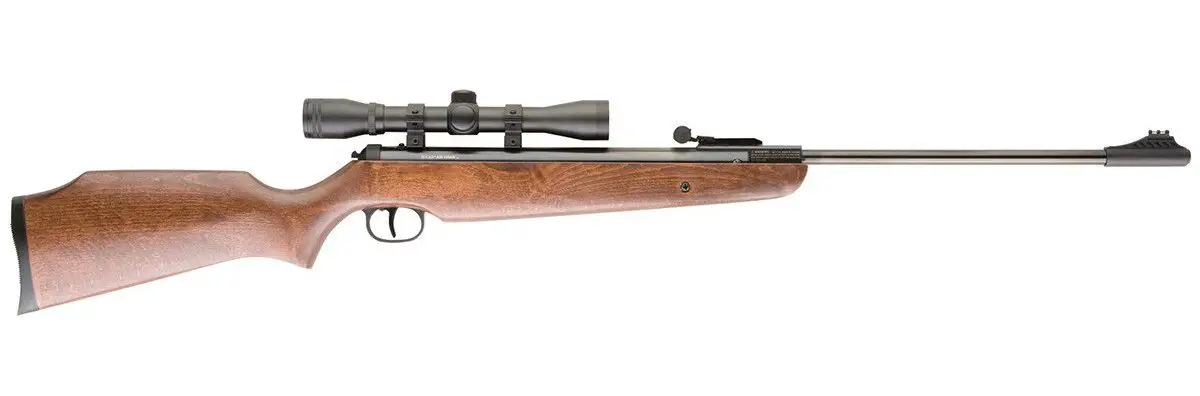
Ruger Air Hawk Combo

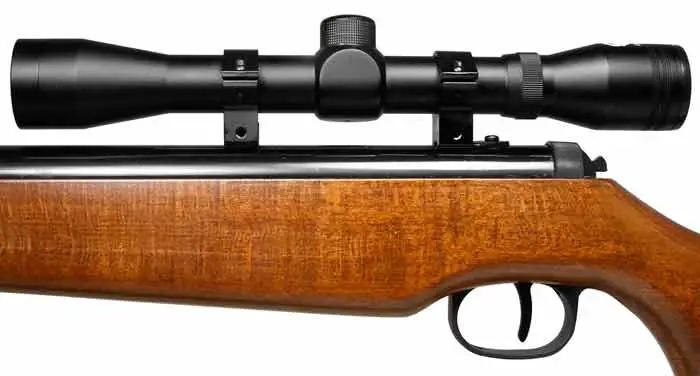
In addition to the handy fiber optic sight, Ruger has added the 4×32 scope in case you get bored with iron-sight shooting.

32 is the diameter of the front lens, measured in centimeters, while 4 is the magnification of the scope i.e. it magnifies the picture 4 times bigger than real sight.

This scope is good enough for plinking but I suggest you upgrade to a better scope if you want to go hunting.

Velocity, accuracy and power

Chrony tests give us results as follows:

PelletFPS
Hyper mag pellets 5.2 gr, lead-free pellet1142.41 – 1154.5 – 1145.55
JSB exact jumbo799.48- 805.06 – 802.65
Crosman premier light 7.9 gr925
Stoeger X speed precision pellet1045 
Crosman Premiere super domed726.5
RWS Superdome 8.3 gr737.4 
Crosman pointed pellet746.1 
RWS Hobby pellet1093 – 1499 – 789 – 797 – 766 – 803 – 810 – 755 769 – 806 – 750 – 771
JSB exact heavy 10.34 gr659 – 757- 665- 534 – 553 – 536 – 550 – 593 – 555 – 546 – 631 – 581 – 559
RWS Max lead-free pellet882- 970 – 892 – 904 – 854 – 835 – 816- 877- 814- 799
RWS Hobby630 – 644- 677- 722- 720- 699- 706 – 1080- 790 – 1089
JSB heavy572 – 893 
RWS 5.2 gr Hyper Max lead-free pellet906 – 1203
Gamo Raptor platinum alloy pellet1098
H&N Field Target Trophy green 5.56 gr1131 – 1579
Crosman Premiere HP 7.9 gr939
JSB Exact Diabolo 8.44 gr820
H&N Field Target Trophy 8.64 gr863
H&N Baracuda Mathch 10.65 gr788
Crosman SSP 4 gr1463
H&Ntarget trophy green 5.56 gr1182
Field target trophy 8.64 gr929 
Crosman premier 7.9 gr989
RWS 9.3 gr super mag817 – 965
CPHP927
Crosman premier heavy 10.5 gr760 
PBA gold1189
7.9 gr destroyer895
7.71gr gamo match915 
RWS Superdome900

The common shooting groups are:

  • ¾” at 20 meters with JSB exact jumbo
  • 2 ½” at 60 feet
  • 0.61” – 0.64” at 22 yards
  • 0.493” at 10 meters with AirARm Falcon pellet
  • 0.411” at 10m with Crosmn Premiere 7.9 gr
  • ¼” at 8 yards
  • 1 hole 5 shots group at 10 yards with polybag
  • ¼” with destroyer, 3/8” with CPHP
  • less than ½” at 40 yards with Baracuda match 10.64gr
  • 1/6” at 25 yards, 2-3” at 100 yards
  • hit a penny at 10m
  • dime size at 20 yards
  • 1” at 50 feet out of the box
  • 0.75” at 10 meter
  • 0.86” at 25 yards with H&N target trophy green
  • 0.91” at 25 yards with H&N field target trophy 8.64 gr
  • 0.61” at 25 yards with Crosman Premire 7.9 gr
  • hit 1.5” square block at 40 yards and 32 oz bottle at 100 yards
  • ¾” at 30 yards
  • nickel size at 13 yards with Crosman destroyer
  • 1.5” at 30 yards
  • 1 ½” at 30 yards with CPHP, dime size at 60 feet
  • 0.65 “ at 10 yards
  • hit penny at 25 yards with Kodiak and RWS super mag
  • ½” at 20 yards with CPHP
  • dime size at 15 yards
  • less than ½” at 25 yards
  • hit a 2.5” tin at 55 yards with CPHP
  • dime-sized group at 30 yards within 30 shots
  • 1” at 25 yards out of the box
  • 1” at 15 yards
  • 0.5” at 10 yards with Gamo match
  • hit 1” knot on a pine tree at 36 yards using open sight
  • a dime at 50 yards, ¾” at 20 yards
  • 1” at 30 yards
  • 2” at 50 yards
  • 2” at 100 yards
  • 50-cent size at 50 yards
  • 1” at 30 yards
  • group 3 shots through beer bottle cap at 30 yards
  • dime size at 30 yards
  • a quarter-size group at 15 yards
  • 3” at 80 yards
  • stack up pellet at 50 yards
  • hit a pack of cigarettes at 60 yards
  • hit a 7” frying pan at 50 yards on average 2 seconds after loaded (quick follow-up shot)
  • 1 – ½” at 30 m with H&N Baracuda Match
  • 1” at 30 feet
  • sight in at 20 yards
  • hit street light at 30 yards
  • 1” at 25 yards
  • ½” at 30 yards
  • ¼” at 30 yards
  • 1” at 75 yards
  • 3/8” at 165 feet
  • ¼” at 30 yards
  • and ¼” at 20 yards out of the box.
ruger air hawk

That accuracy looks promising, how about the power? Surprisingly, Ruger Air Hawk can:

  • hit tin can at 80 yards
  • blow 8 oz pop can at 30 yards
  • penetrate ¼” phone book with Crosman Premiere pointed pellet at 45 yards
  • picking off crow at 50-80 feet with Beeman Crow Magnum
  • kill bird at 30 yards
  • go right through a hard piece of ½” plywood like it wasn’t even there with H&N Baracuda
  • penetrate 8” deep in a cardboard box at 8 yards
  • Pick off crow at 50-80 feet with Beeman Crow magnum
  • Dispatch squirrels and birds at 20 meters
  • pick off a 12 oz can at 25 yards with easy
  • Kill 10 squirrels and 26 woodpecks
  • went completely through a chest of a squirrel at 30 yards
  • shatter beer bottles at 30 yards
  • pick off a pop can at 50 feet using open sight
  • 1 shot kills a crow at 50 yards
  • blow a turtle’s head out at 7 yards with CPHP
  • went through a tin can and ¾ way into a 2×4 board with Raptor gold pellet
  • shot a bird at 30 yards on the first day with the gun
  • headshot a couple of foxes at 50-60 yards
  • shoot squirrel at 80 yards, hit a squirrel at 50 feet
  • headshot opossum at 20 feet with 6.5 gr flat tip target ammo
  • nail a squirrel at the bird feeder at 20 yards- pellet go through the pest and feeder cleanly
  • headshot crow at 83 yards
  • shot robin at 50 yards and squirrel at 40 yards
  • went through both fences at 31 yards
  • kill squirrel at 12-15 yards
  • shoot through 3/8” phone book up and ¼” plywood behind it.

To sum up, common pests like squirrels, rabbits, crows, etc don’t stand a chance before this heavy-hitting rifle.

Trigger

This trigger is almost an exact replica of the T06 trigger on the RWS 34 rifle.

The trigger plate is metal, not plastic.

Furthermore, the trigger pull test gives us amazing numbers:

  • The trigger pulls at only 1 lbs 155 ounces, 3 lbs 6 oz, 2 lbs 14 oz, which makes it a dream for young shooters.

The safety is automatically on when you cock the gun so you don’t have to worry about misfiring.

Cocking and loading

To cock the gun, hold the pistol grip with one hand, place the stock on your hip, and break the barrel all the way down to its limit.

Load it with the breech open after you cock the gun, but the pellet into the chamber (with the pellet’s nose lying forward)

And pull the barrel up to its original position and you are ready to shoot.

Loudness

The noise test result of this gun is 100.7 decibels, which is in the medium range: not so loud and still backyard friendly

Maintenance

At first, you can get banging noises due to excess preservative oil burning off.

Just clean the barrel and shoot a lot of light pellets and you’ll be fine.

Oil it with 2 drops of RWS air chamber lube every 1000 shots, into the compression chamber port.

This keeps the piston and mainspring working.

Protect the barrel by coating it with RWS spring cylinder oil if you are not going to use this gun for a long time.

A tip to increase accuracy more: just tighten the screw, fit a better scope, select the right pellet, and hold the gun correctly.

Customer review

Customers are content with the power and accuracy of the Ruger Air Hawk at its price level.

They love its quality build, beautiful fiber optic sights, solid weight, and crisp trigger.

Most negative reviews mostly concern defective products or damaged scopes.

They are item-specific and do not affect every single gun.

Some customers complain that the rifle is made in China

But so what? 

Ruger will not let any Chinese company produce their air guns without strict provision

Because cheap production lines can ruin the entire reputation they worked so hard to build up.

Specifications

  • Caliber: .177″ (4.5mm)
  • Max velocity : 1000 FPS
  • Loudness : 3-Medium
  • Barrel Length: 18.7″
  • Overall Length: 44.8″
  • Shot Capacity: 1
  • Cocking Effort 30lbs
  • Barrel: Rifled
  • Front Sight: Fiber optic
  • Rear Sight: Fiber optic (Adjustable for windage and elevation)
  • Scopeable: 11mm dovetail
  • Trigger: Two-stage adjustable
  • Buttplate: Soft rubber recoil pad
  • Average trigger pull: 2 lbs
  • Action: Break the barrel
  • Safety: Automatic
  • Powerplant: Spring piston
  • Function: single shot
  • Weight: 8.16 lbs
  • Scope: 4×32
  • Cocking effort: 31lbs
  • Made in China
  • Distributed and imported by Umarex
  • Suggested for: small game hunting/ plinking/target practice/pest control
  • Warranty: 1 year

This gun weighs more than 8 lbs, making it pretty heavy for young shooters but very nice if you have a medium to large build.

Also, the heft makes the gun feel solid and helps a little bit with accuracy.

ProsCons
  • Awesome, solid stock
  • Durable blued barrel
  • Stunning power
  • Amazing accuracy
  • Light, crispy trigger
  • Gorgeous fiber optic sight
  • Cheap price
  • Made in China

Price

The price of a Ruger Air Hawk is so cheap: just around 100 dollars for a gun that’s solid, hard-hitting, and extremely accurate.

For that cheap price, if you take care of it, you‘ll have a good gun for a long time and get rid of squirrels or rabbits on your property.

Check Price on PyramydAir

Conclusion

ruger air hawk price

This rifle is hard to beat in its price class, it has good bluing, good metal, and the accuracy that you come to expect from Ruger’s name.

If you want better accuracy, just replace the scope.

Furthermore, it has so much power despite the fact that it’s a .177 rifle.

The Air Hawk is an inexpensive rifle that’s worth putting a quality scope on down the road!

Seabass Fishing Basic Lures! 6 Minnow Recommendations

0

This article is based on a Japanese article and has been machine translated.

Sea bass fishing is fishing for sea bass (Japanese sea bass) using a variety of lures.

The most basic of these lures are called minnows, which resemble small fish.

Since minnows are the most basic lure, there are so many types that it is difficult to choose the right one.

In this article, we’ll take a closer look at minnows and introduce six recommended products!

If you’re not sure which minnow to choose, please try one of these.

Introduction to the characteristics and usage of minnows

First, let’s take a look at the characteristics of minnows and how to use them.

Before choosing a minnow, it is a good idea to first learn more about minnows.

A minnow is a lure that resembles a small fish.

Minnows are one of the many types of lures, and their main characteristic is that they resemble small fish.

Not only does it look like a real fish, but it also swims just like a real fish.

Therefore, it has the ability to catch sea bass in areas where there are many small fish that serve as bait for sea bass, as well as in areas where there are not so many.

It is also easy to use, and the basic operation is just to reel it in.

Sometimes you need to give it a little action, but basically just reeling it in is enough to catch fish, so it is easy to use even for beginners.

As you can see, the minnow is one of the most basic of lures, yet easy to handle, and is quite suitable for beginners.

Minnows are great for any situation.

I mentioned above that minnows work well both in areas with and without small fish as bait.

In fact, minnows have the power to catch sea bass anytime and anywhere, regardless of where, when or when they are used.

Therefore, it is best to use it for the first cast at the point where you are going for the first time or when you are not sure if you can catch fish.

You can also determine whether to use more intense or natural lures based on the reaction of the sea bass to the minnow.

In other words, minnows are the standard for all lures and are essential for sea bass fishing.

This is the first lure you should buy if you are a beginner in sea bass fishing.

Keep a few different types of minnows on hand.

And there are three types of minnows: the floating type that floats when stopped, the sinking type that sinks, and the suspending type that stops on the spot.

Each of these three types of minnows has its own strengths in certain situations and times of the year, and it is recommended to have more than one type available if possible.

However, if you can only afford one of them, we recommend the floating type.

The floating type is a type of minnow that dives deep when reeling in and rises to the surface when stopped.

The floating type is the easiest type to catch for beginners because the action of stopping and floating often attracts sea bass.

For this reason, we have picked up recommended minnows, focusing on the floating type.

Choose one of these minnows and you’re good to go! 6 Recommended Minnows

Here are six types of minnows for seabass fishing that we actually recommend.

Recommendation 1: Shimano Exsence Silent Assassin 140F AR-C

The X-Sense Silent Assassin 140FAR-C is a minnow from the sea bass fishing lure series sold by Shimano.

The action and size of the lure are easy to handle, making it suitable for beginners who are new to lures.

It features Shimano’s original center of gravity shifting system called AR-C, which gives it more flying distance than other minnows of the same size.

It will definitely be very useful when sea bass are bouncing in the distance.

The color lineup includes models that glow like actual fish scales.

Recommendation 2: Daiwa Seabass Hunter Z

The Seabass Hunter Z is a great minnow for those who are just starting out in fishing and have never handled a lure before.

The lineup includes two of the most frequently used and easy to handle sizes, 9cm and 12cm.

Its swimming action is that of an orthodox minnow, so just reeling it in is enough to appeal to sea bass.

Another major attraction of this minnow is its price, which is less than 1000 yen.

Most other minnows cost around 1500 yen, so this price is quite reasonable.

You may want to buy more than one of several colors.

Recommendation 3: Daiwa Shoreline Shiner Z Set Upper 125S-DR

The Shoreline Shiner Z Set Upper is one of the most popular minnows among the many sea bass fishing minnows.

Of course, they are popular because they can be fished, and even beginners can significantly improve their chances of catching fish.

And these minnows sink slowly when stopped, a type called slow sinking.

It is recommended to use it when you cannot catch fish easily with floating type minnows or when you are targeting deep water.

It can be used in quite a wide range of situations because it can also provide enough distance.

Be sure to purchase these along with the floating minnows.

Recommendation 4: Megabass ONETEN Jr.

SW is a lure that was originally popular as a minnow for bass fishing, but was developed for the salt lure game.

It has enough flying distance as a lure for sea bass fishing, so it can be used to attack a wide range of distant points.

It is a minnow that is good at exploring efficiently when you don’t know the conditions of the day at the fishing spot.

It is also attractive because it has a quick darting action when the rod is lightly agitated.

The darting action stimulates the predatory instinct of sea bass lured by the natural action.

Recommendation 5: Megabass X-80SW

The X-80SW is a recommended lure for those who are looking for a minnow with power that moves greatly and appeals to a wide range of people.

The body is larger than the minnows we have introduced so far, allowing it to fly a considerable distance.

When you just reel it in, it swims in a big left-right motion called wobbling.

There are very few minnows that can make this wobbling motion as large as this minnow, so it will be able to make sea bass that do not respond to other minnows respond.

And the type is slow sinking, which enables you to keep attacking the same depth steadily.

Recommendation 6: Jackall Big Backer Gulf Minnow

The Big Bucker Gulf Minnow is a minnow from the Big Bucker salt game lure series sold by Jackal.

This product was originally developed to target bluefish such as yellowtails, but it is also very useful when targeting sea bass.

It has a solid weight of 27g, so it can be used for long-distance casting in large rivers and offshore embankments.

Of course, when you are targeting sea bass, you may also catch bluefish such as yellowtails, and the durability of the lure is such that it can handle such situations without problems.

If you want to fish for sea bass and other big fish that can be caught in the ocean, please consider purchasing this product.

If you want to go sea bass fishing, buy a minnow first!

Minnows are an essential lure for sea bass fishing and should be the first lure you purchase if you are a beginner.

Since these lures can actually catch sea bass, many types are sold by various manufacturers.

Among them, the six minnows introduced here are easy to handle and are recommended for beginners, so please refer to them.

BEFORE You Buy the SIG P365, Read This REVIEW

0

Does the P365 Live Up to the Hype?!

No gun has received the attention that I’ve seen the SIG Sauer P365 receive since its announcement in January just before SHOT Show. It gets this attention in all fairness, though, because when a gun shakes up the current single-stack 9mm market, dominated by Glock 43’s and M&P Shields, it’s understandable.

For the last 6 years, gun owners have bought into the idea that a concealed carry gun needs to be slim, lightweight, single-stack, somewhere between 6-8 round capacity, and striker-fired. Concealed carriers have also bought into the idea that it MUST be single-stack for a gun to fit those requirements.

Enter the SIG P365. It is all of those things—slimmer than the Glock 43, lighter than the Shield. It has a phenomenal trigger not just for guns in this class but even for any modern defensive pistol. And then there’s the fact that it just happens to hold 10+1 rounds in its standard configuration. That’s four more rounds than the G43 and three more than the M&P Shield. Readily available 12-round magazines boost that to nearly double the capacity of the Glock.

And you wonder why people are going nuts over this pistol.

But they’re also freaking out over some other aspects of the pistol, and not necessarily in a positive way. But first, let’s talk about some of the features and specifications of the gun.

trauma gear banner

Specifications

First Impressions:

Grip

I first got my hands on the P365 just before SHOT Show at a special SIG SAUER Range Day Media event. My good friend, Kyle Lamb, was there as well doing some demonstrations for SIG. Besides being involved in the excitement surrounding the P365, Kyle also has a gun he designed in collaboration with the team at SIG based on the P320 platform, the SIG SAUER X-VTAC 9mm, which is a pretty nice piece of hardware itself.

Kyle did a little demonstration of the P365 on camera with me, and the shots you see me fire there are the first I sent downrange out of this little beast. I call it that because it is like the Little Engine That Could, small in size and stature, but big in performance!

Right away, I knew there was something pretty special about the little gun. Placing it in my hand, I was immediately surprised at how good the grip felt. The P365 takes some of its design cues from P320, X-Series pistols. Particularly in its stippling and smooth trigger guard undercut. The undercut allows the shooter to get an even higher grip on the gun for greater control and flatter shooting.

The P365 sit’s nicely in the hand’s webbing because of the grip’s backstrap and beavertail design. I saw a graphic online with the outlines of 3 of the most popular single-stack 9mm handguns overlaid and compared to the P365.

Analyzing the graphic, I could see that the P365 has a bore axis height as low as anything out there. The low bore axis is surprising because SIG Sauer guns, especially in the Classic line of pistols, have established a reputation of having a bore axis that is relatively high compared to competing designs. Not that this has kept me from shooting them quickly and efficiently.

Bore axis height is an overrated factor, but regardless the SIG P365 performs exceptionally well in this regard.

Stippling on the grip is effective and comfortable. The gun sticks in the hand like it should without being too aggressive for more sensitive skin.

Trigger

The next thing I noticed right away was the trigger. My first trigger press surprised me as I wasn’t expecting it to fire so quickly and easily. Sig says it has a 6- lb trigger.

I have not put a trigger scale on it to test, but I would say 6 lbs. seems about right. But the trigger FEELS lighter than that. It is deceptive. I’m not sure what sorcery (you will see similar references throughout this review) is going on there, but it is a very nice, light, crisp trigger for a striker-fired gun.

The trigger reset is fantastic as well. It is short and distinct. The initial take-up of the trigger is light and free. The travel of the trigger once you “hit the wall” (the point where you feel resistance in the stroke) is about a quarter-inch. Pressing the trigger through the stroke is smooth and even. Once it breaks, there is no perceptible overtravel.

Instead of having the trigger break near the rear of the trigger guard opening, it breaks with about 3/8” open space behind the trigger. The length of pull has an outstanding balance. Shooters with smaller hands will have no problem working the trigger, and larger-handed folk will use it comfortably.

Sights

The original P365 came with SIG-Lite Night Sights. I have owned several SIG pistols with these night sights. They are good, serviceable tritium-based sights, far better than what many firearm manufacturers put on their stock pistols.

However, early into the P365 launch, customer’s discovered their pistols were breaking the tritium vials due to the extreme recoil velocity of the slide. These early pistols were sent back in and replaced with SIG SAUER’s new XRAY3 Day/Night Sights. The XRAY3 sights are fantastic! They are bright in daylight or low-light conditions. The front sight is a tritium vial surrounded by a bright green circle that is very easy to pick up in rapid strings of fire.

The rear notch sight in use works more like a blacked-out rear sight in daytime use, but it also has two tritium dots that show up very nicely in low light. While you can see the two rear dots in the daytime, I don’t notice them. While shooting fast, you get a very bright front sight that is easy to find in the rear notch.

Recoil and Shootability

The next thing I discovered about the P365 is that it is easy and pleasant to shoot. I call it the “little gun that shoots like a big gun.” This is true of the felt recoil and muzzle rise that occurs when firing, but it is also true in how accurate the gun is and the ease with which confidence comes to hit your intended target.

While some smaller guns can be challenging to shoot at a distance or small targets, my experience with the P365 is that if you see that bright green front sight on the target and press the trigger smoothly, you WILL hit for what you aim.

With my Glock 43, it just seems I have to concentrate much more on the sight picture, and even then, it sometimes isn’t enough when shots go where I do not expect them to. My confidence with the P365 is very high, and I find myself shooting it in situations and challenging shots that I usually reserve for my larger, duty-sized guns.

Now back to the handgun’s recoil. Recoil with the P365, like its trigger, is deceptive. It is a small gun, to be sure, so I expected it to be snappy. But it FEELS less snappy than similar guns in this category. Watch this video of me running a Bill Drill with the gun (done at 3.5 yards and shooting a 2.5” group in 1.94 seconds). Pay attention to HOW FLAT the gun is in my hand:

That is some serious voodoo magic. This thing seems to shoot flatter than some of my much bigger, heavier guns. Your mileage may vary depending on how effective and tight you grip your gun, but it is still impressive.

BEFORE You Buy the SIG P365, Read This REVIEW

Capacity

Capacity is where the P365 gets the most significant amount of attention, and rightfully so. I don’t know what kind of witchcraft the engineers in Exeter, NH are employing, but for the size and thickness of the P365 to be able to fit 10 or 12 rounds into a profile that doesn’t look any bigger than an S&W Shield, it is pure witchcraft I’m telling you, pure mysticism!

The reality is that then-new Pistol Product Manager Phil Strader instructed engineers at SIG SAUER to design a new micro-compact pistol. And to start first by developing a double-stack magazine capable of holding at least 10 rounds and making it as small as possible.

The result? Three new patents just based around the magazine made the rest of the design much more easily achieved.

The gun comes with two 10-round magazines, one with a flush base plate and another with a slight pinky finger extension. Oddly enough, after shooting several hundred rounds, I came almost to prefer the flush baseplate when using the 10-round mags.

Due to the trigger guard undercut and other grip design features, I can sneak about half of my pinky onto the gun’s grip. But even if I couldn’t get a full grip on it, I never once felt compromised in shooting the gun well, unlike other competitor’s guns.

A 12-round magazine is also available, and while it extends the grip length, it is still just barely longer than some other guns with standard capacity magazines in them. The M&P Shield with a factory 8-round magazine is longer than the P365 with a 12-round magazine. Wizardry!! Harry Potter would be proud!

Even better than the capacity and the ability to remain a very concealable gun? The 12-round magazine makes the P365 feel and shoots like a different gun. It FILLS the hand, and it FEELS excellent!

The magazines are well-constructed metal-bodied, double-stack magazines. They are pretty much what to expect from SIG if you are familiar with their other mags. Excellent quality, great performing magazines, but they come at a cost. Currently, there are no aftermarket magazine options that I am aware of, so you’ll be getting your fill of extra mags direct from SIG.

Accuracy

The SIG SAUER P365 is accurate. Testing across many different loads, it exhibited outstanding groups. I am not the most skilled bullseye/target shooter (I prefer to go FAST), but the gun is accurate enough for a small defensive tool. Group sizes were consistently around 3 inches at 15 yards (I didn’t have a longer range to test with at the time).

My greatest challenge to shooting more accurately was the width of the front sight post, as it covered up much of the target from 15 yards and out. But I am confident that if you used a Ransom Rest to test inherent accuracy, I am sure the results would be excellent. One of the significant differences with this gun is the trigger. I don’t need to rehash the point, but it is a very shootable trigger; it lends itself to easy, accurate shooting.

Reported Failures

Reliability is the big “elephant in the room” part of the review. Much has been said about the reliability of the P365 in the months since its release. Several people, including some respected reviewers, have indicated that the gun may not be quite ready for prime time. They believed it was released too early, almost like a “beta version” to be tested by the gun-buying masses.

I am not sure what to make of this because my experience with several different P365’s has been quite positive.

But let’s take a look at some of the noted issues that have come up:

Return-to-Battery (RTB) Failures

In the first month or so of release, customers reported RTB failures. The issues seemed only to affect the very first guns that hit the streets. I shot a couple of different early models and didn’t have a single RTB issue, but many people did. Some of it could have been ammunition issues, but I think there were some legitimate concerns. SIG fixed this on a warranty basis for existing owners and all newly manufactured guns with a slightly stronger recoil spring assembly (RSA). To date, with the two different P365’s I have in my possession, I have not had a single RTB failure.

SIG-Lite Night Sight Failures

Some early guns were affected by faulty night sights. Again, Sig fixed this issue within a few weeks. All guns had their sights replaced, and new models shipped with the new XRAY3 Day/Night Sights, which are fantastic! (See above.) Also, there were some reports of sights coming loose in their sight channels. I’m not entirely sure just how widespread these issues were, but it seems Sig addressed it, as I have heard no new reports in some time.

Barrel and Slide Peening

Another “issue” that received quite a bit of attention was peening. The slide excessively banging into the corners of the barrel hood and its slamming between the barrel cam and locking lug caused the excessive peening. I never thought it was much of an issue. Even if peening occurred, I didn’t feel it would be a failure point several thousand rounds down the road. Apparently, SIG Sauer took some steps to address this, but either way, no one’s even talking about this issue anymore.

Trigger Return Spring Failures

Shortly after that, it was reported (and Tim at the Military Arms Channel experienced this on camera) that some guns were developing a trigger return spring failure. I’ve seen it mentioned that some owner’s springs broke, but I’m willing to bet most of the failures were instances of the spring popping out of position. This issue seems rectified, with no new reports of it in some time.

Primer/Striker Drag

There is much attention to so-called primer drag, where the striker remains in contact with the primer as the barrel begins unlocking from the slide. Some believe that this is the reason for several broken firing pins. I am a little unclear on this. The reason being that I have other guns that exhibit primer drag, and it is more common with small, striker-fired firearms. Part of the reason for this is that the slide/barrel takes on recoil before unlocking due to the shorter rearward travel. On larger guns, the slide and barrel stay locked together longer and provide more time for the striker to retract before unlocking. I have witnessed primer drag on many other smaller guns, including Glock, Smith & Wesson, and others. Although it does appear that drag marks on the P365 may be more pronounced. I presume this is why it garnered more attention.

Broken Firing Pins

There were a fair number of reported broken firing pins. Many believe that the primer drag is the culprit for causing this. I suppose it is possible, but let’s first establish that the firing pin itself is much harder than any primer. Regardless, there are plenty of documented instances of broken firing pins. According to SIG Sauer, it is unclear exactly how many of these occurred, but it is a limited number. Companies have developed and released hardened stainless steel replacement strikers as an aftermarket part for those highly concerned about this issue. However, as reports of broken firing pins have decreased substantially, it would seem that this is less and less of a problem affecting the product line. SIG Sauer has since redesigned the striker and reevaluated their manufacturing supplier due to some inconsistencies and out-of-spec hardness and tempering. Some firing pins were too brittle, and the primer drag likely did not help and instead exacerbated the problem.

BEFORE You Buy the SIG P365, Read This REVIEW

Failure-to-Lockback (FTL)

I’ve seen this mentioned, and in the case of one serious “reviewer,” he has tracked this statistic with monotonous consistency. I personally don’t believe many of these FTL’s are legitimate in that something with either the slide stop or magazine follower failed to work, causing the FTL. I think 99% of these are shooter-induced. What do I mean? Many shooters ride the slide stop with their dominant hand thumb because of its location and the gun’s small size. They may not notice it’s an issue just by looking at their grip, but I suspect due to the small, lightweight gun that the 365 is rotating, the slide stop up into their thumb. I have not experienced any FTL’s with either of my 2 guns. But I am confident when the shooter uses a properly-developed grip, they won’t have this issue. The problem is that most shooters do not have a good grip, and their lack of this has not been an issue on other guns they’ve fired. But it is exacerbated on this platform for whatever reason.

Various ejection/extraction/feeding issues

I think many of these are ammunition related especially in the case of steel and aluminum-cased cartridges. Most of the malfunctions I have seen in the P365 platform have occurred with steel/aluminum-cased ammo. People will counter with, “Well, my [X brand of gun] has no issue with shooting steel or aluminum-cased ammo!” That’s a fair point. But we cannot make the case that the gun will get us killed by not being reliable in a gunfight simply because it doesn’t like cheap ammo. We don’t carry (I hope) cheap ammo in our defensive guns anyway. I had one malfunction out of over 5K rounds fired with brass-cased ammunition, and it was a +P round (more on this in a moment). Everything else was either steel or aluminum.

A NOTE: M of the above problems appear resolved. However, even if a person were to have a problem with their gun, SIG Sauer has one of the best warranty and customer service programs in the industry. My interactions with SIG’s customer service department have been nothing but positive and professional exchanges.

At this point, I should mention that I have been testing two different P365’s. SIG promised to send me one for review, but I couldn’t wait, so I purchased one myself made in mid-February. You’ll note that this is just a few weeks after they were officially released.

The other gun finally arrived from SIG in late May and was manufactured in the first week of May. I could have contacted SIG and said, “Never mind sending the gun; I have one already.” But I was interested in getting my hands on another one made at a different time for comparison. I heard all these bad things, and I figured the more guns I could experience, the better my test data.

By the time the demo gun from SIG arrived, I had already put almost 2,000 rounds through my personal gun. I fired an additional 3,000 rounds through the two guns throughout the remainder of the summer, about half-and-half. So I ended up with about 3,400 rounds fired through my personal gun and 1,600 rounds through the evaluation gun from SIG. Some fired in pure evaluation, and quite a few in different training courses.

I tested the guns with minimal cleaning. The somewhat loose standard followed was no cleaning, and fresh lubrication applied only once every 500 rounds. You will see from images in this article that my guns are still dirty. I believe that it is much more critical that firearms are well lubricated than being perfectly clean. I’m done evaluating them, so now I will give them an extensive cleaning.

I tested both guns with a variety of ammunition brands, types, and weights over the summer:

  • Sig Sauer Elite Performance FMJ in 115, 124, and 147-grain varieties
  • Sig Sauer Elite Performance JHP in 115 and 124-grain loads
  • SIG Sauer 365 FMJ and V-Crown 115 grain
  • Federal 115 gr FMJ Aluminum
  • Federal 115 gr FMJ Brass
  • Hornady XTP 124 gr
  • G2 Research R.I.P.
  • Winchester Ranger-T 124 gr +P
  • Remington Golden Saber 124 gr +P
  • Winchester 147 gr JHP (Whitebox)
  • Federal Hydrashok 135 gr
  • Federal Hydrashok Deep 135 gr
  • Federal 150 gr HST Micro
  • Winchester Train & Defend (FMJ and JHP both)
  • Remington UMC 115 gr JHP
  • Fiocchi 115 gr FMJ
  • And a few others

Reliability

The gun ran perfectly smoothly until I started shooting the Federal aluminum-cased ammo. This stoppage happened about 200 rounds after shooting a variety of SIG Sauer FMJ loads. On the 212th shot, the Federal aluminum 115-grain case failed to extract, and a double-feed occurred. 16 shots later, the same thing happened. I made it through the remainder of the aluminum-cased ammo (about 80 rounds) without further issues.

One failure-to-feed malfunction occurred at around 700 rounds with one load of 124 grain Winchester Ranger-T +P. Considering the other 4500+ rounds of brass-cased (including several hundred nickel-plated cases and dozens and dozens of +P rounds as well) ammunition fired without trouble, I considered this a fluke. The malfunction that occurred was actually the next round in the magazine, taking a nosedive into the magazine body.

At around 1500 rounds, I fired my first steel-cased rounds through the guns. Neither one would run reliably with them. I averaged about 3 rounds per 10 or 12-round magazine that would double-feed when shooting steel-cased ammo. Talking with other P365 owners, this seems to be a hit-or-miss issue. Some report having no problem shooting the stuff; others have similar issues like mine.

I also tested the new SIG Sauer 365 FMJ and V-Crown 115 grain loads, designed and loaded to shoot and feel identical.

The point is that a person can practice more with the cheaper FMJ rounds and get the same velocity, recoil impulse, and point-of-impact/point-of-aim as the V-Crown JHP defensive loads.

These rounds have also been optimized for the shorter-barreled P365. I liked how they shot very much. I tested the 365 V-Crowns extensively, including in ballistic gelatin, and the performance was excellent. A full review of this ammunition is forthcoming.

Finally, around 2,500 rounds on my personally purchased P365, I experienced my first, legitimate brass-cased round failure. This failure was with a Federal Premium 115 grain brass-cased cartridge. It was a failure-to-extract malfunction. I have since had no other malfunctions with either of the two guns.

Overall, when shooting even just decent quality brass-cased loads, the P365 exhibited a 99.96% reliability rating.

I have spoken with numerous P365 owners, and I have personally witnessed several P365 owners fire their guns. Some of these were in handgun courses I instructed this year. I estimate that I have seen approximately 5,000-6,000 rounds fired through about 10 other P365 pistols. While I have seen a few malfunctions occur, and some seemed to experience more malfunctions than I did, including brass-cased ammunition, I can still count the TOTAL number of malfunctions witnessed in all these other guns on less than two hands. Worst-case scenario, the P365 is still 99.85%+ reliable. This represents a little more than 1 malfunction every 1,000 rounds, and I estimate about 1 in every 750.

How does this compare to other well-established firearms? My Glock 43 has had the same number of malfunctions in fewer rounds fired. I regularly witness malfunctions from a variety of semi-automatic handguns, including Glocks, Smith & Wesson M&P’s, Rugers, etc.

All guns have issues. Sometimes they are ammunition-caused, and I personally feel many shooters rationalize the malfunctions they do experience and claim that their gun is “100% reliable.” I haven’t met a 100% reliable semi-auto yet. Shoot them enough, and you will experience failures.

I personally feel that a failure rate of no more than 1 in every 500 rounds is an excellent standard. These numbers represent a 0.2% failure rate or a 99.8% reliability rate. You will see that the P365 falls above this standard.

Do I consider this good enough for personal defense, including EDC (Everyday Carry)? Yes, I do. As with any gun, you should do testing with a minimum of 500 rounds of your carry ammo.

I am sure some will disagree with my findings, but I can only speak from my own experience and data. And the data does not lie. Everything I wrote above is true. But even with some of the negativity surrounding the P365, here is what I found:

It is a freaking excellent gun!

That doesn’t mean it is without its faults or hasn’t had some growing pains for some people. But for me (and I can only speak from my own experience), the SIG P365 has been a very solid and reliable platform. So let me begin wrapping up my thoughts on this innovative platform:

The Bad

BEFORE You Buy the SIG P365, Read This REVIEW

The grip

I think the grip is too “shallow.” It is a very small gun. The width of the grip is less than an inch wide which is fine. But I think Sig could have increased the distance between the front strap and the back strap of the grip. That said, I think it feels very nice in hand. I like the contouring, the stippling, the length—there are many great aspects of the grip. I understand that it is a balancing act of building a compact and concealable gun, but that is also shootable for various shooters and hand sizes. I think they did an excellent job. But if I were king for a day, I would have stretched it out just a bit.

Failure-to-Extract Malfunctions

In my experience, this malfunction is the most common one to occur with the P365 platform. Also known as a “double-feed,” this is where the fired case fails to extract fully. The slide continues rearward, picks up the next round, and shoves it into the rear of the still-chambered empty casing.

To clear this MOAM (Mother-Of-All-Malfunctions), it requires the shooter to lock the slide to the rear, strip the magazine from the gun, rack the slide multiple times, insert a loaded magazine, rack the slide, and chamber a fresh round. In contrast to FTF (Failure-to-Fire) and stovepipe malfunctions that generally only require a Tap-Rack to clear, you can see how this double-feed malfunction can cost a shooter some time to clear it when they might not have that much time in a fight.

Due to the nature of this, it is a little concerning that WHEN the P365 experiences a failure, the double-feed malfunction occurs at a higher rate when compared to most other handgun platforms. I believe this is because of the unique design and small, ultra-compact size. My personal belief is that the gun unlocks a tad early while gas pressure is still elevated, locking the empty casing in the chamber. This results in the extractor slipping off the case’s rim, and we get our double-feed malfunction.

I only experienced this with steel and aluminum-cased ammunition, which are less “slick” than brass-cased ammunition. There may be something to it with the modulus of elasticity of steel and aluminum being substantially higher than brass which would result in steel and aluminum cases contracting after firing back down to an extractable size at a slower rate than brass. I don’t know; I’m just thinking here, which can be downright dangerous at times!

The Front Sight

While the new XRAY3 Day/Night Sights are excellent and visible, I feel the front sight is a tad wider than it needs to be. Or the rear notch could be wider. The width of the sights is basically the same as what you’d find on SIG’s full-sized guns, which when you shorten the distance between the front and rear sights, the front sight starts to fill the notch more and more. Typically for most people, having a little more light on either side of the front post in the notch is a little quicker to center and send the next shot. But this is a minor complaint because I shoot the P365 just fine.

Magazine Release

This is also a minor issue I have with the gun, and it may be specific to me, but I think the mag release could be different. The P365 has a raised mag release button which shape follows the contour of the grip. The P320’s have a flat raised button. I think a hybrid approach would have been better—flat, but have the rear of the button start flush with the grip. My issue is that because the grip is so small, occasionally, when I grip a little too firmly with my support hand, during recoil, my hand will accidentally depress the mag release. So I have had to relax my support hand grip slightly to avoid this.

In analyzing the instances where this occurred, I determined that my support hand palm makes contact with the rear portion of the button. Starting the button flush with the surface and manufacturing it to be flat would still enable positive activation when desired but would likely eliminate the accidental dropping of the mag. The grip is small enough that virtually any adult hand and thumb can reach the mag release even if designed as described above.

Things I Like About the P365

Accuracy-

For its size, the SIG Sauer P365 is accurate.

Modular Chassis Construction

While SIG Sauer does not advertise this fact, the reality is that the gun is built similarly to the P320. Both have a serialized “frame” or chassis that can easily be removed from the grip module. The potential exists for much future innovation and design improvements from both SIG and third-party aftermarket manufacturers. It is also convenient if a person wants to have two different grip modules with different accessories (such as one with a mounted FOXTROT365 weapon-mounted light) that would allow the owner to swap between other setups quickly. I recently picked up a FOXTROT365, and in my limited initial testing, I am quite impressed, and I look forward to putting it to use.

Feel of the Gun

It just feels good in my hand. The contouring and texturing are excellent. The ergonomics are good. The slide serrations are effective.

Trigger

There is no other small striker-fired handgun on the market with a trigger better than the one found on the P365. I also feel SIG was brilliant to have the trigger break at 90-degrees, in the “middle” of the stroke, instead of the rear of the trigger guard. Besides the trigger weight, smoothness, and break being good, the position at which it breaks is part of the secret as well, I think. It breaks before the finger can overwrap the trigger, causing any disturbance to the aim of the gun before it is fired.

Size and Capacity

What’s not to love about 10+1 rounds (standard) and 12+1 rounds (extended) in a micro-compact size and form? This is the first micro-compact gun that tempts me to consider if I could replace my Glock 19 or SIG P320 Compact, both 15-round capacity guns. Packing the P365 around is a cinch. It disappears on my body in either the Tac-Lab M.T.R. or GrayGuns/PHLSTER Classic holsters, and there was tons of holster support for it from the get-go.

Shootability

I come back to a statement I made earlier. It is the little gun that shoots like a much bigger gun. I LIKE shooting it!

The Verdict

I plan on sending a check to SIG Sauer in Exeter, New Hampshire, to pay them for the review gun they sent me. I like the P365 well enough that owning just one is not enough. Plus, I have plans for some fun upgrades and modifications I’d like to do to one of these guns, mainly because I want to. A tease?—think red dot and compensator as a start …

The P365 is a winner. 13 rounds in a tiny form that is easily concealed and is easy to shoot. Magic, I say.

Magically magical.

More Pics!

Links

SIG SAUER – www.sigsauer.com

GrayGuns – www.grayguns.com

Tac-Lab Holsters – www.facebook.com/TacLab2016/

Best Air Rifle Deals

Popular Posts

Air Rifle vs BB Gun: Understanding the Key Differences and Choosing the Best Option

0
"Air Rifle vs BB Gun: Unveiling the Key Differences and Choosing the Perfect Weapon for Your Shooting Needs. Delve into this comprehensive guide to...

5 Types of Air Guns You Need to Know Before Buying

0
Have you ever wondered how many types of air rifles are out there? Is your head spinning around with various powerplants and you don’t know...

Can you dry fire a gamo air rifle?

0
Unveiling the truth behind dry firing a Gamo air rifle, this intriguing headline delves into the possibility of safely practicing without ammunition. Join us...