

Home Blog Page 170

Benjamin Marauder Wood Stock (Gen 1) Review – The Best Name In The Air Rifle Game

0

Benjamin Marauder is a brand that mixes superiority with affordability when it comes to air rifles. 

Since 2009, Benjamin Marauder has been gifting shooting enthusiasts

With a wide range of rifles that combine accuracy, accessibility, quietness and class.

Whether you’re a hobbyist, a serious shooter or a pest controller, you can rely on this air rifle.

The Marauder is one of the best PCP air rifles you can buy right now!
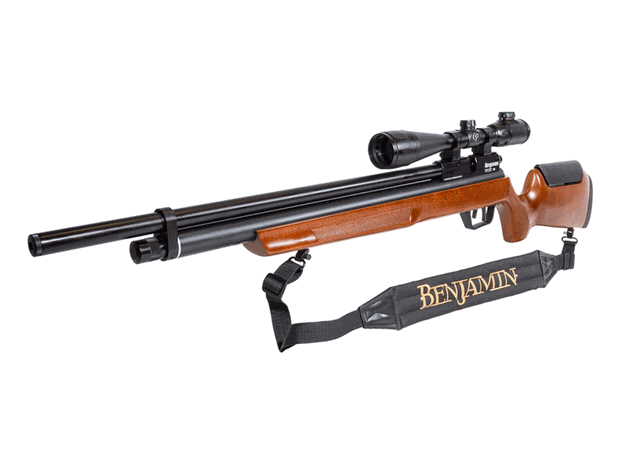
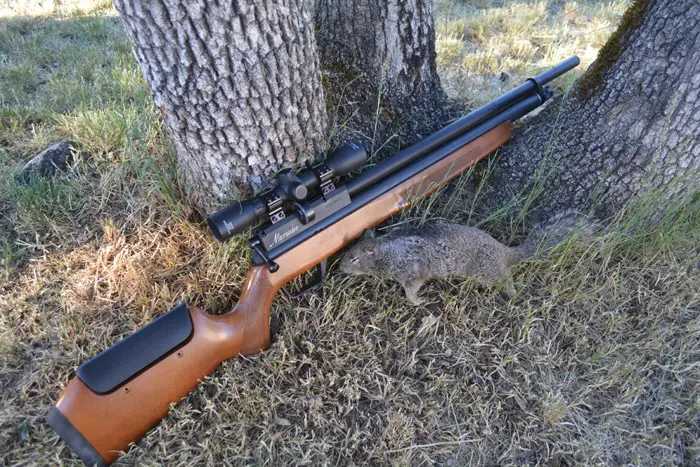
enjamin marauder wood stock generation 1

The Benjamin Marauder’s affordable price has made it a popular choice with multitudes of shooter.

If you’re thinking about buying an air rifle for hunting or for pest control, we’re here to make your task easier.

Benjamin Marauder – Guntype

Benjamin Marauder is a PCP pellet gun.

PCP (Pre-charged pneumatic) air rifles use highly-pressurized air in the chamber to discharge the pellet.

The pressurized air is compressed up to 2000-3000 psi by using scuba tanks or hand pumps.

When the air reaches the desired pressure, the gun is ready to use.

(For more on the 5 types of air rifles you need to know before buying, see this post.)
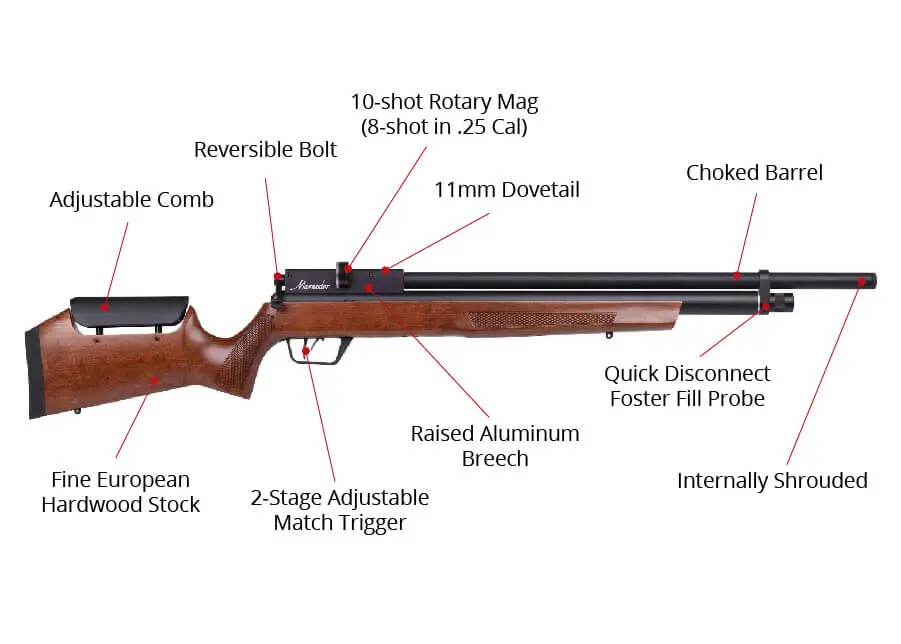
benjamin marauder wood stock diagram

The Benjamin Marauder air rifle’s reservoir is filled via hand pump, tank, compressor, or other accessories that we are going to discuss in detail later.

The air pressure inside the reservoir increases due to the blockage that the valve creates.

When you pull the trigger, a little gap is created through which the pressurized air escapes, launching the projectile.


Benjamin Marauder is one of the best PCP air rifles you can buy right now

You must understand that the air pressure and the performance are not always proportionate.

With too much air pressure your rifle will stop working at all

This is why we will discuss in detail the best air pressure range for this model along with the Benjamin Marauder .25 cal.
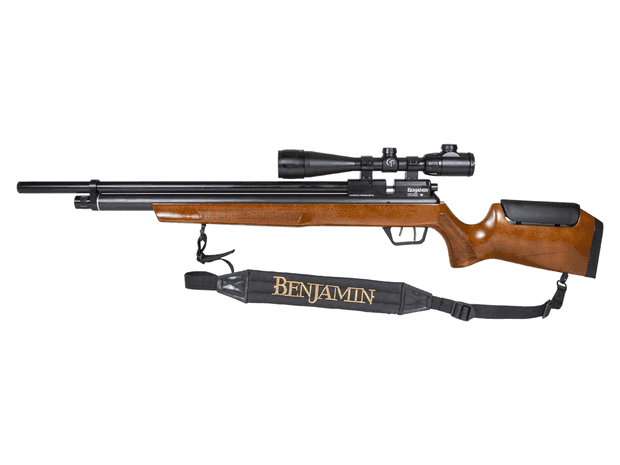
benjamin marauder wood stock

The basic feature that I would like you to understand is that this is a multi-shot gun — once you pull the trigger you can fire up to ten shots.

This particular model has auto-indexing which looks after the accuracy for the succession of shots.

Check Price on Pyramyd Air

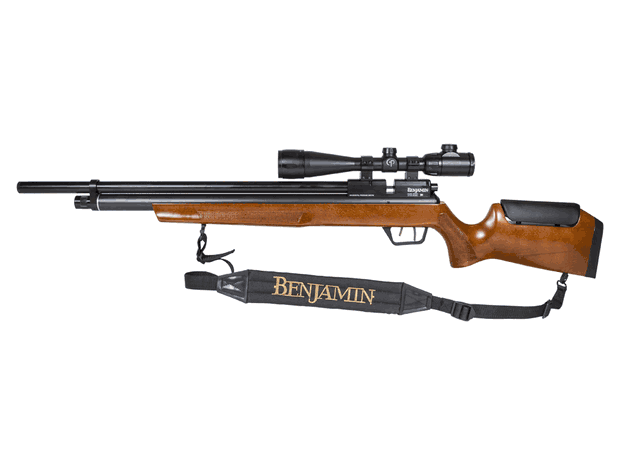
The Benjamin Marauder wood stock rifle comes with a barrel that is fully shrouded,

And as a result, they are really quiet, making it absolutely suitable for pest control or safeguarding the lawn.

(For more on things you should know about air rifle barrels before buying, see this post.)

As with most PCP guns, the marauder is perfectly suited for pest control.

However, with higher caliber ammunition and the right accessories, you can use it for medium to big games like boar, deer, etc.

(For more on the best air rifle for deer hunting, see this post)
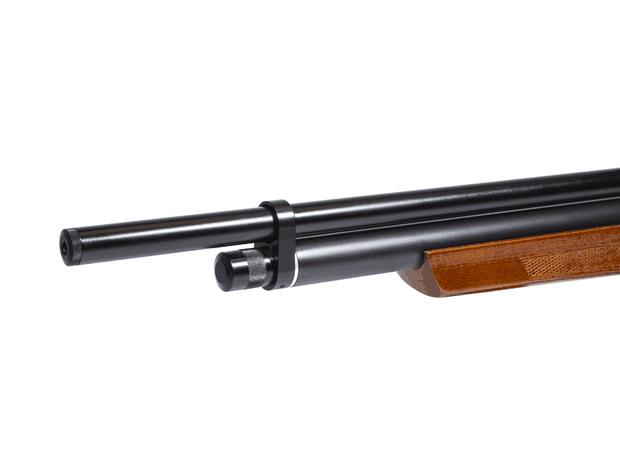
benjamin marauder gun barrel

The barrel comes choked for better accuracy and range as it shapes the shot spread initially.

This means that you can hit your target repeatedly, and the points of impact are more condensed than that of an unchoked barrel.

This dramatically increases the chance of killing your game.

The caliber ranges from .177 to .22 and .25 (with Crosman barrel or Lothar Walther Match Barrel)

Accuracy, velocity, and air pressure vary with caliber.

(For more on how to choose the right air gun caliber for your game, see this post.)

a marauder is an expert in pest control. furthermore, with higher caliber and proper accessories, you can use it for medium and big games like boars, deers, etc.

A PCP gun has numerous advantages over spring-piston guns, accuracy chief among them.

Secondly, the Benjamin Marauder doesn’t need to be cocked again and again, as you can charge it once for multiple shots.

Stock

There are two types of stock available: wood and synthetic.

Let’s deal with the wooden one here.

The black powder finish is worth the comment.

The stock also comes in a black synthetic version.

The metal parts have bluing, which is intended to protect them from rust.

It may lack the beautiful mirror finished look of an air rifle, but this stock gives it a very realistic appearance.

Let’s be honest, a Marauder is not just made to be looked at.

It is for SHOOTING with serious power!
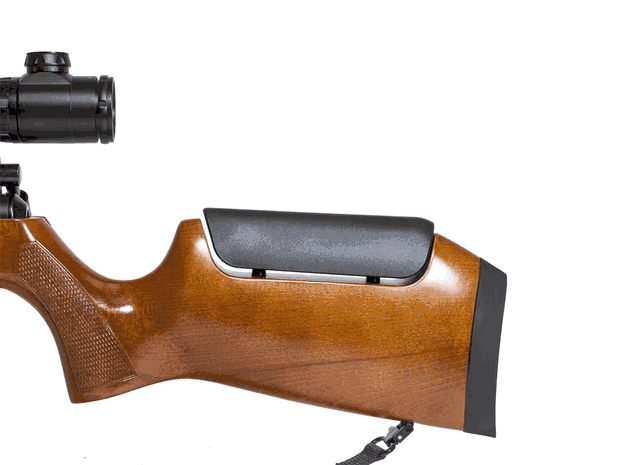
benjamin marauder wood stock

The wooden stock gives you an authentic look but it could be harder to use in extreme weather conditions,

While the synthetic stock would do just fine and remains lighter in weight.

The synthetic one may lack the authentic touch but it is more easily carried.

(For more on the in-depth comparison between synthetic and wood stock, see this post.)

Coming to the most important and impressive feature, this stock is ambidextrous.

Both right and left-handed gunners can use it with ease. For left-handed shooters, the bolt has to be reversed.

The stock has padding for better resting.

The Marauder stock is heavy but the weight just feels better and more realistic while shooting, although some might find the weight too much.

Fear not, we have a solution for that too: Just attach a sling to alleviate some of the burdens.

Sight

Sighting is one of the most important features of any gun.

Being able to control the sights effectively makes all the difference for the performance.
benjamin marauder sight

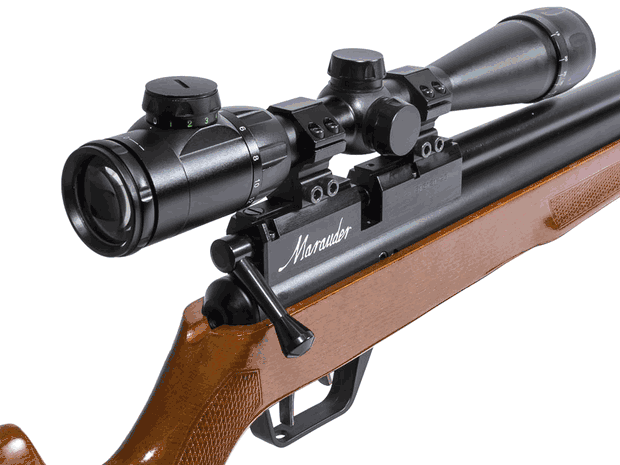
The Benjamin Marauder wood stock has an 11mm dovetail rail which we can see across the receiver top.

This model does not offer you an iron open sight

So you are free to choose your favorite optic for your mission depending on factors like the scope, price, range, etc.

It would be wise to have an adapter handy or an extra set of airgun rings available.

We can see a Picatinny rail on the vision and target version.

You can choose the best one suitable for you from the options available in the market like a Hawke sidewinder 30 SF Mil-Dot Reticle scope.

Besides, a Center point-4 16*40 AO scope is included in the Marauder premium package. 

(For more on how many types of air gun sights are out there and which one is suitable for you, see this post.)

Velocity, accuracy and power

The key point for the most effective velocity or accuracy and the optimum use of power is tuning.

You can use the factory setting if you are not an expert yet.

I would personally advise you to go with the preset tuning,

But there is huge scope for improved performance with the Marauder models if they are tuned with the right technical knowledge.
benjamin marauder wood stock specification

It would not be right if I didn’t mention that there’s a lot of in-built tuning potential with this gun.

Easy adjustments can be made for valve output or hammer spring tension.

benjamin marauder wood stock accuracy

A word to the wise though: do not change the factory settings without complete understanding.

You will end up in a lot of trouble regarding muzzle velocity or high air pressure.

benjamin marauder pellets

Here I will make you a table for a better understanding of the velocity, energy, and accuracy.

The gun has been tested for different pellets, and the results range from 23.38ft/lbs to 33.43ft/lbs in case of average muzzle energy.

The velocity of the muzzle also varied from 1041.83 FPS to 843.85 FPS.

WeightPelletsFirst shot muzzle velocityFifth shot muzzle velocityTenth shot muzzle velocityAverage muzzle velocityAverage muzzle energyAccuracy
9.70 grainGamo Raptor Platinum1057.94 FPS1037.09 FPS1030.82 FPS1041.83 FPS23.38 FT/LBSGOOD
10.03 grainH&N field target trophy green1038.43 FPS1032.58 FPS1007.23 FPS1024.70 FPS25.00 FT/LBSPOOR(vertical stringing)
11.90 grainRWS hobby994.08 FPS980.63 FPS963.31 FPS980.30 FPS25.40 FT/LBSGOOD
14.30 grainCrossman premier HP950.15 FPS939.31 FPS922.70 FPS935.83 FPS27.81 FT/LBSGOOD
14.35grainJSB Jumbo Exact953.59 FPS941.58 FPS929.36 FPS941.61 FPS28.26FT/LBSBEST OF THE TESTED
14.66 grainH&N field target trophy954.80 FPS950.37 FPS927.51 FPS941.99 FPS28.89 FT/LBSGOOD
21.14 grainH&N barracuda match848.93 FPS846.38 FPS836.84 FPS843.85 FPS33.43 FT/LBSGOOD

Nothing can match the Marauder for accuracy in this price range.

That is one trait I can vouch for any day.

The rifle is accurate over both long and short distances.

The range varies from caliber to caliber.

.177 is fit for paper targets whereas .22 is all set to kill some rabbits or squirrels.

From up to 30 yards of distance .22 does its magic smoothly.

(For more on the differences between .177 & .22 and which jobs they do best, see this post.)

In the case of .25, you can try from 50 to 100 yards distance.

.25 is suitable for hunting predators and sometimes, if properly set, it can be used for animals as large as coyotes.

Want example? Ian Harford and Steve Wild from Team Wild TV used Benjamin Marauder wood stock for hog hunting here:

Trigger

We mentioned the trigger earlier, but here, I am going to help you understand how that helps you in the shooting.

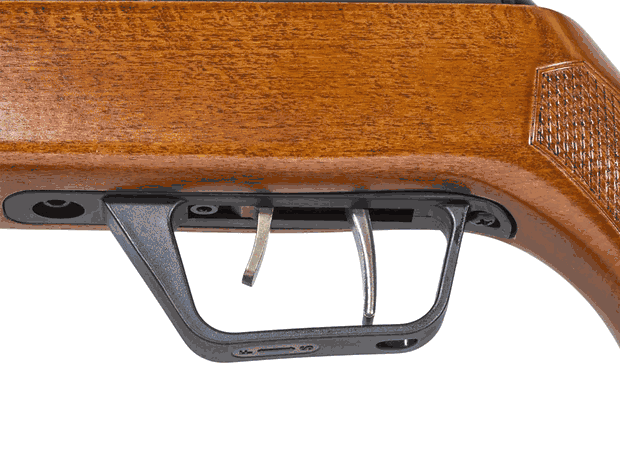
This is a two-stage trigger resulting in a very crisp function and positive let-off.

It makes all the difference, and you will understand how pleasant it is once you start shooting.

The two-stage trigger offers you two basic advantages over single pull conventional triggers.

The first one is safety.
benjamin marauder wood stock generation 1 trigger

Safety is very important in the case of air guns or rifles and in this model, the safety is attached just in front of the trigger with direct contact.

The trigger pull weight is around 3lbs, which is pretty reasonable.

Two-stage triggers are much safer because of their requirement of heavier trigger pull.

There is less of a chance of an accidental shot.

The second benefit of such a trigger is the accuracy.

You take the first pull, then if not targeted properly, you can pause and correct it with minimal effort and then take the second pull.

It is way easier and thus results in higher accuracy.

Now, if you are not happy with the manufacturer’s adjustments on the trigger, you can always change it.

Crossman has a very detailed manual that contains all the necessary information about changing any kind of setting.

You can change the first and second stage settings along with the pull weight and the position of the trigger blade.

However, my advice to you is to do it very slowly, just one or two steps at a time,

And then make use of the changes to understand your actions on the trigger and its reaction on the whole system.

It is of grave importance to keep checking the safety of the trigger — accidental discharges are the last thing you want while enjoying a fun shoot.

Cocking and loading

Let us start with the bolt.

The opening act has a cock and because of that, the opening action is justifiably light.

You can load the pellets easily while following the three classic steps.

Pull back the bolt handle first, then snap the magazine in and conclude with pushing forward the bolt.

For an easier loading process, the aluminum breech is elevated.
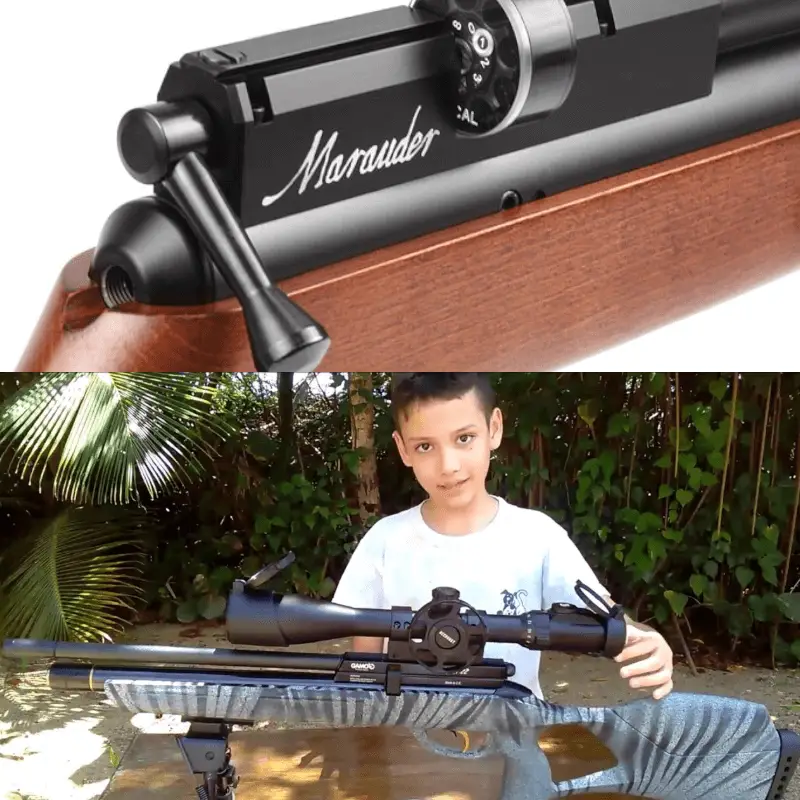
benjamin marauder wood stock b sign

You can cock the rifle and leave it aside until you are ready to shoot.

This does not affect the shooting at all.

The bolt is reversible, and it may take some time for adjustment but it’s not an issue to worry about.

About the magazine, you should be careful while filling it with pellets because it’s quite small.

You may end up losing more pellets while loading than actually shooting.

Loudness

If you see one thing in any Benjamin Marauder review more than most, it would be the noiselessness.

It’s famous for this feature, thanks to its fully shrouded barrel.

The internal shroud is called the De-pinger because it changes the sharp ping of the gun into a dull thud.

People claim that it’s so quiet that they’ve killed squirrels without disturbing any other nearby animals.

Shooting Ability

The Benjamin Marauder comes with a 10 shot clip which is very convenient to load.

Though single shot trays are also available, I could not think of any valid reason or appropriate situation where you might need one.

The Marauder offers you a very useful feature in that it shows how many pellets are remaining in the clip.

The absence of double feed protection as seen on most firearms should also be noted carefully as it plays a great role in jamming the rifle.

There could be a number of consequences if you load them without care.

First of all, there is nothing to alarm you about the fault.

Now that it is done, it could be a double shot that would surprise you leading to accidents or unintended events.

Another thing that can also happen is that your system could be jammed, and it would take a lot to get it back to normal again.

The ambidextrous feature makes it not only user-friendly but also suitable for a wide range of accessories.

The Marauder has a wide fan base, and they know how to respect it while making shooting easier for everyone.

You can adjust the stock comb height for setting up cheek weld,

Which is a big plus considering it can be customized according to your physical needs, and the features of your scopes or mounts.

We can always use a good cheek weld, which instantly results in higher accuracy.

You can also use a rifle rest or stand if you are planning a long session.

Maintenance

The Marauder is not a high-maintenance gun.

Clean the pellets after using a few hundred with any air rifle lube.

This will prevent lead building up in the barrels, and your shooting experience will not fall below standard.

Have micro fibers handy to clean the overall outer parts.

It removes the smudges and any kind of fingerprints making the air rifle new and shiny.

Accessories

First and foremost, you need a hand pump or tank to fill the tank.

Being a PCP rifle, it works on the pneumatic principle, which uses compressed air for shooting.

This model needs 2000-3000 psi pressure to work.

The actual amount may vary by a small amount, and you will get the closest value for your rifle following the instructions on the owner’s manual.

Keep the pressure accurate for effective shots.

Once the pressure gets low, you cannot operate the rifle.

Then, the velocity and accuracy fall and it won’t be triggered.
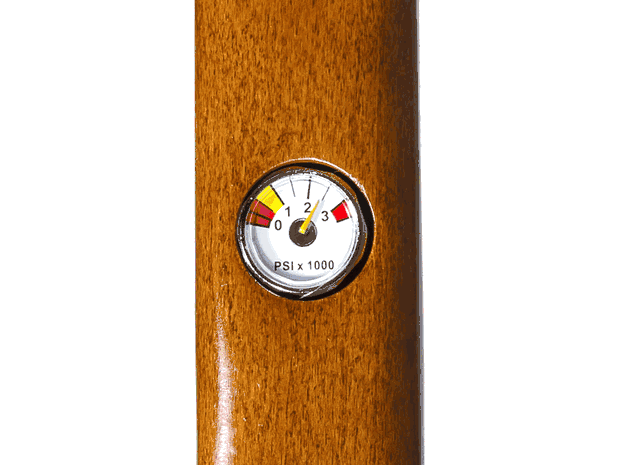
benjamin marauder needs 2000-3000 psi to work

215cc (size of the air reservoir) is a considerable amount of air, and it could get tiresome to use a hand pump though many shooters prefer to use it.

In that case, a compressor or scuba tank, or carbon-fiber bottle makes the process easier and faster.

There are numerous compressors available in the market.

In fact, the marauder also can be bought with a tank,

But if you are looking for something better, you can go for:

If you are interested in hand pumps, you can go with Air Venture g6 or g7 hand pump or Hill MK4 hand pump.

Another must need accessory is a sight for this air rifle which I have already mentioned in the section dedicated to it.

Another must-have accessory is a sight for this air rifle, which I mentioned above.

Pros and Cons

ProsCons
  • Quietness is the key. You have to try very hard to listen to a marauder's sound
  • Accuracy is unbeatable
  • Variable velocity and muzzle energy.
  • Easy for multiple shots.
  • Ambidextrous stock with reversible bolt.
  • High-quality robust material.
  • Unbeatable affordability.
  • Adjustable in nature.
  • Standardized parts for finding accessories easily or replacing part.
  • Low and hassle-free maintenance.
  • Rich bluing coat on metal parts as protection from rust.
  • Once the pressure goes down, it will malfunction, and you will end up annoying your target rather than killing it.
  • It is somehow heavy rifle and could be an issue for customers with weaker physic.
  • The stiffness may cause inconvenience.
  • Pumping could be an issue as well if you are using a hand pump. The reservoir takes quite a time to get filled.

Price

The Benjamin Marauder comes at an unbeatable price.

PCP Air guns cost from as little as 300 dollars to several thousand dollars,

And this model can be bought for around 450-550 dollars, depending upon the barrel and accessories.

Affordability meets quality with this model.

There are better air rifles in the market, but when we are talking about this price range, finding something better would be very difficult.

Anything better than this will cost you 3 to 4 times its price. 

Durability

Known for its performance and durability, I do not need to mention these features specifically.

It will go for years unless you neglect it.

It requires very little hassle, as I mentioned above.

With a little care, your marauder will keep you company for years.

Marauder is the model in which affordability meets the standards. Anything better than this will cost you 3 to 4 times of its price

Specifications

Here I am charting out the entire specifications once more so you can see it all together.

  1. 10 shots repeater rifle with an auto indexing features.
  2. Air pressure range from 2000-3000 psi.
  3. The muzzle velocity can be adjusted with different pellets and so is the muzzle energy. The accuracy depends on the pellets.
  4. There is an internal shroud present in the gun that makes it very quiet, turning the ping into a thud.
  5. Choked barrel ensures better accuracy and repetitive hit on the target.
  6. The two-stage trigger is made of metal, which is robust and smart looking.
  7. In case of circular magazines, they made the process easier with the raised breech made of aluminum.
  8. Original model comes with dovetail ring of 11 mm.
  9. The stock is made of hardwood. The forearm and grip are checkered and you can adjust the comb.
  10. Reversible bolt is present in this air rifle, which can be switched from left to right making it ambidextrous and suitable for both right and left hand shooters.
  11. In-built manometer to keep track of the pressure inside the reservoir.
  12. The size of the air reservoir is 215cc.
  13. Benjamin Marauder wood stock gen 1 rifle weighs around 8.2 lbs without scope. The heavy weight helps in improving accuracy.
  14. At the end of the reservoir, there is a quick disconnect male foster fitting which is used with a quick disconnect female fitting for filling up the tank from a pump or air tank.
  15. Swivel studs for sling along with one magazine is provided.
  16. The valve has been increased from the previous model which gives more shots. In case of the .177/.22 caliber the number of shots is almost 32 whereas it is 16 in case of the .25 caliber.

Another feature that varies with caliber is the noise. The loudness of the rifle increases with an increase in caliber.

Customer review

Customers are very satisfied with Benjamin Marauder wood stock air rifle gen 1 and delighted after shooting with it.

They emphasize accuracy, durability, quietness, and a smart look.

There have been few complaints about this air rifle and the brand names live up to the expectations.

Critics are also happy with the products, and different air rifle selling sites have detailed customer reviews which are absolutely positive.

At the end of the day, all I can say is that the Benjamin Marauder is the name you trust for accuracy and durability.

It will last for long years and serve you well.

At this price, it is hard to find a better air rifle that has this degree of performance with all these high-end features and quietness.

How Benjamin Marauder compared to other guns?

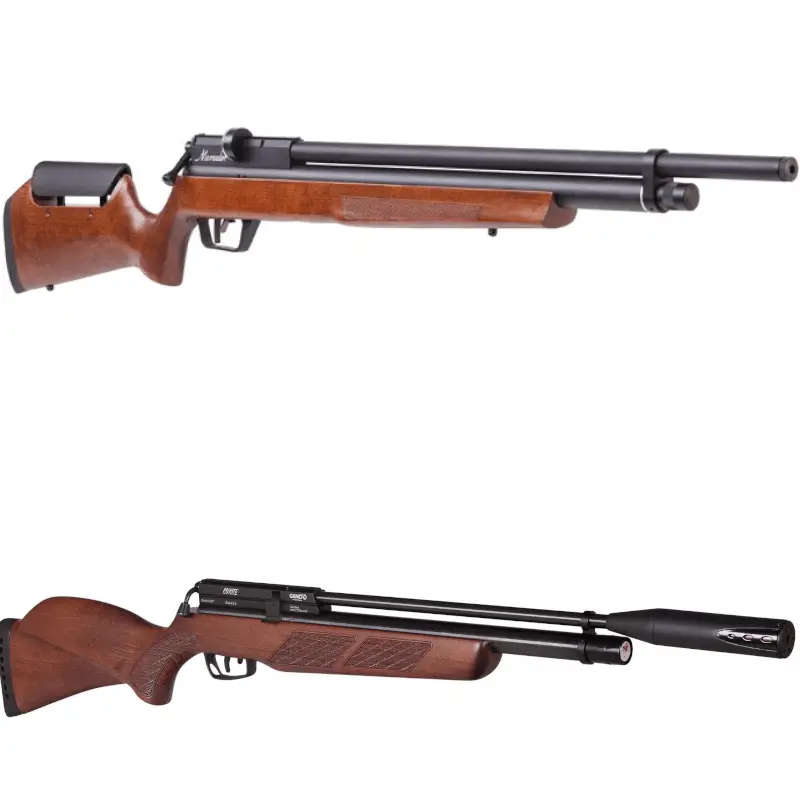
Benjamin Marauder vs Armada

SpecificationsBenjamin MarauderBenjamin Armada
Max velocity1100 fps1000 fps
Loudness2-low-medium2-low-medium
Barrel Length20.0”20.0”
Overall Length42.8”42.8”
Shot capacity1010
Barrel RifledRifled
Front sightNoneNone
Rear SightNoneNone
Scopeable11mm dovetailWeaver/Picatinny
ButtplateSoft rubber recoil padPlastic
Trigger Pull1.5 lbs1.5 lbs
ActionBolt actionBolt action
SafetyManualManual
PowerplantPre-charged pneumaticPre-charged pneumatic
FunctionRepeaterRepeater
Max shots per fill3230
Weight7.3 lbs7.3 lbs
Cylinder size215 cc215 cc
ShroudedYesYes
StockSyntheticSynthetic
GripAmbidextrousAmbidextrous
ColorBlackBlack

As is evident above, the Benjamin Armada is very similar to the Benjamin Marauder PCP air rifle.

Perhaps the most striking difference is the tactic-cool stuff the Armada has been upgraded with.

The Benjamin Armada has a fancier stock than the Benjamin Marauder.

In this sense, the Armada is largely seen as a cosmetic upgrade of the Marauder.

The rest of the functions are pretty much the same.

If you’re onto aesthetics, do not hesitate to purchase Benjamin Armada.

Below is a comparison of the maximum muzzle velocities for the different models of Benjamin Marauder and Benjamin Armada:
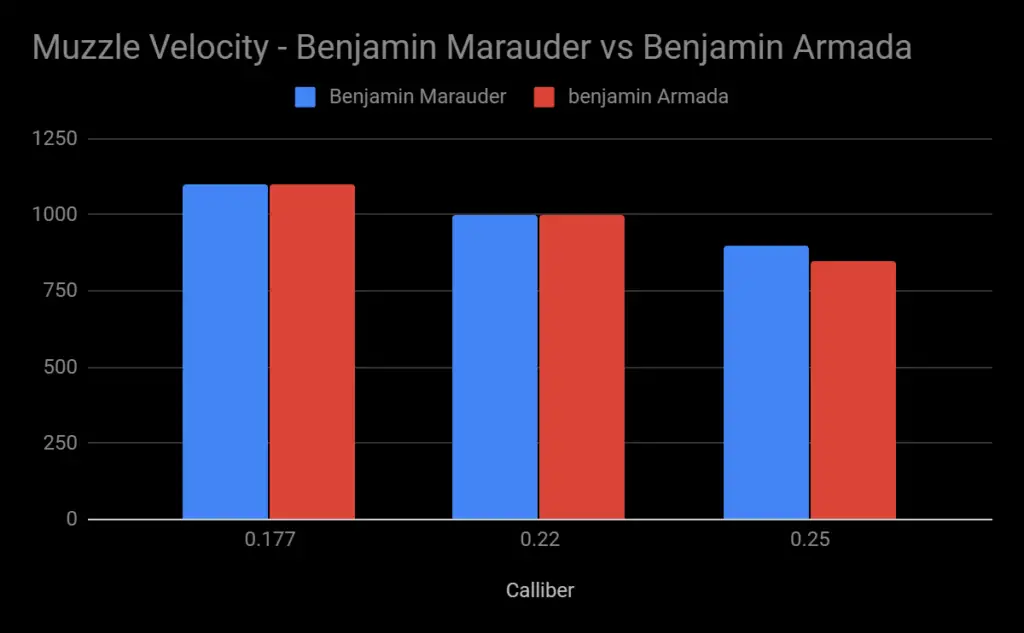
Benjamin Marauder vs Armada

Rick Eutsler (Air Gun Web) did a match-up between Benjamin Marauder and Armada here:

Benjamin Marauder vs Hatsan (AT 44, AT 44S-10, BT65)
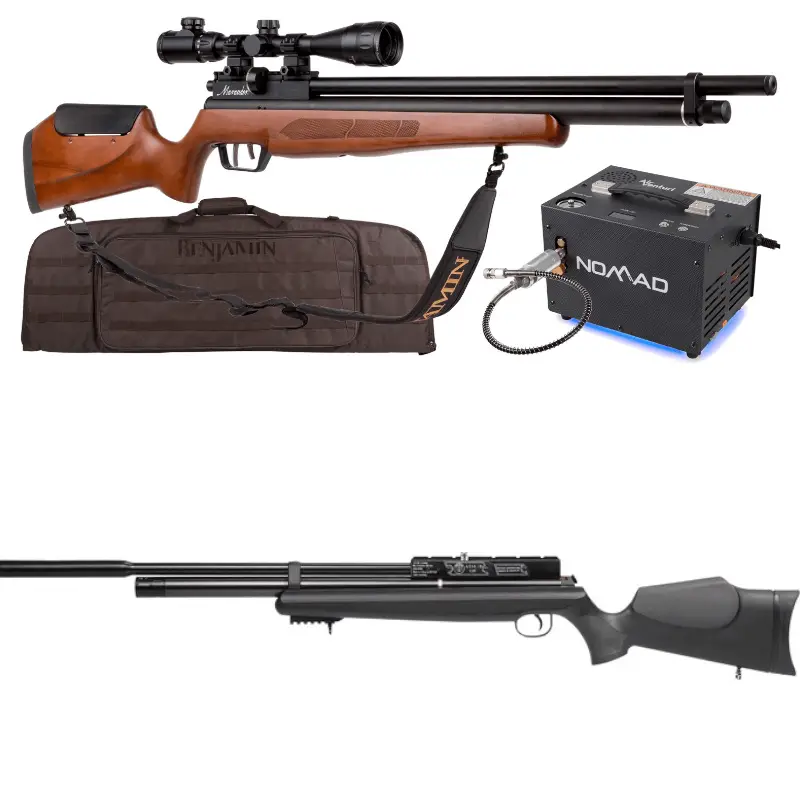
Benjamin Marauder vs Hatsan (AT 44, AT 44S-10, BT65)
SpecificationsBenjamin MarauderHatsan AT44-10 Long QEHatsan AT44S-10 Tact QE PCPHatsan BT65 SB Elite QE
Caliber.177.25.22.22
Max velocity1100 fps970970 fps1180 fps
Loudness2-low-medium2-low-medium2-low-medium4-medium-high
Barrel Length20.0”22.8”19.4”23.0”
Overall Length42.8”48.945.0”48.8”
Shot capacity1091010
Barrel RifledRifledRifledRifled
Scopeable11mm dovetailWeaver and 11 mm dovetailsWeaver and 11 mm dovetailsWeaver and 11 mm dovetails
ButtplateSoft rubber recoil padAdjustableRubberRubber, Adjustable
ActionBolt actionSideleverSideleverBolt action
SafetyManualAutomaticAutomaticDual – manual and automatic
PowerplantPre-charged pneumaticPre-charged pneumaticPre-charged pneumaticPre-charged pneumatic
FunctionRepeaterRepeaterRepeaterRepeater
Max shots per fill32351040
Weight7.3 lbs8.6 lbs9.5 lbs9.75 lbs
Cylinder size215 cc230 cc180 cc255 cc
StockSyntheticSyntheticSyntheticSynthetic
GripAmbidextrousAmbidextrousAmbidextrousRight
ColorBlackBlackBlackBlack

The table above compares and contrasts Benjamin Marauder to the three models of Hatsan.

The Hatsan BT65 SB is the longest of the four PCP air rifles.

All the three Hatsan models are heavier than the Benjamin Marauder

The Hatsan AT44S-10 has a notably small size cylinder (180 cc) that can yield only 10 shots per fill.

Benjamin Marauder has a 215 cc cylinder that yields 32 shots per fill.

Benjamin Marauder and Hatsan BT65 use bolt action while Hatsan AT44 and Hatsan AT44S10 use side lever action.

People have different preferences when it comes to choosing between bolt action and side lever action.

The majority prefer side lever actions, because of their smoothness and the ease of cocking the gun.

Bolts can sometimes move out of position when stalking game, however.

Below is a comparison of the maximum muzzle velocities for the different models of Benjamin Marauder and Hatsan AT44:
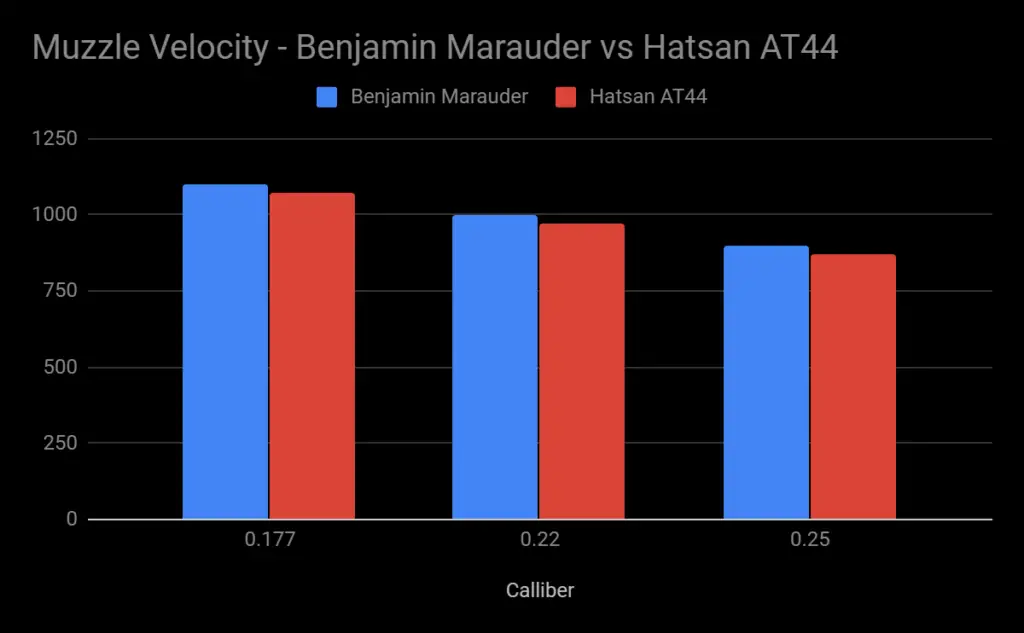
Benjamin Marauder and Hatsan AT44

The Legendary Jim Chapman (American Air gun Hunter) did a head-to-head review between Benjamin Marauder and Hatsan BT65 here:

Benjamin Marauder vs Diana Outlaw
Benjamin Marauder vs Diana Outlaw
SpecificationsBenjamin MarauderDiana Outlaw
Caliber.177.177
Max velocity1100 fps1000 fps
Overall Length42.8”41”
Shot capacity1013
Front sightNoneScope 3-9×40
Rear SightNoneNone
Scopeable11mm dovetail11 mm dovetail optics rail
ButtplateSoft rubber recoil padSoft Rubber
ActionBolt actionSide lever
SafetyManualManual
PowerplantPre-charged pneumaticPre-charged pneumatic
Max shots per fill3213
Weight7.3 lbs6.6 lbs
Cylinder size215 cc210 cc
ShroudedYesYes
StockSyntheticWalnut-stained German beech
GripAmbidextrousAmbidextrous
ColorBlackBrown stock, Black barrel

In terms of weight, Diana Outlaw is lighter than Benjamin Marauder by about 0.7 lbs.

Diana Outlaw offers you fewer shots per fill (13) than Benjamin Marauder (32).

This is despite the fact that Diana Outlaw has a cylinder with slightly less capacity than that of Benjamin Marauder – 210 vs 215 cc.

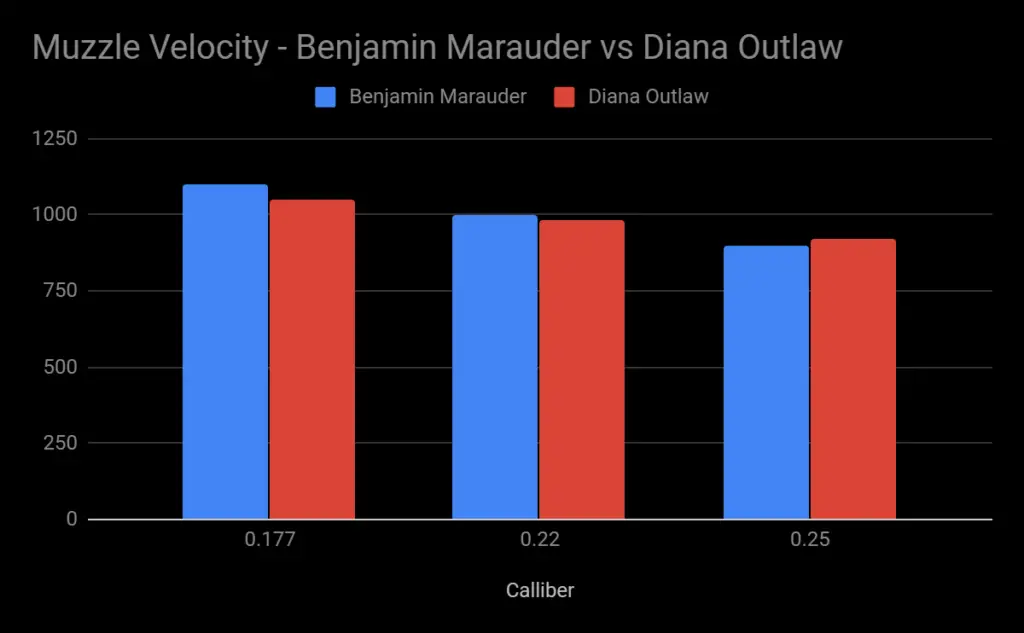
For the .177 caliber, Benjamin Marauder exhibits a higher muzzle velocity (1100 fps) than Diana Outlaw (1000 fps).

While Benjamin Marauder operates on a bolt action, Diana Outlaw operates on Side lever action.

Below is a comparison of the maximum muzzle velocities for the different models of Benjamin Marauder and Diana Outlaw:
muzzle velocities - Benjamin Marauder vs Diana Outlaw

Benjamin Marauder vs Gamo Urban

Benjamin Marauder vs Gamo Urban
SpecificationsBenjamin MarauderGamo Urban
Caliber.177.22
Max velocity1100 fps800 fps
Loudness2-low-medium3-medium
Overall Length42.8”42.0”
Shot capacity1010
Barrel RifledRifled
Front sightNoneNone
Rear SightNoneNone
Scopeable11mm dovetail11 mm dovetail
ButtplateSoft rubber recoil padSoft rubber recoil pad
Trigger Pull1.5 lbs3.0 lbs
ActionBolt actionBolt action
SafetyManualManual
PowerplantPre-charged pneumaticPre-charged pneumatic
FunctionRepeaterRepeater
Max shots per fill3230
Weight7.3 lbs6.7 lbs
Cylinder size215 cc105 cc
StockSyntheticSynthetic
GripAmbidextrousAmbidextrous
ColorBlackBlack

The trigger pull for the Gamo Urban (3.5 lbs) is double that of the Benjamin Marauder (1.5 lbs).

This tells you that you can have better control of the trigger when using the Gamo Urban.

Lighter triggers can still work but are not the preference of more experienced shooters.

Another significant difference is the cylinder size of the guns,

Where the Benjamin Marauder comes with a 215 cc cylinder while the Gamo Urban comes with a 105 cc cylinder.

The larger the cylinder the more shots per fill you expect.

The 0.6 lbs difference in weight between the two air rifles may not be that noticeable.

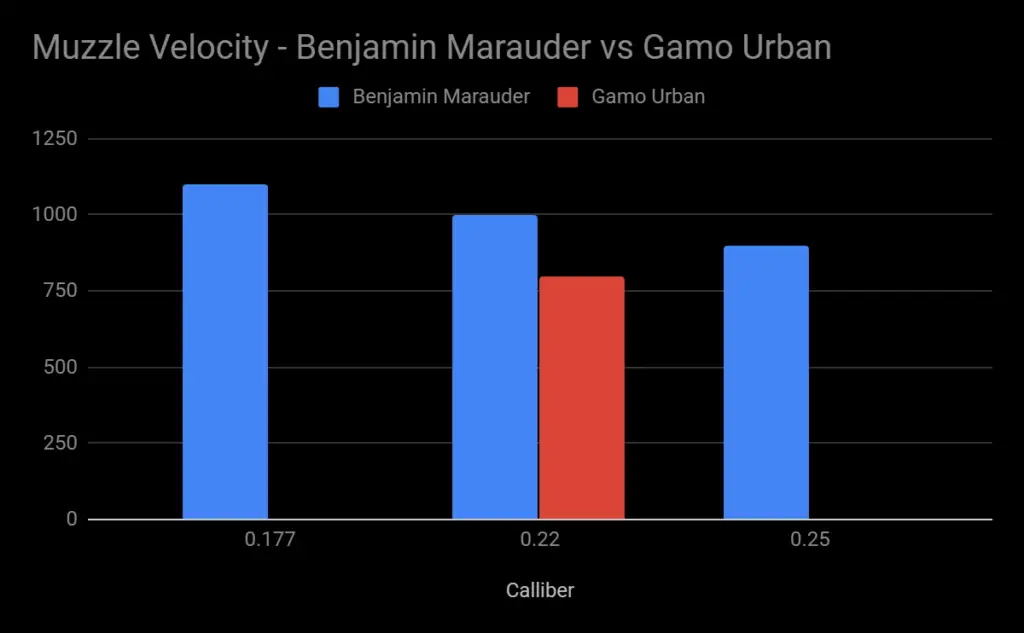
Below is a comparison of the maximum muzzle velocities for the different models of Benjamin Marauder and Gamo Urban:
Muzzle Velocity - Benjamin Marauder vs Gamo Urban

Benjamin Marauder vs Gamo Coyote

Benjamin Marauder vs Gamo Coyote
SpecificationsBenjamin MarauderGamo Coyote
Caliber.177.22
Max velocity1100 fps1000 fps
Loudness2-low-medium3-medium
Barrel Length20.0”24.5”
Overall Length42.8”42.9”
Shot capacity1010
Barrel RifledRifled
Front sightNoneNone
Rear SightNoneNone
Scopeable11mm dovetail11 mm dovetail
ButtplateSoft rubber recoil padVentilated rubber
ActionBolt actionBolt Action
SafetyManualManual
PowerplantPre-charged pneumaticPre-charged pneumatic
FunctionRepeaterRepeater
Max shots per fill3225
Cylinder size215 cc153 cc
ShroudedYesYes
StockSyntheticBeech
GripAmbidextrousAmbidextrous
ColorBlackBrown

With the Gamo Coyote, you expect about 25 shots per every fill of the 153cc cylinder.

On the other hand, the 215cc cylinder of the Benjamin marauder yields about 32 shots per fill.

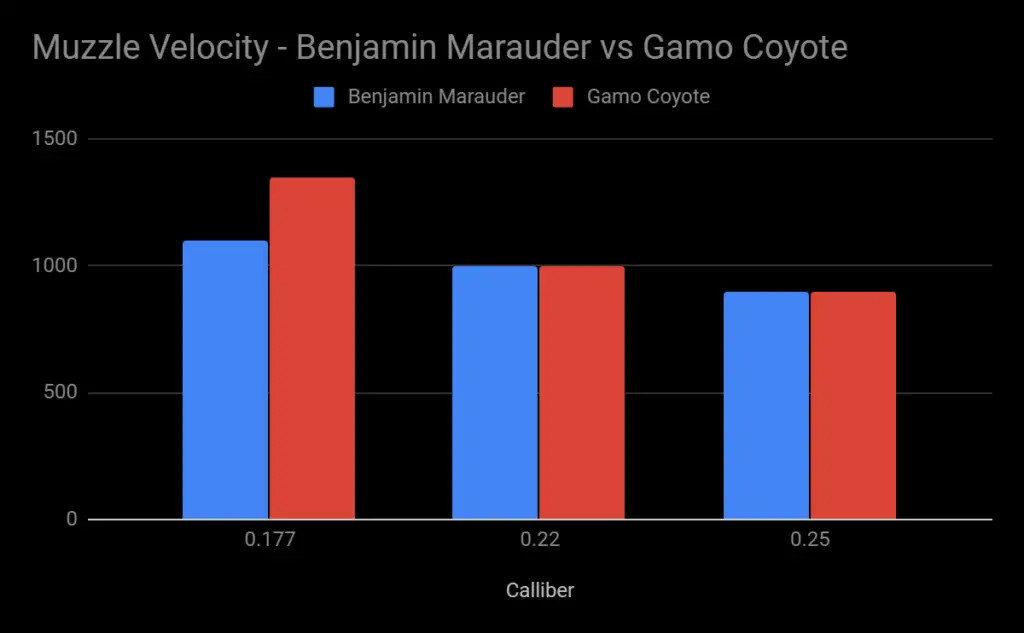
Below is a comparison of the maximum muzzle velocities for the different models of Benjamin Marauder and Gamo Coyote:
Muzzle Velocity - Benjamin Marauder vs Gamo Coyote

Keep in mind that you can use Benjamin Marauder for coyotes like Chip Hunnicutt (Marketing Manager at Crosman Corporation) did:

Benjamin Marauder vs Umarex Gauntlet
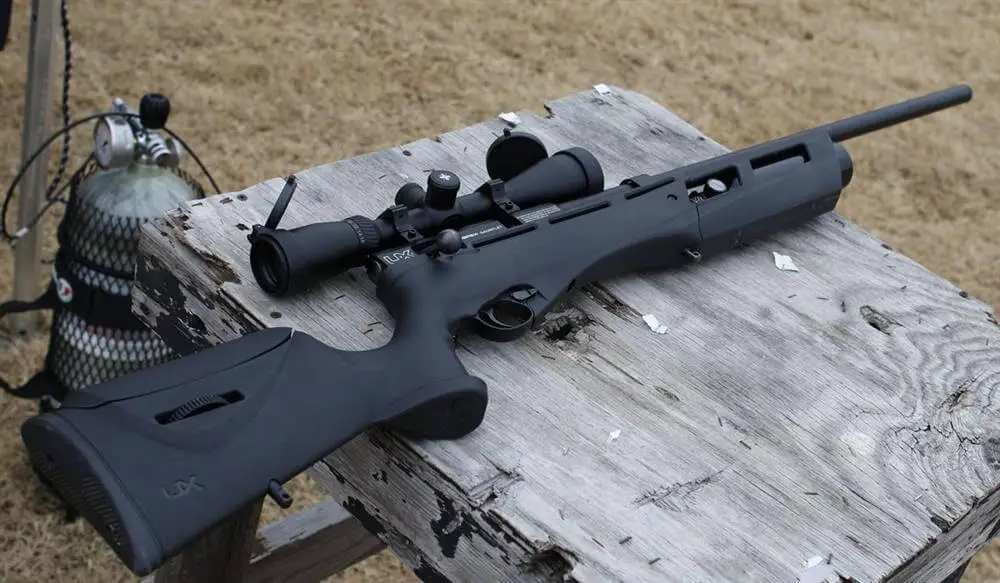
Benjamin Marauder vs Umarex Gauntlet
SpecificationsBenjamin MarauderUmarex Gauntlet
Caliber.177.177
Max velocity1100 fps1000 fps
Loudness2-low-medium3-medium
Barrel Length20.0”23.5”
Overall Length42.8”46.0”
Shot capacity1010
Barrel RifledRifled
Front sightNoneNone
Rear SightNoneNone
Scopeable11mm dovetail11 mm dovetail
ButtplateSoft rubber recoil padRubber
Trigger Pull1.5 lbs2.9 lbs
ActionBolt actionBolt action
SafetyManualManual
PowerplantPre-charged pneumaticPre-charged pneumatic
FunctionRepeaterRepeater
Max shots per fill3270
Weight7.3 lbs8.5 lbs
Cylinder size215 cc213 cc
ShroudedYesYes
StockSyntheticSynthetic
GripAmbidextrousAmbidextrous
ColorBlackBlack

The Umarex Gauntlet is slightly longer than the Benjamin Marauder, by about 4 inches.

For this reason, the Umarex Gauntlet is also heavier than Benjamin Marauder by about 1.2 lbs.

Let this guide your choice as you know how strong you are.

Other than that, the Umarex Gauntlet gives you a clean 70 shots per fill.

This lets you shoot and shoot and shoot before you think of refilling the gun again.

The 30 shots per fill for the Benjamin Marauder are however not that bad, bearing in mind other guns offer you only 8 shots per fill.

Below is a comparison of the maximum muzzle velocities for the different models of Benjamin Marauder and Umarex Gauntlet:
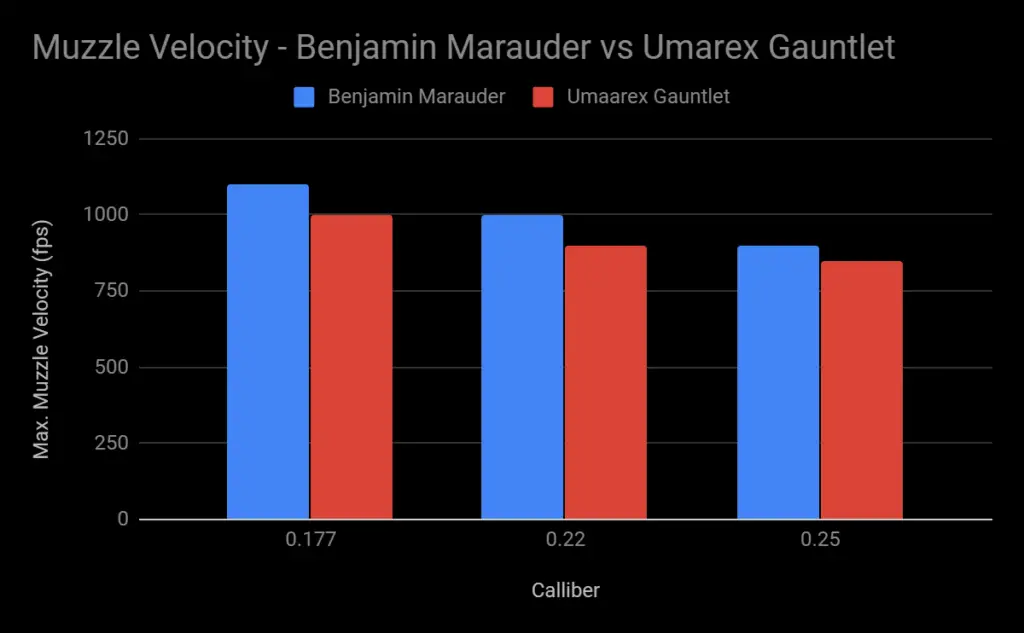
muzzle velocities - Benjamin Marauder vs Umarex Gauntlet

Benjamin Marauder vs Field and Target version of itself

SpecificationsBenjamin MarauderBenjamin Marauder Field and Target Rifle
Caliber.177.177
Max velocity1100 fps1000 fps
Loudness2-low-medium2-low-medium
Barrel Length20.0”20.0”
Overall Length42.8”43.0”
Shot capacity1010
Barrel RifledRifled
Front sightNoneNone
Rear SightNoneNone
Scopeable11mm dovetailWeaver/Picatinny
ButtplateSoft rubber recoil padSoft rubber recoil pad
ActionBolt actionBolt-action
SafetyManualManual
PowerplantPre-charged pneumaticPre-charged pneumatic
FunctionRepeaterRepeater
Max shots per fill3280
Cylinder size215 cc215 cc
ShroudedYesYes
StockSyntheticHardwood
GripAmbidextrousAmbidextrous
ColorBlackBrown

You will certainly fall for the Hardwood stock of the Benjamin Marauder Field and Target Rifle.

The hardwood stocks give you the confidence and pride of outdoor hunting more than synthetic stock will ever do.

But on the other hand, synthetics can be more durable given the effect of weather on wood.

Again, the Field and Target Version stays true to its name

By giving you an incredible 80 shots per each fill of the air cylinder, compared to the 32 shots per fill for the basic Benjamin Marauder.

Below is a comparison of the maximum muzzle velocities for the different models of Benjamin Marauder and Benjamin Marauder Field and Target Version:
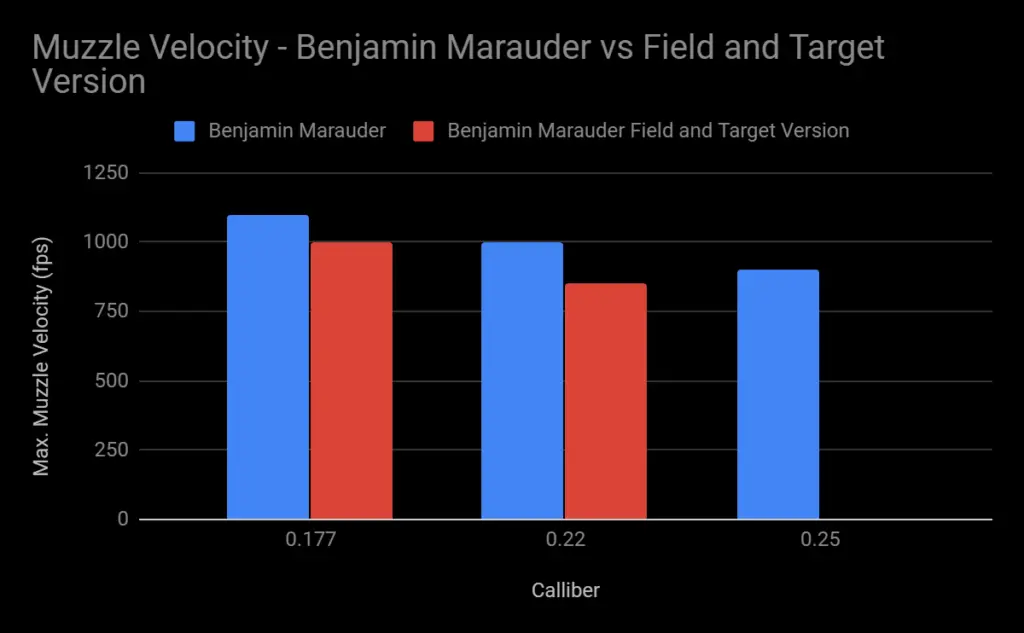
muzzle velocities - Benjamin Marauder Field vs field and target version of itself

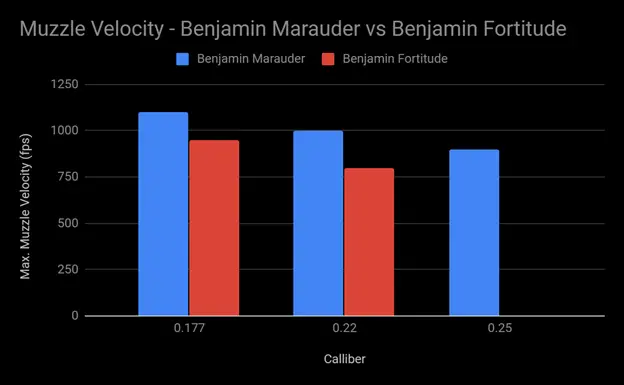
Benjamin Marauder vs Benjamin Fortitude
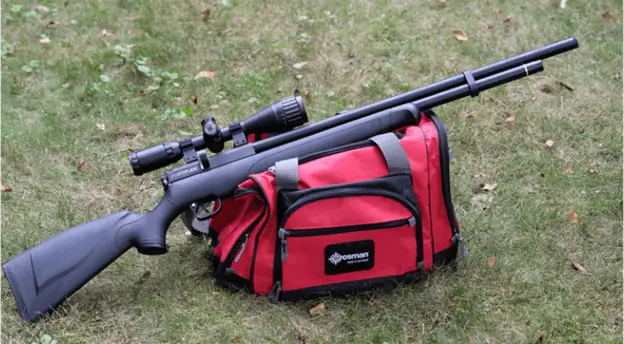
Benjamin Marauder vs Benjamin Fortitude
SpecificationsBenjamin MarauderBenjamin Fortitude
Caliber.177.177
Max velocity1100 fps950 fps
Loudness2-low-medium2-low-medium
Barrel Length20.0”23.31”
Overall Length42.8”42.6”
Shot capacity1010
Barrel RifledRifled
Front sightNoneNone
Rear SightNoneNone
Scopeable11mm dovetail11 mm dovetail
ButtplateSoft rubber recoil padPlastic
ActionBolt actionBolt action
SafetyManualManual
PowerplantPre-charged pneumaticPre-charged pneumatic
FunctionRepeaterRepeater
Max shots per fill3260
Weight7.3 lbs5.3 lbs
Cylinder size215 cc135 cc
ShroudedYesYes
StockSyntheticSynthetic
GripAmbidextrousAmbidextrous
ColorBlackBlack

The Benjamin Fortitude is way lighter than the Benjamin Marauder by a whole 2lbs.

Go for the Fortitude if you are young or of small stature.

The 60 shots per fill for the Fortitude is also something to wow you.

See below the performance comparison.

Below is a comparison of the maximum muzzle velocities for the different models of Benjamin Marauder and Benjamin Fortitude:
Conclusion
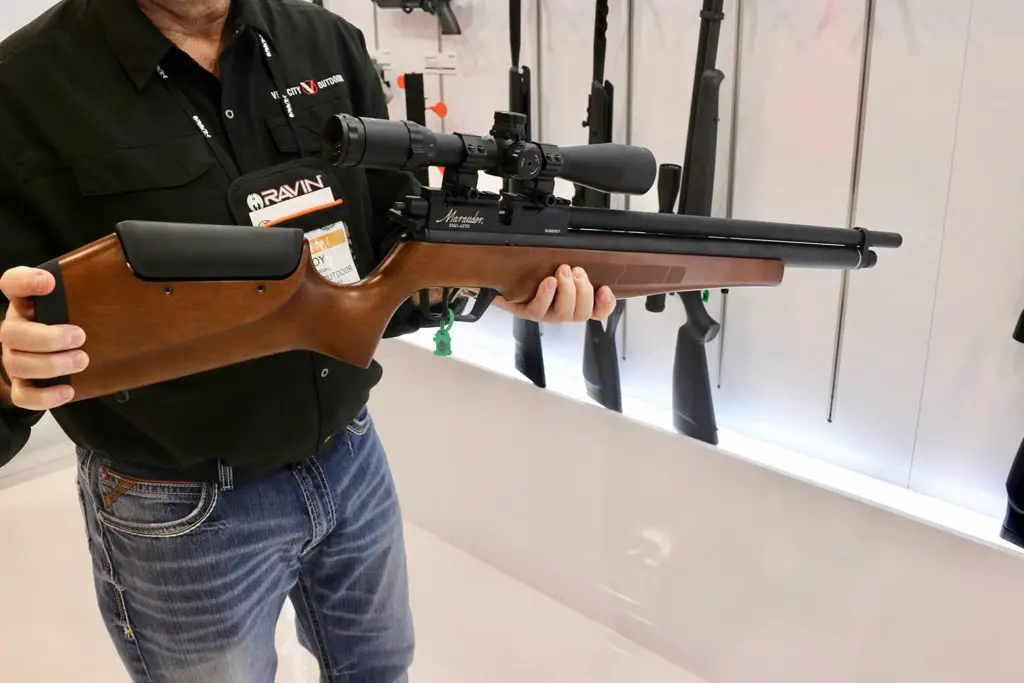
Benjamin marauder is very unlikely to disappoint you when it comes to performance.

The quietness with perfect accuracy and adjustable features makes it a shark in the sea of air rifles.

The price which is around $500, is unbeatable and the acceptance among the hunters shows clearly that it has earned the name rightfully.

If you are into synthetic, check out Benjamin Marauder Synthetic Stock (Gen 2) review here
Barrel Break-In: What Is It & How To Do It Right [Guide]

0

For whatever reason, the topic of barrel break-ins comes up in two main groups amongst gun owners…

First, the precision shooters. Second, the guys that skimped on quality parts.

Rock Island Armory VR80 Barrel

This topic pops up time and time again online either as a question on “how-to” or as a response to something not going right. I’m going to get on my soapbox for a minute and try to set the record straight on this a bit.

Is a break-in process necessary for your barrel? Let’s dive in, talk about it, and help you reach a conclusion!

Barrel Break-In: What Is It?

Before we tackle whether or not your barrel needs to be broken in, let’s discuss what a break-in is and what it is supposed to do.

Faxon Ion Pencil Barrel

When you get a new barrel, there are going to be some tiny imperfections that are inherent to the process of making it. Please take note, I said tiny, not obvious.

A quality-made barrel will have microscopic nicks, pockets, and other suck shallow “holes” in metal that are part of the machining process or the make-up of the metal used.

These may or may not be visible if borescoped. However, it shouldn’t be visible if you look down the barrel before assembly.

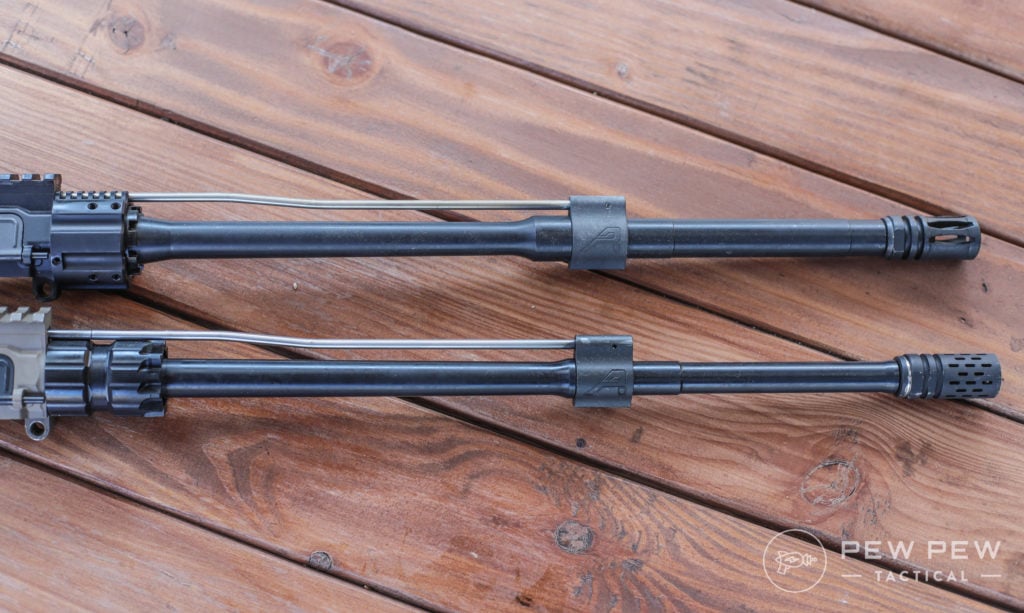
Aero Lightweight Barrel vs Regular

The break-in process in theory should help to fill in or fix any of these imperfections.

By shooting a round, then cleaning any corrosive agents out of the barrel before they can set in, you are smoothing things out and creating a more uniform surface.

The actual process of this can vary from shooter to shooter, but the idea is the same.

Shoot a shot, clean the corrosives out, allow the barrel to cool (depending on conditions). Shoot a shot, clean, and cool. Repeat.

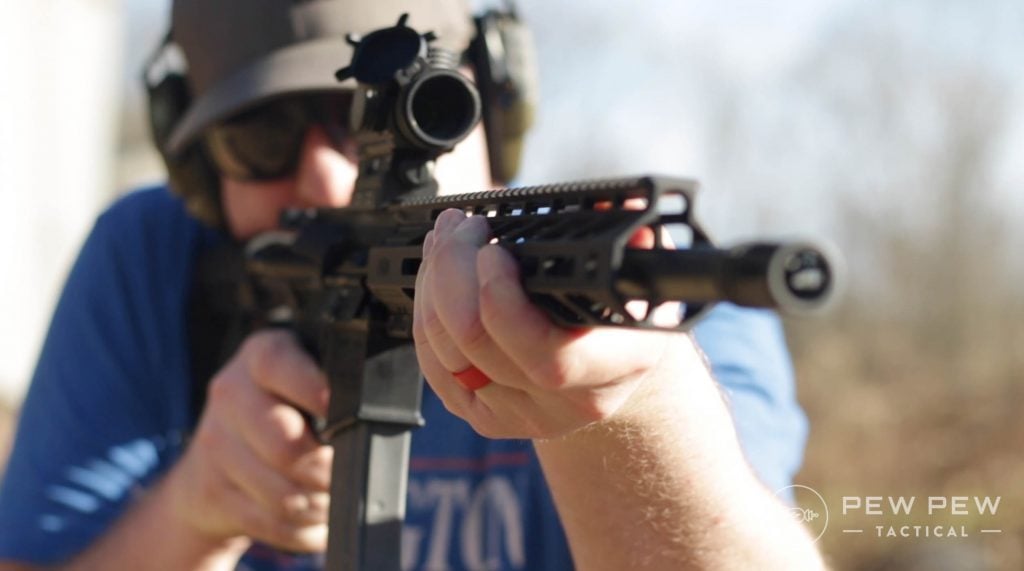
Faxon Firearms Ascent AR-15

This variation is also where things get a little wonky and can border on the mystical.

Plus, breaking in a barrel isn’t always necessary in the first place.

Precision Shooting

Breaking in a precision gun, be it bolt-action or semi-auto, is a necessary part of owning the gun.

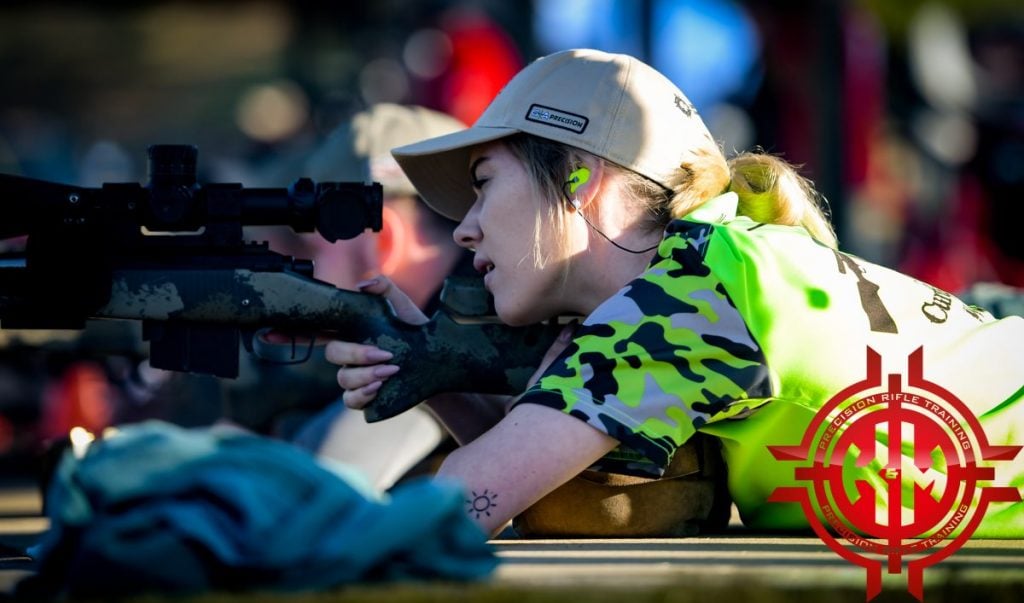
Gap Grind PRS
These guys know what’s up. (Photo: K&M Precision)

With precision shooting, eliminating any variables to control your shot placement is the primary focus.

To that goal, breaking-in can tighten up groups and reduce flyers to some degree. This is due to the “break-in shots” achieving a barrel free of anything that might impact the spin of the bullet.

Say, for example, that a tiny burr was riding up in the barrel and it hit the bullet just before exiting the muzzle. That is going to affect the spin, trajectory of the bullet, and ultimately change the point of impact.

My precision guys are some of the most superstitious, must-adhere-to-tradition members of the barrel break-in cult you will find.

broke meme
Gap Grind PRS

I live in Nevada, and it gets hot during the spring and summer months (consistently over 110 degrees Fahrenheit in Las Vegas). I know guys that refuse to shoot more than one shot every couple of days when breaking in a barrel to allow it to fully cool.

Why? That’s what the guy who taught them to shoot did, and the guy before him handed that down, and so on.

I am not saying that allowing your barrel to cool longer is a bad thing. I am asking what’s going to be achieved by waiting 48 hours that isn’t achieved in an hour?

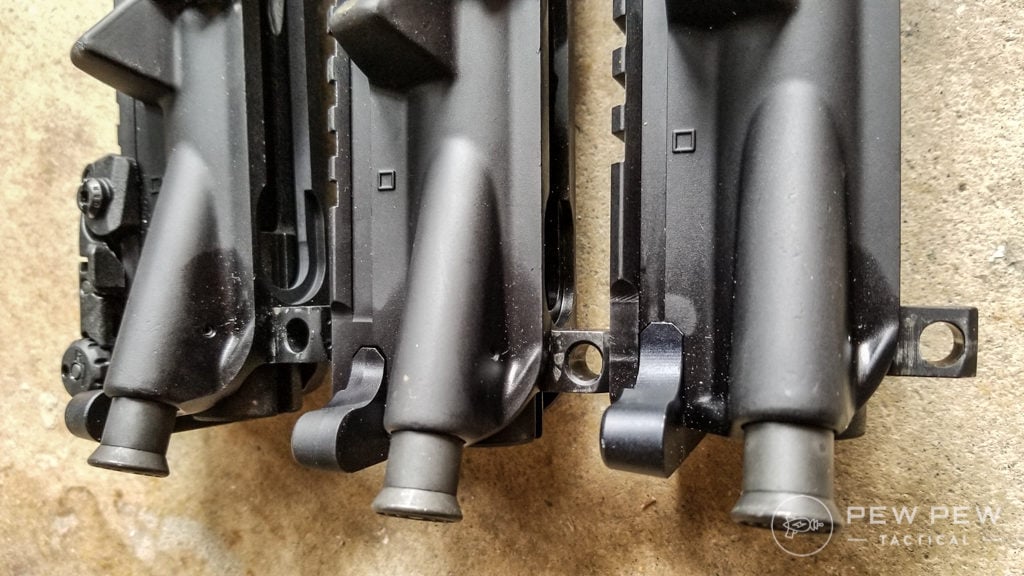
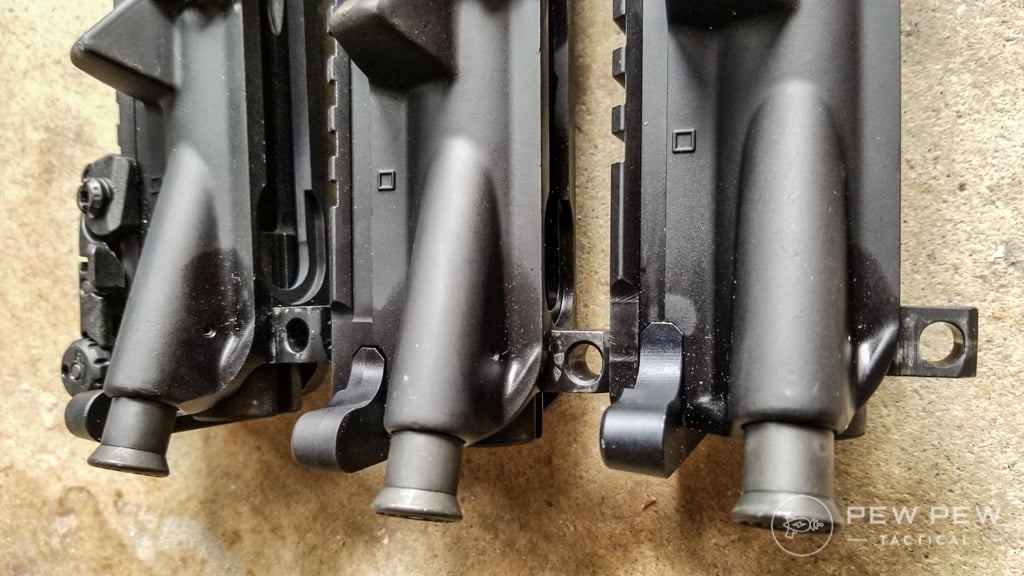
Small Machining Marks on Upper Receivers

Other examples are shooters that will only run their lucky number of patches down the bore, shooters that will only shoot on the hour, or any other number of things that supposedly work for them.

The Budget Boys

The other group I see consistently talking about barrel break-in are the guys that buy low-quality parts from manufacturers that use their customer base as a form of quality control.

CVA barrel mood ring
These guys spending on their guns.

This mostly seems to be guys in the AR-15 crowd that think the 0 MOA guarantee on their $79 barrel is going to deliver.

Companies that improperly machine barrels seem to draw in shooters that think saying, “I need to break in my barrel” will do anything. It won’t.

When rifling is improperly cut, when barrels are improperly crowned when gas ports are improperly sized, and when there are visible imperfections from the manufacturing process, no amount of “break-in” is going to fix the issue.

Your barrel is already broken.

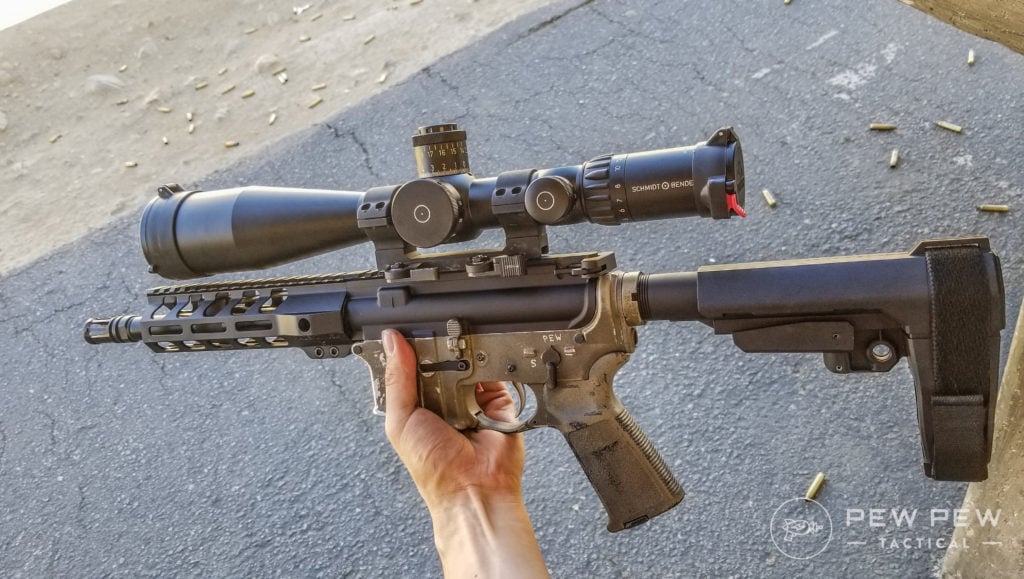
PSA 7.5 AR-15 Pistol with SB Tactical Brace
Small machining marks. These are upper receivers, but the concept is the same.

(Quick side note: machining leaves marks, there are times tool marks are ok and other times when it isn’t.)

There is a reason Mike Mihalski of Sons of Liberty emphasizes the barrel as, “the heart of the gun” in his armorer’s course.

Aero Precision M4E1 ATLAS Testing

Properly made AR-15 barrels can be upwards of $400 and that’s because proper manufacturing from good materials takes time, and labor isn’t cheap.

Unless you have built a PRS-style AR, a barrel break-in isn’t needed.

While it can certainly act in the role to an extent, the AR-15 was never intended to be a precision weapon. It was a gun designed for infantry to fight battles with.

Winchester 32 Piece Cleaning Kit
Don’t bother breaking in this guy

If your barrel is so poorly made that you cannot hit a man-sized target at a few hundred yards due to imperfections in the barrel, then get a new barrel.

How-To Break In a Barrel

Now that I’ve addressed what and who, I may as well tackle the how.

I will discuss the method of barrel break-in I use for my precision guns — bolt or PRS-style ARs.

This method was passed on to me by Ryan Furman.

Crimson Trace RAD Max Range Shooting
Aero Precision M4E1 ATLAS Testing

The appeal of the process is that it is a no-nonsense, no-frills, get it done and get shooting approach to things.

This approach has helped me to break in barrels while at the same time developing hand loads. It’s not only a time-saver but will also save some life on your barrel.

First, you’ll need a few factory rounds to get on target.

11. Faxon Bantam Integrated Brake Barrel
Not that many

After that, I use whatever load I’m testing to try and find the nodes. (If you are unfamiliar with handloading this part may be a bit confusing).

Fire a shot, then give the barrel a swab with Bore Tech Eliminator.

The directions call for three to four patches soaked in Eliminator, then 10 to 15 passes with a tight-fitting nylon brush.

You then want to let the Eliminator soak for about five minutes. Push dry patches through until they come out clean, and you’re done.

Fire another shot, and repeat the process.

On days where the heat is excessive, I’ve found it necessary to set my gun in the shade with a fan (or in my car with the AC on high) to get the barrel to cool down without wasting time.

After 20 or so rounds, a thorough cleaning is in order with the normal procedure and equipment you use.

Barrel Break-In: What Is It & How To Do It Right [Guide]
Winchester 32 Piece Cleaning Kit

There you have it. No need to wait days, pray to the ballistic gods, or sacrifice a chicken for help.

Conclusion

Barrel break-ins have their time and place, but they have become convoluted in superstition and mystery.

Barrel Break-In: What Is It & How To Do It Right [Guide]

The process is straightforward when you strip away all the fluff. Fire a shot, clean some of the carbon and copper out, then repeat.

So, find a process that works for you and stick with it. If something isn’t working, figure out why and change it.

Barrel Break-In: What Is It & How To Do It Right [Guide]

Do you break in your barrels? Let us know below. Need to pick up an AR barrel? Check out our article on the Best AR-15 Barrels.

Everything You Ever Wanted to Know About Deer Poop

0

Man, that’s a big pile of buck crap right there.

I’ve heard it a dozen times. You’ve heard it too, or even said it. We all have. But the deer biologists in goggles and gloves who study deer poop for a living (and other, more glamorous things) say it’s actually pretty difficult to distinguish buck and doe droppings.

While the myth of the buck turd is mostly false (more on that momentarily), there are still plenty of things we can learn from deer scat.

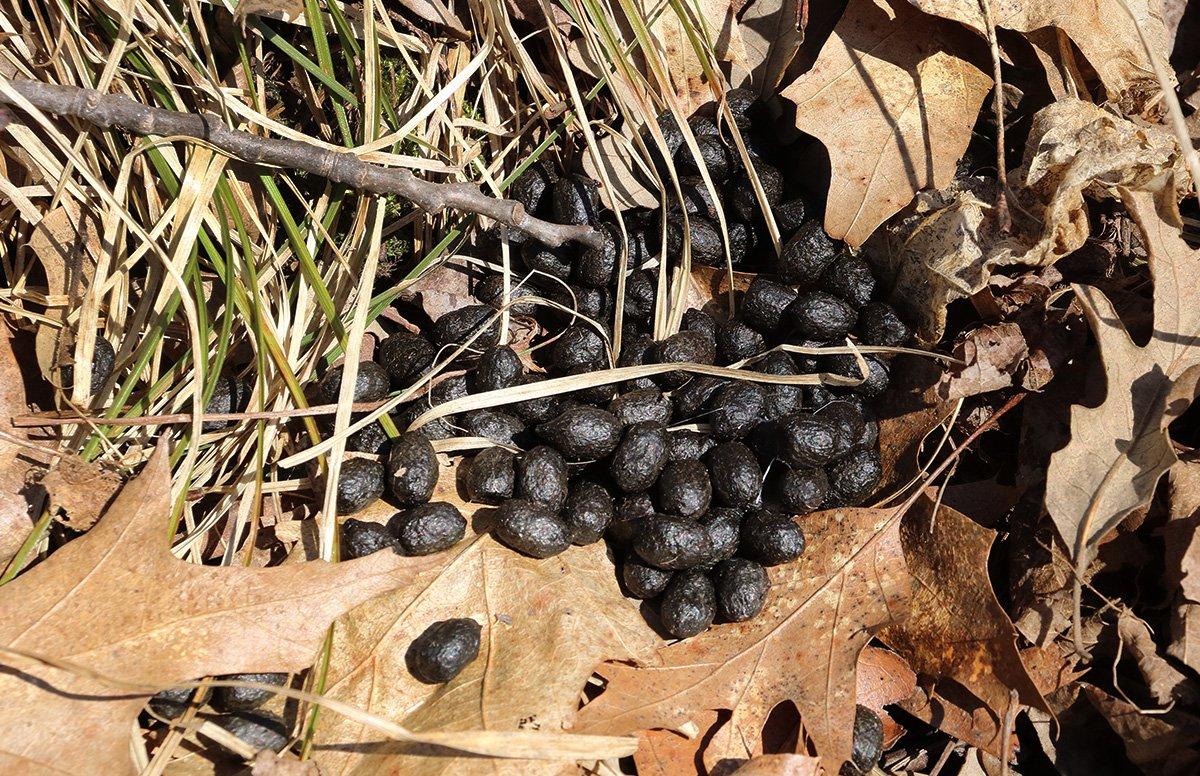
Deer dung is full of secrets. You can learn a lot by studying deer poop. (Shutterstock / Aaron J. Hill photo)

1. Fawns poop when does tell them to.

Since a major part of fawn survival hinges on scent reduction, they don’t poop where does hide them. Does will take fawns to neutral areas – well away from daytime hideouts – and let them nurse and poop all at once. Fawns can only defecate after their mothers stimulate them while nursing, according to Duane Diefenbach, wildlife ecology professor and leader of the PA Cooperative Fish and Wildlife Research Unit. Weird as it is, does often consume their fawns’ feces, too. This process reduces scent and helps protect the fawn from predators.

2. Adult deer are very regular.

During fall and winter, most whitetails empty their bowels about 10 to 15 times per day. In spring and summer, this frequency spikes, fluctuating between 20 and 30 times. Interestingly, their bowel movements are so predictable that many wildlife agencies often guestimate deer population densities based on the number of poop piles they discover within a designated area. You can do the same: Hunters who take trail camera surveys seriously can use this method to verify population densities.

3. It’s nearly impossible to distinguish between buck and doe poop.

The commonly held belief is that large, tubular excrements belong to bucks, and small, pelleted piles belong to does. But according to Buckmasters, research shows that it’s virtually impossible for hunters to distinguish between buck and doe poop. Both sexes produce both scat shapes. When comparing tubular scat, bucks can have longer stool pieces, but that’s not always true. The bottom line? Unless you see the deer that dropped it, scat shape alone won’t indicate a deer’s sex.

4. Bucks sometimes drop more pellets, though.

Male deer can, however, produce more pellets than female deer. When comparing pelleted scat, a buck drops 70 to 80 per session on average, while does generally produce 50 to 60. Seriously though – what hunter is going to stop and count? If you’re after a mega-giant though, maybe you should bring a latex glove and a No. 2 pencil, and count to 80.

5. Color and moisture suggest how long the scat has been there.

The coloration and moisture level of a pile helps determine the age of deer poop. Droppings that are still dark, shiny and wet are likely less than 12 hours old. If there’s no moisture and droppings look lighter in color, there’s a good chance the scat is at least 24 hours old, if not several days. Droppings become more fibrous over time, and scat that’s cracked, crusty or broken is usually at least a week old.

6. Digging through poo gives clues.

Learn what deer are eating, and when, by examining scat. A forage’s water content will dictate its composition and shape. Mounds of firm, pelleted dung suggests woody browse (buds, leaves, twigs), grain (corn, oats, soybeans) and hard mast (acorns and nuts). Long, singular, squishier poop indicates recent consumption of broadleaf plants, forbs, grasses, and soft mast (apples, peaches, pears, persimmons, plums, etc.).

7. Handle deer droppings with care.

Prions – malformed proteins shed by CWD-positive deer – are commonly found in deer urine, feces and saliva. While it’s currently believed that humans can’t contract this disease, who really wants to become a lab rat? If you’re going digging, carry gloves or use a stick.

8. Concentration indicates high-traffic areas.

The best lesson you can learn from deer poop is that a lot of it indicates a good hunting spot. Hunters who stumble on extensive piles of poop should take note. Often, excessive scat is located near preferred food sources, water sources, and bedding areas. If you find a bedding area that’s full of it, go mobile and get as tight as you dare on that deer.

Shop Realtree Gear

The Best Shot Size and Chokes for Bobwhite Quail

0

Take a look at selecting shot size and choke size for bobwhite quail hunting

Nowadays, I use a 20-gauge, over-under Beretta 686 Silver Pigeon choked in skeet and modified, respectively. When I walk out into the uplands with a 30-inch barrel, I have a bad habit of slinging my gun over my shoulder a little too confidently. Why? Because the gun is a nice piece and I can trust that my No. 6 shot Kent Cartridge loads will consistently drop the explosive, bobwhite quail.

And, if you really want to be picky about it, I prefer to shoot my game birds with steel shot. I personally just don’t want lead in my meat, but that part is up to you.

If you think about the flight and escape habits of quail in their natural habitat, often they will sit tight in cover and hold for a pointing dog—assuming you have a pointing breed. Outside of that, if you’re anything like me, you’ve got a flushing retriever and you keep your actions closed and barrels loaded. There’s no time for tea, but I digress. Quail will flush fairly close and will often provide a reasonable shot if you take a little time to breathe before the shot.

What shot size is best for bobwhite quail?

If Prince Bob gives the pup a half-a-time-a-day, you should have within a 20 to 40 yard shot on a flushing bird. If you want more options, you’ve got the choice of No. 8 as well. I often skip over No. 7 1/2 simply because every time I shoot them birds never seem to fall dead on. My dog tends to do a little more work with the No. 7 1/2 shot as birds—yes, little 6-ounce bobwhites—seem to run off.

I think there may be some kind of jinx with me and No. 7 1/2, but, regardless, I do not recommend them for quail. Blame it on my Southern superstition if it pleases you, but regardless, you won’t catch me shooting them anymore.

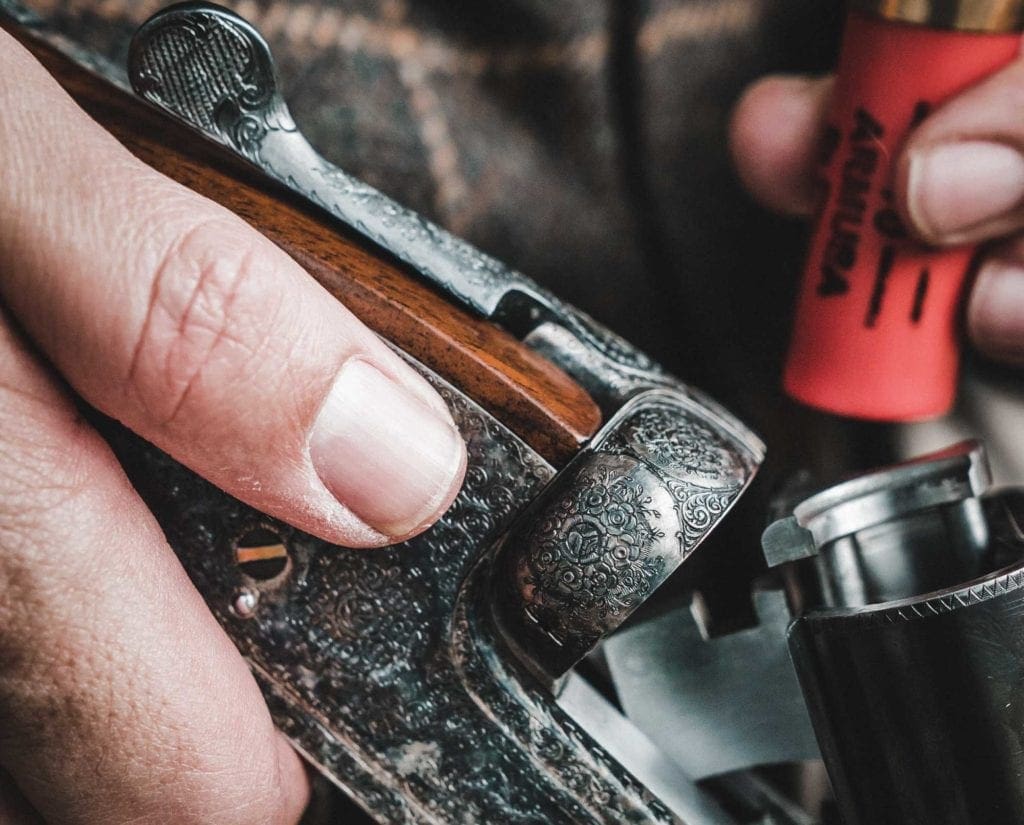
A quail hunter loading shotgun shells into his gun.

What gauge is best for bobwhite quail?

It is my thought that if you’re reading this you have some kind of appreciation for the finer things in life. Why? Because you are chasing Mr. Bob. You’ve got some kind of fine shooting dog who’s working the heavy cover, thorns, and thickets that house and host our quarry. In addition to that pretty dog, you also likely have a nice-looking over-under Beretta like mine or your Grandaddy’s Winchester Model 12 pump gun.

At a time, Grandaddy was a quail specialist and now you’re in his footsteps. Either way, bobwhite quail hunting requires a bit of class and nostalgia, so shoot a gun that means something to you. The bird demands that much respect; the dog demands that much respect. Further, the habitat and landscape demand that footsteps be left by dog and man, birds are successfully retrieved in full, and memories are made along the way.

Wild Game Recipes: Spicy Brandy Cranberry Glazed Quail

I’ve shot quail with 12- through 28-gauge shotguns and even attempted with a 98-year-old .410. That didn’t last long due to more wasted gun power than shot birds. My choice gauges for wild bobwhite quail are primarily 20-gauges and secondarily, the classic 16-gauge side-by-side. Ammunition for 20-gauge shotguns is typically more readily available, especially in a pinch, though I would highly recommend soft-shooting 16-gauge RST shells if you prefer to run that gauge. For an older shotgun especially, the RST shells are a much lighter shooting load than most others and will put a little less wear and tear on Grandaddy’s old gun.

Concluding thoughts about hunting bobwhite quail

For sake of length, I will conclude because I’ve got a knack for talking shotguns to great length.

Obviously, if you have not noticed, I am a bit biased towards No. 6 loads because they are a size that’s been proven time and again. In the world of consumerism, many manufacturers are constantly producing loads for one reason or another. To this day I still do not understand the need for 3 1/2-inch loads and one definitely does not need them for a 6-ounce bird—2 3/4 inch shells will suffice. Further, quail are fairly fragile birds, so shooting No. 6 or No. 8 shot has been proven effective.

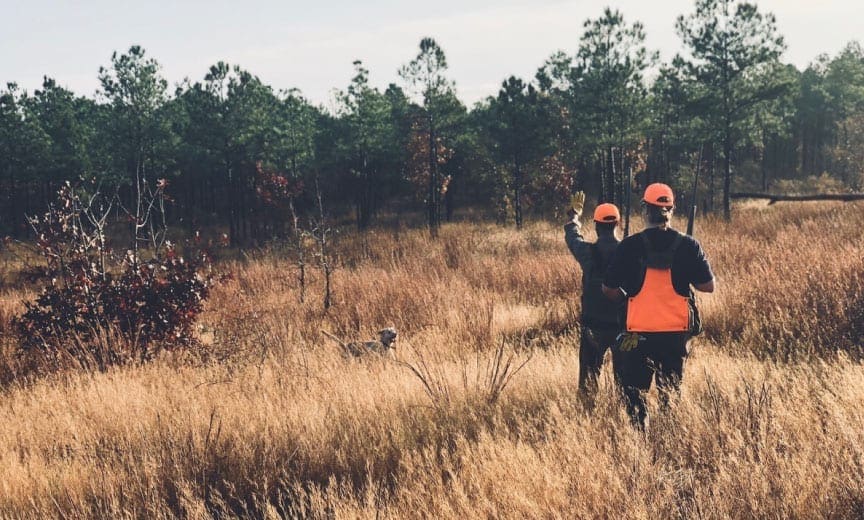
Two quail hunters and bird dog our hunting quail.
Author Durrell Smith Quail Hunting – Photo by Josh Same

Much of a man’s quail shooting ineptitude comes not from selecting the wrong shot size, but from the hunter’s irreverence to the ethics of hunting. Ethical hunting is inclusive of finding and retrieving downed game, with or without a dog.

For many like myself, hunting with a dog is essential for not just the experience of following a dog through the woods, but also to increase my chances of finding downed game. Shooting No. 6 for me has additionally made retrieving shot birds significantly easier as seldom do I find crippled birds or runners.

Configuring your shot size, pattern, choke and barrel length as well as studying the habits of the birds themselves all come together to make a complete and successful hunting experience. Hunting ethically is understanding all aspects of your shotgun including the best shot size and gauge, and with respect to Bob, I would rather chase game birds in a dignified and ethical manner. That means shooting No. 6 shot (preferably steel) through any gauge, .410 through 12, choosing a skeet and/or modified choke configuration, as well as bringing along an enthusiastic pup that will find and retrieve your game.

How Public Land Bobwhite Quail Shift Patterns

Understanding Bobwhite Quail Behavior

Plantation Quail – A Southern Bobwhite Film

How Native Prairies Can Help Save Bobwhite Quail

Secrets of the Perfect Coyote Bait Pile

0

The perfect coyote bait pile is a marvelous tool for coyote hunters. Set up correctly, a coyote bait pile will lure in and hold coyotes exactly where you want them, convince them to consume the bait, and give you all the time you need to take your shot.

Coyote bait pile essentials: Bait, location, and time.

Your success baiting coyotes will depend on using the right bait in the right location and patiently waiting for the magic to happen.

Want to know when coyotes are the most active and most likely to show up at your bait pile or respond to your calls? Check out my article.

Looking for a great book on how to call in a coyote? Check out Andrew Lewand’s book below. This book answers the most frequently asked question on the internet… What sounds are working right now? No matter which brand of call you use, the sequences in each chapter with boost your success rate!

The right bait.

Honestly, nothing beats a deer carcass. It’s what coyotes expect to find dead of natural causes (or gunshot wounds) in the woods and fields. Indeed, it’s often discovered split open and mangled alongside the roadway. They consume it regularly and are naturally drawn to the familiar odor of its decay.

There may be other baits, and they may work, but deer meat is the superior choice.

Coyote bait pile
Photo Credit: Shutterstock/G Allen Penton

The perfect location.

Simply put, a coyote bait pile tucked just inside a woodline that provides the coyote with a sense of cover but is actually a shooting lane with you on the other end is the perfect location.

We’ll discuss how to set up this location later, but you can get a basic idea from this image.

That’s far enough away to help you beat a coyote’s amazing senses.

All the time it needs.

The last piece of your perfect coyote bait pile is time. Time for the pile to ripen. Time for the pile to be found.

During the days and weeks after you have placed your bait, you will be sorely tested. Doubt will creep in and disturb your resolve. “Did I use enough meat?” “Is the pile too well hidden?”

Make a solemn vow as you walk away from your perfectly baited and placed pile. A vow to never, for any reason, disturb it. It’s a test of faith in yourself and the quality of the work you have done.

Avoid the temptation to commit the only unforgivable sin of baiting coyotes: Spilling fresh human scent on it.

Getting deer for your coyote bait pile.

There are three ways to get deer for your coyote bait pile. Here they are arranged in order of easiest to hardest.

From deer hunters.

If you hunt deer, you know a lot of flesh doesn’t get packed into freezer bags. So this season, let your deer hunting friends know you’d love to take home their scraps.

You can make a suitable sized coyote bait pile from a single butchered deer using the Baitsicle Method discussed later.

Deer processors.

Deer cutters, especially those who butcher your deer, are often more than willing to let you take as much of their waste as you can carry.

Brings some buckets and heavy duty contractor bags with you.

Roadkill.

I hesitate even to mention this method of collecting bait. However, because it is legal in some states, I’ll take the time to layout the easiest way to secure enough carrion from roadkill, but check your local laws and be very damn careful. A bad night could end with you being roadkill.

First of all, you only need one deer to make a coyote bait pile. You do not need 300 pounds, no matter what someone tells you. 50-75 pounds is perfect and will last the whole season.

Secondly, a doe in the back of your truck brings a lot less attention than a buck with a big rack in the back of your vehicle—police attention, that is. The law may be on your side, but you still could get arrested by a suspicious officer and have to spend money defending yourself. A dead doe is a tragedy. A dead eight-pointer is a trophy. Consider yourself warned.

Roadkill tips.

Collecting roadkill is a significant job. You have to drive around sparsely traveled back roads (never attempt recovery on major routes), racking up quite a few miles before you’ll come across anything of value. Once you spot a possible candidate, I suggest you consider a few points before proceeding.

Is it in a safe location for collection after dark? At night, you’ll be able to collect when the traffic flow is at its lowest point. You will also be able to hear vehicles approaching and see their oncoming headlights. Night-time recoveries draw less attention from the general public, too. Think fewer 911 calls. After dark, you’ll have fewer flies to deal with, and you won’t have to drive off a murder of crows. However, a flashlight is required so you can be assured Mr. Bear isn’t already seated at the Roadside Cafe himself.

Is the carcass relatively intact? If the stomach is burst, the deer severely mangled or already badly rotted, take a hard pass on it. Lifting a dead deer into the back of a truck by yourself is a nightmare, to begin with. Don’t add to your impending misery by trying to handle anything dead for too long.

Bring rain gear. Never, ever recover roadkill in anything you’ll want to wear again. There’s just no way to do it without getting bloody and stinky. So bring a rain suit and gloves with you.

A bit of rope will ease (some) of your pain. Without a rope, your best bet is to grab the head, sit on your tailgate, and use your legs to push yourself backward as you lift the deer over the back of the truck. You’ll find another way to get deer for your bait pile next year.

If you have rope, you can tie up the head, stand on your tailgate, and lift and pull the head up and over the end of the truck. When you can grab the legs, you should be able to walk backward and pull the rest of the deer into the truck.

Types of coyote bait piles.

Baitsicles

The baitsicle is my favorite coyote bait pile for four reasons; easy to transport, requires the least amount of baiting material, draws repeated visits, and can be placed in nearly every type of location.

How to make a baitsicle.

You’ll need one five-gallon pail, 10 feet of rope, enough bloody deer scraps to fill 75% of the bucket, a hammer (to break the bucket if the bait sticks to it), and access to water.

Start by placing a few inches of meat on the bottom of the pail. Now, coil at least a foot-long section of rope on top of the flesh and cover the coil with more scraps. Next, slowly add water, making sure the meat holds the rope down. Once your bucket is about half full, you can add the rest of your bait, top off the water, and allow it to freeze.

Pro tip: Bloody is best. The pinker your water, the better. For an example of how bloody; check out these photos of how coyote trappers make their baitsicles.

Correctly done, you should have about 6 feet of leftover rope. You will use this to drag your baitsicle and anchor it in the field.

The baitsicle will weigh over 50 lbs, but frozen, it should be easy to pull over snow and rugged enough to survive being dragged over open terrain.

During each thaw and refreeze, more bait will be exposed for the coyotes to lick and gnaw on, providing each coyote with just enough to encourage repeated visits.

Pro tip: Drag your baitsicle around. You’ll leave a scent trail everywhere you go that leads predators directly to your bait.

Wait, do you live where the eastern coyote roams? Then you need to check out my article on Killing Giants.

Hay bales or compost piles in open fields.

A compost pile in an open area is an insect and rodent luxury apartment. Over time, it will attract more and more predators like foxes and coyotes.

You can use a hay bale to create a min-compost pile for less than $20. So, don’t worry if you don’t own a farm or have access to large amounts of compost.

To begin, I’ll assume you are both reading this before the summer has ended, and you want to make a one-of-a-kind coyote bait pile with live rodents that even squeaks for you.

Your first step is picking up one or more 50 lbs compressed blocks of hay from a local supply store. Make sure you get hay, not straw. Mice and voles (your real coyote bait) love to nest in and eat hay.

Once you have selected a place to set your hay coyote bait pile, chop a hole about half the size of the bale and 6-10 inches deep.

Note: The smell of freshly disturbed earth often draws the attention of foxes and predators, so be prepared to hunt this spot shortly.

Fill the hole with corn and flip the bale over on top of it. Over time, the corn will be found by rodents, who will consume it and use the hay bale for nesting in and also feast on. Their movements, scent, and occasional squeaks will act as a living coyote bait pile that also draws in plenty of foxes.

Compost piles for coyote baiting.

A compost pile that features pine shavings or other bedding materials taken from chicken coops and duck houses will often contain an ungathered egg and uneaten food pellets. This waste material will quickly draw insects and other scavengers. Fox and coyote are never far behind. This type of compost pile is a predator magnet, and therefore, a hazard if kept too close to livestock. I’ve seen predators visit my compost pile several times a week all year long.

Using cages for baiting coyotes.

Dead chickens, squirrels, and other small mammals placed in cages and secured to the site create mini coyote bait piles. Leave them uncovered, and you’ll be surprised how many critters stop by to check out the bait.

Pro tip: Hay bale, compost, and cage coyote bait piles work best in open, mowed fields that make good habitat for rodents.

Want to know what calls coyotes and foxes respond to the most? Is there a magic sequence other hunters use to bag coyotes? Read my article on calls here to find out the best calls.

The best location for a coyote bait pile.

The absolute best place for a coyote bait pile is just inside a woodline.

Set the pile 5-10 yards inside the woods and about 100 yards from your shooting location. You want your bait far enough in to calm the coyotes and give them a sense of cover. However, don’t go too far, as you’ll double or triple the amount of site preparation you’ll need to create a clear shooting lane.

Looking at the bait pile from your shooting stand, you should have just wide enough of a window to see any coyotes when they are within 25 feet from either side of the pile—this is also the perfect range for night shooting using the best thermal scope for new predator hunters.

Set the bait inside the middle of your shooting window and secure it to prevent movement by the coyotes. You can use a sapling but avoid wide tree trunks that could obstruct your view of the target or interfere with the path of your shot.

And don’t worry about ropes, tie-down stakes, or other exposed equipment used to secure the bait—it will lose any scent and be ignored by curious coyotes.

If you can’t secure your bait to an object, consider using an earth anchor.

Pro tip: Deerskins serve multiple purposes, so save them and wrap your pile in them. The skins help convince the coyotes, and the frozen flesh helps protect the bait pile.

Add a camera to your coyote bait pile.

A cellular game camera will let you know when your pile is being visited and, more importantly, by whom. While it can be used as a real-time burglar alarm or help you pattern the visits being made, it does have a few easily fixable drawbacks.

  1. It can spook coyotes. Even the faintest glow of the shutter’s IR light or softest click can make a coyote bolt. Most won’t go more than a few yards away before returning, but if it happens every time they near the pile, it could drive them off permanently. The fix here? Set the timer to allow no more than one photo every 5 minutes.
  2. The cold can sap cheap batteries. It cant be said too often; set your pile and never go back to it except to pick up a dead coyote. Use high-quality lithium batteries where appropriate.
  3. Squirrels, birds, and even mice will set off the camera too. You usually get a package deal with cellular cameras. These deals can give you 100 to 200 free photos a month. If you are not careful, they will all be daytime photos of crows and nighttime images of mice racing around your set. To avoid this, reduce the camera’s sensitivity. Going from high sensitivity to medium setting should help, but even at the lowest setting will pick up coyotes and foxes.
  4. Your camera will need as clear and unobstructed shot. Set it at the right height and make sure any branches, brush, or twigs are cleared out of the way. Also, make sure to remove anything the wind may move around—a single twig can send many false alarms to your phone.

Where is the absolute best place to shoot a coyote? Don’t know? Then read this article on where to place your round to put a coyote down.

Scatter free meals to add confidence when coyote baiting.

No matter which coyote bait pile method you use, scattering some morsels around the pile will help make the coyote feel more confident when reaching the actual pile.

Deer scraps are fine, but confidence strips that include “fishy” treats, like shrimp, add a tempting scent that has often set my bait piles on fire, luring predators in much faster than deer-only sets. If you are afraid that coyotes won’t come to your bait pile because they’ve been shot at them before, read my, The Truth About Educated Coyotes article.

If your coyote bait will sitting in an area with heavy snow, I recommend using a coyote lure you can smear on tree limbs and other items that won’t get buried under the snow and ice.

Dunlap’s Hellfire Long Call Smear is skunk in a bottle. It works every season for me, even though I’ve never even seen a skunk where I hunt. Great stuff!

Now, stay away from you coyote bait pile.

Once your bait and camera are set, don’t go near it again, except to recover a downed animal. Let it quietly sit for as long as it takes to start attracting coyotes. Look, it may be two weeks before you see activity, but worrying you haven’t set the pile upright and trying to rework it or add bait to it will only splash new doses of your scent all over the place. Just be patient. If there are coyotes around, they will find your pile.

There is only one other reason to get anywhere near your coyote bait pile, heavy snow. While the stench always finds a way to work itself up and out of even the heaviest snowfalls, you can reduce the time it takes for coyotes to find it.

It’s time for a short snowmobile ride! From the road closest to your pile, start near one end of the field and use your snowmobile to create a nice curvy path. Then, hug the edge of the woodline and cut back to the road at the opposite end of the field. Plowed roads get heavy predator travel in rural areas. But, if they find an easy way to scout inside a field quickly, they will take it.

If you don’t have a sled, snowshoes will work just as well, especially after the deer have helped break the trail even more for you.

Interested in a quick course on how to track a wounded coyote? Read this article on how to track a wounded predator.

Who is visiting your coyote bail pile?

There are two types of coyotes you’ll catch visiting your bait pile; residents and transients.

Residents consider the location your placed your bait pile in to be their territory. They’ll visit it more than once. They will make their approach less cautiously. Their visits will last longer, they’ll eat more, and they will stay closer to the pile while resting.

Transients are coyotes in search of their territory. Transients get treated and act like trespassers. They will be very cautious during each approach. Their heads will be on swivels, and they will be quick to grab a bite and retreat a pace before consuming what they caught. The single click of a game camera can drive them away, perhaps for good.

If you set the pile up to remove unwanted local coyotes, there’s no need to worry you will attract coyotes from other more distant areas.

https://www.mossyoak.com/our-obsession/blogs/deer/deer-carcass-disposal-how-why-and-why-not

Calling near a coyote bait pile can increase your success.

Calling near your coyote bait pile is a great idea. Even if your stand is empty, there’s a good chance you’ll catch a late-arriving coyote. Coyotes that finally show up to investigate the source of your calls will poke around and possibly discover your bait pile.

If you are targeting hungry coyotes, check out https://thepredatorhunter.com/how-to-master-the-best-closed-reed-coyote-call/.

You can also call near bait that has already been found and partially consumed. A simple coyote vocalization may bring a resident coyote back to defend its food source in these situations.

A bit of effort, but nothing beats a perfect coyote bait pile.

A perfect coyote bait pile takes some scouting, planning, and waiting-but it yields unbelievable results. So start your planning today, and reap your harvest during the next coyote hunting season.

Improved Modified Chokes: The Unpopular Choke Size

0

What is an improved modified choke tube? Improved modified is a little known choke tube size but it does excel in some situations where common choke sizes just don’t cut it.

An improved modified choke is tighter than modified but more open than a light full choke. Improved modified choke tubes measure between .696″ and .705″ and are used for mid range waterfowl hunting. Chokes in improved modified sizes are marked by two notches.

In this guide, we’ll discuss why improved modified chokes are some of the least popular choke tubes, but they do serve a purpose when hunting waterfowl and fill a niche that other choke tubes can’t match. And if you want to see the leading improved modified choke tube for hunting, be sure to check out Carlson’s Long Range Cremator.

Improved_Modified_Chokes
Carlson’s Long Range Chokes are Improved Modified diameters.

What is an improved modified choke?

An improved modified choke is tighter than modified but more open than light full chokes according to the choke tube constriction chart. For a fixed choke 12 gauge, an improved modified choke measures 0.695” in diameter. The three types of modified choke tubes are improved modified, modified, and light modified. Improved modified is a tighter diameter than both modified and light modified.

For popular shotgun brands, the improved modified measures 0.696″ for Beretta and Benelli, 0.697″ for Browning, 0.705″ for Winchester, and 0.697″ for Remington. Choke tube markings indicate an improved modified choke tube with two notches.

Modified vs improved modified chokes

If you are stuck on deciding between a modified vs improved modified choke tube, you are not alone. The two chokes are very similar in size, with modified measuring 0.705″ and improved modified measuring 0.695″.

The improved modified will give tighter patterns at longer ranges than a modified choke, which translates to 5-10 yards more of effective range. Patterning your shotgun with both size choke tubes with the same ammo is the only way to know for sure. If you want an all-around waterfowl choke, stick with the modified. If you plan to stretch your shots, go with the improved modified.

Is an improved modified choke good for duck hunting?

An improved modified choke tube is a great choice for both ducks and geese since it can be used with a wide range of shot types – including steel shot – and isn’t too restrictive for up close shots over decoys.

The reason why improved modified chokes are not popular is that modified choke tubes are usually included with choke sets on new shotguns, so there really isn’t a need for them. Improved modified chokes are popular with reloaders and those that pattern their shotguns regularly since they are always in search of the best patterns and improved modified can be a hidden gem under the right conditions.

What patterns to expect with improved modified

Improved modified provides the best patterns between 40 and 50 yards with steel shot and even further with heavier than lead alternatives. All bird shot pellet sizes and types can be used through an improved modified choke tube.

If you have experience with modified choke tubes, expect your pattern to be slightly tighter with an improved modified. Depending on the shotgun and ammo, the difference may not even be noticeable.

Improved Modified Choke FAQs

Bottom Line

Improved modified is one of the least popular choke tube sizes mostly because modified is included with choke sets for new shotguns. The measurement of improved modified is 0.695” in diameter for fixed choke 12 gauges.

Duck hunting with an improved modified choke and steel 4 shot is an effective combination out to 35 yards. Improved modified also makes a great long range goose hunting choke with larger steel shot. As with all choke tubes, you should pattern your shotgun to see what choke works best for the distance you will be hunting.

Finally, if you’re wondering which chokes you should switch to for waterfowl, there’s no better place to start than our list of the best waterfowl chokes. Whichever choke you pick, just make sure it fits the choke system on your shotgun.

Search Chokes by Gauge

Related Posts

  • Best Waterfowl Choke Tubes for Duck Hunting Success
  • Choke Tube Diameter and Constriction Table
  • 7.5 vs 8 shot: The 3 Key Differences to Know

Buckshot vs Slug: Choosing The Right Hunting Load

0

Read the rest of the article to learn my take on the buckshot vs slug for hunting debate.

Shotguns can be extremely effective for big game hunting if they’re used correctly. For those who hunt big game with a shotgun, it is important to weigh the advantages and disadvantages of using buckshot or a slug. The buckshot vs slug debate has been raging for many years. While I won’t settle that question during the course of this article, I will discuss the pros and cons of hunting with buckshot vs a slug and hopefully provide some good advice for prospective hunters.

Note: some of the links below are affiliate links. This means I will earn a small commission (at no extra cost to you) if you make a purchase. This helps support the blog and allows me to continue to create free content that’s useful to hunters like yourself. Thanks for your support.

Buckshot

Buckshot is the largest type of “shot” loaded in shotgun shells and a typical buckshot load consists of multiple medium diameter pellets. There are many different types and variations of buckshot currently in use, but 12 gauge “00” (“double-aught”) buckshot consisting of 9 (sometimes more) .33 caliber pellets, is the most common. As the name would suggest, buckshot was originally designed for use on medium-sized species of game such as deer.

Like all types of shot, a buckshot pattern grows in size as the range increases. To a certain extent, this is good because it gives the hunter a little room for error when aiming. However, this also means that buckshot has a relatively short maximum effective range. Depending on the exact shotgun and buckshot load being used, you’re probably looking at a maximum range of around 30 yards.

Another disadvantage of using buckshot is the fact that since the individual pellets are normally relatively lightweight (a lead 00 buckshot pellet weighs 50-51 grains), they do not retain their energy or penetrate as well as slugs. This also limits the effectiveness of buckshot on thick-skinned animals and at longer ranges.

That being said, buckshot is absolutely devastating when used at close range on thin-skinned game. The characteristics of buckshot also make it extremely effective for shooting at moving animals.

For that reason, buckshot is very popular among hunters pursuing deer with hounds and by guides in Africa following up wounded leopards. As long as it is used under appropriate conditions, buckshot is an excellent, though not very versatile choice.

BUY SOME GREAT 12 GAUGE BUCKSHOT AMMO HERE

BUY SOME QUALITY 20 GAUGE BUCKSHOT AMMO HERE

Slug

In direct contrast to buckshot is a slug, which is a single, large diameter projectile designed to be fired from a shotgun. Just like buckshot, there are many different types of shotgun slugs available on the market. While there are numerous differences between the various types of slugs, they all share several basic characteristics in performance.

The big advantage of using a slug is that it has a much longer effective range than buckshot. A 50-75 yard shot on a deer is usually well within the performance capability of a shotgun shooting slugs. When using a barrel designed to shoot slugs and more precise iron sights or a scope, this range can be extended even further.

Though a shotgun shooting slugs will not even come close to matching the effective range of most centerfire rifles, it can easily be used to take ethical shots on animals 2-3x further away than a shotgun shooting buckshot.

Additionally, since a slug is a single large diameter projectile, it makes a very big hole in whatever it hits. Though the exact size of the projectile varies, at .615 caliber, a 20 gauge slug is approximately twice the diameter of a .30-06 bullet and a 12 gauge slug (.729 caliber) is even larger.

Shotgun slugs are also usually very heavy: a 3/4 ounce (328 gr) 20 gauge slug and a 1 ounce (437.5 gr) 12 gauge slug are both significantly heavier than a 150 gr .30-06 bullet. Additionally, shotgun slugs retain their energy better and typically penetrate much deeper than buckshot.

A shotgun shooting a slug is also much more precise than a shotgun shooting buckshot. Depending on the situation, this can be either a good or a bad thing. However, this means the hunter has less margin for error when aiming, which is especially apparent when shooting at a moving target.

BUY SOME GREAT 12 GAUGE SLUGS HERE

BUY SOME GREAT 20 GAUGE SLUGS HERE

Buckshot vs Slug

So what should you use: buckshot or a slug?

Well, it depends on the animal being hunted, the circumstances of the hunt, and the local hunting regulations. It is not legal to hunt big game with buckshot in many places, probably due to the fact that so many hunters wound and lose deer by shooting them with buckshot at too long of a range.

If this is the case where you hunt, the choice is simple: use a slug.

For the majority of hunters, using a slug is probably the best choice due to the superior range and flexibility of the slug vs buckshot.

However, if you hunt thin-skinned game (like deer) in an area where you are likely to only take extremely short range shots and where it is legal to do so, then use buckshot.

For a more detailed discussion on the different shotgun gauges and their recommended uses, read the article below:

Shotgun Gauges Explained: 10 vs 12 vs 16 vs 20 vs 28 vs 410

Enjoy this article delving into the buckshot vs slug debate? Please share it with your friends on Facebook and Twitter.

Make sure you follow The Big Game Hunting Blog on Facebook, Instagram, Twitter, and YouTube.

NEXT: THIS IS THE BEST 6.5 CREEDMOOR AMMO FOR HUNTING ELK, DEER, AND OTHER BIG GAME

Discover the Fascinating Points on Deer Antlers: Unraveling the Mysteries

0

“Exploring the Enigma: Unraveling the Mystery Behind Deer Antlers’ Points. Delve into the fascinating realm of deer antlers as we unravel their purpose, growth patterns, and unique characteristics. From evolutionary advantages to behavioral cues, discover the hidden secrets behind these magnificent natural formations.”

1. “Understanding the Points on Deer Antlers: A Guide for Wildlife Enthusiasts”

1. "Understanding the Points on Deer Antlers: A Guide for Wildlife Enthusiasts"

Deer antlers, with their impressive points and branching structure, have long fascinated wildlife enthusiasts. Understanding the significance of these points can provide valuable insights into the health and age of a deer.

The Significance of Points

Points are tines that branch off the main beam of a deer’s antler. These points are measured based on their length, with any tine measuring at least 1 inch being considered a point. The number of points on a deer’s antler can vary greatly, ranging from as few as two to as many as 14 or more.

The number of points on a deer’s antlers is not necessarily an indication of its age. Instead, it is more closely related to the overall health and genetics of the animal. Older bucks tend to have larger and more branched antlers, but this is not always the case.

Counting Points

When describing white-tailed bucks, hunters often refer to them by the number of points they have. For example, an eight-point buck would have four points on each side of its antlers. However, it is important to note that counting points alone does not provide a complete picture of an animal’s size or quality.

In addition to counting points, hunters also consider other attributes when scoring an animal, such as the spread (the width between the tips of the antlers), the length of the main beam, and the length of each point. These measurements help determine the overall size and quality of a deer’s antlers.

Understanding how to count and interpret points on deer antlers can enhance your appreciation for these majestic creatures and their unique characteristics. By observing these features in wildlife habitats or through photographs, you can gain valuable insights into the health and age of the deer population in your area.

2. “Decoding the Mystery: How to Count Points on Deer Antlers”

2. "Decoding the Mystery: How to Count Points on Deer Antlers"

When it comes to deer antlers, counting points can be a bit of a mystery for some people. But fear not, we are here to help you decode the process!

To start, points are the tines that branch off from the main beam of the antler. In order for a point to be counted, it must measure at least 1 inch in length. These points can vary in number and shape, making each set of antlers unique.

When describing white-tailed bucks or bull elk, hunters often use the number of points as a way to identify and classify them. For example, an eight-point buck is one that has eight tines branching off its main beam. This is the most common type of antler for white-tailed deer.

It’s important to note that counting points may not always give an accurate indication of an animal’s age. While younger deer and elk typically have fewer points, older animals may have smaller and less dense antlers. The health and fitness of an animal can be better determined by examining the size and overall quality of their antlers.

In addition to counting points, hunters also consider other attributes when scoring an animal’s antlers. These include measurements such as spread (the width between the two main beams), main beam length, and length of individual points.

For elk specifically, each side is counted separately when describing their antlers. So if both sides have six points, they would be referred to as a 6×6 bull elk.

Moose antlers are measured differently than deer or elk. The most common measure of size for moose is spread – which refers to the total width between the two main beams. Other measurements taken into account include the number of points, width and length of the palm (central part of the antler), and circumference of the beam at its narrowest point.

So, the next time you come across a set of deer antlers, you’ll have a better understanding of how to count the points and appreciate the unique characteristics they possess.

3. “Exploring the Fascinating World of Deer Antler Points”

3. "Exploring the Fascinating World of Deer Antler Points"

Antler points are a fascinating aspect of deer antlers that capture the attention of wildlife enthusiasts and hunters alike. These points, also known as tines, are the branches that extend from the main beam of the antler. They can vary in number and shape, creating unique characteristics for each individual deer.

The Significance of Antler Points

Antler points serve multiple purposes for deer. They are used as weapons during the breeding season, or rut, when males compete for dominance and mating rights. The number and size of antler points can indicate the strength and fitness of a buck, making them an important factor in determining which males are successful in securing mates.

Additionally, antler points can be used to estimate the age of young bucks. Yearling deer typically have spikes instead of branched antlers, which gradually develop into more complex structures as they mature. However, using antlers alone to determine age is not always reliable, as other factors such as genetics and nutrition can influence their growth.

Differentiating Antler Points

When describing deer antlers, hunters often refer to the number of points present on each side. For example, an eight-point buck would have four tines on each side of its antlers. This method allows for easy comparison and classification among different individuals.

In addition to counting points, hunters may also measure other attributes of the antlers to score an animal’s trophy potential. This includes measuring the spread (width between the two main beams), length of main beam, and length of individual points. These measurements help determine the overall size and quality of a buck’s antlers.

Understanding these aspects of deer antler points adds depth to our appreciation for these magnificent natural structures. Whether you’re a wildlife enthusiast or a hunter seeking a trophy buck, exploring the world of antler points offers a deeper understanding of deer behavior and the unique characteristics that make each individual deer truly remarkable.

4. “Demystifying Deer Antler Points: What You Need to Know”

Deer antler points can be a source of fascination and intrigue for many people. They are often used as a way to measure the size and maturity of a deer, but understanding how to count points can be confusing. Here are some key points to help demystify deer antler points:

1. Points are tines branching off the main beam

Points on deer antlers refer to the tines that branch off from the main beam of the antler. These tines must measure at least 1 inch in length to be considered as points.

2. Additional attributes can be measured for scoring

In addition to counting points, hunters may also measure other attributes of the antlers to score an animal. This includes measuring the spread (width between the tips of the antlers), main beam length, and length of individual points.

3. Different counting methods for different species

When it comes to counting points, there are different methods depending on the species of deer. For white-tailed deer, they are typically described by their total number of points. The most common type is an eight-point buck, which refers to a deer with four tines on each side.

On the other hand, elk are counted by each side of their antlers. For example, a mature elk with six points on both sides would be referred to as a 6×6 bull.

4. Age does not always determine antler size

While it is commonly believed that older deer will have larger antlers, this is not always the case. Antler size is more influenced by an animal’s overall health and genetics rather than its age alone. Deer, elk, and moose past their prime years may actually have smaller and less dense antlers.

Understanding how to count and interpret deer antler points can provide valuable insights into the size and maturity of an animal. However, it is important to remember that antlers are just one aspect of an animal’s overall health and fitness.

5. “Unveiling the Secrets of Deer Antler Points: A Comprehensive Overview”

5. "Unveiling the Secrets of Deer Antler Points: A Comprehensive Overview"

The Importance of Antler Points

Antler points are tines that branch off the main beam of a deer’s antlers and are often used to describe and measure the size and quality of the antlers. These points are an important indicator of the health and fitness of the animal rather than its age. While antlers can vary in size and shape, the number of points can provide valuable information about the overall condition of the deer. Hunters often use these points to determine whether a buck is mature enough to harvest or if it should be allowed to continue growing.

Counting Points on White-Tailed Deer

When describing white-tailed bucks, hunters commonly refer to them by their number of points. The most common antler type for white-tailed deer is eight points, which refers to eight tines branching off each side of the main beam. However, it’s important to note that counting points alone may not provide a complete picture of a buck’s size or quality. Other attributes such as spread (the width between antlers), main beam length, and length of points are also considered when scoring an animal.

Counting Points on Elk and Moose

Unlike white-tailed deer, elk are counted by each side when referring to their antler points. For example, a mature elk with six tines branching off each side would be referred to as a 6×6. Moose, on the other hand, are primarily measured by their spread, which is the total width between their antlers. Additional measurements for moose include the number of points, width and length of palm (central part of antler), and circumference of beam at its narrowest point.

Overall, understanding how to count and interpret antler points can provide valuable insights into the size, quality, and overall health of deer, elk, and moose populations. This knowledge is essential for wildlife management and conservation efforts.

6. “Counting the Points: An In-Depth Look at Deer Antlers”

6. "Counting the Points: An In-Depth Look at Deer Antlers"

Antlers are a fascinating feature of animals in the deer family, and counting the points on these antlers can provide valuable insights into their age and health. When it comes to white-tailed bucks and bull elk, the number of points refers to the tines branching off the main beam of the antler that measure at least 1 inch. Eight points is the most common antler type for white-tailed deer, typically found on 3 or 4 year-old bucks, as well as aging bucks and those living in poor habitats.

Elk, on the other hand, are counted by each side of their antlers. The most common mature elk antlers have six points on both the left and right sides, resulting in a classification of “6×6.” This measurement system allows hunters and wildlife enthusiasts to assess an elk’s size and maturity based on its antler configuration.

For moose, size is primarily measured by spread, which refers to the total width of their antlers. Additionally, moose antler scoring takes into account other factors such as points, palm width, palm length, and circumference of beam at its narrowest point. The palm is the central part of the moose’s antler that resembles an outstretched hand.

Understanding how to count points on deer antlers provides valuable information about an animal’s age and overall health. It allows researchers and wildlife managers to monitor populations and make informed decisions regarding conservation efforts. So next time you come across a majestic set of antlers in nature or hear someone discussing them, you’ll have a better understanding of what those points signify.

In conclusion, deer antlers serve various purposes in the animal kingdom, including attracting mates, defending against predators, and establishing dominance within their social hierarchy. Understanding the different points on deer antlers provides valuable insights into their behavior and evolutionary adaptations. Further research is needed to delve deeper into this fascinating aspect of deer biology and its implications for conservation efforts.

303 British vs 30-06 [Which One Is Better]

0

You know what is the most confusing decision if you are a shooter? It is when you have a beautiful rifle and you need to choose the perfect cartridges for it.

So, what are you choosing between 303 british vs 30-06?

Per round of .303 British will cost you $2.50 and .30-06 Springfield will cost $1.90. So, .30-06 is quite cheaper. 30-06 has a velocity of 890 m/s and .303 British has 844 m/s. .30-06 Springfield is more available. But .303 British damages more to the target because of its lower energy than 30-06.

So, let’s get into the article to find the perfect cartridge for you.

A Quick Comparison Between 303 British and 30-06

The 303 British and the 30-06 basically mean .303 British ammo and .30-06 Springfield ammo. Both of the ammo is very popular among shooters. They have some impressive aspects that made them popular among the users.

Now let’s have a quick look into the basic differences between these ammos. For your comfort, I’ve taken the cartridges with the same mass (10g).

Factors.303 British (10g).30-06 Springfield (10g)Velocity844 m/s890 m/sEnergy3,463 J3,820 JMas Pressure (SAAMI)49,000 psi60,200 psiOverall length3.075 in3.34 inAvailablityGoodBetterPrice $2.50/rd$1.90/rd

Though you can compare the cartridges by their aspects the effectiveness also depends on the rifle. So, it is really necessary to have a good rifle to get the best performance from the cartridges.

If there is any defect in your rifle then it can also affect the performance of the cartridge. So make sure your rifle works properly and doesn’t have any defects in it.

Remember there are also differences between 303 enfield vs 303 british.

In-Depth Comparison between 303 British and 30-06

Let’s assume you have a nice rifle and it works perfectly. Then comes the confusion of having cartridges. Because while choosing the perfect cartridges you need to examine so many different aspects.

Now let’s talk about the 303 rifle bullet and 30-06 deeply. So that it will be easier to you to choose the best one for your rifle.

Velocity

Velocity is the most important aspect when you are going to choose the perfect cartridge for you. This shows how your bullet is going to reach the target. And obviously when you’ll shoot you’ll definitely want to reach close to the target as much as possible.

The .303 British (10g) has a velocity of 844 m/s. Which is kind of impressive for many of the users. And this velocity is enough to make a good hit on the target.

On the other hand, the .30-06 Springfield (10g) has a velocity of 890 m/s. Which is 46 m/s more than the .303 British (10g). As this cartridge has more velocity then you can say that it will be more accurate than .303 British (10g).

Winner: As .30-06 Springfield (10g) has more velocity so it wins this segment.

Energy

The impact of a bullet is described in terms of momentum and kinetic energy. The more pressing concern is how much of the energy will reach the goal. If the bullet goes through, a little amount of the projectile’s energy may be transferred to the target.

The majority of the energy may be transferred if the bullet deforms or mushrooms. A slow bullet that transfers all of its energy to the target. Which is more deadly than a quick one that goes through the target.

So, we can see that .303 British (10g) creates 3,463 J of energy. Which is very impressive. And it will create good damage to the target.

Then if you take a look at the .30-06 Springfield (10g) it creates 3,820 J of energy. Which is almost 400 J more than .303 British (10g)’s energy.

You have already got slow bullets or bullets with less energy damage more than the fast ones. So generally .303 British (10g) will damage more than the .30-06 Springfield (10g).

Winner: As .303 British (10g) will damage more that’s why it wins this segment.

Availability

Availablity is one of the most concerning issues while choosing cartridges for your rifle. Suppose you are planning for a long adventure tour. Then you will definitely want to have some extra cartridges with you.

Then again you will be more satisfied with the availability in every place. It will be better if you can get your cartridges in ruler and remote areas right!

So, you will get more availability with .30-06 Springfield (10g). These bullets are very commonly available all around.

You will also get.303 British (10g) in most of the city or town areas. But it won’t be that much available in rular and remote areas.

Winner: For being more available .30-06 Springfield wins this segment.

Price

Price of the cartridges should be the main concern like velocity when choosing bullets right! Because bullets are something that needs continuous investments.

So it is really important to have some cartridges with reasonable price points.

The .303 British (10g) will cost around $2.50 per round. Which is kind of a costly cartridge.

Then the .30-06 Springfield will cost around $1.90 per round. Which is 60 cents less than the .303 British (10g). This may not be seen as a big difference but it will become large when you’ll buy a bulky quantity.

Winner: For being more reasonable .30-06 Springfield wins this segment.

Which One You Should Choose!

As you can see .30-06 Springfield has more velocity and availability with a lower price point. Which makes this cartridge more attractive to the shooters.

But if you want to have less shoot and more damage to the target then.303 British can be your choice. And don’t forget it is also a popular cartridge among shooters.

So, now you can choose as per your preference.

Don’t forget to take safety precautions before shooting. Let me suggest to you some stuff that will keep you safe while shooting.

  • YINSHOME Shooting Ear Protection Earmuffs, Gun Safety Glasses, Earplugs, Protective Case
  • TRADESMART Shooting Ear Protection – Hearing Protection with NRR38 Earplugs, Safety Glasses & Hard Carrying Case

These protection tools will help you to save your ears and eyes while shooting.

FAQs

What is a 303 British comparable to?

303 British, necked down to fire a. 257 projectile, developed in Australia. Which was in the 1940s as a sporterized rifle cartridge. Notably for the Lee-Enfield action; comparable variants also emerged in Canada at the same time.

How accurate is a British 303?

Accuracy may vary depending on the rifle you are using. Most 303s are 60 to 100 years old, so keep that in mind. To 250-300 yards, a competent rifle should have a minute of deer accuracy. Though 303 British has a good velocity to hit accurately.

Is 303 British a good caliber?

Yes, in most cases it is a good caliber. The.303 British cartridge is ideal for hunting whitetail deer and black bears and is good for all medium-sized wildlife. It was a favorite moose and deer cartridge in Canada when military surplus rifles were plentiful and inexpensive.

Conclusion

I hope by now you have got a perfect idea about 303 british vs 30-06. I want to recommend the one as per your needs.

If there are any more queries, please drop them in the comment section.

Be safe while shooting. Take care.

How to Hunt Rabbits Without Dogs

0

Some years back, I was invited to hunt rabbits with a group of dedicated houndsmen who loved to run (and shoot) rabbits with their beagles. The day had been a relative success with our group scoring on about 18 rabbits for the day. For my personal efforts, I had managed to pull the trigger on a small number of the critters, missing a couple and accounting for a few in the final bag. The hunt had reminded me how enjoyable a small-game hunt can be—no stressed strategizing to score on the biggest racked trophy around or overly tactical effort like calling a longbeard to the gun—just trying to nab game as it appeared for the sake of shooting and adding to the bag limit. The whole experience left me wanting more.

The problem was, I didn’t have a pack of beagles. But I knew some places where I had frequently seen rabbits, both on my farm and my brother’s, so I decided to set off for some brush with a shotgun stoked with No. 6s draped across the crook of my arm. The results were surprising. While I didn’t bag as many rabbits on that first solo effort due to some tricky shooting, I scared up a lot more than I had expected. The effort opened up a new world of hunting to me. With rabbit season where I live running well into February, long after most other seasons have closed, it’s a great opportunity to grab another day or two of time outdoors and, with a little effort, enjoy a bit of exercise that typically results in more meat for stews or to accompany a side dish of risotto.

Whether you’re hunting solo or with a buddy or two, hunting rabbits without hounds is a relatively simple affair with good odds for success. Rabbits are abundant anywhere wild cover is available, meaning you are almost certain to find game. Here’s how to score on your own rabbit adventures.

Find ‘Em FirstRabbits don’t travel far between cover and food so one of the best places to find them is in thick, brushy areas right next to where they like to eat—open grassy areas with clovers and broadleaf weeds, or crop fields that have been planted in soybeans, peanuts, wheat, alfalfa and the like. Brushy patches of blackberries, honeysuckle, blueberry and other viney, tangled brush provide great cover for animals where they can feed without fear of being nabbed by avian predators. Brushy ditches and fencerows through fields, as well as brush piles and windrows, also provide excellent havens.

In the deep winter chill, brushy areas on south-facing slopes (or in flat-land the side of cover facing the sun) can be more productive, as rabbits will slip to the edge of their hideout and sun themselves for warmth.

In many areas where deer hunters have worked to establish lush, green plots to attract whitetails, you’ll find the overgrown edges bordering these deer magnets will also harbor a nice population of bunnies. The brushier the borders around these open areas, the better. Rabbits will also grow thick in overgrown clearcuts that have repopulated with small saplings that provide abundant twigs and bark for rabbits to chew on.

Gearing UpIt doesn’t take much to pull off a rabbit hunt, but a few key items will certainly make it more successful and comfortable for you. Some guys are content to sit at field edges at dawn or dusk, looking to snipe a few targets as they appear to feed, and for that, a precision-scoped .22 is ideal. This is a fine way to hunt them that will definitely produce, but after a season of sitting in a stand for whitetails, I personally don’t want to sit and wait for rabbits. I want to go after them and kick them up, which means using the scattergun. A 12-gauge remains the most versatile game gun for any sportsman, and without a doubt, serves the rabbit hunter ably, but I prefer a lighter, more compact 20-gauge for tromping brush and swinging in cover. The smaller, well-pointed charge, loaded with No. 6 shot is more than ample for rabbits.

Because you will likely be traipsing through thick, briar-laced cover to kick these creatures into the open, your legs will take some abuse. For this, a good pair of vinyl-faced brush pants or heavy chaps are a must, along with light, but durable boots with leather or Cordura uppers for walking. I like an old-style canvas upland game jacket too, with a lined nylon game pouch built into the rear for toting a brace as you collect the small treasures. A small backpack can also do the trick for keeping your hands free for more shooting.

When hunting with others, safety orange vests and/or hats are a really good idea, too, since hunters are generally obscured by the thick cover in which rabbits are found, yet are in close proximity to each other while hunting them.

Walk ‘Em UpMy favorite and most productive hunts are in spots where the brush is no more than waist-high and surrounded by relatively open ground that a bolting rabbit has to cross for an exposed shot. With your shotgun at the ready, simply plunge in and slowly walk a zigzag pattern—keeping your eyes alert for flashes of brown—and listen for scurrying ahead of you. Pause frequently, creating an almost herky-jerky approach that will leave rabbits guessing which way you are about to go and making them nervous. A nervous rabbit is one ready to move. I like to walk slowly for about 10 to 15 paces and then pause 20 to 30 seconds before moving on. This seems to work well. When working overgrown cutovers, look for areas that are no more than two to three years old. More than that, and they will be so grown up that while they’ll harbor plenty of rabbits, seeing and shooting them may be next to impossible.

A hunter can walk plenty of rabbit-rich brush, but if it is so thick he can’t see more than a few feet in front of him, then it will be a lot of wasted effort. Like the smaller patches of brush and tangles of honeysuckle and briars I prefer to hit, other good spots that offer the perfect blend between hideout and visibility include fencerows and ditches in fields as well as brush piles pushed up at the edge of open woods. Whether hunting rabbits or other species, I try to note these high-production spots throughout the season and return to them time and again when hunting for rabbits.

If hunting with partners, take turns with one guy working brush in this manner, while the others post slightly ahead, repositioning quietly and frequently as you progress. When hunting in pairs, hunters can also flank each other, standing 15 to 20 yards apart depending on the amount of brush they’re working, and alternate walking ahead of each other and pausing.

Hunting rabbits is really no more difficult than that—its simplicity in approach and execution, a big part of what makes it so much fun.

Best Air Rifle Deals

Popular Posts

Air Rifle vs BB Gun: Understanding the Key Differences and Choosing the Best Option

0
"Air Rifle vs BB Gun: Unveiling the Key Differences and Choosing the Perfect Weapon for Your Shooting Needs. Delve into this comprehensive guide to...

.22 vs .25 Air Rifle: The Ultimate Comparison Guide

0
When I first got introduced to the world of rifles, I often thought that a bigger caliber meant better performance. So, I thought that...

How to choose the right Air Gun Caliber for your game?

0
A story is told of three Native American hunters. Two are smart, the other somewhat ignorant. On the first day of the hunting season, one of...