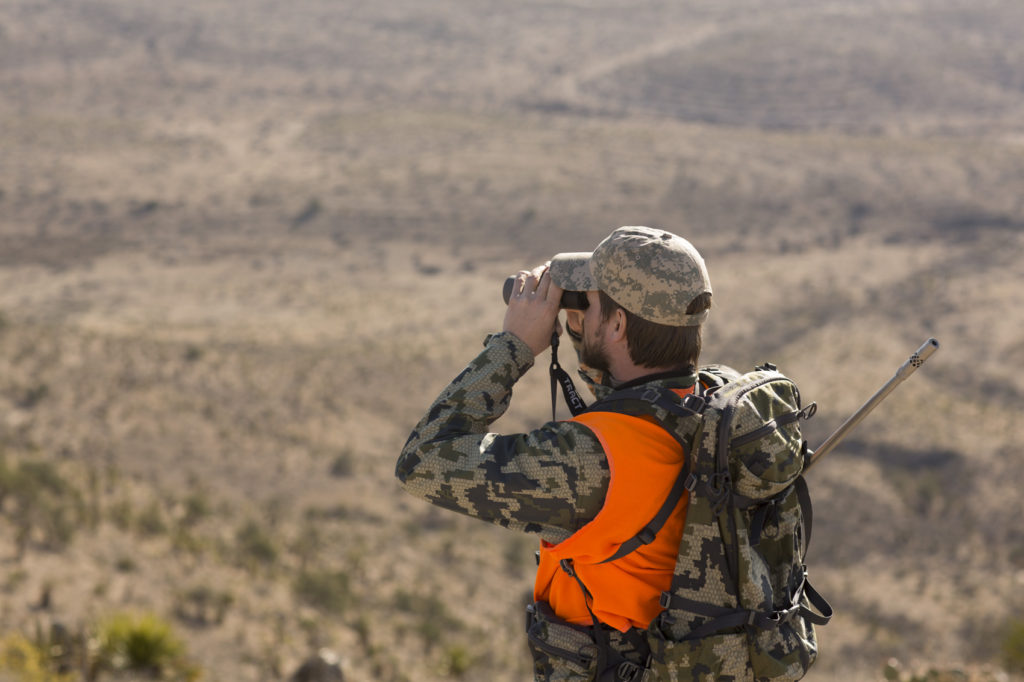
The best binoculars for hunting out west have a higher magnification as well as a list of other qualifications to help you spot more elk, antelope, or mule deer.
Years ago I had the good fortune of going on my first elk hunt at the NRA Whittington Center in northern New Mexico. I’d been sent there by my then-employer Sporting Classics magazine to cover the Center’s 40th anniversary. The hunt was a bonus.
Thinking back to the preparation aspect of the trip, there was a lot of discussion about the rifle and the ammunition. Some of the senior editors who’d been on many successful western hunts even suggested boots and clothing layering systems. They also stressed the fact that I’d enjoy myself much more if I went into the hunt with strong lungs and legs. But I can’t for the life of me recall a single discussion on optics.
I guess it was already assumed that I had a scope on my rifle that was “good enough.” And since binoculars were never mentioned and I didn’t know any better, I headed west with the 8x I use to deer hunt in the thick eastern hardwoods. Needless to say, they didn’t perform well, mostly because the magnification was too low. Here is what I learned from that trip and several subsequent adventures about what makes up the best binoculars for hunting out west.
High magnification binoculars are a critical part of a successful hunt.
Best Binoculars for Hunting Out West
First and foremost, the best binoculars for hunting out west have long-range performance with a wide field of view that allows you to pick out well camouflaged animals in vast terrain must be built into the binocular. My guide at the Whittington Center had an extra 10x binocular that he allowed me to use during the hunt. And while 10x definitely works, I’d get my hands on the more optimal 12x binocular.
Out on the plains, high magnification in your binocular can be the difference between putting a lot of time and energy into stalking a 65-inch pronghorn rather than a world-class 80 incher. You ought to be able to define the characteristics of the animal before making the decision to go after it. Only a binocular with high magnification will allow you to do that.
Great Low Light Performance
It was warm for October in northern New Mexico. The first three days we didn’t see many elk. The ones we did spot were at the edges of the dark timber at first light and last. This is why you need a binocular with great low-light performance. Whether you’re considering a 10x or 12x, go for a 50mm objective lens. The combination of superior light-transmitting glass and a larger objective lens will allow you to pick up more animals as they move between feeding and bedding areas at dawn to dusk.
Ruggedness & Weather Resistance
Ruggedness and weather resistance will always be high on the list of most important factors when it comes to the best binoculars for hunting out west. The western terrain is tough, so your equipment should be too. In the mountains, especially in the fall, the weather changes every hour. It’s not an unusual occurrence to watch a snow storm blow through a warm, sunny day at 8,000 feet. A binocular that’s both water and fogproof with argon gas and sealed with o-rings will provide you a tool that will function in all conditions.
A binocular built with a magnesium alloy body is about as durable as it gets. Wrapped in rubber armor and your glass is protected even if you slip and fall right on top of them. Oftentimes, the terrain is steep and footholds uncertain. Especially in the heat of the moment when you’re trying to get set up on a big bull or buck.
Lightweight
Magnesium alloy is also super lightweight, which allows you to hold the binocular steady for longer periods of time. While we’d always suggest using a harness to evenly distribute the weight when you’re spending days in the woods, a lighter binocular won’t hurt your neck or traps in the event you’re having to move quickly over rough ground.
Tripod Adaptable
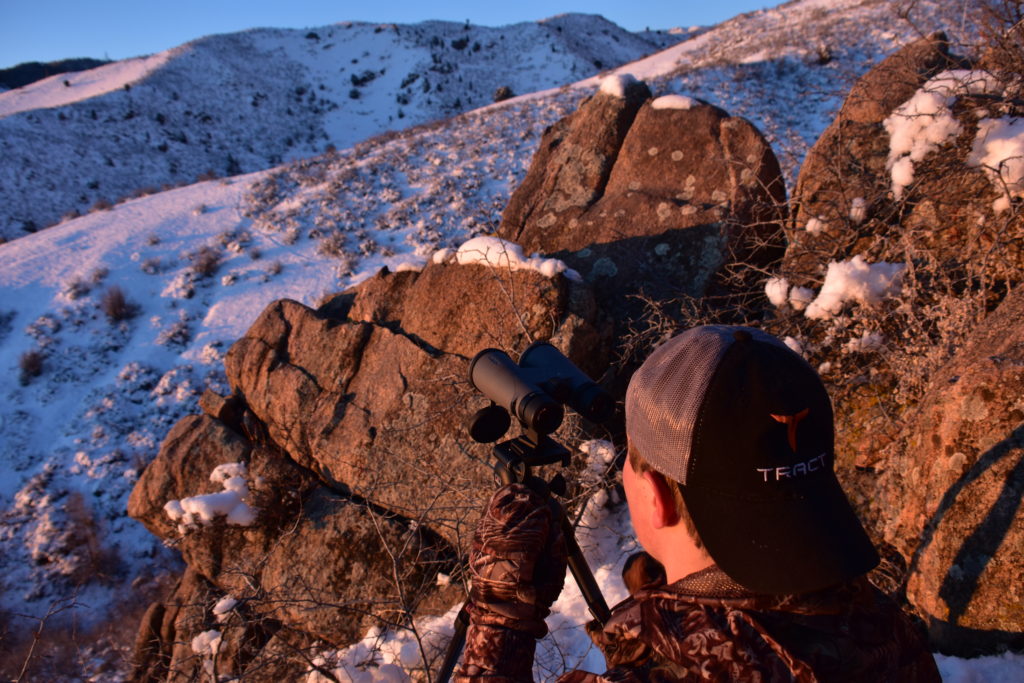
When you’re hunting out west, plan on spending a lot of time behind the binocular. There is the element of luck that puts you in range of an animal on the first morning. But most often, at least one or two days are devoted to scouting and glassing. Using a quality lightweight tripod along with a binocular tripod adapter will take stress off your body and allow you to glass for extended periods of time. And there is the “human tripod,” described by TRACT co-founder Jon Allen, where you sit as low as possible, move your hands to the ends of the objective barrels, and pull your elbows into your chest. A solid foundation and less shake will allow you to see more game more often.
Glassing with the TORIC 12.5×50 mounted on a tripod helps you cover a lot of ground efficiently.
Hunting in the west is usually quite the adventure. There are so many animals, birds, trees, and landscapes that make having the best binoculars for hunting out west worth your while. These things you’re able to see well will remain ingrained in your memory for years to come.
If you need help choosing the perfect binocular and accessories for your hunt out west, please contact us at:
Email: [email protected] Phone: 631-662-7354 LIVE Chat: tractoptics.com
The annual Athlon Outdoors Rendezvous has become a major event that lends itself to a lucky few getting an early glimpse of new products that could shake things up once they hit the market. Sometimes it’s simply a chance to get more quality time with products that have been available to shooters, as well as giving the manufacturers a chance to download more pertinent and in-depth info to us enthusiasts. This year the sampling of long-range rifles and optics impressed.
Long-Range Rifles
The long-range side of Rendezvous remains a much-anticipated segment. We get to shoot at extended distances (1 mile) in challenging and often tricky wind conditions. This allows us to get a grasp on the level of performance these products are capable of in real-world settings. The course of fire is challenging, with environmental conditions that can change at a moment’s notice.
This year didn’t disappoint in the tactical long-range department. Targets from 100 yards to a mile were on tap, and the weather in the Tetons did what it does best. Luckily, the manufacturers brought out solid pieces for us to shoot.
Barrett MRAD MK22
The MRAD is simply awesome. Every sample of this rifle, no matter where I’ve encountered one, has been an absolute tack-driver—a term that I think is nauseatingly overused but completely applicable to Barrett’s award-winning and military-solicitation-winning long-range precision rifle. I guess you could call it a true sniper rifle.
While several versions of the MRAD have shown up at past Rendezvous, this year, we got a taste of the MK22 Advanced Sniper Rifle System, which is the rifle deployed by our elite warrior units.
The MK22 is a bolt-action repeater featuring a multi-caliber capability that few possess. It can be modified to chamber eight different calibers, including long- and short-action options, and can accommodate multiple barrel lengths.
MK 22 Features
The MK 22 features a full-length monolithic upper receiver with a Pic rail that runs the length of the top. The handguard includes slots in the 3, 6, and 9 o’clock positions, which can be utilized via M-LOK attachment-type accessories.
The MK22 has an incredible drop-in match-grade, two-stage trigger. It’s fully adjustable as well with a crisp break. This trigger, coupled with the tool-less adjustability of the foldable stock for length of pull and comb height, makes the Barrett beyond easy to shoot precisely no matter the shooter’s experience level. It also features an action that is ultra-smooth, with a bolt handle placement that makes operation simple for right- or left-handed shooters.
Shooting the MRAD out to a mile, especially chambered in 300 Norma, was an absolute joke and every run of the bolt is perfect, making you feel like a rock star all the time. The MRAD MK22 as well as all the MRAD models are of the highest quality and performance levels in the precision space.
SIG Sauer Cross
SIG’s Cross made its debut at our 2020 Rendezvous. The Cross comes in as a lightweight, multipurpose, do-all bolt-action rifle that I like to refer to as the “everyman’s” bolt-action rifle.
The Cross takes minimalist and maximizes capabilities by being modular and feature-rich. The core of the Cross is a one-piece receiver that reminds one of an AR-type platform. This design is to improve rigidity and accuracy.
The receiver gets a barrel much like that of an AR platform, with a barrel nut and barrel extension with a pin that mates up to a slot in the receiver. This means the Cross barrel can be changed out fairly easily, and Sig has different lengths available depending on what caliber. Speaking of caliber, the Cross is available in 6.5 Creedmoor with an 18-inch barrel as well as .308 and the elusive 277 Sig Fury with 16-inch pipes.
The Cross is highly adjustable, especially for being so basic in nature. The length of pull and cheek pad height can all be easily changed, and the stock folds too. It’s sure to fit any shooter well.
Don’t let all the “minimal” and “basic” terminology fool you. The Cross performs like any quality precision rifle should with excellent accuracy that’s easy to call upon. Thousand-yard shots with consecutive and repeatable impacts in a package that’s easy to live with. It will make a believer out of anyone.
ZEV Technologies Large Frame Billet .308
Precision is not only left to the bolt actions. Plenty of gas-operated rifles are capable of extended range entertainment, and ZEV is delivering the goods with its Large Frame Billet rifle chambered in .308.
If the name ZEV appears on it then it’s going to be an eyeful of delight, and this rifle doesn’t disappoint. The billet upper and lower are 7075-T6 and machined to perfection with aesthetic styling and cues to make anyone envious.
It features a match-grade 16-inch barrel from 416R SS with a beautiful bronze PVD coating that is most excellent. The twist rate is 1:10 and it has a mid-length gas system. The barrel is topped with a ZEV muzzle brake to tame the recoil, which it does along with an H3 buffer. With this combination, ZEV is claiming sub-MOA accuracy, which I have no reason to doubt based on my 500-yard stroll with it in Idaho.
The trigger is an ATC AR Gold model featuring a flat face. The breaking weight is clean 2.5 pounds which helps in the accuracy department as well. Where the gas gun shines over the bolt is its ease of operation. No bolt to run, just press reset, press, and the short reset on the AR Gold trigger makes short work of this.
Controls are ambidextrous, which this southpaw long-gunner loves. I sat down behind the ZEV and confirmed some hits at 300 then shot it at 500 yards. After a few consecutive hits I knew what I needed to. The ZEV will deliver fast and accurate shots and look dang good while doing it.
CZ 600 Series
CZ is no stranger to rifles of all sorts. From big-bore hunting rifles to take large game in Africa, to police sniper rifles, and one of the best .22 trainers to ever exist, CZ has a whole host of offerings for the precision-minded shooter.
The 600 series bolt action was on tap during the Rendezvous, and it represents a new direction for the bolt-action side of CZ, with new technologies, materials, design, and focus. The goal is to meet the needs of many shooters, which while sounding like the right thing to say, is a difficult idea to execute.
Think of the 600 series as a multi-role bolt action rifle with versatility as the key feature. Meanwhile, there are several models in the 600 lineup: Alpha, Range, Trail, and Lux, each with its own set of unique and specific features for the particular shooter.
The Range most closely resembles the long-range precision shooter’s anatomy with a heavy contour, hammer-forged barrel, and a sub-3/4 MOA guarantee for five shots. This guarantee is verified before any rifle leaves the factory.
The Range features a beautiful laminated wooden stock with adjustable comb height and a button hook with pic rail to attach a monopod or bag rider. It also gets QD stud beneath the forend and on either side.
The receiver of the Range is drilled and tapped for Rem 700-type scope bases, so compatibility should be a breeze. The heavy barrel is 24 inches long and is threaded for a suppressor or brake as well.
An adjustable, single-stage trigger makes its way into the Range to help ensure the accuracy of the rifle. The Range is chambered in 6mm Creedmoor or .308. Choose wisely before you hit the Range.
Long-Range Optics
EOTech Vudu Optics Line
The EOTech Vudu line has been going strong for several years. I’ve had extensive run on the 5-25×56 and it has performed well with excellent glass quality and accurate tracking in a rather compact package.
When a magnification range that high isn’t necessary, Vudu has both 1-6 and 1-8×24 offerings as well, each offering excellent glass and easy-to-use reticles. An 8X option is good for gas guns, but a little more is needed for any precision work, and 10X is about the cutoff for that. Thankfully, EOTech now has an option to fit the bill with its new 1-10×24 VPO (variable power optic).
The new 1-10, like any good precision optic, is available as a first focal plane scope, so the reticle will grow and shrink with the magnification setting. This means that measurements taken through the optic with the reticle will be correct no matter the magnification settings. Yes, the reticle can get kind of small on the “1” setting, but illumination will help make it visible for the role that magnification is intended for.
I was able to use the Vudu 1-10 to fire effectively to 500 yards mounted on top of a custom 6.5 Creedmoor bolt-action rifle. Such an optic will easily let the shooter go further than that. What the 1-10 offers is high-level versatility within certain parameters.
Other features include excellent turrets, with .1-MRAD adjustments on the MIL version and .25-minute adjustment on the MOA version. It also features an included throw lever.
Axeon 6-24×50 Long Distance Shooting Rifle Scope
The budget-minded shooter is looking for products that can deliver performance without breaking the bank, and Axeon may have the goods in its 6-24×50 Long Distance Shooting Rifle Scope.
Featuring a 50mm tube and fully multi-coated objective lens, the Axeon SF Long Distance Scope has the right stuff for the precision shooter. A 30mm tube also makes its way on board, making it easy to find rings for attachment.
There are several other features that will bring a smile to the end user’s face, adding even more value to this optic. The tactical turrets are exposed, so making quick adjustments to elevation and windage is easy and no worries about losing caps. The turrets come zero-reset adjustable. It also features side parallax adjustment to get it dialed in just right. The reticle is a Mil-Dot version featuring 1/4-MOA adjustments with audible clicks.
The optic proves rugged as well, delivering a lot for a price of $299.
Riton 7 Conquer Optic
Riton is a Rendezvous favorite due to its ability to consistently bring new optics products in every category, from reflex sights to spotting scopes, LPVOs, and my favorite, long-range precision optics. And Riton has proven over and over again that you can have great performance at an affordable price—something I’ve long disputed.
The 7 Conquer 3-24×56 is one such optic. The 7 Conquer has Riton HD/ED glass. A bright and clean picture awaits the user. The reticle is an illuminated first focal plane type, so ranging will be consistent across the magnification range. The Oden reticle is a Christmas tree type and is easy to see. While it may seem intimidating, it is full of information for the trained shooter and will allow for easy and accurate holds for elevation and windage. The reticle also features six levels of illumination and auto shut off.
The turrets on the 7 Conquer are excellent with great feedback. It’s a MIL type with .1 MRAD adjustments and a Zero Stop feature, meaning you’ll always be able to get your dials back on track should you lose your way.
Waterproof and shockproof, durability is a thing with Riton optics, and the 34mm tube takes abuse well. I have shot the Riton’s to a mile and beyond, and they always perform at a high level. They also feature a Lifetime Warranty, but you’re not likely to have to use it.
This content was originally posted by Ballistic magazine in March 2022.
READ NEXT – 5 Rare Survival Rifles Designed for Air Force Crews
Meaning the gas strut is turned 180 degrees on its axis so the larger mass of the gas strut pushes the piston instead of the rod,
Thereby, it generates more power, velocity, and impact than other gas pistons.
Now we know what a ReAxis gas ram is, let’s take a look at its benefits over a spring piston.
First, you have smoother cocking since it doesn’t have spring torque like metal springs.
Second, there is no spring fatigue even if you leave it cocked for hours so you don’t have to worry about the piston wearing out over time.
Third, the ReAxis gas piston is not affected by the weather.
With the springer, the mainspring is lubricated with grease so it becomes harder and tougher when the weather gets cold.
ReAxis strut doesn’t have this problem and it functions perfectly in different types of weather.
Fourth, the ReAxis gas ram allows you to have a smoother shooting experience with less recoil compared to a spring piston.
And finally, it lasts longer than a metal spring.
In the air gun world, it is not uncommon to make spring compression over its standard threshold.
This weakens the spring and shortens its life span.
However, the ReAxis gas piston doesn’t care about compression so you can enjoy long-time shooting with it.
The caliber is available in both .177” (4.5 millimeters) and.22” (5.5 millimeters).
.22 caliber is the favorite choice for hunters.
While the .177 caliber offers more velocity, it usually doesn’t generate enough takedown power to kill an animal in 1 quick, clean shot.
On the other hand, the .22 caliber has more knockdown power transferred to the target’s body so it’s the go-to gun for field hunters and pest eliminators.
It gives the same shooting experience for both left-handed and right-handed shooters.
There is no difference whether you are left-handed or right-handed.
Besides, it has nice texturing on the forearm and grooves on the grip to prevent slippage from your sweat, enhance stability when aiming, and improve accuracy.
Moreover, the stock has a rubber buttpad to help absorb recoil, even the ReAxis gas piston has already cut the recoil to a great extent.
Last but not least, the stock has a thumbhole design that provides a more relaxed grip on your wrist by resting the stock on your wrist as opposed to holding it with your arm.
A thumbhole stock is best for varmint shooters and for anyone who spends a lot of time on shooting positions like bench rest shooting.
Ammo
The Umarex Octane uses .177 and .22 pellets corresponding to its 2 types of calibers.
.177 pellets are damn cheap if not the cheapest pellet on the market: you can buy hundreds of high quality .177 rounds for just a few bucks
So .177 is the best choice for target shooting and plinking.
On the other hand, a .22 pellet is heavier and has more knock-down power than a .177 pellet so it is the go-to pellet of pest eliminators and small game hunters.
As if the full fiber-optic sight is not enough for dead-on accuracy, Umarex adds a 3-9×40 AO scope in the package.
40 is the diameter of the front lens, measured in millimeters.
3 and 9 mean that the scope has variable zoom-in power.
It magnifies the image 3 to 9 times bigger than the picture you see without the scope.
On top of that, this scope has parallax adjustment.
AO stands for adjustable objective so you can adjust the sight according to your own unique needs
Have you seen the Picatinny rail come with the integral dovetail in the same air gun?
This rifle has that feature.
Therefore, you can use whatever scope you like to mount on the Picatinny rail or remove the Picatinny rail and use the 11mm dovetail directly.
Velocity, accuracy and power
In .177 caliber, the Umarex Octane delivers velocity up to 1450 FPS with alloy pellet and 1250 FPS with lead pellet.
In .22, this rifle produces 1250 FPS with alloy and 1050 FPS with lead pellets.
These types of velocities put Umarex Octane into the ultra-magnum class of air rifles.
Besides, since the speed of sound is 1100 FPS (may vary with altitude and temperature), you can hear the loud crack when shooting because the superfast pellet breaks the sound barriers.
Chrony test has given us the following results:
In .177:
Pellet (.177)
FPS
FPE
Baracuda Match 10.65 gr
890
18.74
Crosman Premier 10.5 gr
1200
33.58
Crosman Premier Domed 10.5 gr
1154
31.06
In .22:
Pellet (.22)
FPS
FPE
RWS Hobby 11.9 gr
925
22.61
H&N Baracuda green pellet 12.5 gr
925
23.75
Predator Metalmag 17 gr
745
20.96
H&N Baracuda green 12.96 gr
925
24.63
JSB Exact Jumbo 18 gr
769
23.64
Benjamin Discovery HollowPoint 14.3 gr
863
23.65
JSB Jumbo Heavy 18.13 gr
776.52
24.28
Crosman Premier domed pellet 14.3 gr
993
31.32
Ruger pointed pellet 17 gr
899
30.52
Diabolo RWS 13.43 gr
781
18.19
H&N Hunter 18.21 gr
732
21.67
Crosman 14.3 gr Hollow point
842
22.52
JSB Monster Diabolo 13.43 gr
797
18.95
RWS SuperMags 9.3 gr Field line wad-cutter
944
18.41
RWS Meisterkugeln 8.2 gr
1065
20.66
Gamo Raptor 9.9 gr
1120
27.58
Gamo Match Diabolo wad-cutter 15.43 gr
875
26.24
H&N Field Target Trophy Green 9.57 gr
1038
22.9
RWS SuperDome 14.5 gr
800
20.61
Beeman Kodiak 21.14 gr
683
21.9
Crosman Premier Hollow Point 14.3 gr
902
25.84
JSB Exact Jumbo 15.9 gr
762
20.51
RWS Hobby 11.9 gr
889
20.89
Beeman Kodiak domed 21.14 gr
682
21.84
RWS Hypermax 9.9 gr
1029
23.28
For Umarex Octane, various shooting tests have been conducted by different shooters with positive results.
The common shooting groups are:
less than 1” in 20 yards,
0.891” at 20 yards with Predator Polymag,
0.675” at 20 yards with H&N Baracuda green,
1/2″ at 25yards with JSB Jumbo Heavy 18.13 gr,
0.2” at 65 feet with Crosman Premiere Hollow point,
nickel size at 50-93 feet,
1/2″ at 20 yards with Crosman Premiere Hollow Point,
same hole at 35 yards with JSB RS,
same hole at 33 yards,
1” at 10-15 yards,
2” at 25 yards,
penny size at 25 yards,
dime size at 10-15 yards,
dime size at 20 yards with JSB Monster Diabolo 13.43 gr,
clover-leaf size at 20 yards with RWS Super Mag 9.3 gr Field line wad-cutter,
1” at 25 yards,
1/4″ at 25 yards,
1/4″ at 50 feet,
1/4″ at 10 yards,
2” at 40 yards,
dime size at 30 yards,
nickel size at 30 yards,
1” at 30 yards,
penny size at 35 yards,
1/2″ at 30 yards,
1/4″ at 50 yards,
silver dollar size at 50 yards,
1/4” at 30 yards,
1/4″ at 45 yards,
penny size at 30 yards,
1/4″ at 45 feet with JSB Jumbo Diabolo,
1” at 50 yards,
1/2” at 30 yards,
3/8”-1/2” at 25 yards with Crosman Premiere Domed,
1” at 50 yards,
1/2″ at 30 yards,
1.25” at 50 yards,
0.581” at 10 meters with Beeman Kodiak,
0.368” at 10 meters with RWS Hobby,
1” at 10 meters with RWS Super dome,
0.982” at 10 meters with Predator Polymag,
0.245” at 10 meters with 14.3 gr Crosman Premiere Hollow Point,
1.067” at 25 yards,
0.292” at 10 yards with JSB Diabolo Exact 8.4 gr,
0.416” at 20 yards with JSB Diabolo Exact 8.4 gr.
Furthermore, this Umarex Octane can:
shoot AAA battery at 23 meters,
shoot battery LR44 at 23 yards,
penetrate 1/4″ plywood and go deep into 3/4″ plywood,
pierce through 3/4″ pine board,
hit penny at 24 yards,
blow through 1/2″ plywood,
hit crow at 40-50 yards,
kill squirrel at 40 yards,
kill squirrel at 25 yards,
go through 1/2″ plywood at 51 yards,
go through 2×4 cardboard box at 20 yards,
penetrate 4 soup cans (8 layers of corrugated metal) with the following pellets:
Beeman Crow Magnum Hollow Point 18.21 gr
Beeman Kodiak Extra Heavy 21.14 gr
H&N Baracuda 21.14 gr
JSB Match Diabolo Jumbo Heavy 18.13 gr
Polymag 22.16 gr
punch through 3/4″ plywood at 40 yards with Crosman Premier Hollow Point 14.3 gr,
penetrate 3/4″ board,
penetrate through 1” thick oak board at 10 yards,
blow through 1×4 pine board at 75 feet with Crosman Premier Hollow Point,
hit soft ball at 150 yards,
kill 2 starlings at 109 yards,
kill groundhog at 40 yards,
kill squirrel at 30 yards,
go through 3/8” plywood and destroy the wine bottle at 40 yards.
Although being a supersonic air gun in both .177 and .22 calibers, Umarex Octane produces very little noise thanks to advanced technology for noise suppressors.
Therefore you can enjoy a successful hunting day or a fun plinking afternoon without startling your neighbors.
Shooting Ability
The effective shooting range of this gun is up to 100 yards. You can use it for target shooting, plinking, pest control, and small game hunting.
You don’t need to buy anything else for this gun. Everything you need is already in the box.
Maintenance
The Umarex Octane requires very little maintenance:
Just clean your gun every now and then, coat the barrel with RWS Spring Cylinder Oil every few hundred shots and you are all set.
Specifications
Caliber: Available in both 0.177 and 0.22
Velocity: In .177- 1450 FPS with alloy- 1250 FPS with lead / In .22- 1250 FPS with alloy- 1050 FPS with lead
Loudness: 3- Medium
Barrel Length: 19.5”
Overall Length: 48.5”
Shot Capacity:1
Cocking Effort: 42 lbs.
Barrel: Rifled
Front Sights: Fiber Optic
Rear Sights: Fiber Optic/ fully adjustable for windage and elevation
Scopeable: Picatinny
Trigger: Two-stage adjustable
Buttplate: Rubber
Suggested for: Target shooting/Plinking/Small game hunting/ Pest control
Trigger pull: 3.5 lbs
Action: Break Barrel
Safety: Automatic
Powerplant: Gas-piston
Function: Single-shot
Body Type: Rifle
Weight: 9.5 lbs
Warranty
Another point that I love about the Umarex rifle is the 3-year warranty.
While most guns with gas pistons have only a one-year warranty, Umarex goes the extra mile and provides up to 3 years of warranty.
Additionally, some shooters are hesitant to try new technology so they worry about support if anything happens in the future.
The extra 2 years of warranty take care of those concerns instantly.
Price
The price for Umarex Octane is just about 200 dollars.
It’s a bargain if you consider the innovative ReAxis gas piston, advanced silencer that makes a supersonic sound no more a problem, heavy-duty power, eye-opening velocity, and extreme shooting range that every shooter dreams of.
Growing up a 22 LR Rifle was my best friend and my love for firearms directly came from the 22LR round. If you are considering buying a 22 rifle, you probably want to know what the Best 22LR rifle for you is.
First, everyone is different, and it’s extremely important to know that. So one size definitely does not fit all. But I will do my best to cover a full spectrum of 22 LR rifles so you can find one that suits you or the person you are shopping for best.
7 Best 22LR Rifles
Here is our list of the 8 of the Best 22LR rifles of 2024!
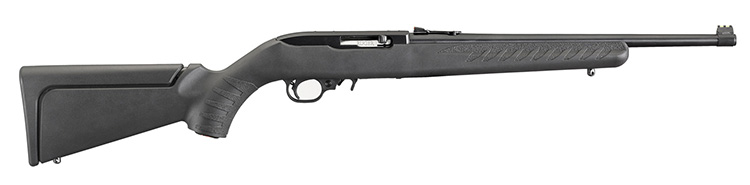
Ruger 10/22
The Ruger 10/22 is a great 22LR rifle because of its superbly reliable action, outstanding durability, and extensive range of models available.
Its action can eat through the cheapest of ammo types with little issue, making it the perfect choice for hunters, survivalists and plinkers alike.
The Ruger 10/22 takes its place as the best overall because it can be used for essentially every purpose under the sun – from hunting to plinking to target shooting – while offering an affordable option for any shooter looking for a reliable semi-automatic 22LR rifle.
Additionally, it offers an array of ergonomic enhancements that improve accuracy and overall function.
The Ruger 10/22 is also the 22 rifle with the most available accessories on the market.
Smith & Wesson M&P 15-22
The Smith & Wesson M&P 15-22 is a great 22LR rifle for shooters who want an AR-style platform to practice their skills.
It offers the same features and similar functionality as an AR, making it perfect for training with a direct translation to your main AR.
The M&P 15-22 has an M-Lok handguard that allows you to attach any standard AR accessories, plus it has a threaded barrel for adding on a suppressor or flash hider.
Furthermore, the lightweight polymer receivers make this rifle easy to carry around without sacrificing durability or accuracy.
Additionally, its appearance stands out from other 22lr rifles due to its AR styling, which makes it appealing to those who like tactical designs.
Savage Mark II FV SR
The Savage Mark II FV SR is an excellent choice for a 22lr rifle due to its features and performance.
It comes with a 16.5-inch heavy-profile fluted barrel which provides accurate shots round after round.
The threaded muzzle is a nice feature that allows for suppressor mounting. The detachable box magazine holds five rounds of .22 Long Rifle ammunition.
Additionally, the rifle has an adjustable Savage AccuTrigger that allows shooters to fine-tune their trigger pull for a crisp and clean break.
Overall, this rifle offers great value for its price point while providing all of the features needed for effective small-game hunting or target shooting purposes.
Henry Golden Boy
The Henry Golden Boy is a great 22lr rifle due to its reliability, aesthetics, and affordability. It is built with high-quality components that ensure smooth operation and longevity.
The Henry Repeating Arms Golden Boy also features a classic lever action design that adds a touch of nostalgia to your shooting experience.
It comes in several different configurations, including a complete walnut stock or one trimmed with gold for added elegance.
The Henry Golden Boy is very affordable compared to other lever action rifles on the market, making it an attractive option for those looking for value without sacrificing quality or aesthetics.
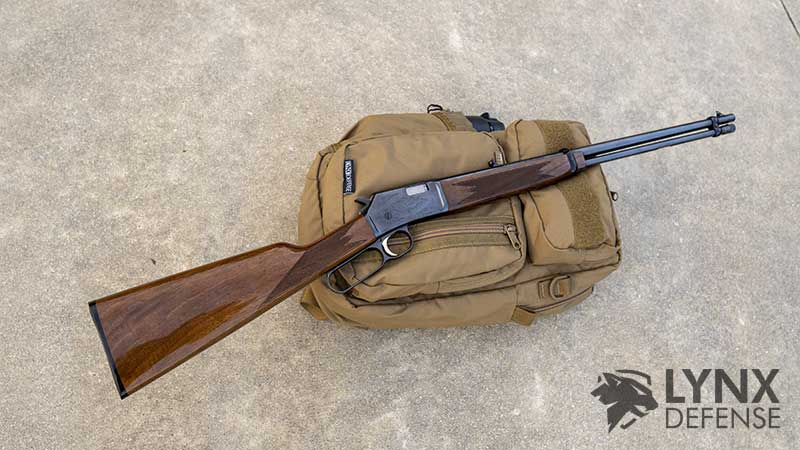
Browning BL-22
The Browning BL-22 is a great 22LR rifle due to its high-quality design and features. It’s one of the best lever action rifles on the market even though it’s 22LR.
It is built as a tribute to John Browning’s gun-making mind and features scroll engraving on the receiver, a polished blued finish, and a takedown design for ease of cleaning and storage.
The SA-22 also has an ambidextrous bottom ejection port which was ahead of its time.
The 19-inch barrel has a 1:16 rate of twist for accuracy when shooting small game or varmints.
Furthermore, the 10-round magazine loads through a port in the stock, which gives it a slim design that is easy to handle overall – making it an excellent choice for those looking for an attractive yet reliable rifle at an affordable price point.
Ruger Charger
The Ruger 10/22 Charger is a compact and lightweight pistol version of the popular 10/22 rifle. It also inspired the 9mm version the Ruger PC Charger.
It measures just under 20 inches long and features a folding pistol brace for easy storage and transport.
The Charger also comes with an open front sight and grooves in the receiver for mounting a scope, making it ideal for plinking or target shooting.
It offers great value for money with its affordable price tag of just under $300. The Ruger 10/22 sets the standard for what a 22LR rifle should be with its reliable performance, durable construction, ergonomic design, and high-quality components that ensure accuracy and reliability over time.
Tikka T1x MTR
The Tikka T1x MTR is a great 22lr rifle due to its high-quality construction, accuracy, and versatility.
It is built using many of the same features as Tikka’s popular T3x centerfire rifles, which ensures that it has high-performance bedding footing, a single-stage trigger mechanism and a synthetic stock that can withstand temperature variations.
The semi-heavy barrel keeps everything cooler and steadier than a thin barrel while also contributing to increased accuracy.
The modular design of the rifle allows users to swap out components depending on their needs or preferences.
Overall, the Tikka T1x MTR offers outstanding quality at an affordable price point with plenty of options for any shooter looking for accuracy in their rimfire rifle.
What are the benefits of owning a 22LR rifle?
They are cheap to buy and shoot
22LR rifles are relatively inexpensive compared to other types of firearms, with prices ranging from $100 to $500.
Furthermore, .22LR ammunition is also relatively cheap compared to other calibers, such as 9mm or 5.56mm.
This makes 22LR rifles an attractive choice for shooters who want a quality firearm without breaking the bank.
Not only are they cheaper than most other types of guns on the market, but they also tend to have less recoil which helps people train and avoid flinching before shooting.
The low cost of ammunition means you can put a lot more rounds down range for your dollar than with other calibers.
They are accurate
22LR rifles are accurate but only effective to roughly 150 yards, with some gun models capable of achieving sub-inch groupings at 100 yards.
This level of accuracy is comparable to more expensive rifles such as those chambered in .308 or .30-06 but 22LR is not effective at the ranges those rounds are.
The key factor that contributes to the accuracy of a 22LR rifle is its barrel length. Longer barrels typically produce higher levels of accuracy than shorter ones due to their increased dwell time and the twist rate of the barrel.
Other features that can influence accuracy include the fit and finish of the rifle, as well as its stock design which can help reduce recoil and improve stability during shooting sessions.
They are suitable for shooting small game and pests
The 22LR rifle is capable of shooting a variety of small game and pests.
It is especially effective at taking small game such as squirrels, rabbits, ground birds and other similar animals.
It can also be used for pest removal tasks such as snake defense or eliminating other nuisance animals.
The 22LR cartridge works well for these types of tasks due to its low recoil and noise level, which makes it ideal for close-quarter situations.
There are even “pest control” rounds, often called rat shot which doesn’t damage property but can kill mice and rats at close range indoors.
On several occasions, I have dispatched a mouse caught on a glue trap before discarding him to stop the mouse from suffering.
They are available in a wide range of styles and sizes
There are a variety of 22LR rifles available, including bolt action, semi-automatic, and lever action rifles. These rifles offer different features depending on the type, such as:
Bolt action rifles offer precision shooting capabilities with a smooth operation and easy loading of rounds.
Semi-automatic rifles are more modern versions of rifles that allow for faster firing rates.
Lever action rifles provide an old-school cowboy look and feel while still being modern enough to use modern ammunition like 22LR rounds.
They are easy to handle and shoot
An easy-to-handle and shoot 22LR rifle should have the following characteristics:
Superbly accurate – The rifle should be able to accurately hit targets at various distances.
Lightweight – The rifle should be lightweight so that it is easy to carry around and handle during shooting sessions.
Excellent trigger – The trigger should be smooth and responsive, allowing for precise shots every time. Typically a low-poundage trigger pull is desired.
Comb height – The comb height should be adjustable so that shooters of all heights can comfortably use the rifle without strain or discomfort in their neck or shoulders while aiming down the sights or scope.
Fun to shoot – Shooting with any type of 22LR rifle should be enjoyable due to its accuracy, lightweight design, and fun features like a bipod or scope with adjustable magnification level if applicable in this particular model you’re considering purchasing (just make sure it’s legal where you live!).
They are quiet
22LR rifles benefit from being quiet because they use less powder and are typically shot from longer barrels.
By using a 22LR rifle that is quiet, hunters can reduce the risk of spooking their prey and increase their chances of success.
A quiet rifle is also beneficial for those who wish to practice shooting without disturbing their neighbors or damaging their hearing. However, you should always wearing hearing protection while shooting.
They are good for target shooting practice
Yes, 22LR rifles are great for target shooting practice.
The lack of recoil and relatively inexpensive ammunition makes the .22 LR cartridge ideal for beginners who want to learn how to shoot properly.
The lack of recoil also helps experienced shooters train to avoid flinching before pulling the trigger.
With the low cost of ammo that means that you can put more rounds down range for your dollar than with other calibers.
They are fun to shoot
Yes, 22LR rifles are fun to shoot. They are accurate, reliable, and offer a great range of uses.
They can be used for target practice, pest removal, or even for hunting rabbits in the fall.
Plus, they are relatively inexpensive compared to other types of ammunition and you don’t have to worry about them being scarce due to their popularity. Overall 22LR rifles provide an enjoyable shooting experience without financial burden.
What to consider when buying a 22LR rifle?
There is plenty to consider when buying a 22LR rifle for yourself or a loved one. From the brand to action, to any number of things. Here is a comprehensive list of things to consider when buying your rifle.
Action type
You probably already know what kind of action you’d like but here are the three most popular.
Lever Action
These .22 LR rifles are cycled by hand, but instead of a handle at the back of the bolt, there is a lever by the trigger that must be actuated to load another round.
A lever action rifle uses a manually operated system that feeds cartridges into the chamber by means of pulling back on the lever, which operates an internal mechanism that moves ammunition into position before cocking it ready to fire again when pulled back again by hand.
They are often recreations of guns from the Old West and are popular with those who are interested in that time period.
Semi-Auto
Semi-Auto rifles are typically magazine feed and often have a higher magazine capacity of 10-25 rounds and beyond.
These guns fire and reload with a single trigger pull and release. This allows for much higher rates of fire.
Single Shot
Single shot rifles only have one shot capacity as indicated by their name; after firing one round, you will need to manually reload before firing again.
These types of 22LR rifles are typically used for hunting small game since they don’t offer much firepower compared to other types of action firearms, such as semi-automatic or bolt action models.
Bolt Action
A bolt action rifle uses a manual mechanism to eject the spent cartridge and chamber a new one. This type of rifle typically has a longer barrel for increased accuracy and a larger capacity than other types of 22LR rifles.
Bolt action rifles are similar to single shot in that you have to chamber a new round manually; unlike single-shot rifles, you have an easy way to do that with a lever on the bolt.
Bolt actions are a classic rifle and are used for better accuracy and precision. They typically have smaller magazine capacities and even sometimes have internal magazines inside of the gun.
Caliber
When choosing a 22LR rifle, it is important to consider the caliber of the rifle.
You are probably saying 22LR, Duh.
You’re right. However, be sure to make sure it’s a 22 Long Rifle; there are a few flavors of .22 caliber rounds.
22LR, 22 Long, and 22 Short are all popular 22 caliber rounds. The most popular is by far the 22 Long Rifle (.22LR). But some rifles can shoot only one or all three rounds.
One thing is certain the 22 Longs and 22 Shorts in 22LR magazines are a recipe for disaster if they are not compatible.
There are four different types of 22 caliber rounds available: 22 Long Rifle (LR), 22 Long (L), 22 Short (S), and 22 Magnum (M).
22 LR: This is the most common type of rimfire cartridge and is compatible with most rifles and magazines.
It can be chambered safely in both tube-fed and detachable magazines.
It offers high accuracy, low recoil, and high velocity for long-range shooting. The standard muzzle energy is around 35 to 40-foot pounds which makes it suitable for small game hunting or target practice at short ranges.
22 Long: This round is not compatible with most 22LR rifles as it does not fit in most detachable magazines.
However, it can be fired safely in some rifles that are designed for both types of cartridges.
The muzzle energy for this round tends to be higher than the LR version at around 45 to 50 foot pounds which makes it more suitable for larger game such as varmint or small deer species up to 100 yards away from the shooter’s position.
22 Short: Like its longer counterpart, this cartridge also has limited compatibility with certain rifles that can handle both types of cartridges without any issues. The short is shorter than both the 22LR and 22 Long
Barrel length
When buying a 22LR rifle, it is important to consider the barrel length.
Longer barrels offer better accuracy and muzzle velocity, which can make a significant difference in terms of accuracy.
Additionally, longer barrels are more suitable for hunting as they can provide more power and range than shorter barrels.
Note that shorter barrels are typically lighter and easier to maneuver around obstacles in the field or at the range.
While there may be some tradeoffs with shorter barrels such as reduced accuracy or decreased muzzle velocity compared to longer ones, they still provide excellent performance in most situations and are an ideal choice for many shooters looking for a compact, fun rifle.
Trigger
The trigger pull for a 22LR rifle is typically smooth and reliable. The Ruger 10/22 features a tapered cold hammer-forged barrel that uses the two screw V lock system for a tight fit to the receiver.
Trigger pull and weight varies from rifle to rifle so finding one that is your preferred weight is important. You can also purchase rifles with adjustable trigger weights.
When buying a 22LR rifle, it is important to consider the features of the trigger group. Many modern rifles come with a push-to-fire safety that helps train younger shooters in proper rifle safety habits and can be found on both large and small caliber rifles.
On the other hand, some older 22LR rifles do not have a push-to-fire safety or any type of safety mechanism at all so it is important to know what type of trigger you are getting before making a purchase decision.
Safety features
When buying a 22LR rifle, safety features to consider include the following:
Bolt action – A bolt action rifle uses a manual mechanism to load and unload ammunition. It has a handle or lever that you pull back to open the chamber, then push forward to close it again. These typically have a push button safety
Semi-automatic – Typically, all have a push-button safety and can usually be found near the trigger or trigger guard.
Lever-Action – Traditional lever-action rifles do not have a push button safety. However, some .22LR rifles like the Rossi Rio Bravo have push button safeties.
Stock options
A variety of stock options are available for 22LR rifles, including:
Synthetic
Synthetic stocks are one of the most popular modern-day options for .22LR stocks. The Synthetic stock is available on nearly any rifle configuration offered today.
The synthetic stock is typically a plastic or resin that makes the gun light and extremely durable to wear and tear and the elements.
Wooden
Wood stocks are the classic look you remember from your favorite western movie. These stocks are often coated to resist wear and tear and moisture.
Many lever-action rifles and bolt-action rifles have wooden stock options.
Chassis
Drop-in chassis are extremely popular for precision shooters as they allow the barrel to free float, which improves accuracy. There are many different brands and options depending on which gun you purchase.
Some chassis even make the guns look more “tactical” or transform your rifle to look like an entirely different gun.
Scope mounting options
For 22LR rifles, scope mounting options include: Picatinny rail, dovetail mount, Weaver rail mount, ring mount and integral scope mounts.
Picatinny rails are typically found on newer models of 22LR rifles and provide an easy way to attach optics.
Dovetail mounts are more common on older models of 22LR rifles and can sometimes require the services of a gunsmith to install.
Weaver rails offer another option for attaching optics but may require drilling into the firearm’s receiver if it doesn’t already have a rail installed.
Ring mounts can be used with both Picatinny and Weaver rails or directly onto the barrel without any additional hardware required.
Integral scope mounts are built into some older models of 22LR rifles but may not be compatible with modern optics due to changes in design over time.
For 22LR rifles, there are a variety of scope options available. These include:
Magnification: Between 4 – 7X power
Fixed 4X or low power variable magnification optic (LPVO).
Athlon Ares 4.5-30×56 – Best scope for 22LR Benchrest
Bushnell Trophy TRS-25 – Best Red Dot Scope Under $100
Leupold VX-Freedom 1.5-4×20 – Best Scope for 22LR Squirrel Hunting
Magazine capacity
The magazine capacity for a 22LR rifle is the maximum number of rounds the rifle can hold in its magazine.
Most detachable magazines range from 10-25 rounds. You can find aftermarket magazines that get higher round counts but loading them may be a challenge.
Bolt action rifles often have a 5-10 round internal magazine. If it does have a detachable magazine it is typically a small single stack style magazine, think 1911 single stack magazine scaled down.
Bolt design
When buying a bolt action 22LR rifle, considerations should be made for the bolt design.
Bolt Actions are manually cycled from a handle at the back of the bolt and typically feed from a magazine.
They are reliable weapons that work well and are great hosts for suppressors if that’s something that interests you.
The bolt design should focus on a smooth action and a throw knob that lives up to your standards in size and style.
Weight and Balance
It is important to consider the weight and balance of the rifle. Ruger’s Precision Rifle in .22 LR offers a good balance between weight and accuracy, with a 6.8 lb weight and 35.13″-38.6″ length.
The Ruger Precision Rifle in .22 LR has an AR-style pistol grip, fiberglass chassis, heavy barrel, massive bolt handle which makes it look like most tactical rifles you’d see at the range.
The Ruger Carbine 10/22 Rifle also offers good weight balance with its 5 lb weight and 33″-34″ length.
The Ruger 10/22 Carbine Rifle comes with a wood stock which gives it an aesthetic advantage over other models in its class but it does not have any additional features that would make it stand out from other rifles of its caliber or type (such as AR-15s).
Customization Options
Customization options for 22LR rifles include:
Adjustable sights – Most .22LR rifles have adjustable sights to allow for precise aim and accuracy.
Long-range scope – A long-range scope can be added to increase the range at which a rifle can be accurately fired.
Trigger adjustment – Some models of .22LR rifles come with a built-in trigger adjustment feature that allows users to fine-tune their pull weight.
Stock adjustment – Some models of 22LR rifles allow users to adjust the stock for better fit and comfort.
Aftermarket Accessories – Some guns have far more aftermarket options than others. Typically the volume sellers like the Ruger 10/22 will have a ton of aftermarket accessory options.
Value for money
When evaluating the value for money of a 22LR rifle, it is important to consider the type of action and features that are offered and everything in the list above.
Depending on your needs, you can find rifles with different actions such as bolt action, lever action, semi-automatic and more. Additionally, some rifles offer features such as adjustable sights or rubberized grips for comfort and accuracy.
When comparing value for money between different 22LR rifles, it is important to consider the quality of the components used in each model.
High-quality components such as a steel barrel or synthetic stock will provide better performance over time than lower-quality parts like plastic stocks or aluminum barrels which may be less durable or accurate over time.
FAQ
What is the best 22LR rifle?
When it comes to the best .22 LR rifles, there are many options available. Some of the top models include:
Ruger 10/22
Smith & Wesson M&P 15-22
H&K 416 22
Browning BL-22
What are the advantages of a bolt action rifle compared to other types of rifles?
The main advantage of a bolt action rifle is its mechanical accuracy, which is the maximum potential accuracy of a firearm without any human inputs.
Bolt actions can be built to tighter tolerances than semi-autos, which increases accuracy and repeatability. Additionally, they are also great hosts for suppressors and are generally quieter than semi-auto-suppressed guns due to no moving action.
On the other hand, semi-automatic rifles such as 10/22s can be just as accurate in practice if they are fitted with custom parts or properly cared of by their owners. Ultimately it comes down to the shooter rather than the gun itself regarding practical accuracy in field conditions.
What type of ammunition is used in a 22LR rifle?
22LR rifles utilize rimfire ammunition, which is loaded with a primer and a bullet and the primer is in the rim of the cartridge, hence the name “rimfire.”
The rimfire system dates back to the 19th century and uses a small explosive charge located in the perimeter of the cartridge case around which the rest of the components are assembled.
22LR ammo can be prone to duds due to the primer being in the rim of the cartridge it can lead to poor performance in semi-auto rifles or other issues such as poor cartridge seating or decreased accuracy potentials.
Higher quality brands like CCI offer better performance at minimal recoil additions, while subsonic rounds keep projectiles below supersonic speeds for quieter shooting experiences coupled with suppressors.
Copper jacketed hollow point bullets provide for humane kills on small game hunts while providing reliable operation even in cheaper bulk offerings that often present more duds than centerfire cartridges do in similar situations.
What type of scope is best for 22LR rifles?
When choosing a scope for 22LR rifle scope, it is important to consider the shooting distance and the appropriate magnification.
A good scope will have the right magnification for your particular uses, such as squirrel hunting, bench rest competitions, or long range shooting.
For most types of 22LR rifle use, a variable-powered scope with low-powered magnification is ideal.
This allows you to use more than one magnification setting without buying multiple scopes.
Additionally, a variable-powered scope allows you to adjust quickly between different ranges without having to change out lenses or adjust settings on fixed power scopes.
What is the best trigger for a 22LR rifle?
The best trigger for a .22 LR rifle is one that is smooth, lightweight, and has little to no grit. It should be easy to pull with no grit or delay in firing.
The Savage AccuTrigger is one of the best affordable triggers available for a .22 LR rifle due to its adjustable design that allows you to customize your pull weight from 2 lbs all the way down to 0 lbs.
It also features an ergonomic shape that makes it comfortable and easy to use while still providing precise control over your shots.
Manticore makes an extremely adjustable Ruger 10/22 trigger.
What are the best accessories for a 22LR rifle?
When it comes to accessories for a 22LR rifle, there are many options available. Here is a list of some of the best accessories:
Bipods – These provide stability and balance when shooting and can be used with most 22LR rifles. We cover a number of them in our best bipod guide.
Scope or Optic – A scope or optic will allow you to accurately aim at your target and is essential if you plan on using your rifle for hunting or competition shooting purposes.
Hearing Protection – While not a direct accessory to the gun ear protection is important when shooting any type of firearm as it helps reduce damage caused by exposure to loud noises while also preventing hearing loss over time if worn regularly while shooting.
Magazine Loader – This tool makes loading magazines easier so that you can quickly reload without taking too much time away from the range or hunt.
Gun Case – To ensure that your rifle stays in good condition during transport, it’s important to invest in a good gun case that protects it from dust, moisture, and other potential damage sources during travel.
What type of rifle is best for squirrel hunting?
For squirrel hunting, the best 22 LR rifle would be one that is accurate, lightweight and easy to use.
Options such as the Ruger 10/22, Savage A22, and Christensen Arms Ranger 22 are good choices for this purpose due to their accuracy and ease of use.
For maximum effectiveness when hunting squirrels with a 22 LR rifle, it is recommended that you use high-quality ammunition such as copper-plated hollow points or full metal jacket rounds that have been optimized for small game hunting.
It is important to practice shooting from different angles before going out in the field so that you can become more familiar with your rifle’s range and accuracy capabilities.
If you are looking for more of a fun and cool-looking gun check out the GSG 522.
“Unraveling the Legality: Felons’ Possession of Air Rifles in Washington State”
Can a felon own an air rifle in washington state?
In Washington state, the ownership of firearms by felons is regulated by both state and federal laws. However, when it comes to air rifles, the laws are slightly different. While traditional firearms are generally prohibited for felons to possess, air rifles may be allowed under certain circumstances. According to Washington state law, felons can legally own and possess an air rifle as long as they have completed their sentence and do not have any restrictions that explicitly prohibit them from possessing any type of firearm.
It is important to note that while felons may be allowed to own an air rifle in Washington state, there are still some limitations and restrictions in place. For example, individuals who have been convicted of certain violent crimes or offenses involving domestic violence may still be prohibited from owning any type of firearm, including air rifles. Additionally, if a felon is on probation or parole, their supervision conditions may include specific restrictions on firearm possession.
In summary, while felons in Washington state may be able to legally own and possess an air rifle under certain circumstances, it is crucial for them to thoroughly understand the applicable laws and consult with legal professionals if they have any doubts or concerns regarding their eligibility to possess such firearms.
In Washington State, felons are prohibited from owning firearms, including air rifles. The state’s laws prioritize public safety by imposing restrictions on individuals with criminal records. It is important for felons to be aware of these regulations and comply with them to avoid further legal consequences.
Crappie readily bite for nearly everyone in the spring, but these panfish become more of a challenge to catch in the heat of summer.When the summertime sun raises water temperatures above the 80-degree mark, crappie seek deeper water and heavier cover. The fish still remain active though as they feed on schools of shad passing through the crappie’s hot-weather haunts.
On my home waters of Lake of the Ozarks, summertime crappie fishing poses two problems: heavy recreational boat traffic and a lack of visible cover. I solve the first problem by fishing early and late in the day to avoid traffic. Crappie tend to burrow into the middle of brush when recreational boaters churn up the water and it becomes difficult to position my boat in the rolling waves and properly present my lure through the brush.
Some fish can also be caught in the clear water early and late in the day, but mid-day action is slow as the crappie suspend over deep water. In the stained water areas of a lake, the fish stay shallower and are easier to catch throughout the day.
How To Fish For Crappie In Shallow Water
Minnows are the most popular summertime bait for anglers fishing a tight line off docks or spider rigging in boats. Since a crappie’s appetite is voracious during the summer, I select larger minnows (sometimes bigger than 3 inches) for my bait. I prefer using 2/0 and 3/0 hooks because the bigger hook is easier to remove from a crappie and the fish don’t swallow it as much as they do a smaller hook.
Jigs are also productive for summertime crappie. I use either a single 1/16-ounce jig for shooting docks or a double rig for vertically jigging above brush piles. The double rig consists of a 1/16-ounce jig spaced 18 inches above a 1/8-ounce jig at the end of my line.
While my home lake lacks visible cover, Truman Lake is another one of my favorite summertime crappie fisheries that has plenty of it. Lots of standing timber was left in Truman when the Army Corps of Engineers filled the lake.The lowland lake has more turbid water so crappie can be caught in both shallow and deep water in the summertime. A shallow-water pattern produces best when a summertime shad hatch occurs, but for most of the summer you need to fish deeper water.
How To Fish For Crappie In Deep Water
The shallow pattern consists of dipping minnows with a long pole and slip-bobber system in timber along fence rows and tree lines on the main lake or creek channel. You can catch these fish less than 10 feet deep and sometimes even as shallow as 2 feet. The slip-bobber system allows you to adjust your bobber up or down to find the magic depth in which the crappie are holding. Use number 2 or 4 hooks and pinch on a couple of number 5 split shots about 2 to 3 inches above the hook. Keeping the weight close to the minnow will restrict its movement to prevent hang-ups in the heavy cover.
Summertime Crappie Fishing: Deep Water
The deep-water pattern works best in timber along main lake bluffs and channel swings during the hottest part of summer. The fish will vary in depth from 15 to 25 feet depending on the lake’s thermocline. The same slip-bobber rig used for catching shallow crappie also works in the deeper water because the fish will be suspended in the timber. If it’s too windy the bobber will bounce too much in the waves and make your presentation look unnatural. Remove the slip bobber rig then and present your minnow vertically on a tight line next to the timber to trigger a bite.Try these patterns for crappie action as hot as the summertime weather.
Native to Europe. Widespread all over England and Wales. Although still common, less frequent in some parts of Scotland and Ireland.
Where to find Wild Cherry
Deciduous woodlands and hedgerow. Widely planted in parks and alongside streets.
When to find Wild Cherry
Fruit early to mid summer.
How to identify Wild Cherry
Wild Cherry is a deciduous tree. The tree has a straight trunk and branches that grow in rings up along the trunk. The bark is brown to grey and have ‘cuts’ around the trunk called lenticels. The leaves have elongated oval shape with serrated edges and bright green in colour, which is lighter underneath. The flowers are either white or pink in colour and are variable dependent on species / variety. The fruit is round and shiny, red in colour and has a stone in the middle.
Wild Cherry lookalikes
The Cherry Plum (Prunus cerasifera) fruit look similar, which is generally a bit bigger and come in different colours such as red and yellow. Nonetheless, all species of cherries and plums are edible.
All about Wild Cherry
There are a few different Cherry species growing in the UK and Ireland. The most common is Wild or Sweet Cherry (Prunus avium), but there are also Sour Cherries (Prunus cerasus) and Bird Cherries (Prunus padus). All Cherries are edible but have different flavour profiles.
The fruit will start to appear at the end of June and you’ll have to be quick to beat the birds. The Cherries are often a little hidden by the leaves, so it’s best to stand under the tree and spot the darker ones, though sometimes it’s more practical to pick under-ripe fruit to ripen at home.
Medicinal properties of Wild Cherry
The fruit stalks are astringent, diuretic and tonic.
Culinary uses and recipes with Wild Cherry
The flowers taste of almonds and can be made into syrup or infused in milk for making custard.
Sweet Cherries are best eaten fresh, straight from the tree and added to natural yoghourt. However, Wild Cherries are relatively small and tedious to pit and are often used to infuse drinks and make preserves and sauces.
Cherry fruit is so versatile. It can be used to make Hungarian Sour Cherry soup (Meggyleves), cooked with game or venison terrines, made into preserves such as jams and pickles or sweet desserts such as panacotta and chocolate & cherry mousse.
In the drinks front, Cherry can be used to make Cherry schnapps (Kirschwasser) and wine made of blossoms or fruit, but fruit can simply be infused into drinks to make flavoured brandy or a mock amaretto. Off the booze? Make a simple and delicious cordial or juice.
Safe foraging of Wild Cherries
Just like shop-bought Cherries, the seeds or pips of the Wild Cherry contain hydrogen cyanide and are poisonous. It is usually present in too small a quantity to do any harm. In excess, however, it can cause respiratory failure.
Ecological importance of Wild Cherry
Cherry trees provide a food source for many birds and small mammals, as well as used for shelter and nesting.
Walmart’s Air Rifle Return Policy: Simplifying Returns for Your Peace of Mind. Discover the hassle-free process and generous return policy offered by Walmart when it comes to air rifles. Get peace of mind knowing that if you’re not satisfied with your purchase, Walmart has your back with easy returns and customer-friendly policies.
walmart air rifle return policy
Returning an air rifle purchased from Walmart is a straightforward process thanks to their customer-friendly return policy. Walmart allows customers to return air rifles within 90 days of purchase, provided that the product is in its original condition and packaging. It is important to note that all returns must be accompanied by the original receipt or proof of purchase.
In order to initiate a return, customers can visit their nearest Walmart store or use the online return portal on the Walmart website. If returning in-store, it is recommended to bring the air rifle along with all its accessories and packaging for a smooth return process. For online returns, customers can print out a prepaid shipping label and send the package back through any authorized carrier.
Once returned successfully, customers have several options for reimbursement. They can choose to receive a refund in the original form of payment or opt for store credit. Additionally, if the air rifle was purchased as part of a bundle or promotional offer, customers may need to return all items associated with the offer in order to receive a full refund. Overall, Walmart’s air rifle return policy prioritizes customer satisfaction by providing flexibility and convenience throughout the process.
In conclusion, Walmart’s air rifle return policy ensures customer satisfaction by offering a 90-day return window for most products. However, it is crucial to review the specific guidelines and conditions for returning air rifles to avoid any complications or misunderstandings.
If you’re anything like me, you know that landing a monster flathead catfish is an exhilarating experience. But here’s the thing: to increase your chances of success, you need to choose the right hook size.
The ideal hook size for flathead catfish depends on several factors. For average-sized flatheads, medium-sized hooks, ranging from 1/0 to 3/0, are commonly used. However, if you’re targeting smaller or trophy-sized flatheads, adjusting the hook size to smaller or larger is recommended. It’s important to consider the fish size, bait selection, and fishing technique when choosing the right hook size. Experimentation and experience will help you determine the best hook size for your specific fishing situation.
That’s why in this ultimate guide, I’ll walk you through everything you need to know about selecting the perfect hook size for flathead catfish. Let’s get started!
Understanding the Flathead Catfish
Flathead catfish, scientifically known as Pylodictis Olivaris, are native to North America and are widely distributed across rivers, lakes, and reservoirs. They are highly adaptable and can thrive in various aquatic environments. One of the distinguishing features of flathead catfish is their flattened head, which gives them their name. They have a broad, muscular body covered in mottled brown or yellow-brown skin, helping them camouflage in their surroundings.
These fish can grow to impressive sizes, with adult flathead catfish commonly reaching lengths of 2 to 3 feet and weighing between 20 and 50 pounds. However, they can grow even larger, with trophy specimens tipping the scales at over 100 pounds. Landing a trophy flathead catfish is every angler’s dream!
Flathead catfish are primarily nocturnal, which means they are more active during the night. They are opportunistic predators and feed on a diverse diet consisting of fish, crustaceans, insects, frogs, and even small mammals. Their preferred hunting strategy is to lie in wait and ambush their prey, relying on their powerful jaws and sharp teeth to secure their meal.
When it comes to habitat preferences, flathead catfish are often found in areas with submerged structures, such as fallen trees, brush piles, and rock formations. These structures provide cover and attract smaller fish and prey, making them ideal hunting grounds for flathead catfish. They are also known to seek out deeper holes and channels, especially during the daytime when they tend to be more inactive.
Understanding the behavior and habitat preferences of flathead catfish is crucial for successful fishing. By targeting areas with cover and using the right techniques and bait, you’ll increase your chances of enticing these elusive predators and reeling in the catch of a lifetime.
Now that you have a solid understanding of flathead catfish, let’s continue our exploration by diving into the significance of hook size and how it affects your fishing success.
The Significance of Hook Size
Now that you have a good grasp of flathead catfish and their behavior, let’s delve into the significance of hook size when it comes to targeting these remarkable fish.
Choosing the appropriate hook size is critical for several reasons:
Hooking Efficiency: Flathead catfish have relatively small mouths compared to their body size. Using a hook that is too large can make it difficult for the fish to take the bait fully or result in a poor hookset. On the other hand, a hook that is too small may not provide enough surface area to effectively penetrate the fish’s tough mouth. By selecting the right hook size, you maximize your chances of effectively hooking the fish and keeping it securely on the line.
Natural Presentation: Flathead catfish can be quite cautious and discerning when it comes to biting. They are skilled predators that rely on their instincts to detect and assess potential prey. Using a hook that matches the size of the bait you’re using creates a more natural presentation. A properly presented bait, with the hook concealed within, increases the likelihood that the catfish will strike without hesitation.
Adaptability to Fish Size: Hook size plays a crucial role in adapting to the size of the flathead catfish you’re targeting. Different bodies of water may have varying populations of fish, ranging from smaller juveniles to larger, more mature specimens. By choosing the right hook size, you can optimize your chances of catching fish within the size range prevalent in your fishing location.
It’s important to note that hook size is not the only factor that influences fishing success. Bait selection, fishing technique, and even environmental conditions all play a part. However, selecting the appropriate hook size sets the foundation for a successful fishing experience.
In the next section, I’ll explore the key factors to consider when choosing the right hook size for flathead catfish, including the targeted fish size, bait selection, and fishing technique. So, stay tuned to ensure you’re armed with the knowledge you need to make the right hook size decisions on your next fishing adventure.
Factors to Consider When Choosing Hook Size
When it comes to choosing the right hook size for flathead catfish, several factors come into play. Let’s take a closer look at these considerations to help you make informed decisions on the water.
Targeted Fish Size: The size of the flathead catfish you’re aiming to catch is an essential factor in determining the appropriate hook size. If you’re fishing in an area known for smaller-sized flatheads, using a smaller hook size, such as sizes 2 to 4, can be effective. This ensures that the hook fits comfortably in the fish’s mouth and increases your chances of a successful hookset. Conversely, if you’re targeting larger trophy-sized flatheads, you’ll want to opt for larger hooks, such as sizes 4/0 and above, to handle their powerful bites and provide better hooking opportunities.
Bait Selection: The size and type of bait you’re using also influence the choice of hook size. Matching the hook size to the bait size is crucial for presenting a natural and enticing offering to the flathead catfish. If you’re using smaller bait, such as worms or small minnows, a smaller hook, around sizes 2 to 4, is appropriate. On the other hand, if you’re using larger bait, such as large shad or live bluegills, a larger hook size, such as 3/0 to 4/0, will accommodate the bait’s size and help secure a solid hookset.
Fishing Technique: The fishing technique you employ plays a role in hook size selection as well. Different techniques, such as bottom fishing, drifting, or using floats, require different hook sizes to optimize success.
Bottom Fishing: When bottom fishing, where your bait is stationary on the river or lakebed, using larger hooks, such as sizes 3/0 to 5/0, can be beneficial. These larger hooks allow the catfish to take the bait without feeling excessive resistance, increasing the chances of a successful hookset.
Drifting or Drift Fishing: If you’re employing a drifting technique, where you allow your bait to move with the current, slightly smaller hooks, such as sizes 2/0 to 3/0, can be more suitable. These hooks provide better sensitivity and allow for quicker response when you feel a bite or nibble while the bait is in motion.
Remember, these recommendations are not set in stone and can vary based on your fishing location, prevailing conditions, and personal experience. It’s always a good idea to experiment and adjust your hook size based on the specific situation you find yourself in.
Stick around to discover the hook sizes that are most likely to lead you to fishing success!
Hook Size Recommendations for Flathead Catfish:
Now that you understand the factors that influence hook size selection, let’s dive into some practical hook size recommendations for targeting flathead catfish. Remember, these recommendations are based on general guidelines, and you may need to adjust them based on your specific fishing conditions and personal preferences.
Small Hooks (Size 2 to 4)
Using smaller hooks, such as sizes 2 to 4, can be effective in certain situations:
Juvenile Flathead Catfish: If you’re fishing in an area where smaller flatheads are prevalent, opting for smaller hooks is a wise choice. These hooks fit comfortably in the smaller mouths of juvenile flathead catfish, increasing your chances of a successful hookset.
Light Tackle Fishing: If you prefer a lighter tackle setup or enjoy the challenge of finesse fishing, smaller hooks are suitable. They provide a delicate presentation and can be effective in enticing cautious or finicky flathead catfish.
Medium Hooks (Size 1/0 to 3/0)
Medium-sized hooks, ranging from sizes 1/0 to 3/0, are versatile and suitable for various fishing scenarios:
Average-sized Flathead Catfish: When targeting adult flathead catfish of average size, these hooks offer a good balance between hooking efficiency and versatility. They can handle a variety of bait sizes and are appropriate for most fishing techniques.
Multi-Species Fishing: If you’re fishing in an area where flathead catfish coexist with other species like channel catfish or smaller gamefish, medium-sized hooks are a reliable choice. They can accommodate different bait sizes and increase your chances of targeting multiple species.
Large Hooks (Size 4/0 and Above)
Larger hooks, starting from size 4/0 and going higher, are suitable for specific scenarios:
Trophy Flathead Catfish: When you’re targeting monster-sized flathead catfish or fishing in waters known for producing giant specimens, using larger hooks is recommended. These hooks provide the strength and durability required to handle the powerful strikes and aggressive fights of trophy fish.
Using Large Live Bait: If you’re presenting large live bait, such as sizable shad or bluegills, using larger hooks ensures a proper fit and improves your chances of securing a solid hookset.
Remember, these recommendations are not definitive rules but serve as a starting point. Factors such as local fishing regulations, water conditions, and personal preferences may require adjustments. It’s always a good idea to experiment with different hook sizes to find what works best for you in your specific fishing environment.
Next, ‘ll explore other factors to consider alongside hook sizes, such as hook type, line selection, and additional tips for successful flathead catfish fishing.
Other Factors to Consider:
When selecting the right hook size for flathead catfish, there are a few other factors to keep in mind to optimize your chances of success. Let’s explore these additional considerations:
Hook Type
Beyond hook size, the type of hook you choose can also impact your fishing experience. Here are a couple of options to consider:
Circle Hooks: Circle hooks are popular among anglers targeting flathead catfish due to their high hooking and holding capabilities. These hooks are designed to rotate and lodge in the corner of the fish’s mouth, reducing the risk of deep hooking and increasing the chances of a successful catch-and-release.
J Hooks: Traditional J hooks are effective as well, especially when using live bait or natural presentations. Their design allows for easy hooksets, and they work well for anglers who prefer a more direct approach to hooking flathead catfish.
Ultimately, the choice between circle hooks and J hooks depends on your personal preference, fishing technique, and local regulations. Experimentation and experience will help you determine the best hook type for your flathead catfish adventures.
Line and Leader Selection
While hook size is crucial, it’s equally important to pair your chosen hook with the appropriate line and leader. Here are a few considerations:
Line Strength: Opt for a sturdy fishing line with sufficient strength to handle the weight and fighting power of flathead catfish. Braided lines, in the 20 to 40-pound test range, are commonly used due to their high tensile strength and sensitivity. Monofilament lines in a similar strength range are also suitable options.
Leader Material: Consider using a leader between your mainline and hook to protect against abrasion from the fish’s rough mouth and potential snags. Fluorocarbon leaders in the 20 to 40-pound test range are often preferred, as they offer durability, low visibility, and excellent abrasion resistance.
Ensure that your line, leader, and hook size are properly matched to maintain a balanced setup and maximize your chances of landing those big flathead catfish.
Additional Tips for Successful Flathead Catfish Fishing
Here are a few extra tips to enhance your chances of success:
Proper Hook Setting: When you feel a bite or see your line moving, it’s crucial to set the hook properly. Instead of a forceful strike, use a firm and steady hookset to ensure the hook penetrates the fish’s tough mouth.
Fish Handling: Take care when handling flathead catfish to protect both yourself and the fish. Use appropriate fish-handling tools, such as lip grips or landing nets, and avoid squeezing the fish excessively to minimize stress and potential injury.
Experiment and Adapt: Fishing for flathead catfish can vary greatly depending on factors like location, time of day, and weather conditions. Be open to trying different techniques, bait choices, and hook sizes to find what works best for your specific fishing scenario.
Tips for Successful Flathead Catfish Fishing
As I wrap up this guide on choosing the right hook size for flathead catfish, let’s cover 7 additional tips and tricks to boost your chances of a successful fishing experience. These insights will help you refine your approach and make the most of your time on the water.
Location is Key: Flathead catfish are often found near submerged structures, such as fallen trees, rock formations, and brush piles. These areas provide cover and attract prey, making them prime hunting grounds for flatheads. Target these locations to increase your chances of finding active fish.
Time of Day Matters: Flathead catfish are primarily nocturnal, so fishing during the early morning or late evening hours tends to be more productive. However, they can also be active during low-light conditions and even during the day in certain situations. Pay attention to the fish’s behavior and adjust your fishing times accordingly.
Live Bait vs. Cut Bait: Flathead catfish are opportunistic predators and respond well to live bait. Consider using live bait, such as shad, bluegills, or large nightcrawlers, to entice these fish. Alternatively, cut bait, such as chunks of fresh fish or prepared stinkbaits, can also be effective. Experiment with different bait options to see what the fish are most responsive to on a given day.
Patience is a Virtue: Flathead catfish can be elusive and require patience. Be prepared to wait for the fish to find your bait and take it. Give them time to fully engulf the bait before setting the hook. Avoid rushing the process and be ready for sudden, powerful strikes.
Vary Your Techniques: Flathead catfish respond to different fishing techniques. Experiment with various methods such as bottom fishing, drifting, or casting and retrieving to see what works best in your fishing spot. Adapt your approach based on the conditions and fish behavior.
Stay Safe: When targeting flathead catfish, be aware of your surroundings and exercise caution. These fish have sharp spines on their pectoral and dorsal fins, which can cause injury. Handle them carefully, wear protective gloves if necessary, and be mindful of hooks and lines.
Learn from Experience: Fishing for flathead catfish is a continuous learning process. Keep a fishing journal to record your catches, techniques, and observations. Over time, you’ll develop a deeper understanding of their behavior and refine your strategies accordingly.
Remember, fishing is about more than just catching fish—it’s about enjoying the experience and immersing yourself in nature. Take the time to appreciate the beauty of your surroundings and the thrill of the chase.
Conclusion
In conclusion, selecting the right hook size for flathead catfish is crucial for optimizing your chances of success on the water. By considering factors such as the targeted fish size, bait selection, and fishing technique, you can make informed decisions.
Remember to adapt and experiment based on your specific fishing conditions and preferences. As you embark on your flathead catfish adventures, cherish the joy of being in nature and the thrill of the chase. Respect the environment, follow fishing regulations, and practice responsible fishing. Now, go out there, cast your line, and create unforgettable memories while reeling in those prized flathead catfish.
Tight lines and happy fishing!
Next Read: What Size Hook For Cobia Fishing? Dominate Cobia Fishing
With the popularity these days of cartridges for long-range this and long-range that, it’s surprising the .300 Blackout has become one of the more popular rifle cartridges since its commercial introduction in 2010. Timing may have played a hand in the Blackout’s acceptance, as it was introduced by Advanced Armament Corporation (AAC) and its sister company, Remington, when the trend of tactical shooting started to build. The Blackout, though, has many positive attributes. For one, the short cartridge fits in any gun design that accepts the .223/5.56, from single-shot handguns and compact bolt-action rifles to autoloading carbines, where it has been most successful. The Blackout shoots the complete range of .30-caliber bullets – from light bullets acceptably fast for hunting to 200-grain and heavier bullets plodding along at subsonic velocities. The Blackout’s story goes back much farther than 2010. AAC had been working on a military cartridge when it was bought by Remington, backed by the Freedom Group, in 2009. The following year AAC and Remington introduced the .300 Blackout. That year I toured the Remington ammunition plant in Lonake, Arkansas, mainly to observe the production of shotshells. At the nearby Remington shooting range, a couple of Remington engineers uncased an AR-15 and showed around the cartridge for which it was chambered. “It’s the .300 Blackout,” they said. “It’s the .300 Whisper,” I replied.
Bullets handloaded for the .300 Blackout include the (1) Berger 110-grain FB Target, (2) Berger 125 FB Target, (3) Speer 165 boat-tail, (4) Lehigh Defense 194 Maximum Expansion and the (5) Berger 210-grain VLD Target.
The Blackout is indeed the .300 Whisper designed by J.D. Jones in 1992 by necking up .221 Fireball cases to accept .30-caliber bullets. The only difference between the Blackout and Whisper is Blackout chambers have a slightly longer leade. Jones states on his website (sskindustries.com) that the “Whisper series of cartridges was developed as specific military, police, competition and recreational cartridges . . . ” The website also states, “A Whisper cartridge must be capable of sub-sonic extreme accuracy with very heavy bullets for its caliber, i.e. 240 grains in 30, as well as moderate to high velocity while maintaining excellent accuracy with light bullets for the caliber, i.e. 125 at 2300 FPS in the 30.
Some heavier bullets are longer than the .300 Blackout case. At left is a Berger 210-grain VLD Target, and at right is a Lehigh Defense 194-grain Maximum Expansion.
“. . . the cartridge was designed as a multi-purpose cartridge from the beginning. Its design parameters, in addition to the ballistics quoted above, were that it must be capable of being used in the AR-15/M16 family of rifles, contenders and bolt action rifles as well as being easily suppressed.” Quite a number of carbine bolt actions are chambered in Blackout. Most have 16-inch barrels. They range from Kimber’s Adirondack that weighs 4 pounds, 13 ounces, to the Ruger American Ranch rifle and Remington Model 700 Tactical. Pretty much every AR-type rifle chambered in .223/5.56 NATO is also chambered in Blackout. A different barrel is the only requirement to change from .223 to Blackout, as both cartridges operate at the same 55,000 psi and use the same magazine and bolt face. A SIG Sauer MCX VIRTUS Patrol was used to shoot the loads in the accompanying load table. The carbine is chambered in 5.56 or .300 Blackout. Only a barrel swap was required to change between the cartridges. Turning out two Torx screws loosened the barrel clamps, and the 5.56 barrel originally on the carbine pulled free of the upper receiver. After inserting a Blackout barrel and tightening the barrel clamp screws, I was in business shooting the Blackout.
CFE BLK powder and Speer 165-grain bullets provided this 100-yard group.
I first shot SIG Sauer factory ammunition through the VIRTUS. Ammunition options are nearly unending, with Blackout ammunition also available from Barnes, Federal, Fiocchi, Gorilla, Hornady, HSM, Magtech, Nosler, Noveske, Remington, Silver State Armory, Streak, Underwood and Winchester. I’m sure there are others. It seems someone is always comparing the Blackout to the .223/5.56, 7.62×39 and .30-30. So, ballistics-wise, let’s measure the Blackout against these three cartridges. The .30-30 beats the Blackout every which way. The .30-30 shoots Sierra 150-grain bullets at 2,367 fps with 36.3 grains of CFE 223, and the Speer 125-grain TNT with 33.0 grains of H-335 at 2,587 fps when fired from the 20-inch barrel of my Winchester Model 94. Those velocities are an additional 300 fps faster than Blackout velocities with the same bullet weights. The Blackout is America’s version of the 7.62×39 Russian, and the tactical crowd calls the Blackout the 7.62×35. I have been able to shoot Sierra 110-grain bullets at 2,511 fps loaded with Reloder 7, and Speer 125-grain bullets at 2,500 fps with CFE BLK powder from the 18.5-inch barrel of my CZ 527 Carbine 7.62×39. Tulammo is the fastest factory ammunition I have shot through a CZ, with its 124-grain FMJ bullets registering 2,405 fps at the muzzle. Advantage for the Russian round is 200 plus fps. Ballistic charts show there is not much difference between the energy carried by 125-grain bullets fired at 2,235 fps from the Blackout and the .223 shooting 69-grain bullets at 3,000 fps, and 80-grain bullets existing the muzzle at 2,750 fps. The .22-caliber bullets carry about 50 foot-pounds of additional energy than the .30-caliber bullet by the time the three bullets have reached 100 yards. The .22-caliber bullets hang on to that energy advantage at 200 yards and enlarge the difference as distance increases. Both bullets fired from a .223 drop half the distance of the .30-caliber bullets at distances from 150 to 400 yards when all three bullets are zeroed at 100 yards. The Blackout launching 165-grain bullets at 1,850 fps does not improve on those figures. A 220-grain bullet fired at 1,000 fps from the Blackout carries only about half the energy as 165-grain bullets. The heavy bullet drops like a hand-thrown brick.
To go out on a half-sawn limb, the Blackout was never designed to improve on the .223’s ballistics. The Blackout’s value is that it provides acceptable velocity from a 16-inch barrel with bullets that carry some persuasive weight. Bullets for the Blackout run the gamut of lightweight projectiles traveling somewhat over 2,000 fps to heavy bullets plodding along at 1,000 fps. To determine how well light and heavy bullets expanded, I shot all the bullets listed in the accompanying load table into stacks of dry paper placed 35 yards from the muzzle of the SIG carbine. SIG-loaded Sierra 125-grain MatchKing bullets hit the paper at 2,080 fps, and handloaded Berger 110- and 125-grain bullets impacted at about 2,000 fps. All three bullets fragmented.
These cartridges show the overall loaded lengths of the (1) .223 Remington, (2) 7.62×39 and the (3) .300 AAC Blackout, all of which seem short compared to the (4) .30-30 Winchester.
SIG 120-grain HT Solid Copper loads hit the paper at 2,150 fps. The hollowpoint peeled back into four petals to the bullet’s solid shank. The bullets expanded to nearly twice their original diameter, just like SIG advertises. The HT would make a great hunting bullet. I doubted Speer 165-grain bullets would expand with a slow impact velocity of a 1,700 fps. But the jacket of the bullets ripped apart down to the base and lost their lead core. Berger 210-grain bullets were marginally stable when fired at 1,100 fps from the SIG’s barrel with its 1:6 rifling twist. A few of the bullets hit sideways on targets at 100 yards. The Bergers hit the paper going 960 fps. Recovered bullets looked like they had immediately turned sideways when they hit. The bullets bent in half and fairly well lost their lead core. SIG-loaded Sierra 220-grain MatchKing bullets plowed into the paper at just under 1,000 fps. Their hollow points opened up, and the bullets expanded halfway down their length, doubling their initial width. The MatchKings would make a great bullet for shooting hogs. Lehigh Defense has a great selection of bullets for all uses of the Blackout. Those bullets range from a 78-grain Close Quarters bullet, with an aluminum core and prestressed jacket designed to violently expand and limit penetration no more than 18 inches, to Maximum Expansion 194-grain Subsonic Bullets. Lehigh states Maximum Expansion bullets do not expand in dry mediums like wood or drywall. Their hollowpoints are designed to expand at 750 to 1,200 fps upon contact with a fluid-based medium through hydraulic energy. I shot the bullets into the paper at 1,400 fps. The .60-inch-deep hollowpoints peeled back into four petals down to their solid copper base. It seemed only a sprinkle of powder balanced my scale when weighing charges to handload the Blackout. Powder weights for 210-grain bullets looked especially light; how could those small amounts of powder even push those big bullets out the bore?
Powders for the Blackout are relatively fast burning, such as Accurate No. 11FS, 1680, 5744, LT-30 and No. 9, Alliant Reloder 7 and 10X, IMR-4227 and 4198, Hodgdon Lil’Gun and CFE BLK. CFE BLK worked well with the 110- to 210-grain bullets I used for the Blackout. CFE BLK traded back and forth with Lil’Gun for highest velocities. Accurate No. 11FS provided good accuracy with Berger 125-grain FB Target bullets with a velocity 200 fps faster than Lil’Gun. Vertical spread of impact points of the different bullet weights was tremendous. With the SIG carbine sighted in to shoot 125-grain bullets on aim at 100 yards, Berger 110-grain bullets hit way over point of aim at 100 yards. In contrast, 210- and 220-grain bullets at subsonic velocities hit about 20 inches lower than the 125s.
Lehigh Defense 194-grain Maximum Expansion bullets expanded down to their solid copper shank when fired into stacks of paper.
Across the board, the Blackout produced low extreme velocity spreads that most likely resulted from powder charges held tightly in place by bullets in the Blackout case to promote a uniform powder burn. Over nine shots, SIG ammunition loaded with 120-grain HT bullets had an extreme velocity spread of 27 fps, Sierra 125-grain bullets provided a spread of 24 fps and Sierra 220-grain MatchKing bullets had an extreme spread of 16 fps. Handloads also produced even velocities. Berger 125-grain bullets shot with three different powders had an average extreme spread of 17 fps, Speer 165-grain bullets had a 29-fps velocity spread for three powders, and Lehigh Defense 194-grain bullets averaged 22 fps using three powders. There is some concern that the small powder charges the Blackout burns may fail to generate enough gas to cycle an autoloader’s action. The SIG MCX VIRTUS Patrol is equipped with a two-position gas valve to meter the correct amount of gas used to cycle the rifle. Adjustments are made by pushing down a lever on either side of the valve through “windows” in the sides of the handguard. The left-side lever on the handguard has a “minus” and the right side a “plus” mark. SIG suggests setting the valve on “minus” for loads that generate supersonic velocities and “plus” for subsonic loads. I left the valve on the latter setting for all shooting. Every one of several hundred loads cycled without a hitch.
The Blackout uses very little powder. This 11.5-grain charge of CFE BLK was all that was required to fire a 210-grain bullet.
Handloading the Blackout was straightforward. A few loads resulted in compressed powder charges when seating bullets. The cartridges remained the same length after sitting for a day. Some handloaders have reported the Blackout’s rather thin case necks fail to adequately hold bullets in place. A combination of compressed powder and the thrust of an autoloader’s bolt slamming closed can cause bullets to partially slide out of cases. Solutions include using a slightly narrower expander button in the sizing die, or loading bullets with a crimping cannelure to crimp case mouths. Most .30-caliber bullets, though, do not have a crimping groove. Those with a crimping groove most likely have it in the wrong place, unless they are specifically intended for the Blackout. Redding National Match dies come with a taper crimp die that solves all such problems. If I can theorize why the .300 Blackout has become so popular, it is because it’s a great informal target and everyday-shooting cartridge. Cartridges, handloads at least, are relatively inexpensive, and recoil is negligible. I shot the SIG carbine at targets, and my son shot it at ground squirrels. The back-and-forth slam of the bolt created more recoil than the actual firing of cartridges. From there the Blackout readily adapts to short-range hunting with an assortment of bullet weights and styles.