Home Blog Page 78

Ammo test: Barnes X lead-free bullets (TSX and TTSX)

0

Broadsword takes the Barnes bullet for a spin. Is the original copper projectile that kicked off the lead-free revolution still the best?

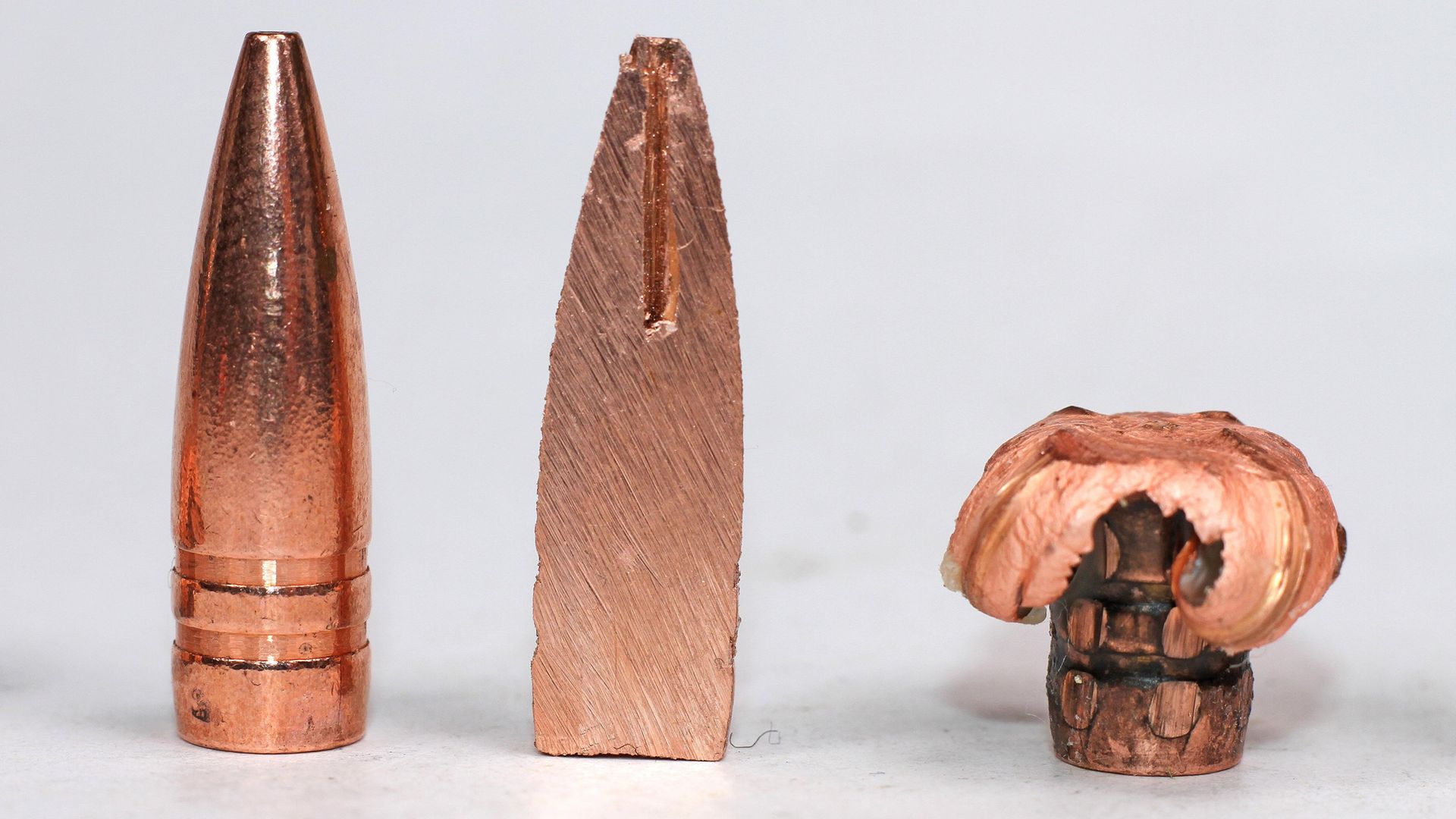
Next in our line of lead-free bullet tests are the .30 cals on offer from Barnes in their Triple Shock X bullet range, which was introduced in 2003. These offer an all-copper bullet with a traditional hollow-point design in the TSX format, or faster expanding projectiles with the newer TTSX bullets with their polymer tip and larger hollow point format. Barnes offer a very good range of both bullet styles as well as variety of calibres, so there is something for everyone and every rifle type.

As usual we are trying to find a sweet spot where the lead-free bullets perform the same ballistically down range as traditional lead-cored bullets of the same weight, thus giving the shooter a viable lead-free option when the time comes – if you can get any!

Ammo test: Barnes X lead-free bullets (TSX and TTSX)

credit: Archant

Bullet specificationsThe TSX and TTSX bullets are not the same dimensionally. Different bullet lengths have implications on load density and accuracy as well as overall cartridge length, but we will discuss that in future articles. At present I am trying to load like for like to see the similarities and differences.

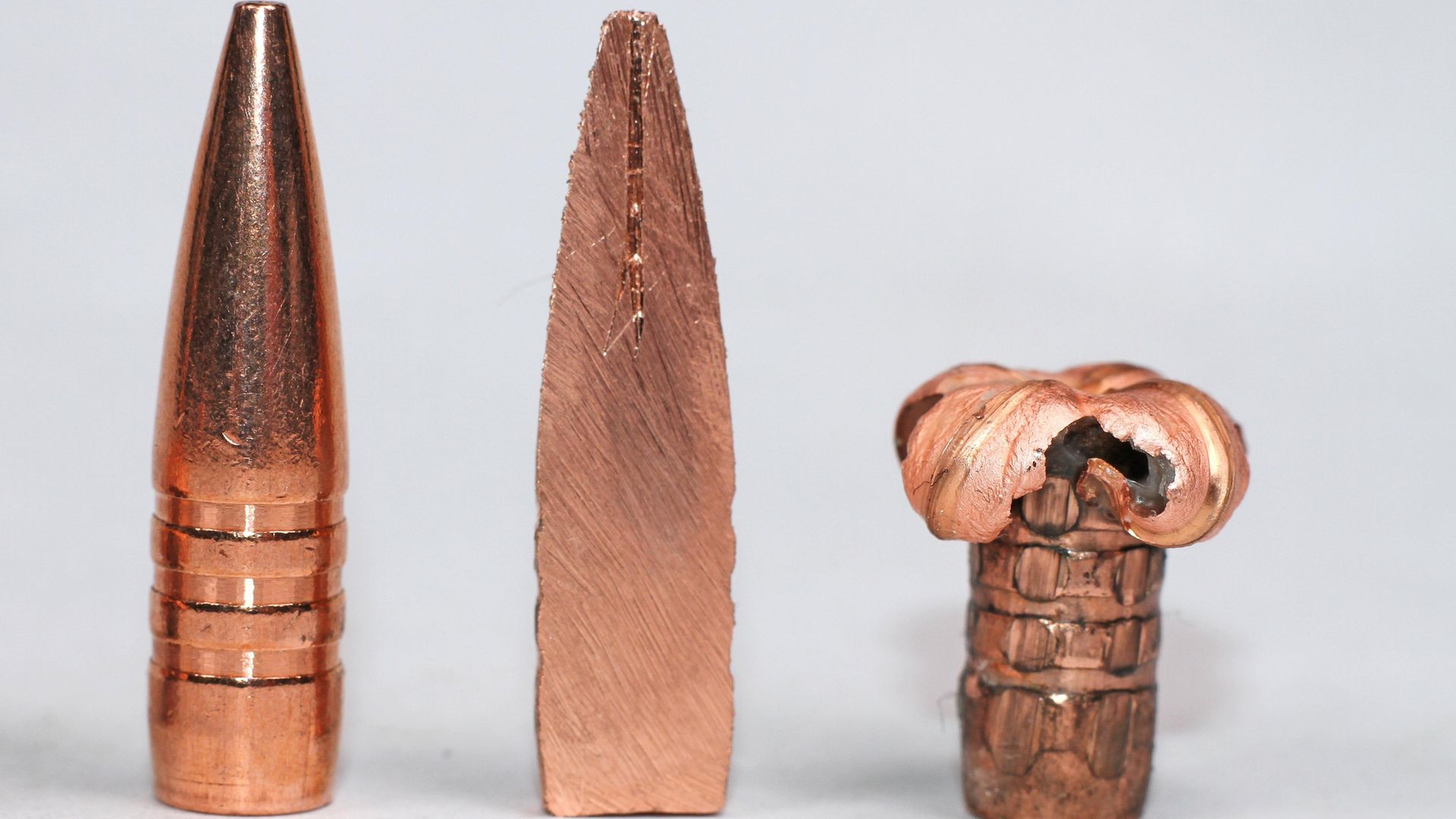
TSXThis is the original Triple Shock-style bullet from Barnes, with an all-copper construction available in flat base and boat tail designs. The 110gr TSX weighs 110.2gr, is 0.9540″ long, 0.3070″ in diameter, and has two smooth cannelure/pressure rings called Accu-Grooves and a flat base. The hollow point is very neat and uniform, and when sectioned can be seen to extend 0.4250″ into the bullet – but it is very narrow, as is the opening. This bullet has a sectional density (SD) of 0.166 and ballistic coefficient (BC) of 0.264, with an overall length of 0.955″.The 130gr TSX weighs 130.6gr, is 1.0860″ long with the same 0.3070″ diameter, Accu-Grooves and hollow point design, but this time with a slight boat-tail base. The SD is good at 0.196, as is the BC at 0.340 G1 – a very nice blend of values.The 150gr TSX as expected is 1.2365″ long, with a more obvious boat tail, and the same hollow point and diameter as the others, but with three Accu-Grooves to relieve stress/friction and fouling. A decent SD of 0.226 helps penetration and the BC of 0.369 value helps retain energy with a more streamlined flight.

Ammo test: Barnes X lead-free bullets (TSX and TTSX)

credit: Archant

Ammo test: Barnes X lead-free bullets (TSX and TTSX)

credit: Archant

Ammo test: Barnes X lead-free bullets (TSX and TTSX)

credit: Archant

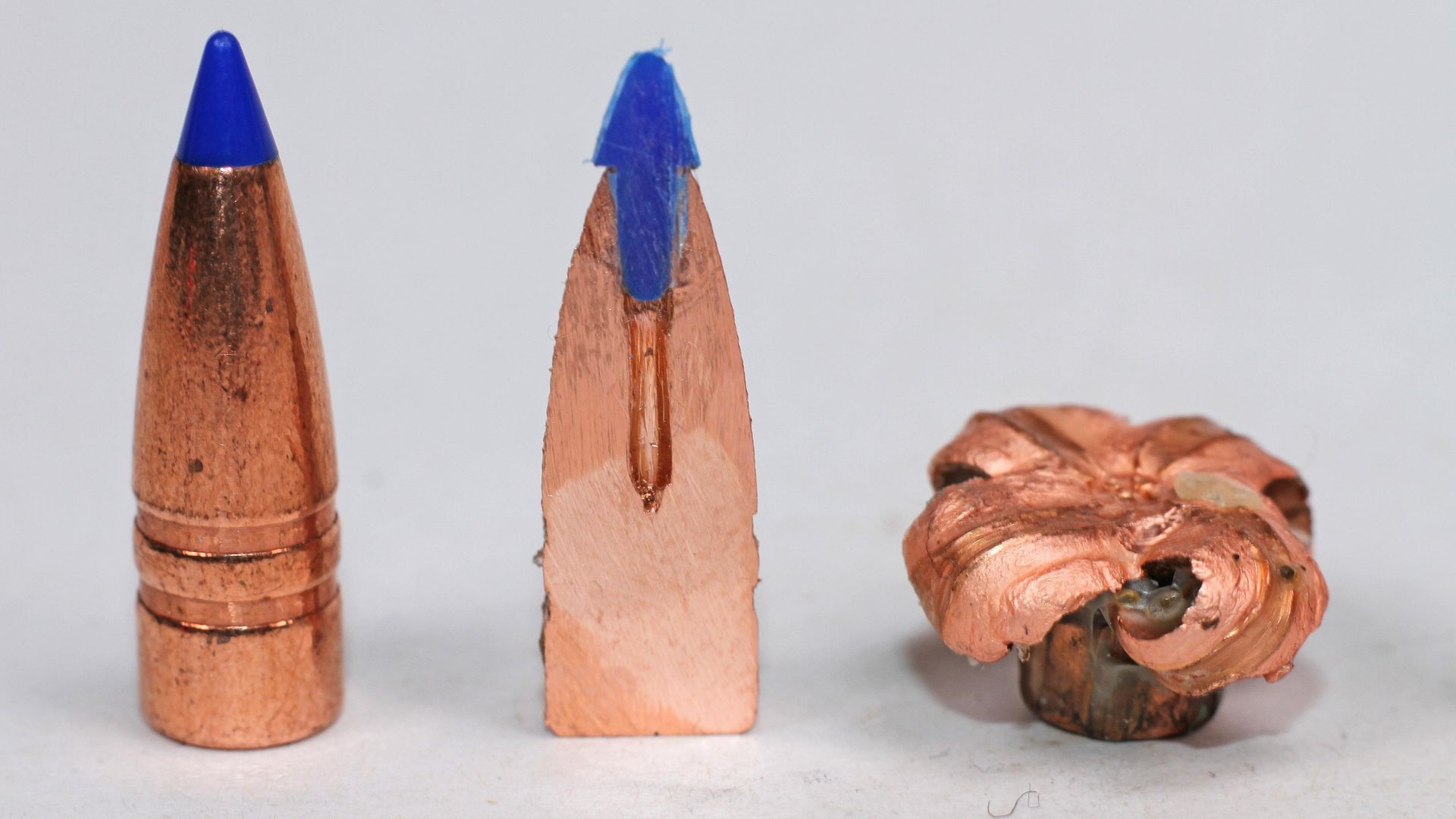
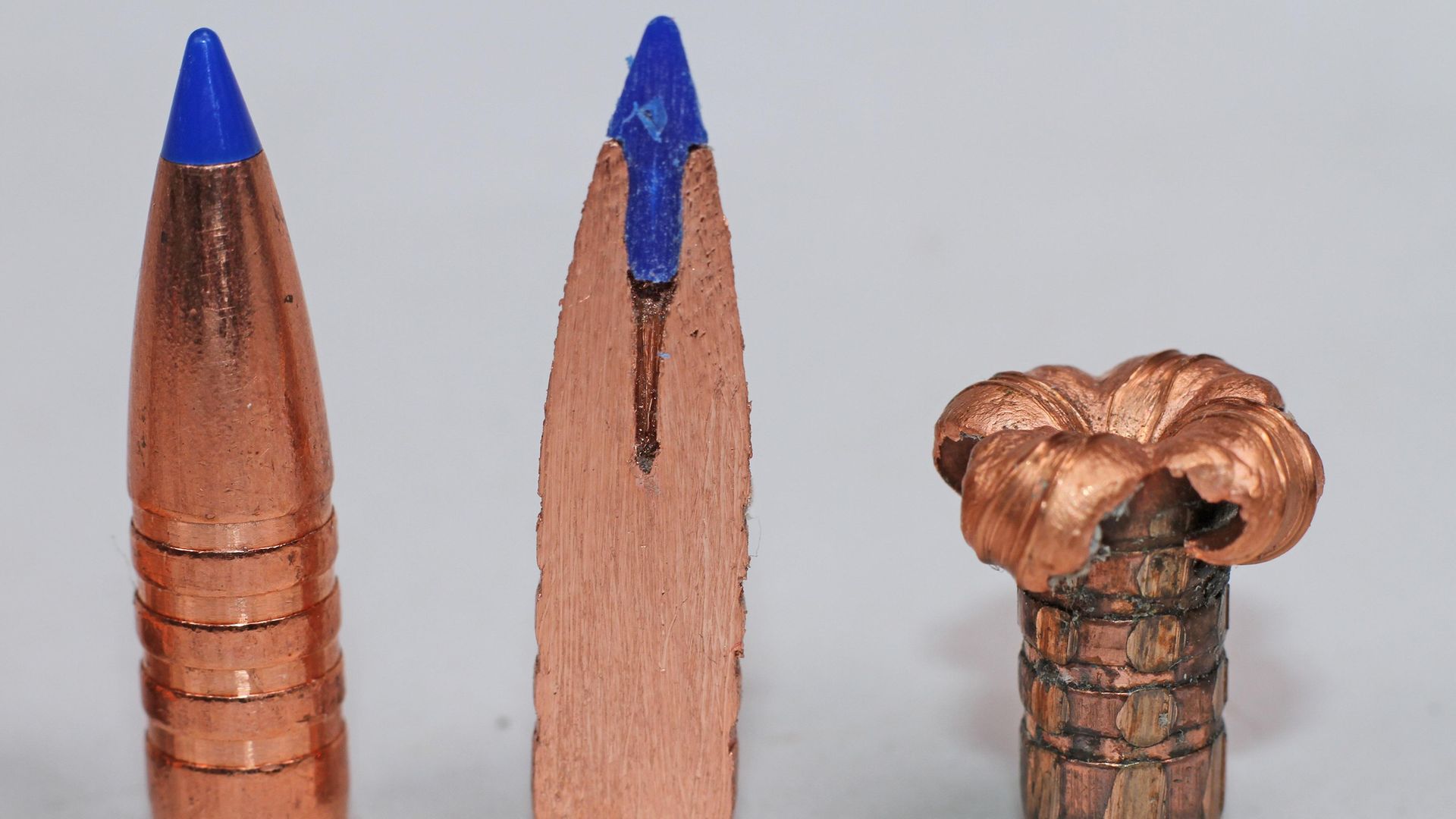
TTSXThis is essentially the TSX bullet with an added tip for better aerodynamics, hence the enhanced BC values as well as better terminal expansion with its redesigned nose cavity.There is a 130gr TTSX bullet option but I could not get any for the tests. The 110gr TTSX weighs 110.4gr and is 1.0425″ long with a diameter of 0.3060″. It has a flat base, two Accu-Grooves and a large blue polymer tip 0.1825″ long and 0.1465″ in diameter, giving a better overall hollow point than the TSX bullet. When sectioned, the bullets have a larger hollow point channel for nearly half their overall length. The sectional density is the same as in the TSX with the same weight obviously but the BC has increased to 0.295 due to the more streamline tipped bullet meplat.The TTSX 150gr bullet weighs 151.0gr and is 1.3015″ long and again slimmer than the TSX bullets at 0.3060″, which is slightly curious. There are Accu-Grooves, resulting in three distinct riding rings and there is a shallow boat tail and the same polymer tip as on the 110gr TTSX. The 110gr TTSX’s SD of 0.226 is identical to the same weight TSX version but the polymer tip boosts the BC to 0.420 – a sizeable improvement over the 0.369 for the same weight TSX bullet.Standing the bullets side by side, you can instantly see the differences in height and overall aerodynamic design despite having the same weights. Most of this is the extra tip of the TTSX bullets, but the cannelure positioning is also different. Because the hollow points and expansion channel are bigger on the TTSX, the bullet has to be longer to achieve the same weight as the TSX bullet. A separate article on OAL/accuracy for all bullets tested will appear in a subsequent issue.

Ammo test: Barnes X lead-free bullets (TSX and TTSX)

credit: Archant

Ammo test: Barnes X lead-free bullets (TSX and TTSX)

credit: Archant

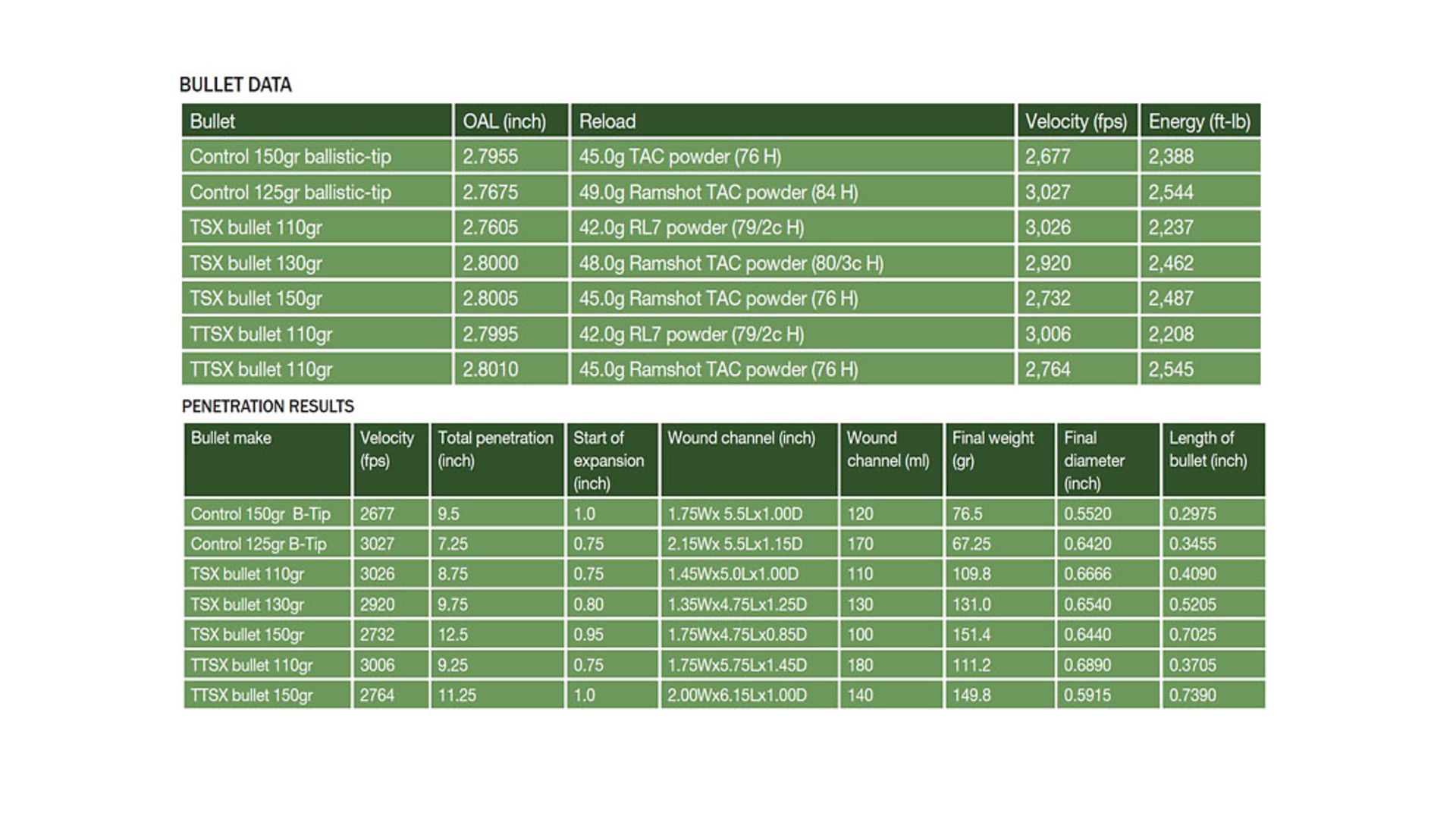
ReloadsI tested the Barnes bullets the same day as the Nosler lead-free E-Tips in a previous article, and therefore used the same control sample of Nosler Ballistic Tip bullets as a comparison for lead-cored bullet performance. The numbers in brackets are the Harrell Premium Culver powder values I use for instant powder measuring. I tried to match the velocities as best I could to get a true reflection of each bullet’s down-range performance.

Ammo test: Barnes X lead-free bullets (TSX and TTSX)

credit: Archant

ResultsWe are trying to see what weight a Barnes bullet needs to be to achieve the same wound channel and expansion/penetration as a corresponding weight traditional lead-cored bullet.

Ballistically the TSX and TTSX were similar to the Nosler Ballistic Tip control group when loaded with the same powder/primer, etc. But as always, the harder Barnes gave at least 50fps faster velocities. A lead-cored bullet’s jacket gives a little when travelling down the bore, while the solid-cored Barnes are more rigid, causing a pressure increase and thus more velocity. That’s why the TSX and TTSX have cannelures to relieve the pressure a little and reduce copper fouling in the bore as the rifling engages the riding bands.

Interestingly the TSX bullets all have a 0.3070″ diameter and the TTSX even smaller at 0.3060″, again to reduce friction. All the bullets retained near as damn it 100% of their weight plus a bit of media.

Now the interesting part regarding down range performance. The TSX bullets expanded very well; they always do, despite that small hollow point aperture and channel. The 110gr bullet expanded to 0.6666″, doubling its size – beastly! The 130gr TSX expanded to 0.6540″ and the larger 150gr TSX to 0.6440″; all impressive. This translates down range to good terminal ballistics. The 110gr TSX penetrated to 8.75″ with a wound channel of 5.0″, maximum width of 1.45″ and volume of 110ml. That’s almost the same as the 150gr Nosler Ballistic Tip at 120ml volume. Looking good.

The heavier 130gr TSX penetrated further, to 9.75″, with a wound channel of 4.75″, maximum width of 1.35″ and volume of 130ml – very good indeed. The 150gr TSX penetrated the most at 12.5″, with a wound channel of 4.75″, max width of 1.75″ and 100ml in the medium.

To me this proves that going lighter to 110gr or 130gr in a lead-free bullet is needed to replicate your older 150gr traditional 0.308 bullet loads with the TSX bullets tested. The 130gr looks very interesting, with a good blend of penetration and expansion, as well as excellent wound volume. I use them in my .30-47L rifle.

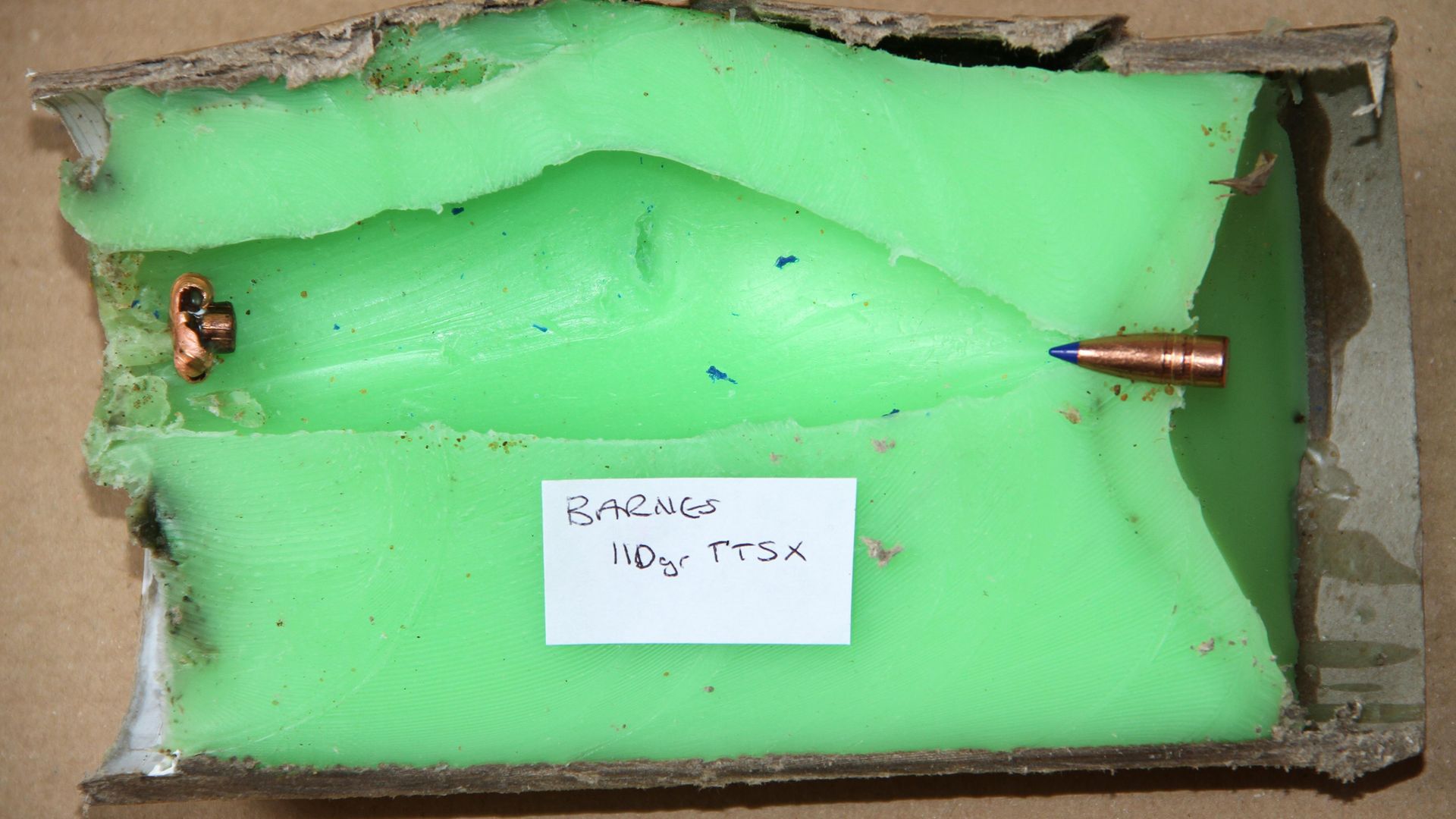
Next up the TTSX bullets. Will these tipped projectiles prove a point? The 110gr TTSX actually penetrated further than the same weight TSX bullets at 9.25″ and gave an impressive 5.75″ wound channel with a maximum width of 1.75″, resulting in a whopping 180ml volume. That’s 10ml more than the control Nosler Ballistic Tip 125gr bullet at nearly the same velocity. Impressive.

Again there was 100% weight retention and bullet expansion was an amazing 0.6890″, up from 0.3060″. The 150gr TTSX also impressed as it penetrated the most at 11.25″. I thought it would expand more with the better hollow point like its 110gr sibling, but still managed a 0.5915″ bullet diameter. The wound channel was impressive, recording a wound channel of 6.15″, maximum width of 2.00″ and 140ml volume.

You should also note that the larger projectile weights carried their wound channels in a linear line for longer, but outside the critical test media and thus animal body cavity. We don’t need total penetration in the UK, although our American cousins do seem to be obsessed with it.

It was also interesting to see the blue polymer tip being fragmented almost at the start of the wound channel to begin the initial expansion of the TTSX bullets. Again, note how clean the wound channels are with these Barnes bullets. You can see how the bullet rotates in flight as the medium has a definite swirl to its inner profile. People forget that a bullet’s rotation also helps to dissipate energy for a quick dispatch on game. There was no wandering of the bullets through the medium with either and these Barnes shot very true in flight.

Before the tests began, I would have said to go with the 110gr TSX or TTSX if you wanted the same performance as a normal lead-cored 150gr .30 cal bullet. That is still true. Look at the 110gr TSX’s 110ml volume and that amazing tipped TTSX 110gr bullet, which at the same velocity as the TSX gave 70ml more wound volume in the same area.

The 130gr bullet, as discussed, would be a good lead-free all-rounder for penetration and performance. I have to admit I was expecting more from the 150gr TTSX, having seen its smaller brother perform so, well but a 140ml wound channel is still 20ml more than a conventional 150gr ballistic tip. Which when you think of it means that a Barnes TTSX at 150gr mimics the traditional 150gr lead-cored control bullet weight for weight. Ah ha! We might be on to something!

Ammo test: Barnes X lead-free bullets (TSX and TTSX)

credit: Archant

ConclusionsOf the lead-free projectiles tested thus far, these offerings from Barnes seem to deliver good consistent performance. The lighter bullets give the desired combination of wound channel and volume within a more confined space – i.e. there is less penetration, which means the bullet’s energy is dumped inside the beast without over-penetration, which has always been a problem with some lead-free bullets. Also, the tipped TTSX Barnes would definitely seem to offer a very good expanding lead-free option if you still want to retain the same weight bullet that you usually use in your rifle.

I would say from a purely subjective view point that there might be some light at the end of the tunnel with regard to changing over from lead to non-lead projectiles. The trouble is supply and demand, as prices are high even if you can buy them to test. Also, as we will explore in future articles, the issues regarding load density, seating depth and rifling twist for best accuracy, make this a whole new ball game!

Contacts RayTrade Ltd Tel: 01635 253344 Barnes bulletsNorman Clark Gunsmiths Tel: 01788 579651 Reload SuppliesHannams Reloading Ltd Tel: 01977 681639 Reload suppliesHenry Krank Tel: 0113 2569163 Ramshot powdersHighland Outdoors Tel: 0845 0990252 Nosler Ballistic TipEdgar Brothers Tel: 01625 613177 Alliant Powders

.270 vs .30-06: The Big Game Hunting Caliber Showdown

0

270 vs 30-06When it comes to hunting big game, it’s hard to ignore the 270 Winchester and 30-06 Springfield. Both cartridges see extensive use during rifle hunting season and are the bane of North American whitetail, mule deer, feral hogs, antelope, and elk.

There’s no denying that the 270 Win and the 30-06 are great cartridges that offer a wide range of bullet weights, allowing shooters to tailor their hunting rifle to take on varmints up to black bears.

And although each cartridge has its own merits, hunting forums across the Internet are ablaze with heated debate over which one is the best choice for their next bolt-action rifle.

First Shots: 270 Win vs 30-06 Springfield

Which is going to work better for You? Do you need the knockdown power of heavier bullets fired from the 30-06? Or does a flatter shooting 270 Win fit your hunting cartridge needs?

In this article, we will objectively compare the 270 Win and the 30-06 Springfield to give you all the data you’ll need to make the best choice on your next bolt action hunting rifle.

Cartridge Specs

When you begin comparing two cartridges, it is good practice to start by examining the case itself.

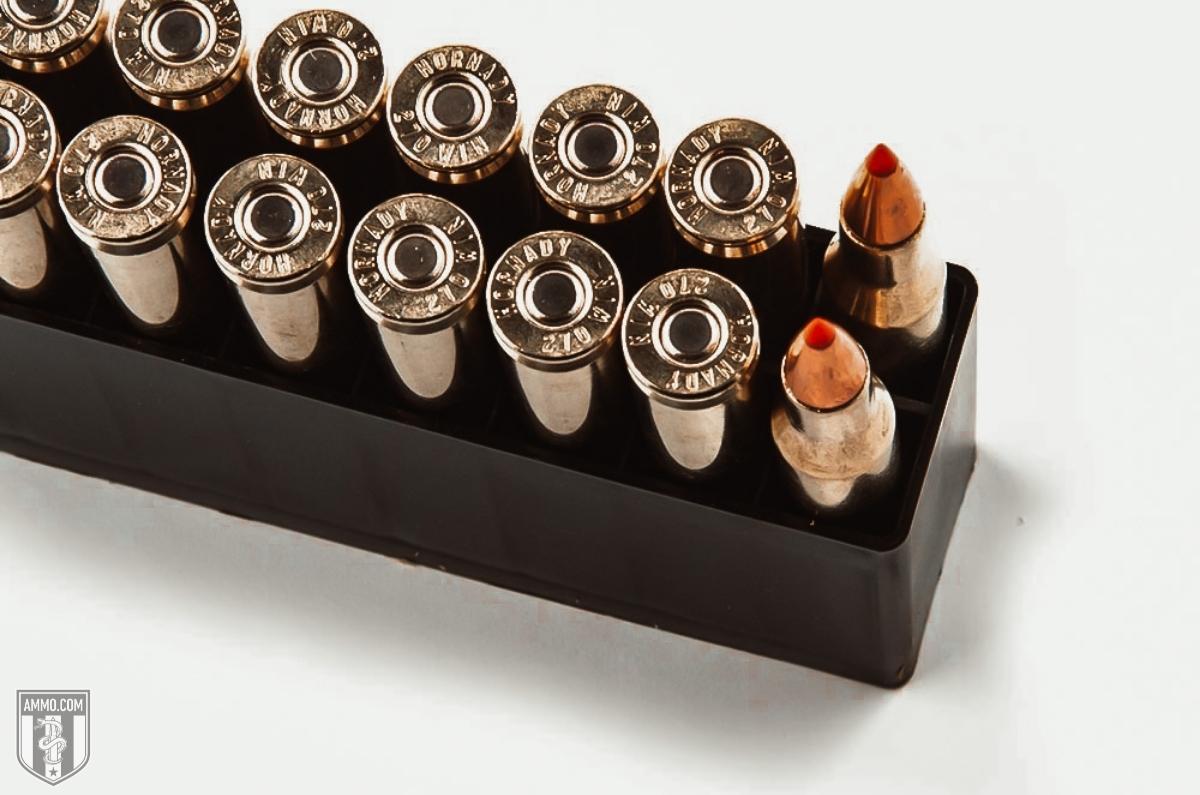
Looking at the 270 Win vs 30-06 cases, we notice that both cartridges descended from the .30-03 rifle round, which we will learn about later in the history sections below. This means that both hunting cartridges will be very similar.

There are only three major differences between the .270 Win and the 30-06, the bullet diameter each cartridge fires, their neck diameter, and the SAMMI max pressure rating.
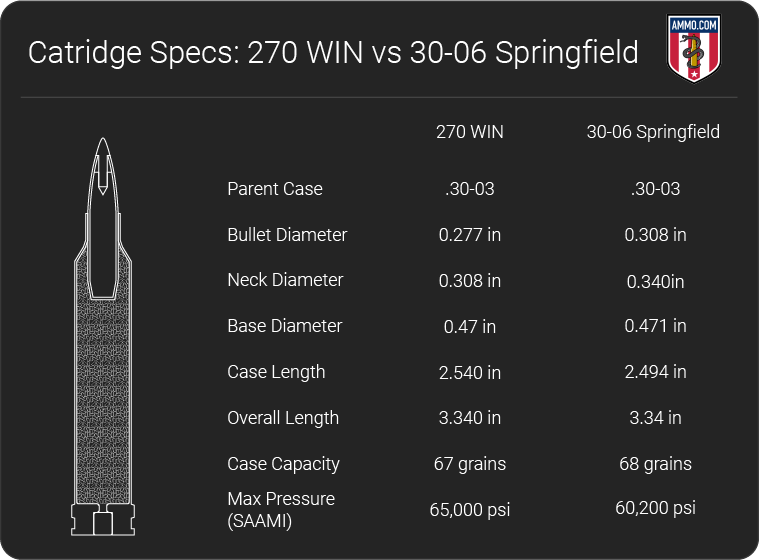
.270 vs .30-06 dimension chart

The 270 Winchester fires a .277” diameter bullet while its larger brother fires a .308” diameter bullet. Simply put, the 270 Winchester is a necked-down version of the .30-03.

As the case capacity between the two is virtually identical, it makes sense that the 270 Win would have a higher maximum pressure as we are shooting smaller projectiles with the same powder charge. This will naturally lead to higher pressures.

Recoil

Recoil impulse is always something to consider when selecting which caliber you want for your new hunting rifle.

As the case capacity for both the 270 Win and the 30-06 is nearly identical, felt recoil energy is going to be dependent on two factors: rifle weight and bullet weight.

A heavier rifle will typically impart less recoil onto your shoulder, the same can be said for lighter-weight bullets.

Internet forums will often state that recoil is not a huge consideration for big game hunting as the shooter will typically only fire one shot. Generally, I’d agree. However, there is the occasion where a follow-up shot is needed. In that case, I’d want a cartridge with less recoil to help me get back on target quicker.

When it comes to 30-06 and 270 Winchester, the 30-06 is going to have higher recoil. How much you ask? The difference is not as great as you would think.

On average, the 30-06 will generate 25 ft-lbs of recoil energy while the 270 Winchester will slap your shoulder with 20 ft-lbs force. Although the 270 Win does have less recoil, it’s nothing like a 223 Rem!

Shooters will often report that the recoil impulse is different between the two cartridges. Hunters will often describe the 270 as having a sharper more defined recoil and the 30-06 having a rolling recoil impulse throughout the firing process.

Although this is not exactly quantifiable, it is a trend you will discover if you like reading shooting forums or talking about rifle cartridges around the fire at deer camp.

Regardless, the 270 Winchester has less recoil energy and will be a better choice for an inexperienced shooter or one with a smaller frame.

Trajectory

Trajectory is how we quantify a bullet’s flight path to its target measured in inches of bullet drop. As a bullet travels downrange, it is constantly being pulled back towards the earth due to gravity. And in terms of long-range shooting, a flatter trajectory is preferred.

Lighter-weight bullets traveling at higher velocity (FPS) will be affected by gravity less as they will reach the target faster than heavier bullets traveling slower.

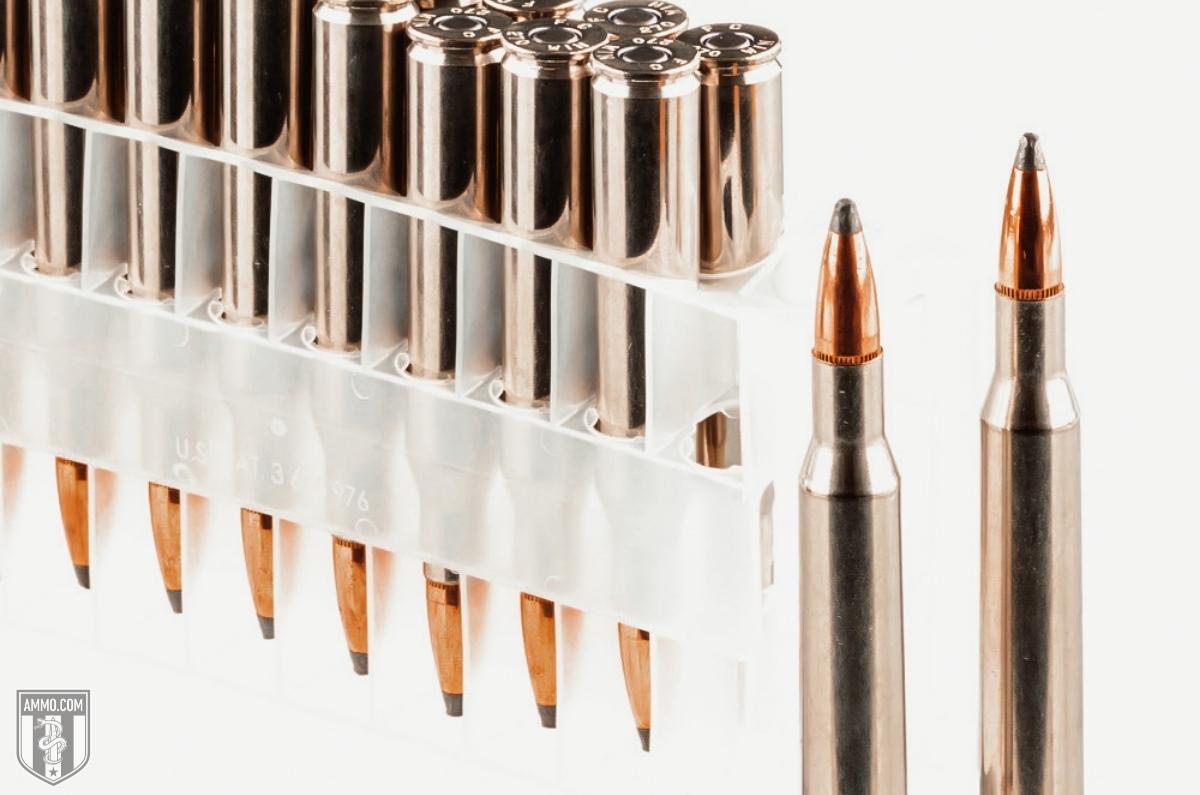
Therefore, the extremely popular 130 grain bullet offerings for 270 Winchester, like the Hornady 30-06 Ammo SST Superformance or Nosler AccuBond, offer exceptional bullet drop values well past 500 yards. On average, a 130 grain bullet fired from a 270 Win will have dropped about -38” at 500 yards, which is better than the 6.5 Creedmoor and on par with the 300 Win Mag at that distance.
270 vs 30-06

Although the 30-06 fires a heavier bullet, its trajectory numbers are still very reasonable for the power that it brings to the field. Take for example your typical 150 grain Nosler Partition having a bullet drop of -42” at 500 yards, that’s still very respectable.

The simple truth is that the trajectories of both hunting cartridges are extremely similar. However, the 270 Winchester will be slightly better as it generally fires lighter bullets at a higher FPS.

Accuracy

Accuracy is an extremely difficult metric to quantify as it is primarily dependent on the rifle used and the ability of the shooter.

There’s no denying that some handloads will be more accurate than others, however, accuracy is most often a measure of a shooter’s skill as opposed to the cartridge itself. Both the 270 Win and 30-06 are capable of sub-MOA groups with proper handloads or match-grade factory loads.

Some shooters will report having better accuracy with a 270 Win, most likely due to less felt recoil energy and favorable trajectory.

However, with all things being equal, there should be no difference in accuracy between these two cartridges.

To learn more, check out our recommendations for the best 30-06 ammo for accuracy.

Ballistic Coefficient

Ballistic Coefficient (BC) is a numerical representation of how well a bullet resists wind and air resistance. It’s a measure of how aerodynamic a bullet is, a high BC is preferred and means the bullet will buck the wind easier.

The way a BC is calculated is rather complicated and irrelevant for this article, however, heavier bullets will typically have a higher ballistic coefficient.

Overall, both the 270 Win and 30-06 have high BC’s and resist wind drift extremely well. Both cartridges have long, slender bullets which help cut down on wind drag.

Furthermore, the added weight from 180 grain bullets available in 30-06 makes it more difficult for the wind to force the bullet off target.

There is not an appreciable difference in BC between these two cartridges. On average, the 30-06 will have slightly higher BCs than the 270 Win, but we are really splitting hairs in this instance.
270 vs 30-06

It’s unlikely most shooters will be able to ascertain the difference in ballistic coefficient between 30-06 and 270 Win, therefore we are going to call this one a tie.

Sectional Density

Sectional Density (SD) is the measure of how well a bullet penetrates a target. This is extremely important when hunting big game, as you need a bullet that can punch through thick hide, bone, and sinew.

Sectional density is calculated by comparing the bullet weight and the bullet diameter, the higher the number the more effective it will be at penetrating a target. The higher the SD the deeper the bullet will penetrate the target.

Just like for ballistic coefficient, there is not much difference between the 30-06 and the 270 Win.

The reason for this is the difference in bullet design and velocity between the two. Although the 270 Win is firing a smaller bullet, the bullet’s energy is localized into a smaller area increasing penetration. In contrast, the heavier 30-06 uses brute force to penetrate deep into the target.

In the end, you’ll get similar penetration for both the 270 Win and the 30-06, to the point that I doubt any hunter will be able to tell the difference between the two.

Hunting

Now we come to the crux of the debate, determining which cartridge is the better option for hunting.

The simple answer is: It depends.

The consensus across North American and European hunters is that the 270 Winchester is better suited for varmint hunting and medium-sized game while the 30-06 is preferred for medium to larger game.

There is some truth to this belief.

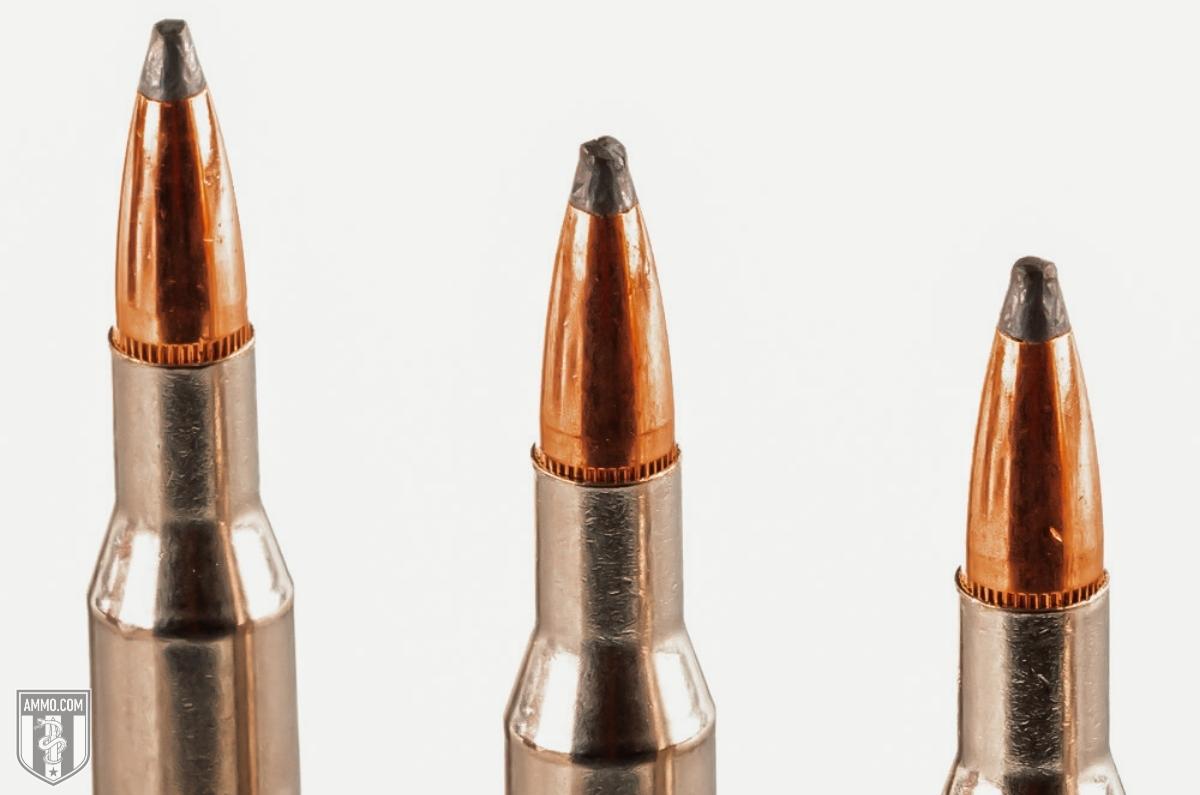
The more common and lighter 120 and 130 grain weigh bullets offered for the 270 Win makes it ideal for taking care of smaller critters that terrorize your property like groundhogs, prairie dogs, or coyotes. These bullets offer a flatter trajectory and hit hard, making short work of any varmint in your sights.

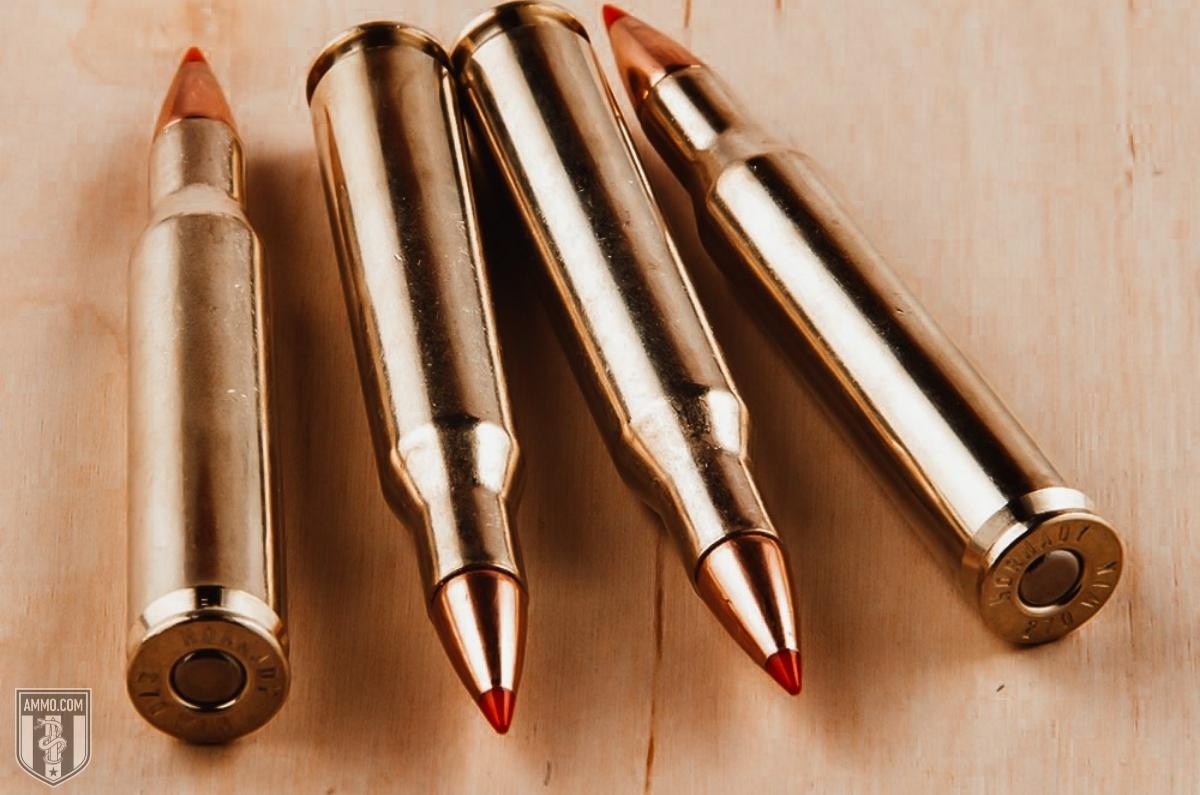
The heavier bullet weights for .270 also do extremely well against whitetail, mule deer, antelope, and feral hogs. A 150 grain Nosler Partition or Barnes TSX will have no issue putting meat in your freezer this hunting season.
270 vs 30-06

But what about larger game that is running around North America, is the 270 Win suited for this role as well?

There is a long-held belief that the 270 is insufficient for elk, perpetuated by tale tales around the campfire or armchair hunting forum gurus who spend more time typing than they do in the woods.

The simple truth is that with proper shot placement and bullet selection, a 270 Win is more than enough to take down an elk. However, I would suggest that this is the upper limit for the 270 Winchester, as when we get into even larger game like black bear, caribou, and moose, you’re going to need something with a bit more power.

Enter the 30-06 Springfield.

Though the 270 is a very versatile cartridge, when you need to take down the largest North American game the 30-06 is hard to beat.

With its heavy-hitting 220 grain factory loads like Hornady InterLock or the Barnes Vor-TX Long Range will make short work of caribou and black bears as they hit hard with excellent penetration and expansion.

It’s well established that the 30-06 is the better choice for large game, but does this mean it can’t play in the varmint arena as well? Decidedly not.

Although not as popular, you can find 30-06 loads for 125 grain weight bullets that would have zero issues taking care of varmints on your property.

The well-known Field and Stream columnist, Jack O’Connor, who was perhaps the biggest proponent of the 270 Winchester, openly admitted that the 30-06 Springfield is the more versatile cartridge.

And for good reason! With its wider range of bullet weights to choose from, the 30-06 offers shooters the versatility to take down varmints and bears alike.

The 30-06 can also be utilized on an African safari as well. Though I’d not recommend it, the 30-06 has been used to take down an elephant, however, a 375 Weatherby Magnum might be a better choice for the largest of African game.

Although many hunters might argue that the flatter shooting 270 Winchester is better suited for varmints, there’s no reason that a 30-06 can’t be used for the same purpose.
270 vs 30-06

To summarize, if your hunting aspirations end at hunting North American elk, then there’s no reason to shy away from a 270 Winchester as it can achieve everything you desire with less felt recoil and a flatter trajectory.

However, if you believe there is the possibility that you’ll go on safari one day to the African plains or you’ve always wanted to go to Alaska to take down a caribou, then the 30-06 Springfield is clearly the better choice as it offers you the versatility you need to take down a wide variety of larger game at long range.

Ammo and Rifle Availability

There is no shortage of ammo options or bolt action rifles when it comes to 270 Win and 30-06.

All the major firearm manufacturers like Remington, Winchester, Savage, Ruger, and Weatherby make rifles chambered in both calibers.

However, as the 30-06 has been around longer and it was also a military cartridge, you will find more rifle options available for 30-06 with some semi-auto options also.

As far as price is concerned, factory new rifles will be equal in price regardless of caliber for most manufacturers. However, as the 30-06 was a military cartridge, there are many surplus rifle options on the secondary market if you don’t want to get the newest, tricked-out long-range hunting rifle and prefer the more classic look.

The same situation is true for ammo. There are simply more factory loads for 30-06 than 270 Winchester as the 30-06 has been around longer as was heavily utilized by the US military in the early part of the 20th Century.

You won’t lack options if you opt for a 270 Winchester, but the 30-06 just offers more as it has been optimized and improved upon more.

The price between these two cartridges is about equal. For the cheaper practice ammo, you should expect to pay around $1.50/round while the premium hunting ammo will go for about $3/round at the time of writing.

Reloading

If you love reloading as I do, then you’re going to have a wonderful time crafting your perfect long-range handloads for both the 270 Winchester and 30-06 Springfield.
270 vs 30-06

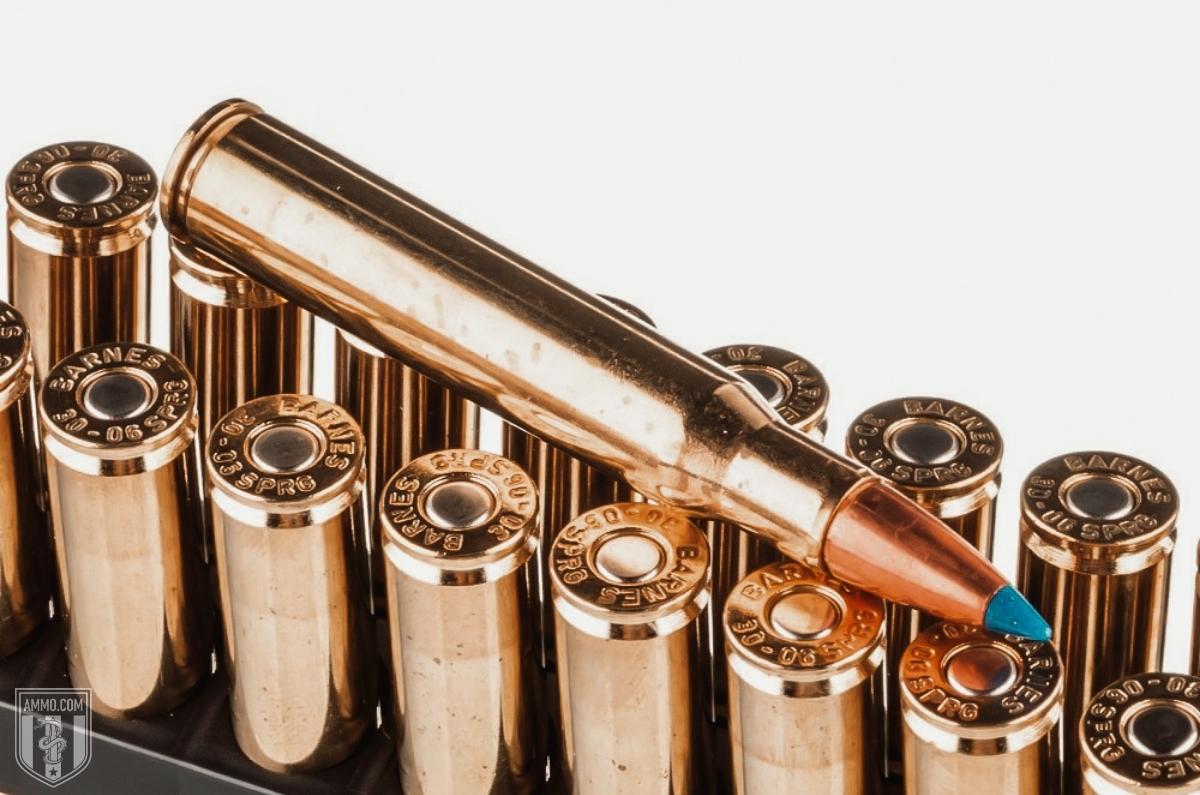
There is a wide range of bullets available for both that you can choose from to work up your perfect hunting or long-range target rounds.

However, as the .277” bullet diameter is not commonly used in other cartridges, the 30-06 will offer you more cross-compatibility in terms of components.

For example, if you reload for 30-06 then you can easily reload for 308 Winchester and 300 Win Mag as they fire the same .308” bullet diameter.

Reloading for either of these great cartridges should be a joy as you’ll have plenty of component choices for both, the 30-06 just offers more compatibility with other 30 caliber cartridges.

.270 vs .30-06 Ballistics

The ballistics tables below offer you the opportunity to check out some of your favorite factory loads for both calibers and determine which will be the most effective for your intended use.

Our team here at Ammo.com has done an excellent job compiling manufacture’s data to give you a wide range of bullet weights to choose from.

.270 Ballistics

Note: This information comes from the manufacturer and is for informational purposes only. The actual ballistics obtained with your firearm can vary considerably from the advertised ballistics. Also, ballistics can vary from lot to lot with the same brand and type load.

.30-06 Ballistics

Note: This information comes from the manufacturer and is for informational purposes only. The actual ballistics obtained with your firearm can vary considerably from the advertised ballistics. Also, ballistics can vary from lot to lot with the same brand and type load.

.270 Win History: Winchester’s All-Star Hunting Cartridge

As with many cartridges in the 20th Century, the 270 Winchester got its roots from the 30-06 Springfield.

After the Spanish-American War, the United States Military began the process of creating a new cartridge after seeing the deadly efficiency of the 7x57mm Mauser round in the hands of Spanish troops.

The round that was eventually selected is the lauded 30-06 Springfield which also came with the Army’s new bolt action rifle, the 1903 Springfield. The 30-06 Springfield was designed to fire 150gr bullets at 2,700 fps (feet per second).

The 30-06 was wildly successful and led to wildcatters using the 30-06 as a parent case to make new cartridges. A wildcatter is someone who makes their own custom cartridges that are not commercially available to achieve a specific purpose.

Many wildcatters live true to my personal motto, “Go big or stay home”, and necked up the 30-06 to accept a larger caliber bullet. Two wildcat cartridges that eventually became commercially available were the .35 Whelen and the .400 Whelen.

Winchester decided to take a page out of the Mauser Playbook and necked down the cartridge to accept a smaller diameter bullet that would be fired at a faster muzzle velocity.

The .270 Win was introduced in 1925 and is a necked-down version of the 30-03, the progenitor of the 30-06, to accept a 0.277” diameter bullet.

The original offering of the 270 Winchester came in their Winchester Model 54 bolt action rifle and was designed to fire 130 grain bullets at a muzzle velocity of 3,140 fps.

The decision to use a 0.277” diameter bullet was a somewhat perplexing decision by Winchester as 270 was a much more obscure caliber at the time. By comparison, the much more popular 0.284” diameter bullet was used in the 7x57mm Mauser, 280 Remington, 7mm Remington Magnum, and 7mm-08.

This decision by Winchester meant that the 270 Win was not an immediate commercial powerhouse like the 30-06 and lived in relative obscurity for many years.

Even today there are only a few cartridges that utilize the 0.277” in diameter bullet, the most popular being the 270 Winchester Short Magnum (270 WSM), the 270 Weatherby Magnum, and the 6.8 Remington SPC.

It’s been theorized that Winchester wanted to stay away from popular European bullet designs like the 6.5mm Swiss (and more recently the 6.5 Creedmoor) and 7mm Mauser to make a cartridge that was truly American and wouldn’t be viewed as fashion-drafting off of other gunsmiths’ work.

Regardless of their reasoning, it wasn’t until after WWII that Jack O’Connor began to expound upon his unabashed love affair with the 270 Winchester in Outdoor Life magazine that the cartridge really started to see its popularity grow.

O’Connor had been using the 270 Win in many of his big game hunts and this is what is primarily credited with the rise in popularity of the cartridge.

Since then, the 270 Win has been steadily growing more and more in popularity due to its flatter trajectory, long-range shooting capability, and versatility as a hunting round being able to ethically harvest game animals from groundhogs to elk.

With the ability to shoot lighter bullets from 120gr for small game up to a heavier bullet at 160gr for large game, the 270 Winchester allows you to have ammo versatility that other cartridges only dream about.
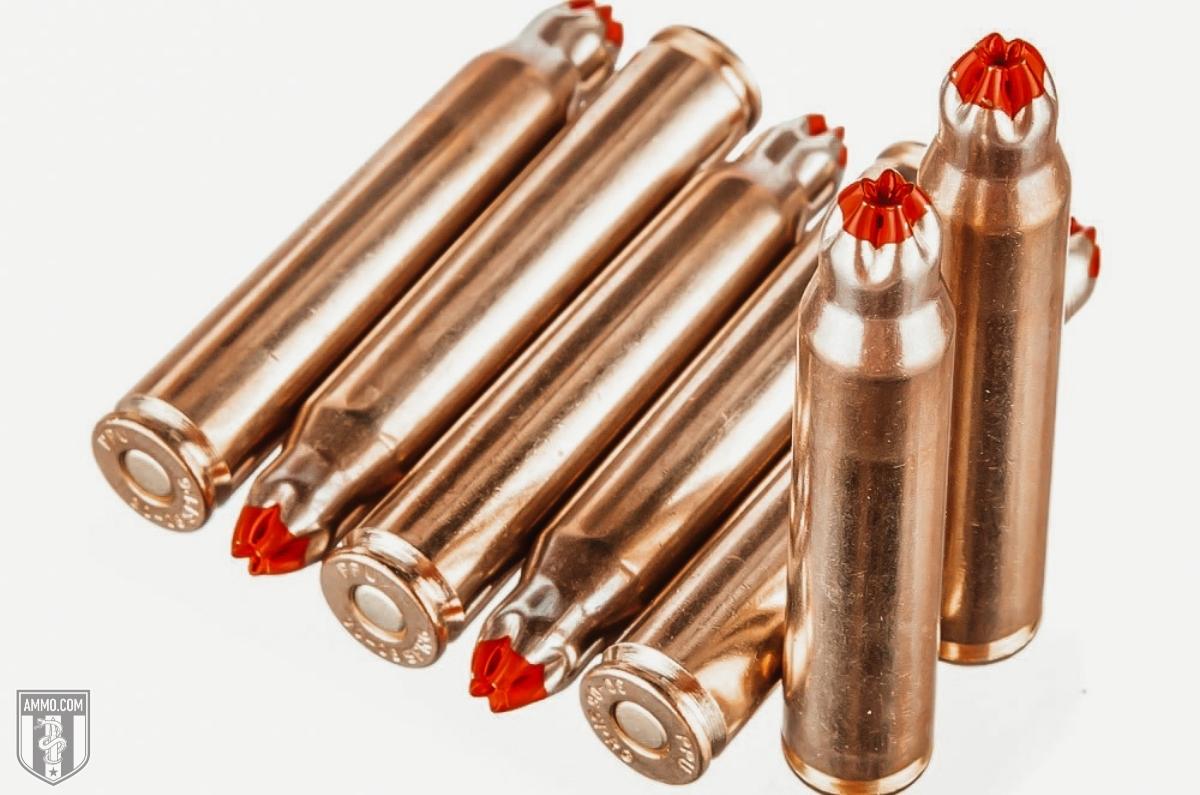
270 vs 30-06

30-06 Springfield History: America’s Beloved 30-Caliber Rifle Cartridge

America’s love affair with 30 caliber rifle rounds began back in the Wild West with the introduction of the 30-30 Winchester. Later, the U.S. Army developed the 30-40 Krag to be its smokeless powder replacement for the .45-70 Government.

Around 1901, the U.S. Military started developing a new cartridge to replace the 30-40 Krag. The American Expeditionary Forces were very familiar with the effectiveness of the 7mm Mauser cartridge, suffering staggering losses at the hands of the 1893 Mauser at the Battle of Santiago during the Spanish-American War in Cuba.

It was clear that the 30-40 Krag was an inferior design compared to the Spanish Mausers and the military did not want to fall behind with advancements in bolt action rifle and cartridge technology.

At the time, heavier bullet weights were thought to be the superior ballistic choice. Therefore, the initial design submitted in 1903 used the same 220-grain round-nose bullets fired by the 30-40 Krag.

The 30-03 Springfield was patterned after the famous 7x57mm Mauser cartridge, sharing identical case head dimensions.

However, it didn’t take long for the American generals to take note that multiple European nations were favoring higher velocity, Spitzer (pointed) projectiles in their new bolt action rifles.

Not wanting to get left behind, the U.S. Military was quick to adopt a similar design. In 1906, the new cartridge that fired a Spitzer flat-based 150 grain bullet was submitted and accepted. The original design for 30-06 Springfield achieved a muzzle velocity of 2,700 fps, packed 2,429 ft lbs of muzzle energy, and a maximum pressure of 60,200 psi (SAAMI specs).
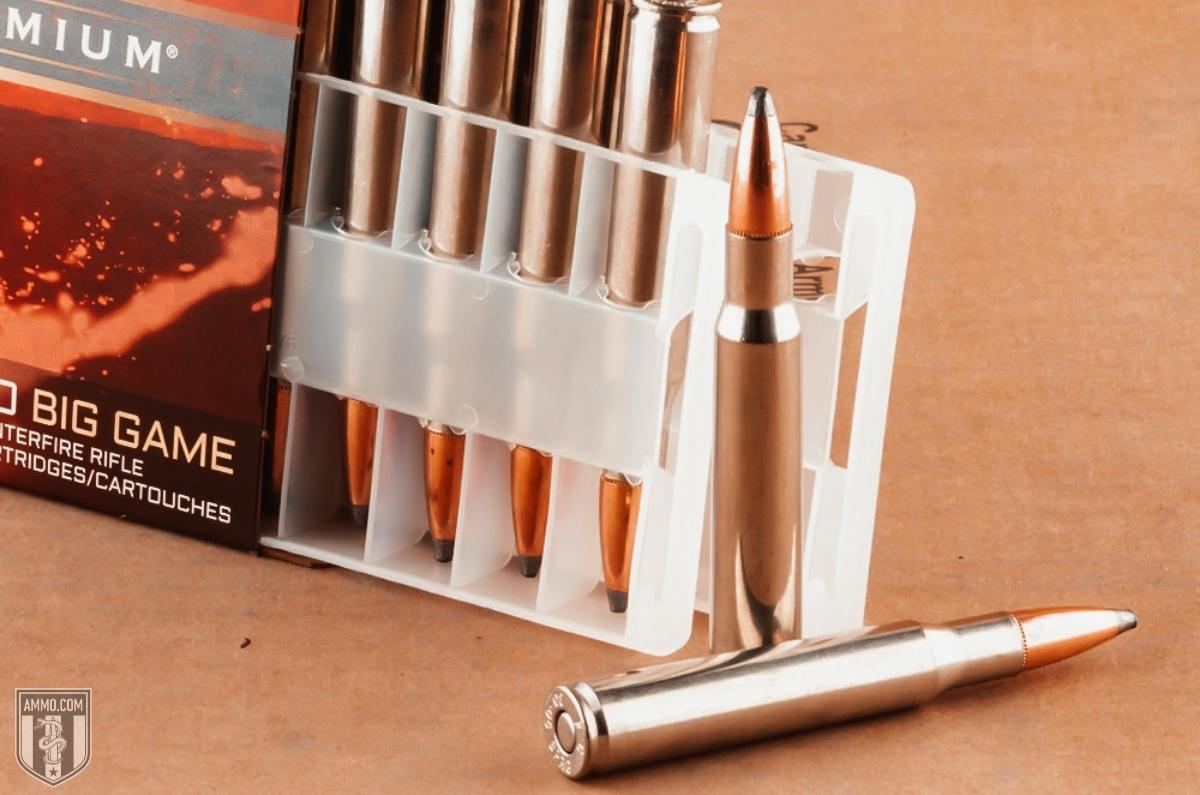
270 vs 30-06

And thus the 30-06 Springfield was born. The “30” designates the bullet caliber and the “06” (pronounced: aught six) designates the year of its adoption. The 30-06 Springfield can also be referred to as the 3006 Springfield or just simply as 30-06.

Although the 30-06 initially gained popularity with the Army’s new bolt action rifle, the 1903 Springfield (which looked surprisingly like a Mauser…coincidence I’m sure), it truly became World Famous with the introduction of the semi-auto M1 Garand during World War II.

The 30-06 Springfield was the ammo carried by our soldiers who fought in the trenches on the Western Front in World War I, stormed the beaches of Normandy in WWII, assaulted the 38th Parallel in Korea, and saw limited use in the jungles of Vietnam.

Not only has the 30-06 seen massive success on the battlefield, but it has seen immense commercial success in the civilian market as well. Big game hunters loved the amazing terminal ballistics and long-range that the 30-06 offered while having a recoil impulse that is not punishing to the shoulder.

Since its introduction to the civilian market, the 30-06 has been the de facto hunting cartridge that all other hunting caliber cartridges are measured against. The most popular loadings for 30-06 range between 150 and 180 gr bullet weights with the 180 grain bullet being the most popular with big game hunters. However, specialty ammo can go as low as 110-grain bullets and as high as 220 grain projectiles.

The 30-06 Springfield is incredibly versatile, allowing hunters to customize their loads depending on the game animals they are stalking. Lighter bullet weights like the 150 and 165 gr Nosler Partition or Accubond can be utilized for whitetail or mule deer, while you should have good luck with the 200 gr Barnes TSX when you have a perfect broadside shot lined up on that trophy elk in your crosshairs.

The 30-06 is truly a rifle cartridge of American legend and has survived the test of time, as it is still one of the most popular hunting rounds in the world over 100 years later.

Final Shots: 270 vs 30-06

When it comes to big game hunting, it’s hard to beat these two great cartridges. The 270 Winchester offers a flatter trajectory like the 300 Win Mag as well as the power and penetration necessary to take down whitetail, antelope, and elk all with less recoil.
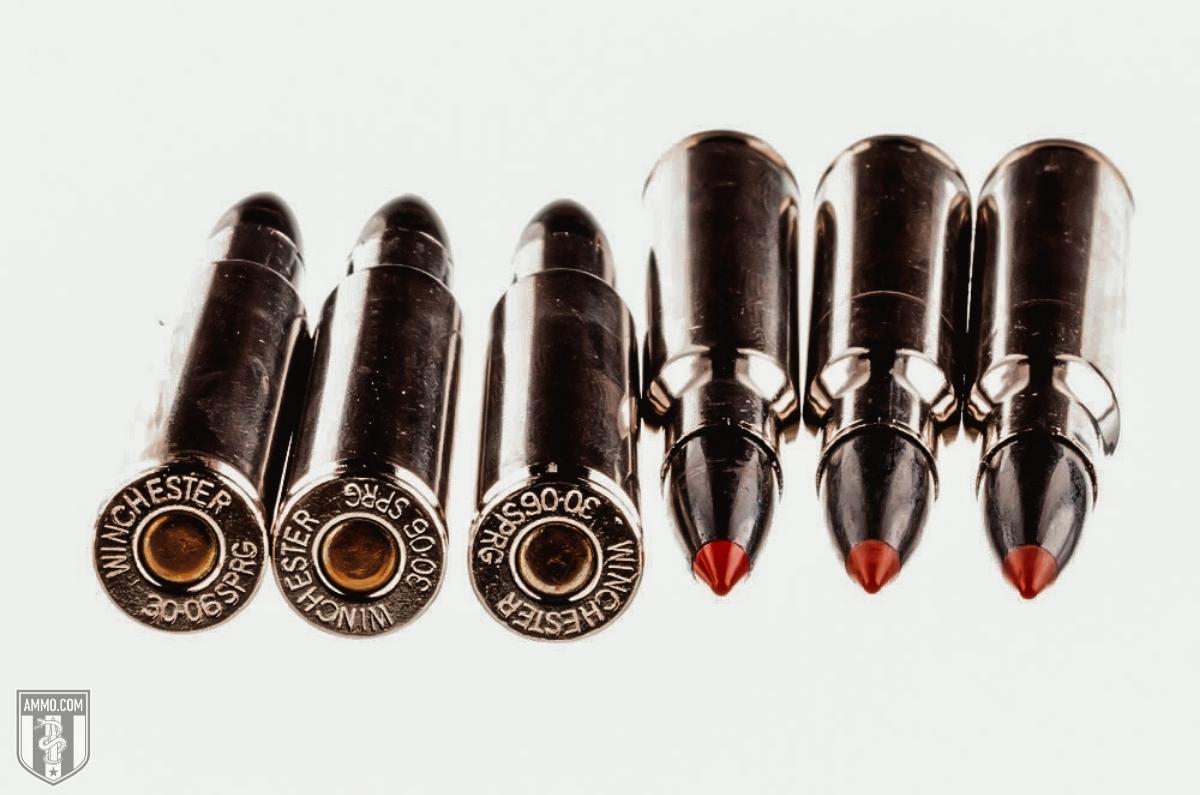
270 vs 30-06

The 30-06 Springfield is a tried-and-true long-range hunting round that has tackled all different varieties of larger game across North American and the African savannah. Black bears and elk stand no chance against the hard-hitting 30-caliber warhorse and many shooters prefer the heavier bullets the 30-06 can handle.

Which caliber is right for you depends on what you plan to hunt.

If you have zero aspirations of taking on black bears or moose, then the 270 Winchester is the better option as it is an extremely capable long-range cartridge that is flatter shooting and has less recoil but does not sacrifice on terminal ballistics.

If you plan to go hunting in Alaska or Africa in the future, the 30-06 Springfield will ensure these large game animals end up in your freezer or wall and not lost in the bush.

Regardless of which caliber you choose, the most important aspect of big game hunting is shot placement to make sure that the animal does not unnecessarily suffer.

Make sure you stock up on ammo here at Ammo.com as hunting season is quickly approaching and it’s high time you dusted off your rifle and got to the range for some practice!

What is Grain Weight and How Does It Affect Shooting Performance?

0

While hunters and marksmanship enthusiasts are more familiar with how grain affects shooting performance, the average American gun owner does not understand the importance of making this part of their criteria when purchasing rounds. The team at The Range 702 explains why you should pay attention to grain weight and its effect on recoil, trajectory, and impact, as well as practical applications.

3 pistols with bullets

Common Misconception About Grain Weight

Before we get into what grain weight is, let’s first talk about what grain weight is not. Don’t fall into the trap of thinking that the grain weight listed on a box of ammunition represents powder weight or the overall power of the cartridge.

Some people connect the reference of grain weight as being a measurement of the “grains” of gunpowder in the ammo. However, it has nothing to do with that. Grain weight refers to the overall weight of the entire round that is projected from the gun. In fact, different gun powder formulas can have varying weights but still deliver comparable performance levels.

What Is Grain Weight?

The grain weight system is used to measure the mass of a piece of ammunition. Measuring in grain (gr) is a measuring system to describe the mass of the cartridge projectile (the part that is propelled forward from the firearm). These measurements of mass help determine the correct size of ammo to use for specific shooting purposes.

Ready to improve your shooting? Book a training class with our skilled instructors at The Range 702 in Las Vegas!

Understanding Grain Weight and Firearms

Rounds of ammunition for handguns and rifles come in cartridges made up of the following parts:

  • Primer
  • Propellant
  • Casing
  • Projectile

Shotgun shells are structurally different and require one more part known as a wad.

The weight of the projectile is measured in grains using the grain symbol gr. When converted using the metric system, there is approximately 7,000 grain in one pound. The weight of a paper clip is about 16 grain.

The mass of the 5.56 NATO rounds1 for the M4 carbines is 62 grain, which equals around four paperclips. However, there are other versions of this ammunition for AR-15 rifles with 55 grain for a lighter projectile.

Close-up of a group of 9mm rounds. Cartridge background. New cartridges stacked neatly near each other.

Selecting the Right Grain Weight for Your Shooting Purposes

There are some things to consider when choosing the right grain to help with your shooting performance, including:

  • Caliber – Caliber is the internal diameter of the barrel and is the first factor to consider when selecting ammunition. The rounds must fit the magazine, chamber, and barrel, which requires a specific shell size. Cartridges come in a range of calibers and grain. Heavier grain results in a larger projectile, but the difference is not always noticeable.
  • Ballistics – The grain weight of ammunition will affect ballistics (velocity, energy, and overall shot performance). Ballistics considers the mechanics of how a shot behaves and is an important factor in choosing cartridge weight to match its purpose.
  • Joules – Grain affects recoil energy (pushback the shooter feels from the gun once discharged) and the energy put downrange. This energy is expressed in a unit of measurement called joules. When you feel the recoil of standard grain, think about the following: heavier grain weight will have greater recoil force while lighter grain will have less. Likewise, grain weight affects the energy felt by the target.

Learn more shooting tips from the experienced instructors at The Range 702. Contact us to book a lane today!

Which Grain Weight Is Best for Shooting?

The answer to which grain weight is best depends on the type of shooting and which firearm you’re using. Here are some various applications and their recommended grain weight:

1. Routine Range Shooting

Understanding grain weight isn’t as important when first becoming familiar with various firearms. For beginners, there is a standard size and grain weight for all ammunition types and brands. For the range, the 55 grain for AR-15 and other 5.56/.223 rifles are adequate because you will aim at targets positioned in short to medium distances.

2. Hunting

You generally want heavier grain weight to deliver more energy into the game, but this may also depend on animal species. Hunters who do not want to leave blood trails, meaning they prefer a more humane shot that drops the game on the spot, will go for heavier grain. A heavier grain also means that they may have to do more stalking to get closer because heavier cartridges travel slower.

3. Self-Defense

Self-defense situations typically occur at close ranges of at least 21 feet from the threat2. Should you need to engage a threat, you want the stopping power that heavier rounds provide. While considering round weight and energy, you should choose rounds that are less likely to pass through a target, which means lost energy and additional hazards. Even though self-defense rounds are commonly more expensive, you should practice shooting these at a range to ensure they feed and fire without malfunction in your firearm, and to familiarize yourself with how they shoot.

4. Marksmanship

Sport shooting of rifles at longer distances may require lighter grain ammunition. Other factors, such as wind conditions and the type of rifle, should also be considered.

In conclusion, choosing adequate grain weight is essential to your real-life shooting experiences. Getting used to various ammunition weights will also help you improve the handling of your firearm.

Visit The Range 702 in Las Vegas

If you’re interested in getting a personal feel of what these various ammunitions feel like, check out our shooting experiences and gun vault! Get expert advice from our instructors and sign up for one of our many classes that will help you learn how to handle your gun better.

Sources:

1Wikipedia. 5.56×45mm NATO. Retrieved on 20 December 2021.

2Findley, Ben. (8 April 2015). What is Your Safe Distance to Engage the Threat: The 21-Foot Rule. USA Carry. Retrieved 20 December 2021.

Top 6 .22 WMR Hunting Loads

0

Introduced in 1959, the .22 Winchester Magnum Rimfire (22 WMR) is the quintessential ranch rifle round. The “.22 Mag,” as it’s less colloquially coined, delivers external and terminal ballistics sufficient to rid the pasture, woodlot and garden of marauding varmints, pests and predators out to 150 yards. When a quality rifle is placed in the hands of accomplished marksmen, that distance can be stretched a bit further. Despite the .22 Magnum’s uptick in external ballistics over the .22 Long Rifle (22 LR), perceived recoil is virtually nonexistent, making it ideal for multi-day prairie dog and ground squirrel shoots. Shooter fatigue with the cartridge is purely fictional.

Further endearing the .22 WMR to homeowners with neighbors is its reduced report; unless ultra-long volleys are commonplace, it’s unlikely that the sound will burden either the nearby residents or livestock within earshot. Ammunition is surprisingly affordable and diverse, too. In fact, 50-round boxes of ammunition in wide-ranging configurations range from $10.99 to $17.99 at MidwayUSA. Given such an assortment—the abovementioned retailer lists 26 different loads on its website—and price range, how do you know what to select? That’s the intent of this article—to provide an unbiased perspective.

In the subsequent paragraphs, I describe the particulars of six current .22 WMR hunting loads, as well as each load’s performance with regard to accuracy from a bench rest at 100 yards (five consecutive, five-shot groups), velocity and terminal performance at 50 yards in modeling clay. Velocities were recorded using a Competition Electronics ProChrono Digital 15 feet from the 20 ½-inch barrel of the test rifle, a Henry Repeating Arms Lever Action Octagon Frontier topped with a Bushnell Banner 3-9X40 riflescope. Bear in mind that as a lever-action rifle, the Henry was incapable of illustrating functionality of the ammunition in a semi-automatic, .22 WMR-chambered arm, and inherent accuracy shouldn’t be judged solely based on results from a single rifle, either. Lastly, I noted the advantages and drawbacks associated with each load. Here are my discoveries.

1. CCI Maxi-Mag .22 WMR 40-Grain Total Metal JacketParticulars: Featuring a full metal jacket, 40-grain bullet propelled to 1875 fps—for 312 ft.-lbs. of energy—this load was designed primarily for plinking and perforating paper; however, it’d nicely pull double-duty for those who want neutralize varmints or even dispatch porkers. Concerning the latter, from the field reports that I’ve read it’s the cat’s meow for exterminating feral hogs—to each their own. MSRP: $11.79 per 50-rnd. box; midwayusa.com.

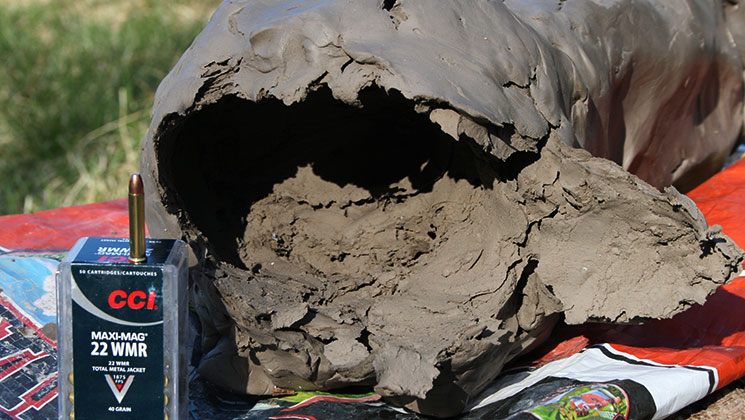
Test: Across a Competition Electronics ProChrono Digital chronograph at 15 feet, the load averaged 1768 fps. Concerning accuracy, the flat-point, no-lead-exposed bullets proved to be near the top of the heap. In fact, for five consecutive, five-shot groups, it averaged 1.11-inch. The single smallest group measured 0.78-inch. As for its performance in the modeling clay, forget everything that you know about TMJ bullets—it doesn’t apply here. This bullet expands violently; weighing 33.4 grains, the recovered bullet measured an impressive 0.702-inch in diameter. Still, penetration was fairly deep.

Advantages: Eye-opening terminal ballistics, accurate, low cost, no-lead-exposed bullet.

Drawbacks: Looking for a non-expanding bullet to minimize pelt damage? This isn’t it.

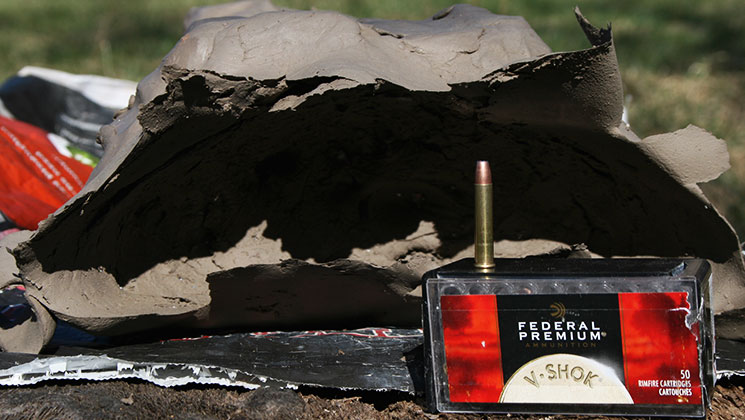
2. Federal Premium V-Shok 30-Grain Speer TNTParticulars: This devastating round employs Speer’s appropriately named “TNT” bullet; pairing a lead core and thin jacket in a cavernous, hollow-point configuration maximizes expansion while simultaneously reducing penetration—perfect for stopping critters on the spot and reducing the risk of ricochet. Enhancing the external and terminal ballistics of the 30-grain bullet, its speedy 2200 fps velocity resulting in 322 ft.-lbs. of energy at the muzzle. MSRP: $12.99 per 50-rnd. box; midwayusa.com.

Test: Despite the test rifle’s 20½-inch barrel, this load achieved 2147 fps—only 53 fps less than the velocity achievable from a full 24-inch barrel. Accuracy with this round was respectable, averaging 1.39 inches for the 25 shots. Terminal performance in the modeling clay could be summed up with one word: devastating. The bullet created an immense yet relatively shallow cavity and completely fragmented. It’s little wonder why so many hunters report instantaneous kills on game upward the size of coyote.

Advantages: Shocking terminal performance, good accuracy, reasonable cost, reduced risk of ricochet.

Drawbacks: Want deep penetration? Look elsewhere.

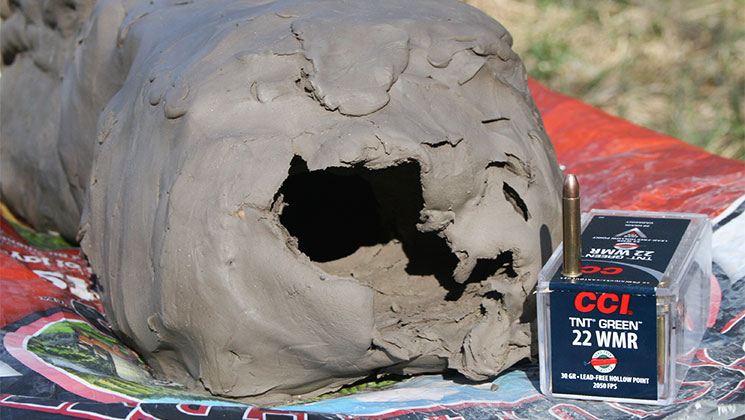
3.CCI TNT Green .22 WMR 30-Grain Lead-Free Hollow PointParticulars: This is one of the few lead-free options in .22 WMR. It features a California compliant, 30-grain hollow-point bullet propelled to 2050 fps. Energy is 280 ft.-lbs. MSRP: $15.99 per 50-rnd. box; midwayusa.com.

Test: Taking into account its lightweight, 30-grain bullet, the recorded velocity of 1960 fps revealed that this is no speedster. That has little effect on its terminal performance, though. In fact, the projectile created a sizeable and surprisingly deep wound channel in which it fully fragmented, leaving the once-compressed core material strewn about. With such expansion characteristics, ricochets would be highly unlikely. The load’s strong showing with regard to terminal performance was somewhat offset by its accuracy potential; in the Henry it averaged 1.95 inches, which is large for extended-range work on smallish species.

Advantages: Lead-free (California compliant), good terminal ballistics.

Drawbacks: Pricey, lackluster accuracy.

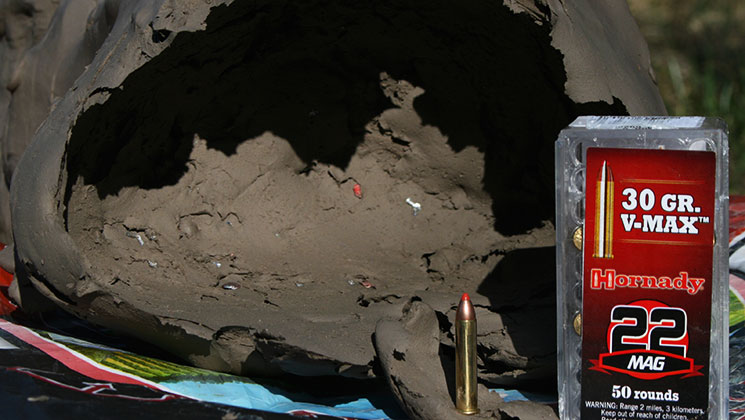
4. Hornady 30-Grain V-MaxParticulars: The unabashed long-range option of this assemblage, this load employs Hornady’s 30-grain, polymer-tipped V-Max bullet propelled to 2200 fps, making it ideal for stretching the distance on wary varmints and predators. In addition to increasing the ballistic coefficient (BC) for improved external ballistics, the tip ensures explosive expansion even at the reduced velocities at distance. Recovery distances will be short—if the animals move at all. Energy is 322 ft.-lbs. As an aside, this bullet has a lead core, therefore it’s not California compliant for hunting; however, Hornady manufactures a lead-free option in its 25-grain NTX load. MSRP: $11.69 per 50-rnd. box; midwayusa.com.

Test: Averaging 2166 fps, the Hornady 30-grain V-Max load was the fastest of the group. It was also the most accurate; in fact, the average for five consecutive, five-shot groups was a remarkable 0.94-inch. The single smallest group measured a diminutive 0.21-inch. Between its speed and accuracy, this is the go-to round for stretching the distance. True to its lineage, the 30-grain V-Max bullet proved to be extremely explosive in the modeling clay; only a few shards of the jacket and core and the tip were recovered.

Advantages: Extremely accurate, fast, excellent terminal performance, reduced risk of ricochet, low cost.

Drawbacks: None

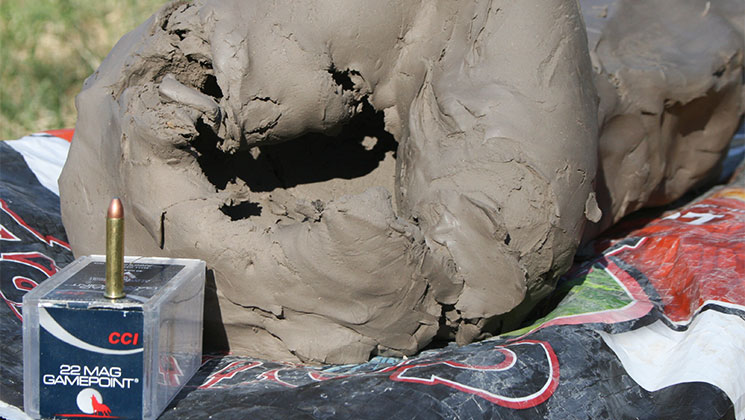
5. CCI .22 Mag GamePoint 40-grain Jacketed Soft PointParticulars: Unique in this grouping, the GamePoint load—marketed as a small-game load—features a 40-grain, jacketed, soft-point bullet, which is designed for controlled expansion and deep penetration. Said characteristics will endear it to pursuers of larger, tougher predators, such as coyotes. Propelled to 1875 fps, the bullet produces 312 ft.-lbs. of energy at the muzzle. MSRP: $12.99 per 50-rnd. box; academy.com.

Test: At 1915 fps, the Competition Electronics chronograph revealed that this load was slightly faster than the published velocity. Accuracy wise, the load did good but not great; for 25 shots it averaged 1.65-inch. What stands out about this load is its terminal performance. Constructed more like a big-game bullet than one for varmints, the recovered bullet weighed 39.9 grains—virtually 100 percent weight retention. Moreover, the bullet, which measured 0.545-inch in diameter, created a large wound cavity and penetrated deep. For coyotes and other large nuisance species within the .22 Magnum’s realm, there’s none better.

Advantages: Deep-penetrating, high-weight-retention bullet (perfect for larger animals within the cartridge’s capabilities), descent accuracy, moderate cost.

Drawbacks: More likely to ricochet than the more fragile bullets.

6. CCI Maxi-Mag .22 WMR 40-Gr. Jacket Hollow PointParticulars: Ah, yes, the omnipresent Maxi-Mag .22 WMR load; perhaps none is as so persuasive. The 40-grain, copper-plated-lead, hollow-point bullet is pushed to 1875 fps, for 312 ft.-lbs. of energy. Designed for small game and varmints—think utilitarian—the projectile offers controlled expansion for deep(ish) penetration. Because of its terminal performance, though, only with headshots should it be utilized on edible game. MSRP: $11.79 per 50-rnd. box; midwayusa.com.

Test: This load clocked 1759 fps from the Henry’s abbreviated barrel. Concerning accuracy, at 1.90-inch for it left much to be desired; you’ll struggle to make consistent hits on small species at the 22 WMR’s farthest reaches. The load offered a useful blend of terminal ballistics. Only the GamePoint and TMJ loads out-penetrated the Maxi-Mag 40-grain JHP bullet, and the cavity it produced was sizable. Given the recovered projectile expanded to 0.438-inch in diameter and weighed 17.5 grains, a sizeable portion of the bullet pierced deep while the washed off material would naturally serve to damage vital organs and structures.

Advantages: Utilitarian bullet design, low cost

Drawbacks: Unimpressive accuracy

The .22 WMR is a top-notch cartridge for eliminating nuisance animals at ranges out to 150 yards. However, its maximum potential is unlocked only through load selection. Here you’ve been introduced to six options among the many in the marketplace. One of them will help you extract the most from your “.22 Mag.”

What Does Turkey Poop Look Like? A Hunter’s Guide to Identifying Turkey Poop in the Wild

0

Turkey hunting is a popular activity among hunters in many regions of the world. Hunters must be able to spot evidence of turkeys in the vicinity to improve their chances of success. Turkey’s poop is one of the most reliable indicators. Understanding the appearance of turkey poop may assist hunters in identifying likely feeding and roosting locations as well as the size and gender of the bird. We’ll provide a brief overview of the physical characteristics of turkey poop in this post and discuss why turkey hunters must be able to recognize it.

What does turkey poop look like?

The internal anatomy of male and female turkeys differs, with males having a rudimentary internal sex organ that may influence the shape of their droppings. So, depending on the sex of the bird, the look of turkey poop might change. The poops of male turkeys are long and thin, only curving at one end, and include some uric acid on the surface. These excretions are about 2.93 inches long and 0.39 inches in diameter. On the other hand, female turkeys often make droppings that spiral into a wider and stretchy coil to contain eggs. In addition, turkey poop often has a “J” form and sometimes has blunt ends that curve in one direction.

Physical Characteristics of Turkey Poop

CharacteristicDescription ShapeBlunt ends, curls in one direction, shaped like a “J”, spiral. Differs as per gender. Colorgreenish or grayish brown in color TextureUsually firm and cylindrical, but can vary based on diet and hydration SizeGenerally larger than chicken feces, up to 1 inch in length

Identifying Turkey Sign

Recognizing turkey signs is crucial for hunters who wish to discover possible hunting grounds and raise their chances of success. The following are some pointers on how to spot turkey poop and other indications of activity nearby:

Identifying Turkey Poop: Turkey poop may be recognized by its compact, cylindrical shape and gritty texture. They often have a tapered end and stand out for their color and scent. It’s critical to identify them from other animal waste in the vicinity, such as that of deer or rabbits, which might resemble them in size and form but vary in texture and color.

Other Signs of Turkey Activity: Besides looking for bird droppings, hunters should search the area for further indications of turkey activity. Feathers, scratch marks on trees or the ground, footprints, and regions where turkeys roll around in the soil to dust themselves are a few examples. Hunters might use these indications to find prospective roosting and feeding locations.

To discover viable hunting grounds and improve their chances of success, hunters must be able to recognize turkey signs. Hunters may find and hunt turkeys more successfully by being acquainted with the physical qualities of bird droppings and other signals of turkey activity.

What Turkey Poop Can Tell Us: Size, Shape, and Gender Identification

Turkey droppings’ size and shape might provide information about the bird’s gender and size. A bigger bird often has larger droppings, while a smaller bird typically has smaller droppings. The form of the droppings may also determine the gender of the bird. Females often produce more spiral-shaped droppings, whereas males typically produce more J-shaped droppings.

GenderPoop Shape Male TurkeyLong and narrow, curls towards one end with white uric acid Female TurkeySwirls into a coil, spacious and stretchy to accommodate eggs

How Turkey Poop Can Reveal a Bird’s Diet and Health

Turkey poop’s color and texture may also inform the bird’s diet. For instance, if the droppings are greenish, the bird may have been consuming grass or other plants. Dark brown or black droppings might indicate that the bird has been consuming seeds or insects. The texture of its droppings may also determine the bird’s nutrition and state of hydration. Dehydration may be indicated by crumbly, dry droppings, while moist, flowing droppings may suggest more liquid diets.

Using Scratches and Droppings to Locate Roosting Spots

Turkey sign may also be used to find suitable roosting and feeding locations. Scratch marks may identify them at tree bases, bare ground areas, and droppings. For instance, many bird droppings in one spot can indicate that the birds are roosting nearby. There may have been bird feeding in that region if there were scratch marks on the ground.

Conclusion

In conclusion, turkey hunters must comprehend the physical properties of bird poop. Hunters can determine the size, gender, and diet of turkeys by analyzing the size, shape, color, and texture of their droppings. They may also use this information to pinpoint prospective roosting and feeding locations. Hunters might improve their chances of success in the field by being aware of these crucial hints. The next time you go turkey hunting, look out for and take advantage of bird poop. Happy searching!

Frequently Asked Questions

Art Lander’s Outdoors: Ky’s 2022-23 deer season begins Saturday with opening of archery season

0

Kentucky’s 2022-23 white-tailed deer season opens Saturday, with the start of archery season. The 136-day season continues through January 16.

The outlook for the 2022-23 deer season is upbeat.

“I think we’ll have a good season,” said Deer Program Coordinator Noelle Thompson. “We’re hoping for good hunting weather. We don’t have CWD (Chronic Wasting Disease) in Kentucky and have set up a surveillance zone.”

Chronic Wasting Disease (CWD) Surveillance Zone

New this season is a Chronic Wasting Disease (CWD) Surveillance Zone in five counties in the Jackson Purchase — Calloway, Fulton, Graves, Hickman and Marshall Counties — and special regulations have been established.

CWD is a fatal, neurological illness occurring in North American cervids, members of the deer family, including deer, elk, and moose.

Since its discovery in 1967, CWD has spread geographically and increased in prevalence locally. CWD is contagious and transmitted freely within and among cervid populations. No treatments or vaccines are currently available.

Of great concern to wildlife managers and the hunting community, CWD has been detected in at least 23 states, and two Canadian provinces, but does not infect livestock or humans. CWD is transmitted directly through animal-to-animal contact, and indirectly through contact with objects or environments contaminated with infectious material, including saliva, urine, feces, and carcasses of CWD-infected animals.

CWD has not been found in Kentucky, but has been detected nearby in western Tennessee.

Special regulations in Kentucky’s CWD Surveillance Zone include:

For the complete CWD Surveillance Zone regulations consult page 13 of 2022-23 Kentucky Hunting and Trapping Guide.

Kentucky deer population dynamics

The 2021-22 Kentucky White-tailed Deer Harvest and Population Report stated that “Overall, the statewide deer population estimate shows a stable to slightly decreasing trend. The 2021 statewide estimate was 919,308 deer at the start of the 2021-22 hunting season, (which is) less than 1 percent below the 10-year average.”

Zone 1 counties have the highest deer densities in the state, are considered reduction zones, with an unlimited bag limit on antlerless deer.

At the other end of the spectrum the Zone 4 counties have the lowest deer densities, and antlerless deer harvest opportunities are very limited.

The Zone 2 and Zone 3 counties are at or near population goals.

Weather influenced last season’s deer harvest

The total number of deer harvested during the 2021-22 deer season was 132,328, which is the ninth highest harvest on record, but a 6.56 percent decrease from the 2020-21 season harvest of 141,620, and 5.6 percent below the 10-year average of 140,129.

Weather played a big role in the harvest decline last season.

During the months of October and November there were several days of warmer than normal weather and rain. In December there was a record-breaking weather event, a widespread tornado outbreak.

All these factors contributed to the lower than expected deer harvest for the overall season, but in January the harvest was the highest on record for the month, 3,788.

Highlights from last season’s deer harvest

Here’s some deer harvest highlights from last season that are relevant going forward:

• The total antlered deer harvest was 68,035; 70.6 percent of which were adult males, 19.8 percent yearling males and 9.5 percent male fawns. It was the sixth highest antlered buck harvest on record.

The top three counties with highest antlered deer harvest per square mile of habitat were: Anderson County, 4.5 antlered deer/square mile; Pendleton County, 4.4 antlered deer/square mile, and Bracken County, 4.3 antlered deer/square mile.

The antlered buck harvest in Fayette County was 0.6 antlered deer/square mile, the lowest of all 120 Kentucky counties, according to the report.

Kentucky ranks in the top five for all time, in the Boone and Crockett Club record books.

• The total number of female deer harvested was 57,126, which is 11.6 percent lower than the 2020-21 season. However, the percentage of female deer harvested has been relatively stable over the last decade.

• Harvest by weapon type: archery, 14,869 deer; crossbow, 12,202 deer; modern firearm, 96,370 deer, and muzzleloader, 9,245 deer.

Kentucky 2022-23 deer season dates

For this upcoming season there are no changes to the zone status of Kentucky’s 120 counties, season lengths or bag limits.

There are 51 Zone one counties, 34 Zone two counties, 13 Zone three counties and 22 Zone four counties.

Deer season regulations

The complete regulations for the 2022-23 Kentucky deer season are available online at fw.ky.gov.

Deer season is a celebration of Kentucky’s wildlife bounty of quality antlered bucks and deer in abundance statewide. Start planning your hunts now.

6 Ways to Tenderize Wild Boar Meat

0

It’s no secret that wild game meat can be tougher than farmed meat.

Wild animals use their muscles much more than their domestic counterparts thus leading to tougher meat.

However, on the flip side, you usually end up with a healthier and more flavorful product.

The good news is it’s also easy to tenderize wild boar meat, and there are a few methods of doing so.

Marinade

6 Ways to Tenderize Wild Boar Meat

One of the most common methods of tenderizing wild boar meat is by marinating it.

One of the great things about using this method is that not only does it tenderize the meat but it flavors it also.

Marinades vary according to your desire. There are many options to choose from for both flavor and tenderizing effects.

For a marinade to tenderize hog meat it must have an acidic or enzymatic ingredient.

Common acidic ingredients are vinegar, citrus juice, wine, and yogurt.

Common enzymatic ingredients include pineapple, papaya, kiwi, and ginger.

Both of these types of ingredients can make wild boar meat tender, but they do it in different ways.

Using acids in a marinade denatures proteins, meaning it causes them to unfold by changing the pH level.

Enzymes, on the other hand, break down proteins into smaller fragments.

Best For:

  • Tenderloin
  • Backstrap (loin)
  • Chops

Steps:

  1. Choose a marinade that contains either an acidic or enzymatic ingredient
  2. Mix marinade ingredients together
  3. Place wild boar meat in a vacuum bag
  4. Pour over marinade and seal
  5. Place in fridge for 4 – 12 hours

Brine

6 Ways to Tenderize Wild Boar Meat

Brining meat is not a new technology and has been around for thousands of years.

Yet, it’s still one of the best methods for tenderizing wild hog meat.

Typically brines are used for the preservation of meat like wild boar ham or bacon.

However, they have also been known to tenderize meat and are often used to do so before smoking.

While brining isn’t as effective as marinades for breaking down meat, it can still tenderize meat through osmosis and diffusion.

As the meat sits in the brine, osmosis causes the meat to absorb some water and salt.

The salt then causes the protein to denature (unwind), and hold more water, thus making the meat more tender.

Every brine must include salt and water, however, it’s also a good opportunity to flavor the meat by adding in other ingredients.

Other ingredients could include, sugar, spices, herbs, or curing salt for preservation.

However, if using curing salt you need to ensure the balance between curing and kosher salt to prevent making the meat too salty.

Best For:

  • Hams
  • Bacon
  • Large muscle groups (shoulder, hind leg)
  • Chops

Steps:

  1. Weigh the meat and determine the correct salt and water ratio
  2. Dissolve the salt in the water
  3. Add the wild boar to the water
  4. Place in the refrigerator
  5. For small cuts like chops or steak brine for 2-4 hours
  6. For large cuts like whole loin or rack brine for 12-24 hours
  7. For curing brine for 1.25 days per pound

Aging

6 Ways to Tenderize Wild Boar Meat

Aging is another century-old technique for tenderizing meat.

While this method of tenderizing wild boar meat is a bit more effort, it’s very effective at tenderizing.

There are two methods for aging meat, (1) Wet aging, and (2) Dry aging.

Wet aging is the easiest of the two options and can be done at home with little more than a vacuum packer.

Dry aging is a little more involved and will need a dedicated fridge with proper airflow and humidity management.

One of the great benefits of dry aging is not only is it effective in tenderizing meat but it also intensifies the flavor of the meat.

Aging wild boar tenderizes the meat by enzymatic breakdown.

The enzymes are naturally present in the muscle tissue of the wild hog, and by managing the temperature you can use them to tenderize the meat without the bacteria spoiling the meat.

Best For:

  • Loin
  • Tenderloin

Steps:

Dry aging:

  1. Clean the meat surface and pat it dry with paper towels.
  2. Prepare a dedicated refrigerator or cooler. Ensure it can maintain a consistent temperature just above freezing (around 34°F or 1°C).
  3. Maintain a relative humidity of around 80-85% within the refrigerator.
  4. Ensure good airflow within the refrigerator, possibly using a small fan.
  5. Place the meat on a wire rack to allow airflow all around it. Ensure it doesn’t touch any walls or other items.
  6. Regularly check the temperature and humidity levels to ensure they remain consistent.
  7. Allow the meat to age for the desired period, typically ranging from a few weeks to several months, depending on preference.
  8. Inspect the meat periodically for any signs of excessive mold growth or spoilage.
  9. Once the aging process is complete, remove the meat from the refrigerator. Trim away the hard outer crust and any moldy or oxidized portions.

Wet aging:

  1. Place the hog meat in a vacuum-sealable bag. Using a vacuum sealer, remove all the air and seal the bag tightly. This anaerobic environment aids in the aging process while preventing unwanted bacterial growth on the surface.
  2. Store the vacuum-sealed pork in a refrigerator set just above freezing, typically around 32°F to 34°F (0°C to 1°C). The cold temperature slows the growth of harmful bacteria while allowing the enzymes in the meat to break down muscle fibers and enhance tenderness.
  3. Age the hog meat for 5-14 days. While some of the benefits of aging will be noticeable after just a few days, a more extended period can result in a more pronounced change in tenderness and flavor.
  4. Periodically check the vacuum-sealed bags to ensure they remain tightly sealed with no leaks. A compromised bag can expose the meat to harmful bacteria.
  5. After the aging period, remove the pork from the bag. There may be a distinct smell initially, but it should dissipate after a few minutes. If the odor remains strong and unpleasant, it’s a sign of spoilage, and the meat should be discarded. The pork should also be inspected visually for any signs of off-color or mold.

Meat Mallet

6 Ways to Tenderize Wild Boar Meat

One of the simplest methods of tenderizing wild boar meat is using a meat mallet.

This is a method that I use often, particularly for German wild boar (schnitzel).

The tenderizing here is happening in two ways, (1) connective tissues and fibers break, and (2) the meat gets thinner.

Beyond this, there is no chemical reaction like the other methods mentioned above.

This method is perfect if you are in a hurry or are only looking to tenderize the meat a little bit.

If you have a particularly tough cut of meat you should choose one of the other options as this method is limited in its tenderizing ability.

Best For:

  • Chops
  • Schnitzel

Steps:

  1. Lay the meat flat on a chopping board
  2. Cover with plastic wrap
  3. Using your meat mallet, gently pound the meat from the center out
  4. Continue until you reach your desired thickness

Slow Cooking

6 Ways to Tenderize Wild Boar Meat

The slow cooker is one of the best methods for tenderizing tough cuts of meat.

This is my go-to method for the toughest cuts of meat such as shanks, ribs, neck, etc.

The slow cooker uses low heat and time for tenderizing meat. It’s fantastic for stews, roasts, or rib dishes.

The meat will literally fall off the bone as it did in my Korean ribs dish, if you leave it long enough.

While I mostly use the slow cooker for ribs and stews, etc.. If you want to tenderize prime cuts of meat such as the loin by slow cooking, you can do this by using a sous vide.

The principle is the same, the meat gets tenderized by low heat over a long period of time.

Best For:

  • Ribs
  • Shanks
  • Roasts

Steps:

  1. Brown the meat on a hot pan
  2. Place in slow cooker along with other ingredients
  3. Cook for 6-8 hours
  4. Plate and serve

Velveting

6 Ways to Tenderize Wild Boar Meat

One method of tenderizing wild boar meat that is often overlooked is velveting.

This is an Asian technique that is used to tenderize thing cuts of meat quickly.

Best For

  • Any thinly sliced meat

Steps:

  1. Place meat in a nonreactive container
  2. Pour over baking soda or cornstarch
  3. Rest for 20-30 minutes
  4. Rinse meat and pat dry

Allow 1 1/2 teaspoons of baking soda for 1lb of meat.

7 Super Long-Range Rifles and Optics to Dominate in the Field

0

The annual Athlon Outdoors Rendezvous has become a major event that lends itself to a lucky few getting an early glimpse of new products that could shake things up once they hit the market. Sometimes it’s simply a chance to get more quality time with products that have been available to shooters, as well as giving the manufacturers a chance to download more pertinent and in-depth info to us enthusiasts. This year the sampling of long-range rifles and optics impressed.

Long-Range Rifles

The long-range side of Rendezvous remains a much-anticipated segment. We get to shoot at extended distances (1 mile) in challenging and often tricky wind conditions. This allows us to get a grasp on the level of performance these products are capable of in real-world settings. The course of fire is challenging, with environmental conditions that can change at a moment’s notice.

This year didn’t disappoint in the tactical long-range department. Targets from 100 yards to a mile were on tap, and the weather in the Tetons did what it does best. Luckily, the manufacturers brought out solid pieces for us to shoot.

Barrett MRAD MK22

The MRAD is simply awesome. Every sample of this rifle, no matter where I’ve encountered one, has been an absolute tack-driver—a term that I think is nauseatingly overused but completely applicable to Barrett’s award-winning and military-solicitation-winning long-range precision rifle. I guess you could call it a true sniper rifle.

While several versions of the MRAD have shown up at past Rendezvous, this year, we got a taste of the MK22 Advanced Sniper Rifle System, which is the rifle deployed by our elite warrior units.

The MK22 is a bolt-action repeater featuring a multi-caliber capability that few possess. It can be modified to chamber eight different calibers, including long- and short-action options, and can accommodate multiple barrel lengths.

MK 22 Features

The MK 22 features a full-length monolithic upper receiver with a Pic rail that runs the length of the top. The handguard includes slots in the 3, 6, and 9 o’clock positions, which can be utilized via M-LOK attachment-type accessories.

The MK22 has an incredible drop-in match-grade, two-stage trigger. It’s fully adjustable as well with a crisp break. This trigger, coupled with the tool-less adjustability of the foldable stock for length of pull and comb height, makes the Barrett beyond easy to shoot precisely no matter the shooter’s experience level. It also features an action that is ultra-smooth, with a bolt handle placement that makes operation simple for right- or left-handed shooters.

Shooting the MRAD out to a mile, especially chambered in 300 Norma, was an absolute joke and every run of the bolt is perfect, making you feel like a rock star all the time. The MRAD MK22 as well as all the MRAD models are of the highest quality and performance levels in the precision space.

SIG Sauer Cross

SIG’s Cross made its debut at our 2020 Rendezvous. The Cross comes in as a lightweight, multipurpose, do-all bolt-action rifle that I like to refer to as the “everyman’s” bolt-action rifle.

The Cross takes minimalist and maximizes capabilities by being modular and feature-rich. The core of the Cross is a one-piece receiver that reminds one of an AR-type platform. This design is to improve rigidity and accuracy.

The receiver gets a barrel much like that of an AR platform, with a barrel nut and barrel extension with a pin that mates up to a slot in the receiver. This means the Cross barrel can be changed out fairly easily, and Sig has different lengths available depending on what caliber. Speaking of caliber, the Cross is available in 6.5 Creedmoor with an 18-inch barrel as well as .308 and the elusive 277 Sig Fury with 16-inch pipes.

The Cross is highly adjustable, especially for being so basic in nature. The length of pull and cheek pad height can all be easily changed, and the stock folds too. It’s sure to fit any shooter well.

Don’t let all the “minimal” and “basic” terminology fool you. The Cross performs like any quality precision rifle should with excellent accuracy that’s easy to call upon. Thousand-yard shots with consecutive and repeatable impacts in a package that’s easy to live with. It will make a believer out of anyone.

ZEV Technologies Large Frame Billet .308

Precision is not only left to the bolt actions. Plenty of gas-operated rifles are capable of extended range entertainment, and ZEV is delivering the goods with its Large Frame Billet rifle chambered in .308.

If the name ZEV appears on it then it’s going to be an eyeful of delight, and this rifle doesn’t disappoint. The billet upper and lower are 7075-T6 and machined to perfection with aesthetic styling and cues to make anyone envious.

It features a match-grade 16-inch barrel from 416R SS with a beautiful bronze PVD coating that is most excellent. The twist rate is 1:10 and it has a mid-length gas system. The barrel is topped with a ZEV muzzle brake to tame the recoil, which it does along with an H3 buffer. With this combination, ZEV is claiming sub-MOA accuracy, which I have no reason to doubt based on my 500-yard stroll with it in Idaho.

The trigger is an ATC AR Gold model featuring a flat face. The breaking weight is clean 2.5 pounds which helps in the accuracy department as well. Where the gas gun shines over the bolt is its ease of operation. No bolt to run, just press reset, press, and the short reset on the AR Gold trigger makes short work of this.

Controls are ambidextrous, which this southpaw long-gunner loves. I sat down behind the ZEV and confirmed some hits at 300 then shot it at 500 yards. After a few consecutive hits I knew what I needed to. The ZEV will deliver fast and accurate shots and look dang good while doing it.

CZ 600 Series

CZ is no stranger to rifles of all sorts. From big-bore hunting rifles to take large game in Africa, to police sniper rifles, and one of the best .22 trainers to ever exist, CZ has a whole host of offerings for the precision-minded shooter.

The 600 series bolt action was on tap during the Rendezvous, and it represents a new direction for the bolt-action side of CZ, with new technologies, materials, design, and focus. The goal is to meet the needs of many shooters, which while sounding like the right thing to say, is a difficult idea to execute.

Think of the 600 series as a multi-role bolt action rifle with versatility as the key feature. Meanwhile, there are several models in the 600 lineup: Alpha, Range, Trail, and Lux, each with its own set of unique and specific features for the particular shooter.

The Range most closely resembles the long-range precision shooter’s anatomy with a heavy contour, hammer-forged barrel, and a sub-3/4 MOA guarantee for five shots. This guarantee is verified before any rifle leaves the factory.

The Range features a beautiful laminated wooden stock with adjustable comb height and a button hook with pic rail to attach a monopod or bag rider. It also gets QD stud beneath the forend and on either side.

The receiver of the Range is drilled and tapped for Rem 700-type scope bases, so compatibility should be a breeze. The heavy barrel is 24 inches long and is threaded for a suppressor or brake as well.

An adjustable, single-stage trigger makes its way into the Range to help ensure the accuracy of the rifle. The Range is chambered in 6mm Creedmoor or .308. Choose wisely before you hit the Range.

Long-Range Optics

EOTech Vudu Optics Line

The EOTech Vudu line has been going strong for several years. I’ve had extensive run on the 5-25×56 and it has performed well with excellent glass quality and accurate tracking in a rather compact package.

When a magnification range that high isn’t necessary, Vudu has both 1-6 and 1-8×24 offerings as well, each offering excellent glass and easy-to-use reticles. An 8X option is good for gas guns, but a little more is needed for any precision work, and 10X is about the cutoff for that. Thankfully, EOTech now has an option to fit the bill with its new 1-10×24 VPO (variable power optic).

The new 1-10, like any good precision optic, is available as a first focal plane scope, so the reticle will grow and shrink with the magnification setting. This means that measurements taken through the optic with the reticle will be correct no matter the magnification settings. Yes, the reticle can get kind of small on the “1” setting, but illumination will help make it visible for the role that magnification is intended for.

I was able to use the Vudu 1-10 to fire effectively to 500 yards mounted on top of a custom 6.5 Creedmoor bolt-action rifle. Such an optic will easily let the shooter go further than that. What the 1-10 offers is high-level versatility within certain parameters.

Other features include excellent turrets, with .1-MRAD adjustments on the MIL version and .25-minute adjustment on the MOA version. It also features an included throw lever.

Axeon 6-24×50 Long Distance Shooting Rifle Scope

The budget-minded shooter is looking for products that can deliver performance without breaking the bank, and Axeon may have the goods in its 6-24×50 Long Distance Shooting Rifle Scope.

Featuring a 50mm tube and fully multi-coated objective lens, the Axeon SF Long Distance Scope has the right stuff for the precision shooter. A 30mm tube also makes its way on board, making it easy to find rings for attachment.

There are several other features that will bring a smile to the end user’s face, adding even more value to this optic. The tactical turrets are exposed, so making quick adjustments to elevation and windage is easy and no worries about losing caps. The turrets come zero-reset adjustable. It also features side parallax adjustment to get it dialed in just right. The reticle is a Mil-Dot version featuring 1/4-MOA adjustments with audible clicks.

The optic proves rugged as well, delivering a lot for a price of $299.

Riton 7 Conquer Optic

Riton is a Rendezvous favorite due to its ability to consistently bring new optics products in every category, from reflex sights to spotting scopes, LPVOs, and my favorite, long-range precision optics. And Riton has proven over and over again that you can have great performance at an affordable price—something I’ve long disputed.

The 7 Conquer 3-24×56 is one such optic. The 7 Conquer has Riton HD/ED glass. A bright and clean picture awaits the user. The reticle is an illuminated first focal plane type, so ranging will be consistent across the magnification range. The Oden reticle is a Christmas tree type and is easy to see. While it may seem intimidating, it is full of information for the trained shooter and will allow for easy and accurate holds for elevation and windage. The reticle also features six levels of illumination and auto shut off.

The turrets on the 7 Conquer are excellent with great feedback. It’s a MIL type with .1 MRAD adjustments and a Zero Stop feature, meaning you’ll always be able to get your dials back on track should you lose your way.

Waterproof and shockproof, durability is a thing with Riton optics, and the 34mm tube takes abuse well. I have shot the Riton’s to a mile and beyond, and they always perform at a high level. They also feature a Lifetime Warranty, but you’re not likely to have to use it.

This content was originally posted by Ballistic magazine in March 2022.

READ NEXT – 5 Rare Survival Rifles Designed for Air Force Crews

The Best Bass Fishing Lures

0

We’re not sure if Bob Carnes knew what he had immediately when he created the Arkie Jig. But we do know what he had was something incredibly special to bass fishing. Carnes was building baits in Arkansas and was looking for a way to make jigs more weedless and attractive to bass. He thought if he could make a balanced head for his bucktail jigs and add a brush guard to protect the hook he could fish his jig in more places.

He saw a TV show where they were using a jig with a fiberguard. At the time he was looking at wire guards for his jigs but the demand for the fiberguard after that TV show aired forced his hand, and he had to figure out a way to mold a fiberguard into leadhead. All the while he was tweaking on the shape of the head to keep it from snagging. It started more like a banana head, then he shortened it and flattened and widened it to make keep it level and upright which was critical to avoiding snags.

Once he got the jig head design and fiberguard correct he began tying the first jigs with bucktail. But he saw the Gilmore Lure Company Spinnerbait had some sort of rubber bands hanging off of it. He wasn’t sure what it was exactly or even how to get a hold of the rubber. He knew underwear had elastic in it as did women’s girdles. They actually traced the girdle’s rubber back to a rubber company and got them to color some rubber for them.

The rest as they say is history, but the lasting effect of some simple necessity has continued for more than 50 years. A skirted snagless jig has arguably won more national tournaments than any other lure. There for a time in the 80s, every tournament of any significance was being won on them. In the early days of the B.A.S.S. Tour, there were something like five tournaments in a row won on Carnes jigs and no one told anyone. They were keeping it secret.

Bo Dowden won the Classic in 1980 on a brown and orange Arkie Jig and the boom for Carnes’s snagless jig was going full steam ahead. The jig was carried in Walmart Stores in the early 70s when it was still just a regional chain. And after word spread and Walmart grew, access to his Arkie jig was much easier.

Now just about every jig manufacturer and component shop carries the Arkie style head for flipping. It was a lasting innovation that is every bit as good today as it was 50 years ago.

Our Skirted Jig Reviews

  • Freedom Tackle Football Jig
  • Nichols Lures Skipper Jig
  • Jewel Baits Pro Spider Jig
  • Strike King Hack Attack Fluoro Flip Jig
  • Z-Man CrosseyeZ Flipping Jig
  • Bill Lowen Finesse Flipping Jig
  • Buckeye Balling Out Jig
  • Strike King Tour Grade Skipping Jig
  • V&M Flatline Football Jig
  • Greenfish HD Flipping Jig
  • M-Pack Lures Football Jig
  • Missile Jigs Mini Flip Jig
  • Strike King Structure Jig
  • Buckeye Lures Mop Jig
  • Cumberland Pro Caster Jig

2024 SHOT Show Day three

0

Industry dayDay oneDay two

This report covers:

  • SHOT in reverse?
  • Correction
  • Evanix
  • ASG
  • Security at SHOT
  • Hawke
  • Josh and Mirfee Unger
  • Survival Airguns
  • Summary

Today we continue looking at the 2024 SHOT Show and there is one more report yet to come.

SHOT in reverse?

Remember my comment that the crowds were smaller this year? Well, today they weren’t. It almost felt like a first day. Go figure!
Correction

I have to correct something in the Day 2 report. I called that concealed carry firearm a Three Ounce pistol. It isn’t. It’s just an Ounce pistol. They used the international symbol for the measurement “ounce” in front of the word Ounce on the literature and I thought it was a fancy number three.

Ounce pistolThe cover of the Ounce pistol brochure.

Okay, let’s see some more of the show!
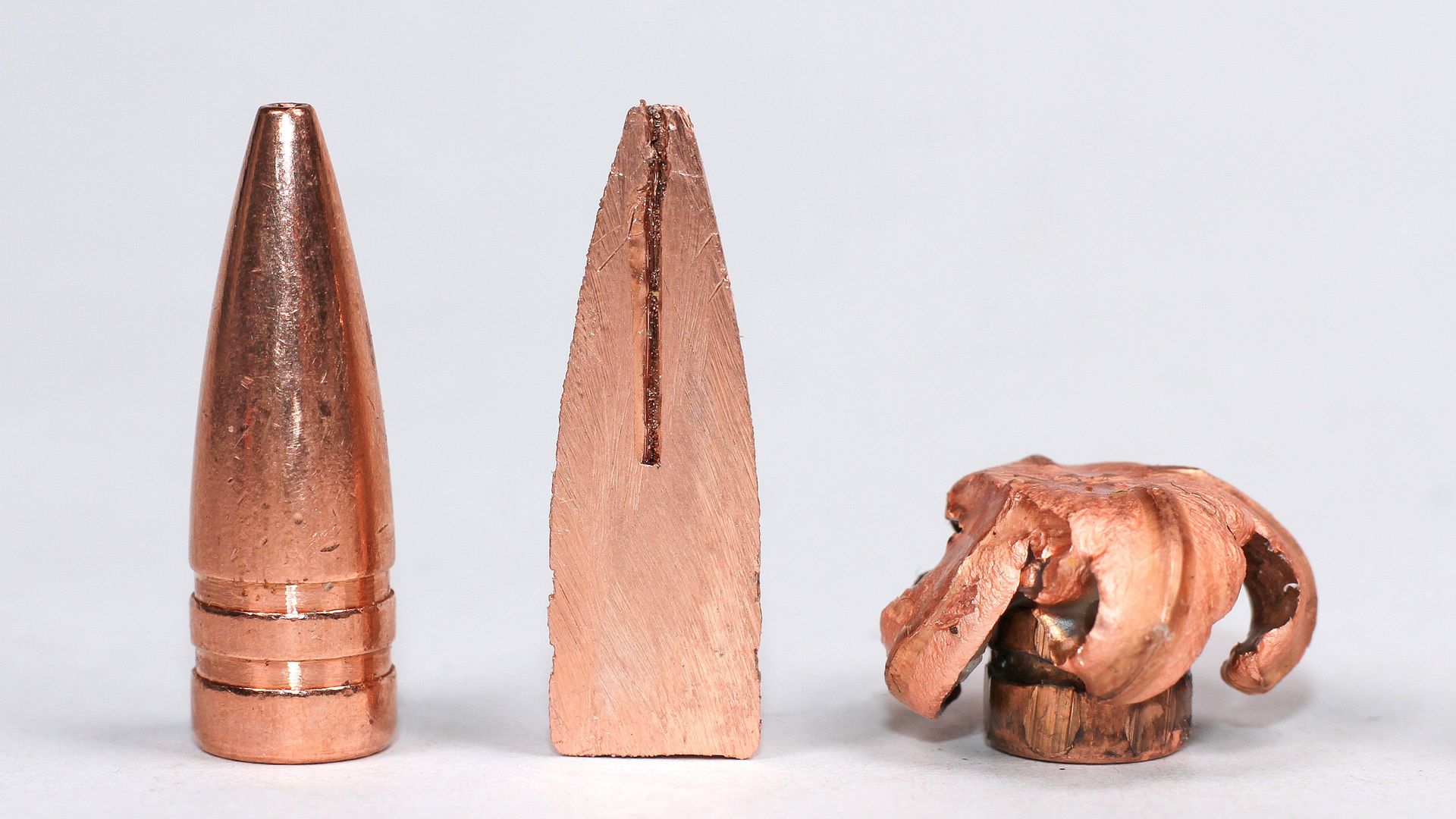
Evanix

Viper — The Viper is a new precharged pneumatic (PCP) pistol that comes in .177, .22 and .25 calibers. It is semiautomatic and has a 7-shot rotary magazine in all calibers.

Evanix ViperEvanix Viper is semiautomatic.

The Viper has a balanced valve and gets around 20 good shots per fill to 3,600 psi. It gets in the 12-14 foot-pound range in .177 to around 20 foot-pounds in .25 caliber. It retails at $975.

Rex S — I also saw the Rex S which is a Rex pistol bored out to accept 28-gauge shotshells. The Rex rifle also gets this treatment, resulting in a 28-gauge shotgun that shoots a charge of shot at up to 1,300 f.p.s. for the long gun and 1,000 f’p.s. for the pistol.

Evanix Rex SThe new Evanix Rex shot pistol.

RexS shot and cartridgeHere is the shotshell and a charge of shot that goes in the Rex S pistol.

ASG

My next stop was at Action Sport Games. They showed me a pistol that looks very much like a Glock but is actually called an ISSC. Now get this — ISSC is an Austrian firearms manufacturer, just like Austrian Glock and their handguns look like Glocks. But they’re not. They are ISSC.

ISSC M22 — This is a CO2-powered BB pistol that comes in either a blowback or non-blowback model. It should be out later this year and I will test it for you.

ISSC M22ASG will bring out the ISSC M22 later this year.

Security at SHOT

Just a side comment — the security at the show was much tighter this year than ever before. There were service dogs everywhere. I bet I saw at least 40 of them. Also, at my hotel there were guards on all the guest elevators, asking to see your room card/key. I know that Vegas has had problems in the recent past, but I could tell they aren’t quite sure what to do about it.

Hawke

My next stop was at Hawke, the scope manufacturer. I saw a scope with not less than 8-inches of eye relief! Called the Vantage Turkey Dot, it’s a 1-4X20 that you hunters should look into when it comes out.

Hawke Vantage Turkey DotHawke Vantage 1-4X20 Turkey Dot.

What this scope will do for airgunners is allow them to mount it forward of the back of the rifle. It’s a little longer than a Bug Buster and probably ideal for some guns like the Dragonfly 2. It will probably sell for $220.

Josh and Mirfee Unger

At the AirForce booth I ran into Joshua and Mirfee Unger. Josh is the founder of Pyramyd AIR. They came as a surprise to see AirForce and also to see the folks at Air Venturi.

Josh and Mirfee UngierJosh and Mirfee Ungier. Josh founded Pyramyd AIR and Air Venturi. They enjoyed being back at SHOT once again.

Survival Airguns

My last stop was at the Survival Airguns booth. Their name includes two words I don’t expect to hear together — survival and airguns. This I had to see.

Zeus — The Zeus is a .72 caliber (12-gauge) rifle that I was told develops 1,500 foot-pounds of energy at the muzzle. If it can do that it is hands-down the most powerful air rifle in the world.

ZeusThe Zeus is Survival Airguns big boy.

Zeus cornflakesZeus cornflakes. Seventy-two caliber hollowpoints made by Mr. Hollowpoint.

Summary

And that was the show. But for Monday I’m writing one more report that catches most of the things that haven’t yet been in the reports of the last four days. This SHOT was good, and I can see the industry is changing. Some companies are growing while others are fading away. I guess that’s life.

Best Air Rifle Deals

Popular Posts

How far can an air rifle shoot accurately?

0
An air rifle's effective shooting range depends on various factors, including the type of rifle, the caliber, and the power source. Generally speaking, most...

Guide to find Best Scope for Break Barrel Air Rifles

0
"Unlock the Perfect Shot: Discover the Best Scope for Break Barrel Air Rifles. Enhance your shooting experience with precision and accuracy, as we delve...

Air Rifle vs BB Gun: Understanding the Key Differences and Choosing the Best Option

0
"Air Rifle vs BB Gun: Unveiling the Key Differences and Choosing the Perfect Weapon for Your Shooting Needs. Delve into this comprehensive guide to...