Home Blog Page 7

Preparing and Using Sinew

0

To make many of the more advanced tools and weapons associated with wilderness survival you will need two animal products, sinew and rawhide. What sinew is, how to obtain it, and how to process it is the subject of this post.

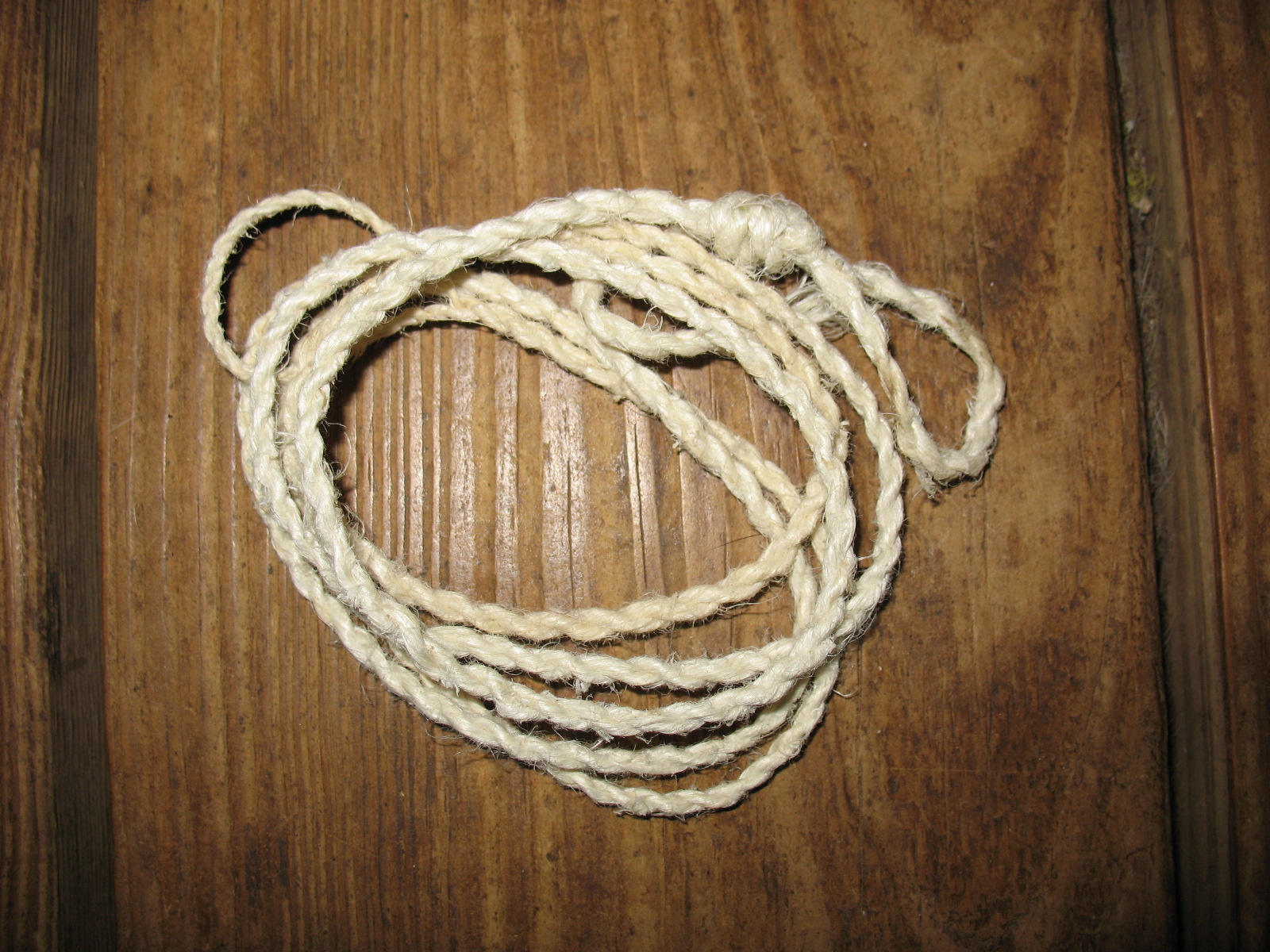
What is Sinew?Sinew can be obtained from the tendons of any mammal. Tendons are the tough stringy things that attach muscles to bones. When these tendons are processed into sinew they provide a wonderful material that can be used to make super strong cordage, good sewing thread, and they can be used as a binding twine to attach arrowheads, arrow fletchings, knife blades, spear points, drill points and etc. Sinew is as tough as nylon, and it is impregnated with its own natural glue that can be activated with a little moisture. Sinew shrinks a little when it dries so that is binds things together tightly. Sinew will last for hundreds of years if it is protected from moisture. In short, sinew is a super material that has no modern equivalent. The only down-side to sinew is that it must be kept dry. If you get it wet it will soften and stretch, and whatever you have bound together with it will come apart. If you think that any sinew that you have used may be exposed to moisture, you must coat it with pine sap or some other agent that will waterproof it.

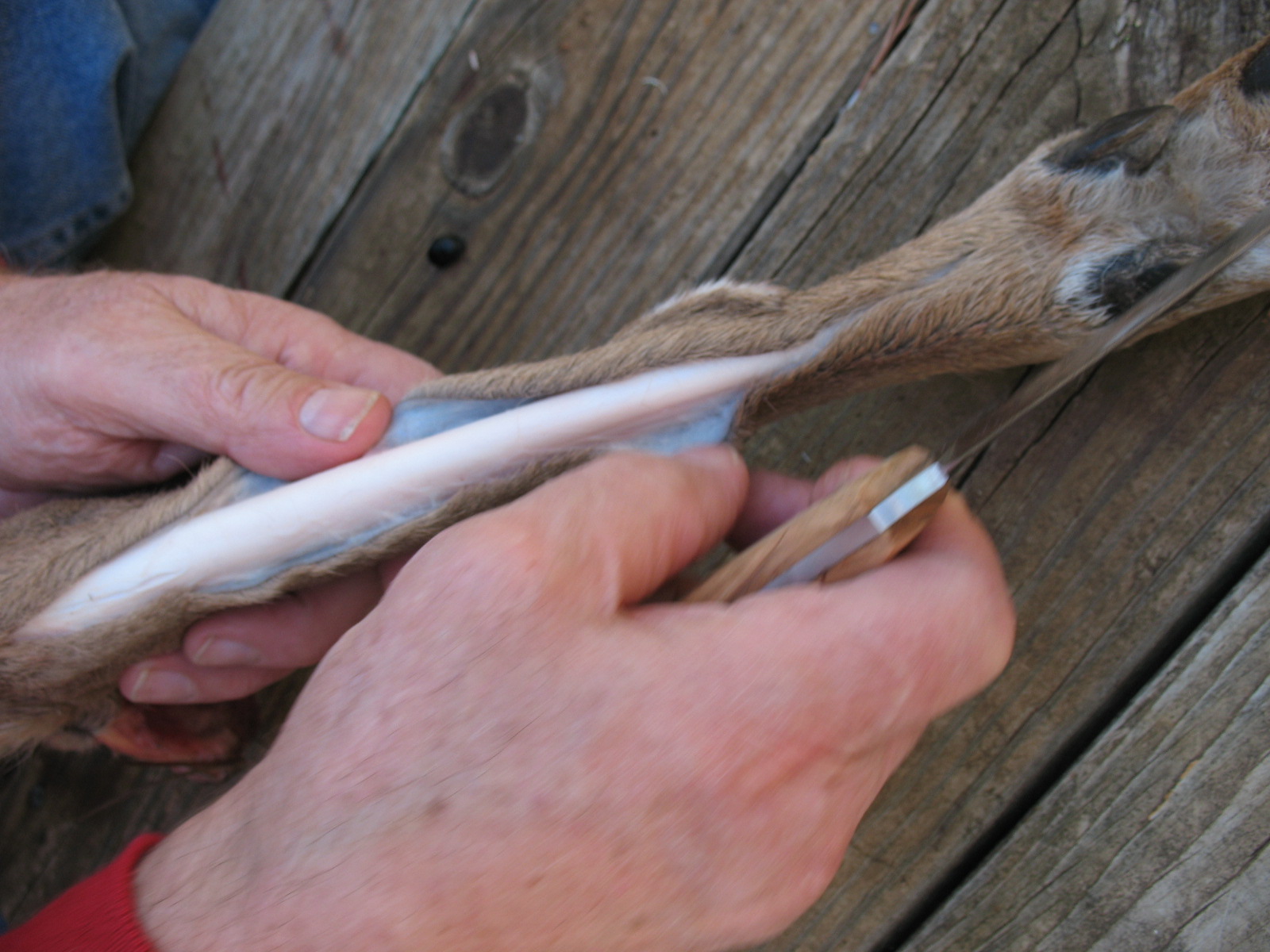
How do You Obtain Sinew?One of the most widely available sources of sinew is from the deer, although elk or buffalo will work just as well. The most useful sinews are located in the lower legs and along the upper back lying over the back straps. If you hunt deer you can remove both the leg and back sinews when you are butchering. If you have friends that hunt you can ask them to bring you the lower legs when they butcher. The lower legs have no usable meat on them and most people just cut them off and throw them away. Hunters will usually be glad to give you this part of their kill even if they do think you’re a little strange for wanting it. You can even go to most packing houses during deer season and they are often glad to get rid of any legs that they have. All of my friends know that I want deer legs and I usually get anywhere from twenty to fifty a year just for the asking. Pictured below: deer legPreparing and Using SinewHow do You Process Sinew?To remove the sinews, you need a sharp knife or a good sharp flake of flint. Slice down the back of the leg from knee joint to just above the dew claws and peel the skin back. Lying just below the skin is a white membrane. This membrane encases the tendon which lies in a shallow groove down the back of the leg bone. Preparing and Using SinewPreparing and Using Sinew

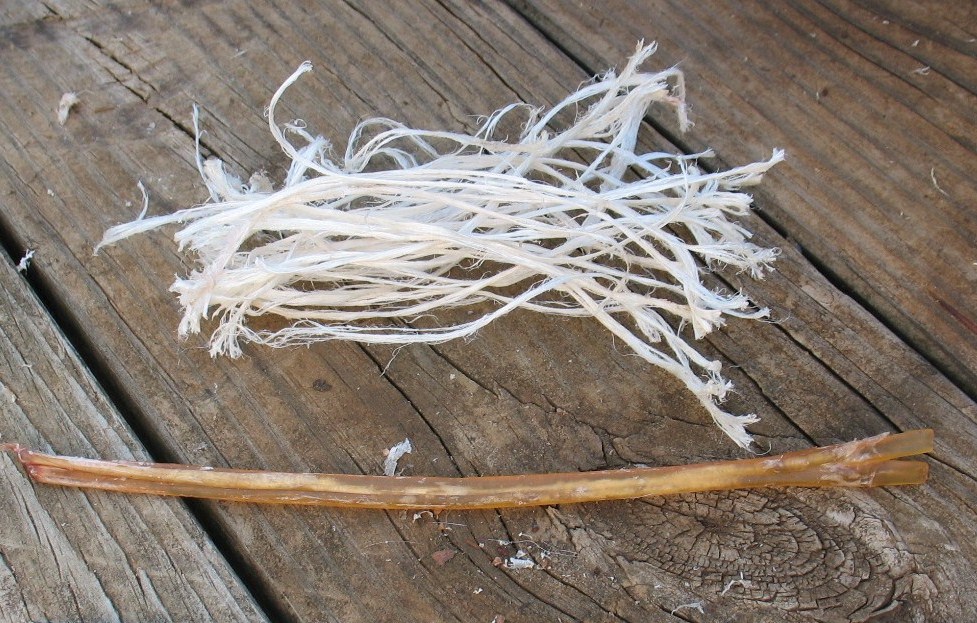
Split open the membrane and you will see a milky white cord looking thing. This is the tendon. Preparing and Using SinewYou can usually slip your finger under the edge of the tendon and lift it up out of the bone a little. When you get the tendon up out of the groove, run your knife up and down to loosen the tendon even more. Preparing and Using SinewI usually run my knife down toward the hoof, and when I can’t go any farther, I turn the blade up and slice through the tendon freeing that end. You can then grab the tendon with you hand and peel it out down toward the knee joint. When you pull up as much of the tendon as you can get, cut that end off with your knife. Preparing and Using SinewPreparing and Using SinewThere may be some membrane left sticking to the tendon (kind of a slimy case) and if you can remove this it will be helpful although it’s not vitally necessary.When you have a white floppy tendon in your hand, the hard part is done. Preparing and Using SinewJust set the tendon out in the sun or on the kitchen drain board if your spouse is out of town. In less than twenty-four hours the soft wet tendon will be hard, dry, and kind of a translucent yellow color. It looks a lot like plastic. Preparing and Using SinewNow take the dried tendon and use a smooth round rock or the round end of a ball peen hammer and start pounding. What ever you pound with, it needs to be rounded. Flat edges, like the flat of a hammer or axe, will cut the fibers in the sinew. Preparing and Using SinewAs you pound, the sinew will start to turn white, and it will begin to separate into fluffy white fibers. You can now take you fingers and pull apart the fibers is small bundles about the thickness of a pencil lead or smaller. Preparing and Using SinewThese little fiber bundles are what you’re looking for. You can use them to back a bow, make a bow string, sew leather together, tie on arrowheads etc.Preparing and Using SinewTo use the sinew to, for example, tie on an arrow head; all you have to do is pop a piece in your mouth and chew on it a little. Don’t be squeamish. It’s no different than chewing on a piece of deer jerky. The saliva in your mouth and the gentle chewing will soften the sinew in seconds. Don’t chew too long or you will wash all of the glue out of the sinew.

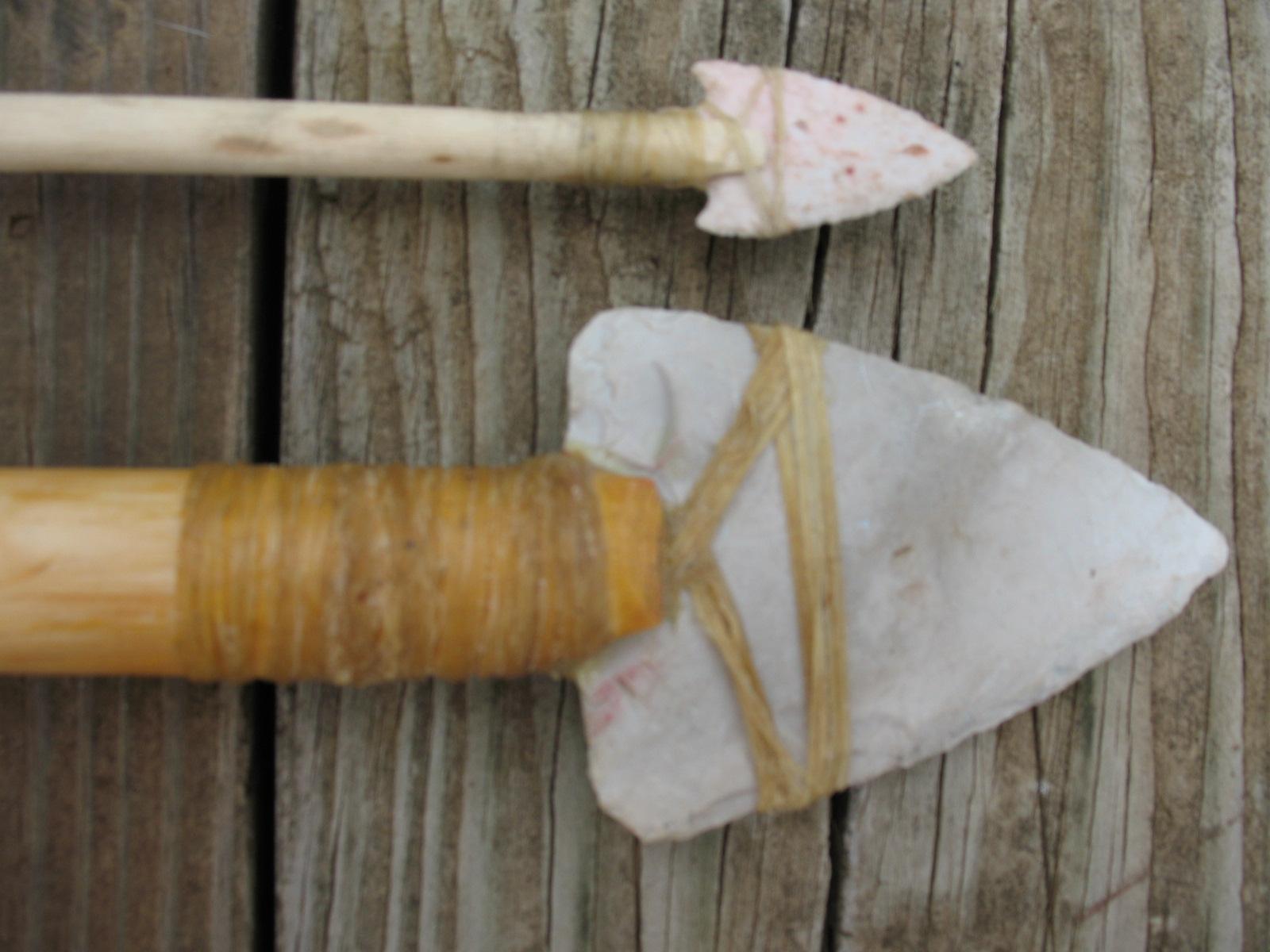
When the sinew is soft remove it from your mouth and wrap it around your arrowhead. You don’t have to tie it off because the sinew will stick to itself. Set it in the sun for twenty or thirty minutes and it will dry hard and tight. Coat the sinew with melted pine sap or carpenter’s glue and let it dry. Pictured below: sinew bow string, arrowhead, spearhead, and knife blade all attached with sinew; and sinew backing on an elm wood bow.Preparing and Using SinewPreparing and Using SinewPreparing and Using SinewPreparing and Using SinewThat’s all there is to it. Amazing isn’t it!

The Struggle to Contain, and Eat, the Invasive Deer Taking over Hawaii

0

There should not be any land mammals living in the wild on any of the Hawaiian islands. There shouldn’t be many wild mammals, period; the only endemic mammal in Hawaii, besides marine mammals, is a single species of bat. But there are many mammals traversing the eight main islands in the archipelago today. There are wild sheep, goats, cattle, mongoose, wild boar, rabbits, rats, mice and a small but stable population of brush-tailed rock wallabies on Oahu. None of them should be there.

But the most important invasive species for a few islands, especially Maui and Molokai, is the axis deer. On Molokai, an island of only around 7,000 people, there are somewhere around 70,000 axis deer. On Maui, there are around 50,000.

The axis deer are a fascinating and multi-dimensional inhabitant. They are simultaneously invasive and part of traditional culture; they destroy food supplies and are an extremely important source of food themselves; they are protected by law and despised by some parts of law enforcement; they are wildly destructive to Hawaii and also, during the worst of COVID-19, were a beacon of hope.

***

Axis deer, which are sometimes known as chital, are native to Sri Lanka, parts of India and Nepal. They’re sometimes known as the spotted deer, because they have white spots on their tawny coats, and sometimes as the barking deer, because they are extremely vocal. They first showed up in Hawaii in 1867, given as a gift to King Kamehameha V: three bucks, four does and one male faun, for a total of eight deer. The gift-givers were from Hong Kong, then a colony of Britain. The deer were initially released on Molokai, and they multiplied quickly; some were later moved to Oahu, Lanai and, eventually, in 1959, to Maui.

“Introducing grazing animals here was considered a good thing,” says Jeff Bagshaw of the communications and outreach team for Hawaii’s Department of Forestry; he focuses on deer in Maui. Hawaii was a base to explore the Pacific and a halfway point to Asia, but some of the early sailors found it tough to restock their ships without land mammals to hunt. A few different peculiarities of the Hawaiian islands made it a great home for the axis deer. As grazers, they prefer to eat grass, but they will browse for just about anything. And Hawaiian plants, without any native mammals that might eat their leaves or shoots, never bothered to evolve thorns, spines or toxins to discourage herbivores. There’s even a variety of native Hawaiian raspberry, called the akala, that doesn’t have any thorns.

The deer found no predators in Hawaii, either; none of the wolves, big cats, terrestrial snakes or alligators that prey on them in Asia. But because they had so many predators in Asia, the deer evolved to give birth much more often than other deer species, in the hopes of outpacing the rate at which they get eaten. In Hawaii, they have no predators, but they still give birth year-round.

The dream of those early sailors was realized, but far too well: Soon, Hawaii had an absurd number of land mammals to hunt. The deer, on a few of the islands, became an environmental and sometimes a public health disaster. “They have a huge impact on all our native species,” says Bagshaw. One example: The ōhia tree, which grows in high elevation forests, is both sacred to Hawaiians and vital for the state’s water supply (when clouds come into contact with the tree, condensation forms and drips onto the ground, eventually flowing down the mountain into rivers and reservoirs). Starting in 2010, two new-to-science types of fungus were found on the tree that are harmful to it. Trees do have the ability to heal scars in their bark, which would eventually block the fungal infection, but ōhia trees heal slowly and much more slowly now because the deer nibble and rub on the bark, keeping those wounds open and the infection much more deadly.

There are more common environmental problems, too. The deer trample the land, damaging the nests of ground-nesting endemic bird species. They’ll eat a wide variety of plants, including endangered ones, which has cascading effects on insects and birds. They’ll eat just about anything, really, including crops: Farmers have reported big losses in fruit crops and vegetables, as well as damage to sugarcane. They’re a public health issue, too: They provide food for (also non-native) mosquitoes and, when they die, they can poison delicate water ecosystems. This became a much larger problem recently, when drought led to Molokai deer dying of starvation by the hundreds—although not in large enough numbers to put their population in any jeopardy. And they’re extremely dangerous to drivers; axis is just one of many deer species that seems magnetically attracted to moving vehicles.

Given all of this, it’s not unreasonable to wonder whether the deer should simply be completely eradicated from Hawaii. And, in truth, Hawaii has taken some measures to keep the deer population from spreading: It is now illegal to move deer from one island to another, and when they were illegally brought to the Big Island in 2009, it took only a few years for the government to remove them all. Even in Maui, the Department of Forestry will remove deer from particularly delicate ecosystems, especially watersheds or places where there are endangered species, provided those places are on state land. “We’re the most isolated landmass on the planet,” says Jake Muise, one of the owners of Maui Nui, a commercial venison operation in Maui. (Muise also handled removing the deer from the Big Island, a few years back.) “If our watersheds aren’t functioning properly…water is the most valuable thing we have.”

Hawaii’s governor, David Ige, has committed to what’s referred to as the “30 by ’30” plan: to fence in 30 percent of the state’s priority watersheds by 2030, largely to protect them from the deer. That may not sound like all that ambitious of a plan—only 30 percent?—but the difficulty of constructing this fencing is truly staggering. Bagshaw says that a minimum height of seven feet is necessary for hog fencing to keep out the deer, and Muise says that even that isn’t guaranteed; the deer are clever and persistent. They’d love to construct 12-foot fences instead, with proper skirting on top and bottom, but the expense is daunting. All the steel must be imported from the mainland, and constructing long expanses of fencing on extremely rugged state lands, over rivers and creeks and mountains, is a major undertaking. That same cost of installing fencing can eat into farmers’ profits too much for it to be worth it.

But for whatever efforts the Department of Forestry has taken, the process for actually eradicating these deer from Hawaii would be insanely expensive and maybe impossible; while the Department can remove deer from state land, that land is often remote and rugged and not really the preferred habitat for the deer. Getting permission from every private landowner with deer on their property, and figuring out the liability situation for having government agents with guns there, all in the service of somehow killing and removing more than a hundred thousand deer? It’s just not going to happen.

Another reason it’s not going to happen, beyond the practicalities, is that, according to Bagshaw, the deer are legally protected. The state constitution, dating back to at least 1950, has included a clause meant to protect the traditional subsistence practices of Hawaiians. But therein lies the question: What exactly is “traditional”? Hawaiian courts have set the precedent that any practice that existed in Hawaii before November 25, 1892 counts as “traditional.” That date was chosen for its importance to Hawaiian law; it was the last reorganization of the Kingdom of Hawaii’s judiciary system prior to American annexation. And the axis deer, of course, had arrived a couple of decades prior to that date. So the law that protects traditional subsistence practices applies, just barely, to a wildly destructive invasive species.

Not only is the Department of Forestry not allowed to completely eradicate axis deer from Hawaii, it is theoretically required to ensure that the population is stable and secure. Of course, that’s not a problem it’s really worrying about; the deer is so overpopulated that the idea of saving the deer is laughable. But it would have to, if it came to that.

***

Despite the fact that the axis deer doesn’t belong in Hawaii, that bit about it being protected as a subsistence practice isn’t actually that crazy. Deer hunting, although only 150 years old, has legitimately become a tradition on the islands of Molokai, Maui and Lanai. Deer, especially but not exclusively in the more rural parts of those islands, is a major part of the culture. Many families have extra chest freezers to store axis deer, and you can find it on the grill at backyard barbecues. (Most often, it’s sliced thin and marinated in teriyaki sauce, according to Muise.)

The deer also serves a pretty vital role as a source of protein. While Hawaii was perfectly capable of feeding its own population prior to European contact, the late 19th and early 20th centuries destroyed Hawaiian agriculture. Instead of planting crops that could feed the Hawaiian people, such as taro, breadfruit and coconut, Europeans (and soon, Americans) tore all that out to plant the crops that could feed foreign imperialists, such as sugarcane and pineapple. By 1936, Hawaii was, according to a University of Hawaii study, in desperate straits: Only 37 percent of its food was grown locally. The rest was, and remains today, imported, at great expense and significant risk, mostly from the mainland United States.

On Lanai, for example, the 3,100 or so residents rely in large part on the barges that deliver their food. If there’s a disruption in that service, from, say, a devastating global pandemic, store shelves are empty. Those on Lanai and Molokai, and to a lesser extent Maui, have to figure out some other way to feed themselves, and the incredibly abundant axis deer are a major part of that equation.

Of course, the deer aren’t exclusively a help. Fresh produce imported from the mainland is quite expensive in Hawaii, and backyard gardening is more than just a hobby for many Hawaiians. But as anyone who lives near a deer population knows, there are few things deer like more than absolutely destroying a carefully planted garden. They are damnably difficult to keep out, requiring at least an eight-foot fence, which is not affordable for most people. So the deer provide subsistence, but they also might take some away.

The Department of Forestry is engaged in an awkward dance regarding the deer. It can’t eradicate the deer, even if that makes ecological sense. But it’s also the agency that hands out hunting permits, and boy, is it ever handing them out. “On Maui and Molokai, there is no bag limit and there is no season,” says Bagshaw. “You can hunt ’em like a videogame from sunrise to sunset, if you want.” The permits cost $20 for the year and require no more than a gun license and an easy online application. Frankly, the Department of Forestry would love it if hunting was even more common than it is.

But the state’s resources for actually dealing with the deer problem are extremely limited. With most of the deer on private land, the ability to actually hunt on prime land tends to come down to one-on-one relationships between landowner and hunter, which isn’t much good for efficiency.

Commercial operations have been slow to take hold. Muise, a Canadian who came to Hawaii on a volleyball scholarship more than 20 years ago and never left, started Maui Nui with his wife, Ku’ulani. Muise grew up in an extremely rural part of far northern Alberta, and the self-reliant subsistence he learned there carried over to a place that’s about as different, ecologically, as any place on the planet. Maui Nui is one of the only companies selling axis deer commercially at scale, and the reason for that is, well, it’s insanely difficult to do so.

“The process of harvesting a wild animal has crazy amounts of overhead that go into it,” says Muise. It is legal to give hunted meat to anyone you want, in the United States, but to sell it, it has to be inspected. Unlike some states, Hawaii has no state meat inspection service, so Maui Nui has to go straight to the USDA. On every single hunt, a USDA inspector must accompany Maui Nui’s hunters and examine every single wild axis deer for health before giving a thumbs up to the hunter to take a shot. And that hunter can only take that one shot; the USDA regulations for humane commercial hunting strictly require that the animal be rendered unconscious immediately, with a single shot to the skull. This process is slow and liable to spook the deer, so it has to be done at night, when the deer are more calm, which requires all kinds of equipment. Maui Nui’s hunters use military-grade infrared binoculars and, as of recently, a drone, to locate deer in the dark.

Until very recently, there were no USDA-approved butchers for deer in Maui, so Maui Nui had to, at truly ridiculous expense, send whole deer carcasses via barge to processors on the mainland, and then have the broken-down deer shipped back. It now has its own butcher, but all of this—the equipment, the hunting training, the hourly fee for the USDA inspections, the butchering facility—requires an insane level of investment. The idea of, say, selling axis deer in Whole Foods? It’s not nearly as easy as going hunting.

Other states have programs to make use of overpopulated game animals. In Pennsylvania, a public-private partnership called Hunters Sharing the Harvest operates a network of deer processors throughout the state. Hunters can bring in a kill to any of these facilities, it’ll be broken down and venison—highly valuable protein!—will be put into the food bank system. Hawaii has no version of this, owing to the lack of state resources to inspect and approve processors. And that’s especially galling, because, unlike the white-tailed deer of Pennsylvania, the axis deer in Hawaii is apparently delicious. As a subtropical species, the axis deer has much less intramuscular fat, which carries that gamey flavor that many find unpleasant in other deer species. “When we talk about people eating venison, there’s a general apprehension because it’s most associated with something gamey they’ve had in the past,” says Muise. But he describes axis deer as an extremely clean, non-gamey meat, somewhere between beef and lamb in flavor.

To Muise, there’s a balancing act involved and some point at which the damage caused by the deer and the value of the animal to Hawaiian society can meet in the middle. But his operation by itself isn’t nearly large enough to slow down the population growth of the deer, let alone reduce the population to a sensible number. Neither the public nor the private sector has the ability to get the axis deer under control. And given their damage to public health, the delicate ecosystem of these islands and agriculture, the time might have come for a better plan.

How To Keep Yourself Protected When Going Hunting: A Guide

0

Hunting is a thrilling outdoor activity enjoyed by many enthusiasts. Whether you’re a seasoned hunter or a novice, prioritizing your safety is essential when venturing into the wilderness. By taking certain precautions, you can ensure a safe and enjoyable hunting experience. In this guide, we will explore crucial points to keep yourself protected while hunting.

Proper Planning and Preparation

Before heading out for a hunting expedition, thorough planning and preparation are key. Start by familiarizing yourself with local hunting regulations and obtaining the necessary permits. Research the specific rules and regulations for the area you plan to hunt in, as they may vary depending on the location and the type of game you intend to pursue. Study maps of the hunting area to understand its topography, potential hazards, and legal boundaries.

It is also important to inform someone reliable about your trip, including your expected return time and the location where you will be hunting. Provide them with relevant contact information and instructions on what to do in case they don’t hear from you within a reasonable timeframe. Additionally, carry a means of communication like a mobile phone or a two-way radio to stay in touch with others if needed.

Dress Appropriately

Choosing the right attire is vital for both comfort and safety during a hunting trip. Opt for clothing that provides effective camouflage and blends well with the natural environment in which you will be hunting. Consider the predominant colors and patterns of the landscape during the season you plan to hunt. This will help you remain undetected by your game.

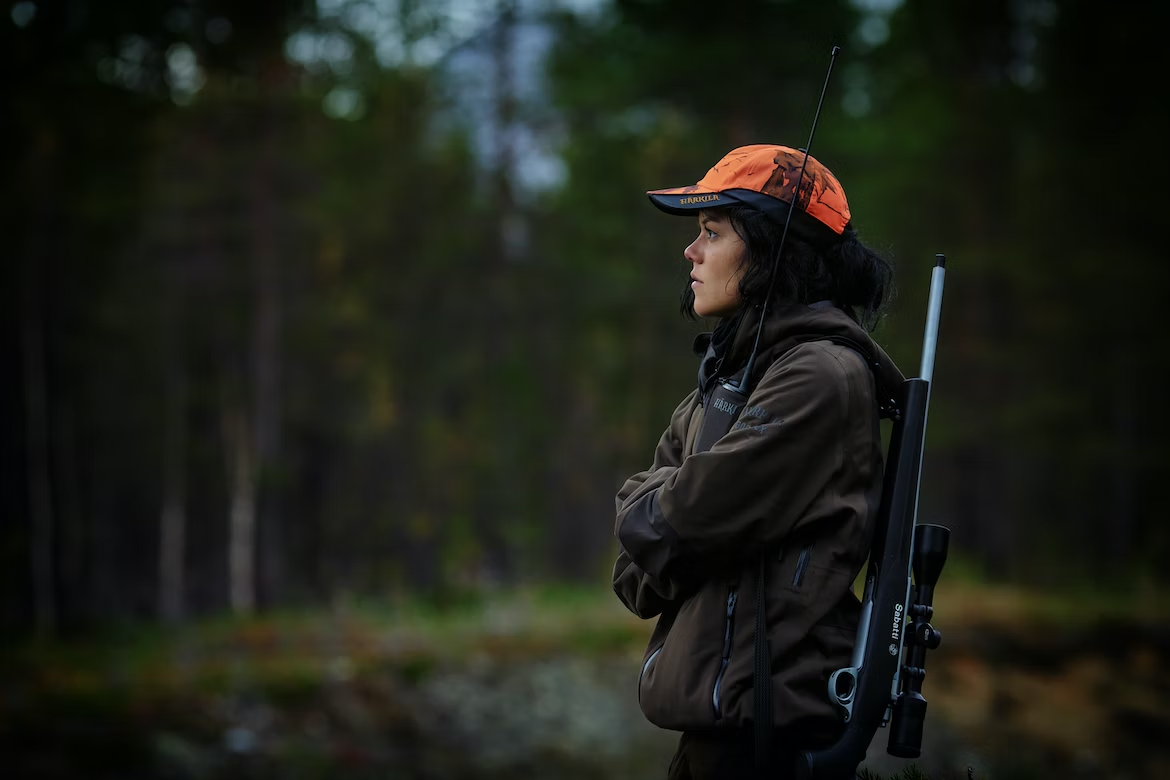
Ensure your attire includes bright-colored elements, such as an orange hat or vest, to enhance visibility to other hunters in the vicinity. This is particularly important to avoid any mistaken identity accidents. 

Additionally, for those seeking an extra layer of protection, considering the use of a bulletproof vest can be a worthwhile option. While not commonly utilized in standard hunting scenarios, bulletproof vests can provide an added level of safety in specific situations where there may be a higher risk of accidental discharge or when hunting in areas where firearms are more prevalent. You can get more information from https://bulletproofsupplystore.com/, but generally, bulletproof vests are designed to absorb and distribute the impact of bullets, reducing the risk of serious injury. Consult local laws and regulations regarding the use of bulletproof vests during hunting activities and consider professional advice to choose a vest that suits your specific needs.

Handling Firearms Responsibly

Firearm safety is of utmost importance when hunting. Always treat firearms as if they are loaded, even when you are certain they are not. Familiarize yourself with the specific features and operation of your firearm, whether it’s a rifle, shotgun, or bow, and ensure it is in proper working condition before every hunting trip. Regularly inspect your weapon to check for any signs of wear or malfunction.

When transporting firearms, always follow local laws and regulations. Ensure they are unloaded, securely stored, and properly cased or holstered. When handling firearms during the hunt, maintain the barrel pointed in a safe direction, away from yourself and others. Never place your finger on the trigger until you are ready to shoot. Remember, proper firearm safety practices are critical to preventing accidents and ensuring the well-being of everyone involved.

Be Aware of Your Surroundings

Maintaining awareness of your surroundings is crucial for your safety while hunting. Regularly scan the area for other hunters, as their presence may not always be immediately apparent. Communication is key in such situations, so consider using a whistle or other agreed-upon signals to alert nearby hunters of your presence.

Before taking a shot, always positively identify your target and what lies beyond it. It is essential to have a clear line of sight to your target without any obstructions that could cause a bullet or arrow to deviate from its intended path. 

Avoid wearing headphones or engaging in activities that may distract you from your environment. Be cautious of potential obstacles like fallen trees, uneven terrain, or wildlife that may pose a threat. By remaining vigilant and alert, you can reduce the risk of accidents and ensure the safety of yourself and others.

First Aid and Emergency Preparedness

No matter how careful you are, accidents can still happen. Therefore, it is crucial to carry a well-equipped first aid kit and have a basic understanding of first aid techniques. Your first aid kit should include items such as bandages, adhesive tape, antiseptic wipes, tweezers, and any necessary prescription medications. It’s also a good idea to carry a compact manual that provides instructions on basic first aid procedures.

Learn how to treat common hunting injuries like cuts, sprains, or burns. Understand the signs and symptoms of more serious conditions, such as hypothermia or heat exhaustion, and know how to respond accordingly. Additionally, include essential items like a flashlight, whistle, and compass in your survival kit. These tools can be invaluable in emergencies or when unexpected situations arise.

Familiarize yourself with basic survival skills such as building a shelter, starting a fire, and finding sources of potable water. While these skills may not be necessary for most hunting trips, knowing them can provide added confidence and security. Stay up-to-date with weather forecasts and be prepared for sudden changes in weather conditions.

Hunting is an exhilarating outdoor activity that allows us to connect with nature and challenge our skills. However, ensuring our safety should always be the top priority. By following the points outlined in this guide – proper planning, appropriate attire, responsible firearm handling, situational awareness, maintaining hydration and nourishment, and being prepared for emergencies – you can significantly minimize the risks associated with hunting.

Slug It Out: Best 12 Gauge Slugs

0

Shotguns may be the most versatile weapons on the face of the planet. When loaded with the right ammunition, the modern scattergun can effectively drop everything from tiny upland quail to charging, big-bodied bruins.

By using the best 12-gauge slugs, you can turn a simple shotgun into an impressively accurate powerhouse. The trick is matching your slugs to your shooting application.

Whether you’re looking for slugs for whitetails, dangerous game, home defense, or high-stakes competition, we’re here to help.

RIFLED VS. SABOT SLUGS

Most modern shotgun slugs fall into one of two categories – rifled slugs and sabot (pronounced “SAY-bo”) slugs.

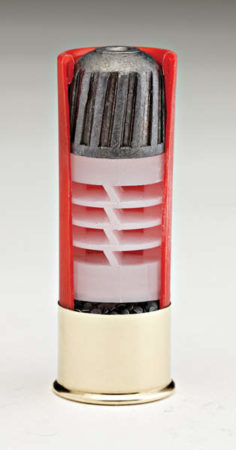
Rifled slugs are designed to be used in smoothbore shotguns. The rifled slug’s defining feature is a set of exterior grooves that resemble barrel rifling. Unlike barrel rifling, the slug’s grooves do not spin the projectile. Instead, the channels allow the slug to compress slightly so it can fit through a shotgun’s choke tube.

Hornady Rifled Slug

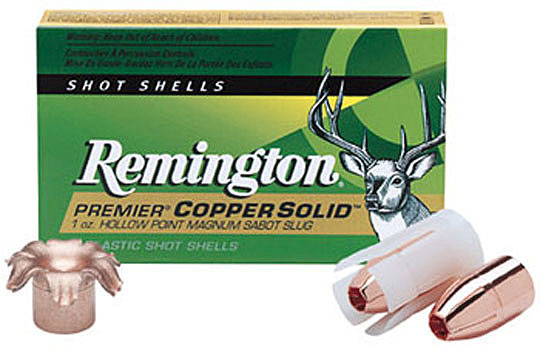
Sabot slugs lack the rifled slug’s exterior grooves because they are designed to be used in shotguns with rifled barrels or with a smoothbore paired with a rifled choke.

Remington sabot slugs

The sabot isn’t the slug at all. The word actually refers to the plastic sleeve surrounding the projectile. As the slug travels down the barrel, the sleeve contacts the rifling, causing the whole package to spin. After the slug exits the barrel, the sleeve falls away, but the projectile continues to spin like a football, which results in better in-flight stability.

Accuracy and Energy

Sabot slugs, with their gyroscopic spin, are generally more accurate than rifled slugs – but not by much. A rifled slug can travel a good 400 yards, but it drops pretty rapidly once it passes the 100-yard mark. Hitting a target beyond that is tricky, and a rifled slug isn’t carrying a ton of kinetic energy past that point anyway.

Sabots have a slightly longer effective range, typically around 125 to 150 yards, although some designs can stretch to 200 yards. The sabot’s football-like spin and higher ballistic coefficient make it slower to shed speed.

Rifled slugs, with their blocky cylindrical profiles and exterior grooves, aren’t nearly as aerodynamic as the sleeker, more pointed sabot slug. Because it holds velocity better than a rifled slug, sabot slugs also retain more energy as it travels down range.

BEST SLUGS FOR HUNTING

While a rifle will always be ballistically superior to even the most cutting-edge shotgun load, slugs do have a place in the hunting world. They are highly effective at typical whitetail ranges, especially when hunting big woods (think inside of 100 yards).

Also, because slug velocity and power peter out past 200 yards, slugs are a safer option than a rifle when hunting in populated areas. In fact, several Midwest states limit deer season to shotguns only for that very reason.

If you plan to use your 12-gauge to punch big game tags this hunting season, here are some of the best options on the market.

Federal Premium TruBall Rifled Slug

Federal TruBall slugs have been putting venison in family freezers for decades. Designed for smoothbore scatterguns, the TruBall system features a plastic ball positioned between the wad and the slug. The design helps keep the slug centered in the barrel. The components separate at the muzzle.

Federal Premium TruBall Rifled Slug

The TruBall system helps these rifled slugs perform more like a sabot, and the company claims they deliver 1.4-inch groups at 50 yards, which is pretty freakin’ impressive for rifled slugs.

Hornady American Whitetail Slug

Loaded with a 325-grain Hornady InterLock bullet, American Whitetail slug loads deliver excellent weight retention and massive expansion. The hollow point projectiles feature a tough copper jacket surrounding a serrated lead alloy core. These babies are tough enough for the biggest-bodied whitetails in North America. They can even be used to bag close-range elk and muleys.

Hornady American Whitetail Slug

The loads also feature a rigid polycarbonate sabot with a unique buffer disc that delivers serious accuracy. If you need to stretch the effective range of your shotgun, this is the way to do it. Hornady says their American Whitetail slugs carry enough power and accuracy to drop bucks beyond 200 yards.

Winchester Super X

Winchester Super X loads have a reputation for offering reliable performance at a super-affordable price point, and their slugs are no different. The line-up includes 12-gauge rifled slugs and sabot slugs.

Winchester Super X
Winchester Super X

If you don’t want to invest a ton of cash, but still want serious knock-down performance, these are the loads you want with you in the deer woods.

Brenneke Black Magic Magnum Slugs

Sometimes when we’re in the woods, we run into things bigger and more dangerous than whitetail deer. These 602-grain slugs are designed for just such an encounter.

Brenneke Black Magic Magnum Slugs

Brennecke’s hefty slugs have notched ribs and a lead point to guarantee seamless passage through your shotgun choke. These slugs leave the muzzle at over 1500 fps and are still packing 1219 foot-pounds of power at 100 yards.

BEST SLUGS FOR HOME DEFENSE

Slugs are regularly used for deer hunting, especially in rifle-restricted states. Deer and humans aren’t all that different. They share similar body weights and depth to vital organs. When we boil defensive shooting down to pure biology, if slugs are effective for deer, they should be just as effective on nefarious bad guys.

However, there are a lot more factors to consider in a home defense scenario than basic biology.

While you might use a slug to drop a monster buck at 75 yards, most home intruders are engaged at close range, usually inside five yards, which is about the typical length of a suburban hallway.

A heavyweight slug has tons of penetration power, which is the main reason big game hunters use them. While penetration is a positive when you’re hunting whitetails, it can be a major liability in a home defense situation. At close range, a 12-gauge slug will smash through anything in its way, plowing through furniture, doors, drywall, and wall studs, and still have enough energy to eff up a body standing on the other side.

Needless to say, shooting a slug inside your home could cause serious collateral damage.

With all that said, modern ammo technology is a marvelous thing. Ammo engineers are constantly pushing the envelope when it comes to defensive ammo, and a few companies offer shotgun slugs designed specifically for defensive shooting. These loads are made to deliver effective stopping power, while minimizing the chance of dangerous over-penetration.

Still, this isn’t our top choice for home defense. But if you want to use slugs, here is what we like.

Winchester Elite Defender Segmented Rifled Slug

Winchester has several innovative loads for home defense, and one of the most appealing is their Defender Series segmented rifled slug. This one-ounce piece of lead has strategic notching on both the exterior and inside the hollow-point cavity. On impact, the slug separates into three segments to compensate for aiming errors and maximize internal damage.

Winchester Elite Defender Segmented Rifled Slug

The fragmentation slows the projectile, which helps minimize over-penetration, making them a somewhat safer option when confronting bad guys, especially in situations where your kids are sleeping in the next room.

Winchester PDX-1 Defender Rifled Slug/Buckshot Combo

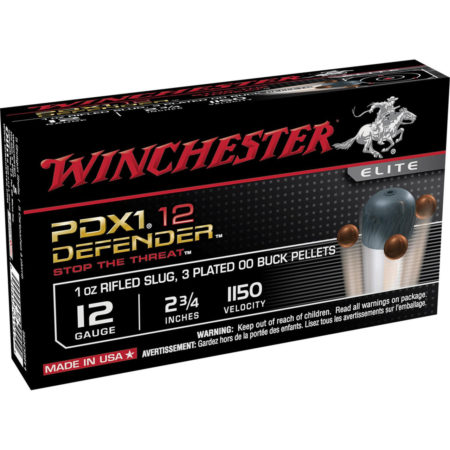
Winchester’s Defender line also includes a unique load that contains both a one-ounce rifled slug and three pellets of 00 buckshot. The load is engineered to compensate for aiming errors that often occur during adrenaline-pumping encounters, especially for inexperienced shotgunners. Because the load has extra pellets, it is still possible (at least theoretically) to hit the target even if the slug misses.

Winchester PDX-1 Defender Rifled Slug Buckshot Combo

There are still some penetration issues with this load, so it may not be the best option for defensive shooting in populated areas like apartment buildings or cookie-cutter suburban neighborhoods.

BEST SLUGS FOR 3-GUN COMPETITION

Most 3 Gun matches require shooters to use both birdshot and slugs. However, using a run-of-the-mill hunting slug is going to bruise your shoulder and leave you frustrated. Low-recoil options designed specifically for competition will help increase accuracy and speed up your shot times.

Here are some options to get you started.

Fiocchi 3 Gun Legacy Series

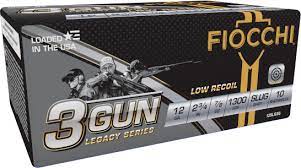
Italian-owned Fiocchi makes a low-recoil slug designed specifically for 3 Gun competition. Fiocchi 3 Gun Legacy Series loads were engineered with the help of American professional speed and competition shooter, Jerry Miculek.

Winchester PDX-1 Defender Rifled Slug Buckshot Combo

Packed with a 7/8-ounce rifled slug coated in red Teflon, these loads are designed to produce minimal smoke so you can pop off quick-succession shots with an unobstructed view of your target.

The slug works best in a smoothbore and leaves the muzzle at a healthy 1300 feet per second.

Fiocchi loaded these slugs in clear, easy-to-identify hulls, so you won’t mix them up with your buckshot loads on the competition field. They also feature a radiused crimp for super-fast reloads.

B&P Competition 3 Gun Slug

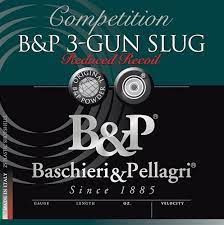
Baschieri & Pellagri have been producing top-quality shotgun ammo since 1885. To say these guys know their way around a shotshell is a major understatement. The company’s 3 Gun slugs are specially engineered to deliver consistently reliable performance, pinpoint accuracy, and reduced recoil.

B&P Competition 3 Gun Slug

LOOSE ROUNDS

With the best 12-gauge slugs, you can increase the accuracy, power, penetration, and range of your shotgun. As with all shotgunning applications, the key is pairing the right type of slug with your shooting needs.

READY FOR MORE?

  • 12-Gauge Vs 20-Gauge Shotguns: Does Size Matter?
  • Best Pump-Action Shotgun: Field & Home Defense [2022]
  • Best Semi-Auto Shotguns [2022 Buyer’s Guide]
  • Best Tactical Shotgun For Home Defense [2022]

Eating Trout Raw: Guidelines for Freshwater Sushi Enthusiasts

0

If you’re an avid trout fisherman, you’ve probably wondered if you can eat trout raw. Saltwater fishermen talk all the time about catching Spanish mackerel or tuna and eating right on the boat. But saltwater fish and freshwater fish live in very different environments. So can you eat trout raw?

The quick answer is that yes, you can eat trout raw if you’re desperate – but otherwise, you should not. It’s not recommended and could be bad for your health. Freshwater fish (including trout) have a higher chance of carrying parasites that could harm you.

On the other hand, saltwater fish are less likely to have harmful parasites in them – and are safer to eat raw. But even then you can still get very ill from eating any type of raw fish.

But what are your other options then? What are the best ways to prepare trout if you’re camping and if you do have to eat trout raw (like if you’re trying to survive without a fire), how would you go about doing it as safely possible?

We’ll answer all these questions and more in this article. Let’s get to it!

Why Can’t You Eat Trout Raw?

raw rainbow trout fillets

Before we get into what you should do if you absolutely have to eat trout raw as well as ways to prepare trout you’ve just caught, let’s go into a bit more detail as to why you cannot eat trout raw.

Author Note: With any raw fish, you run the risk of picking up any parasites that might be living in its meat. These parasites could be tapeworms, lung fluke, or other digestive bugs that will cause you serious harm if transferred to your digestive system.

As we mentioned earlier, saltwater fish don’t have nearly as many parasites that survive in human bodies and are there for less risky to ingest raw. That being said, health experts recommend you freeze all raw fish (saltwater included) at -4 degrees Fahrenheit for at least 7 days to kill any parasites that might be living in them.

This is the standard that sushi restaurants live by and applies to all raw fish.

Can Trout Be Eaten as Sashimi?

Sashimi is small pieces of raw fish – so aligning with our previous answer, you should not eat trout as sashimi. It’s still raw and can harm you for all the same reasons you shouldn’t eat trout raw.

Just because it has a fancy name does not make it any different from eating plain raw trout!

What to Do If You Have to Eat Trout Raw

Now that you know you should not be eating trout raw unless you need to to survive, let’s go over the things you try and do before eating it. It’s worth noting that we are NOT medical experts so if you do take our advice we are not liable for your health.

The first thing you should do is make absolutely sure you have no way to start a fire to cook the trout. Can you use friction to start a fire with two sticks?

Do you have a lighter somewhere on you or someone in your party that you may have forgotten about? Be absolutely sure you can not start a fire before proceeding.

After you’ve checked that, you should focus on cleaning the fish properly and quickly. You’ll want to eat the trout as quickly as possible after you catch it to ensure it doesn’t go bad.

The longer you wait after it is dead the more time bacteria have to grow on it and cause you harm.

How to Clean a Trout

Fresh trout

Once you’ve caught a trout (maybe with a bobber setup or using a stick to spearfish) that you want to eat, you should immediately cut its gills to let it bleed out.

This will preserve the flavor of the meat and remove some of the stronger flavors in the blood.

Author Note: After cutting the gills you should clean it as soon as possible. Here’s how to clean a trout. The process is similar for all species of trout, whether it’s a rainbow trout, cutthroat trout, or lake trout.

Instructions

  1. The first step in cleaning the trout is to make sure you have a sharp knife. Considering you’re in survival mode, even a pocket knife will work fine. If you don’t have a knife. We recommend finding a sharp rock and trying to follow these steps.
  2. Begin by cutting down the trout’s belly starting from the anal fins up to the pelvic fins and the beginning of the collar. We like resting the fish on a big rock to get leverage.
  3. Next, reach up inside the trout and pull out the innards. You may need to use both hands to pull them loose if they are stuck to the rib cage.
  4. Wash away the blood and extra gut from your rock then cut through the collar and remove the head.
  5. Next, it’s time to cut out your fillets. Make a cut across the end of the tail on both sides. Then connect the cut your already made on the belly to the end of the tail.
  6. Make a cut from the top of the backbone starting at the collar and going all the way down to the tail. Move your blade all the way down the spine while cutting through the skeletal bones.
  7. You can then use your knife to cut away the fillet from the collar of the trout.
  8. The last step is to remove as many of the pin bones as you can with your fingernails. This step can be time-consuming but will give you bone-free fish.
  9. The last step is to inspect the meat for any visible parasites or worms. They should be relatively obvious. If you see something weird, don’t eat that part of the fish or try and catch another one.

How to Cook Trout Properly

Luckily you will find yourself in this situation instead of the above. You’ve caught a trout while camping and you are ready to prepare it over a fire! This is a much safer option than eating trout raw. Let’s go over how to cook trout properly while camping.

Instructions

  1. First, you should follow the above steps we laid out for cleaning the trout properly. This will ensure you avoid eating bones (which can be dangerous) and will make the trout taste better. Bleed the fish first then remove the guts. If you brought any seasoning with you (salt, pepper, etc.) this is when you should add it.
  2. After cleaning the raw trout, find a long thin stick with a tip you can sharpen with your knife. This is going to be the skewer that you will use to hold the trout fillets over your campfire.
  3. Slide each filet onto the stick. If you don’t have enough room on your stick, you should find another stick and sharpen it so you have two skewers. Make sure the skewer holds the filet flat and maximizes its surface area. This will help the fish cook quickly and evenly.
  4. Once you build your fire, wait until the big flames have died down. This is the most common mistake when cooking trout while camping – you don’t want to cook it over open flames! You can, but it will impart a bad tasting charcoal flavor from the smoke.
  5. Once the big flames have died out, push the logs apart so the coals are exposed. This is where you are going to cook your trout.
  6. Hold the trout filets over the coals to cook them. You should start smelling cooked fish. Pay attention to the surface of the meat as well – you don’t want it turning black or burning.
  7. The best way to tell if the trout is done is to feel it. If it is firm like the muscle of your thumb and index finger, it’s done.

What Kind of Trout Tastes Best?

Fresh raw trout

Author Note: We also get this question all the time, and the answer is that it depends on your personal preference! Smaller species of trout like rainbow trout and brook trout tend to have firmer meat – like bass or pike. They also tend to taste like perch or other small predatory fish.

Larger species like lake trout tend to be softer and oilier. This is because they don’t have to work as hard to find food and have a higher fat percentage in their meat. If it was up to us, we would eat rainbow trout and steelhead the most.

We think they have the best texter and a mild flavor that tastes great with very little seasoning. Steelhead are a unique type of trout in that they can be caught year-round – even in the winter.

But if you’re in survival mode and purely eating the trout because you need sustenance, you probably won’t care what kind it is or what it tastes like. Hopefully, you don’t find yourself in that situation!

Parting Thoughts

We’ve been camping many times, and inevitably someone asks can you eat trout raw? It might be tempting at first – how much more fresh could the fish get? But as you now know eating trout raw can be dangerous to your health and should be avoided at all costs.

If you do have to eat trout raw, you should make sure to clean it properly first. Hopefully, you’ll have the resources to start a fire and avoid eating it raw.

We hope you found this article useful and informative. If you have additional comments or thoughts about eating trout raw, feel free to shoot us a note in the comments below.

Happy Hunting!

John Breen Buck

0

The John Breen Buck, shot in northern Minnesota in 1918, is considered by many whitetail experts to be the greatest typical ever, despite the fact that at 202 net B&C points he’s several notches down the list from No. 1. This isn’t an attempt to take anything away from the incredible trophies that outscore him, but few other typicals can approach this buck’s “shock value.”

Back in 1903, John took a job as a store clerk in the northern Minnesota town of Bemidji. At that time, a vast area of logged-over woods lay between there and the Canadian border 100 miles to the north. Transportation in the region was difficult, and the use of a horse and buggy was still common. From Bemidji, a railroad ran northeastward all the way to the border town of International Falls. Some 30 miles from Bemidji, the tracks went through the small town of Funkley in Beltrami County. And, that’s where whitetail history was made.

“People who lived north of Bemidji liked to catch the train and ride it into town to do their shopping,” said Ray, John’s youngest son. “In those days, you could flag the train down anywhere along its rout and ride it for two cents a mile. For a lot of people, it was a real treat.

“One of Dad’s customers, Knute Week, lived up near Funkley, at a flagstop place known as Hopt. He would come into Bemidji every so often to do his shopping. Week had access to some good deer hunting land up near Funkley, and he invited Dad to go up and hunt with him,” Ray recalled.

One cold day in November 1918, while two of his sons were overseas fighting in World War I, John grabbed his rifle and gear and hopped aboard the train for Funkley. When he returned home a day or two later, he had with him a deer so large that even back then it cre­ated quite a stir.

“I still can remember when he brought it home,” said Ray, who was 12 at the time. “He had quite a time getting it back to the house. He had to bring it down to Bemidji by train; then he had to get a horse and wagon to transport it from the depot to our house. The story that I always heard was that he was on his stand with his .30/30 rifle when a bunch of deer came by. Several does were being chased by a buck. He raised his rifle and started to shoot at the buck. All of a sudden, he saw this great rack of horns coming through the woods, so he took aim and shot this big buck instead.

“When he got the buck home, everybody came by to see it. A lot of people made a big fuss over it. The rack was so big that even in those days everybody knew that it was something special. The rack was so wide that we had a hard time getting it through the front door of the house.

“Dad knew his buck was really unusual,” Ray added, “and he was awfully proud of it. After much deliberation, he decided to have it mounted. He sent the antlers over to a taxidermist in Duluth—a man named Story. Mr. Story took one look at those antlers and offered him $50 cash for them. Now, $50 was a lot of money back in those days, probably equal to about half a month’s wages. Dad turned him down flat. That deer meant too much to him.

“It seemed like we ate on that old buck for weeks,” Ray added, “and he was one tough old boy. The deer was thin and gaunt when Dad brought him home, despite the size of his antlers. He was a big-bodied deer, and I remember people saying that he weighed well over 200 pounds. Dad tried to give away some of the meat, but it was so tough that nobody wanted it.”

John died in 1947 at the age of 81. Several years later, B&C introduced its new scoring system, and at the urging of friends, the family decided to have the head officially measured. With an unprecedented net typical score of 202 points, the Breen Buck immediately became the world record typical, even though he suffered heavy deductions for non-typical points. The Breen Buck held the record until 1964, when the James Jordan Buck was recognized as a new No. 1 typical.

During the late 1960s, an antler col­lector from the East Coast wrote the Breen family and asked if they wanted to sell the rack.

“His name was Dr. Chuck Arnold, a dentist in Boston,” Ray recalled. “He wasn’t sure whether we spoke English or not, so he wrote to us in both French and English. He said he collected antlers, and he offered us $1,000 for the rack. After talking it over, we decided not to take his offer because we didn’t want the antlers to leave northern Minnesota. After all, Dad’s trophy was Minnesota’s largest typical whitetail of all time (a position the deer still holds today), and we felt it should remain in the state. However, by this time, the old mount was beginning to show its age. For a while, we let it hang in a local store, but most of the time, it hung in our house.

“We talked to sev­eral different museums about possi­bly taking the trophy, but at the time, no one seemed to have much interest in it,” Ray added. “Then, in 1970, Dr. Arnold wrote to us again. This time, he offered us $1,500 for the antlers. He promised us that he would take good care of the trophy and that he would see to it that it got the kind of recognition it deserved. We talked it over and decided to take his offer.”

Dr. Arnold did indeed take good care of the buck . . . and avid whitetail hunters everywhere are glad of it.

The exceptional fact about the Breen buck is that its gross typical frame scored 215 0/8. Six small abnormal points kept this buck from being the world record. Without those points the buck would have had a net score of approximately 210.

The main beams measure 31 2/8″ and 31″ in length, with 6″ bases. The 26 7/8″-wide rack has outstanding tine length and is truly a masterpiece of nature. When compared side by side with similar scoring giants, any hunter would pick this buck as number one!

Michigan’s Biggest Buck!

0

Scoring an impressive 247 4/8’s this monster was not brought down by a hunter

“Michigan’s Biggest Buck” is a very powerful statement. The current Michigan record is a buck shot with a firearm in 1976 by Paul M. Mickey that scores 238 2/8 Non-Typical, Boone & Crockett points. The buck in the pictures accompanying this article has an amazing gross green score of 257 2/8 and a green net score of 247 4/8! If this score holds up, it will blow way past this long standing record by nearly 10 inches.

This new buck cannot officially be recognized as the state record until April 6, at which time it will be eligible for an official panel-score. The current tallies came about when Commemorative Bucks of Michigan scorer, Dennis Sheets measured the massive headgear accompanying this buck. These scores are considered “green” because the current record keeping systems require a 60 day period of “drying” after the antlers are acquired.

This impressive buck was not brought down by a hunter but rather it was found dead by Sharon Weidmayer while she was taking her dog “Camy” for a walk through some overgrown pasture land. Ms. Weidmayer found the buck on February 7, 2010 and informed her hunting friend Ron Waldron of her find and asked him to come and get the deer.

Two days later, Sharon took Ron to the dead animal. When Ron saw the monstrous buck he exclaimed in jest, “That’s not a deer, that’s an elk.”

Ron could not wait to show the antlers to his son-in-law/hunting partner, Mike Guenther. As soon as Mike saw the trophy he knew they had something really special and contacted the authorities to acquire a permit to own the deer.

This buck has 26 scoreable points and carries an incredible 29 inch inside-spread, and main beams that measure 31 inches. The deer was found dead in Clinton, Michigan which is in Lenawee County. This is the same county that produced the 200 class buck taken by Jeremy Collingsworth during the 2009 archery season and was featured on the cover of the January 2010 issue of Woods-N-Water News.

Mr. Guenther reports that the big buck that his father-in-law brought home hadn’t been dead for very long. The deer had been eaten by coyotes but the eyes were intact and the meat remained red. The cause of death is unknown but there were no visible holes or broken bones. The jaw and teeth wear indicate maybe a 4 ½ year old deer.

Ironically, another 4 ½ year old deer that was also found dead is the world record non-typical buck. This deer is known as the “Missouri Monarch” and scores 333 7/8. The highest scoring buck killed by a hunter was shot with a muzzleloader by 15 year-old Tony Lovstuen in Iowa and scores 319 4/8.

The highest scoring Michigan non-typical taken by hunters include the aforementioned Mickey buck which also holds the firearm record at 238 2/8. Aaron M. Davis has the archery record with a Hillsdale County buck that scores 225 7/8. Calhoun County is the home of the state record muzzleloader buck shot by Tim Tackett and it scores 215 1/8. The handgun record is held by Carl Mattson with a score of 218 1/8.

Mike Guenther states that Sharon also found the previous year’s shed from the buck’s right side and that the brow tine curls the same and it even has matching “sticker” points. Guenther goes on to say that the buck put on a lot of mass since the previous year.

When word spread of their great discovery over 200 people toured their pole barn to view the spectacular trophy. Ron and Mike are passionate hunters themselves and are “quite glad to be able to share such a wonderful buck with the public.”

9 Best Weapons For Camping

0

Camping is a relatively safe experience. I have been a camper for most of my life and have never had an issue where I felt that a deadly weapon was necessary. However, that doesn’t mean that it will always be that way. Having some way to protect yourself when things go wrong is just good common sense.

When many people think of carrying a weapon for protection, a gun may be the first thing that comes to mind. While this is certainly an option if it’s legal and you obey the laws, there are many other options that are less deadly but extremely effective.

Different rules apply depending on where you are on whether or not you can carry a gun. I choose not to go this route but I do have a keen sense of my surroundings and am generally prepared for bad things that might happen.

If you camp regularly and are looking to beef up your defenses, there are some common items that will work very well as weapons. Many of these are already at your disposal and you will simply need to be more aware of them.

When considering a weapon, you need to first establish what you are trying to protect yourself from. It could be wild animals or it could be the most dangerous of all; other humans with bad intentions. It’s good to be prepared for both in case something goes down that threatens your well-being.

If you are going to use a weapon, it should be a last line of defense. Some weapons could get you hurt if you don’t know what you are doing. For example, someone with a greater skill set could take a knife away from you and use it against you instead. Only consider a weapon as a last resort when your back is against the wall and you have to protect yourself from serious harm.

Let’s look at some great weapons to have on hand while camping that can help ensure your safety. These are in no particular order EXCEPT the first one.

NOTE: if you choose to carry any type of weapon when camping, make sure it is legal to do so and you understand any consequences involved in using it.

1. Your Brain / Awareness

The number one way to stay safe while camping is with the weapon you have right between your ears; your brain! Being aware of a situation and using your brain to direct your actions is the first step in ensuring your safety.

Our intuition can help us avoid something that might cause us harm. The trick is to listen to that intuition and avoid getting caught in dangerous situations. Not only that, but it also takes awareness to understand how and where to park your RV or pitch your tent.

Avoiding bad areas or other places where you just don’t feel comfortable will go a long way in protecting you.

Being aware of your surroundings and prepared in the best way that you can should be the first action. Only then does it make sense to even discuss weapons.

2. Pepper Spray / Bear Spray

Hand holding pepper spray

Pepper spray is a great way to protect yourself against other humans who are up to no good. It’s an easy weapon to carry with you and can easily be kept in your pocket at all times or in a location in your RV that’s easy to get to. With numerous varieties on the market, it’s easy to find an effective pepper spray that will protect you from intruders and other sketchy people that come around.

Pepper spray is designed to incapacitate an attacker long enough so that you can get away. Don’t expect it to take someone down for good.

Bear spray is great to have on hand as well if you camp in areas where bears and other wild animals could cause Harm. While bear spray isn’t designed for protecting yourself against humans, it can be highly effective in the event of a bear attack. It’s good to have both of these on hand on a camping trip and use them accordingly.

With both of these, it’s a good idea to understand how to use them and what the spray bottles are capable of. You don’t want to get caught in a situation where you need to use one and be fiddling around with the spray nozzle. Even worse, spraying towards yourself rather than the intended target.

3. Knife / Axe

Folding knife at campsite

Every camper should have a knife on hand. Not only for protection but for the practicality of having one. There are so many things you need a knife for while living off the land. A folding knife can easily be carried in your pocket at all times and it’s great to have on hand for those times when you just need a knife. You may need to open a package, cut a cord, slice up some food, or even protect yourself.

A sturdy pocket knife can be a great way to arm yourself and provide you with a weapon if you ever encounter a situation where when is needed. In an RV, you may have a plethora of knives sitting around for cooking and other needs. These may also be used if someone breaks into your RV or someone is up to no good and you need to ward them off.

Similar to a knife, an axe is also effective as a potential weapon. Axes are sometimes needed on a camping trip in order to cut firewood or chop something down. While you hope to never use such a thing, it’s an option that can do a lot of damage and protect you from unwanted visitors if needed.

4. Fire Extinguisher

If you are an RVer, you likely have a fire extinguisher handy in your RV. While a fire extinguisher is meant to put out fires, it may also serve another purpose if your back is against the wall and you need a weapon to ward off an intruder. If you can locate your fire extinguisher in a timely manner and be able to spray it in the vicinity of the person or other being in question, it can potentially save your life.

The CO2 that is emitted from a fire extinguisher can serve to temporarily incapacitate a person and make it easier for you to get away. Not only that but a fire extinguisher could serve as something that can be used to hit someone over the head.

This would be a last resort measure but since most RVs are, or should be, equipped with a fire extinguisher, it is something to consider as a possible life-saving weapon.

Even tent campers should have a fire extinguisher on hand in case a fire starts burning out of control. Keep it close by and easy to grab and use whether it’s to put out a fire or to run someone away from your campground.

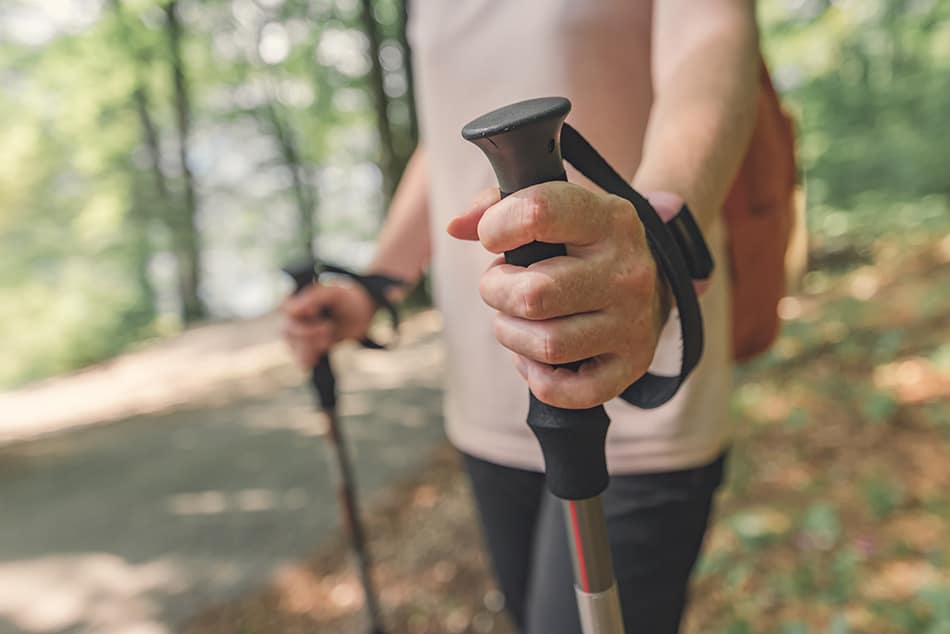
5. Trekking Poles / Walking Stick

Woman holding trekking poles

Campers are often hikers and hikers often carry trekking poles or some type of walking stick. If you don’t, it’s a good idea to start! A walking stick or trekking poles can serve multiple purposes. The most obvious is giving you a stabilized place to hold onto as you walk across areas that could be potentially slippery or dangerous. A trekking pole gives you a place to hold onto as it firmly pushes into the ground while you hold tightly to it as if it’s a handrail.

A stick like this can also be used in the event of an emergency or if someone is trying to harm you. Not only a person but it can also ward off wild animals that have wandered upon you as you can use it as a weapon to poke, prod, or swing in order to hit the assailant. Having trekking poles like this provides a great additional barrier of protection that can be of help during an encounter with a crazed individual.

Besides being handy for keeping you stable as you are hiking, these trekking poles can become your best friends in times of danger.

6. Rocks

You’ll find plenty of rocks out in nature while you’re camping. After your campsite has been set up, a few select rocks from around the area can be positioned inside your tent, RV, or sleeping area. These rocks may come in handy if you were to hear rustling weeds or a person drawing near that shouldn’t be there.

Having a selection of rocks nearby gives you some weapons to throw or hit onto something. This can provide you with some additional protection and could buy you time so that you can acquire another weapon, run away, or call for help.

Rocks can be thrown, as long as you have a good aim, and will likely make a wild animal run away or stop a human intruder in his or her tracks.

7. Dog

Dog next to man sitting in chair at campsite

We campers love our dogs and besides being a best friend, a dog can be a great security system! Depending on the dog you have, you may have a partner that can fully protect you or you may have a partner who will only alert you of danger. Either way, having a best friend on hand that has some sharp canines and an instinct to protect, will go a long way in providing you with a weapon that intruders would not want to tangle with.

Even if your dog is not a powerful breed that can take down a large person, he or she will likely still be a fighter that will stand up for you and protect you in times of need. Not only this but a dog can help to draw attention with its barking and possibly alert others who may be around in the campground or nearby.

8. Stun Gun / Taser

A stun gun or taser might be a weapon that you haven’t considered before but can be highly effective if something tries to harm you. If a person comes into your campground causing a ruckus or breaks into your RV and puts your life in danger, a stun gun or taser can be used to stop them in their tracks. The high voltage of these devices is designed to shock and temporarily disable a person as it gives you time to get away or figure out your next move.

A taser is great for taking someone down from a distance, typically 15 to 25 feet away. However, a stun gun can be highly effective if an intruder is upon you and you are fighting for your life. A stun gun temporarily can disable a person if activated while making contact with their body.

The video below shows what happens when a stun gun is used.

There are laws regarding these depending on the locality that you are camping in but in general, are legal to use in most US states and can provide some additional protection when you need it most. Learn more about stun gun laws.

9. Personal Alarm

A personal alarm is something that is more of a deterrent than a weapon. While there won’t be much you can do as far as injuring someone, a loud piercing alarm that you can push when in danger will alert others in the area and potentially cause the intruder to disappear.

Animals may not like the sound either and can be startled enough to run away when the alarm is sounding. These types of personal alarms can be carried in your pocket, on your keychain, in a purse, or backpack. It’s best to have them in a place that is easy to get to without much difficulty.

Having an alarm like this hanging from your backpack strap as you are hiking for example gives you a way to instantly press it in a time of danger. The WETEN Personal Alarm Keychain (affiliate link) is a great option that is easy to use and can be carried on your keychain.

Bottom Line

Overall, camping is a safe experience and there may be no need to worry about carrying a weapon. However, it’s good to know that there are some objects easily accessible that can be highly effective. When your back is against the wall and you are fighting for your life, these items may come in handy as long as you plan in advance.

As the saying goes, expect the best but prepare for the worst. This is just good common sense! It’s better to think about these things now and be prepared when you need them rather than not knowing what to do when the time does come.

Field Labrador – The Hardest Working Labrador Retriever Of All

0

Field Labrador is another way to describe a working, or American-type, Labrador. The term field Labrador is used because these Labs are most often seen out working in the field on a hunt. And that’s where this type of Labrador is bred to excel. The better known name American Lab is used because they were developed in the United States. Of course, that doesn’t mean you won’t meet them in other areas of the world today, or that every Lab you meet in America is necessarily American-type!

Field Labs are taller and longer than English, or show-type, Labs. Some field Labs and their owners take part in field trials, and earn championship titles which can be included on their pedigree.

Different Types Of Labrador

There is only one Labrador Retriever breed. But selective mating choices in different breeding lines have gradually created two distinct types of Lab. This is frequently confusing for prospective owners researching their first Lab. Not least because each type of Lab is known by multiple names! The two Labrador types are:

  1. English Labradors, also known as show Labradors, or bench Labradors (after the show bench)
  2. and American Labradors, also known as working Labradors, or field Labradors.

How Does A Field Lab Compare To A Show Lab?

So how can you tell a American-type field Lab and an English-type show Lab apart? Well, there are tell tale differences in the way they look, and also in their temperaments. They can seem subtle at first, but if you’re lucky enough to meet a lot of Labs, you’ll soon discover that you can tell them apart quickly – like meeting human twins.

Field Labrador Looks

Field Labs are taller, longer, leaner, and more athletic looking than show Labs. Front-ways on, their face and neck tend to look more slender and elongated. Of course, these things are all relative, and the field Lab is still a robust and sturdy looking dog! At the back, working lines are increasingly losing the classic Labrador otter tail too, in favor of a much slimmer tail.

By comparison, show Labs are bred to exemplify the physical description in the breed standard, which is shorter, stockier, and still in possession of a wide-based otter tail. The field Lab’s drift in appearance from the breed standard is an indirect result of basing mating decisions primarily on working ability rather than looks. But field Labs which don’t perfectly match the physical description in the breed standard are still purebred Labs, if they have the pedigree to prove it.

Field Labrador Temperament

All Labs are energetic, but field Labs have more stamina than show Labs, and need more daily exercise. Field Lab owners also tend to believe that their dogs are smarter than show Labs, and quicker to learn new commands. They usually have greater confidence working at a distance from their handler. People looking for working Labs value these qualities when it comes to long days retrieving on game shoots. But outside of a working context they can also make field Labs seem stubborn compared to show Labradors. But it’s simply that they find making their own decisions rather rewarding!

Field Lab owners have to make more effort to be sufficiently fun, stimulating and rewarding, that their dog will always be more interested in looking to them for cues, than making up their own mind about what to do next. Which is why many people think that modern field Labs are great working dogs, but the comparatively sedate modern show Lab makes a better family pet.

Field Labs And Field Trials

Field Labs are smart, enthusiastic and tireless. Even if they’re not going to work in the traditional sense, most owners participate in agility, scentwork, and retrieving activities with their field Lab. These give them an outlet for their energy and ability.

One of the most popular activities for working field Labs and amateur field Labs alike are field trials. Field trials replicate all the requirements of a day out on a hunt – following commands from a distance, and completing retrieves on land and from water, under different levels of distraction. They’re co-ordinated and judged by kennel clubs. Dogs who enjoy success in several field trials can earn titles to include alongside their name on the kennel club’s pedigree record.

U.S. Field Labrador Titles

U.S. field Labrador titles are awarded by the American Kennel Club (AKC). There are two possible titles to work towards: Field Champion and Amateur Field Trial Champion. Labs with these titles can have the prefix FC or AFC placed before their name on their pedigree.

U.K. Field Labrador Titles

In the UK the only field trial title is Field Trial Champion. Dogs with field trial champion status can have the letters FTCh placed by their name on their Kennel Club pedigree. In theory, it’s also possible for working Labs in the U.K. to hold the title of Dual Champion (DC). This is automatically awarded to dogs who achieve both Field Trial Champion and Show Champion Titles. However, the difference between field- and show-type Labradors is now so great that it’s been many decades since one held the title of Dual Champion.

Alternatives To The U.K. Field Trial Champion Title

If you’re looking for a litter of working Labs in the U.K., you might also come across dogs described as FTW. This stands for Field Trial Winner. It’s not an official title, but it indicates that a dog has completed some of the milestones on the way to becoming a Field Trial Champion.

UK field Labs can also take part in gundog working tests organized by The Gundog Club. These graded tests are a fun way for working and non-working Labs to develop the skills they were bred for and have fun together. Certificates from these tests aren’t entered on a dog’s pedigree. But they’re an enjoyable entry point to field trials for people with Labradors from working lines.

Australian Field Labrador Titles

In Australia, the field Labrador titles are Novice Retrieving Ability, and Open Retriever Ability. These titles are earned by completing the relevant Retrieving Ability Test For Gundogs, administered by the Australian National Kennel Council.

The Significance Of Field Labrador Titles

Field titles are an indicator of excellent field work in retriever breeds. Labradors don’t have to be field Labs to secure them – English or show type Labs can work towards them too. The judging criteria are intended to cover innate qualities of well-bred working retrievers, and learned abilities of well trained dogs and accomplished handlers.

If you’re looking for a field Labrador because you want to work with them, or participate in field trials yourself, then looking for litters with field trial champion parents is a good way to set yourself up for success. Even as an amateur, if you catch the field trial bug, putting yourself forward for titles is a fun way to challenge yourself and celebrate you and your Lab’s progress. But it doesn’t matter if you ultimately choose to enjoy the training, but forego the assessments.

Earning Field Labrador Titles

If field trials are something you’re interested in doing with your Lab, visit your regional kennel club website and look for local events to attend as a spectator first.

Organisers are usually happy and enthusiastic to show you what they’re all about and encourage new people to get involved! Kennel Clubs also run training courses to prepare new competitors for what to expect. Don’t forget that in the U.K. the Gundog Club is also a great place to start learning these skills. Your trainer will help you judge when you’re ready to start entering field trials.

Field Labradors – Summary

Field Labrador is simply another term for an American or working type Lab. Unsurprisingly, field Labs are best known for their field work, but field Labs and show Labs can both participate in gundog training, and both compete for field titles. These activities are fun ways to engage a Labrador in the kind of work he was bred for. He gets the satisfaction of doing what he was meant to do, and you get the pleasure of watching him at his finest!

Do You Have A Field Labrador?

Do they hold any field titles, or have you considered working towards them? Let us know in the comments box down below!

References And Further Resources

American Kennel Club

The Kennel Club

The Australian National Kennel Council

Turkey meat: what are the most common cuts and how to best cook them

0
Immagine

A meat that is often mistreated and relegated to the world of fitness; in reality the turkey is a tasty product, it has a firm flesh, with a delicate taste and it is rich in nutritional properties. Classified among white meats thanks to the low presence of myoglobin, turkey has a very low fat content and almost all are concentrated in the skin, as with all poultry meats. The peculiarity of this product is that it can be safely cooked and consumed in its entirety; the most famous example is the classic American stuffed turkey, the dish par excellence on Thanksgiving Day in America.

In 1600 the turkey was among the rarest and most requested animals in Europe to “adorn” the gardens of noble villas. Today it is among the most common farmed birds, even if the cuts between which to range are not very many.

For turkey there are various types of cuts in the world, for example in Italy there are only four cuts but, as we have also seen with beef, abroad there is a different classification; in the United States there are dishes prepared with the head and neck of the turkey and sometimes also the tail is used. An important thing to keep in mind for all the following cuts is cooking; turkey meat can only be eaten if perfectly cooked, otherwise you could face unpleasant intestinal unexpected events.

1. The turkey breast

Immagine

It is the best-selling and most prized cut of the whole animal; a lean, very tender meat, suitable for the preparation of thin slices, it can be cooked in cubes, strips and so on and so forth. Important thing; many people think that turkey breast and turkey rump are the same thing but they are not. The rump is much appreciated by those who follow a low-calorie diet because it is rich in proteins and mineral salts but it is important to understand what it really is; it is a real cured meat obtained from the processing of the breast muscles, boned and cleaned, then processed and seasoned with a mix of salt and spices. Usually the rump also undergoes a smoking or caramel treatment. So turkey breast and turkey rump are two very different things.

While we recommend the turkey rump especially for sandwiches, buns, toasted bread or wraps, and it is also appreciated in the form of scallop with beer, turkey breast is very suitable for slow cooking, especially in the oven it is really tasty. Also excellent as a scallop or, for the sweet tooth, cut into chunks, breaded and fried.

2. The turkey wings

Immagine

The “middle” cut of the animal; thinner than the thighs but fatter than the chest. You can buy them both whole and cut and are really excellent cooked on the barbecue, in full American style. Also in this case, frying is a more than appreciated method; being an American animal, it goes without saying that the most popular cooking techniques are those from the New Continent. Fried turkey wings are tasty and very simple to make. Just follow the same procedures as for chicken wings and that’s it.

A little tip; ask your trusted butcher to debone the wings and, once at home, turn them into a stuffed roll (perhaps with ham and / or mortadella), they are truly a delicacy.

3. The turkey thighs

Immagine

Very tasty cut of meat that goes perfectly with spices and flavors. A typical recipe is the Mexican thigh, prepared with many spices, but the tastiest recipe is probably the one that wants it cooked on the grill, together with some vegetable skewers to mix all the flavors. The thigh is the fattest part of the animal because it is richer in skin; try it in the oven or on the rotisserie, you will not regret it.

4. The turkey drumsticks

Immagine

One of the most popular turkey cuts, the drumsticks are the part of the legs under the thighs. Their meat is tasty but less tender than the thighs because this is a part that is more “trained” by the animal during its life, therefore it tends to be hard. Precisely for this reason drumsticks are ideal for slow cooking, in the oven. Also excellent alla cacciatora, or cooked in a pan with fresh tomatoes and vegetables.

Best Air Rifle Deals

Popular Posts

Air gun 101: Everything you need to know about air rifle accuracy

0
Wyatt Earp has said: Fast is fine, but accuracy is everything And I just thought how many airgunners are obsessed with muzzle velocity and muzzle energy,...

Air Rifle vs BB Gun: Understanding the Key Differences and Choosing the Best Option

0
"Air Rifle vs BB Gun: Unveiling the Key Differences and Choosing the Perfect Weapon for Your Shooting Needs. Delve into this comprehensive guide to...

Best Air Rifle Brands – Who Makes the Best Pellet Gun?

0
In Jeff Bezos’ own words: "A brand for a company is like a reputation for a person. You earn reputation by trying to do hard...