The SilencerCo ASR Muzzle Brake is a game-changer! Although there are some folks who are not much into muzzle brakes for personal reasons, they are still not a bad idea.
I’ve used quite a few SilencerCo ASR muzzle devices, and I can say for a fact that they are an awesome choice. To start with, they are solid and also great for reducing recoil and muzzle rise. They are built from high-quality materials that can withstand the heat and pressure of regular use. In addition, this muzzle brake is pretty easy it is to install. So if you are in doubt, this is the muzzle brake for you. To find out about other brakes and firearms, read up more on our website.
I’m not sure exactly what kind of steel this muzzle brake is made of. But it’s strong.
We actually got an ASR Flash Hider hot enough to melt it. A customer blasted like 20 mags of full auto through a SilencerCo suppressor.
This one got way too hot. It still works, though.
The muzzle device got hot enough that the metal got soft and blistered. We straightened it out and let it cool down. And the muzzle device still works on that full-auto rifle today. It didn’t get brittle. And even the black nitride finish held up to some extent.
That makes me pretty certain that the SilencerCo ASR Muzzle Brake will hold up through all sorts of hard use, since most of us don’t have full-auto rifles.
Also, the machining on this muzzle brake is super clean. All the corners are beveled slightly to remove any harsh edges. Even the internal edges of the ports are beveled slightly.
Lastly, the threads on the ASR mount are incredibly clean. But I’ll talk about the ASR mount later on.
But, even without mentioning the ASR mount, the construction and attention to detail on this muzzle brake is obviously top notch.
Fit and Finish
There’s some good and some bad here.
First, the black nitride finish is incredible. As I mentioned earlier, the black nitride finish on the ASR Flash Hider that we melted held up somewhat. It wasn’t perfect. But I wouldn’t expect any finish to hold up through being melted without any damage.
But it’s evidence that the finish is incredibly strong.
And the finish resists carbon fouling pretty well. It seems that this muzzle brake collects less carbon than many other muzzle devices I’ve used.
It takes quite a bit of suppressed shooting—and even more unsuppressed shooting—to get any significant carbon buildup on the muzzle device. So the nitride finish certainly seems to do its job.
The next aspect of the fit and finish that I noticed is the threading for mounting the muzzle brake to your barrel. The threading is incredibly smooth and well finished. This muzzle device threaded on super smoothly and easily.
My only complaint about the fit is the shims.
I don’t know if shims are a requirement for muzzle brakes. But I prefer crush washers. I find it much easier to time a muzzle device with a crush washer. And I’ve never had a muzzle device that’s mounted with a crush washer come loose.
If it’s necessary to use shims for a muzzle brake, so be it. You can use a crush washer for a compensator, though. And that must be timed. So why not use crush washers for muzzle brakes?
But I digress. My problem with this muzzle brake is that I’ve occasionally found it difficult to time the muzzle brake with the included shims. Either the shims were too thick or too thin. And I ended up having to pretty much overtorque the muzzle brake to get it properly timed.
It’s not a huge deal. I just used a bigger wrench. And this hasn’t been an issue with every ASR muzzle brake I’ve installed. It might just be a slight mismatch between the threading on the brake and the threading on certain barrels.
But you don’t have these sorts of issues with a crush washer. That’s all I’m saying.
Either way, my one complaint about the fit is pretty minor. Timing muzzle devices with shims is always kind of a pain. So I might have this complaint about any other muzzle brake.
Putting my minor gripe aside, the fit and finish on this muzzle brake is outstanding. It installed (mostly) flawlessly. And it requires very little cleaning and maintenance. That’s about as much as you can ask for from a muzzle brake.
It might be tough to see. But that shim is SMASHED.
Suppressor Mount
Obviously, the primary feature of this muzzle brake is the ASR suppressor mount.
Here’s my one sentence opinion of the ASR mount: it’s one of the best—if not the best—suppressor mounting system on the market right now.
Just look at those clean, sharp threads.
It’s super simple and easy to use. It’s absolutely secure. And it’s nearly impossible to get a false positive with the locking mechanism.
Also, referring again to the ASR Flash Hider we melted, we melted an ASR muzzle device. And the ASR mount still works! We didn’t even have an issue removing the suppressor after getting it hot enough to melt the muzzle device.
I know that this is a sample size of one.
But we use a lot of SilencerCo suppressors on rental guns at the range. And the operation is almost always flawless, despite how badly we beat them up and how often we burn them down on full-auto guns.
They very rarely even get carbon locked. That’s not to say that it can’t happen. But it takes a lot of abusive shooting to lock up the ASR mount.
So, in short, I’m convinced that the ASR suppressor mount is an amazing mounting system.
Obviously, you can only use SilencerCo suppressors with the ASR system (there may be other manufacturers that produce ASR compatible suppressors. But I’m not aware of them).
However, SilencerCo makes awesome suppressors. Being restricted to using SilencerCo suppressors isn’t really a limitation. No matter what you want to do with your suppressor, SilencerCo makes one that will fit the bill.
All in all, the ASR mount gets two thumbs up from me.
Muzzle Brake Performance
My observations here are pretty straightforward.
In terms of recoil reduction, this is a good muzzle brake. However, there are dedicated muzzle brakes that perform better.
I will say this, though: the only muzzle brakes that offer better recoil reduction are dedicated muzzle brakes. The other muzzle brakes with suppressor mounts feel about the same, or even slightly worse.
For a muzzle brake with a suppressor mount, this muzzle brake is outstanding. But, if your primary concern is recoil reduction—and you don’t need the suppressor mount—you’d be better served with a dedicated muzzle brake.
Allow me to make this recommendation, though:
Use this muzzle brake, even if you don’t have a suppressor right now and you just want recoil reduction.
Why?
This muzzle brake offers plenty of recoil reduction for typical AR-15 rounds. It might not be the very best. But it’s good. You’ll get a very controllable rifle. And, it saves you a bit of money if you decide to get a suppressor down the road.
Additionally, using a muzzle brake with a suppressor mount is especially valuable if you need to pin and weld your muzzle device.
It’s good enough that I pretty much use some variation of the SilencerCo ASR Muzzle Brake on all my rifles, at this point. That way I can slap one of my SilencerCo suppressors on any rifle I have. And I have very little need—if any need—to swap muzzle devices in the future.
That’s my two cents on why using an ASR muzzle brake is a great idea.
But, in fairness, here’s a counterpoint:
You may want to forego this muzzle brake if the muzzle blast is a significant concern for you. The muzzle blast from this muzzle brake is relatively mild. But it’s still a muzzle brake.
If that’s your situation, allow me to recommend the SilencerCo ASR Flash Hider. That way you can still get a suppressor down the road, if you change your mind.
That’s all I have to say about that.
Braking Things Down
As you may have guessed, I think the ASR muzzle brake is an amazing muzzle device.
It performs well as a dedicated muzzle brake. And you can pop a suppressor on it, if you need to muzzle the muzzle blast.
The only thing to watch out for is timing it with the shims. You may need a pretty sturdy upper receiver vice block to get this muzzle brake properly timed. But that may just have been a product of the barrel I mounted this SilencerCo ASR Muzzle Brake on.
In the end, I think that you’d be hard pressed to find a more versatile muzzle brake that offered better recoil reduction than the ASR muzzle brake. It could easily be the only muzzle device you need.
The stock has a slightly raised cheekpiece and slightly textured plastic in the grip so you can grasp this gun more tightly and line up the sight faster.
Moreover, this gun has a tactical pistol grip:
It orients the hand in a vertical way similar to the position one would take with a conventional pistol.
This pistol grip provides a comfortable feel and allows you to maneuver the gun easily.
The stock has a removable rubber buttplate so you can store ammo in the handy space beneath the recoil pad.
The funny thing about this gun is the placement of the cocking bolt on the left side
While the magazine must be inserted and indexed from the right side,
(as opposed to Crosman M4-177 which places both of them conveniently on the right),
But it’s not that big of a deal when you get used to it.
Sight
The Crosman MK-177 comes with an outstanding open sight.
The sight consists of a post-front sight and dual aperture rear sight.
The aperture sight (a.k.a peep sight) is similar to the iron sight except it has a small hole cutting through the middle of the rear sight.
When aiming, shooters look through the aperture and focus their eyes only on the front sight and the target.
The eyes will automatically center the front sight and ensure accuracy.
The picture of the front sight and the target is sharp and clear while the surrounding of the aperture now is only out of focus blur zone.
So sometimes aperture sight is also called ghost ring sight.
The aperture sight has a significant advantage compared to a factory open sight.
With a traditional sight, there are 3 points you have to focus on: the target, the front sight, and the rear sight.
It’s really hard to focus on 3 points at the same time since they are located at different distances from the eyes.
But with the aperture rear sight, there are only 2 points to focus on: the front sight and the target because the eyes automatically focus on these points at the center of the ring.
In conclusion, the aperture sight is fast to pick up, easy to acquire the target, and optically superior to a traditional open sight.
This multi-pump rifle has a velocity of up to 800 FPS with steel BB and 750 FPS with alloy pellet.
This is medium velocity compared to other pellet guns and super-high velocity compared to other BB guns.
This type of awe-inspiring speed sets this BB/pellet rifle apart from other air guns that also shoot BB on the market.
Chrony test has given us results as follows:
For 10 pumps:
Pellets
FPS
FPE
Crosman Premier 7.9 grains pellet
628.7
6.94
7 gr RWS pellet
631.4
6.2
RWS Hobby 7.0 gr
594.5
5.49
6.9 gr RWS
631
6.1
Crosman SSP pointed pellet 4 gr
751
5.01
Steel BBs 5.1 gr
669
5.07
Although these velocities a lower than the advertised numbers, this gun still delivers enough knockdown power, about 5-7 FPE,
So it still can drop birds, crows, doves, etc and common plinking objects such as tin can, water bottle, and so on doesn’t stand a chance
For Crosman MK-177, various shooting tests have been conducted by different shooters with positive results.
The common shooting groups are:
1” at 30 feet,
1/2″ to 3/4″ at 20 yards,
1/2″ at 22 feet,
1” at 50 yards,
1.173” at 10 meters with Crosman Premiere lite,
0.839” at 10 meters with Air Arms Falcons 7.33 gr,
0.858” at 10 meters with RWS Hobby,
0.399” at 10 meters with H&N Finale Match Pistol.
As you can see this is an undoubtedly accurate air rifle with a shooting range of up to 20 yards.
Specifications
Caliber: 0.177”
Velocity: 800 FPS with steel BB, 750 FPS with alloy pellet.
Loudness: 3- Medium
Barrel Length: 16.75”
Overall Length: 33”
Shot Capacity: 300.
Cocking Effort: 3-10 pumps
Barrel: Rifled
Front Sight: Elevation adjustable Pin
Rear Sight: Windage Adjustable/ Dual Aperture Peep
Scopeable: Picatinny
Buttplate: Rubber
Suggested for: Plinking/Target shooting
Action: Bolt- Action
Safety: Manual
Powerplant: Multi-pump pneumatic
Function: Repeater
Body Type: Rifle
Fixed/adjustable power: Multiple settings
Weight: 3.5 lbs
Customer review
There are lots of customer reviews of this multi-pump rifle.
In positive reviews, buyers love its solid polymer stock, realistic firearm look, fantastic accuracy, and over-expected power.
However, there are some negative reviews about this gun: They don’t like the location of the bolt handle and its pellet storage in the buttplate but those are minor issues, though.
Pros and Cons
Pros
Cons
Amazing velocity
Awesome dual function
Cool tactical looking
Excellent open sight
Great stock
Incredible accuracy
Bolt handle locates on the left side makes it awkward to right handed shooters
Pumping action takes some time to master
Pumping action can be tedious at some point
Price
The price for the Crosman Mk-177 is only about $60.
For $59, or even the normal $79 price, it’s a great gun for the money that will bring you tons of fun.
There are a couple of different listings online but the listing I’ve found with the lowest price is the best deal you can find on the internet.
Also, there is a listing on PyramydAir of the MK-177 with the red dot sight, a couple of hundred pellets, a carry-case, safety glasses, and some spare pellet clips.
This listing is only about $100 and I think you should take a look at it if you want an all-in-one-package gun for your kids.
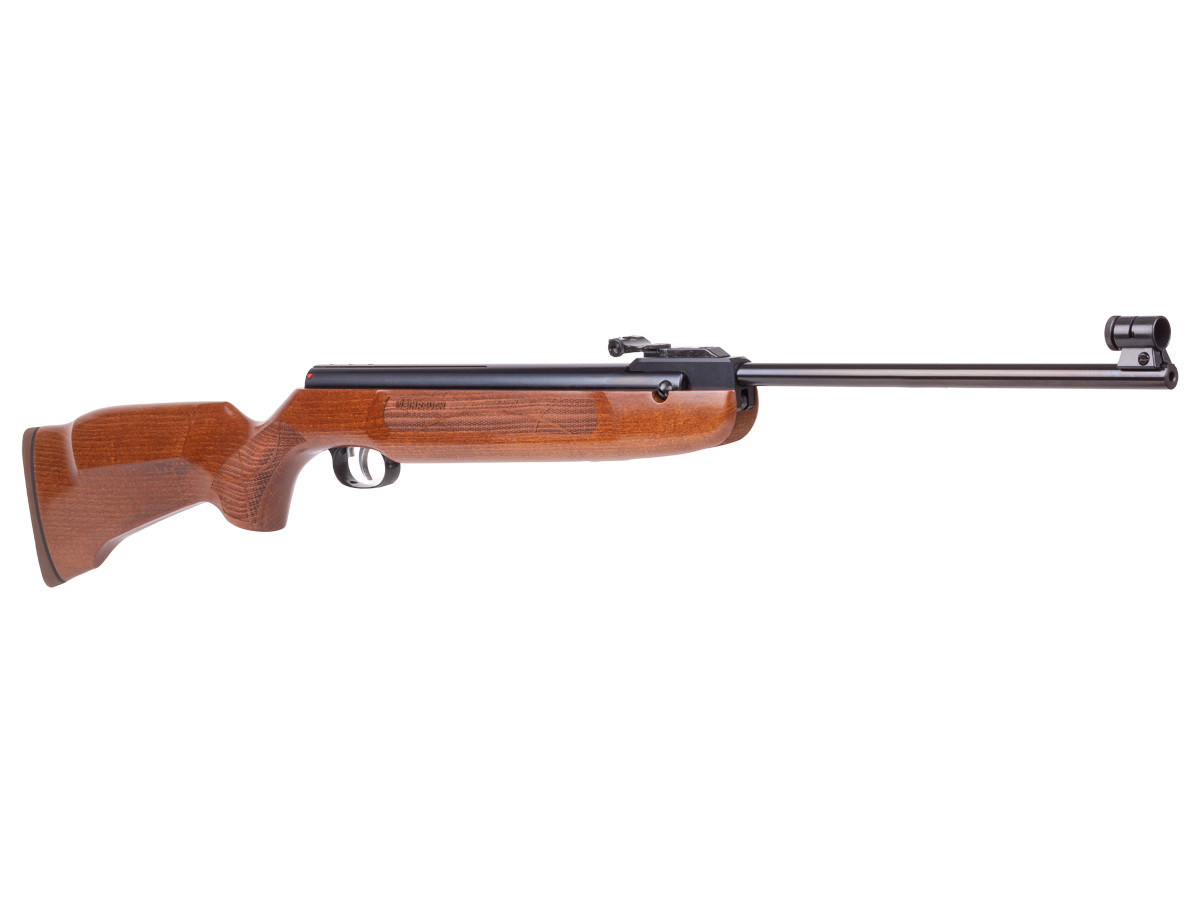
8. Best Spring Piston Air Rifle for Pest Control: HW50S
The HW50S spring piston air rifle from Weihrauch Sport is a high-quality gun perfect for plinking and hunting small rodents. With a state-of-the-art German design and construction, this gun is built to last.
The HW50S features a precision rifled barrel, making it accurate and reliable. The rugged stock is made from durable hardwood, making it sturdy and stable.
The HW50S also has an adjustable trigger, so you can customize it to your specific needs. Whether you’re looking for a gun for plinking or hunting, the HW50S is a perfect choice.
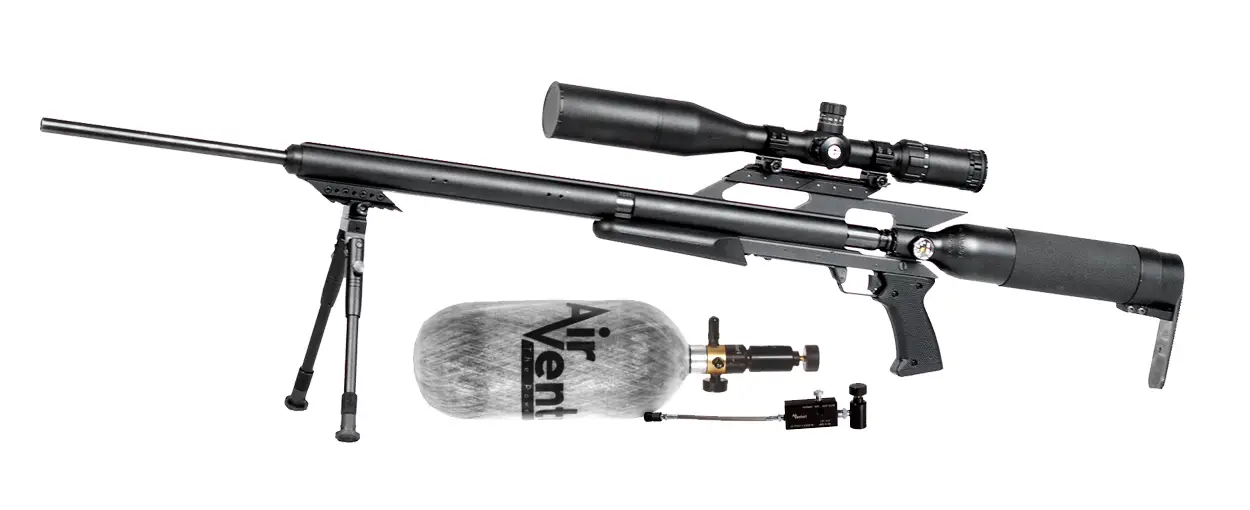
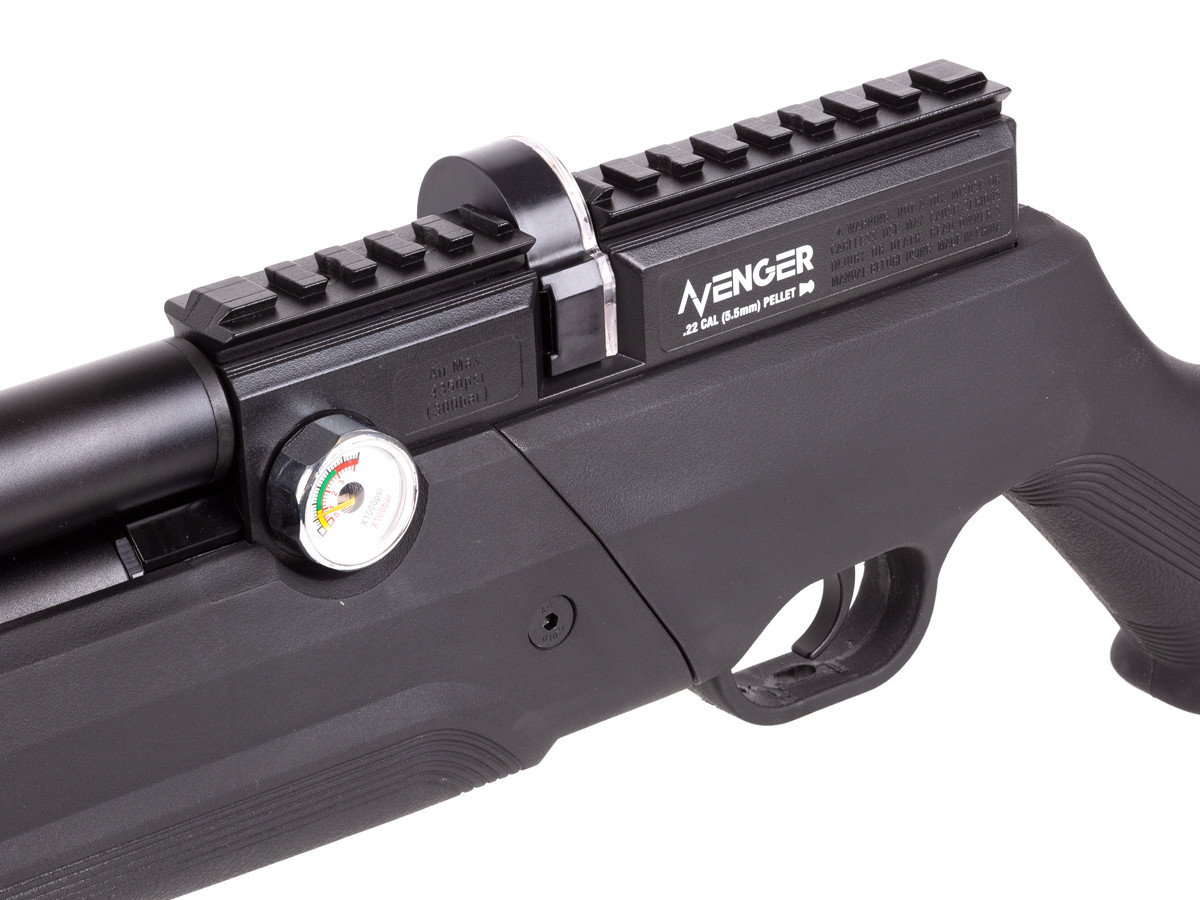
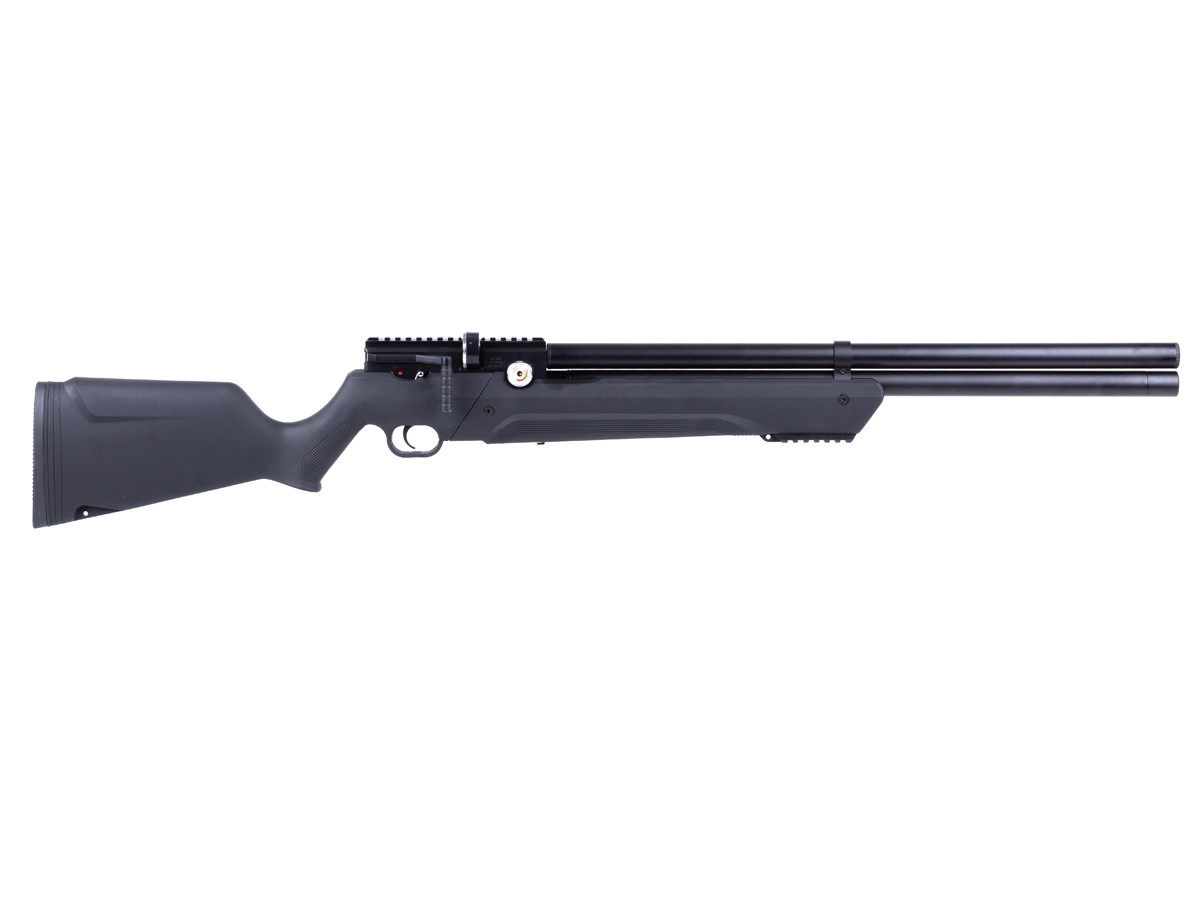
10. Best Value Air Rifle for Pest Control: Air Venturi Avenger
With high-end features at an entry-level price, the Avenger sets a new standard for similarly priced PCPs to live up to.
Featuring an externally adjustable regulator and externally adjustable hammer spring, the Avenger provides the user with a seemingly infinite amount of performance adjustability never seen at this price point.
A smooth side lever action allows for quick follow-up shots, and the fully shrouded barrel keeps your shooting quiet. Available in .177, .22, and .25 caliber.
Features
Pre-Charged Pneumatic
Sidelever Cocking
Synthetic Stock
Externally Adjustable Regulator (Up to 3,000 PSI / 210 BAR)
Easily accessible Hammer Spring Adjustment Screw
Two-Stage Adjustable Trigger
Max Fill Pressure: 4,351 PSI (300 BAR)
Fully Shrouded Barrel
Picatinny Rail on Fore-end of stock
Holes in front and rear of stock for mounting swivel studs for a sling
Dual Gauges – Reg Pressure (RH Side) and Fill Pressure (LH Side)
With so many air rifles out there, it can be a bit confusing to keep up with all the information around.
But fear not! Just read the article according to the problem at hand.
Pests are sneaky little creatures that can destroy your backyard in no time.
More and more people are choosing to sell their firearms in exchange for air rifles because when no other method for pest control works, turning to air rifles is the best option for you.
Frequently Asked Questions
Can You Use an Air Rifle in Your Background for Pest Control?
Yes, you can use an air rifle to hunt for pests in your backyard.
But you will have to check the gun laws of your area before doing so.
In a lot of countries and cities, there are very strict laws regarding air rifles and their usage.
Additionally, you should be 18 or above to use air rifles.
Do check on your town’s laws and regulations before you use an air rifle.
How Much Air Rifle Power Is Needed for Pest Control?
This completely varies according to the pest situation.
However, one important factor to keep in mind is the FPE, also known as muzzle energy.
The muzzle energy is dependent mainly on FPS and the pellet weight.
Typically, you require an air rifle with 1000 FPS for pest control.
But, you also need to know how much energy is required to kill each pest in one clean shot.
You can also refer to the table above to get a better idea about the FPE required for each type of pest.
Do Chipmunks Bite?
Chipmunks are definitely not friendly as they are a house of deadly diseases.
But they bite in rare conditions such as when they are provoked unnecessarily.
Otherwise, they’ll probably run away if they sense the slightest danger.
Do Chipmunks Carry Rabies? What Disease Do Chipmunks Carry?
Small pests such as chipmunks have a relatively low chance of spreading rabies.
It’s almost equivalent to zero.
But chipmunks do carry diseases like plague, hantavirus, and salmonella which are harmful to both babies and adults.
How Can You Kill a Rat in a Humane Way?
Using an air rifle is the most humane way to kill a rat since the rat will die in a second.
Rat poison and rat traps are more cruel methods.
Which Animal Is More Dangerous, Possums or Raccoons?
Possums are docile animals who try to avoid confrontation as much as possible.
But if cornered or provoked, they can attack.
On the other hand, raccoons are aggressive creatures and would defend themselves in the first go.
They would try to bite you or attack you, sometimes even viciously.
Will a BB Gun Kill a Raccoon?
No, a BB gun will not kill a raccoon because it does not produce the kind of energy required to kill a raccoon.
It will only injure the raccoon which is inhumane as it will die a slow death.
Or it can become too aggressive and attack you.
Are Iguanas Poisonous?
Iguanas produce a venom that is generally harmless but they do have sharp teeth.
Although there have been a few cases where iguanas have bitten humans, this is rare.
Their bites can give serious injuries to your face, ankles, fingers, etc.
Do Iguanas Change Colors? What Causes an Iguana To Change Colors?
Iguanas often change colors but not like chameleons.
They turn orange during mating season and dark green as they age.
In low temperatures, they turn black or brown to absorb heat and in hot temperatures, they turn to pastel colors.
Is it legal to shoot a skunk with a pellet gun?
As we mentioned before, shooting any kind of pest has to be mandated by law.
If your district or town’s law states that you can shoot any pest with a pellet gun or air rifle, then you can do so. In a lot of places, it is legal to shoot pests like skunks in your backyard.
Can a .22 Kill a Coyote? What Size Air Rifle Can Kill a Coyote?
No, a .22 rifle will hardly injure the coyote, and so will a .177.
They will either just run off in a distance or towards you for hurting them.
You can go for a .25 air rifle which will impact them more.
With a good distance and muzzle energy, a .25 will definitely work for you.
How Many Times Can a Skunk Spray? Is Skunk Spray Toxic?
Skunks spray only in dire circumstances like when they feel threatened.
They can spray 6 times in succession.
Skunk spray is toxic for both dogs and humans, for the former it may cause diarrhea and vomit but for the latter, it will cause irritation.
What does Inguana taste like?
Iguana meat is often described as similar to chicken but more tender, with a mild flavor profile that some compare to frog legs. The white meat is high in protein and low in fat, and is typically prepared by stewing, grilling, or adding to soups and traditional dishes in parts of Mexico, Central America, and the Caribbean. Due to its taste and texture, iguana is sometimes called “chicken of the trees,” with the tail and legs being considered the prime cuts.
The journey of progression that saw Browning Sweet 16 evolve into the current state is one you will love catching up with. The original old Auto-5 Sweet 16 saw a rigorous production process that began in 1902 when John Browning designed the first Auto-5, which turned out as a very functional semi-automatic shotgun. From then, Fabrique Nationale, a Belgian, took the production and proceeded with that for the next 75 years till 1977.
Production later moved to Miroku, Japan, which proceeded for the next 23 years. In these years of production and remodeling, the Auto-5s were made in 12, 16, and 20 gauges, with the sweet 16 version getting the attention of a majority of users then. You may also want to check out other 16 gauge shotguns. Sweet 16 was loved so much was its ability to combine the abilities of gauges 20 and 12. It was until the year 2000 that the last run of Auto-5 was sold.
How it Came to Be
The old A-5 was not popular for nothing. Its unique humpback profile and its long-recoil action with the moving barrel made it reliable and a preferred choice to almost every gun user. It was so popular that if someone didn’t own it, they at least knew someone who did.
Between the period when the old Auto-5 aged and when the new Sweet 16 was introduced, the browning company introduced a more modern inertia-operated shotgun known as the A-500, which was to be renamed A500R. This gun was only produced for a few years, and the Browning team had to move ahead to something better.
After several attempts to come up with an outstanding gas-operated auto gun, which saw the introduction of discontinued gun versions like the B80, B2000 and A500G, Browning decided to bring in something new. In the year 2012, they introduced the A5, which came in as a 12 gauge gun. In 2016, however, during the 2016 SHOT show, the A5 was reintroduced as A5 sweet sixteen thanks to its 16-gauge features. It is this A5 sweet 16 that we want to focus on today in this guide.
Buyer’s Guide: What to Expect from this Beauty
Features
You may feel motivated already to buy this iconic gun, but before making that step to own one, you may want to know what to look out for in this gun. I gathered some of the general features you can check out for before settling for a reliable A5 sweet 16. Have a look.
The Inertia Action
The A5’s inertia action, which is also called Kinematic drive-by Browning, is an outstanding feature that you must look for when buying the gun. It allows you to keep the outer bolt housing in place while the A5’s recoil moves the gun to the rear. This action helps eliminate the need to have the recoil move the barrel to the rear and push the bolt back to its original position as in the original A-5.
The inertia action applies pressure to an interior bolt spring, which in return powers the bolt backward making the rotary head to twist free of the barrel, which cocks the hummer and ejects the hull. When all these happen, the spring in the stock forces the bolt forward to chamber the new shell and close the bolt.
Detachable Trigger
The A5’s trigger is detachable, and you can easily do this by pushing out the two cross pins and giving it a yank or a pull. As you check closer, you should expect a trigger housing made of aluminum as well as the trigger blade. It has a push-through safety button at the rear of the trigger guard and a bolt latch in front of the trigger guard. This allows the assembly guard to lock when the magazine is empty. The bolt latch can also help release a shell from the magazine to load into the chamber.
New Invector DS Screw Chokes
The A5 sweet sixteen comes with three of the new invector DS screw chokes. They are flush-mounted and are about 2.9 inches long, which gradually compress the shot to avoid deformation. The DS (Double Seal), refers to the choke‘s brass branded seal at the back and front threading at the muzzle. While screw chokes threaded at the muzzle allow carbon to build up between the choke and the bore, the invector DS brass back seal perfectly prevents this.
‘Grade 1’ Wood
One other thing I find appealing, and you would want to check out for it the high-quality wooding on the A5 sweet sixteen shotguns. The wood on this gun has a nice finish in a high-gloss synthetic. The wood’s checkering is a result of a perfect machine-cut, which is well executed in an attractive 18 lines per inch pattern to give it an executive look.
Slender Forearm
The gun has a slender forearm or forend, which makes the gun light and easy to handle, move around and lend in the air. This forend features ergonomic wood construction that offers a perfect grip making the gun stable in your hand for better shooting accuracy.
Adjustable Stock
The stock comes with six shims that fit between the head of the stock and the receiver’s rear, which helps you easily adjust the height and cast off the shaft. Three of the shims will help you adjust the stock’s height only while the other three will adjust both height and cast.
The Two Loading Options
When you go purchasing the A5 sweet sixteen, you will have to check or ask about the gun’s loading options available during the trials. First, there is the normal option for semi-auto guns where you drop the shell into the ejection port and push the bolt-closing button and then place the next shell into the magazine. The second option is the Browning’s speed loading plus where you feed the first shell into the magazine, which it automatically chambers and the closes the bolt.
Upon confirmation of the above features, you will be sure that you are settling for a genuine A5 sweet sixteen shotgun. Let us now see the advantages of getting the new A5 sweet sixteen shotgun below.
What I Love about it
Smaller, lighter receiver for reduced weight.
It offers a sleek feel in your hands.
It is made entirely of steel with wooden stock for durability.
Attractive and good looking.
Comes packaged in an ABS case with storage holes to hold the disassembled gun.
The Inflex II recoil pad at the end of the stock improves its looks and reduces snagging on your cloth.
Kinematic drive system.
What I Don’t Like
The supplied shims don’t quickly move the barrel up enough to measure.
What is the Difference between the Original Browning Auto-5 and the New Browning A5 Sweet Sixteen?
The original A5 Browning shotgun had some structural and functional differences that set it apart from the new sweet sixteen. While these differences may not be major ones, knowing about them could help you differentiate the two and settle for the sweet sixteen much easier. Let us see what sets them apart below.
Receiver
One distinguishing factor between the standard and the new sweet sixteen would be the receiver. The sweet sixteen’s receiver is hollows out in usually four spots taking shape reminiscent of half-moons. The original one, on the other hand, had a distinctive squared-off humpbacked receiver. The new sweet sixteen’s receiver is of aluminum, which gives it the resilient strength against corrosion. The standard one, on the other hand, had its receiver mostly made of steel.
Barrels
The barrels on the older versions where the barrel ring mounts on the mag tube come with three holes drilled out to ease some weight away. On the other hand, the sweet sixteen enjoys a total barrel dynamics, which helps to extract the overall performance from this revered gauge (g 16).
Feel and Texture
There is a real difference in how the two guns feel, and their texture would easily tell them apart. The old A5 has a thinner wood finish that offers less grip; hence it is less stable in the hands than the new sweet sixteen. The new one has a checkered finish on the stock, making it attractive but sturdy to hold hence more stable in the hands than its predecessor.
Weight
With time the sweet sixteen came into the picture. One of the things that the manufacturers shelved from the older version was some excess weight from the stock and the forearm. This meant that the outcoming sweet sixteen had to weigh lesser than the original one.
‘Sweet Sixteen’ Designation
Initially, all A5 sweet sixteen had the ‘Sweet Sixteen’ designation inscribed on the receiver’s left side, which automatically reminded you that you were holding a sweet sixteen shotgun. However, over the years, the new sweet sixteen has evolved, and the guns have been refinished with the latest ones having the designation removed.
Safety
The older versions had the safety pins on the trigger guard’s front that slid back and forth through the trigger guard. These initial safety pins were considered unsafe, and they had to be replaced with at least two subsequent safety styles in the latest version. So essentially, the new sweet sixteen offers safer operations than what the old version did.
Shooting the New A5 Sweet Sixteen
After settling for the sweet sixteen shotguns, you have many expectations running in your mind about how the gun is going to function. The shooting experience can be very smooth and fun when you do everything right. So let us find out what happens after the purchase deal is sealed.
When bought, the gun comes out of the box very dry. After a few shots, it may start to fail to cycle the shells. The perfect shells you can consider for this gun include the Fiocchi 1-oz number 8. They offer a maximum speed of up to 1.156 fps, which are lighter for increased air velocity. Since the gun comes out when dry, you may consider applying some oil to smoothen the shooting process.
Convenience
I believe the speed loading gun plus feature would be more convenient than the standard option for semi-auto shotguns to load the gun. The gun’s trigger pull will appear a bit heavier than the overall weight of the gun. It weighs about 6.25 pounds, which is still a bearable weight for an entire operation. The trigger has a bit of creep, but its likely you won’t feel it because of the heavy trigger pull.
If you have a full face and a short neck, the sweet sixteen’s stock design would be a perfect fit. The drop of 1.75 inches at the nose area on the stock helps you better view the hump. If you do not have the full face and short neck, you have to lift your face over the stock.
Comfortably expect a perfectly stable operation despite the gun being delightfully light for field carry. It doesn’t whip about when shooting thanks to its long barrel. The gun comes packaged in a black ABS take-down case, ideal for car travel but not for demanding travel escapades.
It comes with the two extra chokes and wrench, stock lengths, spacers, cable trigger lock, manual, and six height shims. Its manual is unique as it gives you a detailed guide on how to use the gun. This ensures you have a comfortable time during the assembling and disassembling of the firearm.
Most Popular Browning Sweet 16 Accessories
Final Verdict
The Browning sweet sixteen is a revolutionary gun with outstanding features that will meet your expectations and exceed them. Mainly used for hunting, the sweet sixteen will improve your success score in the fields. Remember to have extra magazines for convenience during your hunts; this helps you reduce wastage of time refilling the magazine.
Do not forget to check out the features that define a modern sweet sixteen before making a purchase. Ensure you check the inertia action, new DS screw chokes, detachable trigger, and adjustable stock, among other features. Do not keep waiting any longer; get yourself a new sweet sixteen shotgun and join the rest in enjoying this gun’s excellent features.
This week we continue our quest to determine who is the greatest bass angler of all time. In the previous article we revealed and made a case for three anglers in Denny Brauer, Aaron Martens and Edwin Evers. Again, our criteria are based off the recent list by B.A.S.S. of the ‘All-Time Money Winners.” But before we get to the top two on this list, we have to take a look at some of the old timers who made bass fishing what it is today. Guys who were around when it all began in the late 1960’s like Bill Dance, Roland Martin and Rick Clunn who all dominated the pro tour in the beginning and took full advantage of their early success.
No name or person in the history of bass fishing is more recognizable than Bill Dance with his University of Tennessee baseball cap. To give you an idea how popular that cap is, I ran into Bill at the International Fishing Show known as ICAST in Orlando a few years ago and his PR director had one of Bill caps in his hand while Bill toured the show. I ask him what the extra hat was for, and he said it’s in case someone comes by and snatches his hat off his head. I asked if that had ever happened, and he said yes quite often. When it comes to marketing, no other cap is as recognized as the one Bill Dance wears. His show “Bill Dance Outdoors” is the longest running fishing TV show in history broadcasting since January 5th,1968. Bill does an outstanding job of introducing new tackle and techniques to the public though his show. He’s not just another pretty face for TV, but in his hay day, he was one of the best anglers to ever wet a hook and dominated the tour early on. But he retired from tournament fishing at a very young age in order to focus more on his TV show and sponsor promotions. He pretty much put Strike King Lures on the map and has help make them the leading tackle company in the world.Let’s look at Roland Martin…another of the all-time greats who many will say IS the greatest angler of all time based on the fact that he won 9 Angler of the Year Titles. No one even comes close to that and the fact he won 19 B.A.S.S. events and 19 runner-up finishes. He was in the money 63% of the time as he accumulated over $1 million in winnings during a time when the money was nothing like it is today. If he would have fished in this new era of today with that kind of dominance, his earnings would have exceeded over $4 million in tournament winnings alone not including endorsements and merchandise sales. The only thing that haunts Roland Martin today, is the fact that he never won the Bassmaster Classic. A tournament that just seemed to elude his grasp time and time again. Just a little info about Roland (who resides in Naples Florida) is he loves to turkey hunt and tarpon fish. His son Elite Series Pro Scott Martin has also been very successful in his own right with an FLW Championship under his belt and a very popular TV show called “The Scott Martin Challenge.”
Rick Clunn is another angler whose name always comes up as the greatest of all time and at one time had the title of the GOAT.. Just like NFL quarterbacks who are judged by the number of Super Bowls they’ve won, bass fishing professionals are judged by how many Bassmaster Classics they’ve won. Rick Clunn and Kevin Van Dam lead that list with four Classic wins to their credit. (More on KVD later) Now Rick is a different bird who has always flown a little different route than most other anglers. When other anglers would zig, Clunn would zag. In the beginning and during most of his career, Rick separated himself completely from other pros and I mean literally by staying at campgrounds outside in a tent. He avoided hotels where he felt anglers talked too much and got into each other’s head. He avoided what he called “dock talk.” Rick’s philosophy included a form of meditation known as zenning. It was his way of becoming one with nature. He always felt like the closer he was with nature, the better he could connect with the bass and as Rick would say “become one with the fish.” Over his career, Rick has accumulated over $2.6 million dollars in winnings.
Now let’s looks at the real GOAT (Greatest Of All Time)…Kevin Van Dam. This guy took bass fishing by storm in 1987 and made his presence felt his first year as a touring professional. Allegedly the story goes that he walked up to Rick Clunn (who was the GOAT at that time) and introduced himself as Kevin Van Dam and that he was the guy who was going to start kicking his a#$. Whether this is true or not, it illustrates Van Dam’s confidence in his abilities to catch fish and win tournaments. His mental toughness has far exceeded all other anglers of his generation. If you look at winnings alone, Van Dam has collected over $6.4 million dollars in winnings which is double his closest competitor. He has won 4 Bassmaster Classics (the Super Bowl of bass fishing) and has won more B.A.S.S. events than any other angler in history with 25 and has 16 runner-up finishes to his credit. Over his career, he has been in the money 80% of the time which is an amazing stat in itself. KVD has also capitalized on the business side of bass fishing as well as the lead spokesperson and bait designer for Strike King Lures. There’s not a bass angler in America that does not have at least one KVD endorsed lure in their tackle box. So, you can debate this all you want, but it’s pretty clear based off statistics alone and money earned that Kevin Van Dam truly is the greatest bass fisherman of all time. I hope you’ve enjoyed this breakdown of bass fishing all-time greats. Whether you choose to agree or disagree, it’s hard to argue against KVD. Till next time, don’t forget to set the hook!
Steve GrafOwner/Co-hostHook’N Up & Track’N Down ShowAnd Tackle Talk Live
As the sportsmen and women in the state of Vermont looked to the beginning of a new decade in January 2010, none of them could imagine the event awaiting to unfold: a massive buck from Vermont’s past was about to overtake the top spot in the Vermont Big Game Trophy Club’s non-typical category. The groundwork was laid some 70 years prior in Vermont’s Northeast Kingdom by a man who was proud of his hunting heritage and the tradition of a family deer camp.
It was January 16, 2010, that I prepared to go to work at the 18th annual Yankee Sportsman’s Classic. I had decided that it would be an opportune time to bring in the rack from a buck that my great grandfather had harvested in Norton, Vermont, back in 1938. The timing couldn’t have been better, as I would be working at the Pelkey’s Archery booth directly across the aisle from the VBGTC. I planned to just drop it off in the morning and pick it up at the end of the day. This would be easy, or so I thought.
On my way into the facility I ran into Peter Porter, a measurer for the VBGTC. Porter’s eyes lit up like a kid at Christmas and he quickly stated, “I’m measuring this one!” It was 8:30 a.m. and he went right to work measuring and recording while I went back across the aisle to talk with show goers about the new 2010 bowhunting equipment. As I worked, I couldn’t help but notice there always seemed to be a group of onlookers around Porter and the rack. Interest from show participants was growing.
Towards the end of the measurement process Porter had determined that it was, at minimum, a Boone and Crockett-caliber buck. He came across the aisle to get me, and he had also called in Ron Boucher, a master measurer for the VBGTC, as well as an official measurer for the Boone and Crockett Club. As Boucher and Porter discreetly discussed the rack, at no point did either one of them mention any of the actual measurements from the big rack. Boucher examined the rack, reviewed Porter’s measurements, and then pulled me aside away from the crowd. “You’ve got something special here,” Boucher explained to me. “With your permission I’d like to take the rack to one of the side rooms away from all this commotion to measure it.” I willingly agreed to his request and as Boucher disappeared into the crowd with the rack, I couldn’t help thinking to myself, “Well, this is getting interesting. . . .”
AN UNLIKELY STATE RECORDWhile Boucher was away with the rack, I had a constant flow of people stopping by to ask if I had heard anything about the final score. I was amazed at all of the attention that this Vermont deer was getting. A couple of long hours later Boucher emerged with the rack, but still no news on the results. After another half hour or so of anxious wondering, I decided that I should head across the aisle and see what was going on. As I approached the VBGTC booth I was quickly greeted by Boucher with the words, “We’re close to being able to tell you, but we are going through the math one more time.”
As I went on my way, allowing the measurers more time, it had still never crossed my mind that my great grandfather could have harvested a potential Vermont state record. The day continued to tick by as I went about my business, occasionally pausing to wonder why I hadn’t heard anything from the VBGTC Measurers. It was nearly 2 p.m. – almost five and a half hours after Peter started measuring – when it happened: As I was talking to an outfitter about a potential future hunt, a friend came up to me and said, “The Foundation is looking for you!” My immediate response was, “The Foundation? What Foundation?” and he quickly explained that the guys from VBGTC were looking for me.
As my friend and I worked our way back through the crowd on our way to the booth, I quizzed him on what he knew. “They’re not telling anyone anything,” he said, “They are just asking to speak with you.” When I got to the booth Boucher pulled me aside and took the time to explain the entire process of what had just transpired, without any specific numbers. He then spoke the words that I will never forget: “I didn’t want anyone else to know until I talked to you, but your great grandfather’s buck is the new State of Vermont non-typical record. It scored 196 5/8.”
I was speechless. I was completely caught off guard, literally without words. I’m quite sure that I didn’t hear – and certainly can’t remember now – much of anything that people said to me after that point. I just kept thinking to myself, “Great grandpa shot a state-record buck hunting out of the family camp!”
THE MILK HOUSEThat day at the show people quickly began to call the deer “The Milk House Buck.” This stemmed from the fact that before the day the rack was entrusted to me it had been stored for years in an old milk house. I choose to call it “The Tice Buck” out of the respect I have for my great grandfather and the hunting tradition in our family. Deer hunting has always been important to the Tice family, a valued tradition and a great part of our family heritage. To think that an unassuming man participating in an annual ritual, a pursuit for which he contained such unrestrained passion, had yielded such a monumental trophy was simply overwhelming, and I couldn’t help but think about the man I’d heard so much about during my lifetime.
My great-grandfather, George Ira Tice, was born January 18, 1899. George was a lifelong resident of Holland, Vermont, a carpenter by trade, a devoted family man and the father of 10 children. George was also a fervent reader and relatives recall seeing George in the living room of his home with his foot up on the marble table reading for hours on end. Yet what people remember most about George is that he was a passionate outdoorsman, with an unquenchable thirst for hunting. He purchased his first hunting license in 1911 at the age of 12 and was so proud of that moment that he saved that license his entire life and is still in the family today.
George was not a man who was content sitting idly about, waiting for the next deer season. One of his more unique outdoor activities was “bee lining.” When I first heard the expression I was curious as to what this entailed. Bee lining is the practice of catching
wild honeybees and then following them back to their hive. Once the hive is found, it is marked and at the end of the summer the honey and the wax are harvested.
George was also an avid fisherman and enjoyed all types of fishing, his favorite style being brook fishing. The family camp is surrounded by pristine brooks that were then full of native Vermont brook trout. It’s safe to say that while George fished the brooks, he was always thinking about, scouting for and planning for the upcoming deer hunting season.
DEER CAMP TRADITIONThe Tice camp located in Norton, Vermont, started its useful life as a bunkhouse and office for logging crews. When the logging operation abandoned the building in the early 1900s, George turned the building into a hunting camp. In the mid 1940s he added a kitchen area to the camp and the camp has remained unchanged to this day. The Northeast Kingdom is a very rural portion of the state with large tracts of wooded land abundant with spruce and fir trees, cedar swamps, and high ridges of hardwood timber. Most hunters that call these woods home are trackers. The expansive woods and the low concentration of deer require an intimate knowledge of the woods and the deer’s habits. The ability to pick up a track and determine if it is a deer worth following is a crucial skill and a mark of pride.
George was so dedicated to his deer hunting that family members who had the privilege of knowing him cannot remember a time that he missed an entire hunting season at camp and can only recall twice when he left hunting camp before the season’s end. The first time was when he had sent his hunting boots back to L.L. Bean to get re-topped prior to deer season. The boots weren’t back when he left for camp, so part way through the season he had to leave to get his boots. The second time that he left hunting camp was for the birth of his youngest son, Earl.
George’s eldest son, Robert, recalls his father building a two-wheeled cart to pull supplies into camp, as getting to and from camp was not the easiest of chores. There was not always a graveled road that passed by the camp as there is today. Robert cannot remember a time that his father did not go to camp or into the woods without his favorite rifle, a Winchester Model 1907 .351 Self Loader. This is the very gun that George shot “The Tice Buck” with. Robert remembers that when George switched his cartridge loads over to smokeless powder that the gun began to malfunction and would no longer eject the casings. While the family did make an effort to get the rifle repaired, the attempt was unsuccessful and unfortunately this gun is no longer in the family.
FAMILY HEIRLOOMWhen George harvested the “The Tice Buck” in November of 1938 he was hunting with his friend and hunting partner, Burt Gray. Those who recall George telling the story of the hunt note that he always commented on how deep the snow was that year. George kept the buck’s rack in the living room on a wall between the wood stove and the entrance way and it remained on that wall for the remainder of George’s life, and after his death in 1965, his wife, Ethel, kept the rack in the very spot where George had hung it. When Ethel passed away in 1971, Robert and his wife, Joan, moved the rack to their house in Derby, Vermont. Robert and Joan kept the rack in their basement until lack of space and a repair project required that the rack be moved out of the basement and into the old milk house.
In 2005 while visiting Robert and Joan they bestowed on me one of the greatest honors of my life: they passed on the guardianship of the rack to me.
Over the past five years the rack has been a prominent fixture in my archery room. While working on bows I had often wondered what the rack would score but never could I imagine the recent events.
Robert, Joan, and I are all avid hunters and understand the importance of maintaining and preserving the antlers within the Tice family. Deer hunting is a longstanding tradition in our family and this trophy, a family heirloom, will be a constant reminder of the great hunters that came before us.
A VERMONT RECORDIn the end, the rack earned a gross score of 196 5/8 inches and a net score of 190 6/8 inches. The main beam lengths are 28 3/8 inches on the right and 27 4/8 inches on the left. It has an inside spread of 22 6/8 inches, an amazing outside spread of 29 0/8 inches, along with circumferences as high as 6 1/8 inches. This buck and my great-grandfather will now get the recognition that they both deserve. I have started the recording process for the Boone and Crockett Club, The Northeast Big Bucks Club, and the Vermont Big Game Trophy Club.
I can’t help but wonder how many hunters, in search of their own trophy buck, drove by this rack hanging in an old outbuilding next to a well-traveled state road? The fact that the rack remained unmarred hanging there in an outbuilding, that even the smallest of gnawing creatures might have acknowledged the majesty in the monarch’s crown, I think is remarkable, as is the idea that there were no rumors across the state of the rack and no one other than family and a few close friends even knew of its existence. When I think of these antlers in that little building, a Vermont State record, one word comes to mind: Astonishing!
The beaver is an abundant furbearer throughout most of North America, and trapping is an enjoyable and rewarding activity that can produce high quality fur pelts for mittens or hats, and meat that makes excellent table fare. Beavers are quite easy to locate, and easy to trap once you get them figured out. A wide variety of traps are used to catch beaver. The best beaver trap probably depends on your individual situation. Let’s take a look at the options.
The 330 is the most common trap used to catch beaver. It is a large bodygripping trap (also often referred to as a ‘Conibear’) typically measuring 10″x10″. The 330 is usually placed in blind sets along a beaver’s natural travelway. As the beaver moves along a trail or run in the water or at the water’s edge, it travels through the trap opening, trips the trigger and is caught. The 330 is designed to be a quick kill trap, which is very humane and effective. Being such a big and powerful trap, it can be very dangerous if not handled or used properly. Be sure to take precautions, use safety devices where appropriate, and never set these traps in a location where they could catch a domestic animal. Most states require these traps be set in water to avoid catching nontarget animals.
330 traps are made by a variety of manufacturers, including Duke, Bridger, Victor (the owner of the name ‘Conibear’), Belisle, and RBG. The Duke 330’s are the cheapest and provide the best bang for your buck. They are actually a bit smaller than most 330’s, measuring 10″x9″ instead of 10″x10″. Bridger and Duke both make a magnum version of this trap (Bridger’s is 10″x10″, Duke’s is 10″x9″), which closes completely without any gaps, and often results in extra catches by holding beavers that are only caught by the tail, foot or other body part that would allow them to pull out of most other traps. The only thing I don’t like about the magnum style is that I find some of them very difficult to set, particularly the Bridgers. Some adjustment can help with this. The Belisle 330’s are also a magnum type trap but with a different jaw style. They are made of top quality construction, have superior safety catches and triggers, and are the top of the line trap with a correspondingly high price tag. RBG bodygrip traps are unique in that the jaws are shaped in a circle rather than a square, appealing to an animal’s natural tendency to enter round openings.
330’s can catch otter as well, especially if the trigger is configured to cover a large percentage of the jaw opening. They also catch the occasional muskrat that trips the trigger in just the right location while swimming at the right speed.
Although the 330 is by far the most common beaver trap, other sizes can be used to take beavers as well. The 280 bodygrip trap has an opening of 8″x8″. It can catch beavers in the right situation, particularly in areas with very small runs and trails. Smaller beaver are more likely to be caught in 280’s, but I have caught larger beavers in these traps occasionally as well. With the smaller trap it can be a challenge to get the beaver to swim through the opening. Sometimes they’ll swim around the trap instead. Some trappers have good success using 280’s when they are baited as opposed to using them in blind sets. Although beavers can be caught in 220 bodygrip traps, with 7″x7″ jaw spreads, it’s not as common and I wouldn’t recommend it. On the other end of the spectrum, Minnesota Brand makes a huge bodygrip trap, the MB 1216, which measures 12″x16″ and is designed to cover large, wide runs. This can also be a very effective trap, but misses are possible as well, because a beaver can often swim through the large opening without setting the trigger off at all, or setting it off too late to be effectively caught. RBG makes a Big Bear, a 10″x22″ opening trap, that works on the same principal.
TS-85
The TS-85 has been gaining in popularity among beaver trappers for years. This coil spring foothold trap has a massive 8.5 inch jaw spread, which allows for a large target area for the beaver to put its foot and get caught. Foothold traps for beaver are most commonly set as drowning sets in the water near shore. They are designed to catch a beaver as it approaches the shore or enters the water from land. Proper depth and guide sticks, as well as lure and bait placement all play a part in a trapper’s success using footholds for beaver. The TS-85 was designed by professional trapper Tim Sawatzky and has a lot of experience behind it. The trap is easy to set and has several features, including a dogless design with easily adjustable pan tension and high lever lockup on the jaws. It’s a nice trap for the money and my favorite beaver foothold trap.
MB-750
The MB-750 is a beast of a trap. Designed and built by Minnesota Trapline Products, the trap is super strong and sports a 7+ inch jaw spread, smaller than the TS-85 but still pretty large. One unique feature of the trap is that it has a locking mechanism that holds both jaws down, eliminating the loose jaw. Some trapper have issues with the loose jaw being flipped up by a beaver while moving through the set area, causing the trap to fail to connect. The fact that this trap has no loose jaw, however, means that it’s a bit dangerous to set for the inexperienced – your fingers are right in the danger zone when making any adjustments to the pan!
Related: MB-750 Beaver/Otter Trap Review
WCS Pro 7.5
The WCS Pro 7.5 is basically a reboot of the extremely popular CDR trap. The CDR was a 7.5 inch jaw spread beaver trap a simple, effective design. The WCS Pro 7.5 features a solid chain and swivel system, wire levers which make it fast underwater, and the Paws-I-Trip pan system, a very popular feature that I’m a big fan of.
Bridger #5
The Bridger #5 is a work horse of a beaver trap with a simple design and a very reasonable price tag. Minnesota Trapline Products has made some recent improvements to the trap design and construction. It’s a good contender in the beaver foothold trapping game.
No-BS Beaver Extreme
Kendall Obermeir has made some noise in the trapping industry with a new line of No-BS traps that are super impressive. Their ruggedness of design, top quality products and workmanship and unique new features make these traps unique and worth checking out. The Beaver Extreme trap features heat treated steel, a lower pan, dogless design, and the traps are pre-coated from the factory.
Duke 850-FJ
The Duke 850 is the newest beaver trap on the market. The 850-FJ is the closed jaw model, designed for beaver (the offset jaw trap of the same name is designed for wolf and mountain lion). This trap is essentially a larger beefed up version of the Duke 550 or 650 traps, which were almost a carbon copy of the MB-550 coyote trap. The trap features heavy cast steel jaws, heavy duty chain and swivels, four coiled, and the Paws-I-Trip pan system. It’s a nice looking trap, but hasn’t been on the market long enough for me to really get a feel of how it works for different trappers.
So, What’s the Best Beaver Trap?
There are plenty of great options for beaver trappers these days, which makes it tough to determine the best trap. The 330 is the best type of bodygrip/conibear trap for beaver trapping without question, and if I had to choose a ‘best’ brand of 330 I’d go with Belisle. That said, all of them work and catch beavers effectively.
When it comes to foothold traps for beaver, it’s tough to say. The different models vary quite a lot. I prefer the TS-85, but there are advantages and disadvantages of each model, and I haven’t used them all extensively. Regardless of what you choose, if you pick from the list above you’ll have yourself an excellent beaver trap that will effectively catch beavers year after year.
Imagine a buck so epic that it defends the crown as the Boone and Crockett world record typical whitetail buck for 30 years and counting. The typical whitetail world record is the holy grail of deer hunting records, the one many dream about, but very few even come close to touching.
This hunting season marks three decades since farmer Milo Hanson took down the world-record typical whitetail buck. Milo Hanson’s buck, harvested near Biggar, Saskatchewan on November 23, 1993. Its mark of 213 5/8 inches for a wild typical buck has yet to be surpassed in the whitetail deer hunting record book.
Milo Hanson’s world record is proving nearly impossible to beat. During its reign, it’s fended off multiple world-class challengers. Many dedicated hunters have scoured the wilderness to find a whitetail buck, either from Canada or anywhere else, with a rack frame large enough to qualify, but that doesn’t also have some abnormality that classify it as non-typical and thus disqualifying it from this record. Some failed upon panel scoring, and others were flat-out denied because of abnormal points that denoted a non-typical classification.
Here’s the story behind the famous Milo Hanson buck, and a few typical buck hunting record challengers that just barely missed the mark.
In that corner of Canada, the Hanson buck of Saskatchewan was already a local celebrity a year before it met its maker during the 1993 rifle season. Local hunters first noticed it in 1992, and news of the massive whitetail spread quickly. Hunters from all corners of the region and beyond came to try to topple the beast. Neighbors reported sightings during afternoon gossip, and a school bus loaded with kids even caught a glimpse of him. At least one massive 5-point side shed was picked up that was believed to belong to him. This big buck had a target on his back.
And yet, somehow, he survived not only the archery season but also the muzzleloader seasons prior to the start of Saskatchewan’s rifle season. Milo Hanson and his buddies hunted for this particular deer with no success several times leading up to that fateful November day. At one point Hanson and a friend both passed on a gorgeous, 160-inch buck because they knew the big one was still out there somewhere and deer season wasn’t over yet. That ended up being a good decision, for Hanson at least.
The morning of the day that changed his life, Hanson was hunting his own property, doing a deer drive with some buddies. “On the night of November 22, we had fresh snow, and I called the guys to plan our hunt,” Hanson told Boone and Crockett. “The next morning, I met my neighbor, John Yaroshko, and we drove to meet Walter Meger and Rene Igini. When we pulled up, I knew something was happening because they were excited. They said they spotted a monster buck entering a willow run and it hadn’t come out.”
With a fresh snow to help them track, the deer hunters set up a small deer drive with one man pushing and three standers on either side. Hanson took the north side while his buddies covered the other, and one walked up the middle following a fresh track. The first time Hanson spotted the buck standing broadside about 150 yards from his position, a huge rush of buck fever took over. We can only imagine what it would be like to be that close to the biggest typical whitetail of all time!
He fumbled the first shot and missed the deer completely. The hunters regrouped near where they saw the buck go into cover and jumped him out again. Hanson’s second shot at the deer was a solid hit, dropping the buck down to his knees. The buck was still moving, though.
“Unfortunately, the buck got up and ran into a nearby aspen stand,” Hanson Hanson said to B&C. “I ran up the hill to where it disappeared and saw it below me, standing still. I aimed through my four-power scope and fired another shot with my .308 Winchester Model 88 lever-action. Down it went. I saw its head over a clump of willows. To ensure it stayed down, I fired another shot, and the hunt ended.”
Upon reaching the deer, the hunters discovered one of the .308 bullets had shattered and struck the back of the buck’s right main beam. While the shot cracked the antlers, fortunately, it did not break them.
Once news got out that Hanson had taken down the local legend, his farm became a hotspot for curious onlookers, and the phone started ringing off the hook. Hanson knew then he had something special on his hands. North American Whitetail magazine was the first to spread the news of Hanson’s harvest to hunters far and wide in the February 1994 issue.
What Was the Score of the Milo Hanson Buck?
The official Boone and Crockett net score of the current typical world record Milo Hanson buck was 213-5/8 inches. The 14-point buck had an inside spread that measures just over 27 inches. Its greatest spread was over 29 inches, and six of the 10 main points exceeded 11 inches.
What Did the Hanson Buck Weigh?
Hanson has stated many times that the most frequent question he gets from other hunters is about the buck’s weight. However, we will never know, because Hanson never weighed the deer, field-dressed or otherwise. He estimated in a 2010 interview with Outdoor Life that the live weight was probably around 200 pounds.
While that’s a heavy deer, it’s not exactly a large-bodied deer for Saskatchewan, where big whitetails pack on the excess body weight to get through the long winters. Hanson is a farmer in the Biggar area, which is known for agriculture, so there was no lack of food for the record deer. However, considering the fact the deer was not taken until November 23, it seems extremely likely he’d lost quite a bit of weight during the rut.
The most amazing fact about this buck, other than the 213 5/8-inch score, is the fact that it was aged at only three-and-a-half to four-and-a-half years old. There’s almost no question the world record whitetail had not even hit his prime yet when Hanson dropped him. It makes us wonder if it would have netted over 220 or even 230 inches with another year of growth—although no hunter would be crazy enough to pass up a buck like this!
It speaks to the quality of deer hunting in the area that a hear after harvesting his world record, Hanson shot a 171-inch buck, which no one knows or talks about because the “Hanson Buck” takes up all the headlines. After hearing that, there’s no doubt Biggar was the right place at the right time with the right genetics to produce a true monster.
How Big is the Milo Hanson Buck?
It’s hard to appreciate just how large the Hanson buck is unless you see it or one of the many replicas for yourself. At the time of the deer’s downing, the James Jordan buck from Wisconsin was the typical world record. The Jordan buck is no slouch, but the Hanson buck has it beat, thanks to a 29-inch greatest spread and a 27-2/8-inch inside spread. The G2s and G3s are also ridiculously long with a few of them reaching nearly 14 inches in length.
However, the Jordan buck has the Hanson buck beat on main beam length. Still, the Hanson buck’s 28-4/8-inch main beams are nothing to sneeze at. The right side of this great deer scores 95-4/8 inches while the left scores 98 inches. The gross score is 223-7/8 inches. There are only 7-1/8 inches of deductions. It helps that the buck only had 3-1/8 inches of abnormal points, all on the right side. The left has zero, which is an equally impressive tidbit that’s hardly mentioned.
What are the Hanson Buck’s Main Challengers?
As for the Hanson buck’s challengers, there have been many. Most infamous is the Rompola buck, allegedly taken in Michigan back in 1998. Hunters are still divided if the 218-5/8-inch deer was a hoax, or a hunter who simply did not like the limelight. We may never know the truth.
In 2006, it looked like Wisconsin would regain its crown as the holder of the typical world record with the Johnny King buck. That deer initially grossed over 220 inches and netted around 218 as a typical. That was until a Boone and Crockett scoring panel determined the buck’s G3 and G2 points shared a common base, causing massive deductions that resulted in a score around 180 inches net. The Johnny King buck still inspires passionate opinions among hunters, though.
In 2021, an Indiana musician named Dustin Hoff came close when he set a new second-largest typical whitetail deer of all-time record. The monster buck, which surpassed the Jordan Buck for the number two spot, is still the largest whitetail ever killed in the United States, according to the record books. The buck’s official B&C score is 211-4/8 points.
Then there was “The General,” a massive whitetail that roamed Nebraska back in 1958 and didn’t resurface until the 1990s. This buck had massive 32-inch main beams, 14-inch G2s, and 7-inch mass measurements. The antlers gross nearly 240 inches and net in the 220s. There’s just one problem: It’s a set of sheds, and no other antlers from the deer are known to exist. Because of this, the exact inside spread is unknown, and B&C do not recognize sheds in the record books.
Did the Milo Hanson Buck Get Sold?
The original Milo Hanson buck hasn’t been sold, as of this writing. Milo Hanson continues to maintain ownership of the mounted buck that he shot in 1993. He has sold the buck’s likeness for licensed use on merchandise and for replica mounts.
What is the Hanson Buck Worth?
While the once-in-a-lifetime buck made Hanson some money in licensing, he also said it made his life more hectic. Suddenly, he was in demand for sportsmen’s show appearances and spent a lot of time traveling with his mounted buck.
In the 2010 interview with Outdoor Life, Hanson pulled back the curtain behind what it’s like to be the hunter of a world-record buck. He estimated he made $60,000 a year off his record buck for almost a decade—or at least $600,000. While many world-class whitetails have found their way into private collections over the years, the Hanson buck remains in the hunter’s possession. That said, in that same interview, he noted he’s never received an offer close to what he has made on the deer.
Could the Hanson Buck Record be Broken?
As with anything hunting-related, anything is possible. Will this 2024 whitetail deer hunting season be the one where the Hanson Buck is finally dethroned, or will it remain the undefeated typical champion? Only time will tell.
READ MORE: The Worst Poaching Cases So Far in 2024
Shoulder pain is almost inevitable for archers and bowhunters due to the repetitive motion of shooting a bow. This motion puts significant stress on the shoulder joint. According to a research study by van Doorn et al, shoulder pain is the third most common musculoskeletal complaint treated in physical therapy. From my experience as a physical therapist, I have found that shoulder pain is often caused by repetitive activities.
Common shoulder issues among archers and bowhunters include shoulder instability, scapular dyskinesis, rotator cuff disorders, biceps tendinopathy, bursitis, and shoulder impingement.
Shoulder instability
Occurs when the shoulder joint (glenohumeral joint) is unable to maintain its proper position due to excessive movement in the ligaments, joint capsule, or from insufficient dynamic stability of the rotator cuff musculature. This instability can result in frequent dislocations, subluxations, or allow excessive movement of the shoulder which causes undue stress and eventual pain, swelling, weakness, or limited range of motion.
Scapular dyskinesis
Refers to abnormal movement or positioning of the shoulder blades (scapula) during shoulder movements and limits the efficiency of the complex shoulder joint.
Rotator cuff disorders
Refers to a group of conditions that affect the muscles and tendons that attach the shoulder blade to the upper arm bone. The rotator cuff muscles include: supraspinatus, infraspinatus, teres minor, and subscapularis. These four muscles work to stabilize the shoulder joint and keep the ball and socket joint centered in optimal position. Rotator cuff disorders can include inflammation, tears, or degeneration resulting in pain and weakness.
Biceps tendinopathy
Refers to pain and inflammation of the biceps tendon, which attaches the biceps muscle to the shoulder and elbow. This pain is usually located on the front of the shoulder and can cause a popping sensation in the shoulder. Biceps tendinopathy can be caused by overuse, degeneration, postural abnormalities, or poor shooting form and technique, and can result in pain, weakness, and limited mobility.
Bursitis
Refers to inflammation of the small fluid-filled sacs that provide cushion between the tendons and bony structures. Bursitis can be caused by overuse or injury, and can result in pain and limited range of motion.
Shoulder Impingement
Occurs when the tendons or bursa in the shoulder become compressed or pinched during shoulder movements, resulting in pain and limited mobility. It can be caused by a variety of factors, including overuse, poor posture, or structural abnormalities in the shoulder joint.
It’s important to understand that the shoulder is a complex joint that involves many muscles, tendons, ligaments, and bones. If the riser and cam, or scapula and humerus, are not in the optimal position, then this may lead to bow failure or shoulder dysfunctions and pain. The aforementioned shoulder dysfunctions can occur separately, but oftentimes, they are interrelated and occur at the same time.
For example, shoulder instability can lead to scapular dyskinesis because the shoulder blade has to compensate for the unstable joint. Scapular dyskinesis can then cause rotator cuff disorders because it changes the mechanics of how the rotator cuff muscles work. Rotator cuff disorders can also lead to biceps tendinopathy because the biceps tendon works closely with the rotator cuff muscles and, in my opinion, should be considered part of the rotator cuff for all practical purposes. Bursitis can develop as a result of any of these conditions because any abnormal movement or positioning of the shoulder can compress or pinch the tendons or bursae in the shoulder joint.
This is a brief explanation of how complex the shoulder joint is and highlights the importance of addressing any shoulder pain as early as possible to prevent further dysfunction and pain while shooting a bow and arrow.
By addressing the underlying dysfunction, archers and bowhunters can prevent the development or progression of other shoulder dysfunctions and minimize the risk of further damage or injury.
Prevention and Management of Bow Arm Shoulder Pain
Archers and bowhunters can prevent and treat bow arm shoulder pain with archery-specific exercises. Archery-specific exercises should include both compound and accessory exercises that target the rotator cuff, scapula, and arm musculature to help stabilize the shoulder and meet the demands of shooting a bow.
Core strengthening, balance training, and mobility exercises are also vital in maximizing success and reducing risk of injury.
Self-filming while shooting a bow and arrow will help identify shooting flaws and provide feedback on what may be contributing to your bow arm shoulder pain.
Shooting a bow and arrow with poor archery form can compound shoulder problems and increase the risk of injury.
To manage existing bow arm shoulder pain, modify shooting frequency, reduce draw weight, ice, modify shooting form and technique, or take a 1-2 week break from shooting.
Step-by-Step Return to Shooting After a Shoulder Injury
1. Start with shorter distances: It’s important to start at a shorter distance, such as 10 yards, and gradually work your way up to longer distances. This will help you ease back into shooting and prevent re-injury.
2. Decrease the draw weight: Using a lighter draw weight can help reduce the strain on your shoulder as you work your way back up to shooting your normal draw weight. Increase the draw weight by no more than 5-10% in one week.
3. Focus on form: When returning to shooting, it’s important to focus on your form and technique. This can help you prevent future injuries and improve your accuracy. I am a strong believer in self-filming to identify poor shooting form.
4. Incorporate stretching and warm-up exercises: Incorporating stretching and warm-up exercises into your routine can help improve your flexibility and reduce the risk of injury.
5. Perform supplemental exercises: Progressive archery-specific exercises targeting the rotator cuff, scapula, and core musculature will help restore and build the strength necessary for performing archery and bowhunting at a high level.
6. Listen to your body: It’s important to listen to your body and take breaks as needed. If you experience pain or discomfort when shooting, it may be a sign that you need to take a break or reduce the volume of your shooting.
7. Seek professional guidance: If you’re unsure about how to safely return to shooting after a shoulder injury, it’s always a good idea to seek guidance from a healthcare professional or qualified archery coach. They can help you develop a safe and effective plan for returning to shooting.
Return to Archery Guide
Use this table as a guide to your recovery and return to shooting a bow and arrow. It’s important to note that these guidelines are just a starting point and may need to be adjusted based on individual recovery, physical ability, and experience with archery. Additionally, it’s important to always listen to your body and adjust accordingly. It may be a good idea to discuss your return to shooting with a healthcare professional.
If you ask anyone to name a tree off the top of their head, oak is likely to be one of the most common answers you’ll hear. Oak trees are fairly common in the United States, and we use them for a ton of different purposes. However, many people don’t know that oak trees aren’t all the same. In fact, oak includes a large assortment of different tree species that vary quite a bit from one another. The United States is home to over 60 distinct species of oak trees alone.
You don’t need to get extremely granular with oak tree species if you don’t want to. Oak species generally belong in one of two major categories: white oak trees and red oak trees. If you enjoy oak trees and want to consider them for your own yard or landscape, you should know what you’re getting into with both white and red oak trees. So what are the differences are between white oak vs. red oak trees? Get a better idea about which one is perfect for you with the following information.
The oak trees we classify into the white oak family are usually distinguishable by their size. White oak trees can grow into massive specimens if left to their own devices. They produce many acorns, which help feed a wide variety of animals. They also provide shelter for animals. The average white oak tree usually ends up somewhere around 80 feet in height and tends to be almost as big as its height in the total width of its branches.
White Oak Appearances
As you might guess, white oak trees have a lighter wood color than red oak varieties. The bark tends to be ashier in color, and you can also characterize a white oak tree by how rough its bark is. White oak tree bark has very deep ridges that many people find attractive for their yards. In contrast to their rough and coarse bark, white oak tree leaves don’t boast any sharp angles. The leaves instead have more rounded tips.
Pros of White Oak Trees
There are plenty of benefits to owning a white oak tree. Their massive size is a draw for lots of people who enjoy larger trees. Their sizes reflect their long lives as well. Many white oak species have extremely long lifespans and can survive for centuries as long as nothing terrible happens to them. Many people also prefer white oak trees because of their gorgeous coloring during the autumn months. In terms of care, white oaks are highly resistant to drought, and they also have a high resistance to rot and disease.
Cons of White Oak Trees
There aren’t too many cons to worry about with white oaks, but the ones that exist are worth going over. Buying a young white oak tree is perfectly fine, but it’ll grow very slowly as a reflection of its extensive lifespan. You may not see your oak tree fully grown in your life if you buy it when it’s still a sapling. More mature white oaks’ imposing sizes can also make them a hassle to transplant should the need ever arise.
Red Oak Overview
When you compare them to white oak trees, red oak trees aren’t quite as towering in size. They certainly still make a statement, as they can grow up to about 75 feet. However, many usually finish growing around 60 feet instead. Also, their branches don’t stretch as far out laterally, giving them a skinnier and leaner appearance. Red oaks can survive quite well in different soil types, even highly compacted soil. They also help feed and provide adequate shelter for critters of all shapes and sizes.
Red Oak Appearances
The appearance of a red oak is almost completely opposite to that of a white oak tree. Red oak trees tend to be much darker in coloration. The bark on a red oak is also much smoother than its white oak counterparts, with very few deep ridges to find at all. As the name suggests, it isn’t rare to see a deep red tint in many of the species’ woods. Furthermore, red oak trees have much pointier ends on their leaves compared to the rounded edges of the white oak leaves.
Pros of Red Oak Trees
If you want an oak tree that you can watch quickly grow, you’ll prefer a red oak without a doubt. These trees can gain more than two feet in a year. While you won’t get as large of variety of colors in their leaves during the autumn months, red oak leaves do turn a very attractive shade of red before they fall. Additionally, red oaks can stave off the effects of many sources of pollution, and they’re much easier to transplant somewhere else when compared to white oaks.
Cons of Red Oak Trees
Some people may consider the smaller size of a red oak to be a con that they can’t budge on. In the eyes of many individuals, they aren’t quite as majestic as fully grown white oaks. Getting the right amount of water for a red oak can also be more of a balancing act than it is for a white oak tree.
Major Differences Between White and Red Oak
Let reflect on the main differences between white and red oak now. These are the factors that will probably sway your choice.
Leaf shape: White oaks have soft, rounded edges on their leaves, whereas red oaks have a more striking and pointy leaf shape.
Size: White oaks grow to be much larger than red oaks. The former reaches up to 80 feet, while the latter rarely ever goes above 70 feet.
Growth rate: White oaks grow much more slowly than red oak species. Red oaks can grow multiple feet in a single year.
Bark texture: White oak trees have bark that features a much rougher texture than red oak trees.
Now you have a better idea of the differences between white oak and red oak trees. Therefore, you can make a better decision when you find oak trees for sale. Plant Me Green provides customers with both types of oak trees. And we ensure that we only sell the highest quality trees in terms of health and longevity.
Wyatt Earp has said:
Fast is fine, but accuracy is everything
And I just thought how many airgunners are obsessed with muzzle velocity and muzzle energy,...