


Home Blog Page 186

Deer Reactions After the Shot — What Do They Mean?

0
Deer Reactions After the Shot — What Do They Mean?

Although your adrenaline is at its peak in the moments after you shoot, do your best to pay attention to the reaction of the deer. Doing so could confirm a hit or a miss, help you estimate where the arrow made contact, and aid you in its recovery.

As the buck approached, I gazed ahead and spotted the shooting lane. He would be there in seconds, and I knew the day of truth had arrived. A cluster of honeysuckle allowed me to draw my bow. Then, he entered the small opening I had made several weeks earlier after setting up the stand.

Upon releasing the arrow, I saw the white vanes disappear into the deer, forward and slightly low. Meanwhile, the buck’s hind legs kicked out. He ran hard for 30 yards, then slowed to a staggering walk like someone well over their legal limit of alcohol. His tail twitched erratically as he did his best to stay on his feet, but I could see that time was against him. Moments later, he fell and lay motionless.

Although the kill was quick and took only seconds, I had already determined the arrow zipped through the buck’s heart. A visual confirmation gave me a good idea of where the arrow hit, but it was the deer’s reaction to the impact that provided solid evidence of a heart shot.

Most archers take only ethical shots and have a good understanding of whitetail anatomy.

Bowhunters shoot for the largest vital area — the lungs. Nevertheless, it takes only an inch of aiming error to turn a quick recovery into a long tracking endeavor. This is especially true of deer that travel long distances because of bowhunters who begin tracking too soon after the shot. This most often happens because the archer has failed to accurately understand where the arrow hit and assumes he will have a prompt recovery.

The Boiler Room

I’ve always classified the vital heart and lungs as the boiler room. An arrow that takes out both lungs will result in a quick and humane kill. The lungs of an adult deer are roughly nine inches in diameter and offer the largest target.
Deer-Shot-Reactions-Double-Lung.jpg
Most deer that are hit will flee the scene with their tail down. Watch deer carefully after the shot for any clues you can gather about where they are hit. Such clues can be extremely helpful in planning your recovery strategy.

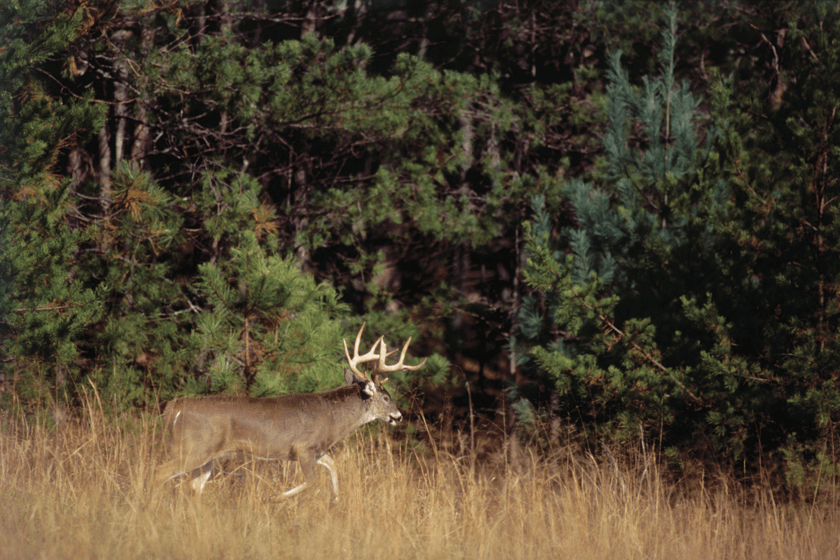
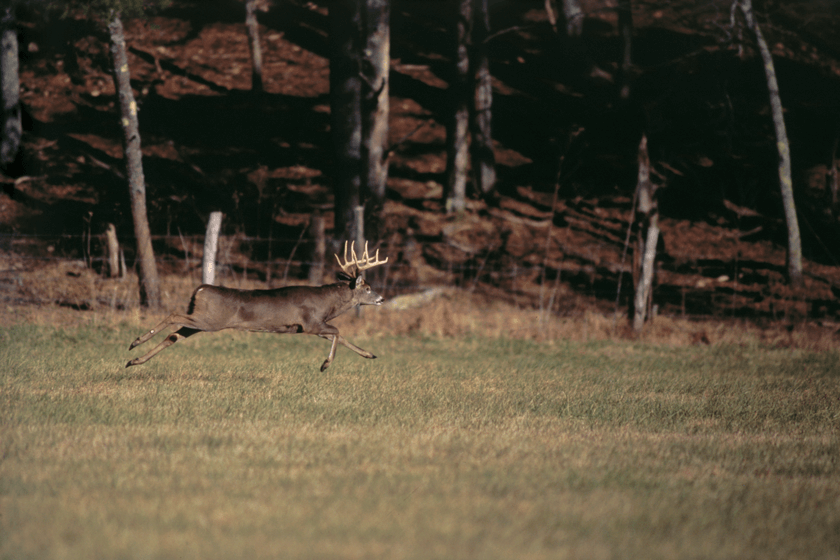
A deer that is hit in both lungs typically runs hard and fast. This is provided the heart is spared. They remind me of a racehorse running down the final stretch of the track. Long strides are common, and their belly is low to the ground.

Most deer that are hit will flee the scene with their tail down. Watch deer carefully after the shot for any clues you can gather about where they are hit. Such clues can be extremely helpful in planning your recovery strategy.

While this is the common reaction, exceptions do exist. Consider a mature doe my son shot several years ago as it stood broadside. He swore the arrow passed through the deer just behind the shoulder but began to wonder after she ran a short distance, stopped, looked back and snorted. Then she fell to the ground. Upon field dressing the deer, it was obvious the arrow had penetrated both lungs. I point this out just to let you know unusual incidents do occur.

The lung-shot deer usually runs only 100-150 yards. However, if the broadhead takes out only one lung, their reaction could be entirely different. Many run hard at first but slow to a walk after a short distance. A deer shot in only one lung is often difficult to recover and requires extreme patience when tracking.

The buck mentioned at the beginning of this story reacted like a classic heart-shot deer.

Back legs usually kick out as the deer promptly leaves the scene, appearing as if they received an electrical shock. They run erratically for a brief distance and may change directions repeatedly. It’s common for them to slow down just before they drop.

There are cases where heart-shot deer have traveled up to 200 yards, but this usually occurs if the arrow only nicks or slices the heart. An arrow that hits low, just behind the front leg at the brisket, could nick the heart and miss the lungs entirely.

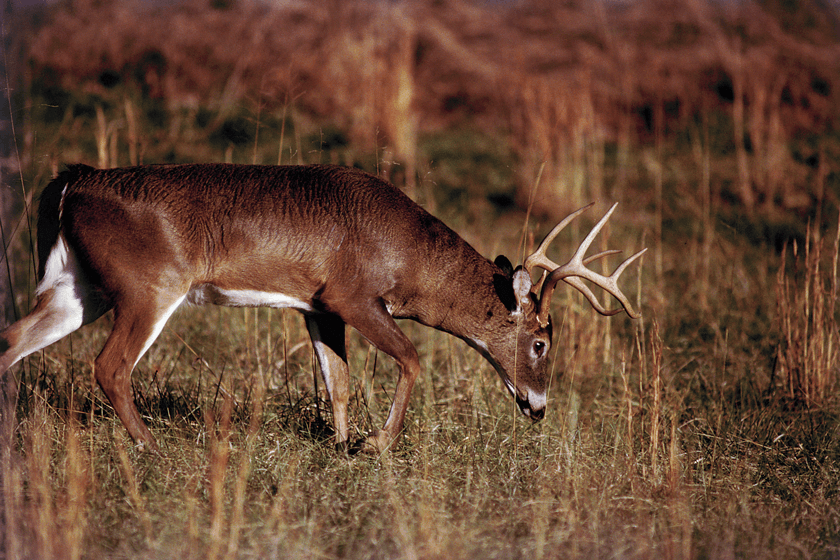
A paunch-shot deer will typically walk very slowly, with its head down. Another common trait of the paunch-shot deer is a hunched over appearance. As the deer walks, its back end could appear raised, with the legs in a wide stance.

The Abdominal Wound

The reaction of a deer hit in the abdomen differs greatly from that of a lung- or heart-shot deer. In fact, the difference is like night and day.

Tracking the animal also requires a different approach.

A paunch-shot deer will typically walk very slowly, with its head down. Another common trait of the paunch-shot deer is a hunched over appearance. As the deer walks, its back end could appear raised, with the legs in a wide stance.

I classify an abdomen shot as anything including liver, stomach and intestines. Although the kidneys are located high and just in front of the hips, they do not relate to the paunch wound. A severed kidney results in immediate hemorrhage and will put a deer down quickly.

A paunch-shot deer usually runs only a short distance before stopping. In many instances, it will jump or flinch as the arrow hits before bounding away. It seldom runs hard and will usually appear to lope. The distance it travels before stopping could vary from only a few yards to 100 yards. In many cases, a deer with an abdomen wound will stop within 50 yards.

Once the deer stops, it could stand in place for one or more minutes. I know of one liver-shot buck that ran about 80 yards before stopping. It then stood in one location for 15 minutes before slowly walking away.

Once a paunch-shot deer begins walking, it will move very slowly with its head down.

Another common trait of the paunch-shot deer is a hunched over appearance. As the deer walks, its back end could appear raised, with the legs in a wide stance.

Most deer with an abdominal wound will bed down within a short distance if left alone.

If you can’t find blood on the ground after the shot, your next best option is to find your arrow and examine it carefully. Bright-colored blood on your shaft could indicate a lung hit, while darker blood or stomach material are sure signs of an abdomen shot. And, of course, if the arrow is free of blood and/or hair, you know it was a clean miss.

The liver-shot buck mentioned previously laid down after walking 40 yards from where it had stood. I was able to see this from my stand only because I had excellent visibility.

The bedding down quick theory is applicable with a liver or stomach wound — but only if the hunter does not begin tracking too quickly. The exception is the intestinal-shot deer, which could travel much further before bedding.

I suggest waiting several hours before tracking an abdomen-shot deer. This deer can be recovered if the hunter is patient.

Muscular and Skeletal Reactions

One common muscular and skeletal wound is the back shot. A friend of mine refers to this as “no man’s land.” That’s understandable, since a deer hit here is difficult to recover. Although there is a major artery that runs perpendicular with the back, most high hits will miss this vital blood vessel. Of course, a high hit could result in a spine shot that drops a deer immediately, but it should not be considered a target. Back hits usually occur when the archer does not get down on his target, or misjudges yardage.
Deer-Shot-Reactions-Checking-Blood.jpg
If you can’t find blood on the ground after the shot, your next best option is to find your arrow and examine it carefully. Bright-colored blood on your shaft could indicate a lung hit, while darker blood or stomach material are sure signs of an abdomen shot. And, of course, if the arrow is free of blood and/or hair, you know it was a clean miss.

Most deer hit high will run hard and fast, resembling that of a lung-shot deer. There are a couple of differences, however. A deer with a back wound runs hard but doesn’t take the long strides. Thus, the belly will not appear low to the ground. Most back-shot deer will usually stop running within 100 yards, whereas the lung-shot deer will usually run hard until it goes down. Determining the difference, though, could depend upon your visibility.

Other muscular and skeletal wounds will react in much the same way as the back-shot deer. One exception is the hip shot. Even when bone is missed, an arrow will inflict major damage to the ham muscle. You often notice this when the deer exits, since it could favor one leg. You might find more evidence when you track the deer, since blood typically runs down the leg and is found in tracks.

Fortunately, many muscular and skeletal wounds are superficial.

A deer that flees the scene of a shot with its tail flagging may indicate a clean miss. Deer that are missed also will often stop after a short distance and look back curiously at the site where the arrow sailed past them.

Nevertheless, I suggest you always give 100 percent when tracking such an animal. As mentioned previously, there are always exceptions to how a deer reacts when hit, and you seldom know exactly where your arrow hit until you make a recovery.

The Clean Miss

Like most bowhunters, I’ve missed my share of deer. It’s easy to do and will often occur from no fault of our own. There are always those dreadful limbs that seem to come out of nowhere. Then there are times when that dreaded buck fever interferes with our concentration.

A deer that flees the scene of a shot with its tail flagging may indicate a clean miss. Deer that are missed also will often stop after a short distance and look back curiously at the site where the arrow sailed past them.

Nevertheless, we cannot always determine if we hit or miss when the shot is taken. I can’t tell you how many times I’ve sat in my stand wondering if I missed or hit the deer.

Sometimes I’ve been sure of a hit, only to discover a complete and embarrassing miss.

Other times, I’ve cursed myself for missing, only to discover a perfect hit. Usually, when I’ve mistaken a hit or miss, it’s due to poor visibility following the shot.

It’s normal for deer to run when a miss occurs. However, there are telltale signs that seem to point to a probable miss. Consider the deer’s alertness. If he runs and stops, looks back with the head held high, there’s a good chance you missed. Most deer, when hit, do not want to stick around and ask questions. A wounded deer seldom runs and then stops to look back and focus on the shot location. Of course, it’s common for a deer to appear spooked when missed, even if it has no idea what happened. Some will not demonstrate curiosity, while others will.

Another trait of a hit deer is the tail dropping. The tail of some deer will drop halfway the first few yards it runs, and then drop completely after running further. Most deer you miss will run with their tail flagging. Again, consider this only a general rule. I’ve seen a few mortally wounded deer run with their tail flagging until they fell or stopped running.

Sounds that follow the shot could indicate a hit or miss. When an arrow hits the body cavity, you usually hear a dull thump. A loud crack could indicate bone, such as a rib, but it also could be the sound of the arrow hitting a tree or rock. Such was the case for me last season when a 10-pointer came into my grunts. I shot between two small hickory trees and thought I was on target. I heard the loud noise of the arrow hitting, well, something. The buck lunged forward, ran a short distance, stopped and looked back. I searched for 30 minutes for my arrow, to no avail. Only when my wife Vikki showed up and helped did I unravel the mystery. She spotted my arrow 10 feet above the ground, dead center in one of the hickories.

There is one final note worth mentioning about a hit or miss. Most archers know when they make a good shot as soon as they release. If you shoot within your effective range, have no doubts as to yardage and are not trying to push an arrow through a tight opening, you can be almost certain you will get the job done. The only other thing is to know that you aimed and followed through. I’m usually aware of this and can be certain that when I release the arrow the job will be done. Then there are those times that I did not do as I should have — I knew when I released that I could be in trouble!
2022 Whitetail Rut Predictions | Deer & Deer Hunting

0

Each year since 1992, Deer & Deer Hunting has provided both Southern and Northern readers with the “Whitetail Rut-Predictor.” This system has been featured in several D&DH articles by late contributing editor Charles J. Alsheimer.

The Whitetail Rut-Predictor is also included in our annual wall calendar, which still features Alsheimer’s photography. The predictor lets you plan when, where and how to hunt.

The rut follows predictable stages of deer behavior. These changes dictate the effectiveness of hunting strategies. Scrape-hunting, for example, might be effective when bucks seek does, but it won’t work later in the rut when most does are already bred or being tended.

The dates in this chart are approximate. The fluidity of activity levels (shown in the charts below) moves the days by a day or two depending upon the current major/minor phase.

Not every buck exhibits the predicted primary behavior on a given date. Several factors, including age, nutrition, health and genetics, can affect the time and extent to which bucks exhibit a behavior. The Whitetail Rut-Predictor represents peaks in the activities (orange and blue symbols) and “minors” of secondary activity (black symbols).

The primary rut behaviors predicted in this calendar are “seeking,” “chasing” and “tending.” Feeding is a buck’s primary pre-rut activity. To take advantage of this, place stands near deer travel routes and feeding areas.

The top chart predicts the 2022 rutting intensity for the North. It’s important to note that the seeking, chasing and tending lines do not work independently of each other. Rather, they work together and should be viewed as one blending into the next as the rut progresses. The chart below predicts the South’s 2022 rutting activity.

Seeking Behavior

The onset of each rut period is marked by a sudden increase in buck activity as bucks seek does. The trigger is not exactly known, but it might be a chemical signal from does approaching estrus.

Intense seeking activity makes for great stand-hunting. Bucks in this mode are also vulnerable to calling, rattling, scents and decoys. These bucks will often skirt the edges of swamps and forest transitions.

Chasing Behavior

Chasing begins when a buck locates a doe near estrus. As the buck approaches, the doe runs, but not in all-out flight. She soon slows or pauses to look back for the buck, which won’t seek other does, and continues in pursuit. The buck occasionally catches up and tries to corner the doe. This can result in a long chase that continues until the doe lets the buck accompany her.

Stand- and still-hunting in a near-estrous doe’s home range can be productive, because several bucks could enter the chase.

Tending Behavior

After a doe allows a buck to accompany her, tending begins. He beds and moves with the doe until she is bred. Tending, which ends abruptly, usually lasts about 24 hours. After the doe is bred, the buck again seeks other does and the cycle resumes.

Tracking can be effective for hunting a buck tending a doe. Bucks also respond to grunt calls, because they seek to drive off other bucks. However, don’t expect a buck to go far from a hot doe to visit scrapes and scents.

Contributing Factors

Bucks in healthy herds with a balanced sex and age structure have well-defined social orders. In herds in which bucks reach 5-plus years of age, dominant bucks do most of the breeding. As the herd’s age structure is skewed toward young bucks, the youngsters become increasingly involved in the rut and breeding. As the doe-to-buck ratio approaches 1:1, seeking behavior and interactions between bucks are maximized. As the doe-to-buck ratio skews toward does, bucks spend less time seeking because females are readily available.

Seeking behavior begins abruptly and kicks off the rut about the time of the full moon, but not just any full moon, because day length is also involved. As chasing and tending increases, seeking behavior declines. Seeking can be expected any time during the rut when a buck finishes chasing or tending a doe. The peak of seeking occurs just before the peak of tending and breeding. Tending behavior and breeding peaks about the time of the new moon during the rut. The rut seems to end as quickly as it begins.

Effects of Latitude

The wobbling cycle of the Earth on its axis as it circles the sun causes seasonal changes by varying the amount of sunlight.

The link between diminishing day length and the rut’s onset is clear. However, it’s not simple. The breeding season is most intense and concentrated at Northern latitudes where the difference between day length in summer and winter is greatest. The breeding season lengthens the nearer deer live to the equator. This partly explains why the Southern rut appears more varied.

Effects of Weather

Activities on the Whitetail Rut-Predictor calendar might occur several days early because weather can affect daylight amounts. Dense clouds shorten day length 15 to 20 minutes, and decrease moonlight intensity. Rain and snow block sunlight and moonlight by defraction and diffusion, preventing moonlight from reaching the ground. Storms can shorten daylight about 30 minutes and obscure almost all moonlight.

Intense rutting activity is often associated with storm fronts in South Texas and other Southern states, but not in Northern states. This activity is often attributed to low air temperatures or barometric changes, but light likely plays a major role. Air temperatures exceeding 55 degrees Fahrenheit usually decrease deer activity.

The Predictor’s Basis

The Rut-Predictor is based on a model that links cyclical changes in the Earth’s solar and lunar illumination to the whitetail’s reproductive cycle. It is hypothesized that sunlight and moonlight provide environmental cues that set, trigger and synchronize breeding.

A computer model was developed that uses astronomical data, field observations of rutting activities and measurements of light intensity to predict rut activity.

The Rut-Predictor hypothesis differs from conventional views. The general belief is that peak breeding north of the Mason-Dixon Line occurs each year about Nov. 15. However, it has been observed that rut activity often falls to nearly zero by mid-November. The timing of peak rut activity could vary year to year by as much as three weeks at any given location.

If the moon is the timing mechanism for the estrous cycle, what sensory pathway in deer receives the cue? External stimuli fall into three primary categories: physical, chemical and biological. The great distance between Earth and the moon rules out any regular 28-day exchange of sounds, scents, or chemical and biological materials deer can detect.

The moon affects the Earth’s gravitational fluctuations and nighttime illumination. Both factors create external stimuli that deer might detect. However, little evidence suggests deer or other creatures directly detect gravitational forces. Responses to those fluctuations are probably indirect. As a result, gravity’s effects were rejected as a stimulus for timing the whitetail’s estrous cycle.

Moonlight can be detected, especially by whitetails, which have eyes adapted for low-light vision. Light passing into the eye strikes the nerve-rich area in the back of the eye, causing electrical impulses to pass along the nervous system to various organs. Some impulses pass to the pineal gland in the center of the brain, providing input to the endocrine system. The pineal gland and related hormones are involved in or regulate the reproductive cycle. The pineal gland responds to light by increasing (with diminishing light) or decreasing (with increasing light) production of a hormone called melatonin. This increases/decreases other hormones.

The fact that moonlight changes the Earth’s illumination on a cycle similar to the whitetail’s 28-day estrous cycle, the fact that whitetails have a sensory system that can detect moonlight, and the fact that the whitetail’s endocrine system responds to light stimuli by altering levels of reproductive hormones argue against coincidence.

Testing the Rut-Predictor

The Rut-Predictor has been well tested. For example, when whitetails from the United States have been brought to the Southern Hemisphere, where seasons are reversed, they shift from a November rut to a May rut. This is also reinforced by the fact whitetails in equatorial regions breed asynchronously throughout the year.

Alsheimer’s 20-plus years of work on this subject had him convinced that he was onto something.

“Interestingly, the only way to disprove this theory is to witness behavior that contradicts it, such as seeing most does breed within seven days of a first quarter moon,” Alsheimer said. “Failure to observe predicted behavior, however, proves nothing, as it might be caused by unrelated factors, such as poor visibility, bad weather or low deer numbers.”

Conclusion

To help predict breeding behaviors for your area, keep a daily log of fresh rubs and scrapes you and your hunting partners observe. For added accuracy, quantify your effort by recording how many hours of hunting are associated with your counts.

Editor’s note: It is important to note that peak tending (breeding) oftentimes occurs well after the peak rut activity that’s observed by hunters across North America.

D+DH In-Depth is our premium, comprehensive corner on America’s No. 1 game animal. In this graduate-level course, we’ll teach you about deer biology, behavior, and ultimately, how to become a better hunter. Want to be the first to get our premium content? Become a D+DH Insider for FREE!

.338 Lapua: The Hard-Hitting Big Game Round and the 5 Best Rifles

0

There are not many cartridges that can literally take down every big game animal in North America. The .338 Lapua Magnum is one of those rare rounds. While it was originally designed for military snipers and law enforcement, dedicated hunters have proven the .338 Lapua’s effectiveness on everything from whitetails and mule deer up to elk and even the large, lumbering bison. It’s all thanks to the nearly 4,000 pounds of energy delivered by 250-grain and larger bullets. As a long range hunting tool, it’s nearly unmated in terms of trajectory. It’s quite capable of extremely flat shooting at distances of 200 to 400 yards, allowing hunters to bag animals that previously would have walked away unharmed. Hearing all that, you might be surprised to hear the .338 Lapua has mostly a niche following these days. There are some very good reasons for that which we’ll dive more into later. The .338 Lapua may not be the round for everyone. But for many people it’s going to hit that perfect sweet spot. The right combination of speed, power, and long-distance ability that quite frankly leaves a lot of other hunting rifle cartridges in the dust in terms of performance. However, if you’re looking for a hard-hitting cartridge that can quite literally do it all in terms of big game here in North America, keep reading to learn more about this fascinating round.

.338 Lapua The Round

When compared to many other popular hunting rounds on the market today, the .338 Lapua is still something of a baby, as it was only developed in 1989. It does use a rather old cartridge, the .416 Rigby, as a parent case. The Lapua was born out of sniper rifle research in the early 1980s by companies like Research Armament Industries. Long story short, development started when the .416 Rigby was necked down for an 8.6mm (0.338-inch) bullet. Shortly after that, Finnish ammo manufacturer Lapua teamed up with SAKO and British gunmaker Accuracy International to perfect what we know today as the .338 Lapua Magnum. Most notably, Lapua greatly increased the case strength to handle the enormous pressure inside. The first Lapua rounds were designed with bullets that were full metal jacket. This was originally designed for military sniper rifles, after all.

Today, ammo options are still somewhat limited, especially for hunters. However, the ballistics speak for themselves. Hornady manufactures a factory round in their ELD-X Precision Hunter line that has a 2,800-fps muzzle velocity. That’s with a 270-grain bullet! It’s pumping out about 4,699-foot pounds of muzzle energy. Hornady says this round has zero drop at 200 yards from a 24-inch test barrel. At that distance, it’s still doing 2,562-fps and can deliver 3,935-foot pounds of energy. Hornady also offers a 285-grain bullet for competition in their Match Grade line which is doing 2,745-fps at the muzzle and is dishing out about 4,768-foot pounds of energy.

Lapua makes several types of factory ammo today with similar ballistics. The 231-grain Naturalis is a good example of a quality hunting round. Lapua says it has zero drop at 100 yards and is travelling about 3,018-fps at the muzzle and is hitting with about 4,681-foot pounds of energy. We could go on and on, but it should be obvious now that this round has some serious speed and stopping power for hunting.

Disadvantages of the .338 Lapua Magnum

If this is your first time reading about the .338 Lapua, you are probably thinking there’s got to be a catch with this round, and you’d be right. There are several. For one, there’s tremendous recoil, as you might expect when using such large casings and bullets. Because of the power and recoil, many firearms manufacturers need to make the guns heavier to compensate. If you’re looking for a precision rifle package, you can expect it to weigh anywhere from 11 to 12 pounds. That’s fine for long range shooting at the range, but almost unusable in the field for hunting. You will find a few die-hards who will tote guns like that into the deer woods, but personally, I’d never try it. Manufacturers have managed to do some amazing things with the designs of .338 Lapua rifles in recent years, but you’re going to be hard pressed to find one under eight pounds.

The second drawback is the cost, both for the rifles themselves and the ammunition. If you’re looking for something under $1,000, the .338 Lapua may not be for you. The lower end rifles seem to start around the $1,200 range and they only go up in price from there. Some higher end .338s sell for $5,000 or more.

And then there’s the factory ammo. That Hornady Match Grade we mentioned earlier? We found it online going for about $120 a box, or nearly $6 a round. Even Federal Premium’s American Eagle line of jacketed soft points goes for nearly $70 for a box of only twenty rounds. If you’re not into handloading when you start shooting .338 Lapua, odds are you’ll get into it quickly, if only to keep from burning a hole through your wallet.

There are other disadvantages, such as a lack of ranges reaching out to 1,000 yards and more, which is what this rifle likes, but most people get more hung up on the rifle and ammo costs. We cannot blame them. It’s one of the main reasons the .338 Lapua remains something of a niche. If you haven’t been scared away yet, let’s look at some of the hunting rifle options on the market today in this awesome round.

Savage Arms 110 Long Range Hunter

If you are planning on seriously going into the backcountry of North America hunting with the .338, the 110 is a great gun to consider. At 8.8 pounds, Savage Arms has done an excellent job of cutting the weight down to where it’s manageable for hiking up and down hills and mountains in pursuit of game. It probably still won’t be comfortable, but the trade-off is that you’ll be able to reach out further than other hunters. It has a 26-inch carbon steel barrel with a 1:9 twist rate and a muzzle brake to help tame the recoil a bit. This rifle also does ergonomics well due to the signature Savage AccuFit system to adjust things like length of pull and comb height. These small creature comforts go a long way towards comfort on a rifle that has a 49.5-inch overall length. This centerfire bolt action can usually be found for about $1,300 new from most major retailers.

Christensen Arms Traverse

High end rifle manufacturer Christensen Arms has been doing some exciting things, specifically trying to build better stocks for bolt action rifles in recent years. As a result, they’ve really reduced the weight factor on this selection. The Traverse may be the lightest .338 Lapua on the market at 7.7 pounds. Much of that is thanks to the carbon fiber Monte Carlo stock. We like this one for anyone planning a remote hunt 10 to 20 miles from the nearest road where you need firepower without being weighed down too much. It’s also well suited for the elements thanks to a 27-inch, 416R stainless steel barrel wrapped in Aerograde carbon fiber. It also features a removable muzzle brake to help with the recoil. Another thing we like about the Traverse is that M16-style extractor with a slightly larger ejection port. It helps this rifle cycle smoother than some of the other offerings on the market. It’s not cheap; you’re looking at about $2,500 for a Traverse, but you can head into the field confident you’ve got one of the best long range rifles out there right now.

Weatherby Mark V Accumark

For the hunter looking for a .338 Lapua Magnum rifle that’s as accurate as it is functional in the field, it’s hard to go wrong with a Weatherby Mark V. They gave this rifle a 28-inch barrel with a 1:9.3 rate of twist. They also fluted the barrel, which helps cut the weight of this rifle down to 8.3 pounds. The barrel, receiver, bolt, knob, and safety have also been given a black Cerakote finish. That’s going to make it perfect for the rain and snow common at high altitudes. We like this one for anyone seeking accuracy for two reasons. One, Weatherby rifles guarantee a sub-MOA group at 100 yards using factory ammo. And two, it’s got an extremely short 54-degree bolt throw that makes for a faster and cleaner follow-up shot when inches count. Not that you’re likely to need another shot with a round like this, but it’s a little extra peace of mind when pursuing more dangerous game animals. It can be found for about $1,800 from most major retailers.

Christensen Arms Mesa Long Range

If you are fine with a little extra weight, the Mesa is a great option for a slightly lower $1,600 price tag than the Traverse we mentioned earlier. We like this one for anyone hunting more flat lands where you’re going to have more chances at distances out to 400 yards or more. The barrel length of the Mesa is 27 inches and you’re looking at a 1:9.3 rate of twist. This free-floating barrel should handle the rain and snow well because it’s made from 416R stainless steel. The muzzle is also threaded, and it comes standard with a muzzle brake. Christensen Arms backs this rifle with a sub-MOA accuracy guarantee, too. The stock has spacers to adjust both the length of pull and the comb, so there’s some nice customizing of the ergonomics. This rifle comes in at 10 pounds. That’s heavy, but not to the point where it’s completely unwieldy in the field. But, you’ll still want to eat your Wheaties in the morning before hiking any mountains with it.

Savage Arms 110 Precision

We know precision rifles are not often used for hunting, but this is one where you can make it work. We’d recommend it more for long distance hunting from an elevated position than an intense spot and stalk through the brush and up the hills. The 11-pound weight is just light enough to make it doable if you’re determined enough. Savage fluted the barrel of the 110 Precision and skeletonized as much of the stock as possible to make this one of the lighter .338 Lapua Mag precision rifles on the market. This rifle has a 24-inch carbon steel barrel with a 1:9.3 rate of twist and is threaded with a BA muzzle brake installed to help with the recoil. Another reason we like this one is simply because they include their crisp and adjustable AccuTrigger system that allows each shooter to adjust between a 1.5 and 4-pound trigger pull based on his or her preferences. At $1,500, it’s also rather affordable for a precision rifle.

For more outdoor content from Travis Smola, be sure to follow him on Twitter and Instagram For original videos, check out his Geocaching and Outdoors with Travis YouTube channels.

READ MORE: 338 WINCHESTER MAGNUM: THE POWERFUL BIG GAME ROUND AND 5 RIFLES CHAMBERED FOR IT

60 years ago today: World-record smallmouth caught

0

Originally published in 2007

On a plaque outside David L. Hayes’ Leitchfield, Ky., home are the words “One old fisherman lives here with the catch of his life.” Whether the sign refers to Ruth, his wife of 64 years, or the gigantic smallmouth bass that hangs on his living room wall is anyone’s guess. It’s a question Hayes wryly refuses to answer.

Unfortunately for the 80-year-old angler, it’s not the only question surrounding his trophy catch from Dale Hollow Lake on the Tennessee-Kentucky border 50 years ago. Controversy swirls around this fish that stood as the world record for more than 40 years and now splits the record keeping authorities squarely down the middle.

The International Game Fish Association, generally recognized as the authority on freshwater fishing records since taking over from Field & Stream in 1978, disqualified Hayes’ catch in 1996. The National Fresh Water Fishing Hall of Fame did likewise the same year. In 1999, however, the Hall of Fame reinstated Hayes’ catch. The IGFA has not budged.

Even the states involved in this tangled tale are on different pages. Kentucky disqualified the catch in the midst of the IGFA and Hall of Fame turmoil. Hayes still sits atop the Tennessee record book.

It’s a controversy that confounds smallmouth fans and frustrates the small community of Celina, Tenn., where a remarkable series of events took place more than half a century ago.

The catch

The date was July 9, 1955, and David Hayes, his wife and their six-year-old son were spending the day on Dale Hollow Lake trolling a 600 series pearl Bomber for smallmouth and walleye. They’d been coming to “the Hollow” for about three years, and Hayes had gotten very good at summertime trolling — so good that he was occasionally followed by local guides and other anglers hoping to learn his secrets.

On July 9, however, things were slow. Hayes’ favorite trolling runs were coming up empty … at least until he swung into a favorite cut between Illwill Creek and Phillips Bottom, just north of Trooper Island and in Kentucky waters.

“There were a couple of weed beds through there, and if you lined it up just right you could bring your plug right between them and keep it bumping the bottom.”

Hayes had about 300 feet of line out when the big fish hit. At first he thought he was snagged. Then he felt the surge of a powerful fish.

It took several minutes with his Tru-Temper steel rod, Penn Peer 209 reel and 20-pound-test line to bring the bass boatside, but Hayes eventually put a net under the leviathan. “It was between 10:00 and 10:30 a.m.,” he said.

“I had no idea it was a world record.”

The controversy

The fastest, easiest way to be called a liar is to catch a giant fish. Make it a world record, and the detractors will beat a path to your door.

After Hayes swung his giant smallmouth aboard his 21-foot cruiser, he stowed the fish in a metal cooler he kept on the deck of the boat and went right back to fishing. The Hayes family liked to eat fish, and the day was still young.

Sometime around noon, Hayes was getting low on gas and decided to head to the nearest marina — Wisdom Dock, up Illwill Creek. When he got there, he was met by Granville “Lightnin’ ” Madison, a dockhand who filled Hayes’ gas tank. When Madison asked if Hayes was having any luck, the angler was characteristically modest.

“I’ve got one pretty good smallmouth,” Hayes said.

Madison asked if he could weigh it, and Hayes agreed. Unbeknownst to the angler, Kentucky Water Police Officer Oral Burtram was inside the marina and saw the fish on the scales. The smallmouth lacked an ounce of weighing 12 pounds.

From Wisdom Dock, Hayes headed down the lake to Cedar Hill Resort, where he maintained a slip for his boat. It was there that the story took an unfortunate turn.

Once again the fish was placed on the scales — this time they were certified — and once again the bass weighed 11 pounds, 15 ounces. People who were there and saw the fish still marvel at its size.

Hayes’ mistake was in letting the fish out of his sight. He let dockhands at Cedar Hill weigh it. Had he kept it under his control the entire time, he would likely have never lost his place in the record books.

More than a month later, on August 17, Raymond “Doughbelly” Barlow presented an affidavit to the Corp of Engineers office at Dale Hollow Lake. The document, sworn to by Doughbelly’s nephew, John H. Barlow, claimed that Hayes’ bass had been tampered with — that it really weighed only 8 pounds, 15 ounces and that Cedar Hill Resort owner Dick Roberts and John’s own brother Ira had asked John (a one-time guide at Cedar Hill) to “fix it up good.”

John claimed he shoved 3 pounds of motor parts and sinkers into the bass’ gullet then pinned the fish’s throat shut with a treble hook. After the alleged dirty work was done, the bass weighed 11-15 — the same as it had weighed at Wisdom Dock.

Because the Corps isn’t involved in keeping fishing records, the affidavit was returned to Doughbelly and a copy kept in the Corps office. It would be more than 40 years before anyone looked at it again.

A record is undone

Hayes was firmly entrenched in the record books by the mid-1990s when a Livingston, Tenn., assistant principal invited him to display the fish at an outdoors show. Eldon Davis and a few others decided that Hayes’ bass didn’t look like it weighed nearly 12 pounds and began their own investigation.

Davis found the John Barlow affidavit and then found Barlow himself. Using a private polygrapher and a set of questions devised by Davis, John passed a lie detector test. He was never given a subsequent test by state officials.

Within a few months, Hayes’ bass was stricken from the record books despite the fact that no one from IGFA bothered to get his version of events. Hayes learned of the disqualification when Bassmaster senior writer Colin Moore called to interview him in 1996.

Tennessee’s due diligence

Whether or not David Hayes holds the world record for smallmouth bass, the record came from Dale Hollow Lake. Both the second (John Gorman’s 10-14 in 1969) and third (Paul Beal’s 10-8 in 1986) biggest bronzebacks were caught there.

So when Ron Fox, assistant director of the Tennessee Wildlife Resources Agency, investigated the catch and controversy in the summer of 1996, it was with an eye to discovering the truth, not to defend a state icon.

“I thought the research would be brief and confirm that the fish was a hoax, but the more I looked into it, the more the bits and pieces added up to help us reach our decision to maintain the catch as a record.”

Fox talked to all the living witnesses to the catch and weighing. He heard from Bobby Stone, the night clerk at Cedar Hill who slept each night on the freezer containing the fish until it was sent to a taxidermist. Stone also examined the fish on the day it was caught, had his photo taken with the fish numerous times after the weighing and stated unequivocally that the fish’s gullet was not pinned shut with a treble hook or otherwise compromised.

Fox talked with Lightnin’ Madison who saw the fish at Wisdom Dock and confirmed its weight at 11-15. He even spoke with John Barlow’s brother, Ira, a Cedar Hill clerk and guide who was at the dock when Hayes came in and whom John implicated in the alleged tampering.

Ira told Fox that John was nowhere near Cedar Hill that day and that John fabricated the story in order to get revenge on Dick Roberts, who had fired him from his guiding position. Ira even passed a polygraph test by a licensed examiner.

“I feel very comfortable that Mr. Hayes caught the world record smallmouth and deserves the recognition for it,” Fox said. In March of 1997, TWRA decided to keep the Hayes fish as the state record.

A formula for the truth

Whether you contend that Hayes’ smallmouth weighed a legitimate 11 pounds, 15 ounces or whether you believe John Barlow and others boosted its weight, there’s no question that the fish was 27 inches long and had a girth of 21 2/3 inches.

A highly regarded formula for estimating bass weight is length x length x length ÷ 1,600. Plug the known numbers into the formula and Hayes’ bass comes out to 12.3 pounds (12 pounds, 5 ounces).

The other most commonly used formula for estimating bass weight based upon measurements is length x length x girth ÷ 1,200. Under this equation, the Hayes smallmouth weighs 13.16 pounds (13-3).

If the bass’ girth measurement is reduced by three inches — more than enough to compensate for any foul play, the formula would still indicate a weight of 11.34 pounds (11-5).

The Hayes bass was simply too large to weigh just 8-15, as John Barlow claimed.

The affidavit

Why would Dick Roberts ask John Barlow to boost the weight of Hayes’ bass? The obvious answer, of course, would be to gain notoriety from having a world record smallmouth weighed at Cedar Hill Resort.

Forget for a moment that Dick Roberts was a pillar of the community, that he taught Sunday school at Celina United Methodist Church for more than 40 years and that he had the respect of virtually everyone around the lake. Ignore the fact that it would be completely out of his character to do something so unethical.

Instead, ask why anyone would need the help of John Barlow for such a deed. After all, even according to Barlow’s own sworn statement, “Mr. Roberts and Ira Barlow came to me, and Mr. Roberts asked me to lead the fish — told me to fix it up good — and handed me a number of lead sinkers. Ira Barlow also had some lead sinkers in his hand.”

Why did they need John Barlow if Roberts and Ira Barlow were standing right there with the sinkers? Why bring someone else in on the fraud? It makes no sense.

The usual suspects

Three men came together to create the affidavit sworn to by John H. Barlow, and all of them had motives to lie and discredit Cedar Hill Resort. In addition to John, there was Doughbelly Barlow and James H. Reneau Jr.

Doughbelly was a well-known character around Dale Hollow Lake in the 1950s. The corpulent fishing guide worked out of Dale Hollow Marina and was a sometime deputy sheriff known for ruthless behavior. He was also John’s uncle.

Doughbelly was renowned for being jealous of other anglers who were catching bass when he was struggling. It would have bothered him to see a world record come into a competing marina. That it was caught by a weekend angler added insult to injury.

Jimmy Reneau was the attorney who prepared the affidavit. He also was the owner of Holly Creek Resort, just up the lake from Cedar Hill. Whatever business Dick Roberts gained by having a record smallmouth come to Cedar Hill, Reneau may have felt he was losing at Holly Creek.

Even the county court clerk who notarized the affidavit may have had something to gain from the conspiracy. Mary Ruth “Oopie” Reneau was Jimmy’s sister.

Can I get a witness?

By the time John Barlow’s affidavit came to light in the mid-1990s, most of the principals in the matter were dead. Raymond Barlow died in 1975; Jimmy Reneau committed suicide in 1981; Oopie died in 1984; and Dick Roberts passed away in 1993.

Of the six men John Barlow implicated in the conspiracy — himself, Dick Roberts, Dick’s eldest son Dickie, Ira Barlow, Walter Blakely and David Hayes — only the Barlows, Dickie Roberts and Hayes were alive in 1995 when the statement resurfaced.

And only John Barlow recollected anything at all about tampering with the big smallmouth. Hayes denies it emphatically. Dickie Roberts was astounded by the charges and refuted any involvement on the part of himself or his father.

And when Ira Barlow was on his deathbed in 1998, he told his son, Tim, that the fish was legitimate and that John had fabricated the entire tale. Tim calls his Uncle John a “career liar” and says that setting the record straight was something his father wanted to do, right to the very end of his life.

Absolutely no one backs up John Barlow’s story of fish tampering. Even the witnesses he lists in his infamous affidavit refute him.

Where are we now?

The witnesses to the record smallmouth controversy are, quite naturally, disappearing. David Hayes is nearly the only one left.

Though Tennessee and the Hall of Fame have placed Hayes in his proper position in the record book, Kentucky and the IGFA have not, choosing instead to ignore the considerable evidence in his favor.

Whether or not his home state and the IGFA do the right thing and reinstate his catch will have little effect on Hayes’ life. He enjoys his retirement, his family and his friends. Unless someone asks about the big fish, Hayes seldom talks about it.

But to have one of the greatest accomplishments in sportfishing history discredited in the face of so much evidence to the contrary is an indignity that no one should suffer.

As Ron Fox puts it, “Mr. Hayes is a fine individual and should not end this life with his accomplishment being lost from the record books.”

Turkeys Are What They Eat: Weird and Adaptable

0

As many of us in the United States prepare to eat turkey, let’s take a look at what wild turkeys eat. The list might surprise you, and their dietary choices may help us figure out what the future holds for wild turkeys.

Like that certain uncle at your holiday dinner, wild turkeys will eat just about anything that fits into their mouths. They are the quintessential omnivores.

Acorns and azalea galls, bluegills and blueberries, crabgrass and caterpillars … they all go right in.

Prickly pear and panic grass, toothwort and tadpoles, grasshoppers and grapes, pecans and paw paws, sedges and snakes … and the list goes on.

Depending on the plants species and time of year, turkeys will eat roots, bulbs, stems, buds, leaves, flowers, fruits and seeds.

In search of protein, they move about the woods like a pack of velociraptors, thrashing up the leaf litter and eating anything that moves.

Their quarry includes all manner of insects as well as salamanders, lizards and frogs.

From the treetops, to the ground and across forests, fields and suburban yards, turkeys make use of every inch of habitat available to them.

They are even known to venture into the water to eat aquatic plants, fish and crayfish.

Peak Turkey?

The return of the wild turkey is a triumph of wildlife management. Careful regulation of hunting combined with reintroductions has produced a thriving turkey flock that nearly matches the population that existed before North America was colonized. But credit must also be given to the turkey itself.

Thanks to their dietary versatility, turkeys can thrive almost anywhere. Wet or dry, high or low, hot or cold, turkeys can make any habitat work. They only require some trees for roosting at night.

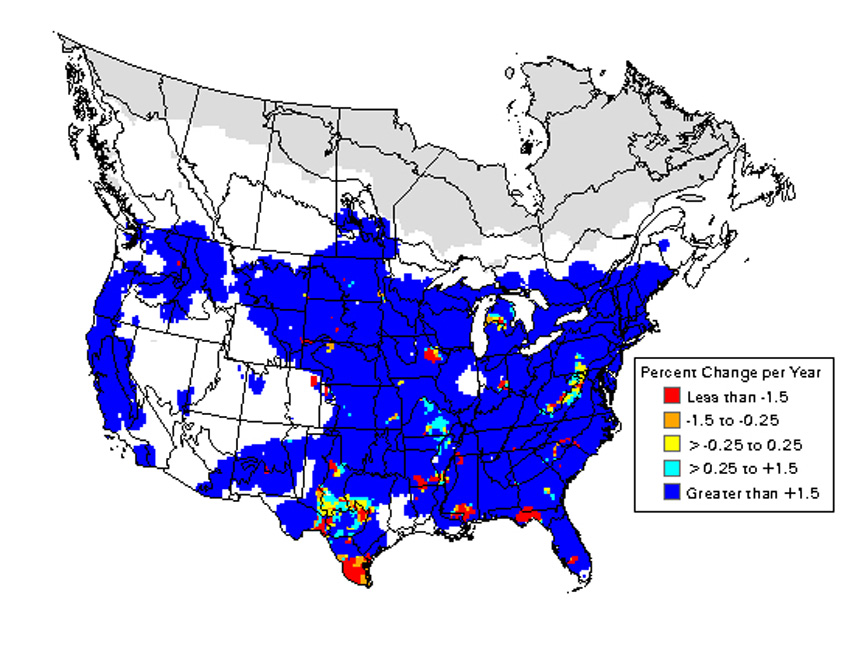
Wild turkey populations continue to grow. Across the U.S., the population is increasing by an average of 9 percent each year, according to the Breeding Bird Survey.

Turkey population trend map from the Breeding Bird Survey. Image © USGS

But how long can the population recovery continue? When do we reach “Peak Turkey”?

All animal populations have limits to growth. Food, disease, predation and environmental conditions each play a role.

But for turkeys, we can rule out food as a limiting factor. Given this bird’s extreme omnivory, other factors would likely come into to play before turkeys begin starving to death.

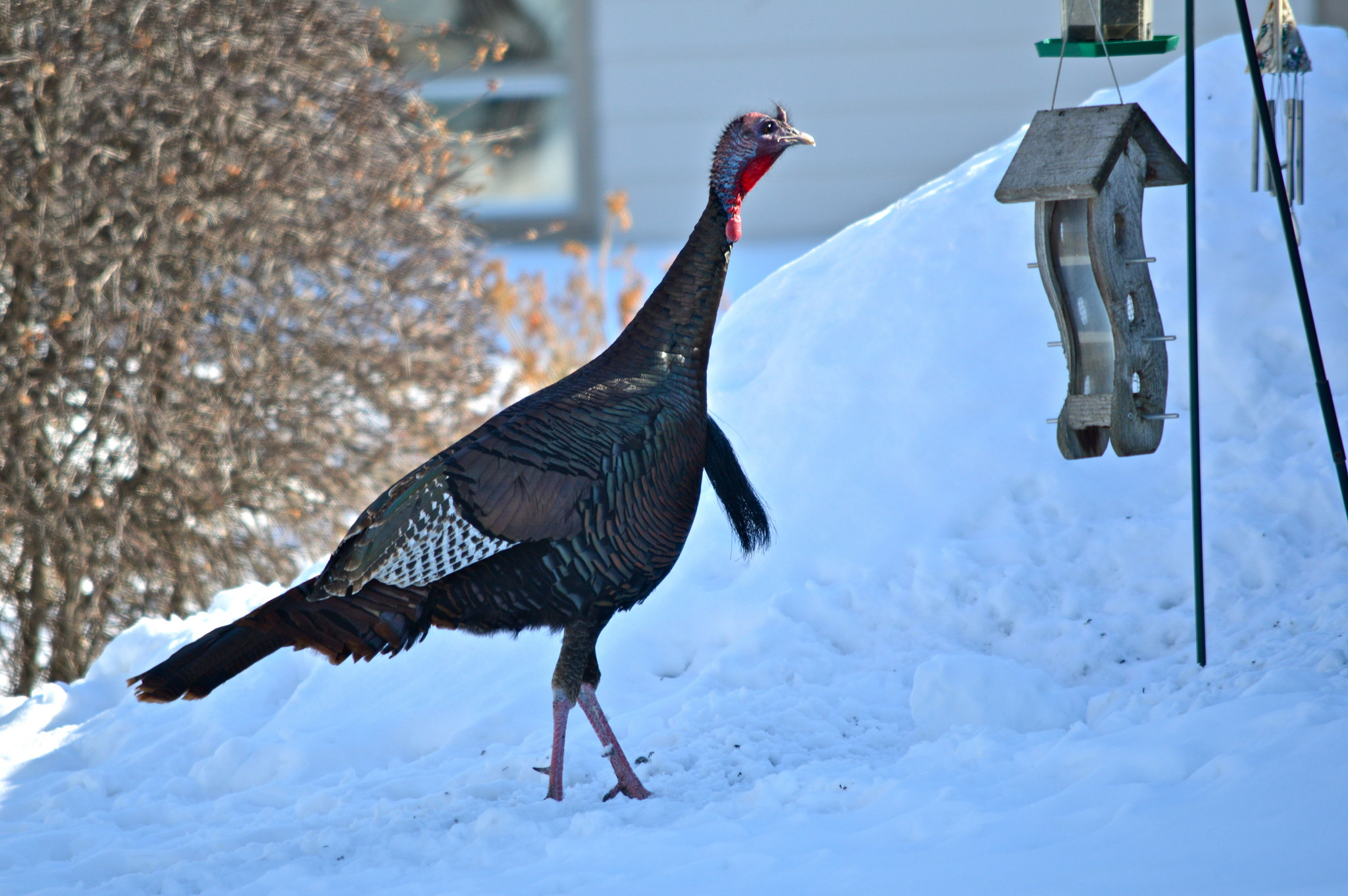
For example, even in the depths of winter when snow cover blocks access to the ground, turkeys can make do. Until thaw comes, they subsist on white pine and hemlock needles, mosses, lichen and the buds and stems of beech, sugar maple and hop hornbeam trees.

The best snow ration of all. Photo © Laura Pontiggia / Flickr through a Creative Commons license

Predation, on the other hand, may play a central role in turkey population regulation. As most of us know, turkey is delicious!

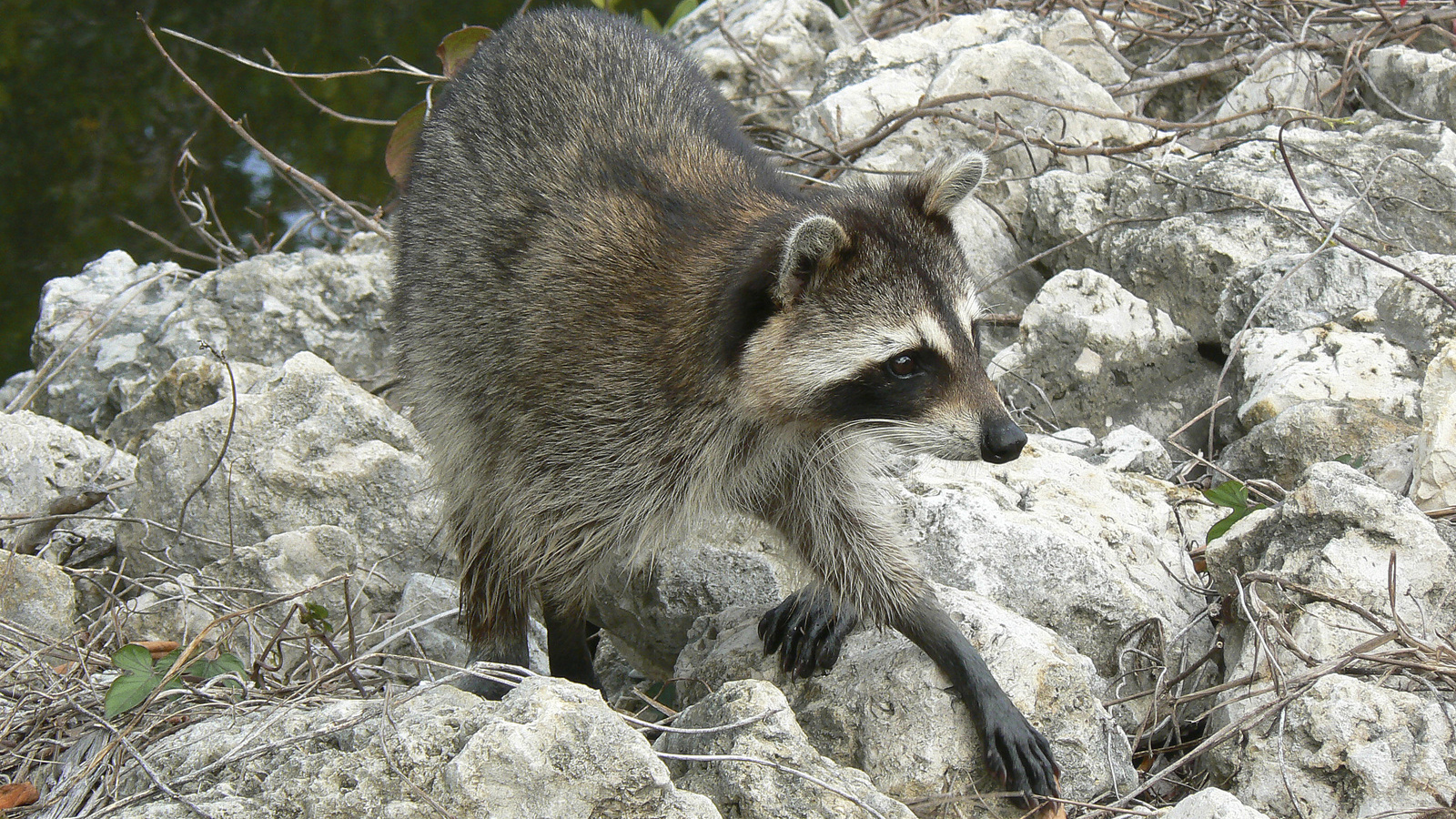
Surprisingly, the usual suspects – coyote, bobcat and raccoon – do not commonly prey on adult turkeys. These carnivores instead focus on less formidable and wary prey such as rabbits and rodents.

Hunters kill turkeys, but regulations are set to manage for population growth. They allow hunters to take a limited number of mostly male birds.

It is nesting time that brings the most risk to a turkey. The above predators and many more seek out turkey eggs and chicks. And a hen turkey’s risk of being killed by a predator is also highest when she is sitting on the ground incubating her eggs.

Raccoon in Florida. Photo © The Nature Conservancy (John C. Winfree)

A recent analysis of data from 15 Southern and Midwestern states shows that continued growth of turkey populations is limited by nest predation, combined with the limited availability of high quality nesting habitat.

In parts of this study area, peak turkey has arrived: the turkey population has begun to level off.

The research reveals that in places with the largest turkey populations, hen turkeys are less likely to have a successful brood of turkey poults.

According to the authors, this may be because all the best nesting sites tend to be occupied when populations are high. Many turkeys are then forced to choose nest sites that expose them to a higher chance of predation.

Overall the production of young turkeys tapers off while adult turkey survival remains high, resulting in a stable population.

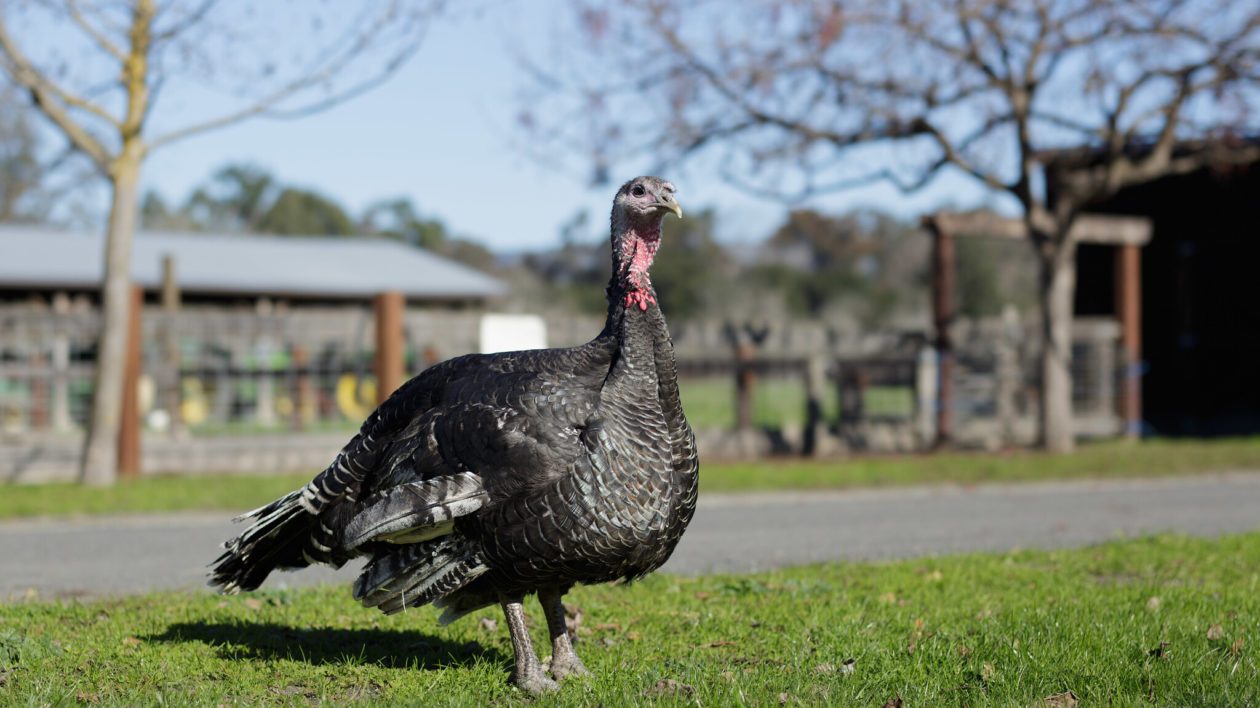
turkey on ground
Photo © John Loo / Flickr

Living with Abundant Velociraptors?

Another factor to consider as we approach peak turkey is how higher turkey populations affect the ecosystems around them.

Consider white-tailed deer. This is a classic example of a wildlife management success gone wild.

Deer populations in the absence of large predators such as wolves can easily exceed the ecological carrying capacity of their habitat. When this happens, understory plants disappear and tree seedlings are eaten before they can grow. Such dramatic changes to the understory begin to affect other animals that depend on these habitats.

Few researchers have given attention to any potential effects of expanding turkey populations on the abundance and distribution of the things they eat.

Diet is a product of preference and availability. We know that turkeys eat almost anything, but we know little about what they prefer. Their preferences are important to know because preferred items will be the first thing to disappear from the pantry as turkeys become more abundant.

If these preferred items are plants or animals of conservation concern that aren’t able to thrive while being hunted by packs of modern-day velociraptors, then we might have a problem. To put it another way, are turkeys themselves a limiting factor for other organisms?

For example, turkeys like to scratch up spring ephemeral wildflowers and eat their roots. Although deer eat such plants too, how culpable are turkeys in the decline of these flowers that crop up in early spring woodlands before trees leaf out?

One study did focus on turkey impacts by excluding them from patches of forest. The results showed that turkeys hindered the regeneration of oak trees by scratching up leaf litter in search of food. Deer cause the similar problems with reduced tree seedling regeneration.

It may be a while yet before researchers, wildlife managers and hunters come to terms with the success of wild turkey management and the possibility that we are at or near the ecological carrying capacity for wild turkey in many places. The focus of wildlife managers remains on propelling population growth.

We still have much to learn about how turkeys influence the ecosystems around them.

Filling our knowledge gaps may be important as we make decisions about managing for wild turkey population stability or growth into the future.

Only then can we be sure whether gaultheria and gartersnakes, spring beauty and skinks can still thrive in a post-peak turkey world.

Palomino Trout: What Are They and How to Catch Them

0

It’s not uncommon to find gold in the mountain streams and rivers of the Appalachian mountains, but many anglers venture into these hills in search of a different kind of gold.

The golden rainbow trout is one of the most unique fish in North America and has captured the attention of anglers for more than half a century.

These fish are also known as “bananas” or “lightning trout”, and they are known for their distinctive bright yellow coloration. This golden coloring comes from breeding a West Virginia rainbow trout with a classically colored rainbow trout to create this striking hybrid.

Palomino Trout or Golden Rainbow Trout

Their origins can be traced back to the Mountain State of West Virginia, and they are vastly different in appearance from any other fish you’ll find in the state. The emergence of the golden rainbow trout began in 1955 when workers at a fish hatchery noticed a unique fish that stood out from the rest.

The hatchery-raised rainbow trout, but this one bright fish appeared quite different. Instead of having the same pigmentation as a regular rainbow trout, the trout’s body color was bright yellow. This was due to an extremely rare genetic mutation that normally pigmented rainbow trout do not possess.

Palomino Trout vs Rainbow Trout

This one fish was taken and studied by scientists who worked to produce a new species of golden trout through selective breeding with typical rainbow trout. By selectively breeding this single rainbow trout, the golden rainbow trout originated and has since become one of the most sought-after trout species in fly fishing.

Through these cross breed species of such bright fish, biologists have gone on to produce vast numbers of self-sustaining populations in small creeks throughout North America. The golden rainbow trout or palomino trout has now become one of the most popular trophy fish in the country.

It’s one of the most famous trout species in sport fishing or fly fishing and is sought by nearly every avid angler with a fly rod. From one single fish in West Virginia, an entirely new cross breed has emerged and is bred and sold from fish hatcheries all throughout the United States.

The golden rainbow trout is a beautiful fish that’s known by a number of different names, such as the palomino trout, palomino rainbow trout, golden rainbow, banana trout, golden trout, golden rainbows, and lightning trout. They are also sometimes even called swimming bananas.

Palomino Trout Facts

This article covers all the facts and information you need when it comes to fishing for golden rainbow or palomino trout.

Where to Find Palomino Trout

Palomino trouts have been stocked from various fish hatcheries throughout West Virginia and other states in the eastern part of the country. They are now commonly found in West Virginia and have self-sustaining populations of palomino trout all throughout the Great Lakes region and even the Pacific Northwest.

Golden rainbow trout can usually be caught in most areas where you might expect to find other trout, especially brown trout, brook trout, lake trout, and even salmon species like cutthroat trout. Palomino trout are capable of living their entire life in the wild and can reproduce, unlike other hybrid species like tiger trout.

Palomino Trout Characteristics

Palomino trout (Oncorhynchus mykiss aguabonita) are very similar in their physical appearance to other trout species. Despite being such bright fish, their physical traits – skin color aside – look almost indistinguishable from that of brook trout and regular rainbow trout, as well as brown trout.

Golden rainbow trout, much like rainbow trout and brown trout, will develop a large hooked jaw as they mature. Like other trout, palomino trout have a similar adipose fin, which is found between the dorsal fin and the caudal fin, or tail.

Golden trout are known for having white-colored edges around their dorsal fin, lateral fin, and anal fins. Like rainbow trout, palomino trout also have dark green coloring along the top of their backs. Palomino trout are known to have intersecting horizontally-aligned ovals that are known as parr marks. These fish also sport dark spots along their backs and sides as well.

The palomino trout is known to have red horizontal marks along their lateral line, which is very similar to rainbow trout, which they are closely related to, and also have a purple or reddish lateral line. The belly of golden trout can be a pink or orange color, which becomes more vibrant in spawning males.

Palomino trout are known to grow much larger and faster than regular rainbow trout due to hybrid vigor, which is also known as heterosis. Hybrid vigor is an enhanced function of the palomino trouts’ biological systems as a result of hybrid breeding.

The world record palomino trout is a Pennsylvania fish that weighed 13 lbs, 8 ounces. The fish was caught in Mahoning Creek, Pennsylvania. The population of golden trout in Mahoning Creek is higher in concentration than in any other stream in the world.

How to Catch Palomino Trout

The best method of catching palomino trout is virtually the same techniques you might employ for targeting rainbow trout or brook trout, and even lake trout. They are known to feed voraciously on salmon eggs and, like other species of trout, will strike at many different types of flies and spinner lures.

Palomino trout are known to be much harder to catch than rainbow trout, brook trout or brown trout, but this is mainly thought to be due to the fact that they get more pressure. Like tiger trout, golden rainbow trout are easily spotted in any stream, which means anglers will be able to see them (particularly if using polarized fishing sunglasses) and cast to them effectively.

Catching Palomino Trout on the Fly

The techniques and presentations you might use to catch palomino trout are virtually the same as what you might use for rainbow trout or other species. Some anglers in states like West Virginia have learned that these fish are so highly targeted by other anglers that they have to resort to using flies or nymphs that are very different than what they might normally cast at native brook trout or rainbows.

You’ll want to use dry flies for palomino trout much like you would any other species. It’s also a good idea to fish with streamers that are different than what other anglers are throwing, as the palomino trout in any stream might take an interest in different colors that they are not so used to seeing.

This is a great strategy for states such as West Virginia, where palomino trout are very highly-pressured. The only way to guarantee that you’ll have a greater chance of catching palomino trout when fishing in a popular area is to get to the best locations as early as possible, right before the fish are stocked.

Catching Palomino Trout on Lure

Many anglers that fish for lake trout often use various lures to catch them. Although there are not any known palomino trout in the Great Lakes, you can catch them in some lakes throughout this area. It’s best to use lures like worms or insects to catch palomino trout in lakes as well as streams.

Best Walleye Rod And Reel Combo

0

Walleye fishing is a popular sport among anglers and enthusiasts, and having the right equipment is essential for success. A good walleye rod and reel combo is a must-have, as it can make a significant difference in your fishing experience.

With so many options available on the market, it can be overwhelming to choose the right one for your needs. That’s why we have put together this guide to recommend the best walleye rod and reel combos available online.

We’ll also provide you with some tips on what to consider when selecting the perfect combo for your fishing style and preferences.

So, whether you’re a seasoned angler or a beginner looking to get started, keep reading to discover the best walleye rod and reel combos that will help you land that prized catch.

Factors to Consider When Choosing a Walleye Rod and Reel Combo

When choosing a walleye rod and reel combo, there are several factors to consider to ensure that you get the best equipment for your fishing style and preferences. Here are some key factors to keep in mind:

  1. Length and Power of the Rod: The length and power of the rod determine its sensitivity and strength. Longer rods provide greater casting distance and better line control, while shorter rods offer more precision and control. Power refers to the rod’s stiffness, with heavier power providing more strength and lighter power being more sensitive. Consider the type of water you’ll be fishing in and your preferred casting distance when choosing the length and power of the rod.
  2. Type of Action: Rod action refers to how much the rod bends when pressure is applied to it. Fast-action rods bend only at the tip, while moderate-action rods bend more in the middle. Fast-action rods provide more power for hook sets and long casts, while moderate-action rods are better for casting accuracy and playing fish.
  3. Reel Size and Gear Ratio: The size of the reel should match the size of the rod, with larger reels being better for longer casts and heavier lines. Gear ratio refers to the number of times the spool rotates with one turn of the handle. Higher gear ratios provide faster retrieval, while lower gear ratios offer more power. Consider the type of lure you’ll be using and the depth of the water when choosing the reel size and gear ratio.
  4. Type of Line: The type of line you use depends on the water conditions and the size of the fish you’re targeting. Monofilament lines are versatile and work well for most situations, while braided lines provide greater strength and sensitivity for heavy cover and deep water.
  5. Personal Preferences and Budget: Finally, consider your personal preferences and budget when choosing a walleye rod and reel combo. Some anglers prefer specific brands or styles of equipment, while others prioritize affordability. Determine what features are most important to you and how much you’re willing to spend before making your final decision.

By considering these factors, you’ll be able to choose a walleye rod and reel combo that matches your fishing style and preferences and helps you catch more walleye.

Penn Battle III Spinning Rod And Reel Combo

The Penn Battle III Spinning Reel and Fishing Rod Combo is a top-rated choice for walleye fishing online. This combo features a high-quality spinning reel and a durable rod that can handle a variety of fishing conditions.

The Penn Battle III Spinning Reel has a full-metal body and side plate that provides excellent durability and strength. It also has a CNC Gear technology system that ensures smooth and precise gear alignment, allowing for longer casts and more accurate retrieves. This reel also features a 5+1 stainless steel bearing system that ensures smooth operation and reduces wear and tear on the internal components.

The rod included in this combo is made from graphite composite blanks that provide excellent sensitivity and strength. It has stainless steel guides with aluminum oxide inserts that help prevent line wear and provide smooth line flow. The rod also features EVA handles that provide a comfortable grip even when wet.

The Penn Battle III Spinning Reel and Fishing Rod Combo comes in a variety of lengths and powers, so you can choose the one that best matches your fishing needs. This combo is also reasonably priced, making it an excellent value for its quality and performance.

Abu Garcia Pro Max & Max Pro Spinning Rod And Reel Combo

The Abu Garcia Pro Max & Max Pro Spinning Reel and Fishing Rod Combo is another excellent option for walleye fishing online. These combos offer high-quality spinning reels and rods that provide excellent sensitivity and strength.

The Abu Garcia Pro Max Spinning Reel has a lightweight graphite body and rotor that provides excellent balance and performance. It features an Everlast bail system that provides durability and a slow oscillation design that ensures even line lay. The reel also has a 7+1 stainless steel bearing system that ensures smooth operation and reduces wear and tear.

The Abu Garcia Max Pro Spinning Reel is a step up from the Pro Max, providing even better performance and features. It has a lightweight aluminum body and rotor that provide excellent durability and balance. The reel features an AMGearing system that provides precision-machined gears for smooth and accurate operation. It also has a Rocket Line Management System that provides better line control and longer casting distances.

Both the Pro Max and Max Pro spinning reels are paired with high-quality fishing rods that provide excellent sensitivity and strength. The rods are made from 24-ton graphite blanks that provide excellent balance and sensitivity. They also feature stainless steel guides with Zirconium inserts that help prevent line wear and provide smooth line flow. The rods have EVA handles that provide a comfortable grip even when wet.

The Abu Garcia Pro Max & Max Pro Spinning Reel and Fishing Rod Combos come in a variety of lengths and powers, so you can choose the one that best matches your fishing needs. These combos are also reasonably priced, making them an excellent value for their quality and performance.

Ugly Stik Elite Spinning Rod And Reel Combo

The Ugly Stik Elite Spinning Combo is a great choice for walleye fishing online. This combo features a high-quality spinning reel and a durable rod that can handle a variety of fishing conditions.

The Ugly Stik Elite Spinning Rod is made from Ugly Tech™ graphite and fiberglass construction, providing excellent strength and sensitivity. It has stainless steel guides with Ugly Tuff™ one-piece stamped stainless steel guides that provide maximum durability and eliminate insert pop-outs. The rod also has Ugly Stik® Clear Tip® design that provides excellent sensitivity and strength, allowing you to detect even the slightest bite.

The spinning reel included in this combo is also of high quality, featuring a 4+1 ball bearing system that provides smooth operation and reduces wear and tear. It has a machined aluminum spool that provides excellent line management, allowing for longer casts and better line control. The reel also features a durable graphite body and rotor that provide excellent balance and performance.

The Ugly Stik Elite Spinning Combo comes in a variety of lengths and powers, so you can choose the one that best matches your fishing needs. This combo is also reasonably priced, making it an excellent value for its quality and performance.

Quantum Reliance Spinning Rod And Reel Combo

The Quantum Reliance Spinning Reel and Fishing Rod Combo is a highly-rated option for walleye fishing online. This combo features a durable and high-performing spinning reel and rod that can handle a variety of fishing conditions.

The Quantum Reliance Spinning Reel has a solid aluminum body and rotor that provides excellent durability and strength. It also features a ceramic carbon drag system that delivers smooth and consistent drag pressure, allowing you to fight and land bigger fish. The reel also has a 5+1 stainless steel bearing system that ensures smooth operation and reduces wear and tear.

The rod included in this combo is made from a high-quality graphite blank that provides excellent sensitivity and strength. It has stainless steel guides with zirconium inserts that help prevent line wear and provide smooth line flow. The rod also features a split-grip cork handle that provides a comfortable and secure grip, even when wet.

The Quantum Reliance Spinning Reel and Fishing Rod Combo comes in a variety of lengths and powers, so you can choose the one that best matches your fishing needs. This combo is also reasonably priced, making it an excellent value for its quality and performance.

Pflueger President Spinning Rod And Reel Combo

Lastly, the Pflueger President Spinning Reel and Fishing Rod Combo is a top-rated choice for walleye fishing online. This combo features a high-quality spinning reel and a durable rod that can handle a variety of fishing conditions.

The Pflueger President Spinning Reel has a lightweight graphite body and rotor that provide excellent balance and performance. It features a sealed drag system that delivers smooth and consistent drag pressure, allowing you to fight and land bigger fish. The reel also has a 10-bearing system that ensures smooth operation and reduces wear and tear.

The rod included in this combo is made from a high-quality graphite blank that provides excellent sensitivity and strength. It has stainless steel guides with aluminum oxide inserts that help prevent line wear and provide smooth line flow. The rod also features a cork handle that provides a comfortable and secure grip, even when wet.

The Pflueger President Spinning Reel and Fishing Rod Combo comes in a variety of lengths and powers, so you can choose the one that best matches your fishing needs. This combo is also reasonably priced, making it an excellent value for its quality and performance.

The Benefits Of Buying A Walleye Rod And Reel Combo

Buying a rod and reel combo is an excellent option for anglers who want to save time and money while ensuring that their equipment is well-matched and ready to use. Here are some benefits of buying a rod and reel combo:

  1. Convenience: Buying a rod and reel combo saves you the time and effort of having to search for and buy separate rod and reel components. With a combo, you get everything you need in one purchase, saving you time and hassle.
  2. Cost-Effective: Buying a combo is often more cost-effective than buying a rod and reel separately. Combos typically offer a discount over buying the components separately, allowing you to save money without sacrificing quality.
  3. Well-Matched Components: Rod and reel combos are designed to be well-matched, ensuring that the rod and reel are compatible in terms of length, power, and other specifications. This ensures that you get the best performance out of your equipment and allows you to focus on catching fish instead of worrying about whether your equipment is compatible.
  4. Improved Performance: With a well-matched combo, you can expect improved performance and ease of use. Combos are designed to work together, ensuring that you get the best possible performance out of your equipment.
  5. Variety: Rod and reel combos come in a variety of lengths, powers, and styles, allowing you to choose the one that best matches your fishing needs and preferences. Whether you’re a beginner or an experienced angler, there is a combo available that will work for you.

Overall, buying a rod and reel combo is a convenient, cost-effective, and efficient way to ensure that your equipment is well-matched and ready to use. With a well-matched combo, you can expect improved performance and ease of use, allowing you to focus on catching more fish.

Guided Walleye Fishing With Captain Lonney

For 25 years Green Bay Trophy Fishing has guided and provided helpful information to anglers in and around Door County. We are some of the most experienced fishing guides in Green Bay and pride ourselves on being experts on everything related to fishing in the area.

If you are interested in booking a walleye fishing charter, you can view our rates or contact us here.

Wilson Combat Super Sniper Review

0
Wilson Combat Super Sniper Review

“The wind has picked up. Hold the edge of the plate.”

I maneuvered the reticle over to the edge of the plate, which was shimmering in the morning heat. I eased back on the trigger, and at the sound of the shot the rifle pushed back a bit. I watched a new dot appear on the plate, but I could not hear the impact.

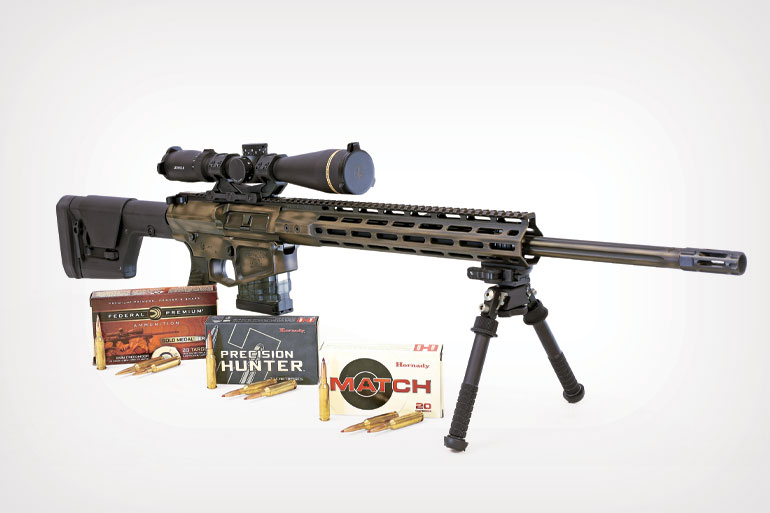
I was at Bill Wilson’s ranch, with Bill himself calling the wind for me, using a Wilson Combat Super Sniper, chambered in 6mm Creedmoor. The Super Sniper is the culmination of the knowledge base of Bill and his crew and their years of building rifles based on the Stoner system.

The Wilson Combat Super Sniper’s 20-inch barrel is heavyweight stainless with a 1:8 twist, and this particular sample had the threaded muzzle option with a Wilson Combat flash hider installed. There is also a rapid-thread muzzle brake as an option.

Wilson-Combat-Super-Sniper
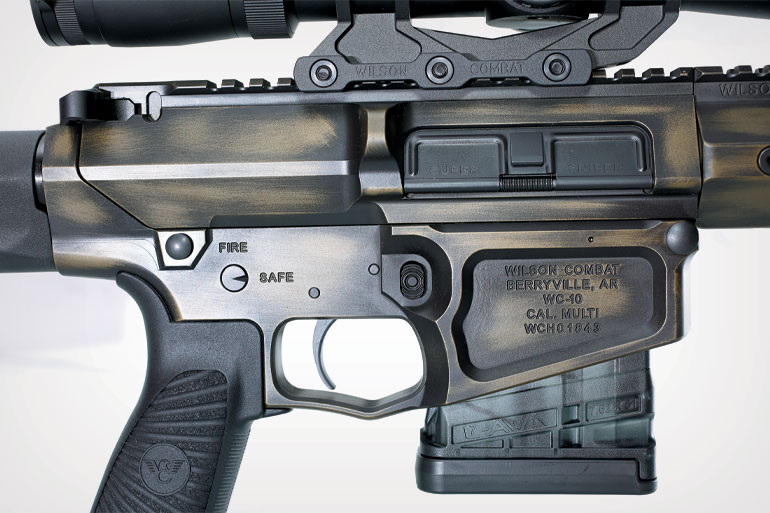
The AR-10-based Super Sniper features aluminum billet receivers with a rubber bumper between them to eliminate play. The trigger is Wilson’s excellent TTU.

The barrel is installed in a Wilson Combat BILLet upper, which is matched to a lower, and both are machined from pre-hardened billet aluminum. A small rubber bumper in the lower bears against the rear lug of the upper as you close it up for a wobble-free fit.

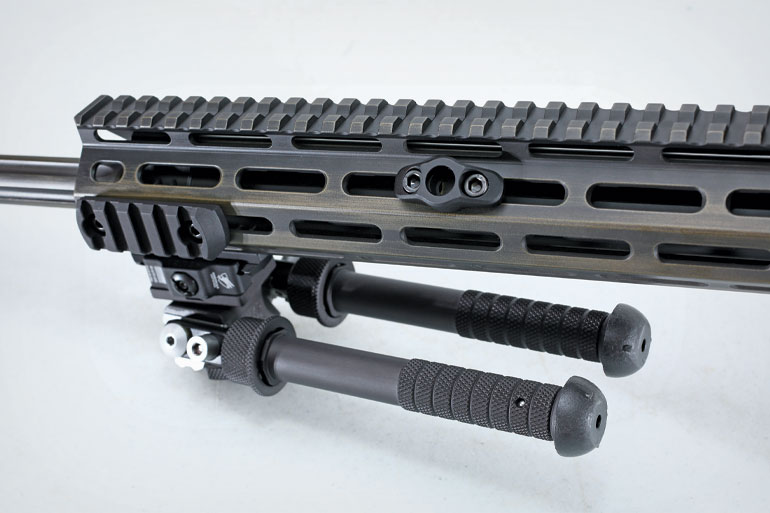
The fore-end is the company’s T.R.I.M. Rail, a free-float handguard 13.8 inches long that has M-Lok slots for mounting a bipod and any other accessories you use. The full-length optics rail up top aligns with the rail on the receiver, so there’s plenty of room for scopes, backup iron sights, night vision or other extras.

The Rogers Super-Stoc telescoping stock is standard equipment, but my sample came with an optional fixed Gen3 PRS from Magpul that adjusts for cheekpiece height and length of pull.

The lower receiver has a Wilson Combat pistol grip, made by Bravo Company with the Wilson Starburst pattern and logo on it. The trigger on my sample was Wilson’s TTU, a two-stage trigger set at four pounds. The charging handle is Bravo’s BCM Gunfighter with its larger-than-GI left-side latch. The Super Sniper’s bolt and bolt carrier are magnetic particle inspected and then NP3 coated.

In the AR-10 version of the Super Sniper, which includes the 6mm Creedmoor chambering, the rifle feeds from M110-pattern magazines. Wilson supplied one from Lancer, but Magpuls will work as well.

The base model Super Sniper is finished in black Armor-Tuff, but my test rifle featured a burnt bronze/black camo pattern. It also came with Wilson’s T V3 Ultralight scope mount. The V3 does not use the hand-tightened wheel of the firm’s Accu-Rizer but rather three crossbolts that clamp the mount to the receiver. It is lighter and sturdier, but it requires tools to install. A Leupold VX-6HD scope was installed for testing.

Wilson-Combat-Super-Sniper
The T.R.I.M. handguard sports M-Lok slots and a full-length optics rail. The finish is burnt bronze/black Armor-Tuff.

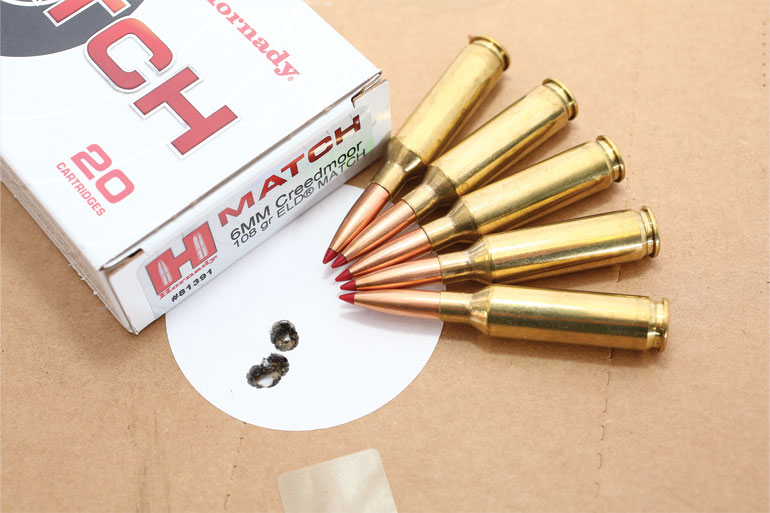
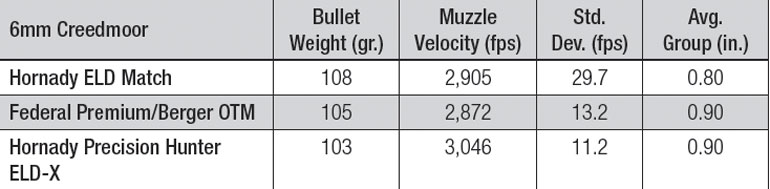
The 6mm Creedmoor is a result of the competitive demands of the Precision Rifle Series, a long-range competition that requires accuracy, flat trajectory and the ability to deliver quick follow-up shots when needed. When I was shooting with Bill Wilson, I could see all my hits out to 1,200 yards, but at the longest distance I couldn’t hear them because the 108-grain bullet didn’t ring the steel hard enough to let the sound carry back to the firing line.

I don’t have easy access to such distances back at home, so I had to content myself with punching absurdly small groups at 100 yards. The clean, crisp trigger pull of the TTU made that easy. I suspect this rifle could shoot even better than I found, as the accuracy limits are getting down to my limits.

What is this rifle for? Well, for someone who wants to get into Precision Rifle Series or similar long-range rifle competitions, this would be just the ticket because it’s scarily accurate and has mild recoil.

As a hunting rifle, the Super Sniper might not be the best choice. At a book weight of more than eight pounds, it isn’t exactly a stalking rifle, and once you load it up with a bipod, scope and ammo, you’re looking at double-digit weights. But if you’re hunting from a tree stand or a blind where you don’t have to lug the rifle very far and there’s an availability of a rest, that weight won’t matter.

As a beautifully made, utterly reliable rifle that the shooters at the gun club will envy, the Wilson Combat Super Sniper gets top marks. Yes, the starting point is a bit on the high side as AR rifles go these days. And once you add in the extras, the price does tick up, but quality costs and quality lasts. If you don’t simply blast ammo into the hillside to make noise, you’ll be a long time wearing out the Wilson Combat Super Sniper’s 6mm Creedmoor barrel.

Wilson-Combat-Super-Sniper
The Super Sniper demonstrated terrific accuracy, which makes it a good option for those looking to get into the long-range precision game.

Wilson Combat Super Sniper Specs

Type: AR-15, AR-10 (tested)Caliber: .223 Wylde, .224 Valkyrie, 6mm Creedmoor (tested), 6.5 Creedmoor, 6.5 Grendel, .260 Rem., .308 Win.Capacity: 20-round Lancer magazine suppliedBarrel: 20 in.Overall Length: 40.5 in.Weight: 8 lb., 11 oz.Receivers: Billet aluminum, burnt bronze/black Armor-Tuff handguard T.R.I.M. free-float M-LokStock: Magpul PRS Gen3 fixed; Bravo Company grip Wilson starburstSights: None; full-length optics railTrigger: TTU 2-stage, 4 lb. pull (measured)Price: $3,020 (base), $5,525 (as tested)Manufacturer: Wilson Combat, wilsoncombat.com

Wilson Combat Super Sniper Accuracy Results

Wilson-Combat-Super-Sniper
Notes: Accuracy results are averages of three five-shot groups at 100 yards off a Champion shooting rest. Velocities are averages of five shots measured on a LabRadar chronograph set to read 15 feet from the muzzle.

Full Story: How Derek Wolfe Killed a Dog-Hunting Mountain Lion

0

Last week, former NFL defensive lineman and Super Bowl 50 champion Derek Wolfe killed his first-ever mountain lion with his bow and some help from a buddy’s hounds — and the cat is absolutely massive.

The photo Wolfe posted to Instagram garnered plenty of attention. It takes a big guy to be an NFL defensive lineman, and at 6 feet 6 inches and 280 pounds, Wolfe is no exception. The photo (full version below) shows an absolute beast of a cat that practically dwarfs the retired football player.

“Gutted, he was 174 pounds,” Wolfe told Free Range American. “Obviously, I couldn’t weigh him up there on the mountain, so I’m guessing he had to be 200-plus.

“He was 8 1/2 feet long,” Wolfe added.

By mountain lion standards, Wolfe’s cat is an absolute monster. According to Colorado Parks & Wildlife, adult males on the large side reach 8 feet in length and weigh an average of 150 pounds.

But the cat isn’t only a trophy for Wolfe with an incredible hunting story attached to it — he actually did the local community a service by taking out this particular mountain lion.

As Colorado cat populations thrive, interactions between people and mountain lions have become tenuous, with family pets often ending up on the big cats’ menu. Before the hunt, Wolfe and his buddy tracked his big cat to a den under a residential porch, and two neighborhood dogs had recently fallen prey to an area cat.

It appears the local pet population and the owner of the house attached to that porch owe Wolfe a little extra gratitude. Here’s how he got on the cat, tracked it through a residential area, and treed it, and how the former pro athlete crawled on his hands and knees to make the shot after climbing a rocky slope completely smoked him.

GOOD GEAR – Look Badass at the Shooting Range With the BRCC Black Rifle AR Cuffed Beanie

Derek Wolfe Untamed

Wolfe played college football as a defensive lineman for the University of Cincinnati and was drafted by the Denver Broncos in 2012. He played eight years with the Broncos, helped the team win Super Bowl 50, and then finished out his career with the Baltimore Ravens.

Wolfe said he grew up hunting and killed his first whitetail with a bow when he was only 13. However, football demanded so much time, energy, and focus that he didn’t have much left for hunting. Wolfe left the NFL just before the 2022 season. While he regularly spent the off-season chasing wild hogs and axis deer, now that the 32-year-old has retired from professional football, he has plenty of time to pursue his passion for hunting.

There’s even a YouTube video series in the works, titled Wolfe Untamed, highlighting the former NFL player’s efforts to tackle new hunting challenges.

RELATED – New Knives From the 2024 SHOT Show

A Mounting Mountain Lion Problem

Wolfe bagged his colossal cat in Game Management Unit 46, which includes parts of Clear Creek, Park, and Jefferson counties. The unit is not far from Nederland, where mountain lions have terrorized the small town by killing at least 15 neighborhood pets, including a 100-pound Doberman pinscher.

“We were like, ‘Oh, man. This isn’t good. This cat is way too comfortable being near people. He’s stalking something here, coming up on the porch and looking in windows. He’s looking for pets or people.’”

— Derek Wolfe

“People in parts of Colorado are really dealing with this, and [Colorado Parks & Wildlife] is only supposed to help when it comes to livestock, and they have to follow the law,” Wolfe said. “There’s nothing that protects pet owners from mountain lion attacks. If a mountain lion attacks your pet and you kill it, you could be ticketed for that.”

Wolfe had been waiting for the opportunity to get a mountain lion with his bow, partly because he had heard about the animals harassing residents and killing their pets. He passed his mountain lion certification exam and bought his license, so when his buddy Alex Nestor called him up after a fresh snow and asked him if he wanted to cut tracks on a big cat, he was ready to go.

On the morning of Jan. 18, Wolfe and Nestor drove along back roads looking for a cat sign. They found evidence suggesting a mountain lion in the area may have been targeting pets, just like the mountain lions stalking Nederland cats and dogs.

“This was for sure a mature male,” Wolfe said. “We looked to the left as we were walking up on the tracks, and there was a full-grown 300-pound 4×4 mule deer lying under a tree that this cat had dragged across the road. It was still a little warm, so we knew it was fresh from that morning.”

They followed those monstrous tracks through someone’s yard and up under their front deck.

“When we looked under there, you could see that the cat had made a little bed in there. It looked like it had been living under there,” he said. “When we knocked on the door to see if anybody was home, we saw that the cat had walked right up onto their porch.

“We were like, ‘Oh, man. This isn’t good. This cat is way too comfortable being near people. He’s stalking something here, coming up on the porch and looking in windows. He’s looking for pets or people.’”

GOOD GEAR – Make the Perfect Cup of Coffee With the BRCC Fellow Clara French Press

The Hunt and the Climb

After two hours of calling around trying to get the landowner on the phone, the two hunters finally got permission to track the cat through private property up into the adjacent public land.

“We put the dogs on the tracks, and where is the first place they went? Boom. Right under that porch. That’s where the scent was heaviest,” Wolfe said. “It’s insane. Any time this guy came walking out of his house, this 8 1/2-foot, 200-pound cat could have been lying under there.”

The dogs eventually followed the cat tracks up into the surrounding mountains, and Wolfe and Nestor followed.

“This area is super mountainous, with straight up-and-down cliffs. There was 2 to 3 feet of snow on the ground, and once the dogs were on him, we went straight up to the top and then straight down the other side.”

Wolfe described how rushing up a nearly 4,000-foot elevation change was one of the most physically and mentally challenging things he’s ever had to do.

“It took me forever to get to the top on the first climb because I was just slipping and sliding on these rocks. It’s all rocks, straight up and down, and you can’t post into it because of the snow,” he said. “The rocks just slip out from under you. So I’m crawling up the hill on one side, then basically sliding down on my back the whole way down the other side, and then trying to get up through a ravine.”

Nestor, still following his dogs, had managed to get ahead of Wolfe, so he dropped him a pin on his phone, marking the spot where the hounds had the cat treed.

“I go straight to the pin and just come out on the road. Then I got the message that said, ‘Dude, you’re, like, 1,000 yards below me.’ I could hear the dogs howling their heads off up there.

“By this point, my legs were cramping. My hamstrings, my calves, and my quads are locked up, and I could hardly walk without being in a full-body cramp. I’m gassed and sucking air. The muscles in my rib cage just locked up on me because I was sweating. It was a crazy sweat, too, because it was so cold.

“Then Alex said, ‘Dude! Get. Up. Here.’”

As a retired pro football player, Wolfe is no stranger to hard work and physical exertion, but this hunt beat him up.

“I’ve had death threats. I would definitely say defamation,” Wolfe said. “It’s these animal rights groups coming after me, trying to say I had no right to do this, that I’m a murderer, or that I’m trying to compensate for something.”

“It was the hardest hunt I’ve ever been on,” Wolfe said. “It felt like I just did a full padded practice in 90-degree heat, but it was cold and snowy somehow. It’s all right, though. You’ve got to pay the price to get to them, man. That’s just the way it goes, especially with a bow.”

Wolfe crawled on his hands and knees the rest of the way up the ridge to get to where Nestor’s dogs had the cat snagged in a tree.

“When I got to the spot, I was just laying there looking up, and there’s the mountain lion above me in the tree. And I’m like, ‘Oh, god. Don’t fall on me, please.’”

Wolfe was so exhausted he wondered if he could pull the 80-pound draw on his Hoyt Highline. Somehow, he managed to stand up and reach a good spot about 12 yards from the tree. Then, he lined up the pin on his Spot Hogg sight and sent a Sevr broadhead straight through the big cat’s vitals.

“I made a really good shot, an ethical shot, and that cat dropped right where I had just been laying.”

RELATED – New Optics From the 2024 SHOT Show

The Real Work Begins

Any rocky hill that can smoke an athlete like Derek Wolfe is a serious fucking hill.

As every hunter knows, there’s only a small moment of celebration after a successful shot, and then the real work begins.

“After all that, I still had to get the cat out of there,” Wolfe said.

“We gutted it and stuffed it, long ways, in my Kifaru pack. His head was hanging out on my right side, and the tail and hinds were flapping out on my left. I put my bow on my back. Then, I got down on my hands and knees and crawled out of there backward, all the way down.

“I couldn’t stand up and walk because my legs were just locking up on me,” Wolfe said. “At one point, I fell about 10 feet down a rock face.

“Everything was straight up and down, I couldn’t get any traction, and I had to wrestle with 180 pounds of cat the whole way.”

He focused on taking one little backward step at a time, mostly on his hands and knees, until he finally made it back to the truck with his cat.

“CPW came out and checked the animal. I was laying on the side of the road because I was just wrecked,” Wolfe said.

GOOD GEAR – Conquer Your Taste Buds With the BRCC AK-47 Espresso Roast

Keyboard Warriors Target Derek Wolfe

Now, as Wolfe spoke to me over the phone from his home in Denver, the hunt is almost a week behind him, and the cat is in various places. The mountain lion’s meat has been sent to a processor, his skull shipped off for scoring, and the hide sent to the taxidermist.

“I haven’t [eaten] mountain lion before, but I hear it’s really sweet meat, so I’m looking forward to it,” Wolfe said. “I had some breakfast sausage made so we can eat biscuits and gravy.”

While Wolfe admits this was one crazy hunt, he said the craziest part is the hate that’s been spewed at him online after the fact, despite the hunt being 100% legal. Major media outlets have been quick to cover how social media keyboard warriors have attacked everything from Wolfe’s character to his masculinity.

“I’ve had death threats. I would definitely say defamation,” Wolfe said. “It’s these animal rights groups coming after me, trying to say I had no right to do this, that I’m a murderer, or that I’m trying to compensate for something.

“I’m not trying to compensate for anything. I just love doing this. This is a lifestyle for me,” Wolfe explained. “Leave me alone. I did everything right. I did everything legal. I’m not out here poaching animals. I’m doing it the right way, the ethical way, and the way it’s meant to be done.

“It’s important to manage any herd, whether it’s deer, elk, bear, or mountain lions. They all need some kind of management because they will starve themselves out, they’ll get diseases, they’ll overkill, and they’ll harm people. There are lots of reasons.

“Hunters are conservationists. That’s what we are. We love animals, and we want them to be around for generations.

I do this because I want my kids to be able to hunt, and I want their kids to be able to hunt. I want them to be able to enjoy it as much as I do.”

READ NEXT – Polar Bear Attacks Remote Alaskan Village — Kills Woman, Toddler

Air Rifle vs BB Gun: Understanding the Key Differences and Choosing the Best Option

0

“Air Rifle vs BB Gun: Unveiling the Key Differences and Choosing the Perfect Weapon for Your Shooting Needs. Delve into this comprehensive guide to understand the distinctions between air rifles and BB guns, helping you make an informed decision on which firearm suits your preferences and shooting goals.”

BB Guns

BB guns are commonly used for recreational shooting and can be an effective tool for scaring away pests, including stray cats. BB guns typically fire.177 caliber round copper-clad steel balls. These round projectiles are inherently unstable in flight, resulting in poor accuracy. Additionally, the lack of rifling in the barrel and the loose fit of the BB inside it further diminish velocity and accuracy.

However, some BB guns have rifled barrels for improved accuracy and may use pure lead shot instead of copper-clad steel BBs. These higher-quality BB guns can produce higher velocities and better precision. It is important to note that even though a BB gun may not be as powerful or accurate as other air rifles or pellet guns, it still has the potential to cause harm or injury if used improperly.

How Does a BB Gun Work?

A BB gun works by using a spring-piston system. When the gun is cocked using either a lever-action or pump-action mechanism, a piston is forced back against a spring. The spring is compressed behind the piston, which is held in place by the trigger sear. When the trigger is pulled, the spring and piston are released. The spring forces the piston forward, compressing air in the barrel. The compressed air propels the BB out of the gun at high speed.

The BB itself is usually made of copper-clad steel and is slightly smaller than the internal barrel diameter. This allows some of the compressed air to escape around the BB, resulting in lower velocities and less accuracy compared to other types of air guns. BB guns typically have velocities ranging from 275 to 475 feet per second.

Other Means of Propulsion

In addition to the spring-piston system used in BB guns and pellet guns, there are other means of propulsion for air rifles. One alternative is the use of metal gas cylinders that hold compressed gas. These gas cartridge BB guns can produce higher velocities than most other BB gun actions. Another option is the use of a multiple pump system, where a piston is used to pump air into a holding chamber. The more times the action is operated, the higher the pressure in the chamber. Many multi-pump rifles can use traditional BBs or bullet-shaped pellets. These different propulsion systems offer varying levels of power and performance, so it’s important to consider your specific needs when choosing between a BB gun or pellet gun.

Styles and Types of BB Guns

There are several styles and types of BB guns available on the market. The most common style is the lever-action BB gun, which has been a popular choice for many years. Another popular style is the pump-action BB gun, which requires the user to manually pump the gun to build up pressure before each shot. Both of these styles typically use a spring-piston system as their propulsion mechanism.

In addition to these traditional styles, there are also newer designs that have revolutionized the BB gun market. Some BB guns now feature larger refillable gas tanks and can offer semi-automatic or fully automatic fire. These gas-powered BB guns often resemble the Browning 1911 pistol and rely on CO2 gas cartridges for power.

Overall, when choosing a BB gun for discouraging a stray cat, it is important to consider factors such as accuracy, power, and ease of use. A lever-action or pump-action BB gun with enough power to frighten or deter the cat should be sufficient for your needs.

Pellet Guns

Pellet guns are a type of air gun that typically fire.22 caliber bullet-shaped lead projectiles. Unlike BB guns, which use round steel balls, pellets are made of malleable lead and can tightly swage to the barrel of the pellet gun. This allows for rifling in the barrel, which imparts spin to the pellet and improves its accuracy.

Pellet guns can deliver higher muzzle velocities compared to BB guns, with some models capable of reaching speeds of up to 1,000 feet per second. The increased power and accuracy of pellet guns make them suitable for hunting small game like rabbits, squirrels, and birds. There are also larger caliber pellet guns available that can be used for hunting larger game species, including deer.

The Advantage is in The Projectile

When it comes to discouraging a stray cat from coming around, both a BB gun and a pellet gun can be effective options. However, the choice between the two depends on your specific needs and preferences.

A BB gun typically fires.177 caliber round copper-clad steel balls. These round projectiles are inherently unstable in flight and lack rifling, making them less accurate. While a BB gun can certainly frighten or potentially hurt a cat, its effectiveness may be limited due to its low velocity and poor accuracy.

On the other hand, a pellet gun typically fires.22 caliber bullet-shaped lead projectiles. These pellets are made of malleable lead that can swage tightly to the barrel, allowing for better accuracy. Pellet guns also often have higher muzzle velocities compared to BB guns, delivering more power upon impact.

In terms of caliber, using a.22 caliber pellet gun may be more effective in deterring the stray cat. The larger and heavier projectile has the potential to deliver more force without causing serious harm. However, it’s important to note that even non-lethal shots can still cause injury or pain to animals.

Ultimately, it’s crucial to prioritize safety and ethical considerations when using any type of air gun against animals. It’s recommended to consult with local authorities or animal control professionals for guidance on humane methods of dealing with nuisance animals.

The Propulsion System – Putting the Pellet Down the Barrel

Air rifles, pellet guns, and BB guns all use different propulsion systems to put the pellet down the barrel. Air rifles can be powered by springs, compressed gas cylinders, or integral air pumps. These power sources create pressure that propels the pellet forward. Pellet guns also use similar propulsion systems to air rifles, but they typically deliver higher muzzle velocities than BB guns. Pellets are made of lead and can swage tightly to the barrel, allowing for better accuracy. On the other hand, BB guns use a spring-piston system that is less efficient and delivers lower velocities. BBs are round steel balls that are less stable in flight and tend to be inaccurate.

Air Guns – Aren’t BB Guns and Pellet Guns Air Guns?

While BB guns and pellet guns are often referred to as air guns, they are not technically the same. Air guns encompass a wider range of firearms that use compressed air or gas to propel a projectile. BB guns and pellet guns fall under the category of air guns, but there are some distinctions between them.

BB guns typically fire.177 caliber round copper-clad steel balls, while pellet guns fire.22 caliber bullet-shaped lead projectiles. The size and shape of the projectiles make a significant difference in terms of accuracy and effectiveness. Pellets tend to be more accurate due to their ability to swage tightly to the barrel and be affected by rifling, while BBs lack these characteristics.

In terms of power, pellet guns generally have higher muzzle velocities than BB guns. Some pellet guns can reach speeds of up to 1,000 feet per second, making them suitable for hunting small game. BB guns typically have lower velocities due to their round character and lack of spin. They are usually used for recreational purposes rather than hunting.

Size is the Difference

When deciding between a BB gun or pellet gun to discourage a stray cat, it’s important to consider the size difference between the two. BB guns typically fire.177 caliber round steel balls, while pellet guns typically fire.22 caliber bullet-shaped lead projectiles. The larger size and shape of the pellet make it more effective in delivering a deterrent impact to scare off the cat without causing serious harm.

In terms of caliber, a.22 caliber pellet gun would be a better choice for deterring the stray cat. The larger size and weight of the pellet will provide more stopping power and impact force compared to a smaller.177 caliber BB. This will increase the chances of successfully scaring off the cat without causing any significant harm.

Regardless of whether you choose a BB gun or pellet gun, it’s crucial to prioritize safety. Always follow proper firearm safety protocols and treat any air gun as you would a standard firearm. Make sure to aim responsibly and avoid shooting at close range or in areas where there may be unintended targets. Remember that even non-lethal shots can still cause injury, so use caution when using an air gun to deter animals.

Developing the Power to Be Effective

When it comes to discouraging a stray cat from coming around, both BB guns and pellet guns can be effective options. However, the choice between the two depends on your specific needs and preferences.

If you want to simply frighten or startle the cat without causing any harm, a low-powered BB gun may be sufficient. BB guns typically have lower velocities and are less likely to cause serious injury. A.177 caliber BB gun should provide enough power to scare off the cat without causing significant harm.

On the other hand, if you want a more powerful option that can potentially deter the cat from returning, a pellet gun may be a better choice. Pellet guns typically have higher velocities and can deliver more energy upon impact. A.22 caliber pellet gun should provide enough power to effectively discourage the cat from coming back.

Regardless of which option you choose, it’s important to prioritize safety and follow all local laws and regulations regarding the use of air guns. Always aim responsibly and take precautions to ensure that no unintended harm is caused.

Powering a Large Caliber Air Rifle

Powering a large caliber air rifle requires a more sophisticated and powerful propellant system than the standard spring-piston designs. Typically, these air rifles depend on either compressed gas cylinders or integral air pumps to generate the high pressures needed to propel the larger caliber projectiles. These systems are capable of delivering enough energy to be useful for hunting big game.

In recent years, new technologies and developments have made large caliber air rifles more viable for both hunting and target shooting. Some air rifle shooters have successfully taken deer, elk, and feral pigs using these powerful rifles. However, it is important to note that using an air rifle for hunting requires careful consideration of distance and delivered energy on impact.

Which is the Best Choice – Air Rifle, Pellet Gun or BB Gun?

When deciding between an air rifle, pellet gun, or BB gun to discourage a stray cat from coming around, there are a few factors to consider. Firstly, it’s important to note that all of these guns should be treated with caution and safety measures should be followed at all times.

If you want to frighten or hurt the cat without causing serious harm, a pellet gun may be the best choice. Pellet guns typically fire.22 caliber bullet-shaped lead projectiles which have better accuracy and deliver higher muzzle velocities compared to BB guns. This means you can have more control over where the pellet goes and potentially scare away the cat without causing significant injury.

The specific caliber of the pellet gun will depend on your preference and local regulations. It’s advisable to consult with local authorities or experienced shooters for guidance on what is suitable for your situation. Additionally, proper aim and accuracy are crucial when using any type of gun, so ensure you have sufficient practice and follow all safety protocols.

Air Rifle, Pellet, and BB Guns – Closely Related but Distinctly Different

When it comes to air rifles, pellet guns, and BB guns, they are closely related but distinctly different from each other. These non-ballistic rifles have different propulsion systems and fire different types of projectiles.

Pellet guns and BB guns typically fire.177 or.22 caliber projectiles, while air rifles can be purchased in various calibers ranging from.177 to.50 caliber. The projectiles used can be round pellets or conical/bullet-shaped projectiles.

The power sources for these guns can vary as well. Springs, compressed gas cylinders, or integral air pumps are commonly used in these types of firearms.

In conclusion, when comparing air rifles and BB guns, it is important to consider their intended use, power capabilities, and safety features. Air rifles offer higher velocities, accuracy, and are suitable for hunting or competitive shooting. On the other hand, BB guns are generally less powerful but can be used for recreational plinking or target practice. Safety precautions should always be followed regardless of the chosen firearm. Ultimately, the choice between an air rifle or BB gun depends on individual preferences and specific needs.


Best Air Rifle Deals

Popular Posts

PCP vs Spring Piston: Which one is better?

0
When reading about guns in the search for the first one that would be perfect for you, an age-old debate comes into question. Should...

What Is a Break Barrel Air Rifle?

0
A break barrel air rifle is a type of air rifle that uses a break action to load and unload pellets. It is one...

PCP vs Gas Piston: Which One is Better?

0
The perfect airgun is a difficult pick when you are new to gun-hunting. There are a lot of things to keep in mind, starting...