Home Blog Page 151

Difference Between Beanies, Toque, Watch Cap, Skull Cap, And Knitted Cap

0

Types of Winter Hats and Beanies.

In the past, hats were one of the most used garments for both men and women. Little by little this fashion was left in the past but today it returns with more strength than ever.

One of the benefits of caps, hats or bennies is that if you wear them during the warm season they protect your face from the sun’s rays and in cold weather, it keeps you warm. Anyway, a bennie can be a great ally, not only to protect you from the weather but it is an accessory that will give glamour and sophistication to your outfits.

The term beanie comes from colloquial word “bean” to refer to the head. At first, the beanies were carried mostly by workers with a front visor to avoid hair on the face and the sun to dazzle them. In the middle of the 20th century, beanies began to be carried by everyone all around the world.

Beanies are accessories that have recently become very fashionable especially for the cold season, but can also be used at any time of the year, there are different styles, colors, patterns, textures available on the market.

Let us find out some of the different types of hats/caps available in today’s fashion:

Toque Vs. Beanie.

Last update on 2024-11-03 / Affiliate links / Images from Amazon Product Advertising API

Definition:

Especially in Canada, Toque is the common name for a knitted winter hat. In the USA and most other parts of the world, it is simply called Beanie. It is a type of hat with no any brim. It comes with varying shapes. But mostly you can find it in the woolen fabric. And usually, it is topped by a pom-pom on it or with tassel.

Similarity – Toque Vs. Beanie:

Toque and Beanie both can be fitted closely with head and it is generally knitted with wool. Both are fashionable. Especially those of animal figures or festive reasons find an original hat according to your style online.

Differences – Toque Vs. Beanie:

Toque can usually be worn in the winter season to prevent from cold wind while on other hand Beanie is so versatile that can be worn anytime. You can wear it in winter while doing sports or simply as an accessory to walk around the city or the countryside.

There are different designed unique Toques are available. It is ideal for those who like to have fun and original style. Different unique colored or simple white and black cap can be combined with any type of clothing in winter. Toque or Beanie, both are modern and cool on a daily basis.

Watch Cap Vs. Beanie.

Last update on 2024-11-03 / Affiliate links / Images from Amazon Product Advertising API

Definition:

The watch cap is a close-fitting knitted cap. It is typically worn by the US Navy members in cold season. This type of cap is ideal for insulating against dropping temperatures, snow, and drizzle. The coverage and the size are easy can be adjusted by cuffing the cap as your desired and style. Usually, it comes with a simple design and keeps your head warm and dry.

Similarity – Watch Cap Vs. Beanie:

Watch Cap and the beanie cap both are presented as the rolled-up companion. And both can be worn in winter months.

Differences – Watch Cap Vs. Beanie:

Watch cap usually comes straight on the back while Beanie comes with a dropped shape on the back and a modern oversize look. Beanie is more suitable with both a daily outfit and a western outfit, the beanie is ideal for any time and place.

Beanies are the first choice of many for any occasion. There are many occasions in which to wear beanies. During outdoor activities, beanies offer optimal protection against the cold. They can also be used during party nights and especially in the so-called Bad Hair Days, those days when it is impossible to set the hairstyle.

Beanies are much appreciated, especially in hipster fashion and are part of the look. And of course, some time ago the beanies were also discovered by musical stars that combine their beanies during the day today.

Skull Cap Vs. Beanie.

Last update on 2024-11-03 / Affiliate links / Images from Amazon Product Advertising API

Definition:

Skullcap comes with tight fitting and crocheted woven or made from knitted material typically brimless. They are classic and simple and it lasts forever.

Similarity – Skull Cap Vs. Beanie:

Skull Cap and Beanies both can be worn by any age young and old. You can find both these types of caps in many leading brands like Nike, Adidas or PUMA. Both are the perfect companions for the sport. In both types, you will get different models for day and night parties. They are also very popular among rappers.

Differences – Skull Cap Vs. Beanie:

You can find skull caps which can be worn usually one side, while on other hand beanies you can find with a reversible model which can be rotated to take them in two colors.

Beanies are complements for any demographic group. The beanies for men are mostly hats fitted to the head. For women, there are also the so-called oversize beanies that are capped with a normal cut in the sector of the forehead and lengthen backward with a fall larger than normal.

Really the beanies are rather colorful and unisex and are rarely selected for a specific sex. For women tend to be beanies adorned with hearts and bows or in pink or garish colors, however, these are an exception.

Knitted Cap Vs. Beanie.

Last update on 2024-11-03 / Affiliate links / Images from Amazon Product Advertising API

Definition:

A knitted cap is usually made with wool. It is designed to offer warmth in cold weather. It has typically simple and tapering constructions though there are many different variants are available in the market.

Similarity – Knitted Cap Vs. Beanie:

Knitted Caps and Beanies always give you the opportunity to fight the cold and the wind. You can combine them with a sweater of neutral or dark colors. It is also useful to use hats with denim shirts and even for halftime with trousers or clothes that will make you gain elegance.

Both are an excellent winter garment! Both types of caps will delight your wardrobe. No matter, whether you are in good for casual looks, subtle and simple, or to enhance your winter clothes, both will always look nice on you.

Differences – Knitted Cap Vs. Beanie:

Knitted caps are usually available with real fur on it. They are made with the best quality materials. They do not fade, they do not shrink and their cleaning does not represent any problem. While on other hand, beanies come plain and it can be shrunk after a certain period of time.

Beanies come with a whole range of textures, colors, and fabrics as you have never imagined, all this and much more! You can be with contemporary or classic styles using western style raincoats and as accessories, fine leather gloves that will make you look distinguished and you will be overwhelming wherever you go.

With beanies, Toque’s, Watch Caps, Skull Caps, And Knitted Caps, you can make a very basic and still impressive style with any suits like skinny cotton pants, jeans, hoodies or a knit sweater, the most important thing is that your heat capacity is not lost! These impressive caps are ideal with booties, jackets, jackets or even jackets.

Caps can be one of the favorite aggregates for any season. So choose wisely, Check out our categories for women, for men and for children.

Join this glamorous trend with us! Resign to be cold, because now with the beanies you’ll be fashionable!

.410 Ammo: Our Top 7 Picks for Hunting Loads

0

The tiny .410 bore may be the smallest caliber shotgun widely available to the public, but it is still an incredibly effective hunting tool. Countless generations of hunters have gotten their start with a .410 thanks to the round’s low recoil. In recent years, advancements to .410 ammo have increased the speed, power, and effectiveness of these tiny shotshells all without creating a larger blow to the wallet. It’s not uncommon to find factory .410s for less than 50 cents per round these days, which is something in this economy. You can’t even get a candy bar for that these days.

There are also plenty of hunters out there who are returning to the .410 simply because they’re looking for a new challenge after having done it all with a 12- or 20-gauge. The smaller spread can make sporting clays fun again if you’ve mastered the other calibers. The .410 has also really taken off for turkey hunting as new modern loads have upped the range and power significantly. We know a self-defense market has also taken off for .410, but today we’re going to focus solely on .410 shotgun ammunition for hunting or clays purposes. These are the options we look for first whenever we head afield with an old .410 bore, and they’ll suit you well in your outdoor adventures, too.

The Best Rifled Slug for .410

Winchester Super-X .410 Gauge

Pros:

  • Reliable, fast .410 slug.
  • 2½- and 3-inch options.
  • Packs a punch on smaller game

Cons:

  • More expensive than other .410 rounds
  • Doesn’t really have the kinetic energy for deer

While most hunters likely don’t think of using slugs with a .410, the proof is in the ballistics of the Super-Xs. Winchester manufactures both a 2½-inch, 1/5-ounce version and a 3-inch, ¼-ounce version of this hollow point, rifled slug. You’re looking at about 1,800 fps of muzzle velocity, which is nothing to sneeze at for a shotgun caliber this small. One area of caution we’ll note is the use of these slugs on deer. We’d advise against it, even if .410 is legal in your state. That’s because the muzzle energy is only 788 foot-pounds, and it slows to 403 foot-pounds at 50 yards, and 234 foot-pounds at 100 yards. And, yes, we do know that hunters have harvested deer with .410s before. However, we like to keep to a minimum kinetic energy of at least 1,000 foot-pounds. That said, we thought the Super-X deserved a spot on this list because it’s a dynamite round for coyotes and smaller feral hogs at close distances. I also like this round for pest control. It’ll do a real number on annoying woodchucks or other pests that are tearing up your backyard. In truth, I like these slugs for those mid-sized varmints better than a .22 or other rimfire. It just ends with a quicker, cleaner kill, which is something all hunters should strive for. At $7.99 for a box of five or $21.99 for 15, these rounds are a little more expensive than some other options, but they’ll get the job done for you effectively.

The Best Dual-Purpose Round

Remington American Clay & Field

Pros:

  • Dual-purpose round perfect for field and clay
  • Quality primer
  • Low price point
  • Hulls are perfect for reloading

Cons:

  • Limited amount of shot sizes available

Shooters know Remington is one of the brands to go to for affordability and reliability, and the American Clay & Fields are a nice option that covers both of those bases. We’ve seen these rounds on sale for just over 50 cents a round if you catch them at the right time. These are lead shot loads that use Remington’s popular STS primers. The muzzle velocity is approximately 1,275 fps for these rounds that are meant for both hunting and clay shooting. It’s nice to seamlessly go from one passion to another without having to adjust for a different round in between. Remington makes these shells in No. 9 and 8 shot sizes with a shell length of 2½ inches respectively. In a hunting scenario, we like the No. 8 shells for doves and pigeons on private lands where lead shot is legal to use. For skeet and clay, we like the No. 9 option as a target load. It’s hard to go wrong with either of these game loads. Normally priced, these rounds go for about $17.99 a box, which isn’t bad for 24 shotgun shells. Pick up a few at a time, and they’ll last you a few seasons of fun target and wing shooting.

The Best-Long Range Turkey Load

HeviShot Hevi-18 410 bore

Pros:

  • Turkey-dropping power
  • Long-range ability
  • High pellet count for a .410

Cons:

  • Extremely high price tag

Ammo manufacturers have really started to push the .410 to its limits to create some of the best turkey loads on the planet right now. If you start comparing specs, you’ll find some comparable ballistics to larger rounds coming from the tiny .410 with none of the nasty kick. Hevi-Shot makes these rounds in No. 7 and 9 shot sizes. The Hevi-18s use dense tungsten super shot (TSS) in place of lead. The cool thing about tungsten is that it’s heavier than lead, which allows hunters the opportunity to drop down shot sizes without losing effective range or stopping power. If you’re introducing a youngster to turkey hunting but are worried about bringing down a bird with a .410 bore, these are probably the best shells to consider. The muzzle velocity of these loads is about 1,090 fps. Another nice plus to these is that tungsten is often considered non-toxic in many places. That makes it an option for public lands. The huge downside to TSS rounds is the price. These rounds go for about $45 for a box of five, or roughly $9 a shell. These are probably the most expensive .410 shells on the market right now as a result. We realize these rounds aren’t for everyone; but for hunters who want to be able to reach out and bag those Toms that like to hang up at 30-40 yards from your setup, these shells will get the job done.

The Best Option for Waterfowl

Hevi-Shot Bismuth

Pros:

  • Non-toxic shot for public land
  • Denser than steel shot

Cons:

  • Extremely tight pattern
  • Price tag

You don’t hear about hunting waterfowl with a .410 bore too often. It’s not something that many hunters attempt. It’s understandable when you consider that many .410 guns meant for waterfowl come with a full choke installed. You often end up with an extremely tight pattern that makes the birds much harder to hit. For that reason, this is one instance where we don’t recommend a .410 for a beginner. Waterfowl hunting with a caliber this small is for the more advanced duck hunters who have already done it all with a 12- or 20-gauge and are looking for a better challenge. If you are going to hunt ducks with a .410, Hevi-Shot’s Heavy Bismuth shotgun ammo is the one to consider. It’s non-toxic, so you can use it on public land, and Bismuth is slightly denser than steel, which means it’s going to have better range and lethality in those scenarios. The only downside is that Bismuth is more expensive than steel. You’re looking at about $55 for a box of 25, or about $2.25 a round. Not cheap, but also not too bad in the grand scheme of things. Especially when you factor in the hot velocity of 1,300 fps from the muzzle. Hevi-Shot offers these rounds in No. 4 and 6 shot sizes that will help you limit out and push your shooting skills to the limit.

The Best Budget Upland and Small Game Shells

Winchester Super-X Upland and Small Game

Pros:

  • Wide variety of shot sizes
  • Affordable
  • Availability

Cons:

  • Toxic shot
  • Challenging for upland hunters

Again, you’ll hear about fewer hunters using .410 for upland game simply because the range and spread are greatly reduced when using one of these tiny shotguns. It can be done, but just like with waterfowl, it’s probably only best attempted by seasoned hunters who are ready for a new challenge. For small game such as squirrels and rabbits, however, it’s a little more doable. Winchester manufactures several high brass variants in .410 in shot sizes ranging from No. 4 to 7.5. I’ve also used the 11/16-ounce loads with No. 6 shot for a little pest control around the house in the past. I can personally attest to the knockdown power of the Super-X line, which is why I use it in nearly all of my firearms. The muzzle velocity is anywhere from 1,100 to 1,135 fps, depending on the shot size and load. There’s something here for almost every hunting scenario. Along with being ultra reliable, Super-X is surprisingly affordable. You’ll usually find it going for about $21 for a box of 25—around 88 cents a round. The other nice thing is the accessibility of these shells. They’re sold practically everywhere, and they’re often still on the shelf even during shortages. It all adds up toward making these some of our favorite general-purpose .410 bore shells to use each season.

The Best Dedicated Skeet and Sporting Clays Round

Federal Top Gun

Pros:

  • Affordable dedicated skeet and clays round
  • Reliable Federal primers
  • Fast muzzle velocity

Cons:

  • Something of a niche round

If you’re truly looking for a real challenge on the skeet or sporting clays range, switching over to a .410 is a sure way to do it. If you can get consistent with a .410 on clay targets, everything else will seem easy by comparison. Federal Premium makes what we think is the best quality dedicated target round in the Top Gun. They make a few variants, a No. 9, ½ shot charge, and a No. 6, 11/16 shot charge. The difference is the No. 6 shot rounds are about 200 fps faster. They are doing about 1,330 fps at the muzzle. There is also a No. 7.5, ½-ounce shot charge option that’s also doing the same speed. These are strictly for target shooting on private lands because they are lead. The other thing we love about these rounds is the affordability. They go for about $17.99 a box, or around 72 cents a round. It’s a nice option to get into competing without breaking the bank.

The Most Affordable Target Round

Aguila Competition

Pros:

  • Wide array of shot sizes available
  • Extremely affordable

Cons:

  • Has a reputation for being dirty

Affordability is a big thing when you’re shooting a lot of shells for competition. Which is why we really like Aguila’s competition rounds. A 25-round box goes for around $16.99, or less than 70 cents a round. These would be a solid choice if you’re helping outfit one of the many clay shooting teams that are popping up as an extracurricular activity in schools across the country. Aguila makes its .410 options in 00B, 7 ½, 8, and 9 shot. The No. 9 shot options has a choice of a ½-ounce or ¾-ounce load. All the shot types are doing about 1,275 fps at the muzzle, which is not bad at all for the price point. Aguila also has a solid reputation for being reliable and accurate, both important aspects of competition. The downside to Aguila is that the ammo has a reputation for shooting extremely dirty almost universally across the whole line. But if you don’t mind a little extra cleaning, this is a solid option that won’t break the bank.

For more outdoor content from Travis Smola, be sure to follow him on Twitter and Instagram For original videos, check out his Geocaching and Outdoors with Travis YouTube channels.

READ MORE: THE 8 BEST .410 SHOTGUNS

DE M4 RIS Electric AEG Rifle Review

0

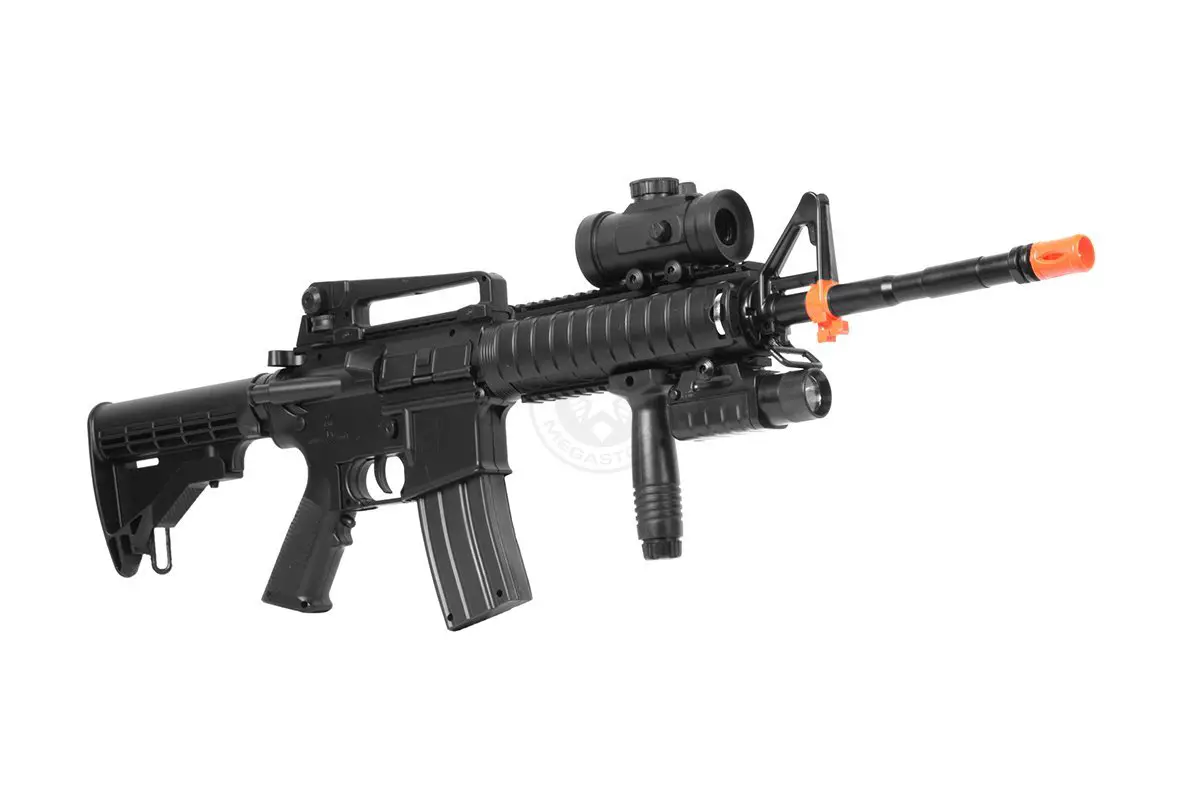
Our take:  The DE M4 TacSpec RIS with a built in RIS system, a flashlight, and a functional red dot scope is one of the best starter electric rifles on the market.  It is one of the best choices a starter AEG and also is one of the best deals around because of its low price tag that includes the rail system and all tactical accessories.  The DE M4 TacSpec features adjustable hop up and a rear-retractable 4-point stock extra comt.  The rail system further adds onto the upgrade potential of this gun, since you can add an almost endless amount of tactical accessories to it, including flashlights, scopes, lasers, and grenade launchers.  Also comes with a vertical RIS egrip.

de m4 ris rifle review

Note:  Carrying handle is removable; underneath it is a weaver rail to mount items such as red dot scopes.

de m4 ris accuracy

Specifications:
Operation:  Electric Automatic
Firing Modes:  Semi-automatic and Full-automatic
Muzzle Velocity:  220-240 FPS
Magazine:  50-round standard M4 magazine
Gearbox:  ABS Plastic
Hop-up:  Adjustable
Weight:  5 pounds

Ammo type:
  0.20gram seamless BBs

Package includes: 
 Rifle, rechargeable battery, wall charger, instruction manual, unjamming rod,  magazine, flashlight, red dot scope.

Lightning Safety Tips for Fishermen

0

Lightning Safety Tips for Fishermen

I love the phenomena of thunderstorms. Like many of you, I’m fascinated by the crackle of lightning bolts and house shaking thunderclaps. Also, like too many people, I’ve unwisely continued fishing while a storm approached when I should have been long gone to safety. Lucky for me, I miraculously survived that ordeal. Honestly, even a record largemouth bass is not worth getting fried over.

Facts about Lightning & Fishing

  • Lightning kills 80 to 100 people yearly in the U.S.A little more than half of victims were engaged in outdoor recreation like fishing or boating. Ten times as many are struck but survived with severe, life-long injuries or disabilities. With the height of lightning season upon us, it’s time for fishermen to consider lightning safety.
  • You Must Stop Fishing during Lightning.Lightning can strike as many as ten miles away from its source cloud. This is why it is recommended to stop fishing and move indoors as soon any thunder is heard. The debris clouds trailing behind a thunderstorm can produce their own lightning, fishermen should wait 30 minutes after the storm has passed to begin fishing to be completely safe. While inside during a storm stay away from doors and windows, plumbing, wiring, appliances and telephones.
  • When to Stop Fishing during Lightning?A somewhat less conservative response to seeing lightning involves the ’30/30 rule.’ Upon spotting lightning, if you can count to 30 before hearing thunder, the odds are you’re out of range of the lightning. A count of five before hearing thunder equals roughly one mile of distance from a lightning strike, a count of ten equals two miles, etc. However, thunderstorms can move as fast as 50mph so the next bolt of lightning could be right on top of you.

William Becker, of the University of Florida, notes that lightning is very unpredictable and bolts contain as much as 100 million volts – a minimum of 500,000 times the electricity needed to power a sparkplug! Lightning follows Ben Franklin’s ‘path of least resistance’ rule, and guess what? The path can easily be through a fisherman’s body, which happens to conduct electricity quite well. So, if it’s impossible to seek indoor shelter and you are trapped outside during a thunderstorm, reducing your exposure is critical. Lightning Safety Tips for FishermenWhat to do When You See Lightning?

First thing to do

1) Lay down your fishing rods, they could act like an antennae and draw a lightning strike right to you. If on land,

  • seek like-sized shrubs or a group of small trees, get low and avoid touching the plants. On open terrain like fishing beaches or desert potholes with no form of cover, find a low spot and crouch on your heels.
  • Never move towards solitary trees and avoid isolated structures like gazebos or picnic table covers (especially if they are constructed of metal), lightning can travel as much a 60 feet sideways after striking an object. An automobile – but not convertibles or cars with a fiberglass roof – offer some shelter but put your hands in your lap and avoid contact with the steering wheel, radio, ignition, etc.

2) If you are on a Boat

Boaters are at great risk during lightnings. They are often the highest object on the water’s surface. Even distant thunder or lightning flashes should trigger an immediate move toward shelter on land.

  • Lower all fishing rods and radio antennasThen crouch down without contacting any metal railings, wiring, or the motor; don’t get in the water or dangle your legs or hands in the water.
  • Disconnect the VHF radio and GPSThis way they may survive a lightning strike. Lightning protection systems are available for some fishing boats but getting off the water is safer.

Lightning strikes the United States around 25 million times per year.

Most Florida fishermen won’t be ‘shocked’ to hear their state annually has more strikes than any other. However, NOAA notes that lightning occurs in all fifty states. Lightning can occur at any time, but late afternoon hours are the most dangerous periods for lightning strikes, and folks spending time outside in open areas like fields or beaches are the most common victims. So make yourself aware of the weather forecast before heading out to fish and if the predictions include thunderstorms plan on returning home before the storms are due to bubble up.Fishing for bass, walleye, trout, catfish, bream, or whichever species you favor, can be a fun way to enjoy the great outdoors if you keep in mind lightning safety whenever you grab your fishing rods for a day on the water.

Airsoft Guns Vs Airguns – What Is the Difference?

0

When you think of airsoft guns, the first thing that may come to mind is the movie “National Lampoon’s Vacation” where Chevy Chase and his family are terrorized by a group of thugs armed with airsoft guns. Airsoft guns have certainly come a long way since then and are now used for recreational activities by many people. But what exactly is the difference between an airsoft gun and an airgun? Let’s take a closer look.

Overview of Airsoft Guns:

Airsoft guns are types of simulated firearms that are powered by batteries or compressed air. They fire spherical plastic BBs using a spring-fed mechanism called the “blowback” system.

Unlike actual guns, they have been designed specifically for use as target practice and simulation training tools, especially for law enforcement officers and military personnel.

Airsoft guns come in a variety of styles, sizes, and colors to suit the needs of different users. Many models also feature tactical upgrades such as scopes, lasers, lights, grenade launchers, adjustable stocks, rails for mounting accessories like flashlights or bipods, etc.

Overview of Airguns:

Airguns are a type of shooting equipment that uses compressed air or spring pistons to propel projectiles. Unlike conventional firearms, which typically rely on combustible propellants such as gunpowder for their power source, airguns use pressurized air or springs instead.

There are several different types of airguns, ranging from small handguns and rifles to powerful pellet guns and BB guns. Some models feature single-shot mechanisms while others have magazines capable of holding multiple rounds. Most airgun designs also feature mechanisms such as break barrels or underlever cocking systems that make them easier to reload and shoot.

Airsoft Guns Vs Air Guns – Differences Between These Two Guns

Materials and Barrels:

– Airsoft Guns:

Airsoft guns are made of tough, lightweight plastic materials that can withstand high impact and provide good resistance to scratches and dings. They also feature precision barrels made from metal alloys such as steel or aluminum for enhanced accuracy and range.

– Air Guns:

Air guns are typically made of wood, metal, or other durable materials that can withstand repeated use. The stock can be made of wood or synthetic materials. The barrels may be constructed from steel, aluminum, or other robust materials to ensure precision performance at a range of distances.

Power Sources:

– Airsoft Guns:

Airsoft guns typically rely on gas pressure or spring-powered mechanisms to propel the projectiles they fire, although some models may incorporate electric motors instead. These power sources allow airsoft guns to deliver consistent muzzle velocities across different shooting conditions.

– Air Guns:

Air guns are typically powered by compressed air or springs, although some models may also incorporate gas piston systems or precharged pneumatics (PCPs) instead. This allows users to precisely adjust the firing velocity of their airgun based on shooting conditions, target type, and range.

Power and Range

– Airsoft Guns:

Airsoft guns are commonly designed to deliver muzzle velocities of between 300 and 600 feet per second, which is sufficient for short-range target practice and simulation training. Some models can reach much higher velocities, up to 800 or even 1000 FPS.

– Air Guns:

Air guns typically have a muzzle velocity ranging from 500 to 900 FPS, which is enough for both hunting and recreational shooting at targets or small game animals. Some .177 pellet guns can reach velocities of over 1200 FPS, the Gamo Magnum. Air guns have multiple calibers to choose from: .177, .22, .25, .30, .357, all the way up to .50. The bigger the caliber, the more powerful an air gun is, some can take down large games like deers or elks.

Accuracy:

– Airsoft Guns:

Airsoft guns are typically designed to provide good accuracy at close to medium ranges, with some models also capable of hitting targets at longer distances. Their barrels and sights are often precisely calibrated to ensure accurate shooting results.

– Air Guns:

Air guns can also deliver excellent accuracy over both short and long ranges, due to the precision construction of their barrels and sighting systems. These guns may be equipped with scopes or other types of optical sights that enhance the shooter’s ability to zero in on targets from a distance.

Ammunition:

– Airsoft Guns: use BBs as their primary ammunition type, although some models may also use metal or plastic pellets. These projectiles are typically small in size and lightweight, allowing airsoft guns to deliver large volumes of fire for short periods of time.

– Air Guns:

Air guns rely on a variety of different types of ammunition that can range from wooden pellets to lead airgun bullets or arrows. Most air gun cartridges are sized to fit into the chamber of the gun without modification, while others require specific chambering adapters. The choice of the projectile will determine how powerful an air gun is, with heavier ammo delivering more recoil and greater impact force on targets.

Purpose:

– Airsoft Guns: for sport and target practice, airsoft guns are used by recreational shooters and enthusiasts to practice shooting skills. They can also be used in military and law enforcement training simulations as well.

– Air Guns:

Air guns are commonly used for hunting small/medium/large game animals, pest control, target practice, or competitive shooting. Many air gun enthusiasts also enjoy participating in air gun competitions such as field target shooting, bullseye target shooting, or plinking.

(For more on the best air rifle for hunting medium games, see this post)

Rifle Scopes: First Focal Plane vs. Second Focal Plane (Explained in Plain English)

0

What’s the difference between first focal plane vs second focal plane?

A first focal plane reticle enlarges and shrinks as you adjust the magnification while the second focal plane remains the same size.

Why does that matter and which focal plane scope should you choose?

By the end of this article, you’ll fully understand both types of focal planes so you can choose the best rifle scope for your needs.

Let’s get started!

What is the First Focal Plane?

There are two locations where a reticle can be installed within a rifle scope: the first focal plane (FFP) or the second focal plane (SFP).

With a first focal plane scope, the reticle is physically placed on the “front” of the erector tube assembly and magnification lenses. The first focal plane is furthest from your eye when looking down the sight.

How does that make a difference?

With a First Focal Plane scope, the size of the reticle will appear to grow or shrink as the scope’s magnification is increased or decreased, respectively.

FFP SAMPLE (1)

Now that you’ve got the basics, let’s talk about the pros and cons…

First Focal Plane: Pros and Cons

With the first focal plane optics, the reticle size is going to scale up or down with your magnification adjustments.

This means your trajectory markings, or holdover values, are going to remain accurate regardless of what magnification setting you’re on. This is great news if you hate doing math!

But, it comes at a cost…Literally.

The price is often higher by virtue of its more complicated construction. A first focal plane reticle is also typically associated with higher-end scopes.

With first focal plane scopes, the reticle will look small and thin with less power while the reticle will be thicker at higher power.

FFP SAMPLE (2)

It can be easy to lose those thin reticle lines, especially against dark backgrounds. Although, some of the best Leupold riflescopes have illuminated reticles for better visibility.

Also, the reticle can cover too much target at the highest setting. If this is a dealbreaker to you, that’s where Second Focal Plane comes into play…

What is the Second Focal Plane?

The most common design is SFP, or a Second Focal Plane scope. It’s also referred to as Rear Focal Plane.

With a second focal plane scope, the reticle is placed behind the magnification lenses on the erector tube assembly.

The second focal plane scope is closer to your eye. Therefore, the reticle stays the same size at any magnification range.

SFP SAMPLE (1)

Now, let’s talk about the pros and cons of this…

Second Focal Plane: Pros and Cons

Its lightweight, great resolution, and durability against heavy cartridges make it a popular choice among hunters and law enforcement.

With the second focal plane, your units of measure per each hash mark (MOA or MRAD) represent the same value regardless of your magnification setting.

However, the spacing for holdover in the reticle is only correct at the highest magnification setting. So, it’s not always reliable for variable long-range shooting.

For example:

Let’s look at the Viper HST 4-16×44. This is a second focal plane scope with a magnification range of 4-16x. The Viper HST has hash marks representing 1 MOA but this is only true at its full magnification: 16x.

Of course, you can always do the math in between. But it becomes complicated and confusing and we all know that’s no bueno.

Second focal plane scopes are more commonly seen in the average riflescope and they’re easier to manufacture. That’s why they’re typically less expensive.

First Focal Plane vs. Second Focal Plane for close-range shooting

A second focal plane scope is more suited for close-range hunting and defensive shooting.

SFP SAMPLE (1)

Why?

Because you have a strong and easy-to-see reticle even at the lowest magnification. With low-powered optics, like 1-4X optics, this is a highly undervalued feature.

When it comes to a First Focal Plane scope, you can easily lose sight of your marks at low power. This can be a hassle when you need to make adjustments for the wind or distance— especially for older eyes.

Since you’d have to zoom out to get the rest of the marks in the scope’s view, your target shrinks relative to your view. If you’re hunting small game, this can be an inconvenience.

First Focal Plane vs. Second Focal Plane for long-range shooting

First focal plane scopes are best for competitive and long-range precision shooting.

The hash marks represent the same value across all magnification levels. It allows you to use and trust those holdovers at any given point in your magnification.

This is an advantage for spotting impacts and misses for corrections. It’s also very helpful if you need rapid and precise follow-up shots.

Hitting something at longer ranges means getting as much precision as possible. With a second focal plane scope, making those fractional MOA adjustments becomes far more difficult.

Conclusion

The truth is— it’s a matter of preference and intended use. There is no “better” between the two focal planes.

Higher magnification ranges are better in a first focal plane scope. Lower magnification is fine for second focal plane scopes.

If you’re into precision shooting, especially in matches, and you don’t mind the cost: a first focal plane riflescope is great to have.

If you won’t be taking many shots where you need to “hold” for windage or elevation, a second focal plane scope is more than enough. Plus, it won’t necessarily break the bank.

There are other things you need to consider before buying an optic— like choosing the best quick detach scope mounts. At least when it comes to a SFP scope vs a FFP scope, you won’t be scratching your head anymore.

Since we’re on the topic of upgrades, my AR-15 A2 front sight removal guide is up. Go check it out!

Picking a Walleye Ice Rod 

0

Picking a Walleye Ice Rod It’s coming quick this year – ice season. Often early ice can be one of the best times of year, so let’s get ready!

We use two types of rods when ice fishing for walleyes. One is for jigging and one is a dead stick, which is simply hanging a bait in a secondary hole.

One of the things that makes catching walleyes tricky is the way they bite. They don’t really bite a bait, they suck it in. As they move close to their prey, they open their mouth, flare their gills and suck a volume of water, hopefully containing your bait, into their mouth. Then with their sharp teeth they hold the bait in their mouth, waiting for it to quit struggling while determining if they want to swallow it. If they detect something is wrong (bad taste, too much resistance, wrong texture) they just open their mouth, slam their gills tight and blow the bait out. The problem is this can all happen is less than a second!

So as a walleye angler, we need sensitivity in our equipment to not only feel a soft bite, but to feel it quickly and then set the hook before the walleye spits out our offering.

The hookset can often be problematic with walleyes, as their mouth is very boney. To set the hook point into their mouth you have to make your lure move inside the mouth, so it can drive into those bones. With a walleye this can often be difficult because of the way they are holding that bait solidly in their teeth. A hard, solid hookset, is imperative.

Lastly, the rod needs to be able to handle the fight of a walleye. Since the rods are short, normally less than 3-feet, you don’t have a nice long bow in the rod to take up the head shaking of a big walleye. These head shakes are amplified by the use of no-stretch lines (see below). So, a good walleye ice rod needs to be able to absorb the pull of the fish.

It is also important with this short length be able to keep continuous tension on the fish, so it can not throw the bait. Add to that the issue of having to fight the fish up through a small hole and you must have the right action to consistently land fish.

Jigging Rod

This is the rod you’re working by popping, dropping, jiggling, and pounding as you try to entice a walleye to first get interested, and then to strike. We use a couple of different rods for jigging. The Clam Ice Team Professional Series 26” Medium Action Walleye Rod and the JT Outdoors 30″ Gold Digger are great all-around rods. For targeting bigger walleye, we use the JT Outdoors 34″ Black Reign. All of these rods have similar attributes. The shorter ones are particularly good in one-man shacks like the Clam Legend XL Thermal and the longer rods for bigger shacks like the Clam X200 Pro Thermal.

These rods are all super sensitive and lightweight. When fishing in cold conditions, walleyes often don’t hit the bait very aggressively, once again, they are just sucking it in. Also, many times you will be getting bites as the fish chases your bait in an upward direction, so it is hard to detect the bite because they are pushing slack in the line as they bite while they swim toward you. You’ve got to be able to feel them to move on to the next step – setting the hook!

To increase sensitivity, we use a no stretch line as our mainline. The best choice out there is Berkley NanoFil. NanoFil is a uni-filament line, meaning it is a single strand of no-stretch material with no braiding or weaving. The no-stretch attribute greatly increases your ability to feel what is often a subtle bite. The beauty of uni-filament is that it does not retain water in the line, so ice build-up is greatly reduced. Nothing dampens sensitivity more than a big glob of ice on the line! The ice that does build up on NanoFil is on the outside of the line and is quickly taken off with a single sweep between your fingers. For walleye fishing, 8-10lb NanoFil is best.

Often in ice fishing conditions, the water is much clearer than in summertime. There is no algae or sediment from wind to cloud things up. For this reason, you will want to use a Fluorocarbon leader to make the line that is tied to the bait nearly invisible. We use a small #14 to #18 swivel to attach the NanoFil to the Fluorocarbon leader. The length and pound test of the leader depends on conditions. If you are targeting larger fish, then lean towards a 10lb leader made with Berkley Professional Grade 100% Fluorocarbon. For smaller fish or in super clear conditions, you might go as light as 6lb Fluorocarbon. A standard leader length is 2-feet, although in gin clear water a 4-foot one is not uncommon.

The nice thing is that you can rig your reel one time with NanoFil and then adjust your leader to the situation. You can even quickly change to a 2-pound leader if some nice crappies happen to show up! A power hookset can be achieved with these rods because they all fast taper. This means that only the last few inches of the rod have a lot of bend. Since the majority of the rod is stiff, it has a strong backbone and thus amazing hook setting power.

With the few inches on the end of the rod being extremely flexible, you have some rod bend during the fight. It is a very specific action to get the right power in the backbone but flexibility in the tip, and these three rods nailed it!

Dead stick

There are a couple instances when we use dead sticks. The first is when walleyes are in a finicky mood. Often hanging a rod with a simple jig and live minnow in a hole next to where we are jigging produces better than the jigging rod. Jigging is still important to draw the fish in, but we see it on our Lowrance HDS units all the time, a walleye comes in and looks at the jig rod, doesn’t bite, but fades over to the jig and a minnow and slurps it in.

Second, we are also big proponents of using JT Outdoor Hot Boxes for our dead sticks. These boxes have a propane heat source in them to keep the hole clear of ice, so they can be set up remotely from our shacks. They are very portable and quick to set up. These boxes really give us big advantages! If you are fishing a flat or basin area by spreading out lures similar to how you would use planer boards in the summer, you can multiply your results. If you are fishing structure it is nice to be able to set up rods in several depths. Try jigging in a shack at the top of the break with a Hot Box set at the middle or bottom of the break to cover several depths.

In any situation, the big difference between a jigging rod and a dead stick is that you’re are not typically holding the rod to detect the bite. The walleye is going to suck the bait in and either hold it while determining if it is going to eat it, or it will slowly start to move away. Since there is a delay between the bite and the hookset you need to use a much more limber rod for this set-up. Enter the JT Outdoors 36” Walleye Snare Rod. This is one of the coolest rods out there for ice fishing! It is super flexible at the tip to about half way down the rod. You could call this rod action Slow Taper. The idea is that the walleye will suck in the bait and feel little or no resistance from the rod. Remember too much resistance will make them want to spit the bait.

The Snare Rod has a built-in red ball at the end of the rod, so even at a distance you can see the slightest bite as the rod tip and ball will move slightly down. When you get to the rod at this point, a solid sweeping hookset will double over the Snare Rod enough to get into its strong backbone and drive the hooks home! We have never seen another rod on the market that duplicates this rods ability to trick a walleye into holding on to a bait with its limberness, but still have the hook setting strength of a Snare Rod!

Sometimes, especially with Hot Boxes it might take a while to get to a biting walleye. What’s interesting is that you will catch a surprising number of fish that sit still and hold on to the lure a long time. The other thing that may happen is that once the walleye determines its ok to eat the bait, it will typically swallow the bait a little deeper and it will start to move away. Correspondingly the Snare Rod will double over even more. Often the red ball will even touch the water!

This is where things get interesting. As the Snare Rod bends more and more, it also starts putting more pressure on the fish. Many times the fish will make a sudden move to try to get away. This move often puts the Snare Rod into its strong backbone and the fish will literally set the hook by its self – thus the name Snare Rod! One big advantage of the Snare rod, is once the fish is hooked up, you’ll have all kinds of flex in the rod and fish rarely get off.

Set up the Snare with the same Nanofil mainline and don’t be afraid to drop down a size or two in your leader pound test, this is a more finesse technique, so a lighter leader will often allow the minnow to swim more actively on a light jig.

Two rods, same result – The Next Bite!

Mule Deer in New Mexico | New Mexico State University – BE BOLD. Shape the Future.

0

Guide L-301 Revised by Louis C. Bender and Chris Allison College of Agricultural, Consumer and Environmental Sciences, New Mexico State University

Authors: Respectively, Senior Research Scientist (Wildlife) and Retired Extension Range Management Specialist, Department of Extension Animal Sciences and Natural Resources, New Mexico State University. (Print friendly PDF)

Introduction

Mule deer (Odocoileus hemionus, Figure 1) are one of the most important game animals in New Mexico and the West. The size of the mule deer population in New Mexico is unknown, and densities of mule deer can vary greatly among areas and over time. For example, densities of mule deer ranged from an estimated <1.2 deer/mi2 on private land in Colfax County to <1.9 deer/mi2 on New Mexico State University’s Corona Range and Livestock Research Center (CRLRC), while a recent minimum count found 3.7 deer/mi2 in higher-density areas of the San Andres Mountains (Bender et al., 2011, 2012; L. Bender, unpublished data). On CRLRC, mule deer densities declined from 1.9 deer/mi2 in 2005 to 0.7 deer/mi2 in 2008, highlighting the variation possible in deer populations in response to drought and other factors. In general, mule deer have been declining in numbers in New Mexico since populations peaked around the 1960s, similar to declines seen throughout the West (Heffelfinger and Messmer, 2003). Because of population declines, harvests of mule deer have also declined; deer harvests (mostly mule deer), estimated to be as high as 55,000 in 1960, declined to <10,000 in 2013. Despite declines, mule deer are still present in all 33 counties in New Mexico.

Figure 1. Mule deer are New Mexico’s most important big game species. (Photo by Terry Spivey, USDA Forest Service, Bugwood.org.)

Range and Habitat

There are two subspecies of mule deer in New Mexico, the Rocky Mountain mule deer (O. hemionus hemionus) and the desert mule deer (O. hemionus eremicus). Rocky Mountain mule deer are found in the northern two-thirds of the state and desert mule deer in the southern third. The Rocky Mountain mule deer is larger; the average field-dressed weight of mature (6 years or older) males (bucks) is around 195 lb, with larger deer weighing more than 250 lb. Mature desert mule deer average about 140 lb field-dressed, with the largest deer approaching 170 lb.

Mule deer are extremely varied in their habitats. Rocky Mountain mule deer are found from above the timberline to low-elevation short grasslands, and frequently in urban areas. During winter, deer that use higher elevations usually migrate to lower elevations where food is more easily obtainable and deep snow does not limit their movements.

Desert mule deer prefer shrublands and woodlands in desert mountain ranges and hills, or arroyos in arid desert flats. They normally spend summer and winter in the same general area.

Physical Description

Mule deer have extremely large ears, hence the name. Adults have a reddish coat in summer and a gray coat in winter. The summer coat is fine and silky in texture and the winter coat is coarser and thicker. Desert mule deer are usually lighter or paler than Rocky Mountain mule deer. The reddish-brown fawns are spotted and depend on their protective coloration for safety. They lose their spots two to three months after they are born. A characteristic feature of the mule deer is the large white rump patch that surrounds the base of the tail. The tail itself is white with a small black tip. Unlike the white-tailed deer, the mule deer does not raise its tail in alarm, but holds it against the body as it flees. Mule deer may also stot, or bounce stiff-leggedly on all four legs, when fleeing.

Mule deer bucks have antlers that are forked (Figure 2) instead of being like a white-tailed deer’s, whose points rise from the main beam (Figure 3). The antlers are shed following the breeding season each winter, and new antlers begin growing shortly after the old ones are dropped. The dropping of antlers occurs when the length of daylight decreases, triggering glandular reactions that control the production of testosterone, insulin-like growth factor-1, and other hormones. The same process is involved in the growth of the new antlers, which are covered by a skin called velvet that contains an extensive network of blood vessels. These supply the protein and minerals needed for the growth of antlers, which are the fastest-growing tissues in the animal kingdom. In late August or September, the velvet dries up and is rubbed off on small trees and shrubs as the antlers harden or mineralize. Antler size and number of points depend mostly on the deer’s age, physical condition, and their genetic background (Bender, 2011).

Figure 2. Antlers from a mule deer.

Figure 3. Antlers from a white-tailed deer.

Life Cycle

The breeding season or rut for mule deer in New Mexico begins in late November (northern areas of the state) and lasts until mid-January (southern areas). During breeding periods, mature bucks cover a large area in search of receptive females (does). The does are receptive for about three days. If they are not bred during this time, their cycles will continue, and 28 days later they will again be receptive. Unbred mature does are rare in New Mexico.

There is little actual fighting between bucks because dominance hierarchy has usually been established before peak rutting periods occur. The smaller or less-aggressive bucks recognize their superiors and usually give in to their dominance. The breeding class is usually the prime-aged mature bucks, plus a few younger bucks who are exceptionally large-bodied or aggressive. One buck will breed with many does, so it is not necessary to have equal numbers of males and females. No permanent bond is formed between bucks and does. When the female is no longer receptive, the buck will leave her to seek other does.

Mule deer have a gestation period of about seven months. Fawns are usually born in June and July, later in southern New Mexico and later if does are in poor condition. Normally, a doe has one fawn the first time she gives birth. After this, she may have multiple fawns if she is in good condition. After about age seven the number of fawns will decrease again.

Fawns get up on their feet only hours after birth, but they are rather unsteady and very susceptible to predation. During their first few days, they remain hidden and alone except when feeding (Figure 4). At about three weeks of age, the fawns begin sampling solid foods, and shortly thereafter they begin to accompany the doe almost constantly. Most fawns are weaned by October or November, after which they are dependent on their competitive ability to obtain adequate nutrition. Fawns that are larger at birth, or born earlier, tend to be larger at weaning and therefore are more likely to survive.

Figure 4. Fawns depend upon hiding and lying still for survival during their first few weeks. (Photo by Mara Weisenberger.)

Survival

Typically >80% of unhunted mule deer adults in New Mexico survive each year, although this can drop to <60% during severe droughts (Bender et al., 2007, 2010, 2011). Likewise, survival of fawns can range from >50% to none surviving, and the latter occurs during droughts when condition of adult females is very poor (Lomas and Bender, 2007). Malnutrition is the most common cause of death (excluding hunting) in studied mule deer populations in New Mexico.

Malnutrition is the most common disease of mule deer (Bender et al., 2007, 2010, 2011), and when other diseases and parasitism cause mortality, the actual underlying cause is usually poor-quality food that causes malnourishment. Probably the most publicized diseases of mule deer are the epizootic hemorrhagic disease-bluetongue complex (collectively called hemorrhagic disease [HD]) and chronic wasting disease (CWD). HD is a viral disease that affects deer, pronghorn, and bighorn sheep; it is spread by biting gnats or midges (Culicoides spp.). Although HD can be enzootic (always present in low frequency), in mule deer it is most commonly seen in infrequent epizootics (outbreaks), which can result in a large number of deaths when deer and vector conditions are conducive to outbreaks. Outbreaks occur during late summer or early autumn, usually in close proximity to wet areas. During outbreaks, some deer die quickly with no apparent signs of disease, others may die within a week, some recover but are debilitated, and still other deer show no sign of disease during outbreaks, and survivors may develop immunity to that particular virus serotype (but not necessarily other HD virus serotypes). White-tailed deer are more vulnerable to HD (especially epizootic hemorrhagic disease) than mule deer, and thus high mortality from HD is more common in white-tailed deer and pronghorn than mule deer.

Chronic wasting disease (CWD) is an invariably fatal degenerative neurological disease of deer, elk, and moose. CWD, a transmissible spongiform encephalopathy, is very rare in New Mexico and is limited to portions of the San Andres, Organ, and Sacramento Mountains. Uncertainty still lingers over exactly how CWD is spread and even the causative agent, which is likely an abnormal protein called a prion. Much of the concern about CWD involves its similarity to bovine spongiform encephalopathy (BSE), or mad cow disease; consuming products from BSE-infected cattle has been linked to fatal new variant Creutzfeldt-Jakob disease in humans. However, the World Health Organization has concluded that there is no evidence that CWD can be transmitted to humans. Despite this, hunters should avoid eating venison from infected animals (or other obviously sick animals) and should use simple precautions, such as wearing latex gloves when handling deer or elk from areas known to have CWD. Many states also restrict movement of venison or other parts of deer, elk, and moose from areas or states where CWD is present; be sure to check with local Game Departments for regulations on transporting venison. The Chronic Wasting Disease Alliance website (www.cwd-info.org) is an excellent source for up-to-date information regarding CWD and its management.

Predators kill deer in New Mexico each year. The chief animals that prey upon deer are mountain lions, black bears, Mexican wolves, coyotes, bobcats, and feral dogs. Interactions between predators and mule deer are complex and highly variable across distance and time; the key to understanding predation is differentiating between the act of predation and the effect of predation. Although predators kill deer, predation may have little effect on the population if predation substitutes for (e.g., is compensatory to) other forms of mortality because deer are in poor condition or otherwise predisposed. When predation is additive to other mortality factors, then predation can limit deer populations. Whether predation is mostly additive or mostly compensatory varies with the specific local conditions of the predator and prey communities, and their surroundings.

Mule deer can live about 10-15 years. The average lifespan of bucks is shorter than does, especially in areas of heavy hunting pressure. Because of this, most populations contain only 25-50 bucks for every 100 does.

Food Habits

Mule deer feeding is mainly crepuscular, meaning that they feed mostly early in the morning and again just before dark. They prefer higher-quality foods like forbs (commonly called weeds) and browse (leaves, buds, and new shoots of shrubs and trees), but they also utilize grasses when young and actively growing as well as succulents. Seasonally, mule deer diets are >60% browse in spring, >50% browse in summer and autumn, and >80% browse in winter (Heffelfinger, 2006). Most of the remainder of the diet is forbs, and grasses and succulents (e.g., cacti) usually contribute much less than 10% seasonally.

The actual diet of deer is very diverse and reflects what is available. Common foods in northern New Mexico include aspen, chokecherry, oaks, bearberry, bitterbrush, mountain mahogany, and most other shrubs in the rose family (Rosaceae). Winter diets may be supplemented with firs, pines, and other evergreens, though in limited quantities because many of these conifers contain secondary plant compounds that are toxic to deer, inhibiting function of their digestive systems. In southern New Mexico, common foods include mountain mahogany, oaks, skunkbush, yucca, ceanothus, mesquite pods, globemallow, vervain, and silktassel. Piñon and juniper may be used during dry seasons and winter months despite plant toxins, the effects of which can be minimized by mixing these with other plant species. In all areas, a wide variety of other forbs are important depending upon what exactly is available.

Mule deer are classed as concentrate selectors, meaning they eat lesser amounts of very high-quality foods; hence, they select for foods with high concentrations of readily digestible nutrients such as simple sugars. These are, as noted previously, mainly browse and forbs. Because of their need for high-quality foods, deer are always on the move while feeding. They take a bite and move on, spending little time in one spot, selecting the best foods that are available. This continued movement ensures a properly balanced diet if sufficient plant species are present.

Like other ruminants, the mule deer has a four-chambered stomach. When they eat, the food is swallowed with a minimum amount of chewing. Between feedings, the food is regurgitated and rechewed as cud. When reswallowed, it passes through the other chambers of the stomach and on through the digestive system. Food passes through their digestive system much more rapidly than in elk or cattle, however, and this short retention time limits just how much plant material mule deer can digest. This, combined with a faster metabolism than elk or cattle, is what drives their need for high-quality, easily digestible foods.

Availability of water can influence deer use of a particular area. Their daily intake varies from 0 to 1 1/2 quarts per 100 pounds of body weight. This is influenced by time of year, activity, and the kind of forage the deer is eating.

Sign

The most common sign of deer use of an area is their tracks. The track is from 2 3/4 to 3 1/4 inches long, and the walking stride is 22 to 24 inches long. When the mule deer runs, all four feet leave the ground at once, unlike the white-tailed deer, which pushes off with its hind feet. The resulting track patterns of the two species obviously differ.

When a deer browses, a characteristic stub remains (Figure 5). The jagged, shredded end of the twig results when the lower incisors pinch the twig against the toothless upper gums. The deer pulls and actually tears the twig, leaving a jagged, uneven end rather than a smooth cut.

Bucks remove the velvet from their antlers on small trees and shrubs. The scarred and broken branches and bark are easily observed about 18 inches above the ground. Many of these may be found in an area because one buck will rub several trees.

The dark brown scat of mule deer is usually found in clumps. Each pellet is about 1/2 inch long and tapered on one end. The fibrous material on which a deer has been feeding is often observable in the scat.

Figure 5. Browsing by deer leaves jagged twig ends.

Habitat Enhancement Recommendations

Owners who want to improve mule deer habitat on private lands should keep in mind a wide range of considerations. Ideal range of mule deer provides both food and cover, with shrublands and woodlands providing the best habitat because they provide both food and cover. Conversely, grasslands tend to be poorer habitat because they usually lack cover (Bender, 2012). Diversity is the key to managing mule deer; the healthiest deer herds are those on ranges that supply the greatest variety and abundance of woody browse and forbs of high nutritional quality throughout the year. Whether mule deer need free water is uncertain; they can probably meet their needs from succulent foods. However, they do prefer sites around water, and free water may be required during droughts or while raising fawns. Thus, permanent watering spots should be retained and created where desired, especially in desert mule deer ranges. When new impoundments are built, several smaller holes are more desirable than one large one.

Management and the Future

Hunting is the main source of mortality for adult bucks, and control of hunting seasons is used to manage mule deer populations in New Mexico. The locations, date, and length of seasons are used to control hunter numbers and densities; this in turn controls harvest to some extent. In areas where deer are abundant, antlerless and either-sex hunts are used. This encourages harvest by hunters where numbers need to be reduced and maintains a younger, more productive age structure in the doe population.

Ultimately, however, habitat is the key to mule deer populations. Peaks in mule deer populations in the mid-1900s resulted from obvious and subtle landscape changes associated with human settlement (see, for example, the history in Clements and Young, 1997). Habitat changes resulting from extensive logging, initial overgrazing of grasslands, and large wildfires greatly favored mule deer by creating large areas of shrublands and early successional (saplings) forests. Mule deer responded to these new habitats, especially the huge increase in shrublands, with population increases that peaked generally sometime during the 1940s to 1970s. Later, improved range management favoring grasses over shrubs, control of fires allowing shrublands to grow old or develop into closed forests, and greatly reduced logging all reduced preferred mule deer habitats. These changes have decreased the amount of mule deer habitat in New Mexico and throughout the West. As one example, the amount of forestland in aspen, probably the best mule deer habitat in northern New Mexico, has declined 88% (Bartos, 2001). These changes have driven deer populations down because they have greatly reduced both the amount and quality of mule deer habitat.

Thus, the welfare of mule deer in New Mexico is influenced by other uses of forests and rangelands. Land use policies developed by land management agencies are an important component of mule deer management. Only through coordinated efforts of these agencies and support for management programs from the general public can New Mexico be assured of a healthy mule deer population.

So, what does the future hold for mule deer? The “good old days” of the 1950s and 1960s are gone forever; the circumstances that created so much high-quality habitat can never be duplicated in modern times. However, managers can continue to try to maintain or increase the quality of remaining habitats to increase mule deer numbers above the current low levels. Cooperative Extension programs, the Western Association of Fish and Wildlife Agencies Mule Deer Working Group (www.muledeerworkinggroup.com), and State Wildlife Agencies all have publications and other information available on increasing the quality of deer habitat. For more information on all aspects of mule and white-tailed deer ecology and management, see Deer of the Southwest (Heffelfinger, 2006).

References

Bartos, D.L. 2001. Landscape dynamics of aspen and conifer forests. In W.D. Shepperd, D. Binkley, D.L. Bartos, T.J. Stohlgren, and L.G. Eskew (compilers), Sustaining aspen in western ecosystems: Symposium proceedings [Proceedings RMRS-P-18], (pp. 5-14). Fort Collins: U.S. Forest Service, Rocky Mountain Research Station.

Bender, L.C. 2011. Basics of trophy management [Guide L-111]. Las Cruces: New Mexico State University Cooperative Extension Service.

Bender, L.C. 2012. Guidelines for management of habitat for mule deer: Piñon-juniper, Chihuahuan desert, arid grasslands, and associated arid habitat types [Circular 662]. Las Cruces: New Mexico State University Cooperative Extension Service.

Bender, L.C., L.A. Lomas, and J. Browning. 2007. Condition, survival, and cause-specific mortality of mule deer in northcentral New Mexico. Journal of Wildlife Management, 71, 1118—1124.

Bender, L.C., J.C. Boren, H. Halbritter, and S. Cox. 2011. Condition, survival, and productivity of mule deer in semiarid grassland-woodland in east-central New Mexico. Human-Wildlife Interactions, 5, 276—286.

Bender, L.C., B.D. Hoenes, and C.L. Rodden. 2012. Factors influencing survival of desert mule deer in the greater San Andres Mountains, New Mexico. Human-Wildlife Interactions, 6, 245—260.

Clements, C.D., and J.A. Young. 1997. A viewpoint: Rangeland health and mule deer habitat. Journal of Range Management, 50, 129-138.

Heffelfinger, J. 2006. Deer of the Southwest. College Station: Texas A&M University Press.

Heffelfinger, J.R., and T.A. Messmer. 2003. Introduction. In J.C. de Vos, Jr., M.R. Conover, and N.E. Headrick (Eds.), Mule deer conservation: Issues and management challenges (pp. 1-11). Logan, UT: Jack H. Berryman Institute.

Lomas, L.A., and L.C. Bender. 2007. Survival and cause-specific mortality of mule deer fawns in northcentral New Mexico. Journal of Wildlife Management, 71, 884-894.

Original author: James E. Knight, Extension Wildlife Specialist.

Acknowledgement: Some of the information presented here was obtained from publications of the New Mexico Department of Game and Fish (www.wildlife.state.nm.us). This agency is responsible for the management of big game populations in New Mexico.

To find more resources for your business, home, or family, visit the College of Agricultural, Consumer and Environmental Sciences on the World Wide Web at pubs.nmsu.edu

Contents of publications may be freely reproduced for educational purposes. All other rights reserved. For permission to use publications for other purposes, contact [email protected] or the authors listed on the publication.

New Mexico State University is an equal opportunity/affirmative action employer and educator. NMSU and the U.S. Department of Agriculture cooperating.

May 2014

Can you shoot air rifles in city limits?

0

“Urban Air Rifle Shooting: Navigating City Limits for Safe and Legal Recreation. Explore the rules and regulations surrounding air rifle usage within city boundaries, ensuring a responsible and enjoyable shooting experience in urban areas.”

can you shoot air rifles in city limits

Garden Target Shooting With Mat Manning

Shooting air rifles within city limits is a topic that often raises questions and concerns. The regulations regarding shooting air rifles in urban areas can vary depending on the specific city and local ordinances. In some cities, it may be prohibited to discharge any type of firearm, including air rifles, within city limits. This is primarily due to safety concerns and the potential for noise disturbances to residents.

However, there are also cities that allow shooting air rifles within certain limitations and under specific circumstances. These restrictions may include requirements such as using a designated shooting range or having a certain amount of acreage for shooting on private property. It is important to thoroughly research and understand the local laws and regulations before engaging in any shooting activities with an air rifle within city limits.

In conclusion, shooting air rifles within city limits is generally not allowed due to safety concerns and local laws. It is important to check with local authorities and adhere to regulations in order to ensure the safety of oneself and others.

.223 Remington vs .30-30 Winchester Ammo Comparison – Ballistics Info & Chart Caliber Ballistics Comparison 07 Dec, 2018 Posted By: Foundry Outdoors The following ammunition cartridge ballistics information and chart can be used to approximately compare .223 Remington vs .30-30 Winchester ammo rounds. Please note, the following information reflects the estimated average ballistics for each caliber and does not pertain to a particular manufacturer, bullet weight, or jacketing type. As such, the following is for comparative information purposes only and should not be used to make precise predictions of the trajectory, performance, or true ballistics of any particular .223 Remington or .30-30 Winchester rounds for hunting, target shooting, plinking, or any other usage. The decision for which round is better for a given application should be made with complete information, and this article simply serves as a comparative guide, not the final say. For more detailed ballistics information please refer to the exact round in question or contact the manufacturer for the pertinent information. True .223 Remington and .30-30 Winchester ballistics information can vary widely from the displayed information, and it is important to understand that the particular characteristics of a given round can make a substantive difference in its true performance. Caliber Type Velocity (fps) Energy (ft-lb) .223 Remington Rifle 3150 1250 .30-30 Winchester Rifle 2370 1890 [Click Here to Shop .223 Remington Ammo] [Click Here to Shop .30-30 Winchester Ammo] Velocity As illustrated in the chart, .223 Remington rounds – on average – achieve a velocity of about 3150 feet per second (fps) while .30-30 Winchester rounds travel at a velocity of 2370 fps. To put this into perspective, a Boeing 737 commercial airliner travels at a cruising speed of 600 mph, or 880 fps. That is to say, .223 Remington bullets travel 3.6 times the speed of a 737 airplane at cruising speed, while .30-30 Winchester bullets travel 2.7 times that same speed. Various calibers Energy Furthermore, the muzzle energy of a .223 Remington round averages out to 1250 ft-lb, while a .30-30 Winchester round averages out to about 1890 ft-lb. One way to think about this is as such: a foot-pound is a unit of energy equal to the amount of energy required to raise a weight of one pound a distance of one foot. So a .223 Remington round exits the barrel with kinetic energy equal to the energy required for linear vertical displacement of 1250 pounds through a one foot distance, while a .30-30 Winchester round exiting the barrel has energy equal to the amount required to displace 1890 pounds over the same one foot distance. As a rule of thumb, when it comes to hunting, muzzle energy is what many hunters look at when deciding on what caliber of firearm / ammunition to select. Generally speaking, the higher the muzzle energy, the higher the stopping power. Again, the above is for comparative information purposes only, and you should consult the exact ballistics for the particular .223 Remington or .30-30 Winchester cartridge you’re looking at purchasing. [Buy .223 Remington Ammo] [Buy .30-30 Winchester Ammo] Please click the above links to take a look at all of the .223 Remington and .30-30 Winchester ammo we have in stock and ready to ship, and let us know any parting thoughts in the comment section below. Foundry Outdoors is your trusted home for buying archery, camping, fishing, hunting, shooting sports, and outdoor gear online. We offer cheap ammo and bulk ammo deals on the most popular ammo calibers. We have a variety of deals on Rifle Ammo, Handgun Ammo, Shotgun Ammo & Rimfire Ammo, as well as ammo for target practice, plinking, hunting, or shooting competitions. Our website lists special deals on 9mm Ammo, 10mm Ammo, 45-70 Ammo, 6.5 Creedmoor ammo, 300 Blackout Ammo, 10mm Ammo, 5.56 Ammo, Underwood Ammo, Buffalo Bore Ammo and more special deals on bulk ammo. We offer a 100% Authenticity Guarantee on all products sold on our website. Please email us if you have questions about any of our product listings. 1 Comments Bruce Barbaro – Jun 02, 2022 Why have a web sight for ammo when YOUR OUT OF STOCK ON EVERYTHING.!!!!!!!!!!!!!!!!!!! Leave a comment Comments have to be approved before showing up Your Name * Your Email * Your Comment * Post Comment

0

The following ammunition cartridge ballistics information and chart can be used to approximately compare .223 Remington vs .30-30 Winchester ammo rounds. Please note, the following information reflects the estimated average ballistics for each caliber and does not pertain to a particular manufacturer, bullet weight, or jacketing type. As such, the following is for comparative information purposes only and should not be used to make precise predictions of the trajectory, performance, or true ballistics of any particular .223 Remington or .30-30 Winchester rounds for hunting, target shooting, plinking, or any other usage. The decision for which round is better for a given application should be made with complete information, and this article simply serves as a comparative guide, not the final say. For more detailed ballistics information please refer to the exact round in question or contact the manufacturer for the pertinent information. True .223 Remington and .30-30 Winchester ballistics information can vary widely from the displayed information, and it is important to understand that the particular characteristics of a given round can make a substantive difference in its true performance.

Caliber Type Velocity (fps) Energy (ft-lb) .223 Remington Rifle 3150 1250 .30-30 Winchester Rifle 2370 1890

Velocity

As illustrated in the chart, .223 Remington rounds – on average – achieve a velocity of about 3150 feet per second (fps) while .30-30 Winchester rounds travel at a velocity of 2370 fps. To put this into perspective, a Boeing 737 commercial airliner travels at a cruising speed of 600 mph, or 880 fps. That is to say, .223 Remington bullets travel 3.6 times the speed of a 737 airplane at cruising speed, while .30-30 Winchester bullets travel 2.7 times that same speed.

Various calibers

Energy

Furthermore, the muzzle energy of a .223 Remington round averages out to 1250 ft-lb, while a .30-30 Winchester round averages out to about 1890 ft-lb. One way to think about this is as such: a foot-pound is a unit of energy equal to the amount of energy required to raise a weight of one pound a distance of one foot. So a .223 Remington round exits the barrel with kinetic energy equal to the energy required for linear vertical displacement of 1250 pounds through a one foot distance, while a .30-30 Winchester round exiting the barrel has energy equal to the amount required to displace 1890 pounds over the same one foot distance. As a rule of thumb, when it comes to hunting, muzzle energy is what many hunters look at when deciding on what caliber of firearm / ammunition to select. Generally speaking, the higher the muzzle energy, the higher the stopping power. Again, the above is for comparative information purposes only, and you should consult the exact ballistics for the particular .223 Remington or .30-30 Winchester cartridge you’re looking at purchasing.

Please click the above links to take a look at all of the .223 Remington and .30-30 Winchester ammo we have in stock and ready to ship, and let us know any parting thoughts in the comment section below.

Foundry Outdoors is your trusted home for buying archery, camping, fishing, hunting, shooting sports, and outdoor gear online.

We offer cheap ammo and bulk ammo deals on the most popular ammo calibers. We have a variety of deals on Rifle Ammo, Handgun Ammo, Shotgun Ammo & Rimfire Ammo, as well as ammo for target practice, plinking, hunting, or shooting competitions. Our website lists special deals on 9mm Ammo, 10mm Ammo, 45-70 Ammo, 6.5 Creedmoor ammo, 300 Blackout Ammo, 10mm Ammo, 5.56 Ammo, Underwood Ammo, Buffalo Bore Ammo and more special deals on bulk ammo.

We offer a 100% Authenticity Guarantee on all products sold on our website. Please email us if you have questions about any of our product listings.

Best Air Rifle Deals

Popular Posts

How Does an Air Rifle Work?

0
Discover the inner workings of an air rifle with our comprehensive guide! From the mechanics behind its powerful shots to the intricate process of...

Air gun 101: What is a PCP air rifle? Is PCP gun the best...

0
A PCP air gun is one of five types of air rifles in the market today. PCP air guns have become more and more...

How far can an air rifle shoot accurately?

0
An air rifle's effective shooting range depends on various factors, including the type of rifle, the caliber, and the power source. Generally speaking, most...