Home Blog Page 150

Snow Geese Hunting Without Decoys: 8 Tips for Getting Geese Without Help

0

Why Hunt Snow Geese without Decoys?

There are many good reasons to hunt snow geese without decoys, and there are several situations where you might have to. For example, if they are moving around in one big group, if you don’t have access to the field they are feeding in, or if you have limited hunting time, it may make more sense to set up a quick pass shoot rather than to decoy the birds.

There may be other practical reasons: if snow geese are destroying wheat crops, which could lead to ecological imbalance, or if you’re attempting to harvest as many snow geese as possible because their population is too high. Whether the reasons are practical or necessary, there are several effective ways to harvest snow geese, such as pass shooting, using a cow board, or sneaking. These eight essential snow geese hunting tips can save you money by helping you hunt without decoys.

8 Tips for Hunting Snow Geese Without Decoys

Find Exact Location

The most important variable in hunting snow geese is location. Considerable effort is required to scout them and understand their migratory patterns to locate their feeding, watering, and roosting areas, as they can migrate a remarkable distance within a short period of time.

Therefore, time is of the essence, and scouting will help you make the best use of the time you have. The more critical time is, the less time you can attribute to setting up decoys. Time is better spent making sure you know the exact location of the geese than trying to lure them somewhere.

Take Cover

When scouting, you should also be thinking of spots to conceal yourself effectively. Hide among the trees and woodland in the areas geese land to feed so they can’t see you and refrain from moving as much as possible to not startle them.

Fence lines can also give you some cover to hide. You can also try lying down in weeds in a field and using the ground as camouflage. Don’t startle the geese by jumping the gun. You’ll probably have to lay still for a while, so be patient.

Clothing

When it comes to blending in, you’ll want to wear appropriate clothing that matches the natural background. Wear the colors of the area you’ve scouted and find a comfortable position. There are also many professional layout blinds available designed specifically for hunting geese that you can choose from.

Pass Shooting

Now that you’ve done the basics, it’s time to consider various methods of hunting snow geese without decoys. Pass shooting is among the most popular and obvious. It is a relatively inexpensive method that allows the Geese to pass by an area you have already scouted.

After they arrive, target one or two geese in one group and shoot once or twice when they’re in range while the other group is further away. It’s critical that the second group maintains its usual patterns, so be sparing at first. This will help to increase the number of snow geese you can bag.

Use a Cow Board

Instead of decoys, you can use a cow board, which may seem a bit odd at first but is inexpensive and gives the geese the impression that they’re landing in a normal field devoid of humans. You will need to be a quick shot, however, as you’ll need to move it realistically so the geese don’t understand it’s fake, and be ready to shoot when a bird is in range within about 50 yards.

Sneaking

Sneaking takes some practice but is another effective method once you know how to do it. Naturally, sneaking works best during high harvest in the late season where you can hide more easily, and again you should take pains not to move too much by crawling slowly and making as little noise as possible. Target the geese at the edge of the flock closest to you, and shoot when you feel like you are close but not yet noticed.

Jump Hunting

Jump hunting involves traveling around and looking for flocks of snow geese already feeding in fields. If you have the requisite permission to hunt in the area, you can use the element of surprise to sprint out into the field and shoot as many of them as possible before they get away. First, though, you’ll want to get as close to them as possible by using the stealth methods described above.

Capture Their Attention

You can simulate geese calls from your hiding place, either by training your voice to emit sounds like theirs or, probably more easily, by using pre-recorded sounds and an amplification device. In your scouting and study of snow geese patterns, learn a comprehensive range of geese sounds.

For example, they cluck when they are excited, murmur when they are looking to feed, and honk when they are relaxed. So make calls, or use recordings, that correspond to where you need them to be: cluck when they are at a distance, and murmur when they are heading in your direction.

A Successful Snow Geese Hunt Without Decoys

You can use a combination of any of the methods above, or all of them, for a successful snow geese hunt, though some, such as capturing their attention, will take more practice than others.

Some of the tips are inexorable: you will not be able to bag snow geese without doing the necessary scouting and concealing yourself adequately before discharging your weapon.

The Benefits of Snow Geese Hunting without Decoys

Not using decoys when snow geese hunting is straightforward and easy to learn and can also result in good fun. If you want to save money, save time, or have a reason to eliminate snow geese as quickly as possible, you can easily circumvent the need to use decoys. All it takes is a little practice and patience.

You can also check:

Great Benefits of Hunting Activity

Air Rifles for Small Game (Buying Guide)

How to Start Hunting

Tips to Keep Your Feet Warm During Hunting (Read Article)

How Tall Is A Moose – How Big Is A Moose

0

As per studies, traffic accidents with moose are 13 times more fatal than that with other deers. Each year, more than 500 car accidents occur with moose in northern New England. The injuries sustained by people involved in the accidents were far more serious and fatal due to the weight and height of the Moose. This is a serious issue that has also been reported in Canada and Scandinavian countries.

The moose is the largest and heaviest living member of the deer family. When a vehicle crashed into a moose, it hits its long legs, leading the bulk of the animal into the windshield and roof. You might wonder how tall is a moose and may try to comprehend how big is a moose, which makes it so dangerous in road accidents. When you are aware of its height and mass, you will definitely avoid confronting it when you are traveling north or when camping in the wood. This article will give you a clear picture of its height and size along with visual comparisons.

How Tall Is A Moose – How Big Is A Moose

How Tall Is A Moose

  • Moose is the tallest living species of deer.
  • According to National Geographic, it is 5 to 6.5 feet tall at the shoulders.
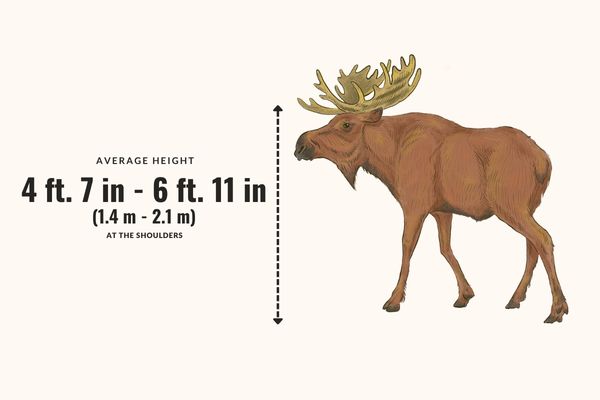
  • The average height of adult moose at the shoulder ranges from 4 feet 7 inches to 6 feet 11 inches (1.4 to 2.1 meters).
  • The Alaskan subspecies (A. a. gigas) is the largest, and so the tallest, among all the races. It stands over 6 feet 11 inches (2.1 meters) tall at the shoulder.

How Tall Is A Moose

How Big Is A Moose

  • Moose is the biggest species in the family of deer.
  • They have 5 to 6.5 feet height at the shoulders.
  • Their head and body are 7 feet 10 inches to 10 feet 2 inches (2.4 to 3.1 meters) long, while their vestigial tail is further 5 to 12 cm long.
  • Males are heavier than females. Males (bulls) usually weigh from 380 to 700 kg (838 to 1,543 lbs), while females (cows) weigh from 200 to 490 kg (441 to 1,080 lbs). The weight of an individual depends on race or cline, age, and nutritional variations. National Geographic describes their weight as 1800 lbs.
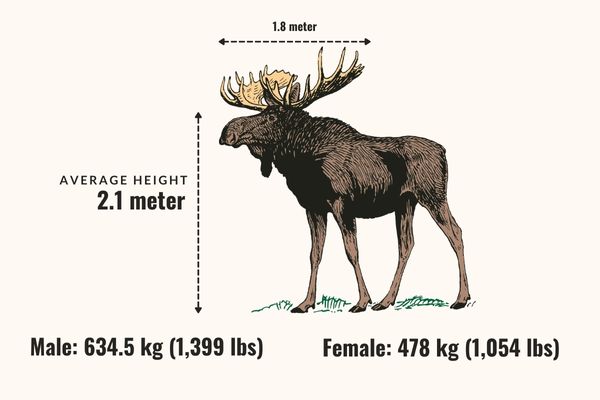
  • The Alaskan subspecies (A. a. gigas) is the biggest of all the moose subspecies, which has a 2.1-meter height at the shoulders, a 1.8-meter span of the antlers, and an average bodyweight of 634.5 kg (1,399 lbs) for males and 478 kg (1,054 lbs) for females.

How Big Can A Moose Get

  • The recorded biggest moose was an Alaskan moose shot in September 1897 at the Yukon River.
  • It was 2.33 meters (7 feet 8 inches) tall at the shoulder and weighed 820 kg (1,808 lbs).
  • There have been reports of even bigger individuals, including a male killed in 2004 that weighed 1,043 kg (2,299 lbs), and another male whose weight was reported as 1,180 kg (2,601 lbs). However, these reports were considered unauthentic.

How Tall Can A Moose Get

  • The Alaskan moose shot in September 1897 at the Yukon River was the tallest individual.
  • It was 2.33 meters (7 feet 8 inches) tall from hoof to shoulder.

How Tall Is A Moose Compared To A Human – How Big Is A Moose Compared To A Person

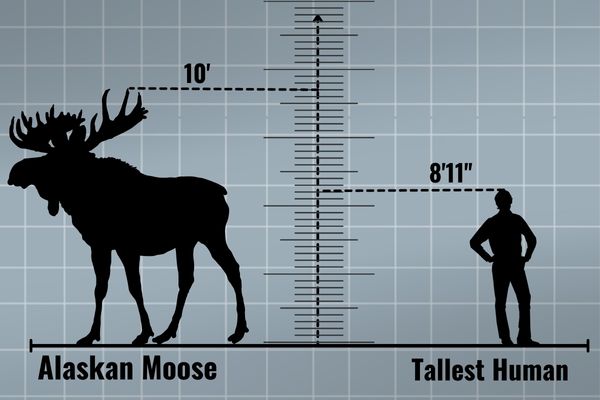
  • When compared with humans, a moose is much taller than even the tallest humans in the world. Robert Wadlow of the United States was the tallest human ever at 8 feet 11-inch height.
  • A moose is up to 6.5 feet tall at the shoulder, while an adult male human has an average height of 5 foot 7.5 inches.
  • The Alaskan moose is more than 7 feet taller at the shoulder.
  • When head and antlers are also measured, their total height reaches more than 10 feet.
  • Even the tallest human can not stand eye to eye with a moose with a raised head.

How Tall Is A Moose Compared To A Human

How Big Is A Moose Compared To A Car

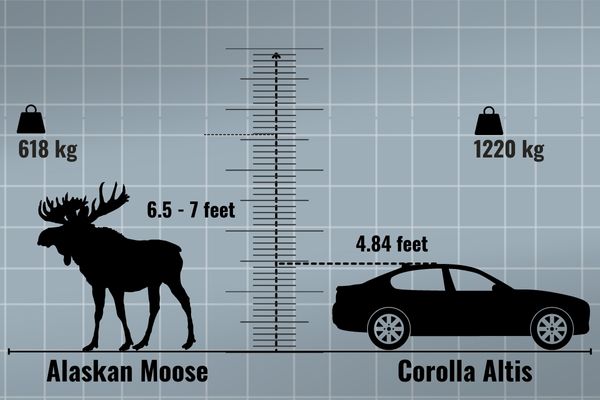
  • The body length of an Alaskan moose is around 9.2 feet. It stands 6.5 to 7 feet tall at the shoulder. A moose has a body weight of around 618 kg (1800 lbs) according to National Geographic.
  • An average size Corolla Altis car is about 15.16 feet long, 5.82 feet wide, and has about 4.84 feet in height. It weighs up to 1220 kg.
  • So when a moose is compared to a car, a moose is taller and heavier than a car. But a car is longer and wider than a moose. So we can say that a moose is bigger than an average size Corolla Altis car.

How Big Is A Moose Compared To A Car

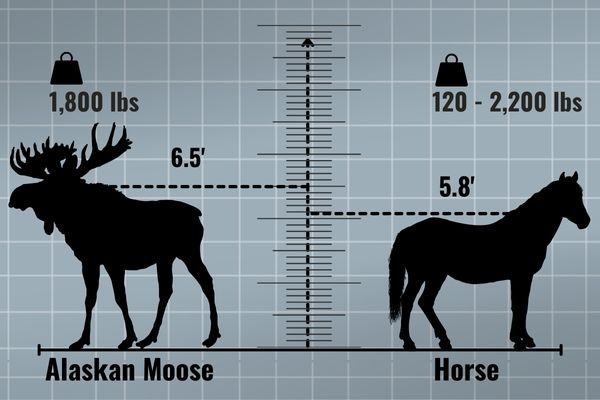
How Big Is A Moose Compared To A Horse

  • Let’s compare a moose to a horse.
  • According to National Geographic, the height of a moose at the shoulders ranges from 5 to 6.5 feet, while the height of a horse at the shoulders ranges from 2.5 to 5.8 feet.
  • A full-grown moose has a bodyweight of up to 1,800 pounds, while a horse has from 120 to 2,200 pounds.
  • So in terms of size, a moose is bigger than a horse. And in terms of weight, a horse is bigger than a moose.

How Big Is A Moose Compared To A Horse

How Big Is A Full Grown Moose

  • On average, a full-grown moose stands 5 to 6.5 feet tall at the shoulders and weighs up to 1,800 pounds.
  • Different subspecies have different sizes and weights. Age and nutritional variations also affect their size and weight.
  • The Ussuri, Amur, or Manchurian subspecies (A. a. cameloides) is the smallest subspecies. Their full-grown individuals (both male and female) have 5 feet 5 inches to 6 feet 1 inch (1.65 to 1.85 meter) height at the shoulders and weigh between 200 to 250 kg (441 to 772 lbs).
  • The Alaskan subspecies is the largest of all the subspecies and the largest deer in the world. A full-grown Alaskan moose has 6.9 feet (2.1 meters) height at the shoulders, 5.9 feet (1.8 meters) span of the antlers, and an average bodyweight of 634.5 kg (1,399 lbs) for males and 478 kg (1,054 lbs) for females.
  • The other seven subspecies are of middle size with an average height of 5 to 6.5 feet at the shoulders and a weight range of 320 to 725 kg (705 to 1,598 lbs).

How Big Can A Moose Get

How Tall Is The Tallest Moose

  • The tallest moose was an Alaskan moose shot in September 1897 at the Yukon River. It had a hoof to shoulder height of 2.33 meters (7 feet 8 inches).

How Big Are Moose Antlers

  • Male moose (bull) have prominent antlers on the head.
  • Their antlers grow in the form of cylindrical beams projected on both sides of the head at right angles to the middle of the skull and then forks.
  • The growth rate and size of their antlers depend on their diet and age, while the symmetry of their antlers shows their health.
  • The antlers of mature bulls have a length between 4 to 5 feet (1.2 to 1.5 meters), a spread of 6 feet from end to end, and weigh around 18 kg (40 lbs).
  • The antlers of a full-grown Alaskan moose of 5 to 12 years of age have a span of more than 79 inches (200 cm). As they grow older, the size and symmetry of their antlers reduce.
  • The recorded widest span of the moose antlers was 83 inches (210 cm).
  • The recorded heaviest antlers were of an Alaskan moose, which weighed 36 kg (79 lbs).

How Tall Is A Moose With Antlers

  • The antlers of a moose are long from 4 to 5 feet (1.2 to 1.5 meters).
  • With head and antlers, a moose stands more than 10 feet tall.

How Tall Is A Full Grown Male Moose

  • A full-grown male moose (bull) stands an average of 6 feet tall at the shoulders.
  • A full-grown male Alaskan moose is 6 feet 11 inches tall from hoof to shoulders. With its head and antlers, it stands more than 10 feet tall.

If you are a Moose lover and a creative person. Apart from learning more about them, you can also leave their footprints in your life. You can turn your favorite moose lookalikes into gifts that you can carry with you at all times and keep forever by designing them yourself, such as enamel pins or keychains. Customize your favorite moose into a cute pin that you can wear as an accessory to express your personality, or give as a gift and collect as a souvenir. At GS-JJ.com, any design and style can be freely selected, come and have a look!

Ruger Mini 14 Target Rifle

0

The Ruger Mini-14 has proven its ruggedness since it started riding around in pickups in 1974, but getting it to consistently shoot neat little groups at 100 yards has often been an exercise in frustration. Accuracy—frankly not the Mini-14’s strongpoint—has generally taken a backseat to its simple and reliable operation. With competitive action-shooting events on the rise, Ruger decided to address this issue, introducing the Mini-14 Target Rifle accompanied by claims of minute-of-angle performance.

Appropriate for a Mini-14 derivative, the Target Rifle keeps the fixed-piston gas system and rotary bolt with dual locking lugs borrowed from the M1 Garand and the line’s military inspiration, the M14. The investment-cast receiver and L-shaped charging handle have a matte-stainless finish. Scope bases integral to the receiver—a feature that debuted on the Mini-14 Ranch Rifle during the early 1980s—also fittingly appear on the Target Rifle. Ruger includes high, 1-inch rings for mounting an optic, which is mandatory since the receiver and barrel are devoid of iron sights. Other features manifest in the Mini-14 family and carried on with the Target Rifle are a Garand-style safety, stout magazine release lever and ventilated, fiberglass handguard that covers the barrel from receiver to gas block.

The similarities end there.Ruger started its Mini-14 makeover by going straight for what most often is the deciding factor in a rifle’s accuracy—the barrel. Though the lightweight, 18 1⁄2-inch barrel of the standard Ranch Rifle makes for quick and easy handling, it has many times bore the brunt of the criticism stemming from inaccuracy. The Target Rifle, in contrast, has a heavy, hammer-forged, stainless steel barrel that is .78 inch in diameter where it emerges from the gas block, with an additional 3 1⁄2 inches of length. Its six-groove rifling has a 1:9 RH twist to stabilize all but the heaviest .224-caliber match bullets.

Prominent on the barrel is a 41⁄2-inch-long, harmonic-dampening weight. The 3⁄16-inch-thick sleeve slips over the barrel, and four Allen-head screws keep it in place. A series of helical grooves on the barrel’s surface allow the position of the harmonic dampener to be changed by turning it after loosening the attachment screws. Rotating the harmonic dampener clockwise moves it toward the receiver, while turning it counterclockwise shifts it toward the muzzle.

Barrel harmonics, or the vibration of the barrel during firing, can greatly affect point of impact and group size. Functions that occur within a rifle such as the firing pin striking the primer, the ignition of the propellant, the expansion of the propellant gases and the bullet’s contact with the rifling as it travels through the bore all produce a number of vibrations that are ultimately transmitted to the barrel. These vibrations cause the barrel to move in an arc, even before the bullet has exited the bore. If these vibrations were absolutely consistent, there would be a lot of rifles shooting one-hole groups. However, their magnitude and duration vary from shot to shot, and five bullets may leave the bore when the muzzle is at five different points on the vibration-induced arc. In part, this is why even a very tight group will still somewhat resemble a triangle.

One way to control vibration is to add weight to the barrel, which soaks up the impulses. The heavy barrel on the Target Rifle works together with the harmonic dampener to reduce the amplitude of the arc, making bullet exit, and therefore point of impact downrange, more consistent. Different loads, of course, can produce different amounts of vibration, and the ability to adjust the harmonic dampener allows the shooter to tune the barrel to obtain the best accuracy with any given ammunition.

A beefy barrel does not a target rifle make, so Ruger continued overhauling the Mini-14 by giving it a stock eminently suited for shooting from the bench. The thumbhole buttstock has a large, triangular-shaped cutout just behind the pistol grip that not only lets the thumb encircle the pistol grip, but also provides a stable shelf on which its fleshy base can rest. Along with the slight swell to the pistol grip, the design promotes a steady, repeatable hold. The stock’s high, slim comb rises slightly at the heel and digs into the cheek for a tight weld. So it will nestle solidly into a sandbag, the toe is rather thin and parallels the comb for 3 inches. The stock’s lower line then curves dramatically upward before running forward to the pistol grip, forming a hook for the non-shooting hand to press against and keep the rifle firmly settled on the bench. Three removable, black plastic spacers just forward of the rubber buttpad let shooters adjust the stock’s length of pull from 14 to 15 1⁄2 inches in 1⁄2-inch increments. In keeping with the theme of the Target Rifle, Ruger gave the fore-end a 2-inch-wide flat spot to make it easy to rest the gun on sandbags or hold in an offhand position. The stock is constructed of a gray laminate that complements both the stainless finish of the rifle’s metal and the black handguard.

A Mini-14 that will shoot minute of angle? I, too, was skeptical. But to give the Target Rifle a fair chance, I topped it with a Sightron SII Big Sky 4.5-14×42 mm scope and waited for a calm day to test Ruger’s claim. I picked the 55-grain soft-point load from Black Hills to start. The first several groups from the 100-yard line were around 2 1⁄2 inches—pretty much what I expected from a Mini-14 and certainly nothing to write home about. Then I began playing with the position of the harmonic dampener and shot as many holes in the criticisms of this autoloader’s accuracy as I did targets. With this particular load, the rifle liked the forward end of the harmonic dampener to be positioned about 3⁄4 inch behind the muzzle. Thusly tuned, it produced five, five-shot groups that averaged 1.03 inches. Pretty dang close, and two of those groups measured inside the minute-of-angle standard. I tried several other loads, including some with match bullets weighing between 69 and 75 grains, but none of them delivered the accuracy of my first pick. The runner-up was the 50-grain Winchester Supreme Ballistic Silvertip load, which averaged 1.10 inches after 25 shots. Perhaps with a little more tweaking I could find the harmonic dampener’s sweet spot with these other loads and shave a little from their group sizes.

True to the nature of the Mini-14, I experienced no failures to feed or fire during testing, and that was during approximately 400 rounds of 12 ammunition types over three days. No complaints there, but I did have an issue with the Target Rifle’s trigger. At 5 1⁄2 pounds of pull weight, it’s quite heavy for a rifle intended for target work, and I had to squeeze through a lengthy amount of creep. Nonetheless, I learned to live with it, and from the factory the Target Rifle performed as advertised.

The Mini-14 is rarely described as being pinpoint accurate, and in fact, until now it was never made to be. With some modifications, Ruger has turned this ubiquitous truck gun into a rifle ideally suited for chewing out bullseyes. I’d call the Mini-14 Target Rifle accurate any day.

Does Walmart Sell Hunting Licenses?

0

Hunting is a popular sport in the United States, and many people rely on hunting to provide them with food. If you’re interested in hunting, you may be wondering if Walmart sells hunting licenses.

The fact is: Many people are unaware that Walmart sells hunting licenses. As a major retailer, Walmart is well-positioned to provide hunting licenses to its customers. In this blog post, we will discuss the benefits of purchasing hunting licenses from Walmart. We will also look at the different types of hunting licenses available at Walmart. Finally, we will provide some tips for purchasing hunting licenses from Walmart.

does-walmart-sell-hunting-licenses

Can You Get a Hunting License at Walmart?

Yes, Walmart does sell hunting licenses. You can purchase a license for many different types of games, including deer, elk, bear, and turkey. Buying your license online is easy and convenient – all you need is a computer and an internet connection. Plus, you’ll save 5% on your purchase when you buy your license online

What Do You Need for a Walmart Hunting License?

In order to purchase a hunting license from Walmart, you’ll need a few things. First, you’ll need to be at least 18 years old. Next, you’ll need a valid form of identification, such as a driver’s license or passport. Finally, you’ll need a credit or debit card to pay for your license. Once you have all of these things, you’re ready to purchase your license!

(Are raccoon rodents? See this post for more)

How Much Does a Hunting License Cost at Walmart?

The cost of a hunting license varies depending on the type of game you’re hunting and the state in which you reside. However, in general, licenses range from $19-$35. You can find more specific pricing information on the Walmart website.

Is There an Age Limit for Buying a Hunting License at Walmart?

Yes, there is an age limit for buying a hunting license at Walmart. You must be at least 18 years old to purchase a hunting license from Walmart. If you’re not yet 18, you can still hunt with a valid hunting license from another adult.

How Do I Get a Hunting License From Walmart?

The hunting license process at Walmart is easy and straightforward. Just tell an employee in the sporting goods department that you want one, and they’ll provide all the necessary forms for completing it.

You need to fill out some personal information like your name or birthday , select different types of hunting activities – uplands/woods, waterfowl season springs turkey ala duck decoying, etc., pay fees according to what kind(s) chosen plus taxes. 

After confirming your identity and collecting payment, the official will give you a tag to carry with you while hunting that has proof of hunting permission.

It’s important to know the laws in your state when hunting, so be sure you’re following them. The cost of a hunting license may vary depending on where and what type of animal it is for but most start around $12!

does-walmart-sell-hunting-licenses

FAQs

Can You Hunt the Same Day After Buying a Walmart Hunting License?

Yes, you can usually hunt the same day after buying a hunting license from Walmart. However, it’s always a good idea to check the regulations in your state to be sure.

Is There a Limit on the Number of Hunting Licenses You Can Purchase From Walmart?

No, there is no limit on the number of hunting licenses you can purchase from Walmart. However, you can only purchase one license per person.

Do You Need a Hunting License to Buy a Gun at Walmart?

No, you do not need a hunting license to buy a gun at Walmart. However, you will need to pass a background check in order to purchase a firearm from Walmart.

What Are the Pros and Cons of Buying a Hunting License From Walmart?

There are both pros and cons to buying a hunting license from Walmart. Some of the pros include convenience, price, and selection. Some of the cons include limited customer service and restricted hours. Overall, the decision of whether or not to buy a hunting license from Walmart is up to the individual.

Does Walmart Sell Hunting Licenses With Permits and Endorsements?

Yes, Walmart sells hunting licenses with permits and endorsements. However, the cost of these licenses may be higher than the cost of a regular hunting license.

What Are Some Other Places That Sell Hunting Licenses?

In addition to Walmart, you can also purchase hunting licenses from sporting goods stores, outdoor retailers, and state wildlife agencies. You can also purchase hunting licenses online from some retailers.

Can You Get a Hunting and Fishing License Together at Walmart?

Yes, you can usually get a hunting and fishing license together at Walmart. However, the cost of these licenses may be higher than the cost of a regular hunting or fishing license.

Do You Need a New Walmart Hunting License Every Year?

In most cases, you will need to renew your Walmart hunting license every year. However, the rules for renewing a hunting license may vary depending on the state in which you live. Be sure to check the regulations in your state before purchasing a hunting license from Walmart.

Does Walmart Selling Hunting License Holders?

Yes, Walmart sells hunting license holders. These holders can be used to store and protect your hunting license while you are out in the field.

How to Find a Walmart With Hunting Licenses?

To find a Walmart that sells hunting licenses, you can use the Store locator on the Walmart website. Once you have found a store, you can call to confirm that they sell hunting licenses. You can also ask about the cost of hunting licenses and whether or not they sell other hunting supplies.

Conclusion

When it comes to hunting licenses, Walmart is a one-stop-shop. You can purchase licenses for many different types of games, including deer, elk, bear, and turkey. Buying your license online is easy and convenient – all you need is a computer and an internet connection.. So what are you waiting for? Get your hunting license today!

The Best Weed Torches Tested in 2024

0

<?xml encoding=”utf-8″>

Weed management is rarely at the top of anyone’s list of desirable to-dos. Bending over and pulling weeds is a lot of work, and it’s rarely a permanent solution. Spraying weed killer isn’t the best alternative since the chemicals aren’t good for grass or the pollinators that may land or feed on those weeds.

Instead of breaking your back or introducing harmful chemicals into your lawn’s ecosystem, consider smoking out those pesky plants with a weed torch. These handheld torches run on propane and focus a small but scorching flame on stubborn invasive weeds. This guide helps shoppers choose the best weed torch for a particular yard or garden.

We tested the following weed torches in our lawns, vegetable gardens, and ornamental landscape beds. Read on to find out how we selected these models, how they performed on our backyard tests, and which may be the best weed torch for your lawn and garden maintenance needs.

  1. BEST OVERALL: Red Dragon VT 1-32C 25,000 BTU Mini Weed Dragon Torch
  2. RUNNER-UP: Flame King YSN340K Auto Ignition Propane Torch
  3. BEST BANG FOR THE BUCK: Flame King YSNPQ810CGA Propane Torch Weed Burner
  4. BEST HEAVY-DUTY: Red Dragon BP 2512 SVC 400,000 Backpack Weed Torch
  5. BEST FOR GRAVEL: Gaspony TB-PFP Power Flame Pro 500,000 Propane Torch
  6. BEST FOR PAVERS: Flame King YSNPQ820S Wide Flame Propane Torch Burner
  7. BEST FOR GARDEN: Houseables 20,000 BTU Weed Torch Propane Burner
  8. ALSO CONSIDER: Ausail 50,000 BTU Weed Torch Propane Burner

How We Tested the Best Weed Torches

We set up our weed torch testing regimen to simulate real-world working conditions. We spent more than 6 hours, or an average of about 45 minutes per torch, in testing. In addition to the operational tests outlined below, we evaluated ease of assembly, operator comfort, effectiveness in killing weeds, and durability. After assembling each torch according to the manufacturer’s instructions, we installed fuel tanks, tested for leaks, and recorded the weight and dimensions of each unit.

We assigned specific areas of the lawn, vegetable garden, and landscape beds to specific torches and labeled the areas accordingly. Each area contained similar coverage of weeds and desirable plants, and the terrain was also comparable from one plot to the next. One at a time, we lit the torches and treated the assigned spaces. Walking at a slow pace, we passed the flame across any weed leaves and stems without stopping. The intense heat desiccated the green leaves, and there was no need to char them.

After the treatment, we evaluated the weed dieback and monitored for regrowth. We inspected each space 3, 7, and 14 days after the initial treatment. After recording the Day 14 observations, we treated each area a second time. Finally, we entered our observations on a scoring rubric to help clarify an overall evaluation and award recommendations for each tool.

Our Top Picks

We’ve identified and tested some of the best weed torches on the market. Our lineup includes compact tools, heavy-duty models, and high-powered torches for a broad spectrum of property types and users. Read the individual product reviews ahead to learn more about them and to find the best option for specific uses.

Jump to Our Top Picks

What to Consider When Choosing a Weed Torch

Between how a torch works and lights to its size and features, choosing this gardening tool does take a bit of background research. It’s important to understand how these tools function and to evaluate the area to be treated before scorching those dandelions. The following are a few important shopping considerations to keep in mind while searching for the best weed torch.

Lightweight vs. Heavy-Duty

There are two styles of weed torches: lightweight and heavy-duty. Lightweight weed torches, equipped with bent tubes that attach to a small 1-pound propane gas canister, are the more portable option. Heavy-duty torches are for large-scale jobs and have hoses that can connect to a full-size 20-pound tank.

Choosing between the two styles is really a matter of preference, but here are a few points to help decide between the two.

Lightweight torches

Pros

  • Easily portable
  • User-friendly
  • Operate with lower temperatures

Cons

  • Lack volume for extended use
  • Do not use refillable tanks

Heavy-duty torches

Pros

  • Offer plenty of volume for long burns
  • Powerful
  • May have adjustable flame
  • Use refillable propane tanks

Cons

  • Heavy and difficult to carry around
  • May be noisy

Ignition Methods

There are generally two ways to light a torch: via built-in igniters or manual strikers.

Built-in igniters work similarly to the striker used to light a barbecue grill. They’re usually attached to the tube and feature a push-button spark. With the gas turned on, the striker safely lights the flame at the end of the tube. The pressure of the gas pushes the flame out to the end of the torch, and then it’s ready to kill weeds.

Manual strikers can be a little trickier to use. Similar to the strikers used in some high school chemistry classes, manual strikers need to be in proximity to gas when struck to light the flame. This could make some DIYers nervous, in which case a built-in igniter might be the better option.

Hose Length

When considering weeding tools, it’s important to think about the size of the area that needs to be treated. Most heavy-duty torches are meant to run on large 20-pound propane tanks, so hose length can affect maneuverability among the weeds. In general, a 10-foot hose is ideal. This length is long enough to cover a wide area, yet short enough to prevent the user from tripping or falling.

Those needing to cover a large area of land while using the torch may wish to purchase an additional cart or dolly to hold the heavy propane tank. The wheels will make moving it across the yard easier.

Bell

Some weed torches are equipped with a bell-shaped shroud at the end of the torch. This bell helps the torch to retain heat and direct the flame, creating a more efficient burn.

While efficiency is always a bonus, it’s not always necessary when it comes to weed torches. It might take a little longer to kill weeds using a lightweight model without a bell, but it’s usually only a difference of a few seconds.

A bell also helps shield other plants from the intense heat created by the flame. If the plan is to work with a torch around sensitive plants, consider a torch with a bell. Keep in mind, however, that using a torch of any kind in a mulch-laden flower bed is a bad idea.

Variable-Flame Control

The ability to control the flame is another important factor to consider when it comes to purchasing a new weed burner, as too much heat may cause the user to unintentionally burn valuable plants with a large flame. Plus, without an adjustable flame, users may run through a canister of propane before covering their entire yard.

Most of the products featured in this guide include control valves that can be dialed up or down to throttle the amount of fuel passing through the wand. Some heavy-duty torches feature boost handles that can temporarily increase the size and temperature of the flame. Simply squeeze the valve to increase the volume and pressure for tougher weeds and release it to return it to its normal setting.

Heat Rating

It’s important to review the heat rating for potential weed torches. Rather than using degrees Fahrenheit (which won’t describe output of the torch), torch heat ratings are quantified using BTUs, and there is a wide range of BTU ratings available.

Most weed burnersproduce at least 20,000 BTUs, which is plenty of heat for burning a weed. Heavy-duty models can produce up to 500,000 BTUs, which isn’t usually needed for common yard weeds. A torch that offers between 20,000 and 100,000 BTUs is often more than adequate.

Safety Features

As a general rule, weed torches aren’t inherently safe. They don’t have a safety valve, they produce lots of heat, and their nozzles get very hot. Gloves and safety glasses help protect users, but there simply isn’t much one can do to make a weed tool like this 100 percent safe.

Features such as built-in gas-control valves, built-in trigger starts, and hoses of safe lengths can reduce some of the risks involved in burning yard weeds. A built-in igniter ensures that the user’s hand is kept a safe distance away from the flame, while the gas-control valve helps throttle back the amount of flame the torch produces to keep things under control. Using a hose of proper length can prevent users from tripping.

Crucial safety tip: Never use a torch or flame of any sort to remove poison ivy. The oil that poison ivy produces (urushiol) is what causes skin blisters and other painful reactions. When the plant burns, that oil attaches to the smoke particles and can travel through airways and land on skin, causing potentially serious health hazards.

Tips for Using a Weed Torch

In general, a quick blast of heat will break down the cells that weeds need to grow, even if they don’t turn completely black. The best time to use a weed torch is on a wind-still day after a good soaking rain. While weed torches are safe if used properly, the soaked terrain will help reduce the risk of an accident, and low wind speeds help keep the flames controllable.

Always keep a hose or a bucket of water nearby while burning weeds, and remove leaves and debris from the area before torching the weeds. Leaves and debris will burn much faster than weeds, and passing over them with a lit torch can lead to an unintended fire in no time.

  • A quick pass of heat is often enough to kill a weed without charring it to embers.
  • Use on a calm day with no wind and after it has rained to torch weeds safely.
  • Keep water on hand and remove leaves and debris before torching weeds.

FAQs

If you want more info about buying or using the best weed torches, read on for answers to some of the most frequently asked questions about these garden tools.

Q. How does a weed torch work?

Weed torches use propane-fueled flames to cook the cells inside of a weed, inhibiting its ability to use sunlight (or photosynthesis) for energy and growth.

Q. How hot do weed torches get?

Weed burners vary in their heat output, with some models producing more than others. Common torches range between 20,000 and 500,000 BTUs.

Q. Can a weed torch help with poison ivy?

Burning poison ivy is a bad idea. The oil in poison ivy, oak, or sumac that causes itchy blisters is called urushiol. If you burn these plants, the oil attaches itself to the smoke particles, which can land in your lungs and cause serious respiratory irritation.

Q. Do I need to reduce the weed to ash or simply brown it to destroy it?

Generally speaking, burning the weeds to charred ash isn’t necessary. Simply heating the plant for a few seconds until it wilts should be enough to destroy it.

Q. How do you start a weed burner?

Starting a weed burner is typically very easy. Start by attaching the propane to the wand, or the hose to the propane tank, depending on the model. Next, open the valve on the propane tank, if it has one. Then open the valve on the wand to let some gas pass through. Finally, press the built-in igniter or use a striker held (safely) near the nozzle while striking to light the weed torch.

Why Trust Bob Vila

BobVila.com has been a trusted resource for DIY information since 1996. Bob Vila has been America’s Handyman since 1979. As the host of beloved and groundbreaking TV series including “This Old House” and “Bob Vila’s Home Again,” he popularized and became synonymous with “do-it-yourself” home improvement. Over the course of his decades-long career, Bob Vila has helped millions of people build, renovate, repair, and live better each day—a tradition that continues today with expert yet accessible home advice.

The Bob Vila team distills need-to-know information into project tutorials, maintenance guides, tool 101s, and more. Our hands-on product reviews detail real-world results based on hours of thorough testing by subject-matter experts. These home and garden experts then thoroughly research, vet, and recommend products that support homeowners, renters, DIYers, and professionals in their to-do lists.


0

Montana Bighorn Sheep Hunting

Available Montana Rocky Mountain Bighorn Sheep Hunts – Search HF Aventures

When it comes to Rocky Mountain bighorn sheep hunting, Montana should be on everyone’s radar. To many, drawing a Missouri Breaks sheep tag in units 482, 622, or 680 is at the very top of their hunting bucket list. Last year, 5,300 non-resident sheep applicants applied for a ram tag in one of the three famed units of the Missouri Breaks. Only four of them were successful in drawing a tag. Unit 482 is still going to give you your best chance at a 180″+ ram. Half of the rams harvested here in 2022 are estimated to have broken that mark, followed by 25% in 680 and 10% in 622.

Go on More Hunts with Better Information, Join Huntin’ Fool Today!

Unfortunately, the bighorn sheep hunts in the Breaks are not quite what they were four or five years ago. Some of the better genetics, especially for mass, are starting to be shot out. The drought over the past three years and the apocalyptic grasshopper hatch that came with it have severely reduced the amount of quality feed these rams need to thrive. These conditions have also contributed to lower lamb production, forcing FWP to reduce the number of ewe tags available in each of the Breaks units. Additionally, ram tags were cut in unit 482 from 20 to 15 in 2022, limiting non-residents to only one permit on this hunt. It’s not all doom and gloom in the Breaks, however, as precipitation levels are off to a great start in 2024. There were also at least one or two mid to upper 80s rams that are known to have made it through the season in each of the three units. The Breaks units are still going to give a hunter the best shot at a 190″ ram, hunters will just need to be good at judging and passing up rams if their goal is taking home a book ram.

Those hoping for better odds of hitting on a Montana bighorn sheep tag will need to consider looking past the Breaks units and instead focus on other second tier units that are available for non-residents. Excluding the unlimited hunts last year, 2,035 non-residents applied for ram tags in units other than the Breaks and four were successful in drawing their tag. For 2024, hunts in units 100, 102, 250, 380, and 423 will each be available for non-residents. On each of these hunts, beginning in early November, most of the rams will come down from their summer range in search of ewes. As the rut takes place, these sheep will stay in highly visible areas and offer a hunter a physically easier lower elevation hunt. The exception to this is in unit 423. The area where most of the sheep stage for the rut can’t be accessed by road. It’s also worth noting that less than 20 total sheep permits are being proposed in region one in 2024. This would mean that only one non-resident permit will be available between units 100 and 102, and when one non-resident is drawn for either unit, the non-resident draw will be shut down in the other.

Montana is the only state that offers over-the-counter bighorn sheep tags. This year, hunters can choose from five units – 300, 303, 500, 501, and 502. The tags must be purchased or applied for by May 1st. The odds of harvesting a ram are typically around 2%, but every year, some lucky hunters take rams home. Last year, eight hunters harvested rams in the unlimited areas. See the “Unlimited Bighorn Sheep” section for more information on all of the units and hunts.

For 2024, Montana has once again shuffled the units that non-residents are able to apply for, so be sure to look over our bighorn sheep table as we have included all non-resident sheep hunts available this fall. If you are a Montana resident and you would like to talk about the other units available to you, give us a call. Despite the long draw odds, anyone who wants a chance to hunt giant rams someday has to be applying in Montana!

Our Memberships Include The Most Accurate Draw Odds Available, Join Now!

Self Guided DIY Montana Bighorn Sheep Hunts

Over the last 20+ years, we’ve collected hunting research and data, so join Huntin’ Fool today and access the best research tools for hunting bighorn sheep in Montana, including 3D Maps, Draw Odds, Consultations, and much more. Go on more hunts with better information!

Private Land, Semi-Guided, and Guided Bighorn Sheep Hunts

Search our database for Montana Bighorn Sheep opportunities.

M0tBbVFzVnFtakU90

Application Deadline

The Montana Bighorn Sheep application deadline is May 1, 2024.

Our magazine, which is available in print and online, has everything in one location – application info, draw details and odds, fees, hunter requirements, point structure, age restrictions, youth information, weapon restrictions, other tag opportunities, hunt planning, and much more. If you would like access to all of our research join today!

Consult with Hunters Who Have Hunted in Your Unit, Join Now!

2024 MONTANA NON-RESIDENT FEES Up-Front Fees Base Hunting License $15 Conservation License $10 Bonus Points (optional/per species) $20 Sheep, Moose, Goat, and Bison Application Fee $50 Post Draw License Fees (if successful) Bighorn Sheep Permit $1,250 Bow and Arrow License (required for all archery hunts) $10 *Fees do not include the additional 2.5% convenience fee.

MT Bighorn Hunting Articles from Huntin’ Fool Magazine

  • Not Your Typical Sheep Hunt by Pete Soverel
  • The Pinnacle by Jana Waller

Best Air Rifles Under $200 – Top 5 budget guns for the money (Reviews and Buying Guide 2025)

0

At $200, it’s not too easy to find a decent PCP air rifle because they usually come at a higher cost.

However, with only $200, you can find some really nice spring-powered and CO2 air rifles.

These are suitable for shooting tin cans, pest control, or for small game hunting.

The best air rifles under 200 bucks can also be suitable for small game hunting and pest control.

The stocks of air rifles under $200 are usually synthetic as it’s cheaper than wood.

(For more on the in-depth comparison between synthetic and wood stock, see this post.)

The barrel would also not be as good as a more expensive air rifle, but I think it’s enough for some purposes.

(For more on things you should know about air rifle barrels before buying, see this post.)

Most air rifles under $200 discharge .177 caliber pellets, and some discharge .22 caliber pellets.

Almost no sub-$200 air rifle discharge .25 or above caliber pellets. 

Air rifles under $200 usually don’t come with scopes and other accessories like silencers.

Therefore, if you just want a basic gun for pest control and small game hunting, 200 bucks are just enough for the basics .

But If you want a serious tool for hunting deer, you may want to spend as much as $500.

N.B. Besides the cost of purchasing an air rifle, there’s also the cost of pellets and recharging compressed air, dry nitrogen, or CO2 gas.

If you purchase a springer, you won’t need to worry about the recharging cost, saving you hundreds of dollars every year .

Top-rated Air Guns Under $200 in 2025:

If you are in a hurry, here is an overview of the best air rifles under 200 dollars candidates in our list:

IMAGEPRODUCTDETAILSLINK
Fun and Affordable
Sig Sauer MCX
  • Calibers: .177
  • Max Velocity: 600 FPS
  • Max Muzzle Energy: 12 FPE

check price on Pyramydair


check price on airgundepot

Best PCP Under $200
Beeman QB Chief
  • Calibers:  .177 , .22
  • Max Velocity: 1000 FPS
  • Max Muzzle Energy: 52 FPE

check price on Pyramydair


check price on airgundepot

Top Pick
Walther Talon Magnum
  • Calibers:  .177, .22, .25
  • Max Velocity: 1400 FPS
  • Max Muzzle Energy: 32 FPE

check price on Pyramydair


check price on airgundepot

Most Accurate Under $200
Hatsan 95 Walnut
  • Calibers:  .177, .22, .25
  • Max Velocity: 800 FPS
  • Max Muzzle Energy: 24 FPE

check price on Pyramydair


check price on airgundepot

Top Pick
Gamo Varmint
  • Calibers: .177
  • Max Velocity: 1250 FPS
  • Max Muzzle Energy: 16 FPE

check price on Pyramydair


check price on airgundepot

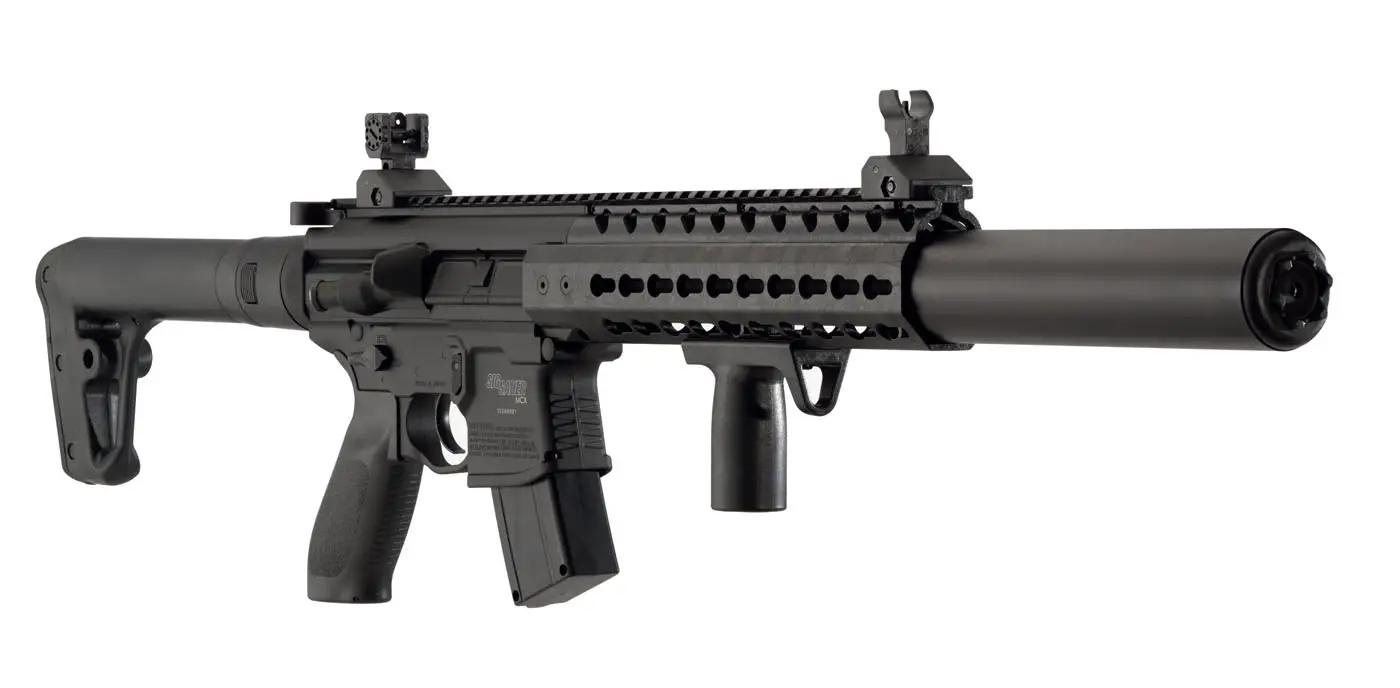
1. Sig Sauer MCX .177 – Fun and affordable

Sig Sauer is a serious firearm manufacturer.

They were founded in 1853, in Switzerland.

In 1949, their SIG P49, which was used by the Swiss army, quickly became a legend on the battlefield as well as the competition field.

Later, they started producing hunting rifles, which were also really successful and well-known worldwide.

In 1980, they reached the US market.

The American market played an important role in making SIG an international leader in the small arms industry.

Nowadays, they produce the toughest, most precise rifles, pistols, suppressors, optics, ammunition, and airguns, many of which are used by leading global militaries.

Their brand philosophy revolves around the love of freedom, the unwillingness to compromise, and the desire to be the best. 

The Sig Sauer MCX .177 is a really fun gun.

You can say that just by looking at it.

The stock is made of synthetic, and the barrel is made of rifled steel. The butt plate is made of plastic.

It comes all in black.

You can use either a Weaver or Picatinny scope on this gun.

The overall length is 34.7 inches.

The barrel length is 17.7 inches – the short length makes the gun shoot even faster.

The gun uses CO2 gas as the power source.

A CO2 air rifle has much less recoil and is much quieter than a springer, but this is still a loud enough rifle in itself.

It’s a semi-auto rifle that can unload 30 shots of .177 caliber pellets.

The max velocity is 700 fps – not so fast, but it is accurate. 

The gun is used for fun plinking, not for hunting as it’s not powerful enough.

The Sig Sauer MCX .177 costs $190 and it comes in a choice of black or earth color.

In terms of enjoyment, this is the best air rifle under $200

Check Price on PyramydAir

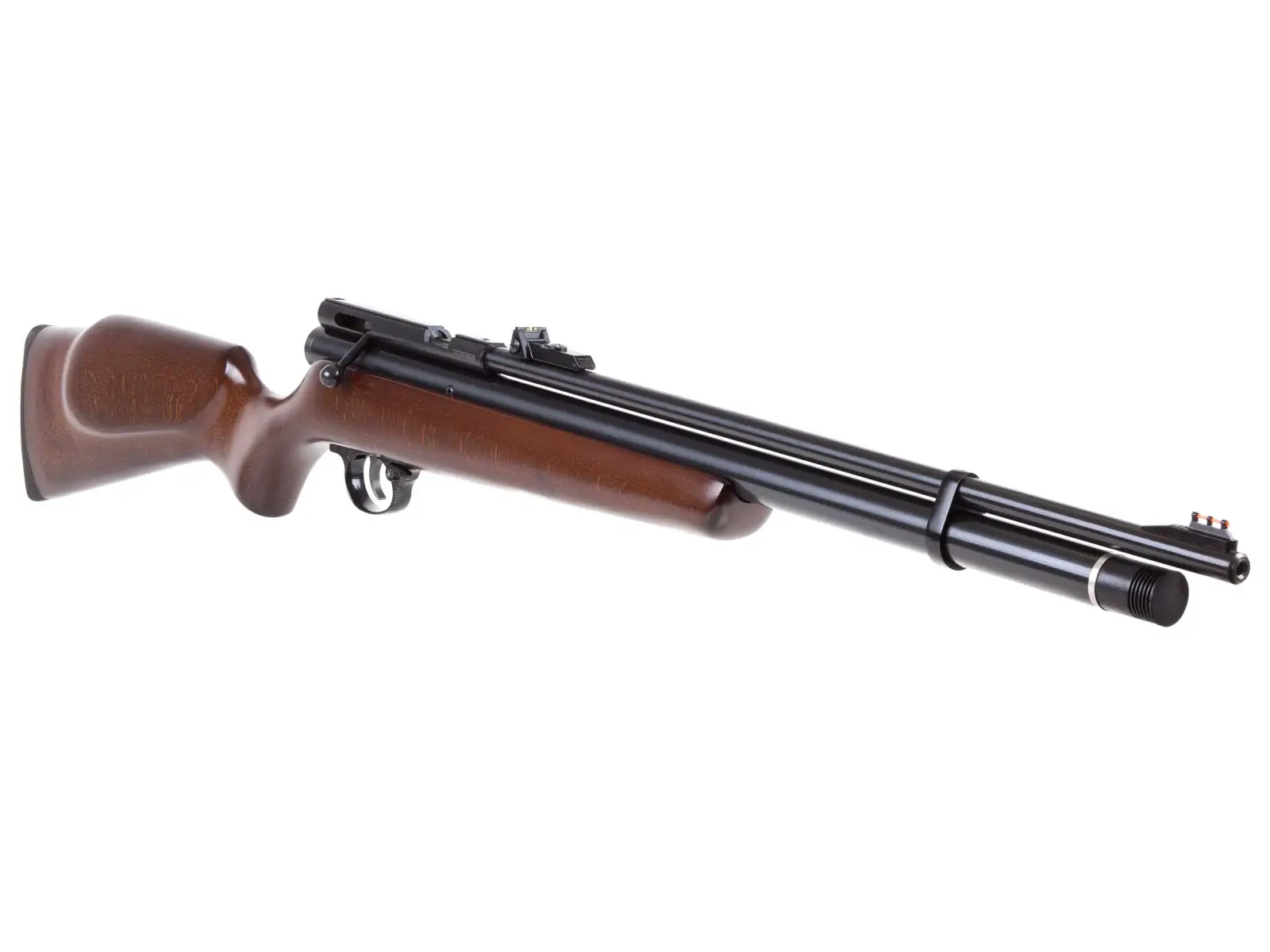
2. Beeman QB Chief – Best PCP air rifle under $200

The Beeman QB Chief PCP air rifle is a rarity — a great PCP air rifle for less than $200 that discharges .22 caliber pellets.

read review here

Beeman is a brand name of Weihrauch & Weihrauch GmbH & Co. KG, a German manufacturer of sporting air rifles, air pistols, cartridge rifles, and pistols.

The company has more than 100 years of experience.

In fact, they were the first mass-produced German .22 rimfire rifle.

Nowadays, they produce innovative PCP air rifles.

Their rifles are made of proven materials.

Every component is carefully monitored by experienced specialists to be accurate in dimension and hardness.

Beeman QB Chief PCP air rifle has an ambidextrous design with a hardwood stock.

The gun has compact size and lightweight: less than 7 pounds and 39 inches.

The Barrel length is 21.5 inches.

There is a rubber pad on the butt plate to absorb the recoil.

There are two raised cheekpieces on each side.

The gun features an 11mm dovetail mounting rail.

This is a bolt-action PCP air rifle with a single-shot capacity.

There is just a little recoil when shooting.

The sound is a little loud but isn’t too bad.

The Beeman QB Chief PCP air rifle has a 136cc cylinder that can be filled with up to 2,000 psi of compressed air.

You can shoot 50 shots per refill in .177, and 35 shots in .22 caliber.

Essential Gear, a rabbit hunting article :: Rabbit Hunting Online Magazine

0

<- back to articles

Essential Gear

by Darrin Glenn :: Featured: August, 2002

Every rabbit hunting season I try to invite someone along that has never been on a rabbit hunt, or someone that has not been on a rabbit hunt in a long time. I have always figured there is really no better way to get a new person into rabbit hunting and beagling than to get them out on a good actual rabbit hunt! You can sit and attempt to describe the pure, clean fun of bawling beagles, shotguns and rabbits to a potential hunt partner, but there is no substitute for experiencing the real deal first hand. I have read in numerous publications how the number of hunters is declining in the U.S. each and every year, and it grips me that sooner than one thinks we hunters could be so outnumbered by the liberal, ANTI-Hunting whackos that our seasons “could” be in jeopardy. I realize that the majority of the public is made up of non-hunters (those who are neither anti-hunters nor hunters), and if the figures I have read are indeed correct, the declining number of hunters and their positive influence on the non-hunting public could have drastic consequences on our hunting future! We as hunters need positive, responsible newcomers, young and old, to join our ranks every day to keep our tradition alive and well.

When I invite someone along on a rabbit hunt and they accept, one of the first topics to surface is of course safety and the principles of a successful rabbit hunt. This is and always should be “priority #1”. For everyone to return safe and sound, hunters and dogs, is top priority. Usually the next thing most newcomers want to know about is the proper gear to hunt rabbits. The proper gear for a successful rabbit hunt often is minimal, which is good for young folks. Rabbit hunting does not require an expensive, elaborate firearm or piles of varying camo and clothing. Usually the first topic of gear centers around a firearm. What style of action, chokes, shot size and gauge or caliber? Many may disagree with me, but as a general rule, my regular hunting partners and myself discourage the use of rifles for rabbit hunting with beagles. Why? I feel that using rifles could pose a threat to the hounds as well as others in the hunting party due to the nature of hunting rabbits behind beagles. Usually the rabbits stay in heavy cover when pursued by hounds and usually are on the move, often at a quick pace. This equals shots at fleeing game in cover, where a hound could be unseen in heavy cover some distance from the bunny. A rifle bullet retains much more energy at greater distances than the shot discharged from a shotgun, and with beagles in the brush and hunters spread out to cut off the fleeing rabbit, I feel the rifle is not the best choice for this type of hunting. So that leaves us with a shotgun.

Any type of shotgun will take rabbits successfully. From low-end single shots to top-end fancy doubles, they will all do the job. It boils down to personal preference. I myself prefer either a semi-auto or a pump action, as often my shooting leaves a little to be desired and the second or third shot comes in handy! However, there have probably been more bunnies taken with a trusty ole single shot smoothbore than any other. Most all the gauges of shotguns are suitable for rabbit hunting as well, with the exception of the big-bore 10 gauges, which would be over-kill. 12 gauges are a tad on the heavy side, especially for cottontails, but can be used successfully with minimal meat damage utilizing less restrictive chokes and smaller shot sizes. I have used my trusty Remington 870 12 gauge for years to take rabbits and have found with an Improved Cylinder choke tube and light field loads of 7’s or 7 ½’s that meat damage is minimal for the larger bore shotgun. 16, 20, 28 and 410 gauges are all good rabbit getters when matched with appropriate shot shells. Over the years I have noticed that the majority of cottontail chasers prefer a 20 gauge to the other gauges, and they are probably right! The versatile 20 gauge, matched with the proper choke and shot shell, is an extremely good rabbit hunting gun and can humanely and quickly dispatch a rabbit at about all normal shooting distances with minimal meat damage. Also remember that most rabbit hunts take place in nasty, briar and thorn choked cover, so don’t expect to bring your new, prized expensive shotgun from the cabinet and return home without a scratch on the stock!

Proper clothing is also important for a successful rabbit hunt. Wading through tangles of briars and mean thorns is not pleasant while wearing a pair of your leisure blue jeans and a t-shirt! If a newcomer has visions of a rabbit hunt taking place on the likes of a dove field, he/she will be in for a rude awakening. It is important that proper protective clothing be worn while rabbit hunting. “Briar pants” are a must for the rabbit hunter to be comfortable and to enjoy the hunt. Briar resistant clothing comes in many styles and in a wide array of prices. Many rabbit hunters prefer to wear bib overalls, chaps or pants with the protective leg covers sewn on. All seem to work well if made with quality materials and it is just a matter of personal preference. A briar-resistant jacket is also a must. Scratched and bleeding arms are just as painful as scratched and bleeding legs! I prefer a jacket with several deep pockets and an attached game bag in the rear, and I like the bag to zip off to be cleaned. I also like to wear a good pair of tough gloves, as I don’t enjoy picking briars out of my hands either. Always remember that fluorescent/blaze orange is required in most states while hunting with the use of firearms. Even if not required, wear it! Safety should be first and foremost, and blaze orange on all in the hunting party is a must. The orange material should be plentiful and visible from all sides. I personally like an orange cap and my favorite hunting jacket has an orange game bag on the rear and orange shoulder patches and orange pockets on the front. When in the thickets, there is no such thing as wearing too much blaze orange!

I carry a variety of items with me while rabbit hunting. My hunting jacket pockets are usually stuffed with goodies, such as a whistle for calling in the dogs, a sharp pocket knife, rubber gloves, a small section of parachute cord, a bottle of water, a few snacks and a couple of band-aids for that rebel briar that usually smacks me in the face. I also usually carry a cell phone for instant contact for aid in any emergency.

Any time you have a novice or first-time rabbit hunter accompanying you to the field, be sure to stop and explain the “basics” of rabbit hunting with beagles to them. Be sure to try and place them in the prime spots to take a rabbit and to enjoy the hunt. As the hunt goes along, take the time to explain what is going on, what the hounds are doing and what to expect from “Mr. Unpredictable”, the rabbit. An enjoyable rabbit hunt with friends can mean the difference in having a future beagler join our ranks, another hunter on our side. While in the field, also take the time to show your guest that hunting is not always about the taking of game, but just about being out in God’s great creation, enjoying what He has so graciously given us to use and enjoy!

What Does Squirrel Taste Like? (Quick Facts)

0

In recent years, there’s been a growing interest in sustainable and alternative meat sources, leading many culinary adventurers to ask an intriguing question: what does squirrel meat actually taste like? While the idea might raise eyebrows in some circles, squirrel has been a cherished protein source for centuries and is experiencing a renaissance in modern cuisine. Let’s dive deep into the fascinating world of squirrel meat, exploring its unique flavor profile, preparation methods, and why it might deserve a place on your dinner table.

The Unique Flavor Profile of Squirrel Meat

For those new to this woodland delicacy, squirrel meat offers a surprisingly sophisticated flavor profile. Most experienced consumers and chefs describe it as a delicate cross between rabbit and chicken, but with a distinctive twist that sets it apart from both. The meat carries a subtle sweetness and, perhaps unsurprisingly, a nutty undertone that’s believed to come from the squirrel’s natural diet of acorns and other nuts.

The meat itself is light in color and features a fine texture that, when properly prepared, can be remarkably tender. Unlike some game meats that can be overwhelmingly gamey, squirrel meat offers a milder, more approachable taste that many find pleasantly surprising. Some connoisseurs describe it as having a slightly “dusky” quality compared to rabbit, adding an extra layer of complexity to its flavor profile.

(For more on the best air rifle for squirrels, see this post)

Species Matters: Different Squirrels, Different Experiences

Not all squirrel meat is created equal, and experienced hunters and chefs know that the species can significantly impact both taste and texture. Grey and black squirrels are generally considered the premium choice, offering more tender meat that’s easier to prepare. Fox squirrels, while edible, tend to be tougher and require more careful preparation to achieve optimal results.

In the United Kingdom, where grey squirrels are abundant, they’re increasingly being recognized as both a sustainable food source and a way to help control an invasive species that threatens native red squirrels. This ecological angle adds an extra layer of appeal for environmentally conscious diners.

Nutritional Profile

For those interested in the nutritional aspects, squirrel meat offers some impressive benefits. It’s notably lean, making it an excellent option for health-conscious diners. The meat is rich in protein and provides essential nutrients including:

  • Vitamin B12
  • Vitamin B6
  • Niacin
  • Iron

However, it’s worth noting that squirrel meat is relatively high in cholesterol, something to consider for those monitoring their cholesterol intake. Despite this, its overall nutritional profile makes it a healthy alternative to many conventional meat options.

The Art of Preparation: Making the Most of Squirrel Meat

The key to enjoying squirrel meat lies largely in its preparation. Due to its lean nature, proper cooking techniques are essential to achieve the best results. Here are some proven methods:

Slow Cooking and Braising

The most foolproof method for preparing squirrel is slow cooking or braising. This approach helps break down the meat’s connective tissues, resulting in tender, flavorful results. A low-temperature braise (between 100ºC and 150ºC) for 4-8 hours typically yields excellent results.

Pressure Cooking

Pressure cooking offers a faster alternative to traditional slow cooking while achieving similar tenderness. This method is particularly useful for older squirrels that might be naturally tougher.

Parboiling and Frying

For those seeking a more traditional Southern approach, parboiling the meat before frying is a time-tested method. This technique helps tenderize the meat while preparing it for crispy, Southern-style preparations.

Roasting

While roasting is possible, it requires careful attention to prevent the lean meat from drying out. Frequent basting is essential, and many chefs recommend wrapping the meat in bacon or other fats to maintain moisture.

Young vs. Old: Age Matters

The age of the squirrel significantly impacts both taste and preparation requirements. Young squirrels, particularly those harvested in their first year, tend to be more tender and can often be cooked without parboiling. Their meat is generally sweeter and more delicate in flavor.

Older squirrels, while still perfectly edible, typically require longer cooking times and more careful preparation to achieve optimal tenderness. However, some argue that older squirrels offer a more complex, developed flavor profile that makes the extra effort worthwhile.

Cultural Significance and Modern Revival

Squirrel meat holds a special place in various culinary traditions, particularly in the American South, where it’s a key ingredient in classic dishes like Brunswick stew. This hearty dish, combining squirrel meat with vegetables like tomatoes, lima beans, and okra, has been a Southern staple since the 19th century.

In recent years, there’s been a revival of interest in squirrel meat among high-profile chefs and restaurants. Renowned culinary figures like Gordon Ramsay and Jamie Oliver have championed its use, and establishments from Hugh Fearnley-Whittingstall’s River Cottage to upscale urban restaurants have featured squirrel on their menus.

Complementary Flavors and Cooking Tips

To make the most of squirrel meat, consider pairing it with complementary flavors:

Herbs and Spices:

  • Rosemary
  • Sage
  • Thyme
  • Parsley
  • Cayenne
  • Paprika
  • Chili

Alcohols for Cooking:

  • Dry red wine (particularly Claret)
  • Cider
  • Ale

The meat works particularly well with nuts and berries, playing to its natural flavor profile. It also holds up admirably in both tomato-based sauces and creamy preparations.

Conclusion

While squirrel meat might not be the first protein that comes to mind for many modern diners, its unique flavor profile, nutritional benefits, and sustainability credentials make it worthy of consideration. The combination of chicken-like familiarity with subtle nutty undertones offers an accessible entry point into game meats for curious culinary explorers.

Whether slow-cooked in a traditional Brunswick stew, Southern-fried to crispy perfection, or prepared using modern culinary techniques, squirrel meat offers a unique and rewarding dining experience. As we continue to seek out sustainable and interesting food sources, this traditional protein may well see its popularity continue to rise in contemporary cuisine.

How To Read Topo Maps: The First Step to Become a Better Deer Hunter in Hill Country

0

Topo maps have a variety of applications, but when talked about in the hunting community it’s generally related to scouting where folks are using them to identify key terrain features. Whether you’re a new hunter or you have a few seasons under your belt, topo maps can seem a bit more intimidating than satellite imagery. However, if you want to hunt whitetail deer in hill country being able to read topo maps is a necessity. Once the very basics are understood it actually becomes quite easy to pick apart key topo features and really get solid visuals of what the real-life ground actually looks like. Once you can visualize, your digital scouting efforts will become much more cohesive with time spent burning boot leather.

Map basics

One of the very basics to reading any map is orientation. This topic is fairly controversial amongst my peer group and has caused more than it fair share of needless miles. Personally, I like to keep my North orientation on all maps facing up. It’s just the way I was taught as a kid, what I’ve seen most often throughout my career in construction, surveying, and has just been the norm throughout my circle of influence. This “North” orientation concept comes from the invention of the compass and understanding of magnetic north from early Europeans. Keeping a North orientation is probably most common but truth be told, there’s really no wrong or right. Whatever orientation used just needs to be consistent amongst communication.

So what is a topo map? A topographic map or sometimes referred to as an elevation map is simply a detailed two-dimensional representation of the Earth’s surface shown as a series of contour lines with each line having a different elevation. The association of elevation with the contour lines allows the reader to interpret the three-dimensional lay and vertical scale of the land.

Contour lines show elevation change and are used to measure the steepness/grade of terrain. Contour lines also signify key terrain features which will always be represented in a consistent manner. Understanding some steadfast rules of contour lines can help you become very efficient at digital scouting topo maps and provide insightful knowledge on how an animal may traverse the topography.

10 Rules of Contour Lines

  • Every specific point on a contour line has the same EXACT elevation.
  • Contour lines separate downhill from uphill.
  • Contour lines do not touch EXCEPT at a vertical edge or cliff. Because each line carries a different elevation it is impossible to have two lines at one elevation.
  • Every 5th line is darker in color and/or thicker. This is known as an INDEX line. Also, INDEX lines will usually carry an elevation number.
  • Contour lines get closer together in steep terrain and farther apart on flat terrain. This is specifically important when looking for bench-type features in the hill country.
  • Contour lines that close or form circles represent a hilltop or a depression.
  • Closed depressions with no outlet have HACHURE marks on the downhill sides of the contour lines.
  • Contour lines will make a V shape when crossing a valley or drainage. The V will always point uphill.
  • Contour lines will make a V or U shape when coming off a ridge top. The V or U will always point downhill. Often times creating a what people refer to as a point and/or spur.
  • Contour lines on the opposite sides of a ridge or valley occur in pairs.

Key Topo Features

You’ll find that the contour line rules above are related to some type of key terrain feature or features. To take those rules a step further lets put some correlation and context around whitetail hunting and show some visuals examples.

Ridge Tops

Tops are fairly easy to identify by either referencing index lines, closed circle, and/or parallel contour lines. Ridge tops are exactly what you’d think….the very top of a ridge. While ridge tops might not offer the most favorable hunting locations, there will typically be a sign there. From my experience, most of that is laid down during night time hours which shifts this feature into a scouting location for both boots on the ground and trail camera sets.

Ridge tops become extremely useful for access routes to and from stand locations. While understanding the big picture of the area (bedding structure, feeding locations, predominant wind directions, travel routes, etc) tops allow you clean access by keeping your scent cone blowing in nondeer areas.

Bottoms

Bottoms or valleys can be identified in the same way ridge tops are but with one addition, traditionally bottoms will have some type of water feature. Bottoms are a great place to look for a sign but again generally speaking most of it will be laid down during night hours. We generally look at these areas for general trail camera locations for the sole purpose of gathering an inventory of the local deer.

Bottoms can be extremely difficult to hunt due to swirling winds and thermal pools however it’s not entirely impossible. Given a zero wind day with high or rising barometric pressure they can be hunted with caution. Bottoms can also offer great access routes because you are able to visually and audibly keep yourself hidden.

Drainages

Drainages are exactly what they sound like….a drainage ditch coming off the hillside and are found in a variety of depths, steepness, and width. Drainages can be spotted on the topo as bends in the majority of the contour lines on the hill said. As the stated rule says above, this will create a V or U shape with the point leading uphill. Wider drainages will look more like a U and narrower drainages will look more like a V. Often times folks may refer to larger drainages as “draws”.

Drainages are one of my favorite features to mark on my map and then go scout. They can provide excellent hunting opportunities pending the sign is there. They not only create a barrier for animals to navigate but double as a pinch point as often you’ll find animals hug the very top of the drainage. They also offer great potential access to stand locations and thermal advantages for evening hunts.

The image above shows 3 different drainages obviously labeled as A,B, and C; each of which have distinct characteristics and advantages. Drainage A is your typical larger drainage that some might refer to as a draw. This might be an area to scout for the potential nighttime sign. Drainage B is smaller in relative profile yet much shorter/steeper than drainage A. This may bode well for access pending there is a sign there to hunt. Drainage C is actually several drainages in close proximity that creates a “bowl” in the hillside. This type of feature is important as the actual drainages and ridgetop reduces potential areas of animal travel creating several pinch points to scout.

Saddles

To whitetail hunters, a saddle is simply a low spot on a ridge top. Generally, it can be identified when contour lines are making a V or U shape off a ridge top that is pointing towards one another from two separate directions. This feature is important because it often provides the path of least resistance for animals to travel and creates a valuable pinch point.

In my opinion, nearly all saddles are at least worth taking a look at. What I’ve found over the last 5 years of hunting public land is that most majorly defined saddles like shown in the photo below will draw human attention, so don’t be afraid to look at saddles that are less subtle.

Points and Spurs

While the verbiage may differ from hunter to hunter, the importance of points/spurs remain the same. Points/Spurs are secondary ridges, usually short in relative length, that stem from the main ridge and are identified by a V or U shape pointing downhill.

For Whitetail hunters points/spurs are key features for a multitude of reasons. The first is that they often provide bedding opportunity for whitetails. These are also great areas to scout for deer trails and rub lines as whitetails will often travel vertical pending the steepness of the point. One advantage to hunting points or spurs is that the wind will generally be consistent once you understand the wind/air currents in the area.

Benches

Image example of a Bench on a topo map

If you’re unfamiliar with this term, a bench is just a relatively flat spot on a hillside. Benches are the hardest of these key features to identify consistently. The more easily seen benches are really just shown by contour lines spread out further in a specific area or elevations compared to the other contour lines of the hillside. With 20′ contour lines a bench can be less than 20′ wide without varying the distance between lines. These subtle benches can often be dynamite spots as they are typically overlooked but the downside is you will likely have to spend some time walking some of these prospected areas.

Benches allow deer to easily navigate hillsides without having to sidehill and also give whitetails a flat area to scrape on. Both great reasons to scout and run trail cameras on benches.

While this article should provide a plethora of knowledge and insight for folks of every map reading ability, don’t feel intimidated if some of this sounds foreign. Everyone has to have a starting point, but hopefully having resources like this and tools like OnX Hunt moves you along that learning curve a tad bit faster. For more helpful content on trail cameras, and hunting strategies be sure to check out the Exodus YouTube Channel and The Exodus Podcast.

Author: Chad Sylvester, Exodus Outdoor Gear Co-Founder/Owner

Best Air Rifle Deals

Popular Posts

Can you dry fire a gamo air rifle?

0
Unveiling the truth behind dry firing a Gamo air rifle, this intriguing headline delves into the possibility of safely practicing without ammunition. Join us...

Air Rifle Scope vs. Rifle Scope – Which One Fits Your Shooting Needs?

0
"Air Rifle Scope vs Rifle Scope: Unveiling the Ultimate Precision Optics. Discover the essential differences and benefits of these two optical devices, empowering shooters...

.22 vs .25 Air Rifle: The Ultimate Comparison Guide

0
When I first got introduced to the world of rifles, I often thought that a bigger caliber meant better performance. So, I thought that...