

Home Blog Page 140

6 Best Holographic Sights In 2024 – We Review 5 True Holo’s & a Bonus

0

This article contains affiliate links. We may earn a small commission if you purchase via these links.

Though holographic sights are often lumped in with red dot sights, like EOTech says – not a red dot.

I created this page for purists by carefully screening the best holographic sights, although I did also test an extremely popular reflex sight that is often mistaken for a holo sight.

I further compare budget, battery power, reticles, size & weight & field of view to make finding the perfect holographic sight easy.

Top 6 Holographic Sights In 2024

What is a holographic sight? A holographic image of a reticle is essentially “sandwiched” between lenses and illuminated by a laser diode. Looking through the sight, the reticle appears to be superimposed in the distance somewhere between the sight and the target.

What are the benefits of a holosight design?

  • Fast target acquisition
  • For close and long-range use
  • In-focused picture due to simultaneous downrange focusing on target and reticle
  • Heavy duty – can use with front lens damage
  • Reticle remains the same size when used with a magnifier

But, there’s no ignoring the drawbacks.

  • Price – they often start at $400 (approx.) for entry-level models
  • Bulky – due to their design, they’re not equipped to be mounted to handguns
  • Limited availability for true holographic sights
  • Battery hog – laser diode requires a lot of power to operate

In the mid ’90s, EOTech was specifically created to bring holographic sights in a compact, rugged, and effective design for small arms to the commercial market. They may have been the only manufacturer of the holo sight and started the trend, but more recently, Vortex has joined the game.

With only two manufacturers producing this type of sight, it restricts availability and likely prevents economical prices to the civilian consumer market.

To be fair, the holographic sight requires a sophisticated manufacturing process, and so it costs more than red dots. But, I’ll get into the differences between red dots and holographic sights later. For now, let’s get into this years latest and best holo sights you must consider!

6 Best Holographic Sights on the Market

1. Vortex Razor AMG UH-1 Gen II – Best Vortex Holographic Sight

Overall, there are noteworthy differences between the AMG UH-1 Gen 1 versus AMG UH-1 Gen II holographic sights. The new version includes a larger rear window, tool-less battery cap, and night vision compatibility. Though it has performance upgrades, there is one major change that may be missed.

Pros:

  • 1 MOA dot
  • EBR-CQB reticle
  • Tool-less battery cap
  • Rear-facing controls
  • Night vision compatible

Cons:

  • Battery life

Holographic sights have always had poor battery runtime compared to reflex red dot sights. This remains true with Vortex’s gen II holosight. It takes a CR123A battery estimated to provide 1500 hours of runtime based on medium settings with normal use. I know that the auto shut-off after 14 hours is a helpful feature but can be disabled for instantly ready use.

However, conservative use of the AMG UH-1 will still only provide a maximum of 62 days (approx.) of operation. I recommend keeping spare batteries on hand since the micro-USB port has been removed. I’ll miss that feature as it used to allow for recharging batteries. At least the battery compartment cover is now tool-less.

Though no specs are provided, Vortex says they increased the size of the rear sight window to expand its HUD-like appeal and apparent FOV. I love that it’s IPX8 waterproof, was upgraded with XR FMC coatings, and is now night vision compatible. It has a rear-facing, dedicated NV button that puts the sight into night mode with reticle brightness that is safe for use with NVDs.

All other favorite features remained the same such as the Weaver/Picatinny quick detach mount, ½ MOA turrets, FHQ glare-reducing, stealth-improving technology, and the ArmorTek coating. The EBR-CQB reticle consists of a 1 MOA dot for long-range use, segmented circle, and bottom triangle post for extreme CQB performance.

I like that the upgrades are productive, it’s covered under the VIP warranty, and it’s still good competition as an alternative in an EOTech-dominated market.

2. EOTech HHS I EXPS3-4 w/G33 Magnifier – Best Tactical Holographic Sight

The HHS I (Holographic Hybrid Sight) EXPS3-4 comes with the G33 Magnifier. It’s the EXPS3 sight with the 4 dot reticle and the G33 to get long-range sight.

Pros:

  • Close-long range
  • Side buttons
  • NV compatible
  • Includes magnifier
  • Switch-to-side mount

Cons:

  • Price

Looking at the price alone, you’d wonder why you’re paying more for the EXPS3 HWS. However, you’re getting a 2-in-1 bundle with this buy. It might cost close to a grand, but the included G33 magnifier makes up the difference, and I think it’s worth it.

The EXPS3 sight is 11.2 oz and is 3.8 x 2.3 x 2.9″ in size – slightly more compact than some other EOTech models. It has a side-loading battery compartment that takes 1 x CR123 for 1,000 hours of use at nominal setting (12).

There are a total of 30 brightness settings with 10 compatible with NV (Night Vision). The HHS will automatically shut down after 8 hours of non-use, but it’s also programmable to shut down after 4. I found that it depends which up or down button you press when activating the sight.

The reticle has 4x 1 MOA dots to provide holding over points for medium to long-range shots. Calibrated for the .223, it can reach out to 600 yards which I know you you can easily do with the 3x G33 (Generation III 3x) magnifier.

The magnifier is 3.9″ long, and fits to all holo sight models with a 7mm riser. Eye relief is rather restrictive with only 2.2″, but many magnifiers have comparable eye relief. The switch-to-side mount is especially convenient to move the magnifier out of the way. It has a 1.18″ (30 mm) height that clears most low-profile, flip-up, rear iron sights.

With everything put together, I would say that the EXPS3 holo sight that can give you the upper hand in any close quarter scenario to every long-range observational need.

3. EOTech XPS3 – Best Holographic Sight for AR-15

If you’re planning on seeing in the dark with your AR-15, you’ll want to upgrade your sight with an XPS3 model. The extra benefit of NV with all the same great features of the second generation models can be found right here.

Pros:

  • NV compatible
  • Lightweight
  • Compact
  • Waterproof
  • Built-in mount

Cons:

  • Rear controls

What’s the difference between the XPS2 and the XPS3? The XPS3 is NV compatible since it’s built with 30 brightness settings that allows 10 of those to work with Gen 1-3 NV devices.

What’s the difference between the XPS3 and the EXPS3? The EXPS3 has side button controls and a quick detach lever mount that this model lacks, but it’s slightly heavier at 11.2 oz.

The XPS3 is the smallest and lightest sight of all EOTech’s HWS sights. Weighing only 9 oz and is 3.8 x 2.1 x 2.5″ in size, it makes for a lightweight holo system leaving plenty of rail space for additional accessories on your AR-15, and yes, you’ll want to mount some extra gadgets like a magnifier.

Built with an integrated 1″ weaver or Picatinny mount, it’ll fit your MSR as easily as the EXPS3 fit mine.

Like all EOTech sights, it’s fog-resistant and waterproof, and I did put it its quick detach mount alternative in a washing machine – no rinse cycle, just submersion. The XPS3 takes 1x CR123 lithium battery that can provide up to 1,000 hours of continuous use.

This model has the 68 MOA ring with 1 MOA center dot. Transition between 7 and 50 yards for CQB shooting and then ping steel out to 200 yards with the .223 calibrated reticle.

Since it’s NV compatible, works with a magnifier, and can co-witness with rear iron sights, I deem the XPS3 a versatile tool for many missions or hunts to come that’s perfect atop your flat top receiver or even on your shotgun.

However, the one thing I don’t like is that the rear controls are virtually inaccessible if you have a magnifier behind it. But the EOTech G33 magnifier has a side-to-switch mount so pushing it out of the way will allow access to the rubber buttons.

The XPS3 has the basics, plus some. I think that its size, light weight, and durable body makes for the ideal kind of sight to top your AR-15.

4. EOTech XPS2 – Best Sight for Competition Shooting

What benefits do you need from your sight for 3-gun comps? Speed, accuracy, durability, and the ability to transition from close to long-range distances. If you’re on a tight budget for a holo sight, the XPS2 will fit the bill.

Pros:

  • Side controls
  • Side-loading battery
  • Quick detach lever
  • Co-witness w/iron sights
  • Fog/waterproof

Cons:

  • No preferred brightness setting on start-up

The XPS2 is made for 3-gun competitions, and it’s a cheaper option versus EOTech’s Hybrid models. To get you on target at speeds expected of a holo sight, this model has a the 68 MOA ring with 1 MOA center dot.

With a .223, you can use the center dot for 50 and 200 yards and the bottom of the ring for close-range shots of 7 yards.

To see the reticle at its best in any condition, the XPS2 has 20 brightness levels to adjust to your preferred setting. However, you can’t save your preferred brightness setting as it will kick back to the default setting on start-up, this seems like a bit of a drawback to me. Note: this is non-compatible with NV gear.

With a CR123 lithium battery, you’ll have up to 600 hours of continuous use on nominal brightness setting at room temperature. I like the side-loading battery compartment with a threaded cap keeps the battery in place while keeping dirt, debris, and water out.

While this sight can get you out to 300 yards faster and more accurately than iron sights alone, it is compatible with use of a magnifier for when you need easy transition for close to long-range shooting.

5. EOTech 512 – Best EOTech Holographic Sight

The 512 is a long-time favorite, and I can see why. With an entry-level price tag (for a holo sight) and all the good ol’ tech you need to get dead-on in an instant, the 512 does it.

Pros:

  • Price
  • Battery life
  • 1 MOA dot
  • 1x magnification
  • Unlimited eye relief

Cons:

  • Bulky

The 512 takes 2 AA batteries to operate and this makes for a longer and heavier build. It’s 11.5 oz and 5.6 x 2 x 2.5″ in size. It’ll take up some rail space, but it’s still so much shorter than a LPVO (low power variable optic).

You can depend on that battery juice to provide up to 1000 hours of continuous use with lithium batteries at brightness setting 12, or you can expect up to 600 hours with alkaline batteries. No need to detach the sight to replace batteries as it has a top-loading battery compartment with a cap latch.

To get zeroed, adjustments can be made with a coin or flathead screwdriver since it features the cross-slot style. I really like the aluminum hood and 10 ft submersible body was made to endure the abuse of extreme conditions.

The reticle is the popular, and one of my favorites, the 1 MOA dot with a 68 MOA ring intended for close-range and fast target acquisition shooting. This EOTech is compatible to mount to both 1″ Weaver and standard Picatinny rails.

With 20 brightness settings, widely available AA batteries, and a programmable 4 or 8 hour auto shut-off, I would recommend the 512 as a simple and affordable holosight for both beginners and intermediate shooters.

6. Holosun 510C Red Dot Sight

The Holosun 510C is not a holographic sight but is often compared to them. I test it out to give you a comparison between EOTech holographic sights and the Holosun.

Pros:

  • Dual power sources
  • Ultra-long battery life
  • Shake Awake
  • Build quality
  • Quick detach mount

Cons:

  • Reflex sight

As a general rule, holographic and reflex sights are both red dot sights. The main difference is that the Holosun has LED technology versus the laser diode in a holographic sight. It’s not necessarily a drawback but a key design difference I think is worth noting.

A very attractive feature I find crucial, and you will too, is the long-lasting battery life and dual power sources compared in my full test review. Auto mode provides ambient-controlled brightness and draws power from the integrated solar panel.

It’s ideal as a fail-safe for when the CR2032 battery fails in Manual mode.

With Shake Awake, you can adjust the sleep timer for “always-on” operation. The quick detach mount I thoroughly cover makes things easy and convenient for dismounts and remounts if you switch out optics on your AR-15 like myself and many others do.

No need to question build quality with the Holosun.

Torture tests should have everyone convinced that this is a sight that will last both you and I a lifetime.

What to Look for in a Holographic Sight System

The most popular question to be asked when looking to buy a holographic sight is how it differs from a red dot sight. Learn about that here and what features you need in a holo sight to get the right kind of features before you buy.

They’re not cheap optics, so you want to get it right the first time you choose.

Technology: Holographic Sights VS Red Dots

With their HUD displays, small and compact builds, and unlimited eye relief, it can be really difficult to tell the difference between a holo sight and a red dot. Add to that consumer misconception about the two, and it gets even harder.

A red dot and holo sight both may use the iconic “red dot” aiming point, but they have two completely different systems. A red dot uses an LED to illuminate a projected dot on coated glass.

Holo sights use a series of lasers and mirrors of a holographic image of a reticle that is sandwiched between glass. The appearance of the reticle to the eye seems to be projected in the distance either on the target or in between the target and the optic.

Because of this type of technology, holo sights are easier to use as you’re focusing on the target itself and the reticle becomes crisp and clear.

Build: Holographic Sights VS Red Dots

Holographic sights can be used in extreme conditions such as when the front lens gets damaged.

It doesn’t hinder the internal mechanics that seems to project the reticle out into the field. They often have a wider field of view (as in the size of the window lens) than red dots, and the center dot can be as small as 1 MOA.

However, the drawbacks to using a holographic sight are often a red dot’s advantages. Red dot sights have a much lower starting price. They’re widely available because the technology is less costly and is uncomplicated compared to holos.

LEDs don’t draw as much power as laser diodes and red dots can often be left on for 50,000 hours or 5 years. They’re also smaller and more compact and can be mounted to pistols.

While the differing features may not be of great concern to many consumers, the difference lies in the technology. Like many things, the choice between the two is a matter of preference.

For more about this, we wrote a full holographic versus red dot sight article, complete with photograph comparisons – check it out!

Budget/Price of a Holosight

Holographic sights are expensive optics often starting around $400 for base models. Combined in packages with other optics, such as a magnifier, they can cost $1000 (approx.) for the pair.

Due to budget restrictions and perceived value, many opt for a higher-end red dot sight over the price of a base model holographic sight. A high-end holographic sight can cost over $600.

Price/Feature Comparisons

Holographic Sight Brand

EOTech was the only manufacturer of holographic sights for the consumer market for shooting sports for just over a decade. Because of this, holo sight availability is limited. Vortex is now a player in the holographic sight industry, and it’s a hope of many that this will boost the holo sight market with a more extensive selection.

But, you may have seen many other sights marketed as holographic sights and with a very low price tags by other brands. These are not true holo sights and are red dot sights by definition if you look at the technology.

Additionally, be vendor-specific when buying a holographic sight as it is known fact that there are Chinese counterfeit products in circulation.

Battery Power of Holographic Sights

Holographic sights draw much more power to operate versus a red dot sight. Vortex provides a rechargeable battery option or a CR123 battery to operate the Razor AMG UH-1. EOTech models will require AA batteries or 123 lithium batteries.

Battery life will depend on usage, but holo sights in general are capable of providing 600-1000 hours of continuous use.

Battery Life Comparisons

Holographic Sight Reticles

Reticles are a matter of preference. Most will incorporate a 1 MOA center dot as the aiming point and a circle surrounding it to rapidly draw the eye to the center. There are also reticle designs available with ballistic holdover dots, ranging scales, and various other options.

Reticle Comparisons

Size/Weight of the Holographic Sight

Holographic sights are small, if you’re comparing it to a rifle scope or even holo sights used in the military decades ago. However, when compared with red dots, they’re bulky in size and weight. They weigh around 11 oz with EOTech’s 9 oz XPS2 and XPS3 models weighing the lightest at 9 oz.

Because of the battery requirements and holo technology, they’re big compared to red dots. They’re typically around 3-4″ in height, 2-3″ in width, and 2-6″ in length – not compatible with pistols.

Size/Weight Comparisons

Field of View of the Holo Sight

Because of the HUD and rectangular window of the holo sight, they tend to offer a wider field of view than red dots. It makes it easier to use with both eyes open and head and cheek welds are easier to repeat and use. Red dots with smaller windows or even with the tube-style design may require you to get a little closer to focus and may be less forgiving with eye relief.

Field of View Comparisons

FAQ’s About Holographic Sights

Notes: EOTech VS US Government

There’s a lot of talk and consumer misconception about the lawsuit against EOTech and the product recall in effect by the manufacturer, so we’ll briefly address it here.

In 2015, EOTech lost a lawsuit against the US Government for civil fraud. There were two, major issues that were brought to light: thermal drift and moisture incursion.

EOTech announced in April 2016 that they remedied the moisture incursion that caused lenses to fog up and reduce reticle brightness intensity. However, the thermal drift issue remains yet to be remedied. The issue is, in extreme temperatures, your zero can be off as much as 12″ at 300 yards.

One such thought is that battery-operated optics are often subject to operating temperatures of the batteries. As much as manufacturers can try to counteract this with various construction materials, builds, and protective features, it’s still prone to faulty operation. There’s also the issue of what constitutes extreme shifts in temperatures.

For the average, recreational shooter, there is very little to no concern of thermal drift occurring. However, for extreme conditions that may be experienced in military operations, extreme Winter hunting, and such, this defect must be considered.

It also must be said that L-3 Communications (parent company of EOTech), “one of the largest defense companies in the US” is still under contract to provide clip-on optics and close-quarter sights. In fact, L3 announced in January 2019 that EOTech Optics won a $26.3 million contract by U.S. Special Operations Command.

While this is rewarding news to the company, it’s not new news. EOTech has been outfitting the military since 2001.

Not everyone is ready to throw out or disregard EOTech. What will you choose?

With a Holo Sight . . .

With a holo sight, you have a 1 MOA dot, the smallest, available dot in the industry.

With a holo sight, you have a rectangular HUD display with an increased field of view to get on target without compromising situational awareness.

With a holo sight and use of a magnifier, your 1 MOA dot will always be 1 MOA to promote accuracy at all distances you dare shoot.

All this amounts to fast target acquisition, speed, and dependability.

With a holo sight, it’s just better.

Further Reading

  • Ozark Armament Rhino 4x Prism Sight Review (Range Tested)
  • Ozark Armament Rhino Red Dot Sight Review (Range Tested)
  • Burris Fastfire 3 VS Vortex Venom Comparison [HANDS-ON]
  • Vortex Venom Red Dot Review (6 MOA) – HANDS ON!
  • What is a Prism Scope? Prism VS Reflex VS LPVO!

How far can an air rifle shoot accurately?

0

An air rifle’s effective shooting range depends on various factors, including the type of rifle, the caliber, and the power source. Generally speaking, most air rifles have an accurate range of about 50 to 100 yards. However, high-powered air rifles with larger calibers can achieve accurate shots at distances up to 200 yards or even more.

The accuracy of an air rifle also relies heavily on the shooter’s skill and experience. Factors such as wind speed and direction, bullet drop, and projectile stability play a significant role in determining how far an air rifle can shoot accurately. Additionally, the quality of the rifle’s optics and ammunition can greatly influence its effective range.

It is important for shooters to understand their specific air rifle’s capabilities by conducting regular practice sessions at different distances. By familiarizing themselves with their rifle’s trajectory and adjusting for external factors, shooters can maximize their accuracy and effectively extend their shooting range.

In conclusion, the accuracy and effective range of an air rifle can vary depending on various factors such as the type of rifle, pellet used, and shooter’s skill. Generally, most air rifles are accurate up to about 50-100 yards. However, with advanced technology and skilled shooters, some high-end models can achieve accurate shots up to 200 yards or even farther. Ultimately, it is important for shooters to understand their specific rifle’s capabilities and practice diligently to maximize accuracy at longer distances.


Lady angler catches pending world record largemouth bass at O.H. Ivie Lake

0

TYLER, Texas (KETK) – Lea Anne Powell, out of Lake Jackson, went out on a fishing trip with one of her fishing guide friends where she might’ve landed the world record for a largemouth bass in her line class.

Powell told KETK News that her fishing journey began after her parents passed away in 2015. She shared that her parents loved to fish and she found peace after a friend asked her to go fishing and then continued that tradition by diving into that world herself.

“I lost both of my parents in 2015 and I actually found peace within fishing. A friend of mine kept asking me to come fish and I had a natural knack for it and it just stuck,” said Powell.

Since then, Powell has been heavily involved in the tournament trails for the past 5 years but nothing prepared her for the fishing trip she took towards the end of February.

Powell said that her friend Dalton Smith, owner of Dalton Smith Guide Service and fishing guide at O.H. Ivie Lake near San Angelo, had a few days off and invited her out to go fishing. The evening of Feb. 27, the first day of their trip, Smith was using a tool called Livescope that serves as an underwater sonogram to help anglers see the fish and tell what’s big and what isn’t.

“They’re doing all this research and you can see the fish. You can tell what’s big and you can tell what’s small and we got into this area where [Smith] was seeing a bunch of big fish,” said Powell. “I casted out and I caught a 10.58 pound [fish].”

Powell said at the time that was her personal record for a fish, but then came the next morning.

The following morning, they went back out and Smith was telling her to cast out in the same area as him. At this point, Powell said she was still trying to figure out how to use the Livescope to locate the bigger fish.

“So he casted out about 50 feet from the boat and about 55 feet slightly to the left of where he was,” Powell said. “I was trying to learn this whole Livescope sonogram and I was like okay I think I have a follower.”

Smith didn’t believe her at first, but once she hooked the fish, they both realized they had a battle ahead of them to reel it in.

“Once I set the hook he was like, ‘oh my God, you caught a giant’. But what was crazy is we were both freaking out because it was hooked 45 feet from the boat and 15 feet down on 10-pound line with a spinning rod,” said Powell. “Which if anybody knows fishing at all, that’s a very hectic situation and anytime I would get her close to the boat, she would start taking off and kept nosing down so I was having to adjust the drag when she would take off running.”

Once the fish was in their net, they knew they had to quickly take it in to get weighed at the Elm Creek RV Park and Gas Station down the street from the lake where they have an International Game Fish Association (IGFA) certified scale.

“She was 12 pounds 3 ounces, the biggest fish ever! Before I went to O.H. Ivie with Dalton, I literally had only caught a 7 pound 8 ounce largemouth. And I was like, cool, if I get an 8 pounder I’m happy.” said Powell. “But I broke my personal best twice in under 17 hours.”

Powell shared that the IGFA has different line classes that include 4, 8, 12 and 16-pound line classes. Powell’s fish was caught on a 10-pound Seaguar Red Label line but Powell shared, “the way that line actually tests, it actually tests up to 12 pounds.”

She said that her application is still pending and shared what all goes into the judging of a fish for a record.

“It is still pending. You have to have witnesses, you have to have proof of what it was caught on, rod and reel make and then you also have to submit a line sample into IGFA,” Powell said. “Once it goes in to the IGFA they will actually go through and test the line and make sure it was legitimately up to 12 pounds and then it will go through a panel internationally and then once that’s done, I’ll know.”

Powell shared that she has been working closely with them and just last week they tested the line so she is still waiting anxiously on an official answer.

“I’ve been working with them really closely because I’m really anxious I’m like ‘I hope I get it’. So, fingers crossed. It is still pending but from what I was told it has been a very long time since they’ve had a nice fish like that go across their desk.”

The record that Powell said her fish is going for is “a female record for a 12 pound line class for largemouth [bass].”

Powell wanted to share some words to lady anglers out there that might feel like they don’t fit the mold of a traditional angler.

“I’ve had so much discouragement being a lady angler and I don’t let that stop me. For every no I’m getting told and every word of discouragement, it pushes me and drives me to go harder and go faster and deeper into my tournaments. You can’t make a record, you can’t catch a fish unless you have a line in the water and do what you can to not let any negativity get you down. Turn those negatives into positives and let them motivate you to get out there and fish and just catch ’em up!”

To keep up with Powell on all of her fishing adventures and check out other fish that she has already caught you can find her socials below:

  • Website
  • Facebook
  • Instagram
  • Twitter
  • LinkedIn

The Best 20 Gauge Ammo for Home Defense, Whitetail, and Upland Game

0

The Best 20 Gauge Ammo for Home Defense, Whitetail, and Upland Game

The venerable 20 Gauge is an often-underrated round, but the truth is it’s still an excellent option for sport shooting, hunting upland game or deer, and even home defense. It’s also a great option for new or recoil-sensitive shooters looking for something with less recoil than a typical 12 gauge.

These days, there is a plethora of great 20 gauge ammo choices out there for us to use, so much so that choosing the right one from all the ones available can actually be a little difficult.

We’re going to fix that.

Below you’ll find all of the best 20 gauge ammo options out there today. We’ve got picks for hunting (bird and buckshot), trap/skeet shooting, having fun at the range, and even self-defense. If you simply can’t wait, the best 20 gauge ammo overall is Winchester Super-X #3 Buckshot.

If you’re new to 20 gauge ammo and want to learn more about how to pick the best ammo for your shotgun, check out our Buyer’s Guide HERE.

Otherwise, keep reading because we went through a lot of 20 gauge shotgun shells to get this comparison done, so let’s dive right in.

Top 5 Best 20 Gauge Ammo Picks

1) Winchester Super-X #3 Buckshot – Best Overall

2) Winchester Defender #3 Buckshot – Best for Self-Defense

3) Federal Premium TruBall Rifled Slug – Best Slug Ammo

4) Remington Premier TSS #7 Shot – Best Turkey ammo

5) Federal Game Load Upland #7-1/2 Shot – Best for Upland Game

Best 20 Gauge Ammo Overall

Winchester Super-X #3 Buckshot

Specs

  • Shot Load: 20x #3 Buckshot
  • Length: 2 ¾”
  • Muzzle Velocity: 1200 fps

Pros

  • Very affordable
  • Available in bulk
  • Variety of shot loads available

Cons

  • Patterning less consistent
  • Might not cycle as well in gas or inertia-operated guns.

Why We Chose It

Whether you’re blasting clays, hunting on the cheap, or just stocking ammo for the end of days (which feels more and more like it could be any day now) it’s hard to go wrong with Winchester Super X.

Winchester offers a variety of shot loads from target loads/birdshot to slugs and high-brass buckshot. We’ve chosen the latter option here but really they’re all solid options you can buy cheap and stack deep.

The 20 gauge buckshot in particular is a good budget hunting or home-defense option that’s unlikely to let you down, though it does lack a little bit when compared to higher-end ammo that’s more tailored for defense or deer hunting.

Still, Super-X is plentiful, affordable, and more than sufficient for most tasks. And it’s the best on this list for turning money into noise at the range, which is a valuable attribute too. This is by far the best 20 gauge ammo for target shooting you’ll find.

Best 20 Gauge Ammo For Home/Self-Defense

Winchester Defender #3 Buckshot

Specs

  • Shot Load: 20x #3 Buckshot
  • Length: 2 ¾”
  • Muzzle Velocity: 1,145 fps

Pros

  • High-Velocity
  • Ideal Self-Defense Load
  • Copper Plated

Cons

  • More expensive than standard buckshot

Why We Chose It

12 gauge shotguns may be the default scattergun choice for home defense, but the humble 20 gauge makes for a great home defense shotgun too, especially with modern ammo shooting a plated payload

Winchester Defender is a high-brass, copper-plated buckshot round available in segmented and rifled slugs as well as #3 buckshot depending on your needs and whether you’re worried more about longer or shorter ranges.

We’ve chosen the buckshot option here because it offers a good shot size, and less recoil than some other roughly equivalent 20 gauge shells out there. Twenty #3 buckshot pellets are basically the equivalent of emptying a full magazine of handgun ammo with a single trigger press, so this is more than enough for close-range threats.

It has an advantage over traditional deer hunting loads because of that harder copper plating that makes it more akin to a steel waterfowl load, albeit with much larger pellets. We didn’t get the recoil gauges out, but it also seems to have lower felt recoil than some other defensive options.

Best 20 Gauge Slug Ammo

Federal Premium TruBall Rifled Slug

Specs

  • Bullet Weight: 328gr TruBall Hollow Point Slug
  • Muzzle Velocity: 1600 fps
  • Length: 2 ¾”

Pros

  • Inexpensive
  • Very High Velocity
  • 1.4” groups at 50 yards

Cons

  • Non-plated/jacketed lead projectile

Why We Chose It

For slugs, you have quite a few options but our favorite is the Federal Premium TruBall Rifled Slug. This is a great slug option for smoothbore barrels and is perfect for any medium-sized game or even self-defense in a pinch. A ¾ oz lead slug is going to make anything from a whitetail to a home invader take notice pretty quickly.

Federal uses a plastic ball (the TruBall in question) to lock the slug into the wad securely, which helps to firmly center the slug in unrifled barrels which translates into a big increase in downrange accuracy. It also helps the wad and slug to separate cleanly at the muzzle.

This is a great option for anyone that wants more versatility out of a smooth-bore 20 gauge barrel and is perfect for virtually any application that calls for a slug.

Best 20 Gauge Turkey Load

Remington Premier TSS 20 Gauge Ammo

Specs

  • Shot Load: 1.5oz #7 or #9
  • Length: 3
  • Muzzle Velocity:1,100

Pros

  • High-Velocity
  • 18g/cc Weight
  • Tungsten Super Shot Payload

Cons

  • Very Pricey

Why We Chose It

Remington’s Premier TSS is a favorite with turkey hunters that want to make every shot count due to its tight pattern and ultra-dense shot load. The specially-designed, ultra-dense tungsten pellets hit hard and make it easier to go with smaller (and more) shot and still get the same energy downrange due to the increased mass.

Mass x velocity in this case equals more dead birds than you get with a standard lead shot as these tungsten pellets are more than 50% the density of your average turkey load.

It is expensive, but if you’re like me you aren’t bagging birds left and right, so making every shot count matters more here and the extra expense is worth it. For a 20 gauge load, this is especially worth it even at short ranges.

Check out our available stock of Remington 20 Gauge Slugs or Fiocchi 20 Gauge ammo for more options.

Best for 20 Gauge Ammo for Upland Game

Federal Game Load Upland #7-1/2 Shot

Specs

  • Shot Load: 7/8 oz #7-1/2
  • Length: 2 ¾”
  • Muzzle Velocity: 1,210

Pros

  • Low recoil
  • Tight patterns
  • Affordable

Cons

  • Lead shot not allowed in all areas

Why We Chose It

The Federal Game Load Upland #7-1/2 is an excellent choice for do-all upland game load that won’t break your budget. These 20 gauge shells produced a nice, tight pattern in our hands and were extremely effective against quail, dove, and any other upland game that dare cross our path.

Packed into a nice, compact 2 ¾” shell length, Federal Game Loads had slightly less recoil than other offerings from Federal like their Vital-Shok, Power Shok, Hevi-Shot, and Top Gun. These game loads also proved to be a great option for sporting clays, as we had a great afternoon exploding clay pigeons with them.

The only downside to these game loads is that they are loaded with lead shot, which is prohibited in some areas. However, Federal has steel shot Game Loads if you need them, but for the price you simply cannot beat the classic #7-1/2 lead shot payload Federal offers.

Parting Shots

There are a ton of great options out there for 20 Gauge ammo, and hopefully, we’ve given you a good idea of what’s available and where to start your search.

Anyone going after larger game birds might be interested in Remington Premier TSS while anyone looking for a low-recoil self-defense option should check out the Winchester Defender line. Budget-wise, it’s hard to beat good old Winchester Super-X in either birdshot or buckshot loads.

And of course, there are other great options out there that we haven’t covered here, so be sure to check out our full range of 20 Gauge ammo to see if there’s something else that might be better suited to your specific needs.

Don’t forget to check out our Hornady 20 Gauge Slugs page for more slug options.

20 Gauge Ammo Buyer’s Guide

Congratulations on your new 20 gauge shotgun! I promise you are going to fall in love with this scatter gun as all the different varieties of 20 gauge ammo offer a ton of versatility without the punishing recoil of a 12 gauge.

No matter if you got a classic pump action like a Mossberg 500 or beautiful Benelli 828 Over/Under, we can help you pick the best shotgun loads for your new, favorite 20 gauge.

Below is our Buyer’s Guide to help you understand how to pick the right shotgun ammo for your new 20 gauge.

What’s a Gauge? Shotgun Bore Size Explained

If you’re familiar with shotguns, you’ll know that a lower gauge means a bigger caliber. However, if you’re new to shotguns or firearms in general, this can be a confusing concept to grasp.

Handgun and rifle calibers are defined by their internal bore diameter. A 40-caliber handgun has 0.40 inch diameter bore. This means the bigger the number, the bigger the bullet the gun can fire. However, shotgun gauges are determined by a more archaic system.

Gauge is determined by the number of lead balls with the same diameter as the barrel that add up to one pound.

So, for 20 gauge shotguns, it requires 20 lead balls with a 0.615 inch diameter to equal one pound. To put this into perspective, a 12 gauge shotgun has a 0.729” diameter bore.

Although this is really technical, just remember that for shotguns, a higher gauge corresponds to a smaller bore diameter.

Rifled vs Smooth Bore: What Slugs to Buy?

When it comes to deer hunting, you simply cannot beat a slug for pure stopping power and terminal performance. And although everyone seems to be gushing over their beloved 12-gauge deer guns, the 20-gauge shotgun is an extremely effective whitetail terminating machine.

Shotgun barrels come in two options, smooth bore or rifled. Smooth bore shotguns have no internal rifling and are the more classic design. Rifled barrels have rifling similar to handguns and centerfire rifles that help stabilize slugs by introducing spin to the projectile.

However, purchasing slugs for your new 20 gauge venison harvester can be confusing as there are two varieties available: rifled and sabot slugs. And understanding which shotgun ammo goes with your barrel is critical for downrange performance.

Rifled slugs are designed for smooth bore shotguns.

These slugs have rifling on the projectile that helps the slug begin rotation in the barrel. Rifled slugs shout NOT be used in a rifled barrel as this can cause leading and will negatively impact accuracy.

Sabot slugs are essentially a large bullet fired from a shotgun. The bullet is held in a plastic cup that falls off after the slug leaves the barrel. Sabot slugs are excellent for long range shots as the traditional bullet design is considerably more aerodynamic than a rifled slug.

Sabot slugs are used in rifled barrel shotguns.

Sabots can be safely fired from smooth bore shotguns but you will likely find they are considerably more accurate when fired from a rifled barrel.

Birdshot vs Buckshot: Shot Size Explained

The difference between birdshot and buckshot is the size of projectiles (shot/pellets) loaded into the shotshell and their penetration ability.

Buckshot fires larger pellets in lower numbers while birdshot fires smaller pellets in much higher quantities. Buckshot loads have high penetration while birdshot typically have lower penetration ability.

Read more about buckshot and birdshot here: Buckshot vs Birdshot.

As its name implies, birdshot is primarily designed for hunting birds like quail, grouse, pheasant, duck, goose, and even turkey. However, birdshot is capable of small game hunting and is quite capable against rabbits, squirrels, and even snakes.

Although primarily developed for bird and small game hunting, birdshot is also used for shotgun shooting competitions such as skeet, trap, and sporting clays.

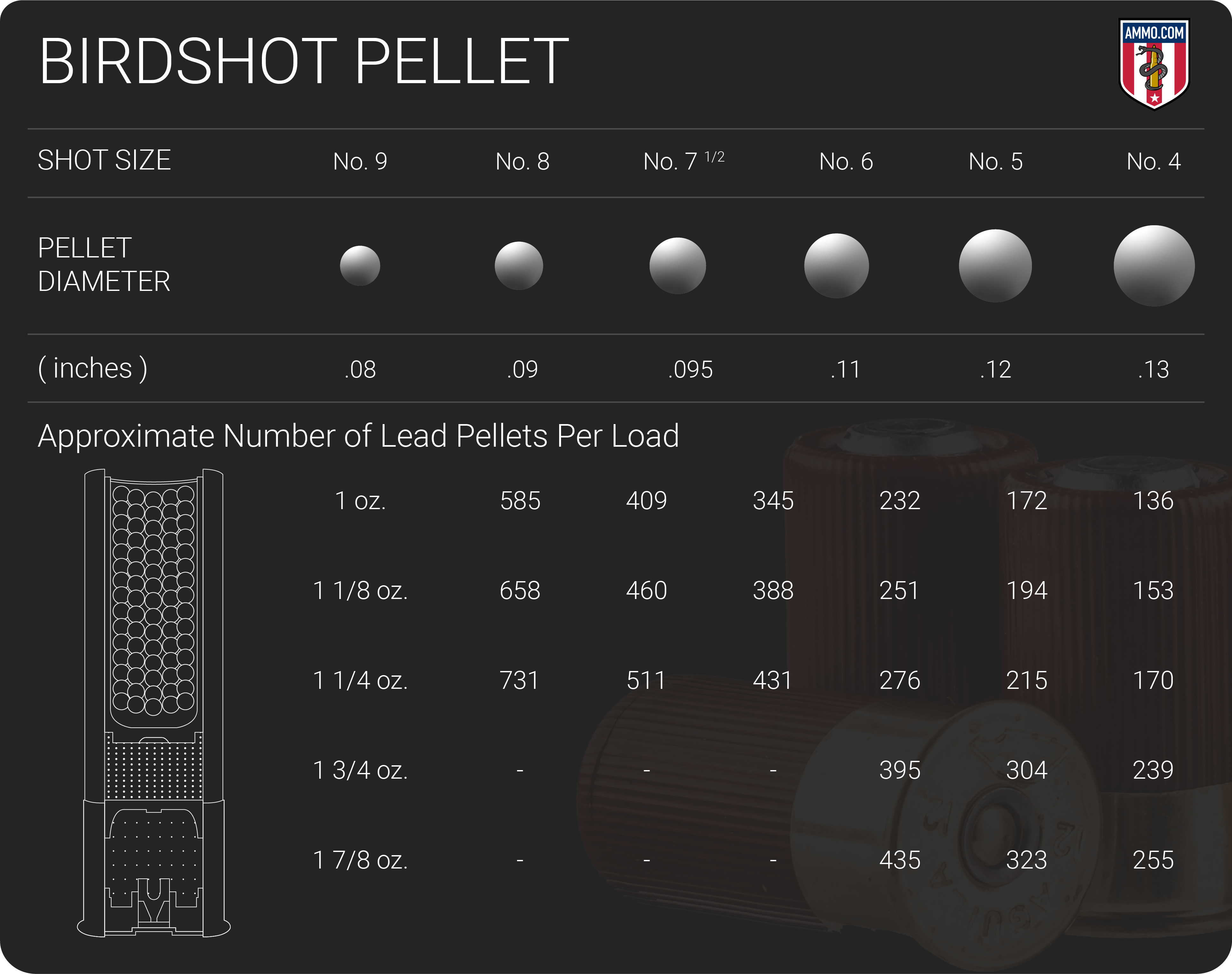
birdshot pellet chart

Pellet shot size works on an inverse scale, just like shotgun gauge, meaning that the larger the shot number, the smaller the pellet size. For example, #5 shot is larger than #8 shot. The most common birdshot sizes you’ll see at the ammo counter are 7, 7 ½, 8, and 9 which can be used for bird hunting and sporting clays.

Although some birdshot loads can carry well over 500 pellets, these lightweight projectiles don’t carry a lot of kinetic energy. Although perfect for felling birds or bursting clay pigeons, they are less effective on large game or in self-defense.

For that you’ll need something with a bit more oomph behind it…like buckshot.

Buckshot, like its name suggests, was designed for hunting medium to larger game. As a “buck” is a term for a male deer, buckshot was primarily designed for whitetail hunting.

Buckshot fires larger pellets but fewer of them. Furthermore, they are often loaded with more powder than birdshot, giving them higher recoil but increased penetration and range. However, unlike birdshot, buckshot typically has a tighter pattern as you want all that stopping power put into a smaller area to harvest big game.

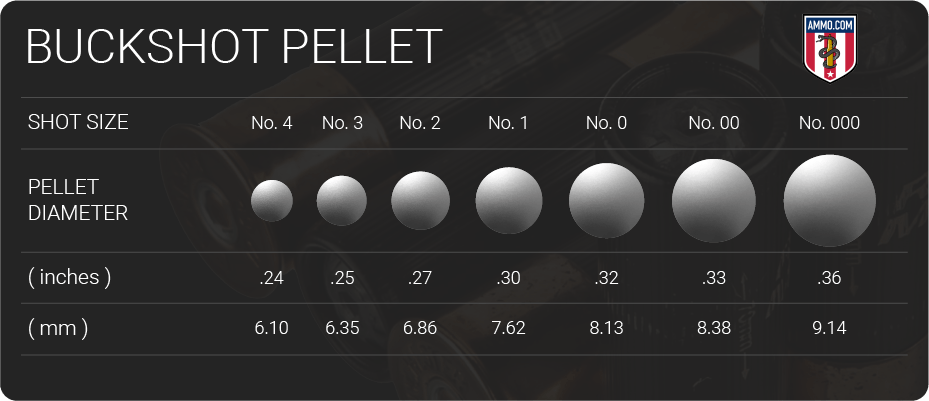
Just like with birdshot, buckshot gauge is measured in reverse. This means that No. 4 Buck will be smaller than No. 1 Buck.

buckshot pellet chart

Buckshot is typically not used on birds or small game due to the amount of kinetic energy it carries. Using buckshot on a bird is considered, by many, unethical and typically renders the majority of the meat inedible.

Although buckshot might not be the best choice for bird hunting, its widespread use by law enforcement has led many homeowners to rely on a home defense shotgun loaded buckshot shells for protection.

Why are 20 Gauge Shotshells Yellow?

One thing you might notice is that virtually every 20 gauge shotshell is colored yellow. This is done to prevent them from being confused with 12 gauge shotgun ammo.

If a 20 gauge shotshell we accidentally loaded into a 12 gauge shotgun, a 12-gauge shell loaded behind could cause the 20-gauge shell to fire inside the magazine causing catastrophic damage to the firearm and potentially the shooter.

Although there is not an industry mandate that all 20-gauge shotgun ammo be yellow, most every manufacturer holds to this unofficial standard.

To learn more about how 12 gauge compares to 20 gauge, check out this article: 12 Gauge vs 20 Gauge.

What Shotgun Ammo Should You Buy? Buckshot vs Birdshot vs Slugs

Now that you have a better understanding of what types of 20 gauge shotgun shells are available, let’s talk about what you should be loading into your scatter gun.

For general target shooting, sporting clays, or upland game, you’re going to want to get some game loads or bird shot. This type of shotgun ammo has low recoil and fires a lot of tiny pellets to give you a good pattern and the highest probability of hitting your target. These loads are typically filled with #7-1/2, #8, or #9 shot and can be bought in bulk from companies like Rio, Fiocchi, Remington, Winchester, and Federal.

For home defense, buckshot is the best choice. A typical 20-gauge shotshell filled with #3 buckshot will contain around 20 pellets. This means when you squeeze the trigger, you are essentially firing the equivalent of twenty 0.25” caliber bullets at the same time. That will stop just about any threat pretty quickly if you ask me! Multiple pellets also have the added advantage of increasing your chances of hitting vital organs to incapacitate a bad guy as quickly as possible.

For deer hunting, slugs are your best friend. Although buckshot was designed for big game hunting, many states and territories prohibit its use for this purpose. This is because at longer ranges, buckshot spreads out and increases the potential for only wounding a deer. Slugs, on the other hand, provide hunters with higher levels of accuracy at longer ranges and focus all the shotgun’s power into a single point. Slugs increase stopping power and reduces the potential for merely wounding the animal.

Shotgun slugs can be used for home defense, however over-penetration is a big problem. A 20-gauge shotgun slug is great when hunting in the woods where over-penetration doesn’t really matter, but indoors you need to consider the safety of your family members. A 20-gauge slug will typically have no issues passing through any would-be home invader and several layers of drywall behind them, possibly hitting an innocent bystander or a loved one. Therefore, it is our recommendation that buckshot should be primarily used for home defense over slugs.

Now that you know which shotgun ammo to buy, let’s get back to our Top 5 List of the best 20 gauge ammo available by clicking HERE!

Best Air Rifle Springs

0

“Unlocking Precision and Power: Discover the Superior Air Rifle Springs for Unmatched Performance”

air rifle springs

air rifle springs

When it comes to air rifles, the role of springs cannot be overstated. Air rifle springs play a crucial role in powering the weapon and propelling pellets or BBs. These springs are essential components that provide the necessary force to compress air within the rifle’s chamber, which in turn generates the energy needed for each shot. As such, choosing the right type of spring is paramount for ensuring optimal performance and accuracy.

There are various types of air rifle springs available on the market, each offering different characteristics and benefits. One popular option is the coil spring, known for its reliability and durability. Coil springs are designed to withstand repeated compression without losing their strength over time. Another common choice is gas ram or nitro piston technology, which utilizes compressed gas instead of a coiled spring. This alternative offers advantages such as reduced recoil and smoother cocking action.

Whether you prefer traditional coil springs or innovative gas ram systems, selecting high-quality air rifle springs is essential for achieving consistent power and accuracy in your shots. Additionally, regular maintenance and lubrication of these springs are crucial to prolong their lifespan and ensure reliable performance throughout extended use. By understanding the importance of air rifle springs and making informed choices regarding their selection and upkeep, shooters can enhance their shooting experience and achieve better results on target.

In conclusion, air rifle springs play a crucial role in the functioning and performance of these firearms. Understanding the different types and qualities of springs is essential for shooters to achieve optimal accuracy and power. Regular maintenance and proper replacement of worn-out springs can significantly enhance the longevity and efficiency of air rifles.

Rain: The Great Myth of 'Ducky' Weather?

0

Rain doesn't necessarily equate to good duck hunting. Success often depends on several associated factors. Photo © Bill KonwayFolks often associate rain with ducks and great waterfowl hunting. Ducky weather, they’ll often say, sounding as trite as a Midwesterner complaining about the gosh-darn humidity during summer.

I’ve experienced some great days in the rain. I’ve also endured some awful rainy-day hunts. After a while, I began to realize that not all rainy, ducky days are the same. In fact, success in the rain often depends on many factors, including the ducks you’re hunting, the duration and intensity of the rain, and several other factors.

An old-timer told me years ago he’d hunt puddle ducks during a long, steady rain but would forget about divers during similar conditions. Generally, I think that’s good advice. Steady moderate to heavy rain seems to stifle diving duck movement more than puddler activity.

They key word, however, is steady. Puddlers and divers move like crazy immediately before and after periods of rain — even intense precipitation. I’ve seen seemingly dead lakes come alive with diver activity 10 minutes before thunderstorms or heavy downpours. Then, action wanes as the wet stuff arrives. Divers still move somewhat during the rain, of course, but the flight typically slows.

Puddlers, meanwhile, don’t seem to be quite as affected by steady rain. In fact, in some situations, such as field hunting, rain can increase your chances. During mild weather, ducks and geese often hit fields at first light, spend most of the day loafing on small waters and then feed again before going to roost. During a steady rain, they might spend all or most of the day in the field.

And consider this rarely mentioned tidbit: Some guides I know love hunting divers or puddlers during sunny days, when ducks can see decoys from long distances, but hate cloudy conditions unless it’s raining. Why? Rain, they say, obscures the vision of ducks so they can’t spot boats, hunters or other potential dangers. It’s an interesting theory.

Then you have those X-factors I mentioned. Wind tops the list, as a big breeze usually gets ducks moving during rainy or sunny days. Further, rain ahead of a major incoming cold front can trigger bird activity, as they sense the urge to feed or migrate, or fresh birds arrive with the new weather pattern.

If rain changes to snow, the debate ends: Get out there. Snow drives ducks crazy. Some of the greatest marsh, field and diver hunts I’ve experienced were associated with snowstorms — even prairie blizzards.

So, should you hunt in the rain? That’s really up to you. I always figure I’ll shoot more ducks during a steady rain than I would sitting at home. I don’t layout hunt during long, steady rains, because doing so is a form of torture similar to lying in a bathtub and turning on the shower — on its coldest setting. However, I’ll gladly brave intermittent showers or light, spitting rain.

My best advice is to watch the radar and get an idea of what the day holds. Then, weigh all the factors, and go with your best instinct. Do not hunt if thunderstorms are forecast. If it appears the rain will stop after a few hours, think about holding off and hunting later. If it looks like an all-day drencher, you’ll have to choose between getting wet or waiting for better days.

Really, with modern raingear, the only hassle associated with hunting in the rain is stripping and cleaning your gun afterward. Sure, that can be a pain. But it beats moping around while watching the weather forecast for the next day.

The 270Winchester

0

This month we shall take a closer view of the 270Winchester and how it compares to the 7 Rem Mag and the smaller 308Winchester

Cartridge wars by rifletalks

The following is a closer ballistic comparison of the 270Winchester, 7Rem Mag and 308Winchester. Together we shall go through their ballistic qualities as well as gauging their relevance in a real world scenario. I augur that this article will make you take a closer look at the cartridge and bullet combination you are using as well as question the way you make use of it.

Wherever I travel to, it seems hunters and shooters alike get into the debate between these 3 popular rifle cartridges. Is the 270Winchester an underestimated long range contender? Is the 7 Rem Mag a superior round? Where does the 308Win stand in this competitive rifle cartridge scenario?

270win cartridge comparison

Which cartridge most represents you?

A – 270Winchester (I already have one & it’s worked for so many hunters so why change it)

B – 7rem Mag (I Love 7mms, love the ballistic performance and can take out anything way out there)

C – 308Winchester (Ammo I can find anywhere, It’s killed everything under the sun. good enough to shoot FTR and Palma competitively)

blaser R8 7rem mag
Blaser R8 in 7 Rem mag, a popular round for open plains hunting or larger game at shorter ranges

In this series of Cartridge Wars – ballistics by Rifletalks, I shall attempt to dispel some myths as well as shed some factual data in ways which I hope will be easier to understand when comparing rifle cartridges. Keep in mind, here we are speaking of rifle cartridges in their standard CIP factory load format.

surgeon rifles 308Win
Surgeon Rifles 308Winchester – custom rifle, from PRS to mountain hunts & African plains game – all rounder topped with a March 2.5-25×42 MTR3 Illum. Reticle. Same scope we used on our 1mile rifle.

Factory loaded 270Winchester VS 7 Rem Mag VS 308Winchester

Each of these cartridges, 270Winchester, 7rem mag and 308Winchester can be handloaded to enhanced specs such as longer over all lengths, increased powder capacity, slower powders, better bullets, longer barrels etc. However, most shooters will acquire a rifle with a barrel length from 22-26 inches as made by most factories. Most of these cartridges, will shoot and burn 100% of their powder charge in a 24inch barrel. Naturally longer barrels provide additional speed as well as added challenges of maneuvering longer heavier barrels so let’s stick to 24inch. Having a few 30inch barrels myself, I’m well aware of this.

In order to find some common base line, I chose the loads as loaded by Hornady Precision Hunter ammunition. I shot this ammo in 6.5 Creedmoor and 30-06 and I believe it is outstanding and fairly well priced at around €2.20 a pop.

270Win – A closer look at bullet choice

The bullet choice is largely the most important component which connects you to your target. It cannot be overlooked. High ballistic coefficient hunting bullets are not as easy to find although most manufacturers nowadays like Hornady, Berger, Sierra, RWS, Norma and Lapua have all come up with their own line of high ballistic coefficient hunting bullets.

7.62 mm bullet VS 7mm rifle bullets

Some cartridges have seen better traction particularly due to their bullets being widely used in other popular cartridges, hence enjoying a wider selection of bullets. Take the 308Winchester (7.62) for instance, you can shoot anything from 110grain to 240grain bullets (if you have the correct rifle twist rate)

308caliber bullets

308caliber bullets: Source https://www.accurateshooter.com/gear-reviews/bulletguide/

Wherever you are in the world, you will find ready loaded 308Win ammo, bullets as well as powder, primers and rifles chambered for this cartridge. It’s comparable to the Land Rover Defender of rifle cartridges.

The 7 Rem mag also enjoys a huge variety of highly accurate 7mm bullets (.284). 7mm bullets are highly sought after in competition, made popular by cartridges like the 284Win among others as well as being very popular in hunting cartridges like 7×64 brenneke, 280ackley improved, 7×57, 280rem, 7RUM and more recently, the mighty 28 Nosler. Remember, it’s not the cartridge that makes it a hunting round but the bullet it is loaded with and to a large extent the weight of the rifle platform from which it needs to be fired from.

7mm (284) bullet lineup

7mm (0.284) Above is an extensive line up of 7mm bullets https://www.accurateshooter.com/gear-reviews/bulletguide/

The 270Winchester on the other hand has enjoyed years as a leading hunting rifle cartridge but what is it’s ballistic performance like compared to the 7rem mag and the 308Winchester?

On my last trip I heard a lot of discussion about the 270win, the 7rem mag and the 308win. It seems all hunters and shooters have owned one of these cartridges, either because they inherited a rifle chambered for this cartridge or else it was just the first rifle they bought.

During our latest trip in the Pyrenees, one guy turns to me and asks, Rod should I change my Voere 270win Luxus for a better mountain hunting rifle? My reply, what are you going to gain over your existing chambering? He said, well I’ll get a flatter shooting round. From my target shooting experience, I know this largely depends on the bullet you are shooting rather than the cartridge or rifle. As soon as I got home, I started digging into this.

The 270Winchester

I know that the Austrian brand Voere lbw luxus 270win makes high quality rifles having shot their 338 Lapua mag version a few times grouping extremely well at 800m with it. In order to be able to guide this fellow shooter, I decided to show you their performance on 2 different levels, Drop in MOA as well as Windage in MOA. You may then decide for yourself.

In my view, Windage is what really influences my choice of that specific bullet & cartridge combination. Why?

Bullet Drop doesn’t bother me, once I laser my target and given I know my actual muzzle velocity, I will dial in that elevation and that will take care of drop. Irrelevant of how fast a cartridge you are shooting, past 400m they are all going to drop considerably that you will have to use a laser range finder before making the shot and you WILL need to know how much it drops exactly. For the scenario below, I am assuming you have dialed in your elevation after you acquired the ballistic solution from the many ballistic applications out there. I prefer Kestrel as it takes into consideration my real time atmospheric conditions as well as the ballistics and it’s spot on once you true your ballistic trajectory.

270Win Voere
Read Review of this 270Win Voere LBW rifle

270Win Vs 7 Rem Mag vs 308Win Ballistics

Below: Notice how close the 270Winchester is to the 7rem Mag to 700m…. Do you still want to change your rifle mate? Why not try changing the bullet first.

The 270Winchester bullet drop

270 Win – Windage

voere Zeiss V8

Read about the Voere LBW rifle above in 270Win here.

Windage on the other hand is a trickier skill set and comes by practicing sending rounds down range as well as practicing with a wind meter off the range. Most hunters seem not to spend a lot of time on the rifle range, they just zero their rifles at 100m and they set off. If you’re hunting short distance, that approach will be fine. If on the other hand, you’re expecting long shots as in some known regions of the world as is mounting hunting, that’s not going to cut it.

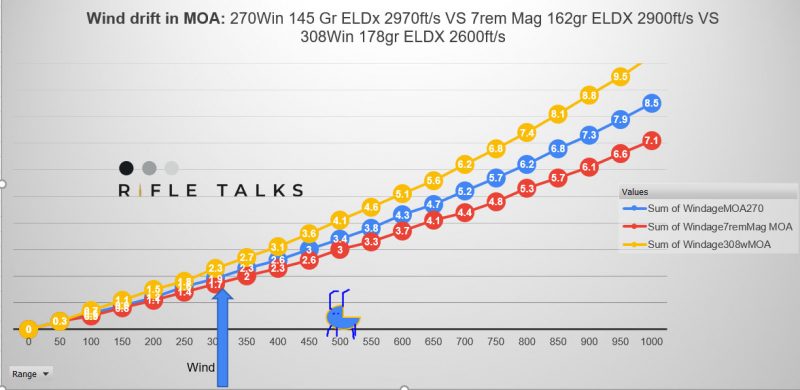
The wind drift table below shows these 3 popular rifle cartridges 270Winchester, 7 Rem Mag and 308Winchester and their wind drift component. I placed a game animal at 500m to give a practical example. The lateral deflection gives you an idea of how much drift you would get due to wind.

The 270Winchester bullet drift

Ok so let’s find out the difference between the 270Winchester, 7Rem Mag and 308Winchester using some numbers and real-world case scenarios.

Let’s take the diagram above. We have a plains game ranged at 500m. We have a 10mph wind blowing from 3 o’clock (Full value wind). Below you can see how much each cartridge/bullet combo will drift, both in inches and MOA. For those new to adjusting for wind in MOA, at 500m/546 yards 1MOA = 5.6inches.

270Winchester VS 7remmag VS 308 Winchester wind drift

So let’s assume you have dialed in windage for this distance or you’re holding off your shot using the reticle hash marks. Now the wind speed drops to 7mph from 10mph but still blowing from 3 o’clock. This happens often and if you do not notice, you will be caught out. By how much?

Below: Here are the wind drift values for a 7mph wind.

270Winchester bullet drop

When do faster cartridges matter?

Faster Cartridges like the 7rem mag and 270Winchester matter. If you were shooting a 308Winchester and the wind drops to 7mph, you now need:

16 inches of Right wind hold instead of 23 inches for a right wind, that’s 7inch difference.

Your 270Winchester would need 14 inches instead of 20 inches that’s 6 inches difference while your

7 Rem mag would need 12 inches instead of 17 inches, that’s 5 inches less correction.

Depending on which way the animal is looking, if it where looking into the wind, you would probably just miss it or just hit it as you would have over compensated but if it were looking away from the wind, you would miss and hit the animal in its hind legs.

Scenario A

Below you can picture this scenario where you are taking a shot at 500m in a 10mph from 3 o’clock (known as full value wind) We are holding off 4 MOA Right wind to compensate for the wind drift. We are shooting the bullet into the wind so that it will bring it back to where we want it to impact.

kentucky Windage hold

Should the wind speed change and the shooter not realize, this is what would happen assuming the wind direction does not change. The effects are further accentuated if the wind direction changes.

  • 5mph wind – miss, shot would hit in front of the animal. (over compensate)
  • 7mph wind – maybe a miss or barely hit (over compensated)
  • 10mph wind – shot impacts exactly as shown below right in the lungs. (correct)
  • 15mph wind – gut shot (under compensated)
  1. b) Scenario B – 10mph wind from 3 o’clock with an animal facing away from the wind.

In order to hold 4MOA of Right Wind, we are aiming at his hind legs. Again we are pushing the bullet into the wind so that the wind brings it back to where we want it to impact.

  • Wind drops to 5mph – Gut shot (over compensate)
  • 7mph wind – Gut shot (over compensated)
  • 10mph wind – shot impacts exactly as shown above right in the lungs. (correct)
  • 15mph wind – Miss (under compensated)

With a 308Winchester, our Right Wind hold is almost the width of the entire animal at 500m.

Holding Off Windage with your 308Winchester

What does holding off look like in real world scenario? While on the range I managed to take this shot. We were not going to shoot the sheep, it’s just to show you what it looks like. The more you hold off, the large the chance for a miss. Here we are holding 6MOA LEFT WIND meaning we are shooting the bullet into the wind so that it would then blow it back on target. Do you want to learn how to develop a perfect load in under 50 rounds?

Kentucky windage - holding Left Windage

swarovski z8i 4Wi reticle
Reticles like the 4Wi on the new Swarovski z8i 3.5-28x50P have 2MOA hashmarks on 28x magnification for you to hold wind.

How do Faster cartridges like the 270Win and 7 rem Mag help us?

They basically narrow down the window that you should hold off as well as diminishing the error bracket. If you ever saw a wind plotting sheet on an Fclass score card, you would see something like this. Dots below the targets plotted to show where the bullet impacted when we dialed a specific wind correction.

wind plotting chart 1000 yards
Wind plotting chart for a 20 round string at 1000 yards

Above: Notice the dotted lines that I drew up to show where the bullet impacted the target relative to my wind correction for that shot. It also gives me an idea of how much the wind changed and consequently its effect on my bullet over a 20-shot string at 1000yards. In this scenario we went from 4MOA estimate to 8.25 MOA Left wind call. That’s with a 284win shooting a 180grain VLDs at 2910ft/s, same performance of 7 rem mag!

How do you know how much you have to dial? You can work it out, there is a simple formula to get you there.

(Wind in MOA for 10MPH @3o’clock X by wind speed (mph) X wind direction value (0.5, 0.7, 0.85) = Wind Correction

Then you have to shoot and practice on the range to get proficient at that. A few hundred rounds a year done well will get you there.

Fclass plotting cards

Instead of holding all that wind, I prefer dialing in that wind component into my windage turret.

In the picture below, the shooter is dialing in 6 MOA RIGHT WIND. In this case he will not have to hold off his Windage. He will hold dead on target- centre mass. This is a learned skill and you have to practice, dial, adjust, shoot till you gain confidence adjusting the turrets with your eyes closed.

Dialing in windage

I took this picture through my Swarovski ATS 25-50×65 Spotting scope during Europeans while peeping at some of the windage adjustments during a course of fire. This ukrainian shooter had 6MOA on the very flat shooting 300WSM.

Swarovski z8i long range hunting scope

Swarovski BTF Elevation and Windage turrets enable you to do just that. Simple and fool proof to work with. I genuinely believe these are some of the best made turrets out there. Easy on, Easy Off. Moreover, these high quality windage turrets on the Swarovski Z8i enable you to dial 4 Mrad Left or 4Mrad Right then they stop turning, you can never get caught one full turn out. Read more about this Swarovski z8i scope which we used on a hunt in the Pyrenees.

Swarovski BTF Elevation and Windage turret
Swarovski BTF Elevation and Windage turret. You can get these from Williamevans

After reading this article, will you be switching to another cartridge or will you explore how your own rifle/cartridge/bullet combination can provide you better ballistics? Contact Us with any feedback you may have and signup to our newsletter!

Winchester Model 1873 .44-40 Rifle Review

0
Winchester Model 1873 .44-40 Rifle Review
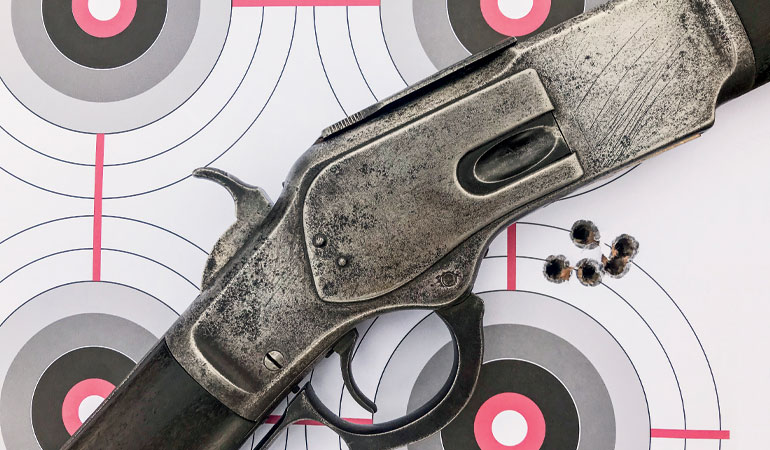
Still favored by riflemen today, the Model 1873 Winchester originally was offered in rifle, carbine, and musket versions. The author’s is the rifle configuration (circa 1889) with a 24-inch barrel chambered for .44-40 Winchester.

Winchester’s Model 1873 lever action was the first truly successful high-capacity repeating rifle. Bugs that plagued the ancestral Henry Model 1860 and Winchester Model 1866 were largely eliminated in its design, and it quickly became the favorite of ranchers, cowboys, lawmen, and outlaws. During the half-century it was manufactured, just over 720,000 were produced.

Manufactured in 1889, the Model 1873 shown and reviewed here represents the most popular configuration—the “rifle” model with crescent buttplate and 24-inch octagonal barrel. Second in popularity was a carbine version with a 20-inch round barrel. There was a third standard type (“musket”) with a 30-inch barrel and full-length stock, but it made up only about five percent of total Model 1873 sales. In addition, many custom 1873s were built and shipped.

Chambered in various cartridges, ranging from .25-20 Winchester through .44-40 Winchester, the Model 1873 was really a pistol-caliber rifle. It did not compete with the big-bore single-shot rifles and lever actions favored by big-game hunters in the Rockies and on the buffalo ranges. High cartridge capacity, light recoil, and good-enough ballistic performance for use out to 100 yards or a bit more were the Model 1873’s forte.

Mechanicals

The Winchester 1873 loads through a gate in the right side panel of the action. Rounds are contained in a tubular magazine beneath the barrel and fed up into the chamber via a lifting-block arrangement that serves triple-duty as a magazine cutoff and as a moving, mechanical ejector. The slender bolt reciprocates rearward inside the top of the action, and its rearmost portion pushes the hammer back to fullcock when the lever is opened.

When the lever is worked, a simple hook-type extractor positioned at 12 o’clock in the boltface draws the empty cartridge case from the chamber. The bolt cocks the hammer, and the lifter brings a fresh cartridge into alignment with the chamber, boosting the empty cartridge above up and out of the ejection port. Bringing the lever briskly back into firing position runs the bolt forward, pushing the fresh cartridge into the chamber.

A trigger-cutoff-type safety is incorporated in the action, and the lever must be squeezed fully closed before the trigger can be pressed. To prevent the lever from inadvertently opening while in the field, a rotating catch is provided at the rear of the lever and may be rotated to secure it in the closed position. Another field-expedient feature is the sliding dust cover atop the action, which may be manually closed to prevent grit from accumulating inside the action.

An additional safety is present in the form of a halfcock notch in the hammer, which may be lowered to this position after chambering a round.

Provenance

The .44-40 rifle reviewed here belongs to a good buddy of mine. His father purchased it for $700 and then handed it down to my friend. The original owner had it most of his life and had hunted with it. A close look inside the bore showed quite a lot of pitting and rounded-off rifling. A gentle but thorough cleaning removed accumulated dust and remnant traces of fouling.

Rangetime

Out of deference to the rifle’s vintage, I assembled two mild handloads to test-fire through it. One consisted of a 200-grain hard-cast bullet sized to 0.429 inch, with the correct nose shape and length for the .44-40, over 7.3 grains of Unique powder. The second load featured a 180-grain short-jacketed hollowpoint bullet over 6.0 grains of Trail Boss powder. Both loads were primed with Winchester Large Pistol primers in Winchester brass.

Not knowing how the worn bore would shoot, I placed my test target at 25 yards. I tested the jacketed-bullet load first, thinking that the cast-bullet loads might quickly build up leading in the pitted bore.

The mild jacketed-bullet load averaged 0.93 inch, and initially the load with the hard-cast 200-grain bullets showed tremendous promise. The first group clumped into one ragged 0.64-inch hole; however, as I expected, the more I shot the cast bullets, the worse accuracy became. Still, they averaged an acceptable 2.13 inches.

With accuracy testing wrapped up, I stepped away from the bench and shot casually, running a few rapid-fire rounds at my steel Birchwood Casey popper target. While I didn’t get too aggressive about speed, the vintage rifle ran smoothly and without a hitch—and without a miss. Balance was wonderful, and recoil was mild. It’s no wonder it was the most popular all-around rifle of its time.

Mossberg 500 Tactical | Mission Ready Shotgun Out of the Box [Review]

0

Unless you live under a rock, you have definitely heard about the Mossberg 500 Tactical by now.

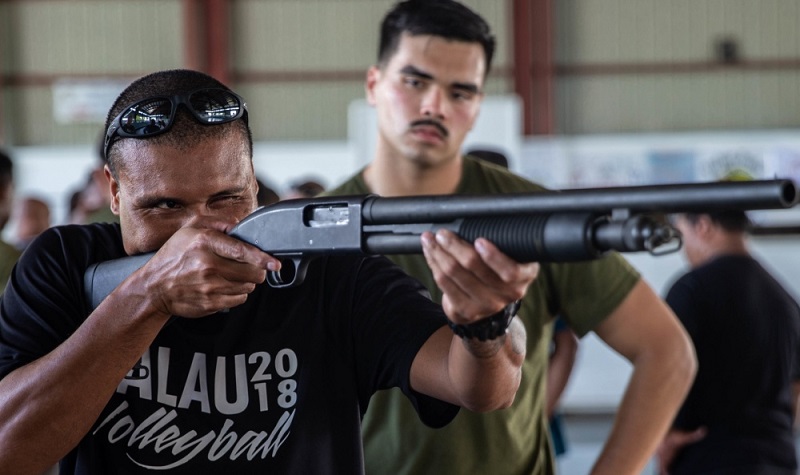
This renowned pump-action shotgun from O.F. Mossberg & Sons certainly needs no introduction. Especially not when organizations like the Marine Corps continue to use it for missions around the world.

That said, is this the right tactical shotgun for you?

Why Choose The Mossberg 500 Tactical?

When it comes to pump-action shotguns for home defense and tactical operations, your options are limitless. Just about everyone in the business of making shotguns has a tactical version of their firearm that performs well. So why should you choose the Mossberg 500 Tactical instead of one of the other brand names?

The answer to that question is simple.

For almost sixty years, the M500 has been continuously improving and evolving. Improvements to this firearm not only come from consumer feedback, but also feedback received from the people who trust their lives to this weapon system daily. This weapon is battle-proven, and with over 10 million units sold, people certainly rely on it both at home and abroad.

Bonus points added for being made in America, and being the only shotgun that meets mil-spec requirements.

You can find some more reasons on why you should trust Mossberg shotguns here.

Meet The Mossberg 500 Tactical

Mossberg 500 Tactical Webpage

There are thirteen different models of theMossberg 500 Tactical. Seven of the thirteen models come stock, ready to load 5+1 into the magazine, with the other six all being 7+1 in capacity. Depending on which model you choose, the weapon may or may not come stock with an adjustable stock and pistol grip, but there are tons of after-market options there as well. Only five of the stock model M500 Tactical come with a sight other than the bead front-sight.

It’s worth noting, that regardless of which model of the 500 Tactical you get, after-market options are available for just about everything. This shotgun has been compared to the Mr. Potato-head of tactical shotguns by some people, and those people were all correct in that assessment. If there is any cosmetic feature of this weapon system that you do not like, there is probably an upgrade or alternative piece of furniture available.

Regardless, the Mossberg 500 Tactical has everything you could possibly need. Of the thirteen different models that exist, there really is a mission-ready shotgun for every scenario. If the shotgun isn’t exactly what you want, you can probably get it there for under $200. Here’s a video of BigDaddyHoffman 1911 doing just that.

Features of the Mossberg 500 Tactical

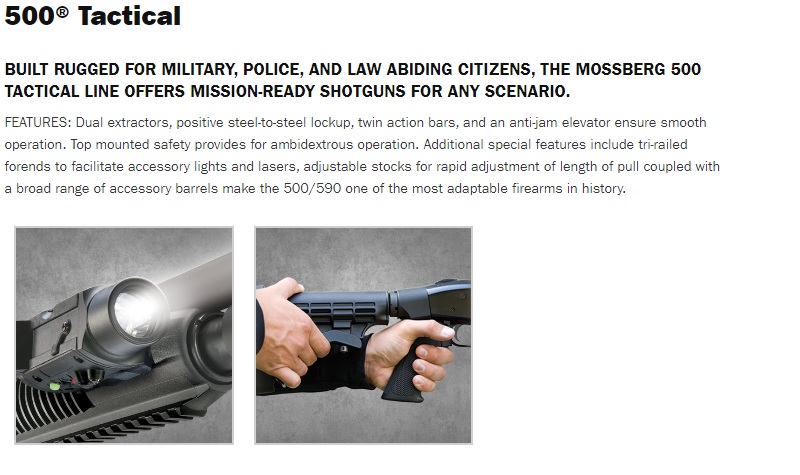
Aside from being a tactical Mr. Potato-head, the Mossberg 500 Tactical has a variety of other features. Like all pump action Mossberg shotguns, it comes stock with dual extractors, positive steel-to-steel lockup, twin action bars, and an anti-jam elevator. The safety selector is ambidextrous, and mounted on the top of the shotgun. Some people don’t like this, but after a bit of work with the weapon system you get pretty used to it.

Stock, most tactical variants of the Mossberg 500 also come with a tri-railed forend. This allows the user to attach a variety of different accessories to the weapon system. Several versions also come with adjusting stocks and pistol grips, which give the shooter better control of the weapon.

Here are the basic specifications of the 500 Tactical – 8 Shot straight from Mossberg.

Gauge 12 Capacity 7+1 Chamber 3″ Barrel Type Heat Shield Barrel Length 20″ Sight/Base Ghost Ring Choke Cylinder Bore LOP Type Fixed LOP 13.875″ Barrel Finish Matte Blued Stock Finish Synthetic (Black) Weight 7 Length 41″

Mossberg 500 Tactical on the Range

Mossberg 500 Tactical Cover

Out on the range is where this weapon system truly shines. Personally, I have been shooting the Mossberg 500 Tactical since around 2008 when I was first qualified in the conduct of less-lethal weapons and munitions. Since then, I have fired the Mossberg 500 and 590, as well as the Benelli xm1014 auto-loader all in military applications and in a variety of environments. Never have I personally experienced any serious issues with the weapon system that were not the fault of poor maintenance, or an inexperienced shooter.

One of the first things you’ll notice with your Mossberg 500 is the ease of use. It really is one of the simplest platforms in existence, and nobody should ever have issues firing it. The action on this weapon runs smooth as silk in most circumstances. Keeping a tight group with the weapon usually depends more on your ammunition and the individual shooter’s experience than on the weapon itself.

We’ve run a variety of different loads from buckshot to beanbag rounds through this platform, and no one ammo-type in particular has had any serious re-occurring issues. In eleven years of firing the Mossberg 500 platform on the regular, I can count the number of malfunctions I have personally experienced on one hand. Simple maintenance makes a world difference, and if you are experiencing a lot of issues with your weapon you should consider sending it into Mossberg to have it looked at.

Here’s a video of IraqVeteran8888 testing out a new optic on his Mossberg 500 Tactical.

Final Verdict on the Mossberg 500 Tactical

This is an absolute no-brainer in my opinion. The Mossberg 500 is one of the premiere tactical shotguns on the market, and it has been for 60 years. At an average cost of around $550, you really can’t get more shotgun for your money anywhere else. Tack onto this the adaptability and dependability of a truly military grade shotgun, and you have yourself a solid purchase for both home defense, and tactical shooting purposes.

These shotguns also make amazing project guns for people who truly like to customize their weapons. In fact, there’s an entire series on Full30 by the Hobbygunsmith where he takes an old Mossberg 500 from a bag of spare parts to a fully functioning weapon system in just four videos. It’s well worth your time.

As always though, that’s just our opinion on the Mossberg 500. If you’re a Mossberg shooter, or just a fan of shotguns in general, let’s hear you sound off down in the comments below with your thoughts and experiences with the weapon system. We’d love to hear from you all!

The Largest Fish Ever Caught on Rod and Reel

0

Fishing always seems like a simple, laid-back event. It’s usually a family-bonding experience accompanied by a slow, leisurely boat ride and a picnic. You catch a few fish, maybe grill some, then release the rest.

As with most things, there are outliers to this stereotype. Instead of a calm and easy affair, an angling trip can also turn into a strenuous game of tug-of-war between you and a giant inhabitant of the seas.

Regular-sized fish may be the norm, but there are also people who have caught large, record-breaking creatures with just their trusty rod and reel. Here are some of the largest fish ever caught over the years.

3,427-Pound Great White Shark, New York, 1986

The biggest fish recorded to be caught on rod and reel is a controversial one. In August 1986, Frank Mundus and Donnie Braddick caught a 3,427-pound great white shark off the coast of Montauk in New York.

The two anglers were reportedly using a 150-lb test line on a group of white sharks. According to a 2005 recounting of Mundus himself, their fight to reel in the shark went on for a total of one hour and 40 minutes.

A Controversial Record Breaker

Unfortunately, the catch is considered to be controversial. There are accusations that Mundus was only able to catch the great white shark after fishing by a dead whale. The dead whale allegedly attracted the sharks, which allowed Mundus and Braddick to bait and reel it in. This violates the record rules of the International Game Fish Association (IGFA).

However, according to Mundus, his boat pulled up to an already dead whale. By his account, the whale had large bloody bite marks the size of peach baskets and still had blood coming out of its mouth. He claims he and Braddick waited by the whale until midnight, when two sharks slammed into the whale.

IGFA-Approved Honorable Mentions

Although the 3,000-plus pound great white shark that Mundus and Braddick caught is tangled up in some controversy, there have been plenty more large catches over the decades that are recognized and approved by the IGFA.

The five official largest fish ever caught on rod and reel while saltwater fishing are the following:

2,664-Pound Great White Shark, Australia, 1959

The contested and official largest fish caught on rod and reel are both great white sharks but are almost 1,000 pounds and over 30 years apart.

The official IGFA-approved record is held by Alfred Dean, who caught a 2,664-pound great white shark while angling in Ceduna, Australia back in April 1959. Since great white sharks have become a protected species today, this record-breaking catch will likely stay unbeaten for years to come.

1,785-Pound Tiger Shark, Australia, 2004

The next largest fish ever caught by an angler using only a rod and a reel is another shark caught much more recently. This time, it was a tiger shark weighing 1,785 pounds and 11 ounces. It was caught by Kevin J. Clapson in ULladulla, Australia in March 2004.

This catch is tied with another record-setting catch from 1964 by Walter Maxwell. The only difference between the two catches was 11 ounces, leading the IGFA to rule in favor of a tie.

1,708-Pound Greenland Shark, Norway, 1987

In October 1987, Norwegian angler Terje Nordvedt caught another large shark while angling in Trondheimsfjord, Norway. He used a herring as bait to reel in a Greenland shark. The fish weighed a total of 1,708 pounds 9 ounces.

Greenland sharks are one of the largest living species of sharks in the world. It can grow up to seven meters or 23 feet long and live up to 500 years old, based on radiocarbon dating.

1,560-Pound Black Marlin, Peru, 1953

The next largest fish ever caught on rod and reel is a welcome change from the shark family that dominate the top three spots. Taking the fourth spot is a gigantic black marlin caught off the coast of Cabo Blanco in northern Peru in August 1953.

The 1,560-pound black marlin was caught by angling legend Alfred C. Glassell, Jr., who used a 130-lb line class and bait. This catch is one of the longest-standing IGFA world records. This particular fish can still be seen as part of a permanent exhibition in the Houston Museum of Natural Science.

1,496-Pound Bluefin Tuna, Canada, 1979

Another non-shark entry rounds up the last spot in the top five largest fish caught by rod and reel. In October 1979, renowned heavy-tackle angler Ken Fraser used a mackerel as bait to reel in a 1,496-pound bluefin tuna. The huge fish was caught in Aulds Cove, off the coast of Nova Scotia, Canada.

This region is known for its bluefin tuna fishery. However, Fraser’s heavy-tackle angling record remains unbeaten to this day.

Making It Big

When it comes to saltwater fishing, a huge part of what gets you catches the size of those on this list is luck, patience, and perseverance. Of course, having the best fishing tackle matters too.

Increase your chances of catching record-breaking fish with Rite Angler’s high-quality tackle. We offer products designed for success and made with anti-corrosive materials for better durability to withstand stormy seas, the blazing sun, and the biggest catch.

Rite Angler has been the partner of many fishers and anglers since our founding in 1990, providing reliable terminal tackle and other fishing equipment for men and women serious about improving their fishing game.

Check out our website and order superior lures, lines, and tackle for your next fishing trip, today!

Best Air Rifle Deals

Popular Posts

Air gun 101: Everything you need to know about air rifle accuracy

0
Wyatt Earp has said: Fast is fine, but accuracy is everything And I just thought how many airgunners are obsessed with muzzle velocity and muzzle energy,...

Can a Felon Legally Possess an Air Rifle in Tennessee?

0
"Understanding the Legalities: Felon Ownership of Air Rifles in Tennessee" can a felon own an air rifle in tennessee? In the state of Tennessee, the ownership...

Air gun 101: What is a PCP air rifle? Is PCP gun the best...

0
A PCP air gun is one of five types of air rifles in the market today. PCP air guns have become more and more...