Home Blog Page 120

What Is Cane Pole Fishing and How to Get Started

0

Cane pole fishing might seem primitive compared to other types of rod fishing, but you’ll be pleasantly surprised by how fun and exciting it is, even if it is reel-free. But how do you get started on this fishing method that dates back generations?

We’ll walk you through everything you need to know about cane pole fishing, including how to make one!

What Is a Cane Pole?

Before buying your supplies for a DIY cane pole for fishing, you need to know what a cane pole is. Don’t worry, though. It is not as complex as you think it is.

A cane pole is a long stick that usually has a 1″-1-1/2″ butt diameter and is between 8-foot-20-foot in length. Some are made from bamboo, while others are graphite or fiberglass. Unlike modern fishing rods, a cane pole doesn’t have a reel, drag system, and line guide. As a matter of fact, you will be using a line as long as the pole itself, if not a tad longer. The hook is at the end of the line, wherein you can use live or artificial baits.

What Are the Different Types of Cane Poles?

Bamboo fishing rods and poles are the most popular. However, there are other types of cane poles that you can use.

Telescopic Cane Poles

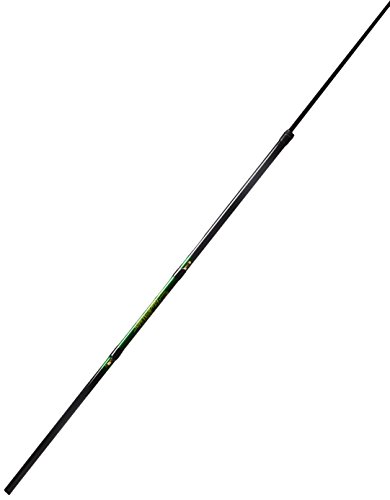
B&M BW4 Black Widow Telescopic Rod, 13-Feet, 4 Pc (Telescopic)

Telescopic poles are made from graphite or fiberglass instead of treated bamboo. This choice of material makes them more lightweight. Since they are collapsible, often shrinking half of their length, they are more compact for camping trips and air travel.

For convenience, many fiberglass telescopic poles also have add-ons like a metal eye tip and line keeper. Length can also vary too, ranging from 8-foot to 20-foot.

Calcutta Poles

Calcutta cane poles are made from solid bamboo, specifically the Calcutta Bamboo (Dendrocalamus Strictus) species. They are highly prized in the fishing community because of their strength and flexibility, which many argue is 100% better than fiberglass. A high-quality Calcutta Bamboo pole is also resistant to rot from saltwater.

These poles are available in various lengths, although most are between four and twenty-five feet long.

Pro Tip: The longevity of bamboo poles is determined by how well they are cared for.

Jigger Poles

Jigger poles are typically 15 to 20 feet long and can also be telescopic. They’re adaptable and great for fishing in places where traditional casting is tricky. Jigger poles can be bamboo, fiberglass, or graphite, among other materials. They’re strung with a short leader attached to the pole’s end and a plastic or wooden plug at the other end.

How to Rig a Cane Pole?

Rigging a cane pole is easier because there is no reel to deal with. However, it’s best first to secure your line lower down the pole’s body. This way, if the tip breaks under pressure, you won’t lose your line or fish.

Rigging a Bamboo Cane Pole

  1. Tie a piece of dacron or monofilament to the center of your pole, just below a notch.
  2. Twist the line to the tip of your bamboo pole by rotating the pole.
  3. Do a half hitch and secure the line in the slit you made in the tip when you get to the top.
  4. Make sure you have enough monofilament to reach the pole’s handle.
  5. At the end of the line, add a swivel or a hook. If you want to adjust the depth of the hook, add a bobber and any split shot you want.
  6. You can now put your bait to the test.

Rigging a Telescopic Cane Pole

Rigging a telescopic pole is as easy as stringing a bamboo rod. As a matter of fact, the procedure is nearly identical, except that there is a decreased danger of the tip breaking under stress.

How to Fish With a Cane Pole

Cane pole fishing is pretty simple, but since it doesn’t have any reel and your line is limited, it can be challenging at first. Here’s how you can master cane pole fishing.

  1. Lower your line into the water by gradually dipping the rod below and slowly raising it.
  2. Avoid moving it around too quickly or forcefully.
  3. Once you’ve hooked a fish, raise the pole above your head. This will bring the fish closer to the banks or boak.
  4. Then grab the fish, either by hand or net and remove the hook.

Cane Pole Fishing Techniques and Tips

You can use cane fishing poles to catch small to medium-sized fish, including bluegills, crappies, and catfish. If you target a larger fish like a Northern Pike, we suggest using a conventional fishing rod.

  • Bass: If you want to catch bass, make sure you use a bait that can function in cover. The bait should also look as natural as possible to the bass.
  • Trout: Use a tiny fly as bait and travel upstream to the stream’s or pool’s mouth. This approach entails carefully dangling the fly 2 or 3 inches over the water’s surface and occasionally touching it, just like a natural fly would.
  • Bluegill & Crappie: While crappie and bluegill are generally easy to catch, a cane fishing pole allows you to get your bait into hard-to-reach areas near dense cover.
  • Catfish: Use a slightly heavier line and anchor your line closer to the base of the pole because the weight of this fish can put a strain on your pole and potentially cause it to crack.

How to Make a Cane Fishing Pole?

You don’t need a sophisticated rod to catch fish at your nearby lake. The following is a step-by-step guide to making your cane fishing pole:

  1. Find a 10-foot to 20-foot long piece of bamboo. Choose one that is straight as much as possible.
  2. Cut the bamboo stalk below the knuckle closest to the ground, near the root.
  3. Remove any attached leaves, but be careful not to cut into the stalk itself.
  4. Cut the tip of the stalk just above the last knuckle.
  5. Allow the stalk to cure for a few weeks by hanging it in a dry location until it turns a solid tan hue. This ensures that the bamboo has dried thoroughly and will endure as long as feasible.
  6. Sand the base and the rest of the pole.
  7. Apply a coat or two of wood lacquer.
  8. Set up your fishing cane and get started.

Cane Pole Fishing FAQ

What Are the Best Baits for Cane Poles?

When using a cane rod or pole to catch fish, the most common species are bluegill and tiny catfish. When going after catfish, you’ll use a variety of baits, including earthworms, crickets, mealworms, and a minnow-shaped plug that floats.

How Long Should a Cane Pole Line Be

The rope’s length should be enough to extend from the pole’s tip to the bottom. This ensures that even if the pole’s very thin tip broke, you could still land a bigger fish.

How to Cure a Cane Pole for Fishing?

You can cure a cane pole for fishing by laying the bamboo on a flat surface. It can take several weeks to months before it completely cures. You will know that the pole is cured if its color changes from green to brown. Never put bamboo poles under direct sunlight because they will crack.

Back to Basics

Cane pole fishing offers you the opportunity to go back to the basics of fishing! It may seem primitive and outdated, but the joy of catching a fish without using any modern fishing gear is exhilarating! Plus, it is a terrific method to learn to fish without spending a lot of money.

Constructing a Bear-Proof Deer Feeder

0

Upon encountering a troublesome black bear who continuously tore up my deer feeders, I decided I was going to have to come up with a better solution to the cheap plastic Moultrie ones I had installed. I began searching the hunting forums for answers but everything I read kept repeating the same old story that there is no bear-proof deer feeder. Most people suggested hanging a barrel spreader between two sturdy trees. There were plenty of examples of crafty bears getting to these as well. There are of course some massive deer feeders for sale for thousands of dollars that would work if I had the money to blow or a way to haul something that large onto the property. My property is very rugged, and everything has to be carried in by hand. After a couple of hours searching I did find a couple of designs that were small enough to bring in, but they still were close to $800.00.

There had to be a better solution. I headed into my shop and drew up some plans for a steel fortress to house a 30-gallon barrel spreader. I headed up to my local steel supplier for the raw materials, tossed a new tank on the welder and got to work.

The Bear-Proof Deer Feeder Build

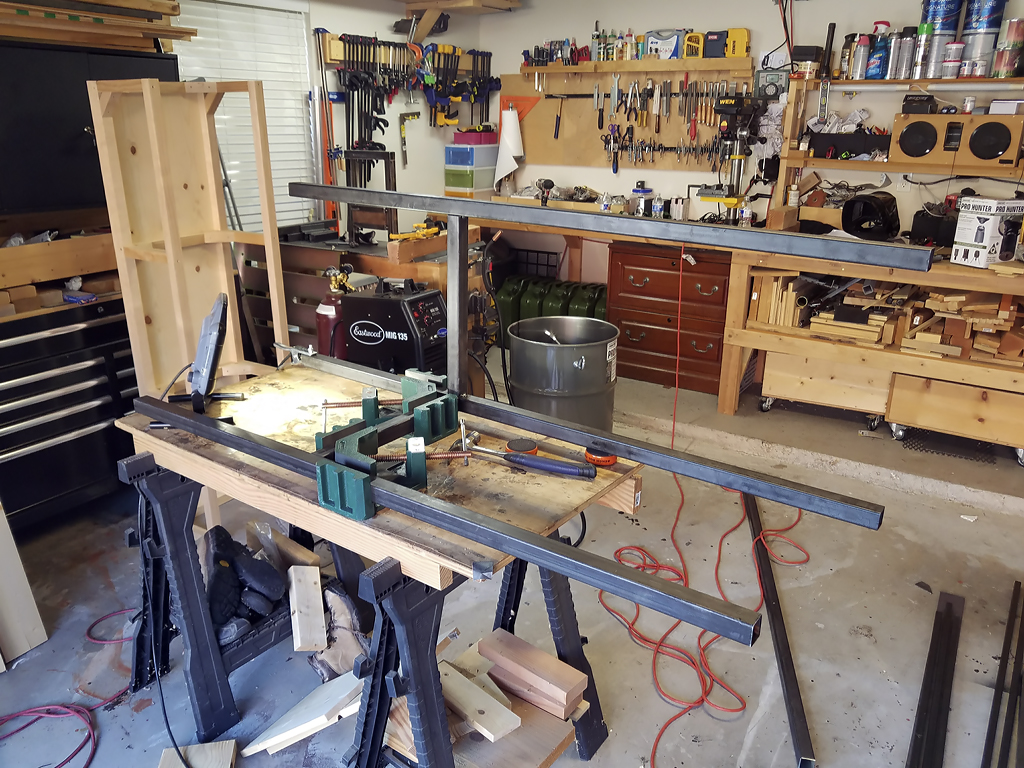
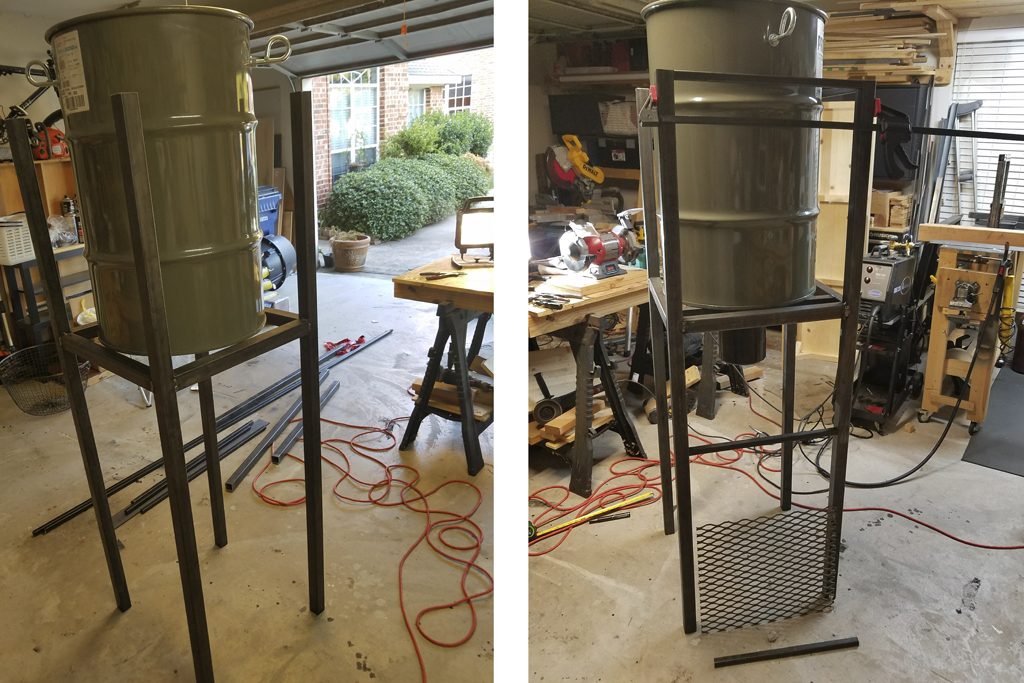
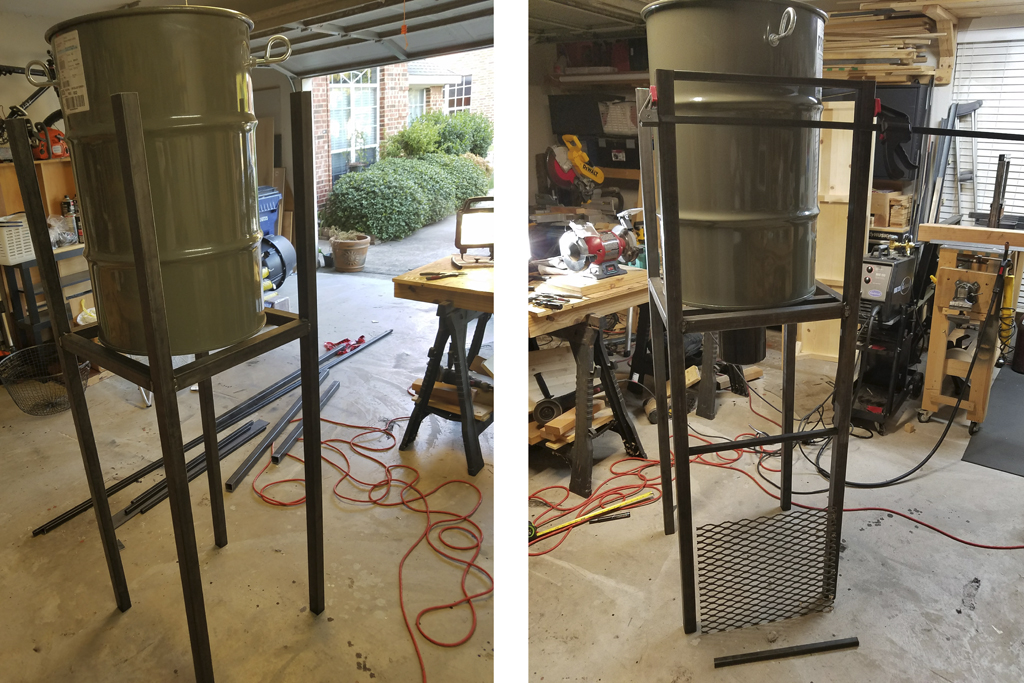
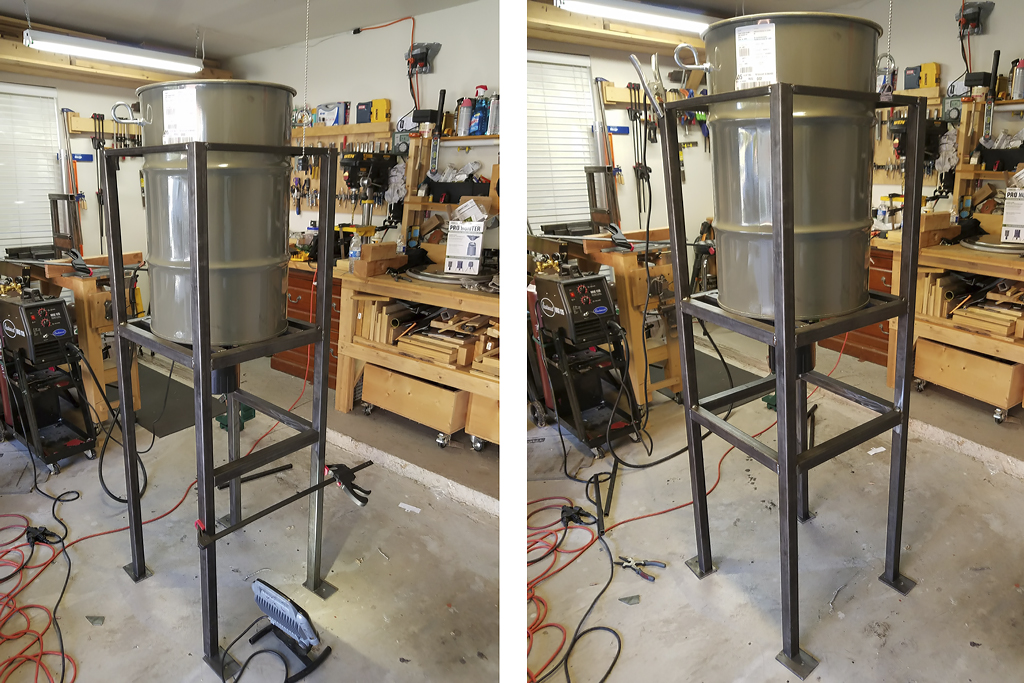
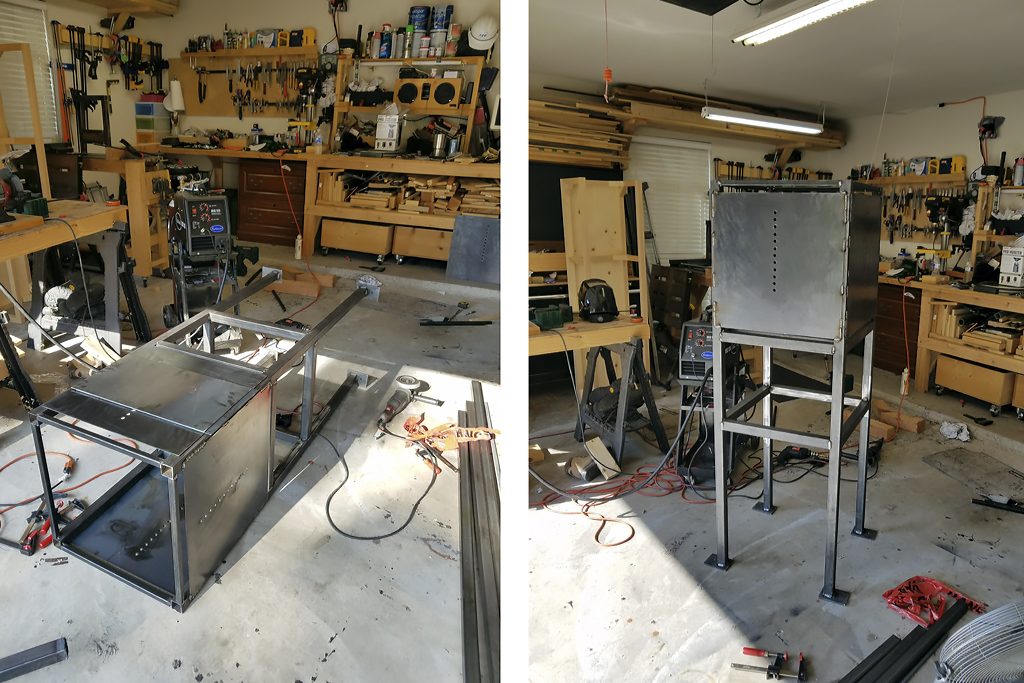
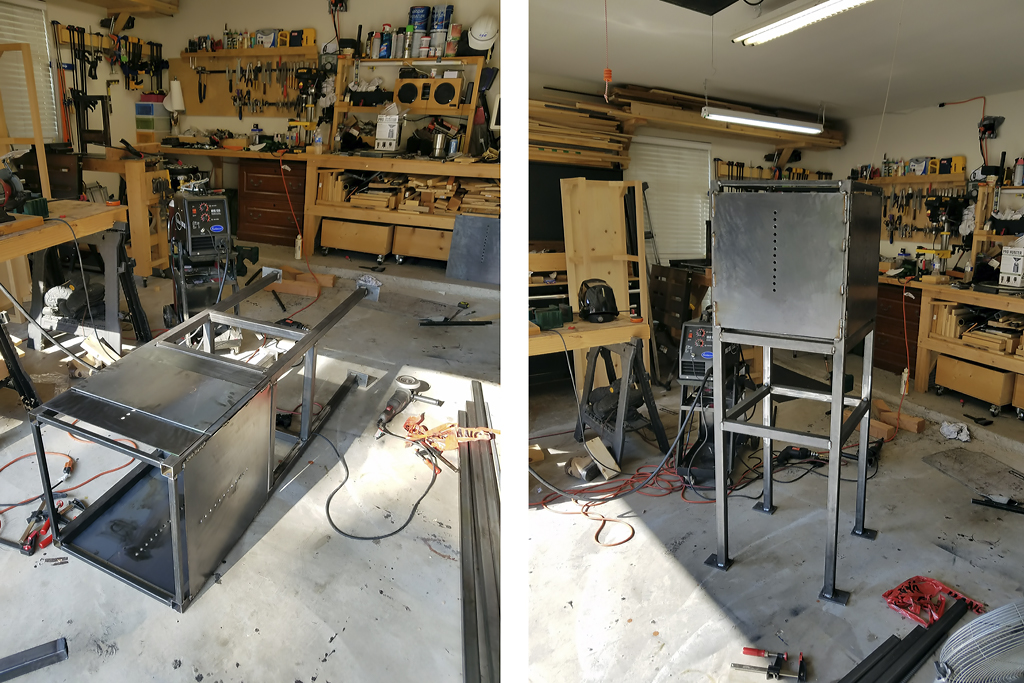
The first task was to construct a steel frame to house the barrel.

Bear-Proof Deer Feeder Frame 1

Bear-Proof Deer Feeder Frame 2

Bear-Proof Deer Feeder Frame 3

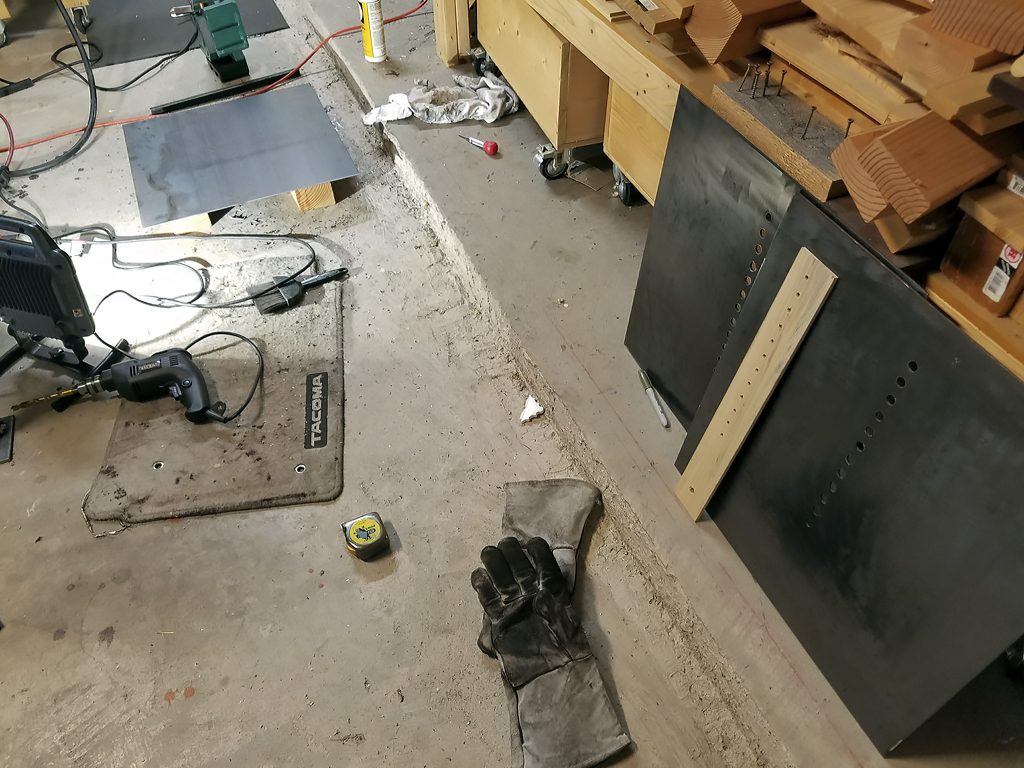
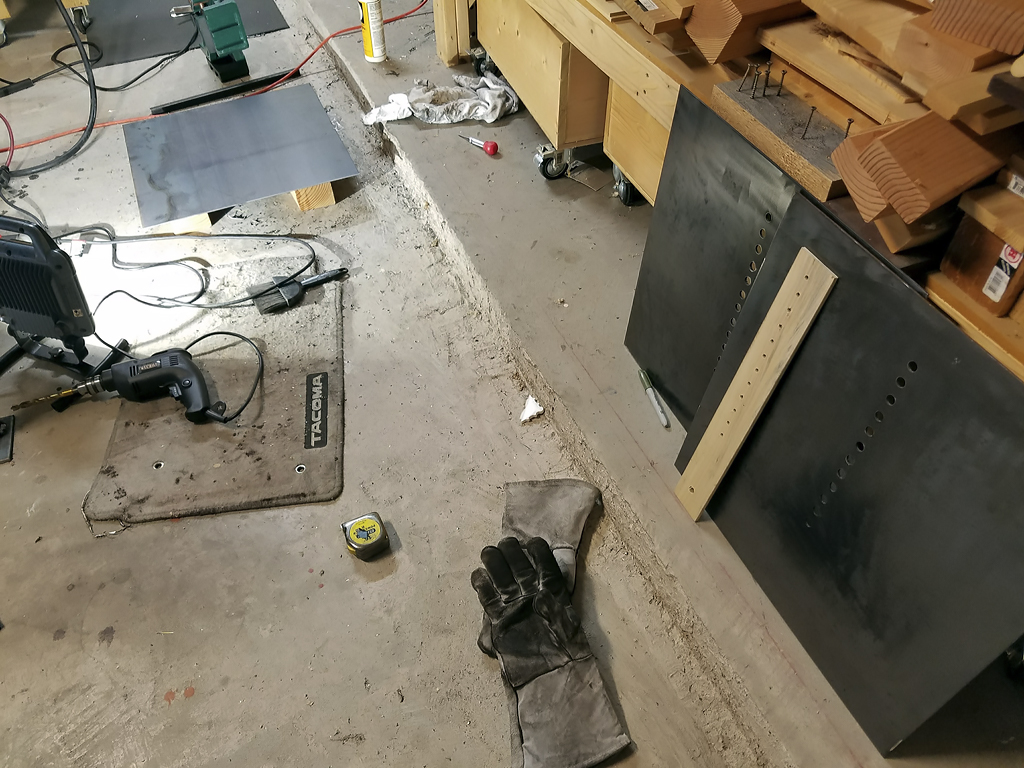
Once the frame was welded up, it was time to give the beast some armor plating. I used 1/8 inch steel plate that is plenty sturdy and didn’t kill me on the weight. Before welding them to the frame, I drilled hole sets for the support legs I had yet to complete.

Bear-Proof Deer Feeder Side Plate 1

Bear-Proof Deer Feeder Side Plate 2

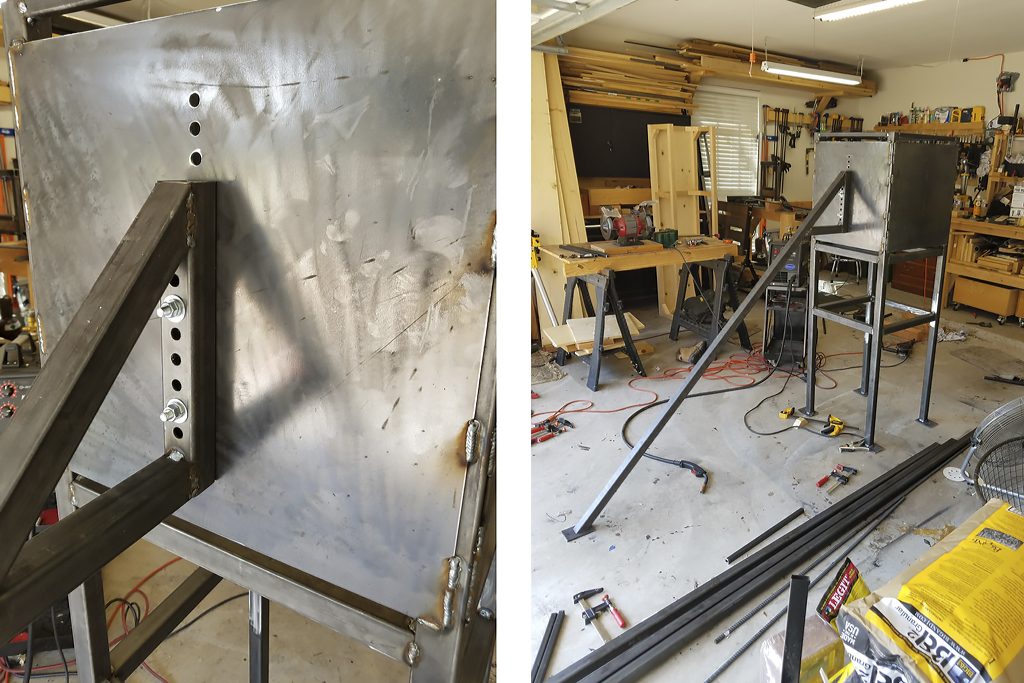
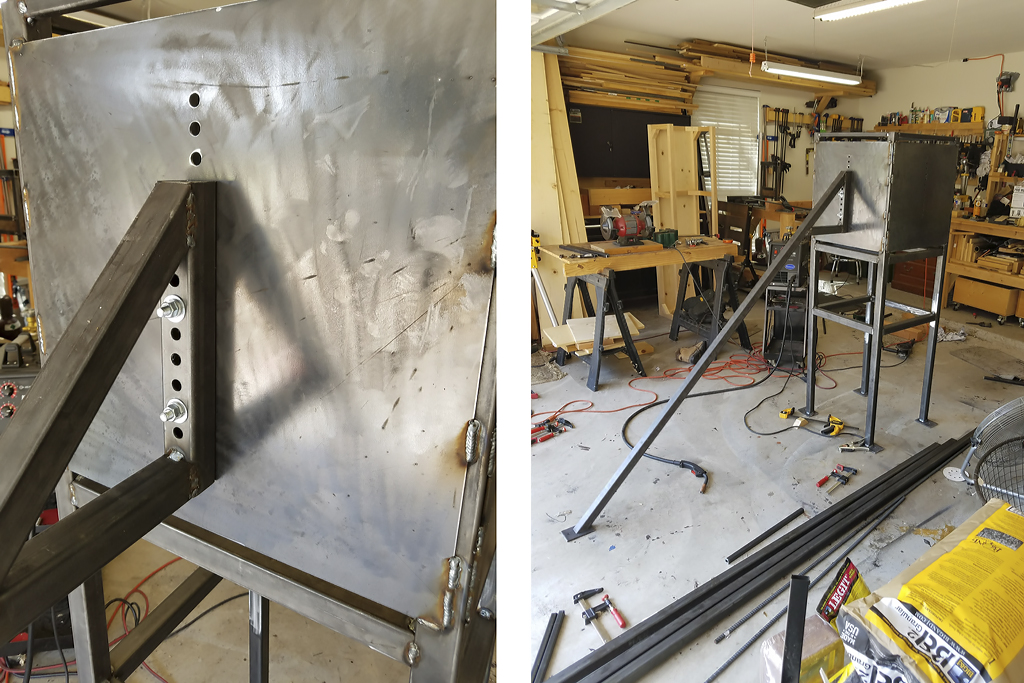
To this point, it’s still just a conventional albeit heavy feeder design. The 45-degree support legs were the first real modification. These were designed to provide adequate stability to survive a hungry bear. These legs are juxtapositioned to the frame legs for added support. Because of the length of the legs, I had to make them adjustable due to the sloping, uneven terrain and they had to be removable for transport. Each leg also has a steel foot with a hole drilled to accommodate an 18-inch rebar ground stake.

Bear-Proof Deer Feeder Support Legs

Next on the list was to build out the critter cage and spray a coat of primer on the beast. The inside of the cage has sheet metal angles to ensure the feed falls outside the enclosure.

Bear-Proof Deer Feeder Critter Cage 1

Bear-Proof Deer Feeder Critter Cage 2

Time to give the beast a facelift and add a cage door for easy access to the spreader controls.

Bear-Proof Deer Feeder Finishing Touches 1

Bear-Proof Deer Feeder Finishing Touches 2

Only a few additions left to create. One of the things I noticed about my troublesome bear is that he liked to rear up on his hind legs and hug and push the feeders from the top where the container held the corn. I took a page from Mad Max and added rebar spikes attached to the upper plate panels. The spikes are sharp enough to be uncomfortable but not so sharp as to injure the bear.

Bear-Proof Deer Feeder Finishing Touches 2

For the final touches, I added a solar battery charger and put plastic end caps on all the open-ended square tube to protect the steel from moisture. Nothing left to do but load up the truck, head to Oklahoma and plant “The Beast.”

Bear-Proof Deer Feeder Finishing Touches 3

Bear-Proof Deer Feeder

After it was all said and done the Bear-Proof Deer Feeder could most likely withstand a tornado, and it only cost about $250.00 and a few weeks of fun in the shop. That’s a bargain in my book.

Update Video: After three days and many hours the bear gives up and the beast wins. Had to do a slight modification as the bear was able to spin the barrel which did cause a loss of a small amount of feed. The real issue is he tears the wire out of the solar charger which I have to fix each time.

All photographs and works are copywritten.

Any use or reproduction requires written consent.

150+ Cool And Funny Moose Names 2024

0

Are you a moose lover and looking for perfect Moose Names? Do you find yourself mesmerized by the sheer magnificence and grace of these gentle giants? If so, then you’ve come to the right place! We have collected 150+ cool and catchy names for moose.

Choosing the perfect name for your majestic moose companion can be an exciting and rewarding experience. Just like naming any other pet, the right moniker can reflect their personality, capture their uniqueness, and deepen the bond between you. But with so many options available, it can be overwhelming to settle on that one special name.

Before diving into the world of moose names, it’s essential to have a basic understanding of these awe-inspiring animals. Moose (Alces alces), also known as elk in Europe, are the largest species in the deer family. They are distinguished by their impressive antlers, humped shoulders, and long, slender legs.

Moose are native to the Northern Hemisphere and are found in various regions, including North America, Europe, and Asia. Despite their massive size, they are gentle herbivores that prefer wooded areas and are excellent swimmers.

In this article, we’ll explore the world of moose names, offering a wide range of options that cover everything from traditional and classic names to creative and quirky ones. Let’s dive into the list.

Best Moose Names

Over 150+ names we have selected 30+ top names that you love. These best moose names are a combination of regal, nature-inspired, and whimsical choices.

Whether you’re naming a toy moose, a fictional character, or simply want to give your love for moose a playful touch, these names are sure to capture the spirit of these magnificent creatures.

  • Thor
  • Willow
  • Atlas
  • Luna
  • Mornington
  • Aurora
  • Rocky
  • Hazel
  • Maximus
  • Juniper
  • Finnegan
  • Stella
  • Josephus
  • Aspen
  • Winston
  • Maple
  • Hudson
  • Penelope
  • Moosey
  • Everest
  • Willow
  • Oliver
  • Misty
  • Mozilla
  • Ember
  • Angus
  • Clementine
  • Moosejaw
  • Savannah
  • Orion
  • Mabel
  • Buck
  • Murray

Cute Moose Names

These cute moose names are perfect for bringing out the adorable and lovable side of these majestic creatures. Whether you have a stuffed moose or a real-life moose friend, these names will add an extra dose of cuteness to their already charming nature.

Pick the one that makes your heart melt and enjoy the delightful companionship of your cute moose!

  • Bambi
  • Sprinkle
  • Marshmallow
  • Snickers
  • Cinnamon
  • Pudding
  • Fluffy
  • Noodle
  • Waffles
  • Mocha
  • Buttons
  • Fuzzy
  • Cupcake
  • Peanut
  • Honey
  • Cheeks
  • Sprout
  • Cookie
  • Pebbles
  • Lollipop
  • Chip
  • Snuggle
  • Muffin
  • Whiskers
  • Sparkle
  • Jellybean
  • Pompom
  • Fuzzball
  • Petal
  • Smooches

Cool Moose Names

These cool moose names are perfect for adding a touch of strength, power, and adventure to your moose’s persona. Whether you’re looking to name a fictional moose character or want to give your real-life moose a cool and distinctive name, these options are sure to make them stand out from the herd.

Choose the name that embodies the coolness you desire and enjoy the awe-inspiring presence of your moose companion!

  • Maverick
  • Thunder
  • Blaze
  • Diesel
  • Titan
  • Zenith
  • Jagger
  • Eclipse
  • Avalanche
  • Hunter
  • Odin
  • Storm
  • Magnum
  • Vortex
  • Blitz
  • Orion
  • Goliath
  • Surge
  • Rebel
  • Raptor
  • Nitro
  • Shadow
  • Stryker
  • Rocky
  • Koda
  • Maximus
  • Ace
  • Glacier
  • Jet
  • Arrow

Funny Moose Names

These funny moose names are designed to bring a smile to your face and add a touch of humor to your moose’s identity.

Whether you’re creating a funny fictional character or looking for a hilarious name for your stuffed moose, these playful options are sure to make you chuckle.

  • Sir Moose-a-Lot
  • Moose-tache
  • Mooseton Churchill
  • Moosey McMooserson
  • Captain Antlers
  • Moo-solini
  • Moose-squito
  • Monty the Moose
  • Moose-efarian
  • Moo-dini
  • Moosey Malone
  • Moose-alicious
  • Moo-la-la
  • Moose-amus Prime
  • Moose-nificent
  • Moose-cifer
  • Moose-tang
  • Sir Horns-a-Lot
  • Moose-erati
  • Moose-feratu
  • Moo-saic
  • Moose-terious
  • Moolicious
  • The Mooseinator
  • Deerly Moose
  • Moose-a-Tron
  • Moose-aphone
  • Shaggy Antlers
  • Mooster Chef
  • Moose-nose

Female Moose Names

These names encompass a variety of styles and characteristics, allowing you to choose the perfect one for your female moose companion.

  • Aurora
  • Willow
  • Daisy
  • Luna
  • Bella
  • Freya
  • Hazel
  • Ivy
  • Nova
  • Ruby
  • Luna
  • Stella
  • Athena
  • Mabel
  • Nala
  • Olive
  • Pearl
  • Quinn
  • Rosie
  • Savannah
  • Tessa
  • Uma
  • Violet
  • Wendy
  • Xena
  • Yara
  • Zoey
  • Cleo
  • Gia
  • Zelda

Baby Moose Names

Baby Moose Names are adorable and playful monikers for young moose. These names capture the youthful spirit and endearing qualities of baby moose, making them even more lovable.

Whether you’re looking for a name for a fictional story or seeking a unique name for a toy or pet, these names will add a touch of charm to your baby moose’s character.

  • Sprout
  • Bambi
  • Pippin
  • Caramel
  • Gizmo
  • Noodle
  • Peanut
  • Buttons
  • Coco
  • Willow
  • Snickerdoodle
  • Marshmallow
  • Dottie
  • Munchkin
  • Wiggles
  • Pudding
  • Twigs
  • Fuzzy
  • Poppy
  • Sprinkle
  • Bouncy
  • Fluffy
  • Cupcake
  • Pippin
  • Whiskers
  • S’mores
  • Olive
  • Nugget
  • Waffles
  • Cookie

Male Moose Names

Male Moose Names are strong and majestic appellations for male moose. These names reflect the powerful and dominant nature of male moose, showcasing their grandeur and magnificence.

Whether you’re looking to name a male moose character in a story or seeking a regal name for a figurine or artwork, these names will add a touch of nobility to your male moose’s persona.

  • Thunder
  • Atlas
  • Maverick
  • Titan
  • Hercules
  • Maximus
  • Odin
  • Brutus
  • Jagger
  • Thor
  • Magnum
  • Caesar
  • Apollo
  • Ranger
  • Diesel
  • Moose
  • Everest
  • Winston
  • Jasper
  • Rocky
  • Duke
  • Orion
  • Buck
  • Angus
  • Bandit
  • Hunter
  • Finn
  • Leo
  • Asher
  • Winchester

Badass Moose Names

  • Thorntusk
  • Brutus
  • Titan
  • Avalanche
  • Grimjaw
  • Vengeance
  • Ragnor
  • Shadowhorn
  • Thunderhoof
  • Fury
  • Ragnarok
  • Warhammer
  • Thunderstrike
  • Ironhide
  • Savage
  • Bloodfang
  • Stormbreaker
  • Goliath
  • Wrathbringer
  • Thunderstorm

Nicknames For Moose

  • Sparkles
  • Tinkerbell
  • Moosie-Q
  • Twinkletoes
  • Pipsqueak
  • Bambi
  • Eeyore
  • Jelly Belly
  • Petunia
  • Jinglepants
  • Simba
  • Petal
  • Spruce the Moose
  • Gus
  • Pebbles
  • Minnie Moose
  • Fifi
  • Igloo
  • Tiny

Famous Moose Names

  • Bullwinkle (Bullwinkle J. Moose) – A beloved moose character from “The Rocky and Bullwinkle Show,” a classic animated TV series.
  • Chocolate Moose – A famous character from the children’s show “Captain Kangaroo,” known for his chocolate-flavored antlers.
  • Morris the Moose – A popular children’s book character from the book series “Morris the Moose” by Bernard Wiseman.
  • Mortimer Moose – A character from the “Zoobilee Zoo” TV series, where he was a gentle and friendly moose.
  • Mighty Moose – A mascot for various sports teams, often representing strength and power.
  • Bull Moose Party – A nickname for the Progressive Party, formed by Theodore Roosevelt in the early 20th century for his presidential campaign.
  • Møøse (Monty Python’s Flying Circus) – A hilarious skit from the comedy series Monty Python, known for its absurdity and wordplay.
  • Eddie the Moose – The mascot for the NHL team Winnipeg Jets, known for entertaining the crowd during hockey games.
  • Moose Mason – A character from the Archie Comics series, known for his adventurous and mischievous nature.
  • Alces – A Latin term often used to refer to the moose species.

Conclusion

Hope you have selected your favorite names. Moose Names offer a wide range of options to capture the essence and personality of these magnificent creatures. Whether you’re looking for names for baby moose, male moose, or any other type of moose character, there are plenty of choices that reflect their charm, cuteness, or strength.

These names allow us to connect with moose on a more personal level and bring their unique qualities to life. So, whether you’re writing a story, looking for a pet name, or simply appreciating the beauty of moose, these names will add an extra touch of character and endearment to your experience.

Related Animals Names

  • Rhino Names
  • Zebra Names
  • Gorilla Names

Staccato CS – Everything about the new carry 2011 – Real Street Tactical

0

Staccato CS - Everything about the new carry 2011 - Real Street Tactical

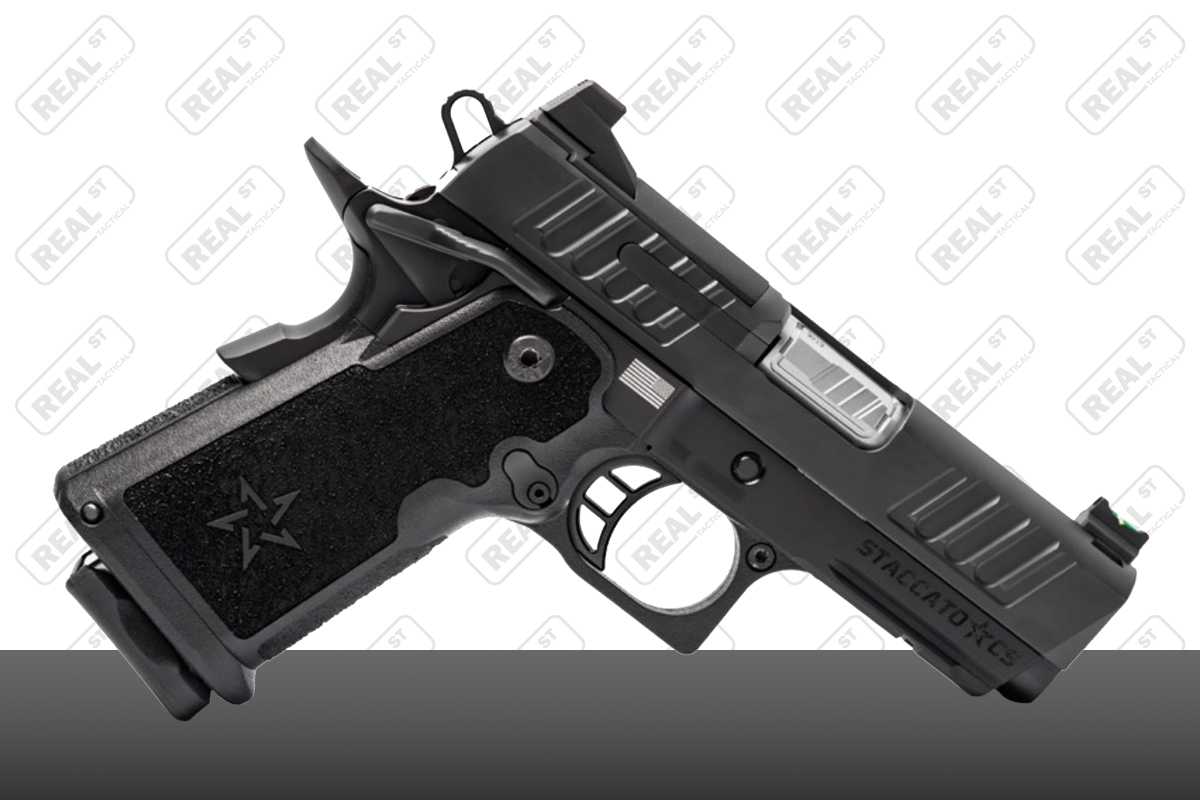
Staccato’s newest model for 2022 is called the “CS” and it is now the smallest and lightest model in their lineup, designed for every day carry and personal defense.

We have all eagerly been waiting to hear about the new model Staccato has been teasing for the last few months and the details are finally here.

Specs

Caliber 9mm Trigger 4-4.5lb Aluminum Barrel 3.5″ Bull Barrel Grip Width 1.2″ Length 7.1″ Height 5.6″ Width at Safeties 1.45″ Weight 22.7oz Empty – No Mag Frame 7075 – Billet Precision Machined Aluminum Slide Finish DLC, Black Optic Ready Dawson Precision Optic Carry or Tactical Grip New Stippled Grip

First Glance

At the time of writing this article (October 27th 2022) these have not shipped to Premium Dealers yet so we will be comparing published specifications until our allocation arrives, at which point we will update with pictures and video reviews.

Size

At 7.1″ long, the CS is now the shortest staccato available. For comparison sake, a C2 is listed at 7.5″ long. But the bigger change the reduction in width, meaning there is a new grip shape. The grip width shrinks by approximately a hundred thousandths of an inch from the C2 width, and about fifty thousandths less than a C2 at the safeties. The thinner width should provide a more comfortable concealed carry experience with IWB holsters.

Frame

The CS frame is aluminum. Previously, the only way to get an aluminum frame “small Staccato” was to get a C2-Limited. Which comes with a threaded barrel and Dawson Compensator. (Which is still a good option if you are looking to shoot suppressed) but the CS comes default with the lighter weight aluminum frame instead of steel.

Weight

Because of the reduced size, and aluminum frame, the weight has been reduced to 22.7oz without reducing magazine capacity from the C2

Grip

One of the first things you notice is the new grip. While the new grip STYLING reminds us of the redesigned G2 Tac grip that now comes on the P and XC models in appearance, this is a totally new grip module that (from the specs) appears to be narrower than the C2 grip module.

Magazines

Because the grip has changed, the magazines have changed as well, but they do still hold 16 rounds each (like a C2). However, it is a CS-specific magazine, and cannot share magazines with other Staccato models.

Trigger

Staccato has announced that the CS will come with an aluminum trigger, instead of the typical composite trigger. And the trigger weight will be delivered at 4-4.5lb which is typical for a gun meant for every day carry personal defense.

Barrel

The CS comes with a 3.5″ bull barrel that we haven’t seen in the Staccato lineup yet. It has some noticeably different design features in the portion of the barrel that is visible externally. So far we have not heard anything about a threaded barrel option yet, so for now you will still have to go to a C2 for a “small Staccato” suppressed shooting experience.

Optic Ready

Much like the C2, the CS can come configured with full size tactical sights designed to mate with a full size optic like a Trijicon RMR/SRO, Holosun 507C/508T/509T or it can also be ordered with lower profile compact sights for use with smaller carry optics like the Trijicon RMR CC or Holosun 507K

We are on the Staccato Premium Dealer program and we have reserved an allocation of these from the first production release. If you are interested in learning more, please feel free to reach out to us.

Interested in receiving more info like this directly to your email inbox? Sign up for our mailing list below to gain early access to new inventory, exclusive deals, and more.

Loading…

The Best Spoons For Trout Fishing: 7 Certified Trout Slayers

0

There are a million different ways to catch trout. Bobbers and bait, spinners, crankbaits, and flies are all effective. But if I had to pick one way to fish for trout forever, it would be with spoons.

That’s because not only are spoons incredibly versatile, but they’re also one of the most fun and active ways to fish. You can troll them deep for lake trout, cast and retrieve them in lakes or big rivers, or flutter them through small streams. Spoon fishing can feel like an art, but it’s much more beginner-friendly than fly fishing.

There are about as many different spoons as there are anglers, but the best of the best spoons have stood the test of time. In this article, I’m going to go over the only 7 spoons you’ll ever need to catch trout. They each have their own subtly different advantages, and if you carry a few of them with you then you’ll always have a trout-slaying lure in your tackle box.

When it comes to trout fishing, simple is usually best, and spoons are about as simple as they come. Essentially, a spoon is just a single piece of oblong-shaped shiny metal with a concave surface (hence the name “spoon”). Actions vary, but they’re generally designed to wobble and flutter around when they’re retrieved, reflecting light at all angles as they go.

Their wobbling and flashy action is supposed to imitate small baitfish that aggressive, adult trout feed on. But even trout that feed primarily on insects will hit spoons, too, because that irresistible wobble triggers their instinct to strike.

This article is about spoons, so of course, I’m sticking to spoons. But if you want the lowdown on the best trout lures (including spinners, jigs, and crankbaits), check out my article on it.

And if you’re totally new to trout fishing and want a rundown on how to do it, check out my post on trout fishing 101.

You can skip this section if you’d like, but I want to give some background before I get into my rankings. The genius of a trout spoon is that it can be fished in more ways than you can count, and each spoon has advantages that work better for different situations.

Trout spoons are great for their versatility. You can crank them in, slow retrieve for a heavy wobble effect, or jig and drop to let them flutter on the fall. But you need to know what to try and when, so here are some basic rules.

Best Line For Spoon Fishing Trout

Spoons are for aggressive trout, so you don’t have to worry as much about using light line. Still, I like to use 4-6 pound test monofilament line for easier casting. If I know the water has potential for lunker brown trout or 20-inch rainbows, I’ll size that line up to 8 or even 10-pound test. When I fish for steelhead, I’ll use anywhere from 12-20 pound test line (usually depending on water clarity).

I also like to use fluorocarbon leaders (when I can afford it; check out my post on the best fluorocarbon line for any budget). Fluorocarbon sinks, helping spoons get down quicker in fast water. Fluorocarbon is best paired with 10-pound test braid, which is very thin and cuts through current easier than mono.

I wrote an entire post on the best fishing line for trout, broken down by species and situation, so check that out if you need more detailed info.

How To Retrieve Spoons

Every spoon lends itself to different kinds of retrieves, which I get into in my rankings below. But a typical spoon retrieve is steady, and just a little slower than you would need to fish an average spinner.

Certain spoons, like the Kastmaster, also work really well when retrieved erratically. Spoons like these have a lot of action when falling through the water column, so letting them stop and drop every now and then can be the key to getting strikes.

Then there are what I like to call “flutter spoons” like the Little Cleo. These spoons work great when cast upstream and reeled very slowly through a run or tailout. The current will do most of the work, and they’ll flutter and roll as they move downstream. Reel in just fast enough to keep them off the bottom, and let them swing across the current when they get downstream of you.

Finally there are spoons that work great for trolling, like the Krocodile. These can be cast and retrieved, too, but they’re also great for trolling deep for lake trout or big lakes rainbow trout.

Overall, the best way to retrieve a spoon is the way that’s working that day. Being adaptable is key. Mix up slow, fast, and jigging retrieves until you figure out what’s working.

Honestly, ranking trout spoons is hard. There are standouts, and every spoon on this list has stood the test of time. But the reality is that any of them might be best for any given river, day, or trout species. They’re all proven to catch trout and they all deserve a place in your tackle box.

With that said, here are the best trout spoons, ranked by popularity, reliability, and of course, my own personal opinion.

As many trout anglers will tell you, if you only buy one spoon, make it a Kastmaster.

That’s because of all the spoons on the market, the Kastmaster is the most versatile. Its unique flat shape allows it to be fished in any way imaginable. You can troll at high speeds without sacrificing action, you can cast it a country mile, and you can even jig it vertically for incredible results. It’s so versatile that I even wrote a whole post about it, so check that out for more details (LINK).

Kastmaster comes in a ridiculous amount of colors, but like any good trout spoon, the best colors are gold and silver. Anywhere from 1/12 oz to 1/4 oz work great for trout fishing, but 1/8 oz seems to be the sweet spot for rivers and lakes, and I like 1/12 oz in shallow creeks.

#2. Acme Little Cleo

Being from the northwest, I really wanted to make the Acme Little Cleo lure my number one. It’s a steelhead killer (steelhead are just ocean-going rainbow trout), and the coastal guides and locals swear by it. The Kastmaster is a tiny bit more versatile, but if you were only going to buy two spoons, the Little Cleo and the Kastmaster complement each other perfectly.

While the Kastmaster has a quick, aggressive action that triggers a quick bite, the Little Cleo is a bit more on the finesse side. Letting river current do most of the work is key, and the way that current deflects off of a slowly sinking Cleo can be absolute magic.

Cleo’s excel when swinging through tailouts and slower water. Their perfect flutter as the current slows down is a trout magnet, perfectly imitating a wounded baitfish that got swept through the faster current above. The best way to fish them is to cast slightly upstream and keep the line tight, reeling very slowly to keep them moving downstream and fluttering the whole way through.

When it comes to Little Cleos, blue and silver in 1/6oz or 1/4oz is my go-to color. But solid silver, solid gold, and silver and red have all been solid trout catchers for me and the folks I fish with.

#3. Luhr Jensen Krocodile

The Luhr Jensen Krocidile comes in at number three because it’s one of the best trout lures for trolling. Its elongated design and spin create a more aggressive flash than most other spoons, and it’s killer when the trout are super aggressive. At 2 1/4 inches for the smallest option, it’s the longest lure on this list.

It might not be the best trout spoon for finicky fish, but when the bite is hot, the Krocodile can bring in more fish from longer distances. It’s a great option for speedy trolling in lakes, too, because their weight and elongated body keep them deeper down in the strike zone. I also like it for bank casting during the fall when big trout start to feed more aggressively.

I like these lures in silver and gold, but with the hammered finish. I think the dimples provide even more flash than the smooth versions, and that’s exactly what I use them for. Size totally depends on what I’m fishing for. When trolling for big lake rainbows I’ll use the 3 1/4 inch, 1 oz size, but I’ll size down when casting from the bank for smaller trout.

#4. Thomas Buoyant

The Thomas Bouyant comes in at #4 on my list because it does something that few spoons do: it works exceptionally well at slow speeds. That’s why it’s one of my go-to’s for high mountain streams or shallow creeks. It can be fished effectively at slower speeds than any other spoon on this list, but it still provides a ton of flash and wobble.

With the Buoyant, don’t even tie it on if you want to crank it in. It spins more than it wobbles, and it’ll quickly twist your line up if you’re not careful. Just flutter it and retrieve it slowly, which is great for inducing a strike from wary lurkers.

Copper is my go-to color, but the Rasta-esque “firetiger” can sometimes be the ticket to catching finicky biters. Since it’s a great small stream lure for me, I usually stick to the 1/6 oz option.

#5. Acme Phoebe

When I was first given a few Acme Phoebes, my first impression was “gimmicky”. The fact that it’s cut out into the shape of an actual baitfish seemed weird, given that spoons are really just for flash. But after fishing with them, I realized that something about those offset fin cuts gives the Acme Phoebe a unique action. Make no mistake: the Phoebe catches trout with the best of them.

Like the Thomas Buoyant spoon, it spins rather than wobbles, and it doesn’t sink as fast as most spoons. It works really well for fishing at slow speeds, which makes it a great option for small streams and shallow creeks. Silver and gold in 1/12 oz or 1/8 oz are standbys, but the rainbow trout color has also been great for me.

#6. Eppinger Dardevle

Though there are spoons that I like a little better these days, the Dardevle is still the classic of classics. It was originally released in 1918, and has probably caught more trout in its history than any other trout lure. When my grandpa gave me his old fishing tackle it was chock full of Dardevles, and he swore that those were his go-to trout catchers.

The classic Dardevle spoon color is red and white stripes. Probably because of nostalgia more than anything, that color is what I usually fish with. But trout love silver and gold, too, and there are plenty of color variations to try out. I like this heavy spoon best with a fast retrieve, which is killer for everything from lake trout to big river rainbows to northern pike.

Because it works best on big, aggressive fish, I usually fish for trout with Dardevle’s in the 1/4-1/2 oz size.

#7. Blue Fox Pixee

As a Northwest native, I have to give the Pixee a place on this list. My dad grew up fishing with them for king salmon in Alaska, and they have a special place in every salmon angler’s heart. But trout and salmon are in the same family, and Pixee’s catch tons of trout, too.

Pixees are big and heavy (the smallest option is 1/4oz), so they work best for long casts in deep water. Because I mostly fish smaller creeks, I don’t use them that often. But when the water is fast and deep, there are few better spoons than a Pixee.

My favorite colors are silver with fluorescent red or orange. They make a variety, so any classic trout color should work well.

#8. Everything Else

Spoons are pretty simple, so in all honesty, even Wal-Mart brand spoons will catch trout. But the lures on this list have earned their spots. They’ve been proven fish-catchers for decades, they last forever, and they’re made with quality hooks and materials. They also do something a little different than the rest, and most off-brand spoons are designed to imitate one of these classic 7.

If you do want to try out some cheaper brands, definitely go for it. But check out the hooks for sharpness, try to avoid painted ones (cheap paint is a common way to cut corners), and if it looks like one of the lures on this list, that’s probably a good sign.

FAQ

Spoons are trout fishing at its finest. They have survival kit-level reliability, are easy to use, and have enough versatility to fish any water you can find. If you keep a few of these spoons in your tackle box, you’ll never be without a secret weapon for catching trout.

Best Hiking Gloves: Cover Up For Comfort

0

Enjoy Happy Trails, the free monthly newsletter from Hiking For Her.

Receive a free resource: Hiking Layering System Explained

The best hiking gloves are the ones you reach for over and over again, because they work well to keep your hands warm and dry.

That’s why I recommend that you have at least 3 types of gloves in your hiking gear locker.

Let’s tackle them one at a time, with an overview of hiking gloves by function.

Best hiking gloves for cold weather

Cold weather hiking the best hiking gloves to guard against hypothermia.

Scary fact:

One of the most neglected areas on a hiker’s body in cold weather are your hands.

  • We all think about protective hats and jackets and pants, but please don’t overlook the importance of keeping your hands warm at all times.

If your fingers are numb, you aren’t going to have the dexterity to adjust your clothing, take the cap off your water bottle, or unfold the map that tells you when an important trail junction is coming up.

And that leads to making mistakes on the trail that can endanger your life, or at least your enjoyment of a hike.

So keep your digits toasty warm!

I have a repertoire of winter hiking gloves, and switch them out as needed.

The least cumbersome pair are fingerless gloves, like these.

  • My fingers are free to manipulate, grasp and tug on my hiking poles, boot laces, and zippers, but the rest of my hands and wrists stay warm.
  • Doesn’t sound like a big deal? It will be when an icy cold wind is blowing, or it begins to rain.
  • And they convert easily to mittens when I need a bit of extra warmth around my fingers.

Fleece hand protectionon a hike

I like lightweight fleece gloves for situations when I know I’d rather not use mittens, like the photo above.

  • They ride along in the bottom of my pack year round, because cold hands are dangerous for extended periods of time.
  • Even a nice summer day can turn nasty at higher elevations. Always put on an extra layer once you top out somewhere the wind can reach you (especially important if you’re sweaty from the exertion of uphill hiking).

Note that these glove options are not weatherproof, so I recommend them only for dry cold conditions.

If you want bombproof gloves with all the features, that also allow you to interface with your phone or GPS screen, expect to pay a bit more.

But revel in the warm, dry hands you’ll have!

Here is a full array of your options.

  • Remember to sort them by weight, weather proofness, and features, as outlined above.

Natural fiber options

Possum down might not be a familiar glove material to you, unless you reside in New Zealand.

Read the Hiking For Her review of Possumdown hiking gloves here.

Another natural choice: alpaca wool gloves, like these.

Best hiking gloves for cool windy conditions

In the spring and fall, I want to stay warm but don’t want extra bulk in my pack or on my hands.

These are the gloves I pull out of my pack when I begin to feel chilled.

  • I know that my core temperature is dropping a bit, and I pay attention by warming up my hands.
  • I also pull on a hat if I’m not already wearing one.
  • More cool weather hiking tips here

Sometimes I know that I’ll be cold part way through the hike, because I’ve consulted my topographical map and recognize a ridge or other windy land feature coming up soon.

So these gloves are kept within easy reach, in my jacket pocket or a top pocket of my backpack where my hiking partner can easily reach them for me.

That way, I don’t need to lose body heat by stopping, removing my pack (there goes all of that delicious warmth trapped against my back!), and digging through gear.

I recommend that you do the same: Keep these gloves handy (oooh, a hiking glove pun).

Why not wearhiking mittens?

I am not a fan of wearing mittens on the hiking trail, with one exception.

Mittens encase my hands in a non-functional configuration, making it hard to grip my poles or do much of anything.

The only exception I make is when I face really cold conditions and I want all of my fingers smushed together to share warmth.

  • I make sure all gear adjustments have been made before I slip on mittens like these.
  • Sometimes I need my trail buddy to help me yank on the second one! And I return the favor.
  • Sometimes I wear these mittens in my sleeping bag if I’m having a hard time falling asleep. For some reason, warm hands relax my entire body.
  • They’re also nice cushioning for sitting on hard cold rocks!

I appreciate the safety loops on these mittens, because I can dangle them above snow or mud from my poles or pack.

Best hiking glovesfor sun protection

I never used to believe in wearing gloves to block UV rays on cloudless hikes…

until I began to require skin biopsies every year for the pigmented spots on my face and hands.

Now I’m a believer in wearing lightweight, light colored wicking fingerless gloves on my summer hiking adventures.

Ever notice how sunscreen tends to wear off?

  • How many times do you reapply it to your hands and fingers?
  • Yeah, not so much for me, either.

This brand is rock solid in the gear industry.

If you’d prefer full sun gloves, they’ve literally gotcha covered! These are handy when you’re hiking over reflective snow fields, to prevent sunburn.

Bonus: Wearing these gloves prevents “age” spots, too.

If you want to go whole hog into UV protective clothing, read this.

A few more tips for buying the best hiking gloves

If you’re just starting out hiking in cooler conditions, and won’t be staying outdoors overnight, you can get away with bargain brands of hiking gloves.

But expect flimsy materials, poorly sewn seams, and less than ideal insulation.

If you’re heading into uncertain weather conditions, or plan to spend at least one night camping in cool/cold/unpredictable temperatures, you absolutely must pay attention to your hands.

Regardless of which brands and styles you go with, be sure your best hiking gloves have:

  • women’s sizing, with a snug but not binding fit
  • a cinching system for creating an airtight seal for really cold conditions
  • appropriate thickness to keep you from over heating or freezing (which is why I have several styles)
  • durable synthetic material on the palms if gripping poles or camera gear is important
  • non-chafing seams
  • wrist straps to prevent loss

Gloves = hiking love

If you are hiking with newbies, children, or a group of folks you don’t know well, bring along a second pair of gloves to hand over when any of them begin to shiver.

Demonstrate without a word that the best hiking gloves are a vital component of your anti-hypothermia strategy.

Be prepared for grateful words and a big smile.

Notice the word LOVE in there?

  • Glove love is where it’s at, y’all.

Ready to tackle warm feet on a hike? I thought you might be up for it 😉

Home page > Best Hiking Gear >

Best Hiking Gloves

I get emails all the time about what I wear on the trail.

That’s why I provide these affiliate links to you: the best gear is instantly available for your consideration, and the gear company sends a few pennies per dollar to Hiking For Her’s website with no added cost to you when you purchase.

Everyone ends up a winner that way: great gear for you, strong gear companies, and more free hiking tips for everyone.

Yeehaw!

And thanks very much for your support. It’s warmly and sincerely appreciated.

10 Best Fly Reels For The Money 2024 (Best Value Top-rated Fly Reels)

0

During my whole fly fishing career, one question I’ve answered the most is, “What are the best fly reels for the money?”

I know fly reels don’t just grow on trees, and you need to spend your hard-earned money to get them. And so you want to get the best value fly reel on the market.

Among all of the fly reels I have used and tested, Ross Reels Animas is the best fly reel for the money and definitely top of the list.

I will cover each of the best fly fishing fly reels for the money in detail. So the next time you need to buy a reel, you know where to look.

Disclosure: The Wading Kit is a reader-supported website and takes part in the Amazon Associates Program. We may earn a small commission if you shop through links on this page. At thewadingkit.com we test products and recommend them based on unbiased research. For info see disclosure here.

Best Fly Reels For The Money

In this article, you will find:

  • Honest reviews for the ten best-rated fly reels
  • A guide that will help you buy the best fly fishing fly reels for the money
  • Tips for maintaining a reel
  • Some frequently asked questions, and their answers
  • A conclusion with a winner from the 10 reviewed best value fly fishing reels

So stay hooked!

10 Best Fly Reels For The Money in 2024 – Reviews

Here are the detailed reviews of the ten best value fly reels:

1. Ross Reels Animas – Best Fly Reel Ever Made

I once went on a fishing trip to the west with my friends, and there I was introduced to this revamped Ross Animas reel. I was pretty dumbfounded by how good this reel looks. The open design, lots of ports, and a silhouette of the Colorado mountains on the back look spectacular. Also, this new reel is significantly lighter than the former one.

As for the performance, I was equally impressed. The drag strength is good enough to do the job. The reel starts cranking without any resistance and rotates like butter. The drag knob is large enough to hold easily. Also, the clicking sound on both incoming and outgoing is solid.

Most people will tell you that the Ross Animas reel is a perfect reel out there with practically no flaws. But I found one after very close inspections. The size of the reel is written on the reel foot, making it invisible when the reel mounts on a rod. I’d rather have the marking elsewhere to make it more visible.

Check Price On Amazon

Takeaway:

The Ross Animas is one of the best fly reels for the money out there. It looks good and performs even better. I doubt there could be a better reel in its class.

2. Sage Spectrum C Fly Reels – Best Quality Fly Reel

The minimal weight of this reel impressed me instantly when I took it out of the box. The ported spool and a sealed drag make this reel one of the best fly reels for the money. You may even call it the finest reel Sage has ever produced, with an affordable price tag.

Not only does it look sexy, but it is also a killer when it comes to performance. The drag is silky smooth and shows no initial inertia at all. The drag knob is straightforward to operate, unlike many other Sage reels where the knob was a bit sunken within the frame. Also, the handle of this reel is just the right size to grip.

The spool and the frame have no gaps between them so that you can reel it confidently without the fear of any lines sneaking into the void. I also like the narrow spool this reel offers because wider spools have the issue of lines not leveling correctly. But the large diameter and concave spool make up for the lack of capacity created by this thinness. You easily store an ample amount of backing in this reel.

The spool-releasing system, however, is a little too tight for me. Nothing major, but you need to exert a bit of force to separate them.

Check Price On Amazon

Takeaway:

Spectrum by Sage may not be the cheapest reel you’d find, but it is easily one of the best quality fly reels under 200$. It is better to spend a few extra bucks to get the many handy features Spectrum offers.

3. Redington RISE Fly Fishing Reel – Best Lightweight

Redington has produced some of the best fly reels for the money, and it’s the same with Rise. This reel looks pretty and is great out in the water. The drag is powerful, and the ergonomics are top-notch.

The finishing is perfect all around, and I could find no blemishes or uneven surfaces. After making an excellent first impression, this reel accompanied me on a fishing trip. The drag was very smooth initially, but since it is not fully sealed, some silt and dirt got into it, making it a little bumpy. Not for seawater, I suppose.

Now, the handle was okay, but the drag knob felt a bit cheap, to be honest. Also, the lines holding capacity was a bit of a turnoff for me. It not only couldn’t hold full backing, but I also had to cut short the floating line to make it fit into the spool. So this reel is good enough for small lakes or ponds only.

Check Price On Amazon

Takeaway:

The Redington Rise reel is a great solid start for someone just beginning their journey into fly fishing. It is also equally suitable for those experienced anglers who only want to relax by a pond.

4. Galvan Rush Light Reel – Next Best Thing

Galvan’s Torque has been my favorite for a long time. Recently, Galvan came up with a more valuable option and named it Rush. The Rush LT is now one of the best value fly reels in the market. It is reasonably lightweight, the drag is not disappointing, and the pricing is much more subtle.

There is a bit of startup inertia, but apart from that, the reel cranks smoothly. The sound of reeling the line in is good, but the outgoing drag click is not as crisp and clear as I’d like. Likewise, the drag knob is comfortable to hold and make adjustments, but the spool handle is not as long as other more ergonomic reels. These are just a couple of things Galvan could work on.

Now comes the durability. I dropped the reel on a cemented surface to test how well-made it was. To my surprise, there were no noticeable dents but the paint scratched from a few places. So that’s that!

Check Price On Amazon

Takeaway:

If you cannot afford the best quality fly fishing reels, the Galvan Rush LT is the next best thing. With a considerable decrease in price, it offers many features of a best-rated fly reel.

5. Waterworks-Lamson Remix Fly Fishing Reel – Best Value Fly Reel

The Remix by Waterworks-Lamson is an excellent choice for someone looking for a beginner’s reel under $200. Its name represents a mix of machined drag and a die-cast spool. Also, it is one of the lightest reels on our list.

Waterworks cut down on a few high-end features to produce a more affordable reel. For example, it is not anodized. Instead, they’ve painted the die-cast spool to save on the cost. Also, the drag is towards the lower side of the scale and pretty sticky.

What’s good about it are the acoustics which are loud and clear in both directions. Plus, the retrieval rates are impressive, too, due to the large-sized arbor. The handle and knob are both okay, nothing too fancy.

Check Price On Amazon

Takeaway:

The Remix has its limitations but is still a good value reel under $200.

6. Temple Fork Outfitters NXT Black Label Fly Fishing Reel – Beginners Friendly

Talking of affordable reels, here’s another. This reel is the cheapest in our list of best fly reels for the money. But by cheap, I only mean the price. Quality-wise this fly reel isn’t bad at all.

You don’t often see a machined aluminum frame in a price range this low. Furthermore, the disc drag system is smooth and pretty durable since it is stainless steel. I have seen many institutes using this reel and a TFO fly rod to teach fishing to amateurs.

But because this reel is painted rather than anodized, you might experience some scratches or the paint flaking off after a few uses.

Check Price On Amazon

Takeaway:

If you are learning fly fishing or are just terrible at it, the TFO NXT Black Label might be the best fly reel for money if you are a beginner.

7. M MAXIMUMCATCH Maxcatch Sparta Fly Reel – The Smooooooothest of All!

Here is another good fly reel for the money. Maxcatch is a lesser-known brand that has dropped some of the best value fly reels over the last few years. I think they deserve some recognition for introducing very cost-effective yet best-quality fly reels to make fly fishing affordable for all kinds of folks.

Sparta is one of the smoothest reels I have ever got my hands on. I mean, I have experienced some high-end reels, but this one is hard to beat in terms of drag smoothness. The drag sound may not be the loudest, however. But I think I can learn to live with the mellow sound.

Now comes the appearance. This reel shows promise in terms of design. The color is beautiful and looks great on my fly rod. The weight may be a bit more if you compare it to better-rated reels of the same size. The sizing also felt a bit off because I ordered a 5/7 wt size, and it felt a bit heavier on my 6 wt fly rod. So you’ll need to be careful there.

Check Price On Amazon

Takeaway:

Sparta is a great value reel under $100. If you can live without the perfect click and a bit of weight, you must try this one.

8. Waterworks-Lamson Litespeed F Series Fly Fishing Reel – A Piece of Luxury

You may call the new “F-series” by Lamson a hybrid between their Litespeed and Speedster series. The features resemble closely with the former, while the looks are similar to the latter. But whoever the parent line is, these new reels are as perfect as a fly reel can get.

The weight is incredibly light. It is considerably more delicate than the previous models from the Litespeed range. Also, the design is phenomenal. The very open design makes for quick drying of retrieval lines.

As for drag, it features Lamson’s signature conical system that is sealed and robust. However, the F-series takes it up a notch with its innovative spring assembly and a drag knob that stops with a pleasant click.

The color whiskey is my favorite to pair up with any wooden fly rods. The only thing I don’t highly appreciate about this new F-series is the high price. I know this range is supposed to be more high-end and a piece of luxury, but Lamson has produced numerous best fly reels for the money with very similar features, yet they cost at least $100 less.

Check Price On Amazon

Takeaway:

If you can afford it, the Lamson Litespeed F series is a piece of luxury that is also unmatched in performance.

9. Bozeman FlyWorks The Patriot Fly Fishing Reel – Good For Salmon

Bozeman is a smaller brand trying to make its way into the bigger fishing gear market. I tried their Patriot fly reel when I looked for a machined body, sealed drag, and affordable reel to go with my new rod. And this reel checked all marks!

It is incredible how many high-end features this reel gives you while staying on budget. The machined aluminum body is smooth and sturdy looking, and I could find no defects in the framework or the paint job. Furthermore, the sealed drag is smooth and powerful enough for enormous tackle, say salmon and steelhead.

The drag knob is functional and has excellent form. I can easily find and use it while I’m busy fighting a running fish. The drag adjustment is pretty fine, and I could find my sweet spot for the torque setting after just a few tries.

The only way this reel might trouble you is the capacity to hold lines. I bought a 5/6 wt reel, and I don’t think I can overline it at all because it will cost me a bit of my backing. Little backing won’t do you any good when you catch a 7wt fish like salmon.

Check Price On Amazon

Takeaway:

The Bozeman Patriots is a good value fly reel for anyone who doesn’t want to spend a lot of fortune. It has its limitations but is still a fair trade at its price.

10. Pflueger Medalist Fly Reel – For Vintage Vibes

Pfleuger has been around in the fly fishing market longer than I can remember. They have produced some classics in fly reels. The Medalist is the last one on our list of best fly reels for the money. It gives a vintage feeling with a more modern click-and-pawl drag system than the old brake shoe type we saw in prior versions.

This reel doesn’t look like it, but it weighs pretty little. The machined body is rough and tough, too, and the drag is smooth. The power on the drag system may not be a lot, but it is enough to catch small fish without a backlash. If you want a reel specific for higher weights, this is the wrong reel.

Now, the clicking sound is pretty loud, precisely as I like it, and the capacity to hold lines is excellent too. What’s not too good is the tiny drag knob that is not at all good for doing its job. The handle is also plastic and a little cheap-looking. I would have been okay with the plastic if this was a $50 fly reel sold at Walmart, but sadly it isn’t.

Check Price On Amazon

Takeaway:

If you want a machined body and a retro look, the Patriot may be the best fly reel for the money. But if you need drag and are too bothered by the knob and handle, then not so much.

Buying Guide:

Testing different fly reels is my favorite job to do. I get to test so many products and tell you about my experience.

After testing the above ten best fly reels for the money, here is a list of the things you’ll need in your reel to make the most out of your money:

Durability

It is understandable; when looking for the most value for your money, you’ll need your fly reel to last you at least a few years. CNC machined aluminum body is good in this regard.

Performance

Smooth drag, adequate strength, and the ability to make fine adjustments on the drag are some of the factors that make a fly reel perform better than others.

Ergonomics

Last but not least, you need your fly reels to be ergonomic. The handle should be long enough to grasp, the drag knob sufficient to adjust, and the spools should separate and reseat easily.

Related Fly Fishing Guides:

  • Best Fly Fishing Gloves
  • Wading Jacket Reviews
  • Best Fishing Waders
  • Best Wading Boots For Fly Fishing

How To Care For Your Best Fly Reels For The Money?

Here are some tips for taking care of the best fly reels:

  1. Practice good handling of your reel.
  2. Rinse your reel with clean fresh water after use.
  3. Deep clean it after every fishing trip, if possible.
  4. Do not soak your reel for longer than 30 minutes.
  5. Grease the inners once a year.
  6. Loosen the drag knob to a minimum before storing.
  7. Store your reel bone dry.

FAQs

Q. What are the top-quality fly reels for the money?

The best purchases I have made for fly reels are the Ross Animas, Galvan Rush Light, and the Sage Spectrum.

Q. Which are the top-rated fly reels for catching bigger fish?

The Bozeman Flyworks Patriot and Waterworks Lamson Litespeed F series are powerful enough to tackle bigger fish in the river.

Q. What is a sealed drag?

A drag that is covered to protect its components from the elements of nature (dirt, silt, sand, salt) is called a sealed drag. For that, we use saltwater fly reels.

Conclusion:

The best fly reels for the money can nail their job and also give the most benefits to make your purchase fruitful.

Among the ten fly reels I have reviewed, the Ross Animas wins for being the most impressive. Thoughtful design, smooth drag, easy handling, and minimal weight are only some of the great features it provides.

So the next time you buy a reel, make sure it deserves your money!

The Wading Kit is reader-supported. When you buy through links on our site, we may earn an affiliate commission, without any extra cost to you. Learn more.

450 Bushmaster vs. 308: Which Should You Choose?

0

Big bullets, big cartridges, and shmedium rifles.

Taking big game is one of the few areas that a standard AR-15 doesn’t do well in, but combine an AR with 450 Bushmaster and you have a whole new ballgame.

How does it stack up to a legendary classic like .308 Winchester? We got that info, ballistics, recommendations, and a lot more!

Sure, But Why

To a lot of you, this comparison might seem kind of… odd. I mean, even someone casually familiar with these two calibers can likely tell that these are not similar.

The answer is simple: A lot of readers are interested in this exact comparison. I don’t know why, but who am I to judge.

Y’all asked for it, so you get it.

Holla in the comments with more suggestions of what we should cover!

Story Behind The Cartridges

450 Bushmaster

Who likes big bullets and cannot lie? Jeff Cooper. The man touched many facets of the firearms world and this is yet one more where he left his mark.

While actually designed by Tim LeGendre of LeMAG Firearms, the inspiration for the idea came from Cooper’s support for a “Thumper” cartridge.

Basically, a “Thumper” was a big bullet moving as fast as they could push it so that an AR could take big game at 200ish yards.

Keep in mind that this was before things like the .458 SOCOM and .50 Beowulf were invented.

LeGendre designed what he called the .45 Professional and delivered an AR chambered in that to Cooper himself.

Bushmaster was highly interested in producing the new design, but they needed ammo for it.

When LeGendre approached Hornady about making ammo for it, they requested a slight change to the design of the case – shortening it slightly so they could load the 250gr SST in it.

The change was approved and the final cartridge was renamed to .450 Bushmaster.

450 Bushmaster Ammo on Table

.308 Winchester

After a cool story like 450 Bushmaster, the history of .308 Winchester can be kind of boring. Maybe I should have saved the good story for last… oh well.

Back in the 1940s 300 Savage was used for a series of tests for the US military, Frankford Arsenal (the actual US Arsenal, no connection to the brand/company that operates today) saw the tests and liked the results.

They started playing with the design a little and created a case that was slightly shorter, with a little less taper, and thicker walls.

Really liking what they saw, they lengthed the case back to its original specs. Using more modern powders (“modern” by 1940s standards) they created a cartridge that was effectively almost identical to the performance of milspec .30-06 Springfield but with a much smaller cartridge.

Smaller means lighter, lighter means you can carry more of it, so all in all – a lot better.

Winchester saw the potential for this new cartridge and introduced it to the hunting world in 1952.

Two short years later, NATO adopted the 7.62x51mm cartridge as a standard.

308 Ammo on Table

Practical Applications

450 Bushmaster

Hunting.

That’s it, that’s the list. The end.

Okay, 450 Bushmaster was designed as a hunting cartridge that could take big game (talking moose-sized “big”) at 200 yards or closer. And if nothing else, 450 Bushmaster does that.

If you’re in a fairly close environment and you need a really big bullet moving quickly to drop something large and four-legged, .450 Bushmaster is a solid option.

However, it comes with some major downsides that make it pretty much useless in all other applications.

Recoil is a beast. 250 grains moving at 2,200 FPS out of a 7ish pound AR means you’re getting the felt recoil roughly equivalent to 12ga slugs.

You can mitigate this with a brake and a good stock, but it’s still a hard hitter.

While you can do things like zeroing at 200 yards to have a point-blank zero out to that distance, 450 Bushmaster is an elephant fighting gravity – and it ain’t no Dumbo.

You are very limited on range and 250 yards starts to push it.

While it starts off with almost 2700 ft.lbf at the muzzle, 450 Bushmaster falls below 1,000 ft.lbf before it hits 300 yards.

308 Rifle Live Fire

.308 Winchester

Everything.

Because of the age of the cartridge and how widely it was adopted by NATO, the military, LEO, and more, .308 Winchester can do basically everything.

Hunting? Oh ya, .308 Winchester has taken every game animal in North America in droves.

Long range precision? Sure, while newer 6mm cartridges are the newest hotness, .308 Win is still widely used by sport shooters, LEO, and competition shooters – although most people running .308 Win in competition do so in special divisions built for it.

SHTF? .308 Win can take game, defend your post-apocalypse bunker, put down mutants (I mean, probably), and is so massively produced and used that refilling your stockpile should be fairly easy.

You can handload .308 Win with every type of bullet under the sun, you can find factory ammo for it in every gunstore and bait shop in the nation, you can find replacement parts basically everywhere, and any rifle you want that is large enough can and probably does come with a .308 Win option.

It is the definitive do-all cartridge in North America.

I would argue that 6.5 Creedmoor is better, but there is no denying that .308 Winchester has achieved unparalleled success. [For more on that, check out our article 6.5 Creedmoor vs 308.]

Ballistics

The real meat and potatoes of these comparisons are how they actually stack up against each other ballistically. Well, in most ways – .308 Win kicks the snot out of 450 Bushmaster.

308 vs 450 Bushmaster ballistics chart

At the muzzle they are basically the same, .308 Win has around 2700 ft.lbf and 450 Bushmaster has just a few pounds under that.

The big difference is that .308 Winchester keeps at least 1,000 ft.lbf out to about 600 yards, 450 Bushmaster loses it by 300 yards.

While .308 can reach out accurately to 1,200 yards (if you’re pretty good), 450 Bushmaster is on life support by the time it gets past 500.

[To learn more about 450 Bushmaster ballistics and why it was created, see our recent article]

AR-10 Vs. AR-15

I’m going to assume that you’re looking at both of these calibers in an AR platform. While both can be found in bolt-action rifles also, 450 Bushmaster in a bolt gun is kind of silly.

The AR-10 is at least a couple of pounds heavier than an AR-15. It’s larger, less handy, and can quickly become a beast to hike with.

Generally speaking, an AR-10 is also more expensive to build or buy.

This is why “thumper” cartridges like 450 Bushmaster, 458 SOCOM, and 50 Beowulf exist. They give you basically the same punch as a short-action cartridge (at least for a couple of hundred yards) but keep the package small.

Personally, I say get both.

Grizzy Bear growling

Wild Animal Defense

I’m a big believer in the idea that guns are not your best defense against most wild animals. For black bears, nothing beats a hiking song and some bear spray. For mountain lions, bringing a mule is technically the best but a hiking song and a sharp stick is a decent second option.

However, there are those times when nothing else will do. Maybe you tend animals that are looking really juicy this time of year, maybe you have a particularly mean set of critters in your area, whatever the case – you need a bigger stick.

.450 Bushmaster is one hell of a stick and in this role, it can really shine.

Most of the professional guides I’ve spoken with that live and hike in grizzly country say they choose a 12ga 3” magnum slugs as their last line of defense against a bear – that gives them about 2950 ft.lbf at the muzzle.

450 Bushmaster comes in around 2700 ft.lbf… but you can have 10 rounds in a magazine and less recoil.

If grizzly is your worst-case scenario, you might want to really consider a 450 Bushmaster or some other thumper as your next move.

What Is Better?

If you can stand the size and weight of an AR-10, then 308 Winchester is the clear winner.

But if you need something smaller and lighter – 450 Bushmaster is the ticket.

Really though, 450 Bushmaster is basically in the exact same boat as 50 Beowulf and .458 SOCOM.

They are all basically the same ballistically, they all have basically the same amount of ammo per magazine, they all cost basically the same, and more or less have the same issues.

I would give .458 SOCOM a slight edge in terms of reliability, but everything else really isn’t enough difference to make a difference.

Converting An AR-15 To 450 Bushmaster

The easy method is a new upper and modifying your magazines.

Magazines are standard AR-15 5.56 NATO mags, but with a new single stack follower. You can also get a dedicated 450 Bushmaster magazine.

For the upper, you’ll need a new barrel and a new bolt. 450 Bushmaster and .458 SOCOM use the same bolt face so it’s pretty easy to find.

A normal BCG can be used, it just needs the new bolt.

Overall, like most other AR conversions – 450 Bushmaster is pretty easy.

[Of course you can also buy a 450 Bushmaster complete upper and all the work is done for you. Just drop it on your standard AR-15 lower, pop 2 pins, and you’re ready to rock!]

Parting Shots

When it comes down to it – the “thumper” cartridges are all basically the same, just slightly different flavors.

If you need one, pick the one you like most and go for it!

But .308 Winchester will give you a lot more options and a lot more range. But that comes at the cost of a heavier rifle.

Let me know what you picked!

And let us know what caliber comparisons you want to see next!

3 Conflicting Facts About Mitch Rompola and The Rompola Buck

0

Throughout the history of hunting, we have never had a deer send a lasting shockwave through the entire community like the Rompola buck. Splitting the industry in half and creating more questions than answers. This infamous buck sits center stage when it comes to the most controversial whitetails ever to surface.

Whether you think it is fake or it is real, there are several aspects when it comes to the deer and Mitch Rompola himself that are quite contradictory. We narrowed it down to 3 facts about the Rompola Buck saga that stand out.

Listen to the full discussion:

#1 – Mitch’s Numerous State Records

Mitch was synonymous with one of the hunters that looked up to the challenge of hunting Northern Michigan. His friends had called him Swampaster and he had a reputation for shooting big whitetails on a consistent basis.

It’s even reported, he held the Missouri state archery record, and then he topped his own record again after a few years. Although after doing some digging, I cannot locate any literature to confirm these records.

The former Commemorative Bucks of Michigan state record was also shot by Mitch Rompola in Grand Traverse County in 1985. That buck scored 181 7/8 B&C, but On November 2, 2012, Robert Sopsic topped that record by 2/8 of an inch for the new state record archery buck. It was clear Mitch had a reputation for being a successful big-buck hunter.

What are the odds of a singular hunter having not one, not two, but three state records and a world record to his name. a quick glance at any whitetail record buck shows a list of names, but very few names on those lists have multiple records. In a state like Missouri, it could be possible but highly unlikely, but to do it in a high-pressure, low-age class state like Michigan? it seems a little fishy to me.

#2 – Mitch’s Desire To Be A Left Alone

Less than a week after the reported kill, Mitch got an unlisted phone number and dropped out of sight. Two of his most vocal critics in Michigan each had put up $10,000, which they said Mitch could collect if he’d just have the rack X-rayed and enter it into B&C. But not even that could spur the man into action.

What’s contradicting about this is the fact that before Mitch killed the infamous buck, he was building a reputation in the industry with magazine articles and making partnerships with manufacturers in the outdoor industry. He was mentioned in several books listing the top whitetail hunters in the nation and had a deal with a deer scent company as well.

You would figure after shooting a buck like that (that tops the previous world record by 3″), Mitch would have laid claim to the title of world record. Instead, mitch went from climbing the ladder for whitetail greatness with sponsors, magazines, and books to completely disappearing off of the face of the earth after shooting the “New World Record” and even signing a deal with Milo Hansens business associate to never enter the buck into B&C and stop calling it the world record.

#3 – The Rack Supposedly Was Lost To A House Fire

***Disclaimer***

***The below information was obtained using free public use programs, websites, and apps.***

Soon after the news broke of the buck, Mitch shut out the outside world and dropped off of the face of the earth. It is rumored that during this time period, the rack was destroyed in a house fire.

With the numerous public resources on the internet now, I was able to go into google earth and look back at historical imagery at Mitch’s actual house. The furthest back satellite image on google earth was from 1985. It is a little blurry, but you can make out the outline of the house and the image gets clearer as the years progress.
As you thumb through the different years, you will notice that the house stays exactly the same, even to this day. If a house fire did happen, it did not get bad enough to disfigure the exterior of the house, meaning it wasn’t an overly big fire if it did happen at all.

The melting point of bone is roughly around 3,000 degrees farenheight, so for the rack to be destroyed in a house fire, the fire itself would have had to engulf the entire house to reach those temperatures.

Conclusion:

Did the fire actually happen or was it a cover for Mitch hiding the rack? What made Mitch go from a hunting industry personality to a hermit? Did the multiple state records actually happen? The world may never know.

As is with every article ever written on Mitch Rompola and the Rompola Buck, there are more unanswered questions than answers. With the recent sale of the Milo Hansen buck and the even more recent discovery of the Rompola Buck’s score sheet, I think that the answers to some of these questions could possibly be just on the horizon.

Written by: Lucas Jones

Elk herd health is strong, but growth is slow

0

LOGAN, W.Va. — Although the West Virginia elk herd is growing and healthy, the top man overseeing the reintroduction project cautioned it’s way too early to be talking about any kind of elk hunting opportunities in the Mountain State.

“It could actually set us back if we jumped on that too early,” said Randy Kelley, Elk Project Leader for the West Virginia Division of Natural Resources in a recent conversation on West Virginia Outdoors.

Although nothing has been officially discussed, some sportsmen have openly shared the idea on social media of a limited hunt for some of the bulls in southern West Virginia. Kelley warned even a limited hunt for males only at this point in the reintroduction process could be detrimental.

“It really messes with your herd dynamics because if somebody gets a bull tag, they’re going to want to take the big, mature bulls. But probably less than 30 percent of our herd is in that prime 5 to 9 year old breeding age. By removing those bulls of breeding age, you change the herd dynamics,” he explained.

Elk herd health is strong, but growth is slow
A young bull elk on the Tomblin WMA. Wildlife officials say any kind of hunting season now, even for bulls only, could be a dramatic setback to the program. PHOTO: Mark Bias

Due to concerns about predation, it’s desirable the majority of elk calves each spring or summer be born around the same time. When the landscape is flooded by young elk all at once, it lessens the chances of predators taking a higher percentage of those young and vulnerable calves. However, if the most mature and dominant bulls are removed and only the younger, more immature bulls are available during the rut it could delay breeding or cause breeding to be a complete failure without enough big bulls on the ground to get the job done.

Due to so many variables, Kelley was reluctant to put a timeline or a herd population estimate on when a hunt of any kind would be acceptable. Neighboring Virginia just opened up a hunting season this year. Kelley indicated they would be closely watching the results of Virginia’s hunt to help guide decisions on elk management in West Virginia.

“There’s no use to reinvent the wheel. We learn from what others are doing and have done,” he said.

Kelley also revealed work has begun on a couple of university studies involving West Virginia’s elk herd. One of the studies is a cooperative genetics study with West Virginia University. The genetic testing will help reveal which bulls are fathering which calves, predominant breeding, and if any of the genetic traits from the two sources of elk are superior or make a difference in strength and survival.

“We have elk from the Land Between the Lakes and from Arizona. We have DNA from every one we released and that will give us a way to look at the parentage and see who is breeding whom and what’s actually going on on the ground out there with regard to breeding,” he said.

The study data could give a more clear look into any genetic predispositions on survival rates, resistance to parasites or disease, breeding dominance, and a host of other information which will help as the herd grows.

A second study on eastern elk is underway at the University of Tennessee which will enable Kelley and his team to know if an elk is suffering from brain worm before it succumbs to the parasite. Until now, they could only know if brain worm was present after the elk died.

“U.T. has developed a blood test to detect brain worm and we can send them a blood sample and find out if any of our elk have it even if they are showing no symptoms,” he said.

Brain worm has been the single biggest killer of West Virginia elk since the reintroduction began. West Virginia annually loses about four percent to brain worm, but the national average is around six percent. Brain worm is a parasite present in whitetail deer. While it has no effect on deer, it’s become a deadly problem for the elk in the eastern U.S.

As for growing the herd with the translocation of more animals from other states, Kelley wasn’t optimistic.

“Because of CWD, the whole biological community is discouraging any movement of cervids at all at this point,” he explained.

Best Air Rifle Deals

Popular Posts

Air Gun 101: What You Should Know about Air Rifle Barrels Before Buying

0
Have you ever heard the phrase: “Imitation is the sincerest form of flattery”? The Chinese must have been very sincere in emulating this proverb. I...

Master Small Game Hunting with an Air Rifle: Tips and Techniques

0
"Experience the thrill of small game hunting with an air rifle! Embark on a captivating journey as you test your accuracy and precision in...

What Is a Break Barrel Air Rifle?

0
A break barrel air rifle is a type of air rifle that uses a break action to load and unload pellets. It is one...