Home Blog Page 100

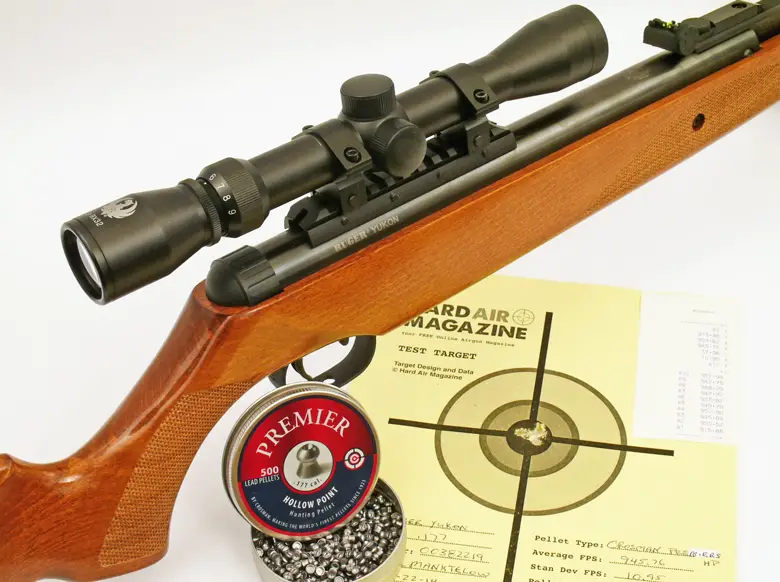
Ruger Yukon Review

0

The design of this air rifle is so sleek and appealing.

They say don’t judge a book by its cover,

But what a wonderful book it is if it has great content as well as a beautiful cover!

Gun Type

The Ruger Yukon is a gas strut air gun.

It is powered by ReAxis gas piston technology.

Surprisingly, Umarex is the first mainstream air gun manufacturer that actually reverses the direction of the gas ram.

They claim that by doing so, you get more power and reliability.

We have to see if it works out at the end of this review but first thing first, how does the ReAxis gas piston work?

Basically, ReAxis stands for Reverse Axis.

According to Umarex, unlike the nitrogen-filled gas piston, the ReAxis piston is reversed:

Meaning the gas strut is turned 180 degrees on its axis

So the larger mass of the gas strut pushes the piston instead of the rod,

Thereby, it generates more power, velocity, and impact than other gas pistons.

Now we know what ReAxis gas ram is, let’s take a look at its benefits over spring pistons.

First, you have smoother cocking since it doesn’t have spring torque like a metal spring.

Second, there is no spring fatigue even if you leave it cocked for days so you don’t have to worry about the piston wearing out over time.

Third, the ReAxis gas piston is not affected by the weather.

With the springer, the mainspring is lubricated with grease so it becomes harder and tougher when the weather gets cold.

ReAxis strut doesn’t have this problem and it functions perfectly in different types of weather.

Fourth, the ReAxis gas ram allows you to have a smoother shooting experience with less recoil compared to a spring piston.

And finally, it lasts longer than a metal spring.

In the air gun world, it is not uncommon to make spring compression over its standard threshold.

This weakens the spring and shortens its life span.

However, the ReAxis gas piston doesn’t care about compression so you can enjoy long-time shooting with it.

The caliber (the internal diameter of the barrel, measured in inches) is available in both .177” (4.5 millimeters) and .22” (5.5 millimeters).

.22 caliber is the favorite choice for hunters.

While the .177 caliber offers more velocity, it usually doesn’t generate enough takedown power to kill an animal in one quick, clean shot.

Oftentimes, the .177 pellet doesn’t hit the bone and organs, it just goes through the animal’s skin and makes it run off rather than dying instantly.

.22 caliber has more knockdown power so it’s a good go-to gun for field hunters and pest eliminators.

(For more on how to choose the right air gun caliber for your game, see this post.)

Ruger Yukon is a break barrel gun which means that you have to cock it each time you want to shoot.

Break barrel gun is the easiest of all air guns to load because the breech is exposed when they break open.

Besides, it gives you unlimited shooting capacity and is easy to repair because it is a simple mechanism.

And finally, a break barrel gun is easy to clean since you have direct access to the barrel.

This rifle is a single-shot gun so it gives you control over the ammunition you’re shooting.

You will find out what pellets work best for your gun in the shortest amount of time.

In addition, single-shot rifles hone your marksmanship skills: you have to aim and shoot carefully because you have only one chance to hit the target before reloading.

The barrel is rifled with helical grooves inside the bore to make the bullet spin, which stabilizes pellets, enhances shooting range, and improves accuracy.

(For more on things you should know about air rifle barrels before buying, see this post.)

One of the features I love about this air rifle is its noise-dampener called SilencAir.

It is a non-removable suppressor with chambers that significantly reduce muzzle noise.

SilencAir is engineered specifically for air guns.

When the first pellet enters the SilencAir, it pushes air into the airport in the first chamber (called the anterior tube),

Then pellet pushes the air through the incipient ring and through the airport and out of the second chamber.

After that, the air is forced out of the third, fourth, and fifth chambers, lowering the audible report at the muzzle.

Thanks to this silencer, you can plink away without letting the whole world know,

And you will not startle your prey in case you miss the first shot in the hunting field.

Stock

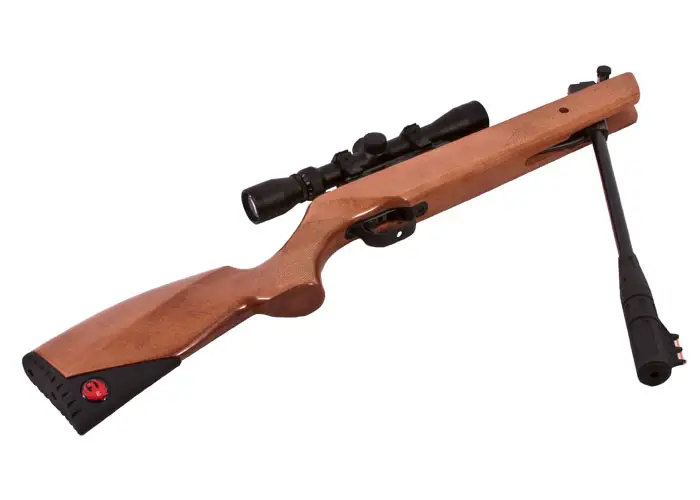
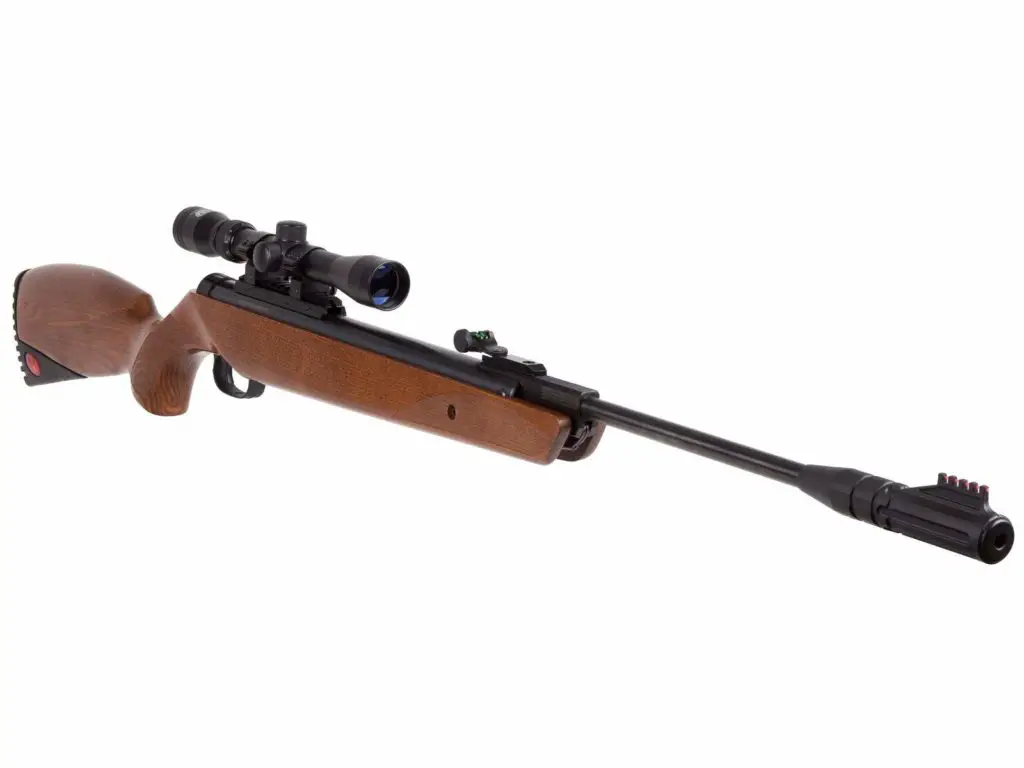
The Ruger Yukon has a hand-finished hardwood stock and is beautiful enough to be a real showpiece in any air rifle collection.

Besides, the wood stock is hefty and rigid and provides you true connection with your air rifle.

(For more on the in-depth comparison between synthetic and wood stock, see this post.)

The stock is ambidextrous: it gives the same shooting experience for both left-handed and right-handed shooters.

Moreover, it has nice checkering in the grip and forearm to prevent slippage from shooters’ sweat, enhance stability when aiming and increase accuracy.

Furthermore, the stock has a sculpted rubber recoil pad.

Even the ReAxis gas piston produces much less recoil than a traditional spring-piston gun,

Having a recoil buttplate is truly a plus point since it helps you absorb recoil and prevents your shoulder from fatiguing after long hours of shooting.

And you can see clearly that the prominent, eye-catching Ruger emblem is attached to the buttplate to add to the aesthetic side of this gun. Cool, huh?

Ammo

The Ruger Yukon uses .177 and .22 pellets corresponding to its 2 types of caliber.

.177 pellets are popular, easy to find, and cost half the price compared to .22 pellets for the same amount

So it’s your best choice for endless fun hours of target shooting and plinking.

On the other hand, .22 pellet is heavier than.177 so it’s more stable in the way it travels towards the target and isn’t affected much by outside conditions like wind.

Moreover, .22 pellets have more knockdown power and retain more kinetic energy after they hit the target

So it is a great choice for hunters and pest eliminators who want to get the job done in one clean shot.

(For more on the differences between .177 & .22 and which jobs they do best, see this post.)

Sight

Are you bored of traditional post sights?

Then you’re going to love this gun.

The front sight is a gorgeous fiber optic sight:

It uses optical fiber for the dots and channels the ambient light to the rear sight in a way that it’s brighter than the dark surroundings.

Fiber optic sight gives you fast target acquisition and gets a precise aim even in low-light conditions like dusk or dawn.

The rear sight is fiber optic too.

It is fully adjustable for windage (adjustable left and right) and elevation (up and down).

Having this sight gives you confidence in any kind of shooting condition.

(For more on how many types of air gun sights are out there and which one is suitable for you, see this post.)

As if the fiber optics sight is not enough, Umarex has also installed a 3-9 x32 scope with a duplex reticle and 35 yards parallax setting.

32 is the diameter of the front lens of the scope. 3-9 is the magnification power of the scope:

It means that it magnifies the picture 3 to 9 times bigger than the image you see without it.

Moreover, this variable-zoom scope has a duplex reticle consisting of four thick posts that go almost toward the center of the reticle and then turn into standard crosshairs in the center.

The idea behind a duplex reticle is to lead the eye to the center (the main point of the reticle).

A duplex reticle is great in low light and gives you the ability to accurately extend your range.

Having this handy scope gives you a small group in target shooting and boosts the accuracy of your gun to the roof.

This accessory is manufactured in the Picatinny style.

A Picatinny rail is almost identical to the weaver rail, except it has a series of ridges located at precise intervals along the rail.

The Picatinny rail gives you lots of benefits.

First, you have more mounting options.

Second, you can swap scopes from one gun to another and use different scopes in one air gun as well.

Finally, there’s no more worrying about tube length, eye relief, etc since you can place scope rings at any place you want.

In summary, the Picatinny rail is undoubtedly the most accomplished and flexible of all optic rails.

Velocity, Accuracy and Power

If you are expecting a supersonic velocity, then you are not going to be disappointed with this rifle.

In .177 caliber, Ruger Yukon delivers up to 1250 FPS with alloy pellets and up to 1050 FPS with lead pellets.

In .22, it generates 1050 FPS with alloy and 850 FPS with lead.

This is a high-end velocity compared with other air guns on the market so you can use it for both short and long-range shooting.

Now those are the numbers on the paper, but how about the actual velocities that this gun performs under Chrony tests?

Pellets (.22)FPSFPE
Baracuda green pellet 12.35 gr790 17.12 
RWS Hobby 11.9 gr750 14.87 
RWS Superdome 14.5 gr693 15.47 
RWS Hobby 11.9 gr746 14.71 
RWS H-point 14.2 gr773 18.85 
JSB Exact 16.2 gr619 13.79 
Gamo Hunter 15.3 gr690 16.18 
Crosman Premiere 14.3 gr740 17.39 

As you can see, the real velocity is pretty close to the advertised numbers, and the more important thing is:

It has more than enough knockdown power to deal with vermin like squirrels, skunks, roosters, crows, etc.

(For more on the best air rifle for squirrels, see this post)

Those velocity numbers are great, but how about accuracy?

Let’s see, the common shooting groups are:

  • 0.734” at 20 yards with RWS Superdome,
  • 1/2″ at 20 yards with JSB,
  • 0.25” at 25 yards with 21gr pellet,
  • 1 1/2” at 30 yards with Discovery 14 gr. 
  • Dime size group at 25 yards using RWS Superdome.
  • 2” at 50 yards with 8.4 RWs Superdome,
  • nickel size at 60 yards with RWS ,
  • 0.35” at 20 yards,
  • 1” at 15 yards with RWs Superdome 8.3 gr,
  • dime size at 30 yards with Crosman Premiere Hollow point. 

Moreover, it can:

  • Nail a rat or hammer a feral rooster at night,
  • put a real good dent in a 50 gallon barrel,
  • go through 1/2″ plywood at 20 yards,
  • penetrate 1 1/2″ through a hard bound encyclopedia,
  • penetrate 1” into 2 layers of 3/4″ birch plywood,
  • and shoot through an armadillo shell. 

In summary, the Ruger Yukon is not only an accurate rifle but also packs a heavy punch to deal with pesky pests like raccoons, possums, and squirrels, etc.

Noise

This gun is very quiet with a noise test result of only 80.3 DB which is much less than other break barrel rifles, which often have over 100 DB.

Many customer reviews confirm this.

One shooter remarked that he shot this gun in his backyard with the neighbors surrounding, but no one noticed the noise.

Another buyer affirms to have killed raccoons in the rafters of his barn at 45 feet without waking up the horse at 2 am!

At any rate, thanks to the silencer, you can plink away without letting the whole world know and take revenge for your decimated garden in a stealthy way.

Specifications

  • Caliber: .177/.22
  • Powerplant: ReAxis gas piston
  • Velocity: 1250 FPS with .177/1050 FPS with .22
  • Loudness: 3- Medium
  • Barrel Length: 18.7”
  • Overall Length: 44.8”
  • Shot Capacity:1
  • Cocking Effort: 30 lbs
  • Barrel : rifled
  • Silencer: SilencAir integral
  • Front Sight: Fiber Optic
  • Rear Sight: Fiber Optic, adjustable for windage and elevation
  • Scopeable: Weaver/ Picatinny
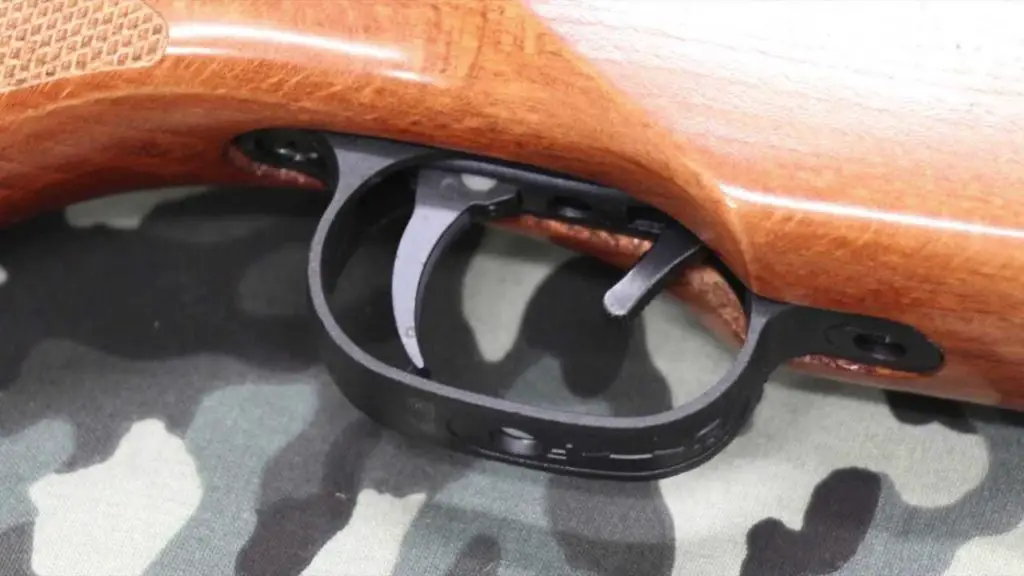
  • Trigger: Two-stage adjustable
  • Safety: Automatic
  • Length of pull: 14”
  • Buttplate: Rubber
  • Suggested for:Small game hunting/ plinking
  • Trigger pull: 3.3 lbs
  • Action: Break barrel
  • Safety: Automatic
  • Function: Single-shot
  • Body Type: Rifle
  • Weight: 9.0 lbs

Customer Reviews

Buyers rave about this gun: they love its accuracy, power, and quietness.

It’s very hard to find a negative review of all online Ruger Yukon reviews about this gun.

Nothing stands out as a serious issue, there are a few complaints here and there about how the scope does not meet their expectations,

But you can upgrade it easily down the road.

Pros

  • Stunning ReAxis technology
  •  Proven SilencAir noise dampener
  • Eye-catching stock
  • Wonderful fiber optic sight
  • Impressive scope
  • High-end velocity
  • Low noise level
  • Mind-blowing power
  • Great accuracy

Cons

  •  The scope could be better but you upgrade it later.

Price

The price for Ruger Yukon is only about 200 dollars.

You cannot find many guns in this price range that have the same quality as this gun.

Conclusion

The Ruger Yukon is an awesome rifle for the money.

It gives you superb power and accuracy plus very little noise for stealthy hunting and urban-friendly shooting.

This is a gun you will have a hard time putting down after shooting it a few times.

And who knows? It might become your new go-to gun for dispatching unwanted garden pests.

90 Best Hunting Podcasts

0

Table of Contents

1. The Hunt Backcountry Podcast

The Hunt Backcountry Podcast Backcountry hunters talking backcountry hunting. Join us for lively discussion on a variety of topics related to backcountry, big game hunting. We’…;ll be talking tactics, sharing lessons learned, swapping stories, interviewing individuals from the hunting industry, and getting into the nitty-gritty of our gear lists and bow/rifle setups.more soundcloud.com/hun.. 25.9K 11.4K 83.6K 2 episodes / week Avg Length 55 min Play Listen on Add Links Get Email Contact

2. Hunt Talk Radio

Hunt Talk Radio Hunt Talk Radio, Randy Newberg Unfiltered is a podcast covering hunting politics, public lands, and conservation topics; even a few things you didn…9;t need to know. The best hunters you’ve never heard of join Randy to answer questions from the Hunt Talk web forum, share ideas, reveal tactics, and give perspectives unique to public land hunting.more cms.megaphone.fm/c.. 8.8K 1 episode / month Avg Length 120 min Jun 2015 Play Listen on Add Links Get Email Contact

3. Hunting Matters

Hunting Matters Houston, Texas, USTradition. Conservation. Family. The Outdoors. It matters to you. It matters to us. This is Hunting Matters, presented by the Houston Safari Club Foun…dation (HSCF). With HSCF Executive Director Joe Betar. Join Joe as he engages in conversations with guests, from various backgrounds, that have a passion for hunting and conservation. Great discussions, news, hunting legislation, and more! Listen and discover.more spreaker.com/show/.. 16K 4.8K 714 1 episode / week Avg Length 41 min Play Listen on Add Links Get Email Contact

4. Working Class Bowhunter – Podcast

Working Class Bowhunter - Podcast IllinoisFun, off the wall and unscripted bowhunting podcast. Interviews with hunting experts, your favorite hunting shows and that hunting camp feel everyone …loves.more workingclassbowhun.. 10.5K 1.4K 14.5K 2 episodes / week Avg Length 97 min Mar 2015 Play Listen on Add Links Get Email Contact

5. Petersen’s Hunting Adventures

Petersen's Hunting Adventures Join co-hosts David Draper and Joe Ferronato, along with a rotating cast of the most experienced, successful hunters from around the world, as they re…live their most memorable hunts, hardships and adventures in a fun no-holds-barred forum. Just like all our channels, the podcast will entertain and educate with cutting-edge tips and techniques and hard-won knowledge from our experienced staff who have been around the globe in search of hunting adventure. You’ll also get a close look at the latest and greatest gear, and hear from the industry leaders on what’s new in the world of hunting.more petersenshunting.c.. 10.6K 11.6K 1 episode / month Avg Length 73 min Play Listen on Add Links Get Email Contact

6. Big game Hunting Podcast | Interviews With The Hunting Masters/Days In The Wild

Big game Hunting Podcast | Interviews With The Hunting Masters/Days In The Wild John Stallone Interviews Hunting Pros to get inside hunting tips and tactics western big game hunting, bowhunting and whitetail deer. interviewswiththem.. 1.2K 16 episodes / year Avg Length 70 min Play Listen on Add Links Get Email Contact

7. The Hunting Public

The Hunting Public Hunters Aaron Warbritton and Zach Ferenbaugh talk deer hunting tips and tactics with various experts across the country. We’ll also cover current… conditions and strategies that can help you right now. The Hunting Public is an online video series showcasing tips and strategies for hunters. We create daily video journals, how-to tip videos, and podcasts to help teach the viewer situational tactics they can apply to their hunts throughout the country.more thehuntingpublic.com 179.9K 10.4K 156.5K 1 episode / quarter Avg Length 82 min Play Listen on Add Links Get Email Contact

8. The Rich Outdoors

The Rich Outdoors The Rich Outdoors Podcast is not only tips and tactics for hunting, it also provides motivation and inspiration. In creating my own ideal hunting ment…or, I created the hunting mentor we all wish we had. Now, I get to share the takeaways with fellow hunters worldwide. We interview top bow hunters, rifle hunters, guides, and fitness freaks to master everything from pre hunt preparation to the decisions made in the moment of truth.more therichoutdoors.net 5.2K 1.5K 2 episodes / month Avg Length 70 min Mar 2015 Play Listen on Add Links Get Email Contact

9. Midwest Flyways Podcast

Midwest Flyways Podcast The Midwest Flyways Podcast is an authentic take on waterfowl hunting from Midwest Flyways. Duck and goose hunting has continued to evolve throughout …the years and we aim to connect duck hunting traditions with the future of waterfowling. If you’re passionate about ducks and geese then come hang with Joey Vassallo, Conor Olstad and Cal Ness as they talk duck hunting, goose hunting and everything else in between.more mwf.podbean.com 2K 22 24.6K 3 episodes / week Avg Length 40 min Play Listen on Add Links Get Email Contact

10. Big Buck Registry

Big Buck Registry Big Buck Registry is another long-time whitetail deer hunting focused podcast, the Big Buck Registry is focused on going in-depth with various guests …and hearing their best deer hunting stories. If you’re looking for some great stories and a few tips too, this is a good one to check out.more bigbuckregistry.com 265.4K 4K 16K 2 episodes / month Avg Length 80 min Feb 2013 Play Listen on Add Links Get Email Contact

11. The Hunting 101 Podcast

The Hunting 101 Podcast Hunting 101 is the fun and educational podcast you start with when you’re getting started as a hunter. No matter who you are, no matter how much e…xperience you have, you’re welcome here. New episodes weekly!more soundcloud.com/hun.. 1 episode / week Avg Length 61 min Play Listen on Add Links Get Email Contact

12. Chasing Tales Outdoors Podcast

Chasing Tales Outdoors Podcast Chasing Tales Outdoors Podcast bring on all different types of hunters to share their success in the field. This is a great way to pick up sound advic…e from others that are getting it done year in and out.more podcasts.apple.com.. 1 episode / week Avg Length 52 min Play Listen on Add Links Get Email Contact

13. The Southern Outdoorsmen Hunting Podcast

The Southern Outdoorsmen Hunting Podcast USYour go-to Deer Hunting Podcast! The Southern Outdoorsmen is a show dedicated to diving deep on the topics that will make you a better hunter. We inte…rview guys who are the ‘real deal’, the best hometown deer hunters across the country – the guys who have consistent success deer hunting the same public lands, leases, hunting clubs, or family farms as everyone else. Every Monday we post an episode with fresh tips, tactics and strategies to give you an edge in the woods this fall.more thesouthernoutdoor.. 26.7K 15.1K 3 episodes / week Avg Length 87 min Play Listen on Add Links Get Email Contact

14. Eastmans’ Elevated

Eastmans' Elevated Brian Barney is an outdoor writer for Eastmans’ Hunting Journals. He is an adventure bowhunter that spends over 100 days a year hunting our publi…c lands. He has a wealth of knowledge hunting western big game and has a knack for harvesting huge mind blowing trophies.more soundcloud.com/use.. 1 episode / week Avg Length 73 min Play Listen on Add Links Get Email Contact

15. GEORGE LYNCH HUNTING Podcast Show

GEORGE LYNCH HUNTING Podcast Show The GEORGE LYNCH HUNTING podcast show from Legendary Gear will discuss and cover ‘all things hunting’ and will be hosted by a veteran hunter, …game call designer, and calling contest judge, George Lynch. George will interview influential, knowledgable, and experienced leaders in the hunting space for strategy, tips, tactics, hunting gear analysis and reviews, guidelines, opportunities, and much more.more podcasts.apple.com.. 1 episode / week Avg Length 37 min Play Listen on Add Links Get Email Contact

16. Hunting Dog Confidential

Hunting Dog Confidential USExplore the history, myths, and incredible stories of hunting dog breed around the world. Co-hosted by Jennifer Wapenski and Craig Koszyk. A Project U…pland Podcast.HUNTING DOG CONFIDENTIAL is made possible by Eukanuba Sporting Dog.more projectupland.com/.. 3K 57.8K 6 episodes / year Avg Length 58 min Play Listen on Add Links Get Email Contact

17. Big Game Hunting Podcast

Big Game Hunting Podcast El Paso, TXMy name is John McAdams and I created The Big Game Hunting Podcast to assist hunters like you in preparing for the big game hunting adventures you’…;ve always dreamed about.more thebiggamehuntingb.. 9.9K 690 299 2 episodes / week Avg Length 58 min Play Listen on Add Links Get Email Contact

18. Chasing Giants with Don Higgins

Chasing Giants with Don Higgins Chronicling the constant pursuit of World Class Whitetails. Follow an experienced land manager, consultant, writer, and hunting industry expert thro…ughout the year as he finds, targets, and hunts world class whitetail bucks. Hunting tips and tricks that can be used no mater your skill set, property, or goals this hunting season.more chasing-giants.sim.. 1 episode / week Avg Length 76 min Play Listen on Add Links Get Email Contact

19. Project Upland

Project Upland Listen to the latest bird hunting podcast episodes from the upland hunting epic film series- Project Upland. Including the bird dogs, upland game spec…ies, upland hunters, and shotguns that make bird hunting so special!more projectupland.com/.. 39.8K 3K 40.6K Play Listen on Add Links Get Email Contact

20. Hunting Roots Podcast

Hunting Roots Podcast We’re digging back to our roots to tell the other side of our hunting story, as well as those from our friends, family, and pioneers from across t…he hunting industry. Untold stories you won’t find anywhere else – you’ll find them right here on the Hunting Roots Podcast is brought to you by one.more buzzsprout.com/185.. 1 episode / week Avg Length 44 min Play Listen on Add Links Get Email Contact

21. Truth From The Stand Deer Hunting Podcast

Truth From The Stand Deer Hunting Podcast Covering all things whitetail, the Truth From The Stand Deer Hunting Podcast is the place to get your deer hunting stories, deer hunting tips and more…. We’ll launch a new podcast each month exploring topics across the landscape of deer and deer hunting. So take your time and enjoy each episode and be sure to subscribe to the podcast and take us with you across all your devices. Whether in the car or at work, we could all use a little more deer hunting in our lives!more cms.megaphone.fm/c.. 1 episode / week Avg Length 92 min Play Listen on Add Links Get Email Contact

22. The 352 Hunting Podcast

The 352 Hunting Podcast Two die-hard hunters from central Florida just talking about crazy hunting stories and having fun. Hosted by Jonah hyatt. podcasters.spotify.. 1 episode / week Avg Length 59 min Play Listen on Add Links Get Email Contact

23. Shedding Light Hunting Stories Podcast

Shedding Light Hunting Stories Podcast USLove a good hunting story? This is the podcast for you. Each episode is a real story told from a real hunter. There may be an occasional name you reco…gnize but for the most part this podcast features average joes just like you! Real guys and girls with real stories about their hunting experiences. Deer, turkey, elk, ducks…if there’s a story to be told we will tell it!more feeds.buzzsprout.c.. 1 episode / month Avg Length 64 min Play Listen on Add Links Get Email Contact

24. Down South Hunting

Down South Hunting Down South Hunting Podcast is a podcast that focuses on southern hunting and hunters. There are multitudes of great midwestern deer hunting podcasts o…n the market, but none that cater to the southern crowd. Our podcasts are geared towards interviewing hunters and biologist with a sprinkle of our own adventures added in.more downsouthhunting.com 2.5K 720 3.1K Dec 2015 Play Listen on Add Links Get Email Contact

25. The Spring Legion Podcast

The Spring Legion Podcast Mississippi, USWelcome to a year-round focus on Spring Turkey Season, brought to you by the guys at Spring Legion, an outdoor community built upon respecting wildlif…e, accepting the challenges of hunting, and a never-ending appreciation for all that the spring season provides.more buzzsprout.com/146.. 2.9K 269 27.4K 1 episode / week Avg Length 61 min Nov 2020 Play Listen on Add Links Get Email Contact

26. Finding Fur and Feathers Hunting Podcast

Finding Fur and Feathers Hunting Podcast Finding Fur and Feathers is a part of the Sporting Journal Radio family. This podcast is dedicated the hunting world. Big game, whitetail deer, waterf…owl, upland, pheasants, grouse and more.more podcasts.apple.com.. 1 episode / week Avg Length 38 min Play Listen on Add Links Get Email Contact

27. Hard Liquor and Hunting Stories

Hard Liquor and Hunting Stories Hilarious hunting stories paired with various beverages. Hosted by Fighting Spirit Productions. podcasters.spotify.. 478 6 episodes / year Avg Length 63 min Play Listen on Add Links Get Email Contact

28. Buckeye And Bluegrass Outdoor Adventures

Buckeye And Bluegrass Outdoor Adventures USBuckeye And Bluegrass Outdoor Adventures is a podcast created to share a love for hunting, Fishing, and the outdoor lifestyle. Join us in this adventu…re as we share our passions and adventures with all of you.more podcasters.spotify.. 3 episodes / quarter Avg Length 49 min Play Listen on Add Links Get Email Contact

29. barebowhunters’s podcast

barebowhunters's podcast Join Barebowhunters’s podcast as they exchange valuable insight about the Barebow Hunters lifestyle. cms.megaphone.f.. 421 3 episodes / quarter Avg Length 45 min May 2017 Play Listen on Add Links Get Email Contact

30. Hunting Overtime Podcast

Hunting Overtime Podcast Hunting Overtime is here to provide you with highly informative and entertaining information relating to anything hunting and even a little fishing. W…e provide many interviews with other outdoor men and women who provide their insight and tactics to help you be successful in the field.more podcasters.spotify.. 699 1 episode / quarter Avg Length 41 min Play Listen on Add Links Get Email Contact

31. Hunting Couple

Hunting Couple We are a younger, hunting couple who love the outdoors, anything hunting, and sharing our experiences. We are here to share our experiences with you a…ll, and hope to find common ground and help people expand their hunting opportunities and shared adventures.more podcasters.spotify.. 12 episodes / year Avg Length 51 min Play Listen on Add Links Get Email Contact

32. PH Journal

PH Journal Queenstown, Eastern Cape, South AfricaA look at the everyday life of a Professional Hunter From South Africa. A lot of discussion about conservation and just interesting people. Join me on… this journey through the African bush veld.more phjournalsa.podbea.. 1.4K 28 30.6K 5 episodes / quarter Avg Length 37 min Play Listen on Add Links Get Email Contact

33. The Wannabe Hunting Podcast

The Wannabe Hunting Podcast Jacksonville, Florida, USI’m Amos, and I’m a wannabe hunter. However, my guests are bone collecting, stone-cold killers. They aren’t wannabes at all! My goal is to… interview these experienced hunters and glean knowledge from their wisdom and tactics in the woods. I strive to take a faith-based and family-friendly approach to life, hunting, and this podcast. Jump in and enjoy the conversation and learn along with us!more podcasters.spotify.. 2.4K 17 episodes / year Avg Length 42 min Play Listen on Add Links Get Email Contact

34. Coon Hunting University Podcast

Coon Hunting University Podcast This is a podcast dedicated to capturing as much knowledge and information in the sport of coon hunting as possible. You will hear from some of the bi…ggest names in the sport.more coonhuntingunivers.. 10 episodes / year Avg Length 88 min Play Listen on Add Links Get Email Contact

35. Hunting Ain’t Easy

Hunting Ain't Easy California, USHunting ain’t easy, but we love the challenge, the opportunity and the wild places it brings us. Hosted by California hunter Mike Costello, the po…dcasts digs into California hunting topics with specific focus on public land deer and bear hunting. We believe that habitat improvement, herd management and predator management are topics that need more attention. Look forward to guests who will shed light on what we can do as hunters and conservationists, to put more animals in the woods.more huntingainteasy.po.. 2.2K 1 episode / week Avg Length 78 min Play Listen on Add Links Get Email Contact

36. Interviews With Masters

Interviews With Masters John Stallone Interviews Hunting Pros to get inside hunting tips and tactics western big game hunting, bowhunting and whitetail deer. To know more on …this, follow us.more interviewswiththem.. 1 episode / quarter Avg Length 64 min Apr 2016 Play Listen on Add Links Get Email Contact

37. Trap’s Lodge – Your Hunting Resource

Trap's Lodge - Your Hunting Resource A virtual hunting lodge where drinks are shared, stories are told, and memories are made. Join us to learn and share everything about hunting and the …outdoors! We will talk about things ranging from which rifle to buy or bullets to use to gearing up for an Alaskan moose hunt. Whether you are just testing the waters or a seasoned hunter, we have something for you! If you’re an aspiring hunting guide, Trapper has been licensed in multiple states and can help you navigate getting your guide’s license as well. We hope you join us on our journey to create the best hunting community out there!more podcasters.spotify.. 145 12 episodes / year Avg Length 30 min Play Listen on Add Links Get Email Contact

38. Hunting Camp Downunder Podcast

Hunting Camp Downunder Podcast Welcome to the Hunting Camp Downunder Podcast where we share hunting stories, talk tips and techniques and all things in between. Join us for our adv…entures from Australia, New Zealand and the USA. Hosted by Craig Hailes, Tobie Hynes and Robert Herbertmore huntingcampdownund.. 3.5K 12K 1 episode / quarter Avg Length 77 min Play Listen on Add Links Get Email Contact

39. The Ridgeline Hunting Podcast

The Ridgeline Hunting Podcast A hunting, fishing, and outdoor podcast for everyone, to a new hunter to a vet hunter just wanting to hear the stories and adventures from their fello…w outdoorsmen. You will hear about their ups and downs, where mistakes were made, and how we have learn from them, to the highs of all highs, tips and tactics from Pro’s and also gear used for upcoming hunts.more spreaker.com/show/.. 1 episode / week Avg Length 58 min Play Listen on Add Links Get Email Contact

40. Hunting & Shit Podcast

Hunting & Shit Podcast Just some Good Ol’ Boys talking hunting, fishing, and all the shit that comes with it. Hosted by Tri-Valley Outdoors. huntingshitpodcast.. 321 2 episodes / month Avg Length 83 min Play Listen on Add Links Get Email Contact

41. German Versatile Hunting Dog Files

German Versatile Hunting Dog Files An in-depth look at training, testing in the JGHV and DKV system, and hunting adventures of the German versatile hunting dog breeds. Hosted by Timothy… Moore.more germanversatilehun.. 5 episodes / year Avg Length 81 min Play Listen on Add Links Get Email Contact

42. The Hunting Dog Podcast

The Hunting Dog Podcast Twin Lakes, Wisconsin, USThe Hunting Dog Podcast features interviews with friends, family and industry professionals all related to the world of hunting with dogs. Depending u…pon the time of day, background noises of beers opening and ice clinking may be evident.more thehuntingdogpodca.. 8.8K 171 34.7K 1 episode / week Avg Length 80 min Jan 2015 Play Listen on Add Links Get Email Contact

43. Simmons Sporting Goods’ All Things Hunting

Simmons Sporting Goods' All Things Hunting Join the Hosts Caleb Wallace, Cole Barthel, and Kyle Barefield from Simmons Sporting Goods’ All Things Hunting as they discuss All Things Hunting …and sometimes fishing… Listen to the entertaining stories and education each week from the hosts and the special guests on the episodes. No matter what species you hunt, this podcast will keep you entertained and make you a better outdoorsman.more feeds.buzzsprout.c.. 2 episodes / quarter Avg Length 64 min Play Listen on Add Links Get Email Contact

44. Big Woods Bucks | Techniques and Tactics for Hunting White Tail Deer

Big Woods Bucks | Techniques and Tactics for Hunting White Tail Deer Big Woods Bucks podcast is a knowledge-based podcast dedicated to teaching people the skills, tactics and techniques needed to become a successful hun…ter by taking each of you along on our adventures. Listen to this podcast as they share the vast knowledge of big woods deer hunting. They are some of the best big woods deer hunters in the world. more bigwoodsbucks.com/.. 18.1K 217 12.7K 2 episodes / month Avg Length 75 min Jun 2018 Play Listen on Add Links Get Email Contact

45. East to West Hunting

East to West Hunting East to West is a group of hunters, anglers, and conservationists who want to explore and share information about Western hunting opportunitiies. To k…now more on this, subscribe with us.more eastwesthunt.com 629 1.2K 3.4K Jan 2018 Play Listen on Add Links Get Email Contact

46. Duck Season Somewhere

Duck Season Somewhere Exploring real duck hunting culture WORLDWIDE! For 365 days per year, it really is duck hunting season somewhere. Ramsey Russell, founder of GetDucks….com chats with genuine waterfowl hunters, conservationists, biologists, storytellers, and others from around the world. The world is a whole lot bigger than our own backyard, and the real story of duck hunting is about more than just ducks. It’s also about people, places, and times both past and present.more getducks.libsyn.com 1 episode / day Avg Length 86 min Play Listen on Add Links Get Email Contact

47. Strange Hunting Strategies

Strange Hunting Strategies Welcome! We are here to talk all hunting, all the time. Being from the Memphis area, we have access to fantastic green timber duck hunting, amazing r…utting whitetails, and some of the best Eastern Wild Turkey hunting in the great United States! Come follow along where I will be talking to some of the funniest, crazy, and downright weird friends of mine that I get to see during the fall and spring.more strangehuntingstra.. 1 episode / quarter Avg Length 55 min Play Listen on Add Links Get Email Contact

48. Whitetail Guru

Whitetail Guru The Whitetail Guru hunting podcast is specifically designed to educate as well as entertain hunters in the South. We will focus the majority of our di…scussion on whitetail hunting, however from time to time we will highlight some other species as well as different hunting regions. We will look to conduct interviews with biologists, hunting experts, and the average, everyday hunter so that we can glean valuable insight from all different perspectives.more soundcloud.com/joh.. 509 764 Play Listen on Add Links Get Email Contact

49. Hunting Fatherhood

Hunting Fatherhood A celebration of fatherhood explored through interviews with people who are passionate about hunting and fishing. Hosted by Brandan Scully. buzzsprout.com/175.. 9 episodes / year Avg Length 53 min Play Listen on Add Links Get Email Contact

50. The Slayer Hunting Podcast

The Slayer Hunting Podcast Eagle, Idaho, USJoin us to obsess over tactics for more successful hunts, conservation and preservation efforts, and all things ducks, goose and elk hunting. Nothing&…#39;s off-limits on this hunting show. Whether you’re a beginner or a longtime hunter, come swap stories with the folks who spend their weekends mucking through bogs and slogging up hillsides in pursuit of their prey. The Slayer Podcast is hosted by lifelong hunter and Slayer Duck Calls CEO Bill Ayer.more theslayerpodcast.b.. 8 episodes / year Avg Length 49 min Play Listen on Add Links Get Email Contact

51. Whitetail Rendezvous – Podcast

Whitetail Rendezvous - Podcast Whitetail Rendezvous vision is to educate, collaborate and communicate with whitetail hunters. Hear the story behind the hunting strategy. Learn to hu…nt whitetail deer from the experts. They will share about food plots, herd management and hunting mature whitetails. Hear about the equipment they use in the field to increase their success.more open.spotify.co.. 2.8K Sep 2015 Play Listen on Add Links Get Email Contact

52. Whitetail Landscapes – Hunting & Habitat Management

Whitetail Landscapes - Hunting & Habitat Management Tully, New York, USWhitetail Landscapes focuses on enhancing whitetail deer hunting properties through design and management efforts. Jon Teater owns and operates Whitet…ail Landscapes and has established clients throughout the United States. Jon’s experience combined with reoccurring podcast guests will provide opportunities for those around the country to learn how to improve their hunting property.more south-dakota-unlim.. 1.4K 1.9K 1 episode / week Avg Length 44 min Play Listen on Add Links Get Email Contact

53. Roe Hunting Resources’ Podcast

Roe Hunting Resources' Podcast Podcast hosted by Roe Hunting Resources roehuntingresource.. 19.2K 8 episodes / quarter Avg Length 158 min Play Listen on Add Links Get Email Contact

54. The Hunting Land Man Podcast

The Hunting Land Man Podcast The Hunting Land Man Podcast takes a deeper dive into the real estate side of hunting land and land management; while also catching up with hunters ar…ound the U.S. for deer stories, rut reports, turkey reports, duck reports. This podcast is your one stop shop for anything and everything that revolves around hunting land.more cms.megaphone.fm/c.. 23.3K 1 episode / week Avg Length 38 min Play Listen on Add Links Get Email Contact

55. Australian Hunting Podcast

Australian Hunting Podcast Initially the concept of the radio shows development was for its Host who wanted to speak with professionals first hand so he could gather the experie…nce to become a better hunter and shooter himself. Jason then decided the share with this valuable information with people all over the world so that they can become better hunters, shooters and fisherman. more australianhuntingp.. 40.1K 752 5 episodes / year Avg Length 80 min Feb 2011 Play Listen on Add Links Get Email Contact

56. The Grind Podcast

The Grind Podcast The Grind Podcast, hosted by Erik Van Woerkom is a hunting podcast that varies in topics of shooting, bow hunting, ammo, behind the scenes of hunts, a…nd anything else hunting-related.more blubrry.com/muleyf.. 2 episodes / quarter Avg Length 35 min Play Listen on Add Links Get Email Contact

57. The Western Hunting Hub Podcast

The Western Hunting Hub Podcast Bugling bull elk coming into your calls, rutting mule deer chasing does, and belly crawling through cactus to put the sneak on a pronghorn is what wes…tern hunting is all about. The work and preparation that goes into a successful western hunt can be endless. Gathering and maintaining hunting gear, learning how to use an elk call, or keeping up with hunting hot topics can keep anyone hunter busy throughout the year. My show The Western Hunting Hub Podcast is the hub for hunters that aspire to hunt in the west or hunt a western state every year. more cms.megaphone.fm/c.. 1.2K 1 episode / quarter Avg Length 51 min Play Listen on Add Links Get Email Contact

58. Elk Talk Podcast

Elk Talk Podcast USElk Talk Podcast allows Randy to collaborate with Corey Jacobsen as they focus on elk and elk hunting, and share public land strategies and informatio…n that will lower the obstacles of hunting elk on public land.more elktalkpodcast.com.. 96.5K 1 episode / week Avg Length 79 min Jul 2018 Play Listen on Add Links Get Email Contact

59. Southern Ground Hunting – Sportsmen’s Empire

Southern Ground Hunting - Sportsmen's Empire The Southern Ground Hunting podcast focuses on public land deer & turkey hunting in the southeastern United States. While the hunting heritage in the …South is strong, it can be one of the most challenging regions in the nation to target mature public land bucks & weary old gobblers. Each episode of the SGH podcast will give knowledge and insight from expert hunters to help you become more successful in the southern woods we call home.more sportsmensnation.c.. 7.7K 1 episode / week Avg Length 62 min Play Listen on Add Links Get Email Contact

60. Where to Hunt Podcast

Where to Hunt Podcast Connecting public land whitetail hunters through our common interest with a one of a kind LIVE Listener Call-In Show airing every Tuesday via Facebook… and YouTube at 7 PM CSD. Support this podcast: https://anchor.fm/wheretohunt/supportmore okayesthunter.com/.. 43.9K 1 episode / week Avg Length 73 min Play Listen on Add Links Get Email Contact

61. TundraTalk

TundraTalk The podcast on hunting and trapping in Alaska, with an Alaskan perspective. The also talk about some of the things they have seen and experienced whil…e guiding hunters in Alaska. For more updates on these, subscribe with us.more tundratalkak.com 1 episode / quarter Avg Length 134 min Feb 2018 Play Listen on Add Links Get Email Contact

62. Gritty Podcast

Gritty Podcast So on this show we talk hunting, we talk outdoors, we talk conservation, we also talk about Hunting Podcasts, Hunting Films, Bowhunting, Archery, Outd…oor, Filmmaking, Hunting Strategies, Elk Hunting, Interviews, and a wee bit of Manly Boasting.more grittybowmen.libsy.. 21.3K 70.9K 2 episodes / week Avg Length 77 min Play Listen on Add Links Get Email Contact

63. The Western Rookie – Hunting Podcast

The Western Rookie - Hunting Podcast USThe Western Rookie Hunting Podcast is dedicated to those who are interested in becoming better western hunters. Elk hunting, mule deer hunting, antelo…pe hunting and other western big game species will all be up for discussion in this educational and entertaining podcast. The guys will also discuss the logistics of western hunting along with the gear that you will need in order to be successful.more sportsmensnation.c.. 14 1 episode / week Avg Length 69 min Play Listen on Add Links Get Email Contact

64. White Knuckle Productions

White Knuckle Productions Iowa, USAThe White Knuckle Podcast is one of the most comprehensive Whitetail Deer hunting podcast exclusively concentrating on Bowhunting, on the internet, …Jason and Todd cover all things related to whitetail deer and deer hunting. In each episode, we share new strategies, expert interviews from across the hunting community and the outdoor industry, in addition to our own stories throughout the different parts of the year round sport of Whitetail bowhunting.more whiteknuckleproduc.. 20.6K 146 9.7K 1 episode / week Avg Length 56 min Play Listen on Add Links Get Email Contact

65. East Meets West Hunt

East Meets West Hunt The East Meets West Hunt Podcast is your resource for all things adventure hunting. This podcast is geared towards the hunter that wants more out of t…he hunt than just the kill. Its for the hunter that loves planning and preparing for the hunt, just as much as the hunt. We will talk to hunters from all over the United States and Canada to provide the EMW community with useful knowledge and motivation to continue to live their life through a series of adventures that help you in all aspects of your life.more eastmeetswesthunt… 5.8K 11.1K 2 episodes / week Avg Length 84 min Play Listen on Add Links Get Email Contact

66. Sportsmen’s Nation

Sportsmen's Nation The Sportsmen’s Nation is a collection of outdoor hunting podcasts for the die-hard sportsman. These podcasts are jam packed with fun and educatio…nal information about whitetail deer hunting that will not only help you in the field, but help scratch the itch when you can’t be in the tree stand.more sportsmensnation.c.. 7.8K 2.8K 2 episodes / month Avg Length 56 min Play Listen on Add Links Get Email Contact

67. Hunting Stories

Hunting Stories Arizona City, Arizona, USNothing but terrific hunting stories! Quick, to the point, and wildly entertaining everyone loves a good hunting story! Hosted by Late to the Game Out…doors.more latetothegameoutdo.. 19 2.5K 2 episodes / quarter Avg Length 42 min Play Listen on Add Links Get Email Contact

68. Nine Finger Chronicles – Deer Hunting Podcast

Nine Finger Chronicles - Deer Hunting Podcast The Nine Finger Chronicles podcast covers a variety of topics including hunting gear reviews and information, individual hunter profiles, hunting succ…ess stories, and hunting strategy tips and tactics. Host Dan Johnson is a passionate sportsman whose year revolves around bowhunting, his crazy family, and his overall love for Mother Nature.more sportsmensnation.c.. 7.8K 6 episodes / year Avg Length 67 min Play Listen on Add Links Get Email Contact

69. The Turkey Hunter Podcast with Andy Gagliano | Turkey Hunting Tips, Strategies, and Stories

The Turkey Hunter Podcast with Andy Gagliano | Turkey Hunting Tips, Strategies, and Stories The Turkey Hunter Podcast with Andy Gagliano provides with quick and effective Turkey hunting tips for more successful Turkey hunts. For more updates …on these, follow us.more theturkeyhunterpod.. 30 episodes / year Avg Length 67 min Play Listen on Add Links Get Email Contact

70. Jay Scott Outdoors

Jay Scott Outdoors Jay has a ton of hunting experience and is a wealth of information. He has a diverse hunting background and I think this is what makes him such a grea…t host. This podcast has its share of endorsements and commercials, but overall it’s well worth the time. I have learned so much about elk calling, elk strategies and late season hunting on this podcast. This podcast has convinced me to try a late season January deer hunt in Arizona. He gets some outstanding guests on his show as well. more jayscottoutdoorspo.. 22.6K 10 episodes / year Avg Length 55 min Play Listen on Add Links Get Email Contact

71. Round The Fire With Kingsview Safaris

Round The Fire With Kingsview Safaris Eastern Cape, South AfricaRound The Fire is all about Hunting, Wildlife & Conservation here in beautiful South Africa. We chat with past and future clients of Kingsview Safaris… plus industry role players to give you the listener the inside scoop on what it is like coming on a hunting safari here in South Africa. There will even be a couple of cool episodes where we sit around a fire after a long day hunting and just let the stories flow.more kingsviewsafaris.c.. 1.6K 260 1 episode / month Avg Length 49 min Oct 2020 Play Listen on Add Links Get Email Contact

72. Hunting Arete Podcast

Hunting Arete Podcast Hunting. It is a deep and complicated thing, far more than just the kill. Hunting Arete explores the people in it, their lives, motivations, and chall…enges. hosted by Hunting Arete Podcastmore huntingarete.com.a.. 1.1K 1 episode / quarter Avg Length 107 min Play Listen on Add Links Get Email Contact

73. FOCUS HUNTING PODCAST

FOCUS HUNTING PODCAST CanadaJoin the FOCUS HUNTING PODCAST as we share hunting stories and experiences as well as learn proven techniques from pros in the industry. focushunting.ca/po.. 2.3K 2 1 episode / month Avg Length 65 min Sep 2020 Play Listen on Add Links Get Email Contact

74. Come Out HeavyHunting Podcast

Come Out HeavyHunting Podcast Two cousins talk hunting in British Columbia, swapping stories from the backcountry, talking mountain hunting, gear dumps, and interviews with guys fr…om around the hunting industry. Hosted by Come Out Heavy.more comeoutheavy.ca/po.. 1 episode / month Avg Length 96 min Play Listen on Add Links Get Email Contact

75. Rookie Hunter

Rookie Hunter An entertaining and educational view into the complex world of hunting and conservation from the perspective of two honest BC hunters. Hear their stor…ies, learn from special guests, and get inspired to experience the outdoors.more therookiehunter.co.. 2.6K 1 episode / year Avg Length 60 min Play Listen on Add Links Get Email Contact

Show 76 to 85

.22 vs .25 Air Rifle: The Ultimate Comparison Guide

0

When I first got introduced to the world of rifles, I often thought that a bigger caliber meant better performance.

So, I thought that when it came to choosing an air rifle, I should probably go for the bigger caliber

However, as I learned more about air rifles, I realized that it’s simply not the case! There are various other factors that affect the performance of the rifle.

Keeping this in mind, I started comparing different calibers of air rifles, such as the .22 vs .25 air rifles. 

These air rifles are quite popular in the market right now which is why many gunners are confused about choosing either one.

To help you out of this patch confusion, I will be comparing them and their performance. So, read on to find out which one suits your requirements better!

.22 vs .25 Air Rifle: Comparison Table 

Field .22 Air Rifle.25 Air Rifle
Accuracy Quite accurate Somewhat less accurate than other big calibers for long-range
CostCheaper than a .25 air rifleMore on the expensive side
Hunting PerformanceExcellent for rabbits, squirrels, pests, like ratsExcellent for killing bigger animals – turkeys, raccoons, and sometimes coyotes too. Also good for squirrels.
TrainingAn excellent option for training.Not cost-effective for training.
PowerLess powerful compared to a .25 air rifleTwo times more powerful
Availability of OptionsA lot of options are availableFewer options available
NoiseSlightly less than .25 air rifleSlightly more in comparison to other small calibers

The .22 Air Rifle: Packed With Performance

The .22 air rifle may sound like a ‘weak deal’ due to its lower caliber when compared to guns with bigger calibers. But, did you know that this .22 air rifle is one of the most commonly bought rifles today? Well,  it could be because of various reasons. 

For instance, a .22 air rifle can pack quite a performance as it allows you to hold 10 shots in the case of a Gauntlet. Moreover, you can also expect quite consistent shots that are not typically seen in other caliber air rifles. Accuracy-wise too, the .22 air rifle is spot on.

If you’re on a budget, then a .22 is a pretty good option as it comes at an affordable rate compared to heavier caliber air rifles.

Additionally, as this type of rifle usually doesn’t have any sound or recoil, you can also use it for training purposes. This is because you can focus on other important aspects such as targeting, gun handling, and trigger control. 

Talking about accuracy, a .22 air rifle can be accurate up to 150 yards or meters.

Lastly, when it comes to hunting, the .22 air rifle can be used for hunting big game. But, as it is illegal, make sure you steer clear of hunting bigger animals. On the other hand, the .22 air rifle works extremely well for hunting rabbits, squirrels, rats, etc. 

(What can you hunt with a .22 air rifle? See this post for more)

The one major drawback to the .22 air rifle is that you cannot use it for self-defense. 

So, overall, I can say that the .22 air rifle performs extremely well for hunting smaller animals as well as for training purposes and cost-effectiveness

Pros of .22 Air Rifle: 

If you’re planning to buy a .22 air rifle you get plenty of benefits like: 

  • Lighter and easy to handle
  • Very cost-effective
  • Excellent for training purposes
  • Minimal noise
  • A variety of choices are available in rifles and pellets for .22 caliber 

Cons of .22 Air Rifle: 

You may face certain limitations if you go for a .22 air rifle like: 

  • Less impact or power compared to a higher caliber rifle
  • Not efficient for self-defense or protection
  • It may not be the best for long-distance hunting 

The .25 Air Rifle: Packed With Power

On the other hand, if you’re looking for a straight and more power-packed air rifle, then the .25 air rifle is the perfect match for you. 

These air rifles give you more power than standard-sized caliber rifles. They’re also lighter than the bigger caliber rifles which are also on the expensive end. Hence, with a .25 air rifle, you’ll get to have a powerful rifle without having to deal with the heaviness. 

The best benefit of this air rifle is its stopping power due to the power it packs within. It also offers a flat trajectory.

As for hunting performance, a .25 air rifle has more than enough power for rabbits or squirrels. Besides, it could perform excellently for bigger animals, like a raccoon or even a turkey. It may even work out for coyotes if you’re skilled enough. 

The drawback to these air rifles is mostly the lack of variety. For .25 rifles, you may not find many options. Additionally, even if you do, they are more on the expensive side compared to the standard caliber rifles, like .177 and .22.

They may also not be as accurate as other bigger caliber ones at longer distances.

Pros of .25 Air Rifle: 

  • Very powerful with excellent stopping power
  • Suitable for hunting bigger animals 
  • Somewhat suitable for protection purposes
  • Less expensive and lighter compared to bigger caliber guns 

Cons of .25 Air Rifle: 

  • Not suitable for hunting small animals like rabbits
  • It may get a bit more expensive compared to standard-caliber guns 
  • Not very accurate at long distances

.22 vs .25 Air Rifle: Which One Is Better? 

Now, moving on to the final part which is a .22 or .25 caliber gun, which one is better suited for you? Both of these air rifles have their specific pros and cons as discussed above. Additionally, they are also good for certain tasks. So, to gauge their performance, let’s consider certain factors that will help you make an effective decision. 

  1. Accuracy

First of all, let’s talk about the accuracy when it comes to .22 and .25 air rifles. Both of these guns have somewhat similar accuracy when shot at a target. 

The only difference between these two is that the .25 air pellets look slightly bigger (due to their increased diameter) on the target. Contrarily, the .22 air pellets leave a smaller mark compared to .25.

For more on everything you need to know about air rifle accuracy, see this post 

  1. Hunting 

Talking about hunting, both .22 and .25 air rifles are well-suited for specific targets. For instance, the .22 air rifle is excellent at targeting and hunting rabbits and squirrels. You can also use it for killing pests like rats easily. Hence, it is useful for small hunting games in comparison to a .25 air rifle. 

On the other hand, as .25 air rifles are on the heavier and more powerful side, these rifles are better for targeting bigger animals, such as raccoons and turkeys. You may use them for hunting squirrels too. 

If you have no option, you can also use these rifles for protection and self-defense purposes. 

  1. Power 

You may already know by now that a .25 air rifle packs a more powerful shot. In fact, it is almost two times more powerful and impactful compared to a .22 air rifle. 

According to a test conducted, the maximum muzzle velocity delivered from a .22 Gauntlet was around 22.2 Ft/lbs whereas that of a .25 was around 45.81 Ft/lbs. 

So, if you’re solely focused on getting a more powerful air rifle for hunting, then the .25 is an ideal choice . 

  1. Noise

The shooting noise from the .22 and .25 air rifles is quite similar and not very loud for backyards. However, keep in mind that a .25 air rifle may make a louder noise compared to a .22 air rifle. This could be because of high-pressure air observed in .25 air rifles. 

Along with the caliber, the type of PCP is also a factor to consider when it comes to noise. If you have a powerful PCP with a .22 caliber, it may produce a louder sound. 

  1. Variety of Options

The .22 air rifle has been popular from time immemorial. Due to this reason, you will find an array of options for this caliber. 

Contrarily, the .25 is not as popular as the .22 air rifle. Hence, there are limited options available in the market for this type of rifle. 

  1. Price 

If I compare the prices of both .22 air rifles and .25 air rifles, then you’ll find that .25 air rifles are definitely more expensive. According to the prices compared, the pellets of .22 air rifles cost nearly about 4 cents whereas, for .25 air rifles, it is 5.3 cents. 

Additionally, most of the .25 air rifles cost more than $300, so if you want anything below it, it is better to go for a .22 air rifle. 

Frequently Asked Questions:

Which Is Better For Squirrel Hunting: .22 Air Rifle Vs .25 Air Rifle?

Both work well for squirrel hunting. However, due to its higher power, a .25 air rifle can knock out a squirrel immediately whereas a .22 one may take time. You can check out a video here for a better understanding. 

(For more on the best air rifle for squirrels, see this post)

Which is the Best .22 Pellet or the .25 Pellet?

.22 pellets are a suitable option if you want more shots per fill in the rifle. It is also affordable as the cost starts at 4 cents. 

On the other hand, .25 pellets definitely strike harder and are suitable for hunting. They are a bit more expensive and start at 5.3 cents. 

Which Has More Knockdown Power Between .22 and .25?

If you hunt with the help of a .25 air rifle in place of a .22 rifle, you’ll notice that the target gets knocked out without any struggle. 

So, you can suppose that a .25 air rifle may have more knockdown power. 

For more on how to choose the right air gun caliber for your game, see this post.

Which Is More Efficient At 100 Yards Test: .22 Vs .25?

At the 100-yard test, you may think that .25 might have a higher BC or ballistic coefficient. However, it is noted that .22 drops less and has a higher BC. 

A higher BC helps in deflecting the air resistance and reducing the drag. So, the bullet speeds through the air faster and further. Hence, you may say that a .22 is more efficient in a 100 yards test against a .25 rifle gun. 

Final Verdict: Which One To Choose .22 Air Rifle vs .25 Air Rifle?

To conclude, let’s see which caliber rifle is more suitable for you. 

You can go for a .22 air rifle if:

  • You want an inexpensive option. 
  • You want it for training purposes. 
  • You have a small hunt game, like hunting squirrels, rabbits, etc. 

Contrarily, you can go for a .25 air rifle if: 

  • You can spend over $300 (approx.)
  • You want to hunt bigger animals like raccoons. 
  • You want a more power-packed gun rather than overall performance. 

Hence, depending on these criteria, choose between .22 vs .25 pellet guns. I’m sure once you understand your requirements and compare them with this guide, you’ll get a better understanding of what to buy. 

Juniper: growing, pruning & harvesting juniper berries

0

Juniper is a versatile plant with plenty of uses: in the kitchen, in gin-making, in the garden as a hedge or even as a decorative bonsai.

Blue juniper berries
When thinking of juniper, its characteristic blue berries spring to mind [Photo: Kateryniuk/ Shutterstock.com]

Juniper (Juniperus) is a decorative woody plant that has a unique look, aroma and healing properties. Here you will find out how to plant and care for juniper plants and why juniper berries are technically not berries at all.

Juniper: blooms, leaves and other characteristics

The juniper genus (Juniperus) belongs to the cypress family (Cupressaceae). The genus contains about 80 species, of which only two occur naturally in Central Europe. The other juniper varieties are almost all distributed throughout the Northern Hemisphere – from the Arctic to tropical regions. Evergreen juniper trees or juniper bushes grow upright, creeping or horizontally and give off a strong fragrance. Their leaves are needle-shaped or scaled, often soft and slightly flattened, but sometimes very pointed. Juniper flowers are often white or pink, very small and inconspicuous. Juniper is better known for its cone fruits, which are often called berries. Until the female cones have reached their blue colour, they have to ripen for up to two years. Juniper is dioecious, which means separate male and female juniper plants are needed for fertilisation.

juniper shrub growing low and horizontally
Juniper grow as a tall tree or ground-covering shrub [Photo: Beekeepx]

But how big does juniper grow? Size varies greatly from species to species and ranges from a one metre tall shrub to a ten metre tall juniper tree. The common juniper (Juniperus communis), which is often planted in milder European climates, reaches an average height of about five to eight metres.

As well as being used as ornamental plants, juniper fruits are used to make gin, essential oils and condiments. They are also high in antioxidants and anti-inflammatory in nature – juniper berries are often used as a natural remedy to treat bronchitis.

Tip: Juniper is a traditional grave decoration, as their evergreen foliage and spire-like growth was thought to represent eternal life.

How to plant junipers: the right location and method

The Juniperus genus is very undemanding and robust, which is why you can plant any juniper in just about any location.

Only shade should be avoided: junipers need a lot of light to thrive. A place in the sun is ideal, while partial shade is tolerated too. Juniper is not overly sensitive to drought and even chalky soil is no problem for this hardy plant. Make sure the soil is well draining, though the juniper will also tolerate a location that is occasionally moist.

Tip: If you want to harvest juniper berries, plant one female and one male juniper plant.

Small juniper bonsai in pot
Junipers can even be kept as a potted bonsai [Photo: qSPOoKYp/ Shutterstock.com]

Spring is the best time for planting junipers, but it is also possible to plant in early autumn. Spacing between juniper and other plants depends on the species and its growth characteristics. Place the root ball of the juniper in a bucket of water to soak. Then dig a planting hole in the desired location that is about twice the size of the root ball. If your garden soil is very heavy, you should dig the hole deeper. Mix the dug up soil with plenty of sand to improve water drainage. Then place the juniper in the hole, fill with soil and press down. Make sure to water the freshly planted juniper well.

Potted juniper: You can also keep some small junipers in pots and place them on your patio or balcony. Juniperus communis ‘Compressa’ or Juniperus squamata ‘Blue Star’, for example, are suitable for this. Add a drainage layer of clay shards to the bottom of the pot to ensure good drainage. High-quality potting soil, such as our Plantura Organic All Purpose Compost, is perfect for potted juniper.

Tip: Junipers can be used to form an excellent hedge. To do this, reduce the plant spacing and place two juniper plants per metre of hedge. The columnar juniper Juniperus scopulorum, is one variety suitable for this job.

How to care for junipers: the right location and method

There is not a huge amount to consider when caring for junipers. Although the plants grow slowly, they do not require any additional care. Only young junipers require watering and, depending on the time of planting, winter protection can be helpful.

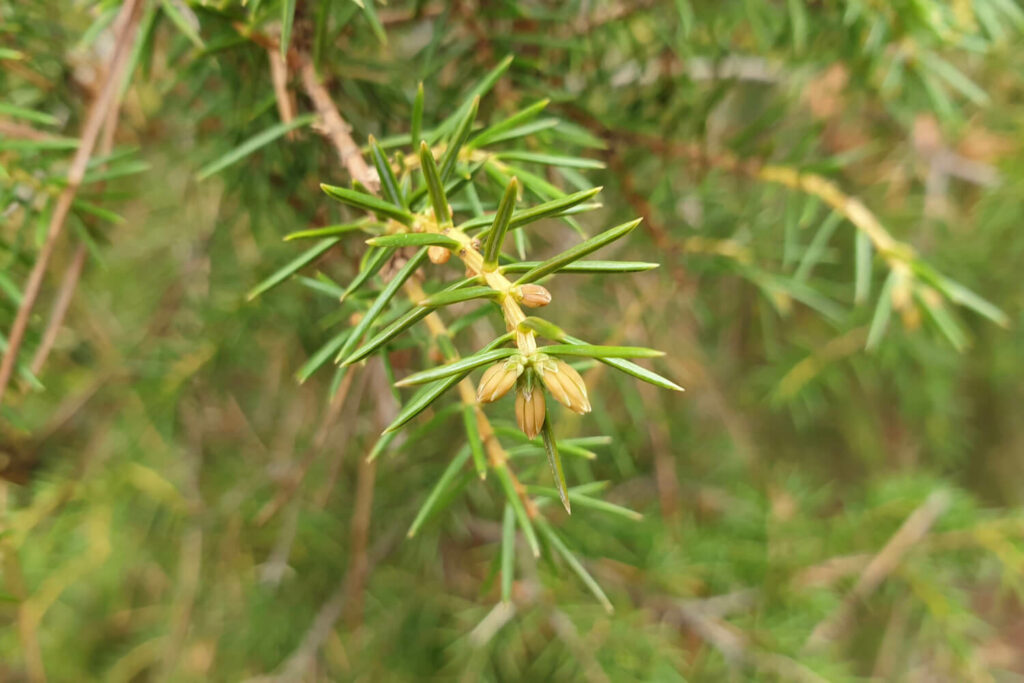
Pointy juniper needles
Juniper needles are sharp, so wear gloves when working with the plant [Photo: ppuDi/ Shutterstock.com]

Juniper care: watering and fertilising

Since junipers cope well with drought, there is no need to water larger, well-established plants. However, you should water freshly planted, young junipers regularly to support healthy growth. In the first few years however, watering is only really necessary when it is dry. Likewise, junipers do not usually require fertiliser, given they are planted in a suitable location. Nonetheless, in sandy soils or in pots, apply a little slow-release fertiliser occasionally. Junipers need a nutrient balance that is low phosphorus and high in magnesium. Because of these special requirements, our Plantura Rose Food is actually ideal for junipers. You should also be sure to repot your potted junipers every so often, as fresh soil stimulates healthy growth.

Bright red juniper berries on plant
Not all junipers have blue berries [Photo: Nella/ Shutterstock.com]

How to prune juniper

Juniper tolerates pruning well, which is why it is often used in topiary. Bear in mind, however, that juniper grows slowly and takes longer for new shoots to form. Although it is not strictly necessary to prune junipers, it does encourage branching. When pruning, avoid cutting into the old wood: After heavy pruning, older junipers barely produce any new shoots. A large, healthy plant can be pruned back a little more. Although, it is not guaranteed to regrow. To avoid this risk, simply remove visible dead branches in spring and regularly prune back young junipers slightly. Since juniper needles are very sharp, always wear gloves when pruning.

Common juniper pests and diseases

Although juniper is very robust, there are still some pests and diseases that plague the sturdy plant.

  • Phomophis blight (Phomopsis juniperivora): Also known as conifers dieback, this disease results in brown discoloured needles and small black fruiting bodies of the veru fungus that causes the disease. To treat, cut all affected parts of the plant back extensively.
browning juniper shoots
Before juniper shoots die, they change colour [Photo: Grandpa/ Shutterstock.com]
  • Juniper ermine moth (Argyresthia trifasciata): If the shoots turn brown from the tips, you may have an ermine moth infestation on your hands. You should seek advice from a plant protection service on how to best combat this for your individual plant.
juniper ermine moth with gold and white striped wings
The juniper ermine moth can also be responsible for needle discolouration [Photo: DJTaylor/ Shutterstock.com]
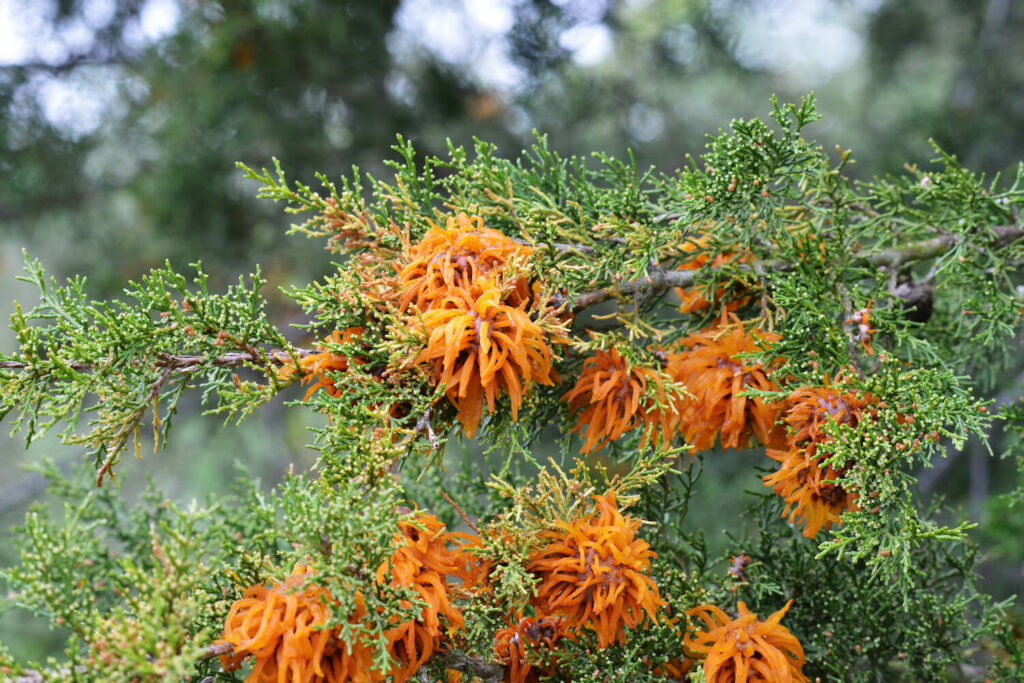
  • Rust fungi (Gymnosporangium): Hawthorn rust, pear rust or juniper rust are caused by various rust fungi. You can recognise them from their yellow, tongue-shaped fruiting bodies and swollen shoots. Cut off any infested parts of the plant and dispose of them in your household waste. These fungi can spread to other plants, such as pear trees.
Orange-yellow juniper rust fungi on branch
Juniper is one of the main hosts for rust fungi [Photo: dvande/ Shutterstock.com]

Juniper propagation

The best way to propagate junipers is from cuttings. To do this, take a young shoot from the main shoot in late summer. This should be slightly woody, but still green at the base. Cut off the stem bark with a sharp knife and remove the tip of the shoot and the lower needles. Then plant the cutting into a mixture of all purpose soil and sand and place the whole thing in a bright place with high humidity at around 20°C. Keep the soil moist at all times. By spring, roots should have formed and the juniper is ready to be repotted or transplanted outdoors.

Tip: When propagating, be sure to use a cutting from the juniper’s main shoot because the conifer shoots will “remember” their growth direction. A side shoot, on the other hand, will not grow straight up after propagation.

Are junipers winter-hardy?

A well-established juniper does not need any extra protection in winter. Though young plants should be protected with a layer of mulch. For potted juniper, place it on a wooden block and wrap it with some jute or a hessian sack to be safe.

snow covered juniper plant
Juniper is winter-hardy [Photo: Alexander Denisenko/ Shutterstock.com]

Harvesting and using juniper berries

Of all the varieties, common juniper (Juniperus communis) is the one most commonly used in the kitchen. The cone berries of the female juniper are ripe as soon as they turn dark blue. This happens two years after pollination. The berries are used, among other things, in juniper tea or for making gin. Other species, such as the savin juniper (Juniperus sabina), are poisonous in all parts. Juniper wood contains essential oils and are also often used to flavour meat.

Tip: Savin juniper was also used in the past for medicinal purposes. It was used, among other things, to clean wounds, for respiratory problems and abortion.

Mug of juniper tea
Juniper tea is said to have healing effects [Photo: ElenVik/ Shutterstock.com]

Are juniper berries poisonous?

Juniper species are slightly poisonous in some, sometimes in all, parts of the plant. While common juniper berries were used in the past for medicinal purposes, they also contain substances which, in excess, can cause irritation in the gastrointestinal tract or on the skin. Juniper should not be consumed during pregnancy or if you have kidney problems. Excessive juniper consumption is also poisonous for pets. Savin juniper is even classified as poisonous and can cause severe irritation and skin blistering from skin contact alone. Vomiting, diarrhea, and blister pain are among the most common symptoms of savin poisoning.

Juniper and heather shrubs are happy to share the same sunny, dry and sandy locations. And like juniper, the type of heather “cross-leaved heath” is very popular in gardens too. Learn all about how to care for it in our article on cross-leaved heath.

What Do Hunters Do With Dead Coyotes? Uncovering the Truth Behind the Hunt

0

Introduction

Hunting coyotes has long been a controversial activity, but understanding what is done with dead coyotes can help shed some light on the truth behind the hunt. Coyotes are wild animals and it is important to understand the implications of hunting them and the ways in which we can both benefit and be harmed by the practice. In this article, we will uncover the truth behind hunting coyotes and explore the different uses of dead coyotes, as well as the ethical debate surrounding the activity.

We will look at fur and body parts, predator control and the benefits and disadvantages of hunting coyotes. In the end, we will summarize the different uses for dead coyotes, as well as the ethical debate around hunting them.

What is a Coyote?

A coyote is a canine animal found in North and Central America. It is a member of the canine family and is similar in size to a small wolf. Coyotes are omnivorous and have adapted to live in a variety of environments, including urban and suburban areas.

They are generally active during the night and have a keen sense of hearing and smell.

Coyotes are known to be resourceful, intelligent and highly adaptive. In the United States, coyotes are hunted for their fur and body parts.

Hunting is regulated by state and federal laws and often requires a hunting license. Hunting allows humans to take advantage of the coyote’s adaptability and natural curiosity. Killing coyotes is also sometimes used as a way to reduce their population and prevent them from competing with other predators for resources.

It is important to note that hunting coyotes is a controversial topic. Proponents argue that it helps protect livestock and prevent overpopulation of coyotes, while opponents contend that hunting is cruel and inhumane, and should be avoided.

It is also important to remember that hunting should be done responsibly, with safety and caution in mind, and not just for sport. Hunting should be done with respect for the animal and its environment.

Overview of the Topic

Hunting coyotes can be a controversial issue but understanding what hunters do with dead coyotes helps shed some light on the matter. Coyotes can be hunted for their fur, body parts, and for predator control.

The fur of a coyote is often used for coats, gloves, and hats, while parts of the coyote like the teeth and claws may be used for jewelry or other decorations. Hunters may also use coyote carcasses to control the population of other predators, such as wolves and bears, that may compete with humans for game.

The ethical debate surrounding coyote hunting still remains. On the one hand, hunting coyotes can help protect livestock and game.

Hunting has caused a decline in the coyote population, which could lead to a decrease in biodiversity in the area. It is up to each individual to decide if they believe hunting coyotes is morally right or not. Understanding all of the possible uses for dead coyotes and the potential consequences of hunting can help inform one’s decision.

What Do Hunters Do With Dead Coyotes?

Hunting coyotes is a controversial issue, with passionate opinions on both sides. Hunters may use dead coyotes for several different purposes, including utilizing their fur and body parts, as well as controlling the coyote population.

Knowing how hunters use dead coyotes can help you make an educated decision on how you feel about the topic. When it comes to utilizing the fur and body parts of coyotes, some hunters do so for commercial purposes such as selling their products, while others use them for their own personal use.

Predator control is another purpose for which hunters use dead coyotes. By controlling the coyote population, hunters reduce competition for food and minimize the chances of coyotes killing livestock. Despite the potential benefits of hunting coyotes, there are several ethical considerations to take into account before making a decision. Taking into consideration the different views of the issue and researching the facts can help you make an informed decision on the contentious topic of hunting coyotes.

Fur and Body Parts

Hunting coyotes for their fur and body parts is a controversial activity. While some people argue that hunting coyotes is necessary for their population management, others believe it is unethical and not necessary. If you are considering hunting coyotes for their fur and body parts, it is important to consider the ethical implications of your actions.

It is important to be aware of the laws and regulations surrounding coyote hunting. Some states require hunters to obtain permits before hunting coyotes, while other states prohibit it outright.

It is also important to practice safety and ethical hunting practices. If you are unsure about the regulations in your area, it is best to check with your local hunting and fish agency.

When hunting coyotes for their fur and body parts, it is essential to use humane trapping and killing methods.

Coyote trapping must be done in a way that does not cause the animal undue stress or pain. There are a variety of humane methods of killing coyotes. The best way to ensure a humane kill is to use a single, swift shot to the head or heart. It is important to always be respectful of the animal you are hunting and to use the appropriate methods to ensure a humane, painless death.

Predator Control

When it comes to a coyote population, hunting can be a great way to keep their numbers down and help protect both their and our safety. Predators like coyotes can cause a lot of damage to livestock, property, and even humans, so it’s important to take active steps to protect ourselves and our communities.

Hunters can help with this by using their catch for predator control, a practice that has been around for centuries. Using hunted coyotes for predator control is a great way to manage the population and ensure that an area is safe. Hunters can use their dead coyotes to scare away other coyotes, helping to keep the animal’s population in check.

They can also be an effective tool for discouraging coyotes from eating livestock and other domesticated animals. Hunting coyotes is an effective way to protect the safety of both humans and animals alike.

Controversy Surrounding Coyotes and Hunting

Hunting coyotes can be controversial, and it’s important to understand why. On one hand, it can be beneficial for a variety of reasons, such as controlling the coyote population, reducing the risk of diseases, and preserving native species.

Hunting coyotes can be detrimental to the environment, can disrupt the coyote’s natural habitat, and can be seen as unethical by some. When making the decision to hunt coyotes, it’s important to do so responsibly.

Make sure you’re aware of the local laws and regulations that come with hunting, and make sure you’re not putting yourself, other hunters, and the environment at risk. It’s also essential to ensure that you’re using the right equipment and that you’re taking the necessary safety precautions.

It’s important to be educated and responsible when hunting coyotes. Do your research and make sure that you’re making the best decision for the environment and for the coyotes. Keep in mind that, while coyote hunting can be beneficial in some cases, it’s important to make sure you’re doing it responsibly and ethically.

Benefits of Hunting Coyotes

Hunting coyotes can be beneficial for various reasons. It is a way to manage the population of these wild animals in order to protect livestock, crops, and other wildlife. Coyote hunting can generate revenue from the sale of their fur and body parts, providing a financial incentive for hunters.

Hunting coyotes can also provide entertainment for some people, who find joy in the challenge of the hunt.

Coyotes are generally perceived as pests in many areas, and hunting them can help to control their numbers. This can help landowners and farmers, as well as other wildlife, who may find themselves competing with coyotes for food or resources. Hunting coyotes can also help to keep their population in check, preventing overcrowding, which can lead to an increase in diseases and a decrease in their overall health.

Hunting coyotes can be beneficial in many ways, from providing a financial incentive, to controlling their population and protecting other wildlife. It’s important to be aware of the potential ethical issues around hunting coyotes and to ensure that any hunting is done in a safe and responsible manner. With the right approach, hunting coyotes can be a beneficial activity for all involved.

Disadvantages of Hunting Coyotes

Hunting coyotes is not without its disadvantages, both for the coyote population and the environment. Coyotes are an essential part of the ecosystem, so if the population of coyotes is reduced, other species may suffer.

Coyotes also help to keep the populations of small mammals and rodents in check. If hunting is overdone, then other species may suffer from having too many of their natural predators removed from their environment. Hunting coyotes can disrupt the natural balance of their habitat and can cause other animals to move away from their natural home.

Overhunting can also have negative economic impacts, as it can lead to decreased tourism and the loss of potential revenue from hunters and wildlife enthusiasts.

Hunting coyotes also has an ethical dimension, as the animals are sentient beings which may suffer. If hunters are not mindful of the stress that hunting can cause, then coyotes may experience fear, pain, and trauma as a result. Hunting regulations should be carefully enforced to ensure that hunting is done responsibly and safely, and that the animals are treated humanely. Hunters should be aware of the potential impacts that their actions may have on the environment and the coyote population, and should take steps to mitigate any potential negative consequences.

Summary

Hunting coyotes is a controversial activity and understanding what hunters do with dead coyotes is essential to understanding the ethical debate that surrounds it. While some hunters use the fur and body parts of coyotes for a variety of reasons, the most common use is for predator control – to limit the number of coyotes in an area.

There are both benefits and disadvantages to hunting coyotes, and it is important to consider both sides of the argument in order to make an informed decision. On one hand, hunting coyotes can lead to healthier natural ecosystems, as they can reduce the amount of native prey animals taken by coyotes. It can also help to reduce the risk of diseases like rabies that are spread by wild coyotes.

Hunting coyotes can lead to a decrease in the overall population of coyotes, which could have a negative impact on the local environment. In the end, it is important to remember that the decision to hunt coyotes is a personal one and should be made with careful consideration. By understanding the different uses for dead coyotes and the ethical implications of hunting them, it is possible to make an informed decision about whether or not to engage in this activity.

The Different Uses for Dead Coyotes

Hunters have been using dead coyotes for different purposes for centuries. The most common use of dead coyotes is for their fur and body parts.

The fur from a dead coyote can be used to make coats, hats, and even blankets. The meat from coyotes is also used for food and can be processed into jerky.

The organs of dead coyotes are often used for medicinal purposes. Coyote hunting is also used as a form of predator control. By hunting coyotes, ranchers can protect their livestock from being attacked by the wild predators.

Coyote hunting helps to protect other animal species from becoming overpopulated. Though coyote hunting has its benefits, it has also faced criticism due to its unethical nature.

Animal rights activists argue that coyote hunting is cruel and unnecessary. The debate around hunting coyotes has been ongoing, but it is clear that both sides must take into consideration the needs of the environment and the animals before deciding on a course of action.

The Ethical Debate Around Hunting Coyotes

Hunting coyotes can be an ethical debate because they have important roles in the environment, such as controlling rodent populations and helping to maintain the balance of ecosystems. Although coyotes can be a nuisance to livestock and wildlife, they also provide a valuable service to the environment by preying on smaller animals and pests.

Some people may argue that hunting coyotes may be necessary to control their populations and protect livestock and wildlife. It is up to the individual to decide what is best for them and their environment.

When deciding if hunting coyotes is ethical, one should consider the coyote’s important role in the environment, as well as the potential risks associated with over-hunting them. It is important to take into account the potential harm done to other animals and the environment when considering the morality of hunting coyotes. Educating oneself on the importance of coyote management and making a conscious effort to be an ethical hunter are important steps in making sure that this ethical debate is resolved in the right direction.

Conclusion

Hunters have traditionally used dead coyotes for their fur and other body parts, as well as for predator control. Although hunting coyotes can have benefits, it is important to consider the ethical implications of hunting such animals. It is important to remember that even if hunting coyotes is done for conservation, the animal still dies.

It is important for hunters to take into account the animal’s overall welfare and not just their own interests when deciding to hunt coyotes. It is up to the hunter to decide whether hunting coyotes is the right thing to do.

If a hunter does decide to hunt coyotes, they should do so responsibly and with respect for the animal. This means ensuring that the animal is killed quickly and humanely, and that their remains are disposed of in a respectful manner. Taking the time to ensure that coyotes are not treated inhumanely is essential in order to ensure that hunting remains a responsible activity.

Understanding Different Types Of Shotgun Stocks

0

Table of Contents

Importance of Choosing the Right Stock

When it comes to shotguns, the stock is more than just a piece of wood or synthetic material that rests against your shoulder. It’s a critical component that influences the balance, handling, and overall performance of your firearm. Selecting the right stock for your shotgun can greatly enhance your shooting experience, whether in hunting, sport shooting, or tactical scenarios.

  • Balance: A well-chosen stock helps maintain the shotgun’s center of gravity.
  • Handling: The stock shape affects how the shooter grips and maneuvers the gun.
  • Performance: Comfort and fit can impact shooting accuracy and fatigue.

Overview of Different Stock Types

Shotgun stocks come in a variety of shapes and materials, each with its own purpose and advantage. Understanding the differences is key to making an informed decision. Below are some common types of shotgun stocks:

  1. Traditional Wood Stocks
  2. Synthetic Stocks
  3. Adjustable Stocks
  4. Collapsible/Folding Stocks
  5. Pistol Grip Stocks
  6. Thumbhole Stocks
  7. Stocks for Youth and Women
  8. Recoil-Reducing Stocks
  9. Custom Stocks
  10. Tactical and Specialist Stocks

Basic Anatomy of a Shotgun Stock

Components of a Shotgun Stock

A shotgun’s stock is composed of several parts, each serving a function that contributes to the weapon’s ergonomics and aesthetics. Here are the primary components:

  • Butt: The rear end that sits against the shooter’s shoulder.
  • Comb: The top part where the cheek rests.
  • Grip: The part where the trigger hand holds the stock.
  • Fore-end: The section below the barrel that the non-trigger hand supports.

How Stocks Affect Shotgun Performance

The design of a shotgun stock impacts the shooter’s comfort and the shotgun’s behavior during firing. An ergonomically sound stock can improve accuracy by offering better control and stability. Various stock shapes and lengths of pull (distance from the trigger to the end of the stock) cater to shooters’ diverse needs and preferences, impacting factors such as:

  • Recoil management: Some stocks are designed to absorb shock better.
  • Sight alignment: The stock’s height and angle can affect how the shooter aligns with the shotgun’s sights.

Factors to Consider When Choosing a Shotgun Stock

Shooting Discipline and Application

The intended use of your shotgun plays a significant role in determining the type of stock that’s most suitable for you. For example, a trap shooter might prefer a stock with an adjustable comb, while a tactical operator could opt for a stock with a pistol grip for better control.

Shooting Disciplines:

  • Hunting
  • Trap/Skeet Shooting
  • Tactical/Law Enforcement

Body Type and Ergonomics

Shotgun stocks should complement the shooter’s stature to prevent strain and improve performance. The right stock should feel natural in your hands and against your shoulder. It’s essential to consider features like the length of pull, drop at comb, and overall weight when selecting a stock.

Ergonomic Considerations:

  • Length of Pull
  • Drop at Heel and Comb
  • Grip Size and Shape

Material and Durability

Stocks are manufactured from various materials, each with its advantages and limitations in durability and field performance. It’s important to choose a stock material that can withstand environmental conditions and the rigors of use.

Common Stock Materials:

  • Wood (Walnut, Maple, Laminate, etc.)
  • Synthetic (Fiberglass, Polymer, Carbon Fiber, etc.)

Traditional Wood Shotgun Stocks

Aesthetic Appeal and Classic Feel

Many shotgun enthusiasts prefer wood stocks for their natural feel and traditional appearance. A well-crafted wood stock not only looks impressive but can also provide a warm and comfortable grip during colder weather.

  • Visual Attractiveness: Each wood stock has a unique grain pattern.
  • Sensory Experience: Wood provides a tactile warmth not found in synthetic materials.

Wood Types and Characteristics

Different woods offer various properties that affect the stock’s performance and longevity. Walnut is a popular choice due to its balance between weight, durability, and attractiveness. Other options include maple and laminate, which provide distinct advantages.

Wood Stock Options:

  • Walnut: Durable, with a rich finish.
  • Maple: Heavier, often with a striking grain.
  • Laminate: Layers of wood for added strength and unique color patterns.

Maintenance and Care for Wood Stocks

To preserve the beauty and function of a wood stock, it’s vital to perform regular maintenance. Exposure to moisture and temperature changes can affect the wood, so proper care is crucial.

Wood Stock Maintenance Tips:

  • Use a quality stock finish to protect against moisture.
  • Store the shotgun in a controlled environment to prevent warping.
  • Regularly clean and oil the wood to maintain its luster.

Synthetic Shotgun Stocks

Benefits of Synthetic Materials

Synthetic stocks, made from polymers or fiberglass, are gaining popularity due to their resistance to environmental wear and reduced maintenance compared to wood. They are an excellent option for shooters who frequently hunt or operate in harsh conditions.

  • Durability: Synthetic stocks can resist impacts, scratches, and weather.
  • Low Maintenance: Less susceptible to moisture and temperature fluctuations.

Varieties of Synthetic Stocks

Synthetics come in diverse forms, each designed to enhance the shooter’s experience and meet specific requirements. High-tech materials like carbon fiber offer strength with reduced weight, while other polymers provide affordability and ruggedness.

Types of Synthetic Stocks:

  • Polymer: Cost-effective and durable.
  • Fiberglass: Rigid and stable.
  • Carbon Fiber: Lightweight with high strength.

Weather Resistance and Durability

One of the main advantages of synthetic stocks is their ability to endure extreme weather conditions, from the dampness of marshlands to the dry heat of deserts, without significant wear.

Benefits of Synthetic Stock Weather Resistance:

  • Consistency: Performs reliably in a range of temperatures.
  • Longevity: Maintains structural integrity over time and use.

Adjustable Shotgun Stocks

Advantages of Adjustability

Whether you’re a competitive shooter looking to fine-tune your fit or a recreational shooter who wants a stock to accommodate different clothing and situations, adjustable stocks can be invaluable. They provide a personalized fit that can enhance performance and comfort.

Adjustable Stock Features:

  • Adjustable Comb: Aligns eye with the sights.
  • Adjustable Length of Pull: Fits a variety of arm lengths.
  • Adjustable Butt Pad: Alters recoil impact angle.

Types of Adjustment Features

Modern adjustable stocks come with several features tailored to improve the shooting experience. Each adjustment can make a significant difference in the shooter’s accuracy and comfort.

Common Adjustments:

  • Comb height and lateral position.
  • Length of pull adjustments using spacers or mechanical systems.
  • Adjustable recoil pads and cheek risers.

Target Shooters and Tactical Use

For target shooters, an adjustable stock allows for consistent cheek weld and eye alignment with the sights for every shot. In tactical environments, adjustability can aid in quickly adapting to body armor or various shooting positions.

Target Shooting:

  • Fine-tuning for precision shots.
  • Consistency between multiple shots.

Tactical Use:

  • Adaptability for different gears and scenarios.
  • Rapid adjustments to meet operational demands.

Collapsible or Folding Shotgun Stocks

Compactness and Portability

Collapsible and folding stocks are designed for shooters who need their shotguns to be as portable and discreet as possible. They’re commonly used in home defense scenarios or situations where storage space is at a premium.

  • Collapsible Stocks: Can be telescoped in for a shorter overall length.
  • Folding Stocks: The stock hinge allows it to fold alongside the receiver.

Legal Considerations and Restrictions

Before choosing a collapsible or folding stock, be aware of local and federal regulations regarding shotgun configurations, as these can vary considerably. Compliance with the law is crucial to avoid potential consequences.

Legal Aspects to Consider:

  • Overall length requirements.
  • Restrictions on collapsible or folding stock features.

Tactical and Home Defense Applications

Shotguns with collapsible or folding stocks are often favored for tactical operations and home defense, where maneuverability is essential, and the ability to quickly stow away the firearm is beneficial.

Tactical and Home Defense Considerations:

  • Ease of transport and storage.
  • Quick deployment in confined spaces.

Pistol Grip Shotgun Stocks

Pistol Grip Only vs. Pistol Grip with Shoulder Stock

Shotgun pistol grips come in two primary styles: pistol grip only and pistol grip with a traditional shoulder stock. The former offers maximum compactness, while the latter provides better stability and accuracy by allowing the shooter to shoulder the firearm.

Pistol Grip Styles:

  • Pistol Grip Only: For breaching and extremely close-quarters use.
  • Full Stock with Pistol Grip: Enhanced control with traditional shouldering.

Control and Maneuverability Aspects

A pistol grip helps in handling the shotgun, making it easier to operate and aim, especially in high-stress scenarios. It allows for a strong wrist position and potentially quicker target acquisition.

Control Advantages:

  • Strong and ergonomic grip.
  • Improved handling during dynamic movements.

Hunting versus Tactical Usage

Hunters may find traditional stocks more advantageous for the steady aim required in their discipline, while individuals interested in home defense or tactical applications might lean toward a shotgun with a pistol grip for its better control in compact spaces.

Usage Considerations:

  • Hunting: Traditional stocks are often preferred for stability.
  • Tactical: Pistol grips favored for maneuverability.

Thumbhole Shotgun Stocks

Design and Ergonomics

Thumbhole stocks integrate the grip and the butt into a single streamlined unit, allowing shooters to lock their hand in place more securely. This design can offer improved grip stability and ergonomics, which is beneficial for precision shooting.

Ergonomic Benefits:

  • Enhanced control during the aiming and firing process.
  • Reduced strain on the shooter’s wrist and forearm.

Benefits for Precision Shooting

Precision shooters, such as those engaging in sporting clays or hunting at longer distances, may prefer thumbhole stocks for the increased stability and support they provide. The design aids in maintaining consistency between shots.

Precision Shooting Advantages:

  • Consistent hand placement for repeatable accuracy.
  • Better rifle-like control for slug shooting.

Hunting and Sport Shooting Preferences

While thumbhole stocks are becoming increasingly popular in hunting and sport shooting circles, it’s essential to choose one that feels comfortable and does not impede the natural movement needed for these activities.

Sporting Preferences:

  • Stability for long-range hunting shots.
  • Comfort for extended periods at the range.

Youth and Women-Specific Shotgun Stocks

Importance of Proper Fit

Proper stock fit is crucial for all shooters, but it’s particularly vital for women and youth, who may find standard stocks too long or heavy. A well-fitted stock can make a significant difference in handling comfort and shot accuracy.

Benefits of Proper Fit:

  • Enhanced control and ease of use.
  • Increased confidence and shooting pleasure for younger or smaller shooters.

Reduced Length of Pull and other Adjustments

Shotgun stocks designed for women and youth often feature a reduced length of pull and other adjustments to cater to smaller frames. Recoil pads designed for lighter shooters can also help manage felt recoil.

Adjustments Specific to Youth and Women:

  • Shorter length of pull.
  • Smaller grip circumference.
  • Lighter overall weight.

Stock Options for Smaller Statures

Recognizing the diverse needs of shooters, manufacturers are offering more youth and women-specific stock options, ensuring comfortable and effective shotgun operation for everyone.

Options Available:

  • Compact models of popular shotguns.
  • Aftermarket stocks with adjustment possibilities.

Recoil-Reducing Shotgun Stocks

Technology and Features for Recoil Absorption

Recoil-reducing gun stocks incorporate technology and design features that dissipate the energy generated when a shotgun is fired. Hydraulic systems, spring mechanisms, and specialized recoil pads are some of the features used to reduce felt recoil.

Recoil Reduction Features:

  • Springs or hydraulic cylinders.
  • Sorbothane or gel recoil pads.
  • Counterweights and dampening systems.

Importance for Shooter Comfort and Follow-Up Shots

Minimizing recoil is not only about comfort; it can also lead to more accurate follow-up shots and reduced shooter fatigue during extended shooting sessions, such as in waterfowl hunting or competitive shooting events.

Shooter Comfort Advantages:

  • Less shoulder and cheek slap.
  • Ability to maintain focus and aim for longer periods.

Considerations for High-Volume Shooters

Shooters who spend a lot of time at the range or in the field shooting large volumes of ammunition should consider investing in a recoil-reducing stock to help mitigate long-term shoulder wear and fatigue.

Considerations for High-Volume Shooting:

  • Preserving shoulder health.
  • Extending shooting sessions without discomfort.

Custom Shotgun Stocks

Tailor-Made for Individual Needs

Custom stocks are crafted to fit an individual shooter’s specific physique and preferences. A custom fitting session with a stock maker can result in a shotgun stock that feels like an extension of the shooter’s body, potentially improving every aspect of shotgun handling.

Custom Fitting Benefits:

  • Precise adjustments to suit body measurements.
  • Craftsmanship that matches personal style and comfort requirements.

Process of Custom Stock Fitting

The custom stock fitting process often involves measuring a shooter’s dimensions and shooting stance. A stock maker then uses these measurements to craft a stock tailored for optimum fit and performance.

Custom Stock Fitting Steps:

  • Detailed measurement of the shooter’s physique.
  • Consideration of shooting style and discipline.
  • Creation of a stock that satisfies functional and aesthetic demands.

Costs and Benefits of Customization

While custom shotgun stocks can be a significant investment, many shooters find that the benefits in comfort, performance, and enjoyment are well worth the expense.

Custom Stock Considerations:

  • Higher cost compared to off-the-shelf stocks.
  • Long-term value in improved shooting results and satisfaction.

Tactical and Specialist Shotgun Stocks

Specialized Stocks for Law Enforcement and Military

Tactical and specialist shotgun stocks are designed to meet the stringent requirements of law enforcement and military operations. Features such as adjustability, rugged construction, and additional accessory mounting options are commonplace.

Key Features for Tactical Stocks:

  • Robustness to withstand rough handling.
  • Modular designs for attaching lights, lasers, and slings.

Conclusion

Tactical stocks often feature design elements that facilitate rapid deployment and manipulation under stress. Materials used in these stocks are typically chosen for their durability and functionality in adverse conditions.

Elements of Tactical Stock Design:

  • Non-slip surfaces for secure grip in all conditions.
  • Ergonomic shape to accommodate rapid movement and positioning.

Waterfowl & Migratory Bird Hunting Regulations

0

SEASONS

OPENING DATE

CLOSING DATE

DAILY LIMIT

Dove (Mourning and Eurasian-collared)

Sept. 1, 2022

Dec. 10, 2022

Nov. 6, 2022

Jan. 1, 2024

15

EARLY: Canada Goose

Sept. 3, 2022

Sept. 11, 2022

5

EARLY: Teal

(Blue-winged, Green-winged, & Cinnamon)

Sept. 3, 2022

Sept. 18, 2022

6

Rail (Virginia, Sora)

Sept. 1, 2022

Nov. 9, 2022

25

Gallinules

Sept. 1, 2022

Nov. 9, 2022

15

Wilson’s Snipe

Sept. 1, 2022

Dec. 10, 2022

Nov. 23, 2022

Jan. 1, 2024

8

American Woodcock

Oct. 8, 2022

Nov. 21, 2022

3

Hunting hours are sunrise to sunset, unless posted.

The U.S. Fish and Wildlife Service sets the frameworks for waterfowl and other migratory game birds. Migratory bird hunting is governed by both state and federal regulations. Wa- terfowl hunting is permitted when seasons are open during the youth deer gun season, the deer gun season, and the deer muzzleloader season. The possession limit for wa- terfowl and migratory birds after the second day is three times the daily bag limit.

OPENING DAY OF A SEASON

No person on the opening day of the season shall possess any freshly killed migratory game birds in excess of the daily bag limit, or aggregate daily bag limit, whichever applies.

MIGRATORY BIRD HUNTING

To hunt migratory birds in Ohio, you must have the following:

  • A valid Ohio hunting license.
  • Harvest Information Program (HIP) certification.

In addition to the requirements above, to hunt waterfowl in Ohio, you must also have the following:

  • An Ohio Wetlands Habitat Stamp en- dorsement is required of all persons 18 or older.
  • A signed federal Migratory Bird Hunting Stamp (Duck Stamp) is required of all persons age 16 and older.

HIP SURVEY

All hunters, including landowners, who plan to hunt migratory game birds, includ- ing mourning doves, ducks, geese, wood- cock, rails, coots, and snipe must have a Harvest Information Program (HIP) certi- fication number on their hunting license. To complete the HIP certification require- ment, call 1-877-HIP-OHIO (1-877-447- 6446) or go to wildohio.gov and answer the survey questions. After the survey you will be given a certification number. Write the certification number on your annual hunting license in the space provided.

Multiyear license and lifetime license hold- ers are required to complete the HIP certifi- cation requirement annually. The certifica- tion number is required to be carried while hunting.FEDERAL REGULATIONS AND FEDERAL MIGRATORY BIRD HUNTING STAMP (DUCK STAMP)

Federal regulations relating to migratory game birds are located in Title 50, Code of Federal Regulations, Part 20.

For additional information on federal regu- lations, go to fws.gov or ecfr.gov

Hunters should know:

  • Federal Duck Stamps are valid from July 1 through the following June 30.
  • You must sign the front of your Duck Stamp in order for it to be valid. Remem- ber: only you may use your Federal Duck Stamp.
  • If you bought an E-Stamp, you must carry your 45-day receipt with you at all times while hunting. Once the receipt has expired, you must carry your current, signed Federal Duck Stamp. If you pur- chased your E-Stamp at a retail store, you must carry the E-Stamp/45-day receipt. Your purchase/credit card receipt from the store is not valid as a Duck Stamp.

Hunters 16 years of age and older are re- quired to purchase this stamp to hunt waterfowl. These stamps are available at many U.S. post office branches, usps.com, or duckstamp.com.

The E-Stamp available through duckstamp. com is valid immediately for up to 45 days with the receipt of the e-stamp purchase.

OHIO WETLANDS HABITAT STAMP

The Ohio Wetlands Habitat Stamp will not be issued at the time of purchase. A li- cense will be issued stating Ohio Wetlands Stamp. The stamp will be mailed later in the year. The stamp does not need to be carried while hunting.

MILITARY WATERFOWL HUNTING

Active duty military and veterans may hunt waterfowl on Sept. 30 and Oct. 1, 2024. Bag limits are the same as the regular season. Active duty military and veterans and youth may hunt waterfowl together during this spe- cial season.

The hunter must be a veteran or a member of the armed forces on active duty.

YOUTH WATERFOWL HUNTING

Hunters 17 years old or younger may hunt waterfowl statewide (on public and private lands) on Sept. 30 and Oct. 1, 2024. Ducks, geese, and coots may be taken under bag limits established for the regular season. Hunting hours are 30 minutes before sun- rise to sunset.

NONTOXIC SHOT

No person may take ducks, geese (including brant), rail, snipe, gallinules, or coots while possessing shot (either in shotshells or as loose shot for muzzleloading) other than ap- proved nontoxic shot. For a list of approved nontoxic shot, see fws.gov.

OPENING DAY OF A SEASON

No person on the opening day of the season shall possess any freshly killed migratory game birds in excess of the daily bag limit, or aggregate daily bag limit, whichever applies.

MIGRATORY BIRD HUNTING

To hunt migratory birds in Ohio, you must have the following:

  • A valid Ohio hunting license.
  • Harvest Information Program (HIP) certification.

In addition to the requirements above, to hunt waterfowl in Ohio, you must also have the following:

  • A Ohio Wetlands Habitat Stamp endorsement is required of all persons 18 or older.
  • A signed federal Migratory Bird Hunting Stamp (Duck Stamp) is required of all persons age 16 and older.

HIP SURVEY

All hunters, including landowners, who plan to hunt migratory game birds, includ- ing mourning doves, ducks, geese, wood- cock, rails, coots, and snipe must have a harvest information program (HIP) certi- fication number on their hunting license. To complete the HIP certification require- ment, call 1-877-HIP-OHIO (1-877-447-6446) or go to wildohio.gov and answer the survey questions. After the survey you will be given a certification number. Write the certification number on your annual hunting license in the space provided.

Multiyear license and lifetime license hold- ers are required to complete the HIP certifi- cation requirement annually. The certifica- tion number is required to be carried while hunting

WATERFOWL SEASONS

OPENING DATE

CLOSING DATE

DAILY LIMIT

Youth Waterfowl Season

Sept. 30, 2024

Oct. 1, 2024

Same as the regular season

Military Waterfowl Season

Sept. 30, 2024

Oct. 1, 2024

Same as the regular season

LAKE ERIE MARSH ZONE:

Geese

Oct. 14, 2024

Nov. 4, 2024

Oct. 29, 2024

Dec. 17, 2024

GEESE

5 combined: Canada goose, white-fronted goose, and no more than 1 brant.

10 combined: snow goose, blue goose, Ross’s goose.

DUCKS

The daily bag limit is 6 ducks, which may include no more than 4 mallards (only 2 hens),

3 wood ducks, 2 redheads, 2 canvasbacks, 1 pintail, 2 black ducks, or 1 mottled duck. One scaup during the first 15 days of the season; two scaup during the next 45 days.

MERGANSERS & COOTS

5 mergansers (only 2 hooded), and 15 coots.

Dec. 31, 2024

Feb. 4, 2024

LAKE ERIE MARSH ZONE:

Ducks, Coots, &Mergansers

Oct. 14, 2024

Nov. 4, 2024

Oct. 29, 2024

Dec. 17, 2024

NORTH ZONE:

Geese

Oct. 21, 2024

Nov. 11, 2024

Oct. 29, 2024

Feb. 5, 2024

NORTH ZONE:

Ducks, Coots, &Mergansers

Oct. 21, 2024

Nov. 11, 2024

Oct. 29, 2024

DEC. 31, 2024

SOUTH ZONE:

Geese

Oct. 21, 2024

Nov. 18, 2024

Oct. 29, 2024

Feb. 12, 2024

SOUTH ZONE:

Ducks, Coots, &Mergansers

Oct. 21, 2024

Dec. 9, 2024

Oct. 29, 2024

Jan. 28, 2024

Hunting hours are 30 minutes before sunrise to sunset during the regular waterfowl season, unless posted.

OHIO WETLANDS HABITAT STAMP

The Ohio Wetlands Habitat Stamp will not be issued at the time of purchase. A license will be issued stating Ohio Wetlands Stamp. The stamp will be mailed later in the year. The stamp does not need to be carried while hunting.

FEDERAL REGULATIONS AND FEDERAL MIGRATORY BIRD HUNTING STAMP (DUCK STAMP)

Federal regulations relating to migratory game birds are located in Title 50, Code of Federal Regulations, Part 20.

For additional information on federal regulations, go to fws.gov or ecfr.gov

Hunters should know:

  • Federal Duck Stamps are valid from July 1 through the following June 30.
  • You must sign the front of your Duck Stamp in order for it to be valid. Remember: only you may use your Federal Duck Stamp.
  • If you bought an E-Stamp, you must carry your 45-day receipt with you at all times while hunting. Once the receipt has expired, you must carry your current, signed Federal Duck Stamp. If you purchased your E-Stamp at a retail store, you must carry the E-Stamp/45-day receipt. Your purchase/credit card receipt from the store is not valid as a Duck Stamp.

Hunters 16 years of age and older are required to purchase this stamp to hunt waterfowl. These stamps are available at many U.S. post office branches, usps.com, or duckstamp.com.

The E-Stamp available through duckstamp. com is valid immediately for up to 45 days with the receipt of the e-stamp purchase.

MILITARY WATERFOWL HUNTING

Active duty military and veterans may hunt waterfowl on Sept. 30 and Oct. 1, 2024. Bag limits are the same as the regular season. Active duty military and veterans and youth may hunt waterfowl together during this spe- cial season.

The hunter must be a veteran or a member of the armed forces on active duty.

YOUTH WATERFOWL HUNTING

Hunters 17 years old or younger may hunt waterfowl statewide (on public and private lands) on Sept. 30 and Oct. 1, 2024. Ducks, geese, and coots may be taken under bag limits established for the regular season. Hunting hours are 30 minutes before sun- rise to sunset.

NONTOXIC SHOT

No person may take ducks, geese (including brant), rail, snipe, moorhens, or coots while possessing shot (either in shotshells or as loose shot for muzzleloading) other than approved nontoxic shot. For a list of approved nontoxic shot, see fws.gov.

DOVE HUNTING

Hours for dove are sunrise to sunset. Doves may be hunted with lead shot. Dove field maps are available at wildohio.gov.

Doves may be hunted on areas that have been manipulated (for example, mowed or bush-hogged) for wildlife management purposes, in addition to areas that have been planted or harvested in a normal ag- ricultural manner. Neither waterfowl nor doves may be hunted on areas where grain or other feed has been distributed once it has been removed from or stored on the field where grown. Contact a Division of Wildlife district office or a state wildlife of- ficer for clarification on baiting regulations before you hunt.

Harvest Information Program (HIP) certi- fication is required to dove hunt. To com- plete the HIP certification requirement, call 1-877-HIP-OHIO (1-877-447-6446) or go to wildohio.gov and answer the survey ques- tions. After the survey you will be given a certification number. Write the certification number on your annual hunting license in the space provided.

Multiyear license and lifetime license hold- ers are required to complete the HIP certifi- cation requirement annually. The certifica- tion number is required to be carried while hunting.

TAGGING REQUIREMENT

No person shall put or leave any migratory game birds at any place (other than at his personal abode), or in the custody of another person for picking, cleaning, processing, shipping, transportation, or storage (includ- ing temporary storage), or for the purpose of having taxidermy services performed, unless such birds have a tag attached, signed by the hunter, stating their address, the total number and species of birds, and the date such birds were killed. Migratory game birds being transported in any vehicle as the personal baggage of the possessor shall not be considered as being in storage or temporary storage.

WATERFOWL HUNTING ZONES MAP
LAKE ERIE MARSH ZONE, NORTH ZONE, SOUTH ZONE

ADDITIONAL REGULATIONS

It is legal to take migratory game birds including waterfowl and coots on or over the following lands or areas that are not otherwise baited areas:

  • Standing crops or flooded standing crops (including aquatics);
  • Standing, flooded, or manipulated natural vegetation; flooded harvested croplands; or lands or areas where seeds or grains have been scattered solely as the result of a normal agricultural planting, harvesting, post-harvest manipulation, or normal soil stabilization practice;
  • From a blind or other place of concealment camouflaged with natural vegetation;
  • From a blind or other place of conceal- ment camouflaged with vegetation from agricultural crops, as long as such cam- ouflaging does not result in the exposing, depositing, distributing, or scattering of grain or other feed; or
  • Standing or flooded standing agricultural crops where grain is inadvertently scat- tered solely as a result of a hunter entering or exiting a hunting area, placing decoys, or retrieving downed birds.

ILLEGAL HUNTING METHODS

NO PERSONS SHALL TAKE MIGRATORY GAME BIRDS:

  1. With a crossbow, trap, snare, net, rifle, pistol, swivel gun, shotgun larger than 10 gauge, punt gun, battery gun, machine- gun, fish hook, poison, drug, explosive, or stupefying substance;
  2. From or by means, aid, or use of a sinkbox or any other type of low-floating device, having a depression affording the hunter a means of concealment beneath the surface of the water;
  3. From or by means, aid, or use of any motor vehicle, motor-driven land conveyance, or aircraft of any kind;
  4. From or by means of any motorboat or other craft having a motor attached, or any sailboat, unless the motor has been completely shut off and/or the sails furled, and its progress therefrom has ceased;
  5. By the use or aid of live birds as decoys; although not limited to, it shall be a vio- lation of this paragraph for any person to take migratory waterfowl on an area where tame or captive live ducks or geese are present unless such birds are and have been for a period of 10 consecutive days prior to such taking, confined within an enclosure which substantially reduces the audibility of their calls and totally conceals such birds from the sight of wild migratory waterfowl;
  6. By the aid of baiting or on or over any baited area.
  7. With any device that emits recorded or electrically amplified bird calls or sounds, or recorded or electrically amplified imi- tations of bird calls or sounds. It is illegal to possess such devices while hunting waterfowl in Ohio;
  8. By means or aid of any motor driven land, water, or air conveyance, or any sailboat used for the purpose of or resulting in the concentrating, driving, rallying, or stirring up of any migratory bird;

LEGAL WATERFOWL & MIGRATORY BIRD HUNTING EQUIPMENT

SEASONEQUIPMENT

WATERFOWL AND MIGRATORY BIRD HUNTING

Shotgun: 10 gauge or smaller shotgun using nontoxic shot, includes muzzleloading shotguns. In order to huntmigratory game birds, your shotgun cannot be capable ofholding more than three shells, unless it is plugged with aone-piece filler incapable of removal without disas- sembling the gun.

Only nontoxic shot may be used to take waterfowl, rail, snipe,and com- mon gallinule. Dove and woodcock may be takenwith lead shot.

Longbow: This includes compound bows and recurve bows.

SIG Sauer P210: Most Accurate 9mm Pistol Ever? A Range Report

0

What Expert Had to Say: Back when I wrote my slightly controversial and proverbial pot-stirring article rating the Top 5 9mm Pistols, I gave Honorable Mention to three particular pistols, among them the legendary SIG Sauer P210. Although many consider the SIG Sauer 210 the most accurate 9mm pistol ever, I rationalized my mere Honorable Mention ranking because I hadn’t yet been able to fire and adequately evaluate the 210. For a long time, it was so goshdarn expensive that none of the gun ranges I frequented throughout the US of A over the past three decades made one available for rental. The pistol took on an aura of Unobtainium, and the Holy Grail all rolled into one.

A Brief History of the SIG Sauer P210

The SIG Sauer P210 has been likened to a Swiss watch of handguns, and that’s not just because Switzerland is the country of origin, though that certainly helps.

As noted by Sean Murphy of Outdoor Life, “While the Swiss aren’t known for a large military force, their arms are known to be high-quality for soldiers that know how to use them. Originally adopted in 1949, the SIG P49 (later renamed P210), featured a steel frame and slide that have full length contact, with a high-quality barrel and superb trigger. With match-grade ammunition, the specification for the original SIG P210 was a five-shot group measuring two-inches or less at 50 meters. Most pistols would struggle to offer this level of precision at half the distance.” (emphasis added)

Eventually, the SIG Sauer P220 replaced the P210 as the Swiss Army pistol. Remarkably, the pistol remains standard issue for Danish Defence (the unified armed forces for the Kingdom of Denmark), despite the overwhelming prevalence of higher-capacity double-action and striker-fired 9mm auto pistols; the P210 is a single-action autoloader with a modest 8-round magazine and an old-school European-style butt-heel magazine release that has long since fallen out of favor for the far faster push-button mag releases located behind the trigger guard.

The standard P210 weighs 970 g (34 oz), has an overall length of 215 mm (8.5 in), and a barrel length of 120 mm (4.7 in).

SIG Sauer P210: My Personal Shooting Impressions at the Range

So, as luck would have it, as I was taking some hard-earned Labor Day weekend vacay in my old childhood hometown of Los Angeles, I decided to visit one of my favorite old SoCal haunts, the good ol’ Los Angeles Gun Club in Downtown L.A…and I discovered to my delightful surprise that the LAGC folks actually had a SIG P210 available for rental! It would be a major understatement to say this was way too good and rare an opportunity to pass up!

After 33 years of aura of mystery surrounding this previously unobtainable pistol, the act of dispelling that aura was…good but not spectacular. (“And the crowd goes…mild.”) Definitely not a bad experience, but not one that blew me away either (bad pun intended).

Slide manipulation was delightfully smooth, probably at least partially because the slide rides inside the frame rails rather than atop them the way most semiautomatic pistol slides do, which also at least theoretically contributes to the gun’s intrinsic accuracy; relatively few other auto pistols emulate this feature, the CZ-75 being amongst those few.

The trigger was also remarkably smooth and worthy of the “Swiss watch” label. The frame-mounted safety flicked downward from the “Safe” to “Fire” position slickly and smartly…but going the opposite direction – such as for cocked-and-locked carry mode – was rough and gritty.

And then there was the aforementioned butt-heel magazine release. On this particular P210 (not sure if it’s a universal design flaw or just unique to this individual specimen), it was extremely stiff and awkward. My shooting buddy and I both struggled with it, and mind you, we both weigh over 200 pounds and work out regularly. Definitely not a desirable feature in a real-world gunfight or even a high-stakes competitive match wherein speed reloads AKA emergency reloads are called for.

(As a sidebar note, SIG did recently release their so-called P210 Carry version, which has the more desirable push-button mag release.)

As to accuracy, the basis of the SIG Sauer P210’s legend, I have to throw out a couple of caveats here. First of all, LAGC is only a 50-foot range, so in fairness, that limited my ability to do a true hard-core test of the gun’s long-distance dialing (so to speak) ability. Second of all, this was a range rental gun, so it’s got some wear & tear on it. That said…at 21 feet, all 25 rounds fired struck the ICE-QT target in the head, but the rounds strayed considerably to the right, clustering around the left eye of the target as opposed to the bridge of the nose that was my aim point. At the 50-foot mark, all 25 rounds were in the 5-zone of the torso, but only 8 rounds landed in the tiebreaking 5x zone, with the rounds once again straying noticeably to the right. The groups were pleasantly tight but nowhere near as tight as the kind I routinely score with my beloved Beretta 92FS/M9, Glock 17, Glock 21SF, Glock 26, or my WWI-vintage Colt M1911 that I fired at this very same range session.

The ammo used was the Remington Range 115-grain full metal jacket (FMJ).

SIG Sauer P210: Bottom Line

So then, I’m not planning to save up money to buy a SIG P210, as many other firearms remain higher-ranked on my Wish List. That said, it is still definitely a high-quality firearm and one of these days, I’d relish the chance to test the gun’s capabilities at 25 and 50 yards (as opposed to 21 and 50 feet). And the good news is, though the pistol is pricey, the price tag actually appears to have gone down compared to the $2,500.00 – $3,000.00 USD that was the norm back in the 1990s.

If you have the desire to own one of these legendary pistols, I definitely recommend it.

Bonus: Sig Sauer Photo Essay

Christian D. Orr has 33 years of shooting experience, starting at the tender age of 14. His marksmanship accomplishments include: the Air Force Small Arms Ribbon w/one device (for M16A2 rifle and M9 pistol); Pistol Expert Ratings from U.S. Customs & Border Protection (CBP), Immigration & Customs Enforcement (ICE), and the Federal Law Enforcement Training Center (FLETC) Criminal Investigator Training Program (CITP); multiple medals and trophies via the Glock Sport Shooting Foundation (GSSF) and the Nevada Police & Fires Games (NPAF). Chris has been an NRA Certified Basic Pistol Instructor since 2011. In his spare time, he enjoys (besides shooting, obviously) dining out, cigars, Irish and British pubs, travel, USC Trojans college football, and Washington DC professional sports.

Can you eat black birds

0

Overview of Blackbirds

Overview of Blackbirds

Photo Credits: Vendingproservice.Com by Carl Clark

Blackbirds are a widespread species found primarily in Europe, Asia, and North Africa. Their plumage is predominantly black with a yellow bill and eye-ring in males, while females have a brownish-black plumage with a pinkish-buff throat. These birds are renowned for their melodious songs, and their diet primarily consists of insects, earthworms, and fruits. Blackbirds typically breed from March to July and lay 3-5 eggs in a nest built on shrubs or trees. Their lifespan ranges from 2-3 years in the wild and up to 20 years in captivity. Join us as we take a deeper look into the world of blackbirds and discover more about these beloved birds.

Appearance and Habitat

Blackbirds are a type of passerine bird. They have black plumage with bright yellow beaks and eyes. They can live in forests, wetlands, grasslands, and even parks and gardens. They thrive in Europe, Asia, North Africa, and certain parts of Australia.

During breeding season, males establish territories. Females build nests using materials such as grass, twigs, and even human-made items like plastic and string. These nests can be found in trees or shrubs within the bird’s territory.

Blackbirds are a fascinating subject for ecologists and behaviorists studying wild birds. They can grow up to 29 cm long and weigh up to 125 grams. This showcases how their physical traits are as impressive as their resilience and adaptability.

Blackbird Breeding and Lifespan

Blackbirds are a captivating species! They sing beautifully and breed from March to August in the UK. Females lay 3-5 pale blue eggs with brown and grey spots in a nest of grass and twigs. The male brings food for the female during incubation, which lasts two weeks before hatching.

During breeding season, males compete to attract females with territorial displays. Afterwards, both parents care for their young until they fledge after 11-14 days. Although blackbirds usually live 2-3 years, some can reach 5 years.

Temperature and rainfall affect blackbird reproduction and breeding success. Experienced adults are more successful. Some can breed out of the regular window due to ideal conditions.

Blackbirds are important to ecosystems. They feed on various things and contribute to biodiversity. In short, blackbirds are an enchanting species with special breeding and lifespan patterns!

Blackbirds as Food

Blackbirds as Food

Photo Credits: Vendingproservice.Com by William Torres

Blackbirds have never been widely eaten by humans and there is no evidence to support the claim that they have a unique flavor. In fact, blackbirds are protected under the Migratory Bird Treaty Act of 1918, making it illegal to hunt or eat them. The same protection applies to crows and other native bird species. Sparrows and starlings are not commonly consumed in many cultures and are not considered a significant source of nutrition. Therefore, it is not recommended to incorporate them into a healthy diet.

Eating Blackbirds

Consuming blackbirds for meat has been a part of human history for centuries. But, compared to other birds like pigeons, chickens, or ducks, blackbird consumption is not that common. Its meat has a dark, gamey taste that is an acquired taste for some. It can be cooked in various ways – roasting, grilling, or stewing.

Sadly, the blackbird population numbers have decreased and their natural habitats have been lost. Thus, laws have been passed to protect them from hunters. Eating blackbirds, like other wild animals, can be risky, as parasites and diseases may exist if it is not cooked properly. It must be cooked at the right temperature to prevent health issues.

All in all, blackbirds may have been historically consumed by humans, but legal protections and the availability of other food with lower health risks have made it less common nowadays.

Crows and Other Birds

Crows and other birds are not a top pick for blackbirds’ diets. These omnivorous birds prefer a variety of nourishments, such as insects, fruits, and veggies. Sparrows and starlings are actually more nutritious for them. But, human activities like putting out bird feeders in gardens and throwing bread crumbs in parks has changed what they eat. This can be bad for their health and lifespan.

Nutritious Sparrows and Starlings

Sparrows and starlings may look common, but they are not for eating. Despite claims that their meat is good for you, it can actually harm your health. And many of these birds are protected by conservation laws. That means that it is illegal to hunt or eat them without permission from authorities.

Handling bird meat without proper preparation can lead to contamination and illness. So, it is important to follow safety guidelines when preparing any kind of bird.

Avoid consuming wild birds, like blackbirds. Instead, choose healthier proteins like lean meats, fish, and plants. This will help provide the nutrients you need without risking your health.

Blackbirds’ Diet

Blackbirds

Photo Credits: Vendingproservice.Com by Juan Carter

Blackbirds are a common sight in gardens and parks, but have you ever wondered what they eat? In this section, we will explore the dietary habits of blackbirds, including both their natural diet and their feeding habits in gardens. Blackbirds primarily eat insects, earthworms, and fruit. They are omnivores and eat a variety of foods depending on the season. During breeding season, they eat more animal foods, and during winter, they eat more plant-based foods. They also eat human-provided food in gardens, such as bread, seeds, and suet. Get ready to learn more about these beloved birds and their dietary habits.

Natural Diet

Blackbirds have a diet that is varied; made up of plant and animal matter. During breeding season, insects are the main source of food. They also eat fruits, berries, seeds, and earthworms. It varies with the habitat; gardens give a mix of bugs, spiders, caterpillars, fruits, and seeds. In rural areas, earthworms and insects are their main source of food.

Blackbirds have an amazing way to get earthworms during heavy rains. They dig with their beaks and use their neck muscles to pull them out. They prefer trees with low-hanging branches. This has been observed by experts.

There are different sub-species of blackbirds with unique features. They differ in plumage color and migratory patterns.

Feeding blackbirds in your garden? Provide them with a natural diet like insects, fruits, and seeds. This will make them appreciate it and may even come back to your garden year after year.

Feeding in Gardens

Blackbirds often visit gardens. They eat a variety of things, including worms, insects, fruits and seeds. In fall, they consume more fruit, and in winter they eat more seeds. They help spread seeds through their droppings. But, some gardeners think blackbirds are pests because they dig up shallow-rooted plants. Watching them forage in open fields is pretty cool; they look for small bugs and worms in grass and foliage. In spring, they look for nesting sites in tall grass while still looking for food. Blackbirds may eat birdseed, sunflower hearts, millet seed and dried mealworms. But, they may also have indigestion from eating bread. In the winters of 1806-07 and 1871-72, military men sent hunters to parks in Paris to kill blackbirds. It’s amazing how blackbirds can adapt to their surroundings when feeding in gardens.

Facts about Blackbirds

Facts about Blackbirds

Photo Credits: Vendingproservice.Com by Michael Clark

Did you know that blackbirds are omnivores and have a diverse diet consisting of insects, berries, fruits, seeds, and even small animals such as snails? In this section, we will take a closer look at some fascinating facts about blackbirds. We will examine how winter affects their food sources and how human activity has impacted their eating habits. Join us as we explore the intriguing world of these feathered creatures.

Blackbirds Omnivores Eat Wide

Blackbirds are known for their varied, vast diets. They eat all kinds of food: insects, worms, snails, fruits, berries, seeds, and even other little birds. They’re opportunistic feeders, changing their diet based on the season and food availability.

In breeding season, they go for more proteins, like insects, to help with producing eggs and raising chicks. In winter, they switch to more fruits and berries since insects are harder to find.

Human influence has changed blackbird’s diets too. Feeders in gardens give them food all year. We can provide seeds and fruits that aren’t normally around.

We can help blackbirds by planting fruit trees or bushes near our gardens. Bird feeders can have peanut or sunflower hearts, which are just the right size for their beaks. Suet blocks with mealworms are great in winter when there’s less food around.

Winter Blackbirds Find Food

Winter brings a challenge for blackbirds – finding food. But, they have adapted. Their usual diet consists of fruits, insects, and seeds. Gardens are great for foraging worms and insects.

Blackbirds are opportunists, looking for any food source in poor weather. Bird feeders provide grains, nuts, and suet cakes. Holly bushes offer shelter and food. Insects can be found under tree bark and leaves.

In spite of the winter troubles, blackbirds work out ways to find alternative food sources. They use innovative methods to feed themselves.

The Royal Society for the Protection of Birds (RSPB) recommends not to solely depend on feeding blackbirds in winter. Unsuitable foods may cause health problems.

It is evident that blackbirds are skilled at finding food during winter, using various strategies.

Human Influence on Blackbirds’ Diet

Human activities have a big effect on the Blackbirds’ diet.

Urbanization and cutting down trees have made gardens, farms, and suburban areas popular places for Blackbirds to eat. They can get seeds from plants and fruits from orchards. People often feed them or leave food out in their gardens, which increases the amount of food available for Blackbirds.

Blackbirds are omnivores and they will eat nearly anything. As humans change the natural environment with new ecosystems in suburban areas and covering forests, Blackbirds might change their eating habits, too.

It’s important for humans to watch what they’re doing to the environment. If humans stop feeding Blackbirds, the birds may not be able to find enough food in times when natural resources are scarce.

In the end, human influence on the Blackbirds’ diet has both good and bad effects. On one side, human activity gives them more food, but on the other hand, this could have unexpected results in the long run.

Can You Eat Black Birds?

Can You Eat Black Birds?

Photo Credits: Vendingproservice.Com by Bryan Lewis

Can you eat black birds? Across the globe, many cultures eat birds. Some studies suggest certain species of black birds, such as crows, ravens, and blackbirds, can be eaten if properly cooked. But, others disagree due to potential health risks.

It’s vital to consider that some black birds may carry diseases or consume toxic substances, so it is important to understand the attributes and risks associated with each species before consuming them. Plus, certain cultures have taboos or superstitions connected to eating black birds, so this adds to the complexity.

So, it may be possible to eat certain species of black birds. But, caution must be used. So, if you’re thinking of adding black bird meat to your diet, research it and get expert advice first.

FAQs about Can You Eat Black Birds

Can you eat blackbirds?

Yes, blackbirds can be eaten and were once eaten despite their bitter taste. Larger blackbirds can be cut into pieces like poultry, and their livers have a similar flavor to chicken livers.

What do blackbirds eat?

Blackbirds are omnivores and have a varied diet that includes earthworms, insects, spiders, snails, fruit, seeds, and berries. Their diet changes according to the seasons, with fruits becoming more dominant in the winter. They find most of their food on the ground, in the soil, or under debris and moss. They prefer a diet of worms and snails, not bird feeders.

Are blackbirds a common bird species?

Yes, blackbirds are a common bird species belonging to the true thrush family. They are present in North America, Australia, New Zealand, Europe, and Russia. There are different subspecies, some migratory, partially migratory, or residential. The species got its name from fully black males, but females and offspring have dark brown feathers. They inhabit woods and bushy areas, use mud for building nests, and are territorial. They create lifelong relationships with a pair returning to the same area every year. They have 2-3 broods during the breeding season, with 3-5 eggs per female. Males catch caterpillars or earthworms for offspring, while females prepare the nest. They protect their territory fiercely but will couple with other birds when migrating. Urban males do not migrate in winter as they can find food in cities.

Is it safe to eat crow meat?

Yes, crow meat is safe to eat and highly nutritious, but the flavor can vary depending on preparation. Crows can be eaten and are considered a delicacy by some. The negative connotations surrounding crows have led to the phrase “eating crow” to refer to admitting being wrong.

What are some interesting characteristics of blackbirds?

Blackbirds create lifelong relationships with a pair returning to the same area every year. They protect their territory fiercely but will couple with other birds when migrating. Their natural diet has been depleted by human influences such as intensive farming. Blackbirds breed from April to July and may have up to 3 clutches of chicks during this time. The average lifespan of a blackbird is 3 years, but the oldest one on record was 14.

What should you do to attract blackbirds to your garden?

Blackbirds appreciate soft seeds like sunflower hearts and rolled oats as extra energy sources in the winter. Mealworms and dried fruit can be provided by birdwatchers to encourage Blackbirds to visit. Suburban areas provide rich foraging grounds for wild blackbirds, but their natural diet has been depleted, so providing food can be beneficial for their survival.

Picking The Best Wood for Spear Shaft in 2021

0

A spear shaft needs the right wood. The wood can depend if you use the shaft to decorate or for combat training. But, this can get tricky for reasons like durability, strength, and more.

So naturally, you must be wondering, what’s the best wood for spear shaft?

Hickory, ash, red oak, and acacia are great options for spear shafts. Hickory is a very reliable option whereas Ash provides a traditional feel. Red oak is a great option for decorative purposes while acacia is widely available.

To know more about these woods, keep reading our article. We have elaborated on their features and differences below just for you.

Let’s begin!

Which Wood To Pick For A Spear Shaft?

best wood for spear shaft

With the variety of options available, choosing wood for a spear shaft can be puzzling. However, we have four recommendations: Hickory, Ash, Red oak, and Acacia.

To help you understand these variations, we’ve put together a table.

Type of woodAdvantages Disadvantages HickoryAccessible Strong Durable Not as traditional as Ash Is heavier than other woods Rigid Ash Traditional Lightweight Flexible Prone to rot Not very durable Red oakDurable Great for decorative purposes Splinters easily Heavy to carry and use Difficult to cut and size Acacia Widely available Durable Expensive Temperature-sensitive

We understand that this isn’t sufficient information for you to make a final decision. This is why we’ll go over the differences in more detail below.

1. Hickory

This is the most common hardwood out there. If you’re making a spear for combat and throwing purposes, this is a great option. In terms of cost, hickory is really affordable.

This is because hickory is very strong and durable. So no matter how you throw or use it, your spear shaft will remain intact. There will be little to no splintering of the wood on heavy impact.

On top of that, hickory is widely available. You can easily get it from hardware stores or dealers. This wood is easy to maintain and only needs the occasional wipe down with a damp cloth.

However, this is very heavy wood, roughly weighing 2 pounds. So while yielding the shaft, you may think it’s too stiff and rigid. Also, you might want a spear shaft similar to those used in older civilizations. In that case, hickory isn’t the right choice.

2. Ash

Many spear shafts in history were made from ash. Similar to hickory, this is also a widely available hardwood for spear shafts. Ash is on par with hickory when it comes to cost.

The unique quality of this hardwood is that it’s light and flexible. This makes it easy to yield and maneuver in close range, up to 80 meters. Since it’s light, it’s also a great option for newbies learning to wield and use spears.

However, unlike hickory, ash isn’t very durable. If it bends too much, it’s tough to restore the original shape.

On top of that, ash is prone to rotting. This makes it tough to maintain. Chances are, your spear shaft won’t last longer than a year.

3. Red Oak

This is the most beautiful hardwood of the bunch. This brown wood with red undertones makes a very aesthetically pleasing spear shaft. It tends to be slightly more expensive than Ash and Hickory.

Red oak is also the toughest hardwood out there. So it’s on par with hickory in terms of durability.

However, since the wood is tough, it’s very difficult to cut and size it. If you’re new to spears, this will be very heavy to use.

Lastly, the wood is brittle and splinters easily. Consequently, it can’t take high-impact blows. So it’s best for decorative purposes only. It just needs regular cleaning with a rag.

4. Acacia

If you’re living somewhere where the aforementioned woods aren’t available, use acacia. This is a hardwood that’s available all across the world. It’s highly durable and resists splintering upon impact.

However, acacia is more expensive both in terms of price and maintenance costs.

The natural properties of the wood make it tarnish quickly. So it requires yearly maintenance in the form of polishing.

If you’re unsure about the type of polish to get, check the ones below. Any one of these will make your spear shaft shine.

Now that’s covered, let’s proceed.

Final Decision: What Is the Best Wood for A Spear Shaft?

Don’t have a preference for one over the other? We can assist you.

If you want to make a spear shaft for combat or throwing purposes, opt for hickory. It will give you the strength and longevity you need.

If you want a traditional or low-scale spear shaft, go for ash wood. However, for simply decorative purposes, stick to red oak.

Lastly, if you can’t find the other woods, go for acacia. Simply store the shaft in a cool place, below 86℉ to keep the wood from tarnishing.

We hope these let you decide the best wood for your spear shaft.

Frequently Asked Questions

Question: How thick should a spear shaft be?

Answer: Ideally, the diameter should be 1 to 1.5 inches. This is a good range of thickness that’ll let you handle the spear well. Anywhere in this range should allow you to handle the spear with one or two hands.

Question: How long should a throwing spear shaft be?

Answer: Depending on your height, it can range from 5.5 feet to 8 feet long. If the wood is light, then opt for 6 to 7 feet. This is the optimal length for single and double-handed throwing. If the wood is heavy, and you’re 6 feet or taller, go for 8 feet.

Question: How to take care of the spear?

Answer: After each use, wipe it down with a damp rag. Wait for it to dry completely. Opt for storing the spear in a cool and dry room. Once every 6 months, polish the spear to keep it looking brand new.

Final Words

With everything covered, now you should know the best wood for spear shaft. Make sure you pick the wood for the task it needs to do.

Good luck with the project and we hope the wood you pick serves you well.

If this article helped you, let us know in the comments below!

Best Air Rifle Deals

Popular Posts

Pump Air Rifles vs Break Barrel

0
Exploring the Pros and Cons: Pump Air Rifle vs Break Barrel - Unveiling the key differences and advantages between two popular air rifle mechanisms....

Dry Firing Air Rifles: What You Need to Know

0
"Master the art of precision shooting with dry firing air rifles. Enhance your aiming skills, trigger control, and muscle memory without using ammunition. Discover...

Best Air Rifle Brands – Who Makes the Best Pellet Gun?

0
In Jeff Bezos’ own words: "A brand for a company is like a reputation for a person. You earn reputation by trying to do hard...