


Home Blog Page 101

Best survival axe

0

Despite the axe’s status as one of humanity’s most ancient and widespread tools, many modern preppers overlook the value an axe adds to a well-rounded survival kit. But that’s a mistake — we consider some form of an axe one of the four core bladed tools everyone should have on hand.

Axes are devastatingly effective against hard materials like wood and metal, exploiting the basic laws of physics and leverage to drive an edge through a surface with maximum force and minimum calories burned. This combination of effectiveness and efficiency makes an axe a lifesaver in situations as varied as escaping a burning office building to surviving the winter wilderness of the Pacific Northwest.

More: Not sure about all the different types of bladed tools and how to mix the right types together for your needs?

More: Survival hatchet review

A good axe can do a lot more than just chopping, though. If an axe has the right beard, poll, and handle design, you can “choke up” on it with your hand and use it for knife-type tasks like carving, game processing, shaving fuzz sticks, and similar fine work.
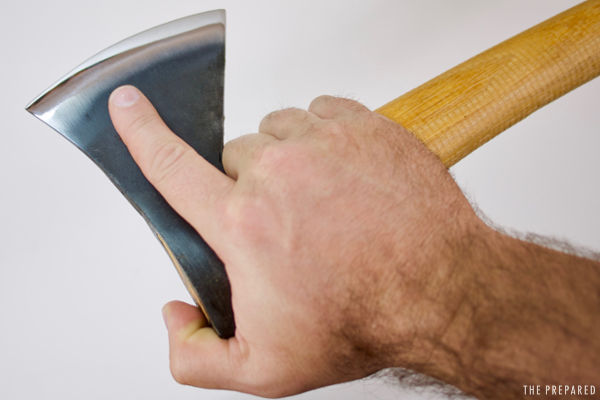
Sometimes the right axe actually works better than a field knife for certain fine cutting tasks, because the configuration pictured above places your hand and fingers very close to the working edge, giving you more control and allowing your sense of proprioception to engage in a way that it can’t with all but the smallest knives.

Full review details on the best survival axes, our criteria, contenders, and more below the fold.

If you just want to check this off your prepping list and move on without spending too much time or money, the jack-of-all-trades $80 Estwing Camper’s Axe is a heavy, steel-handled, ultra-durable classic with a great reputation. As a general-purpose survival axe from a reputable company, the Eastwing is a capable chopper that works for any type of user (skilled or unskilled) in any environment (country, suburbs, or city).

The $235 Gransfors Bruks Small Forest Axe is a legendary axe that has dominated the compact survival axe niche for decades and is widely known by the acronym “SFA.” You pay a little extra for the name, but this amazing tool is worth the premium. At only 19 inches and two pounds, it’s small enough to toe the line of being a hatchet, but gives you that axe-level power in a package you can easily carry on foot.

The very best emergency axe for city preppers is the tried-and-true $240 Fire Axe Inc JP Special 4lb Pick Head Axe with synthetic handle. Expensive, but worth it: The JP Special is a high-quality axe carried by firefighters and frequently recommended in firefighter forums because it’s a dependable beast of a chopping, breaching, and demolition tool. Because this is a personal axe and not a truck axe, it’s compact enough (though just barely) to be carried short distances on a belt or pack.

The $180 Hults Bruk Kisa Medium Sized Felling Axe is right in the sweet spot of quality, features, size, and price for an axe that’s built for processing large amounts of forest wood. It’s large enough to handle tough homesteading tasks but small enough to carry a while on foot if you needed to. Hults Bruk is a legendary brand popular among bushcrafters and preppers.

If you’d rather have just a little bit more portability in an axe that’s still capable of handling rural tasks, check out the slightly cheaper $150 Helko Journeyman. However, the Journeyman’s head shape is more suited for wood splitting than it is for knife-type work like carving.

The best budget axe for rural preppers is the $50 Council Tool 2.25# 24” Boy Axe. Made in the US (which is harder to find the cheaper you go) and based on a famous design used by the US Forest Service. You’ll sacrifice fit and finish, plus it’s meaningfully longer and heavier than the more expensive alternatives, but it will serve you well in a pinch.

Why you should trust us

I’ve professionally reviewed bladed tools for 6 years, personally used them in the bush for 35 years, and have been a prepper for 10 years.

We’ve spent an additional 55 hours preparing this review by talking with other experts in the field — ranging from firefighters and first responders to bushcrafters and preppers — and researching countless product reviews and social forum threads.

Top contenders and our selection process

We narrowed down the field to the top 20 survival axes of different sizes and features. From that list we received samples from top manufacturers to compliment the models we already owned.

Any of the axes in the top 20 will serve you well in any type of emergency, but we’ve narrowed down the list further to the ten best picks for different types of preppers in different environments.

View the spreadsheet in Google Docs

Note that axe data, particularly weights, are often wrong or misleading on ecommerce sites. For example, many sellers only list the weight of the axe head, not the overall axe. Where possible, we’ve used data directly from the manufacturer or from speciality retail sites that take care to get it right.

We’ve focused here on more lightweight, packable axes that are big enough to do useful felling work but small enough to carry on-foot for modest distances.

Our final choices come from a mix of reputation and reviews from other experts we trust, combined with our own hands-on experiences with many of these products and brands.

Axe basics

Axes are two simple machines put together: a wedge and a lever. All the members of the axe family (including hatchets and tomahawks) share the same basic anatomy:
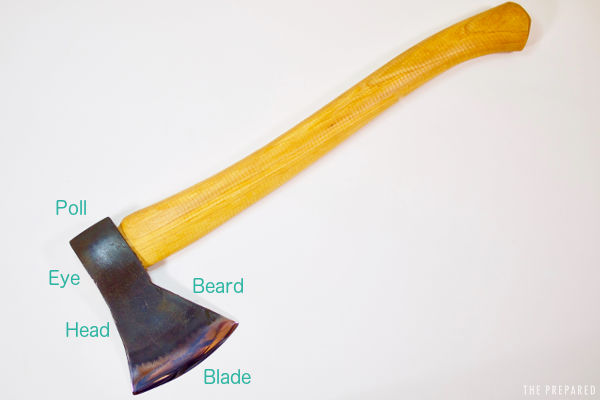
  • Head: The wedge-shaped weight at the top of the axe that does the chopping.
  • Eye: The large hole in the head that attaches around the handle.
  • Blade: The part of the axe head with the edge on it that does the chopping. Sometimes called the ‘bit’.
  • Poll: The part of the axe head opposite the blade.
  • Beard: The part of the blade that extends downward in a triangle shape.

Survival axe considerations

Weight distribution

An axe is more effective when most of the weight is in the head. When the weight is more evenly distributed between the handle and head, the laws of physics make it less “punchy”.

So when you’re comparing models, keep in mind that two axes with the exact same length, materials, and weight can have very different chopping capabilities.

Head shape
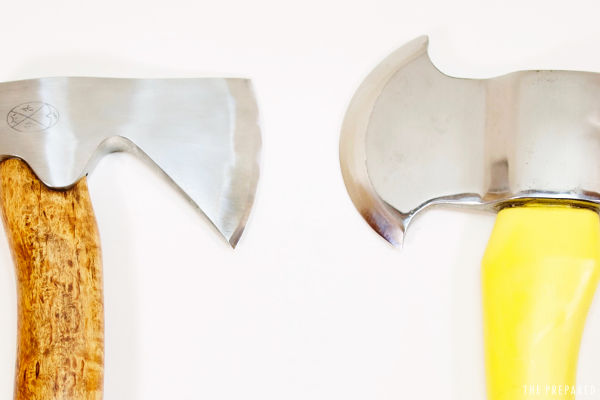
The edge shape and thickness determines how well an axe handles different materials.

A flatter edge shape puts more of the edge in contact with the thing being chopped on each stroke, making it great for wood and other natural materials.

But that same flat edge could more easily get stuck in a totally flat surface (like a wall or door), which is why some demolition or “fireman’s” axes have half-moon shaped heads.

Those curvy edges can be awful to chop rounded natural materials with, though, which is why this factor matters when thinking about your environment.

Head thickness and cutting vs. splitting

A wide axe head (think of a “fat” pyramid) is better at using that wide angle to forcefully split pieces apart. Like splitting already-cut logs of firewood into sections: a fat wedge forces the wood apart through opposing pressure, more so than biting into the material and slicing through it.
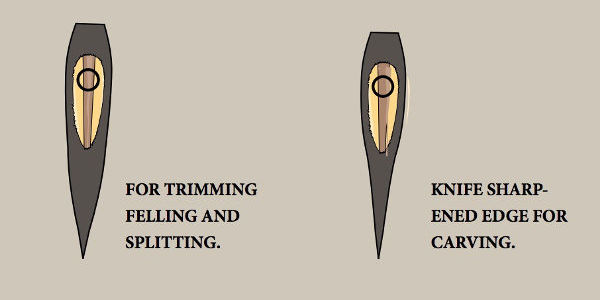
A thinner axe head acts more like a knife cutting through the material, and is better suited to cutting tasks like felling trees or limbing logs.

We generally prefer the more cutting-oriented heads that are more popular with today’s bushcrafters for their versatility in doing many different kinds of non-chopping camp chores, but for most preppers the real-world performance and usage differences between the different head thicknesses and shapes represented in this guide are subtle and not worth obsessing over.

Poll shape

You can flip an axe around and use the poll as a secondary tool.
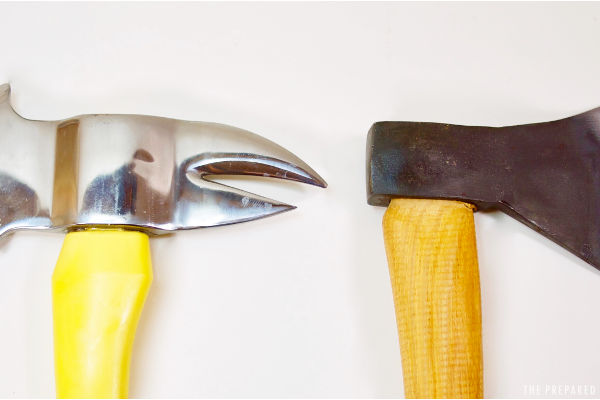
Polls come in two varieties: hammer and spike. There’s also a ‘pick’ axe poll, but in this guide we use ‘spike’ and ‘pick’ interchangeably since they’re basically the same thing.

Hammer polls allow the axe to double as a hammer. They’re also generally safer than spike polls. There is some folklore around not using an axe poll as a hammer, but these concerns are vastly overrated. Lightweight striking is fine — it takes a lot of beating against a hard surface to deform the eye of a good axe, so go ahead and hammer those tent stakes and forget about that myth you read on the internet.

The spike or pick poll increases the axe’s effectiveness as a demolition and breaching tool, which is why you see this feature on tomahawks and dedicated breaching axes. A spike poll can also be used for digging, and is especially good at digging through hard or rocky ground.

Handle length

The mechanics of leverage means the length of the handle matters a lot for how well an axe chops. Even an inch can make a difference.

That creates a tricky tradeoff between portability and chopping ability. We favor a balance between these two factors and it’s reflected in our recommendations.

But if you were looking for a big, old-growth hardwood chopper that’ll never leave your garage, for example, you’d clearly want a longer handle.

Some handles are meant to break and be replaced

Like tires on a car, a wooden axe handle is a wear part that is designed to break down with use and be replaced periodically. Axe handle breakage is a normal thing for well-used axes, which is why hardware stores stock so many wooden replacement handles.

Breakage is also a factor for fiberglass handles that are rated to handle 1,000 pounds or more of lateral force. But it normally takes some abuse to get there.
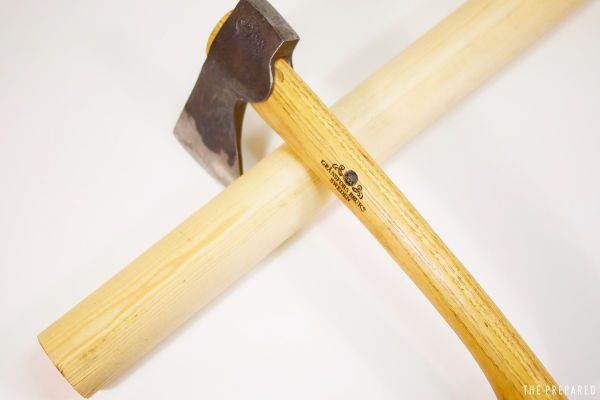
Overstrike is a major cause of breakage for wooden and synthetic handles — especially among amateur users — and will take this valuable tool out of commission until repaired. Overstrike happens when you swing the head too far out and the part of the handle right beneath the head whacks into the log.

Common handle materials

Wood:

  • Pros: light, absorbs shock well, and is infinitely replaceable with a little effort.
  • Cons: easiest to break or splinter.

Synthetics (mostly fiberglass):

  • Pros: lightweight, very strong, good shock absorption.
  • Cons: very difficult to repair or replace.

Metal:

  • Pros: strongest, lets the axe double as a pry bar.
  • Cons: very heavy, transmits shock right to your wrists and arms.

We take those tradeoffs into consideration when thinking about urban vs. rural and skilled vs. amateur preppers. For example, if you live far away from the woods or if you have no idea how to go about fashioning a replacement axe handle, then you might pick a synthetic-handled axe and hope it never breaks.

Don’t plan to fell big trees in a disaster

For every prepper who’s within bug-out distance of a forest, chopping wood for fire and shelter is a necessary and appropriate part of surviving.

But “chopping wood” does not equal “chopping down trees with an axe.” The former is essential, while the latter is a very bad idea for anything but the smallest trees — unless you’re already experienced enough that this guide is pointless.

Felling trees is far more dangerous than it looks, especially with an axe (regardless of axe size). No matter how easy it looks on YouTube, you should not attempt to fell trees that are larger than about half a foot in diameter.

It’s also the case that even with chainsaws and trucks to haul wood in, it can take weeks to prepare enough firewood to heat a cabin for a full winter in any geography where it gets really cold. With axes it can take part of a summer, and that’s if you already know what you’re doing.

If the situation absolutely requires you to fell a tree, and there’s just no getting around it, then you should use a saw — preferably a chainsaw. This is still quite dangerous, but it’s less insane than an untrained axe user wailing away on a large tree.

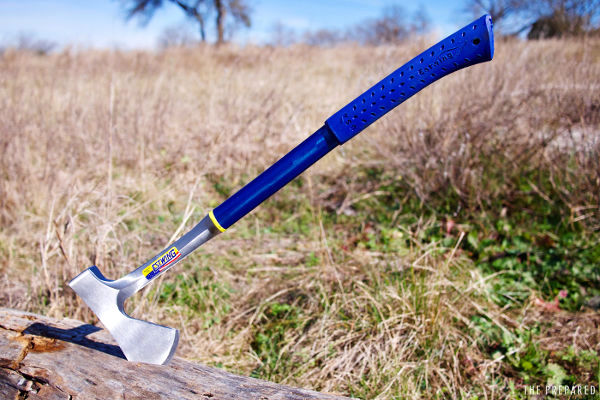
Best axe for most people: Estwing Camper’s Axe
  • Price: $$
  • Specs: 26” length, 3.4 lbs weight, all-steel construction, shock-absorbing handle, general-purpose head shape
  • Pros: indestructible, great brand reputation, widely available, inexpensive
  • Cons: heavy, low splitting ability for the weight

Who should buy this: The $80 Estwing Camper’s Axe is ideal for anyone who lives in a city or suburb, where space is at a premium and they may have to chop materials besides wood.

It’s also good for someone with little or no experience using an axe, who will be prone to overstrike and other axe abuse that could quickly break a wooden or synthetic handle.

At 3.4 pounds, this axe is heavier than the more expensive alternatives, making it less preferable long on-foot bug outs. But it works well for bugging in, vehicle bug outs, or shorter on-foot trips.

If you want to optimize and specialize for a specific environment, activity, or skill level, then you can do better than the Estwing — but for affordable value and all-around flexibility, it’s impossible to beat and will last you a lifetime.

Benefits: The Estwing’s all-steel design makes it strong enough to withstand serious abuse like hard hammering or overstriking, so it’s forgiving for unskilled or fatigued/injured users.

This axe is compact enough to be easily stored in a closet or under a bed, or fit into a pack for short distances. It’s tough enough to be used to hack through a door or wall. The hammer poll can be used for striking in a pinch.

The Estwing’s head shape and edge profile are along the lines of a Hudson Bay pattern, but it’s very thin. The thinness gives it plenty of bite in our own testing and makes it a very capable cutter despite its poor weight distribution. But it will stick in wood and is not wide enough for serious log splitting.
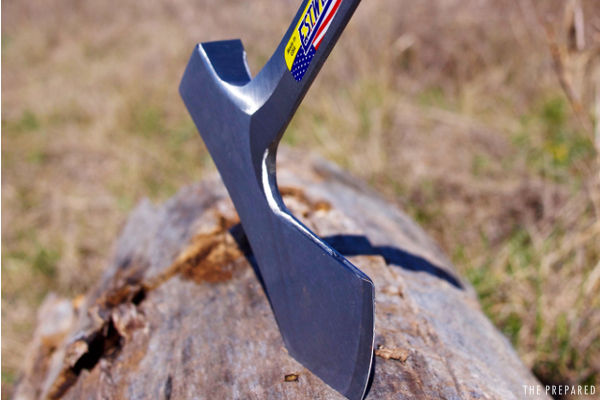
The large beard means you can choke up on it for carving and slicing and get your hand behind the edge — but the thin, diamond shape around the edge makes this uncomfortable. So this is not a general-purpose bushcraft axe, and is not popular with bushcrafters.

The handle steel is relatively soft to help with toughness and shock absorption, but it means you can bend the axe if you attempt to pry with it. But it can be beat back into shape if that happens.

Downsides: The Estwing’s all-steel construction has three main drawbacks: lack of shock absorption, poor edge retention, and poor length-to-weight ratio. The first downside affects comfort and fatigue, and the latter two affect performance.

The steel handle transmits the shock of axe blows directly to the user’s wrists and arms. This increases fatigue when using the axe for long period. The shock-absorbing handle and softer steel help with this, somewhat, but it’s still an issue.

The ductile steel that makes the handle of this axe so tough also makes the thin, V-grind edge more quick to roll and dull than the harder, convex edges of the other axes in this guide.

The Camp Axe’s overall length is much shorter than competing wood-handled axes in the ~3.5lb range, which also reduces chopping ability by reducing leverage.

In short, this axe gives up some efficiency and portability (despite its compact size) in exchange for its incredible, amateur-friendly indestructibility.

Brand and product reputation: Our research and first-hand experience with Estwing axes indicates that this American-made brand has a sterling reputation with campers, construction workers, preppers, and outdoorsmen. We have found no significant complaints about the quality of Estwing products and consider this to be a very reliable family of tools.

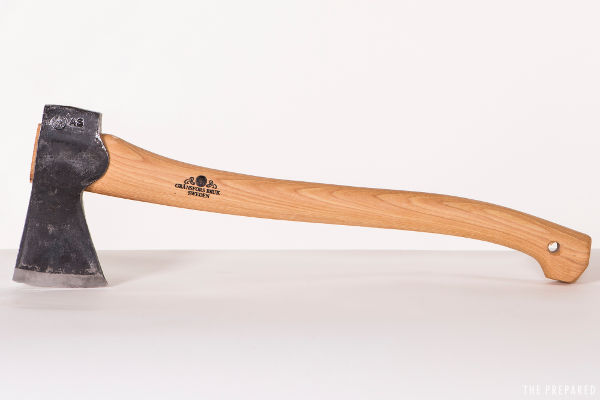
Overall upgrade pick: Gransfors Bruks Small Forest Axe
  • Price: $$$$
  • Specs: 19” length, 2b weight, hickory handle, hand-forged carbon steel head
  • Pros: unmatched reputation, iconic bushcraft and camping tool, excellent for cutting, carving, and general bushcraft chores
  • Cons: less suited for splitting, you pay a bit extra for the brand name

Who should buy this: The $235 “GB SFA” is the best compact survival axe for pack-weight-conscious preppers in the hardwood, arboreal forests of North America. This is also for preppers who want to buy the reigning champ and enjoy the resulting peace of mind from knowing you’ve got a premium tool with legendary status and celebrity endorsements.

Benefits: At 19 inches long and only 2 pounds in weight, the SFA is really more of a large hatchet than an axe, with a head that’s optimized more for cutting than splitting (thought it does split), and that can be very effectively choked up on for use in place of a knife for carving, slicing, food and game preparation, and other fine cutting chores.

The SFA is so effective at general-purpose cutting tasks that some bushcrafters who use one prefer it to the fixed-blade field knife for everything but batoning.

Downsides: The Gransfors price premium is the only downside peculiar to this axe, and it’s not nearly as high on this particular model as it is on some other axes in the Gransfors line. Any other downsides of the SFA are shared by their similarly-compact competitors — namely, the compact size reduces chopping ability and user safety compared to a full-sized axe.

Brand and product reputation: This amazing tool is the gold standard in this space, even to the point of being an important part of the cultural history of axes. Note the outsized popularity of this brand and model — thanks in part to an endorsement by famous bushcrafter Ray Mears — has created an online backlash by people who automatically dislike something so popular. Ignore them.

City and suburbs upgrade pick: Fire Axe Inc JP Special
Urban survival axe review

  • Price: $$$$
  • Specs: 28” length, 4lbs weight, 1200lb-rated fiberglass handle, forged and chromed carbon steel head
  • Pros: indestructible, great brand reputation, premium professional demolition tool
  • Cons: heavy, better for demolition than wood chopping

The $240 Fire Axe Inc JP Special 4lb Pick Head Axe is perfect for escape, rescue, demolition, and B&E in urban environments. Even though you might end up chopping down trees in Central Park, our top choices for people in developed areas are based on a handling a wide mix of materials and activities.

And when we have to choose between axes great for chopping wood vs. anything else, in this category we optimize for more urban needs like navigating damaged buildings, breaking into locked rooms and containers, making access holes for ventilation or surveillance, or busting up furniture for firewood.

Note: The above link takes you to the Fire Axe Inc JP Special with a wood handle (item# JPSW). The same axe is available with a fiberglass handle (item# JPSF) for the same price, but you need to contact the company and ask for that specific model.

Benefits: The heavy, chrome polished, carbon steel head will chop right through nails, wiring, and other tough industrial materials without taking damage.

But it’s still capable of chopping wood. Although if you’re using it on trees, the blade’s width and shape make it much better for splitting than cutting.

The pick on the back of the head is used for creating holes in sheetrock or wood, and lets the axe operate as a pry bar to force open doors and windows.

The 1200-pound rated fiberglass handle is light yet strong enough to pry with. The low weight of the handle, when combined with the heavy head, makes the axe a devastating splitter despite its short length.

Downsides: The main downside to this axe is the weight. At four pounds, it’s intended to ride for short distances on the belt.

The pick head also prevents it from easily being used as a hammer, although you can hammer with the side of the head if you have to.

The blade profile and ergonomics make it unsuited for common bushcraft tasks that involve fine work, so it has to be paired with a field knife for those jobs.

Brand and product reputation: This axe is commonly recommended on firefighter and first responder forums as an aspirational product, i.e. a speciality, premium tool that you spring for when you’re serious about your work, and that you carry with pride and plan to hand down to your children.

Because this is a niche product carried at speciality outlets, there aren’t many traditional product reviews of it, but all the discussions of it we’ve read are highly positive with no reports of flaws or quality control problems.

Best overall rural axe: Hults Bruk Kisa Medium Felling Axe
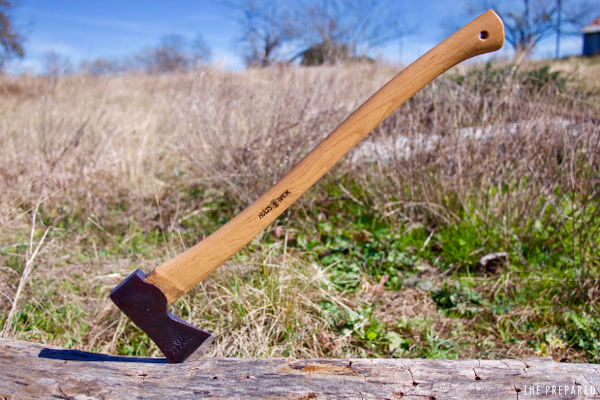
  • Price: $$$$
  • Specs: 26” length, 2,86 lbs weight, 2lb head weight, linseed oil-treated hickory handle, hand-forged carbon steel head
  • Pros: legendary brand reputation, premium bushcraft and camping tool, more of a cutter than a splitter
  • Cons: none that are particular to this axe

Who should buy this: The $180 Hults Bruk Kisa Medium Sized Felling Axe is a great choice if you live in a rural area, especially in northern areas with hardwood forests, but still care about portability.

Note that none of our rural axe recommendations are on the full-sized end of the spectrum — the very largest axes used by lumberjacks solely to fell large standing trees — because in any case you want it to be portable enough to move on foot if you really need to.

Benefits: The 26-inch Kisa axe is a bit shorter and more lightweight than would be ideal for a straight tree-felling axe. In return for not going overboard into full-sized tree felling axe territory, you get a compact axe that can do everything you’ll need an axe to do in the woods.

At 2.86 pounds, we’d consider it packable for modest distances, and many bushcrafters actually carry this axe (or one this size) as part of their standard loadout. For some experienced bushcrafters, the Kisa is the “one blade” they’d want with them in the woods.

The head is a traditional pattern that works for both cutting and splitting, but is a little more optimized for cutting. It’s easy to choke up on the head for use in non-chopping bushcraft tasks like fuzz stick making and carving. The poll can be used as a hammer in an emergency.
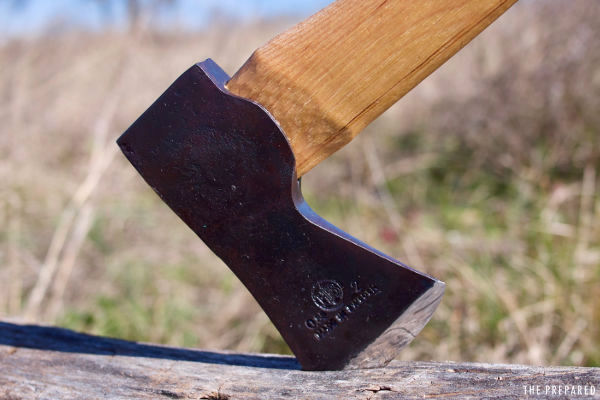
With the Kisa, you get a hand-forged, Swedish axe from one of the world’s oldest and most reputable axe makers, and it offers the same quality and features as the comparable $245 Gransfors Bruks Scandinavian Forest Axe at a lower price point.

Downsides: Any downsides this axe has are shared by all axes in this category, e.g. the wooden handle will break eventually, and the size and weight make it less portable than more compact axes or hatchets. But we’re aware of no downsides particular to this axe.

As with all quality wood-handled tools, you’ll want to store this axe indoors when possible — it’s not something to throw in your truck bed.

Brand and product reputation: This axe model is very popular with bushcrafters, and gets rave reviews in forums, on YouTube, and at retailer sites. Hults Bruk’s reputation is legendary, and we’re not aware of any criticisms of their quality control.

Also great for rural preppers: Helko Journeyman
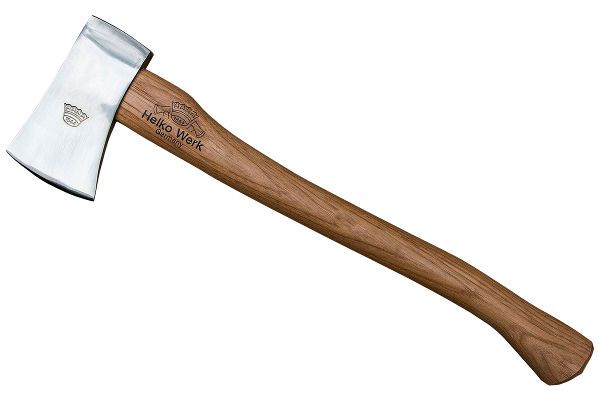
  • Price: $$$
  • Specs: 20” length, 2.2 lb weight, 1.5 lb head weight, Swiss-made hickory handle, hand-forged carbon steel head
  • Pros: great brand reputation, premium wood processing tool, equally balanced between splitting and cutting abilities
  • Cons: less suited for non-chopping bushcraft work

Who should buy this: Pick up the $150 Helko Journeyman instead of the Hults Bruk Kisa if you want something that’s more portable but still good at processing hardwood.

Benefits: The Journeyman’s head shape strikes a balance between cutting and splitting ability, making it a versatile camp axe for creating fire and shelter. The head has a mirror polish to reduce getting stuck in wood and that resists rust from natural moisture. The poll is safe to use for light hammering, since the maker has explicitly designed it for such use.

Downsides: This axe’s head shape makes it a bit less ideal for carving and other knife-type work. So you’ll want to pair it with a good field knife for non-wood-processing chores.

Helko axes often don’t have quite the same hand-finished feel as the Hults Bruk axes — which might be part of the reason the competitive HB Kisa is $10-20 more — so keep that in mind if you care about aesthetics and your tastes lean more towards the traditional, rustic vibe.

Brand and product reputation: Helko is relatively obscure in the US (outside of axe-nerd circles) compared to the major US and Swedish makers, so English-language reviews of this specific model are rare. But we’ve found no complaints about the brand, and this product’s reputation is top-notch in all the sources we reviewed.

Budget pick for rural preppers: Council Tool 2.25# Boy’s Axe
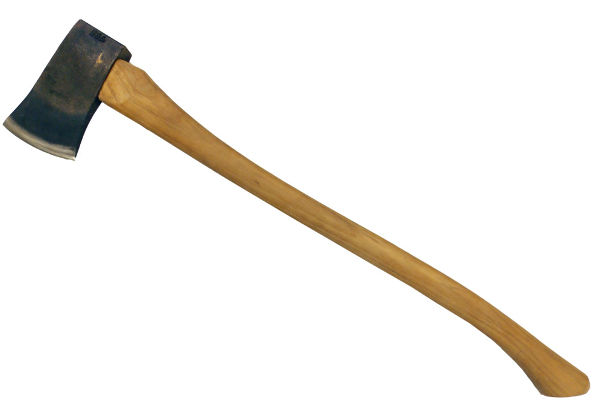
  • Price: $$
  • Specs: 24” length, 3.5lb weight, 2.5lb head weight, hickory handle, hand-ground carbon steel head
  • Pros: legendary brand reputation, quality wood processing tool, balanced between splitting and cutting abilities
  • Cons: none that are particular to this axe

Who should buy this: If you want an axe specialized for rural needs but want to spend less than $100, check out the $50 Council Tool 2.25# 24” Boy’s Axe.

Benefits: The CT Boy axe is a budget offering from a premium maker, which we prefer over products made by purely budget manufacturers like Snow & Nealley. This is a well-tested design that’s based on an axe used for years by the US Forest Service, and it’s similar in size and shape to an axe preferred by bushcraft legend Mors Kochanski.

Downsides: The finishing on this is rougher than on the company’s premium lines, and the poll and eye walls aren’t hardened to support hammering. But it’s unlikely that most preppers will really notice much difference if they aren’t comparing this axe side-by-side with a premium offering.

This is a splitting and cutting axe, and not as much a general-use bushcraft/carving axe that can substitute for a field knife.

Brand and product reputation: Council Tool’s offerings are widely considered to be on-par with the best European makers, and in some cases a cut above. We have read about cases where buyers of axes in the company’s budget lines have gotten products with handle issues, but the customer service is outstanding and returns are handled professionally.

The competition

Outside of our top contenders, there’s a whole secondary group of great axes that might fit the specific price or features you’re looking for:

Snow & Neally Hudson Bay ($68): A popular American-made pick for budget compact bushcraft axes. The length and weight is typical of the classic Hudson Bay pattern. In fact, if you want to get as close as possible to the specs of the Gransfors Bruks Ray Mears Wilderness Axe, then this S&N axe is a very close match at a far cheaper price.

Wood Tools Bushcraft Axe ($63): This is a new one to us, but we got a sample and we absolutely love it. This wonderful little hand-ground axe is designed on the model of the perpetually out-of-stock Ray Mears Gransfors Bruks axe, but a bit lighter and shorter. This axe is clearly a labor of love from a boutique shop that, in our opinion, is criminally underpricing its work. We’ve used this axe in a number of pictures in this guide, including the main guide image at the top of the article, so if you like what you see then hurry up and order one before the maker figures out what’s up and doubles the price.

Helko Rheinland Pack Axe ($150): This is a beautiful, bushcraft-focused axe from Helko. It’s along the same lines as the Wood Craft Pack Axe from Council Tool, in that it’s a relatively recent, premium, retro-styled offering aimed at the bushcraft crowd. It’s designed to be lightweight and packable, and to work for carving and other bushcraft chores. Unlike all the other axes in this guide except for the Mueller axe, the axe head shape is a very traditional German all-purpose woodworking pattern. At least one expert review we’ve seen claims that fit and finish on this axe is not quite as good as competing Swedish offerings, but in terms of performance no one disputes that it can hold its own.

Helko Scout ($165): The Scout is a great cutting and splitting axe for preppers who care less about portability and more about getting through lots of wood more efficiently. Between the head weight, handle length, and head shape, this is a better high-volume wood processor than the more cutting-focused axes like the Hults Bruk Kisa, but is not as suited for use as a knife alternative for fine bushcraft work.

Hultafors Classic Hunting Axe ($130): The Hultafors-branded axes aren’t available in the US, so our European readers should give this compact bushcraft axe a very close look.

Hults Bruk Aneby ($160): This is as close as you can get to the Hultafors Classic Hunting axe in the US, and like the Classic Hunting Axe it’s a fine alternative to the Gransfors Bruks Small Forest Axe (SFA).

Ray Mears Gransfors Bruks Wilderness Axe ($175): This famous axe model was designed by Ray Mears, as a midpoint between Gransfors Bruks’ Scandinavian Forest Axe and their Small Forest Axe. It’s never in stock, but if you do score one it’s a wonderful tool. You’ll pay extra for the names on it, though.

Helko Black Forest Woodworker ($160): This is Helko’s flagship product, a beautiful, traditional design that fills the same general-purpose wilderness axe niche as the Gransfors Scandinavian Forest Axe. It has a head that’s slightly heavier than other axes in this size range, and based on overall design it’s a very good general-purpose bushcraft and survival axe.

Council Tool Wood Craft Pack Axe ($155): This axe was recently introduced, and has a ton of features aimed at the bushcraft and survival crowd. The hardened eyewall and poll are designed for hammering, and head shape is made for a mix of cutting, carving, slicing, and general camp use. It’s often out of stock, and some reviewers claim the overall fit and finish level on this model is higher than that of even the premium European axe makers.

Council Tool Velvicut Hudson Bay ($145): The Velvicut line is one of Council Tool’s two premium axe lines, which makes this the axemaker’s best Hudson Bay pattern offering. If you want a traditional Hudson Bay type axe, then this is the top of the line.

Gransfors Bruks Scandinavian Forest Axe ($245): The larger alternative to the Gransfors SFA, this iconic axe has played a major role in the revival of the premium axe scene in the US and Europe. These axes are very hard to come by online right now, and if you can find one in stock it may have a significant markup.

Snow & Nealley Single Bit 2.25# ($80): A budget wood chopper from a solid US axemaker, consider this an alternative to the Council Tool Boy’s Axe of the same size.

Mueller Biber Classic Forest Axe ($150): This axe is similar in shape to the Helko Rheinland Pack Axe, but it’s much larger. It’s a traditional German axe from an established, boutique Austrian maker, and the quality is impeccable, especially for the price.

More info about axe brands

Hultafors is one of the two top-tier Swedish axe makers that still runs its own factory (the other is Gransfors Bruks), and the products are popular with bushcrafters for their high quality and outstanding value. Hultafors axes are fully hand forged, and generally come in two finishes: a cheaper, standard finish and a more expensive, premium finish.

Hultafors also owns Hults Bruk, and axes from both brands come from the same foundry. There are some differences in labeling and branding, depending on the year, but you should consider the two brands as equivalent and just look at the specifics of the model.

Gransfors Bruks is a high-end maker of fully hand-forged Swedish axes. Thanks to a combination of craftsmanship and celebrity bushcrafter Ray Mears’ endorsements, GB has become the bushcraft community gold standard. You pay a premium for the Gransfors Bruks name, though it’s not always clear that the quality difference is worth the price difference over the other top makers — you have to evaluate on a case-by-case basis. But if you can afford to ignore the price difference, and you just want the fan favorite, then this is your axe maker.

Wetterlings is a venerable Swedish axe maker now wholly owned by Gransfors Bruks, and the latter has stopped making axes under the Wetterlings mark as of 2017. If you find a Wetterlings axe for sale it’s usually of very high quality, so buy with confidence.

Snow and Nealley is an Amish axe maker that has been based in Maine since the late 1800’s, and they’re still turning out high-quality, traditional wood-handled axes at unbeatable prices. Many of our budget picks are from this maker. The axe heads were briefly made overseas, hence a smattering of negative reviews that claim they’re made in China or Mexico, but they’re back to being made in the US out of US-sourced steel and hickory.

Estwing is an American tool maker familiar to many from big box retailers, and they make very good axes at budget prices. The Estwings’ all-metal construction — even the handle is metal — is a strength and a weakness. These axes are much heavier than their wood- and synthetic-handled counterparts, but are bombproof.

Council Tool is based in North Carolina, and the company’s premium Velvicut and Wood-Craft lines are on par in price and quality to the top European makers. Their budget axes have differences in tempering and finish from their premium line, but are still quite good. They made axes for the National Forestry service for a while, and have a sterling reputation among axe enthusiasts.

All the Council Tool axes are drop forged, which means that the blacksmith holds the heated metal with tongs while a machine hammers it. So they’re sometimes billed as “hand forged,” and this is accurate for some definition of the term, but they’re not hammer-forged like a Hults, Gransfors, or Mueller, so they don’t have quite the same aesthetics.

Helko is a German maker of fine, traditional axes for forestry and woodcraft. Their offerings generally compare in price, quality, and features to the top Swedish and American makers. Helko’s axe heads are drop-forged, like those of Council Tool.

Husqvarna is a chainsaw maker that is now in the budget axe business. The company sources its axe heads from the Hults Bruk factory, and for this reason many people on the internet who don’t know how quality control, steel selection, finishing, and tempering work have concluded that the heads must be therefore be identical to Hults Bruk/Hultafors heads. This is trivially false, as even different lines from the same maker will have different steel, tempering, and quality variances.

We haven’t included any of Husqvarna axes in our guide because the reviews are so mixed — people either love their axe or they hate it because they’ve broken the head in half. But we did want to mention this brand in order to debunk the myth that you can get a Hults Bruk head on the cheap by buying one of these budget axes and doing some of your own finishing work on it.

Mueller is a small, family-owned Austrian company that has been making axes continuously for over 300 years, and their reputation is excellent. They aren’t as widely known in some of the other high-end makers, but their price and quality are considered on par with the best. Their axe heads are fully hand forged.

Axe safety

There’s an old saying: “You can’t spell accident without axe.” Yeah, the spelling doesn’t work, but you get it. Axes are dangerous. Watch some videos and heed these tips:

  • Always use two hands.
  • Set up a dedicated safe area free of rocks, hazards, and (most importantly) other people. Nobody comes near you while you’re swinging an axe.
  • Always position yourself so you’re out of the path of your swing if you miss your target and it keeps going. Sometimes this will feel awkward and inefficient, but do it anyway.
  • Aways swing so that if the axe glances off the wood it won’t hit your body with the edge. Again, this may make your swing suboptimal, but it’s even less optimal to end up with an axe in you.
  • Always make sure your axe is sharp. Learn the best ways for preppers to sharpen blades.
  • Always carry your axe with the blade pointing toward the ground.
  • Never use your axe when the head is cold, because it will be more brittle and likely to chip. If it’s winter, then warm the head up by a fire or by placing it next to your body before using it.

Notice that two of these safety rules are about how you position your body in relation to your swing. This is hard to get right, and it’s where most people have accidents.

In general, a shorter handle takes more care to be safe with than a longer handle, because the head swings that much closer to your body and vital organs.

It also matters how long your arms are and how tall your body is in relation to the axe’s length, so a shorter axe can be safer for a smaller person. Think about this length vs. safety factor when you’re selecting and using an axe, because all that sweet portability you bought by going with a 19-inch pack axe does you no good if the edge ends up buried in your leg.


How To Get Water From A Well Without Electricity

0

If you’re going off-grid, you’ll need a water source, usually in the form of a well or borehole.

That’s all well (excuse the pun) and good when you’ve got the power to pump water from it, but if the grid goes down, you’re effectively upstream without a paddle.

Don’t despair – there are several ways to get water from your well without electricity – it just takes a little preparation and forethought.

7 Ways To Access Your Well Water Without Electricity

#1 Generator

Solar pump

Although only 5% of American homes have backup generators, they are one of the best ways to ensure consistent power regardless of grid problems or extreme weather conditions.

While a dual fuel generator may provide the most cost-effective solution, few can produce the voltage needed for a deep well pump to operate.

For deep well pumps, a diesel generator will provide a more effective solution as they are both portable and powerful enough to produce the pump’s required 220v.

#2 Solar Pump

wind turbine

There are numerous different types of solar well pumps available, the best of which can pump water from depths of 600’ or more.

A surface solar pump is a viable option for shallow wells and to move water from your storage tank to your home. For deeper wells, you’ll need a submersible solar pump.

The best solar well pumps can run off batteries as well as sunlight, making them a suitable option for accessing water during extreme weather conditions, as well as during a power outage.

On our small-holding, a submersible solar well pump pushes water to a storage tank at the top of the hill; we then rely on gravity to transport that water down to the house.

The benefit of this two-pronged approach is that we’re not solely reliant on the solar pump, and therefore sunlight, but can get a consistent water supply straight to the house regardless of the weather or the national electricity supply.

#3 Wind-Powered Pump

Green Hand Cistern Pump

A wind turbine isn’t something you can always rely on to provide water when you need it as you can be sure the wind will drop the instant you decide you need it, but you can use it to pump water to a holding tank which can then be transported to your home by gravity.

Many home wind turbines can be hooked up to solar panels, providing two alternative power sources for those inevitable emergencies. Read more about hybrid wind and solar systems.

Although you’ll need to invest a few hundred dollars in a good-quality wind turbine, once in place, it costs very little to run or maintain.

If you lack the funds to buy a wind turbine but have an abundance of DIY know-how, you could make your own out of PVC piping, and an old car fan as demonstrated in the video below.

#4 Hand Pump

How To Get Water From A Well Without Electricity

One of the simplest ways to get water from a well when the power’s down is via a hand pump. The best hand pumps can be alongside your electrical submersible pump, making it easy to swap from one.

Hand pumps are particularly effective for shallow wells and can draw water from a depth of 25’ or less without undue muscle fatigue on your behalf.

Accessing water that’s over 30’ down requires significantly more muscle power, which is why some deep well hand pumps can be linked to a windmill or operated via a foot valve.

A shallow well hand pump is simple to install and relatively affordable. It’s well worth paying that little bit extra for a high-quality pump, however, as you’ll be relying on it in your hour of need.

While you can pick up a pitcher pump for as little as $50, it’s more advisable to invest a few hundred dollars in getting a more reliable, better quality model, like the Pressurized Sealed-Top Water Pump from Lehman’s.

Deep well hand pumps cost considerably more, especially the Bison Stainless Steel Deep Well Hand Pump that can draw water up from depths of 300’. You may well need to be a potential contestant for the World’s Strongest Man competition to achieve this, but it is possible!

The best deep well hand pumps come with a lifetime warranty, require little maintenance and no priming, meaning that you can install them and forget about them until an emergency arises.

The main benefit of a hand well pump is that it requires nothing more than muscle power to operate it, which means you’ll have access to water in all weather conditions. If you opt for a solar pump, you’ll be reliant on sunlight whereas, with a generator, you need fuel.

The hand pump needs nothing at all, making it by far the most sustainable and reliable approach.

#5 Well or Sleeve Bucket

The sleeve bucket is the simplest and cheapest way to get water from your well without electricity. Also known as torpedo or cylinder buckets, the modern-day “well bucket is simply a long, skinny bucket that can be lowered into the narrow confines of a well casing to bring water to the surface.”

A high-quality sleeve bucket from Lehman’s costs less than $100, is made of galvanized steel, and can hold nearly 2 gallons of water. It has a handy device that enables you to discharge water from the bottom, rather than attempting to up-end it and empty it from the top.

If you’ve got access to some rope and PVC piping, you can easily make your own sleeve bucket which, while not as sleek or voluminous as a bought model, will still do the job effectively. Find out how to make your own PVC well bucket below.

The only problem with using a well bucket is that you’ll need to remove your submersible pump to get access. With most pumps, this is a fairly simple operation but it’s inconvenient nonetheless and not something you need to do if you have a hand pump.

#6 High Lifter Or Hydraulic Ram Pump

Depending on the topography of the land, you could use a hydraulic ram pump or a high lifter to access your well water. Both these pumps use downhill water pressure to push the water up to a higher point than the original source.

These gravity-fed water systems are easy to install and maintain but are only effective where there is a continuous supply of water and room to install the pump at least a foot and a half below that source.

While hydraulic ram pumps need a higher flow rate and can be rather noisy, high lifters can cope with as little as one gallon per minute and operate in virtual silence. As they are both self-powered, they don’t require any fuel, solar power, or electricity, so can operate regardless of power outages or severe weather conditions.

#7 Build An Emergency Pump

While I don’t feel my DIY skills would be up to the task of making a sleeve bucket, let alone an emergency well pump, there are plenty of people who’ve done just that and are willing to share their designs and methods.

The simplest type of pump to make is one that, like the pitcher hand pump, uses suction to draw water up. Designs like these are cheap and easy to make but will only work effectively on shallow wells.

For deeper wells, a vacuum pump is more effective and, although these are slightly more complicated and expensive to build, there are some informative online tutorials that give a complete list of materials and step-by-step instructions on how to complete the project.

Conclusion

If you’ve already got alternative energy sources, like wind or solar, on your property, getting water from your well when the grid goes down isn’t too much of a problem.

When severe weather conditions, like heavy rain or gale-force winds, disrupt your electricity supply, however, they’re liable to play havoc with those alternative sources as well, leaving you at the top of the well without any water.

The most reliable and sustainable ways of getting water from your well, therefore, are those that rely on gravity, like the hydraulic ram or high lifter systems, or those that need only muscle power.

While sleeve buckets are reliable and easy to use, in many cases, you must remove your submersible pump before you can start accessing the water, which is why the hand pump is the best method of getting water without electricity.

You can install a hand pump alongside your existing electrical pump so you can switch easily from one to the other without having to uninstall anything at all. A top-quality deep well hand pump can draw water from depths of up to 300’, keeping dehydration at bay whatever the weather.

Read more about the different types of well pump.

DIY Hog Hunting Bait | Tips and Tricks For Taking Feral Hogs

0

Author: Hogman Team

When it comes to hog hunting, one of the most effective tactics you can employ to bring the animals out in the open is by using hog bait. While hog bait can be bought straight off the shelf at your local outdoors store, at HOGMAN-OUTDOORS we’ve had great success in creating our own DIY hog hunting bait. Check out our tips for drawing out feral hogs below.

HOGS ARE ONMIVORESBecause hogs are omnivores, meaning they eat both plants and animals, a wide variety of baits can be used to successfully draw them in to the open. And hogs think with their stomach – the saying isn’t “eat like a pig” for nothing – meaning they’ll readily come out of cover when they smell food. That being said…

NOT ALL BAITS ARE CREATED EQUALAlthough hogs aren’t picky eaters, there are some smells and flavors that will draw their attention more readily than others.

  1. Stick to Something FamiliarSweet corn is a staple in hog baits, because hogs can easily recognize the smell. Corn will “sour” once soaked for several days, creating a smell that will attract hogs but keep other animals, such as deer, away. Additionally, corn is a versatile bait that can be used in all kinds of different mixes (corn + Kool-Aid; corn + Jell-O; corn + beer). Hogs also have a liking to pecans and acorns, which can be used in your bait mix, or around the feeder area.
  2. Play Up the Sweet StuffIt’s no secret that hogs have a sweet tooth, so play up the sweet stuff to really attract their attention. As mentioned above, corn can be mixed with low-budget drink powders, such as Kool-Aid, or with sweet gelatin-flavored packets. Effective hog bait can be created by mixing corn with sugar and several packets of Kool-Aid or Jell-O, and letting the mix soak together for a while. Here’s a great recipe from the Georgia Department of Natural Resources that does just that:
    • 150 pounds of corn
    • 8 pounds of sugar
    • 1 packet of yeast
    • 4 or 5 packets of grape, strawberry, or raspberry flavored gelatin or drink powder. Place the corn in a 40 gallon metal trash can and fill it with water to 3 to 4 inches above the corn. Mix in all the other ingredients. Place the trash can in the sun with the lid secured. Stir it with a shovel or paddle daily for 10 to 14 days.

KNOW THE LAWKnow what’s allowed before you make your hog bait. The use of toxicants and chemicals in the baiting of feral hogs is illegal in all 50 states; additionally, check your local hunting regulations to ensure that baiting is allowed on public lands.

PRE-BAITPre-baiting is a great way to condition hogs to associate your feeder area with a food source. This involves leaving your bait out in the open for several days (or using an automatic feeder with a timer). This will encourage hogs to lower their defenses and become accustomed to the area, making it easier for you to slide in and make the kill.

Get hunting!

ADVANTAGE: HUNTER

The HOGMAN-OUTDOORS Game Alert® Hog Hunting Light is the new generation in hog hunting technology. The low-intensity, motion-activated, red LED light is magnetically attached under a hog feeder, and provides momentary (10-second) illumination only when movement is detected within a 200-yard perimeter. The discreet light allows for hunters to remain virtually undetected by prey, keeping them hidden until the moment strikes.

6 Ideas for Unconventional-Themed Adult Party

0

Themed parties are a great way to bring friends and family together for an unforgettable experience. If you’re looking for some unique ideas that will make your next themed adult party stand out, we’ve got you covered! We’ve gathered 6 unconventional themes perfect for getting everyone in attendance excited about the upcoming festivities. Whether you want something more subtle or outrageous and over-the-top, one of these six ideas is sure to be just what you need!

Mystery Dinner

Step back in time to the roaring 1920s where dinner parties were the events of the year. But this isn’t just any ordinary dinner, it’s a mystery dinner. As you indulge in a delectable three-course meal, you’ll work alongside your fellow guests to solve one of the most intriguing mysteries of the year. Who committed the heinous crime? Was it the sly butler? Or perhaps the sultry singer? With clues hidden throughout the room and red herrings designed to throw you off course, it’s up to you to put your detective skills to the test. So don your finest flapper dresses and fedoras, and join in on the thrilling fun of the mystery dinner.

Movie Night

Are you a die-hard fan of movie characters like Harry Potter, Luke Skywalker, or even the Joker? Well, get ready to bring those characters to life! It’s time for a movie night that’s unlike any other. You won’t just be watching your favorite films, you’ll be able to dress up as your favorite characters and even recreate some of the most memorable movie scenes of all time. This is your chance to unleash your inner actor and show off your creative side. So grab your popcorn, get your outfit ready, and get ready for an unforgettable movie night that will transport you into the magical world of the big screen.

Game Night

Looking for a fun and social activity to enjoy with your friends? Consider hosting a game night! Whether you prefer classic board games or challenging card games like poker, there’s sure to be something for everyone. You could even mix it up with a gel ball gun game for a futuristic twist! With snacks, drinks, and a little friendly competition, game night is the perfect opportunity to unwind and spend quality time with your friends. So clear your schedule, set up a game table, and let the fun begin!

Sing-Along Party

Get ready to belt out your favorite tunes with a sing-along party! All you need are some karaoke versions of your go-to songs and a group of enthusiastic friends. With each person taking turns to showcase their singing skills, it’s sure to be a night of non-stop laughter and fun. Whether you’re hitting those high notes or singing along to the classics, a sing-along party is the perfect way to spend an evening. So dust off your vocal cords and get ready to sing your heart out!

Old-Fashioned Tea Party

Step back in time with an old-fashioned tea party, where you can indulge yourself in an elegant and refined atmosphere. Bring out your fanciest tea set and set the table with elegant linens to create a vintage vibe that will transport you to a bygone era. Add a touch of sophistication with a selection of scrumptious scones, perfect for savoring with a generous dollop of clotted cream and jam. Sip on a cup of your favorite brew, and enjoy a delightful afternoon in the company of loved ones. Celebrate tradition and the finer things in life with an old-fashioned tea party that will captivate your guests and leaves them feeling thoroughly spoiled.

Art Show

There’s nothing quite like appreciating the creativity and talent of your friends. Hosting an art show is the perfect excuse to invite your creative pals over and showcase their latest masterpieces. From stunning paintings to intricate sketches, the possibilities are endless. And what better way to add some competitive flair than by offering a prize for the best artwork? It’s not just about winning though, it’s about sharing the joy of art and creating an environment where everyone feels inspired and supported. So why not gather your friends, break out the easels, and let the art judging begin?

No matter what type of themed adult party you’re looking to host, there are plenty of unconventional ideas that will make your event a hit. From movie nights and mystery dinners to art shows and old-fashioned tea parties, these six unique themes offer something for everyone. Not only will they create an unforgettable experience for the guests, but they’ll also give them an opportunity to show off their creative sides in a fun and supportive environment. So don’t be afraid to think outside the box when it comes time to plan your next themed adult party! With any one of these six ideas, you can rest assured that your gathering will be talked about long after it’s over.

$100k PLUS: The 6 Most Valuable Rare Antique Fishing Lures

0

Antique fishing lures can be worth a good amount of money – some have sold for as much as $100,000.

There are plenty of collectors out there looking to add to their collection, whether they are fairly common antique lures, or the rarest of the rare.

In this post, we will take a look at the most valuable lures out there and talk about their history, and how much they could be worth.

What is the Most Valuable Antique Lure in the World?

The most expensive lure in the world is the giant Copper Haskell Minnow. This lure was patented by Riley Haskell in 1859 and is a prime example of lures used in the very early years of recreational fishing in America.

The Copper Haskell Minnow is a very rare lure, but there is only one known example of the giant copper Haskell minnow size, and this single example, coupled with the fact that all Haskell minnows are very rare, led to the lure selling at auction for $100,000 dollars.

What Other Antique Lures are Highly Valuable?

Money

Musky Charmer Minnow

Musky Charmer Minnow 1 1
Musky Charmer Minnow (photo courtesy Lang’s auctions).

There are several types of lures that are worth a good chunk of change in the charmer lure line, but the Musky Charmer Minnow is the rarest and most sought after of all charmer lures.

The Musky Charmer Minnow comes in at 5 inches in length, being the largest of all charmer minnows, and there are only a few known to be in existence today.

The paint scheme with stripes on the rear section of the lure is particularly rare, with only one known to exist, and recently, this one-of-a-kind vintage fishing lure sold for $25,000 at auction in 2018.

Heddon Black Sucker

Heddon has made tons of popular lure designs over a long period of time, and in fact, Heddon still produces some of its classic lure designs to this day.

The Heddon Black Sucker is a fishing lure that is worth quite a bit of money if you manage to get your hands on a quality example.

The Black Sucker is a 6-inch wooden bait with glass eyes, a non-movable intact tail, and a front prop spinner.

The lures typically feature a natural scale paint job and, as with most valuable lures for years passed, are very rare. One of these lures in great condition sold at auction for $19,000 dollars in 2006.

Heddon Mohawk Minnow

You will see the name Heddon a few times in this list, and that’s because Heddon was one of, if not the, top lure brand in the fishing early recreational fishing industry.

The Mohawk minnow was produced in the early 1900s and features a front and rear propeller arrangement and excellent color patterns.

If this lure comes with the Heddon paperwork and box and is in exquisite condition, you could find yourself selling it at auction for as much as $18,000 dollars, as someone found out when one sold for $18,400 in 2013.

1905 Smith Minnow Wiggletail

The Wiggletail is a very unusual-looking mechanical vintage lure that makes you scratch your head when you first look at it.

The mechanical tail design certainly makes it stand out among other tackle from the period, and it is a very rare find, with only ten examples known to exist today.

In 2015 one of these steampunk-Esque-looking lures sold for a decent chunk of change at auction 2015 for $17,500.

Shakespeare Wooden Minnow

Shakespeare Wooden Minnow

The Shakespeare wooden minnow lure follows the same popular lure design seen used by other lure builders in the early 1900s, with a front and rear propeller blade and a cylindrical body that tapers from head to tail.

The props are different than those found on many other lures from the same period, and are bent backwards at an angle, these propellers are known as A-notch propellers.

If this lure comes with the original box, which in itself is very rare, and if both the lure and the box are in great condition, you could fetch over $18,000 dollars for one of these lures, as some lucky person did in 2012.

What Types of Antique Lure is the Most Valuable?

There are several different types of antique fishing tackle that are worth money, from the copper-built Haskell minnow, the rarest of all old fishing lures, to standard steel lures.

The majority of antique fishing lures that are worth quite a bit are typically made out of wood and are hand-painted, and if the lure and paint condition of the lure is good, chances are you can get a pretty penny for one of these rare lures if you choose to sell one.

What are the Most Expensive Old Lures Made Of?

The Haskell minnow is made of copper, and since these are the rarest of all recreational fishing lures, the chances of finding one are like hitting the jackpot.

Most other old fishing lures are made from wood, and water can take its toll on wooden fishing lures. If you find a wooden fishing lure in great condition, chances are it wasn’t fished much and thus can be worth a good amount.

Which Companies Made the Most Valuable Old Fishing Lures?

Heddon, Shakespeare, and Creek Chub baits, Pardee, and Pflueger lures are the more commonly found fishing lures, and they were very popular in the early days of recreational fishing.

Heddon is probably the most familiar of all these fishing lure brands, and there are actually quite a few of them floating around, but not all of them are worth a substantial amount.

Where Can You Buy and Sell Vintage Fishing Lures

If you want to collect and potentially sell lures to collectors, a good place to start looking would be online, such as on eBay or in Facebook groups.

If you live in an area with a very prominent fishing culture, like the upper Midwest and Great Lakes region, start going to flea markets and rummage sales during the spring and summer, chances are someone has some old fishing lures sitting on a table for a few bucks, and that is where I have gotten many of mine.

Are Vintage Fishing Lures a Good Investment?

This is a hard question to ask, as many of the antique fishing lures you find are going to be somewhat common. For instance, I have a Heddon Dingbat sitting on my computer desk that is in great condition, but it features the most common paint job of the type, meaning it is only worth about 30 dollars.

If you happen to find one of the rare ones on this list, along with others not listed, they can be a good investment. There isn’t much information out there on how an antique fishing lure appreciates over time, so if you don’t want to keep and old fishing lure as a collectible, you’re better off selling it at auction.

7mm PRC: Savage Expands Rifle Lines for New Cartridge

0

Hornady recently announced the newest cartridge in its Precision Rifle Cartridge series of long-range shooting superstars — the 7mm PRC. Directly on the heels of Hornady’s announcement, Savage Arms revealed its own plans to expand several of its most popular rifle models to include hunt-ready options chambered in Hornady’s newest long-action cartridge.

“We’re thrilled to get these 7mm PRC additions into the hands of Savage fans and shooters everywhere,” said Beth Shimanski, director of marketing at Savage Arms, in a release. “With Savage’s heritage for proven accuracy, these rifles are designed for top performance and match grade accuracy, putting challenging shots and the biggest game in your reach.”

Savage will have several of its factory hunting rifles chambered in 7mm PRC available by the end of the year, including the bolt-action 110 Ultralite, 110 High Country, and 110 Apex Hunter XP, as well as the straight-pull Impulse Big Game and Impulse Mountain Hunter rifles.

Savage’s 7mm PRC rifles all feature barrels with a 1:8” twist rate, ideal for stabilizing long, heavy-for-caliber, high BC bullets. Savage claims their models can pitch 180-grain bullets from a 24-inch barrel at a pretty impressive 3,000 fps.

Shooters can also do a barrel swap on any existing long-action rifle with a .540-inch bolt face, like the 7mm Rem Mag or .300 Win Mag, to accommodate the new cartridge.

Why Make the Switch?

Shooting long, high BC .284 caliber projectiles, the cutting-edge 7mm PRC slides perfectly into the gap between 6mm PRC and .300 PRC.

With a slightly shorter case length but the same overall length as the 7mm Rem Mag, the PRC has plenty of headroom for taller, sleeker, more aerodynamic bullets. The design makes the cartridge compatible with the absolute best-performing long-range bullets in production without having to modify your magazine.

The 7mm PRC performs best out of fast-twisting barrels. One turn every eight inches stabilizes the longer, heavier bullets to cut through practically any atmospheric condition. With just over 17 inches of drop at 400 yards, these cartridges leave plenty of wiggle room when shooting unknown distances. Plus, the 7mm bullets will still be packing plenty of power for dropping muleys, elk, sheep, and moose well beyond that range.

Yes, this is a magnum cartridge. However, as far as magnums go, the recoil on this one is surprisingly manageable. It is relatively comparable to the 7mm Rem Mag and definitely milder than the .300 Win Mag.

GOOD GEAR – Want To Know What Liberty Tastes Like, Try the BRCC Freedom Roast

What Hornady Has to Offer

Hornady is currently offering the 7mm PRC in three different factory loads.

Target shooters will appreciate Hornady’s Match load, featuring 180-grain ELD-M bullets with a freakishly high BC of .796 (G1). The ELD-M projectile is currently one of the flattest-shooting bullets on the face of the planet.

Hornady also offers its Outfitter line with 160-grain CX expanding copper-alloy bullets for big-game hunters and their Precision Hunter loads. Topped with 175-grain ELD-X, Precision Hunter features a heat shield tip that resists the high temperature generated by the cartridge’s blistering speeds.

Hornady also loads its 7mm PRC cartridges with temperature-stable, magnum-speed propellants for consistent velocity and longer barrel life.

RELATED – Daniel Defense Suppressors Finally Introduced With 3 Rifle Models

7mm PRC Specs

Bullet Diameter: 7mm (.284 inches)Parent Case: .300 PRCCase Length: 2.280 inchesCase Head: 0.532 inchesShoulder Angle: 30 degreesMuzzle Velocity: 2,900 to 3,000 fpsSAAMI Max Pressure: 65,000 psi

GOOD GEAR – Sneak Up on Waterfowl With the BRCC Reticle Duck Camo Pullover Hoodie

Savage Rifles Available in 7mm PRC:

  • 110 Ultralite: $1,649
  • 110 Ultralite HD: $1,649
  • 110 Ultralite Camo: $1,699
  • 110 High Country: $1,239
  • 110 Timberline LH: $1,239
  • Impulse Big Game: $1,449
  • Impulse Mountain Hunter: $2,437
  • 110 Apex Hunter XP: $736
  • 110 Apex Storm XP: $819
  • 110 Apex Hunter XP LH: $709

READ NEXT – No, the AR-15 Was Not Designed to ‘Blow Targets Apart’ or Cut off Heads

How Deer Survive Winter ?

0

“Winter Wonder: Unveiling the Enigmatic World of Deer in Chilly Seasons. Explore the hidden realm of deer as we delve into their intriguing behaviors and survival strategies during the frosty winter months. Discover how these graceful creatures adapt, forage, and navigate through snowy landscapes to endure harsh conditions and thrive amidst nature’s icy embrace.”

1. How Deer Adapt to Winter: Strategies for Staying Warm and Finding Shelter

Growing a Thicker Coat of Fur

During the winter months, deer adapt to the cold weather by growing a thicker coat of fur. This thicker fur serves as insulation, helping them retain body heat and stay warm. The outer layer of their fur consists of long, hollow hairs that trap heat, while the undercoat is made up of shorter, denser hairs that provide additional insulation.

Utilizing a Layer of Fat

In addition to their fur, deer also have a thick layer of fat under their skin. This layer acts as an extra source of insulation, helping to keep their body temperature from dropping too low. The fat layer provides an additional barrier against the cold weather and helps the deer stay warm during winter.

Finding Shelter in Thickets and Under Evergreen Trees

To seek shelter from the cold and wind, deer often bed down in thickets or under evergreen trees. These areas provide some protection from harsh weather conditions and help them conserve body heat. Additionally, if there is snow on the ground, deer will search for areas where the snow is not as deep to find better cover.

Using Antlers to Brush Away Snow

When food sources are covered with snow, deer utilize their antlers to brush away the snow and access their food. By clearing away the snow from vegetation or other food sources, they ensure they have enough sustenance during the winter months when food may be scarce.

Overall, deer employ various strategies such as growing a thicker coat of fur, utilizing a layer of fat for insulation, finding shelter in thickets or under evergreen trees, and using their antlers to clear away snow. These adaptations allow them to survive and stay warm during the challenging winter season.

2. Surviving Winter: Insights into the Winter Habits of Deer

2. Surviving Winter: Insights into the Winter Habits of Deer

Paragraph 1:

During winter, deer face numerous challenges in order to survive the harsh conditions. One of their key adaptations is growing a thicker coat of fur. This thick fur acts as insulation, keeping their body heat from escaping and protecting them from the cold weather. The outer layer of their fur consists of long, hollow hairs that trap heat, while the undercoat is made up of shorter, denser hairs that provide additional insulation. By growing this thicker coat, deer are able to stay warm and maintain their body temperature even in freezing temperatures.

Paragraph 2:

In addition to their fur, deer also have a layer of fat under their skin that helps them stay warm during winter. This layer of fat acts as an extra source of insulation and prevents the deer’s body temperature from dropping too low. The fat reserves provide energy for the deer during times when food may be scarce or difficult to find due to snow cover or frozen ground. By utilizing both their fur and fat reserves, deer are able to adapt to the winter conditions and survive until spring when food sources become more readily available.

List: Ways Deer Find Shelter in Winter

– Deer will seek shelter in thickets or under evergreen trees where they can find some protection from the cold winds.
– They will look for areas with less snow on the ground and avoid deep snowdrifts.
– Deer may also use natural features like rocky outcrops or dense vegetation as shelter from the elements.
– In extreme conditions, they may dig shallow depressions in the snow called “yards” where they can huddle together for warmth.
– Additionally, deer will use their antlers to brush away snow from their food sources so they can access nourishment during winter months.

3. Winter Survival Tactics: How Deer Stay Warm and Find Food in Cold Weather

Staying Warm in the Winter

During the winter, deer employ various tactics to stay warm and maintain their body temperature. As mentioned earlier, one of the key adaptations is their thick coat of fur. The outer layer of long, hollow hairs acts as insulation, trapping heat close to their bodies. Additionally, the undercoat consisting of shorter, denser hairs provides extra insulation. This combination of fur layers helps to prevent the loss of body heat and keep the deer warm even in freezing temperatures.

In addition to their fur, deer also have a layer of fat under their skin that aids in thermal regulation. This layer acts as an additional insulating barrier against the cold weather. By having this reserve of fat, deer can conserve energy and maintain a stable body temperature throughout the winter months.

Finding Food in Cold Weather

Finding food becomes more challenging for deer during the winter when vegetation is scarce and covered by snow. However, they have developed strategies to locate sources of sustenance even in these harsh conditions.

Deer are known to browse on woody plants such as shrubs and tree bark during winter when other food sources are limited. They use their antlers to brush away snow from these plants, exposing edible parts beneath. This behavior allows them to access vital nutrients and sustain themselves during periods of low food availability.

Additionally, deer have a remarkable ability to detect hidden vegetation beneath the snow using their highly sensitive sense of smell. They will actively search for patches where snow cover is thin or absent, allowing them access to grasses or other plants that may still be available for grazing.

By adapting their feeding habits and utilizing their sensory abilities effectively, deer are able to find enough food to survive through the winter months despite the challenges posed by cold weather conditions.

4. Unveiling the Secrets of Deer’s Winter Behavior and Adaptations

During the winter, deer exhibit fascinating behavior and adaptations to survive in harsh conditions. One of their remarkable adaptations is their ability to stay warm. As warm-blooded animals, deer need to maintain their body temperature in order to survive. To combat the cold weather, deer rely on their fur as insulation. Their outer layer of fur consists of long, hollow hairs that trap heat, while the undercoat is made up of shorter, denser hairs that provide additional insulation. Additionally, deer have a thick layer of fat under their skin which acts as an extra layer of insulation and helps prevent their body temperature from dropping too low.

To find shelter from the cold and wind during winter, deer employ various strategies. They often seek out thickets or take refuge under evergreen trees where they can find some protection from the elements. When there is snow on the ground, they will look for areas with less snow depth for bedding down. Deer also utilize their antlers to brush away snow from their food sources, ensuring access to necessary nourishment during this challenging season.

Overall, understanding these winter behaviors and adaptations of deer can help us appreciate their incredible ability to adapt and survive in harsh environments. By respecting their natural habitats and taking precautions while driving in areas where deer are known to cross roads, we can contribute to the conservation efforts aimed at protecting these majestic creatures.

5. From Fur to Shelter: Understanding How Deer Cope with Winter Conditions

5. From Fur to Shelter: Understanding How Deer Cope with Winter Conditions

The Importance of Insulation

Deer, being warm-blooded animals, need to maintain their body temperature in order to survive. In the winter, when the temperatures drop significantly, deer rely on their fur as a crucial adaptation for staying warm. Their fur consists of two layers – the outer layer made up of long, hollow hairs that trap heat, and the undercoat composed of shorter, denser hairs that provide additional insulation. This unique combination helps to retain the deer’s body heat and protect them from the cold.

Growing a Thicker Coat

To adapt to winter conditions, deer undergo a natural process of growing a thicker coat of fur. As the colder months approach, their bodies respond by producing more hair follicles and increasing hair growth. This thicker coat acts as an effective insulator against the harsh weather elements, preventing their body heat from escaping and helping them withstand low temperatures.

Finding Shelter

In addition to their fur, deer seek out shelter during winter to further protect themselves from the cold and wind. They often bed down in thickets or take refuge under evergreen trees which provide some barrier against the elements. When there is snow on the ground, they will actively search for areas where the snow is not as deep to find better cover. Furthermore, deer utilize their antlers by brushing away snow from food sources to ensure access to necessary nutrition during this challenging season.

By understanding how deer adapt and cope with winter conditions through their fur insulation and seeking shelter, we can appreciate their remarkable ability to survive in harsh environments. To ensure their safety and avoid accidents while driving during times when deer are most active, it is important for us humans to exercise caution on roads known for frequent deer crossings by following specific guidelines such as using high beams, maintaining vehicle condition, observing speed limits, and resisting the urge to swerve. By respecting their natural behaviors and habitats, we can coexist with these amazing creatures.

6. Driving Safely in Deer Country: Tips to Avoid Collisions During Winter Months

6. Driving Safely in Deer Country: Tips to Avoid Collisions During Winter Months

Paragraph 1:

During the winter months, it is important to take extra precautions while driving in areas where deer are present. With their ability to adapt to their surroundings, deer often seek shelter near roadsides and can pose a significant risk to drivers. To avoid collisions with deer, it is crucial to be aware of their behavior and follow certain safety measures.

Paragraph 2:

Firstly, being aware of when deer are most active can greatly reduce the chances of an accident. As mentioned earlier, deer are generally more active at dawn and dusk, so it is essential to exercise extra caution during these times. Use high beams whenever possible as they can help illuminate the area and make it easier to spot reflective eyes on the side of the road.

Secondly, ensuring that your vehicle is in good condition is vital for safe driving in deer country. Properly inflated tires and well-maintained brakes will provide better control over your vehicle if you encounter a sudden deer crossing. Regular maintenance checks should also include functioning headlights and windshield wipers for optimal visibility.

Thirdly, obeying posted speed limits and driving with caution in known deer crossing areas can significantly reduce the risk of collisions. When you come across a “deer crossing” sign, slow down immediately and be prepared to stop if necessary. Remember that swerving around a deer is not recommended as it may lead to loss of control or collision with oncoming traffic.

Lastly, if you spot a deer on the side of the road, resist the temptation to swerve or make sudden maneuvers. Instead, firmly apply your brakes while maintaining your lane position. This will minimize the chances of losing control and potentially causing an accident.

By following these tips and remaining vigilant while driving in areas frequented by deer during the winter months, you can greatly reduce the risk of collisions and ensure your safety as well as the well-being of these adaptive creatures.

In conclusion, deer adopt various strategies to survive the harsh winter conditions. They seek shelter in dense forests, conserve energy by reducing activity levels and foraging on available food sources such as twigs and bark. Their thick winter coat provides insulation against the cold, while their hooves adapt to aid movement on snow-covered terrain. While winter poses challenges, deer have evolved remarkable adaptations ensuring their survival until spring arrives.

A Handy Guide to Choosing the Best Pig Breeds

0

By far, my favorite homesteading venture has been the raising of hogs! No matter where you raise your homestead pigs, on pasture, in the woods, or in a clean pan, the quality of a homegrown hog versus a store-bought hog is unsurpassable. Until you eat real pork-lean, reddish-pink pork, you don’t realize how artificial conventional ham and bacon taste! But which pig breeds will get you the best ham & bacon?

One year, we purchased our pigs from two different sources. The reason for this was because by the time we found the first one, he had only one left for us at that time: Big Pig. (Here’s a tip- if you plan to raise your own hogs this year, NOW is the time to start shopping for a breeder. They go like hotcakes. We had a hard time finding them in the first two years.) After much searching, we found a source for our second hog. And what we got was a much smaller pig for DOUBLE the price, Little Pig.

Original, I know.

Her breeder told us that he was selectively breeding for leanness, and the difference was noticeable as the two girls grew up. The older one certainly had a jiggle to her when she ran, whereas the younger looked as though she was working out.

Choosing a Pig Breed: Meat-Type or Lard Type

The difference turned out to be more than visual. When it came time to eat, there was a very discernible difference between the flavor of Big Pig’s and Little Pig’s bacon. And let’s face it, the best reason to raise a hog is for the love of bacon!

Big Pig produced meaty bacon yet with an ample amount of fat to crisp and flavor the meat. My mouth is watering, just thinking about it! While Little Pig had virtually no fat and the results were a product that was chewy and tasted like ham. I would compare it to Canadian Bacon, only thinner.

The fat is where the flavor is!

What I’ve come to learn is that American pork production for commercial and show purposes is leaning increasingly towards lean to provide us with an alternative to chicken for our low-fat diets, since we don’t realize how vital saturated fats are to our health. And there are several different types of hogs out there.

So while shopping for your partners in Homestead Waste Management (feeder pigs) this year, it might be helpful to know which pig breed would suit your needs, so you’re not disappointed with your final results this winter.

Some questions you should ask yourself are:

  • Do you not care about having lean cuts of meat?
  • Do you prefer having more bacon over ham?
  • Will you be using a lot of lard?
  • Do you want juicier, more flavorful meat?

If you answered “yes” to any of those questions, you’re going to want to find yourself the lard-type of pig breeds!

Identifying Meat-Type vs. Lard-Type Pig Breeds

Most likely, the pig breeds you choose will be limited to one of the two types on the right of this chart. So let’s look at the difference between “Fat-Type” and “Meat-Type” hogs:

Meat Type on Left | Fat Type on Right

And while we’re on the subject, I found it to be interesting how the specific breeds have changed over the years.

Take a look at the difference between pig breeds from before and pig breeds now:

Duroc:

Hampshire:

Tamworth:

Berkshire:

I see the least difference in the Tamworth. If I were interested in raising heritage pork, I would definitely give Tamworth a try first. We know that Large Black Hogs and Gloucestershire Old Spots also produce a respectable amount of lard. The fattiest pig we’ve ever had was an LBH x GOS. By keeping good homesteading records we know that our yields on leaf lard off of those gals were more than ALL of the lard of any other pig breeds we’ve tried. Hands down, that was the best pork we’ve ever raised. So long as we are able to get that cross we will raise them from now on.

Of course, if you’re not a bacon person, it would stand to reason that fatty hogs wouldn’t be the best choice for your homestead. You’ll probably have an easier time finding your feeder pig source. Thankfully, for those of us who want the fat-type hog, the slow food movement is making them easier to find.

Which Pig Breeds Should You Choose for Your Homestead?

1. Wooly Mangalitsa

These pig breeds have an incredibly interesting history. They are the only pig breed on earth with wooly coats, making them one of a kind. Mangalitsa pigs are typically suggested for small farms or homesteads. Also, many farmers will tell you this pig breed is their favorite. So what is so great about them?

Well, for one thing, these pigs are delicious. They typically produce Kobe beef and other types of pork, and some argue they are the best-tasting pig. Their meat is tender, which is caused by their small bone structure. But just because they are smaller in the frame does not mean they don’t have some great fat on them!

This pig breed is one of the more fatty ones, which is great for bacon and flavor! So you will be getting the best of both worlds: amazing tasting meat, and excess fattiness (if that’s your thing). Though do keep in mind, owning this specific pig has to mean you have great use for fat because they have so much of it.

These pig breeds are low maintenance. So, they have even temperaments and do good outdoors at all times. Also, they are good at not eating you out of the house and home. They don’t rely on protein as their primary food source, and they eat about half the amount of other pigs, so they are great pigs to purchase in order to cut down on costs. Because of their fat and hair, they do good in the winter. Mangalitsas are very easy to maintain and they provide a profitable return, making them a wonderful pig for your homestead!

2. Red Wattle

The Red Wattle breed is exceptionally calm and even-tempered, as well as submissive and sensitive (easily startled). They are not known for aggression, and they are easy to raise. Red as a name fits this breed, as most are the color red, or red with black spots. This breed is larger in nature and bulky in weight. As they get bigger, their growth rate is fast. Their meat is delicious- tender, lean, and non-fatty. One of the best things about this pig breed is how well they mother, meaning means less work for you in helping to raise and care for their little ones! Wattles are sweet and kind in how they take care of their young, not to mention the bare huge litters multiple times of the year.

If you have a small homestead farm or are new to raising pigs, this type is a great place to start. One of the things that makes these pigs so nice to raise is how friendly they are. They enjoy being talked to and cared for, and you will grow very fond of them as you raise them. Wattles will help you to build up healthy soil and pastures by foraging. This also benefits you by keeping your feeding bill low! But even if you need to keep them enclosed in a yard or a pen, they do good in these confined spaces as well. Keep in mind that this is a giant pig. They regularly get up to 1,000 pounds, so be prepared to get a great return when they’re butchered!

3. KuneKune

KuneKune actually means “fat and round.” This breed is another sweet, even-tempered, and docile type. They are not small like our first suggestion or large like our section, but they hit that sweet spot right in the middle. KuneKune pigs will not uproot your plants (their noses don’t allow it), and they are good with fences. These are a few of the reasons why this pig breed is known for being the best for small farms. Some other reasons are the way they lack gross smells, how calm and quiet they are, and mainly, how well they do with children. KuneKune’s are the type of pigs who have everyone who meets them falling in love.

These pigs do great outside when it is not raining, but be sure to have a plan for when the rain does come! They tend to all sleep on top of each other in order to stay warm. Though they can be outside, it is best to have a barn for the rain and winter weather conditions. Remember, they don’t have fur! Keep in mind that we are talking about pure breed KuneKune’s. Once you begin to bring in the cross-bread types, behaviors may change. It is also important to remember to research what to feed them and how much. There are terrible consequences if you overfeed, underfeed, or don’t feed correctly.

4. Chester White

These pigs are on most homestead breed lists you will find. There are some great reasons for this. Firstly, they live very long lives. This fact is important if you are looking for pigs that can be raised for a long time and kept in top shape to produce the best meat. The main reason these pigs are so loved is because of their ability to mother. These Pennsylvanian natives are very kind, nurturing, and loving with their young. Chester Whites are bulky and muscular as well. They are all-around sturdy and well-mannered pigs, and you cannot go wrong with bringing them onto your homestead.

5. American Yorkshire Pig

American Yorkshire is a great pig breed to end this section of our article. This breed is the most commonly known one around, as well as the most popular in the US. So, they have the typical look of a pig that comes to mind when you think of pigs, and this is probably because their name truly fits them as America’s sweetheart. In addition, they have pretty pink skin and come along with tons of perks. Not to mention that, they are quick growers, come in big litters, and they are nice and bulky.

On top of all this, they are not expensive to feed, so you will get a good return on your investment. They are deeply loved for their meat, which is loaded with flavor, is lean, and has minimal amounts of fat. Not to mention, they are amazing moms for the same reasons as our last few pigs who win at parenting. This breed is indeed the perfect way to start your homesteading pig raising journey, and most of the nation would agree with that fact.

Final Toughts

Finally, it’s time to weigh in! Which do you prefer, ham or bacon? Also, which pig breed is your preference for meat production? Which breed best fits your needs? Tell us everything about your preferences in the comments section below.

Not to mention that all your further questions are more than expected in the same place. So, everything that you’d like to add or question regarding this article and all the pig breeds discussed, I wait in the comments section. Thank you a lot for reading and I hope that you’ll choose exactly what you need!

Smoked Venison Brisket

0

Venison brisket can be one of the toughest cuts on the deer. Learn how to prepare it so that it comes out tender and juicy every time!

Sliced deer brisket on wooden cutting board.
Sliced venison brisket on wooden cutting board

Smoking, like many other cooking technique, gets a bad rap. It is really a very forgiving way to cook. People tend to overcomplicate the process though. Keep reading and we’ll simplify it a bit.

You will just need some planning ahead of time to make sure it comes out perfect.

What is brisket?

The brisket of the deer is found on the chest (breast), above the front legs. It is a thinner cut of meat and has more connective tissue due to the fact that this muscle works harder than other muscles in the animal.

Most of the time it ends up in the grind pile for a lot of people. We have been saving them for years. When they are slow cooked. They are absolutely delicious. Tender and very flavorful.

Smoking low and slow is a perfect way to tenderize this meat. There is very little hands on time because the smoker does all of the work. The only thing you have to possess is patience. Don’t try to rush the process.

Beef or pork have fatty briskets and are a lot larger, so they take eons to smoke. Deer briskets will smoke in a fraction of that time. Because the deer is so lean, it doesn’t require the Texas crutch that beef requires, so it’s much easier.

Trimming the venison brisket

The first key step is to trim the brisket of all silver skin and any large pockets of fat that you can see.

Season the brisket

Next make a delicious rub so that the brisket will take on a great flavor and texture. Make sure you cover it with enough rub.

Ingredients you need

  • brown sugar – dark brown or light brown sugar will both work
  • granulated garlic – you can substitute garlic powder but granulated has a better flavor.
  • onion powder –
  • cumin
  • coriander
  • cayenne pepper – or chili powder, chipotle powder is good too.
  • Dutch cocoa powder – optional but this adds a fun mole negro type flavor.Ingredients for rub. See details in recipe below.Pin
  • venison brisket
Venison brisket

How to make it

In a small bowl, mix ingredients for the rub. Generously season roast with kosher salt or sea salt and fresh cracked black pepper. Then season it generously with the rub.

If the rub doesn’t seem to be sticking well, drizzle a bit of olive oil on top and then rub it into the meat with your hands.

Cut a large piece of plastic wrap and tightly wrap roast. Place it on a rimmed baking sheet and put it in the refrigerator for 8-24 hours to marinate.

The next day, remove it from the fridge and allow it to come to room temperature. Set up and start your smoker heating to 225°F. Don’t go over this or it will cook too quickly. You could go down to 200°F but realize that it will take a bit longer.

Process for making leftover venison brisket. See details in recipe below.

Place the piece of meat on a rack in your smoker. spritz with a mixture of 1 part apple cider vinegar and 2 parts of olive oil or the oil of your choice in a clean, food safe spritzer. Close the lid or door and leave it but be careful tending the heat so it doesn’t get too hot.

Pro tip: We often cook a beef brisket at the same time. If you do this, place the venison under the beef so that the fat from the beef drips on it.

Spray the meat a couple times with the vinegar and oil mixture. If your smoker is equipped with temperature probe, insert it into the thickest part of the meat.

Smoke the brisket for 2-4 hours, depending on the size. This brisket was 2¼ pounds and took about 3 hours. The time will vary according to several factors. How many times you open the door and lose heat, how accurate the thermometer is, how much the meat weighs and the particular cut you use.

Check the internal temperature with an instant read thermometer. Stick a fork into the meat. Turn it a bit. The meat should be fork tender.

Different deer populations taste and cook differently, depending on diet, predators, and terrain. See our ultimate guide to cooking deer for more information.

What type of smoker to use

You can use a wood pellet grill or smoker, an electric smoker or a charcoal smoker to make this deer brisket.

Appetizer plate with brisket crostini.

How to warm leftovers

If frozen, thaw in the refrigerator.

  • Place slices or a whole chunk in a deep baking pan. Pour venison broth or chicken stock (beef is too overpowering for the mild venison flavor) in the bottom of the pan.
  • Cover tightly with aluminum foil.
  • Bake at 325°F about 20 minutes for slices. About 40 hour for larger chunks.

You can also warm it in the slow cooker on low for a couple of hours with some stock, BBQ sauce or other liquid.

What to serve with deer brisket

  • mashed potatoes
  • French fries
  • coleslaw
  • cornbread
  • fresh veggies, like corn on the cob
  • BBQ sauce
Appetizer plate with brisket crostini and cherry tomatoes and pickle slices.
Appetizer plate with brisket crostini.

What to do with leftovers

Leftovers will last for about 4 days refrigerated. For longer storage, vacuum pack and store in freezer for about 6 months.

Venison brisket makes some great dishes with the leftovers.

  • Great tacos, quesadillas and the best fajitas
  • Great appetizers. Try a toasted crostini topped with cheddar cheese, brisket and grilled onions, like the ones we did in the photo below.
  • Make classic mac & cheese with brisket.
  • Warm some sliced brisket and make sandwiches or subs with cheese, grilled onions and BBQ sauce.
  • Frittatas

More smoking recipes

  • Smoked Beef Brisket
  • Chipotle Peppers
  • Smoked Spare Ribs
  • Steelhead Trout
  • Smoked Pulled Pork – Finish with Slow Cooker
Appetizer plate with brisket crostini.

Tools to use

  • smoker
  • meat thermometer
  • chef’s knife

This venison brisket is a delicious addition to your venison recipe book. Next year don’t grind it. You’ll be happy you didn’t!

Connect with us through our social media ages! Facebook, Instagram, Pinterest, Twitter.

If you have any questions or comments, please ask in the comment section below. We’d love to hear from you!

I hope you enjoyed the recipe today!

Enjoy. And have fun cooking!

Binky's signature

Are Doves Color Blind? (Explained)

0

For a very long time, people were unaware of how other birds (especially pigeons and doves) saw the world around them.

Recent investigations in the field of science have, thankfully, shed light on the astonishingly varied visual capabilities of these bird species. So, let us discuss Dove’s vision. Are they color blind?

Doves are not colorblind in any sense. They can see and differentiate colors easily. Doves’ eyes, in contrast to human eyes, find it easier to concentrate on stationary things than they do on moving ones.

Like most other types of prey animals, dogs have a single eye on each side of their heads, giving them a monocular field of vision.

They have a field of vision that is 340 degrees wide, much wider/advanced than humans and many other birds.

But there’s more to learn about how doves see the world around them.

In this article, we’ll explore the topic of Dove’s vision in more detail, including:

How doves see color and the difference between human and dove eyesight.

Let’s get started.

Do doves have good eyesight?

Doves have excellent vision and can see well in bright and dark light. They’re also able to see movement from a long distance away, making them superb hunters. In fact, doves are so good at spotting prey that they can often take down small birds with just a few quick pecks.

Doves have better vision than humans

Doves have a vision that is far superior to that of humans. Because of their eyes’ incredible sensitivity, they can discern UV colors that are entirely invisible to human sight.

These birds have the ability to recognize color, and when they spot brightly colored clothing that stands out from its surroundings, they will become alarmed. So, their hunt is a little bit tricky too.

Lack Depth Perception

Doves are distinguished by the constant bobbing of their heads, which is one of their features.

The action has been interpreted as a means of maintaining balance due to the position of their legs in relation to the rest of their bodies; nevertheless, there is another component at play here.

They have to continually refocus their eyesight to see objects clearly, particularly while they are moving around on the ground.

Their downward vision is highly developed and ground-focused, just as one would anticipate from any species belonging to the bird kingdom.

Eyes Anatomy/Shape

In comparison to the size of their bodies, the eyes of doves are significantly bigger than those of other birds.

The form of their eyes is likewise distinct from one another. The lenses have a significantly flatter profile.

The visual acuity of a dove is significantly superior to that of raptors because they have binocular vision, while doves have monocular vision.

In point of fact, doves have eyesight that is two times as excellent as that of humans when seen via their monocular lateral field of view.

Doves Are Constantly On the Lookout

Have you ever attempted to sneak up on a dove and get a closer look? It is incredibly challenging, and it may even be impossible.

As wild birds, they are experts at surviving in their environment and are highly attuned to their surroundings. When they are stumbling about on the ground, it may seem as though they are in a whole different universe; nevertheless, this is not the case.

Doves are always vigilant, and despite having to refocus their vision constantly, they have excellent eyesight, which helps them avoid potential threats.

When humans approach, they may appear to be unaware of your presence in regions that people often visit; nevertheless, you should not accept this impression since they are always aware of your position.

What colors entice doves to visit your garden?

Natural camouflage colors such as grey, brown, and olive are suitable possibilities for attracting birds with more cautious temperaments, such as doves, waterfowl, and other similar species. These birds are more likely to be scared off by brighter colors.

Note: White should be avoided at all costs since doves are more likely to be attracted to other exceptionally bright colors. It would appear that doves interpret this color as a warning.

Dove eye colors

Eye Color of doves varies from light brown to gray when they are young. But their eye colors change from dark brown to gray-brown or black as the species develops and becomes an adult.

The shade of their eyes also alters depending on the time of day and light availability.

During the nighttime, their pupil becomes more dilated to let in more light, just like the humans. On the other hand, in low light conditions, their pupil contracts to a small black dot.

When doves are alarmed or feel threatened, their eyes will also become more prominent.

The reason behind this is that their eyes need to be more focused when they are on high alert.

Doves also have a third eyelid, which is a translucent membrane that covers the eye when they blink.

In fact, this third eyelid helps to protect the eye and keep it moist.

Why are colors essential for doves?

Doves rely on color for a variety of reasons, including attracting potential mates and identifying food and water sources.

For the aim of breeding

The beginning of the mating season is signaled by the appearance of plumage with brighter colors. A mature and healthy mate can also be deduced from a partner’s use of brighter colors.

Cues from food as well as the surroundings

Seeds/fruits with bright colors are often ready to eat and have the highest concentration of nutrients when they are at their peak.

Seeds/fruits with bright colors are often ready to eat and have the highest concentration of nutrients when they are at their peak.

The changing of the colors of the leave also indicates doves migrate in the cold weather.

Can doves see colors?

Doves can see color, but their color vision is not as good as that of other birds, such as hawks.

The eyes are also used to detect movement and light. The retina contains rods and cones which respond to different wavelengths of light.

These cells have a high sensitivity for detecting motion, while the rods are more sensitive to low-intensity light than the cones. Birds’ eyes are also capable of seeing polarized light, which allows them to distinguish between objects with similar colors.

This ability comes from the fact that the eye contains an internal structure called the tapetum lucidum, which reflects light back through the lens.

How do doves see colors?

Dove’s eyes contain three types of photoreceptors: rods, cones, and double cones. Rods are responsible for night vision, while cones are responsible for day vision. Double cones are responsible for color vision.

Rods

Rods are located in the retina and help the bird see at night. Their function is to detect changes in brightness. When there is no change in brightness, the rod cell fires off an electrical impulse. If there is a sudden increase in brightness, then the rod cell stops firing.

Cones

Cones are located in the retina’s center and are responsible for daytime vision. They are made up of two parts: a short outer segment and a longer inner segment. The outer segment contains rhodopsin, which absorbs photons and triggers chemical reactions within the cone cell. Rhodopsin is activated by blue light, which makes it easier for the cone to absorb photons.

Dove eye and the human eye

In contrast to humans, who are trichromats and can only see three colors, blue, green, and red, doves are tetrachromats, meaning they can see four colors: ultraviolet (UV), blue, green, and red.

The ability to see UV light is what sets doves apart from other birds and animals, including humans.

In fact, this capability is thought to help doves find food and mates and avoid predators.

Do doves have peripheral vision?

Doves do not have peripheral vision. Doves have binocular vision, meaning they can see directly in front of them and to the side. This is because they have a band of nerve cells (the striated muscle layer) that runs across their eyes, allowing them to move their eyes quickly in any direction.

Binocular vision allows birds to judge distances accurately and helps them catch prey by spotting it from a distance. It also helps them keep track of other birds or predators when they are flying in formation.

What distinguishes a common dove from a mourning dove?

The distinction between these two species is primarily in their color. The blue-eyed ground dove’s body feathering varies from milky light brown to greyish buff, and it has a pinkish tinge to it. In contrast, the mourning dove has a coloration that is more brown and earthy and has black patches on its wings.

Distribution and habitat

Blue-eyed ground doves are found throughout much of North America, including Canada, Mexico, Central America, South America, and the Caribbean. They can be found in a variety of habitats, such as grasslands, prairies, savannas, deserts, forests, wetlands, and urban areas. Blue-eyed ground doves have been known to inhabit agricultural fields, parks, gardens, and even suburban backyards.

On the other hand, mourning doves live all over the world, except for Antarctica and Australia. They prefer open wooded areas, especially near water. They often nest in tree cavities or under bridges. Mourning doves are usually seen alone, although pairs will sometimes form if one member dies.

Can doves see at night?

Doves have excellent night vision, thanks to their rods. Rods are located in the retina and help the bird see at night. They detect changes in brightness, and when there is no change in brightness, the rod cell fires off an electrical impulse.

This allows doves to see in low light conditions and even in complete darkness. In addition, doves have a tapetum lucidum, which is a reflective layer of cells in the back of their eyes that reflects light and helps them see better in the dark.

What color are the dove’s eyes?

The color of a dove’s eyes can vary depending on the species. Common doves have dark brown eyes, while mourning doves have yellow-orange eyes.

Blue-eyed ground doves have blue eyes, which sets them apart from other species. The blue coloration is caused by a pigment called pteridine that reflects light and gives the eye its distinctive hue.

Do doves recognize faces?

Doves are one of the few species of birds that are capable of recognizing people’s faces, although they are a rare exception.

Doves are able to distinguish between individuals who provide them with food and those who intend to hurt them. This talent is essential for the birds to have in order to survive in the wild since it enables them to tell friends from foes.

People who provide doves with food regularly will notice that the birds are less likely to flee from them when they approach. The reason for this is that the birds have learned to recognize the human faces of the people who feed them over the course of time.

Do doves have the ability to see TV screens?

Doves are able to view the screens of televisions, computers, and other electronic devices.

The bird’s eyes are so sensitive to light that they can see the flickering of the images on the screen.

In fact, doves are not the only type of bird that can see electronic screens. Any bird with good eyesight will be able to see the images on a screen.

Summary

Before we move on to the conclusion, we’ve summarized this article into a short list of key points for you to remember:

  • Doves have good vision, with some species being able to see in dim conditions due to special cells in their eyes called tapetum lucidum.
  • Doves are one of the few species of birds that can recognize people’s faces.
  • Doves can see the screens of televisions, computers, and other electronic devices.
  • Grey doves have better vision than mourning doves.

Conclusion

In this article, we’ve learned about the anatomy of a dove and how its eyes work. We’ve also learned some interesting facts about the behavior of these birds.

We went over some interesting facts about doves. We also answered some common questions people have about these birds.

Doves are intelligent creatures that have the ability to recognize faces due to their extraordinarily sharp vision, enabling them to identify showy attire and activity from a considerable distance.

Additionally, we looked at the differences between the eyes of a grey dove and those of a mourning dove.

Finally, we discussed whether doves see color and why they might be colorblind.

Want to learn more about doves?

Ready to boost your knowledge to the next level? If so, check out the articles below:

  • Do Doves and Pigeons Make Good Pets?
  • What Do Turtle Doves Eat? Everything You Need To Know!
  • Are Doves Aggressive?

Sources

  • FOR THE BIRDS: Bird eyes differ from human eyes
Best Air Rifle Deals

Popular Posts

Air gun 101: What is a PCP air rifle? Is PCP gun the best...

0
A PCP air gun is one of five types of air rifles in the market today. PCP air guns have become more and more...

Best Air Rifle Brands – Who Makes the Best Pellet Gun?

0
In Jeff Bezos’ own words: "A brand for a company is like a reputation for a person. You earn reputation by trying to do hard...

Master Small Game Hunting with an Air Rifle: Tips and Techniques

0
"Experience the thrill of small game hunting with an air rifle! Embark on a captivating journey as you test your accuracy and precision in...