

Home Blog Page 76

Best Thermal Scope

0

Want to buy the Best Thermal Scope for your rifle? We have you covered with a comprehensive, constantly updating list of quality Thermal Scopes on the market.

We have all price ranges on our list, so you can be sure to find something in your price range and feature set.

What is thermal imaging?

Thermal imaging is a type of optical technology that measures the amount of heat radiation given off by living objects.

It works by capturing the infrared light that is emitted from the heat of a target, and this is then converted into an electrical signal that creates an image of the target on a display.

Thermal imaging scopes are useful in any kind of lighting condition and can be used during the day and at night, even in total darkness.

They do not require external light sources, are unaffected by glare, and can be used to see through dust, smoke, and fog.

However, they are pretty expensive and may require additional training to interpret the images correctly.

Best Thermal Scopes for 2024

ATN ThOR 4

ATN ThOR 4 Thermal Scope

The ATN ThOR 4 thermal scope is an excellent option for those looking for a reliable thermal scope in 2024.

This thermal scope is packed with features that make it an ideal choice for both hunting and tactical operations.

The 4th generation dual core thermal sensor provides ultra-sensitive detection and better contrasts.

The scope also has recoil-activated video, a one-shot zero, and ultra-low power consumption.

The ATN ThOR 4 features a built-in laser range finder, dual-stream video, and a new ultra-sensitive next-generation thermal sensor which lets you view and record at never before seen high resolution.

ThOR 4 series of thermal scope features a suite of applications like a built-in ballistics calculator, and it features recoil-resistant components and an expandable MicroSD slot that lets you record up to 256 gigabytes of photos and video on your device.

All these features make the ATN ThOR 4 an excellent choice for 2024.

Sig Sauer Echo 3

Sig Echo 3 Thermal SCope

The Sig Sauer Echo 3 thermal scope is an excellent choice for anyone looking for an affordable, yet high-quality thermal scope.

The Echo 3 offers a wide variety of features that make it a great choice for an all-purpose thermal scope in 2024.

One of the Echo 3’s best features is its reasonable price tag. With two variants available, one with 1-6x magnification and one with 2-12x magnification, it is possible to acquire an excellent thermal scope without breaking the bank.

With 8 color palettes and 6 brightness settings, users are able to adjust the image to fit their needs.

The Sig Sauer Echo 3 also provides excellent battery life and a motion-controlled battery monitoring system, called MOTAC.

This system helps conserve battery life and helps ensure that the optic will power back on when needed.

The Echo 3 utilizes two CR123 batteries that last for up to 6 hours.

Finally, the main eye-catching feature of the Echo 3 is its large open screen. This feature allows users to keep their situational awareness high and makes the optic easier to use on the fly.

These features make the Echo 3 the best overall thermal scope for 2024.

Burris Thermal Riflescope

Burris Thermal Riflescope

The Burris BTS 50 Thermal Riflescope is an excellent choice for thermal rifle scopes in 2021.

Its durable design and one-button control make it one of the most user-friendly thermal scopes available on the market.

With a 3.3-13.2 magnification range, a 400×300 pixel thermal sensor resolution, and a 50 Hz refresh rate, the Burris Thermal Riflescope offers a clear sight picture for hunting a variety of animals.

Its Hot Track feature allows the device to quickly and easily recognize the hottest object in the reticle’s zone and stick with it as it moves around.

The Burris Thermal Riflescope is also lightweight and compact, and its mounting system makes it easy to attach to a Picatinny rail.

Burris Thermal Riflescope comes with a 3-year warranty.

This makes it a great option for those who want an affordable and reliable thermal scope for their nighttime shooting setup.

Pulsar Thermion 2 Pro

Pulsar Thermion 2 Pro Thermal Scope

The Pulsar Thermion 2 Pro is a powerful thermal imaging riflescope that offers a sleek design and a built-in laser rangefinder.

Featuring a 640×480 microbolometer resolution and an AMOLED display with 1024×768 resolution, this scope can detect heat signatures up to 2,000 yards away.

It includes a powerful laser rangefinder with a range of up to 875 yards, Wi-Fi connectivity to upload data to the Stream Vision 2 App, 10 reticle shapes in 9 color modes, Picture-in-Picture mode, and 5 unique shooting profiles.

It also boasts 10 hours of battery life, IPX7 waterproof rating, and can withstand calibers from 12 gauge, 9.3×64, and .375 H&H.

This scope is ideal for hunters who need precision and accuracy in any weather condition.

AGM Rattler TC19

AGM Rattler TC19 Thermal Scope

The AGM Rattler TC19 is a great thermal scope for 2024 due to its affordability, impressive detection range, and versatility.

At under $1000, it’s a great value compared to its competitors, with a useful detection range of up to 650 yards.

It also features a FLIR Tau 2 sensor with 384×288 resolution, which allows for very crisp and detailed thermal imaging even at long distances.

The scope can also be used as a riflescope or a handheld monocular, with a digital zoom of up to 8x magnification.

It has the added benefit of being able to be connected to an external 5V battery pack via USB, increasing the usable battery life.

All of this makes the AGM Rattler TC19 a capable and affordable thermal scope for 2024.

Steiner NightHunter S35

steiner nighthunter s35

The Steiner NightHunter S35 is an ideal thermal scope thanks to its unbeatable combination of features, performance, and price.

It has a high-resolution sensor of 640 x 480, a fast refresh rate of 12 micron/50 Hz, digital zoom of 2x and 8x, a long battery life of 4.5+ hours, and a lightweight 2.25-pound design.

It also offers durable aluminum housing and both first- and second-plane reticles, allowing the user to accurately and precisely identify targets in the dark.

Its price of under $5000 makes it an affordable option for those who need a reliable thermal scope.

With its reliable performance, high-quality components, and reasonable price, the Steiner NightHunter S35 is the perfect thermal.

ATN THOR LTV

atn thor ltv

The ATN ThOR LTV is a thermal rifle scope that has been gaining popularity in the shooting community because of its great price point.

This scope provides users with a 1280x720p HD display with Black-hot and White-hot modes, a one-shot zero feature for easy adjustments in the field, and 10+ hours of continuous battery power.

It is constructed with a hardened aluminum alloy and has a weather-resistant IP rating, making it prepared to face any adverse weather conditions.

It features the acclaimed 68 MOA circle dot reticle, which is known to offer the most intuitive ranging capabilities available.

With its excellent features and affordable price, the ATN ThOR LTV is perfect for both experienced and novice hunters and shooters alike.

It is a great product that combines both quality and affordability, making it a popular choice for anyone looking for a thermal rifle scope.

Fusion Thermal Avenger 40

fusion thermal avenger 40

Fusion Thermal Avenger 40 is a thermal scope that was designed around the Keep it Simple stupid menu system that Fusion Thermal is known for.

The Avenger 40 features a three-button control system as well as an alloy housing. The 40mm Ultra HD objective lens provides a great sight picture. The sensor is a 384×288 12-Micron thermal sensor and provides a top-notch thermal image.

A quality QD tactical scope mount is included and this optic is backed by a five-year transferable warranty.

What are the benefits of using a thermal scope?

Improved Target Acquisition and Acquisition

Using a thermal scope can drastically improve target acquisition and range.

Thermal scopes help with three things: detection, recognition, and identification.

Thermal imaging requires no light to function, which provides a distinct advantage in dense vegetation, under cloud cover, and during moonless nights.

Thermal scopes can detect targets up to 2,000 yards away, recognize the difference between a hog and a calf or spot a weapon up to 500 yards away, and identify a person or animal up to 200 yards away.

Furthermore, thermal scopes have customizable reticles and color schemes, as well as a one-shot-zero feature and can save profiles for multiple weapons or ammunition.

All of these features help to improve target acquisition and range.

See in Low Light Conditions

Thermal scopes help see in low light conditions by detecting heat emitted by a target and displaying it as a visible image.

This allows people to observe their target clearly, even in complete darkness or foggy weather.

Thermal scopes are also especially useful for hunting because they are not affected by camouflage or other obstructions, and can detect a target’s heat signature at farther distances than night vision scopes.

They can be used during the day or night, while night vision scopes are not designed to be used in daylight.

Detect and Track Moving Targets Easily

Thermal scopes offer a significant advantage in detecting and tracking moving targets.

The key benefit of a thermal scope is its ability to detect heat emitted by an object, which is why they are able to pick up and track moving targets better than other types of scopes.

This means that a thermal scope can be used to detect and track animals, people, vehicles, and other moving objects even in conditions where other scopes might struggle, such as cloudy days, in the brush, and at night.

Thermal scopes come with a wide range of features and capabilities, such as adjustable refresh rates, custom reticles and color palettes, and one-shot-zero capability, all of which support enhanced target acquisition and tracking.

Enhanced Accuracy and Reduced Guesswork

When shooting, accuracy and reducing guesswork are paramount.

A thermal scope can provide just that, as it provides a clearer image of the target and allows for easier ranging.

Thermal scopes are typically equipped with a built-in rangefinder, so you won’t need to switch back and forth between a separate device, like a rangefinder or rangefinding binoculars.

Some of the higher-end devices on the market have the ability to geotag your shot, recording the elevation, location, and speed when it was taken.

Thermal scopes often come with a 4-line crosshair reticle which allows for an easier adjustment for range to target, as opposed to a single-dot reticle which is better suited for short-range accuracy.

The thermal resolution on these scopes is also higher, providing a much clearer image of the target.

On top of this, the scopes are durable and lightweight, making them easy and comfortable to use, and they often have multiple zero settings, allowing you to save various zero settings to change your rifle’s zero with the press of a button.

These scopes can record your best shots and even share them with your friends. All of these features contribute to making the thermal scope a great choice for accurate, ethical shooting.

Ability to View Through Foliage and Other Objects

Thermal scopes provide a distinct advantage for viewing through foliage and other objects because they detect heat rather than relying on light like a night vision scope does.

The thermal scope can detect heat in heavily wooded areas that help animals or people stand out among the vegetation.

It does not need any additional light sources and can be used during the day or night, whereas daylight can potentially damage a night vision scope.

Thermal scopes have a much higher contrast between the target and the rest of the picture, making it easier to see, while night vision does not.

Thermal scopes can cut through camouflage or dense fog, while targets standing still are harder to recognize with traditional scopes.

Increased Safety Due to Target Detection

The use of a thermal scope significantly increases safety by providing the shooter with the ability to detect targets, even in the dark.

Thermal scopes aLLOW the shooter to identify potential threats in low light or no light conditions.

This allows the shooter to make an informed decision before taking any action, reducing the potential for friendly fire or collateral damage.

A wide field of view and long detection range of some thermals scopes allow for greater situational awareness, enabling the shooter to anticipate threats before they become imminent dangers.

Reduced Fatigue for the Eyes

Using a thermal scope reduces fatigue for the eyes by providing a super clear sight picture with a good refresh rate, a compact design, an adjustable refresh rate, and an awesome resolution.

The efficient size and weight of the thermal scope also enable users to enjoy longer use without the burden of carrying a heavy device.

Moreover, the optics of the thermal scope provide up to 6X or 12X magnification with resolutions of up to 640×512, allowing users to have an enhanced visual experience while reducing eye strain.

What to consider when choosing a thermal scope?

Here are a few good ideas to keep in mind while you’re shopping for a thermal scope.

Purpose and use

A thermal scope is an optical device that uses digital sensors and computer processors to measure and display the differences in heat radiation as various colors and contrast.

It is used as a target spotting scope, allowing the user to pick out targets by their heat signature in dark conditions and through weather conditions such as rain, fog, and snow.

Thermal scopes are also known as Forward-Looking Infrared (FLIR) scopes and can be handheld or mounted to a firearm.

They can also be used to record photos and videos, making them a valuable training tool in a tactical setting, or be used to record your hunt.

Price

Thermal scope price ranges are quite wide: you can find some units under the $1,000 mark, but these are rare to find.

Most thermal scopes on the market will cost at least $1,000, and some will exceed $5,000 and even reach up to $10,000.

If you’re looking for the best bang for your buck, you’ll likely be shopping in the $1,200-$2,500 range, but if you have the budget for it, then you could even look at some of the higher end models.

It’s important to keep in mind that these are not night-vision units, which can cost only a few hundred dollars since thermal scopes depend on a rare-earth element called germanium, which supplies temperature-sensitive glass for them.

Features

When choosing a thermal scope, it is important to consider several key features.

These include lens size, zoom, refresh rate, battery life, Wi-Fi capability, additional features such as Bluetooth technology, streaming, laser rangefinders, GPS, compasses, and ballistic calculators, and video recording capabilities.

Lens size will depend on the range you need to shoot at, while zoom will determine how close you can get to the target.

Refresh rate is important in order to get a clear picture, and battery life will determine how long you can use the scope without interruption.

Wi-Fi capability will allow you to stream video and connect to other devices, while additional features like Bluetooth, laser rangefinders, GPS, and compasses can add convenience.

Finally, video recording capabilities will allow you to capture and replay images. It is important to consider all of these features in order to choose the best thermal scope for your needs.

Quality and Reliability

Image quality is perhaps the most important, as this will determine how clear and accurate the sight picture is.

You should also look at the range of the scope, and make sure it can detect heat signatures out to the distances you need.

Pay attention to the materials used in the scope’s construction, as they should be extremely high-quality, as well as the pixel pitch and thermal resolution.

In addition to these qualities, reliability is also an important factor to consider. Look for a scope with a generous warranty length and positive customer support reviews.

Certain thermal scopes can come with bonus features such as Bluetooth technology, Wi-Fi streaming, and video recording capabilities.

While these features can be helpful, they are not necessary for good operation.

Ultimately, it is important to choose a thermal scope that provides the features you need at a reasonable price.

Optical Quality

Optical quality is of paramount importance when choosing a thermal scope. Good optics will ensure that you get a clear, high-quality image with minimal distortion.

The lens should be made of specialized germanium crystals, which absorb less light from the infrared spectrum.

This will allow you to capture more detail at higher magnifications. A larger objective lens, usually in the 50-60mm range, will also provide more signal and allow for better resolution.

It’s also important to consider the refresh rate of the thermal scope. A higher refresh rate means you will be able to detect movement more easily and accurately.

All of these features are essential for getting the most out of your thermal scope and ensuring you have the best possible experience.

Reticle and Zeroing

When choosing a thermal scope, there are a few important considerations that come into play. The reticle is one of the most important features to consider.

Reticle options vary from model to model and usually have different colors and styles that can also be selected to match your environment and target type.

Some reticles even feature a bullet-drop compensator, which can be a great aid to long-distance shooting.

Zeroing your thermal scope is also much easier than zeroing a traditional optic. Many thermal scopes offer a one-shot-zero feature, allowing you to set an accurate zero with a single shot.

Some models even allow you to save multiple presets, so you can have precise zeroes for different loads of ammunition on hand.

Overall, reticles and zeroing are two of the most important considerations when choosing a thermal scope.

Different reticle options and colors can help you better identify your target, and the one-shot-zero feature makes it easy to set accurate zeroes for multiple loads of ammo.

Field of View

The field of view of a thermal scope is the area the scope will allow you to see.

It is measured in degrees and typically ranges from 4 to 14 degrees, depending on the scope’s magnification.

Generally, the higher the magnification, the narrower the field of view. The field of view is important since it helps you recognize your target from farther away.

With a wider field of view, you can see more of the area around you, making it easier to spot targets.

The refresh rate of the scope also affects how quickly you can recognize targets and movements. Higher refresh rates allow you to see changes to the scene faster.

Weight and size

Weight and size are important considerations. With any optic weight can add unneeded stress to the shooter and weigh down your gun while trying to aim.

Making accurate shots is much easier with a lighter firearm and won’t fatigue the shooter.

Sensitivity and Amplification

Sensitivity is a key characteristic of thermal scopes that determines how well the scope can detect heat signatures of objects at a certain distance.

The higher the sensitivity, the further away the thermal scope can detect heat. Amplification is another key factor in determining the range and performance of thermal scopes.

Amplification increases the brightness of the image, allowing for better detection of heat signatures in low-light conditions.

It also helps to magnify the image and make it easier to identify objects at a distance.

Batteries

When choosing a thermal scope, it is important to consider the battery life, charging time, and replacement battery costs.

Thermal scopes typically operate on lithium-ion batteries that are easy to replace and charge and the battery life for most quality thermal scopes is about 8 hours, which is normally sufficient for a single hunting trip.

However, if a person is going on a longer trip, a spare battery will be necessary.

Some thermals can use external battery sources, which can mix disposable and external battery sources.

When comparing thermal scopes, it is important to take into account battery life as it can make a huge difference in the field.

Thermal scopes have become more efficient, but battery life generally ranges from three hours to twenty-four hours.

Some thermals come with spare batteries while others are rechargeable.

It is important to read up on the scope before purchase to make sure the battery life will last as long as needed, also consider the cost of replacement batteries.

Mounting options

Mounting options for thermal scopes vary depending on the specific scope.

Thermal scopes can either be designed to be mounted directly onto a rifle’s Picatinny rail or require special gear, such as a mounting base with rail segmentation and scope rings with the correct mounting height.

Clip-on thermal devices can also be used to mount a thermal scope onto a rifle that only has dovetails.

Monoculars, on the other hand, are handheld or mounted on helmets and are used purely for observation.

They cannot be zeroed and do not feature reticles, unlike traditional thermal scopes.

Some examples of thermal scopes include the Burris Thermal Riflescope, SIG Echo3, Trijicon REAP-IR, Thermion XP50, ATN Thor 4 384, AGM Python TS50-640, and Steiner Close Quarter’s Thermal Sight.

Each of these scopes has its own mounting considerations, so it is important to do research on the specific scope before making a purchase.

FAQ

What Is An Air Rifle?

0

If you have stumbled upon this article, chances are that you probably have a pest problem at your house. This is a very common problem, especially if you are living in Florida – the wild side of the United States. 

Although the situation may seem like it’s out of hand, pests can easily be controlled by using an air rifle. 

Air rifles are sufficiently silent and do not scare away these little animals, who usually are very fast and alert. With the sound out of the scenario, they make perfect weapons for short-distance shooting and hunting. 

If you are a beginner at hunting, this article will guide you through the basics of air rifles and their benefits. 

I have compiled everything you need to know, so read on to find out!

What Is An Air Rifle?

Airguns or air rifles are weapons that fire using compressed air or other gases. They are typically long, use BB pellets, and are used for hunting, shooting, sports, and sometimes even in wars. What sets them apart from normal shotguns is their firing system.

Air rifles usually have some kind of gas compressed behind the pellet which is released during the time of the shooting. They have many variations, like spring pistons and pneumatics,  but technically, any gun that uses compressed gas is considered to be an air rifle. 

History Of Air Rifle

The creation of the first modern air gun dates back to 1580 and is a representation of the oldest pneumatic technology in our world. From the 17th to 19th century, the caliber used for air guns was usually between .30 to .51 and the velocities were generally 650 to 1000 ft. 

In modern times, air guns are mainly used for killing pests or for the sport of shooting and are not considered to be deadly firearms. 

However, you would be shocked to know that these light weapons were preferred for wars during a certain time for their durability in the rain and the fast, muzzle-loading guns. 

Besides that, air guns were silent, smokeless, and did not cover the shooter’s view, – great features for a soldier on the battlefield. 

The first commercialized air rifle was called the Challenger – an air gun model developed by Markham Air Rifle Company in Michigan, in 1886. 

Air rifles first started becoming a part of target shooting during the 1890s in Birmingham, England. The activity was carried out by people divided into teams and matches were hosted in public houses. The sport became very popular in 1899 and many rifle associations started to exist across Great Britain. 

This was the time air guns also started becoming linked to poaching. Although air rifles are not considered to be arms, they can still be deadly and need to be dealt with carefully. 

How Does An Air Rifle Work?

The main difference between air rifles and pistols is the presence of gas.

In air rifles, the trigger is built in a way that locks the gun with the spring and compresses gas (normally CO2) inside it. When the trigger is pressed, it creates a sudden release of that compressed gas, making the pellet shoot out. 

This system can be found in all sorts of air rifles – spring-piston guns, airguns, and PCPs and is an effective way to silently kill prey. 

Types Of Air Rifles

If you are concerned about which variety of air rifles to pick from, you need not fret anymore. Following is a compilation of the different types of weapons.

1.Spring Piston

    The spring piston gets its name from the fact that it has a coiled spring inside its chamber which is compressed when the gun is cocked. It is a very common beginner’s gun and has an easy system. 

    Upon pulling the trigger, the spring is decompressed and the piston is shifted, causing the bullet to shoot ahead. 

    Although it is a great buy at an affordable price, it has its cons, like how there is more recoil than other rifles. 

    Spring pistons also wear off with time and go weaker over the years. Spring pistons were originally used in shooting games at the Olympics before, but these days are best fit for killing small prey and animals. 

    2.Gas Spring

    There is only one other type of spring piston – a gas piston/spring and just like its name, it uses a gas spring instead of a mechanical one. 

    Gas pistons also require some experience and years of handling guns. They are best to use in cold climates as they have low frictional heat and need to be greased before usage. 

    You should get a gas spring if you want to make consistent firing shots of any kind as they give you a great, accurate vision.                                                                                                                                                                                                                                                                                                                                                                                                                                                                                                                                                                                                                                                                                                                                                                                                                                                                                                                                                                                                                                                                                                                                                                                                                                                                                                                                                                                                                                                                                                                                                                                                                                                                                                                                                                                                                                                                                                                                                                                                                                                                                                                                                                                                                                                                                                                                                                                                                                                                                                                                                                                                                                                                                                                                                                                                                                                                                                                                                                                                                                                                                                     

    Pneumatic 

      Pneumatic air rifles get their name from their function – using pneumatic potential energy stored in compressed air to shoot pellets. Pneumatic air rifles are of two kinds. 

      3.Pump Pneumatic 

      Pump pneumatic guns are pneumatic air rifles with a piston and pressure cylinders inside them. 

      When the gun is cocked, the compressed air in between them is released and forced into the cylinder, which locks the chamber to keep the air in until you shoot. The bullet is shot by the force of compressed air when you pull the trigger.

      Pump air rifles can be beneficial as they are lightweight and have no recoil, but it is not the most popular air rifle out there due to the fact that pumping can become a very tedious task.      

      4.Pre-Charged Pneumatic    

      Pre-charged pneumatic air rifles are basically pumped air rifles, but minus the process of pumping you need to do before you fire it. It keeps high-pressurized air (up to 3000-4000 psi) in the chamber using scuba tanks or hand pumps. PCPs are considered to be the best air rifle as it is recoilless with a high level of accuracy. 

      Its only con would be that PCPs are very high maintenance. They are slightly more expensive as compared to other air rifles and it needs a lot of charging equipment to keep them functioning. 

      Apart from these, they are great guns that are great for any sort of shooting activity and quickly allow you to shoot more than once in a row. 

      5.Compressed Gas

        Compressed gas air rifles have detachable pressure cylinders that are prefilled with compressed CO2 or air/nitrogen. There are three different types of compressed gas guns. 

        • CO2 

        Compressed gas guns with CO2 in the cylinders work the same way a PCP air gun would. The main source of firing power is pressurized gas which causes the pellet to move inside the barrel when the trigger is pulled. They are highly accurate, convenient for shooting back to back, and have no recoil.

        The cons of CO2 compressed gas guns would probably be that they are high maintenance. 

        They get easily affected by the weather since CO2 contracts and expands at different temperatures. It would also be heavy on the pocket to continue buying CO2 cartridges as a hunting enthusiast. 

        • High-Pressure Air 

        High-pressure air gas rifles work the same way CO2-compressed guns do – except, they use pure nitrogen or compressed air (since it is 78% nitrogen). 

        They were first developed for paintball makers but were proven more efficient as nitrogen is more inert than CO2 and remains longer in the gaseous state. 

        • Air Cartridge System

        This is the most modern form of a compressed gas-air rifle which was developed during the 1980s by the company Brocock as their special system. 

        What made them different from normal air-compressed guns was that they used special removable cylinders full of gas instead of a built-in reservoir for the gas. 

        Although air cartridge guns started as rifles that were not considered firearms, in the early 2000s, due to the rising gun violence, these sorts of guns became illegal due to the damage they could do. 

        What Are Air Rifles Used For?

        Air rifles are a modern alternative to shotguns. They are quicker, lighter, and easier to manage and make almost no sound with no recoil. 

        Apart from recreational activities, air rifles are mostly kept by 63% of families in the US for personal protection – according to a survey conducted by Gallup in the year 2019. 

        The following are the three main reasons why people keep air rifles. 

        1. Recreational Shooting

        Shooting as a recreational activity, also known as plinking, is a casual method of practicing the rifle. You shoot at random objects within range like road signs, bottles, logs, tin cans, and other targets. Since the target is not any living being, plinking is safe and legal to do as long as you rightfully own the gun.

        It is an easy way to practice your aim, and get the satisfaction of shooting targets without harming anybody. You can also turn it into a game of shooting perfect shots in a row or firing closest to the target. 

        Air rifles are also used in 10 m Olympic Air Rifle and Air Pistol events with the increased affordability of PCP rifles. 

        1. Pest Control

        Air rifles are also kept for pest control as they are very efficient for this purpose. These guns are silent killers that do not disturb the neighborhood and get the job done easily. 

        An air rifle with a .22 – .250 caliber is enough for short-range shooting and rabbiting. 

        1. Hunting

        Hunting is another recreational activity that makes use of air rifles for their game. Since they are recoilless and go off silently, it is very easy to hunt with them. 

        They also allow rapid firing which makes it more convenient for them. The most common game birds are grouse, pheasant, partridge, and quail. 

        Air rifles are also helpful for all types of small, medium, and big game hunting. The table below denotes the use of an air rifle for hunting purposes.

        Type of Hunting Animals
        Small Game HuntingSquirrels, rabbits, groundhogs
        Medium Game HuntingRaccoon, woodchucks
        Big Game HuntingWild hogs, Wild bear, deer, bison 
        1. Safety

        According to a recently published statistic by the Centers for Disease Control and Prevention, more Americans died of gun-related injuries in the year 2020 than in any other year. 

        Due to the heavy gun violence in the US, the most common reason for buying air rifles is for their own safety and protection.

        Benefits Of Air Rifles Compared To Traditional Rifles

        Although a lot of people prefer the traditional, heavy feel of carrying guns and going out on a hunt, air rifles are much safer, easier to use, and affordable in many ways. The following are a few reasons why air rifles are much better than traditional rifles. 

        1. Flexibility in Performance

        A good air gun is far more flexible than a traditional rifle. Air rifles are silent, lightweight, and allow multiple shots of back-to-back firing. They are accurate and can be used for getting rid of pests such as rabbits, birds, and squirrels and can even be used for hunting big game. 

        On the other hand, a traditional shotgun or rifle cannot be used for general work like killing pests or plinking. It is not neighborhood friendly and can startle anyone with its sound. 

        You can also not practice with normal shotguns on an everyday basis due to the sound it will create and the money that will go into the process. 

        1. Affordability

        Air guns are more affordable and easier to maintain than traditional firearms. Although good air guns are expensive, a decent air rifle of 177 cal would be easily available to purchase as compared to a regular shotgun. 

        Air rifles may be cheaper than their traditional counterparts, but their pellets are even more affordable than those of a regular rifle. 

        As a person who owns a gun, it is likely that you have a certain budget for your hobby. You can easily get more air rifle pellets in that amount as compared to normal ones. 

        Due to their affordability, you also do not need to worry about how many pellets you spend on a regular basis and can go all out with practicing.

        1. Low Maintenance

        With affordable pellets and no need for pumps or extra accessories, air rifles are very easy to maintain. Even their ammunition does not deteriorate over time. 

        Regular shotgun pellets are made of lead mixed with other natural metals. So, even if their normal life span (with proper storage)  is anything from six to twelve months, a slight change on the warmer side can easily ruin your best-quality pellets in 3 or 4 months. 

        Air rifle ammunition is simply a pellet with no special primer powders, hence it remains ready to use and saves you a lot of money as well. 

        1. Legalized

        Air rifles are not considered to be firearms, and are legal in the US in most states. This is not the case with a regular shotgun which can be seen as threatening in many parts of the country due to its gun problem. 

        If your weapon is legalized, you can not only keep it for everything you need it for but also practice and get better at a sport. 

        Since most pellets in an air rifle lose their velocity after around 50 yards, it is also considered to be much safer and trustable than a traditional rifle. 

        Conclusion

        Hunting pests can become a sport once you get a hold of your air rifle and learn how to operate it. Many shooting enthusiasts start with air rifles to kill pests but soon grow to love the sport. Perhaps something similar might happen with you and your first air rifle?

        We hope that this article has helped you understand whatever you wanted to learn about air rifles and their pros and cons. 

        Frequently Asked Questions

        1. Can A Felon Own An Air Rifle?

        An air rifle does not come under the category of a firearm. Hence, it is legal for a felon to own an air rifle. 

        1. What Type Of Air Rifles Are Used In The Olympics?

        The Olympic shooting events are divided into 15 events under three groups – rifle, pistol, and shotgun. The pistols used in the ISSF 10-meter air pistol event are gas-driven with a 4.5 mm caliber. The 10-meter air rifle event uses rifles with a 4.5 mm caliber. 

        1. What Is The Fastest Air Rifle?

        The fastest air rifle is a pellet gun named Magnum, manufactured by the company Gamo. It has an advertised FPS of 1650. 

        1. Can You Kill A Fox With An Air Rifle?

        It is possible to kill a fox with an air rifle hypothetically, but these rifles are used to kill prey like rabbits at a short distance of around 50 yards. The minimum caliber for a rifle to kill a fox should be around .25 cal at 800-900 fps. 

        1. What Air Rifle Should I Get?

        You should get an air rifle depending on the purpose of your gun. A good feature for beginners is .177 cal with a velocity of around 1000 fps, although most guns can be controlled with some practice.

        1. How Far Will A .22 Air Rifle Shoot?

        A .22 air rifle can shoot up to 100 yards according to the level of power it is at. A rifle of the same range with 1100 FPS and a heavier bullet can even go up to a mile. 

        1. Are Red Dot Sights Good For Air Rifles?

        Red Dot Sights work well for air rifles as they have many pros – a wider and easier range, give you direct aim, and make it easier for the hunter to spot the prey. They make a good accessory for your air rifle but are expensive. Hence, they are a great addition that makes shooting easy but is not necessary to go shooting. 

        1. Can You Shoot Pheasants With An Air Rifle?

        Technically, it is possible to shoot pheasants with an air rifle, but most people prefer to use a shotgun. If you use a rifle, you would need to aim directly at the head. 

        1. Is Air Rifles Legal In California?

        Yes, air rifles and small game hunting are legal in California. Any sort of Caliber is allowed but when hunting turkey, the prey must be hunted by a caliber of at least 0.177. 

        1.  Do Silencers Work On Spring Air Rifles?

        Yes, silencers work on spring air rifles, but the brand and quality of the product matter too. 

        1.  Do They Still Make Sheridan Air Rifles?

        No, the Sheridan air rifles had been discontinued after nearly 70 years in the year 2013. However, the .20 caliber pellets are still available for purchase. 

        1.  What Is The Best Air Rifle Manufacturer?

        Hunting enthusiasts buy air rifles depending on the purpose of the product. Hence, it cannot be determined who the ‘best’ air rifle manufacturer is. However, some commendable names are Hatsan, Weihrauch, Daystate, and Brocock. 

        1.  Is Air Rifle Quiet?

        Yes, air rifles are generally quiet as compared to a shotgun as they use a lesser amount of high-pressure air.

        1.  Is Air Rifle Accurate?

        An average air rifle with a .22 caliber has the potential to hit accurately up to even 1.28 km. However, this was proven by a record that was broken, and on average, a high-end air rifle can be accurate at 50-100 yards. 

        1.  Will a .22 Air Rifle Kill A Rabbit?

        Yes, a .22 air rifle is considered to be the best option for killing small animals like pests and rabbits as it is believed that it gives clean kills. Other caliber rifles of other fps can also be used. 

        The Impact of Heart Shots on Deer: Understanding the Consequences

        0

        When a deer is shot directly in the heart, it can have dramatic and immediate consequences. The vital organ’s destruction results in rapid incapacitation and often leads to a quick and humane death for the animal. Understanding the implications of such a shot is crucial for hunters, as it ensures an ethical and efficient approach to harvesting game.

        1. Understanding the Consequences: What Happens When a Deer is Shot in the Heart?

        1. Understanding the Consequences: What Happens When a Deer is Shot in the Heart?

        When a deer is shot in the heart, it will experience rapid blood loss, leading to its quick demise. The heart is a vital organ responsible for pumping oxygenated blood throughout the body. When either the upper chambers (atria) or lower chambers (ventricles) of the heart are hit, the deer bleeds out rapidly. This results in a swift and humane kill.

        Consequences of Shooting a Deer in the Heart:

        – Rapid blood loss: A shot to the heart causes significant bleeding, leading to a quick death for the deer.
        – Immediate incapacitation: The deer’s ability to continue moving or fleeing is greatly impaired when its heart is hit.
        – Humane kill: Shooting a deer in the heart ensures that it does not suffer unnecessarily and minimizes any potential pain or distress.

        It’s important for hunters to aim accurately and ethically to ensure a clean kill and minimize any unnecessary suffering for the animal. By understanding where the deer’s vital organs are located and practicing proper shot placement, hunters can increase their chances of hitting the heart effectively.

        2. The Lethal Impact: Exploring the Effects of Shooting a Deer in the Heart

        2. The Lethal Impact: Exploring the Effects of Shooting a Deer in the Heart

        Shooting a deer in the heart is considered one of the most lethal shots a hunter can make. When the bullet or arrow hits either the atria (upper chambers) or ventricles (lower chambers) of the heart, it causes rapid bleeding, leading to a quick and humane kill. The deer’s cardiovascular system is vital for delivering oxygen and nutrients to its body, so targeting its heart disrupts this essential function.

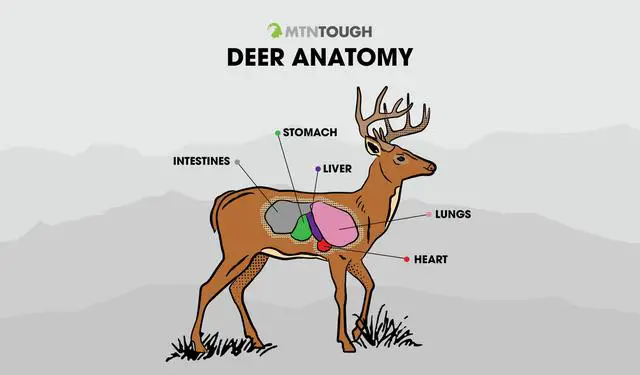
        A deer’s heart is located directly in line with the middle of its front leg. The top of the heart sits at the midpoint between its back and belly. By aiming at this specific area, hunters increase their chances of hitting the heart accurately. A shot to the heart ensures that blood loss occurs rapidly, incapacitating the deer swiftly.

        When a deer is shot in the heart, it may take only seconds for it to collapse and expire. This quick kill minimizes suffering and allows for an ethical harvest. It also reduces the risk of tracking wounded game over long distances.

        In addition to targeting the heart, hitting both lungs is also highly effective when shooting a deer. The lungs fill most of the chest cavity, providing a larger target area than just aiming for the heart alone. Hitting both lungs increases blood loss and further incapacitates the animal.

        Overall, shooting a deer in the heart results in a swift and humane kill due to rapid bleeding and disruption of its cardiovascular system. Proper shot placement is crucial for ethical hunting practices and ensuring successful recovery of downed game animals.

        3. Anatomy Matters: The Outcome of a Heart Shot on a Deer

        3. Anatomy Matters: The Outcome of a Heart Shot on a Deer

        A heart shot on a deer is considered the most effective and quickest way to kill the animal. When either the upper chambers (atria) or lower chambers (ventricles) of the heart are hit, the deer bleeds out rapidly, leading to a swift death. The heart is located directly in line with the middle of the deer’s front leg, with the top of the heart sitting at the midpoint between its back and belly.

        The Importance of Hitting Vital Organs

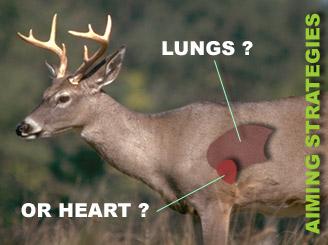
        Hitting vital organs such as the heart and lungs is crucial for ethical hunting and ensuring a quick kill. A deer has a left lung and a right lung, with its heart positioned between them. The majority of both lungs are set slightly behind the heart and behind its front shoulders. As the lungs fill most of the chest cavity, they provide a larger target area compared to just aiming for the heart.

        The Role of Liver Shots

        The liver is located further back on a deer, situated between its lungs and stomach and right behind its diaphragm. While a liver shot is fatal, it takes longer for the deer to expire compared to a heart or lung shot. This is because blood loss from the liver is slower than from other vital organs. Liver shots produce dark red or maroon blood with a watery consistency.

        Considerations for Smaller Deer

        It’s important to note that smaller deer can have vital organs that are half the size of those in mature bucks. Therefore, when shooting at young bucks or does, your margin of error is reduced by 50 percent. Understanding this size difference will help ensure accurate shot placement.

        The Best Shot Placement for Different Angles

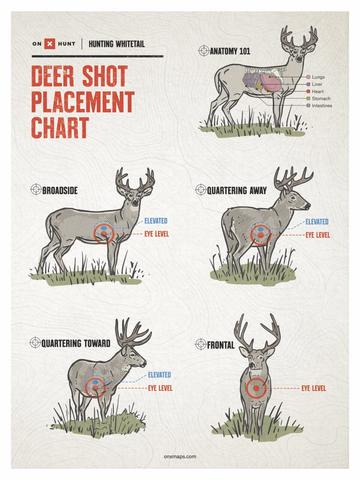
        When it comes to shot placement, different angles require specific aiming points. A broadside shot, where the deer is facing directly towards you, provides an unobstructed path to the heart and both lungs. The best aim for a broadside shot is directly in line with the front leg, between the halfway and lower one-third mark between the bottom of the chest and the top of the back.

        For a quartering-away shot, where the deer is at an angle away from you, it’s important to aim further back than its front shoulder. Aiming at the opposite-side shoulder ensures that your arrow or bullet exits where you want it to.

        On the other hand, a quartering-toward shot presents greater risks due to potential damage to the front shoulder meat and guts. If this is your only option, aim at the front side of the near shoulder, envisioning your shot exiting at the middle or back of the opposite ribcage.

        Frontal shots are ill-advised as they have a smaller target area and involve more bone and fatty tissue. However, if you decide to take a frontal shot, aim high and in the middle to avoid as much bone as possible.

        Other Shots Not Recommended

        There are other angles and shots that are not recommended for ethical hunting. These include head/neck shots and straight-away shots where the deer is walking or running away from you. Additionally, taking a straight-down shot when in a treestand provides a small target area but may be taken if certain conditions are met.

        Understanding deer anatomy and practicing shot placement from different angles will greatly improve your chances of making an ethical kill while hunting with a rifle or bow.

        4. Quick Kill or Prolonged Death? The Importance of Hitting the Heart in Deer Hunting

        4. Quick Kill or Prolonged Death? The Importance of Hitting the Heart in Deer Hunting

        When it comes to deer hunting, hitting the heart is crucial for a quick and ethical kill. The heart shot results in rapid bleeding, leading to a swift death for the animal. Understanding the anatomy of a deer and knowing where its vital organs are located can greatly improve your shot placement.

        A deer’s heart is situated directly in line with the middle of its front leg, with the top of the heart positioned at the midpoint between its back and belly. Aiming at this area ensures that your shot hits the heart, causing significant damage and quick expiration.

        In addition to the heart, a deer has two lungs located slightly behind and beneath it. The lungs occupy most of the chest cavity, providing a larger target area than just aiming for the heart alone. Hitting both lungs guarantees a lethal shot and increases your chances of recovering the downed animal.

        It’s important to note that smaller deer, such as young bucks or does, have vital organs that are half the size of mature bucks. This means that when shooting at smaller deer, your margin of error is significantly reduced by 50 percent.

        Taking a broadside shot on a deer is considered ideal as it provides an unobstructed path to both the heart and lungs. Aim directly in line with the front leg, between the halfway and lower one-third mark between the bottom of the chest and top of the back. This will ensure that your shot lands in the meaty area of the heart.

        While quartering-away shots are also effective, it’s important to aim further back than you would for a broadside shot. A good rule of thumb is to aim at the opposite-side shoulder where you want your arrow or bullet to exit. This ensures proper penetration through vital organs while avoiding obstructions like bones.

        On the other hand, quartering-toward shots and frontal shots are not recommended due to the risk of hitting bones and fatty tissues. These shots can result in poor penetration and limited damage to vital organs, potentially leading to prolonged suffering for the deer.

        For hunters in treestands, shot placement can be affected by the height of the stand. Higher treestands make it more challenging to hit vital organs as the deer’s backbone shields them. Adjustments should be made to aim further back on quartering-away shots and more in front of the near shoulder on quartering-toward shots.

        To ensure successful shot placement, regular practice from a treestand is essential. Using a rangefinder with angle compensation can help determine the correct shooting distance, considering the vertical height difference between the hunter and the animal.

        In conclusion, understanding where to shoot a deer is crucial for ethical hunting and ensuring a quick kill. Targeting the heart and lungs provides the best chance of a clean kill, while avoiding unnecessary suffering for the animal. Regular practice and knowledge of shot placement angles will greatly improve your hunting success.

        5. Shot Placement Secrets: Unveiling the Results of Shooting a Deer in the Heart

        Shooting a deer in the heart is considered one of the most effective and ethical ways to ensure a quick kill. When either the atria or ventricles of the heart are hit, the deer bleeds out rapidly, leading to a swift demise. The heart is located directly in line with the middle of the deer’s front leg, with the top of the heart sitting at the midpoint between its back and belly.

        Aiming for the heart provides a larger target area compared to other vital organs, such as the lungs or liver. This increases the chances of hitting a vital organ and ensuring a clean kill. Additionally, hitting both lungs along with the heart can be achieved with a well-placed shot on a broadside deer.

        However, it is important to note that smaller deer, such as young bucks or does, may have vital organs that are half the size of those in mature bucks. This means that when shooting at smaller deer, hunters must be more precise and reduce their margin of error by 50 percent.

        In summary, aiming for a deer’s heart is crucial for an ethical kill and quick recovery. Understanding where exactly it is located within its chest cavity allows hunters to make accurate shots and minimize suffering for the animal.

        6. Ethical Hunting Guide: What to Expect When You Shoot a Deer in the Heart

        Shooting a deer in the heart is one of the most effective and ethical ways to kill the animal quickly. When you hit the heart, the deer will bleed out rapidly, leading to a swift and humane death. However, it’s important to understand what to expect when shooting a deer in the heart.

        1. Quick Death

        When you shoot a deer in the heart, it will typically result in an immediate drop or collapse of the animal. The rapid blood loss from hitting either the upper chambers (atria) or lower chambers (ventricles) of the heart will cause quick incapacitation and death. This ensures minimal suffering for the animal.

        2. Blood Trail

        A heart shot on a deer will often produce a significant blood trail, making it easier for hunters to track and recover their downed animal. The blood will be bright red and have a watery consistency, indicating a successful shot placement.

        3. Limited Movement

        After being shot in the heart, a deer may still exhibit some involuntary movements such as kicking or twitching due to nerve reflexes. However, these movements are not indicative of life or consciousness and are merely residual effects.

        4. Field Dressing Considerations

        When field dressing a deer that has been shot in the heart, it’s important to be cautious as there may be substantial blood pooling around this vital organ. Take care not to puncture or contaminate any other organs while removing them during field dressing.

        In conclusion, shooting a deer in the heart is an ethical way to ensure quick and humane killing during hunting. Understanding what to expect when aiming for this vital organ can help hunters make accurate shots and efficiently recover their downed animals. Remember to always prioritize ethical hunting practices and respect for the animal’s life.

        In conclusion, if a deer is shot in the heart, it will likely result in rapid death due to severe internal damage and blood loss. This vital organ’s destruction disables the deer’s ability to pump oxygenated blood, causing a swift demise. Proper aiming and ethical hunting practices are crucial to ensure humane kills and prevent unnecessary suffering.

        Glock and More: 7 Most Reliable Striker-Fired Pistols

        0

        Key Point: Each of these pistols are truly excellent choices for self-defense or personal protection.

        If you’re looking for a pistol that you can use for personal protection, self-defense, and concealed carry, you’ve come to the right place. 9mm striker fired pistols as a whole are the simplest and most reliable handguns that you can own, assuming that you’re going to buy from a reputable manufacturer.

        Note – for the purposes of this article, we’ll be sticking with mid-sized and full-sized 9mm handguns rather than guns of other calibers and sizes. Also note that this article is aimed at beginners who have little to no knowledge of firearms and are looking to make a first purchase.

        Here are the best striker fired pistols on the market today:

        CZ P10C

        The CZ P10C is CZ’s first striker fired pistol. The company had previously been most well known for making the CZ75 series of hammer fired pistols. The P10C was released in 2017 (after its initial development had began in 2014) and is designed to

        The P10C comes with a fiber reinforced polymer frame along with a stainless steel side. It competes directly with the Glock 19. It was even built by CZ to fit the same holsters as the Glock as well. Since Glock has a massive array of aftermarket support and parts, this is a major plus.

        Full size and compact variations of the P10C are also available.

        Glock 17/19

        The Glock 17 and 19 are the pistols that started the whole striker fired pistol craze in the first place. The G17 was released in 1983 and the G19 followed a few years later. The G17 is a full size handgun with a 17 round capacity while the G19 has a 15 round capacity and is more compact for concealment.

        The main benefit to the Glock series of pistols are their inherent reliability, simplicity, and their massive array of aftermarket parts and support. In fact, the Glock pistol is one of the single most customizable firearms on the planet, rivaled only by the AR-15 and the 1911 pistol.

        Heckler & Koch VP9

        The HK VP9, also known as the SFP9, was released in 2014. The pistol was designed directly to compete with the Glock 19 and the Walther PPQ, but particularly the latter people as HK sought to make a pistol that would have a very similar trigger and ergonomics to the Walther.

        The VP9 is more close in size to the G17, but has a smaller magazine capacity of 15 rounds. It comes with two polymer protrusions on the rear of the slide that make it easier to grasp with a wet hand. It also offers interchangeable backstraps and side panels on the grip to accommodate different

        SIG Sauer P320

        The SIG Sauer P320 holds the distinction of being the current sidearm of the United States military, replacing the Beretta M9 or 92FS. It also holds the distinction of being a truly modular pistol. The actual gun assembly of the P320 can easily be removed from the gun and swapped between different frame sizes that you can purchase separately.

        The P320 was adopted into the United States military as the M17 or M18. The M17 is a larger version with a longer slide, while the M18 is a smaller compact option. The M17 is being issued to the Army and the M18 issued to the Air Force and Marine Corps. Both pistols come with a manual safety, which the standard P320 does not.

        Smith & Wesson M&P

        The Smith & Wesson M&P line was released in 2005 to succeed their 3rd generation hammer fired guns. The M&P line has since grown tremendously to become Glock’s main competitor. The M&P 2.0 series was released a few years ago, and features enhanced ergonomics with more aggressive grip stippling as well as a superior trigger.

        There are also multiple sizes available for the M&P. The M&P 2.0 Compact is more similar in size to a Glock 19. The first generation M&P Compact was more similar in size to the Glock 26.

        Walther P99

        The Walther P99 (as well as the P99 Compact) is truly one of the most unique striker fired pistols ever made. This is because it’s a double action single action and does not have a consistent trigger pull as the other options on this list. Unveiled in 1996, the P99 has a double action pull for the first shot with all subsequent pulls single action. Meanwhile, a decocker lever on the side puts the weapon back into double action.

        But the pistol can also be placed into AS mode by tackling the slide back slightly on double action. This AS mode essentially makes the double action a much lighter pull and therefore significantly easier to shoot, but also safer to carry than the single action.

        Walther PPQ

        The Walther PPQ is a developed Walther P99 that has a more Glock-like single action only trigger with a consistent pull. It also features enhanced ergonomics over the P99 with more aggressive grip texturing, a squared off trigger guard, and forward slide serrations that make it much easier to perform a brass check on the weapon.

        There are two primary versions of the PPQ: the M1 and the M2. The M1 has a European style paddle magazine release and the M2 has an American style push button magazine release. There are also longer barreled options for both pistols if you desire a longer sight radius and increased bullet velocity. All in all, the PPQ is a very underrated pistol.

        Conclusion

        Each of the above striker fired pistols that we have covered are truly excellent choices for self-defense or personal protection, and you can’t go wrong with any of them.

        This article by Nick Oetken first appeared at Gun News Daily.

        Image: Flickr / Defence Images

        Is .308 Powerful Enough for Grizzly? | What You Need to Know

        0

        It’s a nightmare scenario but one that becomes a reality several times a year. You are in the wilderness and come face to face with one of the scariest animals that anyone could ever encounter. If a grizzly comes after you, then knowing if you can protect yourself is a legitimate concern.

        .308s are powerful enough for grizzly bears in a technical sense. They offer the right mix of stopping power and low recoil, making it a viable option when you come face-to-face with this animal. However, grizzlies are very tough and might require multiple shots from a .308.

        This article will cover a few related topics, such as what the .308 is, how powerful it is, and why it’s a suitable choice for grizzly bear hunting.

        How Can You Take Down a Grizzly With a .308 Cartridge?

        To take down a grizzly with a .308 cartridge, you’ll need to hit it in the right spot. The .308 is powerful enough to penetrate a bear’s skull. However, if you fail to do enough damage on the first shot, you’ll likely need to have one, if not several, additional rounds ready.

        A grizzly bear can weigh anywhere from 675 to 1,700 pounds (306.18 to 771.11 kg), and they can reach speeds of up to 35 miles (56.33 km) per hour. That’s why it’s so important to have a powerful cartridge if you plan to hunt them.

        People have used a .308 to take down bears in just a few shots, but it depends on the situation. If you’re in the backcountry, you might consider using a larger cartridge. But if you encounter a bear in close quarters, the .308 might work better.

        The idea is to have a rifle that you can shoot relatively fast. For example, you don’t want to be fumbling around with a cumbersome bolt-action rifle when a grizzly is bearing down on you. You want to be able to shoot as quickly as possible.

        How Important Is Accuracy When Shooting at Grizzlies?

        Accuracy is extremely important when shooting at grizzlies. The more time you have to set up a shot, the better off you’ll be. You need to be able to hit the bear in a vital spot. Otherwise, you might just injure the animal and make it even more dangerous.

        It’s possible to kill a grizzly bear with guns that are less powerful than a .308 as long as you properly place your shot.

        That said, sudden grizzly encounters may not leave you with enough time to be precise with your shooting, which is why it’s important to be prepared to take multiple shots.

        A slightly wounded grizzly isn’t something you want to deal with. They’re powerful animals that’ll viciously fight back.

        Related What is the Best One Gun? (If You Could Only Have One).

        Have People Taken Down Grizzlies with a .308 Before?

        Despite what you might have seen in the movies, the .308 Winchester round can take down a grizzly bear. In fact, it’s even been used by hunters in Alaska to take down this big, brown bear for years.

        People have taken down grizzlies with a .308 before. However, a grizzly bear’s reaction to being shot isn’t always predictable. It’s important not to assume that a single good shot will be the end of the encounter.

        If you think you might encounter some grizzlies, the .308 should be more than powerful enough for the job. Just make sure that you’re using a high-quality rifle and ammunition and are taking care to be proficient in your marksmanship. With those things in place, the .308 will do its job.

        .308 vs. 30-06 for Grizzly Bears

        30-06 cartridges are more powerful than a .308 cartridge. The 30-06 can take down larger animals at longer distances. However, it also has more recoil and is less accurate than the .308.

        The .308 is a reliable rifle for the inexperienced hunter as it’s easier to control. This is especially true if you’re hunting at close quarters. The 30-06 might be better for an experienced hunter operating in the backcountry.

        While the 30-06 is more powerful and more likely to take down a large grizzly bear, the .308 is still a viable option with quality ammunition.

        How Likely Are Aggressive Bear Encounters?

        Close up of an adult grizzly bear

        Not every bear encounter requires the use of a weapon, but it’s always good to have one in case you need it.

        Aggressive bear encounters are more likely in the backcountry than they are in developed areas. However, bears might get aggressive whenever they feel threatened, regardless of location.

        That said, aggressive bear encounters or full-on bear attacks are relatively rare. While a .308 rifle might protect you against an aggressive bear, there’s no guarantee that you will need to use it. In fact, using your rifle with a non-aggressive bear might make the situation worse.

        The National Park Service provides a number of ways to handle a bear encounter before resorting to the use of a weapon.

        How To Survive a Grizzly Attack?

        To survive a grizzly attack, you need to identify bear territory, the type of bear you’re looking at, and have a solid survival strategy. A .308 rifle can be of great help, but some bear spray can also do the trick.

        Naturally, grizzlies won’t attack unless they feel threatened. And this usually happens in the backcountry without you knowing. The only time you’re likely to see a grizzly is when it’s too close, and that’s why most people have great success with the .308.

        During a sneak attack, your first line of defense should be bear spray. Hopefully, this will stop the bear in its tracks, giving you the chance to shoot your shot.

        But if the grizzly does manage to get on top of you, your best bet is to play dead. Curl up in a ball and protect your vital organs. And whatever you do, don’t fight back.

        Fighting back will only agitate the bear and make the situation more dangerous. Play dead and wait for the bear to lose interest and wander away. Then, you can make your escape.

        Bear attacks are rare, but they can happen. So it’s wise to be prepared for all eventualities.

        Conclusion

        For many people, the .308 won’t be the first choice against a grizzly bear. However, if this is the only weapon you have on hand, you’re much better off with it than you are without it. The .308 is fully capable of taking down a grizzly bear, especially if you place your shot well.

        However, if you do find yourself in a battle with a bear, remember to play dead, protect your vitals, and wait for the bear to lose interest. This might seem cowardly, but it can save your life.

        For more, check out Best All-Around Camouflage Pattern Across Multiple Biomes.

        Wild cherry

        0

        Wild cherry: Plant profile

        Common names

        Wild Cherry, Sweet Cherry, Mazzard, Gean, Crann Silin Fiain

        Botanical name

        Prunus avium (& other Prunus spp.)

        Family

        Rosaceae (Rose)

        Distribution

        Native to Europe. Widespread all over England and Wales. Although still common, less frequent in some parts of Scotland and Ireland.

        Where to find Wild Cherry

        Deciduous woodlands and hedgerow. Widely planted in parks and alongside streets.

        When to find Wild Cherry

        Fruit early to mid summer.

        How to identify Wild Cherry

        Wild Cherry is a deciduous tree. The tree has a straight trunk and branches that grow in rings up along the trunk. The bark is brown to grey and have ‘cuts’ around the trunk called lenticels. The leaves have elongated oval shape with serrated edges and bright green in colour, which is lighter underneath. The flowers are either white or pink in colour and are variable dependent on species / variety. The fruit is round and shiny, red in colour and has a stone in the middle.

        Wild Cherry lookalikes

        The Cherry Plum (Prunus cerasifera) fruit look similar, which is generally a bit bigger and come in different colours such as red and yellow. Nonetheless, all species of cherries and plums are edible.

        All about Wild Cherry

        There are a few different Cherry species growing in the UK and Ireland. The most common is Wild or Sweet Cherry (Prunus avium), but there are also Sour Cherries (Prunus cerasus) and Bird Cherries (Prunus padus). All Cherries are edible but have different flavour profiles.

        The fruit will start to appear at the end of June and you’ll have to be quick to beat the birds. The Cherries are often a little hidden by the leaves, so it’s best to stand under the tree and spot the darker ones, though sometimes it’s more practical to pick under-ripe fruit to ripen at home.

        Medicinal properties of Wild Cherry

        The fruit stalks are astringent, diuretic and tonic.

        Culinary uses and recipes with Wild Cherry

        The flowers taste of almonds and can be made into syrup or infused in milk for making custard.

        Sweet Cherries are best eaten fresh, straight from the tree and added to natural yoghourt. However, Wild Cherries are relatively small and tedious to pit and are often used to infuse drinks and make preserves and sauces.

        Cherry fruit is so versatile. It can be used to make Hungarian Sour Cherry soup (Meggyleves), cooked with game or venison terrines, made into preserves such as jams and pickles or sweet desserts such as panacotta and chocolate & cherry mousse.

        In the drinks front, Cherry can be used to make Cherry schnapps (Kirschwasser) and wine made of blossoms or fruit, but fruit can simply be infused into drinks to make flavoured brandy or a mock amaretto. Off the booze? Make a simple and delicious cordial or juice.

        Cherry full of fruit (Prunus avium)

        Safe foraging of Wild Cherries

        Just like shop-bought Cherries, the seeds or pips of the Wild Cherry contain hydrogen cyanide and are poisonous. It is usually present in too small a quantity to do any harm. In excess, however, it can cause respiratory failure.

        Ecological importance of Wild Cherry

        Cherry trees provide a food source for many birds and small mammals, as well as used for shelter and nesting.

        7 Best Pistol Iron Sights for Glock, Sig & Night Use [2024]

        0

        This article contains affiliate links. We may earn a small commission if you purchase via these links.

        Are you shooting too low?

        Are you struggling to see your sights at night?

        Can you switch out the sights that came with the handgun?

        In general, factory sights tend to leave a shooter wanting. It’s customary for stock sights to simply serve as fillers intended to be replaced. Aftermarket pistol iron sights can make a big difference to accuracy, sight and target acquisition, and overall performance.

        But what sights are right for you and how are they different?

        To pull together this list of the best pistol iron sights, I included a few that I own on various handguns to compare cost, usability, accuracy, and installation. From an owner’s hands-on experience, these pistol sights offer affordability and quality to match or outdo their price points.

        Top Pistol Iron Sights for 2024

        Open sights have a rear sight with a window, notch, gap to view the front sight mounted forward on a firearm. This is the sighting system in and of itself. Going forward, open sights will be referred to as iron sights for simplicity’s sake.

        Iron sights, open sights – semantics. Really though, open sights are under the iron sight category as iron sights is a catch-all for sighting systems, including aperture sights, that use the naked eye to form a direct line of aim to the target.

        Most pistols purchased today come installed with sights. Though some are better quality than others, plastic fillers or basic factory sights are the standard. They do little to improve accuracy or sight visibility and may be why a replacement set is needed.

        While this round-up gathers some of the most popular pistol iron sights including my very own aftermarket handgun sights – which I have high opinions of – it’s not all-inclusive. Other things must be considered such as your particular firearm, use with a red dot or suppressor, and of course, heights to ensure the POA matches the POI.

        So, here’s a handful of the top handgun iron sights to muse over to help you get started on your sight replacement journey!

        7 Best Pistol Iron Sight Reviews

        1. TruGlo Tritium Night Sights – Best Budget & Best Night Sights

        The TruGlo Tritium Night Sights are some of the most popular night sights in the market. This was a large factor in why I personally purchased four sets for my Glocks. Obviously, affordability played a big role, and from my hands-on experience, they’ve been a value buy with big performance.

        Pros:

        • Price
        • Tritium night sights
        • Low profile – no holster snagging
        • Easy to install on Glocks
        • Multiple applications

        Cons:

        • Same color dots

        I bought these earlier in the year and installed them myself with a sight pusher and hex tool that I bought separately online. The sight pusher was easy to use and to see the sights are lined up correctly from the get-go. Overall installation process is easily a 5/5 rating considering that they’ve not come loose, it wasn’t difficult at all, and I haven’t had to make any adjustments.

        Now all my Glocks came with factory sights, and I’ll admit there was a small transition that I noticed adjusting from the U-notch to the square when aligning the dots, and I was accustomed to using the 6 o’clock hold sight picture. However, it’s been a relatively rapid process in overcoming it.

        With the Truglos, I put rounds down at 15 and 25 yards with 5-shot groups in the combat sight picture. I was a little slower at 25 yards, and obviously at 15, it’s a lot easier to be consistent and send down round after round. With the factory sights, I was using the 6 o’clock hold, and with the Truglos, I’m shooting with the combat sight picture.

        Every one of these Glocks has an OWB holster, and the design has not interfered at all. The glowing tritium lamps are way brighter in person than can be seen in the pics. Would I buy these again? Yes!

        2. Trijicon HD XR – Best Glock Night Sights

        For non-MOS Glock pistols, the Trijicon HD XR Night Sights serve for fast target acquisition with highly visible night sights. For Glocks 17, 17L, 19, 22, 23-28, 31-35, 37-39, and 45, the HD XRs are a highly popular upgrade from factory Glock sights.

        Pros:

        • Tritium night sights
        • Highly visible painted front dot
        • Thin front sight
        • LEO & competition
        • For non-MOS Glocks

        Cons:

        • Price

        If you’re buying the set, you could be out almost a couple hundred dollars, but you can find them for more than 25-33% off in most cases. In my opinion, that would be a better price that I could justify over full retail cost. It’s worth remembering that they’re Trijicon quality that come with a 12-year warranty on the tritium lamps (from date of manufacture).

        I really like the high-visible painted ring around the tritium lamp for fast sight focus. The paint is a photoluminescent (glow-in-the-dark) ring that is a trademark of the HD series. I think combined with the black-out performance of the rear sight during the day but glowing performance at night, its usability makes them operationally ready regardless of the conditions.

        The front blade has a 0.122” width. Combined with the 0.169” rear U-notch width, it provides improved target acquisition, more FOV, and long-distance precision. It’s also steeply hooked meaning that if you’re in a rush and a one-hand rack is it, the front sight will catch for a fast first-in-chamber load.

        If you’re sporting a Glock MOS, you’ll want the HD XR MOS sights for that longer fit on the rear of the slide. However, they’re stock height, so they won’t co-witness with a RDS if you’re sporting one.

        Excellent for the needs of competition shooting and law enforcement, these night sights for Glock will also serve for carry firearms as a home and self-defense sighting system.

        3. Truglo Fiber Optic Sights – Best Fiber Optic

        The Truglo Fiber Optic Sights are regularly mistaken for night sights. They’re day-use sights with the fiber portions recessed into the sight well for concealment. They will be harder to see and dim in low light, but as fiber optic sights, they’re intended for daytime applications.

        Pros:

        • Price
        • Fiber optic
        • Contrasting dot colors
        • For Glock (non-MOS)
        • Snag-free design

        Cons:

        • Not good for lowlight

        If you’re looking for a budget pair to upgrade stock plastic sights (fillers) on your Glock, Truglo’s fiber optic fits the bill. The best fiber optic sights provide dot visibility in daylight conditions.

        As such, poor performance in shadows, lowlight, and dark conditions is to be expected – they are not night sights, so I’d say these are best for use in normal conditions.

        Why they stand out to me as value pistol sights are that they’re well-made for the price point. They’re made from solid steel and have a treated Fortress Finish to protect the surface. Even though they’re not adjustable, they’re accurate enough.

        With the right tools, they’re very easy to install and but it’s recommended to be installed by a trained gunsmith – per Truglo’s warranty. Obviously, there is a warranty but there are several conditions such as, it applies only to the original purchaser and proof of purchase is required.

        I prefer contrasting features, and as these fiber optic sights reflect, the rear dots are green while the front sight is a contrasting red. I wouldn’t say they’re “daylight bright” but that is true of most red dot sights too.

        With all that said, I recommended the Truglo fiber optic sights for target shooting and training.

        3. AmeriGlo Optic Compatible Tall Suppressor Sights (GL-429) – Best Glock Black Out Sights

        The best blacked-out Glock sights to pair with a red dot sight would be AmeriGlo’s optic compatible suppressor height irons. Though low in cost, they offer black-on-black simplicity for eliminating distractions through a pistol mounted red dot.

        Pros:

        • Price
        • Suppressor height
        • Blacked-out sights
        • Glock compatible (except G42/43)
        • Serrated front sight

        Cons:

        • Finish wear-and-tear

        The AmeriGlo serrated sights I field-tested are similar and comparable to these Tall Suppressor sights though not the exact same pair. While they’ve been excellent for duty use thus far out to 25 yards, this Glock 17 Gen 5 was recently outfitted with the Holosun HE509T red dot sight.

        The rear has a U-notch, and they’re slightly shorter making for a very low, I’d say, lower ¼ co-witness on the MOS slide with an adapter plate and 0.59” optical RDS height.

        In my opinion, the recommended black-out sights would be a better replacement as they’re tall suppressor height sights and co-witnesses in the lower 1/3 with Trijicon RMR red dots. Heights are 0.315” for the very thin front blade and 0.394” for the rear.

        Though both sights have neither tritium nor fiber optics, they’re steel with a matte black finish. This has been particularly beneficial as they don’t distract from a functioning pistol mounted RDS, like how it is used right now, or for those who use NODS with that RDS.

        The finish is barely starting to wear at the angles after more than a year on my irons, and that can happen. Other than that, they’ve been excellent for target shooting, patrol/duty, and use with a red dot. AmeriGlo sights are made in USA starting with US steel blocks all the way to assembly.

        5. Meprolight Mepro Tru-Dot Night Sights – Best Handgun Sights for Old Eyes

        In general, aging eyes are having a hard time with front sight focusing and dot visibility in poor light conditions. A possible solution is to consider the Meprolight Mepro Tru-Dot Night Sights with a green front sight filled with tritium for low light and dark conditions.

        Pros:

        • Tritium night sights
        • Contrasting dot colors
        • Alloy steel
        • For Glock (non-MOS)
        • 12-year tritium guarantee

        Cons:

        • Not highly visible in the day

        If older eyes are struggling in those lowlight and dark hours, night sights will help with dot visibility. I really like that these Meprolight sights will help with visual acuity because of the green on orange configuration, making them great pistol sights for old eyes.

        The front sight has green tritium that allows for easier and brighter dot identification than other colors. The rear sight has orange tritium, and the contrast will ensure the front sight stands out.

        The catch with tritium is that they don’t glow during the day. To help with dot visibility during daylight conditions, a white ring is painted around the tritium vials. In my opinion along with some buyers, they’re not as useful in these conditions and this would be true especially for those with bad eyes.

        I know that the Mepro sights will fit Glock models except for MOS slides. They’re made from alloy steel. The tritium vials come with a manufacturer guarantee for 12 years which I think is fantastic as it’s on par with Trijicon’s tritium guarantee. The front sight blade is 0.17” in height and 0.16” in width. The rear sight blade is 0.19” in height.

        Though older eyes might benefit from sights that offer both fiber optic and tritium dots, they’re more expensive. When you’re in the market for night sights, your eyes might need a little help from the green-on-orange configuration.

        Available at: Amazon

        6. Sig Sauer X-RAY3 – Best Night Sights for Sig

        The X-RAY3 day and night sights are configured for Sig Sauer firearms. Though they’re included as the standard sights on the P229 and Legion series pistols, they’ll also fit the P-series 225, 227, 220, 226, 238, 938, and 320.

        Pros:

        • Day/night sights
        • 3-dot alignment
        • Fluorescent polymer & tritium
        • Suppressor height
        • For Sig P series

        Cons:

        • Dead tritium dots

        I don’t have any performance complaints with them, and there are few to no complaints to find online. However, it seems that some sights are turning up with dead tritium vials or they don’t glow after a very short period of ownership. I did find that even though the lifetime warranty doesn’t cover tritium, Sig’s limited 5-year warranty covers tritium components starting from date of manufacture.

        As suppressor height sights, they do come just above a suppressor and co-witness with a red dot in the lower 1/3 or a shade lower depending on the firearm and other factors.

        The front blade is 0.374” in height while the rear is 0.417”. It will take some trial-and-error to figure out your POA and POI as they have not been set for any sort of sight picture.

        The tritium vials provide dot visibility in lowlight and night conditions and are housed inside the steel sights for protection. The front sight has an oversized fluorescent polymer dot that surrounds the tritium for high visibility in daylight but also glows in the dark.

        It’s my opinion that they would be excellent for use regardless of the conditions and as such, they offer a lot of value for the money. If you’re not running a red dot, the X-Ray3 does come in Sig size configurations of F6/R8, F8/R8, F8/R6, and F8/R8.

        7. Viking Tactics VTAC Sig Sauer – Best Day & Night Sights

        The VTAC Sig sights have both fiber and tritium dots ready for day/night use. I own and love them, so they were included as a hands-on field test. I got them because they’re stock for the P320 X-VTAC. They’ll fit most of the P series from the P220 to the P365 as well some out of production ones.

        Pros:

        • Day & night sights
        • Fiber or steel
        • 3-dot alignment
        • Tapered front sight (0.110”)
        • Fits a wide range of Sig P models

        Cons:

        • May shoot low

        I sighted-in the VTACs for a 25-yard zero in the combat sight picture. Though others have reported that the sights are 1-2” low at 10 yards or more, I haven’t had such issues. Any flier shots I’ve had, had more to do with my pistol shooting fundamentals than the sights themselves.

        The front is a Sig size #6 (0.230”) and the rear an #8 (0.250”). Even though I haven’t had need to switch out sizes, some have found better results with a front 8 and rear 8 combination to bring up groups that were too low with the F6/R8 combo.

        I find the tapered front extremely beneficial with its slimming silhouette because it gives me the potential for improved precision with its 0.110” pinpoint post. Because the VTACs are standard height, they didn’t co-witness with the field-tested Leupold DeltaPoint Pro I stuck on there.

        The dovetail base can be adjusted with a sight pusher for windage, though windage has never been an issue for me and that seems to be consistent across the board.

        There are a lot of dots going on (a total of six!), but dot acquisition and visibility performance has always been easy, and I’ve never confused them.

        My eyes find the fiber optics easy and fast to pick up in the day and align in the 3-dot alignment configuration. At night, my eye is immediately drawn to the glowing tritium dots. Though as a side note, there is an option for the black steel rear sight with a day & night front sight.

        Though they’re the least well-known sights in this lineup, they offer day and night benefits that are perfectly matched with Sig Sauer P series pistols if you’re considering an upgrade. On my P320, they’re not going to be replaced any time soon. I’ll probably put a different RDS on there, but the VTACs aren’t going anywhere.

        What to Look for in the Best Pistol Iron Sights

        Overall, iron sights are simple and affordable. However, additional components and various materials can influence the cost, how they perform in certain conditions, and diverse specifications can determine what application they’re best suited to.

        For a run-down on the need-to-know info, this guide will get you thinking.

        Cost

        In general, handgun iron sights will vary in cost depending on material, adjustability, and visibility enhancement components. They can be as affordable as $20 and as expensive as $200. Even so, they’re cheaper than pistol red dot sights with an average starting price point of $250 (approx.).

        When considering a budget for pistol sights, you must sum up your needs:

        • Application (type of shooting: hunting, patrol/duty, competition, carry, home defense, etc.)
        • Dot visibility for daylight, lowlight, or dark conditions
        • Durability (plastic housing VS metal)
        • Adjustability (fixed VS adjustable)

        The more you require from your sights, the more expensive they will be. You should also include a budget for the proper tools needed for installation or for a professional install by a gunsmith. A professional install is nearly always recommended by the manufacturer and is sometimes a requirement of the warranty.

        Iron SightsPrice Range
        Pistol iron sights cost comparison price range

        Fiber Optic Day Sights VS Tritium Night Sights

        Both fiber optic and tritium components do not require electricity, power, recharging – any of the inconveniences of illuminated red dot sights. However, these enhanced visibility sights cost more than basic blackout and fluorescent painted iron sights.

        Iron SightsDay UseNight UseFiber OpticTritiumOther (Paint)
        Pistol iron sights dot enhancement comparison

        What are Fiber Optic Sights?

        Fiber optic tubes are installed into the sight. Ambient light is “collected” into the tube and then concentrated at the end – the dot. They are colored to provide contrast against the target and surroundings for high sight visibility. These are appropriate for day use in normal conditions.

        What are Tritium Night Sights?

        Tritium gas is concentrated into tiny vials that catalyze a glowing effect with fluorescent materials. They become highly visible in low light and dark conditions where visual acuity is reduced, and other iron sight alternatives would be rendered useless. Though very visible in these conditions, they do not glow during the day, and you cannot temper its brightness at night. These are night sights.

        More expensive iron sights will incorporate both fiber optic and tritium dots for day and night use.

        Blackout Sights

        Blackout pistol iron sights are plain, as in basic. They lack enhancement features as they lack dots altogether. Why would these be preferable on any handgun?

        Blackout sights have their purpose. Most of the time, the rear is blacked-out for simplicity to remove as many visual distractions as possible. This allows a dot on the front sight to stand out. In turn, this improves front sight acquisition and focus.

        However, when both the front and rear sight are blacked out, they are better paired with a pistol mounted red dot sight. Though taller sights are visible through the RDS, their basic appeal does not distract from the functioning illuminated dot of the RDS.

        This is also important when using night vision with a pistol-mounted RDS. Tritium can be seen through night vision and thus is another distraction to the shooter when viewing through the RDS with NODS.

        Close range VS Long range

        The blade width of the front sight will influence sight acquisition and focus, accuracy, and distance performance. They vary in width, and while some like thin blades, it may be too narrow and can get “lost” against the target or FOV making it slower to pick up.

        Conversely, a wider front sight may cover up too much of the target and FOV to make accurate shots at distance. For close range shooting, say under 10 yards, a wider front sight of 0.140” (approx.) and wider will be faster to pick up.

        For distance shooting over 10 yards, a front sight of around 0.100-0.125” (approx.) will cover less of the target aiding in precision and target acquisition.

        Iron SightsFront Sight Blade Width
        Front Sight Blade Width Comparisons

        Fixed VS Adjustable

        Many pistol sights are fixed and cannot be adjusted. These types are set for a certain sight picture and are sighted in at a specific distance. Therefore, sights are model specific for the handgun. If placed on another pistol or installed incorrectly, the POA will not match the POI.

        Not all fixed sights are accurate even though they’re the right sights for the right firearm. Some modifications can be made such as, front sights can be filed down and dovetail rear sights can be pushed left and right for some adjustability.

        Easier adjustability is usually a feature of a specialty rear sight for competition shooters. Being able to adjust can result in greater precision, tighter groups, and increased confidence when shooting at various distances.

        For more on how to sight-in and adjust, check out our How to Zero Iron Sights how-to guide.

        Installation

        Most pistol sights are fixed. It’s essential to be specific about blade heights so you can sight-in your iron sights. Some can be “pushed” to try to compensate for left/right (windage) and front sights can always be filed down. However, it’s not as easy to weld more steel to too short front sights.

        While a brass punch and mallet is how it was done for a long time, a proper sight pusher is a better tool. Sights with tritium vials can break, and other than being out of the cost of the sight, you’ll want to avoid breaking an alpha-emitter product.

        If you don’t have the right tools, are finding it difficult to get tight groups or to raise/lower them, or they’re not fitting right, a professional install is recommended. In fact, the instructions that came with the iron sights likely mentions that a trained gunsmith install the sights.

        In some cases, the warranties demand this and warranties can be forfeited if installed with any other method.

        Red Dot VS Iron Sights

        With as popular and common as red dots are becoming on handguns, some are doing away with iron sights altogether. However, some of us are rooted in the opinion that red dots can fail, and a back-up sighting system remains relevant even in this electro-optic driven sporting industry.

        Some comparisons include:

        Red Dot ProsIron Sight ProsRed Dot ConsIron Sight Cons

        The rage right now is to combine irons and a RDS for a co-witness and never being without a sighting system. For more in-depth comparisons, check out our Iron Sights VS Red Dot guide.

        Pistol Red Dot SightsPrice Range
        Recommended Pistol Red Dot Sights

        Do You Need an Iron Sight Upgrade?

        The factory iron sights that came with the pistol are not the end-all-be-all. If groups are off regardless of shooting fundamentals or dot visibility is difficult to acquire, aftermarket sights can be a practical upgrade. Some are tall enough to see over suppressors and red dots.

        With various features like contrast enhancements, adjustability, and concealed carry features, upgrading your sights can make all the difference needed in usability, accuracy, shooter safety, and overall performance.

        Further Reading
        • How to Aim Iron Sights [Complete Guide with Photos]
        • What is the Sight Picture & Sight Alignment? [WITH PICS]
        • Iron Sights VS Red Dot Comparisons (Uses, Accuracy, Reliability, Durability & More)
        • Pistol & Rifle Co-Witness Sights Explained!
        • How to Zero Iron Sights on Pistol & AR-15 (With Photos)

        Is Shooting At Trees Safe?

        0

        There is nothing better than going out into the wilderness, relaxing, and target shooting with your friends and family. While it is nice to be out in nature shooting your guns, there are many dangers in doing so if you do not take the proper precautions.

        When you are at a standard range, they take make rules and enforce specific precautions for you to follow. The biggest benefit in utilizing a range is that you have targets that you can hang up in a safe area, you can bring the target to you without having to put yourself downrange, and there are walls in between you and the people next to you shooting, which helps ensure a controlled environment.

        Unfortunately, the outdoors and shooting with a group of people in an open environment is not necessarily the most controlled and safe environment to do so. One potentially hazardous scenario when shooting outdoors is ricochet bullets. In this post we look at whether choosing to hang a target on a tree is a good idea.

        So, Is Shooting a Tree Safe to Do?

        In general, shooting at trees is not a safe practice. Not to mention, this practice may harm or destroy trees in doing so. Damaging natural resources, especially on public lands, is often illegal in the United States. Shooting into trees can cause a ricochet to occur, which can cause your bullet to come back and hit you, someone, you are shooting with, or valuable personal property.

        Will the Bullet Ricochet Off of the Tree?

        Shooting at a tree can cause the bullet to ricochet off and change direction. While trees are softer than rocks and metal, they still can cause your bullet to bounce and sometimes come back at you. It is impossible to project the trajectory of the bullet if a ricochet does occur. This is extremely important to keep in mind because when you shoot it may not just be yourself who is in the line of fire.

        Factors Impacting Whether the Bullet will Ricochet

        Depending on how close you are to the tree, and what type of gun you are shooting, there is a risk of your bullet changing direction to come back at you which could cause you, or your friends and family to be shot by the stray bullet causing injury or worse.

        If you are extremely close, you could run the risk of also having the tree splinter off in your direction causing some nasty cuts and splinters. While numerous factors will impact bullet ricochet, two of the most impactful factors is the type of tree being shot and what caliber of gun is being used.

        Does the Type Of Tree Matter?

        There are a ton of different types of trees in our national forests. Cedar, pine, oak, redwood, and many other types of trees that can be found in a forest. It typically will not matter what type of tree you shoot into, but there are some types of trees that have a “harder” wood core than others, so your chances of ricochet might go up depending on what you shoot at. Oak trees tend to be much more hardwood than a cedar tree.

        Pine on the other hand is a softer wood. Keep in mind that the softer the tree is, the more likely the tree will be damaged by you deciding to shoot it. Even if you have shot at a “softer” tree in the past without issue, it does not guarantee your safety in the future. Something as simple as a knot in the tree can send your bullet flying right back towards you or a loved one.

        Does The Caliber of the Gun Matter?

        When thinking about tree damage and ricochet, the higher the velocity of the bullet, the more chance you have for it to bounce or ricochet. Shotguns utilizing bird shot at a distance will probably have the lowest ricochet potential because they are a scattergun, and the lead pellets are normally pretty soft. The problem with shotguns is that they can do a lot more damage to the tree. The typical bullets you will want to use extreme caution with are going to be 9mm, 45, 22, and larger caliber guns. High powered rifles might actually go completely through the tree causing it to hit something else.

        Below is a video of a bullet ricochet that occurred after shooting a brick at 10 yards.

        How Does Shooting a Tree with a Gun Hurt It?

        Trees are living things, so just like if you shot a real person, shooting at a tree can injure it. It may not kill the tree after one, two, or even thirty shots, it is certainly not great for it. While you might not think this is a big deal, there are US laws that prevents you from harming trees and foliage, which could land you a hefty fine, and possible jail time.

        While trees cannot instantly react to harm being done to them, over time they can stop producing fruit, seeds, and even oxygen, which is an integral part of the ecosystem. There could also be wildlife living in the tree, and if you shoot it and it dies, the wildlife might have to move, especially if the tree dies and falls over.

        While we do not want to tell you what to do, at least think of what you might be doing when you shoot at a tree. It is difficult to measure the outcomes of these types of decisions over time.

        If you love the outdoors, it is your responsibility to protect the resources that you value. The number of active hunters and people who fish are continually decreasing and being a good steward of the activities we love is becoming more and more important.

        Safer Target Options than Shooting at a Tree

        Mentioned above, going to a quality indoor shooting range can be a safer choice than going outside and slapping a target onto a tree. Shooting outdoors is also a safe option if the proper precautions are followed. Risk cannot fully be eliminated during an activity such as shooting, but the risks can be reduced. Three other safer outdoor shooting options include:

        • Shooting a free standing target in front with a hill as a backstop.
        • Shooting at a soft object, such as a box, with a target on it with a hill as a back stop.
        • Shooting a target in a large open field with a slight up-trending grade behind it.

        All of the above options helps to ensure that the bullets shot will end up striking the ground after passing through the target. This provides peace of mind that the bullet will not continue on and strike someone a distance away from where you are. Ricochets could still technically happen, it reduces the risk of it occurring.

        In Summary

        There are tons of options for target shooting in the woods other than hanging targets up on a tree. Always be aware of your surroundings and find a safe spot for you and your friends to shoot without causing any damage to the forest or each other. Find a nice place with a good backstop so that it will stop your bullets and not have any issues of ricochet. Always clean up your mess, never leave any targets or used bullet casings in your spot when you leave, and above all else, enjoy yourself!

        Elk Sausage Recipe: How to Make Elk Breakfast Sausage

        0

        This elk sausage recipe is a great way to enjoy a healthy, protein-packed and delicious meal. Whether you are an experienced or new hunter – or if you bought elk at the store: you’ve come to the right place to find a recipe for elk breakfast sausage patties!

        cooked sausage patties on pan

        Making elk sausages is easy with this recipe because they are in patty form. This means you don’t have to buy hog casings or have fancy sausage stuffing equipment!

        elk in mountains

        Elk are one of the largest types of deer, making it a wild game meat that is similar to venison.

        This meat is growing in popularity because it is nutritious and lean. The first time I tried elk I bought it as ground meat and cooked it for tacos; I loved how it wasn’t as greasy as ground beef and it had such a mild, clean and almost a sweet taste!

        You can substitute elk with ground venison or even ground beef in this recipe, but the cooking process will be a bit different because of the amount of fat. We suggest carefully monitoring the sausage patties on the stove with whichever meat you decide to cook.

        Health Benefits of Elk Meat:

        Compared to regular beef, elk has about half the fat and more protein. It is high in B vitamins, zinc and healthy types of fat. Most farm raised elk are able to free range and have a varied diet including many different types of plant material. Make sure to look up the company and ensure they are a good farm if you are purchasing meat from the store, confirming you are buying a high-quality product.

        While we don’t think many types of animal fats are bad for you (if you are eating grass-fed, grass-finished red meat and organic, pasture-raised poultry), we do think it is easy to have too much fat when eating a diet that includes animal products. For example, we include butter and cream in our diet, so we often get plenty of fat from dairy products. Having a lean meat option is a nice way to help balance the appropriate amounts of fats, carbohydrates and proteins in a meal.

        Elk hunted from the wild:

        As we are not hunting professionals, we don’t have instructions for how to properly skin or butcher wild game. There are many resources for this online! This recipe calls for ground meat which means you will need a good meat grinder or hand grinder if you haven’t bought it pre-ground. Once you have your ground meat, you can follow this easy recipe!

        Storage:

        • You can freeze the prepared raw meat mixture in a non- BPA freezer bag or reusable silicone bag for up to 4 months. Make sure to seal the meat air tight to prevent freezer burn. Only keep the raw meat mixture in the refrigerator for 1-2 days in an airtight container or it will begin to spoil.
        • You can refrigerate the cooked sausage patties for up to 3 days by allowing them to cool to room temperature and sealing them in an airtight container or in a dish covered tightly with plastic wrap.
        • You can freeze cooked sausage patties by allowing them to cool to room temperature and sealing in a non-BPA freezer bag or reusable silicone bag for up to 4 months (again, sealing airtight to prevent freezer burn.)

        Tips for Best results when cooking elk sausage:

        • Combine the dry spices in a small or medium bowl before adding the seasoning mixture to however many pounds of meat you are preparing. This will ensure your sausage seasonings will be uniform throughout your meat.bowl with spices being mixed with spoon
        • Fresh herbs can be used in place of dry by multiplying the quantity by 3. For example, instead of adding 1 teaspoon of dry thyme you can add 1 tablespoon of fresh thyme. We made this recipe in the winter so we only had dry herbs – but can’t wait to try this recipe with herbs from the garden in spring and summer!
        • Preheat the stove to medium heat and add butter until it begins to bubble before adding the sausage patties. This will allow better browning and less sticking.
        • You will want to turn the heat up to medium-high for proper browning but monitor the heat to ensure the sausages are not burning .
        • Carefully monitor the sausages when cooking: you don’t want to overcook these because the low amount of fat can cause the sausage to be quite dry if overly well-done. sausage patties on pan
        • We do not recommend using most “non-stick” pans as most have a coating made with toxic chemicals that can leach into your food. We suggest sticking with stainless steal or cast iron for cooking.

        What to eat with Elk Breakfast sausage patties:

        Enjoy these patties with the same sides you would normally eat with breakfast sausage. Sourdough flatbread, sourdough crepes or pancakes, crispy hash browns, sourdough bread toast with apple butter…

        One of our favorite healthy side dishes for this recipe is sauteed apples in butter and maple syrup, topped with sour cream and a little cinnamon and nutmeg. My mouth is watering just thinking about it!

        sausage on plate

        *This is not medical advice

        *None of these statements have been evaluated by the FDA

        2024 Georgia Rut Dates by County

        0

        There’s nothing quite like hunting whitetails during the rut. Georgia deer hunters are fortunate in that with a little travel, we can hunt the rut from mid-October through the end of the year — that’s two and a half months of rut hunting action!

        To give you an idea of the 2024 rut dates, I’ve included a map below that breaks the peak of breeding into two week intervals. If you’d like more specific dates, check out the table below that narrows it down even further to the best week for each county.

        Georgia Rut Map

        The map and table were created based on research done by the University of Georgia (UGA) and Georgia DNR wildlife biologists that found a strong correlation between deer-vehicle collisions and rutting activity. By looking at deer-vehicle collision reports across the state, UGA and the Georgia DNR were able to pin down the peak of rutting activity for each county.

        Keep in mind, these are just guidelines for Georgia’s peak breeding dates. There will always be does that come into estrus early or late, which can result in a flurry of buck activity outside of these “typical” rut dates. More on that below.

        Georgia rut map by county.

        2024 Rut Dates by County

        October 13-19

        Ben Hill, Camden, Candler, Glynn, Jenkins, McIntosh, and Telfair counties.

        October 20-26

        Atkinson, Brantley, Bryan, Bulloch, Burke, Charlton, Chatham, Clinch, Coffee, Columbia, Effingham, Emanuel, Evans, Glascock, Jefferson, Liberty, Long, McDuffie, Richmond, Screven, and Ware counties.

        October 27 – November 2

        Bacon, Baldwin, Echols, Hart, Jasper, Lanier, Lincoln, Monroe, Putnam, Schley, Taylor, Warren, Washington, and Wilkinson counties.

        November 3-9

        Appling, Bartow, Barrien, Bibb, Bleckley, Butts, Chattooga, Clayton, Cobb, Crawford, Dekalb, Dodge, Dooly, Elbert, Floyd, Gordon, Greene, Hancock, Haralson, Henry, Houston, Jeff Davis, Johnson, Jones, Lamar, Laurens, Lowndes, Macon, Marion, Meriwether, Montgomery, Morgan, Newton, Oglethorpe, Paulding, Peach, Pierce, Pike, Polk, Pulaski, Rockdale, Spalding, Taliaferro, Tattnall, Toombs, Treutlen, Twiggs, Upson, Walker, Walton, Wayne, Wheeler, and Wilkes counties.

        November 10-16

        Barrow, Carroll, Catoosa, Chattahoochee, Cherokee, Clarke, Coweta, Dade, Douglas, Fayette, Forsyth, Franklin, Fulton, Gilmer, Gwinnett, Hall, Harris, Heard, Jackson, Madison, Muscogee, Murray, Oconee, Pickens, Sumter, Talbot, Troup, Turner, Whitfield, and Wilcox counties.

        November 17-23

        Brooks, Colquitt, Cook, Crisp, Dawson, Fannin, Lee, Randolph, Stewart, Tift, Towns, Union, and Worth counties.

        November 24-30

        Baker, Banks, Calhoun, Dougherty, Habersham, Irwin, Lumpkin, Mitchell, Rabun, Stephens, Terrell, Thomas, Webster, and White counties.

        December 1-7

        Quitman

        December 8-14

        Decatur and Grady counties

        December 15-21

        Early and Miller counties

        December 22-28

        Seminole County

        What About Weather or the Moon Phase?

        You may wonder how we know that these dates will apply to the 2024-2024 Georgia deer season. We know because the whitetail rut occurs the same time every year for any given location. It doesn’t change based on weather factors, moon phase, or anything else. That has been documented in study after study over the years.

        What can change from year to year is how much rutting activity you witness where you hunt. Keep in mind that while the dates listed on this page are peak rut activity, there are always outliers that fall outside of that peak. Some does may come into estrus a little earlier and some will come in later.

        When you see rutting activity where you hunt will be determined by the timing of does coming into estrus in that specific area. And since there appears to be a genetic aspect to a doe’s estrus timing, you may see that pattern repeated year after year. If the rut dates listed above don’t correlate with when you typically see rut activity, it’s probably because you have a doe or two that are going into estrus outside of the typical date range.

        How to Hunt the Georgia Rut

        In my mind, there are two keys to taking advantage of the whitetail rut. The first one is to spend as much time in the stand as possible during the peak dates. Bucks are on the feet and moving more than ever during this time, so you never know when a great buck you’ve never seen before may walk into your shooting lane.

        The second key is knowing where the does are and using that information when developing a strategy to catch a cruising buck looking for a receptive doe. If you can find some type of funnel on the downwind side of a doe bedding area, then it’s only a matter of time before you get a shot opportunity.

        Final Thoughts

        There’s no better time to be in a treestand than during the rut, and we have over two months to chase it here in Georgia. I hope you’re taking advantage of that opportunity! Hopefully the Georgia rut map above, along with the table of 2022 Georgia rut dates by county will help you schedule your hunts this year so you can extend the rut-hunting action.

        If you disagree with any of the dates listed in this article, we’d love to hear about it. Let us know what county you hunt, and what dates you think best fit the county based on your observations.

        Best Air Rifle Deals

        Popular Posts

        PCP vs Spring Piston: Which one is better?

        0
        When reading about guns in the search for the first one that would be perfect for you, an age-old debate comes into question. Should...

        Air Rifle vs BB Gun: Understanding the Key Differences and Choosing the Best Option

        0
        "Air Rifle vs BB Gun: Unveiling the Key Differences and Choosing the Perfect Weapon for Your Shooting Needs. Delve into this comprehensive guide to...

        Air gun 101: How Nitro Piston technology can make your shooting sport more exciting?

        0
        In the air gun market today, there are many air rifles made with nitro-piston technology Even the best-selling lists on gun retailer's sites have a...