


Home Blog Page 75

8 Superior Trolling Motors for Kayaks

0

Kayak Trolling Motors

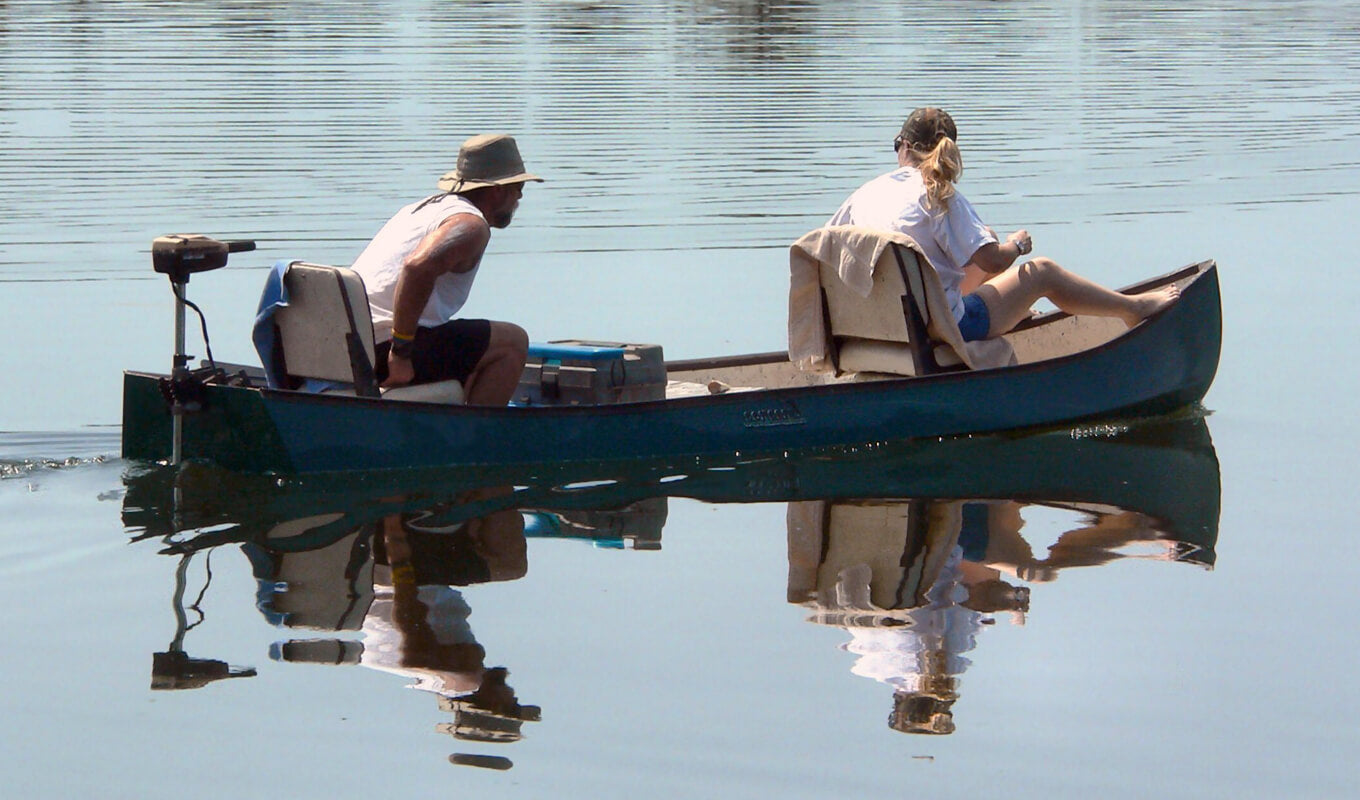
Man and a woman riding a boat with a trolling motor

Trolling motors are a fantastic little add-on to your kayak that essentially transforms your once paddle-powered vessel into a high-performance motorized boat.

If you’ve been thinking about adding a trolling motor to your kayak, whether that be for fishing purposes or to simply run circles around your kayaking buddies, then you’ve come to the right place.

We’ve created the ultimate guide to trolling motors, including the benefits of kayak trolling motors, the best trolling motors for kayaks on the market, and the main things to look out for before purchasing.

So, if you’re wondering what are the best kayak trolling motors for your specific kayak, keep on reading as you’re about to become an expert.

What is a Trolling Motor?

A trolling motor is a relatively small electric engine that attaches to the back of a kayak to help propel it through the water at faster speeds. These motors are often used by kayak anglers as they emit very minimal sound and allow fishermen to creep up on their potential catch.

In general, trolling motors are fairly straightforward pieces of gear, and it doesn’t take a genius to figure out how to use one. To turn in any direction, you simply move the handle of the motor left or right. And if you don’t want the motor in the water for any reason, you can quickly and easily pull it out thanks to the rotational clamp that secures the motor to your kayak.

Benefits of a Trolling Motor
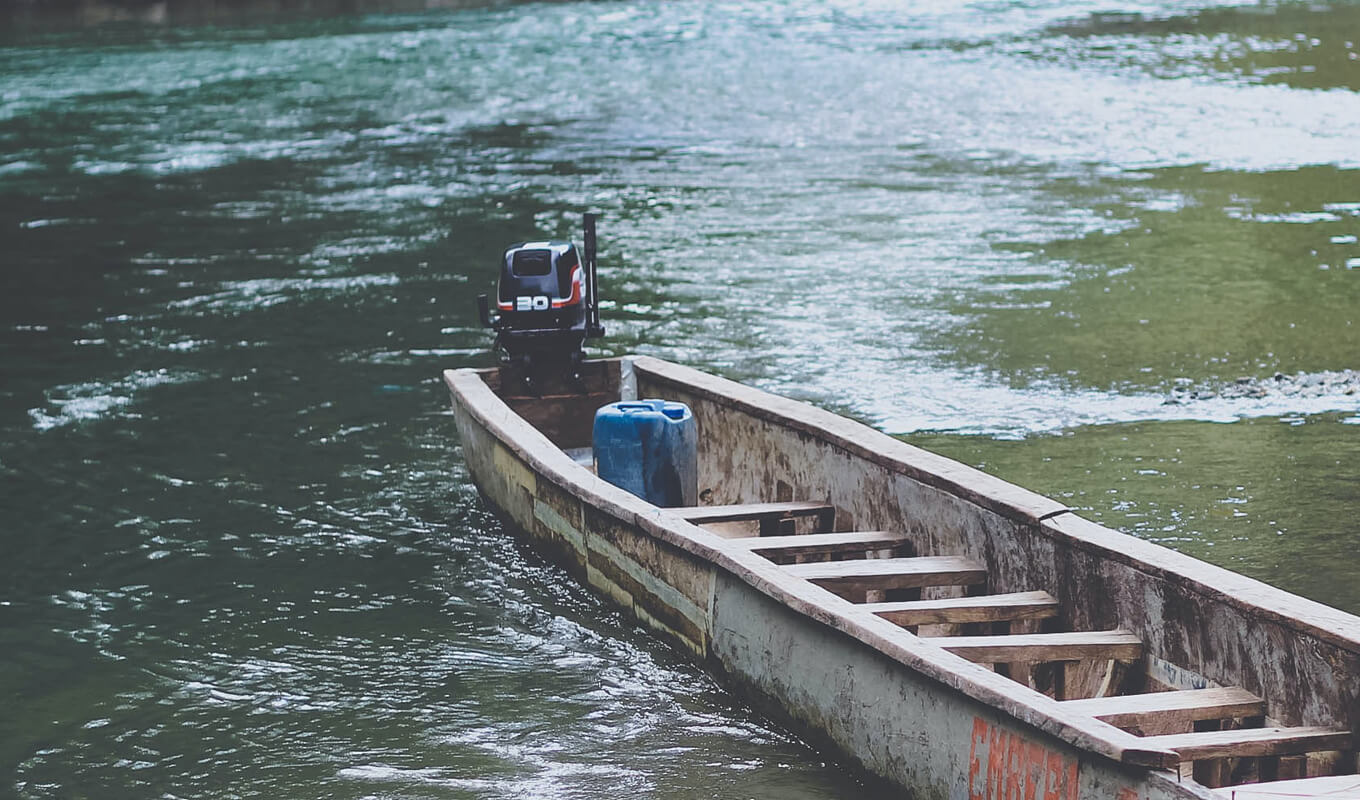
Long boat with a trolling motor

Granted, kayak makers originally designed kayaks to be powered by paddle, but no one ever said you couldn’t amp up the kayak’s performance by adding a motor. Motors are a great way to transform your recreational kayak into the ultimate streamlined fishing vessel, and if you weren’t already swayed into purchasing your own trolling motor, you will be thanks to these incredible benefits.

No Splashes

The first major benefit of a trolling motor is the fact that they barely disturb the water. This reason alone is what draws in many kayak anglers, as with a trolling motor, you’re able to creep up on fish in a way you wouldn’t be able to with a paddle.

Hands-Free Fishing

Another huge benefit to a trolling motor is the fact that it removes the need to paddle, meaning you can be hands-free at all times. As well as freeing up your hands to hold other things such as a fishing rod, eliminating a paddle also gives your arms a break as we all know how tiring paddling a kayak can actually be.

Convenient and Useful in Emergencies

There is no shame in getting tired mid-paddle because, after all, just an hour of paddling can burn roughly 476 calories. A trolling motor allows older or slower paddlers to keep up with the pack without getting physically exhausted. They are also extremely useful in the event of an emergency as they’ll get you back to shore far quicker than a paddle ever would.

You Can Head Down to Smaller Tributaries

If you’re trying to decide between a regular fishing boat or a trolling motor-fitted kayak, then in our opinion, the kayak will come out on top. Kayaks that are fitted with a trolling motor are extremely streamlined and portable, meaning you can head over to more remote or narrower tributaries that larger boats can’t enter.

GILI’s Top Picks: By Budget

8 Superior Trolling Motors for Kayaks

Newport Vessels NK 180

It doesn’t get much more premium in the world of kayak trolling motors than the Newport Vessels NK 180. Newport Vessels designed the NK 180 specifically for kayaks, and the 24-volt, 60 pounds thrust motor will have you zipping through the water quickly, efficiently, and most importantly, quietly.

If you have a drill on hand, you can easily attach the aluminum motor mount to the back of your kayak. Once you’ve attached the motor mount, you can then further attach the motor as the package comes with (almost) everything you’d need to get out on the water. For those with a power pole already installed to their kayak, the good news, the installation process will be even easier.

The one thing you will need to purchase separately is a lead acid deep cycle or a lithium deep cycle battery that has a nominal output voltage between 24V and 29V. And then, once you’ve installed the battery, you’ll be ready to hit the water using the speed controller, the digital throttle control, and the steering cables.

Newport Vessels 55 lbs Thrust Kayak Series

The Newport Vessels’ Kayak Series made it onto our best kayak trolling motor list thanks to its impressive 55 pounds of thrust. And yes, you won’t need anywhere near that amount for your tiny little kayak, but it’s always nice to have the option.

Newport Vessels gave their 55 lbs thrust electric kayak motor a 24-inch adjustable shaft, which is ideal for most standard kayaks. And as the adjustable feature makes the motor versatile, if you ever upgrade your ‘yak in the future or if you switch over to a canoe, you won’t need to buy a new motor.

Staying on the topic of the motor’s shaft, Newport Vessels designed their motor out of fiberglass so you can use it as a freshwater or saltwater kayak trolling motor. This ability to kayak in any water type of waterway makes the Newport Vessel’s trolling motor an excellent option for recreational kayakers who like to switch up their kayaking destinations.

To help improve the trolling motor’s performance, Newport Vessel equipped it with a 6-inch telescoping handle and eight different speeds: five of which propel the kayak forward and three which reverse it back.

And to finish off, Newport Vessels also added an interesting feature to the throttle. The throttle on the 12-volt trolling motor clicks when you change gears or when you turn the motor off which helps prevent you from accidentally leaving the motor on and subsequently draining the battery.

AQUOS Haswing Electric Trolling Motor

The AQUOS Haswing Electric Trolling Motor comes in at the mid-range price point for trolling motors, and with an available and adjustable shaft length of 24.4 inches, it is a suitable option for kayaks and other small boats.

AQUOS equipped their saltwater trolling motor with five forward and three reverse speed options to give the user ultimate speed control while out on the water. And then, to further help with controlling the motor, AQUOS added an ergonomic adjustable 13.7-inch handle so you can steer and direct your kayak from the comfort of your kayak seat.

Some other mentionable features of the Haswing Electric Motor include the ability to tilt the motor out of the water when the depth of the water changes, the corrosion-resistant metal components making it perfect for saltwater fishing, and the LED power reader that lets you check your battery power at any time.

GoPlus Electric Trolling Motor

The Goplus Electric Trolling Motor comes in a 46 lbs, 55 lbs, and 86 lbs thrust variation, however, as you’re only powering a kayak, we’re focusing on the smallest of the three. Goplus designed their electric trolling motor to have 8-speed control settings, 5 of which run forward and 3 in reverse. You can easily adjust these speed controls by turning the dial on the ergonomic telescopic handle, which can also be adjusted for optimum comfort.

To make the motor as sturdy as possible, Goplus created it out of fiberglass composite rods, die-cast aluminum heads, and reinforced composite materials so it is able to withstand damage, warping, and bending in both salt and freshwater conditions.

And if you find yourself traveling through different water depths, you can adjust the shaft height and the shaft angle at the mounting bracket tilt mechanism for proper depth placement. This feature also means that you can comfortably steer your kayak from a sitting or standing position without any issues.

Cloud Mountain FineFind 36 lbs Thrust Electric Trolling Motor

The Cloud Mountain FineFind Electric Motor is another motor that comes in a range of different thrust options, from the smallest 36 lbs, which we’re focusing on today, to the largest 86 lbs, which is suitable for larger boats.

Cloud Mountain designed their 36 lbs motor out of corrosion-resistant fiberglass and ensured that you can adjust the shaft for proper depth placement in all types of water conditions. Then, to aid even further in durability, they added a reinforced nylon bracket and saltwater-compatible hardware so your motor will stand the test of time for years to come.

As with many other trolling motors on this list, the FineFind Electric Trolling Motor has 5 forward and 3 reverse speed setting on the 6-inch telescoping adjustable handle so you can control the speed and direction in which your kayak is going.

Watersnake Tracer Transom Mount Trolling Motor

The first Watersnake trolling motor to make our list is the Tracer Transom Mount Trolling Motor. This motor, in particular, has 30 pounds of thrust, however, there are larger options if you’d like a more versatile and powerful motor.

Watersnake gave their trolling motor 7 different speed options, five forwards and two in reverse, which you can control by the speed dial on the extendable handle. And speaking of extendability, the shaft is also adjustable and designed out of chrome-plated steel, so you can use the motor in saltwater.

Watersnake T18 ASP

If you’re after an incredibly lightweight trolling motor, then look no further than the Watersnake T18 ASp. This 18-pound thrust motor weighs only 4.85 lbs making it the lightest option (by far) on our list.

Most kayak trolling motors come with much larger thrust power, but if you’ll only be using the motor for kayaking, then this 18-pound thrust option will provide you with all the power you’ll ever need. If you do want the ability to switch the motor onto a different vessel, however, then the Watersnake T18 ASP also comes in a 24-pound thrust version.

Watersnake fitted their T18 ASP motor with an adjustable mount fitting that is compatible with a variety of fishing kayak fittings. They also decided on a 24-inch shaft length and created it out of alloy and stainless stress, so it is suitable for both fresh and saltwater.

Minn Kota Freshwater Trolling Motor

The good news for those shopping on a budget, cheaper trolling motors such as the Minn Kota Freshwater Trolling Motor will still provide you with all the power you need to get your kayak from A to B. The Endura Minn Kota Trolling Motors has a 30 to 42-inch shaft and provides kayakers with thrust levels of 30 to 55 pounds.

During the design process, Minn Kota created their motor from composite materials and gave it five forward and three backward rev settings. Something they also improved with this model is the battery life which now allows you to spend more time on your favorite lake or river without having to worry about your battery running out.

Comfort and ease of use were also heavily thought about, so Minn Kota equipped the Endura with a six-inch telescopic tiller that improves the motor’s overall comfort and ease of use.

Things to Consider When Choosing a Trolling Motor for a Kayak

Boats with motors

Before purchasing a trolling motor for your kayak, there are a few things you need to keep in mind.

Power

Kayaks are fairly small boats, and trolling motors, in general, are designed for boats far larger than your diddy little ‘yak. This means that you won’t need to worry too much about the power of your trolling motor, but we understand it’s useful to know what kind of voltage range is suitable.

For the most part, a 12-volt trolling motor would be more than enough for a kayak seating one or two people.

A general rule when it comes to kayak motors is that you’ll need 2 pounds of thrust for every 100 pounds of loaded weight. And when you’re on the market for a trolling motor, you’ll soon notice that even the puniest electric motor will provide you with more than enough thrust to power your kayak.

Control Type

Many electric trolling motor models will come with a foot pedal, and although foot pedals are incredibly useful on bass boats, they’re essentially pointless on a kayak. Instead, you’ll want a tiller handle trolling motor, which allows you to simply direct the direction of the boat by pushing the handle right or left.

You will also find remote-controlled trolling motors on the market, but these are more expensive than a standard tiller handle trolling motor.

Shaft Length

Trolling motors come in a range of shaft lengths, often being fairly long to reach the water from a bass boat. When it comes to kayaks, however, these long shafts cause a problem, so you need to pay close attention to how long the shaft of your motor is.

When purchasing your kayak trolling motor, you need to ensure that the propeller of the motor would sit 12 inches under the water. If the propeller is higher than 12 inches, it will suck air from the surface and create a lot of noise.

To figure out if the shaft length would be suitable for your kayak, measure from the horizontal bar of your motor mount to the surface of the water. Then, add 12 inches to this figure and a further 3-4 inches if you’ll be kayaking in rougher waters. This combined figure is your ideal trolling motor shaft length.

Mounting System

Most trolling motors are designed for bow mounting on a bass boat, but with a kayak, you’ll need a transom mounting system. Transom mounting systems fit the scuppers in your kayak’s cockpit, and once installed, the system will provide you with a solid bar that you can then mount your trolling motor.

Weight

Something many people don’t consider is the additional weight a trolling motor adds to your kayak. All kayaks have a maximum weight capacity, and your weight, the weight of any fishing gear (if you’re using your kayak for kayak fishing), and the additional weight of a trolling motor could tip you over the limit and cause your kayak to sink into the water.

Before you purchase a trolling motor, calculate your weight, the weight of any passengers (if you’re paddling tandem), and the weight of any gear that’ll be on board at any given time. Then add on the weight of the trolling motor you have in mind and ensure that you remain under your kayak’s maximum weight limit.
FAQ’S

The 8 Glands of a Whitetail

0

WHITETAIL DEER GLAND KNOWLEDGE

KNOW THE 8 GLANDS!

If you took a test right now on deer glands, how would you do? Do you know how many glands a whitetail deer has? Do you know where each gland is located? Do you know the function or purpose of each gland? If you are not sure how to answer any of these questions, you are not alone.

Over the last decade, I have been making mock scrapes and using only three glands lures. After learning more about some of the other glands, a whitetail uses to communicate with I have added more lures to my hunting arsenal. Let me help you understand the eight glands of a whitetail, their purpose and how BuckStik Products Utilizes and presents the three main communication glands creating the most powerful Communal Mock Scrape System on the Market.

GLANDS ON THE LEG

Interdigital Gland

Whitetail deer have an interdigital gland between their hooves on each foot. To see this gland, you will have to spread the deer’s hoof apart and look between them. Between the hoof, there is a small hole that allows the interdigital gland secretion to come out.

Each deer has a distinct odor. The interdigital gland allows deer to identify one another. Each time a deer takes a step, it releases a small amount of the gland secretion. Why is this so important?

The importance of the interdigital gland allows a mother to locate their fawns. Bucks can find a doe bed, check it, and follow a doe that might be in estrus. Non-receptive does will be on high alert when they smell the interdigital gland lure from a cruising buck. Deer know their home range well and like to know there are no intruders.

This is one of the three main glands BuckStik utilizes at the ground level during the season.

Metatarsal Gland

The metatarsal gland is located on the outside of a whitetail deer’s back legs. About five to six inches above the deer’s rear hooves is a white tuft of hair. Inside of the hair is an opening that is a duct for the metatarsal gland.

The metatarsal gland will give off an aggressive odor during the rut to warn other bucks in the area. Each deer will have a unique scent that it will give off. Bucks can become familiar with the individual odor of each other. The metatarsal gland seems to be larger in deer that live further north. Some biologists claim that deer are no longer using this gland. I am not sure what to think because I use the gland lure for hunting almost every year.

Tarsal Gland

A whitetail deer has two tarsal glands that are located inside the deer’s hind legs. You can find the tarsal glands where the deer’s back legs bend. The large tufted of lightly-colored hair sticks out and is strategically placed for the deer to create a unique scent specific to that deer.

Because of the unique odor hunters can sometimes smell a buck before they see him. The pungent odor is always most potent during the rut when the deer are making scrapes. When a buck is worked up, the hair on the tarsal glands can stand erect as a sign of aggression or dominance. Some deer biologists believe the tarsal gland scent can signal a doe that a buck is ready to breed.

GLANDS ON THE HEAD

Nasal Gland

The nasal glands are inside the deer’s nose. Biologists describe the glands as being shaped like almonds. The nasal glands are essential for deer. Hunters know deer rely heavily on their noses to help them detect odors in the air. But there is another vital purpose for the nasal gland.

The primary purpose of the nasal gland is to detect odors in the air to help deer survive. Deer are constantly checking the air and walking into the wind, so they know what is around them. A deer’s nose is far better than their eyes!

The second purpose of the nasal gland is two-fold. The gland lubricates the nasal passage, which allows deer to detect scents. The lubricant from the nasal gland can help deer leave their scent on licking branches.

Preorbital Gland

A deer has two preorbital glands that are just below the corner of their eyes. The preorbital gland has two different glands located in the tear duct. The sudoriferous and sebaceous glands are the glands inside of the duct. The preorbital glands are controlled by muscles and can open wider to emit an odor.

The primary purpose of the preorbital gland is a tear duct that helps lubricate the eyes. Deer will often put a licking branch in the corner of their eye. The preorbital gland will open and let the liquid from the gland cover the branch. Biologists believe this is a way that deer will self-mark areas. Older bucks often have preorbital glands that are more defined, which may be a sign of aggressive behavior towards other deer.

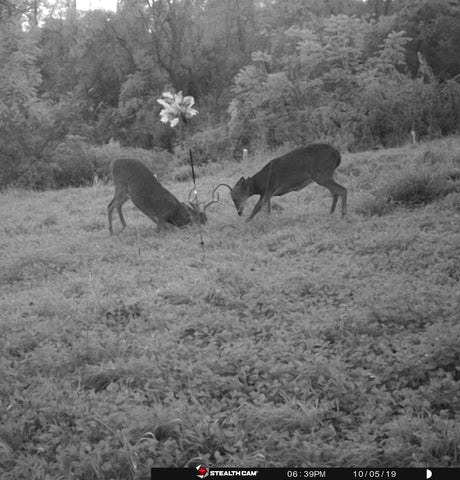
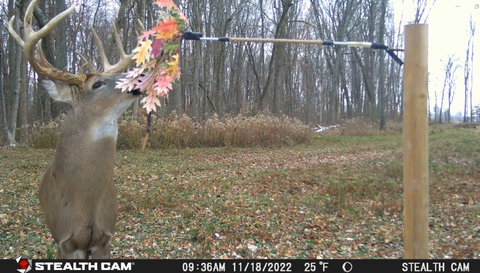
This is the primary gland that is used year round with the BuckStik/BuckBranch. A single spray elevated off the ground on the vine/ropes/leaves produce the greatest effect.

Forehead Gland

The forehead glands are located above the eyes and between the antlers of a buck. A doe also has forehead glands above their eyes and between their ears. The glands will start to produce an oily substance in September. As the rut moves on, the glands will secrete more oils. The secretion will cause the hair on the buck’s forehead to get darker and even reddish.

The purpose of the forehead glands on a buck is essential. As a deer marks a tree with the oily substance, it leaves some information for the other deer in the area. A deer can learn three things from a rub: First, a deer can determine the age of the deer, making the rub. Secondly, a rub can explain a deer’s social status. Finally, it can communicate to other deer its breeding status.

An older buck secretes more oils from his forehead glands. Thus, older deer will mark more trees. Some biologists believe that forehead gland secretion has a pheromone that can help a doe come into estrus.

Lastly, the Forehead gland completes the 3 gland communication system with the BuckStik. A single Spray on the forehead strip of the BuckStik will have your Bucks both young and old rubbing all day long.

Salivary Gland

The salivary gland is inside the mouth of the deer. The glands are on the roof of the deer’s mouth, in their cheeks, and gums. Deer use their salivary glands for more than just digesting food.

The primary purpose of these salivary glands is to produce saliva. The saliva will help a deer digest food it eats and is also vital for marking. Deer will deposit saliva on branches, vegetation, and trees to let other deer know they are in the area. When a deer takes the licking branch in its mouth, it will bite down with their teeth. Biting the branch allows the deer to deposit their scent to the licking branch.

NEWEST GLAND

Preputial Gland

This gland is located in the penal sheath of the buck. It has two primary purposes: lubrication for breeding, and it contains sperm for reproduction. The preputial gland is the newest gland that has been found and studied. Deer biologists believe it to be used for communication during breeding, but there is no hunting use at this time.

In Summary,

These eight glands are used daily in the whitetail world. Some are used more than others, and some are only used during certain times of the year. Deer use non-verbal communication to interact all of the time.

The BuckStik is a true pheromone communication system that ideally presents the Three Main Communication Glands at the ideal height for interaction. By presenting the Preorbital gland elevated in the vine/ropes, the forehead gland in the rubbing strip, and the interdigital gland a ground level it creates the ultimate communal mock scrape system.

Gland Presentation combined the the BuckStik’s ability to capture and hold deer DNA (Gland Secretions, hair) better than anything natural create an amazing communication hub that will last for years. Never again will you have to start over from scratch with a natural branch as the BuckStik lasts multiple seasons.

In the next post, I will give you some strategies on how to use each of the gland lures while hunting.

By Brian Kightlinger

How to Make Homemade Sausage

0

If you are interested in making homemade sausage, you are in the right place. I have been making sausage for decades, and I’d like to share with you my comprehensive tutorial on how to make sausage at home.

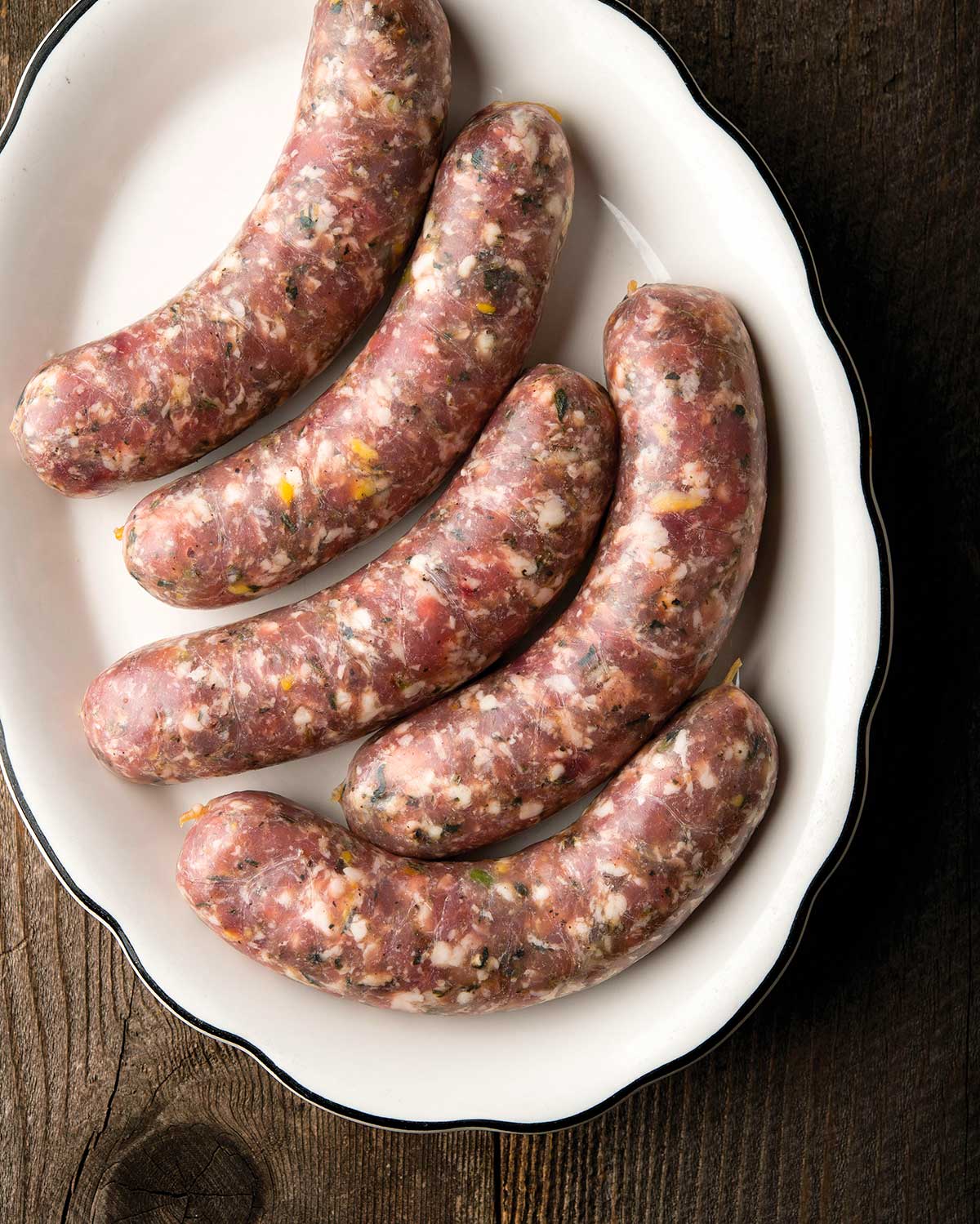
A platter of hot Italian sausages.
Photo by Holly A. Heyser

I’ve learned a lot in the decade-plus since I first wrote instructions on how to make sausage. Each year I learn a new tip or trick, a bit more about meat science, how to get a better bind, which casings are better than others, etc.

This will be a fairly comprehensive article on homemade sausage, meant to get you started, with a sample sausage recipe at the bottom. But understand that making sausage is a process, one you will not perfect the first time out. Perfection comes with practice, precision, plus a little luck.

Why Make Homemade Sausage?

Fair question. After all, even small supermarkets sell several kinds of sausages. The reason is that making your own gives you control. Control over the meat and fat, control over the seasonings, control over the grind, the size and thickness of the links, control over whether your homemade sausages are smoked or fresh.

Anyone reading this who hunts or raises livestock will also want to learn how to make sausage. After all, it’s a wonderful thing to make when you bring home a deer, or some ducks, a mess of pheasants, or after your annual hog slaughter.

Making sausage can be as easy or as hard as you want. Whipping together a batch of homemade sausage without casings is as easy as making meatloaf, which is very similar actually.

Casing links is a little trickier, but it ain’t rocket science. Oh, and yes, there is a little science to know about sausage making.

Basics

At it’s core, sausage is meat + fat + salt, kneaded until it binds to itself. That’s it.

Obviously most of us want to add more seasonings, or maybe stuff the sausage into casings. Or smoke it. We’ll get to all of that below. Let’s break the magic equation above down to its components.

Meat for Homemade Sausage

Any meat will do. I’ve made sausage with lots of weird things, from woodcock and beaver to standards like pork, beef and chicken. I’ve even made fish sausages. My collection of sausage recipes is broken down by general meat type, so that should help you choose one after reading this tutorial.

Unfrozen meat binds to itself better than thawed meat, and pork binds to itself better than other meats. A good compromise is to use your thawed game meats and some never-frozen pork shoulder or belly.

The gnarlier the meat in terms of connective tissue, the more times you will want to grind it. Most sausages I make are ground twice. More on that in a moment.

Fat in Making Sausage

Let’s talk fat. Homemade sausage almost always has pork fat in it, because, well, it’s superior to other fats in terms of melting point, availability and flavor. The best pork fat is fatback, off the back of the hog. Belly is OK, but a little soft. Shoulder is a nice compromise and easy to get.

Leaf lard, or any fat from the interior of any animal, will be harder than fat on the outside of the animal. It’s so hard — meaning it has a higher melting point — that I won’t use it from lambs, goats or cattle, whose fat has a higher melting point to begin with.

Oh, and if you want to use fat from deer, elk, moose or any other cervid, read my article on cooking deer fat here. Short version: Use very little in homemade sausage. Note: pronghorn aren’t cervids, so their fat is fine to use.

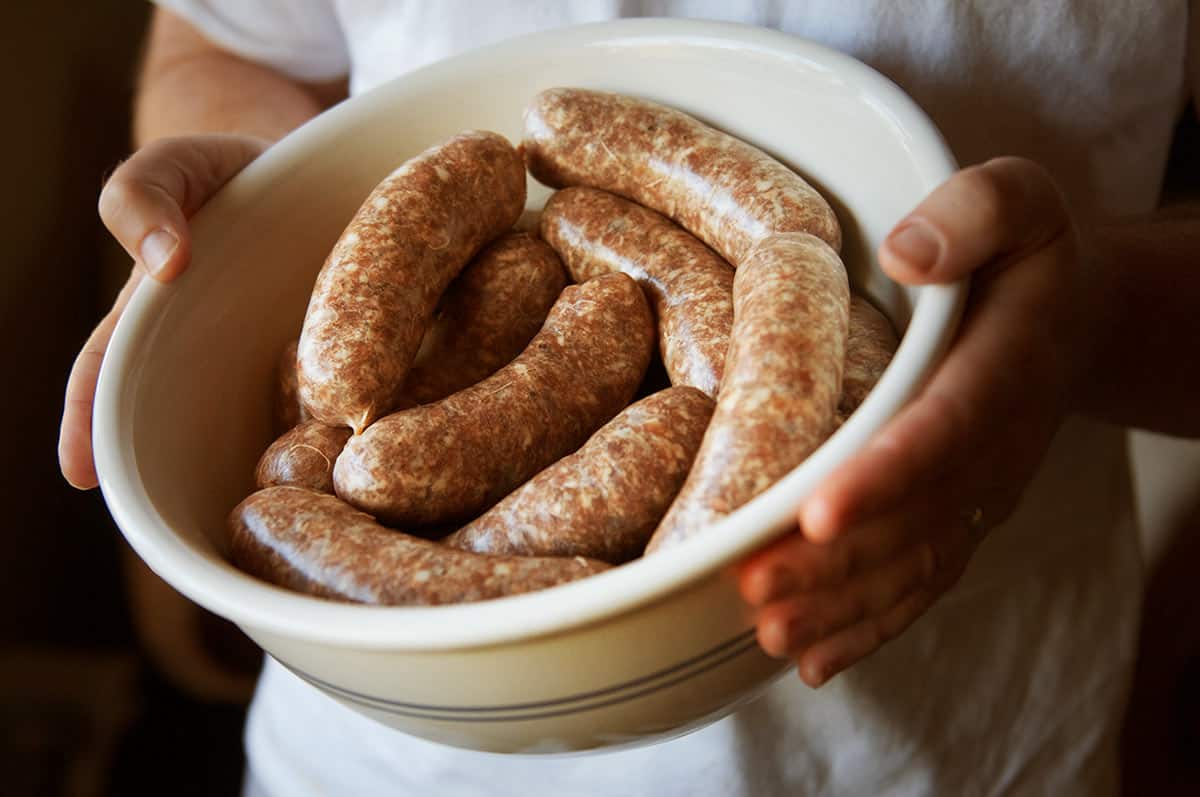
Hank Shaw holding a bowl of freshly made sausages.
Photo by Holly A. Heyser

Beef fat, or that from other bovids like bison, nilgai, oryx, yak or musk ox, is perfectly fine when harvested from the outside of the body cavity. It can be too hard when taken from the inside, but it does depend on the animal’s diet.

Bird fat is too soft for making sausage, unless you are making an emulsified sausage, like a hot dog.

Never use lard. Previously rendered fat won’t work in normal homemade sausage.

In terms of percentage, you will want no less than about 15 percent, and no more than about 35 percent. I shoot for about 20 to 25 percent normally.

Salt and Curing Salt

You need salt to make sausage. Period. The very word sausage comes from the Latin salsus, meaning “salted.” My recipes use kosher salt because it’s readily available and lacks additives like anti-caking agents, which can mar the flavor of your links.

I use Diamond Crystal kosher salt. If you use it too, my volume measurements will be the same. Morton’s kosher salt is cut differently, so volumetric measurements won’t be the same — you’ll have to go by weight.

Which is why salting by weight is way, way, way better. When you do that, you can use whatever salt you want in homemade sausage. I really like using salt I’ve harvested from the Pacific Ocean for this, because, well, I am weird like that.

Five links of pheasant sausage on a platter.
Photo by Holly A. Heyser

Along those lines, avoid weird salt. Like those black and bright red Hawaiian salts. Or flavored salts. Also avoid salt with really big crystals because it won’t mix evenly in your sausages.

A general rule for fresh homemade sausage is to use between 1 and 2 percent salt by total weight of the meat and fat. So for a standard 5-pound batch, which is 2268 grams, at minimum, I’d use about 23 grams of salt, which is about 5 1/2 teaspoons. In reality, I prefer my sausage saltier, so I add about 1.5 percent by weight.

Curing salt is not evil. There, I said it.

For the purposes of this discussion we’re talking about sodium nitrite, which is used in smoked sausages. It is there for food safety — it can prevent listeria and botulism — as well as flavor. It’s why hams, pastrami and corned beef have that rosy, hammy flavor.

And for everyone who thinks they’re not getting nitrites by eating “uncured” products, know that the manufacturers are lying to you. There’s a loophole in the regulations that says if you use celery powder, you can say you aren’t curing meats. Well, celery powder is loaded with sodium nitrite, so there you go.

Anyway, rant over. Use one or the other when you are making smoked sausages.

Additives

Not all additives are bad in sausage. I’ve used a lot of them, rejected most, and a few I have turned to repeatedly because they give you a better link. What I am talking about are things like vegetable fibers, dry milk, binders, etc. that can improve the texture of homemade sausage.

Dry milk and a product called C-bind, from The Sausage Maker (it’s carrot fiber) will both help your links retain more moisture. Not usually a problem with fresh sausages, but very useful for smoked sausages.

Butcher and Packer has a “special meat binder” that is really good, and you only need tiny amounts to improve the bind of your sausage. They don’t say what it is, but I imagine it’s ground up fairy wings or gold dust or something…

Holding a slice of venison summer sausage
Photo by Holly A. Heyser

Equipment for Homemade Sausage

Alas, you cannot make homemade sausage without equipment. At the very least you need a grinder. I will not condone making sausage with a food processor any more. I used to, and you might see it as an option in some old recipes here, but it’s gross. Don’t.

Can you make homemade sausage without a grinder? Um, you can, but it’s a terrible process. You need to hand mince pounds of meat and fat without it heating up, then jam it into casings through a wide funnel. I’ve done it, and it sucks.

Grinders

At the very least you need the KitchenAid grinder attachment, which is fine for very small batches. I have used mine, off and on, since the early 2000s. But it’s not for anyone serious about things.

I use a Weston 1/2 horsepower commercial grade grinder. I like it a lot because it’s sturdy and it’s all steel. Some cheap grinders have plastic innards that will die if, say, you get a piece of bird shot jammed in the blade; good grinders have an emergency shut off that prevents the motor from seizing.

Another good grinder I’ve used is a LEM grinder. I recommend the 1/2 horsepower and the 0.35 horsepower models. Don’t bother with dual grind grinders. They jam easier and are hard to clean.

Homemade sausage links, tied off.
Photo by Holly A. Heyser

Stuffers

For the love of all that’s holy, don’t use your grinder as a stuffer! Running finished sausage that you worked so hard to get a good bind through an augur that shears apart that bind is crazy. Buy a stuffer or just make uncased sausage.

I hate the Weston stuffers because they leave too much meat in them when the plunger is all the way down. A few other companies use this design, and it’s silly. Butcher & Packer, the Sausage Maker and LEM make good stuffers.

Yes, it’s a few hundred bucks, but they last forever, are easy to clean and they make really good links.

Casings

I only use natural casings. I don’t like collagen casings because they are barely edible, if at all, and when they are they taste nasty. But you do you.

Hog casings are the norm, and they come in a variety of widths, which have some traditional recipes associated with them. Bockwurst, for example, needs a wide casing. Weisswurst needs a skinny one, or even a sheep casing.

Sheep casings are awesome when you are done making sausage with them, but they rip easily and will cause you to swear while trying to fill them. Consider getting “pre-tubed” sheep casings, which are easir to put on the stuffer.

Beef casings are very wide and are only really used in fresh sausages for recipes where the eater can’t eat pork. They’re mostly used in salami.

The gold standard of casing companies is Butcher and Packer. No one else comes close.

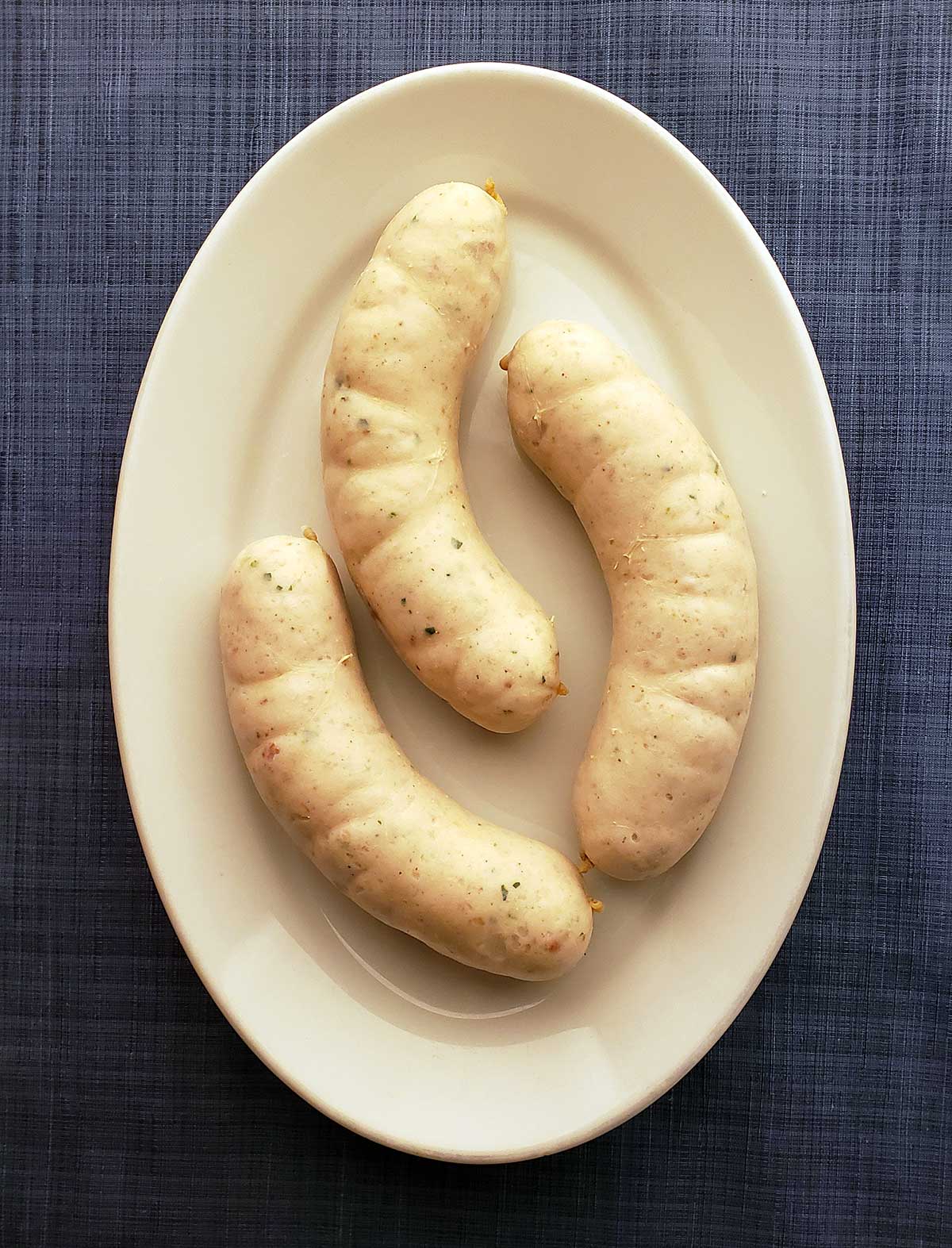
Three links of weisswurst on a plate
Photo by Hank Shaw

Other Random Stuff

I like to have a big needle or a sausage pricker (cue Beavis and Butthead laughter) to pierce the casings of the finished sausage to remove air pockets.

You’ll want something to hang your links from. I use a wooden clothes drying rack.

Spice grinders are useful for, well, grinding spices. Freshly ground spices make a difference.

Actually Making Homemade Sausage

OK, you’re all set. Now what?

A really short tutorial on how to make sausage would look something like this:

  • Cut meat and fat into pieces that fit into the grinder.
  • Add the required salt and/or sugar, mix then put in the fridge overnight
  • Grind once coarsely
  • Grind a second time with lots of seasonings.
  • Chill the meat well, then add liquid, whatever seasonings you didn’t want all ground up, and mix really well for a couple minutes. You’re done if you are making uncased sausage.
  • Put the mix into the stuffer, put the casings on the stuffer, then make a big coil.
  • Make the links from the coil. Tie them off. Hang for a while to “bloom.” Cook and eat.

Before we get into the basic recipe below, I’ll walk you through it in pictures.

Start with meat and fat. Usually with game, the meat is super lean, so I will go something like 3 pounds of this lean meat (venison, duck, pheasant, etc.) with 2 pounds of something fatty, like pork shoulder. Another good option is 4 pounds of lean and 1 pound of pure fatback.

Cut this into chunks that will fit in your grinder, then add the salt and mix. Set this in the fridge overnight. It will change color and get sticky.

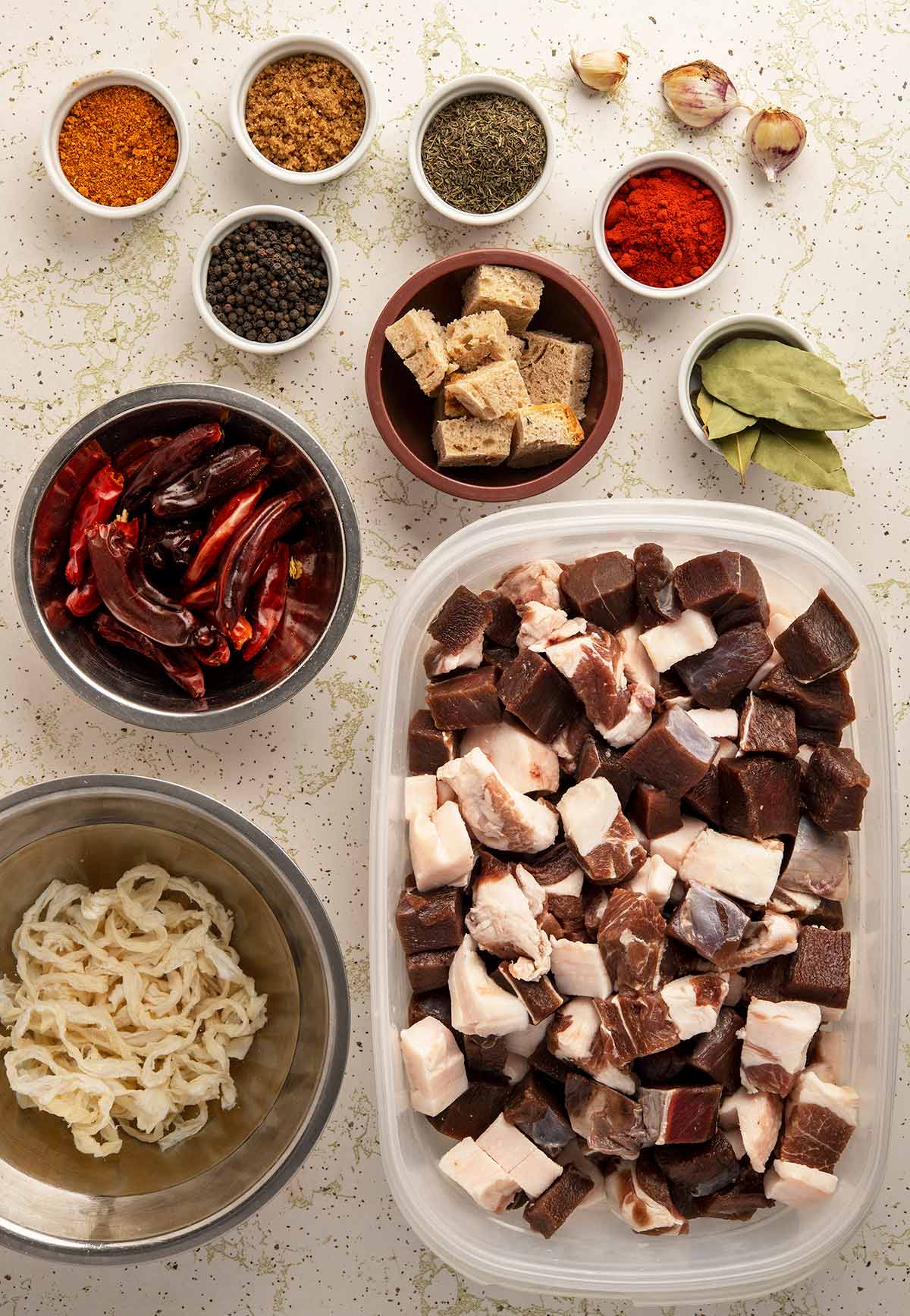
Ingredients for making homemade sausage: casings, meat and fat, seasonings and some bread cubes.
Photo by Holly A. Heyser

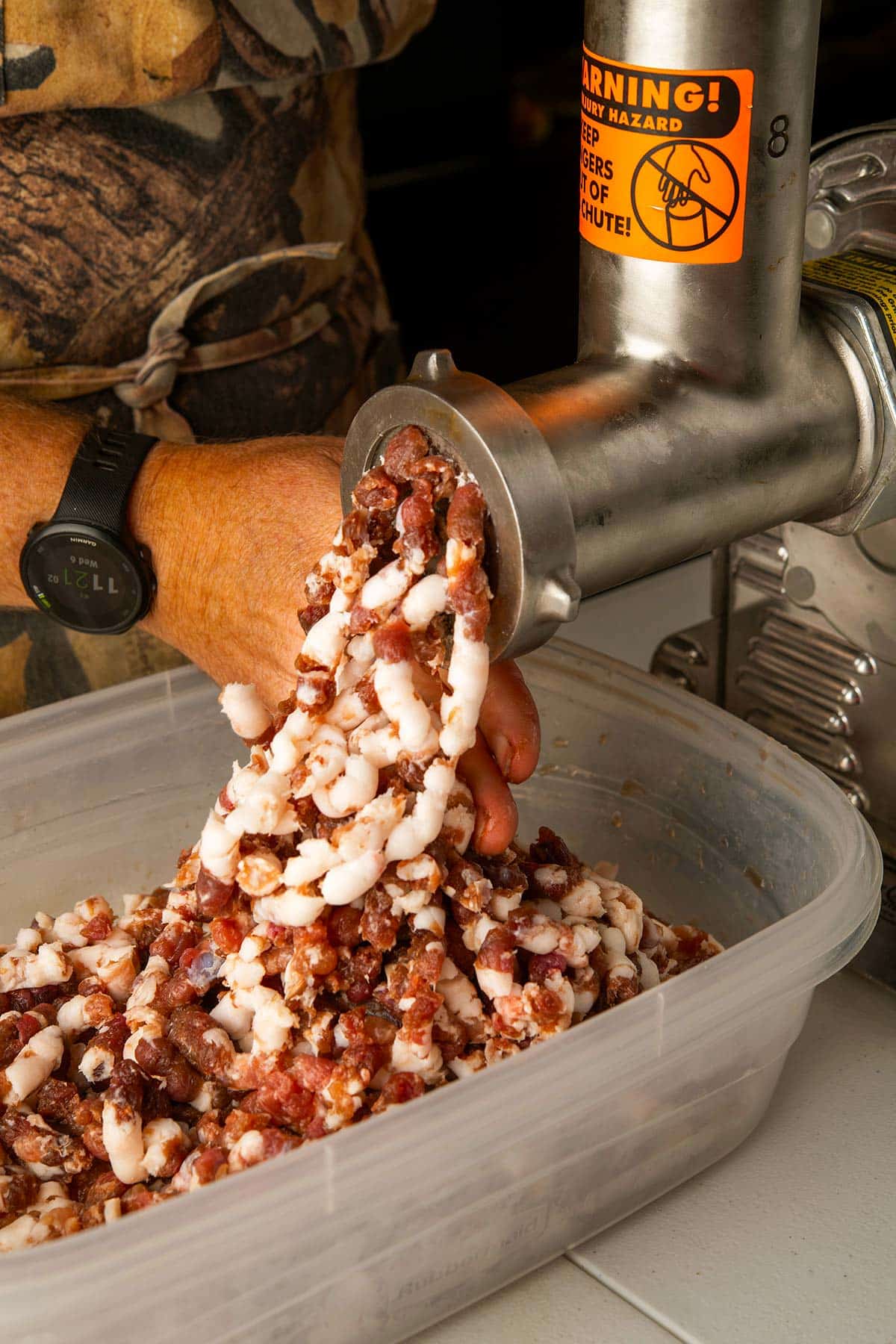
Soak some casings in warm water and get your seasonings ready. I like to freeze my blade, dies, augur and hopper for an hour or more before grinding, to keep things cold — more on that in a bit.

Grind through a very coarse die; I prefer a 10 mm die, but you could go higher if you have one.

Grinding meat and fat for homemade sausages through a very coarse die.
Photo by Holly A. Heyser

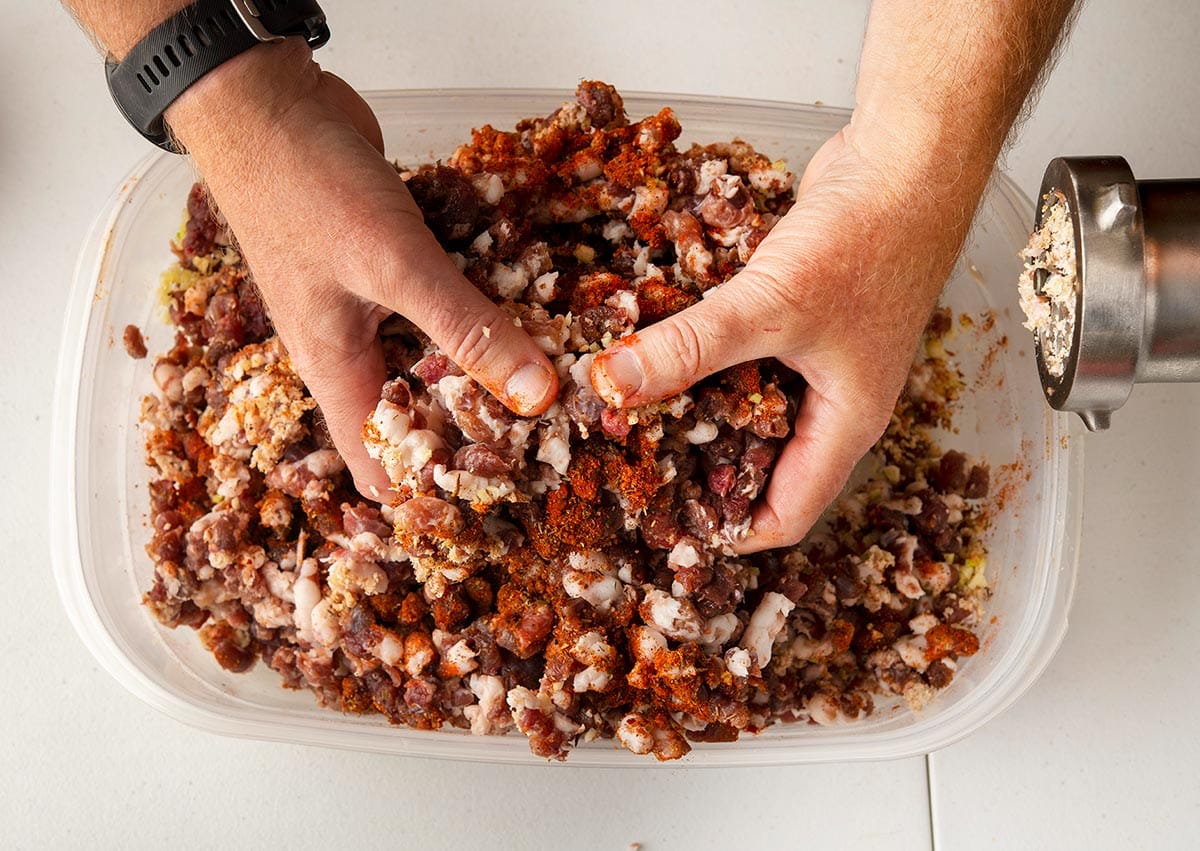
Mix all the spices you want fully integrated into the sausage with the meat and fat. Do this carefully, and don’t squash the mix.

Mixing spices into coarsely ground sausage in a plastic tub.
Photo by Holly A. Heyser

If the mixture is still cold, as in less than about 37F or so, you can grind it again immediately. I do this a lot because I am fast and I start with cold gear.

Beginners with homemade sausage should play it safe and freeze the mixture for 20 minutes or so while you clean up and get ready to grind again.

It is vital for everything to stay cold in this whole process to prevent “smear,” which is when the fat partially melts and coats the meat, breaking its ability to bind to itself. You see this when your sausage comes out crumbly.

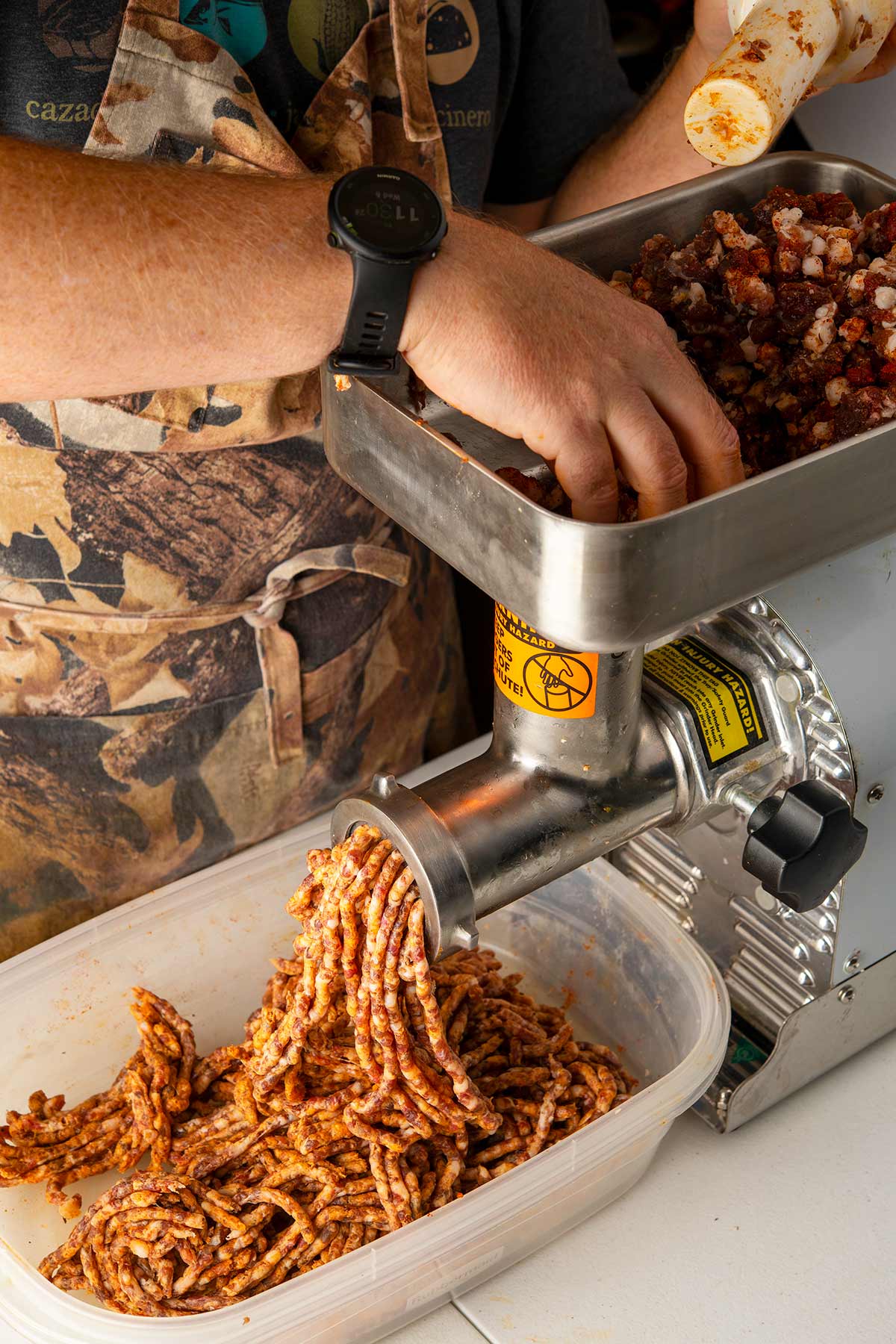
When you’re ready, grind again.

Making sausages: This is the second grind of the meat, into a plastic tub.
Photo by Holly A. Heyser

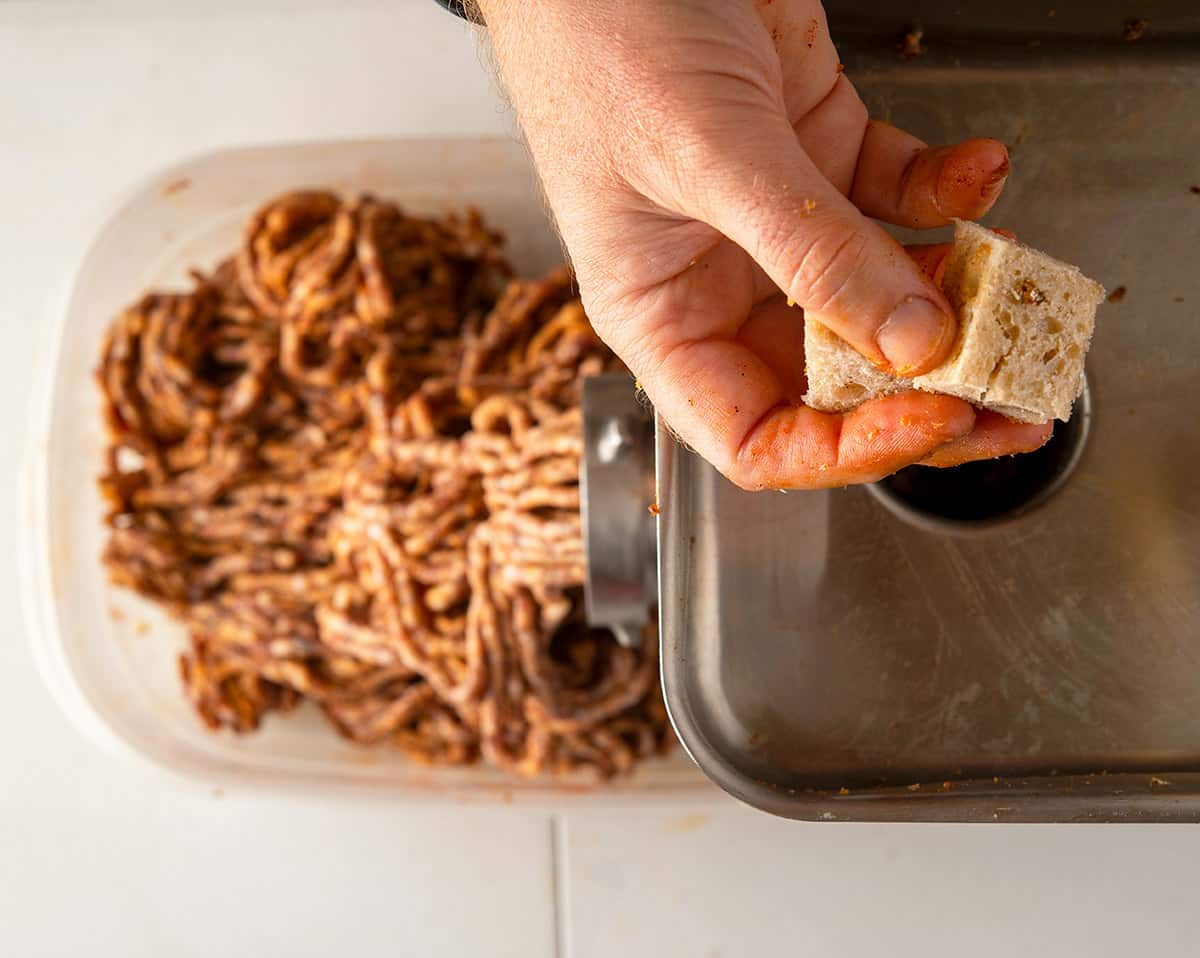
Have a couple pieces of bread, a hamburger roll or something similar handy to finish out your grind; skip this if you are celiac.

The reason is that the bread pushes every last bit of meat through the grinder, so you don’t waste any.

Dropping bread cubes into the grinder to push out every bit of meat left in it.
Photo by Holly A. Heyser

Once you’re all ground, chill the mixture while you clean up. This is important not only to have cold meat and fat, but also because you really do want to clean your grinder right away, or it becomes a nasty, sticky mess. Ask me how I know…

Now you are ready to create the bind in your homemade sausage.

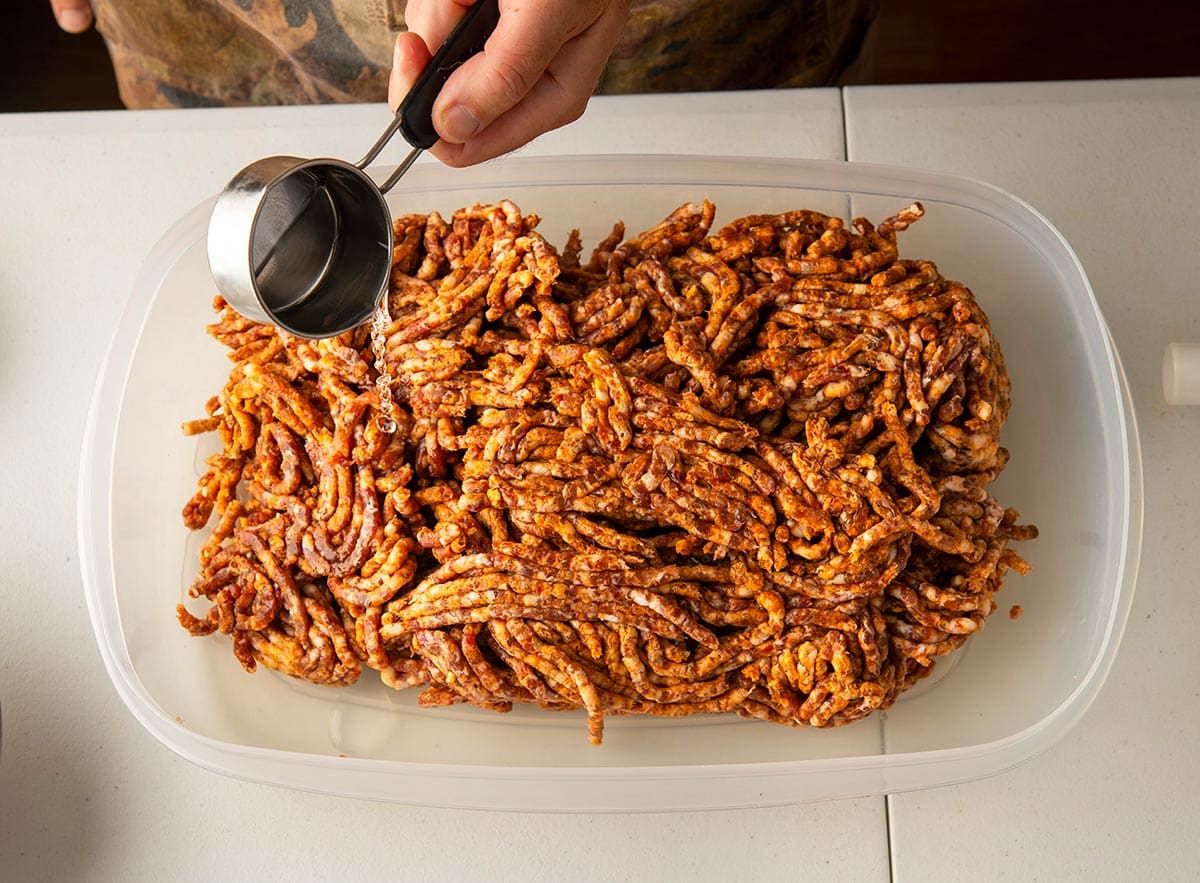
This is when you add ice cold liquid, usually water. Wine, beer, juice, cream are all common in various recipes. Be aware that acidic things will break your bind, so go easy on vinegar if you want a tight, snappy sausage; this is called knacken in German.

Adding ice water to the ground sausage mixture.
Photo by Holly A. Heyser

You’ll also add any herbs or spices you want the eater to see, like cracked peppercorns or parsley or fennel seeds.

Mix, mix, mix! I do this with my (clean) hands for about 2 minutes. Knead like bread. As it so happens, you are creating the same sort of protein bind that exists in bread. It’s gluten in bread, myosin in meat.

This is the moment in making sausage where meat temperature is most critical. If the fat warms and smears here, you’re cooked. Crumbly sausage. What you’re doing is making myosin that forms a network around the fat, and that won’t work well above 40F.

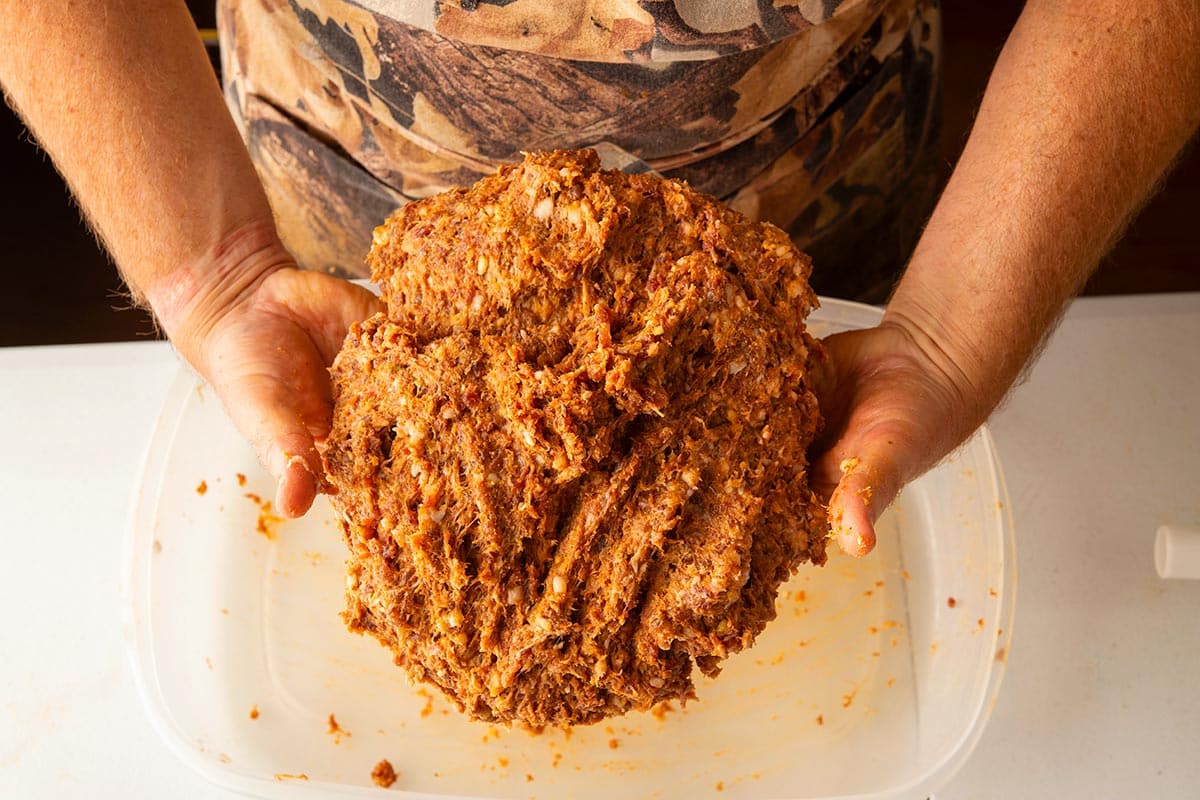
Holding properly mixed sausage, which stays in one piece.
Photo by Holly A. Heyser

You’re done when you see white streaks on the bowl, and when you can pick up the whole shebang in one piece.

Now put the mix in the fridge and clean up again.

If you are not casing your sausage, you’re done! Portion out your sausage into blocks or make patties.

Casing Homemade Sausage

On to casing, which gives people fits until they figure it out. Casing is arguably the hardest part of making sausage, because you need the casings to be tight, but not to burst when cooking. Oh, and by the way, the most common reason your sausage bursts while cooking is high heat, not an over-stuffed sausage.

As I mentioned above, I prefer natural casings, usually hog casings. They’re versatile for most styles of sausage, and are by far the easiest to find. Many supermarkets have them (you’ll have to ask the meat counter people), and all butcher shops will have them.

First off, you will need to soak your casings in warm water to loosen them up; they’re usually stored heavily salted, and often frozen.

If you want, you can run water through your casings to check for leaks. I used to do this when I bought cheap casings, but I’ve never had a leak in any I’ve bought from Butcher and Packer.

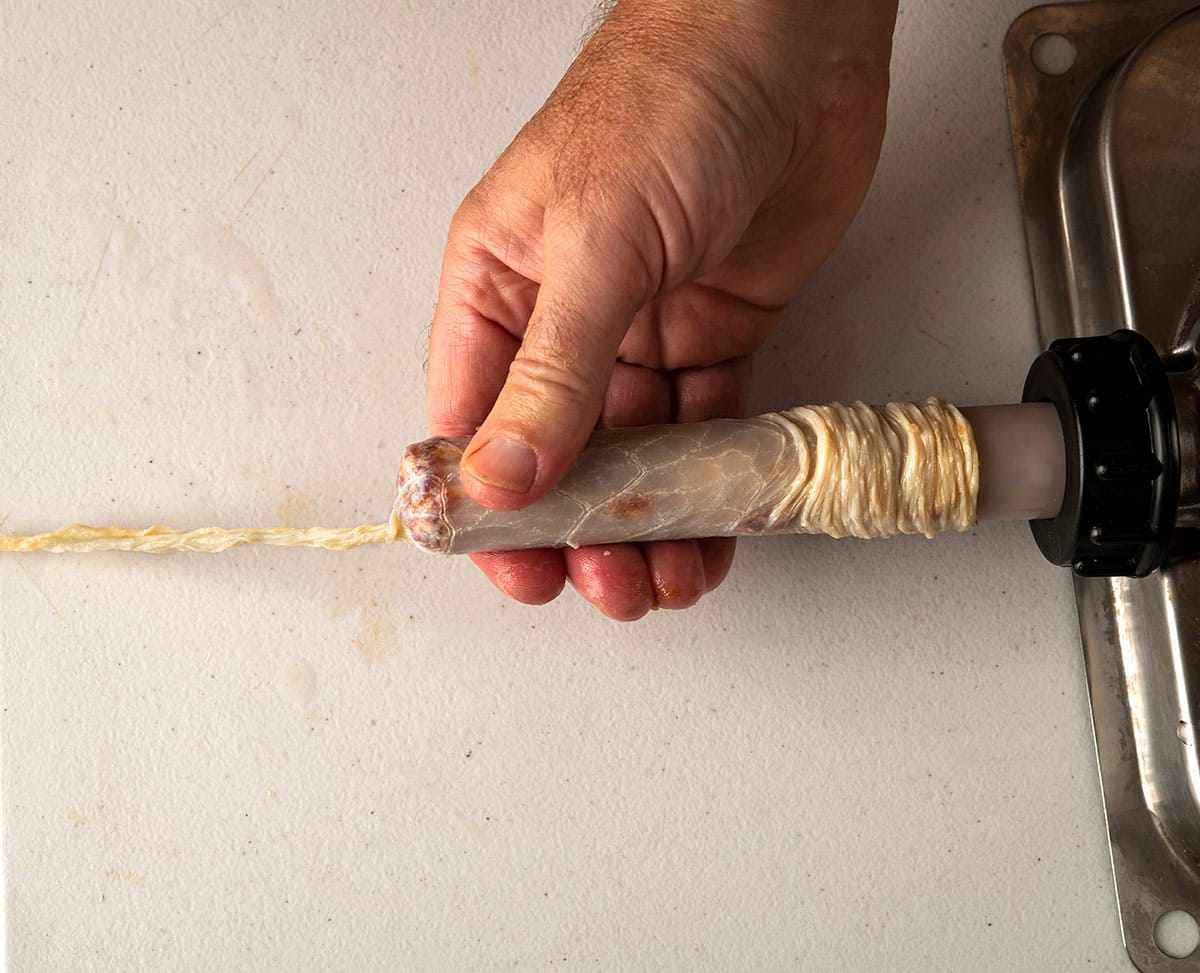
Thread a long length of casing on the stuffer tube; they come in different sizes for different casings. Most are fine for hog casings, but if you work with narrow sheep casings, you’ll need a narrow tube.

Threading hog casings on a sausage stuffing tube.
Photo by Holly A. Heyser

Leave a long “tail” on the end of the casing; this is so you can tie it off easily later. Get the condom jokes out of your system for a while, then crank the stuffer down until you see the end of the sausage come out the tube. Cue scatological jokes, which will remain funny for a half hour or so…

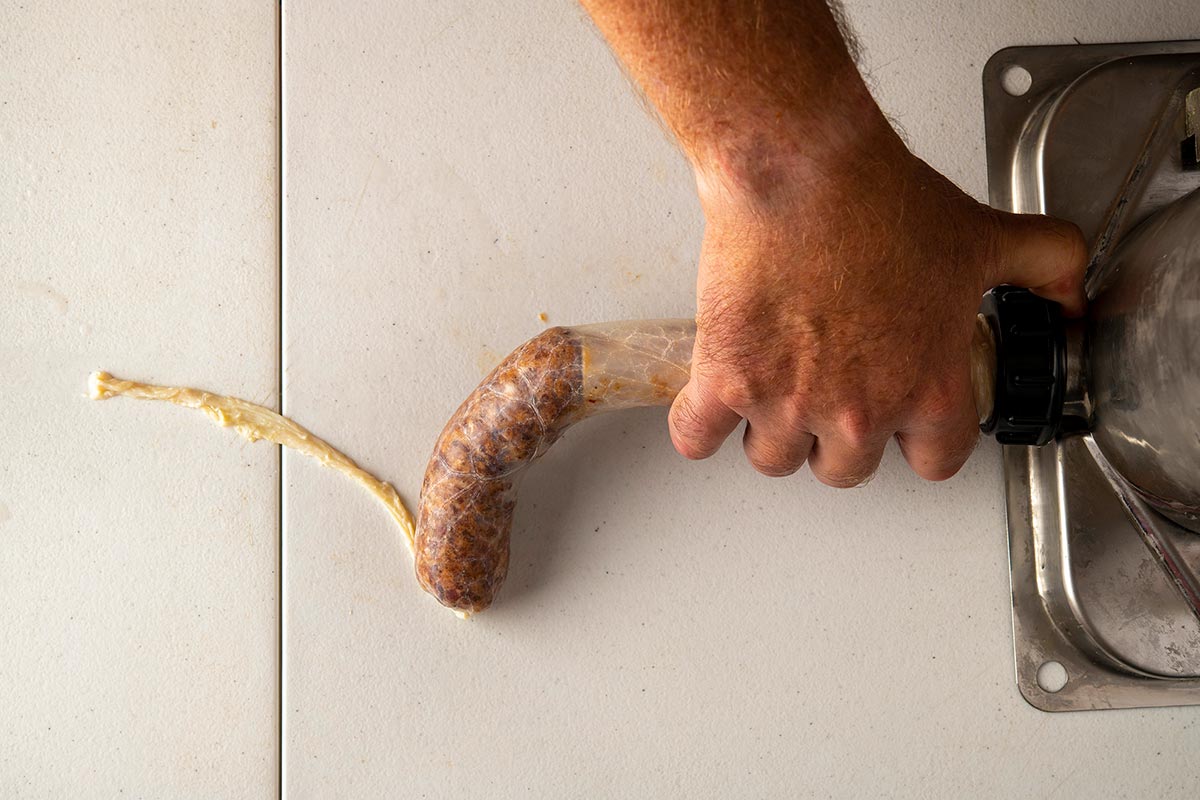
Stuffing homemade sausage with a hand stuffer.
Photo by Holly A. Heyser

Crank out a full coil, fully but not overly tight — you’ll need to twist off links in a moment. Stuff everything before you make links.

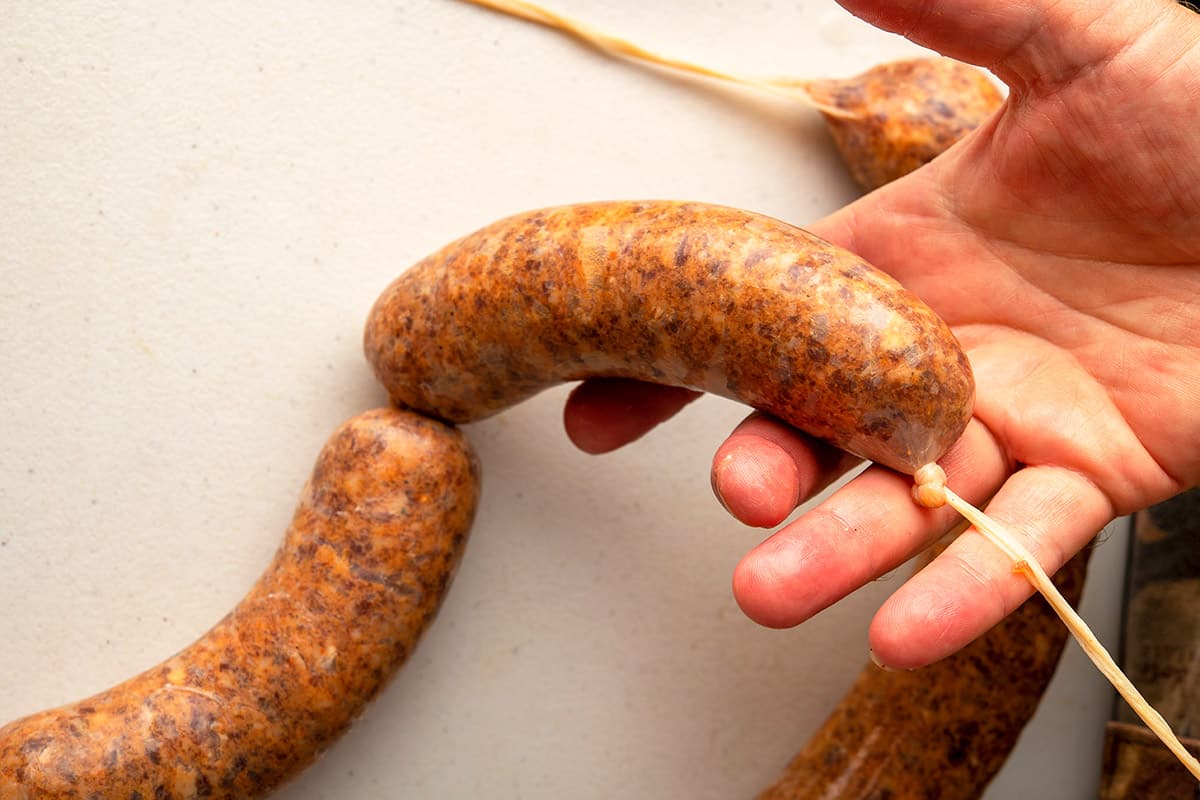
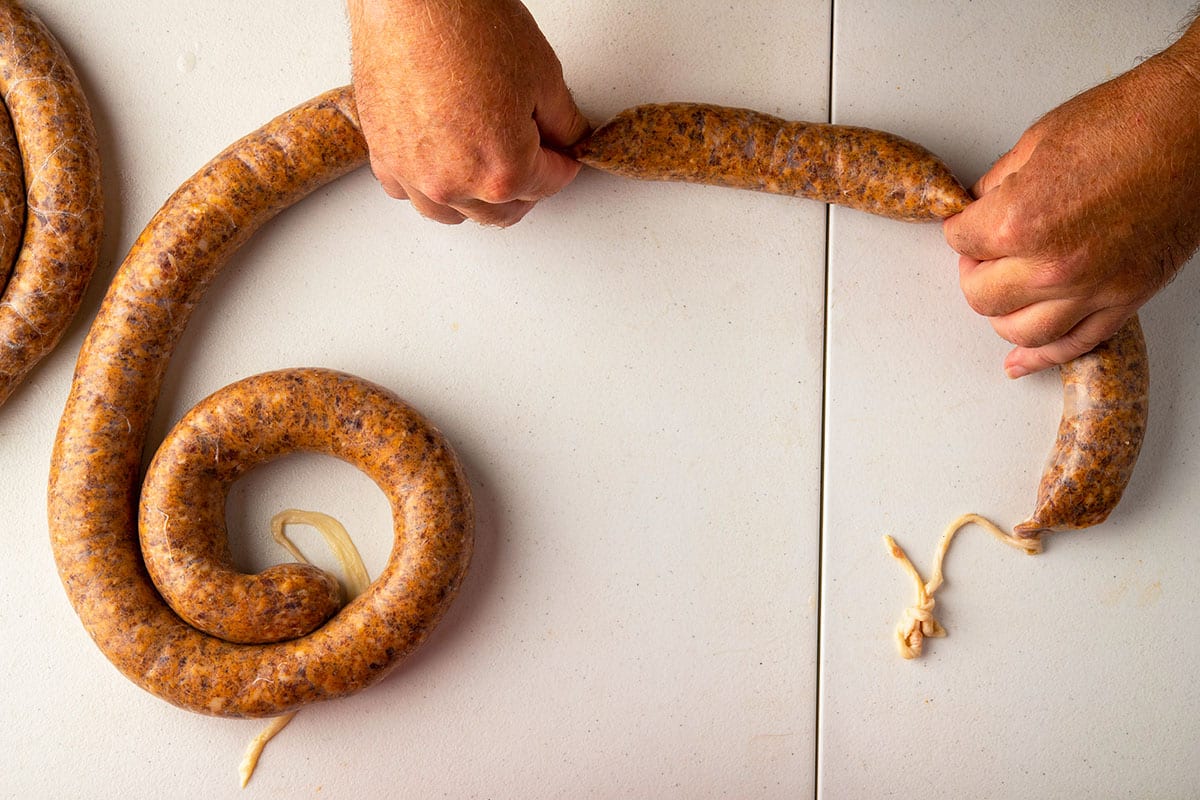
There are a few ways to make links, from tying them off with twine to elaborate twisting tricks. The method I use is simple and it works. The end of the coil is one link. Then you pinch off the next link, spinning it so it will hold.

Pinching off a link of homemade sausage from the coil.
Photo by Holly A. Heyser

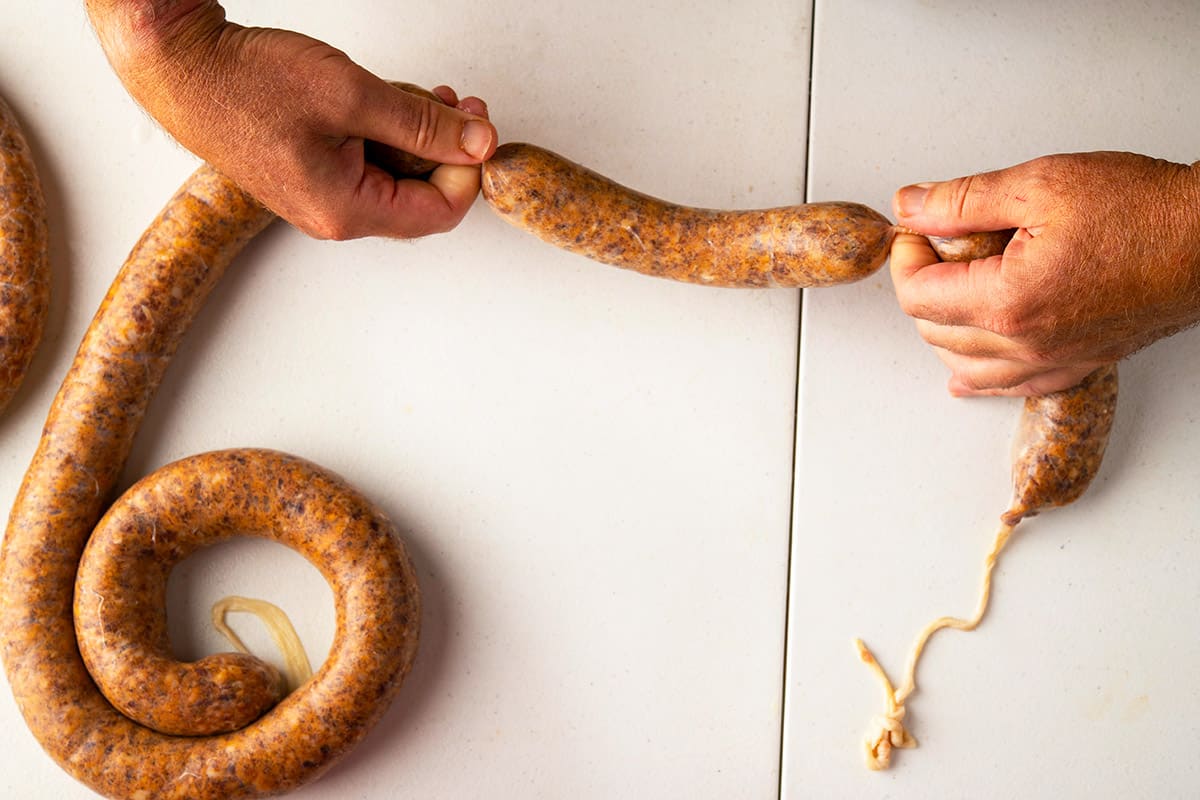
You move down the coil and spin that one the opposite way; this keeps the links from unwinding too easily.

Spinning a link of sausage to tighten it.
Photo by Holly A. Heyser

If this is confusing, I made a short video on making sausage links.

Work all the way down the coil until you get to the end, then tie off both ends after gently compressing the meat within those final links.

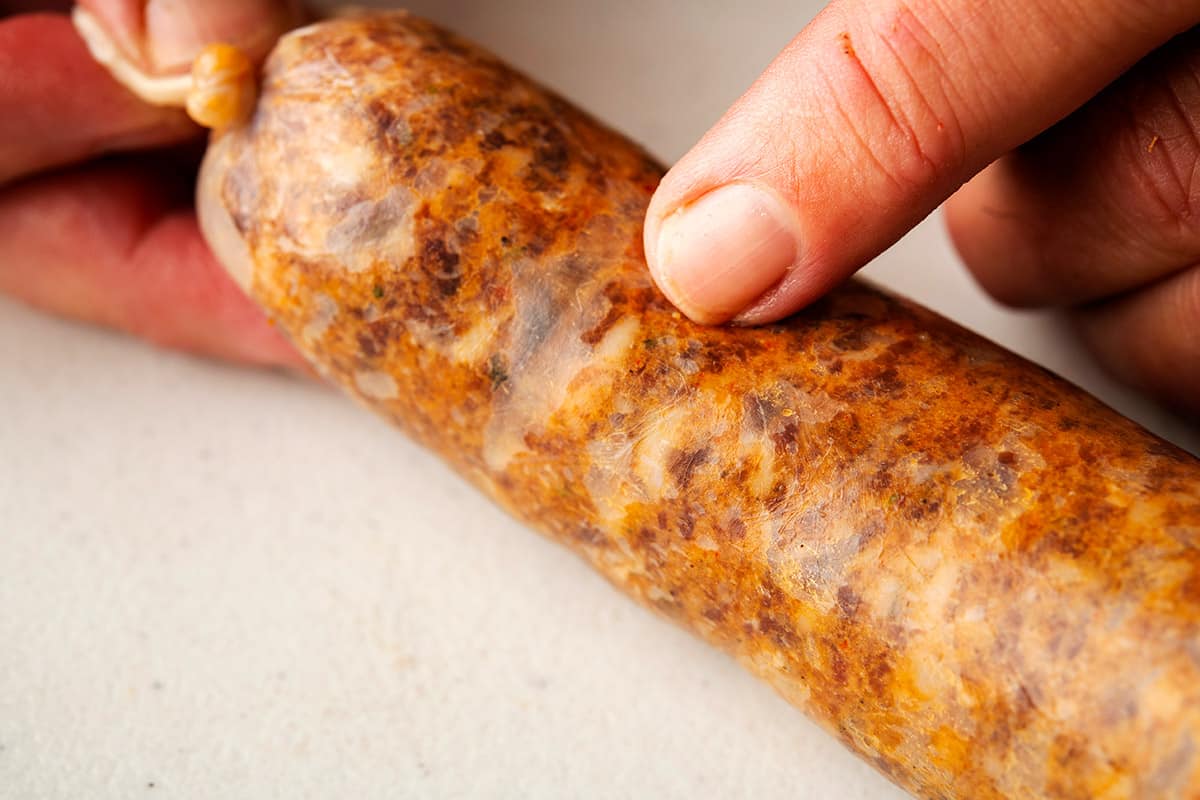
Now you need to compress the meat in each link, looking for air pockets. This is important for a proper bind and snap in homemade sausage, as well as to prevent boiling fat from spraying you when you slice into a link.

Pointing out an air pocket in a sausage link.
Photo by Holly A. Heyser

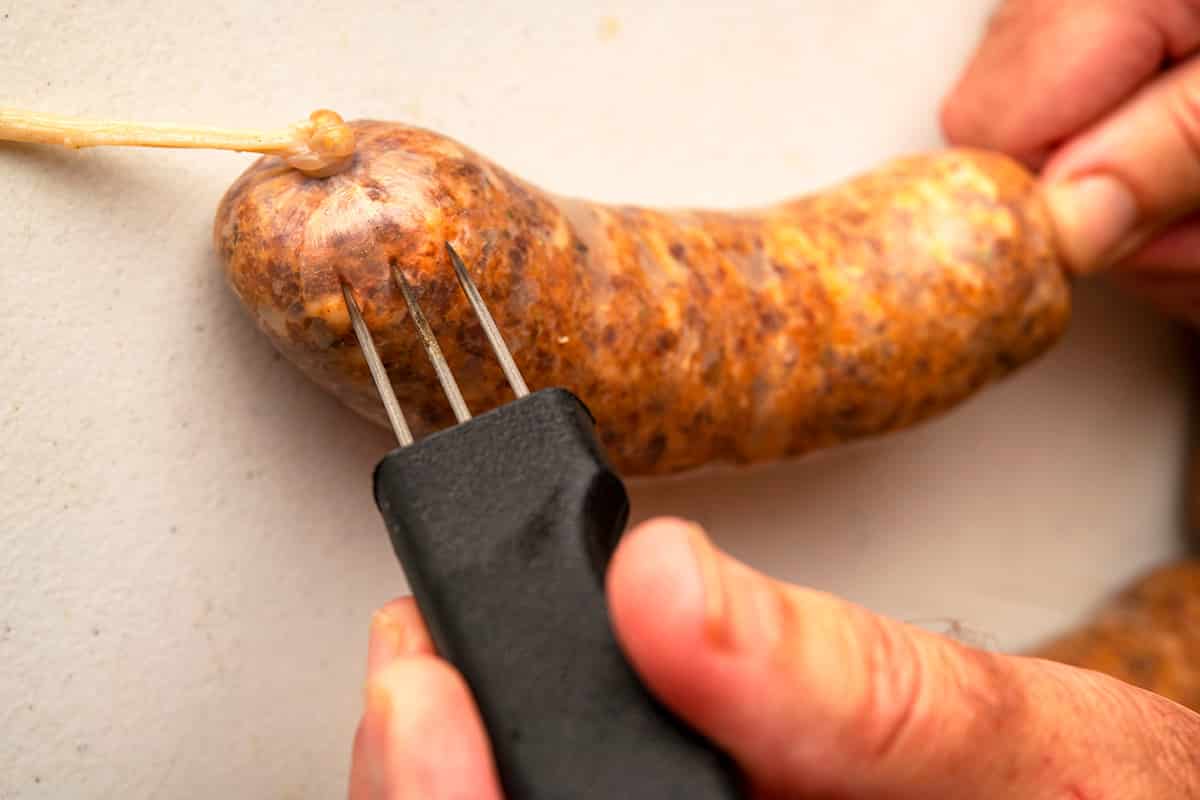
When you find air pockets, use a needle or the awesomely named sausage pricker to remove them. Pierce the casing, then gently compress the meat in the link to fill it.

Piercing a sausage casing to remove air pockets.
Photo by Holly A. Heyser

Now, hang your homemade sausage so it can “bloom,” which is the word we use when the links change color a bit, tighten in their skins and dry out just a little.

It’s a good idea to wait a day after making sausage before eating them, as this blooming process really improves the links.

Storing Homemade Sausage

Once made, homemade sausage will keep a week in the fridge. I like to let them sit there a couple days, then I’ll separate the links and vacuum seal them in packets I plan on eating.

I do not recommend pressure canning or pickling sausages, although people do. Just not a fan of the results.

The Recipe

Deer Liver Shot: Here’s What to do

0

It’s a dreaded feeling and one none of us like to think about, but it happens. You think you hit the liver.

However, it’s not all doom and gloom. While a liver shot may not be what you were going for, it is still within the kill zone.

The important part is, are you sure it’s a liver shot, and what to do next.

What is a Deer Liver Shot?

As the name suggests, a deer liver shot is a deer you hit in the liver. It happens more often than you might think.

Due to the deers’ anatomy, the liver sits within what is known as the kill zone.

The liver runs just behind the lungs on a perfect broadside deer and is almost the same length from top to bottom.

In this scenario, your shot would have to be a little far back to hit the liver. But this changes depending on the position of the deer.

A quartering to or away deer will put the liver in different positions in relation to your shot.

Identifying a Deer Liver Shot

Deer Liver Shot: Here

The first thing to do if you think you hit the liver is to run through a few checks to double-check. It’s important not to skip this step.

Ideally, you should run through this for all of your shots unless the deer drops in front of you.

Tracking a deer with a liver shot is likely to push him far beyond what you can track.

Position

Not all of us record our hunts, but something like a Go Pro is a handy tool to have.

Not only can you assess your hunt, but in times like this, you can also see where your arrow landed.

If you feel your arrow hit near the center of the deer, towards the back of the ribcage, then it is likely you hit the liver.

Judging by the ribcage is the best indicator of whether you hit the liver or not.

As I mentioned above, the position of the deer changes your arrow penetration angle a lot. So what might look like a perfect lung shot on a quartering away deer may actually be a liver shot.

[wd_leadmagnet type=”dressing”]

Sound

Sound is a difficult method of judging shots, but if you are paying attention, it can really be useful.

Often in the heat of the moment, we don’t pay attention to the sound of the impact.

However, it can tell a lot about a shot.

A liver shot makes quite a thud, and if you hear it, you will know exactly what it means.

It’s almost like a hollow sound but with some substance behind it, like a smack.

Deer Reaction

Often a liver shot deer is identifiable by the deers’ reaction alone. However, this does vary from deer to deer.

In most cases, a liver shot deer will start to run but stop after about 100 yards. They proceed to walk after this or even come to a standstill.

Some deer will bed down after about 200 yards, and some can make it out to 500 plus yards before bedding down.

Blood Trail

The best tell-tale sign of all is the blood trail. However, the downside of this is with a liver shot.

Often liver shots produce little or spotty blood.

If it was indeed a liver shot, the blood would be very dark and as mentioned, potentially very sparse with only a few drops here and there.

The blood will usually have a thick consistency and disappear very fast.

What to do after a Deer Liver Shot

Deer Liver Shot: Here

This is where things get tricky. Assuming you read all of the above and are certain of a liver shot then you are fine, because I can tell you to wait 4-9 hours, and you are sure of a recovery.

However, where things go wrong for people after a liver shot is A; they are not sure it was a liver shot or B; they didn’t care to check and went after the deer too soon.

A liver shot will always prove fatal for a deer, but many liver shot deer are not recovered.

This is not because they didn’t die, but because an eager hunter didn’t wait.

The deer still died, but probably 3 counties over or in cover so thick you wouldn’t think it was possible to get into it.

If in doubt, hang back. You will find most liver-shot deer within 500 yards of where you shot him if you wait.

This will allow the deer to bed down, which they usually quickly do after a liver shot.

Come back in 5 or 6 hours, and you’re sure to find your deer just outside the blood trail.

If the weather isn’t favorable, you could start tracking him earlier, but I would at least wait four hours.

I would only wait less than four hours on a suspected liver shot if I saw the deer fall in front of me.

Although in this scenario, it’s likely you’ve clipped one lung alongside the liver.

Final Thoughts

Most hunters are going for that sweet spot, heart – double lung, but it doesn’t always work out like that.

A liver shot isn’t a bad shot, it may not be your greatest, but it’s still a kill shot.

If you suspect a liver shot, back off and wait for at least four hours before tracking, and if you do, it’s likely your deer will be less than 500 yards from where you hit him.

Judges strike down Tennessee law allowing warrantless searches by state wildlife officials

0

The longstanding practice of conducting warrantless searches on private property by officers with the Tennessee Wildlife Resources Agency is unconstitutional, a three judge panel hearing a case in Benton County Circuit Court ruled Tuesday.

The ruling invalidates Tennessee law that TWRA has relied on to conduct warrantless searches and surveillance on private land in order to fulfill its mission of enforcing the state’s hunting, fishing and wildlife laws.

It’s an authority that is not explicitly extended to any other state or local law enforcement. The law, the judges wrote, gives rise to an “intolerable risk of abusive searches” and violates the Tennessee Constitution’s property protections. It is “unconstitutional, unlawful and unenforceable,” their ruling said.

An attorney representing Hunter Hollingsworth and Terry Rainwaters, two Benton County men who filed suit against the TWRA over warrantless searches on their lands, called the ruling a “momentous thing.”

“This is a decision that’s going to have a really huge impact on private landowners in Tennessee,” said Joshua Windham, an attorney for the Institute for Justice, a libertarian leaning law firm.

Windham said the ruling may have implications beyond Tennessee. The Tennessee Constitution’s property protection language, cited by the judges, is echoed in the constitutions of 16 other states, potentially leading to legal challenges of similar wildlife agency enforcement practices elsewhere. TWRA’s practice of patrolling private property without an owner’s consent or a warrant is not uncommon.

A spokesperson for TWRA on Wednesday did not immediately respond to questions about the ruling, or whether state officials plan to appeal.

State wildlife officers patrol private lands across the state year-round without giving owners notice, obtaining consent or appearing before a judge to make a case for a warrant, court records said.

TWRA officers sometimes investigate turkey-, dove- and deer-hunting offenses by crouching in bushes and secretly taping hunters — hiding within the line of fire in some instances cited in the lawsuit. The agency keeps no records of when or how often officers enter private property. TWRA officers do not need a supervisors’ permission before entering private land. There are no agency rule limiting how long officers may spend searching private property.

TWRA attorneys have argued that state wildlife officers must have the flexibility to enter private lands to do their jobs. The agency’s mission is to protect wildlife and enforce hunting, fishing and boating laws. The vast majority of hunting in Tennessee takes place on private property and wildlife aren’t confined to public lands, they noted.

TWRA also cited a well-established U.S. Supreme Court precedent, known as the “open fields doctrine,” which says that property owners have no “reasonable expectation of privacy” on private property deemed to be an open field — property outside the immediate vicinity of an owner’s home or yard, such as a field of crops well beyond a farmer’s homestead.

But the three judge panel in Benton County concluded that the Tennessee Constitution gives property owners more protection. Article I, Section 7 of the Tennessee Constitution provides a “broader guarantee of security for an individual’s real property than its federal counterpart,” they wrote.

Tennessee’s Constitution protects all “property, real or person, actually possessed or occupied,” the court noted. Under Tennessee Supreme Court precedent, land possessed or occupied extends beyond a homestead. Only “wild or waste lands” that are not used, farmed, fenced or otherwise utilized are excluded from those protections, the state Supreme Court has found.

The judges also concluded that the statute giving TWRA the right to enter private land amounted to a “general warrant,” giving officials wide latitude to conduct searches. “General warrants are dangerous to liberty and ought not to be granted,” the court ruled.

Hollingsworth, a Benton County railroad worker, said Wednesday he felt vindicated after years of challenging multiple TWRA officers forays onto his property, where they secretly hid behind bushes to videotape Hollingsworth, his girlfriend and friends while they hunted and socialized. They patrolled his land and surveilled his movements.

Hunter Hollingsworth on his property in Benton County. Photo: John Partipilo.

“I think it’ll be a lot more relaxing to be on my property and you won’t have to be paranoid that they’re looking at you all the time,” Hollingsworth said. “I think it’s fantastic that other people will get to enjoy their property without worrying if they’re being watched.”

Rainwaters similarly expressed “great relief to have the court recognize that searching my property without permission and without a warrant was unconstitutional.”

“It’s even better to hear that the court doesn’t believe anyone else in Tennessee should have their rights violated in the same way,” he said. “I’m going to sleep a little better tonight knowing that state officials have to respect my property rights.”

The case was heard under a new state law requiring a panel of three judges, one from each division of the state, to hear challenges to state law. Judge Donald Parish, Chancellor Jerri Bryant and Judge Russel Parkes presided over the case.

Parish, who concurred with the majority of the decision, filed a dissenting opinion in which he argued the court should have gone further.

The Institute for Justice had requested an injunction barring TWRA from entering private property — which was rejected by the panel because they had already concluded Tennessee’s law was invalid.

But Parish noted that TWRA lawyers argued that their authority to conduct warrantless searches also rests in the Tennessee Constitution’s recognition of a personal right to hunt or fish, subject to reasonable regulation.

Parish also cited a TWRA officer’s conversation with Hollingsworth in the court’s record. Hollingsworth told an officer who showed up on his property that he wasn’t invited.

“When you bought your hunting license, you invited me,” the officer told Hollingsworth.

Absent an injunction, Parish wrote, “I believe an ‘intolerable risk’ of improper searches by the TWRA persists.”

The Biggest Whitetail Deer Ever Killed: A Look into the Record Books

0

Whitetail deer hunting is one of the most popular forms of hunting in North America. These majestic creatures can be found throughout the United States and Canada, and their impressive antlers make them a popular target for hunters. But have you ever wondered what the biggest whitetail deer ever killed was? In this article, we’ll take a look at the record books and explore some of the biggest whitetail deer ever taken down by hunters.

The Boone and Crockett Club

The Boone and Crockett Club is a non-profit organization dedicated to the conservation and management of wildlife and their habitats. Founded in 1887 by Theodore Roosevelt and George Bird Grinnell, the club is best known for its record-keeping system for big game animals. The Boone and Crockett Club’s scoring system is based on the size of the animal’s antlers, and it is the standard by which all other record-keeping organizations measure big game animals.

The Top 5 Biggest Whitetail Deer Ever Killed

According to the Boone and Crockett Club’s records, the top 5 biggest whitetail deer ever killed are as follows:

1. The Jordan Buck – This massive whitetail deer was taken down by hunter Al Jordan in 1914 in Danbury, Wisconsin. The Jordan Buck’s antlers scored an impressive 206 1/8 inches.

2. The Hole-In-The-Horn Buck – This famous whitetail deer was taken down by hunter Larry Gibson in 1940 in Peoria County, Illinois. The Hole-In-The-Horn Buck’s antlers scored 205 0/8 inches.

3. The Missouri Monarch – This massive whitetail deer was taken down by hunter Jim Jordan in 1981 in St. Louis County, Missouri. The Missouri Monarch’s antlers scored 198 2/8 inches.

4. The Beatty Buck – This impressive whitetail deer was taken down by hunter James Beatty in 2000 in Greene County, Ohio. The Beatty Buck’s antlers scored 294 0/8 inches.

5. The Hanson Buck – This massive whitetail deer was taken down by hunter Milo Hanson in 1993 in Saskatchewan, Canada. The Hanson Buck’s antlers scored an impressive 213 5/8 inches.

While these are the top 5 biggest whitetail deer ever killed according to the Boone and Crockett Club’s records, there are many other impressive whitetail deer out there. In fact, there are over 7,000 whitetail deer in the Boone and Crockett Club’s record book, each with their own unique story.

Factors that Affect Antler Size

While genetics play a large role in determining the size of a whitetail deer’s antlers, there are other factors that can affect antler size as well. These include:

1. Age – As a whitetail deer gets older, its antlers will typically grow larger.

2. Nutrition – A whitetail deer that has access to high-quality food sources will typically have larger antlers than a deer that is struggling to find food.

3. Habitat – Whitetail deer that live in areas with ideal habitat conditions (such as good cover and access to water) will typically have larger antlers than deer that live in less ideal conditions.

4. Hunting Pressure – Whitetail deer that live in areas with high hunting pressure may have smaller antlers due to the fact that hunters are selectively targeting larger deer.

Conclusion

While the top 5 biggest whitetail deer ever killed are certainly impressive, it’s important to remember that hunting is about more than just taking down the biggest animal. It’s about being a responsible and ethical hunter, respecting the animals and their habitats, and enjoying the outdoors. Whether you’re a seasoned hunter or just starting out, always remember to hunt safely and responsibly, and to respect the animals and the land.

Federal Terminal Ascent Ammo Review: Great Accuracy and Performance

0
Federal Premium Terminal Ascent — Great Accuracy and Performance
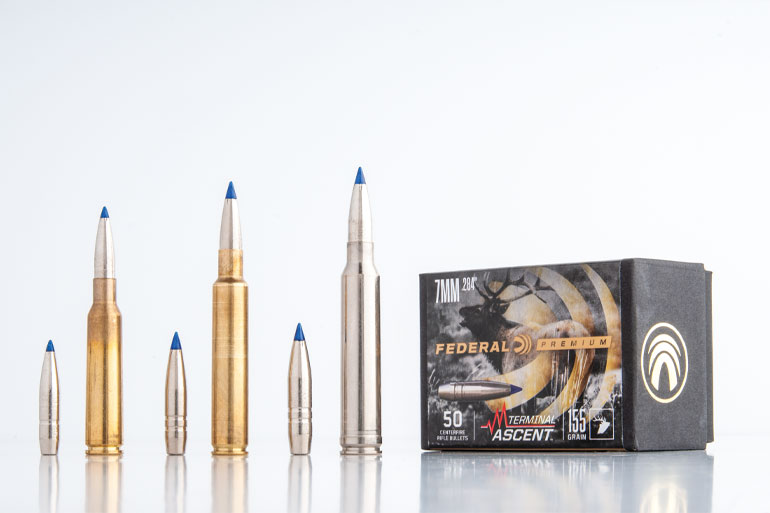
Federal’s initial Terminal Ascent offerings (from l.): 130-grain 6.5mm, 136-grain .277, 155-grain 7mm, 175-grain .308 and 200-grain .308.

An evolution of the legendary Trophy Bonded Bear Claw, Federal’s new Terminal Ascent bullet is a cutting-edge projectile possessing excellent aerodynamics and outstanding accuracy. It offers arguably the most versatile on-impact performance characteristics of all big game hunting bullets.

The short video below shows a hunter taking a Texas aoudad at 600 yards with Federal Custom Shop Rifle Ammo loaded with a Terminal Ascent bullet. Other equipment used: Mesa Precision Arms Rifle, Swarovski Z8 Scope, Silencer Central Banish 30 Suppressor.

Along with factory-loaded ammo for myriad popular cartridges, Federal introduced the Terminal Ascent in component-bullet form. Initial calibers and weights include a 130-grain 6.5mm version with a G1 ballistic coefficient of .532, 136-grain .277 (BC.493), 155-grain 7mm (.586), 175-grain .308 (.520) and a 200-grain .308 (.608).

The Terminal Ascent is basically the fourth generation of Bear Claw-type bullets. Following the original Bear Claw was the composite-tipped, boattailed Trophy Bonded Tip big game bullet optimized for all-around use on deer- to moose-size game.

Third came the Edge TLR, which provided excellent aerodynamics and on-impact performance, but Federal felt it lacked the extraordinary accuracy demanded by today’s extended-range hunters.

Two years of R&D have resulted in the Terminal Ascent, a bullet that shares the ideal impact performance of the Edge TLR and regularly shoots 0.6-inch, 10-shot, 100-yard groups.

Like the Bear Claw, the design features a rear portion of solid copper and a lead front core bonded to the jacket. As a result, no matter how fast it is driven and how close an animal, the Terminal Ascent won’t “grenade” on impact. A good mushroom shape with a generous shank will create a large-diameter wound channel and drive deep—no matter how much heavy bone and dense muscle it encounters.

A boattail enables air to flow around the rear profile with minimum friction and cavitation. A sophisticated heat-resistant, hollow composite tip with a sleek profile further enhances aerodynamics and provides an unparalleled on-impact expansion mechanism.

This composite tip is heat resistant, so it doesn’t erode and suffer reduced, unpredictable aerodynamics like common Delrin polymer may when high-BC projectiles are fired from extreme-velocity cartridges.

Because of the hollow composite tip, which collapses inward on impact and exposes the massive hollow nose of the main projectile, the Terminal Ascent design provides reliable expansion at velocities as low as 1,500 fps—and in many versions 1,400 fps. This means that even when impacting at long range, your bullet will expand reliably and kill cleanly.

To test how easy it is to obtain good handload results with the Terminal Ascent, I assembled 10-round batches for three different cartridges, using an educated guess to pick propellant types and charge weights.

For my Ruger M77 Hawkeye African, I loaded the 130-grain 6.5mm version over 47 grains of Reloder 16 in once-fired Lapua 6.5×55 cases. For the 155-grain 7mm, I loaded a test batch for my .280 Ackley Improved Kimber Mountain Ascent, charging Nosler brass with 59 grains of H4831sc. I loaded the 200-grain .30 caliber version for my Kimber 8400 .300 Win. Mag., charging once-fired, nickel-plated Federal cases with 70 grains of H4831sc.

An all cases I primed with Federal Gold Medal primers. Before seating the Terminal Ascent bullets, I contacted Federal’s tech guru Jared Kutney for some seating-depth advice.

“Terminal Ascent bullets have a secant ogive—some more noticeable than others—but in contrast to standard secant ogive bullets, they do like a little jump. We recommend starting with .050 to .075 inch of jump and adjusting from there. We have found that .060 inch works well for the 6.5mm and 7mm bullets, specifically.”

Following his suggestions but wishing to mix it up a little, I seated bullets in the 6.5×55 test batch .060 inch off the rifling leade but seated projectiles in the .280 Ackley Improved and the .300 Win. Mag. ammo to .050 off the leade.

Three consecutive three-shot 100-yard groups averaged 0.69 inch out of the .300 Win. Mag. Velocity averaged 2,842 fps with a standard deviation of 13 fps. The Ruger 6.5×55 produced superb accuracy as well, averaging 0.77-inch groups for a series of three consecutive three-shot groups at 100 yards. Velocity averaged 3,029 fps with a standard deviation of eight fps.

Finally, I tested the 155-grain 7mm Terminal Ascent in the lightweight Kimber. It has a spaghetti-thin barrel, and it will shoot sub m.o.a. with ammo it likes, but it takes considerably more tuning than heavier rifles.

My handload did not produce sub-m.o.a. accuracy—averaging 1.23 m.o.a. for three three-shot groups—but standard deviation was just 4.6 fps. Average speed was 3,000 fps.

So two out of three of the rifles tested produced sub-m.o.a. accuracy with the first Terminal Ascent handloads attempted—and that was on a day with winds gusting to 15 mph. I’d say that’s downright impressive.

As for the rifle that didn’t, I’m going to work with it. The 155-grain 7mm Terminal Ascent bullet is theoretically perfectly balanced for the .280 Ackley cartridge, and I’m determined to find an accurate load. Judging by the easy accuracy provided by the 6.5mm and .30 caliber versions, I suspect it won’t be difficult.

One other element of the Terminal Ascent bullet line intrigued me. I’m a big fan of the Trophy Bonded Tip bullet and had excellent luck using the Edge TLR in Africa, but I wanted to know more about the AccuChannel grooves around the Terminal Ascent’s shank.

“Solid shank bullets benefit from grooves from a dispersion standpoint,” he said. “Our leading theory is that it makes the bullet more malleable by creating a void into which bullet material can displace when engaging the rifling. The effect is a reduced magnitude of vibration applied to the barrel, and therefore, by way of reduced harmonic reaction of the barrel, a more consistent launch vector from shot to shot.”

There is a drawback, though. “The downside of grooves is the added drag they impart to the bullet in flight,” Kutney said.

However, all grooves are not created equal, and good engineers can minimize adverse effects.

“The AccuChannel provides a smoother geometry from a fluid flow standpoint so as to minimize the drag penalty of each groove,” Kutney said.

How much BC reduction are we talking about? Not much. Comparing the aerodynamics listed for equal-weight Edge TLR and the Terminal Ascent, the more accurate newer version gives up just 1.5 to 4 percent of BC.

I’ve taken a number of animals with Trophy Bonded Bear Claws, Trophy Bonded Tips and Edge TLRs. In every case, terminal performance has been textbook perfect.

Because the Terminal Ascent shares the construction characteristics of its predecessors and adds an unprecedented level of accuracy, it will undoubtedly provide excellent, dependable performance in the field.

Build a inexpensive hog proof deer feeder.

0

Every year I see pictures of downed deer feeders with their contents spilled out on the ground like a giant steel pinata. Most likely culprits are hogs and cattle. On our ranch in the Texas Hill Country we employ multiple wildlife corn and protein feeders inside of a pen that have helped tremendously at keeping wild hogs from destroying feeders and has actually cut the hog traffic on the ranch to almost none.

What you will need.

6 Feed lot panels. 60″ tall and 16′ in length. If you can round up used panels even better as these will need to be cut. If you have old roll wire lying around that will work as well. 48″ tall panels can be purchased as well and this will save you from having to cut the panels down

24 T posts.

The ever popular T-post driver.

Bailing wire…the fix it all.

When you decided on your feeder location stick a t post in the center temporarily, then with the help of a friend measure out approximately 15 from the t-post outwards, you are shooting for a 30′ diameter enclosure. Most feeders will cast around a 24′ spread of corn. Mark the spot and continue to measure out several more spots from center to outer edge. When you have a general area laid out begin by driving a few t posts along the perimeter every 10′-12′ feet. Once your a circle beings to take shape start placing the panels, smaller holes on bottom, on the outside of the T-posts and secure with bailing wire making sure your panels over lap at least one section of the squares. We want to keep animals out so it is important the t-posts are inside the panels. Now your circle may vary in size but 24′-30′ is about what you’re shooting for. You may find that your panels do not reach each other when your circle is complete and that is ok. This is where you’ll want to install your access gate. This can be anything from a smaller section of panel to an old chain link fence gate. If you find your panels over lap a bit at the end over your circle that is ok as this may be used for a gate. Now place the rest of your tposts inside the panels, you want to have about 3 tposts per panel. Now go to town with your bailing wire. Set your feeder up. Stake the legs down with T-posts! This will protect it in case the swine manage to get under the panel as they have been known to pull up the panels if they can get their snouts under it.

Now deer are excellent jumpers but we still like to cut the top section down with bolt cutters to about 48″-50″. Make sure you cut down to the next section as you don’t want any steel protrusions sticking up that may injure wildlife. This is where using old field panels is great, not many folks like cutting brand new ones down if they plan on reusing them after deer season. Some people will actually cut smaller holes in the panel close to the ground for fawns to get into the pens, but remember if a fawn can get in so can smaller hogs. We have been running these pens for years and have yet to have a feral hog get into one. There is always a possibility as hogs are jumpers as well! You can use roll wire as well as this is a fairly inexpensive set up. Always reuse old material lying around as it will save you money that you can be using to fill the feeders with. Hope this helps, good luck Bone Hunters!

COLORADO PARKS & WILDLIFE

0

I often get questions from readers concerning what elk habitat looks like, where do elk like to hang out and which terrain they like during different seasons of the year. When I moved to Colorado more than a decade ago, I had to learn a new way of hunting since I was a whitetail hunter from the South. This “elk” was a different sort. They seemed to have no pattern, they did not seem to haunt the same one square mile that my southern bucks lived in, and they did not play by the “rules” I had learned as a deer hunter. Well, the elk were set in their ways, and it seemed that I was the one who had to change so I went to class and began to learn why elk did what elk did.

I recommend reading this lesson and digesting the points that Chad makes about what elk eat, where they like to live, and what they do when they get pressure from weather or hunters. Next, take out your maps of the game management units you want to hunt and read “Putting It All Together”. Find the places Chad describes on your map. After doing this, you will be able to look at maps or aerial photos of an area and narrow big elk country into a more manageable hunt area. -Jim

Understanding Elk in ColoradoBy Chad J. Bishop, PhD.

As hunters, we commonly seek out information on the animals we hunt in hopes it will explain exactly when and where to find them. We quickly learn, time and again, it’s not that simple. All too often, we find that what works one time fails miserably the next, and we can go from a state of euphoria to desperation in the course of just a few hunts. Much of this inconsistency can be attributed to variability in animal behavior, weather, and habitat conditions. Over time, however, we gradually improve our hunting skills by combining our understanding of the animals with lessons learned from our many hunting experiences. Thus, it is beneficial to understand the ecology of the animals we pursue, as long as we keep our expectations in check and appreciate that the systems we hunt can be extremely variable. My objective here is to present a basic picture of elk ecology in Colorado. My hope is to give the novice elk hunter a better idea of where to begin and to help the seasoned hunter make a little more sense out of past experiences afield.

What do elk eat?

Elk are herbivores capable of consuming diverse diets of grasses, forbs, and shrubs. The term forb refers to any broad-leaved herbaceous plant that is not a grass. Forbs are an important dietary component of elk and other wild ungulates and have high nutritional value during the growing season. Elk eat green grasses and forbs during the growing season but also commonly eat cured grasses and forbs during the winter. When elk and other ungulates eat shrubs, they typically select the tips of branches which comprise the current year’s growth and offer the most nutrients.

It may be easiest to explain elk diets by contrasting them to those of some other common herbivores.

  • ​Deer, for example, are often referred to as browsers because much of their diet is comprised of shrubs.
  • Cattle and sheep, on the other hand, are commonly referred to as grazers because they consume large quantities of grass.

The distinction between deer and livestock arises from physiological differences in the proportional sizes of their rumens (i.e., stomach) and in their associated digestive strategies. Elk are considered intermediate to deer and cattle/sheep, which means elk are better adapted to grass diets than deer yet are capable of consuming relatively large amounts of browse. Therefore, elk should be capable of meeting their nutritional requirements across a greater spectrum of habitat conditions than deer or livestock as long as adequate forage quantities are available.

This basic knowledge of elk diets is useful for understanding why elk occur where they do. At a broad scale, elk can successfully occupy a diversity of habitats across Colorado because they are foraging generalists and are adaptable. You can find elk just about anywhere in Colorado west of Interstate 25. At a finer scale, we expect to find more elk where there is a greater abundance of grasses, forbs and shrubs, collectively referred to as “understory” in forested habitats.

In sagebrush and mountain shrub habitats, understory typically refers to the abundance of grasses and forbs only. Using this information, you can begin to visualize more-productive and less-productive habitats based on the amount of vegetation covering the ground. For example, in conifer forests, elk seek out and feed in recently-burned areas, areas with beetle killed over-story, or small clear-cuts because these sites provide greater amounts of quality forage than the understory of a mature forest. When mature trees have been removed, grass, forb, and shrub species capitalize on the released nutrients and dominate the site until the forest regenerates. In such instances, elk utilize the mature forest primarily for cover and move into the openings to forage, typically during morning and evening. As a general rule, habitat types with greater understory will be preferred by elk.

Elk Habitat Use

Elk utilize most habitat types occurring in western Colorado at some point during the year. However, some habitat types are far more productive than others. Arguably, the most productive habitat for elk is aspen. Aspen typically has extremely productive understory and supports large numbers of elk. It is likely no coincidence that Colorado has both more aspen and more elk than any other western state or province.

Other extremely productive habitats that commonly occur in proximity to aspen are oakbrush and mountain shrub. Oakbrush habitat provides food and a good source of cover. It is not uncommon for elk to spend their days in oakbrush during hunting season because it provides great security. Oakbrush can be very difficult to hunt because it is thickly vegetated and difficult to quietly stalk through. Hunters that learn how to hunt oakbrush effectively, however, are often rewarded.Perhaps the best combination of habitat for elk is mosaics of aspen, oakbrush, and mountain shrub, which provide optimal forage and cover. Aspen is also commonly located in proximity to conifer habitats. Spruce-fir forests with intermingled aspen stands are another example of prime elk habitat. The spruce-fir forest provides cover and the aspen understory provides a source of quality forage. Generally speaking, large tracts of mature conifer forest are not that productive for elk because they have limited understory. Ponderosa pine forests can be an exception because they often support a relatively robust, herbaceous understory, and, therefore, can be quite productive for elk, particularly along the front range of Colorado where there is less aspen and oakbrush.As mentioned above, spruce-fir forests provide a good source of cover and are valuable when adjacent to more productive habitats. Lodgepole pine forests are typically unproductive and of utility to elk only when adjacent to other habitat or when used as escape cover from hunting pressure. As a general rule, the utility of conifer forests depends heavily on how much they are intermixed with meadows or other habitats. The exception to that rule is in October when forage in meadows and more open aspen stands has cured while forage in the conifer understory is still green and lush. Elk may not venture out in the open if the forage and security are better in coniferous forests.Alpine habitats, above treeline, offer a productive habitat for elk during summer and early fall and can be heavily utilized by elk. Alpine habitat can offer good hunting opportunities during early-fall hunting seasons, particularly if adjacent conifer habitat is not very productive. Hunting pressure and frost both make the alpine less appealing as fall advances. At the other extreme, elk can be found in pinyon-juniper and lower-elevation sagebrush habitats, particularly later in the season as elk move to lower elevations.

Elk Migratory Behavior

Most elk utilize different areas during summer and winter and spend variable amounts of time transitioning between the two areas during the spring and fall. Thus, biologists refer to three major types of ungulate use areas: summer, transition, and winter range. Summer range typically includes the highest elevation elk habitats, transition range encompasses mid-elevation habitats, and winter range encompasses the lowest elevations. As with anything, there are exceptions to the rules. Elk habitat use and migratory behavior is heavily driven by weather. In mild years, some elk will remain at high elevations late into the fall and may spend winter at higher elevations on south-facing slopes that remain largely free of snow. In years with severe fall or winter weather, nearly all elk will migrate down to low elevations to seek forage and escape deep snow.

Migratory behavior is an important concept for hunters. Generally speaking, most elk will be at higher elevations (i.e., summer range) during archery and muzzleloader seasons and usually first rifle season in Colorado. In mild years, elk will remain at high elevations throughout the second rifle season and occasionally into the third season in many areas. This explains why CPW field personnel commonly refer to elk being located in dark timber during mild hunting seasons, and therefore, difficult to find. In contrast, when significant fall snowstorms occur, many elk will move to transition and winter ranges as early as second rifle season, which typically makes them more vulnerable.

Elk Response to Disturbance

It is well-documented that elk alter their movement patterns in response to human-related disturbance. For example, a number of studies have demonstrated that elk tend to avoid roads2, 3, 4, 5 and that their survival declines as density of roads increases because of increasing vulnerability2, 6, 7, 8. During hunting season, elk will often seek out refuge on private lands or national parks where there is little or no hunting. In the White River National Forest in northwest Colorado, the opening day of archery season caused elk to move from public to private land9,10. Similarly, in the San Luis Valley in south-central Colorado, elk moved into Great Sand Dunes National Park in response to the opening of archery season11. Opening of rifle seasons are thought to cause additional shifts by elk away from public land to secure areas. Generally speaking, elk are adept at seeking out refuges to escape hunting pressure and will move many miles to do so.

The above information explains why hunters with access to private lands that are managed for limited hunting typically do well. Likewise, hunters gaining access to limited-harvest units by using preference points also fare well. However, most hunters do not have access to these optimal hunting situations during most years. For public-land hunters in over-the-counter units, efforts to get away from roads generally pay off. There tend to be fewer hunters and more elk in more remote areas. It is also helpful to obtain maps showing secondary roads, terrain features and public/private land ownership to evaluate where elk may be more likely to move in response to disturbance. If you lack the ability to hunt in remote areas, getting off the road even a short distance and still-hunting on foot can greatly increase your opportunities. It is not uncommon for animals to bed down in thick cover near roads and not be disturbed, even as hunters pass by on the road throughout the day. When hunting roaded areas, it is often helpful to identify patches of heavy cover where it appears elk might bed down to avoid being disturbed.

Putting It All Together

Many hunters know the general location they intend to hunt based on past experience, contacts, recommendations, etc. However, if you’re new to Colorado elk hunting, there are a few things worth considering:

  • Colorado’s largest elk herds occur west of the Continental Divide.

  • Colorado’s highest elk densities generally occur in association with aspen, oakbrush, and mountain shrub habitats.

  • Public-land hunting opportunities span everything from remote wilderness areas to heavily-roaded forests and rangelands.

Once you’ve determined the general location you plan to hunt, the next consideration is when you plan to hunt. If you plan to hunt early in the season (e.g., late August through mid-October), a majority of elk are likely to be at higher elevations. If you plan to hunt later (e.g., late October through December), elk are likely to be mid-slope or even down on winter range just above the valley floors or plains. Many rifle hunters head to the field in late October and early November. At this time of year, maintaining flexibility with your hunting plans can be an effective strategy. Elk can be anywhere on the mountain depending on weather events, and it is best not to lock yourself in to exclusively hunting one spot. Elk are large, herd animals that leave abundant sign. If you’re not seeing evidence in your primary area, it’s advisable to seek out other areas.

After deciding when to hunt and factoring in weather, the next step is to evaluate habitat in terms of forage, security cover, and roads. As a recap, elk prefer habitats with abundant understory, which typically include aspen, oakbrush, and mountain shrub habitats. These habitat types are often intermixed with, or adjacent to, conifer forest. Areas with mosaics of aspen, shrub, and conifer are preferable to large, unbroken expanses of spruce-fir habitat, for example. During hunting season, in particular, elk will tend to avoid roads and place a heavier emphasis on seeking out security cover or refuge areas. It is useful to consider the spatial arrangement of public and private land parcels on the landscape you intend to hunt. If public-private parcels are intermixed, hunting public land near private land may be advantageous as animals will likely move between private and public land in that scenario. On the other hand, hunting public land adjacent to large blocks of private land with minimal hunting pressure will be less ideal. In Colorado, it is the hunter’s responsibility to know land ownership boundaries and not trespass, even where private land is not fenced or signed.

Ultimately, these various considerations should help you assess the overall landscape you intend to hunt: Is there ample forage and security cover? Are you far enough away from potential refuge areas (e.g., large blocks of private land, National Parks) such that elk will likely remain on public land even when pressured by hunters? If so, where are elk likely to go when pressured? What are the relative road densities across the landscape? Are there “holes” that you can access? When you factor in all these considerations, it should be possible to assess a large landscape and identify specific spots to hunt. In summary, areas to select are those that provide abundant forage, ample security cover, fewer roads, and do not have obvious refuges.

​References

  1. Hofmann, R. R. 1989. Evolutionary steps of ecophysiological adaptation and diversification of ruminants: a comparative view of their digestive system. Oecologia 78:443-457.

  2. Cole, E. K., M. D. Pope, and R. G. Anthony. 1997. Effects of road management on movement and survival of Roosevelt elk. Journal of Wildlife Management 61:1115-1126.

  3. Lyon, L. 1979. Habitat effectiveness for elk as influenced by roads and cover. Journal of Forestry 77:658-660.

  4. Rost, G. R., and J. A. Bailey. 1979. Distribution of mule deer and elk in relation to roads. Journal of Wildlife Management 43:634-641.

  5. Rowland, M. M., M. J. Wisdom, B. K. Johnson, and J. G. Kie. 2000. Elk distribution and modeling in relation to roads. Journal of Wildlife Management 64:672-684.

  6. Hayes, S. G., D. J. Leptich, and P. Zager. 2002. Proximate factors affecting male elk hunting mortality in northern Idaho. Journal of Wildlife Management 66:491-499.

  7. McCorquodale, S. M., R. Wiseman, and C. Les Marcum. 2003. Survival and harvest vulnerability of elk in the Cascade Range of Washington. Journal of Wildlife Management 67:248-257.

  8. Unsworth, J. W., L. Kuck, M. D. Scott, and E. O. Garton. 1993. Elk mortality in the Clearwater Drainage of northcentral Idaho. Journal of Wildlife Management 57:495-502.

  9. Conner, M. M., G. C. White, and D. J. Freddy. 2001. Elk movements in response to early-season hunting in northwest Colorado. Journal of Wildlife Management 65:926-940.

  10. Vieira, M. E. P., M. M. Conner, G. C. White, and D. J. Freddy. 2003. Effects of archery hunter numbers and opening dates on elk movement. Journal of Wildlife Management 67:717-728.

  11. Davidson, G. A. 2007. Analyzing elk movements and distributions in Colorado using generalized linear models. Thesis, Colorado State University, Fort Collins, USA.

Bear Hunting Dogs – 9 Dog Breeds to Keep Bears at Bay

0

Bear hunting with dogs brings a whole range of emotions to mind.

More specifically, the pretty controversial bear hounding.

However, there’s also another variant of bear hunting (which could actually be beneficial to wildlife).

But first, let’s explore bear hounding and why it often damages wildlife populations.

Some people disguise hounding as a service to society while others deem it a sick sport.

Even hunting advocates seem to turn their back on bear hounding because it’s not only unfair but damaging to wildlife1 and possibly their own dogs.

  • Bear hounding often orphans cubs
  • Being chased into trees incites incredible anxiety in the animals
  • Hounds are often hurt during encounters
  • Non-target animals are chased since controlling dogs over large distances is impossible
  • Hunters often trespass on private property, target endangered species, or chase bears onto busy roads

Why are bear cubs orphaned?

Because hunters don’t care to check or misidentify the gender.

Sometimes, they eliminate the threat on sight when encounters with their dogs ensue.

Other times, bears are chased over miles and robbed of their energy2 which may seal their fate, just for the hunters to notice the bear is off-limits due to age or gender.

But as mentioned, bear hounding is not the only way to hunt bears with dogs.

Below, I’ve listed all the breeds suitable for bear hunting.

A lot of breeds mentioned in other articles are absolutely not suitable for hunting bears in any way, shape, or form.

What Are Bear Hunting Dog Breeds Used For?

Hounding doesn’t necessarily only serve as a sport, instead bear hunting dogs are also used in some areas to control rising bear populations, but modern non-lethal methods include Karelian Bear Dogs to scare bears away.

As the polar ice melts, the number of bears roaming northern rural regions in Russia increases3.

Naturally, this creates a conflict between the inhabitants of small towns and these massive (and endangered) Polar Bears.

All parties involved will hopefully seek out a peaceful solution instead of allowing bear hunting with dogs, especially considering that it’s us humans who are destroying their natural habitat.

North America might soon face a similar problem and wildlife and law enforcement are seeking solutions.

Until now, bears who’ve gotten too used to people are either euthanized or put far away into another territory, both far from optimal solutions.

Hounding is partly allowed to serve as “population control” but all these (partly inhumane tactics) could be replaced by an altogether different method.

Organizations such as the Wind River Bear Institute created an actionable plan that includes dogs – but in a non-lethal way.

Dogs such as the Karelian Bear Dogs4 are used to scare bears away in the following steps:

  • Bears who get too close and/or too used to humans are identified
  • Bear hunting dogs are brought in to scare them (resembling Coyotes out and about to steal bear cubs)
  • Upon release, the dogs track the bear, bark, and nip at the bear’s heels until called back
  • If the bear has gotten used to a specific spot, they trap the animal and bring in the dogs to scare them and then release
  • Additional methods like firing rubber bullets can be utilized

Sadly, there’s not a lot of literature out there discussing this way of controlling bears.

Instead, most (outdated) research papers focus on traditional bear hounding and its efficacy.

Even though there aren’t a lot of resources, I’ve tried my best and compiled a list of breeds that were traditionally used and could be introduced in this more modern way below.

Any dog breed successfully working bears offers a huge upside to the old ways:

  • No known injuries to the dogs
  • Bears are not unnecessarily eliminated
  • No compromise in safety around campgrounds and National Parks for humans
  • Karelian Bears Dogs have been able to find evidence of poaching and save polar bear dens near oil or gas fields

However, not all areas (think residential) are suitable for this type of bear control.

Besides the labor to raise and train these dogs, controlling bears this way is more labor-intensive.

So now you know about hounding as well as non-lethal bear hunting with dogs, but which breeds are actually suitable?

9 Bear Hunting Dog Breeds

The best bear hunting dog breeds include the Karelian Bear Dog, Plotthound, Coonhound, Foxhound, as well as large game hunters such as the Dogo Argentino or Rhodesian Ridgeback.

Here’s the full list of dogs capable of hunting large game such as bears:

  1. Karelian Bear Dog
  2. Plotthound
  3. Coonhound
  4. American Foxhound
  5. Bloodhound
  6. German Shorthaired Pointer
  7. German Wirehaired Pointer
  8. Dogo Argentino
  9. Rhodesian Ridgeback

Karelian Bear Dog

Among the top spots for dog breeds used to work bear is the Finnish black-and-white Karelian Bear Dog.

Early breed ambassadors have been recorded in other colors as well such as red-gray or pure red.

However, black-and-white emerged as the desired color since the breed standard was formulated in 1945.

The Karelian Bear Dog looks like a cross between Border Collie and Husky with some resemblance to breeds like the Samoyed or a more wolfish German Shepherd.

While working bear is their field of expertise, they can also compete in search and rescue or sled dog trials due to their sturdy double coat and endurance.

Plott Hound

Technically also among the Coonhounds, the Plott Hound has a different ancestor though.

Plott Hounds don’t descend from English Foxhounds but rather from “Hanover hounds” in Germany.

The German immigrant who brought these dogs to the US frequently hunted bears in the mountains with his dogs.

Coonhound

There are various types of Coonhounds such as the Redbone, Bluetick, Black and Tan, American English, and Treeing Walker Coonhound.

Treeing Walker Coonhounds are among the most loving of the Hounds and quite sensible hunters too.

Ever wondered where the word “treeing” comes from?

It’s because this Hound is known to trail smaller game until it climbs a tree with the dog waiting below and barking to signal the location to the hunter.

Walker comes from the breed’s creator.

This breed is also commonly used for traditional bear hunting where the dogs hunt outside the hunter’s control and often camp for quite a long time at the bottom of the tree.

American Foxhound

The American Foxhound’s robust yet sleek frame is complimented by their soft eyes.

The bark that makes bear hunters love the American Foxhound could prove detrimental to your neighbor’s ears.

So before considering one, beware of their fierce barking which can only be controlled through training and exercise to some degree.

Bloodhound

Bloodhounds are known to be among the dogs with the best sense of smell out there (that and their incredibly long ears).

Did you know that the sloppy ears are actually there to block out sound when they’re following trails?

German Shorthaired Pointer

The German Shorthaired Pointer is a versatile hunting dog.

While Pointers are usually trained to point at birds, they can theoretically be used for pursuing and barking at bears too.

German Wirehaired Pointer

German Wirehaired Pointers could be a good fit for hunting bears.

The German Wirehaired Pointer may sound and look similar to the GSP but they’re different breeds.

While their wiry coat places first on the GWPs identifiable traits, their very loving and quite independent character is a close second.

Make sure you have plenty of time and commitment to research since this is a very active breed.

Dogo Argentino

The Dogo Argentino is the first dog of the Mastiff type on this list (there are actually 22 Mastiffs in total).

Rhodesian Ridgeback

Rhodesian Ridgebacks are actually hunting lions in packs in their home country.

Contrary to popular belief, Ridgebacks don’t actually fight the lions, but they’re good at baying them.

What is the Best Bear Hunting Dog?

The best bear hunting dog is probably the Karelian Bear Dog with Hounds coming in a close second.

What the best bear hunting dog breed is also dependent upon the climate and geography in general.

In colder climates, the Siberian Laika was commonly used for hunting and/or baying bears while Hounds are more suitable and widely available in the USA.

In theory, many other dog breeds such as large game hunters or pointers could be trained to do parts of working bear but they’re not bred specifically for this purpose.

They are bred for a variety of work though and technically could be used for working bears in a non-lethal way.

Are Karelian Bear Dogs Rare?

Karelian Bear Dogs are rare as household pets in the US while they are consistently among the top 10 in their home country Finland5.

In Finland, there are over 1000 Finnish Hounds (i.e. Karelian Bear Dogs) registered each year which puts them at spot number 7 for the most popular breeds in 2019 and 20206.

At least 700 KBDs were registered in Finland for over a decade now.

That being said, there were 50,000 registrations in total so that puts the KBD only at about 2% of the total registrations.

As of July 2024, the database has not been updated with current registration numbers.

Everywhere else in the world, it’s safe to say that the KBD is pretty rare except for countries with increasing bear populations (even then, it’s not guaranteed).

Besides North America – where hunting is regulated by each state – and Northern Europe where the KBD is used for elks, Asia and Russia come to mind but there have been no reports of the KBD being common there.

The fact of the matter is that bear dogs may save lives. Look no further than what they did in Washington.7

Sources

  1. Humane Society: Facts about bear hounding (…) ↩︎
  2. ResearchGate, 2019: Behavioral and Physiological Responses of Scandinavian Brown Bears (Ursus arctos) to Dog Hunts (…) ↩︎
  3. Phys.org, 2019: Weak Arctic ice sees 56 polar bears descend on Russian village ↩︎
  4. Beardogs.org: KBD history ↩︎
  5. Finnish Kennel Club: Karelian Bear Dog ↩︎
  6. Finnish Kennel Club, 2020: KBD registration numbers ↩︎
  7. Spokesman-Review (Washington newspaper), 2019: Washington’s first Karelian Bear Dogs, credited with busting poachers and saving kittens, die ↩︎

Disclaimer: This blog post does not substitute veterinary attention and does not intend to do so. I am not a veterinarian or pet nutritionist. If your dog shows any sign of illness, call your vet.

Best Air Rifle Deals

Popular Posts

PCP vs Gas Piston: Which One is Better?

0
The perfect airgun is a difficult pick when you are new to gun-hunting. There are a lot of things to keep in mind, starting...

Master Small Game Hunting with an Air Rifle: Tips and Techniques

0
"Experience the thrill of small game hunting with an air rifle! Embark on a captivating journey as you test your accuracy and precision in...

How Far Can a .22 Air Rifle Pellet Travel?

0
"Unveiling the Power: Exploring the Distance Capabilities of a 22 Air Rifle Pellet. Discover the fascinating journey of a 22 air rifle pellet as...