Home Blog Page 62

Incredible Creatures

0

Prior to European settlement, the grizzly bear (Ursus arctos) called much of California home. Today, despite appearing on the California state flag, the grizzly is extinct throughout the state; the last known California grizzly was killed close to Sequoia National Park in 1922. The savvy Sierran black bear population (Ursus americanus), however, is still thriving.

Size

Size can vary dramatically between black bears. By adulthood, males usually range from 150 to 400 pounds (70 to 180 kg), and females from 90 to perhaps 300 pounds (40 to 135 kg). Males gain weight until they are ten years old or more, while after three years females grow only slowly and stop after seven. Differences in size are indistinct until puberty, at which point females redirect nutrition from growth to reproduction.

Male bears lose weight rapidly through the spring and then gain weight from July until denning in the fall. This seasonal weight change may be explained by mating behavior – male bears expend substantial energy visiting the home ranges of eligible females at a time when food resources are at their lowest. Conversely, female bears are at their lowest weight upon emergence from the den and gain steadily through the year. Females, however, do pay a substantial weight penalty for reproduction; sows with young are 15% lighter than cubless females and may gain only a fourth as much weight from May to September.

Color

Despite their name, black bears range in color from blond through various shades of brown to black. About 95% of bears in the Sierra are some shade of brown and only about 5% are truly black. Color changes through the year are common in bears. Guard hairs start bleaching immediately after the molt, which occurs sometime between May and September. Molting is signaled by the appearance of new guard hairs, which are shorter and darker. They first emerge around the eyes and lower limbs, and then extend up the limbs and down the face and flanks, finishing along the spine.

Lifespan

Longevity for bears in the Sierra varies, but the average lifespan is 18 years. The most common causes of death include accidents with vehicles, disease, enemies, old age, and starvation due to loss of functional teeth.

Communication

Black bears communicate through posturing, marking with odors or other sign, and vocalization. Unlike dogs that can display teeth or curl a lip, a bear’s ability to communicate with facial expressions is poor. The most significant and productive act of communicating for a bear is through its body posture. Bears are often seen in movies and television standing on their two hind legs, growling and looking quite ferocious. In real life however, black bears “stand up” when they are trying to get a better look or smell at something that has piqued their curiosity, and growling is rarely a sound that you will hear from a black bear. When bears assess other bears, staring, slapping the ground, and bluff charging are aggressive behaviors, while lowering the head is submissive. To mark a tree, bears will rub the trunk with their shoulder, neck, and rump. They claw and bite bark and roll on the ground at the base of trees as well.

Although bears are generally silent animals, they do have several vocalizations:

  1. Huffing: a single rapid, highly audible exhalation of air through the open lips, produced by both cubs and adults.
  2. In-Out Huffing: rapid inhalation and exhalation similar to single huffing repeated rapidly.
  3. Bawling: a long hoarse wailing sound produced by cubs.
  4. Grunting: a soft “clungk, clungk” made deep in the throat with the mouth closed. Produced by mothers in the presence of cubs.
  5. Jaw-Popping: a rapid snapping of the jaws and popping of the lips, produced by all bears.
  6. Tooth-Clicking: the jaws are snapped together two or three times, more softly than jaw-popping. This is another sound produced by mothers with cubs.
  7. Moaning: a falling note from deep in the throat, much like a human moans, and produced by all bears.

Grunting and tooth clicking seem to be the sounds with the most specific intentions and are almost exclusively used by mother bears with cubs. Grunting seems to mean, “come here” and tooth-clicking is usually followed by the cubs climbing trees. Bawling is done by cubs separated from their mothers, while huffing and jaw-popping often precede or follow bluff charges. This behavior is usually used by animals on the defensive and is used as an alternative to physical contact. In-out huffing is commonly used by bears climbing trees to escape a nearby threat and is a “last ditch” response while fleeing. Bears that are kept in trees for long periods often moan, perhaps implying resignation or defeat.

Reproduction

Female black bears in the Sierra Nevada are usually between three to five years of age when they have their first litter. Courtship and mating usually takes place in a two or three week period in June, July and sometimes as late as August. Bears are polygamous, and a single male may mate with several females. The gestation period for black bears is 235 days (about 8 months), but embryonic growth only takes about two months. This is because bears have a unique reproduction system called embryonic delay, or delayed implantation. Although mating takes place in the summer, the fertilized ovum does not implant for many months. Because of this, bears are only able to give birth when they are in good condition. If the sow has not gained enough weight to support herself and her cubs during the winter, she will abort, and the blastocyst is absorbed by her body.

If a sow is healthy enough, she will give birth during hibernation inside the den in late January or February. Average litter size is two cubs; however, three cubs are not uncommon in the Sierra Nevada. Cubs weigh about 8 ounces at birth and grow to approximately 10 to 12 pounds by the time they leave the den three months later. The cubs will stay with their mother for the rest of the year and will den with her the next winter. After emerging from the den the second year, they will stay as a family unit until the sow is ready to mate again in early summer.

Temperature Regulation:

Like humans, a black bear’s normal body temperature is around ninety-eight to ninety-nine degrees Fahrenheit (though it can vary during hibernation). A black bear’s thick fur serves as excellent insulation during the cold winter months, but it can be problematic in warm weather. Bears, like dogs, do not have sweat glands. Because of this, they must cool themselves through other means:

  • Balancing energy expenditure and food intake
  • Resting in shady day beds
  • Lying with their bellies fully touching the cool ground
  • Panting
  • Submerging themselves in water

Petersburg bow hunter harvests world record mountain goat

0
Petersburg bow hunter harvests world record mountain goat
Petersburg resident, Kaleb Baird, poses with the world record mountain goat he harvested on Cleveland Peninsula, in Southeast, AK Sept. 11. Measuring 53 4/8 inches, it is the largest mountain goat taken by a bow hunter in North America. (Photo by Kaleb Baird)

A Petersburg resident has set a new world record for the largest mountain goat harvested by bow in North America. The hunt in Southeast Alaska was the first time Kaleb Baird had ever been out targeting a mountain goat. KFSK’s Angela Denning talked with him and has this story:

Before Kaleb Baird set off on his solo hunt, he did his homework. He had never been hunting for mountain goats before. But he grew up bow hunting deer and birds in Kansas. He knew the importance of being prepared. So, he spent half a year just researching.

“Studying maps and talking to the experts,” said Baird. “I talked to some biologists. I found a really good contact, a fella that used to hunt this population and lived down in that area for a number of years.”

Baird is not from this area. The 33-year-old had visited Petersburg for many years where his dad commercial fished but he didn’t become a permanent resident until last year. That opened up his options to go after a unique, isolated herd of mountain goats on the Cleveland Peninsula between Wrangell and Ketchikan.

The odds were not in his favor. This particular hunt is a lottery draw.

Baird: ‘“I think there was about 150 total hunters that applied and two winners,” Baird said.

KFSK: “So, you were lucky.”

Baird: “Yes, extremely lucky.”

Petersburg bow hunter harvests world record mountain goat
A nanny nurses her kid on a mountain on Cleveland Peninsula in Southeast, AK. (Photo by Kaleb Baird)

That was in February. Fast forward to September and Baird is climbing the mountains of the peninsula with eight days of food on his back and more supplies stashed near the beach.

Baird: “I could’ve used a rifle on this hunt but growing up a bow hunter, I’ve just kind of been a bow hunter my whole life. There’s some incredible equipment out there anymore with regards to compound bows, which is what I shoot. But comfortably, me shooting at an animal, I’m usually 50 yards and inside. And on a hunt like this, 40 and closer, where you’re looking at uneven terrain, and big tough critters, you want to make a good, clean ethical shot.”

KFSK: “That is really close, 50 yards is really close.”

Baird: “(Laughs) Yeah, yeah, no kidding.”

KFSK: “So, it’s all probably strategy on how to do that?”

Baird: “Yeah, utilize the terrain, and wind, and sun and a number of things. Usually, it’s a patience game trying to get them bedding in the right spot and then you can decipher the rest and try to get in tight.”

KFSK: “When did you know that this could be a world record billy?”

Baird: “So, I killed him and I found him that day-I think it was day four of the hunt—and he dropped off of a pretty significant avalanche chute. And he lost about 7-800 foot in elevation from where I shot to where he died and probably did it in a manner of seconds. He basically dove off an avalanche chute. Took me a couple of hours to get down to him. Finally did, and the way he came to rest, his right horn was buried in some gravel in this avalanche chute and initially I thought it was shattered. But I lifted his head up and certainly, like I said, this is my first specifically targeting mountain goat hunt. I mean, I knew a little about size but not enough to really like lift up and say, ‘Oh man, this is going to be the world record’ type deal. I knew he was big just by putting my hands up to him and kind of taking some just some little guesstimates as to how long he was. That type of deal. But I didn’t really know until I got him back and checked him in with Fish and Game.”

KFSK: “So, what does being the world record holder mean to you? What has it mean so far?”

Baird: “Right now personally, I’m still kind of trying to wrap my head around it. It’s pretty surreal. Like I said, this was my first time. It wasn’t like I went up there—I did joke over the summer with some friends and family, I think, that I was going to shoot a world record but that was (laughs) completely in jest. I didn’t really think that that was ever going to be a possibility.”

That was just the beginning of a long process. The horns were measured ten ways by an official measurer and scored at 53-4/8 inches. A panel of judges in Arizona with the bow hunting organization Pope and Young confirmed the new record on December 5th.

Baird doesn’t know how much the mountain goat weighed because he quartered him and carried all the meat down the mountain. He also saved the head and part of the hide, which he plans to mount.

Depending on the pandemic, Baird could be recognized in April in Reno, Nevada at a convention that brings together a thousand bow hunters from around the world.

Baird’s mountain goat is the largest one ever harvested by bow in North America. A slightly larger mountain goat, measuring 57-4/8 inches from British Columbia holds the record for one harvested by rifle.

Petersburg bow hunter harvests world record mountain goat
A mountain goat that Kaleb Baird saw during his hunt on Cleveland Peninsula in Southeast, AK. (Photo by Kaleb Baird)

7mm Rem Mag vs .300 Win Mag – Cartridge Comparison

0

In this cartridge comparison of the 7mm Rem Mag vs .300 Win Mag, we are dealing with two cartridges that each carry loyal users and often find themselves the subject of heated debate on numerous firearm forums and within hunting lodges. Both cartridges were released to the public hardly a year apart and further adds to the rivalry that has been raging. Regardless of where your allegiances are situated in this topic, hopefully you are coming into this with an open mind, because both of these magnum rounds are tremendous cartridges and their popularity and longevity in such a cutthroat field speaks in volumes to their performance.

For two cartridges that overlap in so many applications, it is easy to get on the path of trying to determine which cartridge is better. We are not here to lobby for one cartridge over the other. Instead, we want to present the numbers and discuss any strengths and weakness of both cartridges. By doing this, you as a reader has a better resource and source of knowledge to make your own decision.

We will look at several ballistic categories as well as other performance specs throughout the article, and we hope that in the end, you come away with information for a more educated decision based on your hunting and shooting needs.

A Brief History

While some of you might have no interest in the history of either of these rounds, we not only think it is interesting, but we think that if you have an idea of why these cartridges were designed and produced gives you a better understanding of their intended uses. Below you can find some very, very brief histories of these two cartridges.

7mm Remington Magnum

The 7mm Rem Mag has become over recent years, one of the most popular magnum rounds on the market for hunting purposes. It was released to the civilian market in 1962 and quickly gained popularity in the hunting world. This cartridge was able to match and even excel in several ballistic categories compared to the .30-06, one of the most popular long range, big game cartridges at the time, but the 7mm rem came with much more tolerable recoil when compared to other magnum cartridges on the market.

The 7mm Rem Mag is a flat shooting round that is available in a good selection of bullet weights, though maybe not as many as the .300 Win Mag. The majority of bullet weights used for the 7mm rem mag rounds for hunting purposes fall between 150 and 180gr though there are outliers of lighter and heavier bullets.

300 Winchester Magnum

The .300 Win Mag came into production by Winchester in 1963. When comparing to other popular hunting rounds, including other 30-cal bullets the .300 Win Mag is a newcomer. If you look around the internet long, you will find that there are circles of devout followers and also unbelievers in the .300 Win Mag for various reasons. In our opinion, it can’t be denied that this cartridge can fill several hunting needs and is the reason for its continued existence and in our opinion, one of the best magnum rounds of its caliber class.

This cartridge can be packed with large amounts of powder giving it a huge advantage in velocity and the ability to carry a large amount of energy over a greater distance. The cartridge is also able to be to take a variety of bullet weights. Most weights are within the 150-200 grain range, but there are several lighter and heavier rounds available. It is also available in a wide array of bullet styles which gives it a lot of versatility

This is an extremely popular caliber for long-range shooters including those chasing big game. The .300 Win Mag is not only a hunting caliber but is also favored by long range competitive shooters. While this cartridge has been and is still used in sharp shooting corners of the military, the majority of its action is found in the hunting world.

Specs

7mm Rem Mag300 Win Mag Parent Case.375 H&H Magnum.375 H&H Magnum Bullet Diameter.284”.308” Neck Diameter.315”.339” Base Diameter.532”.532” Case Length2.5”2.62” Overall Length3.29”3.34” Case Capacity82gr93.8gr Max Pressure (SAAMI)61,000psi64,000psi

Both the 7mm Rem Mag and the .300 Win Mag were designed from the same parent casing, but their final dimensions do have some very significant differences. We first notice that the caliber of bullets that the casings will accept are different. As the names imply, the .300 Win Mag takes a 30-cal (.308″) bullet, while the 7mm Rem Mag takes a smaller caliber (.284″) bullet. The case and overall length of the .300 Win Mag are slightly longer than the 7mm RM, and its overall case capacity has a larger volume.

While the .300 Win Mag has a higher case capacity and can take higher pressures, it also must send heavier grain bullets down range while maintaining necessary terminal ballistics. The 7mm Rem Mag, on the other hand, is using lighter bullets. Because of this, it will be interesting to see how these two cartridges stack up in various performance categories.

To do this, we have selected five popular rounds from each cartridge that include several different bullet weights and intended applications. For the sake of clarity and brevity, we decided on only five selections each. If your favorite round is not on the list, it’s not because we don’t think it’s a round worthy to take in the field. We have to cut it off somewhere. Below we have listed our ten selections to be used in this article.

Because a lot of the discussion is going to revolve around these ten rounds, and because we are very aware of the possible issues when trying to use a small sample size to extrapolate performance to a much larger field, we have compiled extra rounds for each cartridge. While we will not be graphing all of these rounds (that would be a nightmare for your eyes) we have calculated averages for both and will present those at the end of each section. This way, you can have more data at your disposal if you are looking to make a decision, and it will also check our small sample group and help us confirm that the results we are seeing is accurate for the cartridges as a whole.

These are factory loads, and the performance data we are looking at comes from the manufacturer’s website and well trusted and accurate ballistic performance calculators. While this is fine for comparing specific rounds, it doesn’t mean that the numbers are set in stone. It also means that if you look around at handloading website, you are going to see numbers that sometimes vastly outperform the rounds we will be looking at in this article. While hand loading and the art of balancing the various components that go into a cartridge is a topic worth discussing, it is beyond the scope of this article.

It is also not uncommon to see slightly different performance firing these rounds from your rifle compared to computer generated data. You might see slower velocities as well as changes in bullet energy and trajectory. This is common, and most are not even aware that this occurs and when it does, it is usually not a noticeable difference. What we are saying is that the differences in performance shown here will translate to differences in performance for you when using the same firearms chambered for each cartridge, so the comparisons made here are still valid.

Recoil

While most experienced hunters or competitive shooters are not too concerned with the amount of recoil, others still might be, and those with less experience definitely are concerned about recoil. And recoil does play a role in choosing a cartridge, especially if you are dealing with a decision on cartridges that can be used for similar applications. In our opinion, you can become accustomed to any recoil within reason it still stands that certain amounts can cause you to flinch or close your eyes before a shot.

We used a ballistics calculator to generate the recoil energy (ft.lb) generated from firing each of the ten rounds that we have chosen for comparison. It is important to make clear that we are looking at recoil energy and not the actual kick or felt recoil, though increased recoil energy for one round over another will often translate to increased felt recoil of the same round.

Quite a few factors can influence the recoil such as bullet weight, the amount of powder, as well as the firearm weight. We have kept some of these variables as constants to better compare the two cartridges. We kept both of these cartridges with being fired with a 9lb firearm, and the powder loads were selected from load data. Because we are looking at factory loads, we were very conservative with the amount of powder as factory loads are often loaded with grain in far less amount than the max capacity.

So as you can see, these numbers are pretty fluid and can fluctuate depending on a variety of factors. As long as you keep those variables constant from round to round, the trends we see are going to remain the same.

So, let’s take a look at the recoil energy of the ten rounds now (Graph 1).
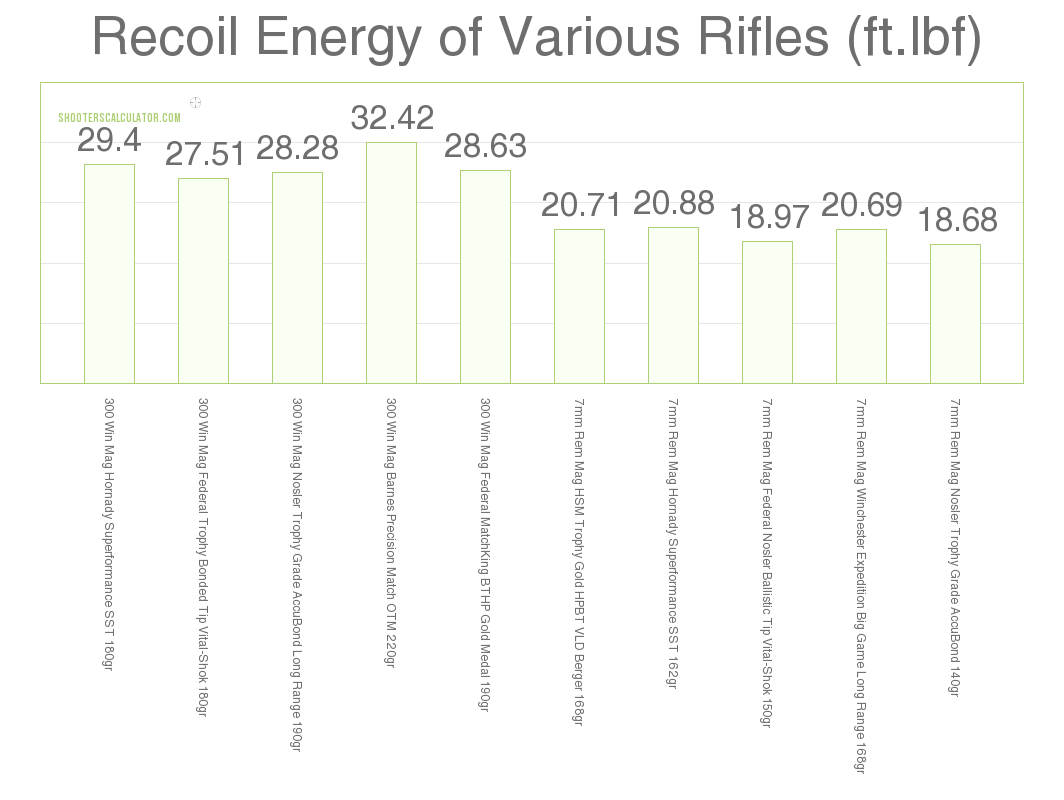
Recoil 7mm Rem Mag vs .300 Win Mag

When we look at this graph, we see a clear and distinct difference in recoil energies produced from these two cartridges. All five of the .300 Win Mag rounds produced between 27 and 32ft.lb of energy, between 7 and 14 more ft.lb of recoil energy than the 7mm Rem Mag rounds.

A rule of thumb that a lot of shooters go by is that 20ft.lb of recoil energy can influence the shot and even be uncomfortable for some shooters. Again, this is all relative and depends on who is holding the gun. If we do go by this rule, the 7mm Rem Mag rounds still could be troublesome for some hunters and marksmen though still a good bit lighter than the .300 Win Mag rounds.

When you have two cartridges that overlap in a lot of shooting situations each category deserves some consideration. For such a difference in recoil, it usually means there is a performance spec out there that the recoil energy is resultant from. Let’s continue and see what we find.

Let’s take a look at the how the recoil energy between these two cartridges compare when we work with a larger data set. You will find these tables at the end of each section throughout the article.

Average Recoil (ft.lb)

.300 Winchester Magnum7mm Remington Magnum 27.322.1

The recoil energy for these rounds was generated as we described earlier and used the same variables. With the larger sample size, we see the same trend that we saw above. The .300 Win Mag, on average, is generating around five ft.lb more recoil energy than the 7mm RM rounds and if you look at the individual rounds (not shown) they tend to group pretty tightly by cartridge type though there are some outliers for both cartridges as is often the case.

Ballistics

If you’re looking at a cartridge comparison, you are going to end up looking at the ballistic categories. If you’re a hunter, competitor, or just enjoy shooting, understanding how your cartridge of choice behaves in flight and understanding its limitations is critical to your level of success

In this section, we will take a look at several ballistic categories including the velocity, the ballistic coefficient, as well as the short and long range trajectory of the 7mm Rem Mag vs .300 Win Mag. After we have examined these sections, we should have a much clearer understanding of where these cartridges excel and where they fall short and will let us begin teasing apart applications one cartridge might be favored over the other. Of course, it might also tell us that both are more than capable of doing the same thing efficiently and effectively.

Velocity

The velocity is an interesting and critical performance spec for any cartridge comparison. While we will examine it as a standalone performance category, velocity has its hand in just about all other performance specs of a cartridge. It influences recoil, trajectory, and it even influences stopping power of the bullet in several different ways.

While you need a certain amount of velocity to get the proper terminal ballistics, there is a fine line between too little and too much velocity. It is a common mistake to think that the maximal velocity you can get out of a round means a better overall performance. If you load a round too hot it can lead to extreme pressures that become very dangerous for the shooter. If the round is not paired with the correct twist rate of the barrel, the bullet can be highly unstable in flight and become highly inaccurate.

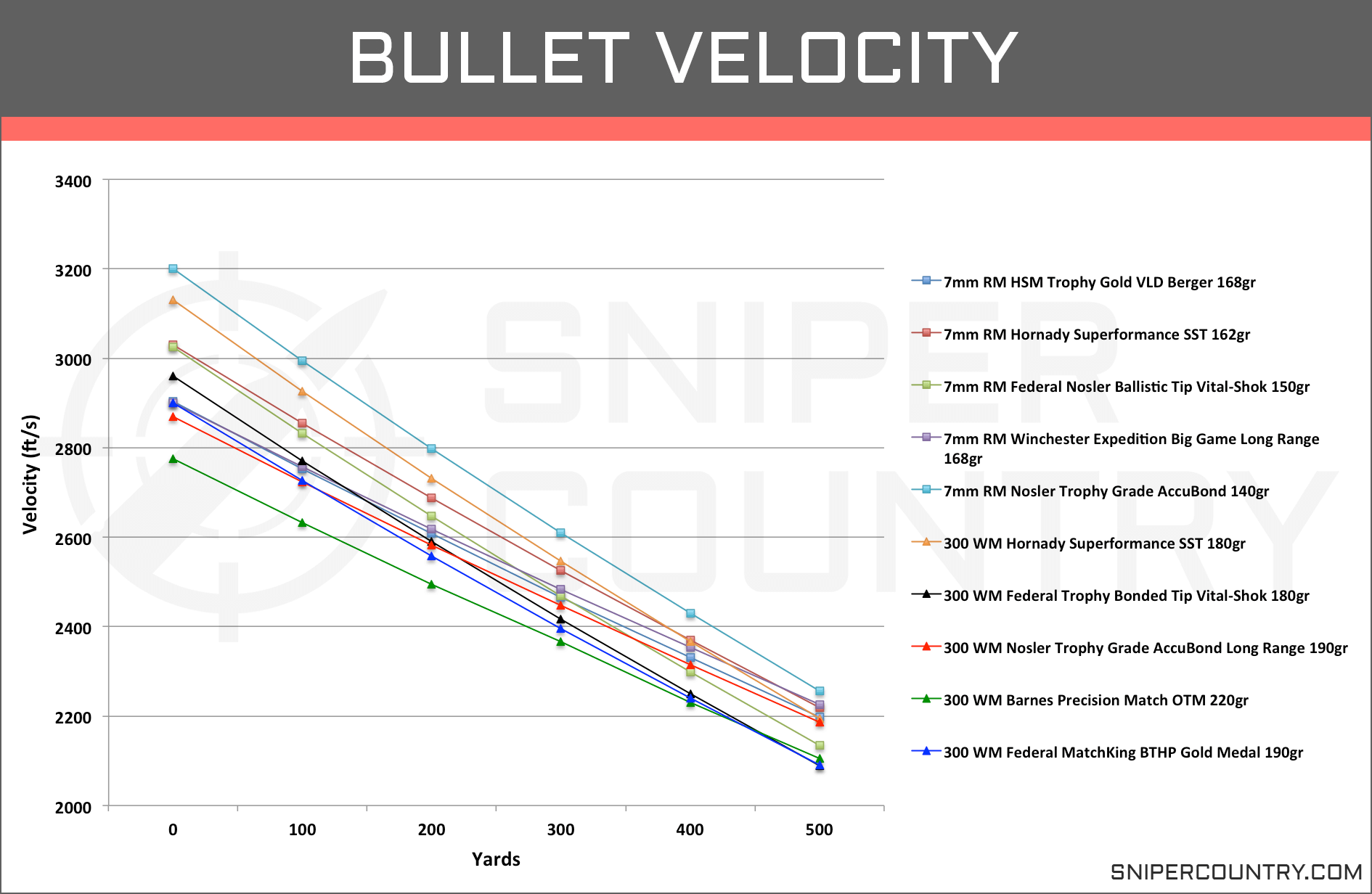
We have compiled the velocities of the ten selected rounds from the manufacturer’s websites and have listed them here. We are looking at the ft/s of each bullet as it moves from the muzzle out to 500 yards (Graph 2).

Bullet Velocity 7mm Rem Mag vs .300 Win Mag

The first thing that jumped out at us as we looked at this data is that unlike the recoil, there is not a cartridge that has an overall greater amount of velocity. Both the .300 Win Mag and 7mm Rem Mag have specific rounds that show a much higher velocity and also rounds that fall lower on the graph.

If we were to take averages of all the rounds, then there would be a slight advantage to for the 7mm Rem Mag rounds at each yard marker and each time the difference is less than 100fps. Now, 100fps for some might be a bigger deal than others, but keep in mind it’s only an average. There are 7mm Rm rounds that outperform some .300 Win Mag and vice versa.

Both cartridges maintain supersonic speeds over a 500-yard range and will maintain that rating over several hundred more yards. This is more than enough velocity to get proper terminal ballistics for these rounds but keep in mind some of these are not intended for hunting purposes.

From what we are looking at from these factory loads, velocity is definitely a wash between the 7mm Rem Mag vs .300 Win Mag, but that might not be the case when we bring in more data. Below you will find the velocity averages for the two cartridges.

Average Velocity (ft/s)

Yards.300 WM7mm RM Muzzle2976.43031.5 1002773.32828 20025902634 30023902442.7 4002236.42267 5002055.82098.2

When we look at more rounds for each cartridge, we still see that the 7mm RM has higher velocities than the .300 WM rounds at each marker through the bullet’s range. And, like the smaller sample set that we just looked at in our graph, the difference between the two cartridge’s average is less than 100fps at each yard marker.

With two cartridges that have the potential and the reputation for long range shooting, we wanted to also look at how long these cartridges can stay in supersonic flight. We have listed the average cutoff for supersonic flight in the table below.

Average Supersonic Limit (Yards)

7mm Remington Magnum.300 Winchester Magnum 1292.11258.75

We are interested in how long these rounds can maintain supersonic flight because it influences the calculations you will have to make to be accurate with long range shots. When a bullet falls below this speed barrier, its slight is less stable than it initially was and environmental factors begin to have more noticeable influence on the round. When you know when these effects start occurring, you can adjust accordingly or go with a round that might give you more flight time at these speeds.

With these two cartridges, we see fairly similar limits for supersonic flight though the 7mm RM rounds have, on average, 36 more yards of supersonic speed. In the grand scheme of things, we don’t know if that is enough to sway you towards one cartridge or the other without taking into consideration other performance specs. We do know what there is a lot of range in the limits for both cartridges.

Ballistic Coefficient

The ballistic coefficient is derived from an equation that includes input variables from specific cartridge specifications including bullet dimensions and velocity. The physics and math behind the ballistic coefficient and its implications, while interesting, is not something we are going to attempt to convey in this article, but we do urge you to check it out.

In the simplest explanation possible, the ballistic coefficient gives you an idea of how well a bullet is streamlined and how well it can overcome air resistance. The higher the BC, the better the bullet can cut through the wind, meaning it resists drag and wind drift much more efficiently than a bullet with a lower BC. As you can imagine, this makes the BC a relevant piece of information for both long range competition shooters and hunters alike.

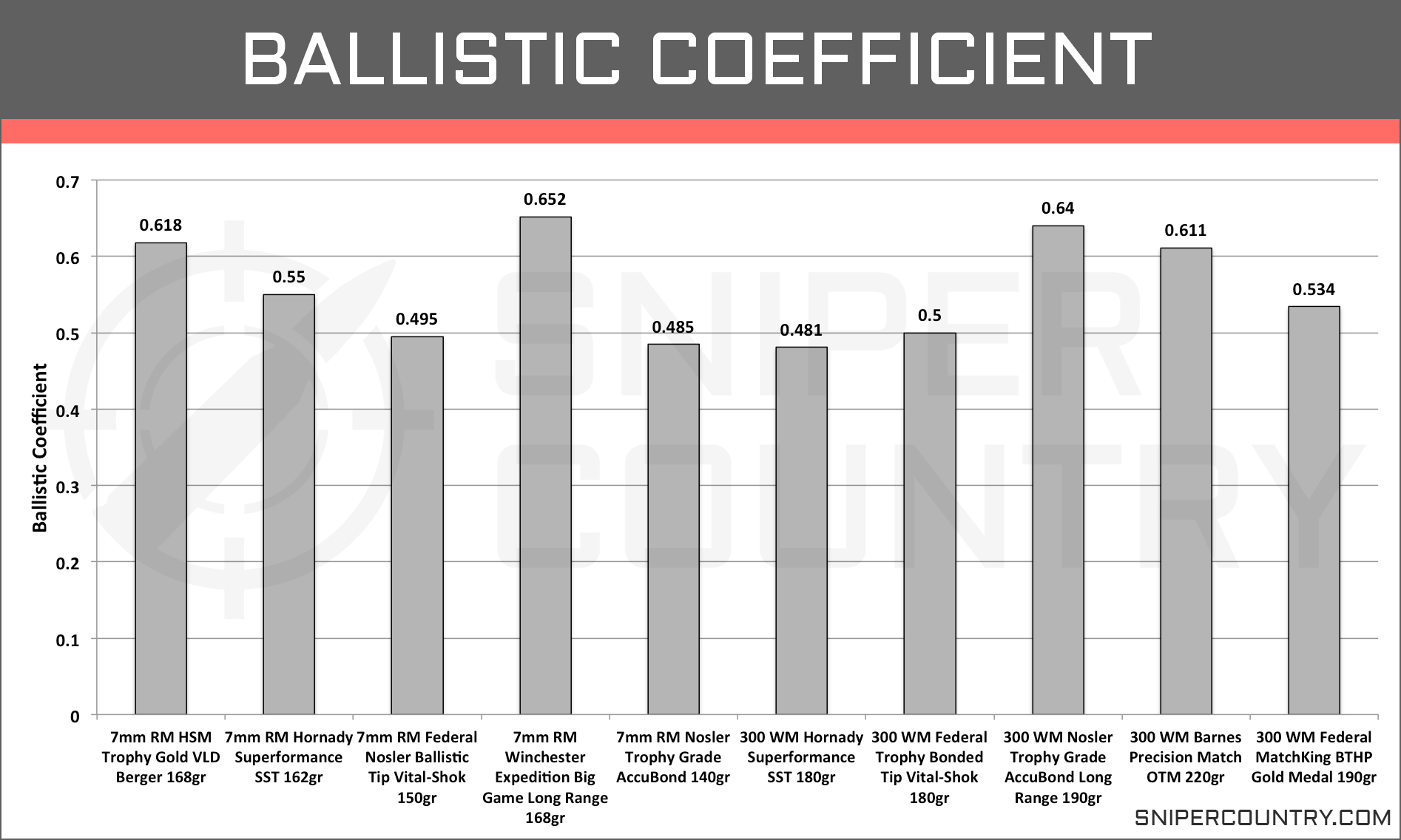
We have compiled the G1(for comparison of all bullet types) ballistic coefficients for each of the ten rounds and listed them here (Graph 3).
Ballistic Coefficient 7mm Rem Mag vs .300 Win Mag

As with the velocity, we see a lot of variation in BCs throughout all ten selected rounds and within each cartridge class. Both of these cartridges sports rounds with ballistic coefficients well over .45 and each have rounds with BCs above the .6 mark.

If you’re interested in the averages, the 7mm Rem Mag has an average BC of .56 while the .300 Win Mag has an average BC of .553. Though there is a slight difference in the averages, we don’t think it is a fair way to decide which of the cartridges have the better ballistic coefficients. If you need a round that’s going to resist wind deflection and drag, both the 7mm RM and the .300 WM have options to get the job done.

BCs are also important in the trajectories of bullets. Higher BC rounds tend to have flatter trajectories. Since these two cartridges were nearly identical in their BC’s, let’s see if the same trend continues when you look at the short and long range trajectories. Before we move on to the trajectories of these two cartridges, take a look at the average BCs of the larger sample size. It is important to remember when looking at these averages, that they are just averages and you’re not shooting averages out the barrel. It does give you a better idea of which cartridge has more options for higher performance numbers for each specific category.

Average Ballistic Coefficient

.300 Winchester Magnum7mm Remington Magnum 0.4890.483

When we looked at averages of the smaller set, the 7mm RM had a .01 difference in the averages of the rounds. In the larger data set, the .300 Win Mag had a .006 advantage over the 7mm RM rounds. Obviously, there is no real difference in the BCs of these two cartridges. If you are wanting a BC in the .05+ range, there are options for that with both of these cartridges.

Trajectory

Look on any forum discussing shooting and the ballistics of a certain cartridge, and you are bound to see the topic of trajectories pop up. We’re don’t mean to insult anyone’s intelligence, and we are probably speaking to the choir here, but a bullet’s flight path is not a straight line but rather a parabolic shape. A bullet’s design, their BC, and the muzzle velocity all influence the trajectories.

So why exactly is trajectory important, more specific, why is how flat a trajectory is so important? Even with today’s rifle optics, you can ask anyone whether adjusting for a 45″ drop or a 65″ drop is easier and 45″ will be the answer every time. Not only are you taking into account elevation but wind as well. And for hunters, where you might not have all the time in the world to take a shot, the fewer variables you have to account for the better.

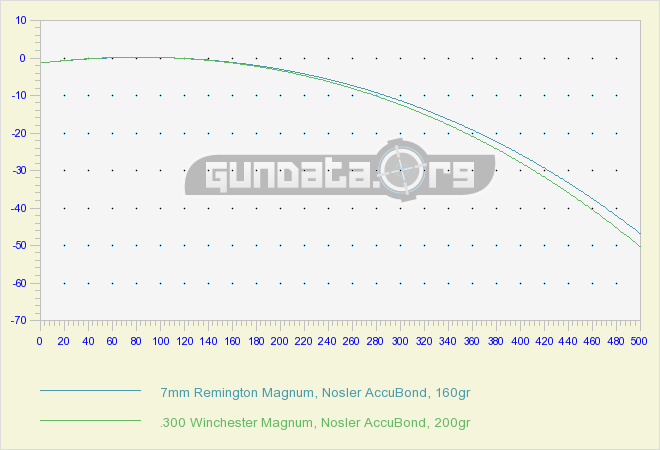
Before we launch into the short and long range trajectories, we wanted to step back and show the trajectory of two similar rounds, one for each cartridge, that uses the same bullet design and similar weights, as these cartridges allow, that come from the same manufacturer. With just two rounds, it might be easier to get an overall view of how these two cartridges stack up before we throw eight other rounds into the mix. (Graph 4).

Trajectory 7mm Rem Mag vs .300 Win Mag

From this graph, it is easy to see that these two cartridges show very similar trajectories out to 500 yards. In this case, the 7mm Rem Mag shows slightly less bullet drop than the .300 Win Mag round and even at their most distinguishable range, we are only looking at around 5” difference. And we can’t rule out the fact that we could change the bullet weights of these two rounds and close or widen the gap. With that in mind, let’s bring in a more diverse selection of rounds for each cartridge and see if we still see similar trajectories.

Short Range Trajectory

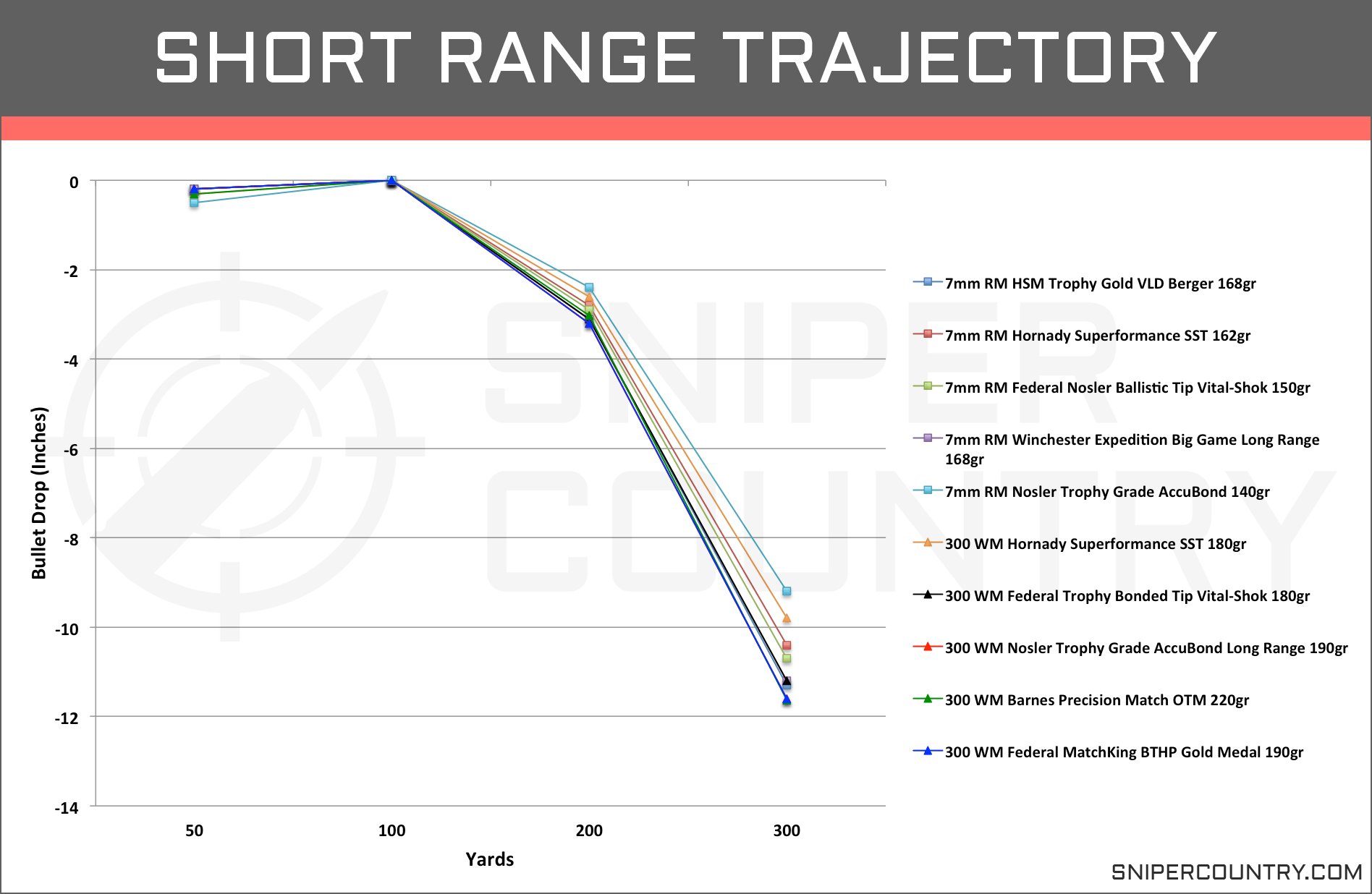
While both of these cartridges were designed with longer range capabilities in mind, they are both also hunting rounds, and with hunting, you are going to come across as much or more shots at targets within 300 yards depending on the terrain and the game. With that, we feel it’s important to look at the short range trajectories (Graph 5).
Short Range Trajectory 7mm Rem Mag vs .300 Win Mag

We are looking at the bullet drop (inches) from the 50 to 300 yards with the firearm zeroed in at 100 yards.

At the 200 yard mark, all ten of these rounds are clustered very tightly with a difference of only .7” between the flattest and steepest round. We also do not see any trend towards one cartridge having a flatter trajectory than the other. In fact, the flattest shooting and steepest dropping round are both 7mm Rem Mag rounds.

As we move out the 300-yard mark, there is a little more spread between the rounds but still no clear cut advantage for one cartridge over the other. And when we say spread out we are still looking at a range of less than 2.5”. The top two performing rounds are a 7mm Rem Mag and a .300 Win Mag option, and they only have a difference of .6″.

We are again seeing that both of these cartridges are performing very similarly. If you want a flat shooting round for short hunting situations, both the 7mm RM and the .300 WM are going to get the job done.

Below, you will find the numbers for the larger data set. We have also included an additional 400 yard marker as there are certain hunting situations where this range can be a normal shooting distance.

Average Bullet Drop (Inches) at Short Range

Yards7mm RM.300 WM 50-0.23-0.193 10000 200-2.8-2.9 300-10.7-11 400-24.5-25.6

Just as with the smaller set of rounds we just looked at, these two cartridges are nearly identical in their trajectories. The 7mm RM has a flatter trajectory throughout the bullet’s range, but the largest difference seen between the two cartridges is only 0.9 inches at the 400 yard mark. With that type of similarity, it’s hard to even say it’s an advantage. At these normal hunting ranges, you are not going to get an advantage by going with one cartridge over the other. Instead, your advantage is going to be achieved by selecting from individual rounds and both the .300 WM and the 7mm RM have rounds with phenomenal trajectories.

Long Range Trajectory

Let’s step out and take a look at the trajectories of the 7mm Rem Mag vs .300 Win Mag at increased distances (Graph 6).

Long Range Trajectory 7mm Rem Mag vs .300 Win Mag

We are again looking at the bullet drop (inches) of the ten rounds, but now we are following them out to 700 yards with the firearm zeroed in at 200 yards.

At the 300 yard mark, we are looking at insignificant differences between the two cartridges. The averages of the rounds for each cartridge have a difference of less than .4”.

As we move out to more distant markers, we start to see more of an advantage for the 7mm RM though it is still fairly close, and there are several .300 Win Mag rounds that shoot as flat or flatter than several 7mm RM rounds. Before we list some these differences between the averages of the two cartridges, it’s important to keep in mind the applications you plan to use one or both cartridges for. For hunting purposes, shots out past 500 yards get pretty dicey so the 600 and 700-yard data points are not going to be as important to you as the .300 and 400 points.

Here are the differences in averages of the 7mm Rem Mag vs .300 Win Mag; 300yds (.34”), 400yds (1.32”), 500yds (2.62”), 600yds (3.08”), and 700yds (6.96”). To some these numbers aren’t going have any sway in their decision. For others, the trend of the 7mm RM losing altitude at a slower rate than the .300 Win Mag as you increase the distance is very important.

Though the averages give a slight advantage to the 7mm Rem Mag in flat trajectories, especially as it moves out to the 600 and 700 yards range, the two top performing rounds at each yardage marker was a 7mm RM and a .300 WM. You might have more options for flat shooting rounds for the 7mm RM but be aware that there are .300 WM rounds that can easily compete for flat trajectory.

In the table below, we have listed the average bullet drop for the two cartridges below. We have also added an additional 1,000 yard marker for those who like to push their limits.

Average Bullet Drop (Inches) at Long Range

Yards.300 WM7mm RM 1001.51.4 20000 300-6.7-6.4 400-19.5-18.8 500-39.5-37.9 700-104-101 1000-295.6-286.8

Like the smaller sample set and like the averages we saw when examining the short range trajectory, there is not a whole lot of difference between these cartridges. The 7mm Rem Mag rounds have a slightly flatter trajectory, on average, and this is most pronounced at 700+ yards, but when looking at individual rounds, there is a mixture of both cartridges from the high end of the bullet drop range to the flattest shooting rounds.

Stopping Power

In this next section, we are going to look at several sub-categories of stopping power. Stopping or knockdown power as some like to call it is going to be more important to those looking to utilize these cartridges for hunting purposes.

Stopping power is extremely important in a hunter’s decision for a cartridge. For us and the majority of hunters we know, putting down an animal quickly and humanely is of utmost importance. Not only is it because we don’t want the animal to get away and we don’t want to have to track it for miles, but we also respect the animals a great deal and letting one get away wounded is the last thing we want.

Unfortunately, there is no single measurement that is going to convey to us a cartridge’s stopping power, but there are several factors that influence stopping power such as bullet energy, penetration, and bullet expansion. The two former factors are something we can work with for comparing the 7mm Rem Mag vs .300 Win Mag with computer generated data. For penetration, we will actually look at two different metrics, the sectional density and the bullet momentum.

And while we do think understanding these components of stopping power is important, it is all worthless if you can’t put the right bullet where it needs to go. A small lack of force can be made up for with an accurate shot in the vitals.

Energy

When the powder in the casing is ignited, and the bullet is forced down the barrel and down range, that energy created from the burning powder is carried by the bullet. That kinetic energy is only one factor of a rounds stopping power, but it is an important one. We know from basic physics that if the cartridge can be fitted with larger and heavier bullets and sent downrange at increased speeds (more powder) than they should carry extra force with them. Because of this, we can easily compare two cartridges rather than having to look at the individual bullet types used.

When the bullet impacts the target, this kinetic energy is transferred to the surrounding tissue and organs causing massive damage. This transfer is also affected by how the bullet reacts on impact, such as how the bullet expands. More expansion causes a larger wound and also transfers the energy carried by the bullet more efficiently. Velocity is also a key component in a bullet’s ability to expand, but for now, we are just going to stick with comparing the energies of the rounds involved.

The amount of energy that is required to bring down game varies from animal to animal. While there are general rules of thumb for what is required, nothing is set in stone, and as we just mentioned, there is more involved than just bullet energies. Still, it is accepted that 1,000ft.lb of energy is a good mark for deer while 1,500ft.lb is more suitable for elk. As the species increase in size so does the amount of energy. And like we have mentioned before, using a proper bullet and putting it in the right spot can make up for lack of energy.

Let’s take a look at the bullet energies (ft.lb) of the ten selected rounds from the muzzle out to 500 yards (Graph 7).
Kinetic Energy 7mm Rem Mag vs .300 Win Mag

Unlike the last couple of performance categories we have looked at, here we see a distinct difference between the two cartridges more so than just between different rounds. From the muzzle out to 300 yards, all of the .300 Win Mag rounds show higher bullet energy than the 7mm Rem Mag rounds. Right from the muzzle, the lowest .300 Win Mag round is carrying 3,474ft.lb of force while the highest 7mm Rem Mag round is carrying 3,303ft.lb of force. The difference between the highest .300 Win Mag and the lowest 7mm Rem Mag round is even more drastic with a difference of 615ft.lb of force.

What is interesting is that as these rounds move downrange, the gap between the two cartridges begins to close. While the three .300 Win Mag rounds maintain their lead; the other two are tightly clustered with several 7mm Rem Mag rounds.

If we look at the averages of the two cartridges at the muzzle and 500 yards, we can see how much this gap closes. At the muzzle, the .300 Win Mag rounds have an average bullet energy of 3,640ft.lb while the 7mm Rem Mag rounds have an energy of 3,162ft.lbs. That’s a difference of 478ft.lb. By the time they reach the 500-yard mark, that difference is nearly cut in half to 224.4ft.lb of difference.

While the .300 Win Mag overall has higher bullet energy, the differences are not too extreme. You can cherry pick a round from each and see quite a bit of difference as we did earlier, but there are a lot that carries very similar energies, and we saw that as they travel downrange they even out even more. And for hunting purposes, we are not sure that an extra .300 ft.lb of force is going to make much of a difference. IF you put either of them in the vital zone, they are both going drop the animal.

Let’s see if the trends continue in the same direction when we look at more rounds for both cartridges.

Average Bullet Kinetic Energy (ft.lbs)

Yards7mm RM.300 WM 03140.83479 1002733.83029 2002372.52658.4 3002051.72290 40017661988.3 5001513.31741.3

When we bring in the extra rounds, we still observe the greater kinetic energy with the .300 Win Mag rounds at each yard marker along the bullet’s flight. And like earlier, as the rounds move downrange, the gap between the two did shrink. While this category was a little more clear cut when thinking about the difference between the cartridges as a whole, there are still instances where some of the 7mm Rem rounds produced KE around or above the average of the .300 WM rounds.

And what shouldn’t be lost, is that while the .300 Win Mag does seem to have more KE, the amount that the 7mm RM rounds generate are not insignificant. Both of these rounds produce enough KE to create a lot of damage on the largest North American game at all ranges most hunting shots are taken.

Penetration (Sectional Density)

Penetration is another component to a bullet’s stopping power that we want to address in this article. For a bullet to quickly kill an animal, it must reach the vital organs. When thinking about how much penetration is necessary, you also have to think about the type of game you are hunting. A mature bull moose is going to require more penetration than a whitetail deer.

There are several factors that influence the amount of penetration that is going to occur, other than the type of animal. Some of these factors include the velocity, the caliber of the bullet, the weight of the bullet, and the bullet’s design. In this section, we are going to look at the sectional density (SD), which is a number calculated from the caliber of the bullet, as well as its weight.

The sectional density correlates with the amount of penetration a bullet will have on the target, and since we are not looking at bullet types and designs in this article, we think the SD is a good means of comparison for two cartridges. And though it is fine for looking at now, when making your final decision on a specific round, it is important that you take into account all of the factors. Understanding your bullet design, how it expands, and the velocity needed for proper expansion and penetration is a huge can be the difference between a clean kill or an injured animal you have to track through the night.

So when you look at the SDs of various cartridges and specific rounds, higher SDs correlate to deeper penetrating bullets. As an example, let’s take two rounds, both are 100gr, but one has a diameter of .100″ and the second has a diameter of .200″. The .100″ bullet is going to have a larger SD than the .200″ bullet and theoretically, deeper penetration. This is because the force behind the bullet is localized to a smaller area and can drive the bullet deeper.

We can do the same exercise, but instead look how the weight of the bullet affects the SD. With two bullets, each with a .300” diameter with one weighing 100gr and the second 150gr, the 150gr is going to have a higher sectional density and deeper penetration.

We have calculated the sectional densities for all ten of the selected rounds have compiled them here (Graph 8).

Sectional Density 7mm Rem Mag vs .300 Win Mag

Like most ballistic and other performance specs we have looked at between the 7mm Rem Mag vs .300 Win Mag, there is not a whole lot of difference between the two cartridges. On average, the 7mm Rem Mag rounds have a SD of .279 while the .300 Win Mag rounds have an average SD of .289, a hundredth of a difference. Both cartridges have their rounds with heavier bullets and subsequent higher SDs.

Though the 7mm Rem Mag rounds are a smaller caliber than the .300 Win Mag rounds, they also have lighter bullets. This difference between the two leads us to rounds that have very similar SDs.

Average Sectional Density

.300 Winchester Magnum7mm Remington Magnum 0.2840.273

Again, with the larger set of rounds, we see the sameresults from earlier. The .300 Win Mag rounds show a slightly higher sectional density than the 7mm Rem Mag rounds.

Penetration (Momentum)

The second metric that we will use to get an idea of how these two cartridges compare in potential penetration is the momentum of the bullets. Moment is simply how well an object in motion will stay in motion. Meaning, how well can the object, a bullet in this case, overcome resistance and keep moving forward. The higher the momentum, the more the bullet can penetrate after encountering resistance. And, this is of course omitting the type of bullet that is being fired which in the field, is going to have to be taken into consideration. Though, for hunting purposes, just about all of the rounds for these two cartridges are going to be designed to hold together well and over controlled expansion.

It is also important to keep the sectional density in mind when looking at momentum. The higher the sectional density, the less resistance the bullet encounters because of the smaller area that is interacting with the target.

We have graphed the bullet momentum of our ten rounds and graphed them below (Graph 9).
Momentum 7mm Rem Mag vs .300 Win Mag

From this graph, we can see that the rounds do appear to group with rounds of their respective cartridge type. The averages definitely lean towards the .300 WM rounds for higher momentum. We do see that advantage begin to shrink as the rounds move downrange with an average difference of 12lb/ft.s at the muzzle and 9lb/ft.s at the 500 yard marker.

We do see that the Barnes .300 WM round is a big boost to the averages and without it, the average performance between these cartridges would be much similar. Let’s take a look at the larger sample set and see how the two compare. Even without the highest performing round, we still see the rounds from each cartridge grouping together pretty tightly. For the .300 Win Mag rounds, all of the them leave the muzzle with over 75lb/ft.s of momentum while all of the 7mm RM rounds are below the 70lb/ft.s mark. We also do not see any overlap between rounds of different cartridges until the 500 yard mark, and even then, it is only the highest performing 7mm RM round that matches the lowest performing .300 WM round. And when we say highest or lowest performing, we mean that in regards to only the momentum numbers.

Let’s take a look at the averages of the full data sets.

Average Bullet Momentum (lb/ft.s)

Yards.300 WM7mm RM Muzzle75.466.6 10070.762.2 20064.957.9 3006153.7 40057.249.5 50052.646

When we add in more rounds, we are still seeing the same trends as before. The .300 WM rounds are generating more momentum from the muzzle out to 500 yards. We do see the difference shrink by a few lbs/ft.s but overall, the .300 Win Mag seems to have the advantage if you are wanting more momentum.

These results shouldn’t be too surprising. Given that the mass and velocity make up bullet momentum and since there was very little difference in velocity between the cartridges and the .300 WM rounds have heavier bullets, it makes sense that they generate more momentum.

Accuracy

Trying to determine which cartridge is more accurate is always a task that makes us feel a little dirty. The best method of doing this is through hundreds of rounds through several days of shooting and measuring groupings. Even then, two people’s results can be drastically different. Heck, one person’s results can be different from day to day. And we’re not discounting that method, it can be very valuable, but you just have to be cautious of who you are getting that information from. We think which cartridge has the better accuracy comes down to the person pulling the trigger and their level of experience shooting said cartridge.

If we look at some of the ballistics data such as the ballistic coefficients and the trajectories, there is not a whole lot of difference between the two cartridges in either category. The 7mm Rem Mag had on average slightly higher BCs and slightly flatter trajectories out past 500 yards than the .300 WM rounds, but as we stated during those discussions, there are rounds for both that perform better than others. And if you need some extra power at short range the differences are nowhere enough to make you decide against the .300 Win Mag. In fact, we don’t think there is a big enough difference in these categories to make you lean one way or the other regarding accuracy from the data we have looked at here.

And you can’t discount the role recoil can play in accuracy. We think that most of you here reading this article would easily adjust to the increased recoil of the .300 Win Mag, but there might be some who could easily be thrown off by the kick. And if you’re a person who enjoys burning through a box or two at the range, that extra 10ft.lb of recoil can be fatiguing and lead to a decrease in accuracy over time.

It’s all nitpicking to us. We did feel the need to mention it, but both the 7mm Rem Mag and the .300 Win Mag cartridges can drive nails with some practice on your end, and they can do it from a distance.

Price & Availability

When we look at the price of the 7mm Rem Mag vs .300 Win Mag, it can vary from round to round. Just between cartridges, we don’t think there is enough of a difference to choose one over the other based on price. Each cartridge has cheaper boxes of ammunition and each has more expensive boxes. You can definitely save a few cents per round by looking into handloading for both of these cartridges.

As far as availability goes, just about every major ammunition company are loading .300 Win Mag and 7mm RM cartridges and most of them carry several different models of each. We don’t think there is any difference in availability between the two, though there is less compared to other popular hunting rounds. And with the internet at your disposal, finding exactly what you need has never been easier.

AmmunitionPrice (20 Rounds) 7mm RM HSM Trophy Gold VLD Berger 168gr$47.99 7mm RM Hornady Superformance SST 162gr$32.29 7mm RM Federal Nosler Ballistic Tip Vital-Shok 150gr$36.79 7mm RM Winchester Expedition Big Game Long Range 168gr$43.99 7mm RM Nosler Trophy Grade AccuBond 140gr$58.00 300 WM Hornady Superformance SST 180gr$30.99 300 WM Federal Trophy Bonded Tip Vital-Shok 180gr$46.99 300 WM Nosler Trophy Grade AccuBond Long Range 190gr$48.99 300 WM Barnes Precision Match OTM 220gr$48.99 300 WM Federal MatchKing BTHP Gold Medal 190gr$52.99

Applications

As we start top close out this comparison, let’s try to take the results we have found and start teasing apart certain applications of these cartridges might be better suited or maybe applications where you can’t go wrong with either.

We have also provided the average tables throughout the article below to make it a little easier for you as we move through this section.

For long range precision shooting, both of these rounds have options to get the job done. The 7mm Rem Mag rounds have more options for higher muzzle velocities, flatter trajectories, and better BCs which helps performance greatly downrange. That is not to say that there aren’t .300 Win Mag options that can give you very similar performances, but most would rather not deal with the increased recoil for dozens of shots within a short time frame.

While both of these rounds can function in long range precision shooting, the majority of users are going to be using them in a hunting capacity. Both the 7mm Rem Mag and the .300 Win Mag can be used for medium sized game such as deer, hogs, antelope, and sheep at just about any realistic hunting range. We really like the lighter 7mm Rem Mag rounds for these game animals. Overall, both rounds are really overkill for these game animals stopping power wise, but that extra range can be a game changer.

Both cartridges also have heavy enough bullets and the terminal ballistics to be used for larger game such as elk, moose, and more exotic game and still have a wide effective range. For bigger and more dangerous game, you might like the kinetic energy and larger bullets of the .300 Win Mag but as we discussed in the previous sections, we would be comfortable with either cartridge in these hunting scenarios.

We did see slightly higher sectional density numbers, on average for the .300 Win Mag and pretty significant differences in the momentum data with the edge going to the .300 Win Mag as well. Both of these combined, barring bullet design, indicate that the .300 Win Mag should have better penetration potential. And that is not to say that the 7mm RM rounds are not going to penetrate well. Given that the cartridge is still around tells you that it is able to bring down large game efficiently. If you were of the mind to get as much penetration as possible, the numbers say the .300 WM is better suited. Even so, it’s really more about picking the correct round rather than the correct cartridge.

Best Rounds

Before we wrap up this article, we want to take the ten rounds we have been looking at and pick a couple that we think fits certain applications well.

Top Hunting Round

For the 7mm Rem Mag rounds, we are big fans of the HSM Trophy Gold VLD Berger 168gr round. We think the 168gr bullet is a great weight for hunting purposes as it has a manageable recoil. It has one the best muzzle velocities and BCs of all the rounds we looked at so you have excellent downrange ballistics, including a flat trajectory. It doesn’t have the highest amount of energy associated with it, but with the excellent Berger VLD bullet and velocity, you get more than enough penetration and expansion to take medium to large game at common hunting ranges.

For the .300 Win Mag, our choice goes to the Nosler Trophy Grade AccuBond Long Range 190gr. Some of our reasons for selecting this round is the terminal ballistics and the stopping power. This round maintains over 2,000fps throughout a 500-yard flight, which is more than enough to cause proper expansion of the ballistic tip bullet. This speed along with the sectional density is going to be more than enough to penetrate to and through vital organs of big bull elk and moose at long ranges. It might be a bit of overkill for medium sized game and you might get a bit more damaged meat, but there is little doubt that it will put them down.

Conclusion

Both of these magnum rounds have been in circulation for just about the same amount of time. More than enough to have a good feel for their strengths and their weaknesses. The fact that both are still used and still a topic of debate should give you an idea that both can be highly effective rounds in the right hands and the right situations.

We hope that this cartridge comparison of the 7mm Rem Mag vs .300 Win Mag has given you an unbiased look at some of the ballistic and other performance properties of these two rounds. We also hope that you have come to the same conclusion as we have after researching these two cartridges. With practice, either one can easily become your go to round.

Ammunition List

Baby Blues: It’s Snapper Time!

0
2018 8 Its Snapper Time Child
Snapper blues are just about the perfect saltwater species to introduce new anglers to the exciting sport of fishing. (Photo by Toby Lapinski)

When I think of snapper blues I think of my youth. Countless memorable days in late August, sunburned shoulders, casting from a jetty in Madison, CT near my grandparents’ house. There was no 10-fish limit back then, and a bucket full of snappers fed the family fried-fish dinners for several nights. Today, the same excitement still thrills me when I feel one tugging on my spinning gear, fighting like a fish twice its size. Tigers cloaked in kitten bodies.

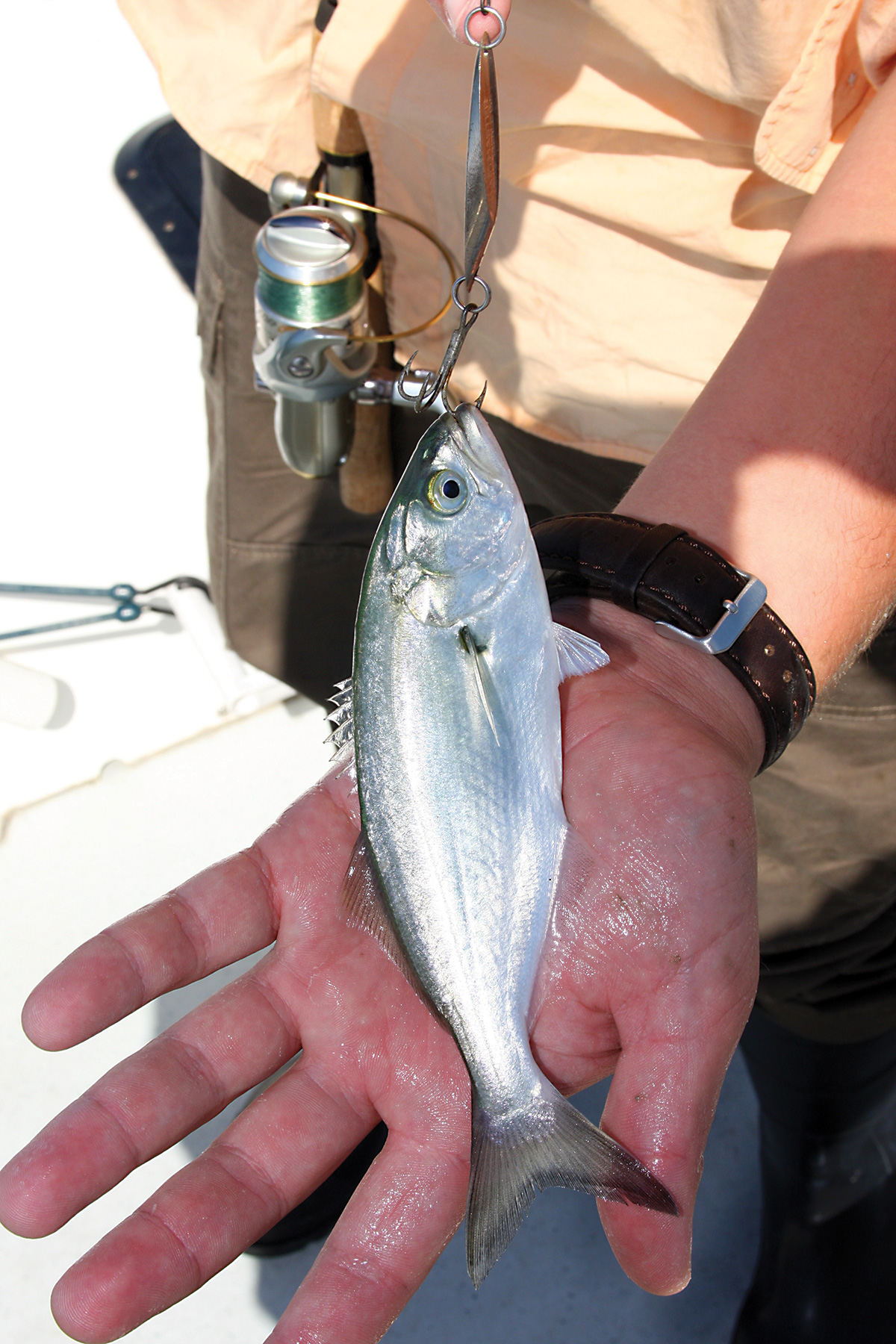
I’ve met anglers who believe snapper blues are their own species, and those folks were surprised to learn that “snappers” are simply baby bluefish. Anyone familiar with juvenile blues knows the name comes from the fast and fierce snapping of the jaws, which can inflict an impressive finger wound from even the smallest fish.

Snappers are young-of-the year bluefish, which become a “catchable” size of about 5 inches long when they invade our waters in late July and early August. They eat and grow at a remarkable rate, sometimes approaching nearly an inch per week. Late-season snappers reach at least 10 inches long before they migrate south in September, and are formidable opponents on a light outfit. They’ll strike at any lure smaller than themselves, making them a great target for young or beginner anglers and anyone looking for fishing fun on the saltwater.

Snapper Appeal and Locations

“When you find a school of snapper blues,” said Elliott Taylor, a snapper expert with 20 years’ experience in both CT and RI waters, “the bite can last all day, and you don’t need any special tackle to catch a limit. You don’t have to be a saltwater angler to get into snappers [although a saltwater license is necessary to target and/or harvest them], a lightweight freshwater rod will suffice, making these fish accessible to people of all ages and skill levels. Snappers, however, are not hardy fish—many don’t survive the catch-and-release process—so it’s best to have a plan for your catch, and stick to the limit only.

“You can find snappers close to shore, in estuaries and near structure like rock piles, docks and jetties where they chase bait like silversides, mummichogs and grass shrimp. Breachways and mini rip lines near shore often hold snapper blues, and nearshore tern activity is a great indicator the fish are there. Fleeing baitfish and small surface breaks are other exciting giveaways.”

2018 8 Its Snapper Time Catch
Whether they’re sought for food, sport or bait, snapper blues make great summer targets.

Technique

The easiest technique for catching snappers is to fish a small metal lure. Using this method, you cast—from either shore or a boat—as far as you can and then slowly reel in. Small tin lures are designed to tumble and flash, imitating a wounded or escaping baitfish, which draws any snappers within sight. Snapper pros experiment with different retrieve speeds to see what works best on a given day—faster speed keeps the lure near the surface, and slower speed allows it to sink a bit. Generally, try to keep the lure about 2 feet below the surface with your rod tip near the water.

An advanced technique is to work a flat metal rapidly across the surface with your rod tip held high, which causes the lure to travel along the top like a jumping baitfish—the same concept as working a big surface plug for adult bluefish. The trick is to reel it as slowly as possible while keeping the lure skimming the surface. The commotion triggers aggressive strikes, and it’s fun to see the hits on top.

Despite their reputation as voracious feeders, bluefish of all sizes are sometimes fussy. Bait is often the answer when small blues hesitate striking tin lures. If you’re only stocked with lures, try dicing a silverside into tiny chunks and use a piece to sweeten the treble hook on your metal.

Other snapper experts are diehard bait anglers, which means using a snapper rig—purchased from a tackle shop or home tied—consisting of a small hook threaded with shiners and bobber or “snapper popper.” Set the popper to hold the bait about 18 to 24 inches below the surface. Cast your line a little way out from the dock or jetty and wait. Some anglers try to cast as far as they can, but that’s unnecessary with bait and may cause a soft bait to tear from the hook. Like fishing for freshwater panfish, when you see the popper dip below the water you know a snapper is biting.

“Gently but erratically retrieving snapper poppers will attract fish that are spread out,” said Taylor, “as will using small, freshwater, surface-popper lures with the first treble hook removed. In areas with a large concentration of fish, a very small tin such as a Kastmaster, Hopkins or Deadly Dick is most efficient.”

Tackle

An inexpensive, light and durable 5- to 7-foot, small spinning outfit and assortment of small metal lures are perfect for quickly loading up a limit on snappers. You can add to the fun and challenge by bringing along a small fly rod.

“I use ultralight tackle,” said Taylor, “like a 6-foot 6-inch Ugly Stik Intercoastal and small reel spooled with 10-pound mono finished with a short 20-pound fluoro leader. But slightly heavier saltwater rods to 8 feet will also work, especially if you’re expecting any type of larger fish mixed-in. Long casts and intermittent twitches during a quick retrieve with a 1/8-ounce silver Kastmaster from any craft, including a kayak or SUP, attracts plenty of attention from the ever-present summertime snappers. You can move up to a 1/4-ounce for bigger snappers later in the season. Four- to 5-weight fly rods are also an absolute riot for snapper blues using a minnow imitation or bucktail retrieved quickly.”

Snappers for Bait

In the absence of traditional baitfish like porgies or bunker, snapper blues make good baits for slammer bluefish and even striped bass, but the main use for snappers as bait is for late-season doormat fluke. Keeping within the 10-fish limit, you can fish snappers either dead or alive, and there are several approaches when doing so. Some pros rig the snapper in the same manner you’d rig a shiner for largemouth-bass—from the bottom lip through the top, typically off a traditional fluke rig, either with a fluke bomb or off a three-way swivel.

To fish the fluke bomb, start with a barrel swivel attached to a 3-foot section of 30-pound fluorocarbon leader. Tie in a 6-inch dropper loop at the mid-point of the leader, and attach a large, flashy teaser. At the end of the leader, attach a snap swivel to clip on a fluke ball heavy enough to hold bottom. Cut a second 3-foot length of 30-pound fluoro, and attach it to the 9 o’clock position on the fluke ball with another snap. Tie in a 5/0 Gamakatsu live-bait hook for your main bait at the trailing end of the leader. This rig works equally well with live or dead snappers.

To fish a snapper live, some people prefer to place the hook in the back, just in front of the dorsal fin. You can also hook them through the nostrils. They can stay alive this way for a length of time. If the snapper is dead, however, don’t fish them with the flared gill covers and bent up head, typical of their rigor mortis position, because they spin in the current. If that condition happens, cut off both gill covers and bend the body straight. Sewing the mouth shut helps, too.

Other fluke pros “butterfly” the snapper bait by running a fillet knife from the tail up close to the head on both sides of the spine. Some experts then remove the spine for an unobstructed flutter action.

2018 8 Its Snapper Time Fish
While an array of lures and bait will produce snapper blues, tried-and-true “tins” like a Kastmaster or Hopkins is tough to beat.

Snappers in the Skillet

Many people don’t like eating bluefish, and therefore won’t eat snappers. But snappers don’t have the same dark meat and strong taste as adult blues. Their flesh is light and finely textured.

“They are great in the frying pan,” said Taylor, “just remove the head by making a diagonal cut behind the gill covers, cutting through the backbone. Gut the fish by pulling the head down, removing it from the body along with the entrails. Season to your liking with salt, pepper and oregano, and fry on medium heat until golden brown.” You then simply and easily eat the fillet off the backbone as you would a small trout.

The Elusive Striper

“These juvenile bluefish,” said Taylor, “also work great as live bait for large striped bass. When I was 10 years old, I was out in our Merrimac canoe with my father near a rock pile on Quonny Pond in Westerly, RI. We watched pods of bait swirling with packs of snapper blues meticulously corralling and devouring the peanut bunker and shiners. We were casting small Kastmasters and slowly filling our two-person limit for dinner. Suddenly, a large striper erupted inches from the boat, startling us, and taking a mouthful of bait and snappers with it. Frantically, we casted hoping to catch the bass, but to no avail. Since then, I have landed several 15- to 35-pound stripers using snapper blues.

“Catching your bait can be just as fun as catching your target species. Snapper fishing is consistently fast-paced, making it a quick cure for the fishing bug when other fisheries are slow in late summer.”

Brent’s Bottom Line – My Top 3 Hooks

0

You know, it doesn’t matter what kind of bait you use if you don’t have a hook in it. That sounds simple, but when it comes to choosing the right hook, I consider that decision very carefully.

Hooks are obviously extremely important because that’s how you’re able to land a fish. However, you have to use the right style of hook for the right application. Otherwise, you decrease your chance of catching fish.

When I’m determining the type of hook I’ll use, a lot of factors come into consideration. The type of bait I’m using is certainly a big element, but so are line size, the habitat I’m fishing and the size of fish I expect to catch.

For instance, you wouldn’t use a thin wire hook with 20-pound fluorocarbon in heavy cover. Conversely, you wouldn’t use a heavy flipping hook in open water with light line. Every hook has its purpose and learning to select the right one for the job will increase your success as an angler.

Here are a few of my favorite hooks and a few details on how I use them:

HOOK 1: Gamakatsu Straight Shank Heavy Cover Flipping Hook

How I Use It: This hook is great for fishing around any shallow cover such as grass or wood. The strength allows you to set the hook and drag that fish out of cover. In this scenario, if you try to use a hook that’s too light, one of two things will happen: Either your hook will bend, if the fish will wiggle loose.

When you hook a fish in that heavy cover, those fish have so much leverage. By comparison, out in open water, the fish is pulling against you, which means they’re pulling against your line and your rod. There’s not much pressure on the hook and on the fish.

But when that fish is in the target area and he’s pinned against something, they have so much leverage that they can turn their head really hard really hard the other direction and it will bend the hook. So you need a heavier hook for that situation.

This is my choice for flipping/pitching with 22-pound Sunline Shooter fluorocarbon. I’ll rig this hook with the Yamamoto Flappin Hog and use a 4/0 for the larger size bait and a 3/0 for the smaller one.

Hook Pointer: When I feel the bite in heavy cover, I drop the rod tip, reel up any slack and set the hook pretty hard.

HOOK 2: Gamakatsu Super Line Extra Wide Gap (EWG) Hook

How I Use It: This is my choice for all 5-inch Senko applications around shallow cover, where I cast and flip the bait on 16- to 20-pound fluorocarbon. That hook holds the Senko, I believe, straighter than any other hook. It allows the bait to line up perfectly straight on the hook.

That bait falls the best without any hook in it – without anything to hinder it. By design, the bait wiggles when it falls. With any hook, if the bait is tweaked a little bit and not perfectly straight, I don’t think it falls as naturally as it’s designed to fall because you’re limiting the amount of action it has.

Depending on depth, I’ll fish the Senko on a weighted Texas rig with a 4/0 hook or a weightless Texas rig with a 3/0. With the weightless rig, the 3/0 size is better because there’s less hook and I don’t overpower the Senko and mar the action. With a standard Texas rig, weight is less of an issue.

Hook Pointer: Not only does that hook keep it perfectly straight; it allows you to Tex-pose that hook point. So you don’t have to pierce the Senko completely like you would with a standard Texas-rigged setup where the barb and the point are buried inside the bait.

Well, a Senko is a big-body bait with a lot of salt and a lot of bulk. Anytime you have to pierce that bait, your odds of catching that fish decrease.

With that EWG hook, the bend that it has allows me to run the hook point completely through the bait and then the hook point lays flat on top of that bait. Then all I do is just barely pierce the skin with the point to make it completely weedless. When I set the hook, all I’m doing is tearing through one little piece of plastic.

So this hook helps the bait sit flat without any weird bend to it and it helps with the actual hook-up ratio when you set the hook.

HOOK 3: Gamakatsu Weedless Split Shot/Drop Shot hook

How I Use It: This is my choice for wacky rigging 5-inch Senkos. Wacky rigging maximizes that classic Senko action because there’s only one point of entry, as opposed to the two points of entry that you have with a Texas-rigged bait.

The reason a Senko is so effective at tempting fish is that it has a crawly, wiggly action on the fall. Fishing it on a wacky rig allows the bait to fall as it’s made to.

I like a 1/0-2/0 hook for wacky rigging and I’ll fish this rig in shallow to mid-depths on spinning tackle. I typically use 8-pound fluorocarbon, but these hooks are heavy enough that I can get away with 16-pound line if I’m around heavier cover.

Hook Pointer: Because I’m using spinning tackle and lighter hooks, I have to take it easy on the hook set. If I drop the rod tip and set the hook like I would with a flipping presentation, I might bend the hook. With spinning gear, I’ll reel down and pull into the hook set, instead of the drop-snap method.

Here are a few more points to consider with your hooks:

Knot Choice: For all of the hooks I’ve mentioned, I attach my line with a version of a uni-knot. Essentially, you make a loop through the eye; similar to the Palomar, but then you tie a uni-knot over the main line and the tag end with the loop.

In the past, I’ve had trouble with broke lines with Palomar, but since I’ve been using this knot, I’ve had almost no trouble with knot-related break-offs. A Palomar is a great knot for reaction baits, but for any hook setting baits with lot of shock, I use this modified uni-knot.

Matching Line to Hooks: The one trick is to look at the diameter of the hook as it relates to your line. The lighter the line, the lighter the hook should be. Basically, a light line doesn’t have enough power for a heavy hook; but a heavy line has too much power for a light hook. If you go the wrong way; things will go south in a hurry.

Hook Organization: How you store your hooks can play a key role in your efficiency, particularly your ability to quickly respond to an opportunity on the water.

I keep my hooks in a Plano Utility box with slots for the different sizes. This box also carries my other terminal tackle items. I have back-up items in their original packaging in my truck, but I’ll keep a complete assortment of terminal tackle in this one box in my boat.

Doing it this way, keeps everything I need right in front of me. I don’t have to open up a box for hooks, another box for weights and another box for bobber stops. It’s faster and easier to have something right there.

Sharpening Hooks: There’s nothing wrong with touching up the tip of a hook now and then. I do it if I see the point just has a little bend or tweak in it.

However, if I think a hook’s point has worn down to the point of needing more than a casual touch-up, I’ll replace it. It takes only a few seconds to retie and I’d rather know that I have a hook that won’t let me down.

What Do Coyotes Sound Like? – Audio & Video Examples

0

All wild animals make special sounds for communication or any other purpose. The coyote is also a wild animal that covers very vast territory from Alaska to Central America. They also make a lot of sounds like yips, howls, and barks. You may have been familiar with these sounds through literature, art, and films even if you have not experienced them in the wilderness. Generally, coyotes are not very vocal animals like human beings. They are considered very quiet wild animals. They do most of their daily communications with the help of eye contact, body language, and very subtle facial expressions.

Coyote sounds might not have any definite language but it is easily readable by other family members and those people who have spent some time listening to these sounds. The sound usually comes out in the form of an emotional outburst. Most of the time the vocalization of the coyote is related to the family’s internal affairs as coyotes have very intense family lives. It is also very much known that the coyote makes a lot of noise or special kinds of sounds at night.

In this article, we are going to explain in detail what do coyotes sound like under different circumstances.

What do coyotes sound like?

Coyote makes a lot of sounds. You can hear these wild animals both day and nighttime in the wilderness. Sometimes people also intermix their sounds with other animals like foxes, dogs, owls, and wolves. Coyotes mainly make sounds for the sake of communication. The most prominent sounds they make are yipping, barking, howling, yelping, woofing, etc. However, they prefer to utilize some silent means of communication as we have explained above. In the nighttime, they also make some strange sounds like they are howling.

Coyote sounds meaning

Coyote makes different sounds under different circumstances. It is important to understand their meaning so that we can get to know what coyote wants.

Sound of coyote Bark

Like other animals, coyote also barks as a warning of danger. They also make these sounds while fighting or if they want to grab the attention of others.

Sound of coyote Bark.

Howling

They howl under different situations. If they lone howl, it means to give intimation to the other members of the pack so that they can easily track each other in the wilderness. If they are making bark-howl then it is a warning sign for the intruders to go away. For socialization, they also make group howls or yip howls.

Coyote Howl: Back And Forth Social Coyote Communication.

Whining and yelping

Coyote pups or beta members usually make these sounds. They make these sounds while tucking their tail. Moreover, all the coyotes also whine if they are injured.

Coyote Growling sounds

This sound is almost the same as barking. It seems more dominant than barking. They make these sounds as a warning sign or if they have gained dominance or going to gain dominance on anything.

Coyote Growling sounds.

Huffing and woofing

These are disliking sounds. If there is some disagreement between the pack members, then they make huffing and woofing sounds. They also make these sounds if other animals like dogs or wolves have intruded into their territory.

Estrus chirps

These sounds are usually erupted by a female coyote who is in search of its mating partner. It is not a very well-known sound and only makes for calling in coyotes for the breeding season.

Coyote Yipping sounds

Coyote yips to express their painful feeling. It is actually an extreme form of whining. They usually make this sound if these animals are highly stressed or disturbed. It could be highly alarming for the other pack members if Coyote makes these sounds.

Coyote Yipping sounds.

Coyote Laughing sound

Sometime coyote makes a mixture of sounds. Various sounds like yipping, whining, and whistling when mixed together make a very strange laughing-like sound. They make these sounds if they are doing some celebrations in the nighttime or if they have got some big source of food.

Pack of Coyotes Laughing in an urban area.

Sounds of a coyote Screaming

It is one of the strangest noises you can hear from a coyote. These screams are almost the same as women are distressingly screaming somewhere. These are also called coyote distress sounds. These sounds might be extremely frightening for you and you must not go towards these places from where these noises are coming from. Usually, they make these sounds if their predator comes towards them. You may also consider these screams the same as the scream made by foxes, badgers, and bobcats.

Sounds of a coyote Screaming.

Coyote sound at night

Now, let me explain to you what does a coyote sound like at night. Coyotes make various kinds of sounds at nighttime. The howling sound is the most prominent among these. They make these sounds for communication purposes at night with their pack members. Moonlight also influences the coyote sounds. It means moonlight influences the coyote sounds. Coyote also makes a sound at night for an indication of their home territory as they don’t want an intruder to come near their home range or territory.

For this purpose, they make sounds like barking, howling, and whining. They also make howl for communication purposes while hunting at nighttime. They hunt as a team and also share the food they hunt. In this kind of hunt, communication is very necessary which they make by making howling sounds. They also make howling sounds at nighttime for keeping the predators away from their den for the safety of their pups.

Coyote Pack Sounds At Night

Coyote mating sounds

Coyote sounds are also very famous during breeding or mating seasons. The season usually starts between January and March. Coyote starts making sounds at the beginning of this season. Male coyote only makes howling while mating but this sound is mixed with the yipping, barking, and howling of female coyotes. Male coyotes also remain monogamous throughout their life until their partner dies. Sometimes you may also hear coyote mating calls which are intentionally done for attracting their mating partner towards them.

Decoding the howling sound of a coyote

Coyote makes howl when the sunset colors fade. Howling is the long but slow sound that usually breaks the calm of the forest. These are short howls that rise and fall as quickly as possible. You may also confuse this sound as the noises of a pack of animals but it is actually an illusion which is called the “beau geste” effect. The howling sound gradually distorts as it passes from one phase to another. These howls come in a variety of forms. Let’s have a look at all of these howling sounds made by individual coyotes or packs of coyotes.

Yip howl

These sounds are a mixture of sounds made by alpha coyotes along with female yips, barks, and howls. Beta coyotes and their pups may also join this sound. By hearing this sound, another alpha pair may also respond in the same manner and resultantly these yip howls may be heard from very far miles away.

Song dogs

Coyote sounds are also called song dogs due to their capability to travel very long distances. This type of song comes in two types.

Group yip howling

These yip howls are an indication of very strong bonding within the family. It is also a very strong message for territorial display that no one should cross this particular territory as it belongs to a specific coyote group. It is a very large auditory fence that no one should dare to cross.

Bark howling

This mixture of sounds is a warning sign which indicates agitation, disturbance, and threat. They usually make these sounds when big animals like wolves, or small animals like dogs or human beings intrude into their territory. If the tone of the howling sound is much higher then it means the coyote is highly disturbed and facing very high potential threat from the predators.

Coyote Bark-Howling sound.

Coyote sounds during Denning season

Coyote also makes sound while making dens for them. In this season, these animals are not very local. They just bark at the animals who come near their dens. These are also not very volume barks and usually make very low-volume barks or signals through body language.

Coyote sounds during the pup rearing season

Coyote pups become active very early and start coming out of their dens just after 35 days of their birth. The parents of coyotes take it to less risky places like open plains or grass fields for training about hunting and killing the prey. They usually don’t hunt very big or dangerous animals as it could be risky.

On this short hunting tour, they also leave their pup freely for making some independent hunt. They might be separate from each other but keep telling each about their location with the help of their special sounds. Female coyotes also indicate through sounds the time to return back. In this hunt training exercise, sometimes coyote pups also get lost in the wilderness.

Coyote pup sounds.

Coyote sound during pup dispersal season

After some months of nourishing and taking care, of coyote pups are left alone on their own. This usually happens in the month of September if the mating season has occurred at its time. At this age, these pups are trained enough that they can easily find and kill their prey. These young coyotes start finding out their own territory after leaving their parents. After that, they prepare themselves for the mating season.

During this time, you may also witness a lot of young and transient coyotes in search of their territory and mating partner. In this process, these animals may also do fighting with a lot of other animals as well as their own mates. They usually make howling and barking sounds after dispersal from their parents.

How to utilize sounds for catching a coyote

You may also use some sounds for catching coyotes or luring them close enough that you can easily see them properly. There are two ways to do this. First of all, is the electronic callers. It might be an expensive method but it works most of the time. You can make a lot of coyote sounds as well as other coyote prey sounds by using this electronic device.

Another method of luring coyotes towards you is with the help of closed-reed callers. It is not a very expensive method but you need to have some practice for practically applying it. It mainly makes sounds that seem like the certain coyote prey is in distress and the coyote must immediately go there and hunt it down.

Watch how to utilize sounds for catching a coyote.

Weird coyote sounds

Coyotes make a lot of different kinds of sounds. It is the wild animals that make the most strange and weird sounds throughout their lives under different circumstances. It is also the only North American mammal that could make this number of sounds. Generally, it is very normal to hear sounds like yip, bark, howl, and yelp from these animals. Sometimes they emit laughter sounds and sometimes distress sounds.

You cannot understand under what conditions they are making any particular sound. We have also heard coyote sounds like a woman screaming at night. These screaming sounds have also been made by other animals like bobcats and foxes.

Should you be concerned if you hear coyote sounds near you?

You may hear coyote sounds like yipping, howling, and barking at nighttime. People are usually very concerned or alarmed about these sounds especially if they are erupting in the nighttime. It is usually thought that coyote has made some hunting and now eating and making sounds. It is a wrong perception because coyotes can make a lot of sounds for various other reasons.

For instance, they make sounds for the purpose of communication between themselves. For this purpose, they yip and howl. They also make barking sounds while making their dens or safeguarding their territory. People also overestimate the number of coyotes from the sound they heard.

Once it was experimented on by the wildlife research institute of Texas. They play some recording sounds of a coyote howling and yipping. When people were asked to estimate the number of coyotes in the recording, they increased two times the number of coyotes they heard. Thus, there is nothing to worry about just coyote sounds unless these animals are showing aggression toward human beings or pets.

Frequently asked questions

Conclusion

In a nutshell, we have tried our best to cover all the possible coyote sounds that they can make in a very comprehensive manner. We have also covered their coyote calls at night, strange screaming sounds as well as their normal sounds. Most of the time they make sounds in the pack which might be difficult to decode but after reading this article you can easily differentiate between these sounds and what is the meaning of these sounds. I hope this article helps you a lot in understanding all the possible coyote vocalizations.

How to Ace Your Afternoon Goose Hunt

0
How to Ace Your Afternoon Goose Hunt

Let’s look at some key arguments for targeting geese in the afternoon. (Photo By: Dan Hruska, HP Outdoors)

One of the most fun aspects about waterfowl hunting is when you get the opportunity to break a few rules. Like not using the classic alphabet decoy patterns or placing the blind in the kill hole kind of rules. Birds wise up to the rule book quickly, and it often pays to be different.

There are a number of key reasons of to vote for hitting the snooze and setting up later in the day to bang on birds, from the simple pleasure of sleeping in, to avoiding the competition of getting to a field first, to exploiting an overlooked and untapped potential, there’s just something special about being out there later in the day. You’ll likely find your own arguments for targeting geese in the afternoon, but if you’re still undecided, here are some additional tips from a seasoned goose hunter to help you get more geese on your late day hunts.

geese flying over goose decoys
Get setup and get ready. Afternoon flights can come fast and furious. (Photo By: Dan Hruska, HP Outdoors)

Get After It

Benjamin Webster, owner of Big Kansas Outdoors, runs his operation in central Kansas with hunts that often include afternoon goose setups, specifically. Unlike many other outfitters, Webster offers a single hunt each day that capitalizes on the weather, and if the scales are tipped to support a late-day hunt, that’s what they do. Instead of providing his clients with two average or mediocre hunts, when the weather dictates it, these afternoon sits can be real bang-up hunts.

“There are several advantages for hunting the afternoon,” Webster suggests, “There’s typically much less hunting pressure, it’s usually warmer, and you’ve got the sun out with no frost on your decoys.” “We use the weather to our advantage, and every hunter should. If it’s going to be brutally cold with no wind in the morning, you’re going to have frost on the decoys. Sleep in and scout the fields and hunt the afternoon when you have sun, better wind, and clean decoys.”

goose hunter laying in goose decoys
The warmer, late-day sun tends to keep frost off the decoys. (Photo By: Dan Hruska, HP Outdoors)

Webster goes on to advocate for goose hunters to think outside the box and aim for an afternoon setup for geese. “When you get stuck in a rut doing the same thing, you’ve got to try something different to get out of that pattern.” “The birds get a lot of pressure in the morning, so it’s good just to switch it up on them, it’s never going to hurt, and it can make a big difference. If you can just wait, be patient, and play the weather, you’re going to be way more successful.”

For anyone looking to go for gold on their afternoon goose hunt, Webster makes the following suggestions:

  • The wind is usually better and more consistent in the afternoon vs the morning, where it may be light and variable—or no wind at all;
  • Nine times out of ten, any geese that you see in a field in the morning will be back there in the afternoon;
  • Use field edges and tree lines to hide, and be conscious of your shadows in the low angle of the late-day sun;
  • Watch your hide and decoy setup with the sun setting in the west, vs. rising in the east like you’re accustomed to during the morning hours;
  • Decoy setups stay the same no matter the time of day or part of the season you’re in, but pay attention to what you’re seeing in your scouting and match that in your decoy placements;
  • Be ready. You’re going to get a shorter flight, maybe only one to two hours, but they’re going to come out hot and heavy and ready to feed.
goose hunter in goose hunting blind
Pay special attention to the longer and larger shadows produced by the afternoon sun. (Photo By: Dan Hruska, HP Outdoors)

Loving It Late

The morning magic of hunting geese at first light will never go away, but at times, there may be good reason for us to hunt later in the day. Perhaps you can sneak out of work early or maybe one day you’ll have to wait for the weather to break. Migrating geese will generally feed twice a day throughout the season, so consider capitalizing on the latter part at some point this year.

The best hunts—at least the most memorable ones—don’t just fall into your lap. Sure, there may always be some luck involved, but I’m willing to bet the stories you’ll be telling decades from now will revolve around the times you dared to do something different and had a blast. Just like the childhood book series, it’s “choose your own adventure” out there, you never know what you might find if you don’t try it.

waterfowl hunters kneeling over pile of dead ducks and geese
Smiles and piles after an afternoon hunt. (Photo By: Dan Hruska, HP Outdoors)

The Best Kerosene Heaters of 2024

0

<?xml encoding=”utf-8″>

Creating a backyard space takes planning and effort, so it’s a shame that you can’t use it as often when temperatures drop. If you’re tired of letting winter’s icy grasp drive you inside, a kerosene heater could be a solution. A kerosene heater on a patio or deck can keep you and your family warm so you can enjoy the great outdoors. These cold weather wonders are available in different types, sizes, and capacities. Learn why the following models are considered among the best kerosene heaters on the market.

  1. BEST OVERALL: DuraHeat Portable Convection Kerosene Heater
  2. RUNNER-UP: Sengoku Kerosene Heater, White
  3. BEST BANG FOR THE BUCK: Sengoku HeatMate 10,000-BTU Indoor/Outdoor Kerosene
  4. UPGRADE PICK: Dyna-Glo Delux KFA80DGD Kerosene Forced air Heater
  5. BEST MIDSIZE: Mr. Heater MH75KTR kerosene heater

How We Chose the Best Kerosene Heaters

Since there are multiple types of kerosene heaters on the market, we provide a list of recommendations that covers as many options as possible. Our top picks include a selection of the best forced-air, radiant, and portable kerosene heaters for shoppers to choose from. Depending on what you’re looking for, our list can provide solutions for smaller areas, all the way up to a powerful 80,000 BTU heater that can heat up areas of up to 1,900 square feet.

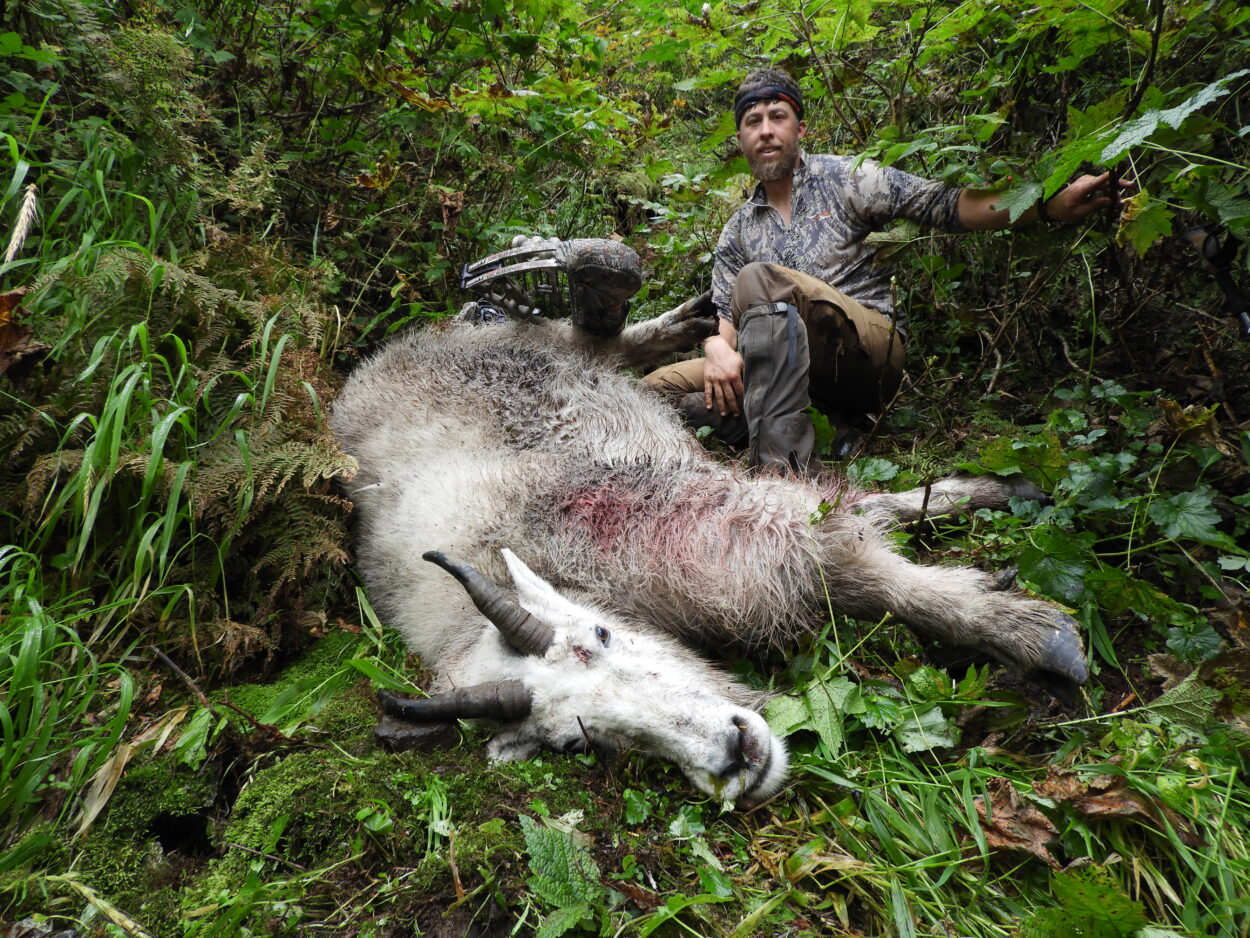

During our research, we made sure to only include top brands that use the highest quality materials. Most importantly, we ensure that each of our top recommendations include common safety features such as tip-over and high-temperature shutoff.

Our Top Picks

Kerosene heaters aren’t new technology, but some improvements have been made to safety and efficiency, so keep the considerations detailed above in mind while comparing products. This list of some of the best kerosene heaters on the market helps streamline the shopping process.

Jump to Our Top Picks

What to Consider When Choosing the Best Kerosene Heater

Kerosene heaters produce plenty of heat, which can make them ideal for outdoor applications. Kerosene is a relatively inexpensive fuel, so burning a kerosene heater on “high” in an outdoor space may be more affordable than using another type of heater. When shopping for a kerosene heater, keep in mind their specifications, such as tank size, heat type, and the all-important safety features.

Type

Kerosene heaters are available in various models, each of which produces a different type of heat. Some are more suitable for specific applications than others. Note: All kerosene heaters run on a liquid fuel, which can be messy. If that’s not a task you want to undertake, other non-electric heaters use propane, natural gas, and easier-to-manage fuels.

  • Convective kerosene heaters use convection to heat a space. They produce warm air that rises and pushes cold air down toward the heater. The heater then draws in the cold air and heats it, which rises and pushes colder air down again. This produces a very even heat within a space, and they run quietly.
  • Radiant kerosene heaters produce localized heat, essentially warming the objects in front of them. They don’t do a particularly good job at heating a larger space evenly, but they’re ideal for targeting a specific area, such as a table or sitting area.
  • Forced air kerosene heaters (also known as torpedo heaters and salamanders) heat air and force it into the area, much like a furnace. They’re suitable for heating large outdoor tents and gazebos, but they can be quite loud.
  • Portable kerosene heaters come in both convection, forced air, and radiant models, though the latter type is the most common. These heaters are small and easy to transport. Take it outside to refill the fuel tank, which helps minimize potential mess or dangerous accidents.

Tank Size

Kerosene is a liquid fuel, so tank sizes are measured in gallons or liters. The ideal tank size is relative, so consider these factors:

  • Heat output: Large heaters burn more fuel, so they need a larger tank.
  • Portability: Smaller heaters need to be light and portable, so they have a smaller tank.
  • Fixed vs. removable: Fixed tanks are usually larger, while removable tanks must be small and manageable.

In general, larger wheeled kerosene heaters have fuel tanks that hold up to 15 gallons (roughly 56 liters) of fuel, while smaller models may hold only 1 or 2 two gallons (about 7 to 8 liters).

Heating Capacity

Kerosene heaters also come in a variety of outputs, which are measured in BTUs (British Thermal Units). The higher the number of BTUs, the more heat a heater can produce.

Smaller heaters that produce heat within the 10,000 to 25,000 BTU range are ideal for smaller rooms, patios, or porches. Depending on the model, they can heat between 300 and 1,000 square feet. Midsize heaters (roughly 50,000 to 75,000 BTUs) warm spaces between 1,000 and 2,000 square feet.

Larger models—typically forced hot air—can pump a lot of hot air throughout a space. These heaters, which sometimes produce more than 150,000 BTUs, work well for large backyard parties and semi-enclosed tents.

Efficiency

Anytime energy is a factor, efficiency must be considered when choosing the product. Since kerosene heaters burn fossil fuels, make sure the model you choose is efficient and wastes as little fuel as possible.

Many kerosene heater manufacturers list their products’ efficiency rating, describing it in percentages. The best kerosene heaters burn around 99 percent of the fuel, passing less unburnt fuel through the exhaust.

But for a heater to work efficiently, it must be the correct size for the space. A 10,000-BTU heater may never heat a large garage, for example, which means fuel is wasted. Heating a small patio might not require a 135,000-BTU heater, as it will burn more fuel than necessary to keep the space comfortable.

Run Time

Run time is directly related to the size of the fuel tank, the heater’s output, and its efficiency, the most important of which is tank size. The larger the tank, the more fuel it uses, so the longer the heater will run. A heater that runs for several hours without refueling is a convenience worth shopping for, but manufacturers aren’t always forthcoming with this information.

Some of the best kerosene heaters can provide heat on a low setting for up to 12 hours before running out of fuel.

Safety Features

Kerosene heaters have the potential to be dangerous. If left unattended or used incorrectly, they can start a fire or cause burns. Many heaters have an overheat switch that shuts down the unit if it gets too hot. Also, compact kerosene heaters can tip over quite easily if inadvertently bumped. An anti-tip switch shuts off the heater if it tips over.

Moreover, any machine that burns fuel—kerosene, gasoline, wood, or any other type—also produces carbon monoxide. The best kerosene heaters are extremely efficient and designed to emit very little carbon monoxide, which makes them safe even for indoor use. However, when used indoors, it’s a good idea to install a functioning carbon monoxide detector as a safety precaution.

FAQs

If you have concerns about running a fossil fuel-burning heater in an enclosed space or want more info about kerosene heaters, check out the answers to the common questions below.

Q. How big of a kerosene heater do I need?

This depends on the space you’re heating. In most cases, a 50,000-BTU heater is effective at heating a small porch, while a 100,000-plus-BTU unit might be necessary for a large open space such as a wedding tent or barn.

Q. How many square feet will a kerosene heater heat?

The amount of space a kerosene heater heats depends on BTU output. Low-output heaters, in the 25,000-BTU range, may heat 1,000 square foot spaces, while 135,000-BTU units can heat over 3,000 square feet.

Q. Do kerosene heaters give off carbon monoxide?

Yes, carbon monoxide is a by-product of the combustion process. Generally speaking, these heaters produce levels considered safe, but users should have a functioning carbon monoxide detector when running a heater indoors.

Q. Is it safe to run a kerosene heater all night?

Kerosene heaters are not as safe as a furnace or boiler, but they could be the only heat source in a power outage. While these heaters may be considered safer than sleeping without heat in subzero temperatures, you should never leave a kerosene heater unattended.

Why Trust Bob Vila

Bob Vila has been America’s Handyman since 1979. As the host of beloved and groundbreaking TV series, including This Old House and Bob Vila’s Home Again, he popularized and became synonymous with “do it yourself” home improvement.

Over the course of his decades-long career, Bob Vila has helped millions of people build, renovate, repair, and live better each day—a tradition that continues today with expert yet accessible home advice. The Bob Vila team distills need-to-know information into project tutorials, maintenance guides, tool 101s, and more. These home and garden experts then thoroughly research, vet, and recommend products that support homeowners, renters, DIYers, and professionals in their to-do lists.

The Purpose-Built Hunting AR: A Close Look At The Daniel Defense Ambush .308

0

We all know AR-type rifles have a military background. We know they’re also referred to as “Assault Rifles.” Now that the elephant is out of the room let’s move on to look at why the Daniel Defense Ambush Series should have a spot in your lineup this fall.

But first, why in God’s name would someone choose an AR for hunting?

AR rifles bring a lot to the table for hunters. For starters, the overall construction of the AR is metal (where it counts) so there’s nothing to swell or crack, and there won’t be a shift in harmonics between hot or cold weather. This design also makes the rifle relatively impervious to water—perfect for a nasty forecast. The stock can be quickly adjusted, accommodating the big and tall or smaller framed shooter such as a lady or youth hunter. With a flat-top design there’s loads of real estate for optics and eye relief so the rifle can literally grow with a developing shooter. Lastly, they’re very quick-handling allowing for fast follow-up shots. So how does the Daniel Defense Ambush rate as a purpose-built hunting rifle?

The Ambush model I received is the .308 variant. The initial stand-out was the bulk of the rifle (aka upper & lower), was hydro-dipped in Kryptek camo, one of my favorite and most versatile patterns. As soon as I picked up the rifle, I realized I wouldn’t need to worry about variations in terrain because I wouldn’t carry this gun far enough for there to be any real changes in environment. At 11 lbs. with optic you’ll realize you don’t want to take the Ambush for a long walk. Weight isn’t always a bad thing for hunting though and, when I’m on a still hunt, I actually prefer a heavier rifle. A hefty but good-shooting rig is great in a deer stand or in a coyote hide, and I knew the Ambush would shine on a predator hunt if it was accurate. Dry-firing showed off the trigger, sourced from the best, Geissele. The weight of the trigger wasn’t super light but the break was very clean and I was confident it would aid in the rifle’s accuracy.

To test the rifle I first mounted my Spartan Precision Javelin bipod. In the past I’ve used this bipod with great accuracy results, and I relied on it recently in Africa for it’s added stability and fast removal in the field. Next, I added my suppressor, mimicking my ideal coyote setup. So how did the Ambush perform on the range?

I was a bit surprised by how accurate the Ambush is with factory ammo. With the 155 gr. Hornady ELD Match ammo my first two 100 yd groups measured .792” and .872”. This is good accuracy for ANY rifle, but in a semi-auto capable of rapid-repeat shots this is downright impressive. The Hornady ELD-X Precision Hunter averaged nearly a one inch grouping. Another point worth mentioning is the rifle’s extremely mild recoil. The rifle’s weight and gas operation tame what would be a snappy cartridge into something I’d let my 8 year old shoot. On the range this is one of those rifles you just won’t want to stop shooting, and with the .308’s availability of cheap surplus ammo you can have a high volume range session without breaking the bank.

In summary, this AR is a worthy hunting rifle. As a deer rifle the Ambush is a great option for hunting from a stand or from a ground blind. As a predator rifle, a good shooter should have no problem putting multiple coyotes on the ground out to 500 yds. At moderate to intermediate distances paired coyotes often run for a short clip and then stop to look back in the direction of the shot when a hunter sends a round down range. With the Ambush, you should have the first dog on the ground and another pill on the way for the second guy when he stops to look back at his fate.

Best Air Rifle Deals

Popular Posts

Gas vs Spring Piston: Which One is Better?

0
Today, you can find 5 different types of air rifles available in the industry. They are: spring pistons, gas pistons, PCP air rifles, variable...

What Is a Break Barrel Air Rifle?

0
A break barrel air rifle is a type of air rifle that uses a break action to load and unload pellets. It is one...

Air Gun 101: How many types of Air Gun Sights are there and which...

0
The former American president, Joe Biden, was recently quoted saying: If you need more than ten rounds to hunt, you better stop that business and...