Home Blog Page 210

#WhitetailWednesday: 7 World-Class Bucks Known Only From Shed Antlers

0

These bucks are only known by the sheds they left behind.

In whitetail hunting history, there are plenty of successful hunt stories that ended with a legendary whitetail deer. But for every huge deer that falls to a hunter, there are probably just as many that get away. Some of these bucks are total ghosts that are only known by the shed antlers they left behind.

For today’s #WhitetailWednesday, here are seven bucks that left behind their antlers and vanished into thin air.

The Kansas King

These gorgeous 12-point deer sheds were found in the early 1990s. This buck may have rewritten whitetail hunting history had a hunter ever spotted it. There are actually two sets of sheds from this buck. The first scores 201 7/8, but it’s the second set that garners everyone’s attention. We can only speculate on the inside spread, but it is believed this buck would have netted a whopping 217 inches!

Had the buck met his demise by a hunter, Milo Hanson’s typical world record would likely actually be number two in the record books. Unfortunately, the world will never know.

The General

Yet another would-be typical world record, this gargantuan buck wandered Nebraska sometime in the late 1950s. For years, the sheds remained in relative obscurity in a farmer’s home. That is, until he showed them to an Oklahoma hunting outfitter. The outfitter recognized the significance of the awesome antlers subsequently scored them.

It’s estimated this monster buck would have grossed over 230 inches typical and would have likely netted somewhere in the 220s! That’s mostly thanks to main beams of over 30 inches. What’s crazy is the farmer who found them said there wasn’t one, but THREE bucks of this caliber running around the area that year!

It’s felt like Milo Hanson’s world record has been untouchable the last 25 years, but one can only wonder how much more out of reach the record would feel had the General fallen to a hunter.

The Excelsior Urban Giant

This buck was actually pretty well-known to many of the locals who tracked his movements and antler growth with trail cameras near Excelsior, Minnesota, in 2011. Many shed hunters searched for the large antlers and eventually his sheds were tracked down on two separate days by the same hunter in February 2011. The two sides scored around 175 inches without factoring in an inside spread, which would probably put the buck in the 190-inch range.

But in 2012, it the buck seemingly vanished without a trace and no one seems to know for sure what happened to it. There are internet rumors, but no proof he was hit by a car in late winter. This giant, like many mature bucks, will probably remain one of the great mysteries of whitetail history.

The Knife-Handle Buck

This giant wandered Iowa sometime in the 1970s. Unfortunately, the sheds were picked up by a farmer who didn’t really care about them and not someone who loves antler hunting. The farmer gave one side to a visiting trapper and the other side to a friend who had a hobby of making knife handles.

Yes, one of the largest sets of typical antlers ever was partially cut up for a knife! Fortunately, only part of it was destroyed and the leftover piece was later recovered in 2012 still in fairly good condition. A taxidermist was able to recreate the long-missing side from the piece.

Of course, this means no accurate numbers can be ascertained for this deer, but we can make a good guess. Estimates on this buck’s score over 230 inches, meaning this buck would could potentially have shattered all current typical records if only the buck had met up with a lucky hunter during hunting season.

The Wensel Shed

Photos of this single massive shed have circulated the internet for years now. You wouldn’t have to be a shed hunting master to spot something like this.

This buck had some good genes. This seven-point side scores over 100 inches all on its own! An Illinois giant grew this antler back in 1980, and as far as we know, the other side was never found, although it was rumored to be just as big.

Looking at this side, it’s easy to imagine it probably would’ve been a world record had the deer been harvested. But, like many of the bucks on this list, it just seems to have vanished into the wild, never to be seen again. But, it’still igniting the imaginations of hunters all these years later.

Mystery Wisconsin World-Record 5-Pointer

Another buck shrouded in relative mystery and known by only one shed deer antler, this 5-point side is the stuff of shed hunting dreams. The antler was found by a Wisconsin farmer (Are you also noticing a pattern here with farmers picking up world-class antlers?) and then tacked to a barn, where it stayed for years before it was sold and brought out of obscurity.

The thing that grabs everyone’s attention with this antler is the jaw-dropping 13-7/8-inch browtine. As far as we know, the other side was never found and the buck was never shot. This one side scores an eye-popping 98 6/8 inches. If the other side was anything like this one, we may have been talking about a 10-pointer that rivals the Jordan buck for king of the 10-pointers.

The Minnesota Monarch

This buck puzzled hunters for years in Minnesota, mainly because no one could find the deer before late winter. One landowner found several sets of sheds, as he noticed the deer only showed up on his property in February.

In 1990, the buck’s antlers scored 310 inches non-typical. Keep in mind, that was before calculating in the inside spread which can only be guessed. It’s very likely this buck would have been a world record for a hunter-killed whitetail at the very least.

But the following year, the Monarch didn’t return. Instead, he vanished into Minnesota hunting legend, and hunters in the area were likely left wondering what could’ve been.

NEXT: #WHITETAILWEDNESDAY: 5 WORLD-RECORD BUCKS THAT SUCCESSFULLY AVOIDED ALL HUNTERS

Compound Bow vs Longbow: Who Really Wins the Fight?

0

Compound bows are becoming increasingly popular nowadays. With the advancement of modern technology, compound bows are becoming more robust, flexible, and accurate.

However, a large portion of bowhunters still uses traditional longbows for archery and hunting. Now the question is, why? What is the difference between these two? And how to distinguish which one is an ideal piercing weapon?

That’s what we’re going to discuss today in our “compound bow vs longbow” guide. We’ll explore the key difference between these 2 bow types, and help you choose the best one for you.

Compound bows use a pulley system to store potential energy, resulting in high-velocity (up to 370 ft/sec), and high-powered arrows whereas traditional longbows feature a traditional outlook, are low-maintenance and are easy to carry around. Which one you’ll end up choosing depend largely on your preference.

Let’s explore more in our in-depth “Compound Bow vs Longbow” comparison:

A Brief History
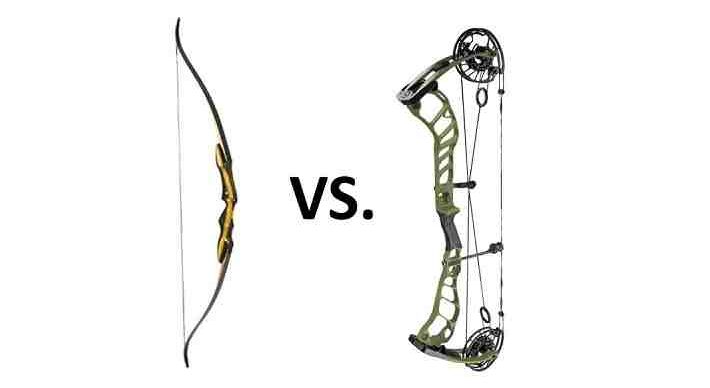
Longbow vs Compound Bow

The traditional, good-old longbow comprises a bowstring that’s tied to a bowed implement. Usually, the tool is a single unit from top to bottom. To lurch your arrow far, you need to pull the bowstring back significantly.

This action requires a lot of energy and concentration. Therefore, you have to lug your entire weight backward. Besides, you need to stay upright for improved accuracy. If you have less weight, however, this action is awkward.

It’s even more difficult if your hands are unsteady. Therefore, a better contraption has replaced this mechanism in a modern-day compound bow.

Here, a pulley (cam) is introduced to recoil the strings. And to improve the versatility and reinforcement at the center, a thicker and more robust member is fitted.

Therefore, the entire length comprises a short truncated upper recurve segment, and a lower one coupled together with a much stronger middle unit.

The advantage of this new design is that it allowed for a more significant backward movement without the bow breaking apart.

What’s more? the archer now needs to spend less energy, and yet, the accuracy of the arrow has significantly improved.

Compound Bow vs Longbow: Key Differences

1. Origins

Bows have been in existence for millennia. A 17,000-year-old arrow discovered in South Africa proved that bow hunting existed even during the stone-age era.

It’s believed that the Egyptians are the ones who invented the bows and arrows. Many pieces of evidence indicate bows were in use around 2,300 BC.

During this period, the preferred construction materials were sticks from hardwood timber such as ash and oak. The string was made of sheep intestine.

Obviously, so many changes have taken place since then. From the rudimentary and inaccurate weapon, you now have an extremely lightweight and powerful tool.

Compound bow

A compound bow is an improvement upon the longbow. It’s fairly intricate. Holless Allen gets credit for the development of the compound bow.

He modified a longbow into the much stronger compound bow we see and love today. He did this by initiating several improvements to the longbow and showcasing it through a patent he applied for in 1966 and received in 1969.

The new compound made its debut in the US National Archery Competition in the 1970s.

Longbow

Bowhunting enthusiasts Baer, Hiyt, and Mathews refined the longbow using new and modern materials. They transformed the hitherto wood frame and sheep intestines elements previously used for these longbows.

But even before the new revolution in the manufacture of the longbow, a previous one had already occurred.

The most advanced modernization of medieval archery goes to the Welsh. It appears that they manufactured the longbow into a tactical offensive weapon.

Their archers managed to withhold a large regime of British soldiers in the Battle of Waterloo in 1066. But the first recorded use of a longbow was during the battle of AD 633 during the war between the Welsh and Mercians.

Since then, this particular longbow earned the name of the British longbow. It’s been used in numerous battles with the French both on land and in the sea.

2. Design

The design of a longbow varies from that of a compound bow. Let’s see what our “compound bow vs longbow” comparison guide points out about the design differences between these two types of bows:

Compound bow

The high-quality compound bows are sophisticated. They have two sewn recurve ends fitted with pulleys at the end (limb). Either or both cams feature one or more cables attached to the opposite limb.

These cams provide the pivot needed when you pull back the bowstring. This action (let off) enhances the accuracy of the arrow while giving a more natural aiming response.

The center of the compound bow (riser) pivots the limbs, bow sights, bow stabilizers, and quivers. This section required greater flexibility to transfer as much of the stored energy from the bow to the arrow as possible.

This segment curves out towards the target, making it exert more force, which is subsequently transferred to the arrow.

Newer models of compound bows have cables and cable slides as well as a higher brace height. This is the length between a grip throat and the bowstring.

Longbow

The longbow, on the other hand, comprises a long weapon measuring about four feet long. Its stave was from a D-shaped section of a hardwood branch.

It has a singular and long limb. Typically, it’s made from a single material. There is no reinforcement or clamping along the entire stretch.

Even if the bowstring structure is the same as in a compound bow, the longbow still shoots slower and requires more force.

As a result, the arching process is also more strenuous than the former. This is due to the lack of a bow curve, the absence of cams as well as a more prolonged and weaker limb.

3. Material

The elements that make the longbow and compound bow affect how these two tools perform. Let’s look and the material composition of compound bow vs longbow.

Compound bow

Previously, compound bows comprised plastic-coated steel. However, due to lower tensile strength and flexibility – that decreased the arrow’s overall accuracy, – they now feature more suitable materials.

The more prominent material currently is the high-modulus polyethylene compound. It offers higher tensile strength as well as maximum energy transfer.

Longbow

The ancient longbows were constructed mostly from yew. However, hazel and elms were occasionally used. It was then coated with resin, wax, or excellent tallow to improve its tensile strength.

Currently, however, composite materials of laminated fiberglass and tampered wood are now used to make recreational longbows.

4. Uses and Benefits

Long ago, bows and arrows were used for hunting and conquering. But presently, they are used primarily in sports hunting and bow shooting competitions. Archery has grown as a favorite pastime as well as a game in all major tournaments.

Compound bow

A compound bow has a more significant benefit due to its design. The robust cams allow for a higher energy reserve. You only draw a portion of the energy and the rest remains at the front where it’s needed most when shooting.

The horizontal limbs also reduce the vibration and recoil intensity before shooting the compound bow, improving the accuracy of the shot as a result.

Further, modern compound bows have sighting devices to improve aim, as well as mechanical release to retain shot consistencies. Therefore, you are likely to shoot accurately using less effort.

Longbow

Longbow proved challenging to use since it required an inertia of over 65 lbs to deliver the necessary projectile power. This posture is also more strenuous since you’ll have to arch significantly back to convert sufficient energy needed by the arrow.

Different types of longbows were used for assorted arrows. There existed fight arrows, with chisel arrows. Other bows accommodated hunting arrows. Even within them, they also vary between animal and bird hunting types.

When you compare a longbow vs. a compound bow, you find that a longbow is lighter and quicker to shoot. Besides, it’s also quieter.

Additionally, the longbow is easy to make since it needs just one or two tree branches.

5. Draw Length

In archery, you need to be sure about a bow’s draw length. Typically, a draw length has a close correlation with your overall body size.

Take the distance from the tip of a nocked arrow to the tip of your draw-out hands. Divide this distance by 2.5, and you’ll get your draw length,

Compound bow

For a compound bow draw length, measuring the arrow tip should ideally be around two feet beyond the riser at full draw. When you hold this position and measure the arrow length, you get the draw length by adding one foot to the computed distance.

Longbow

The draw length of a longbow is usually more than five feet. Many of the early models had their measures reaching up to 12 feet. But they commonly averaged six-and-a-half feet long.

6. Limitations

Even the best-functioning longbows or compound bows have their drawbacks. Below are some of the shortfalls that are apparent in both the compound bow and the longbow.

Compound bow

By design, compound bows have many moving parts. This structure makes them susceptible to breakages and parts malfunctions. Further, having many elements make compound bow maintenance and handling a bit expensive.

Replacement is also intensive. It requires special tools to replace and repair damaged parts or strings of the compound bow.

Longbow

The longbow stretches more slowly and unsteadily. When you draw it backward, your arms move with the full energy you are exerting. You need more power to hold back your hands firmly.

At the same time, during the process of drawing your bow, less energy is available at the point where the bowstring meets the arrow.

This has the dual effects of releasing less punch directly to the arrow, as well as exacerbating your unstable hold. Hence when you release the arrow, it first, only moves a short distance and is less linear in its movement.

Further, it’s more likely to miss its target due to a weak trajectory caused by less force.

7. Care and Maintenance Requirements

Proper care for your bow is vital. You appreciate that owning a modern compound bow may cost you up to $1,000. Even with the composite material, they have many parts and accessories that need tender care.

Compound bow

Compound bows have sights, pulleys, limbs, cables, and cams. All these are made of different materials. Further, their assembly is delicate. Hence you ought to maintain each component individually:

  • Cables: Waxing protects your cables when not in use. Do this once a month or after every exposure to the elements.
  • Limbs: Laminated limbs are susceptible to cracking under various layers. Do a thorough inspection (by rubbing with cotton wool) to identify such defects.
  • Frame: This component suffers from a lot of tension. Inspect it routinely for cracks and twists.
  • Cams: Visually check on the cams before using your compound bow. To prevent corrosion and discoloration, wipe this part clean after every use.
  • Accessories like bow-sights rest and quivers also require regular maintenance. Accurately mount them to avoid any damage through colliding with other surfaces.

Longbow

Longbows are made from composite frames or laminated timber. Run periodic inspections to identify damages to the fame and the bowstring.

Apply remedial measures similar to those on frames and limbs and accessories in the compound bows. Don’t store limbs in a hot compartment. Keep your longbow in a cool dry place. Better still, afford similar treatment to bolts and nuts.

Are Compound Bows Better Than Longbows: Which One to Get?

Compound bows and longbows have been used for centuries in hunting and archery. Now, you might be thinking Is a compound bow better than a longbow, or is it the other way around?

That’s a question that has been debated by hunters, archers, and outdoor enthusiasts for many years. Let’s find out which is the better option for you.

When a Compound Bow Is Better

Compound bows are becoming increasingly popular due to their superior accuracy and power compared to traditional longbows. While some people will always prefer the classic look of a longbow, it’s hard to deny the benefits of a compound bow.

Compound bows have several advantages over longbows. They are capable of higher draw weights than traditional longbows, allowing for greater accuracy, longer range, and more penetrating power.

The cams on a compound bow also make it easier to shoot with a consistent draw length, which can be very helpful for novice archers.

Additionally, compound bows are usually easier to maintain and tune than longbows. This can be a big plus for people who aren’t as experienced with bow maintenance and tuning.

When a Long Bow Is Better

Longbows have several advantages over their modern counterpart that make them attractive to traditionalists.

Their simpler design makes them lighter and easier to carry, making them a popular choice for hunters who must traverse long distances.

Longbows can also be more durable than compound bows since they are less complicated and require fewer parts. They don’t usually require as much maintenance or tuning either, which can be a plus for those with limited technical skills.

Finally, traditional longbows are often more aesthetically pleasing than compound bows, which can be a plus for those who prioritize looks.

Longbow vs Compound Bow: Which One You Should Get

The choice of whether to get a compound bow or a longbow is up to the individual archer or hunter. Both have their advantages and disadvantages, so it’s important to weigh all of the factors before making a decision.

Some archers may prefer the classic look and feel of a longbow, while others may be drawn to the power and accuracy of a compound bow.

Ultimately, the choice is yours, so do your research and find the option that best fits your needs. Good luck!

Conclusion

And with that, we’re at the endgame of our in-depth “compound bow vs longbow” comparison. Let’s do a quick recap.

You understand that compound bows offer better performance than longbows. However, you may still come across diehard fans of traditional bowing techniques.

To them, using both a compound bow and a longbow propel the arrow to the ordinary distance of 22 feet. But the inclusion of modern technology into bowing has made significant strides that you can’t ignore.

In fact, the new construction and materials have made bow hunting a more comfortable sport for everyone.

So, whether you aspire to hunt elks, deers, or any other small-medium game animal; or win a trophy at an archery completion, you have to start by learning how to use, differentiate and care for your bows and arrows.

Either way, you still need to practice consistently to perfect your pull, nock, aim, and shoot.

FAQs

Which Type of Bow Is More Accurate: Longbow or Compound?

Compound bows are generally considered to be more accurate than longbows as they feature a system of pulleys that help create consistent draw weight throughout the shot.

Is It Easier to Shoot a Longbow or Compound Bow?

In most cases, compound bows are easier to shoot than longbows since they feature a system of pulleys that help make the draw weight consistent throughout the shot. Compound bows also tend to be less affected by wind speeds, giving them an extra accuracy boost.

How Much Draw Weight Should I Use With Each Type of Bow?

Generally speaking, recurve bows require more draw weight than compound bows, with 40-50 lbs being the standard range for recurves and 25-45 lbs being the usual range for compounds.

For safety reasons, it is important to never exceed the maximum recommended draw weight for either type of bow.

6 Black Bear Hunting Rifles & Cartridges | Bear Gun Overview 2024

0

There is an ongoing debate about what is the best black bear rifle and best cartridge for hunting trips and that debate will most likely never cease.

The biggest reason for the debate is there are tons of options out there that will get the job done. It all comes down to things like, personal preference, distance of potential shot on a black bear, distance and intensity of the hike in and out of where you’ll hunt, if there are grizzly bears, and other predators also present where you’re black bear hunting, and probably a few other factors as well.

In this article the goal is to present 6 different rifles and black bear cartridges that will all “get the job done” it just depends on your exact hunting situation as to what the best black bear gun is for you. We’ll be covering rifles from Ruger, Henry, Browning, Savage, Remington, and Mossberg.

Ruger American Ranch Rifle

Overview:

The Ruger American Ranch Rifle in 450 Bushmaster is a top-tier option for black bear hunting and more. Its 16.12″ cold hammer-forged barrel, adjustable Ruger Marksman trigger, and patented Power Bedding system ensure remarkable accuracy and consistent performance. The ergonomic Flat Dark Earth synthetic stock combines modern design with practical handling. This rifle offers affordable excellence, making it a great companion for bear hunters who value precision and reliability in the field.

Price Range: $429 – $569

Rifle Cartridge: 450 Bushmaster

Year Introduced: 2016

Why is the Ruger American Ranch Rifle in 450 Bushmaster a popular black bear gun?

The Ruger American Ranch Rifle in 450 Bushmaster has gained popularity among black bear hunters due to its unique combination of features that make it exceptionally well-suited for this type of hunting. The rifle’s 450 Bushmaster cartridge, optimized for short to medium ranges, delivers ample stopping power necessary for black bear hunting scenarios.

The 16.12″ cold hammer-forged barrel provides accuracy, while the adjustable Ruger Marksman trigger allows for precise shot control. Additionally, the ergonomic synthetic stock ensures quick and easy handling, which is crucial in situations where speed and accuracy matter.

The rifle’s compact size and manageable weight contribute to its ability to navigate through challenging terrain often encountered in bear hunting. Moreover, the included Ruger® Hybrid Muzzle Brake reduces recoil, making follow-up shots more comfortable and accurate. The Ruger American Ranch Rifle is great for hunting black bears. It has the right features for precision, power, and maneuverability.

Ruger American Ranch Rifle Specs:

Henry X Model

Overview:

Henry’s Lever Action X Model .30-30 captures the essence of classic Americana, tailored for modern black bear hunters. The .30-30 caliber lever action design merges tradition and innovation, making it an excellent choice for pursuing black bears.

Crafted with durable synthetic furniture, the rifle remains lightweight while offering versatility with in-line sling swivel studs, M-Lok accessory slots, and a Picatinny rail. The blued steel barrel is equipped with fiber optic sights, ensuring swift target acquisition in challenging scenarios. For those considering suppressors or muzzle devices, the threaded barrel (5/8×24) is accompanied by a removable thread protector.

While honoring tradition with a 5-round removable tube magazine, the rifle also embraces convenience with a side loading gate for topping off rounds, ideal for bear hunting scenarios. This rifle captures the enduring spirit of the .30-30 cartridge, synonymous with black bear hunting.

Boasting a 21.375″ barrel, 1:12 twist rate, and 40.375″ overall length, the rifle weighs 8.07 lbs. It’s fully outfitted for accuracy with adjustable fiber optic sights and scope readiness, offering black bear hunters reliable precision.

The Lever Action X Model .30-30 perfectly balances heritage and modernity, making it an exceptional tool for black bear hunting in varied terrains and conditions.

Price Range: $899 – $1198

Rifle Cartridge: 30-30 Win

Year Introduced: 2021

Why Is The Henry X Model .30-30 Rifle a Popular Black Bear gun?

The Lever Action X Model .30-30 by Henry is a popular choice among black bear hunters because of its balanced blend of classic design and modern features. The .30-30 caliber offers effective stopping power for black bears, while the lever action mechanism allows quick follow-up shots. Its synthetic furniture, equipped with sling swivel studs, M-Lok slots, and a Picatinny rail, caters to practical hunting needs.

The rifle’s fiber optic sights ensure swift target acquisition, and the option for optics attachment enhances accuracy. With a threaded barrel for muzzle devices, removable tube magazine, and side loading gate, this rifle streamlines the hunting experience.

Henry X Model .30-30 Rifle Specs:

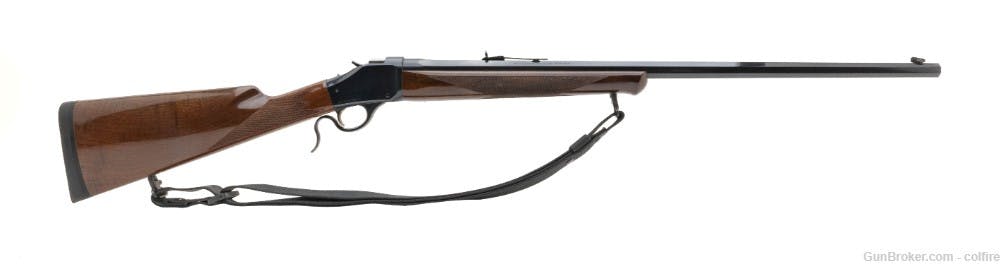
Browning 1885

Overview:

The Browning 1885 in .45-70 Govt is a sought-after option for black bear hunters, because it merges classic elegance with modern functionality. The robust .45-70

Govt caliber provides the necessary stopping power for black bear encounters, making it a reliable choice. The single-shot design encourages deliberate and accurate shots, crucial in bear hunting scenarios. Its timeless walnut stock showcases traditional craftsmanship, while the barrel’s matte blued finish ensures durability.

The rifle’s 28″ barrel, complete with adjustable sights, facilitates precise target acquisition, especially in diverse hunting environments. The single-shot action simplifies operation, reducing the risk of follow-up shots and enabling shooters to focus on accuracy. This rifle upholds the legacy of the .45-70 Govt cartridge that’s renowned for its effectiveness in bear hunting.

With its combination of classic aesthetics and dependable performance, the Browning 1885 in .45-70 Govt embodies the spirit of traditional hunting while catering to the demands of modern black bear hunters.

Price Range: $595 – $3299

Rifle Cartridge: .45-70 Govt

Year Introduced: 1985

Why Is The Browning 1885 in .45-70 Govt a Popular Black Bear Gun?

The Browning 1885 rifle in .45-70 Govt is a favored choice among black bear hunters for its classic design and powerful performance.

The .45-70 Govt caliber offers substantial stopping power, essential for black bear takedowns. The single-shot action emphasizes accuracy, while the walnut stock and matte blued barrel provide a timeless look and durability.

Browning 1885 in .45-70 Govt Rifle Specs:

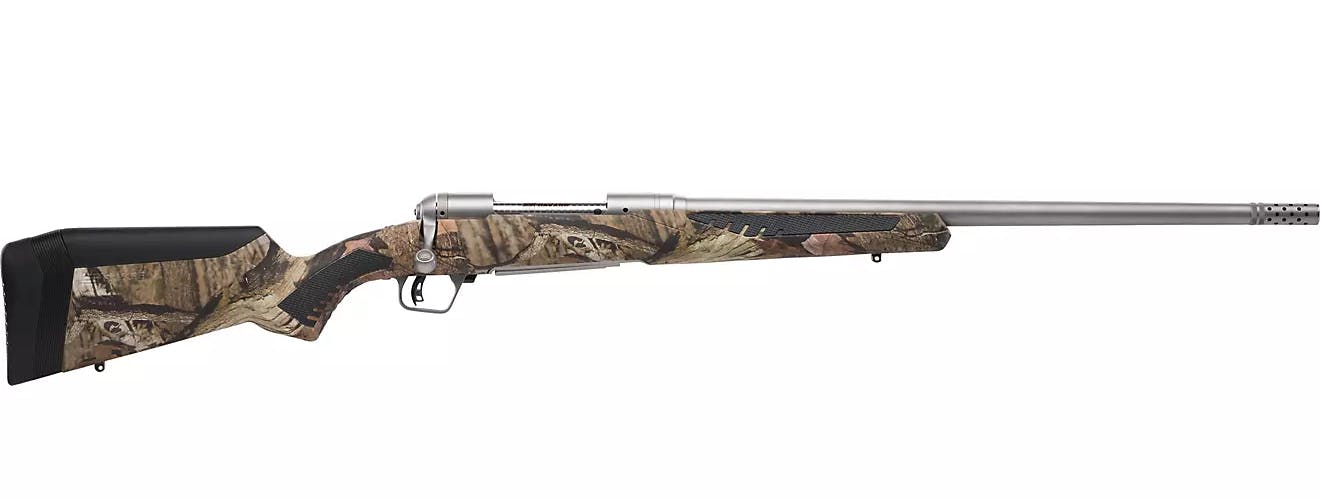
Savage 110 Bear Hunter

Overview:

The Savage 110 Bear Hunter in .338 Win Mag is a prime choice for black bear hunters seeking both robust performance and durability. This rifle is equipped with the AccuFit™ system, allowing shooters to easily personalize the length-of-pull and comb height for a comfortable fit. The user-adjustable AccuTrigger™ enhances safety and accuracy by delivering a clean pull and preventing accidental discharges from jarring or dropping.

Complemented by the AccuStock™ rail system that securely cradles the action three-dimensionally, the 110 Bear Hunter offers a customized and precise shooting experience straight out of the box. The rifle features a 23-inch stainless steel fluted barrel with an adjustable muzzle brake, housed in a synthetic stock.

In terms of specifications, the rifle operates with a bolt action and accommodates the potent .338 Win Mag cartridge. The barrel boasts a length of 23 inches and features a straight fluting design, all finished in a matte treatment.

The rifle’s stock is crafted from synthetic material and the overall length of the rifle is 44.125 inches, with a rate of twist of 1 in 10.

The receiver, barrel, and other critical parts are constructed from stainless steel, ensuring durability and resistance to the elements. The rifle’s weight is 8.39 pounds, providing a balanced feel for shooters. All these features come together to make the Savage 110 Bear Hunter a reliable and effective option for black bear hunting, offering both precision and adaptability in challenging conditions.

Price Range: $899 – $1029

Rifle Cartridge: .338 Win Mag

Year Introduced: 1963

Why Is The Savage 110 Bear Hunter in .338 Win Mag a Popular Black Bear Gun?

The Savage 110 Bear Hunter in .338 Win Mag has gained popularity among black bear hunters for several reasons.

Its rugged design and powerful .338 Win Mag caliber offer the necessary stopping power for taking down black bears effectively. The AccuFit™ system, allowing customization of length-of-pull and comb height, ensures a comfortable fit for a variety of hunters, enhancing accuracy and overall shooting experience.

The user-adjustable AccuTrigger™ is a safety feature appreciated by hunters, providing a crisp and clean pull while minimizing the risk of accidental discharges, even if the firearm is dropped or bumped. The AccuStock™ system, cradling the action securely, enhances accuracy by minimizing movement during firing.

The rifle’s 23-inch stainless steel fluted barrel, coupled with the adjustable muzzle brake, contributes to accuracy by reducing recoil and muzzle rise, allowing for quicker follow-up shots.

With its combination of features, power, and adaptability, the Savage 110 Bear Hunter is well-suited for the challenges of black bear hunting. Its ability to be tailored to individual preferences, the assurance of the AccuTrigger™ system, and the precision-enhancing AccuStock™ make it a reliable choice for hunters seeking success in the unpredictable and demanding conditions of black bear hunting.

Savage 110 Bear Hunter Rifle in .338 Win Mag Specs:

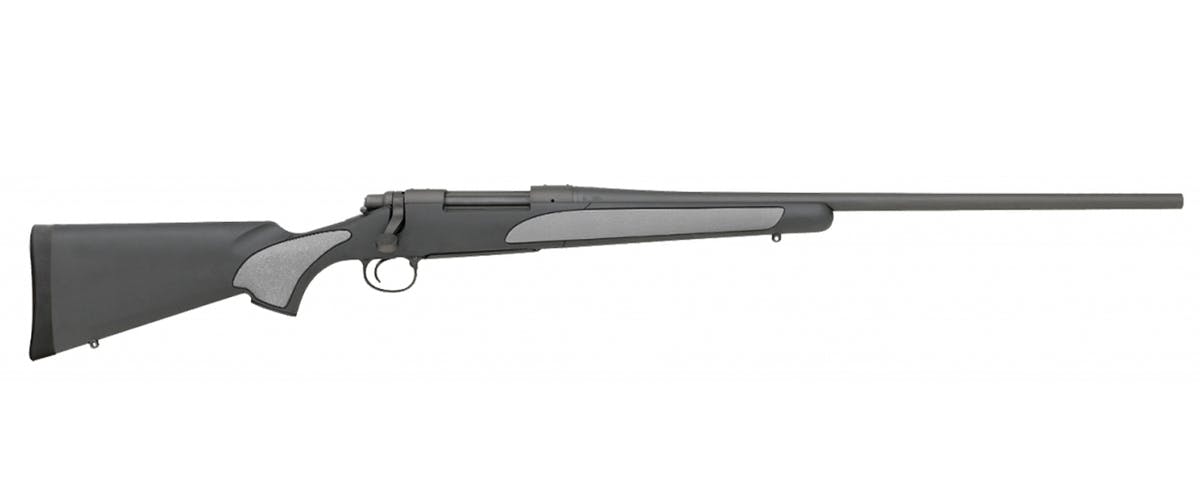
Remington 700 SPS

Overview:

The Remington 700 SPS in .30-06 Springfield stands out as an excellent choice for black bear hunters seeking a potent and affordable firearm. This rifle inherits the renowned quality of the Model 700 series while being accessible in price. The Model 700 SPS, or Special Purpose Synthetic, embodies accuracy and performance, qualities vital in black bear hunting.

With its ergonomic synthetic stock and carbon steel barrel and receiver, the rifle ensures comfort and durability, crucial in demanding hunting scenarios. The matte blued finish adds a sleek touch to its appearance. Hunters are drawn to the Remington 700 SPS for its reliable performance, backed by favorable reviews and trusted recommendations from peers.

The rifle’s specifications include a 4+1 capacity and a 24-inch barrel. The matte black synthetic stock is designed for scope base attachment, catering to optical needs for precise shots. Weighing 7.37 pounds, this bolt action rifle is chambered in .30-06 Springfield, a versatile cartridge ideal for black bear hunting.

Appearing in matte black with gray panels, the Remington 700 SPS is tailored for right-handed hunters, with an overall length of 44.5 inches. The synthetic stock and 1:10 inch twist rate of the barrel contribute to accuracy, ensuring your shots count in bear country. The Remington 700 SPS in .30-06 Springfield embodies both Remington’s legacy and commitment to providing hunters with an effective tool that stands up to the challenges posed by black bear hunting environments.

Price Range: $630 – $810

Rifle Cartridge: .30-06 Springfield

Year Introduced: 1962

Why Is The Remington 700 SPS in .30-06 Springfield a Popular Black Bear Gun?

The Remington 700 SPS in .30-06 Springfield is a favored choice among black bear hunters for its winning combination of accuracy, power, and affordability. Renowned as a reliable rifle series, the Model 700 SPS maintains this reputation with the Special Purpose Synthetic version, offering hunters a cost-effective yet high-performance option.

Its ergonomic synthetic stock and durable carbon steel barrel and receiver ensure comfort and resilience in bear hunting conditions. Positive reviews and recommendations emphasize the rifle’s accuracy, crucial for precise shots required in black bear encounters.

The .30-06 Springfield cartridge’s versatility enhances its popularity, balanced by the rifle’s maneuverable 44.5-inch length and 24-inch barrel. Overall, the Remington 700 SPS in .30-06 Springfield stands as a trusted and accessible choice, meeting the demands of black bear hunting with dependable accuracy and effectiveness.

Remington 700 SPS in .30-06 Springfield Specs:

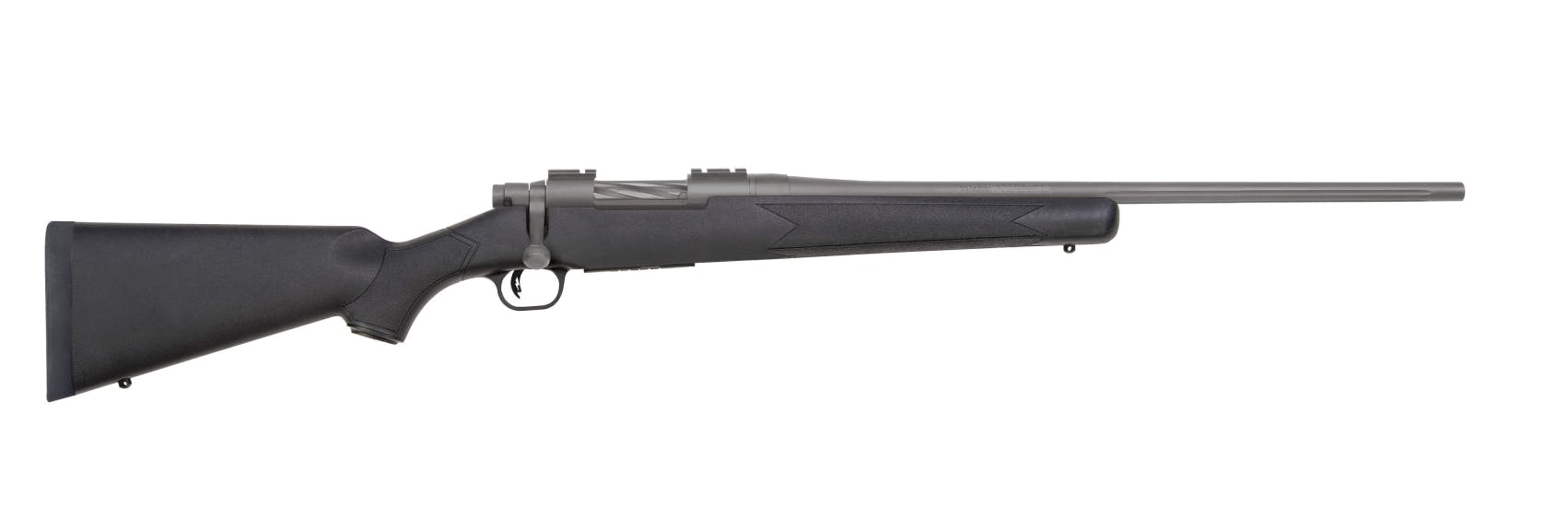
Mossberg Patriot

Overview:

The Mossberg Patriot in .308 Win has established itself as a preferred option among black bear hunters, seamlessly blending modern innovations with a touch of classic design. This value-rich bolt-action rifle resonates with those who value both tradition and progress. From its sharp appearance to its impressive accuracy, the Mossberg Patriot captures attention for its ability to deliver in the field.

Designed to cater to a variety of hunting scenarios, the Patriot accommodates short- and long-action calibers, ensuring versatility when facing the challenges of black bear hunting. The inclusion of a drop box magazine adds convenience to the hunting experience, while the fluted and threaded barrels, spanning 20″ to 24″, seamlessly combine style and function. Additional enhancements, such as the spiral fluted bolt and recessed match barrel crown, contribute to the rifle’s overall performance and appeal.

A notable feature that resonates with black bear hunters is the patented LBA® user-adjustable trigger, which provides the flexibility to fine-tune the pull weight between 2 to 7 lbs according to personal preferences. The barrel threading specifics further demonstrate Mossberg’s attention to detail, catering to various calibers and ensuring compatibility with different muzzle devices.

In the world of black bear hunting, the Mossberg Patriot in .308 Win has earned its place as a reliable and capable companion, encapsulating Mossberg’s commitment to providing hunters with a firearm that combines quality, versatility, and affordability.

Price Range: $255 – $829

Rifle Cartridge: 308 Win

Year Introduced: 2015

Why Is The Mossberg Patriot in 308 Win a Popular Black Bear Gun?

The Mossberg Patriot in .308 Win has gained popularity among black bear hunters for its versatile features tailored for effective hunting. Adaptable to different calibers, it accommodates various hunting conditions.

The drop box magazine allows quick reloads, while fluted and threaded barrels offer a balance of aesthetics and functionality. The patented LBA® user-adjustable trigger and meticulous barrel threading enhance accuracy and customization. Overall, this rifle’s adaptability, ergonomic design, and precision make it a reliable choice for successful black bear hunting.

Mossberg Patriot in 308 Win Specs:

Good luck out there on your black bear hunting trip! Hopefully this article has narrowed down your search if nothing else.

Gunbroker.com is an awesome place to find great deals on black bear hunting rifles and the best black bear cartridges you’ll need. One of the coolest parts about GunBroker.com is you can get your hands on the best bear rifles that aren’t even in production anymore. You could potentially bear hunt with a piece of history if you wanted to! Thanks for taking the time to read this article.

310 Catchy Hunting Slogans & Catchy Hunting Phrases

0

What is hunting? Hunting is the art of killing animals to serve different purposes. These purposes include eliminating pests, and food, and dealing with the problem of overpopulation. People carry out different hunting projects, be it school projects or personal ones. The purpose of the hunting slogans is to make hunting look more exciting and a fun activity to carry out.

Catchy Hunting Slogans

Here is a list of the catchy Hunting Slogans

Nice rack!

Hooked on quack!

Hunt like a girl!

Hunting is an art.

The buck drops here.

Happiness is hunting.

I’d rather be hunting…

Don’t only live, Hunt!

We eat. Therefore we hunt.

The girl’s gone hunting.

Hunting is not for cowards.

This girl knows how to hunt.

Keep calm and aim at the heart

Rise n shine. It’s huntin’ time!

You have to be loyal to hunting.

Driving trucks and hunting bucks!

PETA: People eating tasty animals.

Life is a game; hunting is serious

List of Top 10 Hunting Slogans

  1. Born to hunt
  2. Live. Laugh. Hunt.
  3. If it hops it drops.
  4. This babe bags bucks!
  5. Keep calm and aim and fire
  6. Live to hunt. Hunt to live.
  7. If you chum, they will come.
  8. Real men hunt for their food.
  9. No guts mean no glory at all.
  10. I don’t wear bows, I shoot them.

Duck Hunting Slogans

I’ve made a list of the best duck hunting slogans that would help you with your specific assigned projects. As the name specifies, the duck hunting slogans talk about hunting ducks making it look cool. You can look for yourself by going through the following slogans

Duck. Duck. Boom!

The duck stops here.

Happiness is hunting.

Tis the season to be hunting.

Let’s play duck, duck, moose!

Driving trucks and hunting bucks!

Life is a game; hunting is serious

Hunting: Making small men feel macho

If I’m not hunting, I’m thinking about it.

I like big bucks and I cannot lie.

I love to make memories in the forest

Deer hunters have their own impression

You don’t have to regret being a hunter

Vegetarian: Old Indian word for bad hunter.

I love three things, Deer, ducks, and Elks.

I love adventures, but not more than hunting

I need a gun, and a forest to show my skills.

Some girls play house, real girls go hunting.

Hunt Daaaaay! C’mon, you know what day it is!

Hunting is not a sport, it’s a way of life.

Life is a game, and hunting is its play button

In my year, there are two seasons. Deer and Elk.

If you’re too busy to hunt, then you’re too busy!

Protect your hunting rights; spay or neuter a liberal!

Here I would like to add a point and inform you all, that hunting slogans are often also used for the purpose of discouraging hunting. The following slogans are an example of it, where the people who hunt are looked down upon!

  • Put a stop to trophy hunting!
  • Hunting will be a sport when animals shoot back!
  • There are no hunting accidents. It’s called karma!

Turkey Hunting Slogans

Some essential gears are required for the hunting of Turkeys. And the companies selling these gears and types of equipment make use of the turkey hunting slogans to attract more customers to buy from them. Some of the Turkey hunting slogans include:

Down to Feast

Turkey Wasted

Talk Turkey to Me

Let’s Get Basted

Turkey & Touchdowns

Let’s Get Stuffed

Gobble till You Wobble

Get Your Fat Pants Ready

Be Grateful & Give Thanks

Thankful, Grateful, Blessed

Football, Feast, Nap, Repeat

Nobody Diets on Thanksgiving

Football, Turkey, Nap, Repeat

Save a Turkey, Kill a Workout!

Gather Here with Grateful Hearts

Let Our Hearts be Full of Both Thanks & Giving

Being Grateful Turns What You HAVE Into ENOUGH

I’m Into Fitness…As in Fitness Pumpkin Pie in my Mouth!

For All the Blessings in My Life, I Will Celebrate with a Fork & Knife

Give Thanks, Give Cheer, Not Only on Thanksgiving but All Through the Year

Deer Hunting Slogans

The deer hunting slogans assist in coming up with slogans that could be used on different channels and pages pursuing deer hunting. Deer hunting is a fun activity, and many people earn through it by attracting more people to it. Some of the deer hunting slogans include:

I’d rather be hunting…

There’s no season like deer season.

Some girls play house, real girls go hunting.

My year has four seasons. Deer, elk, turkey, duck.

Shootin’ deers and drinkin’ beers. That’s how I roll!

Hunting isn’t a port, it’s a call to something greater.

Hunting is not for kids, it is a gentlemen’s game.

My year has four seasons. Deer, elk, turkey, duck.

If you want to hunt a deer, consistency is the key.

There are no accidents in hunting, I call it Karma.

If I am not hunting, definitely I am thinking about it

Protect your hunting rights; spay or neuter a liberal!

Some people are good at hunting, others are just people

Hunting isn’t a port, it’s a call to something greater.

Deer hunting would be a fine sport, only if deer had guns.

To be a successful hunter, you just need to know your ground.

If you haven’t gone hunting yet, you haven’t seen anything yet

Knowing your ground and pack is the most important thing in hunting.

Fishing poles and hunting gear. Dreams of bass and big ol’ deer.

Hunting Phrases

  • “If we act like prey, they’ll act like predators”
  • “You not only are hunted by others, you unknowingly hunt yourself.”
  • “The search for a scapegoat is the easiest of all hunting expeditions.”
  • “Found the sheep too easy to kill?’ I ask. ‘Where’d you get the weapon”
  • “People never lie so much as after a hunt, during a war, or before an election
  • “The more a woman appreciates the hunting prowess of her man, the more he will kill for her.”
  • The way humans hunt for parking and the way animals hunt for food are not as different as you might think.
  • The fascination with shooting as a sport depends almost wholly on whether you are at the right or wrong end of the gun.
  • “I have a knife in my boot,” she said, and then wondered, for a moment, if she could throttle a moose with her bare hands.”
  • “Was there any more repellent sight, Harriet wondered than a silly, self-centered, greedy woman clad in the skin of a beast so much more splendid than herself”
  • “I ask people why they have deer heads on their walls. They always say it because it’s such a beautiful animal. There you go. I think my mother is attractive, but I have photographs of her.”

In short, Hunting is a skill that needs to be boosted time by time, and using hunting slogans is the best way to do so. Many cool and motivating slogans have been mentioned in this article, which can help prompt people to hunt more. The hunting slogans have made hunting look very spellbinding. It is quite appalling as the hunting slogans also somewhat have a story to tell!

FIRST-PERSON HUNTING REPORT: Tagging the Idaho state-record moose

0

BY ROBERT RIPLEY

In June of 2021, I was shocked to learn I had drawn an Idaho moose tag for the 2021 season. I quickly found the outfitter that held the permit for the unit I was to hunt — Broadmouth Canyon Ranch, which runs a famous high fence elk hunting program. They do own a large amount of land that is fair chase property. Little did I know, I was going to go on a hunt that was almost perfect.

Because of prior hunts in early in October, I got to the lodge on October 28. News of my moose tag had proceeded me. When I entered, I was an instant celebrity. All of the elk hunters wanted to talk about moose hunting and my tag. We all oohed and aahed at the moose head that hung over the fireplace.

My guide Tate and I met at breakfast well before sunrise. He said he knew a couple of places that should hold moose. We would be glassing off of some ridges. I pointed out that this was my first moose hunt and no clue what to look for. He said we would be hunting the Shiras moose, which is the smallest moose in North America, and that a good bull would have ten points on both sides.

We rode a side-by-side on dirt roads I will never find again. It was well below freezing and we had no windows on the side by side so warm gear was necessary. After a cold ride we came up on a ridge, made a hard left then slammed on the brakes. Tate pointed to my right where two cow moose stood 25 yards from us. They were not spooked, they just stood and stared. This had to be a good omen, right?

We turned around to find somewhere we would not spook them. We began glassing as the light of dawn creeped over the mountains. We glassed an area of deep canyons that stretched for miles. I’ve hunted wild hogs in California for years. It’s not unusual to glass a pig that turns out to be a burned out log so when I saw black that is what I assumed. But everything black was a moose, 13 in all, 9 that were bulls. There were two that looked big to me. Tate said I could shoot one of them on Wednesday if we had not found one bigger, and that was two days away.

We left that ridge to glass a new one. There were not as many moose but one looked good a couple miles away. Then Tate got excited. He said the one he could see was enormous. He got out his spotting scope and hooked up a camera so we could see it easier. It was indeed bigger than anything we have seen so far. He was feeding on a nob about a mile and a half away. Initially Tate wanted to wait for him to bed down. But that idea lasted a whole two minutes. He said, “Let’s kill that monster!”

We would not see the moose for the stalk down. We had the wind in our faces. We worked our way down a steep canyon wall. At the base of the wall was a long grove of dead trees that extended at least a mile down the canyon. Just outside of the trees was a game trail that rivaled the lanes of the highways I had used to get to the lodge. I’m five foot, nine inches, at best, and Tate played center for his college basketball team. It took almost two of my strides to match his one. He was pumped up with adrenaline and we made great time.

There were two nobs, one closer to us and one where the moose was. We stopped at the base of the first one and made a plan as we shucked off our jackets and backpacks. We would slowly climb to the top of the first nob, set up the shooting sticks and should have a 100-yard shot. We did exactly as planned, but the moose wasn’t involved in our planning. He was not there. It was comical as Tate and I looked for him then looked at each other. We did not think he had busted us because he could not have seen or smelled us.

Our new plan was to quietly and slowly climb the second nob while looking over both sides to see if he had wandered off. We climbed the second nob as planned, Tate was to my right just forward of me. At 61 years old, you find that you will trip over any little thing — roots of bushes, rocks, blades of grass, you get it. As I walk, I look forward every couple of steps to find those things that can trip me. As I scanned the ground in front of me, I looked up. There was six inches of moose antler over a bush right in front of me. I whispered, firmly, “Tate!” That’s all it took, we both dropped to the ground.

Tate asked me if I was comfortable shooting freehand? I’ve done it but I didn’t want to mess up a shot on possibly my only moose. He quietly set up the shooting sticks. He said to shoot fast as the moose will probably see me. With my adrenaline sky high I squatted behind the shooting sticks, place the muzzle of my rifle on the V of the sticks, took a deep breath and stood up slowly. As I stood I pushed the rifle forward on the sticks, bringing the rifle up to my shoulder, he did look at me as I put my eye to the scope, clicked off my safety and fired. He dropped where he stood. No steps, no running, just dropped dead.

Tate and I cheered. We jumped up and down, fist pumped and high fived. As we walked up to the moose I realized how big he was. Much larger than any elk I have ever harvested. Tate and I oohed and awed. Tate said it was the biggest ever harvested on the ranch — it was 11 by 11. It was much larger than the one over the fireplace at the lodge.

It green scored at 160 inches. After the 90-day drying period required by Boone and Crockett, it measured at 152 7/8 inches, the Idaho state record is 150 inches.

The Case Against Fair Weather Waterfowl Hunting

0

Foul-weather hunting can bring the best opportunities when other hunters are staying home

There are many obligations in my life that distract me more than I’d like from hunting and fishing. Work, farm life and family all pull my attention out of the woods. Yes, there are days when I just can’t justify spending all day in the duck blind or tree stand. But as many excuses as there are to keep me out of the woods, I never allow weather to be one of them. As the saying goes, “a smooth sea never made a skilled sailor.”

Why you shouldn’t be a fair-weather hunter

A fair-weather hunter is someone who is only found hunting or fishing when it’s a blue bird day and the sun is shining high and bright. It seems as though precipitation has the power to stop most folks from even entering the woods. Most people will consider this a “lost day.” Don’t be most people. Time and again I have found myself completely alone in areas that are usually littered with hunters or anglers, all because a low-pressure system is threatening to dump a few inches of snow or rain. I have experienced some of the best hunting and fishing during these rare moments of respite. These days are essential for accessing areas without alerting animals to your presence, determining what sign is the freshest, what specific food sources are being targeted, and overall, broadening your understanding of the game you are pursuing. Animals also tend to be a little more one-track-minded on such days, seeking food and shelter usually in conjunction with each other. Coupled with the lack of human presence, it’s sometimes hard for me to settle on a place to hunt.

As the climate patterns continue to shift across the globe, extreme weather events become the norm. Hunters must adapt to these effects to successfully take advantage of the hunting seasons. The grow season in the foothills of the White Mountains of New Hampshire is typically mid-May to mid-September. Lately, however, we have been experiencing more snowstorms throughout the early spring compared to late fall and early winter. This climatic shift has also led to prolonged periods of drought throughout the summer and a much wetter fall season. This means more chance for snow during our spring turkey season and a higher probability of heavy rainstorms during waterfowl and deer seasons. But, if you are determined enough to make every effort to get into the woods regardless of the forecast, then you can capitalize on opportunities you, and many others, otherwise would have missed.

While rain and snow tends to put a damper on most human activities, fish, birds, and most game have no choice but to continue life regardless of significant weather events. This seems especially true when it comes to waterfowl. I have shot more ducks and geese in driving rain, sleet, fog and snow than I have on clear, sunny, warm days. Most rainy day duck hunts I’ve been on were fast in-your-face shoots, ending almost as quickly as they began with a limit of dabblers. Sure, you may be soaked from boots to barrel, but there is nothing better than successfully executing a hunt in less than desirable conditions and coming out the other side, all the wiser and more grateful for the roof above your head and the food on your table.

In 2017, the year was punctuated by major flooding events, one of which completely obliterated a local NHFG fish hatchery along the Baker River. Heavy rains at the end of October led to massive flooding along the Pemigewasset River and its tributaries. Jumping on the opportunity, my brother and I spent the earlier part of the storm scouting groups of ducks and geese in some of our favorite spots. With more rain in the forecast and rivers already breaching their high water marks, we figured half our spots would be inaccessible because most of the routes in would be inundated. We adjusted our strategy and scoured the local agriculture that parallels the rivers.

In the contour of an extinct oxbow, long cut off from the river and since cultivated for years, we happened upon several hundred mallards and black ducks piling into a newly flooded cornfield. In the adjacent block of oaks and beech we could hear wood ducks whistling, and somewhere on the far side of the field, a hundred geese were trumpeting. If there’s a waterfowl hunting heaven, this is what it must look like. We silently sat and watched the geese loaf along the back of the flooded oxbow and feed across the hillside. Strings of mallards worked their way through the submerged corn stubble, like feathered vacuums, devouring the left over crop.

The next morning with a loose plan in hand, we let the river dictate our access and setup beneath overhanging pine bows overlooking a transition between the timber and the corn. With limited time available before work we quickly threw out a string of floaters in front of us with a few full-bodies making their way up the corn. As dawn quietly approached, the torrent of the river was interrupted by a flurry of wings and whistles. The wood ducks were the first to arrive. They left as quickly as they came, albeit fewer in their ranks. After several agonizingly long minutes, the mallards graced us with their presence, settling amongst our spread. A few volleys and a couple handfuls of ducks later, we marched out of that flooded field soaked and grinning. We spent the next three days hunting that spot and hit our limits two out of three days. A week later there was a foot of snow and the river was frozen.

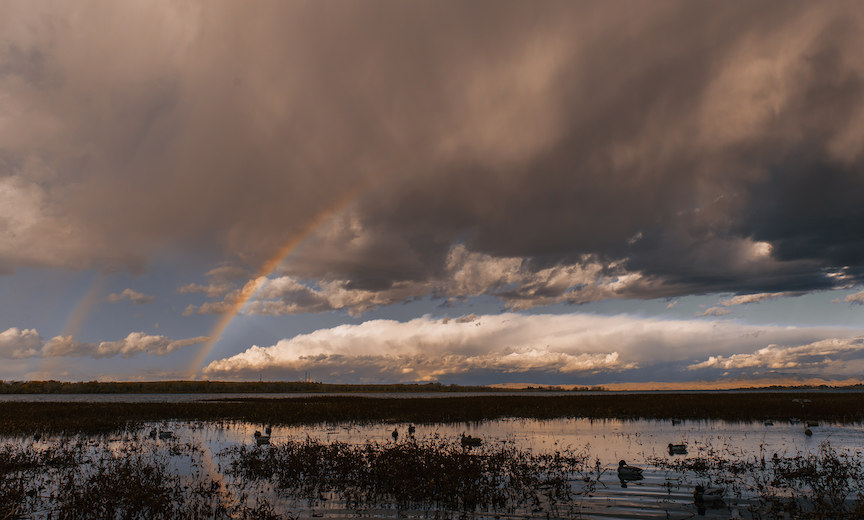
A double rainbow with storm clouds over duck decoys

Tips for making the most of foul weather hunting

Hunting on short notice, over a new feeding ground, in an area that birds can’t typically access via water usually leads to grumbling and a dose of ibuprofen. To pull off a hunt in driving rain and in close proximity to a swollen river takes both luck and skill. The luck is finding the birds; the skill is in beguiling them. It’s through quiet observation that I’ve learned where and how to hunt. I don’t advise chasing divers in open waters when the water is choppy and the wind is howling, unless you like constantly chasing decoys and bilging water out of your waders or boat. During storms, time is better spent hammering the backwater with plenty of cover, while freshly flooded cornfields almost always make for great puddle duck and goose hunts. Of course, finding the X is always first and foremost, especially when the forecast is set to change.

With seasons as short as they are and limits constantly subjected to changes in population size, today’s hunters should seize any opportunity to get outdoors in order to succeed. If time is taken to properly scout and understand the behavior patterns of the animals you intend to pursue, your success rates will climb. Utilize every rare, solitary moment in the woods to sharpen your hunting skills, especially when most people are still relaxing at home, out of the woods and out of the mire.

Duck Blind Quick Tips and Hacks

The Origins of Retrievers: Hunting Dog Confidential Episode #8

A Introduction to Jump Shooting Ducks on Upland Hunts

Benjamin Bulldog M357 Test Review .357 Caliber

0

FIRST, SOME HISTORY

Well, here’s a surprise! Although HAM has kept you covered on Benjamin Bulldog progress since before its launch, we’ve never published a comprehensive shooting test review before. So now we’re shooting the Bulldog M357!

The Benjamin Bulldog was first launched at the 2015 SHOT Show. But there had been a “sneak peak” before this. On 14 July 2014 – yes, nearly nine years ago! – HAM brought you the first, brief, details of a new .357 caliber replacement for the Benjamin Rogue.

This was the first sighting of the Bulldog. It was certainly demolishing cinder blocks at 55 yards and we were all mightily impressed!

Since that time, HAM has featured the Bulldog occasionally. I shot it myself in June 2019 – as you’ll see below – but for some now long-forgotten reason the story was not published.

Then in 2021, we carried this story about the best way to mount a bipod on the Bulldog. It’s the Leapers UTG Over Bore Bipod.

That information is even more pertinent for the Benjamin Bulldog M357 because the new model has no Picatinny rail under the forend (as the first model did). If you want to use a bipod with the M357, an above bore model is the only way to go.

BUY FROM AMAZON UTG TL-BPOB01-A Over Bore Bipod, 7″-11″ Center Height, Picatinny

Then, in March 2024, HAM carried a first look at the new Benjamin Bulldog M357. We liked what we saw, but a vacation (good) and a long bout of COVID (bad) meant that it’s taken until now to actually shoot the gun under controlled test conditions and publish this comprehensive test review.

Shooting the Benjamin Bulldog M357

VALUE FOR MONEY

Selling for $929.99, the Benjamin Bulldog M357 is attractively-priced for a “true” big bore air rifle combining a power level approaching 300 Ft/Lbs with magazine feed and a five-year warranty. In fact, when you look around, you’ll find that there are very few other airguns that can match these core specifications!

Many US buyers will be pleased to find that the Bulldog is designed and assembled in Velocity Outdoors’ Bloomfield NY headquarters. Most of the parts are sourced in the US too, although the use of a German Lothar Walther barrel is definitely an acceptable exception.

So, on a “bang for the buck” basis, the Bulldog has to be a very strong contender.

BUY FROM PYRAMYD AIR Benjamin Bulldog .357 Bullpup, Shrouded 0.357 Hawke Sidewinder 30 SF 6-24×56, 20x Half Mil IR Reticle, 30mm Tube

SPEED AND ACCURACY

For this HAM review, I tested the Benjamin Bulldog M357 with two types of Benjamin slugs.

Shooting at 25 Yards, the 145 Grain Benjamin Nosler Ballistic Tip eXTREME slugs gave an excellent 5-shot group of well under 1-Inch CTC.

The average Muzzle Energy across the five shots was 234.9 Ft/Lbs. The first shot gave 257.4 Ft/Lbs as it had the highest velocity.

Benjamin Bulldog M357 Test Review .357 Caliber

By comparison, the 147 Grain Benjamin .357 Slugs gave a looser group of under 2-Inches CTC at 25 Yards. But it should be remembered that these slugs are half the price of the Nosler eXTREMEs!

Muzzle Energy was higher at an average of 249.4 Ft/Lbs. The first shot gave 269.2 Ft/Lbs.

Benjamin Bulldog M357 Test Review .357 Caliber

As mentioned elsewhere, the Bulldog was never designed as a target rifle! So the group with the Nosler eXTREME slugs was definitely very acceptable hunting accuracy at 25 Yards.

COMPARISON WITH ORIGINAL BULLDOG

It’s interesting to compare the groups above with a group I shot back in 2019 using an original-model Bulldog and Nosler eXTREME slugs.

This group is slightly tighter than for the M357. But – given the shooter’s capabilities – I’d say they demonstrated very similar accuracy. In the case of the “old” Bulldog, the average Muzzle Energy was 182.1 ft/Lbs.

Comparing “5-shot average” Muzzle Energies, the M357 thus delivers a 29% increase in Muzzle Energy against the original version and with very similar accuracy. That’s definitely a very worthwhile improvement!

TRIGGER AND COCKING EFFORT

The Benjamin Bulldog M357 has a two-stage, non-adjustable trigger. The metal blade is comfortable in use and well-placed. It’s accompanied inside the trigger guard by a push-pull manual safety.

This safety design is very practical because it makes the shooter immediately aware if it’s engaged. It’s close to impossible to put your finger on the trigger!

Note that there is no externally-available methods for adjusting the Bulldog’s trigger. It is what it is…

However, sear release was quite predictable in the gun tested by HAM, with a fairly clean brake. All-in-all, this is a good hunting trigger, which is what it was designed to be.

The Bulldog is cocked using a rear-mounted side lever. This requires a fair – although not unreasonable – amount of effort to operate.

The location of the side lever requires that any Bulldog is removed from the shooting position. I found it most comfortable to rest the buttpad against my hip while actuating the side lever. This is understandable, however it does mean that a second shot is not available instantaneously, in spite of the magazine feed.

The side lever can be changed to operate from the left (other) side of the gun if required. However, this is a job that should be undertaken by a Crosman Repair Center if warranty is to be retained. For example, you can request such a service if ordering your Bulldog from Pyramyd Air.

COMPARISON TO MANUFACTURER’S CLAIMS

The manufacturer claims a peak Muzzle Energy of 300 Ft/Lbs for the Benjamin Bulldog M357.

True, the maximum Muzzle Energy developed during this HAM test was 269.2 Ft/Lbs using 147 Grain slugs.

However, knowing that the Muzzle Energy of PCP air rifles inevitably increases with projectile weight, it’s very likely that shooting a heavier slug will attain the claim. Consider that the .357 caliber ammo available now ranges up to 212 Grains…

CONSISTENCY

The Benjamin Bulldog M357 is not regulated. This is understandable in a big bore hunting air rifle. The result is that the gun loses power with every shot.

Fortunately this decline in power is very predictable at about 20 FPS drop per shot, as the following shootdown chart shows.

Benjamin Bulldog M357 Test Review .357 Caliber

For HAM testing, I topped-up with HPA after every 5 shots – one magazine’s capacity. I’m guessing that most M357 owners will adopt a similar refilling strategy to avoid too many shots striking low.

The average pull weight of the trigger on the Benjamin Bulldog M357 tested by HAM was 4 Lbs 3 Lbs. The lightest pull recorded was 4 Lbs 0 Oz, the heaviest 4 Lbs 11 Oz. So, trigger pull weight consistency was pretty good.

NOISE LEVEL

As with other members of the family, the Benjamin Bulldog M357 includes the company’s baffle-less, triangular shroud. However be aware, it’s loud. Like “ear defenders required” loud!

No Bulldog is going to be “backyard-friendly”, but then it’s designed as a hunting gun, not an all-day, family plinker. The design expectation is obviously that you’ll be shooting it in wide open spaces.

Some owners will be pleased that the M357 is fitted with M18 threads at the muzzle. These are covered with a knurled cap when not in use, but provide the capability to add a big bore airgun-specific silencer where legal.

However, fitting a silencer will obviously increase the overall length of the gun – thus somewhat defeating the purpose of the compact, 36-Inch overall length, form factor that is a major part of the product’s attraction.

SIGHTS AND SCOPE

In preparation for our shooting tests, I mounted a Hawke Sidewinder 6-24 x 50 FFP scope using Hawke 30 mm High Tactical Match Rings.

With its’ 24x magnification and sharp optics, the Sidewinder gives plenty of “reach” for long-range shooting. The rings are definitely sturdy, too, with their six screw top fixing.

To gain the correct eyeline, I also fitted a 0.75-Inch high Leapers UTG Super Slim Picatinny Riser between the rings and gun. This raised the scope sufficiently to enable a comfortable sight picture to be achieved without straining my neck.

You’ll probably find that you need a riser, too…

Benjamin Bulldog M357 Test Review .357 Caliber

We should also mention that the Bulldog’s almost-endless top Picatinny rail allows for enormous flexibility in scope mounting. There’s pretty-well no scope that can’t be mounted on this air rifle, however long it is. That’s a major benefit right there that should not be ignored!

SHOOTABILITY

Alt 36-Inches overall – the Benjamin Bulldog M357 is not long However it’s definitely a chunky airgun! With scope mounted, the all-up weight was 10 Lbs 14 Oz. That’s a fairly substantial weight, hence the overbore bipod mentioned elsewhere in this review.

That compact length makes the Bulldog surprisingly easy to shoot offhand. Yes it’s heavy, but it balances well and naturally, making it relatively easy to hold on target. Most big bore air rifles are longer – some much longer – than the M357 as longer barrels are an easy way to increase Muzzle energy with PCPs.

Loading the detachable 5-round magazine is easy enough – once you remember to keep a finger in place to stop the slugs from falling through! Unlike most magazines, you do not rotate the rotor all the way and then let it return as you load. You rotate a little, load one, then repeat as necessary.

This is a practical and easy method of operation, especially if you just want to “top up” the magazine after taking a couple of shots.

The magazine is loaded downwards into the breech. This is simple and easy to do. The only requirement is to be sure that the cocking lever is pulled all the way back as you do so.

At just $18.99, these .357 caliber Bulldog magazines are among the cheapest in the market. That makes it a good plan to buy several…

APPEARANCE AND FINISH

OK, I have to be honest. I really do not like the look of the Bulldog!

However, there’s an old English expression that “handsome is as handsome does”. Thinking of this and – maybe – the familiarity that happens over time, makes the looks less polarizing than when the gun was first introduced back in 2014.

I still do not think the Benjamin Bulldog M357 is a great-looking gun. But I can live with it!

Benjamin Bulldog M357 Test Review .357 Caliber

The finish of the Benjamin Bulldog M357 tested by HAM was OK. The clamshell synthetic stock moldings are good enough. However the seam between them is pretty pronounced.

The sheet metal shroud of the test gun was fine on one side, but the finish was imperfect on the other. (It was easy enough to see, but tough to photograph).

Does that matter? Maybe not for a “working gun”, as there’s nothing to cause a problem. But for a price approaching $1K, my expectations would be higher…

BUYING AND OWNING

As with many Velocity Outdoor models, the Benjamin Bulldog M357 carries an outstanding 5-year return-to-factory warranty.

The gun ships with the company’s usual-style owner’s manual. This includes much information and many illustrations, but crams it all in at a minimum type size, making it difficult to read.

Also included is one magazine, a tube of Crosman Pellgun Oil together with a pack of “Bore Tips” for lubricating and barrel cleaning. Thanks Velocity Outdoor!

Another practical point for the bulldog is that the designers included sling swivel mounting points forward and rear. As the Benjamin Bulldog M357 is a heavy gun and you’ll be carrying it for hunting, a good sling and pair of swivels will be an excellent additional investment.

There’s good news about filling the Benjamin Bulldog M357 with High Pressure Air. First is that “only” 3,000 PSI is required for a full fill. This means that you will get more fills from a tank or shorter compressor run times than other comparable PCPs using a higher fill pressure.

Secondly, the Bulldog incorporates a “Foster standard” male quick disconnect for filling. In my testing and analysis for this HAM investigation, I found that Benjamin PCPs comply better with this standard than some other companies.

Another great feature is that – just ahead of the fill nipple and almost-hidden down in that slot – is a degassing screw. Operated with a 3/32-Inch Allen (hex) wrench, this allows all pressure to be released from the Bulldog, if required. It’s a great safety feature, even if you’re not likely to use it often.

However, the fill nipple area is covered by a “snap off” cover that I always find troublesome to use. In practice, I leave it off when shooting the Bulldog, which is not ideal. But it does stop me from loosing the item…

That’s it – the wrong way round! – in the photograph above.

One other consideration for the Bulldog M357 owner is the length of the slugs that you plan to shoot through the gun.

The M357’s magazine accepts the 145 Grain Nosler eXTREME as about a practical maximum length. The specification for these slugs is 18.71 mm long. Looking at the magazine, it’s pretty clear that somewhere around this length is the maximum that could be magazine-fed into the Benjamin Bulldog M357.

As an alternative, the M357 can be single-loaded by opening the bolt and pushing the slug into the barrel by hand. (Yes, it’s fiddly, but it can be done). In this case, the maximum slug length would be around 21 mm (0.8 Inches).

This means that, for example, 178 Grain NSA slugs should fit, but that Seneca 212 Grain ammo is never going to make it into the M357, even with hand loading. Some testing is going to be involved if you want to use ammo longer than around 19 mm (0.750-Inch) and be aware that it’s likely not to fit into the magazine.

BUY FROM PYRAMYD AIR Benjamin Bulldog .357 Bullpup, Shrouded 0.357 Hawke Sidewinder 30 SF 6-24×56, 20x Half Mil IR Reticle, 30mm Tube

This entire article including scoring, test targets etc is Copyright Hard Air Magazine and may NOT in part or in whole be reproduced in any electronic or printed medium without prior permission from the publisher.

How to Identify the Difference in Prairie Grouse on the Hunt

0

Learn to identify the differences between a prairie chicken and a sharp-tailed grouse.

A trio of hunters spaced out over forty yards from each other with two pointing dogs covering the large expansive prairie walked towards the horizon. The dogs were quartering back and forth as they crested an upland slope searching for scent. Suddenly the dogs began to act “birdy.” As if someone hit the pause button on the TV remote, the dogs froze in mid-stride. The hunters approached with anticipation. Shotguns were transitioned into the ready position. Grips tightened.

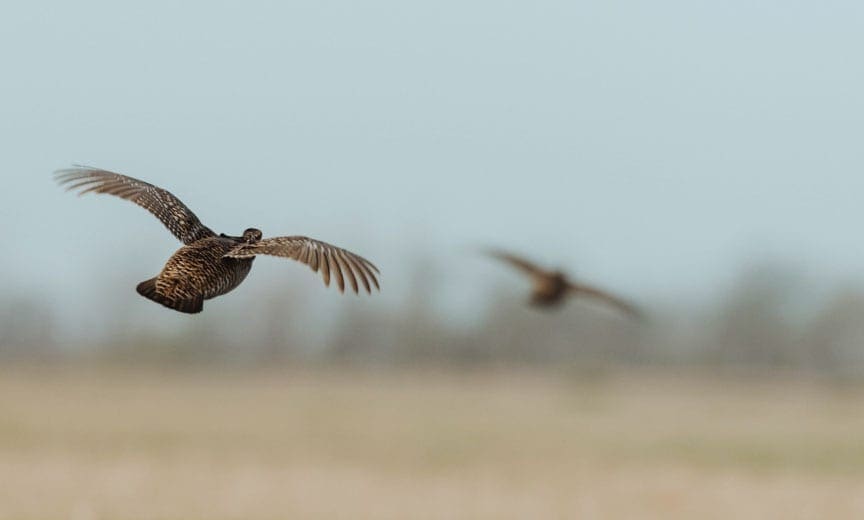
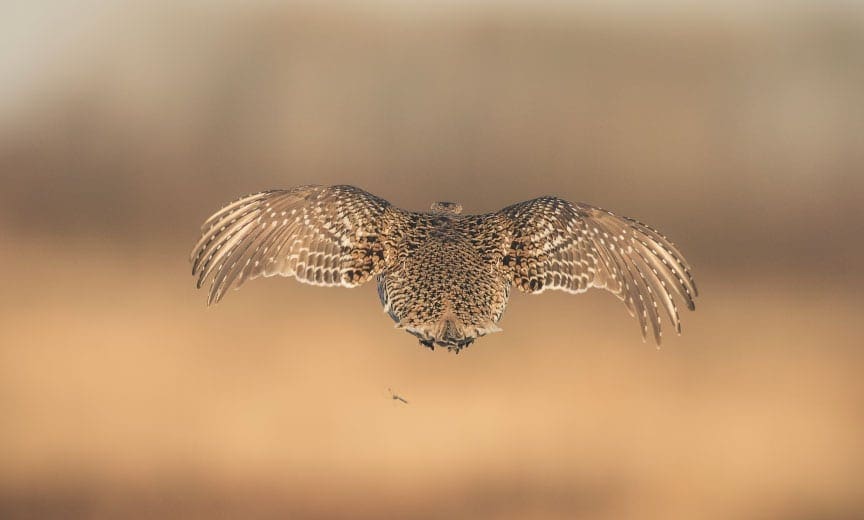
Suddenly, a covey of football sized and shaped birds exploded from the swaying grass. The half-dozen birds rose into the air with a series of rapid wingbeats. Underbellies appeared to be lighter in color along with unique tail appearances. These were not hen pheasants, though similar in coloration. These were prairie grouse. A volley of shots rang out from each of the three hunters. A pair of birds dropped from the blue sky.

As birds were being retrieved, a late flush thirty yards away startled the hunters. More shots rang out, breaking the silence again across the landscape. One more bird returned to the ground from where it flushed. Birds were brought to their masters. With birds in hand, it was quickly discovered that two different types of prairie fowl had been taken on the wing-a duo of prairie chickens and a sharp-tailed grouse. The two species shared several similar characteristics, from the habitat the birds were being hunted in, to the way they flushed, and even their shared physical appearances. Both birds were indeed upland cousins.

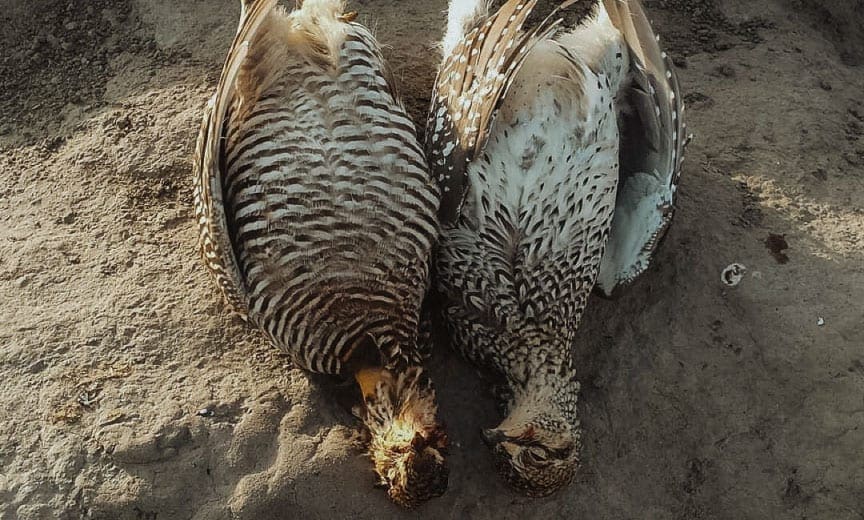
On the left a prairie chicken on the right a sharp-tailed grouse. Photo by @uplandflush AKA Frank Loncarich and Kyle Hedges.

Greater prairie chickens (chickens) and sharp-tailed grouse (sharptails or sharpies), collectively referred to as prairie grouse, are closely related birds native to the prairie landscapes of Colorado, Idaho, Kansas, Minnesota, Montana, Nebraska, North Dakota (no prairie chicken season) and South Dakota, Wyoming, and Canada. Prairie grouse hunting typically occurs on large expanses of grassland, but can occur in cropland or field edges in grassland dominated landscapes. As the name implies, prairie grouse are birds of the great, wide-open spaces found in North America’s Great Plains.

These birds are usually found in coveys which tend to increase in size as the season progresses. It’s not uncommon to find prairie grouse in mixed flocks of both prairie chickens and sharptails where these species’ range overlaps. While historically there are some range overlaps between sharp-tailed grouse and greater prairie chickens, range itself is a good way to identify the species, as sharp-tailed grouse are found in a much wider geographic area than are prairie chickens.

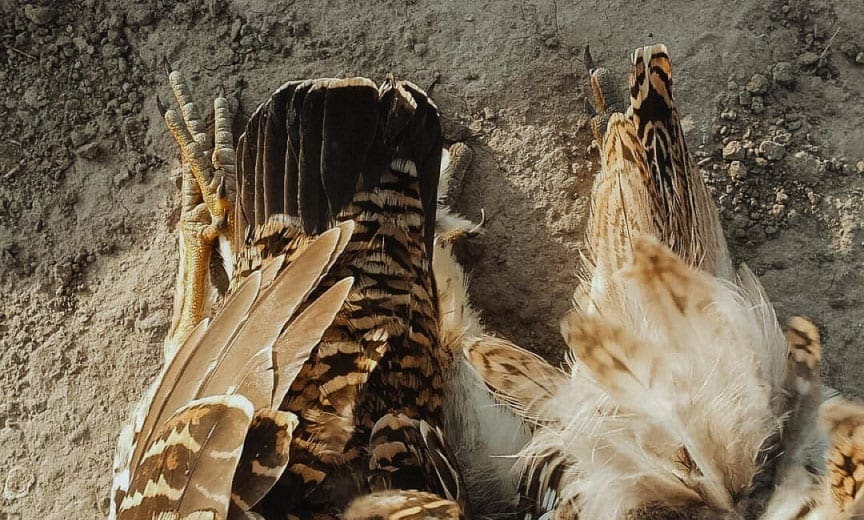
On the left the tail of a prairie chicken on the right the tail of a sharp-tailed grouse. Photo by @uplandflush AKA Frank Loncarich and Kyle Hedges.

Understanding Prairie Grouse Habitat

Habitat is critical to finding grouse out on the vast expansive prairie. Hunters should concentrate by looking for native grass with nearby croplands. This will be a paradigm shift for pheasant hunters who may lean toward thicker cover in low-lying areas. What looks like prime pheasant cover is NOT where prairie grouse will be found. The best habitat is pristine grass that looks like it did when Native Americans hunted there. Grass that is shorter than knee high is best. Any higher and the birds cannot see over it to defend themselves and observe approaching predators. These are all things to consider when finding sharp-tailed grouse habitat or prairie chicken habitat.

Prairie grouse are not likely to be found in areas where cattle have overgrazed the grass; however, it has been my experience and observation that prairie grouse will indeed remain in the area, especially if there is an established lek.

When it is hot prairie and the sun is beating down as is common during September and even into October, grouse will seek out relief and move to areas with shade, such as in taller grass, plum thickets, clumps of sumac, bushes, and tree rows. If there is dew or rain on the grass, birds will move to shorter grass or areas where they can stay dry.

Prairie chicken in flight, their dark band tail color a distinguish factor between the sharp-tailed grouse. Photo by Steve Oehlenschlager

Difference in Prairie Grouse Ranges

For prairie chickens, range is the easiest way to tell them apart. Greater prairie chickens can be found from Kansas, eastern Colorado, Nebraska, and on northward through the Dakotas. Sharp-tailed grouse are found in a much wider geographic area than are prairie chickens. They are found in lot more states as well as north of the border.

Identification of Prairie Grouse

Telling them apart in flight is an acquired skill. The question one must ask is, are you as a hunter able to identify which type of prairie grouse from the way it flies or its appearance in flight? What about from the type of habitat or physical attributes once birds are delivered to leather-gloved hands? In actuality there’s little practical difference visually between greater prairie chickens and sharp-tailed grouse.

The first step in any bird identification is learning to observe. Watch and listen. It will also help to think about what types of habitat are most likely to hold specific types of upland gamebirds. The availability of specific habitat types may limit where a species can be encountered.

A sharp-tailed grouse in flight, their light white color tail a distinguish factor between the prairie chicken. Photo by Steve Oehlenschlager

Prairie Grouse Quirks.

Flocks of chickens and sharptails often flush in small groups, or even one-by-one when pointed or flushed by dogs. Hunters should follow up on every flush, including wild ones. With each covey rise, there’s a chance that a straggler may be holding tight. Many hunters make the mistake and assume that all the birds have flushed, thus missing an opportunity for a late riser. Even if the birds are out of shotgun range, hunters need not stand there but hustle over to the area where the birds flushed. There’s a good chance of finding a tight-sitting bird or two.

Hunters who empty their guns on the initial flush should reload quickly and be ready for straggling singles. One thing in common for both prairie chickens and sharptails is that they both chuckle like they are laughing at you when flushed!

Guide to Hunting Prairie Chickens in Kansas

Finding Sharp-Tailed Grouse Habitat

Hunting Prairie Chickens in September – The Kansas “Grouse” Opener

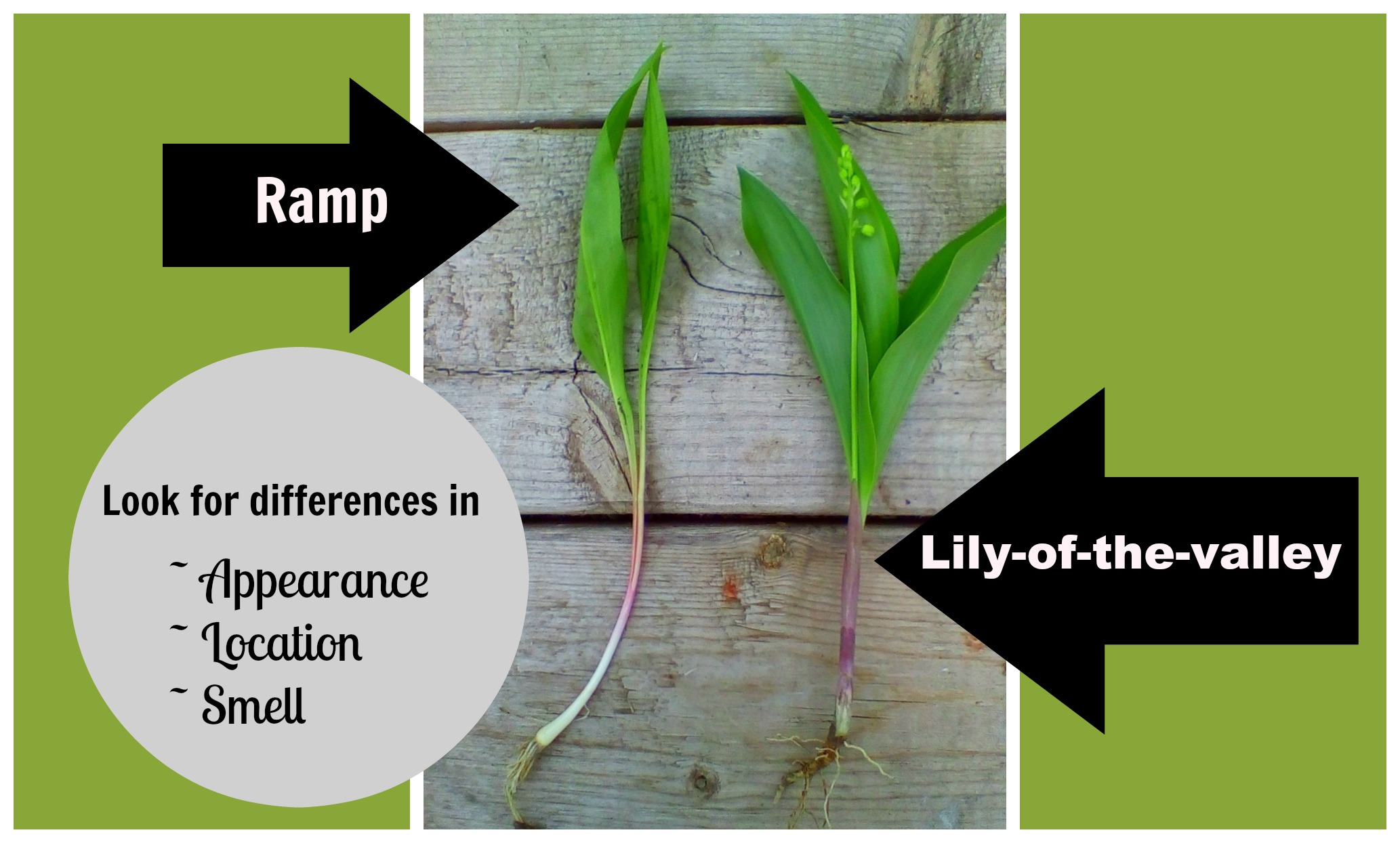
How to tell the difference between ramps and lily-of-the-valley

0

ramplily

New foragers sometimes worry about telling the difference between highly sought-after ramps (wild leeks) and their poisonous look-alikes, Lily-of-the-valley. It’s always wise to be leery when you’re new to foraging, but once you know what to look for you don’t need to worry. There are quite a few ways to accurately tell the difference between the two plants.

Ramps (ramsons in the UK) are alliums, members of the onion family. Their leaves taste like a milder mixture of garlic and onion, and once cooked they have the texture of spinach. They have a short season and are difficult to cultivate, which means that they fetch top dollar at farmers’ markets — up to $20 a pound.

In contrast, Lily-of-the-valley is an imported flower that has invasive habits and contains cardiac glycosides that affect the body in a similar manner to foxglove (digitalis). Symptoms of ingesting it include flushed skin, nausea, dizziness, headache, weakness, hallucinations and changes in heart rate. In extreme cases, it can lead to death. Most cases of poisoning by Lily-of-the-valley result from children eating the berries that occur later in the season, but occasionally there are cases of poisoning where people mistakenly cook with them, thinking they are ramps.

The two plants look similar, but there are good ways to tell them apart. You can see some differences right away and there are even more ways to be sure you’re picking ramps and not lily-of-the-valley.

Appearance:

  • Look at the roots. Ramps emerge from a bulb and have rootlets at the very end of it. Lily-of-the-valley do not have bulbs but have longer roots with rootlets along the length.
  • Look at the leaves. Ramps have one or two leaves that emerge separately from the ground, each on its own stem. Lily-of-the-valley has a stem that appears and multiple leaves that are whorled around the center.
  • Look at the flowers. Ramps do not have a flower stem until later in the season. The lily-of-the-valley flower stem appears almost as soon as the leaves unfold. Once the flowers emerge (generally after the season for harvesting ramps), the flowers look very different. Ramp flowers are small daisy-like clusters with green centers at the end of a stalk, while Lily-of-the-valley have many small bell-shaped flowers that hang down from the length of the stalk.

Location:

  • Look at the site. Ramps grow on the floor of moist, open woodlands. Lily-of-the-valley is a domestic plant which likes the same soil, but is usually found on old farm sites and around homes.

Season:

  • Pay attention to the time of year. Ramps emerge earlier in the year. They typically come up when Lily-of-the-valley are just breaking the ground in very early spring.

Scent:

  • Smell it. Smell is the easiest identifier by far. Tear the leaf — ramps smell very strongly of onion and garlic. Lily-of-the-valley has no smell when the leaves are torn.

It’s a good idea to locate and dig up a lily-of-the-valley so you can see and smell the differences for yourself. The best way is to forage with someone who has experience with ramps your first time out. That said, if you use these identifiers it is easy to tell the difference. Be sure to never eat anything that you are not sure about, however.

Ramps are extremely slow to reproduce, which means it’s important to forage for them responsibly. In some parts of the country they are over-harvested and it is illegal to harvest them in parts of Canada. Be sure to only harvest the leaves and not the bulbs, so the plants survive. Even then, harvest only a small percent of the leaves you find. This can help ensure that the stand can continue on for many years.

Once you have your ramps, here are wonderful ways to cook with them.

The Day the Duck Hunters Died

0

It is easy to forget the days like the one the duck hunters died. It is easy to forget that there was a time—not so very long ago, really—when there was no Gore-Tex, no Thinsulate, no neoprene and no polypropylene for duck hunters. There was a time when outboard motors, far from the sleek and powerful marvels of today, were crude, cumbersome beasts, unreliable under the best circumstances and all but useless under the worst. There was a time when there were no cell phones, no emergency beacons, no Flight for Life helicopters.

There was a time, too, when there were no weather satellites, no telemetry to provide data that could be plugged into sophisticated formulas and fed into supercomputers for timely forecasts. Indeed, that the weather could be predicted with any degree of accuracy then—November 1940, to be precise—seems almost miraculous, meteorology in those days being one part science and two parts the divination of omens, signs and portents. Nothing brings this into starker relief than the fact that, a little more than a year later, what appeared on radar to be a swarm of aircraft approaching the Hawaiian Islands was dismissed as some sort of malfunction by military officers who refused to trust this newfangled and unproven technology.flying mallard duck

Of course, some things do not change with the passage of time, and one of those constants is the love of duck hunters for the kind of wet, raw, blustery, thoroughly miserable days that keep normal people indoors with the fireplace crackling and the teakettle whistling on the stove. And just as absence makes the heart grow fonder, the longer the duck hunter is made to wait for such a day, the hotter burns his pent-up desire to escape the sloughs and bays and marshes, and there—decoys artfully set, blind brushed and grassed, dog expectant and quivering, call poised to be pressed to lips—scan the lowering skies for birds that ride the wind.

The fall of 1940 had been a mild one in the Upper Midwest, an extended Indian summer of warm temperatures and little rainfall. In other words, the duck hunting had been disappointing. Oh, there had been the usual “local” birds in the early season—teal, wigeon, shoveler, the odd mallard—but without any heavy weather to set the migration in motion, the great flocks of northern ducks were still in the prairie provinces of Canada, fattening up for the long flight south. Hunters throughout the region, from the Dakotas across to Wisconsin, from Minnesota down to southern Illinois, were on pins and needles, knowing that the change in weather they so dearly wanted was overdue, that it could happen any day.

Finally, on Sunday, November 10, came a forecast that held promise. The outlook was for clouds, snow flurries, and colder temperatures. Wildfowlers were ecstatic, and what made this good news even better was that Monday, November 11, was Armistice Day—the predecessor to Veterans Day, and, for many people, a holiday. Although as holidays go it was a fairly somber one. The grinding effect of the Great Depression still lingered in the U.S., and in Europe. There, where just 22 years earlier the eponymous armistice had been signed, war raged once again.

flying gadwall duckStill, it’s not much of a leap to suppose that the typical waterfowler of the Upper Midwest, upon hearing the forecast on the radio or reading it in the local newspaper, felt blessed—even jubilant. Other concerns were pushed aside; nothing mattered now but getting ready for tomorrow’s hunt. Decoys, shell boxes, shotguns, and calls were checked and rechecked. Ditto for boats, motors, gas tanks, and oars. Clothes were carefully laid out; sandwiches were made, wrapped in wax paper and refrigerated; thermos bottles were placed next to coffee percolators. The dog was given an extra bit of food, because in a few hours he was going to be one busy retriever and would need all the energy and stamina he could muster.

The phone lines hummed as hunting partner called hunting partner, their voices crackling with excitement. They knew, with as much certainty as they knew anything, the ducks would be flying, and they aimed to be smack dab in the middle of them.

They got more than they bargained for.

In his magisterial Where The Sky Began: Land of the Tallgrass Prairie, John Madson describes the genesis of a Midwestern blizzard as a “temperature marriage” of cold, dry polar air sweeping down from Canada and warm, moist subtropical air welling up from the Gulf of Mexico.

“Since its primary component is wind,” Madson wrote, “the classic blizzard is essentially a phenomenon of the open lands—particularly the plains and prairies, where the topography offers little resistance to moving air and the great storms can run almost impeded. There may be more snow in northern and eastern forest regions, and certainly much cold. The difference between winter storms there and the classic prairie blizzard lies in the intensity of unbridled wind that plunges the chill factor to deadly lows, drives a blinding smother of snow during the actual storm, and continues as ground blizzards and white-outs long after snow has stopped falling. Depending on snowfall and wind, the storm may leave drifts three times as tall as a man and is usually followed by calm, silver-blue days of burning cold.”

That, in a nutshell, describes the blizzard that screamed across the Upper Midwest on Monday, November 11, 1940, devastating everything it touched along the way. The winds blasted at a constant 40-50 mph with gusts in excess of 80. More than 16 inches of snow fell in the Twin Cities, while more than 26 inches were recorded a few miles up the Mississippi River near St. Cloud. In LaCrosse, downstream on the Wisconsin side of the Mississippi, the barometric pressure sank to an all-time low. The temperature dropped 30 degrees—from above freezing to single digits—in two hours and continued to plummet from there. Windchills were virtually off the charts.

Wind-blown snow and trees

Nothing escaped the storm’s furious, relentless, indiscriminate wrath. Livestock perished by the hundreds of thousands. So many turkeys died in parts of Minnesota and Iowa that after the storm farmers were selling whole “fresh frozen” birds for 25 cents apiece. The losses to wildlife, especially pheasants, were spectacular. Communications and power were disrupted across thousands of square miles, and transportation was brought to an absolute standstill. Every town and village close to a main road became a refuge as stranded travelers sought shelter from the storm. Countless people opened their homes to complete strangers, providing whatever they could offer in the way of board and room.

But for some there was no shelter, no refuge. Motorists stuck in snowdrifts on remote stretches of road were buried alive in their cars, their frozen bodies not exhumed for days. On Lake Michigan, the freighter William B. Davock was sheared in two by monstrous waves.

The ferocity of the storm was almost beyond human reckoning. There are accounts of farmers who, after checking their livestock, could not find their way from the barn to the farmhouse. Disoriented, pummeled by the wind, with no visible landmarks to guide them, and no sense of east, west, north, or south, they wandered blindly through a roaring white hell. The lucky ones bumped into something recognizable and groped their way to safety. The unlucky ones didn’t.old boat in water

Nearly everyone who survived the storm remarked on how incredibly difficult it was just to breathe. The air was so laden with moisture that it seemed as thick as syrup. And even when you were able to draw a deep breath, the cold seared your lungs like a red-hot blade.

This is what thousands of duck hunters, with their wooden skiffs and their cranky outboards and their canvas caps, found themselves caught in. Most of the world knows the Midwestern blizzard of November 11, 1940, as the Armistice Day Storm. To sportsmen, it’s simply the day the duck hunters died.

No one really knows how many people lost their lives as a direct result of the Armistice Day Storm. Although Time put the death toll at 159, the actual figure was probably closer to 200—and about half of them were duck hunters. According to John Madson, 85 duck hunters perished in Minnesota, Wisconsin, and Illinois alone. As he wrote in Where The Sky Began, “Caught by the storm with little warning, they drowned as they tried to reach land, or stayed in their duck blinds as waves tore them apart, or simply died of exposure that night on the river islands out of reach of help . . .”

If a storm causing as much destruction and loss of life occurred today, someone like Sebastian Junger or Jon Krakauer would write a best-selling book about it. But while it certainly made headlines—a spread in Life was entitled “Midwest Tempest Strews Death By Land and Lake”—America was preoccupied with other matters. After the dead were buried, the damage was cleared, and the bereaved had ceased to mourn, life resumed more-or-less as usual. And the weather for the remainder of the winter of 1940-’41 was largely unremarkable.

But no one who was there would ever forget it. Nor did their memories, like photos left too long in a show window, pale with the passage of time. It was the persistence of these memories that, 45 years after the event, prompted a Minnesota man named William Hull to track down and interview more than 500 people who’d lived through the Armistice Day Storm. He then selected 167 of these accounts and assembled them into a book called, fittingly, All Hell Broke Loose.

Now in its 18th printing, it’s replete with tales not only of close calls and narrow escapes, but of countless acts of charity, generosity, selflessness, and heroism. (There are a number of humorous, Keillor-esque tales as well, such as the one entitled “Three Hours Digging Path to Outhouse.”) Not a few of these stories were told by duck hunters. While the specifics may differ slightly—some recalled seemingly endless flocks of divers like redheads, bluebills, and canvasbacks, while others remember wave upon wave of mallards—they all agree that they had never seen the sky so full of ducks. They agree, too, that there was nothing in the weather that morning to presage what was coming, that the storm was upon them almost before they knew what was happening, and that it was only by the grace of God that they survived when so many others did not.

Every sportsman who was there has his own wrinkle to add to the story. Cyril Looker of Fremont, Wisconsin,—in the heart of the wildlife-rich Wolf River bottoms—recalls standing on the shore near a power line cut and burning up two boxes of shells as the ducks poured into Partridge Lake. The kicker, notes the 83-year-old Looker, is that the birds—mallards and divers both—were flying beneath the wires.

painting of hunters and dog in snow

The account that eclipses all the rest, though—and has made the Armistice Day Storm vividly and chillingly real for generations of sportsmen ever since—is the one written by the great Gordon MacQuarrie. Indeed, it’s entirely likely that if MacQuarrie, then the outdoors editor for the Milwaukee Journal, hadn’t been on the scene, the event would be little more than a footnote in duck hunting history. While a lesser writer might have filed a competent and informative report, MacQuarrie penned a masterpiece.

His story, under the headline “Icy Death Rides Gale on Duck Hunt Trail,” appeared on the front page of the Journal on Wednesday, November 13. It was filed from Winona, Minnesota, a Mississippi River town about 90 miles downstream from the Twin Cities. The river there is a sprawling, two-mile-wide wilderness of islands, oxbows, and backwater sloughs, and Winona was the epicenter of the disaster: At least 20 duck hunters died within 50 miles of the city.

“The winds of hell were loose on the Mississippi Armistice day and night,” wrote MacQuarrie. “They came across the prairie, from the south and west, a mighty freezing force. They charged down from the high river bluffs to the placid stream below and reached with deathly fingers for the life that beat beneath the canvas jackets of hundreds of duck hunters . . .

“The wind did it, the furious wind that pierced any clothing, that locked outboard engines in sheaths of ice, that froze on faces and hands and clothing, so that survivors crackled when they got to safety and said their prayers.

“Mother Nature caught hundreds of duck hunters on the Armistice holiday. She lured them out to the marshes with fine, whooping wind, and when she got them there she froze them like muskrats in traps. She promised ducks in the wind. They came all right, but by that time the duck hunters were playing a bigger game with the wind, and their lives were the stake.

fallen trees, snow and ice

“By that time men along the Mississippi were drowning and freezing. The ducks came and men died. They died underneath upturned skiffs as the blast sought them out on boggy, unprotected islands; they died trying to light fires and jumping and sparring trying to keep warm; they died sitting in skiffs. They died standing in river water to their hips, awaiting help; they died trying to help each other. A hundred tales of heroism will be told, long after the funerals are over.”

MacQuarrie told of Gerald Tarras, a strapping 17-year-old who’d gone hunting in the Mississippi bottoms that fateful day with his father, brother, a family friend, and their black Lab. They set up mid-morning in a drizzling rain; by noon they were trapped by six-foot waves, waves that pounded like huge iron fists and hurled freezing spray that turned instantly to boilerplate ice. The men beat on one another to try to keep warm, but it was a losing battle. At about 2 a.m. the friend uttered one last moan and died in Gerald’s arms. Gerald’s brother held out until 11 in the morning, but after 23 hours of exposure, he, too, succumbed.

Then, shortly after noon, a small plane flew over. Gerald waved, and the pilot signaled that help was on the way. Rescuers in the government tugboat Throckmorton arrived at 2:30—half an hour too late to save Gerald’s father. They found the boy crouched against a stump, holding his dog for warmth, fighting to remain conscious.

frozen pond, lake

Max Conrad, the pilot who led rescuers to Gerald Tarras, was one of the true heroes of the Armistice Day Storm. Dozens of hunters would later acknowledge that they owed their lives to him. On Tuesday the 12th, with the wind still howling but the skies clear, he took off from his hangar in Winona to help find the hunters who hadn’t come home. Flying a redoubtable Piper Cub—and fighting to make even 20 or 30 knots of airspeed against the brutal headwinds—he scanned the frozen margins of the Mississippi for the living, but often as not discovered the dead.

When he located survivors—they were frequently huddled in the lee of a skiff they’d propped up as a windbreak—Conrad would circle low, cut the engine for a moment, and holler “Hang on! Help is coming!” A few minutes later, he’d return and, like manna sent down from heaven, drop a canister filled with sandwiches, whiskey, dry matches, and cigarettes. Conrad would then circle until the Throckmorton or one of the many rescue boats that had deployed in search of survivors could get a fix on the spot. He kept flying until 10 p.m. that night, and he was out again at dawn the following day.

There is no telling how many hunters died for the simple want of dry matches. But even that was no guarantee, as there was still the problem of finding dry fuel to burn. Many a prized Mason decoy went up in flames, and a group of 17 hunters stranded on the same island took turns shooting down limbs for firewood until their ammunition ran out.

The Mississippi River was not the only place where duckboats became sepulchres, of course. Two hunters died on Wisconsin’s Big Muskego Lake, barely 20 miles from downtown Milwaukee. One of these men was alone in his skiff, trapped by waves and ice. Toward the end, another party of hunters glimpsed him standing in his boat with his head tilted back, his arms stretched outwards, and his palms turned up. It was as if he was imploring God—or perhaps commending his soul to Him. While the other hunters, who themselves were fighting to survive, watched helplessly, the man slumped back into his skiff, leaned heavily against the gunwale, and went motionless.

His spirit, like the ducks that drew him out on that terrible day, had flown.

The author wishes to thank Howard Mead of Madison, Wisconsin, for his assistance in providing background research.

Best Air Rifle Deals

Popular Posts

Dry Firing Air Rifles: What You Need to Know

0
"Master the art of precision shooting with dry firing air rifles. Enhance your aiming skills, trigger control, and muscle memory without using ammunition. Discover...

Master Small Game Hunting with an Air Rifle: Tips and Techniques

0
"Experience the thrill of small game hunting with an air rifle! Embark on a captivating journey as you test your accuracy and precision in...

Air gun 101: The differences between .177 & .22 – Which jobs they do...

0
I’ve always believed the popular phrase: “It’s not the size of the dog in the fight that matters - but rather the size of the...