


Home Blog Page 202

A Guide to American Woodcock Hunting

0

Woodcock may be one of the greatest game birds to pursue for those interested in becoming a bird hunter or in areas otherwise devoid of wild birds

It comes as no surprise that the popularity of American woodcock hunting has risen with the decline of other upland game species in its flyway. In many areas, the bobwhite quail has become a distant whistle and the ruffed grouse merely a ghost. Woodcock are a migratory bird with flyways that stretch from Canada to Louisiana, east Texas, and even Florida. As a result of their geographic diversity, they have earned a variety of nicknames and cultural nods such as “mud bat” and woodcock gumbo. The entire eastern half of the United States hosts woodcock seasons which are regulated by federal migratory game laws. With a crash course in habitat knowledge, the leap to becoming a woodcock hunter is often easier than with other upland game species. Before you know it, that distinct whistle of rising wings will be a calling card for one of your favorite game species.

Are woodcock the gateway bird of the East?

If you ask me, woodcock represent one of the greatest opportunities for becoming an upland hunter. I may even take it a step further and say that they represent one of the best entry-level pursuits for new hunters all around. They offer exciting wingshooting challenges that can sometimes feel more like video-gaming than hard work. For those of us that drift further into the uplands and find ourselves with a bird dog coming along, we soon discover that woodcock may be a new dog’s (and hunter’s) best friend.

The biggest challenge when making the leap to woodcock hunting is learning about habitat, but this is easily achieved even without advanced degrees in ecology. A few basic concepts will eventually blossom into more elaborate ideas and theories with more time spent in the woods.
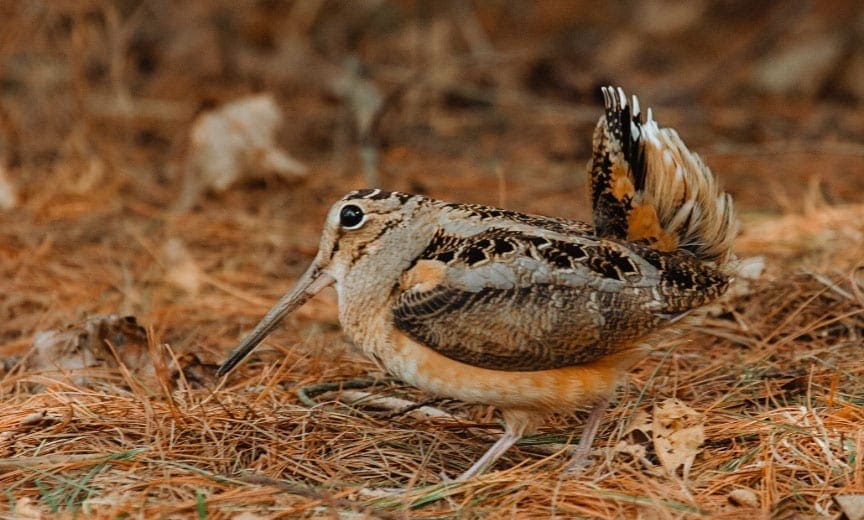
An American woodcock probing for worms

Woodcock hunting gear

Woodcock hunting gear can be as complex or as simple as you want, which is one of the beauties of upland hunting. Jeans can suffice if you can stand some thorns, or you could go invest in expensive upland-specific pants—the choice is yours. When it comes to topics like chokes and shot size, there are some specifics that make the most sense for the quarry. When it comes to choosing a hunting dog, should you go down that route, that’s a novel but we can at least get you started.

Woodcock shotguns, chokes, and shot size

Woodcock are not large birds. On the upper end, a female can weigh as much as a half-pound and on the low end, males can weigh as little as five ounces, so they do not require heavy firepower to bring down effectively and ethically.

The nature of the cover that woodcock inhabit and their behavior towards hunters will make for a lot of close shooting opportunities. This scenario calls for open shogun chokes like cylinder, skeet, and improved cylinder.

The most popular lead shot sizes for hunting woodcock are #7.5, #8 and #9. More obscure specialty loads can take you to #10 shot and to spreader loads, which have a wad designed to allow shot to spread out faster. In the realm of steel, #6 and #7 shot are among the most popular if only because smaller steel loads are very uncommon or non-existent. It does not take a lot to kill a woodcock, so it’s worth considering how many pellets you’re willing to pick out of one before eating. My personal choice is #7 steel.

When it comes to choosing a shotgun for woodcock hunting, it is the answer we all know is always true, but never want to hear: use a shotgun that works for you. The most popular of all the shotgun gauges for woodcock is 20 gauge, but the 12 gauge continues as a cultural staple. More obscure gauges like 16 and 28 find good representation in woodcock hunting, while the more experienced may try the challenge of a .410. The action type does not matter as long as it’s a gun that you can shoot straight with confidence. Note that federal migratory game laws require a shotgun plug when hunting woodcock to reduce the gun’s capacity to three shells. Shotguns with shorter barrels are traditionally valued for woodcock hunting due to the stem density and tight swinging area of their preferred habitat, though there’s plenty of debate over a few extra inches and their added value to overall gun balance… but that’s a discussion for another day.

Woodcock hunting clothing

As mentioned, jeans can work just fine in the pursuit of woodcock. There is no need for camouflage, but woodcock hunting certainly calls for blaze orange in the interest of safety. You will need a means to carry shotgun shells (probably 25 depending on your success and shooting consistency), your empty shells, water, birds (hopefully!), and outdoor basics like a compass and even matches and poncho if you wander into remote country. The addition of a dog can increase the list of items to carry quite a bit. Many upland vests and strap vests have been designed over the years by upland junkies, iconic brands, and even some homemade lots. If you get really into it, it’s worth checking out the countless vest options along with a good jacket and upland pants. A pair of leather shooting gloves is nice, but I have survived a solid 25 years in the woods without them.

Boots are the one thing I would not leave open to interpretation. Woodcock tend to live in wet lowland environments as they probe soft soils for earthworms. Some hunters may pitch a solid pair of leather boots, but I will debate it to my grave that rubber boots will always be the best option. Leather boots are great, right up until you step into a wet hole that sends water over the top and into the boot. You can put a fair number of miles in when searching for woodcock, so it’s important to think about comfort and avoiding blisters, too.
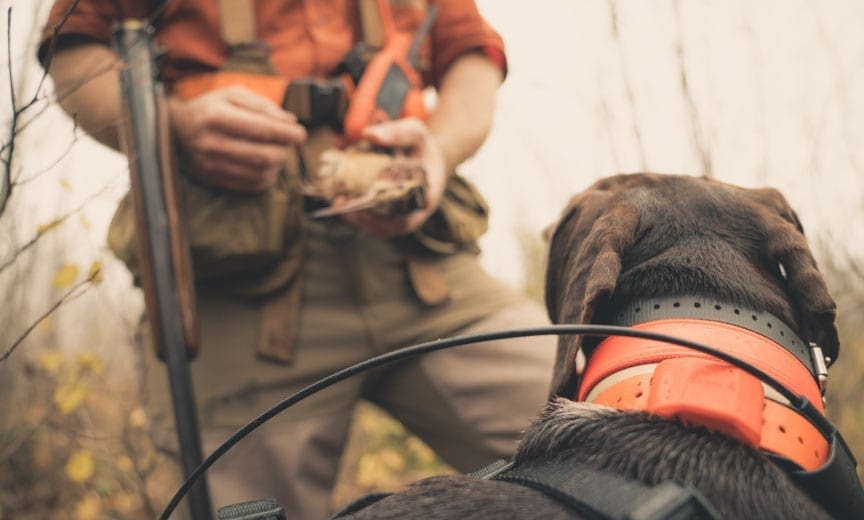
A bird dog retrieves a woodcock to hand.

Woodcock dogs

Choosing a dog breed (even without a game species involved) is like going to an ice cream stand with an endless number of flavors, not to mention having to choose between cone and cup. You can effectively use a flusher, a pointer, or a dog you rescued at the pound who likes to walk in thick cover. There are some breeds that have even been named because of their particular woodcock hunting ability, like the American and English Cocker Spaniels. But there are also pointing breeds that are just as specialized and well-suited for this type of hunting. I am a pointing dog guy at the end of the day and, just like anything, we all have personal preferences.

If you are considering a dog, think first about what you want out of it. Perhaps join a local hunting dog club like NAVHDA to see some different dogs in action. You should be looking for a dog that has been bred to hunt the region or terrain that encompasses your primary hunting area. Most importantly, once you decide on a breed, carefully vet your breeder. Ask to see their dogs hunt, ask other people for recommendations, and do your homework. It’s an investment of hopefully 12 years or more that will be your shadow each and every day, so it should be taken more seriously than buying a car.

The good thing about hunting the American woodcock with dogs is that the birds generally like to hold tight and not walk. The recent influx of woodcock hunters throughout the flyway certainly seems to be accelerating some walking and running behavior, but still nothing compared to the iconic ruffed grouse, notorious scaled quail, or the classic ring-necked pheasant. Ultimately, for the novice dog handler, woodcock can and will become addicting for both the hunter and the dog.

Getting to know the American woodcock

Woodcock are a migratory bird, so the kinds of places in which they live, nest, and stop over can vary by geographic location. They have two primary flyways: the central, which is essentially from Ontario to northern Louisiana, and the eastern, which is from Quebec to northern Florida. However, we must remember these are man-made lines and recent studies by the United States Fish and Wildlife Service and the American Woodcock Society have shown birds crossing over these flyway systems. The northern reaches of the woodcock flyway are what is considered their “resident” location, which typically includes Canada, upper Midwest states, and parts of New England. The southern areas like Louisiana and east Texas are considered their wintering grounds and are generally dictated by whether the soil freezes, which affects their ability to probe for worms. Any place in between the resident and wintering grounds is often referred to as stop-over states.

Getting to know woodcock cover

Woodcock like young vegetation with a high stem density, or places considered early succession growth in forests. Add in upland shrubbery or alders and if you have trouble walking through it, you can be sure a woodcock would love it. They also need a place to land to get into the cover. I have found that thick areas adjacent to fields, log landings, trails, and meadows tend to hold birds because they have ample openings to set down. Their food source is primarily earthworms, which has more to do with soil type than anything else. If you are ready for advanced theories on that, you can read “Targeting Worms with GIS Soil Data to find Woodcock Habitat.”

To simplify all this, noting that this is not fine science, this is where I would begin:

  1. There needs to be soft and moist soil
  2. The brush density needs to be such that it’s hard to walk through and swinging a shotgun seems challenging
  3. Check for a nearby opening for landing and access
  4. When all else fails, try hunting along rivers and waterways with dense shrubbery immediately nearby
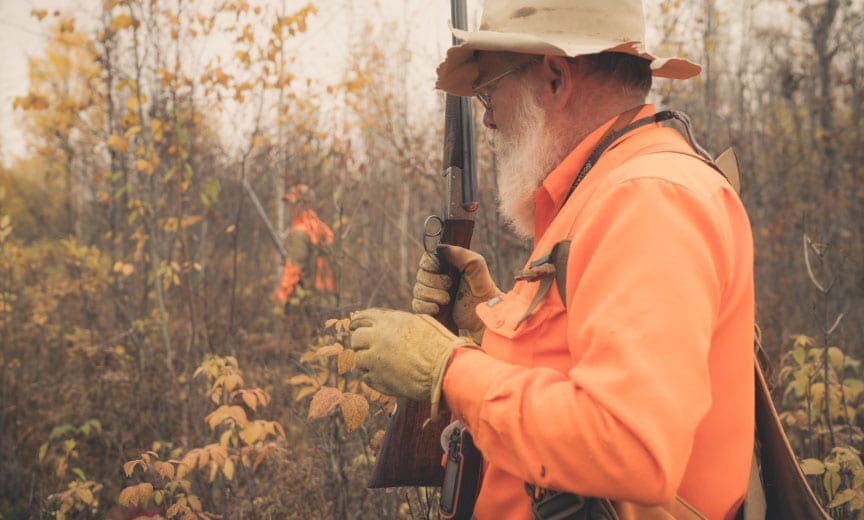
Hunting in woodcock habitat

In recent years I have found woodcock in soft wood (conifer) covers, which is something that trends more commonly as they head south in stop-over states. While I do not know the exact science, my guess is that it’s pretty easy for those short legs to walk on those open floors while still providing cover from predators above.

For the best understanding of woodcock cover, I recommend learning from a biologist and not a novice woodcock hunter like myself. Read: How to Identify American Woodcock Habitat

The nature of migrating birds

The fall woodcock migration is an exciting and sometimes frustrating part of woodcock hunting. If you catch the bug like I did, you may find yourself following the migration south, hunting multiple states and trying to extend your season. When the cold weather comes in, so do the “flights” of woodcocks arriving from north of your location to stop over during the migration to wintering grounds. It’s a tricky thing and many argue the science behind what makes the birds pick up and move, but you will certainly notice that one day a cover can have birds everywhere and the next it will only be a faint memory with remnants of their signs like woodcock splash.

READ: The Unrealized Opportunity of Woodcock Hunting in the Central Midwest

This fleeting presence is something to love, but it is also a warning sign that the birds will eventually be gone. States with no resident populations will find it more inconsistent, so you should not easily give up on a particular spot because things can change from day to day.

OUTDOOR LIFE: How to Hunt the Mysterious Woodcock Migration

Shooting woodcock

There are a couple schools of thought when it comes to wingshooting woodcock. First, it’s important to understand how woodcock tend to flush. The nickname “mud bat” refers to their characteristic rise like that of a bat. Their flight is often like a fluttering, unpredictable dance or zig-zag to the top of the canopy. Once past that, they tend to take off like rocket ships or, as the folks from Modern Wild would say, like “timber rockets.” There are plenty of exceptions to those rules, of course. Sometimes they will liftoff in a deliberate and direct pattern, which some would argue is a tell-tale sign of a resident bird knowing how to escape. Weak flyers are often considered tired flight birds, but neither assumption has been scientifically proven.

One of the greatest things about woodcock—especially if you are hunting with a dog—is that they tend to hold tight, meaning you must come close to stepping on them in order to get them to fly. This is what makes them great for young dogs in training, but can make them a little more challenging to find if hunting without a dog (more on that later).
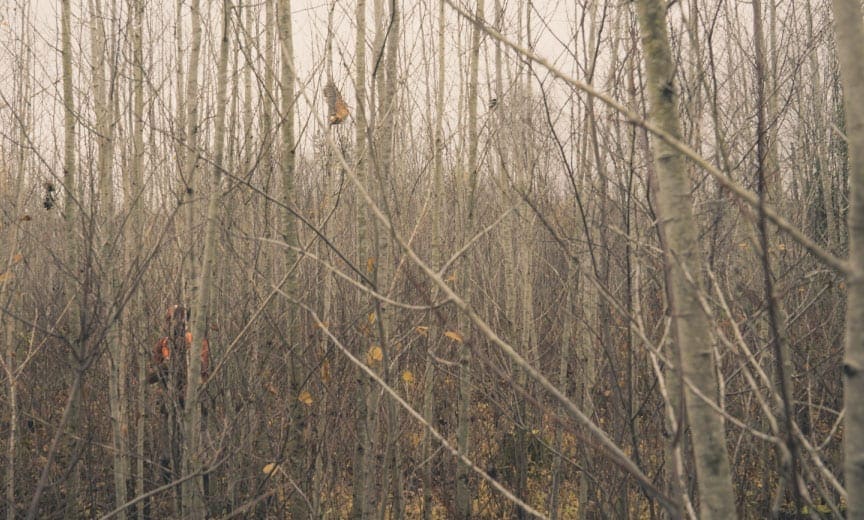
A bird hunter tries to shoot a woodcock through thick cover

The most reputable school of thought on shooting technique is to let the bird get away from you a bit before shooting. This allows for their trajectory to stabilize and for your shot to open up to a larger pattern. I usually have an issue containing myself, so as soon as that whistle comes up and the bird is a safe height off the ground, I let the shots fly. You can really approach this however you like, just get some shot safely in the sky when the bird gets up. To be most effective at this, you have to understand one of the more difficult mental barriers in shooting woodcock: ignoring the trees.

I grew up shooting woodcock from as early as I can remember and never once thought about a tree as my barrel swung through thick cover. But for those that did not get programmed at a young age, this can be a hurdle. If the trees and branches get into your head, you will not swing properly and you will always be at a disadvantage when shooting woodcock.

READ: Ignore the Trees when Grouse and Woodcock Shooting for Better Results

Beyond that, understanding the basic theories of effective shotgun shooting, such as the Churchill method, can greatly increase your odds in any wingshooting situation. Practice your gun mount repeatedly, consider the fit of your shotgun, and try patterning your gun to understand the shot pattern before hitting the woods.

Hunting woodcock without a dog

There are undoubtedly people reading this right now and yelling, “Blasphemy!” at their screen. But yes, woodcock can be hunted without a bird dog. Although I started off in my early years hunting over my father’s Brittany, I continued hunting later in life without a dog. Because woodcock hold tight, you will have to carefully grid an area when walking to make sure you have applied ample pressure to get them to flush. They are highly camouflaged, so without a dog’s nose giving you an indication of where they sit, you are unlikely to see them until they take off.

Recovery of shot woodcock without the aid of a dog can be particularly challenging because their camouflaged coloring blends in perfectly with the forest floor. Since they are small and live in dense cover, they can often get hung up on things off the ground, which only adds to the complexity of locating them after the shot. As a conservationist, you owe it to the bird to make a serious effort with or without a dog to recover game in any circumstances.

READ: How to Recover More Birds without a Dog

The controversy and ethics of pass shooting woodcock

Pass shooting woodcock is a technique rarely spoken of and highly controversial. Many consider it to be “unsporting.” I bring it up because you will inevitably discover it and should carefully consider the ethics of such a method. Although legal in some areas, it’s important to remember that legality does not always equate to sustainable practice. As hunters, we should think carefully about the long-term implications of pass shooting woodcock and the impact on future woodcock populations.

Pass shooting woodcock is a method that takes advantage of the final, legal shooting time to shoot woodcock as they move through open areas like fields to move to feeding areas. I often hear stories of early morning waterfowl hunters shooting woodcock at first light, as well. By setting up in a field adjacent to woodcock habitat and waiting for these final or first moments, a hunter will encounter fast-flying birds. These birds are a challenge to hit because they are often at top speeds. At a minimum, I would recommend steering clear of this method and finding a downed woodcock that sailed a long distance is not easy and could certainly start to enter the realm of the unethical. As a responsible culture, we need to make the hard choices even when laws permit it. We should not rely on legislation to dictate our morals and our commitment to sustainable practices.

Eating American woodcock

Although woodcock can be a culinary challenge at first attempt, with a bit of knowledge they can make amazing table fare. A few basic rules can accelerate that process. As renowned upland game chef Hank Shaw would point out, they pluck easily. Aging woodcock is a common practice, accomplished by tossing them in a fridge for a few days with the guts still in and the feathers still on. After a few days, they are better tasting and easier to pluck.
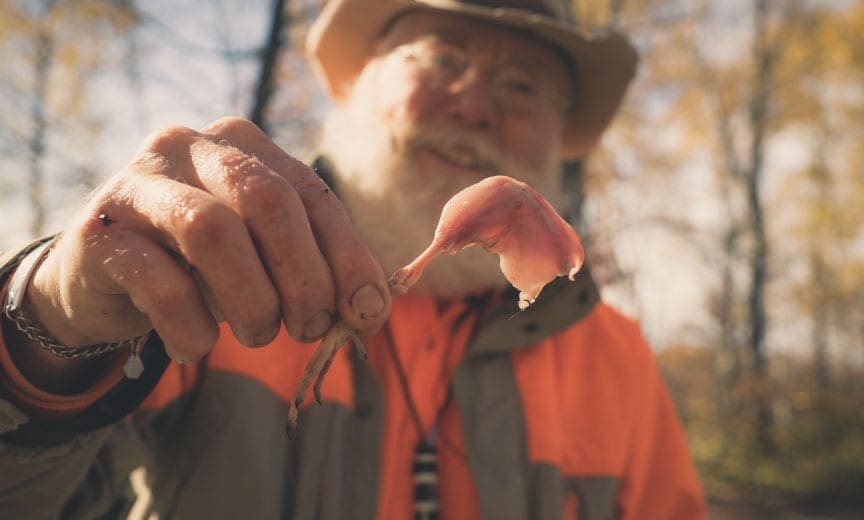
Eating woodcock legs

Woodcock cook faster than chicken and must either be cooked to medium rare or for a very long time to allow the meat to fall off the bones. Anything in between will cause you to think that woodcock aren’t worth eating, which is simply untrue. They are “earthy” in flavor and respond well when paired with mushrooms or sweeter things from where they live, such as apples and cranberries. Sure, you can slap bacon on them and of course it will taste great (and like bacon), but they are very good when prepared in other manners as well.

The legs are often thrown away, but it’s worth pointing out that this light, tender meat is arguably the best part of the bird. They can either be cooked as part of a whole bird or saved for a day of woodcock poppers or buffalo legs. Woodcock have become the most common bird prepared in my kitchen.

Woodcock conservation

In speaking of hunting woodcock, we must take note of their current state and their future. Since the populations were first recorded in the 1970s, woodcock have suffered a 1% decline every year. Habitat loss is the largest culprit in this decline, because woodcock often migrate through areas that are heavily developed without consideration for their needs. Recent studies with the Eastern Woodcock Migration Research Cooperative (EWMRC), in partnership with the American Woodcock Society, are hoping to identify areas that are in greatest need of habitat for stop-over cover.

While the populations are considered stable and safe to hunt, and given the migratory nature of the bird, you can feel safe and confident in hunting them in any state that has a legal season. They are currently sustainable and will hopefully begin to rebound if we all do our part to follow the science and support efforts to create more habitat.

Recent mumbling in the scientific community has theorized, but not yet proven, that climate change may be shifting the woodcock range and affecting some breeding behavior. This is worth following as we learn more and consider how this will affect the future of hunting this bird.

Woodcock hunting media content

Woodcock has been written about since medieval times when the Eurasian woodcock would be cooked in court. Eventually hunting practices evolved with dogs to bring them to market. In the Americas, they are known for the poetic culture that surrounds them, which has been explored by many of the upland literature greats. If you are an audio lover, I would suggest heading over to Audible and downloading Woodcock Shooting by Edmund Davis. This 1908 classic is unusual, poetic, and informative. Furthermore, you can check out frequent episodes of the Project Upland Podcast where host Nick Larson’s love for the woodcock and culture is hard to hide.

American woodcock hold the distinct position as the most-covered bird in Project Upland Original Films. Much of that simply reflects the opportunity that surrounded me when my passion brought me along this path. From our first year of films with the Ruffed Grouse Society to the viral film “First Season,” digging through our film library will give many options to get inspired in the poetic vibes of woodcock culture. If seeing drone footage of woodcock points and shooting situations sounds intriguing, check out the film “Legacy.” And for those as nerdy as it comes, you can find our latest film on the topic, “Woodcock Banding,” which explores the unusual ritual of using dogs in the spring to band woodcock with biologist Bailey Petersen.

Project Upland has a long list of woodcock hunting articles that can be found here.

We will continue to evolve this article as we create more content around woodcock hunting in North America, so be sure to check back in. And in the true crowdsource mentality of the Project Upland community, we always like to hear about what questions and ideas you have around the topic. Comment below, email us, or hop onto the Facebook community page to share your thoughts. We hope this article helps with woodcock hunting this season.
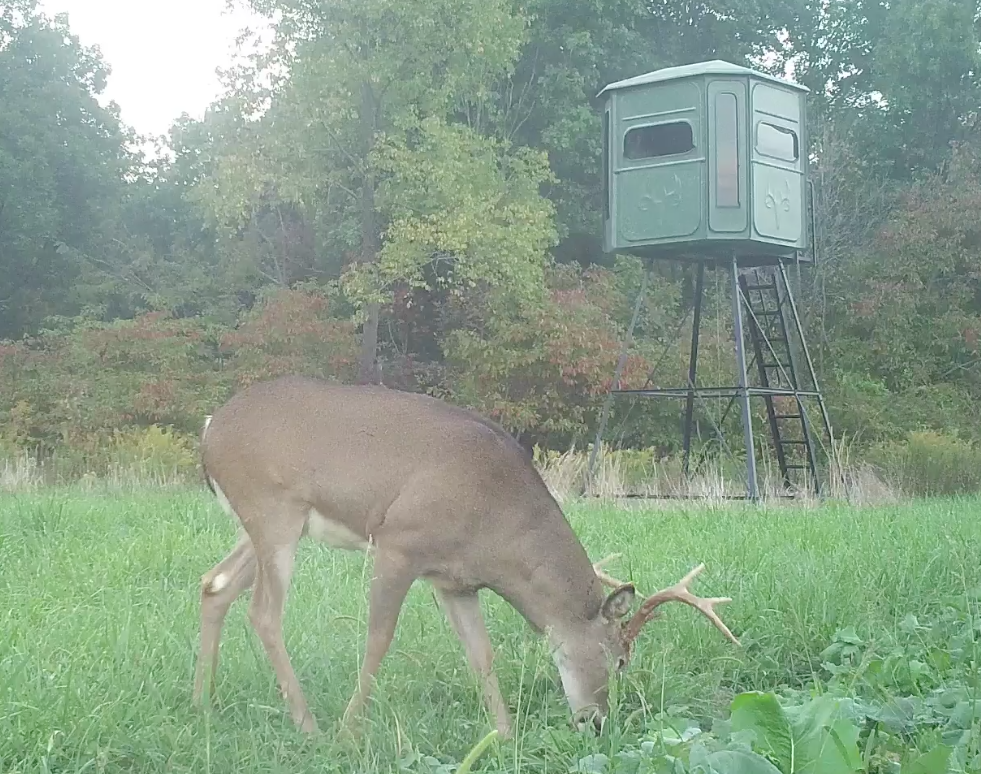
About Management Bucks

0

A lot of hunters use the term “management buck” as an excuse to shoot a deer from their property. Some do it simply because they want to have fun and tag a deer, while others do it thinking that they will help sculpt the genetics in the wild for the whitetails in their area.

Who’s right? In those two scenarios, hunter #1 is right in the fact that he is not shy about wanting to have fun while hunting. There’s absolutely nothing wrong with that! What about hunter #2?

Although the desire to want bigger bucks to hunt on a property isn’t a bad thing, it’s misguided if you are shooting bucks as “management deer” with the sole intention of believing you are actually going to modify wild genetics. That’s a topic for another day, but in short, it is simply not possible. The biggest reason why we can’t do a lick about genetics in the wild is simply that a whitetail gets as much as 60 percent of its DNA from Mom. And even then, social stress, nutrition and a litany of other factors make it virtually impossible to manage antlers by bullets or arrows (or both).

So … what is a management buck? For the sake of this exercise, a management buck is a mature (3-year-old or older) deer that isn’t considered a “trophy” by the landowner’s standards. By the time a buck hits this age, he is starting to settle in his ways. In other words, he has found his spot on the landscape where he will spend an inordinate amount of his time throughout the year. We call this “core area” for most properties.

When a buck finds this sweet spot on his overall home range, he will occupy it until he is either booted away by a larger, more dominant buck, or he’s killed (most oftentimes by a hunter).

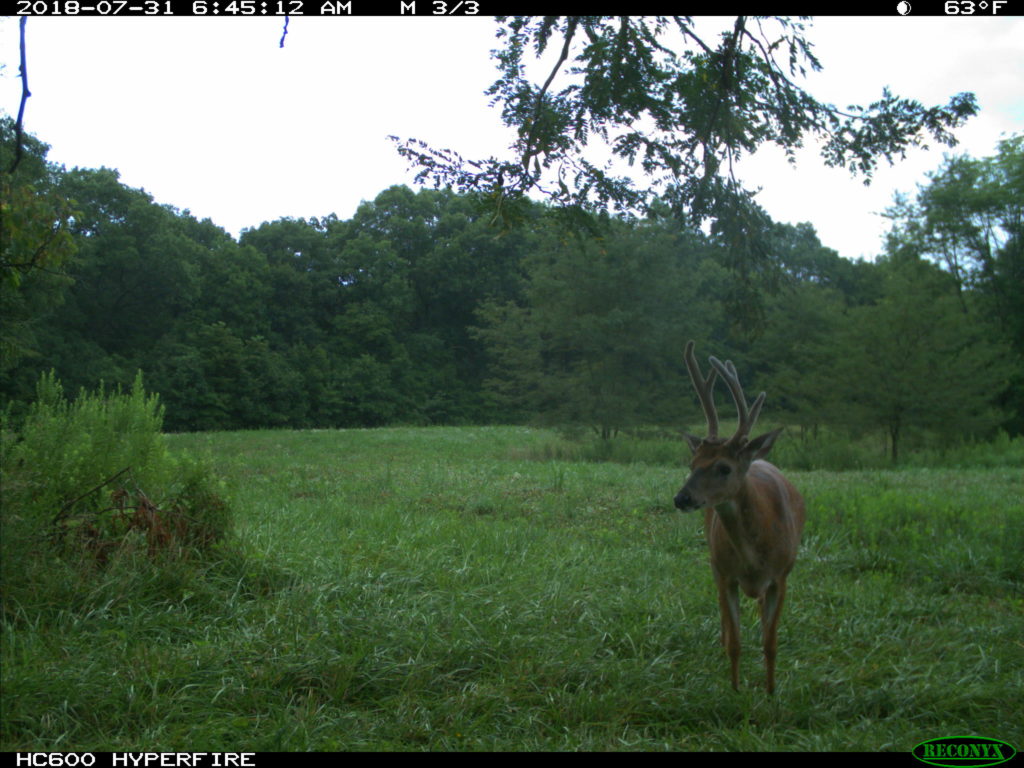
Trail cameras provide critical information on which bucks you might want to consider adding to your “management” list — if you are so inclined to take your private-land management to that level.

For most areas in North America, we are talking about properties that are measured in hundreds (if not thousands) of acres when we are talking about the geeky level of deer management when you can actually determine if a buck is “living on your ground.”

Hunting Land is Key to Managing Bucks

I don’t own land, but I’ve been blessed to have had the opportunity to hunt several properties over the years that meet this description. One of them is a sprawling Illinois property that’s managed by my friend (and DDH contributor) Steve Bartylla. Over the past several years, I’ve had the good fortune of hunting management bucks on this property. To me, they are all trophies, because, well, any legal deer is a trophy in my eyes.

What is it about these deer that makes them management bucks? Here are 4 factors that can put a buck into “management” status:

  1. They are considered mature (beyond 3-1/2 years old).
  2. They have not exhibited the potential to have racks much larger than what they currently have (usually 130 inches or less), in an area that can easily produce near-Boone-and-Crockett-class antlers on bucks of similar ages.
  3. They exhibit “bully” behavior during the rut. This simply means these bucks are not wimps, and they routinely suppress the potential of younger bucks with more desirable antler traits.
  4. They live in areas of limited buck-rearing cover.

Having a land manager who knows the deer on his property inside and out is the key to identifying potential management bucks. As was the case on my Illinois hunts, I was supplied with trail-camera images of potential management bucks that I might see over the course of a hunt. This was very helpful, but even more helpful was knowing the precise locations where I may or may not see individual bucks.

WATCH: BEST DEER HUNT ENDS WITH SUPER WIDE BUCK

Some folks might view such management as almost anticlimactic when you’re hunting. I don’t. Because, again, if it’s an up-close encounter that makes my heart race; it’s game on!

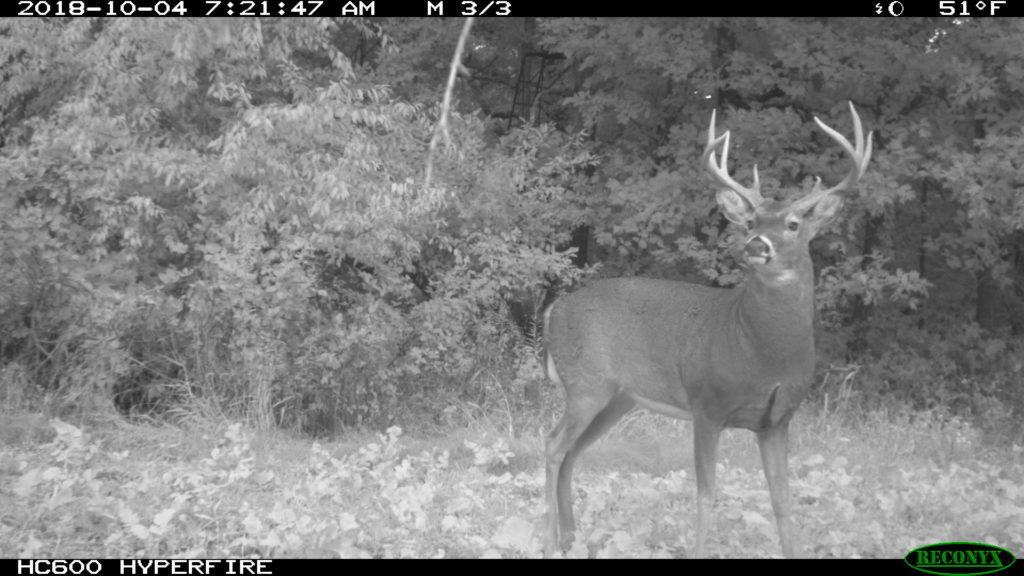
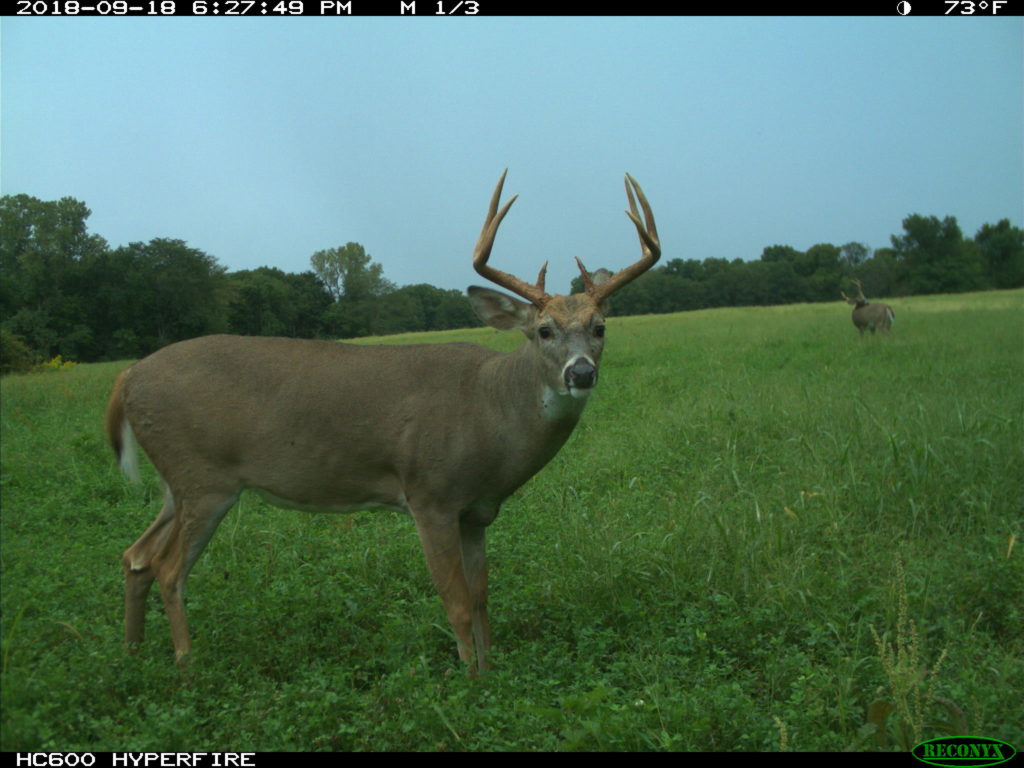
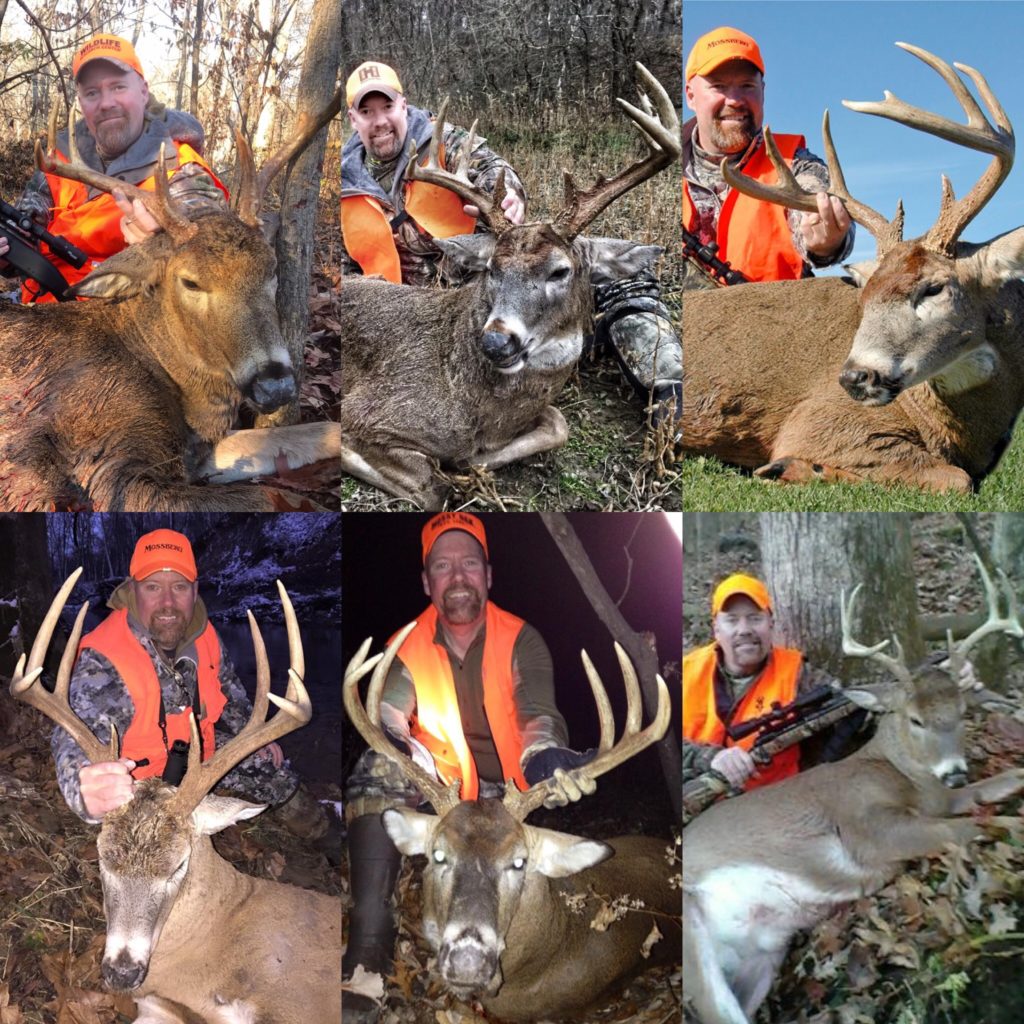
The term “management buck” is really deceptive depending upon which region of the country you’re managing whitetails on large private properties. Here’s a look at six “management” bucks I bagged in Illinois over the years.

Here are some more examples of mature whitetails that could very easily be considered management bucks for a hunter/landowner who is managing a large piece of ground in the Upper Midwest. All of these deer are mature, and all of them have exhibited near max potential for antler growth.

— — — — —

PURSUIT CHANNEL SPOTLIGHT

Don’t Miss Out on a Chance at the “Iron Man Hunt”

My friends at Pursuit Channel are excited to announce their next big giveaway: a once in a lifetime hunt with Real Outfitters in TX . The lucky winner of this hunt, man or woman, will have an action packed 3-days and nights of hunting like you have never experienced before, guaranteed!

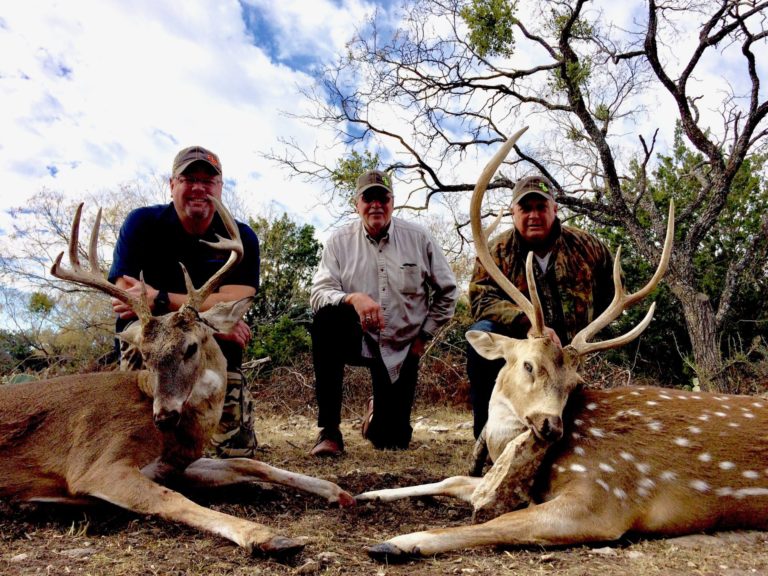
This will be classified as a challenging Iron Man Hunt because you’ll be hunting non-stop, day and night (yes, you will get some sleep). You’ll be hunting big whitetail bucks and a doe during the day, and the invasive Axis Deer buck and doe at night or day if needed. You’ll also have opportunities for Feral Hogs, Predators or Varmits, days or nights.

Don’t enter to win this hunt unless you want the hunting experiences you’ll never forget as long as you live. You’ll have some exciting stories to tell your friends and family about. This hunt will be with Real Outfitters in TX. This will be our 3rd trip winner hunt with them and they never disappointed our previous trip winners that have gone there to hunt. The winner can keep all of the meat they want or Real Outfitters will donate the meat to local programs feeding the hungry.

This hunt will be taken January 2 – 6th and food, lodging and guides are included. This hunt will be filmed by USOC Adventures TV Show and air between January – June of 2019 on the Pursuit Channel. Airfare will be provided by the Pursuit Channel.

Duroc Pig: Is This Hardy and Fast-Growing Pig Right for You?

0

This year, we decided to breed our sow, Boo, with Duroc genetics. Boo is a mixture of Tamworth and Berkshire genes, which in the past has led to piglets that are fast-growing, vigorous, and, I might add, quite cute to look at!

We wanted to give a new breed of pigs a try this year, however. We decided to go with Durocs. Durocs have a reputation for being some of the hardiest and quickest-growing pigs around.

Here’s what you need to know about the Duroc pig breed. That way, you can decide whether it’s right for you and your farm.

About Duroc Pigs

A red pig with drooping ears, the Duroc is a wonderful breed to consider if you are interested in raising market pigs.

It is the second most common breed of pig in the US.

Most Durocs will be a deep mahogany color, as ours were, but you might also find some that are a pale yellow or gold color.

History of the Duroc Pig Breed

They were first bred in the early 1800s in New Jersey and New York. The original parents of the Duroc were red pigs from either state.

The pig is believed to get its red color from the Berkshire pig. The Berkshire is a breed that is now black but was once a rust color, similar to the modern Duroc. Some people also believe that the Duroc contains genetics that can be traced to the Guinea coast of Africa.

A very large pig, the Red Hog quickly rose to popularity for its massive size and its ability to produce large litters of piglets that grew exceptionally fast.

These Red Hogs were eventually bred into the Duroc-Jersey and what is today known as the Duroc. However, the breed wasn’t renamed until 1823.

In 1823, a man named Isaac Frink of Milton, NY raised a red boar of this lineage. It was prized for its carcass quality, growth rate, quiet disposition, and broad shoulder and ham areas.

Though smaller than many of the earlier pigs in this line that came out of New Jersey, it ultimately had a much better carcass quality. He named the breed the Duroc in honor of his famous Thoroughbred stallion, Duroc.

Eventually, the original Jersey line and this new Saratoga-based line were crossed to create a hog that was well-suited for the vast majority of farmers.

It was formally recognized in the creation of the American Duroc-Jersey Association in 1883 (renamed the United Duroc Swine Registry) in 1934.

The breed of choice for a large percentage of American farmers, the Duroc is also a good choice for the modern homestead.

Characteristics of Duroc Pigs

Although the Duroc is not the largest breed of pig you will find to raise on your farm, it is still nothing short of impressive. The average weight of a fully mature boar is close to 900 pounds, while a sow will be around 800 pounds.

With drooping ears, it’s easy to pick this pig out of a line-up of other pigs, most of which have erect ears instead.

As I mentioned earlier, most Duroc pigs will be a deep red in color. However, some are much lighter or even golden or orange in their appearance. Durocs are usually medium-length and have a slight dish of the face. They have large snouts and short, curly tails.

Benefits of Raising Duroc Pigs

1. Great for Outdoor Raising

Raising pigs outdoors, whether on pasture or in a woodland setting, is a great idea for so many reasons. This can really cut down on the amount of barn cleaning that you need to do. It also helps when it comes to improving the health of your animals.

Durocs are perfect for an outdoor environment because they are covered in dense, coarse hair that they shed come summertime. They also have tough, hard skin.

These pigs can tolerate both cold and warm weather with ease.

You don’t have to worry about them becoming sunburned, something that is all too common with other kinds of pigs. The Duroc can, in fact, tolerate most weather conditions without a problem.

As long as you have a muddy area for them to cool off, some rich pastures, and plenty of food and water, your Durocs will have everything they need.

2. Tender, High-Quality Meat

If you ever take a glance at a Duroc pig, your first thought will probably be, “blocky!” The Duroc has a stocky build with plenty of meat in the ham and shoulder area.

We found that the meat ended up being a bit more of a dark red in color, too. This was a testament to their diet as well as the fat distribution and leanness of the meat.

3. Fast Growth Rate

Durocs grow quite quickly, especially when compared to other breeds of pigs. In fact, we conducted a bit of a pseudo-experiment this year. In so doing, we raised both Yorkshire and Duroc piglets for the market.

The results impressed us.

The Yorkshires were slightly older than the Durocs – yet the Durocs reached market weight nearly a month sooner. Anecdotal, but something I saw echoed in many other farmers’ reviews of what it’s like to raise Durocs.

4. Large Litters

Duroc sows are great mothers. They can take care of their young with very few problems.

This is great news considering that the litters can be extremely large. Some say that Durocs can give birth to litters of nearly 2 dozen pigs. This is exceedingly rare, but litters can easily contain around 10-15 piglets if you’re lucky.

Not only that, but Durocs have a long life expectancy – up to 20 years when cared for properly. If you are raising breeding animals, that’s an important factor.

5. Minimal Aggression

Although some people find the Duroc breed to be somewhat aggressive, this isn’t usually the case. There will always be some variation in a breed.

Mostly, though, Durocs raised with other pigs and used to socializing will be quite mild-mannered.

6. Good for Breeding

Because of the reasons listed above, Duroc pigs are some of the best when you are trying to breed certain features into a new line of pigs. In fact, they are often crossed with Tamworths, Yorkshires, and other breeds to create superior pork.

Challenges of Duroc Pigs

1. Extremely Curious and Mischievous

One of the major benefits of raising Durocs is that they are extremely intelligent. In fact, Durocs are so smart that many people wonder whether they can be raised as pets. In short – I don’t recommend it.

Because they are so smart, they are also extremely curious – and extremely mischievous, too. They learn quickly. While they can be trained to be obedient over time, in most cases, if you’re raising market hogs, this isn’t something you’ll have the time to do.

Durocs can be challenging to raise if you don’t have the time or money to invest in some serious infrastructure. By that, I mean these pigs need fences – not just any old fence, but a good fence.

When raising other breeds of pigs, like Tamworths and Yorkshires, we didn’t have to worry about them getting out very often.

A 3-strand electric fence was satisfactory in keeping them contained, even on the occasions when the electricity would be knocked out (they still didn’t test the fence).

Our Durocs, however, seemed to escape regularly. They learned how to lift a gate off its hinges and did this repeatedly. That was along with pushing dirt up and around the electric fence and page wire fence so they could wander wherever they felt obliged to do so.

Duroc pigs are not animals that are well-suited to confinement. Even if your barn is lock-tight, raising these pigs in a sequestered environment is not a good idea. They will not be allowed to root and explore as they please if you do.

2. Skittish Personality

Durocs are known for being extremely independent. Even when raised with other pigs, these smart little buggers aren’t terribly fond of human interaction. They will bolt away at the first touch.

This isn’t necessarily a bad thing when you’re raising pigs for meat. However, keep in mind that it might make them more challenging to handle.

My husband and I have always joked that you can’t force a pig to do something it doesn’t want to. Pigs aren’t like other livestock, such as sheep. These aren’t species that can more or less be manipulated or coerced into doing what you need them to do.

That’s doubly true for Duroc pigs!

However, I have also read that this breed is often used for the show ring. I think that, with a bit of training, you could easily have a Duroc that is friendly and docile enough to be handled. It’s all in how much time you want to commit to it.

3. Must be Raised in a Social Environment

Pigs like to be around other pigs – and that’s true for Durocs. Duroc pigs enjoy other pigs and will get lonely if left to their own devices.

Not only that, but they’ll also get curious! That translates to more pigs trying to escape – not good news for you or your fences.

Therefore, do whatever you can to keep your Duroc pigs entertained with the company of other pigs. Yes, even if they’re pigs of another breed.

How to Raise Duroc Pigs

Duroc pigs should be raised just like any other breed of market pig. Although they can handle most weather conditions, provide them with appropriate shelter like a 3-sided barn. This will help them get out of driving wind and heavy precipitation, along with the burning sun.

A pig will eat an average of 6-8 pounds of feed per day, though this of course varies depending on what you are feeding and what age of pig you are raising.

The average pig will eat up to 900 pounds of food. That is after being weaned from its mother until it is ready for slaughter.

Many farmers use a mixture of corn and soybeans to feed their Durocs. You can also feed any kind of fruit and vegetable, scrap, dairy products, etc.

Don’t forget water as well.

Pigs need a minimum of a gallon of water per day per pig, but potentially more if it’s a larger pig or the weather is warm.

They also need a muddy spot in which to wallow. Be sure to provide this for your pigs when the weather is hot. When it’s cool, a bit of straw bedding will suffice.

Durocs are known for being exceptionally clean animals. They will usually only do “their business” in one corner of the barn, sleeping in the other.

Therefore, the amount of straw you will need is minimal. They have no unique health needs that you would not encounter in other pig breeds, either.

Are Duroc Pigs Right For You?

There are plenty of pig breeds out there for you to choose from, including Yorkshire, Tamworth, Berkshire, Gloucestershire, and more. Why should you choose the Duroc, with all these other options to choose from?

To be fair, the Duroc might not be the perfect breed for everyone.

Take the time to read the information above and to make sure that this is the ideal pig for your small farm or homestead – and if you’re looking for a good meat producer that is smart and stocky, look no further than the Duroc.

Everything You Need to Know About Aging Venison

0

Should you age your venison before butchering? If so, how long? Under what conditions? Why might aging venison matter? Let’s explore every aspect of hanging your whitetail before taking knife to meat.

It’s the symbol of a successful hunt, and a harbinger of great eating to come: A whitetail on the meatpole.

Whether I’m hunting out of some farmhouse on the prairie, a northwoods deer camp, a motel room in farm country or the familiar comfort of my own home, nothing warms my heart like stepping out into the starry night or my chilly garage and taking one more look at a whitetail I was lucky enough to bag that day.

But questions always arise as I stroke the thick, pepper-gray fur of an autumn or winter whitetail: What are the benefits of waiting to cut up the meat, versus finishing the job as soon as possible? Why do these factors matter to meat quality? How long should l let this deer hang? And if I’m going to let the meat age, what are the proper and safe conditions under which to it?

If you’ve pondered these important topics, all of which have a direct effect on the quality of the venison that reaches your table, here are some answers.

Aging Actions

After a deer dies, its muscles quickly enter a state of rigor mortis, defined literally from Latin as stiffness in death. The reason is really pretty simple: without oxygen feeding the muscle tissue anymore, the proteins present can no longer perform their maintenance work, and the muscles contract.

Rigor mortis has nothing to do with aging meat. It is just a natural process that sets in a couple hours after death. Within 12 to 24 hours though, the process will complete itself and the muscles (meat) will relax again. That’s when aging starts … and you should have that deer carcass cooled down when it happens.

Butchering and freezing a deer while it is in a state of rigor mortis is not a good idea because the contracted meat will stay that way: tough and taut. But what happens to meat when it ages?

Photo by David Gilane.

There’s a little more science involved with aging meat and why it can be beneficial to the texture and taste of your final output. After rigor mortis has ended, enzymes begin to work break down those complex proteins present in the venison. Most important to break down are the proteins in the connective tissue – known as collagen – that is present between the meat fibers. This is a natural process that tenderizes meat.

Given the right conditions, which we will discuss, letting a deer age for some period of time will result in meat that is tenderer and should have better flavor.

It’s important to note that aging is not rotting. It takes bacteria to begin and carry out the deterioration process; given the cool conditions needed for proper aging, bacteria can’t live or begin to go to work.

Proper Conditions

If you’re going to age your venison, the process must take place under the proper conditions.

Temperature is the number one consideration. If your deer is hanging outside in temperatures below freezing, it is not aging. It is frozen. You will have to thaw it before butchering. You are better off not putting that meat through a freeze-thaw freeze cycle, though. Strive to hang your deer where it is cool, not cold.

The ideal temperature range for aging a deer is 36 to 40 F. The lower the temperature, the longer the deer can age. Many butchers recommend 36 F. Surroundings between 32 and 36 do the aging job pretty well, too, but slower.

If outdoor conditions match those temperature ranges (32 to 40 F or so), you are in good luck. But that’s often a lot to ask during deer seasons that range from sultry September to frigid December and January.

When conditions are too warm to hang your deer outside, there’s an easy way to age your deer that doesn’t involve finding a meat locker in which to hang the entire carcass.

To start, skin the deer and chunk it up into seven parts:

  • Two hind quarters
  • Two front quarters
  • Two loins
  • Bag of other trim meat you pull off

Then place the meat in a spare refrigerator set to 36 F for aging. This plan works just as well as hanging a whole carcass. To prevent the meat from drying out, wrap it in plastic wrap or place it in plastic bags. Note that this is also a great meat-aging when a carcass would freeze hanging outside, or even in your garage or a shed.

Speaking of hanging carcasses, here are a few important concepts to understand.

  • If the deer has had a chance to cool, hanging it with the skin on is desirable because the skin holds moisture in and the meat won’t dry out.
  • A deer is best hung by the gambrels (back legs). This also happens to be ideal positioning for skinning a deer later, and pulling off the meat too, for that matter.
  • If you do skin the deer to give the meat a better chance to initially cool, place the carcass or quarters in cheesecloth bags for hanging. This will protect the meat from flies, and give it an extra measure of protection once a crust forms over the meat.

Here’s the bottom line for temperature considerations regarding aging. If that carcass is going to rise to a temperature above 40F for any portion of the day, you are giving bacteria the opportunity to go to work.

Next, consider how long to age the meat.

Timing Considerations

Every hunter seems to have their own opinion on how long to age a deer … or if it should even be aged at all! Certainly, delicious venison is processed each year from both ends of the length-of-aging spectrum. Here are a couple examples from my own experience.

Quite a few Novembers ago now, the gun season in southern Wisconsin was exceedingly warm, with daytime temperatures topping in the upper 50s. Our little hunting group that year consisted of me, my friend Ron, brother Larry, and my Dad.

The first day of the season was slow – hunters and deer just weren’t moving in the “heat.” So on the second day we went to work, doing some little pushes through brushy creekbottoms and shady north-facing sidehills. We moved whitetails, our aim was true, and at day’s end we had a pleasant quandary to deal with in the warm weather: Three whitetails down.

We skinned them by lantern light in my Dad’s backyard as the November night cooled temperatures into the thirties. The next morning, rigor mortis was done, so we butchered the deer in an assembly line, before the day got too warm. Maybe those deer would have been better with some aging, but we didn’t have too many options, as we all had to go our own separate ways in the afternoon. The venison was just fine, too.

On the other hand, quite a few Novembers ago now, I shot a nice young buck in Minnesota’s gun season. I didn’t have time to butcher the five-pointer before leaving for another hunt, so I took the deer to a trusted butcher.

I had a little trepidation when they said their main cooling room was full and they were going to store that deer in a refrigerated semi-trailer in their back lot. My concern wasn’t the surroundings: The trailer was clean as a whistle, refrigerated perfectly, and we hung the deer to boot.

But mine was the first one in. And it looked to me like first one in meant last one out.

I returned from Nebraska five days later, got busy with kids and work and life, and finally remembered to call the butcher on day 10 to pick up my meat. “We’re just getting to that one tomorrow,” was the reply.

Do you know what? That was the best deer I ever ate, bar none. Now it certainly didn’t hurt that the animal was a roly poly yearling. But the venison would literally melt in your mouth. While 11 days is a little longer than usually recommended for aging, I can’t argue with the results.

The Science of Venison Spoilage

So how long should you age a deer? The answer is, it all depends. But here are some guidelines.

First off, older deer usually require more aging than younger deer, to get them to a tender state. The reason: Younger deer haven’t accumulated as much collagen in their muscles.

To a point, the longer you age a deer, the more tender it will get, as with my 11-day buck. Three to four days is about be the ideal amount of aging time that most butchers recommend, but seven days is fine and some meat cutters swear by ten. But remember, conditions must be ideal – in that 36 to 40 F range.

What if your schedule doesn’t allow you to wait that long? Maybe conditions are too warm outside, or life is going to get real busy, real fast, and you have to do the job when you have the time. In that case, at the very least, you should wait for the meat to cool down and rigor mortis to end.

If you have a deer that you’re going to completely grind for sausage, jerky, brats and other processed venison products, aging time is not as much a factor. While aging is fine on meat intended for these purposes, the physical act of grinding will take care of the tenderization work. But if you’re saving out delicious loins for boneless chops, and some chunks of prime cuts from back legs for steaks and roasts, age them in a refrigerator or cooler (see sidebar) for a few days before making the final cuts and freezing.

Conclusion

Given the right conditions – 36 to 40 F in a dry and clean environment – aging your venison for three to four days will improve the quality of the meat markedly. You can age a deer longer than that, but don’t let the meat dry out or you will lose tenderness and flavor. You can butcher your deer without aging if you want or need to, but make sure the carcass is cool and rigor mortis has ended.

venison marinade
Try Dan Schmidt’s magic marinade recipe!

Aging Venison in a Cooler

Do you hunt early seasons when it’s too warm to hang and age a deer? Coolers make great options for aging venison. Under the tightly closed lid of a good cooler, ice keeps venison at an almost ideal temperature for aging. Here are a few guidelines for making sure your meat ages properly.

Chunk up the deer. Quarter the deer into front shoulders, rear quarters, loins, and a bag of any trim.

Place ice in the bottom of the cooler. Don’t mix meat and ice. Place meat on top of the ice.

Keep the meat dry. If you let the meat soak in ice water, all the juices that make venison taste great will leach out. Instead, place the meat in plastic bags. Or, at least, place plastic over the ice in the bottom of the cooler so that meat and water can’t come in contact.

Drain water regularly. Drain out water daily, and add ice as you need to.

Flip the pieces. Every day, rearrange the meat so that a different part is in contact with the cold surface of the ice. This will help the meat age at the same rate.

You can age a venison in a cooler as well as you can a spare refrigerator. The cooler route just takes a little more work to keep the meat dry, the water drained, and the ice replenished.

Cooler aging is also great if you’re camping and hunting: Your meat will keep, and it’s aging at the same time. Getting ice may be the only issue. Plan ahead and know which town to run to for more ice.

Cooler aging can also work in frigid weather to keep extreme cold away from the meat so it doesn’t freeze. If a carcass hung outside is in danger of freezing, chunk out the deer and put in coolers without ice. Place coolers in a garage or shed where they’re not fully exposed to the elements.

D+DH In-Depth is our premium, comprehensive corner on America’s No. 1 game animal. In this graduate-level course, we’ll teach you about deer biology, behavior, and ultimately, how to become a better hunter. Want to be the first to get our premium content? Become a D+DH Insider for FREE!

Also check out this recent blog:

Do Birds Kill Their Own Babies? (Why Would They?)

0

The animal world can seem a little cruel and difficult to understand at times, particularly when it comes to how different species will treat their young. You might have wondered, do birds kill their own babies?

Some birds will kill off their offspring if there are not enough food resources to go around, or if they are likely to cause harm to the rest of the brood. Baby birds can also die from neglect or abandonment, though this is rarely just because they have been touched by a human.

Read ahead in this article to find out why some birds might kill their babies, and whether humans might inadvertently make this happen by interfering with a nest.

Why Would a Mother Bird Kill Her Babies?

It is not a myth that some mother birds will kill their babies, but it is not a very common phenomenon. Birds spend a lot of time and energy caring for their young and are often among the most devoted mothers in the animal kingdom.

Almost all species are instinctively driven to survive and reproduce, so why might a mother bird choose to cause the death of her offspring? There are three main reasons why birds have been recorded as actively killing their babies.

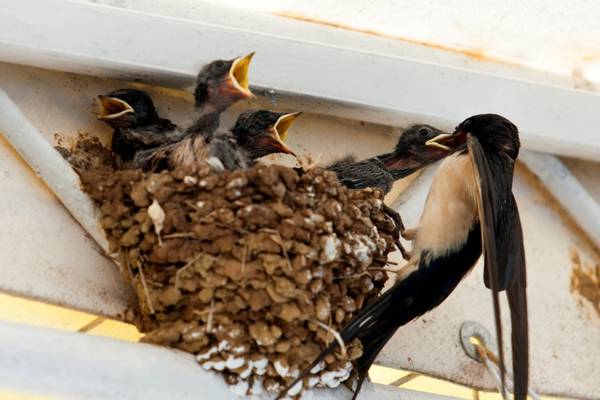
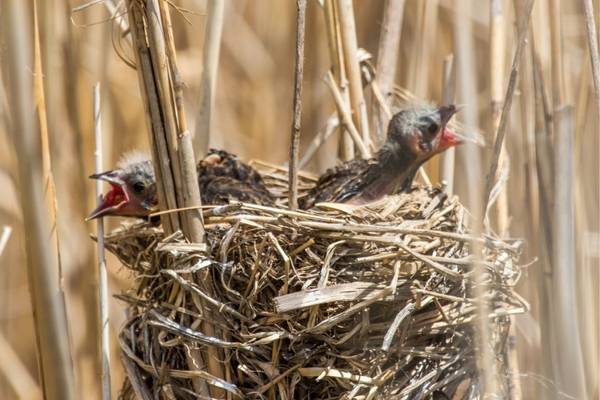
  • Brood reduction: Mother birds will sometimes kill their babies because they do not have the food resources or nest conditions needed to keep their entire brood alive. Some birds may reduce their brood size so that the limited food or space they have can be given to the healthiest of their offspring, or even be kept for themselves!
  • Preventing the spread of infection: If a baby bird is sick with an infection that may spread to the other nestlings or the adult birds, a mother may kill the infected baby or discard them.
  • Reducing the breeding success of competing birds: As with many other species, birds have been known to kill the offspring of other parents that they are competing with so that their own babies are more likely to survive.
  • To gain attention from dominant males: A rare phenomenon in birds, but the house sparrow females are notorious for killing off other females’ offspring – partly to establish dominance!They do this especially when they replace previous mates of attractive male sparrows with large territories. Partly because they do not want to spend the energy raising other females’ nestlings, but also to demonstrate some kind of dominance over other female competitors!
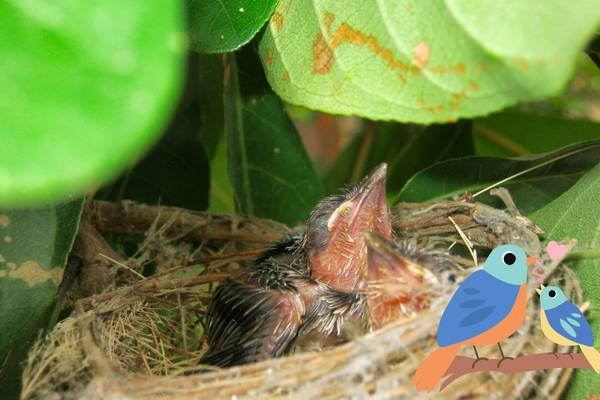
Bird babies nest
Bird moms generally love their babies and would never harm them without reason! Only in rare cases where it prevents the death of themselves or their (future) offspring will a bird mom hurt their own kind.

It is actually more common for baby birds to die from neglect or abandonment than it is for them to be killed directly by their mother. These are often accidental deaths, though, as most bird species are very caring and attentive parents.

Which Bird Species Are Known to Kill Their Babies?

Infanticide is a rare occurrence in birds, but some bird species do seem to be a little less caring than others. So, who are some of the main culprits?

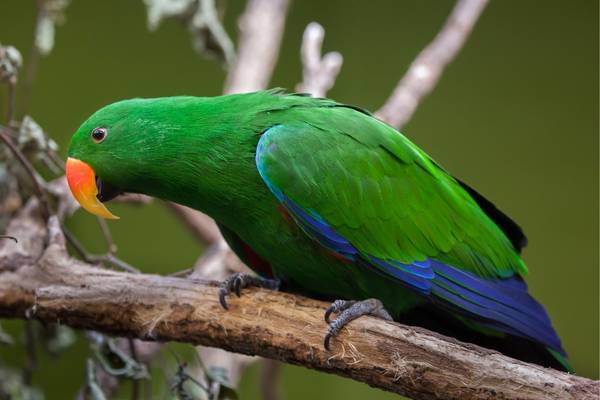
Eclectus Parrots

These parrots are known to kill their young if their nests are not able to support the entire brood.

Eclectus Parrots are usually loving parents, but stress or hunger may lead them to sacrifice their young males!

They usually choose to kill the youngest male sibling first so that older female nestlings will develop more quickly. They do this as they know (by instinct!) that females take less work and food to raise!

Black Eagles

Although black eagle mothers are not necessarily killers themselves, they often let their offspring kill each other without interfering.

When baby black eagles fight, they can sometimes fight to the death, and the mothers will rarely intervene. This allows the strongest of their young to survive.

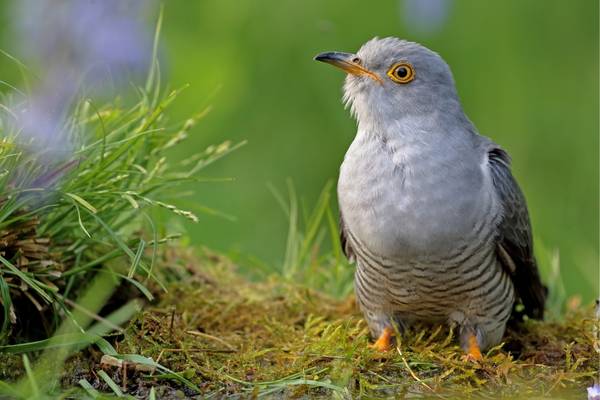
Cuckoos

You’ve probably heard of the strange way that some cuckoos “care” for their young. They can lay their eggs in the nests of other birds, turning their own babies into “brood parasites”.

Cuckoos are notorious for killing other birds nestlings, but rarely kill their own!

Baby cuckoos will often kill off the offspring of the host bird so that they can be raised without competition.

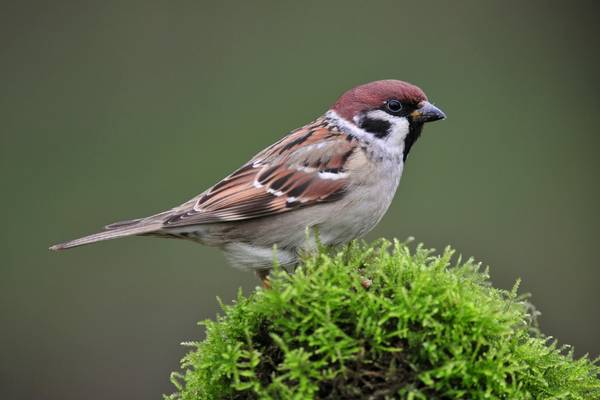
House Sparrows

The males of this widespread bird species are actually known to go out of their way to hunt down and kill the babies of competing males so that their young are more likely to survive. But females will actually do the same, which is unusual for birds!

In fact, more than 10% of new house sparrow nestlings are brought up in a nest where the male (or much rarer, the female) has first killed off the offspring of the previous partner to one of the parents!

House sparrows are common backyard birds all over the world, but they do have a bizarre way of establishing dominance!

Although this behavior is almost always carried out by males in other bird species, house sparrow females are notorious for killing the nestlings of competing females!

They seemingly do this to get more attention from polygamous males and to advance in the social hierarchy.

Do storks kill their babies?

Yes! White Storks have been known to kill their babies and a 3-year-long study found that 9 out of 63 nests experienced infanticide. This means that it only happens in 14% of the nesting couples, but less often if conditions are optimal and perhaps more often if food is scarce.

Why do storks kill their babies?

Storks will kill their babies if they lay too many eggs and therefore have to care for more than they can carry. In other bird species, the nestlings would outcompete each other “naturally” and the parents would not need to intervene, but not in storks.

Stork nestlings are demanding and there are limits to what a couple can support in times of food scarcity. Sometimes it is better to end the life of a nestling early rather than compromising all the chicks.

Therefore, the stork parents will often intervene themselves to put an end to the smallest chick’s misery before it starves to death.

Will Birds Also Eat Their Own Babies?

As a biologist with a keen interest in avian behavior, I can provide insight into the intriguing topic of cannibalism in birds. While it may be unsettling to imagine, yes, there are instances where certain bird species engage in cannibalistic behaviors, including consuming their own offspring.

Although this behavior is relatively rare among birds, it has been observed in various contexts and can serve different purposes depending on the species and circumstances involved.

One important point to emphasize is that the vast majority of bird species do not exhibit cannibalistic tendencies towards their young. Parental care and nurturing instincts are deeply ingrained in most avian species, as they invest significant time and energy in rearing their offspring.

The act of killing and consuming their own young goes against the typical parental behavior observed in birds, which is geared towards ensuring the survival and well-being of their progeny.

Nevertheless, there are several factors that can contribute to instances of cannibalism in birds. These factors include food scarcity, competition for resources, stress, environmental conditions, and even genetic predispositions.

In certain cases, a parent bird may perceive their own offspring as a potential source of nutrition, especially when food availability is limited or unpredictable. By consuming their young, the parent bird gains sustenance to survive during challenging times.

In addition to nutritional benefits, cannibalism in birds can also serve other purposes. One such purpose is related to maintaining the overall fitness of the parent bird. By eliminating weaker or sickly offspring through cannibalism, the parent bird can allocate its limited resources towards raising the healthier offspring, thus increasing the chances of their survival and overall reproductive success.

This behavior, known as “culling,” ensures that the limited resources are allocated to the strongest individuals who have a higher likelihood of passing on their genes to the next generation.

It is important to note that cannibalism in birds is not limited to parents consuming their own young. In some cases, unrelated adult birds may prey upon the young of other individuals within their own species.

This type of cannibalism can occur as a result of territorial disputes, dominance hierarchies, or simply as a opportunistic feeding behavior.

Certain species of birds, such as gulls and raptors, have been observed engaging in this behavior, particularly when food resources are scarce or when defending their nesting territories.

It is crucial to understand that cannibalism in birds is not the norm, but rather an exception to the typical parental care exhibited by avian species. The majority of bird parents invest significant effort in protecting, feeding, and nurturing their young, ensuring their survival and eventual independence. Cannibalism, when it does occur, is generally a result of exceptional circumstances and environmental pressures.

In conclusion, while it may be unsettling to contemplate, cannibalism in birds, including the act of consuming their own offspring, has been observed in certain species. This behavior can be driven by factors such as food scarcity and the need to prioritize the survival of the fittest offspring.

However, it is important to remember that such behaviors are not representative of the broader avian population. Most birds exhibit remarkable parental care and strive to ensure the well-being and success of their young.

Do Birds Kill Their Babies If You Touch Them?

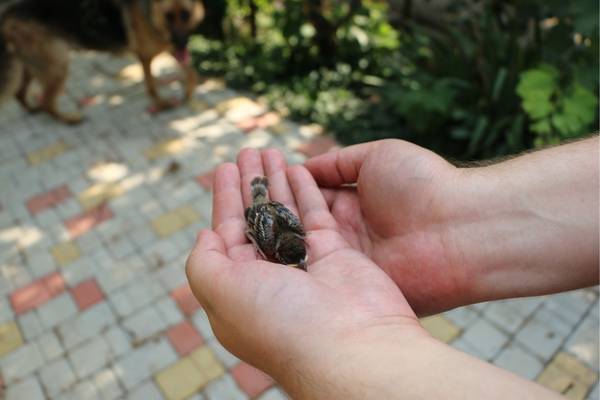
You’ve probably been told to leave a baby bird alone if you spot one out in the wild because its mother will kill it if it has a human smell, but is this true?

Actually, this idea is a myth, although the advice that it has produced is actually pretty sensible.

Birds will not kill their babies just because they have been touched by humans, and a human smell is not going to cause a baby to be abandoned.

The problem with touching a baby bird is that your presence is likely to scare off the parents, and the adult birds may find it difficult to locate them again.

It is a myth that a bird will abandon a nestling if you touch it, but you have to be very careful not to scare the parents when you put it back into the nest!

It’s best to leave a baby bird where you find it because you want its parents to come back, and they are more likely to do so if you’re not around.

If the birds are older at the fledgling state, the bird might not belong in the nest anymore and will take care of by the parents. In if that is the case, you should not move it or try to rescue it!

What Do Birds Do When Their Babies Die?

When baby birds do die, it can seem very sad to us, but do the adult birds become upset? What do they do when this happens? Well, it’s hard to determine exactly how much emotion birds have.

There is no scientific proof that birds will mourn or grieve, but some of their behavior does suggest a level of sadness.

For example, penguins are known to hold onto their young for a long time even after they have died, crows have been observed gathering around their dead, and magpies will sometimes place objects over the bodies of deceased birds.

No bird parent is happy when their babies die, but birds do not have feelings as humans do!

As for what actually happens when a baby bird dies, things are a little more practical. Dead bodies breed bacteria and attract predators, so they need to be removed from the nest.

The larger the baby is, the further they will be taken away. Many predatory and scavenger birds, like vultures and hawks, will even eat their young, though this does not seem to be done out of maliciousness, but simply because it is expedient.

In the end, though we may never know for sure what goes on in a bird’s mind when its young die, we can see that they do take some actions that could be interpreted as signs of sadness.

What can you do to prevent birds from killing their own babies?

You always have to be careful when trying to help birds as the reason for their behaviour can vary and you might make it worse!

Some possible reasons for bird infanticide include if the bird is sick, stressed or hungy, if the bird feels threatened, if the baby is not healthy, or if the mother bird is simply inexperienced.

If you are concerned about birds killing their own babies, you can try to provide nesting materials and a safe environment for them to nest in.

Making sure that the birds have food, shelter and nesting material will minimize the risk of infanticide.

You can also try putting out extra food for them in your yard. I have already written extensively about how to feed backyard birds in each state of the US here on the site – so just go and find the bird in question and read all about what to feed it in my posts on backyards birds!

I will put some links at the end of this post as well!

Conclusion

As much as we might not understand it, killing babies is a natural occurrence in the animal world. For birds, it usually happens when the mother bird is trying to protect her (future) offspring or ensure their success.

While it’s a myth that human touch will cause a mother bird to kill her baby, it’s best to leave them alone so as not to scare off the parents. And if a baby bird does die, the adult birds usually handle it by removing the body from the nest without measurable remorse.

FAQs

Do blue jays kill their babies?

There are many factors that can affect the behavior of blue jays. Some reports suggest that blue jays may kill their babies if they perceive a threat to their safety, while other reports indicate that blue jays are generally gentle and nurturing parents. Ultimately, it is important to remember that every animal is unique and therefore reactions to different situations will vary.

Do mourning doves kill their babies?

No, mourning doves are not known to kill their babies.

Do quails kill their babies?

There is no definitive answer to this question as different quail species exhibit different behaviors. But some species might do so.

Why do quails kill their babies?

Some quail birds will kill their own babies if they perceive them to be a threat, while others will not. It is speculated that quails may kill their babies if they are sick or deformed in some way, in order to prevent the spread of disease.

Do budgies kill their babies?

Some budgies may kill their babies if they feel threatened or if they are not getting enough food, while others may not kill their babies under any circumstances.

Do geese kill their babies?

No, geese do not kill their babies. They are herbivores and would not normally be aggressive against their young.

Do crows kill their babies?

Crows will gladly eat other bird’s eggs and babies but do rarely eat their own offspring. Some crows may kill their babies if they perceive them to be a threat to their survival during food shortage.

Do Canadian geese kill their babies?

No, geese do not kill their babies. They are herbivores and would not normally be aggressive against their young.

Do swans kill their babies?

Swans, like geese, are herbivorous birds that do not normally have a taste for meat. They have very few babies so they will not let them go to waste. And whereas they will never kill their own babies, they will sometimes kill the nestlings of competing swan couples!

Do parakeets kill their babies?

No, parakeets do not kill their babies. Parakeets are small, gentle birds that typically make great parents.

Do finches kill their babies?

No, finches do not kill their babies. They are small, seed-eating birds that typically have large clutches of eggs (6-8). The female will incubate the eggs and both parents will feed the chicks once they hatch.

They may sometimes peck them by accident and kill them unintentionally. They will then throw them out of the nest where they will day from the fall if not completely dead already.

Do zebra finches kill their babies?

Zebra finches are very similar to regular finches and do not kill their babies on purpose.

Why would zebra finches kill their babies?

Zebra finches would only kill their babies by accident and never intend to do so on purpose. Especially when held in captivity where food is usually plentiful. They may sometimes peck them on accident as they are not the most intelligent birds around!

Do chickens kill their babies?

Chickens only kill their babies if they are hurt or injured. Sometimes they will eat their own eggs if they are free-range. However, they would only do this if they could not lay another egg that day and needed to conserve their energy.Chickens are omnivorous birds, but they mostly eat plants. They will only eat meat if it is available, but they do not hunt for it.

Do cardinals kill their babies?

As cardinals have very strong family bonds, it is unlikely they would kill their babies but it is possible. Cardinals will only kill their babies if they are severely disturbed or stressed.

Do robins kill their babies?

I have never heard any reports of robins killing their babies. So at least, they are not well known to do so.

Do hawks kill their babies?

Hawks are predators and will kill baby animals for food, including other birds, but they rarely kill their own babies as they do not have large broods.

Do sparrows kill their babies?

Yes! As mentioned earlier in this post, house sparrows kill almost ten percent of their total offspring if we count across and between couples!

Do mother ducks kill their babies?

No, ducks do not kill their babies.

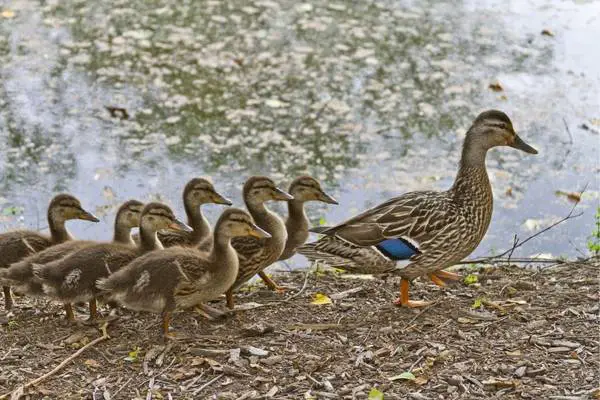
duck parent and ducklings
Ducks are among the best parents of birds!

And let’s end this post on a happy note: In fact, duck mothers are very nurturing and will often incubate other duck’s eggs and raise their chicks if given the chance!

More About Backyard birds in North America

Are you interested in how the backyard birds in your state compare to other states?

Then check out my other blog posts below:

  • Backyard birds of Alabama
  • Backyard birds of Colorado
  • Backyard birds of Delaware
  • Backyard birds of Georgia
  • Backyard birds of Hawaii
  • Backyard birds of Illinois
  • Backyard birds of Iowa
  • Backyard birds of Kentucky
  • Backyard birds of Louisiana
  • Backyard birds of Maryland
  • Backyard birds of Massachusetts
  • Backyard birds of Missouri
  • Backyard birds of Nebraska
  • Backyard birds of New York
  • Backyard birds of North Carolina
  • Backyard birds of Oklahoma
  • Backyard birds of Rhode Island
  • Backyard birds of South Carolina
  • Backyard birds of Tennessee
  • Backyard birds of Texas
  • Backyard birds of Virginia
  • Backyard birds of West Virginia
  • Backyard birds of Wisconsin
  • Backyard birds of Wyoming

And in Canada:

  • Backyard birds of Ontario
  • Backyard birds of Prince Edward Island
  • Backyard birds of Saskatchewan
  • Backyard birds of Quebec

Not on the list? Check out the rest of my posts on backyard birds here!

Maybe you would like to know if the Blue Jay or Cardinal dominates in the bird feeder hierarchy or how birds such as seagulls sleep at night? Or why mourning doves poop so much.

My Favorite Backyard Birding Gear:

If you are interested in posters and other wall arts etc. with drawings of all the backyard birds you have just read about, check out my portfolio over at Redbubble:

https://feederwatch.org/

American Museum of Natural History Birds of North America. DK; Revised edition (September 6, 2016). ISBN: 978-1465443991

National Geographic Backyard Guide to the Birds of North America, 2nd Edition. National Geographic; 2nd edition (October 15, 2019)

Birds of North America. National Audubon Society. (Knopf April 6, 2021). ISBN: 978-0525655671

https://celebrateurbanbirds.org/

https://www.birds.cornell.edu/

Late Season Turkey-Hunting Tips

0

In many states, the spring turkey season only lasts two or three weeks. The drastic and rapid changes that take place throughout this short timeframe amaze me.

One of the most drastic changes is the way your hunting area looks. In most locations, these changes happen quickly and are often noticeable from day-to-day. Perhaps you could see for several hundred yards on opening morning. Today, the area may be in full foliage, limiting visibility.

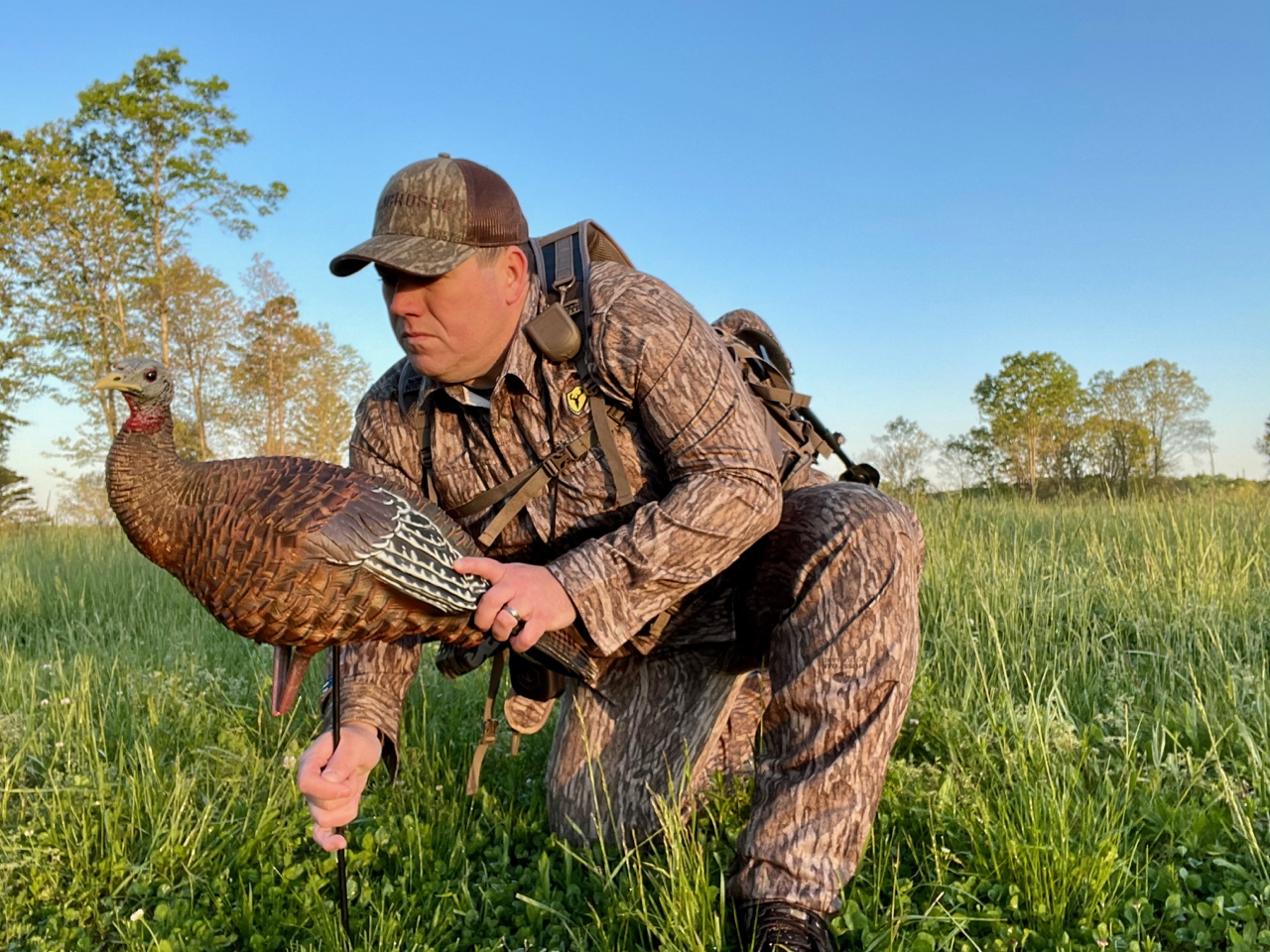
heath wood setting up turkey decoy

Another change from beginning to late season is the behavior of turkeys themselves. Toms have spent the first few days being pressured by every hunter with a turkey call within a 50-mile radius; they have also spent the last month fighting with other toms to establish dominance and determine who is going to breed hens first. To put it mildly, by the late season, toms are stressed out and often cautious of every move they make.

Late-season decoy setups are often a tense, uncertain and debated subject for turkey hunters. As mentioned earlier, by this point in the season, many gobblers have been fighting with other toms at some point. In some cases, they’ve had their butt whipped. This combined with likely encounters with hunters who tried to shoot their head off can cause mature toms to become skeptical of approaching a decoy setup. But don’t let this common, late-season fear find you leaving your decoys in the truck. With some careful thought, more strategic placement, and different calling regimens, your turkey decoys can still help you from ending the season with an unfilled tag.

Early in the season, a decoy setup is usually used to fool a gobbler into thinking he’s got a chance at breeding a hen. The typical setup often consists of a hen and either a jake or a strutting tom. When a gobbler sees this picture, he often comes in ready to fight. During the late season, however – as we’ve explained – his mood can change as quickly as the foliage.

Instead of coming in with boxing gloves on and swinging, toms can be more likely to avoid a scuffle because of fear of losing the battle. In some cases, toms will even spook from such a decoy setup and leave the area altogether.

To avoid the chance of running him off, use a low-key late-season decoy setup that is simpler, more subtle, and exhibits less dominance. Your goal is to simply to get his attention instead of bringing him in for a fight. During the late season, the only decoy I leave at the house is a full-strut gobbler. I’ll usually switch to a single hen decoy and occasionally a jake decoy to go along with her.

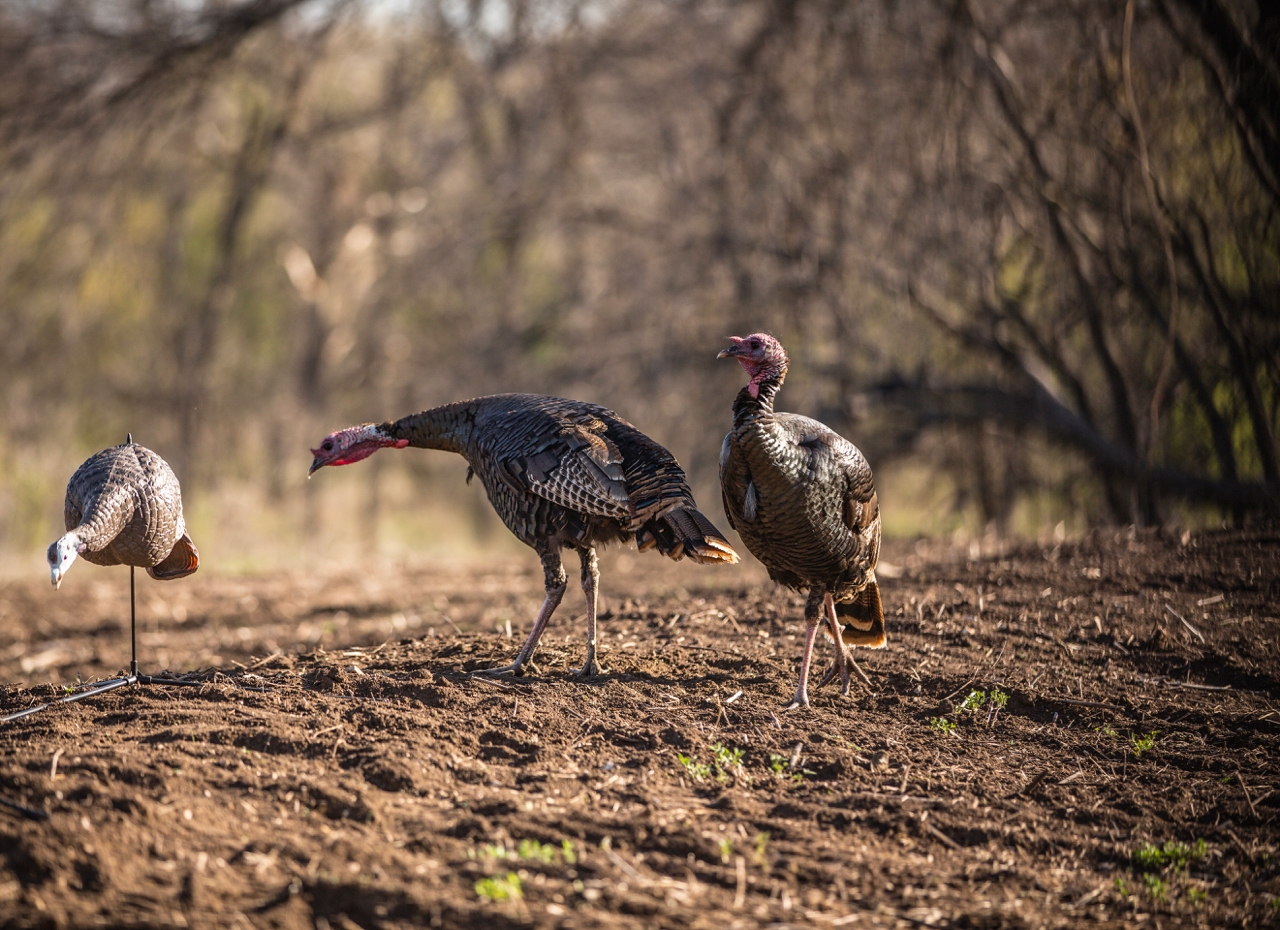
During the latter part of the spring, hens began to venture out in the fields or open areas by themselves, often getting up off a nest to do a little feeding or dusting. By using one lone-hen decoy, you are naturally replicating a turkey’s behavior. When a tom sees a lone hen, the curiosity builds as to whether she has been bred. Perhaps she’s looking for company.

Sometimes jakes have the same idea, so I may decide to place a jake decoy ten to 15 yards from the lone hen. On many occasions during the late season, I have had jakes respond to my calls and my lone decoy setup. The jakes show up in hopes of trying to get access to a hen who isn’t accompanied by a mature tom. When a single jake hangs around the hen decoy, it enhances the scene for any tom. Unlike a mature gobbler, a jake is an easy fight. Using the hen/jake combination makes it possible to appeal to that last bit of dominance in a mature gobbler in an unthreatening way.

turkey and turkey decoys

The next thing to remember when using decoys in the late season is to pay particular attention to where they are placed. Ground foliage has grown up just like the leaves on the trees; your decoys must be visible. We’ve all had toms come into the field we’re hunting and seemingly pay no attention to our decoys. When this happens, don’t overthink things; it’s usually because he simply didn’t see them. When a decoy is placed out in the grass, it may look visible from your vantage point, but it may not be to a turkey. In all situations, but especially the late season when grass at other vegetation is thick, try to place your decoy on a hill or rise where it’s most visible. If necessary, use taller decoy stakes to make them visible above the grass.

Once the decoys are in place and visible from a long distance, consider your calling style. Remember that gobblers have been pressured. Just like your modified decoy setup, late-season toms often respond better to more subtle calling, so tone it down.

Resist the urge to make and gobbler calls when a tom is slow to respond. Hearing another tom close to the hen can intimidate a late-season tom. Instead, use a few soft yelps sparingly. All you want to do is let a nearby tom know there is a hen out by herself. Call softly and only periodically. This is often just enough to build his curiosity and make him want to come to investigate.

Understand that “late season” does not mean a specific date or time of year, as hunting seasons are different across the country. But all states and all turkey-hunting ranges do have one thing in common: by the time the late season arrives, turkeys have been pressured and are on high alert. So, wherever you take to the field, combine a less intimidating low-key decoy setup with a softer, more subtle calling method for increased success in your late-season hunting.

matt addington turkey photo

Photo by: Matt Addington

Does it hurt the deer when they scrape velvet off their antlers?

0

Discover the truth behind deer shedding their velvet! Unraveling the mystery, we explore whether or not this process causes pain for these majestic creatures. Join us on an enlightening journey as we delve into the fascinating world of antler regeneration and its impact on deer.

The Process of Shedding Velvet from Deer Antlers: Does it Cause Pain?

When male whitetail deer, also known as bucks, grow their antlers during the summer, they are covered in a velvet-like texture. This velvet is a honeycomb, bone-like tissue that provides nutrients and blood supply to the growing antlers. Bucks use their antlers to fight other bucks and mark their territory by rubbing trees. However, during the mating season or “rutting,” high levels of testosterone cause the velvet encasing to die off.

The shedding of velvet from deer antlers does not cause pain to the buck. In fact, it is a natural process that occurs every year. A drop in testosterone after the rut weakens the connection tissue between the antlers and the buck’s head, leading to the antlers falling off. This typically happens in late winter, from January through March.

After shedding their antlers, bucks begin regrowing them during spring and summer months. The new antlers are usually larger than the previous year’s. From August through September, the antlers lose their velvet encasement in preparation for the breeding season. This cycle repeats annually.

During this time of year when bucks are shedding their antlers, it is a great opportunity for shed hunting enthusiasts to venture into wooded areas and search for these dropped antlers called “sheds.” Finding sheds requires first identifying deer signs that indicate deer activity in an area. These signs include tree rubs, scrapes on the ground made by bucks with their hooves, droppings, bedding areas characterized by depressions in long grasses made by deer, tracks, and travel routes marked with hoof prints.

To increase your chances of finding sheds, focus your search around bedding areas where deer rest or sleep, travel routes that are worn paths frequented by deer movement, food plots such as agricultural fields or areas abundant with acorns, and water sources. These locations are more likely to have shed antlers.

It is important to note that shed hunting should be done responsibly and ethically. Respect private property rights and obtain permission before searching on someone else’s land. Additionally, be mindful of your surroundings and take precautions to avoid disturbing wildlife or their habitats.

If you’re interested in learning more about whitetail deer or want additional information about shed hunting, you can visit the Mass Fish and Wildlife website for comprehensive resources.

Remember to share your experiences and findings in the comments section of the Animal Control Corner blog. Subscribe to receive future blog posts directly in your inbox by visiting Weston.org/StayInformed and entering your email address.

Happy shed hunting!

Understanding the Velvet Removal Process in Deer Antlers: Is it Harmful to the Deer?

The velvet removal process in deer antlers is a natural and necessary part of their annual cycle. It is not harmful to the deer but rather a result of hormonal changes. During the summer, male whitetail deer, known as bucks, grow antlers covered in a velvet-like texture. This velvet is a honeycomb, bone-like tissue that provides nutrients and blood supply to the growing antlers.

However, as the breeding season approaches, bucks experience high levels of testosterone during rutting. This surge in hormones causes the velvet encasing to die off. Bucks will then rub their antlers against trees to help remove the velvet and mark their territory. The rubbing action also helps strengthen their neck muscles for fights with other bucks.

Once the testosterone levels drop after rutting season, weakness develops in the connection tissue between the antlers and skull. As a result, the antlers fall off naturally without causing any pain or harm to the buck. This shedding process typically occurs from January through March.

During spring and summer, the antlers begin regrowing and are usually larger than those from previous years. From August through September, they lose their velvet encasement in preparation for the whitetail breeding season. The cycle then repeats itself annually.

It’s important to note that while shedding antlers may seem like an uncomfortable process for deer, it is actually a natural occurrence that allows them to grow new and stronger antlers each year. It is not harmful or painful for them.

If you come across shed antlers while out shed hunting or exploring nature, consider it a fascinating find that showcases this unique aspect of deer biology. Enjoy observing these natural wonders but remember not to disturb or interfere with wildlife during their mating or shedding seasons.

Shedding Velvet from Antlers: Exploring the Impact on Deer’s Well-being

Shedding Velvet from Antlers: Exploring the Impact on Deer

Shedding velvet from antlers is a natural process that occurs in male deer, known as bucks. During the summer months, bucks grow their antlers, which are covered in a velvet-like texture. This velvet is a living tissue that supplies blood and nutrients to the growing antlers. However, as the breeding season approaches and testosterone levels rise, the velvet begins to die off.

The shedding of velvet from antlers does not cause any harm or pain to the buck. In fact, it is a necessary process for their well-being. Once the velvet dies off, bucks will rub their antlers against trees to help remove it. This rubbing behavior also serves as a way for bucks to mark their territory and assert dominance over other males.

After the rutting season, when testosterone levels decrease, the connection tissue between the antlers and skull weakens, leading to the shedding of antlers. This typically occurs in late winter, from January through March. The dropped antlers are called “sheds” and can be found in areas where deer activity is high.

The shedding of antlers allows bucks to conserve energy during harsh winter months when food sources may be scarce. It also prepares them for the upcoming breeding season by allowing new antler growth during spring and summer months. The new antlers are usually larger than those shed in previous years.

Understanding this natural process of shedding velvet from antlers helps us appreciate and respect the well-being of deer populations. Shed hunting can be an enjoyable outdoor activity during this time of year while ensuring minimal disturbance to these magnificent creatures.

For more information on whitetail deer and their behavior, you can visit Mass Fish and Wildlife’s deer information web page. And if you happen to come across sheds or any other interesting finds while enjoying nature, don’t forget to share your experiences with the Animal Control Corner.

Happy shed hunting!

Debunking Myths: Does Scraping Velvet off Antlers Hurt Deer?

Myth: Scraping velvet off antlers causes pain and harm to deer.

Contrary to popular belief, scraping the velvet off antlers does not cause any pain or harm to deer. The velvet is a soft tissue that covers the growing antlers, providing them with nutrients and blood supply. As the antlers reach their full size, the velvet begins to die off naturally. Bucks will then rub their antlers against trees and other objects to help remove the dead velvet. This rubbing action is a normal behavior for bucks during this time of year and does not cause any discomfort or injury.

Myth: Removing the velvet from antlers affects deer health.

There is no evidence to suggest that removing the velvet from antlers has any negative impact on deer health. Once the velvet dies off and is rubbed away, the antlers are fully formed and hardened. They serve as weapons for bucks during mating season and as territorial markers throughout the year. The shedding of the velvet is simply part of a natural process that occurs annually in deer populations.

Myth: Bucks actively seek out assistance in removing their velvet.

While it may seem like bucks are seeking assistance in removing their velvet by rubbing against trees, this behavior is primarily driven by instinct rather than a deliberate attempt to seek help. Bucks engage in rubbing activities as a way to mark their territory, establish dominance, and prepare for mating season. The act of rubbing helps them shed the dead velvet, but it is not an intentional seeking of assistance from external sources.

Overall, it is important to understand that scraping velvet off antlers does not hurt or harm deer in any way. It is a natural process that occurs as part of their annual growth cycle. By debunking these myths, we can appreciate the beauty and wonder of deer shedding their antlers without any concerns for their well-being.

Examining the Natural Shedding Process of Velvet on Deer Antlers: Is there Pain Involved?

The Growth and Purpose of Antlers

Male whitetail deer, known as bucks, grow antlers during the summer months. These antlers are made of honeycomb, bone-like tissue and serve multiple purposes. Bucks use their antlers to fight other bucks during territorial disputes and also to mark their territory by rubbing trees. While the antlers are growing, they are covered in a velvet-like texture. This velvet encasing is eventually shed due to high levels of testosterone during mating season.

The Shedding Process

After the rutting season, when mating occurs, testosterone levels decrease in bucks. This drop in testosterone weakens the connection tissue between the antlers and the buck’s head, causing the antlers to fall off. This shedding process typically occurs from January through March, with dropped antlers referred to as “sheds.” It is important to note that this natural shedding process does not cause any pain or harm to the buck.

Antler Regrowth

Following the shedding of their antlers, bucks begin regrowing them from spring through summer. The new antlers usually grow back larger than the previous year. In preparation for the whitetail breeding season, which occurs from October to early December and is known as “rutting,” bucks lose the velvet encasement on their antlers from August through September.

Deer Signs and Shed Hunting

To find shed antlers, it is essential to locate areas with deer signs indicating deer activity. Bedding areas can be identified by depressions made by deer in long grasses. Travel routes are narrow paths marked with numerous hoof prints. Food plots such as agricultural fields or areas abundant with acorns, as well as water sources, are also prime locations to search for sheds. By observing these deer signs, shed hunters can increase their chances of finding antlers during this time of year.

Conclusion

The shedding process of velvet on deer antlers is a natural and painless occurrence for bucks. Understanding the growth, shedding, and regrowth cycles of antlers can enhance the experience of shed hunting. By identifying deer signs and focusing on areas with high deer activity, individuals can enjoy the outdoor activity of shed hunting in Weston’s open spaces and forested areas while respecting the natural behaviors of whitetail deer.

Shedding Velvet from Antlers: Unraveling the Truth about Deer’s Sensations

When it comes to shedding their antlers, male whitetail deer experience a unique sensation. The antler growth process begins during the summer months, with the antlers covered in a velvet-like texture. This velvet is a honeycomb, bone-like tissue that provides nourishment to the growing antlers. As the antlers develop, bucks use them for fighting other bucks and marking their territory by rubbing trees.

However, during the mating season known as “rutting,” high levels of testosterone cause the velvet encasing to die off. Bucks will actively rub trees to help remove this dead velvet. The drop in testosterone after rutting weakens the connection tissue, leading to the natural shedding of the antlers. It’s important to note that this shedding process does not hurt the buck in any way.

The annual shedding of antlers occurs in late winter, typically between January and March. The dropped antlers are referred to as “sheds.” After shedding, from spring through summer, new antlers grow back and are usually larger than those of the previous year. From August to September, these new antlers lose their velvet encasement in preparation for the whitetail breeding season.

To communicate their presence and readiness for mating, bucks engage in various behaviors such as rubbing trees and scraping the ground with their hooves. These actions leave behind visible signs known as “deer signs.” Tree rubs, scrapes, droppings, bedding areas, and tracks are all indicators that deer are present in an area.

If you’re interested in shed hunting and finding these sheds, it’s essential to look for these deer signs first. Bedding areas can be identified by depressions made by deer in long grasses. Travel routes are narrow paths marked with numerous hoof prints. Food plots like agricultural fields or areas abundant in acorns, as well as water sources, are also prime locations to search for sheds.

Understanding the shedding process and recognizing deer signs can greatly increase your chances of having a successful shed hunting experience. So head into the woods during this time of year when bucks are shedding their antlers, and enjoy the great outdoors while searching for these natural treasures!

For more information about whitetail deer and their behavior, you can visit the deer information web page from Mass Fish and Wildlife. And don’t forget to share your shed hunting experiences or any other interesting nature encounters in the comments section of the ACO Blog.

Happy shed hunting!

In conclusion, the process of scraping velvet off their antlers may cause some discomfort for deer, but it is a natural and necessary part of their growth. While it might appear painful, deer have evolved to handle this process efficiently, and any temporary discomfort they experience is outweighed by the benefits of shedding their velvet, such as improved mobility and readiness for mating season.

6.8 Western: What the .270 WSM Should Have Been

0

If you ask the average American rifle shooter if the world needs another hot new hunting cartridge, it’d be tough to find many to agree right off the bat. But if you laid these specs in front of that same average shooter, they might change their tune: a long, heavy-for-the-caliber bullet with a high ballistic coefficient that produces less felt recoil than a 7mm Rem Mag that can be run in a light, short-action rifle action. Yeah, that’s definitely attractive — and that’s the new 6.8 Western cartridge.

It was engineered as a collaboration between Browning and Winchester, and released to the public in 2021 with hunters as the target demographic.

“The 6.8 Western is the cartridge we turn to for accuracy testing,” said Browning’s director of marketing and communications, Rafe Nielsen, on the Backcountry Hunting Podcast.

Many shooters may ask why two powerhouse companies would introduce a new cartridge in an already saturated market. Do the engineers at Winchester and Browning know something we don’t?

GOOD GEAR – Survive the Day With BRCC’s Endurance Roast

Going From Good to Great

The cartridge’s designers lowered the shoulder of the .270 WSM, removing roughly 10% of the case’s powder capacity. Lowering the shoulder allowed long, higher ballistic coefficient bullets to seat in the case without encroaching into the powder space.

Fast-twist barrels of 1:7.5” and 1:8” help stabilize the long, heavy .277-caliber projectiles weighing from 162 to 175 grains.

The heaviest bullet you can expect to find in a .270 WSM is 150 grains. With heavier bullets and a higher BC, the 6.8 Western can simply reach out farther with greater accuracy.

READ NEXT – 338 Norma Magnum: Cheat Code for Snipers and Machine Guns

6.8 Western vs. 7mm Rem Mag

According to the BH Podcast, the 6.8 Western, for the most part, nips on the heels of the 7mm Remington Magnum in several categories — again, with a lighter kick.

When both cartridges shoot the same 165-grain bullet weights, the velocity for the 6.8 Western is roughly 2,900 fps, and the 7mm Rem Mag moves at about 3,000 fps. The BC of those bullets is more than 0.600 on the G1 scale, which translates into a projectile that can buck the wind and retain energy at long ranges.

However, the 6.8 Western produces about 15% less felt recoil than a 7mm Remington Magnum. It offers a cartridge capable of taking all of North America’s big-game species — minus the really big bears — in a short-action platform with manageable recoil.

With those features, the 6.8 Western is predictably an excellent deer hunting cartridge that’s capable of making long shots across bean fields on whitetails or steep canyon shots on mountain muleys. It’s especially well-suited for hunting the Great Plains, where shots are routinely at around the 400-yard mark.

GOOD GEAR – Embody the Ethos of the Quiet Professional With BRCC’s Silencer Smooth Roast

6.8 Western vs. .270 Winchester

The 6.8 Western and a .270 Winchester fire the same-diameter bullet, but their parent cases differ quite a bit. The .270 Winchester was born from necking down the .30-06 Springfield case to hold a .277-inch projectile.

The 6.8 Western was created from the .270 Winchester Short Magnum case by lowering the shoulder and reducing the case’s powder capacity, which allows a longer, heavier, high BC bullet more room to fit into the case.

A 140-grain bullet fired from a .270 produces 1,401 foot pounds of energy at 500 yards, while the 6.8 Western’s 170-grain bullet hits with 1,736 foot pounds The cartridges also have almost identical trajectories, but the 6.8 lands with a larger wallop.

READ NEXT – Iron Will Releases New Wide Single-Bevel Broadheads

How It Stacks Up Against the 6.5 PRC

Should you get a 6.8 Western if you have a 6.5 PRC? That largely depends on whether you are a target shooter or a big-game hunter.

The 6.5 PRC allows shooters to hit vital-size targets on large bovines out to 800 yards. However, the 6.5 PRC’s 140- to 153-grain bullets do not carry the same downrange penetration capabilities and energy transfer as the heavy-for-caliber 163-, 165-, 170-, or 175-grain projectiles from the 6.8 Western.

If hitting steel at extended distances or shooting whitetails and pronghorn in open country is what you are asking the 6.5 PRC to do, then sticking with that cartridge is fine. However, if you’re after larger game, like elk, large black bears, or moose, the 6.8 Western will drive heavier bullets at difficult angles deep into the vitals.

Those heavier bullets will retain more energy at longer ranges. Pair that extra power with the larger frontal diameter of the 6.8 PRC, and the cartridge delivers far more thump on target.

Both cartridges also have the charge sitting close to the primer, which allows for efficient ignition within the case, consistent pressures within the chamber, and velocities that stay the same from shot to shot.

GOOD GEAR – Fuel Your Next PR With BRCC’s Fit Fuel Blend

6.8 Western Rifles

There are currently 23 rifle offerings from Winchester chambered for the 6.8 Western. Nine are in the “rifleman’s rifle,” the controlled-feed Model 70. There are also 14 options in Winchester’s budget-friendly XPR line.

Browning’s 6.8 Western lineup includes 18 X-Bolt rifles, including the Western Hunter LR. There are 13 X-Bolt models in 6.8 featuring Browning’s own Hawg Muzzle Brake, advertised to reduce felt recoil by up to 76%, depending on caliber. Not only is this easier on your shoulder, but it also reduces muzzle rise, so a shooter can easily spot hits or get back on target for follow-up shots on game.

For models that don’t wear a brake, recoil sits between the levels of a .270 Winchester and a 7mm Remington Magnum. It is pretty comparable to a .30-06 firing a 180-grain bullet, which comes out to about 20 foot pounds of felt energy in an 8-pound rifle.

Some smaller gun shops, such as the Texas company Hill Country Rifl, have decided not to build guns for the new caliber because some ammunition doesn’t seem to shoot well out of their rifles.

“The Browning ammunition made our accuracy standards of a three-shot half-inch group at 100 yards,” Matt Bettersworth of Hill Country Rifles told Free Range American, “but the Winchester ammunition did not meet our standards. And this was from the same gun.”

Winchester Model 70 Extreme HunterPrice: $1,869.99

Often dubbed “The Rifleman’s Rifle,” Winchester’s Model 70 bolt-action is incredibly accurate for a factory-fresh rifle. This version is built for dead-on accuracy in the roughest hunting environments on Earth.

It features a tough Bell and Carlson synthetic stock that resists moisture like there’s no tomorrow and a free-floating sporter-weight barrel with a tungsten Cerakote finish.

Winchester XPRPrice: $609.99

The Winchester XPR is proof that you don’t have to dump a wad of cash to get a great rifle chambered in 6.8 Western. The company took the proven concepts of the Model 70 and combined them with super-efficient manufacturing processes to come up with a reliable and affordable option for the everyday hunter.

Featuring an advanced polymer stock with a matte black finish, a nickel teflon-coated bolt body, and a rugged Perma-Cote finish on the barrel and receiver, this rifle is made to stand up to harsh conditions and rough environments.

The Future of the 6.8 Western

Predicting the fate of a cartridge is hard. Like the .30-06 Springfield, some survive because of the confidence of troops carrying them in battle and later into the deer woods. Sometimes the cartridge is paired with a rifle platform that flat-out works, such as the 7mm Rem Mag and the Remington Model 700. Some cartridges never make it far beyond the basements they were born in.

If hunters and shooters take notice of the 6.8 Western’s ability to shoot high BC bullets capable of ringing long-range steel or taking game up to the size of a moose, then it should stick around. An inherently accurate cartridge that recoils less than a 7mm Remington Magnum chambered in compact, lightweight, proven rifle platforms should find a place in any rifleman’s arsenal.

READ NEXT – S&W Drops Performance Center Version of 10MM M&P M2.0 Pistol

Marlin 1895 .45-70 Trapper Lever Gun: Review

0
Marlin 1895 .45-70 Trapper Lever Gun: Review

Marlin 1895 .45-70 Trapper Lever Gun (RifleShooter photo)

The release of the Ruger-made Marlin 1895 SBL .45-70 Gov’t rifle last year was very well received, and Marlin is following that up with the 1895 Trapper. It has the same chambering, satin stainless finish and gray laminate stock as the SBL, but the Trapper version has a shorter, 16.1-inch barrel. Its barrel is cold hammer forged out of 410 stainless steel, has a 1:20 twist and is threaded 11/16×24 for mounting a suppressor or other muzzle device.

With its shorter barrel and reduced overall length of 34.25 inches, the Trapper is ideal for anyone who wants to add a can to their rifle without making the gun so long that it becomes unwieldy or for those who hunt in tight cover and want the shorter barrel because it’s handier. Weight is 7.1 pounds, and the gun’s balance point is centered at the loading port, which gives it that “between the hands” feel shooters love.

The triggerguard plate, receiver and lever are all precision CNC machined from 416 stainless steel forgings. An oversized lever loop makes it easy to cycle quickly and reliably. The bolt features a side-mounted extractor on the bolt body and a spring-loaded ejector that rests in a recess within the receiver. There’s also a crossbolt safety located on the upper rear portion of the receiver. The hammer has both half- and full-cock positions.

1895 Trapper

Ruger Marlin 1895 trapper model lever gun in .45-70 gov
The Marlin’s controls are classic 1895, with a side loading gate, side ejection port and an exposed hammer. (RifleShooter Photo)

The Trapper model features Skinner front and rear sights. The rear sight is an aperture design, and the aperture unscrews so it can be replaced with larger or smaller aperture sizes. The front blade sight is sturdy and sports a bright white stripe along the spine that is easy to see in low light. There’s also a dovetail in the barrel that allows you to add a buckhorn-style rear sight if you’d like. Unlike the SBL, there is no Picatinny scope rail.

The laminate stock on the Trapper has a darker color scheme than that found on the Ruger/Marlin 1895 SBL rifles. A dense recoil pad about 3/4 inch thick with a spacer is perfectly mated with the contour of the stock. The iconic Marlin horse and rider logo is laser engraved onto the grip, and there’s an “RP” proof mark on the left side of the barrel. “Mayodan, North Carolina,” Marlin’s new base of operations, is stamped on the barrel as well, and serial numbers for these rifles begin with the prefix “RM” for Ruger Marlin.

Even the trademark bullseye design that has graced Marlin rifles for decades can be seen on this gun, albeit with a red center in homage to the Ruger brand. “The 1895 Trapper is an excellent early addition to our new Marlin line,” said Mickey Wilson, vice president of operations at Ruger’s Mayodan, North Carolina, facility. “It’s easy to handle, sports a great sight system and is powerful enough to take any North American large game animal, as well as offering protection to guides and fisherman from potentially dangerous animals.”

At just over six pounds, the trigger isn’t light, but it’s clean and sufficient for an open-sighted lever gun. I managed to punch groups right at an inch from 50 yards. With the Trapper’s shorter barrel, the Federal load ran about 100 fps slower than spec velocity, and the Hornady load was almost 200 fps slower.

Field Function

Hornady
The Skinner aperture sight is adjustable for windage and elevation, and the rifle has a dovetail farther forward to mount a traditional open sight. (RifleShooter Photo)

The Marlin Trapper functioned flawlessly with one exception. I ran dry during one drill, and in my haste to reload, I didn’t fully seat the last cartridge in the magazine tube. When I attempted to cycle the action the bolt locked in the open position with the lever frozen, which is a telltale sign of this error. This common failure with Marlin rifles is entirely preventable as long as the shooter has the presence of mind to fully seat each round. Recoil from the Trapper is stiff, especially from the bench. Off the bench the rifle isn’t unpleasant at all, and with the gun held firmly and fired from a solid stance, it’s possible to deliver fast follow-up shots.

At a suggested retail price of $1,349, the 1895 Trapper is $50 cheaper than the SBL. That’s higher than Henry’s All-Weather Lever Action .45-70, but the Henry holds one less round; has a longer, unthreaded barrel; and lacks the Trapper’s impressive wood and Skinner sights. Is there still a place for big-bore lever guns in the hunting arena? Absolutely. For hogs, deer, elk, moose or anything that has the potential to bite back, there are few better options, and that’s because nothing handles like a lever-action carbine.

Ruger Marlin 1895 trapper model lever gun in .45-70 gov
The Marlin’s 16.1-inch barrel is threaded 11/16×24, and the thread protector matches the color and contour of the barrel, which improves aesthetics. (RifleShooter Photo)

There’s also no doubt that these guns will be gobbled up by Marlin collectors, but you don’t need a dogmatic reason to buy one. These American-made lever actions are simply fun to shoot. That’s reason enough to own one.

Marlin 1895 Trapper Specs

  • Type: Centerfire, lever action
  • Caliber: .45-70 Gov’t
  • Capacity: 5 rds.
  • Barrel: 16.1 in., stainless; 1:20-in. twist, threaded 11/16×24
  • Overall Length: 34.25 in.
  • Weight: 7 lbs., 1 oz.
  • Stock: Gray, laminate
  • Finish: Satin stainless
  • Trigger: 6 lbs., 1 oz.
  • Sights: Skinner adjustable aperture rear, Skinner blade front
  • MSRP: $1,349
  • Manufacturer: Marlin Firearms

How to Count Points on a Buck the Right Way

0

Whitetail deer are one of the most common game animals for hunters in the USA. But how many points do you score for that big buck’s antlers? Learning how to add all the points isn’t too difficult, but it does take a little practice. Here’s a guide to counting deer points and scoring your prize buck.

You don’t have to be a math whiz to learn how to count points on deer antlers correctly. Any hunter, regardless of qualification, can count points on their buck by reading up on techniques online. The Boone and Crockett Club website includes a user-friendly, easy-to-use scoring chart that will help you score your whitetail deer quickly and accurately.

Simply follow along, punch in those numbers, and let the internal technology handle the rest. If you’re a new hunter and looking at how to count points on your buck, you’ve come to the right place. In this article, we’ll look into everything you need to know about scoring your buck and much more. Let’s get started!

What is the Boone and Crocket Scoring System?

how to count deer points

Hunters have long kept track of the sizes and measurements of the racks on the deer they shoot, even before record books were established. This has made it easier for hunters to remember the size of the animals and compare them to other bucks shot by other hunters.

However, because there was no standardized method for measuring and tallying rack sizes, many hunters disagreed about which bucks were the largest. Sometimes, hunters were not using the same measurements. Even when they agreed on something, such as counting the normal points, nearly all the bucks compared had differences that produced important questions.

For example:

  • Which are the main points on a buck that can be scored?
  • What qualifies as an antler point?
  • What about other antler points and abnormal points?

The Boone and Crockett Club is a non-profit organization created in 1887 by Theodore Roosevelt for passionate big-game hunters. An authorized committee of B&C members took on the challenge of widening the scope of the club’s current basic methodology to a more complete, equitable, and objective measurement system.

This system was meant to recognize remarkable North American big game animals.

Their actions developed an objective, honest, and fair grading system known as the Boone and Crockett scoring system. The Boone and Crockett record book classified scores into two groups:

Boone and Crockett Awards = 160-170

Boone and Crockett All-Time Awards = 170+

Their score sheet is available on their website; you can download it and enter the measurements. If you submit the Boone and Crockett Club with your information, they’ll use it to create valuable data. This information can then be used for conservation and game management.

Typical vs. Non-typical Deer Antlers

how to count points on a buck

Hunters coined “typical” and “non-typical” antlers to describe the relative size of killed bucks. A typical deer has a symmetrical rack, which means that each antler’s orientation, the direction of tines, the number of points, and general arrangement are mirror images of one another.

In contrast, a non-typical deer looks unbalanced, and you can identify them at a glance. You’ll notice that the point count on each side does not match. This imbalanced appearance can be counted easily as having six points on one antler and four on the other.

However, if you’re scoring a BC score, the difference between typical and non-typical becomes prominent. When you score a typical buck, abnormal points will be deducted from your total score. But when you score a non-typical buck, you get extra points.

The lengths of the atypical scores are included in the final net score sheet, which is the main difference between scoring a typical and a non-typical rack. On a typical buck, these values are deducted from the score sheet. The majority of non-typical points include spits and kicker points. Drop tines, for example, are far less common to come across.

How to Count Points on a Buck’s Antlers

Now that you know some basic aspects of point counting, let’s look at how to score your buck accurately.

Step 1: Measure the Antler Beam Length

The first step is to measure the entire antler length from base to tip. As a deer antler is certainly not a perfectly straight piece that you can measure with a simple ruler or tape, this process can be challenging.

You may use a flexible cable or string to measure the exact length of the main beams. You’ll want to trace the beam length using the cable/string. After you reach the end, use an alligator clip or tape, or ask a friend to mark the end.

Now measure the length of the string or cable for the beam length. After measuring, take record and repeat the process on the other antler.

Step 2: Measure the Tine to Get Your “G” Measurements

The “G” values refer to the antlers’ tines. Each tine’s measurement is assigned a G and a number, beginning with the tine closest to the skull. G1 refers to the first tine (closest to the skull), G2 corresponds to the following tine, and so on.

To obtain the “G” values, put a piece of tape over the base of the tine, aligning it with the top edge of the main beam. After placing the tape, measure from the base of the tine to the top. Repeat this for each tine and record your measurements.

Step 3: Measure Abnormal Points

What counts as abnormal? Any tine or point that does not come from the main beam. This can include leaners, stickers, kickers, and drop tines. Abnormal points are measured independently from the main tines and noted in their own category on the scoring sheet.

To be counted as a point, a tine must be at least 1 inch long, and its width should be less than its length (for example, a 2-inch tine with a 2 1/2-inch base would not count).

Step 4: Measure the Inside Spread

Calculate the inside spread of the two antlers, which is the distance between the insides of the antlers’ outer sections. This measurement is taken perpendicular to the skull’s center line. The Boone & Crockett scoring chart refers to this measurement as a “spread credit” if it is shorter than the longest main beam.

If your spread credit is longer than the main beam, then that longer main beam length will decide your overall score. For instance, if the inside spread is 22 inches and the longest of the two main beams is 20 inches, then 20 inches is used as the inside spread credit.

Step 5: Take Circumference Measurements or the “H”

You’ll probably require more than just a regular carpenter’s tape measure to finish the “H” measurements. Here you’ll need a flexible tape measure used by tailors since you’ll have to wrap it around the antlers to obtain the circumference. Alternatively, you can roll a wire around the antler, measure the wire, and then mark the circumference.

Any antler, regardless of the number of tines, will have eight total H measures, four on each side. The H1 measurement will be the least circumference between the first point and the burr. The smallest circumference between the first and second points will be the H2 measurement. Continue taking measurements until you have four measurements for both antlers.

The smallest point between the following G points is used for all other circumference measurements. If G4 is absent, H4 is taken halfway between the center of G3’s base and the main beam’s tip.

For example, if you get a 6 point without G3 or G4, find the halfway point between the G2 and the main beam’s tip, measure its circumference, and use this value as your H3 and H4 measurements.

Step 6: Add the Measurements

For this step, you’ll need your most reliable calculator. All you have to do is add your measurements together. Your buck’s green gross score is the sum of all your measures. But the net score is what counts if you want to put your score in the record books. To find it, subtract any side-to-side differences and the abnormal points.

For instance, if the left G3 number is 4.5 inches and the right G3 number is 5, you should subtract a half inch from the measures. Now that you have the net score, you must wait for the rack to dry for 60 days before recalculating the score to make it official. To determine the final score, you’ll follow the same procedure.

How To Count Points on a Buck: Quick Summary

Let’s quickly summarize the main steps to count the point on a buck:

  1. Measure the length of the two major beams.
  2. Measure the lengths of each point.
  3. Add the four circumference measurements together.
  4. Count the spread credit.
  5. Subtract the total length of all atypical tines on a typical rack.
  6. Subtract the difference between each main beam measurement for the right and left.
  7. Subtract the differences in the left and right major points’ measurements.
  8. Subtract the difference between each circumference reading.

Bottom Line

As most hunters take down one buck each season, scoring is a process best left to the professionals. A taxidermist, guide, or even a professional wild game processor can assist you in counting your points.

You’ll need a notepad, flexible tape, basic math skills or a calculator to score your prize. If you believe your buck is great enough to break a record and is qualified for a place in the records, send your bid formally by reaching the Boone and Crockett Club. A professional from the club will arrive and record your new score for everyone to see in their book.

FAQ

What counts as a point on a buck?

In hunting, a point on a buck refers to the individual tines of the antlers. A tine has to be at least one inch long and may be quickly counted by assuming that an overwhelming majority of mature whitetail bucks grow a brow tine on each antler and that the main beam tip is counted as one point. Points are typically documented on Column G, which is why hunters often refer to them as G-points. Points include the brow tine, which sticks straight up near the base of the antlers.

How rare is an 8-point buck?

8-point bucks are the most common, making up 50 percent of antlered deer in all mature buck age classes. Is an 8-point that may be average to many hunters your perfect buck? It all depends on the hunter’s preferences and criteria such as hunting pressure, available food, and the age of the buck. Ultimately, the decision of what constitutes a “perfect buck” is subjective and varies from hunter to hunter.

Do you count brow tines in the score?

Brow tines are small antlers that point forward over the deer’s eyes. These are counted for whitetail deer but not for mule deer.

How can you count a buck’s score in the field?

One quick estimation can be made by counting the number of points through your scope or binoculars. A buck that has two standing normal points per side is probably an 8-point buck. If you spot one with three standing points, it is probably a 10-point buck.

Counting deer antler points in the field is a good way to estimate the score, but you’ll need to bag the deer and let its antlers dry for 60 days before you can get an official score.

Related Articles:

When do deer drop their antlers?

Watch Deer Hunting Videos to Improve Your Game

Every Wonder if Deer Mate for Life?

Get Rid of Raccoons at Feeding Stations

Best Air Rifle Deals

Popular Posts

Air Rifle Scope vs. Rifle Scope – Which One Fits Your Shooting Needs?

0
"Air Rifle Scope vs Rifle Scope: Unveiling the Ultimate Precision Optics. Discover the essential differences and benefits of these two optical devices, empowering shooters...

Synthetic vs Wood Stock: The Final Showdown Between Brunette And Blonde

0
I understand that you’re here to get some quick facts on synthetic vs wood stocks Probably to guide your purchase.  Quick alert - the debate...

Best Air Rifle Brands – Who Makes the Best Pellet Gun?

0
In Jeff Bezos’ own words: "A brand for a company is like a reputation for a person. You earn reputation by trying to do hard...