

Home Blog Page 194

11 Most Expensive Duck Decoys Ever Sold

0

I don’t know how much you paid for your antique duck decoy, but you’re about to be frazzled by how much people have paid for them in the past.

These aren’t out-of-the-packaging duck decoys (and some are not even decoy ducks), but they all have one thing in common: they cost a ton of money.

Over the last few decades, we’ve seen some of the most expensive duck decoys ever sold, and the details are quite interesting.

Vintage duck decoys can be ridiculously expensive. Does this make them more usable or viable than inexpensive, brand-new models?

Not necessarily, but you have to understand that black duck hunting is a pastime. It’s a rite of passage for a lot of young men.

You incorporate it into your life, and other eccentric duck hunters with deep pockets will stop at nothing to claim some of the most coveted factory-made decoys in history.

If you’d like to see a graphical breakdown of expensive wooden decoys, we got you covered:

1. The Crowell Bundle

I’m calling it this because two decoys were sold together for a whopping $1,130,000.

On record, this is the most expensive decoy purchase to date, but it comes with some interesting and unique details.

If you didn’t know, A. Elmer Crowell was a Massachusetts native, who had an eye for carving.

Some people pick up carving vintage or whittling as a hobby, but this man did it so excessively that his work is still revered over a century later.

He began carving vintage and selling his decoys in 1912, up until his passing in 1952, and as we all know, dead artists can make a ton of money.

And that’s what it was: art. Crowell put so much detail into these decoys, that they were picked up by the Fine Arts of Boston (though the timeline is unclear).

They held onto these until their value escalated. In 2007, his pintail drake and Canada goose decoys sold as a bundle.

We know the amount, and the date, but the buyer went completely undisclosed.

The reason these were so expensive is that they were some of Crowell’s first documented decoys.

They were carved sometime around 1915-1917, shortly after he began carving and have held their aesthetics and shape for over a century.

It’s believed that this is because America’s history continues to go on and on. Even though we’re a relatively young country, our rich heritage becomes valuable at an accelerated rate.

It’s like having a piece of history, from your favorite thing, sitting right on a shelf somewhere.

We’re giving Crowell his dues here, and while he isn’t included further down the list since we’ve already mentioned him, it’s important to state that this 1.13 million dollar purchase for two decoys was actually part of a large sale of 31 Crowell decoys, which in total ended up costing about $7,500,000.

2. Red-Breasted Merganser Hen Carving, by Lothrop Holmes

Crowell has been the only one to fetch over a million for a decoy purchase, but that was a pair even then.

An inseparable pair, but more than just a single decoy.

The individual most expensive decoy actually belongs to Lothrop Holmes, but since it was still purchased for a lower denomination, it comes in at number two.

This wooden hen sold for an insane $856,000 and held a record as the most expensive decoy sale for quite some time.

Much like Crowell, Lothrop Holmes actually came from Massachusetts as well, where duck hunting was a common sport.

Lothrop didn’t start out with decoys; it was more of a side hobby that later turned into a career.

Holmes spent his time as a ship’s carpenter for years, which allowed him to grow his proficiency in woodworking.

I’m not mentioning the same creators over and over again, so for the sake of transparency, it’s also important to note that Lothrop’s Ruddy Turnstone sold for $470,000 back in 2000.

3. The Eider Drake Decoy On Monhegan Island

We’re still in New England guys, but this time we’re in Maine.

There’s a ton of mystery shrouding The Eider Drake because even to this day, I can’t credit the original manufacturer.

Truth is, nobody has a definitive answer on that, and we likely never will.

It’s a fetching decoy, but nothing like Crowell or Holmes could make, yet it still sold for a hefty price tag of $767,000 back in 2014. You may recognize it as being the center of the James McCleery collection until it was eventually sold.

Recent research points to a man by the name of Eben Weed being the original creator of this decoy, but some of the evidence is inconclusive.

4. Unattributed Slot Neck Canada Goose Decoy

Because most duck decoys of merit were made in the 1830s to the 1880s, documentation (especially for a hobby) was largely unavailable.

Much like The Eider Drake, this remains unattributed but without potential leads as well, really leaving us all in the dark.

This brought in $553,600 back in 2007 when it was sold by Guyette, Schmidt, and Deeter.

It’s fetching, and for its time, it shows a great level of attention to detail with the colors and shades.

5. The Wilson Merganser Drake Duck Decoy

Gus Wilson may not be the first name that comes to mind when you think of famous decoy designers, but he’s one of the most recent record-holders for duck decoy sales.

This decoy was purchased in 2017, whereas most of the others on this list were bought about a decade ago or longer.

Wilson’s decoy pulled in $330,000, partially because he didn’t make a lot of decoys.

Of the ones that he did make that we’re aware of, their beaks weren’t the best.

Many of them snapped off and were replaced, but this one hit such a high price point because the original beak is still completely intact.

6. The Lincoln Hisser

When it comes to expensive duck decoys, Joe Lincoln is a name that often comes up. He made one of the most realistic goose decoys out there, showing a Canada goose in mid-motion that really makes it look like they’re scurrying along the water while the decoy bobs.

It was the highest ticket item at an $800,000 auction, bringing in $299,000 individually, which greatly surpassed the average for the dozens of other items in the auction.

Joe Lincoln painted decoys well into his 70s and remains an underdog in the decoy world.

7. Graves Mallards

It’s nothing compared to some of these world-famous decoys, but the Graves Mallards brought in $218,500 at another G&S auction.

It was one of the largest amounts of money they made at their 2006 auction.

Bert Graves was a more recent carver than Crowell or Holmes because he made his last decoy in 1956.

For once, we’re not in New England with this origin story, either; Bert is actually from Peoria, IL, and has set the scene for high-quality duck decoys ever since.

8. The Blair Mallard

John Blair was another small-timer in the decoy world, but his ability to carve a fantastic mallard earned him a top spot in the record books.

This simple mallard has an excellent definition, which is part of the reason that it fetched $214,000 and is considered one of the most valuable decoys.

Interestingly, some John Blair decoys have gone for $12,000 or less, but this one mallard has been trading hands and increasing in value for years.

John Blair was a PA native and spent most of his time outdoors when he wasn’t carving duck decoys.

9. Thomas Chambers Simple Wood Duck

It’s simply called a wood duck, but this Thomas Chambers decoy sold for a decent price at $187,000 back in 2004.

Chambers is the only one on this list who wasn’t American-born. Instead, he hailed from Ontario, Canada.

Like many others on this list, he lived until the 1940s but didn’t enjoy much of his work being sold.

To date, he’s reined in close to seven figures from beyond the grave in duck decoy auction sales.

10. Cobb Brant Mallard

Quite simply put, Cobb Brant was one of the oldest duck decoy crafters out there, being born in 1825, but his work still didn’t gain quite the necessary amount of recognition that his peers did.

Still, he brought in $168,000 almost a century later for this single duck decoy.

There’s not a ton of information available on Brant. Though much of his earlier years aren’t recorded, he lived a simple life.

11. Bernie Madoff’s Decoy

The guy we all know and hate. Bernie Madoff might just go down as this century’s biggest American villain, but his decoy fetched a rather handsome amount of money during the auctioning of his estate.

While it’s nothing compared to Crowell, Madoff’s decoy sold $4,750 at auction.

However, as these terms are often interchangeable, it’s important to note that this decoy was actually a structure, not just a carving or decoy duck.

Most Expensive Recurve Bow in the World

0

The best recurve bows can usually cost a fortune. In general, more expensive recurve bows tend to offer an advantage over less expensive counterparts. Especially when competing at a professional level. So, it makes sense if you are an advanced archer or an athlete looking for the most expensive recurve bow in the world.

There are quite a few really pricey bows out there. We are not talking about specialty bows but rather the most expensive recurve bow available to anyone.

The most expensive publicly available recurve bow is the Sanlida Archery Olympic Recurve Bow. This is a common bow used by Olympic athletes and offers one of the most accurate shots in the sport.

We review the Sanlida Archery Miracle Olympic Recurve Bow going over what makes it so special (and expensive).

Most Expensive Recurve Bow in the World

Sanlida Archery Olympic ILF Recurve Bow Review

If you want to compete at the highest level of target shooting, let’s say the Olympics, Sanlida Archery Olympic ILF Recurve Bow is a deservingly good choice. But, you may ask, “why this recurve bow?” First, this recurve bow is designed by Sanlida Archery, a reputable brand known for making archery equipment that offers incredible performance at a great value. Only a few archery brands do it better than Sanlida Archery.

Second, it comes with a full kit. The recurve bow includes everything you need for your target shooting. The interesting thing is it’s a ready-to-shoot bow, meaning that you don’t have to set it all up from scratch. You could adjust it to suit your preference if need be. The bow comes in four separate versions – 66″, 68″, and 70″, with varying tension levels. The item’s weight is 1300g (about 48 lbs), which is quite heavy. The weight is okay since the bow is tailored towards advanced archers and competitive athletes.

Another good reason is the construction. Each accessory is designed with high-quality material, and the bow itself is CNC machined 6061-T6 aluminum to enhance its strength. The limbs are made of premium-quality carbon and foam materials, while the riser is metal to add to the overall strength of the bow.

Table could not be displayed.

Pros

  • Ultimate Performance – the ready-to-shoot bow is designed to offer the best performance, thanks to the included accessories and construction. Archers can attain advanced level shooting with high precision using this equipment and boost their chances of success in competitions.
  • Great Design – with aluminum and carbon the main materials for the parts, you should expect the Sanlida Archery Olympic ILF Recurve Bow to last long enough. It’s strong and has an adjustable wooden grip, with a strong ILF recurve riser and limbs capable of seeing you through any target shooting competition.
  • Powerful – shooting precision is essential in archery. This recurve bow helps you to achieve that. Typically, a heavy bow can hinder shooting efficiency, but not the Sanlida. Despite its 2.8 lbs weight, the bow feels light and powerful simultaneously when holding it. This gives you the confidence to shoot.
  • Excellent Customer Support – if there’s one thing you should commend Sanlida for, it’s their customer service. The manufacturer ensures that customers are utterly satisfied with their products. The customer service is ultra-responsive and ever-ready to attend to your complaints.
  • Good Value for Money – although the price is over $900, the bow still comes at an unbeatable value compared to its rivals. When you consider that it comes with all the accessories needed in the kit, you will be excited to cough out such an amount for the recurve bow. It comes at one of the lowest costs around.

Cons

  • Expensive – this isn’t a con per se, considering that we are reviewing an expensive recurve bow. However, some archers with a limited budget may want to reconsider purchasing the bow.

Structure of the Bow – Riser, Limbs, and String

The ILF riser and limbs are solidly made, while the string is too robust to break. The beautiful anodizing ILF riser is aluminum, making it difficult to break easily even when used intensively. The riser comprises an adjustable wooden grip with bolt systems, sight, and stabilizers that are all durable. Overall, the bow doesn’t feel flimsy.

The lower and upper limbs are made of high-quality advanced carbon and foam materials that flex well. Thanks to these materials, the recurve limbs deliver a greater amount of kinetic energy more efficiently when the bowstring is released. This boosts the speed of the shot. The bowstring in the lowest version is 66”, which is normal for an archery athlete.

The bow’s string is also sturdy and holds power excellently. In addition, it stretches pretty well, which helps to exert more force on the shot for better output. You can’t fault this recurve bow.

Is an Expensive Recurve Bow Worth the Price?

The price of the Sanlida Archery Olympic Recurve Bow is fair, considering that the bow is for advanced target shooting. Beginners may question the price’s outrageousness, but it’s not typically for simple target shooting or practice. There are other bows available for such activities, and they come at a more affordable price than the Sanlida Archery Olympic ILF Recurve Bow.

The recurve bow’s advanced features make it ideal for Olympians. It can enhance the shooter’s precision, thanks to the sight and stabilizers. The wooden grip is also fully adjustable to match the riser, which improves shooting precision and balance. It gives the ultimate performance at an incredible value.

Apart from athletes, archers who need a bow with advanced features for the fun of shooting can also purchase this bow. The bow’s weight can be a hindrance if you aren’t a fit person. But, with all things being equal, you should enjoy recording those great shots with the bow. This bow is worth the price, and we recommend it.

The Sanlida Archery Olympic ILF Recurve Bow includes the following accessories;

  • Bow
  • Instruction manual
  • Sight
  • Advanced string
  • Weight
  • Sight pin damper
  • Arrow rest
  • Carbon stabilizer long rod
  • Riser
  • Limbs damper
  • Stabilizer and riser damper
  • Clicker
  • Cushion plunger
  • Limbs.

Final Thoughts

With Salinda Archery Olympic ILF Recurve Bow, shooting targets has never been easier. It possesses the capabilities to make you a champion in any target shooting competition. Although it doesn’t come cheap, it’s one of the most accurate even when compared to others within its range.

This Sanlida recurve bow is the most expensive recurve bow in the world but that’s what Olympic accuracy takes. With all the accessories included, you don’t need to make extra purchases. You can kickstart your journey to being a champion with this powerful bow.

Review: HEX Dragonfly Red Dot

0

By Paul Carlson

I’m probably not telling you anything that you don’t already know, but shooting handguns is fun. Do you want to take that fun to the next level? Then shooting them with slide-mounted red dot optics is the answer, and the reason is simple — it’s easier to get hits.

Today, I’m reviewing the new HEX Dragonfly optic that can make shooting easier than using traditional “notch and post” sighting systems. Regardless of your stance on the red dot vs. iron sights argument, we know that getting hits is the key to really enjoying a shooting session.

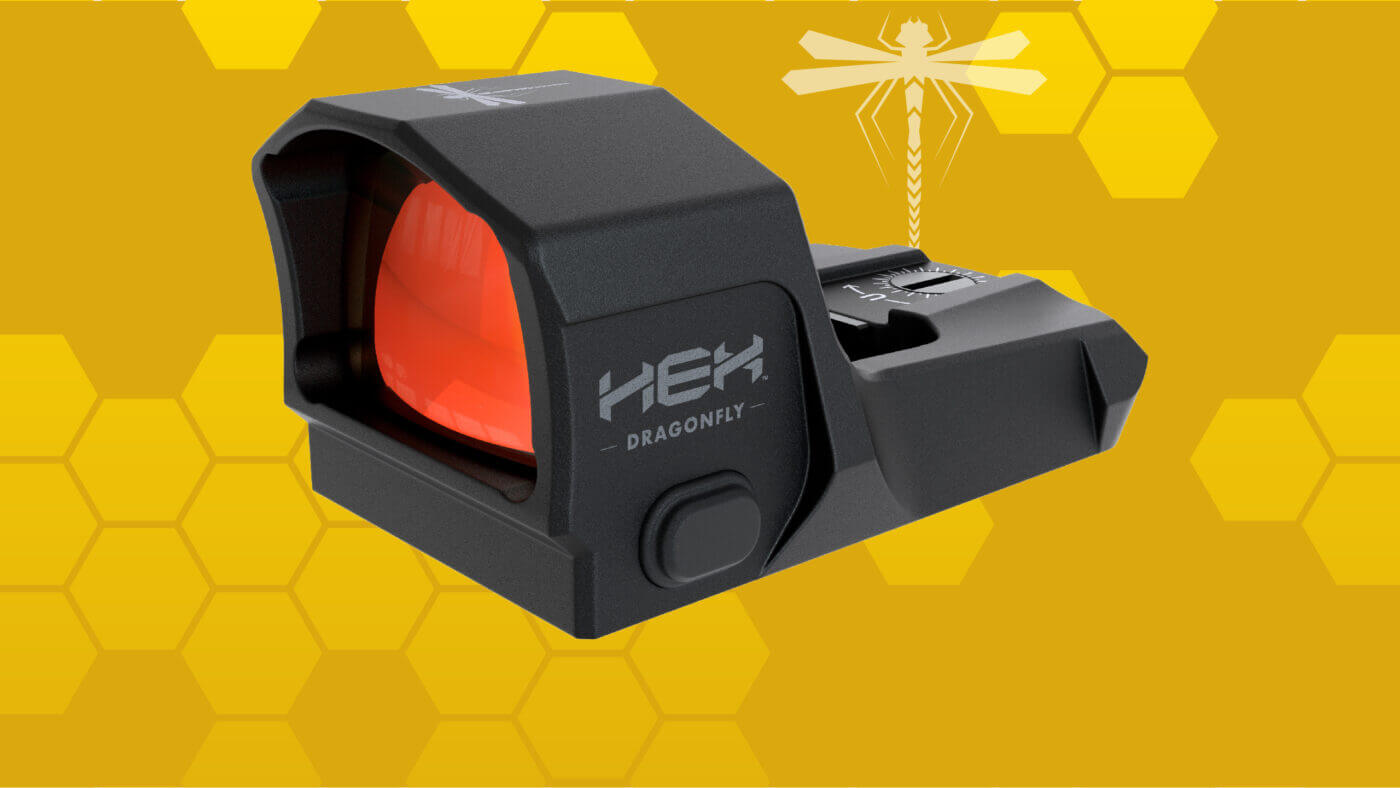
HEX Dragonfly red dot optic
The HEX Dragonfly is designed to offer premium-grade features and durability at a price that won’t break the bank.

The popularity of slide-mounted red dots isn’t just some random phenomenon. Instead, it has been based on a consistent improvement in technology and innovation over the years, as well as an understanding of the shooting issues people may face. As a result, it seems that dots are everywhere these days, and there are some very good reasons why. In this article, we are going to be looking at the Dragonfly. But first, let’s consider why you might need a red dot optic.

The Why

Regardless of the sight radius of your gun, using a red dot on your pistol can help you shoot with more precision and accuracy, especially at distance. A moderately sized dot, say around 3.5 MOA, allows you to refine your aiming point and repeatedly put rounds on a small area of the target. At the same time, you are provided with feedback on the movement of your gun by the dot on the optic’s window before you even press the trigger. That feedback generates a faster learning curve when it comes to getting hits at distance.

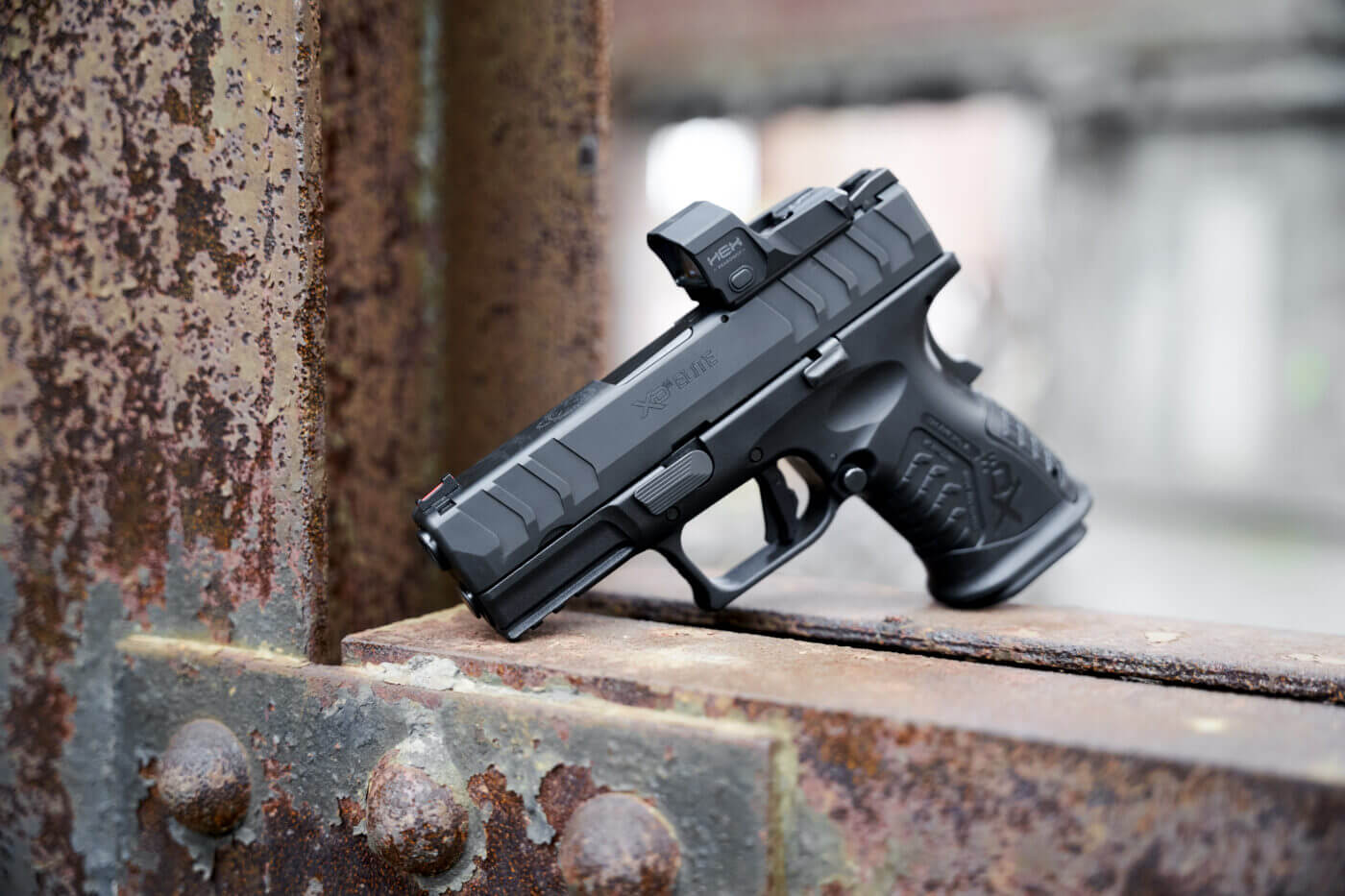
HEX Dragonfly mounted on XD-M Elite Compact pistol
The Springfield Armory XD-M Elite 3.8″ Compact OSP and the HEX Dragonfly make for a great combination.

And when it comes to getting hits, being able to use a refined aiming point is always an advantage. But, depending on lighting conditions, sometimes it can be hard to pick up your iron sights. That’s not the case with an electronic red dot optic. Red dots, especially either with manual brightness settings for fine-tuning or auto-adjusting ones that react to ambient light on their own, make it easier to aim regardless of the lighting conditions.

Another major advantage of a red dot is the ability to “target focus,” which allows you to focus on your target rather than your sights. The principle is simple enough. The sight’s emitter projects a dot onto a glass lens that’s right on top of your handgun slide. Despite the fact that the projected dot is just a couple of feet away from your eyes, your brain imagines that the dot is at the same distance as your target.

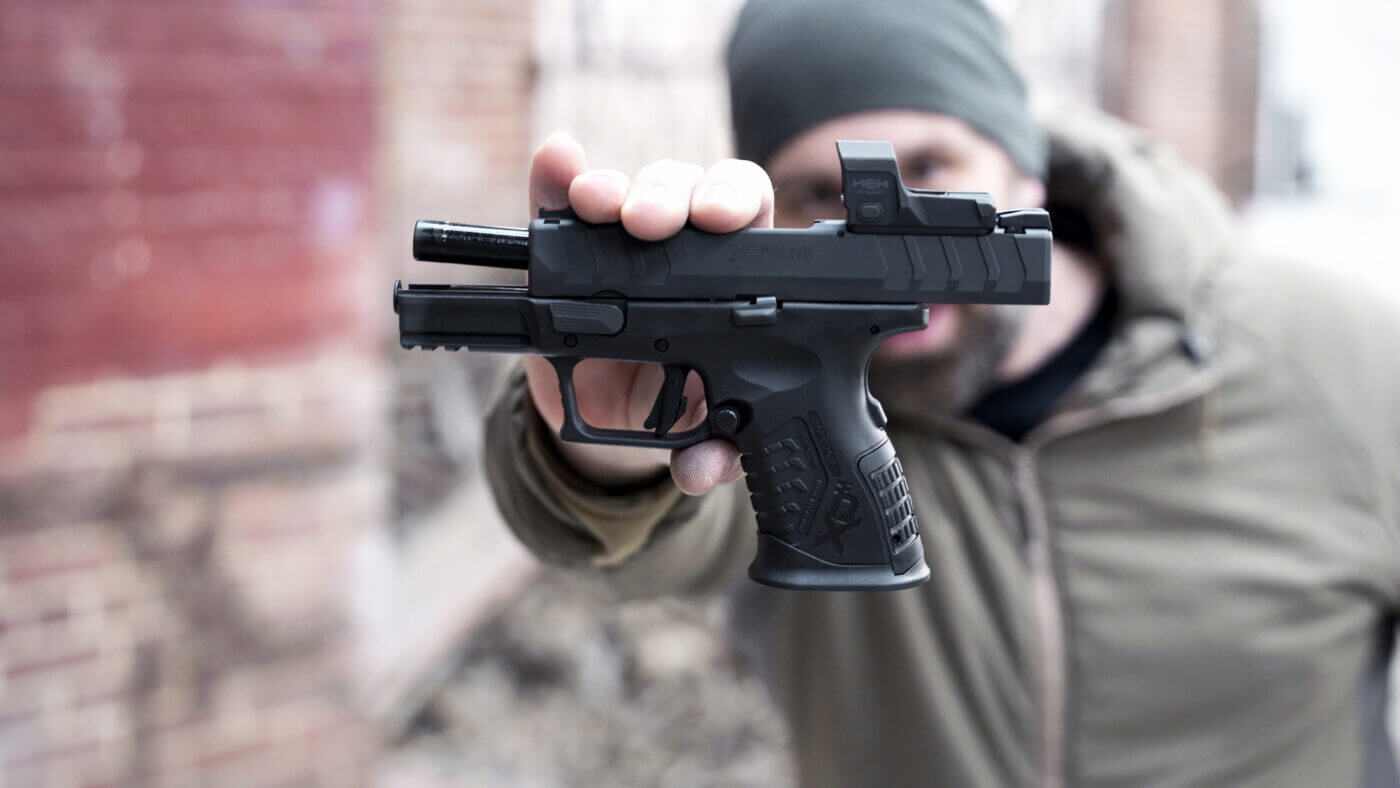
HEX Dragonfly on Springfield Armory pistol
Turning the Dragonfly on is a simple endeavor. Just press the button on the left side of the housing. The dot comes on at the lowest of eight brightness settings.

With a red dot, you never have to shift your focus from the sight to the target, or conversely from the target to the sight. Just look at your target, and the dot will be superimposed right where you need it. This applies to the red dot both on a pistol as noted, or also on a long gun.

All the Buzz?

So, let’s get back to that HEX optic I mentioned. The red dot is the HEX Dragonfly, and it’s a standard-sized red dot electronic optic designed with full-sized handguns as well as long guns in mind. Featuring the “Springfield Standard” footprint shared with the Vortex Venom and Burris FastFire, the Dragonfly is designed with durability and ease of use in mind.

HEX Dragonfly red dot optic
The windage and elevation adjustment clicks are both tactile and audible, making the zeroing process simple.

Frankly, when I think of what’s important for an optic, reliability is at the top of the list. Life and death situations require solutions that are dependable, and the Dragonfly is designed with dependability in mind. The Dragonfly features a beefy housing that is machined from 6061 T6 aluminum, and it is thick. Topped off with Hardcoat anodizing, this optic is built to withstand the abuse of recoil and a whole host of hardships. And within this rugged housing is a scratch-resistant, anti-glare-coated glass lens for the 3.5 MOA red dot. Springfield’s choice of durable materials and coatings set the stage for the duty-ready nature of the Dragonfly.

Simple Choices

When it comes to ease of use, the Dragonfly has everything you need. The red dot ships with a Picatinny mount for attaching the optic to a long gun, and as mentioned uses the Springfield Standard footprint for mounting to handgun slides. To mount onto a pistol like the XD-M Elite, you simply mount a Springfield #1 plate to the pistol along with the included sealing plate and then mount the optic. Easy. Oh, and matching up with the optic’s durability is an IPX7 waterproof rating, meaning the optic can be submerged in water up to one meter for 30 minutes.

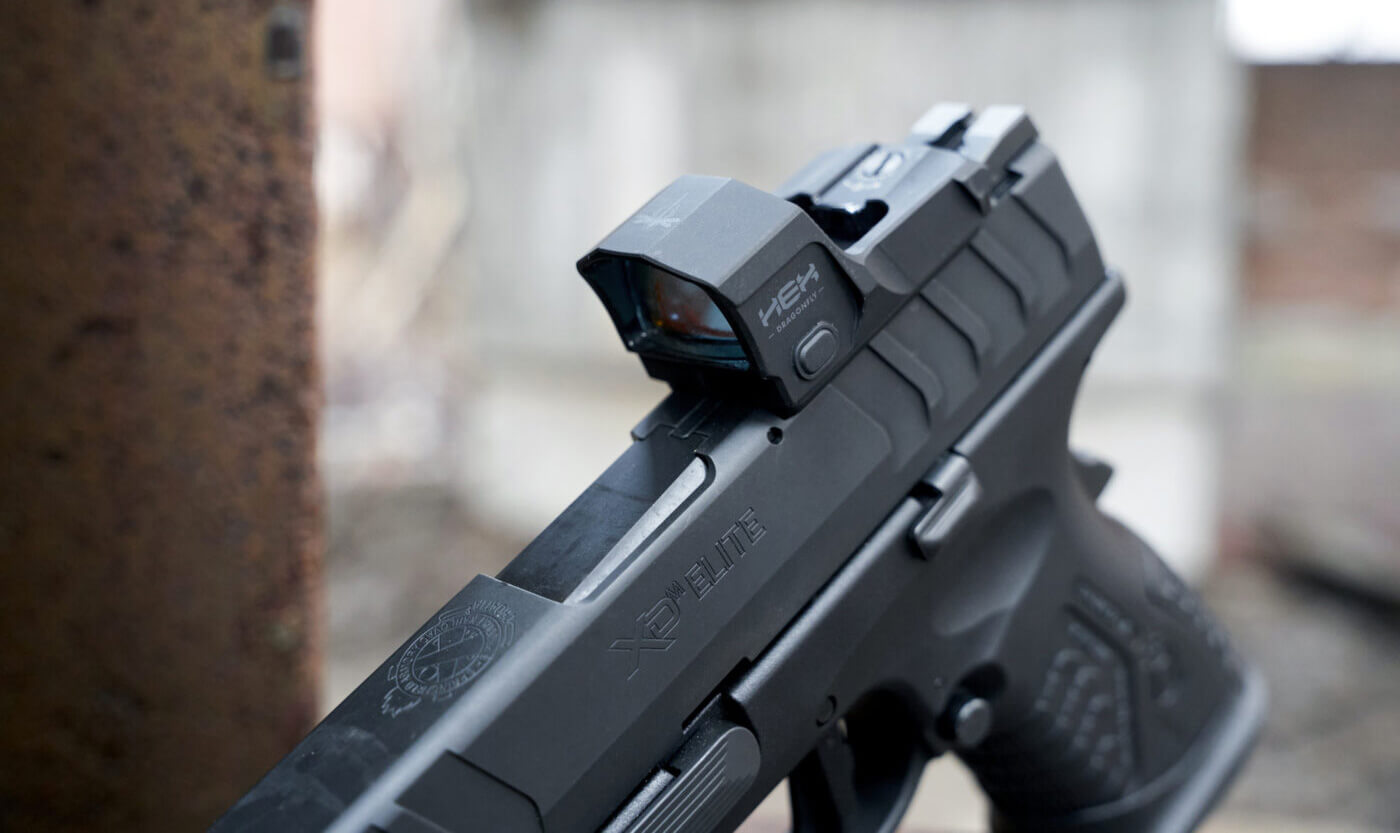
HEX Dragonfly red dot optic on a pistol
The Dragonfly’s scratch-resistant, anti-glare-coated glass lens is protected by the robust housing. A hood protrudes in front of the lens to provide protection from impacts.

When it comes to using up the Dragonfly, it’s an easy process as well. The Dragonfly depends on a single button to control the emitter. One press turns the dot on to the lowest brightness setting. Each push cycles the dot’s brightness up through the eight different settings, and one more push turns the optic off.

All the functions are on a single button. It doesn’t get any easier than that.

The Dragonfly runs off of a single, bottom-loading CR2032 button battery that is included with the red dot. It’s a common cell, easy to find at your local store, and it lasts. The single battery will run for more than 100,000 hours (or three years according to the HEX website). To improve power consumption, the optic cycles off after 16 hours. When you turn your optic on, you select the brightness level. The Dragonfly remains at the brightness you chose until you change it or the optic turns off.

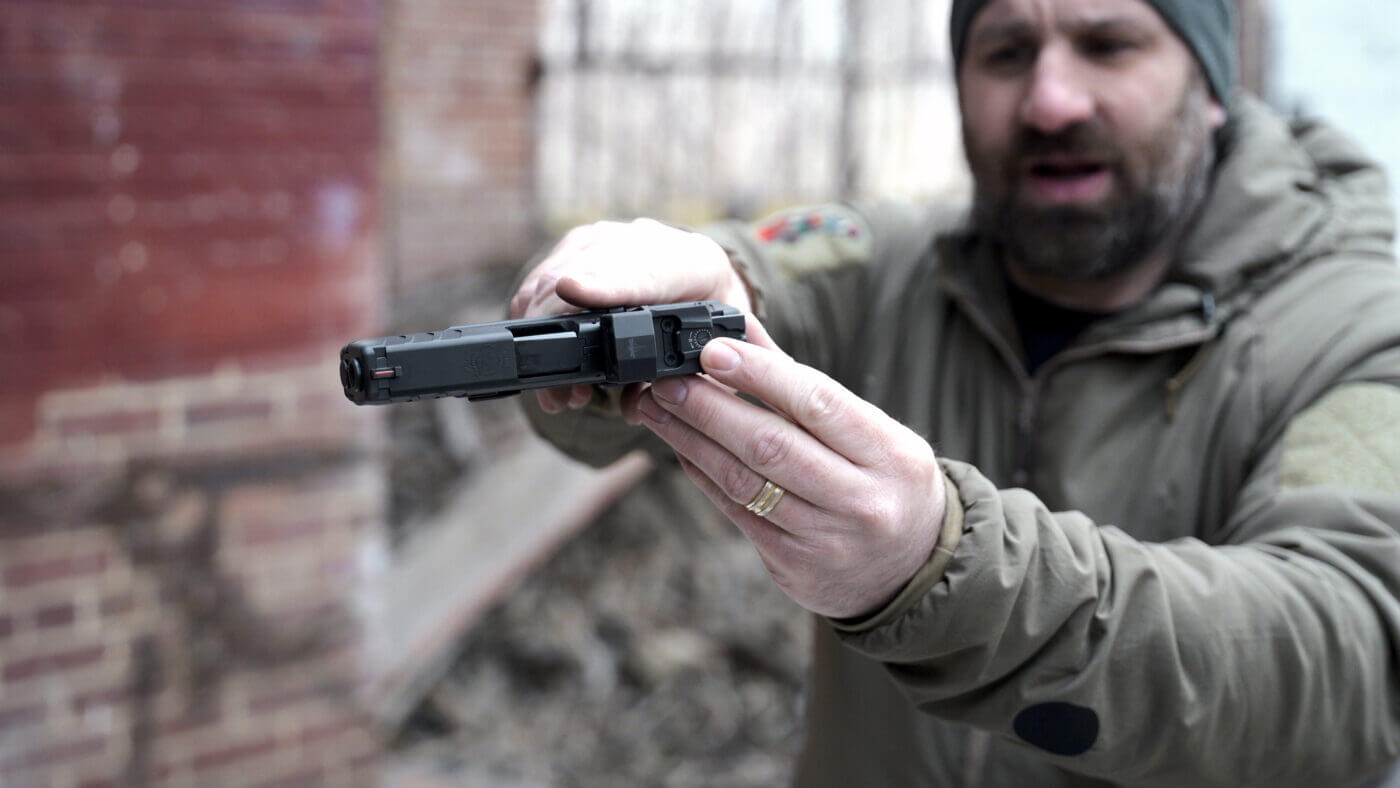
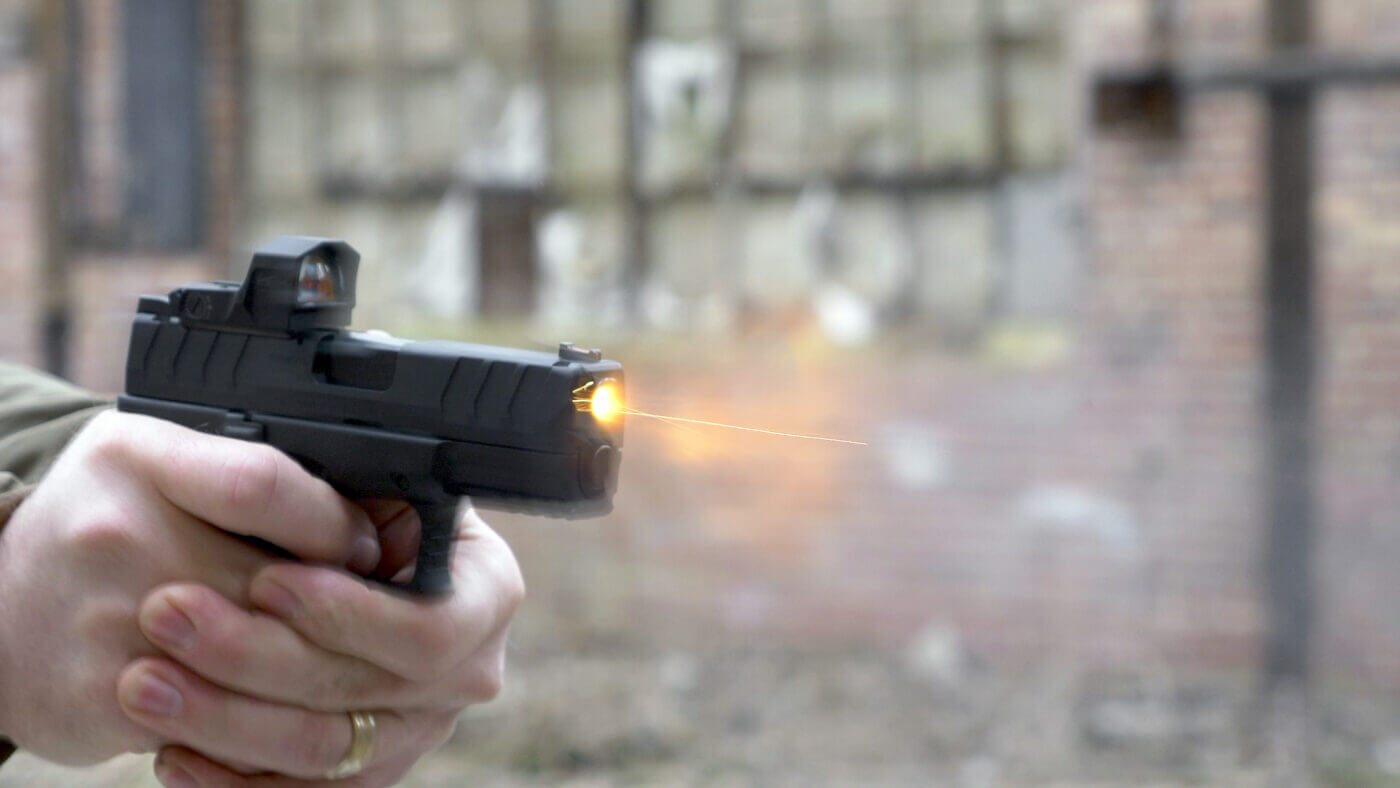
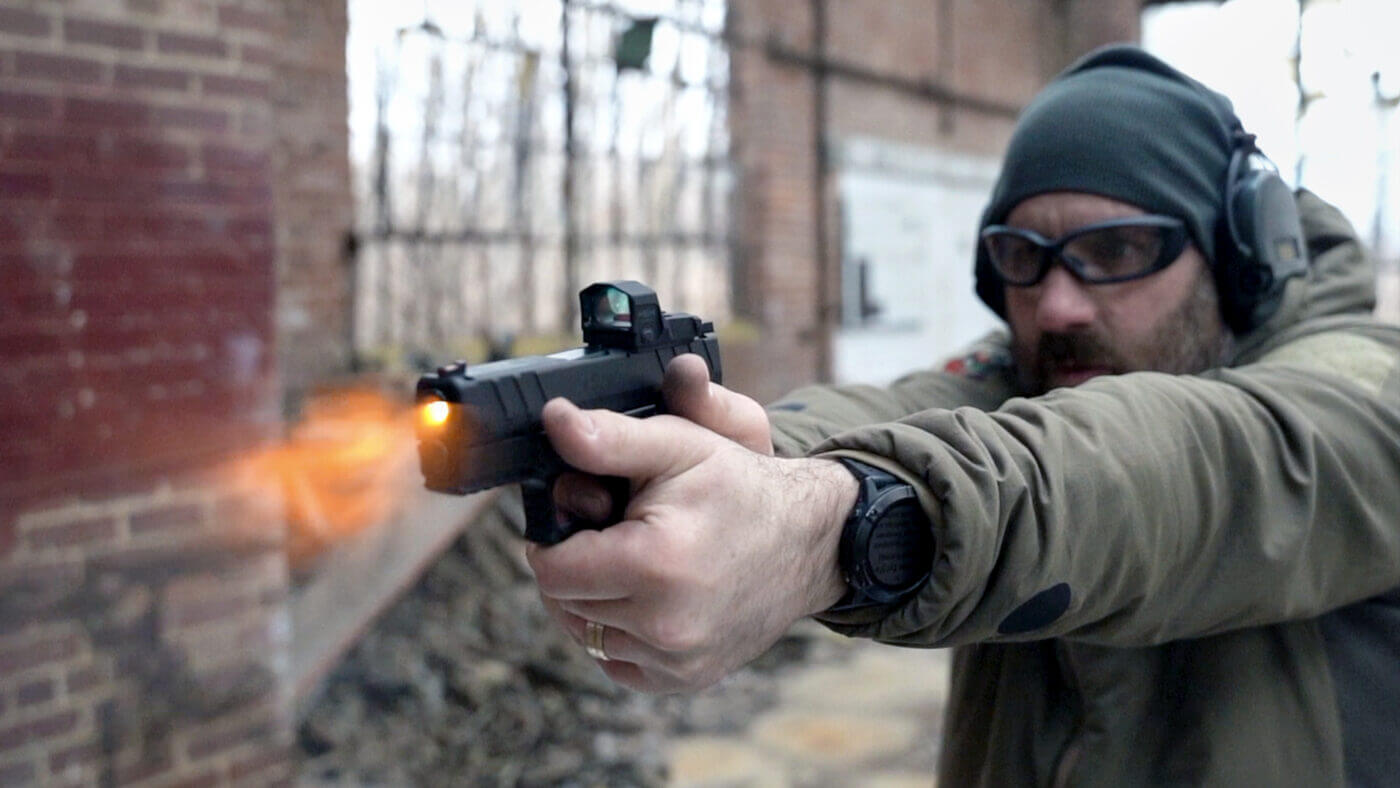
Shooting pistol with HEX Dragonfly red dot optic
The author conducted durability testing with the HEX Dragonfly. He found the red dot optic performed well with different firearms and a broad range of loads.

The Dragonfly’s housing features a hood that extends out in front of the glass lens. This serves as a shield to protect the glass from impacts and adds further protection for the lens if the optic’s face were to come into contact with anything. Finally, the rear of the housing is serrated to help reduce the glare, which helps the shooter focus on the dot.

Clearly, the HEX Dragonfly has an impressive feature set, especially when you consider that its MSRP is just $249.

HEX Dragonfly Specifications

Optic TypeDot SizeMagnificationWeightDimensionsBodyLensOperationBattery/LifeMSRP

Range Time

I had a chance to get some range time with the Dragonfly mounted on top of a Springfield Armory XD-M Elite Tactical OSP 4.5” 9mm as well as an XD-M Elite 3.8” Compact OSP 9mm, and it shot great on both. The Dragonfly was easy to track. On presentation, all it took was some intentional pressure from my pinkies, and the dot dropped into the window right where I wanted it. With each trigger press, the 3.5 MOA dot would lift and then drop right back to the point of aim.

Testing HEX Dragonfly red dot on range
The author was able to get accurate shots on target quickly using the HEX Dragonfly optic.

Regarding adjustments, that single button is really the way to go when it comes to setting the brightness. No complicated button press combinations to remember to lock the brightness in. Simply set it and forget it.

Also, the Dragonfly has plenty of adjustments when it comes to windage and elevation. The sight features 160 MOA windage and elevation adjustments. I especially like that the clicks are audible and tactile, and they can be easily made with a 9mm case. I had the Dragonfly zeroed in no time, and it has remained zeroed since. Check out Gunspot’s article on how to sight in a red dot for a quick way to sight in your optic.

Conclusion

While there are plenty of red dot sights out there from which to choose, Springfield Armory’s HEX stands out. The Dragonfly is a very reasonably priced optic, but with premium build quality and features. I have no doubt that the Dragonfly will serve you well, whether you are mounting it on a handgun or a long gun. It can handle all the hard knocks you can throw at it on the range, at the match or in the field. If you have been wondering if a red dot belongs on your gun, the HEX Dragonfly certainly deserves a look.

Editor’s Note: Be sure to check out The Armory Life Forum, where you can comment about our daily articles, as well as just talk guns and gear. Click the “Go To Forum Thread” link below to jump in!

Join the Discussion

Go to forum thread

Featured in this video

Polar Bear vs. Grizzly Bear: Who Would Win in a Fight?

0

polar bear vs grizzly bear

Yes, it’s time to answer the age-old question of who would win in a fight: the ferocious grizzly bear of sub-Arctic North America, or the hulking polar bear from the frozen tundra.

Both are formidable opponents, as they both sit on top of their respective food chain, but what if these two were to meet each other in less-than friendly circumstances?

How would their differences in stature and hunting strategies measure up? In order to answer this question, we will have to take a closer look at each animal’s individual stats.

The Weigh-In

Height

5-8’ 7-10’

Weight

400-1000 lbs 775-1,300 lbs

Paw Width

7” 12”

Claw Size

2-4” 2-4”

Bite Force

975 PSI 1200 PSI

Speed

35mph 25mph

As you can see from the table above, the polar bear has a HUGE advantage in size. Quite simply, they’re massive.

With their extreme size and weight, they are perfectly evolved to endure the harsh winters of their arctic habitats.

Polar bears do not really hibernate, because the Fall and Winter months provide the best environment for accessing food.

This is because when the ice forms, the bears have access to their main food source: the seal.

They are able to venture further out from land and hunt in the seal-rich waters.

Furthermore, their thicker fur and fat supplies make them a harder target to defeat, as teeth and claws have a much farther distance to go in order to do any damage.

While still being huge, the Grizzly is a much leaner predator.

Their size is more suited for warmer climates, thicker vegetation and faster prey.

The Grizzly does not have the same need for insulation that the polar bear does because unlike polar bears, they hibernate during the cold months.

Oppositely to their arctic cousins, Winter is a lean season for the Grizzly, as migratory animals move south and food becomes scarce.

Paws and Claws

In order to support their great size, their paws need to be huge as well.

Also, their broad size gives them much needed traction as they traverse snow drifts.

Their paws also make them incredibly adept swimmers, as they work like flippers and help propel them to hunt aquatic prey.

Claws, on the other hand (pun intended), the Grizzly might see a slight advantage.

While being roughly the same size, the Grizzly’s claw is built for digging and doing damage to any opponent it might face in the wild.

The polar bear’s claw is more built for giving traction in the snow, and for taking hold of seals, which make up most of its diet.

Much like the polar bear, seals have large fat reserves to insulate them from arctic climates. Because of this, polar bears’ claws must be good at grabbing hold of them so they can then eat them.

A sharper, more slender claw might eviscerate their prey’s flesh, but cause them to lose it in the ocean in the process.

As far as paw size, the polar bear has the advantage.

Mouth and Bite Force

Not only is their mouth much larger, but their teeth are more designed for delivering the fatal blow than the Grizzly’s.

As mentioned before, grizzly bear’s claws are the most powerful weapons in its arsenal.

As the Grizzly’s diet is more varied, it has more rounded molars than the polar bear.

This helps the Grizzly grind down vegetal food in the absence of live prey.

Now, let’s talk about bite pressure.

Measuring at 1200 PSI, there are only a few animals on earth that have a greater bite force than that of the polar bear (the top of the list being the saltwater crocodile).

Not to say the grizzly bear’s bite is weak, as it certainly is not. At 975 PSI, it is only a few spots down from the polar bear in ranking.

But what do these numbers mean?

In more practical terms, these animals can easily bite through a cast iron pan, a cinder block or even a bowling ball. Imagine what it would do to you!

The polar bear has the advantage when it comes to mouth and bite force

Head Games

On the topic of robustness of skulls, this one goes to the Grizzly.

Their heads are built like a battering ram with incredibly thick bone all around.

In fact, their skulls have been known to deflect rifle bullets.

They are built for fighting and raw aggression.

Polar bears have much more slender skulls in comparison.

This makes them more streamline in the water, making them stronger swimmers, but more vulnerable to trauma in the head region.

Even with the polar bear’s stronger bite force, if a fight were to be decided by a head chomp, it might go in the favor of the Grizzly.

Speed

If the fight comes down to a chase, or they decide to settle the squabble peacefully with a good old fashioned woodland foot race, the grizzly would once again have the advantage.

A common misconception with grizzly bears is that they’re big and slow. In fact, they are big and fast, clocking in at 35mph!

That means a bear could run the entire 360 foot length of a football field in 7 seconds!

It’s huge paws and streamline body make a swimmer of Phelpsian proportions.

If the race is a swim-off, than the polar bear is going to edge out the competition.

Agression

Both are incredibly aggressive creatures and would have no problem with defending themselves if provoked.

There have been more accounts of humans being attacked by grizzly bears, but that is mostly due to the population density in which they live.

However, polar bears alone claim a very impressive title: they are the only species on earth that considers humans food.

While other animals are known to attack, kill and eat humans, this is usually due to provocation.

Polar bears see humans as a viable food source and will stalk and hunt people as a means to survive in the barren arctic.

I’m calling this one a draw.

Intelligence

The polar bear is widely regarded as one of the planet’s most intelligent hunters.

Their ability to stalk prey over long distances and outsmart and outmaneuver makes them absolute master tacticians.

Seeing as how they often use their wits to prey on humans speaks volumes to their prowess.

If our Ursidae melee involves some level of hide and seek, the decision would go to the polar bear.

Strengths & Weaknesses

Both animals are evolutionary masterpieces and are perfectly equipped to reign supreme in their respective habitats.

This means that their strengths may prove to be weaknesses if transplanted into a different environment. And vice versa.

For example, the polar bear has incredibly dense fur and heavy fat reserves. It is perfectly suited for life in the arctic.

However, if you were to bring a polar bear into a sub arctic summer, it would tire easily and need to cool down before long.

They are bears from very different environments, which makes it difficult to parse out strengths and weaknesses.

Final Verdict

If we were to somehow create a neutral arena, one that plays to neither the polar or the grizzly bear’s advantages, we would have a very even fight, despite the size difference.

If it came to a close-quarters brawl, the polar bear might have an advantage.

While not possessing the sharp claws of the grizzly, its huge paws and strength could deal a fatal blow to the smaller opponent.

It’s thick coat and skin would help shield against any minor lashes from the grizzly.

If the polar bear gets close enough to use its powerful jaws, it might be a done deal.

However, if the grizzly bear can get a bit of distance, its speed could prove to be a huge advantage.

Quicker and more mobile than the hulking polar bear, it could dip in for quick strikes and tire it out.

If we’re not talking about an all-out brawl, this could all change.

As mentioned before, polar bears are master hunters and swimmers.

If this fight were to happen in an uncontrolled environment with each animal’s location being unknown, the polar bear would edge out the grizzly bear.

In real life?

There have been no recorded instances of a grizzly fighting a polar bear, but over the last decade there have been sightings of either encroaching on the other’s territory.

As climate change continues to thaw the polar ice drifts, grizzlies have been seen venturing further into polar bear territory.

While this may pique the interests of those wanting a battle royale between these two juggernauts, it almost certainly spells disaster for the future of their kind.

As human’s impact on the earth’s environment continues to worsen, these habitats are being destroyed and food sources are being depleted.

So, if you ever witness a grizzly fighting a polar bear, it’s not a great sign.

Final Thoughts

On the topic of who would win this battle, I have to defer to environmental variables.

Both are perfectly in tune with their habitat and will surely be victorious if this fight happens on home turf.

Nature always proves to be more complex, and less generous with easy answers than we hope, but can keep thinking about it all the same.

220 Hunting Dog Names with Meanings

0

Have you adopted a hunting dog breed? As with all types of dogs, selecting the perfect name for your an exciting, albeit slightly daunting task. Whether you want to honor your dog’s breed heritage or you plan to train your dog as a loyal hunting companion, search through our list of hunting dog names for one you can call out in tranquil dawns or whisper in hushed woods.

Hunting dogs have been man’s faithful companion for millennia, and their names often carry weighty legacies, inspired by mythology, hunting terminology, renowned hunters, and nature itself. So whether you’re a fan of traditional names like ‘Ranger’ and ‘Hunter’, or seeking more unique names like ‘Artemis’ or ‘Oakley’, we have you covered.

Hunting Dog Names with photo of puppy

Female Hunting Dog Names

  • Aella: In Greek mythology, Aella was an Amazon warrior known for her swiftness. It means ‘whirlwind’.
  • Artemis: Greek goddess of the hunt and wild animals.
  • Atalanta: A Greek heroine, famous for her swift foot and hunting skills.
  • Bellona: Roman goddess of war.
  • Britta: A Swedish name meaning ‘strength’ and ‘exalted one’.
  • Calypso: Means ‘she that conceals’, from the nymph who was skilled at hunting in Greek mythology.
  • Ceridwen: Welsh goddess of rebirth, transformation, and inspiration.
  • Chase: An English word for ‘hunt’, it also makes a great dog name.
  • Cleo/Clio: One of the muses in Greek mythology who inspires heroic pursuits.
  • Diana: Roman goddess of the hunt and moon.
  • Echo: A nymph from Greek mythology, known for repeating voice.
  • Freyja: Norse goddess of love, beauty, and war.
  • Gaia: The ancestral mother of all life in Greek mythology.
  • Harper: Old English name for someone who plays the harp, but it can also signify a hunting horn.
  • Huntress: The female form of ‘hunter’.
  • Juno: Roman goddess who was a protector of the state and women.
  • Kali: Hindu goddess of destruction, time, and doomsday.
  • Kira: Means ‘ruler’ or ‘leader’ in Russian.
  • Luna: Means ‘moon’ in Latin, the celestial body often associated with night hunts.
  • Minerva: Roman goddess of wisdom and strategic warfare.
  • Misty: This name can signify the mysteriousness of forests during hunts.
  • Nyx: Greek goddess of the night, a strong name for a hunting dog.
  • Oakley: For Annie Oakley, the Wild West sharpshooter. (Did you know that Annie Oakley met her future husband in a shooting match with him? He traveled with a dog named George. Annie was quickly smitten with George so her soon-to-be fiance courted her by sending her cards “signed” by George.)
  • Odessa: Means ‘long journey’ which can be symbolic of long hunting expeditions.
  • Pandora: Means ‘all gifted’ in Greek, from the myth of the first human woman created by the gods.
  • Puma: After the large, stealthy cat that is an excellent huntress.
  • Raven: Inspired by the intelligent bird often associated with hunting magic in various cultures.
  • Rhea: A Greek Titaness, mother of gods, and skilled in many ways.
  • Ripley: A character from the “Alien” series, known for her toughness and survival skills.
  • Rover: A traditional name for a dog who loves to explore or rove.
  • Saga: Norse goddess of history and storytelling, a fitting name for a dog that will share many hunting tales.
  • Scout: Ideal for a dog who’s good at finding game.
  • Shadow: A great name for a dog who’s a silent follower during hunts.
  • Skadi: The Norse goddess of bowhunting, winter, mountains, and skiing.
  • Sphinx: A mythical creature with the body of a lion and the head of a human, known for her cunning.
  • Storm: For a dog with a wild spirit, like the untamed weather.
  • Terra: Means ‘earth’ in Latin, a grounding name for a hunting dog.
  • Tracker: Directly related to the hunting ability of dogs.
  • Truffle: A fitting name for dogs used for finding truffles, a type of fungi that’s a culinary delicacy.
  • Valkyrie: In Norse mythology, they are female figures who choose who lives and dies in battle.
  • Wilder: English origin, this name signifies someone who’s wild and free.

Male Hunting Dog Names

Archer: English name for Bowman
  • Ajax: In Greek mythology, Ajax was a brave and powerful warrior.
  • Apollo: The Greek god of music, poetry, and light.
  • Archer: This English name stands for ‘bowman’, an excellent choice for a hunting dog.
  • Artemis: Although traditionally a female name (the Greek goddess of the hunt), it can also work well for a male hunting dog.
  • Atlas: A Titan in Greek mythology known for his strength and endurance, he was condemned to hold up the sky for eternity.
  • Beowulf: The protagonist of an Old English epic poem, known for his bravery and strength.
  • Blaze: Represents a trail or a fast-moving fire, perfect for a swift hunting dog.
  • Chase: English origin, this name symbolizes a hunter’s pursuit.
  • Falcon: A bird of prey known for its incredible hunting skills.
  • Fletcher: An English name that means ‘arrow-maker’.
  • Gunner: A strong name of Scandinavian origin that means ‘bold warrior’.
  • Hawkeye: Denotes sharp vision, like the Marvel superhero who’s an expert archer.
  • Hunter: An obvious choice, this English name is self-explanatory and popular.
Jager: German for hunter
  • Jäger: The German word for ‘hunter.
  • Leopard: Named after the big cat known for its hunting skills and agility.
  • Orion: A Greek mythological hunter, who was placed among the stars as the constellation of Orion.
  • Ranger: Means ‘forest guardian’ in French, fitting for a hunting dog.
  • Rex: Latin for ‘king’, it signifies a dog that rules the hunting ground.
  • Scout: Someone who gathers information stealthily, this name is fitting for a hunting dog with a keen sense of smell and tracking skills.
  • Spartan: Referring to the ancient Greek warriors known for their discipline and bravery.
  • Tracker: An English name that directly relates to the tracking ability of hunting dogs.
  • Wolf: Named after the wild canine known for its hunting skills in packs.

Bird Dog Names

Are you adopting a bird dog? Our previous dog Irie was a German Shorthaired Pointer mix who loved nothing better than long walks in the woods. Here’s a look at some good bird dog names both related to appearance and inspired by their breed heritage.

Bird Dog Names Related to Appearance

  • Brindle: This term is used to describe a coat color pattern on dogs that appears somewhat similar to a speckled pattern.
  • Camo: Short for ‘camouflage’, which can often appear as a speckled pattern.
  • Cheetah: This big cat has a beautiful, spotted coat.
  • Confetti: This name could reflect a coat that looks like it has small pieces of different colored spots.
  • Dot: A simple and cute name for a speckled dog.
  • Dotty: A fun, affectionate take on ‘Dot’.
  • Freckles: An adorable name for a dog with a speckled coat.
  • Galaxy: Like the night sky filled with stars.
  • Leopard: Named after the big cat with a famously spotted coat.
  • Marble: Like the stone that often has a ‘speckled’ appearance.
  • Mosaic: Referring to the art form using small pieces to create a whole.
  • Mottle: A term that means to mark with spots or smears of color.
  • Oreo: Like the cookie, black and white.
  • Pebbles: For a coat that resembles the varying colors of pebbles.
  • Pepper: Ideal for a dog with black or grey spots.
  • Pinto: A Spanish word meaning ‘painted’ or ‘spotted’, used to describe horses with coat colors that include large patches of white.
  • Pixel: A cute, modern name for a dog with a coat that looks pixelated with different colors.
  • Polka: As in polka dots.
  • Pongo: From the Dalmatian character in 101 Dalmatians.
  • Smudge: A spot or blot, perfect for a dog with a speckled coat.
  • Speckle: Directly refers to the small spots or patches of color.
  • Splatter: A pattern created when a liquid splashes over a surface – a unique name for a speckled dog.
  • Sprinkle: Just like sprinkles on a cupcake, your dog’s speckles might remind you of this.
  • Splotch: A blot or a spot of color.
  • Spot: An obvious but classic choice for a speckled dog.
  • Starry: If your dog’s coat reminds you of a starry night sky.
  • Sundae: Like the dessert topped with a mix of different toppings.

Bird Dog Names Related to Birds

Whether you plant to hunt with your bird dog-or getting out and enjoying nature with your bird dog breed, here’s a list of potential names tied to birds, speed and the outdoors.

  • Aero: Greek for ‘air’, perfect for a dog that is as light and swift as the air.
  • Avian: Means ‘relating to birds’.
  • Breeze: Ideal for a fast and nimble bird dog.
  • Comet: For your swift and unstoppable hunting companion.
  • Dove: Named after the bird, symbolizing peace and harmony.
  • Eagle: A strong, noble bird that’s a skilled hunter.
  • Feather: Symbolic of the bird-like lightness and agility of your dog.
  • Flight: Represents the action of flying, usually referred to birds.
  • Gale: A very strong wind, representing speed and power.
  • Harrier: A type of bird of prey, also a breed of hound dogs.
  • Hawk: Named after the bird of prey known for its keen vision and speed.
  • Jet: Signifying speed and agility.
  • Kestrel: A bird of prey known for its hunting abilities.
  • Lark: A small, often singing bird, for your cheerful companion.
  • Merlin: A species of falcon, also the name of a legendary wizard.
  • Nimbus: Latin for ‘cloud’, signifying lightness and speed.
  • Osprey: A fish-eating bird of prey.
  • Peregrine: Named after the fastest bird in the world.
  • Raven: A bird known for its intelligence and adaptability.
  • Robin: After the bird species, for a friendly and sociable dog.
  • Skye: A name inspired by the wide open sky where birds dwell.
  • Sparrow: Named after the small, agile bird.
  • Swift: As the name implies, it represents swiftness. It’s also a type of bird.
  • Talon: The sharp claws of a bird of prey.
  • Wing: Symbolic of the bird-like agility and grace of your dog.
  • Zephyr: A gentle breeze, perfect for a swift and quiet bird dog.

Duck Dog Names

These names are all related to ducks and their environment. They could be ideal for a hunting dog bred to retrieve waterfowl, such as a Labrador Retriever, Chesapeake Bay Retriever, or a Golden Retriever.

  • Anas: From the Latin word for ‘duck’.
  • Aqua: Latin for ‘water’, where ducks often dwell.
  • Bayou: A slow-moving creek or a swampy section of a lake or river.
  • Brook: A small stream where you might find ducks.
  • Caddis: Named after the aquatic insect, a common food for ducks.
  • Canvas: Short for Canvasback, a type of duck.
  • Creek: A small stream, an environment frequented by ducks.
  • Decoy: The replica used to attract ducks during hunting.
  • Diver: Many duck species dive for their food.
  • Drake: The term for a male duck.
  • Eider: A type of duck found in the colder parts of the Northern Hemisphere.
  • Fin: As ducks are aquatic birds, this name relates to water and swimming.
  • Flapper: Referring to the flapping sound a duck’s wings make.
  • Flyway: The migration routes used by ducks.
  • Gadwall: A type of duck common in North America.
  • Lagoon: A shallow body of water separated from a larger body of water (like a sea) by barrier islands, sandbars, or coral reefs.
  • Marsh: A type of wetland, a common habitat for ducks.
  • Merganser: A type of diving duck.
  • Migrate: Referring to the migratory nature of many duck species.
  • Pintail: A type of duck known for its distinctive tail feathers.
  • Quack: The characteristic sound a duck makes.
  • Reed: A type of tall, slender grass that often grows in wetlands where ducks live.
  • Ripple: Named for the small waves ducks create when they swim.
  • River: Many ducks are river-dwelling.
  • Scaup: A type of diving duck.
  • Shoveler: A type of duck named for its unique, shovel-like beak.
  • Splash: Named for the sound a duck makes when it lands in the water.
  • Teal: A small, fast-flying type of duck.
  • Webber: For the webbed feet that make ducks such efficient swimmers.
  • Widgeon: A type of dabbling duck.

Pheasant Hunting Names for Dogs

  • Autumn: Pheasant hunting season often takes place in the fall.
  • Blaze: Referring to the bright, fiery colors of a pheasant.
  • Bramble: These are often found in the habitats where pheasants live.
  • Brush: Named after the type of vegetation where pheasants are often found.
  • Buster: A name that signifies breaking through the brush to flush out pheasants.
  • Copper: For the beautiful, copper-colored plumage of some pheasants.
  • Cornfield: A place where pheasants often hide.
  • Covey: A term for a small flock of birds, including pheasants.
  • Flush: This term refers to the action of startling birds into flight.
  • Forest: Pheasants can often be found in forested areas.
  • Golden: For the golden color found on many pheasants.
  • Grassland: A type of terrain where pheasants often live.
  • Harvest: The term can refer to the hunting season.
  • Hedgerow: A place where pheasants often hide.
  • Meadow: Refers to the open fields where pheasants can be found.
  • Quill: A term for a bird’s feather.
  • Rooster: A term for a male pheasant.
  • Rustic: Refers to the countryside where pheasant hunting often takes place.
  • Sage: For the sagebrush landscapes where some pheasant species are found.
  • Setter: A type of gundog used for hunting game birds.
  • Thicket: A dense group of bushes or trees where pheasants often hide.
  • Timber: Refers to wooded areas where pheasants might be found.
  • Upland: Referring to upland bird hunting, which includes pheasants.
  • Whistle: Named for the unique sound many pheasants make.
  • Wilderness: Representing the wild areas where pheasants live.
  • Woodland: A term for forested areas, part of the natural habitat of pheasants.

When picking a name for your pheasant hunting dog, consider these options that represent the environment, the quarry, and the experience of the hunt. Ultimately, choose a name that fits your dog’s personality and the role they play in your hunting outings.

Famous Hunting Dog Names

  • Bang Away: Boxer, Westminster Best in Show winner in 1951.
  • Belle: from the novel Big Red by Jim Kjelgaard.
  • Blue: Coonhound, from the book Where the Red Fern Grows by Wilson Rawls.
  • Bran: Irish Wolfhound, owned by the legendary Celtic hero Fionn mac Cumhaill.
  • Buck: from Jack London’s novel The Call of the Wild.
  • Bullet: Roy Rogers’ trusty companion on his TV show.
  • Chief: from the movie The Fox and the Hound.
  • Copper: also from The Fox and the Hound.
  • Duke: Bloodhound, from the television series The Beverly Hillbillies.
  • Gelert: Legendary Welsh hunting dog.
  • Luath: Labrador Retriever, from the movie The Incredible Journey.
  • Marley: Labrador Retriever, from the book and movie Marley & Me.
  • Old Dan: Redbone Coonhound, from Where the Red Fern Grows.
  • Rin Tin Tin: German Shepherd, a famous movie star in the 1920s and 30s.
  • Snoopy: Beagle, from the comic strip Peanuts by Charles M. Schulz.
  • Sounder: Coonhound, from the novel Sounder by William H. Armstrong.

Gun Names for Dogs

  • Beretta: A famous Italian firearm manufacturer.
  • Blaser: A German firearm manufacturer known for its high-quality hunting guns.
  • Bolt: Referring to the bolt action of some types of firearms.
  • Browning: Named after John Browning, the famous American firearms designer.
  • Bullet: Projectile fired by a majority of firearms.
  • Caliber: A term used in firearm measurements.
  • Carbine: A short-barreled rifle.
  • Colt: A renowned American firearms manufacturer.
  • Flintlock: An older type of firearm ignition system.
  • Gauge: A term used to measure the bore size of shotguns.
  • Gunmetal: a fitting name for a gray dog.
  • Hammer: External component of a gun’s firing system.
  • Henry: An American firearms manufacturer.
  • Kimber: A company that produces a wide variety of firearms.
  • Magnum: A term often used to describe a powerful gun or large caliber.
  • Mauser: A German arms manufacturer.
  • Musket: An old-style gun that was loaded from the muzzle.
  • Powder: Explosive mixture used to propel a bullet.
  • Remington: For the American company Remington Arms originally founded in 1816.
  • Ruger: An American company known for its rifles, shotguns, and pistols.
  • Savage: An American company known for producing firearms for hunting.
  • Scope: Telescopic sight used on many hunting rifles.
  • Shell: Brass casing containing primer, powder and a projectile bullet.
  • Trigger: Firing mechanism on a hunting firearm.
  • Winchester: American firearms manufactured by the Winchester Repeating Arms Company.

More Dog Name Posts You Might Like

113 Werewolf Names for Dogs Sure to Make You Howl

110+ Star Names for Dogs: Celestial Names for Your Stellar Pup

Football Dog Names 🏈 for Your New Teammate!

Pin it to remember

Hunting Dog Names for Hunting Breeds and Sporting Dogs

What is ZipStitch? The do-it-yourself device for closing wounds quickly wherever you are

0

ZipLine Medical says anyone can use its ZipStitch device for wound closure, and it doesn’t need to be prescribed by a doctor

zipstitch

ZipStitch says its device is 12-times stronger than regular stitches and results in reduced scarring (Credit: YouTube/ZipStitch)

There’s an emphasis in many industries on easy-to-use, cheap alternatives to established products — and healthcare is certainly one of them. Jamie Bell takes a look at ZipStitch — a hospital-grade wound closure device that anyone can use to treat small cuts in seconds.

Whether it’s at home chopping vegetables, playing sports with friends, or cycling to work, minor cuts and flesh wounds can happen just about anywhere in day-to-day life.

Bigger, deeper wounds will often require a trip to the emergency room, and ultimately stitches — a painful, invasive procedure.

In the US, getting stitches is also expensive for anyone without health insurance. Cost range from $200 to as much as $3,000 in some cases.

However, any medium-sized or smaller cut is usually treated outside the healthcare setting using an adhesive bandage or plaster.

While these dressings can stop a small amount of bleeding — and protect against infection — they do little to close the wound and speed up the healing process.

US tissue-repair device company ZipLine Medical has developed a tool called ZipStitch, which combines the convenience of a plaster with many of the benefits provided by having a cut stitched by a doctor.

ZipStitch: The do-it-yourself wound closure device

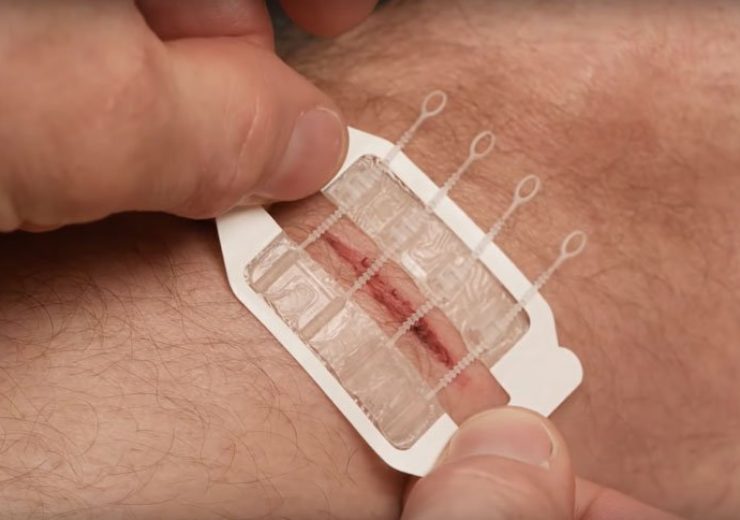
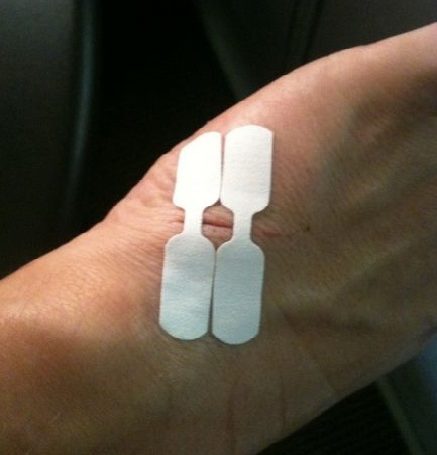
ZipStitch is a small, adhesive device that is designed to be placed over cuts less than 4mm in width.

Once it is stuck down, the user simply pulls each of the four miniature straps on the device, tightening them and closing the break in the skin.

Because it is so small and light, ZipLine Medical believes its product is ideal for everyday first-aid kits, and can be useful for someone to have with them during a range of outdoor activities where minor injuries can often occur, including cycling, hiking or camping.

The company warns, however, that the wound must be cleaned properly and allowed to dry before application.

Not only does this reduce the risk of infection, but it ensures the device will stick to the skin and remain in place.

It is sold online for $29.99 as part of a pack including gauze pads to stop bleeding, alcohol wipes to clean wounds, and bandage to cover and protect the cut once ZipStitch has been applied.

The device is supposedly 12-times stronger than regular stitches and results in reduced scarring.

Although it can only be used to close wounds up to 1.5 inches in length. ZipLine Medical recommends seeking stitches in hospital to close larger cuts.

Unlike conventional sutures, ZipStitch is also non-invasive, which can reduce the chances of bacteria causing infection.

The company says it provides better protection than butterfly bandages and other adhesive plasters, repairing cuts faster and decreasing the likelihood of scarring.

Hospital-grade Zip technology

The device uses ZipLine Medical’s own Zip technology, which has been used by more than 500,000 people in the past five years, and by hospitals in 30 countries.

The California-based company says it delivers faster and less painful wound closure than established methods such as stitches or staples — with 95% of its patients saying they prefer Zip technology to these treatments.

Having proven to be safe and effective in several clinical trials, it gained FDA approval in 2017.

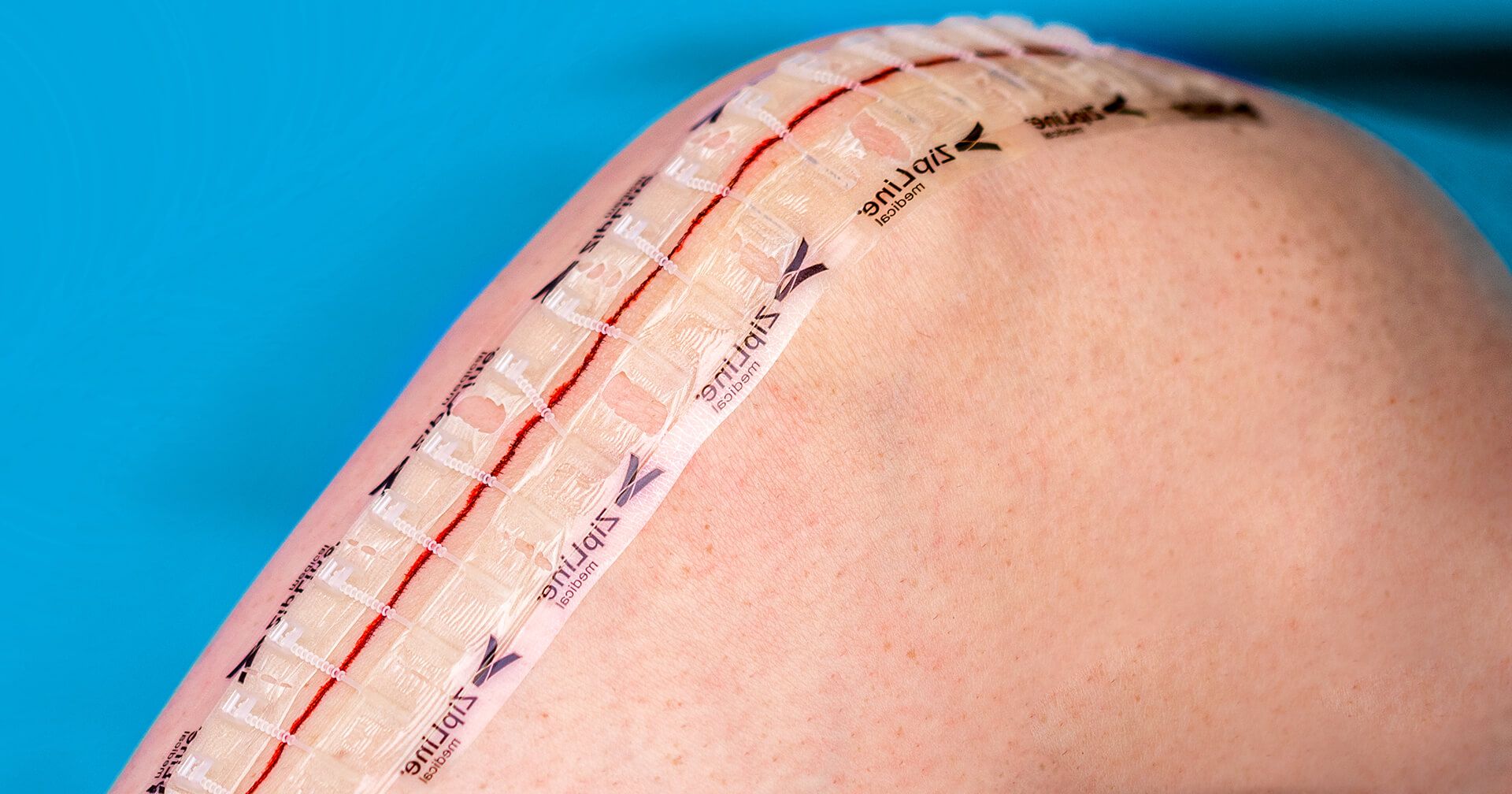
As well as treating minor, everyday injuries, Zip technology has been used to close wounds left by operations including knee and shoulder replacements — which, the company says, has resulted in reduced scarring compared with conventional stitches.

When used to close wounds following these procedures, a longer strip of the ZipStitch device is used to precisely align the edges of the incision.

zipstitch wound closure device
Zip technology used to close an incision following knee surgery (Credit: ZipLine Medical)

The Zip structure also functions as a cage to offer extra protection from anything that might cause pain or reopen the cut.

Removing the ZipStitch can be done at home by the patient in some cases, and ZipLine Medical says this is as simple as pulling off a Band-Aid.

It is also less painful than removing stitches or staples, and leaves no holes in the skin.

As well as benefits for patients, the company claims the speed at which ZipStitch works can decrease healthcare costs and improve efficiency of patient care by reducing the number of follow-up appointments.

How ZipStitch compares to butterfly bandages and other wound closure devices

The main alternative to ZipStitch is the butterfly bandage — an adhesive strip designed to close small wounds by pulling the skin together.

These outperform ordinary plasters and are also small and light.

However, butterfly bandages cover a much smaller area than the ZipStitch device, meaning only cuts that are very short in length can be closed effectively.

There are several other methods for closing wounds without traditional stitches — German healthcare company McKesson uses a series of adhesive strips to do this.

zipstitch wound closure device
Butterfly bandages can be applied easily, and do not involve puncturing the skin (Credit: Drew Stephens)

Clozex Medical has developed a wound closure device that comes in several different lengths to treat a variety of cut sizes, and to cope with curvatures and raised areas on the skin.

Skin glue or “liquid stitches” can also be used to non-invasively hold the edges of a cut together. It can also be applied in addition to other wound closure methods like traditional stitches or adhesive bandages.

These other products are not do-it-yourself solutions, and require a healthcare professional to administer them.

B&C World's Record – Non-typical Sitka Blacktail

0

In 1987, at 4 a.m. on a foggy August morning in southeast Alaska, William B. Steele had a decision to make: continue driving for 20 miles on gravel roads to reach his Sitka blacktail deer hunting area, or turn around? He’d chosen a large unnamed mountain to hunt, but the closer he got, the thicker the fog became.

When he reached the mountain he decided to hunt. But the weather was so bad, he almost turned around several times during a mile-long hike to the top of a 1,500-foot ridge. An hour later Steele reached a pass on the ridge, and as he picked his way through the fog he inadvertently jumped a few deer. Frustrated, he wondered why he was even there.

Overlooking a large bowl, Steele decided to take a break and glass for animals. As he ate a sandwich, he noticed a group of Sitka blacktails (Odocoileus hemionus sitkensis) 1,200 yards away, across the valley in a muskeg. Through the fog and mist, Steele got a glance at what looked to be a heavy-antlered deer. He decided to work his way across the bowl and try to get closer. He made a mental note of where the deer stood, took a compass bearing, and headed through the brush.

The wind was light and swirling, but mostly in his face as he started to creep through the timber toward the spot where he’d marked the deer. Eventually, he ran out of cover and had to proceed across an open muskeg toward the next stand of trees.

Suddenly, in the wide open, Steele spotted two of the largest bucks he’d ever seen, feeding through the trees, just 125 feet away. They were moving to his right when he noticed a stiff-legged doe to his left. Busted, he froze. The doe knew something was wrong, but couldn’t determine the threat. Out of the corners of his eyes Steele glanced at the bucks. One had fed nearly into view.

Knowing time was running out, Steele slowly raised his .30-06 and leaned to the right as far as he could without tipping over. He could see most of the buck past the tree so he put the crosshairs on its shoulder and squeezed the trigger. The buck jumped and then raced out of sight through the muskeg. It piled up no more than 150 feet away from Steele.

Steele packed out the animal and was on his way home when a dump truck driver behind him signaled him to pull over. The driver got out and told him he had shot a deer the week before that measured in the 125-point class, and he thought that Steele’s looked to be as big. After the velvet was removed and the trophy dried, it was officially scored at 126-2/8 points.

Editor’s Note: When William B. Steele’s Sitka blacktail was originally measured, it was scored as a typical because there was no non-typical category. When the non-typical Sitka blacktail category was created at the beginning of the Boone and Crockett Club’s 25th Awards Period, the score on Steele’s great trophy was changed to 134 points. It now stands as the largest Sitka blacktail ever recorded.

Basic Gun Safety Guidelines You Should Follow Around Others

0

Gun safety is no joke. Every year countless injuries could have been avoided if only the individual in charge of the weapon knew the correct procedures vis-a-vis gun control and safe practice. Moreover, with the government constantly sniffing around for any excuse to forcibly remove your constitutionally given right to own and operate firearms, it’s wise to become familiar with the proper techniques when using a weapon to avoid fueling the anti-gun lobby in their almost neverending quest of overreach. This article will examine some fundamental firearm safety rules that all gun owners should follow, whether they are using real, replica, airsoft, or even replica weapons. So without further ado, let’s waste no time and jump right in.

Fail To Treat All Weapons As Loaded And Be Prepared To Reap The Consequences

In order to understand why this initial step is so undeniably vital, just consider the recent tragic case involving Alec Baldwin. The actor and arguably his stunt coordinators committed the cardinal sin of not treating the weapons that were under their care appropriately. As a result, someone tragically lost their life. 

All of this could have been avoided by simply adhering to the most basic rule of gun safety: to treat every firearm as though it were loaded. Even if an unexpected discharge doesn’t result in death, people can get seriously hurt in an accident from either the ammunition itself or even the blowback that occurs when a bullet, dummy, or real leaves the barrel. So instead of being like Alec or the countless others who treat their weapons with gay abandonment, ensure that you are entirely compos mentis when operating your gun and always, always, always consider it loaded until you have performed a weapon-safe technique and are sure the chamber and barrel are clear.

Maintain Trigger Discipline At All Times

As you are probably already aware, the trigger is what makes the gun go bang! This isn’t the case in all cases, and some older firearms are prone to accidental discharge when dropped, etc., but it’s safe to say that a bullet will leave the chamber and fire at whatever the gun is pointed at when the trigger has been pulled. Consequently, trigger discipline, along with other safety techniques, is perhaps one of the first things taught at firing ranges. 

Fortunately, this is also the most straightforward method to follow as it simply means keeping your finger off the trigger until the time that you need to give it a squeeze and unload down range. While you might have seen videos of special operations forces appearing to do otherwise, you are not a special operations forces solder, and when controlling your weapon in civilian life, keeping your finger off the go button until required is what is required of a safe shooter.

Only Ever Point Your Firearm At The Thing You Intend To Shoot At

This advice sort of builds on the previous one about presuming your gun is always loaded. Nonetheless, even if you are sure the chamber is empty, keeping it pointed away from anything you don’t want to shoot is still good practice. This will teach you outstanding safety methods that you will keep with you throughout your shooting life. As with the previous point regarding trigger discipline, it’s an easy technique to master; you just need to ensure you do it every time you take out your weapon in order to create a form of muscle memory. 

Store Your Firearms Locked And Unloaded

Even if you happen to live in a state with relatively lasses-faire laws surrounding gun ownership, it pays to purchase a dedicated gun safe for all of your weapons and their ammo. This serves two additional purposes in addition to keeping your firearms free of dirt and dust. 

  1. Whether you want to believe it or not, studies indicate that firearm-related injuries are more likely to occur in the home than outside. Therefore, it makes sense that locking them away from those untrained in their use will make your home safer.
  2. Most gun owners don’t simply own one weapon… it’s almost impossible! Moreover, guns and the myriad of accessories you invest in to kit them out cost a lot, as in arguing with the wife kind of money! Most thieves know this, and you really don’t want to come back home to see that you have been the victim of a home invasion and they have absconded with your very expensive, very dangerous weapons. 

When Displaying In Public, Be Considerate Of Other People

It’s fair to say that it’s your right to carry a weapon when in public so long as you have the correct licenses and your state laws allow it. However, you should also be aware that most folks will never have had exposure to real weapons outside of a Hollywood film. Therefore, while it may be your right to open carry, it might be a good idea to be sensible about it to avoid freaking people out and causing unnecessary issues with the police. Of course, it’s up to you if you want to ignore this point, as it isn’t strictly a safety tip. Nonetheless, just think if you really need to carry your heavily modded AR with you when you head out to withdraw money from a bank or if a hip-holstered pistol might suffice.

Invest In The Appropriate Safety Equipment To Protect Your Eyes And Ears

Despite the fact that this article is about staying safe around others, it usually pays to consider your own needs. Think of it as an airplane oxygen mask sort to thing. I.e., you put your own mask on first before helping others. In this case, it means ensuring your eyes and ears are fully protected so that you can continue operating your firearm safely in the event of an occurrence that could render you unable to use the weapon and, therefore, hazardous to those around you (think shrapnel in the eye or being unable to hear orders from the range master, etc.).

Never Allow Children Unhindered And Unsupervised Access To Your Weapons

Do you know what is a good idea? Teaching kids of a certain age how to operate a firearm safely and ensuring they understand just how deadly they can be in the wrong hands. Do you know what isn’t a good idea? Giving them free rein to handle and shoot a deadly weapon without the correct supervision. So, by all means, teach your kids how to shoot, but never leave them alone with it and lock it away in your home when not in use.

Firearm safety really isn’t rocket science. As long as you adhere to a few fundamental, common-sense techniques, you will ensure that you and those around you are free from danger and that you can enjoy and use your firearms as they’re intended.

Moose: How Often Do Bears Hunt These Large Prey?

0

“Majestic and elusive, the moose is an iconic symbol of the wilderness. Explore the world of these magnificent creatures, known for their impressive antlers and massive size. Discover fascinating facts, habitat, behaviors, and conservation efforts surrounding this captivating creature in our immersive moose guide.”

The Role of Moose in the Diet of Bears: An In-Depth Look

While bears are capable of hunting large prey like deer and moose, it is not their primary source of food. They are more likely to scavenge for carcasses or hunt smaller animals. The frequency of bear hunting large prey can vary based on factors such as the availability of other food sources and the bear’s individual behavior.

Bears, including Eurasian brown bears, Gobi Bears, Grizzly bears, Kodiak bears, and black bear species, have a diet that mainly consists of plant matter. They consume foliage such as berries, seeds, grasses, and nuts. The protein they do consume mostly comes from carrion (dead animals), salmon, eggs, and insects.

In terms of hunting large prey like moose, bears tend to target young, sick or disabled individuals rather than healthy and fleet prey. They are opportunistic hunters who are unwilling to expend more calories than they would gain from a kill. Their hunting patterns are well attuned to their own limitations and energy efficiency.

List:

– Bears primarily rely on plants, berries, insects, and small mammals in their diet.
– Hunting large prey like moose is not their main source of food.
– Factors such as availability of other food sources and individual bear behavior influence the frequency of bear hunting large prey.
– Bears mainly consume plant matter such as foliage (berries, seeds, grasses, nuts) and small prey like mice, insects, and fish.
– Protein in their diet comes from carrion (dead animals), salmon, eggs, and insects.
– Bears avoid healthy and fleet prey but may take their chances with young or disabled large prey.
– Bears are highly opportunistic hunters and prioritize energy efficiency in their hunting patterns.

Understanding the Relationship Between Bears and Moose as Prey

Understanding the Relationship Between Bears and Moose as Prey

Bears’ Diet and Hunting Patterns

Bears are primarily omnivores, with their diet consisting mainly of plants, berries, insects, and small mammals. While they are capable of hunting large prey like deer and moose, it is not their primary source of food. Bears are highly opportunistic in their hunting patterns and prefer to scavenge for carcasses or hunt smaller animals. They are well attuned to their own limitations and are unwilling to expend more calories than they would gain from a kill. Millennia of evolution have taught bears the most energy-efficient way of surviving, which involves avoiding healthy and fleet prey like deer or moose.

Moose as Prey for Bears

Although bears by and large avoid healthy and fleet prey such as deer or moose, they will take their chances with young, sick, or disabled large prey. In fact, studies have shown that bears do occasionally hunt moose calves or caribou calves when the opportunity presents itself. A study conducted in Alaska equipped a small group of brown bears with cameras, revealing that more than half of their meals came from moose or caribou calves. Adult moose made up just over 12% of their diet during the study period.

Frequency of Bear Hunting Large Prey

The frequency of bear hunting large prey like moose can vary based on factors such as the availability of other food sources and the bear’s individual behavior. While some bears may rely more heavily on hunting large prey when other food sources are scarce, others may predominantly feed on plant matter, carrion, salmon, eggs, and insects. It is important to note that different bear species may exhibit different hunting patterns as well.

In conclusion, while bears have the capability to hunt large prey like moose, it is not their primary source of food. Their diet mainly consists of plant matter and small prey like mice, insects, and fish. Bears are opportunistic hunters and will take advantage of young, sick, or disabled large prey when the opportunity presents itself. The frequency of bear hunting large prey can vary based on various factors such as food availability and individual behavior.

Exploring Bear Hunting Patterns: How Often Do They Target Moose?

Exploring Bear Hunting Patterns: How Often Do They Target Moose?

The Frequency of Bear Hunting Large Prey

Bears, although capable of hunting large prey like deer and moose, do not primarily rely on them as a food source. Their diet mainly consists of plants, berries, insects, and small mammals. The frequency of bear hunting large prey can vary depending on factors such as the availability of other food sources and the individual behavior of the bear. Bears are highly opportunistic predators and are well attuned to their own limitations. They are unwilling to expend more calories than they would gain from a kill, drawing on millennia of evolution that have taught them the most energy-efficient way of surviving.

Bear Diet Composition

Bears by and large avoid healthy and fleet prey such as deer or moose. Their diet is primarily composed of foliage such as berries, seeds, grasses, nuts, and small prey like mice, insects, and fish where they don’t face a physical challenge. Such foods make up the bulk of a bear’s diet. However, bears will take their chances with young, sick or disabled large prey if available. They also scavenge for carrion when the opportunity presents itself.

Research Findings

A study conducted in Alaska using cameras equipped on brown bears revealed interesting insights into their hunting patterns. More than half of their meals came from moose or caribou calves, while adult moose accounted for just over 12% of their diet. Over a period of 45 days, the bears killed an average of 34.4 moose and caribou calves per bear. In some cases, one bear even killed 44 calves in just 25 days.

In conclusion, while bears have the ability to hunt large prey like moose, it is not their primary source of food. They are highly adaptable and opportunistic predators, preferring a diet consisting mainly of plants, berries, insects, and small mammals. The frequency of bear hunting large prey can vary based on factors such as the availability of other food sources and the individual behavior of the bear.

Moose as a Food Source for Bears: Frequency and Factors

Moose as a Food Source for Bears: Frequency and Factors

Factors Affecting Bear Hunting of Moose

The frequency of bears hunting large prey like moose can vary based on several factors. One important factor is the availability of other food sources. Bears are highly opportunistic and will choose the most energy-efficient way of obtaining food. Therefore, if there is an abundance of plant matter, berries, insects, or small mammals in their environment, they are more likely to rely on these food sources rather than hunting moose.

Another factor that influences bear hunting behavior is the individual bear’s behavior and preferences. Some bears may have a higher inclination towards hunting large prey, while others may prefer to scavenge for carcasses or hunt smaller animals. This individual behavior can also be influenced by factors such as experience, age, and physical condition.

The Role of Carrion in Bear Diet

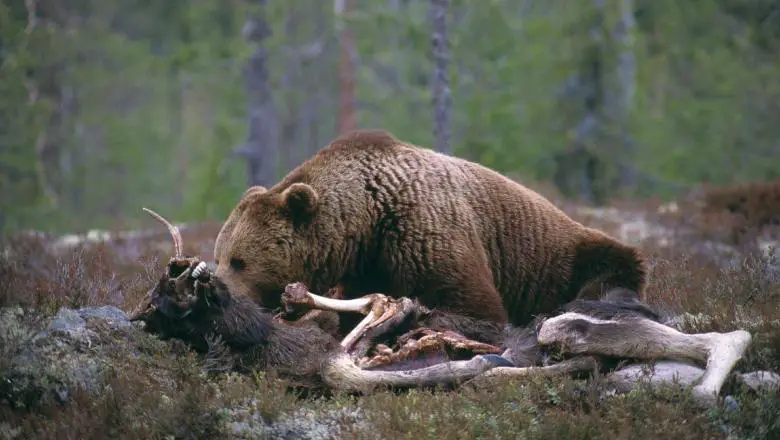
Carrion plays a significant role in the diet of bears, including their consumption of moose. When given the opportunity, bears will readily feed on carrion, which includes dead animals such as moose. This allows them to obtain valuable nutrients without expending excessive energy in hunting.

However, it is important to note that bears primarily target young, sick, or disabled moose when hunting for prey. They are less likely to take on the challenge of hunting healthy adult moose due to the physical challenges involved. Therefore, while moose may be part of a bear’s diet when available as carrion or vulnerable individuals, it is not their primary source of food.

Observations from Studies

Studies conducted on brown bears in Alaska have provided insights into their hunting patterns and reliance on moose as a food source. These studies equipped a small group of brown bears with cameras to monitor their feeding habits. The results showed that more than half of their meals came from moose or caribou calves, while adult moose made up just over 12% of their diet.

The study also revealed that bears killed an average of 34.4 moose and caribou calves over a span of 45 days. In some cases, individual bears were observed to have killed as many as 44 calves in just 25 days. These observations highlight the opportunistic nature of bear hunting and their ability to target vulnerable prey when available.

In conclusion, while bears are capable of hunting large prey like moose, it is not their primary source of food. They primarily rely on plant matter, berries, insects, and small prey for sustenance. The frequency of bear hunting moose can vary depending on factors such as the availability of other food sources and the individual behavior of the bear. Carrion plays a significant role in their diet, allowing them to obtain nutrients without expending excessive energy in hunting healthy adult moose.

Unveiling the Truth: How Much Do Bears Really Hunt Moose?

The Predatory Behavior of Bears

Bears are often perceived as fierce predators capable of taking down large prey like moose and deer. However, the truth is that bears are primarily omnivores with a diet consisting mainly of plants, berries, insects, and small mammals. While they do have the ability to hunt larger prey, such instances are relatively rare. Bears are highly opportunistic in their hunting patterns and prefer to scavenge for carcasses or hunt smaller animals. This behavior is driven by their evolutionary instincts to conserve energy and maximize their chances of survival.

The Factors Influencing Bear Hunting Patterns

The frequency of bears hunting large prey like moose can vary depending on several factors. One significant factor is the availability of alternative food sources. Bears will prioritize consuming plant matter, berries, and smaller prey if these resources are abundant and easily accessible. Additionally, individual bear behavior plays a role in determining hunting patterns. Some bears may exhibit more predatory tendencies than others, leading them to actively pursue larger prey when opportunities arise.

Understanding Bear Diets

Contrary to popular belief, the bulk of a bear’s diet consists of foliage such as berries, seeds, grasses, and nuts. They also rely on small prey like mice, insects, and fish for sustenance. These food sources provide the necessary nutrients without posing a significant physical challenge to the bear. However, bears are not averse to taking advantage of young, sick, or disabled large prey when presented with the opportunity. They may also consume carrion if it becomes available.

Overall, while bears are capable hunters that can take down large prey like moose or caribou calves when circumstances align, these instances are not common occurrences in their diet. Their primary focus remains on plant matter and smaller prey that offer a more energy-efficient way of survival.

The Surprising Role of Moose in Bear Diets: Debunking Common Misconceptions

The Surprising Role of Moose in Bear Diets: Debunking Common Misconceptions

1. Moose as a Secondary Food Source

Contrary to popular belief, moose are not a primary food source for bears. While bears are capable of hunting and consuming large prey like moose, it is not their main source of sustenance. Bears primarily rely on a diet consisting of plants, berries, insects, and small mammals. Moose only make up a small percentage of their overall diet.

2. Opportunistic Behavior

Bears are highly opportunistic hunters and are well attuned to their own limitations. They have evolved to be energy-efficient and will not expend more calories than they would gain from a kill. As such, they tend to avoid healthy and fleet prey like adult moose or deer. Instead, they prefer to scavenge for carcasses or hunt smaller animals that do not pose a physical challenge.

3. Dietary Composition

The bulk of a bear’s diet consists of plant matter such as foliage, berries, seeds, grasses, and nuts. They also consume small prey like mice, insects, and fish where they face less resistance. Carrion is another food source that bears take advantage of when the opportunity presents itself. While they may occasionally target young, sick, or disabled large prey like moose calves or bison calves if available, it is not their typical hunting pattern.

In conclusion, while bears have the ability to hunt large prey like moose, it is not their primary source of food. Their diet mainly consists of plant matter and smaller prey items that require less effort to capture. The misconception that bears frequently hunt adult moose or other large species stems from their opportunistic behavior and occasional consumption of easy targets when available.

In conclusion, moose are fascinating creatures known for their impressive size and unique features. They play a crucial role in the ecosystem, contributing to the balance of nature. However, they also face threats such as habitat loss and climate change. It is important to protect and conserve moose populations to ensure the long-term survival of these magnificent animals.

Rabbit Hides With Salt and Alum

0

March 18, 2015

Kari:

Finer salt works best. Alum (aluminium sulfate) is a pickling compound that can be found in bulk at feed stores. I like it for bunnies because other methods of tanning such thin hides have resulted in a lot of work for semi-softened product. I recommend trying various methods to see which you like best!

1. Mix 1 cup salt + 1 cup alum + 2 gallons of H2O

Use 5-10 bunny hides, case skinned, fur side in and no de-membrane necessary. Case skinned means you pull off the skin like a sock. The membrane is the layer that holds the skin to flesh. The middle, the layer we want to work with, is an epidermis layer. The part that holds the fur to the skin is called the grain.

Soak hides for 2 days, stirring twice a day to make sure all folds get equal access to solution.

2. After 2 days, take out bunnies and squeeze solution from them back in to bucket- save solution! Peel off membrane (non-fur side). It is easiest to start at the bottom near the rump. Peel off all that you can- the hard work will pay off, the easiest time to peel this stuff off is now. Peel until pure white under-layer is exposed. A rule of thumb is peel until there is nothing left that can peel. The neck is usually the thickest and hardest to work.

Feed membrane to pigs!

3. After adding another 1 cup salt + 1 cup alum to the previously used solution, put bunnies back in solution. The bunnies need more of these compounds because they’ve probably already soaked up most of what you had put in the previous solution. So stir, and add bunnies back in.

4. I’ve found it best to let bunnies soak (stirring twice a day) for 5-6 days. I’ve been using frozen bunny hides mainly, so maybe that makes a difference, but I have found that hair tends to shed around 7+ days. The book says 7 days, so use your own judgement. Take out bunnies, toss solution, rinse, soap, and repeat the washing process again. Hides should be fur side out at this point. I think most soaps are good, I’ve used pine tar and dish soap before, and both seemed to work fine. Get all solution and soap out by the time you are done.

5. At this point you have some options. You can string the bunnies, hair side in, and let them dry and wait for a convenient time to work them. Or, keep them moist for a few days while you work them in batches. I recommend working 2-3 at a time, maybe more if you get a system down.

If you decide to work on a few now, then part hair down the middle of the belly and cut to make one flat hide. I part the hair to reduce the trimming of long hairs along the edge. Cutting along the belly is a good and common rule, but if you have a hole in the hide you might choose to cut a line including the hole to reduce holes in the main body of your hide.

6. I have found it useful to drip dry bunnies overnight and allow them to become a bit tacky before stretching. Stretching really wet hides doesn’t do much good and creates opportunity for ripping.

If you want to sew up any holes, do it before the stretching process with a tiny needle and trimming the corners of the hole to create an even surface when the hide is flat. Any thread should do, stronger the better probably.

7. So now is the fun part! You can stretch the hide all kinds of ways- between your hands, using your knees, over the back of a chair or on a corner. Get the middle and the edges, keeping a close eye on what seems to be drying and work it to keep it supple. If some part (usually an edge) is hard or yellow, give it a firm but gentle pull to release it into opening up. It will turn soft and pure white. I like to work the middle on the chair or a corner, as well as giving sharp pulls with my hands. Careful! Bunnies do rip. And it will happen. So test your boundaries and learn at what stage is best for what kind of stretching.

8. You will find out just how much time is needed in babysitting your hides. They don’t need to be stretched every minute, just keep an eye on them. When they are fully dry, give them a good shake and roughing up. It will help loosen things a bit. While drying keep at a cool or neutral temperature. Don’t heat or put by fire! They get crunchy! Sometimes it takes me 2 days to let a hide dry. Just let it take its time, it’s worth it!

I wrote a little ditty on harvest day of these rabbits. Warning: graphic content.

Best Air Rifle Deals

Popular Posts

What Is An Air Rifle?

0
If you have stumbled upon this article, chances are that you probably have a pest problem at your house. This is a very common...

5 Types of Air Guns You Need to Know Before Buying

0
Have you ever wondered how many types of air rifles are out there? Is your head spinning around with various powerplants and you don’t know...

Guide to find Best Scope for Break Barrel Air Rifles

0
"Unlock the Perfect Shot: Discover the Best Scope for Break Barrel Air Rifles. Enhance your shooting experience with precision and accuracy, as we delve...