

Home Blog Page 172

9 Hawks in Michigan | All You Need to Know!

0

You’ll find the nests of the hawks before leaves start to grow on trees. Therefore, they’re called early nest builders.

Due to this habit, numerous large hawk nests can be found on spring trees. Thus, it’s easy for a person to identify a hawk’s nest located in Michigan.

What are the different hawks found in Michigan? The different hawks found in Michigan are Osprey, Rough-legged hawk, Northern Harrier, Sharp-shinned hawk, Cooper’s hawk, Red-shouldered hawk, Broad-winged hawk, Northern Goshawk, and Red-tailed hawk.

These hawk species are economically harmless. Some of their nests can be found on the ground and 75 feet from the ground when situated on a tree.

To identify the hawks that reside in Michigan, you have to know their appearance and behavior. This article has all the information for every hawk species that are mentioned.

Do Hawks Live in Michigan?

Hawks live in Michigan, a nesting site for these birds. The earliest record of this activity is in 1934.

How to Identify a Hawk in Michigan?

Binoculars can help you identify a hawk in Michigan, and you have to weigh these factors.

  • Plumage – The underside and back plumage should be compared. The plumage of the most common hawks in Michigan, called red-tail and sharp-shinned, highly varies all over their bodies. On the other hand, the matching underside and back plumage is seen on rough-legged hawks and osprey.
  • Beak shape and color – Every hawk has a unique beak. A species has a distinct one that is similar to adults and juveniles alike.
  • Habitat – You can readily expect what species you can find when you know the habitat of some hawks. For instance, rough-legged and red-tailed hawks are likely to be found in farmlands, woodlands, and city areas. Since sharp-shinned hawks feed on fish, they are around waterways.
  • Forms in-flight – You can’t just see the hawks perched on a tree. Even when they fly up above, you can distinguish them through their forms while flying.

9 Hawks in Michigan

Osprey
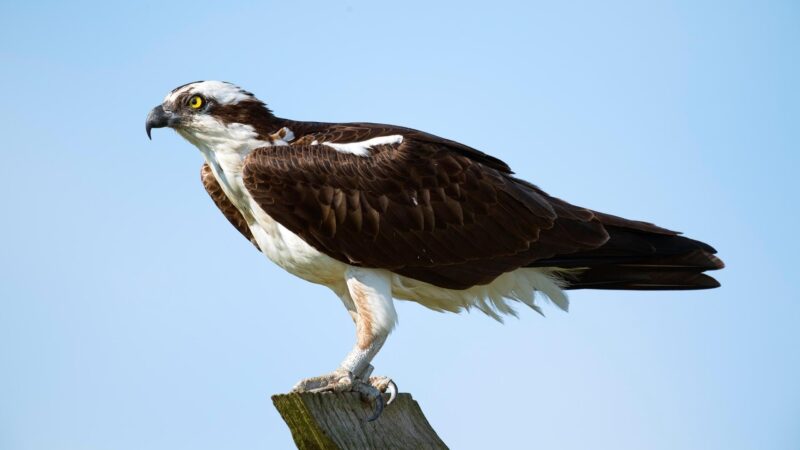
Osprey

This is a large species with long wings that have carpal joints. Ospreys have unique fishing techniques, as supported by their body parts. They have long legs, curved claws, and spicules which are spiny footpads to easily grip slippery fish.

Because they dive when fishing, they have nasal valves and oily, dense plumage to prevent water from entering their nostrils.

  • Appearance: It has a dark brown back and a bright white underside. There’s a morphological variation based on the regions that they occupy. Those that are in tropical and subtropical areas are smaller.
  • Color: Dark brown, bright white
  • Wingspan: 145 to 170 cm
  • Lifespan: 25 to 26 years
  • Size: 55 to 58 cm
  • Weight: 1,200 to 2,000 grams
  • Diet: Amphibians, birds, carrion, fish, mammals, mollusks, reptiles
  • Place of Origin: All continents except Antarctica
  • Characteristics: Solitary; sedentary; colonial; migratory; diurnal; motile

Rough-Legged Hawk
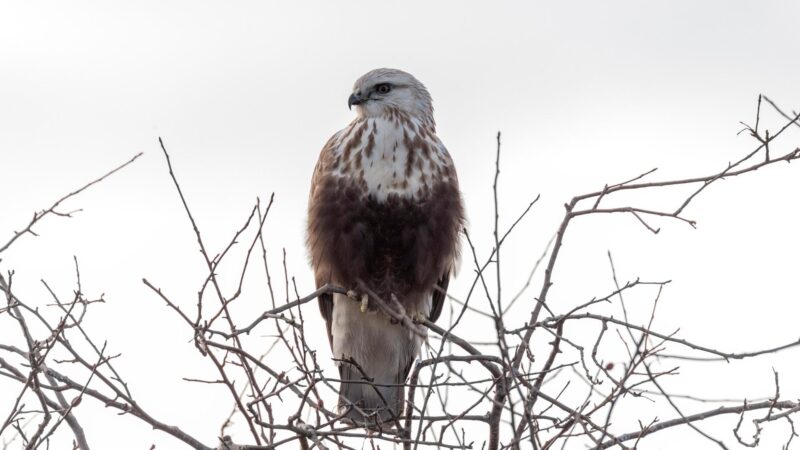
Rough-Legged Hawk

You won’t see rough-legged hawks walk as they tend to soot downs when gathering food and getting near a mate. They also fly low for their size, and they just flap their wings to reach a certain altitude.

  • Appearance: Both males and females have dark and light morphs. However, the coloration varies between adults and young. There’s a black band on the edges of this bird’s underside.
  • Color: Black, brown, grayish
  • Wingspan: 122 to 143 cm
  • Lifespan: 18 to 24 years
  • Size: 46 to 59 cm
  • Weight: 745 to 1,380 grams
  • Diet: Birds, mammals, reptiles
  • Place of Origin: Holarctic region
  • Characteristics: Glides; territorial; solitary; motile; migratory; diurnal

Northern Harrier
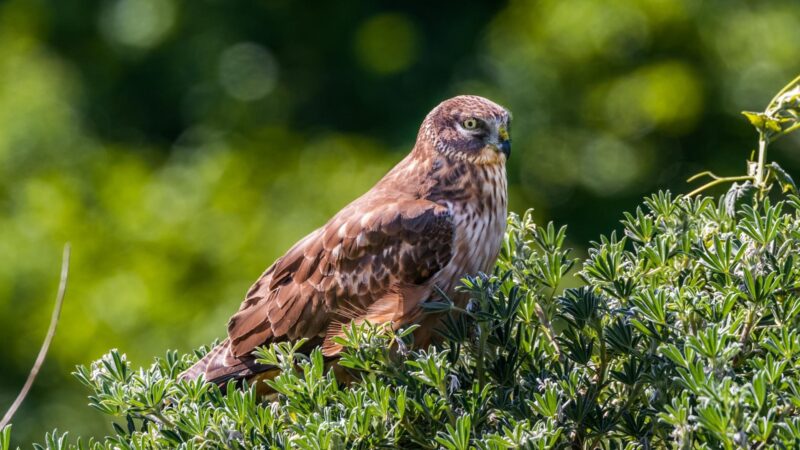
Northern Harrier

Northern harries don’t only fly, but they also hop and walk. You’ll usually see them flying low and slow near the ground. On some occasions, they would soar high. The male is more agile and flies faster than his female counterpart.

  • Appearance: A Northern harrier can easily be spotted due to some unique features. Specialized feathers surround their face, so there’s like a disc that directs the sound to their ears. When it’s on a flight, a white rump patch is visible.
  • Color: Gray, white, brown
  • Wingspan: 380 to 384 cm
  • Lifespan: Up to 16 years
  • Size: 41 to 50 cm
  • Weight: 290 to 600 grams
  • Diet: Amphibians, birds, mammals, reptiles
  • Place of Origin: Holarctic region
  • Characteristics: Diurnal; migratory; motile; glides
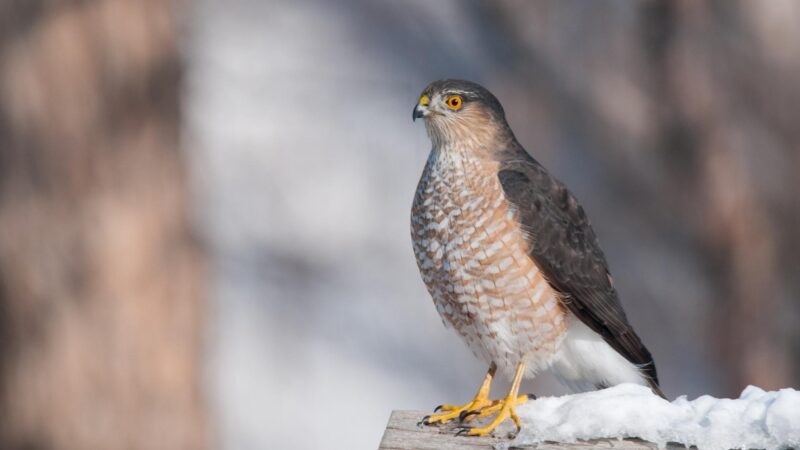
Sharp-Shinned Hawk

Sharp-Shinned Hawk

The Sharp-shinned hawk is the smallest species in North America, but it’s an opportunistic hunter. Since thus territorial, it would chase, call, and attack intruders.

  • Appearance: The back of this hawk is bluish-gray or slate, and the underside is white. It has a crown in a dark hue. Moreover, it has a dark-colored beak in a hook shape.
  • Color: Bluish-gray or slate, brown, white
  • Wingspan: 52 to 65 cm
  • Lifespan: Up to 19 years
  • Size: 24 to 34 cm
  • Weight: 87 to 218 grams
  • Diet: Birds, insects, mammals
  • Place of Origin: Nearctic and Neotropical regions
  • Characteristics: Diurnal; motile; solitary; territorial; migratory

Cooper’s Hawk
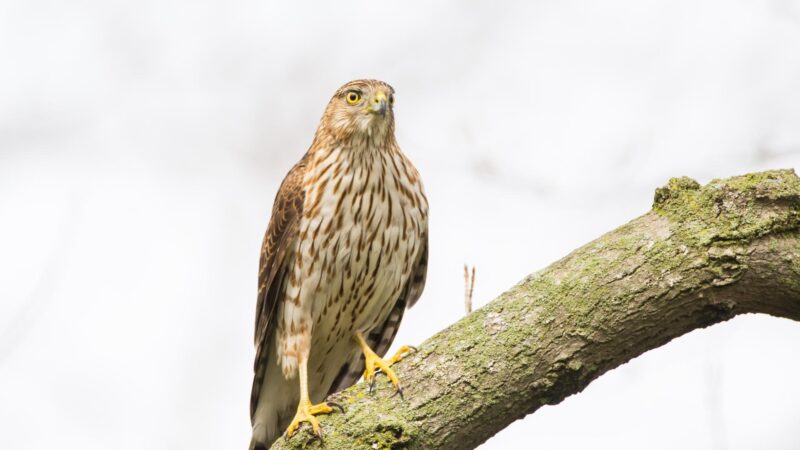
Cooper’s Hawk

This hawk perches on a tree and waits for its prey. It lives in forests and open lands. You will be astonished to see it as this is a swift flier. With a rapid wingbeat, it can search through heavily vegetated woodlands for its food.

  • Appearance: A Cooper’s hawk is medium-sized with a long, lean body. The ones that reside in the west are smaller than those in the east. When in flight, its wings appear short and rounded, while the tail is long and barred. It has a hooked bill suitable for tearing meat.
  • Color: Blackish, blue-gray, white
  • Wingspan: 75 to 94 cm
  • Lifespan: 12 to 20 years
  • Size: 35 to 50 cm
  • Weight: 280 to 556 grams
  • Diet: Reptiles, amphibians, mammals, birds
  • Place of Origin: Nearctic and Neotropical regions
  • Characteristics: Solitary; territorial; migratory; motile; diurnal

Red-Shouldered Hawk

Red-Shouldered Hawk
  • Appearance: This is a large, heavy species with broad wings and a long tail. The upper part of its body has the colors brown and red, while the underside is creamy. It doesn’t form a flock, as most red-shouldered hawks don’t migrate. Only those that breed in the Northern part of the US and South of Canada migrate to the North of Mexico in winter.
  • Color: Dark brown, brown, reddish, creamy
  • Wingspan: 92 to 107 cm
  • Lifespan: Up to 20 years
  • Size: 43 to 61 cm
  • Weight: 550 to 700 grams
  • Diet: Aquatic crustaceans, amphibians, insects, birds, reptiles, mammals
  • Place of Origin: Nearctic region
  • Characteristics: Diurnal; sedentary; solitary; migratory; motile

Broad-Winged Hawk
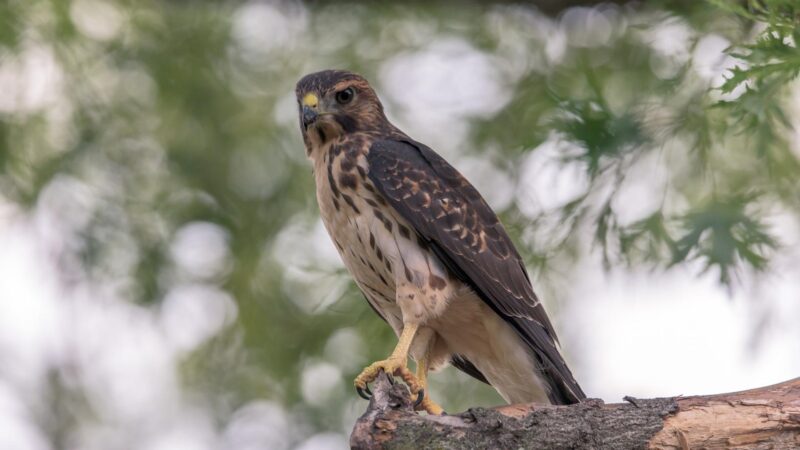
Broad-Winged Hawk

Although the Broad-winged hawk is inclined to stay in dense forests, it prefers to be near open areas like road trails, meadows, and wetlands. It doesn’t like to be near humans.

When in the peak of migration, thousands of broad-winged hawks flock together. Hence, it results in a thermal current, so every bird minimizes its energy when flying.

  • Appearance: This is a small and stocky species. As a dark-colored bird, you can easily spot the white, broad stripe and the two thin lines in the middle of its body. When flying, it has pointed wing tips. But these wingtips don’t reach the tail when this bird is perched.
  • Color: Dark gray, black, white
  • Wingspan: 81 to 100 cm
  • Lifespan: 16 to 18 years
  • Size: 34 to 44 cm
  • Weight: 265 to 560 grams
  • Diet: Insects, birds, amphibians, reptiles, mammals
  • Place of Origin: Nearctic and Neotropical regions
  • Characteristics: Solitary; diurnal; migratory; motile; territorial

Northern Goshawk
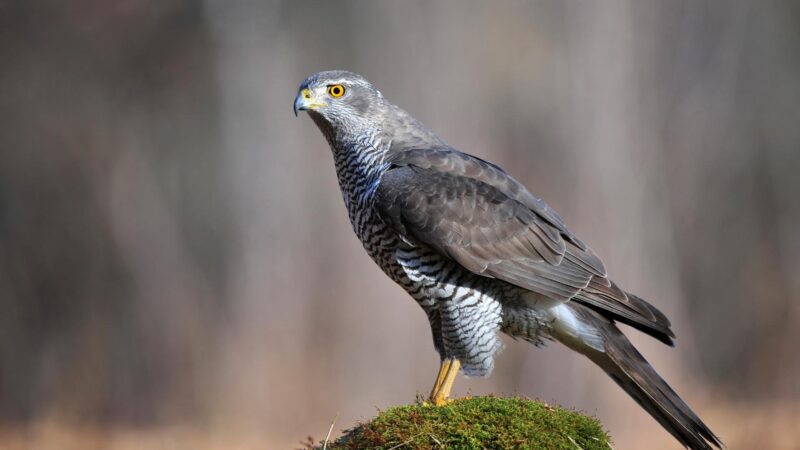
Northern Goshawk

This is the largest accipiter species. It’s fascinating that it spends its entire lifetime in the same nesting area. It will only leave during winter and go to the southern area, but it returns when spring comes.

  • Appearance: As an accipiter, it has a distinct white grouping of feathers, and this is like a band over the eye. You’ll also notice that the band seen on a Northern Goshawk is more striking than the other species. It has dark coloring, but the eyes are reddish-brown.
  • Color: Blue-gray, black, light gray, white
  • Wingspan: 98 to 115 cm
  • Lifespan: 16 to 19 years
  • Size: 55 to 61 cm
  • Weight: 631 to 1,362 grams
  • Diet: Birds, insects, mammals, reptiles
  • Place of Origin: Holarctic region
  • Characteristics: Sedentary; solitary; motile; diurnal; migratory

Red-Tailed Hawk

A pair of Red-tailed hawks stay in the same territory for life. This bird can adapt to different kinds of habitats at various altitudes.

It can be found in grasslands, agricultural fields, forests, and woodlands. When it comes to laying eggs, its preferred spots are large trees in an open area, wooden fence rows, and forest edges.

  • Appearance: The back part of a Red-tailed hawk varies from auburn to deep brown, but the underbelly is always lighter than the other body parts. Its legs, feet, and skin on the base of the beak are all yellow.
  • Color: Auburn to deep brown, brownish-red
  • Wingspan: Around 122 cm
  • Lifespan: 28 to 29 years
  • Size: 45 to 65 cm
  • Weight: 795 to 1,224 grams
  • Diet: Birds, reptiles, mammals
  • Place of Origin: Nearctic region
  • Characteristics: Territorial; diurnal; migratory; motile

What Is the Biggest Hawk in Michigan?

Osprey is the biggest hawk in Michigan, with a wingspan of over 5 feet and a maximum weight of 2,000 grams which is twice or even four times the weight of other species.

How Big Are the Hawks in Michigan?

It depends on the species. While Osprey, Northern Goshawk, Rough-legged hawk, and red-tailed hawk are larger and weigh over a thousand grams, there are smaller species like Broad-winged hawk, Red-shouldered hawk, Northern Harrier, Cooper’s hawk, and Sharp-shinned hawk.

They just weigh a few hundred grams or around half a thousand grams. The smallest among them is a sharp-shinned hawk that can weigh 200 grams.

Can You Shoot a Hawk in Michigan?

Hawks are protected under Federal law enacted in 1918 called Migratory Bird Treaty Act. So, you can’t just shoot a hawk in Michigan any time you want.

Is It Illegal to Shoot Hawks in Michigan?

It’s illegal to shoot hawks in Michigan if you don’t have a permit. A depredation permit is usually given when the hawks are a threat to public health and safety.

What Is the Largest Bird in Michigan?

The majestic golden eagle is the largest bird in Michigan. It’s based on its 7.5 wingspans and more than 6,000 grams weight.

How Do You Tell the Difference Between a Falcon and a Hawk?

Here are the factors that you have to take note of to differentiate a falcon from a hawk:

  • Size, speed, and taxonomy – Although hawks are bigger than falcons, they have shorter wings. Since falcons have longer wings, they fly faster than hawks.
  • Beak vs. talon – Falcons dive and use their beaks with a notch to grab and stab prey. Hawks have talons or claws to catch their prey. They have slightly curved beaks.

What Is the Rarest Bird in Michigan?

The rarest bird in Michigan is Kirtland’s Warbler. It’s in yellow and blue-gray colors. The size of this elusive bird is the same as the sparrow.

Where to See Thousands of Hawks as They Migrate Through Michigan?

Different bird species follow the path of the Great Lakes in Michigan when they migrate. Hence, it creates a fascinating view. You’ll see thousands of hawks from the Detroit River to Keweenaw Peninsula.

Thousands of hawks create a wonderful view in the Straits of Mackinac as Lake Huron and Lake Michigan attract these avian migrants to their funnel effect.

Summary

Apart from identifying the species of hawks in Michigan, you’ll also be able to tell them apart from other birds like falcons.

If you have this ability, you won’t be confused. With this knowledge, bird watching will be more fun as you can name the birds. Even only hawk species can make identification challenging as there are variations.

Related: 8 Hawks in New Jersey | Check for Photos!

List of Sources

Ward, L. (1934). Hawks and Their Nests in Michigan. Searchable Ornithological Research Archive.

Kirschbaum, K., Watkins, P. S. (2000). Pandion haliaetus. Animal Diversity Web.

Limas, B. (2001). Circus cyaneus. Animal Diversity Web.

Good, G. (2008). Buteo lagopus. Animal Diversity Web.

Dewey, T., Perepelyuk, V. (2011). Accipiter cooperii. Animal Diversity Web.

Kanawha Falls is new hotspot for catching variety of lunkers

0

Kanawha Falls offers anglers a chance to catch different kinds of fish and plenty of them.
That’s according to Mark Scott, assistant chief fisheries biologist in Charleston, urges anglers to head for Kanawha Falls at Glen Ferris near Gauley Bridge.

“The New and the Gauley rivers come together to form the Kanawha River,” he says. “The falls serve as a barrier to the upstream movement of fish species. It’s a very productive section. Water quality is excellent.

“The fish come up and congregate at the base of the falls, where there’s a good food supply and excellent forage, including numerous minnows and crawfish and other aquatic insects.

“Some of the largest records and trophy fish come from this area.” The fisheries biologist adds proudly, “We recently measured a walleye that was 33-and-one-quarter inches long and weighed 16 pounds. The existing state record was caught at Kanawha Falls in 1976. We have a length record and a weight record was taken from there.”

In addition, Scott says, striped bass and hybrid striped bass records both came from the Kanawha Falls.

The falls area has produced some nice muskies in the 40-inch class. “We stock the area with fingerling musky too on an annual basis,” Scott says.

Here are some other popular area waters for fishing:

Tailwaters of the Bluestone Dam, including the area below the dam extending down to the State Route 3 bridge. “It’s a popular area for wading and using small Jon boats,” Scott explains.

“The water is shallow. Wading along the banks of the river is productive, and bank fishing is good. There’s access for small boats too.”

The tailwaters are popular for smallmouth, flathead catfish, channel catfish, panfish (rock bass and bluegills), and it also produces large carp, according to Scott.

The DNR fisheries biologist also recommends that anglers try a canoe float trip on the Greenbrier River from Caldwell near Lewisburg downstream to Ronceverte.

“It provides exciting fishing for smallmouth bass and rock bass,” Scott says.

Another spot that is teeming with fish is Hawks Nest Lake, a 250-acre impoundment on the New River.

“It produces excellent fishing for smallmouth bass, spotted bass, crappie, panfish, channel cats, flathead cats, and striped bass hybrids,” Scott says emphatically.

Popular artificial baits for Hawks Nest include various color jigs, crankbaits, and spinners, but all species seemingly are attracted hellgrammites, large creek chubs, minnows, lizards (salamanders), earthworms and nightcrawlers.

And if you are looking for thrilling trout-fishing adventures this fall, chances are you will not have to travel far to find them.

They are waiting for you in the cool limestone waters of southeastern West Virginia. In fact, some of the most famous trout waters in the Eastern U.S. are limestone streams. And they extend all the way from upstate New York to West Virginia.

Folks in the Mountain State can take a measure of pride in knowing that sinking spring creeks of the Greenbrier River Valley contain water quality, aquatic insects, and well-oxygenated chilly water like the larger limestone streams found in the Northeastern U.S.

These limestone streams run underground. When streams do suddenly appear, they provide a mystical experience for anglers—especially those who pursue their prey under catch-and-release, fly-fishing only regulations.

“If you’re in the area and plan to go fishing, you owe it to yourself to try one of these ghost streams,” said Scott. “They’re cool, limestone-enriched underground waterways that create ideal habitat for trout.”

Hatcher, meanwhile, has other ideas when it comes to fishing. He has caught more than one hundred trophy-size channel catfish on chicken livers during the past 15 years.

He has nailed forty smallmouth and largemouth bass citations during the past five years at Stephens Lake, Sandstone Falls and Summersville Lake.

The resolute angler caught twenty of the citation-size bass last season.

Hatcher’s philosophy of fishing is simple: “Stay at it. You cannot catch them if you are on the couch.”

Top o’ the morning!

White-tailed Deer

0

Odocoileus virginianus

Maine is near the northern extent of the white-tailed deer range, and they live in many habitats here, from deep woods to farmland to suburban backyards.

Habitat

Major habitats that provide food and cover for white-tailed deer in Maine are forest lands, wetlands, reverting farmlands, and active farmlands. Forest stands containing little or no canopy closure, wetlands, and reverting and active farmland yield the largest and best forage within reach of deer. However, stands made up of mature conifers with tree height greater than 30 feet, crown closure of greater than 60%, and interspersed or adjacent hardwoods for browsing provide critical winter habitat for deer. Ideal deer wintering habitat is connected by other usable habitat to aid deer in moving between them. Currently, 94% of Maine is considered deer habitat; this excludes developed parts of the state. In practice, even a portion of Maine’s developed land is currently occupied by deer. Wintering habitat is more limited in availability, comprising only 2 to 25% of the land base in various parts of the state.

Back to top

Diet

Deer are highly selective herbivores, concentrating on whatever plants or plant parts are currently most nutritious. Finicky eaters, deer opt for variety over quantity, when feeding along in the woods and fields. Deer consume grasses, sedges, ferns, lichens, mushrooms, weeds, aquatics, leaves (green and fallen), fruits, hard mast (acorns, beech nuts, etc.), grains, and twigs and buds of woody plants. Contrary to popular belief, deer consume twigs and buds of dormant trees and shrubs only when more nutritious foods are unavailable. When restricted to woody browse, deer inevitably lose weight. During the course of the year, deer may browse several hundred species of plants. A few are highly preferred; many others are consumed only when the best forages have been depleted. Overabundant deer populations can reduce the abundance of preferred forages, while causing less-desirable plants to become more common. Extremely abundant deer can literally eat themselves out of house and home. At these times, hungry deer are underweight, prone to starvation and disease, produce fewer fawns, grow smaller antlers, and create increased conflicts with homeowners, gardeners, farmers, forest landowners, and motorists.

Back to top

Distinctive Characteristics

Maine is home to one of the largest of the 30 recognized subspecies of white-tailed deer. After attaining maturity at age five, our bucks can reach record live weights of nearly 400 lbs. Most adult bucks, however will range from 200 to 300 pounds live weight and will stand 36 to 40″ at the shoulder. Does are considerably smaller; they normally weigh 120 to 175 pounds live weight. Newborn fawns begin life at 4 to 10 pounds but grow to approximately 85 pounds live weight in their first six months of life.

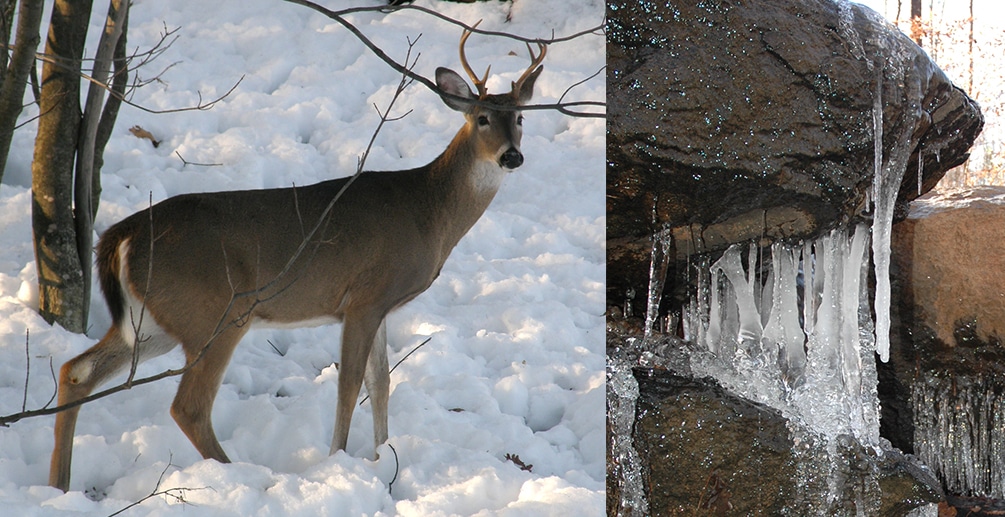
Whitetails have reddish brown fur in the summer switching to a grayish brown in winter. Their trademark white tail, when erected, flashes a danger signal to other deer in the vicinity. Whitetails have keen hearing, made possible by large ears that can rotate toward suspicious sounds. They have wide-set eyes, enabling them to focus on subtle movements while maintaining an excellent sense of depth perception. Whitetails have a very keen sense of smell enabling them to sense danger, even when visibility is poor. They have long graceful legs, enabling them to cover ground quickly by leaping, bounding, turning and outright running at speeds up to 40 miles per hour.

White-tailed deer communicate using a variety of sounds, ranging from explosive “whooshes” when startled, to the barely audible mews and grunts a doe uses to tend to her fawns. Deer are very expressive; they employ a large repertoire of signals using facial expressions and body language. These postures help to maintain the dominance hierarchy within all deer groups. Deer also communicate using odors, which emanate from a number of scent glands.

Back to top

Nocturnal/Diurnal

White-tailed deer are crepuscular animals, meaning they are typically most active around dawn and dusk. This does not mean that deer are not at all active during the day. Deer activity may also be influenced by weather, seasonality, and human activity. During hot summer days, for example, deer are less active during the daytime and more active at night when it’s cooler. Conversely, deer may be more active than usual during cooler weather. Deer activity may increase throughout the day during the breeding season while bucks are actively searching for does that are receptive to breeding. Areas with a lot of daytime human activity – which may include in the woods during the hunting season if hunter densities are high- may see little daytime deer activity and increased nocturnality of resident deer.

Back to top

Seasonal Changes

Summer home ranges (area that an animal lives within) for deer in Maine are generally 500-600 acres but can vary from 150 to more than 2,000 acres. Movement by deer from summer to winter range can vary from less than a mile to more than 25 miles depending on availability and suitability of the winter range. Deer are not generally territorial (defend their home range against intrusion of other deer). However, pregnant does will defend a small birthing area (less than 20 acres) against intrusion by all other deer, for about a month.

Bucks annually produce antlers, which are made of bone. Triggered by day length and maintained by hormone production, antlers begin growing in April, and are nurtured by a velvety outer network of skin tissue and blood vessels. Velvet is shed when growth is complete in late August and September. The hardened, polished antlers remain until they are shed in late December to early March. In whitetails, antlers allow bucks to advertise and demonstrate their dominance; hence they play a role in reproduction. A buck’s first true set of antlers normally is grown by age one. Buck fawns, however, begin growing the antler base at one month of age. This base develops into two or three-inch velvet-covered “nubbins” by early winter. White-tailed does sometimes produce antlers, but this is rare. Does that do sprout antlers typically are older (5 to 15 years old); their antlers are usually velvet-covered spikes. Most antlered does remain fertile.

Each year, deer produce two coats of hair, each adapted to seasonal climate. In late spring, deer grow a coat of fine, short reddish hair. This pelage allows ample air circulation and helps the deer to stay cool in summer’s heat. During September, deer molt to a highly insulative coat which consists of a dense layer of fine woolly hair under a layer of long hollow brown, gray, and white guard hairs. The guard hairs can be erected to form a very thick insulative coat, which protects against the cold winds of winter. Fawns are born with a reddish-brown coat dappled with white spots. This affords excellent camouflage against detection by predators in the summer. By early autumn, fawns grow the typical winter coat.

Another adaptation for survival is the deer’s habit of storing fat for the winter. In autumn, deer accumulate fat under the skin, in the viscera, between the muscles, and in the hollow bones of the legs. This fat layer can comprise 10 to 25% of a deer’s body weight by late fall. In winter, fat is reabsorbed to provide much-needed energy to supplement inadequate diets of woody browse.

Back to top

Reproduction & Family Structure

The peak breeding season for deer in Maine occurs during mid-November, although some breeding may occur in October and as late as January. The onset of the rut in bucks and estrus in does is controlled primarily by decreasing day length. Does in estrus are receptive to breeding for roughly 24 hours, and if not successfully bred, they will come into heat every 28 days, until early winter. Bucks establish and maintain a dominance hierarchy; typically the majority of does in an area are bred by the most dominant bucks. Gestation period for deer is roughly 200 days, after which well-nourished adult does give birth to twins, triplets, and rarely, quadruplets. Fawn and yearling does typically produce one fawn, if they conceive at all. The peak fawning season in Maine is mid-June. In a typical year, each 100 Maine does will give birth to about 130 fawns. However, early fawn losses tend to be high; only 60 to 80 of these young deer typically survive their first five months of life.

What to do if you find a deer fawn all alone

Back to top

Survival & Threats

White-tailed deer can live to 18 years, but few deer in the wild live that long. Does typically live longer than bucks presumably because rutting behavior predisposes bucks to higher losses due to hunting, motor vehicle collisions, physical injuries, and depletion of fat reserves going into the winter. Deer populations subjected to high hunting mortality are comprised of predominantly young deer. Conversely, a greater proportion of deer annually survives to older age classes within lightly hunted herds.

Causes of mortality of while tailed deer vary throughout the state. In more developed areas, deer are commonly struck by vehicles, harvested by hunters, and killed by predators. In less developed areas, human-related deaths are relatively few, and adult deer are more commonly taken by predators, particularly coyotes, lynx, and bobcats. Young fawns may also be preyed upon by black bear, fisher, and fox. Deer of any age may succumb to malnourishment of other natural causes, particularly at the end of harsh winters and in the following spring. Presently, Maine’s deer are relatively disease-free, and there are no diseases with significant negative impacts on our deer populations at this time.

Back to top

Management & Conservation

Population and Distribution Trends

Maine’s white-tailed deer population has experienced periods of boom and bust, and circumstantial information suggests that the state’s deer population likely did not exist in high abundance prior to the arrival of European colonists in the early 1600’s. With a combination of harsh winters, a higher predator population, and perhaps a lack of young vegetative growth for forage, white tailed deer may have been restricted to the southern coast until the European colonization. With colonization, settlers began clearing the landscape through small-scale logging operations, triggering an increase in the growth of undergrowth, providing white tailed deer with an optimum mix of forage and cover. From then, deer expanded their range and became more common in central and northern Maine. After the extirpation of cougars and wolves from Maine, deer were able to farther expand and increase in numbers with virtually no predation. Still, deer numbers continued to fluctuate with winter severity and large-scale events that caused significant habitat changes such as fires or spruce bud worm outbreaks.

Historical Management

MDIFW began estimating deer populations in the mid-1950’s, enabling the state to better understand the status of the populations and create a more informed management decision process. Between the mid-1950’s and early 1960’s, MDIFW estimated Maine’s deer population at 250,000. Eventually, habitat changes, severe winters, coyote colonization, and increased hunting pressure led to declining deer populations, and Maine’s deer population reached an estimated 141,000 deer in the 1960’s. Following this time and continuing through the late-1980’s, Maine’s deer population expressed slow growth, eventually causing a series of new management strategies and laws that attempted to expedite the growth of Maine’s deer population. Finally, Maine’s deer population grew prolifically through the 1990’s as a result of the regulatory system that limited doe harvest, plus a series of mild winters. During this time, Maine’s deer population grew to an estimated all time high of 331,000, however, much of the growth occurred within the southern tier of the state. Generally speaking, the Department has been successful in achieving deer population objectives in central and southern Maine, where wintering habitat and other factors were more favorable. Achieving meaningful herd increases has been less successful in eastern and northern Maine. Today, deer abundance ranges from one to five deer per square mile in the north, to 15 to 35 deer per square mile in central and southern areas. Some locations, in which access to recreational deer hunters has been limited or denied entirely, support higher deer populations that are above socially acceptable levels. These latter areas are above desired population levels, and they are the focus of most deer/people conflicts in Maine today.

Current Management

Prior to 1975, MDIFW did not set specific goals or quantified objectives for the deer population, harvest, or hunter success rates. Most regulatory actions were made by the Legislature and they were reactions to severe winters, or perceived regional declines in deer abundance. Between 1975 and 1985, MDIFW initiated strategic planning for deer, part of which involved setting publicly-supported goals and objectives. In some areas, this meant attempting to manage deer populations to specific deer densities.

With the more recent implementation of a new Big Game Management Plan, the Department no longer attempts to manage deer to specific deer densities. That approach did not adequately account for many other important aspects of deer population management such as maintaining animal health and social acceptance of deer levels and limiting negative impacts of overabundant deer. Deer management in Maine currently strives to maintain deer levels that are socially acceptable and in balance with available habitat. In areas where deer numbers are not socially acceptable or where deer are causing significant damage to habitat, the Department employs a variety of small-scale management options to try and alleviate the problems.

Each year, MDIFW staff and contractors examine roughly 6,000-8,000 hunter-killed white-tailed deer to collect data on population sex ratios, age structure, estimated mortality and recruitment rates, and body and antler size to provide a clearer picture of the size and health of both the population and habitat. From these examined deer, we also collect samples from roughly 500 deer annually to test for Chronic Wasting Disease, one of the greatest threats facing deer in this country. For more information on data collected in support of Maine deer management, please visit our Research & Management Report (PDF).

Improving deer populations in Maine’s northern and eastern forestlands depends on protecting and increasing amounts of deer wintering habitat. Protection of deer wintering habitat has historically been dependent on landowner cooperation and has not always been possible. Beginning in 2021, MDIFW gained access to funding allowing for the purchase and management of deer wintering habitat, and efforts are underway to identify candidate parcels with willing sellers.

Many Mainers in areas of low deer density have begun artificially feeding whitetails, especially in the winter, which adds an important and relatively new dynamic to the deer wintering landscape in Maine. In Maine’s heavily developed southern and coastal regions, MDIFW staff will continue to develop innovative approaches to safely manage deer harvests in order to maintain deer populations at levels that provide hunting and viewing opportunity while alleviating negative impacts from deer. In all of Maine, we will need to improve access to huntable land through proactive landowner relations programs in order to keep deer populations at tolerable levels.

Current Research in Maine

Maine Deer Winter Mortality Study

Since the early 1970’s, Maine has used a metric called the winter severity index (WSI) to describe how Maine winters impact winter mortality rates (WMR) in deer. WSI is one of the cornerstones of deer management in Maine and impacts the number of antlerless deer permits allocated for hunters each year. Because ecological relationships change over time, this metric needs to be periodically re-evaluated.

For that reason, in 2015, the Maine Department of Inland Fisheries and Wildlife (MDIFW) began a study to reassess the relationship between WSI and WMR. Doing so requires data on winter temperatures and snow conditions, which are used to determine WSI, and data on the survival rates of deer in the winter. Temperature data are provided by temperature loggers placed at 26 WSI monitoring stations throughout the state. Snow condition data are also recorded by biologists and volunteers at these monitoring stations. At the end of winter, in early April, data from temperature loggers and snow measurements are used to calculate a WSI value, which will inform permit allocations for the upcoming deer season.

From 2015 to 2021, MDIFW captured white-tailed deer and fixed GPS collars to them to monitor their movements and survival rates. D eer were captured in wildlife management districts (WMDs) 1, 5, 6, and 17.

The fates of these deer in conjunction with data on the severity of the winters they encounter will help to re-evaluate the relationship between WSI and WMR and help shape deer management in Maine in the future.

The major goals of this study are to:

  1. Reevaluate the correlation between WSI and WMR for white-tailed deer
  2. Assess seasonal survival rates for the adult deer population
  3. Assess cause-specific mortality of our adult deer population
  4. Reassess the current winter severity index and try to identify a new and more simplistic metric

Back to top

Living with Wildlife

How to Prevent or Resolve Conflicts with Deer

White-tailed deer are one of the most recognized mammals in Maine, with frequent sightings throughout the state. However, deer are known for entering and consuming vegetation around the home or in gardens. Learn more about how to prevent and resolve conflicts with deer

Back to top

Skeet Shooting vs Trap Shooting: Which One Should You Pick?

0

Skeet shooting and trap shooting are two popular forms of clay target shooting. Both involve shooting at clay pigeons (also known as clay targets or skeet) that are launched into the air at various angles and speeds. While the two sports are similar in many ways, some key differences set them apart.

In this blog post, we will take a closer look at the differences between skeet shooting and trap shooting, and help you decide which sport is right for you.

What Is Skeet Shooting?

men shooting clay targets in outdoor shooting range

Credit: Envato Elements/ MargJohnsonVA

Skeet shooting, also known as “skeet”, is a shotgun shooting sport in which clay pigeons are launched from two target machines known as “high” and “low” houses that are placed at different heights. When firing at the targets, the shooter stands in a variety of shooting positions around a semi-circular range. During each round, the shooter must complete a total of 25 shots.

Types of Skeet Shooting

The two most common types of skeet shooting are- American and International Skeet Shooting:

1) American Skeet Shooting

American skeet shooting is the most popular type of skeet shooting in the United States. It is governed by the National Skeet Shooting Association (NSSA) and the National Sporting Clays Association (NSCA). In American skeet, the targets are launched from “high” and “low” houses on a semi-circular range with eight shooting stations.

2) International Skeet Shooting

This form of skeet shooting is governed by the International Shooting Sport Federation (ISSF) and is shot on a rectangular range with eight stations. Like American skeet shooting, the targets are launched from a “high” and “low” house but from a different angle.

What Is Trap Shooting?

woman in shooting gear aiming a rifle in outdoor range

Credit: Minnesota Monthly

Trap shooting, also known as “trap”, is a shotgun shooting sport in which clay pigeons are launched from a single machine or a “trap” house located at the far end of the range. In this sport, trap shooters have five shooting stations and are required to take five shots at each station before moving on, making it a total of 25 shots.

Types of Trap Shooting

Similar to skeet shooting, there are different varieties of trap shooting, including:

1) American Trap Shooting

American trap shooting is practiced in the majority of American shooting ranges. It is typically done using a single launcher positioned in a small trap house which launches clay targets away from the shooter, who is stationed at one of the five available stations along the range.

2) Olympic Trap or Bunker Trap Shooting

In Olympic trap shooting, also known as “bunker trap,” a line of 16 machines is used to launch targets, rather than just one. The targets are launched at different predetermined angles, providing a challenging variation of the traditional trap shooting game.

3) Double Trap Shooting

Double trap shooting is a variation of the traditional trap shooting game in which two targets are launched simultaneously from the trap house. These targets usually follow a set part and shooters are required to shoot at them one at a time.

4) Wobble Trap Shooting

Like double trap, wobble trap is a variation of traditional trap shooting, where the target’s flight path is much more unpredictable. This is achieved by an oscillation mechanism that makes the trap move up and down as well as side to side

Skeet Shooting vs Trap Shooting: What’s the Difference?

woman aiming a rifle
Credit: Envato Elements/ vlad_star

Now that you have a general idea of skeet and trap shooting, let’s take a closer look at the distinctions between them so that you can make an informed decision and choose the one that you prefer the most:

1) The Movement of the Targets

In skeet, the targets are launched from two different houses at varying angles, making it a more challenging sport. In trap shooting, the targets are launched from a single house at a consistent angle, making it a bit easier.

2) The Rules

The rules of skeet and trap shooting are similar, but there are some key differences. In skeet shooting, the shooter must hit targets from both the high and low houses to complete a round. In trap shooting, the shooter must hit a certain number of targets to move on to the next round.

3) The Equipment

Both skeet and trap clay pigeon shooting require hunting guns and a supply of clay pigeons. However, the type of hunting gun and ammunition used can vary depending on the sport.

Skeet shooting typically requires a shotgun with a short barrel and tight choke, as the targets are launched at a closer range. Trap shooting, on the other hand, typically requires trap guns with long barrels and open chokes, as the targets are launched at a farther range.

If you’re interested in practicing skeet and trap shooting in your own backyard, consider investing in a clay pigeon thrower like the one from Do-All Outdoors. Alternatively, if you prefer to throw your own clay targets, the White Flyer Blackout Skeet and Trap Clay Targets are an excellent option.

Which One Should You Choose?

When it comes to trap vs skeet shooting, the final choice depends on your personal preference.

Skeet shooting is considered to be more challenging and requires more skill, as the targets are launched from two different houses at varying angles. It’s a sport that requires quick reflexes and the ability to adapt to different angles and speeds.

On the other hand, trap shooting is considered to be more beginner-friendly, as the targets are launched from a single house at a consistent angle and speed. This sport requires a steady hand and good aim, but it’s less demanding than skeet shooting in terms of movement and adaptation to different angles.

If you’re looking for a challenging sport that will test your reflexes and adaptability, skeet shooting may be the right choice for you. But if you’re looking for a sport that is a bit more relaxed and easier to pick up, trap shooting may be a better fit.

Summary

Skeet and trap shooting are two popular clay target shooting sports that share the goal of hitting as many clay pigeons as possible, but differ in terms of range layout, target movement, and equipment used. The choice between the two ultimately comes down to personal preference.

Looking to improve your shooting skills? Look no further than EasyShot shooting targets. Made from durable materials, our targets are excellent for honing your shot and improving your aim. Order yours today and take your shooting to the next level!

Do Squirrels Eat Meat? Are They Omnivores or Vegetarians?

0

There is much debate over what squirrels eat in the wild. Some say they are vegetarians, while others believe they occasionally dine on insects, eggs, and even small mammals. But what about meat? Do squirrels eat meat? The answer may surprise you.

Do Squirrels Eat Meat? Are They Omnivores or Vegetarians?

Squirrels are technically omnivores, which means that they eat both plants and animals. In the wild, they will eat a variety of things, including insects, nuts, fruits, and seeds. However, whether or not they will also eat meat depends on their surroundings and what food is available. In some cases, squirrels may eat small rodents or birds if they can find them. So overall, the answer to the question is yes – squirrels do sometimes eat meat. But it’s not something that they normally rely on for their diet.

What Kind of Meat Do Squirrels Eat?

While squirrels will occasionally eat meat, it’s not their main source of food. Their diet consists mostly of plant material, such as nuts, seeds, and fruits. However, they are known to eat insects, eggs, and small mammals on occasion.

How Often Do Squirrels Eat Meat?

The answer to this question depends on a few factors, including the squirrel’s environment and what food is available. In general, however, squirrels only eat meat when other food sources are scarce. This means that they will typically only eat meat in the winter when food is more scarce.

Why Do Squirrels Eat Meat?

Protein: Squirrels need protein to survive, and they can get this from both plants and animals. Insects are a good source of protein for squirrels, and they will also eat small mammals or birds if they can find them .

Nutrition: Meat is a good source of many nutrients that squirrels need, including fat, vitamins, and minerals. Eating meat can help squirrels stay healthy and survive in the wild.

Survival: In some cases, eating meat may be the only way for a squirrel to survive. If there is no other food available, eating meat may be the only way to get the nutrients they need.

What Squirrels Don’t Eat?

Squirrels will eat most plants and fruits, but they stay away from vegetables like raw onions and raw garlic. They also avoid eating hot peppers such as Anaheim peppers, Serrano peppers, and jalapeños. These vegetables can cause stomach discomfort for squirrels, so they typically stay away from them.

 What Nuts Do Squirrels Eat?

Squirrels are known for their love of nuts, and they will eat just about any type of nut they can find. This includes peanuts, almonds, walnuts, pecans, and more. Squirrels will also eat acorns and other types of tree nuts.

Do Squirrels Eat Fruits?

Squirrels enjoy eating fruits, and they will often eat them right off the tree or bush. Some of the fruits that squirrels like to eat include apples, bananas, grapes, oranges, and strawberries. Squirrels will also eat berries such as blackberries, blueberries, and raspberries.

What Seeds Do Squirrels Eat?

Squirrels are also fond of eating seeds, and they will often eat them right out of the ground. Some of the seeds that squirrels like to eat include sunflower seeds, pumpkin seeds, and sesame seeds. Squirrels will also eat nuts such as peanuts and almonds.

Do Squirrels Eat Insects?

Squirrels are known to eat insects on occasion, and they will typically go for insects that are high in protein. This includes beetles, ants, grasshoppers, and crickets. Squirrels will also occasionally eat caterpillars and larvae.

Do Baby Squirrels Eat Meat?

Yes, baby squirrels will eat meat if it is available to them. However, their diet consists mostly of plants and nuts. Baby squirrels typically only eat meat when other food sources are scarce. This means that they will typically only eat meat in the winter when food is more scarce.

What Do Wild Squirrels Eat?

Wild squirrels typically eat the same things as pet squirrels. This includes nuts, seeds, fruits, and insects. However, wild squirrels may also eat small mammals or birds if they can find them.

Do Flying Squirrels Eat Meat?

Flying squirrels are known to eat insects on occasion, and they will typically go for insects that are high in protein. This includes beetles, ants, grasshoppers, and crickets. Flying squirrels will also occasionally eat caterpillars and larvae.

Do Gray Squirrels Eat Meat?

Gray squirrels are known to eat insects on occasion, and they will typically go for insects that are high in protein. This includes beetles, ants, grasshoppers, and crickets. Gray squirrels will also occasionally eat caterpillars and larvae.

FAQs

DO SQUIRRELS EAT MICE?

It’s not common, but squirrels have been known to eat small rodents like mice. This usually happens when other food sources are scarce and the squirrel is trying to survive.

DO SQUIRRELS EAT BIRDS?

Yes, squirrels will occasionally eat birds. This typically happens in the winter when food is more scarce.

DO SQUIRRELS EAT EGGS?

Yes, squirrels will eat eggs if they can find them. This is a good source of protein for them.

WHAT DO SQUIRRELS AVOID EATING?

Squirrels avoid eating raw onions and garlic because these vegetables can cause stomach discomfort. They also stay away from hot peppers such as jalapeños, Anaheim peppers, and Serrano peppers.

Where Do Northern Deer Find Water in Winter?

0

The winter of 2017 has seen some pretty drastic temperature swings across North America. In fact, within the last 30 days we’ve seen air temperatures of 70 degrees at BWI airport in Baltimore, Maryland and 7 degrees just south of Birmingham, Alabama. When it’s warm out and water is available, deer get by no problem. However, what happens when the temperature drops and surface water begins to freeze? How do deer satisfy their basic daily requirement for water? Recently, I answered this question for an avid QDMA member in the #AskQDMA video shown above.

Deer get water from three major sources:

  1. Free water: These are natural bodies of water from puddles, streams, seeps, springs, lakes or ponds, as well as cattle troughs and other man-made catchments. Basically, liquid water you can see and touch.
  2. Preformed water: This is water found in food that deer eat. Its availability varies depending on the time of year and what vegetation is available. During spring and early summer the majority of a deer’s diet is comprised of forbs and other herbaceous material, which tend to be very succulent (high water content). When those types of plants disappear, what is left are plants that generally have less water in them – such as older leaves, needles, buds and twigs on woody shrubs and saplings.
  3. Metabolic water: This is water that is released from food during the digestion process as a result of oxidizing carbs, fats and protein found in plants.

It’s important to note that the reasons deer need water actually fluctuates throughout the year as well. Water consumption helps control some basic, year-round things for deer such as daily metabolic function, waste excretion, and transporting nutrients and minerals throughout the body. But there are other seasonal or age-related influences too, including gestation, lactation, thermoregulation(keeping ‘em cool in summer and warm in winter) and growth, for younger deer. Taking that into consideration, it’s safe to say deer need water most in spring and summer when biological and seasonal conditions warrant it. Luckily, this time of necessity coincides perfectly with a period when preferred foods are available and full of water.

Even when free water is abundant in any form, deer still satisfy most of their needs through preformed water, which is water in their food.

Deer will obviously stop, bend down like Bambi and drink free water any time its available. Or, they may eat snow in winter, too. However, even when free water is abundant in any form, they still satisfy most of their needs through preformed water. This is especially true in places with adequate precipitation, which is much of their natural range in North America.

When free water is scarce, such as in a severe drought or the extreme Southwest, deer are obviously forced to get almost all of their daily water requirements from the other two categories. As you probably noticed, each are directly related to diet. What’s interesting, though, is as their foods diminish in water content, the more they need water, just like you or I would need a big gulp of water after eating nothing but dry food for days on end. Thus, it’s a catch-22. The drier the food, the more they need water; but, during a drought there isn’t any or it occurs ata time when foods are low in water anyway. That’s why drought years impact deer productivity so much that you see drastic fluctuations in population and even antler size in arid regions, like south Texas. The lack of water limits their ability to thrive and grow.

What about in the extreme North? When all the free water is frozen, isn’t that just as tough as southern drought conditions? Not so much. It sure would take a lot of snow consumption to equal 8 ounces of water. But, because their overall water needs are reduced this time of year, and because deer get most of their water from foods they eat anyway, northern deer satisfy most of their winter water requirements by eating green needles within reach on coniferous trees, like hemlock and white cedar, the last year’s growth of buds and branches on numerous deciduous saplings and shrubs, live bark off both, and even acorns and other hard mast that they can find under the snow. During winter, northern deer also have the unique ability to recycle their urine and dry their feces internally to conserve water as well. Pretty neat.

So, the next time you see a news clip of a deer stuck on the ice and hear the anchor mention the deer must’ve been looking for water – just yell “hogwash” at the screen! He or she must have water on the brain.

Best Glocks of 2024: Top Calibers & Sizes

0

Glocks…one of the most popular, recognizable, and divisive brands in the firearms world.

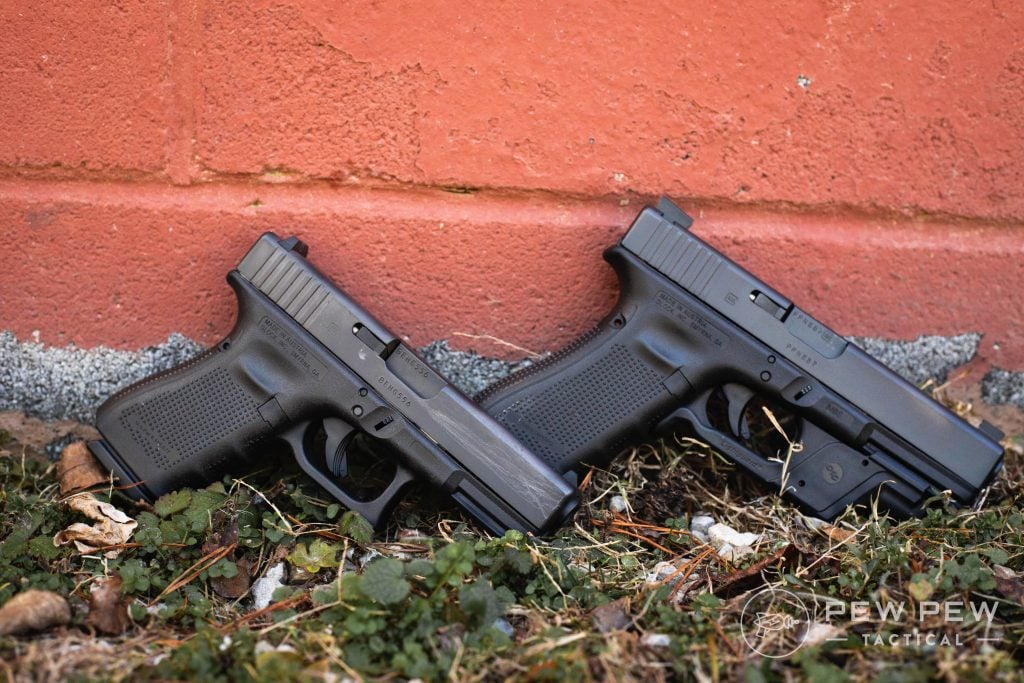
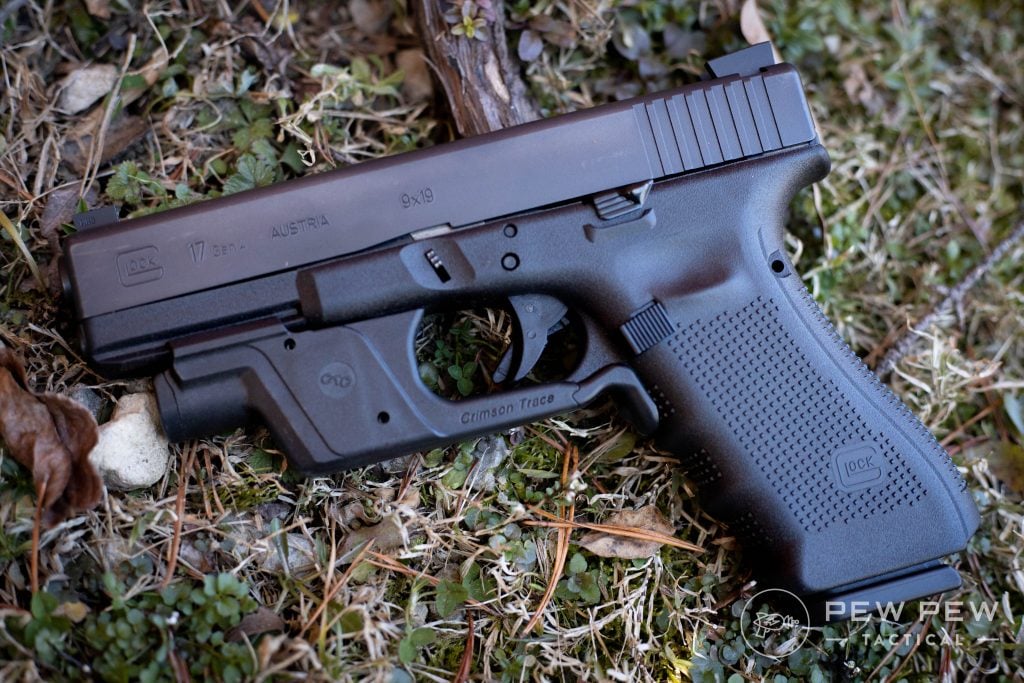
Glock G17 and G19 Gen 4
Glock G19, left, and G17, right.

Even if you take a step out of the gun community, most people know about Glock. From movies to rap lyrics, the brand seemingly exists everywhere.

But within the gun world, Glocks are one of those guns that foster a conversation.

Glock Rap
Glocks pop up everywhere

Whether you love Glocks or love to hate them, we’re going to take a look at some of the best models the Austrian company has to offer.

From concealed carry 9mm variants all the way to full-auto (oh yeah, they have one of those too), we’ll tell you which Glocks are worth your time, money, or are just plain fun.

Let’s get to it!

THE QUICK LIST

History Time!

We would be remiss if we didn’t at least touch on the history of Glock. Since it is a powerhouse brand, we feel we kinda owe it to you to explain how they got to where they are.

Glock began in the early 1960s, helmed by Gaston Glock.

Gaston Glock
Gaston Glock

At the time, pistols weren’t really on his mind. Instead, the company manufactured wood, steel, and plastic.

Fast forward to the groovy era of the 1970s, marking Glock’s entry to the world of weaponry — specifically, knives, grenades, and machine-gun belt links.

1970s
The 70s were groovy, baby.

It didn’t take long for the wheels to start turning and by the 1980s, the Glock 17 emerged.

While it wasn’t the first polymer pistol to land on shelves (that honor belongs to HK VP70), it was the first one to be a big hit.

All Tested Glock Triggers
The G17.

Before you know it, law enforcement was arming up with the plastic fantastic and its stellar 17-round magazine.

So, why has Glock maintained its stature?

Well, like it or not, the pistols are affordable and reliable. Two things that make both government agencies and civilians fall in love.

Glock Models Chart
Aftermarket, anyone?

Since Glock’s emergence into the firearms community, the brand has continued to release new models based on the tried-and-true design.

Whether that’s upgrading generations or producing new models in different calibers (I’m looking at you G44), Glock isn’t going anywhere anytime soon.

Glock G17 Gen 4
Glock models…you got some options.

Best Glocks in All Calibers

With history behind, let’s get to what you really came for…the best Glock pistols.

Though 9mm is classic Glock, we’re going to cover all sorts of calibers in the company’s inventory.

1. Glock 17 (9mm)

Ok, so we had to kick this list off with the OG, the one that started it all…the Glock G17.

A full-size, 9mm model, the G17 is available in all multiple generations.

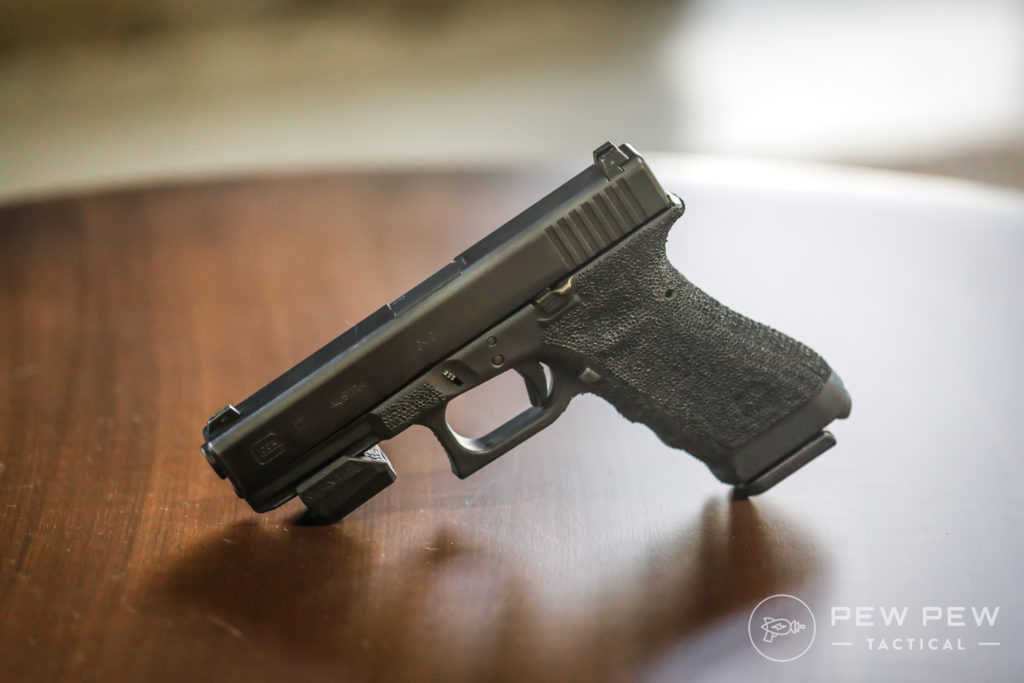
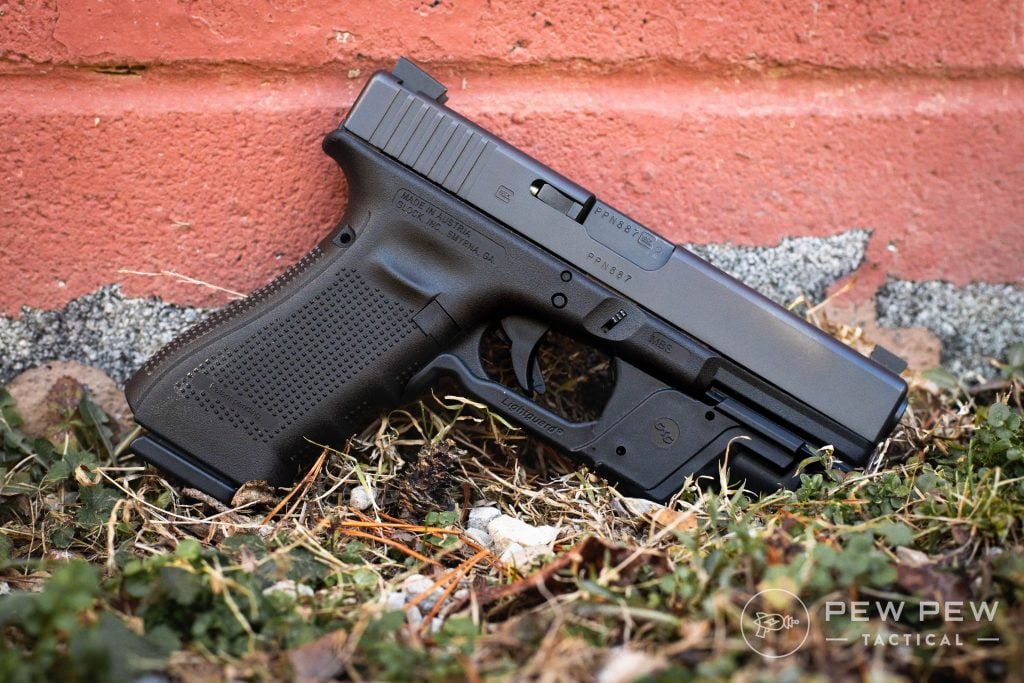
Glock G17 Gen 4
Glock G17 Gen 4 with a Crimson Trace light.

(Don’t know the difference between a Gen. 3 and a Gen. 5, head over to our Glock Generations article to get the low-down.)

Featuring a barrel length of 4.49-inches, the G17 measures 8.03-inches in total length. It weighs in at 32.28-ounces loaded with a standard 17-round magazine.

Glock G19 Gen 4
The gold standard of Glocks

The G17 is the gold standard for most law enforcement and its reliability has made it a winner in the civilian market.

From carry to home defense, the G17’s larger style makes it a perfect pistol for self-defense and personal protection.

If full-size isn’t your thing, however, then you might consider moving to Glock’s midsize 9mm…

2. Glock 19 (9mm)

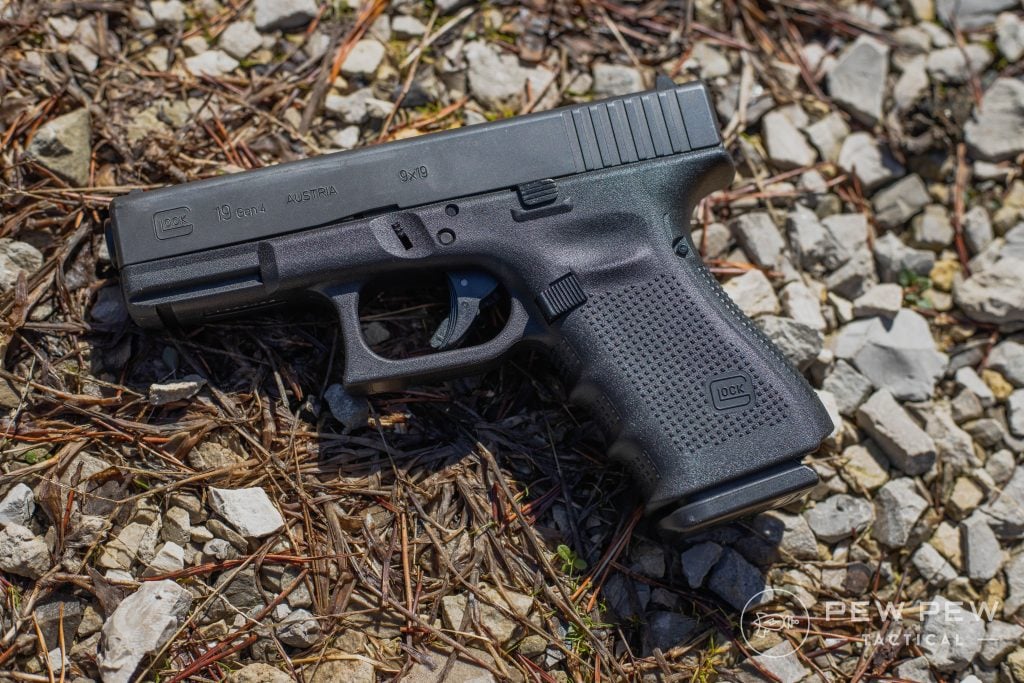
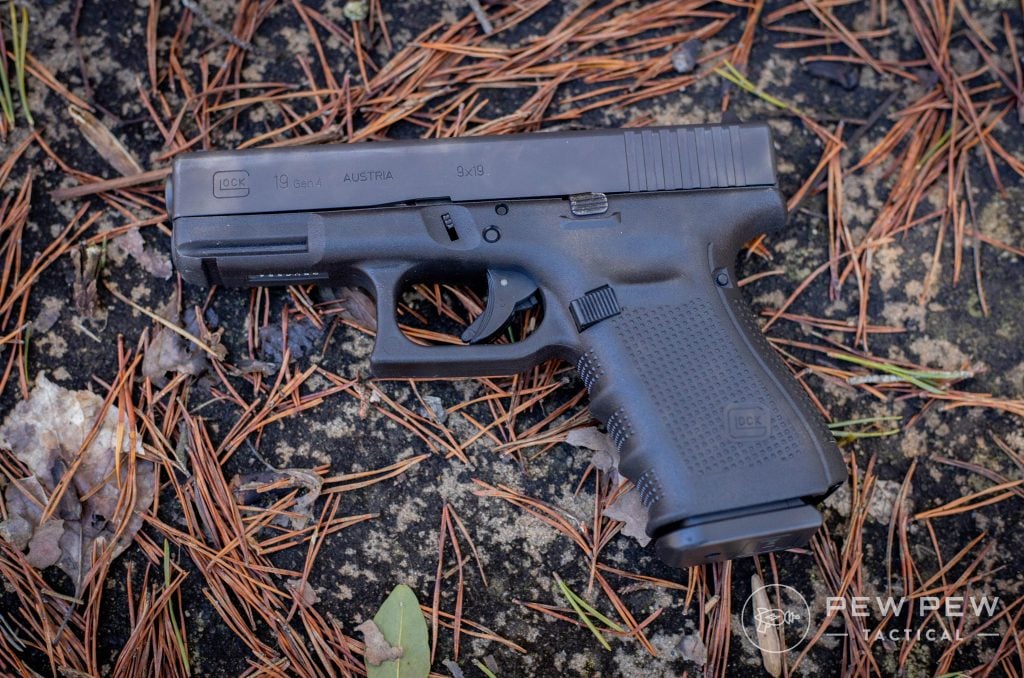
The Glock 19 is remarkably similar to the G17, but on a slightly smaller scale.

Still chambered in 9mm, the G19 measures 7.28-inches in total length. It sports a 4.02-inch barrel and weighs 30.16-ounces loaded.

Glock G19 Gen 4
Glock G19, Gen 4

This midsize model is versatile and easily transitions from the range to concealed carry with its double-stack design.

Again, it’s seen wide use in the law enforcement realm and, like most Glock products, is renowned for its ease of use and reliability.

G43 Banana
Love a midsize? The G19 is for you!

Not to mention, the 9mm chambering means that, in non-ammo shortage scenarios, you should be able to easily train with it alongside its standard 15-round magazine.

The G19 also benefits from a wealth of aftermarket support so you can switch sights, triggers, and slides if you so choose.

Interested in learning even more, especially about the Gen 5 G19, then head over to our full review.

If you still need something smaller to conceal, maybe in hotter summer months, then let’s take a look at a single stack.

What do you think of the Glock 19? Rate it below.

3. Glock 43/43X (9mm)

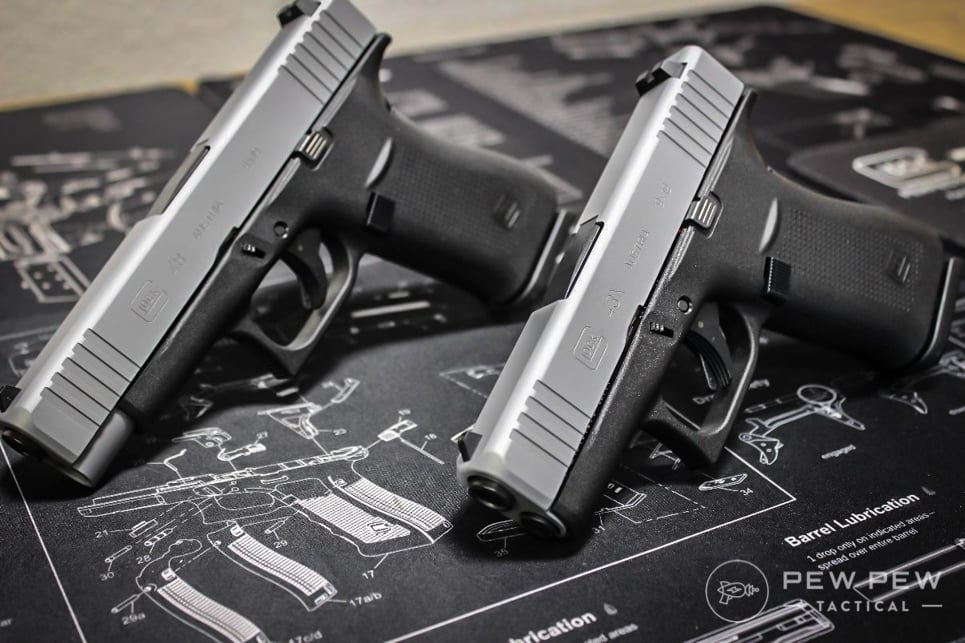
Coming in with a subcompact style, the Glock 43 and newer 43X reduce the size of the platform with a single-stack design.

Glock G43X
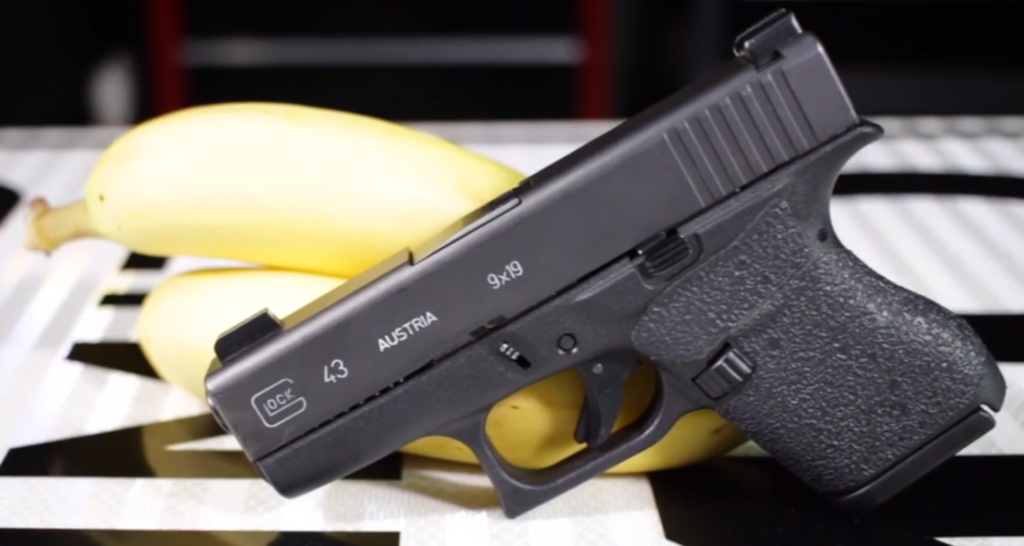
G43 and a…banana???

The 6-round capacity on the G43 brings with it a slimmer profile but still with a 9mm chambering.

Offering a 3.41-inch barrel and 6.26-inch overall length, the G43 weighs 20.64-ounces loaded.

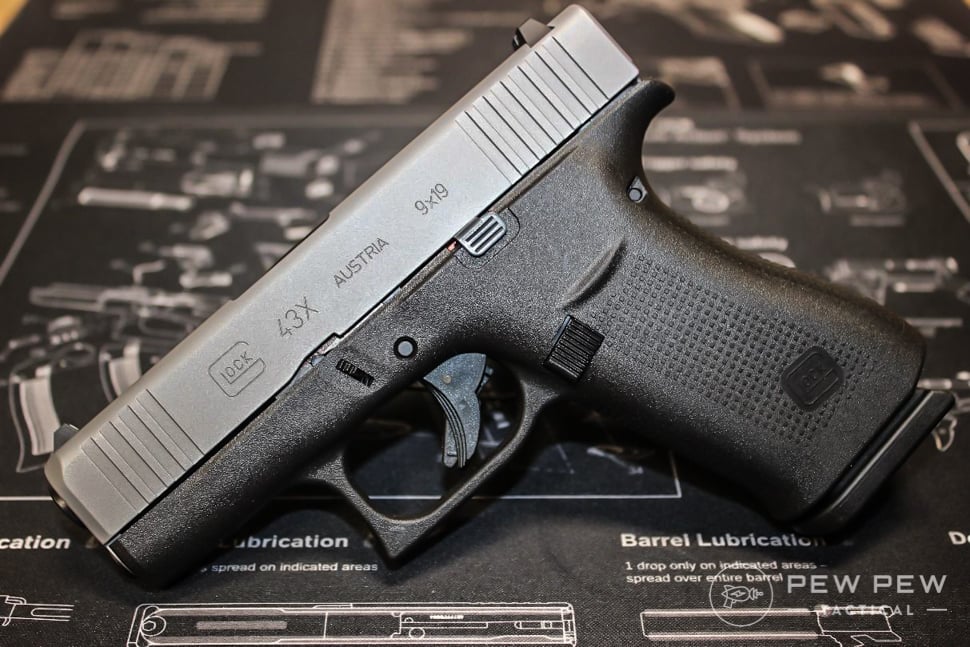
Meanwhile, the G43X brings an ever-so-slightly larger build.

The G43X measures 6.50-inches overall but still uses that 3.41-inch barrel. Loaded, it weighs more than the standard G43 at 23.7-ounces.

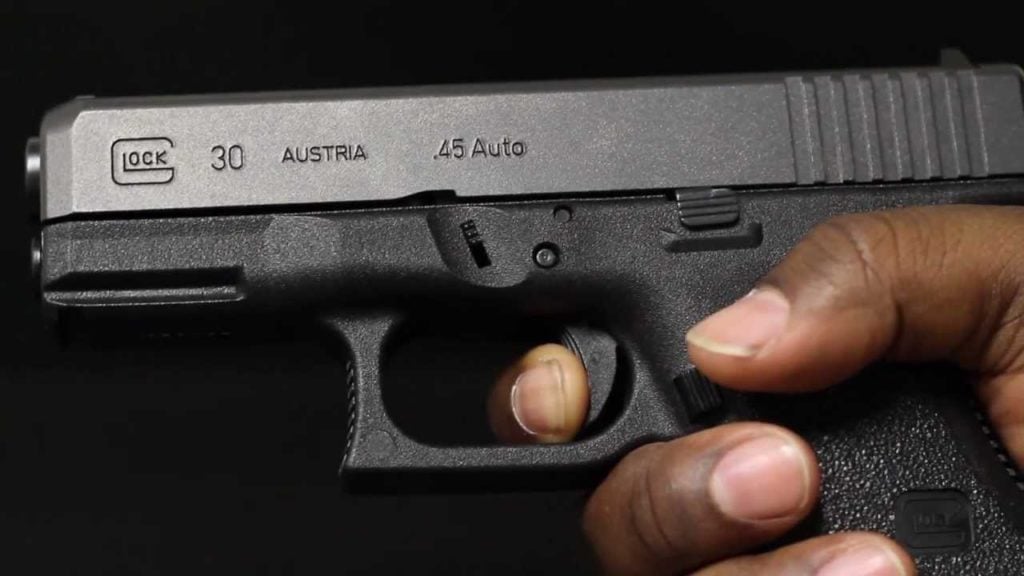
.45 acp glock 30
Glock G43X

You also get more rounds with the G43X — it features a 10-round capacity.

If you want a slim CCW pistol but have to have that sweet, sweet 9mm, the G43 and G43X are right up your alley.

For a more in-depth look at the G43, check our review here or just watch the video below.

If you prefer a little different oomph, however, you can knock it up to .45 ACP.

4. Glock 30SF (.45 ACP)

Some people love their .45 ACP and who are we to tell you you’re wrong. If .45 ACP is what you want, then the G30 SF is the Glock pistol for it.

Based on the G30 design, the G30 SF brings a subcompact appearance with a 10-round capacity.

.45acp glock 30s vs 30sf
The Glock 30 is just the right size for a lot of folks.

How does Glock accomplish this? With a shortened frame and reduced grip dimensions, of course.

With a barrel length measuring 3.78-inches and an overall length of 6.97-inches, the SF weighs 33.69-ounces loaded.

Glock G21
The Glock 30SF (right) vs the Glock 30S (left)

The choice of many plain-clothed street cops and security personnel, the G30 SF fits naturally into a concealed carry or defensive setup.

Like all Glocks, it’s easy to operate and maintain.

Though the G30 SF makes for flawless concealed carry in .45 ACP, what about a full-size for home-defense or just fun at the range…

5. Glock 21 (.45 ACP)

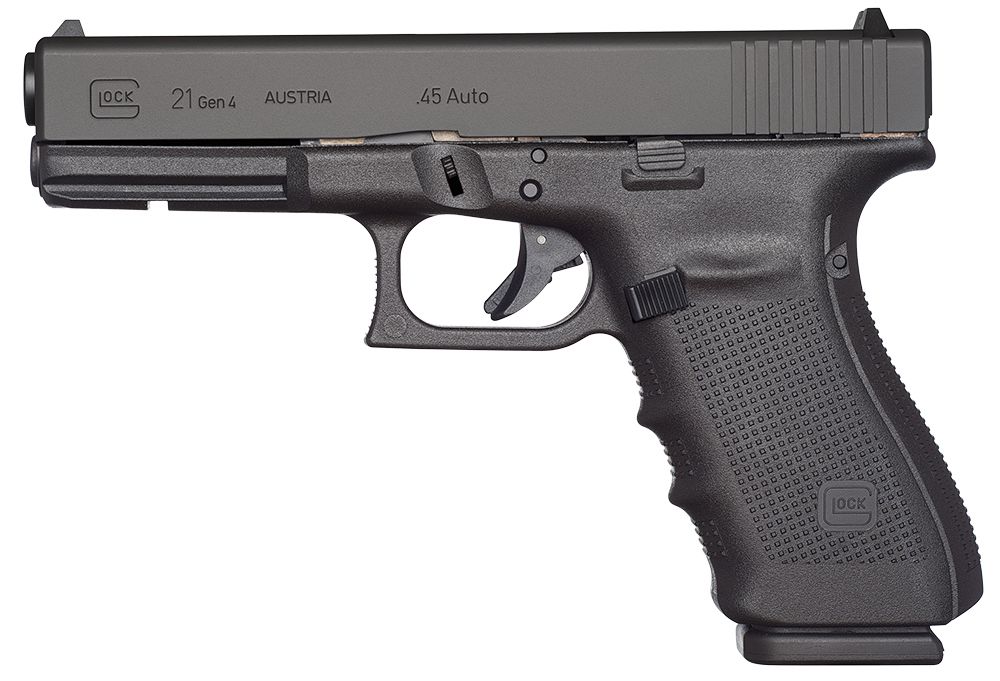
Continuing the .45 ACP vibe, the G21 is the full-size package.

With a barrel length of 4.61-inches and a total length sitting at 8.07-inches, the G21 weighs 38.80-ounces loaded.

What do you get from the G21 that you don’t see with the G30 SF? More rounds!

Glock 23, Gen 4
Glock G21

The G21 boasts a standard capacity of 13-rounds.

We always think more is better, especially when at the range or during a defensive situation.

Which, is where this pistol excels.

It could easily tuck into a nightstand safe or tossed into a range bag.

If .45 ACP isn’t your cup of tea, though, Glock does offer a handful of .40 S&W models

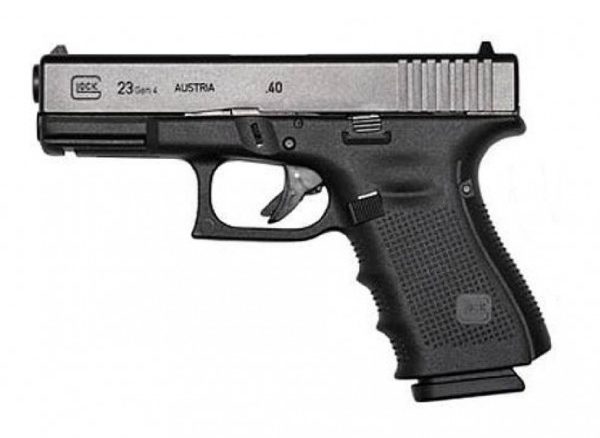
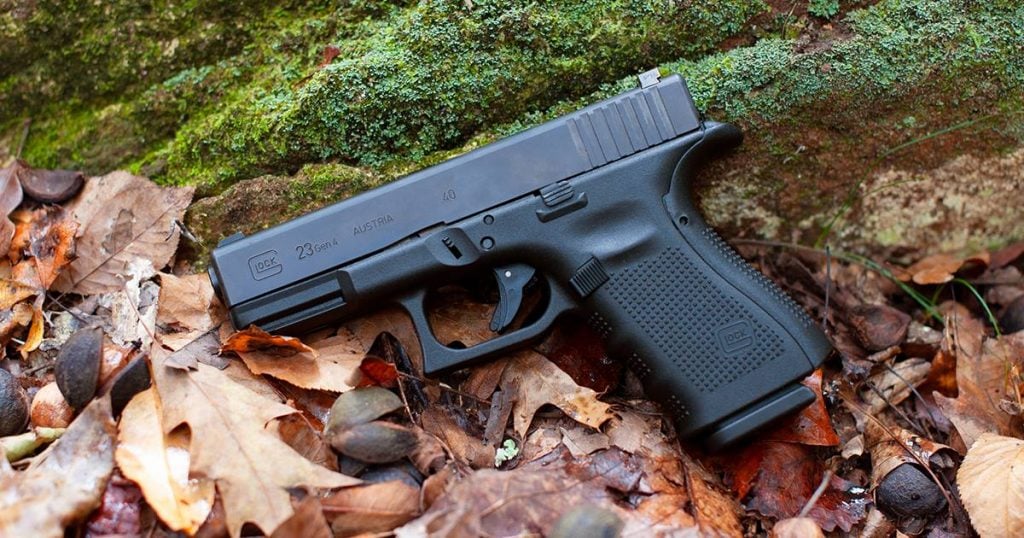
6. Glock 23 (.40 S&W)

The G23 comes chambered in .40 S&W with a magazine capacity of 13-rounds (though you can certainly spring for an aftermarket mag with up to 22-rounds).

Sporting a 4.02-inch barrel and total length of 7.28-inches, it weighs 34.36-ounces loaded.

Glock G23

It’s available in Gen. 4 or Gen. 5, but if you go for a Gen. 5 you’ll get the bonus of an nDLC finish, Glock Marksman barrel, and flared magwell.

Oh, and lefties will appreciate that ambidextrous slide stop lever too!

Using a compact build, the G23 is a nice middle area between full-size and subcompact.

Glock 20 and lots of ammo
Glock G23 (Photo: Glock)

And if you happen to love red dots and optics as much as we do, there’s even a MOS model that supports red dots.

If you love the .40-caliber, then you can’t get better than the G23.

Of course, while we’re talking alternative rounds, we might as well mention that Glock also has 10mm offerings

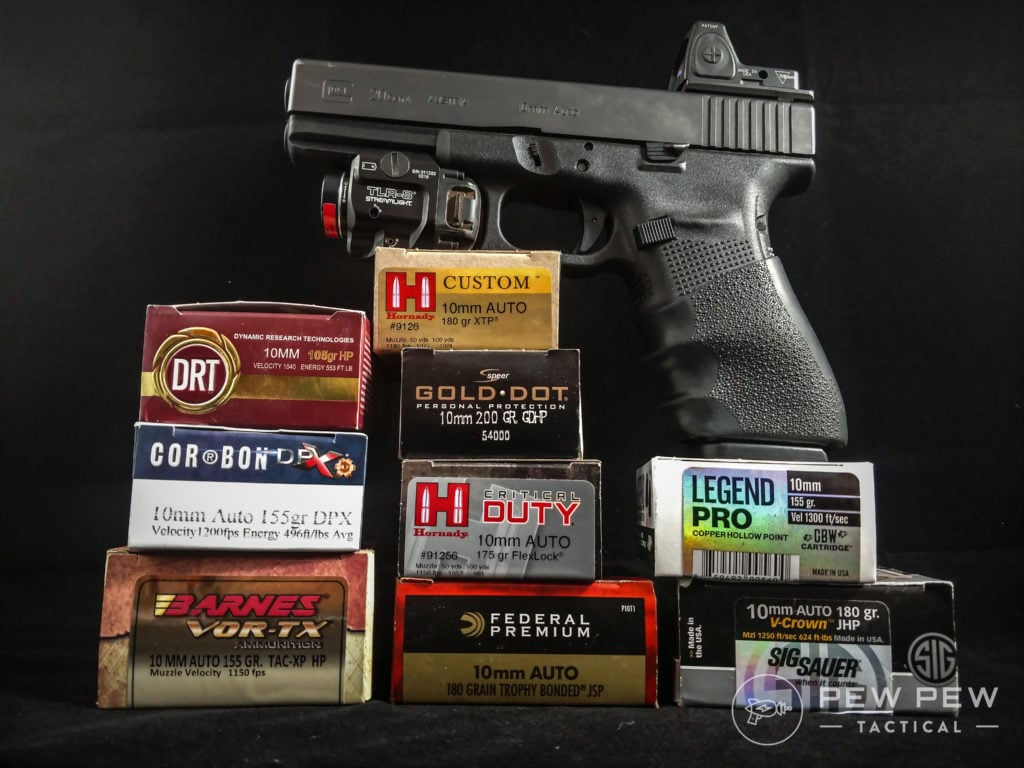
7. Glock 20 (10mm)

There’s something cool about shooting 10mm. Whether you’re doing it on the hunt or at the range, it’s a fun round!

Luckily Glock has a few 10mm offerings up its sleeve, but our favorite is the G20.

Glock 20 Target and Ammo
G20 with a Trijicon optic.

With a capacity sitting at 15-rounds, the G20 is a full-size model with 8.07-inches in total length to its name.

The barrel measures 4.61-inches and total loaded weight is 39.86-ounces.

While the G20 only comes in the Gen. 4 variant, but Glock does offer an SF, or short frame, model.

Glock G42
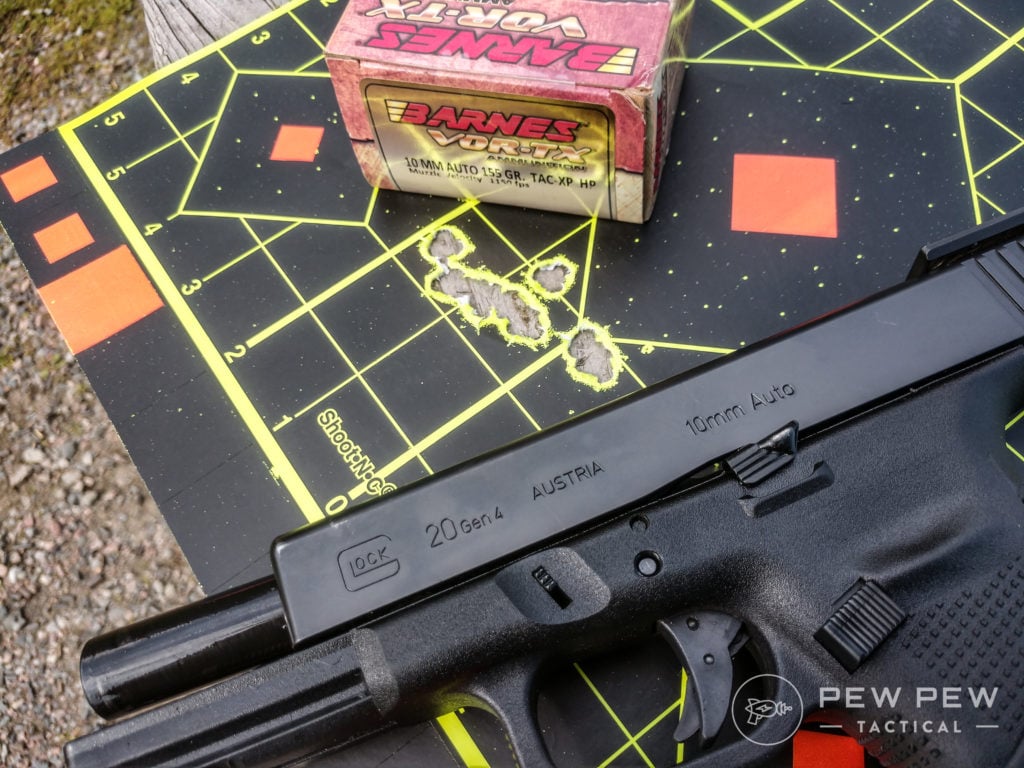
From a distance of 25 yards, shooting from the bench, with the SRO mounted to the gun the G20 nailed this group with Barnes 10mm 155-grain TAC-XP HP.

You still get that 15-round capacity with the SF and most of the measurements are on par with the G20.

But the SF downsizes the receiver’s circumference at the rear for a little more ease when shooting.

Interested in a deep dive into this 10mm bad boy? Check out our full review here!

Of course, if 10mm is just a bit much in your book, you can move in the opposite direction to a Glock in .380 ACP.

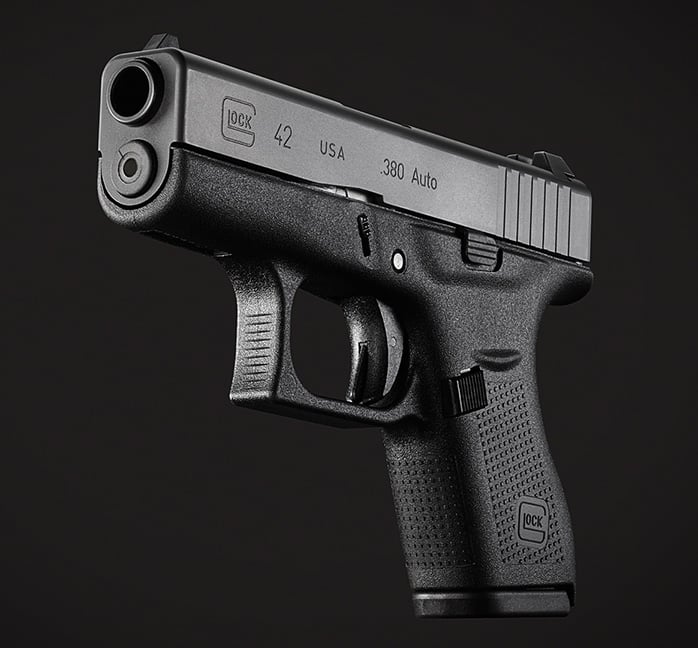
8. Glock 42 (.380 ACP)

The G42 comes chambered in .380 ACP which means there’s little to no recoil while shooting.

This subcompact offers a barrel length of 3.25-inches with an overall length measuring 5.94-inches. Weight rests at 15.87-ounces loaded.

Glock G42
Glock G42

Glock’s G42 is an ultra-compact pistol designed for concealed carry. This is your summer gun!

The trade-off for such a small handgun, though, is capacity. In the case of the G42, that means 6 rounds. Probably want to stock up on the spare mags…

Glock 44 at the Range
Glock G42

It keeps to Glock’s easy-to-shoot-and-maintain platform and brings that durability you’ve come to expect from the Glock brand.

If .380 ACP is still too much, you can always go with a cartridge most of us probably started on…a .22 LR.

9. Glock 44 (.22 LR)

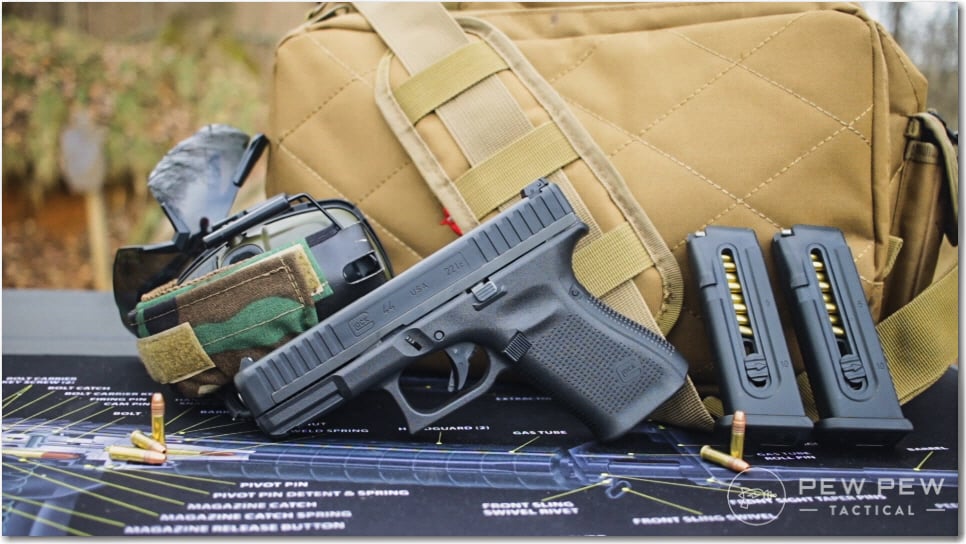
Ok, so I know the G44 is controversial. I’m sorry to all the fanbois who wanted a Glock PCC but instead got a .22 LR. Don’t throw hate at me.

The G44 burst onto the scene with a .22 LR chambering. According to the company, they wanted to introduce a gun specifically for first-time gun owners and those that put in a lot of training reps at the range.

Glock G48 MOS
Glock 44

Mimicking the size of the G19, the G44 comes with a 4.02-inch barrel and an overall length of 7.28-inches. Loaded with its standard 10 rounds, it weighs 16.40-ounces.

While you most likely won’t be packing this in your IWB holster, the G44’s strength comes from the fact that you can easily plink with it.

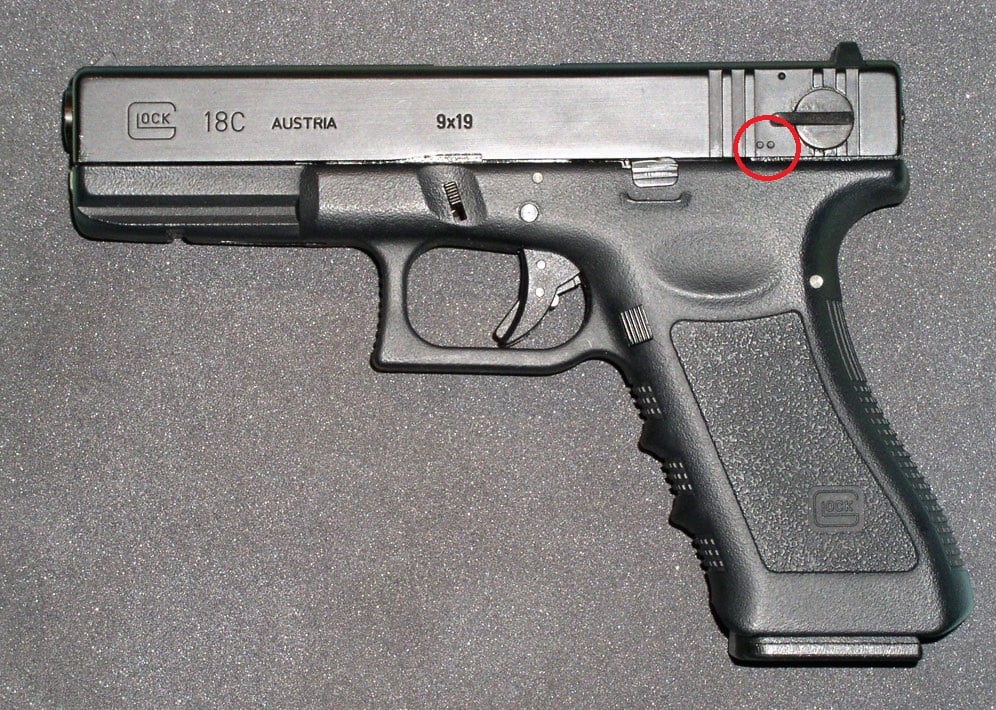
Glock 18C with Fun Switch

Normally, .22 LR ammo is cheap and easy to find, making this gun a perfect training companion.

Not to mention, .22 LR has virtually no recoil so first-timers will find this comfortable and less intimidating to shoot.

To see the G44 in action, peep our video below or you can read our full review here!

10. G48 MOS (9mm)

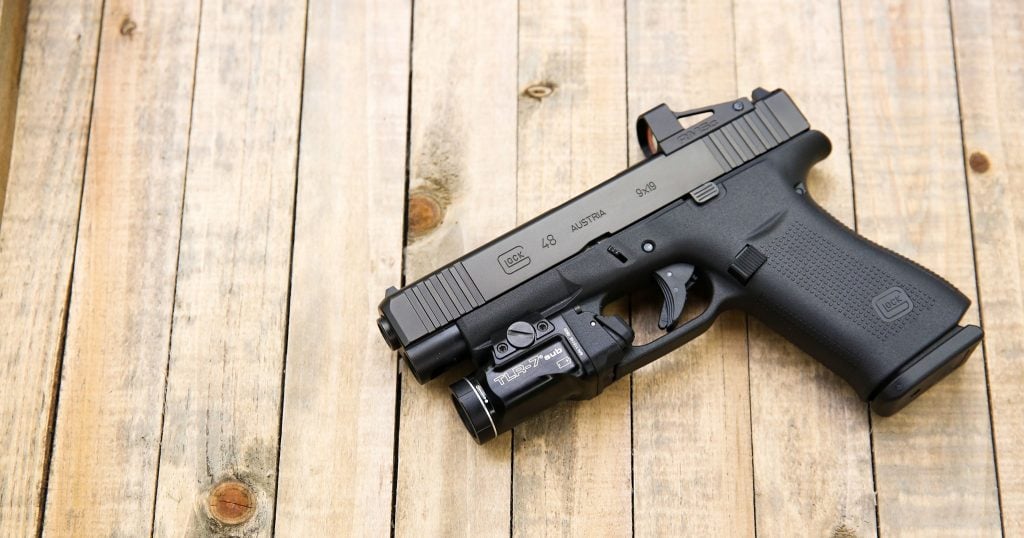
A newer Glock model, the G48 series takes a slim approach and looks to shave down on size.

Chambered in 9mm, it measures pretty close to the G19 but adopts Glock’s Slimline build to reduce its width.

Where the regular, ole G19 offers a 1.26-inch width, the G48 MOS measures 1.10-inches.

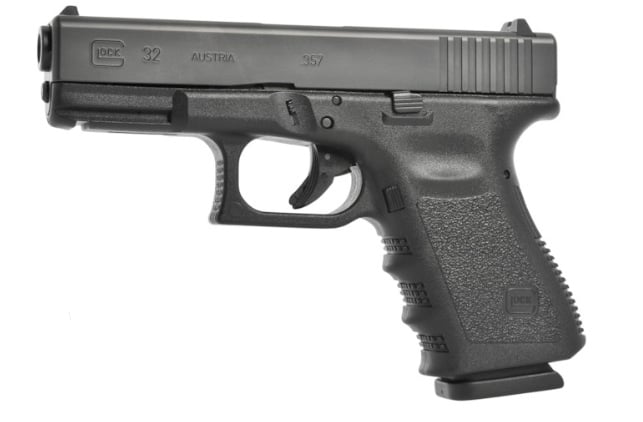
Glock G32
Glock G48 MOS (Photo: Glock)

The G48 brings a 4.17-inch barrel to the table with an overall length of 7.28-inches. It tips scales at 24.97-ounces loaded. And, it comes with a standard capacity of 10 rounds.

The MOS designator means that it uses Glock’s Modular Optic System. If you love red dots, this is a great pistol to toss an optic on — especially for concealed carry.

For more info on the G48 (and G43X) walk on over to our full review here.

Honorable Mentions

We couldn’t do an ultimate Glock list and leave off the very cool full-auto (yeah, you read that right) Glock 18.

The G18 is a BAMF 9mm full-auto Glock that most of us could just dream of owning. But for the lucky few, it’s a rad model that is peak Glock.

Glock G43X and G48
Glock 18C with fun switch

Also worth mentioning, if you’re a fan of .357 calibers and were a little bummed to not see the cartridges mentioned…well, let me put you on the G31 and G32.

Both are .357 SIG models! So, go get your fix!

Best Glocks of 2024: Top Calibers & Sizes
Glock G32

Conclusion

Glock pistols set the standard for polymer, striker-fired pistols. With a range of calibers from .22 LR all the way to 10mm, you’re guaranteed to find a model that fits your needs.

Best Glocks of 2024: Top Calibers & Sizes
Glock G43X and G48

What is your favorite Glock? Did it make our list? Let us know in the comments below. If you’ve already got a Glock but want to snazz it up, check out some of our other articles on how to Gucci your Gat: Best Glock Upgrades, Best Glock Sights, and Best Glock Triggers.

How long does a squirrel live?

0

Squirrels are common mammals found in diverse habitats across the globe, from dense forests to urban parks. While many people observe these agile creatures daily, few understand the complexities of their lifespan patterns. This comprehensive guide examines how long squirrels live and the various factors that influence their longevity, drawing from scientific research and documented observations.

General Lifespan Patterns

The study of squirrel lifespans reveals a complex interplay of natural and environmental factors. These bushy-tailed rodents typically have shorter lives than many people might expect. The average squirrel survives for about five to six years in the wild, though this number can vary dramatically depending on circumstances.

Research indicates that approximately half of all squirrels in a given population die each year. This high mortality rate reflects the numerous challenges these small mammals face in their daily lives.

The most vulnerable period in a squirrel’s life is its first year. Many young squirrels don’t survive to see their first birthday, falling victim to predators, disease, or accidents. This high early mortality rate has led to an evolutionary adaptation where squirrels produce multiple litters per year – a natural response to ensure species survival despite challenging odds.

A significant disparity exists between the lifespans of wild squirrels and those in captivity. Captive squirrels often live considerably longer than their wild counterparts, sometimes doubling or even tripling their expected lifespan. This difference demonstrates the impact that protection from predators and regular access to food and healthcare can have on squirrel longevity.

(For more on the best air rifle for squirrels, see this post)

Lifespan by Species

Different squirrel species have evolved varying lifespans, each adapted to their specific environmental niches and challenges. Research provides detailed information about the life expectancies of common squirrel species:

Eastern Gray Squirrels

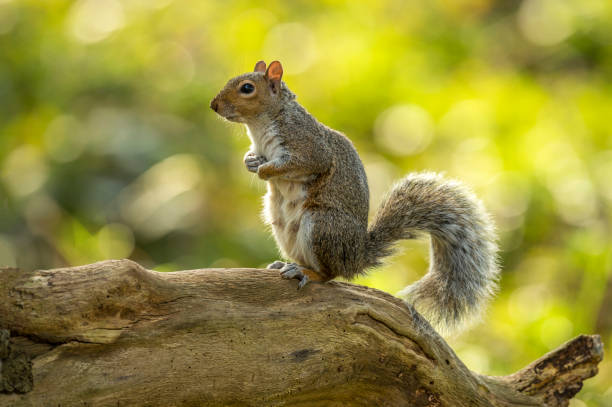
The Eastern Gray Squirrel, prevalent in North American urban areas, serves as an informative case study in squirrel longevity. In the wild, these adaptable creatures typically live between 6 to 12 years. However, their life expectancy at birth is notably low – just two years – due to the high mortality rate among juveniles.

Eastern Gray Squirrels demonstrate remarkable longevity potential in captivity. Under protected conditions with regular care, these squirrels can live up to 20 years. This substantial difference illustrates the significant impact of environmental pressures on natural lifespan.

Red Squirrels

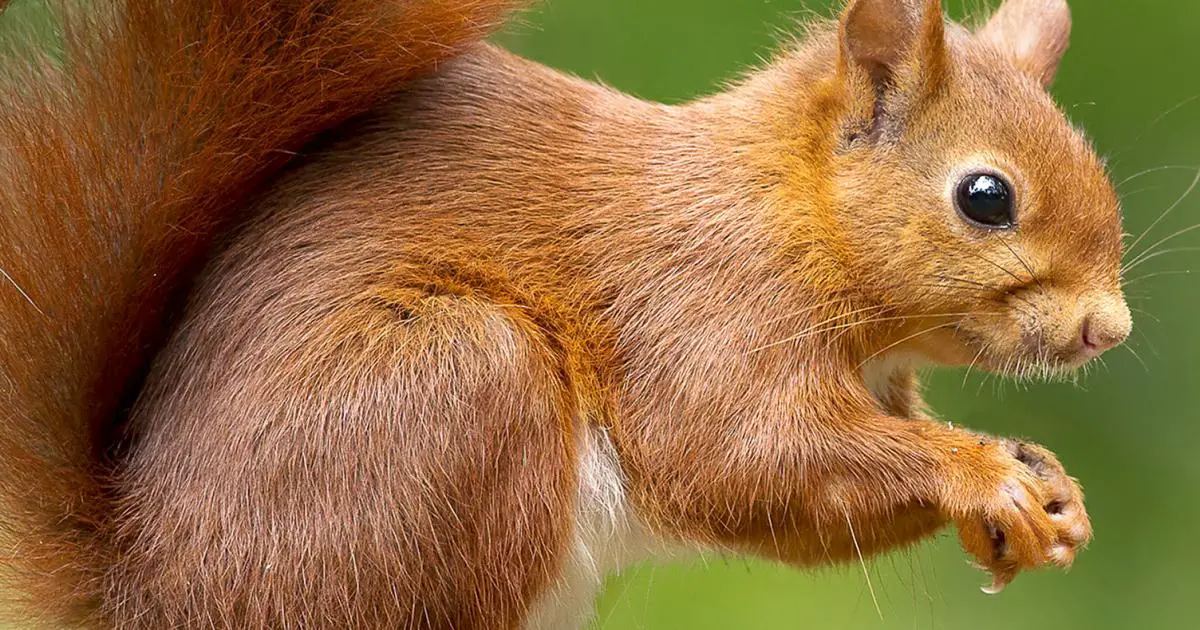
Red Squirrels, characterized by their smaller size, typically live around 5 years in the wild, with some individuals reaching up to 9 or 10 years. A notable aspect of Red Squirrel demographics shows that males tend to live longer than females, contrary to patterns observed in many mammal species.

The survival rate of Red Squirrels presents a concerning statistic – only about 20% survive to reach adulthood. This low survival rate is balanced by their reproductive strategy, although they typically have smaller litters than other squirrel species.

Fox Squirrels

Fox Squirrels exhibit one of the most impressive potential lifespans among wild squirrels, with some individuals living between 8 and 18 years in natural conditions. However, survival beyond 12 years remains relatively uncommon in the wild.

Gender disparity plays a role in Fox Squirrel longevity. Females typically live longer, averaging about 13 years, while males average around 8 years. As with other species, most Fox Squirrels don’t survive to maturity, succumbing to various natural hazards early in life.

Ground Squirrels

Ground Squirrels, including species like the California Ground Squirrel, typically have shorter lifespans than their tree-dwelling relatives. In the wild, they average 3-4 years, though some may live up to 6 years. Under captive conditions, they can reach up to 10 years, demonstrating the significant impact of protected conditions on longevity.

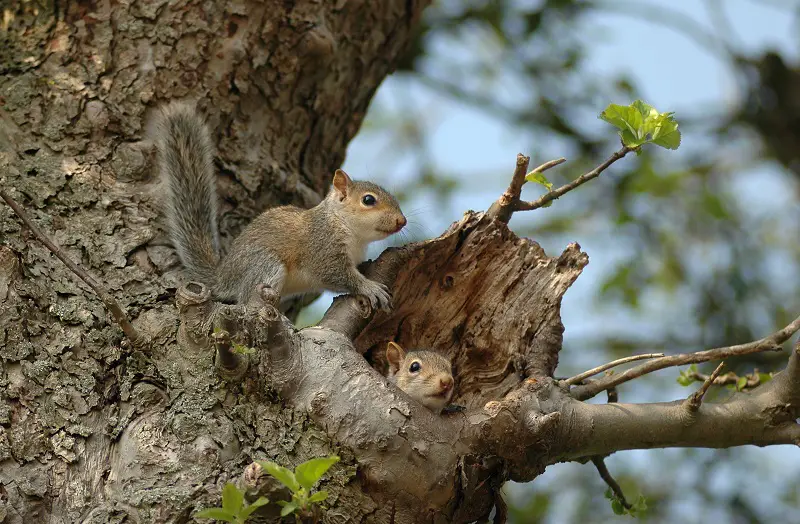
2 young squirrels emerge from their nest in a tree

Factors Affecting Lifespan

Several key factors influence squirrel longevity and help explain variations in lifespan:

Natural Predators

Predation represents one of the most significant threats to squirrel survival. Hawks, owls, coyotes, bobcats, and snakes actively hunt squirrels. These predators pose particular danger to young or inexperienced squirrels, contributing to the high mortality rate in the first year of life.

Disease and Parasites

Squirrels face vulnerability to various diseases and parasitic infections. These health challenges can significantly impact their lifespan, particularly in urban areas where higher population density facilitates disease transmission.

Environmental Hazards

Modern environments present numerous challenges to squirrel survival. Falls from trees or power lines, collisions with vehicles, and accidents during foraging pose significant risks. Urban squirrels must navigate additional hazards including power lines, traffic, and human structures.

Habitat Quality

Habitat quality plays a crucial role in determining potential lifespan. Access to reliable food sources, safe nesting sites, and adequate cover from predators contribute to longevity. Urban squirrels encounter abundant food sources but face different challenges than their forest-dwelling counterparts.

Human Impact

Urban development affects squirrel lifespans in both positive and negative ways. While development provides new food sources and nesting opportunities in structures like attics and wall spaces, it also introduces hazards such as vehicle traffic and exposure to toxic substances.

Survival in Human Structures

Modern squirrel populations demonstrate notable adaptation to human structures. Squirrels inhabiting attics or walls experience different survival patterns compared to their fully wild counterparts. While these locations offer protection from predators, survival depends on reliable access to food and water.

Research shows that squirrels face severe challenges in enclosed spaces without access to resources. A squirrel trapped in an attic typically cannot survive more than two weeks without food and water. In wall spaces, where conditions are more confined and stressful, survival time decreases to just a few days without resources.

Conservation Implications

The study of squirrel lifespans provides valuable insights for conservation and urban wildlife management. The relatively short average lifespan of most squirrel species, combined with high juvenile mortality rates, indicates population vulnerability to environmental changes and habitat disruption.

Population sustainability relies on squirrels’ adaptability and reproductive strategy of multiple litters. Their demonstrated ability to thrive in urban environments has enabled many species to maintain stable populations despite human encroachment on natural habitats.

Best Glocks Today: Reviewed by Special Operations Veterans and Professional Shooters

0
Best Glocks

In the world of handguns, few names command as much respect and admiration as Glock. Renowned for their reliability, durability, and adaptability, Glock pistols have earned their place in the holsters of law enforcement, military personnel, and responsible gun owners worldwide.

Our team of special operations veterans and pro shooters have been shooting Glock models for years, on active duty, in competition, and as civilian concealed carriers. Together, they have over 200 years of experience shooting Glocks and can provide valuable insight to anyone looking to buy a Glock pistol.

In this extensive guide, we’ll delve deep into the realm of Glock pistols, exploring their history, shared features, model variations, and, most importantly, the best Glocks available today.

Background

Before we dive into the specifics of Glock pistols, let’s briefly touch on their origin. Our journey begins with the visionary engineer Gaston Glock, an Austrian entrepreneur with a polymer and synthetic materials background.

In the early 1980s, Glock responded to a request from the Austrian military to develop a new handgun, marking the inception of the Glock pistol.

Gaston Glock’s innovative design incorporated a polymer frame, a striker-fired mechanism, and a straightforward yet reliable operation. These groundbreaking elements catapulted Glock to the forefront of the firearms industry, forever changing the landscape of handguns.

Best Glock Pistols

Choosing the Right Glock for You

Purpose

Purpose or use of your Glock

First, determine the primary purpose for which you intend to use the firearm.

If it’s concealed carry, opt for a compact or subcompact model like the Glock 19, 43X, or 26, which balance concealability with firepower.

For home defense, consider a full-size or compact Glock, such as the Glock 17 or Glock 19, offering a blend of size, capacity, and accuracy.

In professional or duty settings, prioritize reliability and durability, making the full-size Glock 17 or Glock 22 popular.

Competitive shooters will want pistols optimized for accuracy and performance, with the Glock 34, designed specifically for competitions, being an excellent option with its extended barrel and improved trigger.

Frame Type

Pistol Calibers

Frame type is another crucial consideration. Glock offers three main frame types: full-size, compact, and subcompact, though there are also some other variants on these.

Full-size frames provide a comfortable grip, making them ideal for duty use and competition, while compact frames, like the Glock 19, offer versatility, suitable for concealed carry and general use.

Subcompact frames, such as the Glock 43X and Glock 26, prioritize deep concealment and portability.

Full-size and compact frames are great duty sized handguns, while compact and subcompact frames are both good for shooters looking for a carry gun.

Caliber

Glock MOS

Your choice of pistol cartridge matters as well. 9mm is the most popular for its manageable recoil, higher capacity, and affordability, suitable for various purposes.

.45 ACP delivers substantial stopping power but with more recoil, favored by those prioritizing larger caliber rounds. .40 S&W provides a compromise between 9mm and .45 Auto in terms of power and capacity, often chosen for law enforcement.

Capacity

Glock Gen 4 vs. Gen 5

Next, consider magazine capacity. Standard capacity magazines range from 10 to 17 rounds, striking a balance between capacity and concealability.

However, extended magazines, available as aftermarket accessories, can increase capacity, offering extra rounds, sometimes even without altering the pistol’s overall size.

Carefully assessing these factors ensures you’ll choose the right Glock pistol that aligns perfectly with your specific needs and preferences.

MOS or Standard Models

Best Glocks Today: Reviewed by Special Operations Veterans and Professional Shooters

“MOS” in Glock terminology stands for “Modular Optic System.” Glock MOS models are equipped with features that allow for the easy attachment of optical sights, such as red dot sights or reflex sights, directly onto the pistol’s slide.

The Glock MOS system typically consists of a milled slot or plate on the slide that accommodates various mounting plates or adapters. Shooters can then attach compatible optical sights to these mounting plates, allowing them to co-witness with the pistol’s standard sights or provide an unobstructed view through the optic.

Gen 4 vs. Gen 5

Best Glocks Today: Reviewed by Special Operations Veterans and Professional Shooters

Glock has introduced several generations of pistols, with Gen 4 and Gen 5 being the most recent.

Perhaps the most noticeable of these changes is removing the finger grooves previously found on Glock grips to accommodate shooters of all hand sizes better. Glock also improved the grip texture to help ensure a firm grip and front slide serrations to make racking the slide easier.

While the overall dimensions between the Gen 4 and Gen 5 remain relatively similar, eagle-eyed enthusiasts will spot a slight increase in width for the Gen 5 model. This minor alteration, though subtle, might pose compatibility challenges with specific Gen 4 accessories, particularly holsters.

Glock also widened the mag well, facilitating faster reloads, though it’s essential to remember that proper training remains crucial for mastering the art of swift magazine changes.

For southpaw shooters, Glock took another step in the right direction by adding an ambidextrous slide stop on the Gen 5. This thoughtful addition makes it much easier for left-handed shooters to engage the slide without the need to adjust their grip.

Finally, Gen 5 Glocks boast both a barrel upgrade and trigger upgrade, promising improved accuracy and a more refined shooting experience.

However, you can’t go wrong with Gen 4, either. Both generations are well-regarded and have their devoted followers, so if you’re not too worried about these differences, you may be able to save a bit of money by going with a Gen 4 model.

FAQs

Do Glocks have a safety?

While Glocks don’t have a manual safety or grip safety, Glocks do feature a unique safety system called their “Safe Action” system. This three part safety system includes a trigger safety, firing pin safety, and drop safety to ensure that Glocks cannot be fired unless the trigger is directly and completely pressed.

What are the best Glock sights?

Glock factory sights are known for being, well, not the greatest. For that reason, many Glock owners opt to upgrade the stock Glock sights for aftermarket sights. Choosing the best Glock sights largely depends on your personal preferences and use cases.

Some popular options include tritium night sights for low-light shooting and red dot sights for enhanced target acquisition.

What are the best Glock triggers?

The best Glock trigger is a matter of personal preference, as different shooters have varying preferences for trigger weight and feel. Some aftermarket options include the Apex Tactical trigger and the ZEV Technologies trigger, which allow customization to suit your liking.

Why are Glocks so popular?

Glocks have achieved popularity due to their reputation for reliability, simplicity, and versatility. These reliable pistols are known for functioning flawlessly in various conditions and requiring minimal maintenance, making them a dependable choice for a wide range of users.

The Bottom Line

That brings us to a close on the best Glocks. Glock pistols have rightfully earned their place as some of the most trusted and widely used firearms in the world.

Whether you’re a seasoned shooter or a novice exploring the world of handguns, there’s likely a Glock model that aligns with your needs and preferences, and with this guide to the best Glock pistols, you should have all the information that you need to choose the perfect Glock for you.

Remember, responsible firearm ownership entails not only choosing the right firearm but also obtaining proper training and adhering to safety practices. Embrace the responsibility that comes with gun ownership, and enjoy shooting responsibly.

By considering your purpose, frame type, caliber preference, and capacity requirements, you can confidently select the ideal Glock pistol for your specific needs. As you embark on your journey with Glock, prioritize safety, continuous training, and responsible firearm usage. Happy shooting!

Bill Jordan – About Realtree – Camo Fabric,Realtree Camo,Outdoor Camo,Jungle Camo – Shenzhen Dayton Textile Products Co., Ltd

0

A stone’s throw from the back porch of the home where Realtree ® founder Bill Jordan grew up in Columbus, Georgia, Lake Oliver provided fabulous bass fishing for a young boy. Bill also often hunted dove and deer with his father, Leon, a devoted hunter who owned a small farm.

The Jordan home was the meeting place for all the neighborhood kids, and was always alive with activity. In addition to hunting, fishing and roaming the hills, Bill played football, basketball and baseball on a nearby vacant lot. That’s just what boys did in Columbus, Georgia, in the 1960s.

Bill’s mother, Kitty, who still lives in the same home where Bill grew up, remembers many times when he would get up at dawn, jump in his boat and fish until the last minute before grabbing a quick bite and heading off to school.

His classic American boyhood shaped Bill’s natural athletic skills and his love of the outdoors, and provided tremendous family support and permanence.

Bill attended Columbus High School, where he starred in track, basketball and football. Baseball was actually Bill’s best sport as a youngster, but he gave it up before entering high school, because it was difficult to play four sports at the high school level. After earning all-state honors as a receiver on the school’s winning football team, several major colleges (the Universities of Georgia, Auburn, Tennessee, and Mississippi) recruited Bill heavily in football and basketball. Bill decided on football, his best sport, and chose the University of Mississippi, primarily because of the abundance of good hunting and fishing within a short drive of campus.

At Ole Miss, Bill played on two bowl teams and started several games despite a problematic hamstring injury that sidelined him several times throughout his college career. During those years, one of Bill’s roommates was the great quarterback Archie Manning, who remains a good friend to this day.

When Bill graduated from college in 1973, his injuries kept him from considering a career in professional football, so he came back to Columbus to settle into the family boat business with his father and his older brother, Butch.

Bass fishing tournaments were quite popular at that time. Being an avid angler who was in the boat business, Bill made a natural progression into competitive fishing. Many of his customers and friends were also fishing the tournaments, which were a popular social activity in the Chattahoochee Valley. Bill competed well at local tournaments and earned a reputation as a top bass angler. After winning several tournaments, Bill entertained the idea of fishing the newly formed Bassmaster tournament circuit. Ultimately, Bill knew he needed to stay close to home to help his father and brother.

His competitive fishing skills were put to use, however. After starting his own business, Spartan Archery Products, in 1983, Bill continued to fish the local bass circuit to make an extra $2,000 to $10,000 a year to help pay his employees. After forming Realtree ® in 1986, Bill stopped competing in fishing events.

Spartan Archery Products grew out of Bill’s desire to own his own business in the hunting or fishing markets. He began by considering the things that hunters and anglers buy every year. He decided that camouflage t-shirts were a commodity item that he could easily manufacture locally and sell nationally. Bill made inroads to several major retailers with his Spartan brand t-shirts, but the profit margins were low, making it a tough business.

By the mid 1980s, the modern camouflage revolution was just beginning. Bill was one of the first to join the market.

He believed that overlaying a leaf pattern on a vertical bark pattern would produce a three-dimensional effect that would blend well with hardwood trees. So, using paper and colored pencils, Bill sat in his parents’ yard and sketched the bark of one of the big oak trees growing there. That tree, which still stands today, served as the inspiration for the entire Realtree line.

After a few false starts and some trying times in the late 1980s, Realtree grew quickly throughout the 1990s, becoming a household name in the hunting industry. Bill has never stopped innovating. He and his company, Jordan Outdoor Enterprises, Ltd., stay at the forefront of the latest developments in fabric design and printing in order to advise customers (licensees who pay a royalty fee to use the camo patterns) about the best ways to maintain quality and performance.

Today’s camo designs are created using sophisticated computers, digital cameras, and photo-realistic printing, and Bill continues to oversee the entire process of creating and launching each new camouflage pattern.

In the late 1980s, Bill began to realize the value of television and video for reinforcing his brand and selling his camouflage patterns. Bill became a pioneer in the hunting television and video industry, hiring David Blanton from LaGrange, Georgia, in 1991 to launch the wildly popular Monster Bucks ® video line and Bill Jordan’s Realtree Outdoors ® television show.

Bill also developed an interest in NASCAR racing in the late 1980s. He shared many hunting camps with two of the best drivers of his generation, the late Davey Allison and the late Dale Earnhardt. His association with the drivers eventually led to a friendship with Earnhardt’s car owner, Richard Childress. Today, Realtree is a secondary sponsor of the Childress number 29 car driven by Kevin Harvick.

Bill has never forgotten his humble start with a small company in the back room of his late father’s marine dealership. Despite many setbacks along the way, Bill persisted, creating an all-American success story. His genius for promotion has brought him, and Realtree, to where they are today. Bill remains a man of the people who is as comfortable among a group of Iowa farmers as he is meeting with the president of a large corporation.

Bill’s greatest joy is his family. Bill and his wife Shannon have three children, Tyler, Graycen and Colton. Bill and Shannon participate in every aspect of their children’s development. Their oldest son, Tyler, already appears in Realtree hunting videos and on television. And Bill loves the time he and Tyler share hunting and fishing.

Best Air Rifle Deals

Popular Posts

Air gun 101: The differences between .177 & .22 – Which jobs they do...

0
I’ve always believed the popular phrase: “It’s not the size of the dog in the fight that matters - but rather the size of the...

Pump Air Rifles vs Break Barrel

0
Exploring the Pros and Cons: Pump Air Rifle vs Break Barrel - Unveiling the key differences and advantages between two popular air rifle mechanisms....

PCP vs Spring Piston: Which one is better?

0
When reading about guns in the search for the first one that would be perfect for you, an age-old debate comes into question. Should...