Home Blog Page 153

Best Lures

0

You have a lot of options for catching a variety of different salmon, however, most it boils down to 3 things: bait fish, eggs and flies. Imitate these 3 things and you will catch fish.

Best Fishing Lures & Flies

Soft Baits

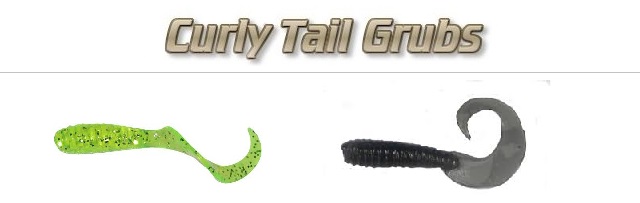
Curly tail grubs are great baits for salmon. The 4 to 5 inch grubs will work better than the smaller grubs, however, for some of the smaller salmon, don’t rule out a 2 to 3 inch grub. They are great for casting, jigging or slow trolling.

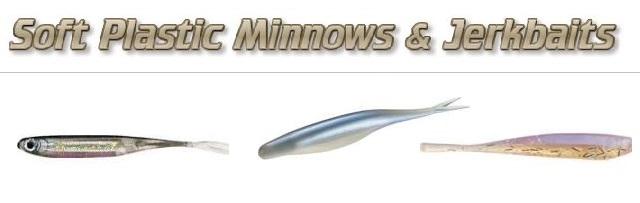
Jigging or drop shotting minnow baits aren’t a very popular way to fish for salmon, however, they can be effective. Some anglers will fish this way when they find a large school of salmon. Another way to fish with these baits is with a scrounger jighead. You can then cast them and wind them in with a steady retrieve or slow troll them.

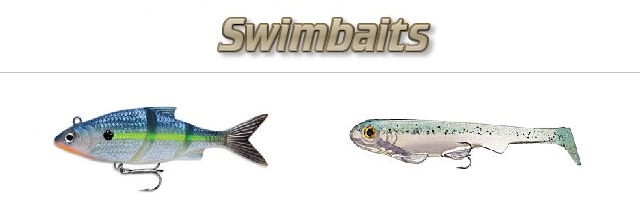
Swimbaits can be very effective for salmon. You cast them or troll them. They probably work better trolled because you can cover more water, but don’t rule out these lures when salmon move into the shorelines and harbors to spawn in the fall.

Hard Baits

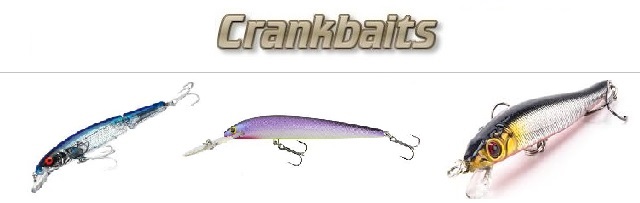
Crankbaits can be effective for salmon. Most anglers that fish crankbaits will troll with them. Whether you fish shallow, deep or in between, you have a lot of options. Some anglers report good success casting crankbaits when salmon move into the shallows during the spawn.

This is one of the most popular ways to troll for salmon, especially in the spring and early summer when salmon can be caught somewhat shallow.

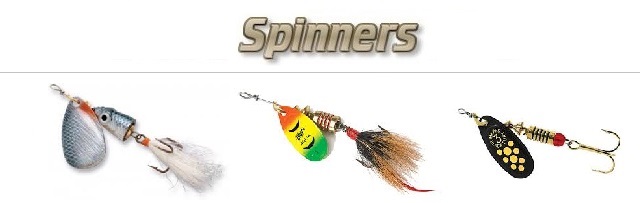
Inline spinners are very popular for trout and they will work for salmon too. Most anglers won’t use spinners for salmon, however, when salmon move into the shallows to spawn, you can usually catch some fish with a spinner. On the Great Lakes, anglers fish the harbors and shorelines in the fall and do pretty well with these lures. Some anglers report success in some rivers too, however, flies and eggs tend to be much more productive in the rivers.

Spoons

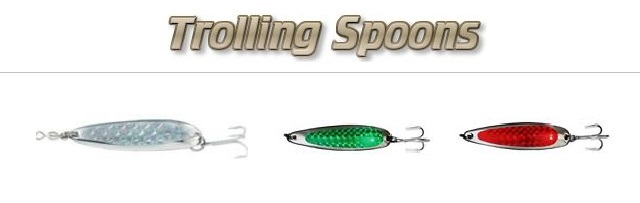
Trolling spoons are the most popular types of spoons for salmon. Troll a variety of them at different depths and they will catch all types of salmon.

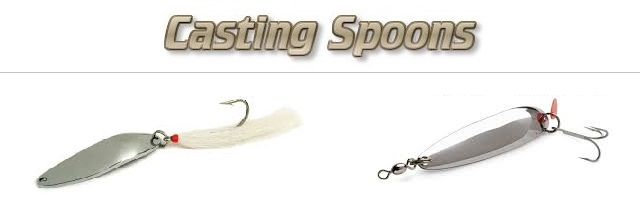
Casting spoons aren’t as popular as trolling spoons, but they are super effective when salmon are close enough to shore that you can cast for them. Some boaters also report good success casting spoons in the harbors in the Great Lakes. Every state doesn’t allow you to fish from your boat in the harbors, so check the regulations before using this technique.

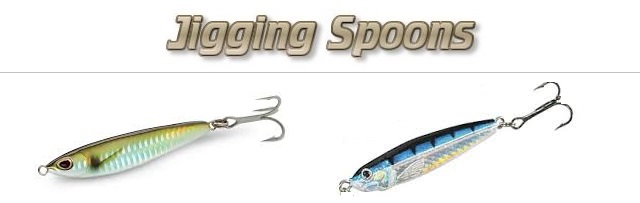
Jigging spoons can be effective for salmon when you find a school of them in deeper water. Trolling tends to be more effective so most anglers never even try a jigging spoon. They can be effective though if you are in the right situation.

Flies

They say that when salmon enter the rivers to spawn that they do not eat, however, they must still be willing to hit a bait, otherwise, anglers would never catch them. You can use a variety of flies that you see trout anglers use, however, most anglers that fly fish for salmon will stick to the egg patterns and streamers. You can catch salmon with other flies, but the ones listed below tend to be the better patterns for targeting salmon.

Best Lures

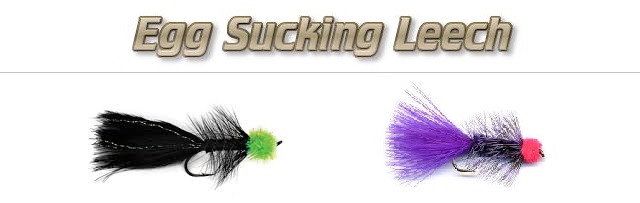
The egg sucking leech is a very unique fly that works very well for salmon. Anglers fish these at the beginning of the spawning runs all the way to the end and they tend to catch fish consistently through the entire run.

Best Lures

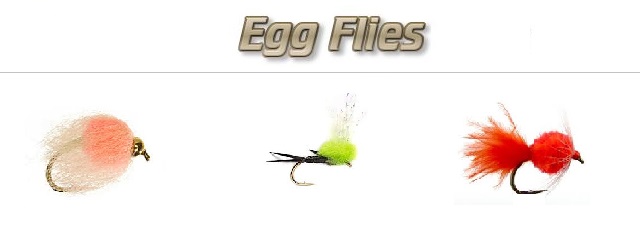
Egg flies work great, especially once the salmon start laying their eggs during the spawning runs.

Best Lures

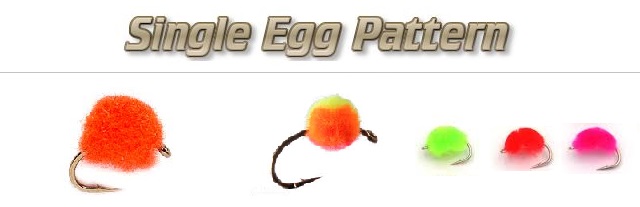
There may not be a better way to target salmon once the salmon start laying their eggs during the spawning runs in the rivers. Tie on a single egg and drift it slowly downstream.

Best Lures

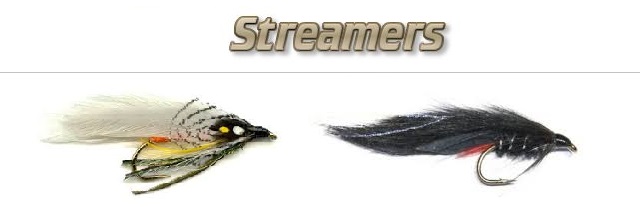
Streamers are popular flies for salmon. Fish a variety of streamers in the rivers when the salmon are running and you should catch some fish.

NEW 7mm PRC: Complete Overview – Ultimate Reloader

0

The 7mm PRC is HERE! In this story I’ll give a complete overview of this new cartridge including specs, a comparison with other cartridges in its class, talk 7mm PRC ballistics, and give you a preview of much more 7mm PRC content that’s coming!

Disclaimer

Ultimate Reloader LLC / Making with Metal Disclaimer: (by reading this article and/or watching video content you accept these terms)

  • The content on this website (including videos, articles, ammunition reloading data, technical articles, gunsmithing and other information) is for demonstration purposes only.
  • Do not attempt any of the processes or procedures shown or described on this website.
  • All gunsmithing procedures should be carried out by a qualified and licensed gunsmith at their own risk.
  • Do not attempt to repair or modify any firearms based on information on this website
  • Ultimate Reloader, LLC and Making With Metal can not be held liable for property or personal damage due to viewers/readers of this website performing activities, procedures, techniques, or practices described in whole or part on this website.
  • By accepting these terms, you agree that you alone are solely responsible for your own safety and property as it pertains to activities, procedures, techniques, or practices described in whole or part on this website.

7mm PRC Quick Facts

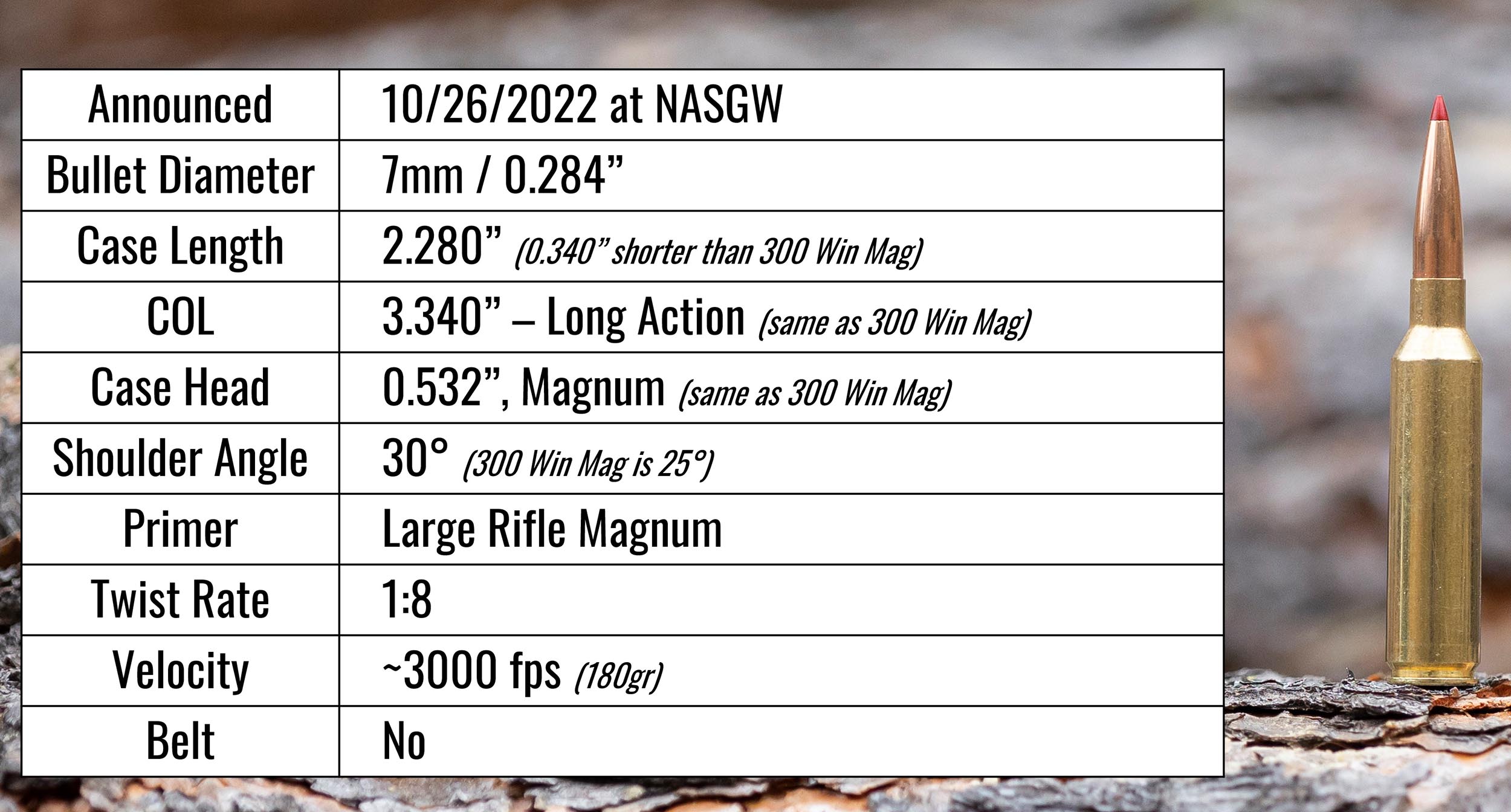
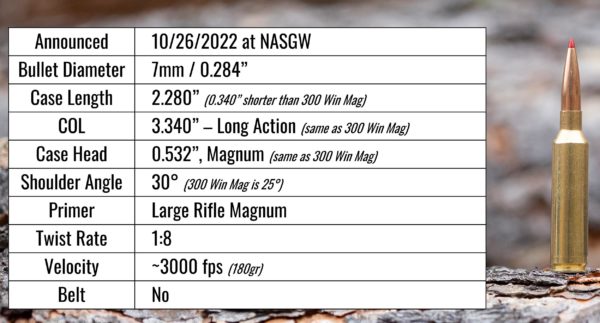
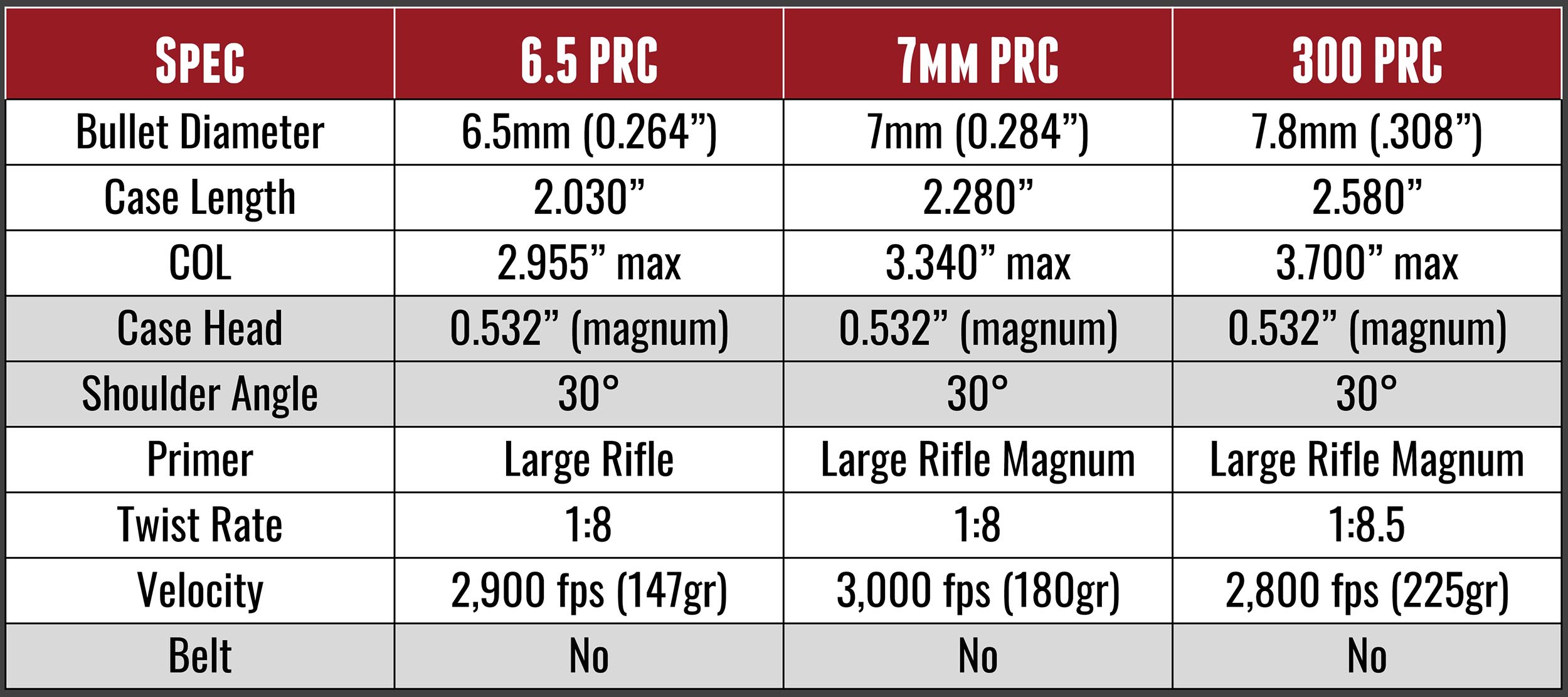
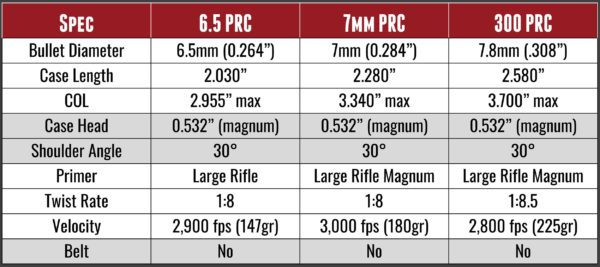
7mm PRC is its own cartridge, different from the 6.5 PRC and 300 PRC fundamentally. Here’s some quick specs:

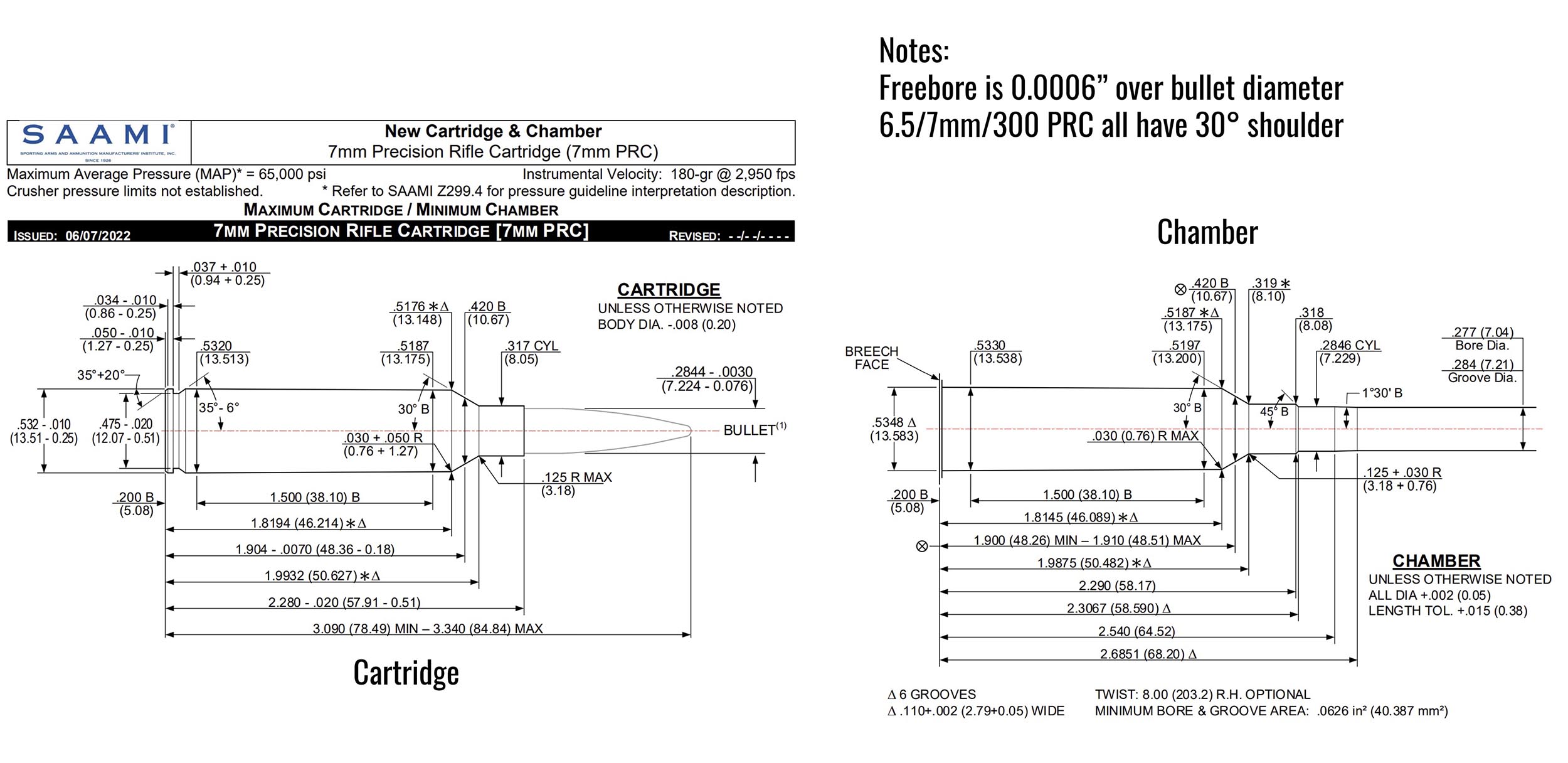
7mm PRC SAAMI Specs

On June 28, 2022 SAAMI officially released the specifications for the 7mm PRC which you can download HERE.

With a limit of 65,000 PSI, and compatibility with 300 Win Mag and similar rifle platforms (including magazines), the 7mm PRC has great power and flexibility. If you have a long action magnum rifle (with 0.532″ bolt face), upgrading to 7mm PRC is likely just a barrel change!

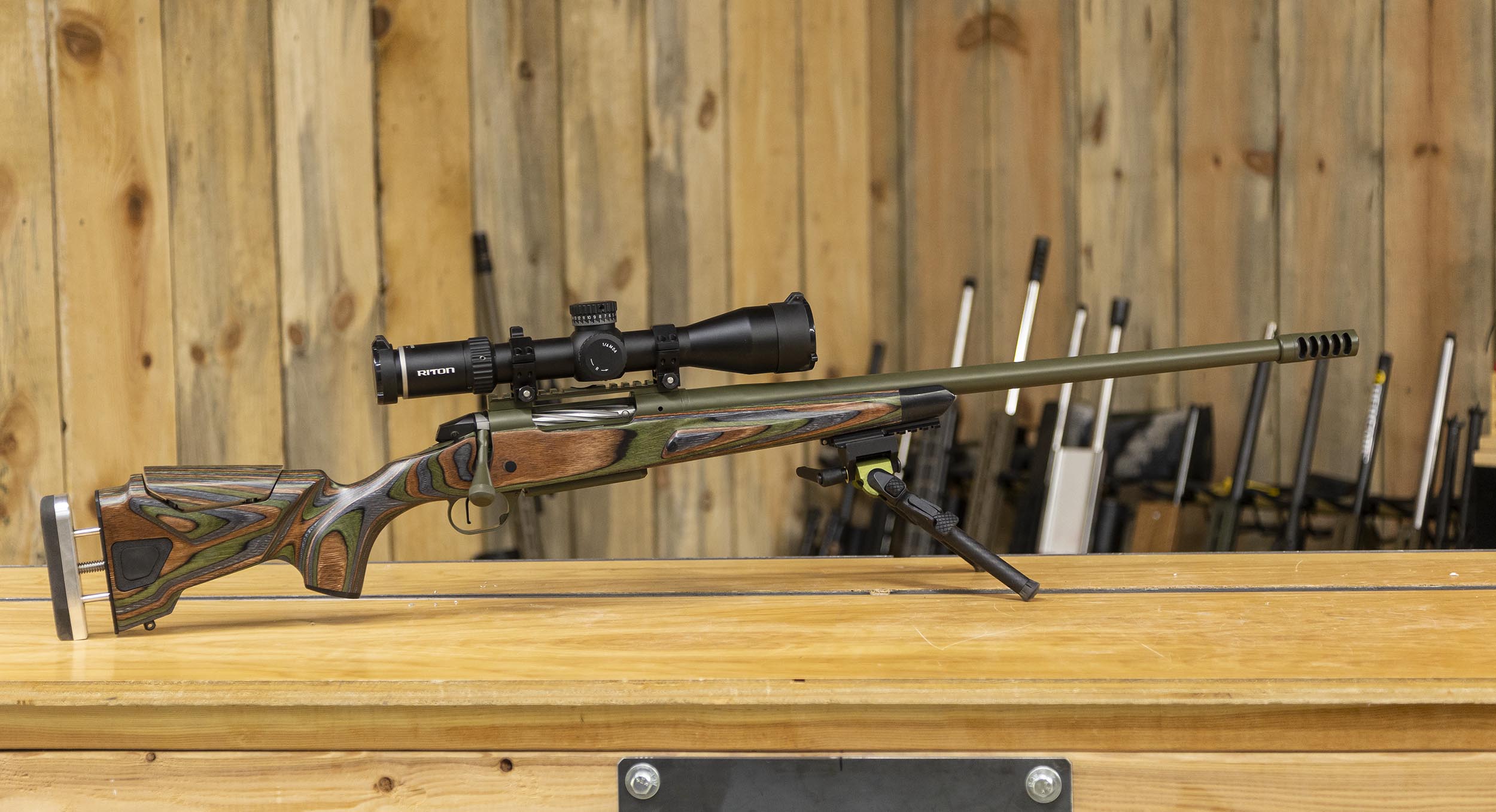
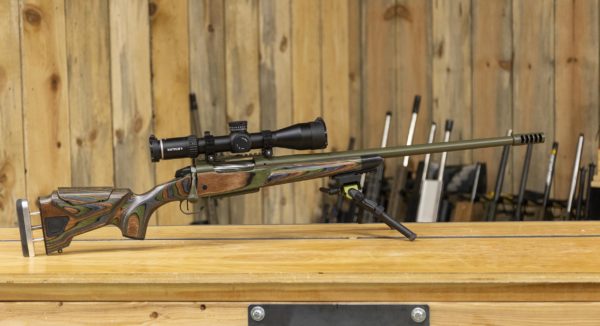
7mm PRC Bergara / Boyds Build Preview

Rifle #1 for this project is built on the following:

  1. Bergara Premier Action (LA, bare)
  2. Bartlein 7mm 5R Barrel Blank 1:8
  3. Boyd’s Agility stock
  4. Hawkins Precision Hunter DBM / Hawkins Hunter Magazine
  5. RITON X7 Conquer 3-24x50mm Scope (MOA)

Plus, a full Cerakote job on the barreled action. There will be a dedicated story on this build!

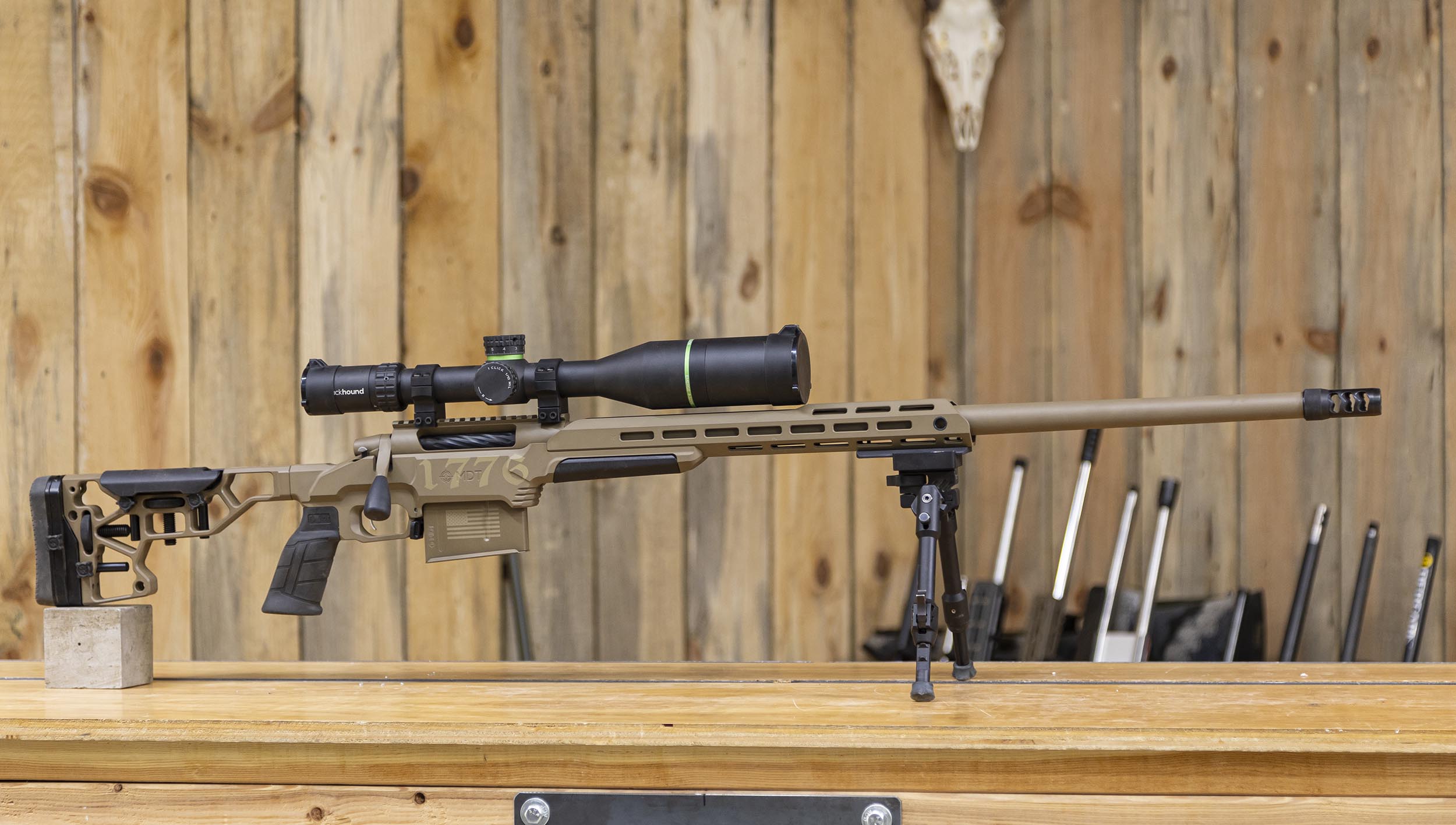
7mm PRC Bat / MDT “Freedom Rifle” Build Preview

Rifle #2 for this project is a spare-no-expenses top-shelf build focused on long-range target shooting. Here’s what makes up this build:

  • Bat HR Action (LA)
  • Bartlein 7mm 5R Barrel Blank 1:8
  • MDT ESS Chassis (With FDE + engraving on barreled action)
  • Blackhound Emerge 4-32x56mm Scope (MIL)

Like with the Bergara build, there will also be a dedicated story for this Bat/MDT build!

Quick Look: All Three PRCs Compared

The “Three PRCs” share a lot in common. All three of these magnums are serious long-range cartridges with 0.532″ case rims, 30° shoulders, and optimized around long, slender high-BC bullets. 6.5 PRC can fit in a short action, where 7mm PRC and 300 PRC both require a long action.

7mm PRC Ballistics

I was surprised at how well the 7mm PRC performs with ballistics!

PRC Reference Ballistics

For ballistic comparisons, the following were used as a baseline: (taken from SAAMI references)

  • 6.5 PRC: 147gr @ 2,900 fps
  • 7mm PRC: 180gr @ 3,000 fps
  • 300 PRC: 225gr @ 2,800 fps

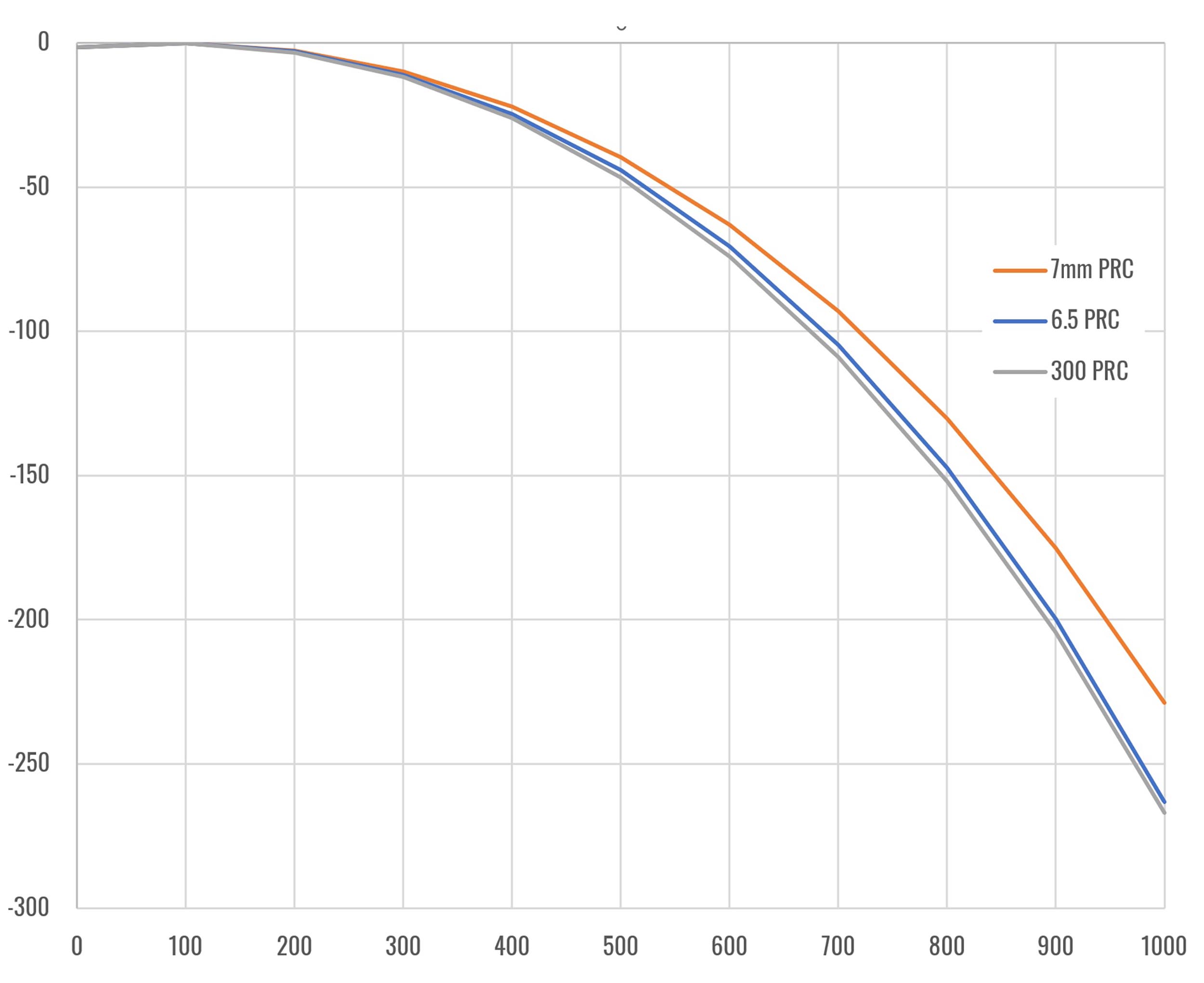
Drop Comparison: The Three PRCs

Can the 7mm PRC beat both the 6.5 PRC and the 300 PRC?

The answer is YES. Here’s the data for the above chart:

This was a bit of a surprise for me to find out!

Drop Comparison: 7mm PRC -vs- Popular Hunting Cartridges

While this is NOT an “Apples to Apples” comparison, I thought it would be interesting to compare 7mm PRC with other popular hunting cartridges for drop to 1,000 yards. Check this out:

All drop chart calculations were based on Hornady ELD-X bullets, using typical twist rate for guidance on bullet weight: (based on 100 yard zero)

You can see how well 7mm PRC does in terms of having a flat trajectory! Also, per our recent story, we showed that 30-06 and the 6.5 Creedmoor can share nearly the same trajectory!

Initial Testing Results

For testing, I only had two boxes of factory ammunition to start break-in on two rifles! One box of Hornady 7mm PRC 180 grain ELD-M Match ammunition, and one box of Hornady 7mm PRC 175 grain ELD-X Precision Hunter ammunition. So I kept shooting to a minimum as I wanted to keep some cartridges on hand for future reference. The initial results were GREAT.

First Break-In Group on Paper: Bat/MDT 7mm PRC “Freedom Rifle”

First Break-In Group on Paper: Bergara/Boyd’s Custom Rifle

Velocity Data Summary, All Testing

The following is a summary of velocity data collected during break-in (all in feet per second):

Here we see approximately 150 fps difference between the 22″ barreled Bergara, and the 28″ barreled Bat custom. Further data will be included in later stories when more shots can be fired (above data utilized 3-shot strings due to limited ammunition being available). This is some impressive performance!

Conclusion

The 7mm PRC brings a very well rounded new option to the table for both match/long-range shooters and for hunters as well. With a simplified beltless case, optimized case geometry, and Hornady’s industry-wide efforts bring this cartridge to market, don’t be surprised to see the 7mm PRC become one of the more popular new cartridges in the long-action class. I’m looking forward to bringing you many more stories featuring this great new cartridge.

Get the Gear

Bat HR Rifle Action

MDT ESS Chassis

Bergara Premier Long Action at Brownells

Boyd’s Agility Stock

Bartlein Barrels

Additional product links will be provided when available!

Don’t miss out on Ultimate Reloader updates, make sure you’re subscribed!

Thanks, Gavin

A Beginner’s Guide to Heat Lamps for Ducklings

0

So, you’ve just brought home your newest addition to your family — baby ducks! Cute and fuzzy, ducklings melt hearts. But, don’t be fooled by their adorable faces; ducklings are challenging to take care of.

The good news? Once you’re equipped with proper knowledge, caring for your ducklings is both easy and rewarding.

The most critical aspect to keeping your duckling safe, comfortable, and happy is learning how to give them proper amounts of heat. Ducklings need to live at a specific temperature, and without their mothers around to provide them that heat, you as the owner must step in to give that heat to keep them safe and happy.

Below is everything you need to know about heat lamps for ducklings.

Do Baby Ducks Need A Heat Lamp?

Yes! They do need a heat lamp. Using a heat lamp is the best way to provide the necessary heat for them while they are babies.

When they’re young, ducklings have difficulty regulating their internal body temperatures on their own. In the wild, baby ducks stay under their mothers’ protection until they’re around one month to two months old so that their mothers can help keep them warm.

The mother ducks use their down feathers to keep them warm. At night, they snuggle together to stay warm, which is how to keep ducklings warm without a lamp.

If you’ve adopted a duckling, you’ll need to provide them with warmth since they won’t have their mothers around. The best way to accomplish this is with a heat lamp. To ensure you’re keeping a warm enough temperature, you may also want to purchase a thermometer and keep it inside their brooder.

When they are first born, set the lamp to 90 degrees. Then, drop the temperature by 5 or 10 degrees each week until you reach 70 degrees.

Check out this duckling temperature chart for more information:

Another question many duck owners have is if baby ducks need heat lamps in the summer. If your house is temperature regulated and you keep them indoors, then yes, you do. If you keep them outside and the temperature reaches 90 degrees or higher, you can remove the heat lamp. However, be sure to put the heat lamp back at night in case temperatures drop.

How Much Heat Is Too Much?

While ducklings do require heat to keep them healthy, too much of a good thing can cause problems. It’s important not to give them too much heat as this can cause health problems and even death.

As a result, many new duck owners wonder, “how do I know if my ducklings are too hot?” Luckily, ducklings aren’t subtle about how they’re feeling. If you notice your duckling is panting, breathing fast, or has moved away from the heat lamp, these are signs that your duckling is too hot.

You’ll also notice if they are too cold as they will group around the heat source and not move so they can conserve heat. If you see your ducklings huddled around the heat lamp and become lethargic, try raising the heating temperature in your brooder.

A healthy duckling will have a substantial amount of energy and, as a result, will run around the brooder. If you notice a rapid change in your ducklings’ behavior, such as becoming more lethargic, tweak the heat to see if that makes them feel better.

Heat Lamp Logistics

Many new owners also wonder, “how far should the heat lamp be from the baby ducks?” Typically, you should hang a heat lamp 18 inches above the bedding.

You’ll need to purchase an infrared heater as a regular bulb does not have the power to create enough heat for a brooder. A 250-watt heat lamp will be sufficient and can even keep up to 30 ducklings warm. If you have more than 30 ducklings, consider purchasing more than one 250 watt bulb.

Make sure to use an infrared heat lamp with a hood and place it on one side of the brooder. Putting it on one side of the brooder is vital so that the ducklings have the option to stay on the cool side if they need to cool down.

To decrease the temperature, raise the height of the infrared heat lamp by moving it further away from the floor of the brooder. You can purchase a stand that is extendable so that you can continue to raise the light stand as the ducklings grow older.

If you must, you can use a heating pad for ducklings, but those are harder because it’s challenging to regulate the temperature. Additionally, if you have more than one or two ducklings, they all won’t be able to fit on the heating pad. Therefore, your best bet is to stick with a heat lamp and a thermometer.

When Do I Need To Turn Off The Heat?

Once fully grown, ducks will have their down feathers to keep them warm. Once they have these feathers, they do not need supplemental heat. Many duck owners wonder how long do ducks need a heat lamp? Until they’re fully grown and have their down feathers.

Ducklings need the most heat at night, so you must leave your heat lamp on at night. It is safe, but make sure you buy a good brand heat lamp and follow all safety precautions.

FAQ

When Can Ducklings Sleep Outside?

Once the ducks are fully grown, they can sleep outside. When ducklings reach about two months, they fully develop their down feathers that keep them warm on their own.

How Do I Know If My Ducklings Are Cold?

If your ducklings are cold, they’ll tell you by their behavior. If you notice they’re lethargic, don’t move away from the light, and huddle together, that’s a pretty safe bet that they’re too cold.

Do Two Week Old Ducklings Need A Heat Lamp?

Yes, they do. Two-week ducklings have not developed down feathers yet.

How Cold Is Too Cold For Ducklings?

It depends on how many days/weeks the ducklings are. Typically ducklings cannot handle temperatures below 70 degrees.

Caseless Ammunition: Is It Better Than Regular Ammo in 2024?

0

Caseless ammunition is a special kind of firearm ammunition that – you might have guessed – lacks cases.

This is the simplest explanation, of course, but it still doesn’t really explain how caseless ammunition works. If ammunition lacks cases, then how is everything held together?

During the course of this article, we plan to break down caseless ammunition in its entirety. How does caseless ammunition work? Is it more or less efficient than traditional ammunition? And which type of ammunition is more affordable?

Let’s find out!

What Is Caseless Ammunition?

As noted, caseless ammunition is ammunition that lacks cases. But what does that actually mean?

In a traditional bullet, the internal components – the primer, propellant, and projectile – are held together by a case.

This case holds everything together and makes the ammunition easy to load; it also keeps the round in place once it’s chambered and ready to fire.

Caseless ammunition does away with this by incorporating the primer and propellant into the projectile itself.

This can take two forms – the propellant can be internal (e.g. placed into the base of the projectile) or external (wherein the projectile is packed into the propellant, which surrounds it).

In both cases, the primer and projectile are both consumed, meaning there is nothing to eject.

What Are The Advantages Of Caseless Ammunition?

Caseless ammunition obviously has its advantages, or it would not have been invented. What, then, are those advantages?

It’s Easier To Store

Because it doesn’t have a (relatively) bulky outer casing, caseless ammunition requires less storage space than its cased counterpart. It’s also much lighter than cased ammunition, making it more convenient to transport.

Improved Rate Of Fire

An automatic or semi-automatic weapon firing at a rapid rate needs time to eject the spent casing before chambering and firing the next.

The use of caseless ammunition precludes this; there is no spent casing to eject, so it’s possible to fire it much more rapidly.

”It’s likely that the technology surrounding caseless ammunition is only going to improve and that the ammunition will become more and more widespread in the coming years.”

This is of particular importance when firing in three-round bursts, where caseless ammunition is much more accurate than cased.

Lower Rate Of Malfunction

Because there is no case to eject, guns using caseless ammunition are far less likely to jam while in use.

This is potentially life-saving in combat situations, where a moment’s hesitation or clearing a jammed gun can be the difference between life and death.

What Are The Disadvantages Of Caseless Ammunition?

On the flip side of the coin, caseless ammunition has its drawbacks; these drawbacks have prevented it from being more widely adopted, and until the issues listed below are solved, chances are that many people will continue to prefer guns using traditional cased ammunition.

It Makes Firearms Prone To Overheating

One of the functions fulfilled by a bullet casing is that when the round is discharged, the brass casing acts as a sort of heat sink, absorbing much of the heat generated and protecting the weapon itself from any damage.

With caseless ammunition, this de facto heat sink is removed from the equation, meaning that the gun itself needs to absorb the heat.

This can lead to rapid overheating in the short term, interfering with the operation of the weapon. In the long term, it can warp the barrel and potentially ruin it completely.

The Rounds Are Prone To Storage Damage

Cased ammunition can be stored indefinitely, as the brass casing will protect the round from incidental damage and wear and tear.

Conversely, caseless ammunition is, by its very nature, highly prone to getting damaged. Internal-propellant caseless ammunition is susceptible to the projectile itself getting chipped or dented, which can interfere with its ballistic path or efficacy.

With external-propellant variants, however, the propellant itself can become compromised, which may lead to the round misfiring or decreased efficacy.

Propellant Residue Can Build Up

When a bullet is fired, there is a certain amount of residue left over from the combustion of the propellant. In the instance of cased ammunition, this residue is contained within the casing, which is then ejected from the chamber.

With caseless ammunition, that residue instead ends up building up inside the firearm, which can eventually lead to malfunctions.

Caseless Ammunition Can Be Less Powerful

One solution to the abovementioned issue is to use less propellant or to make use of a recoilless system whereby some of the propellant residues are ejected from the rear of the gun.

While this solves the problem of residue build-up, it means that the projectile is fired with much less force.

This leads to the round exiting the gun at sub-sonic speeds, which in turn leads to reduced accuracy and much less stopping power.

It’s Less Widely Supported

Cased ammunition is widespread and easily available wherever you can buy guns, making it easy to obtain and use.

Most gun vendors are also extremely familiar with it, meaning that it’s quick and simple to get advice or to deal with any issues that arise while using cased ammunition (e.g. jams).

Caseless ammunition, on the other hand, remains relatively niche – as do the firearms that can be used along with it.

This means that if you do run into maintenance problems with a firearm using caseless ammunition, it can be difficult and expensive to effect repairs.

Conclusion: Is Caseless Ammunition Better?

At present, it’s sadly the case that caseless ammunition isn’t quite as efficacious as its cased counterpart.

Despite the advantages it gains in reduced weight and space taken up, an improved rate of fire, and a lower rate of malfunction (in certain cases), the disadvantages soon pile up.

And those disadvantages are significant. With the build-up of propellant residue on the one hand or decreased projectile efficacy on the other, there’s no easy answer to the question of whether power or reliability is more important.

Furthermore, the relative lack of support for caseless ammunition means it’s much harder to get help if you do run into maintenance issues.

That said, it’s likely that the technology surrounding caseless ammunition is only going to improve and that the ammunition will become more and more widespread in the coming years.

Until then, however, it’s probably best to stick with your traditional ammo.

Want to read more about the ever-changing world of ammunition? Check out our related articles such as our guide to RIP ammo and 5 little-known Glock magazines to know about!

How To Aim Like A Pro When Bowfishing

0

Anyone who has ever flung an arrow at a fish can attest to the challenges of consistently hitting them. Even big, lumbering carp in an apparent stupor 10 feet away prove frustratingly illusive for novice bowfishers.

My first time bowfishing proved to be quite defeating. There were more than a few easy targets that swam away uninjured. If fish could laugh, I am sure they did. So what makes hitting a fish with an arrow so hard? And more importantly, where should you aim to begin with?

Always aim low when bowfishing. Water refracts light at a different angle compared to air so fish appear shallower than they really are. Your distance from the fish and its actual depth determine how far below the fish you should aim. Start by aiming at least 3 to 6 inches below fish in shallow water.

That answer though is not enough to become a bowfishing expert. If you want to hit more fish, don’t skip this article. We’ll give you all the information you need to shoot better, aim better and get more fish to the boat. Let’s get started.

Do you aim above or below fish

There really isn’t a single occasion where you would aim above a fish while bowfishing. Always aim low. In fact, aim much lower than you think. Even if you grasp the concept of light refraction in water, your first impulse is to aim directly at the fish. Resist this urge and push your arrow tip below the fish before you release.

How far below a fish do you aim

If you only learn one thing from this article, just remember to aim low. Yet, the obvious follow up question is how low do you aim?

It’s a tricky question to answer and it depends entirely on the actual depth of the fish in the water and its distance from the shooter. Of course, there are all sorts of angles and math that you could use to determine the exact place to aim at a fish. However, you won’t have time in the heat of the moment to calculate or remember a chart full of numbers.

Instead, use the following basic rules to get you close.

  • 10-4 rule: Your distance from a fish plays a major role in how you aim with a bow. In general, for every 10 feet between you and a fish, aim 4 inches below it. That means if a fish is 15 feet away, aim 6 inches below the thickest part.
  • 1-3 rule: Depth is even more critical than distance and much harder to gauge for inexperienced shooters. A standard guideline is to aim 3 inches below a fish for every 1 foot of depth. If you guess a fish to be 3 feet below the surface then aim 9 inches low.

Now lets put the 10-4 and 1-3 rules together in an example. Say, for instance, you stealthily sneak up to a carp rooting in the mud. You get within 10 feet and you guess the water to be 2-3 feet deep. Where do you aim?

Since you’re only 10 feet away, aim 4 inches low. But you also need to adjust 6-9 inches lower because of its depth beneath the surface. Overall, you should aim at a spot 10-12 inches below the fish’s belly.

Set reasonable expectations

When it comes to bowfishing, numbers only get you so far. Even with the 10-4 and 1-3 rules, you’ll still watch your arrow zip over the top of a fish or stick in the mud an inch from its head. It’s all part of the game and setting reasonable expectations is the best way to avoid frustration. Trust me, you’ll miss even more if you are frustrated.

So what should your expectations be?

First, don’t expect to hit every fish you shoot at. When you first start, it will take at least 5 to 10 shots before you make contact. Sure, sometimes you get lucky but most pros agree that your first 20 or 30 shots will be misses. It takes practice. Lots of practice. As you shoot more, you will miss less.

Secondly, force yourself to only shoot at fish within your “high probability zone”. For me, that’s a 20 foot circle. If a carp, gar or snakehead is within that range, there is a much better chance I’ll hit it. Anything outside of that and my margin for error goes way up.

For you, 20 feet may be too far. Or maybe you have superior archery skills and your high probability zone might stretch out to 30 feet. Either way, don’t waste your energy trying to make Hail Mary shots. Take the time to sneak closer for a better shot. You’ll gain more confidence and scare away fewer fish.

Aim with instinct

Our brains and bodies are capable of truly amazing feats. You can capitalize on this fact when bowfishing. Instinctive shooting is the natural ability to aim without thinking. The shots I tend to miss are the ones I thought about too much. I ignored my instinctive aim and tried to calculate and plan the shot.

Don’t fight your instinct. Keep in mind though that instinctual shooting doesn’t just happen. It takes repetition to calibrate that sub-conscious skill. Start out with the aiming rules we discussed. As you start hitting more fish you’ll develop the muscle memory that is the foundation of instinctive shooting. Pretty soon, you can hit a fish with out actually thinking about your aim.

One of the best ways to keep from over thinking a shot is to shoot fast. Pulling the bow back and releasing your arrow as soon as it feels right means you are tapping into that instinct. Holding back a few moments longer introduces doubt and gives your conscious brain time to override natural skill. Instinct is also your best chance at hitting a moving fish from a moving boat. Try calculating your aim in that situation and you’re guaranteed to miss.

Apply proper form

Shooting form is probably the hardest part of bowfishing and the most ignored element to improve your aim. It’s not easy to focus on stance and form when you’re flinging arrows from an unstable boat at constantly moving fish. Yet, any elite archer will tell you that proper form is the key to consistently hitting the bullseye. Therefore, it makes since to incorporate better form in bowfishing too.

You can improve your form using a few basic concepts that are outlined below.

  • Establish a solid anchor point with the string to your face.
  • Square your stance and shoulders just as you would with a hunting bow.
  • Bend at the hips when aiming down at fish. Don’t hunch over.
  • Keep a loose grip on the bow with your bow hand to avoid pulling a shot.
  • Keep flex in your bow arm to prevent string slap and flinching.

Developing consistent form takes repetition. If you start out with good form though, it will quickly become cemented into muscle memory and you won’t need to think about it again. More of your attention can be focused on stalking the fish and taking the shot.

Can you use a sight when bowfishing

Understandably, people new to bowfishing assume that all the guess work can be eliminated by using a bow sight.

You can certainly use a sight when bowfishing and some prefer it over instinctive shooting. However, a sight is often inefficient since you need to adjust the pin position to match your shooting distance and depth of the fish for every shot.

Bowfishing involves a lot of snap shooting which is usually better suited for instinctive shooting. When the fish are thick and the action is fast and furious, even people using sights tend to revert to instinctive shooting.

If you also bow hunt for deer or elk, using your conventional hunting sight for bowfishing can lead to bad habits that translate back to hunting. It’s better to save the sight for hunting season and avoid it during bowfishing season.

5 tips to improve bowfishing accuracy

Once you nail down the principles of aiming and form, there are still several things you can do to improve your overall accuracy. Here are our 3 favorite tips for taking your bowfishing accuracy to the next level.

Tip #1

Practice shooting stuff in the water – Everything from floating leaves to a submerged plastic water bottle makes for good practice. You can even toss a few slices of wheat bread into the water as a practice target. The bread also double as a way to attract carp as it dissolves in the water.

Tip #2

Use polarized glasses – Polarized glasses cut surface glare and give you a clear sightline to the fish. Not only will you spot more fish, you’ll also be able to better gauge their depth and movement with polarized glasses.

Tip #3

Get the right gear – Just about any bow will work for bowfishing but getting the right gear goes a long ways to improving your accuracy. Everything from reel and arrow, to draw weight and bow length impacts how you shoot. If you are serious about bowfishing get equipment that fits you and helps make each shot easier to manage.

Tip #4

Focus on one fish at a time – Sometimes several fish will cruise by within bow range and you’ll struggle to zero in on a single target. Try to avoid bouncing from fish to fish. Pick one and keep your eyes glued on it while you aim and shoot.

Tip #5

Relax and breathe before your shot – Just like some hunters get buck fever, some of us get fish fever too. Calm your nerves as you approach a fish. Focus, relax, and breath as you aim and shoot.

Parting words

Bowfishing is an awesome sport filled with challenges and loads of action. When you feel like setting down the fishing pole and picking up a bow, give bowfishing a try.

Want to know if you have a bowfishing season in your state? Don’t miss our guide to bowfishing laws for all 50 states. See if bowfishing is legal in your neck of the woods!

The Biggest, Record-Setting Moose Harvests on the Books

0

With big bulls standing nearly 7 feet tall and weighing up to 1,600 pounds, moose are massive animals. They’re technically the largest species in the deer family, prized as trophies for their impressive antlers, second only to how delicious their wild game meat is. An even bigger bragging right for a moose hunter: bagging a record-breaking moose.

While we have no way of knowing that is truly the biggest moose ever, we can turn to the Safari Club International record books to see what is the biggest moose that’s ever been downed in North America. But first, a few fun facts on how big moose truly are.

How Big Can a Moose Get?

The size of a moose depends both on its sex and what subspecies it is. Male bull moose are almost always larger than cow moose, but even a small female can weigh over 800 pounds.

The Shiras moose, located in the Rocky Mountains and Pacific Northwest, are the smallest of the moose subspecies, with adult males weighing up to 1,000 pounds. Still, this makes them the largest big game animal in the Rocky Mountains.

Conversely, the Alaska-Yukon moose (also known as the Alaska moose), found in the northwest reaches of North America, is the largest of the subspecies. Male Alaska bulls can weigh up to 1,600 pounds and stand 7 to 8 feet tall at the shoulders. With a massive rack of antlers added on top, these moose can tower over 10 feet tall.

Western Canada moose, also known as Western moose, and Eastern Canada moose, also known as Eastern moose, fall in between Shiras and Alaska moose in size, with Western moose typically being larger than Eastern.

Does Alaska Have the Biggest Moose?

As you might have guessed, yes, Alaska has the biggest moose—not only in North America, but in the world. That’s why the Alaska moose hunt is on the bucket list of many hunters. Alaska moose inhabit boreal forests and mixed deciduous forests throughout Alaska and western Yukon.

Is There Any Bigger Game Than a Moose in the United States?

The only animal larger than a moose in the United States is a bison. Bison can weigh 2,200 to 3,000 pounds, in comparison to a moose’s weight of 800 to 1,600 pounds. However, bison only have moose beat in terms of weight. They “only” stand about 6 feet at the shoulder, and are 8 feet long, making them shorter than moose all around.

Bison can be hunted in Utah, Wyoming, Arizona, Alaska, and Montana, but getting a tag and permit for a hunt is almost impossible. If you’re looking for the biggest game animal to hunt, moose is a more likely bet.

What Makes an SCI Record Moose Kill?

Safari Club International (SCI) recognizes records for four North American subspecies of moose: the Shiras moose, the Eastern Canada moose, the Western Canada moose, and the Alaska-Yukon moose.

To track records of the biggest moose kills, SCI ranks moose by their antler scores, rather than their weight. Using the SCI measuring system to score a moose, hunters must measure the length and widths of each “palm” on the antler (i.e., the big, flat area of a moose antler). SCI also scores the number and length of tines, the circumference of each main beam of the antler at the smallest place, and the greatest outside spread of the moose’s antlers.

All of the measurements are added together for the final score of the moose. The bigger the palm spread, and the more numerous and longer the tines, the better the animal scores.

Unlike the Boone and Crockett Club, which also tracks moose records, SCI doesn’t deduct the score for abnormal points of differences in antler symmetry. As a result, the SCI score is often significantly higher than the B&C score for the same animal.

Safari Club International Moose Records

1. SCI Shiras Moose Record

Though they are the smallest subspecies of moose in North America, Shiras Moose can still weigh up to 1,000 pounds. Shiras Moose live in Colorado, Utah, Wyoming, Montana, Idaho, Oregon, Washington, Alberta, and British Columbia.

Jim Hall set the SCI record for Shiras moose in 2018 when he shot a massive bull near Republic, Washington. Hall had been applying for a moose tag for almost 30 years. He was in the last few days of moose season, after two months of unsuccessful hunting, when he took down the impressive animal.

The moose was estimated to weigh about 650 to 700 pounds and had a combined 242 inches on its antler measurements for a score of 504-7/8 inches. Hall beat the previous record by just 1-1/8 inch.

2. SCI Eastern Canada Moose Record

Eastern Canada moose live in Ontario, Quebec, New Brunswick, Newfoundland, Nova Scotia, Maine, Vermont, New Hampshire, Massachusetts, Connecticut, and New York. Big bulls can weigh nearly 1,400 pounds.

Jeremy Boileau shot the current SCI record Eastern Canada moose with a rifle in Quebec, Canada in September of 2011.

Boileau’s behemoth moose scored an incredible 666-3/8 inches, which is more than 80 inches larger than the next biggest Eastern Canada moose and more than 175 inches bigger than the third-biggest moose in the record book! Not only did the moose have a massive outside spread of 56 inches, but it had a ridiculous 20 points on each antler, which is one of the reasons why it scored so high.

3. SCI Western Canada Moose Record

Western Canada moose live in British Columbia, Ontario, Yukon Territory, Northwest Territories, Nunavut, Alberta, Saskatchewan, Manitoba, Wisconsin, Minnesota, parts of North Dakota and Michigan’s Upper Peninsula. With big bulls weighing nearly 1,500 pounds, they are the largest subspecies of moose found in the continental United States.

Doug Rehbein currently holds the SCI record for the Western Canada moose, for a bull he killed with the guidance of hunting guide Mark Boote of Jennings River Outfitters. Rehbein took the moose in October of 1998 in the renowned moose hunting grounds of the Cassiar Mountains of British Columbia.

This giant moose scored a remarkable 557 inches and had a 64-2/8 inch outside spread with 12 points on one antler with 10 on the other. Though the number of points may seem low for the score, this moose had absolutely massive T-2 and T-4 points, which helped boost it to the record books.

4. SCI Alaska-Yukon Moose Record

Alaska-Yukon moose, as the name implies, live in Alaska and the Yukon Territory of Canada. They’re the largest moose in North America, both in terms of body size and antler size.

The largest Alaska-Yukon Moose in the SCI record books, as well as the highest-scoring moose for all of North America, was taken by Debra Card near Cordova, Alaska with a rifle in September 1999. The bull weighed a ridiculous 1,800 pounds.

Not only is this the only moose on the list taken by a female hunter, but it’s also the biggest moose on record ever hunted in the U.S. Her moose had a whopping 74-2/8 inches spread with 19 points on one side and 20 on the other. It scored an extraordinary 731-1/8 inches.

To put in perspective how gigantic this moose was, it measured 225 inches larger—that’s 68 percent!—than the largest Shiras Moose in the record books.

Other Biggest Moose Harvest: The 1897 Moose

As you now know, SCI lists its record moose by antler size. And while a massive rack is incredibly impressive, what about the largest moose every taken by weight?

That record goes to a monster of a moose taken in September 1897. Weighing 1,808 pounds and standing 7.6 feet at the shoulder, the moose was taken in the Yukon and made it into the Guinness Book of World Records. Over a hundred years have passed and still, no one has touched that record.

But, that doesn’t mean there aren’t still plenty of monstrous bull moose out there to be taken. Start planning your United States moose hunt today.

READ MORE: Biggest Bear in the World: Official World Records for Each Bear Species

Wayback Lowcountry: Hunting for arrowheads

0

You can find Native American artifacts here if you know where to go and what to look for.

Story + Artwork by Michele Roldán-Shaw

It took me a few years to find my prize spearpoint. I’d put in the time ambling along dirt roads — especially after a rain — and combing freshly ploughed fields, as my old-timer informants advised. They made it seem like finding artifacts around here was easy, and certainly the points and potsherds strewn around their homes bore this out. Yet somehow for all my wanderings I never managed to find more than a few broken flint chips.

Until my 24th birthday. I was on a little solo expedition near the Donnelly Wildlife Management Area, hiking deep in the heart of extensive dirt tracks that crisscross woods and wetlands. The road looked like it had turned to a mud bog in summer rains, then gotten baked dry by a merciless sun until it split into a network of cracks — prime hunting ground for arrowheads. They get unearthed this way and sometimes conveniently display themselves on little raised pedestals after all the mud has washed off around them. Yet I wasn’t actively looking that day, just walking and talking on my cell phone, when suddenly I happened to glance down and there was a beautiful 3-inch-long spearhead! It had a light buff color with blushes of rich ochre and was museum quality with only the tiniest chip missing from the point. I couldn’t believe it. A short distance away I found a nice white arrowhead and another slate gray point with the butt end broken off. I’ve never found another arrowhead since.

America has been home to human beings for millennia. But exactly how many? It was long thought that the first people arrived 13,000 years ago, yet in recent years that date has been pushed further and further back. South Carolina made a memorable contribution to the debate when archeologists at the Topper Site, an ancient chert quarry on the banks of the Savannah River in Allendale County, announced compelling evidence of human activity dating back 50,000 years. As with any sensational new finding in the scientific community, it caused international controversy and is still disputed today.

Here in the Lowcountry Native inhabitants were laid back seafood eaters, as their old middens of oyster, mussel and clam shells attest. But they also enjoyed an abundance of wild game: deer, rabbit, coon, squirrel, quail, wild turkey, waterfowl, even bear and bison that once roamed this far east. The land we now stand on has been littered with projectile points. Big spearheads are impressive, but I find the tiny “bird points” most fascinating because of their minute size and the skill it must have taken to manufacture them. I always thought that bird point referred to the intended prey; after all, birds are small, so the arrowhead should be too, right? But in fact these beautiful little killers were meant to take down big game (or human enemies!) as their small size made them deadlier by increasing the speed of the projectile.

An arrowhead found locally might be more than 10,000 years old, which is exciting to ponder. A less happy thought is what happened to the descendants of those people: genocide, displacement, decimation by disease, attempted erasure from the collective culture. We can’t change the past — but we can honor those whose mere continued presence bears testament to the strength of their people. According to a 2016 study, 13,000 Native Americans live in South Carolina. Of the 29 tribes thought to have been living here at the time of European contact, just 10 are currently recognized by the state government, and only one has federal recognition. But indigenous people are still here. They are not merely an ancient history of arrowheads, potsherds and middens. They are the original Americans, and they deserve the dignity of acknowledgment.

Sharp points

The best places to look: dirt roads, plowed fields, eroding banks

If you find one: visit projectilepoints.net to identify the type

Worth a trip: the Smithsonian Museum of the American Indian in Washington, D.C., which has a gorgeous collection of hundreds of arrow and spearpoints arrayed in an artful swirl

Contemporary tribes in South Carolina: Pee Dee, Waccamaw, Catawba, Cherokee, Edisto, Santee, Sumter, Natchez, Yamasee, Chicora

PSA Dagger VS Glock 19: How Does the Clone Stack Up?

0

The PSA Dagger vs. Glock 19 – this has to be one of the most hotly debated choices for a reliable sidearm in the firearm community.

Both offer a unique blend of reliability and functionality, leaving enthusiasts in a quandary over which to pick for their primary choice of protection.

What we hope to do here is delve deep into the features, handling, and performance of the PSA Dagger vs Glock 19 Gen 5 and provide a detailed comparison. By the end of this analysis, we think you’ll have a better understanding for making an informed decision.

We’ll use a Glock 19 Gen 5 slide on a Gen 5 gun for comparison as both the Palmetto State Dagger and the Gen 5 are modern options available to buyers.

So, stay tuned as we dive into the specifics and all the gritty details of the Glock 19 vs PSA Dagger battle.

INITIAL COMPARISON OF THE PSA DAGGER VS GLOCK 19

The PSA Dagger Full Size and the Glock 19 are two 9mm striker-fired handguns that have many similarities in terms of dimensions and features. However, there are some notable differences between them. For instance, the PSA Dagger has a slightly shorter barrel length of 4 inches compared to the Glock 19’s 4.02 inches.

Additionally, the Dagger Full Size S model has a magazine capacity of 17 rounds, while the Glock 19 can hold up to 15 rounds. Furthermore, the PSA Dagger is compatible with most Gen3 Glock spare parts, which offers a wide range of aftermarket customization options.

When it comes to ergonomics, the PSA Dagger sets itself apart with a distinct grip shape and texture, setting it apart from the Glock 19. The grip is enhanced compared to the Gen 3, and there are no back straps. It also has a carry cut out, allowing you to strip the magazine without any issues.

This model is perfect for those who prefer a simple design and want to run their trigger finger in front of the trigger guard.

THE TRIGGER SKUTTLEBUTT

By reputation, everyone has told me that the trigger mechanism is the biggest difference between these two, with the Dagger featuring a hinged trigger similar to the M&P. There is also a cut-out for the magazine release, just like the old Gen 3. It has an accessory rail and wavy cuts in the front that are basically there, I believe, to make it look cool.

The PSA Dagger is widely recognized as a more budget-friendly option, offering a lower price point compared to the Glock 19. Overall, both handguns are reliable and well-suited for various shooting scenarios, with the PSA Dagger generally considered to be a reliable and affordable alternative to the Glock 19.

Here’s a breakdown comparison between the specs of the Glock 19 vs PSA Dagger:

PSA Dagger Full-Size S

Glock 19

Caliber

9x19mm (9mm Luger)

9x19mm (9mm Luger)

Action

Safe Action®

Safe Action®

Weight (empy mag)

22.5 oz

21.52 oz

Overall Width

1.28 inch

1.34 inch

Overall Length

7.15 inch

7.28 inch

Barrel Length

4.5 inch

4.02 inch

Magazine

Double stack

Double stack

Mag Capacity

17+1 rounds (standard mag)

15+1 rounds (standard mag)

MSRP $299.99

$539.99

PSA DAGGER VS GLOCK 19 – OUR TAKE

FINGER GROVE AND BEAVERTAIL

There is one feature on the PSA gun that I was not a fan of right away. The finger groove here is similar to older Glock models but was revised for the Gen 5. It has a slightly enhanced texture compared to the Gen 3, but in my opinion, it’s not as good as the Gen 5. On the other hand, I do appreciate the extended beavertail.

SLIDES AND CONTROLS

The gun also has standard Glock controls and takedown, as well as a slide lock (although it’s not technically meant to be used as a release). There are some wavy cuts in the front that are mainly aesthetic but can be used as a sort of gas pedal, although they’re not big enough for proper use.

Personally, I’d prefer if these cuts were deeper and more functional, like on some other gun models or customizations from companies like Agency Arms. Nonetheless, the slide itself is quite nice, with a tri-top design that I am a big fan of. In fact, I think it looks better than the stock Gen 5 slide.

The Dagger has a stainless steel guide rod, which I think is actually a big improvement upon the standard Glock plastic guide rod – it’s a little more durable, and I do like that it adds a little weight out front, reducing muzzle flip overall.

PERFORMANCE

During our testing, we fired two thousand rounds through the gun and found it to be highly reliable. There were no malfunctions during the entire duration of the test, which is exactly what we expected from one of the most reliable guns in the world.

We used various types of ammunition, including Phoenix Ring, Fiocchi, Winchester White Box, and 124-grain Gold Dot, as well as Critical Duty, and all of them worked exceptionally well.

MAGAZINE

We used the magazine that came with the gun, which was a Magpul magazine, as well as the standard Gen 5 Glock 19 and Glock 17 magazines, as well as extended magazines, and there were no malfunctions whatsoever.

This is particularly important since magazine compatibility is crucial for a gun’s reliability. This clone comes with one magazine included in the package – not surprising for the money. However, the standard Gen Five product comes with three magazines, which, in my opinion, is a better deal as more magazines are typically better.

In the final analysis, the accuracy of the Palmetto State Dagger is alright, but the standard Gen Fives are more accurate – the main reason being is that they have a better trigger.

TRIGGER

I personally am not that crazy about the Palmetto State Dagger trigger at all – it’s heavy, has a lot of creep and take up, and an awkward reset. The good news is that it takes Gen Three parts, so you can upgrade it with those new sweet old chimneys if you choose to. If you were going to keep this gun, that’s what I would suggest you do.

The big white combat sights are simplistic and durable up close. However, they are only slightly better than the lower-end sights on the market – so not that good. You can buy Gen 5 Glocks that have Ameriglo sights, which I would highly recommend.

SIGHTS

The Glock 19 sights are significantly better, with a slightly wider box that allows for quicker site acquisition up close, a thinner front sight that is high definition, and night sights with a tritium insert on the front sight. This allows you to use the sights at night, which is important for your safety.

I like the fact that the Gen 5s have this option, but they obviously cost more. If you want, you can buy these sights for $60 and put them in your PSA since they are compatible with Glock parts. Out of the box, I don’t like the accuracy of the Dagger sights, but it can be improved.

ACCURACY

In reviews, people often talk about mechanical accuracy, which I find amusing because handguns are difficult to shoot due to fewer points of contact and a five-pound trigger in a one-pound gun. This makes it challenging to shoot accurately, period.

Therefore, any accuracy issues are likely due to the interface and ergonomics of the gun. Primarily, it’s better to discuss the sights and the trigger. To be clear, the mechanical accuracy may be comparable to a standard Glock, but to achieve the same level of accuracy from it, you may have to address the trigger and sights issue.

ERGONOMICS

Moving on to the ergonomics, I think there are a lot of really good ergonomic features going on with the Palmetto State Dagger. Firstly, I love the tri-top slide; it looks very cool.

Additionally, the slide serrations are very usable and actually more effective than the Gen 5 Glock. The rear serrations work very well, too, and the finish on the gun is shiny and attractive, although it might not be quite as durable as the Gen 5.

HOLSTER COMPATIBILITY

While Glock clones such as the PSA Dagger mimic Glock designs closely, slight variations in sizes between the Glock and its clones can pose challenges when it comes to holster compatibility. These minute differences can affect the secure fit of the weapon, which is crucial for safety, accessibility, and comfort.

Therefore, having a specifically designed Glock 19 holster or a PSA Dagger holster is not merely an option but a necessity. It ensures that your firearm is held as securely as possible, enabling the best draw capability and reducing the risk of accidental discharges while improving ease of access when needed.

Conclusion: PSA DAGGER VS GLOCK 19 – THE BOTTOM LINE

Looking at the final score, it’s clear why both the Glock 19 and the PSA Dagger have firmly established their reputation in the firearm market – each has its own distinctive advantages.

Our comprehensive testing and rigorous evaluation of the PSA Dagger only reaffirmed its reliability and performance. While the Glock 19 continues to dominate as a reliable staple in the world of handguns, the introduction of more budget-friendly options like the PSA Dagger is certainly a welcome addition; especially beneficial for novices in the world of firearms who might be hesitant to spend a significant amount upfront.

The bottom line: prices and availability of firearms can fluctuate quite a bit. There was a time not that long ago when the PSA wasn’t readily available, and prices went up to over $450 apiece. In a case like that, why settle for the limitations of the PSA Dagger when you can go for the true original by spending a little more?

Having said that, anyone choosing to go for the PSA Dagger is not likely to be disappointed, especially if they can take the savings and put them towards some fine extras they wouldn’t normally be able to afford. In our opinion, both are fine weapons, which make the PSA worth your consideration.

Ultimately, the choice of firearm is a deeply personal decision, but one common factor remains – the necessity for a secure, well-fitted holster. A custom-made Craft Holster, be it IWB (Inside the Waistband) or OWB (Outside the Waistband), can be the perfect complement to your chosen firearm, enhancing safety, accessibility and your overall shooting experience.

DO YOU FANCY SOME MORE LIGHT READING? THEN CARRY ON WITH THESE ARTICLES

Glock 19 Review – The Best 9mm Pistol Ever Produced?

PSA Dagger Review: Is This Glock Clone Worth It?

Exploring PSA Dagger Problems: A Candid Look at Performance and Functionality

14 Best Hunting Books for Your 2022 Reading List

0

The hunting story follows human language back to the very beginning. And luckily for us bibliophiles, there are now hunting books, apps like Audible, and a Kindle to tell it.

Hunters know that stories abound the world over — and most spin plenty of their own tall tales. It’s easy to search the web and find a whole swath of hunting books sitting atop the charts. And those books about hunting are often entertaining, educational, and important.

But it turns out there are plenty of books that tell hunting stories without entirely branding them as such. Perhaps it’s a lauded gourmand recapping his life with bird dogs and expensive bottles of wine. Or perhaps it’s a series of outdoorsmen and women telling near-death stories that will both shock and educate you as you head afield.

It could also be a 1984 expedition into the Arctic, where a writer walks among natives — both wildlife and human — to learn the ways of their northern world. Or it could simply just be a collection of classic tried-and-true hunting stories, collected into one place for all to enjoy.

I gathered up a few of my favorites that walk the line and tell the tales. Among these best hunting books, I hope you find a few new favorites.

Best Hunting Books

‘Campfire Stories: Close Calls‘ by Steven Rinella & Contributors

Campfire stories meateater

My favorite hunting book of 2021 wasn’t a hunting book per se, but a hunting-adjacent audiobook experience put out by the MeatEater team in tandem with Audible. Inspired by a brown bear attack while filming a MeatEater episode, Rinella invites contributors with near-death stories that chill and entertain.

Stories range from bear attacks to backcountry falls to one particular harrowing escape from hypothermia. The quality of this audiobook experience is akin to listening to a really highly produced podcast in chunks from different folks on different topics. It’s a fun listen.

And I seriously doubt you’ll be able to drop one of these stories in the middle to listen to later. Once you’re in it, you’re in it.

Listen to ‘Campfire Stories: Close Calls’

‘The Hunter’s Game: Poachers and Conservationists in Twentieth-Century America‘ by Louis S. Warren

the hunters game

If you enjoy nerding out on conservation history like I do, “The Hunter’s Game” will take your understanding of American hunting culture to a new level. Historian Louis S. Warren weaves narratives that, though dense at times, are unlike any I’ve heard in the usual storytelling of American conservation lore.

The struggles of socioeconomic factors against a rising tide of sport hunters changed not only the face of wildlife management but also how Americans view wildlife in the broader scheme of things. And the stories he focuses on in Pennsylvania, New Mexico, and Montana shed a more complicated light on what it means to be a conservationist in modern-day America.

In my opinion, this is a must-read for all hunters and wildlife enthusiasts alike.

Read ‘The Hunter’s Game’

‘The Last Wild Road: Adventures and Essays from a Sporting Life‘ by T. Edward Nickens

best hunting books

T. Edward Nickens is one of the most prolific hunting writers among us, and his longtime effort as a journalist and editor-at-large at Field & Stream is reflected in this 2021 collection of stories.

Funny, poignant, and occasionally heartbreaking, Nickens’ stories run the gamut. But they always meet on the side of human connection in hunting, where consciousness meets the outdoors in fresh and sometimes surprising ways.

A personal favorite involves a trip to Pennsylvania, where Nickens meets and communes with a pair of brothers who lost their father in a hunting accident many years prior. What happens? You’ll have to read to find out.

Read ‘The Last Wild Road’

‘Traplines: Coming Home to Sawtooth Valley‘ by John Rember

I picked up “Traplines” off a bookshelf in the back of the Polebridge Mercantile outside of Glacier National Park. That weekend, it became a fast favorite.

Author John Rember tells the tale of his life spent in Idaho’s Sawtooth Valley. And he masterfully (and hilariously) weaves in the history of Sawtooth Valley, the plight of the salmon, learning to hunt with his father, and more.

I love this book. I reread it every year at least once, and it deserves a place on that coveted bookshelf.

Read ‘Traplines’

‘American Serengeti: The Last Big Animals of the Great Plains‘ by Dan Flores

If you’ve ever flown over middle America and stared down at the neverending grid of corn and suburbia, wondering what this place looked like before we plastered “for sale” signs and white picket fences all over it, this is the book to pick up.

Flores is a masterful writer and storyteller, and he delves into the wild history of the great plains. And, more specifically, he parcels out how the wildlife that makes its home there has fared through the colonization of the plains.

If hunting a bison or a pronghorn is on your list, get this book in your hands to better understand their plight.

Read ‘American Serengeti’

‘That Wild Country: An Epic Journey through the Past, Present, and Future of America’s Public Lands‘ by Mark Kenyon

That Wild Country: An Epic Journey through the Past, Present, and Future of America

The latest literary installment from the MeatEater crew is Mark Kenyon’s “That Wild Country.” Kenyon is a renowned figure in the current landscape of whitetail hunting, and he’s one of the most successful podcasters in the outdoor genre with his podcast Wired To Hunt. But aside from his regular gig in the hunting media world, he’s also an outdoor writer.

He enters the literary game with a book that celebrates his experiences on public lands while also delving into the history, politics, and possible future of our natural resources. The book is present, personal, and educational, and the reader will find it to be quite apt for the current moment whether they’re a hunter or an angler.

It’s also a great buy if you own a Kindle, offering free access with Kindle Unlimited or a $2 fee without.

Read ‘That Wild Country’

‘Great American Hunting Stories,’ Edited by Lamar Underwood

I like essay collections, and this one is particularly cool. It includes a lot of writing by big names in history like Theodore Roosevelt, Zane Grey, and William T. Hornaday.

This collection spans the globe, from getting charged by lions in the African bush to bird hunting in the American South. This collection is ready for readin’ by a roaring fireplace.

Read ‘Great American Hunting Stories’

‘Beyond Fair Chase: The Ethic and Tradition of Hunting‘ by Jim Posewitz

beyond fair chase best hunting books

This small but mighty book is a beginner’s foray into the ethics of hunting. Often given out as part of course material for hunter education courses, “Beyond Fair Chase” opens the reader up to the basic foundation of what it means to be an ethical hunter.

And the book has now been in circulation for 27 years, with more than 2 million copies sold. At just $6, it’s affordable and makes for a great gift for the new or coming-of-age hunter. It’s not just a dry read on ethics, either. Posewitz fits in hunting stories and anecdotes throughout as examples of how to be a fair-chase hunter.

It’s also a great book for longtime hunters to revisit, offering a platform to expand on one’s own personal notions of fair chase while contemplating the reasons we all head out in the field in the first place.

Read ‘Beyond Fair Chase’

‘H Is for Hawk‘ by Helen McDonald

This is a beautiful book about an interspecies relationship with a primordial hunter. McDonald weaves her way through mortality and relationships while training and hunting with a goshawk.

The writing within this book is both stunning and crisp, and it won, oh, about a billion awards. If you haven’t read it, it’s a killer read, and both the paperback and Kindle versions are under $6 each.

Read ‘H Is for Hawk’

‘Off to the Side: A Memoir‘ by Jim Harrison

If you haven’t read Harrison by this point in your life, shame on you. And if I’d left him out of this list, the shame would be on me.

Harrison is a personal favorite writer of mine for both prose and poetry. And his memoir is fun, elegant, and delightfully twisted in a way that leaves you wishing you were tableside, stories rolling, a fire roaring, a glass of good wine in hand, with bird dogs sleeping at your feet.

He takes on a variety of his personal obsessions throughout. And, to be frank, I’d give this an R-rated review if it was a movie. He does dedicate an entire section to strippers. But he also dedicates an entire portion of the book to his own sporting tradition. And it’s pretty darn spectacular.

Read ‘Off to the Side’

‘Under the Biggest Sky of All: 75 Years on the Rocky Mountain Front‘ by Ron Mills

This book is a bit of an underdog, and you likely haven’t heard of it. But I love it.

Ron Mills is the old West as it lives in this moment, and this book is a gift from that tradition. His life on Montana’s Rocky Mountain Front is full of “campfire and horse sweat,” as the lauded writer Hal Herring puts it in the foreword. And Mills is certainly and definitively not a writer.

But that’s what makes this book so charming and deliriously fun. These are campfire stories, written down. They’re colloquial and cozy, and they’re full of grizzlies, floods, hypothermia, hunting, and much more. He covers the gamut of his life, and it’s just a kick in the Wranglers. Promise.

Read ‘Under the Biggest Sky of All’

‘Arctic Dreams‘ by Barry Lopez

I’ve loved this book for years. My copy is old, it’s ragged, and the edges of the pages are in that tired state of use that shows a certain kind of love for the writing.

“Arctic Dreams” hit the shelves in 1984, yet the book feels crisp, new, and prescient when it comes to the climate issues the Arctic faces today. Lopez digs deep — 496 pages deep — into the life, wildlife, hunting traditions, and cultural world of the Arctic Circle.

Frankly, it’s a spectacular, deliberate, and stunning literary opus that — in my very important opinion — is a perfect example of the highest echelon of writing. Can’t say much more. And y’all, it’s free to read on your Kindle if you have an Amazon Prime membership.

Read ‘Arctic Dreams’

‘A Hunter’s Heart: Honest Essays on Blood Sport,’ Edited by David Petersen

I list this book almost entirely because of the inclusion of my all-time favorite hunting essay “The Heart of the Game” by Tom McGuane. But, of course, it holds a swath of other great writers including President Jimmy Carter, Rick Bass, Terry Tempest Williams, and Ed Abbey.

I’d be doing it an injustice if I didn’t mention that the collection itself is impressive. But McGaune’s essay is particularly perfect. I found it over a decade ago in the collection “The Best of Outside: The First 20 Years.” It categorically changed my former non-hunter views on what hunting could be. And, really, it was the lead-in to my own journey as a sportswoman today.

You can read McGuane’s full essay here, but it’s worth putting it on your shelf. And if you’re putting it there, you’re certainly not making a mistake by having it live in this particular collection of hunting writing.

Read ‘A Hunter’s Heart’

‘The Mindful Carnivore: A Vegetarian’s Hunt for Sustenance‘ by Tovar Cerulli

I love this book for one primary reason: It’s a clear-cut outlier in the world of the traditional hunting story.

Cerulli documents his life as both a vegetarian and an eventual vegan. This book goes through the ins and outs of how our food relates back to the life cycle. It takes the reader through Cerulli’s deeply personal journey of deciding to put his own meat on the table through hunting.

This is the kind of book anyone and everyone can read and understand from an eating perspective. And voices like this have the power to change the public’s relationship with hunting.

Read ‘The Mindful Carnivore’

Canine tail docking FAQ

0

A: Tail docking of some breeds may be based on a belief that their non-working members experience risks similar to working dogs; more commonly, however, it is to conform to a distinctive breed appearance or standard. Survey data indicate that preventive tail docking of pet dogs is unnecessary.18,21 Therefore tail docking of non-working dogs, even if their breed was originally developed for working purposes, is considered a cosmetic procedure unless evidence exists to the contrary. In countries such as the United Kingdom where tail docking is legally prohibited (with a few exemptions) the breed standards of traditionally docked breeds have been amended.22

Q: Do dogs need to have tails?

A: It is natural for most dogs to have tails based upon their descent from a tailed species. However there is no strong evidence that naturally bobbed or surgically docked dogs are physically or psychologically disadvantaged. There is some early, but inconclusive, data that raises questions as to whether docking impairs communication with other dogs23 or may increase the risk of developing incontinence.24

Q: Is tail docking painful?

A: Tail docking is painful.25 The intensity or duration of the pain under ideal or typical circumstances is difficult to quantify. Painful procedures conducted in the neonatal period when the nervous system is vulnerable can result in negative long-term changes which affect how pain is processed and perceived later in life.26,27

Q: Why does AVMA policy oppose cosmetic tail docking?

A: The essential question is not “How harmful is the procedure?”, but rather “Is there sufficient justification for performing it?” Performing a surgical procedure for cosmetic purposes (i.e., for the sake of appearance) implies the procedure is not medically indicated. Because dogs have not been shown to derive self-esteem or pride in appearance from having their tails docked (common reasons for performing cosmetic procedures on people), there is no obvious benefit to our patients in performing this procedure. The only benefit that appears to be derived from cosmetic tail docking of dogs is the owner’s impression of a pleasing appearance. In the opinion of the AVMA, this is insufficient justification for performing a surgical procedure.

Q: What forms of tail removal would not be considered cosmetic?

A: The naturally bobbed animal is not considered “docked.” Bobbed genetics exist in many pedigreed breeds (e.g., Old English Sheepdog, Australian Shepherd17) and have been introduced into others (e.g., Boxer28). Some breeders, both historically and currently, would prefer problematic conformation to be corrected via breeding alone.

Removal of a dog’s tail for medical reasons is not referred to as “docking.” The most common reason for amputation or partial amputation of a dog’s tail is traumatic injury where repair of the entire tail is not possible or advisable. Amputation may also occur in the case of tail deformities that negatively impact a dog’s function or increase risk of injury. An argument might be made for removal of the tail of a dog on the basis of repeated prior injury.

Precautionary removal of the tail of a young puppy needs to be based on compelling evidence that the animal is at high risk of tail trauma due to congenital defect, breed and/or planned working activity. However, such a justification must be supported by evidence such as empirical data or impartial expert opinion based on extensive, directly relevant experience.

REFERENCES

1. Podberscek AL, Paul AS, Serpell J. Companion Animals and Us: Exploring the Relationships Between People and Pets. Cambridge University Press, 2000; 307. 2. Fleming. The wanton mutilation of animals. The Nineteenth Century, a Monthly Report, 1895;37:440. 3. Drury WD. British Dogs, Their Points, Selection, and Show Preparation. L.U. Gill: London. 1903. p. 165 4. Hallock C. The Sportsman’s Gazetteer and General Guide. Forest and Stream: New York. 1877. p. 456. 5. Shields G. The American Book of the Dog. Rand, McNally: Chicago. 1891 6. almer, RM. All about Airedales: A Book of General Information Valuable to Dog Lovers and Owners, Breeders and Fanciers, Illustrated from Selected Photographs of Noted Dogs and Rare Scenes. The Airedale Terrier Reviewed. 3-A Publishing Co.: Seattle. 1916; 53. 7. Coren, S. How Dogs Think: Understanding the Canine Mind. Simon and Schuster, 2004; 106 8. Youatt W, Lewis EJ. The Dog. Leavitt and Allen, 1857 Available at: http://books.google.com/books?id=wxkPAAAAYAAJ Accessed December 15, 2008. 9. Bennett PC, Perini E. Tail docking in dogs: can attitude change be achieved? Aust Vet J 2003;81:277-82. 10. Sonntag, Q. Cosmetic tail docking. Vet News 2004;Feb:4-5. 11. Noonan GJ, Rand JS, Blackshaw JK, et al. Tail docking in dogs: a sample of attitudes of veterinarians and dog breeders in Queensland. Aust Vet J 1996;73:86-88. 12. Lytton, N. Toy Dogs and Their Ancestors: Including the History and Management of Toy Spaniels, Pekingese, Japanese and Pomeranians. Duckworth & Co: London. 1911; 91. 13. Moissac, JE. The fight against cosmetic surgery. Canadian Veterinary Journal 2009;50:11231124. 14. Australian Veterinary Association: Surgical alteration to the natural state of animals: http://www.ava.com.au/node/1085 accessed January 31, 2013 14. RCVS Guide to professional Conduct: http://www.rcvs.org.uk/advice-and-guidance/guide-to-professional-conduc… accessed January 31 2013. 16. Lee RB. A History and Description of the Modern Dogs of Great Britain and Ireland. H. Cox: London. 1897. p. 220-221. 17. Sasson-Brickson G. The bobtail trait in Australian shepherds – part I: a historical perspective and docking Regulations in various countries. Aussie Times 2005;March-April 18. Diesel G, Pfeiffer D, Crispin S, et al. Risk factors for tail injuries in dogs in Great Britain. Vet Rec 2010;166:812-817. 19. Strejffert G. Tail injuries of shorthaired German point dogs born in Sweden 1989, 1992 http://www.cdb.org/countries/sweden.htm Accessed June 28, 2010 20. Milne, E. The Truth about Cats and Dogs. Book Guild Publishing, 2007; 118. 21. Darke PG, Thrusfield MV, Aitken CG. Association between tail injuries and docking in dogs. Vet Rec 1985;116:409 22. Kennel Club: Breed Standard tail clauses – traditionally docked breeds: http://www.thekennelclub.org.uk/cgi-bin/item.cgi?id=1359 Accessed January 31st 2013 23. Leaver, SDA, Reimchen TE. Behavioural responses of Canis Familiaris to different tail lengths of a remotely-controlled life-size dog replica. Behaviour 2008;145:377-390. 24. Thrusfield P, Holt M. Association in bitches between breed, size, neutering and docking, and acquired urinary incontinence due to incompetence of the urethral sphincter mechanism. Vet Rec 1993;133:177-180. 25. Noonan G, Rand J, Blackshaw J, et al. Behavioural observations of puppies undergoing tail docking. Appl Anim Behav Sci 1996;4: 335-342. 26. LaPrarie JL, Murphy AZ. Long Term Impact of Neonatal Injury in Male and Female Rats: Sex Differences, Mechanisms and Clinical Implications. Frontiers in Neuroendocrinology 2010;31:193-202. 27. Vega-Avelaira D, McKelvy R, Hathway G et al. The emergence of adolescent onset pain hypersensitivity following neonatal nerve injury. Molecular Pain 2012;8:30. Accessible online at: http://www.molecularpain.com/content/8/1/30 28. Haworth K, Putt W, Cattanach B et al. Canine homolog of the T-box transcription factor T; failure of the protein to bind to its DNA target leads to a short-tail phenotype. Mammalian Genome 2001;12:212-218.

This information has been prepared as a service by the American Veterinary Medical Association. Redistribution is acceptable, but the document’s original content and format must be maintained, and its source must be prominently identified.

Best Air Rifle Deals

Popular Posts

Master Small Game Hunting with an Air Rifle: Tips and Techniques

0
"Experience the thrill of small game hunting with an air rifle! Embark on a captivating journey as you test your accuracy and precision in...

Can a Felon Legally Possess an Air Rifle in Tennessee?

0
"Understanding the Legalities: Felon Ownership of Air Rifles in Tennessee" can a felon own an air rifle in tennessee? In the state of Tennessee, the ownership...

PCP vs Spring Piston: Which one is better?

0
When reading about guns in the search for the first one that would be perfect for you, an age-old debate comes into question. Should...