

Home Blog Page 124

The Best 1-8x Scopes in 2024

0

Not sure what scope to get for your 1-8x?

Look no further.

I’ve tested ALL the best 1-8x scope (plus 1-8xscope mounts and accessories.)

By the end of this guide, you’ll find the perfect optic for your 1-8x.

Let’s get started!

1-6x vs. 1-8x Scope

If you’re looking for a versatile short to mid-range scope, 1-6x or 1-8x is your best bet.

But, what’s the difference between these two choices and which is better?

Keep reading to find out…

1-6x Scope

A 1-6x scope has a variable magnification from 1x to 6x and can be set anywhere in between.

This scope can pretty much do everything you could need. At a close range of about 25 yards, you’ll be able to target and shoot almost as quickly as you could with a red dot. Which makes these scopes a great choice for an SKS rifle or any home defense rifle.

At 6x magnification, you should be able to shoot out to 1000 yards, although not extremely accurately. The sweet spot is closer to 400 yards for optimum clarity and accuracy. This is great for 3 gun competitions and most hunting situations.

1-8x Scope

With the 1-8x scope, you’ll get an extra 2x of magnification range.

While you still get 1x magnification, this scope isn’t as great at the super short ranges. It’s most effective range is around 300-500 yards, with a little give or take above and below that.

It’s great for hunting, since that’s right around the normal distances that most people prefer to hunt. However, it does have some disadvantages to the 1-6x.

Which is better?

Both the 1-6x and 1-8x variable magnification scopes are great, depending on what your main function for them will be.

There’s only a few differences between the two scopes. The main difference is the eyebox. On a 1-8x, the eyebox noticeably shrinks. With a pickier eyebox, it can be a little more difficult to use.

But, if you’re bench shooting, it may not make a huge difference for you.

Another issue is the weight and the cost. Most of the time, a 1-8x scope will both be heavier and more expensive than the 1-6x. For something like a muzzleloader, the 1-8x is likely going to weigh you down. And if you’re looking for a scope under $100, 1-8x is likely out of the question.

The benefit to the 1-8x is, of course, that you get an extra 2x of magnification, which allows you to target and shoot further. It also usually will have better glass quality than the 1-6x. Although that will really depend on the scope brand.

But, the 1-8x has to be at full magnification for the reticle to give you the best results. And that extra 2x of magnification almost always coincides with a loss of clarity, as well as a tighter eyebox.

In most cases, the 1-6x is the better choice. It does almost everything and has the best overall value. The benefits of the 1-8x don’t really outweigh the downsides, unless you really need the extra magnification. So, if you do a fair amount of long range shooting, the 1-8x might be worth it.

Another thing you’ll want to consider when choosing the right scope is whether the reticle is first focal plane or second focal plane…

What is the Difference Between First Focal Plane and Second Focal Plane?

There are a few key differences between these two types of scopes, which should help you to decide which is better for your setup.

First Focal Plane

First Focal Plane, or FFP, scopes have the reticle right in front of the magnification lens. What this means is that when the magnification changes, so does the reticle.

The reticle will increase or decrease in size as the magnification gets higher or lower.

The benefit to this type of scope is that the holdover or subtension values stay consistent and accurate, no matter the magnification. This makes it the best suited for long range shooting.

The downside to this is that the reticle can get pretty small at lower magnifications, making it difficult to see. Also, the reticle gets bigger and thicker at high magnifications, and the lines could block part of your view.

On top of that, FFP scopes are quite a bit more expensive than the SFP.

Second Focal Plane

Second Focal Plane, or SFP, scopes have the reticle behind the magnification lens. So, with these, the reticle doesn’t change its size at all.

The great thing about this is that the reticle is strong and easy to see, no matter the magnification. And it doesn’t get in your way at all.

Unlike the FFP, short range shots are quick and easy to see, which makes SFP perfect for home defense and close range hunting like you’d do with a 45-70 or any other hunting rifle.

Another bonus is that SFP scopes are a lot more affordable than the FFP scopes.

The downside is that the spacing for holdover is only correct at the highest magnification. Which means that you’ll have to calculate it when you’re using it at the lower magnification settings.

When you’re trying to choose between the two, the SFP is most common and the popular choice. Unless you do a lot of really long range shooting or long range competitions, which is where the FFP scopes excel, the SFP is a better overall value.

The 5 Best 1-8x Scope

If you’re pressed on time, here’s a quick list of the best 1-8x scope:

  1. Swarovski Optiks L Z8i 1-8×24: Best 1-8 Scope
  2. Athlon Argos BTR GEN2 1-8×24: Best for AR-15
  3. UTG 1-8×28: Best for the Budget
  4. Primary Arms SLx8 1-8×24 FFP: Best 1-8x FFP Scope
  5. Vortex Razor HD 1.5-8×32: Best for Hunting

1. Swarovski Optiks L Z8i 1-8×24: Best 1-8 Scope

If you are in the market for a scope to use with your 45-70 and want the best in the industry, look no further than Swarovski Optiks.

The Swarovski Optics L Z8i 1-8×24 is the clearest scope on the market.

Let me tell you why….

Glass Clarity & Reticle

Swavorski sets the standard for best optics glass in the industry-hands down. No one does it better than this Austrian company. A few may come close-but they can’t quite cut it.

Between near perfect glass clarity and the fully-multi coated lenses, the L Z8i line transmits 93% of visible light.

Meaning this is the clearest and brightest view through an optic that you’ll ever see. After using this scope, even my “best” scopes seem hazy.

The view on this scope is truly clear and precise from edge-to-edge. Other scopes may claim they have edge-to-edge clarity, but really, they only have 70% of the range this scope has.

There’s no fuzzing at the edge of objects. I couldn’t get a sharper sight picture if I had cut it with an exact-o knife.

When I took this optic out to the range, I didn’t need a spotter. I could clearly see all the hits on my paper-even pushing passed 500 yards. There’s no questioning where my shots landed.

This scope is outstanding and as Swarovski’s flagship line, the Z8i 1-8×24 outperforms all other scopes you’ll ever use in low-light situations.

The illuminated Flex-change 4A-IF reticle gives me a fully adjustable red dot. Or if I’d prefer, I can toggle to a red dot centered in an illuminated red circle.

The red dot illumination levels are the most adjustable I’ve ever seen: there are 64 different intensity levels.

The scope also features an ingenuitive battery saving feature-if the scope senses that the rifle isn’t being held at a shooting angle, it turns the red dot off.

The reticle cross hairs are thin and unobstructive. I can clearly see my target. The Z8i 1-8×24 comes with either a BDC reticle or a simple duplex.

If you have an eye condition that makes red dots hard to see, you might be interested in holographic sights.

Eye Relief & Eye Box

The eye relief on this particular Swarovski is pretty standard: 3.74 inches (95mm).

I found the eyebox forgiving. I use this scope in 3-gun competitions and I can easily see my shots from cover or around odd angles.

Durability

The Swarovski L Z8i 1-8×24 is nitrogen purged to prevent fogging.

The aluminum housing is sturdy and strong. It holds up to heavy recoil and can take a beating. As I said, I use this for 3-gun competitions so it gets thrown around and beat up.

This scope isn’t a “gun-safe queen” that I only bring out to the range on sunny days. I don’t treat it softly. It’s a tool and I work it hard.

Elevation & Windage Knobs

The Swarovski L Z8i’s turrets turn with 0.1 MRAD clicks. The turrets turn with a tactile click that I can hear and feel.

The turrets are compact and unobtrusive. They are easy to turn.

Swarovski offers turret upgrades called Ballistic Turret Flex or BTF. These are aftermarket turrets you can swap out for both the elevation and windage ones that come standard from the factory.

They cost about $300 each and you don’t need extra tools to install them.

What’s the benefit of the BTF turrets?

Well, they allow me to set zeros for 3 different distances to better fine-tune your shots.

For example I can set and save zero for 100 yards, 250 yards and 500 yards to improve accuracy and take the guesswork out of hold overs or hold unders.

Personally, I think they are a worthwhile upgrade. If you’re going to spend almost $3000 on the scope, spending an extra $600 for pin-point customized accuracy is a no-brainer.

Parallax & Magnification

The magnification range on this Z8i is 1-8x. The single power is a near perfect 1x. The true 1x paired with an illuminated reticle makes it easy to engage close range targets with both eyes open.

The 8x is impressively clear. I could easily pop 6 inch steel targets from 800 yards.

With the aid of a throw lever, I can slam through the magnification range on the Z8i for quick target acquisition or identification-making this a perfect optic for defensive or battle use.

There’s no questioning my target in low light situations because I can clearly see it.

Check out my list of the other top 1-6x scopes on the market for a comparison.

Mounting & Rings

This optic has a 30mm tube. Any 30mm ring set will work quite well. I prefer to use these mounts from Vortex. They are only compatible with a picatinny rail. They won’t mount to a weaver.

Is the Swarovski L Z8i 1-8×24 worth it?

Swarovski set a high bar for optic clarity that all optics companies are trying to reach. As Swarovski’s flagship scope line, the Z8i is the best scope you can buy.

They don’t need any extra bells and whistles that other companies add to their optics to distract you from their inferior glass and coatings.

As such the Swarovski L Z8i 1-8×24 is the worth it because it has:

  • Durable design
  • Flex-Change reticle
  • Unbelievable clarity
  • 93% Light transmission

Why settle for any old optic, when you can get the best?

2. Athlon Argos BTR GEN2 1-8×24: Best for AR-15

The Athlon Argos BTR Gen2 has a set of features that make it perfect for the AR-15.

In fact:

I’ve personally bought and hand-tested this scope to see if these claims were true, and they most certainly were.

Need proof? I’ve got it all laid out down below.

Glass Clarity and Reticle

The excellent glass quality gave me a picture with no distortion or blurring to be seen. Nothing but a crisp, crystal clear image of the target.

The glass is fully multi coated and excels at drawing in ambient light for a much brighter picture. Its anti-reflective glass reduces light reflections, making it perfect at drawing less attention to your position.

The reticle is horseshoe shaped and works perfectly for aiming at silhouettes. It draws my eye to the target quickly and is useful even at maximum range. I was especially impressed with how simplistic it was so that I could focus on what I was aiming at.

I was impressed by the illuminated reticle. Targeting was a breeze even around dawn and dusk, especially when combined with the multi coatings ability to draw in ambient light.

Eye Relief and Eye Box

The eye relief is a generous 3.4” and led to no issues even at max range.

As I expected once I saw how great the glass quality was, I didn’t suffer from eye fatigue even after several hours of use. The glass is clear all the way through and even around the edges there was no sign of blurring or distortion.

Eye box was also a non-issue. I was able to easily center my picture and didn’t have to get into an uncomfortable position to do it.

Durability

The Athlon Argos BTR Gen2 was designed to be as durable as possible.

During testing I dropped it, banged it around, and fully submerged it in water. The high levels of abuse didn’t even scuff the exterior of the scope, much less damage the interior. It also held my zero with no issues throughout the testing.

How was it able to do all of this?

The aircraft grade aluminum this scope is made of can already handle just about anything you can throw at it, but it also has an XPL coating on the lenses.

This prevents any dirt or oil from affecting the glass and helps prevent any scratches.

It’s also argon purged and completely waterproof.

You won’t have to worry about any fogging or moisture damage even in the roughest of terrains. The one tube construction gives it an extra layer of durability as well.

Elevation and Windage Turrets

The turrets on the Athlon Argos BTR Gen2 are top of the line.

Each adjustment gave crisp audible clicks just as good turrets should. Even with heavy recoil they never adjusted without me wanting them to, which is one of the top criteria I expect from them.

The best part?

It only took me 20 rounds to find my zero, and it solidly held it for the next 300 after that.

Parallax and Magnification

The parallax is fixed at 100 yards, and even bouncing between magnifications this proved to work just fine.

The magnification is 1-8x. The Athlon Argos BTR Gen2 is capable of landing some pretty distant shots, but its real strength is in the close to mid range. It is best used for close quarters combat, target shooting, or hunting.

While this scope would go best with an AR, even higher power rifles work well with it. I also slapped this scope on one of my lever actions, and it’s without a doubt the best scope for Marlin .45-70.

Mounting and Rings

The Athlon Argos BTR Gen2 does not come with any mounting or rings.

I highly recommend getting the Vortex Optics Pro Series rings, as they mesh very well with this particular scope. $60 for the 30mm is a small price to pay for keeping your scope secure.

Is the Athlon Argos BTR GEN2 worth it?

If you’re looking for a scope for your AR-15 that can deliver amazing glass quality, incredible durability, and unmatched versatility, then look no further than the Athlon Argos BTR Gen2.

Here’s why:

  • Audible turrets
  • Extreme durability
  • Crystal clear multi-coated glass
  • Horseshoe reticle for easy silhouette targeting

To sum it up: this scope has an amazing set of features that would be at home on any sort of semi-automatic rifle.

It’s a very reasonable price for the product’s quality, and I’m honestly surprised it wasn’t higher. The level of effort that was put in to make this scope incredibly durable with the high quality glass is clearly well above the norm.

So if you need an AR-15 scope that can handle any situation you get into, then look no further than the Athlon Argos BTR Gen2 1-8×24.

3. UTG 1-8×28: Best for the Budget

Searching for an all-around budget scope is tiring.

I’ve found one for you.

And it’s the best scope deal anywhere. Here’s why.

Glass Clarity & Reticle

Clear glass. Super clear.

The fully-multicoated emerald coatings on this scope allow maximum light transmission. With the 28mm objective lens, lighting just before dawn or after dusk can be tricky at high magnification, but it works well through most of the range.

In low light conditions, it will provide plenty of brightness at 5x or less to pop those pesky critters that keep attacking the chicken coop.

There are several reticle options available, so get the one you prefer. A BDC is available that is pre-set for .223 or 5.56 rounds, making this the perfect budget scope for an AR-15. It also comes in mil-dot and dot-circle variants.

In all cases, the reticle is etched, so if the battery dies you will still have a point of aim.

All of the extra colors seem a bit excessive to me personally, but I have mine set on the brightest red I could find and I just leave it there. If you want more color options, there are 36 in total, so you can go red, green, blue, yellow, teal, or whatever you want.

Eye Relief & Eye Box

Some say that a “true” 1x scope should have infinite eye relief, but the reality is that complex lens arrangements make this impossible.

Still, I tested the eye relief as soon as I picked up the scope, and at 1x I could fit my whole hand between my eye and the scope and see just fine. Then I read the specs.

A whopping five inches of relief at 1x, and it only drops to 3.4 inches at 8x. In short, the eye relief is plenty for any application, especially high kick rifles. It’s probably the best scope for lever action 45-70.

The eye box is roomy, bigger than the front objective, making the whole setup very pleasant in both hunting and battle situations.

Durability

UTG continues to innovate, trying to keep up with the likes of Leupold and other top manufacturers, while keeping their price point down.

The tube is nitrogen purged and sealed with o-rings to ensure that it is water tight and will never fog up.

They’ve also started using this coil erector return spring on some of their scopes. Think of this like the shocks on your car. Even under heavy recoil or an occasional bump, the inner guts are protected from damage and remain solid, holding your zero under adverse conditions.

It also uses a smart spherical structure to maintain integrity of the outer skin to inner components. Every piece of this scope was designed around being tough, and it lives up to that reputation on top of my .308.

With the included heavy-duty mount, all of this strength does come at a cost. The scope itself is 18oz and mounted can be over a pound and a half. More on the mount later.

Elevation & Windage Knobs

The turrets have a solid click, a feature that I like.

There’s nothing worse than mushy turrets that make you take your eye off the target just to ensure that you have the right elevation dialed in for the range.

The ½MOA clicks are fast to dial in, and there are no caps in the way, so you can click over to the proper elevation and windage easily.

Parallax & Magnification

Parallax is fixed at 100 yards. This may bother some people, but if you have a solid cheek weld, you really can’t ask for more from a budget scope.

For the price of an air rifle scope, the important thing is how well the secondary focal plane and optical path are aligned. Even without adjustment, the maximum deviation due to parallax isn’t going to be enough to affect the shot too much, unless you are looking for a competition scope.

Mounting & Rings

The UTG 1-8X28 comes with its own mounting system. Depending on which variant you purchase, it will come with a single clamp mount for a Picatinny rail or two rings that will work with Picatinny or Weaver rails.

As I mentioned earlier, the scope rings are a little heavy, but they are also built ultra-rugged. This review on youtube suggested that you could smack the mount with a hammer and not budget:

I wouldn’t recommend that, but it is a super solid mounting system.

Is the UTG 1-8×28 worth it?

The UTG 1-8x28mm scope is the best all-around scope for the price, period.

For hunting, target shooting, combat, you name it, you won’t find a better optic for even twice the price. The only applications where you might want something else if if you needed a red-dot scope or a true long-range target scope.

  • Fully-coated optics
  • Responsive tactile clicks
  • Wide magnification range
  • Layers of durability through design
  • Includes mounting rings, battery, and more

By the way, it also comes with a lifetime warranty from UTG!

If you want the best all-around scope for the money, the UTG 1-8×28 is it, hands down.

4. Primary Arms SLx8 1-8×24 FFP: Best 1-8x FFP Scope

If you’re looking for the best 1-8x FFP scope, the Primary Arms SLx8 is the answer.

Not only does it have all the features you’d need in this type of scope, it’s also pretty lightweight and compact.

Once I tried it, I was hooked.

Want to know why? Keep reading…

Glass Clarity & Reticle

The Primary Arms SLx8 has amazing glass quality for the price.

In fact, I was surprised that the glass was just as crystal clear as scopes twice the price.

The lenses are fully multi-coated, which draws in more light and decreases glare for the brightest, clearest sight picture.

Plus, it has a ACSS® Raptor reticle, which is a first focal plane and extremely accurate at all available magnifications. It’s also designed specifically for AR-15, AK-47, and M4 rifles.

What’s great about this reticle is that at 1x it’s basically like a small red dot, which makes for super fast target acquisition like you’d need at close quarters.

Then, at the higher magnifications, you get the full Advanced Combat Sighting System, which allows you to make precision shots out to 600 yards.

On top of that, it has 11 illumination settings and even has one that works perfectly in the brightest part of the day. All powered by one CR2032 battery that comes with the scope. And it comes with a spare!

Eye Relief & Eye Box

The eye relief on the Primary Arms SLx8 1-8×24 FFP is very forgiving.

It’s 3.2 inches – 3.3 inches, which means you really shouldn’t need to worry about the eye relief on this scope, especially if you’ve got a good cheek weld.

Also, this scope has a quick focus eyepiece, which helps you to get on target faster than ever.

Durability

Primary Arms is well known for its high quality products and the SLx8 1-8×24 FFP scope is no different.

It’s lightweight and compact, which makes it perfect for any setup.

Plus, it’s waterproof and fogproof, so it’ll function in any type of weather. And I can attest to this, as I’ve dropped mine in a puddle while out hunting. It came out working just the same as before.

It also comes backed with a lifetime warranty, so even if you had a problem, Primary Arms will help you get it sorted out.

Elevation & Windage Knobs

The elevation and windage knobs are ¼ MOA click adjustments.

The turrets adjust easily with just a finger click and there’s both a tactile and audible, solid click for each adjustment.

They are also low profile, which is really nice. Plus, they come with turret caps.

What about zeroing?

It’s quick and easy. I had mine zeroed in 6-7 shots at 100 yards. So far, it’s been dead on accurate and after 500 rounds, it’s still held zero.

Parallax & Magnification

The Primary Arms SLx8 has a variable magnification of 1-8x.

This is the perfect range for close to mid-range distances. Basically, it works perfectly for close quarters combat, out to varmint hunting and big game hunting ranges.

1-8x is probably one of the most popular rifle scope magnification ranges because it pretty much gets you everything you could need. Unless you’re doing long range competitions or need to shoot past 600 yards, which is not as common.

As far as parallax, it’s fixed at 100 yards and I haven’t noticed any distortion.

Mounting & Rings

This scope doesn’t come with a mount, so you’ll need to purchase one separately, but considering the quality of this scope and the affordable price point, that’s to be expected.

I recommend the Primary Arms Basic AR-15 scope mount.

It works great and that’s what I use for my AR-15 mount.

Is the Primary Arms SLx8 1-8×24 FFP worth it?

This scope is a great quality 1-8x scope at an affordable price compared to the competition.

You’ll get:

  • Crystal clear glass
  • Lightweight, compact
  • Fully multi-coated lenses
  • FFP ACSS® Raptor reticle
  • Low profile, precise, capped turrets
  • Short to mid-range precision accuracy

In short, you’ll get everything you could ask for out of a 1-8x rifle scope. Try the Primary Arms SLx8 1-8×24 FFP scope. You’ll be happy you did.

5. Vortex Razor HD 1.5-8×32: Best for Hunting

The Vortex Razor HD 1.5-8×32 is the best scope for hunting, hands down.

In fact,

This is the best Vortex glass I’ve owned yet, and its clarity alone has given me the opportunity for crazy shots while hunting.

Want to know more? Here’s how…

Glass Clarity & Reticle

The Vortex Razor HD has crystal clear glass.

It’s sharp and bright with edge to edge clarity with optically indexed lenses.

The lenses are fully multi-coated and the proprietary XR Plus Fully Multi-Coated anti-reflective coating makes sure that the scope doesn’t compromise your position.

The lenses have HD Elements like premium extra-low dispersion glass. This delivers the ultimate color and clarity for high-definition imaging in the field.

The glass actually comes from the same factory as Trijicon and the higher end Leupold scopes- same quality, with half the price tag.

It comes with a G4 BDC reticle which is super clean, highly versatile, and crisp. Your eye is drawn to the fine dot in the center, even in low light.

The G4 features five hash marks and a simple sight picture. It’s a viable option for all classes of rifles- muzzleloaders, varmint, standard, and even magnum calibers.

This reticle works well for me and I’ve come to prefer the clean field of view on the top half of the glass. It’s saved me critical seconds in the field.

The locking ocular focus ensures your reticle always stays sharp and crisp after you’ve adjusted it.

Eye Relief & Eye Box

The Vortex Razor HD has 3.8 inches of eye relief and a very forgiving eye box.

It’s a comfortable distance for nearly any application. But practicing good cheek weld is always a good idea.

Durability

I’ve yet to be disappointed with Vortex’s quality and this scope once again checks all of the durability boxes.

Overall, the Vortex Razor HD has a rugged construction that’s waterproof, shockproof, fogproof, and ready for whatever you throw at it.

Plus, the lifetime warranty is great for my peace of mind.

First, it’s fully waterproof. The O-ring seals make sure it stays that way by preventing moisture, dust, and debris from penetrating the optic.

The single-piece tube ensures its waterproofness while also enhancing your base optics.

The scope’s Argon gas purged body means that the scope is fog-free over a wide range of temperatures or fluctuations. You’ll have a clear shot whether that’s in the snow, sun, or rain.

The one-piece tube construction is also better at keeping out moisture, keeping your scope fog proof for the rest of its life. Plus, with less moving parts, it’s more durable for heavy recoils.

Scopes have to endure a lot in the field. The Vortex Razor HD is prepared to take a beating thanks to the ArmorTek coating, hard anodized finish, and aircraft-grade aluminum construction.

At only 13.4 oz, this optic is incredibly light and built for speed. I hate lugging around heavy optics every day during a hunting trip.

The smaller scope size (only 11 inches long) also means you can run a lighter rifle with a lower profile- music to the backcountry hunter’s ears.

Elevation & Windage Knobs

The elevation and windage turrets are almost perfect.

Their large diameter makes the adjustments easy to read, accurate, and faster.

Plus they’re capped turrets which is a must for me. This gives them external protection that’s especially helpful when making long stalks in open country.

But they’re mushy.

The adjustments knobs feel soft and don’t have a strong click to them.

Despite the mushy feeling, they do track properly. This is the only con I’ve found with the scope so far.

Parallax & Magnification

The magnification ranges from 1.5x to 8x.

This is a broad and versatile range that’s ideal for hunting.

It might not deliver extreme long distances, but it’s optimized for close- and mid-range shooting with the capacity to 600 yards on a centerfire.

Plus, on a technical note, the zoom lens mechanism glides smoothly and cleanly through all magnification ranges due to the internal precision-glide erector system.

The parallax setting is fixed to 100 yards and has worked well for me so far.

Mounting & Rings

With the compact size, this optic fits best on a short action rifle. I recommend the Vortex Optics Pro Series Riflescope Rings in the 1-inch size.

Plus, those specific rings will work with a Ruger Scout as the ocular bell clears the scout Picatinny mount by a few thousandths of an inch without removing the scout mount.

The tube is too short to mount on a long action rifle using a standard mount, but it could work if you were to install a rail or cantilever mounts.

In the box, you get a 3-inch sunshade as well which has come in handy out in the field.

Is the Vortex Razor HD 1.5-8×32 worth it?

The Vortex Razor HD 1.5-8×32 is an incredible optic that packs premium durability and crystal clear glass into a lightweight, compact package.

It’s a great addition for sub-600 yard rifle hunters and shooters looking for a lightweight, optically superior, riflescope.

Here’s why it works:

  • G4 BDC (MOA) reticle
  • Large Diameter Turrets
  • Vortex lifetime warranty
  • XR™ Plus Fully Multi-Coated
  • HD (High Density) extra-low dispersion glass

In short, this scope will give you the added accuracy you need at a reasonable price for your next hunting trip.

If you’re looking to dramatically improve your shooting accuracy, the Vortex Razor HD 1.5-8×32 will get you the results.

Now It’s Your Turn

I hope you enjoyed my best 1-8x scopeguide.

Now I want to turn it over to you:

Which rifle scope will you pick for your 1-8x?

Let me know by leaving a quick comment down below.
Muskies on Topwater Baits

0
Muskies on Topwater Baits

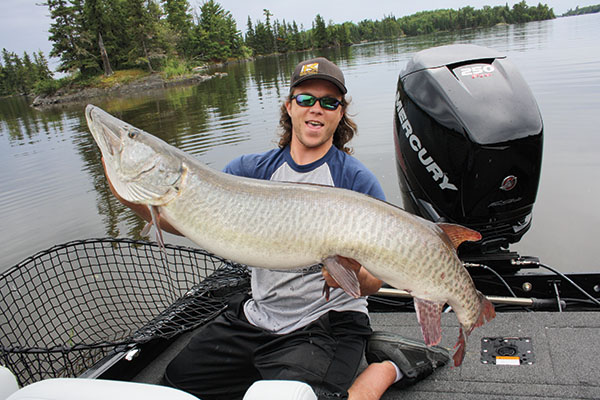
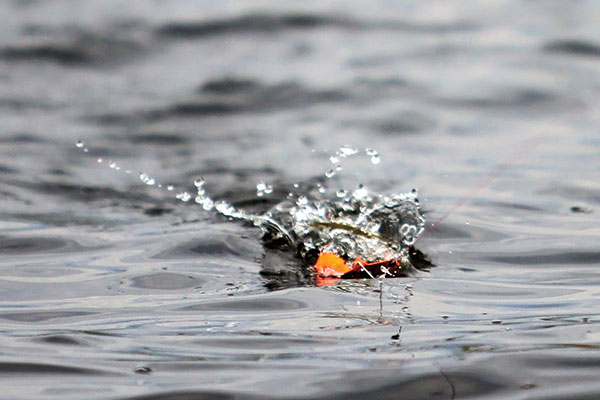
Big Muskie on Topwater LureFew things in fishing are more exciting than watching a muskie suddenly appear like a great white shark stalking your surface lure. It’s even more heart-stopping when the monster opens its mouth and engulfs it. Unfortunately, many muskie anglers are of the mistaken belief that, while thrilling to use, topwater lures are low-percentage options and highly situational.
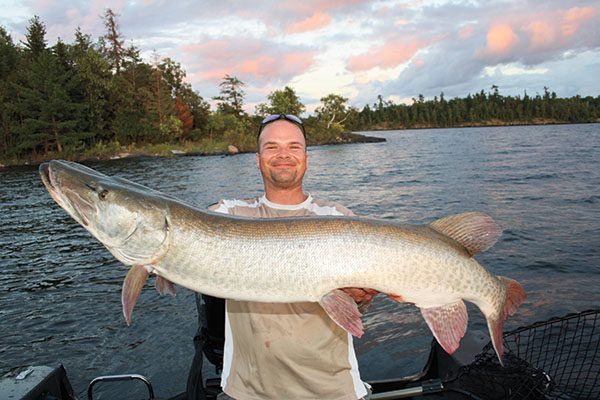
Not so, says renowned Ottawa River muskie guide John Anderson, legendary muskie guru Dick Pearson, and Lake of the Woods muskie stalker Darcy Cox. There’s almost never a time, nor a situation, when the trio won’t throw a surface bait. It’s why they’re topwater trendsetters.

“If an angler only threw surface baits, they would catch fewer fish, but they would be much bigger,” says Anderson, who owns the Ottawa River Muskie Factory. Pearson, on the other hand, has seen it all during his time on the water, pioneering muskie tactics through the heydays of the 1970s, 80s, and 90s. He attributes much of today’s topwater skepticism to times past, when lure selection was limited and hooking percentage poor.

“Many in my era tried it, but quit,” Pearson says. “I can remember having multiple blow-ups and losing fish after fish on early versions of the Mud Puppy and Arbogast Muskie Jitterbug. Today, however, I haven’t found a surface bait I don’t like. The variety is amazing.”

Cox, ironically, fell head over heels for surface lures, taking the fast lane to the top of the water column after reading an article penned by Pearson in In-Fisherman magazine. “It opened my eyes as to how versatile topwater lures can be for muskies,” says Cox, whose Tank Industry Guide Service has a waiting list of guests. “I was throwing Globes in 2-foot waves and using prop baits and walk-the-dog-style surface lures in sunny conditions, which is counter to what we’re taught. I think the word is getting out now, as more muskie anglers are discovering how deadly surface baits can be.”

Large Topwater Muskie LureTHE ULTIMATE EDGE

“My transition to taking muskies on topwater was gradual,” recalls Pearson, who’s also an avid hunter. “I began looking at muskies the same way I look at whitetail deer — as creatures of edges. That’s when the importance of the surface became more apparent. I regard it now as the ultimate edge. The place where two worlds collide. The place where oxygen, temperature, wind, sound, and visibility have their greatest variations and consequences.

“There were eureka moments, as well,” he says. “The first evening I ever threw a Top Raider, for instance, I boated four nice fish. Another time, in the 1980s, I threw the first Jackpots in rollers on Lac Seul and boated five big muskies in one day.” While Anderson, Pearson, and Cox won’t hesitate to present a surface bait around any piece of structure or cover, or in any weather or water conditions, they concede that they’ve isolated a range of locations and conditions where the lures excel.

“Project Noble Beast is my bible,” Anderson says, referring to Sean Landsman’s groundbreaking telemetry research on the Ottawa River. “It showed how devoted muskies are throughout the season to specific shallow structures like rocky shoals and dense weedbeds. When you understand how dedicated the fish are to specific locations, you realize why you need to enter waypoints on every spot you raise a big fish.

“You can make a living casting topwaters at sunset. I use them in the morning, as well, but the evening is universally more productive, especially in July and August. Throwing topwaters at sunset in mid-summer is a great big-fish strategy,” he says.

Spotting shallow cover, especially associated with vegetation, also persuades Cox to drop whatever rod he’s holding and quickly grab one rigged with a topwater lure. “I’ve found that surface baits work well on sunny, warm days immediately following a cold front,” he says. “I often find muskies in as little as 6 inches of water during the warm-up. They don’t want to go out deep to chase food.

“The first couple of weeks after the muskie season opens is a great time to use topwaters. Fish are shallow, soaking up the heat, so a topwater is the perfect lure to use where the fish feel most comfortable.” Pearson agrees. “In summer, calm, warm mornings and evenings are best around shallow structures with submergent vegetation and reeds,” he says.

“But topwaters are often my bait of choice on Opening Day, as well. Warming water is much better, in my opinion, than cooling water.”

Trophy Muskie on TopwaterGOOD VIBRATIONS

Listen to Anderson, Pearson, and Cox talk about topwaters and you frequently hear about noise, vibration, and water displacement. “Part of the collision factor I mentioned earlier,” Pearson says, “are noise and visual disturbance. It’s like an escaping mouse triggering a cat. Sound is very important. You’re tickling their lateral lines with good vibrations.

“The deep pop produced by a Fat Bastard in the wind may be key one time, while a light pop, or as I like to say, the pitter-patter of little feet, works better another time. In a walk-the-dog-style bait, a Jackpot may work, but then the whoosh of a Weagle outfishes it. Similarly, I’ve seen times when tinkling a flaptail is unbeatable and then, for no reason, the waddling plop-plop of a Creeper shines. You have to think about the different sound options and vary them regularly.”

While Cox also pays attention to the different sounds surface baits make, he’s even more fixated on their vibrations, likening the pulse patterns to the big double-bladed bucktails that have taken the muskie world by storm. “The bigger the vibration radius, the more muskies you can call in with a surface bait,” Cox says. “That’s why #10 bucktails changed the game. Nothing matches their ‘call radius.’ It’s the same with topwater baits.

“Sometimes, however, a call radius isn’t required. If you’re casting to a spot where you know a muskie is positioned, the silent treatment may entice a fish that’s wary of the unnatural clatter from rattles. That’s why I tend to throw noisy topwaters when I’m searching for muskies, switching to quieter surface baits when I return to a fish I raised earlier, or when working high-percentage water.”

Anderson, on the other hand, believes that fish in general, and muskies in particular, pattern sound more easily than they do sight. And he’s convinced it extends beyond the timbre or tone of your lure, to include things like your electric trolling motor and sonar.

“I was involved in a sturgeon tagging study on the St. Lawrence River, and we couldn’t approach a tagged fish when the water pump was running,” Anderson says. “It wasn’t noisy, but it had a distinct resonance that the biologist in charge of the study said the fish had learned to identify. As soon as we turned off the pump, we could drive right up to them.”

After being involved in that project and studying how muskies react to various surface sounds, Anderson is convinced that they’ve become conditioned to avoid many popular lures. “I’m throwing much bigger surface lures these days,” he says. “Lures like the Big Mama, Dirdy B, and Twisted Sis’tr offer a larger visual profile, but beyond that, they make a different noise and throw more water. The Top Raider is a great lure, but most muskies have seen and heard it so many times I’m certain they’ve learned to avoid it.”

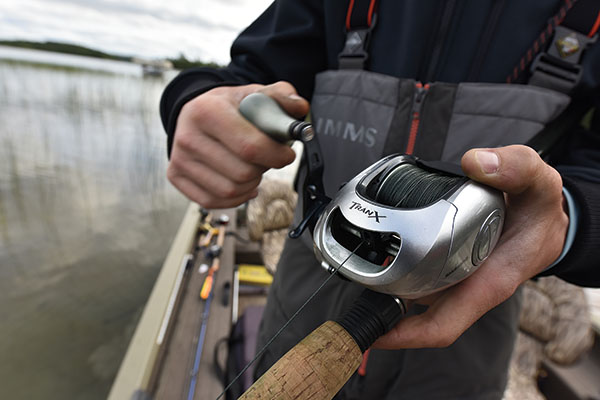
Low-Profile Reel Designed for Handling Big Muskies on TopwaterFAST & ERRATIC OR SLOW & STRAIGHT?

This also applies to walker-style lures. Anderson says you typically raise more fish with lures that sashay back and forth erratically, but you put more in the boat with baits that run straight ahead. “Muskies don’t miss topwater lures by mistake,” he says. “It’s never an accident. So, if you’re seeing fish, or having them boil on your bait, it’s because you’re doing something they don’t want you to do. Usually it’s the speed of your retrieve.

“Most muskie anglers have two retrieve speeds: fast and really fast. I have so many people in the boat with me each season that I get to study them carefully. It has taught me that retrieving surface baits slowly is essential most of the time. I typically crawl them along, retrieving them ever slower, certainly slower than other lure types.”

While Cox differs slightly from Anderson in his fondness for walk-the-dog style topwaters, he agrees that a lingering retrieve is almost always better than a rapid one. “Walk-the-dog-style topwaters are slow-moving lures,” Cox says. “You want to make them act wounded. They’re in the right position above the fishes’ heads so they can see them from different depths and directions. A lazy muskie can cruise up, slowly make the decision to eat, then attack with minimal effort and a high chance of success.”

GO FIGURE

No lure is perfect, and while surface baits come with little baggage, they’re not without warts. The biggest is when you spot a muskie trailing your lure. Surface lures are the most difficult to work at the side of the boat when you’re trying to entice a reluctant fish to bite.

“If I spot a muskie following my surface bait, I try to duck down and hide,” Pearson says. “I change the retrieve speed if time permits. I also move my rod tip and try to change the lure’s direction. But usually you’re faced with two choices: Either stop the lure in its tracks, or take it under and go into a figure-eight or circle.

“Stopping works, although most muskie anglers are hesitant to try it. I have film of me catching a 50-inch fish after stopping a walk-the-dog style topwater. You can see the fish rise up slowly and take it down like a bobber. If I go into a figure-eight, however, I almost always pull the topwater under, hoping that I can continue its action and in doing so, create a trail of bubbles.”

TOPWATER ACES UP THEIR SLEEVES

Being smitten with surface baits means Anderson, Pearson, and Cox have their fair share of aces up their sleeves. Pearson, for example, likes walker-style lures over deep water whenever he spots suspended balls of bait, especially ciscoes, in the upper part of the water column. And he won’t hesitate to fish these lures in rollers when a storm is approaching.

Anderson, however, rarely leads with a surface bait, typically starting each day with muskie-size jerkbait, glidebait, softbait, or bladebait. “But if I can’t seal the deal, I use a surface lure,” he says. “They’re the best clean-up bait you can tie on.”

Cox likes to fish the most unlikely spots, a foot or less of clear water, at the most dubious time, mid-day, under bright sun. “On opening day last year, I was sight-fishing on a sandflat in one foot of water when I spotted a gorgeous muskie,” he says. “My guest made a cast and the wake was Godzilla-like. The strike on the figure-eight was classic, and the ensuing fight a masterpiece. The fish measured 51.5 inches and we watched the whole show, from start to finish, on a flat-calm, blue-sky, sunny day. You have to love throwing surface baits for muskies.”

*In-Fisherman Field Editor Gord Pyzer is a former Ontario natural resource manager and National Fresh Water Fishing Hall of Fame inductee. He lives in Kenora, Ontario.

Mitchell resident shoots one of world's largest mountain lions

0

After five long tiring days of hunting, a 200-plus pound mountain lion fell from a tree, possibly putting Mitchell resident Jeff Jarman in the record books.

Four years ago, Jarman, an Aberdeen native, went to a convention in Reno, Nev., called Safari Club International and met long-time mountain lion hunting expert, Marc Hubbard.

Although there was a four-year wait to hunt with Hubbard in his hometown of Penticton, British Colombia, Jarman wanted to cross a big-cat hunt off of his bucket list. So they made the appointment.

Jarman, who works at American Garage Door, hunted at Hubbard’s business, Okanagan Outfitters, a guide service that has led easily over 400 hunts to mountain lions in Canada, including four of the top 10 in the world. Little did Jarman know, Hubbard’s son, Russ, would lead him to the fourth-largest mountain lion in the world.

“The second I pulled the trigger, he was coming down out of that tree,” Jarman said. “Usually around here when you shoot a buck, and as you get closer to it, it has ground shrinkage. As we kept getting closer to the cat and looking him over he just was bigger and bigger. I couldn’t get my hand around his tail.”

When Jarman was traveling to the Hubbard’s outfitters club in Canada earlier this month, he thought he was headed to the boondocks. Instead, when he arrived, he saw beautiful mountain ranges surrounding a huge lake with wineries along the shore. Penticton sits on the south side of Lake Okanagan, which is over 80 miles long and three miles wide.

The hunt was scheduled for seven days, and Jarman and Russ looked for lynx and mountain lion tracks while riding snowmobiles on trails in the dense, tree-filled, snowy mountains.

Russ guided the hunt for Jarman. Russ, 23, said he shot his first cat at the age of 12 and has been guiding people under his dad’s business alone since he was 18. Russ had guided at least 100 people cat hunting, he said.

After the fourth day of snow fall and not finding many promising tracks, Jarman admitted he was getting a little nervous. He and Russ were working from sun up to sun down, not wasting a minute of daylight, looking for a cat. His $500 license for an international mountain lion was running dry.

The next morning the fun started. Russ spotted some tracks at about 9:30 a.m. on a blue-bird sunny day, giving Jarman the decision to go after the cat.

“(Russ) explained that before the hunt, he said ‘even though I tell you the track is average size, it could be a small cat or a big cat or even a female,’ ” Jarman said. “He had a hard time telling exactly the size.”

Russ explained the fresh snow gave him some trouble indentifying the size of the tracks, confusing him on the size of the cat.

But Russ told Jarman he thought the cat had probably been through that area the previous night, could be an average-size male and had “good stride” on it.

Three English Red Tick dogs were released after Jarman made the decision to go after the cat.

“That’s when the fun started, when the dogs went crazy and started howling,” Jarman said. “Once you release the dogs, it’s a full-day deal.”

Russ described the dogs as like a German-shorthaired pointer, while Jarman said they were like bloodhounds.

Each dog had its own separate GPS unit on its collar, allowing Russ to track the dogs while they tracked the cat. Then, while the dogs were out, Russ and Jarman drove around to the opposite side of the mountain, near where the dogs had posted. At about 2 p.m., and over 10 miles from the original track sighting, they got within roughly 1,000 yards of the dogs, and they hiked on foot the rest of the way.

But as Jarman and Russ were about 100 yards from the dogs, they quit barking. The guide didn’t like his ears.

Russ explained then that sometimes the cats will jump from tree to tree, and the dogs will lose track of them, but that time, the dogs did a great job finding the cat.

As they reached ground zero, where they found the most tracks, they spent about 20 to 30 minutes with their heads raised to the sky, looking for a treed mountain lion.

“After searching for that thing I about had enough, but he called me up to where he was with his dog, and calm as day he said, ‘the cat’s right above us,’ ” Jarman said.

Russ pointed to a 100-foot spruce-like tree, which was canopied above him and Jarman.

“The dogs came back toward me, and I was joking with the lead dog, like ‘find the cat,’ and then he was barking at the tree, and I saw a little twitch of the black trail,” Russ said. “Then I spotted it.”

With his heart pumping and after the dogs were tied up, Jarman positioned himself, looked through the scope of his .270 caliber and thought, “that’s a little guy.”

Quite an interesting thought from a man who was about to the pull the trigger on a 200-plus pound mountain lion, but Hubbard assured him it was a good animal.

“I could tell from his body and head alone he was huge,” Russ said. “I told Jeff to set up against a leaned-down tree. Then, one shot dropped the cat. That cat didn’t move an inch.”

Added Jarman: “I hit the cat square-on in the chest, probably about 50-70 feet up in the tree. There was no hesitation. He just fell from the tree immediately.”

That’s when Jarman saw exactly how big it was.

The mountain lion had about a three-foot long tail and was roughly 10-feet long from nose tip to tail tip. Each razor sharp claw was at least three inches of shredding power and Russ said, by looking at teeth length, the cat was 8 to 10 years old.

“He was much more excited about the size of the cat than I was,” Jarman said.

While taking photos of the animal, it took both men to lift it up initially. Then, they skinned it and drove back to camp on the snowmobiles, as the dogs rode happily alongside on the sleds.

When they got back to the house, Russ explained to Jarman the cat he shot may be a record holder. Marc Hubbard is an official measurer and initially said the skull size gave it the fourth-largest mountain lion in the world title.

“We have to re-measure the skull, it’s a length by width measurement,” Russ said. “I’ll measure it first and get it down to 1/16th of an inch. Then, once it’s certified by my dad, than gets submitted to Safari Club International trophy record book.”

Since the cat was shot recently, it needs to wait 60 days to dry to become an official measurement, but Jarman said he feels good about Hubbard’s measurement.

“It’s a feeling of luck,” Jarman said. “If it was a cat half as big as that, I would have shot it. But to have it hit the record books is just the cherry on the cake. It’s pretty exciting.”

The skin won’t be shipped back into the United States until March or April, Jarman said.

This wasn’t Jarman’s first big trip. He said he’s gone to New Mexico hunting elk, Alaska hunting brown bear and to the Arctic Circle for polar bear.

Best Shooting Chronographs

0

One thing that will help you shoot more accurately is if you know your ammunition’s velocity and other related data. Luckily, there’s a tool for that — a shooting chronograph!

Not only can it measure the velocity of your shots but its data can also help you assess your reloading skills. No longer are chronographs only to be found in ballistics labs, but are now priced so as to be a regular part of a shooter’s kit.

Shooting chronographs are easy to use and show you valuable data.

In turn, these data can help you improve your reloading skills and the quality of your shots. Get that bullet to land where you want to with this shortlist of the best shooting chronographs. We’ll take a look at seven great options.

Shooting chronographs offer help when firing long-range shots in target shooting and before hunting trips.

Some of you may already know that I have been in the gun industry for more than 40 years now.

Over the last few years, I have tried and tested over 15 different chronographs. So, if you are unsure about getting one, then this article might serve as your ultimate buyer’s guide. Here’s the summary of the chronographs that I will discuss in this review:

GGD Shooting Chronograph Bullet Speed Tester

  • Unbeatable price
  • Wide velocity range
  • Solid design
  • Not as durable as some of the others

$64 Shop NowClick to read my review Best Shooting Chronographs Caldwell Ballistic Precision Chronograph

  • Can adjust accuracy up to 99.75%
  • Ideal for beginners due to its ease of use
  • Compatible with archery, airguns, firearms, and rifles
  • Oversized sunscreens made of plastic
  • Thin metal rods are bendable

$114 Best Shooting Chronographs Competition Electronics ProChrono Digital Chronograph Shop NowClick to read my review Best Shooting Chronographs LabRadar Ballistic Velocity Doppler Radar Chronograph Caldwell Ballistic Precision Chronograph G2

  • Has Bluetooth, SMS (text), and email features for data transfer
  • Accuracy of +/-.25%
  • Can measure 5 to 9,999 FPS (frames per second)
  • Connect to a mobile device to view advanced statistical data
  • Tripod has an average design

$207 Best Shooting Chronographs MagnetoSpeed V3 Ballistic ChronographBest Shooting Chronographs Shooting Chrony 7000129 Beta Master Chronograph Shop NowClick to read my review Best Shooting Chronographs Competition Electronics ProChrono Digital Chronograph

  • Records up to 99 string shot data in its internal memory
  • Compatible with pistols, shotguns, rifles, and arrows
  • Has a velocity range of 21 feet up to 7,000 FPS
  • Slower speed recording time when used in outdoor shooting
  • Need to buy other accessories (e.g., Indoor Lighting System) for better performance

$110 Best Shooting Chronographs Shop NowClick to read my review Best Shooting Chronographs LabRadar Ballistic Velocity Doppler Radar Chronograph

  • Powers up either by using AA batteries or an external USB power source
  • Can track and record different types of statistical data
  • Good for both outdoor and indoor use
  • Pricier than many other chronographs
  • Not suitable to use for long periods of time

$559 Best Shooting Chronographs Shop NowClick to read my review Best Shooting Chronographs MagnetoSpeed V3 Ballistic Chronograph

  • Can record data up to 1,100 rounds per minute
  • Compatible with many firearms, including airguns
  • Great for pro shooters
  • The Bayonet’s weight affects shooting
  • Data is hard-to-read

$380 Best Shooting ChronographsBest Shooting Chronographs Shop NowClick to read my review Best Shooting Chronographs Shooting Chrony 7000129 Beta Master Chronograph

  • Has an accuracy of up to .5%
  • Long battery life up to 48 hours of continuous use
  • Complex design
  • Read the full manual to achieve best results

$159 Best Shooting Chronographs Shop NowClick to read my review
Why Is a Chronograph Essential?

I have heard many people ask: “Why should we even bother buying a chronograph anyway?” Chronographs are useful, especially for long-range shooters attempting to test their loads’ consistency.

Here are the three big pieces of data that a good chrono will give you:

For beginners, you may find yourself confused by all this (trust me, I was too). Trying to calculate the data of how your load does at the range is a lot of work.

Chronographs help find the right load for you by doing all the painful calculations.

How a Chronograph Operates

Let’s break this down easy. Chronographs are useful pieces of scientific equipment, but using one for our goals is actually pretty easy.

By default, a chronograph’s main goal is to measure time. This is also true for shooting chronographs.

How a shooting chronograph actually works depends on the exact type you get. Right now, there are three general styles.

Skybox Chronographs

Skybox chronographs use a “skybox” to measure when the shadow of the projectile passes two points. It does some math and provides velocity information. This is the most common and cheapest type of chronograph since they are easy to make and the tech is pretty simple. Chronos like the Caldwell down below use Skyboxes.

Best Shooting Chronographs
Caldwell Chronograph “skybox” design

The downside of these is that they can be inconsistent depending on the weather. If you’re under 100% sun when you test one batch of ammo but 70% sun when you test a second batch, your results might not entirely match.

Radar Chronographs

Radar chronographs normally use Doppler radar to bounce a single off of the projectile and get information back from it. This is very handy since it can measure velocity at multiple distances between you and the target.

Best Shooting Chronographs
LabRadar

These are also rather expensive and harder to set up than the other kinds. The good news is they are very accurate and work in all weather conditions.

Electromagnetic Chronographs

Electromagnetic chronographs attach to the barrel or the rifle frame in some way and use a bayonet to extend past the muzzle of the barrel. In the bayonet is small electromagnetics that creates a small electromagnetic field above them. Measuring how that field is disturbed by the projectile enables the computer to math out how fast it is moving.

Best Shooting Chronographs
MagnetoSpeed V3 with an MK Machining ARCA mount

These are decently priced, very easy to use, and work in all weather, but make shooting for groups while taking velocity data at the same time much harder since the weight of the bayonet hanging off of the barrel shifts POI and affects harmonics. This can be solved by getting an aftermarket mount and attaching the bayonet to that.

Where to Use and Store Chronographs

You can use shooting chronographs almost anywhere you wish. Displays are usually easier to read indoors, but I have never had a problem using them outdoors.

My best recommendation is to use your chronograph on a cloudy day. Â

Like guns, you also need to take extra care of your chronograph. You can use a carry bag or kit to store all your chronograph accessories in one place.

7 Best Shooting Chronographs

I have chosen seven of the best shooting chronographs to buy this year. Before we talk about them in greater detail, I have summarized a neat table for you to look at. The table includes the dimensions, weight, and price of each featured chronograph:

NameDimensionsWeightPrice Caldwell Ballistic Precision Chronograph21.5 x 10 x 4 inches3.2 lbs$114.99 Caldwell Ballistic Precision Chronograph G260 x 36 x 36 inches8 lbs$207.00 Gun Gear Depot Precision Chronograph5.1 x 3.1 x 2.0 inches0.4 lbs$64.99 Competition Electronics ProChrono Digital Chronograph16 x 4 x 32 inches2 lbs$110.49 LaBradar Ballistic Velocity Doppler Radar Chronograph11 x 10 x 2 inches2.1 lbs$559.99 MagnetoSpeed V3 Ballistic Chronograph12 x 4 x 2 inches2 lbs$380.00 Shooting Chrony 700129 Beta Master Chronograph20 x 20 x 3 inches7 lbs$159.99

Caldwell Ballistic Precision Chronograph

Let’s start with the Caldwell Ballistic. Its decent price offers strong reliability. In addition, this is one of my first chronograph and its high performance is not reflected in its relatively modest price. The Ballistic also includes ¼-20 threads for tripod mounting and a 15-ft audio jack cable for data transfer. Plus, it also has a carry bag suited for portable travel.

Best Shooting Chronographs
Caldwell Chronograph

The Caldwell Ballistic’s highlight feature is its pinpoint velocity. It has the ability to record readings of 5 to 9,999 fps (frames per second).

It is also factory calibrated and is easy to operate for newbies. Due to its calibrated design, it has a dependable accuracy of +/-.25%. Furthermore, this chronograph also caters to different types of shooters’ needs.

Airguns, arrows, firearms, paintball rifles – you name it! As an archery enthusiast, this chronograph is the one for me.

The Ballistic has a decently sized LCD screen that makes it easy to read. It measures its velocity by MPS (meters per second) or FPS (feet per second).

It records the velocity, SD, and ES of every projectile you fire from your gun. Since it is factory calibrated, its accuracy could reach up to 99.75%.

Like other Caldwells, the Ballistic’s effective accuracy lies at its 48 MHz processor. I saw how it generates quick data when I took my AK-47 rifle out at my local range. Its 15ft jack audio cable allows you to transfer data to all smartphone types.

When I paired it with my iPhone, I read my stats through an Excel sheet format.

Personally, I’ve never had an issue with durability on the Caldwell. Even when I accidentally shot mine with a .22 LR at 5ft, it kept working for almost a year before it finally died on me. Since I did shoot it, I’ll give it a pass for its early retirement.

Caldwell Ballistic Chronograph G2

Compared to the Ballistic, the G2 has a more expensive price in the market ($200+). But this chronograph’s high price equates to its high performance on the range. It has a +/-.25% accuracy like the other Caldwells.

The G2’s upside-down design allows shooters to place it either on a tabletop or with a tripod. Whenever I like to do my shooting test sitting down, I use my G2 instead. It is also compatible with a wide variety of weapons.

Examples are airguns, firearms, arrows, and paintball rifles. If you’re looking for versatile chronographs, the G2 is your best choice!

Best Shooting Chronographs
(Left to right) The Ballistic Chronograph G2 from the official Caldwell site.

The G2 can also calculate more different types of data. This includes the average velocity, extreme spread, minimum, maximum, and standard deviation. It can also measure 5 to 9,999 feet per second (FPS) like the rest of its Caldwell counterparts. Unlike the Ballistic, G2 has its Bluetooth and SMS (text) features.

You can transfer your data using Bluetooth without using a cable jack. Also, you can share your data via SMS (text) or email. I can borrow my friend’s laptop, computer, or tablet to view my emailed data at any time. The G2 also includes a carry bag and a rechargeable Li-Ion battery. Click on the video below to see how the G2 works at the range:

The only downside to the G2 is its need for mobile devices. You need a phone, tablet, or laptop to view your advanced data analysis. Its tripod design is also average like other tripods in the market. Due to its collapsible feature, you can also use the G2 for indoor and outdoor shooting.

GGD Shooting Chronograph Bullet Speed Tester

If you want a feature-rich shooting chronograph but you’re on a budget, you really can’t go wrong with this one from Gun Gear Depot.

With a velocity range of 999m/s (~3200 fps) it offers an excellent range for an enthusiast. It also records groups of up to forty rounds and will calculate kinetic energy (a feature of the much more expensive LabRadar chronograph).

It is powered by a rechargeable lithium battery (USB cable provided) and is portable and versatile. Its LED display is bright and the chronograph works confidently in most weather conditions – the design incorporates its own ‘sky screen’ over the chronograph. Â

If you want to improve your shooting this chronograph is a great entry-point – it’s affordable, simple to operate, and has a solid design. Decent data with no-nonsense. At the current sale price of $64.99 we highly recommend it.

Competition Electronics ProChrono Digital Chronograph

If you prefer a simple yet reliable chronograph, then ProChrono is your best bet. This unit is one of the top-rated models in today’s market due to its wide array of features. It also comes with a decent price of $115.99.

Its accessible interface is also fitting for amateur and expert shooters. The ProChrono is also compatible with arrows, pistols, shotguns, and rifles.Â

The ProChrono from the Midway USA e-commerce site.

One of the ProChrono’s best attributes is its shot string data. Its power-down memory can store up to 99 string shots.

The data shows a bullet’s average velocity, standard deviation, and extreme spread. You can also delete an individual or an entire string by touching a button on its easy-to-use keypad.

The ProChrono’s clear 4-digit LCD screen records both meters per second (MPS) and frames per second (FPS). I use this chrony most of the time because I can view my shot string data in greater detail. The ProChrono’s ability to track 21 feet to 7,000 FPS makes it suitable for large shooting areas. You can check out the model’s review below:
This little guy’s shot timing resolution runs up to 750 nanoseconds. As such, it could display shot string data right away. The ProChrono’s only downfall is its speed recording time on sunny days. Outdoor shooting with this chrony slows down the generation of your projectile data.

LabRadar Ballistic Velocity Doppler Radar Chronograph

The LabRadar is the most expensive chronograph ($559.95)Â included in this review (but with good purpose!).

Unlike other chronographs, this uses radar instead of sunscreens to measure a bullet’s flight. The LabRadar comes with a set of accessories. This includes a USB cable, warranty card, instructions manual, and carrying cases.

The LabRadar from the official LabRadar site.

This unit can run either using an external USB power source or 6 AA batteries. When using batteries, it only wastes ¾ of their power after 4 hours of use at the shooting range.

My friend who owns one of the chronys also commented on how easy the LabRadar’s setup is. It only took him less than 5 minutes to set it ready and 2 minutes to adjust between various loads. You can watch an unboxing and review of this chrony here:
The LabRadar also has the ability to track and gain velocities 100 yards and beyond. To test it, I went over to my friend’s place (the same person before) and used my .308 with it. I got my projectile’s maximum range result of 7.62mm per 100 yards! In addition, it also calculates a bullet’s SD, ES, maximum, minimum, and average velocities. Talk about an all-rounder in stats!

I have noticed a few setbacks with the LabRadar. We start off by talking about its price. The LabRadar costs at least $500 or up on average.

The price combined with the extra accessories you often need to get make this a very pricey option with arguably little benefits over something like a MagnetoSpeed V3.

MagnetoSpeed V3 Ballistic Chronograph

MagnetoSpeed produces reliable chronographs and the V3 is one of them. The V3 comes at a reasonable price ($380) with great inclusions like its data logging feature.

It can collect data up to 1,100 rounds per minute, earning its top speed and accuracy ratings. This unit is suitable for muzzles and suppressors from ½ to 2 inches in diameter. True to its name, the V3 uses electromagnetic sensors to measure velocities by FPS.

Like many chronographs, you can use the V3 on various kinds of weapons, including airguns. The unit comes with a Bayonet that you attach to the muzzle of your gun to track its load data.

This is one of V3’s straightforward qualities as you can fire your shots away and it generates the data you need. Also, you can adjust the unit to rapid mode if you want to take quick shots. I had a lot of fun using it on my Spring Piston at my local range.

The V3 has a kit that includes a lot of accessories. It has a display unit, a Bayonet sensor, an alignment rod, and an instructions manual. It also has downloadable firmware updates and a troubleshooting guide.

If you ever run into problems, you can do the troubleshooting on your own. Scroll down to watch an overview and unboxing video of the V3:
I love my V3 and use it for nearly every range trip. If you mount the unit to your bayonet you’ll have to accept the shift in POI and adjustable for the new weight.

Personally, I use a mount from MK Machining so I can mount my V3 to the chassis of the rifle. For me, this makes the perfect setup.

Shooting Chrony 7000129 Beta Master Chronograph

Long-range shooter enthusiasts, you might want to read this one out. The Beta Master is one of the best long-range shooting chronographs in the market right now.

Along with its top performance, this chrony costs less than two hundred bucks ($149.99). Regardless of what gun you use, the Beta Master has an outstanding accuracy of .5%.

The Shooting Chrony from the Midway USA e-commerce site.

The Beta Master tracks a bullet’s speed from 30 to 7,000 feet per second which makes it ideal for long-range shooting. It also uses one 9 volt alkaline battery as its power source that could last up to 48 hours when used for long periods.

From my personal experience, I don’t charge the Beta Master often because of its long battery life.

This unit can perform a lot of actions, one of which includes its string shot memory. The Beta Master can store up to 60 shots in its internal memory. Like the ProChrono, you can delete an individual or a whole set of string shot data.

Also, this chronograph only weighs less than 3 pounds which makes it convenient to carry around. If you’re curious about how it does on the field, you can click on the video below:
The only major downside that the Beta Master has is its design. This might overwhelm the first-time users but its manual could help you get past that.

Speaking of the design’s downside, I had two of them and found that I had to be careful when closing the unit (it folds in half, like a clam shell) not to get the power cable from the battery caught between the halves. I practically cut the cable on one my units before I’d determined what was happening.

Turns out it didn’t matter much, as I shot the thing a short time later. go figure! But, give it a little bit of practice and you can see how powerful this bad boy can get.

Conclusion

If you wish to buy a cheap yet reliable chronograph, the GGD Shooting Chronograph Bullet Speed Tester has the capacity to record accurate readings with a sale price of $64.99.

For newbies, I recommend the Caldwell Chronograph for its ease-of-use operation and all-in-one package.

MagnetoSpeed V3 goes well with experienced shooters for its complex data calculation.

Which chronograph do you prefer? Share your thoughts below in the comments section!

You might also enjoy:

  • How To Reload Ammo [Ultimate Guide]
  • [Review] Caldwell Shooting Supplies
  • 4 Best Shot Timers

6.8 Western: Ultimate Guide To The New Cartridge From Winchester & Browning

0

Looking for a rifle cartridge that delivers heavy hitting performance at long range to hunt with this fall? Here’s what you need to know about the 6.8 Western.

Browning and Winchester raised a few eyebrows when they announced the 6.8 Western to the world in early 2021. Many people were understandably very skeptical of what the new cartridge offered to hunters that they couldn’t get with a more established cartridge. The fact that they released the 6.8 Western in the middle of a global pandemic and a historically bad ammo shortage didn’t help with perceptions either.

I admit I was very skeptical at first as well and did not think a new caliber was really needed at the time. However, I eventually decided to take a look at the 6.8 Western with an open mind and I was pleasantly surprised by what I discovered.

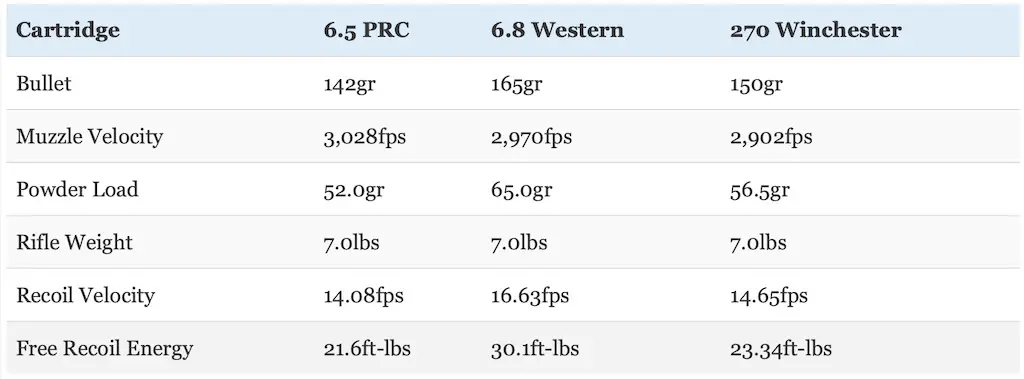
In this article, I’m going to discuss the history as well as the strengths and weaknesses of the 6.8 Western in detail. I’ll also provide some information on how the 6.8 Western compares to the 6.5 PRC and .270 Winchester cartridges to give you an idea of what sort of performance you can expect from the cartridge and so you can decide if it best fits your needs as a hunter.

Before we get started, I have an administrative note:

Some of the links below are affiliate links. This means I will earn a small commission (at no extra cost to you) if you make a purchase. This helps support the blog and allows me to continue to create free content that’s useful to hunters like yourself. Thanks for your support.

6.8 Western History

The story of the 6.8 Western really begins with the .270 Winchester.

Formally released by Winchester all the way back in 1925, the .270 Winchester offered hunters blazing fast velocities and extremely flat trajectories compared to other cartridges in use at the time.

Designed by necking down a .30-06 case to use .277″ instead of .308″ bullets, the original .270 Winchester load shot a 130 grain bullet at approximately 3,140 feet per second (2,846 ft-lbs of energy). Originally released with the Winchester Model 54 rifle, the cartridge developed a well-deserved reputation for effectiveness on thin-skinned game over the years.

The cartridge understandably developed a large and devoted following during the course of the 20th Century and the .270 caliber became irrevocably linked to the Winchester brand. Well, Winchester decided to follow-up on their long running success with a new .270 caliber cartridge at the beginning of the 21st Century.

Winchester released the 270 Winchester Short Magnum (270 WSM) in 2002. That cartridge also fired a 277-caliber bullet, but used a shorter and fatter case. This gave the 270 WSM two advantages over the 270 Winchester: it had a significantly larger case capacity that could hold more powder and it would fit in a short action rifle instead of the longer standard or long action rifles the .270 Winchester is used in.

Indeed, the 270 WSM had an approximately 200-300fps velocity advantage over the .270 Winchester. This resulted in a slightly flatter trajectory, more resistance to wind drift, and more retained energy at all ranges.

However, while the 270 WSM was fairly commercially successful for Winchester, many felt like the cartridge didn’t live up to its full potential. Looking back on things, the 270 WSM suffered from the same limitations as the other short action magnum cartridges designed around that time, like the 7mm Remington Short Action Ultra Magnum (7mm SAUM) and 7mm Winchester Short Magnum (7mm WSM), in that it used a design focused solely on higher velocity instead of heavier and more aerodynamic bullets.

Specifically, the 270 WSM used the same 1:10″ rifling twist rate as the original .270 Winchester. This twist rate worked extremely well for the bullets in the 130gr-150gr weight range most popular for the two cartridges.

While those bullets are outstanding for many hunting applications, they don’t quite offer the sort of the extended performance more and more hunters and shooters are looking for these days. Shooters and hunters have started to place a much higher emphasis on long, heavy, and aerodynamic projectiles in recent years with the rise in popularity of long range shooting.

In response, the various ammunition manufacturers have worked to satisfy that demand with offerings using sleek, low drag bullets. The Nosler AccuBond and AccuBond Long Range, the Barnes LRX, the Hornady ELD-X, and the various Berger bullets are all great examples of extremely aerodynamic hunting projectiles that have really taken off in recent years, especially in 6.5mm, 7mm, and .30 caliber.

Unfortunately, those slower rifling twist rates used by the .270 Winchester and 270 WSM held back development of those long, heavy, low-drag bullets in .277″ caliber.

For instance, there are several different hunting bullet options available in 6.5mm, 7mm, and .30 caliber with a G1 ballistic coefficient over .600 like the 143gr ELD-X in 6.5mm (.625 BC), the 168gr VLD Hunting in 7mm (.618 BC), and the 210gr AccuBond Long Range in .30 caliber (.661 BC). Comparable bullets in .277″ caliber include the 145gr ELD-X (.536), 150gr VLD Hunting (.518 BC), and the 150gr AccuBond Long Range (.591 BC).

Yes, hunters using custom rifles with fast enough rifling twist rates can use some of the very heavy and extremely aerodynamic 277″ caliber bullets that are available these days like the 170gr Berger Extreme Outer Limits (EOL) with a .662 BC. Those heavy bullets simply weren’t an option for hunters who don’t handload and who use factory production rifles though.

That changed when Nosler rolled out their new 27 Nosler cartridge in 2020.

Designed from the beginning to use the new .277″ caliber 165gr AccuBond Long Range (.620 BC), 27 Nosler rifles used a faster 1:8.5″ rifling twist rate and took the performance of the .277″ caliber to the next level by allowing for the use of extremely high BC bullets in a .277″ caliber cartridge.

The Nosler cartridges are excellent performers that fire bullets with higher ballistic coefficients at very fast velocities, but they’re still fairly niche offerings and are primarily available in custom rifle builds (with a handful of exceptions). Even so, this development set things in motion for the next domino to fall.

That domino fell on 15 January 2021 when Browning and Winchester jointly announced the release of the new 6.8 Western cartridge. Also known as the 6.8 Winchester Western, the announcement of the new round took some by surprise.

Instead of just revamping an older cartridge to use heavier bullets, designers at Winchester and Browning decided from the very beginning to build a purpose built cartridge that will handily outperform the old .270 Winchester and 270 WSM.

Here’s what Winchester’s lead engineer for the 6.8 Western, Kyle Masinelli, had to say:

We wanted to get into the untapped potential of bullets above the .264 caliber. We only wanted bullets with G1 BCs above .600 and our goal was to beat the .300 Winchester Magnum’s 180-grain AccuBond’s energy delivery at 500 yards.

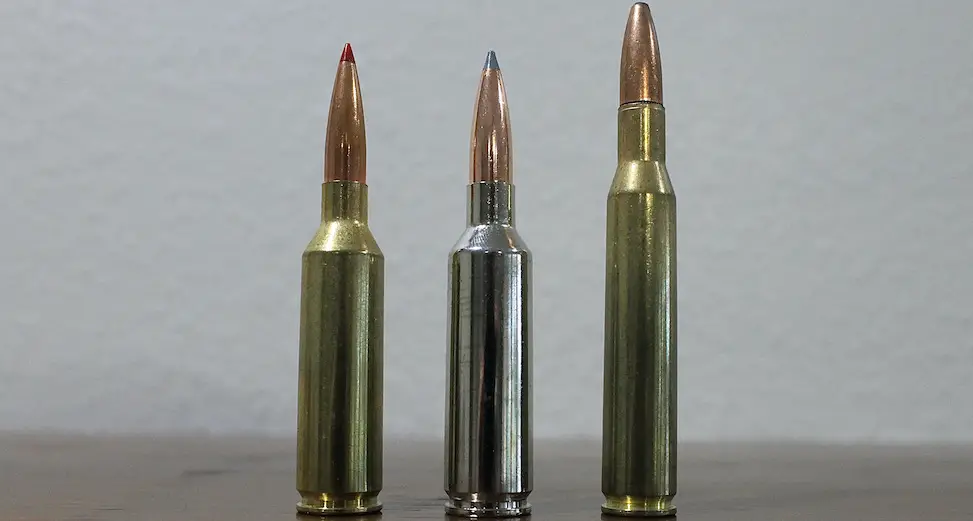
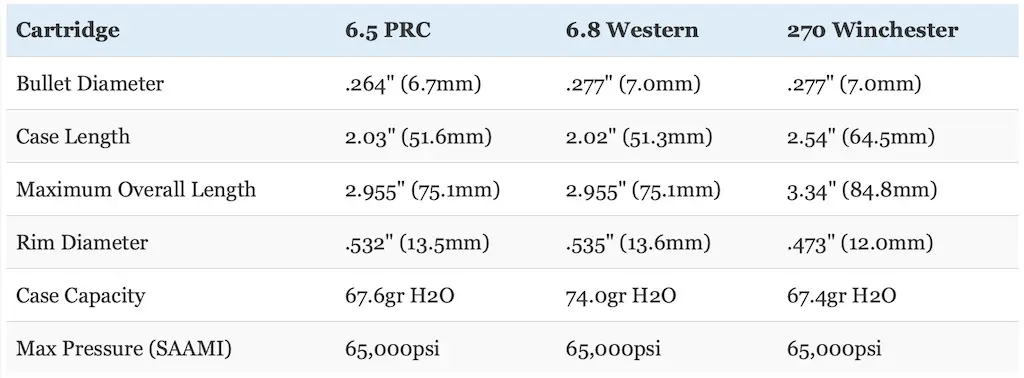
To that end, they borrowed a page out of the playbook used in other successful cartridge releases like the 6.5 PRC. Similar in appearance to the 270 WSM and 6.5 PRC, the 6.8 Western has an overall length of 2.955″ and uses a beltless case that’s 2.02″ long, .535″ in diameter at the base, and has a 35 degree shoulder.

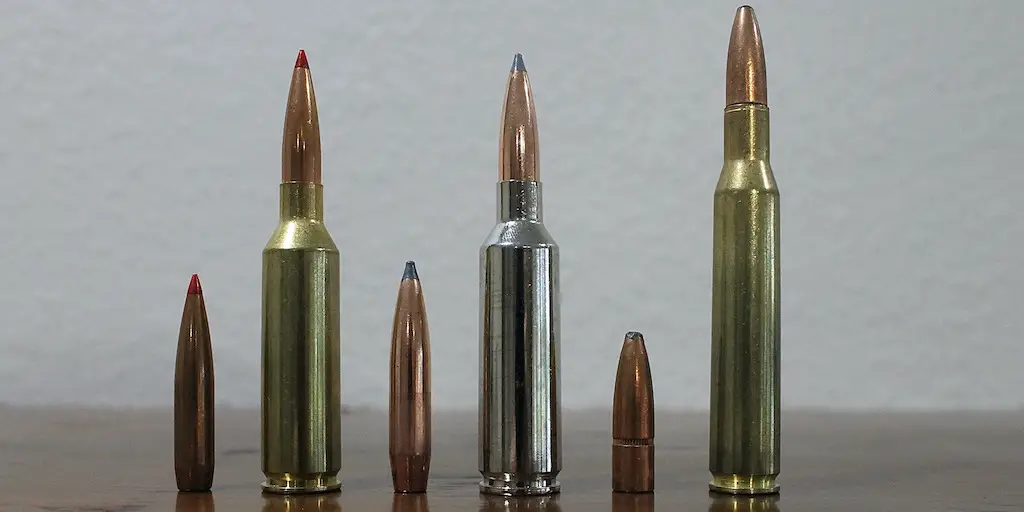
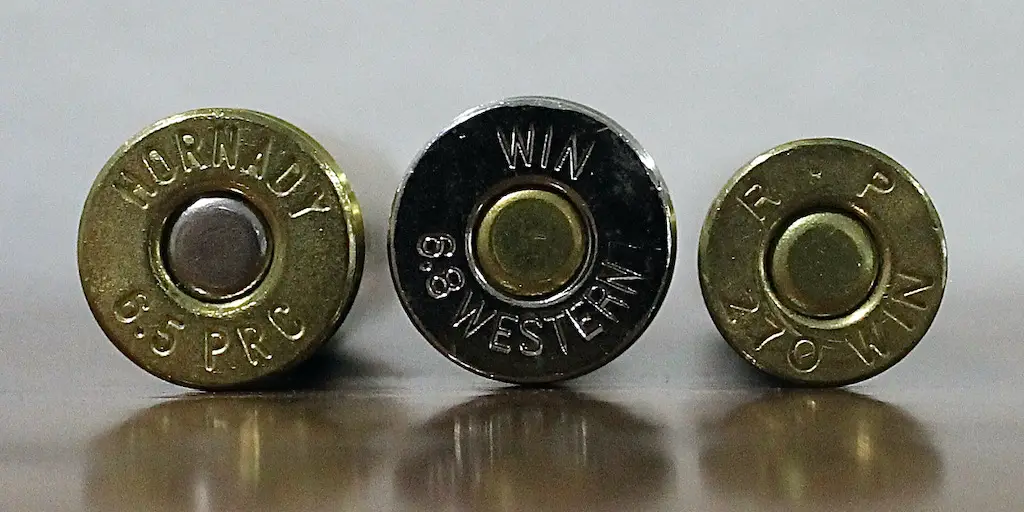
picture of 6.5 prc vs 6.8 western vs 270 winchester

Though the 270 WSM cartridge has an overall length of 2.86″ and fits neatly into the traditional definition of a short action cartridge, the 6.8 Western exceeds those standards by a hair with a maximum cartridge overall length (COAL) of 2.955″. Even so, the 6.8 Western will feed reliably from short action AICS-pattern box magazines that are so common with modern rifles.

In addition to lengthening the COAL of the 6.8 Western, designers at Winchester moved the cartridge shoulder back slightly and decreased the case length compared to the 270 WSM. Similar to what designers at Hornady did with the 300 PRC, this resulted in a little bit more space for the bullet outside the case (also known as head height).

This facilitated the use of long, heavy-for-caliber bullets without requiring them to be seated too deeply into the case that they intrude into the powder column.

Those longer bullets also required a faster rifling twist for proper stabilization in flight. So, they designed the 6.8 Western for use in rifles with a 1:7.5″ or 1:8″ rifling twist rate (1:8″ is SAAMI standard).

The end result is a short and handy .277 caliber cartridge that delivers impressive ballistics that compare very favorably to some noted long range-cartridges.

6.8 Western Ballistics

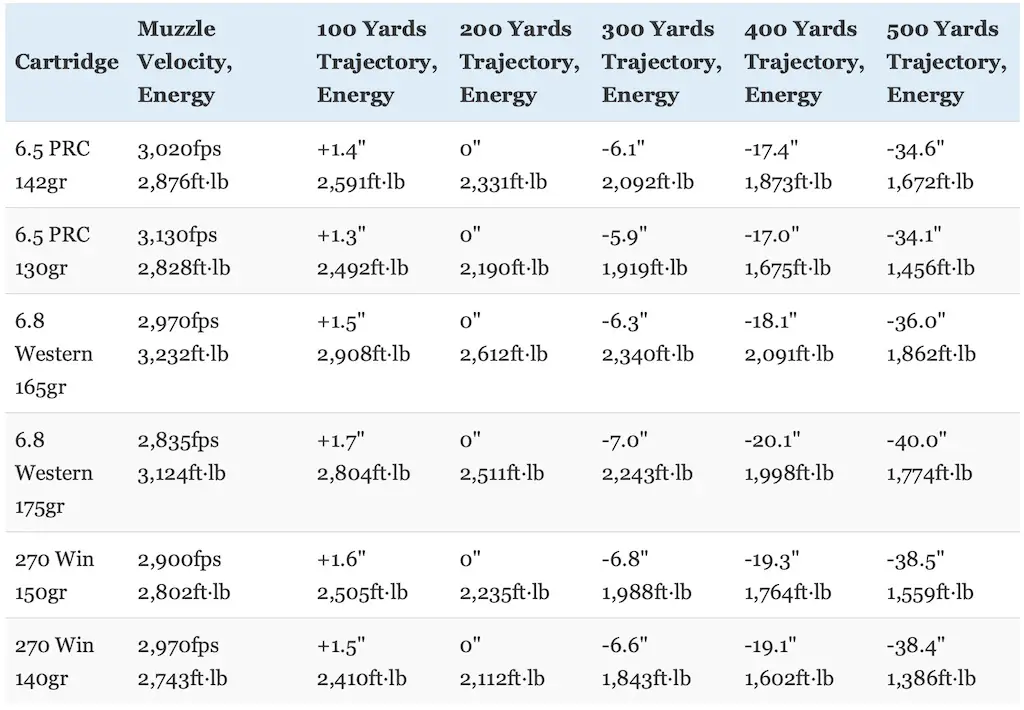
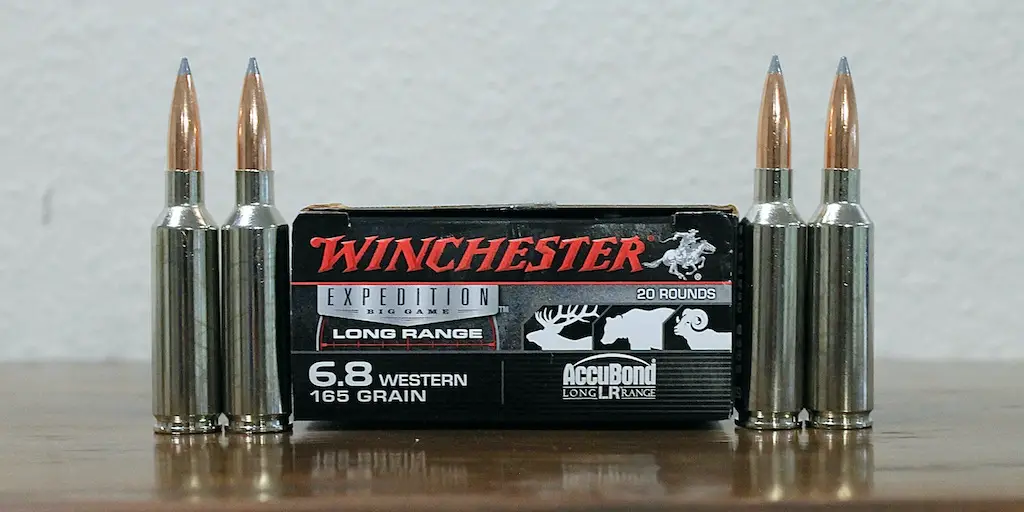
Typical 6.8 Western ballistics are a 165gr bullet at 2,970 fps (3,226 ft-lbs) or a 175gr bullet at 2,835 fps (3,124 ft-lbs) with a 24″ barrel. Those loads use very aerodynamic bullets that retain lots of kinetic energy and deliver excellent extended range performance on deer and elk-sized game.

As a point of comparison, the 165-175gr bullets used by the 6.8 Western are heavier than the 140-147gr bullets common with the 6.5 Creedmoor and 6.5 PRC, heavier than the 130-150gr bullets most common with the 270 Winchester and 270 WSM, and comparable to the heaviest 160-175gr bullets used by the 7mm Remington Magnum.

However, assuming similar bullet ogive profiles, the 6.8 Western bullets are a little more aerodynamic, have a higher sectional density (SD), and can be fired at a higher velocity than those used by the 7mm Remington Magnum in typical factory loads.

Sectional density (SD) is a measure of the ratio of the diameter of a projectile to its mass. All other things equal, a heavier projectile of a given caliber will be longer and therefore have a higher sectional density and consequently penetrate deeper than projectiles with a lower mass and sectional density.

For instance, Nosler offers a 7mm Remington Magnum load firing a 168gr AccuBond Long Range with a .616 BC, a sectional density of .298, and a muzzle velocity of 2,880fps. Winchester has an almost identical load for the 7mm Rem Mag firing the same 168gr AccuBond Long Range at 2,900fps. Compare those loads to Winchester’s 6.8 Western offering firing a 165-grain Nosler AccuBond Long Range with a .620 BC, a sectional density of .307, and a muzzle velocity of 2,970fps.

That works out to 2″ more bullet drop, .5″ more wind deflection, and 71 fewer ft-lbs (~4%) of energy remaining at 500 yards for the 7mm Rem Mag. That’s a very small edge to be sure, but it’s an advantage for the 6.8 Western over the 7mm Rem Mag nonetheless.

Finally, the cartridge accomplished Kyle Masinelli’s stated goal of delivering more energy at 500 yards than Nosler’s 300 Win Mag 180gr AccuBond loads with 1,862 ft-lbs of energy compared to 1,745 ft-lbs with the .300 Winchester Magnum. The 6.8 Western also a slight edge in terms of trajectory (the .300 Win Mag has 2″ more bullet drop and about 3.5″ more wind deflection at 500 yards) and about 10% less free recoil energy than the .300 Win Mag.

6.5 PRC vs 6.8 Western vs 270 Win

First, the 6.5 PRC uses .264″ bullets while the 6.8 Western and .270 Winchester use .277″ bullets.

Additionally, they all use different weight bullets.

While the 6.5 PRC can use lighter 120gr, 127gr, and 130gr bullets, it’s most commonly used with 140gr, 143gr, or 147gr bullets. The .270 Winchester most often uses bullets in the 110-150 grain range, with 130 grain bullet and 150 grain bullets being the most common.

Finally, the 6.8 Western can use the same lighter weight 130-grain and 150-grain bullets as the .270 Winchester (and fire them quite a bit faster), but it’s optimized for 165 grain, 170 grain, and 175 grain bullets.

The .270 Winchester has the longest maximum overall length (3.34″) and longest case length (2.54″). The 6.8 Western and 6.5 PRC have the same maximum overall lengths of 2.955″ and case lengths of 2.02″ and 2.03″ respectively.

This makes sense as the .270 Winchester is designed for use in standard or long actions rifles (same as the 30-06) while the 6.5 PRC and 6.8 Western are considered short action cartridges.

The .270 Winchester has a .473″ rim diameter while the 6.5 PRC and 6.8 Western have larger .532″ and .535″ rim diameters. Interestingly, the 6.8 Western has the largest case capacity of the three while the 6.5 PRC and .270 Winchester have very similar case capacities even though they use a dramatically different case design.

Finally, the 6.5 PRC, 6.8 Western, and .270 Winchester all have the same SAAMI maximum pressure of 65,000psi.

picture of 6.5 prc vs 6.8 western vs 270 win size

Those differences in the external dimensions of the 6.5 PRC, 6.8 Western, and .270 Winchester translate into some interesting differences in their ballistic performance.

The table below compares Winchester Expedition Big Game Long Range and Browning Long Range Pro Hunter factory ammo in 6.5 PRC loaded with 142gr AccuBond Long Range (.625 BC) and 130gr Sierra Tipped GameChanger (.510 BC) bullets, in 6.8 Western loaded with 165gr AccuBond Long Range (.620 BC) and 175gr Sierra Tipped GameChanger (.617 BC), and in .270 Winchester loaded with 150gr AccuBond Long Range (.591 BC) and 140gr Sierra Tipped GameChanger (.508 BC) bullets.

Note: the Sierra Tipped GameChanger is sometimes referred to as the Sierra Tipped GameKing bullet or the Sierra TGK.

All six loads used a 200 yard zero.

picture of 6.5 prc vs 6.8 western vs 270 win ballistics

With about 2-6″ less bullet drop than the 6.8 Western and about 4.5″ less bullet drop than the .270 Winchester at 500 yards, the 6.5 PRC has the flattest trajectory of the bunch. The 6.8 Western has about 2.5″ less bullet drop at 500 yards than the .270 Winchester with the Nosler bullet, but actually has about 1.5″ more drop with the Sierra bullet.

However, the 6.8 Western has an edge over the other two in terms of kinetic energy at all ranges.

The Nosler bullet used by the 6.5 PRC has a slightly higher BC than the Nosler bullet used by the 6.8 Western, but the situation is reversed with the Sierra bullets. So the ~12% advantage the 6.8 Western has with kinetic energy at the muzzle drops a tiny bit to ~11% at 500 yards with the Nosler bullet, but a ~10% advantage in muzzle energy turns into an ~22% advantage in kinetic energy with the Sierra bullet.

Both bullets used by the 6.8 Western are more aerodynamic than the bullets used by the .270 Winchester, especially the Sierra bullet. So, the 6.8 Western has an ~15% advantage in muzzle energy and an ~19% advantage in kinetic energy over the .270 Winchester at 500 yards with the Nosler bullet and an ~14% advantage in muzzle energy turns into an ~28% advantage in kinetic energy at 500 yards.

The chart below compares how much a 10 mile per hour crosswind impacts those same 6.5 PRC, 6.8 Western, and .270 Winchester loads out to 500 yards.

picture of 6.5 prc vs 6.8 western vs 270 win wind

The same general trends hold true with regards to wind deflection as well.

The 6.5 PRC ABLR has the least wind deflection, followed by both 6.8 Western loads, the .270 Winchester ABLR, the 6.5 PRC Sierra, and finally the .270 Winchester Sierra. Just .4″ separates the 6.5 PRC and 6.8 Western Nosler loads and 1.3″ separates the 6.8 Western and .270 Winchester Nosler loads.

Once again, the 6.5 PRC and 6.8 Western are extremely similar, with a slight edge going to the 6.5 PRC. Likewise, the 6.8 Western has a slightly larger (though still not gigantic) advantage over the .270 Winchester out to 500 yards.

Now let’s talk about recoil.

The table below compares the recoil produced by handloads that are very similar to the AccuBond Long Range loads compared above for the 6.5 PRC, 6.8 Western, and .270 Winchester when fired from identical rifles.

picture of 6.5 prc vs 6.8 western vs 270 win recoil

Felt recoil will vary from shooter to shooter and rifle to rifle, but free recoil energy is still a useful way to compare cartridges.

Interestingly, the 6.5 PRC and .270 Winchester have very similar amounts of free recoil energy, but the 6.8 Western has quite a bit more than both of them. Specifically, we’re looking at about 28-39% more recoil for the 6.8 Western.

While we’re not talking about ridiculous amounts of recoil here, 6.8 Western recoil has been described as “stout” or “noticeable” depending on the exact person in question. For reference, it does have a bit less recoil than typical .300 Win Mag loads and recoil very similar to (maybe a little more depending on the exact load) the 7mm Rem Mag.

This is the sort of recoil that many people can handle without a lot of trouble, especially when shooting a rifle that fits them well, that has a good recoil pad, or is equipped with a muzzle brake or suppressor. Even so, it’s still worth mentioning that the 6.8 Western does kick a lot more than either the 6.5 PRC or the .270 Winchester.

Don’t underestimate the impact that recoil has on the ability of a person to shoot accurately either. Some people do handle recoil better than others, but all other things being equal, they will absolutely shoot more accurately with a milder recoiling cartridge.

Additionally, there are a couple of other factors that are also worth discussing.

First, the 6.8 Western and .270 Winchester larger diameter bullets than the 6.5 PRC.

Specifically, the larger diameter .277″ bullets used by the 6.8 Western have about 10% more frontal surface area (also known as cross sectional area) than the 6.5 PRC (.0603 vs .0547 square inches). All other things being equal, a bigger bullet will make a bigger hole, cause more tissue damage, and result in more blood loss.

This is a definite, though not gigantic advantage in favor of the 6.8 Western.

Those new, heavy, and extremely aerodynamic .277″ caliber bullets used by the 6.8 Western also have a relatively high sectional density (SD).

Sectional density (SD) is a measure of the ratio of the diameter of a projectile to its mass. All other things equal, a heavier projectile of a given caliber will be longer and therefore have a higher sectional density and consequently penetrate deeper than projectiles with a lower mass and sectional density.

120 grain, 129 grain, 140 grain, and 143 grain .264″ bullets have sectional densities of .246, .264, .287, and .293.

130 grain, 150 grain, 165 grain, 170 grain, and 175 grain .277″ bullets have sectional densities of .242, .279, .307, .317, and .326 respectively.

As a point of comparison, 150 grain, 160 grain, and 175 grain .284″ bullets used by 7mm cartridges (like the .280 AI and 7mm Rem Mag) have sectional densities of .248, .266, .283, and .310 respectively.

There’s a little overlap there, but with the exception of the 175gr 7mm bullets compared to the 165gr .277″ bullets, those 165-175gr .277″ bullets the 6.8 Western is optimized for have a definite edge in sectional density over the heaviest 6.5mm and even 7mm bullets.

Especially when combined with the fact that the 6.8 Western carries more kinetic energy downrange than the 6.5 PRC, those heavier and larger diameter bullets with a higher sectional density are certainly helpful when hunting big game.

What about 6.5 PRC vs 6.8 Western vs 270 accuracy?

While external ballistics are extremely important, performance on paper doesn’t mean a darn thing if you can’t hit your target.

Well, Winchester implemented some design principles with the 6.8 Western to help optimize accuracy. Specifically, they built the cartridge with a tight freebore diameter.

Freebore is the smooth portion of a rifle barrel closest to the cartridge. Having a more snug freebore diameter means there’s less room for the bullet to yaw upon firing before engaging the rifling. This can also help enhance accuracy, especially with extremely long bullets.

So, the designers at Winchester built the 6.8 Western with a tight freebore diameter in a manner similar to what other designers did with the 6.5 Creedmoor and 6.5 PRC. Those cartridges each have just .0001″ clearance around bullets when they’re chambered.

Compare that to .0003″ with a .270 Winchester and .0016″ with the .30-06 Springfield.

In any case, the details will vary on the exact rifle, ammunition, and shooter in question. However, the 6.8 Western certainly has excellent potential for accuracy right up there with the 6.5 PRC.

6.5 PRC vs 6.8 Western vs 270 Win Availability

Finally, let’s talk about availability of rifles and ammunition.

Winchester raised a few eyebrows when they released the 6.8 Western in the middle of a nationwide (and worldwide) shortage of ammunition and firearms. More than a few hunters and shooters reacted to the announcement with anger and frustration that Winchester and Browning were both devoting resources to producing 6.8 Western rifles and ammo at the expense of other more popular cartridges that were in short supply.

I admit that I felt that way initially as well. My opinion has changed a bit since January of 2021 though.

Since it’s such a new cartridge, there is very little competition for 6.8 Western ammo and rifles right now. Indeed, the 6.8 Western is the only centerfire rifle cartridge I’ve personally had uninterrupted access to both rifles and ammunition for during the entirety of 2021.

My situation is not unique and I’m actually aware of several cases of hunters purchasing rifles chambered in 6.8 Western specifically because they could get ammo for it.

Availability likely varies from places to place and I have no doubt that there are areas where you can buy 6.8 Western ammo but not rifles and vice versa. Even so, it’s still one of the more readily available centerfire rifle cartridges in the United States at this time.

That does make more sense now that I think about it though.

I have no idea how much ammo Winchester and Browning have produced for the 6.8 Western in 2021. For the sake of argument though, let’s assume they made 50,000 rounds of amm0 (just a wild guess).

Unlike more widely adopted cartridges, the vast majority of that ammo is likely being purchased by people who actively intend to practice with and actually hunt with that ammo in the near future. The fact that the 6.8 Western is a more specialized cartridge also means it’s not something a casual or brand new hunter is likely to purchase either, which reduces demand for it somewhat.

This is in contrast to a lot of other cartridges where people are buying more than normal to have on hand “just in case.” The newer gun owners and hunters are also much more likely to be purchasing cartridges like the 6.5 Creedmoor, 308, 30-06, etc.

I’m just guessing here, but it appears that Browning and Winchester probably satisfied the 6.8 Western ammo needs of a larger number of hunters to this point with those 50,000 rounds of ammo than they would have by focusing that same production capacity on 270 Winchester or 30-06 ammo.

There’s no guarantee what the future may hold, but at least in the near term, the 6.8 Western seems to have benefited from the ammo shortage. At least as of mid-September 2021, the 6.8 Western is still one of the most widely available centerfire rifle cartridges in the United States.

Compared to the 6.5 PRC and .270 Winchester, it’s not even close: the 6.8 Western is a clear winner in terms of ammo availability at this instant.

So where do we stand overall with these cartridges?

6.8 Western vs 6.5 PRC

The 6.8 Western fires larger and heavier bullets at a slightly lower velocity than the 6.5 PRC. The 6.5 PRC has a slight edge in recoil, trajectory, and wind drift, but the 6.8 Western more kinetic energy at typical hunting ranges and is better for hunting bigger game.

Both cartridges have extremely similar trajectories and similar amounts of wind drift. In fact, both are excellent performers in that category overall when compared to commonly used centerfire hunting cartridges for those who want to squeeze all the performance they can out of a cartridge. The 6.8 Western does have more recoil though.

However, the 6.8 Western combines the flat trajectory and great resistance to wind drift of the 6.5 PRC with heavier and larger diameter bullets that have noticeably more kinetic energy at typical hunting ranges. That might not matter too much when hunting deer or pronghorn, but I’d definitely lean towards the 6.8 Western over the 6.5 PRC for game like bear, elk, or moose.

6.8 Western vs 270 Winchester

The 6.8 Western fires heavier and more aerodynamic 165-175gr bullets at velocities comparable to the 270 Winchester with lighter 130-150gr bullets. Therefore, the 6.8 Western has more recoil, but an edge with trajectory, wind drift, and kinetic energy. It’s also better on bigger game and at longer range.

The 6.8 Western has a definite ballistic advantage over the .270 Winchester in terms of external ballistics. The fact that it can use heavier and more aerodynamic bullets really catapults the 6.8 Western into the next level for work at extended range and/or for hunting bigger game like elk and moose.

That does come at the expense of more recoil though. If we’re being honest, not every hunter will need the extra capability the 6.8 Western provides compared to the .270 Winchester. However, it does provide some great capabilities for those who want or need that extra performance.

6.8 Western Ammo

There is a surprisingly good selection of factory loaded 6.8 Western ammunition these days. At this time, Browning and Winchester are the primary sources of factory 6.8 ammo, but it’s one of the easiest to find centerfire rifle cartridges in the United States as of late 2021.

Most of this ammunition is geared specifically for hunters who want to take advantage of the long range performance of the cartridge. This selection will likely continue to improve if the cartridge takes off with the general hunting public in the next few years.

Specifically, the Browning Long Range Pro Hunter line loaded with 175gr Sierra GameChanger bullets, the Winchester Expedition Big Game Long Range line loaded with 165gr Nosler AccuBond Long Range bullets, the Winchester Ballistic SilverTip line loaded with 170gr Ballistic SilverTip bullets, Winchester Extreme Point Copper Impact line loaded with 162gr Copper Impact bullets, and Winchester Super X line loaded with 170gr Power Point Bullets are the only loaded ammo options I’m aware of for the cartridge.

The ammunition selection for the cartridge is decent online right now and the 6.8 Western isn’t nearly as difficult to find as some other cartridges during the ongoing 2020-2024 ammo shortage.

GET 6.8 WESTERN HUNTING AMMO HERE

GET MORE 6.8 WESTERN AMMO HERE

EVEN MORE 6.8 WESTERN HUNTING AMMO HERE

picture of 6.8 western

Best 6.8 Western Ammo For Hunting

Browning and Winchester both make factory 6.8 Western hunting ammo and both brands are available online from time to time. That could very well change in the future, but Winchester Ammunition in particular has done a very good job of continuing to get their ammunition for the cartridge to market in the ongoing ammunition shortage.

If you’d like to learn more about some of the various hunting ammunition choices for the 6.8 Western read this article:

Best 6.8 Western Ammo For Hunting Elk, Deer, & Bear

6.8 Western Rifles

Browning and Winchester both rolled out the 6.8 Western in a number of different rifle models from the start. At this instant, 6.8 Western rifles include 7 different versions of the Browning X-Bolt, 14 versions of the Winchester XPR, and 9 version of the Winchester Model 70 bolt action rifles.

In particular, the Browning X-Bolt Western Hunter and the Browning X-Bolt Max Long Range are both fantastic factory rifles for those who want outstanding long range capability in a hunting rifle.

The Max Long Range comes with a 26″ barrel and the Western Hunter uses a 24″ barrel. These rifles are definitely on the long side, but they have lots of reach and those long barrels help maximize the performance of the cartridge at extended range.

I’d personally lean towards the Western Hunter for a 6.8 Western rifle with plenty of reach that isn’t too big or bulky. On the other hand, the Max Long Range is idea for those who prioritize long range capability above all else.

BUY A BROWNING X-BOLT WESTERN HUNTER HERE

BUY A BROWNING X-BOLT MAX LONG RANGE HERE

SEE OTHER IN-STOCK 6.8 WESTERN RIFLES HERE

If you’d like to learn more about some of the various hunting rifle choices for the 6.8 Western read this article:

Best 6.8 Western Hunting Rifles

Final Thoughts On The 6.8 Western

It’s clear that the designers at Browning and Winchester put some serious energy into building a superb rifle cartridge with the 6.8 Western. The advantages offered by the 6.8 Western over the old .270 Winchester are more incremental than transformative, but the new cartridge does provide a noticeable benefit to hunters.

This is especially true for those hunting out west for bigger game like elk where distances can start to get pretty long. This rifle cartridge was designed specifically for hunters (as opposed to competition shooters) and delivers in the areas most important to that group of people.

Specifically, the cartridge is extremely flexible and offers an outstanding balance of a flat trajectory, great resistance to wind drift, and heavy hitting performance at long range without excessive recoil, muzzle blast, throat erosion, or extremely short barrel life. Oh and it does that while still fitting in a short action rifle.

I’m not endorsing using the 6.8 Western for extremely long-range shooting situation on a game animal at ridiculous range. However, I am saying I think it ranks up there with other great cartridges for hunting situations in open country like the 7mm Rem Mag and 300 Win Mag.

That said, the 6.8 Western is a very specialized cartridge that probably doesn’t offer serious advantages to the average eastern whitetail hunter. If you never shoot beyond 200 yards, then there’s no need for you to purchase a 6.8 Western unless you just want to.

However, a hunter looking for a good all-around cartridge for use on game ranging from deer and pronghorn up to elk at moose out west could absolutely make use of the advantages offered by the 6.8 Western though. The fact that the 6.8 Western is one of the more widely available centerfire rifle cartridges in the United States during the ongoing ammo shortage is also an advantage in favor of the cartridge.

There’s no guarantee what the future may hold, but if I were in the market for a new hunting rifle and wanted something with outstanding all-around capability that I could actually purchase a good rifle and ammo for right now, then I’d be very seriously considering getting a rifle in 6.8 Western.

It’s not a world changing cartridge or something with magical capabilities, but I think the 6.8 Western is an excellent cartridge that largely performs as advertised. If it sounds like an appealing choice for you, then get a good quality rifle, learn to shoot it accurately, and I’m sure you’ll be happy with how it performs for you afield.

Enjoy this article about the 6.8 Western? Please share it with your friends on Facebook and Twitter.

Browning and Winchester provided information for the history of 6.8 Western. The data used to compare the trajectory and recoil of the cartridges was obtained from Winchester. Maximum pressure and data to compare cartridge sizes for the 6.5 PRC, 6.8 Western, and .270 Winchester were obtained from SAAMI (p28, p85), here, and here). Case capacity information for the 6.5 PRC, 6.8 Western, and .270 Winchester was obtained from Chuck Hawks, The American Rifleman, and Rifle Shooter Magazine. Frontal surface area information was obtained from Chuck Hawks. I used Shooters Calculator to compare trajectories, wind drift, and recoil for the cartridges.

Make sure you follow The Big Game Hunting Blog on Facebook, Instagram, Twitter, and YouTube.

NEXT: BEST 6.5 CREEDMOOR AMMO FOR HUNTING ELK, DEER, AND OTHER BIG GAME

NEXT: 11 BEST HUNTING EAR PROTECTION OPTIONS FOR HUNTERS IN 2021

NEXT: 101 BEST GIFTS FOR HUNTERS

Identifying Animal Eyes at Night | With Eye Shine Chart

0

Whether you are a hunter or just curious about what animal is in the woods near you, being able to identify them by their eyeshine is a pretty cool skill to have. I did a lot of research but had trouble finding a good resource. So, I decided to compile everything I learned and share it here with you. This is what I found out.

In identifying animal eyes at night, you should consider four primary factors – the color, the shape of the eyes, pupil slit orientation, and eyelid shape. Predatory animals have glowing eyes with vertically elongated pupils, while harmless animals have horizontally elongated pupils.

In total, there are five primary eye shine colors that are visible in animals: blue, green, white, yellow, and red.

Here is an eye shine chart of 38 animals:

BlueGreenWhiteYellowRed

By the way, this fascinating book on Amazon covers how animal eye color affects behavior.

This article will examine why some animals have eyes that glow in the dark and how this feature helps them survive. We’ll also share a helpful eyeshine chart that you can use to identify animal eyes in the dead of night.

Four Colors of Animal Eye Shine

Why Do Animal Eyes Shine at Night?

Before we look at what colors go with actual animals, let’s talk a bit about the science.

Many animals have a thin reflective membrane at the back of their eyes, known as tapetum lucidum. This reflective membrane layer lies behind the iris and acts as a retroreflector, which means it reflects light back at the source – in this case, back at your flashlight.

It reflects visible light passing through the retina back to increase the amount of light on the photoreceptors. The presence of a tapetum lucidum gives nocturnal carnivores superb night vision.

Animals reflect the light directly toward the light source to give the retina a succinct image to analyze. Cats have incredible night vision because the reflective effects boost their night vision.

By matching the original and reflected light, the reflective layer maintains the image’s contrast and sharpness. The reflective layer uses constructive interference to increase the amount of light passing through the animal’s retina.

This phenomenon is also known as eyeshine because the glowing eyes are simply reflections of the light source trained at the animal. Shining light directly on the face of an animal with a tapetum lucidum causes the eyes to glow.

Eyeshine comes in various colors, including white, yellow, red, blue, pink, or green. Since the reflective layer is iridescent, the pupils’ color is affected by the angle of vision, eye color, and the mineral makeup of the tapetum lucidum.

Related Which Animals’ Eyes Reflect at Night? | A Biological Insight.

Night Vision and Eyeshine

Owl Face Close-Up with Yellow Eyes

A tapetum lucidum improves an animal’s ability to see in the dark and low-light conditions. The reflective eye membrane is typical in mammals, reptiles, invertebrates, and amphibians.

The eyeshine color depends on the animal and can be red, orange, yellow, pink, blue, or green. The sheen depends on eye color, the shape of the eyes, and the light’s angle shining on the animal.

The intensity of the eye glow varies between species, with some animals glowing brighter than the rest. The animals with the brightest eyeshine have excellent night vision because their eyes have fewer cones. Unfortunately, perfect night vision comes with limited color vision or complete color blindness.

Eyeshine in Predators

Most of the nocturnal predators have a tapetum lucidum to help them see in the dark. Dogs, house cats, big cats, alligators, and ferrets are some of the predators with eyes that reflect in the darkness.

Improved night vision is essential to these predators because it allows them to track prey in pitch darkness.

Cool Fact: Some predatory fish, like walleye, need excellent night vision to hunt in the dark, deep waters. As a result, they have reflective eyes.

Interestingly, while owls have eyes that glow in the dark, they lack a tapetum lucidum in their eyes.

Glowing Eyes in Predators

Unsurprisingly, some of the prey targeted by the predators with improved night vision developed a tapetum lucidum layer. The layer evolved as a defense mechanism to help these herbivores detect predators in low-light conditions.

Some non-predators with excellent night vision include cattle, deer, pigs, camels, kangaroos, and horses.

Identifying Animals by Eye Glow at Night

While it’s possible to identify some animals by their eyeshine, the eye glow color is more of a guideline than accurate science.

Several factors influence the color of an animal’s eyeshine, including:

  • The color of the light source – flashlight, camera, LED, or moonlight
  • The color of the animal’s eyes
  • The size of the animal’s retina
  • The distance between you and the animal
  • Your position and light source angle

Here are charts grouping animals by their eyeshine color:

Eyeshine Charts

It’s important to note that accurately identifying an animal at night might require more information than just its eye color. If you can, try to use the animal’s general size, behavior when looking at you, habitat, eye size, and more.

Related What Does Moon Overhead and Underfoot Mean?

Animals With Red Glowing Eyes at Night

Some animals with characteristic red eyes at night include:

  • Alligators and crocodiles- The large eyeballs of alligators and crocodiles glow fiery red in the dark, making them easy to identify. If you’re near a river, lake, or swamp in an area that these creatures live in, take extra caution if you see red eyes in the dark.
  • Owls- Owls are nocturnal birds with big eyes that glow red or orange after dark.
  • Red fox- Foxes have red glowing eyes with perpendicular pupils.
  • Rabbits- A rabbit’s eyes will exhibit a light red tone when you shine a light on them.

Animals With Yellow Eye Glow at Night

A Lynx with Glowing Eyes at Night

Some animals have glowing yellow eyes at night, including:

  • Bears- A bear has dark brown eyes that take on a bright yellowish glow when you shine a light on them in the dark.
  • Cats- Some cats have eyes that give off a yellow glow in the dark, but this can vary depending on the cat in question.
  • Deer- A deer’s eyes glow yellow in the dark. As deer often live in the same habitats as bears, you should also look at the height and size of the eyes to determine which animal you’re looking at.
  • Raccoons- Raccoons have big eyes that glow bright yellow in the dark.
  • Chinchilla- Commonly kept as exotic pets, chinchillas also have big eyes that glow yellow in the dark.
  • Panthers- This big cat has smallish eyes that glow yellow in the dark. You might not see the yellow glow if you shine the light directly on their face.

Animals With Glowing Green Eyes at Night

Some animals with eyes that glow green in the dark include:

  • Dogs- Some dogs can have an eerie green nighttime glow that can be unsettling in the dark. A dog’s eyeshine can take on different colors, including blue, orange, green, and red.
  • Foxes- Some foxes have an intense green glow in their eyes as they forage for food after dark, though a few types of foxes have white or yellow eyes instead.
  • Opossum- Opossums have big eyes that light up green in the dark. You’re likely to find them perched up high on a tree at night.

Animals With White Eye Glow at Night

Some of the animals with eyes that glow white in the dark include:

  • Coyotes- Coyotes have big eyes that glow bright white in the dark. While they’re predators that typically hunt in packs, you don’t need to panic if you see a pack of white eyes staring at you, as coyote attacks on humans are extremely rare.
  • Deer- A deer’s eyes will reflect the white light of a camera equipped with a flash to assume a bright white glow in the dark.
  • Tigers- Tigers would be difficult to spot in the dark were it not for their large eyes that glow white in the dark.

Why Human Eyes Don’t Shine

Human eyes do not have a reflective layer called the tapetum lucidum. In fact, all haplorhine primates are diurnal and do not have the tapetum lucidum.

To read more about this topic, go here.

Conclusion

Shining a flashlight into the darkness only to see a pair of glowing eyes staring back at you can be a bit frightening. And unless you know whether those eyes belong to a dangerous predator or a harmless herbivore, you won’t know whether to ignore them or be on your guard. Fortunately, you can identify an animal by its eyes at night if you have the correct information.

Some animals have eyes that glow in the dark because they have a special reflective membrane behind their retinas. The membrane is a unique adaptation to help their ability to see at night.

Most common eyeshine colors include white, green, red, yellow, and orange. The eye glow color depends on the specific animal, eye color, and light source, among other factors.

You’d need more information about an animal in addition to its eyeshine, such as habitat, size, behavior, eye size, and more, to identify it accurately.

Still, the included eyeshine chart should help. And don’t forget to check out this book on Amazon, it’s extremely helpful.

I hope this article has provided the info you needed. Thanks for reading!

For more, check out What Can Deer Smell? (How To Avoid Detection).

MDWFP News

0

Many wing-shooters, especially those with years of hunting experience, would likely share the story of harvesting a banded bird as one of hunting’s greatest memories. Some hunters might pursue doves, ducks, or other game birds their entire lives without ever holding an aluminum leg band in their hands. Still, others may be fortunate enough to have a lanyard covered with these trophies. In addition to becoming prized possessions, bands serve an important role by providing a wealth of information about the birds that wear them and the hunters who pursue them.

Mississippi Department of Wildlife, Fisheries, and Parks (MDWFP) has actively banded migratory birds through-out its history. Most of them are game birds that are important to Mississippi hunters, such as wood ducks, mourning doves, and mallards. Banding helps to understand things such as how long a bird lives, how many birds are harvested, and migration and dispersal patterns. The data helps the U.S. Fish and Wildlife Service (USFWS) and state wildlife agencies like MDWFP develop sound hunting regulations and gain useful information to improve management.

How Banding Works

The U.S. Geological Survey’s Bird Banding Laboratory (BBL) provides all per-mitted banders with numbered bands of the correct size for the species they intend to band. All are inscribed with contact information for reporting the band. Depending on the age of the band, this could be a telephone number, mailing address, website address, or a combination of these (most of the currently used bands include the website www.reportband.gov). In addition to the reporting information, each band also has a unique band identification number. When biologists place one of these small aluminum bands on a captured bird’s leg, they record the band number, bird species, age, sex, and the location and date of banding. All of the banding data are provided to the BBL, which enters it into a central database. This central database holds all of the information from every bird banded by a permitted bander.

When banded (or “marked”) birds are released, they become potential data sources to be collected by hunters or birdwatchers who might encounter them. Biologists sometimes use other marking methods in addition to the standard aluminum leg band. Other common markers include neck collars, nasal markers, dyes, colored leg bands, web tags, radio (or satellite) transmitters, and wing markers. Sometimes ducks or doves can have two bands, one of which could be a reward band. The USFWS began using reward bands decades ago to encourage hunters to report the bands they recovered. Original reward bands were worth $2, but now some of them are worth as much as $100. Reward bands are now used to determine the rate hunters report bands, which helps the USFWS and state agencies estimate harvest rates.

Waterfowl Banding

Hunters know that waterfowl are highly mobile and wide-ranging. Similarly, band-ing efforts are distributed widely across the continent and throughout the year in an attempt to mark a representative sample of the wild population. Most banded waterfowl harvested by hunters are banded during the late summer period while on or near the breeding grounds of the U.S. and Canadian prairies. MDWFP assists with these efforts through membership in the Mississippi Flyway Council, which provides funding and staffing to accomplish banding goals annually in southern Canada.

Banding waterfowl during late summer allows biologists to identify places where ducks nest and their migratory routes to the wintering grounds. For instance, a mallard identified as a newly hatched male (known as a Hatch Year Male) and banded on a prairie wetland in Saskatchewan in early August could be harvested by a hunter in the flooded timber of O’Keefe WMA in the Mississippi Delta in late January. If the hunter reports the band to the BBL, then the harvest data is recorded and can be paired with the banding location information. Through many years of hunter co-operation in data reporting, MDWFP has learned that portions of Saskatchewan are extremely important to Mississippi water-fowl hunters, as these areas produce many of the ducks harvested in the state. Knowing which areas contribute large numbers of ducks to Mississippi allows MDWFP to allocate funding annually from the sale of state waterfowl stamps to conserve waterfowl breeding habitat in Saskatchewan. This targeted habitat delivery, funded by Mississippi waterfowl hunters, helps to ensure harvestable populations for the future.

In some years, MDWFP and USFWS band waterfowl during winter to maintain further sustainable waterfowl populations. MDW-FP biologists and partners have banded approximately 13,000 mallards in Mississippi since 1949. The peak of MDWFP winter banding occurred during the 1970s and into the 1980s. Winter banding helps to understand better how vulnerable waterfowl are during winter, and thus determine their survival rate during the wintering period (and hunting season). For instance, if survival of these winter-banded birds is low, that can suggest there is not enough high-quality waterfowl habitat in the Mississippi Delta. Also, capturing mallards on the breeding grounds that were banded in Mississippi during the previous winter helps pinpoint key waterfowl breeding areas and populations important to hunters.

Resident Wood Duck Banding

There is no doubt that wood duck banding is extremely important to Mississippi hunters. The state’s swamps and bottom-land hardwood forests produce many wood ducks, but, until recently, it was not known how much hunting pressure this important resource could sustain. During the busy months of July-September, MDWFP biologists, WMA managers, and conservation officers worked diligently to band wood ducks on WMAs and private lands throughout the state. In 2008, this hard work was rewarded.

After many years of data collection, analysis, and cooperation with the U.S. Fish and Wildlife Service, Mississippi Flyway states (including Mississippi) received approval to allow an extra wood duck in each state’s daily bag limit. The Commission on Wildlife, Fisheries, and Parks took advantage of this opportunity and increased the wood duck daily bag limit from two to three birds per hunter. This was great news to Mississippi duck hunters in general, as this species is usually near the top of the statewide harvest every year. For areas outside of the Mississippi Delta region of the state, this increase in the wood duck bag limit was extremely important.

Resident Mourning Dove Banding

Mourning dove banding also occurs statewide during the summer months. MDWFP biologists attract birds to open areas with repeated feedings. After the birds become used to finding grain in the area, funnel traps are placed over the top of the food source. Each trap, made out of wire mesh, has two entrances that open inward, and once the birds are inside, the hole narrows so they can’t escape. Biologists record data, band the birds, and release them immediately.

Hunters should inspect harvested doves closely to check for leg bands. Those fortunate enough to harvest banded doves are strongly encouraged to report the information by visiting the website on the band. Similar to waterfowl banding, the data collected from doves banded in Mississippi (i.e., age and sex of the bird and site of banding) helps track when they move and where there go. It also provides estimates of survival and harvest rates. This information then allows MDWFP to improve dove management in Mississippi.

The information obtained by band reporting is critical to maintaining harvestable populations of waterfowl and mourning doves and improving their habitat in Mississippi and throughout North America. The next time you share a hunt with someone on a dove field or in a duck blind, take time to educate them on the importance of banding and band reporting. For more information on MDWFP’s waterfowl management efforts, visit www.mdwfp.com/waterfowl.

(click to enlarge)

Houston Havens is MDWFP Waterfowl Program Coordinator.

Staccato CS: Best Carry 2011? [Complete Review]

0

It seems, for the commercial pistol market, the future is in your holster.

The last half-decade has seen a veritable onslaught of options from every major manufacturer we can think of — from the first-generation of true pocket pistols, focused on “shrink it down and smooth it out,” to the current iteration of modular, high-capacity models with shorter sights and longer grips that are too big for your pocket but too small for your duty belt.

But there’s one pistol platform that never really fit in with the slick carry gun crowd — the 19/2011 genre of pistols. It’s not that these guns are strangers to the concealed carry role. In fact, Rock Island Arsenal devised the “General Officer’s Model Pistol” in the early 1970s.

This was a junior-sized variant of the 1911A1 with a 4.25-inch barrel, similar in form factor to the Colt Commander. Shortly after this, Detonics released their 3.5-inch Combat Master. In the mid-1980s, Colt followed suit with the Officer’s ACP, sharing that 3.5-inch barrel length.

Unfortunately, the Officer’s ACP quickly gained a reputation for being very snappy and not very reliable. Compared to modern striker-fired pistols, the 19/2011’s action is a little more complex, and cramming all those parts into such a restricted living space tends to create issues.

Since then, a number of companies have released 3.5- and even 3-inch 19/2011-style pistols in both single- and double-stack configurations. As a whole, they’ve seen mixed results over the years, but conventional wisdom has held that, once you shrink the 19/2011 operating system below 4 inches, performance takes a nose-dive.

Enter the new Staccato CS. Staccato has spent the last several years laboring to make the double-stack 2011 — once solely considered to be a rich man’s gamer gun — both ruggedized and accessible to the masses.

The team at Staccato tells us that their pistols are now approved for duty use by more than 700 law enforcement agencies across the country, no small feat considering that the first-generation Staccato P launch was covered in these pages less than five years ago. Since then, they’ve brought an entire line of 2011s to market for duty, carry, and competition use.

Staccato’s latest generation of stippling is a much finer grit-like texture, much easier to carry against the body.

The most diminutive of those was the single-stack Staccato C, with a 3.9-inch barrel, which was released in tandem with the C2, a double-stack model of the same length that could accept the entire range of full-size 2011 magazines from abbreviated 16-rounders all the way up to 26-round “happy sticks.” Certainly short enough for a carry holster, both the C and C2 still nicked the edge of that unspoken 4-inch minimum length for reliability and smooth operation.

The Staccato C was discontinued from production in late 2022. We heard rumors of this in advance, with whispers that its replacement would be a new, even-shorter double-stack model. Admittedly, we were wary of the swap. We really enjoyed the slimmer, single-stack profile of the C, finding that the “Officer Double Stack” grip on the C2 was a little too wide for us to carry without a sport coat or sweatshirt to cover it up.

The CS magazine, side-by-side with the Staccato C2 magazine (black) highlights the dimensional differences in the two sticks.

We were also keenly aware of the functional issues that could arise from shrinking a 2011 to the forbidden length. The bottom line is that we expected a sawed-off C2 and were skeptical of that concept’s merit. Then, we got our hands on the CS. It was explained to us at unveiling time that the CS includes several proprietary internal and external design changes.

After getting up-close and personal with it, the Staccato CS has not only transcended our previously held notions about 3.5-inch 19/2011 pistols, but recaptured our interest in the evolution of the 2011 as a platform.

SKIN DEEP

For the uninitiated, 2011s consist of three main parts: the polymer grip module, the metal frame (dust cover, rails, skeleton for the grip, and some other parts), and the upper half — the slide and everything inside it. These pieces aren’t plug-and-play across sizes and models, though gunsmiths and enthusiastic tinkerers have managed to find some combinations that work between existing Staccato variants.

Both the grip module and frame on the CS are completely different from any existing Staccato. We’ll talk more about the frame shortly, but the grip circumference is significantly reduced compared to previous models.

They also toned down the texture a little. If you’re familiar with the wraparound “star stamp” texture on larger Staccatos, you’ll know it’s a good aggressive treatment for hard shooting, but less optimal for against-the-body carry. By contrast, the CS grip sports a fine-grit sandy texture with more refined contours.

That grip is designed around a new magazine. There’s good news and bad news here. The bad news is, if you already have one or more full-size 2011s, those magazines won’t be cross compatible with the Staccato CS. With 2011 mag prices reaching well-north of $50 each, we understand if the idea of having to start a second mag collection to feed the CS might be disconcerting.

But these 16-round sticks are leaner, with an improved follower design to optimize feeding at the steeper angle required in short guns, and every CS pistol will ship with three of them in the case. Not only is this a general value-add, it’s also the typical number of mags required for a two- or three-day pistol class. In our mind, this is Staccato’s attempt to send potential buyers a message — the CS is a carry gun that’s meant to be shot as much as it’s carried.

To the same end, the CS also comes optics-ready, with a section of Picatinny rail on the dust cover for a carry light. In our testing, only two lights would fit properly on the Staccato CS light rail: SureFire’s XSC and Streamlight’s TLR-7 Sub. Since both lights are handgun-specific, make sure you pick up the 1913 rail version. None of the larger weapon lights we tried would fit.

BEAUTY ON THE INSIDE

While we appreciate the aesthetic and ergonomic updates, where the CS really makes its money is under the hood. Staccato has made some meaningful changes to the internal design, with the aim of amplifying all of the existing advantages of the 2011.

One of the most noticeable design changes is that the CS is Staccato’s first model to feature an external extractor. To 19/2011 purists, this may appear at first as a step backwards. Especially in the 1911 world, external extractors are sometimes considered a warning sign of mass-produced pistols that have not felt the gentle touch of gunsmith that all 1911s inherently require.

Sometimes they’re seen as a sign of laziness or lack of knowledge on how to properly tune a traditional extractor.

The wide-mouth magwell makes magazine changes a cinch.

We think it’s safe to say that Staccato pistols aren’t built lazily or without knowledge of the platform. When talking with the Staccato team, they said the switch to external extractors was made for a couple of reasons. One was ease-of-maintenance for the armorers at those 700-plus professional agencies that authorize or issue Staccatos on a widespread basis, since the spring or even the entire extractor can be replaced without having to detail strip the slide.

The other is consistency. They can drop the same extractor, with the same matching spring, into each and every CS, as opposed to having to hand tune a traditional extractor, which introduces some element of human variance between pistols. They also tell us that even with zero tension (a round manually hung on the hook falls off), their external extractors pulled spent brass effectively and repeatedly during normal firing.

With Staccato’s hard focus on the LE duty market, refining their design to run under the worst possible conditions is an ever-present goal.

Once you get the slide off the gun, you’ll notice the CS also has continuous, full-length frame rails. Larger model Staccatos have interrupted frame rails, a requirement to accommodate their full-size double-stack magazines.

But with the narrower profile of the new CS magazines, full-length frame rails become possible again — a boon to slide/frame fit and accuracy. Staccato designers went one step further by cutting thin grooves on the inside of the rails to hold lubricant on the rails longer.

It was previously held wisdom that thinner lubricant was generally preferred by Staccato pistols, to permeate the tight slide/frame fit. The side effect of this tight fit is that lubricant can be pushed or worn off the rails more quickly and that built-up carbon doesn’t have anywhere else to go.

The new frame rails, in addition to lubricating grooves, also have small half-moon cuts on either end so that grit and debris can be pushed out of the rail grooves as the slide reciprocates.

Despite its diminutive size, the CS can still accept a full-size pistol red dot, like this Holosun 507C.

How well does all this stuff work? Staccato tells us that all of their previous testing has yielded a rough bracket of 1,000 to 2,000 rounds before the slide loses lubrication and starts dragging on the frame rails from carbon buildup. With the new rails on the CS, pre-production test samples were able to run 3,000 to 4,000 rounds before those effects set in, since lubricant can remain on the rails longer and build-up can be “scrubbed out” more easily during the firing cycle.

While the CS’s short barrel is fluted, they’re applied sparingly and specifically. There are two longitudinal flutes applied at the 4- and 8-o’clock positions on the barrel. While they might not do much to reduce weight, their purpose is to act as a heat-release feature.

The shorter CS action, combined with increased amount of metal-to-metal contact between the barrel, slide, and frame, opens the door for rapid heating of the pistol during high volume shooting.

Much like the inclusion of three magazines, the design logic of including a couple barrel flutes points squarely to the notion of training with your carry pistol consistently and aggressively.

Finally, there were some changes made to the recoil system to optimize it for reliability in the shorter workspace of the CS frame. We do know it’s a toolless, multi-stage system with some similarity to previous designs, but Staccato was pretty tight-lipped on the specific changes made here. Regardless, we found the system to work consistently and effectively for managing recoil, even during sustained rapid-fire testing.

ROUNDS DOWNRANGE

Our very first rounds downrange on the CS were shot at Staccato’s live launch event, where they had several different courses of fire set up to highlight various aspects of the CS’s performance capability. We started on the long-range challenge, which had C-zone steel arrayed from 50 to 200 yards. In our first six shots fired through the CS, we scored hits on 50-, 75- and 100-yard steel. That set the tone for the remainder of our range testing.

Over the course of the following 500 to 700 rounds, we put the CS into as many hands as we could, including the range staff at our receiving FFL, several student athletes from the Wildgats Scholastic Shooting team at University of Arizona, and most of the RECOIL editorial team.

The CS can wear subcompact weaponlights like this SureFire XSC.

This subcompact powerhouse received universal high remarks and only suffered one stoppage — the result of a squib load while shooting some 147-grain subsonic rounds. Once we tapped the slug out of the chamber and reassembled the gun, it continued to run like a Swiss watch for the duration of our testing.

LOOSE BRASS

Staccato announced that the first CS pistols should be shipping to dealers by the end of 2022, so as you read this, you should be free to go pick one up, if the $2,499 MSRP doesn’t stop you from leaping off the couch.

The price of admission has never been low for 2011s. But it’s worth noting that a highly accurate, highly reliable Staccato costs about half of what it would have taken to get the same level of performance from a 2011 a few years ago. They also don’t require aftermarket assistance to live up to their potential.

SPECS:

Staccato CS

  • Caliber: 9x19mm
  • Capacity: 16+1
  • Barrel Length: 3.5 inches
  • Overall Length: 7.1 inches
  • Weight: 22.7 ounces
  • MSRP: $2,499

ACCESSORIES

  • Optic: Holosun 507C $309
  • Light: SureFire XSC $359
  • Price as shown: $3,167

Whitetail Deer Hunting in Maine’s North Woods

0

Deer hunting in Maine’s vast north woods is a wilderness experience our farm country friends find truly exciting and challenging. The area surrounding North Country Lodge provides the best habitat available for monster whitetail bucks. The big ones are here, and they challenge you to the chase.

The Elusive Northern Whitetail Buck

Monster big woods bucks over 200 lb dressed weight are not uncommon. A Maine buck’s antler size can be impressive, but body weight is what Maine bucks are noted for most of all.

Northern whitetail deer are a genetically different buck than you will find at home. Bucks are naturally bred with large bodies to survive cold winters, and typically will reach an older age due to low hunting pressure. Miles and miles of woods, with very few hunters, allows these trophies to reach a maturity not often seen by our southern neighbors.

Big woods bucks often cover a large territory while searching for a hot doe, and even though they favor certain travel areas, you never know where or when you will encounter your prize. You will find hardwood ridges and fir thickets where bucks will be checking for does. Bucks will bed down in a thicket or next to a fallen tree, but just as often they will take a bed on an open slope where they can scan for movements.

Deer Population

Maine’s deer population changes yearly depending on many factors – mostly the length of winter. Northern deer can survive brutally cold temperatures, but winter survival really depends on how early green growth and buds start to appear toward spring.

When populations dipped ten to twenty years ago, we closed our lodge during November. Populations are now rebounding, and we are seeing many more deer than in past years. For this reason, and at the urging of our many hunters who have always enjoyed the lodge and hunting in the “big woods,” we are again opening the lodge for November.

The Hunt

The “woods are lovely, dark and deep” as Robert Frost wrote. Endless miles of unpaved roads and skidder trails provide unlimited access to all manner of terrain. You will be free to roam through our area’s vast spruce-fir-hardwood forest without encountering “no trespassing” signs, paved highways or even another hunter. Or you can stay close, and take a stand in a known deer crossing area.

Hunt on your own, or guides can be provided upon request. We will also provide you with maps of the area and tree stands, set up by our Professional Maine Guides, to aid you in your Whitetail Deer hunt. You are free to head out in early morning and remain out until dark – or come and go as you please. The lodge is always open.

November in Maine can bring cold temperatures, with snow from easy tracking depth to knee deep. When fresh and soft, snowy woods are silent and beautiful – perfect for silently stalking and tracking. Warm and waterproof boots and clothing are suggested. Weather can also bring 40-50 degrees at noon, with lighter clothing and layers being vital.

Cell phone service is available throughout our area, making it easy to keep in touch with your partners or to call for help when needed.

Deer Hunting Season

Maine’s firearm deer season runs for 4 weeks, typically beginning the first Monday in November. Call us for details about each season, and early opportunities for bow hunting.

Shooting time starts 30 minutes before sunrise, and ends 30 minutes after sunset. Exact time is set by the State.

Fantastic Deer Hunting Lodge

Enjoy the warm hospitality at North Country Lodge and the camaraderie of fellow hunters. We believe that comfortable accommodations, relaxation, great meals, and complete service are important parts of an enjoyable hunting experience and vital to enjoying your visit with us.

You will enjoy our beautiful lodge with its rustic atmosphere and modern conveniences such as fireplace, WIFI and maid service.

The Lodge has two large sitting rooms, complete with a large fireplace and adorned with numerous trophy mounts representing past hunts – setting the perfect stage for sharing “tall tales” about your hunts.

The Lodge has full modern conveniences, including:

  • Clean attractive private sleeping rooms that accommodate from 1 to 6 persons
  • Comfortable beds
  • Showers
  • Towels and linens
  • Daily cleaning service
  • Spacious and relaxing lounge areas
  • WIFI
  • Cell Phone Reception

Women, couples and family groups with youth hunters all find the Lodge very hospitable. Single hunters are very welcome. Call us for more information.

Firearm and archery ranges are located adjacent to the lodge for double checking and fine tuning your sights before and during your hunt.

Delicious Dining

You will enjoy dining in the Lodge’s beautiful dining room. Our kitchen staff serves the finest quality meals – All “home cooked and all you can eat” – served in a beautiful dining room.

Breakfasts are available at 5 am for those wanting to hunt early. Lunch is provided in the dining room or you may take a bag lunch for a day in the woods. Bring your thermos, and we’ll fill it with hot coffee for the trail.

Before you Choose

Be sure to compare North Country Lodge’s quality service and hunting opportunities. Ask questions. Find out why Over 75% of our hunters are return clients.

Don’t settle for less than the best.

We look forward to playing a part in your dream of bagging a “Trophy Maine Big Woods Buck”.

Deer Hunting Package

Deer hunts at North Country Lodge include:

  • Deluxe accommodations in a fully equipped modern hunting lodge.
  • Six Days of hunting
  • Seven Nights of lodging.
  • Three complete meals per day-home cooking and all you can eat.
  • Daily room cleaning service.

Advice from our licensed Maine guides on where to hunt and methods to use.Registered Maine Guides available upon request

Click here for our rates

Click here to obtain a Maine Hunting License online. Licenses are also available at many locations on your way here.

North Woods Tips

Two articles of hunter orange clothing are required during deer season by Maine law. November in Maine can be very cold (20F or colder). Warm clothing and rugged boots are important. A flashlight, knife, compass, matches and fire starter are also considered a necessity for hunting Whitetail Deer in Maine. Many find their GPS and Cell phones very handy.

About North Country Lodge

When you plan your hunting trips, you expect the best, with “no surprises.” The Goodman family established North Country Lodge in 1985, always making sure that guests enjoy the very best Maine hunting experience.

Location, Location, Location

North Country Lodge is nestled among the pines, spruce and hardwood ridges in Aroostook County of northern Maine. The region comprises the largest wilderness area east of the Mississippi River. We are 11 miles north of Patten Maine, and approximately 25 miles east of Maine’s largest state park (Baxter State Park) and the Maine Woods National Monument.

For well over a century, Aroostook County has offered the finest Black Bear, Whitetail deer, and moose hunting on the North American continent.

This magnificent hunters’ paradise, with hardwood ridges, rolling hills, swamps and bogs, provide the setting for an exciting and memorable experience in the vast North Maine Woods.

Maine Guides

Our staff of hunting guides has a vast knowledge of the region and the game that resides here. All have exemplary reputations earned over the years from serving hunters and the hunting industry. Our guides are active all year, either preparing for your visit, or working diligently with outdoor organizations and wildlife biologists to protect the game and the privilege to hunt.

Discover Creative Ideas for Using Deer Antlers Found in the Woods

0

“Unlocking the Hidden Potential: Exploring Creative Uses for Your Pristine Deer Antler Discovery! Discover the multitude of fascinating and practical possibilities that lie within an intact deer antler found amidst nature’s embrace. From stunning crafts to unique home decor, join us as we delve into the limitless wonders this natural treasure holds.”

Creative Uses for a Found Deer Antler: Crafting, Jewelry, and Home Decor Ideas

Finding a deer antler can open up a world of creative possibilities. Whether you stumbled upon a single shed or discovered both antlers, there are numerous ways to incorporate them into crafting, jewelry, and home decor projects.

Crafting Ideas:

– One popular use for deer antlers is crafting unique jewelry pieces such as pendants or earrings. The natural beauty and intricate details of the antler make it an interesting focal point for accessories.
– Another option is to repurpose the antler into knife handles, buttons, or coat hooks. These functional items can add a touch of rustic charm to your everyday life.
– For those with artistic skills, carving the antler can create intricate designs and sculptures. This allows you to showcase your creativity while utilizing the natural material.

Home Decor Ideas:

– Antlers can be used in various home decor projects. They can be transformed into lamp bases or chandeliers, adding a unique and nature-inspired element to your interior design.
– If you found both antlers, mounting them on a wooden plaque or display stand can create an eye-catching wall decoration. This showcases the beauty of the antlers while also serving as a conversation starter.
– Additionally, if you prefer a more minimalistic approach, simply cleaning up the antler with soap and water and displaying it as is can be an interesting decorative piece for your coffee table or mantel.

Before using any found deer antler in your projects, it’s important to ensure that it’s legal to possess and use them in your area. Always follow local regulations regarding wildlife protection and conservation.

Remember, the possibilities are endless when it comes to incorporating deer antlers into crafting, jewelry making, and home decor projects. Let your imagination run wild and enjoy creating unique and beautiful pieces with these natural treasures.

Practical and Unique Ways to Use an Intact Deer Antler from the Woods

Practical and Unique Ways to Use an Intact Deer Antler from the Woods

1. Crafting Jewelry:

One creative use for intact deer antlers is to craft unique jewelry pieces such as pendants or earrings. The natural shape and texture of the antler can add a rustic and organic touch to any accessory, making it a perfect choice for nature-inspired jewelry designs.

2. Knife Handles:

Deer antlers can also be used as handles for knives, adding both functionality and aesthetic appeal. The durability and natural grip provided by the antler make it an excellent material choice for custom knife handles.

3. Coat Hooks and Buttons:

Transforming deer antlers into coat hooks or buttons is another practical way to utilize them. By attaching the antlers securely to a wall or garment, you can create unique and eye-catching decorative elements that also serve a functional purpose.

4. Home Decor:

Deer antlers can be incorporated into various home decor items, such as lamp bases or chandeliers. Their natural beauty adds a rustic charm to any space, creating a cozy and inviting atmosphere.

5. Dog Chew Toys:

If you have dogs, you can cut up deer antlers into smaller pieces and give them to your pets as chew toys. Antlers are long-lasting and provide a safe alternative to traditional dog chews, as they do not splinter like bones or synthetic materials.

These are just a few examples of the many practical and unique ways you can use an intact deer antler from the woods. Before utilizing them in any project, ensure that it is legal to possess and use deer antlers in your area.

Discover the Versatile Possibilities of a Recently Found Deer Antler

Discover the Versatile Possibilities of a Recently Found Deer Antler

If you have recently come across a deer antler, you may be wondering what you can do with it. Luckily, there are numerous creative and practical uses for an intact deer antler. One popular option is to use them for crafting jewelry, such as pendants or earrings. The unique shape and texture of the antlers make them a stunning addition to any accessory.

In addition to jewelry, deer antlers can also be repurposed into functional items. Many people use them to make unique knife handles, buttons, or coat hooks. The natural beauty of the antlers adds an interesting touch to these everyday items. They can also be used in home decor, such as lamp bases or chandeliers. These pieces create a rustic and nature-inspired atmosphere in any room.

Legal Considerations

Before using the antler for any purpose, it is important to ensure that it is legal to possess and use deer antlers in your area. Some regions have specific regulations regarding the collection and use of wildlife parts. Make sure to research and adhere to these laws before proceeding with any projects involving deer antlers.

Cleaning and Displaying

If you have found a single antler, you can clean it up with soap, water, and a soft brush before displaying it in your house. A cleaned-up antler can make for an interesting conversation piece or decorative element on a coffee table or shelf.

If you have found both antlers from a buck’s shedding process, you can mount them together as a set. This creates an impressive display that showcases the symmetry and size of the antlers. There are various mounting options available depending on your preference.

Other Uses

Some people choose to cut up deer antlers and give them to their dogs as chew toys. The durable nature of the antlers makes them long-lasting and safe for dogs to gnaw on. Additionally, antlers can be used as handles for bottle openers, adding a unique touch to a functional tool.

If you are feeling particularly creative, you can even make a Ulu out of a deer antler. An Ulu is a traditional Inuit knife that can be used for digging, stabbing, or battering. Crafting an Ulu from an antler combines functionality with the natural beauty of the material.

The possibilities for using a recently found deer antler are endless. Take some time to think about how you could incorporate it into your life, whether it’s through crafting, home decor, or repurposing it in innovative ways.

From Crafting to Home Decor: Exciting Ideas for Your Found Deer Antler

From Crafting to Home Decor: Exciting Ideas for Your Found Deer Antler

Crafting Jewelry

One creative use for an intact deer antler is to craft jewelry. Many people use antlers to make unique and natural pendants or earrings. The organic shape and texture of the antler can add a rustic and earthy touch to any piece of jewelry.

Knife Handles, Buttons, and Coat Hooks

Another practical use for deer antlers is to create knife handles. The strength and durability of the antler make it a great choice for this purpose. Additionally, antlers can be fashioned into buttons or coat hooks, adding a unique and nature-inspired element to clothing or home decor.

Home Decor

Deer antlers can also be used in various ways as home decor. They can be used as lamp bases or incorporated into chandeliers, creating a rustic and natural ambiance in any room. Displaying an intact deer antler on a coffee table or mantel can also serve as an interesting conversation piece.

Pet Chews

For pet owners, deer antlers can be cut up and given to dogs as chew toys. The hardness of the antler provides dogs with a long-lasting and satisfying chewing experience, while also promoting dental health.

Other Creative Uses

The possibilities are endless when it comes to using found deer antlers creatively. Some people use sheds (antlers that have naturally fallen off) as handles for bottle openers or even incorporate them into art pieces. You could also consider making a Ulu – a traditional Eskimo cutting tool – out of the antler by shaping it into a digging, stabbing, or battering tool.

Before using any found deer antler, it’s important to ensure that it’s legal to possess and use them in your area. Once you have confirmed the legality, let your imagination run wild and explore all the exciting ways you can incorporate deer antlers into your crafts and home decor.

Transforming Nature’s Treasure: Innovative Ways to Use a Found Deer Antler

Transforming Nature

Jewelry and Accessories:

One creative use for an intact deer antler is to craft it into unique pieces of jewelry. Antlers can be transformed into pendants or earrings, adding a touch of natural beauty to any outfit. Their intricate shape and texture make them visually appealing and one-of-a-kind accessories. Additionally, antlers can be used as handles for knives, buttons, or coat hooks, giving these everyday items a rustic and distinctive look.

Home Decor:

Deer antlers can also be incorporated into home decor in various ways. They can be used as lamp bases or chandeliers, creating an eye-catching focal point in any room. The natural elegance of the antlers adds a touch of wilderness and sophistication to the overall ambiance. By displaying an intact deer antler on a coffee table or shelf, it becomes a conversation piece and adds a unique element to the home decor.

Pet Chew Toys:

For pet owners, deer antlers can serve as durable chew toys for dogs. Some people cut up the sheds and give them to their furry friends as a safe and natural alternative to synthetic chew toys. The hardness of the antlers provides dogs with hours of entertainment while also helping keep their teeth clean and healthy.

Functional Tools:

If you have both antlers from a buck, they can be flattened together in the fall to attract other bucks during mating season. Moreover, deer antlers can be repurposed as functional tools like ulus, which are versatile cutting tools commonly used by indigenous cultures for digging, stabbing, or battering tasks.

In conclusion, finding an intact deer antler offers numerous creative possibilities for its use. From crafting jewelry and accessories to incorporating them into home decor or repurposing them as functional tools, the natural beauty and versatility of deer antlers make them a valuable and unique treasure from nature.

Unleash Your Creativity with a Recently Discovered Deer Antler: Inspiring Ideas

Unleash Your Creativity with a Recently Discovered Deer Antler: Inspiring Ideas

If you have recently come across a deer antler, whether it’s a shed or one that you found on the side of the road, there are plenty of creative and practical ways to use it. One popular option is to craft jewelry out of the antler, such as pendants or earrings. The unique texture and shape of the antler can make for stunning pieces that add a touch of nature-inspired beauty to your accessories collection.

Another idea is to use the antler as a handle for various items. Many people choose to make knife handles out of deer antlers, creating one-of-a-kind pieces that are both functional and visually appealing. Additionally, antlers can be used as buttons or coat hooks, adding a rustic and natural element to clothing or home decor.

Speaking of home decor, deer antlers can be incorporated into various design elements. For example, they can be used as lamp bases or even transformed into chandeliers, creating eye-catching focal points in any room. Whether you prefer a more minimalist aesthetic or enjoy embracing nature-inspired themes in your home, incorporating deer antlers into your decor can add a unique and personal touch.

Before using the antler for any purpose, it’s important to ensure that it’s legal to possess and use deer antlers in your area. Checking local regulations will help you avoid any legal issues and ensure that you are respecting wildlife conservation efforts.

In conclusion, finding a deer antler opens up a world of creative possibilities. From crafting jewelry to making knife handles or incorporating them into home decor, there are countless ways to unleash your creativity with this natural treasure. So take some time to think about how you can transform this recently discovered deer antler into something beautiful and meaningful.

In summary, finding an intact deer antler in the woods offers a multitude of possibilities. From crafting unique home decor and jewelry to using it for dog chews or as a natural garden accent, the opportunities are endless. Whether you choose to showcase its natural beauty or repurpose it creatively, this unexpected discovery can add a touch of nature’s charm to your life.

Best Air Rifle Deals

Popular Posts

PCP vs Spring Piston: Which one is better?

0
When reading about guns in the search for the first one that would be perfect for you, an age-old debate comes into question. Should...

Air gun 101: Everything you need to know about air rifle accuracy

0
Wyatt Earp has said: Fast is fine, but accuracy is everything And I just thought how many airgunners are obsessed with muzzle velocity and muzzle energy,...

Gas vs Spring Piston: Which One is Better?

0
Today, you can find 5 different types of air rifles available in the industry. They are: spring pistons, gas pistons, PCP air rifles, variable...