

Home Blog Page 117

First Focal Plane vs. Second Focal Plane Rifle Scopes

0

Researching rifle scopes, you’ll probably stumble across a few terms that may leave you scratching your head…

First focal plane and second focal plane, a.k.a. FFP and SFP.
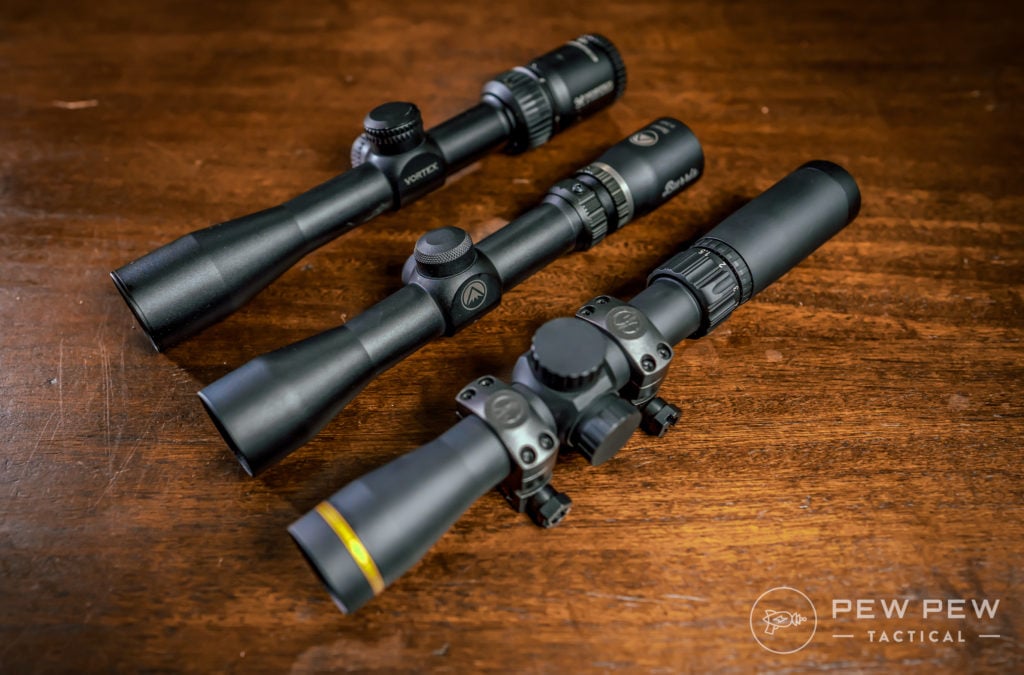
Triple Scout Scopes
Triple Scout Scopes

If you’ve seen these terms, you’ve likely also noticed considerable price differences, reticle differences, and beyond.

That may leave you wondering, what’s the big deal? Why such a difference?

Luckily, we know our optics around here.
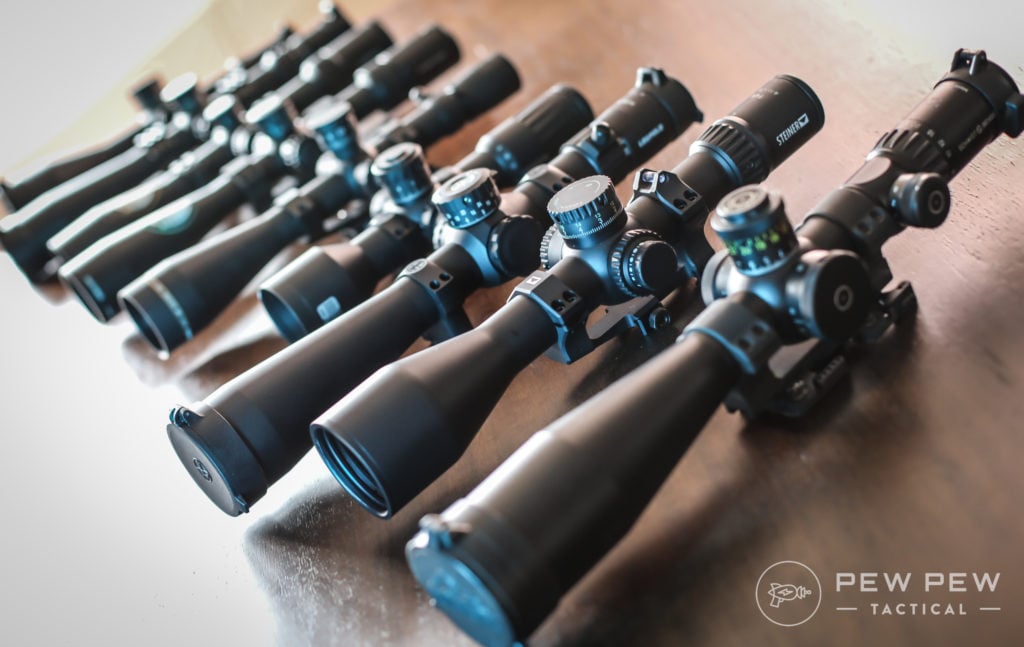
9 Tested Long Range Scopes
Oh yes…we love optics!

So, in this article, we’re taking on FFP versus SFP. We’ll lay out the definitions of these two, what they mean for the inside of your optic, and which might be the best option for your rifle.

When we’re through, you’ll confidently know the difference between FFP and SFP and which one deserves your hard-earned cash.

Let’s get to it!

Understanding Subtensions

Before we dive into the difference between FFP and SFP, we need to first talk about subtensions…because they’re important!

Have you ever looked inside your optic to see hash marks or circles?

Well, those are subtensions, and we use them for windage and ballistic drop of a projectile.
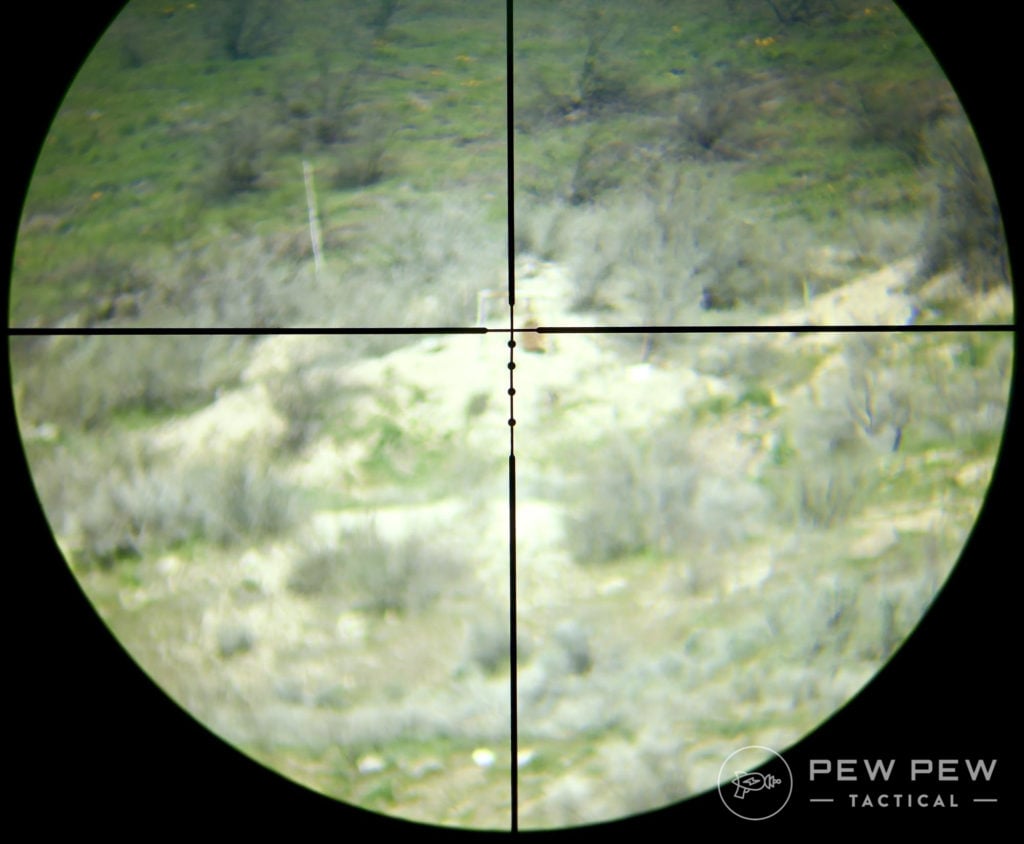
Mini-14 (9)
Those little circles are subtensions.

They allow you to use holdovers to estimate bullet drop and windage.

Those subtensions are a specific size, so shooters can account for windage and ballistic drop at various ranges.

With that out of the way, let’s dive into FFP and SFP…

FFP vs. SFP

Let’s clarify that we’re looking exclusively at variable-powered optics when talking about FFP and SFP.

First Focal Plane

FFP, or first focal plane, has grown in popularity though they are somewhat new.

First focal plane scopes house the reticle assembly near the front of the magnification erector assembly.
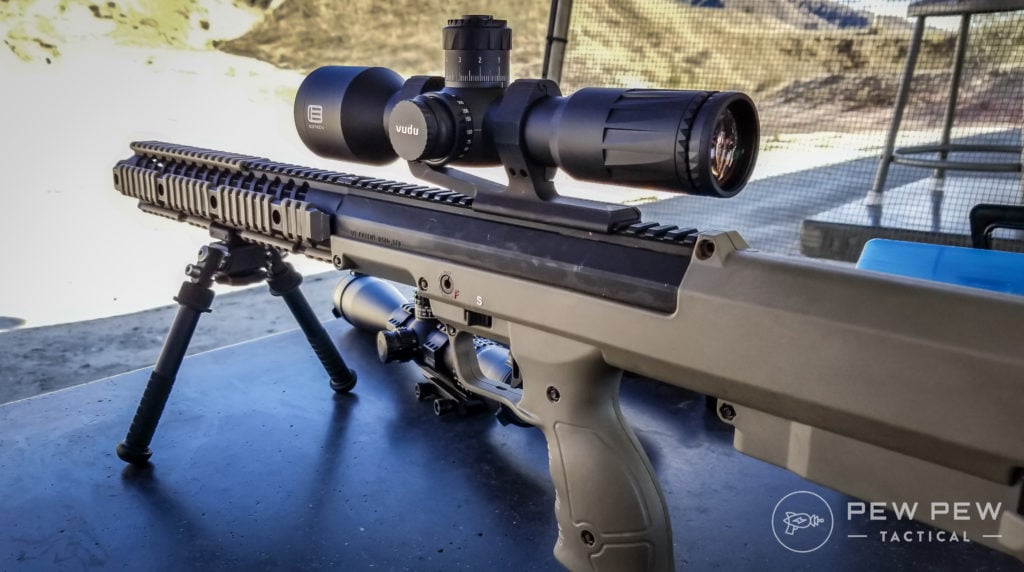
EOTech Vudu Mounted
EOTech Vudu, a FFP scope.

The erector assembly houses your magnification component, and the reticle sits in front of it.

You’ll likely see most high-end optics companies offering FFP optics.

With first focal plane optics, the reticle size changes as the magnification increases and decreases.
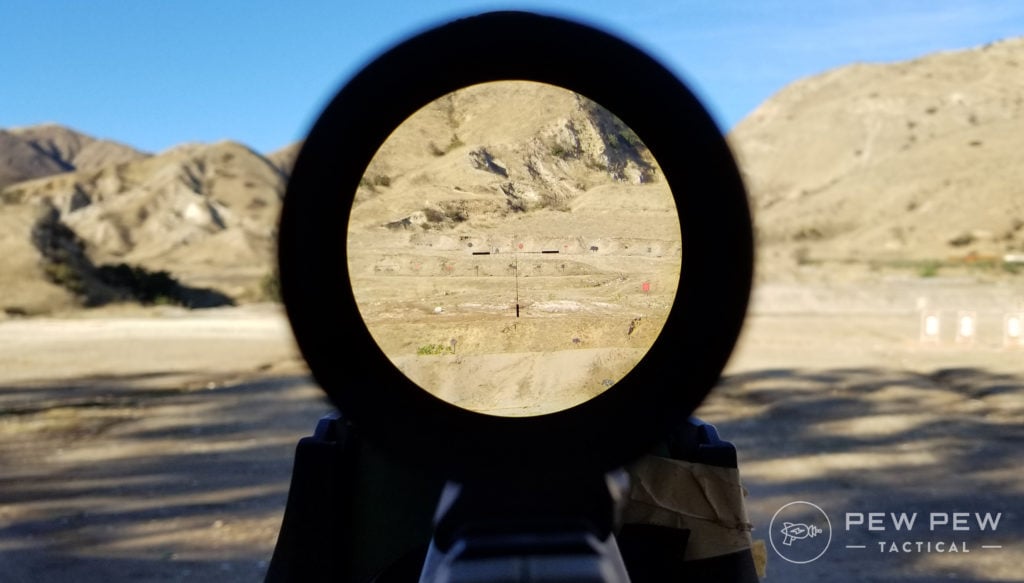
EOTech Vudu 5x
EOTech Vudu at 5x

FFP optics keep the measurements of the reticle accurate at any magnification range.
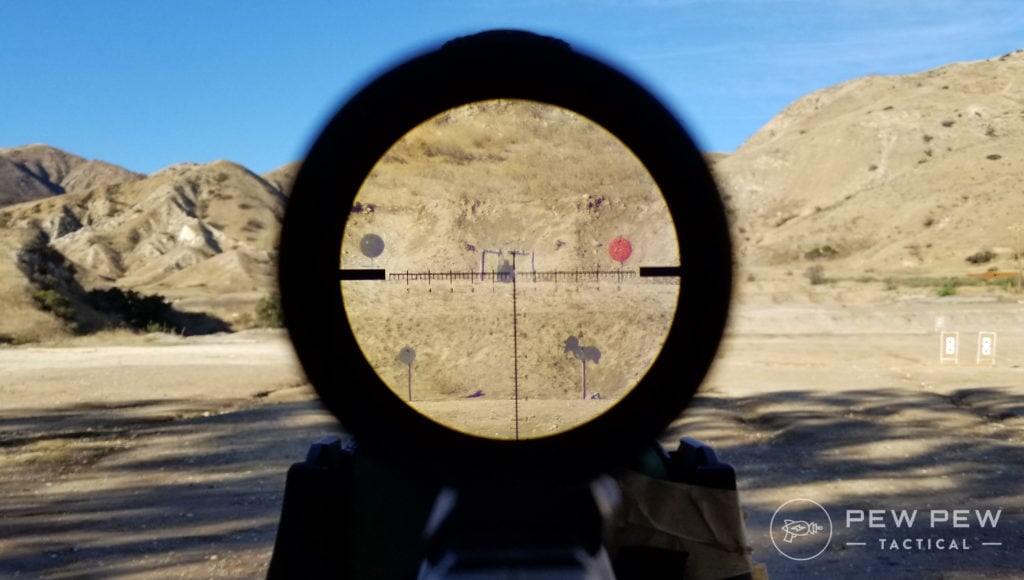
EOTech Vudu 25x
EOTech Vudu at 25x.

FFP’s use of reticle subtensions at every magnification setting is the FFP’s biggest advantage, my friends.

With high-powered optics, like 6-24X and beyond, this becomes extremely valuable.

Making on the fly windage and elevation calls is invaluable!
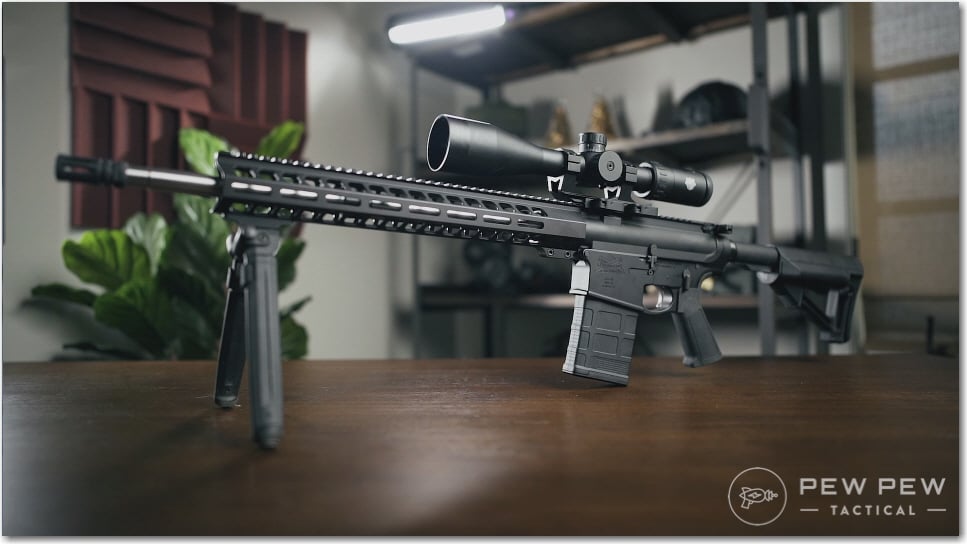
PSA AR-10 Gen 3 Handguard
PSA AR-10 with PSA 6-24x scope.

When it comes to reticles that use ballistic drop compensation, a first focal plane scope is a must-have.

This allows on-the-fly ballistic drop compensation without the worry or need for finding the right magnification setting.

Another big advantage is that at higher magnification levels, the subtensions are accurate and easy to see.

FFP scopes have some downsides, though.

Downside

At close range, the reticle can appear very small and hard to see. Combine that with low light issues, and the reticle can get awfully hard to see.

For lower-powered optics, the usefulness of an FFP reticle declines.

Second Focal Plane

SFP, or second focal plane, optics house the reticle behind the erector tube assembly.
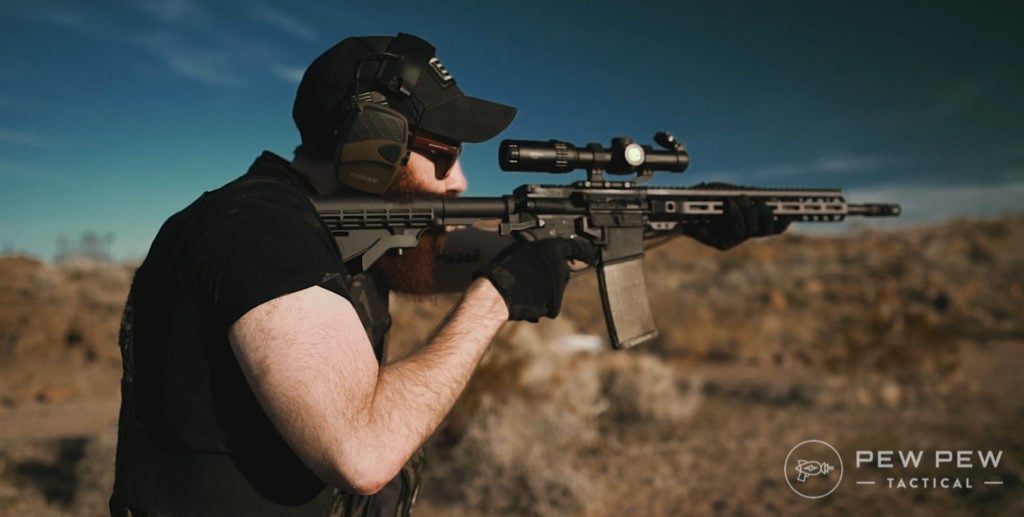
Shooting the Strike Eagle
Shooting with the Strike Eagle, a SFP scope.

SFP optics tend to feature affordable price tags while offering comparative specs in quality, magnification, durability, etc.

Something Of a Poor

With second focal plane optics, the reticle remains the same size throughout its magnification range.
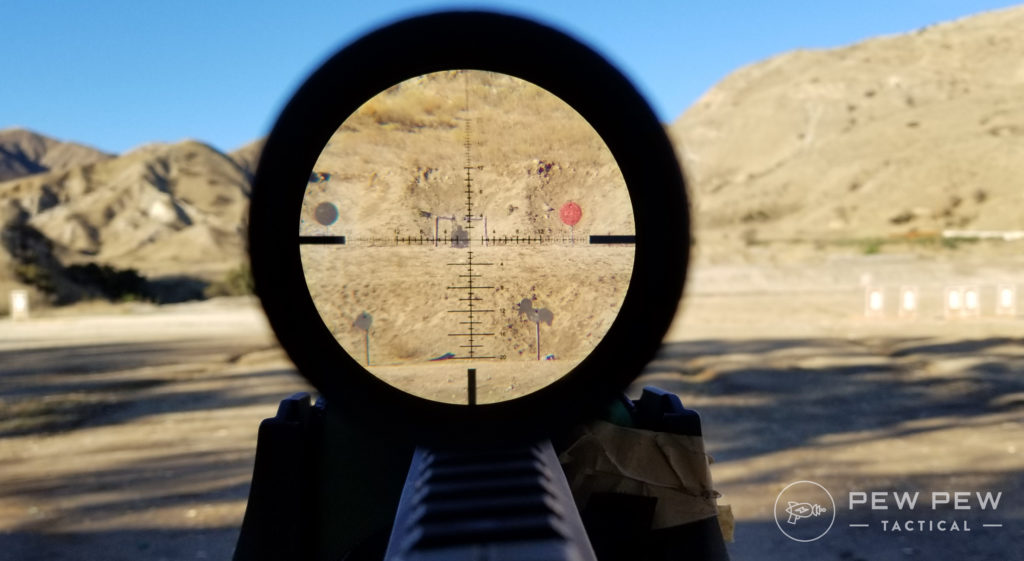
Strike Eagle 4x
Strike Eagle 4x

Consequently, the reticle’s various subtensions aren’t accurate through the range of magnification.
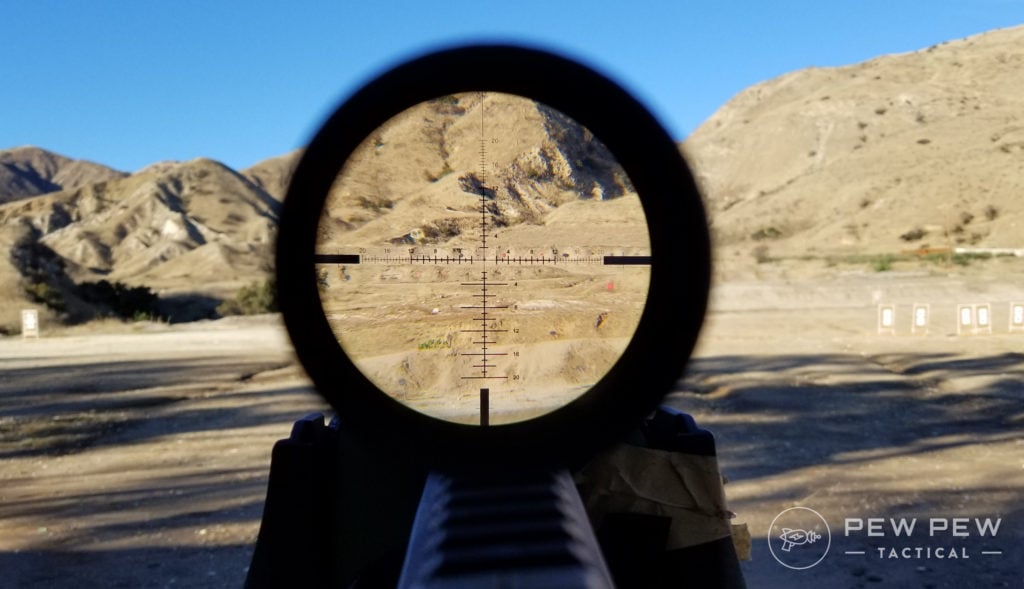
Strike Eagle 24x
Strike Eagle 24x

Often SFP scopes have a specific magnification in which these measurements are accurate.

That magnification range is often the highest setting but can vary between manufacturers. So, it’s wise to check the manual to be sure.

You can also do a little math with an SFP scope and various magnification ratings to come up with accurate measurements.

Hangover Math Gif
Me at the range calculating in my head…

These optics use highly visible reticles at every magnification setting. This makes the optic easier to use at lower powered settings.

With low powered optics, like 1-4X optics, an SFP reticle is easy to use for close-range shooting. It’s big, easy to see, and fast.
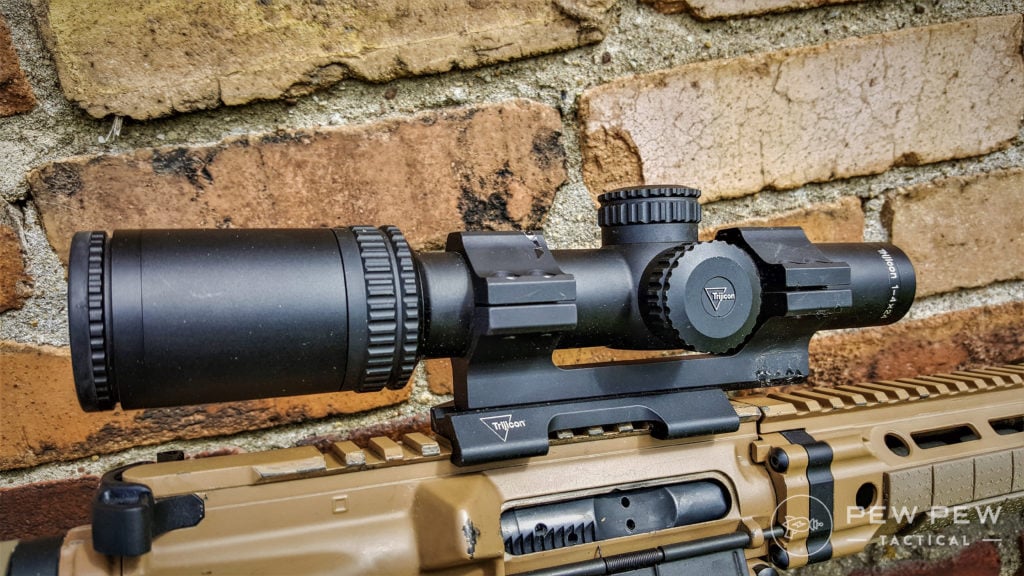
Trijicon Accupower 1-4x in a BOBRO QD mount.

The downsides are apparent.

SFP subtensions suffer at every magnification range but one. This makes higher-powered SFP optics nowhere near as fast or as useful for on-the-fly long-range shots.
Thumb on top of the grip, you don
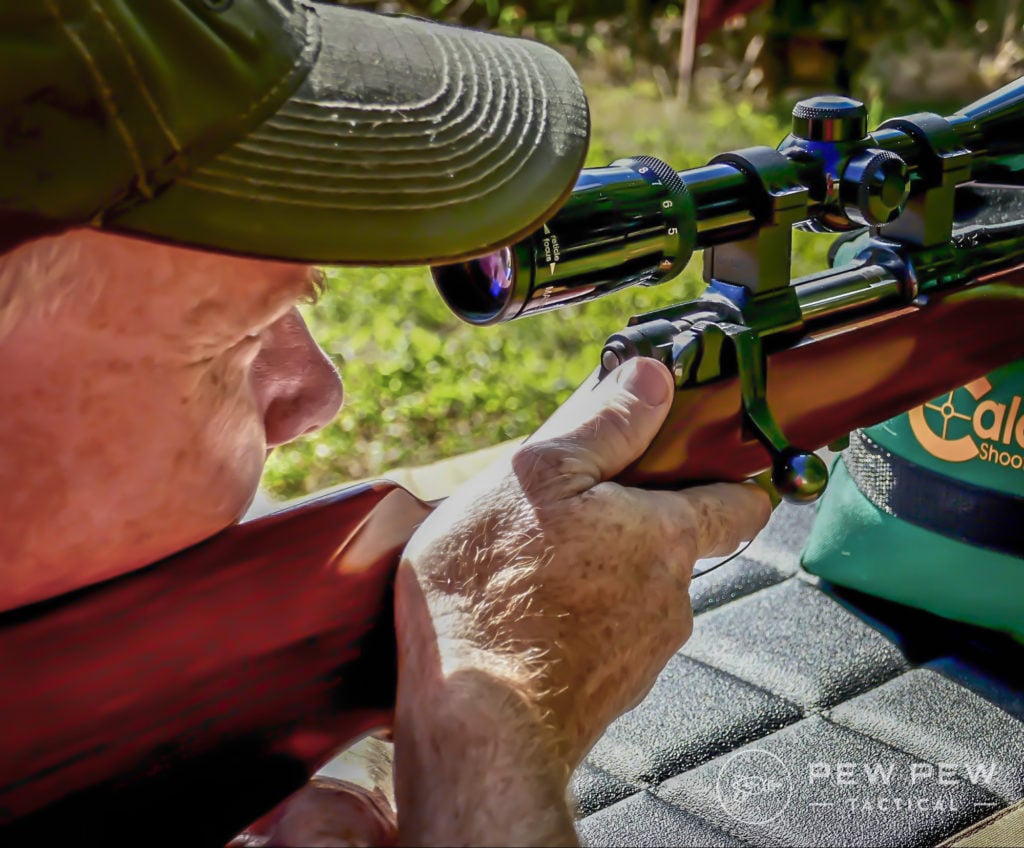
SFP optics…not so great for long range shooting.

You Should Definitely Buy…

FFP optics are surely the better choice, right?

Well, it’s never that simple, y’all.

Notebook Simple

FFP and SFP are important, sure, but they shouldn’t be the only factor to consider when shopping for scopes.

You also should look at overall scope quality — including clarity, durability, and reticle design.

On top of that, think about the optic’s purpose and at what ranges you’ll use it.

That will help guide your hand and selection between FFP and SFP.
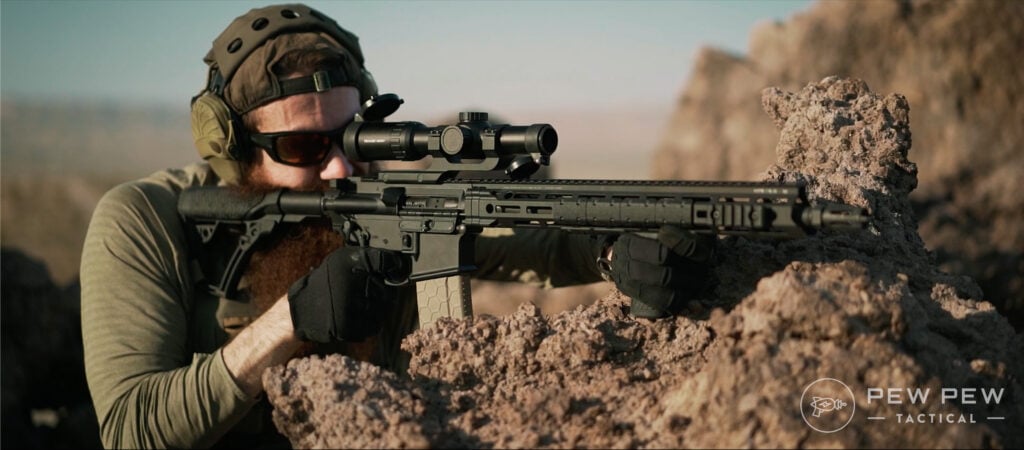
Daniel Defense DDM4V7 Desert Shooting
Runnin’ and gunnin’ in the desert will require a different scope than long distance shots from prone.

When to Buy an SFP

If you want a lower-powered LPVO, then SFP is the way to go.

The bigger reticle is faster for close-range shots, and long-range shots will max out the magnification, so the subtensions are accurate.

A 1-4 or 1.5-5 is perfect with an SFP reticle design.
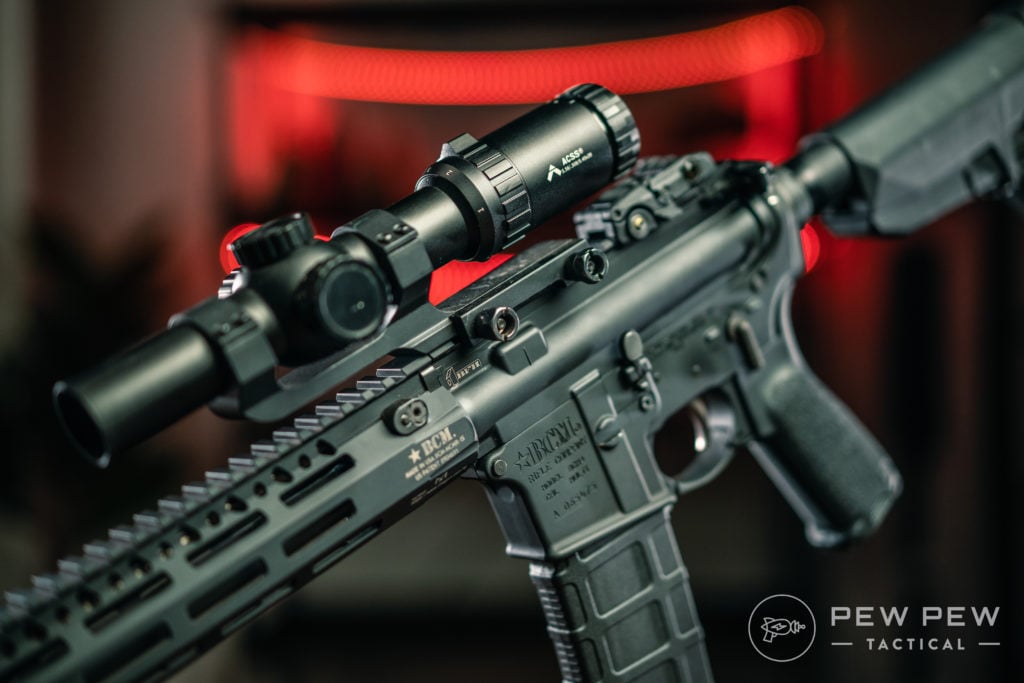
BCM with Primary Arms 1-6x ACSS
BCM with Primary Arms 1-6x ACSS SFP.

This is especially true when paired with a little carbine in a pistol caliber or something like a 10.5-inch barreled AR.

These are not long-range firearms by any means and work best in close quarters shooting where speed rules.

The bigger SFP reticles are fast at close range because they tend to be bigger than most.
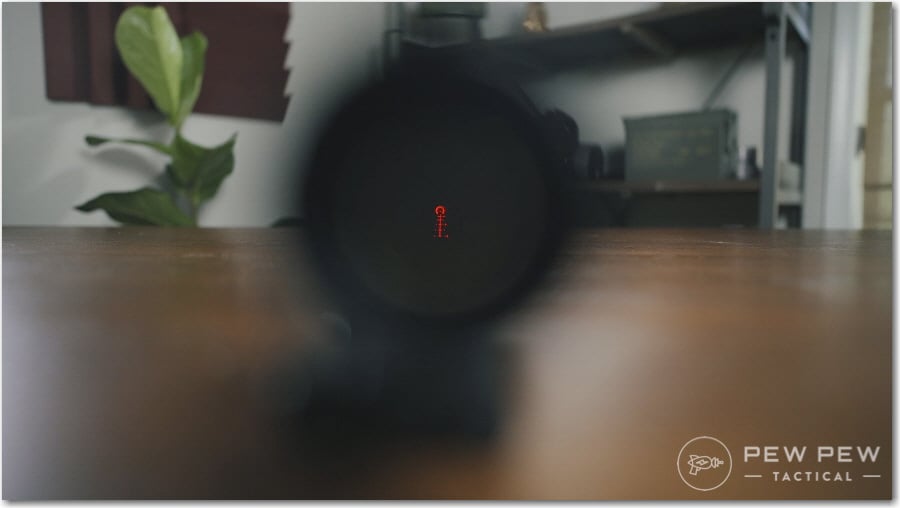
Illuminated Primary Arms 1-6x ACSS Reticle

Hunting is another realm where SFP is important.

Humane hunting ranges are not going to involve much bullet drop. Therefore, the accuracy of subtensions or even their presence is silly.

When a hunter chooses an optic, they need to consider not only their furthest shot but their closest shot.

Close shots often rely on speed, and big reticles are fast reticles.

There is a good argument for SFP optics for 3-Gun and USPSA PCC.

The ranges these competitors engage at are rarely long, and the need for ballistic drop estimation is often unnecessary.

Need some suggestions? Check out our roundup of the Best 1-6x Scopes & LPVO.

When to Buy an FFP Optic

First focal plane scopes are the optic of choice for snipers and designated marksmen. In those roles, precision is critical.
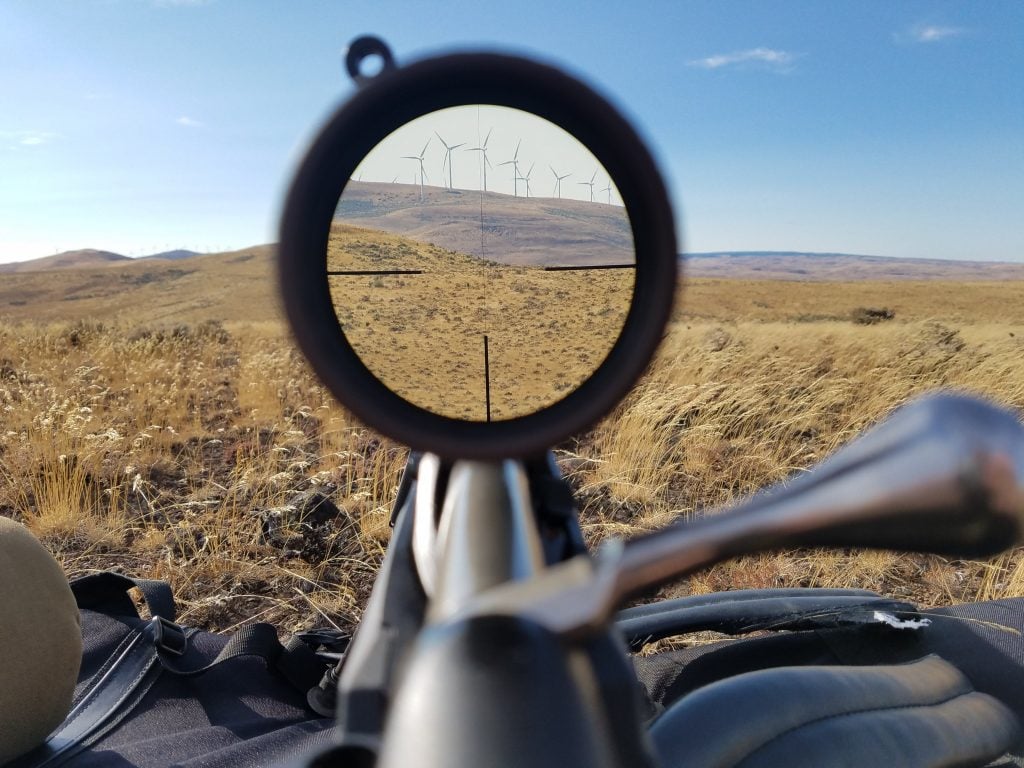
Vortex Razor Gen 3 1-10X down sight

The FFP optics are the best choice for duty grade use and when you need to reach out and touch a target with extreme accuracy.

FFP scopes also fit very well into Precision Rifle Series matches.
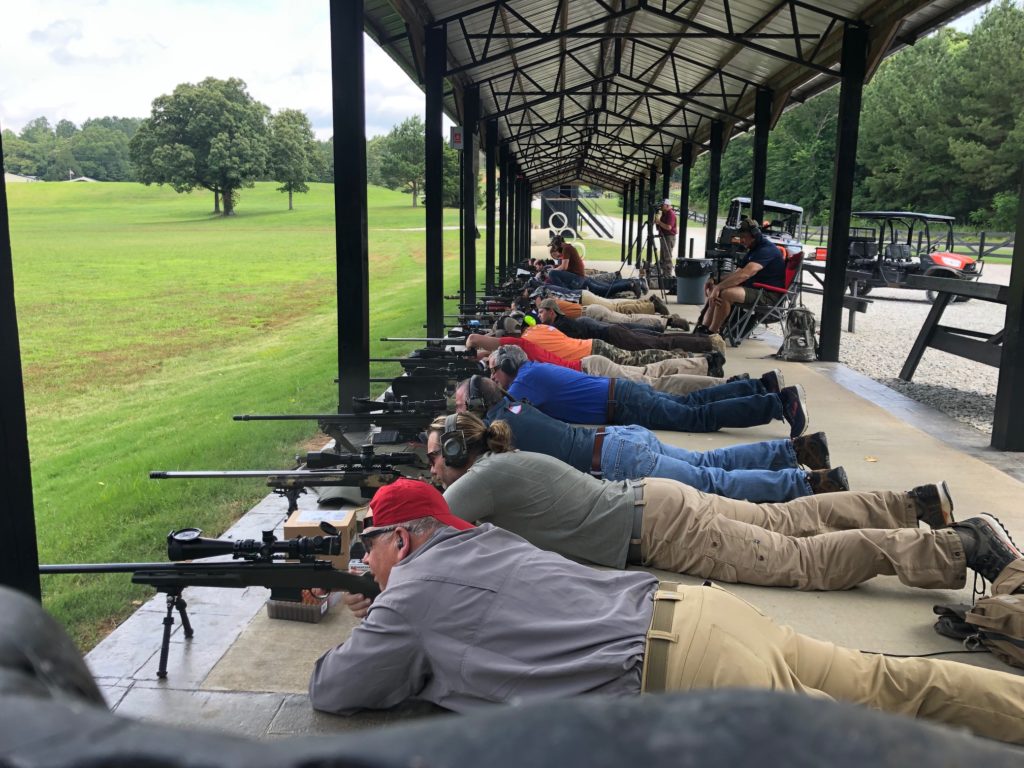
km precision rifle training 3
Precision rifle training.

These scopes dominate this field because the ranges are so varied. Competitors need to place accurate shots at different ranges while compensating for wind and drop.

If you want to shoot long range almost exclusively, then go for an FFP optic over an SFP.

If you need some suggestions, we have you covered. Check out our list of the Best Long Range Rifle Scopes.

Conclusion

Whether you want the close range SFP offers or want to reach out to further distances with FFP, knowing the difference between FFP and SFP optics will help you get the most out of your shooting experience.
More Scope Mounts
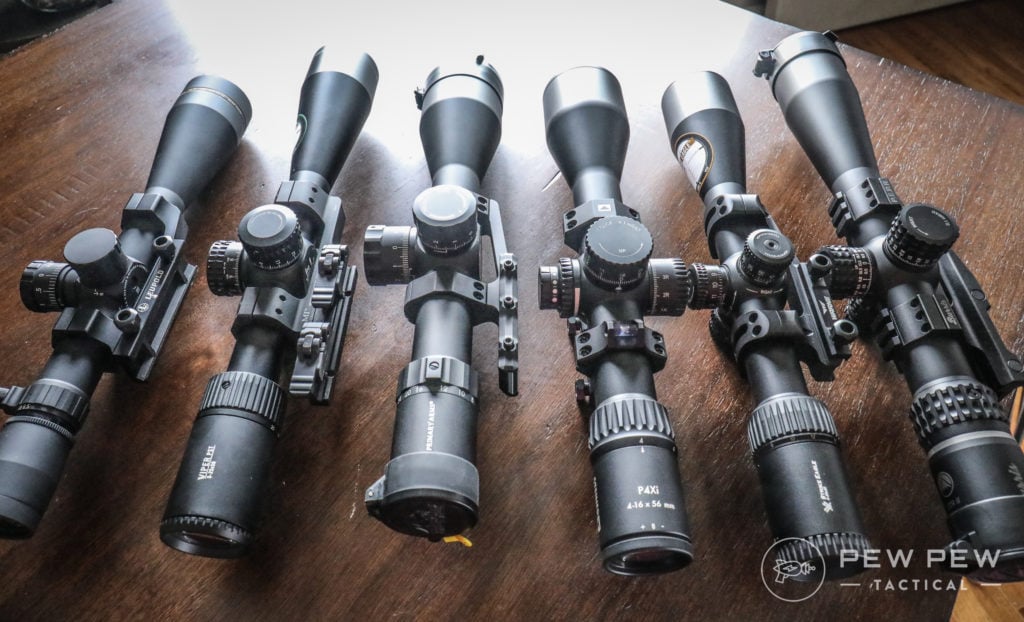
Scopes, scopes, and more scopes.

SFP or FFP, which do you prefer? Let us know in the comments below. Ready to start nailing down which optics to buy? Head over to our Gun Scopes & Optics page where you will find all the articles you need to choose your next optic.

Holosun 507k Vs EPS Carry

0

Optics are a critical part of using any firearm. This tool impacts the way you see and will change how you fire. Two popular optics include the Holosun 507k and the EPS Carry. In this article, we’ll discuss each product to determine which is right for you.

Specifications

To determine which optic is the best choice, we will need to examine the specifications of each optic. Many details go into each product, from the reticle to the dimension of each product. Everything matters when considering the best choice.

We will go over the following:

  • Footprints
  • Reticle
  • Battery
  • Shake Awake Technology
  • Housing
  • Brightness Level
  • Dimensions
  • Pricing

Each makes a difference when comparing two optics.

Let’s dive deeper into each of the specifications. The more you know about the products, the easier it will be to choose the right one for your needs. First, we’ll talk about the footprints of each.

Footprints

The Holosun 507K and the EPS have the same footprint. The EPS has the same footprint as every optics device in the K series.

Thanks to this similarity, there is no difference between the mounting standard and the bottom surface of the red dot sight on either product.

Next, let’s talk about the reticle.

Reticle

Each product has options for multiple reticle systems. You can go with a 2 MOA dot or a 6 MOA option.

With the multi-reticle system, there is a standard 2 MOA dot and a 32 MOA ring, 2 MOA dot only, and 32 MOA ring in that order. If you pick the MRS selection, you also get Solar FailSafe. This addition allows constant charging with a quality solar-powered system.

Again, there is no winner in this category. Both products have multiple options to serve you well on the move. You may pick the reticle system that best suits your needs.

The battery is where the first differences emerge. Let’s discuss this source of power next.

Battery

The EPS Carry comes with a CR1620 battery. This device has 12,000 hours of life on circle plus dot, or 50,000 hours if you use the dot-only on setting 6. It will last even longer with a solar charging ability.

On the other hand, the Holosun 507K runs on a CR1632 battery. This option allows up to 50,000 hours of battery life on setting 6.

The CR1632 will last longer and provide more use than a CR1620 battery. The Holosun 507K is the winner in this category.

All Holosun devices come equipped with shake awake technology. Let’s talk about what this addition is next.

Shake Awake Technology

Shake Awake technology is an addition to Holosun’s optics that turns off the LED in the system when there is no motion detected. It’s designed to save energy and help the optic last for as long as possible.

Users may customize the amount of time it takes for the LED system to turn off in their settings. It’s also possible to turn off Shake Awake entirely, keeping all control to yourself.

The 507K and EPS Carry tie in this category. They both have the quality Shake Awake system.

Every optic comes in a shell to keep it safe. Let’s examine the housing for each product next.

Housing

The EPS Carry has a housing made of aircraft grade 7075 T6 aluminum. This product is one of the highest-strength aluminum alloys on the market, composed of zinc and copper as alloying ingredients. The housing is durable and meant to withstand significant damage.

The Holosun 507K has the same material protecting it from the outside world. You will receive the same benefits from this housing as you will with the other. However, it isn’t aircraft grade so it might not be as strong as the EPS Carry.

The winner in this category is the EPS Carry. Its aircraft-grade housing will help it last longer than the competing Holosun 507K.

Next, let’s consider the brightness level of the product. The better the illumination in a system, the easier it will be to see what you are aiming at in the dark and light.

Brightness Level

Both products have excellent brightness level features. Both choices have 12 levels of brightness options, eight for the daytime and four that are night vision compatible. They offer extensive visibility during every light shift while you are out.

There is no winner in this category, as both products have the same brightness level offerings. You’ll have plenty of visibility no matter which of the two you select.

We have two more categories to cover before landing on a winner. Next, let’s talk about the dimensions of each product.

Dimensions

The EPS Carry measures 1.62 x 1.19 x 0.95 inches. It weighs one ounce, and the window size measures .58 x .77 inches.

The Holosun 507K measures 1.6 x .98 x .95 inches. It weighs one ounce and has a window size of .58 x .77 inches.

These products are very similar in their dimensions, off by a fraction of an inch in the cases where there is a difference. We would say the EPS Carry is the winner, as it offers a slightly larger viewing window and device for the user.

Next, let’s talk about perhaps the most vital component – price.

Pricing

The Holosun 507K costs $320, while the EPS Carry costs $400. If you want a lower-priced EPS, nix the Carry for the EPS at $330.

When considering money, the Holosun 507K is the more economical option. It costs $80 less than the competing EPS Carry.

We’ve gone over the details of the Holosun 507K and the EPS Carry. Which one emerges as the best optics option for your firearm needs?

Conclusion

Although there are many similarities between these products, the winner is the Holosun 507K. It has a better battery life and doesn’t cost as much as the competing EPS Carry.

No matter which Holosun product you use, you are sure to have a quality experience. Each product comes equipped with items like the Shake Awake features and excellent optics, allowing for the best possible experience every time.

Top 5 Dream Hunts

0

We asked our hunters what their Top Five Dream Hunts would be. Some of their answers were… well, no brainers to be honest, but a few of them took us by surprise. If you would like to have us help you make one of your dream hunts a reality, one of our hunting consultants would love to help you out.

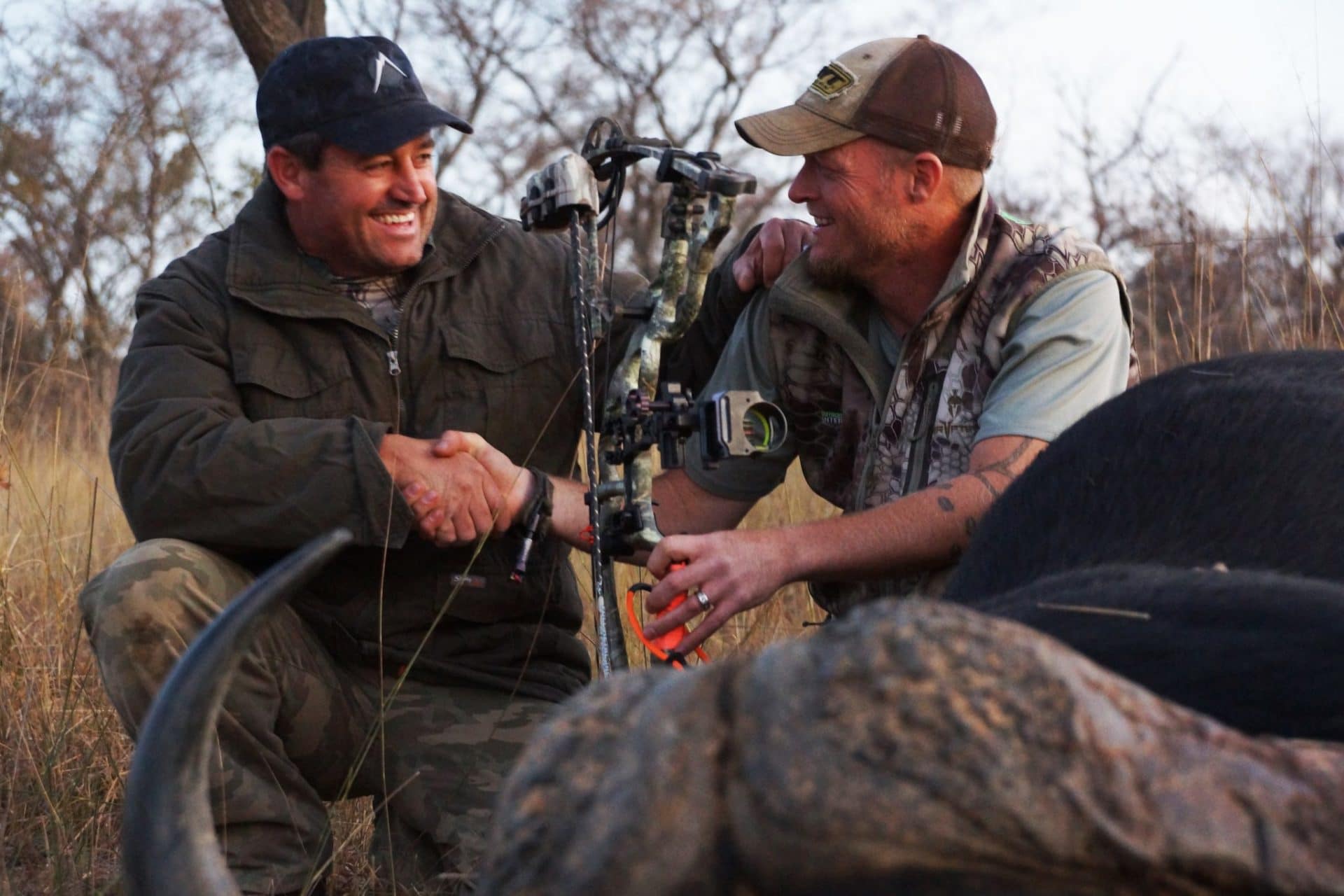
Botes and Shad with a giant buffalo

Cape Buffalo Hunting Safari

#1 in our Top 5 Dream Hunts survey, Cape buffalo hunting has drawn more people to go hunting in Africa than all the other Big Five combined.

Regarded as one of the most ill-tempered animals on the face of the earth, Cape buffalo hunts in Africa are extremely popular. We offer cape buffalo hunts in Botswana, Mozambique, South Africa, Tanzania, and Zimbabwe. What is great about an African Safari is the amazing amount of plains game species available to hunt in addition to dangerous game. If you want to hunt “Black Death,” be sure to have the right gear, research the best calibers. If you’re a bowhunter, take your archery gear very seriously. These animals are no joke!

Ask For Pricing or More Information

Located in the heart of Argentina, also known as the dove hunting capital of the world, our hunting lodge offers a more than beautiful location, unlimited, high volume dove shooting year round combined with superb hospitality and affordable dove hunting prices

Shooting Doves in Argentina

Dream Hunt #2 kind of surprised us.

We thought that Argentina dove shooting would probably be in the top 10, but scoring #2 on our dream hunts survey?… didn’t expect that. That being said, dove hunting in Argentina is AMAZING! You can very easily shoot between 1,000 and 3,000 rounds per day!

If you’ve been thinking about doing an Argentina dove hunt, we have some great wingshooting for you. From the moment they pick you up at the airport, they do their best to make your trip to Argentina a safe, incredible and unforgettable experience. If you’d like to stay a little closer to home, we have some spectacular dove shooting in Mexico as well.

*While you’re in Argentina, you should check out the Golden Dorado River Cruiser. Just trust us on this one.

Ask For Pricing or More Information

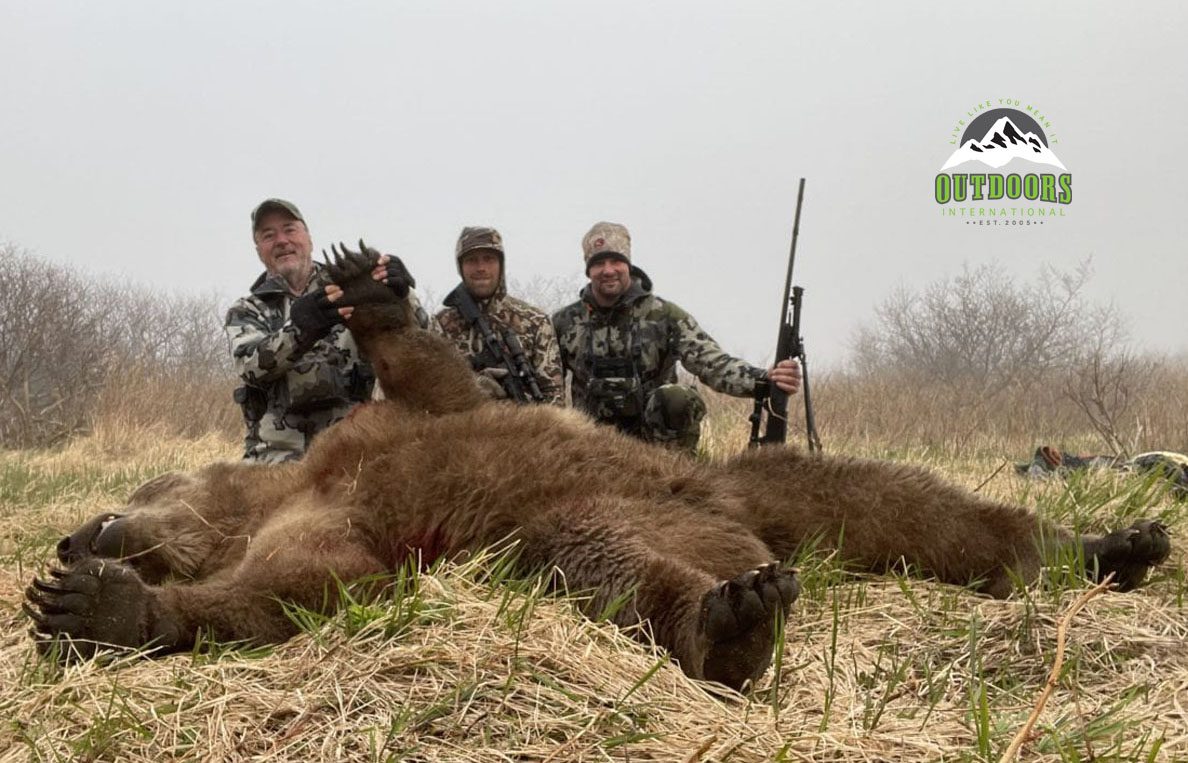
Brown Bear Hunt in Alaska

Brown Bear Hunt

Brown bear hunting was #3 in our Top 5 Dream Hunts survey and they are available in Alaska, Kamchatka, and there are even Eurasian brown bear hunts.

Alaska brown bear hunting is at the top of most hunters’ lists, for good reason. Two of our favorites are an Alaska coastal brown bear hunt out of a luxury yacht, and the fall bear hunts (odd years) on the Alaska Peninsula.

Ask For Pricing or More Information

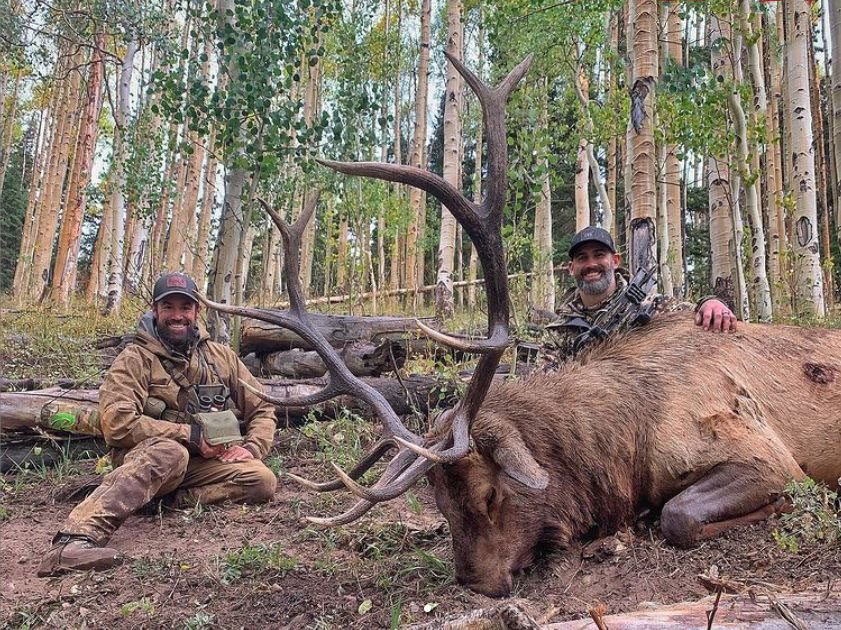
AJ with a spectacular Utah archery elk.

Trophy Elk Hunt

Elk hunting being dream hunt #4 on our dream hunts survey really didn’t surprise us.

Elk hunting is awesome, and if you haven’t experienced it, you should. We offer many different types of elk hunts including land owner tags, bow hunts, trophy hunts, hunting leases, private ranches, corporate hunts with large groups, and drop camps. There are so many cool options with elk hunting, it’s hard to choose a favorite hunt. If you would like to experience elk hunting for yourself, be sure to talk to one of our consultants.

Ask For Pricing or More Information

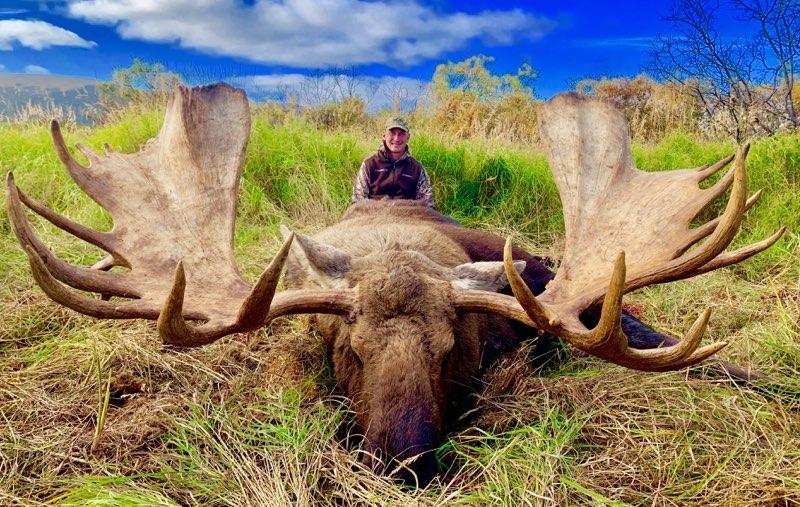
Incredible Alaskan Moose

Moose

It was no surprise that moose made our top five dream hunts.

Moose hunting can be incredibly fun, and are one of the most sought after big game animals in the world. For beginning moose hunters, the most important thing to keep in mind is that moose are huge and can be VERY difficult to pack out of the field. Finding the right moose hunting outfitters is critical, both for your success and for the enjoyment of your hunt. We have LOTS of good moose hunts to choose from and you should talk to a consultant to see which one fits your needs best.

Ask For Pricing or More Information

What are your Top 5 Dream Hunts?

Ask Us About a Hunt Request pricing and availability

Where to shoot a squirrel with an air rifle?

0

“Optimal Target Placement: Mastering Squirrel Hunting with an Air Rifle. Discover the exact spot to aim, enhancing your accuracy and ensuring humane squirrel control. Uncover effective techniques for responsible hunting, enabling efficient pest management without compromising safety or ethics.”

where to shoot a squirrel with an air rifle

where to shoot a squirrel with an air rifle

When it comes to hunting squirrels with an air rifle, accurate shot placement is crucial for ethical and humane kills. The ideal target area to shoot a squirrel with an air rifle is the head or chest region. Aim for the head if you are confident in your shooting skills, as a well-placed shot will result in instant death. However, this can be a challenging task due to the small size and quick movements of squirrels. Therefore, many hunters opt for chest shots as they offer a larger target area and have a higher chance of hitting vital organs.

For a chest shot on a squirrel, aim at the center of its body just behind the front legs. This area contains vital organs such as the heart and lungs. It is important to choose an air rifle with sufficient power and accuracy to ensure a clean kill. A.177 or.22 caliber air rifle with adequate velocity is recommended for hunting squirrels effectively. Additionally, always take into consideration your surroundings and make sure you have a safe backstop before taking any shot.

In conclusion, it is crucial to prioritize safety and ethical considerations when deciding where to shoot a squirrel with an air rifle. Aim for a precise headshot, ensuring a quick and humane kill. Always be aware of your surroundings and follow local laws and regulations regarding hunting or pest control.

Working with Basswood Fiber: From the Tree to the Basket

0

I’m sitting in the low water of the Rondout Creek next to my house, with the water flowing past slowly. The sun glints off the water and dances in the most complex and beautiful way. Trees are swaying and cedar waxwings are darting in the blue sky above. In my hands and all around me, floating in the slow moving water are lengths of basswood fiber. Fiber from the bark of a tree I had carefully chosen earlier in the season from the adjacent bank to harvest and process into fiber to be used in making baskets. In this moment I feel completely serene and smile, letting the beauty of this perfect summer day fill me.

This memory of being in the river and rinsing basswood inner bark fiber represents why I do what I do in the deepest way. It was a glimpse of what it feels like to really be a human being on this earth; working with the plants and being in touch with the landscape. The entire process of working with basswood, from choosing a tree to using the fiber in baskets is very dear to me and I want to share that experience with you in this post. As you read below please remember that the plants are our greatest teachers. Just when I think I know something about basswood I get shown a new way by the plant itself! I encourage you to try the process yourself and build your own personal knowledge of working with this wonderful tree. At my 2017 Wild Basketry program I loved seeing participants getting to know the tree throughout the entire season from harvest to completing twined bags at the end of the 8 months we spent together.

Basswood, American Linden, Tilia Americana,

Basswood is the common name of one of our most beautiful native trees in North America, specifically in the region of central New York state where I live. Tilia Americana is the common name, but it is also often called by the name Linden. Besides being a wonderful shade tree the leaves are incredibly rich nutrients and serve to nourish the forest floor each year. And of course its name hints at one of its most valuable purposes: basswood = bast = fiber. The inner bark of the wonderful tree can be removed from the trunk, retted, and made into fiber for a variety of projects. It was valued by many native peoples from the east coast to the Great Lakes region. I wonder… did someone sit in the very river I harvest my basswood from and do the same process three hundred years ago? Tilia as a genus was not only important to North America. A quick glance at wikipedia tells us that there are around 30 species of Tilia throughout the northern hemisphere. In Europe it is commonly known as Linden, or Lime tree. Traditionally it was used to make cordage and other fiber products all across its range. What a truly wonderful tree.

What is Basswood Used For?

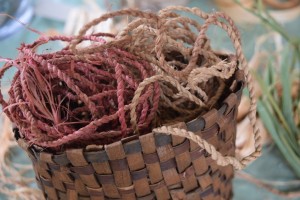
Basswood fiber makes for excellent cordage. The long lengths you can obtain are its main advantage. It may not be as strong as dogbane or as soft as milkweed, but I love the color it’s flexibility. It also takes dye really well.

It is also great for using in twined projects, using as a sewing strand, wrapping, and basically any thing else you can dream of! Recently I’ve also been using the inner bark before it is retted as long flexible stakes for weaving pack baskets. I hope that in a year I can update this post with even more used for this great material! If you are fortunate enough to be surrounded by basswood tree you are indeed lucky and blessed.

How to Harvest and Process Basswood

When to Harvest

I have found that the best season for me to harvest and peel the bark from basswood in my part of the world, which is the Hudson Valley, in New York State, is in June. I have peeled logs as early as May and as late as October and it still works, but is more difficult to separate the inner bark from the wood log.

How to Choose a Tree

The perfect tree is the one that says yes when you ask if it is open to becoming something new. There are many ways to ask a tree if it is ready, but I’ll share my process. First I close my eyes, touch the tree and just ask, either out loud or in thought. Then I step back and really look at the tree and it’s surroundings. Is it part of a cluster of many trees where removing it won’t damage the ecosystem or is it the only basswood in the forest? Is it easy to get to or far out of reach? Will cutting it down damage other trees? Is the tree healthy or struggling to survive? Is there a bird’s nest and its branches? Does it just feel right or wrong? Does it for fulfill the general requirements for a good basket tree listed below? Pay attention to the signs and trust your instincts. Don’t be afraid to hear no and continue looking.

The Specifics of Good Basket Tree

Besides the tree’s readiness to be cut down, you are also looking for physical characteristics which make a tree better for getting long, straight, easy to use fiber. A long, straight trunk with very few branches is ideal. I usually harvest trees between 5 and 10 inches in diameter which are growing tightly in clusters with more basswoods. This being said you can also remove the bark from fallen branches, crooked trees, and other less ideal trees. I recently removed the bark from a large 16″ diameter tree. It was backbreaking work, but so far the bark seems like it’ll be great. Some I used as thicker stakes and some I put in a bin to ret.

Removing the Outer Bark

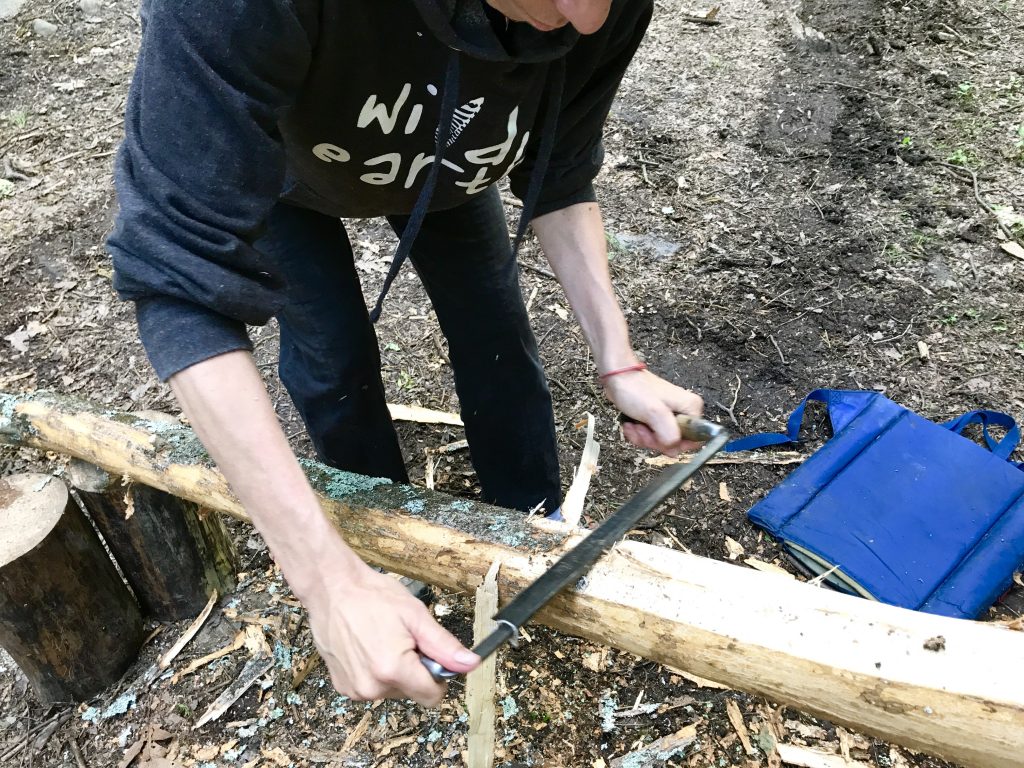
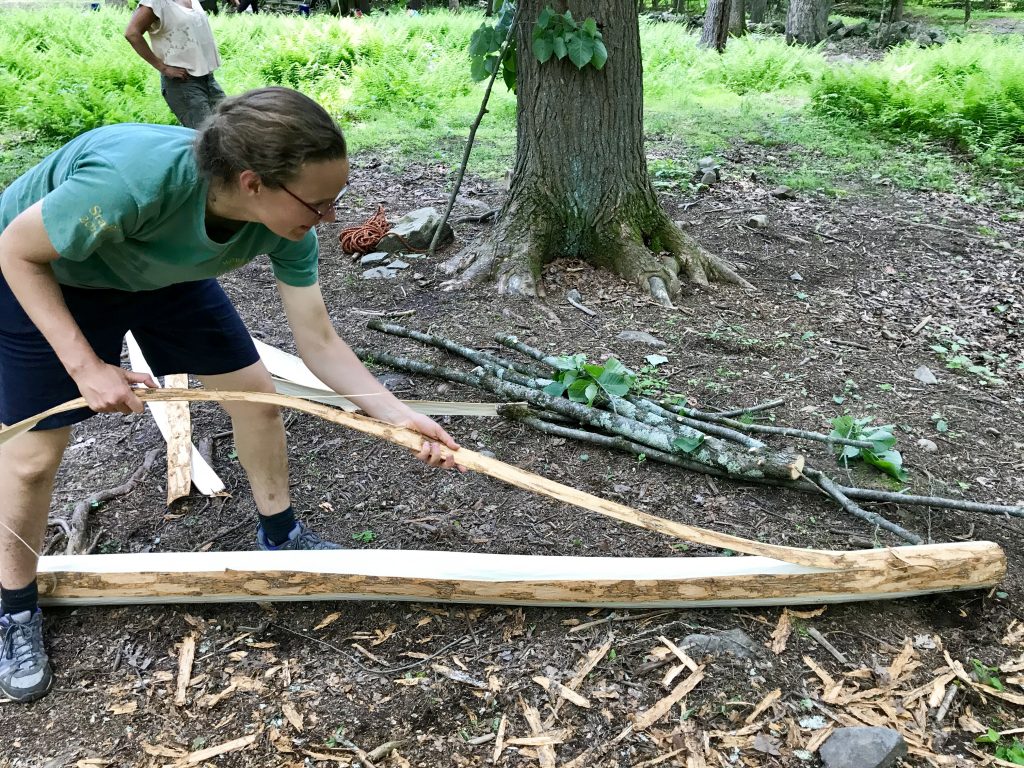
After you have safely cut down the tree, you can remove any unnecessary branches and either prepare to remove the bark in the field, or move the trunk to your working area. If I have a very long trunk I’ll usually cut it into sections about 10 feet long to carry out. In my process I use a draw knife to first remove the rough great outer bark from the log. You want to get all the scaly gray bark off without cutting too deeply into be inner bark. It’s a fine line and only practice will help you get over the learning curve of this process.Harvesting basswood barkRemoving the bark for me basswood tree with a drawknife

Peeling the Inner Bark Off the Log

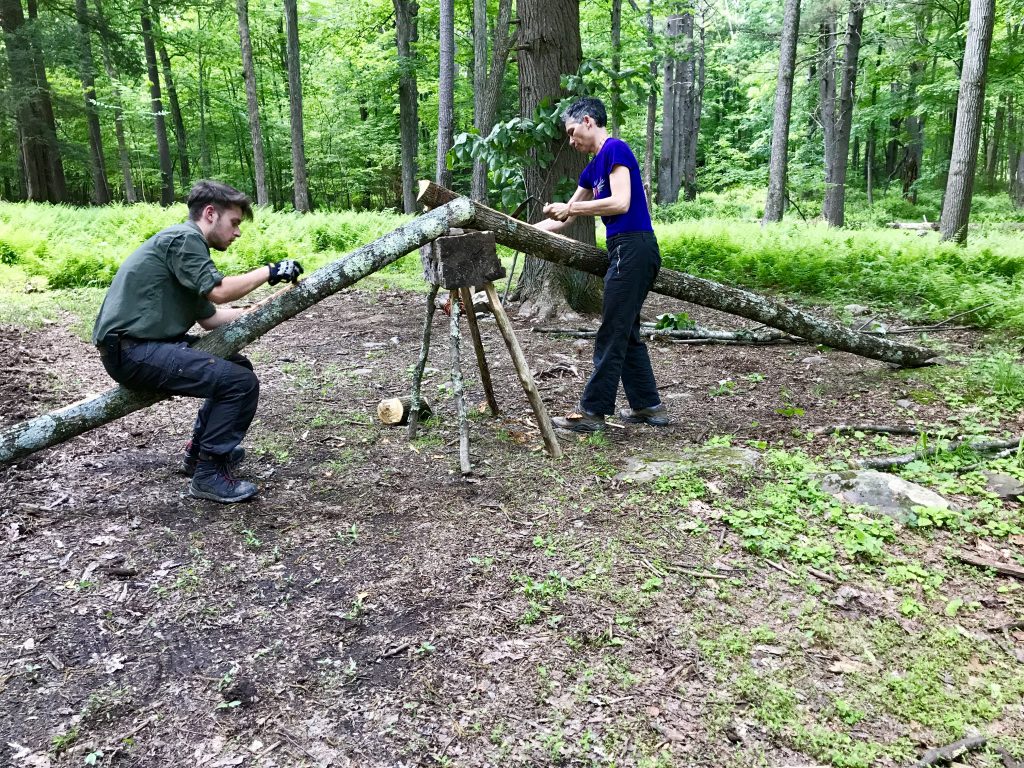
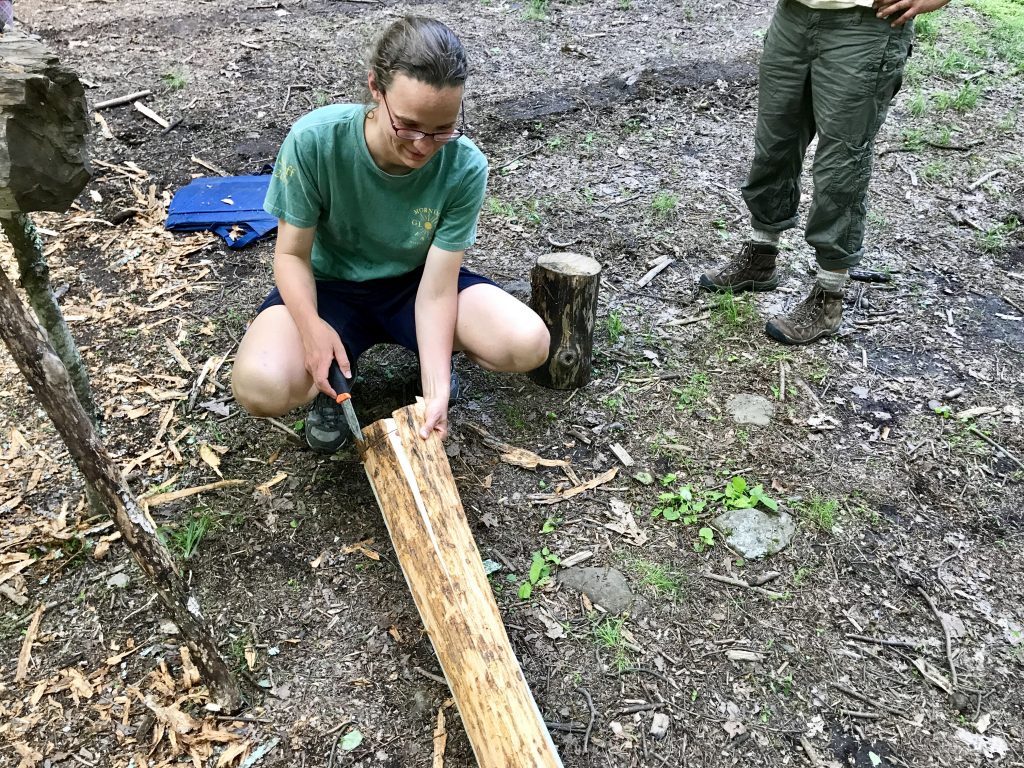
Once the log is completely smooth I will cut lines about 4 inches apart down the entire log through the inner bark layer all the way into the wood. Then peel each section up from the log. This is the material that will become cordage after it is retted. The wood you are left with is excellent for carving; soft and easy to work with. Save it or give it to a friend who will make good use of it.

Peeling a basswood log

Peeling bark from a basswood log

Retting Basswood Fiber

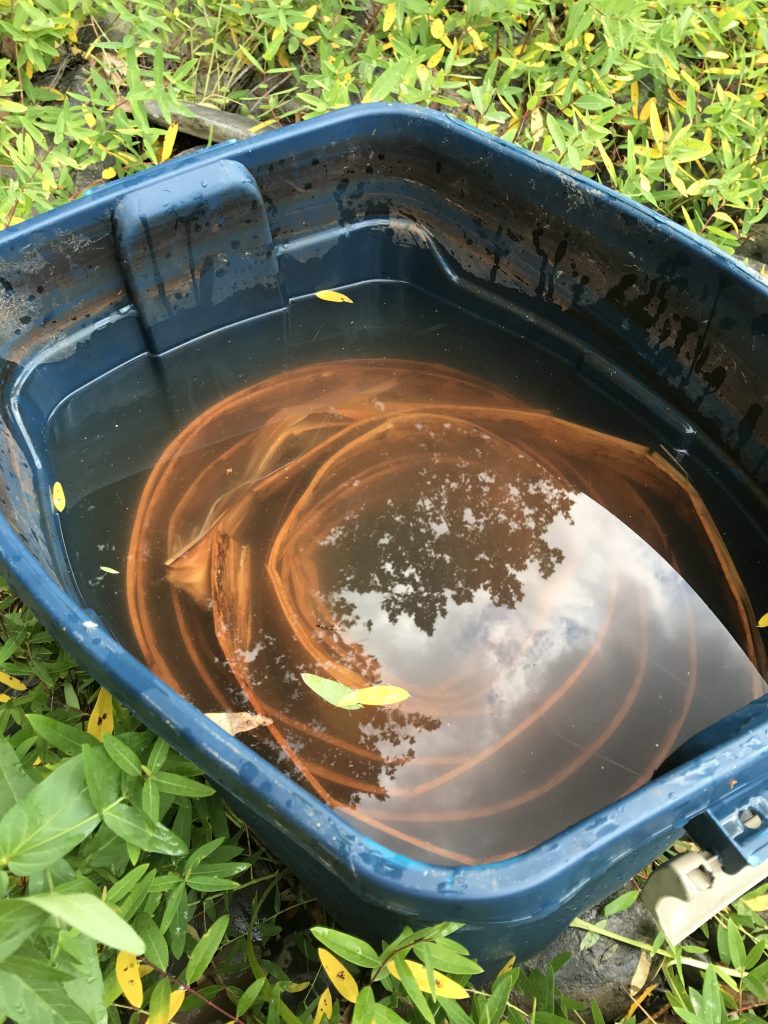
As soon as you have peeled the sections of basswood inner bark from the trunk it is time to put them through a process called retting. Retting sounds alot like ‘rotting’ and in a way that is what is happening. In water retting you submerge the lengths of basswood inner bark in water for a period of 6-8 weeks. During this time microorganisms in the water rot away the cellular tissue and pectins leaving only the long gorgeous strands of bast fiber. It’s a stinky, fun process that is a good way to scare your neighbors away as buckets of rotting bark sit out all summer next to your house! It may end up taking longer than 8 weeks. Just test it and put it back if it’s not done. Sometimes I’ll even peel half of the layers off and then put it back to get the rest of it retted enough to use.

It is best in my opinion to ret your basswood fibers in water that is full of life. River or pond water is great, but if you must use water from the hose the process will still work, but it seems to take longer. I usually take a large tote bin down to the river. First I put the basswood lengths in the tote using the space in the most economical way, by putting coils inside coils until the whole bin is full.

Basswood bark soaking in a bin

Be gentle when coiling your basswood. If you bend it too sharply it will crack and those cracks will come back to haunt you later when you find your fibers are broken into two foot sections along the length of your beautiful 8 foot piece of bark. Learn from my mistakes and be patient and gentle! Then I use a bucket to fill the bin to the top, making sure it is far enough from the bank that rising water won’t wash it away.

Make sure every single inch is completely submerged with a couple inches of water on top. Do not skimp on this! Even a tiny piece exposed can be a real pain later. Don’t be lazy, and take your time weighing down the pieces with rocks. I was wisely told once that impatience is wanting something for nothing. If it doesn’t all fit then get another bin or bucket. Again I have taken shortcuts and ended up with dry spots in the middle of otherwise perfectly good lengths.

Let the bin of basswood fiber sit for 6-8 weeks, or longer. Check on it to make sure water levels are good. Sometimes if the water gets too nasty I’ll pour it out and refill it. I’m not sure if leaving the same nasty water or changing it periodically is better for the basswood.

When is it ready? You can tell it’s ready when the bark is very flexible when you squeeze it. Give it a test once in awhile and usually after 6-8 weeks it is ready. You can always take one piece out and try rinsing it and if it doesn’t come apart then put it back in for longer.

Rinsing the Basswood Fiber

My favorite way of rinsing basswood fiber is to take the lengths of bark into the river itself. There, rub the bark and bend it and if it is ready soon you will see layers of the bark start to separate. Continue to work it, peeling and rubbing and squeezing it until beautiful, translucent layers of fiber separate along the whole length of the bark. They may feel slimy. Just continue to rinse them until they feel clean and then take each piece or group of pieces and let them dry in the sun. Either before or after they dry I like to bundle each group of pieces neatly so they don’t get tangled in storage. Make sure they are completely dry before storing them. You put so much work into processing and harvesting, not to mention all the work the tree did growing. Don’t let it go to waste and be grateful for every inch of beautiful fiber that you iwll soon be making into beautiful products.

Making bags, cordage, and more

Guide to Magnet Fishing in Texas: Where to Go and Is it Legal?

0

When magnet fishing in Texas, you can find more than the occasional gun or knife. The state of Texas has over 7364 square miles of water area making. Needless to say, there are many different places where you can go magnet fishing. However, some spots are better than others, depending on your interests.

Is magnet fishing legal in Texas?

Yes, magnet fishing is legal in the state of Texas. There are no specific laws or regulations in place regarding the activity. However, as with any outdoor activity, there are some general rules that apply. For example, it is illegal to magnet fish on private property without the owner’s permission.

Of course, what is legal isn’t always ethical. It would not be the first time repeated, reckless or inconsiderate behavior resulted in federal regulation. Please have a look at our magnet fishing etiquette!

‍What are the best places to magnet fish in Texas?

There are many great locations for magnet fishing in Texas. Some of the best spots include lakes, rivers, and streams. In particular, areas with slow-moving water tend to be ideal, as objects are more likely to become caught on something underwater. Here are some of the most popular locations for magnet fishing:

Lake Houston

Located just outside of Houston, Lake Houston is a popular magnet fishing destination in Texas. With numerous lakeside parks and clean water, it is the perfect place for people to try out this fun activity.

Brazos River

Another great spot for magnet fishing in Texas is the Brazos River. This river flows through central Texas and offers many opportunities for magnet fishing enthusiasts to explore its waters.

Clear Creek

Clear Creek is another popular location for magnet fishing, especially among residents of Austin and the surrounding areas. This picturesque creek has long been a favorite of local anglers due to its clear waters and abundant wildlife. It is not the most bountiful magnet fishing location.

Lake Travis

Located near Austin, Lake Travis has become one of the most popular destinations for magnet fishing in recent years. Because it is a man-made lake that provides access to clean water and parks, it is the perfect place for people to try out this fun activity.

San Antonio River‍

If you want to try your hand at magnet fishing in San Antonio, then look no further than the San Antonio River. This river is a great place to find all sorts of lost items, including coins, jewelry, and even the occasional bicycle.

Sabine River

The Sabine River is one of the best places to go magnet fishing in Texas. This river is full of lost items that have been swept away by the current over the years. You never know what you might find when you go magnet fishing in this river.

The Houston Ship Channel

The Houston Ship Channel is known for being a great place to find old guns and knives.

Other places you could try:

  • the canals near Lake Caroline
  • Lake Texoma
  • Red River
  • any bridge over the Trinity River in Dallas
  • Lake Worth
  • Lake Ray Hubbard
  • San Jacinto River
  • Guadalupe River
  • Neches River
  • Old Sabine Bottom Bridge
  • New Sabine Bottom Bridge
  • Lake Conroe
  • Cedar Creek Lake
  • Richland Chambers Reservoir
  • Lake Athens
  • Falcon Lake

What can you find when magnet fishing in Texas?

You can find all sorts of lost items when you go magnet fishing in Texas. This includes coins, jewelry, and even the occasional bicycle.

If you’re lucky, you might even 3 AK47s like this guy.

Additional resources

  • With the help of this guide, you’ll find the perfect magnet fishing spot near you!
  • Here is a detailed map that conveniently shows all the different types of water bodies across the U.S.

Did you stumble upon other useful resources, locations, or maps for magnet fishing in Texas? Feel free to drop a comment down below!

Understanding Whitetail Scrape Behavior

0

One of the greatest ways whitetails communicate with each other is through the scent they leave behind. Throughout the year bucks are constantly marking their territory with scent, and scraping behavior is one of the chief ways they do it. Though bucks will work a scrape’s overhanging licking branch throughout the year their most aggressive scraping is done from October to December, when testosterone levels are highest.

Bucks will work prime licking branches 365 days a year with 80% of scraping behavior in the North occurring from mid-October to mid-November.

When a whitetail buck makes a scrape he does so where there is an attractive branch hanging along a roadway, at the edge of a field, on a well-worn trail, or in a random area he’s walking through.

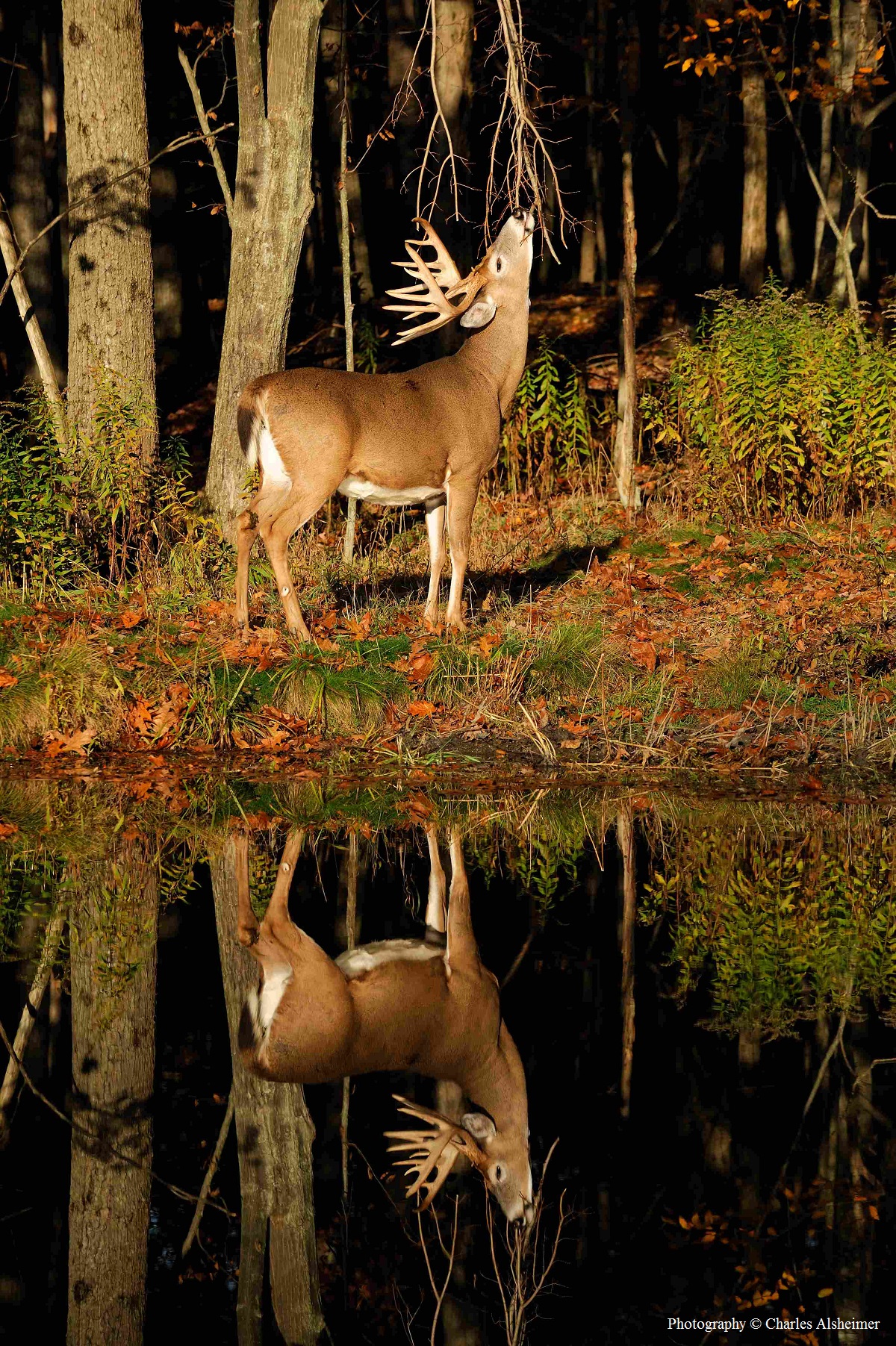
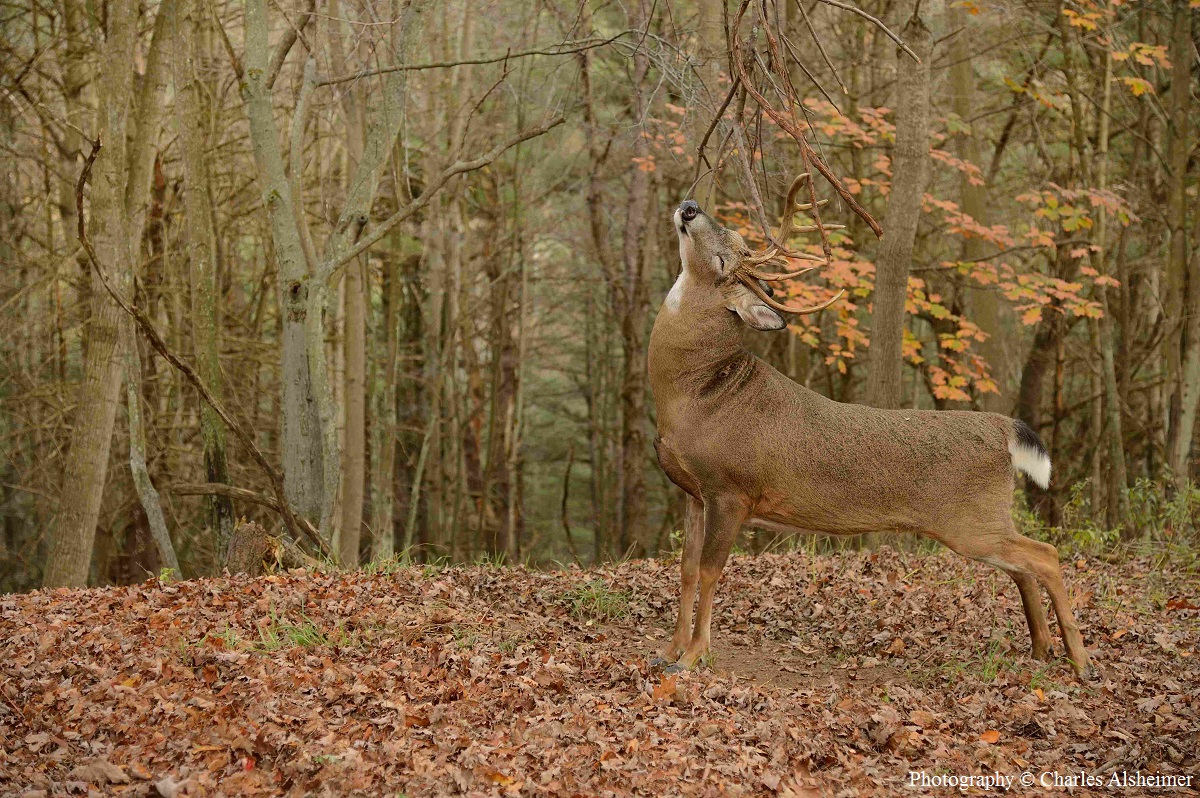
In most cases a buck begins the scraping process by rubbing his forehead, preorbital, and nasal glands on the branch and in some cases will actually lick and chew on the overhanging branch. Once done, most bucks will paw the leaves and other debris from the ground under the branch, then urinate into the pawed out earth. The process usually takes less than two minutes, but during this time a buck will leave liberal amounts of scent behind. Scraping, like rubbing, allows a buck to make his presence known by dispensing scent throughout his area.

Mature Whitetail Buck Making a ScrapeTypical scraping behavior involves leaving scent from a buck’s nasal, preorbital and forehead glands. When done working the branch bucks will paw the ground and urinate into the ground.
Hunters debate whether scraping is primarily a “buck thing” or if it’s done to attract does. During my years of photographing and hunting whitetails throughout North America, I’ve seen many does work a scrape’s licking branch. Only twice have I actually seen a doe paw the ground below the licking branch after scenting the licking branch. However, I’ve killed several does in archery season that were working a scrape’s licking branch when I released the arrow. On the other hand I’ve seen and photographed hundreds of bucks making scrapes during my career. So, based on this, it’s my view that scraping is primarily a buck behavior, a behavior they use to dispense scent and show dominance.

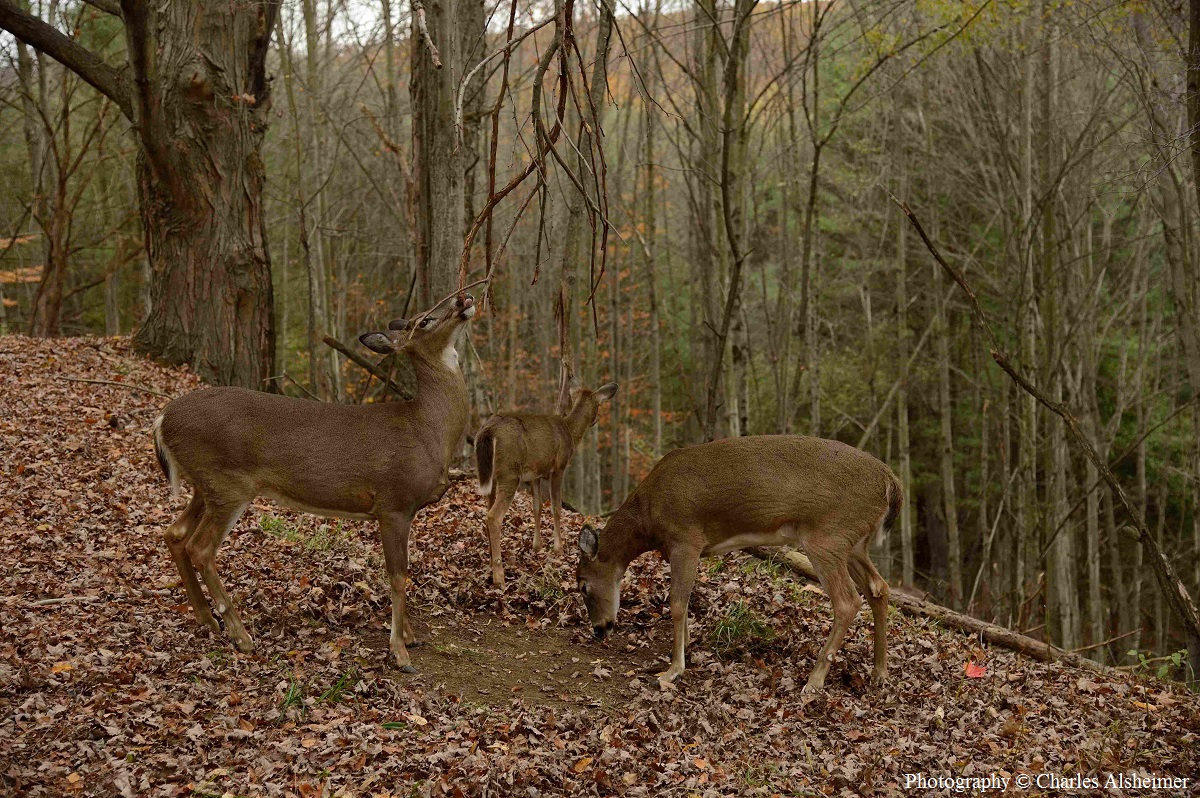
Though they seldom paw the ground does will actively work a scrape’s overhanging licking branch.

I believe scraping is also a satisfying, conditioned response for bucks. When working an overhanging licking branch, a buck is greatly satisfied by the branch massaging his forehead, preorbital and nasal glands. I don’t believe a buck consciously knows he is spreading his scent to other deer.

Judging from the hundreds of photos I’ve taken of scraping bucks, it appears the satisfying and stimulating aspects of scraping might explain why a buck performs scraping behavior so frequently. I’m not saying scent-depositing isn’t a big part of scraping, because it is. But I’m convinced the dynamics of scraping are incredibly complex and serve several functions, probably more than we’ll ever realize.

The age structure of a buck population heavily influences the amount of scraping that will take place. If yearling bucks dominate an area, scraping behavior will not be great. However, if there are an abundant number of 2+ year old bucks in the population, scraping sign will be very evident.

In 1990 I was a part of a scrape research project conducted on the Avery Estate in New York State where deer could be closely monitored in a natural setting. We discovered that during the two weeks leading up to peak breeding mature bucks made 6 to 12 scrapes every hour they were on their feet.

Mature buck working a licking branchDuring the two weeks leading up to peak breeding mature bucks can be expected to make between 6 and 12 scrapes every hour they are on their feet.
Classifying Scrapes

The way I classify the scrapes I find has evolved over the years. When hunters began to understand the whitetail’s scraping process in the early 1970s scrapes were commonly described as “boundary, secondary and primary.” Though I’ve used these terms, I learned along the way that there was a clearer way of defining what I was finding and photographing. In order to make the scraping process easier to understand I’ve settled on referring to the scrapes I find as boundary, random and primary.

Boundary scrapes: Boundary scrapes are made as bucks travel through their territory. These scrapes often show up along the edge of fields, fence rows and old roadways. Those made along field edges are nearly always made at night. Because of this I pay little attention to these scrapes except for checking the track size. If the track is more than 2 ¼ inches wide (with no more than a ¼ inch split in the toes) the buck is probably over 2 ½ years old and nearing maturity. Such bucks will also tip the scales at over 175 pounds (live weight) in the North.

Random scrapes: Random scrapes are just that—scrapes that are made spontaneously as a buck cruises his territory. A buck will often make a random scrape whenever he comes upon an attractive licking branch and is “moved” to work the site. Seldom will they be reused and in most cases are not serious candidates for a hunting set up.

Primary scrapes: Primary scrapes are the ones hunters need to pay attention to. In many ways they are the “mother lode” of whitetail scrapes, with some having the potential of becoming very attractive to whitetail bucks. They are most often found in strategic locations—inside corners, ridge lines, and especially along well-worn trails between bedding and feeding areas during the rut.

In many instances bucks will make a line of scrapes (20 to 50 yards apart) along such trails. Because many primary scrapes are found along well-worn trails, more than one buck (and does) will work and rework them during the seeking, chasing and breeding phases of the rut. I’ve probably killed more bucks over primary scrapes along well-used runways than any other place.

Hunting scrapes in prime travel corridors can be a very successful strategy in the days leading up to peak breeding, when bucks are on the move.

Timing

Though bucks work licking branches 365 days to leave their scent, prime scraping behavior occurs in the 30 day window leading up to peak breeding, especially during the last 10 days. Once breeding kicks in scraping behavior drops off drastically. During the post-rut scraping still occurs, but it is only a fraction of what it was before the rut.

deercampbanner

Recreational Firearm Noise Exposure

0

Michael Stewart, PhD, CCC-A, Professor of Audiology, Central Michigan University

Firearms Are Loud

Exposure to noise greater than 140 dB can permanently damage hearing. Almost all firearms create noise that is over the 140-dB level. A small .22-caliber rifle can produce noise around 140 dB, while big-bore rifles and pistols can produce sound over 175 dB. Firing guns in a place where sounds can reverberate, or bounce off walls and other structures, can make noises louder and increase the risk of hearing loss. Also, adding muzzle brakes or other modifications can make the firearm louder. People who do not wear hearing protection while shooting can suffer a severe hearing loss with as little as one shot, if the conditions are right. Audiologists see this often, especially during hunting season when hunters and bystanders may be exposed to rapid fire from big-bore rifles, shotguns, or pistols.

Hearing Loss Due To Firearm Noise

People who use firearms are more likely to develop hearing loss than those who do not. Firearm users tend to have high-frequency permanent hearing loss, which means that they may have trouble hearing speech sounds like “s,” “th,” or “v” and other high-pitched sounds. The left ear (in right-handed shooters) often suffers more damage than the right ear because it is closer to, and directly in line with, the muzzle of the firearm. Also, the right ear is partially protected by head shadow. People with high-frequency hearing loss may say that they can hear what is said but that it is not clear, and they may accuse others of mumbling. They may not get their hearing tested because they don’t think they have a problem. They may also have ringing in their ears, called tinnitus. The ringing, like the hearing loss, can be permanent.

Protecting Your Hearing From Firearm Noise

The good news is that people can prevent hearing loss by using appropriate hearing protective devices (HPDs), such as earmuffs or earplugs. However, studies have shown that only about half of shooters wear hearing protection all the time when target practicing. Hunters are even less likely to wear hearing protection because they say they cannot hear approaching game or other noises. While some HPDs do limit what a person can hear, there are many products that allow shooters to hear softer sounds while still protecting them from loud sounds like firearm noise.

Two types of HPDs designed for shooting sports are electronic HPDs and nonlinear HPDs. Electronic HPDs make softer sounds louder but shut off when there is a loud noise. The device then becomes hearing protection. Electronic HPD styles include earmuffs, custom-made in-the-ear devices, one-size-fits-all plugs, and behind-the-ear devices.

Nonlinear HPDs are not electronic and are designed to allow soft and moderate sounds to pass through, while still reducing loud sounds. Nonlinear HPDs can be either earplugs that are inserted into the ear or custom-made earmolds. Nonlinear HPDs that have filters are the best choice. They are better than those that use mechanical valves. This is because the valves may not close fast enough to protect hearing from loud noise.

The U.S. military uses both electronic and nonlinear HPDs to protect soldiers’ hearing during combat and weapons training. Electronic HPDs cost from less than $100 for earmuffs to over $1,000 for high-technology custom-made devices. Insert plug-type nonlinear HPDs cost around $10-$20, while custom-made nonlinear devices cost around $100-$150 per pair. Talk with your audiologist to choose the type of hearing protection that is right for you.

Tips To Protect Your Hearing

  • Always use some type of hearing protection any time you fire a gun.
  • Always have disposable HPDs handy—make them part of your gear.
  • Double-protect your ears, like putting muffs over plugs, when shooting big-bore firearms.
  • Choose smaller caliber firearms for target practice and hunting.
  • Choose single-shot firearms instead of lever action, pump, or semi-automatic guns.
  • Avoid shooting in groups or in reverberant environments.
  • Use electronic or nonlinear HPDs for hunting.

Foraging Wild Ramps (Wild Leeks): Identification and Look-alikes

0

Wild ramps are a type of onion that are delicious, popular, elusive, and sought after. Also called wild leeks, it is very important to properly identify and sustainably forage ramp plants. Once harvested, wild ramps make a delicious and flavorful addition to many meals!

Fresh wild ramp leaves on a wood cutting board.

What are Ramps?

Ramps (Allium tricoccum) are a perennial species of wild onion with a strong onion or garlic flavor. The ramp plant is wild growing in some areas and is also called wild leek, wild garlic, or ramsons.

Wild ramps are native to eastern North America and grow widespread in the eastern United States and Canada. Although I had heard much about them when I lived in the west, I had never seen them before I moved to Vermont!

Allium ursinum, also called wild garlic, is a related species that grows in Europe and Asia and can be used the same as wild leeks.

Ramps grow from March to June depending on your location. They are one of the earliest plants to forage in the spring, which is a happy sight for those of us who have long winters.

Related: What to Forage in Spring: 20 Edible and Medicinal Plants and Fungi

Where Can I Find Wild Ramps?

Wild ramps grow in eastern Canadian provinces, and in much of the northeastern United States, as far west as Minnesota and south as Georgia. It is common to find ramp plants in New England and the Appalachian mountains.

Ramps do not grow wild in the western US but can be planted and grown in a home garden. This is a wonderful way to have access to ramps and their tasty flavor without harming the population.

Wild leeks are found growing in clusters on the forest floor, often popping up through fallen leaves of deciduous hardwood forests. They tend to like damp areas but can be found in many types of rich soil.

Is Wild Leek Invasive?

Sometimes ramp plants grow in huge patches or colonies, so to the naked eye, it might appear that they are invasive. However, they take over 7 years to grow so are not considered invasive.

Wild leeks are actually protected due to overharvesting in many areas.

A close up of wild ramps showing green leaves and a red-purple stem.

How to Identify Wild Ramps

To identify wild ramps for while foraging, look for plants that are low growing, about 4-12 inches high. They have 1-3 broad leaves per plant and either white or reddish-purple stems (there are 2 varieties).

Ramp plants have flowers that bloom in the summer after the leaves have died back. The flowers look similar to cultivated onion flowers and produce black seeds.

A key identifying factor is that they smell like onion or garlic. This is a very important identification characteristic as toxic look-alikes won’t have this smell.

If it doesn’t unmistakably smell like an onion, it’s not a ramp!

A cluster of ramps growing in a wooded area.

Do Ramps Have Poisonous Look-Alikes?

Wild ramps have two extremely dangerous and deadly toxic look-alikes. It’s just as important to identify these properly as it is to identify the ramp plant.

Both of these toxic plants have wide leaves that come up in spring, and neither of them will have an onion or garlic smell.

False Hellebore (Veratrum viride) leaves can look similar to the wild ramp plant in that they are both pleated. This toxic plant can be identified by its ribbed leaves and lack of onion scent. They grow in swamps and marshes, whereas ramps grow in wooded areas.

False hellebore growing.
False Hellebore – a toxic wild ramp look-alike

Lily of the Valley (Convallaria majalis) do not have bulbs at the roots like ramps, instead, they have longer roots and rootlets along the length. They produce many bell-shaped flowers in contrast to the small daisy-like clusters that grow on ramp plants. They do not smell like onion or garlic.

Lily of the valley leaves growing.
Lily of the valley with bell-shaped flowers is a toxic plant

How to Forage Ramps Sustainably

In some areas, wild ramps are protected due to overharvesting so it is important to forage sustainably.

Ramps are a threatened species in many regions, and in some locations, there are regulations on harvesting them. Be sure to check your local laws before foraging them.

Ramps are slow growing, taking 7 years or more to fully mature. Completely pulling up the bulb will kill the plant, so be sure you know how to harvest them correctly before heading out to gather.

A wild ramp patch, with a natural cloth and foraged ramp leaves resting on it.

How to Collect Wild Leeks

It is best to only take one leaf per plant without pulling up the bulb. If the bulb or rhizome (the base of the bulb) is left in the ground it will continue to grow year after year.

If you find a patch where it is clear that other foragers have already taken leaves from the plants, move on to a different patch. Overharvesting the leaves is detrimental to the plant.

A patch of wild ramps growing in the forest.

Harvesting leaves is much easier and cleaner than pulling up bulbs. The good news about only harvesting the leaves is that the leaves have tons of flavor, so pulling up the bulbs is not necessary!

If you live in a region where ramps grow prolifically as they do in some areas of Vermont, it can be helpful in large and very dense colonies to selectively pull up some bulbs.

The bulbs or rhizomes can be replanted either elsewhere in the forest or on your property, ultimately helping the population of ramp plants.

Before pulling up and replanting any wild leek bulbs, research to determine if it is permitted in your region.

Take seeds after the plant flowers in the summer and spread them to other areas of the forest or bring them home to plant in your garden.

A cluster of ramps growing in a wooded area.

How to Grow Ramps

Since the population of wild ramps is protected and in a state of decline, grow them in your yard for a great way to have access to their delicious flavors without threatening the wild population.

Grow ramps from seeds, bulbs, starts, or by transplanting wild plants or rhizomes. Read this guide on how to grow ramps in your backyard for all of the best methods.

They have a long germination period if growing from seed, and once sprouted the plants take 7 years or more to fully mature. Patience is key!

These tasty plants need shade and moisture. They tend to do best under hardwood trees, just like when finding them growing wildly.

A good way to keep this threatened plant around is by growing your own!

How to Use Ramps

Just like their smell, wild ramps have a distinct onion or garlicky taste. The taste will mellow out when cooked but are still very flavorful.

For a stronger flavor, know that wild ramps are safe to eat raw! Try them in this delicious ramp pesto recipe.

A dish of ramp pesto on a wooden cutting board surrounded by ramp leaves and a block of parmesan and a cheese grater.
Ramp pesto

To preserve ramp leaves and enjoy them all year, make ramp butter and freeze it, or make pickled ramps.

Another great way to preserve wild leeks is to ferment them, of course! Try this ramp kraut recipe.

Add ramps to a delicious dinner and saute them in this ramp pasta, with a side of ramp focaccia bread or buttermilk ramp biscuits, yum!

However you choose to use your sustainably foraged wild ramps, they’ll be a delicious and appreciated part of your meal!

More Spring Foraging Finds:

  • Foraging for Morel Mushrooms
  • Chickweed Foraging
  • Foraging for Purple Dead Nettle
  • Dandelion Foraging
  • Foraging for Wild Violets

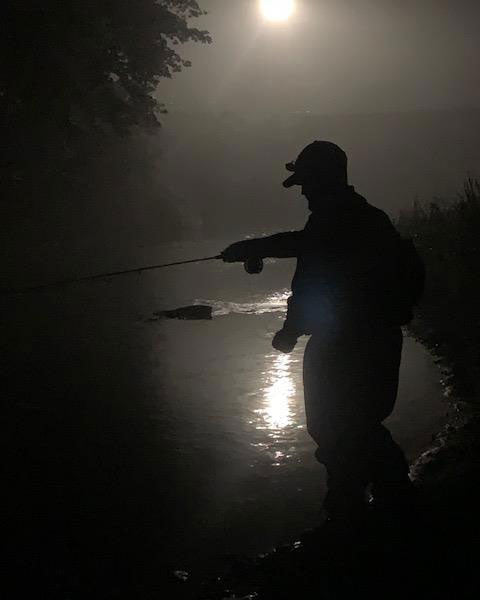
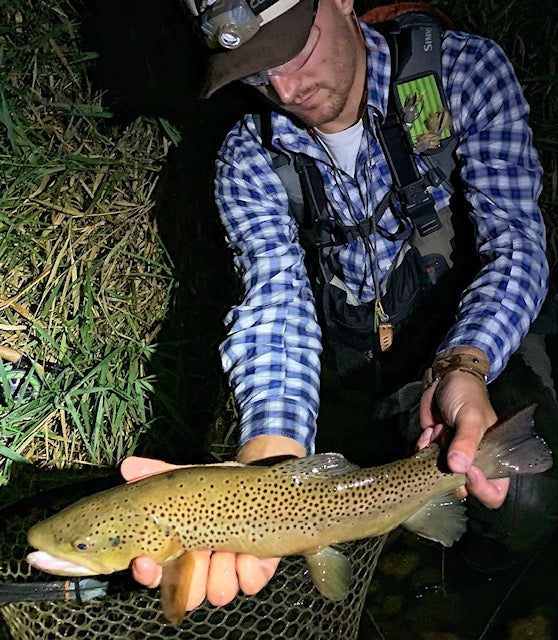
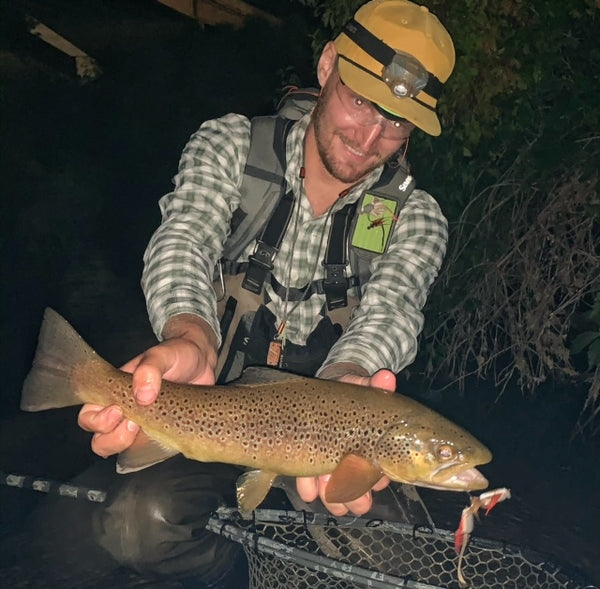
The Dark Side… Night Fishing for Big Brown Trout Let’s Face It, in Most Cases Those Big Brown Trout in Your Local River Aren’t Falling Victim To a Size 10 Woolly Bugger or a 16 Prince Nymph To be honest, you’re probably unaware of what lies beneath the surface tucked against a log jam or wedged under that giant boulder mid-river that you’ve fished countless times. In most cases in my night fishing experience, there’s almost always a much bigger fish that shows itself at night than any other previous fish you’ve might have seen during the daylight hours. The majority of the largest trout I have ever seen were at night in less than 24” of water. Some of the most dominant predators on the planet feed at night… and brown trout are no different. Before we go further into tips, tactics, and tackle, I’d like to preface that night fishing obviously has its additional challenges and even dangers. Safety is by far the utmost importance when fishing, especially night fishing. Understanding every inch of the river you plan on night fishing is extremely important. Knowing every boulder, drop off/ledge, and casting obstruction can prevent you from going for an unexpected swim, broken rod, or even a hook to the face (speaking from experience). Always wear eye protection (clear or light illuminating lenses), two headlamps (you’ll drop one in the river), and try to take a fishing buddy with you just for peace of mind. Where I live in Pennsylvania as well as many places in the country, night fishing is more of a seasonal approach. By all means, you can night fish every month of the year and find some success, but there is definitely a “prime time” to be on the water. Typically, I personally begin my night fishing season during the “post hatch” season. After the majority of the caddis and mayflies hatch in May, and the water becomes skinny and shallow, this is when I find brown trout to be starved and more eager to eat larger meals. This Will Change the Way You Fly Fish Pressured Waters Night fishing in May, June, and even early July definitely produces plenty of fish, but not THE fish we’re all looking for. Once August rolls around and water temps begin to drop into safe fishing temperatures, that’s when you need to fish until the wheels fall off. Sleep becomes a thing of the past and coffee becomes your best friend. Your best shot at consistently catching brown trout 20”+ and even 24”+ is between August and October. The worst conditions for daytime fishing are your best conditions for night fishing. Low and clear water is by far the best water conditions to target big brown trout at night. Dominant brown trout adapt and hide so well during these conditions during the daytime which make them almost impossible to target. Once the sun begins to fade, the fish will migrate out of structure and move into feeding areas for the night. Swing It! Spey Streamer Fly Fishing Tips A mistake anglers often make is fishing the same deep hole they typically would fish during daytime. Brown trout will move into shallow sandy tail-outs, or push into the head of a run where the water might be less than 24” in depth. The inside seam of a deep pool also offers a great ambush point for a large brown trout. Tackle used when night fishing is very similar to fishing big streamers. Any 6wt, 7wt, or 8wt will suffice. On larger rivers, a trout spey or switch rod works great for swinging streamers or skating rodent patterns across the surface. A floating fly line is the most versatile line for night fishing in my opinion. You can fish surface flies, “pushers” that sit barely subsurface in the surface film, or even a streamer if you want to swing a baitfish into deeper pools. Your leader is extremely important when night fishing as well. Typically when fishing a surface style fly, keeping the leader short and stout is critical. Two feet of 20lb tippet to a blood knot, followed by three feet of 15lb tippet is typical when fishing surface style flies. Your leader needs to be strong and abrasion resistant. It’s not “if,” it’s “when” you toss your flies into a tree. I have personally witnessed brown trout eat mice, rats, bats, baby birds, and even water snakes. A large brown trout over 24” is not much different than a musky. Don’t be afraid to think outside the box when night fishing. The biggest brown trout I’ve hooked at night was on a 6” rat pattern. The most important aspect of fly design for night fishing in my opinion is how much vibration, water displacement, or surface disruption you can create while not sacrificing your hook gap. Thin, but wide profile deer or foam body mouse flies work great. If using streamers, a pusher style fly that rides high in the water column seems to be extremely effective as well. Tied with a Surface Seducer Double Barrel Popper & Slider Body. How to fish you fly is totally dependent upon on moon phases, cloud coverage/ambient light, and speed of the current. A mouse is not going to swim upstream against the current. The two most effective retrieves are: Down and across just like you would swing a wet fly Casting upstream and working the fly back to you If the current is a classic soft dry fly drift, I almost always work the fly down and across. Your rod tip height as well as your casting angle will dictate the speed of the fly. While fishing short and soft inside seams of a faster run/pool, orienting yourself downstream or below the fish will enable you to cast directly upstream and work the fly right to your feet. This is also a fantastic approach to work upstream along parallel with a heavily wooded bank. I have seen countless times where a fish will strike multiple times with this approach and ultimately eat the fly at your feet after missing 3-4 times in one drift. Be sure to always start your casts short, most fish are sitting right at your feet! At the end of a long night as the sun begins to rise; rest assure, that legendary fish most likely got away. More times than not, they have to make a series of mistakes in order for you to land them. Whether it ran you into a long jam, bent a 1/0 hook, or it came off just short of the net; the giants of the dark will keep you coming back for more. Tip your cap, swig some spiked coffee and keep after it. More often than not, they’ll leave you with a memory rather than a photo that you will never forget. Some nights, all you’ll have left is a fly patch full of chewed up foam. Want More Content Like This? Join the Flymen Mailing List at the bottom of the page! About Stephen Nymick: Stephen Nymick is owner of Stephen Nymick Fly Fishing LLC, and a Guide for Steelhead Alley Outfitters. He began fly fishing at just 5 years old on his local streams in Western Pennsylvania. The day his father took him out to get his first fly rod, he also came home with his first fly tying kit. Stephen has been fly fishing exclusively for over 20 years and has guided for 7 years. Throwing big streamers or mice for brown trout and swinging flies for Steelhead are Stephen’s true passions. You can follow Stephen on Instagram @stephennymick. For further questions, email Stephen at [email protected]. To book a trip, contact Steelhead Alley Outfitters at 888-453-5899. Written by Stephen Nymick Filed under brown trout,  fly fishing,  fly fishing tips,  fly tying,  freshwater Tweet Comments on this post (8) Feb 26, 2024 Hi Sir/ We are manufacturers of fishing flies based in Uganda. We have qualified tiers who can maintain the best quality that a customer needs, we strictly deliver on time and use the right size of hooks. We tie all types of flies according to the customers orders. We are now looking for someone whom we can partner with for progress in both parties. Thank you as we wait to hear from you soon. under management by Fred — Fred luyali Apr 21, 2022 Hi, Re night time fishing for trout article. Thank you for a thoroughly informative article. Could you let me know what the chewed up flies in the picture are called and do you have any tying instructions you could send me? Kind Regards Derek Coles — Derek Coles Oct 31, 2021 Dear Sir, I am Betty, a professional custom fly tier and the owner of a tube fishing flies fly group in business. With an experience of 20 years in fly tying in fulling mill company, I do produce all categories of fly patterns etc,Nymphs,Dries,Wets,Salmons,Saltwater, Pikes,Terrestrials etc. The quality of flies lies within my finger tips. I am always impressed with each and every fly that comes out of my vice.I have 20 good fly tiers who have experience in producing quality flies for the fly market globally. I will be glad if you would test my flies sample to match the quality of the same. I can assure you that with my flies you will emerge the best in the flies industry. If you are ready to foster flies business with me, I will be supplying you with a lower price per 1 dozen.I am eagerly waiting to hear from you. Best regards — Fred luyali May 04, 2021 This piece really got me thinking about my terminal obsession with netting three footers out of the Colorado where I live. I’ve actually landed a couple of those ghost browns @ zero-dark-thirty, and broke off even more. Your piece has me plotting already for some unconventional post-hatch, stealthy Ninja type spey missions. — Matthew Fullenwider Mar 18, 2021 I’m gonna be that guy and say that my biggest after dark brown came at 11:55 pm in mid-March…but overall I agree that late summer is the best time to raise fish in the late hours of the night. I would also add that a full moon is bad for mousing but great for streamers. — Patrick Houlton Mar 17, 2021 Nice article. Exactly what areas do you guide ? — John Kersting Mar 17, 2021 Great article, very insightful. — David Mar 17, 2021 Excellent article. I just started drifting my big tailwater after sunset last September to get the feel of casting streamers and catching fish after dark in big flows. Managing the boat and maintaining situational awareness is not for the faint of heart. One thing I wish the article had mentioned was technical specs on headlamps for night fishing — Drew Gilchrist Leave a comment Name Email Message

0

Let’s Face It, in Most Cases Those Big Brown Trout in Your Local River Aren’t Falling Victim To a Size 10 Woolly Bugger or a 16 Prince Nymph

To be honest, you’re probably unaware of what lies beneath the surface tucked against a log jam or wedged under that giant boulder mid-river that you’ve fished countless times. In most cases in my night fishing experience, there’s almost always a much bigger fish that shows itself at night than any other previous fish you’ve might have seen during the daylight hours.

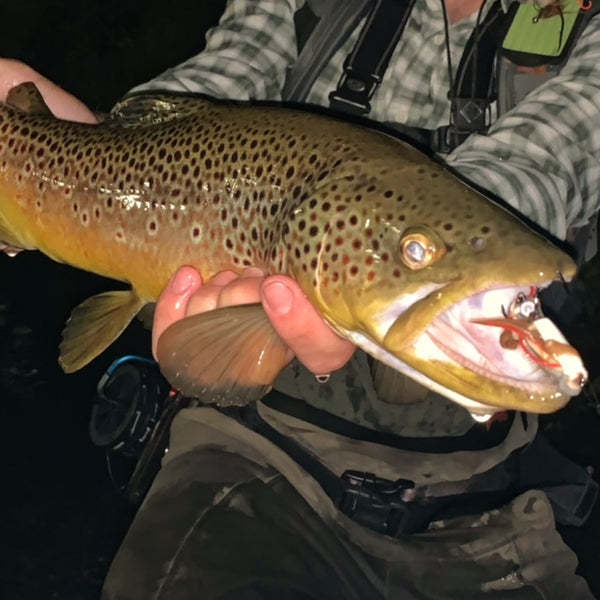
The majority of the largest trout I have ever seen were at night in less than 24” of water. Some of the most dominant predators on the planet feed at night… and brown trout are no different.

Before we go further into tips, tactics, and tackle, I’d like to preface that night fishing obviously has its additional challenges and even dangers. Safety is by far the utmost importance when fishing, especially night fishing. Understanding every inch of the river you plan on night fishing is extremely important. Knowing every boulder, drop off/ledge, and casting obstruction can prevent you from going for an unexpected swim, broken rod, or even a hook to the face (speaking from experience). Always wear eye protection (clear or light illuminating lenses), two headlamps (you’ll drop one in the river), and try to take a fishing buddy with you just for peace of mind.

Where I live in Pennsylvania as well as many places in the country, night fishing is more of a seasonal approach. By all means, you can night fish every month of the year and find some success, but there is definitely a “prime time” to be on the water. Typically, I personally begin my night fishing season during the “post hatch” season. After the majority of the caddis and mayflies hatch in May, and the water becomes skinny and shallow, this is when I find brown trout to be starved and more eager to eat larger meals.

This Will Change the Way You Fly Fish Pressured Waters

Night fishing in May, June, and even early July definitely produces plenty of fish, but not THE fish we’re all looking for. Once August rolls around and water temps begin to drop into safe fishing temperatures, that’s when you need to fish until the wheels fall off. Sleep becomes a thing of the past and coffee becomes your best friend. Your best shot at consistently catching brown trout 20”+ and even 24”+ is between August and October.

The worst conditions for daytime fishing are your best conditions for night fishing. Low and clear water is by far the best water conditions to target big brown trout at night. Dominant brown trout adapt and hide so well during these conditions during the daytime which make them almost impossible to target. Once the sun begins to fade, the fish will migrate out of structure and move into feeding areas for the night.

Swing It! Spey Streamer Fly Fishing Tips

A mistake anglers often make is fishing the same deep hole they typically would fish during daytime. Brown trout will move into shallow sandy tail-outs, or push into the head of a run where the water might be less than 24” in depth. The inside seam of a deep pool also offers a great ambush point for a large brown trout.

Tackle used when night fishing is very similar to fishing big streamers. Any 6wt, 7wt, or 8wt will suffice. On larger rivers, a trout spey or switch rod works great for swinging streamers or skating rodent patterns across the surface. A floating fly line is the most versatile line for night fishing in my opinion. You can fish surface flies, “pushers” that sit barely subsurface in the surface film, or even a streamer if you want to swing a baitfish into deeper pools. Your leader is extremely important when night fishing as well. Typically when fishing a surface style fly, keeping the leader short and stout is critical. Two feet of 20lb tippet to a blood knot, followed by three feet of 15lb tippet is typical when fishing surface style flies. Your leader needs to be strong and abrasion resistant. It’s not “if,” it’s “when” you toss your flies into a tree.

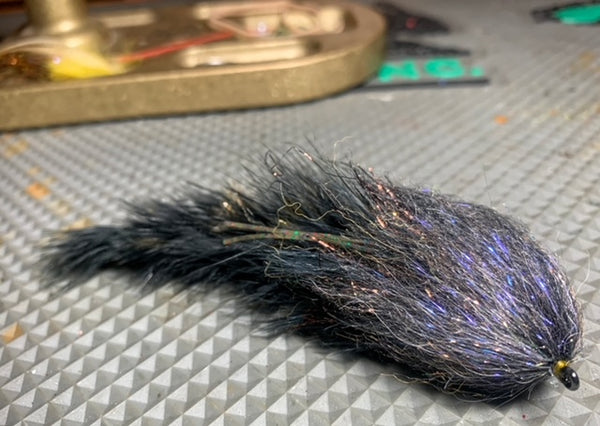
I have personally witnessed brown trout eat mice, rats, bats, baby birds, and even water snakes. A large brown trout over 24” is not much different than a musky. Don’t be afraid to think outside the box when night fishing. The biggest brown trout I’ve hooked at night was on a 6” rat pattern. The most important aspect of fly design for night fishing in my opinion is how much vibration, water displacement, or surface disruption you can create while not sacrificing your hook gap. Thin, but wide profile deer or foam body mouse flies work great. If using streamers, a pusher style fly that rides high in the water column seems to be extremely effective as well.

Tied with a Surface Seducer Double Barrel Popper & Slider Body.

How to fish you fly is totally dependent upon on moon phases, cloud coverage/ambient light, and speed of the current. A mouse is not going to swim upstream against the current.

The two most effective retrieves are:

  • Down and across just like you would swing a wet fly
  • Casting upstream and working the fly back to you

If the current is a classic soft dry fly drift, I almost always work the fly down and across. Your rod tip height as well as your casting angle will dictate the speed of the fly. While fishing short and soft inside seams of a faster run/pool, orienting yourself downstream or below the fish will enable you to cast directly upstream and work the fly right to your feet. This is also a fantastic approach to work upstream along parallel with a heavily wooded bank. I have seen countless times where a fish will strike multiple times with this approach and ultimately eat the fly at your feet after missing 3-4 times in one drift.

Be sure to always start your casts short, most fish are sitting right at your feet!

At the end of a long night as the sun begins to rise; rest assure, that legendary fish most likely got away. More times than not, they have to make a series of mistakes in order for you to land them. Whether it ran you into a long jam, bent a 1/0 hook, or it came off just short of the net; the giants of the dark will keep you coming back for more. Tip your cap, swig some spiked coffee and keep after it. More often than not, they’ll leave you with a memory rather than a photo that you will never forget. Some nights, all you’ll have left is a fly patch full of chewed up foam.

Want More Content Like This?

Join the Flymen Mailing List at the bottom of the page!

About Stephen Nymick:

The Dark Side… Night Fishing for Big Brown Trout </header> Let’s Face It, in Most Cases Those Big Brown Trout in Your Local River Aren’t Falling Victim To a Size 10 Woolly Bugger or a 16 Prince Nymph To be honest, you’re probably unaware of what lies beneath the surface tucked against a log jam or wedged under that giant boulder mid-river that you’ve fished countless times. In most cases in my night fishing experience, there’s almost always a much bigger fish that shows itself at night than any other previous fish you’ve might have seen during the daylight hours. The majority of the largest trout I have ever seen were at night in less than 24” of water. Some of the most dominant predators on the planet feed at night… and brown trout are no different. Before we go further into tips, tactics, and tackle, I’d like to preface that night fishing obviously has its additional challenges and even dangers. Safety is by far the utmost importance when fishing, especially night fishing. Understanding every inch of the river you plan on night fishing is extremely important. Knowing every boulder, drop off/ledge, and casting obstruction can prevent you from going for an unexpected swim, broken rod, or even a hook to the face (speaking from experience). Always wear eye protection (clear or light illuminating lenses), two headlamps (you’ll drop one in the river), and try to take a fishing buddy with you just for peace of mind. Where I live in Pennsylvania as well as many places in the country, night fishing is more of a seasonal approach. By all means, you can night fish every month of the year and find some success, but there is definitely a “prime time” to be on the water. Typically, I personally begin my night fishing season during the “post hatch” season. After the majority of the caddis and mayflies hatch in May, and the water becomes skinny and shallow, this is when I find brown trout to be starved and more eager to eat larger meals. This Will Change the Way You Fly Fish Pressured Waters Night fishing in May, June, and even early July definitely produces plenty of fish, but not THE fish we’re all looking for. Once August rolls around and water temps begin to drop into safe fishing temperatures, that’s when you need to fish until the wheels fall off. Sleep becomes a thing of the past and coffee becomes your best friend. Your best shot at consistently catching brown trout 20”+ and even 24”+ is between August and October. The worst conditions for daytime fishing are your best conditions for night fishing. Low and clear water is by far the best water conditions to target big brown trout at night. Dominant brown trout adapt and hide so well during these conditions during the daytime which make them almost impossible to target. Once the sun begins to fade, the fish will migrate out of structure and move into feeding areas for the night. Swing It! Spey Streamer Fly Fishing Tips A mistake anglers often make is fishing the same deep hole they typically would fish during daytime. Brown trout will move into shallow sandy tail-outs, or push into the head of a run where the water might be less than 24” in depth. The inside seam of a deep pool also offers a great ambush point for a large brown trout. Tackle used when night fishing is very similar to fishing big streamers. Any 6wt, 7wt, or 8wt will suffice. On larger rivers, a trout spey or switch rod works great for swinging streamers or skating rodent patterns across the surface. A floating fly line is the most versatile line for night fishing in my opinion. You can fish surface flies, “pushers” that sit barely subsurface in the surface film, or even a streamer if you want to swing a baitfish into deeper pools. Your leader is extremely important when night fishing as well. Typically when fishing a surface style fly, keeping the leader short and stout is critical. Two feet of 20lb tippet to a blood knot, followed by three feet of 15lb tippet is typical when fishing surface style flies. Your leader needs to be strong and abrasion resistant. It’s not “if,

Stephen Nymick is owner of Stephen Nymick Fly Fishing LLC, and a Guide for Steelhead Alley Outfitters. He began fly fishing at just 5 years old on his local streams in Western Pennsylvania. The day his father took him out to get his first fly rod, he also came home with his first fly tying kit. Stephen has been fly fishing exclusively for over 20 years and has guided for 7 years. Throwing big streamers or mice for brown trout and swinging flies for Steelhead are Stephen’s true passions. You can follow Stephen on Instagram @stephennymick. For further questions, email Stephen at [email protected]. To book a trip, contact Steelhead Alley Outfitters at 888-453-5899.

Best Air Rifle Deals

Popular Posts

What Is a Break Barrel Air Rifle?

0
A break barrel air rifle is a type of air rifle that uses a break action to load and unload pellets. It is one...

How Do Break Barrel Air Rifles Work?

0
A break barrel air rifle is a type of airgun where the barrel breaks open at a hinge point just above the breech. This...

Air gun 101: How Nitro Piston technology can make your shooting sport more exciting?

0
In the air gun market today, there are many air rifles made with nitro-piston technology Even the best-selling lists on gun retailer's sites have a...