

Home Blog Page 9

Warm-Up Raccoon Trapping

0

You’ll rack up more ‘coons when the winter heat waves hit — if you follow this trapper’s ways.

By Toby Walrath

When trappers think of midwinter traplines, raccoons aren’t likely the first animal that comes to mind. Cold temperatures and rare track sightings do not make the effort of checking and maintaining traps seem worth the work — especially in northern states. But, by targeting the warmest days of each winter month, trappers can spend less time on the trapline and yield more winter-prime raccoons.

Raccoons are targeted in early fall by most trappers and hunters because that’s when the best weather occurs, but midwinter pelts are the most prime. With the current market situation, only the biggest and best raccoon pelts will sell. From a dollars-and-cents perspective, you can spend far less on fuel and trapping expenses and make a lot more money by trapping fewer prime animals, than you can by trapping many that are under-prime. If you are trapping simply for enjoyment and to get a nice hide for the wall or for craft work, it is still beneficial to trap raccoons when the fur is in its fullest and most beautiful condition. Knowing when to set and when to leave traps sprung can maximize your midwinter trap time and yield more prime fur.

First, raccoon pelts are generally good by the end of October and pelts become heavy by mid-November. It is right around this time — especially in northern states — when raccoons hole up in dens somewhere and become difficult to find. This mild form of hibernation is called torpor, which causes raccoons to do very little and slumber for long periods, while conserving fat stores. As long as temperatures stay cold and the snow piles up, raccoon activity remains pretty much nonexistent until it warms up again. Trappers who pay attention to travel routes in the early part of autumn can capitalize on winter-prime furs when the time is right.

Every winter season experiences a few days or weeks of warm weather. Warmth at this time of year is relative to the cold temperatures found on either side of the warm spell. In some regions of the country, woodsmen know this as a Chinook, or Chinook wind, in other parts it is called a January thaw or an ice eater.

Whatever you call it, there is often a time period when the cold weather of winter is reversed temporarily and the temperatures rise above freezing. It can last for a few days or several weeks and often comes with rain and drizzle. This is when raccoons get on the move looking for food, and when trappers can obtain the best pelts.

Secondly, breeding season for raccoons varies slightly by the latitude of their area, but occurs in the first half of the calendar year, generally reaching its peak somewhere within the time between January and March. Any young males that still remain with the family group will disperse at this time and the big boars go out searching for a mate. When a warm spell aligns with breeding activity, the opportunity for prime winter pelts is optimum.

There is some risk that pelts can become stained with urine at this time of the year, especially if the raccoons are holed up inside tight quarters with several other animals for long periods of time. However, I have trapped many wintertime raccoons that brought premium prices at fur sales, and because of this fact I continue to target them in January and February. I have caught raccoons as late as March in the Northwest that had quality hides.

Most of my trapping effort for raccoons is performed a little differently than it is for other species. This difference is driven by the timing of peak activity, weather and the market. Developing a strategy to maximize my return on investment allows me to be able to afford to trap raccoons every season. To put this into perspective, I can’t afford to spend $50 on fuel and bait to trap one $10 raccoon. I also don’t want to spend the time to check traps five times to catch just one raccoon in the current market, either. This is especially true when I can spend my time trapping bobcats and coyotes that bring a much higher paycheck than raccoons.

So, in order to make money, or at least break even, from trapping raccoons, it is necessary to spend less time and money when the least amount of time is required to catch the most valuable pelts. In order to accomplish this I must catch more fur in less time. This is possible by setting traps only when peak activity is expected. Predicting the timing takes a bit of trial and error, but there are some key factors that help me focus my effort at precisely the best periods to find my raccoon sets full.

A full moon will bring raccoons out more during winter months than a dark moon. Some trappers may debate that statement, but it has been my experience over the years. If the weatherman predicts mild temperatures at or above freezing in the middle of the night and there is also a full moon, I make sure that my trapline is in good working order. But, determining exactly where and how to set up my trapline begins much earlier in the season.

I always keep track of where I see raccoon sign while trapping other species throughout the fall. Muskrat, beaver and mink habitat overlap with raccoons. Much of the best winter raccoon trapping locations are in thick timber with large trees that are adjacent to open farm fields or cattail marshes. These forested areas offer protection and food sources when ponds and creeks are frozen. I search for the travel routes that raccoons use during the fall between the food source and den sites.

It’s important to know that when the temperatures dip down in the autumn months raccoons begin looking for a place to stay long term. The areas where raccoon sign, such as tracks and scat, are found just before freeze-up will be the best places to set traps during the midwinter season. These locations are different than the ones you may be accustomed to in the early fall.

Once the areas are identified, it becomes a waiting game. The frigid winter temperatures come and the snow begins to pile up in late November. That is when I generally switch my trapping efforts to bobcats and marten. But, I keep an eye on the weather, too. Usually somewhere around early January a warm weather system will move into my region and that is when I get ready for raccoon trapping. By then all of my other traplines are in and I have a routine of checking those traps with minimal maintenance, which allows me to dedicate some time to a raccoon line.

I use encapsulated traps, also known as dog-proof traps, or DPs, for raccoon trapping because they are very selective and I don’t have to worry about chewing issues. I can also count on the trap functioning properly and there is very little work required to set them up.

To begin, I travel to the areas where I noted high activity just before freeze-up, and choose the most obvious weatherproof locations. In my area, the ground is rock hard at this time of year, so I use heavy cable with an adjustable loop on one end to wrap around a tree trunk and over my trap.

For bait, I keep it simple by using dry cat food and fish or shrimp oil. Even with above-freezing temperatures during the day, any dip in the mercury could freeze up a trap packed with bait that can freeze. The cat food will not freeze as long as it stays dry, and fish oil is naturally freeze proof. I fill the cat food to just at or below the bottom of the trigger. If it gets wet I will clean it out and replace it with fresh, dry bait.

There are models of DP traps with push/pull triggers that will set the trap off as the raccoon pushes its paw inside, but the ones that I prefer rely on an upward pulling motion. It won’t take much oil and I have utilized homemade sun-rendered oil, commercial fish oil and even fishy smelling oils made for fisherman. As long as the oil is thick and has a strong odor, I will add a teaspoon of it to the cat food and then smear some on a tree within a foot or two of the trap. Precise trap placement is not real critical, but I like to jam the support stake (commonly found on top DP brands) into the soil or duff at the base of the tree when possible, so that the trap is upright at a slight angle. I will always set at least two or three traps within 50 feet or so of each other because I so often see more than one raccoon travelling together. I have caught as many as three very close together, and if I have enough traps I will set as many as six in one premium location.

Next, I’ll wait and check my traps regularly as long as the weather stays above freezing. When temperatures drop again I spring the traps and lay them on their sides to keep any rain or snow out, and forget about them until the weather is predicted to warm up again.

When I know that the weather is going to heat up for a few days, I reset and re-bait all of the traps throughout the entire warm spell again. In this way I am keeping my traps operational only when the raccoons are most likely to be actively searching for food. Most importantly, I won’t waste any time maintaining and checking traps when temperatures are below freezing, because I know that overall raccoon activity will be very limited during those conditions. With my traps already secured to the trunk of weatherproof trees, resetting them is very easy when the time comes.

Midwinter raccoon trapping can produce the best quality hides at a time of the year when food is scarce and their breeding season is ramping up. Those two factors alone should increase the return on a trapper’s efforts. I also like to be the only raccoon trapper working an area, and given the low prices of fall skins and the common thought that winter and raccoon trapping don’t belong in the same sentence — I have enjoyed many productive days afield pursuing prime pelts without seeing any other trappers.

Try trapping raccoons this winter when their fur is at its best and competing trappers are few and far between. You will get more skins and profit for your efforts, while having one more excuse to get outside when others are curled up in bed waiting for spring.

—Toby Walrath is a big-game guide, writer, photographer, hunter and trapper, and can be reached through his Instagram account @walrathoutdoorsphoto.

How to Call Wolves With Your Voice – The Ultimate Challenge

Related Posts

  • Trapping Raccoons With Randy Smith
  • Trapline Preparation: How to Make Your Own Raccoon Bait
  • How to Make a Bucket Set by Jim Spencer — Part II

Trotline Fishing: Building and Setting Trotlines

0

Trotline Fishing Tips and Tricks

catfish on a trotline

Where and When to Set out Trotlines

Catching catfish with trotlines is very fun and a great way to provide family and friends with some of the best table fare there is. While many anglers have their go-to ways of catching catfish, there are several timeless tips and tricks out there that may lead to many more fish on your trotline than the next angler.

The first tip to catching catfish on a trotline would be to identify raises in the waterways you’re fishing. The shallower water that these raises may serve flatheads and other catfish subspecies very well as they pursue food at night. These fish tend to lay in deeper water and cover during the day and navigate into shallower, open water at night to feed.

The next tip would be to pay attention to the time of the year you’re fishing. The three times of the year to identify in your area are pre-spawn, spawn, and post-spawn. The spawn is when fish breed. However, different fish may spawn at different times of the year, so don’t confuse the report of someone fishing for spawning bass or crappie with when the catfish may be spawning. When catfish spawn, many of them tend to stay very close to, if not hovering over a bed. This fixes their focus more on breeding and reproducing than feeding, making them harder to catch on a trotline.

Take the state of Kentucky, for example. Catfish in the state of Kentucky tend to spawn in the month of June. Some of the most successful catfishing anglers may fish up to Memorial Day and then back off of setting trot lines in the month of June. Then, around 4th of July, it’s a great time to get your trotlines back in the water.

A final trick that can prove to produce high yields of catfish is to target flathead catfish in the fall when they are heavily feeding to prepare for winter. Months such as September and October, throughout most parts of the U.S., can prove to be very good months to set trotlines. Especially, for flatheads.

What You Need to Build a Trotline

Building a trotline for catfishing can prove to be a relatively simple way to catch a large amount of catfish with minimal effort. The supplies required to build your own trotline can all be acquired at Walmart and are relatively affordable for the yield of catfish they can all provide. Trotline supplies include:

  • Main Line – A roll of Hard Nylon Line (#36)
  • Drop Lines (The lines going from your main line to your hooks) – A roll of Hard Nylon Line (#18)
  • Fishing Swivels – Requires 2 Swivels Per Drop Line
  • Catfish Hooks – Requires 1 per Drop Line; Get as big as size 8/0 for bigger catfish like flatheads and blue cats and as small as size 1/0 for smaller breeds like channel or mud catfish
  • Trotline Clips – Used to attach angler information for legality purposes or for attaching weights throughout the trotline to maximize the amount of submersion
  • Line Winder – Serves to wind up a trotline in an organized manner

How to Build a Trotline:

  • How many hooks should you put on a trotline?
  • How long does a trotline need to be?
  • How do you assemble a trotline?
  • How do you weigh down a trotline?

The first question you need to answer is: How long should my trotline be? To answer this question, you will need to do some scouting. If you’re going to drop your trotline in a big body of water like a lake or reservoir, you may want to tie off to a couple of trees sticking up in shallow water. In this case, your trotline should be long enough to span the distance between the trees. If you’re dropping the trotline in a river, you need to know where you want to fish. Catfish like creeks and rivers with shallow flats next to deeper water. In many cases, these flats run along the bank for short distances. You may need a short trotline in this case. Other times, you may want to go bank to bank and, in these cases, you will need a longer trotline.

Next, you need to know how many hooks to tie to your trotline. The general rule of thumb is to have a hook every six feet. This will give you good coverage, but hooks will not be so close that they tangle up when a hooked catfish starts thrashing. Check the regulations for the lake and state you fish in. In many cases, there are limits on the number of hooks a trotline can have. Also, most states require trotlines to have a form of identification to indicate who owns the trotline. Make sure your trotline is tagged appropriately.

The easiest way to assemble your trotline is to tie your mainline between two trees. Next, tie your 24-inch drop line to the mainline every six feet. After you tie each dropline, go ahead and tie the swivels and hook to the dropline. Some anglers prefer two swivels per dropline and others use one swivel — the choice is yours. Once you are done, wind it up and you’re ready for the water. If you have time and are fishing areas with little traffic, you can do all this at the actual location. Once you’re on the water, simply tie off the main line, tie your drop lines and hooks and then bait as you go.

To sink your trotline to the bottom, you will need to tie weights to your trotline. Most anything will work for a weight. Rocks and coffee cans full of cement are often used. Tie enough weights to get to the depth you need. Generally, there is a heavy weight in the middle and several others on either side. Keep in mind the more weight you have, the more weight you’re pulling up when checking the trotline.

How to Set a Trotline

Your overall setup will only be as good as where you place the trotline and how well you fasten it to each end’s anchor. The following steps serve as a great baseline to properly setup your trotline:

  • Identify solid anchor points to tie the trotline to on each side of the body of water you’re fishing. Solid tree roots, green bushes, or fallen timber are great things to search for first.
  • Tie each end of the trotline to the identified anchor points.
  • Begin on any side of the trotline and place your drop lines on the main line and bait each hook as you assemble the drop lines. As you progress across the trotline, fasten weights to any points on the main line that will help to properly submerge the main line. Continue fastening the drop lines and weights to the other end of the trotline.

Best Bait to Use on a Trotline

When it comes to catching catfish on a trotline, your trotline will only be as attractive as the bait you put on each hook. It is important to know that different subspecies of catfish prefer different types of food. Knowing which subspecies of catfish you’re targeting will help you determine what type of bait to use on your trotline. Some subspecies of catfish prefer live bait, while others prefer lifeless bait.

Questions that may lead you to choosing the best bait for catfish in your water are:

  • What kind of catfish are in the water I’m fishing?
  • Of those types of catfish, which ones am I targeting?

Best Live Bait to Use on a Trotline

When targeting flathead or channel catfish, live bait can prove to be the most effective.

Best Cut Bait and Artificial Bait to Use on a Trotline

When targeting blue catfish or channel catfish, freshly cut parts of dead fish work best, followed by any types of dead bait or “stink catfish baits.”

Best Hooks to Use on a Trotline

The best hook to use on a trotline is directly correlated with the size and species of catfish you’re targeting and the size of the bait being used on the trotline. When targeting smaller sizes and species of catfish, such as channel catfish or mud catfish, you may look toward a smaller J-Style hook such as sizes 1/0 or 2/0 hooks. As the catfish size and species you’re targeting get larger, so will the size of your hook. When targeting big catfish such as blue catfish or flathead catfish, you should start getting closer to a size 8/0 hook.

Edible Hickory Nuts: A Taste Test

0

I recently completed a project that I began last Fall.

On nature walks in the park in the Fall, I am frequently asked about the hickory nuts we find: “Are they edible”? The short answer is yes. The question, however, deserves a fuller response.

To say that something is “edible” is, in a sense, simply to say that it is safe to eat; it is not poisonous and will not make the eater sick. Hickory nuts are definitely edible in this sense. This is only the first consideration, though, for someone who is actually considering eating something found in its natural state. Not everything edible is something that one wants to consume. Are the hickory nuts of Eliza Howell Park ones that we are likely to find pleasant to eat?

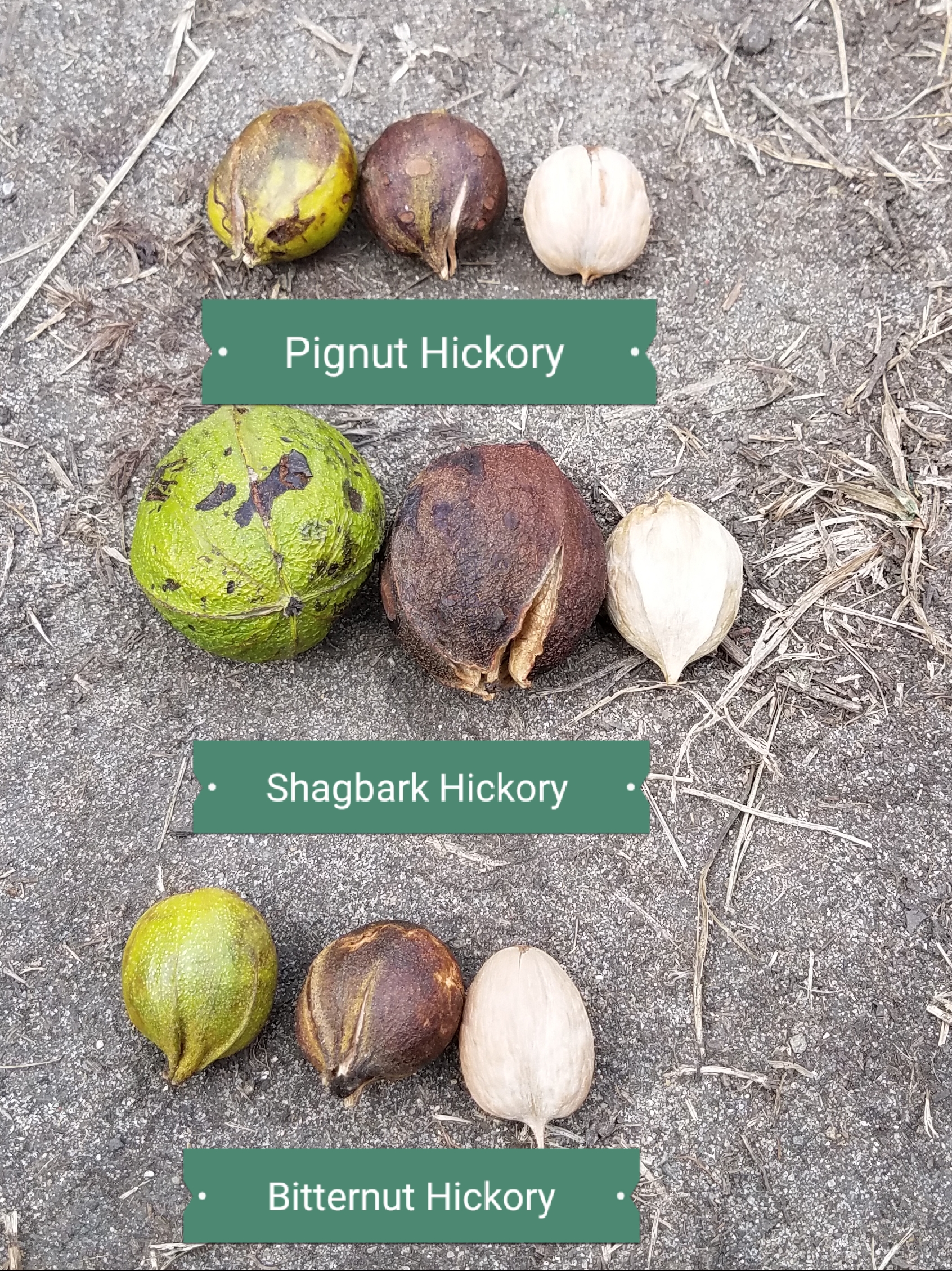
To the best of my knowledge, there are three species of hickory nut trees in Eliza Howell: Bitternut Hickory, Shagbark Hickory, Pignut Hickory. The trees are not numerous, but in some years all three produce bumper crops and the nuts are easy to find on the ground. Bitternut appears to be the most common of the hickories in the park.

This picture depicts each Eliza Howell hickory species in the progression from green nut to ripening nut to the nut after the outer hull is removed.

20180219_094534

The first clue to tastiness might be what our ancestors thought when the species got their common names. “Bitter” clearly suggests unpleasant. And identifying something as “pig feed” is not normally a recommendation for human consumption. In the past, Pignut Hickory nuts were commonly part of the annual diet of hogs.

The other species, on the other hand, was identified by its bark: the trunk has large strips of peeling bark. Calling attention to the bark helps to provide identification if one wants to locate a tree for purposes of collecting nuts. Shagbark is a hickory that nearly everyone agrees is tasty as well as edible.

20180219_100719

I have eaten Shagbark Hickory nuts many times. We collected them every Fall for Winter eating when I was young. Having no memory of ever eating Bitternut or Pignut, I browsed the reports and descriptions of others. There appears to be general agreement that Bitternut nuts are not tasty, but there is less agreement on Pignut. Most, but not all, describe it as unpleasant to eat.

I decided to do a taste test. I harvested a few nuts of each species in the Fall and this February I ate some of each.

The Shagbark was enjoyable, as remembered.

I found little difference between Bitternut and Pignut. My assessment of these two: On the one hand, if I were hungry, they would serve as an acceptable source of nutrition; on the other hand, I do not intend to bring them home to eat. I am perfectly pleased to let wildlife have them (and I do see from the evidence in the snow that squirrels have, in fact, been using them for Winter food this year).

20180219_094954

There is an old Roman (Latin) saying: “De gustibus non est disputandum.” We should not dispute matters of taste. What one person likes another might not – and that does not make either wrong. My opinion on the taste of the different hickory nuts found in Eliza Howell Park is just one person’s opinion. But this coming Fall, when asked if the hickory nuts we step on are edible, I can at least speak as one who has tasted them.

Deer Tongue for Dinner

0

deer_tongue_1_574_372_s

About a dozen years ago, I began to feel guilty about leaving gut piles behind in the woods after field dressing a whitetail. I was uncomfortable knowing my wife Elaine and I might be wasting edible items after butchering an animal. We first tried cooking the heart, which we found to be delicious. Then we tried liver, which smelled great when it was being cooked, but the taste was, well, not very appealing.

Our next experiment involved the tongue – rather I should say “my” experiment, as Elaine just couldn’t bring herself to try this organ. My reasoning was that in the 1800s, Americans regarded buffalo tongue as a delicacy, and it became a high dollar entrée in the country’s best restaurants. So, why wouldn’t a deer’s tongue prove to be equally scrumptious?

Several years ago, I crock-potted my first deer tongue and found it to be tough and unappetizing – thus ending the research on that potential menu item. But this past year, while reading about cooking animal organs, I discovered that mammal tongues are covered by a sheath that must be peeled off, which I had not done on my initial kitchen test.

Intrigued about trying tongue again, I again crock-potted this organ, removed the sheath, sliced it into small pieces, and ate it on brown bread with sharp cheddar cheese and mustard – the same way I prefer heart. The tongue was quite tasty, possessing a milder flavor than heart but nevertheless very appealing and featuring a somewhat light, delicate taste.

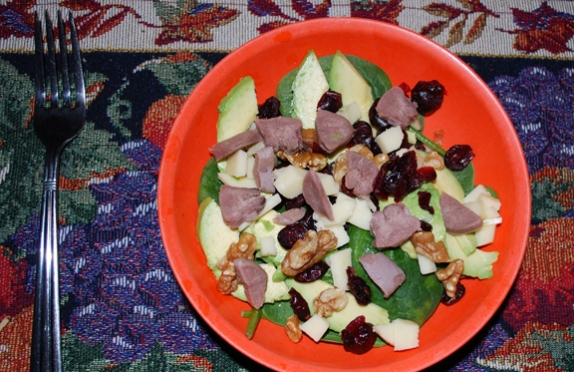
Experimenting again, I found that deer tongue, as the prime player, makes an excellent salad. I’ve included a recipe below.

First, for those deer hunters who like to experiment with the organs and various uncommon cuts of a whitetail, I have a few questions. If you can help, please comment below.

Ribs: Have you ever cooked venison ribs? How do you remove the ribs from the deer, and how do you prepare them?

Lungs: I’ve heard that deer lungs can be made as part of a haggis recipe. Has anyone tried this?

Bone marrow: Native Americans ate deer bone marrow. Does anyone still do that?

Kidneys: Thoughts?

Intestines: Many folks relish chitlins, which are fried hog intestines. Anyone ever tried doing that with a deer’s intestines?

Mystery Meat: Once, a widow who let me hunt on her land asked me to bring her a deer liver if I was successful, so I did. Later, she called to thank me for including the gall bladder because it also “cooked up nicely” as part of her meal of fried liver and onions. The problem is, deer don’t possess gall bladders. To this day I wonder, what was the organ this lady ate?

Thanks for any ideas you can offer, and here’s that recipe.

Deer Tongue Salad

In a crock pot, cook the tongue on high for three hours. I’ve removed the sheath immediately after cooking and also after refrigeration. I’ve found it works better to cook and then chill the tongue before removing the sheath.

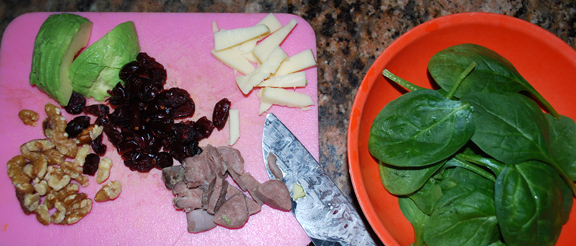
On top of a bed of spinach, thinly slice the chilled tongue and add sharp cheddar cheese, black walnuts, cranberries, and slices of avocado – my favorite add-ons. Feel free to experiment with your favorite vegetables and cheeses, and let me know the results.

deer_tongue_2

Best Glock Triggers [Hands-On Tested]

0

There’s no doubt about Gaston Glock’s pistol, it’s a good gun.

But can it be better?

Absolutely.

One of the most obvious improvements would be an upgraded trigger system. There are roughly a million different upgrades for the trigger out there…so how do you choose?

That’s where we come in…we’ve bought, used, and tested the most popular triggers over thousands of rounds.

Obligatory disclaimer that you should have a qualified gunsmith install and test all this stuff.

THE QUICK LIST

Stock Glock with 25 Cent Trigger Job & 3.5 lb Connector

Let’s establish a baseline trigger.

Many will say to get a better Glock trigger, you just have to shoot it. And they are right.

Thousands and thousands of rounds (or dry-fire) will polish up the internals and make the trigger much better. Not custom 1911 level…but better than when you bought it.

We cover how to do the infamous Glock 25 Cent Trigger Job with some polishing compound and Dremel.

Another affordable upgrade I do is upgrading the stock 5 lb connector with a Lone Wolf or Ghost 3.5 lb connector. If you built a Polymer80 Glock with a Lone Wolf frame kit…you already have the 3.5 lb connector.

Doing both in my G19 brings the trigger pull down from around 6 lb 6 oz to 5 lb 4 oz and makes it much crisper and with a smoother reset. Perfect for general purpose and maintaining the stock safeties.

Here’s a quick video on the first pull and reset so we have a baseline for the others.

Perfectly manageable, but still room for improvement!

Best Glock Triggers

1. Apex Tactical Glock Enhancement Trigger

Apex is well known for improving the turd of a trigger that comes on Smith and Wesson M&Ps, especially the first models that hit the streets. Obviously, they’ve expanded, or they wouldn’t be on this list.

Apex’s Glock Enhancement Trigger came out a few years ago and is one of the most affordable drop-in trigger systems.

When I say drop-in trigger…I mean it.

It’s a self-contained system with a trigger, trigger bar, and disconnector all built together. You remove your standard Glock guts and fill in the blank. It’s a very simple installation process and very convenient.

The Apex trigger gives you a quick stop initially, so you know when to ease and squeeze the trigger. There’s some minor pull before a clean break.

Also, a much shorter reset that’s followed by a similar pull and clean break again.

Red not doing it for you…they have purple and black too.

One big difference is the flat-faced trigger that still maintains the safety features of the standard Glock. I definitely like flat-faced triggers after using the Apex a bunch. It’s also a little meatier than the other triggers, which I like.

You can combine upgrades with the Zev Competition Spring kit, which I heavily recommend. With it and a polish job…my trigger pull is 5 lb 7 oz and much smoother.

However, I found with mine that I got light primer strikes with the use of the reduced weight striker spring. So be sure to test.

If that happens to you…you might need the Zev Skeletonized Striker ($79) to take full advantage of the springs.

The Apex Glock trigger is my pick for best bang-for-the-buck since it looks cool, is reliable, improves upon the stock trigger, and is priced right.

What’s your take on the Apex trigger? Rate it below.

2. Velocity Trigger

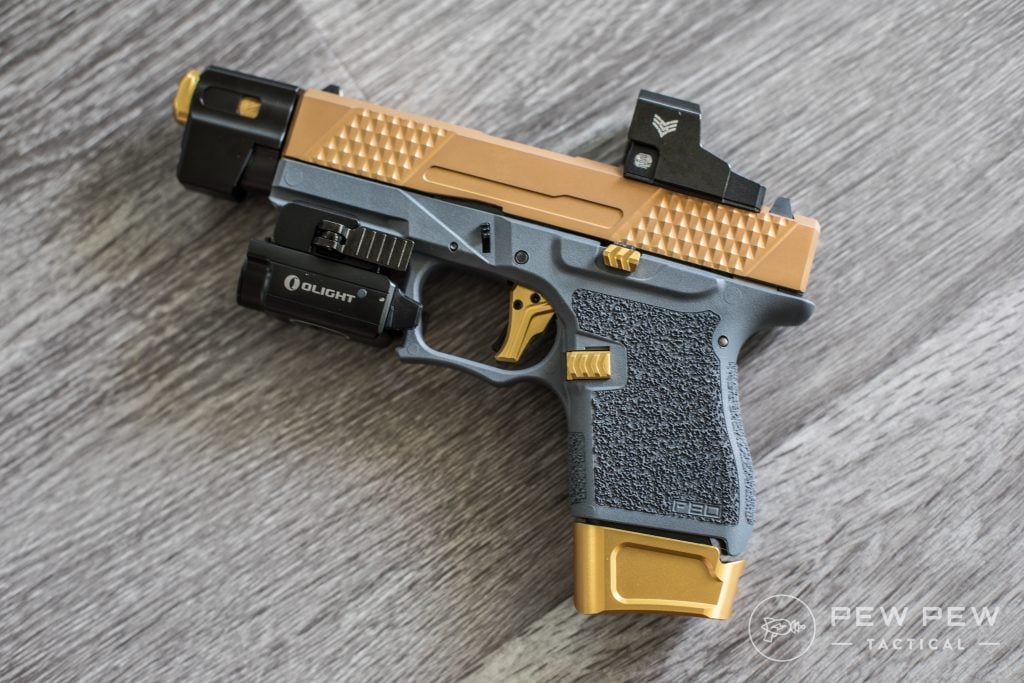
This Velocity Trigger I got sent for testing, and I put it in a new Polymer 80 build with a SeeAll Sight and matching gold Faxon Barrel.

It’s much thinner than the Apex or stock Glock trigger. The flat-faced trigger is also ridged for your finger’s pleasure with a lower-activating safety.

With stock springs and only a 3.5 connector, I was getting 4 lb 12 oz. With the competition spring kit…it should go down some more.

However…one big thing I didn’t like was that in my P80 build and my style of pressing the trigger (pretty high up with thin fingers)…many times, the “safe-action” trigger wouldn’t engage. And I’d be left with no PEW.

Whatever at the range…annoying at a competition…but potentially deadly in a real-life encounter. Not that I would recommend having anything modified on your gun for self-defense.

Otherwise, the trigger was great…longer pull after the initial stop and a nice click.

I would recommend for competition/range if you’re finger placement is usually on the lower half of the trigger or if you have thicker fingers than I do.

3. Overwatch Precision Trigger

The Overwatch Precision is from another P80 build. It also has the competition spring kit.

With everything…I get a super soft 2 lb 12 oz trigger pull. However…it’s pretty spongy when compared to the other triggers. Nice reset, though.

But…runs into the same safety reset problem as with the Velocity (so make sure you press lower or have thicker fingers).

My pick if you really want a light trigger pull throughout. I personally prefer less spongy (even at the expense of pull-weight), so this is my least favorite trigger out of all the series.

4. Zev Fulcrum Ultimate Trigger

My favorite trigger that lives in my G34 for competition shooting. What I’ve shot the most besides stock Glock triggers.

It breaks the cleanest without a lot of pre-travel and no mushiness. Combined with a little 25-cent trigger job polishing and the lightest springs…it comes in at under 3 lb 10 oz.

It’s not much to look at when installed…but the kit comes with an entirely new trigger assembly, lightened springs, and lightened striker (or else sometimes, when you only change springs, you get light primer strikes).

Plus…adjustable pre-travel and over-travel to get YOUR perfect trigger pull. This all comes at a price, though!

5. Tyrant CNC ITTS Trigger

Want a nicer-looking trigger but don’t want to change your trigger pull?

You can check out the Tyrant CNC ITTS Trigger, which replaces the trigger shoe with something purrty.

Fully Modded P80 PF9SS (Glock 43)

Easy enough to install with instructions right here.

It keeps your original trigger pull for safety reasons but makes your Glock look a whole lot better!

Tyrant CNC Glock
Tyrant CNC Glock

And while it doesn’t change the performance of the pull, that machined aluminum sure does feel nice. They come in different color combinations too!

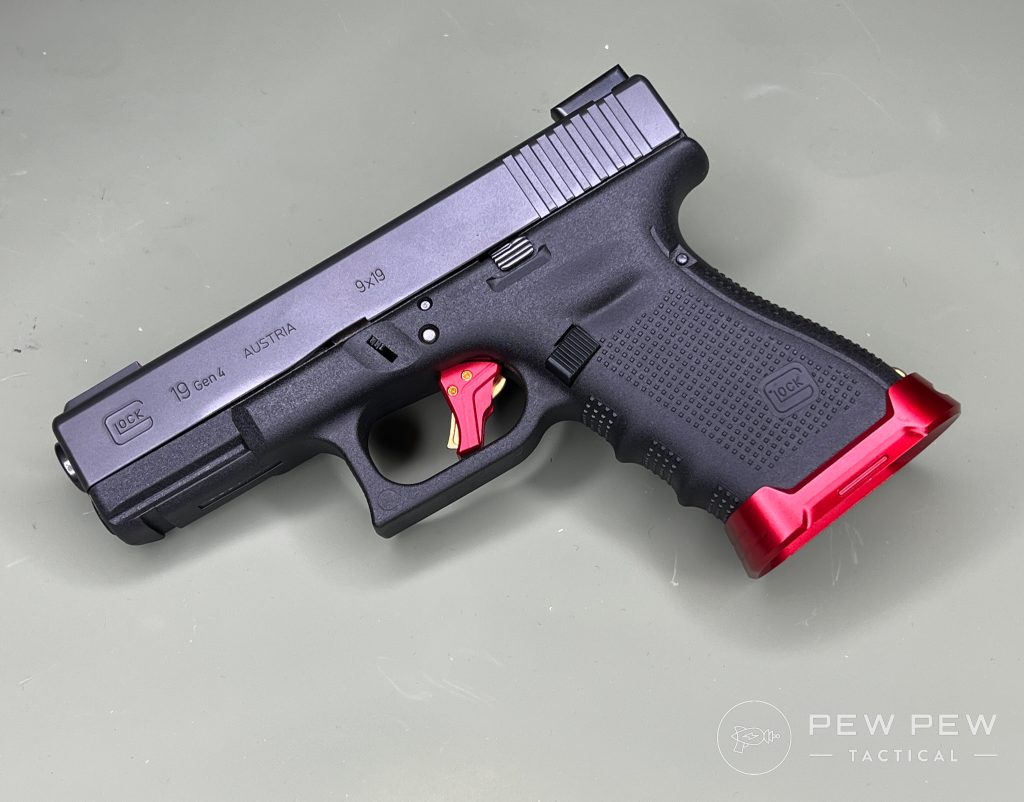
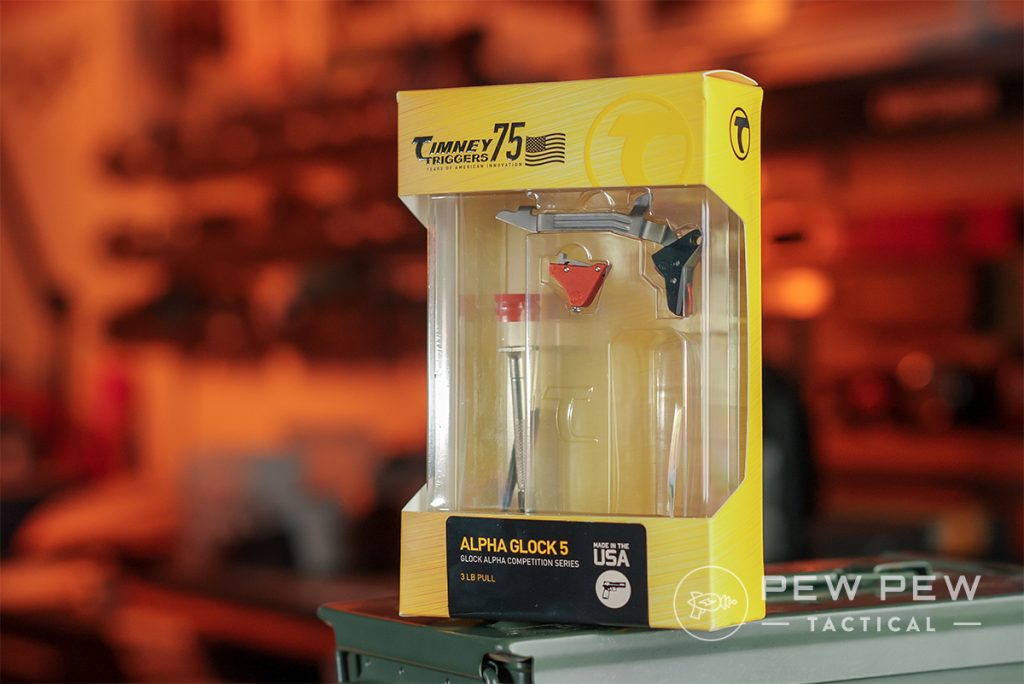
6. Timney Alpha Glock 5

First off, I like the Gen 5 Glock trigger and consider it to be a significant improvement over previous generations.

Pressing back on the trigger, it travels back a few millimeters with minor resistance before stopping at a pretty well-defined wall. Pushing beyond this, the trigger breaks crisply at an average of around 4 pounds on my Lyman Digital Gauge.

Timney Alpha Glock 5

Reset occurs after a slight release and is both audible and tactile. It’s a great trigger for a striker-fired gun, and I have definitely gotten used to it.

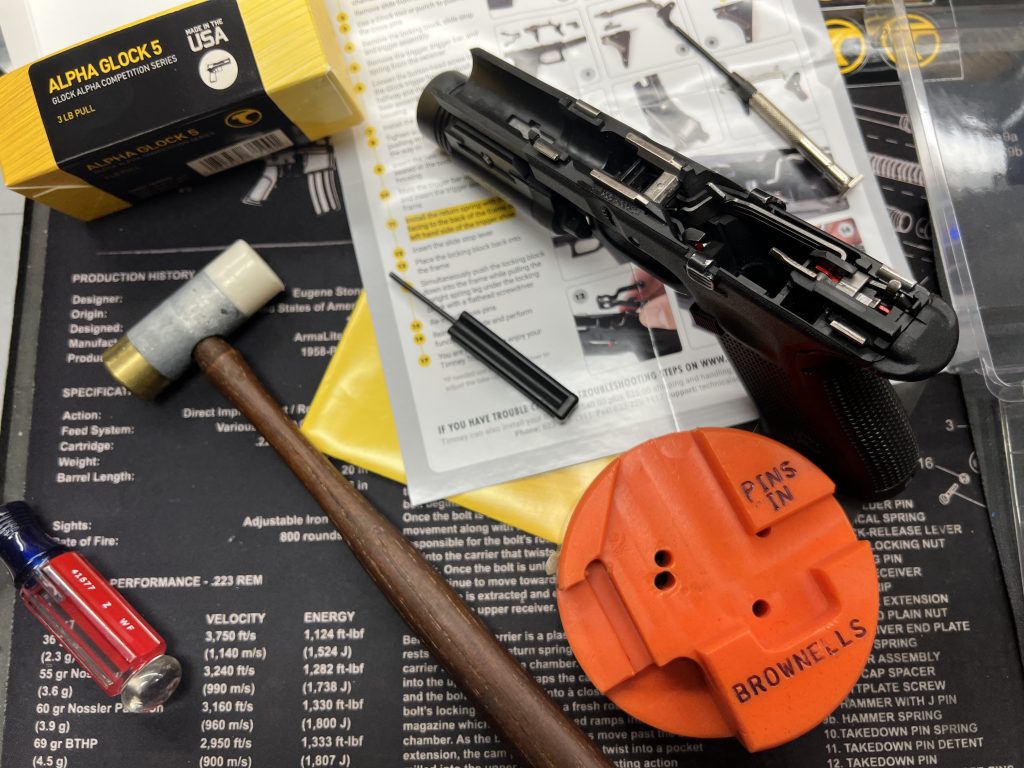
Given Timney’s overall reputation in triggers, I was excited to try the Alpha Glock 5. So I cracked open the package and started putting it in.

Timney Alpha Glock 5 install
Hold your mouth jussssst right

Installation was a little challenging due to the small parts, but the instructions were detailed and included good photos. Then, the trigger return spring has to be compressed on the inside of the locking block while installing the locking block.

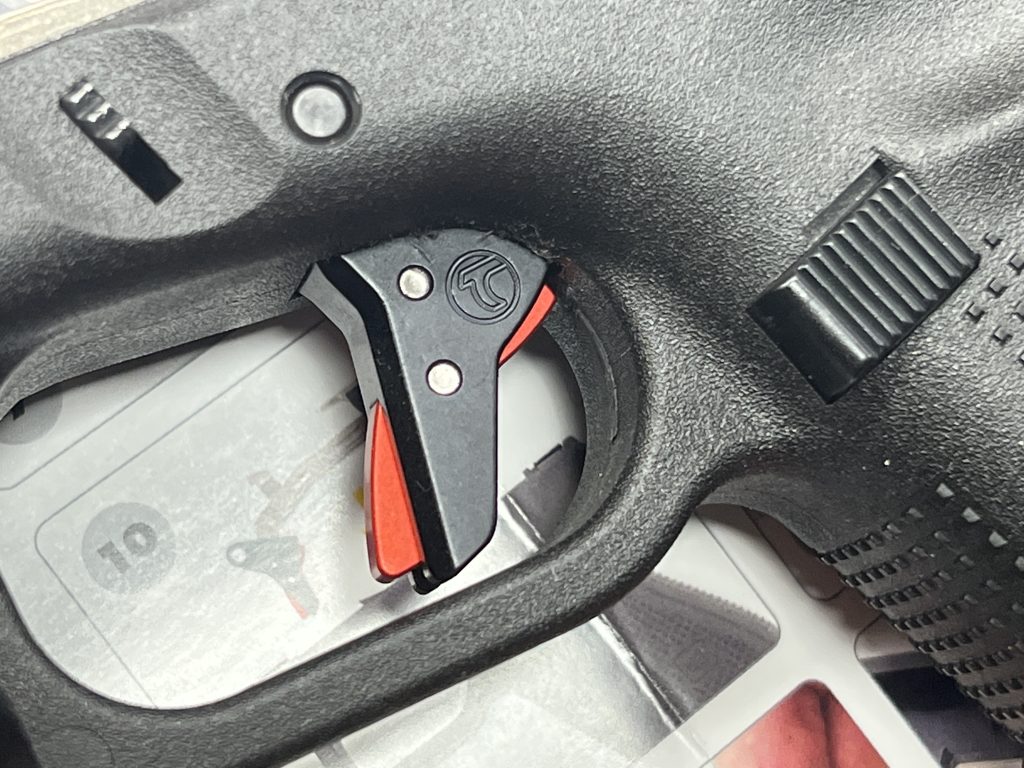
After installing, I noticed the surface of the all-aluminum trigger shoe was smoother, and the interface with the safety bar in the trigger was also smoother.

The pull weight felt lighter, and I confirmed this on the gauge at an average of 2.5 pounds.

Timney Alpha Glock 5 safety
Smooth and pretty

During press, the previously defined wall before break felt softer. And finally, trigger reset felt a bit longer to reach but was still audible and tactile.

Out at the range, the trigger truly shines with a performance you soon become accustomed to and can repeat easily. It’s a great upgrade for around $150.

Honorable Mentions

There are a lot of Glock triggers. Here are some honorable mentions:

  • Agency Arms ($160): Pretty good as well…but I’d still take the Apex with the spring kit. Personal preference, though…tons of people love it.
  • Lone Wolf Adjustable ($75): The P80 kit trigger is actually pretty good…and this adjustable upgrade is not too shabby either.
  • CMC Trigger ($170): Another popular one, but was meh to me when I tried it.

Final Thoughts

We can all agree that sometimes swapping out a Glock factory trigger for something a little nicer can make all the difference when it comes to shooting.

Best Glock Triggers [Hands-On Tested]

And hopefully, we’ve given you some options to kick your Glock up a notch.

How did we do…what other triggers did we miss that we can test for the next update? Let us know. For a perfect trigger tune-up, make sure to grab a trigger pull gauge. We have our recommendations here!

What Color Eyes Do Coyotes Have At Night?

0

Coyotes- Coyotes have big eyes that glow bright white in the dark.

Also, Do You Know What color do coyote eyes glow in the dark?

fiery white glow Coyotes, wolves and dog’s eyes usually have a fiery white glow. A bobcat’s eyeshine is yellowish white. A bear’s eyes will glow fiery orange. Night eyeshine is not only exhibited by some of the mammals, reptiles and amphibians.

Generally What animals eyes glow green at night? Felines, both big and small, will have a heavy upper eyelid, and a pupil that is perpendicular to the shape of the eye. The eyes of cats will grow green in light at night. Deer, on the other hand, will have a larger and rounder, less oval, shape.

Here You Can Watch The Video How to Make Brown Eyes POP | BLUE EYELINER Makeup

Similarly, EYELINER : colors for brown eyes | which suits best ???

Frequently Asked Questions(FAQ)

What color eyes do deer have at night?

The eyes of a deer may appear black or brown during the day; however, during the night, the color changes to yellow. The yellow shine in the eyes of different species, especially those of a deer, occurs due to the tapetum lucidum.

What color is a Coyotes eye?

Unlike the exotic blues and greens of domestic dog eyes, which humans have selectively bred for around 8,000 years, coyote eye color lies strictly within the golden spectrum, he says. (Coyote pups are born with bluish eyes that transition to yellow by about six weeks old.)

What color do racoon eyes reflect at night?

Raccoons- Raccoons have big eyes that glow bright yellow in the dark.

Do raccoons eyes glow in the dark?

Their eyes may appear to glow red at night. The eyes of raccoons have a structure called a tapetum lucidum that reflects light, allowing them to see well in the dark. When a bright light like a flashlight shines directly into their eyes, they shine red!

What color do bears eyes glow at night?

Black bear have large round eyes at night and are set closer to the ground than a deer’s. A bear’s eyes are near pupil-less and glow red or green.

Which animals eyes glow in the dark?

A large number of animals have the tapetum lucidum, including deer, dogs, cats, cattle, horses and ferrets. Humans don’t, and neither do some other primates. Squirrels, kangaroos and pigs don’t have the tapeta, either.

What animals eyes reflect blue?

White eyeshine occurs in many fish, especially walleye; blue eyeshine occurs in many mammals such as horses; yellow eyeshine occurs in mammals such as cats, dogs, and raccoons; and red eyeshine occurs in rodents, opossums and birds. The human eye has no tapetum lucidum, hence no eyeshine.

What color do dogs eyes reflect at night?

In low (dim) light eyes are more sensitive to blue than red. So a dog with a tapetum which reflects green light will have better night-vision than one which reflects red.

Which animals eyes glow in the dark?

A large number of animals have the tapetum lucidum, including deer, dogs, cats, cattle, horses and ferrets. Humans don’t, and neither do some other primates. Squirrels, kangaroos and pigs don’t have the tapeta, either.

What animals eyes reflect blue?

White eyeshine occurs in many fish, especially walleye; blue eyeshine occurs in many mammals such as horses; yellow eyeshine occurs in mammals such as cats, dogs, and raccoons; and red eyeshine occurs in rodents, opossums and birds. The human eye has no tapetum lucidum, hence no eyeshine.

What color do dogs eyes reflect at night?

In low (dim) light eyes are more sensitive to blue than red. So a dog with a tapetum which reflects green light will have better night-vision than one which reflects red.

Which animals eyes glow in the dark?

A large number of animals have the tapetum lucidum, including deer, dogs, cats, cattle, horses and ferrets. Humans don’t, and neither do some other primates. Squirrels, kangaroos and pigs don’t have the tapeta, either.

What animals eyes reflect blue?

White eyeshine occurs in many fish, especially walleye; blue eyeshine occurs in many mammals such as horses; yellow eyeshine occurs in mammals such as cats, dogs, and raccoons; and red eyeshine occurs in rodents, opossums and birds. The human eye has no tapetum lucidum, hence no eyeshine.

What color do dogs eyes reflect at night?

In low (dim) light eyes are more sensitive to blue than red. So a dog with a tapetum which reflects green light will have better night-vision than one which reflects red.

Article References…

  • https://survivalfreedom.com/identifying-animal-eyes-at-night-with-eye-shine-chart/
  • https://www.tallahassee.com/story/life/home-garden/2018/08/02/nocturnal-creatures-reveal-themselves-flash-eyeshine/892325002/
  • https://q-beam.com/blogs/news/how-to-identify-animal-eyes-at-night-by-flashlight
  • https://kidadl.com/facts/deer-eye-everything-you-wanted-to-know-about-doe-eyes-and-more

Strategies for Montana Fishing in October

0

One of the most frequent questions I am asked when visiting anglers are planning their fishing trip to Montana is “when is the best time to come out”. That question is impossible to answer so I generally try to feel out what is most important to someone: nice weather, lots of action, dry fly fishing, big trout, etc. If your top priority is catching big brown trout the answer is easier: October. There is no better time to fish Montana for large trout than October (and even November). Brown trout which tend to make up the majority of the trophy size trout that we see each year spawn in November and early December. Browns are notorious for becoming more aggressive prior to the spawn.

The aggressive nature of browns in the fall combined with the fact that they are on the move running up river and sometimes into tributaries can produce some heart stopping action for lucky and persistent anglers. Late fall fishing isn’t just about targeting huge trout, there can also be some great dry fly fishing over the baetis hatch. For most of our guides, however, we get caught up in chasing really big fish in the autumn months. Hunting huge browns in the fall isn’t for everyone and if you are going to play the game there are a few important guidelines worth considering.

Dress for Success October and November in the Northern Rockies can be notoriously unpredictable. Days can be warm and sunny or the snow can be blowing sideways. Make sure you prepare for any kind of weather from hot and sunny to cold and wet. If you are travelling all the way to Montana to chase big October browns you don’t want to be shut out just because some bad weather blows in. Although October and November are dry months, there will always be some early winter storms that move through and these often produce great conditions for browns that love low light conditions. I still wear gore tex waders but I also have long underwear and fleece pants to layer underneath as well as plenty of layers on top. Don’t forget the gloves and winter hat either.

Arrive at Peak Times Although big browns begin moving in late September, the best fall run fishing isn’t until after the middle of October and sometimes as late as mid November. The peak fishing on the Madison run above Hebgen in Yellowstone is usually the third week of October while monster browns on the Missouri usually don’t start showing up until November.

Throw Giant Streamers Most anglers know that big browns are predators and that fishing streamers is a great way to target them. If you are going to throw streamers in the fall don’t underestimate how big of a fly a huge brown will eat. I have seen big browns regularly eat relatively big trout in the 15” range – they often can’t swallow them all at once and spend a day with a big tail sticking out of their mouth. If you want to move fish over 24” make sure you are stripping the biggest streamers that you can find. I usually have to tie my own tandem hook streamers that are around 10” long. These massive flies are best fished on a seven or eight weight. They won’t put you into many small trout but if you throw them long enough you are sure to see some huge fish at some point.

Try Egg Patterns Whitefish, brown trout and brook trout are all fall spawners which means there are a lot of eggs bouncing around the rivers in October and November. Although huge browns tend to prefer a big meal, eggs are so packed with nutrients that even the largest browns will still eat them. There are days when fishing egg patterns under an indicator will outfish every other method for big browns.

Target Spawning Runs Although any large river that holds big browns can produce a monster in the fall, targeting fisheries that receive a spawning run of browns from a lake or larger river downstream is a good option in late October and November. Most of these fall run fisheries are no secret. Expect to see some other anglers if you are chasing browns on these fisheries that include the Madison in Yellowstone Park, The Lewis Channel in Yellowstone and the Missouri between the lakes. There are other locations that aren’t as well known that also produce a great run of fall browns if you do some legwork and experimenting. Even on the famous fall run fisheries like the Madison in the park there is always plenty of room and on a weekday with a bit of fall weather you will often see very few other anglers. November fishing is also extremely productive and the fishing pressure dramatically drops off with very few visiting anglers in the state and most of the locals out hunting.

Limb Lines For Catfish – The Complete Guide

0

Limb lines are an extremely effective and simple method of catfishing. Typical limb lines for catfish setups involve nothing more than stout twine, a heavy sinker, a strong swivel, a sharp hook, and a tasty piece of bait. Instead of attaching this to a fishing pole, you tie it to a supple green limb overhanging the water and motor away to go do other things. In your absence, the limb fights the fish. Clever anglers may set a dozen or more of these lines, and let them “soak” for a couple of hours while they fish with a rod and reel nearby. If they’re lucky, they’ll soon be blessed with a “tree shaker,” a catfish so big it makes the whole tree sway as it struggles to return to deeper water!

Are Limb Lines Legal?

In most cases, yes! Most states allow limb lining in one form or another. In places where catfish are plentiful (throughout most of the southern and midwestern United States) regulations generally permit limb lines, trotlines, and other forms of setlining. Some states may have restrictions on the number of lines or hooks you can have out at once, and most require that the lines be tagged with the owner’s information. It’s important that you read up on your state’s regulations and clarify any questions with local authorities before you begin setting limb lines for catfish.

Limb Line Fishing

Some catfishermen look down upon limb lines, claiming that they don’t require any skill. It’s true that limb lines do set the hook and play the fish for you. But limb lines are to rod and reel fishing what trapping is to hunting. It’s a different way to accomplish the same goal, and you put in all of the hard work and planning on the front end of the project. There is definitely an art to setting limb lines.

limb lines for catfish
Look for banks with a lot of overhanging brush on them when you are setting your limb lines.

For this article, we were lucky enough to be able to interview Art Preller. Art is a longtime limb line fisherman on the White River and the inventor of the Port Arthur Limb Line.

How Deep To Set Limb Lines For Catfish

While many fishermen conceptualize catfish as deep water bottom dwellers, Art knows different. “Catfish are edge dwellers,” he says. “They’ll run the bank edge at night, and you don’t need a whole lot of water to catch them in. I’ve got a three foot paddle on my boat, and if I see a limb that looks good I’ll go over and stick that paddle in the water. If it’s got three feet then I’ll go ahead and set a line. I don’t usually fish all the way on the bottom. I’ll drop the bait down to the bottom and then come up about six inches.”

Setting Catfish Lines – Where To Put Them

We asked Art if he had any advice on what stretches of the bank were good candidates for limb line fishing.

“It depends on what you’re fishing for,” Art replied. “If you’re fishing for flatheads, bluff banks are best. If you’re fishing for channel cats or blue cats, you can really catch them almost anywhere. I like to look for banks with a lot of overhanging brush on them. And the more structure you have around on the edge of the bank, the better.”

Catfish Bank Poles/Diddy Poles – An Option When You Don’t Have A Limb

Sometimes, there just isn’t a limb handy where you want to set a hook. Art keeps a few pvc poles in his boat that can be driven into eroded bluff banks. Referred to as “bank poles” “ditty poles” or “diddy poles,” these simple devices can make you a more versatile fisherman.

Diddy poles can be made from pvc, bamboo, cane, or green willow shoots. Anglers can also purchase premade diddy poles made from fiberglass. These poles are small enough in diameter that they can be set on sunken timber with the aid of the appropriately sized drill bit. If you’re looking to purchase some premade diddy poles, Catfish Getters offers them in several sizes and configurations.

Limb Lines On The River

When setting limb lines on the river, look for breaks in the current. If there’s a seam line in the current, catfish will lurk in the low-flow areas and wait to ambush food swept downstream. The mouth of creeks and sloughs off of the main channel can be productive areas.

setting a limb lines for catfish
If you can’t find any limbs overhanging the bank, you can attach your limb line to a diddy pole on the bank.

Structure can also provide an easy place for catfish to rest and wait for prey. Old docks, fallen down trees, and sunken houseboats or derelict vessels on the bank can be productive places.

How To Set Limb Lines For Flatheads

Flathead catfish are highly regarded by serious catfishermen. “Flatheads are kinda like the crappie of the catfish family,” Art explains. “They have a very white, clean meat because they hunt live bait; they’re not scavengers like the other species.”

So how can a catfisherman target flatheads with his limb lines?

“You’ll definitely catch more flatheads with live bait,” he said. “Down here, we like to use goldfish or rice slicks.” (Editor’s note: “rice slicks” is a colloquial term for Green Sunfish (Lepomis cyanellus). “June is usually the most productive month because they’re spawning. Right now, if we set hooks with live bait, we’re running around a 25% hookup rate for flatheads.”

Best Bait For Limb Lines

What about other species? What’s the best bait for channel catfish and blue catfish?

“Nightcrawlers are always a good go-getter,” says Art. “You’ll mainly catch channel cats on them, but you can catch blues and even flatheads occasionally. You just have to be careful how you run your lines. If you’re using nightcrawlers, wait until sunset to bait your hooks. Otherwise bait-stealers like bream and gar will clean your hooks before catfish can find them.”

“As far as blues go, if you can catch a few skipjack or freshwater drum, you can cut those up and that’s a really good bait for blue cats,” Art explains. “We were out just last week and caught a 22lb blue on a piece of cut drum.”

Best Hooks For Limb Lines

Hook selection is a very important part of your limb line strategy. Catfish run the gamut from 2lb “eatin’-sized” channel cats all the way to trophy-class blue cats that can break the hundred pound mark. You’ll want to match your hook to your target fish’s size.

“I’m not really a trophy catfisherman,” says Art. “I’m just out to fill my freezer. My general rule is if a fish is too big for my filet knife, I’ll let him go. You need big fish in your water to replenish what you catch. So with that in mind, I consider a size two to size four j-hook to be about right for what I’m targeting.”

catfish
Choose your hook size based on the size of catfish you are looking to catch.

What about trophy catifsh?

“If you’re going for the big fish, those 50-80lb trophy fish, then you’ll want something bigger. I’d say a 7/0 circle hook would be about right for big fish. You’ll also want to get some bigger swivels. Big catfish are tough on your tackle.”

Best Knot For Limb Lines

For your connections to the swivel and hook, a good, no-slip knot with high break strength such as a Palomar knot is ideal. For your attachment to the limb, a good slip-knot will hold even the largest catfish, but come loose quickly and easily with a tug of the tag end when it’s time to gather your lines back up.

Best Time To Set Limb Lines

Limb lines are usually set at night during the spring and summer months. During this time, catfish feed more heavily at night as the water temperatures cool off. They’ll transition from deep, cool holes to the shallows along the shoreline in search of prey such as shad, bluegill, skipjack, crawfish, and insects.

Fishing at night also ensures that you are avoiding the “bait stealers” Art mentions. If you try to run lines during the day, you’ll have to fight with bream, gar, choupique, and even hungry turtles!

Limb Line String

Catfish are not line-shy. Heavy-duty, tarred trotline cord is strong and holds knots well, two features crucial in limb line string. Art’s premade limb lines come standard with tarred cord rated to 170lbs, plenty strong enough for even the biggest trophy catfish.

Limb Line Weights

When selecting weights for limb lines used in catfishing, it is essential to consider the size and behavior of the catfish species you are targeting. Generally, heavier weights are preferred to keep the line securely anchored to the limb or structure. The weight should be sufficient to counteract the fish’s strength and prevent it from easily breaking free. Depending on the water current and depth, weights ranging from 2 to 8 ounces or more may be suitable. It’s important to experiment and adjust the weight based on the specific fishing conditions to ensure the limb line remains stable and effective in attracting and catching catfish.

How To Make A Limb Line

Limb Line Setup

If you’d like to make your own limbline, start by gathering your materials. You’ll need heavy cord, strong swivels, sharp hooks, and some ½-4oz egg weights.

Start by cutting 2 lengths of cord; a 6-10ft main line and an approximately 2ft leader. Tie a heavy-duty swivel on one end of the main line using an improved clinch knot or palomar knot and thread an egg weight on. In heavy current, you’ll need a heavy sinker to keep your bait submerged. In slack water, use a lighter sinker.

Once the sinker is threaded, prevent it from coming off by tying a simple overhand knot on the opposite end of the line from the sinker. Then, tie a hook to your leader line. Straight-shank hooks can be attached with an improved clinch knot or similar. Circle hooks perform better when snelled. Be sure to use a hook size appropriate for the size fish you are after.

Once this is done, tie the hook and leader to the swivel on your main line. Add a tag in compliance with local regs to your main line, and your line is ready for the water!

Limb Line Rigs

It may not occur to most fishermen, but there is more than one way to rig a limb line. Most anglers will stick with the tried-and-tested Carolina and split shot rigs for limb lines. But there’s nothing stopping you from experimenting! Any live or cut bait rig that you would tie on the end of a rod-n-reel can be duplicated on a limb line. A dropshot rig is a good way to suspend bait off of the bottom, and you can experiment with multiple hooks by mimicking a high-low rig.

Catfish Limb Lines For Sale

While limb lines are simple to make, they do take up a lot of time. And if you don’t already have the hardware on-hand, it can be surprisingly expensive by the time you add up all of the materials plus time and gas to acquire them. Pre-made limb lines are an excellent option for fishermen who are short on time, or who just want to try a couple out on their next fishing trip.

Art Preller’s Port Arthur Limb Lines are an innovative take on limb lines. They incorporate a hi-vis, reflective flagging device that serves as a fish indicator, tag, and storage device. According to Art, “You can put fifty of them in a five gallon bucket and they’re all organized. And when you’re done fishing, they’re easy to pull off of the river so that you aren’t losing equipment or littering the environment.”

limb lines for catfish
Trophy sized catfish can definitely be caught on the proper limb line setup.

Limb Line Safety

Unfortunately, some fishermen give limb-lining a bad name and abandon their lines or leave them unattended for too long. This can be dangerous to wildlife and even people, especially when water levels fall and leave the hooks exposed. Animals and boaters can become hooked or entangled in an abandoned limb line, so always be sure to remove your lines when you are done with them!

Limb Line Lights

Some anglers go so far as to mark their limb lines to make them more visible. A chemical glow stick or inexpensive clip-on light can make it easier for you or unwary boaters to locate your lines in the dark. Reflective tape and hi-vis yellow, orange, or pink lines can also make it easier for you and others to see your lines.

Limb Line Tags

In most states, regulations call for tagging your limb lines. These tags generally require you to provide ID and contact information. In Alabama, for example, lines must be tagged with the owner’s name and either a phone number or fishing license number. This information helps conservation officers to identify the owners of abandoned lines.

Limb Line Storage

Perhaps the most difficult part of fishing with limb lines is keeping them organized! The more lines you run, the harder this becomes. A boat full of lines with sharp hooks and flopping catfish isn’t just frustrating, it can be downright dangerous!

Some anglers keep their lines wrapped around a section of foam pool noodle. Bury the hook point in the foam, wrap the line around the noodle, and tuck the tag end under the last wrap for a clean package that can be easily unwound when needed.

Another storage tactic is to wrap the lines around your fingers in a figure-8 pattern and secure it with a small alligator clip. The wrapped line can then be set into a compartment in a flat, stowaway-style tackle box.

Final Thoughts On Limb Lines For Catfish

In conclusion, limb lines are a highly effective and popular method for catching catfish. This traditional fishing technique combines simplicity and efficiency, making it accessible to anglers of all skill levels. By utilizing strong lines, appropriate bait, and strategic placement, limb lines offer a reliable means of catching plenty of catfish. However, it is crucial for anglers to prioritize responsible fishing practices, ensuring the safety and well-being of both the targeted species and the surrounding ecosystem. By adhering to local regulations and employing responsible fishing methods, anglers can continue to enjoy the thrill of limb lining while preserving natural resources and being considerate of other outdoorsmen.

Full Disclosure: This post may include affiliate links. There’s no extra charge to our readers for using these.

Eating Eyeballs: Taboo, Or Tasty?

0

It wasn’t the fish heads poking out of the Stargazy Pie that stopped more than a few of our readers cold. It was the eyeballs.

“Not a lot of food nowadays has eyes; what’s up with that?” one reader asked in commenting on a recent Salt post that featured a photo of the historic dish, which involves whole fish (eyes and all) poking out of a pie.

Turns out, quite a lot of cuisine features eyeballs. But there’s no question that in many cultures, eating eyes is a food taboo.

I first ran afoul of this when I cooked up ukha, a famous Russian fish soup, for a group of friends. The fish heads make for a beautiful clear broth, and my husband, who grew up in Kamchatka, wanted to make sure those big old heads swam in his bowl.

Alas, when the bowls were laid out, the one with fish eyes staring balefully upward landed in front of the most fastidious eater in the room. He has never dined at my house again.

So I called James Serpell, director of the Center for the Interaction of Animals and Society at the University of Pennsylvania, and asked why eyes creep people out.

“Eyes represent faces,” he said, “and it’s through the face that we learn to recognize and empathize with others. So it’s not entirely surprising that we find eyeballs disconcerting.”

Serpell learned that firsthand when he sat down to eat with a family in Iceland. They served svio, or boiled sheep’s head. “You get half a sheep’s head on your plate,” he told The Salt. “And you eat everything. Ears, eyes, nose — everything.”

Everything, including the eyeball. “The consistency is quite offensive,” he reports.

But even traditional Icelanders have their food taboos — the sheep head was served without the brain. “When I said, ‘Where’s the brain?’ they looked at me with horror.”

When it comes to Americans, “people in our culture are disgusted by eating any non-muscle part of edible animals, says Paul Rozin, a professor of psychology at the University of Pennsylvania who studies human food choice and disgust. “Eyes may be special because it is so clear that they are an animal part, and they have some special significance for many people.”

Maybe the eyes of other mammals are just a bit too close to home for most people. Fish eyes seem the most acceptable form of ocular cuisine, my fastidious soup-eating friend excluded. As our well-traveled readers pointed out, small fish are eaten whole in many cultures, from British whitebait to the dried fish snacks ubiquitous at Asian groceries. Elvers, tiny eels that resemble spaghetti, are popular not just in Europe but also in Asia.

Indeed, Asian cultures probably win the prize for not just tolerating but embracing fish eyes, both raw, as in sushi, and cooked. “I’ve had the fist-sized eye of a garoupa, steamed and garnished. (Gelatinous.),” one of our intrepid readers commented. “And in Asia fish tend to be cooked with the head on — it’s a sign of good fortune when things have a head and a tail!”

Shanghai-born food blogger Chichi Wang relishes fish eyes: “The trick to eating a fish eyeball is to keep it in your mouth for as long as possible,” she writes. “A rush of fatty fish flavor is accompanied by a gelatinous, spongy texture. Swallow too quickly and you’ll miss the nuances.”

When she was little, Wang’s mom always saved the fish eyes just for her. So when relatives recently gathered at a Cantonese restaurant, Wang offered her mom the fish eyes as a special treat.

“Take that away,” her mom said. “Fish eyeballs are really gross.”

Wang then realized that what had seemed to be the selfless act of motherhood had been instead an act of self-protection.

In the past few years, more adventurous Americans seem to be discovering fish eyes (and we’re not talking the slang for tapioca pudding). Look on chat boards devoted to the protein-rich paleo diet, and you’ll find debates on the nutritional benefits of caribou eyes.

And in Chicago, chef Cary Taylor took on the challenge of making a fish eye dish. After his fishmonger refused to provide pre-gouged eyeballs (“he said there was no way he was going to have his guys in the back cutting out fish eyeballs or they would riot,” Taylor told the Chicago Reader), the chef cooked up grouper-head soup. He then squeezed out the eyeball gel (best use gloves, he says) as a flavoring and thickener.

“It didn’t seem to be a super distinctive taste to me,” Taylor reported, though he did like the soup’s nice, fresh seafood taste. He’s now contemplating offering a free shot of whiskey to customers willing to suck the eyeballs out of a whole roasted fish.

Would you eat those eyeballs? Have you? Or is that a food that’s best left as a taboo? Tell us what you think.

Spot and stalk vs. ambush hunting: What’s the best option?

0

Josh Kirchner making a stalk on a mule deer

To spot and stalk or ambush hunt — that is the question

I have always been plagued with that dilemma ever since I started down this venture we call hunting. Growing up, we always still hunted or ambush hunted. I really wasn’t exposed to spot and stalk hunting until a few years ago. When I did go down the spot and stalk path, I couldn’t help but just want to find somewhere where I could sit and wait for that bear or buck to walk by though. In turn, when I was ambush hunting, I couldn’t stop thinking about what I could be seeing if I was glassing at that time. It was definitely a “grass is greener on the other side” scenario for me and, sometimes, it still is.

So which is better?

I feel like there really isn’t a concrete answer for this question. Everybody is different and different situations call for different types of hunting strategies. For instance, it wouldn’t be the best idea to spot and stalk hunt in country where you couldn’t see 10’ in front of you. This would call for more of a still hunting/ambush hunting approach. The whole idea behind spot and stalk is to spot the animal from a good distance away and plan a stalk in order to get close enough for a shot. Could that be done in dense country? Yes, it could. Is it the most productive way of hunting there? In my opinion, no. Let’s take a look at both applications.

Spot and stalk

Josh Kirchner glassing for bucks

This is by far my favorite way to hunt. Sitting on a high vantage point and overlooking vast open country with my binoculars brings a calming feeling to me. It’s like a never ending puzzle that is begging to be solved. Where will you see the animals? What animals will you see? Will you even see anything? If you do, how are you going to make your approach? I have learned more about deer hunting this way than any other animal. It is such an added benefit, in my opinion, to be able to sit there and watch animals from a long ways away act like themselves and do their thing. What part of the hill do they tend to walk on? What facing slope are they choosing over the others? Where are they bedding? That one is the most important, especially for a spot and stalk bowhunter. If you can glass a deer up and actually watch where it beds, now the game has really begun. Being able to do this is going to give you a lot more time to get over to where that animal is because you really don’t need to worry too much about that animal moving its position. Also, if you have never experienced the rush of sneaking up on a bedded deer or herd of elk, you are missing out. This is where our natural predatory instincts kick in and they are put to the ultimate test. Try it out sometime.

Ambush hunting

Ambush bowhunting technique

This type of hunting brings its own set of adrenaline rush. I can remember being a kid and sitting up against a tree with my dad. It was the first archery hunt that I had ever gone on. The day before we saw two or three amazing mule deer bucks and found a prominent trail leading up a fence line right towards where we were positioned for the morning. Just as the sun was peaking over the hillside in front of me, I saw antlers along with it. A beautiful old buck with a gray patch on his back slowly worked his way down towards me. I was so shaken up, I literally couldn’t pick up my bow. The old warrior walked right past me at 10 yards without an arrow to his name. That deer still haunts me.

Continued below.

goHUNT INSIDER equals better hunting research

Ambush hunting can be the most boring experience known to mankind, especially if you are a little kid. I have had the thought of bringing an audio book with me into the blind or perhaps a podcast. The hard nose in me says that this will take away from my experience and that those things don’t belong in the mountains and maybe they don’t. The plus with it, though, is that if you do see something, chances are you are going to be presented with a shot. I will admit that it is a very exciting experience hearing something walking towards you and not being able to see it until it comes into view. There is no better way to get close to game than letting the game get close to you.

Which method is the best way to go?

Spot and stalk or ambush hunt what is best

I am afraid that only you can answer that question. How do you prefer to hunt? If you don’t care, then take a look at the country you will be hunting. What application do you think is going to lend success? I myself prefer to spot and stalk as I have stated above. Because of this, I try to find country that allows me to do so. The past few months, I have been fighting with myself on how to approach my next spring bear hunt. In the past it has been a constant battle of spot and stalk or ambush hunting. In the end, I decided to do what makes me happy and plays to my strengths, successful or not. If you like sitting in a blind or treestand, then do it! If you’re like me and enjoy looking through your optics and playing “Where’s Waldo?” with the quarry you seek, then do it! You write your own story.

Best Air Rifle Deals

Popular Posts

Air Rifle Scope vs. Rifle Scope – Which One Fits Your Shooting Needs?

0
"Air Rifle Scope vs Rifle Scope: Unveiling the Ultimate Precision Optics. Discover the essential differences and benefits of these two optical devices, empowering shooters...

PCP vs Spring Piston: Which one is better?

0
When reading about guns in the search for the first one that would be perfect for you, an age-old debate comes into question. Should...

Guide to find Best Scope for Break Barrel Air Rifles

0
"Unlock the Perfect Shot: Discover the Best Scope for Break Barrel Air Rifles. Enhance your shooting experience with precision and accuracy, as we delve...