

Home Blog Page 41

10 Best Sniper Rifles For 2024

0

When it comes to the art of long-range shooting, snipers reign supreme.

Operating as a sniper is one of the most challenging and rewarding roles in any field or sport involving firearms.

The primary objective of this profession is to shoot accurately at a distance while maintaining safety and control.

To that end, sniper rifles are built for this purpose — to shoot from a distance with precision and accuracy, making them an ideal weapon for anyone interested in taking down distant targets.

This article will list some of the best models on the market today and what are some of the key features that make them so great.

Below are the 10 best sniper rifles for 2024.

Note: There is STRONG evidence that the Biden administration is steadily working towards the banning of ALL long rifles. These include ALL rifles that they deem an ‘assault weapon‘, many of which are listed below.

It is STRONGLY recommended that, if you’ve been on the fence on buying a long gun, you get off that fence and buy one ASAP.

#1. Ruger Precision 6.5 Creedmoor 24” M-LOK Bolt Action Rifle
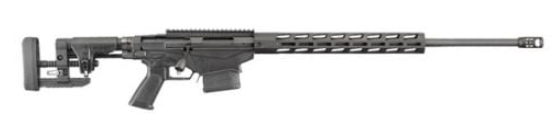
Ruger Precision 6.5 Creedmoor 24” M-LOK Bolt Action Rifle

  • Caliber: 6.5 Creedmoor
  • Action: Bolt
  • Barrel Length: 24”
  • Overall Length: 42.45” – 45.75”
  • Capacity: 10-Round
  • Weight: 10.7 lbs.

The Ruger Precision .6.5 Creedmoor 24” M-LOK Bolt Action Rifle offers premium features that will enhance your accuracy and precision down range.

This rifle is chambered in 6.5 Creedmoor making it perfect for taking down any target, including elk, boars, and deer.

It also features several features to provide you with consistent shooting down range, including a 24” cold hammer forged Chrome Moly Steel barrel, a hybrid muzzle break, and a Ruger Marksman Adjustable trigger.

Its hybrid muzzle provides enhanced recoil mitigation and reduced noise.

The Ruger Marksman Adjustable trigger provides you with a customizable trigger pull between 2.25 and 5 pounds for smooth pulls and improved control.

Another prominent feature is the Ruger Precision MSR stock with an assault rifle-style grip, an adjustable length of pull, and an adjustable cheek comb to get a customized fit for any shooter.

It also includes a 15” M-Lok handguard and a Picatinny rail up top for your favorite accessories and optics for the perfect loadout.

If you are looking for a premium sniper rifle that can easily take down your target at any range, the Ruger Precision .6.5 Creedmoor 24” M-LOK Bolt Action Rifle is an excellent choice.

It is available from Palmetto State Armory. Here’s where to buy it: www.PalmettoStateArmory.com

#2. Springfield Armory 2020 Waypoint .308 WIN Bolt-Action Rifle, Evergreen Camouflage

  • Caliber: .308 Win
  • Action: Bolt
  • Barrel Length: 20”
  • Overall Length: 41.5”
  • Capacity: 5-Round
  • Weight: 6.56 lbs.

The Springfield Armory 2020 Waypoint .308 WIN Bolt-Action Rifle is the perfect rifle for those who want a lightweight yet rugged rifle that has guaranteed accuracy.

Springfield Armory guarantees a .75 MOA because of its precision craftsmanship.

Weighing just 6.56 pounds, it is perfect for going deep in the backcountry.

Also, the hybrid profile stock and 20” barrel are crafted from durable carbon fiber and can withstand the harshest environments.

It features a Cerakote finish on the barrel and the stainless steel receiver for even more durability and longevity.

To provide over-the-top precision, it also features Springfield’s TriggerTech adjustable trigger.

The Springfield Armory 2020 Waypoint .308 WIN Bolt-Action Rifle is your best bet if you want a lightweight rifle that can handle any environment.

It is available from Palmetto State Armory. Here’s where to buy it: www.PalmettoStateArmory.com

#3. Springfield Armory M1A Loaded National Match

  • Caliber: .308 Win
  • Action: Semi-Automatic
  • Barrel Length: 22”
  • Overall Length: 44”
  • Capacity: 10-Round
  • Weight: 9.3 lbs.

Springfield Armory’s M1A Loaded National Match has the legendary M1A platform with modern features that will give you a competitive edge over your competition.

Winning competitions is all about consistency and reliability, and the Loaded National Match has everything you need to get a tight shot group.

It features a 22” National Match air-gauged premium barrel with a 1:11 twist ratio with a six-groove rifling.

The barrel also features a classic M1A Loaded long-slotted flash suppressor.

You will have precision shooting out of the box by combining the National Match .62” front sight post and a non-hooded aperture rear sight.

It also features a 2 stage Military Trigger that is fine-tuned for a consistent 4.5 to 5-pound trigger pull.

If you are looking for a sniper rifle that is custom designed to provide you with match-grade performance at a reasonable price, the Springfield Armory M1A Loaded National Match is an excellent choice.

It is available from Palmetto State Armory. Here’s where to buy it: www.PalmettoStateArmory.com

#4. Bergara Premier HMR PRO 308 5 Round Bolt Action Rifle, Mini-Chassis With Adjustable Cheekpiece

  • Caliber: .308 Win
  • Action: Bolt
  • Barrel Length: 20”
  • Overall Length: 40”
  • Capacity: 5-Round
  • Weight: 9.3 lbs.

The Bergara Premier HMR PRO 308 5 Round Bolt Action Rifle is an excellent rifle for those who want a premium shooting experience for hunting and matches chambered in .308 Winchester.

It features a Synthetic stock with an adjustable pull length and cheekpiece to get the perfect fit for any shooter.

With a 20” free-floating barrel, you will have consistently accurate shots down range.

With an upgraded bolt and feeding system, it has a premium 2-lug system that separates the floating bolt head for smooth action.

The bolt has a one-piece design and comes with a full nitride finish for enhanced durability.

The rifle also features a premium TriggerTech trigger that offers a consistently smooth pull.

It also comes with a 5-round capacity AICS-style magazine.

If you are looking for a high-performance rifle designed for hunting and matches, the Bergara Premier HMR PRO 308 5-Round Bolt Action Rifle is an excellent choice.

It is available from Palmetto State Armory. Here’s where to buy it: www.PalmettoStateArmory.com

#5. Ruger Predator 6.5 Creedmoor Moss Green 22” Rifle

  • Caliber: 6.5 Creedmoor
  • Action: Bolt
  • Barrel Length: 22”
  • Overall Length: 42”
  • Capacity: 3-Round
  • Weight: 6.6 lbs.

Ruger Predator 6.5 Creedmoor Moss Green 22” Rifle is the perfect rifle for those wanting premium features without a premium price tag.

It features a one-piece three-lug full-diameter bolt with dual cocking arms for smooth cycling.

The rifle also features a soft rubber butt pad, providing better control and recoil mitigation.

For accurate shots down range, it features a trigger with an adjustable pull between 3 and 5 pounds and a 22” threaded cold hammer forged steel barrel.

The Ruger Predator’s synthetic stock and alloy steel hardware can withstand the harshest environments.

Also, it only weighs 6.6 lbs making it perfect for long trips in the backcountry.

The Ruger Predator 6.5 Creedmoor Moss Green 22” Rifle is your best choice for a budget-friendly sniper rifle that can deliver consistent performance.

It is available from Palmetto State Armory. Here’s where to buy it: www.PalmettoStateArmory.com

#6. Sauer 100 Silver XT 6.5 Crd Bolt Action Rifle

  • Caliber: 6.5 Creedmoor
  • Action: Bolt
  • Barrel Length: 22”
  • Overall Length: 42”
  • Capacity: 5-Round
  • Weight: 6.68 lbs.

The Sauer 100 Silver XT 6.5 Crd Bolt Action Rifle is an excellent entry-level rifle that is perfect for taking your targets down at a distance.

It is chambered in 6.5 Creedmoor and has several features to provide an excellent shooting experience.

With a synthetic fixed Ergo Max stock, it will provide enhanced comfort and control.

It also features a 22” cold hammer forged steel barrel with a Cerakote finish for improved longevity and durability.

Other features include a three-position safety, an adjustable single-stage trigger, and steel hardware.

The Sauer 100 Silver XT 6.5 Crd Bolt Action Rifle is a top choice if you are looking for a solid-performing entry-level bolt action sniper rifle.

It is available from Palmetto State Armory. Here’s where to buy it: www.PalmettoStateArmory.com

#7. Savage Arms Axis II Precision 6.5 Crd Bolt Action Rifle, Matte OD Green/Black

  • Caliber: 6.5 Creedmoor
  • Action: Bolt
  • Barrel Length: 22”
  • Overall Length: 42.5” – 43.5”
  • Capacity: 8-Round
  • Weight: 9.88 lbs.

Savage Arms partnered with Modular Driven Technologies to introduce the Savage Arms Axis II Precision 6.5 Crd Bolt Action Rifle.

It includes an exclusive MDT chassis and many other features to provide precision shooting without destroying your bank account.

It features an aluminum stock with a beautiful matte olive drab green/black finish.

The stock features an adjustable comb height and length of pull spacers to get an excellent fit for enhanced control and comfort.

It also comes with a 22” carbon steel barrel that is button rifled for improved durability and accuracy.

An excellent feature is the M-Lok forend that allows you to customize your loadout.

With a 2.5 to 6 lb adjustable AccuTrigger, you will have smooth and consistent trigger pulls that ensure you will take down your target.

With its many features at an excellent price point, the Savage Arms Axis II Precision 6.5 Crd Bolt Action Rifle is a top pick.

It is available from Palmetto State Armory. Here’s where to buy it: www.PalmettoStateArmory.com

#8. Howa M1500 Australian Precision Chassis 6.5 Crd Bolt Action Rifle

  • Caliber: 6.5 Creedmoor
  • Action: Bolt
  • Barrel Length: 24”
  • Overall Length: 44.5” – 47.5”
  • Capacity: 10-Round
  • Weight: 10.8 lbs.

The Howa M1500 Australian Precision Chassis 6.5 Crd Bolt Action Rifle specializes in modularity and accuracy with its fine-tuned components.

It comes with a LUTH-AR MBA-4 fully adjustable stock with a variable length of pull of 12” to 15” for a precise fit.

With a 24” threaded precision barrel, ten-round capacity, and an M-Lok free float handguard, you can have the perfect loadout to keep a target engaged no matter the distance.

Howa backs its product with a lifetime warranty and a sub-MOA guarantee.

If you want guaranteed performance with tons of customization, the Howa M1500 Australian Precision Chassis 6.5 Crd Bolt Action Rifle is a perfect fit for you.

It is available from Palmetto State Armory. Here’s where to buy it: www.PalmettoStateArmory.com

#9. Daniel Defense Delta 5 Pro 6.5 Creedmoor Rifle 24”

  • Caliber: 6.5 Creedmoor
  • Action: Bolt
  • Barrel Length: 24”
  • Overall Length: 40.25”
  • Capacity: 10-Round
  • Weight: 11.4 lbs.

The Daniel Defense Delta 5 Pro 6.5 Creedmoor Rifle 24” has custom enhancements that you will not find in your average long gun.

It features an interchangeable 24” proprietary steel blend barrier with a Cerakote finish and an Area 419 Hellfire Muzzle Brake.

The Area 419 Hellfire Muzzle Brake provides reduced recoil and muzzle rise, allowing you to reengage your target quickly.

It also comes with an adjustable Timney Elite Hunter single-stage trigger, an M-Lok handguard, an AR-15 grip attachment, and an ergonomic thumb rest.

The synthetic stock also has an adjustable length of pull, butt pad height, and cheek riser for a fantastic fit.

Pair all that with an included ten-round PMAG, and you get an excellent package.

A downside to the Delta 5 Pro is its price, but every inch of it is well worth the price tag.

If you want a feature-rich sniper rifle perfect for newcomers or professionals, the Daniel Defense Delta 5 Pro 6.5 Creedmoor Rifle 24” is an excellent choice.

It is available from Palmetto State Armory. Here’s where to buy it: www.PalmettoStateArmory.com

#10. Springfield Armory M1A SOCOM-16 .308

  • Caliber: .308 Win
  • Action: Semi-Automatic
  • Barrel Length: 16.25”
  • Overall Length: 37.25”
  • Capacity: 10-Round
  • Weight: 8.8 lbs

The Springfield Armory M1A SOCOM-16 .308 brings everything shooters love about the standard M1A and makes it compact.

This version has a shorter 16.25” barrel and gas system with an overall length of 37.25”, making it perfect for maneuvering in tight spaces.

Its black composite stock is impervious to harsh weather and is comfortable to fit in the pocket of your shoulder.

The iron sights on the M1A SOCOM-16 are top-notch, with an XS Tritium front sight and a classic M1A rear sight.

One of the best things about this rifle is that it is semi-automatic with a ten-round capacity that enables you to continually engage your target without interruptions.

A unique feature of the M1A SOCOM-16 is that it comes with a forward scout-style Picatinny rail to accommodate close-quarters optics.

It also features a two-stage match-grade tuned trigger for crisp trigger pulls.

If you are looking for a premium rifle that will deliver at short or long distances with a semi-automatic action, the Springfield Armory M1A SOCOM-16 .308 is a clear winner.

It is available from Palmetto State Armory. Here’s where to buy it: www.PalmettoStateArmory.com

Semi-Automatic Vs. Bolt Action

Based on the shooter’s preference, they may desire a bolt action or semi-automatic rifle, but what is the difference?

Fire Rate

The most significant difference is that semi-automatic rifles can fire follow-on shots much faster.

In the long run, you can engage a target more effectively with a Semi-automatic sniper rifle.

Recoil

Bolt action rifles will tend to provide more accurate follow-on shots because of the way gas is expelled differently between the two.

Semi-Automatic rifles use some of the gas for expelled rounds to charge the weapon for another shot.

While doing this, the gas is pushed back towards the rear, and the bolt slams into the buffer spring.

Bolt action rifles only have one stage of recoil, where the recoil is pushed directly into the shooter’s shoulder pocket.

Moving Parts

While a high-quality semi-automatic rifle will have consistent performance, it is still more likely to malfunction due to having more moving parts.

.308 Winchester Vs. 6.5 Creedmoor

.308 Winchester and 6.5 Creedmoor are two of the most common rounds fired by snipers and for a good reason.

They offer plenty of power to take down your target at any range.

What Is The Difference?

Round Variety

The .308 has been around for decades with plenty of different variations in weight and complexity from lightweight 125-grain to heavier 180-grain rounds.

With the 6.5 Creedmoor, the heavier rounds are typically 1437-grain.

The .308 Winchester will generally be easier to get and is cheaper.

Recoil

The 6.5 Creedmoor has slightly less recoil than the .308 Winchester.

Ballistics

Both .308 Winchester and 6.5 Creedmoor do an excellent job at providing the ballistics you need to take down your target.

However, the 6.5 Creedmoor has better ballistics, allowing the round to have a flatter trajectory for long distances.

Final Verdict

For long-range precision shooting, the 6.5 Creedmoor is the way to go.

However, if you are the average hunter who will engage their target at less than 300 yards, the .308 Winchester is a better choice.

References

Bolt Action or Semi-Automatic for Long-Range Competition?

6.5 Creedmoor vs. .308 Winchester

See Also

12 Best Long Range Rifles

9 Best AR-10 Rifles

12 Best 308 Rifles

10 Best .22 Caliber Rifles

9 Best Rifles For Home Defense

Featured Image: GetArchive.net

Affiliate Disclosure: This post may contain affiliate links. If you click and purchase, I may receive a small commission at no extra cost to you. I only recommend products I have personally vetted. Learn more.
The Best Angle Compensating Rangefinders & Beginners Guide

0

When laser rangefinders hit the market, they did more than just replace the shoddy rangefinders of the past.

With advanced technology and innovative features put into the mix, laser rangefinders came with greater durability, longer range, and better performance.

There’s no doubt the better features such as built-in pressure sensors, wind calculators, and ballistic drop corrections are what make laser rangefinders a must-have in the field.

But the one feature that’s highly underestimated and no hunter should go without ever again, is Rangefinder Angle Compensation.

When you’re in your tree blind, out in the canyon, or in mountainous terrain, you’ll need a laser rangefinder to make sure you get the right distances to your target. Trying to eyeball a distance can be risky. You could end up with a misplaced shot.

Now, trying to eyeball a distance while on an incline or a decline can end up being a disaster of a shot. But if you have an angle compensating rangefinder that can do the math and the measuring for you, you’ve just improved your chances of taking home your prey. Make way now for Angle Compensation.

Angle Compensating Rangefinder: To Have or Not to Have?

Every long distance shooter, whether it’s the bow or rifle you prefer, knows that gravity is like the third wheel that you just can’t get rid of. So you make room for it, and every shot you make in the field, you compensate for its effects. There’s two distances that need defining if you want to get an accurate shot.

  • Line of Sight: the actual measured distance between you and the target
  • True Horizontal Distance: the distance which gravity will act over; the distance you’ll need to aim for

Of course, if you’ve got the perfectly flat terrain with the broad side of that elk facing you from about 40 yards, then the line of sight distance is going to be the same as the true horizontal distance.

Gravity won’t have much of an effect to affect either the bow or the bullet. Some people decide to forgo the angle compensation feature, saying it just makes a rangefinder more expensive than it needs to be since you can get by without it. “It’s only a few yard difference” says the skeptic.

However, no matter how ideal the perfectly flat terrain can be or how good your distance estimating skills are, hunting can take you to high-angle areas that just might show you how much of a difference those five yards can make.

Errors between 20 to 25 percent can make all the difference. For the bow hunter, that could be a complete miss. For the rifle shooter, a 20 percent error at 200 yards is a 40 yard difference. That could also be a complete miss or worse, a wounded animal.

“But why would shooting at a target on an incline or decline make a difference?”

Have you ever played one of those carnival fair games where you have to toss a ball into a bucket from about 10 feet away? In your mind’s eye, you know you have to toss a little higher to create an arc for the ball to land into the bucket.

Easy right? Well, take that bucket and put it on the top of the Ferris wheel, still only 10 yards away. Thinking your imagined trajectory path may need some tweaking now?

The rangefinder angle compensation feature can take into consideration the angle shot and the actual distance to give you a corrected value as accurately as it can, even to -/+.5 of a yard. The only thing left for you to do is to adjust your sights to match what the rangefinder calculated.

Since most optics are zeroed in on flat ground, you might want to consider a rangefinder that has further ballistic calculating capabilities where you know how many “clicks” you need to make to adjust for angle degrees.

Let’s take a look at a scenario…

You’re up in a tree blind and you spot an elk stroll into your ranging spread. Your line of sight distance to the elk is 70 yards, but the elk is only 23 yards away from the base of your tree stand.

What’s the actual distance you should aim for? On top of that, for the bow hunter, what’s the angle you should launch your arrow for? How many degrees do you adjust your scope for? For the rifle hunter, how far will your bullet get before a complete drop takes place due to the effects of air resistance and gravity?

Do these kinds of distances matter on trajectory anyway? Anyone have an electronic level or a protractor on hand? Anyone know what the acceleration rate of gravity is? Wait a minute, you didn’t sign up to be in math class right?

As the above scenario illustrates, calculating the correct distance to make an accurate shot from either an incline or decline to your target can be quite the math challenge. To make it simpler, a rangefinder with angle compensation can do all the hard work for you.

Your rangefinder should tell you the line of sight distance is 70 yards to the elk, but your true horizontal distance is 23 yards.

For the Bow Hunter…

If you’re an archer, these distances are going to be very important to distinguish between which ones are important for your shot. The line of sight distance tells you that although the elk is further away to your eye, you should use the horizontal distance and aim as if it’s 23 yards away because gravity only acts over a horizontal arrow path.

If you aim for anywhere near 70 yards, you’re going to miss and lose that arrow. That’s because you overcompensated the trajectory path by 47 yards which is a 70 percent error rate. That’s a big difference when 15 percent is considered accurate.

For the rifle shooter…

For the firearm user, these distances won’t make a difference, nor would it be a problem. But if the distances were more extreme, and the angles were steeper, you’d need better math skills or you’d need to get yourself a rangefinder with angle compensation. If you had a line of sight distance of 400 yards to your target at a 40 degree incline, you’re going to want to aim low and use the horizontal distance of 335 yards.

Rangefinders with ballistic calculators can tell you what your bullet drop holdover will be according to your rifle’s zero and the type of ammunition being used. Gravity acts over a horizontal path, so the bullet is only going to drop the more parallel your rifle is to the ground.

It’s important to remember that there is going to be less of a bullet drop whether you’re aiming up or down, and to always aim low.

Where to Use Angle Compensation

Both rifle shooters and bow hunters alike can benefit from using rangefinders with angle compensation. Situations that they could prove helpful for include:

  • Rifle hunters with extreme distances
  • Archers in a tree blind
  • Mountain goat hunting in canyons
  • Ranging in mountainous areas
  • Ranging in unknown territory

With this in mind, check out 6 of our most recommended angle compensating laser rangefinders in the table below.

6 Best Angle Compensating Rangefinders

Laser rangefinders with angle compensation have made it possible to be done with the days of carrying around bullet drop cards with you, and having to tediously do the math before every shot.

Even if you don’t know that you’d need angle compensation for any of your hunts, it’s better to be prepared than to be without.

Images Source: https://www.bushnell.com/

Further Reading
  • HANDS ON: Sig Sauer Kilo1600BDX Review (6x22mm Rangefinder)
  • How Do Laser Rangefinders Work? (Everything You Need To Know)
  • Leupold RX-Fulldraw 4 Rangefinder Review
  • Vortex Fury HD 5000 AB Rangefinding Binoculars Review
  • Sig Sauer Kilo 3000 BDX 10×42 Rangefinder Binoculars Review

Multi-Purpose Footwear For Advanced Bowhunting

0
Multi-Purpose Footwear For Advanced Bowhunting
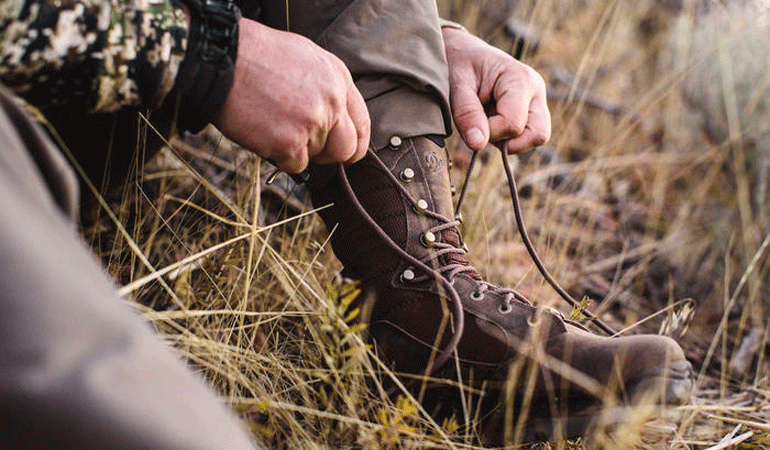
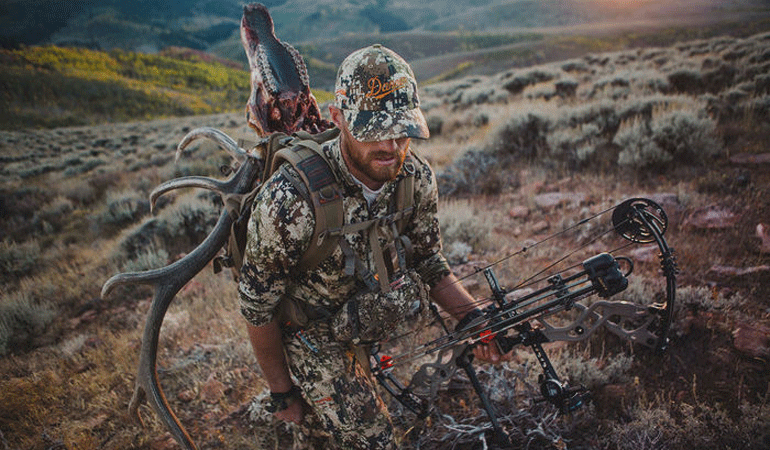
Hunters rarely think about how their foot health and comfort translates to a more enjoyable time in the field, but it’s undeniable that high-quality boots and a good hunt are tightly linked. (Photo courtesy of Danner Boots)

Five years ago I ditched the couch potato lifestyle and started running. It sucked, but as I got into the process I realized that I didn’t hate it as much as I expected — at least most of the time. The runs that were chock-full of misery were those where I didn’t get much sleep the night before or where my feet were beat up.

As far as sleep, that’s fodder for a different article. When it comes to foot-care, I found a few things to be helpful that have migrated from my life as a runner to my life as a hunter. And while it may not seem like a big deal, especially to the whitetail hunter, good footwear is a game-changer.

Here’s why:

From Deer To Elk & Back Again

As a traveling bowhunter, I use to think about western hunting much differently than my midwest whitetail adventures. That’s not the case anymore, and my hunting tactics have converged to mirror both pursuits more closely than I ever thought possible — and so has my choice of boot.

While I do like knee-highs for some whitetail hunting, particularly if I need to wade through a creek or a swamp to get to my spots, I’m mostly reliant on quality leather boots — the kind that are a necessity in the elk mountains.

Danner-Pronghorn-Sidehill.jpg
Western hunts, as well as whitetail forays, demand the right leather boot that provides a high level of comfort, support and traction.

The first thing worth looking for, whether you’re a deer hunter, an elk hunter — or both — is comfort. This is a no-brainer but it’s amazing how a little extra weight or some stiffness in the wrong spot can turn miserable after a few miles. Comfort starts with fit, of course, so if you’re not wearing the right size of boots you’re already in trouble. You might think you can make up for the difference with your sock choice, but you can’t. One hike up a mountain or into the woods to check trail cameras and you’ll be deep into regret and blistered up.

Wear the right-sized boots, and pay attention to how tall they are. Light hikers that fit like running shoes are comfortable, but they belong on trails and not in the timber. For hunting and scouting you need some support, and for most of my pursuits I’m looking for boots that are at least eight inches tall.

This is important in the whitetail woods, but a game-changer in steep terrain. Naturally, it’s easy to think about the uphill aspect of elk hunting and the support your feet will need, but it’s the side-hilling and downhill treks that will get you.

Side-hilling, with 40 pounds in your pack, is a great way to figure out how much support your boots offer. Add in an elk quarter and a lot of extra weight, and you’ll really understand what you’re dealing with when it comes to potential ankle sprains or worse.

For the downhill treks — which tend to be more dangerous than uphill because you’ve got loose rocks and gravity conspiring against you with each step — you’ll need support on the top and the bottom of your boots. Quality tread, the kind designed to grip where grip isn’t easy to find, can keep you upright and in one piece. That’s something hard to understand when you’re breaking your boots in at home in Michigan or Pennsylvania and not faced with the reality of elevation and the up-and-down places elk and mule deer call home.

Whitetail Considerations

Maybe you won’t hunt elk — that’s okay. If you stick to the whitetail woods you may wonder why you need a good pair of boots. Well, you can roll your ankles in deciduous forests, too. While falling down a river bluff isn’t as dangerous as falling down a mountain, it’s not that much fun either. And it’s really not fun in the dark when you’re slipping in to a rut stand you’ve been saving for just the right conditions.

Quality leather boots are a necessity in the elk mountains, as well as the whitetail woods. Take care of your feet and you’ll surely have more enjoyable hunts overall.

The kind of tread that will help you in the mountains will also help you at home on the whities, and in other situations, might save your hide as well. Last fall, while bowhunting some public land in Oklahoma, I was blessed with a buzzer-beater buck. I watched him tip over as the light faded on my last night down there and to put it mildly, was pretty jacked up about filling my tag.

When I climbed down to go look at him, my knee-high boot slipped off of my climbing stick and caused a puckering, find-religion-now moment even though I was attached to a lifeline. The upshot here is that well-designed tread is good for more than the mountains…

Danner Pronghorn — Fifth Generation

The boots that are winning me over this year — and that I’ve scouted deer in, hung stands while wearing, and are traveling with me 19 hours west to hunt elk in Colorado — are the Danner Pronghorns. I’ve covered more ground while bowhunting in the Pronghorns over the years than any other boot, and their latest version is the fifth generation, which represents a new-age return to the old classic 851 design.

Danner-Pronghorn-5G-Close.jpg
Danner has designed its new Pronghorn boots around the TERRA FORCE® NEXT™ platform, which utilizes a shank system to provide total arch support and torsion control — two things that will keep your ankles intact and your feet pain-free after miles of hiking each day.

This means that the fit and comfort level of these new Pronghorns is off the charts, but now those attributes are combined with the TERRA FORCE® NEXT™ platform, which is designed to promote all-terrain arch support, stability and torsion control. They are also built with Vibram® Pronghorn Outsoles so that there will be no complaints when it comes to traction no matter what type of terrain you hunt.

Pronghorns are also waterproof thanks to a GORE-TEX membrane, and can be ideal for mid- to late-season hunts if you opt for the insulated versions (400g or 800g PrimaLoft®). Unlike similarly priced offerings that claim to be waterproof, these Pronghorns are also incredibly breathable. That’s one of those things that is hard to appreciate until you’re putting on the miles in the early season.

The real kicker, at least for yours truly, is that for half of the price of competitor’s boots, you can get the Pronghorns and know that they’ll last. The most disappointing boot experience of my life was finally getting my hands on a pair of $500 leathers, only to toss them two seasons later because they had fallen completely apart. My last pair of Pronghorns lasted me three times as long, and that’s through a lot of use. This is one of the many reasons that for almost two decades, Pronghorns have been the go-to choice for western hunters and whitetail junkies alike, which is something not destined to change any time soon thanks to the newest version.

Conclusion

No matter what you hunt, or how you scout, quality footwear is key. Find yourself a pair of boots that will allow you to do the things you need to do to be successful and remember that the right boot can take you across the flattest whitetail territory as well as up the steepest mountain basin, so choose wisely.

How To Water Pigs: Equipment Tips, Winter Care & More

0

Keeping clean water available to your pigs can be a real challenge at times! These clever omnivores, combining strength with an inquisitive nature and a love of mud, can upset a water trough before you can turn around. But in high summer, even a few hours without water can seriously compromise a pig’s well-being; and even in winter, our animals need water to be constantly available.

Outsmarting our pigs is an ongoing project, so it’s a good thing there are lots of ways to water a pig!

How Much Water Does a Pig Need?

How much water pigs need is the first consideration. Water consumption for sus scrofa can be highly variable, depending on weather, the size of the animal and what it is eating. (Pigs on dry feed drink more than pigs on a natural diet.)

While young pigs may consume only a few pints a day, a lactating sow (mama pig nursing babies) can require as much as 6 gallons! So whatever method you use for delivering water to your pigs should take these requirements into consideration.

Read more: Check out these tips for preparing your pigs for winter.

Let’s Talk Troughs

First, of course, is the basic water trough. The lowest-tech solution, this may be the obvious choice when you’re just starting out.

Troughs can work well, too, if we take the time to plan thoroughly.

A trough for pigs should be heavy enough—even when half-empty—that the animals can’t flip it. And while the sides have to be low enough so that even the smallest pig can get a drink, you also want them to be high enough to prevent animals climbing (or being pushed!) over the side.

If you elect to water from a trough, putting one or two cinder blocks in the bottom of the tank can provide footing for any animal that might fall in—at least long enough for you to help it out again.

An open trough also presents a challenge for animals kept on deep bedding. Tank sides need to be high enough to prevent litter from falling in and fouling the water.

Other Options (Cup Waterer, Pig Nipples)

Only slightly more complex than a trough are the cup waterer and pig nipple. These simple valves can be fitted to a garden hose and attached directly to the wall of a pig pen. Since there is no trough, there is no danger of drowned animals or fouled water.

And animal-activated stem valves mean that water is delivered on demand only. This keeps waste to a minimum.

pig water watering waterer winter
Shawn and Beth Dougherty

Of course, a pig who wants a puddle in which to wallow can—and may!—cause deliberate spillage to make a wet spot. But, generally speaking, these simple valves help keep to a minimum .

Don’t have running water to the pig pen? Not a problem! Pig nipples and cup waterers can be easily plumbed into the side of a large plastic barrel. This, when filled with water, will be too heavy for your porkers to flip. And you can stabilize it in one corner of the pen for further security.

Hooked up to a rain barrel outside the barn, your pig barrel will even fill automatically! Or, if your pigs are on pasture, an extra-large livestock tank can be similarly fitted with a pig-operated waterer. The tank’s broad base will prevent overturning.

Read more: Do you have a farm water backup plan?

Watering in Winter Weather

Of course, water in the heat of summer is an hourly necessity, but winter water can be just as much of an issue! If you are keeping a pig during the cold months, you’ll have to find a way to keep his water from freezing.

First, there’s nothing to prevent you from simply breaking ice in your stock tank, if that’s where the pig gets water. We do it ourselves and know others that do the same.

Stock Tank Deicer

Dropping in an electric stock tank deicer may be all that you need to keep water warm enough that it will not freeze. But if you are using a metal pig nipple, this extension may be the first part of your system to ice up.

In only moderately cold weather, inserting a copper wire or six-penny nail into the back of the stem valve will sometimes conduct enough heat from the main tank to prevent the nipple freezing. Make sure, though, that there is no possible way for the pigs to reach the heater—or the heater cord! Pigs will chew on anything, so take precautions so that you don’t get a shocked pig or an electrical fire.

Running Water Is Slower to Freeze

Other solutions may be even simpler. Running water is slow to freeze, which is why in near-freezing weather you may see an outdoor tap left open just a trickle. Why not direct this tiny flow into the pig tank? Even mere drips of water falling in a tank will disturb the surface enough to prevent freezing if temperatures are not too low.

Or you could do something as simple as filling the tank daily with a bucket from the house.

Let Them Eat Snow

Is there snow on the ground? Pigs are smart! Let them eat snow for their hydration needs, as long as clean snow is available in their pasture or paddock. Save yourself days or weeks of breaking ice or hauling water.

And there’s always butchering time to put an end to our pig-watering chores—until we get another pig!

Kel Tec KSG

0

The Kel Tec KSG is an extremely well-known shotgun mostly for its looks and its exceptional price point.

The KelTec KSG is an extremely unique 12 gauge shotgun that provides a lot of fun and a ton of potential uses. This shotgun is a direct competitor of the IWI Tavor TS12.

About KelTec

At KelTec, they design firearms that are innovative in design and exciting to use. KelTec employs 300 American citizens – many military veterans – who come to work every day to craft unique firearms dreamed up by our team of talented engineers.

KelTec is celebrating its thirtieth year in the firearms industry. KelTec is most notably known for their very unique designs in pistols, rifles and shotguns. The design team at KelTec without a doubt has a big collective imagination.

KelTec’s Mission Statement

Our mission is to create innovative, quality firearms to help secure your world.

We believe in respect, family, the right to bear arms, and a love for our great country.

The Kel Tec KSG

The KSG for the longest time was unobtainable in the gun world. As soon as dealers got them in the shipping doors they were flying out the front (after all the appropriate paperwork had been completed).

I remember seeing the then relatively new company’s firearms in local gun shops and even handling a few on occasional trips.

Kel Tec KSG

I remember their pistols seemed very blocky and felt somewhat cheap in the hand, even as an inexperienced young man in the gun world.

Then I caught a glimpse of a KSG. That particular shotgun had already been sold and was awaiting pickup by the lucky new owner. I asked the salesman behind the counter if I could hold the futuristic, space-age-looking shotgun hanging on the wall.

The owner of the shop apparently overheard my request and made his way over and took the scatter gun off the wall and handed it to me after checking to make sure it was not loaded.

The very second the short shotgun was in my hands I knew I had to have one. This was the start of approximately a year and a half of trying unsuccessfully to track down one of these beasts to call my own.

While driving to see my in-laws in the neighboring county one afternoon, my wife was scrolling through Facebook and happened upon a local gun shop’s Facebook page that had just posted that they had received one of the coveted Kel Tec KSGs in stock.

Having listened to me talk about this particular shotgun for almost two full calendar years and complain every time I tracked one down but it was marked well above MSRP or bought out from under me her eyes lit up when she read the post.

She then told me what she had found and where it was located. It was in the opposite direction that we were traveling. I mumbled something under my breath and continued to drive toward my in-laws grumpier than I was when we started the journey.

The next thing I knew my wife had located the telephone number for the shop and had them on the line. She asked if the Kel Tec KSG was still available, and although I could not hear the conversation, the look on her face told me all I needed to know.

Not expecting them to hold the gun, I had my wife ask them just in case. They stated that they would in fact hold the scattergun for me to come later that evening to purchase.

After what seemed like the longest visit with the in-laws and an equally long road trip back the other direction, I finally had a KSG that was mine. Buyers remorse is real, but I can tell you that I felt no such thing after this purchase!

KelTec KSG Design

What does KSG stand for? It’s quite simple, really. KSG stands for KelTec Shotgun. A simple name for the first entry by Kel Tec into the scattergun world.

This plays perfect into the design of the Kel Tec KSG because as a pump-action shotgun it doesn’t get much simpler than that; on the surface at least.

keltec ksg vertical

The KSG is a 12ga, pump-action, dual magazine, bullpup design. That’s a lot to digest.

First, we will start with the action of the shotgun. There are three main types of shotguns, the first and most simple is the break barrel. This shotgun is one that you might typically see hanging over your grandpa, or great-grandpa’s fireplace.

The action of this shotgun breaks open at the rear to load and eject its shells. Typically a break barrel shotgun holds one or two rounds of ammunition, one in each barrel.

This is not always the case though as there is a current design that has three barrels and thus holds three shells at a time.

Another design that you may commonly find is a semi-automatic shotgun. This type runs either off inertia from the recoil, or gas that is siphoned off to unlock the breach and load the next round.

You might also find this type of shotgun above an old fireplace as a family heirloom or possibly a more modern iteration in the cab of a police cruiser.

The third main design bridges the technology gap between the two previously mentioned styles quite nicely.

It takes the simplicity and reliability of the break barrel and high capacity of the semi-automatic and combines the two into one package; the pump action.

A pump-action shotgun is actuated by pumping the forearm of the gun to feed, extract and eject the shells. This design is popular and is used around the world.

The design team at Kel Tec chose to make their first shotgun a pump action. They then chose to make that pump action shotgun tactical. They also made the bold choice to make their first tactical shotgun a bullpup.

Bullpup firearms seem to have a love-hate relationship in the gun industry. While most of the time they look cool and futuristic, there are several design and logistical and potential extreme safety problems to overcome.

By definition, a bullpup is any firearm whose chamber is located behind the trigger. This obviously is not an everyday occurrence.

One glaring problem with this design for the KSG is you now have the contained detonation of a shotgun shell no more than a few millimeters away from the arguably most important organ of your body. The one that thinks and makes thousands of decisions every day.

This is no light matter to consider. The folks at KelTec knew that they needed to design the receiver of the KSG to be sturdy and robust enough to handle anything that could be thrown at it.

The receiver of the KelTec KSG is made from hardened steel and is thick enough to contain any blast that may occur in the chamber. The furniture of the KSG is made from glass-reinforced polymer.

The furniture of the KSG is simple in design and functions practically. The one aspect I do not care for about the KSG furniture is the way it is attached to the gun.

KSG is known for using a clamshell-type design to cut weight and cost when manufacturing their firearms. This is no different for the KSG.

To attach each section of the clamshell, KelTec uses bolts and nuts on the opposing side that are offset into the side of the shotgun.

This detracts from the overall appearance of the scattergun and somewhat cheapens the rugged space-age look. One might even compare it to a child’s nerf gun, although it obviously is much tougher than that.

The forearm and the pistol grip is where this issue is most apparent. I wish KelTec would spend a little more time and money on this aspect of the design and make these points more solid and look more professional.

Other than the gripe with the non load-bearing aspects of this shotgun, all the rest of the construction is as solid as you can ask for.

The top rail is quality aluminum, the magazines are made from the same hardened steel that the receiver and chamber are constructed from and the stock is capped with a nice rubber pad and is much thicker than the seemingly flimsy pistol grip.

KSG Operation

As stated above, the mode of operation for the KelTec KSG is a pump action. There are similarities to other pump actions in this design.

The forearm on the KSG is wider than that of a traditional shotgun. This is because of the dual magazine tubes located underneath and parallel to each other and under the barrel.

kel tec ksg shotgun

This is noticeable when holding the shotgun, but not to the point where it is uncomfortable.

On the underside of the forearm, there is a row of picatinny rail to attach a vertical grip or hand stop. Installing one of these accessories is a good idea because as a pump-action shotgun, you have to pump the action.

If you end up pumping the action a little too hard, you may end up a few digits short after your hand slips off the front of the shotgun and into the path of the barrel.

This could be an obvious safety issue if you are not careful or cognisant of how you are operating the shotgun.

Safety

The safety of the KSG is a simple cross bolt design. This style of safety is a classic design that is easy to activate and deactivate.

The safety is clearly labeled with white paint and red paint for “safe” and “fire” respectively. While simple in design, you could accidentally activate or deactivate it on gear when the shotty is slung.

Trigger

The trigger of the KSG is made of the same glass-filled polymer that the other parts are made of. Unfortunately, this makes the trigger feel of cheap quality, but it does get the job done. The trigger pull is not horrible, it is serviceable for a combat shotgun.

keltec ksg trigger

I should note that there is a company that makes aftermarket parts for the KSG, one of them being an upgraded trigger. This company is MCARBO. They have a website and a YouTube channel detailing their products and installation of the same.

I feel that this is the single most needed improvement on the KSG.

Takedown of the KelTec KSG

Takedown of the KelTec KSG is interesting. After visually and physically checking to make sure the KSG is unloaded, move the magazine selector to the center of the receiver.

Next, there are two HK-style take down pins located on the bottom side of the receiver that are retained by a spring pin.

You can fully remove them when taking down the KSG for service and cleaning and KelTec designed two through holes into the pistol grip of this shotgun to hold the takedown pins so they do not end up lost in the process.

keltec ksg takedown

Once the takedown pins have been removed and properly stowed, lift the pistol grip section up from the rear of the receiver and rotate it toward the front of the shotgun. KelTec advises not to take this section apart any further for cleaning.

Once the pistol grip and trigger section has been removed, next you need to pull the stock out of the back of the receiver. This is accomplished by simply pulling the stock to the rear until it clears the receiver.

Next you move the forearm of the shotgun further to the rear until you can remove the bolt out of the receiver.

KelTec also advises to not take the bolt down any further that this for field strip/cleaning.

keltec ksg prop

After doing these steps, you will have access to clean almost all of the KSG. If you want to remove the pump-action, you can remove the two retaining nuts at the front of the two magazine tubes.

KelTec suggests you turn the nuts in sequence of a half turn for each at a time to keep the retaining bar from binding up behind the nuts. Once these are removed you may pull the pump-action free of the frame and set it aside.

KelTec KSG Features

The KSG is only offered in one chambering, however, it is the most popular chambering for shotguns in the USA. The 12ga of the KSG means that you have all the firepower on tap that you could ever need.

The KSG comes with a removable cylinder bore choke.

This means that you can remove the factory choke and replace it with a choke tube adapter and be able to place any style choke the adapter is designed to take. This opens the possibilities of the shotgun up tremendously.

Pistol Grip

The pistol grip on the KSG is located approximately mid-way between the end of the barrel and the stock. The pistol grip is the only protrusion from this sleek scattergun.

There is checkering on the pistol grip, but it is more for aesthetics than functionality.

The trigger guard does exactly what it is intended to do. To actuate the pump of the shotgun, the slide release is located directly in front of the pistol grip and is ambidextrous.

Stock

The stock of the KSG is thick and robust. It helps that the stock is directly attached to the back of the receiver.

Kel Tec KSG Buttstock

There is a rubber but pad that helps hold the stock in the shoulder pocket and keeps it from slipping around on clothing. It does not do much to help the recoil of the shotgun.

Magazines

Next, we have the magazines. As alluded to previously, there are dual magazines on this bullpup shotgun.

KelTec KSG Magazine Well

Each magazine is constructed out of hardened steel and holds 6 or seven rounds of 3” magnum shells. Yes, that’s either 12 to 14 rounds of high brass, hard hitting magnum 12ga firepower on board, pre-loaded, and ready to go.

With a 6 round Lynx Defense Shotgun Card the KSG could potentially hold up to 20 rounds (one in the chamber) of 12ga destruction on board. This is an obscene amount of ammunition to have on the shotgun itself.

Having two magazine tubes also means that you can have one mag loaded with your favorite flavor of 00 buckshot and the other full of 1oz slugs.

To choose between the two magazines all you have to do is flip the magazine selector which is located on the bottom of the receiver.

To load the KSG you have to flip the scattergun over to be able to access the magazines.

keltec ksg mag well

The magazines load easily enough and have individual catches to retain the shells in the magazine.

To unload each magazine, you must press the mag catch lever of each individual tube to allow the shells to bypass it and come out of the shotgun.

Sights

The rail located on the top of the KSG is solid and is made of quality aluminum. Most shotguns come with a simple bead sight or perhaps rifle-style sights if it is a rifled shotgun.

The KSG comes with neither of these but the rail allows you to place whatever sights you choose on it.

keltec ksg optic

I opted to place a set of Magpul MBUS sights on my KSG. The MBUS sights allow for proper cheek weld to be able to use the sights as they were designed to be used.

Having a standard picatinny rail up top also means that you are able to place any type of red dot or holographic sight on top of the KSG. As this is a smooth bore, any quality choice of non-magnified sighting system will serve you well.

Shooting the KSG

Shooting the KSG is downright fun. Per square inch, I don’t think I possess a more powerful firearm. When the KSG is fully loaded it is a heavy beast. This weight is well balanced and because of the bullpup design, the weight is kept very close to the shooter’s body.

The balance and weight of the KSG assists greatly in recoil mitigation. That’s not to say this scattergun is a light recoiling. With full power loads you will know when you’ve pulled the trigger.

Being a pump-action, you do not have to rely on recoil from high brass rounds to cycle the action. This means that you can use reduced power or light loads in the KSG as well.

One of my all-time favorite loads to put in the KSG is the Aguila Mini shells and Mini slugs. With this loading, you can house up to 24 rounds in the twin magazines plus one making this compact shotty’s capacity just 5 rounds shy of an AR15.

Add on a Lynx Defense Shotgun card to the side of the receiver and you can add another 6 rounds contained on KelTec KSG’s frame easily eclipsing the capacity of the AR. Now that is really impressive.

Price & Models

KelTec places the MSRP (manufacturer’s suggested retail price) of the KSG currently at $900.00. This of course is just a suggestion.

These scatterguns can be found for more or less depending on the situation and simple supply and demand.

With the current political climate toward all things gun-related as it is, if you find a KSG for close to this price I’d say you’ve probably found a deal.

kel tec ksg

There are some other models and variations to the KSG that have been released through the years since the KSG first was released to the market. KelTec has a KSG25, with an overall length of 38” and a standard capacity with full power 3” shells of 25 rounds. The KSG25 has a MSRP of $1150.00.

KelTec also has two other models than that of the standard KSG and KSG25. One of these would require a tax stamp in addition to their purchase price as its shorter barrel length would make it a NFA item.

This version is called the KSG Tactical. It has a barrel length of 13.7”. The capacity of the KSG Tactical is reduced to 10 rounds of 2 ¾ “ shells. The KSG Tactical goes for around $1225.00 (plus a $200.00 tax stamp and paperwork to the federal government)

For a shotgun that only comes in at 26.1” overall length to begin with, this model seems quite trivial, and the loss of capacity puts the nail in the coffin as far as I’m concerned.

The next model that KelTec offers is the KSG Compact. The KSG Compact Keeps the overall length of the original, and the same barrel length of 18.5” but shortens the magazine tubes.

There are only two logical reasons this model exists:

  1. For those states that have been allowed to tread on the freedom that the Constitution guarantees each and every one of us as US citizens and;
  2. If you want to make the KSG into a SBS (short barrel shotgun) but want to take the scattergun home with you while you wait for the paperwork to come back before you chop it down to the length of the Tactical model mentioned above.

The last variation of the KSG is the KS7. The KS7 is unique as it gets a slight face lift in appearance.

The barrel length and OAL remain the same, but the KS7 loses one of its magazines, reducing its capacity to 7+1. This also means that the KS7 is a thinner and lighter package if that is important to you.

Final Thoughts

No matter which model you choose, or what kind of shells you decide to stuff in the magazine(s) of the KSG, it is next to impossible to surpass the firepower and handiness of this small scattergun.

Some have complained that the downward ejection of the shotshells can cause them to hit the wrist, but I have not experienced this over the many years and thousands of shells sent down range through my copy.

While I do think there are some areas that could be improved upon, overall the KSG is a must-have addition to any collection in my opinion.

I feel like this shotgun can fill many roles, and while I may not choose to take the KSG directly into a combat zone, it does check the “shotgun” box of home defense plans.

I believe the compactness can not be beaten and the large capacity of this shotgun is unmatched.

It is shorter and more maneuverable than a full-size AR, and more stable than a pistol. If I choose to grab a shotgun when something goes bump in the middle of the night, this is the one.

If you are in the market for a defensive shotgun the KSG is definitely a contender but be sure to weigh your options the KSG against the IWI Tavor TS 12, the Remington Tac-14, and the Benelli M4.

‘MeatEater’ Season 11 Available Now on Outdoor Channel Mondays at 8 p.m. ET

0

MeatEater is Part of Outdoor Channel’s “Taste of the Wild” Block Monday Nights

DENVER (October 11, 2024) – MeatEater, featuring the charismatic Steven Rinella, has consistently captivated viewers of Outdoor Sportsman Group, and now season 11 of this perennial favorite is now available nationally on Outdoor Channel for the first time every Monday at 8 p.m. ET.

As Rinella continually shares, the show transcends beyond the mere search of an animal; it’s a testament to his own personal grit, determination and essence that fuels such pursuit. Season 11 sees Rinella and crew chase moose in Alaska, spearfish in Hawaii, hunt ducks in Louisiana and find themselves in many more nature-fueled adventures along the way.

“One of my favorite episodes from season 11 was a moose hunt in eastern Alaska. We were there for ten days and were getting our buns kicked. And then, finally, in the last hour of the last day of the season here comes a bull from about a mile off. Trying to call him up the mountain while simultaneously closing the distance by heading in his direction was one of the more exciting moments we ever filmed,” shared Steven Rinella.

Growing up in the Midwest’s great outdoors – hunting, fishing, and trapping from a young age – Rinella has always viewed the world through the eyes of an ancestral hunter/gatherer. Inspired by early man’s skill, ingenuity, and sheer determination to survive and thrive under challenging circumstances, Rinella has made his life’s work to cultivate those same qualities – and encourage others to do the same – while always being mindful of conservation principles and practices.

In MeatEater, Rinella explores various hunting techniques, tracks and pursue prey, and procures and cooks his own food. Whether tracking blacktail deer in the remote Alaskan wilderness, or rooting out javelina in Texas, Rinella leverages his back-country skills, challenging himself at every corner while providing nail-biting adventure along the way.

Steven Rinella is an avid outdoorsman, writer, and television personality best known for his ability to translate the hunting lifestyle to a wide variety of audiences. He is the host of the long-running television show MeatEater and top-ranked MeatEater podcast. He is the New York Times bestselling author of ten books dealing with wildlife, hunting, fishing, and wild game cooking, most recently Outdoor Kids in an Inside World: Getting Your Family Out of the House and Radically Engaged with Nature and the audio original, MeatEater’s Campfire Stories: Narrow Escapes and More Close Calls. He is the recipient of the Conservation Achievement Award from The Theodore Roosevelt Conservation Partnership.

About Outdoor Channel: Outdoor Channel has been taking viewers across America and around the world on unparalleled adventures since 1993. Dedicated to the outdoor lifestyle and conservation, the independent cable network is a division of Outdoor Sportsman Group and provides a complete spectrum of riveting hunting, fishing, shooting and adventure entertainment. Outdoor Channel is the largest outdoor TV footprint in the country and is available in more than 50 countries internationally. Outdoor Channel can be viewed in HD and is accessible by broadband and mobile platforms. For program times and other information, visit www.outdoorchannel.com. Follow us on Twitter, Instagram, Facebook and YouTube.

********

MEDIA CONTACT:

Outdoor Sportsman Group | [email protected]

How Far Can A .270 Shoot? Professional Explanation & Hunting Tips

0

If you are looking for tools for medium-sized hunting games, a 270 rifle is a version worth owning. It has a compact size with a long enough range to flexibly hunt large animals such as wild deer or bears. How far can a 270 shoot? How is its performance? In this article, we will give a complete answer on the maximum distance that this version performs. Scroll down for details!

What is .270 Rifles?

A .270 rifle is a type of firearm that is designed to fire ammunition chambered for the .270 Winchester cartridge. The .270 Winchester, often simply referred to as the .270, is a popular and versatile rifle cartridge known for its long-range accuracy and relatively flat trajectory. It is commonly used for hunting a wide range of game, including deer, elk, and various other large and medium-sized game animals.

The .270 Winchester cartridge typically uses bullets with a caliber of .277 inches (7mm), and it can deliver high muzzle velocities and energy, making it effective for shooting at extended ranges. This cartridge was introduced in 1925 and has remained a popular choice among hunters and sports shooters for many decades.

Rifles chambered in .270 Winchester are available in various configurations, including bolt-action, semi-automatic, and lever-action designs, allowing shooters to choose a rifle that suits their preferences and needs. These rifles are known for their accuracy, making them suitable for target shooting and hunting applications where precision is important.

What Seed .270 Bullet Is The Best?

You can choose from different types of ammunition for the 270 rifles. People will use 130-grain, even 150-grain, or 165-grain bullets. This number will depend on the characteristics of the hunt, such as terrain, climate, temperature, and target.

130 grain

If you need to take down deer, 130-grain ammo is the best product. For large-scale games and larger opponents like elk, a larger caliber bullet will be the best solution. The best thing I usually do is to search for information on the internet and consult experts to make the best choice.

The 130-grain ammunition is perfect with the balance between the power it produces and the weight that makes it a choice for many hunters. The extra energy of this bullet makes it work better and fly farther than other ammunition for the 270 guns.

150-165 grains

When you need to hunt large animals, you should choose larger ammunition such as 150 – 165 grain bullets. They will have better attack power when penetrating the animal’s skin.

90-110 grains

At distances of more than 5000 feet, the lighter 90-110 bullets would be ideal as they will measure longer distances for hunting deer or antelope. This projectile is subject to wind resistance at lower altitudes.

How Much Does .270 Winchester Drop?

The 270 rifle is a worthwhile investment because it increases your experience with high accuracy when hunting. According to many experimental studies, a 270 Winchester will drop about 3 inches if you aim 200 yards from the target.

If you are 300 yards away, the 270 Winchester will drop about 11 inches. Based on the above theory, you need to aim higher to accommodate the distance between you and the target to get the right shot.

Moreover, the 270 rifles can shoot up to 500 yards with accurate accuracy, but it will be less effective than close range. If you are not a professional and seasoned hunter, experimenting with longer than 500m may not work. A closer range will help you take out the target better. At the same time, you need to practice patiently to master the 270 rifles.

Factors Affecting Shooting Distance

The shooting distance of a firearm, such as a .270 rifle, is influenced by several key factors. Understanding these factors can help shooters make accurate shots and assess the effective range of their rifles. Here are the primary factors affecting shooting distance:

Bullet Ballistics

  • Muzzle Velocity: The speed at which the bullet exits the barrel greatly affects its range. Higher muzzle velocities generally result in longer effective distances.
  • Bullet Weight: Heavier bullets tend to retain energy and velocity better over longer distances, making them suitable for extended ranges.
  • Bullet Design: Different bullet shapes and designs, such as boat-tail or spitzer, can impact the bullet’s aerodynamics and trajectory.

Rifle Configuration

  • Barrel Length: Longer barrels can provide higher muzzle velocities, which can extend the shooting distance. Shorter barrels may limit effective range.
  • Accuracy: The precision and consistency of the rifle’s construction and components, including the chamber, barrel, and trigger, play a critical role in achieving accuracy at long distances.
  • Scope Quality: A high-quality optic with appropriate magnification and clarity is essential for accurately assessing and engaging targets at extended ranges.

Shooter Skill

  • Marksmanship: A shooter’s skill, including their ability to control breathing, trigger squeeze, and follow-through, greatly affects accuracy at longer distances.
  • Training: Regular practice and training in long-range shooting techniques are crucial for improving skills and maximizing effective range.
  • Environmental Conditions: The shooter’s ability to read and adjust for factors like wind speed and direction, temperature, humidity, and elevation can significantly impact accuracy.

Environmental Factors

  • Wind: Wind has a substantial effect on bullet trajectory. Understanding wind patterns and using wind-reading techniques can help compensate for its influence.
  • Altitude and Atmospheric Conditions: Higher altitudes typically result in lower air density, which can affect bullet flight. Additionally, variations in temperature and humidity can influence air density and, consequently, bullet performance.
  • Terrain and Obstacles: The type of terrain and the presence of obstacles between the shooter and the target can limit or enhance the effective shooting distance.

Ammunition Quality

  • Consistency: High-quality, consistent ammunition is essential for achieving predictable and repeatable ballistics. Variations in ammunition can affect accuracy at long ranges.
  • Handloading: Handloading or reloading ammunition allows shooters to fine-tune loads for specific rifles and shooting conditions, potentially extending effective range.

Target Size and Type

  • The size and type of the target play a significant role in determining the effective range. Larger targets are easier to hit accurately at longer distances.

Understanding and accounting for these factors is crucial for shooters looking to maximize the effective shooting distance of a .270 rifle or any other firearm. It requires a combination of the right equipment, skill development, and environmental awareness to consistently achieve accurate shots at extended ranges.

How Far Can A 270 Shoot?

How Far Can A 270 Shoot 1

You can use the 270 rifles up to 500 yards to defeat the big beast on your hunt. This is a product that receives a lot of attention and is an excellent choice if you want to take down large prey. The maximum distance a gun can shoot will depend on the barrel length and caliber.

If you own a long barrel, you will shoot accurately even when aiming long distances to the target The 24-inch barrel length is ideal for big hunting games. Besides the barrel length, the caliber is also a feature to consider.

Is the .270 Acceptable for Long-Range Shooting?

How Far Can A 270 Shoot 2

Long-range shootThe 270 rifles are ideally suited for long-range shooting Furthermore, expert tests have proven it to be one of the best in the range, with the best long-range performance available today. As with any rifle, gun construction and payload determine how far you can hit your target.

Most users expect to shoot at an ideal distance of 500 yards This range could undoubtedly be more extensive if you have the skill and seasoned experience for similar games. The 270 is the perfect product of a sizable long-range rifle.

It is an indispensable accessory for many professional hunters because of its stable and flexible operation in different terrain and situations. The device also works accurately and powerfully to hit multiple targets quickly. The 270 rifles have overcome many limitations of a conventional long-range gun version.

What’s The Max Effective Range For 270?

The maximum range you can shoot with a 270 rifle will depend on your target size. For animals weighing 1,200 pounds, you should stay within 450 yards. For a 1,000-pound beast, you can increase the distance up to 500 yards and use 130 or 140-grain ammo. In case you need to hunt coyotes, a distance of 300 yards will be optimal for the 270 Winchester.

Might The .270 Beat A Deer?

How Far Can A 270 Shoot 3

When participating in hunting, you always need to choose a good rifle and have the ability to shoot flexibly on many terrains. Of course, the 270 is the perfect version for hunting large-sized deer within 200 yards of any terrain.

This distance can be longer if you are a professional hunter. In dense jungles, you’ll need to reframe this to a shorter range for the best accuracy. Most skilled hunters prefer a 270 to take down animals with the most suitable ammunition.

In this regard, the 270 Winchester cartridge is on the most popular list even though it has been around since 1925. Its performance is excellent, with speeds up to 2700 ft/s at close range. But when you need to shoot at a distance of more than 500 yards, accuracy may decrease because of a wind speed or orbital fall rate.

Tips for Maximizing Shooting Distance

Maximizing shooting distance with a .270 rifle, or any other firearm, requires a combination of equipment, skills, and knowledge. Here are some tips to help you achieve longer and more accurate shots:

Select the Right Ammunition

  • Choose high-quality, consistent ammunition suitable for long-range shooting.
  • Experiment with different bullet weights and designs to find the one that performs best in your rifle for extended distances.

Optimize Your Rifle Setup

  • Ensure your rifle is in excellent condition and well-maintained.
  • Use a high-quality scope with appropriate magnification and clarity for long-range shooting.
  • Consider a bipod or shooting rest for stability.

Learn Ballistics

  • Understand the ballistics of your chosen ammunition, including muzzle velocity, bullet drop, and wind drift.
  • Use ballistics software or smartphone apps to calculate and adjust for bullet trajectory.

Practice Regularly

  • Develop and maintain your marksmanship skills through consistent practice.
  • Focus on breathing control, trigger squeeze, and follow-through.
  • Practice at various distances to gain experience and confidence.

Study Wind Patterns

  • Learn to read wind speed and direction accurately at different distances.
  • Use wind flags or vegetation as visual cues to gauge wind conditions.
  • Adjust your aim and hold-off for wind drift as needed.

Understand Environmental Factors

  • Be aware of how altitude, temperature, and humidity affect air density and, consequently, bullet performance.
  • Make necessary adjustments for these factors using ballistics data or calculations.

Keep Records

  • Maintain a shooting log or journal to record data on your rifle’s performance, ammunition, and environmental conditions for each session.
  • Use this data to refine your shooting techniques and equipment settings.

Use Stable Shooting Positions

  • Practice shooting from various positions, including prone, supported, and offhand, to determine which is most stable for long-range shots.
  • Employ sandbags, shooting sticks, or bipods to enhance stability.

Learn from Experienced Shooters

  • Seek advice and tips from experienced long-range shooters.
  • Attend shooting courses or events to gain valuable knowledge and insights.

Safety First

  • Always prioritize safety when handling firearms.
  • Ensure you have a safe backstop and a clear line of sight to your target.

Know Your Limits

  • Understand your own shooting capabilities and the limitations of your equipment.
  • Avoid taking shots beyond your skill level or the effective range of your rifle.

Stay Calm and Patient

  • Maintain composure and patience when taking long-range shots.
  • Avoid rushing shots, especially in high-pressure situations.

Remember that maximizing shooting distance is a skill that takes time to develop. Consistent practice and a commitment to improving your marksmanship, knowledge of ballistics, and understanding of environmental factors will help you achieve longer and more accurate shots with your .270 rifle or any other firearm.

Conclusion

This article has answered your question: How far can a 270 shoot? The maximum distance that a 270 rifle can shoot is 500 yards. This number can vary depending on your ammo and the surrounding physical conditions. If you want to hunt big animals quickly, the closer the distance will help you win them. We hope you can choose and use the best 270 rifles and ammunition for your effective hunting trip. Thank you for reading!

10 Essentials For Your Bowhunting Gear

0

Whether you’re narrowing the gap between food and your table, connecting more deeply to nature through conservation, or extending your hunting seasons with archery gear, you’ll never run short of great reasons to try bowhunting.

Gearing up to bowhunt is exciting, and it’s much simpler than most people realize. To help you better understand what you need for your first bowhunt, let’s review 10 basic bowhunting tools.

1. Compound Bow

Compound bows are great for beginning bowhunters and are the most popular style of bow among bowhunters today. Photo Credit: John Hafner Photo

Obviously, a bow of some sort is your most basic need. You have three bow types to choose from, starting with the compound bow. These bows are nearly standard issue for bowhunting today. They’re easier to shoot than traditional recurves or longbows, but require more practice than crossbows to become proficient. Modern compound bows are efficient and don’t require extraordinary strength to draw and shoot.

When selecting a bow, it’s best to seek help from an expert at an archery shop. Hunting bows are not “one size fits all.” Make sure you choose a bow that matches your fit and bowhunting needs. You must become as accurate as possible to enjoy shooting and be lethal in the woods.

2. Traditional Bow

Using a traditional bow for bowhunting is challenging yet rewarding. Photo Credit: T. Ridenour

Traditional recurves or longbows are bowhunting’s simplest weapons. These bows have been used thousands of years, and are more effective today than when our ancestors carried them for hunting and self-protection. Shooting and harvesting game animals with these basic bows is also challenging and rewarding.

Drawing a traditional bow that’s powerful enough to take game animals like deer, elk or bears requires more strength than drawing a compound bow. However, their simplicity makes them the most affordable option for prospective bowhunters with tight budgets.

3. Crossbow

Crossbows are user-friendly, lack recoil and make minimal noise, making them a great choice for introductory bowhunters, if allowed under state regulations. Photo Credit: John Hafner Photo

Until recently crossbow hunting was mostly reserved for senior citizens, or people with injuries or disabilities. Today, most states and Canadian providences allow crossbows during part or all of the regular archery season. Crossbows reduce the learning curve needed to shoot arrows proficiently. Most crossbow archers prefer aiming with a scope like those used on hunting rifles. This makes crossbows fairly easy to shoot accurately, even for those with little or no experience. Crossbow prices vary, but they’re similar to prices for compound bows.

4. Arrows

Arrows aren’t universal. Select an appropriate arrow for your bow and shooting needs by determining the style of your bow, its draw weight and draw length. Visit an archery shop near you for guidance. Photo Credit: T. Ridenour

Once you’ve selected a hunting bow, it’s time to pick your arrows. Arrows must be matched to your bow’s draw weight and draw length. To ensure you make the right choice, consult experts at the nearest archery store.
5. Broadheads

Every bowhunter needs a sharp, reliable broadhead for an ethical harvest. Photo Credit: T. Ridenour

For most target practice, archers shoot arrows tipped with practice points. When it’s time to prepare for bowhunting season, swap your field points for broadheads. Broadheads wield razor-sharp blades that cut through a game animal’s hide, flesh and organs to cause quick, ethical harvesting. Broadheads come in nearly infinite options, but some might be better suited than others for the quarry you hunt and the bow you shoot. Again, ask an expert for advice to ensure your broadhead matches your setup.

6. Bow Accessories

A bow-sight is a reference point for aiming, and typically has one to six pins the shooter adjusts individually to precise distances. Photo Credit: T. Ridenour

This is a broad category. The accessories you need depend on your bow and your budget. Those shooting a compound, crossbow or traditional bow must have a hooded quiver to carry their broadhead-tipped arrows. Most hunting quivers attach to the bow or crossbow, but some bowhunters prefer quivers they carry over a shoulder or attach to a pack.

Next, arrow-rests hold the arrow in place while drawing and shooting. The options are many, and the styles vary by bow and personal preference. Release-aids attach the bowhunter to the bowstring, and feature a trigger that releases the arrow.
Release-aids are standard gear for shooting a compound bow. Those shooting traditional bows use a shooting glove or finger tab, which protects the shooter’s fingers when drawing the bowstring and releasing the shot.

A bow-sight is a reference point for aiming, and typically has one to six pins the shooter adjusts individually to precise distances. You’ll find plenty of options for bow-sights, and the archery store’s pros can help you find your best option. Even so, a sight is not absolutely necessary for some bowhunters, especially those shooting traditional gear. However, they’re a great training aid when learning archery, and deliver consistent accuracy.

Bowhunters who use crossbows require fewer accessories than those using vertical bows. Crossbows are commonly sold in kits with everything needed to start shooting, but many options exist if you dislike what’s included.

Scopes, for example, come in various magnifications, and at highly varying price points. Be sure to consult an archery pro to determine which scope meets your hunting needs.

Crossbow hunters also require a cocking device, which helps them draw the bow and lock its string into the fire-ready position. A simple string-cocker uses a rope and pulleys for this task, but some crossbows feature a hand crank that makes the job nearly effortless.

7. Clothing

Dress in camouflage clothing to go undetected in the woods while bowhunting. Photo Credit T. Ridenour

Bowhunting and camouflage go hand in hand. Camo helps bowhunters remain unseen so unsuspecting game approaches within range. Matching camo to your hunting area can feel overwhelming, but experts at an archery or sporting-goods store can help.

No matter what you choose, be sure to dress in layers. Bowhunting can require bouts of vigorous, sweat-pumping activity followed by long stretches of wet, chilly waiting in harsh elements. Layering helps you stay comfortable by adding or removing layers to match the situation.

8. Backpack

A hunting pack will easily allow you to carry gear, licenses, snacks, a water bottle and other essential equipment. Photo Credit: John Hafner Photo

You’ll need a hunting pack to carry your gear, water, snacks, licenses and hunting gear. If you plan to hunt where you’ll often hike long distances, consider a pack that can carry your bow. And if you hunt areas accessible only by foot, choose a pack that’s substantial enough to help pack out your animal.

9. Boots

Invest in a good pair of hunting boots to help you tackle rough weather and rugged terrain. Photo Credit: T. Ridenour

Veteran bowhunters put good boots at or near the top of their gear list. Whether you’re sitting, still-hunting or spot-and-stalk hunting, boots are vital to consistent success. If you regularly hike a mile or more to reach hunting sites, your boots must offer comfort and support. Stand-hunters, meanwhile, usually place priority on boots that keep their feet warm all day.

10. Ground Blind/Treestand

Treestands conceal bowhunters by elevating them above the animal’s normal view. When using a treestand, never leave the ground without wearing a full-body safety harness to prevent a fall. Photo Credit: John Hafner Photo.

Stand-hunters hide out and wait in treestands or ground blinds for animals to come into bow range. Ground blinds are essentially small, portable camouflage tents that set up where you hunt. Treestands conceal bowhunters by elevating them above the animal’s normal view. Both are excellent options. If you bowhunt from a treestand – the most common method for bowhunting deer – never leave the ground without wearing a full-body safety harness to prevent a fall.

No matter your hunting style, also carry binoculars and a rangefinder. Binoculars help you search the landscape for game and identify it. And rangefinders quickly pinpoint the distance to your quarry.

Did you get all that? No matter which bow you choose or the style of bowhunting you try, expect an adrenaline rush like you’ve never experienced when that deer, bear, elk or turkey walks into range. And to ensure you’re ready for that big moment, start scouting now to find a nearby bowhunting shop to help guide you along.

By: Tyler Ridenour of Bowhunting360.com

Fish Tales Network

0

Our world’s oceans contain some of the craziest things. Scientists are still discovering new fish TODAY and if that doesn’t tell you about the content of the sea, then I don’t know what does. A lot of it is terrifying and most people wouldn’t be caught dead trying to fight anything that’s been evolving for like, a trillion years. These creatures probably know more about the creation of the earth than we do. While a ton of the ocean’s animals are scary, they can also be super tasty. As much as you may like Salmon and Tuna, there’s plenty of fish in the sea. And most of it is delicious when seared in your kitchen, regardless of how crazy-looking it may be. We’ve compiled a list of some of the most exotic fish that you can actually put in your mouth and eat (and really really love).

The Lionfish is a tropical fish and it is an established invasive species on the East Coast of the U.S. and in the Caribbean. It is fast-growing, an insatiable eater, reproduces year round, and has no known predators in the areas to which it has been introduced, so it is quickly becoming a threat to local ecosystems, especially along the central and south Atlantic coasts. One way to help save the environment: eat more Lionfish! In areas where it is native, such as the Red Sea in Greece and many islands in the Pacific, the Lionfish is regularly consumed. These slow-pokes are typically caught with spears or hand-held nets, a catch method that results in little bycatch or damage to the habitat. The fins of the Lionfish are venomous, but are easily removed after being caught and the poison is neutralized by heat, as through cooking. The Lionfish has a white flesh and is said to taste similar to certain Snappers and Groupers.

Spiny Lobsters basically eat anything you put in front of them, but they’re mostly known for consuming small Snails and Crabs, decaying organic matter, and some plants. Incredibly hungry crustaceans, they have exoskeletons that do not expand and they must shed often in order to grow bigger. Before molting, a Spiny Lobster begins building a new, bigger skeleton inside the existing one. As it gets too big to be contained, it splits open the outer shell and the new exoskeleton hardens. Spiny Lobsters are more active at night and that’s when they go out to forage for food. These babies are super sweet; way sweeter than the Maine Lobster but you’re not likely to find it on your American plate any time soon. About 90% of the live Spiney Lobster market gets sold to China due to their insanely high demand and the percentage gets higher every year, while American consumers aren’t willing to pay the price for this unique looking Lobster. If you happen to find a Spiny Lobster on your menu down the line, be sure to give it a try (you might not see it again) – it’s chewy, nutty, and again, very sweet!

If you’re a big fan of sushi, you’ve probably already heard of Uni, the Japanese word for Sea Urchin. The gonads of the Sea Urchin is a delicacy in Japan, and often it can retail for as high as $360 per kilogram. It is served raw as sashimi or in sushi, with soy sauce and wasabi and it is imported in large quantities to Japan, mostly from America and South Korea. California Uni is abundant and especially delicious and most of it is exported to the Japanese market but it is enjoyed in the United States as well with many consumers loving the unique texture and the flavor is a surprising mix of sweetness and ocean brine. Don’t be scared to try new things! Uni is becoming more and more popular every day, so if you see it on the menu during your next visit to the sushi bar, give it a shot!

The Nordic Wolffish is a pretty scary looking thing but it’s perfect for frying or grilling! It kind of looks like an eel with a really big head. Wolffish has delicious, firm flesh similar to Monkfish (another ugly looking fish). Because they live on shellfish, the meat can also have a flavor reminiscent of Shrimp. This fish holds up really well in a fish stew, and it’s especially great when fried as cutlets. Most Wolffish are caught off the shores of Iceland near the Arctic Circle. This fish is super unique: they’re known by the natural antifreeze they produce to keep their blood moving fluidly in their very cold habitat and the large size of their eggs. The Icelandic Wolffish population success is also an important factor in the health of other bottom-dweller populations, such as Atlantic Cod. Important to the ocean environment, versatile in the kitchen, and super delicious? What a combo!

A marine crustacean named for its resemblance to the praying mantis, Mantis Shrimp are typically found as a sushi topping, are boiled whole, and eaten out of the shell. They appear in various Mediterranean cuisines (in Italy, they are Canocchie) and there are over 450 different species of Mantis Shrimp. The meat is intensely sweet, like Lobster, only even more tender than the most tender of tiny Lobsters. It is, by far, the most delicious of the squirmy crustaceans you’ll encounter at the local fish market. If you can get your hands on some Mantis Shrimp, prepare them as you would Prawns, Shrimp, and Langostinos: in pasta, linguine, paella, risotto, and anything else your heart desires. Or, just boil and get to grubbing.

Ever have a buttermilk fried Pufferfish with tartar sauce? We have, and let us tell you: it has to be tasted to be believed. Essentially, it’s the Kentucky fried fish you need in your life. Fry these guys up whole and you have yourself a party. The Pufferfish makes a lot of appearances in cartoons and sunny seaside town decals at seafood restaurants and beyond, but most people don’t know that you can actually eat them. The Pufferfish’s ability to “blow up” and appear larger is its way of communicating to predators, “Hey, I’m bigger than you! Don’t mess with me!” But make no mistake, they’re all talk and no action. The Northern Pufferfish inhabits bays, estuaries and protected coastal waters at depths of 10-183 m along the Atlantic seaboard and this particular species is non-toxic, in contrast to many other kinds of blowfish. The firm, tender, white meat along its stiff backbone tastes so much like chicken that you just need to give it a try and see for yourself that the Northern Pufferfish is the REAL chicken of the sea.

Cooking Aoudad – Yes, it’s good stuff.

0

This article is one of many from our Aoudad Prep Series

Can you eat Aoudad?

You’re damn right you can. Is it the easiest game meat to prepare? No. However, it really isn’t that much different than other “tough” species like Mountain Goat or Ibex. The name of the game is to fight the texture via slow cooking, cutting thin pieces of meat and/or grinding the meat.

I personally believe the bias against eating big Aoudad rams is more cultural than anything else. Folks say “they smell like hell” or “my dog won’t even eat that rank meat”. Yes, a big ram does stink but so does a slammer big horn sheep or a bull elk who has spent the past two weeks of the rut pissing all over his belly and front legs. Be careful how you take care of the animal in the field, and aoudad meat smells just like other game meats. When I have prepared it, most folks describe the taste as mild, almost lean beef-like.

Cliff and Amy’s Aoudad Tacos Recipe

This recipe throws in the three important components to any Mountain Goat, Ibex or Aoudad preparation: 1) Physical Texture – We slice the meat thin. 2) Lean – We add a little pork fat for taste and extra fat. 3) Cooking Texture – We slow cook the meat for about 1 hr. This taco recipe is basic and doesn’t include any specific amounts or exact cooking times. Make it to your taste.

Cooking Aoudad Recipe

Ingredients

  • Purple Onion
  • Cornstarch
  • Limes
  • Fresh Garlic
  • Corn Tortillas
  • Red Chili – I use Blue Ribbon Medium Hot
  • Fatty Pork Cut – I use shoulder roast
  • Aoudad Back Strap
  • Butter
  • Salt and Pepper

You will need a deep stock pot and a large skillet.

Step 1 – Prepare the Meat

One of the most important components of preparing game meat is to remove all the silver skin, hair, dirt, etc… A lot of this can be done in the field, but tidy it all up before cooking.

Separate the muscle groups on the backstrap and slice into 6-12″ pieces so you can better remove everything except the red meat.

Next, cut thin slices across the grain of the backstrap. Shooting for slices 1/4″ thick is a good target.

Slicing aoudad meat for tacos

Once you have all the slices done, push them together in batches and cut across the meat. The result is best described as “diced”.

When I add any domestic meat/fat to wild game meat, I try to use as little as possible so I retain most the healthy aspects of the game meat. For this preparation, using a well trimmed yet fatty pork shoulder, I used roughly 1/6th the amount of the shoulder relative to aoudad meat. Unlike the aoudad, I cut the pork shoulder into larger chunks around 1×1 inch squares. Mix the pork with the aoudad and season with salt and pepper.

Step 2 – Brown the Meat

Start off by cutting some fresh garlic and adding it to a hot pan with an ample amount of butter. Don’t skimp on that butter! Next, slowly add the meat. As the meat cooks on high heat, periodically stir. You want the meat to brown with a golden color before turning the heat off. The meat should be completely cooked on the outside, but retain it’s “juicyness”.

Step 3 – Slow Cook in Chili

This is where it starts to get fun. First, move the browned meat into a deep stock pot. Next, add the Blue Ribbon red chili with a cup of water. As we slowly cook the meat in the chili over low heat, we will get a reduction in the chili. The water mitigates some of the natural thickening and keeps all the meat covered while cooking with the chili. Stir occasionally and cook on low heat for 1-1.5 hrs.

As you get close to being done cooking the meat, use small amounts of cornstarch and water to thicken/thin the chili sauce to the consistency you prefer. For making tacos, you need the sauce to be close to syrup thickness. When using cornstarch, never quit stirring or it will ball-up into little gross dumplings.

Step 4 – Serve

This is all up to personal preference. We chop up some fresh onion and lettuce, warm up corn tortillas, cut limes, and serve with cilantro. Enjoy!

Best Air Rifle Deals

Popular Posts

Air Rifle vs BB Gun: Understanding the Key Differences and Choosing the Best Option

0
"Air Rifle vs BB Gun: Unveiling the Key Differences and Choosing the Perfect Weapon for Your Shooting Needs. Delve into this comprehensive guide to...

Best Air Rifle Brands – Who Makes the Best Pellet Gun?

0
In Jeff Bezos’ own words: "A brand for a company is like a reputation for a person. You earn reputation by trying to do hard...

Gas vs Spring Piston: Which One is Better?

0
Today, you can find 5 different types of air rifles available in the industry. They are: spring pistons, gas pistons, PCP air rifles, variable...