Home Blog Page 189

B&C World's Record – Dall's Sheep

0

Having gained the experience he needed on earlier hunts for Dall’s sheep (Ovis dalli dalli), Harry Swank, Jr., a resident of Anchorage, decided to try for a really outstanding ram in Alaska’s Wrangell Mountains. He knew there were some wonderful heads to be found there, even though the world’s record, at that time, had come from the Chugach Mountains. Swank’s story occurred in September 1961, and offers an excellent example of trophy hunting at its very best.

“A man must want a trophy pretty badly to put in all that time, and that man was me,” Swank said. “So last season I went into the wild Wrangell Mountains of Alaska with my hunting partner, Perley Jones, and guide Jack Wilson. From Jack’s base camp at Gulkana we made a number of reconnaissance flights deep into the mountains and finally picked an area that was so shockingly rough and remote it is seldom, if ever, visited by hunters. Then in September, I was put down on a big, tilted glacier—an operation that called for infinite skill. The country was as hostile as any a man is likely to meet; forbidding glaciers bounded by treacherous crevasses; cliffs whose sheer faces seemed insurmountable; and miserable weather.

“After a good night’s sleep, Perley and I made a blood-curdling descent down the side of the main glacier into a valley. Moving slowly up a canyon we carefully glassed the surrounding ridges. There were sheep, but nothing that looked like a world’s record. By now it was well into the afternoon, but I decided to have a look at what lay beyond the next hill. The hill proved to be farther away than I’d estimated and the sun was getting dangerously low when I finally glassed the valley beyond it. Seeing nothing, I was about to return to camp when two rams suddenly appeared on a ridge a quarter-mile away. One was a youngster but the other was huge—bigger than any sheep I’d ever seen.

“Caught out in the open, there was nothing I could do but try to get closer to the ram,” Swank said. “Strangely enough, I managed to get within a few hundred yards of it before the young sheep noticed me and started to act nervous. Groaning inwardly, I dropped to the ground and brought my .264 against my shoulder. The great white sheep moved closer to the edge of the ridge and peered down curiously. Instantly I brought the crosshairs to bear, but as my finger tightened on the trigger, doubts began to assail me. Should I shoot or wait? I was not sure this ram was of world’s-record stature, and if I shot him my hunt would be over for the year.

“‘Maybe,’ I was saying when the rifle went off, almost by itself, with a wham, before I’d truly made up my mind,” Swank recalled. “The big ram leaped convulsively, then slumped to the ground. By now it was almost dark.

“The next morning I carefully measured the curl and learned that my seven year quest was over—the head was a world’s record,” Swank said. “Later, the Boone and Crockett Club officially scored it at 189-6/8 points.”

This trophy won the coveted Sagamore Hill Award in the 1961, signifying both trophy excellence and a hunt exhibiting the finest standards of fair chase.

Turkey Hunting; How to tell the difference between Jake and Long Beard

0

Turkey hunting is a trendy sport that involves the pursuit of wild turkeys. It is a sport that has weathered the dynamic tales of time and has become a time-honored tradition. I supposed that this sport dates to the Native Americans, and then even the European settlers took hunting turkeys to pass the time till it got embedded into their culture.

There are over 7 million wild turkeys in North America. Usually, many people engage in the hunt for turkeys in the fall, and some also believe it is a dying activity. It is practiced in the countries of North America, Mexico, and Canada, amongst many others.

One of the most important things to remember when going turkey hunting is identifying the various varieties. There are many types of wild turkeys, and some are meant to be hunted, and some aren’t, so if you have never hunted before or are an amateur hunter, you need to know how to differentiate between these species.

There is Hen, Jake Turkey, and Tom Turkey. The Tom turkey is also called Long Beard Turkey and Gobbler Turkey. Hens are female turkeys and have characteristics like being small, having dark brown and dull hued feathers, short tail feathers, and short leg length.

Jake and Tom are Male turkeys and are often very difficult to differentiate. Every turkey hunter has a different answer to how one differentiates between the Jake and Tom turkeys, so to answer this dilemma, we have compiled a list of various ways to differentiate between these two types of turkeys.

There is a fundamental difference before starting with the list: Jake is an immature male bird whose age would be one human year while a gobbler is a mature turkey of more than two human years.

It is vital to differentiate between them because it is illegal to shoot specific turkeys species in some countries, and no one wants to get on the wrong side of the law. This will often not be a legal rule, but some people feel guilty killing a young turkey and are uncomfortable about shooting them. There is nothing wrong with hunting either Tom or Long Beard, except when it is illegal if you are happy with your decision.

Moving forward, when you can plan the type of turkey in front of you, it all comes down to the turkey’s looks and behavior. From beards, tail feathers to the color of the head, gobbles, and behavior, these factors help determine These types to differentiate between Jake Turkey and the Long Beard Turkey.

Below is a list of all the differences and explanations for them to understand Jake Turkey’s characteristics and the Gobbler Turkey.

Turkey Beards

Turkey Beards

Turkey Beards is a key identifier. It also helps one distinguish between females and males. The Hens have dark brown breast feathers while the males have black breast feathers.

In the males, Jake Turkey has short beards of about 2 to 3 inches, while the Long Beard Turkey has beards of the length up to 10 inches, which is also the cause of its name. Often the Long Beard Turkeys also have multiple beards showing their maturity.

Only Long Beard Turkeys don’t need to host multiple beards, but only rarely will you run across a Jake Turkey with multiple beards, while a Hen Turkey might also have a beard. The beard of a Hen Turkey will usually be very wispy and short. Many regulations permit you to hunt Turkeys with beards.

Tail Fan

Tail Fan

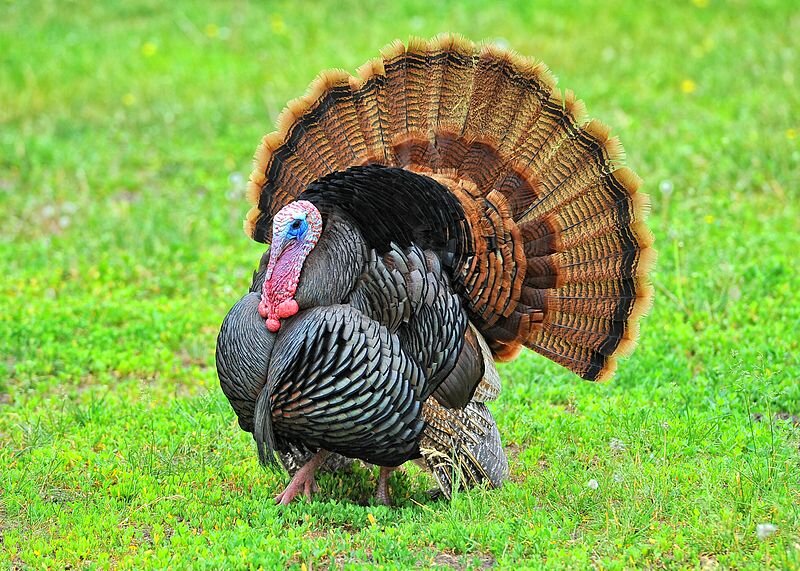
Another common identifier is the Tail Fans. During the summer, Jake Turkey molts and then starts to lose its feathers. Almost all feathers get shed except for the ones in the region of the beard and the central tail feathers, thus resulting in the central tail feathers being above the rest of the fan when the rest of the feathers grow back in.

This extra length causes the fan to look uneven and awkward, which can be seen prominently when the turkey walks around. In the turkey’s second summer, it sheds all its feathers, so they grow back uniformly.

This shows a sign of maturity, so only Gobbler Turkeys will have a uniform tail fan while Jake Turkey will have an uneven and awkward fan. Sometimes, due to forests’ wild nature, even a Gobbler Turkey might have an uneven fan because of losing a few feathers to predators. Still, on looking closely, the unevenness will not be as much as Jake Turkey’s.

Head Colour

Head Colour

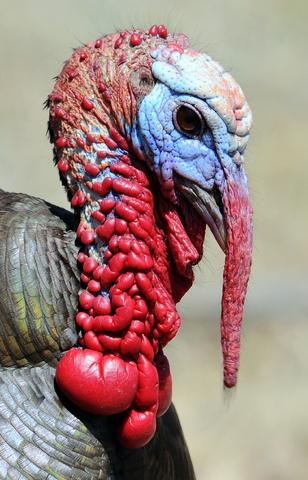
Tom Turkeys and Jake Turkeys typically have the same head colors and are a lot different from those of their female counterparts, but there is a slight difference between their heads during the spring breeding season.

Jake Turkey has a paler hue to their usual red and blue heads during this season, while Tom Turkey has a vibrant array of red shades and blue shades to their usual head color.

These vibrant colors help in attracting mates. Some white spots on their head are also found, making it easy to differentiate between the two turkeys during the hunt for the mature turkey bird.

Turkey Spurs

Turkey Spurs

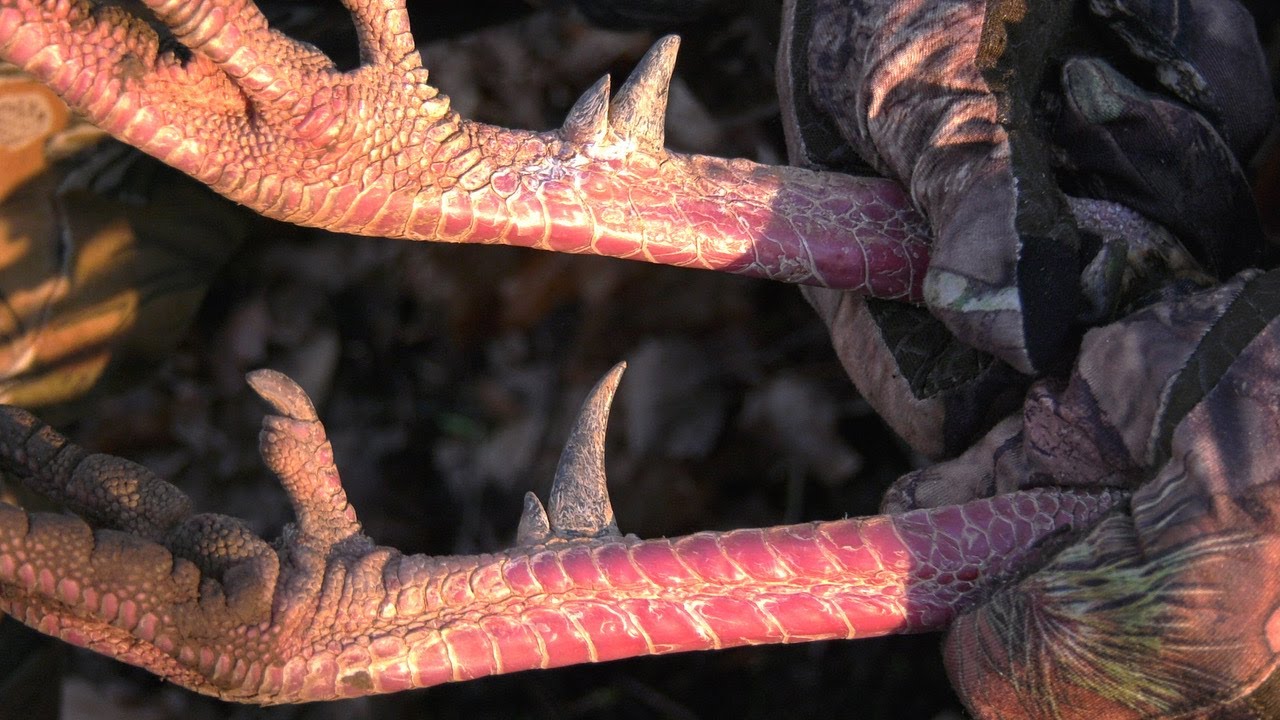
Turkey Spurs are also one of the common ways hunters differentiate between Jake Turkeys and Long Beard Turkeys. It helps determine the age accurately. Jake Turkeys have short and conical spurs that are slightly rounder.

Their spurs are around half an inch in length. On the other hand, a Long Beard Turkey has slightly longer spurs that are straight and pointed. They are longer than half an inch in length. As the Turkeys grow older, their spurs get more curved and hooked in form.

Gobbles

Gobbles

Gobbles are an identifier that requires patience and complete silence. It requires the hunter to use their hearing skills to their best as it is based on the kind of gobble the turkey in front is producing.

Gobbler Turkeys give a long, loud, and very good gobble, and in comparison to that, a gobble produced by a Jake Turkey is much softer and shorter and often not as good. If you are in a position where a Jake Turkey is making gobble sounds with the Gobbler Turkeys, you will probably be able to see the difference.

Jake Turkey’s gobble sounds like the noise that fellow hunters will be made to blend into the environment, while the gobble of a Gobbler Turkey is loud and like a response to the Death Valley Box call.

Behavior

Behavior

Complimenting the animal kingdom’s general assumption, the older turkeys are more aggressive and loud compared to their younger flock. The Long Beard Turkeys are much more forward and louder in their behavior than the Jack Turkeys, which is why if a Jake Turkey is in the presence of a Long Beard Turkey, then it might not even strut near it.

Although this does not apply to the time when there is a group of Jake Turkeys, they are bolder when teamed up against a single Long Beard Turkey. In hunting, one must be aware of such nuances and decoy strategies.

A weaker, long beard may be more willing to approach hen decoys if there is no other male decoy around, while more robust, more aggressive gobblers may come running in to kick your jake decoys out of town.

All these identifiers are essential, but none of them apply solely individually. They need to be utilized with the complete sense and awareness of the hunter other identifiers’ backingers. Ensure all the conditions before you pull a trigger because a blunder like this cannot be rectified.

Often a hen might be bearded, or a Long Beard Turkey has no spurs or has an irregular fan, while a Jake Turkey might produce a gobble loud and long.

It is essential to be utterly aware while hunting because one is prone to accidents, including injuring a bird that is illegal to hunt or shooting a fellow hunter who was imitating the bird calls with a red and blue hat.

Turkey Hunting is a fun sport that many families enjoy, so to have a hearty experience, make sure you understand all the points carefully and then go into the field.

Pocket Knife Parts Explained: Tip-to-Clip Anatomy

0

Belly, swedge, choil, and bevel — what the heck do these things actually mean? In the context of pocket knives, unfortunately, the answers can be complicated. While some terms are nearly universal (“edge,” for instance, or “lock”), there are certain words and phrases that can vary slightly, either from the manufacturer or the “everyday carry” community at large.

But that’s why I’m here! In conjunction with my recent explainer on shopping for your first knife, I thought it might be helpful to explain some of the various parts and pieces you’ll see referenced in most of our reviews. Many of these are shared in the world of fixed blades, but for this guide, we’re going to focus mostly on folders.

Get ready for a vocabulary overload, and no small amount of quibbling. From grinds to blade shapes and tips, the terminology and debates are almost endless. But to join (or pass up) the discussion, here’s what you’ll need to know.

Finch pocket knives
(Photo/Josh Wussow)

A Knife’s Blade and Parts

This is the natural place to start, as the shape and arrangement of the blade is likely to play the biggest role in your choice of pocket knife. Something we won’t be covering is the multitude of available steels.

If you’re looking for a deep dive into the best steel for your particular application, check out this separateexplainer from GearJunkie.

Grind

We’ll begin with the edge. That’s the sharp part that cuts things, right? True! But it’s a bit more complicated than that.

Urban EDC Supply LC Knife - Closing
(Photo/Josh Wussow)

There are several ways a blade can be ground into sharpness. For pocket knives, the most common is the flat grind and the hollow grind.

The first of these is just as it sounds — the blade slopes down from the top (or spine) until the sides join at the cutting edge. Their angles usually taper once again near the very end, forming what we call a secondary bevel. That’s the shiny part that catches the sun.

A hollow grind has all of the same parts, except that the blade steel slopes inward as it descends toward the edge instead of plunging straight down at an angle. This creates a narrower, more slicing-friendly edge that’s wider at the top and thinner at the bottom. Knives like the Buck 110 are a classic example of this design.

Buck Knives 110
Hollow grind on the Buck 110; (photo/Buck Knives)

There are other types, such as Scandi (short for Scandinavian) grind, which can be found on knives like the Cold Steel Finn Wolf. In this case, both sides of the blade descend straight down, until they angle inward to form a single, primary bevel/edge.

Cold Steel Finn Wolf
Cold Steel Finn Wolf; (photo/Cold Steel)

These are excellent for outdoor pursuits, specifically woodworking and bushcraft. Saber grinds are similar to Scandis, though they angle inward again to form a shorter, secondary bevel at the edge. Both of these are far more common on fixed blades as opposed to folders.

Tip to Belly

A knife’s belly is the part of the blade where the edge curves up toward the tip. Unlike human beings, the more belly your knife has, the better it is at sliding through things.

Some knives (like tantos) have no belly at all. These are better suited for scraping or piercing tasks. You may also see serrations near the backside of the edge (also called the heel), which are saw-like teeth best used for cutting fibrous materials like a rope.

Tanto blade
Example of a “tanto” blade; (photo/Slideordies14)

This is also where makers potentially install a sharpening choil, which is a small (usually half-moon) shaped cutout that allows users to more easily sharpen the full length of the edge.

The Benchmade Bugout, for instance, has a large choil, while the Spyderco Delica has none.

Knife choil
Knife choil; (photo/Josh Wussow)

Proceeding upward from the tip, you’ll often see a narrowed stretch of metal along the top of the blade. This is called a swedge, and it helps taper the steel into a fine point.

There are an incredible number of tip styles and, to be frank, the labeling is incredibly nebulous: reverse tanto, sheepsfoot, Wharncliffe, drop point, and clip — makers tend to play fast and loose with their naming conventions. Just know that the narrower the tip, the more delicate it is.

Near the rear of the spine, many makers include a series of small, beveled cutouts known as jimping. These are designed to provide a natural landing spot for your thumb, lending additional texture and grip.

Opening, Locking Mechanisms

This is a big one, so I’m going to boil it down to basics. Thumb studs and finger holes are exactly what they sound like. They’re added or absent bits of metal along the upper rear of the blade, which allow you to push the knife open with your thumb.

A flipper tab does the same thing, though it’s positioned on the bottom side, near the heel. Many of these also serve double duty as a blade guard, keeping your finger away from the edge once the knife is open.

Front flippers are also a thing, though these require some practice. Nail nicks are most common on traditional knives, which utilize a backspring to keep the blade semi-locked in place.

However it opens, the blade will swing open on a pivot. And surrounding the pivot, you’re likely to find things like washers or bearings to help move the action along. You’ll also see reviewers discussing a knife’s detent.

As the folks at Knives and Tools so eloquently described, this is another small bearing that lines up with a hole cut out in the hidden portion of the blade.

“Because the detent ball falls into the hole when the knife is closed, the knife will stay closed.”

So when you see a reference to “detent,” folks are generally discussing the amount of force required to pop open a blade. Simple!

Locks are a different matter. For a discussion on these, I’m going to refer you to the experts at KnifeCenter. Frankly, this topic is vast enough to be an article in itself. But it’s hard to go wrong with the basics, like a back lock, frame lock, or liner lock.

Handle and Clip

You know what a broom handle is, right?

Well, knife handles are a lot like that, only they’re attached to sharpened steel instead of rough bristles. Basically, it’s the place where you put your hand. There are plenty of materials used here, but the most common are things like G-10, FRN, Micarta, and carbon fiber.

WE Knife Banter Pocket Knife - G10 handle
Example of a G10 handle with a lanyard hole; (photo/WE Knife Co.)

These are well-suited for most general use, though metals like titanium, steel, and aluminum are also popular. Heck, you can even find wood or bone pocket knives, if you’re going the traditional route.

Best for general use: G-10, FRN. Because of their water resistance and grippy nature, these materials are perfect for most everyday tasks. Micarta also fits into this category, but can garner stains from moisture.

Best for metal-heads: stainless steel, titanium. If you’re looking for a full-metal experience, both of these make for functional handles. However, stainless steel handles can become rather weighty. And though titanium is lighter, neither offer the in-hand warmth of other materials.

Best for fancy folks: carbon fiber, wood, bone. Carbon fiber is an excellent choice for lightweight handles. While formerly limited to high-priced knives, it’s now available on several budget-friendly models. Wood and bone are most often relegated to traditional knives, though there are exceptions from Helle and Opinel.

If you’re opting for a handle made with polymer or natural material, your knife will generally have liners. These bits of steel provide structural support and give your handle scales something to sit on. You’ll also find various posts and spacers along the back, which keep the scales from pinching down on the closed blade.

Sometimes, these are hollowed out to form a lanyard hole, allowing you to loop fabric through for decoration or added grip. This passes through both the flat side that usually bears the maker’s logo (the show side), and the opposite surface known as the clip side.

Types of Pocket Clips

And that brings us to one of the things that make pocket knives, well, pocketable. Pocket clips come in many forms, but the most popular terms you’ll see are these: deep carry, reversible, and tip up/tip down.

Deep carry fits its description. These clips allow the backend of the knife to rest near the top seam of your pocket, creating a more discrete appearance. But in general, most pocket clips allow at least a portion of the knife to be seen.

Reversible and tip up/tip down are different sides of the same coin (or knife). This means that the clip can be moved and repositioned, whether it be to suit a left-handed user or someone with a preference between having the knife’s stowed tip facing upward or downward in the pocket.

Here’s a hint for new knife folks: 99% of the time, tip up is significantly easier and safer, as the back of your pocket helps keep the blade closed.

Got all that? If not, there are plenty of ways to keep the terms fresh in your memory. One of the best is this visual aid from Knafs — a poster showing everything discussed here and more. And if all else fails, pull up reviews and discussions from YouTube.

But you don’t have to know any of this stuff in order to enjoy and use a pocket knife. The most important thing to keep in mind, as with all tools, is safety.

Know where your edge is pointing, what you intend to cut, and make sure your space is clear. And if you’re still unsure as to what you’re looking for in a blade, check out our guide on how to shop for your very first knife.

Best Camo for Deer Hunting: What the Science Says

0

In our previous post, we talked about the intricacies of deer vision, focusing on their perception of color, sensitivity to light, ability to detect movement, and their response to blue-spectrum and UV light. With that foundation, it’s time to delve into choosing the best camo for deer hunting in different hunting environments and seasons.

In this follow-up post, we’ll discuss what the science says about deer vision and camouflage and how to use them to enhance your concealment and help you choose the right camouflage for hunting deer.

Selecting the Right Camouflage to Beat Deer Vision

Choosing the right camouflage can make all the difference in a successful deer hunt. Deer have exceptional vision, and hunters need to be aware of how they perceive colors and movement to avoid detection. In this section, we’ll look at the science behind deer vision and how it relates to camouflage.

  1. Match your environment: Choose a camouflage pattern that blends well with the dominant colors, patterns, and textures of your hunting environment.
  2. Adapt to the season: Select camouflage that reflects the changing foliage and vegetation throughout the hunting season. Early-season hunts may require more green elements, while late-season hunts call for patterns with more browns and grays. Snowy environments or winter hunts may necessitate snow camouflage patterns.
  3. Consider deer’s unique color perception: Deer perceive reds, oranges, and some tans and grays as shades of green or gray. Be cautious when selecting camouflage patterns, as they may appear effective to human eyes but stand out to deer due to their unique color perception.
  4. Minimize blue-spectrum and UV visibility: Since deer are sensitive to blue-spectrum and UV light, avoid clothing and gear treated with brighteners, which can make them more visible to deer. Use UV-free detergents for washing your hunting gear and consider using UV-blocking sprays on your clothing and equipment to minimize the chances of being detected by deer.

READ: Deer Vision 101: How Deer See Color, Light, and Movement

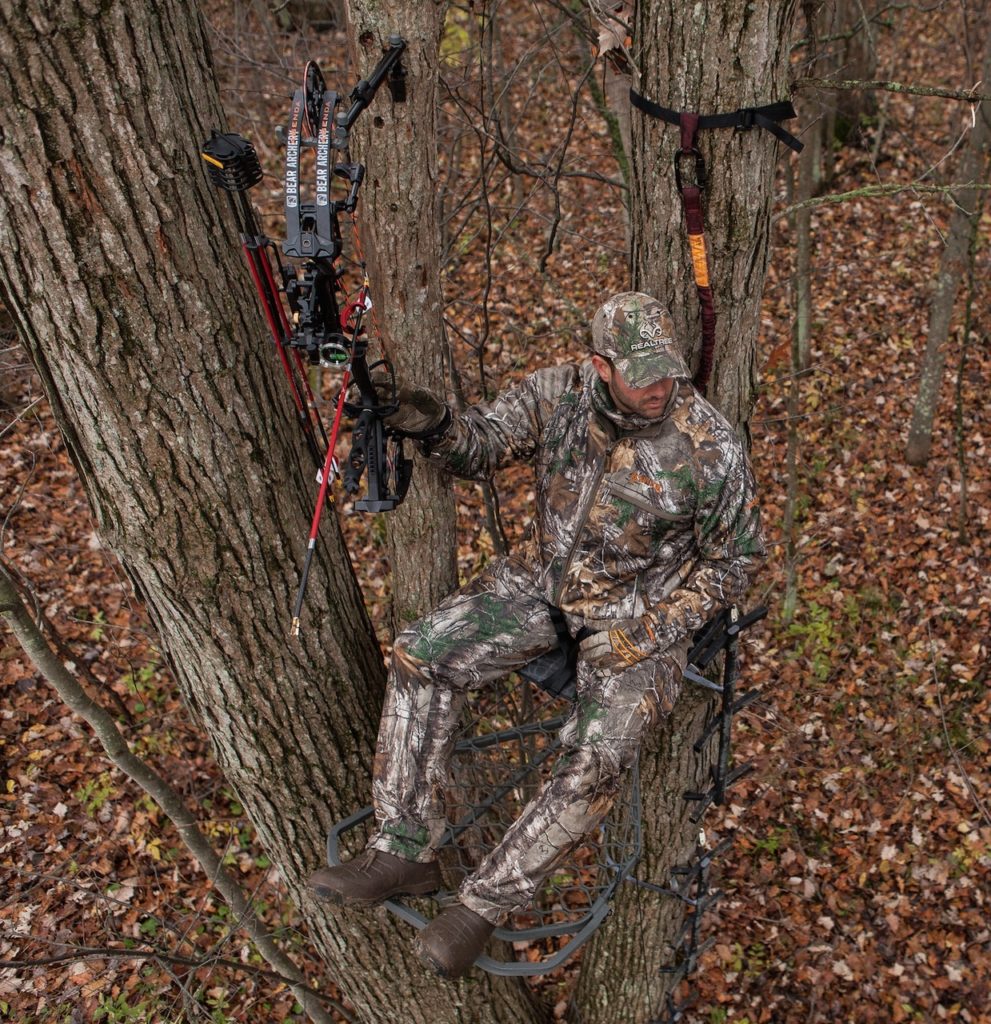
Bow hunting in tree and matching camo

Why Mimicry Camo Might Not Be the Best Camo

Mimicry camo, which uses pictures or photos of sticks, leaves, bark, trees, etc. to mimic the environment, is the most common type of hunting camouflage. These patterns can look incredibly realistic to the human eye and provide a sense of satisfaction to the hunter wearing them.

As research into deer vision and behavior has advanced, it has become clear that mimicry camo may not be the most effective option for hunting. While these patterns may look highly detailed to the human eye, deer perceive them as blurry blobs of color. Instead, patterns that use disruptive shapes and colors to break up the hunter’s outline have been shown to be more effective at fooling the eyes of whitetail deer.

While mimicry camo may look great to human eyes, it may not always be the most effective choice when hunting deer. By understanding the limitations of deer vision and the importance of breaking up your outline, you can make an informed decision when choosing your hunting apparel and give yourself the best possible chance of success.

The Effectiveness of Computer-Generated “Disruption” Camo Patterns

In recent years, computer-generated “disruption-style” camo patterns have become increasingly popular among hunters. With advancements in technology, it’s easier than ever to create intricate designs and patterns that are meant to mimic natural surroundings. But are these patterns actually effective? In this section, we’ll take a closer look at the effectiveness of computer-generated camo patterns and compare them to traditional, nature-based mimicry patterns.

Disruption camo is designed to break up the outline of the hunter and create the illusion of depth using different-sized patterns. This method tricks the animal’s eyes into not recognizing the subject as one single object, which makes it harder for them to identify the threat. In essence, disruption camo is designed to trick the animal’s eyes into not seeing anything at all.

Best camo for deer hunting: what the science says
This picture shows how closely macro and micro camo from companies like Sitka and Huntworth look the same by following the same principles of how deer see.
  1. Kuiu, Sitka, Huntworth, and Forloh: These companies have developed advanced camouflage patterns using computer algorithms and digital technologies to create intricate designs that blend effectively with different types of terrains and vegetation. Their patterns can be quite effective for bow hunters, as they help to break up the human silhouette and blend seamlessly with the environment.
  2. Asio Gear’s owl-inspired camo: Asio Gear has developed a camouflage pattern specifically for bow hunters, inspired by the natural plumage of owls. This unique pattern is designed to mimic the disruptive coloration and patterning found in owl feathers, which help owls remain concealed from their prey. The effectiveness of this pattern for deer hunting will depend on the specific environment in which you are hunting and how well the colors and patterns match the local vegetation and terrain.

Modern hunting gear companies like the ones detailed above have developed innovative, computer-generated camouflage patterns designed to provide better concealment in various hunting environments. These patterns are often based on detailed studies of natural environments and animal vision, with the aim of increasing their effectiveness in fooling the keen eyes of deer and other game animals.

Deep Cover Camo by Forloh for close range camouflage
Forloh’s Deep Cover camo was specifically designed for deer vision for bow hunter camouflage at 40 yards or less. It was not made for the human eye.

READ: Bow Hunting Clothes: Optimizing Camo, Scent, and Stealth

Mastering the Art of Concealment

Effective camouflage is just one piece of the puzzle when it comes to successful bow hunting. In addition to choosing the right gear, it’s important to master the art of concealment. This means staying motionless, scent-free, and taking advantage of natural cover to blend into the environment. In this section, we’ll explore the key strategies and techniques for concealing yourself effectively while bow hunting.

  1. Blend with the environment: Choose a camouflage that closely resembles the natural patterns and contrasts in your hunting area, helping you to blend in seamlessly.
  2. Minimize movement: Deer are highly sensitive to movement, so remain as still and quiet as possible when waiting for the perfect shot.
  3. Maintain awareness: Stay vigilant and keep an eye on your surroundings. Deer have a wide field of view, and their heightened senses can detect even the slightest disturbances.
  4. Camouflage vs. solid colors: While it’s possible to hunt deer without wearing camouflage, using camo can improve your chances of remaining concealed and undetected. For bow hunters, who need to get closer to their quarry, being able to break up your outline and blend into your environment is critical to your success. However, it’s crucial to combine camo with other hunting strategies and choose the appropriate pattern for your hunting environment and season.

It’s also important to consider other gear that can reduce visibility, such as face masks, gloves, and boots. These items should also match the camo pattern of the clothing.

Buck sniffing the air looking into the wind while looking for predators.

The Best Camo for Deer Hunting

When it comes to deer hunting, camouflage isn’t just a fashion statement – it’s a crucial tool for success. Understanding deer vision and visual processes is key to creating effective camouflage that works in two ways. First, it must break up the hunter’s 3-dimensional shape and avoid stimulating the ambient system. This is achieved through an effective macro pattern.

Second, if the hunter is detected, the camouflage must prevent or delay recognition by making the hunter appear to have a completely different texture, which is where the micro pattern comes into play. Camouflage gives hunters an extra edge in the difficult pursuit of hunting by enhancing their concealment and increasing their chances of a successful hunt.

Many hunting clothing companies offer camouflage patterns that incorporate both macro and micro patterns to effectively break up the hunter’s shape and texture.

Some examples of such camo patterns include:

  • Sitka Optifade Subalpine and Elevated II (and all the other variations they have)
  • Kuiu Valo, Verde, and Vias
  • First Lite Specter
  • Huntworth Disruption
  • True Timber Strata
  • Under Armour Ridge Reaper Barren

These patterns use a combination of larger and smaller shapes, colors, and textures to create a highly effective camouflage that can help hunters remain hidden from deer.

There isn’t a single combination of colors that works optimally to beat deer vision, but generally speaking, camo patterns that incorporate shades of brown, green, and gray are the most effective. These colors match the natural environment, work against what a deer can see best, and reduce the silhouette of the hunter, making them less detectable.

It’s also important to choose a camo pattern that matches the specific environment and season you’ll be hunting in, as this can vary greatly depending on the location and time of year. Ultimately, the best combination of colors will depend on the individual hunting situation and environment you are in.

*Does mimicry camo work for deer hunting? Of course, it does. Deer have limited ability to see fine details, making mimicry camo effective, especially in environments where the camo closely matches the surroundings. However, based on my experience, I choose disruption-style camo 90% of the time. Disruption-style camo is designed to break up the human outline and create visual confusion, providing reliable concealment in various environments. While mimicry camo excels in perfectly matched environments, disruption-style camo offers versatility and effectiveness even when the colors and patterns may not perfectly align. This is why disruption-style camo has become my preferred choice for its all-around performance.

The Best Camo Patterns for Bow Hunters in Treestands

For bow hunters who hunt from treestands or elevated positions, there are disruption-style camo patterns specifically designed to blend into the vertical lines of trees. Sitka’s Elevated II and Kuiu’s Vias Camo are examples of camo patterns that utilize a mix of grays and greens to break up the human silhouette against the vertical lines of trees.

When hunting from a treestand, it’s important to consider the angle at which deer are likely to approach. Camouflage that blends in well with the vertical lines of trees can be particularly effective when deer are approaching from below, as it helps to break up the hunter’s outline and prevent them from being spotted.

Some of the best camos for deer hunting from a tree stand are:

  • Sitka’s Elevated II
  • Kuiu’s Verde (Early season)
  • Kuiu Valo (Mid-season)
  • Asio Gear’s Raptor Camo (See my mid-season gear review here)
  • True Timber Strata
  • Huntworth Disruption (or Tarnen)
Asio Gear Raptor Camo

What Deer Science Says

Understanding the science behind deer vision and camouflage is crucial for any serious bow hunter. As hunters, we want to reduce our visibility to deer and increase our chances of a successful hunt. Thanks to a number of scientific studies, we now have a better understanding of what camo patterns work best and why.

There are a number of scientific studies that support the effectiveness (or lack of) of camo patterns that mimic the environment. For example, a study conducted by the University of Georgia found that hunters wearing naturalistic camouflage patterns (mimicry) were less visible to deer than those wearing non-naturalistic patterns or solid colors.

Here are some additional resources and studies that can provide more scientific insight into deer vision and how it relates to the camouflage you wear when hunting:

  • New York Times
  • The Free Library
  • The Deer Laboratory
  • North Country Whitetails
  • The Outdoor Channel
  • Desolve Camouflage Camo Science

Conclusion

By applying your understanding of deer vision to your choice of camouflage, you’ll be better prepared to blend into your hunting environment and stay concealed from the keen eyes of whitetail deer. Remember to select a pattern that closely matches the natural colors, patterns, and textures of your hunting area, and adapt your camouflage according to the season.

Additionally, bear in mind that deer rely on other senses, such as hearing and smell. Thus, it’s essential to minimize noise, control your scent, and remain aware of wind direction while hunting. By combining all these elements, you’ll become a more proficient and effective whitetail deer bow hunter.

Understanding how deer see and process information is essential when trying to find the best camo for deer hunting. While many camouflage patterns use mimicry to blend in with natural environments, ungulates (deer) do not perceive fine detail the same way humans do. Instead, breaking up your outline is the key to effective camouflage, using different-sized patterns to create the illusion of depth and disrupt the animal’s ability to recognize one single object. This is where disruptive camouflage patterns can be more effective than mimicry patterns. By focusing on our outline, removing contrast to the environment we are hunting in, and using effective camouflage, we can reduce our visibility and increase our chances of a successful hunt.

While I didn’t list every deer hunting camouflage that meets the criteria in this post, you can now take this information and make an informed decision on what to buy the next time you are shopping for bow hunting clothes.

Boost Your Hunting Success with Deer Urine: The Power of Scent in Attracting and Masking Human Odor

0

Deer urine: A versatile tool in hunting and gardening. Discover the hidden potential of this natural resource, as we explore its uses in attracting deer during hunting season and as an organic fertilizer for your garden. Learn how deer urine can enhance your outdoor experiences and benefit your plants, all while staying environmentally friendly.

The Role of Deer Urine in Hunting: A Comprehensive Guide

The Role of Deer Urine in Hunting: A Comprehensive Guide

Why Hunters Use Deer Urine

Deer urine is a popular tool used by hunters to attract deer and mask their human scent. This is because a deer’s sense of smell can be up to 1,000 times stronger than that of a human. By using deer urine, hunters can increase their chances of success by enticing deer to come within shooting range.

Types of Deer Urine

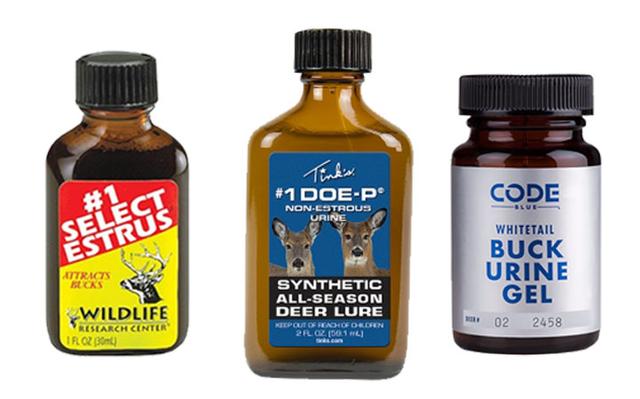
There are different types of deer urine that hunters use depending on the breeding season and specific hunting goals. Standard doe urine can be used at almost any time of the year to attract deer. Buck urine is typically used during the breeding season or leading up to it, as it attracts local bucks who may challenge intruding bucks. Doe estrous urine, collected from does ready to breed, is used during the peak of the rut to attract reproduction-focused bucks.

Restrictions on Natural Deer Urine

It’s important to note that natural deer urine products are banned for hunting in some regions due to the potential spread of chronic wasting disease through deer urine. In these areas, synthetic scents are allowed instead. Hunters should familiarize themselves with local regulations before using any type of deer scent.

Other Scents Used by Hunters

In addition to deer urine, some hunters also use scents derived from other animals such as raccoons, foxes, or skunks. These scents are used to further mask their own scent and increase their chances of remaining undetected by deer. Some hunters also utilize scents derived from interdigital glands (on a deer’s hooves) and tarsal glands (on the inside of a deer’s back legs) to simulate deer activity in an area.

Scent Suppression and Cover Scents

Hunters not only use scents to attract deer but also employ strategies to suppress their own human scent. Scent-free clothing made with charcoal liners or antimicrobial fabrics is popular among hunters. Additionally, scent-suppressing sprays, wipes, and ozone-generating machines are used to alter scent molecules and make a human’s smell undetectable by deer. Some hunters also use cover scents that mimic natural smells in the environment, such as trees, acorns, corn, vanilla, or berries.

In conclusion, deer urine plays a significant role in hunting by attracting deer and masking human scent. Hunters have various options when it comes to choosing the right type of urine for different hunting scenarios. It is essential for hunters to be aware of any restrictions on the use of natural deer urine in their region and consider alternative synthetic scents if necessary. Additionally, employing scent suppression techniques and utilizing cover scents can further enhance a hunter’s chances of success in the field.

Harnessing the Power of Deer Urine: How Hunters Use It to Their Advantage

Deer urine is a powerful tool that hunters use to attract and deceive deer. With a deer’s sense of smell being up to 1,000 times stronger than that of a human, using scents derived from deer urine can greatly increase a hunter’s chances of success. Natural deer urine products are collected from farm-raised deer during different reproductive cycles to capture specific scent profiles associated with breeding conditions. These products are typically marketed as attractants or calming scents that entice deer to come within shooting range.

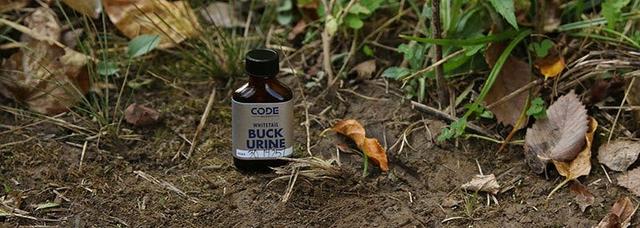
Hunters have various ways of using deer urine in their hunting strategies. They may pour a few drops on their boots, sprinkle it on leaves, drag it on a cloth as they walk, pour it onto the ground, or use saturating aerosols to present the smell of deer near their hunting locations. Different types of deer urine are used depending on the time of year and the behavior of bucks. Standard doe urine can be used almost any time, while buck urine is typically used during the breeding season or leading up to it. Doe estrous urine, collected from does ready to breed, is used during the peak of the rut to attract reproduction-focused bucks.

It’s important to note that natural deer urine products are banned for hunting in some regions due to concerns about chronic wasting disease. In these areas, synthetic scents are allowed instead. Additionally, some hunters also use other animal urines such as raccoon, fox, or skunk urine to further mask their scent. They may also utilize scents derived from deer interdigital glands and tarsal glands for additional deception.

In addition to using deer scents, hunters also invest in scent-elimination products and scent-suppressing clothing to minimize their human odor. Scent-free clothing made with charcoal liners or antimicrobial fabrics is popular among hunters. For those who cannot afford such clothing, there are scent-suppressing sprays or wipes available. Another innovative development in scent suppression is the use of ozone-generating machines that alter scent molecules, making a human’s smell undetectable by deer.

Some hunters prefer to use cover scents to mask their human odor instead of trying to smell like nothing at all. These cover scents come in various forms such as sprays, wafers, sticks, and gels. They provide hunters with the ability to mimic the smells of trees, acorns, corn, vanilla, anise, soil, berries, and other natural scents that may fool a wary deer’s nose.

In conclusion, harnessing the power of deer urine has become an integral part of many hunters’ strategies. By using different types of deer urine and other animal urines, hunters can attract deer and mask their own scent effectively. Combined with scent-elimination products and cover scents, these techniques significantly increase the chances of a successful hunt. However, it’s essential for hunters to be aware of regional regulations regarding the use of natural deer urine due to concerns about chronic wasting disease.

Exploring the Benefits of Deer Urine in Attracting and Masking Human Scent

Exploring the Benefits of Deer Urine in Attracting and Masking Human Scent

Deer urine has been used for many years by hunters as a tool to attract deer and mask their own human scent. This is because a deer’s sense of smell is incredibly strong, up to 1,000 times stronger than that of a human. By using deer urine, hunters can increase their chances of success in harvesting a deer.

One of the main benefits of using deer urine is its ability to attract deer to a specific area. Hunters can use different types of deer urine depending on the time of year and the breeding cycle of the deer. For example, standard doe urine can be used at almost any time of year to entice both does and bucks to come within shooting range. During the breeding season or leading up to it, hunters may opt for buck urine to attract local bucks to the area. Additionally, doe estrous urine collected from a doe ready to breed can be used during the peak rutting period to attract reproduction-focused bucks.

It is important to note that natural deer urine products are banned for hunting in some regions due to the potential spread of chronic wasting disease. In these areas, synthetic scents are allowed instead. However, some hunters also use other types of animal urine such as raccoons, foxes, or skunks to further mask their scent while hunting.

In addition to using deer urine, hunters also have other options for masking their human scent. Scent-free clothing made with charcoal liners or antimicrobial fabrics is popular among hunters who want to suppress their odor. Alternatively, scent-suppressing sprays or wipes can be used as well. Some hunters even use ozone-generating machines that alter scent molecules and make a human’s smell undetectable by deer.

Overall, using deer urine and other scent-masking techniques can greatly increase a hunter’s chances of success in attracting deer and remaining undetected. These methods allow hunters to smell like the natural environment and reduce the chances of scaring away their target.

Understanding the Different Uses of Deer Urine in Hunting Strategies

Understanding the Different Uses of Deer Urine in Hunting Strategies

Deer urine is a popular tool used by hunters to attract and mask human scent, increasing their chances of a successful hunt. The strong sense of smell possessed by deer makes these scents effective in luring them within shooting range. Natural deer urine products, derived from both does and bucks, are commonly marketed as attractants or calming scents. These scents are collected from farm-raised deer during different times of the year and reproductive cycles to capture specific scent profiles associated with breeding conditions.

Hunters use standard doe urine throughout the year, applying a few drops on their boots, leaves, or dragging it on a cloth as they walk. They may also pour it onto the ground or use a saturating aerosol to create the smell of deer near their hunting locations. Buck urine is typically used during the breeding season or leading up to it, with the hope that dominant bucks in the area will investigate and try to run off any intruding buck. Doe estrous urine, collected from a doe ready to breed, is used during the peak of the rut to attract reproduction-focused bucks.

It’s important to note that natural deer urine products are banned for hunting in some regions due to concerns about chronic wasting disease spread through deer urine. In these areas, synthetic scents are allowed instead. In addition to deer urine, hunters may also use urine from raccoons, foxes, or skunks to further mask their scent. Some hunters even utilize scents derived from deer interdigital glands (on hooves) and tarsal glands (inside back legs), which simulate deer walking through an area and provide unique scent signatures for communication.

To suppress their own human scent, hunters have various options available. Scent-free clothing made with charcoal liners or antimicrobial fabrics is popular among hunters. For those who can’t afford such clothing, scent-suppressing sprays or wipes are a viable alternative. A newer development in scent suppression is the use of ozone-generating machines, which alter scent molecules and make a human’s smell undetectable by deer. Cover scents are also used by hunters who aim to smell like something else rather than trying to eliminate their scent entirely. These cover scents come in various forms such as sprays, wafers, sticks, gels, and can mimic the smells of trees, acorns, corn, vanilla, anise, soil, berries, and more.

In conclusion, deer urine is a versatile tool in hunting strategies. It is used to attract deer and mask human scent through different types of urine collected from does and bucks during specific breeding conditions. However, it’s important to be aware of regional regulations regarding the use of natural deer urine due to concerns about disease transmission. Hunters also have options for suppressing their own human scent through clothing, sprays/wipes, and innovative technologies like ozone-generating machines. Additionally, cover scents provide hunters with the ability to smell like other natural elements found in the environment.

The Science Behind Deer Urine: Why Hunters Rely on It for Success

The Science Behind Deer Urine: Why Hunters Rely on It for Success

Deer urine has long been used by hunters as a tool to attract and deceive deer. The reason behind its effectiveness lies in the powerful sense of smell that deer possess. A deer’s sense of smell is up to 1,000 times stronger than that of a human, making it crucial for hunters to mask their own scent and use attractants that mimic those found in the natural environment.

One of the main uses of deer urine is as an attractant. By using doe urine, hunters can simulate the presence of a female deer in heat, which will entice bucks to investigate and potentially come within shooting range. Similarly, buck urine can be used during the breeding season to imitate the presence of a dominant buck, triggering territorial behavior in other bucks and increasing the chances of a successful hunt.

It’s important to note that different types of deer urine are collected at specific times of the year to capture different scent profiles associated with breeding conditions. This ensures that hunters have access to scents that closely resemble those produced by deer during specific periods, increasing their chances of attracting targeted deer.

However, it’s worth mentioning that natural deer urine products are banned for hunting in some regions due to concerns about spreading chronic wasting disease. In these areas, synthetic scents are allowed as an alternative. Additionally, some hunters also use urine from other animals such as raccoons, foxes, or skunks to further mask their scent and create a more realistic hunting environment.

In addition to using deer urine, hunters also employ other strategies to suppress their human scent. Scent-free clothing made with charcoal liners or antimicrobial fabrics is widely available and helps reduce odor detection. Scent-suppressing sprays or wipes can also be used to attack odors directly. More recently, ozone-generating machines have emerged as a new development in scent suppression, altering scent molecules to make a human’s smell undetectable by deer.

Overall, the use of deer urine and other scents in hunting is based on the understanding of a deer’s powerful sense of smell and their natural behaviors. By using these scents strategically, hunters can increase their chances of success by attracting deer and masking their own presence in the hunting environment.

Maximizing Harvest Success with Deer Urine: A Closer Look at Its Applications

Maximizing Harvest Success with Deer Urine: A Closer Look at Its Applications

Deer urine is a popular tool used by hunters to attract and mask their scent from deer. With a deer’s sense of smell being up to 1,000 times stronger than that of a human, it’s no wonder that many hunters rely on these scents to increase their chances of success. Natural deer urine products, derived from both does and bucks, are marketed as attractants or calming scents that entice deer to come within shooting range.

Hunters use standard doe urine throughout the year, pouring a few drops on their boots, leaves, or cloth as they walk, or even setting off a saturating aerosol to create the smell of deer near their hunting locations. During the breeding season or leading up to it, hunters opt for buck urine to attract local bucks to the area. By using buck urine, hunters hope that dominant bucks in the area will investigate the scent and try to run off any intruding buck.

Another type of natural urine used by deer hunters is doe estrous urine. This urine is collected from a doe that is ready to breed and is used during the peak of the rut to attract reproduction-focused bucks. However, it’s important to note that natural deer urine products are banned for hunting in some regions due to the potential spread of chronic wasting disease through deer urine.

In addition to using deer scents, some hunters also use urine from raccoons, foxes, or skunks to further mask their scent. They dab a few drops on their boots while walking to their hunting stands in hopes of covering any scent left in their tracks. Other scents derived from deer interdigital glands (on the hooves) and tarsal glands (on the inside of a deer’s back legs) are also used by hunters.

To suppress their human scent, hunters have various options. Scent-free clothing made with charcoal liners or antimicrobial fabrics is a popular choice. For those who can’t afford scent-suppressing clothing, there are sprays or wipes available that attack odors. Another method is the use of ozone-generating machines that alter scent molecules, making a human’s smell undetectable by deer.

Lastly, some hunters use cover scents to smell like something else instead of trying to eliminate their scent altogether. These cover scents come in the form of sprays, wafers, sticks, gels, and other products that provide hunters the ability to smell like trees, acorns, corn, vanilla, anise, soil, berries, and more.

In conclusion, deer urine is a valuable tool for hunters looking to maximize their harvest success. Whether it’s using doe urine at any time of year or specific types of urine during the breeding season, these scents help attract and mask human scent from deer. However, it’s important to be aware of regional regulations regarding the use of natural deer urine products due to the potential spread of diseases. Additionally, hunters have other options such as using cover scents or scent-suppressing clothing to further increase their chances of success in the field.

270 vs 30-06 Debate Settled Once And For All

0

The .270 Winchester and .30-06 Springfield are both great cartridges, but have different strengths and weaknesses. So, the question central to the 270 vs 30-06 debate remains: which one should you be hunting with?

Most hunters and shooters probably agree that the .270 Winchester and .30-06 Springfield are both quite versatile and effective cartridges. After all, there is a reason why they are the two most popular centerfire rifle cartridges used by hunters in the United States.

While there is an overlap in their capabilities, the two cartridges are best suited to different tasks and represent two different ways of thinking. This is part of the reason why each cartridge has such a dedicated and loyal following and why the 270 vs 30-06 debate continues to rage on after so many years.

In today’s post, I’m going to discuss the merits of the 270 vs 30-06 and provide some insight into which cartridge you should be using in various situations.

Before we get started, I have two administrative notes:

Some of the links below are affiliate links. This means I will earn a small commission (at no extra cost to you) if you make a purchase. This helps support the blog and allows me to continue to create free content that’s useful to hunters like yourself. Thanks for your support.

Additionally, I recorded an entire podcast episode on this exact subject. If you’d rather listen than read, click the appropriate link below to listen to this episode on your preferred podcasting service.

Be sure to hit that “Subscribe” button in your podcast player!

30-06 vs 270 Podcast

Apple | Google | iHeart | Spotify | Stitcher

270 vs 30-06: Similarities

First, lets start with the areas where the .270 Winchester and .30-06 Springfield are similar.

Both the .270 Winchester and the .30-06 Springfield are descended from the .30-03 Springfield cartridge, which was itself heavily influenced by the 7mm Mauser. Both the .270 and .30-06 are great cartridges for hunting medium to large sized game all over the world ranging from roe deer to moose under the right circumstances. They also have great reputations for accuracy and performance at extended range.

They are also very popular cartridges among hunters and shooters all over the world. Indeed, those two cartridges are among the most commonly used centerfire cartridges in the United States.

For that reason, just about every gun manufacturer produces rifles chambered in .270 Winchester and .30-06 Springfield. The same goes for ammunition, so users of these cartridges have plenty of choices when it comes to good quality guns and ammo.

So, we’ve covered how the .270 and .30-06 are similar, but how are they different?

270 vs 30-06: Cartridge Sizes

The U.S. Army designed the .30-06 Springfield for use in the bolt action 1903 Springfield rifle in 1906 as an improvement on the .30-03 Springfield cartridge. The Army was just coming off the heels of a sobering lesson regarding the effectiveness of the 7mm Mauser in the hands of Spanish troops in Cuba in 1898 and wanted a cartridge and rifle that could compete with the revolutionary new Mauser.

Using smokeless powder and a new 150gr pointed bullet fired at a muzzle velocity of 2,700fps, the .30-06 Springfield was a significant improvement over previous cartridges the military used during that era like the .30-40 Krag and the .45-70 Government.

It didn’t take long for the .30-06 Springfield cartridge to catch on with the hunting and shooting communities and it was soon an extremely popular cartridge in the United States and in North America as a whole.

As good as the .30-06 Springfield was, not everyone was completely satisfied with it and wildcatters quickly started modifying the cartridge for more specialized tasks.

Around the same time gun designers were necking up the .30-06 to develop the .35 Whelen cartridge, engineers at Winchester decided to go the opposite route and neck down the .30-06 to use .277″ instead of .308″ bullets. The resulting .270 Winchester cartridge (also known as the .270 Win for short) was formally released in 1925 for the Winchester Model 54 rifle.

The original .270 Winchester load shot a 130 grain bullet at a blazing fast velocity (for 1925 anyway) of 3,140 feet per second (2,846 ft-lbs of energy).

Though the .270 Winchester was not an immediate success, American hunters appreciated the flat shooting characteristics of the round and the fact that it was so effective on thin skinned game. The cartridge gradually became more and more popular, which was helped by Jack O’Connor and his famous affinity for the cartridge that he expressed in countless Outdoor Life articles over the years.

That’s not to say that the cartridge only became the incredibly popular because of O’Connor. While O’Connor did indeed love the .270 Winchester and used it extensively on hunts all over the world, it was far from the only cartridge he used. The .270 Winchester was also a good enough cartridge and filled a big enough niche that it probably would have been successful even without any help from Jack O’Connor.

The .270 Winchester is something of an oddity when it comes to bullet diameter though. Unlike all the other popular 7mm cartridges like the 7mm Mauser, 7mm-08, 7mm Remington Magnum and the .280 Remington that use .284″ bullets, the .270 Winchester uses .277″ bullets.

It’s unclear exactly why Winchester decided to go with .277″ instead of .284″ bullets with the .270 Winchester. One theory is they choose that particular bullet size based on the obscure 6.8x57mm Chinese Mauser cartridge. It’s also possible they wanted to create a distinctly American bullet size and avoid the 6.5mm and 7mm bullets popular in Europe by building a new brand new bullet diameter 10% smaller than the one used in the .30-06 (.9 multiplied by .308 is .277).

Regardless of their reasons, the design team at Winchester went with a .277″ bullet diameter and the rest is history. Interestingly enough, while the .270 Winchester turned out to be a smashing commercial success for the company, .277″ bullets never really caught on. The 270 Winchester Short Magnum (270 WSM) and the .270 Weatherby Magnum are the only other two mass produced cartridges that utilize bullets of that size.

You can see the heritage of the .270 and .30-06 cartridges on display in the photos below.

The .270 Winchester has a slightly longer case length (2.54″ vs 2.494″), but the two cartridges are identical up to the shoulder.

Though the .30-06 Springfield cartridge in the photo is slightly shorter than the .270 Winchester cartridge, the SAAMI specifications for the two cartridges overlap and the .270 Winchester and .30-06 Springfield have the same maximum authorized overall length of 3.34″ (84.84mm).

Since the .270 Winchester and .30-06 Springfield have the same maximum overall length of 3.34″, both cartridges are used in long-action rifles.

Due to the fact that the .270 Winchester basically just uses a necked down .30-03 Springfield case (which is also the parent cartridge for the .30-06), both cartridges also have the exact same case diameter and virtually the same case capacity.

Note: while the case capacity figures listed below do give a good indication of the differences between the two cartridges, exact case capacities vary slightly according to the brand of brass used.

270 vs 30-06 Ballistics

The .30-06 Springfield is certainly no slouch in terms of velocity or trajectory, but the .270 Winchester has a clear advantage in both of those areas. Similar to the difference between the 7-30 Waters and the .30-30 Winchester, by necking down the .30-06 case to shoot smaller diameter bullets, the designers of the .270 Winchester were successful in building a cartridge with a higher velocity, flatter trajectory, and less recoil than the .30-06 Springfield.

This is because, when compared to the .30-06 Springfield, the smaller diameter .270 Winchester shoots lighter weight bullets.

For instance, the vast majority of .270 Winchester factory loads shoot bullets in the 120-150 grain range. Of these, 130 grain and 150 grain bullets are by far the most common. On the other hand, though it’s possible to find .30-06 ammo shooting bullets weighing as little as 110 grains and as heavy as 220 grains, most .30-06 Springfield factory loads use bullets in the 150-180 grain range. 150 grain, 165 grain, 168 grain, and 180 grain bullets are the most common these days.

The table below compares the 130gr Nosler AccuBond (.435 BC) in .270 Winchester to 150gr Nosler Partition (.387 BC), 165gr Nosler AccuBond (.475 BC), and 180gr Nosler AccuBond (.507 BC) loads in .30-06 Springfield. As you can see, there is a significant difference in the bullet trajectories between the two cartridges.

Though two of the .30-06 loads utilize bullets with a higher ballistic coefficient and have as much or slightly more energy remaining at 500 yards, the .270 Winchester load still hits 4-8″ higher than all three .30-06 loads.

Not only does the .270 Winchester have a noticeably flatter trajectory, but that particular load generates 22-36% less free recoil energy than those three .30-06 Springfield loads when used in the same rifle. Felt recoil will vary from shooter to shooter and rifle to rifle, but free recoil energy is still a useful way to compare the two cartridges.

It’s tough to pick a winner when it comes to accuracy of the 270 vs 30-06 because it’s something of an apples to oranges comparison. Most people agree that both cartridges are capable of excellent accuracy, but the .270 Winchester is used almost exclusively as a hunting cartridge while match shooters, military and police snipers, and hunters have all used the .30-06 Springfield extensively over the years.

That’s not to say the .270 Winchester isn’t an accurate cartridge. It most certainly is, but it just doesn’t have the same pedigree as the .30-06 Springfield in that regard and for that reason, there are very few choices available for .270 Winchester match ammo.

All that being said, both cartridges have the potential for excellent accuracy in the right hands.

270 vs 30-06: Ammunition Selection

The .270 Winchester and .30-06 Springfield are two of the most popular cartridges for hunters in the United States. For that reason, virtually every ammunition manufacturer of note like Barnes, Browning, Federal Premium, Hornady, Nosler, PPU, Remington, Swift, Weatherby, and Winchester (just to name a few) produce a wide variety of good quality ammo in various bullet weights for both cartridges. So regardless of whether you want lighter or heavier bullets for either cartridge, you should be able to find what you’re looking for.

Just about every major style of bullet is available in those cartridges as well like the Barnes TTSX, the Hornady GMX, InterBond, and SST, the Nosler AccuBond and Partition, the Remington Core Lokt, the Swift Scirocco and A-Frame, and the Winchester Power Point (just to name a few).

Prices and availability for each cartridge vary from region to region, but ammunition for both cartridges is widely available. In fact, if a sporting goods store only carried ammo for two different centerfire rifle cartridges, I’d bet money they’d have .270 and .30-06 ammo. Ammunition for both cartridges is similarily priced as well.

BUY SOME QUALITY 270 WINCHESTER AMMO HERE

BUY SOME EXCELLENT 30-06 SPRINGFIELD AMMO HERE

Read the articles below if you’d like to learn more details about some of the various hunting ammunition choices for the 270 or the 30-06.

Best 270 Ammunition For Hunting Deer, Bear, Hogs & Other Big Game

Best 30-06 Ammunition For Hunting Elk, Deer, Bear, & Other Game

If you’re into hand loading, then you’re also in luck because reloading components for both cartridges are widely available. There are also lots of good quality .277 and .308 caliber bullets to choose from, so you shouldn’t have much trouble working up a custom load that shoots very accurately in your chosen rifle.

270 vs 30-06: Rifle Selection

Since the .270 and .30-06 are such popular cartridges, there are lots and lots of rifles to choose from and virtually every firearms manufacturer produces rifles chambered in both cartridges. Additionally, because the cartridges are the same length and have the same rim diameter, rifles of the same model chambered in each cartridge are virtually identical to each other.

Among others, the Browning X-Bolt, CZ-550, Mossberg Patriot, Remington Model 700 and 783, Ruger American and M77 Hawkeye, Savage 11/111, Thompson Center Compass, Tikka T3X, Weatherby Mark V and Vanguard, and (of course) the Winchester Model 70 are all available in .270 Winchester and .30-06 Springfield.

As anyone who has read a few of his articles in Outdoor Life would know, Jack O’Connor’s favorite rifle was a Winchester Model 70 rifle chambered in .270 Winchester. Even though the Model 70s has been chambered in many other cartridges (including .30-06), and even though many other rifles are available in .270 Winchester, the Model 70 and the .270 Winchester remain irrevocably linked in the minds of many hunters due to O’Connor’s work.

By the way, O’Connor’s Model 70 is currently on display at the Jack O’Connor Museum in Lewiston, Idaho

The description reads:

Jack O’Connor’s Favorite Rifle: The Winchester Model 70 Featherweight .270 was purchased in Lewiston in 1959. It was custom-stocked by Al Biesen of Spokane who also fitted an engraved trap-door buttplate and grip cap. It was used by Jack from Botswana to British Columbia on a variety of game, including his last Stone ram in 1973.

BUY AN OUTSTANDING 270 WINCHESTER RIFLE HERE

BUY A DEPENDABLE 30-06 SPRINGFIELD RIFLE HERE

Read the article below if you’d like to learn more details about some of the various hunting rifle choices for the .270 Winchester.

Best 270 Rifles For Hunting – Ultimate Guide

270 vs 30-06: Which Is Right For You?

When using the right bullets and with good shot placement, both cartridges are excellent for hunting medium to large sized game. Indeed, both the .270 Winchester and .30-06 Springfield are great choices if you’re looking for a really versatile cartridge.

They are both extremely effective (and popular) deer hunting cartridges. Indeed, whitetail deer probably make up well over half of the game harvested by those two cartridges each year. The .270 and .30-06 also work really well for feral hogs and black bear hunting. The same goes for exotic game like sika, axis, and fallow deer.

However, this is where the strengths and weaknesses of each cartridge start to diverge.

The flat trajectory of the .270 Winchester makes it great for animals that are more likely to require longer range shots like mule deer or pronghorn. By the same token, the fact that the .270 also has a relatively mild recoil also makes it a great cartridge for mountain hunts where a lightweight rifle is really desirable. After all, there’s a reason why Jack O’Connor liked his .270 so much for hunting sheep why it’s also still such an effective cartridge for mountain goat, Himalayan Tahr, and chamois hunting.

On the other hand, since it shoots heavier and larger diameter bullets, the .30-06 Springfield has a clear advantage when hunting larger species like caribou, elk, and moose. When using a 180 grain bullet, the .30-06 also has a clear advantage when hunting most species of African plains game.

That doesn’t mean that you can hunt elk, moose, or plains game with a .270. After all, lots of hunters have killed untold numbers of those animals with a .270 over the years. If anything, the .270 Winchester is even more effective on really large game (elk hunting in particular) now than it was even 20 years ago because hunters have access to much better quality bullets these days.

For instance, the 150gr Nosler Partition below really did a number on a big kudu bull in South Africa.

There’s also nothing saying the .30-06 isn’t suitable for long range shots or that can’t also be a great rifle for a mountain hunt.

Like I said earlier, they’re both quite versatile, but that each cartridge is just a better choice for certain applications.

Do you primarily hunt deer, hogs, or bears in an area where long distance shots past 200 yards are uncommon and bullet drop is less of a concern? Both cartridges will work just fine under these circumstances and there isn’t much of a difference between them ballistically inside of 300 yards.

Are you very sensitive to recoil? Do you do a lot of mountain or backcountry hunts where it’s really nice to have a lightweight rifle? Consider going with the .270 Winchester, which has a lighter recoil that’s more manageable in a small and light rifle. With good shot placement and quality ammunition, the .270 Winchester is a wonderful choice for mountain goat, sheep, or tahr hunting.

Do you want to hunt larger game animals like elk, moose, red stag, and eland? Both cartridges will work, but the .30-06 Springfield offers a clear advantage since it can use heavier 180 grain bullets that are much better suited for extremely large and/or tough animals.

As I’ve stated before: the .270 Winchester and the .30-06 Springfield are both great rifle cartridges. While each one may be better suited to specific situations than the others, they are both very solid performers overall. The difference between them (270 vs 30-06) is not as great as it is sometimes made out to be and the animal will never know the difference if your shot is placed in the right spot.

Want to take a rifle chambered in one of these cartridges on a hunt?

Book an excellent black bear hunt here.

Book an outstanding African hunting safari here.

For a more detailed discussion on the .30-06 Springfield and how it compares to some other popular .30 caliber cartridges, or to learn about how the .270 compares to the .308 Winchester, or to learn about other cartridges specifically designed to improve upon the performance of the .30-06, read the articles below:

308 vs 30-06 vs 300 Win Mag: Which Cartridge Should You Be Hunting With?

7mm Rem Mag vs 300 Win Mag: What You Know May Be Wrong

25-06 vs 6.5 Creedmoor vs 270 Winchester: The Results Might Surprise You

270 vs 308: Which One Should You Hunt With?

Enjoy this article about the .270 vs .30-06 debate? Please share it with your friends on Facebook and Twitter.

Nosler provided the load data used to compare recoil for the cartridges (here and here). Cartridge case capacities were obtained from Chuck Hawks. The Lyman 50th Edition (p197-198 & 246-250) and Hornady 10th Edition (p351-355, 510-522) reloading manuals were also used as references for this article. Maximum pressure obtained from SAAMI (p28 and p29). I used the Hornady Ballistic calculator and Handloads.com to compare wind drift, the range each bullet goes subsonic, and recoil for the cartridges.

Make sure you follow The Big Game Hunting Blog on Facebook, Instagram, Twitter, and YouTube.

NEXT: BEST 6.5 CREEDMOOR AMMO FOR HUNTING DEER AND ELK

NEXT: 101 BEST GIFTS FOR HUNTERS

NEXT: 11 BEST HUNTING EAR PROTECTION OPTIONS FOR SPORTSMEN

All You Need To Know About The Googan Squad Line

0

The Googan Squad Fishing line is finally here! – Cast further, fish longer, and feel more confident in every cast you take knowing that you’re spooled up with the best line in the biz created by the legendary Googan Squad.Our team, the Googan Squad, and a high-end line manufacturer worked tirelessly to create what is possibly the best-valued fishing line on the market today. Learn how, when, and, why to effectively fish with all three types of the Googan Squad Fishing Line.

Googan Squad 8x Braided Line

15lb – Great for finesse tactics – shaky heads, drop shot, small swimbaits. Can be used to catch panfish, walleye, and great for trolling30lb – Best for walk-the-dog topwaters, swim jigs and chatterbaits. Can also be used for trolling50lb – Ideal for flippin’, froggin’, and big game fishin’BUY GOOGAN SQUAD 8X BRAID
The silky smooth Googan Braided Line is comprised of 8 strands of high-quality Dyneema fibers. All braided line is made up of small individual strands that are woven together tightly to produce a strong, dependable fishing line. Standard braid usually consists of 4 strands while the Googan Squad Line is made up of 8 strands. The added strands help make each spool of line smoother, stronger, and easier to manage.

Googan Squad Flurocarbon

8lb – Excels for shaky head and jerkbait bass fishing. Useful as a leader when fishing with braided line. Also a solid option for walleye fishing.12lb – All around solid line. Good for crankbaits, spinnerbaits, bladed jigs, Texas rigs and Carolina rigs.15lb – Perfect when fishing the same baits as above, but around hard cover and/or vegetation. Also better when flipping jigs.BUY GOOGAN SQUAD FLUOROCARBON

Fluorocarbon line and bass fishing go together like Flair and small fish or like Jon B and dope beats. If you’re going to be a bass angler you’re going to need a few spools of Fluoro. So, why not rig up with high quality, long-lasting line that helps you support the Googans? Catch bigguns and fish like a Googan all day long with this legendary Fluorocarbon.

Googan Squad Monofilament

6lb – Great for panfish and trout. Excels on smaller size spinning reels. Perfect for float fishing, spinners, small cranks, and live bait. Ultralight techniques.8lb – All around solid line. Great for multi-species angling. Strong enough for small Texas rigs, small enough for float fishing and other light options.12lb – Great option for pond fishing. Texas rigs, soft plastic jerkbaits, poppers, jigs, and lots of other typical bass fishing techniques.BUY GOOGAN SQUAD MONOFILAMENT

Start catching more mondos with the Googan Squad mono! The affordable and versatile monofilament line is ideal for any bass or multi-species angler. The added stretch from monofilament helps absorb the shock while fighting a fish which makes the Googan Squad Monofilament a solid choice when fishing any treble hook baits.In addition to being deadly for largiesand smallies, this monofilament will help you fool trout, walleye, panfish and more. Available in 3 lines sizes, the Googan Squad Monofilament is the best value of all the three line options. Each spool holds 330 yards which should be enough to fill 2-3 of your reels.

Googan Squad Line FAQ:

Why Did The Googan Squad Create Their Own Line?The Googans and the Catch Co wanted a high-end fishing line that they could fish with but also put their name behind and bring to market. After countless hours of product development, both teams landed on a truly special product, resulting in Googan Squad Fishing Line.Why Is

Types Of Fishing Swivels (And How To Choose The Right One)

0

When you’re fishing, you need to use the right equipment to make sure you have the best chance of catching a fish. One important piece of equipment is the swivel. Swivels allow your line to spin freely, which helps reduce tangles and keeps your bait from getting twisted up. In this article, we will discuss the different types of fishing swivels and how to choose the right one for your needs!

What Is A Fishing Swivel?

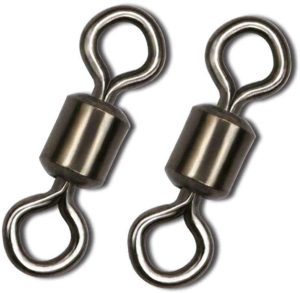
A fishing swivel is a small metal device consisting of a pivoting joint in the middle, and two metal rings attached at the ends. The metal rings are connected to the joint with an anchor inserting into the joint, which allows them to rotate freely in any direction.

The main advantage of fishing swivels is that they prevent line twist when you’re fishing with a lure or a rig that tends to rotate in the water. The most common examples of this would be inline spinners and metal spoons, which rapidly rotate during retrieval, and thus quickly end up twisting your fishing line if you use them without a swivel.

A second advantage provided by fishing swivels is that they often come with a snap attached to one end, which makes it very convenient to switch out your lure or leader line quickly while fishing.

Because of these key advantages, fishing swivels are present in most fishing rigs used by anglers. Now let’s take a closer look at the different types of fishing swivels, and how to choose the right one.

What Are The Main Types Of Fishing Swivels?

The 5 main types of fishing swivels are:

  • Barrel swivels
  • Ball-bearing swivels
  • Snap swivels
  • Three-way swivels
  • Finesse swivels

Together, these 5 swivel types cover more than 90% of all fishing applications where fishing swivels are used, and so are plenty to get you started. Let’s take a closer look at each of them below.

Barrel Swivel

Barrel SwivelThe barrel swivel is the original fishing swivel, and simply consists of a pivoting joint with two rings attached to either end. The joint in the middle is usually round, or sometimes a small barrel.
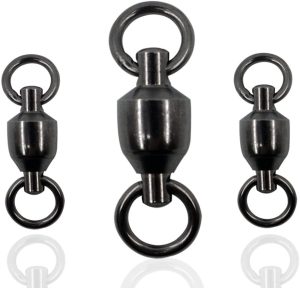
While barrel swivels are very cheap and easy to use, they don’t prevent line twist very effectively, since their rings don’t rotate as efficiently as those of a ball-bearing swivel.

See Barrel Swivels On Amazon | See On Walmart

Ball-bearing Swivel

Ball Bearing SwivelA ball-bearing swivel is an improved version of the barrel swivel, and comes with a ball bearing inside the pivoting joint. Due to this ball bearing, the rings of the swivel rotate much more freely than those of a standard barrel swivel, and thus prevent line twist more effectively.
The main downside of ball-bearing swivels is that they are considerably more expensive than barrel swivels. Because of this, one option is to use them only when you’re fishing with a lure type that generates a lot of line twist.

See Ball-bearing swivels On Amazon | See On Walmart

Snap Swivel

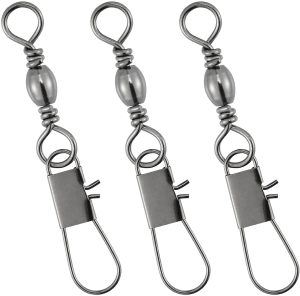
Snap SwivelA snap swivel is an improved version of the barrel swivel that comes with a snap attached to one end, instead of the regular ring. The most common way to use a snap swivel is to tie your main fishing line to the ring of the swivel, and then use the snap to attach to the ring of a lure.
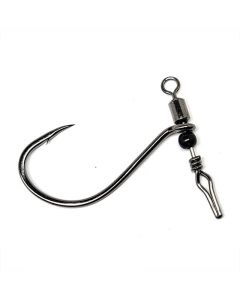
The great thing about using a snap swivel is that you can easily exchange the lure for another one at any time, which is much faster and easier than retying the line every time you want to change your lure.

See Snap Swivels On Amazon | See On Walmart

Three-way Swivel

As its name suggests, a three-way swivel consists of a pivoting joint that has three rings attached to it instead of two. The advantage of this setup is that you can add a separate leader line to one of the rings with a weight attached to the end of it.

The leader line used to attach the weight is usually weaker than the main line, which means that if the weight gets snagged on the bottom, it’s fairly easy to break it off without losing the rest of your tackle.

Three-way swivels are most commonly used for trolling rigs, since they allow you to troll a heavy weight close to the bottom without worrying too much about getting snagged.

Finesse Swivel

Finesse SwivelThe finesse swivel is a relatively new swivel type that’s used for fishing with a drop shot rig. It consists of a hook that is directly attached to the swivel, and can rotate around the axis of the swivel.

While one end of the finesse swivel looks like a regular swivel ring (which is where you attach your main line), the other end looks like the clip-on ring of a drop shot weight.

The great thing about the finesse swivel is that you can use it to attach a drop shot weight via a leader line that is not directly tied to the swivel, but is instead clipped into it.

In case your weight gets snagged on the bottom, this design allows you to pull the line attached to the weight off the swivel, so you’ll only lose the weight, but not the rest of your rigging.

Swivel Sizes

Fishing swivel sizes are classified with an aught scale similar to fishing hooks, with the smallest size starting at 12, and gradually increasing as the numbers go down to size 1. After reaching size 1, swivel sizes switch to 1/0, and go up to size 12/0, which is the largest swivel size.

In general, it’s best to choose the smallest swivel size that you can get away with, since that won’t spook fish as much as an oversized swivel. For example, when fishing for trout, a size 12 swivel is most often the best choice.

However, when fishing for bigger fish with heavy lines, it’s necessary to increase the size of your swivel, since that also increases the amount of weight that the swivel can bear without breaking.

Snap Swivel Size Chart

Barrel Swivel Size Chart

What Is The Difference Between A Barrel Swivel And A Crane Swivel?

A crane swivel is an intermediate form between a barrel swivel and a ball-bearing swivel. It comes with highly polished metal parts that enable its rings to rotate better than those of a barrel swivel, but not as well as those of a ball-bearing swivel.

When in doubt, it’s usually best to opt for a ball-bearing swivel, since that guarantees the best performance. This is especially important when fishing with rotating lures, such as inline spinners and spoons.

How Do You Choose A Swivel For Fishing?

Choosing the right swivel depends on what fishing technique and what fishing lure you want to use. If you’re fishing with lures that have a heavy rotating action, it’s essential to use the best swivel you can find, which would be a ball-bearing swivel.

On the other hand, if you’re fishing with lures that don’t rotate, or with fishing rigs that don’t don’t twist up the line, you can opt for a simple barrel swivel. Also, if you want to have the flexibility of changing up your lure or presentation at any time, it makes sense to use a snap swivel, which you can use to attach a different lure or leader line very quickly.

Do Swivels Spook Fish?

In most cases, fishing swivels don’t spook fish, and you can attach them directly to your lure without any problems.

However, if you’re dealing with finicky fish, a swivel may spook them. This is most often the case when fishing in heavily pressured fisheries, where the fish have learned to avoid anything that comes with a fishing line and/or terminal tackle attached to it.

Another scenario where swivels may spook fish is when fishing in crystal clear waters, such as trout streams. And obviously the most challenging situation is when dealing with pressured fish in very clear waters.

If you find yourself in any of the situations above, you can still use a swivel, but shouldn’t attach it directly to your lure. Instead, tie a 2 to 3 foot fluorocarbon or monofilament leader between the swivel and the lure. That way, you still get the benefit of the swivel, but without spooking the fish.

When To Use a Snap Without a Swivel

Instead of using a snap swivel you can opt to use a snap without a swivel attached to it. This is a good option if your lure or rig doesn’t really generate line twist, and if you’re dealing with heavily pressure fish that spook easily (especially when fishing in very clear water).

What Are the Different Types of Open Sights: A Comprehensive Guide

0

Open sights have been a crucial component of firearms for centuries. Despite advancements in technology, they remain a popular choice among shooters of all skill levels. Whether you are a seasoned marksman or a novice, having a solid understanding of the different types of open sights, their workings, advantages, disadvantages, and how to use them effectively can significantly improve your accuracy and overall performance.

In this article, we will delve into the world of open sights and provide you with a comprehensive guide to help you make the most out of this crucial component of your firearm.

What Are Open Sights?

man pointing a gun on blurred target

Credit: Envato Elements/ microgen

Open sights, also called iron sights, are an integral part of rifles, shotguns, and handguns. They offer a straightforward aiming mechanism that does not rely on batteries to function. They are often mandatory by law in specific hunting situations and are typically made of robust metal materials to withstand the rigors of regular use.

Open sights are made up of two components: a front sight and a rear sight. The front sight is a fixed post or bead that is positioned at the end of the barrel or on a ramp near the muzzle. The size and shape of the front sight can vary depending on the type of firearm and its intended use. For example, a shotgun used for bird hunting may have a larger front bead, while a rifle used for precision shooting may have a thinner, more precise front post. The rear sight, on the other hand, is typically a notched plate or aperture that is mounted on the barrel or receiver. Some open sights may have a basic notch in the rear sight, while others have a more complex aperture that can be adjusted for windage and elevation.

To aim using open sights, a shooter lines up the front sight with the rear sight, aligning them with the target. This process is known as “sighting in” the firearm. Once correctly aligned, the shooter can aim and discharge the weapon.

The Benefits of Using Open Sights

woman pointing a gun on target

Credit: Envato Elements/ valeriygoncharukphoto

Open sights offer several benefits compared to other types of sights. Some of these benefits include:

1) Cost-Effective

Open or iron sights are generally much less expensive than other types of sights, such as telescopic sights or red dots, making them a popular choice for beginner shooters or those on a budget. By choosing these sights, shooters can enhance their accuracy and shooting skills without breaking the bank.

2) Lightweight

Other types of sights, such as telescopic or red dot sights, tend to be heavy which can be burdensome, causing discomfort and strain on the shooter’s arms, shoulders, and back. Open or iron sights, on the other hand, are significantly lighter, allowing the shooter to move and aim their weapon with greater ease and accuracy. This reduction in weight also reduces the likelihood of fatigue on the shooter’s body, enabling them to remain focused and alert for more extended periods, resulting in better shooting performance.

3) Does Not Require Batteries

Open sights have a significant advantage over electronic sights in that they do not require batteries or electricity to function. This means that they can be used in any environment, without the worry of the batteries running out or malfunctioning.

Additionally, since these sights do not have any electronic components, they are not susceptible to electronic interference. This makes them an excellent option for shooting in areas with high levels of electromagnetic waves, such as areas with high-voltage power lines or around electronic devices.

4) Quick Target Acquisition

One of the key advantages of open or iron sights is their ability to facilitate quick target acquisition. In hunting or self-defense scenarios, every second counts, and the simplicity of open sights can prove to be a vital factor in reacting quickly. By merely aligning the front and rear sights with the target, the shooter can quickly and efficiently acquire their target, without the need for additional adjustments or sighting mechanisms.

5) Durability

Open sights are renowned for their durability, making them an excellent choice for shooters who require a rugged and reliable aiming device. Unlike electronic sights, which can be sensitive to impacts or exposure to harsh environments, these sights are typically made of high-quality materials and designed to withstand the rigors of frequent use in various environments. The robust construction also makes them less likely to malfunction or require maintenance, providing shooters with a reliable and low-maintenance aiming device.

6) Consistent Accuracy

Open or iron sights are simple and reliable, which can lead to consistent accuracy in shooting. With practice and proper alignment, shooters can achieve consistent accuracy with open sights, even at longer distances. This consistency can be particularly important for hunters or target shooters who need to hit their target with precision.

The Different Types of Open Sights

woman pointing a gun on target

Credit: Envato Elements/ ASphotostudio

The four main types of open sights are v-notch sights, u-notch sights, buckhorn sights, and semi-buckhorn sights. Here’s a brief description of each:

1) V-Notch Sights

V-notch sights are one of the most common types of open sights, and they’re often found on pistols and rifles. As the name suggests, they feature a V-shaped notch cut into the rear sight, which serves as the aiming point. The front sight is typically a post or bead that is centered in the V-notch. To aim, you need to align the top of the front sight with the bottom of the V-notch on the rear sight, and then center the front sight in the notch.

V-notch sights are popular for their simplicity and accuracy at short and medium ranges. However, they are not very precise, and you cannot adjust them for windage or elevation.

2) U-Notch Sights

U-notch sights are similar to V-notch sights, but they feature a U-shaped notch instead of a V-shaped notch. This type of sight is often found on shotguns and rifles intended for target shooting or hunting purposes. To aim, you need to align the top of the front sight with the top of the U-notch on the rear sight, and then center the front sight in the notch.

The U-shaped notch on U-notch sights offers an advantage over V-notch sights by helping to frame the target, simplifying the aiming process. While these sights are not as precise as other sighting options and cannot be adjusted for windage or elevation, they still offer greater precision than V-notch sights.

3) Buckhorn Sights

Buckhorn sights are a type of open sight that is often found on lever-action rifles. They feature a curved notch with a small protrusion in the center that serves as the aiming point. To aim, you need to align the front sight with the center of the buckhorn notch.

Buckhorn sights are well-suited for fast shooting at close to medium ranges, but they can be challenging to use for more precise shooting at longer ranges.

4) Semi-Buckhorn Sights

Semi-buckhorn sights are similar to buckhorn sights, but they have a flatter, less curved notch. This type of sight is often found on bolt-action rifles, and it’s preferred by some shooters for its versatility and accuracy at longer ranges. To aim, you need to align the front sight with the top of the semi-buckhorn notch.

Which Open Sight Should You Choose?

man pointing a gun with both hands

Credit: Envato Elements/ Vailery

The type of open or iron sight that you should choose depends on a variety of factors, including personal preference, shooting style, and the intended use of the firearm.

For those who prioritize simplicity and ease of use, V-notch sights are a good choice. They are suitable for handguns and rifles and are commonly used for close to medium-range shooting, including self-defense, hunting, and recreational target shooting. They are also ideal for shooting in low-light conditions, as the contrast between the front and rear sights is easy to see.

For those who require greater precision and accuracy, U-notch sights are a better option. They are particularly useful for shotguns and rifles that are used for target shooting or hunting, where precise aiming is critical. The U-shape of the notch provides a more precise aiming point than V-notch sights, making them suitable for longer ranges.

Buckhorn sights are ideal for shooters who need to quickly acquire and aim at targets at close to medium ranges. These sights are frequently used in lever-action rifles used for hunting or fast-paced shooting sports. However, they are not recommended for precise shooting or longer ranges because the curved notch can make it challenging to align the front sight with the target accurately.

On the other hand, semi-buckhorn sights provide a more versatile and accurate open sight for shooting at longer ranges. They are commonly found on bolt-action rifles used for target shooting or hunting. The flatter, less curved notch on the rear sight provides a more precise aiming point than a buckhorn sight. Although these sights are suitable for longer ranges, they can also be used for close to medium-range shooting.

Step-by-Step Guide on How to Use Open Sights Effectively

man pointing a gun on target

Credit: Envato Elements/ Vailery

Now that you know the different types of open sights and which one is best suited for you, here is a step-by-step guide on how to use them effectively:

1) Begin by Properly Aligning the Sights

Before using open sights, make sure they are properly aligned for your firearm. Adjust the rear sight so that the front sight post is centered in the notch. If the sights are misaligned, you will not be able to aim accurately, and your shots will miss the target.

2) Assume a Stable Shooting Position

Stand in a stable position with your feet shoulder-width apart and your body slightly leaned forward. Place your dominant hand on the grip of the firearm, and your non-dominant hand under the barrel or foregrip for support.

3) Bring the Firearm Up to Your Shoulder

Bring the firearm up to your shoulder while maintaining a stable shooting position. Ensure that the butt of the firearm is pressed firmly against your shoulder, and your cheek is resting against the stock of the firearm.

4) Focus on the Front Sight

When aiming with open or iron sights, it is important to focus on the front sight. The target and rear sight should be hazy while the front sight should be clear. This helps you aim accurately.

5) Maintain a Consistent Sight Picture

Once the sights are aligned and you have focused on the target, focus on maintaining a consistent sight picture. This means keeping the front and rear sights in the same position relative to each other and the target throughout the firing sequence.

6) Squeeze the Trigger

With your sights aligned and your firearm aimed at the target, squeeze the trigger gently. Avoid jerking or flinching, as this can cause your shot to miss the target.

7) Follow Through

After firing the shot, continue to focus on the front sight and keep the firearm steady for a moment before lowering it. This helps you to ensure that your shot was accurate and can help you make any necessary adjustments to your aim for future shots.

3) Practice, Practice, Practice

Using open or iron sights effectively takes practice. Make sure to spend time at the range honing your skills and becoming familiar with the sights and the shooting process. Shooting at different distances and in different lighting conditions can also be beneficial. By practicing frequently, you can develop muscle memory and ultimately enhance your precision.

Summary

Open sights are an integral component of firearms, and selecting the appropriate sight is vital to improving your shooting experience. With a diverse range of open sights available, it’s crucial to evaluate your shooting needs and preferences. Whether you use your firearm for hunting, target shooting, or self-defense, there’s an open sight that suits your requirements.

Once you have selected the right open sight for your firearm, it’s time to practice your shooting skills. That’s where EasyShot shooting targets come in handy. At EasyShot, we offer a variety of high-quality shooting targets that can help you improve your accuracy and precision. With durable construction and multiple designs, our targets are perfect for all types of shooting practices. Check us out today!

World Class Whitetail Deer | Hunting Trip | Louisiana

0

Rocky Fork Whitetails offers the ultimate World Class Whitetail Deer Hunting Trip for Louisiana residents.

World Class Whitetail Deer Hunting Trip for Louisiana residentsLooking for an World Class Whitetail Deer Hunting Trip in the Louisiana area? Because at Rocky Fork Whitetails, we offer the biggest and best World Class Whitetail Deer Hunting Trip just up the road in Ohio. If fact we deliver on your World Class Whitetail Deer Hunting Trip you have always dreamed about.
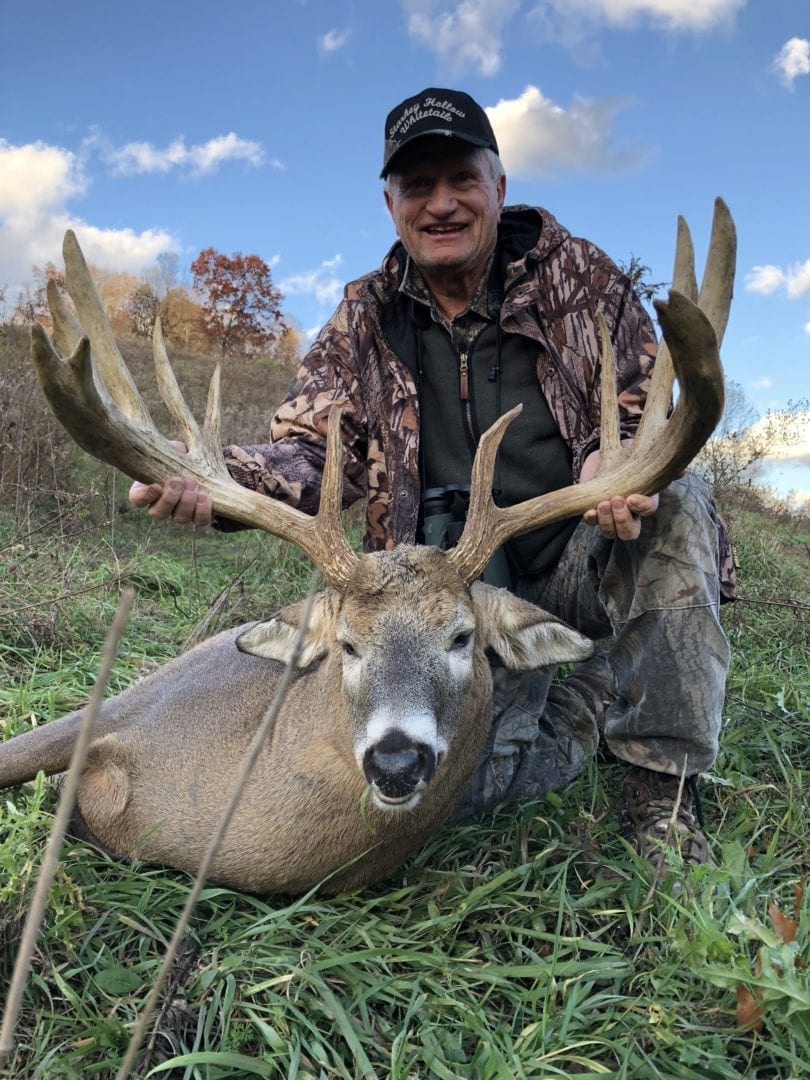
We are simply the best place for Whitetail Deer, Elk, Mule Deer, Red Stag, Ram, Mouflon Rams, Axis Deer, Fallow Deer, Sika Deer, Black Buck and other challenging and exciting hunting experiences in Ohio; or anywhere else. So forget those Louisiana area hunts, come home to the Ohio World Class Whitetail Deer Hunting Trip experience that only Rocky Fork Whitetails can deliver!

Hunters who have traveled from the Louisiana area, trust Rocky Fork Whitetail’s World Class Whitetail Deer Hunting Trip; for exciting and memorable World Class Whitetail Deer Hunting Trip experiences in Ohio. We take your World Class Whitetail Deer Hunting Trip experience and turn it into your World Class Whitetail Deer Hunting Trip dream, with a knowledgeable staff of World Class Whitetail Deer Hunting Trip expertise; that will insure you the greatest experience you will ever have in World Class Whitetail Deer Hunting Trip.

We offer many World Class Whitetail Deer Hunting Trip and other hunting adventures:

  • Whitetail Deer
  • Elk
  • Mule Deer
  • Red Stag
  • Ram
  • Mouflon Rams
  • Axis Deer
  • Fallow Deer
  • Sika Deer
  • Black Buck

Ultimate World Class Whitetail Deer Hunting Trip for Louisiana residentsPremium World Class Whitetail Deer Hunting Trip for Louisiana Outfitters looking for adventure in Ohio

There is a reason Rocky Fork Whitetail’s has been ranked #1 by Louisiana residents for World Class Whitetail Deer Hunting Trip for years; Ohio delivers the big game! World Class Whitetail Deer Hunting Trip enthusiast know that we provide the highest quality guided World Class Whitetail Deer Hunting Trip available for the modern day World Class Whitetail Deer Hunting Trip trophy hunter.

Hunting on the Ohio area’s best World Class Whitetail Deer Hunting Trip acreage, you can leave your problems at home in Louisiana and experience the excitement and the relaxation that Rocky Fork Whitetails in Ohio offers.

Our people make the difference for your World Class Whitetail Deer Hunting Trip adventure.

Book your World Class Whitetail Deer Hunting Trip for Louisiana residentsAttracting hunters and enthusiasts from Louisiana and beyond, a World Class Whitetail Deer Hunting Trip at Rocky Fork Whitetails is the ultimate location for the most insane World Class Whitetail Deer Hunting Trip in Ohio; or anywhere else.

Rocky Fork Whitetails on Ohio is dedicated to the exciting World Class Whitetail Deer Hunting Trip and hunters from Louisiana love to come and experience that only Ohio can offer. Our unique combination of World Class Whitetail Deer Hunting Trip experience and conditions guarantee an exciting World Class Whitetail Deer Hunting Trip.

Because Rocky Fork Whitetails is the top choice for outfitters of all ages and skill levels coming from Louisiana we work hard to make sure you have the most exciting World Class Whitetail Deer Hunting Trip in the Ohio area.

We know your World Class Whitetail Deer Hunting Trip will be the adventure of a lifetime. Your facebook and instagram page will be full of exciting World Class Whitetail Deer Hunting Trip memories that will have you asking one key question: “When can I go back!”

The Perfect World Class Whitetail Deer Hunting Trip for Louisiana residentsWhen you journey from Louisiana to Rocky Fork Whitetails in Ohio, every World Class Whitetail Deer Hunting Trip is ALL INCLUSIVE:
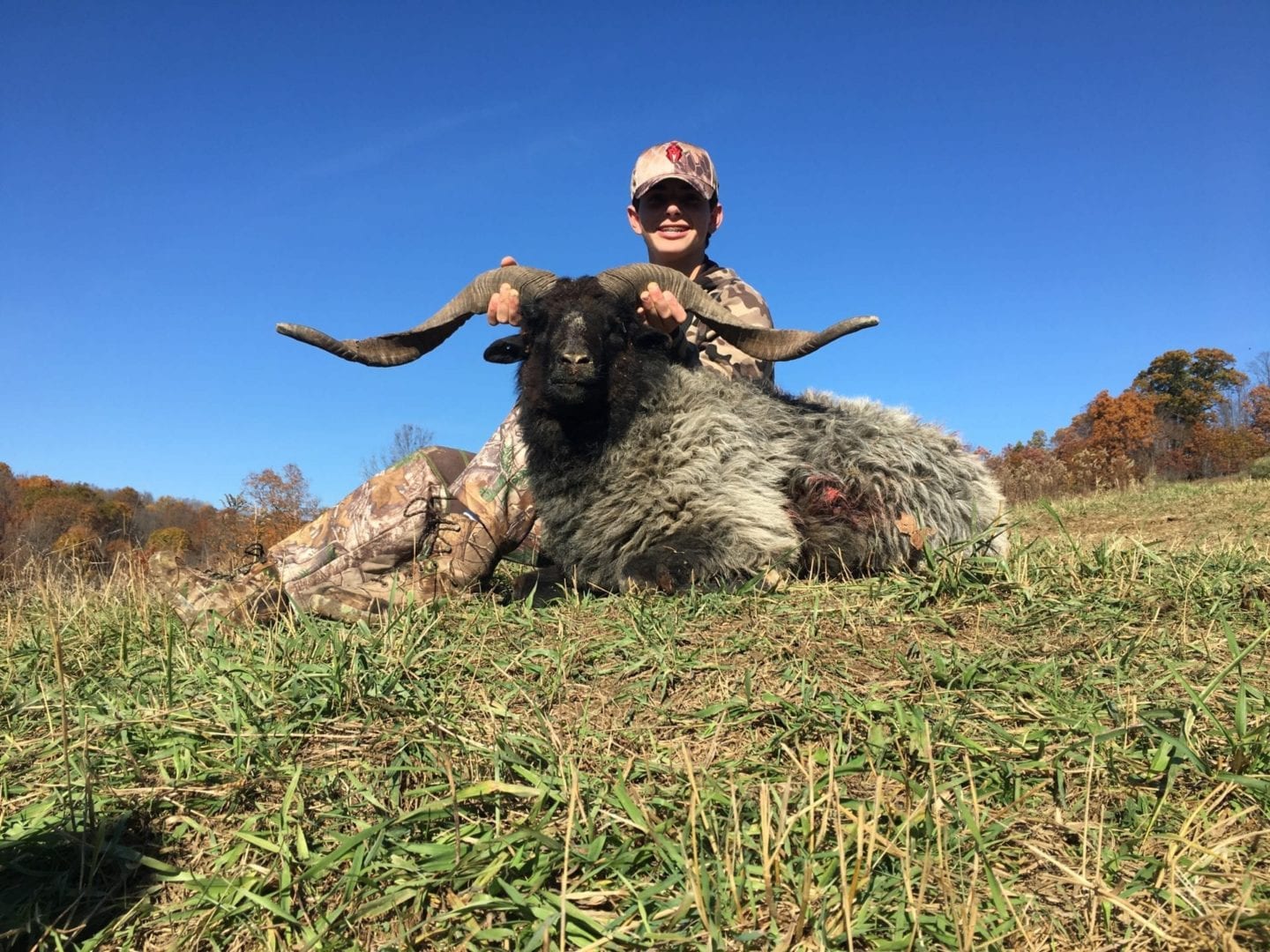
  • 5 Star Lodging (Click for more info on our Ohio Ranch and lodge)
  • Vast menu of food
  • Alcoholic Beverages
  • License
  • Tags
  • Professional Guide service
  • Caping
  • Skinning
  • De-boning of your harvest along with an on site taxidermist (additional charge).

Note: Groups of 4 or more there will be a mandatory 12% gratuity added. There is a $500 non-refundable deposit due upon booking.

Rocky Fork Whitetails in Ohio offers a unique World Class Whitetail Deer Hunting Trip for those coming from Louisiana.

All ages and skill levels welcome for the World Class Whitetail Deer Hunting Trip of a lifetime!

Youth hunts World Class Whitetail Deer Hunting Trip for Louisiana residentsAnother of the things that makes our World Class Whitetail Deer Hunting Trip so exciting, for those coming from Louisiana to our expansive 283 acre ranch in Ohio, is whether you are a beginner or a pro; Rocky Fork Whitetails diverse and expansive ranch always makes it unforgettable. Our highly skilled guides make sure to custom curtail your Ohio World Class Whitetail Deer Hunting Trip adventure to make sure you experience the thrill of the hunt. Followed by the peace and relaxation that only our 5 star lodge nestled in the hills of Ohio can offer.

We welcome all first time World Class Whitetail Deer hunters from Louisiana and beyond to your Ohio World Class Whitetail Deer Hunting Trip adventure.

There simply is not better place in Ohio, or anywhere else to learn the sport that from the experienced guides at Rocky Fork Whitetails. Young or old there is no age limit, if you can shoot with accuracy at a moderate distance you will net a good sized World Class Whitetail Deer; in fact, we guarantee it. Don’t want to bring from your Louisiana area home for your World Class Whitetail Deer Hunting Trip? That’s no problem! We have everything you need at no extra cost upon request.

Rocky Fork Whitetails can even accommodate any special physical or dietary needs for your ultimate World Class Whitetail Deer Hunting Trip. Your guided World Class Whitetail Deer Hunting Trip centered in the majestic hills of Ohio will be World Class Whitetail Deer Hunting Trip and Rocky Fork Whitetails is here to make sure you have World Class Whitetail Deer Hunting Trip stories to tell when you get home!

(410) 984-8680 • [email protected]

At the Rocky Fork Whitetails in Ohio we want to promote and encourage future World Class Whitetail Deer hunters from the Louisiana area and beyond, welcoming them into our brotherhood of World Class Whitetail Deer outdoorsmen. We take pride in the time and care we take teaching the first time World Class Whitetail Deer hunter from Louisiana. Keeping in mind this will be the most important World Class Whitetail Deer Hunting Trip of their life and will set the tone for their future World Class Whitetail Deer Hunting Trip enthusiasm at Rocky Fork Whitetails in Ohio.

If you are a Father, Mother, Uncle or Grandparent that wants to experience your youth`s first time World Class Whitetail Deer Hunting Trip, rest assured you will both have a great and memorable World Class Whitetail Deer Hunting Trip experience with us at the Rocky Fork Whitetails in Ohio.

Hunting Lodge World Class Whitetail Deer Hunting Trip for Louisiana residentsExperience the most awesome Lodging in Ohio for your extreme World Class Whitetail Deer Hunting Trip!

Looking for a little get away? Perhaps a little peace and quiet after an aggressive day your World Class Whitetail Deer Hunting Trip? Maybe the crackle of the fire as you tell your World Class Whitetail Deer Hunting Trip stories and share memories with friends in Louisiana? Our Bed and breakfast here at Rocky Fork Whitetails in Ohio provides just the right setting to give you all this and more.

When you Travel from Louisiana for your World Class Whitetail Deer Hunting Trip Adventure you’ll Discover we have Room to Spare!

In the off season our 5 Star Lodge becomes a Bed and Breakfast. Our Bed and Breakfast sits on 160 acres in NE Licking County, deep in the beauty of Ohio. We have 22 custom Amish made beds in the main lodge. You’ll have a World Class Whitetail Deer Hunting Trip like no other when you choose Rocky Fork Whitetails in Ohio. The lodge also has a large wrap around deck that is great for relaxing after a long day of World Class Whitetail Deer Hunting Trip, enjoying the view of our 160 wooded acres. Moreover, the wildlife can freely move in and out of the property on its Eastern border. This provides a indescribable immersion in the beautiful wooded area.

The property is approximately 5.5 miles from Newark, Ohio and 34 miles to I-270. There are great trails for those who like to hike during the off season of hunting. Have a little downtime between World Class Whitetail Deer Hunting Trip? Rocky Fork Whitetails offers activities such as: 2 stocked ponds for fishing, ATV rides PLUS local pheasant, duck and trap shooting. (additional cost apply) Want more still? We are only a short hour away from Amish country and its famous attractions.

Ladies, Are you looking to the ultimate World Class Whitetail Deer Hunting Trip adventure?

We especially like to welcome the ladies to our World Class Whitetail Deer Hunting Trip sport in Ohio. No matter what level of World Class Whitetail Deer Hunting Trip experience you have, we will customize a World Class Whitetail Deer Hunting Trip to meet your skills. We will get you to the right place, at the right time optimizing a clean World Class Whitetail Deer shot. You will take home to Louisiana some great pictures of your World Class Whitetail Deer Hunting Trip experience that you will remember for the rest of your life. Take a World Class Whitetail Deer and be featured on our website!

Call or contact us today to get your World Class Whitetail Deer Hunting Trip in the Louisiana area experience scheduled today!

(410) 984-8680 • [email protected]

Best Air Rifle Deals

Popular Posts

Dry Firing Air Rifles: What You Need to Know

0
"Master the art of precision shooting with dry firing air rifles. Enhance your aiming skills, trigger control, and muscle memory without using ammunition. Discover...

Air Gun 101: What You Should Know about Air Rifle Barrels Before Buying

0
Have you ever heard the phrase: “Imitation is the sincerest form of flattery”? The Chinese must have been very sincere in emulating this proverb. I...

What can you kill with a 177 air rifle?

0
"Unleash Your Precision: Discover the Power of a .177 Air Rifle to Take Down Targets with Accuracy. Explore the Versatility and Potential of this...