Home Blog Page 168

Air Rifle Scope vs. Rifle Scope – Which One Fits Your Shooting Needs?

0

“Air Rifle Scope vs Rifle Scope: Unveiling the Ultimate Precision Optics. Discover the essential differences and benefits of these two optical devices, empowering shooters to make informed decisions when it comes to enhancing accuracy, range, and overall shooting experience. Dive into the world of advanced optics and make your shots count with confidence.”

air rifle scope vs rifle scope

When it comes to shooting sports and hunting, having a reliable and accurate scope is essential. However, there are different types of scopes available in the market, specifically designed for air rifles or traditional firearms. Understanding the differences between an air rifle scope and a rifle scope can help you make an informed decision based on your specific shooting needs.

An air rifle scope is specifically designed to withstand the unique recoil generated by air rifles. Air rifles typically produce a forward recoil, also known as a reverse recoil, which is different from the backward recoil generated by firearms. As a result, air rifle scopes are built with reinforced internal components to handle this unique recoil mechanism. These scopes often have shorter eye relief distance and greater durability to ensure they can endure the double recoil produced by air rifles.

On the other hand, a rifle scope is designed for use with conventional firearms such as shotguns, pistols, or rifles that use gunpowder-based ammunition. These scopes are typically built with longer eye relief distances to accommodate the backward recoil generated by these firearms. Rifle scopes also come with various magnification options tailored for long-range shooting or close quarters combat. Additionally, they often feature adjustable turrets for windage and elevation adjustments.

In conclusion, while both air rifle scopes and rifle scopes serve the purpose of improving accuracy in shooting sports or hunting activities, their designs are tailored to meet the specific demands of their respective firearm types. Understanding these differences will allow you to choose the right scope that suits your shooting needs and ensures optimal performance on the range or in the field.

In conclusion, while both air rifle scopes and rifle scopes serve the same purpose of enhancing accuracy and precision, they are designed for different types of firearms. Air rifle scopes are specifically tailored to withstand the unique recoil and vibration of air rifles, whereas rifle scopes are better suited for traditional firearms. Therefore, it is crucial to choose the appropriate scope that matches the specific firearm to optimize shooting performance

Black Trumpet Mushrooms

0

Black trumpet mushrooms, also known as the horn of plenty or horn of death. Don’t let the name confuse you though-these are one of the best wild mushrooms to harvest, hunt and cook, and are valued around the world as a gourmet ingredient and choice edible mushroom.

In this post I’m going to share with you everything I know about hunting, identifying, harvesting and cooking these mushrooms, along with some of my favorite recipes for black trumpets at the end.

For reference, I’m in the Midwest, so most of what I discuss here for hunting will refer to Craterellus fallax as it’s the most common species near me. Older field guides may use the name Craterellus cornucopiodes, now seen as a European species.

Where to Find Black Trumpet Mushrooms

In mid-summer, typically early July through October, (I’ve picked them as late as November) I will start to check my patches. Where do black trumpets grow? In my area, around white and red oak trees. One species (Craterellus caeruleofuscus) grows with pines, but isn’t as widely available.

One of the best parts about these mushrooms is the sheer volume you can find, when, and if you find the right kind of patch. The harvests will vary from year to year depending on seasonal conditions, but there will usually be some.

Two friends of mine have near-legendary patches in Minnesota, that, on a good year, with an extra hand or two, you could pick 30, 40lbs or more. As trumpets are very light weight compared to others, that kind of quantity is massive.

Wet and decaying areas

Often when you’re hunting these I look for moist, shady areas. They may be close to a small source of water or a wet/swampy area where there’s decaying and dead wood. Golden chanterelles, by comparison may occasionally be nearby, but I don’t see them as much in wet areas as I do trumpets.

At least to me, black trumpets seem to operate in two ways: mycorrhizal and saprobic, meaning that they grow both in harmony with certain trees, and will seem to live off of decaying matter. Contrastingly, golden chanterelles are only mycorrhizal.

Most of the time with mushrooms from my experience, they’ll be one or the other but not both, which makes trumpets extra special.

A good trick to remember when you’re searching for new patches is that trumpets like to be often in the same areas as some of their other chanterelle cousins, especially the yellowfoot chanterelle which is much easier to spot from a distance as it isn’t black.

If you see one of the orange mushrooms pictured above, or golden chanterelles, it’s a good indication you’re on the right track.

Sphagnum moss

It isn’t true everywhere, but trumpets seem to have an affinity for sphagnum moss. When I’m in a forest with red or white oaks, and I start seeing sphagnum moss during the summer, I make sure to keep my eyes open for trumpets.

More often than not, when I see moss and start looking closely, and walking slowly, I’ll find some.

Black Trumpet Mushroom Identification

Found across North America, black trumpets are one of the easiest wild mushrooms to identify, with nearly no real look-a-likes. Your biggest challenge will be finding a good patch at the right time.

Black trumpets

  • Have a whitish to creamy spore print.
  • Have an unique aroma I describe as dark and intensely sweet aroma of apricots that are nearly overripe. Golden chanterelles, by comparison, smell like fresh apricots.
  • Are mostly black, or shades of grey, but one species is nearly blue (see below) and white, albino mutations are also possible.
  • Often grow clustered, with a shape like a horn or funnel.
  • Do not have gills, but can have false gills. They may have veins that are difficult to see on the outside (called the spore-bearing surface or hymenium) or the veins may be more pronounced with some specimens-see below.

Different Species

There’s more than one species to learn about and enjoy, each one with slightly different characteristics. Two I’ve found are craterellus foetidus and craterellus cinereus, which some may call black chanterelles, but there’s others too.

No matter what kinds grow near you, one thing’s for certain: if it’s a true black trumpet it’s edible and delicious, and knowing the exact species is purely academic. If you’re like me though, the more you learn about wild mushrooms, the more you’ll want to know the exact types your finding.

Look Alikes

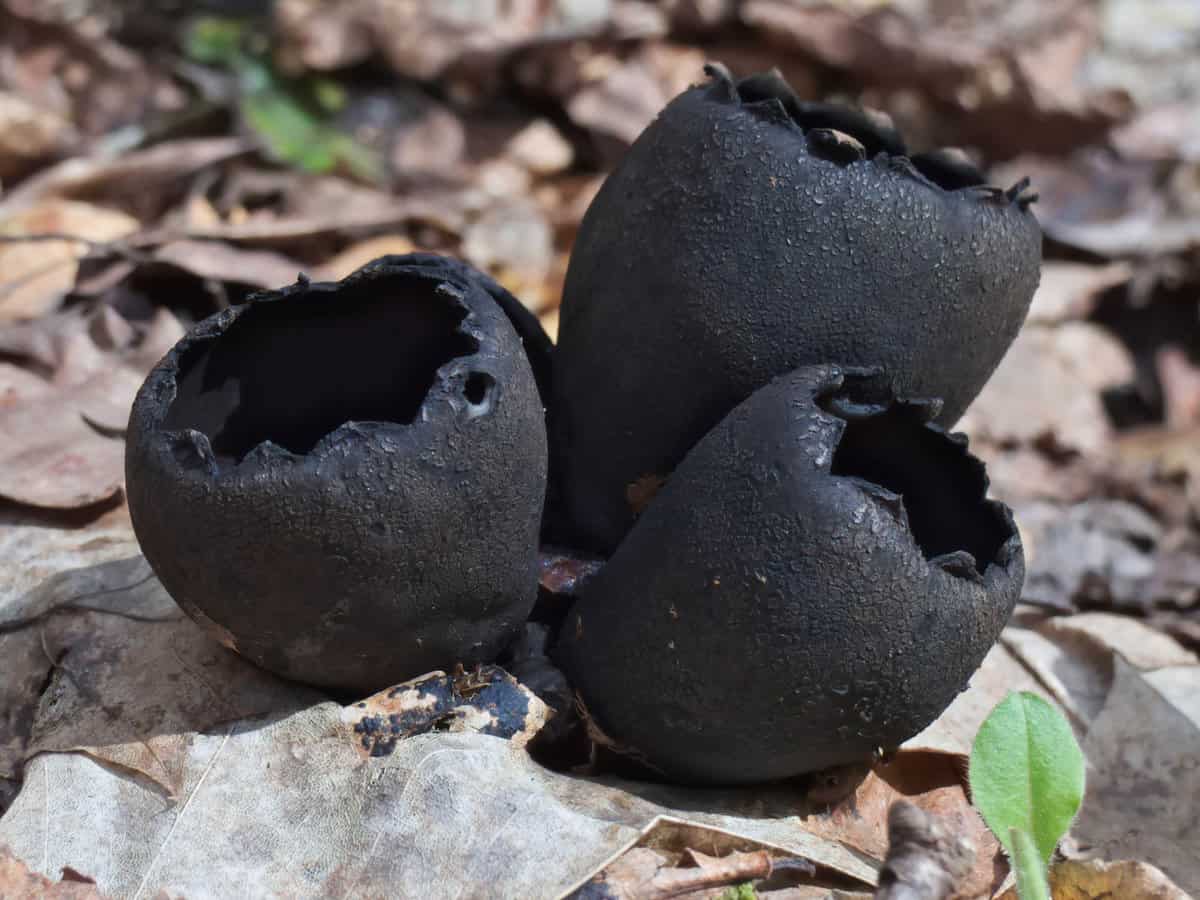
Some consider devil’s urn (Urnula craterium) a trumpet look alike, but they’re more cup-shaped and appear in the spring. They’re edible, but don’t taste very good.

Devils urn (Urnula craterium) in the woods.
Devils Urn.

Cleaning Black Trumpet Mushrooms

Cleaning starts in the field. Some people just pull the mushrooms out of the ground and put them in a basket-don’t do that. To avoid dirty mushrooms that can ruin your food with grit, I pull them from the ground, cut the end off, along with any dirt, then put them in the basket.

If I’m going to a patch where I expect to harvest lots of mushrooms, I like to bring a scissors since I can just bend down and snip-snip-snip, leaving the dirty bottoms behind and keeping all the mushrooms in my bag clean.

If my trumpets are very clean, I just open them up, leaving them in one piece, and give them a brush with a mushroom or pastry brush.

One of the best things about these mushrooms is that they’re often very clean, and may not need any additional trimming after they’re cut from the field, if you pick clean and carefully.

If my trumpets are a dirty or it’s rained recently, I slice them in half lengthwise and then give them a gentle dip in some cool water, working quickly so that they don’t absorb too much liquid.

After you wash them, just set them on some paper or cloth towels to air dry a bit and shed any water that may be sticking to them. I describe this a bit in the video below.

How to Cook Black Trumpet Mushrooms

Black trumpet mushrooms have one of the most potent flavors of all wild mushrooms, especially when fresh.

They may be fragile or small, but they pack a punch. It’s hard to describe exactly what black trumpets taste like besides saying they’re delicious, but the flavor is a sort of a rich, earthy, oddly sweet and fruity taste that will remind you of fresh apricots and ripe stone fruit, with a bitter note at the end. It’s a delicious, unique taste.

One of the best things about these is their versatility. If you’ve just come back from a long hunt, there’s nothing wrong with just tossing some mushrooms in a pan with butter.

But if you have more time, you can make all kinds of things, limited only by your time and imagination. Here’s a few things I think are helpful.

Quick tips

  • As they’re hollow, trumpets cook very fast-so don’t overcook them.
  • A large amount will wilt down to a fraction of it’s size in the pan.
  • Trumpets will turn other foods they come into contact with black or grey if the mushrooms are fresh.
  • Another name for them is poor man’s truffle. Finely chop them as a (visual) substitute for black truffles.
  • With a sweet aroma and tender texture, these can work in sweet and savory dishes, such as candying.
  • Black trumpets can be eaten raw in small amounts as a garnish.

Like most mushrooms, these marry wonderfully with cream. Like other chanterelles, I would encourage you to cook these by themselves first, and keep things simple as their flavor can be overwhelmed by strong flavors like excessive garlic, smoked food, spices, and spicy/hot seasonings.

A bowl of pasta with black mushrooms and tomatoes.
The mushrooms are great in pasta.

Bitterness

Use trumpets with a light hand at first as they can be bitter if you use too many in a dish. The bitterness will concentrate itself, so be careful when making reduction-type sauces, for example: purees, or putting too many in a soup.

The bitterness is a bit of an acquired tastes, and most mushroom hunters grow to like and crave it to some extent. It’s not unpleasant, but some sensitive people may not like it.

How to Dry Black Trumpet Mushrooms

There’s a few different ways you can preserve trumpets, but drying is by far the best. Luckily, as black trumpets are hollow, they dry like a dream, and are one of the best mushrooms for drying and using in the off season as they don’t get tough. To dry the mushrooms, I look over them for debris, then put in a dehydrator at 120-145F until cracker dry, typically overnight.

Occasionally I’ve left mushrooms spread out on cookie sheets with a ceiling fan blowing on them and found them naturally dehydrated after a day or two-something you can’t do with golden chanterelles.

Once they’re cracker dry, I store the mushrooms in a sealed glass container or mason jar. For cooking, rehydrate the mushrooms by covering with warm liquid, stock, or alcohol. Remove the mushrooms, strain the liquid for debris, adding the mushrooms back to their liquid for whatever recipe you’re making, or simply frying them up and discarding the liquid if you don’t need it.

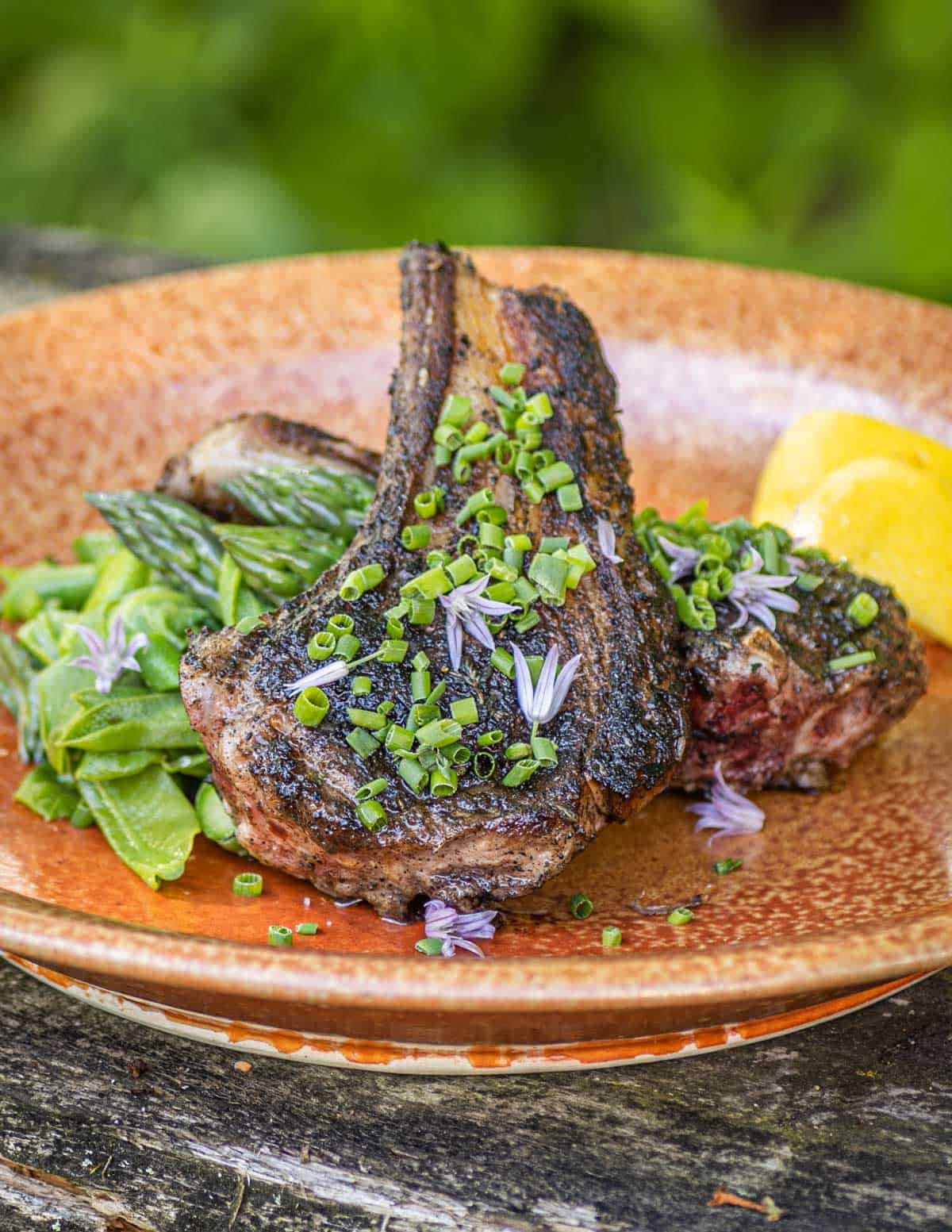
Mushroom crusted lamb chops on a plate with vegetables outside.
The dried mushrooms make a good crust for meat.

Black Trumpet Mushroom Recipes

Here’s some of my favorite black trumpet recipes, or places where they can be substituted. One of the most unique things about these mushrooms is that they can work in savory as well as some sweet applications, so find a few of both below.

  • Black Trumpet Pasta
  • Candied Trumpets
  • Sweet Mushroom Jam
  • Jacques Chibois’s Carbonara of Chanterelles and Black Trumpets
  • Baked Fish with Trumpet Crust
  • Rack of Lamb or Venison with Dried Trumpet Crust
  • Black Trumpet Coulis
  • Rabbit Braised In Milk, with Trumpets And Carrots

More Trumpet Recipes

More

35 Essential Wild Mushrooms Every Forager Should Know

References

David Arora: Wild Mushrooms Demystified

MushroomExpert.com: Craterellus Fallax

Handloading the 7mm Precision Rifle Cartridge (PRC)

0
Handloading the 7mm Precision Rifle Cartridge (PRC)

The 7mm PRC is intended as a long-range performer, spitting heavy bullets out of its .375 Ruger-based case at fast speeds.

Hornady’s new 7mm PRC (Precision Rifle Cartridge) is probably the best long-range 7mm cartridge ever introduced. As with all rifle cartridges, handloading tuned ammo for it helps achieve the best it has to offer. The 7mm PRC’s DNA is 100 percent long range. As such, loading highly aerodynamic bullets is recommended. The cartridge doesn’t offer any advantage with light 7mm bullets.

As spec’d by SAAMI, the 7mm PRC has a rifling twist rate of 1:8. This enables it to effectively stabilize the long-bodied, streamlined projectiles. Lead-core bullets of 168 grains ranging up to 195 grains and monometal bullets of 160 grains up to 168 grains provide optimal performance in the 7mm PRC. Examples are Barnes 168-grain LRX bullet; Berger 168-grain VLD Hunting, 180-grain VLD Hunting, and 195-grain Extreme Outer Limits Elite Hunter; and Hornady 160-grain CX, 175-grain ELD-X, 180-grain ELD Match and 190-grain A-Tip.

The 7mm PRC has a cartridge case design characteristic that affects handloading technique, particularly projectile seating. Like its 6.5 PRC and .300 PRC siblings, the 7mm PRC is engineered with a lot of head height. This allows long bullets with stretched-out, fine-entry noses to be seated well out of the case, so the bases don’t intrude into the powder reservoir. This is important, as you’ll see in a moment.

The parent case is the .375 Ruger, which is a non-belted case with quite parallel sides and relatively steep 30-degree shoulder angle. It’s actually a quarter-inch shorter than the classic 7mm Rem. Mag. and has less capacity when filled to the case mouth. The 7mm PRC case contains 82 grains of water; the 7mm Rem. Mag. contains 85 grains of water.

However, since you don’t have to seat long, heavy-for-caliber bullets deeply into the powder reservoir, loaded 7mm PRC cartridges actually have greater internal capacity than 7mm Rem. Mag. cartridges.

Hornady

Overall 7mm PRC case length is 2.280 inches. Trim-to length is 2.260 inches. Overall maximum loaded cartridge length is 3.340 inches. This puts the 7mm PRC into the “standard .30-06” cartridge length category. As with every cartridge, if desired, handloaders may load to longer max length if their rifle’s magazines will allow it. SAAMI pressure limit is 65,000 psi.

Currently, cartridge cases are available only from Hornady. That’s not a problem, because the Hornady cases I’ve used in my testing and handloading and hunting with the 7mm PRC have been stellar.

If you want to milk every ounce of potential out of the 7mm PRC and your Hornady cases, trim them all to equal length, then weight-sort and neck turn them. You’ll end up with top-notch cases equal to any task.

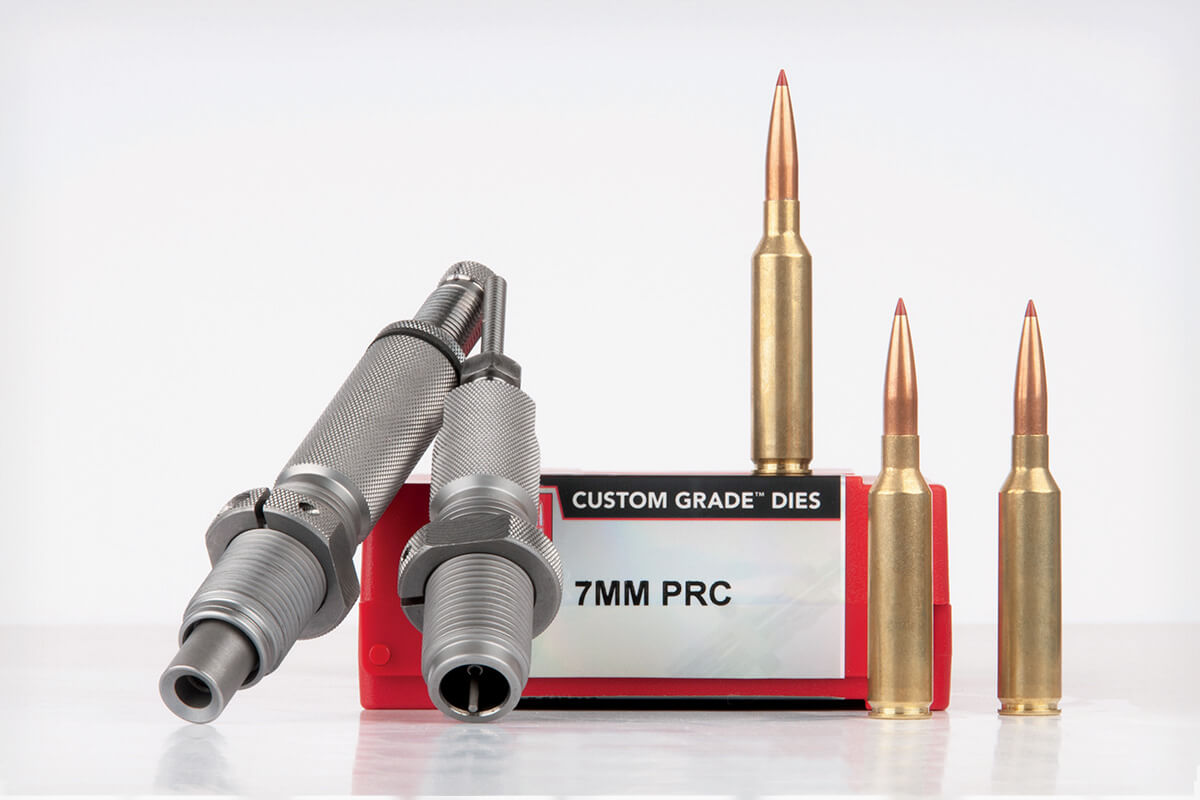
My reloading dies are standard Hornady versions, and they’ve served very well. Presumably, other manufacturers such as RCBS and Redding will soon get on board, and we may see match-grade dies as well.

As nearly all propellant charges will be well north of the 60-grain threshhold compatibility with Large Rifle primers, it’s best to use Large Rifle Magnum primers. I’ve been using Federal 215 Gold Medal Match primers, and they’ve provided splendid consistency.

Data for the 7mm PRC are currently available on the Hornady reloading app. I developed the loads in the accompanying chart from early recommendations by Hornady technicians based on their lab work. They suggested Reloder 26 and H1000, with RL-26 being particularly magic.

However, at first I didn’t have any RL-26 on hand, so I started with H1000. To my delight, every load averaged less than three-quarters of an inch at 100 yards. Even with the relatively short 20-inch barrel on the Gunwerks Nexus test rifle, velocity was rather good.

Accuracy with Hornady’s 180-grain ELD Match bullets was eyebrow-raising, averaging 0.42 inch over a series of three-shot groups. This bullet has an incredibly good ballistic G1 coefficient of .796, and Hornady’s factory ammo is spec’d to generate about 2,950 fps in 26-inch barrels. That makes it one of the most capable extreme-range cartridges on the market.

Thanks to the 7mm PRC’s head height, handloaders will find it easy to finesse seating depth for best accuracy. Load thin-jacketed cup-and-core bullets to kiss the rifling. Load thick-jacketed bonded-core and monometal bullets 0.050 inch off the rifling leade so as to avoid pressure spikes, and tune from there. Generally, best results with such will be found between 0.020 and 0.100 inch off the leade.

As with all bottlenecked, centerfire cartridges fed from box magazines, there’s no need to crimp seated bullets. Just allow the neck tension to hold them in place.

For Idaho’s 2022 spring bear season, I loaded up a batch of 7mm PRC ammo using 150-grain Hornady CX bullets. My wife and two daughters proceeded to clobber three black bears with the 7mm PRC.

A few months later, the 160-grain CX was launched. My first try at working up a handload resulted in a load under half m.o.a., courtesy of RL-26. Clearly, the 7mm PRC is a well-behaved, inherently accurate cartridge that’s easy to handload for splendid results.

I haven’t yet experimented with a broad variety of projectiles by manufacturers other than Hornady. However, I’m looking forward to doing so.

Candidly, before learning the details of the 7mm PRC, I was a deep skeptic. I didn’t believe we had any use for another 7mm Magnum. After handloading and shooting and hunting with it, I’m a convert.

I experienced a powerful testimony of the cartridge’s right to exist at the SAAM shooting facility in Texas. Using a Remington 700 chambered in 7mm PRC, I shot steel targets all the way out to a mile. Then I put five consecutive 180-grain ELD Match bullets onto a 24×48-inch steel plate at 1,800 yards. I became a believer.

I now consider it the best 7mm magnum ever designed, and tuned handloads take it from splendid to spectacular.

WARNING: The loads shown here are safe only in the guns for which they were developed. Neither the author nor Outdoor Sportsman Group assumes any liability for accidents or injury resulting from the use or misuse of this data. Shooting reloads may void any warranty on your firearm.

How To Find Arrowheads In The Woods: What You Need To Know

0

How To Find Arrowheads In The Woods: The Ultimate Arrowhead Hunting Guide

Since I started hunting arrowheads a few years ago, I’ve had a lot of people ask where the best places to hunt for arrowheads are. And if you’re an arrowhead hunter yourself, you know that a single perfect answer to that question just doesn’t exist.

But since many of the friends that ask me this question enjoy spending a lot of time out in the woods, I thought I would focus on that. And explain to them how they can take part in the fun I was having in hunting for arrowheads, even in the woods!

For information on learning the value of your arrowheads, check out my post, The True Value Of Arrowheads: What Are They Worth To You?

For tips on hunting arrowheads, keep reading!

Introduction

I created a list of tips for these folks to help answer their question…as well as to share with you, fellow arrowhead hunters. So keep reading, and I hope you find some tips that are useful on your next arrowhead hunting trip.

Once you begin finding arrowheads, the next fun part is identifying them! If you need help identifying Indian arrowheads, you might find my post, American Indian Arrowhead Identification: A Resource Guide helpful for that phase of arrowhead collecting.

Once you find your arrowheads, you’ll want to display them with pride! Check out my post of some of the Best Arrowhead Display Cases.

Recommended Reading

How To Find Arrowheads In The Woods

Like I mentioned earlier, the answer isn’t necessarily all that straight forward. I promise that you’re not going to be successful at hunting arrowheads if all you do is randomly walk into the woods and start looking at the ground. You might get lucky, but chances are you won’t find a single arrowhead point.

Get To Know The People And How They Lived

The first thing about hunting arrowheads anywhere, whether it’s in the woods, in a creek or in a field, is knowing what to look for. You want to really get to know where the ancient people who left the arrowheads behind would have spent time or gathered together. Get to know where and how these people lived, hunted and traveled, and you’ll be a thousand miles ahead of most arrowhead hunters.

Remember The Ever Changing Landscape

The other thing to remember is that the landscape 500, 1000 or even 5000 years ago was significantly different than it is now. The pond, lake or creek you see today very well could have been a dry meadow or seasonal creek 1000 years ago. And areas that are now dry, could have easily been shallow ponds, marshes or even the bottom of a massive lake.

So as you walk out into the woods to look for arrowheads, keep these following tips and suggestions in mind:

Look For Evidence of Indian Camps

Whether you’re walking in the deepest part of the woods or simply following a well used trail, keep your eyes open for evidence of old Indian camps. How do you find Indian Camps? Think about areas that you would be useful to you if you were to set up a camp today. Things that would be important for a camp are natural shelter, like bluff overhangs, sources of water such as springs could be a great indications of a possible Indian camps being near by.

Many Indian camps will be located near a water source, such as a creek, river or spring. Just like modern civilizations, ancient peoples relied heavily upon water. They would have almost always camped very close to a source of fresh water. Their survival depended on it.

Indian camps would have been close to water, but they wouldn’t have necessarily been right on the water. Look for high areas that are away from the water a bit, but more importantly, are up out of the floodplain, such as a bluff or a knoll.

Hunting Arrowheads In Creeks, Rivers and Streams

When thinking about tips on how to hunt arrowheads in the woods, one of the best tips I can give you is to find a creek or river and start your search there. For me, it all starts with a water source. Even the fields I hunt for arrowheads in must always be near some type of water source, such as a creek, stream or river.

Remember that not all streams, creeks and rivers were flowing the same way 1000 or more years ago. Always keep that in mind. But if you’re certain you’ve found a creek or river that was present in ancient times, it should prove to be an excellent place to begin your hunt for arrowheads.

Creek Walking For Arrowheads: What Time Of Year Is Best?

Time your arrowhead hunting trip during the part of year when water levels are at their lowest. This is typically during the summer months. Creeks and rivers with low water levels will expose much more of the gravel bars and creek beds, which is where the arrowheads can be found. Also look in the eroded sides of the creeks that would normally be covered with water.

Arrowheads are made out of stone, so they tend to move along the bottom of the river just like other rocks and gravel. Spend time looking for arrowheads in the gravel bars and other rocky areas. Look along the water line as well as just inside the water line. Moving water will wash away the silt and other debris making it easier to see the arrowheads.

Arrowheads tend to get caught between other rocks of the same size or larger as they are pushed along by the water, pinning it in place.

Hunting Arrowheads Where Two or More Rivers or Creeks Join

If you’re just starting hunting for arrowheads in the woods, one of the best tips you could ever receive is to look for areas where 2 or more creeks, rivers or streams come together. Creek walking for arrowheads is one of the best ways to find arrowheads, and this type of scenario is my absolute favorite location to hunt for arrowheads.

Not only are these areas a hot spot for Indian camps, but they were popular locations for other ancient hunting activities. This is where you can find many other artifacts in addition to arrowheads.

If you’re able to locate where two or more larger sized rivers come together, then you’ll probably find evidence of Indian camps nearby. In ancient times, these areas were teaming with activity. People would not have only camped in these areas, but they would have lived in these locations for long periods of time. Because of this, these areas are not only excellent for hunting arrowheads, but are also where to find ancient stone and pottery artifacts.

If you find where two or more smaller creeks or streams come together, you’ll probably also find a lot of evidence of high animal traffic. Today, these areas are excellent for finding deer and other wild game to hunt. The same would also hold true in ancient times.

Many arrows and spears were shot or thrown at deer and other game while they approached the water. Many of these arrows and spears missed their target, only to be lost in the creek or tall grass. Spend time looking for these lost arrowheads in the eroded sides of the creek as well as on the bottom creek bed and gravel bars.

Tips For Hunting Arrowheads In The Woods

Below are some tips you can use to be more successful at finding arrowheads on your next trip out.

How To Find Arrowheads in Creeks and Streams

Like I mentioned, creek walking for arrowheads is a great way to find them, and gravel bars can be great places to spend your time searching. Here are a few things to keep in mind when hunting arrowheads on gravel bars in streams, creeks and rivers and what your levels of success might be. These are not concrete rules, but rules of thumb.

Sandy Bottom: very rare to find arrowheads. Artifacts you may find are pottery shards and possibly flint.

Pea Gravel: Higher rate for finding small arrowheads/ birdpoints.

Small gravel: Higher chance of finding small arrowheads/ birdpoints and other arrowheads that are about the same size as the gravel.

Medium to Large Gravel: Any size arrowhead can be found in this kind of creek or river bottom.

How To Find Ancient Creeks

Use Google maps to your advantage. Google maps can play a very helpful role when researching good areas for looking for arrowheads in the woods.

Use the topographical option on Google maps to investigate where rivers and streams may have traveled through in the past. You may find that two streams converged in a much different location than where they currently join.

Do your research before you head out and you will find arrowheads and other artifacts!

Now that you know how to find arrowheads in the woods, get out there and start looking! Leave a comment below and share any other tips you might have.

Final Thoughts

If you’ve taken the information in this post and are still unable to find the elusive arrowhead. I’ve located a few places online that sell authentic Indian arrowheads. You can find these items on my post, Where To Find Indian Arrowheads For Sale. However, the best thing you can do is continue to educate yourself on arrowhead hunting.

Expert Knowlege!

The experts have given us everything we need to know to successfully find arrowheads! All that knowledge and experience is written inside the pages of this book! Take advantage of it! And go find those relics!

Share With Other Rockhounds!

Can You Eat Venison [Deer Meat] Raw or Pink? Is it Safe?

0

Venison is not only popular in the UK and the US, but also in other parts of the world like Spain and New Zealand. It is high in protein and has fewer calories than other types of red meat. But can you enjoy it raw or rare?

Raw or undercooked venison is not safe. It is recommended to cook venison to a safe internal temperature of 145 °F (62.8 °C) for roasts and steaks, 160 °F (71.1 °C) for ground venison and sausages, and 165 °F (73.9 °C) for others.

Moreover, the meat shouldn’t come from a deer shot in the wild.

How can you prepare and store venison safely, and how should you order it at restaurants? All the answers are detailed below.

Can You Eat Venison Raw?

According to research, eating raw or undercooked venison may not be safe because of pathogenic contamination, which is discussed in the next section. Venison that came from antlered animals like deer that are shot in the wild is also unsafe.

A study was conducted to examine 30 carcasses drawn from whitetail deer shot by hunters with guns loaded with lead bullets. The carcasses showed extensive metal fragment dispersion. Of the 30 carcasses turned into ground meat, 80% of them contained lead.

The researchers conducted another study and fed the venison to pigs. The pigs’ blood results showed significant amounts of bioavailable lead (source: Lead Bullet Fragments in Venison from Rifle-Killed Deer: Potential for Human Dietary Exposure).

Furthermore, the organs of these antlered animals, such as the liver, kidneys, brain, and gizzard are not to be consumed, since lead accumulates in the organs. They can contain other metals too, as well as chemicals.

Chemicals used in many manufacturing and industrial plants could infiltrate and persist in the environment where the animals live. These chemicals can accumulate in the animals’ bodies.

Some of these chemicals and metals include:

  • Dioxins
  • Polychlorinated biphenyls
  • (PCBS)
  • Per- and polyfluoroalklyl substances (PFAS)
  • Cadmium
  • Mercury

So, what could happen if you ingest these?

These compounds and metals are may result in the development of diabetes and cancer, depreciated immune and thyroid functions, issues with fertility, and strained brain development in children (source: The Michigan Department of Health and Human Services).

Lead can negatively affect neurological, cardiovascular, renal, skeletal, hematopoietic, and reproductive functions when it accumulates in the body (source: Journal of Hazardous Materials Advances).

Therefore, whether rare or cooked, it is best to avoid venison that was shot in the wild.

While it’s true that some meats can be eaten raw safely, it is crucial to consider the safety of consuming raw venison. Venison tartare may also be unsafe, as found in many research studies discussed below.

Can Raw Venison Make You Sick? Does it Have to be Cooked?

Undercooked venison has been in the limelight for being linked to toxoplasmosis.

According to a 2017 study, a retreat was held wherein never-frozen purposely undercooked venison was served to the attendees. Nine out of the eleven attendees who consumed the venison had to seek help.

They experienced myalgia, body aches, fatigue, fever, sweats, arthralgias, lymphadenopathy, chest pain, shortness of breath, blurred vision, and more.

It was discovered that the Toxoplasma gondii that caused their infection came from contaminated undercooked venison (source: Clinical Infectious Diseases).

A study in 2019 published the possible first encounter and report of food poisoning caused by Sarcocystis truncata. The incident took place in Japan, where a 67-year-old man consumed raw venison.

Sarcocystis infection can lead to intestinal sarcocystosis with symptoms of fever, diarrhea, vomiting, and nausea (source: Internal Medicine).

Also in Japan back in 2004, researchers found out that eating raw venison can result in hepatitis E virus (HEV) infection (source: Journal of Medical Virology).

Raw venison can also be a vehicle for Mycobacterium bovis, which can cause infection in the gut and lungs, as well as symptoms of fever, night sweats, chest pain, abdominal pain, weight loss, and if untreated, death (source: FDA).

When buying venison, make sure to purchase from a reliable seller or store. Do not buy the wild-caught type, or at least make sure the animal was not shot with lead bullets.

Make sure to clean all utensils, tools, and surfaces that come into contact with the meat. This means cleaning them before and after handling the venison. You can use 1 teaspoon of kitchen bleach in every quart of water for a simple disinfectant.

Chill venison at no more than 40°F (4.4°C). For longer storage, you can freeze it. In the fridge, it will keep for 1-2 days, and in the freezer for up to 1 year. Ground venison meat can keep for 6-9 months (source: Utah State University: Preserve the Harvest Extension).

Have you ever wondered how long venison can remain cold in the fridge or on ice? Proper handling and storage are crucial to maintain its quality. Familiarizing yourself with the guidelines for storing venison correctly is valuable. It helps preserve freshness and enhances the optimal flavor.

Because venison is a lean meat, cooking it for too long will dry it out. But to keep it safe, you will need to cook venison steaks and roasts to a minimum internal temperature of 145 °F (62.8 °C).

Ground venison or venison sausage should be at 160 °F (71.1 °C), while soups stews, stews, casseroles, and leftovers should be at 165 °F (73.9 °C).

To achieve these cooking temperatures, it is best to use a food thermometer (source: University of Minnesota Extension: Cooking venison for flavor and safety).

Can You Eat Pink Deer Meat?

Venison steak cooked at this temperature is medium rare and still pink inside. And because it is still rare, we recommend cooking or having it cooked at least medium well to make it safer.

When ordering at a restaurant, make sure the venison isn’t wild-caught. Burgers and sausages made from venison have to be cooked at a minimum of 160 °F (71.1 °C). At this temperature, the meat will be well-done and won’t probably have any pinkish tint.

Venison is a great source of high-quality protein and also provides essential amino acids, iron, niacin, thiamine, riboflavin, and zinc. Just make sure to prepare it safely for you, your family, or your friends.

Are you curious about the potential side effects of consuming deer meat, commonly known as venison? Check out my guide to learn about the various ways it can affect our bodies.

Scope Magnification for 1,000 Yards: What You Need to Know

0

One thousand yards is considered to be a long-range distance for shooters, whether you’re hunting or target shooting. Therefore, for the best hunting experience, you need a long-range rifle scope that will provide you with the best image quality and top accuracy. A magnification range plays a big part in that, so it’s important to know the best magnification for a 1000-yard scope so you can shoot long range. Keep reading to find out what it is.

Scope Magnification for 1,000 Yards: The Basics

When people think of extremely high magnification scopes, they think of Spotting Scope vs Telescope. The human eye can only see so far, which is why a high magnification range is a must for any long-range shooting. If you regularly partake in long-range hunting to catch animals that are easily startled, you need to choose a rifle scope with enough magnification for targets up to 1,000 yards.

The best scope magnification for 1,000 yards makes your target seem like it’s no more than 100 yards away, which can be done with about 10x magnification. This provides you with a major advantage that will see your shooting success rate at long range skyrocket. However, you won’t always need a magnification of 10x, which you should keep in mind when choosing the Best Spotting Scope for 1000 Yards for you.

Scope Magnification for 1,000 Yards: How to Choose

picture of best scope for 1000 yards

It may be tempting to choose a scope that has a higher magnification range, especially if you go long-range shooting often. However, you have to have a thorough understanding of your hunting habits in order to validate that this is the right choice for you.

When in doubt, go with a rifle scope that provides you with more flexibility as to not limit you on your hunting trips, like a 4-16×50 rifle scope. A scope with variable magnification is the best choice to provide you with that versatility, refine your skills, and help you make the most out of your hunting trips.

Chances are you will occasionally need to catch a target that’s closer than the 1,000-yard range. In fact, this may happen more often than catching targets at 1,000 yards. This is why you don’t want to choose a rifle scope with a starting magnification that’s too high. Staying within a starting magnification of 4x to 6x is a safe bet. For the best results, choose a rifle scope with a magnification of 6x-24x or 5x-30x to give you enough options out on the field. If 1,000 yards is too extreme, check out Best Scope Magnification for 500 Yards. There is a scope that fits everyone’s needs!

Other Things to Consider for Scopes for 1,000 Yards

Magnification is one of the most important factors to consider when choosing the right scope. It’s more important for longer-range shooting than for shorter distances that may not need as much magnification. Obviously you wouldn’t use a 4×32 scope range for long distance shots!

Although magnification is up there in terms of factors that affect long-range shooting, there are several other factors that you should consider when purchasing a scope for 1,000 yards. These factors include:

  • Reticles and reticle adjustment
  • Quality of the glass (including clarity, brightness, and color)
  • Field of view (FOV)
  • Durability of the body

Scope Magnification for 1,000 Yards – Vortex Viper HST 6-24×50 Rifle Scope

If you’re looking for a high-quality rifle scope for the 1,000-yard range, look no further than the Vortex Viper HST 6-24×50 Rifle Scope.

With a magnification of 6x-24x, the Vortex Optics Viper is great for accurate holds at a long range. The 4x zoom provides versatility and provides a lot of scope adjustability. The side-focus parallax adjustment provides solid image focus and parallax removal. Use the fast focus eyepiece to quickly adjust the reticle to your eye and find your target.

This optic also features premium, multi-coated, extra-low dispersion lenses for excellent resolution and prime color fidelity. You’ll also find exposed turrets, styled like targets, for repeatable and precise finger-adjustable clicks. In all, this is a top choice from Vortex for a scope for 1,000 yards that will deliver results.

Frequently Asked Questions

Conclusion

Long-range shooting extends the possibilities of your hunting trip and allows you to hit targets that would be impossible to strike at shorter distances. Therefore, it’s worth investing in scope magnification for 1,000 yards to give you the best chance of hitting all of your targets. Hopefully, this article has given you an idea of whether a scope for 1,000 yards is right for you.

The 4 Best Turkey Mouth Call [Hands-On]

0

Not sure what mouth turkey call to get?

Look no further.

I’ve exhaustively tested ALL the best turkey mouth calls on the market. In fact, I tested everything, including: construction, sound quality, and so much more.

By the end of this guide, you’ll find the perfect mouth call.

Are you ready?

The 4 Best Turkey Mouth Calls

If you’re pressed on time, here’s a quick list of the best turkey mouth calls:

  1. Woodhaven Red Wasp Diaphragm: Best Overall Turkey Mouth Call
  2. HS Strut Premium Flex Combo: Best Turkey Mouth Call for Beginners
  3. Primos Hunting Upper Cut: Best for the Budget
  4. Primos Hunting Hook Hunter: Best Primos Turkey Mouth Call

1. Woodhaven Red Wasp Diaphragm: Best Overall Turkey Mouth Call

The Woodhaven Red Wasp Diaphragm is a well-known and well-loved turkey mouth call, and for with good reason.

Beginners and seasoned hunters alike go for this budget-friendly and solidly constructed piece of hunting equipment.

This is going to seem like I have nothing critical to say about the Red Wasp, but the truth is that there just isn’t that much for me to complain about.

I have some minor gripes about airflow, but that’s really about it.

Construction

The Woodhaven Red Wasp is a three reed V-Cut mouth call made with a red latex top reed and two straight prophylactic bottom reeds.

Its shape is that of almost every single other turkey mouth diaphragm; a horseshoe. The outer half-ring is made from a premium tape, a lined locking frame with adhesive, and “only the best latex material”

This call feels obviously high quality even looking it, but more so after holding and using it. Everything feels, firm, solid, and I’d even go as far as to say hand-made. You know you’re working with some quality build as soon as you use it.

The construction is as good as I’ve seen with “premium” turkey calls. It sure isn’t lacking in this department.

Sound Quality

All of these other factors like reliability, construction, and build quality are meaningless if there’s not a good sound coming out of the call its self, and the Red Wasp Diaphragm has this in spades.

This call is going to produce a nice, soft, raspy call, just like you’d expect from an old hen. Yelps and clucks sound top-notch. You’ll be certain to attract a few birds to your spot.

The sound quality is truly great, but as with any and every mouth call, the sound is largely dependant on the user. Don’t lose hope yet beginners! You should still consider picking this mouth call up.

While you’ll see many veteran hunters using this call like an orchestral instrument, the Red Wasp is designed in such a way that even newbies can use the call fairly easily, with a little practice of course.

Newer hunters and seasoned trackers both will enjoy the sound quality of this call. It’s easy to learn on and better yet, some hunters never want to let it go.

Durability

Bad build quality is always a deal-breaker for me, but the smartly designed and caringly constructed Red Wasp passed my torture test with flying colors.

Many hunters take meticulous care when handling, using, and storing their calls. Their calls can last them for an almost absurd amount of time, I’m talking months upon months, even a couple of years (gross).

I, however, am the very opposite of that. I treat my numerous mouth calls almost like absolute garbage. Aside from losing several, I toss them in my pockets with my keys, near my phone, and my utility knife. I have shredded up many a turkey calls in my life.

For this particular diaphragm, I was actively doing my best to treat it with the bare minimum care to find out if it could survive even me.

It absolutely defeated my torture and mistreatment. The build quality and durability shines brightly in this instance.

I am typically worried about the reed latex ripping or peeling because of the frequent contact with borderline sharp objects like my keys, but I couldn’t see any visible damage or hear any difference in the sound quality.

I know that the Woodhaven Red Wasp is cheap and I wouldn’t be losing out on much if it got destroyed, but it’s great to have a call that can survive almost anything within reasonable limits.

Even though I can afford to buy a brand new call whenever mine fails, not everyone can. If you don’t have a lot of money to spend or are just a frugal type, rest assured that you won’t be wasting your money.

You’ll likely end up squeezing out every nickel and dime it’s worth before it breaks, fails, or otherwise gets retired.

Price

The Woodhaven Red Wasp Diaphragm is only gonna cost you $11.99 almost everywhere.

While turkey mouth calls are not a particularly expensive item, this is still an amazing deal since you’re going to be bagging birds left and right while you’re using this mouth call.

Is the Woodhaven Red Wasp Diaphragm worth it?

There’s no question about it, yes. Here’s why:

  • Popular – Although inexpensive, the Red Wasp is an ultra-high-quality product. You might be doing yourself a disservice if you skip out on this call just because it’s a popular call. There’s a reason (or more like several reasons) this is a popular call.
  • Durable – The built quality and construction are incredible. It put my worries about durability to rest very quickly. It bordered on invincible, even for me. No bends, breaks, peeling, or tearing here.
  • Reliable – This mouth call is reliable and is in it for the long-haul. It’s a big deal considering this is tied with sound quality for most important aspects of a good turkey mouth call.
  • Great sound – The sound is superb and easy to produce for beginners. The sound is raspy and soft, just what you’d be looking for in an old hen. Many more experienced hunters could play this thing like a darn instrument. You will not be disappointed when you hear the Red Wasp for the first time.

You really can’t go wrong with the Woodhaven Red Wisp Diaphragm. There’s a reason why some veteran hunters won’t use anything else.

2. HS Strut Premium Flex Combo: Best Turkey Mouth Call for Beginners

Using turkey calls can seem pretty daunting at first, as can turkey hunting in general.

Seeing some pros doing almost identical calls seems discouraging, but it doesn’t take perfect pitch for a perfect hunt.

Start out with the HS Strut Premium Flex Combo, a pack designed with beginners in mind.

Construction

The Flex Combo comes with four different types of calls: The Lil’ Strut, Smoking Gun, Triple Trauma, and Sickle Cutter.

All of them are built in the classic horseshoe shape.

The calls are built with a “premium flex frame” that is supposed to be comfortable for the user, and resistant to bending to ensure a good seal is kept during use and to retain its shape for a more consistent sound.

Of course for many new beginners (or those with a sensitive gag-reflex), a turkey call isn’t going to be the most comfortable thing in the world to get used to. Trimming the call down a little bit might be a reasonable path to take when you’re first starting out.

The reeds are made of a material called Infinity Latex, which requires less air pressure to produce a good sound.

Sound Quality

The sound quality is decent for such a low-cost pack of reeds. This is perfect for beginners who are getting into turkey hunting or who just want to practice their calls while driving around.

Someone described the turkey call as a musical instrument, and that holds true; it takes, patience, practice, and time to learn how to use one. It’s important to keep this in mind when judging the sonic merit of a call, but the sound quality is good overall and is certain to help bag some turkeys (if you practice).

While it can’t quite compete with some slightly more expensive calls, it still does what it’s aiming for; to call turkeys.

This call is not just for beginners either, the sound quality is good enough for intermediate hunters to pick these guys up as well.

Longevity and Build Quality

While the HS Strut Premium Flex Combo boasts good quality build for the calls, I didn’t quite get that impression from my time with them.

If you’re the type of person to take meticulous care of every piece of hunting gear you have, you can expect between 6 months and a year of use from these calls, but if you’re like me, the lifespan on the HS Strut calls is significantly less than what you’re expecting.

I didn’t expect much from these calls in terms of durability, but I was still disappointed with the minuscule amount of time it took for these calls to start falling apart.

I should preface this by saying that I did the absolute minimum when it came to taking care of and protecting the HS Struts. At most, I slipped them into a ziplock bag and stuffed that in my pocket, at worst I tossed them in my jacket pocket with my keys, in my back pocket with my wallet, and in my passenger seat.

The first one fell apart in my pocket with the latex peeling from the rest of the body. The second wasn’t as bad, but I was able to feel shallow rips in the material while I was on the hunt. The other two are fine, likely from a lack of use. I quickly chose favorites, but that’s more of a personal thing.

The ruggedness of these calls leaves something to be desired, but basic caretaking should have these calls lasting you a few months up to a year. Throw them away after that, they get rather nasty after that amount of time.

Price

The HS Strut Premium Flex Combo is only going to cost you $12.95. That’s a really great deal even for beginner turkey calls. If you find that you like using mouth calls, you can upgrade to a higher quality and slightly more expensive turkey call like the Primos Hunting Hook Hunter Turkey Mouth Call at $21.95 for two.

Is the HS Strut Premium Flex worth it?

For beginners, this product is a great starting point.

While the build quality isn’t amazing, the price, variety of products, and sound quality are all pretty good for calls that are only about $3.50 a piece.

Even if you decide mouth calls or turkey hunting isn’t for you, you’re only out 13 dollars. These are a steal if you just need something to practice with or even a back-up. They can even last you a while if you’re gentle with them.

If you’re well versed in turkey hunting and mouth calls, you probably won’t be too disappointed with these, but I think you’d be doing yourself a favor by dropping a little extra cash on a higher quality product.

The HS Strut Premium Flex Combo doesn’t bring anything to the table that you haven’t seen before, but if you’re looking for something to gift to a child or new hunters, these would be a solid buy.

3. Primos Hunting Upper Cut: Best for the Budget

The Primos Hook Hunter Upper Cut diaphragm call is the best turkey call for anyone on a budget.

It’s loud, sounds true to nature, and is expertly engineered.

How does this call measure up to others on the market?

Let’s find out!

Design

The Primos Hunting Upper Cut diaphragm call is made with three premium-grade latex reeds. It’s crafted to perfection, and creates raspy pitches accurate enough to fool even the wisest turkeys!

This is thanks to Primos’ precise, expert engineering. Their Hook Hunter line is one of the leading lines of diaphragm calls, combining over 100 years of experience from seasoned, professional turkey hunters.

The handmade cuts, fly-downs, and upper-cut design produce unique pitches, giving some of the best yelps I’ve ever heard.

The experts at Primos have crafted this call with durability and performance in mind.

Sound

Thanks to the precision cuts, this call makes the exact sounds hens use to summon males from a long distance.

It’s a loud, crisp, raspy sound that’s very true to nature, great for cuts and yelps. If you direct your airflow to the right, you can even get those “keekees” and tree calls!

The sound quality of this diaphragm call is truly unmatched. I’d even go as far as to say it’s my go-to turkey call!

Use

The Upper Cut is a very loud, versatile call, so it’s great for both close and long-range use. It fits well in your mouth and is easy to blow, as long as you know how to use it.

It’s definitely not for beginners. Diaphragms can be a bit difficult to get used to, and you’ll need a lot of practice before you understand how to properly use it.

You must become familiar with the natural tones of turkeys to use it effectively. You also may need to pair it with another call if you’re looking to get any non-raspy tones.

Once you get used to it, it’s very simple to use and the airflow is great. Just put it in your mouth, give it a single blow, and watch the turkeys come flocking!

Price

You can find this turkey call at most online retailers for around $11.

At first, this might seem a little expensive for the average hobby turkey hunter.

But, Primos is an elite brand that has been delivering quality products for decades. It’s a great value for what could very well be the best turkey diaphragm call on the market.

It blows nicely, and Primos is a tried-and-true, time-tested manufacturer with over 100 years of experience in the turkey call game.

Is the Primos Hunting Upper Cut Worth it?

This is one of my all-time favorite diaphragm calls.

It’s versatile, gives you a loud, crisp sound that works every time, and comes from one of the best manufacturers out there.

I cannot recommend the Primo Hunting Upper Cut enough. This is one purchase you certainly will not regret.

4. Primos Hunting Hook Hunter: Best Primos Turkey Mouth Call

Primos game calls are top-notch, and without a doubt the Hook Hunter is the best Primos Turkey caller.

The Hook Hunter is actually a two-pack item. A blue call and a green call come together when you buy.

Being a moderately priced pack of callers, is it worth the extra expense?

Range

The Hook Hunter comes with two calls for a reason. Primos is making sure you are covered for long and short range calling.

My favorite of the two Hook Hunters is the blue long range call. Working with it is a slower paced run of sound.

The green short range is also great and easy to use. The clicks and purrs are easy to control and have a raspy sound.

The ghost cut gives me a good seal in the back of my mouth. I can really get after the long calls and kee kee sounds.

Use

The calls are easy to learn with and easy to use.

The packaging comes with helpful instructions and tips on using the mouth caller.

There is something to be said for practice with a mouth call, and the longer I’ve used the Hook Hunter, the better.

When out in the field, both will fit in the pocket on my hunting vest to protect them and keep them handy.

So, practice, practice, practice.

Your family may not appreciate that suggestion, but you can blame me now and thank me later.

Durability

The Hook Hunter is more durable than the cheaper options out there.

With mouth callers, many are only intended to be used for a short season. The Hook Hunters are well built and able to last for years if I’m careful with them.

They are also easy to keep clean.

I just soak mine in dish-soapy lukewarm water for a few minutes, then give it a quick rinse before laying it out on a paper towel.

I take the time to keep the reeds separate with a reed separator when I store them to get the most for my money.

Effective

The Hook Hunter calls are incredibly effective.

The consistent sounds make it easy to use, and to not have to guess at what sounds will come out of my mouth in the field.

The calls both give me more realistic sounds than the cheaper counterparts I’ve tried.

I can call a gobbler with his hens in without decoys, and that’s not a result I’d get with a cheap disposable caller.

Price

The Hook Hunter call is a 2-pack duo that is priced well.

They do come with a

Spinner Fishing for Trout: Tips and Techniques

0

If you’re new to trout fishing and want to get started using artificial baits, there is no better lure to begin with than the humble spinner. The spinner was conceived by French engineer Andre Meulnart on the trout rivers of the French Alps and later adopted and mass produced in the U.S. by Todd Sheldon.

The spinner has become a timeless lure with a reputation to match. Whether you call it a Roostertail, Panther Martin, or MEPPs, the spinner is cheap, easy to use, and practical. I doubt there is an angler alive today that has not had a spinner in their tackle boxes at some point, and there is good reason for it. The spinner remains one of the single most effective fishing lures ever created. From the tackle you use, the size of the lure, and the type of retrieve you perform, the spinner is a highly versatile and nuanced lure that can help you land that trophy trout you’ve been after for years.

Why are Spinners so effective for trout?

Trout, like all fish species, have a specialized organ called the lateral line that runs the length of their bodies. This organ has evolved to pick up vibrations in the water column that indicate danger or potential prey. Trout have also developed incredible monocular and binocular color vision making them adept hunters regardless of water quality and light conditions. The spinner stimulates these extraordinary senses and often elicits a strike even if the trout isn’t hungry. The flash of the blade through the water mimics a floundering baitfish or insect, while the blade’s spinning vibration reinforces the deception that the lure is, indeed, a prey item. Together these two aspects make the spinner lure nearly irresistible to an aggressive trout and at least worth a closer inspection by more wary specimens.

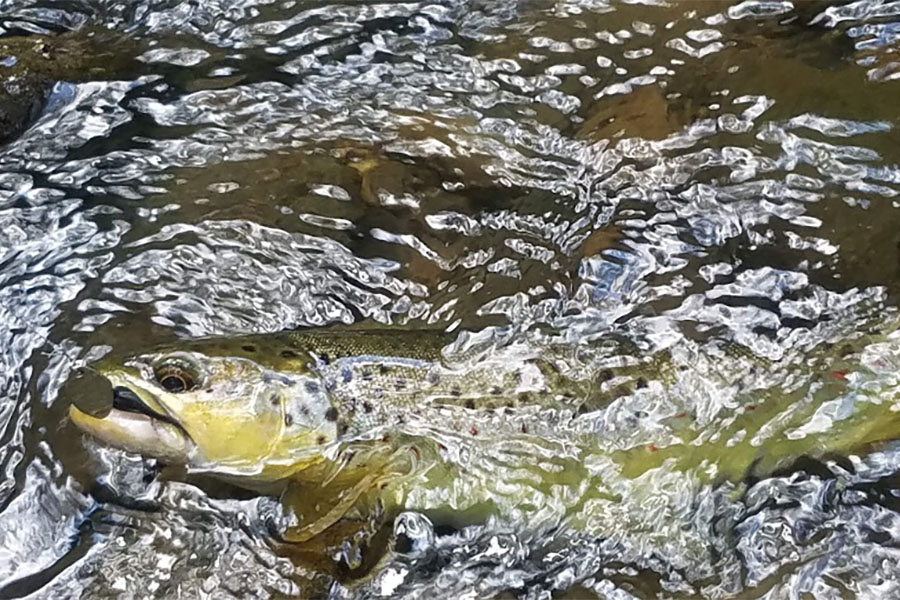
Brown Trout caught on a spinner on the Nantahala River, NC.

Brown Trout caught on a spinner on the Nantahala River, NC.

What Tackle to Pair and Rig with Spinners

A good rule of thumb when fishing for trout, especially in smaller creeks and streams, is to use the most lightweight tackle you can feasibly get away with. My go-to spinner set up for trout is typically a 3000-size spinning reel with 8-12lb braided line, 3-4ft fluorocarbon leader paired with a 6-8ft light action fishing rod with a soft tip. If you have not guessed by now, the name of the game is lightweight tackle; you can use a baitcaster, but unless the lure is at least 1/8oz, I wouldn’t advise it unless you love fixing backlash.

Table 1: A general guide to the sizes of line lure based on the conditions. Color is entirely up to the angler. Rod type for all data below is a 7ft light-medium action rod with a soft tip.

Reel size(Spinning)Mainline(Braid)Leaderline(Floro)Spinner SizeWaterConditionsTrout Expected1000-30008-12lbn4-6lbn1/32 oz; 1/16 oz; 1/8 oz1-5ft, light currentSmall to Medium size Rainbow, Brook, and Brown Trout1000-300010-12lb6-8lb1/4 oz; 1/4 oz1-10ft, light to heavy currentMedium to Large size Rainbow, Brook, and Brown Trout3000+10-12lb6-8lb1/4 oz; 1/4 oz1-10ft, light to heavy currentMedium to Large size Rainbow, Brook, and Brown Trout3000+12+lb8-12lb3/4 oz; 1 oz1-10ft, light to heavy currentMedium to Large size Rainbow, Brook, and Brown Trout

Tackle

1. Spinning reel: size 1000-3000

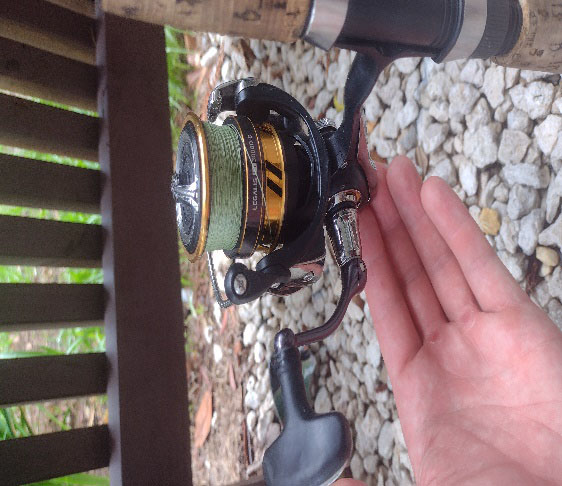
1000 to 3000 sizes of spinning reels are typically compact, light, and more than capable of handling large trout even in fast current. The reel brand is entirely up to the angler, and I would advise avoiding plastic-bodied reels with plastic handles. Remember, in the world of retail fishing, if it feels cheap, it probably is cheap. Typically higher-quality gear will have aluminum, steel, or carbon-fiber reel handles and bodies. My current favorite reel to use with spinners is a Daiwa Legalis 3000 LT.

Daiva Legalis 3000

Daiwa Legalis 3000LT
2. Spinning Rod: 5-8ft Light to Light-Medium action

Longer rods will allow longer casts and more maneuverability around rocks and boulders, while a shorter rod can be used for quicker, more precise casting. Because I like to fish rivers with dense shoreline cover, I typically choose shorter, more maneuverable rods that won’t get hung up in trees and limbs.

3. Line: 8-12lb braid with a 4-6lb fluorocarbon leader

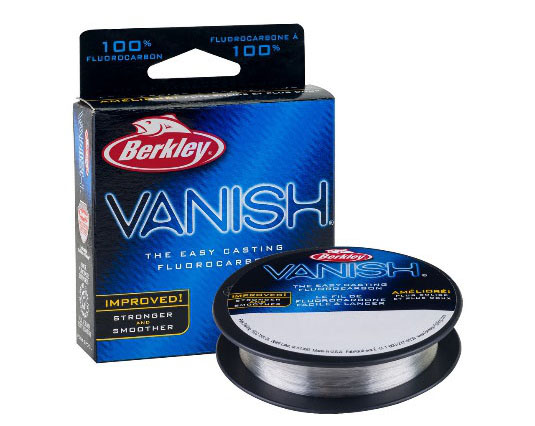
The light braid will give you substantially more casting distance without sacrificing line strength. The fluorocarbon leader is nearly invisible in the water and will not spook away wary trout.

flourocarbon fishing line

Any fluorocarbon line will work. Try not to go above 8lb test.
4. Lure Size and Weight: 1/32 to 1 oz

Lure weight and size depend entirely on depth, wind conditions, size of fish targeted, fish species, and the type of water being fished. A solid middle ground for all types of water is a 1/8 oz spinner. Remember that lure size does matter when attempting to target larger fish regardless of what people tell you. Animals can determine whether a prey item is worth their time for the energy they expend to retrieve it. Although you can find cases of small fishing hitting big lures and vice versa, typically, larger lures will entice larger fish. This is why Muskie spinners are nearly the size of your hand, while trout spinners can be smaller than your pinky fingernail.

Color of Spinner, Do Trout Care?

The color of the spinner’s body isn’t as important as you might think, regardless of what the trout fanatics and gurus tell you. Spinners are primarily causing reactionary strikes with trout due to the combination of flash and vibration. Therefore, when changing lures, it’s more prudent to change the blade style and color instead of the lure’s body color. Changing the blade color, alters the flash color and vibration that the spinner is expending into the water, which might be more enticing to that lethargic 20in brown your trying not to “accidentally” snag in the face after your 100th cast at it.

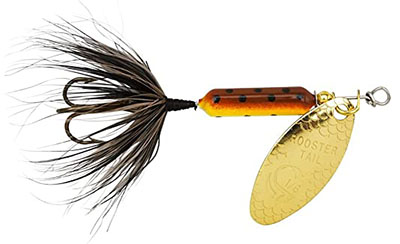
Typically I use darker colors during clear days and brighter colors on overcast days. Regardless of this guideline, however, I have been mistaken before. So take this advice with a pinch of salt. Tip: My favorite color and size when exploring a new creek or river is a 1/16oz Rooster-tail with a bronze blade.

1/16 oz Brown Trout Roostertail with a Bronze Blade

1/16 oz Brown Trout Roostertail with a Bronze Blade

How to Rig a Spinner for Trout Fishing

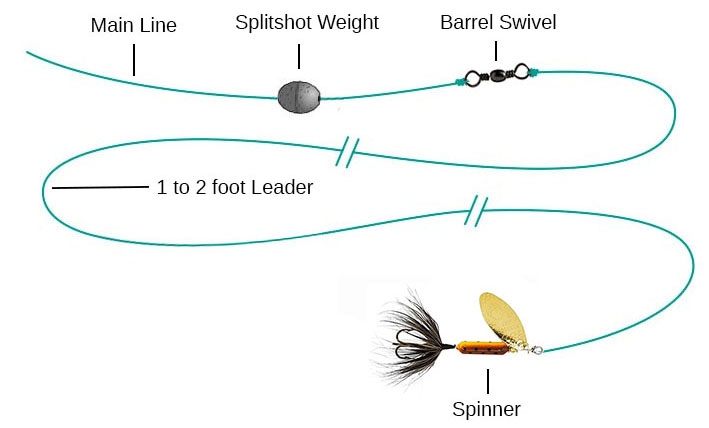
As the name implies, spinners spin. Unfortunately, this sometimes causes the line to spin as well. We use a fluorocarbon leader attached to the braid with a swivel to prevent this. The swivel will allow the leader line to spin while preventing the mainline from turning. Although this isn’t required, it will help avoid tangles and loops forming in your mainline, which can be a real pain in the neck.

When spinner fishing for you trout, you can use a standard spinner rig setup. Tie the mainline (braid) to the fluorocarbon leader using a barrel swivel. Attached the mainline and fluorocarbon leader to the swivel using an improved clinch knot or palomar knot. Allow for 1′ to 2′ of leader line between the swivel and your spinner bait.

trout spinner rig

Spinner rig setup for spinner fishing for trout

Tip: To remove twists from the line remove all tackle from the terminal end of the line and free-spool out as much line as possible into the current or behind a boat. This will naturally allow the line to untwist itself.

How and Where to use a Spinner for Trout

Retrieval Rate

Your retrieval rate is an important aspect you must be aware of when spinner fishing for trout. All spinners have a minimum retrieval rate that will allow the spinner to rotate freely like a boat propeller and not just flop around in the water. To use a spinner the most effectively, you want to maintain the slowest retrieval that your spinner will allow as you propel it through the water.

All brands, blade sizes, shapes, and weights of spinners are different, and finding the optimal retrieval rate for each one is imperative. To get an idea of your spinners’ optimal retrieval rate, drag the lure a few feet in front of you until you see the blade engage and rotate like a small propeller. If it isn’t rotating, you can bend the blade’s edge using a pair of pliers or flatten it with a hammer or rock.

How to Fish a River with a Spinner for Trout

In a river, trout are typically in feeding lanes with their heads pointed into the current as they wait for wounded baitfish or insects to pass by them. These feeding lanes generally are found on drop-offs into deeper water or on the edge of eddies created by rocks or fallen timber. Rarely will they pursue a meal into the current to waste precious energy, highlighting the importance of proper positioning when you make your cast.

Always throw your spinner at roughly a 45-degree angle up-current to allow it to swing through areas where you believe fish might be. Since we know the general direction in a river that trout will face, it’s also prudent to walk upriver instead of downriver when bank fishing. This way, you walk up behind fish instead of in their line of sight. You’ll find you spook less fish and catch more this way.

How to Fish a Lake with a Spinner for Trout

In lakes, trout are much more susceptible to atmospheric changes than in rivers. During the hottest and coldest months of the year, you will typically find them in deeper water and difficult to target by the shore. During the Spring and Fall, trout will hunt along the shorelines, looking for insects, amphibians, and small fish that stray too far into the open. These are the optimal times to throw spinners for trout in a lake. Keep the spinner just a few feet above the bottom, maintaining a continuous retrieval casting toward the structure or the bank. Try to fish drop-offs, structures, and vegetation where the trout’s natural prey may be hiding.

Final Note: Brown vs. Rainbow Trout

Typically, when fishing for trout in the U.S., you will find yourself in waters stocked with Brown or Rainbow trout. Both species of fish have variable habits that, once known, can help you identify areas where you are more likely to catch either species. Brown trout love the dense cover of fallen logs and shorelines with overhangs where they can ambush small animals, fish, and insects as they fall into the water.

Although you can find rainbows exhibiting similar behavior until they reach a particular size class, I tend to find rainbows in deeper, calmer water. Brown trout are also more aggressive and prefer hunting smaller trout and fish, while rainbows, especially hatchery fish, prefer bugs, nymphs, and larvae. I know…I know, you have caught giant brown trout on size 20 nymphs and swear by it. However, from my experience, larger spinners with wider blades tend to catch more brown trout than rainbows.

Till next time, good luck and tight lines.

So, Can You Eat Buffalo Fish for Survival?

0

Surviving isn’t camping. When you are camping, you are generally having fun even when you are working hard, you’ve probably prepared with ready-made meal options, or even a proper menu for the journey, and you can always tuck tail and go home when things get too bad.

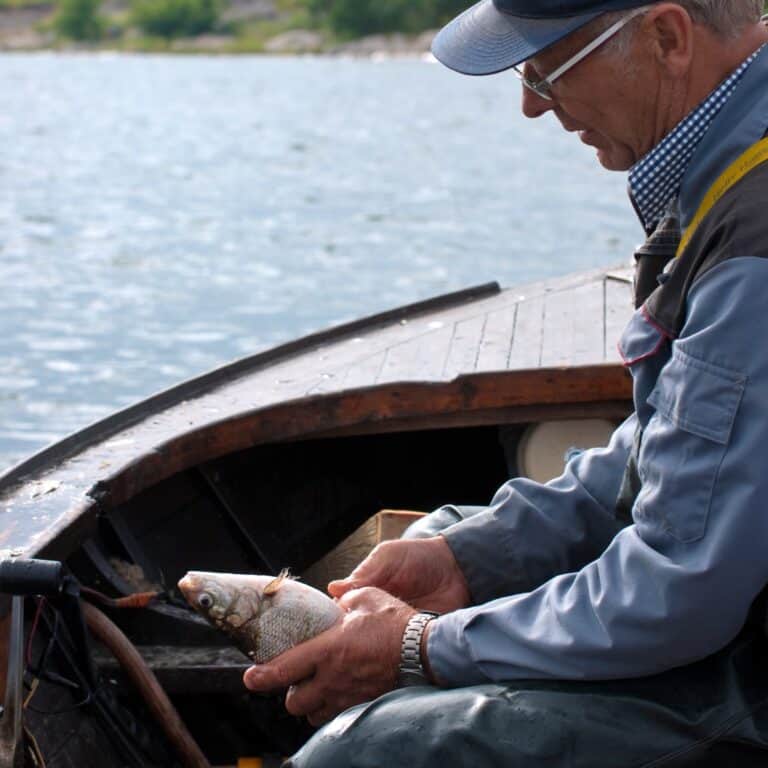
fisherman with a fish in hands

But when you are surviving, pretty much everything else is going to be dictated for you. When and where you can sleep, what you’ll be doing, and of course what you’ll be eating.

In any short or long-term survival situation that lasts a while, what food you do have access to is going to run out and then you have to start sourcing your own food from the wild.

This means you’re going to be eating various animals that you wouldn’t normally consider eating.

How about buffalo fish? Can you eat buffalo fish in a survival situation?

Yes, you can safely eat buffalo fish. They are delicious, nutritious, and usually quite sizable making them a great catch in any survival situation assuming you can get them.

Compared to other, typical freshwater fish found in North America, buffalo fish don’t have the best reputation as game fish, but they have an excellent reputation as table fish (assuming you can get your hands on them).

Easier said than done, though, because they can be very tricky to catch with a rod and reel.

You need to get creative and improvise if you want to bag these big fish in the middle of a survival situation. Keep reading and we will tell you everything you need to know.

Where Can Buffalo Fish Be Found?

Buffalo fish, proper name Ictiobus, are a genus of fish comprising five species native to North America from Mexico all the way up through the United States and into Canada, and also found in Guatemala.

The distribution of the species varies, with big-mouth buffalo being found throughout the Red River in the United States and Canada, and throughout the entirety of the Mississippi River system all the way down to Texas in the Southwest and throughout Alabama.

The smallmouth Buffalo is found throughout the Mississippi River System in the United States and all the way up into Idaho.

Clear, moving freshwater is their typical habitat, and they are tolerant of both fast-moving bodies of water and water with high mineral content.

These fish typically depend on dense vegetation for shelter and to find food, filtering food from the water itself or else sucking up algae off of rocks along with a few inclusions of choice insects and crustaceans.

Generally speaking, you have a good chance of finding these fish if you know where to look and how to find them so long as you are in their habitat.

Buffalo Fish Nutrition Info

Fish are usually pretty healthy eating, and buffalo fish are especially so.

High in protein, very low in saturated fats, and packed with high-quality micronutrients including omega-3 fatty acids, these fish also tend to be sizable and very densely muscled, making them a great meal.

The most notable nutrients found in buffalo fish aside from their high protein content are vitamins B12, D, A, and folic acid along with plenty of selenium.

However, caution should be taken when eating wild-caught buffalo fish because they have a tendency to absorb mercury into their body which will then be consumed by you if you eat them.

Yes, this is a potential problem when eating all wild-caught fish but buffalo fish are more prone than most species to absorb this toxic heavy metal.

Also, because the type of food buffalo fish eats is not really used (or even usable) as bait on a lure when fishing, buffalo fish are most often taken with a bow and arrow.

Do Buffalo Fish Taste Good?

Yes! Buffalo fish, though not commonly advertised or sought for human consumption, nonetheless make for a terrific meal whether or not you are in the middle of a survival situation or just looking for a great fish dinner on a weeknight.

These fish are juicy, firm yet soft, and remarkably clean tasting, lacking the typical fishy oiliness that is present in most species.

The fish also lend themselves remarkably well to many different kinds of preparation, and they can be grilled, steamed, fried, baked, or used directly in a soup or stew with equal ease.

No matter how you are going to cook it and no matter what ingredients you have on hand, you will have a nourishing and wholesome meal from a buffalo fish.

Is it Safe to Eat Buffalo Fish Raw?

No. Eating raw fish, though normalized thanks to the widespread acceptance of sushi, is a bad, bad idea, especially in the case of wild-caught freshwater fish like the buffalo fish here.

The simple fact of the matter is that eating any raw animal protein, including fish, dramatically increases your chances of contracting food poisoning from one of several germs, or else becoming infested with harmful and potentially deadly parasites.

Buffalo fish can play host to all of them, bacteria and viruses to parasites like various species of worms and flukes.

Consider that even contracting something as simple and normally innocuous as food poisoning could prove to be fatal under the circumstances.

You aren’t going to be able to dash down to the ER or to the local clinic for assistance with squashing the bug and getting something for your symptoms…

You’ll be facing crushing nausea, cramping, vicious diarrhea and possibly vomiting in the bargain. That’s just going to dehydrate you and further sap your energy reserves.

That could be enough to finish you off if you are already in a bad way, and it’s going to make taking care of all the other things you need to do to survive difficult or impossible.

To avoid this, always make sure you thoroughly cook the meat from a buffalo fish until it is well done.

An internal temperature of 165° F is sufficient to kill virtually all known pathogens that it could harbor.

Are Buffalo Fish Scales Safe to Eat?

Yes, if they are cooked, but they should generally be discarded.

The scales of the buffalo fish are large and tough, and even when thoroughly cooked they make for pretty difficult eating and offer very little in the way of nutrition.

Feel free to scale the fish when you are cleaning it to prepare it for cooking: you won’t be wasting any calories.

Are Buffalo Fish Eggs Safe to Eat?

Yes, and the eggs of the buffalo fish are fairly sizable compared to most other caviar meaning they can be a great supplemental source of food if you can track them down or are lucky enough to catch a fish that is carrying eggs.

As always, make sure you thoroughly but gently cook the eggs prior to eating if you want to avoid the risks of foodborne illness.

Can You Safely Eat Buffalo Fish Bones?

No. Buffalo fish bones are generally stout and of a pretty good size, making them a significant hazard to try and eat as they are.

People are not supposed to eat fish bones, anyway, unlike some other carnivorous animals, as they pose a significant risk of choking or else they can cause internal injuries including becoming stuck in our intestines.

That’s the last thing you need to deal with under the circumstances!

However, bones can still offer you valuable nutrition in a survival scenario, including the bones from the buffalo fish.

This nutrition comes from the marrow, which can be extracted from the bones easily by simmering or boiling them in water to make a nutritious stock or broth, or else cracking or splitting the bones open before scraping out the marrow and cooking it.

Bone marrow has long been a coveted resource by those who are in a survival situation thanks to its overall nutritional density, so don’t discard the bones unless you have been blessed with an abundance of fish!

Can You Eat Buffalo Fish Organs?

Fish organs are rarely thought of as edible in any situation, but it turns out that you can in fact eat them so long as you take the time to properly prepare and cook them.

They can make for especially nutritious food when taking from a larger fish like buffalo fish.

The heart and the liver are generally the tastiest, and also packed with nutrients, while being easy to prepare.

The intestines of the fish are also edible, but you must use exacting care to expel the waste material from them before giving them a very thorough rinse and then cooking them.

Small Spreads for Snows: It might be time to rethink the “bigger is better” mindset. Use these tips to secure success with a small(er) spread. – Delta Waterfowl

0

Going Small for Snows

No trailer (or three) jam packed with snow goose decoys? S’no problem! Here’s how to make a smaller spread work this spring.

By M.D. Johnson

Eighteen hundred. Two thousand. I’m not sure what the exact number was … hell, I don’t even know if the young man who orchestrated the menagerie of plastic knew the exact number. What I did know was it was a lot of decoys. And battery-driven spinning things. And speakers to rival a Rolling Stones concert. A lot of stuff.

The young man—now much better known—was Tony Vandemore, co-owner of the Missouri-based Habitat Flats and an authority on white goose hunting. I’d joined Vandemore for early-season teal, wood duck, and mallard hunts, but this was my first experience with snows. So when the young man instructed us to get down and flicked the power switch, bringing to life eight speakers and a pair of rotary decoy machines, I listened. But when I finally saw the geese he was looking at—so far away they looked a lot like flecks of pepper on a paper plate—I wondered to myself, “What the hell is this kid doing?”

Moments later, and after taking my inaugural ride in the eye of a white goose hurricane, I realized he knew exactly what he was doing.

And so it was with my further experiences with snows in Missouri, Iowa, Nebraska, Kansas, and South Dakota—concert hall sound systems and a virtual sea of plastic. Fifteen hundred. Twenty-five hundred. But it wasn’t just me, for it seemed to most hunters that massive spreads and big numbers were the only way to go when it came to fooling spring snows.

“Either go big,” I was told time and time again by those foolish enough to chase white geese, “or don’t go at all.”

And that’s just the way it is … or is it?

A man holds a set of flat goose decoys in his hands as more lay on the ground in the background.

Defining ‘Small’

Let’s begin by addressing perhaps the most challenging part of the small spreads for snows equation, that being the definition of the word “small.” For a group accustomed to setting 4,500 decoys, a mere thousand might be small; for those rigging 1,000, then 400 to 500 may fit the bill. Much of it, then, lies in what one’s used to. It’s an eye of the beholder sort of thing, I reckon.

“Downsizing for me is 300 to 500 full-bodies,” said Vandemore “We’ve done this quite a bit in Arkansas, and 300 full-bodies is what we typically run in Saskatchewan in the fall.”

Eleven hundred miles east of Vandemore’s digs in north-central Missouri lies Easton, Maryland, home to some of the nation’s deepest goose hunting traditions, as well as to legendary callmaker, Sean Mann. No stranger to geese, be they darks or lights, Mann is the mastermind behind the Eastern Shoreman goose call, one of the most recognizable hunting instruments ever to be crafted. But while the World Champion and Champion of Champions built his reputation on Canadas, he’s certainly no stranger to the ins and outs of spring snows.

“To me a small spring snow spread would be 300 decoys or fewer,” Mann said, “If I’m hunting a water hole, I may use as few decoys as three dozen floaters.”

That’s not to suggest committing the sin of shooting a roost, Mann continued, but rather, strategically targeting water where the birds are going to hydrate. In Maryland, says Mann, that means avoiding setups on alkali ponds, which birds will use to roost but won’t drink from. Dry-feeding snows must drink afterward to digest their food. Find their watering hole, and it won’t take a massive spread to find success.

Coming back around to the word “small,” Nick Costas, who owns Split Reed (splitreed.com) and Thunderbird Outfitters in Saskatchewan, is quick to admit he’s not a “spring snow grinder” like some folks, but he does his fair share of chasing the white fowl.

“For years, 100- to 150-dozen socks, rotary machines, clone decoys, fliers … the monster set-ups were the big thing,” Costas said. “And people still do it. They’re hunting a 10,000-bird feed. They’re laying in the decoys under the socks. A huge spread with a lot of motion: That’s their play.”

Costas was convinced to rethink this mindset during the spring 2018 season.

“That was a tough year for snows in Arkansas, the year I guided down there,” he explained. “There weren’t a lot of juvies. We came out running 100 dozen socks with rotaries, and didn’t have a lot of success. So, we started packing in layout blinds, with 300 full-bodies and no motion, and had success—forty- to 80-bird shoots. To me 300 full-bodies is a small spread.”

As importantly, it’s enough to work.

Dynamic Decoys

Now don’t get me wrong: I’m not saying there’s not a lot of thought that goes into setting out a 2,000 mixed rig of full-bodies, silhouettes, socks, rotary machines, fliers, layouts, A-frames, and anything else worthy of inclusion in these so-called “monster spreads.” There is! But I will say there’s a great deal more margin for error when setting 2,000 fakes as opposed to artistically arranging Mann’s 36 floaters or Costas’ 300 full-bodies, e.g. preparing for a wind shift, selecting blind locations, and most significantly, concealment to the point of invisibility.

“When I say ‘300 full-bodies,’ I would likewise run a small sock or silhouette spread, if that’s what I had,” Costas clarified. “Not everyone can afford 300 full-bodies … and if there was a consistent snow goose feed, I would have confidence running 300 silhouettes or socks, especially depending on the wind. I’m not the guy who’s going to say you need highly expensive decoys to kill snow geese. I don’t believe that.”

So is there a right way and a wrong way to set those 300 decoys, be they full-bodies, socks, or silhouettes?

“More thought definitely goes into setting a small snow spread than when I’m rigging 1,500 or more,” Vandemore said. “But it’s still a fairly routine configuration, with more on the upwind side and fewer downwind.”

Perhaps not surprisingly, Mann’s thoughts on the subject are similar to Vandemore’s, but with an added element which, to those who’ve spent time peering through a windshield, is quite understandable.

“I try to duplicate or set the exact picture of what I’d seen during my scouting,” Mann said. “The birds know where they want to be, and more importantly, why they want to be there. I don’t need to know why, but I do need to know where, how, and of course, when.”

Costas breaks a bit from the traditional “tight is better” theory of setting a snow goose spread, especially when he’s working with but a handful of decoys.

“I’m running my spread looser than most,” he said. “I’m creating a lot of little pockets, and giving the birds options where they can land.”

What the young man said next truly hit home.

“I know it’s not spring, but this works in the fall in Canada: I’ll run 10 dozen silhouettes, hide out of the spread, and kill tons of snow geese like that,” Costas said. “I’d say that’s a very small snow goose spread, but mind you, I’m running that when they’re coming to that exact field. My philosophy is that the more crap I put out there, the more opportunity I have to mess the situation up.”

Goose Decoys are seen in the foreground as a group of hunters waits inside their blind for the birds to come.

Visibility and Acoustics

Sooner or later, be the rig large enough to cover several football fields or as small as the average driveway, a conversation surrounding spring snows will turn to the topics of sound and motion. Monster spreads often combine the motion and movement akin to a Mardi Gras parade. Constant sound. Spinning. Flapping. Flying. Flipping. Shaking. It’s like hunting geese in an enormous snow globe—with speakers blaring.

A spread of snow geese decoys in a field can be seen from the sky. The elaborate spread is set to lure in the geese.

A small spread though, and the variables of sound and motion, change a touch.

“I’ll still use rotary machines in a small spread,” said Vandemore. “But I’ll put them on short posts close to the ground.”

In the East, Mann believes in the back and forth of his socks as it pertains to motion and is a firm believer in an old school motion tool.

“If I can be in the spread, I’ll use a square black and white flag for attraction and attention,” he said. “I’m not using it for constant motion, but to refocus birds when they’re headed my way. If they start to get bored, as evidenced by birds starting to fall out of the flock or even the entire bunch beginning to slide off, I’ll flip the flag and try to get them refocused.”

Sound is, of course, another variable in the small snow spread; however, here the question is whether to use electronics (e-callers) or to return to the tried-and-true mouth calls … or, both?

“You definitely still need the tunes (e-callers), but you really need to think about volume and lowering that when the birds get closer,” Vandemore said. “Often, I’ll still run two e-callers, but I can get away with one situationally. Don’t overlook the fact that 300 decoys cover a lot less real estate than do 1,000, so it matters where your sound is coming from and how much sound you’re putting out.”

Costas is on the same page with Vandemore when it comes to sound production.

“I adjust my e-caller volume, depending on the birds,” he said. “It’s just like (mouth) calling for ducks and geese—you’re going to be a little louder when you’re trying to get their attention versus when they’re finishing.”

Mann’s theory on the audible is different.

“Volume is often overdone with white geese,” he said. “Snows have great hearing, and they know what they want to hear. Sound quality is the most important aspect. You have to sound like them and know what they’re trying to say. It’s not just creating noise. It’s being a good family group of great-sounding birds.”

Further, Mann walks both sides of the e-call/mouth call fence in the spring.

“I like e-callers when allowed, with a very small group sound and four speakers,” he said. “I’m looking for the sound to ‘move’ around the speakers, as if the birds were talking across the flock on the ground. And I use a White Out (mouth call) to produce specific sounds that complement the electronics.”

However, Mann has hunted snows for decades minus the battery-powered devices.

“I still do more hunts without the e-caller than with,” he said, “I’m okay combining the e-caller with a good call, as long as I have a remote for the electronics. No remote? No e-caller.”

Top Priority: Concealment

Back and forth. This and that. Pros and cons. Ask 100 snow goose wizards the same question, and there’s an awfully good chance you’ll get 100 different responses; however, one common denominator they’ll all agree is the need for total concealment. It’s a fact for snow geese, a young ’fowler once told me, that, “If you ain’t hidden, you ain’t shooting.”

“Concealment is always a top priority for snows,” Vandemore said. “But even more so when you’re working with a small spread and you don’t have 1,000 decoys to help take some of the birds’ attention off your hides.”

Two men in white suits sit among their white snow geese decoys in a field on a hunt.

Mann agreed, noting, “Concealment is without question the primary element. You can’t beat these birds if you’re exposed.”

Costas summarized the matter especially well.

“With a small spread, you need to be hunting the right, consistently behaving birds, and you have to have a great hide,” he said. “Concealment is my ‘thing’ when it comes to snows.”

“Consider that snow geese get shot from the inside of spreads for months on end. So when snows slowly fly up to a spread, they’re looking down. They’re looking for those people they’re accustomed to in the usual spots. That’s the theory behind using 100 dozen decoys: You can hide yourself in the spread, and by the time the birds get to the head, they’re low enough to shoot. You can’t do that with 300 decoys. That’s a small, realistic spread that’s not packed super tight. It doesn’t look like a strip of toothpaste. It says to the birds that this is calm, natural feed, and they need to be there.”

And if you effectively communicate that magic combination to a massive flock of snows, it doesn’t really matter if you’ve put out 300 socks or 5,000 full-bodies—your shotgun barrel is about to get hot!

M.D. Johnson’s decoy trailer is ready for spring in Cathlamet, Washington.

Best Air Rifle Deals

Popular Posts

What can you kill with a 177 air rifle?

0
"Unleash Your Precision: Discover the Power of a .177 Air Rifle to Take Down Targets with Accuracy. Explore the Versatility and Potential of this...

Air Rifle vs BB Gun: Understanding the Key Differences and Choosing the Best Option

0
"Air Rifle vs BB Gun: Unveiling the Key Differences and Choosing the Perfect Weapon for Your Shooting Needs. Delve into this comprehensive guide to...

What Is a Break Barrel Air Rifle?

0
A break barrel air rifle is a type of air rifle that uses a break action to load and unload pellets. It is one...