As a longtime hunter and outdoor enthusiast, I’ve spent countless hours watching squirrels dash through the treetops. These bushy-tailed acrobats fascinate me – not just as game animals, but as remarkably adaptable creatures. Let’s dive into what makes these little rascals tick, food-wise.
You might think squirrels are simple nut-munchers, but boy, would you be wrong! These crafty critters could teach a master chef a thing or two about diverse dining. I’ve watched them sample everything from prime acorns to leftover pizza crusts. They’re like that friend who’ll eat anything at a buffet and come back for seconds.
Squirrels are omnivores, though they lean heavily toward plant-based foods. Think of them as “vegetarians with benefits” – they’ll happily chomp on eggs or insects when the pantry runs low. In my years of hunting, I’ve learned that understanding their food preferences can make the difference between a successful hunt and a long day of squirrel-watching.
The Nutty Stuff: A Squirrel’s Bread and Butter
Let’s talk nuts – the crown jewels of any squirrel’s diet. These little guys go absolutely bonkers for:
Acorns (the Ferrari of squirrel food)
Walnuts
Pecans
Hazelnuts
Almonds
Beech nuts
Pine nuts
Macadamia nuts
Here’s a funny thing I’ve noticed while hunting: squirrels can tell a good nut from a bad one just by picking it up. They’ll give it a quick once-over, like a seasoned card player checking their hand. If it’s no good, they’ll chuck it faster than a hot potato.
During spring and summer, squirrels turn into regular produce aficionados. Their shopping list includes:
Fruits:
Apples
Pears
Grapes
Citrus fruits
Berries of all kinds
Watermelon
Cantaloupe
Figs
Plums
Vegetables:
Corn (a particular favorite)
Tomatoes
Root vegetables
Leafy greens
Squash
Peas
Carrots
Broccoli
Celery
Seasonal Dining: A Year in the Life
Fall: The Great Hoarding Season
Fall is like Black Friday for squirrels. They go into full-on shopping mode, gathering and storing nuts for winter. I’ve seen them work harder than a beaver at a lumber yard, stashing their goodies all over the place.
The clever part? They’ll dig fake holes to throw off other animals. It’s like watching a poker player bluff – they’ll go through all the motions of burying something, but there’s nothing there! As a hunter, this behavior is gold. Where there’s food storage, there’s bound to be squirrels.
Winter: Living Off The Savings
Unlike their hibernating neighbors, squirrels stay active all winter. They rely heavily on those fall stockpiles, but they’re not above raiding bird feeders or munching on tree bark when times get tough. I’ve seen them trudge through snow deeper than their bodies to dig up a cached nut – talk about determination!
Spring and Summer: Nature’s Bounty
These seasons are like an all-you-can-eat buffet for squirrels. Fresh buds, flowers, fruits, and vegetables are everywhere. They’ll sample everything from tender tree shoots to garden tomatoes. As any gardener will tell you (usually with a hint of frustration), squirrels can strip a vegetable patch faster than a swarm of locusts.
The Protein Plan: When Squirrels Go Wild
Here’s something that surprises many folks: squirrels occasionally hunt! When plant foods are scarce, they’ll turn to:
Bird eggs
Baby birds
Insects
Small snakes
Young mice
I once watched a squirrel raid a robin’s nest – it moved with the stealth of a trained operative. These moments remind you that nature isn’t always as cute and cuddly as it seems.
Urban Adaptation: The City Squirrel’s Menu
City squirrels deserve a special mention. These street-smart cousins of their woodland relatives have adapted to human food like teenagers to fast food. They’ll eat:
Cereals
Pizza crusts
Cheese
Dog and cat food
Bird seed
Sandwich scraps
The “No Thank You” List
Despite their adventurous palate, squirrels do have their limits:
Raw onions (they turn up their noses)
Raw garlic (not even with a side of nuts)
Hot peppers (nature’s squirrel repellent)
Certain flower bulbs (daffodils, snowdrops, hyacinths)
Young Squirrels: A Different Menu
Baby squirrels, or kits, follow a strict dietary progression:
Weeks 0-6: Mother’s milk exclusively
Weeks 6-8: Milk plus soft fruits and nuts
Weeks 8-10: Weaning begins
Weeks 10-12: Independent foraging starts
Hunting Tips Based on Feeding Habits
Understanding what squirrels eat has made me a better hunter. Here’s why:
Location Scouting Look for:
Oak trees (acorn central)
Nut-bearing trees
Fruit trees
Areas with abundant mushrooms
Gardens near wooded areas
Timing Your Hunt
Early morning: Heavy feeding time
Late afternoon: Second feeding surge
Post-rain: Prime mushroom foraging time
Seasonal Strategy
Fall: Focus on nut-bearing trees
Winter: Check known cache sites
Spring: Scout near flowering trees
Summer: Target fruit-bearing areas
Conservation and Ethical Considerations
As hunters, we’re also conservationists. Understanding squirrel diet helps us protect their habitat. Healthy squirrel populations need:
Diverse food sources
Clean water access
Natural foraging opportunities
Protected nesting areas
Some Fun Facts I’ve Learned
Through years of observation, I’ve noticed some fascinating behaviors:
Grey squirrels remember their food stash locations better than red squirrels
They can smell nuts under a foot of snow
They’ll test nut freshness by floating them in water
They create fake caches to fool other animals
Practical Applications for Hunters
This dietary knowledge translates directly to hunting success:
Tracking
Follow scattered nut shells
Look for stripped pine cones
Watch for bark strippings
Notice digging patterns
Stand Selection
Position near primary food sources
Watch travel routes between feeding areas
Consider seasonal food availability
Time Management
Focus efforts during peak feeding times
Adjust for seasonal dietary shifts
Plan around weather impacts on feeding
Common Mistakes to Avoid
Even experienced hunters sometimes slip up:
Ignoring seasonal diet changes
Overlooking less obvious food sources
Missing feeding pattern shifts
Forgetting about water sources
The Bottom Line
Understanding what squirrels eat isn’t just about knowing their menu – it’s about understanding their behavior, patterns, and survival strategies. This knowledge makes us better hunters and better stewards of the land.
Remember, these crafty creatures have survived and thrived by being adaptable eaters. They’re opportunistic, clever, and sometimes surprisingly aggressive in their food pursuit. Whether you’re hunting them or just trying to protect your bird feeder, knowing their dietary habits gives you a serious advantage.
I walked into the fertilizer company’s office just in time to hear the radio crackle, “Bernie, are you there yet?”
I was showing up for work just after daylight that mid-November morning in 1989, and my boss was already asking for me on the radio. But when I answered, the call took on a whole new meaning.
“I’m by the slough on the southeast end of Paul Johnson’s home place. GET DOWN HERE NOW!”
Jerry was also my bowhunting buddy, and I knew what the call meant. It’s illegal to share hunting information over the radio, but I could tell by the urgency in his voice that this call wasn’t exactly work-related.
Jerry often showed up for work late at that time of year because he spent a couple hours each morning glassing the surrounding farmland for bucks that had pushed does out into the open fields. This morning, he needed help — and I was happy to oblige.
Ten minutes later I skidded to a stop next to his vehicle on the gravel road. With our windows down, he excitedly related what had prompted his radio call.
A “huge,” “giant,” “monster,” “unbelievable” buck had seen Jerry’s truck top the hill and had dived into tall cattails and willows, disappearing into the 1-acre slough. The buck was still in there, and Jerry was going in after him. My boss would give me a few minutes to work around and choose an escape route to cover in case anything went wrong with his stalk.
Taking note of the wind direction and assuming the buck would try to sneak out with the wind in his nose, 10 minutes later I was covering a deer trail on the opposite side of the small patch of cover. Jerry began creeping in. Arrow nocked, release on the string, I was ready. I still hadn’t seen the buck, but Jerry and I had hunted a lot of these northern Iowa bucks in similar situations, and I could tell by his wide-eye description of the deer that this wasn’t just another 150.
Moments later, I heard Jerry yell. I stood up just in time to see the buck escape the far side of the cover and run across the field. I got a good, long look at him as he ran through the CRP field and over the crest of a hill. And what I saw defied description.
To this day, the sight of that buck is etched in my memory. In 45 years of bowhunting, I’ve never seen anything else like him. His rack was twice as wide as his butt. It reached for the sky, and my first thought was that he had a rocking chair on his head. Stickers and kickers and drop tines: this buck had it all.
Despite spending the remainder of that day and many hours over the following weeks and even years trying to locate the buck, we never saw him again. We never heard of him being killed. We never even heard of anyone else around there having seen him.
So, to our knowledge he was never killed. When we’d look at replicas of world- and state-record bucks, including the giant 282-inch Raveling buck at the Iowa Deer Classic, Jerry and I would just shake our heads and sigh.
Where did that giant we saw come from? Where did he go? How does a world-class buck just appear out of nowhere — and then disappear just as mysteriously?
An Old Theory Revisited
In 1993, Tom Miranda and I teamed up to write a book called Corn Fed Giants. In it, we offered a lot of information for the farmland whitetail hunter. Among the topics I wrote about in the book is a phenomenon I’ve not seen in print anywhere else.
I wrote of my belief that once an outsized, genetically superior buck gets big and strong enough to beat up every other buck he contacts, he just goes wherever he wants during the rut. He breeds does as he pleases, traveling far and wide if need be in that quest. He might follow long-running travel corridors for miles and miles. Then, when the rut is over, he might return to his original range — or, he might settle down right where he is, in the best available habitat.
When I announced that theory over 20 years ago, researchers’ ability to track wild bucks’ movements wasn’t what it is today. Now, with GPS collars, a lot more has been learned about travel patterns and home ranges. Even so, I don’t believe there’s been any research to back up my theory.
In fact, most research has shown bucks tend to reduce their home ranges they mature, particularly after passing peak breeding age. But I’m not totally ready to give up on trying to explain the issue of bucks that appear and disappear like ghosts.
One thing we’ve learned is that bucks are individuals with their own “personalities.” And to my knowledge, no one has put a tracking collar on a wild, world-class buck in Midwest farmland habitat. I’ve seen too many situations in which a huge buck just showed up on a camera, never seen before and then never shot or even seen again. Nor is either of his shed antlers found. It’s as if he simply appeared out of thin air . . . and then vanished in the same fashion.
What does this mean to the hunter who wants to know more about the home ranges and travel patterns of mature whitetails? And furthermore, is there information out there to help us improve our odds of bringing such deer home with us?
Defining Home Range
Every deer hunter has heard the term “home range.” It’s usually associated with a number of acres or square miles. The numbers vary greatly by terrain, habitat quality, food availability and time of year.
Home ranges of whitetail bucks in excellent habitat with plenty of food available can be quite small. GPS studies in prime areas of Louisiana, Pennsylvania and Maryland have shown home ranges averaging from 269 to 559 acres; not even as much as a square mile (640 acres).
Often a square mile is used as a baseline for a buck’s home range in good habitat, though there are clearly many places in which that figure is way off. A GPS tracking study in Texas showed an average home range of 2,271 acres. Availability of food and proximity to cover make all the difference.
In many parts of the West, in fact, whitetails routinely make treks of 2-3 miles between preferred bedding areas in timbered hills to feed on alfalfa in the lowlands. The deer make that long-distance hike each way daily. It’s hard to put a number of acres on a home range when deer are taking such long strolls.
Putting a number of acres or square miles on a home range is deceiving, because it almost implies the area is something of a circle or square. In reality, a home range might be a section of winding river bottom two miles long by 300 yards wide. It might include a couple areas where the deer move upstream on a small tributary, which further makes putting a number on it difficult. The shape of a deer’s home range is dictated by habitat, not by acres.
It can be a mistake to get caught up in home ranges when targeting a particular deer. Trail cameras can help you get a feel for where the buck is spending the majority of his time and when he’s there, but trying to determine the boundaries of his preferred area can be futile.
Bucks will go wherever they need to go to get food and water daily, and they’ll certainly roam during the rut. Home ranges are very fluid and dynamic.
Core Areas
While an overall home range might be pretty nebulous, a core area isn’t. The Quality Deer Management Association defines a core area as “The portion of a buck’s home range where he spends 50 percent of his time.” Core areas are all about security and comfort. While a buck might range widely to find food and water, he’ll often come back to the same small area in which he feels secure.
These core areas can change due to weather and food availability. If a food source completely runs out, and there’s suitable bedding cover near a new food source, the buck might pack up and move.
Bucks also tend to bed in the thickest, nastiest cover during bad weather, though they tend to select areas with some visibility during pleasant weather. A buck might use three or four core areas during the course of any given year.
On average, mature bucks tend to have smaller core areas than younger bucks. The 2 1/2-year-olds travel widely, having ranges much larger than even 3 1/2-year-olds.
Many bucks 5 1/2 or older have tiny core areas in which they’ve learned they can feel secure. These deer are big enough to take over the best of the best bits of security cover from other bucks if they so desire.
Excursions
The ability to track bucks’ exact whereabouts with GPS technology has opened a whole new world of information about their habits. One of the things learned through these studies is that bucks, especially mature bucks, take off on what biologists have termed “excursions” a few times per year. The GPS collars have shown these to be anywhere from one to four miles from the core area.
These trips often last around three days. It’s no stretch, considering the individuality of bucks, to suggest some are far longer. The “stranger” that just showed up on your camera might be on just such an excursion.
While the rut is one time in which bucks make excursions, it isn’t the only one. Spring also is “vacation time” for many bucks. In a GPS study done in Pennsylvania by the University of Georgia’s Andy Olson, all 19 collared bucks went on spring excursions.
It’s not fully known what triggers such forays, but some likely are the result of nutritional needs as antlers are beginning to grow. This also is the time when many bucks approaching their first birthdays are traveling around, looking for adult home ranges of their own.
Fall excursions might be related to rutting behavior or even hunting pressure. The collared bucks in these studies were quick to go entirely nocturnal when they felt hunting pressure or other human intrusion. Pressure even can cause bucks to leave their home ranges altogether for long periods of time.
Secondary Ranges
Following buck movements by GPS makes it clear most bucks have a backup plan: a secondary home range they’ll move to as needed. This is evidenced by the fact they tend to go directly to new areas and spend a lot of time there, indicating prior knowledge of those places.
I have no way of proving this, but I theorize these secondary ranges are often bucks’ natal areas. A buck spends the first year of life in his mother’s home range, learning it intimately. It stands to reason that if an adult buck is making a beeline to an area he knows well, it’s possibly one he learned as a fawn.
I suppose the only real way to prove or disprove my theory would be to put a GPS collar on a wild buck fawn and track him over several years. To my knowledge, this hasn’t yet been done.
In Conclusion
Keep in mind that only a relatively small number of wild bucks have been collared and tracked for lengthy periods. This leaves us with very general tendencies and few specifics.
Again, bucks are individuals; they often have remarkably different habits and personalities. Add to that the fact no truly giant wild bucks have been collared. They might behave quite differently from run-of-the-mill bucks.
I’ve resigned myself to never knowing where that giant non-typical Jerry and I saw in 1989 came from or went. I’m sure he wasn’t shot by legal means, or we’d have heard. He probably just died an “old man,” as many smart bucks do. But GPS tracking studies continue to offer new insights into whitetail movements and ranges.
Maybe one day a world-class nomad like him will be collared and we’ll all get a look into the secretive lives of such giants. No doubt it would be revealing.
Yes, Glocks are among the best and most popular handguns on the market.
Still, as Glock is so prone to upgrades, there is always room for improvement. For example, the factory Glock triggers are not so famous. They have large pull weights.
If you’re one of the competitive shooters, then you probably need a trigger with less pull weight than the factory trigger provides.
Now, before we make a list of the best Glock triggers you can have, let’s explore all factors to consider before making a purchase.
Glock Trigger Types
There are different types of Glock designs that you can choose from for your next upgrade. For example, the most popular design among aftermarket triggers is the drop-in design.
What’s drop-in design?
It refers to an aftermarket trigger assembly that’s designed to be easily installed into a Glock pistol without having the need for advanced gunsmithing or modification. It got its name as it suggest the trigger can just be dropped into the handgun.
A drop-in trigger typically comes as a complete trigger assembly, including the trigger shoe, trigger bar, connector, and other components necessary for proper functioning.
The main advantage of the drop-in trigger is that it makes the upgrade process simple. It’s made to allow you to upgrade your trigger without having too much knowledge about firearms or specialized gunsmithing skills.
However, before shooting your handgun after installing the drop-in trigger, test a few times if everything works as it should before using live ammo.
Read more:
(Top 5) Best Aftermarket Glock Slides
The Top 10 Glock Barrels for Enhanced Accuracy
Review: Glock M.A.R.S. – Magazine Advanced Release System
How to Choose the Right Trigger
Among various different types of factory and aftermarket Glock triggers, choosing the right trigger may not be as easy as it sounds.
However we turn it, everything starts with your needs and preferences.
Would you like to stick with stock triggers or aftermarket triggers? Aftermarket triggers can offer different pull weights, improve reset, or offer other customization options (including different styles).
Next, where are you going to use the Glock pistol? Different environments like competitive shooting, self-defense, and recreational shooting have different requirements and different triggers may suit each of them separately.
And finally, one of the widely known factors is the trigger pull weight. The stock Glock trigger usually has a pull weight of around 5.5 pounds (or 2.5 kilograms). However, if you prefer lighter pull weight, then consider choosing aftermarket triggers with less pull weight.
How Glock Trigger Works
The Glock trigger works on a striker-fired system called the Safe Action Trigger system.
Let’s break it down in a few steps to clarify how does Glock trigger work:
Trigger safety: The Glock trigger has a trigger safety feature. It’s a small lever placed in the middle of the trigger. You have to press it fully to move the trigger backward and fire the gun. This safety prevents accidental firing if the gun is dropped or if pressure is applied to the sides of the trigger.
Trigger pull: When you press the trigger, it moves backward. As it moves, it cocks the firing pin, which makes the bullet fire. The trigger has a short distance to travel, making it easier and faster to pull.
Firing pin safety: When the trigger is fully pressed, it releases a firing pin safety. This lever was blocking the firing pin from moving forward and firing a bullet. Now that it’s out of the way, the firing pin can move forward and hit the bullet’s primer, causing a bullet to fire.
Firing the gun: Once the firing pin is released, it strikes the bullet’s primer, ignited the gunpowder, and fires the bullet.
Reset: After firing the shot, you release the trigger, as you let go, the trigger moves forward, and the firing pin partially resets itself. This prepares the gun for the next shot by making it ready to fire again. The trigger reset distance is short, allowing for quick follow-up shots if needed.
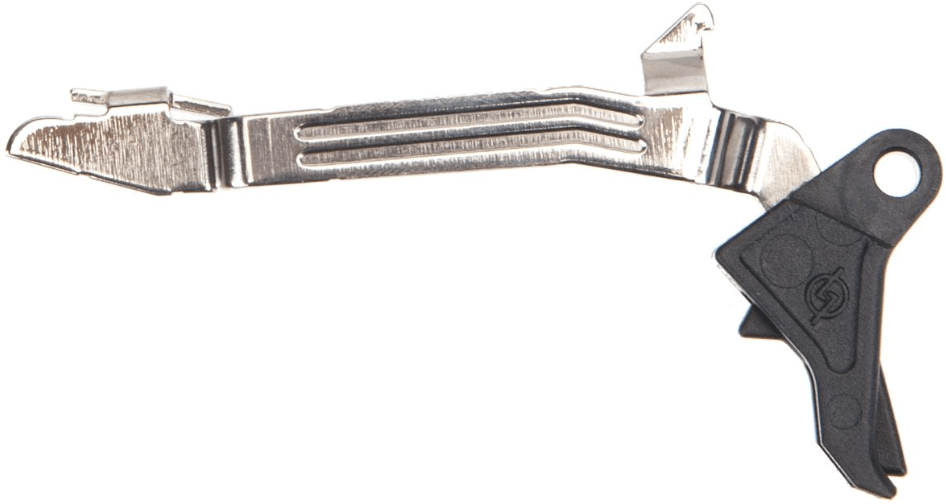
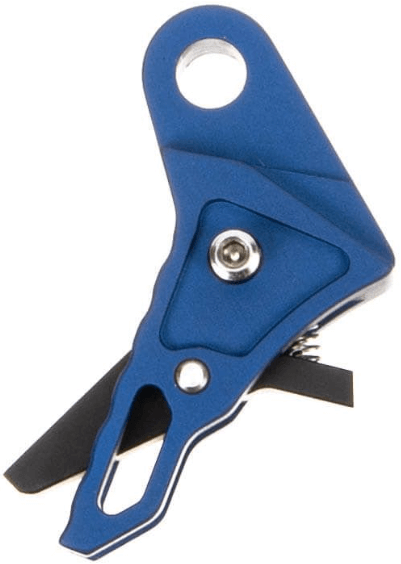
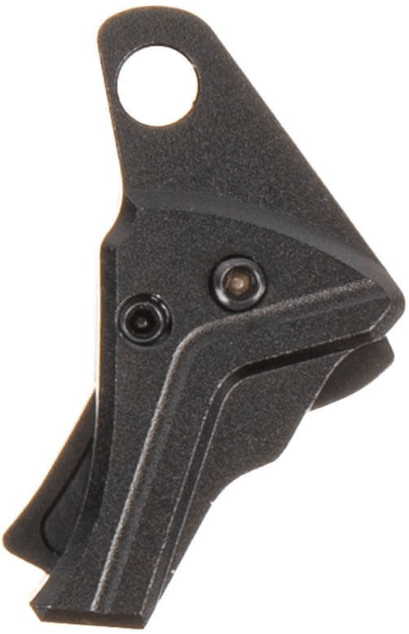
If you’re looking for something on a budget but still reliable, then Syndicate Trigger by Agency Arms is a great choice for you.
The trigger is made of polymer making it strong, durable, and at the same time lightweight.
This is a drop-in model of a trigger meaning you can easily install it at home without needing different and specialized tools.
However, if you have older generations of Glock handguns, you probably won’t be able to use this trigger as it’s compatible with Gen 5 Glocks only including G19X and G45.
Price: $60Get yours here!
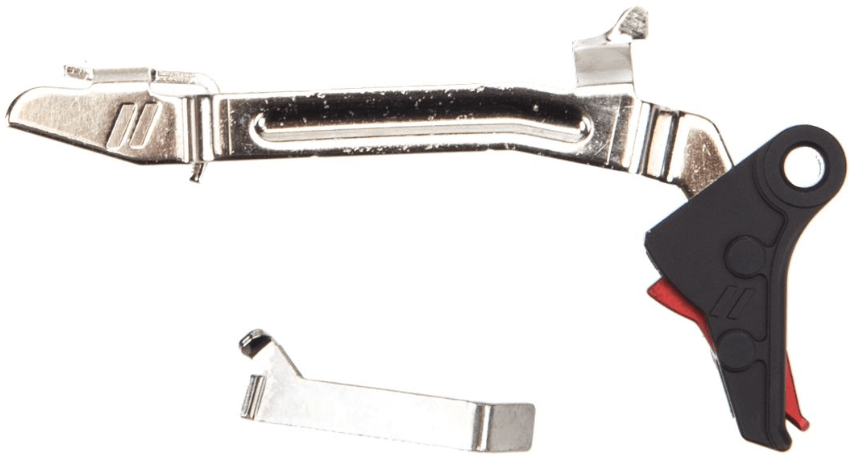
2. Zev Technologies PRO Trigger Bar Kit
This drop-in trigger comes from the Zev Technologies brand, known for winning multiple world championships. It got some pretty good features that make it stand out.
The Pro trigger bar kit supports multiple generations of Glock including Gen 1, Gen 2, Gen 3, and Gen 4. It’s compatible with G26, G19, G17, G34, G17L, G27, G23, G22, G35, G31, G32, G33 Glocks too.
The trigger bar kit is made of hard-anodized aluminum construction. Because of this, the trigger kit is strong, durable, and wear-resistant.
Zev Technologies PRO Trigger bar kit delivers a very crisp and clean trigger pull, making it very comfortable, especially for situations where you’ll need to acquire targets very quickly and deliver follow-up shots.
It’s also easy to install without having any special tools, however, it comes at a little higher price point so if you’re ready to spend a little bit more money, this one is a great option for you.
Price: $132.30Get yours here!
3. Overwatch Precision TAC Trigger
If we have to describe the TAC trigger made by Overwatch Precision as shortly as possible, then we would just say it’s reliable and aesthetic.
It’s made of 7075-T6 aluminum alloy, well-known for its strength and durability which is crucial if you’re going to use your handgun frequently. In this scenario, when you need something resistant to wear, the TAC trigger will get you covered.
The overall feel of the TAC triggers is this: it has a very similar feeling to standard OEM triggers, but it’s crisper and also has better responsitivity compared to them. When pressed, it feels smooth on fingers with a very short reset.
Price: $122.85Get yours here!
4. CMC Trigger Drop-in Trigger
Easy-to-install drop-in trigger made by CMC. Compared to the original Glock trigger, there are definitely improvements.
Let’s start with reset which is great while the trigger itself is light and crisp – something every experienced shooter is looking for when upgrading their Glock.
The trigger pull is about 2.5-3 lbs and is good for situations where you’re required to put several rounds into a target fast. With this trigger, you can easily deliver follow-up shots without affecting the accuracy of your Glock too much.
As for compatibility, you can use this trigger from Gen 1 Glocks up to Gen 4 Glocks. Gen 5 Glocks are not supported this time. Also, CMC offers two different models: one for 9mm Glocks and one for .40cal caliber Glocks. Double-check compatibility before making a purchase.
Comfort and performance – are two words that describe this model the best. It comes from Apex that’s already known for producing quality parts for Glocks.
The drop-in design of this trigger allows you to easily switch the factory trigger with this one.
The Apex Tactical Action Enhancement trigger’s main features are smooth trigger pull, reduced travel and reset distances, and a crisp trigger break compared to the standard Glock trigger.
However, this pistol works only with G43, G43X, and G48 Glock handguns.
Price: $99.75Get yours here!
6. Killer Innovations Trigger Shoe
Aesthetically pleasing yet great performance trigger shoe for Gen 5 Glocks (other not supported). This trigger shoe can go on Glock 17 and Glock 19.
Despite being available in multiple colors, which can also help you make a unique Glock build, the trigger has a crisp break with a short reset. If you’re a competitive shooter who has to put a few bullets in a row in a target, the Killer Innovations trigger shoe provides a very smooth pull and helps you have better follow-up shots.
The trigger shoe is made of aircraft-grade aluminum with an anodized finish. However, this trigger shoe is a little pricey, so be ready to spend more money if you want to own this one.
Price: $115.89Get yours here!
7. Tyrant Designs I.T.T.S. Trigger
If you’re looking for something that’s cheaper but still not lacking quality, and by the way you own Gen 3 or Gen 4 Glock, then you should check the I.T.T.S. trigger.
The trigger comes with stainless steel set screws, safety blades, and power springs ensuring the trigger’s durability.
However, this time you’ll need tools and disassembled Glock in order to change the trigger as ITTS is not a drop-in type of trigger. But if you already have gunsmithing experience, this won’t be a problem for you.
The trigger offers a 30% power spring for fast and fierce trigger reset which is a great feature when it comes to competitive shooting.
Price: $67.45Get yours here!
Final Words
When considering a Glock trigger upgrade, it’s important to assess your intended use and personal preferences.
While the stock trigger may suffice for some, many find aftermarket triggers greatly enhance their shooting experience. Transitioning to a new trigger may require an adjustment period, and practicing with a few hundred rounds is recommended.
Some may prefer to have their stock trigger polished by a gunsmith, while others opt for a complete replacement.
Factors such as trigger shape, intended use (concealed carry or competition), and individual preference play a role.
Ultimately, upgrading to one of the best Glock triggers can improve shooting enjoyment and accuracy, transforming your Glock into a more refined and personalized firearm.
While they each have different strengths and weaknesses, .308 and .270 Winchester cartridges are both proven performers. So, the question central to the 270 vs 308 debate remains: which one should you be hunting with?
I think the majority of hunters and shooters would agree that the .270 Winchester and .308 Winchester are outstanding hunting cartridges. Indeed, they’re both consistently among the most popular centerfire rifle cartridges used in the United States each year for good reason.
While each cartridge offers certain benefits to hunters, there is also a pretty big overlap in their capabilities. For those reasons, understanding their true strengths and weaknesses can be pretty confusing at times. The fact that the .270 and .308 each have very devoted fan clubs can also make it difficult to navigate the debate.
Don’t get discouraged though: in today’s blog post, I’m going to discuss the pros and cons of the 270 vs 308 so you can make an informed decision on which one is best for you.
Before we get started, I have a couple of administrative notes:
Some of the links below are affiliate links. This means I will earn a small commission (at no extra cost to you) if you make a purchase. This helps support the blog and allows me to continue to create free content that’s useful to hunters like yourself. Thanks for your support.
Finally, I recorded an entire podcast episode on this exact subject. If you’d rather listen than read, click the appropriate link below to listen to this episode on your preferred podcasting service.
308 vs 270 Podcast
Apple | Google | iHeart | Spotify | Stitcher
270 vs 308: History
Like many other cartridges developed in the United States, the story of the .270 and .308 Winchester begins with the .30-06 Springfield.
The US Army began the search for a new rifle and cartridge after receiving a deadly demonstration of the capabilities of the revolutionary new Mauser rifle and 7mm Mauser cartridge in the hands of Spanish troops in Cuba during 1898. Those efforts bore fruit a few years later with the bolt action 1903 Springfield rifle chambered in the new .30-06 Springfield cartridge.
Using smokeless powder and a 150gr pointed bullet fired at 2,700fps, the .30-06 Springfield was a gigantic improvement over other popular American cartridges used during that era like the .30-30 Winchester and the .45-70 Government.
Not surprisingly, the .30-06 Springfield was an almost instant success in the civilian market.
While many were satisfied with the .30-06 from the start, wildcatters also quickly started modifying the cartridge for more specialized tasks. Some gun designers necked up the .30-06 to develop bigger cartridges like the .35 Whelen and .400 Whelen.
However, the folks at Winchester went the opposite route and necked down the .30-06 (specifically the old .30-03 case, which the .30-06 is descended from) to use .277″ instead of .308″ bullets. They formally released the resulting .270 Winchester cartridge in 1925 with the Winchester Model 54 rifle.
The original .270 Winchester load shot a 130 grain bullet at a velocity of 3,140 feet per second (2,846 ft-lbs of energy).
If you’d like to see how the .270 Winchester compares to its parent case in the .30-06, read the article below:
270 vs 30-06 Debate Settled Once And For All
While the .270 had a very high muzzle velocity compared to other popular cartridges of the day, it was not an instant commercial success. This was due to a number of reasons, one of which was the fact that the .270 Winchester fired unusual size bullets. Instead of .284″ bullets like the 7mm Mauser (and more recently developed cartridges like the 7mm-08, .280 Remington, .280 Ackley Improved, and 7mm Remington Magnum), the .270 Winchester used .277″ bullets which undoubtedly hampered adoption of the cartridge to a certain degree.
It’s unclear exactly why Winchester opted for .277″ instead of the much more popular .284″ bullets. Regardless of their reasons though, the design team at Winchester went with that bullet diameter and the rest is history. Interestingly enough, while the .270 Winchester eventually became a gigantic commercial success for the company, aside from the .270 Winchester Short Magnum (270 WSM), the .270 Weatherby Magnum, and the 6.8 Remington SPC, virtually no other mass produced cartridges use .277″ bullets.
Helped along by Jack O’Connor and the famous articles he wrote for Outdoor Life about the .270 over the years, the cartridge gradually caught on with the hunting community. Though some were reluctant to adopt the cartridge, many American hunters eventually came to appreciate the flat shooting characteristics of the round as well as the fact that it was so effective on thin skinned game. Within a few decades, the .270 Winchester was firmly entrenched as one of the most popular hunting cartridges used in the United States.
While the .30-06 performed very well during both world wars, the US Military again recognized the need for a new rifle and cartridge after World War II. Specifically, the military wanted a new rifle chambered in an intermediate cartridge, capable of automatic fire, and equipped with a detachable magazine.
If you’d like to learn more about the evolution of intermediate cartridges, read the article below.
223/5.56 vs 7.62×39: Everything You Need To Know
After a very controversial selection process, the Army eventually settled on the M-14 rifle and the new 7.62x51mm NATO cartridge.
The original 7.62x51mm NATO M80 ball load fired a 146 grain full metal jacket (FMJ) bullet at 2,750 feet per second (2,469 foot pounds of muzzle energy). The 7.62x51mm NATO had virtually the same ballistics as the original .30-06 Springfield load (150 grain bullet at 2,700 feet per second) and also fired a .308″ bullet. However, the 7.62x51mm achieved that performance with a much shorter case (51mm vs 63mm) due to advances in powder technology that occurred after the development of the .30-06.
Though the 7.62x51mm NATO had a very short lived career as the primary rifle cartridge for the US military, it’s still widely used by the military in machineguns and sniper/designated marksman rifles. Additionally, Winchester recognized serious commercial potential with the 7.62x51mm cartridge and introduced the extremely similar .308 Winchester cartridge for the civilian hunting and shooting markets in the 1950s.
Providing approximately 90% of the power of the .30-06 in a smaller package, the cartridge soon became very popular and is now one of the most widely used big game hunting rounds in North America.
If you’d like to learn more about how the .308 Winchester compares to the .30-06 Springfield, read the article below:
308 vs 30-06 vs 300 Win Mag: Which One Should You Be Hunting With?
270 vs 308: Cartridge Sizes
As you can see in the photo below, the .270 Winchester and .308 Winchester cartridges have very different external dimensions.
The .270 Winchester has a significantly longer case length (2.54″ vs 2.015″) as well as overall length (3.34″ vs 2.81″). For this reason, the .270 Winchester is used in standard/long action rifles, while the .308 Winchester is the poster child for short action rifles.
Both cartridges have the same .473″ rim diameter. However, the .308 has a slightly steeper shoulder angle (20 degrees vs 17.5 degrees). Even so, the .270 Winchester has significantly more case capacity due to the much longer case used by the cartridge.
Finally, the .270 Winchester has a slightly higher maximum average pressure authorized by SAAMI (65,000psi vs 62,000psi for the .308 Win).
Note: while the case capacity figures listed below do give a good indication of the differences between the three cartridges, exact case capacities vary slightly according to the brand of brass used.
270 vs 308 Ballistics
By necking down the .30-06 case to shoot smaller diameter bullets, the designers of the .270 Winchester built a cartridge with a higher velocity, flatter trajectory, and less recoil than the .30-06 Springfield. Since the .308 Winchester is essentially a scaled down .30-06, with the exception of recoil (which we’ll get to in a minute) the .270 Winchester has the same advantages over the .308 as it does over the .30-06.
However, since most modern .30-06 factory loads have a small edge in velocity (usually around 100-200fps) over .308 factory loads shooting the same weight bullet, the advantage in velocity of the .270 Winchester is even more pronounced when compared to the .308.
This is because the smaller diameter .270 Winchester shoots lighter bullets than the .308 and the .30-06.
For instance, though it’s possible to find .308 ammo shooting bullets weighing as little as 110 grains, most .308 Winchester factory loads designed for big game hunting use heavier weight bullets in the 150 grain to 180 grain range. 150 grain, 165 grain, 168 grain, and 180 grain bullets are most popular for that cartridge. On the other hand, the majority of .270 Winchester factory loads shoot bullets in the 120-150 grain range. Of these, 130 grain and 150 grain bullets are by far the most common.
Additionally, everything else being equal, the smaller diameter bullets used by the .270 Winchester have a higher ballistic coefficient than the larger diameter bullets of the same weight from the .308 Winchester.
However, the .308 Winchester can use heavier bullets than .270 Winchester.
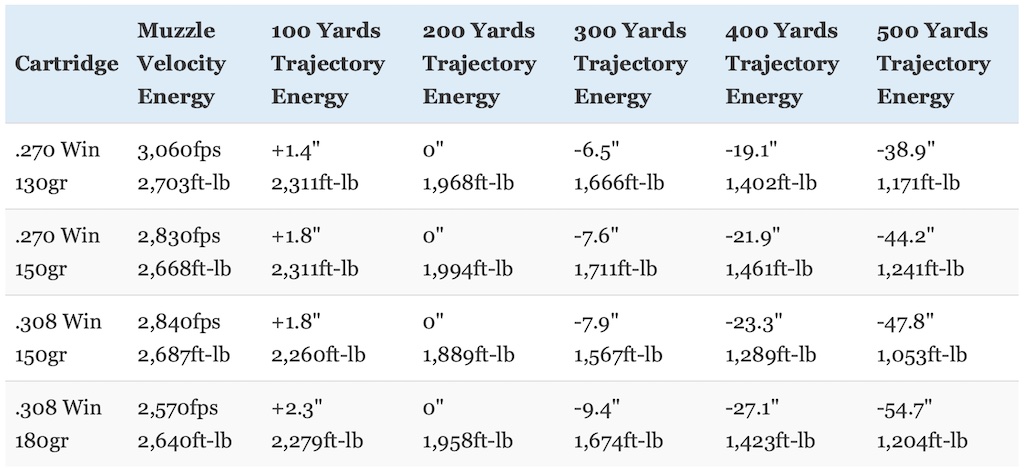
This is illustrated below when comparing four different Federal Premium Nosler Partition loads for the two cartridges. Specifically, the table below compares 130gr (.416 BC) and 150gr (.466 BC) loads in .270 Winchester and 150gr (.387 BC) and 180gr (.484 BC) loads in .308 Winchester.
As you can see, the 180gr .308 load uses a slightly more aerodynamic bullet than those used by the .270. However, the 130gr and 150gr Nosler Partition bullets used in this comparison by the .270 are both more aerodynamic than the 150gr .308 bullet.
This data is for Federal factory ammo using a 200 yard zero.
Not surprisingly, there is a significant difference in the bullet trajectories between the two cartridges.
The .270 Winchester has a slight edge over the .308 when both are using 150gr bullets. However, the 130gr .270 load has an even flatter trajectory with 8.9-15.8″ less bullet drop at 500 yards than both .308 Winchester loads.
With regards to energy, the cartridges are fairly evenly matched to start out with. The gap in kinetic energy grows slightly in favor of the .270 when compared to the 150gr .308 Winchester load at all ranges. However, the opposite happens with the more aerodynamic 180gr .308 Winchester load at longer range.
All things considered, the two cartridges are fairly evenly matched in energy.
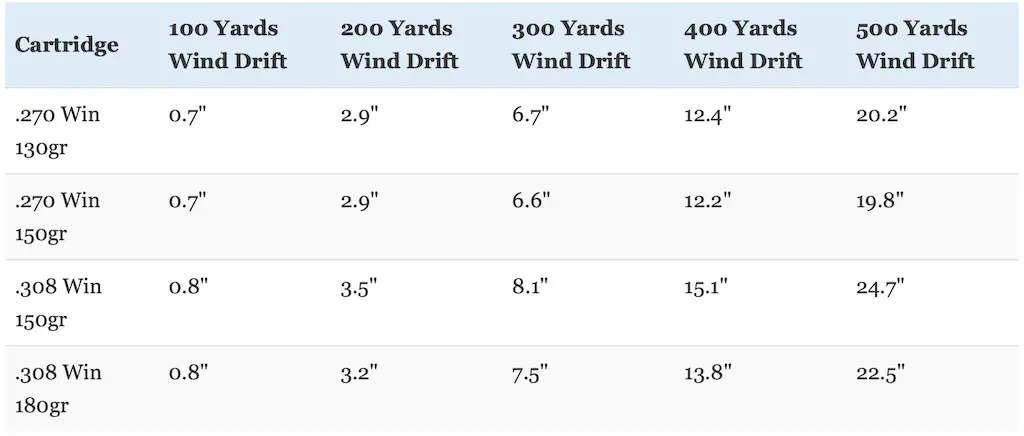
The chart below compares how much a 10 mile per hour crosswind impacts those same four loads out to 500 yards.
Once again we see that the two cartridges are fairly evenly matched at shorter range, but the .270 has a slight advantage in wind drift that grows as range increases. This is because the .270 Winchester loads shoot more aerodynamic bullets (with the exception of the 180gr .308 load) at a higher velocity.
Now let’s talk about recoil.
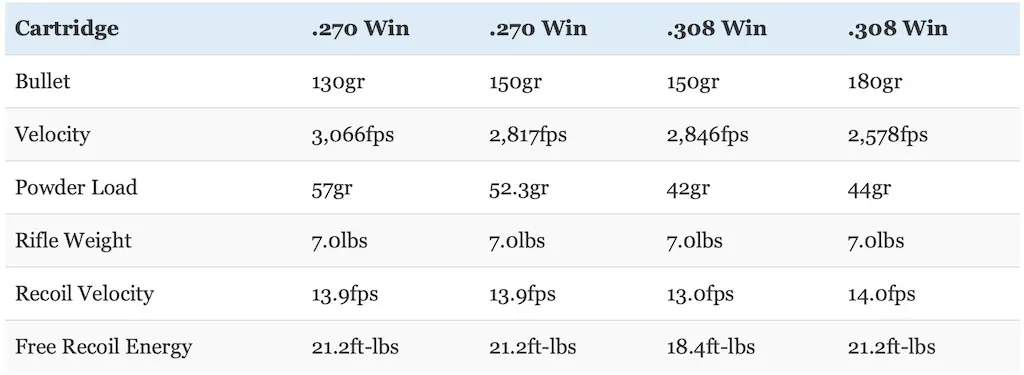
The table below compares the recoil produced by 130gr and 150gr .270 loads to 150gr and 180gr .308 loads (all shooting a Nosler Partition bullet) when fired from identical 7 pound rifles.
Felt recoil will vary from shooter to shooter and rifle to rifle, but free recoil energy is still a useful way to compare cartridges.
Interestingly, with the exception of the milder recoiling 150gr .308 load, the two cartridges have almost identical recoil.
However, that makes sense when you consider that the .308 and .270 were designed as lower recoiling alternatives to the .30-06. This fits with the original intent of the designers interested in building a mild shooting and easy to handle cartridge that was still powerful enough for hunting medium sized game at short to moderate range.
So where do we stand with each cartridge?
The .270 Winchester is a very flat shooting and moderately powerful cartridge, especially considering that it’s nearly 100 years old. With moderate recoil that’s roughly comparable to the .308 and noticeably lighter than the .30-06 Springfield, most shooters and hunters can handle it without much trouble.
While recoil is more or less comparable between the two cartridges, typical .308 Winchester loads do not have as flat of a trajectory as typical .270 loads.
However, the .308 is available with heavier bullets than the .270 and is available in a wider range of bullet weights and models.
As we’ll discuss in a minute, this is partly due to the widespread use of the .308 Winchester (and other .30 caliber cartridges like the .30-06, .300 Win Mag, .300 Ultra Mag, and 300 PRC) in long distance shooting competitions. These projectiles quite often take advantage of the latest developments in bullet development and offer advantages in precision and ballistic coefficient compared to the bullets used by the .270.
Additionally, there are a couple of other factors that are also worth discussing though.
First, the .308 Winchester uses larger diameter bullets than the .270 Winchester.
Specifically, the larger diameter .308″ bullets used by the .308 have about 24% more frontal surface area (also known as cross sectional area) than the .277″ bullets used by the .270 (.0745 vs .0603 square inches). All other things being equal, a bigger bullet will make a bigger hole, cause more tissue damage, and result in more blood loss.
This is a definite, though slight, factor in favor of the .308.
On the other hand, many of the .277″ bullets have a higher sectional density (SD) than the most common bullets used in the .308 though.
Sectional density (SD) is a measure of the ratio of the diameter of a projectile to its mass. All other things equal, a heavier projectile of a given caliber will be longer and therefore have a higher sectional density and consequently penetrate deeper than projectiles with a lower mass and sectional density.
Everything else being equal, the smaller diameter .277″ bullets have a higher ballistic coefficient and a higher sectional density than the larger diameter bullets of the same weight from the .308. However, the .308 generally uses heavier bullets than the .270 Winchester.
All that being said, the .270 Winchester still has a slight edge with most bullets in common use, even when compared to heavier .30 caliber bullets.
As an example, 130 grain, 140 grain, and 150 grain .277″ bullets have sectional densities of .242, .261, and .279 respectively. This compares favorably to 150 grain, 168 grain, and 180 grain .308″ bullets which have sectional densities of .226, .253, and .271 respectively.
For the most part, this also applies to ballistic coefficient.
The bullets used in this comparison illustrate those differences well with the .270 Winchester using 130gr (.416 BC) and 150gr (.466 BC) bullets compared to the 150gr (.387 BC) and 180gr (.484 BC) bullets used by the .308.
With the exception of the 180gr .308 bullets, the .270 has the edge across the board with regards to using more aerodynamic bullets in this comparison.
It’s difficult to pick an accuracy winner between the 270 vs 308 though because it’s something of an apples to oranges comparison. Both cartridges are capable of outstanding accuracy, but the .270 Winchester is used almost exclusively as a hunting cartridge. On the other hand, even though the .270 Winchester does shoot flatter in many cases, military and police snipers, hunters, and practical and/or long distance shooting competitors have all used the .308 Winchester extensively over the years.
For that reason, users of the .308 Winchester benefit from the extensive the research and development that has gone into refining .308″ bullets and rifles for long range shooting in the United States over the last century.
All that being said, while the .308 probably has a slight edge here, both cartridges have the potential for excellent accuracy in the right hands.
If you’d like to learn more about the accuracy of the .308 Winchester and how it compares to cartridge purpose built for long range competition shooting, read this article:
6.5 Creedmoor vs 308 Winchester Debate Settled
308 vs 270: Ammunition Selection
The .308 Winchester and .270 Winchester are two of the most popular centerfire rifle cartridges in North America. In fact, I’d wager that they’re both among the Top 10 (if not the Top 5) best selling rifle cartridges in the United States each year.
Not surprisingly, pretty much every ammunition manufacturer of note like Barnes, Black Hills, Browning, Federal Premium, Fiocchi, Hornady, Magtech, Nosler, PMC, PPU, Remington, Swift, and Winchester (just to name a few) produce a wide variety of ammo for both cartridges.
Virtually every major style of bullet is available in .270 and .308 as well like the Barnes TTSX, the Hornady ELD-X, GMX, InterBond, InterLock, SST, and V-Max, the Nosler AccuBond, AccuBond Long Range, Ballistic Tip, E-Tip, and Partition, the Remington Core Lokt, the Swift Scirocco and A-Frame, and the Winchester Power Point (just to name a few).
Prices and availability vary from region to region, but ammunition for both cartridges is widely available. In fact, if a sporting goods store only carried ammo for three different centerfire rifle cartridges, I’d bet money they’d have .270, .308, and .30-06 ammo.
Basically, there is no shortage of quality .270 Win and .308 Win factory ammunition suitable for hunting.
BUY SOME GREAT 270 HUNTING AMMO HERE
BUY SOME GREAT 308 HUNTING AMMO HERE
If you’d like to learn more about some of the various hunting ammunition choices for the .308 Winchester and .270 Winchester cartridges, read the articles below:
Best 270 Ammo For Hunting Elk, Deer, And Other Big Game
Best 308 Ammo For Hunting Deer, Elk, Hogs, & Other Game
Both cartridges are also well suited for handloaders and reloading components for both cartridges are widely available. With regards to bullet selection, .308″ bullets in particular are very easy to find. Though only a few cartridges use .277″ bullets, the .270 is extremely popular and there’s a plethora of quality bullets to choose from.
308 vs 270: Rifle Selection
Similar to the abundant ammunition choices available in .308 Winchester and .270 Winchester, there are also plenty of quality rifles manufactured in the two cartridges. Regardless of the cartridge you choose, finding a good deer rifle shouldn’t be an issue.
Both are very common in bolt-action rifles. Of course Remington and Winchester produce the Model 70 and Model 700 rifles in .270 and .308 Winchester. Additionally, the Browning X-Bolt, Kimber Hunter, Mossberg Patriot, Nosler Liberty, Ruger American, Ruger Hawkeye, Savage Axis, Thompson Center Compass, Tikka T3, and Weatherby Vanguard are available in both calibers.
BUY A GREAT 270 HUNTING RIFLE HERE
BUY AN EXCELLENT 308 HUNTING RIFLE HERE
Read the article below if you’d like to learn more details about some of the various hunting rifle choices for the 270 Winchester.
Best 270 Rifles For Hunting – Ultimate Guide
Aside from the Browning BAR, the .270 Winchester is almost non-existent in semi-automatic rifles. On the other hand, the .308 Winchester is relatively common in semi-automatic sporting rifles like the AR-10 and M1A.
Though there is quite a bit of overlap in barrel lengths, .270 rifles often have slightly longer barrels than .308 rifles. That’s not a hard and fast rule though, and 22″ and 24″ barrels are very common for both cartridges.
All things considered, identical rifles chambered in .270 Winchester tend to be slightly longer, heavier, and more unwieldy than rifles chambered in .308.
The Winchester Model 70 Super Grade illustrates these differences well.
When chambered in .308 Winchester, the rifle has a 22″ barrel, an overall length of 42.25″, and weighs 7.75 pounds. The same rifle chambered in .270 Winchester has a 24″ barrel, is 44.75″ long, and weighs 8.25 pounds.
So, the rifle chambered in .270 Winchester is 2″ longer and weighs about a half pound more than the exact same model chambered in .308 Winchester.
Barrel lengths do vary depending on the manufacturer and exact model.
At the same time though, the .308 Winchester is sometimes available in more compact rifles with shorter 18-20″ barrels.
Having a shorter and lighter rifle is more important on some hunts than on others. So, just keep that in mind.
270 vs 308: Which Is Right For You?
With good shot placement and when using quality bullets, the .270 Winchester and .308 Winchester are ideally suited for hunting medium to large sized game.
They are both incredibly effective (and popular) deer hunting cartridges and hunters armed with the .270 and .308 make up a significant portion of the annual whitetail deer harvest each year in the United States. Both are also great for similarly sized game like black bear, feral hogs, javelina, mule deer, and pronghorn as well as exotic game like axis, sika, and fallow deer.
However, the flat trajectory and resistance to wind drift of the .270 Winchester makes it a really good choice for game that might require a longer shot such as pronghorn or mule deer. The relatively light recoil of the cartridge also makes it easier to handle in a lightweight rifle that’s desirable on a mountain hunt. Jack O’Connor was really onto something with his affinity for the .270 as a sheep hunting cartridge. Those same characteristics also make it a very good choice for mountain goat in Canada or Himalayan Tahr and chamois while hunting in New Zealand.
On the other hand, since it shoots heavier and larger diameter bullets, the .308 Winchester has a clear advantage when hunting larger species like moose, elk, and caribou. Especially when using a heavy bullet (180+ grains), the .308 has a significant advantage when hunting most plains game in Africa like blue wildebeest, kudu, and eland.
Now the .308 Winchester is a perfectly capable long range cartridge and plenty of hunters use it on mountain hunts each year. After all, the recoil of the .308 is very similar to the .270. By the same token, the .270 has taken untold numbers of moose, elk and plains game without any issues. For instance, the 150gr Nosler Partition below really did a number on a big kudu bull in South Africa.
It’s really just a matter of each cartridge having certain strengths and weaknesses.
Do you primarily hunt medium sized game like whitetail deer, feral hogs, or black bear at ranges within 200 yards? Both are extremely effective deer hunting cartridges and will absolutely get the job done on medium sized game if you do your part. Both are great deer hunting cartridges and are among the most popular North American hunting cartridges in general, so it’s really hard to go wrong here.
If you’re going to be hunting in thick brush or in the tight confines of a deer stand, remember what I just mentioned about the size difference with 308 vs 270 rifles. That extra couple of inches in overall length of a rifle can be a real headache to deal with when trying to quickly and quietly maneuver for a shot.
Are you looking for the cartridge better suited for long range hunting for game like mule deer or pronghorn in open country where you might need to take a shot at several hundred yards? Both will work, but the .270 Winchester is probably the better choice for you. With a significantly flatter trajectory and more resistance to wind, the cartridge does very well on longer shots, particularly on thin skinned game like mule deer, pronghorn, sheep, or tahr.
Do you want to hunt larger game animals like kudu, eland, red stag, elk, or moose? Neither would be my first choice for this sort of hunting, but both cartridges will certainly work and lots of people have used them with success on bigger game. In my opinion, the .308 Winchester is probably the better choice in this case since it uses larger diameter and heavier bullets that are well suited for very large or tough animals.
Regardless of which cartridge you choose, use a controlled expansion projectile and a heavier bullet weight for your elk or moose hunt.
Even though they have slightly different strengths and weaknesses, the .270 Winchester and .308 Winchester are outstanding rifle cartridges. While the differences between them (.270 vs 308) are pretty significant in some respects, they’re both acceptable for a wide range of hunting tasks.
Get a nice hunting rifle chambered in the cartridge that you think fits your needs the best, learn to shoot it well, use quality bullets, and you’ll be well prepared for most common hunting situations.
Are you just itching to take a rifle chambered in one of these cartridges on a hunt?
Book an excellent black bear hunt here.
Book an outstanding Africa hunting safari here.
Enjoy this article comparing the .270 and .308 Winchester cartridges? Please share it with your friends on Facebook and Twitter.
The Lyman 50th Edition (197-198, p241-245), and Hornady 10th Edition (p251-355, p474-488) reloading manuals were also used as references for the history of the cartridges and provided data to compare their size and recoil. Ballistic data for the original 7.62x51mm military cartridge was obtained from Inetres. The data used to compare the trajectory and wind drift of the cartridges was obtained from Federal. Maximum pressure obtained from SAAMI (p171 and p172). Case capacities for the .270 Win and .308 Win were obtained from Nosler. I used the Federal Ballistic calculator and ShootersCalculator.com to compare wind drift, the range each bullet goes subsonic, and recoil for the cartridges.
Make sure you follow The Big Game Hunting Blog on Facebook, Instagram, Twitter, and YouTube.
NEXT: 7mm REM MAG vs 300 WIN MAG: WHAT YOU KNOW MAY BE WRONG
NEXT: 101 BEST GIFTS FOR HUNTERS
NEXT: 11 BEST HUNTING EAR PROTECTION OPTIONS FOR SPORTSMEN
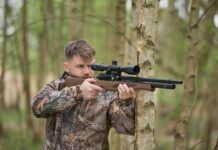
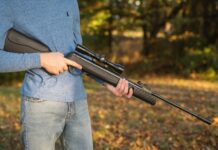
“22 Air Rifle vs. 22LR: Unveiling the Ultimate Comparison in Caliber Precision. Delve into the world of firearms as we dissect the key differences between 22 air rifles and their traditional counterpart, the 22LR. From accuracy to versatility, discover which caliber reigns supreme for your shooting needs. Explore this comprehensive guide to make an informed decision and elevate your shooting experience.”
22 air rifle vs 22lr
When it comes to choosing between a 22 air rifle and a 22lr firearm, there are several factors to consider. Both options offer their own unique advantages and disadvantages, making it crucial for individuals to understand their specific needs and preferences before making a decision.
A 22 air rifle is powered by compressed air or gas, usually in the form of CO2 cartridges or pre-charged pneumatic tanks. These rifles are typically quieter than their firearm counterparts, making them ideal for backyard shooting or hunting small game without causing disturbance. They also tend to have lower recoil, which can be beneficial for beginners or those looking for a more comfortable shooting experience. Additionally, air rifles are often less regulated than firearms and may not require a license or permit in certain jurisdictions.
On the other hand, a 22lr firearm utilizes traditional ammunition that contains gunpowder and primer to propel the bullet forward. These firearms are known for their versatility and power, as they can be used for various purposes such as target shooting, hunting small to medium-sized game, and even self-defense if necessary. The availability of different bullet types and higher muzzle velocities also provide shooters with greater range and accuracy compared to most air rifles. However, it’s important to note that owning a 22lr firearm may require obtaining the appropriate licenses or permits depending on local regulations.
In conclusion, the comparison between a 22 air rifle and a 22lr highlights significant differences in power, accuracy, and cost. While the 22 air rifle is suitable for target practice and pest control at short ranges, the 22lr offers superior range, velocity, and stopping power. Additionally, the availability of ammunition and cost-effectiveness make the 22lr a preferred choice for hunting or self-defense. Ultimately, choosing between these two depends on the intended purpose and personal preferences of the shooter.
From knives to backpacks and bikes, the accessories you bring into the deer woods can be game-changers. Here’s what’s new for 2024.
1. Trophyline Venatic Saddle
At a scant 20 ounces, the Venatic takes lightweight saddle hunting to another level. It weighs just 30 ounces with the bridge and carabiner, all the while keeping you safely elevated and mobile so you stay focused on what matters: the hunt. Manufactured entirely in the U.S.A., the Venatic is made of rugged ripstop fabric that’s breathable and deadly silent. It features a rubberized waistband, Raptor waist and leg strap buckles, a rigid rubber MOLLE band and two bands of additional MOLLE to keep you safe and stealthy. A saddle compression hook, durable foldback lineman loops and an adjustable waist buckle round out the Venatic, resulting in an innovative saddle that’s so comfortable you won’t even notice it’s there. Comes with a Prusik and Black Diamond carabiner. Pick up a Venatic and you’ll quickly realize you are sitting in the future of hunting saddles!
MSRP: $299.99 | trophyline.com
2. TrophylineSumpter Pack
Designed for remote-access hunting, the Sumpter Pack uses an aluminum frame to stay light and mobile. Its durable, lightweight nylon fabric resists tears while keeping the weight of the pack down to less than 6 pounds. The Sumpter includes not only a bow scabbard and a saddle pouch, but also a Meat sling with G hooks that deploys up and over the pack, providing plenty of storage for packing your deer out of the wildlands. An adjustable torso (16-19 inches) and a solid one-piece, breathable back panel make the Sumpter uber-comfortable, while 19 pockets keep all your gear organized and ready for use. Those filming their hunt will appreciate the camera arm/tripod sleeves, and everyone will find the Sumpter’s 2,600 cubic inches more than enough space for all hunting and survival gear. If you’ve been waiting for a rigid and robust pack that will handle your saddle gear and meat from your successful hunt, the Sumpter is the pack for you.
MSRP: $229.99 | trophyline.com
3. Outdoor Edge Razor Pro S
Expanding Outdoor Edge’s popular RazorPro family of knives, the new RazorPro S contains a bone saw made of 65 MN spring steel for wear resistance and the popular RazorPro 3.5-inch 420J2 stainless steel drop point blade. The RazorPro S has a rubberized TPR handle, replaceable RazorSafe blades and a spring steel saw with chrome coating, providing years of use for bowhunters and other outdoor enthusiasts. Like the RazorPro, the RazorPro S comes with six Drop Point replacement blades and a Kryptek camouflage sheath for storage and easy access. Best of all, it’s small enough to easily fit in your pocket or backpack, making it your go-to knife for field-dressing and other chores. The RazorPro S will be available in the spring of 2024, giving you a cutting-edge cutter that will effortlessly handle all your needs in the field.
MSRP: $89.99 | outdooredge.com
4. MTM Case-Gard Traveler Arrow Case
Bowhunters journeying to a weekend and/or out-of-state hunt will want the Traveler Arrow Case, a compact case that is only 2 inches thick and fits in most hard and soft bow cases. The Traveler holds up to six broadhead-tipped arrows and three practice arrows safely and securely, while additional internal storage between foam sets is perfect for storing small accessories. Constructed of rugged polypropylene, it will hold arrows up to 34 inches in length, while notched padding protects arrow fletching and keeps broadheads razor-sharp. Made in smoke color with clear-view windows, the arrow case provides unobstructed views of points and fletching. The Traveler is made in the U.S.A. and comes with a five-year guarantee. There’s also a Traveler Bolt Case for crossbow hunters.
MSRP: $18.41 | mtmcase-gard.com
5. Redline Bowhunting Scabbard
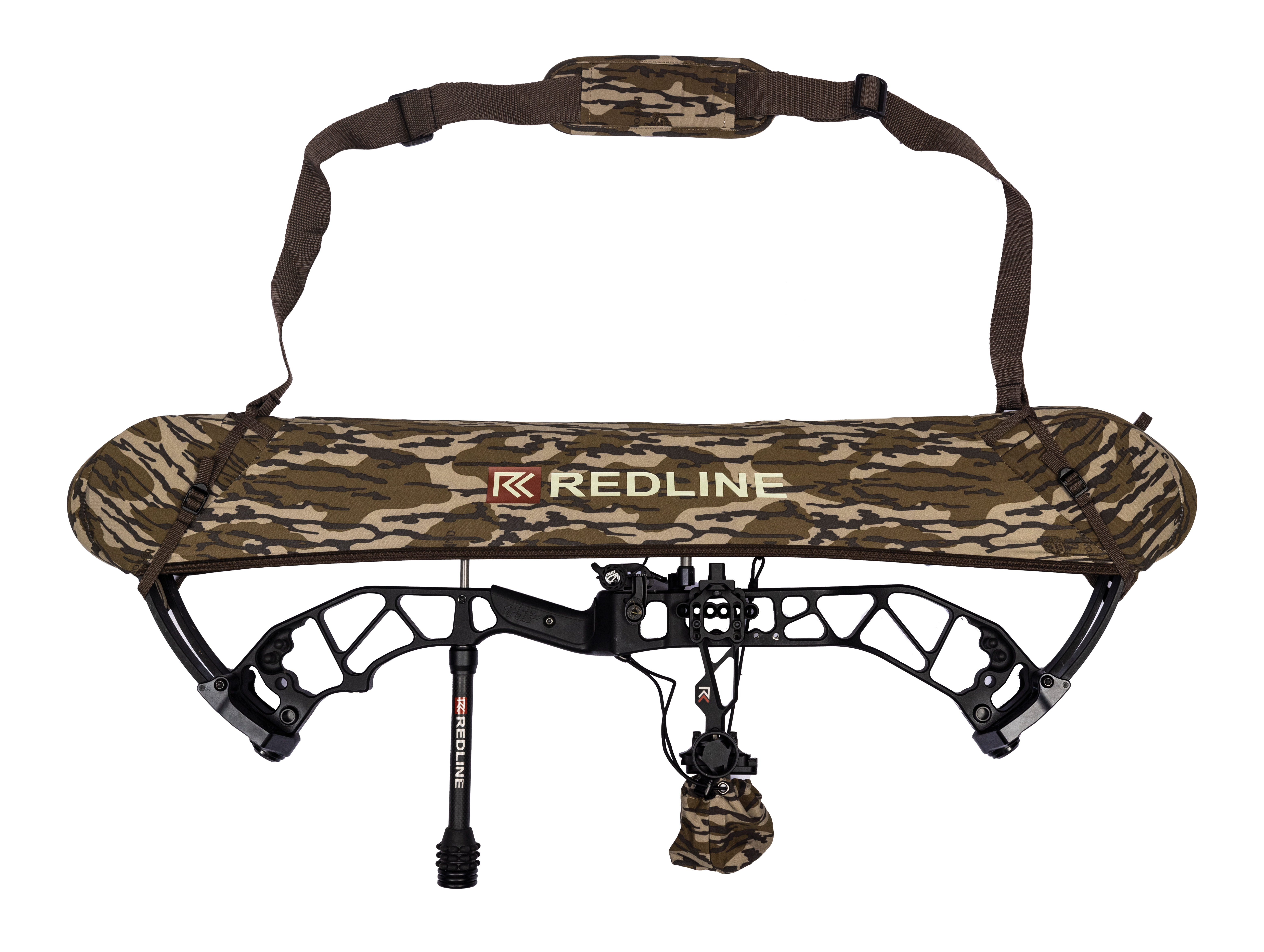
For hunters looking for a heavy-duty bow sling, meet the Redline Scabbard — a tough bow transportation aid that will enable you to traipse through the toughest hunting terrain with ease. It includes a padded shoulder strap for comfort, and a sight cover and padded cam covers to protect your valuable bow accessories. Mossy Oak camo keeps it concealed while traveling, while four-way-stretch material provides a custom fit for all bows. The sling accommodates bows 28-31 inches long and includes dual-clasp attachment points.
MSRP: $59.99 | redlinebowhunting.com
6. Bohning Black Sky 2.0 Bolts
The new BLACK SKY 2.0 and 3.0 crossbow bolts from Bohning Archery are the first fully finished bolts the company has produced, giving horizontal deer hunters accurate downrange precision out to 90 yards. The new bolts have been extensively tested on a variety of today’s most popular crossbows, producing amazingly accurate shots. For example, one testing sequence generated consistent sub-3-inch groups with a fixed-blade broadhead out to 92 yards using a crossbow that shoots 450 feet per second. Two models are available for crossbows both with and without rails. The Black Sky 3.0 uses a 3-inch Shield Cut Low Profile vane cut for railed bows, while the Black Sky 2.0 uses a 2-inch Leading Edge Blazer Vane Profile for crossbows without rails. Each package includes three bolts and Bohning’s 100-grain Premium Points that are guaranteed to be within 1/4 grain weight.
MRSP: $59.00 | bohning.com
7. QuietKat Ibex
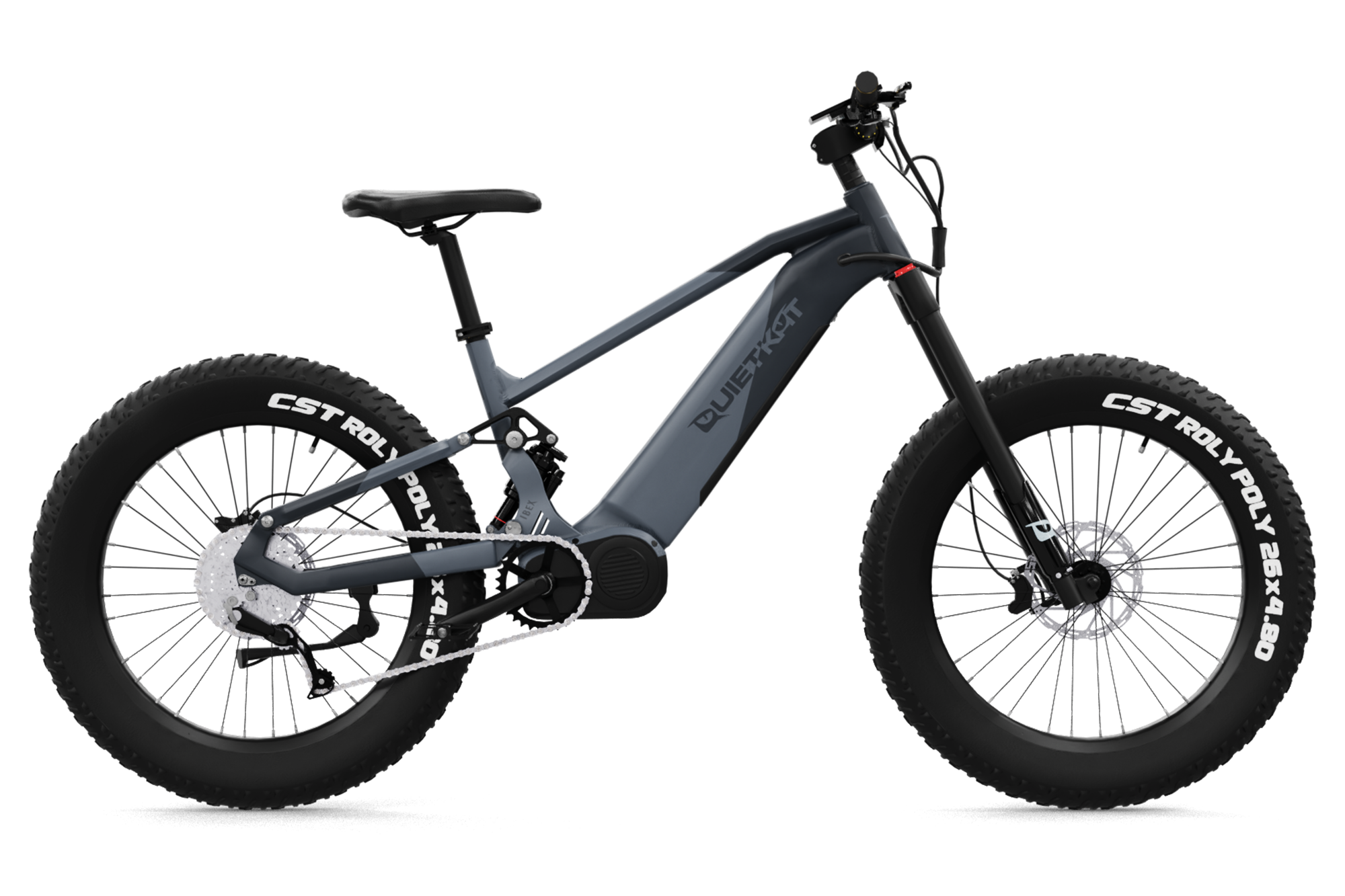
Bowhunters who need to access the wild beyond will appreciate the Ibex, a full-suspension electric bicycle made for hunting, fishing and any other overland adventure you can think of. As sure-footed as the legendary Bigfoot, the Ibex can keenly scale the steepest mountains, while also enabling users to make swift descents over uneven ground. While the Ibex was built to effortlessly climb steep topography, it can also cut cleanly through wet snow and glide through bogs and other low country. The Ibex uses 4.8-inch CST tires and an upgraded FireLink 4-Bar rear suspension to produce ample 130mm of travel to command rugged terra. The Bafang UltraDrive motor delivers an incredible 1,000 watts, while the long-lasting 21Ah battery provides extra range to push farther into the deepest woods where whitetails lie low. And with Tektro hydraulic disc brakes and adjustable front and rear suspension, the Ibex keeps you comfortable and in control on unforgiving terrain.
MSRP: $6,799.00 | quietkat.com
8. Flambeau Scrapper Buck Decoy
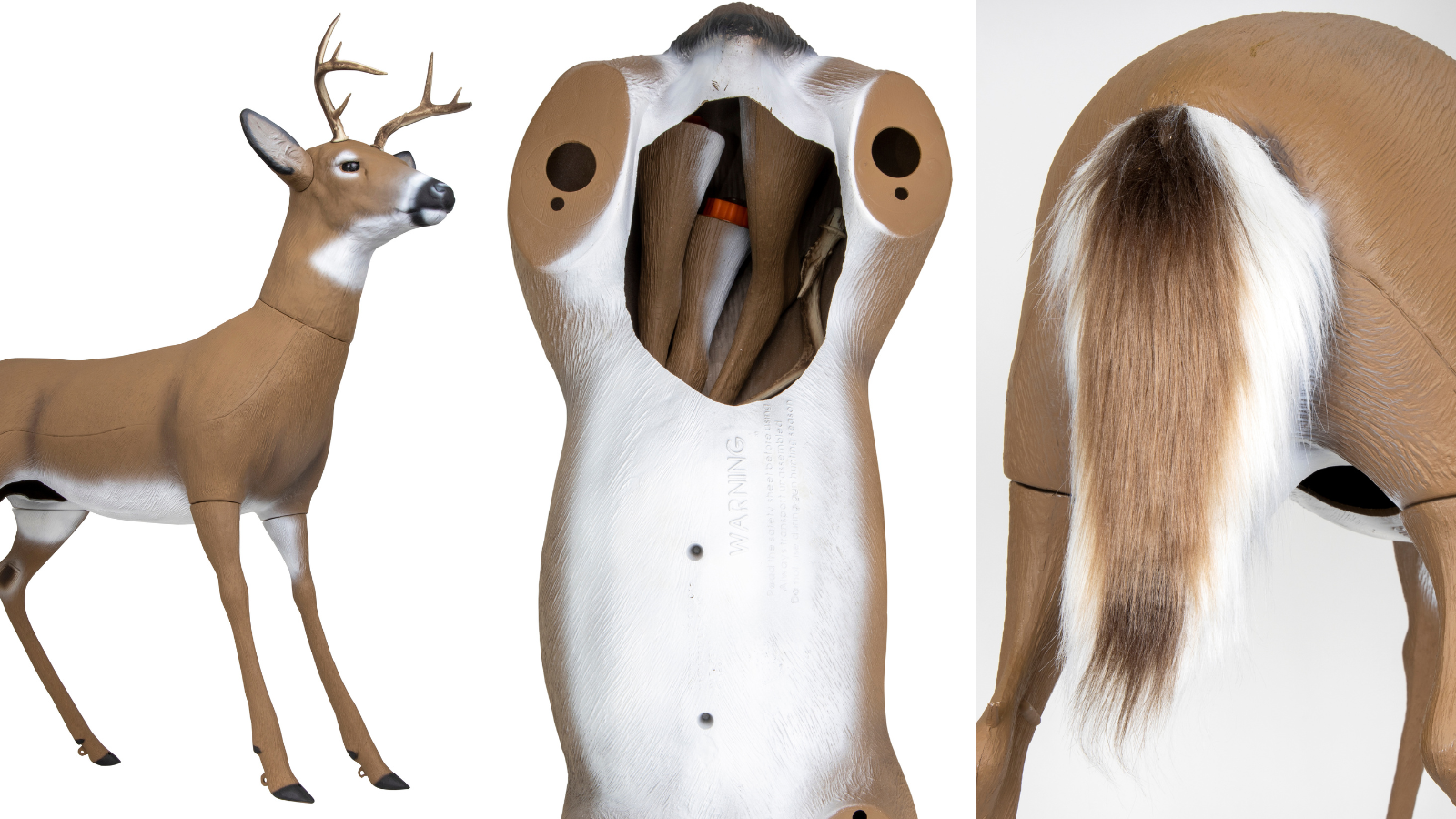
Flambeau’s Scrapper Buck decoy is designed to agitate, not intimidate other deer. Its adolescent presentation is based on a carving by award-winning sculptor Chris Schiller. The decoy is designed to coax in any buck that’s looking to mark and protect its territory. The decoy’s inferior size and rack replicates that of an inferior 2½-year-old. The decoy’s legs store conveniently into the body cavity. Included are ground stakes, a faux tail and a blaze-orange carrying bag for safety in the field.
“Survival Bows And Who Should Consider Owning One” was the topic of my previous article and we talked about exactly what a survival bow was good for and where they excelled in the world of archery. We even mentioned that such bows may slowly start to be renamed the “compact modern longbow” and as such form a new segment of the archery market more widely accepted than a weapon thought to be useful purely as a survival tool.
Today however we deal with one of the most widely misconstrued perceptions of what makes a good survival bow. In order to do this we need to take a look at the industry benchmark for what is believed to be a good bow and that is of course no other than the compound bow.
We also need to look at a few other options to compare to and this is where more traditional bows such as the recurve bow, the longbow and the compact modern longbow come into play.
I have many a time come across forums filled with pages and pages of people discussing (and sometimes even arguing) about what the best bow for a survival or SHTF situation would be. There is a somewhat clear divide in opinion on what the answer to this question is and it generally comes from two very distinct camps of people.
The first camp is a camp of people who seem to be more open minded. People who like to question things and make their own opinions based on extensive research and personal experience, as well as the actual experience of others. They ask questions, debate with fair reasoning and seem to have experienced the use of many types of bows and equipment suited to the outdoors. They seem to be more experienced in the outdoors in general and have a wealth of knowledge of what it means to be an outdoorsman. It is this camp that seem to be more open minded toward considering a more traditional bow such as a recurve bow or compact modern longbow for a survival or SHTF situation.
The second camp of people seem to be more set in their thinking. They seem to be more biased in their approach to the debate and almost exclusively seem to have little real world outdoors experience other than their annual 200 yard walk to their tree-stand for the yearly whitetail hunt. Added to this they deem any bow other than a compound bow to be substandard, almost without exclusion and with further prodding it normally comes out that that is all they have ever shot.
It is no wonder that newcomers to the world of “survival archery” can be so confused when it comes to choosing a bow for a survival or SHTF situation and its time to put some thoughts on the table and take a look at the pros and cons of what makes a good survival bow and then discuss which type of bow may be better between a more traditional bow and a compound bow. For the purposes of this article we are going to look specifically at takedown bows (recurves, longbows and compact modern longbows) vs compound bows:
Let’s first take a look at what attributes make for an ideal survival bow. Survival bows need to be:
Powerful enough to hunt game the size of deer and antelope.
Accurate enough to take small game such as rabbit, squirrel and medium to large birds.
Durable enough to last a lifetime
Easy to maintain
Easy to transport and free up your hands for other tasks or to carry other equipment such as rifles for self defense.
Light enough to allow for carry of other necessary equipment
Simple enough to require no or minimal tools
Adaptable enough to allow for multiple users or unit members both left and right handed
Those who are trained and experienced in the outdoors in a wide variety of skillsets including survival, hunting, tactical, backpacking, etc will quickly appreciate ALL of the points above. You see a survival or SHTF situation would incorporate most if not all of these skillsets and not just a hunting skillset. That is why I am kicking off this “debate” with a list of “What would make for an ideal survival bow?”
Now let’s move on to compare takedown bows and compound bows against this list of points.
The Compound Bow definitely has plenty of power and is as accurate as bows come, but when it comes to durability one has to question them by considering the amount of moving parts involved as well as just how “fragile” these parts are when it comes to the bow taking knocks and bumps when spending extended time off the beaten path. Personally if I had to make it through a SHTF situation I would not feel terribly comfortable putting it through even the smallest amount of hardship I may encounter on my journey, especially if I wanted it to last a lifetime.
Ease of maintenance is also a big issue when it comes to a SHTF scenario. One usually requires special tools and jigs to restring and maintain a bow and you certainly won’t be able to carry those around with you. Sure you may have these at home, but if you had to move you would have a problem.
Ease of transport is another big disadvantage to compound bows. Unless you are strapping them to your backpack (which increases the risk of damaging them) you will either need to leave it at a basecamp or carry it in your hand and that not only reduces the tasks you can accomplish and where you can travel, but it will certainly become a nuisance at some stage. Imagine trying to move through thick underbrush or climb up banks or swim across a river. Certainly not ticking the box of easy to transport.
From a tools perspective you will be fine so long as you don’t need to change or maintain anything, but scene as this is a bow that is needed to last a lifetime, you will at some stage need those tools and as mentioned above you will at some stage have issues.
And finally, the last point of allowing for multiple users. A compound bow is great in that it allows for various poundages to be dialled in on the same bow. Which is great right? The drawback is that it allows for either a left or a right handed archer, not both and therefore cannot be used in an ambidextrous way. Luckily most archers are right handed so this point is less important than others above.
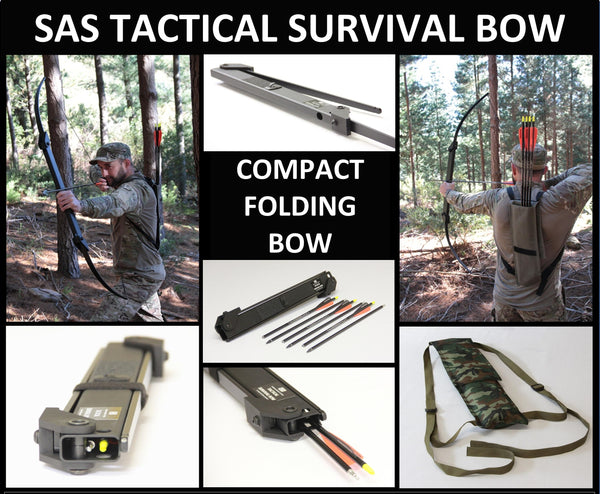
The Takedown Bow segment has three main categories in the form of the takedown recurve, the takedown longbow and the compact modern longbow such as the SAS Tactical Survival Bow and the SAS Recon Folding Survival Bow (soon to launch at the writing of this article) from Survival Archery Systems.
Each of these 3 types of takedown bows has its own unique attributes which we shall summarize briefly against each of the points on our list.
Bow power is something that is misunderstood when it comes to actual takedown ability. Native North Americans were harvesting bison, elk, moose and deer with bows in the 30#-40# range and it all comes down to arrow placement and blood-loss. If you hit your quarry with any bow 45# and up in the vitals it is pretty much game over. There is enough penetration power to cause enough blood-loss that the quarry will go down. What is important thereafter is your ability to track the quarry after having given it enough time to bleed-out. So takedown bows are a good choice for a survival or SHTF situation for sure.
The accuracy of takedown bows whilst not as good as that of a compound, is generally good enough for small game if you have put in the practice. Don’t think you can just stuff a takedown bow in your bag, whip it out and shoot a squirrel at 30 yards when you get hungry; you will learn a hard lesson. Takedown bows, unless fitted with a well sighted sighting system take practice to learn to shoot with an instinctive style. Other than that they are accurate enough to do the job and thus tick the box.
Durability of takedown bows with respect to real world abuse is orders better than that of a compound bow as you typically only have 3 major parts securely bolted together. The riser and two limbs. Wooden limbs and wooden risers typical of many takedown recurves and longbows are not as durable as composite limbs such as those used on compact modern longbows such as the SAS Survival Bow range, so choose carefully. Composite materials are not only stronger than wood, but can weather out the elements such as rain, sunshine, heat and cold and generally last much, much longer. Wooden products require much care whilst composite materials can take substantially more abuse.
Aluminum is also a great riser material as it has very stable mechanical properties that engineers can use to accurately develop bows to ensure they are working well below material fatigue limits, thereby ensuring your bow will last a lifetime. This is important to remember; if a manufacturer does not claim to have designed a bow using engineering principles then beware, because it normally means designs are more based on touchy-feely shape decisions rather than on structural integrity through material selection and detailed analysis.
Ease of maintenance is up next and again, takedown bows require very little maintenance and just a tool or two at most. Wood certainly requires maintenance to keep it in good condition, but composite limbs and aluminum risers require little to no maintenance at all. You also don’t need special tools for compact modern longbows such as the SAS bows, but for recurves and longbows you will generally need a stringer and an allen key or two.
When it comes to multiple users takedown bows generally cannot account for different poundage needs from users. You are pretty much stuck with one poundage unless you are carrying spare limbs around with you. Recurves and longbows with cutouts restrict left and right hand usage with the same bow, but compact modern longbows with non-cutout shapes such as that on SAS Survival Bows allow for both left and right hand usage by simply swapping the bow between hands.
Lastly, let’s talk about transport ability and weight. This is where the big gamechanger comes in when it comes to choosing a bow for survival. Takedown bows are all comparatively light enough for easy transport when you have other gear you need to ruck around. From a packability point of view they are even better, because they can fit into large backpacks which not only helps protect them, but get them out of your hand. Compact modern longbows are the most compact of the lot and can even fit into one-day packs if they are shorter than the magic number of 21″.
Straight limb bows such as longbows and compact modern longbows pack down much better than recurve bows do and take up much less space. Recurve and longbow limbs are usually quite a bit longer than compact modern longbow limbs so are only compatible with very large backpacks, but all takedown bows are much more suited than a compound bow to a SHTF scenario.
This is super, super important to understand when making a decision on buying a bow for survival. Skilled and experienced outdoorsmen with all the skills we spoke about earlier will tell you that having a bow that can easily fit in a backpack is pretty much the crux of your decision. Why, you ask? Well its like what my dad used to tell me when I was a kid trying to do stuff in the workshop and I had a whole bunch of tools I was trying to use, “Put that down and use both hands boy.” He was right and it comes down to freeing your hands up. It makes almost everything you do so much easier.
Like carrying a rifle if you are in a tactical survival situation for instance. Or how about dragging your bike rack deer back to camp? Climbing, swimming, hand-to-hand combat, running with a pack; the list goes on.
Having the ability to get your bow out the way is in my opinion THE most important attribute of a bow for survival and this is exactly why Survival Archery Systems developed its patented SAS Tactical and Recon Folding Survival Bows. They not only pack down very, very compact, but they are the only bow on the market that has a solution for the transport and protection of your takedown arrows. Our customer’s feedback speaks for itself and the number of repeat sales purchased for friends and family seals our opinion on why we believe that the SAS Survival Bows should be your bow of choice if you are looking for a compact, silent bow for survival that will not only last a lifetime but will do the job you need it to do, each and every time.
Well I hope that helps you in your decision in which bow to choose.
To get more info and get yourself one of the very popular SAS Survival Bows for your bugout or survival bag click this link now – https://www.survivalarcherysystems.com/products/survival_bow.
Let’s imagine it’s deer season and you just shot a deer. Maybe your first. Great news, right? The bad news is you didn’t see or hear it fall. Now you have an agonizing dilemma on your hands and an important decision to make. Do you climb down and take up the deer blood trail right away or give the deer more time to expire? Your decision may impact whether you find the deer or not. So before you start blood trailing deer, especially if it’s your first time doing so, here are some important questions you need to answer.
How did the deer react? Was it running instead of bounding? Was it stumbling and crashing through the underbrush instead of jumping over it? Those are both usually good signs.
How did you feel about the shot? Were you shaking from nerves, or were you very calm and relaxed?
How were the weather conditions? High winds can affect arrows and bullets alike and may steer them off-course.
Difference Between Archery and Firearms
First, there are some key differences with blood trailing deer between bow hunting and using a firearm.
Looking at the blood color and consistency is easier in many ways when bow hunting. Usually, your arrow is still at the site of impact (assuming it passed through the deer). You can inspect the blood on the arrow to get a better idea of where you shot a deer. Also, bow hunting relies on the broadhead cutting a large surface area so that the deer will bleed out quickly, and so it generally leaves a lot of evidence.
On the other hand, you can’t exactly find a bullet to inspect it after you shoot, so you will need to look at the blood on the ground or surrounding vegetation instead. Firearms rely on trauma and shock to kill an animal, and sometimes leaves less of a blood trail, especially if the bullet doesn’t pass all the way through. Although if you hit it low (in the case of a heart shot) and it comes out the other side, there should be no shortage of a blood trail.
In my experience, you will typically find a better blood trail when bow hunting than when rifle hunting. Another benefit of bow hunting deer is that you can use lighted nocks to help pinpoint where you hit. Instead of a typical nock on the end of your arrow, lighted nocks turn on when you shoot, leaving a bright light trail for your eyes to follow. Even in the daylight, lighted nocks help you see exactly where you hit a deer, based on where the light blinks out on the deer’s body. It’s even more pronounced in dimmer conditions.
Blood Color, Consistency, and Pattern
Looking at the color and consistency of any blood you find (on the ground, vegetation, or your arrow) can help you make the right decision when blood trailing deer. Depending on which organ your arrow or bullet penetrates, the blood color, consistency, and pattern will be different. Here’s a rough sketch of the various organs for a visual picture.
When it comes to reading the deer sign and figuring out how to blood trail a deer, here are some different scenarios you’re likely to encounter. In addition to your weapon, make sure you carry some basic tracking gear with you, such as a compass, some flagging tape/toilet paper, a knife, a drag rope, and a flashlight (if it will be dark).
Rich, bright red, and sprayed on the vegetation or ground…
You very likely made a heart shot. If you’ve waited the minimum 20 minutes, the deer almost certainly died 19 minutes ago. Proceed following the blood trail slowly.
Bright reddish pink and frothy…
That should be a lung shot. In many cases, heart and lung shots can be combined, and this is obviously a very fatal shot. While the deer is likely already dead, you may have only clipped one lung depending on the angle of the shot. I tend to wait another 15 minutes before taking up the trail when I see bubbles, as you can see in the photo below.
Graphic Photo: Lung shots are generally bright red and bubbly like this.
Dark red or maroon colored and watery…
This might indicate a liver shot. A liver shot deer is still going to die, but you need to wait a while longer – plan on another two hours to be safe. Either climb back into your tree stand or sneak back out and return non-essential hunting gear to your vehicle while you wait.
Brown/yellow/green, watery, and putrid-smelling…
This is never a good sign. You likely hit the deer in the intestines or stomach (called a “gut shot” or “paunch shot”). Shooting a deer in the guts will still probably be fatal (deer usually die from septic shock), but if you want any hope of finding that deer, back out quietly and return several hours later. Most wounded deer will bed down within 150-200 yards, and as long as you don’t push them, they should stay (and die) there too.
If there’s no rain in the forecast (which would ruin the blood trail) and the weather is cold enough (so the meat wouldn’t spoil), consider letting it go overnight before you start blood trailing deer. There’s a risk here if you live where the coyote or wolf population is high, and you may find a half-eaten deer in the morning. On the other hand, if you track a deer before it expires, you will likely jump them from their bed and may never see it again. In some cases, it may make more sense to just back out and cross your fingers.
Red and heavy at the site of impact, but slows to drops quickly afterward…
This is likely a muscle shot. You probably hit the neck or the front leg. It tends to bleed heavily at first, but it clots up and produces only thin droplets from there on, which usually dribble down right within the tracks. This is one time you can take a calculated risk. If you continue to pursue this deer quickly, the wound may continue to bleed. Whereas if you let this deer lie in a bed, it may clot up and you won’t be able to follow it any further. It’s risky, but worth the risk with marginally-fatal shots.
Blood Trailing Deer
If you judge the situation correctly, you can have a much easier tracking job ahead of you. But there are never guarantees, so don’t get complacent. Even if you see lots of frothy, bright red blood, you should still take your time tracking the deer, and keep your eyes up to scan ahead. With any luck, you’ll find it just a short ways down the trail. Then you can feel the emotions that come with tracking a deer and walking up to it for the first time.
The last step is getting it back home and preparing some delicious venison meals with the animal you successfully hunted and tracked. And that makes the experience that much more meaningful.
Here are 3 Types Of Ax Options (Plus Multiple Reviews) For Off-Roading and Overlanding
As Brenan mentioned in his Every Day Carry article way back in November of ’17, an ax is a great accessory for Overlanding and general camping use. Choosing an ax can be rather daunting. There are a wide variety of designs for both general and specialized purposes.
Much of the selection process comes down to what tasks you want the ax to help you accomplish, and your preferences in construction, quality, and feel. What follows are some quick reviews of axes I’ve used in over the past two decades, as well as some features that may be useful for vehicle-based camping.
What to Consider?
The first thing to consider is what size and type of ax you are looking for.
They come in many different lengths, styles, materials, and handles. Depending on how you travel, explore and carry your gear will contribute to what type of tool you need. By definition, a hatchet is really just a light-weight ax but then you have compact axes, compact hatchets, tomahawks, and many others.
Whether compact or full-size, an ax can and will come in handy for most of us off-roaders or overlanders out there. First, decide on how you intend on using the ax. Are you looking to split logs at camp or clear branches on the trail? Take a look at the list below and determine which style and material you relate with. Then check out our reviews below and let us know your thoughts in the comments section.
Styles:
Full-size Ax
Tomahawk Ax
Compact Ax
Splitting Ax
Hatchet Ax
Compact Hatchet Ax
Multi-Tool Axes
Materials
Steel
Composite
Wood
Option 1. Composite Handled Axes & Hatchets
Gerber is an American-based subsidiary of Fiskars, a Finnish company perhaps best known for their pruning shears and other cutting tools that boast orange handles.
As a side note, the popular Fiskars pruning shears are actually a great option throw in your overland gear bag as well. They are small, nimble and really get the job done when it comes to small brush branches.
In years past, Fiskars made composite handled axes under both nameplates in Finland. The handles wrap around, rather than pass through, the ax head. Fiskars advertising appears to be directed toward yard care, whereas Gerber leans more toward the outdoors.
The primary distinguishing feature, however, is handle color.
Gerber or Fiskar Hatchets?
Gerber: Check Price
Fiskars: Check Price
The Fiskars hatchet in the photo above is now almost two decades old. Levy’s, a Canadian leathercraft manufacturer, made the sheath in the picture. It lives in a toolbox in my 4Runner now but has been a useful companion on many backpacking trips over the years. On a wilderness survival training experience for teachers near Alaska wherein it somehow was the only cutting tool to arrive in camp, the little Fiskars even held its own splitting driftwood.
For a few years, I used a Gerber Sport Ax, which featured a longer handle and heavier head than the Fiskars hatchet. Unfortunately, it disappeared during one of my moves between villages. The model has since been replaced in Gerber’s lineup by the Sport Ax II. If you are looking for an ultra-compact hatchet, take a look at the Gerber Pack Hatchet Camping Axe.
Even more aggressive in their lineup of composite axes is the Gerber Downrange Tomahawk. Although it is not an “axe” it sure is close. It packs a steel frame with a Cerakote coating and is finished with a composite handle. The multi-tool has three functions; Axe, Hammer Head, and Pry Bar with integrated prying handle. This is a robust and pricy option.
Gerber Hatchets and Axes
Gerber Sport Axe II: Check Price
Gerber Pack Hatchet Camping Axe: Check Price
Gerber Downrange Tomahawk: Check Price
Both Fiskars and Gerber offer a variety of useful axes for overlanding use. My preferences lean strongly toward wood-handled axes, but the utility and durability of composite-handled axes are undeniable.
Browning’s Tomahawk-Like Axes for Limbing and Light Chopping
In contrast to the Finnish offerings mentioned above, Browning’s ax offerings are limited to the Outdoorsman’s Ax and Outdoorsman’s Compact Hatchet.
For all practical purposes, only the former has any real utility for overlanding. I’ve owned an older version of this ax for about a decade, but have used it sparingly. The 24” handle is of similar construction to the Finnish axes, but the tang of the handle passes through the ax head instead of wrapping around the head. Browning describes the head as a tomahawk design, and it does an exceptional job with limbing and light chopping duties.
Overall, this is a lightweight, durable ax at a fair price – a worthy rival to the Fiskars/Gerber duo – so why don’t I use mine more often? The answer comes down to personal preference. To me, the Estwing – and especially the Helko Werk Black Forest Worker reviewed below – just feel better to use.
Option 2. All-Steel Axes
Providing perhaps the best value in a high quality, high utility camp ax, the Estwing Camper’s Ax from the Estwing All Steel Ax Lineup is positively boring in its durability.
The made in the USA Camper’s Ax is unique among the offerings in this review in being of all-steel construction. This means the head and handle are one solid forged piece. The Camper’s Ax comes with either an 18.75” or 26” handle and a shock-reducing rubber grip. A black powder-coated special edition is also available.
Find It Online:
Estwing Made in the USA Camper’s All-Steel Ax (26″): Check Price
Estwing Camper’s Axe – 16″ Hatchet: Check Price
Lightweight All-Steel Ax For Serious Wood Splitting
The Camper’s Ax has quite a following in Alaska among people who depend on their tools for more than recreational use. Well-used examples adorn boats, ATVs, and snowmobiles throughout the backcountry. My own example survived being run over by a snowmobile and thoroughly abused by students in a wilderness survival class. It could use a thorough cleaning and some love from a file, but I know it’s still good for decades of use.
The Camper’s Ax is on the light side for serious splitting but is an outstanding all-around choice for limbing and felling duties. If you want an ax that can take a lot of abuse and requires minimal care in return, the Camper’s Ax is an excellent choice.
Other useful offerings from Estwing include the Sportsman’s Ax and the Fireside Friend. The Sportsman’s Ax is essentially a hatchet-length version of the Camper’s Ax, while the Fireside Friend is a lightweight, short-handled splitter.
Option 3. Wood-Handled Axes
One of the premier names among ax aficionados, Gransfors Bruk has an impeccable reputation for quality.
These are heirloom-caliber gear. They offer a wide catalog of specialized axes and accessories. Master craftsmen in Sweden forge these axes and mark the one they produce with their initials.
Leather Sheath For Gransfors Bruk Axes
Each ax comes with a reference book, which allows the buyer to see which craftsman made their individual ax. A leather sheath is included, but buyers may want to consider upgrading to a Beneath the Stars sheath after their purchase, as it is a more durable design. The hickory handle features subtle finger grooves for maintaining grip in wet weather or while wearing gloves.
Find It Online:
Beneath the Stars Sheath: Check Price
Gransfor Bruk Hunter’s Ax
The Hunter’s Ax has long been a personal favorite, but my much-used example lives in my hunting pack rather than my 4Runner. Its most unique feature, a flay poll that aids in skinning large ungulates, has limited utility for overlanding chores. The Hunter’s Ax is a highly capable work of art, but there are better choices for camping.
Find It Online:
Gransfor Bruk Wood-Handled Hunter’s Ax: Check Price
Gransfor Bruk Splitting Hatchet
The Splitting Hatchet packs a lot of firewood splitting power in a compact package that fits readily in toolboxes or backpacks.
It features a 19” handle that can be wielded in one hand or both. The head weighs 3.3 pounds, with a thin face that broadens quickly to aid in forcing the wood apart. A protective steel collar at the base of the head guards against damage to the handle from overstrikes. This is an outstanding ax for splitting small quantities of firewood, especially for camp stoves.
Find It Online:
Gransfor Bruk Wood-Handled Splitting Hatchet: Check Price
Hand-Crafted Helko Werk’s Wood-Handled Axes
Another high-quality European brand, Helko Werk’s axes are forged in Wuppertal, Germany.
Much like Gransfors Bruk, Helko Werk employs master smiths who handcraft each individual piece. While these craftsmen and women obviously take pride in their work, they do not press their initials are pressed into the ax heads.
Helk Werk’s Black Forest Woodworker Ax
The Black Forest Woodworker may be the most versatile ax I own. It certainly has seen the most use during my time in Alaska. The slightly exaggerated sweep of the blade face (a feature of Rheinland pattern ax heads) makes it ideal for limbing and falling smaller trees, and it is more than capable of light splitting duty.
Find It Online:
Helk Werk’s Black Forest Woodworker Ax: Check Price
24″ American Hickory Handle Replacements
At 24”, the American hickory handle fits without complaint in a canoe or on an ATV rack. Mine is on its second handle after a certain dog thought it would make the perfect chew toy. Fortunately, replacement handles are available on the website. If you want an all-around ax that matches the Estwing Camp Ax in utility but has a bit more character, this may be the ax for you.
Helk Werk’s Spaltaxt Wood-Splitting Ax
The Spaltaxt is easier to use than it is to pronounce.
A mid-weight ax with a 4.5-pound dual-wedge head, the Spaltaxt is a wood splitting fiend. The extra wedge prevents the head from getting stuck, while the 28” handle yields enough leverage to get the job done without taking up excessive space. If your overlanding adventures require frequent splitting, this is one of the best tools for the job.
I must confess, I am a bit of a geek for axes, so choosing just one to recommend may be more difficult for me than for others.
Perhaps the best recommendation I can make is to visit hardware and sporting goods stores and see how the various offerings feel in your hands. This is one piece of equipment best purchased in person rather than online.
"Debate over whether a 22 air rifle can effectively take down a deer has sparked curiosity among hunting enthusiasts. With its lower muzzle velocity...
"Master the art of precision shooting with dry firing air rifles. Enhance your aiming skills, trigger control, and muscle memory without using ammunition. Discover...