Home Blog Page 15

300 PRC: Read This Before You Buy One

0

The new 300 PRC is getting rave reviews with the long range shooting crowd, but is it really a good choice for hunters?

If they’re not plugged into the long range shooting community, most hunters and shooters probably haven’t heard about the new 300 Precision Rifle Cartridge (300 PRC) Hornady officially released in 2018.

Hornady advertises that the cartridge was designed from the start to use heavy for caliber, extremely aerodynamic bullets that deliver excellent performance at long range. The cartridge has received a lot of hype recently, but do you really need one?

Ever since the .30-06 Springfield took the hunting world by storm at the beginning of the 20th Century, .30 caliber cartridges have been extremely popular among hunters and shooters in North America. Though the .30-06 was and is a great option for many uses, hunters and shooters looking for more power or better long range performance have flocked towards the various .30 caliber magnum cartridges for many decades.

The big gun and ammunition companies have responded to that demand in kind. Hunters these days now have a dizzying array of .30 caliber magnum cartridges to choose from like the .300 Winchester Magnum, .300 Weatherby Magnum, .30 Nosler, 300 WSM, .300 Norma Magnum, and the .300 Remington Ultra Magnum (among others).

For that reason, you can be forgiven for wondering why we need another .30 caliber magnum cartridge and what advantages the 300 PRC offers compared to those older cartridges.

Is the 300 PRC just a fad that people will forget about in a few years when the next big thing comes along? Does the 300 PRC provide enough benefits for hunters and shooters to justify making the switch over to the new cartridge?

In this article, I’m going to discuss the history as well as the strengths and weaknesses of the 300 Precision Rifle Cartridge in detail. I’ll also provide some information on how the 300 PRC stacks up next to the .300 Winchester Magnum so you can decide if it fits your needs as a hunter.

Before we get started, I have two administrative notes:

Some of the links below are affiliate links. This means I will earn a small commission (at no extra cost to you) if you make a purchase. This helps support the blog and allows me to continue to create free content that’s useful to hunters like yourself. Thanks for your support.

Additionally, I recorded an entire podcast episode on this exact subject. If you’d rather listen than read, click the appropriate link below to listen to this episode on your preferred podcasting service.

Be sure to hit that “Subscribe” button in your podcast player!

300 PRC Podcast

Apple | Google | iHeart | Spotify | Stitcher

300 Precision Rifle Cartridge History

With the rise in popularity of extra long range shooting during the 21st Century, ballisticians at Hornady identified the need for a .30 caliber cartridge designed specifically for that sort of work. Existing cartridges like the .300 Win Mag were certainly capable of excellent long range performance, but there wasn’t a .30 caliber cartridge purpose built for that task.

In particular, the existing .30 caliber cartridges were not well suited for using extremely long, high BC bullets.

To accomplish that mission, designers at Hornady decided to think outside the box.

Instead of building a cartridge based on existing design constraints imposed by the various common action lengths (short action, standard/long action, etc.), they elected to just build a cartridge designed specifically to do what they wanted, then build the rifle around it.

So, they took a necked down .375 Ruger cartridge case and built the cartridge with a very long head height.

Head height is the amount of space available for the bullet outside the case while staying within SAAMI specifications for the cartridge. Put simply, more head height facilitates the use of very long, aerodynamic bullets.

We’ll discuss this more later, but to calculate head height, subtract the case length of the cartridge from the maximum overall length.

In fact, due in part to the fact that it has a long head height, the 300 PRC has a pretty long overall length. At 3.7″ long, it’s actually too big to fit in a standard length action rifle.

At the same time, the .375 Ruger was designed with the same .532″ case head diameter as the .375 H&H. However, unlike the .375 H&H (and cartridges like the 7mm Rem Mag and .300 Win Mag descended from it) the .375 Ruger is a beltless cartridge, so the actual body of the .375 Ruger case is larger in diameter than the .375 H&H.

This results in increased case capacity for the 300 PRC (and the 375 Ruger) cartridge while still working with a standard magnum bolt face.

Hornady formally rolled out their new 300 Precision Rile Cartridge in late 2018 and it made a big splash at the 2019 SHOT Show. The cartridge, along with 6.5 PRC (also descended from the .375 Ruger), received formal SAAMI approval in August of 2018.

300 PRC Ballistics

Typical 300 PRC ballistics are a 212gr bullet at 2,860fps (3,850 ft-lbs) or a 225gr bullet at 2,810fps (3,945 ft-lbs). Both loads use long, aerodynamic, heavy for caliber bullets that minimize bullet drop and wind drift at extended range. 300 PRC factory loads generally have a muzzle velocity similar to the .300 Win Mag, but with a heavier bullet with a higher BC.

With careful handloading, it’s possible achieve slightly higher velocities with the cartridge and/or utilize even heavier and more aerodynamic bullets.

Specifically, maximum handloads published by Hornady show a velocity of 2,875fps with a 220 grain ELD-X bullet and a velocity of 2,700fps with a 250 grain A-Tip Match bullet. Both of those loads were obtained using a 24″ barrel, so your mileage may vary.

300 PRC vs 300 Win Mag

300 PRC and .300 Win Mag factory loads generally have similar muzzle velocities, but the 300 PRC shoots a heavier bullet with a higher BC. Therefore, 300 PRC has a slightly flatter trajectory, a little more retained energy, less wind drift, and somewhat more recoil than the 300 Win Mag.

That’s how the two cartridges compare to each other in a nutshell. As we drill down into the details of their similarities and differences though, several especially important factors emerge.

First off, the cartridges have different roots and were built with different goals in mind.

While the 300 PRC was purpose built for long range shooting, the .300 Win Mag was primarily designed for hunters. The Winchester cartridge was also originally designed in the early 1960s, well before hunters and shooters fully appreciated the need for longer and more aerodynamic bullets.

That’s not a knock against the .300 Win Mag at all, but the cartridge is a product of those times. It works great for many tasks (which we’ll get into in a minute), but the cartridge design simply has certain limitations.

The .300 Win Mag and the 300 PRC both fire the same .308″ diameter bullets. There is some overlap in the common bullet weights they use, but the 300 PRC generally works better with longer and heavier bullets.

For instance, the 300 Win Mag commonly uses bullets in the 150-210 grain range with 150gr, 165gr, 180gr, 190gr, and 200gr bullets being most common. The .300 Win Mag normally uses a 1:10″ rifling twist, which is optimal for stabilizing bullets in that weight range.

While the 300 PRC can use those lighter bullets, it’s most commonly available with either 212gr or 225gr bullets in factory loads. Handloaders have utilized bullets weighing up to 250gr with the cartridge with great success.

For this reason, most 300 PRC rifles usually have a relatively fast rifling twist rate (usually 1:8″) in order to stabilize those long, heavy, high BC bullets.

So, why is the 300 PRC better suited for using those heavier bullets than the .300 Win Mag?

As I mentioned earlier, the 300 PRC has more head height than the .300 Win Mag. You can calculate head height by subtracting case length from the overall length of the cartridge.

The folks at Winchester opted to build the .300 Win Mag to fit in a standard length rifle action. This meant a maximum overall length of 3.34″.

On the other hand, the designers at Hornady didn’t operate under those constraints. With an overall length of 3.7″, the 300 PRC requires a magnum length rifle action. At the same time, the .300 PRC actually has a tiny bit shorter case length than the .300 Win Mag (2.62″ vs 2.58″).

This results in a relatively short .72” head height for the .300 Win Mag vs a much longer 1.12″ head height for the .300 PRC.

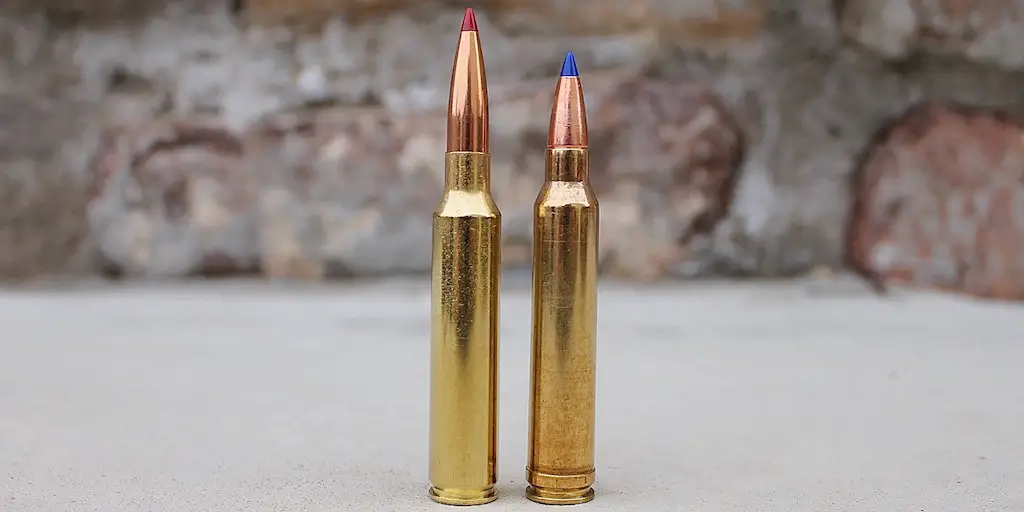
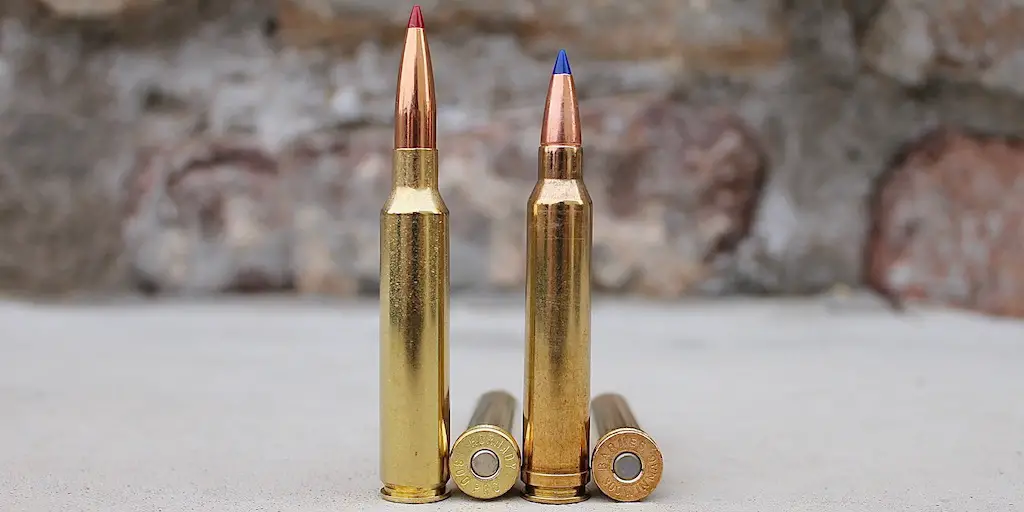
Basically, having more head height means the 300 PRC offers more room outside the case for bullets than the .300 Win Mag. As you can see in the photo below, the 300 PRC can use long, sleek bullets without seating them so deep they intrude into the powder column or contacting the rifling upon chambering.

Why can’t handloaders just use those same long, sleek bullets with the .300 Win Mag and not seat them so deep in the case?

Well, that would result in an overall length in excess of the SAAMI specifications for the cartridge. Since gun manufacturers build their rifles to those same specifications, there simply isn’t enough space in a standard length rifle action (or magazine) for those longer bullets.

That said, some custom rifle manufacturers will build a .300 Win Mag using a longer magnum length rifle action to get around those constraints, which does give handloaders a bit more wiggle room when using longer bullets. However, this article is primarily focused on using rifles in common production, not custom builds.

At the same time, the 300 PRC has a longer case neck than the .300 Win Mag (.3076″ vs .264″). In general, a longer neck helps hold a projectile (especially a very long one) securely and concentrically, both of which help with accuracy.

The 300 PRC also has a smaller throat diameter than the .300 Win Mag.

The throat is the smooth portion of a rifle barrel closest to the cartridge. Having a more snug throat diameter means there’s less room for the bullet to yaw upon firing before engaging the rifling. This can also help enhance accuracy.

Well, the 300 PRC has a throat diameter just .0008″ larger than the bullet diameter while the 300 Win Mag throat has a whopping .007″ of clearance around the bullet.

Additionally, the 300 PRC has a minimally tapered beltless case with a 30 degree shoulder. The .300 Win Mag uses a belted case with a 25 degree shoulder.

While the .300 Win Mag is certainly capable of excellent accuracy in the right hands, the 300 PRC was specifically designed for exceptional accuracy and outstanding performance at long range. As you can see, it incorporates a number of features to help accomplish that goal. Not surprisingly, the 300 PRC is extremely highly regarded for being a very inherently accurate cartridge.

In addition to the advantages the 300 PRC has in terms of accuracy and bullet selection, it also has a slightly greater powder capacity.

As previously stated, both cartridges have the same .532″ case head diameter. However, the actual body diameter of the 300 PRC is the same diameter as the belt on the .300 Win Mag. Since the cases are almost identical in length, the 300 PRC can hold a little more powder (the 300 Win Mag has about 90-91gr of case capacity vs 97-99gr for the 300 PRC).

For example, the Hornady reloading handbook lists a maximum load of 77.0gr of powder for the 300 PRC when using a 225gr ELD Match bullet, but just 72.7gr of powder when loading that same bullet in the 300 Winchester Magnum (p585 of the Hornady 10th Edition Reloading Manual).

Finally, the 300 PRC also has a higher SAAMI maximum pressure of 65,000psi vs 64,000psi for the .300 Win Mag.

picture of 300 prc vs 300 win mag dimensions new

Note: while the powder capacity figures listed above do give a good indication of the differences between the two cartridges, exact case capacities vary slightly according to the brand of brass used.

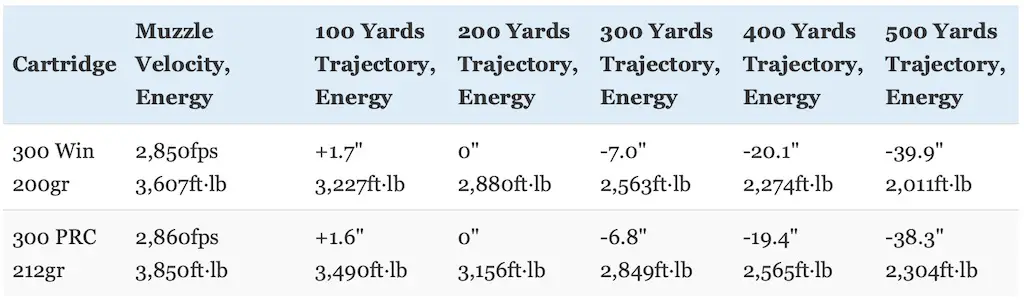
The table below compares a 200gr Hornady ELD-X (.597 BC) load in .300 Winchester Magnum to a load shooting a 212gr Hornady ELD-X bullet in 300 PRC (.673 BC). This data is for Hornady Precision Hunter factory ammo using a 200 yard zero and a 24 inch barrel.

picture of 300 prc vs 300 win mag trajectory

As you can see, the two cartridges have virtually the same muzzle velocity, but the 300 PRC shoots a heavier and more aerodynamic bullet. This results in the 300 PRC having a tiny bit flatter trajectory with just 1.6″ (4%) less bullet drop at 500 yards. The 300 PRC also has about 7% more energy at the muzzle and about 15% more energy remaining at 500 yards than the .300 Win Mag.

Since this article is focused on the performance of these cartridges for hunting, I didn’t include any ballistic data past 500 yards in the table above. However, just to give you an idea of the benefits of the 300 PRC over the .300 Win Mag at long range, consider this: the .300 Win Mag has 20″ (~8%) more bullet drop at 1,000 yards and 96″ (12%) more bullet drop at 1,500 yards with a 200 yard zero.

To further illustrate that same point, consider the supersonic ranges of the two cartridges. This particular .300 Win Mag load drops below the speed of sound around 1,500 yards, but the 300 Precision Rifle Cartridge stays supersonic out until around 1,700 yards.

That’s not nothing, but there’s also not a gigantic difference between them either.

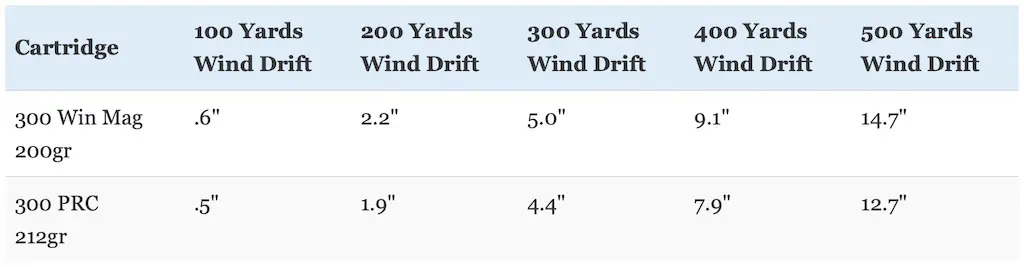
The chart below compares how much a 10 mile per hour crosswind impacts those same loads for each cartridge out to 500 yards.

picture of 300 prc vs 300 win mag wind drift

At 500 yards, there’s just 2″ separating them. Even at 1,000 yards, the .300 Win Mag has about 10″ (~18%) more wind drift than the 300 PRC. So, the 300 PRC does have an advantage in this area, but once again, there’s not a gigantic difference between them.

Now let’s talk about recoil.

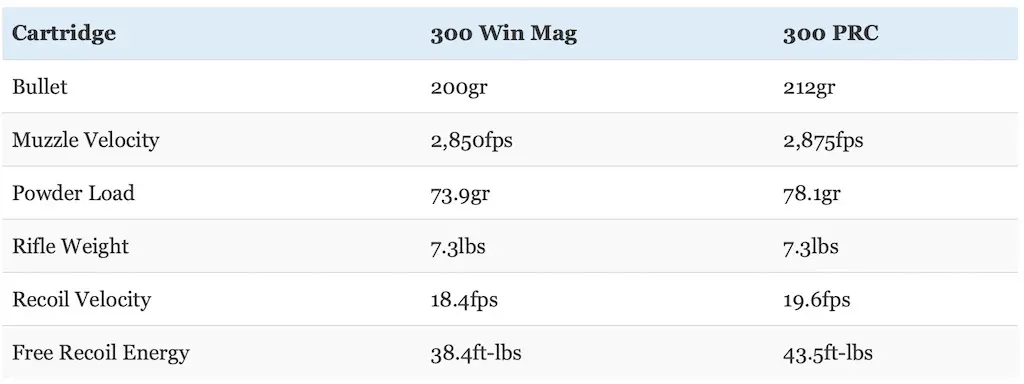
The table below compares a couple of handloads that approximate the performance of the factory loads given above when fired from identical Christensen Arms Mesa rifles.

picture of 300 prc vs 300 win mag recoil compared

Felt recoil will vary from shooter to shooter and rifle to rifle, but free recoil energy is still a useful way to compare cartridges.

Not surprisingly, the 300 PRC delivers those ballistic advantages over the .300 Win Mag at the expense of about 13% more free recoil energy. That’s saying something too because the .300 Win Mag is known for having a relatively stout recoil itself.

Even so, the 300 PRC is still a very shootable cartridge, especially in a heavier rifle. So, it’s not like you’re dealing with .338 Lapua levels of recoil with it.

In fact, that is one of the other selling points of the 300 Precision Rifle Cartridge: it delivers a definite advantage over other .30 caliber cartridges at long range, but without the punishing recoil of higher tier long range cartridges like the .338 Norma or .338 Lapua.

That’s also one of the reasons why the United States Department of Defense recently bought some Barrett MRAD rifles chambered in 300 PRC to supplement the other cartridges the United States Special Operations Command (SOCOM) uses in their sniper rifles.

Take all that for what you will.

So where do we stand overall with the 300 PRC vs 300 Win Mag?

Basically, the 300 PRC is capable of firing a heavier, more aerodynamic bullet at virtually the same velocity attained by the .300 Win Mag when using lighter bullets. That translates into a slightly flatter trajectory, a little more resistance to wind drift, and a little more kinetic energy at typical hunting ranges.

If you want to use the 300 PRC for elk hunting, the additional couple hundred ft-lbs of kinetic energy the cartridge provides might come in handy, but then again, the .300 Win Mag is plenty powerful for that work and I doubt any elk will be able to tell the difference.

The flatter trajectory and more resistance to wind drift of the 300 Precision Rifle Cartridge can also help with shot placement. This does make the cartridge a little bit more forgiving of range or wind estimation errors than the 300 Win Mag, but once again, it’s not a tremendous difference.

While this is probably not an issue for most hunters, typical 300 PRC barrel life is very likely a little shorter than typical .300 Win Mag barrel life.

Since the two cartridges use the same diameter barrel, throat erosion occurs a little faster with the 300 PRC because it has a little bit more case capacity. Simply put, burning more powder in an equally sized space will result in shorter barrel life.

This means that, in general, the 300 PRC will wear out barrels a little faster than the .300 Win Mag will (which can be a bit of a barrel burner itself). Exactly how fast that occurs depends on a number of factors like the quality of the barrel, the exact ammunition used, etc.

For serious target shooters, this is a concern. However, the good news for hunters is that typical 300 PRC barrel life is more than enough to last for many years of hunting with no issues at all.

So, while there is a difference in .300 Win Mag vs 300 PRC barrel life, it probably isn’t going to be a big issue for most hunters.

Unfortunately, the 300 PRC does have more recoil than the .300 Win Mag though.

While many hunters should be able to handle the recoil of both cartridges without too much trouble, don’t underestimate the impact that recoil has on the ability of a person to shoot accurately either. Regardless of how well a given person handles recoil, all other things being equal, they will absolutely shoot better with a milder recoil.

All things considered though, both cartridges are very accurate, flat shooting, and hit hard enough for use on a wide variety of game at practical hunting ranges. Regardless of whether you’re using a .300 Winchester Magnum or a 300 Precision Rifle Cartridge, no pronghorn, mule deer, or elk will go far if you put a well constructed bullet into the vitals.

Of the two cartridges though, the .300 Win Mag is still by far the most popular with hunters. This is reflected in the prices, availability, and variety of factory ammunition and hunting rifles currently in production for each cartridge.

So, even though the 300 PRC does have some advantages on paper, those small advantages don’t make much difference for the vast majority of hunters. The .300 Win Mag is still a fantastic hunting round and it’s a whole lot easier to find .300 Win Mag rifles and loaded ammunition.

If you already have a .300 Win Mag, there’s really not a big reason to upgrade to the 300 PRC unless you just want to.

In fact, the .300 Winchester Magnum is probably the better all around choice for most hunters.

That said, the 300 PRC gives hunters the ability to wring a little bit more performance out of a .30 caliber magnum cartridge. If you really enjoy shooting at longer range, then the inherent accuracy of the cartridge and the fact that it’s designed to use very heavy, high BC bullets are both compelling arguments in favor of the 300 PRC.

It’s a wonderful cartridge for long range precision shooting and I can certainly understand why somebody who used the cartridge for that sort of work would also want to take a 300 PRC afield.

300 PRC Ammo

The 300 Precision Rifle Cartridge does have a pretty dedicated following, but it’s not extremely popular in absolute terms and can’t certainly hold a candle to more established cartridges like the .270 Winchester or .30-06.

This will likely change in the future, but Hornady is the only major ammunition company currently producing 300 PRC ammo. The cartridge is available in both the Hornady Precision Hunter and Hornady Match lines with 212 grain ELD-X and 225 grain ELD Match bullets respectively.

Some people do hunt with the Match loads, but the Precision Hunter line is purpose built for long range hunting and is generally the better choice for most game.

Just as you’d probably expect, 300 PRC ammo is usually more expensive and not as easy to find as more popular cartridges. Since it’s used by a relatively small segment of the hunting world, not every sporting goods store keeps 300 PRC ammo in stock, but most of the big retailers in the USA usually have a couple of boxes of ammo on hand for the cartridge.

That said, I wouldn’t count on finding 300 Precision Rifle Cartridge ammunition in smaller gun store. Availability of ammunition is usually pretty good online though and most of the bigger retailers typically have a good selection of quality factory 300 PRC ammo in stock.

BUY SOME EXCELLENT 300 PRECISION RIFLE CARTRIDGE AMMO HERE

Reloading components for the cartridge (like 300 PRC brass) are available though. The high price of factory ammo and the difficulty involved with obtaining a reliable supply of ammo at times makes it a good choice for handloaders.

One other good point about the cartridge is that even though it’s not nearly as common as other .30 caliber cartridges, the fact that it satisfies a niche market does make it less susceptible to panic buying (unlike the .223 Remington or .308 Winchester for example). So, you’ll probably still be able to find 300 PRC ammo on shelves when people are buying everything else.

Since it uses the same .308″ bullet size that’s also used by the .308 Winchester, .30-06 Springfield, .300 Win Mag, and .300 Remington Ultra Magnum (among others), reloaders have access to a good number of outstanding quality bullets in the 180-200 grain range suitable for use on a wide variety of game to choose from.

However, there’s not quite a big of a selection of really heavy, high BC .30 caliber bullets. Aside from the aforementioned Hornady bullets, 190gr and 200gr Barnes LRX will work well with the 300 PRC (it’s a pure copper bullet, so the LRX is longer for a given weight than a lead core bullet) . The same goes for a couple of different options from Berger, so reloaders should be able to make a custom hunting load that works well for their needs.

300 PRC Rifles

The increasing popularity of long range precision shooting has resulted in a good selection of high quality rifles available for the 300 Precision Rifle Cartridge.

Among other companies, Barrett, Bergara, Browning, Christensen Arms, Fierce Firearms, GA Precision, Gunwerks, Hill Country Rifles, Howa, Ruger, and Seekins Precision all manufacture bolt action 300 PRC rifles.

So, while the selection of ammunition available for the cartridge is relatively small, hunters actually have some really nice rifles to choose from.

BUY A CHRISTENSEN ARMS 300 PRC HUNTING RIFLE HERE

BUY A BROWNING 300 PRC HUNTING RIFLE HERE

BUY A RUGER 300 PRC HUNTING RIFLE HERE

Best 300 Precision Rifle Cartridge Ammo For Hunting

Unlike the .300 Win Mag, there aren’t many options for factory 300 PRC hunting ammo right now. That’s slowly changing though.

If you’d like to learn more about some of the various hunting ammunition choices for the 300 PRC read this article:

Best 300 PRC Ammo For Hunting Elk, Deer, & Bear

Final Thoughts On The 300 PRC

The 300 PRC is a very well designed cartridge that offers some real advantages to long range shooters and fills an important niche among the various .30 caliber magnum cartridges. I’m actually a little surprised it took this long for a cartridge that fills that void to come along, but better late than never and Hornady did an excellent job when they designed the 300 PRC.

While a surprisingly large number of shooters and hunters have adopted the new cartridge, the small benefits it offers over more established calibers like the .300 Win Mag and .300 Remington Ultra Magnum probably aren’t big enough for most hunters to justify making the switch.

This is especially true considering the lack of 300 Precision Rifle Cartridge ammo choices at this point. Even so, the ammo selection for the cartridge will almost certainly improve in the future if the cartridge continues to grow in popularity. So, if you’re the type of person who wants to wring out all the performance you can from a certain caliber, by all means get a 300 PRC.

It’s a fantastic cartridge and I’m sure it will serve you well, particularly if you enjoy shooting at longer range.

Do you have a rifle chambered in 300 PRC that you’re itching to take on a hunt?

Book an incredible black bear hunt here.

Book an outstanding Africa hunting safari here.

Enjoy this article about the 300 Precision Rifle Cartridge? Please share it with your friends on Facebook and Twitter.

J Scott Olmstead’s article for The American Hunter was used as references for the history of the 300 PRC. The Hornady 10th Edition (p574-585) reloading manual (and their online supplement) provided data to compare their size and recoil of the .300 Win Mag and 300 PRC. The data used to compare the trajectory of the cartridges was obtained from Hornady (here, and here). Maximum pressure for the .300 Win Mag and maximum pressure and cartridge dimensions for the 300 PRC were obtained from SAAMI (p172 for the .300 Win Mag) and here for the 300 PRC. Case capacity information for the 300 Win Mag and 300 PRC were obtained from Chuck Hawks (here) and from Hornady. I used Shooters Calculator to compare trajectories, wind drift, and recoil for the cartridges.

Make sure you follow The Big Game Hunting Blog on Facebook, Instagram, Twitter, and YouTube.

NEXT: BEST 6.5 CREEDMOOR AMMO FOR HUNTING ELK, DEER, AND OTHER BIG GAME

NEXT: BEST GIFTS FOR HUNTERS

The Loudest Presentation: 5 Bass Poppers to Disrupt and Attract More Fish

0

The best bass poppers make a lot of noise on the water, and that is what makes them so effective. They’re one of the oldest lures, but over time, testing has lended them quite a nice hand. Now we have poppers of all different shapes and sizes that work better than ever before.

Through my personal experience and other anglers’ knowledge and expertise, I’ve put together this list of the best poppers for bass fishing. These topwater lures will help you clean house on any freshwater pond or lake, so keep reading.

Our Picks For The Best Bass Poppers

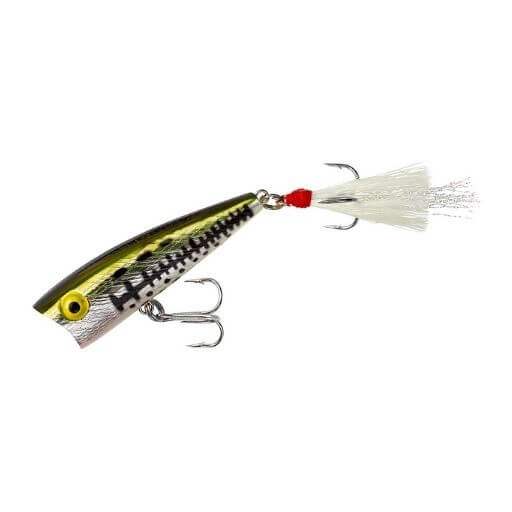
Rebel Lures Pop-R Topwater Popper

Rebel Lures Pop-R Topwater Popper

BEST BASS POPPER OVERALL

  • Type: Teeny Popper
  • Size: ⅛ ounce
  • Color: Ol’ Bass

FEATURED SPECS

  • Design of the mouth spits water which creates a loud noise and vibration to attract ornery bass

EXTRA FEATURES

  • Comes with two treble hooks and a feather-like tail which improves the action and natural appearance

BUYING ADVICE

  • You can use both a straight retrieval or erratic jerking to imitate an injured baitfish

Pros

  • Strong company reputation
  • Great topwater action
  • Versatility

Cons

  • Many anglers recommend swapping the hooks

It’s a no-brainer that the Rebel Pop-R is the best topwater popper for bass fishing. If you’ve ever watched a bass fishing tournament or attended one, I can guarantee you’ve seen this lure used many times. It’s won hundreds of thousands of dollars in tournament money for many professional anglers.

When you cast it out, and it hits the water, you’ll hear the pop. Then, as you’re retrieving it, the lure spits water out using the concave mouth, which creates a lot of disturbance to attract the bass.

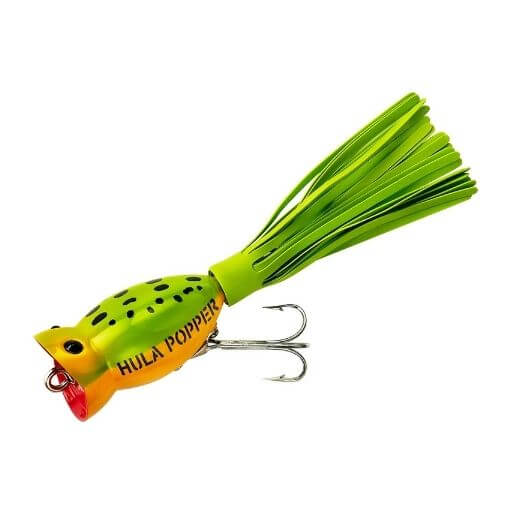
Arbogast Hula Popper

Arbogast Hula Popper

RUNNER-UP BASS POPPER

Specs

  • Type: Hula Popper
  • Size: 1 ¼ – 2 ¼
  • Color: Yellow Belly

FEATURED SPECS

  • Features an extra-strong and sharp treble hook to make it easier to set the hook

EXTRA FEATURES

  • The hula popper creates a loud popping sound when it hits the water, and it bubbles as you retrieve

BUYING ADVICE

  • Locate some grass beds and cast this right in there because it’s meant to imitate a jumping frog

Pros

  • Great loud presentation
  • Large lure catches big bass
  • Works well at night too

Cons

  • The lure is a bit large for some

Here we have another legendary lure with a long-standing history of creating successful anglers out of newbies. The skirt on this one pulsates, so it creates a clicking noise as you retrieve it. You can pair that with the concave mouth that creates a bubble trail.

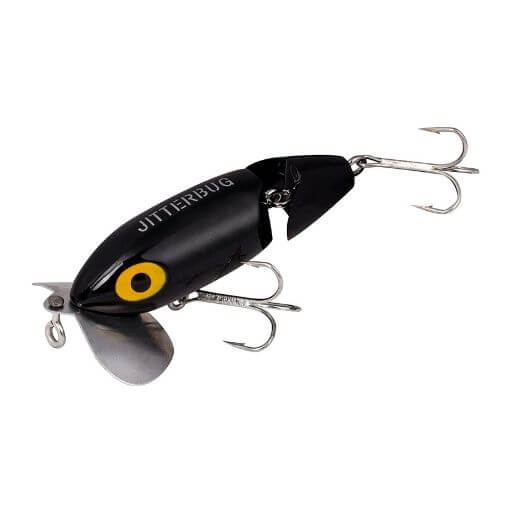
Arbogast Jitterbug

Arbogast Jitterbug

BEST JITTERBBUG

Specs

  • Type: Jitterbug
  • Size: 2 ½ inches and ⅜ ounce
  • Color: 16 color variations

FEATURED SPECS

  • The double cupped lip creates an extremely loud presentation when it hits the water

EXTRA FEATURES

  • This lure is small, so it’s great for casting large distances

BUYING ADVICE

  • Make sure to choose your color to mimic your surroundings. They offer a wide assortment of colors.

Pros

  • Loud presentation
  • Great casting distance
  • Exceptional night time lure

Cons

  • Too many buying options

It’s not often that I would say having too many lure options is a bad thing, but it is when they’re confusing. I find this lure to have too many size variations where some are jointed, and some aren’t, it makes it confusing.

If I were you, I’d go with a non-jointed small lure option and purchase a couple of them in different colors, so you have one for each situation. I highly recommend getting a black one because this lure creates such a loud presentation; you don’t need the bass to see it for night fishing.

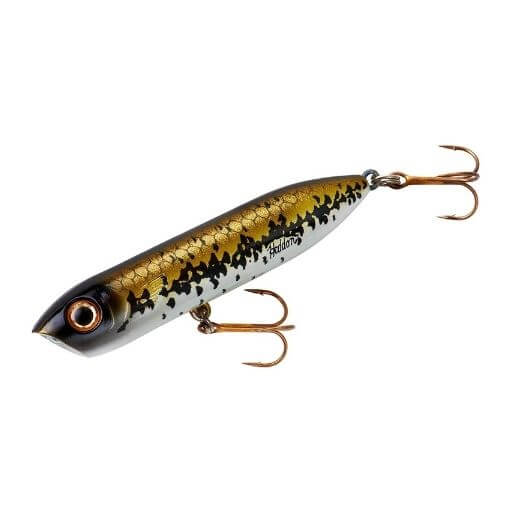
Heddon Chug’N Spook Popper

Heddon Chug

BEST SPOOK

Specs

  • Type: Popping Spook
  • Size: ½ ounce
  • Color: Black Shiner

FEATURED SPECS

  • Thin profile allows this lure to move through the water quickly while chugging and spitting

EXTRA FEATURES

  • Also comes with a loud rattle inside to add to the already loud presentation

BUYING ADVICE

  • These come in both fresh and saltwater options. That makes this one of the best poppers for striped bass as well.

Pros

  • Simple and effective
  • Comes with a wide range of colors and sizes
  • Torpedo movement through the water

Cons

  • Made in China

Don’t get confused by this lure. We’re not talking about the standard Heddon spook here; the company also makes a popper with a similar design. The only difference between this and the original spook is the concave mouth.

While it does a great job of creating noise from its mouth, the ticker on this lure is the internal rattle paired with the mouth.

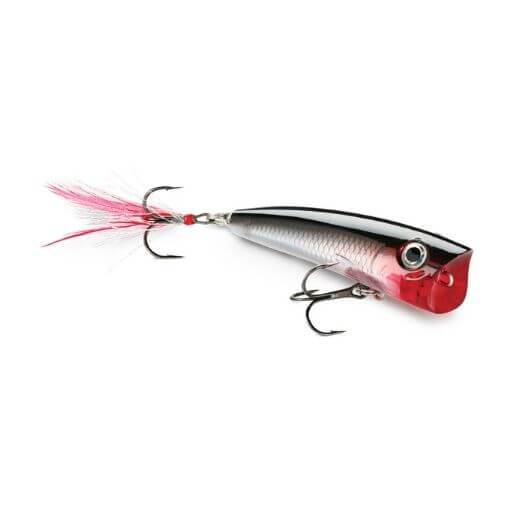
Rapala X-Rap Pop 07

Rapala X-Rap POP 07

BEST SPITTER

Specs

  • Type: Spitter
  • Size: 2 ¾ inches
  • Color: Silver/Red

FEATURED SPECS

  • Incredibly lifelike appearance meant to mimic an injured shad or minnow

EXTRA FEATURES

  • Deep cupped mouth with extended top lip spits water as you retrieve it

BUYING ADVICE

  • These work great near docks or low hanging trees because they have a long casting system that provides pinpoint accuracy on your cast.

Pros

  • Rapala reputation is always good
  • Tail-down design improves the presentation
  • Great spitting action
  • Lifelike appearance

Cons

  • Fragile hooks

If you’ve read any of my other reviews, you know I like to stick with a great company. Rapala bass lures are some of the best on the market, and the design of this one really proves that to us.

Whether you’re looking at the arched back to create a better presentation or the precisely cupped mouth which spits water and makes noise, this lure is designed perfectly for its intended purpose.

What Are Poppers?

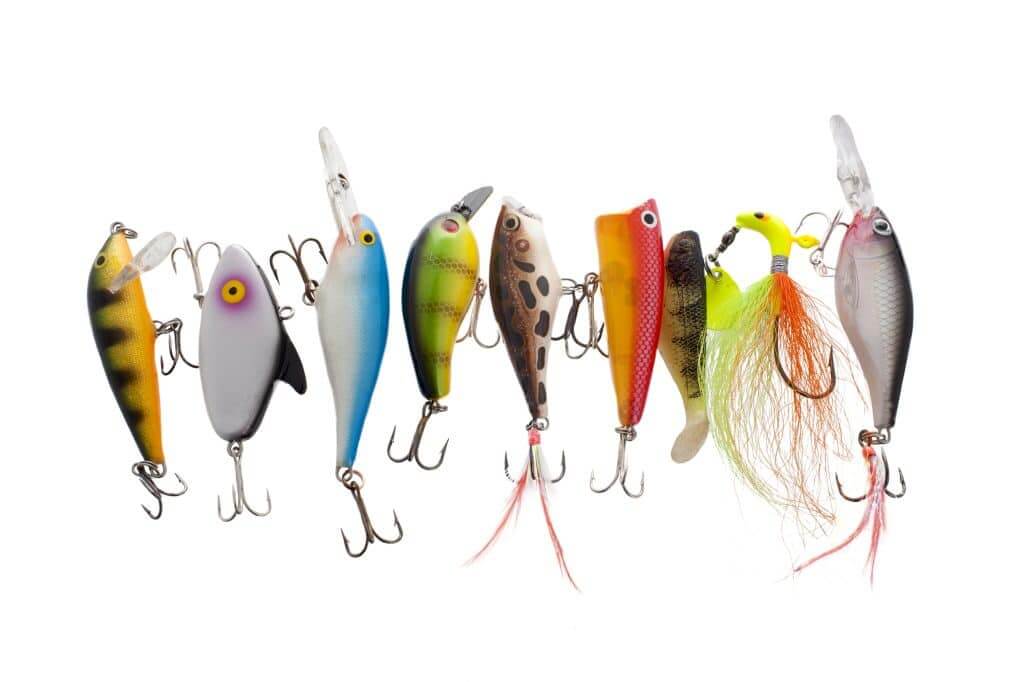
Close up image of different and colorful fishing lures against white background

Poppers are a topwater lure that make a loud popping and spitting sound when they hit the water and retreat. They come in a few different designs and styles, but the selling point is the design and shape of their mouth.

These are not weedless lures because they often come with two treble hooks. You’ll want to fish these near the weeds, but not necessarily in them. Having a bit of clear water allows the design to work it’s magic.

The topwater nature of these make them a great lure for smallmouth bass but certain options like the spook also dive a little so they work well for largemouth bass too.

Types of Bass Poppers

You’ve got a large assortment of bass fishing lures that claim to be poppers, but overall, we’re sticking to two main types. You have chuggers and spitters. They’re both very similar, but the presentation they create in the water is what makes them a little different.

Chuggers

Arbogast Hula Popper

The chugger is a lot like the Arbogast Hula Popper we reviewed above. These create a loud pop sound when they hit the water, and then they bubble when you retrieve them. As you pull them in, they almost shroud themselves in bubbles, and when they pop, that’s when you get the loud noise you’re looking for.

Spitters

Rapala X-Rap POP 07

The main difference between these two is in the shape of their mouth. When you look at a spitter closely, you’ll notice that the top lip of the concave mouth sticks out a little further than the bottom lip. As a result, these lures don’t create that bubble shroud and trail; instead, they spit the water back out somewhat like a water wheel.

It makes a softer sound, but I’ve found that the noise is more consistent, which is what drives bass crazy. Our top pick above is a perfect example of a high-quality spitter.

Features to Look For in the Best Poppers

Popper bass fishing is pretty basic, and most of the lures operate in the same fashion. When you’re shopping around, make sure to look for the following features to determine you have the right lure in your hand.

Concave Mouth – The main feature that makes this lure tick is the design of its mouth. The mouth either spits or chugs, and both of these create a loud noise when they hit the water and when you retrieve them. One sure-fire way of knowing you have a popper is by looking at the design of the mouth.

Treble Hooks – Topwater poppers for bass fishing always come with at least one treble hook. This is because you need to be able to set the hook when a bass comes at you from a variety of different directions. Many of the stock hooks that come with lures are low-quality, so be sure to pay attention to that.

Color Variations – Color is an important buying factor because it will impact your success. I always suggest mimicking the color of your lure to match the surroundings where you’re fishing. Most popular companies like Rapala or Rebel offer an assortment of colors, so you don’t have to worry about that.

How to Fish Poppers for Bass

Interestingly enough, there aren’t too many bass fishing tips I can give you on fishing poppers. They’re one of the simplest lures to fish, which makes them great for beginner bass fishing. You have two options for retrieving.

You can play it safe and follow a steady retrieval. You’ll do this by casting out and retrieving by cranking the reel at a normal pace. The popper will spit and chug as you do this at a natural pace.

If you’re looking to make things a little more interesting, you can cast out, leave the rod tip down and use the tip to jerk the lure in an erratic motion. For this, I suggest getting a lure with a little red on it. Some of the options recommended above have red bellies.

For this, to work best, you’ll keep the line tight, lift the rod tip up quickly, reel in the slack, and repeat this process. The bass will think your lure is injured, and they’ll be more likely to strike it.

Best Time to Use Poppers for Bass

While there isn’t a “wrong” time to fish poppers, any self-respecting bass angler would tell you that night time, overcast, or dusk is the best time to use these. When it’s dark, bass can’t see the lure as well, so they rely on what they hear.

For this situation, having a loud lure that draws a lot of attention is the key to success. Again, be sure to keep everything else in mind as well. Choose a color that relates to the time of day. If it’s pitch black out with very little moonlight, go with a completely black lure.

If you’ve got some moonlight, choose something that might reflect some of that light. Go with a silver shad color or something like that.

Also, keep in mind how your presentation needs to change based on the time of day and year. When it’s a cooler, overcast day – you need to slow it down. When it’s hot, and the sun is still beaming down at 9 pm, you can afford to pick up the pace a little.

Final Thoughts

The best bass poppers aren’t hard to find because so many of the most popular lure brands make a ton of them. I suggest sticking with the Pop-R, Heddon, and Rapala when it comes to these. Even if you have to pay an extra buck or two, you know you’re getting the highest quality lures.

The best thing about poppers is that they’re easy to fish. If you have a kid or a friend who is looking to get into fishing, get them hooked by rigging a topwater popper and showing them how easy it is to catch bass with the right lure and the proper strategy.

We love talking to our community here at Anglers.com, so be sure to drop us a comment with your favorite popper story and tell us more about how you like to fish these lures.

Good luck out there!

Choosing the Right Night Vision Equipment for Your Air Rifle

0

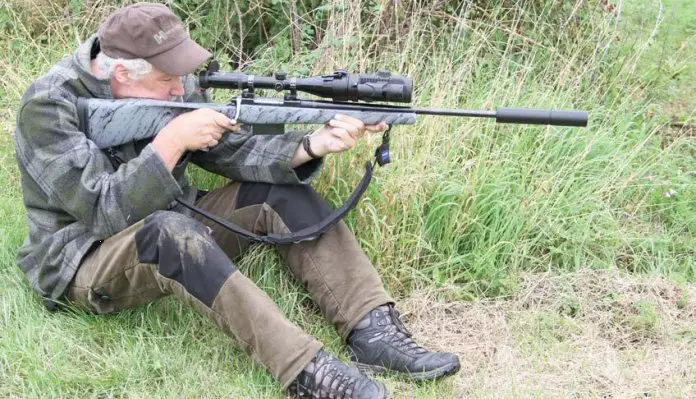
Are you looking for a night vision scope that you can only use at night? Do you need a night vision scope that will convert the rifle scope that you use in the day to still be useful at night? Then you have to think about the money that you are willing to spend on your night vision weapon sights

Picking the Right Night Vision Equipment for Your Air Rifle

If you want to buy a night vision scope, you have to decide if you would like it to fit directly into your rifle. Some night vision scopes would need to be raised so that you can get enough clearance to get a multi-shot.

There are different night vision scopes that you can find in the market and it can get confusing and overwhelming in the beginning. You can check reviews to find the night vision scope that will give you the best value for your money. It does not follow that just because one scope is more expensive than another scope, it is already better. You can also ask other enthusiasts for their recommendations.

Let us say that you would rather get a night vision scope that will serve as an add-on to your rifle. You can check how well the products do when you consider these factors:

  • Battery Life – The longer the battery life, the better.
  • Detection Range – You would like your scope to help you detect movement even from a distance. The better the detection range, the more that you can effectively use your air rifle.

There are some night vision kits that you can purchase online. You can also choose to buy from actual stores. You can ask the staff some questions about the kits that you want to buy. You can also look for one that can offer better eye relief. Remember that the more comfortable it is to use your night vision scope, the better.

How to Choose the Right Night Vision Equipment for Airsoft?

Playing airsoft is a hobby that a lot of people enjoy. If you have not tried it yet, it is about time that you consider it. You can play it with people you know. You can also join groups and make new friends. One important requirement when you play airsoft is to have the best equipment. 

Is it Worth it to Purchase Night Vision Equipment?

Not everyone enjoys playing airsoft at night. If you have been playing for a long time, you should try it out. You are going to have an entirely different experience that you will still enjoy. Some even enjoy it even more than playing during the day.

Just imagine if you would get to feel like a hero while on the battlefield. You can thank your skills, your knowledge, and your equipment for all the things that you would be able to do. The enemies from the other team will be hard to see at night. The challenge can make you more passionate about playing.

Some Night Vision Devices to Consider Getting

You are familiar with the term “night vision devices” but you do not know what you need to get to play airsoft properly. Some of the items that you can get are the following:

  • Monoculars – This can be attached to the weapon that you are using. You can also use it on its own.
  • Binoculars – This can provide you with a better viewing angle. This is ideal if you want to improve your line of vision. Just imagine how useful this would be when the enemies are trying to hide in the dark.
  • Goggles – You are going to need safety equipment when playing airsoft. Using your usual goggles might not work when you are trying to play at night. Night vision goggles will keep your vision clear at night.

You might think that using night vision devices to protect your eyes is meaningless. Remember this: your eyes are sensitive, if you get hit, you may lose your sight. It is better to look through goggles that can make your view slightly distorted than not having eyes to see at all.

Some Features to Consider

Different night vision devices will have features that can be helpful for you and the game that you want to play.

  • Improved Range – The better your range, the more that you will be able to spot enemies even when the field where you are playing at is huge.
  • Improved Illumination – You just need a small amount of light to see your enemies. It will also help you become more oriented with your surroundings in the darkness.
  • Top-Down Ventilation System – This is a feature that you can find in most modern night vision devices. This will prevent the goggles and the other devices from fogging up while you are using them.

Remember that the range of the night vision equipment will not only depend on the item itself. In the dark, it can be tricky when the terrain is higher than usual. Other light sources may also distort the range of your enemies. 

Conclusion

Let us say that you have already chosen the right night vision devices. Make sure that you will use it accordingly. You should also remember to protect yourself at all times while you are playing airsoft. Things are going to be more exciting at night. Have fun with the right night vision devices.

Worlds Largest Grizzly Bear

0

This post has been carried over from our forum which has since been removed from the site. We’ve pulled over the top 10 forum conversations that were not specific to future content areas which we will be posting.

piedipers Hi,

I recently received an email from my wifes’ work regarding a supposed grizzly bear attack in Alaska. Where upon a 14 foot grizzly bear was shot to death by a ranger out deer hunting. It came with three photographs, 1] displaying overall size of grizzly and hunter together, 2] displaying size of paw and 3] graphic portrayal of hiker practically eaten.

forgive my morbidity on this, but can anyone verify this story, which l have pasted below:

Many regards piedipers The following (first two) pictures are of a guy who works for the US Forest Service in Alaska and his trophy bear. He was out deer hunting last week when a large grizzly bear charged him from about 50 yards away. The guy unloaded his 7mm Mag Semi-automatic rifle into the bear and it dropped a few feet from him. The big bear was still alive so he reloaded and shot it several times in the head. The bear was just over one thousand six hundred pounds. It stood 12′ 6″ high at the shoulder, 14′ to the top of his head. It’s the largest grizzly bear ever recorded in the world. Of course, the Alaska Fish and Wildlife Commission did not let him keep it as a trophy, but the bear will be stuffed and mounted, and placed on display at the Anchorage airport (to remind tourist’s of the risks involved when in the wild).

Based on the contents of the bears stomach, the Fish and Wildlife Commission established the bear had killed at least two humans in the past 72 hours. His last meal was the unlucky nature buff in the third picture below. The US Forest Service, backtracking from where the bear had originated, found the hiker’s 38-caliber pistol emptied.

Not far from the pistol was the remains of the hiker. Although the hiker fired six shots and managed to hit the grizzly with four shots (they ultimately found four 38 caliber slugs along with twelve 7mm slugs inside the bear’s dead body) it only wounded the bear – and probably angered it. The other body has not been found. The bear killed the hiker an estimated two days prior to the bear’s own death by the gun of the Forest Service worker.

Think about this – If you are an average size man; You would be level with the bear’s belly button when he stood upright, the bear would look you in the eye when it walked on all fours! To give additional perspective, consider that this particular bear, standing on its hind legs, could walk up to an average single story house and look over the roof, or walk up to a two story house and look in the bedroom windows.

Fitter I’ll dig up the info for you but the story has been quite twisted as its been around for quite some time.

MamaEagle I remember that one too. I think there was a little truth and a little tale to that one.

Here are some info and photos but as I mentioned take it for what its worth. Worlds Largest Grizzly Bear Worlds Largest Grizzly Bear

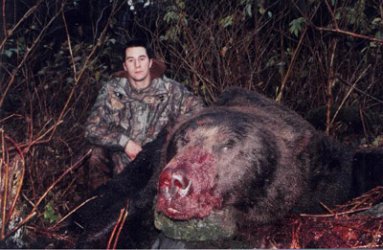
The first two photos are legitimate images of a giant grizzly brought down by a hunter in Alaska. However, the accompanying story is about another hunter and another bear.

On October 14, 2001, U.S. Air Force Airman Theodore Winnen was deer-hunting on Hinchinbrook Island, Prince William Sound when he and his hunting buddy, Staff Sgt. James Urban. spotted the bear. Effectively cloaked by their camouflage hunting gear, the pair had plenty of time to take their shot. The first bullet from Winnen’s 338 Winchester pierced the brain, but it took five more in the chest to bring him down. The first two photos above were taken by Urban and were posted on several hunting boards and shared among hunting enthusiasts. The bear was 10 1/2 feet long and weighed more than half a ton – Big, but not a record.

Six months later, Sigfredo Casiano, was hiking in Alaska and had a similar experience with a large bear. Casiano claims he found himself about 10 feet from the animal when the beast started moving toward him. His first shot brought the bear down, but he fired several more shots, probably to make sure. In this case, the bear was a brown bear, not a grizzly, and between eight and nine feet tall.

Because of the temporal closeness of these two accounts, the two stories became confused. Eventually, the picture of Winnen became associated with the story of Casiano. The confusion was frustrated by National Forest Service officials who mistakenly identified the photos to be from Casiano’s story.

If that weren’t bad enough, some joker along the line decided to embellish the story with a gruesome prologue, complete with photographic evidence. While the origins of the third picture remain unknown, we do know that it has nothing to do with either Winnen’s or Casiano’s bear encounters. It was added nearly a year after the most popular version of this story began circulating. In fact, there is no evidence in either case that the bears had ever attacked humans.

MamaEagle For what it is worth, I remember that third photo was circulated on a website and that the site claimed it to be the result of a dog attack.

piedipers Hi again,

Thanks for this and the reply. Admittedly l have to be honest l thought that there might be a hint of truth in some portion somewhere, but thought that in another area it wasn’t quite right.

I looked into the animal attacks archives here on this site and came up with the Alaskan Hiker Killed by Bear

ANCHORAGE, Alaska (AP) — A man on a day hike in a rural area was killed when a bear bit his head, Alaska State Troopers said Wednesday.

Kenneth Cates, 53, was found Wednesday morning on a horse trail in a heavily wooded area of the Kenai National Wildlife Refuge near his hometown of Soldotna.

Seeing as this stated a ‘hiker’ being killed and thought, here we go this is something.

Out of curiousity, what is the record for the biggest grizzly, and how big is the actual grizzly bear in the two legit photos?

Fitter The bear in the picture is supposedly as you mentioned: The bear was over one thousand six hundred pounds. It stood 12′ 6″ high at the shoulder, 14′ to the top of his head. It’s the largest grizzly bear ever recorded in the world.

MamaEagle I had to go check this out at the truth or fiction site goto when wondering about some emails i recieve. This is what I found attached to this same story and pictures.

******** THE TRUTH Thanks to our readers, the truth about these pictures has been found. The facts are a little different from the original eRumor, but the pictures do record the results of a true hunt and are real.

The original pictures lacked the label linking them with hunting-pictures, but that is where the pictures reside. They were posted by a hunter who used the nickname Dalliwacker but who is, according to published articles, Jim Urban. He says that the bear was actually ten feet high and weighed between 1,000 and 1,200 pounds. He says the bear did not stand up then drop down and charge. It showed no aggression at all. He also says the bear was not shot on Hitchenbrook Island but, like all good hunters, he won’t be specific about where he got it .*************

The version of the eRumor that claims the bear was a killer and was shot by a forest service employee are false.

Fitter Heres an update on the Worlds Largest Bear for all who continue to follow and seek the truth behind this story.

I recently watched a special on National Geographic and a portion of the show was dedicated to this very same bear and the actual hunter. The hunter himself, pictured above, appeared on the show and offered some insight from his home. And yes, the famed bear he shot was mounted on the wall in the interview. Here are some transcipts from the show in exact format.

Narrator: In October 2001, a hunter legally shot a bear on Hinchinbrook Island off Alaska’s southern coast. He emailed photos of himself posing with the bear to friends. The photos became an internet sensation and soon, stories appeared along with the images. Blogs and websites claimed the Hinchinbrook Island bear stood 12 1/2 feet tall on it’s hind legs. A super bear as big as any ever seen.

Ray Massey – Forest Service Spokesman Alaska Region: If the bear sat down in a room with you, and was flat on his behind on the floor, and tipped it’s nose up, his head would be through a normal ceiling by about a foot or two. If this bear stood up, as reported in the web, it could be watching you take a shower on the second floor of your home.

Narrator: And there was more. A photograph of gnawed human remains. According to the internet, the last man eaten by the giant bear, shot on Hinchinbrook Island. This story of a monster man-eating bear astonished web surfers around the world. Especially the hunter who shot the bear. He doesnt know how the bear he killed got to be the worlds biggest bear in cyberspace. It was big. But not that big.

Actual Hunter: In relation to the world record he wound up only being short by 2 inches and uh 2/16ths of an inch which put him at the rank of 145 out of the 347 of the largest, worlds largest bears ever taken. Ya know I got to get that straight. He’s still a record he’s just not the world record.

Narrator: But what about that other photo claiming to show the Hinchinbrook bears last meal?

Actual Hunter: Thats another picture that gets associated with my bear. That has nothing to do with my bear. As far as I know this bear didnt, ya know, kill nobody or maul nobody.

Narrator: So where did the photo come from? Bear experts took a closer look and discovered that, wherever this man died, it probably wasn’t anywhere near Alaska.

Dr. Tom Smith – Research Wildlife Biologist USGS Alaska Science Center: If you look at the vegetation in there it’s not quite tropical but it certainly is not Alaskan. It appeared to be the victim of a tiger attack from the Indian sub-continent.

Narrator: The super-size Hinchinbrook bear is a myth from cyberspace.

.223 Remington vs .45-70 Government Ammo Comparison – Ballistics Info & Chart Caliber Ballistics Comparison 07 Dec, 2018 Posted By: Foundry Outdoors The following ammunition cartridge ballistics information and chart can be used to approximately compare .223 Remington vs .45-70 Government ammo rounds. Please note, the following information reflects the estimated average ballistics for each caliber and does not pertain to a particular manufacturer, bullet weight, or jacketing type. As such, the following is for comparative information purposes only and should not be used to make precise predictions of the trajectory, performance, or true ballistics of any particular .223 Remington or .45-70 Government rounds for hunting, target shooting, plinking, or any other usage. The decision for which round is better for a given application should be made with complete information, and this article simply serves as a comparative guide, not the final say. For more detailed ballistics information please refer to the exact round in question or contact the manufacturer for the pertinent information. True .223 Remington and .45-70 Government ballistics information can vary widely from the displayed information, and it is important to understand that the particular characteristics of a given round can make a substantive difference in its true performance. Caliber Type Velocity (fps) Energy (ft-lb) .223 Remington Rifle 3150 1250 .45-70 Government Rifle 1680 2270 [Click Here to Shop .223 Remington Ammo] [Click Here to Shop .45-70 Government Ammo] Velocity As illustrated in the chart, .223 Remington rounds – on average – achieve a velocity of about 3150 feet per second (fps) while .45-70 Government rounds travel at a velocity of 1680 fps. To put this into perspective, a Boeing 737 commercial airliner travels at a cruising speed of 600 mph, or 880 fps. That is to say, .223 Remington bullets travel 3.6 times the speed of a 737 airplane at cruising speed, while .45-70 Government bullets travel 1.9 times that same speed. Various calibers Energy Furthermore, the muzzle energy of a .223 Remington round averages out to 1250 ft-lb, while a .45-70 Government round averages out to about 2270 ft-lb. One way to think about this is as such: a foot-pound is a unit of energy equal to the amount of energy required to raise a weight of one pound a distance of one foot. So a .223 Remington round exits the barrel with kinetic energy equal to the energy required for linear vertical displacement of 1250 pounds through a one foot distance, while a .45-70 Government round exiting the barrel has energy equal to the amount required to displace 2270 pounds over the same one foot distance. As a rule of thumb, when it comes to hunting, muzzle energy is what many hunters look at when deciding on what caliber of firearm / ammunition to select. Generally speaking, the higher the muzzle energy, the higher the stopping power. Again, the above is for comparative information purposes only, and you should consult the exact ballistics for the particular .223 Remington or .45-70 Government cartridge you’re looking at purchasing. [Buy .223 Remington Ammo] [Buy .45-70 Government Ammo] Please click the above links to take a look at all of the .223 Remington and .45-70 Government ammo we have in stock and ready to ship, and let us know any parting thoughts in the comment section below. Foundry Outdoors is your trusted home for buying archery, camping, fishing, hunting, shooting sports, and outdoor gear online. We offer cheap ammo and bulk ammo deals on the most popular ammo calibers. We have a variety of deals on Rifle Ammo, Handgun Ammo, Shotgun Ammo & Rimfire Ammo, as well as ammo for target practice, plinking, hunting, or shooting competitions. Our website lists special deals on 9mm Ammo, 10mm Ammo, 45-70 Ammo, 6.5 Creedmoor ammo, 300 Blackout Ammo, 10mm Ammo, 5.56 Ammo, Underwood Ammo, Buffalo Bore Ammo and more special deals on bulk ammo. We offer a 100% Authenticity Guarantee on all products sold on our website. Please email us if you have questions about any of our product listings. Leave a comment Comments have to be approved before showing up Your Name * Your Email * Your Comment * Post Comment

0

The following ammunition cartridge ballistics information and chart can be used to approximately compare .223 Remington vs .45-70 Government ammo rounds. Please note, the following information reflects the estimated average ballistics for each caliber and does not pertain to a particular manufacturer, bullet weight, or jacketing type. As such, the following is for comparative information purposes only and should not be used to make precise predictions of the trajectory, performance, or true ballistics of any particular .223 Remington or .45-70 Government rounds for hunting, target shooting, plinking, or any other usage. The decision for which round is better for a given application should be made with complete information, and this article simply serves as a comparative guide, not the final say. For more detailed ballistics information please refer to the exact round in question or contact the manufacturer for the pertinent information. True .223 Remington and .45-70 Government ballistics information can vary widely from the displayed information, and it is important to understand that the particular characteristics of a given round can make a substantive difference in its true performance.

Caliber Type Velocity (fps) Energy (ft-lb) .223 Remington Rifle 3150 1250 .45-70 Government Rifle 1680 2270

Velocity

As illustrated in the chart, .223 Remington rounds – on average – achieve a velocity of about 3150 feet per second (fps) while .45-70 Government rounds travel at a velocity of 1680 fps. To put this into perspective, a Boeing 737 commercial airliner travels at a cruising speed of 600 mph, or 880 fps. That is to say, .223 Remington bullets travel 3.6 times the speed of a 737 airplane at cruising speed, while .45-70 Government bullets travel 1.9 times that same speed.

Various calibers

Energy

Furthermore, the muzzle energy of a .223 Remington round averages out to 1250 ft-lb, while a .45-70 Government round averages out to about 2270 ft-lb. One way to think about this is as such: a foot-pound is a unit of energy equal to the amount of energy required to raise a weight of one pound a distance of one foot. So a .223 Remington round exits the barrel with kinetic energy equal to the energy required for linear vertical displacement of 1250 pounds through a one foot distance, while a .45-70 Government round exiting the barrel has energy equal to the amount required to displace 2270 pounds over the same one foot distance. As a rule of thumb, when it comes to hunting, muzzle energy is what many hunters look at when deciding on what caliber of firearm / ammunition to select. Generally speaking, the higher the muzzle energy, the higher the stopping power. Again, the above is for comparative information purposes only, and you should consult the exact ballistics for the particular .223 Remington or .45-70 Government cartridge you’re looking at purchasing.

Please click the above links to take a look at all of the .223 Remington and .45-70 Government ammo we have in stock and ready to ship, and let us know any parting thoughts in the comment section below.

Foundry Outdoors is your trusted home for buying archery, camping, fishing, hunting, shooting sports, and outdoor gear online.

We offer cheap ammo and bulk ammo deals on the most popular ammo calibers. We have a variety of deals on Rifle Ammo, Handgun Ammo, Shotgun Ammo & Rimfire Ammo, as well as ammo for target practice, plinking, hunting, or shooting competitions. Our website lists special deals on 9mm Ammo, 10mm Ammo, 45-70 Ammo, 6.5 Creedmoor ammo, 300 Blackout Ammo, 10mm Ammo, 5.56 Ammo, Underwood Ammo, Buffalo Bore Ammo and more special deals on bulk ammo.

We offer a 100% Authenticity Guarantee on all products sold on our website. Please email us if you have questions about any of our product listings.

Cooler Connection Blog

0

Deer hunting seasons are underway in some parts of the nation, so it’s time once again to prepare yourself to venture into the fields and forests. Once you’ve managed to harvest and field dress your first deer, there’s the matter of storing it in the proper environment to get the best tasting meat.

Some people will quarter the deer without aging it, but this is a major mistake if you want quality venison. The deer stiffens during rigor mortis in the 24 hours after being killed. If it is processed during this time, the muscles shorten and contract causing the meat to become tough. You should let your deer hang for 2 to 4 days at minimum before processing to avoid this. For the best tasting deer meat Mississippi State University recommends 14 to 18 days of hanging time. A general rule of thumb is, the older the deer, the longer the hang time. Longer hanging times will allow the deer’s natural enzymes and acids to break down and tenderize the meat and give it a smoother, less “gamey” flavor.

Deer meat hanging in a U.S. Cooler Game Locker

An optimal temperature to hang deer meat at should be temperature above freezing but below 40 degrees F. Many people let the deer hang in their garage, but this far from the proper conditions because of contaminants, pests and temperature fluctuations that come with an uncontrolled environment such as this. If your meat is stored above 40 degrees it will start to rot, but if it is frozen at temperatures below 28 degrees it can become freezer burned. In these situations, having access to a commercial-sized refrigerator that will keep your deer at a constant temperature and free of outside contamination is optimal.

The U.S. Cooler Game Locker provides an elegant solution for proper deer aging. The Game Locker is a walk-in cooler equipped with up to 8 meat hooks on a sliding rail system. These refrigerators have been reinforced to bear up to 800 lbs hanging from the ceiling. Owning your own Game Locker will allow you (and any friends you let use it) the freedom to hang several deer in the perfect environment for as long as you see fit.

It may be hard to justify purchasing a large refrigerator exclusively for use during hunting season. In the offseason, the Game Locker can be used just like any other walk-in cooler to store soda, beer, meat, produce or anything else that requires cold storage. The Game Locker is made of modular insulated panels, so it could be disassembled to save space when not in use. It can be purchased with or without an insulated floor and comes in two sizes: 6’ x 6’ x 8’ and 6’ x 8’ x 8’. If you use the Game Locker with the best practices for deer hanging and processing, you can produce venison that is both tender and has amazing flavor. To learn more and get a price quote, visit the U.S. Cooler Game Locker page or download the Game Locker brochure. You can also download MSU’s guide to harvesting, dressing and cooling deer.

Sources:

  1. http://www.fieldandstream.com/articles/other/recipes/2006/01/deer-hang-time
  2. http://www.helium.com/items/168830-how-to-process-a-deer
  3. http://msucares.com/pubs/infosheets/is0327.pdf

Everything You Need to Know for Planning a DIY Hunt

0

At some point in our lives, we’ve all probably dreamt about doing an out of state hunt of a lifetime. The call to adventure in a new place, maybe even chasing an animal you’ve never hunted before – it’s a really exciting idea. So why don’t more of us actually do it? Fear of the unknown? Maybe you’re not sure where to even begin? In this article, I will talk about planning a DIY hunt, including all the little details you might not think about. If you do your first trip the right way, we can guarantee it won’t be your last. Let’s dive into this DIY hunting guide so you can start planning!

Research, Research, and More Research

Planning a DIY hunt doesn’t always have to be expensive, but it certainly can be. After all, you may be traveling many states away and non-resident hunting licenses can be costly all on their own. So before you spend all that hard earned cash and invest your precious time, do yourself a favor and do some homework.

Start by deciding on these factors:

  • What – what species do you want to hunt?
  • Where – where would you like to hunt, what is the ideal setting for your picture perfect DIY hunt?
  • How – Will your hunt be a bow or gun hunt, over the counter tag (OTC) or through an outfitter?

Search online for terms like “best DIY whitetail states” or “best states for whitetail deer hunting” (use whatever animal you’d like to hunt). You can quickly find some of the best areas for public land deer hunting and start developing your list of possibilities.

Those of us who like to hunt DIY are often opposed to looking at Outfitters. Don’t dismiss this opportunity. There are many out there who work will do drop camps or even work with landowners to offer a self-guided hunt with a trespass fee. Both of these options will allow you to do a DIY hunt, but can make the learning curve less steep and can actually cost you less money in the long run. They can often provide gear that you may otherwise have to buy and get you in an area where there may be less hunting pressure than trying to figure that out on your own. This can be a great way to learn an area and a species with potentially better success that starting from scratch on your own.

Sources for Help

There are many different resources for you, some free and some for an annual subscription. Some of the subscriptions I have used and are familiar with are Eastman’s, both Bow Hunting and Hunting Journals. These magazines give you access to the Member Research Section (MRS). This not only gives you access to the deadlines, but also rankings of units within a state for a variety of species, including the type of terrain and the amount of public vs. private land in those units.

Worldwide Trophy Adventures (WTA), formerly Cabela’s TAGS, is a service that can help you with your applications as well as front your application fees, for a small fee on each application. You only pay them for the tag if you draw.

The Huntin’ Fool is another great tool. They offer a magazine as well as access to a data base of North America’s premier outfitters and an application service as well. A new service that I haven’t used is Rolling Bones Outfitters. They are coming out with a new magazine, “Hunt The West” and appear to provide a lot of good information, although most of it appears to be through outfitters they have vetted.

There are also numerous websites, DIY blogs, and forums that can give you access to information, but be careful with some of the information gathered here. Trust but verify! I have personally harnessed a lot of good information in blogs like this on purehunting.com, as well as my YouTube Channel. With 6 full seasons of DIY Hunting as well as DIY tips and tactics, the channel is a great resource for DIY Hunting!

DIY Hunt By Species

Here is a list of the most popular DIY western hunting adventure species. These species are listed in order of how popular they are but also ranked easiest to hardest in terms of getting tag/having a successful hunt.

Pronghorn

States to look at: Wyoming, Colorado, New Mexico, Arizona, Montana

  • Helpful Notes: A few states are pretty easy to draw or have OTC options, especially for archery tags. There are opportunities in some states, like New Mexico, to purchase a landowner tag. I have used this option two times and have had a great hunt for a nominal fee. DIY Pronghorn Hunting Tips Here.

Mule Deer

States to look at: Colorado, Nevada, Wyoming, South Dakota

  • Helpful Notes: South Dakota has some great options for hunting mule deer, both with a bow and rifle and although there isn’t a true OTC license, many areas require zero points to draw. There is quite a bit of walk in ground (private land open to the public) in the Western part of the state. If you know how to play the system, you can even have an opportunity at more than one tag in a season. DIY Mule Deer Hunting Tips Here.

Elk

States to look at: Colorado, Montana, Wyoming and New Mexico

Colorado has quite a few OTC licenses for archery and rifle and Montana’s general season tag can be an easy draw. The draw odds decrease for limited units in both states. Wyoming and New Mexico have more difficult draw odds.

  • Helpful Notes: Colorado has the largest elk herd of any state. The state manages for quantity and not quality for the general areas. The limited draw areas have good quality but may take years if not decades to draw. DIY Elk Hunting Tips Here.

Moose

States to look at: Alaska

  • Helpful Notes: Big Game Hunting in Alaska.

Caribou

States to look at: Alaska and Canada

  • Helpful Notes: These tags, although not difficult to obtain, will cost you more than the average hunt, even for a DIY hunt because of the travel and out of state or country nature of these hunts. There are lots of opportunities and ways to hunt them, from a river float hunt, outfitter or transporter drop camp to driving the “Haul Road”. Big Game Hunting in Alaska.

Bighorn sheep

States to look at: Montana, Idaho, Colorado

  • Helpful Notes: Unless you have a very deep checkbook, these tags are difficult to draw. You won’t even be eligible for a tag in Colorado until you have put in for 4 years. Montana and Idaho have a true lottery system so you have a chance in your first year. Montana does have some unlimited areas. You are guaranteed a tag but there is a small quota in each unit and once it’s met, the area is closed. You need to check your sheep within 48 hours and you need to check the quota status daily.

Mountain goat

States to look at: Colorado, Montana, Wyoming, Idaho

  • Helpful Notes: Not many helpful hints here. These are difficult animals to draw tags for and it will more than likely take years to draw one for a DIY hunt. If this hunt is high on your bucket list, it may be worth saving up and going to British Columbia or Alaska and going with an Outfitter. DIY Mountain Goat Tips Here.

Bear

States to look at: Montana, Colorado, Wyoming, Idaho

Many of these states have OTC options

  • Colorado does not have a spring bear season, just a fall season that starts on September 2nd. Most other states have a spring season and there are options for spot and stalk or sitting over a bait. Some parts of Idaho offer the opportunity for two bear tags in a season. DIY Bear Hunting Tips Here.

Applying for the Hunt

Depending on what states and what species you are wanting to hunt, you really need to dive into when the application deadlines are for the various states. The application deadlines start as early as December in the year prior to when you want to hunt in Alaska, through May. Some states, like Wyoming, have a different non-resident application deadline for elk than that for non-resident deer and pronghorn. Some states require that you pay the full amount of the tag with your application and you will receive a refund, less any fees, if you are unsuccessful. Others only charge an application fee and then will charge your credit card you have on file, if you are successful. Colorado just changed their procedure in 2018. Now you only need to pay a small application fee and don’t need to front the full license fee.

Hunting Regulations and Licenses

Next, it’s time to look at the hunting regulations and license types. It’s not always fun trying to understand a new state’s regulations and tag system, but this can make the difference between hunting next fall or waiting another year.

Maybe one of the states on your list provides over the counter tags for elk, but another state offers only a lottery system. There can be a difference of nearly $400 for out of state elk tags, so if you’re on a budget, this can be a deal breaker or limit your choices. Spend some time digesting the rules and don’t feel afraid to call their wildlife agency to clarify something if you’re confused. My experience has been that most are very willing to help and answer questions. Also, manage your expectations a bit when planning a DIY hunt. If you have never hunted elk before, don’t set unrealistic expectations of a 300 class 6 point for your first bull. Sure, that could happen, but enjoy the hunt and experience and gain knowledge and confidence for future elk hunts. If your bucket list state often takes several years to build preference points and ultimately draw a tag, you’d better get started sooner than later. Alternatively, look to another state that has similar hunting opportunities but a better chance at actually hunting this year.

Where to Hunt

After that step, you’ll need to find an actual place to hunt. While many states (especially western ones) are blessed with lots of public lands, that’s not the case everywhere. And even if there are abundant public lands, it can be a real zoo of other blaze orange hunters during certain seasons. Fortunately, there are ways around these problems.

One way to escape hunting pressure is to simply choose a different season than most others do. For example, firearm seasons tend to be short-lived and full of lots of hunters. But a DIY archery elk hunt (and archery seasons in general) tend to run longer and aren’t always as popular, which may give you a little breathing room. If your schedule allows, you may want to avoid weekends when there are likely to be more hunters out than on a week day. Also avoiding opening weekend can have benefits. You may miss the proverbial first kick and the cat, but there are usually fewer hunters in the field after the opening weekend.

Another way to avoid crowds is to seek out hard-to-access places. The simple truth is that some hunters will choose the easiest option, for any number of reasons. So if you can find a backcountry setting with no vehicle access or a place that’s full of steep topography, you may just be able to have that spot to yourself, at least for a while. Think about hunting right off a main road versus backpack elk hunting – not only are you going to have a better chance at solo hunting with the backpacking option, but it will be much more of an adventure too, which is probably at least one of your reasons for planning a DIY hunt.

Planning Ahead

After you’ve done your research, decided on a place, and bought your license and tags, it’s time to kick it up a notch. This is the time to get really serious because the effort you put in this stage will help shape how successful your hunt is.

Hunting Trip Checklist

Deciding what to take on a hunting trip can be a little tricky sometimes. You don’t want to bring too much stuff and be overloaded, but you don’t want to leave anything behind either. Though many people don’t do it, keeping a simple checklist of the hunting gear you’re going to bring on your trip can save you lots of heartache later on. Imagine arriving at your destination and only then finding out you forgot your quiver of arrows or your best hunting knife. Develop a hunting checklist and check it twice before you even think about leaving home. If you’re hunting with a buddy, or several friends, compare your lists. There are lots of things you will only need one of but would hate to have none if you all forget that one item. If you are going on a backcountry hunt where you will be gone several days, but are driving there, you can take more gear than you need and leave it in your truck, taking only the necessities into the backcountry.

The List of my Usual Hunting Gear and other tools looks like this for most DIY hunting:

  • Hoyt Carbon Defiant bow
  • Hoyt Carbon Defiant bow
  • Gold Tip Hunter 340 arrows
  • Razor-Tip Broadhead
  • Nock Out lighted nocks
  • Hamskea Hybrid Hunter rest
  • Spot Hogg Fast Eddie sight
  • Spot Hogg Whipper Snapper release
  • Browning Shotgun/Rifle
  • Browning ammo
  • Tenzing TZ6000 pack
  • Foxpro Calls
  • Heads Up decoy
  • Mountain house dinners
  • Nite Ize – headlamp and flashlights, S-biners, Gear Ties
  • OnXMaps – GPS chips and phone app
  • Thorogood boots
  • Browning Hell’s Canyon “Speed” clothing
  • Somerset pop up camping trailer (if applicable)
  • Kuiu sleeping bag
  • Outdoor Edge knives
  • Vortex Optics
  • Marsupial gear optics harness
  • Wilderness Athlete – Energy and Focus, Hydrate and Recovery, and meal replacement shakes
  • Siberian Coolers

Physical Preparation

During your research phase, you picked out a few hunting locations you’d like to focus on. Keep a few places in your back pocket in case one doesn’t work out. Study these areas on Google Earth®, OnXMaps or other satellite imagery. In many cases, the topography and terrain will be different from what you’re used to. And if you’re planning on backcountry hunting or going hunting by yourself, you’ll have a lot of work to do. That means you need to be physically capable of actually packing an animal out and mentally strong enough to persist through the challenges you could face.

Well before a DIY elk hunt or DIY mule deer hunt, you should strengthen your cardiovascular system and muscles by running, backpacking, or hill climbing. There are lots of great hunting workouts you could use, especially if you try to relate the exercise to the actual hunt. Put yourself in uncomfortable outdoor situations and develop the tenacity to push through it. Practice shooting your bow or gun with a slightly elevated heart rate. If you don’t prepare like this, you could find out that your dream hunt turns into a nightmare that will haunt you forever. Wouldn’t you rather actually enjoy your time off?

Here is a complete blog and video series of different hunting workouts to focus on for western and DIY hunting.

The End Game

Let’s say you’ve been planning a DIY hunt for months and suddenly your plan comes together. Just like that, you’ve arrowed a huge elk up on top of a mountain. There’s the euphoria and excitement of it all. But then reality hits: how are you getting it home? Decide ahead of time how you will logistically tackle something like this.

First, research how to quarter an animal if you’re hunting a large species. Learn how to do the “gutless method” of quartering. Bring game bags with you to place the quarters in to avoid flies and dirt from touching the meat. Another tip is to pack a can of black pepper. Spreading this on the exposed meat will deter bugs from landing on the meat. If you’re hunting deer or smaller animals, you can often carry or drag them, or use game carts in less rugged places. Make sure you bring enough coolers with ample ice to keep your wild game meat cold and fresh. The absolute worst way to end such an epic adventure is to have your meat spoil because you didn’t plan ahead.

Hopefully you can see that planning a DIY hunt isn’t all that complicated. It does take work – no doubt about that. But if you feel that yearning to try a new adventure, pursue it now. Don’t wait any longer.

How Much is a Benelli M3 Currently Worth?

0

Factors That Influence The Value of a Benelli M3

When evaluating the worth of a Benelli M3 shotgun, it’s essential to consider the multitude of factors that can influence its market value. Beyond its model and condition, various elements come into play, each leaving its unique imprint on the shotgun’s overall desirability and worth.Whether you’re a prospective buyer looking for a deal or a seller aiming to maximize your returns, understanding these elements is crucial. From the condition and rarity of the firearm to the presence of special features and customizations.

[[card_start]]

Sell your Benelli M3 easily!

Cash for Arms will do the heavy lifting for you, and make you a market-based, no-obligation cash offer for your guns.

Get my Cash Offer

[[card_end]]

Conditions

When it comes to determining the value of a Benelli M3 shotgun, one of the most critical factors to consider is its condition. The condition of a firearm can significantly impact its market worth, influencing the decisions of both buyers and sellers alike.We will explore the telltale signs of each condition, shedding light on what sets them apart and how they can affect the shotgun’s value. Whether you’re a seasoned firearm enthusiast or someone looking to buy or sell a Benelli M3, understanding these conditions is key to making informed decisions and getting the most out of your shotgun.

New or Mint Condition

New or Mint Condition for the Benelli M3 refers to shotguns that are in pristine, untouched, and essentially brand-new condition. These firearms exhibit no signs of wear, use, or cosmetic imperfections, and they typically come with all the original packaging, manuals, and accessories. Shotguns in this condition command a premium in the market due to their exceptional state and desirability among collectors and discerning buyers. Their value is at its highest because they offer the assurance of reliability and performance akin to a brand-new firearm. For buyers seeking the best possible condition and overall shooting experience, investing in a Benelli M3 in New or Mint Condition is an ideal choice, although it comes at a higher price point. Collectors often covet these shotguns as they represent the pinnacle of preservation and can be considered investments due to their potential for future appreciation in value. However, readers should be aware that maintaining this condition over time may require careful storage and handling to prevent any degradation or wear that could impact the shotgun’s value.

Excellent Condition

Excellent Condition for the Benelli M3 denotes shotguns that have been well-maintained and exhibit minimal signs of wear or use. These firearms may have seen some limited use but have been cared for meticulously by their owners. In this condition, the shotgun’s finish remains largely intact, with only minor handling marks or imperfections, often barely noticeable. Mechanically, shotguns in Excellent Condition function flawlessly, offering reliable and consistent performance. While they may not be in brand-new condition, these shotguns still maintain a high level of appeal and functionality. Their market value remains strong, making them an attractive choice for buyers who seek a well-crafted firearm with a track record of reliability but are willing to accept slight cosmetic imperfections in exchange for a more budget-friendly price compared to New or Mint Condition shotguns. Readers should understand that Excellent Condition shotguns represent a balance between value and condition, offering a dependable and well-preserved firearm without the premium price tag associated with brand-new models.

Very Good Condition

Very Good Condition for the Benelli M3 characterizes shotguns that have been used but remain in solid shape with minor wear and cosmetic imperfections. These firearms may exhibit some visible signs of use, including small scratches, handling marks, or slight finish wear, but nothing that significantly detracts from their overall appearance or functionality. Mechanically, shotguns in Very Good Condition continue to operate reliably, with no major issues affecting their performance. This condition represents a balance between affordability and functionality, making Very Good Condition Benelli M3 shotguns an attractive choice for buyers who prioritize value and are willing to accept some cosmetic wear in exchange for a firearm that offers dependable operation and a more accessible price point than models in Excellent or New Condition. Readers should understand that Very Good Condition shotguns provide a practical and budget-friendly option for those looking for a reliable firearm that may show signs of use but remains fully functional and capable of meeting their shooting needs.

Good Condition

Good Condition for the Benelli M3 shotguns describes firearms that have been used and exhibit noticeable wear, handling marks, and cosmetic imperfections. These shotguns have seen extensive use and may display significant finish wear, scratches, or dings, although these blemishes do not affect their mechanical functionality. Mechanically, shotguns in Good Condition continue to operate reliably, providing consistent performance despite their cosmetic wear and tear. This condition represents an entry-level option for budget-conscious buyers who prioritize functionality and are willing to accept cosmetic imperfections for an affordable price. Good Condition Benelli M3 shotguns can still serve their intended purpose effectively, making them suitable for shooting enthusiasts seeking a dependable firearm without a substantial investment. However, readers should be aware that Good Condition shotguns may not offer the same aesthetic appeal as those in higher conditions and may require some refinishing or restoration efforts to improve their appearance if desired.

Fair Condition

Fair Condition for the Benelli M3 shotguns indicates firearms that have experienced extensive use and exhibit significant wear, cosmetic imperfections, and signs of aging. These shotguns display noticeable finish wear, scratches, dents, and may have some rust or corrosion on metal components. While they have seen substantial use, shotguns in Fair Condition still maintain basic functionality, firing reliably and safely. This condition represents a cost-effective choice for budget-conscious buyers who prioritize affordability over aesthetics and are willing to accept considerable wear and imperfections. Fair Condition Benelli M3 shotguns are suitable for utilitarian purposes, such as farm or ranch use, where cosmetic appearance takes a backseat to functionality. Readers should understand that while Fair Condition shotguns offer a budget-friendly option, they may require maintenance, refinishing, or potential restoration efforts to improve their overall appearance and condition if desired.

Poor Condition

Poor Condition for the Benelli M3 shotguns denotes firearms that have experienced extensive use, neglect, or damage, resulting in severe wear, corrosion, and significant cosmetic imperfections. These shotguns exhibit substantial finish wear, scratches, dents, rust, or corrosion on both metal and wooden components. Mechanically, shotguns in Poor Condition may have functional issues or safety concerns due to wear and neglect. This condition is typically associated with shotguns that have been poorly maintained, heavily abused, or neglected for an extended period. Poor Condition shotguns are typically not suitable for shooting and may require extensive repairs or restoration efforts to make them functional and safe. They are often considered projects for experienced gunsmiths or individuals with the skills and resources to restore them. Readers should be aware that Poor Condition shotguns are generally not recommended for regular use, and their market value is significantly reduced due to their condition.

Models

When it comes to the Benelli M3 shotgun, diversity is one of its defining features. This renowned firearm offers a wide array of models, each tailored to specific shooting preferences and applications. Whether you’re a seasoned shooter, a collector, or someone exploring the world of firearms, understanding the various models of the Benelli M3 is essential. From the tactical prowess of the ‘Benelli M3 Tactical’ to the adaptability of the ‘Benelli M3 Convertible,’ we leave no stone unturned in our quest to unravel the distinctive attributes of each model, helping you make informed decisions in the world of Benelli shotguns.

Tactical

The Benelli M3 Tactical is a specialized variant of the Benelli M3 shotgun designed primarily for law enforcement and tactical applications. What sets it apart is its unique ability to switch between pump-action and semi-automatic modes, offering adaptability in dynamic situations. This feature, combined with its rugged construction and reliability, makes it a favored choice among tactical units. The Benelli M3 Tactical’s impact on market value is generally positive, as its tactical features and reputation for dependability tend to make it more desirable to buyers in the law enforcement and civilian self-defense market segments. Its versatility and functionality have solidified its position as a reliable firearm for those seeking a shotgun tailored for tactical use.

Convertible

The Benelli M3 Convertible is a notable variant of the Benelli M3 shotgun that distinguishes itself through its dual-operation system. It provides users with the unique ability to switch seamlessly between pump-action and semi-automatic modes, catering to various shooting scenarios. This versatility is particularly valuable for shooters who require adaptability in their firearms. While the Benelli M3 Convertible may not command a significant premium in terms of market value, its appeal lies in its flexibility, making it an attractive choice for a broad range of users, including law enforcement, military personnel, and civilian shooters who value the option to switch between operating modes based on their specific needs.

Super 90

The Benelli M3 Super 90 is a notable variant of the Benelli M3 shotgun with a history dating back to the late 20th century. This model is recognized for its reliability, durability, and dual-operation system, allowing users to switch between pump-action and semi-automatic modes. The “Super 90” designation signifies its chambering for 12-gauge shells and its reliability, as Benelli shotguns are known for their robust construction. The Benelli M3 Super 90 has earned its place as a versatile and dependable firearm, suitable for a wide range of applications, including law enforcement, military, hunting, and sport shooting. Its impact on market value is generally positive, with its reputation for reliability and adaptability contributing to its desirability among discerning buyers and collectors alike.

Super 90 Entry

The Benelli M3 Super 90 Entry is a specialized variant of the Benelli M3 shotgun designed for close-quarters combat and entry scenarios. It is recognized for its shorter barrel length, typically around 14 inches, which allows for greater maneuverability in tight spaces. This compact configuration is particularly favored by law enforcement and military units engaged in breaching and room-clearing operations. While the Benelli M3 Super 90 Entry may not be as versatile as some other models due to its specialized design, it excels in its intended role, making it a preferred choice for those seeking a compact and powerful shotgun for tactical use. Its impact on market value is often positive within the tactical and self-defense market segments, as its unique design and reputation for reliability are highly valued by those who require a close-quarters firearm solution.

Super 90 Field

The Benelli M3 Super 90 Field is a variant of the Benelli M3 shotgun specifically tailored for hunting and field applications. It is known for its longer barrel length, typically around 26 to 28 inches, and various choke options that enhance its performance in hunting scenarios. The “Super 90” designation signifies its chambering for 12-gauge shells and its robust build quality. The Benelli M3 Super 90 Field is a preferred choice among hunters who appreciate its reliability, durability, and versatility in the field. Its longer barrel and choke options contribute to improved accuracy and range, making it well-suited for various types of hunting, including waterfowl, upland game, and turkey. While its impact on market value may not be as pronounced as specialized tactical models, the Benelli M3 Super 90 Field is valued by hunters who seek a dependable and adaptable shotgun for their outdoor pursuits.

Convertible Pistol Grip

The Benelli M3 Convertible Pistol Grip is a variant of the Benelli M3 shotgun designed to provide enhanced control and maneuverability. What sets it apart is the inclusion of a pistol grip, which offers a different ergonomic grip style compared to traditional shotgun stocks. This configuration is often favored by those who prefer a more compact and close-quarters firearm setup, such as security personnel or those using the shotgun in confined spaces. The pistol grip design allows for quick aiming and rapid target acquisition. While the Benelli M3 Convertible Pistol Grip may not have a significant impact on market value, its appeal lies in its specialized grip option, which some shooters find advantageous for specific applications, such as home defense or tactical use.

Super 90 Kromo

The Benelli M3 Super 90 Kromo is a distinctive variant of the Benelli M3 shotgun, recognized for its unique chrome finish that sets it apart in terms of aesthetics. While the core functionality and features remain consistent with the standard Benelli M3, the Kromo’s chrome-plated exterior adds a striking and visually appealing element to the firearm. The chrome finish not only enhances the shotgun’s appearance but also contributes to increased corrosion resistance, making it particularly suitable for challenging environments. This special edition Benelli M3 may hold a unique appeal for collectors and enthusiasts who appreciate its eye-catching design and the added layer of durability provided by the chrome plating. However, the impact of the Kromo’s finish on market value can vary based on individual preferences and collector interest.

Convertible Slug

The Benelli M3 Convertible Slug is a variant of the Benelli M3 shotgun optimized for slug shooting. It is specifically designed to accommodate the use of slug ammunition, which is often used for increased accuracy and stopping power at longer ranges. While the core features of the Benelli M3 remain consistent, this specialized variant may include barrel configurations and sights tailored for improved accuracy with slug rounds. The Benelli M3 Convertible Slug’s impact on market value can be positive, as it caters to a specific niche of shooters who prioritize accuracy and power, particularly for hunting or target shooting at extended distances. This variant’s ability to provide versatility by accommodating both slug and standard shotgun shells makes it attractive to those seeking a single firearm for multiple shooting scenarios.

Special Editions

The allure of a Benelli M3 shotgun becomes even more captivating when adorned with the mark of exclusivity and distinction—special editions. These unique variants of the Benelli M3 offer firearm enthusiasts and collectors an opportunity to own a piece of history and craftsmanship that goes beyond the ordinary.From the sleek ‘Benelli M3 Black Tactical’ to the rugged ‘Benelli M3 Super 90 Marine,’ we delve into the details of each special edition and explore how their individual characteristics contribute to the shotgun’s desirability and market value. Whether you’re a collector in search of rarity or a shooter seeking enhanced aesthetics.

Black Tactical

The Benelli M3 Black Tactical is a special edition variant of the Benelli M3 shotgun designed with a focus on tactical applications. What sets it apart is its sleek and tactical all-black finish, which not only enhances its aesthetics but also contributes to reduced glare and visibility in low-light situations. This special edition caters to law enforcement, military, and civilian shooters seeking a tactical shotgun that combines functionality with a distinct appearance. While its impact on market value may vary, the Benelli M3 Black Tactical’s specialized features and visual appeal make it a compelling choice for those who prioritize both aesthetics and tactical performance in a shotgun.

Super 90 Marine

The Benelli M3 Super 90 Marine is a special edition of the Benelli M3 shotgun known for its robust and corrosion-resistant design. What distinguishes it is its marine-grade stainless steel finish, making it highly suitable for use in wet and saltwater environments where traditional firearms might be prone to rust and corrosion. The stainless steel construction ensures durability and reliability in harsh conditions, appealing to maritime security personnel, boat owners, and those in coastal regions. While the Benelli M3 Super 90 Marine may not significantly impact market value, its unique finish and resistance to the corrosive effects of saltwater make it an attractive choice for individuals seeking a shotgun capable of withstanding the challenges of marine environments.

Super 90 Kryptek Highlander

The Benelli M3 Super 90 Kryptek Highlander is a special edition variant of the Benelli M3 shotgun, featuring the distinctive Kryptek Highlander camouflage pattern. This unique finish not only enhances the shotgun’s aesthetics but also provides effective concealment in various outdoor environments, particularly those with highland terrain and foliage. The Kryptek Highlander pattern makes it a preferred choice for hunters and outdoor enthusiasts seeking a shotgun that blends seamlessly with natural surroundings. While the impact of this special edition on market value may vary, its camouflage finish and suitability for hunting purposes make it an appealing choice for those who prioritize both functionality and camouflage capabilities in a shotgun.

Super 90 Desert Camo

The Benelli M3 Super 90 Desert Camo is a special edition variant of the Benelli M3 shotgun, featuring a desert camouflage finish that is well-suited for arid and desert environments. What sets it apart is its unique exterior that not only enhances its appearance but also provides effective concealment in desert terrains. This special edition caters to hunters and outdoor enthusiasts seeking a shotgun that blends seamlessly with the arid landscapes, making it a preferred choice for desert hunting. While its impact on market value may vary, the Benelli M3 Super 90 Desert Camo’s distinctive camouflage finish and suitability for desert environments make it an appealing choice for those who prioritize both functionality and camouflage capabilities in a shotgun.

Tactical Entry Gun

The Benelli M3 Tactical Entry Gun is a specialized variant of the Benelli M3 shotgun designed for close-quarters combat and entry scenarios. What sets it apart is its shorter barrel length, often around 14 inches, which allows for greater maneuverability in tight spaces. This compact configuration, combined with its tactical features, such as a collapsible stock and ghost ring sights, makes it a preferred choice for law enforcement and military units engaged in breaching and room-clearing operations. While the Benelli M3 Tactical Entry Gun may not significantly impact market value, its appeal lies in its specialized design and its reputation for reliability and adaptability in high-stress situations. This variant caters to those who require a compact and powerful shotgun for tactical use, where quick target acquisition and maneuverability are crucial factors.

Super 90 SpeedFeed

The Benelli M3 Super 90 SpeedFeed is a special edition variant of the Benelli M3 shotgun, often recognized for its SpeedFeed stock. This feature allows for quick ammunition access and reloads, making it an attractive choice for shooters who prioritize rapid and efficient reloading during high-stress situations. While the core functionality of the Benelli M3 remains consistent, the SpeedFeed stock adds a layer of practicality for those who require swift follow-up shots. The impact of the Benelli M3 Super 90 SpeedFeed on market value may vary, but its specialized stock design and appeal to shooters seeking improved reload speed and convenience make it a compelling choice for those in law enforcement, home defense, and other tactical applications.

Entry Comfortech

The Benelli M3 Entry Comfortech is a specialized variant of the Benelli M3 shotgun designed with a focus on shooter comfort and reduced recoil. What distinguishes it is the inclusion of a Comfortech stock, which incorporates advanced recoil-absorbing technology. This specialized stock design significantly reduces felt recoil, making it an ideal choice for shooters who value a more comfortable shooting experience, especially during extended shooting sessions. While the Benelli M3 Entry Comfortech may not significantly impact market value, its appeal lies in its dedication to improving shooter comfort, making it a preferred choice for those who prioritize reduced recoil and enhanced ergonomics without compromising the shotgun’s reliability and adaptability for various applications, including hunting and sport shooting.

Finishes

The exterior finish of a Benelli M3 shotgun not only protects it from the elements but also plays a vital role in its aesthetics and market value. From classic matte black to eye-catching camouflage patterns, the range of available finishes for the Benelli M3 is as diverse as its models.We will not only reveal the unique characteristics of each finish but also delve into how they can influence the shotgun’s desirability and appeal to prospective buyers. Whether you’re a shooter with a preference for stealthy matte black or a hunter seeking the perfect camouflage.

Matte Black

The Matte Black finish for the Benelli M3 shotgun offers a sleek and understated appearance that is both classic and versatile. This finish provides a non-reflective, low-gloss surface, reducing glare and making it an excellent choice for tactical applications where minimizing visibility is essential. While the Matte Black finish may not have a significant impact on market value, its practical and unassuming design is favored by those who appreciate a straightforward and durable finish that complements the shotgun’s robust construction.

Blued Steel

The Blued Steel finish for the Benelli M3 shotgun offers a classic and traditional appearance that has been a hallmark of firearms for generations. This finish is achieved through a bluing process that provides corrosion resistance and an attractive dark blue-black appearance. While the Blued Steel finish may not significantly impact market value, it appeals to those who appreciate the timeless aesthetics of a blued firearm and the added layer of protection against rust and corrosion. This finish reflects a commitment to the heritage of firearms craftsmanship while maintaining the functionality and reliability that the Benelli M3 is known for.

Camouflage

The Camouflage finish for the Benelli M3 shotgun offers a versatile and practical exterior that is designed to blend seamlessly with various natural environments. This finish typically features patterns such as Mossy Oak, Realtree, or other camouflage designs, making it an excellent choice for hunters and outdoor enthusiasts. The primary purpose of the Camouflage finish is to provide effective concealment in the field, allowing the shotgun user to remain undetected by game animals. While the impact of the Camouflage finish on market value may vary, its appeal lies in its functionality, catering to those who prioritize effective camouflage and stealth during hunting and outdoor activities. This finish allows the Benelli M3 to adapt to different terrains and environments, enhancing the overall hunting experience.

Nickel-Plated

The Nickel-Plated finish for the Benelli M3 shotgun offers a distinctive and visually striking appearance. This finish is achieved through the application of a nickel plating layer, providing a bright and reflective surface. While the Nickel-Plated finish may not have a significant impact on market value, it is favored by those who appreciate the unique aesthetics it brings to the firearm. The nickel plating not only adds a layer of corrosion resistance but also imparts a polished and lustrous look to the shotgun. It caters to shooters who seek a shotgun with a standout appearance, making it an attractive choice for collectors and enthusiasts interested in firearms with a distinct finish.

Marine Grade Stainless Steel

The Marine Grade Stainless Steel finish for the Benelli M3 shotgun is a practical and robust choice, specifically designed for use in harsh and corrosive environments, such as maritime and saltwater conditions. This finish provides superior resistance to rust and corrosion, ensuring the shotgun’s durability and functionality in challenging settings. While the impact of the Marine Grade Stainless Steel finish on market value may vary, it appeals to individuals who require a shotgun capable of withstanding the corrosive effects of saltwater and other harsh elements. This finish reflects the firearm’s suitability for maritime security personnel, boat owners, and those operating in coastal regions, where reliability and corrosion resistance are paramount.

Desert Camo

The Desert Camo finish for the Benelli M3 shotgun is a specialized exterior design that is well-suited for arid and desert environments. This finish typically features a camouflage pattern tailored to blend seamlessly with desert terrains, providing effective concealment during hunting or shooting in such settings. While the Desert Camo finish may not significantly impact market value, it is valued by those who prioritize functionality and camouflage capabilities in desert environments. This specialized finish allows the Benelli M3 to adapt to the unique challenges posed by desert landscapes, enhancing the overall hunting or shooting experience by providing effective camouflage and concealment in arid conditions.

Kryptek Highlander Camo

The Kryptek Highlander Camo finish for the Benelli M3 shotgun is a distinctive and effective camouflage pattern designed for highland terrains and foliage-rich environments. This specialized finish allows the shotgun to seamlessly blend into natural surroundings, making it an excellent choice for hunters and outdoor enthusiasts seeking effective concealment. While the impact of the Kryptek Highlander Camo finish on market value may vary, it caters to those who prioritize both functionality and camouflage capabilities in their shotgun. The unique pattern reflects a commitment to providing shooters with effective concealment in highland environments, enhancing their overall hunting and shooting experiences by allowing them to remain undetected by game animals.

Kryptek Typhon Camo

The Kryptek Typhon Camo finish for the Benelli M3 shotgun is a specialized camouflage pattern designed for stealth and concealment in dark and low-light environments. This finish features a dark and intricate pattern that provides effective blending into shadowy and nighttime settings, making it particularly suitable for nocturnal hunting or tactical applications where minimizing visibility is crucial. While the impact of the Kryptek Typhon Camo finish on market value may vary, it appeals to those who prioritize both functionality and camouflage capabilities in low-light conditions. This unique finish reflects a commitment to providing shooters with effective concealment in situations where staying unseen is essential, enhancing their hunting or tactical experiences by allowing them to operate discreetly in the dark.

[[card_start]]

Sell your guns easily!

Cash for Arms will do the heavy lifting for you, and make you a market-based, no-obligation cash offer for your guns.

Get my Cash Offer

[[card_end]]

Included Accessories

While the Benelli M3 shotgun is a remarkable firearm on its own, its value and versatility can be further enhanced by the array of accessories that often accompany it.From the convenience of extra magazines to the assurance of a trigger lock, these accessories can play a crucial role in tailoring your shotgun to your specific needs and preferences. We will not only list these accessories but also delve into how each one can impact the overall value and functionality of your Benelli M3. Whether you’re a new owner or considering a purchase, understanding the significance of these accessories is key to maximizing the potential of your Benelli M3 shotgun.

Original Box

The Original Box for the Benelli M3 shotgun is a valuable accessory primarily from a collector’s perspective. While it does not significantly impact the market value for those intending to use the shotgun for practical purposes, it holds importance for collectors and enthusiasts who value firearms in their original packaging. The presence of the original box, along with any accompanying paperwork, such as manuals and documentation, can enhance the shotgun’s appeal to collectors. However, for those looking to sell or use the shotgun for its intended purpose, the absence of the original box is unlikely to affect its functionality or overall value. It’s essential for readers to understand that the impact of the original box on the shotgun’s value largely depends on the collector market and individual preferences.

Manuals

Owner’s Manuals and other documentation for the Benelli M3 shotgun, while valuable for familiarizing owners with the firearm’s operation and maintenance, generally do not have a significant impact on its market value. These documents are important for ensuring safe and proper use of the shotgun, as they provide essential information about assembly, disassembly, cleaning, and maintenance procedures. However, their absence or presence is unlikely to influence the shotgun’s monetary value when it comes to selling or trading it in. Their primary value lies in helping owners understand and maintain their firearms correctly, contributing to the overall safety and longevity of the shotgun rather than affecting its market price.

Extra Magazines

Extra magazines for the Benelli M3 shotgun are practical accessories that can enhance the firearm’s utility, particularly for those using the shotgun in a tactical or self-defense context. While they do not significantly impact the shotgun’s market value, they offer practical advantages by providing additional ammunition capacity for quicker reloads during high-stress situations. For individuals who prioritize the shotgun’s performance in tactical scenarios, having extra magazines can be a valuable asset, allowing for a more rapid response to threats. However, for those using the shotgun primarily for hunting or sport shooting, the presence or absence of extra magazines is less likely to affect their overall shooting experience or the shotgun’s market value. It’s important for readers to recognize that the impact of extra magazines on the shotgun’s value varies based on the intended use and user preferences.

Choke Tubes

Choke tubes for the Benelli M3 shotgun are essential accessories that play a crucial role in determining the shotgun’s versatility and performance in various shooting scenarios. Choke tubes allow shooters to adjust the spread and pattern of shot pellets, making the shotgun more adaptable for different purposes, such as hunting or sport shooting. The presence of a variety of choke tubes, including options like improved cylinder, modified, and full choke, can enhance the shotgun’s value to individuals who require flexibility in their shooting activities. While choke tubes may not significantly impact the shotgun’s market value, they offer practical advantages by tailoring the shotgun’s performance to specific needs. Shooters who engage in diverse shooting disciplines may find the availability of different choke tubes a valuable asset, allowing them to optimize the shotgun’s performance for different targets and distances.

Choke Wrench

A choke wrench for the Benelli M3 shotgun is a small yet essential tool that allows users to change or adjust choke tubes easily. While a choke wrench itself does not have a significant impact on the shotgun’s market value, it holds practical value for shotgun owners who frequently change choke tubes to adapt to different shooting scenarios. The presence of a choke wrench can enhance the user’s convenience and efficiency in managing choke tubes. It allows for quick and secure adjustments, ensuring that shooters can optimize their shotgun’s performance for specific shooting situations. However, for individuals who seldom change choke tubes or have limited need for adjustments, the absence of a choke wrench is unlikely to affect their overall experience with the shotgun. Readers should recognize that the impact of a choke wrench on the shotgun’s value depends on the user’s shooting preferences and frequency of choke tube changes.

Shotgun Sling

A shotgun sling for the Benelli M3 shotgun is a practical accessory that offers convenience and ease of carry while on the move. While it may not significantly impact the shotgun’s market value, it provides valuable advantages for users who require mobility and versatility in their shooting activities. Shotgun slings allow users to carry the shotgun comfortably, leaving their hands free for other tasks or maneuvers. They are particularly useful for hunters who may need to hike long distances or for those engaging in tactical operations. The presence of a shotgun sling can enhance the overall shooting experience by reducing fatigue and providing a secure method of carrying the shotgun. However, for individuals who primarily use the shotgun for stationary shooting or have no need for extended carrying, the absence of a sling is unlikely to affect their overall experience with the firearm. It’s important for readers to recognize that the impact of a shotgun sling on the shotgun’s value depends on the user’s specific shooting requirements and preferences.

Cleaning Kit

A cleaning kit for the Benelli M3 shotgun is an essential accessory that plays a vital role in firearm maintenance and longevity. While it may not significantly impact the shotgun’s market value, it is a practical and necessary tool for firearm owners. Cleaning kits typically include essential items such as cleaning rods, brushes, patches, and solvents, which are essential for maintaining the shotgun’s reliability and performance. Regular cleaning and maintenance help prevent corrosion, remove fouling, and ensure that the firearm functions correctly. Having a cleaning kit on hand allows users to keep their shotgun in optimal condition, contributing to its longevity and overall reliability. Readers should understand that while a cleaning kit may not directly affect the shotgun’s market value, it is a critical accessory for responsible firearm ownership and ensures the shotgun’s continued performance and durability over time.

Trigger Lock

A trigger lock for the Benelli M3 shotgun is a safety accessory designed to prevent unauthorized access and use of the firearm. While it may not significantly impact the shotgun’s market value, it is an important safety tool for responsible firearm ownership. Trigger locks help ensure that the shotgun cannot be fired accidentally or by unauthorized individuals, particularly in households with children or when the firearm is not in use. They provide an additional layer of firearm safety, complementing other safety measures such as safe storage practices and firearm education. Having a trigger lock can contribute to the overall safety and responsible ownership of the shotgun. It is essential for readers to understand that while a trigger lock may not directly affect the shotgun’s market value, it is a vital accessory for maintaining safety and preventing unauthorized access to the firearm.

Gun Case

A gun case for the Benelli M3 shotgun is a practical accessory that offers protection, storage, and transportation convenience for the firearm. While it may not significantly impact the shotgun’s market value, it holds considerable value in terms of safeguarding the shotgun and ensuring its longevity. Gun cases typically provide a secure and padded environment for storing and transporting the shotgun, protecting it from dust, moisture, and potential damage. They also offer a level of discretion, as they can conceal the firearm’s presence during transportation. Having a gun case is especially important for those who travel with their shotgun or store it for extended periods between uses. While it may not directly affect market value, it contributes to responsible firearm ownership and ensures the shotgun remains in excellent condition for years to come. Readers should recognize that the impact of a gun case on the shotgun’s value is primarily related to its utility and protection benefits rather than its market price.

Recoil Pad

A recoil pad for the Benelli M3 shotgun is a practical accessory designed to reduce felt recoil, thereby improving the shooter’s comfort and reducing the potential for recoil-related fatigue or discomfort. While it may not significantly impact the shotgun’s market value, it holds considerable value in terms of enhancing the overall shooting experience. Recoil pads are typically made of rubber or other shock-absorbing materials and are designed to be affixed to the shotgun’s buttstock. They help to absorb and disperse the energy generated by recoil, resulting in a softer and more manageable recoil sensation when firing the shotgun. For shooters who engage in extended shooting sessions or those who may be sensitive to recoil, a recoil pad can significantly improve their comfort and accuracy. While the presence or absence of a recoil pad may not directly affect the shotgun’s market value, it does contribute to the shooter’s overall enjoyment and comfort when using the firearm, making it a valuable accessory for some users.

Front and Rear Sights

Front and rear sights for the Benelli M3 shotgun are essential accessories that play a crucial role in aiming and accuracy. While they may not significantly impact the shotgun’s market value, they hold substantial value for shooters who prioritize precision and target acquisition. Front and rear sights enhance the shotgun’s versatility, allowing for more accurate shots at varying distances. The presence of these sights enables users to align their aim effectively, whether for hunting, sport shooting, or tactical purposes. While shotguns typically have a more limited effective range compared to rifles, the addition of front and rear sights can help shooters maximize their accuracy within the shotgun’s effective range. These sights are particularly valuable for those who require precise shot placement, such as hunters targeting small game or shooters engaged in competitive sports. Readers should understand that while front and rear sights may not directly affect the shotgun’s market value, they are valuable tools for enhancing shooting accuracy and performance.

Stock Shims

Stock shims for the Benelli M3 shotgun are practical accessories designed to allow users to adjust the shotgun’s stock to achieve a better fit and improved shooting comfort. While they may not significantly impact the shotgun’s market value, they hold considerable value for shooters who seek a personalized and comfortable shooting experience. Stock shims come in various thicknesses and configurations, allowing users to modify the shotgun’s stock to better match their body proportions and shooting style. Properly fitted stock shims can enhance the shooter’s comfort and accuracy by ensuring a more natural and ergonomic alignment between the shotgun and the shooter. This is particularly beneficial for individuals who spend extended periods shooting or require precise shot placement. While stock shims may not directly affect the shotgun’s market value, they contribute to the shooter’s overall comfort and satisfaction when using the firearm, making them a valuable accessory for those who prioritize a customized fit. Readers should understand that the impact of stock shims on the shotgun’s value is related to their utility and comfort benefits rather than their market price.

Customization

The Benelli M3 shotgun is more than just a firearm; it’s a canvas for customization. Whether you’re seeking to improve performance, enhance aesthetics, or tailor your shotgun to a specific shooting discipline, customization offers endless possibilities. From optics that enhance accuracy to extended magazine tubes for more rounds, we dive into the details of each customization, shedding light on what it is, why it matters, and how it can impact the overall market value of your Benelli M3. Whether you’re a competitive shooter, a hunting enthusiast, or someone who appreciates the finer details, our comprehensive guide will empower you to make informed decisions when it comes to customizing your Benelli M3 shotgun.

Optics

Optics customization for the Benelli M3 shotgun involves the addition of optical devices such as scopes, red dot sights, or holographic sights to improve accuracy and target acquisition. The impact on the shotgun’s market value can vary based on the quality and type of optics installed. High-quality optics from reputable manufacturers can enhance the shotgun’s overall value by making it more accurate and versatile, appealing to shooters who prioritize precision. Conversely, low-quality or poorly chosen optics can have a negligible impact or even decrease the shotgun’s value, as they may hinder accuracy or reliability. The choice of optics should align with the shooter’s intended use, with hunting optics, for instance, catering to hunters seeking improved accuracy, while tactical optics may appeal to law enforcement or home defense users. It’s crucial for readers to understand that the effect on market value depends on the optics’ quality and suitability for the shotgun’s purpose.

Extended Magazine Tubes

Extended magazine tubes customization for the Benelli M3 shotgun involves the installation of longer magazine tubes to increase ammunition capacity. The impact on the shotgun’s market value typically leans towards enhancement, as extended magazine tubes cater to users who prioritize increased firepower. This customization is particularly appealing to tactical users, law enforcement, and home defense applications, where having more rounds readily available is essential. The value addition is significant when extended magazine tubes are installed correctly and do not compromise the shotgun’s reliability or functionality. However, it’s important to note that the impact on market value can also depend on the shotgun’s overall configuration, as well as the specific aftermarket parts used for the extension. It’s crucial for readers to understand that extended magazine tubes can positively affect the shotgun’s value if done correctly and with quality components, but the overall impact may vary based on individual preferences and intended use.

Tactical Stocks

Tactical stocks customization for the Benelli M3 shotgun involves the replacement of the factory stock with a specialized tactical stock, such as a collapsible stock or a pistol grip stock. The impact on the shotgun’s market value can be variable, with both positive and negative factors to consider. High-quality tactical stocks from reputable manufacturers can enhance the shotgun’s overall value, as they offer improved ergonomics, customization options, and features like adjustable length of pull or recoil-reducing technologies. Such stocks cater to users who prioritize adaptability and comfort, particularly in tactical or home defense applications. However, the impact on market value may decrease if the chosen tactical stock compromises the shotgun’s overall balance, functionality, or aesthetics. It’s essential for readers to understand that the effect on market value depends on the specific tactical stock chosen, its quality, and its suitability for the intended use of the shotgun.

Foregrips

Foregrips customization for the Benelli M3 shotgun involves adding a vertical or angled grip to the shotgun’s forend to improve handling and control. The impact on the shotgun’s market value can vary based on the quality and type of foregrip chosen. High-quality foregrips from reputable manufacturers can enhance the shotgun’s overall value by offering improved handling and control, particularly for users engaged in tactical or home defense applications. Foregrips can provide stability during rapid fire, better maneuverability in tight spaces, and help reduce recoil-induced muzzle rise. However, it’s important to note that the impact on market value may decrease if the chosen foregrip is of poor quality, negatively affecting the shotgun’s reliability, balance, or aesthetics. The choice of foregrip should align with the shooter’s intended use, with tactical foregrips designed for users who prioritize enhanced control and versatility. Readers should understand that the effect on market value depends on the foregrip’s quality and suitability for the shotgun’s purpose.

Shell Carriers

Shell carriers customization for the Benelli M3 shotgun involves attaching holders or carriers to the shotgun’s stock or receiver to provide quick access to additional ammunition. The impact on the shotgun’s market value typically leans toward enhancement, as shell carriers cater to users who prioritize increased ammunition capacity and quick reloads. High-quality shell carriers from reputable manufacturers can positively affect the shotgun’s overall value by making it more adaptable and appealing to those engaged in tactical or competitive shooting disciplines. The presence of shell carriers can also enhance the shotgun’s readiness in home defense scenarios. However, it’s essential to consider the quality and installation of shell carriers, as poorly designed or improperly installed carriers may negatively affect the shotgun’s reliability or aesthetics, potentially decreasing its value. Readers should understand that the effect on market value depends on the quality and suitability of the chosen shell carriers for the shotgun’s intended use.

Recoil Pads

Recoil pads customization for the Benelli M3 shotgun involves the addition of recoil-absorbing pads to the shotgun’s buttstock, aimed at reducing felt recoil and improving shooter comfort. The impact on the shotgun’s market value can be predominantly positive, as recoil pads enhance the overall shooting experience. High-quality recoil pads from reputable manufacturers can significantly increase the shotgun’s value by making it more comfortable to shoot, particularly for users who engage in extended shooting sessions or are sensitive to recoil. These pads help mitigate the effects of recoil, reducing shoulder fatigue and improving shot placement accuracy. While the presence of recoil pads may not directly affect market value, it enhances the shotgun’s appeal to a broader audience by making it more accessible and comfortable to shoot. Readers should understand that the effect on market value depends on the quality and suitability of the chosen recoil pad for the shotgun’s purpose and the user’s preferences.

Barrel Extensions

Barrel extensions customization for the Benelli M3 shotgun involves the attachment of extended barrels or muzzle devices to achieve specific performance or aesthetic goals. The impact on the shotgun’s market value can be variable, depending on several factors. High-quality barrel extensions from reputable manufacturers can enhance the shotgun’s value by providing increased versatility, improved accuracy, or reduced recoil. For instance, extended barrels may offer better choke options for hunters or competitive shooters, enhancing their shooting experience. However, the impact on market value may decrease if the barrel extensions negatively affect the shotgun’s balance, handling, or aesthetics. It’s crucial for readers to understand that the effect on market value depends on the specific barrel extension chosen, its quality, and its suitability for the intended use of the shotgun. Additionally, barrel extensions may have different impacts in various shooting disciplines, and their value is often subjective based on user preferences and needs.

Sling Attachments

Sling attachments customization for the Benelli M3 shotgun involves the installation of hardware or mounts that allow users to attach slings for convenient carrying and maneuverability. The impact on the shotgun’s market value is generally positive, as sling attachments enhance the shotgun’s overall versatility and appeal, particularly for users who value mobility and quick access to their firearm. High-quality sling attachments from reputable manufacturers can increase the shotgun’s value by offering secure and reliable attachment points for slings, which can improve comfort and accessibility during transport. Sling attachments cater to a wide range of users, from hunters who need to carry their shotgun in the field to law enforcement or home defense users requiring quick access. While the presence of sling attachments may not drastically affect market value, they contribute to the shotgun’s overall functionality and user-friendliness. Readers should recognize that the effect on market value depends on the quality and suitability of the chosen sling attachments for the shotgun’s intended use and the user’s preferences.

Shell Holders

Shell holders customization for the Benelli M3 shotgun involves the attachment of holders or carriers that provide easy access to additional shotgun shells. The impact on the shotgun’s market value is generally positive, as shell holders enhance the shotgun’s overall practicality and appeal, particularly for users who prioritize quick and efficient reloads. High-quality shell holders from reputable manufacturers can increase the shotgun’s value by making it more adaptable and appealing to those engaged in hunting, sport shooting, or tactical applications. These holders provide a convenient way to carry extra ammunition, ensuring that users have quick access to additional rounds when needed. While the presence of shell holders may not significantly impact market value, they contribute to the shotgun’s overall readiness and versatility. Readers should understand that the effect on market value depends on the quality and suitability of the chosen shell holders for the shotgun’s intended use and the user’s preferences.

Magazine Followers

Magazine followers customization for the Benelli M3 shotgun involves replacing or upgrading the component inside the shotgun’s magazine tube that helps feed ammunition into the chamber. The impact on the shotgun’s market value is typically positive, as high-quality magazine followers from reputable manufacturers can enhance the shotgun’s reliability and feeding performance. Upgraded followers can reduce the risk of feeding issues, improve the shotgun’s overall functionality, and make it more appealing to users who prioritize reliability in various shooting scenarios, including home defense or competitive shooting. While the presence of magazine followers may not drastically affect market value, they contribute to the shotgun’s overall dependability and user satisfaction. Readers should understand that the effect on market value depends on the quality and suitability of the chosen magazine followers for the shotgun’s intended use, focusing on improved reliability and performance.

Flashlights or Laser Sights

Customization with flashlights or laser sights for the Benelli M3 shotgun involves adding illumination or aiming devices to enhance target visibility and accuracy, especially in low-light conditions. The impact on the shotgun’s market value can be positive, as high-quality lights or lasers from reputable manufacturers can improve the shotgun’s overall usability, making it more attractive to users who prioritize visibility and precision, such as home defense or law enforcement personnel. Well-chosen accessories can significantly enhance a shooter’s ability to identify and engage targets effectively in challenging lighting situations. However, the impact on market value may decrease if the lights or lasers chosen are of poor quality, affecting their reliability or alignment, which can hinder accuracy. It’s important for readers to understand that the effect on market value depends on the quality, performance, and suitability of the chosen lighting or laser accessories for the shotgun’s intended use, with a focus on enhancing visibility and precision.

Choke Tubes

Choke tubes customization for the Benelli M3 shotgun involves the ability to change or adapt the shotgun’s choke constriction to suit different shooting scenarios. The impact on the shotgun’s market value can be predominantly positive, as a variety of high-quality choke tubes from reputable manufacturers can increase the shotgun’s versatility and appeal to users who prioritize adaptability in their shooting activities. Choke tubes allow users to tailor the shotgun’s pattern and spread of shot pellets, optimizing performance for various targets and distances. This flexibility is particularly valuable for hunters and sport shooters who need to adapt quickly to different shooting situations. However, the impact on market value may decrease if the choke tubes chosen are of low quality or incompatible with the shotgun, affecting their performance or reliability. It’s essential for readers to understand that the effect on market value depends on the quality and suitability of the chosen choke tubes for the shotgun’s intended use, focusing on enhancing adaptability and performance.

Muzzle Devices

Muzzle devices customization for the Benelli M3 shotgun involves the addition of specialized attachments to the shotgun’s muzzle, typically for reducing recoil, muzzle rise, or flash suppression. The impact on the shotgun’s market value can vary based on the type and quality of the muzzle device chosen. High-quality muzzle devices from reputable manufacturers can enhance the shotgun’s overall value by improving its recoil management, making it more appealing to users who prioritize recoil control and follow-up shots. Devices designed to reduce muzzle rise can aid in quicker target reacquisition, benefiting competitive shooters and those engaged in rapid-fire scenarios. While the presence of muzzle devices may not drastically affect market value, they contribute to the shotgun’s overall shooting comfort and performance. However, it’s essential for readers to understand that the effect on market value depends on the quality and suitability of the chosen muzzle device for the shotgun’s intended use, focusing on improving recoil control and overall shooting experience.

Porting

Porting customization for the Benelli M3 shotgun involves the modification of the shotgun’s barrel by adding specially designed ports or vents to reduce felt recoil and muzzle rise. The impact on the shotgun’s market value can be positive, as porting can improve the shotgun’s overall shooting comfort and appeal to users who prioritize recoil control and faster follow-up shots, such as competitive shooters or hunters. Well-executed porting can significantly enhance the shooter’s experience by mitigating recoil and minimizing muzzle flip, ultimately contributing to improved accuracy. However, the impact on market value may decrease if the porting is poorly executed, affecting the shotgun’s functionality, aesthetics, or even causing excessive noise and blast. It’s crucial for readers to understand that the effect on market value depends on the quality and craftsmanship of the porting job, as well as its suitability for the shotgun’s intended use, focusing on enhanced recoil control and shooting comfort.

Trigger Upgrades

Trigger upgrades customization for the Benelli M3 shotgun involve modifying or replacing the shotgun’s trigger components to achieve a smoother, lighter, or more consistent trigger pull. The impact on the shotgun’s market value can vary based on the quality and type of trigger upgrade performed. High-quality trigger upgrades from reputable manufacturers can enhance the shotgun’s overall value by improving trigger performance, making it more appealing to users who prioritize accuracy and shooting control. A well-tuned trigger can contribute to better shot placement and overall shooting experience. However, the impact on market value may decrease if the trigger upgrade is poorly executed, leading to reliability issues or safety concerns. It’s essential for readers to understand that the effect on market value depends on the quality, craftsmanship, and suitability of the chosen trigger upgrade for the shotgun’s intended use, focusing on improved trigger performance and shooting control.

Furniture Customization

Furniture customization for the Benelli M3 shotgun involves modifying or replacing various external components, such as the stock, forearm, or grip, to improve ergonomics, aesthetics, or functionality. The impact on the shotgun’s market value can be diverse, depending on the specific customization and its execution. High-quality furniture upgrades from reputable manufacturers can enhance the shotgun’s overall value by offering improved comfort, adaptability, and visual appeal, making it more attractive to users who prioritize customization and personalization. Custom stocks, forearms, or grips can provide a better fit and improved handling, benefiting users in various shooting scenarios, from hunting to competitive shooting. However, the impact on market value may decrease if the customization negatively affects the shotgun’s balance, reliability, or aesthetics. It’s crucial for readers to understand that the effect on market value depends on the quality, craftsmanship, and suitability of the chosen furniture customization for the shotgun’s intended use, focusing on enhanced ergonomics and user satisfaction.

Custom Engravings

Custom engravings customization for the Benelli M3 shotgun involves the addition of intricate or personalized designs, patterns, or markings to the shotgun’s exterior, often for aesthetic or commemorative purposes. The impact on the shotgun’s market value can be variable, depending on the quality, uniqueness, and craftsmanship of the engraving work. High-quality custom engravings, especially those executed by skilled artisans, can significantly increase the shotgun’s value by enhancing its visual appeal and uniqueness, making it a coveted collector’s piece or an heirloom firearm. Custom engravings can also carry sentimental value, commemorating special occasions or personal preferences. However, the impact on market value may decrease if the engraving work is poorly executed or if the design does not resonate with potential buyers. It’s crucial for readers to understand that the effect on market value depends on the quality and suitability of the chosen custom engravings for the shotgun’s intended use, with a focus on enhancing aesthetics and personal significance.

History of the Benelli M3

The Benelli M3, produced by the renowned Italian firearms manufacturer Benelli Armi S.p.A., stands as a testament to decades of innovation and excellence in shotgun design. Its story begins in the late 20th century, a time when semi-automatic shotguns were rapidly evolving to meet the needs of various markets, including law enforcement, military, and civilian users.

The Benelli M3, initially introduced in the 1980s, represented a significant departure from traditional pump-action shotguns. What set it apart was its unique dual-operation system, allowing shooters to switch seamlessly between pump-action and semi-automatic modes with a simple flick of a lever. This innovative feature provided users with unparalleled versatility and adaptability in various shooting scenarios.

One of the key drivers behind the development of the Benelli M3 was its adoption by law enforcement and military agencies worldwide. Its robust and reliable design, combined with the ability to quickly switch between modes, made it an attractive choice for tactical applications. The shotgun’s reputation for reliability and ease of use contributed to its widespread adoption among specialized units and SWAT teams.

Over the years, the Benelli M3 underwent refinements and improvements, solidifying its position as a dependable and rugged firearm. Its design considerations also catered to civilian shooters, especially those interested in home defense and competitive shooting sports.

The Benelli M3’s impact on the firearms industry cannot be overstated. Its dual-operation system became a benchmark for versatility in shotguns, inspiring other manufacturers to explore similar designs. Benelli’s commitment to quality and innovation ensured that the M3 remained a popular choice among discerning shooters and collectors.

As the years progressed, the Benelli M3 continued to evolve, with variations and special editions catering to specific user needs. Its reputation for reliability, durability, and adaptability remained steadfast, making it a sought-after shotgun in both the law enforcement and civilian markets.

[[card_start]]

Get the best offer for your guns

Let Cash for Arms handle the entire process for you, providing a hassle-free experience.

Get my Cash Offer

[[card_end]]

How to Hold a Bass

0

Learning how to properly hold a bass is a big part of bass fishing. Many bass anglers are quick to get out on the water and reel in a largemouth bass. Unfortunately, they aren’t sure what to do when they land it. You need to know how to hold and handle a bass safely. This is especially true for catch and release fishing. You want to cause as little harm to your bass as possible.

There is a right way and a wrong way to hold a bass. Or, more specifically, there is more than one right way, but many wrong ways.

You need to take a few things into account when you hold a bass. How you’re placing your hands. Where your thumb goes and where the rest of your fingers go. If you’re going to do a horizontal or a vertical hold. The body weight of the bass and whether you can grab its bottom lip. Not to mention the problems with the slime coat and the teeth. Yes, bass have teeth! Make sure to avoid them when you can.

Let’s take a look at some techniques for maintaining a vertical hold or horizontal hold. These will prevent you from dropping the fish. They’ll also protect you from the teeth and ensure you can easily catch and release your bass.

Vertical Hold for Bass

Holding a bass with a vertical hold is an easy and relatively safe way to hold the fish. You need to be aware of the angle you’re holding the bass at, though. Whether it’s a smallmouth bass, largemouth bass or striped bass, try to keep it straight up and down. The more you tilt the fish, the more damage you can do to its lower lip. This can damage its teeth as well. That will affect its ability to hunt when you release it.

Holding it straight up and down relieves pressure on the jaw. Place your thumb firmly in the bass’ mouth and grip the lower lip. Hold it with the rest of your fingers outside the lip firmly. You should avoid the teeth this way. It will allow for a firm but non-damaging grip on the jaw. It also helps avoid that slime coat. That way you’re less likely to drop the fish.

This method of holding bass is not supported by all anglers. That’s because not every angler is able to maintain the correct angle. There is some science behind why this is bad for a bass. Let’s look.

How a Bass Catches Prey

A bass does not eat food like a human does. Without hands, a bass needs to get food in its mouth through suction power. The muscles in the jaw of a bass are able to create a vacuum in the fish’s mouth. They suck in water and prey, expelling the water from their gills. The food is then swallowed, and the fish keeps hunting.

Imagine how much strength it would require you to suck in your dinner rather than lifting it. There is a lot of muscle power required. When you hold a fish by the lip, it puts strain on the muscles. Even if the jaw itself isn’t damaged, the muscles are connected to a fulcrum point in it. If the weight of the fish is not precisely distributed, it rests on that point. So both the jaw and the muscles can suffer. This means even if you catch and release, the fish may be unable to properly hunt.

For this reason, many anglers recommend the horizontal hold method.

Horizontal Hold for Bass

The horizontal hold is what you want when you’re looking to take a pic of your catch. It’s visually more appealing and gives a better idea of the size of the trout. It also requires that you’re more careful.

Basically, you’re going to do the exact same thing you’ll do for the vertical hold. Grab the fish by the lower lip and avoid the teeth. Keep your other fingers below the lip for a good grip. But then, use your other hand to lift up the body of the bass. You’re going to want to grip it like you’re holding a taco. Thumb on one side and your other fingers on the opposite side. Keep the fish’s head slightly above the body. This relieves jaw pressure.

Holding Bass at an Angle

You may have seen photos of anglers holding their bass at an angle. The angled hold usually involves letting the body hang over your hand at an angle. This is a bad way to hold a bass. It puts too much pressure on the jaw. Any angle that puts the body at a 10 degree or more angle from the head is unhealthy. When you put the bass back into the water, they may have permanent damage.

Small bass, just a few pounds at most, may be safe at an angle. Their bodies are not heavy enough to put too much strain in this grip. But larger bass should not be held this way.

Why Holding a Bass is Important

No doubt you have seen some anglers let a fish flop around on the shore or a dock. Sometimes this is unavoidable, fish can be slippery. But that’s also the reason you need to avoid this as much as possible. That slime coat on a bass is not by accident. The layer is what is called the mucoprotein barrier. It is actually part of the fish’s immune system. If an improperly held fish loses that layer as it struggles, it will be endangered. This is important for any species of fish you’re after. You’ll need to be wary of this if you want to hold a catfish or a trout or anything.

As we have seen, the jaw muscles and bones are at risk if the fish is mishandled. Responsible angling means concern not just for your own catch, but for everyone else’s. Many fish species have been fished nearly to the point of extinction, and that includes some bass. Preserving the sport is an important part of enjoying it.

How to Avoid Bass Teeth

Bass have teeth that are sharp. Many a hasty angler has achieved “bass thumb” from putting their thumb too far in the fish’s mouth. This happens most often when you try to remove the bass from the water. When you still have it hooked and you’re ready to pull it in. Many anglers refer to this as lipping the bass.

In order to lip a bass, you just need to get your thumb over its lip and in its mouth. This allows you to maintain control until you are able to hold the bass. However, it will probably still be struggling. There’s also a chance your adrenaline will be pumping. Many anglers overreach at this point. Then your thumb goes too deep and scrapes the teeth of the bass. This can potentially bleed or lead to an infection.

The best way to avoid bass teeth is to be calm. It’s hard sometimes with a struggling fish, and you need to act fast. But do your best to maintain control. Don’t let your thumb go too deep in the fish’s mouth. Whenever possible, use your other hand to lift the bass right away. That minimizes any potential contact.

Things to Remember

Bass fishing is one of the most popular sports in angling. But to maintain bass populations so everyone can enjoy it, you need to be responsible. Knowing how to hold a bass is key. Follow these bass fishing rules whenever possible.

  • Keep contact minimal. Overhandling fish is bad for the animal and can be dangerous for you as well if you get hit by the teeth.
  • If you are catch and release fishing, make sure you get the bass off the hook as soon as you can.
  • Use the horizontal method if you want a picture. Remember, you don’t need a picture of every fish, just the impressive ones.
  • Keep aware of the slime coat and release the fish as soon as you are able. The less stress for the fish, the better.
  • Consider using some fish grabbing aides. A net or a fish-grab tool can help and are less damaging to the fish.
  • If you are fishing for sea bass, you can use the sea itself to help hold the fish. Wait for a rise in the waves to scoop up the fish, minimizing stress.
  • However you hold the bass, remember not to squeeze. Squeezing a fish’s body, even if you don’t think it’s very hard, can be dangerous. The internal organs of a bass are very delicate. A wrongly placed thumb with too much pressure behind it can kill.
  • Avoid the gills. This is hard to do sometimes, but you want to avoid the gill plate at all costs. As with any fish, this could cause serious damage to their respiratory system.
  • When returning a bass to the water, slide it in head first. You may want to keep your hands under it for gentle support at first. Many fish will be stunned or shocked after being caught. This gives them a chance to orient themselves.

Are These Sheds from the Largest 5×5 Whitetail of All Time?

0
Are These Sheds from the Largest 5x5 Whitetail of All Time?
Photo courtesy of Shane Indrebo

It isn’t often that the whitetail world gets a legitimate chance to headline a “biggest ever” or “new world record.” By definition, only rarely do trophies of this magnitude come along.

For instance, the current overall Boone & Crockett non-typical world record “Missouri Monarch” was found way back in 1981. It’s also now been over a quarter-century since Saskatchewan hunter Milo Hanson shocked the world by taking a new No. 1 B&C typical. The “Nebraska General” shed antlers, the largest free-range typical set ever recorded, were found in 1959 but only brought to public attention in 1996.

In 2000, Mike Beatty broke the Pope & Young word record — which had stood since 1962 — with a 294 0/8-inch Ohio non-typical. And in 2004, Tony Lovstuen’s 307 5/8-inch Iowa muzzleloader buck was recognized as the largest whitetail ever taken by a hunter. He held that rank until 2016, when we were treated to muzzleloader hunter Stephen Tucker’s 312 0/8-inch Tennessee non-typical, which was recognized as the largest whitetail ever taken by a hunter. And then, last fall, Luke Brewster arrowed a 320 5/8-inch Illinois giant that has taken the crown from Tucker as the newest top non-typical hunter kill.

Interestingly, on the heels of the Brewster buck, we have another whitetail sending shock waves throughout the antler community.

The December/January 2018 issue of North American Whitetail magazine featured a monstrous 9-point buck from southern Indiana. The deer, taken by hunter Andrea Moffett, had a gross typical score of 200 inches and a B&C net score at 180 4/8. Those numbers put the Moffett buck among the world’s elite whitetails. But it is the 2015 shed antlers from the buck that are going to blow away any misconceptions about just how big a wild deer can possibly grow.

2015 Indiana sheds from Moffet buck
Photo courtesy of Shane Indrebo

The current world record matched set of typical shed antlers listed in the North American Shed Hunters Club (NASHC) record book is from a buck known as “The Nebraska General.” That matched 6×6 set has an official record book score of 195 1/8 net inches following asymmetry deductions (without a spread credit). The largest 5×5 typical sheds listed in the NASHC record book belong to the so-called Fleming sheds from Saskatchewan with a net score of 181 2/8 (again, no spread credit). The preliminary measurements of the Indiana sheds will put them very near, or slightly over the Fleming sheds as the world’s largest known 5×5 set.

The final numbers on a score sheet determine where a set of antlers will rank. However, a score is only a number — it does not always tell the entire story or describe just how big a set of antlers might truly be. Seeing the rack in person is the only way to understand the full size and visual impact the antlers have. And while the Moffett buck carried the 2015 set of antlers, he was beyond any doubt in my mind the largest typical whitetail to ever walk the earth!

Let me explain. It would be impressive enough if these antlers were given a final official score that meets or exceeds the reigning world record for 5×5 sheds. That would make them huge in their own right. However, once you add on a conservative inside spread of 30-plus inches, these Indiana sheds enter a realm all of their own! Positioned as they would have been on the buck’s head, these antlers could score as high as 220 or even higher with a spread credit, netting around 210-213 after asymmetry deductions.

These numbers are unheard of for a 5×5. (Again, the Milo Hanson buck, a basic 6×6, is the largest intact typical rack ever, at 213 5/8). The Indiana buck’s left side alone could cross the coveted 100-inch mark, as that with only five points (counting the main beam). There is a very realistic expectation for these sheds to not only surpass the existing world record 5×5 sheds, but the left antler could be a world-record single, too. The typical mark for a single currently stands at 98 6/8 and is held by the Reissmann shed, a right side from Illinois in 1991.

I was recently given the privilege of not only seeing and holding the Indiana antlers myself, but also was able to compare them to the racks of many other top-end whitetails. When I picked up the sheds for the first time, I was literally speechless! I stood and stared at them and could only shake my head, mostly in disbelief. I could not believe a whitetail, not to mention a 5×5 typical, could ever reach the size and magnitude of what I held in my hands. I was eventually able to form words, but even then I could only say, “Oh, my gosh” over and over. After 30 years of being around world-class whitetails and having the honor of seeing in person and in many cases holding them, I thought I had seen it all. But as soon as I picked up these sheds, I immediately understood that I had been completely wrong in my thinking.

I was recently invited to New Richmond, Wisconsin, and to the office of Antlers by Klaus. Klaus Lebrecht is the world’s leading replicator of world-class whitetails; it was here that I was given the privilege to compare the Indiana sheds to the racks of other world-class bucks, including world records and many Top 10 entries. Albeit, I was comparing them to replicas, but those replicas are exact in scale and measurements. I can say with the utmost confidence that no other whitetail rack can hang with these sheds! They literally embarrass former and even current world records, both hunter-taken trophies and shed sets. I had intentions to take quality side-by-side comparison photos, but I soon realized that doing so would only diminish the perception of any racks I set alongside them! I simply could not do that to some of the biggest deer in the world.

2015 Indiana shed antler from Moffet buck
Photo courtesy of Shane Indrebo

Ohio antler collector Keith Snider recognized the sheds as being world class, and he negotiated their purchase from the Moffett family. They’re now the centerpiece of the “Whitetail Legends” display and are scheduled to be seen and enjoyed by thousands of deer hunters and antler enthusiasts across the continent. The giant sheds made their first public appearance at the Kansas Monster Buck Classic in Wichita earlier in January, and official measuring for NASCHC is tentatively scheduled to take place during the 2019 Iowa Deer Classic in Des Moines, March 1-3.

If you ever have the opportunity to hold these shed antlers in your hands, I’m willing to bet that one of your impulsive reaction will be to run out the door with them — not to steal them, but to show them to everyone you know! I fought with this same urge; antlers of this magnitude need to be seen and enjoyed by all hunters and collectors alike. It was a great privilege to have been given the inside information, photos and story on these sheds in October 2018, but it was very hard to keep them quiet. It was one of the toughest secrets I’ve ever been asked to hold.

There is more to be written about these colossal antlers. The entire story is one of wonder and miracles. I’ll be sure it gets told in its entirety in the near future. In the meantime, I hope you get an opportunity to see them in person. You will not be disappointed in the least. If fact, I’m certain you will agree you have seen the largest 5×5 ever known to have walked the earth!

Best Air Rifle Deals

Popular Posts

Air gun 101: The differences between .177 & .22 – Which jobs they do...

0
I’ve always believed the popular phrase: “It’s not the size of the dog in the fight that matters - but rather the size of the...

How Do Break Barrel Air Rifles Work?

0
A break barrel air rifle is a type of airgun where the barrel breaks open at a hinge point just above the breech. This...

What can you kill with a 177 air rifle?

0
"Unleash Your Precision: Discover the Power of a .177 Air Rifle to Take Down Targets with Accuracy. Explore the Versatility and Potential of this...