Home Blog Page 46

Top Duck Calls of 2021

0
Top Duck Calls of 2021

From single reeds and doubles to whistles and specialty calls, we’ve assembled a solid list of duck calls for newbies and flyway veterans alike. (Matthew Hicks photo)

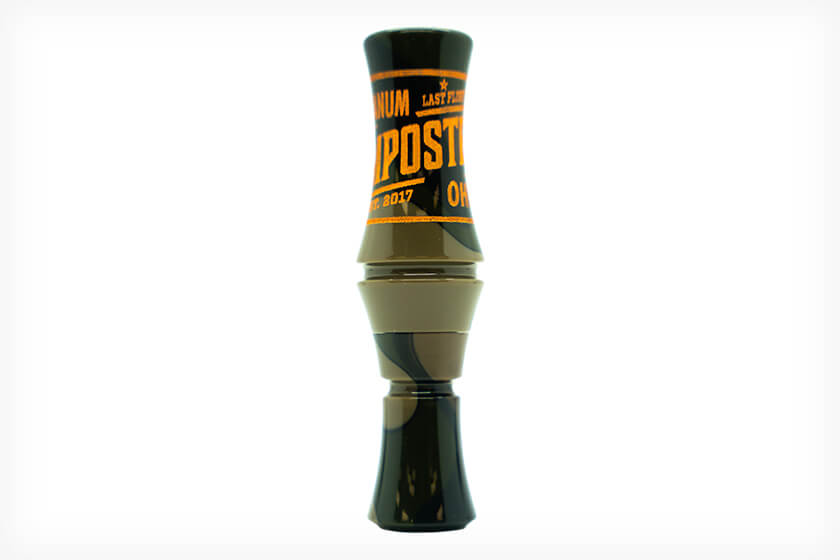
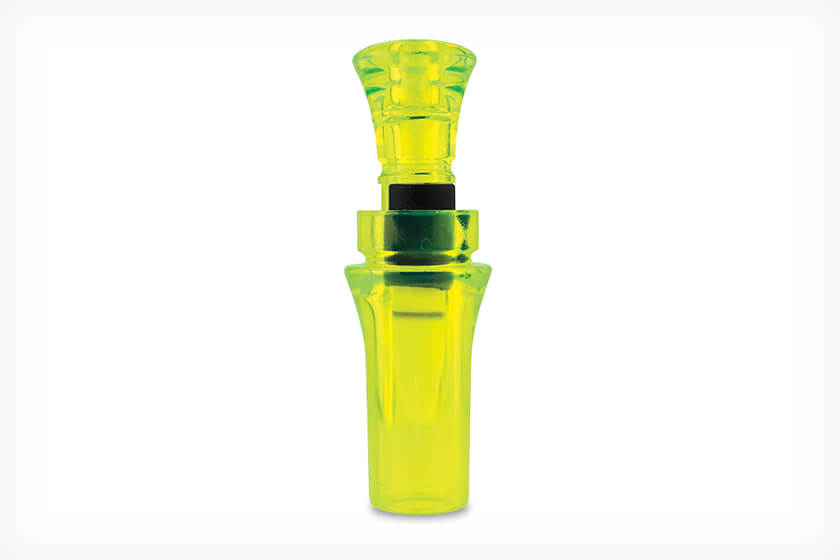
Last Flight Calls – Imposter

last Flight Calls Imposter duck call

We all know that the decoys are pieces of the puzzle when waterfowl hunting, but to finish the puzzle, the Imposter duck call turns those fakes into the real thing. The Imposter duck call is Last Flight’s double-reed call and the newest in their line. Slightly quieter than its big brother the Illusion, don’t let this double-reed fool you, it can still get loud when you need it to. While the Imposter can cover the full range of duck sounds required to finish them tight, where it excels is in its ability to get nasty in the low-end ranges perfect for sweet talking in tight holes or the timber. Duck-worthy features include an O-ring fit insert, .410” exhaust bore, and a medium hold. It is available in acrylic, Delrin, and a hunter series all varying in price, hunter’s choice.

$120 Acrylic | lastflightcalls.net

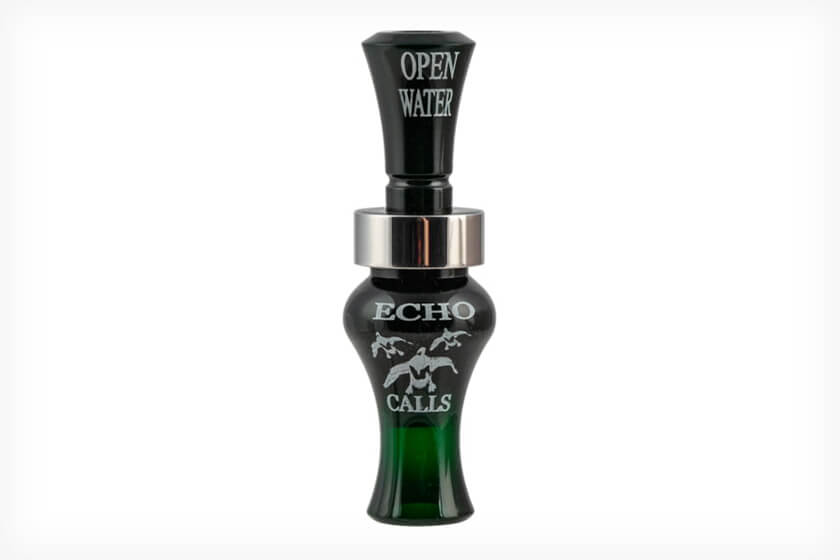
Echo Calls – Open Water

Echo Calls Open Water duck call

Echo’s open water duck call is simply a classic waterfowl call that every waterfowler either has, or will own at one point. Yes, it is that good and functional. While the name implies that it should be used on big water, no surprise there, don’t let the name fool you. While the Open Water is at home on big water or open fields, it can also perform dual-purpose, with a little user finesse, on small water and in tight quarters when you need it to. Sure, if you need to ring out an ear-ringing hail call, it can certainly up the decibels, but it can also get soft and ducky when the birds get close. It is available in both acrylic and in Bois D’ Arc, bocote, and cocobolo wood configurations.

$140 Acrylic | echocalls.com

Duck Commander – The Flash

Duck Commander Flash duck call

Price isn’t the only indicator of awesome, and the Duck Commander Flash proves that statement correct. Singing a smooth, silky tone that the greenheads can’t resist, the Flash can go from soft to loud in well, a flash! It utilizes Jase’s Pro series modified reed system to resist sticking like the water rolling off a duck’s back and has a double-reed design that uses the air pressure of most single reeds. It is extremely easy to blow, but also serves novices and professional callers by being able to produce the full range of duck-worthy sounds. Just when you thought it couldn’t get any better, it has a short barrel for easier hand manipulation for those of us that don’t have the hand size of an offensive lineman. Oh, and if you want it personalized, Duck Commander can engrave 15 characters for that special occasion.

$35 | duckcommander.com

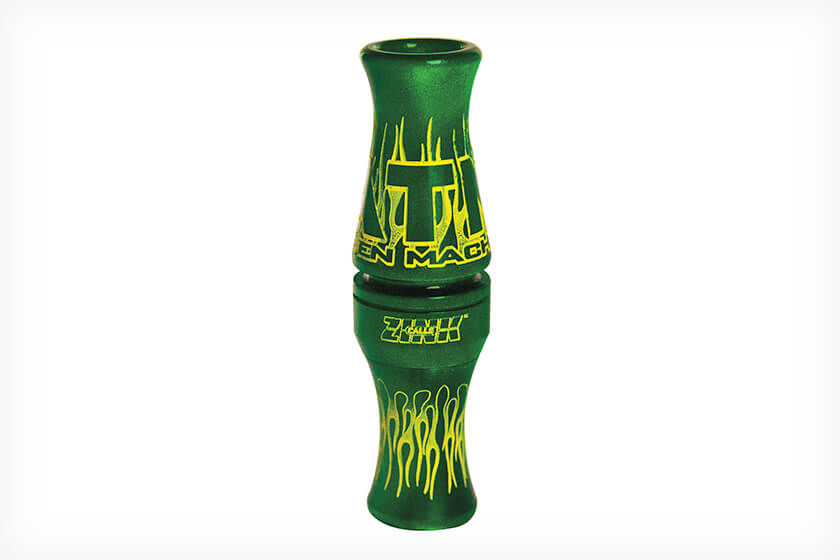
Zink Calls – ATM Green Machine

Zink Calls ATM Green Machine duck call

When you think about an ATM, you automatically think about collecting money, am I right? Well, instead of greenbacks, Zink’s ATM Green Machine was designed to allow hunters to cash in on their favorite green, green-headed mallards that is. Using a double reed design and featuring the smooth, hen mallard sound callers want, the ATM provides greater volume and a radically improved bottom-end feed chuckle to suck them into range. This innovative call features Zink’s Z-cut, no-stick tone channel—a ground-breaking design that permits a huge range of tones while virtually eliminating reed lock, even for heavy spitters. Each call is hand-tuned and ready to rock right out of the box so, if you are looking to cash in, put the ATM on your lanyard, no transaction fees required!

$150 | zinkcalls.com

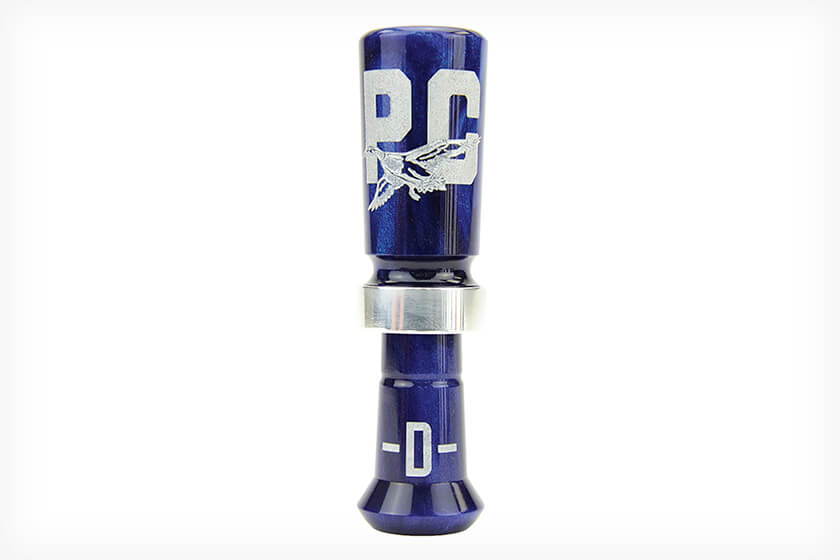
Pacific Calls – PCD

Pacific Calls PCD duck call

The PCD duck call from Pacific Calls is their loudest, most aggressive duck call they have ever built. Simply put, if you need to break them down from stratosphere, this call will hit them at the moon, at least, maybe further, they are still waiting for the sound to rebound. The PCD is lean, mean and ready to both break them down and finish them in the hole for your viewing pleasure. While it creates high hails like a thing of beauty, it is also at home creating those messy feeds and snotty, raspy hen sounds that the ducks eat up when they get close. Versatile is an understatement for describing the PCD, and if I had to create my own description for the PCD acronym, I would say it stands for Pure Chronic Duck.

$130 | pacificcustomcalls.com

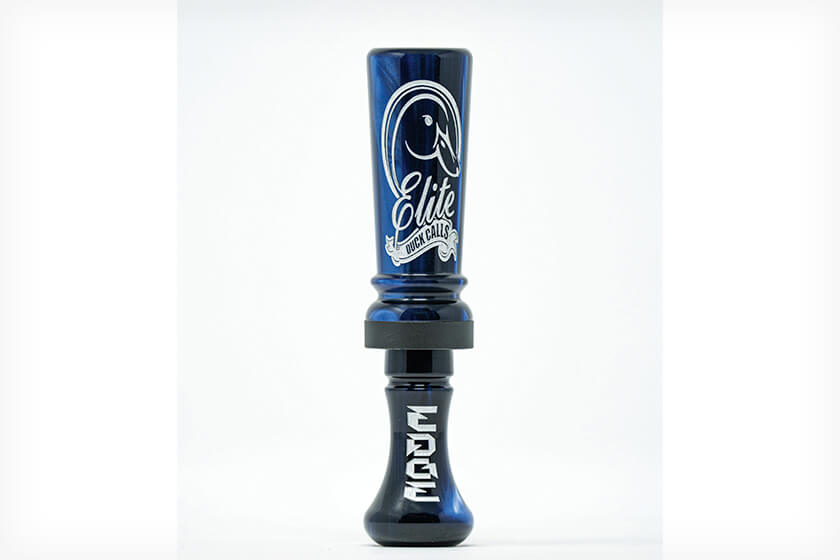
Elite Duck Calls – Edge

Elite Duck Calls Edge

As classy as it is pure duck, Elite Calls Edge duck call not only looks good on the lanyard, it produces the guttural sounds that ducks can’t resist. The Elite Edge is a double reed call that combines great volume and range with ease of operation. The Edge has a deeper tone and is raspier than other double reed calls, creating classic ducky sounds usually only found in single reed calls. While many hunters still covet single reeds for their unique tone, the Edge looks to change the game by bringing single reed sound to an easy blowing double-reed. If you are looking for a unique color combination to mix it up on your lanyard, check out the ice/black variation for some real eye appeal and get ducking.

$140 | elitecalls.net

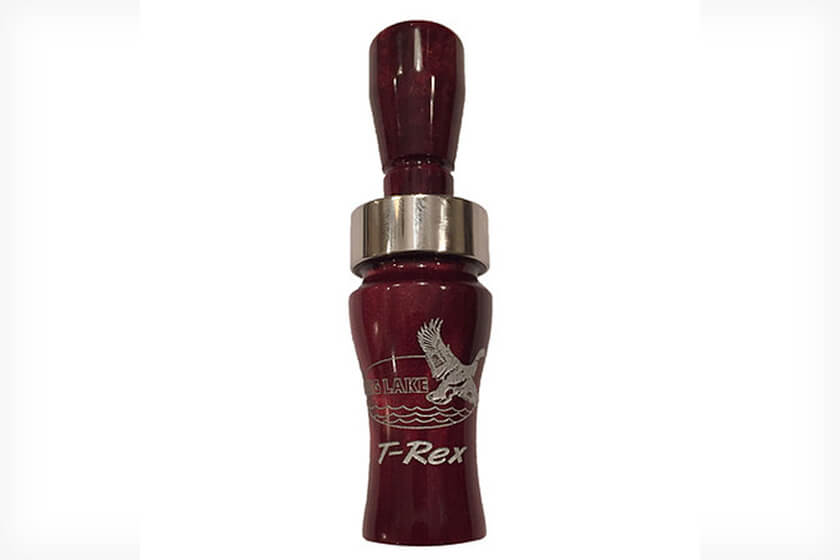
Big Lake Outdoors Products – T-Rex

Big Lake Calls T-Rex duck call

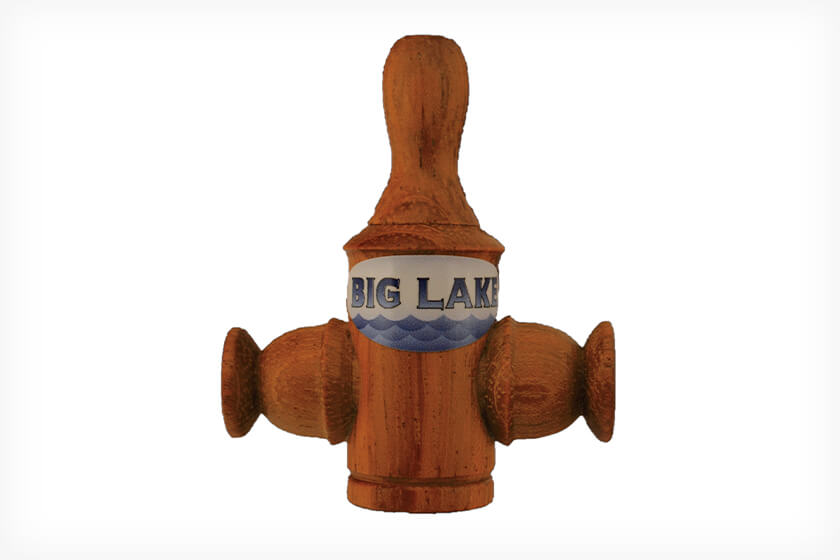
The T-Rex offers a unique approach to the typical duck call. Big Lake Outdoor Products adds both a metal and a mylar reed in the T-Rex call. This produces the ease of calling that is so well liked in a double reed. But the metal reed produces exceptional raspiness. The T-Rex is built on an open water insert that also allows more air volume. So unlike most double reeds, the T-Rex produces amplified calling characteristics.

$110 Acrylic, $50 Dymond wood | biglakeoutdoorproducts.com

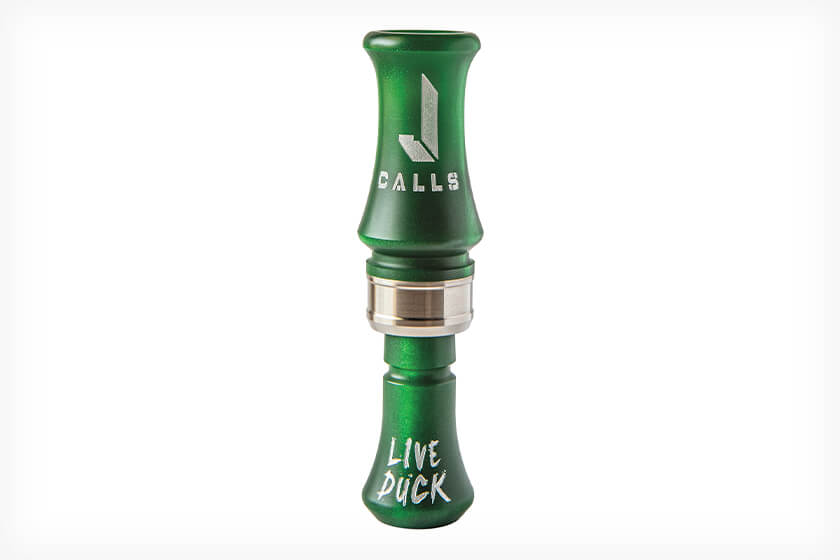
Jargon Game Calls – Live Duck

Jargon Game Calls Live Duck

Jargon’s Live Duck wasn’t designed for the stage, per say, but it was designed to replicate the real thing, hence the name. The Live Duck can articulate the complete vocabulary of the hen mallard, from the softest scratchy quacks to those loud, nasally quacks that separates the women from the girls. It features a large exhaust port with great hold that blends in a perfect amount of back pressure into every call. These features make the call extremely easy to blow but still allow for advanced note articulation by both novice and professional callers alike. If you need a call for hunting the gamut of waterfowl scenarios, or need one to refine your live duck style contest calling skills, JARGON’s Live Duck may just fit the bill, pun intended. This call will not disappoint you.

$140 | jargongamecalls.com

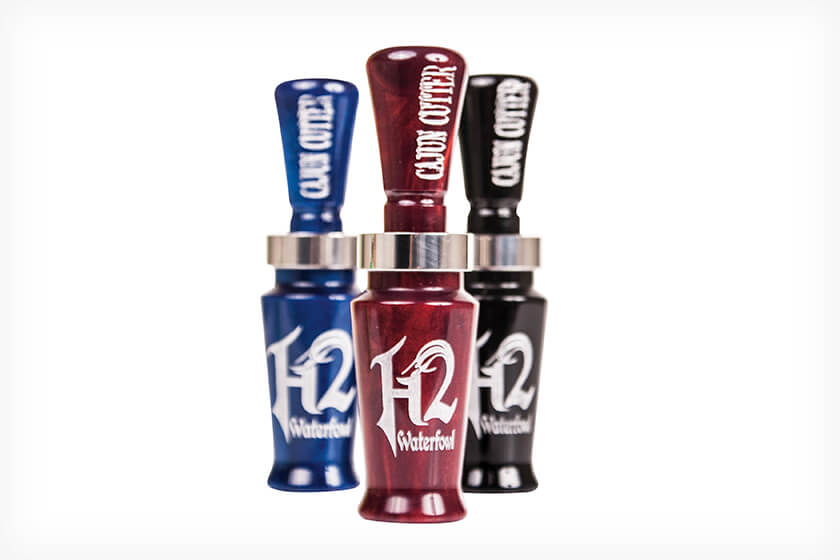
Haydel’s Game Calls – H2CC Cajun Cutter

Haydel

Saying that Haydel’s re-invented the Cajun Cutter with their new H2CC variant would be an understatement. Instead, let’s just say that the H2CC puts a new look on a classic, making the attributes of the original not only better, but more versatile. Staring with a J-frame, the acrylic H2CC features a polished steel band and is tuned with maximum hunter versatility in mind. It is offered in both single and double reed configurations and has a small exhaust hole to allow easy control, producing a great natural tone that will produce the fabled Cajun Cutter “squeals.” It is designed and tuned to be lights out on the finesse side and ideal for callers looking to bend those notes to entice those call shy birds. The H2CC is just plain ducky, for hunters who are into that that of thing.

$140 | haydels.com

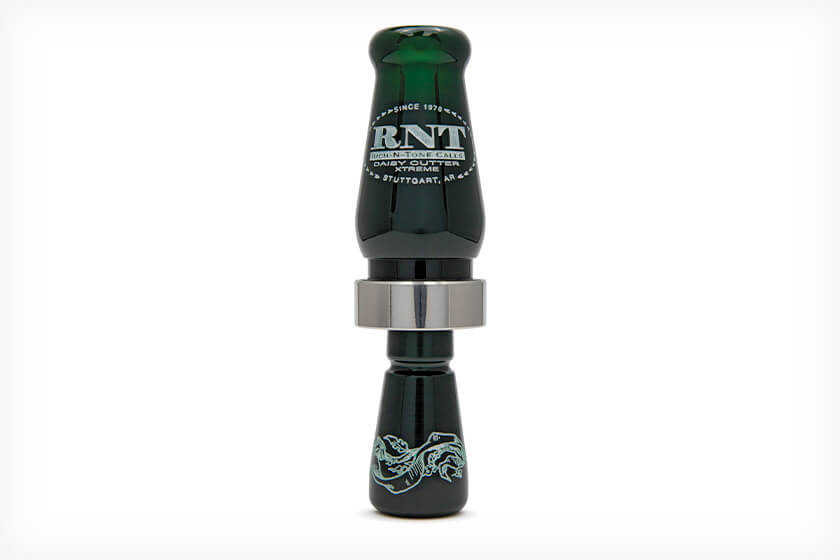
RNT – Daisy Cutter Xtreme

RNT Calls Daisy Cutter Extreme duck call

You know these guys. Rich-N-Tone’s original Daisy Cutter duck call, simply put, is a classic that likely every waterfowl hunter surely knows by name. The Daisy Cutter Xtreme, or DCX for short, is simply a higher-octane version of its predecessor that is still capable of producing those sweet hen sounds that gets the mallard drakes drooling. By modifying the original Daisy Cutter’s design, RNT slightly turned up the volume and enhanced its aggressive nature while maintaining a perfect balance of backpressure all while pushing the calls rasp to an Xtreme jaw jarring new level. If you like raspy, this one has enough rasp for you, your neighbor, and the guy two streets over! It is available in both acrylic and cocobolo or grandillo wood versions, all sure to sweet-talk those greenheads into range.

$145 Acrylic | rntcalls.com

DJ Calls – LLC Cut-Down Kit

DJ Calls LLC Cut-Down kit

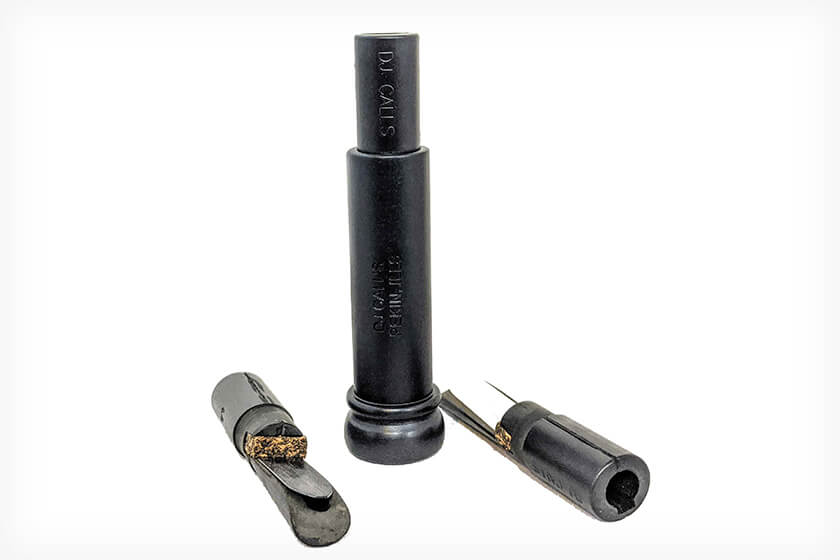
Don’t cut down your classic Olt duck call! Instead check out DJ Calls Cutdown Kit. Their Cutdown Kit is a blasted black acrylic barrel with three different tonals, each cut differently. The tonals are made of hard rubber, just like the original Olts used to have back when they made their hard rubber keyholes. Like the Olts, DJ Calls also has the keyhole, for maximum versatility. The three tonal cuts include: Arkansas, Louisiana, and Quincy styles with .015” reed thickness on the Arkansas and Louisiana and a .020” tapered shave on the Quincy. Consequently, the Quincy is slightly harder to blow, but this is the original cutdown call design. While the blasted black acrylic replicates the original to a “T”, DJ Calls also has other variants to spice things up.

$180 | djcalls.com

Big Lake Outdoors Products – Pintail Passion

Big Lake Calls Pintail Passion

Pintails are one of the most alluring of all duck species and special attention to quality and sound is deserved with a pintail whistle. Big Lake Outdoor Products offers the well-known “Maurilio” whistles that provide exceptional sounds. The Pintail Passion has a roller ball that produces the beautiful trills and peeps of pintails and wigeon. This jatobe wood call has two ports that allow you to alter the sound from high-to-low to mimic more than one duck.

$40 | biglakeoutdoorproducts.com

Wingert’s Wood-Works – Duck Whistle

Wingert

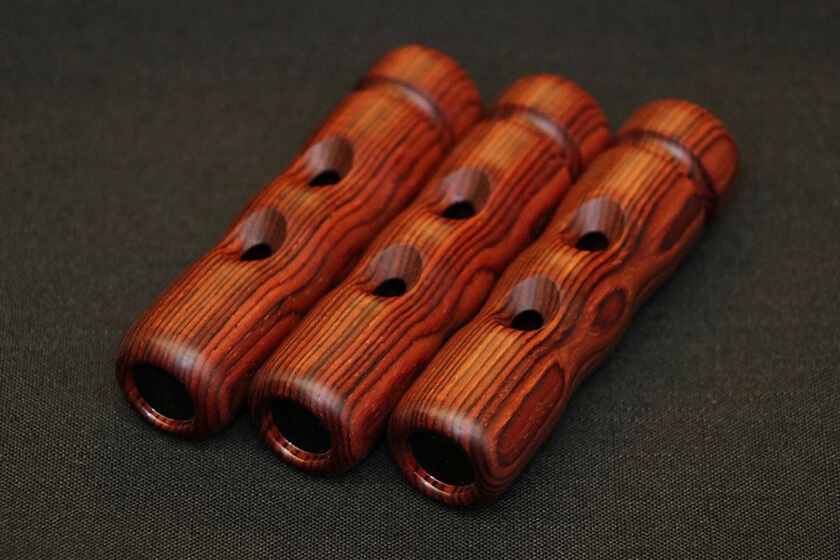
They don’t have contests for duck whistles, but they probably should. Truly custom pieces of duck art, each Wingert’s call is one part hunting function and one part conversation piece. Duck whistles are the most underrated calls on a hunter’s lanyard, and not just for hunting pintails or wigeon, but every species. If you don’t already own one, you are truly missing out on a game-changing apparatus for your lanyard. This is where Wingert’s comes in. Their whistles are available in wood, acrylic, and many other variations including stabilized spalted wood and burls and even micarta. While they all serve the same purpose, you are definitely missing out of you don’t go with one of the more custom and unique choices, as these calls are heirloom quality and do not disappoint. And hey, GQ fashion in a duck blind is a thing, isn’t it?

$75 | wingertswoodworks.com

South Dakota Pheasant Hunting

0

Never been to South Dakota pheasant hunting? You might not know what you are missing.

That was the case with me. Having hunted only in Minnesota and Iowa from 1979-1999 I enjoyed the pheasant hunting that the land afforded me and my hunting partners for years.

Being passionate about habitat and wanting to really affect my hunting outcomes and experiences I began looking for pheasant hunting land to purchase, develop and enjoy. I started in Iowa and through several contacts came across a realtor in Iowa who had some land for sale in Iowa but also South Dakota. I had never hunted pheasants in South Dakota but always assumed it was about as good as Iowa (which was way better than Minnesota at the time). After some discussion and persuasion by the realtor I figured I’d have to be stupid not to go out and at least look at the property.

Just driving out there, which was in the springtime, I could tell by how many birds were hanging around the roads that the bird numbers were good. Long story short is I ended up buying the acreage there and hunting/developing the property for pheasants, deer and turkey since 1999. Every opening weekend we harvest between 30-60 birds per day. I also heard stories around the state of parties of 20 hunters getting their 60 bird limit in as little as ½ hour. That’s more chaos than hunting I would venture but just the same – that’s what South Dakota wild pheasant hunting is capable of producing.

Pheasant Capital of the World? I think most hunters would agree. If you read most pheasant hunting outlooks and forecasts, such as Pheasants Forever or Outdoor News, you’ll find that the statistics again and again point to the South Dakota bird and harvest numbers as the reigning leader.

As recently as 2005, the pheasant population approached 10 million birds (1 40-year record). Number of birds harvested that year was nearly 2 million roosters (11.2 birds per hunter. 2 birds per person per day).

This quote from the Pheasants Forever website on the 2005 season sums it up:

“Overview: The 2005 pheasant hunting season was a year to remember across the upper Midwest. South Dakota maintained its hold as the “Pheasant Capital” with an estimated harvest of over 1.9 million roosters, a 40-year high. Iowa, North Dakota and Kansas all checked in with big 800,000 bird totals.”

South Dakota boasted a rooster harvest over twice as large as the next nearest competitors.

In addition to the native resource, South Dakota also reigns champ in the offerings of public hunting, free walk-in access to private land and a host of commercial fee hunting opportunities. In fact, it could possibly be that since South Dakota’s commercial pheasant hunting is so strong and established that Cabela’s in Mitchell can attract hunters from all 50 states in the union on South Dakota’s annual opening pheasant weekend.

Today the passionate upland bird hunter, thanks to the internet, has excellent access to whatever quality pheasant hunting package they desire. If it’s a pheasant hunting trip of a lifetime you desire, look no further than South Dakota. Whether you’re a budget minded do-it-yourselfer looking for the best public land hunt or Bo Jackson looking for that $5000/day experience you can find it. You’ll have to do a little research. But it’s time well spent.

What ever you do, get to South Dakota soon and experience “The State of Pheasant Hunting”.

Check Availability of UGUIDE South Dakota Pheasant Hunting Camps Here

Run Cost Scenarios of your groups pheasant hunting package here with our Trip Cost Calculator

What Do Slugs Taste Like? Do They Taste Good?

0

Humans are curious being, often intrigued to know about obscure things, including food that doesn’t fall under the conventional realm.

In this case, slugs may not be mainly known as a kitchen delicacy but have stirred interest among a specific section of the people.

However, is this shell-less mollusk edible or safe to eat? Unless you’re into unconventional foods, these questions are probably in your mind.

In this post, we’ll reveal what slugs taste like. Not only that, we’ll answer crucial aspects related to it.

Let’s get into it without further ado.

What are Slugs?

The term ‘slug’ refers to all forms of gastropod mollusks without a shell.

It’s also commonly known as a land slug.

Various kinds of this species are found across the globe, varying in shapes and sizes, but the external anatomy remains the same.

Like snails, it has tentacles on its head, giving sensory and optical senses.

Instead of a shell, it has a mantle covering the top of the head.

Although these species are categorized under the same class-Gastropoda, significant differences start from behavior to anatomy.

Water comprises half of the slugs’ bodies. These mollusks are found primarily on moist ground after heavy rain.

You’ll find them in the damp area under rocks, tree bark, and fallen logs during the dry season.

They have soft tissues which make them highly prone to desiccation due to the absence of an outer shell.

Hence, mucus generation is vital for this mollusk in order to survive.

What Do Slugs Taste Like?

Most people might be familiar with snails as part of kitchen delicacy compared to this shell-less mollusk.

However, some people consume slugs.

It may not be the aesthetically pleasing creature, and to have it may not be everyone’s cup of tea.

That said, unconventional food like this tends to have divided opinions.

Some people like it, while others may not. It also mainly depends on how you prepare it.

The texture is rubbery, and its outer body is quite slimy.

The taste of a slug would be best described as mild, closely similar to snails.

It also largely depends on the ingredients and the preparation process involved.

Because of the presence of mucus, it has a hint of bitterness.

In this case, proper cleaning is required before you proceed with the cooking.

Not many are enthusiastic about eating slugs, which is understandable.

However, some people relish this mollusk. Regardless, it has high nutritional value.

It’s a good source of protein and minerals and also has a high caloric value.

Cleaning these critters is crucial if you plan to have them.

Since they’re scavengers, they may carry parasites that might cause a potential health risk.

Once cleaned, you may prepare it any way you want, from stir-frying to backwoods boil.

We suggest using richly-flavored ingredients since it has a mild taste.

Want to know how to prepare these critters? Keep reading below.

How to Prepare and Eat Slugs?

Since slugs are scavengers, thorough cleaning is to prevent potentially life-threatening diseases.

They’re considered safe but come with a caveat.

If you plan on having these critters, putting them in a container filled with damp cornmeal for a day or two is highly advisable.

Or, put it in wet lettuce, and let them purge.

Once done with toxic cleansing elements, proceed with your culinary adventure.

Some of the ways to have these shell-less mollusks are as follows:

  • Stir-fry slug.

Stir-frying these critters is one of the best ways to relish their taste.

First, you need to blanch slugs in boiling water and then slice them.

Take a wok or skillet to stir-fry along with vegetables.

Add soy sauce to enhance the taste further.

  • Slug pasta.

Give your pasta a new taste by adding these critters.

Stir-fry them in butter first, and then add the pasta sauce.

Let it cook under low-medium heat for ten minutes.

Fold cooked pasta in the mix and then serve it.

  • Deep-fried slugs.

Another great way to enjoy these mollusks is by deep-frying them.

Preparing this way will be an excellent introduction to slugs if it’s your first time.

First, you need to boil them in hot water for two minutes.

After this, immerse them in egg and then rub them in bread crumbs.

Deep fry them like how you do with fried chicken. Fry until it’s golden brown.

Conclusion

Slugs may not be the most pleasant-looking creature, but they are essential to our ecosystem.

Consumption of these critters is a personal choice but comes with a caveat.

Although it’s considered safe to eat, it’s prone to carry parasites that may pose a potential health risk.

If you plan to have it, ensure it’s adequately cleaned and thoroughly cooked.

Avoid raw slugs since they’re scavengers and are likely to have toxic elements.

About The Author

Hunting Slang 102

0

You’re all brushed up on hunting lingo 101 and gun lingo 101, so let’s take it to the next level. Welcome to Hunting Slang 102.

Hunting slang is a less-than-official language that can vary by state or by region, but nonetheless, all hunters and their communities throw around terms and colloquialisms that you probably didn’t hear in your hunter safety course. Admittedly, some hunters are more crude in their slang, but they all have the same intention: to just have fun and make memories while embarking on one of the most natural journeys in the wild.

This list may not be comprehensive, but there’s plenty to add to your personal vernacular.

Game Slang:

Freezer Queen (synonyms: Old Long Nose, Slick Head, Baldy) — A female deer, typically big or old. These are worth shooting because they will fill up the freezer for plenty of dinners.

Speed Goat (synonym: Loper) — A pronghorn antelope, usually called just “antelope.” They are not actually part of the goat family, but they are the fastest. A pronghorn also isn’t technically an antelope, but they are distant relatives. A giraffe is a pronghorn antelope’s closest relative (who would’ve known?).

Dandy (synonyms: Toad, Shooter, Swamp Donkey, Pig) — A really nice male deer, typically big bodied or with a nice set of antlers and old or smart. You’ll be telling stories about this deer for a long time.

Button Buck (synonyms: Nub Buck, Nubby) — A young male deer with antlers that aren’t yet grown in. Their meat is usually tender and good eating, so depending on your goals as a hunter these could result in a successful hunt.

Mulies — Nickname for a mule deer which are typically found in the United States west of the Missouri River. They have a distinctly white behind, thick bodies, large tall ears similar to mule ears, and mature bucks have longer antler tines than whitetail deer.

Whiteys — Nickname for a whitetail deer, which are marked by their white fluffy fur on the bottom side of their tails. Whitetails can be found nearly anywhere in the U.S. except the Southwest, most of Alaska and Hawaii.

Huns — Nickname for Hungarian partridge, which are also known as gray partridge or English partridge, and have a mostly gray body and chest with some orange and cinnamon stripes throughout their feathering. They are a game bird weighing a little over a pound in the same family as pheasants and are typically found in the north central part of the U.S. Excellent eating if you can shoot one after it flushes, or flies, out of its hiding place.

Sharpies — Nickname for Sharptail Grouse

Spike — Any deer that has just one antler spike on both sides of their head, like two spikes (not to be confused with a unicorn, which only has one spike).

Fork Any deer that has antlers that branch out on either side of their head, resulting in a total of four points.

Gobbler (synonyms: Thunder Chicken, Boss Tom, Hammerhead, Red Head) — A male turkey, can be any of the types of turkeys like Merriams, Eastern, Rio Grande or Gould’s. The thundering and hammering referred to in the other nicknames come from the sound the male turkey makes during their mating dance, where they use their wings to beat the ground. They also make a sound like a gobble and the blood rushes to their head when they are excited, causing a red head.

Tree Rat — Quite simply—a squirrel! These can be either gray, red, black, or white, with white being very rare. Though they have a very fluffy long tail, they squeak, run and hide similar to rats.

Yote — A nickname for a coyote of any type, which are smaller than a wolf, but furry with a skinny snout and gray, brown, tan, white and black coloring. They can be found in nearly every state in the U.S. except Hawaii.

Dabblers — This term refers to waterfowl that eat by “dabbling” their heads underwater and keeping their butts above water. Types include the famous mallards, teal and wood ducks, as well as pintails and gadwalls. Coloring for each type ranges from grays to blacks, green, blue, brown and some orange tints.

Divers — Unlike dabblers that stay near the surface of the water, divers actually dive underwater to eat and find fish. These can include canvasbacks, scaup, Mergansers, and redheads.

Technical Slang:

BBD — Abbreviation for “Big Buck Down.” This phrase is used appropriately when a big buck has been shot and believed to be expired. A hunter would usually say this in extreme excitement.

Skunked — No, no real skunks involved here. If you have been hunting for quite a while and come home at the end of the day with no sign of your target animals or an opportunity to harvest, you’ve been “skunked” or unsuccessful.

Winded — It may be tempting to think “out of breath” on this one, but it actually means an animal smelled your scent through the wind, and basically implies you spooked them.

Busted — Similar to getting busted as a human caught red-handed, here an animal has spotted you in their natural territory, causing you to lose a decent opportunity.

Dirt Nap — One of my favorite slang phrases, this one refers to what happens when that animal goes down after a kill shot.

Flagging — Whitetail deer are known for doing this. If they are spooked or warning their fellow deer mates, their tail will perk up and the white undersides of their tails shake like a flag. This usually means you are close to blowing an opportunity to get closer or have already blown it.

Rattling — A fairly typical practice for deer or antlered animal hunting, this is when a hunter uses a pair of antler sheds or manufactured antlers to rattle together for attracting animals. Rattling imitates the sounds antlers make when two male antlered animals fight each other, typically during the rutting season or breeding season.

Bag — A bag is another word for a harvest limit, or however many animals you’re allotted to kill. Waterfowl and bird hunters usually use this term, and may or may not carry their game home in a bag.

Bagged Out or Tagged Out — This is when you’ve officially reached your harvest limit. The phrase “bagged out” is usually used in bird hunting while “tagged out” is usually used for four-legged animal hunting.

Buck Fever — Ah, yes. Good ol’ “buck fever.” Buck fever is a phenomenon that many enthusiastic hunters experience. When seeing a buck in the wild, especially one within the kill zone, a hunter may feel shaky knees, quickened heart rate, inconsistent breathing, sweaty palms, and frozen muscles. Adrenaline is to blame.

Smoke Pole — A nickname for a muzzleloader, a long-barreled gun that produces smoke when shot, due to the gunpowder that ignites when triggered.

Dope — No, not that kind of dope. Here we’re referring to urine of a female deer, or doe, that is in heat which is used in the hunt for a buck. It is found in the form of liquid within a bottle and can be sprayed or soaked on a wick, which can be hung on a tree limb. Place this in an effective spot and the scent will attract bucks during the rut.

The Rut — I’ve referenced this term a few times already, so I’ve saved the best for last. This is one of the ultimate times to hunt antlered deer. During this period of a hunting season, females are “in heat,” or preparing to be bred, and bucks are on the hunt to do the breeding. You interrupt the buck’s one-track-mindset and behavior during this period and voila, the perfect opportunity to harvest a beautiful buck is upon you.

Is Magnet Fishing Legal In California?

0

Magnet fishing in California is a bit of a grey area. There is no specific law against it, but there are laws against trespassing and littering that could be applied. So technically, magnet fishing is illegal in California if you’re doing it on private property or leaving behind trash. But if you’re careful and respectful, you can magnet fish legally across the state.

Magnet fishing enthusiasts are all over California, including in San Diego, Santa Barbara, and Los Angeles. Here are some of the main rules to follow on magnet fishing in California:

Is magnet fishing legal in California?

Affecting ecosystems:

Make sure you are always picking up your trash and any found debris from magnet fishing. Leaving behind trash or debris is littering and illegal in California. You could face serious fines for leaving trash in public areas if caught.

Also, be mindful of the ecosystem you’re in. If you’re fishing in a river or lake, you could disturb the natural habitat and harm the wildlife. Check local regulations before magnet fishing in any body of water.

Trespassing:

You can only magnet fish on the property you have permission to be on. This means no trespassing onto private property or closed-off areas. You could be fined or arrested for trespassing if you don’t have permission. Violating California law for trespassing can often carry fines of $400 or more, which is not worth the risk.

Metal detector use:

In certain areas, such as San Francisco bay, it is illegal to use a metal detector or magnet fishing equipment. This is because of the sensitive ecosystem and the potential to disturb cultural resources that are located underwater. This is a clearly posted area, and if you see signs that prohibit fishing or the use of metal detectors, it is likely an area that prohibits magnet fishing as well.

The best spots to legally magnet fish in California:

There are many spots in California that are perfect for magnet fishing, as long as you follow the rules. Here are some areas that people are flocking to for magnet fishing:

The LA river:

The LA river has many spots with bridge access and waterways that pass under highways, making it perfect for magnet fishing. However, check for signs prohibiting magnet fishing or trespassing before you start, as there are sections of the LA river that are not accessible to the public.

Legg Lake:

Legg lake is a great place to find old coins, as it is a very popular spot for fishing. This lake is located in South El Monte, CA, and is open to the public for magnet fishing.

Berkeley Marina:

Although it is part of the San Francisco bay area, the Berkeley Marina is a great spot for magnet fishing. There is public access to the water and plenty of areas to fish from the pier. This is an area that does not prohibit magnet fishing as long as you follow the rules.

Marina Del Rey:

One of the largest man made marinas in the United States. There is public access to the water and lots of parks along the channel/waterways This is also an area that does not prohibit magnet fishing as long as you follow the rules.

Common items found in Magnet fishing throughout California:

Magnet fishing in California can be a lot of fun, especially in areas that are commonly used by tourists and locals. Some of the most common items found when magnet fishing in California are:

  • Old coins
  • Buckets
  • Tools
  • Knives
  • Wedding rings

Rings are common in swimming and fishing areas, and you can often take them to the police to be returned to their owners.

If you find any cultural artifacts, such as old coins or tools, it is best to leave them in place and notify the authorities. These items could be part of California’s history and should be preserved. You should also contact authorities should you find any firearms or other weapons, as these could be dangerous.

Overall, magnet fishing is a great way to spend some time outdoors, and you can even find some valuable items. Just make sure to follow the rules and regulations in place to avoid getting fined or arrested. With a little research, you can find the perfect spot for magnet fishing in California.

Voting From the Rooftops – Section One: The Capability of the 50 Caliber Sniper Rifle

0

“The advantages are obvious when you consider that many of the same targets of rocket and mortar fire can be neutralized with M33 ball, API M8 or Multipurpose ammunition.”

—”Heavy Firepower for Light Infantry,” Barrett Firearms Manufacturing, Inc. brochure advertising its Model 82A1 50 caliber sniper rifle18

The 50 caliber sniper rifles proliferating on today’s civilian market are coveted by Osama bin Laden’s Al Qaeda and other international terrorist organizations because the cartridge they fire offers a devastating combination of range and power. This section explains why the .50BMG round can slice through body armor like a knife through warm butter, knock down hovering helicopters, rip up armored limousines, destroy radar dishes, and ignite bulk fuel tanks—all at the length of 10 football fields.19 Here is the summary of the round’s merits by an enthusiastic essayist in the authoritative journal The Small Arms Review:

The fifty caliber’s ability to be deployed by one individual and give that person the capability of discretely engaging a target at ranges of over one mile away are definitely alluring from a tactical standpoint. While the .50 cal sometimes seems to be exaggerated, it is hard to imagine a round that at ranges of over a mile and a half away, has more kinetic energy than a .44 Magnum, and has unbeatable penetration as well.20

The trained operator of a 50 caliber sniper rifle like the Barrett M82A1 has the choice of accurately hitting a long range target at 1,800 meters (1,969 yards) away,21 blasting through two inches of solid concrete at the shorter range of 200 meters (219 yards),22 or destroying a spectrum of personnel and material targets at other ranges.23 These choices—the balance of extremely long-range and enormous striking power—are enhanced when specially designed “match,” “armor piercing,” or “armor piercing incendiary” ammunition is used.

To appreciate the threat of the 50 caliber sniper rifle, it is necessary to consider its extended accurate range, its exceptional power, and the extraordinarily destructive characteristics of special 50 caliber military ammunition widely available on the civilian market.

Extended Range and Accuracy

Apologists for the unrestricted sale of 50 caliber sniper rifles to civilians often downplay the sniper rifle’s long range accuracy. But the evidence from manufacturer advertising, military manuals, expert writing, and civilian owners themselves is that the 50 caliber rifles are accurate at ranges of at least 1,000 yards, and in the hands of a patiently trained and well-practiced marksman, nearly 2,000 yards. It is sobering to think of what Al Qaeda or other terrorists who have these sniper rifles can do with them from a distance of 20 football fields, especially given the planning and training of the terrorists that attacked the World Trade Center and the Pentagon on September 11, 2001.

The great mass of its bullet and the large size of the case into which the bullet is loaded give the 50 caliber round its deadly reach. Taken together, these result in much higher momentum than lesser rounds, such as the 30 caliber rounds of most other military sniper rifles.d The staff columnist of Very High Power Magazine, published by the Fifty Caliber Shooter’s Association—a tiny organization of competitive shooters vociferous in its defense of the unrestrained civilian sale of 50 caliber sniper rifles—summarized this point in an article comparing the 50 caliber to the 7.76 NATO (.308 Winchester) “its next, closest, US military competitor” as follows:

For military users, the .50 BMG caliber cartridge offers a significantly larger payload volume over the .30 calibers. Also, with the speed and weight of the .50 projectile, muzzle energy is outstanding for a small arms caliber. This translates into a longer range bullet that can still deliver a punch.

Fifty Caliber Sniper Rifles Are Used by Armed Forces Worldwide

This Swedish soldier takes aim with a Barrett M82A1 50 Caliber sniper rifle. According to Forbes magazine, a sale to the Swedish army in 1989 was Barrett’s first government contract. How long a range? According to the U.S. Army, the 50 caliber rifle more than doubles the range of the sniper over the .308 round:

The typical range for a sniper attack is 300 to 600 meters with medium-caliber rifles. Shots from 800 to 1,000 meters are the exception. However, heavy sniper rifles (.50-caliber, 12.7-mm, 14.5-mm, and 15-mm) with ranges of 1,200 to 1,500 meters are now proliferating around the world.25

Manufacturers of 50 caliber sniper rifles also claim accuracy at these and even greater ranges. “With confirmed hits out to 1800 meters, the Barrett model 82A1 is battle proven,” Barrett Firearms states in its promotional brochure.26In fact, U.S. forces using Barrett M82A1s routinely engaged Iraqi forces out to a range of 1,600 meters (1,750 yards) during the 1991 Gulf War.27 For readers familiar with Washington, DC, this is roughly the distance from the Smithsonian Institute Metro stop to the West Front of the Capitol, where inaugural ceremonies are held. Another manufacturer, Aurora Tactical, says that its Model 650 Special Light Anti-Materiel Rifle (SLAMR) “enables a skilled marksman to deliver exceptionally accurate fire on targets in excess of 1500 yards.”28

These ranges, in the vicinity of one mile, are at the outer limits of what may be expected from a skilled marksman. But they should not be dismissed as beyond the reach of dedicated terrorists like Al Qaeda, especially given the civilian training available and discussed in Section Four. In fact, some expert observers consider the 1000 yard range—the equivalent of 10 football fields end to end—to be comfortably within the grasp of the serious shooter. For example, two publications reviewing the performance of a new entry into the 50 caliber market, the ArmaLite AR-50, addressed the range question. American Rifleman, the NRA’s official journal, said the .50 BMG is “ideally suited for precision target shooting at distances of 1000 yds. or more.”29 The Small Arms Review, dedicated to the arcana of military weaponry, said, “It turned out that hitting something at 1000 yards was not the challenge. The real challenge was finding a place to safely shoot at a target 1000 yards away.”30

Finally, advances in the design of 50 caliber rifles and ammunition alike have gradually improved the performance of expert shots at the 1,000 yard range. Thus, the diameter of the group of winning rounds fired in world record competitions steadily declined from 9.3125″ in 1986 to 2.6002″ in 1999.31

In short, the evidence is clear that the power of the 50 caliber sniper rifle in trained hands reaches from at least 1,000 to as far as 2,000 yards.

Destructive Power

It must always be kept in mind that the 50 caliber sniper rifle’s threat is not only a function of the long ranges described above, but a devil’s blend of long range and massive power. The operator will balance these two depending on the nature of the target. For example, IRA terrorists who assassinated British soldiers and Irish constables fired from ranges as short as 120 yards. The rounds the IRA snipers fired easily ripped through high grade military body armor worn by the soldiers, inflicting instantly mortal wounds.32 On the other hand, the longest confirmed kill in sniper history was achieved at a distance of 1.42 miles in Vietnam, by U.S. Marine Corps Gunnery Sergeant Carlos N. Hathcock. That feat is all the more impressive given that 50 caliber sniper rifles had not even yet been invented—Hathcock was firing single shots from a 50 caliber machine gun that he jury-rigged with a telescopic sight.33 The 50 caliber sniper rifles being sold to civilians today are much more sophisticated and finely made than Hathcock’s makeshift weapon.

Although the 50 caliber sniper rifle presents a dramatic assassination threat because of its extraordinarily long range, that threat must not blind us to the super gun’s power to destroy material targets. This destructive power is at least as serious a terrorist threat as assassination, and is more likely to cause mass casualties and widespread disruption to commerce and civic order. Here, for example, is Barrett’s description of the power of its Model M82A1:

This revolutionary .50 caliber semi-automatic rifle allows sophisticated targets to be destroyed or disabled by a single soldier. Armored personnel carriers, radar dishes, communications vehicles, aircraft and area denial submunitions are all vulnerable to the quick strike capability of the Barrett 82A1. With decisive force and without the need for the manpower and expense of mortar or rocket crews, forces can engage the opposition at distances far beyond the range of small arms fire….The 82A1’s light weight makes transportation as easy as walking….With night vision equipment, the weapon is even more effective under cover of darkness. The muzzle brake reduces felt recoil to no more than that of a 12 gauge shotgun….The advantages are obvious when you consider that many of the same targets for rocket and mortar fire can be neutralized with M33 ball, API M8 or Multipurpose ammunition.34

An excerpt from the U.S. Army’s manual on urban combat indicates that it agrees with Barrett’s assessment of the 50 caliber sniper rifle’s ability to destroy materiel targets:

These heavy sniper rifles were originally intended as anti materiel weapons for stand-off attack against high-value targets, such as radar control vans, missiles, parked aircraft, and bulk fuel and ammunition storage sites. Because of this, they are only marginally accurate enough for long-range shots against individual personnel. It is their ability to shoot through all but the heaviest shielding material, and their devastating effects, that make them valuable psychological weapons.35

How destructive can the 50 caliber sniper rifle be in the hands of an Al Qaeda terrorist? That depends on the ammunition—and the target.

Overview of 50 Caliber Ammunition

The U.S. military uses at least eight different types of .50BMG ammunition, each type designed for a specific use.36 There are also various brands of civilian ammunition, much of it designed and manufactured for long-range competitive shooting, and 50 caliber ammunition can be reloaded at home. Worldwide, at least 100 variants of 50 caliber ammunition are produced in more than 30 countries.37 All of these types of 50 caliber ammunition have one thing in common: they are extremely powerful. Even so, some varieties are much more destructive than others.

The ammunition that 50 caliber sniper rifles fire today was originally developed during the First World War as both an anti-tank and machine gun round.38 Developments in tank armor soon made tanks generally impervious to 50 caliber rounds,39 but according to the Marine Corps and other authorities, the 50 caliber can still blast through more lightly armored vehicles, such as armored personnel carriers, and thus clearly through armored limousines. “Size Matters”

Relative size of 30 caliber and 50 caliber rounds. Most military and police sniper rifles are in 30 caliber.

In fact, one of the reasons that the FBI requested that tanks be brought into the notorious and ultimately tragic siege of the Branch Davidian compound at Waco, Texas Size matterswas that the Davidians were armed with two Barrett 50 caliber sniper rifles.40 An Army general told officials that even the U.S. “Bradley fighting vehicles would be vulnerable to .50 caliber weapons.”41 It is clear that the presence of these super guns in civilian hands contributed to the escalation of force in the encounter. The implications for the security of high-profile dignitaries and others traveling in civilian armored cars, equally clear, are discussed in Section Three.

50 Caliber Ammunition Available on U.S. Civilian Market

The following review of four types of 50 caliber ammunition that are available to civilians in the United States—and thus easily available to foreign and domestic terrorists—describes the destruction the 50 caliber sniper rifle can inflict.

The availability of this ammunition in U.S. civilian markets is wholly aside from the fact that military ammunition stocks also can be procured from underground sources. Arms and ammunition—including such destructive items as M-16 assault rifles, machine guns, TNT, dynamite, plastic explosives, land mines, and hand grenades—are regularly stolen from U.S. military armories.42 Fifty caliber sniper rifles have proliferated in military forces around the world, and 50 caliber ammunition is made in more than 30 countries. Those foreign forces, including some that are less than friendly to the United States, have stocks of military ammunition that are available to any terrorist with the right connections. Arms and ammunition are also stolen from these foreign forces, friend and foe alike, sometimes on a staggering scale.43 Fifty caliber sniper rifles are also now finding their way into the arsenals of civilian police,44opening another potential channel for acquisition of the more exotic 50 caliber ammunition through theft45 or other leakage.46 As Jane’s Intelligence Review noted recently, “the hardest category of military exports to control is dual-use technology—technology that has both civilian or military applications.”47 This description snugly fits the 50 caliber military sniper rifles sold by Barrett and other manufacturers to armies and civilians alike.

Ball ammunition. The simplest and most common round of firearm ammunition is called “ball.” The U.S. Army says 50 caliber ball is used for training and against personnel and light materiel targets.48 Ball has less penetrating power than the specialized rounds discussed below. But the bullet’s power against material objects is nonetheless awesome, varying as in all cases with distance. Thus, the Army says that at the long range of 1,500 meters (1,640 yards), ball ammunition can penetrate one inch of concrete, six inches of sand, and 21 inches of clay.49 At the lesser range of 35 meters (38 yards), ball ammunition can penetrate an inch of armor plate and 16 inches of log wall.50

Of course, a bullet that can penetrate an inch of concrete from the distance of 16 football fields can do massive damage to any softer target (such as human beings or unarmored public utility fixtures) from that and lesser ranges. Moreover, Army tables cited in the paragraph above show that the effects of ball can be enhanced by repeated firing at the same target, a capability of the semi-automatic 50 caliber sniper rifles like the Barrett M82A1 and others.gThis thought is captured in the following quote from a noted expert author on sniping:

It’s the .50’s tremendous ability to penetrate bunkers and building that makes it so deadly….This means you can pulverize enemy positions and induce casualties without necessarily seeing an enemy soldier. When firing at positions, don’t be thrifty; riddle them with enough bullets to ensure damage.51

In lieu of such brute force, the 50 caliber sniper rifle’s performance can be substantially enhanced by the use of ammunition specially designed to destroy hard targets—ammunition that makes the rifles what expert Mark V. Lonsdale calls “a cost effective way to engage the enemy’s high-tech equipment, light skinned vehicles and aircraft, especially when compared to the cost of hitting the same targets with rocket or mortar fire.”52

Armor-piercing and incendiary ammunition. The Army says that the basic 50 caliber armor-piercing round is designed for use “against armored aircraft and lightly armored vehicles, concrete shelters, and other bullet-resisting targets.”53 The armor-piercing effect is achieved by the bullet’s design, which wraps a hardened core of a substance like manganese-molybdenum steel with a softer metal jacket.54 Incendiary ammunition is self-descriptive, used for “incendiary effect, especially against aircraft.”55 In other words, it sets things like airplanes, fuel, and other combustible materials on fire.h Tracer ammunition, familiar to the public from scenes of night combat, leaves a visible trail of incendiary light. Variant rounds combine armor-piercing, incendiary, and tracer effects.56

As the following table demonstrates, the capabilities of the 50 caliber sniper rifle is substantially enhanced by the use of basic armor-piercing ammunition.

50 Caliber Armor-Piercing Bullet Penetration

Material 200 Meters(219 Yards) 600 Meters(656 Yards) 1,500 Meters(1,640 Yards) Homogeneous Armor Plate 1.0″ 0.7″ 0.3″ Face-Hardened Armor Plate 0.9″ 0.5″ 0.2″ Clay 28″ 27″ 21″

According to expert John Plaster, armor-piercing rounds at the shorter range of 100 yards (one football field) can penetrate nine inches of concrete, 1.8 inches of unarmored steel, 3.5 inches of aluminum, and 96 inches of timber.57

Saboted Light Armor Penetrator (SLAP) Ammunition. Designers of anti-armor ammunition have long used the idea of replacing a given caliber gun’s projectile with a projectile of smaller diameter but more dense material. In order to seat the smaller projectile in the larger ammunition case, and to gain the necessary spin from the gun’s rifled barrel, the projectile is wrapped in a “sabot” or “shoe.” The shoe rides the length of the gun’s barrel, then drops away from the projectile when it exits the barrel. The much higher velocity of a “saboted” round enhances its armor-piercing performance.

The U.S. Marine Corps developed 50 caliber SLAP ammunition in the 1980s, and it was used in 1990 during the Gulf War’s Operation Desert Storm. It uses a .30 inch heavy metal (tungsten) penetrator in a plastic shoe, which is .50 inch in diameter. “Since the mass of the saboted penetrator is much lighter in weight than normal ball .50 caliber ammunition, SLAP’s velocity can be significantly and safely increased,” according to the Marine Corps. “This produces a very fast round with a very flat trajectory which enhances hit probability…and extends the light armor capability…significantly.”58

According to Winchester, the civilian contractor that developed the 50 caliber SLAP round, it delivers “superior and proven performance against lightly armored vehicles and armoured attack helicopters at ranges up to 1500 meters.”59

Components of “saboted light armor piercing” (SLAP) round

The 30 caliber bullet fits into 50 caliber case with plastic “sabot.” Sabot falls away after round exits the barrel of the gun.

A round that has “proven performance” against an armored attack helicopter at 1,600 yards is a clear threat to America in the hands of any terrorist group that, like Al Qaeda, has acquired the means to deliver it in the form of the Barrett 50 caliber sniper rifle.

Raufoss Multipurpose (Armor-piercing, explosive, incendiary) Ammunition. The crown jewel of 50 caliber sniper rifle ammunition is the Raufoss multi-purpose round, developed by a Norwegian company and manufactured under license by several companies, including Winchester. Said by experts to be the most popular round with U.S. military snipers,60 it was used to devastating effect by U.S. forces in the 1991 Gulf War.

Designated the MK211 by the U.S. military, the Raufoss round was described by Jane’s International Defense Review in 1994 as “the most influential development of the past decade” in 50 caliber ammunition.61 The round combines armor-piercing, explosive, and incendiary effects and uses a “highly effective pyrotechnically initiated fuze…[that] delays detonation of the main projectile charge until after initial target penetration—moving projectile fragmentation and damage effect inside the target for maximum anti-personnel and fire start effect.”62 According to its developer, Nordic Ammunition Company (NAMMO), the round can be used in “sniper rifles similar to Barrett M82A1,” has “the equivalent firing power of a 20 mm projectile to include such targets as helicopters, aircrafts (sic), light armour vehicles, ships and light fortifications,” and can ignite JP4 and JP8 military jet fuel.63 (The typical 20mm projectile to which NAMMO equates its 50 caliber Raufoss round is approximately .8 inch in diameter, thus more than half again as wide as the 50 caliber. It is used in anti-armor and anti-aircraft cannons, often with an explosive charge.64 The Vulcan 20mm cannon has been the standard internal gun armament of most U.S. combat aircraft—currently including F-14, F-16, and F/A-18—since the 1950s.65)

According to the Marine Corps, the Barrett “M82A1A…fires the .50-caliber RAUFOSS ammunition, which contains a tungsten penetrator and a more powerful explosive charge than the API ammunition….it has penetrated an inch of steel at 2000 yards.”66 Jane’s International Defense Review estimates that the round is “probably capable of disabling a man wearing body armor who is standing behind the wall of a house at 2,000m…. (and) can perforate the foundation of a high-rise building (20cm reinforced concrete) at 400m.”67 Reasonable persons probably would agree that blasting through 20 centimeters (7.87 inches) of reinforced concrete from four football field’s distance is an impressive performance.

The antipersonnel sniping potential of the Raufoss round—touted by both NAMMO and Winchester in their advertising material—inspired an unsuccessful attempt in 1998 by the International Committee of the Red Cross to have the round Raufoss Rounddeclared an “exploding bullet” banned under international law.68 The Raufoss Round—The Crown Jewel of 50 Caliber Ammunition

How the Raufoss 50 caliber multi-purpose round works. The armor-piercing bullet penetrates the armor. Then a delayed action fuze sets off the explosive part of round, producing fragmentation and incendiary (fire-starting) effects.

Availability of Specialized 50 Caliber Ammunition on U.S. Civilian Market

The implications of the potential uses to which a terrorist might put 50 caliber armor-piercing, incendiary, SLAP, or Raufoss ammunition can only be described as frightening. Yet all of these types of ammunition are available on the U.S. civilian market. SLAP is less frequently offered than ball, armor-piercing, and incendiary variants, and Raufoss is rarely offered publicly. Yet the VPC has documented public offerings and apparent sales of all the varieties discussed above in the civilian market (again, aside from leakage from military stocks worldwide).

Ball, armor-piercing, and armor-piercing incendiary are routinely sold through a variety of Internet web sites and mail order catalogs, and at least one site has also offered SLAP.69 In addition to these commercial outlets, armor-piercing and SLAP rounds have been offered for sale through at least one Internet gun auction site.70

Finally, SLAP and Raufoss have been offered for sale through postings on a popular 50 caliber Internet bulletin board.71 One correspondent on the board claimed to have “acquired some Winchester manufactured (real) SLAP ammo which was acquired from a Winchester rep for free.” If this is true, that incident marked a source of leakage that cut out the military middle man.

In sum, the most destructive types of ammunition for the 50 caliber sniper rifles are freely available in the U.S. domestic market—wholly aside from whatever leakage may exist from military sources, not only within the United States, but abroad, including from the armed forces of hostile, terrorist-supporting countries.

In the next section, we report on the hands into which 50 caliber sniper rifles have fallen, including Osama bin Laden’s Al Qaeda and other terrorists and criminals.

c) .50BMG is the technical designation of the round. The BMG stands for Browning machine gun, one of the earliest weapons using the round.

d) Generally speaking, modern ammunition consists of four parts, assembled into a unit called a “round” or “cartridge.” The components of the round are (1) the bullet, i.e., the actual projectile that the gun shoots; (2) the propellant charge, or gunpowder, which when ignited rapidly expands into a high pressure gas that expels the bullet out the barrel of the gun, (3) a “primer” which ignites when struck by a firing pin and in turn sets off the main charge of powder, and (4) a case or “shell” in which the powder, primer and bullet are assembled. Ammunition size is commonly expressed in terms of the approximate diameter of the bullet, measured either in inches (e.g., .50 BMG is roughly half an inch in diameter) or millimeters (e.g., 12.7 mm). Although the dimensions of 50 caliber rounds vary depending on the type (i.e. “ball,” “match,” “armor-piercing,” etc.), the typical 50 caliber bullet is .510″ in diameter by 2.27″ in length, the case is 3.9″ in length, and the overall length of the assembled round is 5.425″. (The overall length is somewhat shorter than the sum of the case and bullet because the bullet is “seated” within the case.) Dimensions from: Dean Michaelis, The Complete .50-Caliber Sniper Course: Hard-Target Interdiction (Paladin Press, Boulder, Colorado, 2000), p. 391; Ian V. Hogg, The World’s Sniping Rifles (Greenhill Books, London,1998), p. 123; Ian V. Hogg, The Greenhill Military Small Arms Data Book (Greenhill Books, London, 1999), p. 280.

e) Last February the FCSA’s president reported that it was “rapidly approaching 2600 members.” “From The President’s Bench,” downloaded from The Fifty Caliber Shooter’s Association Internet web site, http://www.fcsa.org on February 13, 2001.

f) It is not true, nor has the VPC ever claimed, that a 50 caliber round can penetrate the armor of a modern tank, despite occasional erroneous reports to that effect. What is true is that the 50 caliber can force tank crews to “button up,” and well-placed shots could destroy or degrade certain external equipment and vision blocks on some tanks. See, e.g., undated article “How to ‘Tickle a Tank,’” Soldier of Fortune, posted on Barrett Firearms Internet web site, downloaded from http://www.clickstudio.com/barrettmilitary/sof.htm on September 29, 2001. These, however, are generally military matters beyond the range of this report and the VPC’s interest.

g) Semi-automatic firearms typically have an ammunition magazine, popularly called a “clip.” They fire one round every time the trigger is pulled until the magazine is empty. The trigger of a semi-automatic firearm may be pulled rapidly, but it must be released between each round. This differs from the fully automatic weapon, or machine gun, which continues firing as long as the trigger is held down until the magazine is exhausted.

h) Fifty caliber sniper rifles have been banned from some public shooting ranges because of fires set by enthusiasts firing various types of incendiary rounds. See discussion in Section Four.

i) Source: John L. Plaster, The Ultimate Sniper: An Advanced Training Manual for Military & Police Snipers (Paladin Press, Boulder, Colorado, 1993), p. 221.

Back to Voting From the Rooftops Table of Contents

What Do Coyotes Sound Like? – Audio & Video Examples

0

All wild animals make special sounds for communication or any other purpose. The coyote is also a wild animal that covers very vast territory from Alaska to Central America. They also make a lot of sounds like yips, howls, and barks. You may have been familiar with these sounds through literature, art, and films even if you have not experienced them in the wilderness. Generally, coyotes are not very vocal animals like human beings. They are considered very quiet wild animals. They do most of their daily communications with the help of eye contact, body language, and very subtle facial expressions.

Coyote sounds might not have any definite language but it is easily readable by other family members and those people who have spent some time listening to these sounds. The sound usually comes out in the form of an emotional outburst. Most of the time the vocalization of the coyote is related to the family’s internal affairs as coyotes have very intense family lives. It is also very much known that the coyote makes a lot of noise or special kinds of sounds at night.

In this article, we are going to explain in detail what do coyotes sound like under different circumstances.

What do coyotes sound like?

Coyote makes a lot of sounds. You can hear these wild animals both day and nighttime in the wilderness. Sometimes people also intermix their sounds with other animals like foxes, dogs, owls, and wolves. Coyotes mainly make sounds for the sake of communication. The most prominent sounds they make are yipping, barking, howling, yelping, woofing, etc. However, they prefer to utilize some silent means of communication as we have explained above. In the nighttime, they also make some strange sounds like they are howling.

Coyote sounds meaning

Coyote makes different sounds under different circumstances. It is important to understand their meaning so that we can get to know what coyote wants.

Sound of coyote Bark

Like other animals, coyote also barks as a warning of danger. They also make these sounds while fighting or if they want to grab the attention of others.

Sound of coyote Bark.

Howling

They howl under different situations. If they lone howl, it means to give intimation to the other members of the pack so that they can easily track each other in the wilderness. If they are making bark-howl then it is a warning sign for the intruders to go away. For socialization, they also make group howls or yip howls.

Coyote Howl: Back And Forth Social Coyote Communication.

Whining and yelping

Coyote pups or beta members usually make these sounds. They make these sounds while tucking their tail. Moreover, all the coyotes also whine if they are injured.

Coyote Growling sounds

This sound is almost the same as barking. It seems more dominant than barking. They make these sounds as a warning sign or if they have gained dominance or going to gain dominance on anything.

Coyote Growling sounds.

Huffing and woofing

These are disliking sounds. If there is some disagreement between the pack members, then they make huffing and woofing sounds. They also make these sounds if other animals like dogs or wolves have intruded into their territory.

Estrus chirps

These sounds are usually erupted by a female coyote who is in search of its mating partner. It is not a very well-known sound and only makes for calling in coyotes for the breeding season.

Coyote Yipping sounds

Coyote yips to express their painful feeling. It is actually an extreme form of whining. They usually make this sound if these animals are highly stressed or disturbed. It could be highly alarming for the other pack members if Coyote makes these sounds.

Coyote Yipping sounds.

Coyote Laughing sound

Sometime coyote makes a mixture of sounds. Various sounds like yipping, whining, and whistling when mixed together make a very strange laughing-like sound. They make these sounds if they are doing some celebrations in the nighttime or if they have got some big source of food.

Pack of Coyotes Laughing in an urban area.

Sounds of a coyote Screaming

It is one of the strangest noises you can hear from a coyote. These screams are almost the same as women are distressingly screaming somewhere. These are also called coyote distress sounds. These sounds might be extremely frightening for you and you must not go towards these places from where these noises are coming from. Usually, they make these sounds if their predator comes towards them. You may also consider these screams the same as the scream made by foxes, badgers, and bobcats.

Sounds of a coyote Screaming.

Coyote sound at night

Now, let me explain to you what does a coyote sound like at night. Coyotes make various kinds of sounds at nighttime. The howling sound is the most prominent among these. They make these sounds for communication purposes at night with their pack members. Moonlight also influences the coyote sounds. It means moonlight influences the coyote sounds. Coyote also makes a sound at night for an indication of their home territory as they don’t want an intruder to come near their home range or territory.

For this purpose, they make sounds like barking, howling, and whining. They also make howl for communication purposes while hunting at nighttime. They hunt as a team and also share the food they hunt. In this kind of hunt, communication is very necessary which they make by making howling sounds. They also make howling sounds at nighttime for keeping the predators away from their den for the safety of their pups.

Coyote Pack Sounds At Night

Coyote mating sounds

Coyote sounds are also very famous during breeding or mating seasons. The season usually starts between January and March. Coyote starts making sounds at the beginning of this season. Male coyote only makes howling while mating but this sound is mixed with the yipping, barking, and howling of female coyotes. Male coyotes also remain monogamous throughout their life until their partner dies. Sometimes you may also hear coyote mating calls which are intentionally done for attracting their mating partner towards them.

Decoding the howling sound of a coyote

Coyote makes howl when the sunset colors fade. Howling is the long but slow sound that usually breaks the calm of the forest. These are short howls that rise and fall as quickly as possible. You may also confuse this sound as the noises of a pack of animals but it is actually an illusion which is called the “beau geste” effect. The howling sound gradually distorts as it passes from one phase to another. These howls come in a variety of forms. Let’s have a look at all of these howling sounds made by individual coyotes or packs of coyotes.

Yip howl

These sounds are a mixture of sounds made by alpha coyotes along with female yips, barks, and howls. Beta coyotes and their pups may also join this sound. By hearing this sound, another alpha pair may also respond in the same manner and resultantly these yip howls may be heard from very far miles away.

Song dogs

Coyote sounds are also called song dogs due to their capability to travel very long distances. This type of song comes in two types.

Group yip howling

These yip howls are an indication of very strong bonding within the family. It is also a very strong message for territorial display that no one should cross this particular territory as it belongs to a specific coyote group. It is a very large auditory fence that no one should dare to cross.

Bark howling

This mixture of sounds is a warning sign which indicates agitation, disturbance, and threat. They usually make these sounds when big animals like wolves, or small animals like dogs or human beings intrude into their territory. If the tone of the howling sound is much higher then it means the coyote is highly disturbed and facing very high potential threat from the predators.

Coyote Bark-Howling sound.

Coyote sounds during Denning season

Coyote also makes sound while making dens for them. In this season, these animals are not very local. They just bark at the animals who come near their dens. These are also not very volume barks and usually make very low-volume barks or signals through body language.

Coyote sounds during the pup rearing season

Coyote pups become active very early and start coming out of their dens just after 35 days of their birth. The parents of coyotes take it to less risky places like open plains or grass fields for training about hunting and killing the prey. They usually don’t hunt very big or dangerous animals as it could be risky.

On this short hunting tour, they also leave their pup freely for making some independent hunt. They might be separate from each other but keep telling each about their location with the help of their special sounds. Female coyotes also indicate through sounds the time to return back. In this hunt training exercise, sometimes coyote pups also get lost in the wilderness.

Coyote pup sounds.

Coyote sound during pup dispersal season

After some months of nourishing and taking care, of coyote pups are left alone on their own. This usually happens in the month of September if the mating season has occurred at its time. At this age, these pups are trained enough that they can easily find and kill their prey. These young coyotes start finding out their own territory after leaving their parents. After that, they prepare themselves for the mating season.

During this time, you may also witness a lot of young and transient coyotes in search of their territory and mating partner. In this process, these animals may also do fighting with a lot of other animals as well as their own mates. They usually make howling and barking sounds after dispersal from their parents.

How to utilize sounds for catching a coyote

You may also use some sounds for catching coyotes or luring them close enough that you can easily see them properly. There are two ways to do this. First of all, is the electronic callers. It might be an expensive method but it works most of the time. You can make a lot of coyote sounds as well as other coyote prey sounds by using this electronic device.

Another method of luring coyotes towards you is with the help of closed-reed callers. It is not a very expensive method but you need to have some practice for practically applying it. It mainly makes sounds that seem like the certain coyote prey is in distress and the coyote must immediately go there and hunt it down.

Watch how to utilize sounds for catching a coyote.

Weird coyote sounds

Coyotes make a lot of different kinds of sounds. It is the wild animals that make the most strange and weird sounds throughout their lives under different circumstances. It is also the only North American mammal that could make this number of sounds. Generally, it is very normal to hear sounds like yip, bark, howl, and yelp from these animals. Sometimes they emit laughter sounds and sometimes distress sounds.

You cannot understand under what conditions they are making any particular sound. We have also heard coyote sounds like a woman screaming at night. These screaming sounds have also been made by other animals like bobcats and foxes.

Should you be concerned if you hear coyote sounds near you?

You may hear coyote sounds like yipping, howling, and barking at nighttime. People are usually very concerned or alarmed about these sounds especially if they are erupting in the nighttime. It is usually thought that coyote has made some hunting and now eating and making sounds. It is a wrong perception because coyotes can make a lot of sounds for various other reasons.

For instance, they make sounds for the purpose of communication between themselves. For this purpose, they yip and howl. They also make barking sounds while making their dens or safeguarding their territory. People also overestimate the number of coyotes from the sound they heard.

Once it was experimented on by the wildlife research institute of Texas. They play some recording sounds of a coyote howling and yipping. When people were asked to estimate the number of coyotes in the recording, they increased two times the number of coyotes they heard. Thus, there is nothing to worry about just coyote sounds unless these animals are showing aggression toward human beings or pets.

Frequently asked questions

Conclusion

In a nutshell, we have tried our best to cover all the possible coyote sounds that they can make in a very comprehensive manner. We have also covered their coyote calls at night, strange screaming sounds as well as their normal sounds. Most of the time they make sounds in the pack which might be difficult to decode but after reading this article you can easily differentiate between these sounds and what is the meaning of these sounds. I hope this article helps you a lot in understanding all the possible coyote vocalizations.

Are Farm-Fresh Eggs Safe for Consumption?

0

Farm-Fresh Eggs are in high demand right now with store prices skyrocketing. People are turning to their chicken-keeping neighbors for food instead of choosing the convenience of the grocery store. This is a great thing! However, many people struggle to eat fresh eggs because they have been led to believe that these eggs are not safe for consumption. So today, we will dig into the question- “Are Farm-Fresh Eggs Safe to Eat?”

Are Farm-Fresh Eggs Safe to Eat?

Short answer- yes!

Longer answer- It can depend on a few different variables that hinge on the specific chicken keeper.

Let’s talk about these variables and the differences between farm-fresh and store-bought eggs.

Farm-Fresh Eggs are Different than Store-Bought Eggs

What makes eggs straight from the farm different than the eggs that you can purchase at the grocery store?

1. Age

The eggs that you find sitting in a grocery store refrigerator are between 6 weeks and 2 months old. While eggs sold by your local farmer can last that long (even longer when stored properly), he/she usually won’t sell them at that age.

2.NutrientContent

Farm-fresh eggs have been shown to contain less cholesterol, more vitamins & nutrients, and much more Omega 3 fatty acids than typical store-bought eggs. The nutritional value of an egg is related to the diet of the bird (think solely pellet-fed vs. homemade feed vs. free-range) so this factor can vary from one farm to the next.

3. Protective Coating

Most eggs sold straight from the farm still have the bloom intact. Bloom is a protective coating that the hen covers her egg in before she lays it. Eggs sold in grocery store refrigerators have had this bloom removed so bacteria can freely enter through the pores in the shell.

Factors that Affect Egg Safety

Eggs from backyard chickens are safe to eat when the birds are healthy, the coop is clean, the eggs have an intact bloom, and they are handled properly. It is a good idea to get to know the farmer/homesteader you buy eggs from (and use good practices if you are selling eggs).

Be aware that many chicken owners do not allow on-site tours of their coops due to biosecurity issues. However, they should be willing to tell you about their practices.

Flock Living Conditions & Health

The condition of the coop, run, feed, and water are all related to egg safety. The flock should have access to:

  • A dry, clean, and draft-free coop
  • Clean nest boxes-1 box per 4 chickens is recommended
  • Fresh and clean water (The water may get dirty throughout the day, but should be changed as needed.)

Flock health is very important as well because a sick flock could equal sick (or lower quality) eggs. Sick birds should be quarantined and treated separately from healthy chickens.

Egg Handling Practices

  • Eggs should be collected daily and multiple times per day during extreme heat and cold.
  • Farm-fresh eggs can be left unwashed and out on the counter at room temperature OR they can be washed and placed in the refrigerator. Unwashed eggs are usually the better option (we will talk about why in a minute).
  • The oldest eggs should be used/sold first. Using an egg organizer like an egg skelter is a good way to keep the oldest eggs moving out first.
  • Egg cartons CAN safely be reused
  • Broken and cracked eggs should be discarded.

Intact Bloom

An egg is laid with a porous shell. This means that bacteria and other small particles can move in and out of the shell. To protect the egg’s contents, the hen produces a protective layer called bloom.

The bloom is a protective coating that a hen places on her eggs before she lays them. This coating protects the egg by sealing the eggshell pores, preventing bacteria from permeating the shell. This is why most backyard chicken keepers advocate for selling unwashed eggs.

With the protective bloom intact, eggs can be stored at room temperature for 2 weeks (sometimes up to a month). Once the egg is washed, however, the bloom is removed and the egg can no longer be safely stored at room temp. Washed eggs must be refrigerated to keep bacteria from growing in and on them.

When Should Eggs Be Washed?

If you have a clean coop with clean nesting boxes, then typically your eggs will be clean. However, that is not always the case. When it is rainy outside, the birds can bring mud in on their feet & bottoms which transfers to the egg shells.

This isn’t an issue since the bloom is still intact, but if you are selling eggs, your customers may prefer dirty eggs to be washed. Otherwise, there is no need to wash farm-fresh eggs until just before you plan to eat them.

Eggs should be washed in warm water, slightly warmer (by about 20 degrees F) than the shell. This helps to keep bacteria from moving back into the egg through the shell. Using cold water can create a vacuum that pulls bacteria into the egg.

How to Store Fresh Eggs Safely

Storing fresh eggs is just a bit different than storing eggs from the grocery store. This is because of the difference in egg age and the presence of the bloom. There are several ways to preserve and extend the shelf life of eggs such as by freezing, dehydrating, water glassing, and freeze-drying.

Shelf Life of Fresh Eggs

  • Washed fresh eggs in the refrigerator: 6-8 weeks
  • Unwashed fresh eggs in the refrigerator: 3-6 months
  • Unwashed fresh eggs at room temperature: 2-3 weeks.

Shelf Life of Store-Bought Eggs

Store-bought eggs are washed and must be stored in the refrigerator (this is at least true in the United States). They are usually good for 3-4 weeks after the packing date. The packing date is listed as a Julian date on each egg carton. Do not confuse this with the “best by” date.

How to Recognize Bad Eggs

If you want to test your eggs before cracking them, you can use a few different methods:

  1. Egg Float Test

The float test is a little bit controversial. Some people swear by it and some say that it is unreliable. Place an egg in a bowl of water. If the egg floats it is bad, if it sinks it is good. The idea is that a bad egg will float because the air cell inside has grown large enough to make it buoyant.

  1. Candling

Candling is the process of shining a light through the egg to view the contents- almost like an x-ray. You can use this method to see if a chick has begun to develop (if it has been with the hens for several days) or to see if there are dark spots that may indicate a rotten egg.

  1. Shake Test

You can shake an egg close to your ear to listen for a sloshing sound. The idea with this test is that as the egg ages, the air pocket grows and the contents shrink so there is more room for the yolk and white to slosh around.

  1. Crack into another bowl

You can also simply crack your eggs one at a time in a separate bowl. This keeps one bad egg from ruining the entire batch that you are cooking with. Just note that if you do crack a bad egg, you may smell it for a while.

With proper flock management and egg handling, you can lay the question, “Are farm-fresh eggs safe?” to rest!

Raising Backyard Chickens

Keep reading to learn even more about the joys of raising backyard chickens on the homestead!

  • Basics of Raising Chickens
  • Using Cardboard Bedding in the Chicken Coop
  • 6 Reasons Every Homestead Needs a Rooster
  • How Do You Keep Chickens Warm?
  • How to Treat Common Chicken Illnesses
  • 10 Ways to Help Chickens Beat the Heat
  • 10 Dual-Purpose Chicken Breeds
  • Save Money Raising Chickens for Eggs

Terry Drury on Thirteen and Deer Phases

0

Terry Drury Explains What Thirteen Is

DruryTerry1_hdr

Editor’s Note: Mark and Terry Drury have been a part of the Mossy Oak family as long as there has been M.A.D. Calls and Drury Outdoors that produces videos and TV shows. But the history of the Drury brothers and Mossy Oak goes back even farther than the history of Drury Outdoors. Mark Drury was a salesman for Mossy Oak in Missouri, Iowa and Kansas while in college, but Mark did more than sell Mossy Oak camouflage. He was one of the early members of the Mossy Oak family. When Mark and his brother Terry founded Drury Outdoors, Mossy Oak was right there for them and with them. According to Terry Drury, “Some of our best friends in the early days were Toxey Haas, the creator of Mossy Oak, and his dad, Fox Haas, Ronnie “Cuz” Strickland, Bill Suggs and the late Bob Dixon. Our company and our family plans to continue with Mossy Oak, until we go out of business, or we pass away.” Drury Outdoors produces “Bow Madness,” “Dream Season,” and “Thirteen,” all TV shows airing on the Outdoor Channel. The company also produces “Natural Born,” which airs on the Pursuit Channel. Also “King of the Spring” may return in the spring of 2015 on the Outdoor Channel.

“Our show, ‘Thirteen’ is the way Mark and I have divided-up deer season from what we’ve observed, documented and used to predict the movement patterns of older-age-class bucks throughout the 13 weeks of deer season,” Terry Drury explains. “In the 13 weeks that the show airs, we’ll be sharing all the information we have and use each season to consistently take trophy bucks all across the United States. We also allow the viewers to see the mistakes and blunders that we make as well as our successes.”

DruryTerry1_llPhase one of “Thirteen” is titled, “In the Beginning” and runs from September 13 – September 25. At this time of year, not having much wind and having warm-to-hot temperatures are the factors that most impact deer movement. Here’s what we do. We study the most recent Reconyx trail-camera pictures we have, and we hunt the does. We never hunt in the mornings, and we never try to take an older-age-class buck during this period. Everyone needs to assess the buck-to-doe ratio of the whitetails on their properties every year before deer season starts. In areas with many more does than bucks, then you need to harvest does with a bow then, if your state allows harvesting does with bows. That’s exactly what we do. We try not to hunt anywhere we know a mature buck has been seen by our trail cameras, and we try to hunt the fringe regions of our property.

EHD (Epizootic Hemorrhagic Disease) hit our deer herd pretty hard last year, especially our mature bucks. To balance the buck-to-doe ratio on our land, to sharpen our skills as hunters and to improve the accuracy we’re attempting to achieve with our bows, we use the “In the Beginning Time” of deer season to prepare to hunt and take older-age-class bucks. Many hunters prefer to take does at the end of the season after the bucks have finished breeding. However, we prefer to take does at the beginning of the season to sharpen our hunting and woodsmanship skills and also to reduce our doe population before breeding season starts.

We don’t hunt in the mornings during Phase 1, because just before daylight and right at daylight is when the older-age-class bucks are moving. We’re more likely to spook them then than we are to harvest them. If your trail cameras don’t produce pictures of a mature buck moving during daylight hours, then you’re almost doing more harm than good by hunting early in the morning.

Here’s the exception to that rule. If an unusually cold front moves through our hunting lands, giving the mature bucks a reason to move, then we may hunt them. But at this time, the pictures you’ll most often get on your trail cameras will be from 4:30 pm until 4:30 am, which means you won’t have an opportunity to take them with a bow. When we’re hunting deer, Mark and I have our own Hippocratic Oath – do no harm. We feel you’re doing more harm than good for your hunting area, if you’re walking around there and having your scent there at a time when you’re less likely to see a buck.

Too, one question Mark and I often are asked is, “When hunting in hot weather, how do you keep the biting flies, mosquitoes, gnats and no-see-ums off you?” Mark and I both use Thermacell that puts out an odor that I’m convinced won’t spook the deer but do get rid of the bugs. If the bugs are going to be really thick, I’ll use two or three Thermacells.

Tomorrow: Terry Drury Explains Phase 2 – Greener Pastures Deer Hunting – September 25 – October 12

Wild Ramp Salt Recipe (with Foraging Tips)

0

wild ramp salt

I’ve often said that if I could forage only one wild food, it would have to be ramps. These wild leeks are delectable, and I love them sautéed, in ramp soup, in frittata, and in this delicious wild ramp salt.

Identifying Ramps

Ramps - wild leeks

Ramps, also known as wild leeks (Allium tricoccum), are found in the eastern U.S. I generally find them on north facing slopes under deciduous trees in late April or early May.

Each ramp plant has 2 – 3 broad leaves with entire (smooth) margins. The bulbs are white, and the stems may be white or burgundy. One of the most important identifying characteristics of the ramp is its garlic aroma. Crush a leaf; if you don’t smell garlic, you don’t have ramps.

Beware of the lily-of-the-valley, a poisonous look-alike.

Foraging Ramps

Unfortunately, ramps are among the most controversial of all foraged delights. Post an article on social media about ramps, and you’re sure to get trashed, one way or another.

There are those who are completely against any harvesting of ramps, and others who insist that only the leaf, and not the bulb should be harvested. I understand. Big city restaurants pay top dollar for ramps, and consequently they are over-harvested.

My advice is to harvest based on your location, and the number of ramps growing. Never take more than you can use, leave some for others, and most importantly make sure the patch from which you are harvesting is treated with respect so that the ramps can reproduce and provide for others for generations to come.

wild ramps under deciduous trees

That said, I do personally harvest both the bulb and leaf. Where I harvest, there are acres and acres of wild ramps, and we take very few. If ramps are scarce in your area, don’t harvest at all. If you find a nice patch, but it’s the only patch around, then I suggest that you only harvest one leaf from each plant and leave plenty so that the patch can continue to reproduce.

Another important tip for harvesting is to harvest in the middle of the patch where the ramps are crowded. Leave the ramps at the edges of the patch alone, so that they can continue to spread out.

And I also always scrub my digging tool before heading into the woods so that I don’t bring any disease from my garden into the woods. I then carefully dig a bulb here, and a bulb there, being careful to replace any displaced soil. After leaving the patch, no one should be able to tell that you were there.

Lastly, some foragers advise harvesting the ramps by cutting just above the roots. The thinking is that you still get the bulb, but leave the roots to grow again. I did practice this method for a year or two, but it was suggested to me that I was potentially introducing disease into the patch with this method and so I no longer harvest this way.
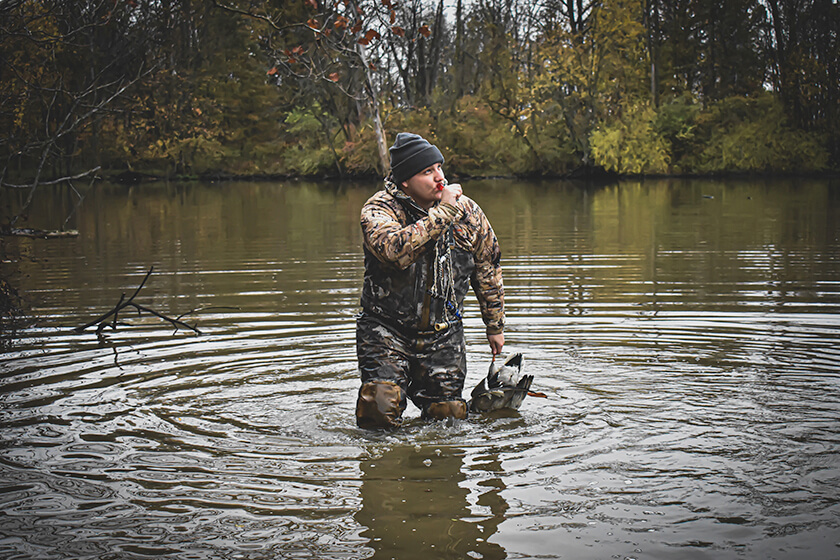
washed ramps

Wild Ramp Salt

Wild ramp salt may used as a finishing salt to add extra flavor to any savory dish, or as a rub for meat. To make, first dehydrate your washed ramp leaves by placing them in a dehydrator in a single layer at 100°F for 4 – 6 hours until brittle. (I use an Excalibur dehydrator).

Then powder them in a blender (I use a bullet blender), coffee grinder, or mortar and pestle.

Then simply mix 2 parts ramp powder to 1 part fine sea salt.

More Posts on Foraging You’ll Love

Ramps and Potato Soup

Ramps and Garlic Mustard Frittata

Oven Roasted Potatoes on a Bed of Pine

Homemade Blueberry Mead

Low-Sugar Elderberry Jelly

Dandelion Oil Lotion Bars

5 Common Plants to Forage for Food and Home Remedies

Tips for foraging ramps (and make ramp salt)!

Best Air Rifle Deals

Popular Posts

Can a Felon Legally Possess an Air Rifle in Tennessee?

0
"Understanding the Legalities: Felon Ownership of Air Rifles in Tennessee" can a felon own an air rifle in tennessee? In the state of Tennessee, the ownership...

Can you dry fire a gamo air rifle?

0
Unveiling the truth behind dry firing a Gamo air rifle, this intriguing headline delves into the possibility of safely practicing without ammunition. Join us...

How to choose the right Air Gun Caliber for your game?

0
A story is told of three Native American hunters. Two are smart, the other somewhat ignorant. On the first day of the hunting season, one of...

Dry Firing Air Rifles: What You Need to Know

0
"Master the art of precision shooting with dry firing air rifles. Enhance your aiming skills, trigger control, and muscle memory without using ammunition. Discover...

Air Gun 101: How many types of Air Gun Sights are there and which...

0
The former American president, Joe Biden, was recently quoted saying: If you need more than ten rounds to hunt, you better stop that business and...