When most hunters think about going out of state for a hunt, their minds turn to getting drawn for elk or mule deer out west. The truth is there are a lot of great out-of-state hunts in the east for whitetail that can offer chances at good deer, without worrying about draws, with some really affordable tags.
If this year has you wanting to get away, but you missed the window to get drawn, here are some over-the-counter options that might not be as far away or expensive, but still get you out of the house and in some new areas, with a chance at a trophy.
WISCONSIN
Wisconsin leads the list for a couple reasons. First, the quality of deer in Wisconsin is incredible. No doubt you’ve heard the tales of Buffalo County, but there are great hunting opportunities to be had throughout the state.
Second, it’s affordable. Non-resident hunters can get in the field legally for around $160, which is super affordable. Never hunted Wisconsin before? You can give it a try even cheaper. Wisconsin has a program for first-time license buyers in the state that basically knocks 50% off your tag. It doesn’t get much better than that does it?
Bonus for non-resident hunters in Wisconsin; lots of public ground. About 18% of Wisconsin ground is public, so you can put boots on the ground and start hunting pretty much right away. A lot of that public ground is further north where the hunting can be a little harder than in the more agriculture-laden southern part of the state, but there are still deer to be had.
You will want to be mindful of CWD zones and any regulations that go along with those, but if you are looking for public-land hunting in a state where a true monster buck can be had, Wisconsin is it, and that’s why it tops the list. For more details and to stay legal in the Badger state visit https://dnr.wisconsin.gov/.
OHIO
Ohio isn’t a secret when it comes to big deer. What might be a secret is just how affordable it is for hunters who come from out of state to hunt there.
Non-resident hunters need to purchase a hunting license for $125, and then your buck tag will run you $24. So, for just under $150, you are up and running the state of Ohio. The Ohio tag and license structure is also one of, if not the, most logical licensing systems in the country as far as I’m concerned. You purchased your buck or doe tag and it’s good for any season. Go to the Buckeye state for archery, but don’t seal the deal? You can return with your tag still in hand for their firearms season and still be legal. It’s straightforward, it’s legal, and frankly MOST states could take a page from the Ohio regulation book in this regard.
If there’s a downside, it’s the lack of public hunting ground. Just 4.2% of Ohio is public, so there isn’t no public ground, but you won’t have the options of some other states. That said, a little scouting, a little hard work, and maybe a few phone calls can get you on some ground that may well hold the deer of a lifetime.
The Ohio DNR website is currently being redesigned, but keep checking for details.
INDIANA
While it isn’t mentioned with the same reverence as other states on this list, or in deer hunting in general, don’t sleep on the Hoosier state. Those paying attention have seen the quality of deer Indiana has been turning out with increasing numbers for the last decade, and while the herd management has lagged behind some other states, and still has some substantial holes, big deer abound here.
The biggest problem in Indiana has been their unwillingness to streamline and simplify that licensing process that in many ways is still a holdover from before Indiana went to the one-buck rule more than two decades ago. Simplest thing to do? Just buy the deer license bundle. It covers all weapons seasons, and allows you to take a buck and two does, or three does, for just $295 as a non-resident. Buy the bundle and don’t take a deer during archery? Come back for the general firearms or muzzleloaders seasons with a tag that’s still good. Archery opens October 1, and both the general firearms and muzzleloader season are two full weeks spanning three weekends. Plenty of time to get in the woods.
Indiana was a slug gun state for a long time, then went to pistol cartridge rifles, and in the last few years has opened up to a host of other rifle options, but there are still limitations, so be sure to double check the regulations to make sure you’re legal, especially if you end up on public grounds. Tags and weapons have additional restrictions on public land that could cause you issues if you aren’t paying attention. Certain doe tags aren’t valid on public land, and the same goes for rifle calibers.
Much like Ohio, less than 5% of the state is public ground, so you may have to work to find spots to hunt, but they are there, and the chances of a big deer being there are pretty good.
Find out about deer hunting in Indiana by visiting https://www.in.gov/dnr/fishwild/2344.htm.
Wherever you choose to hunt this fall, even if you don’t go out of state, stay safe and good luck!
I love the phenomena of thunderstorms. Like many of you, I’m fascinated by the crackle of lightning bolts and house shaking thunderclaps. Also, like too many people, I’ve unwisely continued fishing while a storm approached when I should have been long gone to safety. Lucky for me, I miraculously survived that ordeal. Honestly, even a record largemouth bass is not worth getting fried over.
Facts about Lightning & Fishing
Lightning kills 80 to 100 people yearly in the U.S.A little more than half of victims were engaged in outdoor recreation like fishing or boating. Ten times as many are struck but survived with severe, life-long injuries or disabilities. With the height of lightning season upon us, it’s time for fishermen to consider lightning safety.
You Must Stop Fishing during Lightning.Lightning can strike as many as ten miles away from its source cloud. This is why it is recommended to stop fishing and move indoors as soon any thunder is heard. The debris clouds trailing behind a thunderstorm can produce their own lightning, fishermen should wait 30 minutes after the storm has passed to begin fishing to be completely safe. While inside during a storm stay away from doors and windows, plumbing, wiring, appliances and telephones.
When to Stop Fishing during Lightning?A somewhat less conservative response to seeing lightning involves the ’30/30 rule.’ Upon spotting lightning, if you can count to 30 before hearing thunder, the odds are you’re out of range of the lightning. A count of five before hearing thunder equals roughly one mile of distance from a lightning strike, a count of ten equals two miles, etc. However, thunderstorms can move as fast as 50mph so the next bolt of lightning could be right on top of you.
William Becker, of the University of Florida, notes that lightning is very unpredictable and bolts contain as much as 100 million volts – a minimum of 500,000 times the electricity needed to power a sparkplug! Lightning follows Ben Franklin’s ‘path of least resistance’ rule, and guess what? The path can easily be through a fisherman’s body, which happens to conduct electricity quite well. So, if it’s impossible to seek indoor shelter and you are trapped outside during a thunderstorm, reducing your exposure is critical. Lightning Safety Tips for FishermenWhat to do When You See Lightning?
First thing to do
1) Lay down your fishing rods, they could act like an antennae and draw a lightning strike right to you. If on land,
seek like-sized shrubs or a group of small trees, get low and avoid touching the plants. On open terrain like fishing beaches or desert potholes with no form of cover, find a low spot and crouch on your heels.
Never move towards solitary trees and avoid isolated structures like gazebos or picnic table covers (especially if they are constructed of metal), lightning can travel as much a 60 feet sideways after striking an object. An automobile – but not convertibles or cars with a fiberglass roof – offer some shelter but put your hands in your lap and avoid contact with the steering wheel, radio, ignition, etc.
2) If you are on a Boat
Boaters are at great risk during lightnings. They are often the highest object on the water’s surface. Even distant thunder or lightning flashes should trigger an immediate move toward shelter on land.
Lower all fishing rods and radio antennasThen crouch down without contacting any metal railings, wiring, or the motor; don’t get in the water or dangle your legs or hands in the water.
Disconnect the VHF radio and GPSThis way they may survive a lightning strike. Lightning protection systems are available for some fishing boats but getting off the water is safer.
Lightning strikes the United States around 25 million times per year.
Most Florida fishermen won’t be ‘shocked’ to hear their state annually has more strikes than any other. However, NOAA notes that lightning occurs in all fifty states. Lightning can occur at any time, but late afternoon hours are the most dangerous periods for lightning strikes, and folks spending time outside in open areas like fields or beaches are the most common victims. So make yourself aware of the weather forecast before heading out to fish and if the predictions include thunderstorms plan on returning home before the storms are due to bubble up.Fishing for bass, walleye, trout, catfish, bream, or whichever species you favor, can be a fun way to enjoy the great outdoors if you keep in mind lightning safety whenever you grab your fishing rods for a day on the water.
The length of time it takes for a deer to decompose varies greatly according to environmental factors around the carcass. A deer carcass that is left to decompose without interference from scavengers may take around six months to completely decompose to bones.
Scavengers play a very important role in the decomposition of deer. They help eat the flesh from the bones and scattered the pieces exposing them to other agents of decomposition.
By puncturing the skin, they help in the circulation of oxygen into and out of the body which plays a big role in its decomposition.
Weather is also known to affect the rate of decomposition. Carcasses are known to decompose faster during summer when temperatures are high. Cold temperatures are known to preserve the body.
What is Decomposition?
Decomposition is the process where dead organic matter is broken down into simple organic and inorganic matter
All organic matter once dead needs to be broken down. If this did not happen, bodies and dead plants would be all over the world.
Decomposition helps in returning nutrients ingested back to the ground. Farmers have been known to decompose compost and add it to their to the soil in their farm to increase nutrients in the soil. Dead leaves that decompose on the forest floor add nutrients back to the soil which helps the forest to thrive.
Factors That Influence The Rate of Decomposition
Various factors influence the rate of decomposition. Below are some of them.
1. Temperature
Warmer temperatures promote decay. This is because they are favorable for bacteria activities. Cold temperatures inhibit bacterial activity. It is not uncommon for decomposition not to occur at extreme cold temperatures.
2. Moisture
Research shows that moisture plays an important role in the decomposition of dead matter. The higher the moisture content in the carcass the faster it is able to decompose.
Mummification occurs when the body has low moisture content and is exposed to extremely high temperatures. The body is normally preserved at this state because bacterial activities are not able to complete.
3. Oxygen
Oxygen influences aerobic bacterial activity. This means that the higher the oxygen levels the faster the rate of decomposition.
4. Insects
Insects like blowflies are attracted to rotting matter. They lay their eggs on open surfaces of the carcass which hatch into maggots.
The maggots crawl into the body, damage soft tissue while burrowing into them, liquefying the body and increasing heat. They feed on the dead body and later on emerge as adult flies.
5. Season / Climate
During fly season decomposition rates are higher. This is because of the availability of more flies which means that more maggots will be present to helping the decomposition of the carcass.
6. Animal Activity
scavengers are known to pick through dead bodies and find whatever is edible and eat it. While feeding, they end up scattering some of the body parts exposing them to other agents off decomposition.
What Decomposes a Deer?
A class of animals known as decomposers are responsible for the breaking down of dead matter. They include, fungi, bacteria, worms and insects.
Decomposers are animals that get their energy by feeding on dead plants and animals. They are also known for breaking down animal waste from which they get energy.
They play a very important role of keeping energy flowing throughout the ecosystem. By breaking down organic matter into simpler inorganic matter they make nutrients available for primary consumers.
Worms do not necessarily fall under decomposers. They are commonly known as detritivores. Worms, unlike bacteria who absorb the nutrients directly from their surroundings, feed on and digest their food internally.
What Happens When a Deer Decomposes?
When a deer decomposes, their flesh, internal organs and skin is completely broken down leaving behind only bones which take longer to decompose.
The dead body passes through several stages before it is completely disintegrated too bones. Below at the five stages in which the body Undergoes.
Stage One: Fresh
This is the stage a few hours after the animal dies. Blood stop circulating throughout the body and the limbs start stiffening due to chemical changes in the muscles.
The remains are free of insects. Blood flows and settles on the lower side closest to the ground. Body temperatures either drop or rise to match those of the surroundings.
Stage Two: Bloat
It is during this stage that bacteria present in the human body begins to digest the tissues. This activity causes them to release gases that fill the body making it to bloat.
The body starts emitting a foul smell as the bacteria do their work. The pressure exerted by the gases in the body forces fluids out through openings in the body.
The foul smell attracts blowflies which come and lay their eggs in the body. The maggots hatch and start feeding on body tissues that detach from the skin causing it to slip.
Stage Three: Active Decay
As bacteria and insects breakdown muscles and other organs a lot of mass is lost. Liquids released into the surrounding also contributes to the loss of body mass.
Body tissues liquefy and the skin turns black.
Stage Four: Advanced Decay
It is during this stage that the decomposition of tissues and cells together with the liquefaction of the body is almost complete. Most of the remains have darkened.
A lot of nutrients have been released into the soil surrounding the body increasing its fertility.
Stage Five: Dry Remains
Most of the body tissues and skin have already been decomposed and all that remains is a dry skeleton with perhaps some hair left.
Insects like beetles come and eat anything that might be left. The bones change in color and lighten up because of exposure to the sun. They are eventually covered up and disappear into the earth.
What to Do with a Decomposing Deer?
It is advisable to try and dispose of the body before it starts decomposing. This is to avoid other animals coming into contact with the dead body and avoid the foul smell from filling the area.
When other animals accidentally come into contact with the deer they might get infected by diseases carried by the dead deer. The sickness might spread throughout the herd causing many animals to get sick and die.
The best thing to do is to try and bury the body leaving it to decompose in the soil. This will release nutrients directly into the soil while avoiding anything coming into contact with the body.
If the animal died in a hard to reach place like at the bottom of a ledge, you can speed up the decomposition process by piercing the skin, increasing air circulation in and out of the carcass.
To avoid the foul smell, try pouring large amounts of lime and if possible vinegar to neutralize the smell.
Related Deer Articles:
Are Deer Rodents?
Can Deer Be Domesticated?
Why Do Deer Stare At You
Do Deer Hibernate?
Conclusion
Deer decomposition has its own advantages as it means that nutrients are able to return to the earth which will be used by other organisms.
It however produces foul smells and attracts disease spreading insects like blowflies. It is however a natural process that must occur.
Hunting is an exciting and rewarding activity that can bring together family and friends for a shared adventure. To make sure you have an unforgettable hunting experience, it’s important to plan ahead and be prepared. Here are five tips to help you get ready:
Get the Right Gear
Going hunting can be an exciting and fulfilling experience. To make it even more enjoyable and successful, you must be sure to have the right gear. Having the ideal equipment for your hunt is essential for increasing comfort and effectiveness in the field.
In order to get the best out of a hunting session, it’s important to make sure that you are prepared with items such as firearms, boots, clothing, scopes, and camping supplies.
If possible, upgrade your rifle by getting a rifle sling, a bipod, laser sights, a cheek riser, a suppressor, etc.
Purchasing gear appropriate for your preferred game and location would go a long way in ensuring that your hunting trip is successful and memorable.
You can also rent a campervan from Travellers Autobarn, which will give you the freedom to explore and hunt in some of the most beautiful locations across Australia.
Practice Your Skills
An unforgettable hunting experience starts with preparing your skills. Practicing your shooting, tracking, and navigation methods can help you feel confident in the field. A few key elements to practice are accuracy, strength, and speed. Being accurate with your aim allows you to rapidly fire at targets without wasting too much ammunition or being off-target. Having physical strength means that you can move quickly between environments and easily carry any sort of equipment needed for the journey.
Lastly, having a good speed in target recognition gives you the advantage of spotting what it is you’re looking for faster and making better decisions about whether or not to continue pursuing a hunt. With enough hard work and dedication added into the mix, practicing these essential skills will ensure a successful and amazing hunting experience.
Know the Rules and Regulations
As with any activity, it’s important to know the rules and regulations set forth for a hunting experience. Being aware of local laws, conservation initiatives, and any other policies will help ensure a safe, effective trip. Understanding what type of game can be hunted in an area is essential, as well as knowing size requirements, season restrictions, and even daily bag limits.
Having this knowledge before heading out can help ensure that you have the best possible hunting experience. Additionally, knowing the rules can save hunters from potentially costly legal consequences if they are improperly informed about their state’s regulations. Learning the rules is an essential part of preparing for an unforgettable hunting experience!
Research Your Location
No matter what type of hunting experience you are embarking on, research is key to a successful experience. Before you even leave home for your hunting trip, knowing the land and potential areas where the game can be found is imperative for success. Researching the location can help you understand the local climate, terrain, and any regulations or rules placements that may be different from your regular hunting spot.
With advances in technology, such as online mapping systems, geolocation devices, and weather apps, it has never been easier to be knowledgeable about your target location. Gathering this information before setting out on your hunting adventure will ensure that you come prepared with all the necessary items for an unforgettable experience!
Make Safety a Priority
Hunting is an enjoyable and unique experience, but for it to be truly memorable, safety must come first. Before heading out on the hunt, packing the right items and checking them twice is key. A hunter should have basic medical supplies such as bandages and antiseptic wipes in their day pack, as well as a signaling device like a whistle or flare in case of emergency. Being aware of one’s surroundings and engaging in dialogue with other hunters are also important safety tips.
Additionally, hunters should carry a topographical map plus a compass or GPS system so they don’t get lost, wear blaze orange so that other people can visually identify them right away, and locate hunting areas that do not allow motorized vehicles in order to avoid injury from ATV crashes, and stay calm when wildlife spooks — the wet ground may result in slipping and tripping hazards. Taking these steps will help ensure that the hunt remains safe while retaining its special charm.
Bottom Line
Hunting is an incredible experience that requires preparation and dedication. With the right essentials such as accuracy, strength, speed, knowledge of the rules and regulations, research on your target location, and a sense of safety at all times — you can have an amazing hunting experience!
Vibrant blooms that will be smothered in butterflies and hummingbirds! You’ll be amazed by these extremely fragrant and ornamental vines! The sturdy twining vine Goldflame Honeysuckle (Lonicera x heckrotti ‘Goldflame’) is an incredibly hardy, native Honeysuckle Vine!
This vine has the scent of succulent sweetness as it drifts through the air from the long tubular blooms. Your Honeysuckle will easily grow to full length each year and start blooming in spring, lasting all summer long.
With no worry about invasiveness like other native species, Goldflame will fit perfectly into any garden design and size. The long tubular blooms are dark-pink and yellow and hang in bold clusters that absolutely smother this plant!
These 2-inch blooms appear in the hundreds and you will be amazed by these exotic flowers! They are a favorite among pollinators, butterflies and hummingbirds that will not be able to resist!
This is a vital source of nectar for all your beneficial insects and birds! With a longer bloom time than other Honeysuckle, you’ll have these visitors for weeks!
This vigorous vine can also be trained into a shrub or left to trail along the ground. It’s so adaptable to many conditions and very easy to manage.
These tropical flowers cling to a vigorously growing vine with reddish stems, and are absolutely vibrant as it twists and turns around your garden trellis and arbors.
Goldflame is a rugged semi-evergreen climber that’s virtually indestructible, even with haphazard pruning. Resistant to powdery mildew, Goldflame even tolerates some drought.
Each year, from June to September, you can look forward to lightly fragrant masses of deep pink and yellow, tubular flowers that give way to small inedible red berries in the fall which the songbirds just love.
How to Use Goldflame Honeysuckle In The Landscape
Despite being a fast-growing climbing vine, it won’t get into trouble in the landscape, Goldflame will ramble up trellis, fences and any place you encourage it to do so.
The Goldflame Honeysuckle is most often grown as a trailing vine with incredible flowers. It would create a dramatic effect climbing a trellis or your front porch rail.
Reaching near full height in a single growing season, this type of Honeysuckle is an amazing grower! Filling an area with deep blue-green foliage and bright blooms, these even work amazingly well in containers and act as both the upright thriller or a flowing spiller.
Lovely climbing over fences and hiding unsightly views while enhancing your own! These act as semi-evergreen in warmer growing zones and provide lush backdrop plants among your beds and borders. Beautifully spilling over retaining walls and rambling over hardscapes as an informal groundcover.
A delicious blend of hot pink and golden, exotic flowers smother this vigorous vine of vibrant blue-green as it twists and turns around your garden supports. Adapting to any style garden, these tame natives fill your landscape with color quickly! The long-lasting blooms are even suitable for indoor floral arrangements, filling your bouquets with sweet-smelling blooms.
Incorporate into your garden beds and borders on a trellis or an obelisk among your other planted flowers and perennials to add height, color, fragrance and drama throughout your landscape!
Looking fantastic growing up the columns of your pergolas and gazebos. No pollinator garden should be without something to attract butterflies and other visitors!
#ProPlantTips For Care
Deer resistant and extremely hardy, Goldflame Honeysuckle thrives in a wide range of USDA 4 through 9 hardiness zones. Just provide good air circulation and water to keep these bi-color pink flowers going strong all summer!
Loving the full sun, these are also tolerant of partial sun, especially when planted in hotter climates; appreciating the relief from the summer sun.
Goldflame is highly disease resistant and adaptable. Not particular about soil type, Honeysuckle Vines loves any well-drained soil that ranges from acidic to alkaline.
Take care when applying lawn fertilizers near flowering shrubs. These high nitrogen formulas are designed to produce foliage, but will not support flower development. Instead, apply an all-purpose fertilizer for blooming plants in early spring. Reapply in mid-summer, following label directions for application rates.
Flowering best in average moisture, Goldflame is very drought tolerant once established. Extremely easy care and low maintenance, these won’t need pruning but are highly conducive to pruning if needed.
Sometimes a plant performs just a bit too well in certain areas. Rest assured, Nature Hills uses Plant Sentry™ to track all federal, state and local regulations on invasive materials. We will always protect you and your community.
We’re happy to offer this selection for sale into areas where it will work beautifully without any concern. To check your availability, simply type in your Zip Code to Find Your Growing Zone in the section above the Plant Highlights.
You won’t go wrong by adding height, drama, color, and fragrance with these exotic blooms for your landscape! Goldflame Honeysuckle Vine is just the bold addition your garden beds have been craving! Order yours today from Nature Hills Nursery!
So, despite my naïve protests about being a shooter not a hunter, I was dragged into the world of tactical hunting. A pile of dead hogs later, I was hooked. I no longer own any of the gear I used that day. I’ve gone through many iterations and changes in my kit. Thanks in part to my role here at SHWAT.com I’ve had opportunities to try all kinds of configurations for hog hunting guns. So when I was recently asked about how to set up an AR-15 for Hog Hunting, I readily agreed to answer here. While I’ll be the first to say that there’s no one size that fits all, when you’ve finished reading I think you’ll have a better idea of how to set up your own AR-15 for some tactical hog hunting. Then it’s time to chase some wild boar!
Why focus specifically on setting up the AR-15 for hog hunting? It’s this generation’s gun, and for good reason. The limitless configurations make it one of the most versatile guns on earth. The hardest part is figuring out what you want, never mind need, as you customize your AR-15. Since you’re reading this, you’re more likely to own an AR-15 than any other single gun. Here are some questions and answers for you to consider when getting set up to hunt wild hogs with yours.
Caliber? Perhaps your first consideration is caliber. I don’t know how many different calibers an AR-15 can be built in. Hogs are hunted with a lot of them including .223/5.56, 300 Blackout, .458 SOCOM, 6.5 Grendel, 6.8 SPC II, and countless others. I’ve killed hogs with most of those and others as well. This will surprise some, but not everyone: I’ve killed more wild pigs with .223 than any other caliber. Modern loads render some of the old conventional wisdom obsolete. Remington Hog Hammer made with Barnes 62 grain TSX bullets has demonstrated excellent performance for SHWAT™ writer Brian McCombie, and I’ve had great experience with DRT Ammo’s .223 on hogs weighing 200+ pounds.
A lot of buzz over 300 Blackout during the past couple of years has lead many to explore that round. I’ve been cautious about getting too wrapped up in it, but I plan to give it a workout this year. Having hunted with sub sonic rounds through a short barreled AR pistol with Liberty Suppressors Mystic X silencer, I wasn’t impressed. Maybe it was the ammo; maybe the distance was too great. It was definitely quiet. We’ll try it again with some unique ammo, but super sonic 300 Blackout looks more promising. But like .458 SOCOM and 6.8 SPC II, your range is a bit more limited. If you’re hunting under 200 yards, any of these rounds should be great. If you’re planning longer range hog hunting, the 6.5 Grendel might just be your pick.
Day or Night? Night hunting hogs is a real blast. Adding a white light to your gun is easy and doesn’t have to cost a fortune. If the shooting gets fast as the daylight fades to dark, your white light becomes a real asset. I’ve watched Bill Wilson of Wilson Combat point a white light at hogs who were undeterred by its presence. Bill has spent countless hours with the hogs figuring out which white lights scare them, and the specifics of color temperature and technique that leave hogs comfortable and vulnerable.
Most hunters effectively bagging hogs in the dark have instead employed a broad variety of weapon mounted green and red lights, particularly when hunting predictable places like feeders. Alternatively, you can also equip a feeder with remote control lights like the Inhawgnito, but that’s another story. Flashlights in white, green and red are all easy add-ons to your AR build that won’t trash your bottom line. An important side note: you’ll want your AR to use a hand guard that allows for mounting accessories. Three or four years ago that generally meant a quad picatinny rail. Today you have countless options.
But there are better, albeit far more expensive, doors to crash. Jump into the high tech world of night vision and thermal optics and you’re into a whole new level of the game. Instead of spending a hundred dollars for a light, you’ll spend ten to twenty times that to access what many consider to be the pinnacle of tactical hunting. Case in point: Recently I’ve been highly impressed by the line of thermal optics from IR Defense. I’ve watched IRD grow for a year, and recently hunted with their IR Hunter Mk II. Using this thermal optic, I was able to identify hogs at 400 yards and shoot them on the run at 125 yards. Thermal can fool you though. Rocks at a distance can look remarkably like a group of pigs far off. Stay tuned to SHWAT.com for more on that.
An alternative to thermal is traditional night vision (NV). We’re talking the usual green images. It’s great military technology available to us and allows for the use of infrared lasers and illuminators of countless price points and configurations. The best gear for this is almost as pricey as thermal, but has the added benefit of being able to drive and scan for hogs without any additional lighting. For as little as $3100 a number of manufacturers like TNVC are producing NV monoculars that can be mounted to your AR-15 or to a helmet. We’ll cover your NV options more thoroughly later on here at SHWAT.com.
Hunting during the day is pretty straightforward. Have an optic that works for your scenario and get to work. Obviously, your scenario makes a difference along with your preference in optics. Years ago I invested in a Trijicon ACOG ECOS system that gave me a 4x magnified optic with a red dot 1x unmagnified optic combination. It remains a favorite set up. Red dot sights like the EoTech and Aimpoint optics are super fast to use with both eyes open and I’ve enjoyed great success with them as well. If you plan on bagging multiple hogs from a group, you’ll be hard pressed to beat this kind of a set up.
Alternatively, more magnification both increases the ranges you can make confident shots at and adds precision to virtually any shot beyond 50 yards. There are probably as many magnified optics choices as there are ammo choices. Lots of optics are good enough to hunt hogs mid day at 150 yards. Your run of the mill 3-9x scope might be just fine. However, cheap scopes simply aren’t as sharp and lose contrast quickly at higher magnification. Lack of high quality optical coatings can leave you unable to see clearly with your scope angled towards a late afternoon or early morning sun, washing out when pointed in the direction of the sun. Brands like Trijicon, Nightforce, US Optics and Bushnell Elite Tactical are all winners at various price and feature points.
How will you hunt? If you hunt from a blind you might not need a sling on your AR-15. I prefer spot and stalk hunts which leave me carrying my rifle so I value a sling. Single point slings are often preferred by tactical shooters, but for walking any significant distance, I prefer the stability of a good two point sling over an AR bouncing around on a single point sling. Over time I’ve collected a number of slings including convertible single/dual point models, but my go-to sling, a Viking Tactics two point padded model, remains my favorite.
Triggers? If precision is important to your hunting, you need an upgraded trigger. Truth is, once you’ve used a good drop in trigger replacement you’ll probably loath whatever trigger came in your rifle. I’ve pulled Timney, Wilson Combat, CMC flat triggers and plenty of others. It seems like there’s a new drop in trigger maker for the AR-15 popping up every other month. Most are pretty good; some have nice proven track records if that’s important to you.
While there’s no limit on interchangeable AR-15 configurations, these considerations combined with your personal preferences of brand, grips, stocks, etc. will get you all set to hog hunt with your AR-15. Fact is, getting set up to hunt hogs with the puzzle pieces covered here will also get you set up to effectively hunt various varmints, deer and other exciting prospects for the tactical hunter. Want to show off your favorite setup? Tag @SHWATteam on Instagram.
I’ve said this several times over the years but I’ll say it again in case you missed it the second, third or at some time in the past. Of the states down the spine of the Rocky Mountains Idaho is my favorite destination when it comes to hunting bears. This does not mean to suggest states to the east, west and south do not have their special attributes that make them special in their own right, they certainly do, but for me there’s simply no place like Idaho, especially when it comes to bear hunting opportunities.
Based on my own personal experiences there are a number of reasons why hunting Idaho holds such a dear place in my heart. There’s the memories of successful hunts, of friends made, of riding mules into the backcountry and of camping in those remote places under ebony skies speckled with stars so bright it seems you can reach out and grab them, of the scent of spruce and fir and wood smoke on a chilled night at high elevation, of those remote places where bears grow old and big and have seen few humans. But, from the perspective of a hunter planning a bear hunt there are other reasons why Idaho is, as its nickname states, such a “gem.”
LOTS OF BEARS
According to most sources Idaho is home to between 20,000 and 30,000 black bears, but that’s just and estimate. Whatever the case Idaho is home to one of the largest black bear populations in the western United States if not the Lower 48. The population is healthy and increasing and bears are now being reported in areas of the state where sightings were considered rare just a few years ago. The highest concentration of black bears is found in the forested northern two-thirds of the state, in particular the mountain ranges, subalpine ridges, associated foothills and riparian areas along the lengthy Bitterroots along the border with Montana and Salmon River Mountains and Sawtooth Range in the central region. The remote Selkirk Mountains in the northern Panhandle, the vast Selway Region and designated wilderness areas to the south are home to some of the highest bear densities in the state. To the south, bears are also found in the Caribou Range in the southeast corner east of Pocatello and Owyhee Range in the southwest south of Boise.
LOTS OF ROOM TO HUNT/LOTS OF OUTFITTERS
More than sixty-percent of Idaho is owned by the federal government, some thirty-three million acres. More than twenty million acre of that is in the form of seven national forests. That’s about forty-percent of the state’s land area. Needless to say there is plenty of public land to hunt bears.
All my Idaho hunts have been with an outfitter in the St. Joe or Clearwater National Forests and unless the hunter has a great deal of experience in remote, do-it-yourself hunts an outfitter is recommended. This is big, rugged country and hunting with an outfitter is the easiest, safety and typically most successful way to plan and experience an Idaho bear hunt. Highly qualified and knowledgeable outfitters operate in each of the national forests offering a variety of accommodations, services and hunting packages.
A list of licensed outfitters is available from the Idaho Outfitters and Guides Association.
These same national forests are also popular among do-it- yourself hunters but careful planning is a must including where to hunt, obtaining maps, weather conditions and necessary equipment and where to camps, among other. Campgrounds are available throughout each national forest but open and closing dates, fees if any, whether reservations are needed or not, availability of drinking water and other services vary. Specific and helpful information can be obtained on each national forest as well as campgrounds can be obtained from each national forest supervisor’s office.
COLOR PHASE BEARS & HIGH SUCCESS
Color-phase bears are found throughout the western United States and parts of western Canada but Idaho offers as good a chance to kill one as any place. In general brown or chocolate-phase bears are most common in northern Idaho with cinnamon and blonde less so, although the farther south you go the percentage of lighter bears increases.
Colored bears can and are taken throughout Idaho. In some cases success boils down to being in the right place at the right time but hunting the right habitat greatly increases the odds. Colored bears are taken in the dense timber but areas that offer a combination of timber bordering open, south-facing slopes, wide-open river valleys, open brakes and canyons are general hotspots. These areas are generally warmer and it is believed the lighter hair color helps bears stay cooler. Whether hunting with an outfitter or doing it on your own the St. Joe and Clearwater National Forests, the Selway, the Salmon River country and Frank Church Wilderness and national forests in the southeast and southwest, to name but a few all offer this time of mixed habitat.
A word of note here. Hunters specifically wanting an opportunity at a colored bear should let their outfitter know of their desires when booking a hunt. Many outfitters utilize trail cameras on their baits or are familiar with the bears in their area. There’s no guarantees here but informing your outfitter beforehand can help achieve success.
HUNTING OPTIONS
Idaho offers a lengthy spring bear season but open and closing dates vary. In the Panhandle the season open as early as April and generally in May elsewhere. Closing dates are in June or July. Fall season dates also vary. Most open August 30 and some close as late as November 30, depending on the unit. Falls hunts can also be combined with hunts for elk and deer. Depending upon the unit and season hunters can hunt over bait and with dogs, in some units both are prohibited so hunters should be sure to check when booking or planning a hunt. Spot-and-stalk is legal in all units.
AFFORDABLE LICENSES
Compared to some other western states bear hunting Idaho is one of the best deals available when it comes to over the-counter hunting license and bear tag availability and fees (see Particulars below). Another bonus is resident and non-resident hunters can purchase vastly discounted bear tags in at least seventeen units and portions of two others. These same units also offer the opportunity to take two bears with discounted tags, something increasingly rather in the west. Hunters also have the option of applying for one of the controlled black hunts, although application deadline dates apply.
IDAHO PARTICULARS
Estimated Bear Population: 25,000-30,000 +/-
Legal Limit: Two (2) in some units, one (1) in some units.
Hunting Area: Black bears are basically legal game statewide except some state parks, wildlife preserves and developed areas.
Spring Hunts/Dates: Yes. Varies by unit. April 1-June 30 or late July depending upon unit.
Fall Hunts: Yes. August 30-end of November in most units.
Popular Hunting Methods: Baiting and dogs are allowed in most units. Spot-and-stalk. License Available/Fees: License are available by phone, on-line and venders statewide. Non-resident reduced/second bear license-$41.75. Non-resident full price bear license-$231.00. Non-resident hunting license-$185.00. Non-resident Junior Hunting License (ages 10-17) $91.75.
Legal Weapons-Rifles and handguns except those that take rim fire ammo;
.50 caliber and larger muzzleloaders; bows with 40 pound pull and higher; crossbows 150 pound minimum draw.
Contacts: Idaho Fish and Game, 1 (208) 334-3700; www.fishandgame.idaho.gov.
We caught up with Jay Scott of Colburn and Scott Outfitters and learned about his well-earned success on the trickiest turkeys out there. He’s the host of the Jay Scott Outdoors Western Hunting & Fishing Podcast, but he is also a passionate hunter, angler, and big game guide.
Read on to learn about his relentless turkey hunting process and what it takes to get birds on the ground with his top spring turkey hunting tips and tricks.
Table of Contents:
Introduction 1. Better to Be Early Than Late 2. Carry More Calls Than You Need 3. Locator Calls Don’t Have to Be Perfect 4. Don’t Blow a Coyote Howler at Roosted Birds 5. Pinpoint Where They Roost 6. Tactics Once They’re on the Ground 7. Play Hard to Get! 8. Be Patient 9. Go for Round Two 10. Use the Roads to Your Advantage 11. Get As Close As You Can 12. Calling Cadence Outweighs Tone and Sound 13. Decoy Positioning SHOP THE FULL GEAR LIST
SPRING TURKEY HUNTING IS ONE OF MY FAVORITE SEASONS OF THE YEAR.
For many years as a beginner turkey hunter, I really struggled with calling birds into archery or shotgun range. I’ve been schooled by so many birds that it would seem silly for me to even write an article on bowhunting or shotgun hunting turkeys.
But like lots of other things in life, it seems that persistence usually pays off. I’ve been taught many things by veteran turkey hunters whom I have constantly bombarded with questions on the “Do’s and Don’ts” and “Tips & Tricks” of turkey hunting.
I’ve also learned a lot from trial and error with the turkeys themselves. I’m constantly learning something new about spring turkey hunting every day that I pursue them. One thing I’ve learned is that no two wild turkeys act the same but there are some turkey hunting tactics that can be repeated which will increase your odds of harvesting this magnificent animal.
I’ve attempted to outline some things to remember when chasing these weary longbeards. I hope that one of these turkey tactics will be something you can latch on to and incorporate into your turkey hunting routine.
1. BETTER TO BE EARLY THAN LATE
I always try to set my alarm 30 minutes earlier than my calculated time to get to the roost tree. Usually my alarm goes off around 3:00 AM during turkey season.
I like to be sitting in the dark waiting for the grey in the eastern sky and set up in my position at least 30 minutes before the first call of the hens or first gobble. It gives the woods some time to settle down after I just walked into the roosting area.
It also gives you time to go to plan B if something goes wrong prior to your setup. Another advantage to being early is usually that puts me ahead of other hunters. Being early will never work against you.
2. CARRY MORE CALLS THAN YOU NEED
It is good to have several diaphragms, slates, and box calls. Sometimes the birds will especially like one call or another. The worst feeling in the world is not having the right call.
Don’t be afraid to take a gobble call either (be very careful using the gobbler call on public land).
3. LOCATOR CALLS DON’T HAVE TO BE PERFECT
Locator calls such as coyote howler, owl hooter or peacock don’t have to sound exactly like the natural thing to be effective in getting birds to gobble in the roost.
Quite the contrary, I’ve found that my external reed coyote howler by Primos which does not sound near as natural or authentic as my diaphragm coyote yelp, seems to get more of a response by roosted gobblers.
Remember, you are looking for a shocking response so sometimes the worst shrieking noise you can make will be the best for getting a gobbler to answer.
4. DON’T BLOW A COYOTE HOWLER AT ROOSTED BIRDS
In the morning when you’re too close, the roosted male turkey might answer but they will be very leery to come into your hen yelps because they think a coyote is close and they don’t want to get eaten.
An owl hooter is a much better choice when you are close to the roosted bird. When I say close, I mean within 200 yards of a rooster gobbler.
5. PINPOINT WHERE THEY ROOST
When roosting a gobbler in the evening, make sure you try to pinpoint the exact tree that the gobbler is roosted in. Often, I will get them to shock gobble and then I will sneak in as close as possible.
I then plan my setup for the morning. Things to be looking for while pinpointing the exact tree are:
• easiest way into the setup since it will be pitch dark.• exactly which tree you want to be leaning against and set up under.• which way the bird will fly down.• which way the bird won’t go, etc.
I like to mark the spot where I will setup on my GPS and allow the breadcrumb feature to bring me right into the setup spot the following morning. Be careful not to let the roosted gobbler see your light on the GPS.
6. TACTICS ONCE THEY’RE ON THE GROUND
In the morning or afternoon, when the birds are already on the ground, and you are just prospecting for gobblers by walking ridges, if you get a gobbler to respond move as close to his position without being detected as you can.
Once in close to the gobbler (within 100 yards) set up and try to call again. This works way better than calling from the original position. Now, if you are moving towards his direction and he gobbles loudly and in your direction like he is coming immediately get setup.
7. PLAY HARD TO GET!
Make the gobbler want to come to you. If you get a bird gobbling sometimes just shutting up is the deadliest tactic. I like to fire them up and then shut up.
I usually let them gobble twice before I call again. Usually, they will come hard if you use this tactic. You may risk a bird walking off because you shut up but if they are halfway interested, they will be headed your way. This may be the single best bit of information I have learned over the years.
8. BE PATIENT
In the evenings be in the roost area and be patient. I like to get in areas that I know birds like to roost. I sit and call about every fifteen minutes. The last 30 minutes before fly-up is primetime. Let’s say it is 30 minutes before fly-up and you make a series of yelps and a gobbler answers off in the distance.
I might hit him right back with a series of excited cuts and then just shut up. More than likely he will come to inspect. If they come in but not in shooting range just sit still and watch they fly up into their roost trees. Then you can attack in the morning.
One thing to keep in mind while hunting Merriam’s turkeys is that they typically like to roost on a ridgeline or at least where there is a contour break. The birds like to walk uphill from their roost tree and then coast horizontally into the branch.
This tactic helps them conserve energy by less flying. Sometimes you can roost turkeys without hearing them gobble by just listening for the ruckus of their wings flapping when they fly up.
9. GO FOR ROUND TWO
When the evening hunt does not produce a roosted gobbler for the next morning. There are several options for the following early morning hunt.
Go into an area where you have heard gobblers before and sit tight. Listen at prime time for gobblers in the area. If you can move while it is still dark, then pursue them. If not, wait until they hit the ground and sneak in close to them.
10. USE THE ROADS TO YOUR ADVANTAGE
Another option is to cover as much country as possible in hopes of hearing a roosted bird. This can be done either on foot or in a vehicle.
Wake up extra early and drive to an area where you have seen or heard turkeys. Stop every half a mile and blow your peacock or coyote howler.
11. GET AS CLOSE AS YOU CAN
Always try and get as close to a gobbler before calling to him. If you spot a gobbler with your binoculars try and move in very close to him without being detected.
I will try to get within at least 100 yards or closer if the terrain and vegetation will allow prior to making my first call. Your success goes up tenfold if you practice this method.
12. CALLING CADENCE OUTWEIGHS TONE AND SOUND
The cadence of your calling is more important than the tone and sound of your call. This opinion is debatable but I noticed a big difference in my success when a friend of mine showed me the correct cadence to my hen yelps.
He told me I sounded decent, but my rhythm was off. As soon as I changed my rhythm and cadence it was like a light switched on and the gobblers became way more consistently responsive to my calling. The key is to listen to the hens and focus on the cadence or timing/rhythm of their call.
13. DECOY POSITIONING
Position your turkey decoys at a 45-degree angle from the hunter on the opposite side of where you think the gobbler will come in from. Decoys can be a huge asset if you use them correctly.
On the flip side, they can hurt you if they are positioned on the wrong side of where you want the birds to end up. An example of the correct way to set them up would be: If the gobbler answers your calls to your left it would be best to set the decoys out to your right about 25 yards.
In this case, the bird will come to your call but when he gets close, he will see the decoys and walk right by you (or the hunter) on the way to the decoys to your right.
Remember when the gobbler gets close to remain silent and very still because he will be really looking for the turkey he heard. He should then spot the decoys. You will then be able to have a clear shot as they focus on the decoys.
WRITTEN BY JAY SCOTT
Host of Jay Scott Outdoors Hunting and Fishing Podcast with over 34.5 million downloads.
Professional hunting guide for 24 years in Arizona and Old Mexico.
Has harvested many trophies around the west, which include several animals that make the Pope and Young and Boone and Crockett record books.
Learn more about what KUIU gear Jay Scott thinks is best for hunting turkeys in his turkey gear list.
Visit Jay Scott’s Youtube to see him in action.
Read more about the Gould’s Turkey, the least known subspecies of wild turkey.
Shop KUIU’s top turkey hunting gear list for the spring and fall turkey seasons.
Learn about turkey hunting camo and gear with more top turkey hunting picks for the active turkey hunter.
Mugolio, a dark, aromatic syrup imbued with the flavor of pine cones, is the poster child for the kind of crazy cool, Illuminati-esque foodstuff foragers have access to, all for the price of a hike, or even less, depending on how close you are to some pine trees.
The syrup came on my radar when my friend Dan Farmer gave me a little jar of some he made to try. I remember it being good, but I forgot about it until I opened the Salt Cellar, and started making my own from spruce tips, which is excellent, but not quite the same as pine cone syrup (for the record both are great).
Mugolio is now still a bit of a chef secret, and available through elite specialty distributors, but the price is staggeringly high, exorbitant even, when you consider you can make nearly the exact same thing at home, for less than it costs to make a cake.
A chef secret that takes months to make
The cost of mugolio is not found in ingredients, but is paid in time. How much time is certainly up for debate, and you’ll notice my recipe turns around a lot quicker than burying a jar of pine cones and sugar in the yard and digging it up the next year (an actual recipe from Romania). You’ll want to wait at least a month for a good pine syrup, although aging it longer can be fun.
Mugolio: more than just pine cones
Real quick, some reality. I use the word mugolio interchangeably for syrups made from numerous tree parts, if you look around you’ll see mugolio usually refers to a syrup made from the young cones of mugo pine (Pinus mugo), harvested at a specific time of year, under the strictest of conditions, blah, blah, blah.
I’ve made all kinds of similar sugar based products from all kinds of conifer parts, and it isn’t some difficult, arcane thing you can only do in the light of a full moon— just the opposite.
Making mugolio is easy, and there’s a very forgiving time window for harvesting cones, or other things products like cedar cones, wintergreen, juniper, or spruce tips. All of the aforementioned making excellent syrups in their own right.
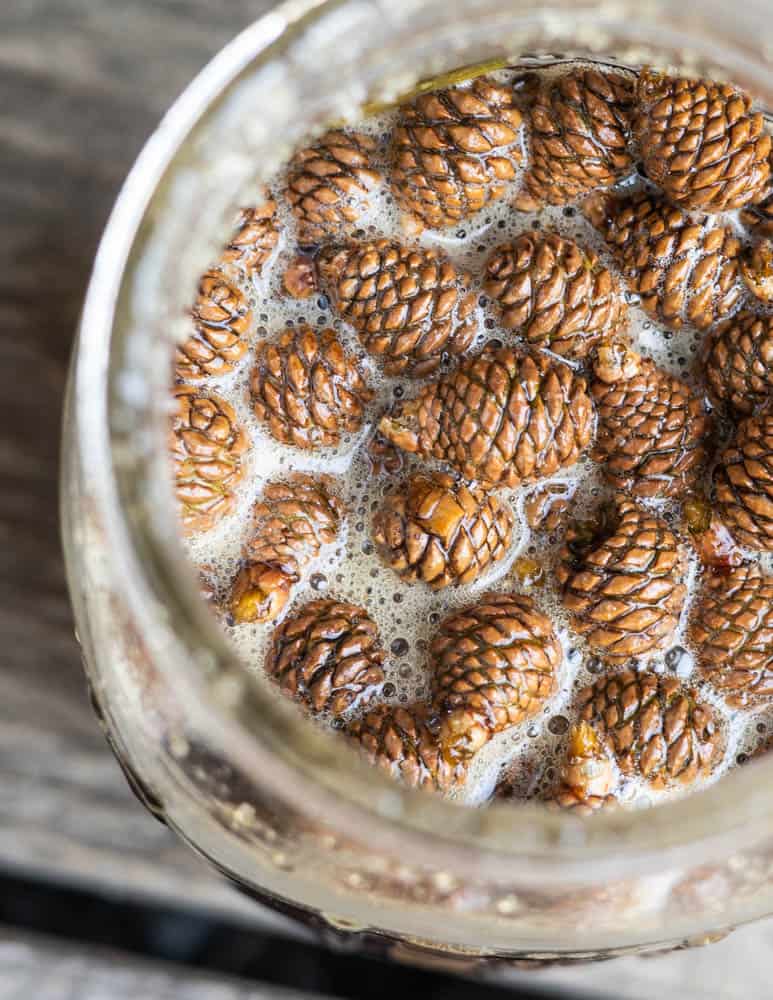
There’s something special about the pine cone syrup though. Pine cones hold more water than any other thing I’ve used, and they also ferment during the maceration process, vigorously.
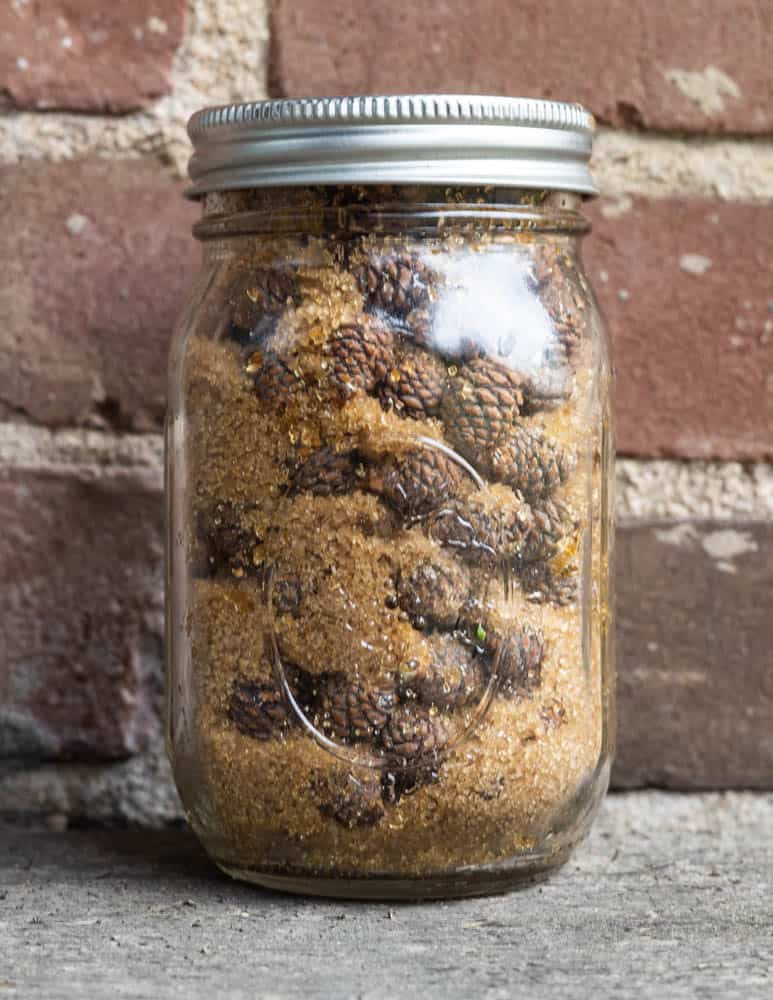
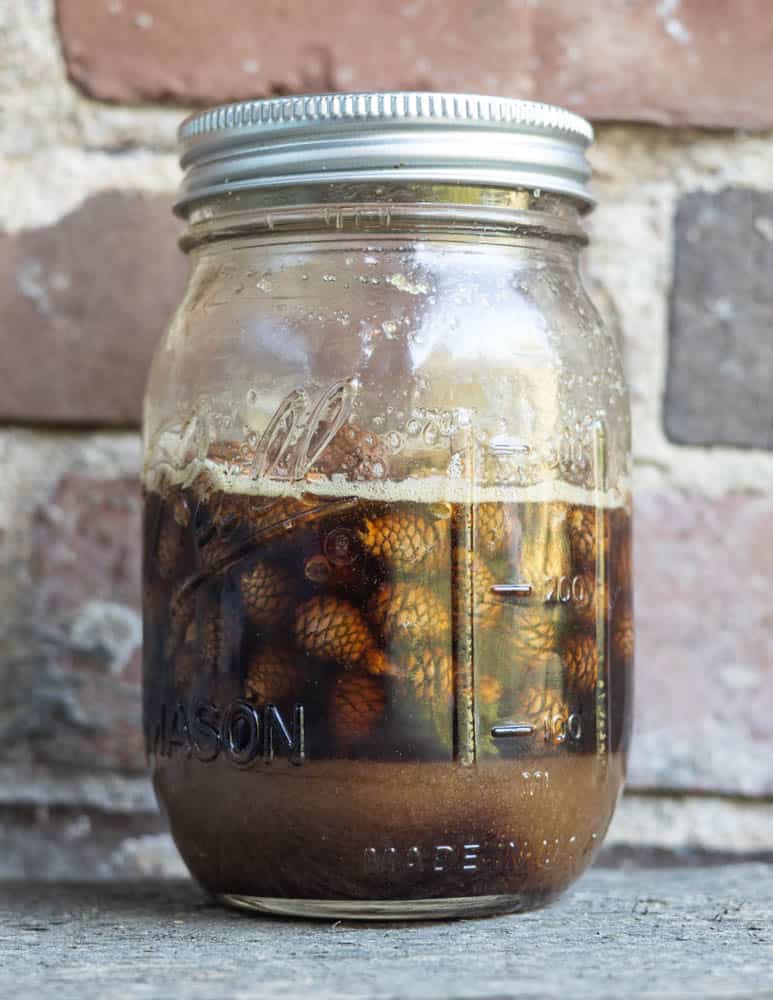
The day after you combine the pine cones and sugar, there will look as if there was a rush and release of water—what was once a solid packed jar of pine cones and sugar is not 75 % full and liquid.
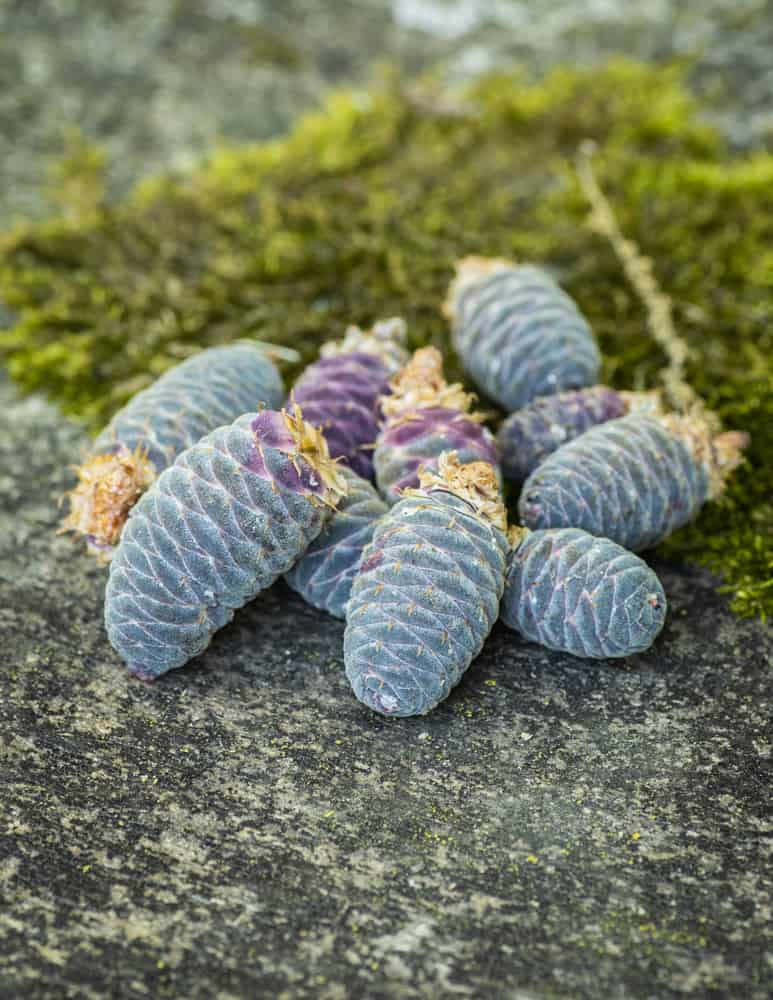
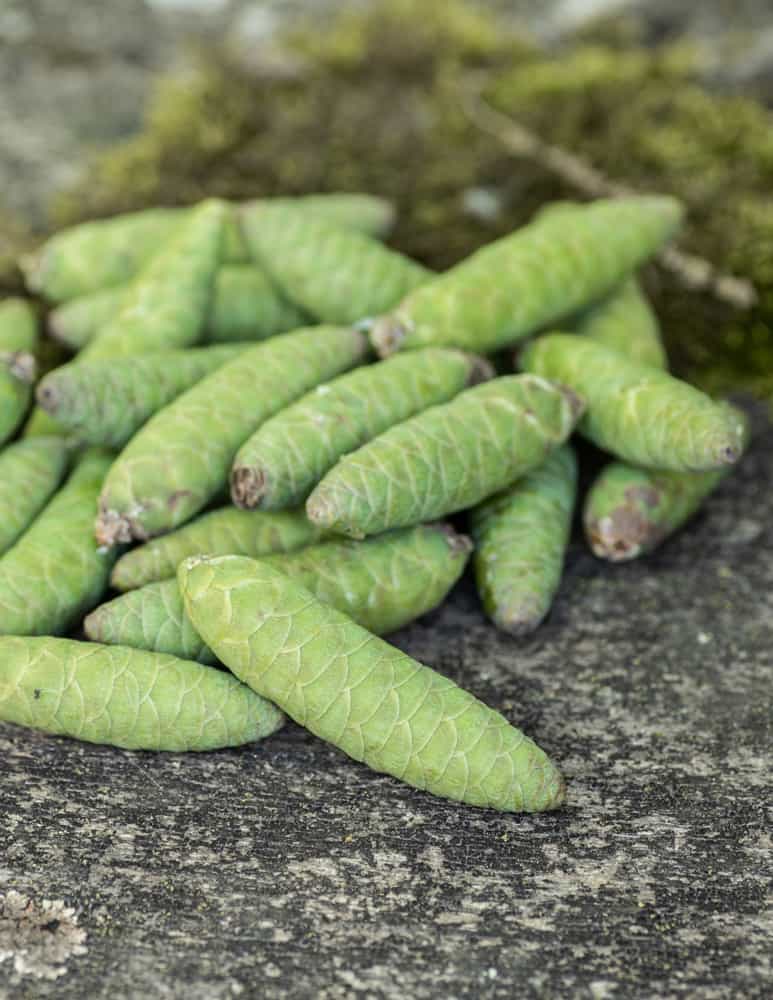
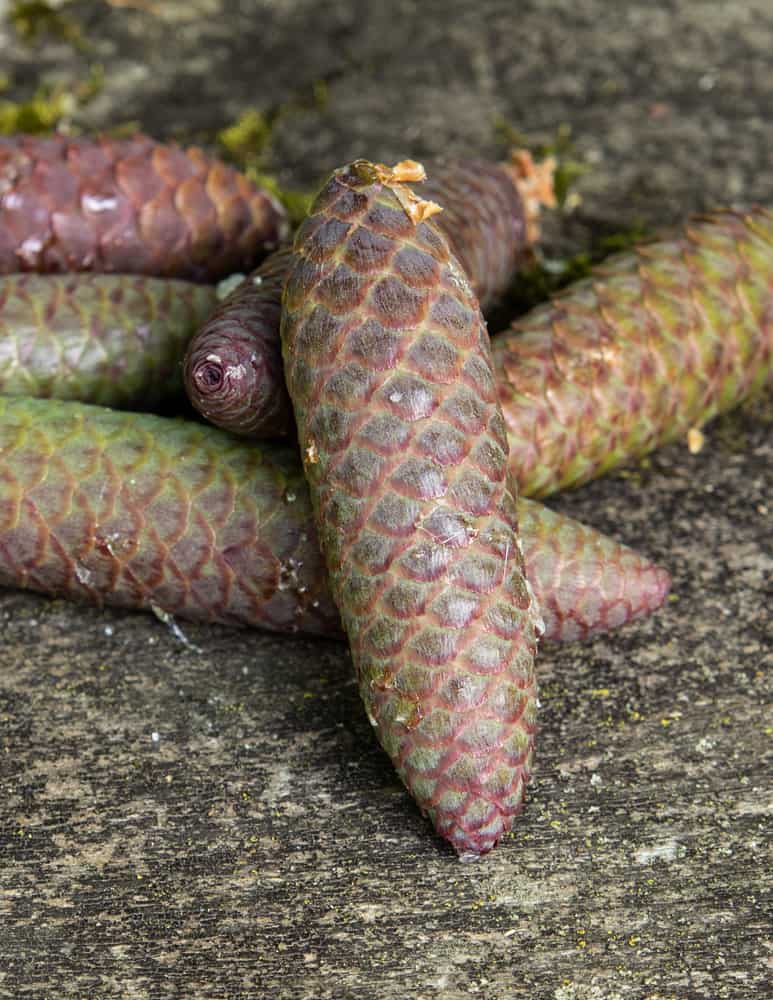
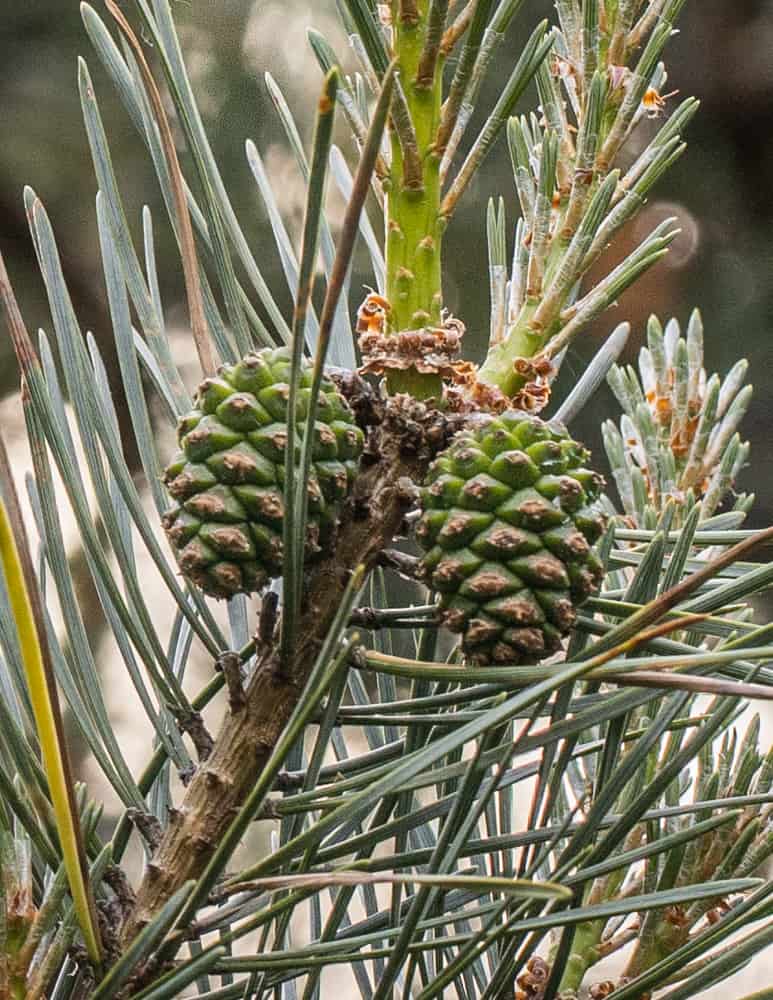
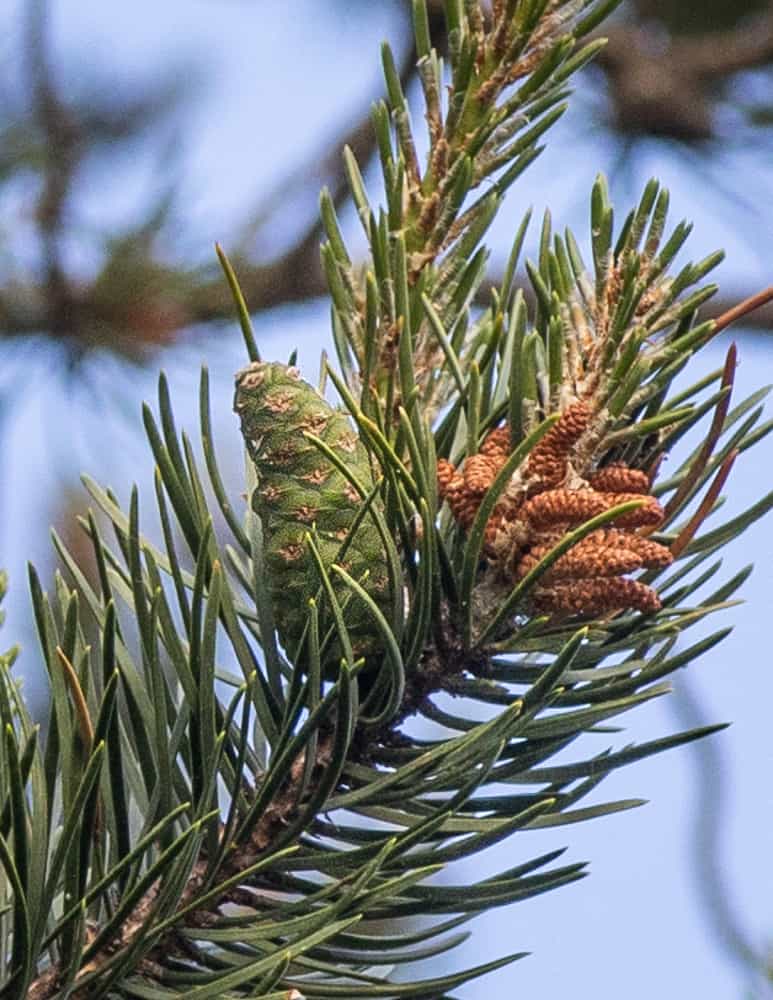
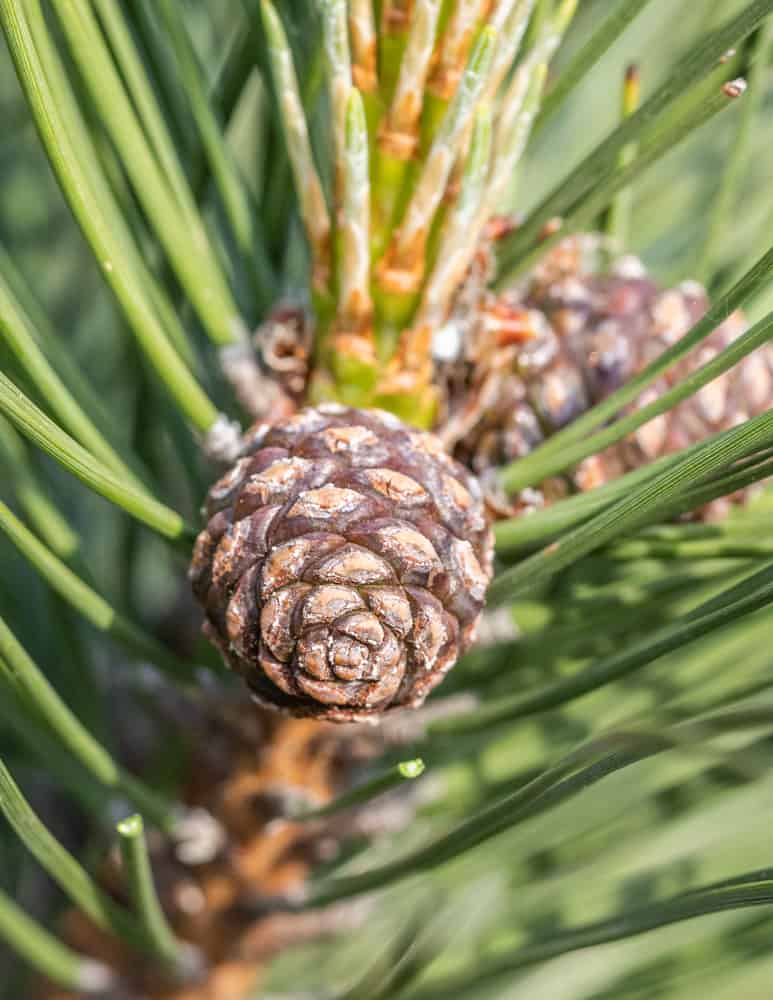
Species of unripe pine cones I’ve used to make syrup
Variation in flavor between species
One of the most fascinating things about mugolio is that every species of tree you harvest unripe cones from will impart a noticeably different flavor unique to the finished product.
Once I started to notice the different flavors, I made a point out of trying to “mugolio” as many different species of unripe coniferous cone I can, and I found some fascinating things. Here’s a quick breakdown of the differences between flavors I taste.
Pinus/Pines
Mugolio made from pinus cones have a resinous, assertive taste.
Picea/Spruces
Spruces lack the aggressive resinous flavor of pines and are the most subtle of all I’ve tasted. Instead of the resinous taste, spruce cones, just like spruce tips, have a citrusy note to them, and so will syrups made from their cones.
Thuja and likely others/Cedars
The only cedar I’ve made mugolio with is the green cones Thuja occidentalis, since they’re easy to find in landscaping. It has a taste exactly like the aroma of fresh green cedar, a bit in between spruce and pine mugolios.
Abies/Firs
Of all the syrups here, and all the different flavors, the syrups I’ve made from balsam fir are the most delicious.
Firs have a resinous punch like pine mugolios, but it’s slightly less aggressive, and most noticeably, comes with strong notes of warm spices like cloves, allspice, and cinnamon.
Unfortunately, mature balsam fir trees, at least around me, seem to only want to grow cones at the very top of the tree, which can make getting enough for a batch of syrup tricky.
Using other conifer products
Other tree products like spruce tips, pine tips and cedar cones I’ve worked with are more dry, and may not ferment during the maceration process, but they can still make a fine syrup.
The point is: you can make syrups like this out of all kinds of things, and everyone I’ve had has been good. If you have spruce trees near you, take a look at the basic spruce tip syrup too, which is nearly the same, sans the fermentation. Here’s a few things I’ve used:
Unripe eastern white cedar cones (Thuja occidentalis. This could can be an abortifacient in high doses)
Juniper berries (Juniperis virginiana)
Spruce tips (many species)
The best part is figuring out how to use it. Somethings take some experimentation, mugolio not so much.
You can literally put it on just about anything where maple syrup would be good, and you’ll be glad you did. The syrup has the essence of pine, but with none of the strong tannins you’d expect If you took a bite out of a pine cone—just pure piney goodness.
Harvest young pine cones in spring or early summer
Most importantly, you are looking for unripe pine cones in the spring and early summer, not the fall, not the winter. Opened cones are not to be used.
This is up for debate, but my favorite comes from green cones as they contain more water. Purists might say that you need to harvest pine cones when they’re the size of a pinky nail, or some other arbitrary size.
I can tell you after making this for years now, that any of the pine cones pictured in the image above will make a fine syrup, but smaller cones will make a syrup with a much stronger flavor, strong enough that some people may not like it.
Another good rule of thumb I’ve found is that whatever cone you’re picking will probably be sticky and exuding resinous, sticky liquid at a prime stage for making pine cone syrup.
Green cone=higher water content
Larger green cones hold more water in them which makes syrup making much easier, and also allows for some fermentation in the process, which adds fun flavors.
As long as the cones are meristematic and tender, and can be cut through with a knife, even if it’s into pieces with long cones like white spruce or balsam fir, they will make a good mugolio. The only cones that won’t work, are mature, tough, barky cones, like those you’d see on the ground.
Using very young pine cones
You can use young pine cones, but they’re smaller and don’t hold as much water as cones that are green, so they’re not ideal here.
If you really want to try with very young pine cones, try chopping them up medium to make it so more cones can be fit in a jar, which means more water, meaning an easier syrup. You can also add a splash of water to help it on it’s way.
Is it safe?
Yes, this is absolutely, positively safe, and there’s no need to worry about botulism. I can’t speak to the exact science of spruce tip and cedar cones syrups, (also safe) but pine cone syrup is especially safe as it ferments as it macerates, due to the higher water content of the cones if harvested at the green stage.
The extended fermentation lowers the pH, making it shelf stable. Remember that sugar is a preservative, and conifer products are all naturally acidic, which is a preservative in itself.
Consider using gloves
The most prime pine and spruce cones for making syrup will be plump, but still unripe. At this stage, most of them will be very sticky and oozing a sappy resinous substance that will quickly coat your hands and will stay for hours. Consider wearing gloves to avoid sticky hand syndrome.
Choosing the right sugar
Some recipes might call for white sugar, and while it will work and give you a flavored syrup, white sugar is more dry, and I find the clear color far less attractive than the caramel color that organic, unrefined turbinado-style sugar or even light brown sugar or a similar substitute will give.
I try to avoid using plain white sugar when I can, and I highly doubt that original mugolio recipes used such highly refined products when the first adventurous people crafted them.
Use a good sugar that you can feel good about eating, and drizzling over everything, because you’ll want to drizzle it, on, well, everything. Here’s a list of sugars that will work
Turbinado
Turbinado is slightly more dry than commercial brown sugars, but it has an excellent flavor.
Light, golden, or dark brown sugar
These are some of the most versatile and affordable, but I suggest using a high quality organic brand. The varying molasses content of the different colors of sugar is negligible in regards to the flavor of the finished syrup.
Maple sugar
Maple sugar is the most expensive you could use, and in my opinion is not the most ideal as it’s prone to crystallization from my experience. It is delicious though. If you’d like to harness the flavor of maple with your pine cones, you can just toss pine cones into maple syrup at a ratio of 1 cup of pine cones to 1 lb (2 cups) of maple syrup.
Zirbenshnaps
This stuff is unique enough that it needs a special mention. Zirbenschnaps is a liquor made with pine cones.
I’m not an expert on distillation by any means, but I’ve been working with a distillery to make similar products, and one thing we’ve been toying around with is making a rendition of it by simply using it as the sweetener in a macerated liquor.
The traditional zirbenshnaps has a red tone to its color, which makes me think they’re using a syrup made from fresh pine cones cooked immediately—not aged.
I know there’s also birch schnaps, and that’s made with reduced birch syrup, so I think using mugolio would be fine. Currently I know zirbenshnaps is only sold at ultra high-end restaurants in my area.
Whatever you make with it, it’s one of the most fascinating and delicious condiments made from wild ingredients I know of.
Making Large Batches
I occasionally make very large batches of syrup, 2 or 3 gallons at a time. Here’s a few tips on doing that if it’s something you’re interested in, especially as this is such a fun (also cheap) and interesting thing to give as gifts. The tips below are intended for those people making 1 gallon batches and up at a time.
Skimming the foam
Similar to maple syrup, when you cook large quantities of the syrup, it will begin to froth and foam at the top and will double in size quickly.
Some cones seem to create more foam than others, especially Norway Spruce. When you notice foam during the cooking process, do your best to skim it off with a spoon and discard.
After you bring the syrup to a simmer and strain, put it back in the pot and bring it to a simmer again, let it rest for a minute or two so the syrup can settle and return to it’s original volume. If you don’t do this, you run the risk of having jars that are half full after settling.
Canning for long-term storage
Pour the piping hot syrup into large jars, or, for smaller ones, pour the syrup into a pitcher with a spout, and pour directly into canning jars (4 oz mason jars make a great gift). Fill the jars nearly to the brim, leaving about ⅛ inch headspace, then, working quickly, screw on the lids tight and turn the jars upside down.
You don’t have to water bath-process this as it’s basically the same sugar concentration as maple syrup, just make sure your jars are clean. The jars will seal naturally but should be refrigerated after opening.
Here’s a few ideas for using it, and a few things yet on my list to try.
Ideas for using
Drizzled on pancakes, crepes waffles and other things primed for syrup.
Use it to flavor whipped cream
Excellent drizzled over soft cheese like mascarpone, labneh, chevre, etc.
Drizzled over fresh fruit
Using in place of honey, I love drizzling it over bowls of warm buttered wild rice with nuts, fruit, and yogurt for breakfast.
It’s good in desserts, added in small amounts like you would use honey. Dairy based desserts like ice cream, panna cotta and custards of all kinds can just be seasoned to taste with it.
Try adding small drizzles to salads, or whisking into vinaigrettes.
Mixing it with a splash of vinegar just to loosen it a bit makes a good brush on or glaze for hams, etc.
Many different types of nut trees grow naturally in Ohio or have been brought from other places.
These trees produce delicious nuts and beautify the landscapes of the state. We’ll learn about the unique characteristics of each tree, where they prefer to grow, and why they’re important to both humans and animals. Native trees such as Black Walnut and Hickory have long been valued for their strong wood and tasty nuts.
In this article, we’ll look at how to tell the difference between native nut trees in Ohio that have been growing here for a long time and non-native nut trees that have recently been introduced.
So, let’s get started.
1. Ohio Buckeye
Common Name: Ohio Buckeye
Scientific Name: Aesculus glabra
Mature Height: 20-40′ (6-12 m)
Native/Non-Native: Native
Flowers/Cones: green flowers
Uses: planted in parks, yards, and along streets for its attractive autumn foliage
The Ohio Buckeye, also known as Fetid Buckeye or Stinking Buckeye, is a Native American tree that features a broad spherical crown with a flat top and can reach a height of 20-40 feet.
The Ohio Buckeye’s palmate leaves are composed of 5 leaflets, each 3-5 inches long and radiating from a central point with fine uneven teeth. The leaves are yellowish green on top and pale and hairy on the bottom, and they are linked to the tree in different directions.
Because of the unpleasant odor of the blossoms and most other portions of the tree when crushed, the Ohio Buckeye is also known as Fetid Buckeye or Stinking Buckeye. It thrives in damp locations naturally, such as river bottoms, and is planted as a landscaping tree in drier highland areas for its gorgeous autumn foliage.
The tree produces spherical, light brown spiny capsules that are 1-2 inches wide. These capsules carry 1-2 glossy brown toxic seeds that fauna avoids. The bark of the Ohio Buckeye was originally employed as a cerebrospinal system stimulant.
The Ohio Buckeye leaves turn yellow to orange in the fall, creating a stunning picture. It can be distinguished from Yellow Buckeye by the warty spines on its fruit capsules. Despite its unpleasant odor, they are one of the most commonly found nut trees in Ohio.
2. Black Walnut
Common Name: Black Walnut
Scientific Name: Juglans nigra
Mature Height: 50-75 feet (15-23 meters)
Native to North America
Flowers in catkins and fruits are green with an edible nut inside
The black walnut tree can be found throughout North America. It can reach a height of 75 feet!
The Black Walnut tree’s leaves are compound, which means that many little leaves grow together on one stalk. Each leaflet is approximately 3-4 inches long and has a pointed tip. The leaves become yellowish green in the fall and fall off the tree.
The Black Walnut tree’s fruit is green with a firm dark nut inside. The nutmeat is delicious and safe to consume. The husk that covers the nut, on the other hand, contains a chemical that can color your skin. Pioneers dyed their garments light brown using these husks!
The wood of black walnut is also quite valued. It does not shrink or distort, making it ideal for making furniture and cabinets. Animals such as squirrels and birds rely on the Black Walnut tree for food.
One important feature of Black Walnut is its ability to create juglone, a natural herbicide. This compound can be damaging to surrounding plants and is present in the tree’s fallen leaves and roots.
3. American Bladdernut
Common Name: American Bladdernut
Scientific Name: Staphylea trifolia
Mature Height: 20-25 feet
Native/Non-Native: Native
Flowers/Cones: Green capsule fruit
Uses: Provides shade and beauty in gardens and forests
The American Bladdernut tree has several slender stems and an open crown. It can reach a height of 20-25 feet and has compound leaves that are 6-9 inches long.
The leaves are oppositely connected and consist of 3-5 oval leaflets ranging in length from 1-3 inches. The fine-toothed margins of the dark green leaves are placed above while the paler green margins are located below.
The bark of the American Bladdernut is originally gray and smooth, but it can turn scaly and fractured as the tree becomes older. The tree’s fruit is a 3-lobed green capsule that turns brown when mature and can grow to be 1-2 inches long. The capsule dangles and opens at the pointed end, releasing lustrous brown spherical seeds.
The American Bladdernut is native to Ohio and grows in moist soils and shade in the understory of deciduous woodlands.
It gets its name from its distinctive inflated green-to-brown bladders, which are most visible in the summer and autumn. These bladders help distinguish this tree from others. Because of its location in the understory of deciduous forests, this tree is sometimes ignored.
4. Butternut
Common Name: Butternut
Scientific Name: Juglans cinerea
Mature Height: 40-60 feet
Flowers/Acorns: Produces small greenish-yellow flowers in the spring; develops oblong nuts enclosed in sticky husks.
Uses: Valued for its timber, which is used in woodworking and furniture making; nuts are edible and enjoyed by both wildlife and humans for their rich flavor.
Butternut, commonly known as White Walnut, is a medium-sized tree with a divided trunk and an open crown that can grow to a height of 40-60 feet. It is scientifically known as Juglans cinerea and is a member of the Walnut family (Juglandaceae).
If you are looking for the best variety among the nut trees in Ohio, then Butternut must be the ideal choice. It is a native tree with a wide range that can live for 80-100 years.
The tree’s compound leaves are 15-25 inches long and have 11-17 leaflets. These leaflets have a toothed border and are typically 2-4 inches long. The last leaflet of each leaf is normally present and the same size as the lateral leaflets, gradually shrinking toward the leaf base.
The bark of the tree is light gray with broad flat ridges. Butternut flowers are catkins that are 1-2 inches long and made up of many tiny green flowers. The fruit is an oval, edible nut with a sticky green husk that becomes brown.
Butternut trees grow in a wide range of soil types, often on slopes with well-draining rich soils.
Butternut wood is highly hard, robust, and in high demand among woodworkers. This tree’s sap can be boiled to make syrup, and yellow dye derived from the husks can be used to color clothes. The common name comes from the butter-like oil that American Indians extracted from the nuts.
Unfortunately, Butternut is plagued by a devastating illness known as Butternut canker, which is caused by a fungus and has killed many of these trees.
5. Horse chestnut
Common Name: Horse Chestnut
Scientific Name: Aesculus hippocastanum
Mature Height: 50-75 feet
Flowers/Acorns: Produces white or pink flowers with a yellow or red spot in the spring; develops spiky capsules containing shiny brown nuts.
Uses: Ornamental tree in parks and gardens, nuts for wildlife.
Aesculus hippocastanum, or horse chestnut, is a medium-sized tree that can grow to be 40-60 feet tall. It is a member of the Soapberry family and is recognized for its lovely white blooms with yellow or orange centers that grow in spike clusters 8-12 inches long.
The Horse-Chestnut tree’s leaves are palmately compound, with 5-9 leaflets radiating from a central point on each leaf.
The bark of Horse-Chestnut trees is dark brown with numerous furrows and scales, and the fruit has numerous spines.
The fruit is a spherical, thick-walled leathery green capsule with 1-3 smooth, non-edible, lustrous chestnut-brown seeds. The tree is not native to the United States and was brought over from Europe perhaps 75-100 years ago.
Horse-Chestnut trees thrive in a wide range of soil conditions and can be found in parks and yards across the United States. They are linked to Ohio Buckeye trees and were sometimes used to treat horse coughs, which is how they received their name. Esculin, a substance found in the Horse-Chestnut tree’s leaves and bark, has been extracted for use in skin protectants.
The Horse-Chestnut tree’s leaves become yellow in the autumn season. This plant is a lovely addition to any outdoor setting, and many people enjoy its distinctive flowers and foliage. However, keep in mind that the tree’s seeds are not edible and should not be consumed.
6. Yellow Buckeye
Common Name: Yellow Buckeye
Scientific Name: Aesculus flava
Mature Height: 50-70 feet
Flowers/Acorns: Produces showy yellow flowers in the spring; develops spiny capsules containing shiny brown nuts.
Uses: Planted for decorative purposes in gardens and parks, providing shade and visual appeal; nuts serve as a food source for wildlife.
Aesculus flava, or Yellow Buckeye, is a big tree that can grow to be 50 to 70 feet tall. It has a circular crown with spreading branches and single or several trunks.
Yellow Buckeye leaves are a palmate compound and range in length from 5 to 14 inches. They are composed of 5 to 7 leaflets radiating from a central point. The leaflets are finely serrated and uniformly yellowish-green on top, paler below, and frequently hairy.
Yellow Buckeye produces green-to-tan tubular flowers in triangular clusters 4 to 6 inches tall in the spring. The Yellow Buckeye produces a smooth, leathery, 3-parted light brown capsule that is spherical and 2 to 3 inches wide. There are 1 to 2 deadly seeds inside the capsule.
Yellow Buckeyes are endemic to Ohio and feature a yellow-to-orange fall color. They can grow up to 6,000 feet in a range of settings and are often found in deep moist soils, rivers, and mountain valleys.
Although the Yellow Buckeye is ubiquitous in the Great Smoky Mountains, it is rare in pure stands in Ohio and is restricted to rich bottomlands.
The Yellow Buckeye’s soft wood is listed at the bottom of the 35 major timbers in the United States and is frequently used for pulpwood, artificial limbs, and interior finishes for dwellings.
Yellow Buckeye seeds and young shoots are poisonous and can make cattle sick. However, the Yellow Buckeye is often marketed as a shade tree and is also known as Sweet Buckeye, Big Buckeye, or Large Buckeye.
7. Shellbark Hickory
Credit:
Common Name: Shellbark Hickory
Scientific Name: Carya laciniosa
Mature Height: 70-90 feet
Native/Non-Native: Native
Flowers/Cones: Thick-shelled green fruit turning dark brown at maturity, round 2-3″ in diameter, husk splits open into 4 sections, releasing a nearly round nut.
Uses: Fruit is edible and eaten by wildlife.
One of the tallest nut trees in Ohio, the Shellbark Hickory, also known as the Big Shagbark Hickory or Kingnut, is a huge, natural tree that may be found throughout most of the United States save the far eastern limit of Ohio.
It can reach a height of 90 feet and has a straight trunk and a narrow spherical crown.
It has complex leaves that are glossy green on top and lighter on the bottom, with 7 (occasionally 9) lance-shaped leaflets. The tree’s bark is gray and rough, growing shaggy with age and flaking into long, thin, loosely linked pieces.
The Shellbark is one of the easiest hickories to identify due to its enormous leaves, incredibly large fruit, and orange twigs. Its fruit, which is edible and consumed by wildlife, is thick-shelled, green, and matures to a dark brown color.
The husk separates into four parts, revealing an almost spherical nut. The central stalk (rachis) of the tree persists after the leaflets fall off each autumn.
Shellbark Hickory grows well in moist to wet soils, floodplains, and sun to partial shade. The tree has been present for 150-200 years, and the Latin species name, laciniosa, means “with folds,” referring to the shaggy bark. It’s a lovely tree that feeds wildlife and lends a unique touch to any area.
8. Mockernut Hickory
Common Name: Mockernut Hickory
Scientific Name: Carya tomentosa
Mature Height: 40-80 feet
Native/Non-native: Native
Flowers/Cones: Produces thick-shelled green nuts
Uses: Valued for its strength for furniture; also used for smoking meat, such as ham.
The Mockernut Hickory is a medium to big tree with a straight trunk. It can reach heights of 40-80 feet and has a narrow circular crown. It has complex leaves that are 8-20 inches long and have 7-9 leaflets. Each leaflet is elliptical, with a pointy apex and a round base.
The leaves are lustrous dark green on top and lighter and hairy on the bottom. The bark is gray to light brown and has short forked ridges.
The Mockernut Hickory produces thick-shelled green nuts that develop to brown. These nuts contain a small edible kernel that ranges in color from tan to light brown.
The tree bears nuts after 20 years, but the optimal nut-bearing age ranges from 50 to 150 years. Its nuts are an essential wildlife food source, as many birds and animals consume them or store them for the winter.
Mockernut Hickory is native to the eastern and southern United States, where it can be found in damp highland areas. It is commonly found growing with oaks and other hickories on ridges and hillsides in the sun.
The species name stems from the Latin term tomentum, which means “covered with dense short hairs,” and refers to the underside of leaves, which aids in species identification.
Mockernut Hickory wood has long been prized for its strength and durability, particularly in furniture. It is also used to smoke meat, like ham. Its hairy, sturdy twigs are frequently reddish brown.
The Mockernut Hickory tree represents a strong and enduring species that has survived for 300-500 years.
9. Bitternut Hickory
Common Name: Bitternut Hickory
Scientific Name: Carya cordiformis
Mature Height: 50-100 feet
Native/Non-Native: Native
Flowers/Cones: Produces nuts
Uses: Wood is used for smoking meat, and nuts were once used for lamp fuel
Bitternut Hickory is a huge, strong tree that can reach heights of 100 feet. The trunk is straight, with slender erect branches and an open spherical crown.
The leaves are compound, which means they are made up of several smaller leaflets. Each leaflet is 3-6 inches long and has a pointed tip and a finely serrated border. The leaves are glossy green above and lighter below.
Bitternut Hickory bark is gray in hue with uneven vertical fractures.
Bitternut Hickory fruit is a circular nut, 34 to 12 inches in diameter, with a pointed end and four ridges extending to the point. This nut is too bitter for humans and most creatures to consume. Previously, the oil derived from the nuts was utilized as lamp fuel.
Bitternut Hickory is a North American native that thrives in damp soils and lowlands. It is a full-sun tree that does not tolerate shade. It has a bright yellow bud that makes it simple to distinguish before the leaves appear. Bitternut Hickory wood is used for smoking meat and has a particular flavor.
This tree has been existing for 100-150 years and is an important part of North America’s natural landscape.
10. American Chestnut
Common Name: American Chestnut
Scientific Name: Castanea dentata
Mature Height: 60-90 feet (18-27.5 meters)
Native/Non-Native: Native
Flowers/Cones: Catkin with male and female flowers on the same tree (monoecious)
Uses: Hard oak-like wood with a straight grain, relatively decay-resistant.
The American Chestnut is a magnificent tree that previously stood more than 100 feet tall.
The leaves of the American Chestnut are distinctive, having large teeth that extend beyond the leaf margin and curve forward like saw teeth. The bark of the American Chestnut is smooth and dark brown to red, splitting into large flat-topped ridges.
The American Chestnut is well-known for its delectable chestnuts, which are frequently roasted over an open fire during the holiday season. However, the tree has numerous more purposes besides producing tasty nuts. The wood of the American Chestnut is firm and straight like oak, making it a great choice for furniture and building materials.
A fungus known as chestnut blight has made mature trees extremely scarce today. Chestnut blight is a fungus that destroys trees by damaging the bark and interfering with nutrition delivery.
The American Chestnut tree is endemic to the eastern United States and is frequently observed in parks or near historic structures.
Although mature trees are difficult to obtain owing to chestnut disease, the American Chestnut will sprout from the stumps of dead or cut trees and can continue to thrive.
Similar Articles
White Flowering Trees In Ohio
Yellow Flowering Trees In Ohio
Common Oak Trees In Ohio
Common Willow Trees In Ohio
Common Purple Trees In Ohio
Common Pine Trees In Ohio
Common Birch Trees In Ohio
Common Ash Trees In Ohio
Native Cherry Trees In Ohio
Native Hickory Trees In Ohio
Common Elm Trees In Ohio
Common Spruce Trees In Ohio
Common Poplar Trees In Ohio
Common Maple Trees In Ohio
Common Cedar Trees In Ohio
Native Aspen Trees In Ohio
Native Plum Trees In Ohio
Common Locust Trees In Ohio
Common Palm Trees In Ohio
Common Nut Trees In Ohio – Sources
The Regional Gardening team makes sure that the information in our articles is accurate by only using sources that are known to be trustworthy. Some of these sources are peer-reviewed journals from government agencies, well-known universities, and scientific research organizations.
Trees Of Ohio, Division Of Wildlife
Trees Of Ohio Field Guide, Book by Stan Tekiela
Ohio Trees, OSU Extension Publications
Native Plant Lists, Ohio Department Of Natural Resources




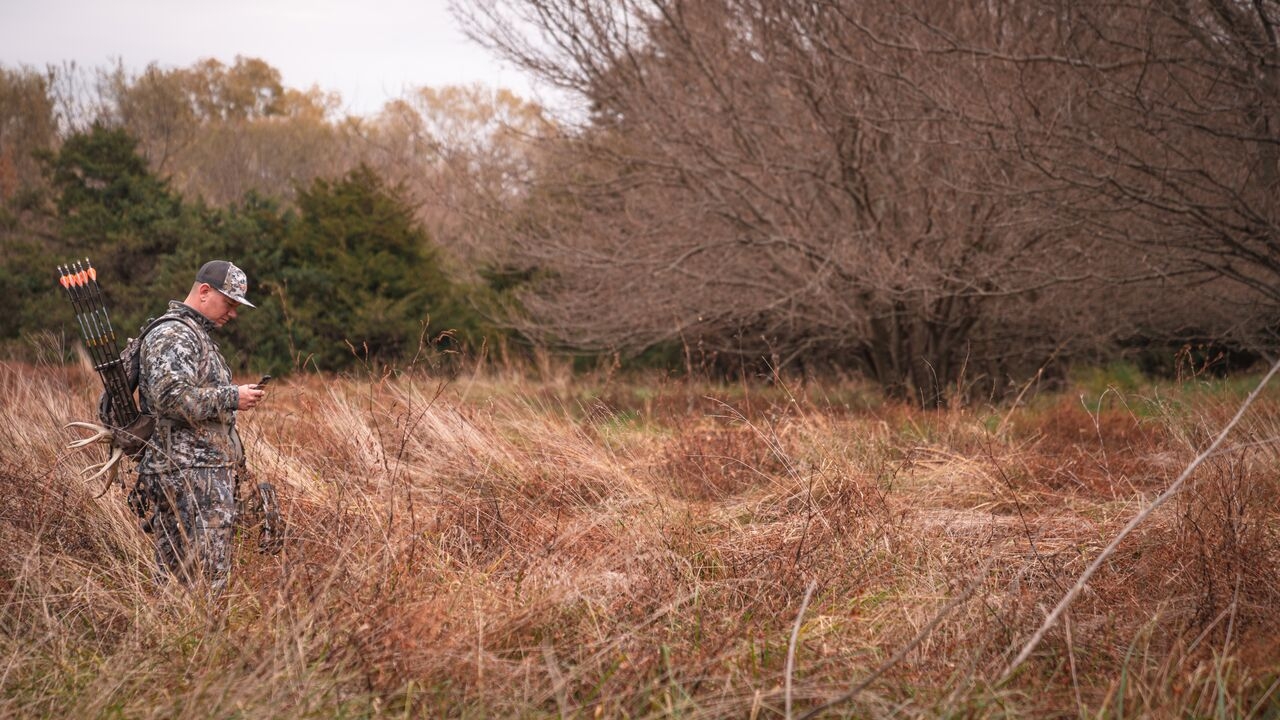


 Day or Night? Night hunting hogs is a real blast. Adding a white light to your gun is easy and doesn’t have to cost a fortune. If the shooting gets fast as the daylight fades to dark, your white light becomes a real asset. I’ve watched Bill Wilson of Wilson Combat point a white light at hogs who were undeterred by its presence. Bill has spent countless hours with the hogs figuring out which white lights scare them, and the specifics of color temperature and technique that leave hogs comfortable and vulnerable.
 But there are better, albeit far more expensive, doors to crash. Jump into the high tech world of night vision and thermal optics and you’re into a whole new level of the game. Instead of spending a hundred dollars for a light, you’ll spend ten to twenty times that to access what many consider to be the pinnacle of tactical hunting. Case in point: Recently I’ve been highly impressed by the line of thermal optics from IR Defense. I’ve watched IRD grow for a year, and recently hunted with their IR Hunter Mk II. Using this thermal optic, I was able to identify hogs at 400 yards and shoot them on the run at 125 yards. Thermal can fool you though. Rocks at a distance can look remarkably like a group of pigs far off. Stay tuned to SHWAT.com for more on that.
 Alternatively, more magnification both increases the ranges you can make confident shots at and adds precision to virtually any shot beyond 50 yards. There are probably as many magnified optics choices as there are ammo choices. Lots of optics are good enough to hunt hogs mid day at 150 yards. Your run of the mill 3-9x scope might be just fine. However, cheap scopes simply aren’t as sharp and lose contrast quickly at higher magnification. Lack of high quality optical coatings can leave you unable to see clearly with your scope angled towards a late afternoon or early morning sun, washing out when pointed in the direction of the sun. Brands like Trijicon, Nightforce, US Optics and Bushnell Elite Tactical are all winners at various price and feature points.