It isn’t often that the whitetail world gets a legitimate chance to headline a “biggest ever” or “new world record.” By definition, only rarely do trophies of this magnitude come along.
For instance, the current overall Boone & Crockett non-typical world record “Missouri Monarch” was found way back in 1981. It’s also now been over a quarter-century since Saskatchewan hunter Milo Hanson shocked the world by taking a new No. 1 B&C typical. The “Nebraska General” shed antlers, the largest free-range typical set ever recorded, were found in 1959 but only brought to public attention in 1996.
In 2000, Mike Beatty broke the Pope & Young word record — which had stood since 1962 — with a 294 0/8-inch Ohio non-typical. And in 2004, Tony Lovstuen’s 307 5/8-inch Iowa muzzleloader buck was recognized as the largest whitetail ever taken by a hunter. He held that rank until 2016, when we were treated to muzzleloader hunter Stephen Tucker’s 312 0/8-inch Tennessee non-typical, which was recognized as the largest whitetail ever taken by a hunter. And then, last fall, Luke Brewster arrowed a 320 5/8-inch Illinois giant that has taken the crown from Tucker as the newest top non-typical hunter kill.
Interestingly, on the heels of the Brewster buck, we have another whitetail sending shock waves throughout the antler community.
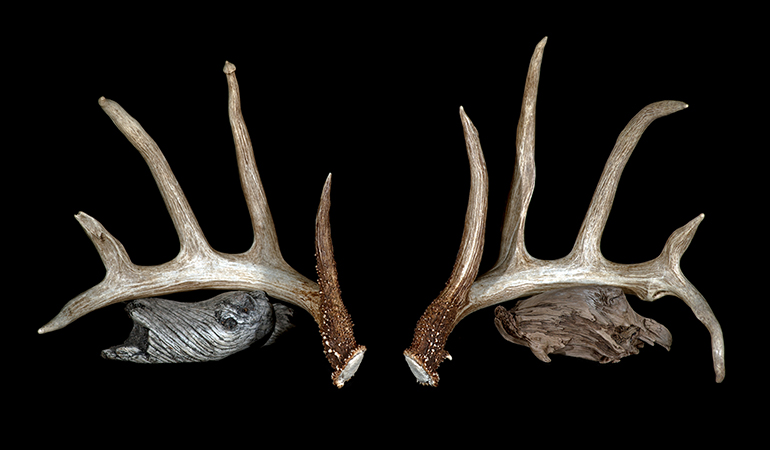
The December/January 2018 issue of North American Whitetail magazine featured a monstrous 9-point buck from southern Indiana. The deer, taken by hunter Andrea Moffett, had a gross typical score of 200 inches and a B&C net score at 180 4/8. Those numbers put the Moffett buck among the world’s elite whitetails. But it is the 2015 shed antlers from the buck that are going to blow away any misconceptions about just how big a wild deer can possibly grow.
Photo courtesy of Shane Indrebo
The current world record matched set of typical shed antlers listed in the North American Shed Hunters Club (NASHC) record book is from a buck known as “The Nebraska General.” That matched 6×6 set has an official record book score of 195 1/8 net inches following asymmetry deductions (without a spread credit). The largest 5×5 typical sheds listed in the NASHC record book belong to the so-called Fleming sheds from Saskatchewan with a net score of 181 2/8 (again, no spread credit). The preliminary measurements of the Indiana sheds will put them very near, or slightly over the Fleming sheds as the world’s largest known 5×5 set.
The final numbers on a score sheet determine where a set of antlers will rank. However, a score is only a number — it does not always tell the entire story or describe just how big a set of antlers might truly be. Seeing the rack in person is the only way to understand the full size and visual impact the antlers have. And while the Moffett buck carried the 2015 set of antlers, he was beyond any doubt in my mind the largest typical whitetail to ever walk the earth!
Let me explain. It would be impressive enough if these antlers were given a final official score that meets or exceeds the reigning world record for 5×5 sheds. That would make them huge in their own right. However, once you add on a conservative inside spread of 30-plus inches, these Indiana sheds enter a realm all of their own! Positioned as they would have been on the buck’s head, these antlers could score as high as 220 or even higher with a spread credit, netting around 210-213 after asymmetry deductions.
These numbers are unheard of for a 5×5. (Again, the Milo Hanson buck, a basic 6×6, is the largest intact typical rack ever, at 213 5/8). The Indiana buck’s left side alone could cross the coveted 100-inch mark, as that with only five points (counting the main beam). There is a very realistic expectation for these sheds to not only surpass the existing world record 5×5 sheds, but the left antler could be a world-record single, too. The typical mark for a single currently stands at 98 6/8 and is held by the Reissmann shed, a right side from Illinois in 1991.
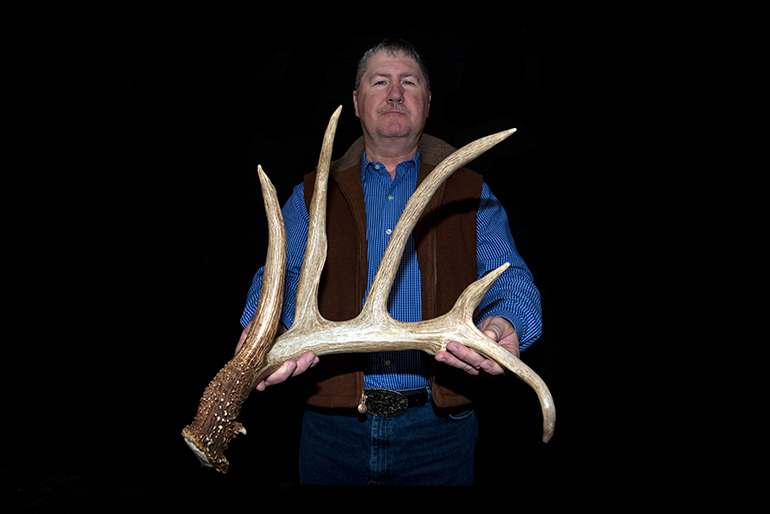
I was recently given the privilege of not only seeing and holding the Indiana antlers myself, but also was able to compare them to the racks of many other top-end whitetails. When I picked up the sheds for the first time, I was literally speechless! I stood and stared at them and could only shake my head, mostly in disbelief. I could not believe a whitetail, not to mention a 5×5 typical, could ever reach the size and magnitude of what I held in my hands. I was eventually able to form words, but even then I could only say, “Oh, my gosh” over and over. After 30 years of being around world-class whitetails and having the honor of seeing in person and in many cases holding them, I thought I had seen it all. But as soon as I picked up these sheds, I immediately understood that I had been completely wrong in my thinking.
I was recently invited to New Richmond, Wisconsin, and to the office of Antlers by Klaus. Klaus Lebrecht is the world’s leading replicator of world-class whitetails; it was here that I was given the privilege to compare the Indiana sheds to the racks of other world-class bucks, including world records and many Top 10 entries. Albeit, I was comparing them to replicas, but those replicas are exact in scale and measurements. I can say with the utmost confidence that no other whitetail rack can hang with these sheds! They literally embarrass former and even current world records, both hunter-taken trophies and shed sets. I had intentions to take quality side-by-side comparison photos, but I soon realized that doing so would only diminish the perception of any racks I set alongside them! I simply could not do that to some of the biggest deer in the world.
Photo courtesy of Shane Indrebo
Ohio antler collector Keith Snider recognized the sheds as being world class, and he negotiated their purchase from the Moffett family. They’re now the centerpiece of the “Whitetail Legends” display and are scheduled to be seen and enjoyed by thousands of deer hunters and antler enthusiasts across the continent. The giant sheds made their first public appearance at the Kansas Monster Buck Classic in Wichita earlier in January, and official measuring for NASCHC is tentatively scheduled to take place during the 2019 Iowa Deer Classic in Des Moines, March 1-3.
If you ever have the opportunity to hold these shed antlers in your hands, I’m willing to bet that one of your impulsive reaction will be to run out the door with them — not to steal them, but to show them to everyone you know! I fought with this same urge; antlers of this magnitude need to be seen and enjoyed by all hunters and collectors alike. It was a great privilege to have been given the inside information, photos and story on these sheds in October 2018, but it was very hard to keep them quiet. It was one of the toughest secrets I’ve ever been asked to hold.
There is more to be written about these colossal antlers. The entire story is one of wonder and miracles. I’ll be sure it gets told in its entirety in the near future. In the meantime, I hope you get an opportunity to see them in person. You will not be disappointed in the least. If fact, I’m certain you will agree you have seen the largest 5×5 ever known to have walked the earth!
The tune of Mrs. McCottontail was singing out of the X24. My thumb positioned on the volume buttons, ramping the volume of the rabbit cries up and down. My attention was on the grown up fence row that led into a nasty thicket full of briars and treetops. Suddenly a group of birds were frantically communicating with each other straight down the fence row. I thought to myself, “Surely that means a bobcat is on its way.”
All of a sudden a bobcat magically appeared no more that 50 yards in front of me. The bobcat’s eyes were fixated on the call -flipping his tail as he stalked toward the sound. My rifle was already positioned in the direction of the X24. As the cat crossed in front of my gun barrel, I lip squeaked to stop him, settled the crosshairs on his shoulder, and squeezed the trigger. Pew! Thwap!!! There laid a bobcat just feet from the call. I walked up to the cat and was in awe – just like I am of every bobcat that I’ve been blessed to put my hands on.
After several years of calling bobcats in Kentucky, I’ve found that thorough scouting, smart stand selection, and solid calling techniques all work together to increase your odds of tagging bobcats.
SCOUT FOR BOBCATS
Scouting is an important tool to take advantage of for bobcat success. It’s pretty tough to call up a bobcat in a place that doesn’t have them.
First things first, you have to find them. You’ll rarely see a bobcat out in the wide open. Bobcats seem to love the thick stuff. Lots of times the thicker the better. Recently logged areas that have treetops scattered throughout and have grown up in thick briars can be hot spots for cats. Brushy creek bottoms, thick drainages, and even grown up fields can be places that bobcats love to hang out in and hunt.
Get out there and start looking for sign such as tracks & droppings. Probably the easiest way to find tracks is by walking travel corridors after a snow. Looking for tracks in mud and sand along creeks and pond banks can also pay off.
Take advantage of trail cameras. Trail cameras are an excellent scouting method for finding bobcats. Not only will they let you know if you have a cat to hunt, but they can also help you pattern a cat and let you know when you need to be in the area calling.
One thing I’ve learned over the years is if you call a bobcat in an area, there’s a good chance you’ll find success in that area year after year. I have a few stand locations that I can count on to produce a bobcat, year in and year out. There’s actually a couple of locations that I don’t dare call unless bobcat season is in because there’s that good of a chance that a cat will stroll in.
STAND SELECTION
Stand selection is crucial for success. An ideal stand will have you set up tight on thick cover, but be in an area open enough for you to see. Setting up in woods or in thickets can be effective, but you take the chance of a bobcat coming into the call and sneaking back off without you ever seeing it. Plus, there’s a good chance you could spook a bobcat walking in if you push too far into their area.
I personally like to find open areas such as a small field that is adjacent to where I have bobcats scouted. If possible I’ll set up 50-75 yards away from the thick cover and place the FOXPRO out half the distance from me to the edge of cover. A bobcat isn’t likely to cover a tremendous amount of open ground. So you’ll need to set up close enough that a bobcat will feel comfortable to come to your call.
When it comes to wind direction for bobcats, you’ll find that opinions differ. I’ll give you mine – Always Hunt The Wind! I have seen bobcats circle to the downwind side of my FOXPRO on more than one occasion. I have also seen a bobcat enter my scent cone, get nervous, and run off without the opportunity to fire a shot. I have also called numerous coyotes (which never get a pass) while making bobcat stands. It doesn’t matter if I’m calling for bobcats, coyotes, or fox – I’m always hunting the wind.
SOUNDS & SOUND SEQUENCES
I definitely have favorite sounds that I like to use on bobcat stands. In my experiences of calling bobcats, I’ve become a big fan of cottontail distress sounds. That being said, I’ve called cats in on jackrabbit, snowshoe hare, and various bird sounds. I’ve actually had success calling in bobcats on over a dozen different FOXPRO sound files.
A general bobcat sequence that I like to run starts out light and builds in intensity throughout the sequence. I’ll usually run 3-4 different prey distress sound files resulting in a 15-25 minute stand depending on the location (most of the bobcats I call in show up under 8 minutes). For instance, I’ll start out with a sound such as “Bay Bee Cottontail.” I’ll run that sound for 4-6 minutes. If a cat doesn’t show, I’ll pause for 20-40 seconds and then go into an adult cottontail sound such as “Mrs. McCottontail.” Again, I’ll run that sound for 4-6 minutes. If a cat still doesn’t show I’ll pause for 20-40 seconds again and then go into a snowshoe hare sound such as “Snowshoe Hare HP.” If a bobcat still doesn’t show I’ll finish with a few minutes of a jackrabbit sound such as “Lightning Jack.” As you can see, I like to start out light and increase with intensity with each successive sound. I’ve learned over the years that if a bobcat doesn’t show on a sound played, they’ll usually show up rather quickly after the next sound starts up. It’s almost as if they are afraid they lost their chance to claim the rabbit and then charge in when another sound starts back up.
Over the last 2 years I’ve fallen in love with the new FOXPRO sound file “Mrs. McCottontail.” I’m starting to think that it might be the best bobcat calling sound file ever recorded. After watching 8 different bobcats show up while that sound was playing, I’ve henceforth started leading off with “Mrs. McCottontail.” I’ve recently tagged 2 bobcats that each came to the call in under 5 minutes to that sound.
CLOSING
It’s an amazing sight to witness a bobcat come to the call. Sometimes they sneak in, stalking your call. At times they will come running in just like a coyote. Other times one will show up out of nowhere just sitting there scanning the area. No matter how they come to the call you need to be ready to capitalize on the opportunity. I wish you the best of luck on your next bobcat stand.
If you’re hanging a deer in warm weather, you’ll want to do it as soon as possible. The ideal temperature for hanging a deer is between 40 and 60 degrees Fahrenheit. If the temperature is any warmer than that, you risk the meat spoiling. The length of time you’ll need to hang the deer will depend on how warm it is. You’ll generally want to hang the deer for at least 24 hours, but in very warm weather, you may need to hang it for 48 hours or more.
If you’re processing your deer in warm weather, you’ll need extra care to prevent the meat from spoiling. Here are some guidelines for how long to hang your deer in warm weather:
If the temperature is above 60 degrees Fahrenheit, you should only hang the deer for one to two days. You can hang the deer for three to four days if the temperature is between 40 and 60 degrees Fahrenheit.
And if the temperature is below 40 degrees Fahrenheit, you can hang the deer for up to seven days. Remember, it’s always better to err on the side of caution when hanging your deer. If you’re not sure how long to hang it, it’s better to hang it for a shorter period of time rather than risk the meat spoiling.
Ask a Deer Processor: How long should you hang your deer?
How long can a deer hang in 60-degree weather
Assuming you are referring to the temperature of the air and not the ground, deer can hang in 60-degree weather for an indefinite amount of time.
The reason being, is that as long as the internal organs remain cool, the deer will not begin to rot. The rigor mortis, in which the muscles stiffen after death, will also be delayed in cooler temperatures. So, if you are hoping to age your deer meat, 60 degrees is the ideal temperature.
Can you let a deer hang in warm weather?
It’s not recommended to let a deer hang in warm weather. The warmer the temperature, the quicker the deer will spoil. If temperatures are above freezing, the deer should be refrigerated or frozen as soon as possible. If it’s not possible to do either of those things, then you can let the deer hang for a day or two, but any longer than that is not recommended.
How long will a deer last in 50 degree weather?
If you’re asking how long a deer will survive in 50 degree weather, the answer is that it depends on the deer. In general, deer can withstand temperatures as low as -20 degrees Fahrenheit, but they will start to feel uncomfortable when the temperature goes above 50 degrees Fahrenheit. If the weather is particularly hot or humid, the deer will start to suffer from heat stress, which can lead to death.
How long can you let a deer hang?
When it comes to deer, there are a few different schools of thought on how long is too long to let a deer hang. Some people believe that as long as the deer is properly taken care of, there is no set time limit. Others believe that waiting too long to process a deer can result in the meat becoming tough and unpalatable. So, how long can you let a deer hang? Ideally, deer should be processed as soon as possible after being harvested. This means that the deer should be gutted, skinned, and deboned as soon as possible after being killed. If you are unable to process the deer right away, it is important to take steps to ensure that the meat stays cool and does not spoil. If you are unable to process the deer immediately, it is best to hang the deer in a cool, shaded area. The temperature should be below 40 degrees Fahrenheit to prevent the growth of bacteria. If the temperature is above 90 degrees Fahrenheit, the deer should be processed as soon as possible. It is also important to keep the deer away from predators, insects, and other animals. If the deer is hanging in an area where there are other animals present, it is important to check on the deer regularly to make sure that the meat has not been contaminated. In general, it is best to process a deer within 24 hours of harvesting it.
Is it OK to hang a deer in 60 degree weather?
The quick answer is yes, it is perfectly fine to hang a deer in 60 degree weather. In fact, this is actually an ideal temperature for hanging and aging venison. If the temperature is too cold, the meat can freeze and if it is too warm, the meat can start to spoil. When hanging a deer, the animal should be gutted as soon as possible after being killed. The intestines can release bacteria into the meat which can cause it to spoil. The deer should then be hung by the hind legs from a beam or other sturdy structure. If the temperature is too cold, the meat can freeze and if it is too warm, the meat can start to spoil. The ideal temperature for hanging and aging venison is between 32 and 40 degrees Fahrenheit. However, 60 degrees is still within the acceptable range. If the temperature is consistently above 60 degrees, you may want to consider placing the deer in a cooler or refrigerator to prevent the meat from spoiling.
Conclusion
If you’re planning on hanging a deer in warm weather, you’ll want to take some extra precautions to make sure that the meat doesn’t spoil. First, you’ll want to choose a cool, shady spot to hang the deer. If possible, hang the deer in a breezy spot so that the air can circulate around the meat and help keep it cool. Secondly, you’ll want to make sure that the deer is completely gutted before you hang it. If the intestines are left in, they can quickly start to rot and contaminate the meat. Finally, you’ll want to check the temperature of the meat regularly. If it starts to get too warm, you can either move the deer to a cooler spot or take it down and refrigerate it.
As an experienced outdoorsman and hunting expert, I\’m excited to share the latest news about West Virginia\’s squirrel hunting season. For both novice and seasoned hunters, this beloved tradition offers a perfect opportunity to sharpen your skills and enjoy the great outdoors. Let\’s dive into the details of this year\’s season and why it\’s such a significant event in the hunting calendar.
When is Squirrel Season in West Virginia?
The regular squirrel hunting season in West Virginia kicks off statewide on September 14th this year. This eagerly anticipated opener marks the beginning of fall hunting activities for many in the Mountain State.
Why Squirrel Hunting Matters
Squirrel hunting isn\’t just a pastime; it\’s a crucial part of West Virginia\’s hunting heritage. Brett McMillion, director of the West Virginia Division of Natural Resources (WVDNR), emphasizes its importance: “Squirrel hunting is a long-standing tradition in West Virginia and is how many hunters are introduced to the sport.”
As an air gun enthusiast, I can attest that squirrel hunting provides an excellent opportunity to practice marksmanship and stalking skills. These fundamental abilities translate well to other forms of hunting later in the season.
Preparing for the Hunt
Before heading out, there are several key points to remember:
1. Review Regulations
It\’s crucial to familiarize yourself with the latest hunting regulations. You can download these for free at WVdnr.gov/hunting-regulations. Some key points to note:
Daily bag limit: 6 squirrels
Possession limit: 24 squirrels
No season limit
2. Obtain Proper Licensing
Ensure you have a valid hunting license. The WVDNR now offers durable license cards, which can be a great option for frequent hunters. Visit WVhunt.com to purchase or renew your license.
3. Choose Your Weapon
While firearms are commonly used, air rifles can be an excellent choice for squirrel hunting. They\’re quiet, accurate, and provide a challenging hunt. If you\’re new to air guns, check out our guide on selecting the best air rifle for small game hunting at Air Gun Maniac.
The Importance of Squirrel Hunting in Wildlife Management
Squirrel hunting plays a vital role in maintaining ecological balance. By managing squirrel populations, hunters help ensure that resources are available for other wildlife species. This aspect of conservation is often overlooked but is crucial for maintaining healthy forests and ecosystems.
Tips for a Successful Hunt
As someone who\’s spent countless hours in the woods pursuing these crafty critters, here are some tips to improve your chances of success:
Scout early: Identify areas with abundant mast crops like acorns or hickory nuts.
Learn to identify squirrel signs: Look for nests, chewed nut shells, and bark strippings.
Practice patience: Squirrels are most active in the early morning and late afternoon.
Master the art of stillness: Movement is your enemy when hunting these sharp-eyed rodents.
Use calls: Squirrel distress calls can be surprisingly effective.
Safety First
As with any hunting activity, safety should be your top priority. Always treat every firearm or air gun as if it\’s loaded, be sure of your target and what\’s beyond it, and wear blaze orange to ensure visibility to other hunters.
Conclusion
West Virginia\’s squirrel season offers a fantastic opportunity to connect with nature, hone your hunting skills, and participate in a time-honored tradition. Whether you\’re a seasoned hunter or looking to get started, September 14th marks the beginning of an exciting time in the woods.
Remember, responsible hunting not only provides recreation but also contributes to wildlife management and conservation efforts. So grab your gear, check your regulations, and head out for some unforgettable experiences in West Virginia\’s beautiful forests.
We\’d love to hear about your squirrel hunting adventures! Share your stories, tips, or questions in the comments below. And for more information on air rifles and hunting techniques, don\’t forget to explore our other articles at Air Gun Maniac.
If you’ve been hunting for some time, chances are, you’re familiar with buck fever. Or that you know of another hunter who has experienced buck fever.
It’s what causes you to miss a giant deer from close range, even though you can regularly hit the bullseye during target practice. It’s also the reason why you feel your heart rate go up, and your hands to start trembling when you’re out there, and you catch sight of that deer, or any other animal that you’re hunting.
But what is buck fever, and why do so many hunters experience it? And are there ways that you can overcome the jittery feeling when it’s time to take the shot?
Here, we’ll learn more about buck fever, it’s symptoms, and what causes it. We’ll also cover some remedies to help you stay calm and focused during your next hunt.
What is buck fever?
Buck fever is a term that describes the nervousness that many hunters experience when they see a deer, and it’s time to take the shot.
According to a 2016 article published by Texas A&M University, buck fever is real, and it can even cause some experienced hunters to miss the broadside of a deer from close range [1].
The article also goes on to say that there is no real cure for buck fever. Fortunately, however, there are ways to keep buck fever under control, as we will discuss below.
But first, let’s take a look at some of the symptoms and explain why it happens.
What are the symptoms of buck fever?
Here are some of the potential symptoms of buck fever.
Rapid heart rate
Excessive sweating
Trembling hands
Narrow vision
A perception that time is speeding up/slowing down
These physical symptoms, and in some severe cases, symptoms like nausea or loss of hearing, can present a real challenge for you as a hunter when it comes to taking an accurate shot on the animal.
Why do I experience buck fever?
When you’ve been out there, patiently waiting for hours, and you finally catch the sight of a buck, it is a thrilling moment. But it can also put a lot of pressure on you.
You might think of it as a rare moment for you to capitalize on the opportunity and deliver the kill shot, so you can provide nutritious food for your family. And as an ethical hunter, you also want to get it right the first time. You want the shot to be effective and lethal to minimize the animal’s suffering.
The added pressure of accuracy within a very small window of time can cause a spike in adrenaline hormone.
Adrenaline and buck fever
The elevated adrenaline is not necessarily a bad thing. Many hunters feel more alert and a greater sense of awareness because of the adrenaline spike, and they use it to their advantage to shoot more accurately.
But if adrenaline kicks into too much of an overdrive when you catch sight of that big-racked buck, it can exert too much on your cardiovascular system. It can cause your heart to pump blood with too much force, which is why you may feel like you’re losing control over your motor skills, and experience various symptoms of buck fever [2].
As we mentioned before, there isn’t really a “cure” for buck fever. And in a way, that’s a good thing, because you may not want it to go away completely.
Many hunters thrive on the adrenaline rush as it elevates intensity, and they cherish the increased awareness of the various emotions.
But if you feel like buck fever gets in your way of taking the best shot, whether it’s at the shooting range, or during an actual hunt, then you will benefit from learning how to control your emotions and calm your nerves.
5 tips to suppress buck fever and remain calm while hunting
Let’s examine five tips to help you remain calm and focused during your next hunting trip.
1. Are beta-blockers really effective against buck fever?
You might have tried beta-blockers in the past, or heard of another hunter who has used them to stave off the jitters.
Beta-blockers are a type of pharmaceutical drug that works by blocking the effects of adrenaline. They are typically prescribed by doctors in the form of Metoprolol & Propranolol in order to treat conditions like hypertension and irregular heartbeats.
Since adrenaline spikes are one of the primary factors behind buck fever, beta-blockers can be effective in preventing the physical symptoms.
But beta-blockers will always be a temporary solution. They do nothing as far as training you to become more resilient against buck fever. Additionally, they can have harmful side effects, and you can become dependent on them if you use them frequently [3]. And in the United States, you will need a prescription.
2. “Tactical breathing” to deactivate fight-or-flight mode
When you’re under intense pressure or stress, your body often switches to what is called the fight-or-flight, or survival mode. The survival mode prepares you to deal with any potential danger by increasing your alertness and awareness, and it is associated with the spike in adrenaline [2].
One of the most simple, yet effective, tools you have at your disposal to deactivate the fight or flight mode is “tactical breathing,” a trick used by Navy Seals to perform better under pressure [4].
Done right, “tactical breathing” can switch your nervous system back to a relaxed mode, and essentially act as a natural beta-blocker. You will feel your heart rate slow down back to normal, and the jitteriness disappear.
You can try it during your target practice, as well as when you’re getting ready to shoot during an actual hunt.
Step 1: Take a deep breath into your stomach to a count of four.
Step 2: Hold your breath and count to four.
Step 3: Exhale slowly to a count of four.
Step 4: Repeat the process till you feel calmer and in control.
3. Visualize the perfect shot (yes, it really works)
Imagining and practicing the perfect shot in your mind can help you remain calm and improve your performance under pressure.
If that sounds a bit too new-age-y, you should know that elite Olympians like Michael Phelps and Lindsay Vonn have used visualization techniques to improve their athletic performance when it mattered most [5][6].
Think of visualization as mental preparation for your next hunting trip. Take a few minutes each day to sit quietly, put yourself in a relaxed state through the breathing exercises mentioned earlier, and then imagine yourself taking the perfect shot at the deer.
Try to make it as vivid as possible. Involve all the senses. Imagine what it smells like, your hand on the trigger or the bow and arrow, the deer emerging, and anything else that you would experience in the real-life situation. You could even imagine yourself beginning to experience buck fever, and then overcoming it.
A visualization practice, along with all the regular preparations, will leave you better mentally prepared and more confident during your next hunt. It will make taking the shot less stressful and may diminish buck fever symptoms.
4. Mimic “real” hunting scenarios to gain confidence
When you practice, if you can mimic a real hunting scenario, it will prepare you better for the real deal.
Maybe you can practice with a 3-D deer and a treestand in the woods near where you live. Try to practice shooting from all kinds of distances that you might have to potentially shoot from when you’re hunting for a deer.
Although it will never be able to fully recreate the real situation, practicing enough in a mimicked environment can make you more familiar, and it might help you build greater confidence in your ability to shoot.
If you’re more confident about your shooting, then you’ll feel less stressed, and your buck fever won’t be as severe.
5. Try PerformZen to remain calm and collected under pressure
Along with breathing exercises, PerformZen can provide an extra boost in calmness and cognitive function.
PerformZen is a natural supplement designed to help performers remain calm under pressure. It is used by public speakers, actors during an audition, musicians who perform for live audiences, students preparing for important tests, professional athletes, and many others.
It can also help hunters suppress buck fever and remain calm when they have to take the perfect shot under extreme pressure.
PerformZen works by boosting GABA in your brain, a neurotransmitter associated with greater calmness [7]. It also contains L-theanine, an amino acid also proven to promote relaxation and calmness [8].
Not only will PerformZen help you remain calm under pressure, but it will also improve your mental focus. It contains magnesium and vitamin B6, the combination of which has been shown by research to improve cognitive function [9].
PerformZen also contains Theacrine and Ginkgo Biloba, both of which will further assist you with shaking off the jitters and in providing you with a clean boost of energy.
Unlike beta-blockers, a natural supplement like PerformZen works by supplying your brain with beneficial nutrients so that it can better handle stressful situations.
So is it possible to overcome buck fever?
Buck fever is a real phenomenon that is quite common among hunters, even experienced ones.
While you want your adrenaline levels to rise so you can elevate your intensity and awareness when taking the shot, you want to make sure that it doesn’t kick into overdrive and make you jittery.
Try some of the tips mentioned in this article, like “tactical breathing”, visualization, and real-life practice scenarios. And if you’re looking for an extra boost in calmness and mental focus, be sure to give PerformZen a try.
The front sight rides are on a dovetail and are held down with a dove screw.
The dovetail is sleek and appealing, and it allows you to aim directly at your target.
The rear sight has standard RWS all metal and it has a spring-loaded ball bearing that helps it to stay put.
It also allows you to adjust for windage (allows you to adjust sight left and right)
And for elevation (allows you to adjust the sight up and down) .
If you like extra magnification then you’ll love that the Diana 48 comes with a standard RWS brand scope to provide extra magnification and improved accuracy.
Throughout all of the customer reviews, not a single user complained about the noise.
This means that it won’t be too loud for indoor target practice and can be taken out to the hunting field for a nice stealthy hunt.
Features and Benefits
Here are some of the main features of the RWS 48 and their benefits:
Features:
Ambidextrous stock
Automatic safety
Side lever cocking
Two-stage adjustable trigger
Beechwood stock
Standard RWS rear sight with spring loaded ball bearing
Single shot rifle
Benefits:
Ambidextrous Stock: The ambidextrous stock is nice because it allows both lefties and righties to use it conveniently with no awkwardness.
Automatic Safety:
Another exciting feature about the RWS 48 is the automatic safety.
The automatic safety assures that you only shoot when intended to, thereby protecting you accidental pellet discharge and potential injuries.
The automatic safety engages immediately once a pellet is inserted and the side lever is cocked back into place.
Lever Cocking:
the side lever cocking allows shooting to be more accurate because it’s less sensitive to handling.
It also accepts longer scopes for better magnification because the barrel doesn’t tip up and get in the way.
Two-Stage Adjustable Trigger: the adjustable trigger allows you to manipulate the amount of force it takes for the trigger to break and the shot to go off.
Beechwood Stock:
the beautifully finished beechwood stock on the RWS Diana 48 had high hardness, is heavily packed and has high resistance to abrasion.
So you don’t have to worry about the stock wearing out.
Standard RWS Rear Sight with spring-loaded bearing: the spring-loaded ball bearing on the RWS Diana 48 holds the setting of your site so it stays where you put it.
There’s no need to worry about losing your precious sight.
It also allows you to adjust for windage and elevation.
Single shot: the RWS Diana 48 is a single-shot rifle, meaning it only allows you to shoot one pellet at a time.
The single-shot helps with accuracy because you’ll always want your first shot to count.
Shooting Ability
The effective shooting range of RWS Diana 48 is up to 50 yards.
Some customer reviews said that it can take out squirrels with one shot from 40 yards.
It is suitable for target shooting, small game hunting, and pest control.
Unbelievablewarranty
As of this date, the Diana 48 has a limited lifetime warranty.
Diana 48 – specs
Calibre: 0.22/0.177
Velocity: 884 FPS with 0.22, 1,100 FPS with 0.177
Stock: beechwood
Barrel length: 17.0 inches
Overall length: 42.13 inches
Barrel: rifled
Front Sight: blade and ramp
Rear Sight: adjustable for windage and elevation
Buttplate: rubber
Suggested for: small game hunting/ pest control
Trigger pull: two pounds 13 ounces
Action: side lever
Safety: automatic
Powerplant: spring piston
Function: single-shot
Body Type: rifle
Weight: 8.5 pounds
Cocking effort: 39 pounds
Customer review
There are lots of customer reviews on the Diana RWS 48.
The majority of users love its accuracy, power, and fantastic design .
Its barrel gives enough space for your thumb so you don’t have to struggle when inserting the pellets.
The bluing on this rifle is dark and even, and the overall metal finish is perfect as well.
Many reviewers also boast about how the Diana 48 stands the test of time.
One owner stated that he has been using the rifle for 20 years, of which he never needed any extensive repairs.
And after years of constant use, the gun still fires as well as it did when it was new.
RWS 48Price
The RWS 48 has a price range of about $400.
It is a reasonable price for a gun that provides attractive design, extreme accuracy and can last for generations.
There are a couple of different listings online with different prices, but the listing I found below is the most reasonable deal amongst e-commercial sites like Amazon, Pyramyd Air, and Walmart.
Pros and Cons
Pros
Cons
Beautiful beech stock
Impressive German engineering
Awesome trigger
Consistent velocities with different kinds of pellets
Remarkable Accuracy
Stands vigorously the test of time
Excellent customer service from the manufacturer
Impressive power
At 39lbs cocking, it is a bit stiff; it would be nice if the cocking was smoother.
Logger boots are more than just footwear—they’re your companions in the great outdoors. From shielding your feet against falling debris to ensuring they’re firmly grounded on rough and uneven terrain, these boots provide the ultimate protection for your feet. In this article, you’ll find the best logger boots on the market that offer unmatched protection and style.
Why Do You Need Logger Boots?
Logging workers have some of the highest injury and fatality rates of any occupation. This high risk of injuries makes it essential for loggers to wear boots that offer maximum protection.
For this reason, logger boots generally have reinforced steel toe caps that offer protection against falling objects, such as branches or logs. These protect your feet from any potential impact and crushing injuries.
Additionally, logger boots make logging work less strenuous by providing comfort through good arch support, cushioning, and even moisture-wicking materials. These features reduce foot fatigue when worn for extended periods.
Comfort, longevity, and protection make a logger boot absolutely essential for anyone working in harsh conditions.
The Best Logger Boots
Best Overall Logger Boots: Georgia Men’s G7313 Logger Boot
Best Low-Heel Logger Boots: Georgia Men’s Low-Heel Logger Boot
Best Waterproof Logger Boots: Carhartt Men’s 8″ Logger Boot
Best Logger Boots for Winter: Chippewa Men’s 9″ Logger Boot
Best Steel-Toe Logger Boots: Irish Setter Men’s Mesabi Logger Boots
Best Composite Toe Logger Boots: Timberland PRO Men’s Rip Saw Logger Boot
Best Logger Boots On A Budget: AdTec Men’s 9” Super Logger Boots
Best Women’s Logger Boots: Chippewa Women’s 8″ Boots
Best Slip-On Logger Boots: ARIAT Men’s Powerline Pull-on Boots
Best Logger Boots Made in the USA: Thorogood Men’s Logger Series 9” Work Boots
Best Logger Boots for Spring: WOLVERINE Men’s DuraShocks Waterproof Boots
Best Overall Logger Boots – Georgia Men’s G7313 Logger Boot
Available at:
The Georgia G7313 logger boot is the brand’s most popular shoe and is my pick for the best logger shoe overall.
These steel-toe logging boots have one of the best waterproof designs I’ve seen. Built with the Georgia Waterproof System, they repel 100% of the water that tries to get inside. You could wade through ankle-deep water in these and still have completely dry feet.
Features
Georgia® Waterproof System
Abrasion-resistant rubber outsole
Goodyear® welt construction
Full-grain leather
Steel shank
Pros
Highly waterproof
Fashionable look
Excellent traction
Stable boot structure
Maximum impact protection
Fits true to size
Cons
Take longer to break in
What People Are Saying
A buyer raved about their spectacular traction on all surfaces and commended the waterproof design of the boots.
Another user stated that “I had tried on boots from various manufacturers, and these were the best boots I had owned.“
Best Low-Heel Logger Boots – Georgia Men’s Low-Heel Logger Boots
Available at:
My top pick for a low-heeled logger is the Georgia low-heeled boot. The boot makes up for the short heel with an oil and slip-resistant outsole that enhances traction and grip in uneven, slippery terrains.
The boot features a composite safety toe to protect your feet from any injury. It’s equipped with a waterproof system that protects moisture from seeming into your boots.
Features
1″ heel
Georgia® Waterproof System
Tempered steel shank
Oil and slip-resistant rubber lug outsole
Heel-stabilizing Counter Lock
Ergo-Fit safety toe
AMP LT insole with memory foam
Pros
Versatile and fashionable
Highly waterproof
Anti-slip outsoles offer great traction
Very comfortable
Composite Toe Cap offers protection
Cons
Not well insulated
Can wear out quicker due to lower heel
What People Are Saying
A user commended the boot’s comfort, quality, and durability.
Another buyer commented, “I was highly impressed with the traction offered by this boot. It allowed me to easily hike over extremely steep slopes without falling.
Best Waterproof Logger Boots – Carhartt Men’s 8″ Logger Boot
Available at:
My top pick for waterproof logger boots is the Carhartt Men’s 8” Logger. This boot features the Storm Defender waterproof membrane that keeps your feet dry while ensuring breathability.
This logger boot also has great traction due to its oil and slip-resistant outsoles. The 3M Thinsulate insulation inside the shoe also offers warmth and comfort.
Features
Carstrong® durable reinforced fabric
Storm Defender® waterproof breathable membrane
Composite toe protection
Carhartt Heel Stabiliser
Goodyear welt-constructed rubber outsole
Electric protection
Pros
Highly Waterproof
Insulated for cold weather
High traction with slip and oil-resistant outsoles
Great ankle support
Extremely comfortable
Cons
Tight toe-box
Take up to a week to break in
What People Are Saying
One customer commended the boots’ waterproof features and said, “The inside stayed dry even when I went into really deep water.”
Another buyer commented, “These boots exceeded my expectations and provided great ankle support at a reasonable price.”
Best Logger Boot for Winter – Chippewa Men’s 9″ Steel-Toe Logger Boots
Available at:
These Chippewa Loggers are one of the best logging boots you’ll get out there. With 400 grams of Thinsulate insulation, this shoe is truly the top choice for keeping your feet warm in the winter. They are also completely waterproof.
The brand’s Chip-a-Tex waterproof membrane prevents any water or snow from getting inside your boot while ensuring breathability.
Features
Chip-A-Tex® waterproof membrane system
Steel toe
Texon® insoles for cushioning
400 grams of 3M Thinsulate™ Ultra
Steel Shank
Goodyear® welt construction
Vibram® rubber outsole
Pros
Superior insulating system
Highly waterproof
Great traction
High protection against injuries
Extremely durable
Cons
Slightly heavy due to the added insulation
Runs narrow at the toe
What People Are Saying
“One user stated, “I will only buy Chippewa boots from now on.”
Another reviewer tested these out during the brutal winter conditions in Cleveland, Ohio. They reported, “These shoes are the most comfortable ones I’ve tried in my entire life.”
These Irish Setter boots are as safe as they are marketed to be. High-quality steel cap toes offer great protection against heavy falling objects so your toes are always safe.
These boots also have other features that make them a great investment for logging. They come equipped with an UltraDry waterproofing system that stops water from getting inside the shoe.
Features
Steel Toe for protection
UltraDry™ Waterproofing system
Electrical protection
Aggressive lug pattern
Oil and slip resistant
Heat-Resistant Outersole
Pros
Highly protective safety steel toes
Waterproof
Aggressive lugs on outsoles give great traction
Durable and Reliable
Cons
Take longer to break in
May have to size up
What People Are Saying
A logger who worked five days a week for 11 hours in a lumber yard commented, “I found these shoes to be worth every penny.”
Another happy customer commented, “After struggling for years to find boots that fit right, I finally found these Irish Setter boots and couldn’t be happier.”
Best Composite Toe Logger Boots – Timberland PRO Men’s Rip Saw Composite-Toe Logger Boot
Available at:
These Timberland loggers come with a composite safety toe that meets ASTM standards and offers good protection against any heavy falling objects.
The boot also has a puncture-resistant plate that prevents any sharp objects from stabbing in from below.
Features
Composite Safety Toe
Ever-Guard Leather for abrasion resistance
Puncture-resistant plate
Waterproof leather and lining
Timberland PRO exclusive Independent Suspension Network
Anti-Fatigue Technology Comfort System
Vibram® Outsoles
Pros
Composite safety toe caps
Slip-resistant outsoles for enhanced traction
Abrasion-resistant uppers
Good waterproofing system
Supportive and flexible
Cons
Laces wear out very fast and are short
They run slightly large
What People Are Saying
One user commented, “The boot is excellent for all weather conditions and is very good for tree work.”
Another buyer bought them for working on steep hills. “These boots provided spectacular ankle support and comfort.”
Best Logger Boots On A Budget – AdTec Men’s 9” Super Logger Boots
Available at:
Here’s my top pick for the best low-cost logger boot – The AdTec Super Logger. It has all the safety features necessary to protect you from falling objects and tough external conditions.
This boot protects your feet from potential hazards with high-quality steel toe caps, a sturdy build, and a waterproof membrane.
Features
Crazy Horse Leather
Goodyear Welt Construction
BROAD Steel Toe
Waterproof Membrane
One Piece Logger Sole
Pros
Affordable
No compromise on safety and durability
Minimal break-in period
Good ankle support
Cons
Heels may wear out faster than more expensive boots
Insoles are very thin and uncomfortable
What People Are Saying
One user stated, “The boot was great for the price and offered good support all the way around.”
Another buyer reported, “I consider them to be among the best boots.”
Best Women’s Logger Boots – Chippewa Women’s Tinsley 8″ Steel Toe Boots
Available at:
These logger boots are perfect for women that are on their feet all day doing strenuous work. This boot features the Chippewa waterproof Chip-A-Tex technology that keeps the boots dry.
They also come with 400 grams of Thinsulate to keep you warm in all conditions.
Features
Waterproof with Chip-A-Tex Technology
400-gram, 3M Thinsulate Ultra insulation
Steel toe meeting ASTM F2413-11 standard
400-gram, 3M Thinsulate Ultra insulation
Texon insole
Vibram Tacoma yellow plug logger outsole
Slip and oil-resistant outsole
ASTM electrical hazard rated
Pros
Waterproof
Insulated
Excellent protection against impacts and compression hazards
Comfortable and supportive fit
Great traction from slip-resistant outsoles
Cons
Long break-in time
Heavy
What People Are Saying
One buyer felt these boots provided the perfect combination of waterproofing, insulation, and steel toe protection.
Another logger who wore them while cutting down trees and digging ditches commented, “The soles gripped rugged terrain like glue. I was pleased with the ankle support of these boots.”
Best Slip-On Logger Boots – ARIAT Men’s Powerline Pull-On Boots
Available at:
The ARIAT powerline loggers are a great choice if you’re looking for work boots you can easily slip on and off.
The boots have a stylish, comfortable design that makes them easy to wear and have high traction, support, and protection.
Features
DRYShield™ waterproof construction
Oil and slip-resistant Vibram® rubber sole
Outdoor traction lugs with debris-releasing tread
External heel protector
Goodyear leather welt construction
Tempered steel shank
Composite safety toe
Pros
Highly waterproof
Comfortable
Easy to put on
Good traction
Extremely stable and comfortable
Cons
Very wide uppers make it hard to pull pants down over them
What People Are Saying
One user commented that “the boots perform well and fit comfortably. The composite toe prevented my toes from freezing”
Another buyer raved about the insulation of the boots and their durability.”
Best Logger Boots Made in the USA – Thorogood Men’s Logger Series 9” Waterproof Steel Toe Work Boots
Available at:
The Thorogood Logger Series 9” Waterproof Boot is a top-notch option for those seeking a logger boot made in the USA.
These boots are constructed with high-quality materials, ensuring durability and performance on the job.
Features:
Premium full-grain leather
American made
Vibram® heel outsole
Steel toe
Aztec lining and ultimate shock absorption
Vibram midsole
Goodyear storm welt construction
Thorogood “job-fitted” design
Pros
Made in the USA, guaranteeing quality craftsmanship
Excellent durability and longevity
Comfortable fit
Good arch support.
Waterproof
Cons
Runs larger than expected
Long break-in time
What People Are Saying
One buyer commented on the quality of the boots, stating that “the boots are top-notch!”
Another happy customer said “the craftsmanship of these boots is outstanding.”
Best Logger Boots for Spring – WOLVERINE Men’s DuraShocks® Waterproof Boots
Available at:
Finding the right logger boots for spring can be difficult. You want boots that can keep you warm in the chilly spring mornings but don’t have your feet sweating in the hotter mid-day.
After a lot of deliberation, my best pick for logger boots for spring is the Wolverine DuraShocks Steel-Toe boot.
These boots have the right amount of insulation that keeps your feet from sweating but doesn’t freeze your toes off in the morning
Features
Wolverine DuraShocks® for shock-absorption
200-gram Thinsulate™ insulation which is perfect for spring
Long-lasting Dri-lex® sweat-wicking lining
Removable double-density footbed for cushioning and stability
Fiberglass shank
Pros
The right balance of warmth and breathability
Good arch support
Excellent durability
Highly comfortable
Waterproof
Cons
Run slightly small
What People Are Saying
One buyer commented on how great the shoes were, and another one really liked their style.
Key Features of a Logger Boot
1. Reinforced Safety Toes
Reinforced toes or safety toe caps are necessary to meet shoe standards and protect the loggers using them.
Logger boots will either have a toe cap made of steel, composite material, or alloy, which protect against injuries.
2. Kiltie
Kilties are pieces of fringed leather sticking out from the bottom of the laces. Kilties are essential for protecting the leather boot from dirt and debris and increasing durability.
3. Raised Heels
Most logger boots have a 2-to-3-inch heel that keeps the foot elevated and provides arch support to the wearer. The heel also makes climbing easier and increases stability.
4. Steel Shanks
A shank is a material inserted between a boot’s insole and outsole to enhance structural integrity and provide arch support and stability.
In logger boots, shanks are most commonly made of steel to provide extra durability and support to the boot and protection for your feet.
5. Deep Lugs
Deep, multidirectional lugs provide the necessary grip and traction on uneven terrains such as mud, dirt, or snow.
How to Choose High-Quality Logger Boots
Here are the key aspects you must consider while choosing logger boots.
1. Waterproof
Logger boots should be waterproof to keep your feet dry and protected, especially if you work in wet and muddy conditions.
2. Durable
Your boots must withstand long hours in challenging terrains immediately without extreme wear and tear.
3. Comfort
When choosing a boot, look for boots with cushioned insoles and ample arch support to minimize fatigue and provide all-day comfort.
4. Warmth
Insulated logger boots are the right way to go if you work in cold environments. Warm logger boots generally have 400g to 600g of Thinsulate material.
5. Breathable
Choose logger boots with breathable materials or moisture-wicking linings to prevent excessive sweating and maintain foot hygiene.
6. Performance to Weight Ratio
Logger boots should offer a balance between performance and weight. Even though extra weight can mean extra protection and warmth, you don’t want to lug around 4kg of boots all day.
FAQs
What’s the best way to tie/lace logger boots?
Logger boots are typically tied the way normal boots are, in the regular criss-cross pattern. However, if you want greater support around your ankles and don’t want the additional hassle of tying your laces up every couple of minutes, you can try other techniques like the heel locking lacing, the 2-1-3 method, and the ladder lacing method.
How long do logger boots last?
Logger boots typically last from about 6 months to a year. However, if they are taken care of properly and don’t go through extreme conditions daily, they can last well over two to three years.
Do logger boots hurt your knees?
Logger boots aren’t supposed to hurt your knees. The boots are designed to prevent fatigue and overuse of your feet, knees, and legs. However, lack of shock absorption and a poor fit in some boots may lead to knee pain for the wearer.
What’s the best value-for-money brand of logger boots made in the USA?
The best value-for-money brand of logger boots made in the USA is Chippewa. Their boots use the highest quality materials and are proven to be extremely durable, comfortable, and long-lasting.
The Bottom Line
Buying the right logger boots doesn’t have to be difficult. Our carefully handpicked selection of the best logger boots should simplify the process and help you choose the right ones for your job.
These exceptional options are designed to meet the rigorous demands of logging work. So pick your favorite logger boot, and step into a world of comfort, durability, and protection. Your feet will thank you!
On June 13, Oregon state officials killed a young black bear that they say had become “too habituated” with humans, according to the Statesman Journal.
While many were outraged by the incident, killing black bears is actually quite common in the US. Many states allow annual hunts of the species, while “nuisance bears” are commonly killed in parks and residential areas.
According to the Humane Society of the United States, humans can prevent interactions between people and bears (and therefore hunts) by minimizing the animals’ access to man-made food.
Seasonal hunts of the species can also be dangerous, as they often ignore the actual problems occurring between black bears and humans.
Visit INSIDER’s homepage for more stories.
When Oregon state officials killed a black bear that had become “too habituated” with humans on June 13, people across the nation expressed outrage. Many questioned why the animal wasn’t relocated, while others found irony in the fact that the animal was only deemed dangerous because humans made it so.
Still, the animal is not the first — and won’t be last — black bear to be killed in the US. According to Western Wildlife Outreach, 50,000 black bears are legally hunted in North America each year, while another unknown amount is illegally poached.
The practice is not met without controversy, of course, but it’s still widespread. Many people believe bear hunts are necessary to control populations and protect humans, though others feel the practice is inhumane and cruel.
In reality, however, the common killing of black bears does little but spread inaccurate messages about how humans can coexist with the species.
Black bears are the most commonly found bear in North America
Amongst brown bears and grizzlies, black bears are the most commonly found throughout North America, according to National Geographic. Defenders of Wildlife, a conservation organization, estimates the North American population of the species to be approximately 600,000. Half of that number is said to reside in the US.
The animals can live for up to 20 years old in the wild, according to National Geographic, and typically roam alone across vast territories. Male black bears are said to be especially solitary, while females become more protective when mothering cubs during their first two years of life.
Black bears aren’t typically aggressive.
It’s also a common misconception that black bears are naturally aggressive. According to the North American Bear Center, most black bears typically approach humans out of curiosity — not dominance — and can be scared away with a simple yell or clap.
Black bears also have no interest in eating humans, as they prefer roots, insects, and small mammals, according to National Geographic.
A black bear was recently killed in Oregon after it had become accustomed to humans who fed it
On June 13, Oregon state officials killed a young black bear that they said had become “too habituated” with humans, according to the Statesman Journal. The bear is said to have been between the ages of 2 and 3 years old, and was frequently fed by humans who would pose for selfies with the animal as it ate.
Days before its death, the animal was spotted on multiple occasions in close proximity to humans, according to the Statesman Journal. It was even seen “eating trail mix, sunflower seeds, and cracked corn” alongside other food that was intentionally left by humans.
Local police shared a photo of the bear on Twitter and asked residents to be vigilant and stay away from the area.
“Deputies are working to get this bear cub near Hagg Lake to go back into the woods… please stay away from the area near Boat Ramp A,” the tweet from Washington County Sheriff’s Office said.
Read more: A bear that was given food by tourists so it would pose for selfies was killed because it had become too used to humans, officials say
On June 14, Oregon state officials confirmed via Twitter that they had killed the bear. Rick Swart, a member of the Oregon Department of Fish and Wildlife, told the Statesman Journal that the decision was influenced by past cases in which he said habituated bears were relocated and placed into situations that were more dangerous than where they came from.
People on social media were quick to criticize the decision and questioned why the animal wasn’t brought to a sanctuary.
Killing black bears is actually a common practice throughout the US
According to Western Wildlife Outreach, 50,000 black bears are legally hunted in North America each year. The species is also illegally poached by people who wish to take “their gall bladders, paws, claws, and genitalia for use in traditional Asian medicines,” according to Western Wildlife Outreach, though an exact number is unclear.
As for why the animals are hunted legally, three major factors often play a part. Officials in residential areas and parks, for example, will often kill individual “nuisance bears” that frequently interact with humans, as seen recently in Oregon.
In many other states, however, annual bear hunts are held to control the species’ population numbers, which are growing in most areas, according to the National Wildlife Federation.
Wide Open Spaces, a website about the outdoors, says these growing populations have led to increased problems between bears and humans, leading many people to see the bears as “large raccoons” that are more of an “annoyance” than “top predator.”
A member of New Jersey’s Division of Fish and Wildlife examines a hunted bear.
Some states also use annual bear hunts to help maintain the populations of other animals, according to Wide Open Spaces.
“Believe it or not, a hungry bear that is fresh out of hibernation will follow deer and elk hearts in hopes of scouting out an easy feast,” Wide Open Spaces reported in 2016. “In areas that foster large bear populations, this can put a real damper on other wildlife populations that need those areas to thrive.”
Not everyone agrees that annual bear hunts are effective
Doris Lin, the director of legal affairs for the Animal Protection League of New Jersey, told NJ 101.5 in 2016 that bear populations are rarely cause for concern.
“The bear population is not a problem,” Lin previously told NJ 101.5. “People don’t care how many bears there are. What they care about is bears getting into their garbage cans, into their bird feeders, and cooking grills.”
People protest the annual New Jersey bear hunt in 2017.
“That can only be controlled with non-lethal methods because no matter how many bears there are, they’re going to be attracted to those barbecue grills and garbage cans,” she continued.
Lin also argued that hunters are “just going to keep hunting and hunting because that’s the goal — it’s sport hunting, it’s a trophy hunt.”
Humans can easily prevent most interactions with ‘nuisance bears’
According to the Humane Society of the United States, “nuisance bears” are typically young males or mothers with cubs, and are created by humans who allow the animals to find man-made food “without getting frightened away.” Bears “become less fearful” of people “each time this happens,” which can often lead to conflicts between the two species.
Issues between bears and humans also become more likely during hyperphagia, which is described by the Humane Society of the United States as “a feeding frenzy in late summer and fall” during which bears “bulk up for hibernation” and consume up to 20,000 calories a day. But humans don’t have to fear these conflicts.
Many states in the US host seasonal bear hunts to control population numbers.
The Humane Society of the United States says that keeping black bears away from man-made food will prevent them from becoming accustomed to people. Specifically, making trash cans inaccessible, “enclosing” compost piles, and storing recyclables indoors can stop bears from making house visits.
The organization also suggests removing bird feeders during the summer months, and keeping barbecue grills free from food residue, as even the smallest traces of food can attract black bears.
Annual bear hunts can ignore the actual problems occurring between bears and humans
Black Bear populations are generally rising throughout the US, but that’s not why people are seeing more of them. According to Western Wildlife Outreach, the construction of “housing developments and roads” often push black bears out of their natural habitats, and therefore away from their natural food.
As a result, many of the animals “will frequent municipal garbage dumps and household garbage cans” in search of something to eat. Not only does this lead to bears being labeled as nuisances, but it can also cause an increase in interactions between bears and humans.
Locked garbage cans can keep bears away from food scraps.
A 2015 report from National Geographic says 49,000 incidents occurred between humans and bears in Florida between 1990 and 2014. Many of these conflicts included “encounters at close range, property damage, and perceived safety hazards,” while 200 of the bears were killed after colliding with vehicles.
But because the state has little room to relocate the animals, most “nuisance bears” were killed after encountering humans. In 2015, Florida also hosted a bear hunt during which 295 black bears were killed in just two days, according to National Geographic’s report from the same year. But, according to the Humane Society of the United States, these hunts do little to solve the actual problem at hand: bears interacting with humans.
“Hunters, trappers and wildlife control agents often remove the wrong bears — they kill the individuals not involved in nuisance behaviors,” the Humane Society of the United States says on its website. “Bear-resistant trash cans, hazing programs and other humane methods work better to solve problems.”
Kitty Block, the president and CEO of the Humane Society of the United States, told INSIDER that humans need to become ‘bear aware’
While annual bear hunts are controversial, Kitty Block, the president and CEO of the Humane Society of the United States, feels that killing individual “nuisance bears” is also ineffective.
“States like Oregon too frequently kill bears unnecessarily who come into human-dominated areas looking for food to survive,” Block told INSIDER. “Frequently, the bears are mothers with dependent cubs. When good responses are not in place, states often wrongly try to manage bear-human conflicts by raising bear-hunting quotas, hitting bears doubly hard.”
Rather than killing “nuisance bears,” Block suggests that “non-lethal tactics” should be used.
“Bear biologists strongly suggest that state wildlife agencies employ an escalating suite of non-lethal tactics that include aversive conditioning and relocation in response to bears exhibiting problem behaviors,” Block said. “Those non-lethal deterrents might include the use of Karelian bear dogs, rubber bullets, chemical irritants, noise making pyrotechnics, or just banging pots.”
“In the instance of this young Oregon bear, he or she could have been placed in a rehabilitation facility or even relocated away from this area where people had been feeding him or her,” she continued. “There was no warrant for the state’s action in killing the animal without first exhausting non-lethal options.”
In a previous tweet, representatives for the Washington Country Sheriff’s Office said it wouldn’t have been possible to relocate the bear.
“This was a tough decision the wildlife experts at the Oregon Dept. of Fish & Wildlife had to make for the safety of everyone,” the Washington County Sheriff’s Office said on Twitter. “Relocation wasn’t an option in this case. Humans shouldn’t feed wild bears. It’s a very sad situation.”
Ultimately, Block believes that humans need to become “bear aware” before attempting to coexist with the species.
“People who live or seek recreation in bear country need to take steps to become ‘bear aware’ in order to prevent conflicts from occurring,” Block said. “Simple steps to prevent human-bear conflicts can include not feeding birds while bears are awake, cleaning up barbecue grills with ammonia, keeping a clean campsite or picnic space, and storing garbage containers appropriately at home and in the wild.”
Read more:
Tourists in Japan are flocking to ‘otter cafés,’ but there’s evidence that the animals are illegally taken from the wild and kept in small cages
Tourists from all over the world go to see Morocco’s ‘goat trees,’ but there’s evidence that the animals are being tied against their will
A man in Tennessee found a family of bears climbing through the windows of his car and hanging out inside
A hungry bear got stuck on the back of a garbage truck after it climbed in looking for a snack
Camping is a relatively safe experience. I have been a camper for most of my life and have never had an issue where I felt that a deadly weapon was necessary. However, that doesn’t mean that it will always be that way. Having some way to protect yourself when things go wrong is just good common sense.
When many people think of carrying a weapon for protection, a gun may be the first thing that comes to mind. While this is certainly an option if it’s legal and you obey the laws, there are many other options that are less deadly but extremely effective.
Different rules apply depending on where you are on whether or not you can carry a gun. I choose not to go this route but I do have a keen sense of my surroundings and am generally prepared for bad things that might happen.
If you camp regularly and are looking to beef up your defenses, there are some common items that will work very well as weapons. Many of these are already at your disposal and you will simply need to be more aware of them.
When considering a weapon, you need to first establish what you are trying to protect yourself from. It could be wild animals or it could be the most dangerous of all; other humans with bad intentions. It’s good to be prepared for both in case something goes down that threatens your well-being.
If you are going to use a weapon, it should be a last line of defense. Some weapons could get you hurt if you don’t know what you are doing. For example, someone with a greater skill set could take a knife away from you and use it against you instead. Only consider a weapon as a last resort when your back is against the wall and you have to protect yourself from serious harm.
Let’s look at some great weapons to have on hand while camping that can help ensure your safety. These are in no particular order EXCEPT the first one.
NOTE: if you choose to carry any type of weapon when camping, make sure it is legal to do so and you understand any consequences involved in using it.
1. Your Brain / Awareness
The number one way to stay safe while camping is with the weapon you have right between your ears; your brain! Being aware of a situation and using your brain to direct your actions is the first step in ensuring your safety.
Our intuition can help us avoid something that might cause us harm. The trick is to listen to that intuition and avoid getting caught in dangerous situations. Not only that, but it also takes awareness to understand how and where to park your RV or pitch your tent.
Avoiding bad areas or other places where you just don’t feel comfortable will go a long way in protecting you.
Being aware of your surroundings and prepared in the best way that you can should be the first action. Only then does it make sense to even discuss weapons.
2. Pepper Spray / Bear Spray
Pepper spray is a great way to protect yourself against other humans who are up to no good. It’s an easy weapon to carry with you and can easily be kept in your pocket at all times or in a location in your RV that’s easy to get to. With numerous varieties on the market, it’s easy to find an effective pepper spray that will protect you from intruders and other sketchy people that come around.
Pepper spray is designed to incapacitate an attacker long enough so that you can get away. Don’t expect it to take someone down for good.
Bear spray is great to have on hand as well if you camp in areas where bears and other wild animals could cause Harm. While bear spray isn’t designed for protecting yourself against humans, it can be highly effective in the event of a bear attack. It’s good to have both of these on hand on a camping trip and use them accordingly.
With both of these, it’s a good idea to understand how to use them and what the spray bottles are capable of. You don’t want to get caught in a situation where you need to use one and be fiddling around with the spray nozzle. Even worse, spraying towards yourself rather than the intended target.
3. Knife / Axe
Every camper should have a knife on hand. Not only for protection but for the practicality of having one. There are so many things you need a knife for while living off the land. A folding knife can easily be carried in your pocket at all times and it’s great to have on hand for those times when you just need a knife. You may need to open a package, cut a cord, slice up some food, or even protect yourself.
A sturdy pocket knife can be a great way to arm yourself and provide you with a weapon if you ever encounter a situation where when is needed. In an RV, you may have a plethora of knives sitting around for cooking and other needs. These may also be used if someone breaks into your RV or someone is up to no good and you need to ward them off.
Similar to a knife, an axe is also effective as a potential weapon. Axes are sometimes needed on a camping trip in order to cut firewood or chop something down. While you hope to never use such a thing, it’s an option that can do a lot of damage and protect you from unwanted visitors if needed.
4. Fire Extinguisher
If you are an RVer, you likely have a fire extinguisher handy in your RV. While a fire extinguisher is meant to put out fires, it may also serve another purpose if your back is against the wall and you need a weapon to ward off an intruder. If you can locate your fire extinguisher in a timely manner and be able to spray it in the vicinity of the person or other being in question, it can potentially save your life.
The CO2 that is emitted from a fire extinguisher can serve to temporarily incapacitate a person and make it easier for you to get away. Not only that but a fire extinguisher could serve as something that can be used to hit someone over the head.
This would be a last resort measure but since most RVs are, or should be, equipped with a fire extinguisher, it is something to consider as a possible life-saving weapon.
Even tent campers should have a fire extinguisher on hand in case a fire starts burning out of control. Keep it close by and easy to grab and use whether it’s to put out a fire or to run someone away from your campground.
5. Trekking Poles / Walking Stick
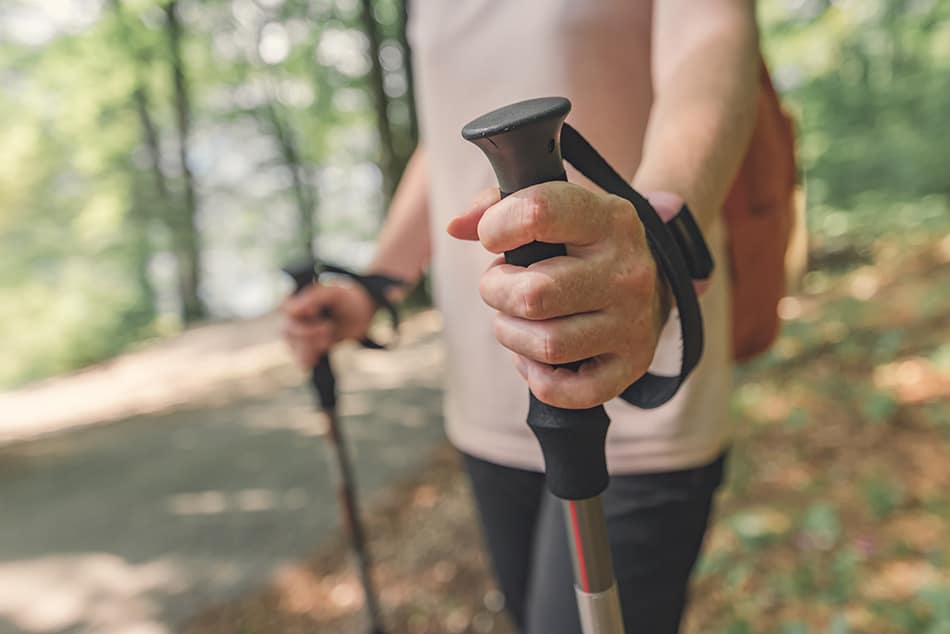
Campers are often hikers and hikers often carry trekking poles or some type of walking stick. If you don’t, it’s a good idea to start! A walking stick or trekking poles can serve multiple purposes. The most obvious is giving you a stabilized place to hold onto as you walk across areas that could be potentially slippery or dangerous. A trekking pole gives you a place to hold onto as it firmly pushes into the ground while you hold tightly to it as if it’s a handrail.
A stick like this can also be used in the event of an emergency or if someone is trying to harm you. Not only a person but it can also ward off wild animals that have wandered upon you as you can use it as a weapon to poke, prod, or swing in order to hit the assailant. Having trekking poles like this provides a great additional barrier of protection that can be of help during an encounter with a crazed individual.
Besides being handy for keeping you stable as you are hiking, these trekking poles can become your best friends in times of danger.
6. Rocks
You’ll find plenty of rocks out in nature while you’re camping. After your campsite has been set up, a few select rocks from around the area can be positioned inside your tent, RV, or sleeping area. These rocks may come in handy if you were to hear rustling weeds or a person drawing near that shouldn’t be there.
Having a selection of rocks nearby gives you some weapons to throw or hit onto something. This can provide you with some additional protection and could buy you time so that you can acquire another weapon, run away, or call for help.
Rocks can be thrown, as long as you have a good aim, and will likely make a wild animal run away or stop a human intruder in his or her tracks.
7. Dog
We campers love our dogs and besides being a best friend, a dog can be a great security system! Depending on the dog you have, you may have a partner that can fully protect you or you may have a partner who will only alert you of danger. Either way, having a best friend on hand that has some sharp canines and an instinct to protect, will go a long way in providing you with a weapon that intruders would not want to tangle with.
Even if your dog is not a powerful breed that can take down a large person, he or she will likely still be a fighter that will stand up for you and protect you in times of need. Not only this but a dog can help to draw attention with its barking and possibly alert others who may be around in the campground or nearby.
8. Stun Gun / Taser
A stun gun or taser might be a weapon that you haven’t considered before but can be highly effective if something tries to harm you. If a person comes into your campground causing a ruckus or breaks into your RV and puts your life in danger, a stun gun or taser can be used to stop them in their tracks. The high voltage of these devices is designed to shock and temporarily disable a person as it gives you time to get away or figure out your next move.
A taser is great for taking someone down from a distance, typically 15 to 25 feet away. However, a stun gun can be highly effective if an intruder is upon you and you are fighting for your life. A stun gun temporarily can disable a person if activated while making contact with their body.
The video below shows what happens when a stun gun is used.
There are laws regarding these depending on the locality that you are camping in but in general, are legal to use in most US states and can provide some additional protection when you need it most. Learn more about stun gun laws.
9. Personal Alarm
A personal alarm is something that is more of a deterrent than a weapon. While there won’t be much you can do as far as injuring someone, a loud piercing alarm that you can push when in danger will alert others in the area and potentially cause the intruder to disappear.
Animals may not like the sound either and can be startled enough to run away when the alarm is sounding. These types of personal alarms can be carried in your pocket, on your keychain, in a purse, or backpack. It’s best to have them in a place that is easy to get to without much difficulty.
Having an alarm like this hanging from your backpack strap as you are hiking for example gives you a way to instantly press it in a time of danger. The WETEN Personal Alarm Keychain (affiliate link) is a great option that is easy to use and can be carried on your keychain.
Bottom Line
Overall, camping is a safe experience and there may be no need to worry about carrying a weapon. However, it’s good to know that there are some objects easily accessible that can be highly effective. When your back is against the wall and you are fighting for your life, these items may come in handy as long as you plan in advance.
As the saying goes, expect the best but prepare for the worst. This is just good common sense! It’s better to think about these things now and be prepared when you need them rather than not knowing what to do when the time does come.
Take care, beware and stare at my snood if you dare!
Turkeys are unique: I cannot think of any other creature on this planet with a dangling piece of flesh that: changes colors, shrinks or lengthens depending upon stimuli of anger or excitement.
https://en.wikipedia.org/wiki/Snood_(anatomy)
From Wikipedia:
“the snood is an erectile, fleshy protuberance on the forehead of turkeys. Most of the time when the turkey is in a relaxed state, the snood is pale and 2-3 cm long. However, when the male begins strutting (the courtship display), the snood engorges with blood, becomes redder and elongates several centimeters, hanging well below the beak”
“The snood functions in both intersexual and intrasexual selection. Captive female wild turkeys prefer to mate with long-snooded males, and during dyadic interactions, male turkeys defer to males with relatively longer snoods. These results were demonstrated using both live males and controlled artificial models of males”
Actually, I have my doubts about that entire second Wikipedia paragraph. I suppose some test some where had those results however….
Common sense and my observation shows the male turkeys defer to- and female turkeys swoon to- the current reigning flock Alpha male. (Alpha male status is always tenuous)
Fighting skills: 99.92% determines whom the hens swoon for. My observation is that Snood length plays an infinitesimal small part in the reproductive process.
Yet, there is a natural selection process at work.
Evidently at least some of the hens prefer a long snood. – a selection that allows the Snood to grow and contract as needed, despite the beatings the snoods take during battle.
A dangling snood is a liability.
Turkey hens also have snoods-smaller versions of the male snood.
Hen snood injury from fighting
And….. A dangling snood, be it a tom or hen is still a liability.
This hen lost her fight for female alpha status and the hen that bested her had clamped down on her snood making it black and blue. Full snood recovery.
Could the snood be a remnant of the age of Dinosaurs?
Latest Study Anseriformes and Galliformes (above) originated in the late Cretaceous
Snood in battle……a thing hanging the way…
Flying snoods!
“Talkin to me?”
Photo of a snood at night. No outside stimulus to make the snood grow.
(Snoods have to rest)
Snood at Florida dawn
And now for a Quick story. I have mentioned the dangling snood is a liability.
I came home one day to find my Eastern wild Tom, with his snood swollen to the size of a banana and his bumpy head twice the normal size. What the heck?
Upon close examination, I discovered fang marks in the “banana” where a pigmy rattlesnake (Sistrurus millarius) had bitten the snood. The Tom was sick for about two weeks, made a full recovery, however his snood was always crooked after that. He lived for another five years. (no photos of that two weeks)
Florida snakes
Odd bit of information: The Ocellated turkey has a blue snood, instead of the normal red.
As the annual December turkey battles heat up, this Royal Palm Tom has his own snood in his mouth, crunching down causing excruciating pain to his rival.
Or something like that..
Video clip of “Turkey Rebellion against Thanksgiving” and snoods in the way!
An air rifle's effective shooting range depends on various factors, including the type of rifle, the caliber, and the power source. Generally speaking, most...
Exploring the Pros and Cons: Pump Air Rifle vs Break Barrel - Unveiling the key differences and advantages between two popular air rifle mechanisms....
"Understanding the Legalities: Felon Ownership of Air Rifles in Tennessee"
can a felon own an air rifle in tennessee?
In the state of Tennessee, the ownership...