Jennifer Kuroda started a not-for-profit organization called the Illinois Bobcat Foundation after the state opened the season on the bobcat. Since then, she’s been an outspoken critic of the practice. Kuroda says she understands that bobcats are one of the most adaptable mammals on the continent, but that’s besides the point.
“There’s definitely not any concern for the status of bobcats in the United States right now,” she said. “But do we need to hunt them?”
For the past seven years Kuroda has lined up for one of the bobcat hunting permits Illinois issues each year — with plans to leave it unused and possibly save at least one of the wildcats.
“I have applied for a permit not to use since the very beginning, and I’ve never received one,” said Kuroda. “So the odds are unlikely, but I still feel it’s a method for me to be involved and have a voice in the conservation of bobcats.”
Wildcat
The bobcat is a medium-sized lynx with a short bobbed tail, hence the name, and dense brown-gray fur along its back, with a whitish underside speckled with black. That makes it prized by hunters and trappers of furbearers. The best pelts can fetch hundreds of dollars, with pelts from the western U.S. typically going for a higher premium than those from the east.
Viorel Popescu is an associate professor in the Department of Biological Sciences at Ohio University in Athens, where he researches quantitative wildlife ecology and lately, bobcat populations. He says that habitat destruction coupled with the fur trade led to a decline in bobcat populations by the 1850s throughout the Midwest.
“They were never in danger of extinction,” said Popescu. “But they had been extirpated from several Midwest states like Ohio, Indiana, Illinois.”
The bobcat is not a federally endangered species. They’re one of the most widely distributed, medium-sized mammals in the country, second only to the raccoon. Popescu adds that today the lynx’s range spans nearly the entire United States, and parts of Canada and Mexico.
Still, a handful of states, including Indiana and Ohio, continue to ban bobcat hunting. Indiana, for example, shot down a 2019 proposal to open a season for the lynx. That same year, California officials closed their bobcat season until further notice.
Popescu says that although bobcat populations were able to return to Midwestern states, arriving at any official count or estimate of the total existing population is complicated by the cryptic nature of the species.
“And the estimates of total numbers of bobcats are really unknown,” he said. “What we know for sure are some very localized densities from very focused studies.”
Open season
Currently there is no population estimate of the number of bobcats in Illinois, and the whole northeast quadrant of the state is off limits to bobcat trappers and hunters. Some counties are cut right down the middle, where hunting is allowed on one side but not the other.
Similarly, Oklahoma does not have a solid number to point at when it comes to bobcat populations. Jerrod Davis, a senior biologist with the Oklahoma Department of Wildlife Conservation, says that’s not necessarily a bad thing.
“If you have a very accurate estimate of how many animals you have in a state, you have a problem,” said Davis.
For others, that’s a cause for concern.
Laura Nirenberg founded the Center for Wildlife Ethics in Indiana and has been executive director for three decades. She’d like to to keep bobcat season closed in the state, even though just across the state line in Illinois, it’s allowed. She says that the self-reported sightings don’t necessarily translate to verifiable proof.
“I can’t tell you how many times people see a stray dog and say that they’ve got a coyote. My point is they’re not trained,” said Nirenberg. “Their intentions might be pure, they might want to help the bobcat and or the department, but that doesn’t mean that the information being gathered is valid.”
Limb lines are an extremely effective and simple method of catfishing. Typical limb lines for catfish setups involve nothing more than stout twine, a heavy sinker, a strong swivel, a sharp hook, and a tasty piece of bait. Instead of attaching this to a fishing pole, you tie it to a supple green limb overhanging the water and motor away to go do other things. In your absence, the limb fights the fish. Clever anglers may set a dozen or more of these lines, and let them “soak” for a couple of hours while they fish with a rod and reel nearby. If they’re lucky, they’ll soon be blessed with a “tree shaker,” a catfish so big it makes the whole tree sway as it struggles to return to deeper water!
Are Limb Lines Legal?
In most cases, yes! Most states allow limb lining in one form or another. In places where catfish are plentiful (throughout most of the southern and midwestern United States) regulations generally permit limb lines, trotlines, and other forms of setlining. Some states may have restrictions on the number of lines or hooks you can have out at once, and most require that the lines be tagged with the owner’s information. It’s important that you read up on your state’s regulations and clarify any questions with local authorities before you begin setting limb lines for catfish.
Limb Line Fishing
Some catfishermen look down upon limb lines, claiming that they don’t require any skill. It’s true that limb lines do set the hook and play the fish for you. But limb lines are to rod and reel fishing what trapping is to hunting. It’s a different way to accomplish the same goal, and you put in all of the hard work and planning on the front end of the project. There is definitely an art to setting limb lines.
Look for banks with a lot of overhanging brush on them when you are setting your limb lines.
For this article, we were lucky enough to be able to interview Art Preller. Art is a longtime limb line fisherman on the White River and the inventor of the Port Arthur Limb Line.
How Deep To Set Limb Lines For Catfish
While many fishermen conceptualize catfish as deep water bottom dwellers, Art knows different. “Catfish are edge dwellers,” he says. “They’ll run the bank edge at night, and you don’t need a whole lot of water to catch them in. I’ve got a three foot paddle on my boat, and if I see a limb that looks good I’ll go over and stick that paddle in the water. If it’s got three feet then I’ll go ahead and set a line. I don’t usually fish all the way on the bottom. I’ll drop the bait down to the bottom and then come up about six inches.”
Setting Catfish Lines – Where To Put Them
We asked Art if he had any advice on what stretches of the bank were good candidates for limb line fishing.
“It depends on what you’re fishing for,” Art replied. “If you’re fishing for flatheads, bluff banks are best. If you’re fishing for channel cats or blue cats, you can really catch them almost anywhere. I like to look for banks with a lot of overhanging brush on them. And the more structure you have around on the edge of the bank, the better.”
Catfish Bank Poles/Diddy Poles – An Option When You Don’t Have A Limb
Sometimes, there just isn’t a limb handy where you want to set a hook. Art keeps a few pvc poles in his boat that can be driven into eroded bluff banks. Referred to as “bank poles” “ditty poles” or “diddy poles,” these simple devices can make you a more versatile fisherman.
Diddy poles can be made from pvc, bamboo, cane, or green willow shoots. Anglers can also purchase premade diddy poles made from fiberglass. These poles are small enough in diameter that they can be set on sunken timber with the aid of the appropriately sized drill bit. If you’re looking to purchase some premade diddy poles, Catfish Getters offers them in several sizes and configurations.
Limb Lines On The River
When setting limb lines on the river, look for breaks in the current. If there’s a seam line in the current, catfish will lurk in the low-flow areas and wait to ambush food swept downstream. The mouth of creeks and sloughs off of the main channel can be productive areas.
If you can’t find any limbs overhanging the bank, you can attach your limb line to a diddy pole on the bank.
Structure can also provide an easy place for catfish to rest and wait for prey. Old docks, fallen down trees, and sunken houseboats or derelict vessels on the bank can be productive places.
How To Set Limb Lines For Flatheads
Flathead catfish are highly regarded by serious catfishermen. “Flatheads are kinda like the crappie of the catfish family,” Art explains. “They have a very white, clean meat because they hunt live bait; they’re not scavengers like the other species.”
So how can a catfisherman target flatheads with his limb lines?
“You’ll definitely catch more flatheads with live bait,” he said. “Down here, we like to use goldfish or rice slicks.” (Editor’s note: “rice slicks” is a colloquial term for Green Sunfish (Lepomis cyanellus). “June is usually the most productive month because they’re spawning. Right now, if we set hooks with live bait, we’re running around a 25% hookup rate for flatheads.”
Best Bait For Limb Lines
What about other species? What’s the best bait for channel catfish and blue catfish?
“Nightcrawlers are always a good go-getter,” says Art. “You’ll mainly catch channel cats on them, but you can catch blues and even flatheads occasionally. You just have to be careful how you run your lines. If you’re using nightcrawlers, wait until sunset to bait your hooks. Otherwise bait-stealers like bream and gar will clean your hooks before catfish can find them.”
“As far as blues go, if you can catch a few skipjack or freshwater drum, you can cut those up and that’s a really good bait for blue cats,” Art explains. “We were out just last week and caught a 22lb blue on a piece of cut drum.”
Best Hooks For Limb Lines
Hook selection is a very important part of your limb line strategy. Catfish run the gamut from 2lb “eatin’-sized” channel cats all the way to trophy-class blue cats that can break the hundred pound mark. You’ll want to match your hook to your target fish’s size.
“I’m not really a trophy catfisherman,” says Art. “I’m just out to fill my freezer. My general rule is if a fish is too big for my filet knife, I’ll let him go. You need big fish in your water to replenish what you catch. So with that in mind, I consider a size two to size four j-hook to be about right for what I’m targeting.”
Choose your hook size based on the size of catfish you are looking to catch.
What about trophy catifsh?
“If you’re going for the big fish, those 50-80lb trophy fish, then you’ll want something bigger. I’d say a 7/0 circle hook would be about right for big fish. You’ll also want to get some bigger swivels. Big catfish are tough on your tackle.”
Best Knot For Limb Lines
For your connections to the swivel and hook, a good, no-slip knot with high break strength such as a Palomar knot is ideal. For your attachment to the limb, a good slip-knot will hold even the largest catfish, but come loose quickly and easily with a tug of the tag end when it’s time to gather your lines back up.
Best Time To Set Limb Lines
Limb lines are usually set at night during the spring and summer months. During this time, catfish feed more heavily at night as the water temperatures cool off. They’ll transition from deep, cool holes to the shallows along the shoreline in search of prey such as shad, bluegill, skipjack, crawfish, and insects.
Fishing at night also ensures that you are avoiding the “bait stealers” Art mentions. If you try to run lines during the day, you’ll have to fight with bream, gar, choupique, and even hungry turtles!
Limb Line String
Catfish are not line-shy. Heavy-duty, tarred trotline cord is strong and holds knots well, two features crucial in limb line string. Art’s premade limb lines come standard with tarred cord rated to 170lbs, plenty strong enough for even the biggest trophy catfish.
Limb Line Weights
When selecting weights for limb lines used in catfishing, it is essential to consider the size and behavior of the catfish species you are targeting. Generally, heavier weights are preferred to keep the line securely anchored to the limb or structure. The weight should be sufficient to counteract the fish’s strength and prevent it from easily breaking free. Depending on the water current and depth, weights ranging from 2 to 8 ounces or more may be suitable. It’s important to experiment and adjust the weight based on the specific fishing conditions to ensure the limb line remains stable and effective in attracting and catching catfish.
How To Make A Limb Line
Limb Line Setup
If you’d like to make your own limbline, start by gathering your materials. You’ll need heavy cord, strong swivels, sharp hooks, and some ½-4oz egg weights.
Start by cutting 2 lengths of cord; a 6-10ft main line and an approximately 2ft leader. Tie a heavy-duty swivel on one end of the main line using an improved clinch knot or palomar knot and thread an egg weight on. In heavy current, you’ll need a heavy sinker to keep your bait submerged. In slack water, use a lighter sinker.
Once the sinker is threaded, prevent it from coming off by tying a simple overhand knot on the opposite end of the line from the sinker. Then, tie a hook to your leader line. Straight-shank hooks can be attached with an improved clinch knot or similar. Circle hooks perform better when snelled. Be sure to use a hook size appropriate for the size fish you are after.
Once this is done, tie the hook and leader to the swivel on your main line. Add a tag in compliance with local regs to your main line, and your line is ready for the water!
Limb Line Rigs
It may not occur to most fishermen, but there is more than one way to rig a limb line. Most anglers will stick with the tried-and-tested Carolina and split shot rigs for limb lines. But there’s nothing stopping you from experimenting! Any live or cut bait rig that you would tie on the end of a rod-n-reel can be duplicated on a limb line. A dropshot rig is a good way to suspend bait off of the bottom, and you can experiment with multiple hooks by mimicking a high-low rig.
Catfish Limb Lines For Sale
While limb lines are simple to make, they do take up a lot of time. And if you don’t already have the hardware on-hand, it can be surprisingly expensive by the time you add up all of the materials plus time and gas to acquire them. Pre-made limb lines are an excellent option for fishermen who are short on time, or who just want to try a couple out on their next fishing trip.
Art Preller’s Port Arthur Limb Lines are an innovative take on limb lines. They incorporate a hi-vis, reflective flagging device that serves as a fish indicator, tag, and storage device. According to Art, “You can put fifty of them in a five gallon bucket and they’re all organized. And when you’re done fishing, they’re easy to pull off of the river so that you aren’t losing equipment or littering the environment.”
Trophy sized catfish can definitely be caught on the proper limb line setup.
Limb Line Safety
Unfortunately, some fishermen give limb-lining a bad name and abandon their lines or leave them unattended for too long. This can be dangerous to wildlife and even people, especially when water levels fall and leave the hooks exposed. Animals and boaters can become hooked or entangled in an abandoned limb line, so always be sure to remove your lines when you are done with them!
Limb Line Lights
Some anglers go so far as to mark their limb lines to make them more visible. A chemical glow stick or inexpensive clip-on light can make it easier for you or unwary boaters to locate your lines in the dark. Reflective tape and hi-vis yellow, orange, or pink lines can also make it easier for you and others to see your lines.
Limb Line Tags
In most states, regulations call for tagging your limb lines. These tags generally require you to provide ID and contact information. In Alabama, for example, lines must be tagged with the owner’s name and either a phone number or fishing license number. This information helps conservation officers to identify the owners of abandoned lines.
Limb Line Storage
Perhaps the most difficult part of fishing with limb lines is keeping them organized! The more lines you run, the harder this becomes. A boat full of lines with sharp hooks and flopping catfish isn’t just frustrating, it can be downright dangerous!
Some anglers keep their lines wrapped around a section of foam pool noodle. Bury the hook point in the foam, wrap the line around the noodle, and tuck the tag end under the last wrap for a clean package that can be easily unwound when needed.
Another storage tactic is to wrap the lines around your fingers in a figure-8 pattern and secure it with a small alligator clip. The wrapped line can then be set into a compartment in a flat, stowaway-style tackle box.
Final Thoughts On Limb Lines For Catfish
In conclusion, limb lines are a highly effective and popular method for catching catfish. This traditional fishing technique combines simplicity and efficiency, making it accessible to anglers of all skill levels. By utilizing strong lines, appropriate bait, and strategic placement, limb lines offer a reliable means of catching plenty of catfish. However, it is crucial for anglers to prioritize responsible fishing practices, ensuring the safety and well-being of both the targeted species and the surrounding ecosystem. By adhering to local regulations and employing responsible fishing methods, anglers can continue to enjoy the thrill of limb lining while preserving natural resources and being considerate of other outdoorsmen.
Full Disclosure: This post may include affiliate links. There’s no extra charge to our readers for using these.
Enjoy Happy Trails, the free monthly newsletter from Hiking For Her.
Receive a free resource: Hiking Layering System Explained
The best hiking gloves are the ones you reach for over and over again, because they work well to keep your hands warm and dry.
That’s why I recommend that you have at least 3 types of gloves in your hiking gear locker.
Let’s tackle them one at a time, with an overview of hiking gloves by function.
Best hiking gloves for cold weather
Cold weather hiking the best hiking gloves to guard against hypothermia.
Scary fact:
One of the most neglected areas on a hiker’s body in cold weather are your hands.
We all think about protective hats and jackets and pants, but please don’t overlook the importance of keeping your hands warm at all times.
If your fingers are numb, you aren’t going to have the dexterity to adjust your clothing, take the cap off your water bottle, or unfold the map that tells you when an important trail junction is coming up.
And that leads to making mistakes on the trail that can endanger your life, or at least your enjoyment of a hike.
So keep your digits toasty warm!
I have a repertoire of winter hiking gloves, and switch them out as needed.
The least cumbersome pair are fingerless gloves, like these.
My fingers are free to manipulate, grasp and tug on my hiking poles, boot laces, and zippers, but the rest of my hands and wrists stay warm.
Doesn’t sound like a big deal? It will be when an icy cold wind is blowing, or it begins to rain.
And they convert easily to mittens when I need a bit of extra warmth around my fingers.
Fleece hand protectionon a hike
I like lightweight fleece gloves for situations when I know I’d rather not use mittens, like the photo above.
They ride along in the bottom of my pack year round, because cold hands are dangerous for extended periods of time.
Even a nice summer day can turn nasty at higher elevations. Always put on an extra layer once you top out somewhere the wind can reach you (especially important if you’re sweaty from the exertion of uphill hiking).
Note that these glove options are not weatherproof, so I recommend them only for dry cold conditions.
If you want bombproof gloves with all the features, that also allow you to interface with your phone or GPS screen, expect to pay a bit more.
But revel in the warm, dry hands you’ll have!
Here is a full array of your options.
Remember to sort them by weight, weather proofness, and features, as outlined above.
Natural fiber options
Possum down might not be a familiar glove material to you, unless you reside in New Zealand.
Read the Hiking For Her review of Possumdown hiking gloves here.
Another natural choice: alpaca wool gloves, like these.
Best hiking gloves for cool windy conditions
In the spring and fall, I want to stay warm but don’t want extra bulk in my pack or on my hands.
These are the gloves I pull out of my pack when I begin to feel chilled.
I know that my core temperature is dropping a bit, and I pay attention by warming up my hands.
I also pull on a hat if I’m not already wearing one.
More cool weather hiking tips here
Sometimes I know that I’ll be cold part way through the hike, because I’ve consulted my topographical map and recognize a ridge or other windy land feature coming up soon.
So these gloves are kept within easy reach, in my jacket pocket or a top pocket of my backpack where my hiking partner can easily reach them for me.
That way, I don’t need to lose body heat by stopping, removing my pack (there goes all of that delicious warmth trapped against my back!), and digging through gear.
I recommend that you do the same: Keep these gloves handy (oooh, a hiking glove pun).
Why not wearhiking mittens?
I am not a fan of wearing mittens on the hiking trail, with one exception.
Mittens encase my hands in a non-functional configuration, making it hard to grip my poles or do much of anything.
The only exception I make is when I face really cold conditions and I want all of my fingers smushed together to share warmth.
I make sure all gear adjustments have been made before I slip on mittens like these.
Sometimes I need my trail buddy to help me yank on the second one! And I return the favor.
Sometimes I wear these mittens in my sleeping bag if I’m having a hard time falling asleep. For some reason, warm hands relax my entire body.
They’re also nice cushioning for sitting on hard cold rocks!
I appreciate the safety loops on these mittens, because I can dangle them above snow or mud from my poles or pack.
Best hiking glovesfor sun protection
I never used to believe in wearing gloves to block UV rays on cloudless hikes…
until I began to require skin biopsies every year for the pigmented spots on my face and hands.
Now I’m a believer in wearing lightweight, light colored wicking fingerless gloves on my summer hiking adventures.
Ever notice how sunscreen tends to wear off?
How many times do you reapply it to your hands and fingers?
Yeah, not so much for me, either.
This brand is rock solid in the gear industry.
If you’d prefer full sun gloves, they’ve literally gotcha covered! These are handy when you’re hiking over reflective snow fields, to prevent sunburn.
Bonus: Wearing these gloves prevents “age” spots, too.
If you want to go whole hog into UV protective clothing, read this.
A few more tips for buying the best hiking gloves
If you’re just starting out hiking in cooler conditions, and won’t be staying outdoors overnight, you can get away with bargain brands of hiking gloves.
But expect flimsy materials, poorly sewn seams, and less than ideal insulation.
If you’re heading into uncertain weather conditions, or plan to spend at least one night camping in cool/cold/unpredictable temperatures, you absolutely must pay attention to your hands.
Regardless of which brands and styles you go with, be sure your best hiking gloves have:
women’s sizing, with a snug but not binding fit
a cinching system for creating an airtight seal for really cold conditions
appropriate thickness to keep you from over heating or freezing (which is why I have several styles)
durable synthetic material on the palms if gripping poles or camera gear is important
non-chafing seams
wrist straps to prevent loss
Gloves = hiking love
If you are hiking with newbies, children, or a group of folks you don’t know well, bring along a second pair of gloves to hand over when any of them begin to shiver.
Demonstrate without a word that the best hiking gloves are a vital component of your anti-hypothermia strategy.
Be prepared for grateful words and a big smile.
Notice the word LOVE in there?
Glove love is where it’s at, y’all.
Ready to tackle warm feet on a hike? I thought you might be up for it 😉
Home page > Best Hiking Gear >
Best Hiking Gloves
I get emails all the time about what I wear on the trail.
That’s why I provide these affiliate links to you: the best gear is instantly available for your consideration, and the gear company sends a few pennies per dollar to Hiking For Her’s website with no added cost to you when you purchase.
Everyone ends up a winner that way: great gear for you, strong gear companies, and more free hiking tips for everyone.
Yeehaw!
And thanks very much for your support. It’s warmly and sincerely appreciated.
A meat that is often mistreated and relegated to the world of fitness; in reality the turkey is a tasty product, it has a firm flesh, with a delicate taste and it is rich in nutritional properties. Classified among white meats thanks to the low presence of myoglobin, turkey has a very low fat content and almost all are concentrated in the skin, as with all poultry meats. The peculiarity of this product is that it can be safely cooked and consumed in its entirety; the most famous example is the classic American stuffed turkey, the dish par excellence on Thanksgiving Day in America.
In 1600 the turkey was among the rarest and most requested animals in Europe to “adorn” the gardens of noble villas. Today it is among the most common farmed birds, even if the cuts between which to range are not very many.
For turkey there are various types of cuts in the world, for example in Italy there are only four cuts but, as we have also seen with beef, abroad there is a different classification; in the United States there are dishes prepared with the head and neck of the turkey and sometimes also the tail is used. An important thing to keep in mind for all the following cuts is cooking; turkey meat can only be eaten if perfectly cooked, otherwise you could face unpleasant intestinal unexpected events.
1. The turkey breast
It is the best-selling and most prized cut of the whole animal; a lean, very tender meat, suitable for the preparation of thin slices, it can be cooked in cubes, strips and so on and so forth. Important thing; many people think that turkey breast and turkey rump are the same thing but they are not. The rump is much appreciated by those who follow a low-calorie diet because it is rich in proteins and mineral salts but it is important to understand what it really is; it is a real cured meat obtained from the processing of the breast muscles, boned and cleaned, then processed and seasoned with a mix of salt and spices. Usually the rump also undergoes a smoking or caramel treatment. So turkey breast and turkey rump are two very different things.
While we recommend the turkey rump especially for sandwiches, buns, toasted bread or wraps, and it is also appreciated in the form of scallop with beer, turkey breast is very suitable for slow cooking, especially in the oven it is really tasty. Also excellent as a scallop or, for the sweet tooth, cut into chunks, breaded and fried.
2. The turkey wings
The “middle” cut of the animal; thinner than the thighs but fatter than the chest. You can buy them both whole and cut and are really excellent cooked on the barbecue, in full American style. Also in this case, frying is a more than appreciated method; being an American animal, it goes without saying that the most popular cooking techniques are those from the New Continent. Fried turkey wings are tasty and very simple to make. Just follow the same procedures as for chicken wings and that’s it.
A little tip; ask your trusted butcher to debone the wings and, once at home, turn them into a stuffed roll (perhaps with ham and / or mortadella), they are truly a delicacy.
3. The turkey thighs
Very tasty cut of meat that goes perfectly with spices and flavors. A typical recipe is the Mexican thigh, prepared with many spices, but the tastiest recipe is probably the one that wants it cooked on the grill, together with some vegetable skewers to mix all the flavors. The thigh is the fattest part of the animal because it is richer in skin; try it in the oven or on the rotisserie, you will not regret it.
4. The turkey drumsticks
One of the most popular turkey cuts, the drumsticks are the part of the legs under the thighs. Their meat is tasty but less tender than the thighs because this is a part that is more “trained” by the animal during its life, therefore it tends to be hard. Precisely for this reason drumsticks are ideal for slow cooking, in the oven. Also excellent alla cacciatora, or cooked in a pan with fresh tomatoes and vegetables.
A shock collar can help you resolve most of your dog’s behavior problems. From obedience to excessive bark training, a good shock collar will help you achieve quick and fast results when combined with correct training methods.
Since Golden Retrievers are active and playful dogs, you need the best quality shock collar to wean your dog off unsafe and negative behavior safely. To help you with that, this article reviews 7 shock collars suitable for a Golden Retriever.
Also, the buying guide will give you a deeper insight into how you can evaluate the features offered by a shock collar.
The Best Shock Collars for Golden Retrievers
1. Pet Resolve PTS1200
You can try multiple combinations to create the perfect training for your Golden Retriever.
This shock collar offers a super-long ¾ mile range that can easily cover wide outdoor areas.
So you can train your dog while letting it have the freedom to explore a massive area.
An interesting feature of this shock collar is the ‘Remove the shock function‘ feature. Yes, you can opt out of the shock function by swapping the metal prongs with the plastic ones. It converts the shock into vibration so that you can use this training unit as a beep and vibration-only system.
This shock collar has a memory function that lets you resume the training session where you left off. The anti-bark function comes in handy when your dog barks unwantedly. And the night mode guides you on night walks with the help of the LED light.
You can also accessorize the collar with extra-long prongs to improve skin contact. It eliminates the need to trim your dog’s fur. It comes in handy for dogs like Golden Retrievers.
These training collars are made of the highest quality materials to make them completely waterproof, meaning your dog can take them for a swim all year around. The collar is adjustable for Golden Retrievers 15 lbs and over.
The Pet Resolve PTS1200 was rated no.1 because, unlike other shock collars, it lets you opt out of using the shock but is available when needed. Other shock collars will always have the shock to be combined, but you can’t skip it.
The fact that you skip this function as you see fit makes it a crucial versatility because you are here shopping for the best shock collar for your Golden Retriever.
2. Halo 2+ Training Collar
Like other collars with a remote/transmitter, the Halo 2+ has the Halo app as the control unit. To use this shock collar, you have to first create virtual fences, and that’s done through the app.
You can create fences wherever you want: your backyard, the play park, the beach, the mall, etc. Also, the app has a location tracking feature that allows you to keep track of your dog even when you are away.
The Halo 2+ collar comes in three sizes small, medium, and large, so it can fit neck sizes ranging from 11 to 30.5 inches. And the collar gives a runtime of 21 hours per charge. So at the end of the day, you can recharge it along with your other smart devices.
As for comfort and durability, the Halo 2+ shock collar is made of extremely durable material that is chew-resistant, slobber-proof, and waterproof at IP67.
3. Educator E-Collar Humane Dog Training Collar
And the transmitter has a range of ½ mile for long-distance communication.
Powered by rechargeable Li-Po batteries, the collar and remote have a quick 2-hour recharge. And the low battery indicators will keep you informed of the battery status.
These shock collars have a fully waterproof construction that is also shock resistant to withstand long-term and frequent use, even around water.
4. SportDOG Brand SportTrainer Remote Trainers
This dog shock collar features tone, vibration, and10 levels of static stimulation to allow the trainer to customize a training process accommodating varying learning curves of different dogs.
You can use the static mode on continuous, momentary, rising, or boosted continuous static stimulations options.
The collar and transmitter run on rechargeable lithium-ion batteries with a quick 2-hour recharge period and long working life. And the use of DryTek® Technology keeps the system waterproof and submersible up to 25 feet, so it is usable through various wet conditions.
5. PetSpy Dog Shock Collar With 1950ft Remote
The blind design of the remote featuring easy-to-use buttons ensures full focus on the training while allowing long-distance control over 650 yards for safe training even when off-leash. Also, the collar is adjustable for dogs weighing 10 lbs to 120 lbs.
This shock collar’s durable and waterproof quality makes it great for all outdoor enthusiasts. The high-quality construction ensures frequent use even in the rain.
Rechargeable Li-ion batteries power the collar and the remote. And the fast charging technology, you have a collar with a long-lasting battery life ready to use whenever.
6. My Pet Command Dog Training Collar
And you can also train in the rain. The bright beacon flashing lights on the collar will help keep track of your dog at night. Also, the collar is adjustable to fit neck sizes of 8.2” – 26.5″.
7. DT Systems IDT-Plus Micro Dog Trainer Collar
The collar is lightweight, compact, fully waterproof, and adjustable. The collar also has an internal antenna system to notify the maxx range and a smart LED light that is especially handy for nighttime use.
A Buyer’s Guide to Help Choose the Best Shock Collar for Your Golden Retriever
Before you decide on a collar, you must consider a few factors and the functionality of these factors to determine if the collar can fulfill your needs. Below are a few factors that will help you make the best purchase for your Golden Retriever.
1. Purpose of Purchase
Shock collars should strictly be used as a training tool for behavior modification like excessive barking, aggressive behavior, or basic day-to-day obedience.
Determining the purpose of purchase will help you choose the most suitable shock collar to fulfill your purpose effectively.
For example, if you need a shock collar to correct unwanted barking, a collar like the Pet Resolve would be the best bet, as it includes an anti-bark function targeted at such corrections. Besides, you can use the same collar for overall obedience too.
2. Effective Coverage & Range
Having a long-range to work with is a good thing when working with playful dogs like Golden Retrievers. It will allow your dog more ground area for fun and play.
Choose a shock collar that can effectively cover your regular surroundings and the areas your dog is allowed to roam in so that you don’t lose a connection even if your dog goes far.
It is also important to note that timing is everything regarding training. A standby mode although conserves battery affects the timing of the correction delivered.
So for effective and timely corrections, I’d recommend a collar like the Pet Resolve PTS1200, which no longer includes the standby mode.
3. The Size of Your Golden Retriever
Golden Retrievers are moderately big dogs with long fur. For the collar to have a reliable effect, the shock should effectively reach the dog without causing any discomfort or pain.
A collar that is adjustable and features longer prongs to allow good contact with the dog’s skin is what you should look for.
4. Efficient Training Modes With Adjustable Intensity Levels
5. Durability and Reliability
A shock collar should be a long-term investment. To ensure it stays long-term, look into the materials used to craft a collar. Leather, biothane, nylon, sturdy buckles, and metal fixtures contribute to the collar’s durability.
Also, check for waterproof and impact-proof qualities for added durability so you can use them in various weather conditions.
6. Battery Life
Longer the battery life, the longer the use you can harvest out of it before recharging again. And this is important because it saves your time and energy from having to recharge recurrently.
So ideally, choose a shock collar with a high-capacity rechargeable battery for long battery life.
7. Function to Price Ratio
So many shock collars are available from various brands. And all these collars offer something that makes them different from each other. But do you need all those features?
No, you don’t. But you have to know what features you will best benefit from. Accordingly, you can weigh the price tag against the collar’s features to determine if it’s worth the price.
Frequently Asked Questions
Conclusion
You can gain effective results from training only when the shock collar is used as humanely as possible.
With consistent training, starting from mild stimulations, you can set the right tone for your Golden Retriever to understand the whole point of training.
Eventually, you may not even need the shock function because dogs are intelligent creatures. They only need a little nudge to push them in the right direction.
My recommendation for you to achieve reliable results is the Pet Resolve PTS1200. It has all the features you need for a thorough conditioning process to help train your dog.
Millions of years of isolation on a continent of extremes has seen Australia evolve some pretty freaky animals.
We’ve got kangaroos that live in trees, sex-crazed antechinus and snakes capable of delivering enough venom to kill dozens of humans with a single bite.
There are a lot of tall tales when it comes to our fantastical fauna and it can sometimes be pretty hard to tell fact from fiction.
So much so that we couldn’t fit every Australian animal “myth” into one article.
So here’s part two of debunking Australian animal “myths” (spoiler: you’ve probably guessed by now but the quotation marks are there because despite our better instincts, some of these myths turned out to be true).
If you missed part one or you like reading terrible things about quokkas, you can catch it here.
And if you’ve got any more Australian animal myths you want busted (or confirmed), let us know.
Do dogs prefer facing north to poo?
OK, so this article is about native animals and sure, most dogs aren’t native.
But we’re shoehorning this in because the Australian dingo qualifies as native under federal environmental law, and this is just too good a rumour not to look into.
Have you ever seen a dog doing circles before settling on a spot to poo?
If you’re like most rational people, you’ve probably filed this alongside such dog behaviours as growling at the doormat, howling at sirens and chasing one’s own tail.
But thankfully, researchers from the Czech University of Life Sciences Prague aren’t like most rational people, and decided to investigate.
They monitored 70 different dogs of 37 breeds making 1,893 bowel motions and 5,582 wee stops over a two-year period.
At first, the orientation of the dogs appeared fairly random.
But there can be local variations in the strength and direction of the Earth’s magnetic field, which is measured by geometric observatories.
When they excluded days of magnetic instability, they found our canine friends were picking up on some serious electromagnetism.
“Analysis … of dogs sampled during calm magnetic field conditions revealed a highly significant axial preference for north-south defecation,” they wrote in their paper published in Frontiers in Zoology.
According to their data, the dogs showed a strong preference for facing either north or south when relieving themselves, and significantly had an almost complete aversion for aligning their bodies on an east-west axis.
Other animals such as birds are known to be able to detect electromagnetic fields, which they use for navigation, so it’s not a huge stretch to presume dogs might also have this capacity.
However, it’s unclear what evolutionary benefit there could be for a dog to align themselves north-south while heeding the call of nature.
And this is only one research paper that doesn’t even look at dingoes specifically.
Still, if you’re ever lost in the bush and have your dog with you, you could use this as a way to get your north bearing.
But remember it’s magnetic north, and probably not accurate on days of magnetic variability.
So, it’s probably best to still use a compass.
Do kangaroos lure their predators to watery graves?
Kangaroos have a reputation for being pretty feisty — especially during the mating season.
When the big males are fighting each other or an unwitting passerby, they can be a pretty intimidating presence.
But as grass eaters, surely they’ve no reason to use violence outside the competition for mating rights? Right?
There is, however, a rumour doing the rounds that if kangaroos are being chased by predators, they’ll lead them into water, and drown them.
The verdict? True, but it’s a question of intent.
“There’s a very strong instinct — kangaroos will go to water if they’re threatened by a predator,” kangaroo ecologist Graeme Coulson from the University of Melbourne says.
Dr Coulson says his neighbour lost two dogs that way.
“It was a bull terrier that went in and it was drowned. Then he got another dog, another bull terrier, and it died the same way.
“So he got a third dog, and he kept it locked up.”
But given kangaroos get no benefit from killing an animal, it’s likely they’re actually entering the water in the hope they’re not followed.
Running into water is a common defence mechanism for a number of herbivores, according to Matt Hayward from the University of Newcastle.
“In Africa, herbivores do the same thing — they run into water if they’re being chased,” Professor Hayward says.
“I’ve seen wild dogs chase impala into dams.
“I’ve seen buffalo waiting in water surrounding by hyenas.
“But they tend to just wait [in the water] until the animal gets bored.
“I don’t think it’s about trying to drown them.”
Is it true whales and dolphins don’t get cancer?
There’s a curious paradox when it comes to whales and cancer.
Because of their huge size, they have vastly more cells than humans and should therefore be at much greater risk of cancerous cell mutations.
However, the opposite is true: the occurrence of cancer in whales as well as other cetaceans like dolphins is far lower than in people — a phenomenon known as Peto’s paradox.
Research published this year in Proceedings of the Royal Society B found that cetaceans have rapidly evolving tumour suppressor genes (TSGs).
These can slow down cell division, repair mistakes in our DNA and kill off cancerous cells before they spread out of control.
According to the researchers, the tumour suppressor gene turnover rate — the rate that genes are gained and lost through mutation — is 2.4 times faster in cetaceans than other mammals.
And they think this has allowed whales to develop a more efficient system of preventing cancer as they evolved their large body size.
But there’s a difference between less cancer and no cancer, according to marine and estuarine ecologist Olaf Meynecke from Griffith University, who says the idea that whales never get cancer is a myth.
“They get ulcers, uncontrolled cell growth and even skin cancer,” Dr Meynecke says.
“I am not sure who put the myth out there, but clearly someone who has not looked at a whale closely.”
Can black cockatoos signal that rain is on the way?
According to folklore, when black cockatoos take wing, there’s rain on the way.
Depending on where in Australia you are, you may have heard this applied to red-tailed black cockatoos, yellow-tailed black cockatoos, or to Carnaby’s black cockatoos — the so-called “rainbird”.
Obviously rain doesn’t fall every time a black cockatoo flaps its wings, but there may some broad truth to the claim, according to bird expert Bob Doneley from the University of Queensland.
“There is absolutely no way I would discount this,” Professor Doneley says.
“Most of this is built on observations by Indigenous people as well as people living in the bush and being familiar with the birds’ body language.”
Rain is a cue for many birds to become more active and in some cases, to breed, he said.
They’ll be more likely to be moving around more, and actively calling and vocalising, which increases the chances that people will notice them.
“That will look to us ignorant people like birds flying around, getting excited.”
For the Carnaby’s black cockatoo, their migration coincides with the rain season, according to Adam Peck from BirdLife Australia.
Carnaby’s migrate to the wheat belt at the time when the winter rains start, and the success of their breeding season depends on how much rain falls, he says.
What isn’t completely understood yet is how exactly the birds know rain is on the way, according to Professor Doneley.
“It’s probably to do with changes in the air — the humidity, even the sound of distant thunder,” he says.
“There are millions of years of genetic evolution for birds to know when rain is going to arrive.”
A freakishly huge bull elk that was killed on a high-fence ranch in southeastern Idaho could potentially set a new world record in Safari Club International’s Record Book. Brian Dhooghe harvested the bull from Broadmouth Canyon Ranch, and he brought the meat from the animal into Bay City Sausage in Aberdeen, Washington, to be processed last week.
The local game processor shared photos of the massive bull’s rack on Facebook, where they’ve generated upwards of a thousand comments. The majority of those comments are negative, as many took the opportunity to criticize the idea of shooting elk on a game preserve.
Outdoor Life, the Boone & Crockett Club, Pope & Young Club, National Deer Association, and other hunting organizations do not believe that taking animals behind a high fence qualifies as traditional fair chase. But still, high-fence hunts are a multi-million dollar business in the U.S., and simply turning a blind eye, or leaving negative comments on a Facebook post, won’t change that. So, it’s worth taking a closer look at these types of hunts—or shoots—and some of the animals they produce.
Some commenters on the Facebook post questioned if the animal was even real, and a few claimed the pictures were Photoshopped. But according to Kyle Strode, who works at Bay City Sausage and saw the rack in person, it’s real, alright.
“Yeah, it was pretty wild. I took a picture of the rack,” Strode tells Outdoor Life, adding that he knew Dhooghe from processing some of his other animals over the years. “Brian has been bringing stuff in forever. So, yeah. It’s a legit animal.”
Outdoor Life was also able to catch up with Dhooghe, who shared the story behind the giant bull.
“What the hell is that thing?”
Brian Dhooghe never claimed his bull was wild or that he killed it “way out in the boon-toolies.” He says he didn’t travel to Idaho just to shoot a record-sized bull that he could brag about. His trip to Broadmouth Canyon Ranch was a 50th birthday present from his wife. The trip was initially booked in 2020, and after a two-year pandemic delay, Dhooghe went out to the ranch last Monday.
He says he had originally paid to shoot a 500-inch bull (for context, the Boone & Crockett Club world-record nontypical elk, known as the famous Spider Bull, scored 478 5/8 inches), but then the head guide made him a deal he couldn’t pass up. The guide mentioned a record-class bull they had walking around the 10,000-acre ranch. He told Dhooghe if they could find it, he could shoot that elk in addition to a mid-500’s bull, and he threw out a price that Dhooghe was willing to pay.
In most high-fence operations, the client chooses which species and size of animal they would like to shoot and then is charged accordingly. For example, Bull Basin, a high-fence operation in Colorado charges $15,900 for a 381- to 399-class bull. Most of these operations guarantee success.
“They had told us this potential record was walking around, but I wanted a nice, big, sexy-looking bull to mount on the wall. And this thing is definitely not that,” Dhooghe says. “He’s ugly. I mean he’s awesome, but kind of freaky lookin’. It looks like something prehistoric, like, what the hell is that thing?”
Brian Dhooghe’s bull was given a green score of 648 and 4/8. Brian Dhooghe
Dhooghe shot his first bull (which scored 571 inches) during one of his first mornings on the ranch. The next day, he joined a group of four other folks for an afternoon elk drive, where the shooters lined up at the end of a patch of timber and the guides walked through the trees pushing the animals out. The others were looking for 300- to 400-class bulls, so when they saw the record-sized bull step out, there was no question as to who would take the shot.
“We’re all sitting there when up comes this thing,” Dhooghe says. “We saw him close to 400 yards, so I put him in my scope and the damn thing didn’t even fit in there!”
Dhooghe shouldered his .300 Weatherby and waited for the bull to reach 150 yards. With the bull quartering to him, he aimed in front of its shoulder and fired. The hand-loaded, 180-grain Nolser Accubond bullet took out the bull’s heart, and after trotting about 15 feet, the massive animal cartwheeled over and died.
A High-Fence World Record?
Two of the guides at Broadmouth Canyon Ranch are certified as scorers by SCI. Dhooghe says that when they put a tape to the bull’s rack, they conservatively scored it at 648 and 4/8 inches.
Unlike Boone and Crockett and the Pope and Young Club, which don’t allow animals harvested on high-fence ranches into their record books, SCI recognizes these trophies as potential records. The organization simply categorizes them as “estate animals.”
Read Next: The Biggest Nontypical Whitetails of All Time
Dhooghe still has to wait until the mandatory 60-day drying period is up. At that point, he plans to bring the rack to an SCI-certifed master scorer in Washington State. If the master scorer concurs with the original green score, the rack will then be judged by a panel of five or six master scorers, who would make the ultimate call as to whether Dhooghe’s bull replaces SCI’s current world record for the biggest bull ever killed with a rifle.
To clarify, bigger bulls have been killed at Broadmouth Canyon Ranch. This September, a hunter named Brian Bailey shot an elk there with a pistol that scored 689 and 6/8 inches, according to the ranch’s Facebook page.
Outdoor Life reached out to SCI, but their Record Book Committee was unwilling to comment on Dhooghe’s bull until they see it officially. SCI’s Online Record Book has two separate books for non-typical Rocky Mountain Elk—one for elk harvested on high-fence ranches and the other for free-range animals. Looking at the high-fence record book, the biggest bull killed with a rifle was harvested from Bull Basin Ranch in Gunnison, Colorado, in 2020. It scored 648 and 2/8. The high-fence record book also includes two larger bulls: a 649-and-2/8-inch bull taken with a crossbow from a ranch in Utah, and a 671-inch bull killed with a muzzleloader from an undisclosed location in Saskatchewan.
High-Fence Controversy and Ethics
The overwhelming number of negative reactions to Bay City’s original Facebook post are proof that a lot of people (hunters included) have strong opinions about high-fence hunting. Many hunters bristle at the notion of killing an animal inside a fenced enclosure—no matter how large the enclosure may be. They make a distinction between “hunting” and “shooting”, saying that high-fence operations violate the most basic fair chase principles and create unnaturally large specimens that are more akin to livestock than wild animals. To many hunters, these outsized antlers and breeding programs designed to grow the largest racks possible degrade the importance of truly wild animals which earn every inch they grow and season they survive.
Plus, high-fence whitetail operations are under extra scrutiny these days as they’ve been connected to the spread of Chronic Wasting Disease.
The fact that the bull was killed on a high-fence ranch has led to criticism from a number of hunters. Brian Dhooghe
“Bought bull, high fence pet,” one commenter wrote. “Basically an animal raised like a beef cow that rich dudes pay to shoot. Would be no different or challenging than running down to your local dairy and shooting a Holstein cow with its head in a feed trough.”
It’s important to note that Dhooghe never violated any laws and never did anything to bring this heat upon himself. He didn’t brag about the elk or lie about where it was shot (the way some high-fence hunters have with trophy animals). In fact, Dhooghe isn’t even on social media. If it wasn’t for Bay City’s post, hardly anyone would know about the bull he harvested in Idaho.
“I don’t have Facebook, but my wife does,” he says. “I was looking at some of those comments and I had to quit looking because all it did was piss me off. All these people on there…can’t you just be happy for a guy to kill an animal like that?”
Dhooghe admits that he understands all the controversy around what SCI calls “estate animals.” At the same time, though, he says that regardless of what most people think, not all high-fence operations are created equal.
Read Next: Our Favorite Cartridges and Rifles for Hunting Elk
“I think there are places out there that give this kind of hunt a bad name. Where they keep them in a pen and you basically go out and pick one, so they can kick it across the field and you shoot it,” he says. “This place isn’t like that at all. They bring these elk in and then they turn them loose on 10,000 acres. My bull had been on that ranch for four years. He’s not a tame elk like everyone wants to think he is.”
No matter how much the hunting community decries high-fence hunting, there are clients willing to fork over tens of thousands of dollars in return for a guaranteed opportunity at trophy-class animals that they won’t get otherwise. And, there are plenty who say these hunting estates have their place. The North American Elk Breeders Association lists several reasons for why game preserves exist, including the opportunities they provide for physically challenged hunters, and the incentive they give landowners to turn a profit while maintaining large, undeveloped open spaces as wildlife habitat.
“I just can’t let it bother me, and it really doesn’t,” Dhooghe says about the vitriol over his giant bull. “I think I was 12 years old when I started hunting, and I never dreamed I would shoot an animal like that, or even have the opportunity to. I’m ecstatic about it.”
Crocodiles and great white sharks are magnificent marine creatures that intrigue one and all. Let us draw a comparative analysis between them.
Crocodiles are reptiles who live on land and water, whereas great white sharks prefer residing in deep waters and will not survive on land. Both crocodiles and great white sharks are dangerous, aggressive creatures who prey on smaller animals of the ocean. However, they frequently attack each other too.
There are several questions that people might have regarding crocodiles and great whites, especially when it comes to the critical differences between them. Today, we will answer some of the most commonly asked questions.
Image Credits: “Madagascar, crocodiles” by luc legay is marked with CC BY-SA 2.0.
Image Credits: “Great White Shark” by Elias Levy is marked with CC BY 2.0.
How are crocodiles different from great white sharks?
Crocodiles and great white sharks are two different species with several distinguishing characteristics. Let us learn more in this regard.
Crocodiles belong to the family of reptiles, whereas great white sharks are essentially a cartilaginous shark species. In addition, crocodiles can move on both land and water, whereas sharks cannot survive outside water and swim at a depth of 1200 meters or more. Besides, crocodiles are generally considered stronger than great white sharks.
Of course, there are several similarities between the two animals. For one, they are both fierce predators who prey on numerous marine creatures.
Will great white sharks win in a fight against crocodiles?
Image Credits: “Great White Shark” by Elias Levy is marked with CC BY 2.0.
Great white sharks and crocodiles are both predators and fighters. But, who will win in a fight against the other? Let us find out.
Great white sharks will win in a fight against crocodiles in deep waters but lose to them in shallow waters. Crocodiles are powerful creatures who can bite and tear apart their prey, and any smaller shark species cannot hold their own against them. However, great white sharks are powerful enough to prey on crocodiles.
We must mention here that great whites are also better swimmers comparatively and can see better in deep waters, which gives them an added advantage over crocodiles.
Crocodile vs. great white shark bite force
Crocodiles and great white sharks have varying bite forces. Allow us to tell you more in this regard.
The crocodiles have greater bite force, not just in comparison to great whites but also most marine animals. For example, crocodiles have a bite force of 3,700 psi, and their jaws are quite powerful as well, whereas great white sharks have a biting force that extends up to 4,000 psi, depending on the size of the shark.
We must mention here that in the case of great white sharks, the larger their size, the more powerful will be their biting force.
Nile crocodile vs. great white shark
Image credits: “Nile Crocodile basking” by Steve Slater (used to be Wildlife Encounters) is marked with CC BY 2.0.
Nile crocodiles and great white sharks are two popular oceanic species. Let us draw a comparative analysis between them.
Nile crocodiles attack anything and everything that comes their way, whereas great white sharks are more selective. As some of you might already know, great white sharks prefer eating seagulls and other shark species. They attack humans out of confusion but never deliberately, whereas there is recorded evidence of Nile crocodiles actively preying on humans.
Nile crocodiles are also known for attacking other crocodiles, small hippos, and birds.
Sea crocodile vs. great white shark
Image Credits: “Saltwater Crocodile” by thinboyfatter is marked with CC BY 2.0.
Image credits: “Great White Shark” by Elias Levy is marked with CC BY 2.0.
Sea crocodiles and great white sharks are intriguing creatures. Allow us to chalk out a comparative analysis between them.
Great white sharks are slightly bigger than sea crocodiles and can overpower them in combat, although not easily. Great white sharks are better swimmers and can maneuver through the ocean, especially deep waters, with ease, whereas sea crocodiles may not have the same swiftness.
Moreover, we must mention here that crocodiles cannot see as well as great whites in the water, which gives the sharks an added advantage.
Tiger shark vs. crocodile
Image Credits: “Tiger Shark at Sea World, Gold Coast” by kevgibbo is marked with CC BY 2.0.
Tiger sharks and crocodiles are dangerous, ferocious creatures. Let us together explore their differences.
Tiger sharks definitely have the upper hand over crocodiles. This is because they can move around better in water, have greater agility, and have sharp, powerful teeth with a strong biting force. Therefore, they can easily cut through turtle shells and attack crocodiles as well. There have been instances of tiger sharks preying on and eating crocodiles.
That being said, crocodiles are ferocious hunters too and often prey on smaller shark species, including young tiger sharks.
Shark vs. crocodile bite force
Sharks and crocodiles have different bite forces in general. Allow us to tell you more in this regard.
Crocodiles are the most powerful biters among all terrestrial species. They have a bite force that extends up to 3,700 PSI and has around 66 teeth that are four inches long each. On the other hand, sharks have teeth that extend up to two inches and have a bite force of 4,000 PSI.
However, shark teeth are serrated and therefore make it easier for them to cut into and tear apart the flesh.
Saltwater crocodile vs. great white shark size
Saltwater crocodiles and great white sharks vary in terms of height and weight. Let us tell you more about their size.
Great white sharks happen to be bigger than saltwater crocodiles and weigh around 6,500 to 7500 lbs, whereas most saltwater crocodiles grow up to 800-1600 lbs only. Besides, great white sharks and crocodiles have similar heights, with sharks growing up to a maximum length of 21 feet, whereas saltwater crocodiles grow up to 22 feet.
Crocodiles, in general, have a tougher hide which makes them more resilient to attacks, and they can hold their own against great whites.
Conclusion
Great white sharks and crocodiles are among the two most intriguing oceanic creatures. They are both highly dangerous and can get quite aggressive towards humans. While crocodiles attack quite indiscriminately, great white sharks prefer preying on sea lions, seals, and smaller shark species. Both these animals are threatened by overfishing and commercial exploitation, due to which it becomes essential for government bodies to take adequate measures to ensure their conservation.
Until recently conventional wisdom held that using a 20-gauge shotgun for deer hunting was a bad idea. The 20 gauge was something ladies and kids used only for its reduced recoil, and the Foster-style slug was the only option. The 20-gauge Foster slug has a ballistic coefficient of around .060, which is about as low as a conical lead projectile can get. Even though it leaves the shotgun with more than 1,600 ft.-lbs. of energy, by the time the slug passes the 100-yard mark it is down to about 625 ft.-lbs. And it drops like a brick—not exactly the performance of deer-hunting legends.
Things have changed, though, and it could be argued that there are some very good reasons to use a 20-gauge slug gun for deer hunting. I put that theory to the test at Graystone Castle in Texas with my friend Joe Coogan and the rest of the “Benelli On Assignment” television crew. When I had a good, 100-yard broadside shot at a buck with tall, almost straight-up antlers, I eased the Benelli M2 shotgun into position. I sent a 5/8-ounce piece of technology through its ribs. If you saw the show, you might remember that you can actually see the slug flying though the air and hitting the deer. It is pretty dramatic footage.
The Federal 20-gauge shotshell was loaded with the Barnes Tipped Expander slug. Federal lists the muzzle velocity at an impressive 1,900 fps from a 30-inch test barrel. From my Benelli’s shorter, 24-inch barrel, it comes surprisingly close with 1,809 fps at the muzzle. That means the slug hit that buck with 1,337 ft.-lbs. of energy, which is more than some 20-gauge Foster slugs have at the muzzle, and it’s about double the energy the Foster carries at 100 yards The buck simply toppled over.
Although the old Foster slugs often struggled for “minute of backstop” accuracy past 50 yards, when I was sighting in, this Benelli M2, which had a rifled barrel, was shooting groups with the Federal ammunition that had some of the rifle guys looking twice. In fact, this setup has the accuracy and external ballistic performance to make it a 200-yard deer gun. Sighted 2 inches high at 100 yards, it strikes 9 inches low at 200 yards and still has 1,000 ft.-lbs. of energy. That kind of performance was unheard of from a 20-gauge slug just a few short years ago. It has all trickled down from the big dog, the 12 gauge, and has completely changed the rules about shooting 20-gauge slug guns for deer.
Many of the newest slugs use polymer tips for higher ballistic coefficients. They are streamlined, lighter in weight, have a higher velocity than the 20-gauge slugs of old and, as a result, mean that the “Twenty-Bore” is no longer a deer hunting compromise. Today’s 20-gauge slug is an efficient and powerful deer hunting tool. Let’s take a look at a few of the recent innovations in 20-gauge slug ammunition from the big-name companies.
I tested the four slugs for terminal performance in both water and Perma-Gel at close range. The slugs impacted with nearly their full muzzle velocity. Both of those testing mediums are a little tougher than the standard ballistic gelatin, yet somewhat softer than big game with its bones and other variables. Expanded diameter was measured twice, 90 degrees to each other, and then averaged.
Whitetail hunters and land managers have been playing around with the idea of food plots for nearly 40 years now. And admittedly, a lot of folks have become quite proficient at planting food plot crops that rival the best farm crops out there.
Even vegetable gardeners would have to be envious at the results seen by those deer hunters who are merely trying to provide the best food plot for the deer on their land.
This year, I’m back at it in our “Fallow to Fabulous” experiment. Last year’s success included two small food plot that were grown on land that hadn’t been farmed in over 15 years. I started out by killing (or attempting to kill) all of the weeds. Wasn’t real successful at that. But I was successful in getting those two plots to grow brassicas quite nicely. Yeah, I know that’s not a major accomplishment, because growing brassicas is fairly easy, even in sandy soils like we have here in central Wisconsin.
In any event, this year I’m back at it. In fact, this week, I (with all credit to my friends who have equipment) worked the plots and again got some brassica seed planted. I went back with the proven blend of Antler King Honey Hole. Honey Hole is a mixture of five unique varieties of brassicas, which include three varieties of rape, and two varieties of turnips. This blend provides an ideal plot for the fall and winter. After the first frost the plants go from bitter to sweet and the deer love them. In fact, we darn-near filled all of our tags during the early archery season while hunting over these plots. It was simply amazing to see deer flock to these plots after not having any real source of supplemental food for years. I know for a fact that it drew deer to our hunting property from a lot of the neighboring properties.
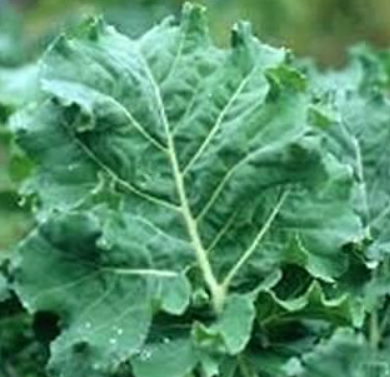
Mature kale leaves are bitter in warm weather, but the plant breaks down and becomes sweeter in the cold autumn months. Deer prefer it at that stage.
The Next Big Thing in Food Plots?
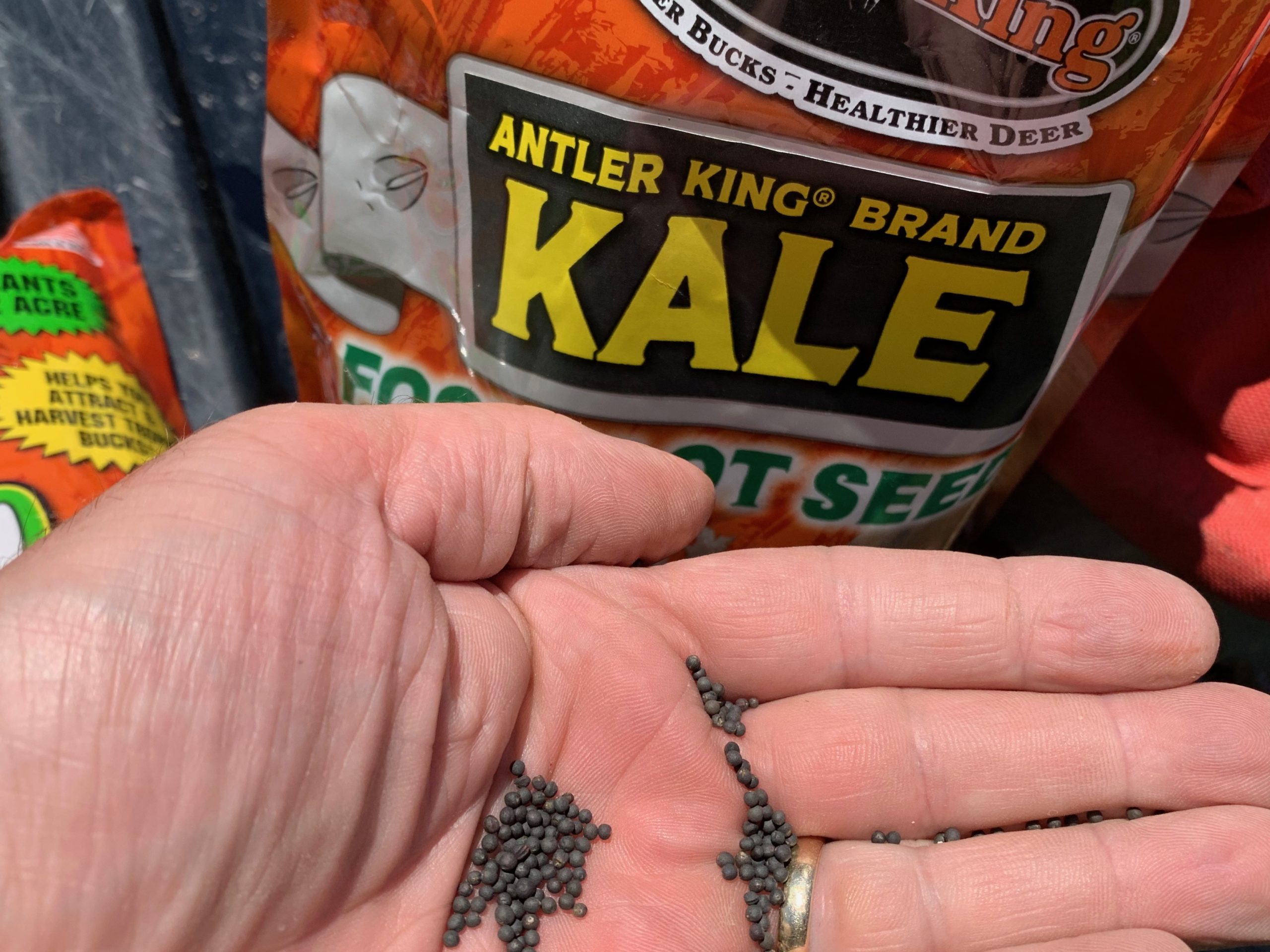
Both plots are relatively small (less than 1/4 acre each), and I used the same amount of Honey Hole when seeding the plots this week. However, I couldn’t help but be intrigued by a “newer” product that Antler King has been offering: Kale.
Yes, kale. That nasty leafy green they put on your plate when you order a sandwich at the restaurant. Yeah, yeah, I know some folks love kale, especially when it’s cooked with mashed potatoes, but I’ve alway found it kind of gross, to be honest. Bitter tasting (to me, anyway), and even though I know it has a ton of good nutrients in it, I’ve always shied away from including it in my salads.
Well, I’m not a deer, and I’m certainly not waiting around until late fall for it to “sweeten up.” Apparently, that’s exactly what kale does … because it IS another form of brassica!
I simply took 1/2 pound of the seed (way more than enough) and cut it with the Honey Hole seed I was planting. I don’t know of anyone who personally has planted a food plot of just kale, so I didn’t want to roll the dice on being all-in just in case the deer didn’t take to it right away. But after reading all of the information about this specific strain, I’m really intrigued as to how these plots will turn out. And we just received a good dose of rain, so this stuff should germinate before too long.
If planted by itself, kale can produce several tons of forage per acre in a deer food plot. (photo by Daniel Schmidt)
More About Kale Food Plots
Here’s a little more info on the seed itself from Antler King:
•Kale is a member of the brassica family and is extremely cold tolerant, easy to establish and provides a fantastic cool-season food source.
•Kale is packed with protein (20-30%) and vitamins and can produce up to 10 tons of forage per acre.
•Kale will grow best in cooler climates as the plant’s leaves will sweeten as the temps get colder.
•Like other brassicas, a frost will create a molecular change and further sweeten the leaves and increase attraction.
•Kale is best planted from July through October and works as a great fall and winter forage crop in the Southern U.S. and a summer, fall and winter forage crop in the North, Northeast, and Midwest.
•Kale prefers lighter soils; sandy, sandy loam or light clay and will perform best in a pH ranging from 5.5-7.0.
Kale Conclusion
So … I will keep my fingers crossed that these brassica plots flourish and the kale is something that helps improve them even more than last year. I will also report back with photos of the progress; and trail-camera photos and videos of any visitors we might get over the next several weeks.