Summer is here, and you know what that means: it’s fire pit season. In recent years, backyard fire pits have exploded in popularity, because let’s be honest: what’s better than sitting around a warm fire on a cool summer night while roasting marshmallows for s’mores? Nothing, that’s what. And if there’s one brand that can take the lion’s share of the credit for making home fire pits a thing, it’s Solo Stove.
Solo Stove’s popularity can be attributed to a number of factors. Its fire pits are ruggedly-built, well-designed, easy to use and (mostly) portable. The brand’s trademark smokeless technology actually works, eliminating the most annoying thing about traditional fire pits and bonfires: the smoke that seems to constantly always be in your face no matter how hard you try to escape it.
The Texas-based brand offers a number of products outside of its core fire pit lineup, including pizza ovens, patio heaters, camp stoves and an array of accessories, but when most people say “Solo Stove,” they’re referring to fire pits. But there isn’t just one definitive fire pit made by the brand — Solo Stove makes a number of different models in various sizes to suit different needs and situations. So if you’ve been wondering about different Solo Stove sizes and wondering which of the brand’s fire pits to get, here’s what you need to know.
What All Solo Stove Fire Pits Have in Common
Signature 360° Airflow: This is the defining feature of Solo Stove’s fire pits. It’s a proprietary ventilation system that uses a system of perforations throughout the fire pit to continually feed fresh oxygen to the base of the fire while simultaneously pumping superheated oxygen to the top of the flame. This results in both a hotter and more efficient flame and a near-total absence of smoke.
304 Stainless Steel Construction: Every Solo Stove fire pit, regardless of size, has the same general design made from 304 stainless steel. That makes them extremely durable and resistant to heat, while also keeping them relatively lightweight. Even the largest Solo Stove is technically portable (though you might need some help lugging it around).
Lifetime Warranty: Finally, every fire pit sold by Solo Stove is backed by a lifetime warranty against manufacturer’s defects. And even if your Solo Stove is damaged through your own misuse, the brand will still give you a 50 percent discount on a replacement.
Solo Stove Mesa
Diameter: 5.1 inches
Height: 6.8 inches
Weight: 1.4 pounds
The smallest Solo Stove fire pit is the Mesa, which is designed to sit on a tabletop and stands just 5.1 inches tall on its included stand. But don’t let the diminutive size fool you: this is a Solo Stove fire pit, through and through. It features dual-fuel capabilities, meaning you can use either wood pellets or firewood — very tiny firewood — as fuel. Unlike other Solo Stoves, the Mesa is also available in a variety of colors other than plain stainless steel, including limited-time options that pop up now and then.
Given its small size, this isn’t the fire pit for the family to gather around in the backyard. It’s designed to live on a table, with a warming radius of just one or two feet. It’s ideal for a couple or to add a little ambiance to an outdoor meal.
Solo Stove Mesa XL
Diameter: 7 inches
Height: 8.6 inches
Weight: 2.3 pounds
The Mesa XL is, as you may have deduced, a larger version of the Mesa. It’s two inches wider, roughly two inches taller and weighs about a pound more. But don’t let the “XL” give you the wrong impression. This is still a tabletop fire pit. It differs from the regular Mesa only in size and capacity. The XL holds up to 1,000 grams of pellets compared to the original’s 285-gram capacity, it has a burn radius of two to three feet and its burn time is 45 – 60 minutes rather than 30 – 45 minutes.
If the Mesa seems just a little too dainty for your needs, then you’ll likely be happy with the Mesa XL.
Solo Stove Ranger 2.0
Diameter: 15 inches
Height: 12.5 inches
Weight: 15 pounds
Moving off of the table and onto the ground, we have the Solo Stove Ranger. Solo Stove positions the Ranger as its most portable full-size fire pit, as it’s large enough for a small group hangout but still light and small enough for a single person to easily tote around. As one of Solo Stove’s full-size fire pits, it features the brand’s easy-to-clean removable ash pan and can only be fueled with wood (unless you spring for the pellet adapter). It also includes a carrying case and works with a wider range of accessories than the Mesa, such as the Heat Deflector and Pi Fire Pizza Oven attachment (read our review of the Pi Fire here).
Solo Stove Bonfire 2.0
Diameter: 19.5 inches
Height: 14 inches
Weight: 23.3 pounds
The Bonfire is Solo Stove’s flagship fire pit, and its most popular. In other words, it’s the right choice for most people. It’s large enough to live in your backyard at nearly 20 inches across, but also still light enough to take to the beach or campsite (like the Ranger, it includes a carrying case). It provides plenty of heat for a crowd and features all of the brand’s latest technology, like the removable ash pan. It also, given its popularity, has compatibility with just about every Solo Stove accessory.
Solo Stove Yukon 2.0
Diameter: 27 inches
Height: 17 inches
Weight: 41.6 pounds
The Yukon is the fire pit for party people. It’s by far Solo Stove’s largest, measuring well over two feet across and weighing nearly 20 pounds more than the Bonfire. This means that it’s best suited to live permanently on your patio or in your backyard. Though it is technically portable, there’s no included carrying case and it’s awkwardly shaped and fairly heavy, so you’ll want help moving it. Since it’s the largest, the Yukon of course throws off the most heat of any Solo Stove fire pit, making it best suited for larger spaces and bigger crowds. Like the Bonfire and Ranger, the Yukon is compatible with a number of Solo Stove accessories.
The most iconic image of America’s nineteenth-century westward expansion is that of the cowboy. Hardworking, tougher than nails, and full of grit, cowboys worked as ranch hands for large cattle and sheep ranches in the out stretching American west. Besides taking care of the everyday keep of the ranch, cowboys were also hired to herd the wealthy rancher’s livestock long distances and at times through wild and dangerous country to the city markets to be sold.
Because of the rough lifestyle and often harsh conditions they lived in, cowboys had to depend on certain tools and equipment to not only get their work done, but in many instances, to survive. Some of these tools have become a part of the cowboy’s iconic image. A good horse and a comfortable saddle; an accurate and trusty rifle or hand gun—and for a few, both; a sharp and well-built knife, good boots, and his bedroll.
The cowboy bedroll was, although simplistic, a significant item in western culture. A cowboy’s bedroll served multiple purposes: such as a trunk to store his personal items, a safe box, a seat while eating, and of course a bed.
The cowboy bedroll was very portable, and extremely practical for the lifestyle cowboys lived, it was also one of the very few comforts a cowboy had, especially while out on the trail. While traveling it could easily be slung over the shoulder if walking or strapped to the back his saddle if solo. While on a drive, it would be thrown into the back of the bed wagon where it could easily be retrieved at the end of the day. While at ranch headquarters it could be unrolled on the floor or a bunk in the bunk house.
What is a Cowboy Bedroll?
The make-up and design of the classic cowboy bedroll was simple; wool blankets or bedding wrapped in a canvas tarp that usually had buckles or ties that would connect the two canvas flaps together. The bedroll could then be rolled up and strapped tight with a rope or leather strap or belt.
The cowboy bedroll was in many ways a precursor for the modern day sleeping bag. Some versions had a strap to allowed it to be carried over the shoulder. The canvas tarp was meant to provide protection from bad weather. If it rained, the canvas added a layer of protection, attempting to kept them dry and warm. This is only true, however, if the canvas was waterproofed with a combination of beeswax and linseed oil. If it wasn’t, your protection against wet weather was limited.
It is true that traditional canvas will swell and hold out water, but once it is touched from the inside it will begin to wick moister through to the inside, thus defeating the purpose for a canvas covering.
In snowy weather, the canvas would allow the cowboy to stay dry and warm, and at the same time the accumulated snow would provide an insulated layer. If the weather was warm and nice the canvas tarp could be flapped open, allowing him to enjoy the cool night are while at the same time providing a ground cloth.
Improving on the Timeless Cowboy Bedroll
It is unclear when and where the bedroll concept was first conceived. One thing is for sure, however, bedrolls have been around for a very long time, and have been used in a large variety of places and circumstances. Forty-niners used them throughout the gold rush. Soldiers used them during the American Civil War.
They have been popular in Australia for many years and come in many shapes and sizes. In Australia they are called a swag, or a swag bag. In many ways the Australian swag bag has lost the simplicity and convenience of the traditional cowboy bedroll and have at this point morphed into what most people would view as a one-man tent. Although the swag is smaller than most tents, it acts as one since you don’t keep your gear in it roll it up. This for most people destroys the point. One could argue that you might as well use a tent.
You may be wondering how Canvas Cutter has improved upon the functionality, protective qualities and durability of the traditional cowboy bedroll without destroying the simplistic nature and its convenient features.
We at Canvas Cutter follow the KIS rule or “Keep It Simple”. The design and function of the traditional cowboy bedroll is already good, which is why it has been around for almost two centuries. We knew the shape of the traditional cowboy bedroll worked, its functionality was good, the protection it could provide from the elements was fare, but often left one wanting, and the canvas traditionally used was quite durable. These things didn’t need to necessarily be changed, but rather improved and where possible simplified.Often when a company tries to improve on timeless product or idea, the improvements made decreases the products simplicity, which regularly changes the very features that made it great in the first place. So, we asked: “how can we take an already simple concept and simplify it even more while at the same time improve and modernize all its features?”
We started by analyzing what the weaknesses of the traditional cowboy bedroll were, which would allow us to identify what we needed to improve. Once we knew what we needed to improve upon, then we could focus on simplifying those improvements.
Improvement #1: Traditional Canvas to Sunforger Marine Canvas
Canvas was a great fabric choice to use for the cowboy bedroll. It is a strong fabric that can handle the abuse of life in the outdoors. Although the cotton threads woven together would swell when wet making the weave extremely tight and difficult for water to get through, unless the canvas was treated it would not hold water out for long.
In fact, even if traditional canvas is treated – often called “Duck” or “Army Duck” canvas once treated – it will still absorb water when touched from the dry inside of the canvas. This is obviously going to be a problem when one is laying inside the canvas bedroll, and constantly rubbing up against it. The water you are supposed to be protected from will slowing start making its way to the inside, leaving you to wake up cold and wet. This obviously destroys one of the main purposes for using the bedroll.
At Canvas Cutter, we knew traditional canvas does not and would not be suitable for our premier canvas bedroll. To eliminate the afore-mentioned problem one would face with the traditional cowboy bedroll, we chose to use Sunforger Marine canvas.
Sunforger canvas is made from multi-thread spun-yarn, that is woven in a crisscross and diagonal line weave, making the weave significantly tighter than traditional canvas, and increasing the canvas’s strength dramatically at the same time. Marine treated means the canvas has been double treated – making it completely waterproof. The treatment also makes the canvas extremely mildew resistant.
Because of the treatment and tighter weave, the Sunforger canvas will not wick. This means it can rain all night and all day and you will remain warm, dry, and comfortable.
Improvement #2: The Flap System to Zipper
Although the traditional cowboy bedroll did provide some protection against the wind and bad weather, that protection was limited. When the weather was windy and rainy the struggle was oh-so-real.
The canvas tarp was used to create the bedroll cover by overlapping to canvas flaps which were often tied or buckled closed. The cowboy bedroll was open ended at the head, allowing the weather and cold air to come in. Sometimes there was a flap that could be pulled over the head protecting it from rain, but not the wind and cold or any puddled water on the ground around you.
Also, it would take time and patience to flip the canvas flaps over your bedding and tie or buckle them closed while getting wet and cold in the process.
At Canvas Cutter, we used the same simple rectangular shape of the traditional cowboy bedroll, but we got rid of the canvas flaps, ties, and buckles. We simplified the design by installing one zipper.
The heavy-duty YKK zipper (which meets military grade standards), runs from the foot of the bedroll up around the head and back down to the bottom of the bedroll, allowing you to quickly and completely close the inside of the bedroll off to the wind, rain, snow, dust, bugs or rodents that might want to find their way inside.
Whether you left the bedroll back at camp or you’re laying comfortably inside it, you and your gear are protected. Canvas Cutter bedrolls have four zipper pulls and short, weather flaps on each side. These pulls and flaps allow you to unzip the bedroll several inches on each side during bad weather conditions, increasing airflow and reducing the possibility of condensation build up inside the bedroll. Two overlapping seams cover the entire zipper and add additional protection against the weather.
Improvement #3: A Piece of Rope VS 3 Quick-release Buckles
The traditional cowboy bedroll was often kept rolled up by a rope or a leather strap. These got the job done, but the idea could definitely be improved upon.
The rope or leather strap were not connected to the bedroll itself, which meant you had to keep track of it. If it got lost, your ability to keep your bed rolled up and the convenience of carrying it was lost.
To make the roll-up/unroll process, as well as the carrying of the bedroll more simple, quick, and easy, we sewed three one-inch polyester webbing straps with quick release buckles to the bottom of the bedroll and included an easy to carry handle to the bottom of the bedroll.
The quick release buckles allow you to unroll your bedroll in seconds, without the hassle of dealing with knots or keeping track of a rope or strap.
When rolling the bedroll up, the quick release bucks and straps allow you to synch the bedroll as tight as you would like. The straps can also be loosened easily while buckled.
Pioneering Bedroll Convenience
The cowboy bedroll has been an iconic piece of outdoor gear in the west for centuries because it makes life in the rugged outdoors a little easier and more comfortable. It allows you to have a mobile camp, that can be set up or taken down quickly and conveniently.
The soul who conceived the simple idea was a genius, and Canvas Cutter has taken this idea and improved it a thousand times over, hoping this better way of sleeping in the outdoors sticks around for centuries to come.
If you are looking for a light-weight and durable canvas bedroll, pick up the newest addition to our canvas bedroll line up – The SUMMIT.
Using the right fishing rig is essential for catching trout successfully, and knowing which rig to use for what conditions can make the difference between catching your limit or getting skunked.
There’s a perfect trout rig for almost every situation, and that’s why it’s so important to master rigging for trout, as this will allow you to choose exactly the right fishing rig for your purposes.
In this article I’ll cover the 9 best trout rigs, and will discuss what each of them is ideally suited for.
How to rig for trout
In order to rig for trout, you need to choose one of three basic types of rigs:
Rigs that present your bait suspended underneath a bobber or float
Rigs that present your bait close to the bottom with a weight
Rigs that enable you to cast and actively retrieve an artificial lure
While these three types of fishing rigs cover almost all trout fishing applications, they come in a variety of different shapes and forms, each of which is best suited for slightly different trout fishing setups.
So if you’re a beginner, chances are that you’re confused about all the different options of rigging for trout.
However, the great thing is that you can get started with just two or three of the most versatile trout fishing rigs, and then add more specialized rigs once you know what kind or rig works best for your pond, lake or stream.
Now let’s look at each of the most important trout rigs in more detail, to help you choose the best rig for your purposes.
And in case you’re also looking for the best bait to use with your trout fishing rigs, check out our article on what is the best bait for trout?
Trout fishing rigs with bobbers
Bobber rigs are among the most effective trout fishing set ups, and work especially well when fishing in shallow ponds and streams, as well as in shallow bays of bigger lakes, or basically in any situation where trout are active close to the water surface.
Now let’s look at the two main types of bobber rigging for trout.
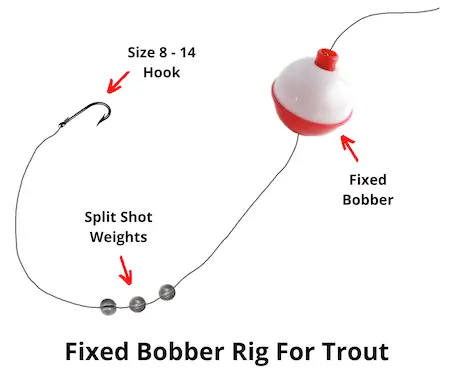
Trout rig with fixed bobber
This is one of the simplest trout rigs, and consists of a fixed bobber attached to the line, as well as a hook and sinker to weigh down the baited hook in the water.
The depth at which the bait is presented depends on the distance between the hook and the bobber.
How to tie it: Attach the bobber to the line, and then tie the end of the line to the hook. The most common type of bobber used for this fishing rig is a round red and white bobber, but you may want to choose a pencil shaped bobber instead, which offers less resistance when a trout takes the bait.
If you’re not sure how to rig a fishing line for trout, take a look at our article on what fishing line should you use for trout?
When to use it: This is a great fishing rig to use in shallow ponds and streams, as well as any situations where trout are feeding close to the surface. It’s very easy to set up and a lot of fun to fish with, which makes it an excellent choice for beginners who want to try trout fishing in a stocked pond.
But keep in mind that the maximum depth you can fish this rig corresponds to the length of your rod, since you can’t cast the fishing rig effectively if you set the bobber higher than that.
How to use it: The best way to use this fishing rig is to cast it out with a baited hook and wait for a trout to bite, which is indicated by the bobber being pulled down underwater.
When you see this, set the hook immediately, so the trout doesn’t have a chance to spit out the hook when it feels resistance on the line. This is the best setup for trout fishing in streams and rivers, where you can use it to drift your bait into the best locations that hold trout.
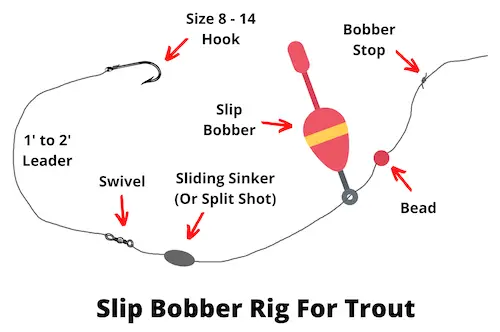
Slip bobber rig
This is another commonly used trout rig, and should be part of every trout angler’s arsenal of fishing tools.
Using a slip bobber rig (aka sliding float rig) makes the fishing rig more compact and easier to cast with than a fixed bobber rig.
How to tie it: Tie a bobber stop on to your main line, and then thread the line through your bobber and tie the line to the hook. The best hook size depends on your bait, but generally lies somewhere between size 8 and 14.
If you’re unsure about choosing the right hook size for different trout line setups, take a look at our article on the best size hook for trout.
Attach a split shot or two to the line between the bobber and the hook. This stops the bobber from sliding down onto the hook and it also weighs down your bait, helping to present it at the right depth to the trout .
Keep in mind that some baits (like powerbait) float in the water, and you may need to add extra split shots to make the baited hook sink down to the desired depth.
When to use it: The slip bobber rig is the best choice when trout are feeding in midwater, and if you can’t reach them with either a fixed bobber rig or with a bottom fishing rig.
The great thing is that you can fish practically any depth with this fishing rig, as you just need to move the bobber stop up the line to whatever depth you want to set the bobber.
How to use it: Estimate the depth of the water you’ll be fishing in, and set the bobber stop to that depth. Then bait your hook and cast out your fishing rig to the desired spot and wait for a fish to grab the bait.
Bottom fishing rigs
Bottom fishing rigs are often the best choice when trout are found in deeper water, as they tend to feed close to the bottom most of the time. There are several options available to you in this rig category, so now let’s look at the most important ones.
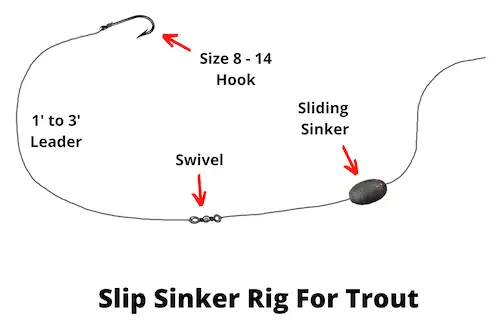
Slip sinker rig
This is the simplest bottom fishing rig around, and is the one most often taught to novice trout anglers. This rig has been in use for more than a century, and continues to perform well in many situations where trout hold close to the bottom.
How to tie it: Thread a 1/8 or 1/4 oz sliding sinker (either a bullet or egg sinker) onto your main line, and then tie the line to a barrel swivel. Attach a leader to the other end of the swivel, and tie your hook to the leader. Choose the type and size of hook depending on the type of bait you want to use.
When to use it: This rig is most commonly used in lakes where trout hold in water deeper than 5 or 10 feet. It’s a great rig to use from shore, since you can cast it relatively far, and cover a lot of water with it.
It’s important to use this fishing rig with floating bait, since you don’t want your baited hook lying on the bottom where trout won’t notice it. You can use it with either powerbait (which is designed to float), or worms injected with air to make them float.
How to use it: This is the most common bait rig used for trout fishing setups, and is usually fished passively. Most anglers cast it out to a promising fishing spot and then wait for a bite. If you do this, make sure to check your rig regularly to see if the bait is still on the hook, and also test different fishing spots.
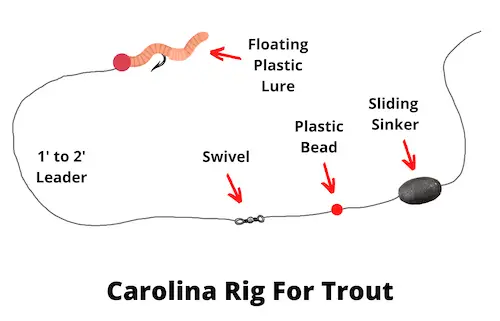
Carolina rig
This rig is very similar to the slip sinker rig, but unlike the slip sinker setup it is often fished actively with artificial lures instead of passively with bait, which is why we list the two options separately.
How to tie it: Start by threading your main line through a 1/8 to 1/4 oz sliding sinker. Next, thread the line through a plastic bead, and then tie it to a swivel or snap swivel. The bead stops the weight from banging into the swivel during retrieval, which protects the knot on the swivel from being damaged while fishing, and this is more important if you want to fish it actively.
When to use it: You can use this option anywhere where trout are feeding close to the bottom. It’s a great option to use when fishing in lakes, reservoirs and ponds, but you can also use it in rivers.
How to use it: While you can also use this fishing rig with a baited hook and fish it passively until a trout comes by and bites, the strength of the Carolina trout fishing rig lies in fishing it actively with a floating lure.
You can use a floating jig head with plastic lures such as trout magnets or power worms. After casting out, let your rig sink to the bottom, and then slowly retrieve it with a jigging movement.
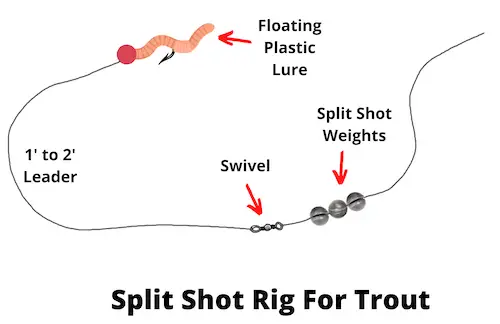
Split shot rig
This is basically a finesse version of the Carolina rig, and instead of a sliding sinker it uses one or more split shots attached to the line. Since trout can be finicky at times (especially when fishing in heavily fished waters), it’s always great to have some finesse techniques up your sleeve.
How to tie it: Tie your main line to a swivel or snap swivel, and then add one or two split shots to the line right above the swivel. Next, tie a 1 to 2 foot long fluorocarbon leader to the swivel, and then tie your hook to the other end of the leader.
Next, thread a soft plastic lure onto the hook, and your trout fishing line setup is good to go.
In most cases you’ll want to use a floating lure on this rig, which will result in presenting your lure right in the strike zone every time the split shots sink to the bottom.
When to use it: This rig is a great option if you notice that the trout are finicky. This is most often the case in heavily fished waters, and especially in clear water it can be advantageous to use a finesse rig that’s harder for the fish to spot. It’s also a great trout fishing set up for small creeks.
How to use it: Cast the rig out and let it sink to the bottom. Then slowly retrieve it with jigging movements of your rod tip. The main disadvantage of the split shot rig is that it can’t be cast as far as the Carolina rig, since it comes with less weight on the line. Because of this, it’s better to use it when fishing in smaller lakes, rivers and streams.
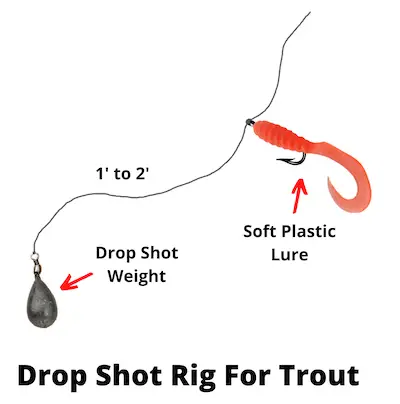
Drop shot rig
This is another great trout fishing rig setup for bottom fishing, and one of it’s key advantages is that it allows you to place your lure in the strike zone and keep it there for a long time. Similar to the two previous rigs, it’s most often used with soft plastic lures.
How to tie it: Start by tying your main line to a 4 or 5 foot fluorocarbon leader with a double uni knot, and then tie the end of your trout leader to a 1/8 to 1/4 drop shot weight.
Next, take a bait hook and place it facing upwards, and form a loop with the leader line about 1 foot above the drop shot weight.
Pass the loop through the eye of the hook from below, and then tie an overhand knot with the loop. Finally, pass the hook through the loop, wet the line, pull tight, and you’re ready to start fishing.
When to use it: While the drop shot rig was originally developed for vertical fishing in deep water from a boat, most bass anglers can tell you that this rig works equally well for fishing from shore, and can even be fished in very shallow water. It’s a great trout fishing setup for beginners fishing in lakes and rivers.
How to use it: Cast the rig out and slowly retrieve it by hopping the weight along the bottom, while jigging the lure up and down. If you figure out where the strike zone is, you can keep the drop shot fishing rig there, and simply wiggle the lure in place without moving the weight. That way you can keep your lure right in front of the fish for a long time, without having to retrieve it and cast again.
Lure rigs
While all of the fishing rigs discussed above can be used as trout fishing setups with either natural bait or artificial lures, some options for rigging for trout are only intended to be used with lures. Let’s take a look at the most important rigs of this type that you should know.
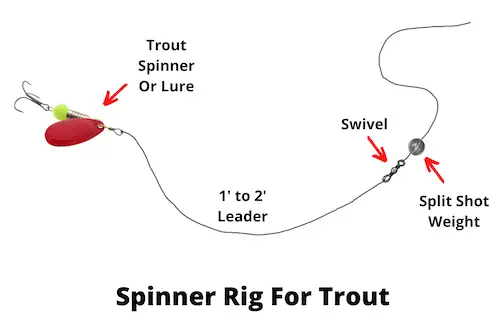
Spinner rig
The spinner rig is the most commonly used lure fishing rigs for trout. It is most often used with spinners (such as a rooster tail or panther martin), but it can also be used when fishing with any other artificial lure designed for casting and retrieving.
How to tie it: Tie your main line to a swivel or snap swivel, and add one or two split shot weights just above the swivel. Next, tie a 2 to 4 foot fluorocarbon leader to the other eye of the swivel, and then tie your lure to the other end of the leader.
Depending on the size and weight of your lure, adjust the number of split shots to achieve the right depth during retrieval. The swivel prevents line twist of your main line, but if you’re using a lure that doesn’t generate twist, you can also tie the main line directly to the leader.
When to use it: This is one of the most versatile trout set ups, and can be used in almost any setting, from small streams to deep lakes. In most cases you should try to fish this rig in the middle of the water column, but can also go deeper than that if the trout are holding close to the bottom.
How to use it: Simply cast out the fishing rig and start retrieving. Depending on how deep you want to fish it, you can adjust your retrieve speed, and you can also experiment with letting the rig sink to the bottom before you start reeling it in. However, if you’re trout fishing over weed beds, make sure to keep your lure above the weeds.
If you’re interested in fishing with trout spinners, check out our complete guide to trout fishing with spinners.
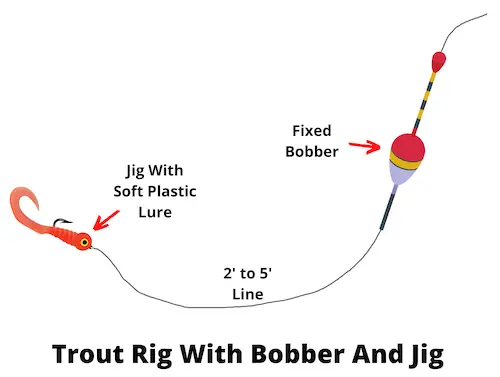
Trout fishing rig setup with bobber and jig
This is a great rainbow trout rig to use if you’re fishing over weeds, as you can fish it slowly without getting the jig snagged in the weeds.
How to tie it: Depending on the depth of the water, you can use either a fixed bobber or a slip bobber.
So start by setting up one of the two bobber rigs (as described above), and instead of tying a bait hook to the end of the line, tie a 1/16 or 1/8 oz jig head to the line. Next, you can bait the jig head with any of a wide variety of plastic lures, and you’re ready to start fishing.
When to use it: This is a great trout fishing setup for beginners when fishing over weed beds, and when want to keep your lure just above the weeds. You can achieve this by setting exactly the right depth with your bobber.
This trout rig setup is also great for drift fishing in streams and rivers, and again you should adjust the setting of your bobber to present the lure just above the bottom.
How to use it: If you’re trout fishing in a lake, cast out the fishing rig and let the jig sink as far as it can (at which point the bobber stands up straight). Then lift your rod tip to retrieve the fishing rig about 4 to 5 feet, and then pause to let the jig sink down again.
What this trout fishing setup achieves is that your jig will be slowly pulled up and then allowed to sink again. In the case of a plastic worm, this results in the worm wiggling through the water, which is highly attractive to most trout.
See also: How to rig when trolling for trout
Ned rig
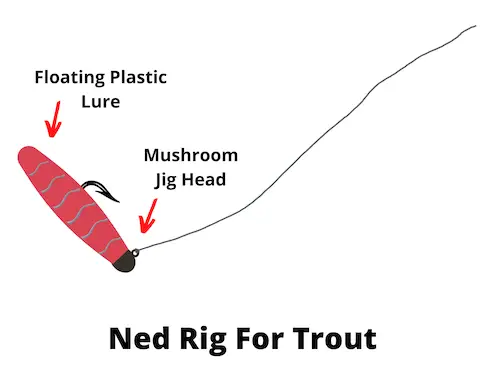
The ned rig is most familiar to bass anglers, but few people know that it also works really well for catching trout. The key feature of the ned rig that makes it so effective when fishing for trout is that it is usually fished with a floating plastic tail, which is ideal for catching trout.
How to tie it: This is the simplest fishing rig to tie in this collection. If you’re using fluorocarbon as your main line, you can tie that directly to the mushroom jig head of the ned rig and you’re ready to start fishing. If you’re using braided line as your main line, it’s best to use a 2 to 4 foot fluorocarbon leader, since that’s much less visible in the water.
When to use it: You can use this rig whenever trout are feeding close to the bottom, and it works equally well in lakes, rivers, and streams. The only situation when you shouldn’t use this rig is if you’re fishing in a lake with a lot of vegetation on the bottom, which is likely to get your ned rig snagged.
How to use it: Cast it out and let it sink to the bottom, then retrieve it for 3 or 4 feet with a jigging motion, and let it settle on the the bottom again. Repeat this until you get a bite.
What are the best trout rigs?
The 3 best trout rigs are:
Slip bobber rig
Slip sinker rig
Spinner rig
Between them, these three setups cover all the three main types of rigging for trout, and if you can set each of them up and fish them effectively, you’re off to a great start.
The slip sinker rig is perfect for presenting a bait close to the bottom, which is the best depth to target trout in most situations.
The slip bobber rig, on the other hand, can be used to present a bait suspended underneath a bobber, which is great when fishing for trout that are active higher in the water column.
And the spinner rig is a great basic setup for active trout fishing with lures, which is an ideal way to cover a lot of water in search of hungry trout.
If you’re currently looking for a new trout rod, check out our article on what is the best rod for trout fishing?
What are the best trout bait rigs?
The 3 best trout bait rigs are:
Slip sinker rig
Slip bobber rig
Fixed bobber rig
Each of these fishing rigs is well suited for baiting your hook with natural baits like worms, maggots, minnows, corn, salmon eggs, or scented baits like powerbait.
In addition, all of them can be used for fishing passively, by casting out your fishing rig and then waiting for a trout to pass by and take the bait.
Trout worm rigs
The best rigging for trout to use with worms is either the slip sinker rig, or the slip bobber rig. The former rig is the ideal choice if you know that trout are feeding close to the bottom, and the latter rig is better if trout are feeding higher in the water column.
When using a slip sinker with a worm as bait, it’s important to make sure that your baited hook floats in the water, as trout will not eat it if it’s lying directly on the bottom. Traditionally, this has been done by injecting air into the worm with a worm syringe (which you can get in most tackle shops).
More recently, many anglers are fishing with floating jig heads baited with worms to make their bait presentation float in the water, and another great trick is to put a small marshmallow on the tip of your hook, which also makes it buoyant.
Finally, no matter which trout worm rig you use, it’s usually best not to use a whole nightcrawler on your hook, as this is too big to fit into the mouth of a trout. Instead, cut off a 1 or 2 inch piece of the worm, and thread it onto the hook.
The best hook type to use for this rig is a baitkeeper hook, which prevents the worm from sliding down the shank of the hook.
Minnow rigs
The best trout rig to use with minnows is either the slip bobber rig, or the fixed bobber rig. Your hook size should be between size 8 and 12 (depending on the size of the minnow). The best way to hook a minnow for trout is through the upper lip.
Small fish form a large part of the diet of many trout species, which is why they can be such a good bait.
Bobber rigs are great for fishing with live minnows, since you can easily spot a trout bite when the bobber goes down, and this allows you to delay your hook set long enough to give the trout a little extra time to get the minnow fully inside its mouth.
Which one of the two bobber fishing rigs you choose depends on the depth of the water you want to fish in, and on the depth at which trout are active.
When fishing with live minnows as trout bait, it’s important to weigh them down with split shots, so they stay at the right depth.
Salmon egg rig
The best trout rig setup to use with salmon eggs is one of the following:
Slip bobber rig
Fixed bobber rig
Drop shot rig
Your hook size should be between size 8 and 14, and if you use a larger hook, you can thread several salmon eggs onto your trout hook. No matter which fishing rig you choose, you need to cast very gently in order to avoid ripping the eggs off the hook during the casting process.
If you’re trout fishing in a lake or pond, the best choice is a bobber rig, as that allows you to present the salmon eggs suspended in the water. But if you’re trout fishing in a stream or river, you can use a bobber rig to drift the salmon eggs with the current.
Alternatively, you can also use a split shot rig to drift the salmon eggs right on top of the bottom of the stream. The latter approach is better for getting it right in front of the trout, but it’s harder to detect bites with this style of fishing.
Egg rigs also work very well for steelhead fishing, and it that’s something you’re into, check out our article on how do you rig for steelhead bank fishing?
Final remarks
This concludes our article on rigging for trout, and hopefully we’ve helped you find exactly the right rig for your fishing technique.
Different trout rigs are ideally suited for different trout fishing tactics – bait fishing, lure fishing, trout fishing from shore, trout fishing from a boat, as well as fishing in diverse bodies of water, ranging from small streams to big lakes.
Now that you understand the basics of what each of these fishing rigs is designed for, this should help you to choose the best trout setups to help you to catch more fish in your local trout fishery.
When it comes to dove hunting, one of the most important skills a hunter must master is knowing how far to lead a dove at 40 yards. This distance can be particularly challenging for many hunters, as it requires a great deal of skill and practice to get right. The key to success lies in understanding the behavior of doves and their tendency to fly erratically, as well as the limitations of your shotgun and ammunition.
There are a number of factors that can affect your ability to lead a dove at 40 yards, including the size of your shot, the pattern of your shotgun, and the agility of the bird itself. Hunters must also be aware of any regulations or hunting laws that may apply in their area, as well as the importance of proper clothing, shelter, and camouflage. With the right training and practice, however, even novice hunters can learn to master this challenging distance and become skilled dove hunters.
Understanding Lead and Distance
What is Lead?
Lead is the amount of space that a shooter needs to aim in front of a moving target in order to hit it. When shooting at a moving target, such as a dove, hunters need to lead the target to account for the time it takes for the shot to reach the target.
Factors Affecting Lead
The amount of lead required to hit a dove at 40 yards can vary depending on a number of factors. These factors include the speed of the bird, the distance of the shot, the type of shotgun and ammunition used, and the skill level of the shooter.
Image by G.C. from Pixabay
How Far to Lead a Dove at 40 Yards?
When shooting at a dove at 40 yards, the amount of lead required will depend on the speed of the bird and the type of shotgun and ammunition used. A general rule of thumb is to lead the bird by about 3 to 4 feet, or about the length of the bird’s body.
It’s important to note that shooting at a moving target like a dove requires skill and practice. Hunters should take a course on shooting moving targets and practice regularly to improve their aim and accuracy.
In addition, it’s important to follow all hunting laws and regulations, including those related to the use of weapons and clothing. Sporting clays can also be a great way to improve your shooting skills and accuracy, as well as to learn more about the sport of hunting.
When shooting at a dove, it’s important to consider the impact of the shot on the bird and the surrounding wildlife and environment. Using a field gun with a tight pattern of pellets can help to minimize the number of pellets that miss the target and reduce the potential impact on other wildlife and water sources.
Practicing Your Shot
The Importance of Practice
For hunters looking to hit their targets accurately, practice is key. Shooting a dove at 40 yards requires skill and precision, and the only way to achieve this is through consistent practice. By practicing regularly, hunters can develop their aim, improve their technique, and get accustomed to the feel of their gun.
Image by BRRT from Pixabay
Best Practices for Practicing Your Shot
To get the most out of their practice sessions, hunters should follow these best practices:
Start with closer shots: Before attempting to hit a dove at 40 yards, hunters should start with closer shots to build their confidence and accuracy.
Use smaller shot sizes: When practicing, hunters should use smaller shot sizes to simulate the size of a dove. This will help them get a better understanding of the patterns their pellets create.
Practice in different environments: Hunters should practice in different environments to get accustomed to shooting in different conditions. This could include shooting on a rifle course or in a field with agile game birds.
Use a field gun: When practicing for dove hunting, hunters should use a field gun rather than a sport gun. Field guns are better suited for hunting game birds and will help hunters get a feel for shooting in the field.
Focus on technique: Hunters should focus on their technique when practicing, paying attention to their stance, grip, and aim. By improving their technique, hunters can improve their accuracy and precision.
Join a club: Joining a shooting club can provide hunters with access to shooting ranges and other resources for practicing their shot.
By following these best practices, hunters can improve their shooting skills and increase their chances of hitting a dove at 40 yards.
Equipment and Accessories
Shotgun and Barrel Selection
When it comes to shooting doves at 40 yards, the right equipment can make all the difference. A shotgun with a 12-gauge or 20-gauge barrel is ideal for this task. The barrel should be at least 26 inches long to provide a good balance between accuracy and maneuverability. A longer barrel may be more accurate, but it can also be cumbersome to carry around in the field.
Shot Size and Pellet Count
The right shot size and pellet count can also have a significant impact on your success when shooting doves at 40 yards. For this distance, a shot size of 7.5 or 8 is recommended. These sizes provide enough power to take down a dove without causing excessive damage to the bird. As for pellet count, a load of 1 1/8 ounces is a good choice for 12-gauge shotguns, while 7/8 ounces is better suited for 20-gauge shotguns.
Dove Decoys and Camouflage
Using dove decoys and camouflage can help you blend in with your surroundings and increase your chances of success. When selecting decoys, choose ones that are realistic and have natural-looking colors. Place them in a way that mimics the natural behavior of doves. As for camouflage, choose clothing that matches the environment you will be hunting in. This will help you blend in and remain undetected by the doves.
In summary, when shooting doves at 40 yards, it is crucial to have the right equipment and accessories. A 12-gauge or 20-gauge shotgun with a 26-inch barrel, a shot size of 7.5 or 8, and a pellet count of 1 1/8 ounces (for 12-gauge) or 7/8 ounces (for 20-gauge) is recommended. Using dove decoys and camouflage can also increase your chances of success.
Image by Nicky ❤️????????????❤️ from Pixabay
Regulations and Safety
Hunting Regulations for Doves
When it comes to hunting doves, hunters must follow specific regulations to ensure the safety of both the hunters and the game. Regulations vary from state to state, so it is essential to check with the local wildlife agency before heading out.
Some common regulations for dove hunting include the following:
Hunting season: There is a specific hunting season for doves, which varies from state to state. Hunters must follow the designated dates and times for hunting doves.
Bag limits: There are specific bag limits for doves, which vary from state to state. Hunters must not exceed these limits.
Hunting license: Hunters must have a valid hunting license to hunt doves, which can be obtained from the local wildlife agency.
Safety Precautions for Dove Hunting
Dove hunting can be dangerous if safety precautions are not taken seriously. Hunters must follow specific safety guidelines to ensure their safety and the safety of others.
Some common safety precautions for dove hunting include the following:
Shelter: Hunters must seek shelter in a safe area, away from other hunters, to avoid accidents.
Surprise: Hunters must always be aware of their surroundings and avoid surprising other hunters.
Hunting laws: Hunters must follow all hunting laws and regulations to avoid accidents and legal consequences.
Weapons: Hunters must handle their weapons with care and only shoot when they have a clear shot.
Clothing: Hunters must wear appropriate clothing to protect themselves from the elements and avoid accidents.
Food: Hunters must bring enough food and water to sustain them throughout the day.
By following these regulations and safety precautions, hunters can enjoy a safe and successful dove hunting experience.
With their bright orange color and meaty texture, chicken of the woods mushrooms are one of the most exciting edible mushrooms out there, and if you catch them at the right time they can be some of the best mushrooms you’ll ever eat. They’re a perfect wild mushroom for beginners, and something to look forward to every year.
About
Chicken of the Woods mushrooms (Laetiporus sulphureus) are a parasitic fungi that decays dead trees and causes a brown heart rot in living trees, making it both a parasitic and saprobic mushroom.
The fruiting body appears as a fan-shaped mushroom growing in large brackets on stumps, fallen logs, and the base of dead trees. They’re widespread across North America, but also enjoyed around the world.
The chicken of the forest.
Famous as the mushroom that tastes like chicken, they’re a great mushroom meat substitute in many dishes, making them perfect for using in vegetarian and vegan mushroom recipes. Some people like to treat them like crab or lobster.
They can grow to a massive size. In 2009 the Guinness Book of World Records listed a chicken mushroom found in United Kingdom weighing over 100 pounds.
White chickens are sometimes confused for an orange hen of the woods.
Chicken of the Woods Species
As of this writing, there should be 7 species in North America. New varieties are identified around the world regularly, and there’s at least 14 species identified in the world to date including L. xinjiangensis from China, L. cremeiporus, from Japan, and L. caribensis from the Carribean.
East Coast and Great Lakes
Laetiporus sulphureus is the type species, and are the best example of what a chicken mushroom will look like. It has yellow pores and grows on dead and dying hardwoods, especially oak, but can also grow on poplar, willow and locust.
L. sulphureus.
Laetiporus cincinnatus or white-pored chickens often grow from the roots of oak trees in a basal rosette shape, but can grow directly from trees as well. Many foragers prefer their texture and bug resistance over yellow varieties. Unlike other chickens, it causes root or butt rot instead of heart rot. It has a peachy-orange color, and cream to white spores.
L. cincinnatus.
Laetiporus huroniensis is newer addition to the genus. L. huroniensis has pale yellow pores and grows on old-growth conifers in the northeastern U.S. and Upper Midwest. It’s bright orange color is similar to L. sulphureus.
Laetiporus persicinus, or the white Chicken of the woods. L. persicinus is the only species to grow on hardwood and softwood. It has a white to pink-salmon cap that darkens to brown with age with white pores. It’s found in the southeastern United States, Australia, Asia, and South America the Caribbean.
West Coast
Laetiporus conifericola. A recently named species with a range from California to Alaska. It’s preference for conifer trees like hemlock, spruce and fir set it apart from others in the genus. The caps are the classic bright orange to peach, and and has yellow pores.
L. conifercola.
Laetiporus gilbertsonii Grows on eucalyptus or oak and is found in the Southwest as well as the west coast. Some avoid it as it can cause allergic reactions for those sensitive to it. A cousin (L.gilbertsonii var. pallidus) has white pores and grows along the Gulf Coast.
L. Gilbertsonii.
Where to Find Chicken of the Woods
You can find sulphur shelf mushrooms anywhere a tree has been infected. In the Midwest, chicken of the woods season begins in late Spring, continuing through Fall. Each host tree has its own “clock” and they’ll fruit at different times.
In Minnesota and Wisconsin I find them growing on red and white oak, but also cherry or beech are possible. On the west coast and up into Canada they grow on Coniferous trees.
Harvesting Chicken of the Woods (Video)
Finding chicken mushrooms is easy. Finding them at the perfect stage for eating is not. Young mushrooms harvested before the shelves form are the most tender.
Stages of growth: perfect, middle aged, and too old.
To harvest, cut the tender portions of chicken mushroom off with a sharp knife. The mushrooms get tough and woody quickly as they grow, and the excitement of finding one can fool you into bringing home a tough, woody mushroom. If you find a large mushroom, trim off dirt from the base.
Mushroom Bugs
Fungus gnat larvae (Sciaridae and others) will infest the mushroom quickly. Some species are more prone to them than others. As you cut, inspect the mushroom for tunneling, keep cutting until you can’t see any bug holes.
Very fresh, young mushrooms may bleed yellow juice when cut
Store fresh chicken of the woods in a Zip Loc bag with a paper towel and they can last for a week in the fridge. Larvae are harmless, but they’ll make your mushrooms go bad faster.
Mushrooms covered with flies will contain maggots/larvae.
Chicken of the Woods Look Alikes
There are no real look alikes, and there’s no false chicken of the woods. The mushroom most commonly confused with chickens are hen of the woods. The difference is easy to see: chicken mushrooms are orange or yellow and hen of the woods are brown.
Chicken of the Woods vs Hen of The Woods
Cooking Chicken of The Woods
Chickens can be substituted for chicken in any recipe, as well as other mushrooms after cutting into bite-sized pieces. They can be sauteed, breaded and fried, pickled, and cooked just about any way you could imagine.
Cooking Tips
Always cook thoroughly, at least 5-10 minutes.
Often only outer 1-2 inches of mushroom is edible.
Very young mushrooms are the best, and the whole mushroom can be tender.
Young mushrooms can be cooked in thick slices for mushroom steaks.
Young chicken mushrooms can have a lemony taste, and pair well a little acid.
To show off the mushrooms, saute them and put them on top of a dish.
Young mushrooms can be cooked in large pieces, older mushrooms must be trimmed. See below for examples.
Young Mushrooms
Young mushrooms may not need trimming.
Older Mushrooms
Only use the tender edges of older mushrooms. Save woody parts for stock.
Allergic Reactions to Chicken of The Woods
Chicken of the woods are edible, but some people have an allergic reaction no matter what species is eaten. Vomiting, nausea and diarrhea are the usual symptoms, but individual sensitivity varies. Another possible reaction is a numbing sensation in the lips after eating chicken of the woods.
Always eat a small amount of food that’s new to you. Start by eating a small serving or 1-2 ounces of cooked mushroom.
How to Preserve Chicken of the Wood
The mushrooms can be dehydrated, pickled, or frozen. Pickling is a good option that keeps the fresh texture of mushrooms. Use my Pickled Chicken of the Woods recipe.
You can dry chicken of the woods but they become very tough. Use dehydrated chicken mushrooms for soup or roasted chicken or hen mushroom stock. You can also use them to make mushroom powder, but it isn’t as good as mushrooms that are more tender.
How to Freeze Chicken of the Woods Mushrooms
Freezing is the best way to preserve these mushrooms. To freeze chicken of the woods, cook until wilted in butter and season with salt, portion into Zip Loc bags. Put the ziploc bags into a vacuum bag and then vacuum seal. Frozen mushrooms will keep for at least 6 months and often longer. You can also freeze them after making Wild Mushroom Duxelles.
Chicken of the Woods Recipes
I have lots of recipes on this site beyond what’s shown below. See the link after the recipes to go to the archive.
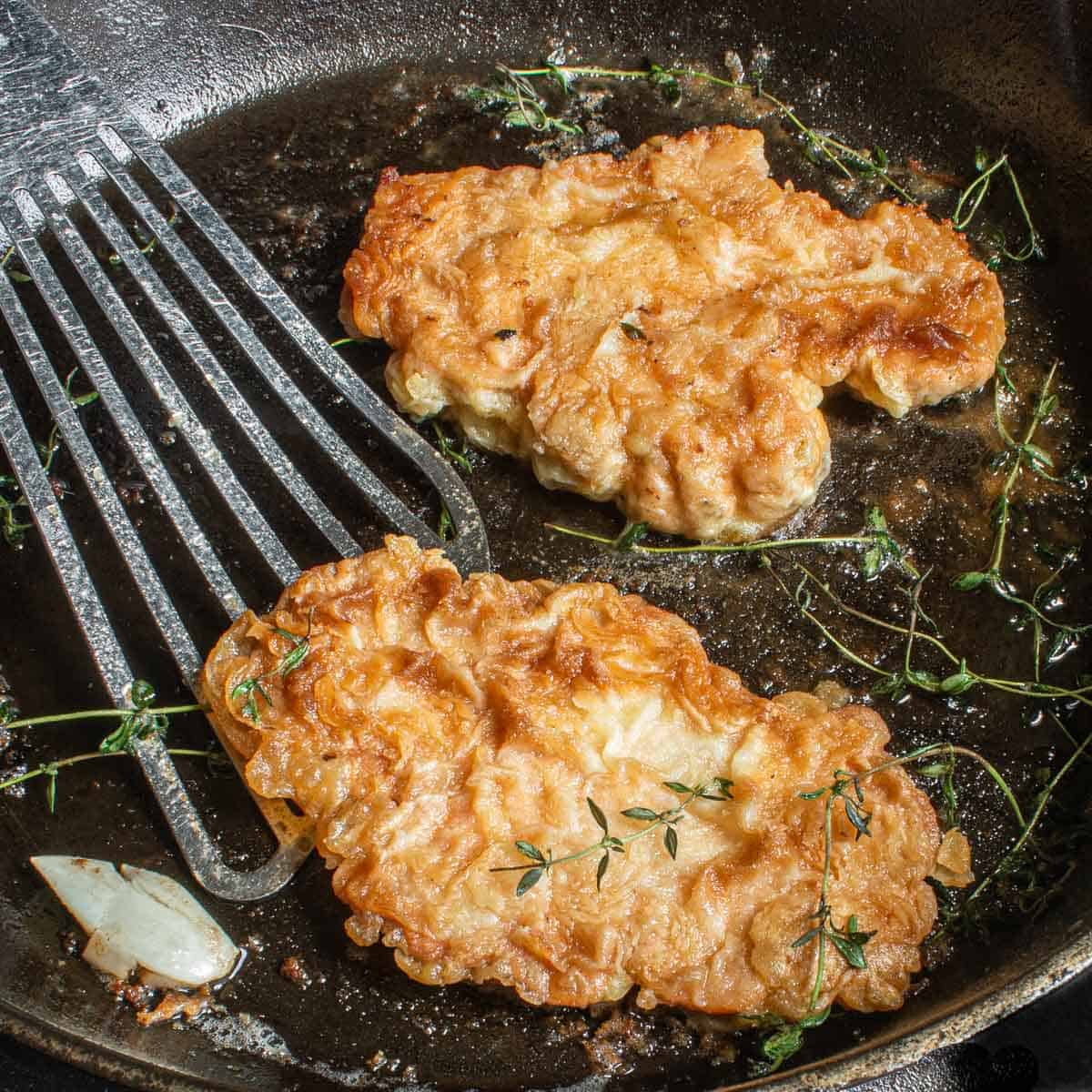
Chicken Fried Chicken of the Woods
Crispy, golden brown mushrooms everyone will love are a fan favorite on this site.
Wild Chicken Mushroom Thai Red Curry
Mushrooms simmered in rich coconut milk sauce with kaffir lime and spices. Many different mushrooms can be used.
Sicilian Chicken of the Woods
In Italy the mushrooms are known as fungo de carrubo and grow from carob trees. They’re traditionally simmered in a spicy tomato sauce, served with grilled bread.
More Chicken of the Woods Recipes
FAQ
References
USDA: A new species of Laetiporus (Basidiomycota, Polyporales) from the Caribbean basin
MycoKeys: Phylogeny and taxonomy of Laetiporus (Basidiomycota, Polyporales) with descriptions of two new species from western China
If you are interested in crossbows or have one, you may know that their arrows are called bolts. The terminology is confusing because some people call arrows, while others insist they are bolts. Most manufacturers agree that you can call them arrows or bolts, but there are distinct differences.
This term bolt dates back to medieval times when oxen were huge contraptions on wheels drawn by crossbows. They used short projectiles that didn’t have vanes and looked like darts. Some say they were called bolts because when they hit the enemy, they hit it like a bolt of lightning.
How Do Bolts Differ From Arrows?
The primary difference between a bolt and an arrow is the length. Technically, bolts are shorter than arrows, and they don’t have their stabilizing vanes in the back. When crossbows were first made in the middle ages, they were huge devices that were in wheels, and they were drawn by oxen.
They were used by the military, and it was the first weapon that was considered simple to use, inexpensive to make, and operable by most untrained soldiers. Back then, the projectiles were shorter and heavier than arrows, and they could make it through chainmail. They would hit the target hard and fast, and it was unexpected, so they called it a bolt.
Differences Between Bolts and Arrows:
Bolts are 16 to 22 inches long, while arrows are 27 to 32 inches
Both have four parts, including the shaft, the fletching, the broadhead, and the nock
Bolts are heavier than arrows
Bolts shoot straighter due to design
Bolts penetrate better
Arrows are deadlier at further distances
Arrows are more accurate at longer distances
Bolts have a slower load time
Heavier bolts make for quieter shots
How Are Crossbow Bolts Constructed?
There are different parts to the crossbow bolt, including the length, the weight, the type of nock, and the shaft materials. Different crossbow manufacturers recommend the type of bolt that will shoot best. You should follow their recommendations because they will include other information such as the length, weight, and type of nock you should use. You need to choose a bolt that fits with their recommendations or you can risk damaging the crossbow.
Bolts are constructed similarly to arrows, but they are tougher because they need to withstand the pressure of being shot at more than 400 fps. They are usually 16 to 22 inches long, with 20 inches being the most common length. You should go shorter than 16 inches because the field point or broadhead could get caught on the crossbow rail.
The weight of your bolt includes the weight of the bolt, crossbow nock, insert, vanes, and field point of broadhead. Most manufacturers will tell you how many grains each shaft weighs, which is how many grains are in each inch of the shaft. You might have a bolt that is 15 grains per inch, and if the bolt is 20 inches, you just multiply the grains per inch by the length. 15 x 20 = 300, so now you know it weighs 300 grains.
Then, you need to add the weight of the nock, the insert, vanes, and tip to get the total weight. Keep in mind that heavier bolts will have more downrange energy and give you better penetration.
The Kinetic Energy of Bolts
If you plan to hunt small game, such as deer, you can use a minimum of 23 pounds of energy. If you hunt larger game, such as elk or black bears, you will need 43 pounds of kinetic energy.
Your bolt will lose three to four percent of its energy for every ten yards it has to travel, so you need to factor all of this in when you are choosing a bolt. You can actually use a kinetic energy calculator to find out how much energy your bow is delivering.
The Bolt Fletching
Most people prefer smaller two-inch vanes over larger ones that are four or five inches. The reason for this is that the smaller vanes lift some weight off the back end of the bolt, which adds to the front of center ratio. As a result, you can shoot more accurately. The best way to decide which vanes are best for you is to practice with different sizes of vanes.
The Crossbow Nocks
The nocks also come in different sizes, and you need to make sure that you use the correct size for your crossbow or your string could jump the nock and cause a dry fire. Some of the nocks are half-moon, flat back, capture, and hybrid moon nocks. You should look for the lighted crossbow nock that matches the type of nock you want to use. If you use a lighted nock, you can easily see where the bolt struck.
Broadheads
There are different types of broadheads available as well. Some companies make them with expandable blades, and they are designed just for crossbows. You can choose an expandable or fixed blade, but make sure that you sight your crossbow for the type you plan to shoot.
What Material Are Bolts Made of?
The shaft of your bolt should be made of carbon fiber, aluminum, or a combination of both. The least expensive option is aluminum. While it is durable, it bends easily, and this makes it pretty useless. Carbon fiber is the most expensive option, and it flies well and is very durable. It also penetrates your target better than aluminum.
Bolts that are a combination of the two have the best properties of each, and they can improve your durability, accuracy, and speed. You can find bolts made of fiberglass or wood, but they are not common. Neither works well or is safe to use on modern crossbows.
Do People Use Arrows on a Crossbow?
If you have a crossbow, you cannot shoot arrows that are designed for a standard bow. However, you can shoot arrows that are made for a crossbow. The problem is that crossbows have a shorter draw length and a higher draw strength, so an arrow for a regular bow would be too long. If the crossbow doesn’t break the arrow when you release it, it has too much weight and the center of mass is too far forward.
In addition, when the draw strength is higher, as it is for a crossbow, it needs a sturdier and heavier arrow or bolt; otherwise, the arrow will split from the force. You need to stick with arrows or bolts that fit the recommendations of the manufacturer for your crossbow.
Final Words
Bolts are the projectiles used by most crossbows, and they are different from arrows. Bolts are shorter than arrows, and they have different vanes. When crossbows were invented, they were very large and sat on wheels. They had to be drawn by oxen because they were too heavy to carry. They were easy to use, and the bolts were short and fat so that they could penetrate the enemy shields.
Today, bolts are projectiles between 16 and 22 inches, while arrows are usually longer. You can’t interchange which ones you use as you could damage your crossbow. You need to pay close attention to what the manufacturer for your crossbow recommends and choose bolts or arrows within that range.
“Decoding the Myth: Unraveling the Velocity Paradox Between Deer and Dogs”
Deer vs. Dogs: Who’s Faster in a Footrace?
The Speed of Deer
Deer are generally very fast runners and have evolved to be agile and swift to escape from predators. The average speed of a deer is around 40 miles per hour (64 kilometers per hour) for short distances. However, the top speed of a deer can vary depending on the species and individual. For example, white-tailed deer, a common species in North America, can run at speeds of up to 30-35 miles per hour (48-56 kilometers per hour). They are known for their ability to make rapid changes in direction to evade predators.
The Speed of Dogs
Dogs are also known for their speed and agility. The speed of a dog can vary depending on the breed and individual. Some dog breeds, such as greyhounds, are capable of running at speeds of up to 45 miles per hour (72 kilometers per hour) for short distances. Greyhounds are among the fastest dog breeds and are often used in racing competitions. However, not all dog breeds can match the speed of a deer.
Advantages of Deer in Running
While some dog breeds may be able to keep up with or even outrun certain deer species, there are several advantages that deer have when it comes to running. Deer are lighter than most dogs and have longer legs, which gives them a natural advantage in terms of speed. They are also very agile and can quickly change direction, making it difficult for dogs to catch them. Additionally, deer are often more familiar with their surroundings than dogs, giving them an advantage in evading capture.
Conclusion
In conclusion, while it is possible for some dog breeds to keep up with or outrun certain deer species, deer are generally faster runners than most domestic dog breeds. Deer have evolved to be swift and agile to escape from predators, and their natural abilities make them formidable runners. It’s important to note that chasing deer with dogs is illegal in many places and can be dangerous for both the dogs and the deer. It’s always best to keep dogs on a leash and avoid chasing or harassing wildlife.
The Speed Showdown: Deer vs. Dogs
Deer’s Speed
Deer are known for their incredible speed and agility, making them formidable runners. On average, a deer can run at speeds of around 40 miles per hour (64 kilometers per hour) for short distances. However, the top speed of a deer can vary depending on the species and individual. Some deer species may be slower, while others may be faster. For example, white-tailed deer, a common species in North America, can reach speeds of up to 30-35 miles per hour (48-56 kilometers per hour). Their long legs and lightweight build give them a natural advantage in speed.
Dog’s Speed
Dogs are also known for their speed and agility, although their running speed can vary depending on the breed and individual. Some dog breeds are capable of reaching impressive speeds of up to 45 miles per hour (72 kilometers per hour) for short distances. Greyhounds, in particular, are renowned for their racing abilities and can reach speeds of around 40-45 miles per hour (64-72 kilometers per hour). However, not all dog breeds are as fast as deer.
Factors Affecting the Outcome
While deer are generally faster runners than most domestic dog breeds, there are several factors that can influence the outcome of a chase between a deer and a dog. The species of deer and the breed of dog involved play a significant role in determining who would come out on top in terms of speed. Additionally, the terrain and environmental conditions can also impact the chase. Deer’s familiarity with their surroundings gives them an advantage when it comes to navigating obstacles and finding cover.
In conclusion, while deer are generally faster runners than most dogs, there are some dog breeds that can keep up with or even outrun them. Greyhounds, known for their incredible speed, are among the few dog breeds that can match or exceed the running speed of deer. However, it’s important to note that chasing deer with dogs is illegal in many places and can be dangerous for both the dogs and the deer. It’s always best to keep dogs on a leash and avoid chasing or harassing wildlife.
Breaking the Myth: Can Some Dogs Outrun Deer?
Deer vs Dogs: The Need for Speed
Deer are generally very fast runners, with an average speed of around 40 miles per hour (64 kilometers per hour) for short distances. However, their top speed can vary depending on the species and individual. On the other hand, dogs are also known for their speed and agility. While the speed of a dog can vary depending on the breed and individual, some dog breeds can reach speeds of up to 45 miles per hour (72 kilometers per hour) for short distances. So, it is possible for some dogs to keep up with or even outrun deer in certain circumstances.
The Advantages of Deer
Despite some dogs being able to match or surpass the speed of deer, there are several advantages that deer have when it comes to running. Deer are lighter and have longer legs, giving them a natural advantage in terms of speed. They are also very agile and can change direction quickly, making it difficult for dogs to catch them. Additionally, deer are often more familiar with their surroundings than dogs, which gives them an advantage in a chase. They know where to find cover and how to use it to their advantage.
Factors Influencing the Outcome
The outcome of a chase between a deer and a dog depends on various factors. These include the species of deer, the breed of dog, and the terrain they are running on. Different deer species have different running speeds, while certain dog breeds like greyhounds are known for their exceptional running abilities. The terrain also plays a role as uneven or dense areas may favor one animal over another.
Keeping Wildlife Safe
It’s important to note that chasing deer with dogs is illegal in many places and can be dangerous for both the dogs and the deer. It’s always best to keep dogs on a leash and avoid chasing or harassing wildlife. Respecting the natural behavior and habitats of animals is crucial for their well-being and conservation.
In conclusion, while deer are generally fast runners, there are some dog breeds that can keep up with or even outrun them. However, deer have certain advantages in terms of speed, agility, and familiarity with their surroundings. The outcome of a chase between a deer and a dog depends on various factors, and it’s important to prioritize the safety and well-being of both animals by respecting wildlife regulations.
Deer or Dog: Which Species Reigns as the Fastest Runner?
Deer’s Speed and Agility
Deer are generally very fast runners, capable of outrunning most predators, including dogs. The average speed of a deer is around 40 miles per hour (64 kilometers per hour) for short distances. However, the top speed of a deer can vary depending on the species and individual. Some deer species, like white-tailed deer, are known for their speed and agility. They can reach speeds of up to 30-35 miles per hour (48-56 kilometers per hour) and are able to make rapid changes in direction to evade threats.
Dog’s Speed and Variations
Dogs, on the other hand, are also renowned for their speed and agility. The speed of a dog can vary depending on the breed and individual. While most domestic dog breeds are not as fast as deer, there is variation among different breeds. For example, greyhounds are known for their racing abilities and can reach speeds of around 40-45 miles per hour (64-72 kilometers per hour). They are among the fastest dog breeds when it comes to running.
Factors Influencing Outcomes
In a chase between a deer and a dog, several factors come into play that determine the outcome. The species of deer, breed of dog, and terrain can all affect who will ultimately be the faster runner. Deer have certain advantages over dogs when it comes to running. They are lighter with longer legs, giving them a natural advantage in terms of speed. Additionally, they possess great agility and can change direction quickly, making it challenging for dogs to catch them.
However, some dogs may be able to keep up with or even outrun certain deer species depending on these factors. It’s important to note that chasing deer with dogs is illegal in many places and can be dangerous for both the dogs and the deer. It’s always best to keep dogs on a leash and avoid chasing or harassing wildlife.
In conclusion, while deer are generally fast runners, there are some dog breeds that can match or surpass their speed. However, the outcome of a chase between a deer and a dog will depend on various factors such as species, breed, and terrain. Both species have their own unique advantages when it comes to running, but it’s crucial to respect wildlife and ensure the safety of both animals by avoiding unnecessary chases.
Unveiling the Truth: Debunking the Idea that Deer Always Outrun Dogs
Deer vs. Dogs: The Need for Speed
Contrary to popular belief, deer do not always run faster than dogs. While it is true that deer are generally very fast runners and can outrun most predators, including dogs, there are some dog breeds that can keep up with or even surpass the speed of deer. The average speed of a deer is around 40 miles per hour (64 kilometers per hour) for short distances, but this can vary depending on the species and individual. On the other hand, some dog breeds, such as greyhounds, are capable of running at speeds of up to 45 miles per hour (72 kilometers per hour) for short distances. So, in certain circumstances and with the right breed of dog, it is possible for dogs to match or even exceed the speed of deer.
The Advantages and Disadvantages
While some dog breeds may have the potential to outrun deer in terms of top speed, there are several factors that give deer an advantage when it comes to running. Deer are lighter and have longer legs compared to most domestic dog breeds, which naturally gives them a greater advantage in terms of speed. Additionally, deer are highly agile animals and can quickly change direction while running, making it difficult for dogs to catch them. Furthermore, deer are often more familiar with their surroundings than dogs, allowing them to utilize cover and escape routes effectively during a chase.
On the other hand, dogs have their own advantages when it comes to running. Some dog breeds have been selectively bred for their speed and endurance over centuries. For example, greyhounds have long been renowned for their racing abilities and can reach impressive speeds. However, even with these advantages, consistently outrunning a healthy and motivated deer may still be a challenge for most dog breeds.
Protecting Wildlife and Ensuring Safety
It is important to note that chasing deer with dogs is illegal in many places and can be dangerous for both the dogs and the deer. Pursuing or harassing wildlife can cause stress, injury, or even death to the animals involved. It is always best to keep dogs on a leash and avoid any interactions that could harm wildlife. Respecting and protecting nature’s balance ensures the safety of both animals and humans alike.
In conclusion, while deer are generally fast runners, it is not always true that they outrun dogs. Some dog breeds have the potential to match or even surpass the speed of deer in certain circumstances. However, deer have several advantages when it comes to running, including their lightness, long legs, agility, and familiarity with their surroundings. Ultimately, it is crucial to prioritize the well-being of wildlife by keeping dogs under control and avoiding any activities that may harm or disturb them.
Speed Demons: Exploring the Running Abilities of Deer and Dogs
Deer Speed:
Deer are generally very fast runners, capable of outrunning most predators, including dogs. The average speed of a deer is around 40 miles per hour (64 kilometers per hour) for short distances. However, the top speed of a deer can vary depending on the species and individual. Some species may be faster than others, but in general, deer have evolved to be agile and swift to escape from natural predators.
Dog Speed:
Dogs are also known for their speed and agility. The speed of a dog can vary depending on the breed and individual. Some dog breeds are capable of running at speeds of up to 45 miles per hour (72 kilometers per hour) for short distances. Greyhounds, for example, are among the fastest dog breeds and can reach impressive speeds.
However, it’s important to note that while some dogs may be able to keep up with or even outrun certain deer species in specific circumstances, chasing deer with dogs is illegal in many places and can be dangerous for both the dogs and the deer. It’s always best to keep dogs on a leash and avoid chasing or harassing wildlife.
In conclusion, while deer are generally fast runners, there are some dog breeds that can match or even surpass their speed. However, it’s crucial to prioritize safety and respect for wildlife by keeping dogs under control around deer and other animals.
In general, deer are faster runners than dogs due to their long legs and powerful muscles. However, there are certain dog breeds specifically bred for speed that can match or even surpass the speed of deer in short bursts. Ultimately, it depends on the specific circumstances and individual abilities of both the deer and dog involved.
I will teach you how to legally and safely refill 1 lb propane bottles for the best savings available. If you don’t already know: Coleman 1 lb propane bottles are extremely expensive (Later I will explain why it is dangerous and illegal to refill disposable propane cylinders with a refill kit). You will end up paying around $13.99 for a 4-pack at a big box store or up to $6.99 for a single 1lb cylinder at a convenience store.
Costs of Refilling Your Propane
Compare that to refilling a 5-gallon cylinder. You can get propane by the gallon (not by the pound) for $2.59-$3.50. You get about 8.35 pounds PER gallon. Let’s assume you purchased the Coleman 4-pack which comes to a price of $15.00 after tax (7.25% in CA) and is, therefore, $3.75 per pound. If you get your fuel from a filling station, you only pay $0.332 per pound. You can already see the savings without doing the math.
You will need a refillable 20 lb tank propane tank and the Flame King refill kit $45-$50, which you can find online at FlameKing.com or Sportsmans Warehouse. The kit comes complete with a stand, adapter and a 1lb tank. You can purchase more tanks for about $15.00 each.
Have your own way to mount your tank? You can purchase the adapter here for about $23.00. If you don’t already own a 20 lb tank, you can find one at your local hardware store. I purchased mine at Tractor Supply for about $35.00 (yes, these are some upfront costs, but look at the long-term savings). You can check 20lb tank prices online here. I recommend getting a digital scale for precise measurements but this is optional. I use an AWS digital scale which I purchased on Amazon for around $12.
Once you have all of your equipment, you’re ready to start filling!
How To Refill a 1lb Propane Tank
Place your 20 lb tank upside down on the stand, hook up the adapter and attach your refillable 1 lb propane canister. Use the provided hex key wrench to open the bleed valve on the 1lb tank. Press the valve lever on the adapter and let the process begin. You will start to hear liquid propane enter into the cylinder. The large tank needs to be upside down because you want the liquid propane to fill the small cylinder, not propane in its gaseous state. Otherwise, you’ll only get a fraction of the fuel!
The stand allows you to hold your 20lb tank upside down and hook up the 1lb tank below it without touching the ground. The filling process is pressure equalization in both tanks. Once you see the propane gas start shooting out of the bleeder hole, you know you’re done. This took me a better part of 1 minute to fill.
If you purchased the optional digital scale then you can make precise measurements.
I start by weighing the empty cylinder (make sure your weight setting is in the “oz” mode), press the ‘tear’ button and this will zero the measurement. Then fill the cylinder, place it on the scale, and repeat the process until you reach 16oz (1 pound). You can also weigh the cylinder without tearing the empty weight, write down the weight and add 16oz to the total weight. Once it’s full, you can write down the weight on the cylinder for future use.
That’s it! You’re done and ready to enjoy the savings by never having to purchase another disposable propane tank again! Additionally, you can take a little pride that you’re not dumping precious resources into landfills.
Here is a detailed version of how I did it and the equipment I used.
The stand is designed to support the 20-pound bottle but not to leave it on the stand if you’re not using it. There is no support feature from accidentally knocking the bottle off the stand. It is easy to assemble with a pad, 2 U-shaped support bars, wing nuts, screws, and washers. You don’t need any equipment except your hands to assemble.
The attached propane refill tap station ready-to-use.
The refillable 1 lb tanks each come with a hex key as well as a plastic tank valve cap. I purchased 3 additional one-pound tanks and each came with a hex key.
The propane cylinder cap is threaded and has four rings to easily carry with your fingers or for whatever you wish to use them for. My only complaint is that I was it was a little more sturdy, but they’re a lot better than the disposable caps.
The relief valve is shown just above the main valve.
Pictured is the propane bottle and refill adapter together. You will notice there is a U-shaped protrusion that will fit into the tank valve. This is to prevent the filling of propane cylinders not approved by Flame King (or the Department of Transportation).
The complete set-up with both propane bottles is ready to go. I like how the 1 lb propane tank sits off the ground for easy attachment. The relief valve is easy to access should your propane refill begin to overflow.
Brought the set-up to the campsite.
Here is where the hex key attaches to the relief valve. Flame King suggests opening the relief valve slightly to allow liquid propane to occupy the space inside the 1 lb propane cylinder.
Once you have everything securely attached, you are ready to operate your refill station. Begin by opening the main valve on your 20 lb propane tank.
Press and hold down on the lever to begin the propane refill process. I personally like how you can start and stop the process by just letting go. As you press down, you will hear the liquid propane start to flow into the smaller propane tank. While you’re filling the propane tank, open the relief valve just a hair. You will hear and smell escaping gas.
This is ok because it’s just the oxygen and gas coming out. The liquid propane is filling from the bottom up and pushing out the oxygen. Once you begin to see a white mist of propane, close the valve on your 1 lb propane cylinder and depress the valve on the propane refill adapter.
That is it! According to Flame King, you have filled the tank to approximately 80% (around 1 lb of fuel).
Once you are finished, it is now time to detach your 1 pound propane cylinder from the tap. This is where gloves will come in handy. First, close the main valve to your 20 lb cylinder.
When removing the 1 lb content from the propane refill station, there is a high chance propane will vent out from the tap. This is extremely cold and could cause a burn to some degree (no pun intended). There is also residual in the tap system and that can spray out cold fuel.
I found that as long as the main valve is closed, you can press the fill lever and release the pressure from the tap. Remove the refill kit from the 20 lb tank and finally take the main propane tank off and flip right side up. Store all your propane tanks in a well-ventilated area. Do not store where any escaping fumes could be collected next to an ignition source (water heater, gas dryer, etc).
As an added measure of safety, I spray soapy water on the end of the 1lb propane tank. If you see small bubbles forming, then you have a leak. Try depressing the main valve and let it snap shut. This usually does the trick. If nothing, then wipe off and you’re ready to store or use. Cheers!
Dangers of Refilling Disposable Propane Cylinders
Now I explain why it is dangerous and illegal to refill those disposable cylinders. Disposable 1 lb propane tanks are convenient for their intended applications and looks like an easy job. Unfortunately, they are not supposed to be refilled and according to federal law, it is illegal to transport refilled disposable cylinders. Getting caught and having it proven that you refilled the tanks seems very unlikely, but it’s still not worth the risk.
Technically, you can refill them so long as you do not transport them and keep them on-site. The valve design has an overflow safety feature that is supposed to release propane if the pressure is too great. I have refilled several containers with a standard refill adapter (which some believe is a great accessory to their camping gear) with no issue and many other people have done this too.
Chances of a critical failure may be low, but I ask you this question: How much is your life, your loved one’s life, or your body worth to you? Is it worth the risk to save a few dollars to refill disposable tanks? I’m one to spend a few extra dollars for better quality material and peace of mind.
Weight Difference Between Propane Tanks
The disposable Coleman DOT 39 propane tanks are much lighter than the Flame King tanks. The disposable tanks have an empty weight of 13.37oz while Flame King is 22.46 oz. A difference of 9.09 oz or over a half pound! That is more metal on the cylinder. Simply holding both empty tanks in hand, you can easily feel the difference in weight.
By comparing both cylinders, one can see the difference in the welding between the 1lb propane tanks. The flame king simply looks more durable while the disposable Coleman propane cylinder is seam welded.
The reason is metal fatigue (learn more about metal fatigue here). Every time you deplete the propane out of the Coleman bottle, the pressure naturally decreases. Refilling the tank quickly introduces pressure back into it. Even with the pressure relief valve, repeating this process a lot of times begins to wear on the structural integrity of the cylinder and it can increase the likelihood of a catastrophic failure. This is especially true around the seam weld.
If you reload ammunition, you know that you can only reload the brass x-amount of times before you have to retire it. Refillable tanks are DESIGNED to be depleted and refilled over many uses, and they’re DOT approved for transport.
If you are dead set on refilling disposable 1 lb propane tanks, customers can purchase a refill kit on Amazon for a price of around $6. Those things are a pretty cheap accessory to your camping gear. I found a high-quality brass adapter at Harbor Freight for $20.00.
Even with that, you need to find a way to support the 20lb tank upside down. Then, you will need to repeat the process of attaching the 1lb propane tank to the adapter, open the valve, fill until you hear the propane stop, bleed the Schrader valve (which reportedly tends to leak after repeated bleeding) or unscrew it, re-attach and repeat until it is full. With the
Flame King, you get the stand, fill valve adapter, and a hex key which allows you to fill a tank in about 1 minute. If you value your time, this is another way to save money.
Shoulder pain is almost inevitable for archers and bowhunters due to the repetitive motion of shooting a bow. This motion puts significant stress on the shoulder joint. According to a research study by van Doorn et al, shoulder pain is the third most common musculoskeletal complaint treated in physical therapy. From my experience as a physical therapist, I have found that shoulder pain is often caused by repetitive activities.
Common shoulder issues among archers and bowhunters include shoulder instability, scapular dyskinesis, rotator cuff disorders, biceps tendinopathy, bursitis, and shoulder impingement.
Shoulder instability
Occurs when the shoulder joint (glenohumeral joint) is unable to maintain its proper position due to excessive movement in the ligaments, joint capsule, or from insufficient dynamic stability of the rotator cuff musculature. This instability can result in frequent dislocations, subluxations, or allow excessive movement of the shoulder which causes undue stress and eventual pain, swelling, weakness, or limited range of motion.
Scapular dyskinesis
Refers to abnormal movement or positioning of the shoulder blades (scapula) during shoulder movements and limits the efficiency of the complex shoulder joint.
Rotator cuff disorders
Refers to a group of conditions that affect the muscles and tendons that attach the shoulder blade to the upper arm bone. The rotator cuff muscles include: supraspinatus, infraspinatus, teres minor, and subscapularis. These four muscles work to stabilize the shoulder joint and keep the ball and socket joint centered in optimal position. Rotator cuff disorders can include inflammation, tears, or degeneration resulting in pain and weakness.
Biceps tendinopathy
Refers to pain and inflammation of the biceps tendon, which attaches the biceps muscle to the shoulder and elbow. This pain is usually located on the front of the shoulder and can cause a popping sensation in the shoulder. Biceps tendinopathy can be caused by overuse, degeneration, postural abnormalities, or poor shooting form and technique, and can result in pain, weakness, and limited mobility.
Bursitis
Refers to inflammation of the small fluid-filled sacs that provide cushion between the tendons and bony structures. Bursitis can be caused by overuse or injury, and can result in pain and limited range of motion.
Shoulder Impingement
Occurs when the tendons or bursa in the shoulder become compressed or pinched during shoulder movements, resulting in pain and limited mobility. It can be caused by a variety of factors, including overuse, poor posture, or structural abnormalities in the shoulder joint.
It’s important to understand that the shoulder is a complex joint that involves many muscles, tendons, ligaments, and bones. If the riser and cam, or scapula and humerus, are not in the optimal position, then this may lead to bow failure or shoulder dysfunctions and pain. The aforementioned shoulder dysfunctions can occur separately, but oftentimes, they are interrelated and occur at the same time.
For example, shoulder instability can lead to scapular dyskinesis because the shoulder blade has to compensate for the unstable joint. Scapular dyskinesis can then cause rotator cuff disorders because it changes the mechanics of how the rotator cuff muscles work. Rotator cuff disorders can also lead to biceps tendinopathy because the biceps tendon works closely with the rotator cuff muscles and, in my opinion, should be considered part of the rotator cuff for all practical purposes. Bursitis can develop as a result of any of these conditions because any abnormal movement or positioning of the shoulder can compress or pinch the tendons or bursae in the shoulder joint.
This is a brief explanation of how complex the shoulder joint is and highlights the importance of addressing any shoulder pain as early as possible to prevent further dysfunction and pain while shooting a bow and arrow.
By addressing the underlying dysfunction, archers and bowhunters can prevent the development or progression of other shoulder dysfunctions and minimize the risk of further damage or injury.
Prevention and Management of Bow Arm Shoulder Pain
Archers and bowhunters can prevent and treat bow arm shoulder pain with archery-specific exercises. Archery-specific exercises should include both compound and accessory exercises that target the rotator cuff, scapula, and arm musculature to help stabilize the shoulder and meet the demands of shooting a bow.
Core strengthening, balance training, and mobility exercises are also vital in maximizing success and reducing risk of injury.
Self-filming while shooting a bow and arrow will help identify shooting flaws and provide feedback on what may be contributing to your bow arm shoulder pain.
Shooting a bow and arrow with poor archery form can compound shoulder problems and increase the risk of injury.
To manage existing bow arm shoulder pain, modify shooting frequency, reduce draw weight, ice, modify shooting form and technique, or take a 1-2 week break from shooting.
Step-by-Step Return to Shooting After a Shoulder Injury
1. Start with shorter distances: It’s important to start at a shorter distance, such as 10 yards, and gradually work your way up to longer distances. This will help you ease back into shooting and prevent re-injury.
2. Decrease the draw weight: Using a lighter draw weight can help reduce the strain on your shoulder as you work your way back up to shooting your normal draw weight. Increase the draw weight by no more than 5-10% in one week.
3. Focus on form: When returning to shooting, it’s important to focus on your form and technique. This can help you prevent future injuries and improve your accuracy. I am a strong believer in self-filming to identify poor shooting form.
4. Incorporate stretching and warm-up exercises: Incorporating stretching and warm-up exercises into your routine can help improve your flexibility and reduce the risk of injury.
5. Perform supplemental exercises: Progressive archery-specific exercises targeting the rotator cuff, scapula, and core musculature will help restore and build the strength necessary for performing archery and bowhunting at a high level.
6. Listen to your body: It’s important to listen to your body and take breaks as needed. If you experience pain or discomfort when shooting, it may be a sign that you need to take a break or reduce the volume of your shooting.
7. Seek professional guidance: If you’re unsure about how to safely return to shooting after a shoulder injury, it’s always a good idea to seek guidance from a healthcare professional or qualified archery coach. They can help you develop a safe and effective plan for returning to shooting.
Return to Archery Guide
Use this table as a guide to your recovery and return to shooting a bow and arrow. It’s important to note that these guidelines are just a starting point and may need to be adjusted based on individual recovery, physical ability, and experience with archery. Additionally, it’s important to always listen to your body and adjust accordingly. It may be a good idea to discuss your return to shooting with a healthcare professional.
So, you’ve just brought home your newest addition to your family — baby ducks! Cute and fuzzy, ducklings melt hearts. But, don’t be fooled by their adorable faces; ducklings are challenging to take care of.
The good news? Once you’re equipped with proper knowledge, caring for your ducklings is both easy and rewarding.
The most critical aspect to keeping your duckling safe, comfortable, and happy is learning how to give them proper amounts of heat. Ducklings need to live at a specific temperature, and without their mothers around to provide them that heat, you as the owner must step in to give that heat to keep them safe and happy.
Below is everything you need to know about heat lamps for ducklings.
Do Baby Ducks Need A Heat Lamp?
Yes! They do need a heat lamp. Using a heat lamp is the best way to provide the necessary heat for them while they are babies.
When they’re young, ducklings have difficulty regulating their internal body temperatures on their own. In the wild, baby ducks stay under their mothers’ protection until they’re around one month to two months old so that their mothers can help keep them warm.
The mother ducks use their down feathers to keep them warm. At night, they snuggle together to stay warm, which is how to keep ducklings warm without a lamp.
If you’ve adopted a duckling, you’ll need to provide them with warmth since they won’t have their mothers around. The best way to accomplish this is with a heat lamp. To ensure you’re keeping a warm enough temperature, you may also want to purchase a thermometer and keep it inside their brooder.
When they are first born, set the lamp to 90 degrees. Then, drop the temperature by 5 or 10 degrees each week until you reach 70 degrees.
Check out this duckling temperature chart for more information:
Another question many duck owners have is if baby ducks need heat lamps in the summer. If your house is temperature regulated and you keep them indoors, then yes, you do. If you keep them outside and the temperature reaches 90 degrees or higher, you can remove the heat lamp. However, be sure to put the heat lamp back at night in case temperatures drop.
How Much Heat Is Too Much?
While ducklings do require heat to keep them healthy, too much of a good thing can cause problems. It’s important not to give them too much heat as this can cause health problems and even death.
As a result, many new duck owners wonder, “how do I know if my ducklings are too hot?” Luckily, ducklings aren’t subtle about how they’re feeling. If you notice your duckling is panting, breathing fast, or has moved away from the heat lamp, these are signs that your duckling is too hot.
You’ll also notice if they are too cold as they will group around the heat source and not move so they can conserve heat. If you see your ducklings huddled around the heat lamp and become lethargic, try raising the heating temperature in your brooder.
A healthy duckling will have a substantial amount of energy and, as a result, will run around the brooder. If you notice a rapid change in your ducklings’ behavior, such as becoming more lethargic, tweak the heat to see if that makes them feel better.
Heat Lamp Logistics
Many new owners also wonder, “how far should the heat lamp be from the baby ducks?” Typically, you should hang a heat lamp 18 inches above the bedding.
You’ll need to purchase an infrared heater as a regular bulb does not have the power to create enough heat for a brooder. A 250-watt heat lamp will be sufficient and can even keep up to 30 ducklings warm. If you have more than 30 ducklings, consider purchasing more than one 250 watt bulb.
Make sure to use an infrared heat lamp with a hood and place it on one side of the brooder. Putting it on one side of the brooder is vital so that the ducklings have the option to stay on the cool side if they need to cool down.
To decrease the temperature, raise the height of the infrared heat lamp by moving it further away from the floor of the brooder. You can purchase a stand that is extendable so that you can continue to raise the light stand as the ducklings grow older.
If you must, you can use a heating pad for ducklings, but those are harder because it’s challenging to regulate the temperature. Additionally, if you have more than one or two ducklings, they all won’t be able to fit on the heating pad. Therefore, your best bet is to stick with a heat lamp and a thermometer.
When Do I Need To Turn Off The Heat?
Once fully grown, ducks will have their down feathers to keep them warm. Once they have these feathers, they do not need supplemental heat. Many duck owners wonder how long do ducks need a heat lamp? Until they’re fully grown and have their down feathers.
Ducklings need the most heat at night, so you must leave your heat lamp on at night. It is safe, but make sure you buy a good brand heat lamp and follow all safety precautions.
FAQ
When Can Ducklings Sleep Outside?
Once the ducks are fully grown, they can sleep outside. When ducklings reach about two months, they fully develop their down feathers that keep them warm on their own.
How Do I Know If My Ducklings Are Cold?
If your ducklings are cold, they’ll tell you by their behavior. If you notice they’re lethargic, don’t move away from the light, and huddle together, that’s a pretty safe bet that they’re too cold.
Do Two Week Old Ducklings Need A Heat Lamp?
Yes, they do. Two-week ducklings have not developed down feathers yet.
How Cold Is Too Cold For Ducklings?
It depends on how many days/weeks the ducklings are. Typically ducklings cannot handle temperatures below 70 degrees.
"Understanding the Legalities: Felon Ownership of Air Rifles in Tennessee"
can a felon own an air rifle in tennessee?
In the state of Tennessee, the ownership...