“Air Rifle vs BB Gun: Unveiling the Key Differences and Choosing the Perfect Weapon for Your Shooting Needs. Delve into this comprehensive guide to understand the distinctions between air rifles and BB guns, helping you make an informed decision on which firearm suits your preferences and shooting goals.”
BB Guns
BB guns are commonly used for recreational shooting and can be an effective tool for scaring away pests, including stray cats. BB guns typically fire.177 caliber round copper-clad steel balls. These round projectiles are inherently unstable in flight, resulting in poor accuracy. Additionally, the lack of rifling in the barrel and the loose fit of the BB inside it further diminish velocity and accuracy.
However, some BB guns have rifled barrels for improved accuracy and may use pure lead shot instead of copper-clad steel BBs. These higher-quality BB guns can produce higher velocities and better precision. It is important to note that even though a BB gun may not be as powerful or accurate as other air rifles or pellet guns, it still has the potential to cause harm or injury if used improperly.
How Does a BB Gun Work?
A BB gun works by using a spring-piston system. When the gun is cocked using either a lever-action or pump-action mechanism, a piston is forced back against a spring. The spring is compressed behind the piston, which is held in place by the trigger sear. When the trigger is pulled, the spring and piston are released. The spring forces the piston forward, compressing air in the barrel. The compressed air propels the BB out of the gun at high speed.
The BB itself is usually made of copper-clad steel and is slightly smaller than the internal barrel diameter. This allows some of the compressed air to escape around the BB, resulting in lower velocities and less accuracy compared to other types of air guns. BB guns typically have velocities ranging from 275 to 475 feet per second.
Other Means of Propulsion
In addition to the spring-piston system used in BB guns and pellet guns, there are other means of propulsion for air rifles. One alternative is the use of metal gas cylinders that hold compressed gas. These gas cartridge BB guns can produce higher velocities than most other BB gun actions. Another option is the use of a multiple pump system, where a piston is used to pump air into a holding chamber. The more times the action is operated, the higher the pressure in the chamber. Many multi-pump rifles can use traditional BBs or bullet-shaped pellets. These different propulsion systems offer varying levels of power and performance, so it’s important to consider your specific needs when choosing between a BB gun or pellet gun.
Styles and Types of BB Guns
There are several styles and types of BB guns available on the market. The most common style is the lever-action BB gun, which has been a popular choice for many years. Another popular style is the pump-action BB gun, which requires the user to manually pump the gun to build up pressure before each shot. Both of these styles typically use a spring-piston system as their propulsion mechanism.
In addition to these traditional styles, there are also newer designs that have revolutionized the BB gun market. Some BB guns now feature larger refillable gas tanks and can offer semi-automatic or fully automatic fire. These gas-powered BB guns often resemble the Browning 1911 pistol and rely on CO2 gas cartridges for power.
Overall, when choosing a BB gun for discouraging a stray cat, it is important to consider factors such as accuracy, power, and ease of use. A lever-action or pump-action BB gun with enough power to frighten or deter the cat should be sufficient for your needs.
Pellet Guns
Pellet guns are a type of air gun that typically fire.22 caliber bullet-shaped lead projectiles. Unlike BB guns, which use round steel balls, pellets are made of malleable lead and can tightly swage to the barrel of the pellet gun. This allows for rifling in the barrel, which imparts spin to the pellet and improves its accuracy.
Pellet guns can deliver higher muzzle velocities compared to BB guns, with some models capable of reaching speeds of up to 1,000 feet per second. The increased power and accuracy of pellet guns make them suitable for hunting small game like rabbits, squirrels, and birds. There are also larger caliber pellet guns available that can be used for hunting larger game species, including deer.
The Advantage is in The Projectile
When it comes to discouraging a stray cat from coming around, both a BB gun and a pellet gun can be effective options. However, the choice between the two depends on your specific needs and preferences.
A BB gun typically fires.177 caliber round copper-clad steel balls. These round projectiles are inherently unstable in flight and lack rifling, making them less accurate. While a BB gun can certainly frighten or potentially hurt a cat, its effectiveness may be limited due to its low velocity and poor accuracy.
On the other hand, a pellet gun typically fires.22 caliber bullet-shaped lead projectiles. These pellets are made of malleable lead that can swage tightly to the barrel, allowing for better accuracy. Pellet guns also often have higher muzzle velocities compared to BB guns, delivering more power upon impact.
In terms of caliber, using a.22 caliber pellet gun may be more effective in deterring the stray cat. The larger and heavier projectile has the potential to deliver more force without causing serious harm. However, it’s important to note that even non-lethal shots can still cause injury or pain to animals.
Ultimately, it’s crucial to prioritize safety and ethical considerations when using any type of air gun against animals. It’s recommended to consult with local authorities or animal control professionals for guidance on humane methods of dealing with nuisance animals.
The Propulsion System – Putting the Pellet Down the Barrel
Air rifles, pellet guns, and BB guns all use different propulsion systems to put the pellet down the barrel. Air rifles can be powered by springs, compressed gas cylinders, or integral air pumps. These power sources create pressure that propels the pellet forward. Pellet guns also use similar propulsion systems to air rifles, but they typically deliver higher muzzle velocities than BB guns. Pellets are made of lead and can swage tightly to the barrel, allowing for better accuracy. On the other hand, BB guns use a spring-piston system that is less efficient and delivers lower velocities. BBs are round steel balls that are less stable in flight and tend to be inaccurate.
Air Guns – Aren’t BB Guns and Pellet Guns Air Guns?
While BB guns and pellet guns are often referred to as air guns, they are not technically the same. Air guns encompass a wider range of firearms that use compressed air or gas to propel a projectile. BB guns and pellet guns fall under the category of air guns, but there are some distinctions between them.
BB guns typically fire.177 caliber round copper-clad steel balls, while pellet guns fire.22 caliber bullet-shaped lead projectiles. The size and shape of the projectiles make a significant difference in terms of accuracy and effectiveness. Pellets tend to be more accurate due to their ability to swage tightly to the barrel and be affected by rifling, while BBs lack these characteristics.
In terms of power, pellet guns generally have higher muzzle velocities than BB guns. Some pellet guns can reach speeds of up to 1,000 feet per second, making them suitable for hunting small game. BB guns typically have lower velocities due to their round character and lack of spin. They are usually used for recreational purposes rather than hunting.
Size is the Difference
When deciding between a BB gun or pellet gun to discourage a stray cat, it’s important to consider the size difference between the two. BB guns typically fire.177 caliber round steel balls, while pellet guns typically fire.22 caliber bullet-shaped lead projectiles. The larger size and shape of the pellet make it more effective in delivering a deterrent impact to scare off the cat without causing serious harm.
In terms of caliber, a.22 caliber pellet gun would be a better choice for deterring the stray cat. The larger size and weight of the pellet will provide more stopping power and impact force compared to a smaller.177 caliber BB. This will increase the chances of successfully scaring off the cat without causing any significant harm.
Regardless of whether you choose a BB gun or pellet gun, it’s crucial to prioritize safety. Always follow proper firearm safety protocols and treat any air gun as you would a standard firearm. Make sure to aim responsibly and avoid shooting at close range or in areas where there may be unintended targets. Remember that even non-lethal shots can still cause injury, so use caution when using an air gun to deter animals.
Developing the Power to Be Effective
When it comes to discouraging a stray cat from coming around, both BB guns and pellet guns can be effective options. However, the choice between the two depends on your specific needs and preferences.
If you want to simply frighten or startle the cat without causing any harm, a low-powered BB gun may be sufficient. BB guns typically have lower velocities and are less likely to cause serious injury. A.177 caliber BB gun should provide enough power to scare off the cat without causing significant harm.
On the other hand, if you want a more powerful option that can potentially deter the cat from returning, a pellet gun may be a better choice. Pellet guns typically have higher velocities and can deliver more energy upon impact. A.22 caliber pellet gun should provide enough power to effectively discourage the cat from coming back.
Regardless of which option you choose, it’s important to prioritize safety and follow all local laws and regulations regarding the use of air guns. Always aim responsibly and take precautions to ensure that no unintended harm is caused.
Powering a Large Caliber Air Rifle
Powering a large caliber air rifle requires a more sophisticated and powerful propellant system than the standard spring-piston designs. Typically, these air rifles depend on either compressed gas cylinders or integral air pumps to generate the high pressures needed to propel the larger caliber projectiles. These systems are capable of delivering enough energy to be useful for hunting big game.
In recent years, new technologies and developments have made large caliber air rifles more viable for both hunting and target shooting. Some air rifle shooters have successfully taken deer, elk, and feral pigs using these powerful rifles. However, it is important to note that using an air rifle for hunting requires careful consideration of distance and delivered energy on impact.
Which is the Best Choice – Air Rifle, Pellet Gun or BB Gun?
When deciding between an air rifle, pellet gun, or BB gun to discourage a stray cat from coming around, there are a few factors to consider. Firstly, it’s important to note that all of these guns should be treated with caution and safety measures should be followed at all times.
If you want to frighten or hurt the cat without causing serious harm, a pellet gun may be the best choice. Pellet guns typically fire.22 caliber bullet-shaped lead projectiles which have better accuracy and deliver higher muzzle velocities compared to BB guns. This means you can have more control over where the pellet goes and potentially scare away the cat without causing significant injury.
The specific caliber of the pellet gun will depend on your preference and local regulations. It’s advisable to consult with local authorities or experienced shooters for guidance on what is suitable for your situation. Additionally, proper aim and accuracy are crucial when using any type of gun, so ensure you have sufficient practice and follow all safety protocols.
Air Rifle, Pellet, and BB Guns – Closely Related but Distinctly Different
When it comes to air rifles, pellet guns, and BB guns, they are closely related but distinctly different from each other. These non-ballistic rifles have different propulsion systems and fire different types of projectiles.
Pellet guns and BB guns typically fire.177 or.22 caliber projectiles, while air rifles can be purchased in various calibers ranging from.177 to.50 caliber. The projectiles used can be round pellets or conical/bullet-shaped projectiles.
The power sources for these guns can vary as well. Springs, compressed gas cylinders, or integral air pumps are commonly used in these types of firearms.
In conclusion, when comparing air rifles and BB guns, it is important to consider their intended use, power capabilities, and safety features. Air rifles offer higher velocities, accuracy, and are suitable for hunting or competitive shooting. On the other hand, BB guns are generally less powerful but can be used for recreational plinking or target practice. Safety precautions should always be followed regardless of the chosen firearm. Ultimately, the choice between an air rifle or BB gun depends on individual preferences and specific needs.
Keeping clean water available to your pigs can be a real challenge at times! These clever omnivores, combining strength with an inquisitive nature and a love of mud, can upset a water trough before you can turn around. But in high summer, even a few hours without water can seriously compromise a pig’s well-being; and even in winter, our animals need water to be constantly available.
Outsmarting our pigs is an ongoing project, so it’s a good thing there are lots of ways to water a pig!
How Much Water Does a Pig Need?
How much water pigs need is the first consideration. Water consumption for sus scrofa can be highly variable, depending on weather, the size of the animal and what it is eating. (Pigs on dry feed drink more than pigs on a natural diet.)
While young pigs may consume only a few pints a day, a lactating sow (mama pig nursing babies) can require as much as 6 gallons! So whatever method you use for delivering water to your pigs should take these requirements into consideration.
Read more: Check out these tips for preparing your pigs for winter.
Let’s Talk Troughs
First, of course, is the basic water trough. The lowest-tech solution, this may be the obvious choice when you’re just starting out.
Troughs can work well, too, if we take the time to plan thoroughly.
A trough for pigs should be heavy enough—even when half-empty—that the animals can’t flip it. And while the sides have to be low enough so that even the smallest pig can get a drink, you also want them to be high enough to prevent animals climbing (or being pushed!) over the side.
If you elect to water from a trough, putting one or two cinder blocks in the bottom of the tank can provide footing for any animal that might fall in—at least long enough for you to help it out again.
An open trough also presents a challenge for animals kept on deep bedding. Tank sides need to be high enough to prevent litter from falling in and fouling the water.
Other Options (Cup Waterer, Pig Nipples)
Only slightly more complex than a trough are the cup waterer and pig nipple. These simple valves can be fitted to a garden hose and attached directly to the wall of a pig pen. Since there is no trough, there is no danger of drowned animals or fouled water.
And animal-activated stem valves mean that water is delivered on demand only. This keeps waste to a minimum.
Shawn and Beth Dougherty
Of course, a pig who wants a puddle in which to wallow can—and may!—cause deliberate spillage to make a wet spot. But, generally speaking, these simple valves help keep to a minimum .
Don’t have running water to the pig pen? Not a problem! Pig nipples and cup waterers can be easily plumbed into the side of a large plastic barrel. This, when filled with water, will be too heavy for your porkers to flip. And you can stabilize it in one corner of the pen for further security.
Hooked up to a rain barrel outside the barn, your pig barrel will even fill automatically! Or, if your pigs are on pasture, an extra-large livestock tank can be similarly fitted with a pig-operated waterer. The tank’s broad base will prevent overturning.
Read more: Do you have a farm water backup plan?
Watering in Winter Weather
Of course, water in the heat of summer is an hourly necessity, but winter water can be just as much of an issue! If you are keeping a pig during the cold months, you’ll have to find a way to keep his water from freezing.
First, there’s nothing to prevent you from simply breaking ice in your stock tank, if that’s where the pig gets water. We do it ourselves and know others that do the same.
Stock Tank Deicer
Dropping in an electric stock tank deicer may be all that you need to keep water warm enough that it will not freeze. But if you are using a metal pig nipple, this extension may be the first part of your system to ice up.
In only moderately cold weather, inserting a copper wire or six-penny nail into the back of the stem valve will sometimes conduct enough heat from the main tank to prevent the nipple freezing. Make sure, though, that there is no possible way for the pigs to reach the heater—or the heater cord! Pigs will chew on anything, so take precautions so that you don’t get a shocked pig or an electrical fire.
Running Water Is Slower to Freeze
Other solutions may be even simpler. Running water is slow to freeze, which is why in near-freezing weather you may see an outdoor tap left open just a trickle. Why not direct this tiny flow into the pig tank? Even mere drips of water falling in a tank will disturb the surface enough to prevent freezing if temperatures are not too low.
Or you could do something as simple as filling the tank daily with a bucket from the house.
Let Them Eat Snow
Is there snow on the ground? Pigs are smart! Let them eat snow for their hydration needs, as long as clean snow is available in their pasture or paddock. Save yourself days or weeks of breaking ice or hauling water.
And there’s always butchering time to put an end to our pig-watering chores—until we get another pig!
South Africa isn’t often associated with long-range hunting. Many of the game ranches in this vast country are covered with dense bush that limits shots to a couple hundred yards or less. There are exceptions, however, and the Umkomaas Valley is one of them. Located in the KwaZulu-Natal province on the eastern edge of South Africa, the Umkomaas Valley is a 120,000-acre wilderness that borders its namesake river. KwaZulu-Natal is the homeland of the Zulu people, whose warrior King Shaka developed new weapons and tactics, allowing the tribe to gain control over many of the surrounding areas stretching as far north as Mozambique and deep into the interior of South Africa. It’s been said the Zulu stopped the southward expansion of East Africa’s powerful Masai warriors—or perhaps the Masai stopped the northward expansion of the Zulu.
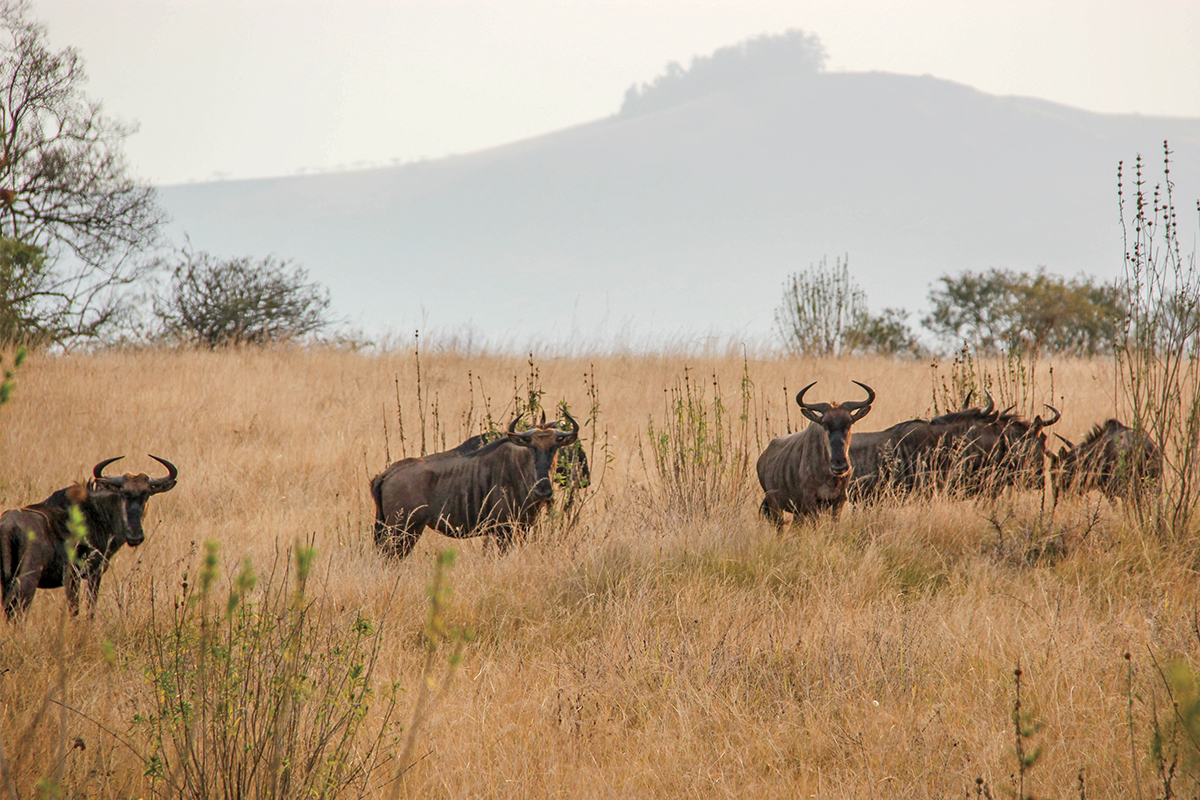
Our hunting party flew from Johannesburg toward the city of Durban, one of the busiest ports on Africa’s Indian coast, passing over a patchwork of agricultural fields perched on the east and west rims of the Umkomaas Valley. The valley itself is a dark, irregular scar on the landscape with high, rocky cliffs and steep slopes covered by snarled thorns. With no fences and minimal hunting, the valley is home to a wide array of endemic African antelope species including Cape bushbuck, Cape kudu, zebra, eland, duiker, and others.
There are also many warthogs, a half-dozen of which were kneeling on their forelegs and trimming the grass around Crusader Safaris’ Umkomaas Valley tented camp when we arrived. The sun was already behind the canyon rim when we began unloading our gear. Crusader Safaris owner Andrew Pringle directed me toward my own canvas tent while a baboon barked in the high rocks above us. By the time I was settled the only sounds in the valley were the hum of insects and the sloshing of the river.
Of the dozens of species of game to pursue in the Umkomaas, a big bull nyala was what I wanted most. Properly referred to as the common nyala (which doesn’t do this species justice: How could a 400-pound animal with ivory-tipped horns, striking chestnut, gray, and white markings, and a magnificent mane qualify as common?), this spiral-horned antelope exists naturally in few places in Africa, and nowhere does it exist in higher concentrations than in KwaZulu-Natal. In fact, some of the biggest nyala bulls on record were killed within a few miles of Crusader’s Umkomaas camp.
The Rifle & Cartridge
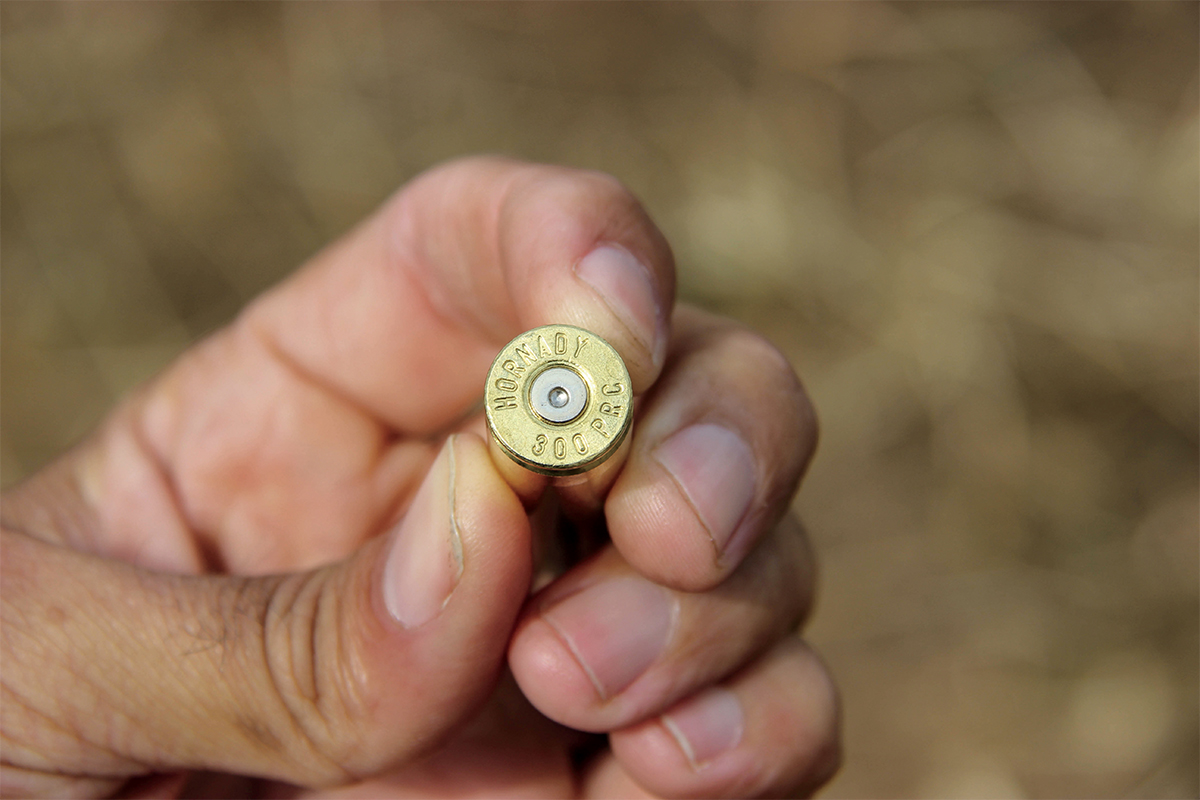
By the time I arrived in South Africa in late 2018, the .300 Precision Rifle Cartridge (PRC) had been announced to the public and a handful of long-range shooters were already using the round to ring steel out past a mile. The powerful new cartridge promised good things: based on a .375 Ruger case, the .300 PRC requires a magnum bolt face, but unlike belted magnums, the full-diameter .375 Ruger case allows for substantial powder payloads. The .300 PRC headspaces off its 30-degree shoulder and chamber drawings are precise. Hornady’s initial match load pushes a 225-grain, polymer-tipped ELD Match bullet with a ballistic coefficient of .777 (G1) at 2,810 feet per second, which is nipping at the .338 Lapua’s heels.
The Lapua excels at long-range shooting, but there are only a handful of hunters that carry Lapua rifles in the field. What about the .300 PRC? I wondered if it would make a sensible all-purpose rifle, especially given the popularity of established rounds like .300 Win. Mag., .300 Weatherby Mag., and the .300 WSM. The .300 PRC hadn’t been used extensively in the field to that point. It was powerful and accurate, but was it practical? And did it offer any real advantage over older rounds?
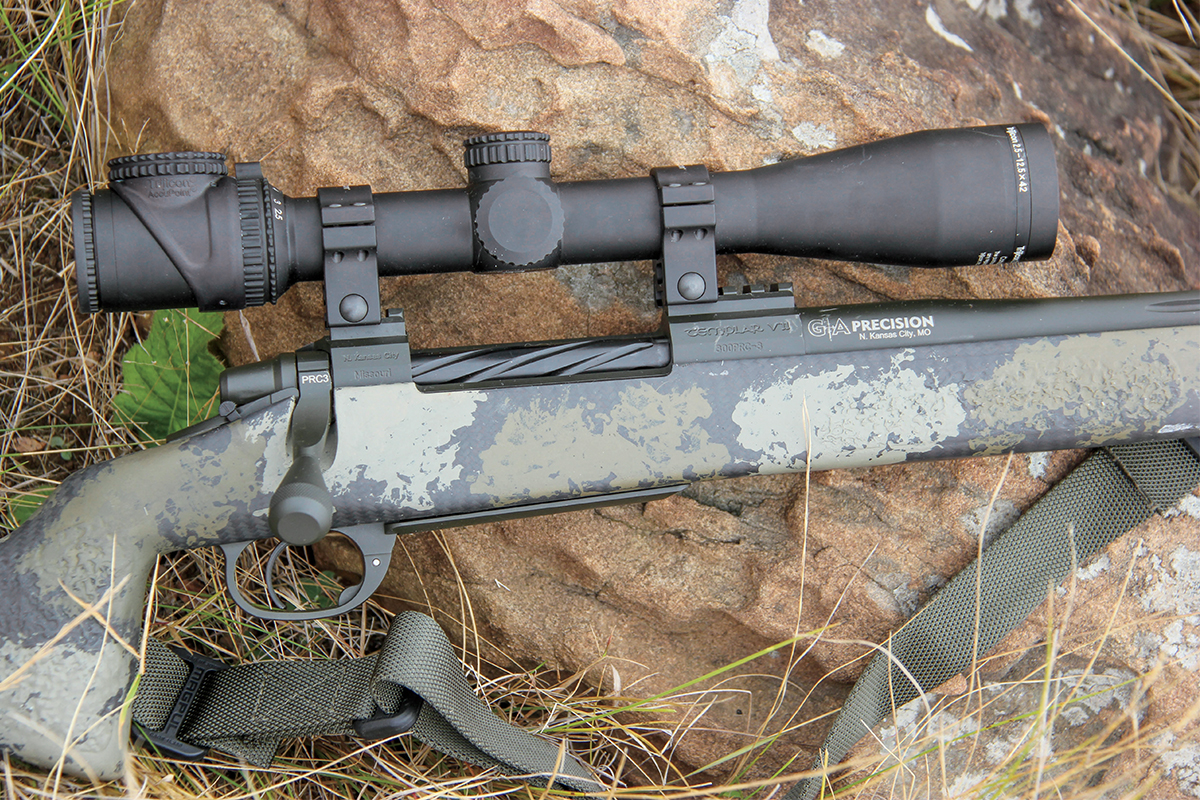
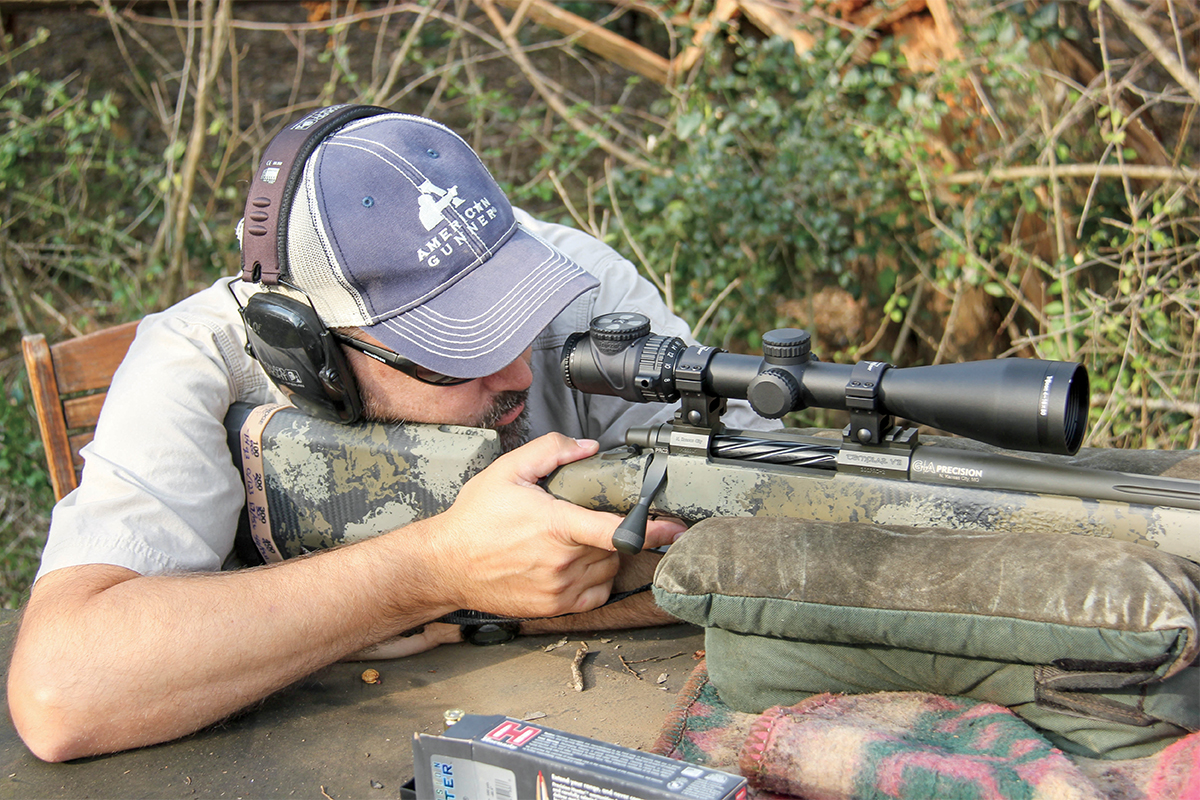
George Gardiner at GA Precision built several early .300 PRC rifles using Templar V2 actions and I carried one of those guns in the Umkomaas. It wasn’t particularly light, with its 26-inch barrel and removable brake, but it was supremely accurate. At 100 yards the GA rifle would place three 212-grain ELD-X hunting bullets close enough to touch, and five shots under an inch was no problem. The early adopters of the .300 PRC said it was the most accurate of the .30-caliber magnums they’d shot, and I’ve found the same to be true.
I topped the rifle with a Trijicon AccuPoint 2.5-12×42 with a green illuminated reticle. For dedicated long-range testing, I would have chosen greater top-end magnification, but the Trijicon’s low 2.5x magnification was important. While I might shoot a nyala at 400 yards, a 40-yard shot through thick brush was also possible. For that, I needed the additional field of view. I also needed a scope that could withstand being bounced around in the bellies of planes, abuse from baggage handlers, and heavy recoil. The AccuPoint checked all those boxes. I double-checked my zero at 100 yards when I arrived at camp and there was no shift in point of impact.
The Nyala Trail
African winter nights can be quite cold. As dim purple light brightened the eastern horizon and the jackals yapped on the crest of the ridges, I slipped from my bed and pulled on extra layers of clothing. After coffee at the main dining patio, I met Professional Hunter Rad Robertson and together we loaded my gear into his Toyota Hilux pickup. We were hunting farther up the valley and needed an early start. The rest of the camp began to stir as we left and began climbing to the rim of the valley.
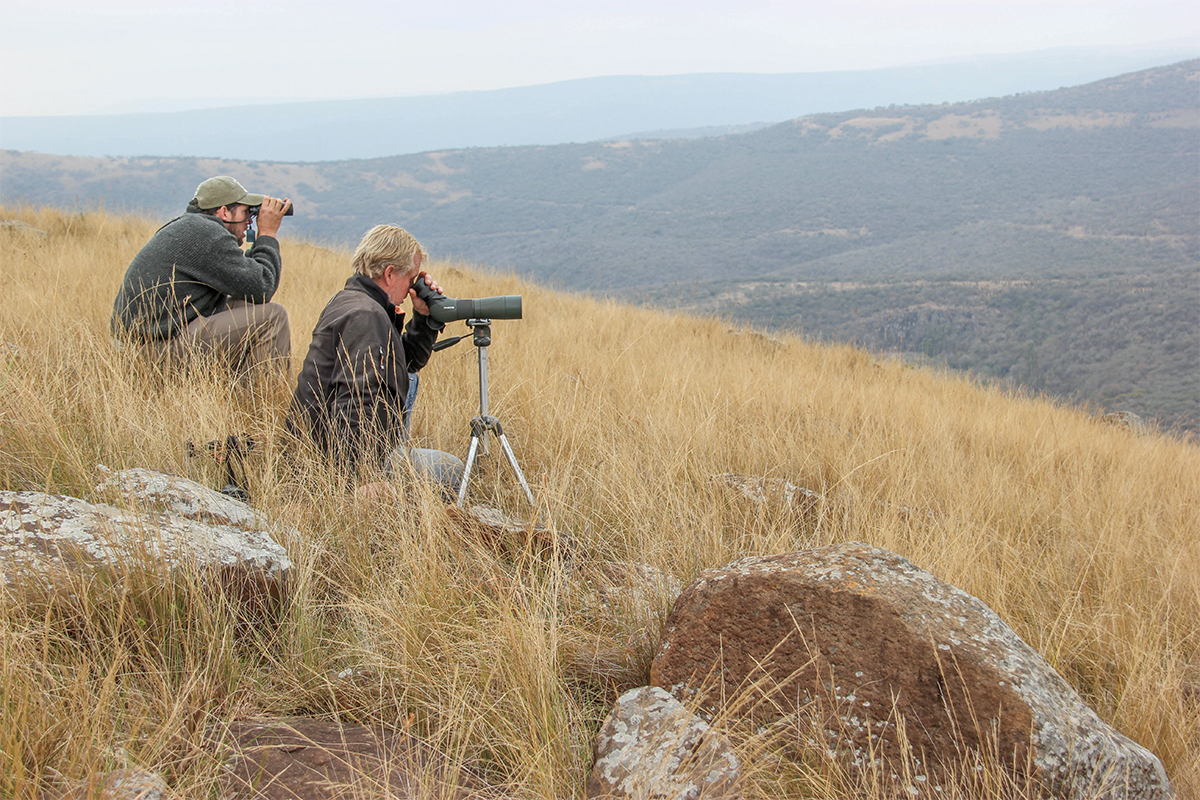
By sunrise the Hilux was bouncing through dry watercourses along the river’s edge. I’d seen a half-dozen nyala that morning, including what I thought was a particularly good bull, but one that Rad elected to pass. Nyala are creatures of habit who follow the same trails and prefer to hide in familiar patches of thorn. Late in the morning Rad and I found one trail that was particularly well-worn. We climbed through a forest of tombstone-gray eucalyptus trees and settled on a narrow hummock—an ideal glassing point. We did see several nyala cows, which are lighter in build and color than bulls, browsing along the edge of the primary trail that wound through the trees along a dry riverbed below.
It was late in the day when Rad decided to move and check a narrow bowl higher up the mountain. The higher country was much more open and if we found a bull the shot might be 400 yards or more. It wasn’t long until we saw game: A herd of dusty-gray kudu cows were browsing in the blackthorn trees halfway to the top. Their broad ears flapped as they stretched their long, thin necks up to pick the choicest leaves.
Rad, who was resting against the base of an aloe tree, told me he saw a bull. Above the cows a single dark animal moved through the knee-high, winter-dry grass. I looked at the bull through my binocular and waited in silence for Rad’s decision. When the bull started down the spine of the hill 300 yards away, Rad decided the horns measured between 25 and 26-inches. We could find a bigger bull.
We were ready to pull stakes and head back to camp for a braai when Rad told me saw another nyala. He had seen this bull before and recognized its wide, heavy horns which measured perhaps 27 inches in length, which wasn’t much better than the first. But the second bull’s horns were much wider with deeper curls and greater girth. The animal’s shaggy body was noticeably larger than the first, too.
The bull vanished into a thin band of trees and our only course of action was to drop down into the valley and slip back up the other side. With all the game scattered throughout the bowl and across the ridge it would be hard to avoid detection, but we decided to try our luck.
Grey columns of clouds pushed inland from the Indian Ocean and darkened the hills. Carefully avoiding the wait-a-bit thorns and ever vigilant for snakes in the hip-high grass we made our way up through the forest, past the kudu herd and into the trees where we’d last seen the nyala. The bull had moved and Rad spotted him just 70 yards away. I shouldered the rifle, but could plainly see a single bent branch that had been invisible to the naked eye. The branch covered the bull’s vitals, and I held my shot until the bull disappeared into the dark forest.
Minutes later we saw a bull come out along the far edge of the trees farther down the slope. Rad insisted on glassing the animal first because he didn’t want to shoot the smaller bull by accident, but soon confirmed the animal walking across the ridge below us was indeed the older bull.
With shooting sticks to stabilize the rifle and an aloe tree serving as a brace I was quite steady and could see the seam of the front leg. Holding a third of the way to the top of the shoulder I pressed the safety forward, slowed my breath, and shot.
There was a flash of orange flame from the muzzle and all I could see was a halo of light impressions dancing in my eyes. The tracker initially reported that he didn’t find any blood or signs that the nyala had been hit, which concerned me, but in the tall grass thirty yards from where the bullet struck, the bull lay stretched out dead in mid stride. Nyala are impressive animals, but being close enough to touch one offers a close look at their striking features.
The horns are deep walnut in color with semi-translucent tips and are neatly curved. White marks like warpaint dot the face (including the characteristic chevron) and the long hairs of the animal’s mane are banded in shades of black, gray, and tan. At nightfall, we headed down the mountain with my bull.
Mixed Bag
With a bit of luck and some good shooting, a hunter in the Umkomaas Valley could harvest more game in a week-long safari than most North American hunters collect in a decade. Modern safaris are a great way to experience Africa as it was in the glory days, and it’s an important means to feed a community where cattle are scarce and beef is costly (which, in turn, prevents the need for poaching).
These hunts are also a great way to test bullet performance because you have animals of varying sizes offering differing shot angles and ranges. Hornady’s Neal Emery hung around the skinning shed collecting .300 PRC ELD-X bullets from the game that he and I shot. We had a broad selection of animals, too. By the middle of the week, I’d killed a cape bushbuck ram with a high uphill shot measuring about 320 yards, and I tagged an incredibly old common reedbuck ram under almost the same conditions the following day at the far end of the valley.
On the day I killed my reedbuck, Emery shot a larger ram in the same area at about 400 yards. Interestingly, we were able to collect bullets from other hunters in camp who were using .300 Win. Mag. and .300 H&H rifles, and the .300 PRC performed well compared to those older rounds. The .300 PRC didn’t create excessive wound channels and terminal performance was superb on animals ranging from 100 to 450 pounds at distances from 50 yards to over 500 yards. We finished the safari by shooting across a canyon at distances to 1,400 yards. The .300 PRC shines as a target round, of course, and the extraordinarily accurate GA Precision rifles made hitting targets at long range no chore.
The .300 PRC is indeed a great target round, but it’s an equally adept big-game cartridge capable of taking most any game at extended ranges. I came away from the Umkomaas Valley with an appreciation not only for the forward-thinking design of the cartridge but a sincere appreciation for its outstanding versatility.
If you own a good rifle chambered in .300 PRC there’s little you can’t do with it so long as you can handle the recoil, which is substantial but manageable. Hornady makes a compelling case that they’ve developed a multi-purpose cartridge that’s perfectly suited for the shooter who wants a target gun that’s also capable of tackling big-game hunts in every corner of the globe.
When buying a new telescopic sight, it is best to start with a clean sheet. There are many things to consider and there is no one type of scope that is good for every gun. Just because your friend has a 3-9×40 on his hunting rifle does not automatically make it the best scope for your hunting rifle.
Buy the best scope you can afford for the gun. Dont put a $99 Shining Deer Special on Old Betsy if your next trip is two weeks in Fiordland. You will never forgive yourself if it fails while you are on The Big Trip. Unless you try to use your riflescope as a spotting scope, (which you shouldn’t), or you are a serious target shooter, you are unlikely to notice large differences in optical quality just by looking through the scope, anyway. The most important reasons for buying a more expensive scope are not that obviously visible. The most important virtues of a telescopic sight are reliability and retaining a zero.
They dont make em like they used to. Right! Modern manufacturing techniques have made todays scopes cheaper, more reliable, and with better lens coatings than what was ever possible before. Many new scopes were impossible to make before the invention of computer optical design programmes.
Dont Buy Old Technology. Don’t buy a particular scope just because your mate’s got one or your uncle had one. One of the most requested scopes in New Zealand is a 30+years old optical design that has poor lens coatings, dreadful reflections and no click-stops on the adjustments. Its sole recommendation is that it doesnt often fog or fail. But neither will many better, newer and CHEAPER scopes.
There a wide range of possibilities when it comes to selecting the best scope for your rifle. Lets look at a few generalizations and go from there. The point is, that you need to match the scope to the type of shooting you will most often be doing, and the rifle it is to go on. Many people get it wrong. They automatically want to put a 3-9×40 on their deer rifle and a fixed 4 power scopes on their 22lr. Why, when rabbits are smaller than deer and are frequently seen at equal or greater ranges than deer.
Lets look at 22s. Most 22s are used for rabbits & possums. Sitting side on at 75 meters a rabbit presents a target roughly the size of a clay house brick. The instant kill area is smaller than a business card. On possums, very often you can only see the eyes. A bit of magnification helps pick up the body and avoid twigs and branches. Both rabbits and possums can usually be relied to sit still for at least a few seconds. Most people only want to buy a fixed 4x power, but we usually recommend a 3-9×40, for most circumstances it is the best all-round scope on a 22lr. In many brands the difference in price between fixed and variable power scopes is usually negligible.
Scopes for Deer, Goat or Pig hunting rifles. Most people by far, ask for a 3-9×40 scope on their deer rifle. If a rabbit has a credit card sized kill area, a deer has one the size of an dinner plate. A goat’s heart/lung area is about the size of a bread and butter plate. A much bigger target than a rabbit, it is frequently seen at 5 to 25 meters and often, on the move. Even at 200metres a dinner plate is a reasonable target, well achievable with a 5x power scope. That is the equivalent of the same plate at 40 meters with no magnification. We feel a 3-9x is more than you need for most deer hunting and lacks sufficient field of view for close running shots. We recommend a 1.5-5x, or up to 2-7x for most deer rifles. The small front lens diameter is not a disadvantage as its field of view and light gathering capability are both greater at lower magnification anyway.
Exceptions where a bigger scope might be appropriate are when the rifle is used principally on Thar, Chamois and deer open country or tops shooting. Then consider a 3.5-10 or 4-14 power.
Scopes for Varmint Rifles. Lets move that house brick sized rabbit out to 100, 200 or even 300 metres. Magpies are worse with a kill zone the size of a 50mm long (2) piece of broomstick. Any takers for the 3-9x?? In this area, more is better. Trade the light gathering for pure magnification. You need it. Ignore scopes with very fine crosshair only reticles. You cant see them in hunting situations where there is no white paper target to aim at. Pick a standard or fine 30/30 or Plex type reticle and buy the most expensive you can afford. In varmint scopes, cost equals quality. Avoid powerful fixed power scopes, as they wont let you take a 25m shot. Use a front lens shade and invest in a laser rangefinder and a bipod. Oh, and a broad stretchy sling to save your shoulder when you have to carry it all.
Hornets need at least 12x to 16x scopes (3-12x or 4-16x). 222s & 223s need at least 16x magnification at the top end. 22-250s and bigger need at least 24x. As you start to shoot your varmint rifle you will start to grow into the more powerful varmint scope. You will actually see your heartbeat bouncing the cross hairs at anything more than a 16x power setting. But, amazingly, after a few months you will learn to shoot between the heart beats (truly) and then you will start to use the top end of your scopes magnification range. Trust me… a magpie at even 200m is a mighty small target. You wouldnt put cross-ply tyres on your sports car. Don’t put a 3-9x on your Varmint rifle.
Variable v/s Fixed Power. The reasons for not buying variable scopes used to be that they were more expensive, had lower quality optics and broke or fogged more often. None of these things are true any more. In many cases a variable power scope is the same price or cheaper now that a similar fixed power scope. The scope makers make so many variable powered scopes, that the unit manufacturing cost is much lower. The staff at Serious Shooters hardly own any fixed power scopes.
Eye relief is the distance that you hold your eye from the back of the scope. Features of eye relief are the distance required to see a clear full picture through the scope, and sufficient distance to protect you from Weatherby or Magnum Eyebrow from a powerfully recoiling rifle. Generous Eye relief means that you can move your eye back and forward through perhaps an inch or two (25-50mm) and still see clearly. Shallow eye relief means there is only one right spot. Scopes like that are not good for quick or running shots. Scope Turrets cover the adjustment dials, usually in the middle of the scope. Target Turrets may be tall, and some may not even have screw-on caps to cover them. Hunting Turrets are small (not tall) and ideally should have clearly defined click-stops in their adjustment. Click stops vary from 2 clicks to the inch, to 8 clicks to the inch, but 4 clicks to the inch is most common.
Scope mounts. There is a bewildering range of options to choose from when selecting scope mounts. They range from $19.95 to way over $500. It is always to your advantage to buy the best scope mounts that you can afford.
Understanding Parallax. Telescopic sights are manufactured to be parallax-free at a particular distance. At the stated distance, you can move your eye around behind the scope and the crosshairs do not wander on the target. This distance is usually 100yds, but some special scopes are focused at closer or greater ranges. Parallax is not a big deal on most deer rifles but is very important at 25m or closer, on very small targets, or for long range precision shooting. It is more noticeable on very powerful magnification scopes; so most riflescopes more powerful than 10x power have a ring on the front (or a third knob on the turret) for dialling the correct parallax. If you have an adjustable parallax scope on a hunting rifle, leave it set on 100yds/mtrs for most shooting, or 25-50yds for close range rabbit shooting.
Light gathering is the ability of your scope to gather all available light from a target and transmit it through the scope to you eye. The larger the front lens or tube diameter, the more light than can be got to your eye.
Magnification. Riflescopes are usually referred to by their magnification power and the diameter in millimetres of the front (objective) lens. i.e. a 4×40, 1.75-5×32 or 4-16×44.
Serious Shooters will recommend the most suitable mounts for your scope and your rifle.
The information contained in this leaflet is copyright of SERIOUS SHOOTERS LTD
For further information contact:Serious Shooters LtdThe Best Gun Shop 726 Great South Road, Penrose, Auckland, New Zealand. Phone 64-9-579-3006
Kayaking has been a part of the human story for thousands of years. Developed by Inuit people for fishing and transportation, kayaking is now an increasingly popular mode of recreation. Similar to canoeing, kayaking offers an active way to get out on the water and intimately enjoy the outdoors.
The growing interest in recreational kayaking is a direct result of the activity’s many benefits and widespread appeal. Kayaking offers a satisfying combination of physical exercise and the grace-filled sensation of being in sync with the stillness and flow of water.
On a clear and windless morning, the experience of slicing quietly across the surface of the water as you repeatedly dip and retract your paddle is simply glorious.
For beginner paddlers interested in purchasing a kayak of their own and advancing their skills, the kayak market can seem complicated. Although kayaking requires various pieces of gear (a paddle and a personal flotation device), a reliable entry-level kayak is the most important item that a beginner will need.
There are many different types and styles of kayaks, each designed for a specific purpose and to best suit a specific kind of paddler. Some categories beginners should be aware of include sit-in kayaks, sit-on-top kayaks, inflatable kayaks, tandem kayaks, and folding kayaks.
Because there are several categories, we’ve chosen the best kayaks in each category to help find the best kayak for you. Be sure to read our buyers guide and our comparison chart to better inform your decision. Scroll through to view our picks for the best beginner kayak, or jump to a category below:
Best Sit-On-Top Kayak
Best Sit-In Kayak
Best Budget Kayak
Best Tandem Kayak
Best Pedal Kayak
Best Inflatable Kayak
Best Folding Kayak
Best Kayak for Kids
Our how-to guide at the end of the list also provides answers to frequently asked questions and all the information you’ll need to select the best kayak for your adventures.
The Best Kayaks for Beginners in 2022
Best Sit-On-Top Kayak: Wilderness Systems Tarpon 105
The Tarpon 105 kayak from Wilderness Systems ($1,119) is our pick for the best kayak in the sit-on-top category. As a recreational kayak, the Tarpon 105 offers impressive versatility and can perform well when used for various activities such as fishing, camping, exploring, bird-watching, and even surfing waves.
For those looking to own a single kayak that is both beginner-friendly and adaptable, the Wilderness Systems Tarpon 105 is a wise choice. The newest version of the tried-and-true Tarpon is the Tarpon 105. This updated model builds on the success of previous Tarpon iterations and comes with more features than ever before.
Thanks to Wilderness Systems’ careful attention to detail and function-forward mindset, it’s fully stocked the Tarpon 105 with various features for on-the-water support — no matter what your favorite kayak-based activity is. In flatwater or flowing creeks and rivers, this kayak is sporty, stable, and downright fun.
For fishing purposes, the Tarpon 105 is compatible with fishing pole holders, GPS units, and fishfinder screens. Relative to similar boats, the Tarpon 105 is very stable and can maneuver easily through tight coves and sharp bends.
At 10.5 feet long, the Tarpon 105 is shorter and stubbier than many sit-on-top kayaks. Because of its shape, this boat is not especially fast, nor does it glide through the water outstandingly well.
Simply put, the Tarpon 105 was built for stable cruising and not for speedy racing. For a similar option that is also longer and faster, check out the Tarpon 120.
The 105’s flat hull allows the boat to turn quickly and easily. While paddling, the entire boat changes direction smoothly and with minimal effort.
For long kayaking sessions, the Tarpon 105 is built with Wilderness Systems’ exceptionally comfortable Phase 3 AirPro seating system. The thoughtfully contoured backrest is ergonomic and supportive — crucial traits for a long day on the water.
The Tarpon 105’s impressively long list of well-considered features includes large waterproof storage wells, a magnetic water bottle strap system, a built-in paddle holder, rigid carry handles, and a dog-friendly deck so you can bring your pup on board.
Paddlers who wish to prioritize stability and comfort over speed would do well with the Tarpon 105. Its shorter length gives the Tarpon a boost in portability, and at 55 pounds, it can be carried around without too much trouble.
Although a bit on the more expensive side at around $1,079, the Tarpon 105’s feature-packed, durable design makes it a good-value buy. A versatile kayak that doesn’t sacrifice fun or comfort, the Tarpon 105 is our choice for the best sit-on-top kayak.
Weight: 55 lbs.
Length: 10’6″
Pros:
Comfortable seat
Easy to climb in and out of, even while out on the water
Makes smooth turns, impressively maneuverable
Useful for lots of activities
Packed with thoughtful features
Cons:
Glides slowly
More expensive than other options
Check Price at REICheck Price at Backcountry
Best Sit-In Kayak: Old Town Manitou Sport
The Old Town Manitou Sport sit-in kayak ($850) is an excellent do-it-all kayak for beginners and seasoned paddlers alike. Originally designed by Necky Kayaks, which is now part of the Old Town brand, the Manitou Sport is a simple craft that offers stability and maneuverability above all else.
Except for technical whitewater, the Manitou Sport performs well on most water bodies including lakes, rivers, creeks, and bays. A 26.5-inch hull makes this kayak incredibly stable. Its 10’11” length offers a functional balance between smooth tracking and nimble maneuverability.
On open water, the Manitou Sport can handle plenty of speed. It also responds well to sharp turns in tight areas thanks to its extended keel. It’s difficult to find a kayak that shines in so many areas of performance.
Although this boat doesn’t quite offer enough storage space for overnight trips, there is plenty of room for a day trip’s worth of gear. Bow and stern deck rigging lets you secure equipment to the top of the boat, and a dry storage area provides reliable waterproofing.
Adjustable foot pedals and a comfortable seating system make it easy to sit in the boat for hours without becoming stiff or sore.
Overall, the Old Town Manitou Sport is easy to love. Its large cockpit is effortless to climb in and out of, and toggle handles allow comfortable two-person carrying of the kayak from the car to the water and back again.
At $850, this kayak is an excellent value, especially because it comes with a Carlisle Magic Mystic paddle. Old Town built the Manitou Sport to maximize recreational fun on the water, and it delivers with style.
Weight: 44 lbs.
Length: 10’11”
Pros:
Durable and lightweight
Comes with a paddle
Good balance of graceful tracking and responsive maneuverability
High-volume bow cuts through choppy water with ease
Comfortable cockpit and seat
Good value
Cons:
Not ideal for open ocean or whitewater
Not very practical for fishing
Check Price at REI
Best Budget: Intex Challenger K1
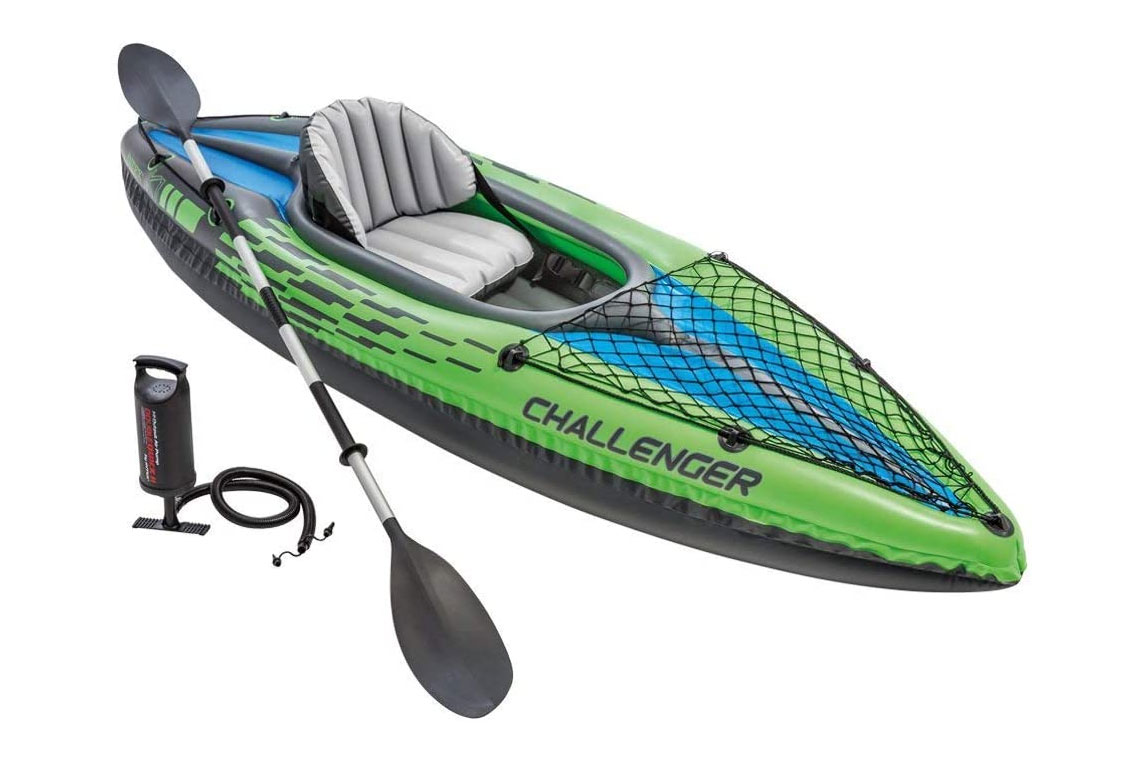
The Intex Challenger K1 inflatable kayak (on sale for $95) is our pick for the best budget kayak available in 2022. With a normal price tag of $170, this boat is far cheaper than other options on this list. For the money, it’s an excellent value that is more than capable of providing many hours of on-the-water fun.
For a cheap kayak, the Challenger K1 handles impressively well on the water. In general, the entire boat rides low, which makes it quite stable and less vulnerable to being pushed around by the wind.
A long skeg helps the K1 track decently well in a straight line. At 9 feet long and 2.5 feet wide, the K1 has a short, stubby profile that turns and steers well.
One downside of the craft’s low profile is the resulting high likelihood of taking on water. The K1 does not have a scupper hole, so to drain any excess water, you’ll have to paddle to shore and flip the entire thing upside down.
The inflatable seat is decently comfortable, and we like that it is both removable and adjustable. On the boat’s upper deck, a cargo net provides a small amount of gear storage. There is not enough space for camping gear, but the net can easily handle a water bottle, a small tackle box, and some snacks.
Intex claims that the K1 is made from venture-resistant vinyl. However, users should take care to keep the boat away from sharp objects — in use and in storage.
Two separate air chambers are quick to inflate. But because there are only two chambers, it’s important to wear a personal flotation device when using this kayak. If one of the chambers pops, the remaining chamber will not provide much buoyancy in an emergency.
The K1 comes with an 84-inch aluminum oar, a repair patch, a carrying duffel, and an inflation pump. To set up the boat, simply inflate both chambers until the included gauge tells you that the boat is good to go.
When your paddling session is over, dry the boat with a towel and fold it back into its carrying duffel. When packed down, the boat and all of its components can be easily stored in a closet or garage.
All things considered, the Intex K1 challenger is a good purchase for paddlers in need of an affordable vessel and who are more concerned about fun than performance. This is not the kayak that will best suit advanced paddlers with racing or expeditionary aspirations. For a day of summer fun, though, the K1 is a wonderful and portable addition to your kit.
Weight: 23.9 lbs.
Length: 9′
Pros:
Affordable
Packs down into an included duffel bag
Comes with a paddle and pump
Tracks and steers well
Removable and adjustable seat
Cons:
No drain plug
Not the most durable
Included pump inflates slowly
Check Price at AmazonCheck Price at Walmart
Best Tandem Kayak: Advanced Elements Advanced Frame Convertible
The Advanced Elements Convertible Tandem Kayak ($980) is a high-performance inflatable kayak that can be paddled by either one or two people. Although a bit on the more expensive side for an inflatable kayak, the Advanced Elements is comfortable, durable, and thoroughly packed with practical features.
Depending on how you set up the seats, this kayak can be either a tandem or a single kayak. Its 550-pound capacity is plenty to accommodate two paddlers plus additional gear.
Tiedown points, bungees, and integrated pockets offer adequate storage for quite a lot of gear. This kayak could feasibly be used for overnight expeditions — especially when configured for a single paddler.
When paddling the Advanced Elements Convertible Tandem, it’s easy to forget that you’re in an inflatable vessel. Impressively, this boat handles more like a rigid-sided kayak. Plus, it offers supreme durability with three outer layers of ripstop material.
At 15 feet long, the relatively narrow 32-inch hull provides excellent tracking without giving up too much stability. Multiple tracking fins and a small skeg contribute to a smooth, straight, and speedy ride.
In tandem mode, this kayak has ample space for both paddlers to move freely without getting in each other’s way. High seatbacks offer sufficient back support and remain comfortable throughout a full day on the water.
The low-lying seats keep your center of gravity close to the water while paddling. This configuration reduces wind resistance and keeps the boat from feeling tippy.
Inflating and setting up the AE Convertible tandem takes some getting used to. A thorough set of instructions is included, but you will still need to practice a few times before setting it up feels efficient.
Six air chambers can be pumped up, although only three of these are important for structural integrity. Each chamber has specific pressure requirements.
Be sure to be careful when inflating because it can be easy to over or underfill. The kayak does not come with paddles or a pump.
Overall, this is a hefty inflatable tandem that in many ways feels more like a solid plastic boat than an inflatable one. Its bulk may be a downside for some users — it’s difficult to pack into its duffel and carry on your own.
However, on the performance side, this kayak shines and offers tracking and speed that most other inflatable tandems cannot. It’s not cheap, but because it’s built to last, it’s our pick for the best tandem kayak of 2022.
Weight: 52 lbs.
Length: 15′
Pros:
Durable
Capacity of 550 lbs.
Can be used as a single boat or a tandem
Tracks well
Handles speed with ease
Ample storage space
Cons:
Heavy
More expensive than other options
Setup is difficult, especially with just one person
Check Price at REICheck Price at L.L.Bean
Best Pedal Kayak: Hobie Mirage Passport 10.5 R
Hobie has been making kayaks for over 20 years. This model ($1,799) is one of its newer ones, released in 2022. We loved the previous version of this kayak, and the updated model maintains the tried-and-true design while adding a new rotomolded hull construction.
Pedal kayaks have lots of pros. Generally, they are equipped with a few more accessory features and have more room for gear storage. And, of course, they allow you to paddle hands free. Fishing, bird-watching, photography, you name it — there are lots of great applications here.
The Hobie Mirage Passport 10.5 R offers great tracking in the water, whether the weight on board is 150 or 200 pounds. The Mirage Glide technology refers to the fins, pedal, and rudder components.
This kayak has a stowable rudder with steering control located by your left hand next to the seat. The Hobie is a bit wider than standard kayaks to accommodate the seat and steering control, although it only measures 34 inches across.
You may have noticed the aluminum frame seat. Pro: It’s way more comfortable than standard kayak seats. Con: It adds some weight.
If you are doing overnight paddles, or even day touring for hours on end, a comfortable seat is worth it. Even with the extra weight of this kayak, it’s balanced well and feels really streamlined moving through the water.
The Passport 10.5 R has kick-up fins that automatically recess. How cool is that? Whether you are paddling in shallow waters or encountering logs or obstacles, the kick-up fins will automatically recess upon impact to protect both you and your equipment.
Other features on this kayak include an 8-inch twist-and-seal hatch for storing gear, as well as two cargo storage areas with bungee straps on the bow and stern. If you are using this kayak for fishing or touring, storage is important.
There’s plenty of space on this boat to store rods, a tackle kit, dry bags, a small cooler, camera equipment, or anything else you may want to bring along.
Pedal/fishing kayaks can run up to $5,000. This Hobie cat model is a great-quality kayak at a great price, especially if you’re looking to pedal. This kayak comes with a two-piece aluminum paddle.
Rod mounts and accessories to personalize your kayak
Kick-up/retractable fins
Good price
High-tech rotomolded construction
Cons:
Lots of individual components
Heavier than most other kayaks on this list
Check Price at Hobie
Best Inflatable Kayak: Kokopelli Moki-Lite
Made for touring across flat water, the Kokopelli Moki-Lite inflatable kayak ($699) is portable, easy to set up, and impressively lightweight. This watercraft is ideal for paddlers who are looking for a simple and high-quality boat for recreational paddling.
Compared to other inflatable kayaks, we appreciate how easily the Moki-Lite transitions from fully deflated to water-ready. In less than 10 minutes, this kayak’s floor and side tubes can be filled with air and launched onto the water. When you’re done paddling, the boat deflates and folds into its roomy river bag for easy transport.
The 1,000-denier reinforced PVC drop-stitch floor is fully rigid when pumped up and is abrasion-resistant. Additionally, the EVA seat is low-profile and relatively comfortable to sit in.
A removable 9-inch tracking fin helps the Moki-Lite track smoothly. The entire kayak is just 10 feet long, and this short length results in high-performance maneuverability.
The kayak comes with a four-piece alpine lake paddle, carry bag, Nano Barrel pump, tracking fin, and repair kit. For a streamlined and sporty-looking inflatable kayak, it doesn’t get much better than the Kokopelli Moki-Lite.
Weight: 17 lbs., 3.2 oz.
Length: 10′
Pros:
Lightweight
High-quality 1,000D outer material
Good tracking with 9″ fin attached
Easy to set up and pack down
Cons:
Not a lot of cargo space
Check Price at KokopelliCheck Price at Amazon
Best Folding Kayak: Oru Inlet
For those living in tight quarters, folding kayaks offer all of the benefits of owning your own watercraft without the need for a large storage space. Whether you live in a van or a studio apartment, the Oru Inlet folding kayak ($999) is a brilliant tool that can go with you anywhere.
Compared to the often-convoluted process of inflating a kayak, the Inlet’s origami-like folding assembly is as simple as snapping a few clips and slipping into the cockpit. Oru claims that the Inlet can be set up in 3 minutes, a bold statement that has been verified by several owners and testers.
When it’s all folded up, the Oru Inlet can be slung over a single shoulder for effortless carrying. After all, it weighs only 20 pounds.
While the folds in the kayak do create weaknesses in the 5mm double-layered polypropylene exterior, the Inlet has been manufacturer-rated for 20,000 fold cycles. The hull’s 30-inch width provides enough stability for beginner paddlers to feel comfortable, and also makes it ideal for fishing.
At $999, the Inlet is cheaper than other offerings from Oru, although it’s still expensive compared to many kayaks on this list. The ideal user is someone who enjoys mellow on-the-water excursions and really wants to prioritize easy storage and compact gear.
The cockpit is large enough to store a small dry bag or a bit of fishing gear. However, there probably isn’t enough room for overnight gear, and there is no waterproof cargo area.
Although this is certainly a niche kayak, it easily earns its place on this list of best beginner kayaks. With the Oru Inlet, the entire user experience is defined by simplicity.
It’s simple to set up, simple to paddle, and efficient enough for regular use. With the Oru Inlet, limited gear storage space will no longer keep you from getting out to paddle.
Weight: 20 lbs.
Length: 10′
Pros:
Super light
Easy to set up and fold down
When folded up, the kayak can be carried with a simple shoulder strap
Padded seat
Open cockpit is simple to enter and exit
Beginner-friendly
Cons:
Maximum weight capacity of 275 lbs.
Expensive
Does not track especially well
Check Price at AmazonCheck Price at Oru Kayak
Best Kayak for Kids: Perception Hi Five
Part stand-up paddleboard and part kayak, the Hi Five watercraft from Perception ($299) is all about fun on the water, which makes it our pick for the best kayak for kids.
The Hi Five is sized to perfectly suit kids up to 120 pounds. At just 6 feet long and 2 feet wide, this small kayak fits easily into most hatchbacks and roof racks.
Its unique design integrates the seat and other features into one continuous piece of polyethylene plastic that weighs just 24 pounds. Because the entire boat is one solid piece, there are very few ways a user can break or damage the Hi Five.
People with kids will know that the ability to withstand rough handling is an asset of any piece of kids’ gear, and the Hi Five is fully up to the task.
On the Hi Five’s stern, a flat swim-up deck allows for swimmers to easily climb aboard. Other clever features include a paddle rest, a large standing surface, and ergonomic grab handles. All of these features come in handy during blissful hours of family time on the water.
Additionally, the Hi Five is specifically designed to keep working as kids grow, making it a good long-term investment that can stay with you for many years.
For maximum safety, the Hi Five is super stable. It comes with a hitch-and-tether system so mom or dad can tow the boat when the smallest paddler in the family gets tired.
For $300 with a kid-size paddle included, the Hi Five can offer many years of joy and paddling progression. From rivers to creeks to small backyard ponds, the Perception Hi Five is a standout kids’ kayak.
Weight: 21 lbs.
Length: 6′
Pros:
Good value
Entire watercraft is one durable piece of molded plastic
Progression-focused
Lightweight and easy to transport
Cons:
Not the most comfortable seat
Check Price at Amazon
Beginner Kayak Comparison Chart
Wilderness Systems Tarpon 105Old Town Manitou SportIntex Challenger K1Advanced Elements Advanced Frame ConvertibleHobie Mirage Passport 10.5 RKokopelli Moki-LiteOru InletPerception Hi Five
Why You Should Trust Us
We compiled this list of kayaks with beginner paddlers in mind. The GearJunkie team has plentiful paddling experience, are we’re also keenly familiar with the kayak market. The boats on this list are user-friendly, approachable, and progression-focused.
Not all beginners will need the same kind of kayak, so we carefully considered dozens of boats and highlighted the best options in several categories. In every category, our recommended kayak had to beat out several other models to earn its place.
To identify our top picks, we considered overall value, usability, build quality, durability, and much more. We examined materials, studied brands, and compared pricetags down to the last detail.
As new kayaks hit the market, we’ll be sure to test them in consideration for this list. At any given time, our roundup will include the best of the best.
Beginners’ Buyers Guide for Kayaks: How to Choose
Before you purchase a beginner-level kayak, you first need to determine what type of kayaking you want to do. There are lots of well-made and high-quality kayak brands, and most brands offer options for a wide range of paddling pursuits. Once you know what kind of attributes you are looking for in a kayak, it will become much easier to choose.
If you want a kayak for mellow cruising on a backyard pond or small lake, you do not want to purchase a sea kayak that is made for slicing through big waves. Similarly, if you need a kayak that will be easy to transport, you don’t want to purchase something bulky and heavy.
There are a few key things to consider when deciding what your kayaking needs really are. There are many unique categories of kayaks, and each category has its own strengths and drawbacks.
In this buyer’s guide, we will provide information about many of these categories, including sit-on kayaks, sit-in kayaks, tandem kayaks, recreational kayaks, day touring kayaks, inflatable kayaks, folding kayaks, pedal-powered kayaks, and whitewater kayaks.
Once you have identified which category best fits your needs and plans, other important considerations to keep in mind include material, weight, capacity, durability, and price. Purchasing the right kayak can feel confusing, but with the use of this in-depth guide, we hope you’ll be able to identify the right kayak to buy.
Types of Kayaks
Sit-on-Top Kayaks
Sit-on-top kayaks do not have an internal, hollowed-out cockpit that you have to climb into. Instead, this style of kayak allows you to sit right on top of the boat, where your legs will be exposed to the open air.
Sit-on-top kayaks tend to be easier to get on and off of than sit-in kayaks. Also, sit-on-top kayaks tend to feel more stable than sit-ins, especially for new paddlers who are getting used to the water.
Sit-on-top kayaks are good for warm weather because the user is likely to get wet. This style of kayak is also better for users who plan to paddle with a dog on board.
(Photo/Amazon)
Sit-In Kayaks
Sit-in kayaks have an internal cockpit that you have to climb into to paddle. When paddling a sit-in kayak, you will have a low center of gravity and the rotation of your hips will be more involved in steering the boat.
Some sit-in kayaks that are built for whitewater paddling utilize spray skirts that cover the cockpit to prevent water from getting inside. Sit-in kayak users will experience less wind resistance than sit-on-top kayakers.
Tandem Kayaks
Tandem kayaks are paddled by two people at once. To allow this, these boats are usually longer than single-user boats and include two seats instead of one.
Tandem boats can be inflatable or made of solid material. The process of learning how to paddle in sync with your partner can be a fun and tricky challenge.
(Photo/REI)
Recreational Kayaks
When a kayak is labeled “recreational,” that means it’s built to prioritize fun over high-end performance. Recreational kayaks will not be the fastest or lightest boats on the market, but they will include practical features that maximize comfort and allow you to enjoy your paddling experience.
Day Touring Kayaks
Day touring kayaks are meant for single-day excursions. These boats lack adequate storage space for overnight trips or expeditions. Often, day touring kayaks are simple and user-friendly vessels built for a quick session on the water.
Inflatable Kayaks
Inflatable kayaks are filled with air like a balloon and can be deflated when not in use. For users who do not have enough storage space to keep a rigid plastic kayak at home, an inflatable kayak can be a fantastic solution.
Inflatable kayaks typically have multiple compartments that must all be pumped full of air before use. This list includes both single-user and tandem inflatable kayaks that we recommend.
Folding Kayaks
In recent years, many folding lightweight kayaks have entered the market. These boats aim to maximize portability for kayakers who don’t have a lot of available storage space in their lives.
Folding kayaks require some practice to assemble and set up properly. Although folding kayaks tend not to be as durable on the water as solid plastic kayaks, they tend to be more lightweight than any other category of kayaks.
Pedal Kayaks
Pedal-powered kayaks do not require a paddle to move about the water. Instead, these kayaks are operated using your legs, either by pushing or rotating the pedals to generate thrust. This style of kayak is excellent for fishing because the foot pedals leave your hands free to cast out and tend to your fishing rod.
Whitewater Kayaks
Whitewater kayaks are made to maneuver through fast-flowing water. Whitewater kayaks are almost always sit-in kayaks, with a short length and minimal storage space. Most whitewater kayaks utilize a spray skirt to keep water out of the cockpit.
Kayak Features
Material vs. Weight
Most kayaks on market these days are made of solid plastic, inflatable abrasion-resistant PVC, thin foldable plastic, or fiberglass. Different materials work well for different functions.
Solid plastic boats tend to be the most durable. Inflatable PVC and foldable plastic are lighter and easier to pack down and store in a small space.
If you plan on paddling with a dog on board, it may be wise to steer clear of inflatable kayaks that can be punctured. Solid plastic kayaks tend to be heavier than inflatable and foldable kayaks. (And obviously, tandem kayaks are heavier than single kayaks.)
If you plan to kayak alone and need to load and unload your kayak from your car on your own, it is wise to purchase a lighter kayak that you can easily carry. Or, get a kayak dolly. Kayaks on this list vary widely by weight, so be sure to check the kayak’s weight before purchasing.
(Photo/REI)
Capacity
The majority of brands measure kayak capacity by weight. Before you purchase a kayak, make sure that the boat will be able to accommodate the total weight of the anticipated user (plus the weight of any gear). It’s good to stay on the conservative side of a boat’s capacity limit to ensure that it will perform safely and as intended.
Durability
Kayaks are built to be durable, but not all boats are created equal. Inflatable watercraft tend to be less durable than solid plastic ones because they are vulnerable to punctures.
To maximize the longevity of your kayak’s life, be careful not to drag it along jagged rocks during loading and unloading. When storing your kayak, be sure to keep it out of the full sun and away from potentially harmful objects and substances. And of course, always follow PSI recommendations to prevent overinflation.
Price
It’s wise to decide on a specific budget before you begin the actual shopping process. Kayaks vary in price a lot, and high-end options can be very expensive.
Still, it’s very possible to find a fairly priced kayak that offers excellent value for the money. If you are considering buying a kayak for yourself and your partner, you’ll also want to weigh the options of buying two kayaks versus buying a tandem.
FAQ
What is the best type of kayak for beginners?
We recommend all of the kayaks on this list to beginner paddlers. Ultimately, the best kayak will be the one that meets your individual needs and helps you progress as a paddler. Depending on your lifestyle, storage space, preferred paddling location, and other factors, some kayaks will suit you better than others.
What size kayak is best for beginners?
There are kayaks of all shapes and sizes on the market. The size and shape of kayaks vary depending on their intended function. Beginner kayaks tend to be between 9 and 12 feet long and 2 to 3 feet wide.
Long, thin kayaks are built for going fast in a straight line and cutting through choppy water and waves. Short, stubby kayaks are made to be nimble and easy to turn in fast-moving streams and whitewater. Many of the kayaks on this list are midsize to provide a good balance between smooth tracking and maneuverability.
Most kayaks — regardless of their size or shape — can accommodate paddlers of various heights and weights. Before purchasing a kayak, check to make sure it can accommodate a paddler of your size.
Which is better: sit-on-top kayaks or sit-in kayaks?
Neither kayak style is strictly better — they simply have different strengths and weaknesses.
A sit-on-top kayak is easier to climb in and out of, especially while out on the water. Sit-on-top kayaks also tend to be better for kayaking with a dog on board. Overall, sit-on-top kayaks tend to be more comfortable for long paddling sessions, as they allow the user to stretch their legs and move around.
Sit-in kayaks keep the paddler’s center of gravity low, which decreases wind residence and creates superior maneuverability. In colder or rainy weather, sit-in kayaks allow the user to stay fairly dry, especially with the use of a spray skirt.
What size kayak should I get for my height?
Most kayaks are made to accommodate people of a wide range of heights. Many recreational kayaks for beginners are around 10 feet long and will be suitable in size for most adults up to 6 feet tall. For those taller than 6 feet, a recreational kayak around 12 feet long will likely be a better fit.
It can be helpful to test a kayak’s size by sitting in it before purchasing. Make sure there’s enough legroom and your hips fit comfortably in the seat and cockpit. Many kayaks have multiple or adjustable footrests to accommodate paddlers with shorter or longer legs.
(Photo/Amazon)
What length paddle do I need?
Having a properly sized paddle can make all the difference. When deciding on the length of your paddle, you must consider both your own height and the width of your kayak. Generally, the wider the kayak is, the longer paddle you’ll need to ensure that the sides of the boat won’t get in the way of the paddle blades entering the water.
Most of the beginner kayaks on this list are between 24 and 32 inches wide. So, here is a basic guideline for how to size kayak paddles for kayaks that are between 24 and 32 inches wide.
Paddlers under 5’5” should use a paddle that’s about 220 cm in length. Folks between 5’5” and 5’11” should use a paddle that’s about 240 cm in length. Paddlers over 5’11” should use a paddle that’s around 250 cm in length.
Adjustable paddles are a good idea for those who will not be able to test out their paddles before purchase. Adjustable paddles are also great as they divide into pieces for storage and travel.
Have a favorite kayak? Let us know in the comments, and we’ll check it out for future updates to this article.
Imagine an underwater Colosseum, where the ocean’s most formidable creatures go fin-to-fin in a showdown for the ages. In today’s matchup, we have the fierce predator, the Great White Shark, squaring off against the speed demon of the sea, the Bluefin Tuna. Let’s dive into this saltwater clash of the titans!
Key Differences between Great White Shark and Bluefin Tuna
The Great White Shark, known for its size and sharp teeth, is the ocean’s top predator. It’s built like a torpedo – perfect for fast, ambush attacks. The Bluefin Tuna, however, is no ordinary fish either. Recognized for its incredible speed and endurance, this fish is like the Formula 1 car of the sea. Unlike the solitary hunting shark, Bluefin Tunas often travel in schools, using their collective power and speed to evade predators.
Statistical Comparison of Great White Shark vs. Bluefin Tuna
Which Is Faster?
In a burst of speed, the Bluefin Tuna takes this round! With a recorded speed of over 43 mph, they’re the ocean’s version of sprinters. While the Great White is no slouch in the speed department, it just can’t match the breakneck pace of its shiny competitor. It’s like comparing a supercar with a freight train!
Which Is Bigger?
Without a doubt, the Great White Shark dwarfs the Bluefin Tuna, growing more than twice its length and weighing more than double. In a sheer size comparison, our shark friend is like a marine monster truck next to a compact, speedy coupe.
Which Is Tougher?
When it comes to toughness, the Great White Shark’s natural aggression, formidable jaws, and teeth designed for shearing flesh make it a terrifying force of brute strength. The Bluefin Tuna, while athletic and highly muscular, doesn’t have the same built-in weaponry. In a tussle of toughness, the shark chomps down on the victory.
Which Is Meaner?
The Great White Shark is the definitive bad boy of the ocean. With a reputation that precedes it, thanks to Hollywood movies and sensationalized media, it’s considered one of the meanest predators in the sea. Bluefin Tuna, on the other hand, are more the ‘keep to themselves’ types, more worried about being someone else’s dinner rather than picking fights. In the mean stakes, it’s the shark with a scary smile that wins!
Who Would Win This Fight
In the ultimate showdown between these two sea giants, it’s a game of speed vs. power. While the Bluefin Tuna boasts impressive speed, in a direct clash, the sheer size, aggression, and killer instinct of the Great White Shark would likely prevail. The shark’s built for hunting and overpowering its prey, and in this theoretical marine match, it would probably prove to be too much for the swift, but less equipped, Bluefin Tuna.
So, there you have it, folks! In this aquatic battle, while each contender shines in their own right, we’d place our bets on the Great White Shark coming out on top. But remember, the ocean’s a wild place and anything’s possible in the deep blue!
Traps to capture birds can come in as many forms and designs as types of techniques, but they all have the same origin source in that they were constructed to capture food. Trapping fowl of any type was as a whole, not regulated or tracked in any way.
When populations were depleted or the species started showing strains from being trapped, such as when songbirds where in fashion at court for their voices or native species were hunted only for their plumage, regulations and laws were put into place to protect the birds.
Bird Haven
In the middle 1700’s, in the region of Ontario Canada, the native people were hit hard with diseases like TB (Tuberculosis) and Small Pox. The remaining people fled to more populated areas, leaving the land unpopulated and unhunted for about 75 years.
It just happens the opposite was occurring in the bird community, and a certain species had a big boom in growth. In this region of Canada, it was berry rich and predator sparse with a lack of competition for food, so a sweet haven that was perfect for birds to flourish.
Rise of the passenger pigeon
This bird was the passenger pigeon and some of its relatives like doves, and the population rivaled those of the buffalo on the plains of the west. Just one flock could swell to numbers of 2 billion birds. Due to this high number of birds, native peoples begin to move back to the prey rich lands.
This abundance in food with forests untouched by people served the native population quite well and several tribes of the Anishnaube moved into the area, with the strongest being the Ojibway.
In the Columbidae bird family there are about 42 breeds and 310 varieties. The stout bodied bird that has a short neck and slim bill many people think that dove and pigeon can be used for both. But dove is from the French for “peeping” and pigeon from the Germanic name for diving.
The larger types of this family are called pigeons, and the smaller ones are doves. But in common terms, the rock dove is what most people refer to as a pigeon and its subspecies are domesticated and the feral ones in the cities.
The passenger pigeon, at one time was thought to be one of the most numerous species on earth. One colony recorded in 1871 by ornithologist A. Wilson was reported to have over 100 million breeding birds.
Evolution of bird trapping
The type of bird and its habits help explain how the bird trap evolved to be most efficient at providing catch as a food source. In the thick Canadian forests not all traps are successful. Traps like the deadfall, spear based traps, or the scissors derivatives do not seems to be that effective for the environment.
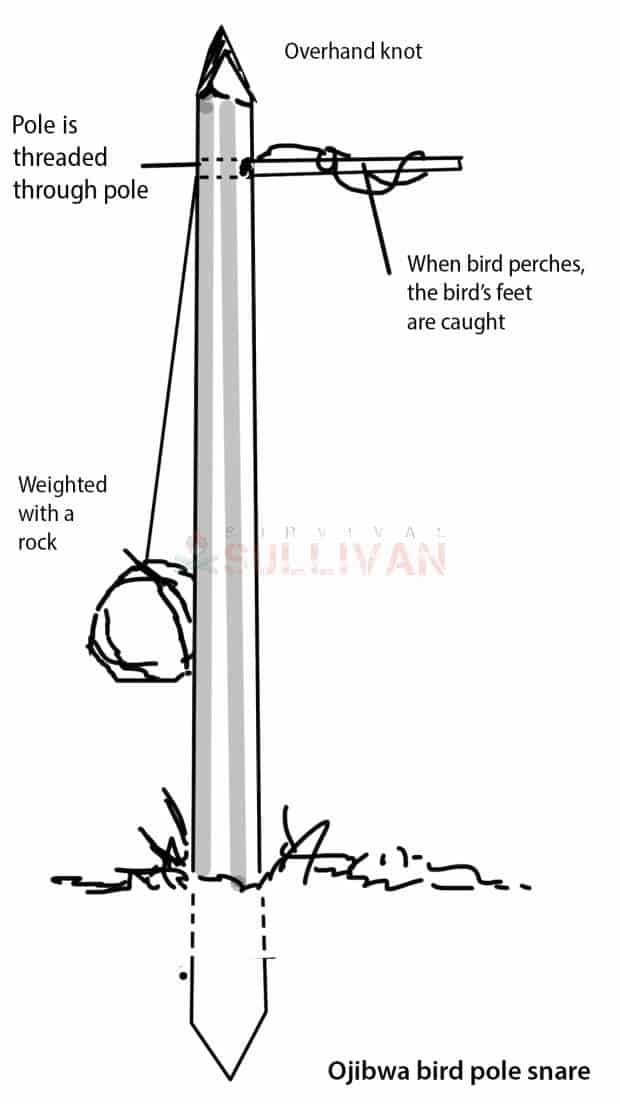
The pole was meant for birds to serve as a perch. With birds such as grouse or grosbeaks they are more ground birds that fly straight up into the protective trees if startled to hide. As the passenger pigeons are perching birds, the Ojibwa bird pole snare was developed.
The Ojibwa Bird Pole Snare
Although a primitive trap, it has a design that is quite sophisticated in its elegance.
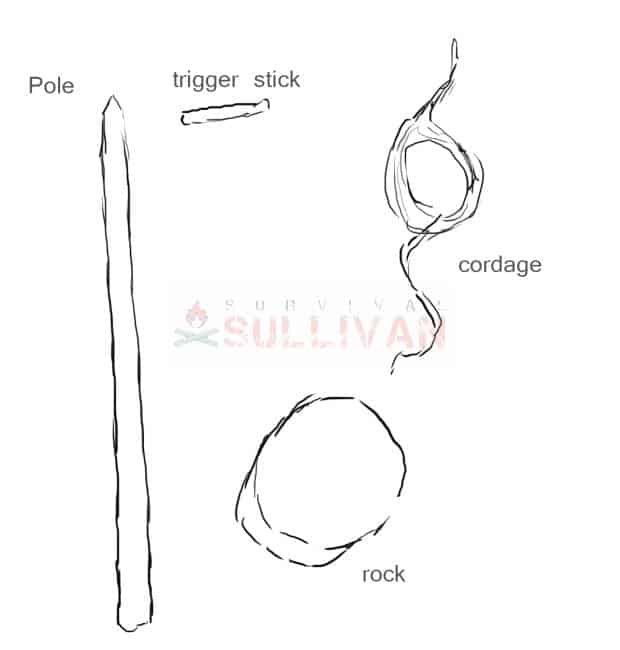
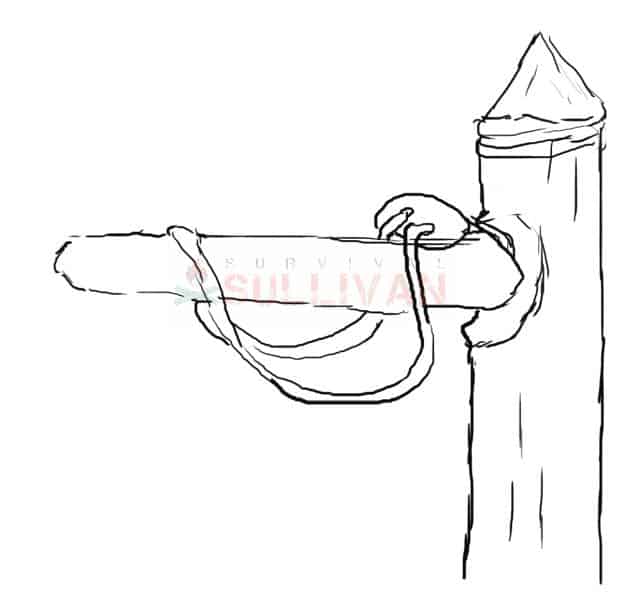
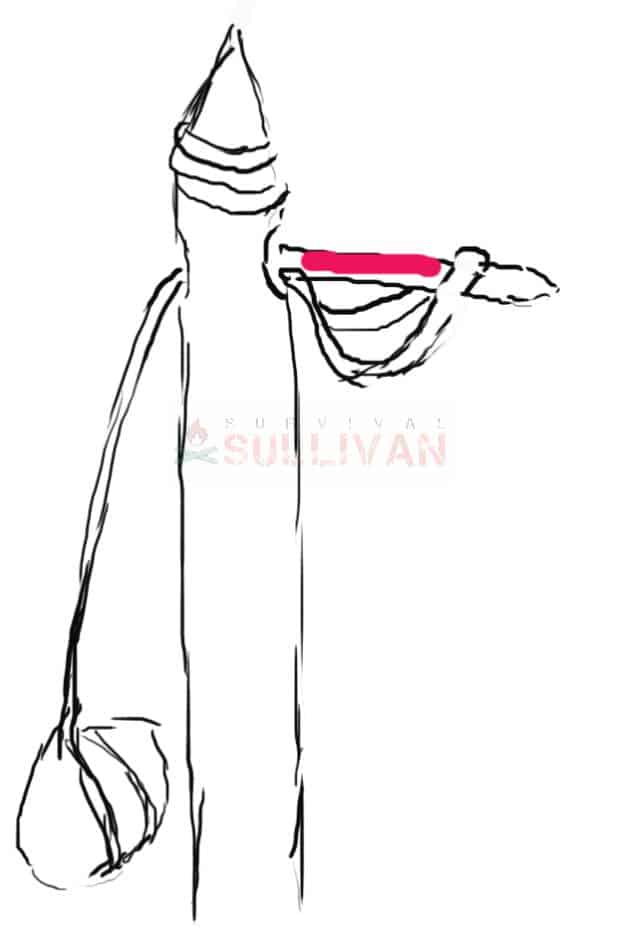
The basic set up consists of 4 main elements:
The Pole
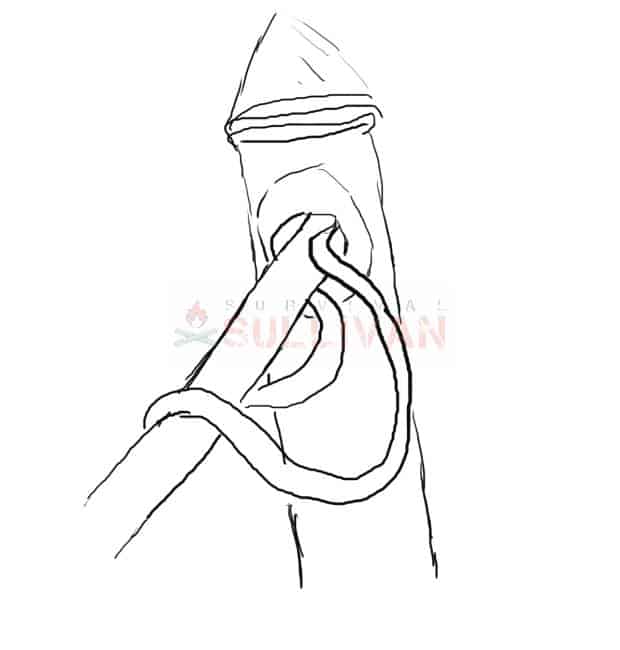
The main piece is a tall pointed pole, about 4 feet in height that you drill a hole in. The hole is bored so there are no snagging pieces inside. You can use flint like the native people, or a hacksaw.
A cord or rope must go through smoothly and without any resistance. The method a lot of bush craft people use is contributed to Kochanski and it is cutting a hole with a long Bowie or hunting knife.
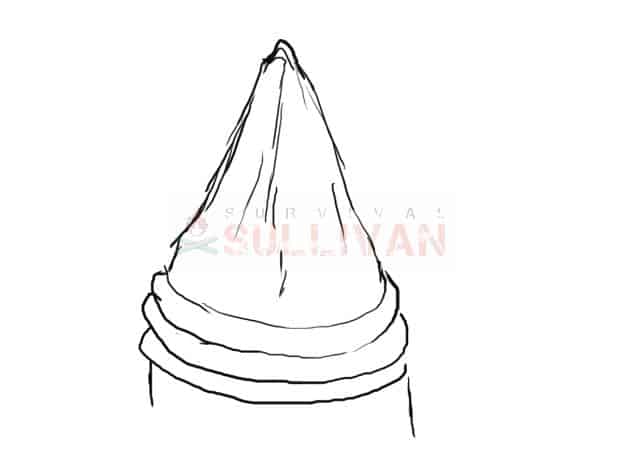
This method makes more of a conical bore on each side so the cord has a range of motion, you can drill the hole of course. Either method would be functional as long as the walls of the hole are smooth inside. You can use your knife to carve a point at the pole’s top. This will discourage birds from landing atop it, and aim them more towards the trigger stick for a seemingly better perching place.
The Triggering Stick
The next piece is a stick that is long enough and thick enough to let a bird perch on it, preferably non-resinous wood (so no pine or cedar). Think of the dowel rods used in bird cages to gauge the width. This triggering stick will fit into the hole as a plug, keeping the snare open by preventing it from sliding shut until it is activated by a bird’s weight on it.
When the bird lands and pressure is presented on the triggering stick, it will cause it to be released. This will allow it to close the snare and shut it.
The Snare
Through the ages many materials have been used from leather strips, natural twines, to wire. I don’t like wire as its too rigid for this type of snare trap and can get misshaped quite easily. After a few uses, it may not slide closed properly, allowing for your catch to escape, or can bend a few times then just snap right in two.
So the consensus is using cord is the best all around. I like the inner strands from paracord as they have a great tensile strength, will not rot or mildew like other natural cords, and slide pretty well allowing for the snare to shut. If you have no paracord, then most cords will do for a while.
The Weight
For this type of snare to work, the activation of the trigger will need to be countered with a weighting mechanism. There are 2 types of mechanisms that will work. A bent sapling to snap the snare closed when activated, or a rock for weight to pull the snare closed with gravity.
The rock method is the one employed by the Ojibwa as it can’t break or be affected by weather like a sapling. So during the long and harsh winter months, the rock won’t fail making it the best choice.
This is the finished Ojibwa bird pole snare:
Here is a closer view of the trigger, and the way it fits into the pole with the snare set.
This is the properly sharpened tip of the pole, to insure the pigeon or any bird to choose the trigger branch as a landing spot for a safer grip.
One variation on the Ojibwa bird pole snare is to add a toggle clip to keep the bird off raised quite a way off the ground and some say its smoother and safer for the prey, but it is not needed. The Ojibwa people used the Ojibwa bird pole snare for many centuries and it is still a reliable trap to this day, so either way is fine.
Using a toggle does insure the birds legs don’t break when the snare is closed, so it is a more humane method. It also may mean the bird, depending on its type, may escape if a particularly strong breed.
Setting the Trap
It is a fairly simple set up. It would be better to practice a few times to make sure your snare line feeds smoothly and the trigger fits snug enough to not fall too soon, but loose enough to be triggered when needed.
A note: To stop the rock for pulling the snare by gravity alone, I have seen people put a knot in the snare close to the rock. This is not advised as it may prevent the snare cord from sliding correctly and let your bird loose.
If the trigger stick is snug enough, you will not need any knots or special ties to keep it from shutting before being triggered by the bird’s weight.
This is what the trap looks like when it is set properly:
As the bird lands here (marked with red), the weight will offset the balance of the stick that has been placed in the pole’s burrowed hole, dislodging it, and letting the rock pull the snare shut as seen below.
One way to entice birds to land and perch is to scatter grains and berries around the stand, or place a leaf with seed in the snare hole. As they come in for landing they will perch first to survey the land for competition, or predator hiding spots.
Have your trap close enough to trees that the birds will fly down onto your perch, but not too close to the local foliage that they just go straight to the seed or bait that you have placed to lure them in.
As stated before pigeons and other migratory birds that perch will be a good prey for this type of snare. This trap was made to harvest the larger passenger pigeon, so it can catch a good sized bird. Rock doves and grouse can also be caught with this type and a few more birds quite effectively.
Final Thoughts
As laws and seasons can differ in many states, you will want to check with your local Wildlife and hunting Bureau for the legality side. For a post collapse situation, using a trap such as the Ojibwa snare can mean life or death in the rough terrain of places like Canada and Alaska.
Maine is near the northern extent of the white-tailed deer range, and they live in many habitats here, from deep woods to farmland to suburban backyards.
Habitat
Major habitats that provide food and cover for white-tailed deer in Maine are forest lands, wetlands, reverting farmlands, and active farmlands. Forest stands containing little or no canopy closure, wetlands, and reverting and active farmland yield the largest and best forage within reach of deer. However, stands made up of mature conifers with tree height greater than 30 feet, crown closure of greater than 60%, and interspersed or adjacent hardwoods for browsing provide critical winter habitat for deer. Ideal deer wintering habitat is connected by other usable habitat to aid deer in moving between them. Currently, 94% of Maine is considered deer habitat; this excludes developed parts of the state. In practice, even a portion of Maine’s developed land is currently occupied by deer. Wintering habitat is more limited in availability, comprising only 2 to 25% of the land base in various parts of the state.
Back to top
Diet
Deer are highly selective herbivores, concentrating on whatever plants or plant parts are currently most nutritious. Finicky eaters, deer opt for variety over quantity, when feeding along in the woods and fields. Deer consume grasses, sedges, ferns, lichens, mushrooms, weeds, aquatics, leaves (green and fallen), fruits, hard mast (acorns, beech nuts, etc.), grains, and twigs and buds of woody plants. Contrary to popular belief, deer consume twigs and buds of dormant trees and shrubs only when more nutritious foods are unavailable. When restricted to woody browse, deer inevitably lose weight. During the course of the year, deer may browse several hundred species of plants. A few are highly preferred; many others are consumed only when the best forages have been depleted. Overabundant deer populations can reduce the abundance of preferred forages, while causing less-desirable plants to become more common. Extremely abundant deer can literally eat themselves out of house and home. At these times, hungry deer are underweight, prone to starvation and disease, produce fewer fawns, grow smaller antlers, and create increased conflicts with homeowners, gardeners, farmers, forest landowners, and motorists.
Back to top
Distinctive Characteristics
Maine is home to one of the largest of the 30 recognized subspecies of white-tailed deer. After attaining maturity at age five, our bucks can reach record live weights of nearly 400 lbs. Most adult bucks, however will range from 200 to 300 pounds live weight and will stand 36 to 40″ at the shoulder. Does are considerably smaller; they normally weigh 120 to 175 pounds live weight. Newborn fawns begin life at 4 to 10 pounds but grow to approximately 85 pounds live weight in their first six months of life.
Whitetails have reddish brown fur in the summer switching to a grayish brown in winter. Their trademark white tail, when erected, flashes a danger signal to other deer in the vicinity. Whitetails have keen hearing, made possible by large ears that can rotate toward suspicious sounds. They have wide-set eyes, enabling them to focus on subtle movements while maintaining an excellent sense of depth perception. Whitetails have a very keen sense of smell enabling them to sense danger, even when visibility is poor. They have long graceful legs, enabling them to cover ground quickly by leaping, bounding, turning and outright running at speeds up to 40 miles per hour.
White-tailed deer communicate using a variety of sounds, ranging from explosive “whooshes” when startled, to the barely audible mews and grunts a doe uses to tend to her fawns. Deer are very expressive; they employ a large repertoire of signals using facial expressions and body language. These postures help to maintain the dominance hierarchy within all deer groups. Deer also communicate using odors, which emanate from a number of scent glands.
Back to top
Nocturnal/Diurnal
White-tailed deer are crepuscular animals, meaning they are typically most active around dawn and dusk. This does not mean that deer are not at all active during the day. Deer activity may also be influenced by weather, seasonality, and human activity. During hot summer days, for example, deer are less active during the daytime and more active at night when it’s cooler. Conversely, deer may be more active than usual during cooler weather. Deer activity may increase throughout the day during the breeding season while bucks are actively searching for does that are receptive to breeding. Areas with a lot of daytime human activity – which may include in the woods during the hunting season if hunter densities are high- may see little daytime deer activity and increased nocturnality of resident deer.
Back to top
Seasonal Changes
Summer home ranges (area that an animal lives within) for deer in Maine are generally 500-600 acres but can vary from 150 to more than 2,000 acres. Movement by deer from summer to winter range can vary from less than a mile to more than 25 miles depending on availability and suitability of the winter range. Deer are not generally territorial (defend their home range against intrusion of other deer). However, pregnant does will defend a small birthing area (less than 20 acres) against intrusion by all other deer, for about a month.
Bucks annually produce antlers, which are made of bone. Triggered by day length and maintained by hormone production, antlers begin growing in April, and are nurtured by a velvety outer network of skin tissue and blood vessels. Velvet is shed when growth is complete in late August and September. The hardened, polished antlers remain until they are shed in late December to early March. In whitetails, antlers allow bucks to advertise and demonstrate their dominance; hence they play a role in reproduction. A buck’s first true set of antlers normally is grown by age one. Buck fawns, however, begin growing the antler base at one month of age. This base develops into two or three-inch velvet-covered “nubbins” by early winter. White-tailed does sometimes produce antlers, but this is rare. Does that do sprout antlers typically are older (5 to 15 years old); their antlers are usually velvet-covered spikes. Most antlered does remain fertile.
Each year, deer produce two coats of hair, each adapted to seasonal climate. In late spring, deer grow a coat of fine, short reddish hair. This pelage allows ample air circulation and helps the deer to stay cool in summer’s heat. During September, deer molt to a highly insulative coat which consists of a dense layer of fine woolly hair under a layer of long hollow brown, gray, and white guard hairs. The guard hairs can be erected to form a very thick insulative coat, which protects against the cold winds of winter. Fawns are born with a reddish-brown coat dappled with white spots. This affords excellent camouflage against detection by predators in the summer. By early autumn, fawns grow the typical winter coat.
Another adaptation for survival is the deer’s habit of storing fat for the winter. In autumn, deer accumulate fat under the skin, in the viscera, between the muscles, and in the hollow bones of the legs. This fat layer can comprise 10 to 25% of a deer’s body weight by late fall. In winter, fat is reabsorbed to provide much-needed energy to supplement inadequate diets of woody browse.
Back to top
Reproduction & Family Structure
The peak breeding season for deer in Maine occurs during mid-November, although some breeding may occur in October and as late as January. The onset of the rut in bucks and estrus in does is controlled primarily by decreasing day length. Does in estrus are receptive to breeding for roughly 24 hours, and if not successfully bred, they will come into heat every 28 days, until early winter. Bucks establish and maintain a dominance hierarchy; typically the majority of does in an area are bred by the most dominant bucks. Gestation period for deer is roughly 200 days, after which well-nourished adult does give birth to twins, triplets, and rarely, quadruplets. Fawn and yearling does typically produce one fawn, if they conceive at all. The peak fawning season in Maine is mid-June. In a typical year, each 100 Maine does will give birth to about 130 fawns. However, early fawn losses tend to be high; only 60 to 80 of these young deer typically survive their first five months of life.
What to do if you find a deer fawn all alone
Back to top
Survival & Threats
White-tailed deer can live to 18 years, but few deer in the wild live that long. Does typically live longer than bucks presumably because rutting behavior predisposes bucks to higher losses due to hunting, motor vehicle collisions, physical injuries, and depletion of fat reserves going into the winter. Deer populations subjected to high hunting mortality are comprised of predominantly young deer. Conversely, a greater proportion of deer annually survives to older age classes within lightly hunted herds.
Causes of mortality of while tailed deer vary throughout the state. In more developed areas, deer are commonly struck by vehicles, harvested by hunters, and killed by predators. In less developed areas, human-related deaths are relatively few, and adult deer are more commonly taken by predators, particularly coyotes, lynx, and bobcats. Young fawns may also be preyed upon by black bear, fisher, and fox. Deer of any age may succumb to malnourishment of other natural causes, particularly at the end of harsh winters and in the following spring. Presently, Maine’s deer are relatively disease-free, and there are no diseases with significant negative impacts on our deer populations at this time.
Back to top
Management & Conservation
Population and Distribution Trends
Maine’s white-tailed deer population has experienced periods of boom and bust, and circumstantial information suggests that the state’s deer population likely did not exist in high abundance prior to the arrival of European colonists in the early 1600’s. With a combination of harsh winters, a higher predator population, and perhaps a lack of young vegetative growth for forage, white tailed deer may have been restricted to the southern coast until the European colonization. With colonization, settlers began clearing the landscape through small-scale logging operations, triggering an increase in the growth of undergrowth, providing white tailed deer with an optimum mix of forage and cover. From then, deer expanded their range and became more common in central and northern Maine. After the extirpation of cougars and wolves from Maine, deer were able to farther expand and increase in numbers with virtually no predation. Still, deer numbers continued to fluctuate with winter severity and large-scale events that caused significant habitat changes such as fires or spruce bud worm outbreaks.
Historical Management
MDIFW began estimating deer populations in the mid-1950’s, enabling the state to better understand the status of the populations and create a more informed management decision process. Between the mid-1950’s and early 1960’s, MDIFW estimated Maine’s deer population at 250,000. Eventually, habitat changes, severe winters, coyote colonization, and increased hunting pressure led to declining deer populations, and Maine’s deer population reached an estimated 141,000 deer in the 1960’s. Following this time and continuing through the late-1980’s, Maine’s deer population expressed slow growth, eventually causing a series of new management strategies and laws that attempted to expedite the growth of Maine’s deer population. Finally, Maine’s deer population grew prolifically through the 1990’s as a result of the regulatory system that limited doe harvest, plus a series of mild winters. During this time, Maine’s deer population grew to an estimated all time high of 331,000, however, much of the growth occurred within the southern tier of the state. Generally speaking, the Department has been successful in achieving deer population objectives in central and southern Maine, where wintering habitat and other factors were more favorable. Achieving meaningful herd increases has been less successful in eastern and northern Maine. Today, deer abundance ranges from one to five deer per square mile in the north, to 15 to 35 deer per square mile in central and southern areas. Some locations, in which access to recreational deer hunters has been limited or denied entirely, support higher deer populations that are above socially acceptable levels. These latter areas are above desired population levels, and they are the focus of most deer/people conflicts in Maine today.
Current Management
Prior to 1975, MDIFW did not set specific goals or quantified objectives for the deer population, harvest, or hunter success rates. Most regulatory actions were made by the Legislature and they were reactions to severe winters, or perceived regional declines in deer abundance. Between 1975 and 1985, MDIFW initiated strategic planning for deer, part of which involved setting publicly-supported goals and objectives. In some areas, this meant attempting to manage deer populations to specific deer densities.
With the more recent implementation of a new Big Game Management Plan, the Department no longer attempts to manage deer to specific deer densities. That approach did not adequately account for many other important aspects of deer population management such as maintaining animal health and social acceptance of deer levels and limiting negative impacts of overabundant deer. Deer management in Maine currently strives to maintain deer levels that are socially acceptable and in balance with available habitat. In areas where deer numbers are not socially acceptable or where deer are causing significant damage to habitat, the Department employs a variety of small-scale management options to try and alleviate the problems.
Each year, MDIFW staff and contractors examine roughly 6,000-8,000 hunter-killed white-tailed deer to collect data on population sex ratios, age structure, estimated mortality and recruitment rates, and body and antler size to provide a clearer picture of the size and health of both the population and habitat. From these examined deer, we also collect samples from roughly 500 deer annually to test for Chronic Wasting Disease, one of the greatest threats facing deer in this country. For more information on data collected in support of Maine deer management, please visit our Research & Management Report (PDF).
Improving deer populations in Maine’s northern and eastern forestlands depends on protecting and increasing amounts of deer wintering habitat. Protection of deer wintering habitat has historically been dependent on landowner cooperation and has not always been possible. Beginning in 2021, MDIFW gained access to funding allowing for the purchase and management of deer wintering habitat, and efforts are underway to identify candidate parcels with willing sellers.
Many Mainers in areas of low deer density have begun artificially feeding whitetails, especially in the winter, which adds an important and relatively new dynamic to the deer wintering landscape in Maine. In Maine’s heavily developed southern and coastal regions, MDIFW staff will continue to develop innovative approaches to safely manage deer harvests in order to maintain deer populations at levels that provide hunting and viewing opportunity while alleviating negative impacts from deer. In all of Maine, we will need to improve access to huntable land through proactive landowner relations programs in order to keep deer populations at tolerable levels.
Current Research in Maine
Maine Deer Winter Mortality Study
Since the early 1970’s, Maine has used a metric called the winter severity index (WSI) to describe how Maine winters impact winter mortality rates (WMR) in deer. WSI is one of the cornerstones of deer management in Maine and impacts the number of antlerless deer permits allocated for hunters each year. Because ecological relationships change over time, this metric needs to be periodically re-evaluated.
For that reason, in 2015, the Maine Department of Inland Fisheries and Wildlife (MDIFW) began a study to reassess the relationship between WSI and WMR. Doing so requires data on winter temperatures and snow conditions, which are used to determine WSI, and data on the survival rates of deer in the winter. Temperature data are provided by temperature loggers placed at 26 WSI monitoring stations throughout the state. Snow condition data are also recorded by biologists and volunteers at these monitoring stations. At the end of winter, in early April, data from temperature loggers and snow measurements are used to calculate a WSI value, which will inform permit allocations for the upcoming deer season.
From 2015 to 2021, MDIFW captured white-tailed deer and fixed GPS collars to them to monitor their movements and survival rates. D eer were captured in wildlife management districts (WMDs) 1, 5, 6, and 17.
The fates of these deer in conjunction with data on the severity of the winters they encounter will help to re-evaluate the relationship between WSI and WMR and help shape deer management in Maine in the future.
The major goals of this study are to:
Reevaluate the correlation between WSI and WMR for white-tailed deer
Assess seasonal survival rates for the adult deer population
Assess cause-specific mortality of our adult deer population
Reassess the current winter severity index and try to identify a new and more simplistic metric
Back to top
Living with Wildlife
How to Prevent or Resolve Conflicts with Deer
White-tailed deer are one of the most recognized mammals in Maine, with frequent sightings throughout the state. However, deer are known for entering and consuming vegetation around the home or in gardens. Learn more about how to prevent and resolve conflicts with deer
The cottonwood tree is one of the most popular tree species in the world. Going by the scientific name Populus Deltoides, the tree originates from and is common in North America, growing in the US, Canada, and Mexico.
Read on to learn more about how to identify this beautiful tree…
The trees come in different varieties and are identified quite easily using their subspecies names. Cottonwood trees growing in southern Canada and the Eastern US come from the subspecies Deltoides, while those growing in the Southern part of Canada and the Central sections of the US go by the subspecies name Monilifera. The Wislizeni subspecies grows in the southern parts of Colorado, Texas, and Mexico.
All these subspecies of the cottonwood tree can grow to a height of up to 60 meters and a diameter of about 3 meters, making it one of the largest hardwood trees in North America.
For optimal growth, the trees grow around rivers and floodplains to access water.
As noted earlier, the cottonwood tree has three different subspecies spread out across North America. The Deltoides subspecies grow in the southern-eastern parts of Canada and the Eastern parts of the US. Some of the notable areas include Ontario, Quebec, North Dakota, and Texas.
In comparison, the Monilifera subspecies grow in south-central Canada, the central US, and New Mexico. Cities in these areas include Manitoba and Alberta.
The final subspecies of the tree is termed Wislizeni. It grows mostly in southern Colorado, Texas, Mexico, and California. Identifying the cottonwood tree and distinguishing each of these tree species is quite a task. Fortunately, we’ve got you covered. In the next sections, we offer a guide on identifying the cottonwood trees and distinguishing their various varieties. We will start by looking at how cottonwood trees germinate and spread.
How Cottonwood Tree Seeds Germinate and Spread
As noted earlier, the eastern cottonwood tree grows mostly in the east side of the US, stretching all the way into Canada. The tree grows in a wide range of soil types. However, for optimal growth, well-drained soils along river banks are recommended.
The tree is also diecious, implying the male and female flowers grow on separate trees.1 Usually, the male flowers and buds grow earlier than female buds. They also tend to bloom much faster than their female counterparts.
The seeds of the tree develop in capsules hosted by short stalks. Under most conditions, the trees start producing seeds at the age of 5 to 10 years. Seed dispersal happens about two months after flowering. Water and wind are the seed’s main dispersal agents. Since most cottonwood trees grow around water bodies, the water medium and winds in such locations carry the seeds, dispersing them in the process. Unfortunately, the viability of the seeds is a bit low. To germinate, they must find moist seedbeds or be immersed in water, conditions that are not always readily available.
Nevertheless, the seeds can enjoy a germination rate of as high as 90 percent under the right conditions.1 These optimal conditions include sufficient sunlight to supply solar energy and soil moisture to supply water for photosynthesis. The growth of the seeds starts slowly.
Once the root zone is developed, the rate of growth is much faster. This fast and steady pace of growth is maintained throughout the tree’s lifetime. One feature of the tree worth noting that affects its growth is its shading tolerance.
In this regard, cottonwood trees are shade intolerant. They are one of the most shade-intolerant hardwood tree species, coming second to only the Black Willow.
Both of these trees grow in the same areas, competing for light and water. However, cottonwood trees tend to outgrow Black Willows, especially in stable water and sunlight levels1 Having discussed how cottonwood trees germinate, let’s now review how the trees look like.
What Do Cottonwood Trees Look Like?
Flowers of Cottonwood Trees
Cottonwood trees are easy to identify from their flowers, leaves, barks, and seeds. The male and female flowers grow on separate trees, a property identified by the term dioecious.2
The flowers are contained in about 3 inches of catkins. Each catkin has about 15 to 40 buds and is uniform in length. The flowers in the catkins appear before the leaves and are usually pollinated by winds.
The male flowers in the catkins protrude from the tree’s branches in clusters of about 2 to 4 inches. They are typically red and yellow with between 30 and 40 stamens. In comparison, female flowers are green and appear singly. Each female flower has a separate stalk.
Leaves of Cottonwood Trees
The leaves of cottonwood trees are triangular with a heart-shaped base that tapers to a long-pointed tip. They can grow to about 7 inches long and 5 inches wide and are shiny green on the top and slightly pale on the underside.2
The stalks of the leaves are long and slender, with two glands at the top. The heterophyllous property of the leaf is perhaps its most distinguishing property. Regarding this, cottonwood trees have two types of leaves; those formed during early winter and those produced later in the season.
The trees use the leaves that grow in early winter for early spring growth, while those growing later in the season are for full maturity. The leaves are distinguishable based on their size and number of teeth, with the former having smaller and fewer teeth than the latter.
Barks of Cottonwood Trees
The barks of cottonwood trees vary in texture, color, and furrowed depth depending on the tree’s age. Typically, young trees will have smooth, shallow furrowed, light grey to yellow-green bark. 2
As the trees grow and mature, the bark’s color changes to gray and becomes rougher, and deeply furrowed. The twigs from the bark are brown and angled, with large buds of about three-quarter inches long. Green-brown resin scales cover the bark of the tree.
Seeds of Cotton Wood Trees
The seeds of cottonwood trees are formed after the pollination of flowers. Before fertilization, female catkins are about 6 inches long. Once fertilized, they produce elliptical shaped seed capsules that are initially green in color.
With time, the seeds turn brown, and the capsules split, releasing about 7 to 10 seeds. The seeds are usually attached to a white cotton-like thread that is easily dispersed by the wind.
Cottonwood trees start producing seeds at five years old, with their peak productivity coming at fifteen years.2 From that point onward, the trees will continue producing seeds for the rest of their life cycle.
Habitats of Cottonwood Trees
Cottonwoods grow in mostly riparian areas such as streams, rivers, and wetlands. The combined ecosystem of the cottonwood trees and marshlands offers an amazing habitat for different species of animals.
Some animals in this habitat include beavers, which feed on cottonwood’s tree barks, shoots, and stems. They also burrow holes into the trees to form their homes. Raptors, otherwise known as birds of prey, use cottonwoods as nests, while insects feed on the bark and other parts of the tree.
So vast is the biodiversity in cottonwood tree habitats that researchers estimate about 40 different animal species benefit from these trees.4 Other animal species in cottonwood forests include moose, deer, elk, insects, and birds.
The Cottonwood Tree Habitat’s Value to Plants
The Eastern cottonwood tree is by far the most predominant plant species in the flood plains of the US. The floods in these locations create ideal conditions for the growth of trees and other species.
Within these locations, cottonwood trees grow in pure and mixed stands. Other tree species that grow side by side with the cottonwood tree in these habitats include the white oak, black-berry, American hornbeam, and basswood. These riparian habitats that host cottonwood trees are also known to have common shrubs such as the Northern spicebush, black tupelo, and sand oak.8
Graminoid tree species in the habitats include wheatgrass, sand dune, switchgrass, and Indiana grass. These habitats are also known to have forbs (herbaceous flowering plant other than a grass) and vines. Common ones include the Asian bittersweet, poison ivy, trumpet creeper, and Virginia creeper.
Some cottonwood species grow in plains. In such habitats, tree species associated with the cottonwood tree include the green ash, American elm, and Russian olive. Shrubs in plain cottonwood habitats include the rocky mountain marple, douglas hawthorn, and Eastern wahoo. Graminoids in this location include the blue grama, Cheatgrass, and Canada wildrye. Forbs and vines include the Virginia creeper, pepper vine, and long root smartweed.
The Cottonwood Tree Habitat’s Value to Animals
Cottonwood tree habitats are exceedingly important for animal life. Eastern cottonwood trees are classified as having a fair value for most wildlife species, including songbirds, game birds, and game mammals.
For example, the northern Great Plains, which hosts eastern cottonwood trees, provides about 50 percent of deer habitats and 70 percent of the habitats for the sharp tailed grouse. Palin cottonwood regions support about 82 percent of the bird species in Colorado.8
As noted earlier, cottonwoods have three subspecies. In more casual terminology, these subspecies are termed Eastern Cottonwood, Black Cottonwood, and Fremont Cottonwood. Each of these tree types has a unique set of characteristics that sets it apart from the others.
The Eastern Cottonwood Tree
This subspecies is most popular in North America. The tree grows in riparian areas and is considered one of the softest hardwood trees in the region.
The Black Cottonwood
This subspecies grows mostly in rocky mountains. Also called the Western Balsam poplar of the California poplar, this tree is the largest type of Western Cottonwood.
The Fremont Cottonwood
This subspecies grows in California, Utah, Arizona, and Mexico. The tree is quite like the Eastern Cottonwood, save for the larger and fewer leaves and differences in flower and seed pod appearance.
Identification Based on Location
Another way to identify cottonwood trees is by looking at the ecological characteristics of the location of the trees. As noted before, cottonwood trees grow well in areas with sufficient light. The trees are the second most shade-intolerant species in North America.
They also require a lot of water. So much water that most cottonwood trees are grown in riparian areas such as rivers, lakes, and marshlands. Knowing these prerequisite conditions for the growth of the trees makes it easy to locate them.
For instance, in North America, the US’s Central, Eastern and Southwestern states have these conditions. It is therefore not surprising that most of the cottonwood in the country grows in these regions. Similarly, in Canada, cottonwood trees grow along the lakes and rivers in Ontario. Again, these conditions are favorable for the trees. Finding them in such locations is therefore predictable. By knowing the optimal conditions for the growth of the trees, identifying them is as simple as matching the conditions to a corresponding ecosystem.
Identification Based on Nearby Tree Species
Another way to identify cottonwood trees is by looking at the nearby tree species. A limited number of tree species can grow under the conditions favored for cottonwood trees. Therefore, by knowing which trees can grow under similar conditions to cottonwood trees and identifying them, locating cottonwood trees growing nearby is fairly easy.
For example, the black willow tree grows under fairly the same environmental conditions as cottonwood trees. In many locations, the two tree species compete for sun and water. Thus, by identifying black willows in a given site, one is also likely to find cottonwood trees nearby.
Notably, cottonwood trees have more than just ecological value. They are also historical monuments. The story of the Kansas State Capitol – Cottonwood Tree illustrates the historical importance of the tree.
The cottonwood tree is one of the state symbols of Kansas, and is visible in old photos of the capital and the story of how a cottonwood tree became a city symbol is quite an interesting one.
One account provides that the cottonwood tree in the old photos of the Capitol grew in the east wing of the Capitol. It offered a much-appreciated shade for dignitaries of the city, including Benjamin Harrison and Vice President Curtis.
The Kansas Historical Society shares a much more reliable account. The story goes that T.J. Anderson moved to the city in 1865 and bought a house that faced the Capitol. At one point, he noticed a small tree of about three feet growing between some of the building’s stone. He and a fellow professor decided to preserve the tree even during the Capitol’s construction, and that is how it came to appear in the photos.
Fire would later ravage the Capitol’s cottonwood tree in 1882. In 1966 the tree experienced more damage, from the Topeka Tornado that happened that year. In 1983, the Secretary of State, Jack Brier, made several attempts to prevent the tree from collapsing.3 Despite all efforts, the tree finally collapsed at the end of that year.
As one of the native trees in North America, the Cottonwood tree delivered several benefits to the ancient communities of the region.5 Most native communities used the tree for religious practices. In particular, the native tribes of Pueblo and Navajo used the tree extensively in their spiritual practices.
Its roots were sometimes used to make Kachina dolls and other objects of worship used in traditional religious ceremonies. Other ancient tribes used the tree as a source of medicine. The community doctors would use the bark and leaves of the trees to make concoctions that many believed to have healing properties.
The uses of the tree went beyond religious and medicinal applications. Some native communities used the trees to make toys and dugout canoes for sea traveling. The large size of the tree’s trunk makes it possible to create such canoes, while the leaf’s shape makes it suitable for making toy whistles.
Others used the tree to make yellow dyes. The dye comes from the tree’s buds, which have chemicals that, once dried, produce the yellow pigment.
Some communities would even consume the seeds of the trees. The seeds have a sticky feel that gives a gum-like sensation that was a delicacy back in those days.5 Cottonwood trees continue to deliver these benefits and more today.
Modern Uses of Cottonwood Trees
The uses of cottonwood trees have since increased from their native applications. Presently, the tree is used primarily for making lumber and related products.6 The tree is suitable for such applications due to its moisture content and density.
In that regard, cottonwood trees have a very low moisture content of about 12 percent measured on a wet basis, and a light density of about 28 pounds per cubic foot.7 These properties make the tree light, but very strong… exactly what is needed for interior furniture applications.
Consequently, most lumber uses of the tree are limited to interior décor. The mentioned properties of the tree also make it exceedingly suitable for making wood pulp. Wood pulp has been increasing in popularity over the past few years. Cottonwood trees are used to make this pulp that is then used to produce high-quality papers for magazines and books. Important to note here is that the uses of cottonwood are limited to light applications, which, as stated earlier, are due to its low moisture content and light density.
In exterior furniture applications, using this tree is not recommended. Its light properties make it too fragile to carry the immense loads that exterior furniture typically carries. Other modern applications of the tree include usage in making food containers and packaging.
The Legacy of Cottonwood Trees in North America
Cottonwood trees are one of the most popular hardwoods in North America. The tree has several ancient uses, including making carvings used in religious festivals. Modern uses of the tree include mostly lumber and related products, where the tree’s low moisture content and light density is highly desired.
The trees are easy to identify by looking at their flowers, leaves, barks, and seeds, the details of which are covered extensively in this guide. Cottonwood trees also offer a habitat for various animal and plant species, some of which have been listed.
Beyond the mentioned benefits, cottonwood trees have historical value, too. Kansas uses the tree as one of its symbols, a metaphor for strength and longevity. With these tips for how to identify the trees based on their local names, location, and nearby tree species, you can start searching for these trees, and impress your friends with the subspecies.
These trees do more than all of this, though. As hardwood trees, they act as carbon sinks, meaning they suck a large amount of pre-existing carbon dioxide (CO2) out of the air. So, these trees actually have the power to not just slow down climate change, but actually reverse it with their carbon removal capabilities. It’s for this reason that the world needs to conserve these trees, to help them aid the Earth as a whole.
“Exploring Felon Firearm Rights: Air Rifle Ownership in Michigan”
Can a felon own an air rifle in michigan?
In Michigan, the ownership of firearms by felons is heavily regulated. While state law allows for the possession of certain types of firearms by individuals with felony convictions, it remains unclear whether this extends to air rifles. Although an air rifle may not be classified as a firearm under federal law, Michigan statutes do not specifically address whether felons can possess or own such weapons. Therefore, it is essential for individuals with felony convictions in Michigan to seek legal advice or clarification from local authorities regarding the ownership and possession of air rifles.
One potential avenue for felons to legally own an air rifle in Michigan is through obtaining a restoration of their firearm rights. This process involves applying to the court and demonstrating that they have been rehabilitated and are no longer a risk to society. If successful, felons may regain their firearm rights and potentially be allowed to possess an air rifle. However, it is important to note that this process can be complex and time-consuming, requiring the assistance of an attorney familiar with firearm laws in Michigan.
In Michigan, felons are prohibited from owning firearms, including air rifles. State law treats air rifles as firearms, subject to the same restrictions. Therefore, a felon cannot legally own an air rifle in Michigan.