Every bow requires some degree of tuning to achieve maximum forgiveness and accuracy. Performing additional super-tuning steps, such as yoke-tuning or moving the cam’s position on the axle, can truly boost arrow-flight performance and your confidence as a bowhunter.
Question: My bow continues to paper-tune with a tail-left tear. I’ve tried moving my rest to the right, to the left, and I’ve adjusted the string-yoke harnesses as suggested by a friend. But I’m still getting a ragged tear and lousy broadhead flight. Can you help? — Alex D., via e-mail
Answer: Bows that don’t tune easy can be frustrating, and I’ve even had a few that wouldn’t tune at all! However, modern-day bows are manufactured with exceedingly close tolerances, so it’s a matter of making a few small adjustments to solve the problem. It could be as easy as resetting the cams, so they are synchronized and rotating plumb with the bowstring. Or you may have to move one or both cams to a different position along the axle by adding shims (small spacers) to one side of the cam and removing from the other.
Such steps are often referred to as “super-tuning,” but these actions simply place the bow’s powerstroke directly in line with the arrow. Shooting style varies, so although the bow may tune perfectly in a shooting machine, this may not be the case for a particular archer.
To perform these tuning steps, you need to have access to a quality press and some basic archery tools so you can work systematically until the flight issue is cured.
When tuning a bow, don’t skip the basics. With a persistent tear like yours, be sure to first check for fletching contact. Spray aerosol foot-powder across the arrow’s fletching area, then shoot it into a firm backstop. Any “smears” of the white powder indicate vane contact with the rest, cables, or riser — a common culprit of poor arrow flight. Also, don’t tune a bow without using several shafts to see if the tears remain the same. If spine varies from one arrow to the next (trust me, not every arrow is made the same), you’ll see various types of tears. Twisting the nock in one-quarter increments could also produce different tears.
Once the basics are covered, move on to synchronizing the cams. The cables should strike the cable stops at the exact same time. Next, assess each cam’s vertical position while at full draw. Cam lean is checked by using a bow-drawing device (or draw board) to allow an easy evaluation of how the cams are oriented. By laying an arrow across the surface of the cam, you can determine if the cam is in line with the bowstring. If the arrow points off-center to the left or right, then cam lean is present. If a draw board is not available, draw your bow and have a friend assess the cams’ positioning. To fix cam lean, adjust the string-yoke harness by twisting one side and untwisting the other, allowing the limb’s tip to equalize the load.
If the left tear persists, try moving your rest to the right, but oftentimes this only works for a very small left tear. Rest adjustments are better for “micro-tuning” groups downrange and adjusting the points of impact for fieldpoints and broadheads. Overall, it’s better to maintain the proper arrow centershot position as recommended by the bow’s manufacturer. This provides improved vane clearance and allows the arrow to stay in the center of the bow’s riser, limbs, and grip for optimum performance.
With large or persistent tears, shimming one or both cams will eventually eliminate the tear (I prefer to yoke-tune first). When repositioning the cam, always move it in the direction of the tear. Depending on your bow’s spacers, you may have to purchase new shims with varying thicknesses to make the necessary horizontal adjustments. Lancaster Archery and Last Chance Archery sell relatively inexpensive spacer kits and tools for this type of tuning.
There are several ways to tune a bow, but I believe paper-tuning is the most precise way to capture irregularities in arrow flight because it examines flight issues only a few feet from the bow. To improve paper-tuning even more, try using a bare shaft. To simulate the weight of vanes, wrap the rear of the shaft with a piece of electrical tape. The bare shaft will expose the smallest rips in paper so you can improve consistency downrange. Any small accuracy adjustments at this point are resolved by moving the rest or D-loop in 1⁄16″ or 3⁄32″ increments until maximum accuracy is achieved.
Trolling fishing is a popular technique used by anglers to catch this prized freshwater game fish. The method involves dragging one or more baited lines or lures behind a moving boat at varying speeds and depths until a walleye takes the bait.
Trolling for walleye can be done on freshwater lakes or rivers, and requires specialized equipment and techniques to be successful. Walleye trolling can be a fun and challenging way to target these elusive fish and is a favorite among many anglers.
Trolling Fishing A Historical Overview
Walleye trolling has been practiced for many years, with the first recorded use of this technique dating back to the early 1900s.
At the time, anglers used hand-cranked reels to drag baited lines behind their boats.
As technology improved, the method became more efficient with the development of electric trolling motors and other specialized equipment.
Today, walleye trolling is a popular sport enjoyed by anglers all over the world, and has even led to the development of specialized boats and equipment designed specifically for this type of fishing.
Despite the advancements in technology, the basic principles of trolling fishing for walleye remain the same – drag a baited line or lure behind a moving boat to attract and catch walleye.
Essential Gear for Successful Walleye Trolling Fishing
To be successful at trolling fishing for walleye, you’ll need a few key pieces of equipment.
The first is a trolling rod and reel setup, which should be strong enough to handle the weight of your lures and the fight of a walleye.
Look for a trolling rod that is at least 7 feet in length and has a medium-heavy power rating. Using a sensitive fishing rod can aid in detecting bites and setting the hook properly
Opting for a reel with a smooth drag system can assist in wearing down a walleye and reducing the risk of line breakage. A drag system that is rated for at least 10-12 pounds can help you handle a larger walleye.
The Penn Fathom Lever Drag 2 is an excellent option to consider.
With its user-friendly design and lever drag system, this reel provides a smooth and intuitive experience.
A level wind reel is ideal for trolling, as it distributes line evenly across the spool and can help prevent tangles.
A downrigger or planer board can help you get your lures to the right depth and keep them there.
Investing in a quality trolling rod and reel setup can make a big difference in your success when trolling for walleye.
You’ll also need a trolling motor or an outboard motor that is powerful enough to move your boat at a slow and steady pace.
Boats Suitable For Trolling Fishing
Having the right boat can make a big difference in your success.
Ideally, you’ll want a boat that is stable, maneuverable, and has plenty of space for you and your gear.
A flat-bottomed boat, such as a jon boat or a bass boat, can be a good choice for trolling, as they offer good stability and maneuverability in calm waters.
Alternatively, a larger boat with a deep-V hull can be a good choice if you plan to fish in rougher waters or if you need more space and storage for your gear.
Equipping your boat with a trolling motor and depth finder can assist you in navigating the water and identifying the prime locations for trolling fishing.|
To ensure a successful fishing trip, it’s crucial to have a high-quality net and cooler on hand.
Trolling Motors For Walleye Trolling
There are many great trolling motors available in the market, but one of the best options for trolling for walleye is the Minn Kota Endura C2 55. This motor is known for its reliability, durability, and quiet operation. It has a 55-pound thrust, making it powerful enough to handle rough water conditions and strong currents. Additionally, it features a telescoping handle, allowing for easy control and maneuverability. Overall, the Minn Kota Endura C2 55 is an excellent choice for any angler looking for a quality trolling motor for walleye fishing.
Best Lures and Baits for Walleye Trolling
Walleye are often attracted to lures that mimic the movements of their natural prey, such as minnows or leeches.
The best walleye lure baits can vary depending on factors such as water temperature, time of day, and the specific body of water you’re fishing
Recommended baits are crankbaits, spinnerbaits, and spoons. Designed to attract walleye.
A depth finder or fish finder is also useful for locating schools of walleye.
It also helps determining the depth at which they are feeding.
Recommendations For Lures Based On Water Depth
Less than 15 feet a floating crankbait or spinner rig can be effective.
These lures can be trolled at a slow speed near the surface, which can attract walleye that are feeding on smaller baitfish.
15-30 feet. A deep diving crankbait or a jig and plastic tail can work well in medium depth water.
These lures can be trolled at a moderate speed to get them down to the right depth and keep them there.
Use a downrigger for depths over 30 feet.
A deep diving crankbait or a spoon can work well in deep water, as they can replicate the movements of larger baitfish that walleye may be feeding on.
Speed And Depth For Walleye Trolling
Speed and depth are critical factors to consider when trolling for walleye.
Generally, a speed of 1.5 to 2.5 miles per hour is a good starting point for trolling.
You may need to adjust your speed based on the behavior of the fish and the conditions of the water.
If you’re not getting bites, try slowing down or speeding up your trolling speed to see if that makes a difference.
As a general rule, walleye tend to be found at deeper depths during the day and shallower depths in the early morning or evening.
Using a depth finder can be helpful in determining the ideal depth for your lure.
Once you’ve found the right depth, be sure to maintain a consistent speed and depth as you troll to maximize your chances of getting a bite.
Tips for Avoiding Snags and Tangles
Snags and tangles are a common problem when trolling for walleye, and can quickly become frustrating if you’re constantly having to untangle your lines or retrieve snagged lures.
One of the best ways to avoid snags is to keep your lure at the right depth for the conditions of the water you’re fishing in.
Using a line counter reel can be helpful in keeping track of the depth of your lure and reducing the risk of snags.
Locations for Trolling Fishing for Walleye
Wisconsin is home to some of the best walleye trolling locations in the United States.
One of the most popular destinations for walleye fishing in the state are Green Bay & Lake Winnebago.
Green Bay is located in northeastern Wisconsin.
The bay covers an area of over 1,600 square miles and has an average depth of only 20 feet.
Ideal habitat for walleye. Some of the most productive areas for walleye trolling in Green Bay include the waters around the Fox River, the Pensaukee River, and the Oconto River.
Known for producing some of the largest walleye catches in the country.
Other notable lakes for walleye trolling in Wisconsin include Lake Michigan, and Lake Superior.
When choosing a location to troll for walleye, it’s important to consider factors such as water temperature, depth, and structure.
Walleye tend to be most active in water temperatures between 55-68°F and are often found near structures such as drop-offs, weed beds, and submerged rock piles.
It’s also important to pay attention to weather conditions, as changes in wind and cloud cover can affect the feeding patterns of walleye.
Enjoy Your Trip Walleye Trolling Fishing
Don’t forget to take in the scenery and appreciate the beauty of the great outdoors while you’re out on the water.
Anglers are required to obtain a fishing license and follow specific size and bag limits for different fish species.
It is important to avoid damaging habitats and follow proper waste disposal methods to avoid polluting waterways. Grab your gear, head out to your favorite fishing spot, and enjoy the thrill of trolling for walleye.
Guided Walleye Fishing With Captain Lonney
For 25 years Green Bay Trophy Fishing has guided and provided helpful information to anglers in and around Door County. We are some of the most experienced fishing guides in Green Bay and pride ourselves on being experts on everything related to fishing in the area.
If you are interested in booking a walleye fishing charter, you can view our rates or contact us here.
Are you looking for a way to comfortably carry your firearm & help you quickly switch between a rifle and sidearm?
If so…you need a good ‘ole rifle sling.
Rifle slings are perfect for ensuring a steady and accurate shot, which is why they’re a favorite among many sharpshooters.
But there’s a bazillion of them out there.
So to help you out, I’ll go over choosing the right material, types of sling, and sling mounting systems. Oh…and, of course, some specific models.
We also have a video going over the benefits of 2-point slings and our favorite ones…
And now, after years of using all the slings out there, we’ve come out with our own.
We’re focusing on the AR-15 since it’s America’s favorite rifle…but a lot of these options will also work for other long-guns and even precision rifle rigs.
We would obviously sew our fingers together so we began our search of new manufacturers out there that were making a name for themselves.
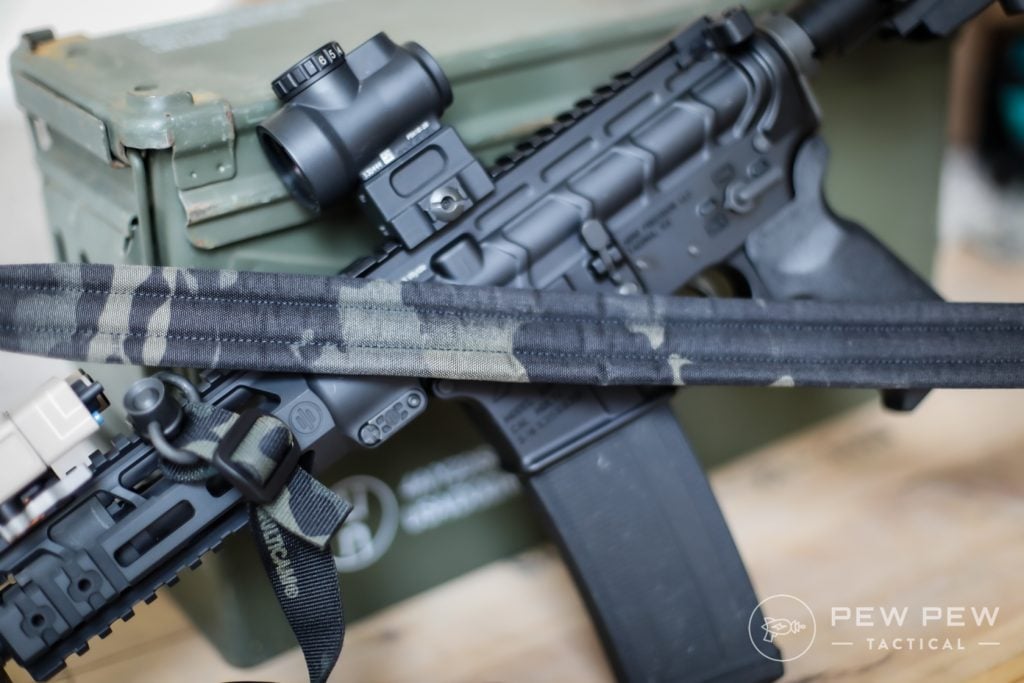
We went with Flatline Fiber to create the Pew Pew Tactical Sling.
Made by hand in Georgia…and with plenty of stellar reviews to boot. Us being one of them.
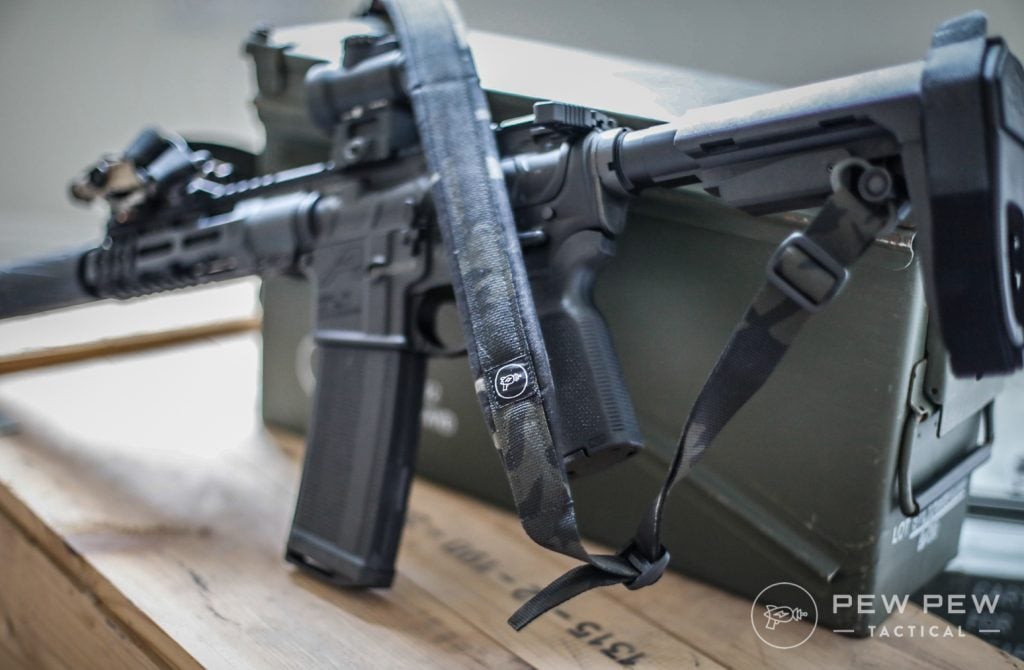
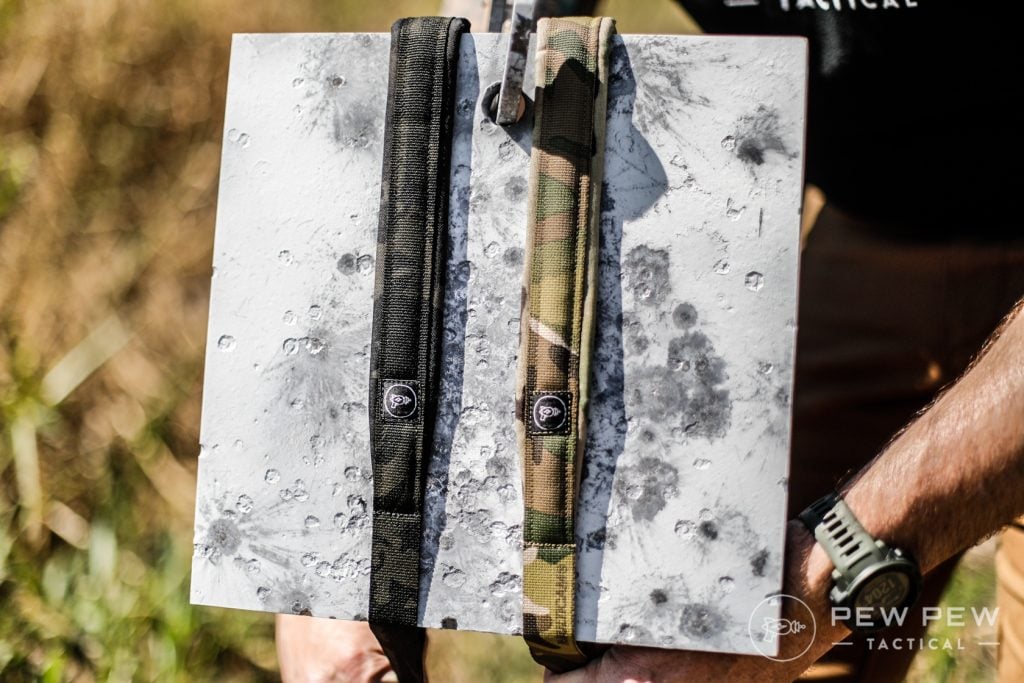
We have our PPT laser gun logo on Multicam, both regular and black, of course.
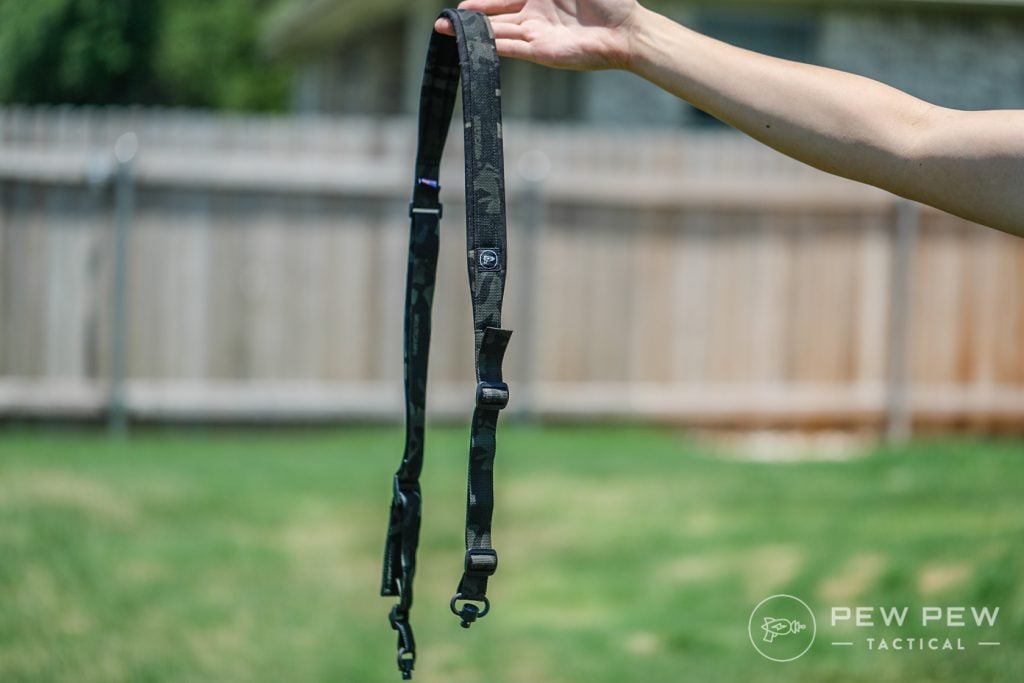
Pew Pew Tactical Slings, Multicam & Black Multicam
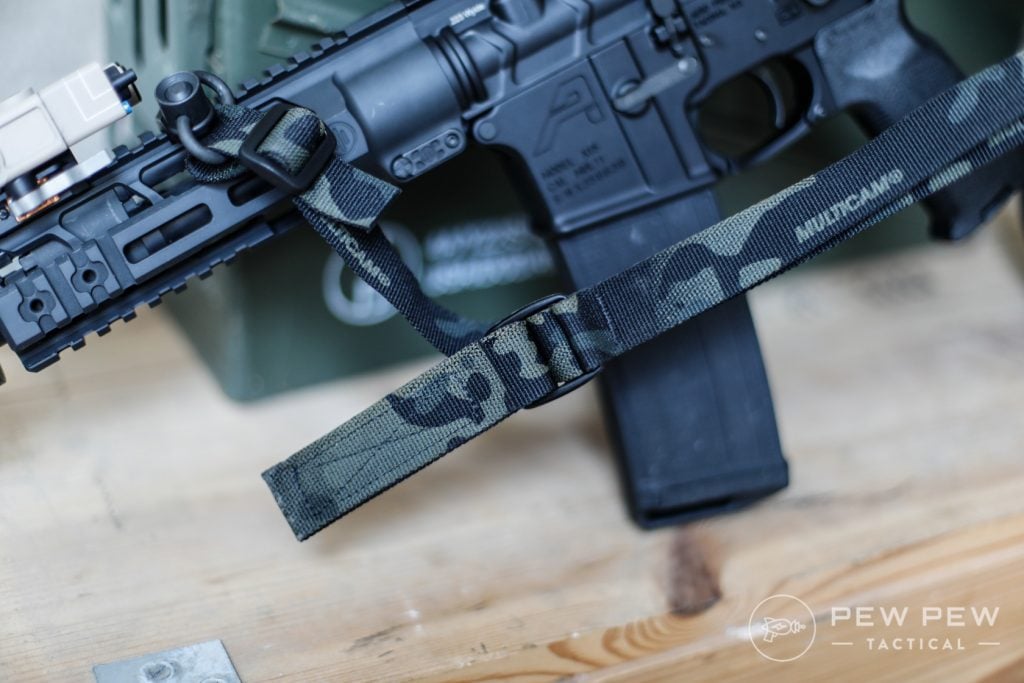
A very nice pull tab…these things make a big difference.
Pew Pew Tactical Sling Pull Tab
And just the right amount of padding that’s slightly less than the Vickers padded version. If you’re not on sentry duty with a 15-pound behemoth this amount of padding is perfect.
Pew Pew Tactical Sling Padding
Also one thing that’s overlooked…it has the right amount of length so you’re not ending up cutting material when attaching.
Pew Pew Tactical Sling, Multicam
Check them out at TriStar Trading where you can find more of our goodies…as long as it’s Multicam!
Pew Pew Tactical Flatline Slings
And don’t forget the Quick Detach Sling Mounts!
Troop Favorite AR-15 Sling – VTAC
The Viking Tactics is a popular two-point sling that’s designed to boost comfort and freedom of movement.
The upgrade/hybrid version has stronger hardware and feels lighter. Used by tons of U.S. troops.
One common complaint is that it is built for an 8-foot monster. However, that’s because the extra length is set for people wearing armor or using it on a long shotgun.
I follow Kyle Lamb’s advice and use some duct tape to tape off the excess…never know when it might come in handy.
One thing that sets it apart from other slings is that it feels light but still super strong.
Also, there are two pull tabs you use to adjust the length — one to cinch it and one to let it go.
Highly recommend watching this video of Kyle Lamb for install and use.
And also highly recommend going with at least something padded if you’re going to be standing around for a few hours on patrol (or even a class).
The VTAC’s padding is thin but makes a world of difference. Especially if you’re going to be standing around a while with your rifle at your side.
My specific version that I use is the padded upgraded/hybrid multicam.
Also Great AR-15 Sling – Blue Force Gear Vickers Sling
Another used by tons of US troops is the Vickers Sling by Blue Force Gear.
There’s also a padded version for enhanced comfort.
Check it out in action…
Note that it only has one tab to deal with…
The length is also more manageable…no duct tape is needed but you might not be able to put it on very long shotguns (or if you’re huge and/or wearing a lot of gear).
The padding is also a little thicker than the VTAC.
But the nylon of the sling itself feels stiffer and is definitely thicker.
And given the choice between padded and not padded versions, definitely go with padded.
What’s your take on the Vickers?
Best Single Point Sling – Magpul MS4 Dual QD Gen2
If you’re looking for a single-point sling that’s comfortable, durable, and easy to adjust, try the Magpul MS4 Sling.
Its 1.25-inches wide nylon material is strong enough to resist wear and tear from constant use but soft enough to prevent chaffing and discomfort.
Additionally, it can be converted to a two-point sling when you grow tired of hitting yourself in the nuts.
The newest Gen2 model has two heavy-duty QD sling swivels and a better quick-adjust slider.
Best 3 Point Sling – Specter Three Point Sling
When it comes to three-point slings, comfort is key.
You don’t want to have something strapped to your body that feels excessively tight or restricts your movement more than it should. Many people prefer Specter Three Point Slings because they’re less likely to cause chafing or affect the wearer’s range of motion.
However, like we go over down below…unless you’re already trained in three point slings and don’t want to try something else…we’d forego this for a two-point option.
Best Precision Sling – Ching Sling
It is made up of two straps, a standard two-point sling and an additional smaller strap connected to the gun’s center stud.
Think of the Ching sling as a two-point sling that was optimized for the “hasty sling” method of shooting.
As you’re carrying a rifle with the Ching sling, the small strap can be slid up and out of the way. When it comes time to shoot, simply loop your arm through the first loop, between the first and center studs, to get a steadier aim.
Works for the AR platform but used more for hunting or precision rifles.
I use a variant of this in NRL22 competition shooting to make unsupported standing shots a little easier.
Best Cuff Sling – Tactical Intervention
Cuff sling variations are a favorite among sharpshooters because they allow you to get a stable and accurate shot without the use of a bipod.
They’re easier to set up than loop sling methods like the “USGI sling” and are an excellent way to improve your aim.
The Tactical Intervention is a popular cuff sling that’s developed with military-grade nylon and is able to withstand regular wear-and-tear.
Again…geared more towards non-AR rifles and precision rigs. We see these more and more in rifle competitions such as NRL and NRL22.
Best Sling Accessories
Once you’ve got the sling, you’ve got to make sure you can attach it to your rifle.
Almost all of the slings mentioned will hook into your butt stock without any additional hardware…whether into the slits or using a QD (quick disconnect) mount.
If you don’t have that…or like having a connection on your end place…check out the BCM QD End Plate (perfect for single point slings).
You might need something for your handguard if it doesn’t already come with QD holes…however I found the factory ones are either too forward (gets in the way of lights) or too rear (too short for slinging on your back).
In that case you’ll need something like a Troy Rail Mount.
However, my current favorite is the Magpul RSA QD since it is adjustable and keeps the sling on one specific side. My loadout below gives me space to activate my light.
It also has anti-rotation so your sling doesn’t get jumbled up
And for actual QD mounts and swivel combos…
We go with Magpul QD Slings (exposed for easier pressing).
or the Midwest Industries (flush fit for added security).
My preference is the flush model since I don’t take on/off my slings that much…and having something accidentally disconnect your sling would suck.
Choosing the Right Material
Gun slings are typically made from one of two options: leather or nylon.
There is no clear-cut answer when it comes to which sling material is better.
Some people believe that nylon slings are better because they’re not as heavy, while others prefer leather because they feel it gives a slight elastic feel that nylon doesn’t.
I personally go with the nylon slings.
If you are someone who prefers the traction and style that comes with a leather sling, it’s important to note that they can stretch over the years.
Types of Gun Slings
There are three main types of gun slings: single-point, two-point, and three-point slings. Then some more specific ones applicable for sharpshooting.
I’ll give a brief explanation of each type first then list the pros and cons of each type of sling so that you can get an idea of which type suits your specific needs.
Single Point Slings
The single-point sling receives its name because it uses one connection point to attach to the gun.
The single-point sling is a favorite for a lot of gun enthusiasts.
The sling wraps around the user’s body while the point attaches to the rear of the weapon.
Pros
What makes the single-point sling a favorite among tactical shooters is that it makes dropping and picking up your weapon simple.
The beauty of the single-point sling is that it always sits directly in front of you (and most likely pointing in a safe direction down).
This makes it ideal for situations where you need to go quickly hands-free, but also must have the ability to quickly grab your weapon at a moment’s notice.
Another benefit of using the single-point sling is that it allows you to perform a wide range of movements such as transitions due to a barrier.
Additionally, your gun doesn’t have to be in front of you with a single-point sling.
You can also wear it in a way that keeps your weapon at your side or on your back. However, those options aren’t ideal for scenarios where you need quick access to your gun.
Cons
Despite the convenience and easy accessibility that comes with single-point slings, they aren’t without their drawbacks.
For starters, single-point slings provide little shooting support. Your aim with a single-point sling won’t be much better than it would be with no sling at all.
Another con of the single-point sling is your gun will sway a lot when you’re not holding it.
For some people, moving hands-free with a single-point sling can be especially annoying because they constantly get knocked in the groin or knees with their gun.
Here’s an example of a loose two-point sling but you can imagine it with merely one.
Once you find the proper tightness adjustment for your body, your single-point sling shouldn’t move as much.
And overall, it’s a great tactical piece for anyone who’s not in situations that require a lot of running.
Two Point Slings
The two-point sling is one of the most commonly-used gun slings and is sometimes known as a carrying strap.
As you may have guessed, two-pointslings are named because they are attached to the gun with two connection points.
They are my favorite and the most versatile for the AR-15 and other rifles.
This sling connects to the rear and front of the firearm, on the bottom of the stock. It’s perfect for carrying a long gun over the shoulder during long hunting treks.
Pros
Not only are two-point slings great for carrying your weapon, but they can also be used to improve your aim.
There are three ways to carry a gun using the two-point sling:
American carry – slung over back of the shoulder, muzzle up.
European carry – slung over the front of the shoulder, muzzle up.
African carry – slung over the back of the shoulder, muzzle down.
Some people prefer the African carry because they feel it makes it easier to grab and aim your weapon. The downside to the African carry is that you risk clogging your muzzle with dirt and debris as you walk.
Remember when I said it can improve your aim?
Simply loop the sling around your non-dominant arm and use the tension to keep your weapon stable. This is called the “hasty sling” method.
Another type of shooting modification that can be used with the two-point sling is the “loop sling.”
This is achieved by disconnecting the rear portion of the sling and pulling a loop through the adjustment slide. Then, slide your arm through the loop and pull tightly:
This will help stabilize your long gun and provide you with the opportunity to shoot more accurately. This tactic is referred to as the “USGI sling.”
Cons
The downside of the two-point sling is that it can be difficult to retrieve your gun in a situation where time is of the essence.
It’s also a little harder to transition from side to side unless you leave some extra length to free up your neck area.
Three Point Slings
The three-point sling also connects to the front and back of the firearm like its two-point counterpart. However, the three-point sling differs in that it has an additional loop that goes around your torso.
When it comes to the three-point sling, I find that people either love it or hate it.
Pros
Overall, I think it’s a good sling that keeps your gun within reach, just like its single-point counterpart.
In addition, the three-point sling has more control than the single-point sling when you’re moving hands-free. That means you don’t have to worry about having your gun bang up your shin or groin area as you move.
The biggest benefit of the three-point sling is that you can easily transition from a rifle to a sidearm without having to fumble between guns.
Cons
However, the three-point sling doesn’t come without its own set of cons. Some shooters complain that three-point slings tend to get caught on bolt release mechanisms and block ejection ports of rifles.
Also, this…
In case you’re wondering…yes that rifle was loaded and no this was not a drill/test/skit. This is, in all its glory, the three-point sling in the field.
The Ching sling is a special shooting sling that incorporates principles of the “hasty sling” and two-point slings. It requires three connection points and can be used for carrying and aiming.
The Cuff sling is a shooting sling designed to help marksmen get an accurate shot without the use of a bipod.
Conclusion
For almost all users…you’re probably good to go with a two point sling.
Remember, a good gun sling can work wonders by increasing your accuracy or helping quickly switch between your long gun and sidearm. Check out more of our essential gear and guns such as Best Weapon Lights or Best Scopes/Optics.
What sling did you end up getting? How do you like it? Let us know in the comments! For more AR gear, check out our round-up of the Best AR-15 Furniture & Accessories.
If you like sitting around the sea and savoring your free time, drone fishing is something that can be appealing to you. While fishing works as a fantastic pastime, a drone can make it much more fun and ensure that you have a catch every time.Whether you plan on doing it as a career or a hobby, drone fishing offers many benefits. So, how does it work? What do you need to do it? Is fishing with drones indeed the future? Here’s everything you need to know.
What Is Drone Fishing?
As its name suggests, it is angling with the use of a flying robot. Drone fishing offers several ways to simplify the process of fishing. Rather than gamble your time away with a chance at getting good fish, you can utilize unique drone features to optimize how to get the fish you want.There are many ways to do drone fishing, depending on how much work you want to do yourself. For starters, you can use the fishing drone to scout for a fishing area. Rather than using the drone to pull the fish, you use it as an aid to scout for an excellent place to fish and find the best spots you can use. Some drone fishers connect their underwater camera to check out the local fish population. You can use your drone camera to scope the local waters if you’re hunting for specific fish like tuna, salmon, or others.Another way to do drone fishing is to use it as a bait release drone. As the drone flies around, it casts off the bait, giving you ample opportunity to catch fish. You can use various types of bait to get more fish, from throwing chum to get more fish in one area to using worm bait to reel in fish.The most common use of drones in fishing is to reel in fish, known as “dropping the line.” Rather than use a fishing line, you can have a drone do the catching for you. Depending on how much interaction you want, this can be the least fun part of drone fishing. However, this is also the best way to get a catch every time.Drones are fantastic for career fishing, especially if you like reeling fish from your boat. You can extend your catch range or add a few extra meters to your fishing zone.
How Does Drone Fishing Work?
If you’ve never done any boating or have been away from this hobby for a while, you may be wondering what goes into doing these activities. In this case, it’s best to start with the basics. First, you need to know the laws surrounding the use of your drone. Most countries have regulations regarding where and when you can fly your craft. While some places allow you to use yours freely, others require you to get a license, register your aircraft, and adhere to other requirements. Next, you need to learn how to pilot your drone. You must learn how to control your copter and maintain and fly it properly. You need to learn special piloting techniques if your drone is huge. Third, you must ensure your drone is equipped for fishing and not just for show. There are several types of bait-dropping mechanisms, depending on your drone model. For example, SplashDrone 4 and Fisherman FD1 are purpose-built drones with integrated bait droppers. They also have a remote-controlled line release and many more. Another type of drone includes a tension-triggered release line, which utilizes DJI-compatible bait droppers.Finally, you need to find a good spot to launch your drone. There are plenty of great places for launching a drone, from public waterways to private property. Depending on your needs, you can also use your boat or fly from the shore as a staging platform.
Who started drone fishing?
Drone fishing was not always how it was today. Fishing with drones is still a new activity even after a few years. The activity started with a certain Milton Frear, the owner of JCMatthew in New Zealand. The company deals with different high-quality adventure brands and technology, from camera equipment to personal transportation.
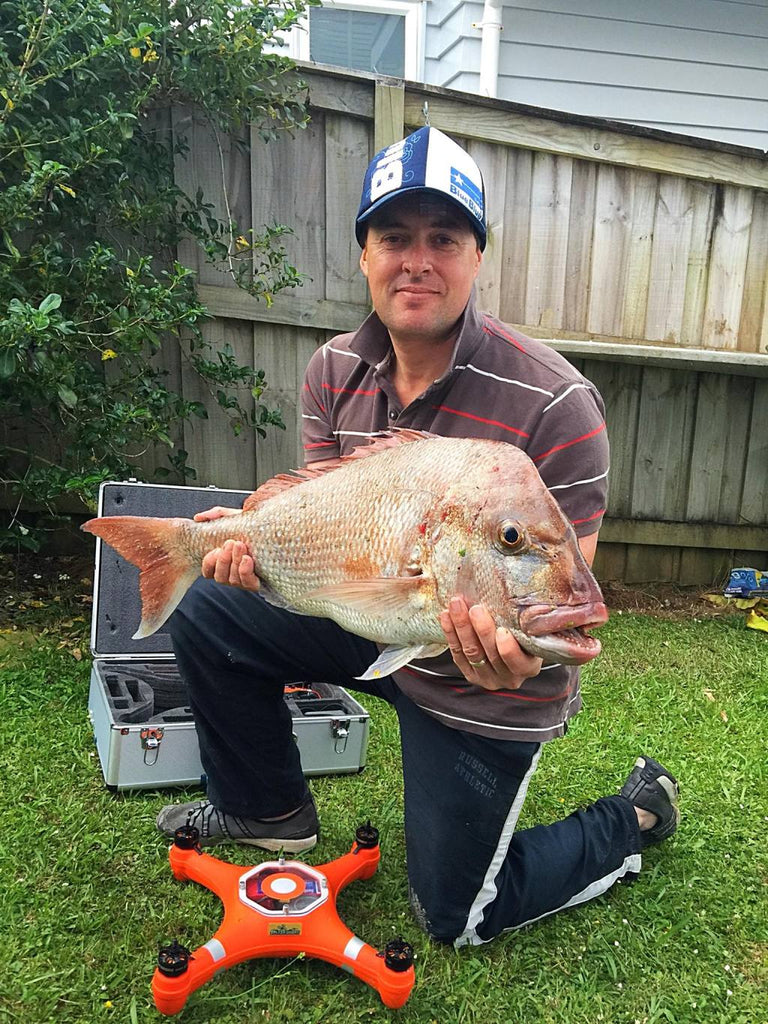
Frear was the distributor of SwellPro in New Zealand, one of the first waterproof drones publicly available for purchase. He used the first-generation waterproof drone, the Mariner, for bait-dropping on the beach in 2014. This personal choice was a clever use of a feature not for its intended purpose.How?The Mariner had a release mechanism initially designed to drop live-saving equipment during an emergency. However, as a lifelong fisherman, Frear understood the novel way of utilizing the feature to drop some bait and get the fish going.Later on, several people started using their drones for fishing too. In particular, Jaiden Maclean of Sea Ulcer wanted to prove if they could fish using drones. Their Youtube video, “Drone Fishing For Tuna,” was a testament to the viability of fishing with a good drone.Their video went viral, garnering as many as 5.3 million views and influencing an audience that loves fishing and flying drones, combining them into one unique hobby. This inspired many would-be anglers to try drone fishing, and it took off from there.Swellpro is the first company who made a waterproof purpose-built fishing drone with an integrated release mechanism. This allows easy fishing and combines scouting, baiting, and angling in a single drone loadout.
Is Drone Fishing Worth It?
Drone fishing is an enjoyable activity for many people, especially due to its many benefits. Whether you’re doing it as a hobby or as a career, using a drone to get some good fish is fun. While some may think it’s less challenging, it also has its own technical hurdles that you need to overcome.So, is drone fishing worth it? Yes! Here are some benefits you can expect when you start drone fishing.
1. Extend The Range Of Your Cast
As the title implies, this allows you to extend the reach of your casting. While a conventional rod has a range of 10 to 15 meters, your aerial capabilities can extend that to as much as 100 meters. This allows you to cover a wide radius, making your chances of getting a snag or a fish much higher.While you can always use a boat to find the fishing spots you want, you can also use a drone and stay on the shore. This gives you a way to go fishing in locations that need a boat to access it, offering a richer space to gather the fish you want.
2. You Have Better Control Over Your Lure
When using conventional rods, you have to rely on hardware to release your hook and lure. When the bait hits the water, your gear must do the rest. The issue with this approach is that you have no say in how the lure behaves once it enters the water. If you use a deep-sea fishing rod, then it can sink to the bottom, making it hard to retrieve them. The mobility of an aerial vehicle gives you more control over your gear. You can quickly move to the best location to make your drop. You can also adjust how fast you move your gizmo, allowing you to bring it in fast or slow, depending on what you’re trying to achieve.
3. Scout For Good Fishing Spots
Using your UAV, you can simultaneously do two things: find a great place to angle and find the right spot for the right species. Scouting with a boat or a kayak can be limiting. If you can’t access an area by boat, then all you can do is hope for the best. On the other hand, when you use your droning to fly over the ocean, you can find a great location for different types of fish and sea life. This lets you modify your technique to make sure you get what you want.
4. Saves Time And Money
While most hobbies cost money, this one can actually save you money, especially if you do it regularly. Unlike traditional boats, you don’t require gas, insurance, or anything else with drone fishing. All you really need is an appropriate form of electricity to power your drone and your other fishing gear.. While you may be thinking it’ll take a lot of time to get the hang of doing this kind of recreational sport, it actually saves you time and effort. As compared to traditional forms of sports, this one doesn’t take as much physical exertion. You also don’t need to lug heavy boats or drive your car to get some fresh fish.
Can You Use Any Drone For Fishing?
If you’re thinking about getting into drone fishing, then you might be wondering if you can use your old drone to do some cool tricks. While it can, the results will be less than stellar. You want them to have the right specs.For starters, you want the drone to be 100% waterproof, from the copter itself to the camera and reeling equipment it uses. Drones can easily die with a strong splash of water with a big wave. You want the vital electronic parts protected so you can keep it operational.You also want a fishing drone that can handle high wind resistance and high payload capacity. The oceans pack strong winds, so your drone should be able to handle somewhere between 29 to 50 kph winds. As for payload, depending on the fish you want to catch, you want to go up to 1 to 2 kgs, which is enough bait to catch you a tuna.You also want a drone with a long flight time to allow for more drops per single charge. This also gives you more time to get your drone come back to safety if you’re fishing from the beach. You also want a good, high-quality camera, preferably an underwater camera for better scouting.
What Are The Best Drones For Fishing?
There are three excellent options on the market if you’re looking for fishing drones. Depending on your needs, every drone offers a different feature. These include:
SplashDrone 4
SwellPro’s SplashDrone 4 is a 5th-gen waterproof drone, offering features that fit every drone fisher’s needs at every skill level. It can float and has IP67 seawater proofing, with the ability to withstand Beaufort Force 7 winds (31 mph/50kph) during its flight.It also offers a swathe of features that allow multifunctional payload and open interface design. This allows you to equip the SplashDrone 4 with optional 1- to 3-axis payloads, from 4K, night vision to thermal cameras. It has a 30-minute flight time without load, with around 12 to 15-mins flight time with payload.
Fisherman FD1
Fisherman FD1, on the other hand, offers almost the same specs, with an IP67 seawater proofing and a max payload capacity of 2kg. It also has a max wind resistance of 44.75 mph/ 72 kph but an equivalent flight time to the SplashDrone 4. Its massive casting range gives you a 1.6 km radius and up to 6 bait drop missions per charge.
Spry+
Spry+ offers a different value than the SpalshDrone 4 and FD1, working as a lighter scout drone with an 800 m control range. Its 4K30fps camera offers easy scouting opportunities for high quality video opportunities. Its waterproofing and corrosion resistance offers a way to scout the waters with no issue at all.
How Much Does A Fishing Drone Cost?
The normal price range for a quality, durable, and functional drone for fishing and outdoor/aerial photography is between $1000 to $2000. This depends on factors like the brand, type, and weight of the product. The cost varies, depending on the features and capabilities you want your droning to have. Some models like the Spry+, for example, are much cheaper compared to other options. The Spry+ costs somewhere around $1000, while the SplashDrone 4 costs around $1800.While this may sound expensive for fishing, you need to remember that a fishing drone can replace several fishing equipment. It can replace a set of fishing rods, scouting gear, boating fees, and underwater cameras.
What Is The Longest Flight Time For A Fishing Drone?
The 20 to 30-minute battery life of most standard consumer-grade fishing drones, which is more than enough for an average fishing trip. The SplashDrone 4 and the Fisherman FD1, for example, can fly for 30 minutes without any load. It can traverse the 1-2km radius of your cast, offering you plenty of opportunity to get the bait in the water. Most recreational drone users spend around 15-20 minutes to do multiple bait drops. A few minutes is more than enough to fly the drone over great distances.
Conclusion
As you can see, there are plenty of reasons why you should consider drone fishing. From its versatility to the sheer amount of things you can do, drone fishing is the future. From helping you find the best place to dropping your lure, you can do so much with one amazing tool. If you’re looking for a great way to spend your time, then investing in a quality fishing drone is one of the best decisions you can make.
Are raccoons rodents? This is a question that many people ask about this commonly seen animal. Raccoons are considered by some to be in the same family as rats and mice, while others believe they are their own unique species. In this article, we will answer this question and provide you with more information about raccoons. Keep reading!
What are raccoons classified as? Are raccoon rodents or marsupials?
Raccoons are generally classified as either rodents or marsupials. They belong to the Carnivora order, meaning it’s a meat-eater, although a raccoon will eat anything available, including whatever is growing in your garden or sitting in your garbage can. Raccoons are members of the Procyonid family, which also includes ringtail cats, coatis of South America, and kinkajous of Central and South America.
Where does the word “raccoon” come from?
The word ‘raccoon’ is derived from the Algonquin Indian word ‘arakun,’ meaning ‘he who scratches with his hands.’ Raccoons are excellent climbers, often scaling trees and fences to get at food or avoid predators. They have sharp claws that enable them to climb and grasp things easily.
What do raccoons look like?
Raccoons are medium-sized animals with a body length of around 40 centimeters (16 inches), plus a tail that can add another 20 centimeters (8 inches) or more. They weigh between 4 and 12 kilograms (9 and 26 pounds). Males are generally larger than females. Raccoons have dense fur that consists of a soft undercoat and coarse outer guard hairs. The fur is usually grayish-brown but can range from pale silver to black. There is often a distinctive black “mask” across the eyes.
Raccoons are omnivores, meaning they will eat just about anything. In the wild, their diet consists of fruits, vegetables, nuts, insects, rodents, small mammals, and even eggs. They are also known to eat garbage and pet food left outdoors.
Possums and raccoons may look similar, but there are some key differences between these two animals. For starters, possums are marsupials, meaning they have a pouch in which they carry their young. Raccoons, on the other hand, are not marsupials. Additionally, possums are typically smaller than raccoons and have longer noses. Possums also tend to be timider than raccoons and will usually only come out at night, whereas raccoons are active both day and night.
What is a Raccoon’s lifespan?
In the wild, a raccoon typically lives for 2-3 years. However, if they are living in captivity (i.e. in zoos or as pets), they can live for up to 20 years.
Are Raccoons dangerous?
While raccoons are not typically aggressive, they can be dangerous if they feel threatened. They may also carry diseases that can be harmful to humans, such as rabies. If you come into contact with a raccoon, it is important to wash your hands thoroughly and avoid touching your face. If you are bitten by a raccoon, you should seek medical attention immediately.
If you are having problems with raccoons on your property, there are a few things you can do to deter them. First, make sure that there is no food or water available for them. This means keeping your garbage cans covered and not leaving pet food outside. You can also try to scare them away by making loud noises or shining a light on them. If these methods do not work, you may need to call a professional wildlife control company or use an air rifle to get rid of them. (For more on the best air rifle for pest control, see this post)
What Kingdom do Raccoons belong to?
Raccoons belong to the Animalia Kingdom.
What class do Raccoons belong to?
Raccoons belong to the Mammalia class.
What phylum do Raccoons belong to?
Raccoons belong to the Chordata phylum.
What family do Raccoons belong to?
Raccoons belong to the Procyonidae family.
What order do Raccoons belong?
Raccoons belong to the Carnivora order.
What genus do Raccoons belong to?
Raccoons belong to the Procyon genus.
What species do Raccoons belong to?
Raccoons belong to the Procyon lotor species.
In what type of habitat do Raccoons live?
Raccoons can live in a variety of habitats, including forests, mountains, and marshes. They are also commonly found in urban areas.
Photo Credits: Vendingproservice.Com by Carl Clark
Blackbirds are a widespread species found primarily in Europe, Asia, and North Africa. Their plumage is predominantly black with a yellow bill and eye-ring in males, while females have a brownish-black plumage with a pinkish-buff throat. These birds are renowned for their melodious songs, and their diet primarily consists of insects, earthworms, and fruits. Blackbirds typically breed from March to July and lay 3-5 eggs in a nest built on shrubs or trees. Their lifespan ranges from 2-3 years in the wild and up to 20 years in captivity. Join us as we take a deeper look into the world of blackbirds and discover more about these beloved birds.
Appearance and Habitat
Blackbirds are a type of passerine bird. They have black plumage with bright yellow beaks and eyes. They can live in forests, wetlands, grasslands, and even parks and gardens. They thrive in Europe, Asia, North Africa, and certain parts of Australia.
During breeding season, males establish territories. Females build nests using materials such as grass, twigs, and even human-made items like plastic and string. These nests can be found in trees or shrubs within the bird’s territory.
Blackbirds are a fascinating subject for ecologists and behaviorists studying wild birds. They can grow up to 29 cm long and weigh up to 125 grams. This showcases how their physical traits are as impressive as their resilience and adaptability.
Blackbird Breeding and Lifespan
Blackbirds are a captivating species! They sing beautifully and breed from March to August in the UK. Females lay 3-5 pale blue eggs with brown and grey spots in a nest of grass and twigs. The male brings food for the female during incubation, which lasts two weeks before hatching.
During breeding season, males compete to attract females with territorial displays. Afterwards, both parents care for their young until they fledge after 11-14 days. Although blackbirds usually live 2-3 years, some can reach 5 years.
Temperature and rainfall affect blackbird reproduction and breeding success. Experienced adults are more successful. Some can breed out of the regular window due to ideal conditions.
Blackbirds are important to ecosystems. They feed on various things and contribute to biodiversity. In short, blackbirds are an enchanting species with special breeding and lifespan patterns!
Blackbirds as Food
Photo Credits: Vendingproservice.Com by William Torres
Blackbirds have never been widely eaten by humans and there is no evidence to support the claim that they have a unique flavor. In fact, blackbirds are protected under the Migratory Bird Treaty Act of 1918, making it illegal to hunt or eat them. The same protection applies to crows and other native bird species. Sparrows and starlings are not commonly consumed in many cultures and are not considered a significant source of nutrition. Therefore, it is not recommended to incorporate them into a healthy diet.
Eating Blackbirds
Consuming blackbirds for meat has been a part of human history for centuries. But, compared to other birds like pigeons, chickens, or ducks, blackbird consumption is not that common. Its meat has a dark, gamey taste that is an acquired taste for some. It can be cooked in various ways – roasting, grilling, or stewing.
Sadly, the blackbird population numbers have decreased and their natural habitats have been lost. Thus, laws have been passed to protect them from hunters. Eating blackbirds, like other wild animals, can be risky, as parasites and diseases may exist if it is not cooked properly. It must be cooked at the right temperature to prevent health issues.
All in all, blackbirds may have been historically consumed by humans, but legal protections and the availability of other food with lower health risks have made it less common nowadays.
Crows and Other Birds
Crows and other birds are not a top pick for blackbirds’ diets. These omnivorous birds prefer a variety of nourishments, such as insects, fruits, and veggies. Sparrows and starlings are actually more nutritious for them. But, human activities like putting out bird feeders in gardens and throwing bread crumbs in parks has changed what they eat. This can be bad for their health and lifespan.
Nutritious Sparrows and Starlings
Sparrows and starlings may look common, but they are not for eating. Despite claims that their meat is good for you, it can actually harm your health. And many of these birds are protected by conservation laws. That means that it is illegal to hunt or eat them without permission from authorities.
Handling bird meat without proper preparation can lead to contamination and illness. So, it is important to follow safety guidelines when preparing any kind of bird.
Avoid consuming wild birds, like blackbirds. Instead, choose healthier proteins like lean meats, fish, and plants. This will help provide the nutrients you need without risking your health.
Blackbirds’ Diet
Photo Credits: Vendingproservice.Com by Juan Carter
Blackbirds are a common sight in gardens and parks, but have you ever wondered what they eat? In this section, we will explore the dietary habits of blackbirds, including both their natural diet and their feeding habits in gardens. Blackbirds primarily eat insects, earthworms, and fruit. They are omnivores and eat a variety of foods depending on the season. During breeding season, they eat more animal foods, and during winter, they eat more plant-based foods. They also eat human-provided food in gardens, such as bread, seeds, and suet. Get ready to learn more about these beloved birds and their dietary habits.
Natural Diet
Blackbirds have a diet that is varied; made up of plant and animal matter. During breeding season, insects are the main source of food. They also eat fruits, berries, seeds, and earthworms. It varies with the habitat; gardens give a mix of bugs, spiders, caterpillars, fruits, and seeds. In rural areas, earthworms and insects are their main source of food.
Blackbirds have an amazing way to get earthworms during heavy rains. They dig with their beaks and use their neck muscles to pull them out. They prefer trees with low-hanging branches. This has been observed by experts.
There are different sub-species of blackbirds with unique features. They differ in plumage color and migratory patterns.
Feeding blackbirds in your garden? Provide them with a natural diet like insects, fruits, and seeds. This will make them appreciate it and may even come back to your garden year after year.
Feeding in Gardens
Blackbirds often visit gardens. They eat a variety of things, including worms, insects, fruits and seeds. In fall, they consume more fruit, and in winter they eat more seeds. They help spread seeds through their droppings. But, some gardeners think blackbirds are pests because they dig up shallow-rooted plants. Watching them forage in open fields is pretty cool; they look for small bugs and worms in grass and foliage. In spring, they look for nesting sites in tall grass while still looking for food. Blackbirds may eat birdseed, sunflower hearts, millet seed and dried mealworms. But, they may also have indigestion from eating bread. In the winters of 1806-07 and 1871-72, military men sent hunters to parks in Paris to kill blackbirds. It’s amazing how blackbirds can adapt to their surroundings when feeding in gardens.
Facts about Blackbirds
Photo Credits: Vendingproservice.Com by Michael Clark
Did you know that blackbirds are omnivores and have a diverse diet consisting of insects, berries, fruits, seeds, and even small animals such as snails? In this section, we will take a closer look at some fascinating facts about blackbirds. We will examine how winter affects their food sources and how human activity has impacted their eating habits. Join us as we explore the intriguing world of these feathered creatures.
Blackbirds Omnivores Eat Wide
Blackbirds are known for their varied, vast diets. They eat all kinds of food: insects, worms, snails, fruits, berries, seeds, and even other little birds. They’re opportunistic feeders, changing their diet based on the season and food availability.
In breeding season, they go for more proteins, like insects, to help with producing eggs and raising chicks. In winter, they switch to more fruits and berries since insects are harder to find.
Human influence has changed blackbird’s diets too. Feeders in gardens give them food all year. We can provide seeds and fruits that aren’t normally around.
We can help blackbirds by planting fruit trees or bushes near our gardens. Bird feeders can have peanut or sunflower hearts, which are just the right size for their beaks. Suet blocks with mealworms are great in winter when there’s less food around.
Winter Blackbirds Find Food
Winter brings a challenge for blackbirds – finding food. But, they have adapted. Their usual diet consists of fruits, insects, and seeds. Gardens are great for foraging worms and insects.
Blackbirds are opportunists, looking for any food source in poor weather. Bird feeders provide grains, nuts, and suet cakes. Holly bushes offer shelter and food. Insects can be found under tree bark and leaves.
In spite of the winter troubles, blackbirds work out ways to find alternative food sources. They use innovative methods to feed themselves.
The Royal Society for the Protection of Birds (RSPB) recommends not to solely depend on feeding blackbirds in winter. Unsuitable foods may cause health problems.
It is evident that blackbirds are skilled at finding food during winter, using various strategies.
Human Influence on Blackbirds’ Diet
Human activities have a big effect on the Blackbirds’ diet.
Urbanization and cutting down trees have made gardens, farms, and suburban areas popular places for Blackbirds to eat. They can get seeds from plants and fruits from orchards. People often feed them or leave food out in their gardens, which increases the amount of food available for Blackbirds.
Blackbirds are omnivores and they will eat nearly anything. As humans change the natural environment with new ecosystems in suburban areas and covering forests, Blackbirds might change their eating habits, too.
It’s important for humans to watch what they’re doing to the environment. If humans stop feeding Blackbirds, the birds may not be able to find enough food in times when natural resources are scarce.
In the end, human influence on the Blackbirds’ diet has both good and bad effects. On one side, human activity gives them more food, but on the other hand, this could have unexpected results in the long run.
Can You Eat Black Birds?
Photo Credits: Vendingproservice.Com by Bryan Lewis
Can you eat black birds? Across the globe, many cultures eat birds. Some studies suggest certain species of black birds, such as crows, ravens, and blackbirds, can be eaten if properly cooked. But, others disagree due to potential health risks.
It’s vital to consider that some black birds may carry diseases or consume toxic substances, so it is important to understand the attributes and risks associated with each species before consuming them. Plus, certain cultures have taboos or superstitions connected to eating black birds, so this adds to the complexity.
So, it may be possible to eat certain species of black birds. But, caution must be used. So, if you’re thinking of adding black bird meat to your diet, research it and get expert advice first.
FAQs about Can You Eat Black Birds
Can you eat blackbirds?
Yes, blackbirds can be eaten and were once eaten despite their bitter taste. Larger blackbirds can be cut into pieces like poultry, and their livers have a similar flavor to chicken livers.
What do blackbirds eat?
Blackbirds are omnivores and have a varied diet that includes earthworms, insects, spiders, snails, fruit, seeds, and berries. Their diet changes according to the seasons, with fruits becoming more dominant in the winter. They find most of their food on the ground, in the soil, or under debris and moss. They prefer a diet of worms and snails, not bird feeders.
Are blackbirds a common bird species?
Yes, blackbirds are a common bird species belonging to the true thrush family. They are present in North America, Australia, New Zealand, Europe, and Russia. There are different subspecies, some migratory, partially migratory, or residential. The species got its name from fully black males, but females and offspring have dark brown feathers. They inhabit woods and bushy areas, use mud for building nests, and are territorial. They create lifelong relationships with a pair returning to the same area every year. They have 2-3 broods during the breeding season, with 3-5 eggs per female. Males catch caterpillars or earthworms for offspring, while females prepare the nest. They protect their territory fiercely but will couple with other birds when migrating. Urban males do not migrate in winter as they can find food in cities.
Is it safe to eat crow meat?
Yes, crow meat is safe to eat and highly nutritious, but the flavor can vary depending on preparation. Crows can be eaten and are considered a delicacy by some. The negative connotations surrounding crows have led to the phrase “eating crow” to refer to admitting being wrong.
What are some interesting characteristics of blackbirds?
Blackbirds create lifelong relationships with a pair returning to the same area every year. They protect their territory fiercely but will couple with other birds when migrating. Their natural diet has been depleted by human influences such as intensive farming. Blackbirds breed from April to July and may have up to 3 clutches of chicks during this time. The average lifespan of a blackbird is 3 years, but the oldest one on record was 14.
What should you do to attract blackbirds to your garden?
Blackbirds appreciate soft seeds like sunflower hearts and rolled oats as extra energy sources in the winter. Mealworms and dried fruit can be provided by birdwatchers to encourage Blackbirds to visit. Suburban areas provide rich foraging grounds for wild blackbirds, but their natural diet has been depleted, so providing food can be beneficial for their survival.
What Expert Had to Say: Back when I wrote my slightly controversial and proverbial pot-stirring article rating the Top 5 9mm Pistols, I gave Honorable Mention to three particular pistols, among them the legendary SIG Sauer P210. Although many consider the SIG Sauer 210 the most accurate 9mm pistol ever, I rationalized my mere Honorable Mention ranking because I hadn’t yet been able to fire and adequately evaluate the 210. For a long time, it was so goshdarn expensive that none of the gun ranges I frequented throughout the US of A over the past three decades made one available for rental. The pistol took on an aura of Unobtainium, and the Holy Grail all rolled into one.
A Brief History of the SIG Sauer P210
The SIG Sauer P210 has been likened to a Swiss watch of handguns, and that’s not just because Switzerland is the country of origin, though that certainly helps.
As noted by Sean Murphy of Outdoor Life, “While the Swiss aren’t known for a large military force, their arms are known to be high-quality for soldiers that know how to use them. Originally adopted in 1949, the SIG P49 (later renamed P210), featured a steel frame and slide that have full length contact, with a high-quality barrel and superb trigger. With match-grade ammunition, the specification for the original SIG P210 was a five-shot group measuring two-inches or less at 50 meters. Most pistols would struggle to offer this level of precision at half the distance.” (emphasis added)
Eventually, the SIG Sauer P220 replaced the P210 as the Swiss Army pistol. Remarkably, the pistol remains standard issue for Danish Defence (the unified armed forces for the Kingdom of Denmark), despite the overwhelming prevalence of higher-capacity double-action and striker-fired 9mm auto pistols; the P210 is a single-action autoloader with a modest 8-round magazine and an old-school European-style butt-heel magazine release that has long since fallen out of favor for the far faster push-button mag releases located behind the trigger guard.
The standard P210 weighs 970 g (34 oz), has an overall length of 215 mm (8.5 in), and a barrel length of 120 mm (4.7 in).
SIG Sauer P210: My Personal Shooting Impressions at the Range
So, as luck would have it, as I was taking some hard-earned Labor Day weekend vacay in my old childhood hometown of Los Angeles, I decided to visit one of my favorite old SoCal haunts, the good ol’ Los Angeles Gun Club in Downtown L.A…and I discovered to my delightful surprise that the LAGC folks actually had a SIG P210 available for rental! It would be a major understatement to say this was way too good and rare an opportunity to pass up!
After 33 years of aura of mystery surrounding this previously unobtainable pistol, the act of dispelling that aura was…good but not spectacular. (“And the crowd goes…mild.”) Definitely not a bad experience, but not one that blew me away either (bad pun intended).
Slide manipulation was delightfully smooth, probably at least partially because the slide rides inside the frame rails rather than atop them the way most semiautomatic pistol slides do, which also at least theoretically contributes to the gun’s intrinsic accuracy; relatively few other auto pistols emulate this feature, the CZ-75 being amongst those few.
The trigger was also remarkably smooth and worthy of the “Swiss watch” label. The frame-mounted safety flicked downward from the “Safe” to “Fire” position slickly and smartly…but going the opposite direction – such as for cocked-and-locked carry mode – was rough and gritty.
And then there was the aforementioned butt-heel magazine release. On this particular P210 (not sure if it’s a universal design flaw or just unique to this individual specimen), it was extremely stiff and awkward. My shooting buddy and I both struggled with it, and mind you, we both weigh over 200 pounds and work out regularly. Definitely not a desirable feature in a real-world gunfight or even a high-stakes competitive match wherein speed reloads AKA emergency reloads are called for.
(As a sidebar note, SIG did recently release their so-called P210 Carry version, which has the more desirable push-button mag release.)
As to accuracy, the basis of the SIG Sauer P210’s legend, I have to throw out a couple of caveats here. First of all, LAGC is only a 50-foot range, so in fairness, that limited my ability to do a true hard-core test of the gun’s long-distance dialing (so to speak) ability. Second of all, this was a range rental gun, so it’s got some wear & tear on it. That said…at 21 feet, all 25 rounds fired struck the ICE-QT target in the head, but the rounds strayed considerably to the right, clustering around the left eye of the target as opposed to the bridge of the nose that was my aim point. At the 50-foot mark, all 25 rounds were in the 5-zone of the torso, but only 8 rounds landed in the tiebreaking 5x zone, with the rounds once again straying noticeably to the right. The groups were pleasantly tight but nowhere near as tight as the kind I routinely score with my beloved Beretta 92FS/M9, Glock 17, Glock 21SF, Glock 26, or my WWI-vintage Colt M1911 that I fired at this very same range session.
The ammo used was the Remington Range 115-grain full metal jacket (FMJ).
SIG Sauer P210: Bottom Line
So then, I’m not planning to save up money to buy a SIG P210, as many other firearms remain higher-ranked on my Wish List. That said, it is still definitely a high-quality firearm and one of these days, I’d relish the chance to test the gun’s capabilities at 25 and 50 yards (as opposed to 21 and 50 feet). And the good news is, though the pistol is pricey, the price tag actually appears to have gone down compared to the $2,500.00 – $3,000.00 USD that was the norm back in the 1990s.
If you have the desire to own one of these legendary pistols, I definitely recommend it.
Bonus: Sig Sauer Photo Essay
Christian D. Orr has 33 years of shooting experience, starting at the tender age of 14. His marksmanship accomplishments include: the Air Force Small Arms Ribbon w/one device (for M16A2 rifle and M9 pistol); Pistol Expert Ratings from U.S. Customs & Border Protection (CBP), Immigration & Customs Enforcement (ICE), and the Federal Law Enforcement Training Center (FLETC) Criminal Investigator Training Program (CITP); multiple medals and trophies via the Glock Sport Shooting Foundation (GSSF) and the Nevada Police & Fires Games (NPAF). Chris has been an NRA Certified Basic Pistol Instructor since 2011. In his spare time, he enjoys (besides shooting, obviously) dining out, cigars, Irish and British pubs, travel, USC Trojans college football, and Washington DC professional sports.
Binocular Reviews Home > Thermal > Best Thermal Imaging Binoculars
It was not that long ago that you had to join the military or an elite police force in order to use any sort of thermal imaging device.
Thankfully for us, this relatively new night vision technology is now readily available to the general public and whilst for most people the prices cannot be regarded as cheap, but they continue to come down as the level of competition between the increasing number of brands who enter the NV market increases.
So only a few years ago your choice of thermal imaging binoculars and bi-oculars was extremely limited, but now there is a good selection to choose from and so I decided that it was high time to take a look at what is out there and compare some of the best.
Please note that in this guide I will be recommending both binoculars and bi-oculars and whilst technically different, I have grouped them together for convenience and to make it easier to compare:
Bi-ocular vs Binocular – What’s the difference?
One of the fist things you will notice when you start researching thermal optics where you can look through them with both eyes is that you are presented with both thermal bi-oculars and binoculars.
So what is the difference? Well a true thermal binocular has two objective lenses, that collect information from each of them, whilst a bi-ocular only has one objective lens, but has an eye-piece arrangement that allows you to look at the image it generates with both eyes.
These obviously both differ from thermal monoculars which only have one lens and you can only view the image with one eye.
The advantage of a true binocular is that with the same size lenses, it collects double the amount of information as a single lens this can lead to a higher quality image and better night vision. On top of this you get a better stereo effect for improve distance perception.
On the down side it costs more to make two lenses, which can in turn, but not always lead to a more expensive product. Binoculars are also often a little heavier as well.
The advantage of a bi-ocular over a monocular is that like a true binocular, it is much easier to see and use with both eyes and you get a much better, more immersive experience.
Ok, so now that we have that out of the way, lets get down to the selections:
The Best? My choices as to what I believe are the top thermal vision binoculars for 2024 are based not only on the specifications and features, but I also took into consideration how much the unit costs.
It would be easy to say that a product with all the top features and latest components is the best and you maybe right. But they won’t necessarily be affordable or good value.
So I guess strictly speaking these are actually my pics of the best thermal binoculars for the money:
First up is the very impressive and only true thermal vision binoculars on the list, the ATN BinoX-THD series:
Next is the BHS-X Command Thermal Bi-ocular from FLIR.
Initially I was going to select their more popular model within this price range, the FLIR Scout BTS-X Pro, however I noticed that the BHS-X has number of better features, including a higher frame rate (30 Hz / 8 Hz vs 7Hz):
Third on my list of contenders to the best value thermal binoculars is another bi-ocular, the Armasight Helios 336 3-12×42:
Conclusion
At the moment and at the current price levels, I find it hard to look at anything past the ATN BinoX-THD.
A true binocular with more and better features and at a price that matches or beats all of the competition and which is why it is my choice as the best thermal binoculars for the money no question.
I would love to know your thoughts and which other devices I should take a look at and consider adding to this list. You can contact me via the link at the foot of this page.
Alternative Options
If your available budget does not quite extend out to affording a thermal binocular, you do still have a number of excellent options to explore:










 Spry+
Spry+ 


