My first gun was a Stevens 20-ga. single shot. It kicked the hell out of me and of course, was only good for one shot, so if I missed, I was screwed.
I was screwed a lot.
A few years after I proved to my father that my flinch was waning and I wasn’t a homicidal maniac, I received an 1100 semi-auto. It was superior in every way: most notably it was fun to shoot, and I could still kill a duck even after whiffing the first couple shots.
Now, don’t get me wrong: I think this “one shot one kill” sniper movie mantra is fantastic-until you blow your one shot … then it sucks. To me it seems downright stupid. You tell me what’s best: A: one-shot, no-kill, or B: two shots one kill? Better yet, three shots, five kills if you line ’em up right.
And that’s why my go-to rifle is a Browning BAR MK3 DBM. First produced in 1918 by John Browning, the original BAR (Browning Automatic Rifle) was good enough for our grandfathers to kill commies by the trench full, so you better believe it’s hell on deer, hogs, bears, and anything else that needs killin’. For driven hunts where the critters hightail it like fleeing Frenchmen, there’s nothing finer.
But make no mistake, today’s BAR is a longshot from your hero grandpappy’s. The new MK3 DBM is a synthetic stocked, 10-round detachable box magazine hunting/pseudo-battle rifle that Pelosi and co. would love to ban if they had any clue how badass it actually is. This modern Japanese-made (Miroku) boomstick handles like a A5 shotgun with its snappy 18-inch fluted pipe and grippy furniture.
I’ll admit the 10-round magazine is perhaps overkill for most hunting situations, but I do like it for one specific scenario: for shooting as many wild pigs as possible in one ambush. Quite often I’ll unleash one-shot that drops the biggest boar, then I’ll pull to the next hog that’s now hauling so fast that it’s rather like shooting a clay pigeon from station no 6. If I can kill two hogs in 3 or 4 quick shots with the BAR I’m doing good. With a bolt gun, I’d have no chance.
For deer hunting, I like the idea of having a quick backup shot, need it or not. Personally, I feel this gun handles and hunts better than any AR-10 I’ve ever used.
The thing is, the BAR’s short stroke gas piston system, legit (meaning well-fitting and practical) buttstock, and 7.6-pound heft make it the lightest-recoiling rifle out there, so much that when chambered in a sweet shooter like .308 Win. I can often see impact through the scope. If you can email me the name of a handier, easier shooting and more deadly all-around rifle, I’ll pick up your next bar tab and say thanks.
Historically bolt-action snobs have offered up three reasons against semi-auto rifles. The first is a nostalgic love affair with a man named Jack O’Connor and his love affair with his Winchester Model 70. Yes, it’s a love triangle and it’s weird, but it offers no explanation why a BAR wouldn’t have also killed sheep just as dead.
Then there are those who say semiautos are inherently unreliable. To that, I say remember the M1 Garand? What about a Benelli M2? A Glock? Yea those POSs hardly ever work. If kept clean, slick, and stoked with full power-loads-none of this reduced-recoil crap-a BAR is as reliable as you’ll ever need for hunting. But even if you lived in the Panamanian jungle for three months straight, shot every day, and had no access to WD-40, I’d still bet that if you pulled the trigger the gun will fire that first chambered round, and I’d be right 100 out of 100 times. And it’ll fire the 2nd and 3rd rounds about 99 percent of the time.
“But you can’t hit a U-Haul truck at 50 yards with one,” say others. Oh yea? When’s the last time you shot a new BAR? Most of them are 1.25- to 1.5-inch rifles out of the box with any ammo, and with a little experimentation to find what it prefers, plenty are sub-inchers.
But I’m not here to sell guns for Browning. I just happen to love this rifle. If I have one complaint (more of a wish, really) it would be this: because of the gas system, most do not respond well if fitted with a suppressor, and I love suppressors for hunting. But that’s about it. I love how the gun handles, that it’s completely impervious to the elements with its synthetic/matte black finish and that its receiver is pre-fitted with Picatinny rails so scope mounting is a snap. Oh yea, that and it holds 10 rounds of critter-killin .308.
For those rare times when I’m feeling like Tom Beringer in the movie Sniper and go for one shot, one kill, I just load one round. But for all other times (i.e. always) I stack the mag to the gills and feel much better about my chances in the real world.
The use of the slingshot is not only intended for children. With the right attributes (power, construction materials, etc.), this tool can become a perfect weapon to practice hunting with a slingshot or slingshot hunting. In this case, how to choose your hunting slingshot? We will find out now in this article.
The different types of hunting slings
You can have a hunting slingshot by making it yourself. This approach does not require much DIY skill. But the easiest way would be to buy one. Moreover, you can find a wide range of choices on the market according to your needs.
According to legislation
According to current legislation on weapons in France, a hunting slingshot is classified into two categories according to its power. Between 2 and 20 joules, it is considered a category D-2-H weapon (free acquisition and possession for adults). For more than 20 joules, it is categorized as a category C-4 weapon (acquisition and possession subject to declaration).
Rustic slingshot
It is a traditional and artisanal manufacture. At the base, the slingshot or the sling was formed of a handle with two branches in Y form, on which were attached elastic bands joined to a flexible band, often in leather. To fire, the projectile (stone or metal ball) is placed on this flexible band by pinching two fingers. Then, the rubber band must be stretched by moving the arm that holds the handle away and the shot is fired after the pressure of the fingers is released on the projectile.
It is a simple manufacture, but generally not very effective.
Modern slingshot,
The modern slingshot is industrially made. Its handle is often made of metal frame or polycarbonate, its grip is designed to be ergonomic and its tubular or flat latex elastic is made to maximize: performance and durability.
For a more comfortable and optimized hunting slingshot, it is also possible to add
An ergonomic handle: finger shape, non-slip grip, pistol shape, etc. ;
An armrest: by leaning on the forearm, you can relieve your wrists (when tightening the elastic) and optimize your comfort by leaning on the forearm. On the other hand, opinions are not unanimous regarding shooting accuracy.
A stabilizer: adding one or more weights stabilizes the slingshot and limits shaking.
A sight: the addition of a sighting device ensures better shooting accuracy. For example, an optical or laser sighting system allows you to shoot accurately at more than 40 meters.
Varieties of slingshots according to its ammunition
The type of ammunition or projectile used to fire slingshots is numerous. Depending on your slingshot model and your hunting needs, you can choose from the following variety of ammunition.
Steel projectiles
These are metal balls with a diameter ranging from 0.68 mm to 0.44 mm. This type of projectile is extremely dangerous and does the most damage on impact. They have better stopping power and are particularly effective for hunting.
Glass projectiles
Glass ammunition is like a rubber-coated bullet. They can bounce more than steel, so be careful when using them at home.
Copper bullets
Some professional hunters like to use copper ball ammunition in their slingshots. However, these bullets are more expensive than steel and glass bullets. In addition, they tend to deform on impact, requiring experience to shoot them accurately.
Tungsten carbide projectiles
This is a hardened ammunition that is lighter than steel balls for the same strength. However, these bullets are expensive.
DIY bullets
You have a free choice on the type of projectile to use, from hex nuts and pebbles to plastic or wood. Just make sure you choose DIY ammunition that won’t quickly damage the slingshot’s rear firing block.
Choosing the right rubber band for your slingshot
The energy expended to propel the hunting slingshot projectile comes from the rubber band. A good slingshot rubber band provides above-average speed and shooting power. For example, professional hunters and slingshot users can hit targets up to 400 feet away using a professional setup.
You can distinguish between two types of slingshot rubber bands:
Tubular models: these are the most commonly used in hunting slingshot design. They are known to be strong and durable.
Flat models: this type of rubber band is characterized by its flexibility and ease of use. They are usually used for introductory slingshots or for defensive slingshots.
The material of your hunting slingshot
In order to have a sturdy, high-performance hunting slingshot, you must be careful to identify the material from which it was or should be made. For this, you will have the choice between metal, wood or plastic.
To know that:
Metal is known for its lightness and strength, especially against wood. That’s why a metal sling is ideal for hunting and survival.
Wood is the most common material for making traditional slingshots. It is an easy material to carve in order to make an aesthetic and authentic slingshot. Slingshots made from this material are often used for practice.
Plastic stands out for its affordable price, its unmatched lightness. Nowadays, you can find durable and efficient slingshots capable of shooting, for example, slingshot balls at high powers and speeds. Only, it is not at the level of metal and wooden models.
Conclusion
There are so many models of hunting slingshots to choose from, whether they are rustic and traditional or more modern. In order to find the right model, it is important to know your needs. This goes for finding the type of slingshot and the type of ammunition that is right for you.
Are you planning to use your weapon for practice or to hunt a particular game? It needs to have sufficient power. This power is based on the choice of rubber band. Between flat and tubular rubber bands, you will have a variety of choices depending on the model of slingshot at your disposal.
For the choice of ammunition, it must match the model of slingshot, as well as your hunting needs. For this, there is a wide variety of ammunition on the market (steel, glass, copper, tungsten carbide, etc.).
If you can’t choose the right model among the many ranges that exist on the market, we suggest you to see our selection of hunting slings.
One thing that will help you shoot more accurately is if you know your ammunition’s velocity and other related data. Luckily, there’s a tool for that — a shooting chronograph!
Not only can it measure the velocity of your shots but its data can also help you assess your reloading skills. No longer are chronographs only to be found in ballistics labs, but are now priced so as to be a regular part of a shooter’s kit.
Shooting chronographs are easy to use and show you valuable data.
In turn, these data can help you improve your reloading skills and the quality of your shots. Get that bullet to land where you want to with this shortlist of the best shooting chronographs. We’ll take a look at seven great options.
Shooting chronographs offer help when firing long-range shots in target shooting and before hunting trips.
Some of you may already know that I have been in the gun industry for more than 40 years now.
Over the last few years, I have tried and tested over 15 different chronographs. So, if you are unsure about getting one, then this article might serve as your ultimate buyer’s guide. Here’s the summary of the chronographs that I will discuss in this review:
GGD Shooting Chronograph Bullet Speed Tester
Unbeatable price
Wide velocity range
Solid design
Not as durable as some of the others
$64 Shop NowClick to read my review Caldwell Ballistic Precision Chronograph
Can adjust accuracy up to 99.75%
Ideal for beginners due to its ease of use
Compatible with archery, airguns, firearms, and rifles
Oversized sunscreens made of plastic
Thin metal rods are bendable
$114 Shop NowClick to read my review Caldwell Ballistic Precision Chronograph G2
Has Bluetooth, SMS (text), and email features for data transfer
Accuracy of +/-.25%
Can measure 5 to 9,999 FPS (frames per second)
Connect to a mobile device to view advanced statistical data
Tripod has an average design
$207 Shop NowClick to read my review Competition Electronics ProChrono Digital Chronograph
Records up to 99 string shot data in its internal memory
Compatible with pistols, shotguns, rifles, and arrows
Has a velocity range of 21 feet up to 7,000 FPS
Slower speed recording time when used in outdoor shooting
Need to buy other accessories (e.g., Indoor Lighting System) for better performance
$110 Shop NowClick to read my review LabRadar Ballistic Velocity Doppler Radar Chronograph
Powers up either by using AA batteries or an external USB power source
Can track and record different types of statistical data
Good for both outdoor and indoor use
Pricier than many other chronographs
Not suitable to use for long periods of time
$559 Shop NowClick to read my review MagnetoSpeed V3 Ballistic Chronograph
Can record data up to 1,100 rounds per minute
Compatible with many firearms, including airguns
Great for pro shooters
The Bayonet’s weight affects shooting
Data is hard-to-read
$380 Shop NowClick to read my review Shooting Chrony 7000129 Beta Master Chronograph
Has an accuracy of up to .5%
Long battery life up to 48 hours of continuous use
Complex design
Read the full manual to achieve best results
$159 Shop NowClick to read my review
Why Is a Chronograph Essential?
I have heard many people ask: “Why should we even bother buying a chronograph anyway?” Chronographs are useful, especially for long-range shooters attempting to test their loads’ consistency.
Here are the three big pieces of data that a good chrono will give you:
For beginners, you may find yourself confused by all this (trust me, I was too). Trying to calculate the data of how your load does at the range is a lot of work.
Chronographs help find the right load for you by doing all the painful calculations.
How a Chronograph Operates
Let’s break this down easy. Chronographs are useful pieces of scientific equipment, but using one for our goals is actually pretty easy.
By default, a chronograph’s main goal is to measure time. This is also true for shooting chronographs.
How a shooting chronograph actually works depends on the exact type you get. Right now, there are three general styles.
Skybox Chronographs
Skybox chronographs use a “skybox” to measure when the shadow of the projectile passes two points. It does some math and provides velocity information. This is the most common and cheapest type of chronograph since they are easy to make and the tech is pretty simple. Chronos like the Caldwell down below use Skyboxes.
Caldwell Chronograph “skybox” design
The downside of these is that they can be inconsistent depending on the weather. If you’re under 100% sun when you test one batch of ammo but 70% sun when you test a second batch, your results might not entirely match.
Radar Chronographs
Radar chronographs normally use Doppler radar to bounce a single off of the projectile and get information back from it. This is very handy since it can measure velocity at multiple distances between you and the target.
LabRadar
These are also rather expensive and harder to set up than the other kinds. The good news is they are very accurate and work in all weather conditions.
Electromagnetic Chronographs
Electromagnetic chronographs attach to the barrel or the rifle frame in some way and use a bayonet to extend past the muzzle of the barrel. In the bayonet is small electromagnetics that creates a small electromagnetic field above them. Measuring how that field is disturbed by the projectile enables the computer to math out how fast it is moving.
MagnetoSpeed V3 with an MK Machining ARCA mount
These are decently priced, very easy to use, and work in all weather, but make shooting for groups while taking velocity data at the same time much harder since the weight of the bayonet hanging off of the barrel shifts POI and affects harmonics. This can be solved by getting an aftermarket mount and attaching the bayonet to that.
Where to Use and Store Chronographs
You can use shooting chronographs almost anywhere you wish. Displays are usually easier to read indoors, but I have never had a problem using them outdoors.
My best recommendation is to use your chronograph on a cloudy day. Â
Like guns, you also need to take extra care of your chronograph. You can use a carry bag or kit to store all your chronograph accessories in one place.
7 Best Shooting Chronographs
I have chosen seven of the best shooting chronographs to buy this year. Before we talk about them in greater detail, I have summarized a neat table for you to look at. The table includes the dimensions, weight, and price of each featured chronograph:
NameDimensionsWeightPrice Caldwell Ballistic Precision Chronograph21.5 x 10 x 4 inches3.2 lbs$114.99 Caldwell Ballistic Precision Chronograph G260 x 36 x 36 inches8 lbs$207.00 Gun Gear Depot Precision Chronograph5.1 x 3.1 x 2.0 inches0.4 lbs$64.99 Competition Electronics ProChrono Digital Chronograph16 x 4 x 32 inches2 lbs$110.49 LaBradar Ballistic Velocity Doppler Radar Chronograph11 x 10 x 2 inches2.1 lbs$559.99 MagnetoSpeed V3 Ballistic Chronograph12 x 4 x 2 inches2 lbs$380.00 Shooting Chrony 700129 Beta Master Chronograph20 x 20 x 3 inches7 lbs$159.99
Caldwell Ballistic Precision Chronograph
Let’s start with the Caldwell Ballistic. Its decent price offers strong reliability. In addition, this is one of my first chronograph and its high performance is not reflected in its relatively modest price. The Ballistic also includes ¼-20 threads for tripod mounting and a 15-ft audio jack cable for data transfer. Plus, it also has a carry bag suited for portable travel.
Caldwell Chronograph
The Caldwell Ballistic’s highlight feature is its pinpoint velocity. It has the ability to record readings of 5 to 9,999 fps (frames per second).
It is also factory calibrated and is easy to operate for newbies. Due to its calibrated design, it has a dependable accuracy of +/-.25%. Furthermore, this chronograph also caters to different types of shooters’ needs.
Airguns, arrows, firearms, paintball rifles – you name it! As an archery enthusiast, this chronograph is the one for me.
The Ballistic has a decently sized LCD screen that makes it easy to read. It measures its velocity by MPS (meters per second) or FPS (feet per second).
It records the velocity, SD, and ES of every projectile you fire from your gun. Since it is factory calibrated, its accuracy could reach up to 99.75%.
Like other Caldwells, the Ballistic’s effective accuracy lies at its 48 MHz processor. I saw how it generates quick data when I took my AK-47 rifle out at my local range. Its 15ft jack audio cable allows you to transfer data to all smartphone types.
When I paired it with my iPhone, I read my stats through an Excel sheet format.
Personally, I’ve never had an issue with durability on the Caldwell. Even when I accidentally shot mine with a .22 LR at 5ft, it kept working for almost a year before it finally died on me. Since I did shoot it, I’ll give it a pass for its early retirement.
Caldwell Ballistic Chronograph G2
Compared to the Ballistic, the G2 has a more expensive price in the market ($200+). But this chronograph’s high price equates to its high performance on the range. It has a +/-.25% accuracy like the other Caldwells.
The G2’s upside-down design allows shooters to place it either on a tabletop or with a tripod. Whenever I like to do my shooting test sitting down, I use my G2 instead. It is also compatible with a wide variety of weapons.
Examples are airguns, firearms, arrows, and paintball rifles. If you’re looking for versatile chronographs, the G2 is your best choice!
(Left to right) The Ballistic Chronograph G2 from the official Caldwell site.
The G2 can also calculate more different types of data. This includes the average velocity, extreme spread, minimum, maximum, and standard deviation. It can also measure 5 to 9,999 feet per second (FPS) like the rest of its Caldwell counterparts. Unlike the Ballistic, G2 has its Bluetooth and SMS (text) features.
You can transfer your data using Bluetooth without using a cable jack. Also, you can share your data via SMS (text) or email. I can borrow my friend’s laptop, computer, or tablet to view my emailed data at any time. The G2 also includes a carry bag and a rechargeable Li-Ion battery. Click on the video below to see how the G2 works at the range:
The only downside to the G2 is its need for mobile devices. You need a phone, tablet, or laptop to view your advanced data analysis. Its tripod design is also average like other tripods in the market. Due to its collapsible feature, you can also use the G2 for indoor and outdoor shooting.
GGD Shooting Chronograph Bullet Speed Tester
If you want a feature-rich shooting chronograph but you’re on a budget, you really can’t go wrong with this one from Gun Gear Depot.
With a velocity range of 999m/s (~3200 fps) it offers an excellent range for an enthusiast. It also records groups of up to forty rounds and will calculate kinetic energy (a feature of the much more expensive LabRadar chronograph).
It is powered by a rechargeable lithium battery (USB cable provided) and is portable and versatile. Its LED display is bright and the chronograph works confidently in most weather conditions – the design incorporates its own ‘sky screen’ over the chronograph. Â
If you want to improve your shooting this chronograph is a great entry-point – it’s affordable, simple to operate, and has a solid design. Decent data with no-nonsense. At the current sale price of $64.99 we highly recommend it.
Competition Electronics ProChrono Digital Chronograph
If you prefer a simple yet reliable chronograph, then ProChrono is your best bet. This unit is one of the top-rated models in today’s market due to its wide array of features. It also comes with a decent price of $115.99.
Its accessible interface is also fitting for amateur and expert shooters. The ProChrono is also compatible with arrows, pistols, shotguns, and rifles.Â
The ProChrono from the Midway USA e-commerce site.
One of the ProChrono’s best attributes is its shot string data. Its power-down memory can store up to 99 string shots.
The data shows a bullet’s average velocity, standard deviation, and extreme spread. You can also delete an individual or an entire string by touching a button on its easy-to-use keypad.
The ProChrono’s clear 4-digit LCD screen records both meters per second (MPS) and frames per second (FPS). I use this chrony most of the time because I can view my shot string data in greater detail. The ProChrono’s ability to track 21 feet to 7,000 FPS makes it suitable for large shooting areas. You can check out the model’s review below:
This little guy’s shot timing resolution runs up to 750 nanoseconds. As such, it could display shot string data right away. The ProChrono’s only downfall is its speed recording time on sunny days. Outdoor shooting with this chrony slows down the generation of your projectile data.
The LabRadar is the most expensive chronograph ($559.95)Â included in this review (but with good purpose!).
Unlike other chronographs, this uses radar instead of sunscreens to measure a bullet’s flight. The LabRadar comes with a set of accessories. This includes a USB cable, warranty card, instructions manual, and carrying cases.
The LabRadar from the official LabRadar site.
This unit can run either using an external USB power source or 6 AA batteries. When using batteries, it only wastes ¾ of their power after 4 hours of use at the shooting range.
My friend who owns one of the chronys also commented on how easy the LabRadar’s setup is. It only took him less than 5 minutes to set it ready and 2 minutes to adjust between various loads. You can watch an unboxing and review of this chrony here:
The LabRadar also has the ability to track and gain velocities 100 yards and beyond. To test it, I went over to my friend’s place (the same person before) and used my .308 with it. I got my projectile’s maximum range result of 7.62mm per 100 yards! In addition, it also calculates a bullet’s SD, ES, maximum, minimum, and average velocities. Talk about an all-rounder in stats!
I have noticed a few setbacks with the LabRadar. We start off by talking about its price. The LabRadar costs at least $500 or up on average.
The price combined with the extra accessories you often need to get make this a very pricey option with arguably little benefits over something like a MagnetoSpeed V3.
MagnetoSpeed V3 Ballistic Chronograph
MagnetoSpeed produces reliable chronographs and the V3 is one of them. The V3 comes at a reasonable price ($380) with great inclusions like its data logging feature.
It can collect data up to 1,100 rounds per minute, earning its top speed and accuracy ratings. This unit is suitable for muzzles and suppressors from ½ to 2 inches in diameter. True to its name, the V3 uses electromagnetic sensors to measure velocities by FPS.
Like many chronographs, you can use the V3 on various kinds of weapons, including airguns. The unit comes with a Bayonet that you attach to the muzzle of your gun to track its load data.
This is one of V3’s straightforward qualities as you can fire your shots away and it generates the data you need. Also, you can adjust the unit to rapid mode if you want to take quick shots. I had a lot of fun using it on my Spring Piston at my local range.
The V3 has a kit that includes a lot of accessories. It has a display unit, a Bayonet sensor, an alignment rod, and an instructions manual. It also has downloadable firmware updates and a troubleshooting guide.
If you ever run into problems, you can do the troubleshooting on your own. Scroll down to watch an overview and unboxing video of the V3:
I love my V3 and use it for nearly every range trip. If you mount the unit to your bayonet you’ll have to accept the shift in POI and adjustable for the new weight.
Personally, I use a mount from MK Machining so I can mount my V3 to the chassis of the rifle. For me, this makes the perfect setup.
Shooting Chrony 7000129 Beta Master Chronograph
Long-range shooter enthusiasts, you might want to read this one out. The Beta Master is one of the best long-range shooting chronographs in the market right now.
Along with its top performance, this chrony costs less than two hundred bucks ($149.99). Regardless of what gun you use, the Beta Master has an outstanding accuracy of .5%.
The Shooting Chrony from the Midway USA e-commerce site.
The Beta Master tracks a bullet’s speed from 30 to 7,000 feet per second which makes it ideal for long-range shooting. It also uses one 9 volt alkaline battery as its power source that could last up to 48 hours when used for long periods.
From my personal experience, I don’t charge the Beta Master often because of its long battery life.
This unit can perform a lot of actions, one of which includes its string shot memory. The Beta Master can store up to 60 shots in its internal memory. Like the ProChrono, you can delete an individual or a whole set of string shot data.
Also, this chronograph only weighs less than 3 pounds which makes it convenient to carry around. If you’re curious about how it does on the field, you can click on the video below:
The only major downside that the Beta Master has is its design. This might overwhelm the first-time users but its manual could help you get past that.
Speaking of the design’s downside, I had two of them and found that I had to be careful when closing the unit (it folds in half, like a clam shell) not to get the power cable from the battery caught between the halves. I practically cut the cable on one my units before I’d determined what was happening.
Turns out it didn’t matter much, as I shot the thing a short time later. go figure! But, give it a little bit of practice and you can see how powerful this bad boy can get.
Conclusion
If you wish to buy a cheap yet reliable chronograph, the GGD Shooting Chronograph Bullet Speed Tester has the capacity to record accurate readings with a sale price of $64.99.
For newbies, I recommend the Caldwell Chronograph for its ease-of-use operation and all-in-one package.
MagnetoSpeed V3 goes well with experienced shooters for its complex data calculation.
Which chronograph do you prefer? Share your thoughts below in the comments section!
Last year I managed to take photos of *most* of the process of butchering deer. Butchering doesn’t include the hanging, skinning, gutting, that’s all done before and I’m usually at home with the boys while he does that. Mac has expressed interest in helping with it this coming fall which is neat as he’s always had a healthy fear of large animals, even when they’re dead.
Let me repeat again and again and again that we are not professionals. I do not know exact names of cuts. BUT, Marius and I have been butchering deer and other animals for ourselves, other family members and friends quite often so between growing up and our relationship together we have butchered deer, moose, bear, cows, pigs, sheep, turkeys, ducks, geese, grouse, chickens and there is probably others I’m forgetting! The deer where we live are Black Tails and give us about 40 pounds of meat off the bone, so please note that larger deer will probably be a little different in some areas. (Where we might cut into stew meat, might be big enough for a roast on a large Mule Deer.)
Butchering Deer: The Front Quarters and Backstraps
Unfortunately I was busy with the cow when he cut the front legs off, so this starts at the point where you have the front legs off. To get them off, the deer is hanging by it’s hind legs, and you simply cut straight up from the joint to detatch it. The meat in this area is grinding and stew meat so you’re not cutting into steaks if you mess up.
With the front legs, you start by simply deboning in as large of chunks as you can.
He then trims off what will be grinding meat, dividing it from stew meat. Stew meat has less sinew, but has ‘rough grain’ meaning it needs to be slow cooked. I’ll show a picture of it lower down.
He takes care to trim off some sinew/connective tissue so that the finished product will be nicer. It isn’t neccessary to do this everywhere, but this below will be stew meat and it’s nicer to have it without gristle.
Holding the foot between his legs makes it more stable to continue deboning the meat.
On the shoulder blade there is about as clean as it gets scraping the meat off. We let dogs chew on it afterwards so it doesn’t go to waste. If we have more than our dog can handle, we give it to other friends dogs. One friend cuts up and dehydrates bones from deer in their excalibur dehydrator. One day when I have my own dog and an excalibur I will do the same!
You can see the grain in the stew meat below is quite coarse in some pieces, but this will make excellent meals!
Then we have the grinding meat, which is quite often pieces that are trimmed off after the initial cutting of larger chunks off, and are too small to do anything else with. More of this could have been made into stew meat but alas, I wanted more sausage than stew meat.
Next, while this looks really funny, it works really well. We have what we call “The Hanger” which is a small log structure big enough to hang a few smaller animals or a cow. It’s open to the air, but in the shade of the woods and covered by a tin roof. My stepdad built in, then Marius outfitted it with pulleys, rope and hooks to make getting animals up and down easier. Marius simply takes the rest of the animals down (I would have to carry down in chunks, too heavy for me) and brings it down to the table. He doesn’t take the feet off when he hangs it because he doesn’t see the point, and it’s handy for this point. So the deer is resting by the rib cage on the table and you’re looking at it from behind.Right on either side of the spine you can see different a coloured stripe of meat and this is affectionately known as the backstrap! Some may call it a loin as well. (You can see the top left where he shot the deer in the vitals, there is a bit of blood shot. This will get trimmed and fed to dogs. If you see about where that stripe goes into a point, where it thickens, Marius cuts a horizontal line to the spine. This separates the tougher neck meat from the buttery backstrap. Below, look how he cuts along the spine, make smooth long motions to make it as neat as possible. This is a primo cut and we treat it so!
After cutting down the side of the spine to the tailbone, he cuts along the top of the ribcage freeing the backstrap from the carcass.
He then makes final cuts trimming away.
And slices it off at the end! You can now see below on the right a definitive marker for cutting apart the hind legs, which is handy.
What you’re left with is one long, gorgeous albeit hard to handle strip of backstrap.
To make this more manageable, I cut it into three even chunks. I do the same with the other backstrap, and wrap two to a package. One of these chunks is a dinner for our family so I usually cook two and make leftover cooked one into some sort of lunch. See the fine grain on this meat? Ridiculous I tell you. Makes me want to go cook up a backstrap right now!
The last part of butchering deer that I’m going to show you before keeping you hanging until next time, is cutting out the tenderloins. It’s never pretty to do so, and these tender morsels could be easily overlooked, but we find cutting them out, wrapping and then trimming up before cooking is the best way to not waste any. Same as on the backstraps, but this time on the inside, he cuts along the spine.
Then below, you can see where he has sliced them out. Gently fry or BBQ these up, keep them rare, and cut them with a fork. You won’t believe the flavour involved with these.
Home Butchering
Pan Fried Deer Heart
How to Package Meat for the Freezer
How We Safely Include Our Children When Butchering Meat
This post may contain affiliate links. If you make a purchase through a link, we could earn a commission – at no additional cost to you. This helps us stay afloat ⛵. It is appreciated.
If you’re new to archery or want to get into archery, you’ll eventually ask the question, “Should I buy a compound bow or recurve bow?”
Most people should buy a recurve bow when starting out in archery because most people who can shoot a compound bow find it somewhat difficult to switch to a recurve bow. On the other hand, if you can learn to shoot a recurve bow well then you will be able to shoot a compound bow well too.
That’s my short recommendation.
However, here are a few more pros and cons to help you decide whether you should buy a compound bow or a recurve bow. We’ll do cons first, then pros, and finish strong with some recommendations.
Compound Bow: Cons
Compound Bows Are Expensive
You can expect to pay between $200 to $600 for a decent compound bow…and that’s JUST for the bow itself. Some higher-end compound bows can be more than $2000.
Assuming the same arrows for a recurve bow, you will still have to buy a compound bow release and the least expensive one will run you about $20 to $40. The average price for a good thumb release is around $100 and above. The higher-end releases can be upwards of $200! For more info, check out my article about What is the Best Compound Bow Release?
Compound Bows Are Harder to Adjust on Your Own
In general, compound bows should only be adjusted by someone who really knows what they are doing.
There are 2 functions that can be adjusted on pretty much all compound bows: draw weight and draw length.
In order to adjust draw, most compound bows have bolts that can be tightened or loosened with an allen wrench. The user manual describes exactly what steps need to be followed and each bow will be different.
In order to adjust draw length, there is usually a system of screws in the cams that must be configured to increase or decrease the string length. Again, the user manual will have detailed instructions and each bow is different.
The downside is that if the manual is not clear or you just don’t understand for whatever reason, you won’t be able to adjust things safely and will have to go to your local pro shop to get your bow adjusted.
Compound Bows Can be Heavier and Awkwardly Shaped
This is big generalisation since you will be able to find some compound bows that a lighter than some recurve bows. But in general, compound bows average around 3.6 lbs to 4.0 lbs in weight.
Not terribly heavy, but when you’re hunting and carrying around a pack all day wherever you go, every ounce counts.
The other aspect is shape. Compound bows cannot be unstrung for storage and shouldn’t be for that matter. They typically run around 30 inches in length and should usually be kept in some kind of case.
Most compound bow cases can be bulky and this is so you can store arrows and all your other gear in there as well. This makes for an awkwardly shaped case that some people may find difficult to store away or transport.
Why is a Compound Bow Better?
Compound Bows Are Easier to shoot
There.
I said it.
And it’s true! Once a person gets used to the seemingly unnatural surprise of the let-off, compound bows are easier to hold at full draw and, therefore, easier to aim accurately.
For example, many compound bows have a 80% let-off. That means that for a 70 lb draw weight, at full draw, you will only be holding 20% of 70 lbs (14 lbs); 80% will be “let-off”.
You still have to pull 70 lbs until the cams rotate passed the “hump”, but once it lets off, you can hold it for much longer than a recurve bow.
This fact may be tempting for some people but we’ll see below why this may not be the be-all and end-all if you plan on ever shooting recurve in the future..
Compound Bows Produce Fast Arrow Velocity
This is one of the reasons why compound bows are easier to shoot. The speed at which the cams rotate and launch the arrow on release makes the arrow less susceptible to flinching or wind drift.
Typical arrow velocity is around 310 fps or faster!
Compound Bows Are Very Accurate
High draw weight compound bows are actually much easier to hold at full draw than one might expect. This makes it easier for a person to aim just right. As stated above, the high velocity makes the arrow less impacted by wind and form.
The combination of these 2 factors (more time to aim and high arrow velocity) make compound bows inherently accurate.
Being inherently very accurate, the arrow will generally impact where you want it to go (provided your sight is zeroed in properly). This can give new archers a confidence boost and make archery much more fun.
Compound Bows Have Adjustable Draw Weight and Draw Length
Above, I said that adjusting the draw weight and draw length on a compound bow can be difficult on your own. That’s true.
But the fact that you CAN adjust the draw weight and draw length? That’s huge!
It may take some learning and practice to figure out how to do it properly and safely, but there’s a clear advantage to being able to make those adjustments. It basically means that you can have 1 bow to do many tasks.
For example, you could lower the draw weight so that you can practice your form and hold your aim longer to develop muscle memory. Then, when hunting season rolls around, you can increase the draw weight to meet the minimum required by the regulations (or higher if you prefer).
Also, if you ever sell your bow to someone, that person will be able to tune the bow to fit their draw length and preferred draw weight.
Compound Bows Are Extremely Satisfying to Shoot
In my opinion, the best part of shooting a compound bow is the sound:
The whisper-slap of the release (and I mean WHISPER).
The swoosh of the arrow as you watch it rise and fall through the air in a perfect arch.
And the “thwack!” of the arrow impacting the target.
There’s nothing like it.
Satisfying.
Compound Bow Recommendation
I currently shoot a recurve bow: the PSE Mustang Heritage with a 40 lb draw weight. However, I recently had the chance to shoot a Diamond by Bowtech Edge SB-1 (available from Bass Pro).
It was my father-in-law’s bow and he didn’t do anything to it since he bought it and I’m pretty sure the sight was way off. Not my draw length, 70 lb draw weight, and no practice with a compound bow in 20 years.
This thing was a dream to shoot!
The very first arrow went a little left (about a foot) and the next 2 arrows were on target. Like riding a bike!
It’s not crazy expensive either and comes ready to shoot with a good sight, a brush arrow rest (aka. whisker biscuit), hunting length stabiliser, peep installed, wrist strap, and D-loop.
Recurve Bow: Cons
Recurve Bows Are Less Accurate than Compound Bows
I consider this a Con for a specific reason and it has to do with fun factor.
The main reason anybody does archery is for fun. When someone is new to archery and they keep missing the target, it isn’t very fun and they begin to lose interest.
Recurve bows are less accurate mainly because they produce lower arrow velocities (around 180 fps). This lower velocity means the arrow is more susceptible to wind drift and issues with bad form.
That means new archers have to work a bit harder to develop good form and become more accurate shooting a recurve bow…but in the long run that is actually a GOOD THING.
So, this “Con” can actually be a Pro depending on how you look at it.
Recurve BowsCan be slightly more difficult to learn proper form
The reason it can be more difficult to learn proper archery form with a recurve bow is because you have to hold the full draw weight of the bow at full draw. With a recurve bow, you don’t get the benefit of let-off that you get with a compound bow.
When you’re just starting out in archery, you haven’t developed the muscles you didn’t know you had that are involved with proper archery form. Developing those muscles and proper form can ONLY come with lots of practice.
Recurve Bow Draw weight not adjustable
There are 2 kinds of recurve bows: one-piece recurve bows and takedown recurve bows.
One-piece bows are made from a single piece of wood or laminated “single piece” to form the limbs and riser of the bow. A good example of this is the Bear Grizzly. This kind of recurve has a set draw weight and it cannot be changed (except by changing how far to draw back the bowstring).
Takedown recurve bows have detachable limbs. This give you the ability to purchase different sets of limbs with different draw weights.
BUT if all you have is the one set of limbs then you are stuck with that draw weight until you get another set.
If you want more information on which recuvre bow limbs are interchangeable, check out my article here.
Why is a Recurve Bow Better?
Recurve Bows Are Less expensive
The typical recuve bow will run you around $150…less than half the cost of a typical compound bow!
And nowadays, since there has been heavy competition among entry-level bow manufacturers, you can find really high quality recurve bows for that price with everything you need to start shooting in minutes.
Recurve Bows Are Easy and Instinctive for Beginners to Learn
Most people have at least some exposure to archery. Whether through movies, TV shows, or wherever it’s pretty hard to go through life without at least seeing someone shoot a bow and arrow.
That’s why most people are able to pick up a recurve bow and just know instinctively how it’s supposed to function.
Literally anyone can learn to shoot a recurve bow.
This is proved from the fact that you can get bow packages for children as young as 4 years old!
Recurve Bows Develop your Archery Muscles Fast
As stated above, when you draw back a recuve bowstring, you are holding the full weight of the bow. You do not get any let-off like with a compound bow.
That means your muscles get a better workout when you shoot a recurve bow versus a compound bow.
When starting out, it is better to get a bow with a lower draw weight like 30 lbs or less. This will make it easier and more enjoyable when learning proper archery form.
Once you get good at it, you should increase the draw weight with higher draw weight limbs for your bow.
Recurve Bows Are Easier to Adjust on Your Own
This comes from the fact that there’s not very much to adjust at all!
For a takedown recurve bow, the most you will have to adjust is swapping out sets of limbs to change the draw weight.
That procedure is as simple as unscrewing a couple bolts, fitting the new limbs, and screwing the bolt back in.
If you have ILF limbs, it’s even easier than that!
Recurve Bows Weigh Less and Are Easier to Transport
A takedown recurve bow, as the name suggests, can be disassembled to remove the limbs from the riser.
This makes for a very compact package and can be transported very easily.
Recurve Bows Are More Satisfying to Shoot!
This one is directly linked with the difficulty in mastering the recurve bow.
It is precisely because it takes a little more effort and more practice to get really good at shooting a recurve bow that is is so satisfying.
When you get a perfect release, watch the arrow fly perfectly through the air and then impact exactly where you wanted it to hit…then all of the hard work makes the feeling so much more satisfying.
Recurve Bow Skills Transfer to Compound Bows
That is exactly what I observed this past weekend.
My 2 brothers-in-law (we’ll call them Jeff and Mark) had never shot a bow and arrow until last weekend. It was Father’s Day and I brought my PSE Mustang Heritage recurve bow out to my father-in-law’s ranch for the day.
He has a Diamond Edge SB-1 that he doesn’t shoot very often so after lunch we all went out back to break in the new target I had bought him for his birthday.
After some basic instruction, Jeff and Mark each had a turn shooting both of the bows (about a dozen arrows each).
The results were very interesting.
Both of them were able to hit the target (as opposed to the back stop) with the compound bows. Both of them struggled a bit more with my recurve bow BUT they were able to get arrows on target within 3 or 4 shots. In both cases, they knew instinctively how to shoot a bow.
One reason they struggled with the recurve was because it has a 40 lb draw weight. Even Jeff, who works constructing oil and gas pipelines and works out regularly, had a tough time holding the bow at full draw.
If the bow had been a lower draw weight, perhaps 25 – 30 lbs, then they probably would have been more comfortable shooting the recurve bow.
All that being said, here’s the kicker:
BOTH of them said that they would probably buy a low-draw-weight recurve bow to start so that they could get their shooting form down perfect, and then level up to a compound bow.
Two brand new archers could quickly see that:
Archery form is absolutely important, and
Recurve bows are better tools to learn archery form.
To me, this is a huge reason in favor of buying a recurve bow over a compound bow because even though both Jeff and Mark agreed that shooting the compound bow was easier they thought the recurve bow would be more beneficial to start.
Recurve Bow Recommendation
Having been shooting my PSE Mustang Heritage for a while now, I’ve grown accustomed to the heavier draw weight at 40 lbs. But still, after about 2 dozen arrows my fingers start hurting real bad and my form begins to get worse.
If I could do it all again, I would definitely purchase a lighter draw weight bow so that I could pretty much shoot all day and not get tired. The more you practice, the better your form becomes.
That’s why I highly recommend the Vista Monarch Take-Down Recurve Bow (available from Bass Pro Shops) specifically in a 25 lb draw weight.
This particular set comes complete with the arrowrest installed and also includes a black padded case with pockets, nock set installed, armguard, tab and a bow stringer.
All you’ll need is some arrows and a target and you’re ready to go!
Find this useful? Then you may want to take a look at my other bow guides:
The pleasure and pride of owning a kayak goes beyond just the independence it allows. For anglers and adventurers around, it allows access to places previously inaccessible…an amazing opportunity until it takes an hour or more to paddle there. Whether you’re sea kayaking, river kayaking, or paddling a local lake, kayakers fall in love with the minimal impacts such a small and quiet boat has on the surrounding environment. While exercise is a primary part of their appeal, a kayak trolling motor can be a great investment to offer some relief on long paddles. That is, if your kayak allows for easy mounting.
The average kayak is not setup to accommodate a trolling motor and most kayak manufacturers do not offer mounting kits designed for their boats. Luckily, we have scoured the market for universal mounts and compared them below for your reference. We have looked at some garage made quality mounts, Brocraft, Railblaza and some basic DIY motor mount designs that are offered on today’s market.
FOUR BOLT STERN MOUNT
Over the last several years, the fishing kayak market has widely adopted the 4 bolt mount popularized by PowerPole Micro Anchors. Although not available on every single fishing kayak, this rapid adoption has made this one of the easiest ways to motorize a fishing kayak. In response to this kayak mount standardization, Newport developed and launched the NK-180S Kayak Motor using this 4 bolt mounting pattern, to ensure a direct fit on the widest number of kayaks available without the need for specialized mounts. Ultimately, this 4 bolt stern mount is the most secure, durable way to motorize your kayak while offering the greatest enhancement in speed, efficiency, and general performance.
LOW QUALITY KAYAK MOTOR MOUNTS
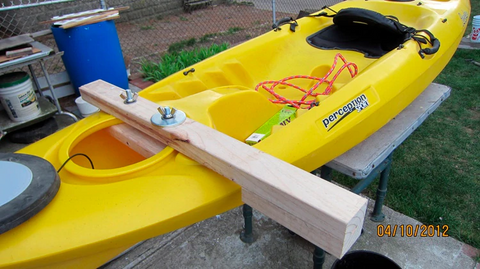
Ranging anywhere from $60 to $200, these mounts look like they were made in your uncles garage, but they can get the job done. These mounts are designed to fit inside rod holders on a kayak that ranges from 26”-36” in width, which can be convenient for existing rod holders on a kayak. For individuals that do not want to drill into their hull, this is an attractive option. Because these kayak trolling motor mounts fit into rod holders, it can work with both Sit-on-top and Sit-Inside kayaks. Depending on the kayak mount, they can be rated to hold up to 55lb thrust trolling motors.
While affordable and easy to install, there are many drawbacks to this style of kayak motor mount. If you do not have rod holders, you will have to install your own. Because it only works with rod holders, there is wiggle and sway, which makes the trolling motor mount unstable. This may cause some concern for users that have a motor hanging over the water. Some of the materials used to make this mount include aluminum and stainless steel, but the down tubes are made from cut PVC that remains unfinished at the ends. If you are looking for the most economical option to get out on the water, and don’t care about looks or quality, this kayak motor mount might be a good fit.
RAILBLAZA KAYAK TRANSOM MOUNT KIT
This is our first choice for a kayak motor mount, which is why we offer it as an option when you purchase out kayak motors. This is the best that money can buy and fits on most kayaks. It’s made with quality materials such as: Anodized Aluminum, Stainless Steel and UV Stabilized Reinforced plastics. This kit is extremely durable and built to last for fresh or saltwater use. When this kit is assembled and installed, it is stable and allows very little sway or movement. Not only can you remove the kit if you would like, but the base mounts are compatible with other Railblaza accessories ranging from rod holders to camera mounts. You can switch from paddling to your kayak trolling motor in under 30 seconds!
Installing this kit requires drilling into your kayak to ensure this kit is secure and stable. This requires tools and can be daunting for some people. The mounting surface also needs to be flat for this mount to be compatible.
BROCRAFT KAYAK TROLLING MOTOR MOUNT
A reasonable priced trolling motor mount for your fishing kayak. $135.99 is right between the pricing for your uncles garage model and Railblaza. This isn’t out of the reach for everyone who is considering a trolling motor mount for their kayak. It’s made with marine grade aluminum which is durable and corrosion resistant for use in saltwater. This mount is also adjustable to fit varying kayak widths and is adjustable to work on different mounting angles.
Downside is that this motor mount is only rated for 35lbs of thrust, which doesn’t inspire much confidence in it’s strength and durability. This kayak motor mount won’t be able to support the 55lb kayak trolling motor that many Newport Vessels customers own. This kit also requires you to drill into the hull of your kayak. However, the mounting equipment provided is not enough to provide a secure and stable mount, with only four screws to hold your new kayak trolling motor. If you are going to risk drilling into your kayak hull, might as well get something secure that you know will work.
DIY
The price from this option can range from $0+ depending on what you already have and what you need to get. This is a great option because you can customize it specifically to fit your kayak. This option gives you the freedom to make the mount of high or low quality to your liking. You can also add additional items or features.
There are some instructions available online. If you do not have the adequate knowledge or experience, you could end up ruining your kayak or end up with a water filled kayak because your kayak motor mount failed.
To learn more about our favorite kayak trolling motor mount, check out the Railblaza mount kit.
Modern-day hunters, tactical shooters, and competition shooters rely so much on their scopes and other gun accessories to enhance their shooting accuracy. However, to improve your overall shooting accuracy, you have to practice as much as you can with your scope and rifle.
Aside from that, you also need to control the amount of recoil released by your firearm. Although you do not need to directly use your strength to manage the recoil impact, you would need a top-class mounting system.
Without a durable and reliable mounting system, your scope will not be of use to you because it is not possible to hold your scope on top of your rifle with your hands while trying to shoot at a target. Having said that, the only solution to managing the recoil effectively and ensuring that it does not affect your scope and rifle relationship is to use a tough scope ring.
There are so many scope rings out there that you can use to mount your scope to your rifle platform. In this article, we have compiled a list of the best scope rings for heavy recoil rifles. Carefully follow the reviews below to find out the best mount for your particular rifle caliber. Sit tight as we proceed…
What Exactly Are Scope Rings?
We need to understand what riflescope rings are before we proceed to some of the best rings available. If you’re a beginner, knowing what this gun’s accessory is and how it should be used can help you be a better shooter.
If you already know what a scope ring does, you can go to the next part; otherwise, let us take a brief explanation.
The phrase scope ring is self-explanatory; even if you have never held one in your hands, you must have seen snipers in the movies shooting with a particular device called a riflescope. This riflescope is held firmly to the rifle by a scope ring, so you will never see a sniper holding the scope with their hands.
A riflescope helps to improve shooting accuracy, while a scope ring holds the scope firmly on the rifle. Scope rings are simple devices that allow you to attach the scope to your rifle and use it without difficulty. There are a lot of considerations to make before purchasing a scope ring.
Some of these include the height, type of rail, and a number of other variables. Fortunately, you will find a section in this article that provides all of the pertinent information about the subject.
So, before you proceed to the review part, check out the guide below because it will provide you with a clear idea of what to consider before purchasing any type of scope ring.
Types of Scope Rings
There are several types of scope rings available on the market for mounting a riflescope. Finding the right ring among the varieties might be difficult. To make your search easy, we have highlighted some of the ring types.
One-Piece Scope Mount
These types of mounting systems have just one piece, as the name implies. As a result, putting them on your rifle would be very easy.
Weaver Scope Mount
These are typically bolted mounts. That is, you must attach the riflescope to the mount using all of the available spots. They ensure a significantly more solid and consistent scope installation.
Dual Scope Mount
These types of scope mounting rings are more versatile than others. They allow users to have room to make adjustments to the distance between the scope rings. This makes it easier to mount the scope exactly the way you want it.
Picatinny Scope Mount
These are similar to one-piece mounts. Bolts must be used to attach both the mount and scope. As a result, you have more installation options.
Dovetail scope mount
The dovetail mounting system, which is commonly found on an air rifle and rimfire rifles, consists of two grooves that are parallel to the barrel. The dovetail rail, sometimes known as a “tip off” mount, allows a shooter to readily remove or replace attached optics. So you can mount dovetail rings easily on this base whether you want to use it on an air rifle or any other rifle.
Although we have so many other types of scope mounts, these are some of the most common or popular scope mounts.
Integral mount
Offset mount
STD scope mount
MOA mount
Quick detach mount
Market’s Top Scope Ring Brands
Let us check out some of the best brands that manufacture high-quality scope rings.
Vortex Optics
Vortex Optics was founded in 1989 as a division of the well-known corporation Sheltered Wings Inc. The firm has produced some of the best and most renowned gun attachments and optical equipment for a variety of shooting applications. This firm also makes good scope rings for rifles that have heavy recoil.
Leupold
When it comes to riflescopes, only a few firms can match the quality of the Vortex brand, and Leupold is one of those. This optical brand is among the best on the market. Its primary goal is to provide its customers with goods that are of exceptional durability, dependability, and adaptability.
Burris Optics
It makes no difference if you are looking for a rifle scope or a scope ring; Burris Optics has it all. Burris is one of the top scope ring brands in the market. they have been in business since 1972, and they are still producing quality optical accessories, including scope rings.
There are other scope ring brands like Seekins Precision and Warne. These brands are not popular when it comes to riflescopes, but when you talk of scope rings, they’re among the best.
Buying Guide for Heavy Recoil Scope Rings
Knowing everything about weapons and their accessories is crucial for a huntsman or marksman. One of the essential elements for mounting your scope is the ring, and we would help you understand all there is so that you can make an informed decision when you want to buy a ring to mount your scope on a heavy recoil rifle.
Ring Type
Traditionally, we have two major types of scope mounts. All other forms of scope mounting rings are made up of either of these two. So, first and foremost, you must decide which one you want. We’re talking about the single-piece mounts and dual-piece mounts.
As previously stated, a single-piece mounting ring has the easiest installation among the two types. Single-piece rings are often built with a light material, which allows for greater precision. Dual-piece rings, on the other hand, allow the gun owner to determine the space they want to have between the two rings.
There is no hard rule that makes one better than the other, its just a matter of preference for the shooter.
Materials Used
The type of material used to construct a scope ring or mount determines a lot on the mount. As a result, you must use caution while selecting this type of device.
Number one: The material chosen determines the weight. It is probable that it will impede your aiming accuracy if it is very heavy. As a result, you should choose a scope ring constructed with a light material.
Number two: It must not be fragile, even though it is lightweight. As a result, you must select a mount that is very strong and durable and can withstand the abuse of a heavy recoil rifle.
With these two factors in mind, we suggest that you choose anything composed of steel or aluminum. Both materials are incredibly long-lasting and lightweight, although aluminum is lighter than steel. They provide you with the highest performance you would need from your ring. With these materials, you are sure your scope rings will not break, regardless of the abuse by heavy recoil rifles.
Attachment Without Hassle
Another consideration is the ease of installation of the rings. Fitting a complicated ring may be physically and emotionally demanding. As a result, we recommend that you choose a mounting ring that is simple and easy to install.
Cost
Most shooters do not have so much to spend on shooting accessories, whether it’s a scope or a scope ring. In fact, you should not expect a shooter that is using a $200 riflescope to buy a scope ring of the same amount or more. So it is important that you double-check everything about the rings, including the cost.
Having a budget in mind before you go to the local gun shop or online marketplace would save you time that you would have spent admiring expensive and out-of-budget accessories.
Scope Rings Made of Steel Vs Aluminum
Scope rings are typically made of two sorts of materials. The first is made of steel, while the other is made of aluminum. However, there has always been a controversy over which of the two is superior. Let’s see what happens!
Weight
Aluminum is the obvious winner in terms of being lightweight. Although steel rings are not too heavy, but when compared to rings made with aluminum materials, they’re quite heavy! Because Aluminum is lighter, the total weight of the rifle and scope mount is reduced, which means you can carry your rifle and scope mount for a long walk without getting tired.
Being lighter also provides improved movement and control over the rifle. As a result, you may be more precise when aiming at or taking a shot with your rifle.
Longevity and durability
Steel is far more durable. However, aluminum comes out on top in terms of longevity. This is because steel corrodes more easily than aluminum. Aluminum, on the other hand, cannot withstand the amount of impact that steel can take.
Overall, aluminum is a better choice, even though it’s not as strong as steel. When all of the benefits are considered, it is a far superior solution over steel rings. Still, the decision is totally yours.
Best Scope Rings for Heavy Recoil Detail Reviews
Even if you’re using the most expensive and high-quality scope in the market, it will be totally useless unless you attach it to your rifle. We’ve got a solution! Here are some of the best scope rings on the market, suitable for practically any high-recoil rifle scope.
1. Vortex Precision Matched Rings
Are you looking for a rifle scope mount for your high recoil rifle? There is no need to worry any longer because we have the best ring here for you! Vortex Optics produces a wide range of high-quality shooting accessories, which includes this Vortex ring. So, if you’re looking for the best scope mount for strong recoil, look no further!
This Vortex ring offers excellent placement, allowing you to put the rings exactly where you want them to be. As a result, there is no undesired imbalance in your vision, and this allows you to have a first-class view through your optic.
This Vortex ring is well contructed. Each of the rings is made of aluminum. Aluminum is both lightweight and strong. Your shots will not be affected as a result of these features (a heavy-weighted scope ring can put additional weight on your rifle, and this could alter your accuracy).
Furthermore, the product’s remarkable sturdiness allows it to endure any abuses without difficulty.
But wait, there’s more. Vibratory toppling, serializing, and hand-bead blasting add to its toughness. It also has a type III anodized finish. As a result, we can tell you that this scope ring will have your back in practically any terrain or weather condition.
These Vortex Optics rings also have a stylish and appealing overall appearance. For you to successfully mount this ring and use it for the purpose you bought it, you have to ensure that the rings match the scope base on the rifle platform.
This rifle scope mount fits perfectly on a Picatinny rail. Trying to use it with another scope base might be challenging.
2. Seekins Precision 30mm Scope Ring
This Seekins ring is one of the market’s newest and fastest-growing optical accessory brands. The firm prioritizes ease and durability, which is why it created this gem!
Let’s go into the specifics. First and foremost, the item is superbly constructed. It is built to last and features a type III hard-coat anodized finish. This provides increasing immunity from environmental damages such as scratches, rusts, and dents.
It also gives the device the capacity to withstand very high recoil. As a result, it is a viable solution if you require consistent perseverance and endurance. You can use it with a heavy recoil rifle because it is built for that purpose.
Furthermore, the unit’s weight is quite little. It weighs about 0.19 kilos and has a plethora of features.
Because it is so light, it has no detrimental impact on your accuracy and allows you to be highly flexible. Such characteristics are essential on battlefields or during competitive shooting.
The installation of the scope ring is a breeze. Once installed on top of your rifle, you may mount almost any sort of riflescope on it. Because of its lightweight design, your gun’s mobility, precision, and control are unaffected. Pricing is also reasonable.
One of the issues with this ring is that it cannot be mounted on a weaver base; it only works on a Picatinny rail. This is because the crossbar on the base of the scope rings are too wide for a Weaver base slot. So if your rifle has a weaver rail, you will not be able to mount this Picatinny ring on it.
This Seekins ring has a 30mm ring diameter; as a result, you can only mount a scope that has the same scope tube diameter as the ring diameter.
When it comes to ring height, this Seekins scope mount has a .82-inch height. This ring height is not just low, but it is one of the lowest heights you can find. You have to ensure that the scope can sit properly on the ring without the scope bell touching the rifle barrel.
3. Warne Scope Ring
Purchasing the nicest rifle scope may be a total waste of money if you don’t have the right mounting system. However, we have a fantastic thing for you right now. With this ring, you will never have to deal with such a problem. The product has a notable method that permits you to repair practically any scope you choose.
This Warne scope mount comes with an all-fit function that allows you to fix practically any type of scope you desire without any problems. It also boasts a robust recoil control, allowing you to continually take precise and steady shots.
Installing this scope ring is also a piece of cake. The recoil control keys in both the front ring and rear ring are made of stainless steel.
This Warne scope mount is made of steel, so you can expect them to be as tough as a nail. The rings have a matte black finish that is meant to protect them from the elements. You just need to fasten the four TORX type T-15 socket cap screws (with a 25 inches/pound torque ) to get the finest experience.
4. Leupold Rifleman Rings
When it comes to mounting a high-quality riflescope, which are hard to come by, placement is everything. Not to worry, we have the ideal option for you! First and foremost, the Leupold brand will present you with a list of optical shooting accessories from which you may select the appropriate one.
Aside from being able to select the perfect size that you want, you will also benefit from the superior lifespan and ruggedity of their aceessories. Leupold scope rings are built of high-quality materials like aluminum. As a result, you are sure to enjoy excellent durabilityof the rings .
Because the rings are constructed of aluminum, this makes them quite light. As a result, the device adds no extra weight to the rifle and so does not impair your shooting ability. A heavy rifle will be inconvenient to shoot with.
Additionally, the product’s mounting mechanism is outstanding! It includes three distinct mounting bits that allow you to put the device atop your rifle with remarkable simplicity and speed.
Also, the mounting elements are constructed in a way that they can endure impacts from heavy recoil rifles. They are designed to retain and hold the rings firmly once they have been installed. Finally, you may enjoy all of this at a low cost. You now see why these rings are regarded as one of the best scope rings.
5. Burris Weaver Style Rings
Burris optics is a famous name in the field of optics. And, among all of its scope rings, this Weaver-type zee ring is the best for long range shots. Would you want to learn more? Continue reading!
Long-range rifles usually have a heavier recoil because of the distance the bullet needs to hit. Therefore you need a scope ring that is very strong and durable to mount your scope to a long-range rifle.
If you value precision, this scope ring is one of the best options you can consider. It features a bottom and top-matched fit, ensuring superior strength and a great fit. What this means is that when you add your scope to the rings, there would be no need for lapping because the rings were neatly deisgned to hold your scopes.
Also, the rings will not add a dent or scratch to your scope if you mount them correctly. The Burris rings are really lightweight. As a result, you can easily fit the gadget on your rifle.
Aside from that, the lightweight construction results in another feature (it weighs around 0.3 pounds), which is the stability of your rifle; as a result, you will be able to shoot precise shots without your rifle waving to the left or right because of the weight.
Furthermore, the rings are of the high kind, making them perfect for target shooting at long distances.
The ring’s general appearance is pretty fascinating. Unlike traditional matte-black hue of most scope rings, this ring is nickel. As a result, it offers your rifle a unique and exciting appearance.
This Burris Picatinny ring can sit perfectly on a weaver mount or Picatinny mount.
They are strong and long-lasting, making the fit for heavy recoil rifles. This wonderful product is available at a reasonable price.
6. Monstrum Tactical Cantilever Mount Dual Scope Ring
Do you want the greatest 1-inch scope ring for your heavy recoil rilfe? We’ve got just the ring for you! Because this scope ring is a one piece mount, there is no need for a lengthy installation procedure. This Monstrum ring includes a plethora of additional features.
Though the ring is slightly heavier than other mounting sytem, you can be sure that it won’t impair your gun’s mobility or precision. Also, because it is somewhat heavier, it assists with absorbing the recoil of strong rifles to a greater extent.
Its extraordinarily strong construction is another feature that makes it on the list of best heavy reoil rings to acquire. It is made of 6061 aircraft-grade aluminum. It can withstand any punishment or abuse from your rifle or the environment.
One of the disadvantages of a cantilever mount is that you cannot attach just any scope you want on them. They have a predefined spacing (2.38 inches) between the front ring and the rear ring; as a result, riflescopes that do not match that kind of ring spacing on their scope tube will not be able to sit on the rings.
The entire mount can easily be installed or uninstalled whenever you want to change the mounts. It is a Picatinny ring and will not sit properly on a Weaver rail. The mount is designed to fit a 1-inch scope tube and may be attached to any regular Picatinny rail-fitted rifle.
The entire length of the mounting system is 5.75 inches. It has a 3 inches long base, with mounting bolts placed 2 inches apart.
7. Talley Scope Ring Mount
Are you angry and frustrated because you can’t seem to find the perfect scope mounting device for your bolt action rifle or heavy recoil rilfes? If that’s the case, this rings could be of interest to you. Talley’s 40mm scope ring is a promising mountng device. Do you wish to know what distinguishes it from others? Well, this ring is incredibly strong. It is capable of surviving any heavy-duty caliber. As a result, you can shoot without fear of damaging your mounts!
Its solid design further demonstrates its abilty to hold zero at all time. As a result, overall accuracy is guaranteed. Installing this ring onto your firearm is a simple process; once completed, you will be able to use it with any scope.
The best part is that you’d get all of these benefits at the most reasonable prices.
Frequently Asked Questions
Is it possible to have a scope mount that is too low or too high?
Yes, it is possible to have a scope ring that is too high or low. If the ring is too low, you won’t be able to attach the scope, because the scope be will rub on the barrel. If it is high, there’s a good probability that you will always have to raise your face from the cheekpiece, reducing accuracy.
Is it an issue if the screw on a scope mount is overtightened?
Yes, it can damage the setup. Overtightening the mounting screw may result in damage to your scope tube.
Are the rings on a 30mm scope and 1-inch scope the same size?
No, they are not. The size of the scope tube determines the size of the mounting ring you will need. Although some rings may be used to install both a 30mm and a 1 inch optic, but it is very uncommon and you will have to lap the scope. This is not an ideal mounting procedure, and it is not recommended.
In the winter anglers do many odd things to channel their fishing fever into substitutes, hoping to dim in some small fashion the feverish intensity of their urge. They whittle new plugs, polish old plugs, discard battered flugs, tie flies, mend nets, read outdoor journals, pore over maps to find new fishing spots to try in the spring, dream about exotic trips to Canada, Yellowstone, Iceland.
If they have the time and money they jet to Florida and pursue glamorous saltwater species. Florida in the winter isn’t really such a red-hot place to fish: It’s better by far in the spring.
Area waters are ignored, except by a few hardy souls with butane in their veins who know about a green snake of a gamefish called the chain pickerel. These toughskinned pickerel-pursuers couldn’t care less that hatches on the trout streams and spawning in the bass lakes are months away. Their quarry loves the cold.
The Washington area offers prime pickerel waters within a one- or two-hour drive in just about any direction (though north, south and east are preferable to west.) Pickerel are in ponds, lakes, rivers and huge impoundments. Yet they draw little attention from fishermen.
Some people simply don’t like the cold, and since pickerel bite best from December through March, quite a few potential anglers never try them.
You’re probably read that pickerel are harsh on the palate, poor fighters and ugly. The last point is moot, the second false. The first one is true.
Pickerel have tasty, sweet meat, but few people get past the first mouthful before they give up in disgust at the bones riddling the flesh. You can try scouring them with cross-cuts and frying in hot oil, which is supposed to make the bones “chewable.” But even chewable bones are anathema to some. There are also complex filleting methods you can look up in dusty tomes if you’re dead set on eating everything you catch.
Whether the pickerel is an ugly fish we’ll leave to the aesthetes. Certainly they are prehistoric-looking, with long, pointed snouts, enormous mouths and a ghastly set of razor-sharp teeth.
Describing the fighting ability of a fish – any fish – is always risky, because each fish is an individual. One pickerel may fight like the devil and the next may fight like a wet paper bag. The same is true of bass, trout and catfish. Generally speaking, pickerel are good fighters – but not great.
But fighting really isn’t much more important than eating qualities or looks where pickerel are concerned. What’s appealing is the whole ritual of pursuing a unique gamefish in his home waters and enticing him to take the bait. Fishing is first and foremost a battle of wits (man) against instincts (the fish). When pickerel are the quarry, the encounter is rich and challenging.
Pickerel habitat encompasses a broad spectrum of water types. Lakes and tiny ponds hold fish, as do sprawling impoundments, broad rivers and wadeable streams. Pickerel prefer blackwater ponds and creeks – waters with a low pH that are stained brown with tannic acids given off by certain plants.
Certain of Maryland’s Eastern Shore ponds and rivers come to mind immediately, as do similar branches and lakes in the tidewater portions of Virginia. The Choptank is one of Maryland’s better pickerel rivers, as are the Nanticoke, Pocomoke and Severn: A list of ponds in Maryland that contain pickerel is printed in the fishing regulations pamphley given out where licenses are sold.
Virginia pickerel, called jackpike by locals, inhabit many blackwaters. The Mattaponi, Pamunkey and Chickahominy, located east of I-95 between Richmond and Fredericksburg, are classic pickerel rivers. A.P. Hill and Quantico military reservations also offer good pickerel possibilities.
However, pickerel also thrive in waters about as black as Mountain Dew. Such inland lakes as Anna and Kerr offer many outsized pickerel in the four – and five-pound range.
Average pickerel in most waters run closer to one or two pounds. Due to their diminutive size, heavy bass tackle is not required to catch the lean fish. Ultralight or light spinning gear is in order, with lines testing four to eight pounds. Den’t worry about the tales of pickerel’s teeth shearing the line. It rarely happens. Wire leaders only serve to impede the action of lures and bait.
Those who favor artificials may hate to admit it, but pickerel can usually be caught more readily with live minnows. Their diet consists almost entirely of other fish, and they seem powerless to resist a helpless victim floundering within reach. So greedy are pickerel that I’ve caught them on small shiners when they still had freshly killed seven-inch-long sunfish bulging in their stomachs.
Look for pickerel in moderate to shallow depths of lakes and rivers where they cruise for food. The fish also like to hold parallel to weedbeds and dropoffs, where they lie in ambush waiting for an unwary baitfish to fin by. When a minnow swims near, the pickerel contorts its body like a snake coiling to strike and darts with blinding speed at the victim, clenching it sideways in the grasp of its inward-angling teeth.
If the pickerel are deeper than five feet, use either a shad dart and minnow or a fine wire hook, split shot and minnow. Crawl the bait in slowly. If the jackpike are in the shallows you can use a bobber and move the minnow from spot to spot after a minute or two if you don’t get a strike.
Lures can take pickerel, also, and sometimes they’ll outfish a minnow. The Johnson Silver Minnow tipped with a pork rind is the old standby pickerel hait, and it hasn’t lost its appeal. Also good are red- and-white Daredevils and broken-back Bebels and Rapalas.
Work these lures with a moderate to fast retrieve and a tight grip on your rod. The strike of a pickerel can be an explosive thing – something that’s sure to take the chill out of a cold wintry day.
What are the requirements of a good cartridge? Being easy to use, good speed, good trajectory, etc. are common features. In these terms, people choose cartridges for themselves. People find it difficult to find what is the difference between a 17 HMR and a 17 WSM?
Both these cartridges are great to use. But you’re here to know the differences between them, and you’re about to purchase one of them. Right? Besides, your rifle will come with respect to the cartridge you choose. And you should also pick a perfect scope for 17 WSM to have a good experience.
What is the difference between a 17 HMR and a 17 WSM?
You are reading this article as you need to find what is the difference between a 17 HMR and a 17 WSM? Consumers had a great experience using both these cartridges.
But you cannot blindly select one of these. You have to filter one of them out based on some parameters. Believe it or not, the following specifications will help you to make a proper decision.
Speed:
In the case of a cartridge, speed is one of the requirements that consumers demand. If the cartridge cannot get enough velocity, then it is useless. Passionate rifle users like to have fast bullets in their rifles.
The speed of 17 HMR is greater with respect to 17 WSM. It is light in weight. As a result, it travels faster than the other. It is suitable to hunt birds or other animals at close range.If needed, you can use affordable thermal imaging scopes for WSM with its rifle.
The speed of 17 WSM is less than 17 HMR. It is heavier. So, it travels with less speed. However, it can make a hole in thick objects. Thick objects cannot be penetrated with thin bullets. So, this bullet is suitable for people who will use it to penetrate thick objects.
Cost:
Cost plays an important role while choosing cartridges. If your potential cartridge use is high, then you should go for the cheapest cartridge available.
The 17 WSM is more expensive between 17 HMR and 17 WSM. The 17HMR costs 20 cents only, whereas 17 WSM costs 30 cents. So, the cost difference is negligible for these cartridges. But you are not buying only one cartridge; you will buy hundreds or thousands of cartridges. However, this little amount can have a great effect in the long run.
The cost of the HMR might even get chipper in time. IT is completely the opposite case for the 17 WSM. 17 WSM will get out of the market sooner or later. As more and more cartridges are coming into the market, the public is losing interest in buying 17 WSM. The production rate has reduced, as well. So, the cartridge and the rifle both might get out of the market as well. As the quantity gets decreased, the seller might take advantage of it. People who have 17 WSM rifles have to buy 17 WSM cartridges, as it will not be available anymore, the seller will sell the product for a higher price.
Field Performance:
The core fact of cartridges is field performance. The choice of cartridge changes based on this parameter. Based on this parameter, other parameters are subjected to change.
Based on the distance of the target, your choice of cartridges will change. A lot of factors come along with an increase in distance.
In terms of a distant shot, time plays an important role. As time increases, the trajectory goes downward. The cartridge has to keep the trajectory for longer distances. If the trajectory decreases, the probability of the cartridge to miss the target will increase.
The wind may have other impacts as well—for example, wind deflection. When a bullet leaves the rifle, it starts flying with velocity in one direction. The wind is flying in another direction. As a result, the bullet might get deflected from the target.
The 17 WSM is the better cartridge to have a better field performance at a greater distance. Both these cartridges can work with the wind. Though, the WSM works better than the other in terms of long-distance.
17 HMR is great for a short distance. It is fun to work with. It has got a better speed than the other. It creates less noise than the 17 WSM. These are needed to hit the target at a short distance.
However, none of these cartridges should be used for self-defense, where many other cartridges are available. 17 HMR and 17 WSM both should be avoided in this term.
Availability:
Availability is a factor that many people do not consider. It creates different types of problem letters.
The 17 HMR cartridge is available. You may go to any ammunition store and find 17 HMR. The rifle of 17 HRM is also available everywhere. As the rifle is available, it is relatively easy to find separate parts if needed to fix the rifle.
The 17 WSM cartridge is not available everywhere. And it’ll be a hassle to find out either. You would find it difficult to find separate parts of the rifle if needed. The cartridge is a special kind. You can’t use this cartridge in any rifle, either. You need to have the 17 WSM rifle to use this cartridge.
In terms of availability, 17 HMR should be your choice.
Final Words
You are looking to find a cartridge that suits you. Go through the parameters given above before making your final decision. And you’ll be able to make a list of what is the difference between a 17 HMR and a 17 WSM? You should be economical while buying cartridges. So, 17 HMR is obviously a better choice for you.
If you need to hit a target at 450 meters distance under strong wind, buying 17 HMR is useless. The 17 HMR will fly up to 150-250 meters and then drop on the ground. You will need 17 WSM to do the job under such conditions. So, all these factors should be considered to get the best cartridge.
When it comes to duck hunting, having the right decoys can make all the difference. To help you choose the best decoys for a successful hunting experience, we have compiled a list of the top 5 duck decoy companies, along with their top 3 decoys and why they are preferred by hunters. With these high-quality decoys in your arsenal, you’ll be well-equipped to attract and bag more ducks on your next hunting expedition.
Avian-X
Avian-X is a renowned brand known for its lifelike and realistic decoys. The brand was created by a group of passionate hunters who wanted to change the game in terms of realism and effectiveness in decoy design. They combine cutting-edge technology with years of field experience to produce innovative and lifelike decoys that attract more waterfowl. Avian-X offers a wide range of decoys designed to mimic a variety of duck species, each with unparalleled detail and realism. They also offer various poses and positions to create dynamic and convincing spreads that lure in wary ducks. With Avian-X, hunters can expect to experience unparalleled success on their hunts by bringing in more birds. The company prides itself on using only the highest-quality materials to ensure durability and longevity in their decoys, making them an investment that hunters can depend on season after season. Here are Avian-X’s top 3 decoys:
Avian-X Topflight Backwater Mallards
Avian-X Topflight Backwater Mallards are the ultimate choice for hunters targeting mallards in marshes, shallow water, or backwater areas. These decoys are specifically designed to mimic the natural postures and movements of mallards in these unique hunting environments. The Backwater Mallard decoys feature realistic paint schemes, intricate feather details, and lifelike body postures that make them virtually indistinguishable from live mallards. The attention to detail on these decoys is unmatched, allowing you to create an incredibly convincing spread that will attract even the most cautious ducks. Whether you’re hunting in flooded timber or small wetland areas, the Avian-X Topflight Backwater Mallards are sure to enhance your hunting success by bringing mallards in close for the perfect shot.
Avian-X Topflight Pintails
Avian-X Topflight Pintails are a must-have for any serious duck hunter. These decoys are meticulously crafted to replicate the unique features and behavior of pintail ducks with extraordinary accuracy. Their lifelike body postures and vivid paint schemes make them virtually indistinguishable from real pintails. The attention to detail, from the intricate feather patterns to the realistic eyes, is truly remarkable. These decoys draw in pintails from a distance, enticing them with their authentic appearance. With Avian-X Topflight Pintails in your decoy spread, you’ll have the confidence and edge needed to attract more pintails and increase your chances of a successful hunt.
Avian-X Topflight Canvasbacks
Avian-X Topflight Canvasbacks are a top-of-the-line choice for hunters targeting these elusive diving ducks. Known for their striking appearance and swift flight, canvasbacks can be a challenge to lure in. However, Avian-X has gone above and beyond to create incredibly realistic decoys that capture the unique characteristics of these birds. The Topflight Canvasbacks feature meticulously painted details that perfectly replicate the distinctive coloring, patterns, and feather textures of live canvasbacks. The attention to detail extends even to the realistic head positions and body postures, ensuring that these decoys look convincingly lifelike in the water. Whether you’re hunting in open water or along the shore, the Avian-X Topflight Canvasbacks are designed to maximize visibility and attract canvasbacks from a distance. With these decoys in your arsenal, you can significantly increase your chances of a successful canvasback hunt.
Flambeau Outdoors
Flambeau Outdoors is another trusted name in the duck decoy industry, celebrated for its innovation and top-quality products. Their decoys combine durability and realism, making them a favorite among hunters. Flambeau Outdoors is a renowned company that specializes in manufacturing high-quality outdoor products and gear. With a rich history that spans over seven decades, Flambeau is dedicated to providing innovative solutions for outdoor enthusiasts. Their hunting decoys, in particular, are highly regarded for their lifelike appearance and realistic features, making them a favorite among hunters. Whether you’re a seasoned hunter or a novice adventurer, Flambeau Outdoors offers a wide selection of products that are designed to enhance your outdoor experience and help you succeed in the field. With Flambeau Outdoors, you can trust that you are investing in top-quality gear that will withstand the demands of the great outdoors. Here are Flambeau Outdoors’ top 3 decoys:
Flambeau Gunning Series Mallard Decoys
Flambeau Gunning Series Mallard Decoys are a popular choice among duck hunters. These decoys are designed with attention to detail and realistic features that make them almost indistinguishable from live mallards. Made of sturdy plastic, the Flambeau Gunning Series Mallard Decoys are both durable and lightweight. They come in a variety of poses, including swimmers, feeders, and high-head drakes, making for a varied and dynamic spread. They have vibrant, non-glare paints that are both water-resistant and durable. These decoys are the perfect tool to convince mallards that your hunting area is safe and appealing. With Flambeau Gunning Series Mallard Decoys in your spread, you can expect to attract more mallards and to get closer to them than ever before.
Flambeau Master Series Mallard Decoys
The Flambeau Master Series Mallard Decoys are the epitome of realism and effectiveness in waterfowl hunting. Each decoy in this series is meticulously crafted to replicate the natural appearance and behavior of live mallards. The attention to detail is remarkable, with intricate feather patterns, lifelike body postures, and vibrant paint schemes that mimic the subtle nuances of mallards in various stages of flight and landing. These decoys are made from durable and lightweight materials, ensuring that they can withstand the harsh conditions of any hunting expedition. The Flambeau Master Series Mallard Decoys also feature removable heads, allowing hunters to customize their decoy setup and simulate different poses and positions to deceive even the most wary ducks. With their unparalleled realism, these decoys create an irresistible allure that will attract mallards from afar, increasing your chances of a successful hunt. Whether you’re a seasoned waterfowl hunter or a passionate beginner, the Flambeau Master Series Mallard Decoys are the ultimate choice for enhancing your hunting experience and bringing more ducks into range.
The Storm Front Classic Mallard decoys excel in replicating the natural appearance and behavior of live mallards. The ultraviolet (UV) paint replicates the reflective properties of real feathers, creating an additional layer of realism that can fool wary ducks. With their versatility and affordability, these decoys are a popular choice for both experienced and novice hunters.
Flambeau Storm Front 2 Wigeon Decoys
The Flambeau Storm Front 2 Wigeon Decoys are a true game-changer when it comes to waterfowl hunting. These decoys are designed to perfectly replicate the natural coloring, feather patterns, and body postures of wigeons – a diving duck species known for its elegance and agility in the water. Each decoy in this set is expertly crafted and hand-painted to accurately simulate various poses and flight positions, creating a lifelike and convincing effect that will attract wigeons from a distance. The decoys are made with Flambeau’s proprietary polymer blend material, ensuring they hold up well in any hunting conditions. They feature a weighted keel and anchor points, which provide stability in the water and prevent rotation during high winds or strong currents. For added convenience, the Storm Front 2 Wigeon Decoys also feature a realistic high-definition paint scheme, which resists chipping and fading over time. If you’re looking for premium quality wigeon decoys that will optimize your hunting results and withstand the test of time, the Flambeau Storm Front 2 Wigeon Decoys are an excellent choice.
Higdon Decoys
Higdon Decoys is a leading company in the waterfowl industry. Based in Kentucky, USA, the company specializes in creating high-quality and realistic decoys that are designed for maximum hunting success. Higdon Decoys offers a wide range of decoy types, including duck, goose, and turkey decoys, as well as various accessories such as motion decoys, wobble bases, and jerk strings. The company takes pride in using only the highest quality materials and innovative manufacturing techniques to create lifelike decoys with exceptional durability. The decoys are designed by professional hunters to reflect the latest advancements in hunting strategies, and the company frequently collaborates with experienced hunters to develop new products for improved hunting outcomes. From the Higdon Magnum Mallard Duck Decoys to the Full-Body SuperMag Snow Goose Decoys, Higdon Decoys is committed to providing hunters with reliable, effective, and top-quality decoys that can withstand the rigors of frequent use in the toughest hunting conditions. Here are Higdon Decoys’ top 3 decoys:
Higdon Magnum Mallard Duck Decoys
The Higdon Magnum Mallard Duck Decoys are among the most realistic and effective decoys available on the market today. These decoys are designed to replicate the size, shape, and coloring of live mallard ducks, providing an incredibly lifelike appearance that ensures maximum attraction of real ducks. They are made from high-quality materials and feature detailed feather patterns that create a seamless illusion. Additionally, the decoys have vibrant paint schemes that can withstand heavy use and exposure to the elements. The Magnum Mallard Duck Decoys are also equipped with weighted keels that provide stability, promote natural movement in the water, and have anchor points for easy setup and placement. For added convenience, the decoys come in four unique body postures to add variety and realism to your spread. With their unmatched realism and attention to detail, the Higdon Magnum Mallard Duck Decoys are a top choice for serious waterfowl hunters who want to improve their success rate and add a touch of authenticity to their hunting experience.
Higdon Standard Redhead Duck Decoys
The Higdon Standard Redhead Duck Decoys are a top choice for waterfowl hunters seeking a realistic and effective decoy setup. This pack includes 12 Redhead duck decoys, each meticulously designed to replicate the size, shape, and coloring of Redhead ducks, ensuring a lifelike appearance that will attract even the most discerning ducks. The decoys are made from high-quality materials and feature vibrant paint schemes that are resistant to fading, ensuring long-lasting use. Their weighted keels and anchor points provide stability and allow for easy setup and positioning. The realistic body postures of these decoys add variety to your spread, enhancing the overall effectiveness of your hunting setup.
Higdon Outdoors Standard Ringneck Duck Decoys
The Higdon Outdoors Standard Ringneck Duck Decoys are a reliable and effective tool for waterfowl hunting enthusiasts. These decoys are specifically designed to replicate the appearance of Ringneck ducks, with meticulous attention to detail in color, feather patterns, and body shape. The foam-filled construction ensures durability and buoyancy, providing a lightweight yet sturdy decoy that can withstand rough water conditions. The decoys come with weighted keels and anchor points, allowing for easy setup and ensuring stability in the water. This lifelike setup, combined with the decoys’ realistic paint schemes, creates an irresistible attraction for Ringneck ducks, luring them into shooting range. The Higdon Outdoors Standard Ringneck Duck Decoys offer hunters an excellent decoy option that is built to last, providing both functionality and realism for a successful hunting experience.
Dakota Decoy Company
Dakota Decoy Company is a reputable and innovative company in the hunting industry. With a focus on premium and realistic decoys, the company has gained recognition among serious waterfowl hunters. Based in North Dakota, USA, Dakota Decoy Company prides itself on producing high-quality decoys that mimic the appearance and movement of various waterfowl species. From mallards to snow geese, their decoys exhibit exceptional attention to detail, ensuring a lifelike and convincing look. The company utilizes advanced manufacturing techniques and durable materials to create decoys that withstand the rigors of the field. Dakota Decoy Company is committed to continual improvement, constantly innovating and enhancing their products to provide hunters with even more effective hunting tools. With their dedication to quality and realism, Dakota Decoy Company has become a trusted name in the hunting community, delivering reliable and top-notch decoys that help hunters achieve optimal hunting success. Here are Dakota Decoy Company’s top 3 decoys:
Dakota X-Treme Mallard Decoys
The Dakota X-Treme Mallard Decoys are a game-changer for avid waterfowl hunters. These decoys, designed by Dakota Decoy Company, are specifically crafted to replicate the appearance and behavior of mallard ducks with unmatched realism. Each decoy is meticulously hand-painted, showcasing intricate feather patterns and vibrant colors that accurately simulate the look of live mallards. The attention to detail extends to the decoys’ body postures, which mimic various natural positions, adding depth and authenticity to your spread. Made from durable materials, these decoys are built to last and can withstand the toughest hunting conditions. The pack includes both hens and drakes for a balanced and diverse presentation. Thanks to their weighted keels, these decoys stay stable and perform convincingly in the water, even in the face of wind and waves. Increase your hunting success with the Dakota X-Treme Mallard Decoys, the epitome of lifelike realism and durability in the field.
Dakota Decoy Signature Series Upright Geese
The Dakota Decoy Signature Series Goose 6-Pack, the ultimate solution for waterfowl hunters seeking ultra-realistic and effective goose decoys. Made from durable EVA plastic, these decoys boast a one-piece body design that enhances their durability and resilience in harsh hunting conditions. With a meticulously designed mix of postures including one sentry, three walking actives, and two relaxed actives, this package provides a dynamic and ultra-realistic appearance that is bound to attract a wide range of waterfowl. The inclusion of the Wind Walker Motion Base allows the decoys to move naturally, increasing their appeal and successfully luring wary geese to your location. Additionally, the base eliminates the need for staking the decoys into the ground, further streamlining your hunting setup. The Dakota Decoy Signature Series Goose 6-Pack offers hunters a high-quality and innovative tool for a successful and productive hunting experience.
Dakota X-Treme Blue-Winged Teal Decoys
The Dakota X-Treme Blue-Winged Teal Decoys, a must-have for waterfowl hunters who are targeting these fast-flying and elusive ducks. These decoys are specifically designed to capture the unique characteristics and essence of Blue-Winged Teal with unparalleled detail. The attention to detail is evident in the decoys’ intricate feather patterns, vibrant colors, and realistic body postures that reflect the natural movement and behavior of these agile ducks. Crafted using the highest-quality materials, these decoys are built to withstand the challenges of the field, ensuring long-lasting performance season after season. The pack includes both drakes and hens, allowing you to create a balanced and convincing spread that will attract Blue-Winged Teal from a distance. Featuring weighted keels, these decoys stay securely anchored in the water, mimicking the tranquility and confidence of real Blue-Winged Teal. Elevate your waterfowl hunting experience with the Dakota X-Treme Blue-Winged Teal Decoys, the ultimate choice for dedicated hunters seeking to replicate the magic and excitement of hunting these speedy and beautiful birds.
Final Approach
Final Approach is a well-known manufacturer of high-quality, innovative, and field-proven hunting gear and accessories for waterfowl and other game bird hunters. Established in 1993, the company has dedicated itself to providing hunters of all skill levels with the gear and tools needed to achieve their hunting goals. At Final Approach, they have a deep understanding of the demands that hunters face when searching for game, which is why they have designed and tested their products to meet or exceed the needs of modern hunters. Their selection of hunting gear includes decoys, blinds, bags, accessories, and more, all made to the highest standards of craftsmanship and quality. By constantly innovating, experimenting, and perfecting their products, Final Approach has earned its place as a trusted provider of hunting gear for seasoned and new hunters alike.
Final Approach Last Pass Mallard Decoys
Final Approach Last Pass Mallard Floaters is a remarkable decoy that combines affordability with exceptional craftsmanship. These decoys are meticulously painted, providing a stunning and lifelike appearance that is sure to deceive even the most cautious waterfowl. Designed to be lightweight and compact, they are the ideal choice for hunters who need to traverse long distances to their hunting spots or are looking to maximize the number of decoys they can carry in a mesh bag or small boat. Built with the same rugged construction and durability as the renowned Live Series Mallards, these decoys are built to withstand the rigors of the hunting season. The new carvings, created by the 17-time World Champion Pat Godin, further enhance their authenticity and overall appeal. With their one-piece design, weighted keel, and cord lock system, these decoys ensure stability and ease of use. The 12-pack includes a balanced mix of 6 drakes and 6 hens, allowing hunters to create a diverse and enticing spread. Trust in the Final Approach Last Pass Mallard Floating Duck Decoys, 12 pack, or simply known as the Last Pass Mallard Floaters, to elevate your hunting game and attract waterfowl like never before.
Final Approach HD Blue Wing Teal Floater Decoys
The Final Approach HD blue wing teal decoys are the real deal, crafted with an unparalleled attention to detail that’s a testament to the new era of excellence in decoy craftsmanship. You’ll be amazed at the intricately sculpted heads and meticulously painted tails – they’re so realistic, they’ll make you do a double-take! If you’re looking for an effortless way to add some variety to your decoy spread and attract teal and other waterfowl, these decoys are a total game-changer. Designed for early season decoy spreads when these early birds are still around in many states, they’re the perfect choice for hunters who want to create a diverse and visually appealing spread that’s sure to catch the eye of passing waterfowl. With a 12-pack that includes a mix of 8 drakes and 4 feeder hens, you’ll have everything you need to create a dynamic decoy spread that’s bound to increase your chances of a successful hunt. So, grab your hunting buddies, set up around a campfire, and get ready to elevate your waterfowl hunting game with the Final Approach HD Bluewing Teal Floater Duck Decoys!
Final Approach HD Greenwing Teal Floater Decoys
Experience the excellence of the Final Approach HD Greenwing Teal Floater Duck Decoys – a game-changer for waterfowl hunters. With unmatched detail, these decoys bring your spread to life and attract teal or add variety. The 12-pack includes 8 drakes and 4 hens, crafted from premium plastic with a realistic, one-piece design. Expertly carved by Wayne Simkin, they blend seamlessly into their surroundings. Upgrade your spread with the Final Approach HD Greenwing Teal Floater Duck Decoys for a successful and unforgettable hunt.
With the variety of options available, choosing the right duck decoys can be overwhelming. The top 5 duck decoy companies highlighted in this article offer some of the best decoys for successful hunting experiences. Whether you’re targeting mallards, canvasbacks, scaup, teal, or Canada geese, these decoys deliver on realism, durability, and effectiveness. Each company offers a range of high-quality and effective decoys that cater to different hunting needs and preferences. Whether you choose Avian-X, Flambeau Outdoors, Final Approach, Higdon Decoys, or Dakota Decoy Company, you can trust that their top-decoys will enhance your hunting experience by attracting more ducks to your spread. Invest in these premium decoys and get ready for more successful hunts ahead. Happy hunting!
"Debate over whether a 22 air rifle can effectively take down a deer has sparked curiosity among hunting enthusiasts. With its lower muzzle velocity...





 Caldwell Ballistic Precision Chronograph
  Shop NowClick to read my review
  Caldwell Ballistic Precision Chronograph G2
 Shop NowClick to read my review
  Competition Electronics ProChrono Digital Chronograph
  Shop NowClick to read my review
  LabRadar Ballistic Velocity Doppler Radar Chronograph
  Shop NowClick to read my review
  MagnetoSpeed V3 Ballistic Chronograph
 Shop NowClick to read my review
  Shooting Chrony 7000129 Beta Master Chronograph
  Shop NowClick to read my review