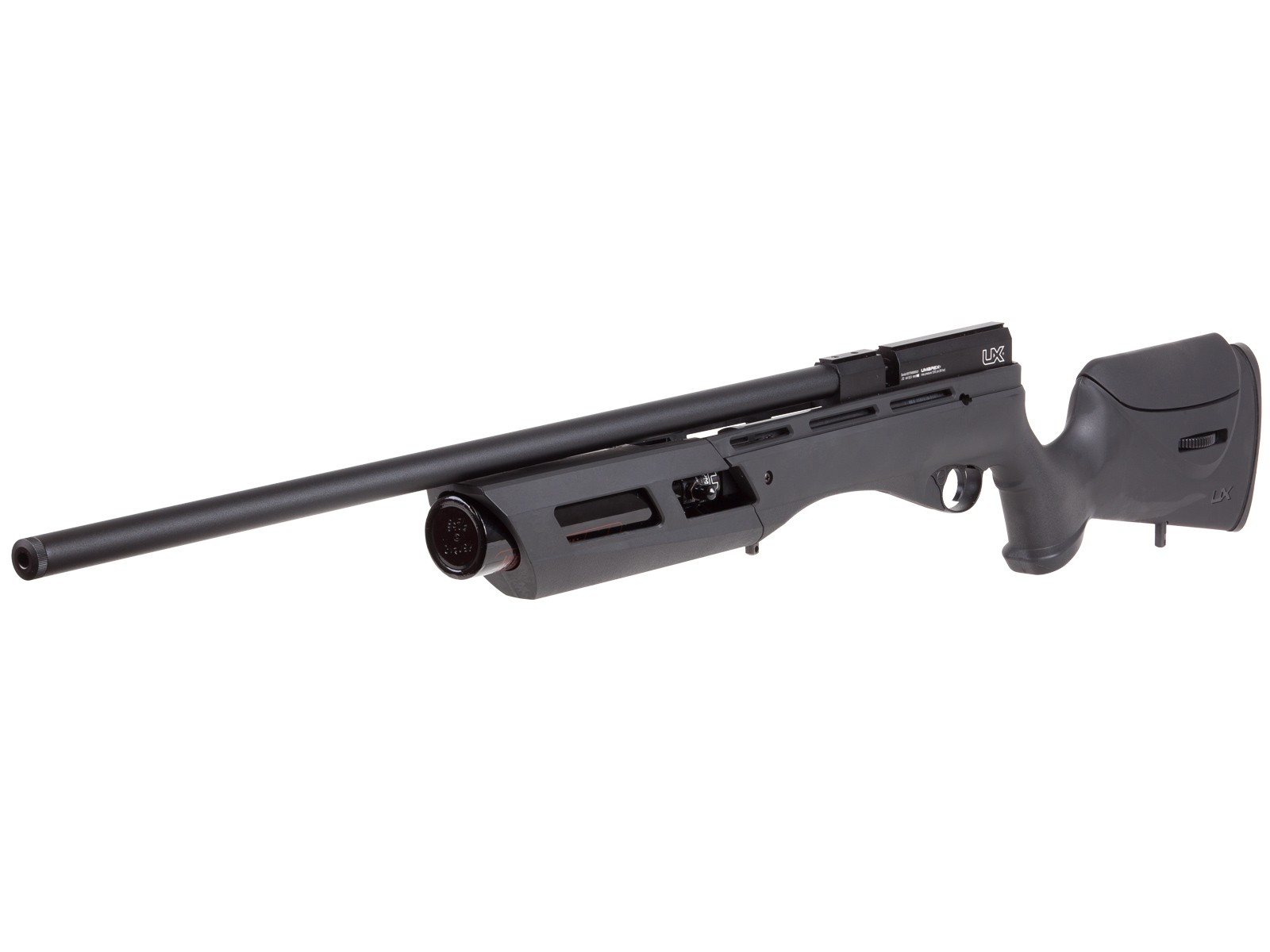
If you have been into rifles for some time, you would know about the company Umarex – the largest importer of air guns in Europe. They specialize in airguns and one of their best-selling PCPs is the Umarex Gauntlet.
The Umarex Gauntlet is a bolt-action, 10-shot repeating air rifle that gives the best performance for shooting at a budget price.
The gauntlet is well-regulated and is available in .22 and .25 calibers – allowing you to shoot long, consistent shot strings effortlessly.
What sets the Umarex Gauntlet apart is its ability to shoot 60-70 shots at 900 FPS – 1000 FPS each with only a .22 caliber.
If you are impressed by the numbers and want to know more about this splendid air gun, read on to find out.
Umarex Gauntlet Silencer
The Umarex Gauntlet is a backyard-friendly, silent shooter that comes with a fully shrouded barrel in .177 cal, .22 cal, and .25 cal versions .
It is a great gun for both traditional and beginner shooters as it has a lot of features that far exceed its cheap price of $300 (which may vary according to sellers).
With a maximum velocity of 900 FPS, the Gauntlet can shoot up to 10 rounds and 60 shots per cartridge. It also comes with a regulator, a shot counter, and a string that helps adjust the grip of the silencer.
The accuracy of the weapon is about 25-50 yards at .22 cal and around 900 FPS. Umarex Gauntlet is very silent and gives you great shots with its sleek, matte-finished body.
Umarex Gauntlet Rifle Details
The following is a compiled review of the main features of the Umarex Gauntlet. I shall let you know about all the important details you might wonder about if you are considering buying this gun.
Hence, without further ado, here are the specifications of the Umarex Gauntlet Rifle.
1. Gun Type
The Umarex Gauntlet is a Pre-Charged Pneumatic (PCP) type of air rifle that has a 10-shot rotary magazine. It comes with a 13-inch cubic air reservoir and a regulator that allows you to shoot at least 70 shots with a .177 caliber, 60 with a .22, and 25 with the .25 model.
2. Stock
The stock of the Umarex Gauntlet rifle is a synthetic one with a durable, matte-black finish which does not get scratched off easily. The forestock is covered with a battle shroud to keep the noise levels low and can easily be removed to switch tanks.
The grip is designed similarly to that of a pistol and to finish it off, there is an adjustable cheek piece on the stock for your shoulder to be comfortable at all times when taking aim.
3. Sight
One of the Gauntlet’s downsides is that it does not come with a bundled scope. You would have to pick one and unfortunately, a large number of bundled scopes are of poor quality. The rifle has standard airgun rails, so Weaver or Picatinny rings will not be compatible with it.
4. Performance
The Umarex Gauntlet has a maximum velocity of about 900 FPS in a .22 caliber rifle. The gun can pull off 69 shots at a Muzzle Velocity of 828 FPS which is a very consistent number. The gun has shown a good performance even with the change in pellets and is not very picky about quality to work well.
The table below represents Umarex Gauntlet’s velocity and accuracy with various pellets:
Pellet
Velocity (FPS)
FPE
Accuracy
H&N Field Target Trophy Green (10.03)
843.85 FPS
15.86 FPE
Great
JSB Jumbo Exact (14.35 Grain)
806.91 FPS
20.75 FPE
Great
Crosman Premier HP (14.3 Grain)
788.16 FPS
19.73 FPE
Good
RWS Hobby (11.9 Grain)
864.63 FPS
11.9 FPE
Great
H&N Field Target Trophy Green (14.66 Grain)
787.71 FPS
20.2 FPE
Good
Gamo Raptor Platinum (9.7 Grain)
931.86 FPS
18.71 FPE
Best
As you can tell from the table, the Gamo Raptor Platinum works best with the Umarex Gauntlet. The H&N pellets are also a good replacement that can easily be obtained in the market.
The trigger-pull weight of the Umarex Gauntlet PCP air rifle is around 3 lbs, which is a considerable amount, but not very light. Many users have complained about the stiffness of the trigger and most negative reviews included the defect in the product.
Although it is adjustable, and a safety mode is available, many have stated that the gun is hard to cock and not very good with the safety placements.
6. Cocking and Loading
Umarex Gauntlet is a bolt action type gun that is easy to operate but can be a bit difficult, as stated by some reviews.
The bolt can be a bit stiff and difficult to cock and is a little hard to pull back. Another difficulty is that even though it is adjustable and comes with a manual, many users found it very hard to put it in place.
The Gauntlet can fire up to a 10-shots in a row and the magazines are extremely smooth and easy to load. It also has tiny numbers to show you the shot you are on, which is a little detail to love about the Gauntlet’s design.
7. Loudness
The noise levels of the Umarex Gauntlet are set at 3-Medium, which means that it is not a very loud rifle.
You may hear a slight, low whistle that PCPs make upon firing, but the Gauntlet is fitted with a shrouded barrel. It lowers the volume and makes the rifle easy to use for practice at home too.
The gun is not the quietest, but it prevents the rapid firing noises that you would usually get out of a gas-powered gun.
8. Shooting Ability
At around 46 inches in length and weighing only 8.5 lbs, the Umarex Gauntlet PCP air rifle is a little heavy to carry, especially when loaded with additional accessories. However, it is this very robust and firm build that appeals to a lot of gun enthusiasts.
There is a sling that can be wrapped around the shooter’s hand or forearm to make their aim more stable. The stock’s comb is adjustable and makes for a good cheek rest for comfort.
The best feature of its shooting abilities is its regulated air supply which makes it easy to not worry about the ‘shot curve’ that most people experience with PCP guns. The magazines are easy to load and it is nice to have at least 10 rounds of shots with a .22 caliber.
9. Maintenance
As a PCP, there is too much maintenance that you need to keep up with for the Umarex Gauntlet. The rifle works well with most bullets and is completely safe for jam clearance or traveling.
The gun also has a regulated design and a very low 1150 PSI that maintains pressure which makes the gun very flexible for HPA filling. Hence, you do not have to keep the tank always full at 3000 PSI to get the best performance.
10. Accessories
The Umarex Gauntlet does not necessarily need a lot of additional tools to make its performance better as it is already a refined rifle as it is.
However, a recommended accessory for the Umarex Gauntlet is the Umarex Gauntlet Starter Combo. It includes a 4-12×40 scope, a sling, rings, and the Air Venturi MK4 hand pump which helps your Gauntlet fill up with air.
A pump is always a good accessory to purchase if you plan on maximizing your PCP’s performance.
If you already have a pump, you can either pick a scope or a bipod to just better your experience with the Gauntlet. A Tactical Bipod or a Heavy Duty Bipod works best with the Gauntlet.
11. Specifications
Following is a quick table to let you know all the specifications and details of the Umarex Gauntlet.
Category
Detail
Manufacturer
Umarex
Max Caliber
.177, .22, .25
Velocity
1000 FPS, 900 FPS, 900 FPS
Ammo Type
Pellets
Action
Bolt action
Barrel Style
Rifle
Fire Mode
Repeated
Gun Weight
8.50 kg
Overall Length
46.00 inches
Barrel Length
23.50 inches
Loudness
3-Medium
Magazine Capacity
10 rounds
Mechanism
PCP
Rail
11mm dovetail
Safety
Manual
Front Sights
None
Rear Sights
None
Shots Per Fill
60
Trigger Adjustability
Single-stage
Trigger Action
0
Use
Plinking, target practice, hunting
Recoil
None
12. Price
The Umarex Gauntlet is fairly priced at $329.99 which is a great deal for all the features it comes with. Most PCP and CO2 guns that come around this rate are not as high quality as this particular rifle is.
The manufacturers even claim that the Umarex Gauntlet PCP is made in a way that it performs the same way as air rifles that are priced high at around $1000 at an affordable value.
It is consistent, comes with all the necessities like magazines and regulators, and has great accuracy of 900 FPS as a 10-round rifle.
This gun will no doubt appeal to a large audience and is a complete value for money, making it no doubt, a great purchase.
Customer Review
Overall, the Umarex Gauntlet is a great air rifle with features that you would not expect at such a low price. It is built stylishly, has great accuracy, and is not picky with pellets.
The best part is its affordability – since most of its features outdo its cheap price. What actually suits it is the trigger and the bolt.
Most of the negative reviews had been complaining about how difficult it is to adjust the bolt and how heavy it is to carry for a long time.
Here is a quick summary of the pros and the cons of the Umarex Gauntlet.
Pros
Cons
Great appearance
Lots of features at its price
Affordable and efficient
Great accuracy
Adjustable and powerful
Stiff trigger and bolt
Slightly heavy
Hard to cock
How Does The Umarex Gauntlet Compare To Other Air Rifles?
The Umarex Gauntlet is an all-rounder beast that covers every important aspect of shooting. It excels in speed, accuracy, and comfort and is a great starting-level rifle.
Here are a few tables that compare some of the best air rifles out there with the Umarex Gauntlet.
If you are looking to make an upgrade, perhaps this section shall help you out in clearing any doubts you have.
Umarex Gauntlet vs Air Venturi Avenger
Category
Umarex Gauntlet
Air Venturi Avenger
Action
Bolt Action
Sidelever
Barrel Style
Rifle
Rifle
Fire Mode
Repeating shots
Repeating shots
Dimensions
48.75 x 9.75 x 4.25
42.75 x 22.75
Loudness
3-Medium
3-Medium
Magazine Capacity
10
8
Shots Per Fill
60
24
Mechanism
PCP
PCP
Velocity
900 FPS (.22 cal)
900 FPS (.177 cal)
Umarex Gauntlet vs Benjamin Marauder
Category
Umarex Gauntlet
Benjamin Marauder
Action
Bolt Action
Bolt Action
Barrel Style
Rifle
Rifle
Fire Mode
Repeating shots
Repeating shots
Dimensions
48.75 x 9.75 x 4.25
42.82 x 20.00
Loudness
3-Medium
2-Low-Medium
Magazine Capacity
10
10
Shots Per Fill
60
32
Mechanism
PCP
PCP
Velocity
900 FPS (.22 cal)
1100 FPS (.177 cal)
Umarex Gauntlet vs Umarex Origin
Category
Umarex Gauntlet
Umarex Origin
Action
Bolt Action
Sidelever
Barrel Style
Rifle
Rifle
Fire Mode
Repeating shots
Repeating shots
Dimensions
48.75 x 9.75 x 4.25
43.10 x 22.90
Loudness
3-Medium
3-Medium
Magazine Capacity
10
10
Shots Per Fill
60
40
Mechanism
PCP
PCP
Velocity
900 FPS (.22 cal)
1075 FPS (.177 cal)
Umarex Gauntlet vs Gamo Urban
Category
Umarex Gauntlet
Gamo Urban
Action
Bolt Action
Bolt Action
Barrel Style
Rifle
Rifle
Fire Mode
Repeating shots
Repeating shots
Dimensions
48.75 x 9.75 x 4.25
45 x 3.5 x 8
Loudness
3-Medium
3-Medium
Magazine Capacity
10
10
Shots Per Fill
60
30
Mechanism
PCP
PCP
Velocity
900 FPS (.22 cal)
800 FPS (.177 cal)
Umarex Gauntlet vs Hatsan Flash
Category
Umarex Gauntlet
Hatsan Flash
Action
Bolt Action
Bolt Action
Barrel Style
Rifle
Rifle
Fire Mode
Repeating shots
Repeating shots
Dimensions
48.75 x 9.75 x 4.25
12 x 45.1 x 4.2
Loudness
3-Medium
3-Medium
Magazine Capacity
10
14
Shots Per Fill
60
100
Mechanism
PCP
PCP
Velocity
900 FPS (.22 cal)
1070 FPS (.177 cal)
Umarex Gauntlet vs Gamo Coyote
Category
Umarex Gauntlet
Gamo Coyote
Action
Bolt Action
Bolt Action
Barrel Style
Rifle
Rifle
Fire Mode
Repeating shots
Repeating shots
Dimensions
48.75 x 9.75 x 4.25
12 x 45.1 x 4.2
Loudness
3-Medium
3-Medium
Magazine Capacity
10
10
Shots Per Fill
60
30
Mechanism
PCP
PCP
Velocity
900 FPS (.22 cal)
1345 FPS (.177 cal)
As you can tell from the information provided, the Umarex Gauntlet goes neck to neck with trusted gun companies like Gamo and Hatsan.
Though the more expensive guns of course excel in performance, the Umarex Gauntlet is a steal for its price.
Conclusion
Many have praised the Umarex Gauntlet for its extreme accuracy and powerful shots which fire off so silently that you only hear a slight shift in the air. It is lightweight and convenient to carry on hunting trips or to practice daily.
I hope that this review has been helpful in making your mind up about buying the Umarex Gauntlet. If it is a high-end performance that you want at a decent price or a starting rifle for an enthusiast, this gun will cover all the basics.
Recommended use:
Target shooting/plinking
Pest control/small and medium game hunting: Best for hunting squirrels, rabbits, rats, pigeons, raccoons, beavers, possums, groundhogs, and coyotes.
Compound bows are becoming increasingly popular nowadays. With the advancement of modern technology, compound bows are becoming more robust, flexible, and accurate.
However, a large portion of bowhunters still uses traditional longbows for archery and hunting. Now the question is, why? What is the difference between these two? And how to distinguish which one is an ideal piercing weapon?
That’s what we’re going to discuss today in our “compound bow vs longbow” guide. We’ll explore the key difference between these 2 bow types, and help you choose the best one for you.
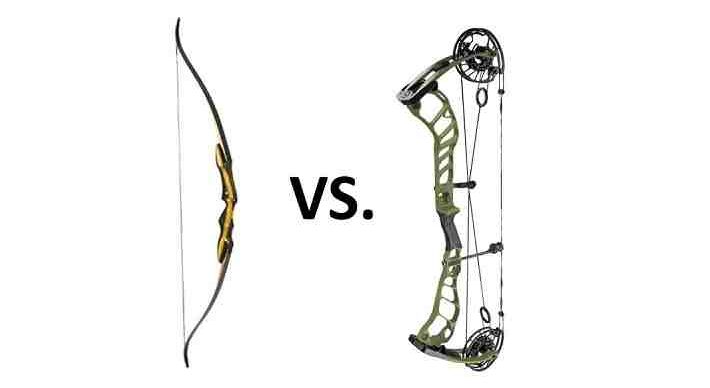
Compound bows use a pulley system to store potential energy, resulting in high-velocity (up to 370 ft/sec), and high-powered arrows whereas traditional longbows feature a traditional outlook, are low-maintenance and are easy to carry around. Which one you’ll end up choosing depend largely on your preference.
Let’s explore more in our in-depth “Compound Bow vs Longbow” comparison:
A Brief History
The traditional, good-old longbow comprises a bowstring that’s tied to a bowed implement. Usually, the tool is a single unit from top to bottom. To lurch your arrow far, you need to pull the bowstring back significantly.
This action requires a lot of energy and concentration. Therefore, you have to lug your entire weight backward. Besides, you need to stay upright for improved accuracy. If you have less weight, however, this action is awkward.
It’s even more difficult if your hands are unsteady. Therefore, a better contraption has replaced this mechanism in a modern-day compound bow.
Here, a pulley (cam) is introduced to recoil the strings. And to improve the versatility and reinforcement at the center, a thicker and more robust member is fitted.
Therefore, the entire length comprises a short truncated upper recurve segment, and a lower one coupled together with a much stronger middle unit.
The advantage of this new design is that it allowed for a more significant backward movement without the bow breaking apart.
What’s more? the archer now needs to spend less energy, and yet, the accuracy of the arrow has significantly improved.
Compound Bow vs Longbow: Key Differences
1. Origins
Bows have been in existence for millennia. A 17,000-year-old arrow discovered in South Africa proved that bow hunting existed even during the stone-age era.
It’s believed that the Egyptians are the ones who invented the bows and arrows. Many pieces of evidence indicate bows were in use around 2,300 BC.
During this period, the preferred construction materials were sticks from hardwood timber such as ash and oak. The string was made of sheep intestine.
Obviously, so many changes have taken place since then. From the rudimentary and inaccurate weapon, you now have an extremely lightweight and powerful tool.
Compound bow
A compound bow is an improvement upon the longbow. It’s fairly intricate. Holless Allen gets credit for the development of the compound bow.
He modified a longbow into the much stronger compound bow we see and love today. He did this by initiating several improvements to the longbow and showcasing it through a patent he applied for in 1966 and received in 1969.
The new compound made its debut in the US National Archery Competition in the 1970s.
Longbow
Bowhunting enthusiasts Baer, Hiyt, and Mathews refined the longbow using new and modern materials. They transformed the hitherto wood frame and sheep intestines elements previously used for these longbows.
But even before the new revolution in the manufacture of the longbow, a previous one had already occurred.
The most advanced modernization of medieval archery goes to the Welsh. It appears that they manufactured the longbow into a tactical offensive weapon.
Their archers managed to withhold a large regime of British soldiers in the Battle of Waterloo in 1066. But the first recorded use of a longbow was during the battle of AD 633 during the war between the Welsh and Mercians.
Since then, this particular longbow earned the name of the British longbow. It’s been used in numerous battles with the French both on land and in the sea.
2. Design
The design of a longbow varies from that of a compound bow. Let’s see what our “compound bow vs longbow” comparison guide points out about the design differences between these two types of bows:
Compound bow
The high-quality compound bows are sophisticated. They have two sewn recurve ends fitted with pulleys at the end (limb). Either or both cams feature one or more cables attached to the opposite limb.
These cams provide the pivot needed when you pull back the bowstring. This action (let off) enhances the accuracy of the arrow while giving a more natural aiming response.
The center of the compound bow (riser) pivots the limbs, bow sights, bow stabilizers, and quivers. This section required greater flexibility to transfer as much of the stored energy from the bow to the arrow as possible.
This segment curves out towards the target, making it exert more force, which is subsequently transferred to the arrow.
Newer models of compound bows have cables and cable slides as well as a higher brace height. This is the length between a grip throat and the bowstring.
Longbow
The longbow, on the other hand, comprises a long weapon measuring about four feet long. Its stave was from a D-shaped section of a hardwood branch.
It has a singular and long limb. Typically, it’s made from a single material. There is no reinforcement or clamping along the entire stretch.
Even if the bowstring structure is the same as in a compound bow, the longbow still shoots slower and requires more force.
As a result, the arching process is also more strenuous than the former. This is due to the lack of a bow curve, the absence of cams as well as a more prolonged and weaker limb.
3. Material
The elements that make the longbow and compound bow affect how these two tools perform. Let’s look and the material composition of compound bow vs longbow.
Compound bow
Previously, compound bows comprised plastic-coated steel. However, due to lower tensile strength and flexibility – that decreased the arrow’s overall accuracy, – they now feature more suitable materials.
The more prominent material currently is the high-modulus polyethylene compound. It offers higher tensile strength as well as maximum energy transfer.
Longbow
The ancient longbows were constructed mostly from yew. However, hazel and elms were occasionally used. It was then coated with resin, wax, or excellent tallow to improve its tensile strength.
Currently, however, composite materials of laminated fiberglass and tampered wood are now used to make recreational longbows.
4. Uses and Benefits
Long ago, bows and arrows were used for hunting and conquering. But presently, they are used primarily in sports hunting and bow shooting competitions. Archery has grown as a favorite pastime as well as a game in all major tournaments.
Compound bow
A compound bow has a more significant benefit due to its design. The robust cams allow for a higher energy reserve. You only draw a portion of the energy and the rest remains at the front where it’s needed most when shooting.
The horizontal limbs also reduce the vibration and recoil intensity before shooting the compound bow, improving the accuracy of the shot as a result.
Further, modern compound bows have sighting devices to improve aim, as well as mechanical release to retain shot consistencies. Therefore, you are likely to shoot accurately using less effort.
Longbow
Longbow proved challenging to use since it required an inertia of over 65 lbs to deliver the necessary projectile power. This posture is also more strenuous since you’ll have to arch significantly back to convert sufficient energy needed by the arrow.
Different types of longbows were used for assorted arrows. There existed fight arrows, with chisel arrows. Other bows accommodated hunting arrows. Even within them, they also vary between animal and bird hunting types.
When you compare a longbow vs. a compound bow, you find that a longbow is lighter and quicker to shoot. Besides, it’s also quieter.
Additionally, the longbow is easy to make since it needs just one or two tree branches.
5. Draw Length
In archery, you need to be sure about a bow’s draw length. Typically, a draw length has a close correlation with your overall body size.
Take the distance from the tip of a nocked arrow to the tip of your draw-out hands. Divide this distance by 2.5, and you’ll get your draw length,
Compound bow
For a compound bow draw length, measuring the arrow tip should ideally be around two feet beyond the riser at full draw. When you hold this position and measure the arrow length, you get the draw length by adding one foot to the computed distance.
Longbow
The draw length of a longbow is usually more than five feet. Many of the early models had their measures reaching up to 12 feet. But they commonly averaged six-and-a-half feet long.
6. Limitations
Even the best-functioning longbows or compound bows have their drawbacks. Below are some of the shortfalls that are apparent in both the compound bow and the longbow.
Compound bow
By design, compound bows have many moving parts. This structure makes them susceptible to breakages and parts malfunctions. Further, having many elements make compound bow maintenance and handling a bit expensive.
Replacement is also intensive. It requires special tools to replace and repair damaged parts or strings of the compound bow.
Longbow
The longbow stretches more slowly and unsteadily. When you draw it backward, your arms move with the full energy you are exerting. You need more power to hold back your hands firmly.
At the same time, during the process of drawing your bow, less energy is available at the point where the bowstring meets the arrow.
This has the dual effects of releasing less punch directly to the arrow, as well as exacerbating your unstable hold. Hence when you release the arrow, it first, only moves a short distance and is less linear in its movement.
Further, it’s more likely to miss its target due to a weak trajectory caused by less force.
7. Care and Maintenance Requirements
Proper care for your bow is vital. You appreciate that owning a modern compound bow may cost you up to $1,000. Even with the composite material, they have many parts and accessories that need tender care.
Compound bow
Compound bows have sights, pulleys, limbs, cables, and cams. All these are made of different materials. Further, their assembly is delicate. Hence you ought to maintain each component individually:
Cables: Waxing protects your cables when not in use. Do this once a month or after every exposure to the elements.
Limbs: Laminated limbs are susceptible to cracking under various layers. Do a thorough inspection (by rubbing with cotton wool) to identify such defects.
Frame: This component suffers from a lot of tension. Inspect it routinely for cracks and twists.
Cams: Visually check on the cams before using your compound bow. To prevent corrosion and discoloration, wipe this part clean after every use.
Accessories like bow-sights rest and quivers also require regular maintenance. Accurately mount them to avoid any damage through colliding with other surfaces.
Longbow
Longbows are made from composite frames or laminated timber. Run periodic inspections to identify damages to the fame and the bowstring.
Apply remedial measures similar to those on frames and limbs and accessories in the compound bows. Don’t store limbs in a hot compartment. Keep your longbow in a cool dry place. Better still, afford similar treatment to bolts and nuts.
Are Compound Bows Better Than Longbows: Which One to Get?
Compound bows and longbows have been used for centuries in hunting and archery. Now, you might be thinking Is a compound bow better than a longbow, or is it the other way around?
That’s a question that has been debated by hunters, archers, and outdoor enthusiasts for many years. Let’s find out which is the better option for you.
When a Compound Bow Is Better
Compound bows are becoming increasingly popular due to their superior accuracy and power compared to traditional longbows. While some people will always prefer the classic look of a longbow, it’s hard to deny the benefits of a compound bow.
Compound bows have several advantages over longbows. They are capable of higher draw weights than traditional longbows, allowing for greater accuracy, longer range, and more penetrating power.
The cams on a compound bow also make it easier to shoot with a consistent draw length, which can be very helpful for novice archers.
Additionally, compound bows are usually easier to maintain and tune than longbows. This can be a big plus for people who aren’t as experienced with bow maintenance and tuning.
When a Long Bow Is Better
Longbows have several advantages over their modern counterpart that make them attractive to traditionalists.
Their simpler design makes them lighter and easier to carry, making them a popular choice for hunters who must traverse long distances.
Longbows can also be more durable than compound bows since they are less complicated and require fewer parts. They don’t usually require as much maintenance or tuning either, which can be a plus for those with limited technical skills.
Finally, traditional longbows are often more aesthetically pleasing than compound bows, which can be a plus for those who prioritize looks.
Longbow vs Compound Bow: Which One You Should Get
The choice of whether to get a compound bow or a longbow is up to the individual archer or hunter. Both have their advantages and disadvantages, so it’s important to weigh all of the factors before making a decision.
Some archers may prefer the classic look and feel of a longbow, while others may be drawn to the power and accuracy of a compound bow.
Ultimately, the choice is yours, so do your research and find the option that best fits your needs. Good luck!
Conclusion
And with that, we’re at the endgame of our in-depth “compound bow vs longbow” comparison. Let’s do a quick recap.
You understand that compound bows offer better performance than longbows. However, you may still come across diehard fans of traditional bowing techniques.
To them, using both a compound bow and a longbow propel the arrow to the ordinary distance of 22 feet. But the inclusion of modern technology into bowing has made significant strides that you can’t ignore.
In fact, the new construction and materials have made bow hunting a more comfortable sport for everyone.
So, whether you aspire to hunt elks, deers, or any other small-medium game animal; or win a trophy at an archery completion, you have to start by learning how to use, differentiate and care for your bows and arrows.
Either way, you still need to practice consistently to perfect your pull, nock, aim, and shoot.
FAQs
Which Type of Bow Is More Accurate: Longbow or Compound?
Compound bows are generally considered to be more accurate than longbows as they feature a system of pulleys that help create consistent draw weight throughout the shot.
Is It Easier to Shoot a Longbow or Compound Bow?
In most cases, compound bows are easier to shoot than longbows since they feature a system of pulleys that help make the draw weight consistent throughout the shot. Compound bows also tend to be less affected by wind speeds, giving them an extra accuracy boost.
How Much Draw Weight Should I Use With Each Type of Bow?
Generally speaking, recurve bows require more draw weight than compound bows, with 40-50 lbs being the standard range for recurves and 25-45 lbs being the usual range for compounds.
For safety reasons, it is important to never exceed the maximum recommended draw weight for either type of bow.
Have you ever seen those unique-looking points extending from the red deer’s antlers? Those elegant and sharp curves are referred to as a brow tine.
But what exactly is a brow tine, and what purpose does it serve?
In this article, we will discuss all there is to know about the brow tine deer. Now, without further ado, let’s get started.
What is a Brow Tine on a Deer?
The brow tine is the first point where the antler branches off from the main beam. It is located near the base of the antlers, just above the deer’s eyes. The brow tine is an essential feature for hunters who are looking to identify and target a specific deer.
It serves as an indicator of a buck’s maturity and overall health.
Antlers are one of the most distinctive features of male deer, and they play a crucial role in many aspects of their lives, from mating rituals to self-defense. Antlers are made of bone, and they are shed and regrown every year.
Deer Antler Terminology – A Quick Overview
Deer antlers are a fascinating and complex feature of male deer. They play an important role in many aspects of the deer’s life, from mating to self-defense. Antlers are made of bone and are shed and regrown every year.
They grow in a branching pattern, with each branch having a specific name and location. Here’s a quick overview of some of the most common antler terminology:
Antler TermDescription
What Age Do Deers Get Brow Tines?
Brow tines typically emerge when a male deer reaches maturity. Brow tines can also appear in some deers as early as four or five months old.
However, there is a considerable variation in the deer population. The difference in growth patterns can be due to genetic factors. But it can also be due to nutrition and environmental conditions.
Here’s a brief data interpretation on brow tines in deers.
Brow Tines in Mature Bucks:
Brow Tines in mature bucks are an interesting aspect of deer anatomy. Brow tines represent the maturity and age of the animal.
As bucks mature, their brow tines tend to grow larger. Hence, making it easy to differentiate from those of their younger counterparts.
Larger & Defined Brow Tines:
As a deer matures and thrives in its environment, its brow tines tend to become more distinct and sizeable.
Hunters can use this information to make informed decisions about which deer to target, based on factors such as the size and age of the animal.
Why Some Deer Grow Brow Tines and Others Don’t
Not all bucks will grow brow tines, and some bucks may have smaller or less defined tines. The size and shape of the tine can also vary between species of deer.
For example, mule deer tend to have more prominent brow tines than white-tailed deer.
Despite these variations, the brow tine remains a valuable feature for hunters and wildlife enthusiasts alike. It serves as a visual indicator of a deer’s age and health, and it adds to the overall beauty and majesty of these magnificent animals.
Scoring Deer: Do You Count the Brow Tines on a Deer?
Deer hunting is a popular activity for many hunters, and for some, scoring the deer they take down is an important part of the experience. Scoring a deer involves measuring and adding up the length of each tine on the deer’s antlers, along with the length and width of the main beam.
While there are several different methods for scoring deer, one question that often arises is whether or not to count the brow tines when tallying up the total score.
In general, the more tines a deer has, the higher its score will be. However, not all tines are created equal, and some may be longer or wider than others, which can also affect the overall score.
When scoring a deer, it’s important to follow the guidelines set forth by the organization or competition in which you are participating.
Conclusion:
The brow tine is an important feature of deer antlers, as it serves as a visual indicator of the animal’s age and health. It can vary between species, with mule deer generally having more prominent brow tines than white-tailed deer.
Understanding the different features of deer antlers can help us better appreciate these magnificent animals and gain a deeper appreciation for wild creatures in general.
Do all Bucks have brow tines?
No, not all bucks have brow tines. While most bucks do have brow tines on their antlers, there is a small percentage of bucks that are genetically programmed to not produce brow tines.
However, it’s important to note that this trait is not necessarily passed along to their offspring, as antler potential is also influenced by the genetic contribution of the does.
Do whitetail deer have brow tines?
Yes, whitetail deer do have brow tines on their antlers. In fact, a single brow tine, also known as an “eye guard,” is commonly present on each antler, although it is not always guaranteed.
In addition to the brow tine, a typical mature rack for a whitetail deer will have two to four other tines per antler, along with the beam tip, resulting in a total of 4 to 6 points on each side.
Will a deer without brow tines ever grow them?
It is unlikely that a deer without brow tines will ever grow them, particularly if it is genetically programmed to not produce them. In the case of whitetail bucks, research has shown that if a buck has spiked as his first set of antlers, he has a 90 percent chance of developing into a buck with missing brow tines later in life.
How do you measure brow tines on a deer?
To measure brow tines on a deer, start by identifying the G-1 tine, also known as the brow tine, on each antler. Measure the length of the brow tine from the front to the tip of the tine.
If the tine splits into multiple branches, measure the length of the dominant branch. The other end of the split is considered an abnormal point and should be counted as a separate point.
Regardless of the number of points on the antlers, it is important to take four circumference measurements per side.
Do brow tines count?
Whether brow tines count towards the total point score of a deer depends on the specific scoring system being used.
In some scoring systems, such as the Boone and Crockett Club scoring system for mule deer, the brow tine or eye guard is not counted when determining the total number of points on the antlers.
This is because traditionally, mule deer have been counted using one side only, and a typical mule deer has four points on one side with brow tines. However, in other scoring systems, such as for whitetail deer, all the points on the antlers are typically counted, including the brow tines.
What makes a drop tine on a deer?
A drop tine on a deer is a tine on the antlers that grows downward instead of upward or outward. In most cases, drop tines are caused by genetic coding, meaning they are a natural variation in the buck’s genes.
While prior injuries can cause a buck to grow weird antlers, true drop tines are mostly the result of a whitetail buck’s genetics.
However, it’s important to note that not all deer will necessarily develop a drop tine, even if they have the genetic potential to do so. Other factors, such as age, nutrition, and overall health, can also influence antler growth and the development of drop tines.
What are G tines on a buck?
G tines are a way of referring to the tines or points on a buck’s antlers. Specifically, the brow tines are commonly referred to as G1 tines, and the next tine on the antler is referred to as the G2, followed by the G3, and so on.
The length of the G2 and G3 tines on a whitetail deer are often the most significant in terms of scoring, although this can vary depending on the specific antler configuration. When scoring a buck’s antlers, each tine or point is measured and added to the total score.
Bowtech Archery and Mathews Archery are two of the top competitors in the bow market. They are both known for their presence in the field of bow technology innovation and for developing some of the best bows out there.
Since both of these brands are on the high-end scale, you will definitely find the quality and the performance you’re looking for. There are many archers all over who are dedicated consumers to both these brands, and both brands have a reputation for having high-value products.
If you’ve heard about these two companies from your friends, teachers, etc., and you’re wanting to get a bow from one of these companies, it may be difficult understanding the differences between these two brands.
So I put a list together of 11 Pros and Cons to Help You Decide if you want to purchase a Bowtech or a Mathews bow. We’ll discuss a certain category of a factor that is important to consider before making your purchase, and talk about which brand is the winner of the category.
This will be kind of like a Battle of the Bands, but this time a Battle of the Bows: featuring Bowtech Archery and Mathews Archery.
Let the games begin!
Origins of Bowtech
So before things start to get bloody, let’s talk a little bit about each of our opponents for this competition.
Our first opponent, Bowtech, was established in 1999 by Kevin Strother and John Strasheim, and their first bow model was released in 2000, which was received with increased orders and archers who were hungry for more.
“Refuse to Follow,”
– The Bowtech company motto
Headquartered in Eugene, Oregon, since their first bow model release, Bowtech has grown to be one of the top bow manufacturers in the world, with 300 workers at their main facility and is the parent company to several other smaller bow manufacturers, like Diamond Archery, Stryker Crossbows, Excalibur Crossbows, etc.
Bowtech prides themselves on making all of their products right here in America, and supporting American industry as well as maintaining world-class design in their bows.
Origins of Mathews
The second competitor in the Battle of the Bows, Mathews Archery, was created in 1992 by Matt McPherson in Austin, Minnesota. McPherson grew up as a kid loving archery, and often because he was too poor to buy one for himself, he created bows that he could shoot when he was in ten years old!
When Mathews Archery was established in 1992, no one could’ve imagined that this small business would become one of the world’s best bow manufacturers, and a leader in bow technology as well.
Now located in Sparta, Wisconsin, Mathews Archery strives to keep themselves always improving and bettering their company and their products for their customers.
Quick Comparison Between Bowtech and Mathews
Bowtech vs. Mathews
Check out our Archery Page For More Great Content!
1. Innovation
Bowtech Bows
Bowtech is known for being one of the best when it comes to creating new bow technology. Bowtech has over 20 different patents for different technologies, including one of their most famous technologies, the Binary Cam system.
The Binary Cam System was patented in 2007 by the company’s research and development director, Craig Yehle. The Binary Cam System is related to the pulley system in the compound bow, and the Binary Cam System features two cams at the top of the pulley system that are stuck together.
This revolutionary Binary Cam System changed the way that dual cam systems were seen, as it eliminated almost all the disadvantages that a dual cam system had because of the desynchronization of the two cams, while still preserving the speed and quality that the cams provide to your shot.
In fact, this innovation was so revolutionary that it was added to the list of the most important evolutions in bow technology history.
Because of the vast amount of technologies that Bowtech has brought to the archery manufacturing world, it has created a name and a reputation for itself by being one of the most influential and one of the best.
Mathews Bows
While not as many as Bowtech, but tying closely around 18 different patents, Mathews Archery has also brought a number of new bow technologies to the archery manufacturing table. The most famous of all of these is the Solocam.
The Solocam, if you can guess, is the complete opposite of a dual cam system and the Binary Cam System developed by Bowtech. The Solocam is a single cam system for compound bows, and it provides a more accurate shot while having a lighter bow and making the shot significantly quieter.
While the Solocam system is not as fast as the Binary Cam System is, the Binary Cam is also louder and heavier than the Solocam system.
Mathews continues to produce new technologies that make their bows better and better.
Winner: Bowtech
While the companies created around the same number of patents, Bowtech has more of a reputation and more impact on the archery world because of their technologies, like the Binary Cam System.
Although this one was a close one, and it can be difficult to say which company has better technology, it can also depend on what you’re looking for for a bow. You may prefer a quieter bow rather than a fast bow, but that’s up to your own personal opinion.
2. Accuracy
Bowtech Bows
Bowtech prides itself on being on “an entire company obsessed with accuracy,” so you would imagine that the accuracy of their products is something that they take into careful consideration.
Bowtech tests every bow before they sell it at retail stores or ship it to their consumers. They also specialize in their bows having dual cam systems and being some of the best with the patented Binary Cam System.
Because the majority of Bowtech’s bows are dual cams with the Binary Cam System installed, they add extra weight to the bow and therefore add more power and speed into the shot.
In addition to the weighted dual cams, in the case of the new Realm SR6 and Realm SS, a front-heavy draw cycle is also included, which makes the bow have even more power, and thus increased accuracy.
Most archers know that heavier bows make for fewer mistakes and better accuracy, as the heaviness of the bow automatically corrects little miscalculations and therefore increases the likelihood for a well-aimed hit.
With the emphasis on accuracy and power, in their bows, Bowtech really does a great job assuring their customers of a bow that guaranteed not to disappoint.
Mathews Bows
Mathews Archery generally specializes in single cam bows, with their specially created and patented Solocam technology. With the release of the recent Vertix, the new Engage grip was developed to increase comfort and to reduce the risk of bow torque.
Mathews also hand-tests each of their bows countless times before they are released to the public and sent to their consumers. So you can rest assured that your purchase will result in satisfaction.
The technology unique to the Mathews company is the Solocam technology, which makes a bow more light, compact, and accurate despite its weight.
Many archers still love and cherish their Mathews bows, as they know that the bow will bring them the results that they desire.
Winner: Bowtech
Since one of Bowtech’s priorities is to provide their consumers with a bow that has pinpoint accuracy, you can see that they follow through with their promises. The unique Binary Cam System technology makes the likelihood of an accurate shot even higher with it’s added weight.
When the newly released Realm SR6 and the Realm SS were tested by Outdoor Life, the Realm SR6 was rated as “excellent”, while the Mathews Vertix was rated only as “very good”.
While Mathews bows are still great and accurate enough for most, some people still struggle with the single cam system and making their shots accurate with the usage of it.
Since Bowtech is a “company obsessed with accuracy,” it’s no surprise that their bows are some of the most accurate out there.
3. Speediest Bow
Bowtech Bows
This year Bowtech came out with the Realm SR6 and the Realm SS. The Realm SR6 is this year’s newest speed bow and is nothing to sneeze at. The advertised IBO speed for this bow was 352 feet per second, making it a very impressive bow.
Although the Realm SS was technically created for a really smooth and silky draw, however, it’s still incredibly fast, with a speed of 336 feet per second.
The famous Binary Cam system makes the bows have a much faster shot as well, as it produces more power, so bows that employ this technology are likely to be the most speedy.
Mathews Bows
Mathews new bow that has everyone buzzing this year is the Vertix. Last year Mathews released the Triax, which also had the archery community abuzz with its state-of-the-art technology and speed.
However, the Vertix is the new and improved version of the Triax, and it has an impressive IBO speed of 343 fps. The Vertix is also supposed to have a really smooth and comfortable draw while still preserving the speed of the bow.
Winner: Bowtech
If you consider the official speeds of the two newest bows from Mathews and Bowtech, then you’ll notice that even though it’s a close call, that the Bowtech’s newest Realm SR6 comes out on top. Both companies have great bows for speed, but my call for this round is Bowtech.
4. Costs
Bowtech Bows
While the Realm SS and the Realm SR6 are priced at around $1,099 each, these two bows are not the most expensive out of all of the Bowtech bows. Since the company is a world-class bow manufacturer and producer, they often have an expensive price tag attached to their products.
For example, the Bowtech Reckoning Compound Bow, which has come out this year as well, features the Deadlock technology but ranges in price from $1,399-$1,499. Many of their finest bows are in the $1,000 range, although they also offer cheaper options from them as well as their other companies.
However, Bowtech is a parent company for Diamond Archery, which is a much cheaper option for bows and other equipment, which can vary from the $200-400 range to the $500-700 range.
The company offers fine products, and that often includes with it a higher price that comes with the quality.
Mathews Bows
As for the Mathews Vertix, having been newly released this year, the price of the bow is retailed for and advertised for $999. The Vertix is actually priced on the higher side of Mathews products!
Generally, you can find a decent bow from Mathews starting from the $200-400 range to the $700-900 range. Although still technically considered a high-end bow, the bows that Mathews Archery offers normally don’t go higher than $1000 a piece.
Winner: Mathews
I’m sure that there are some people out there who are willing to spend thousands of dollars on their equipment, but I think that for most people, spending over $1,000 on a bow going to hurt in the wallet.
So for us normal people who are trying to manage a budget, the bows offered at Mathews Archery are a more economical option.
5. Comfort
Bowtech Bows
Bowtech newest and most impressive bows released this year have undoubtedly been the Realm SR6 and the Realm SS. With thousands of raving reviews, the Realm SR6 and the Realm SS have been the results of many efforts to make the best bow that Bowtech could make.
But as for comfort, the Realm SS is really the fruits of Bowtech’s efforts. With the Realm SR6 as the speed bow counterpart, the Realm SS is supposed to be the bow with the most comfort and ease. The SS in the bow’s name even means “super smooth.”
The most noticeable feature of the Realm SS that makes it so special is the draw curve of the bow’s draw cycle. Often when you are drawing a speed-bow, there is a hump or a hill that you have to go over in the draw cycle, where you have to exert a little more force to be able to get the bow at full draw.
However, with the Realm SS, the draw curve is super smooth, as the name says, and has virtually no hump whatsoever. This makes the shooting experience much more enjoyable and easier for the shooter.
Although let’s not ignore the Realm SR6. It still has a very comfortable draw cycle and easy draw curve, but the Realm SS is what really takes the cake.
Mathews Bows
At Mathews Archery, the company has a philosophy of out-doing itself every time it releases a new product. In the promotion video for this year’s new Vertix, you hear an explanation from Matt McPherson, CEO of the company, talking about the vibration of the bow.
He says that every year they started with a certain amount of vibration in their bows, and referred it to being like a whole piece of a paper. Each year, the company strives to halve the vibration, just like tearing the paper in half. Eventually, the vibration that they have left ends up being tiny!
So you can figure with that sort of imagery that the company has really strived to make their bows the most comfortable ones out there. And the Vertix is a product of that dedication to have the most comfortable bow.
With 20% less vibration than that of the popular Triax released last year, bowhunters and archers everywhere that the Vertix has the best amount of vibration since the Triax.
Outdoor Life says that the Vertix “was completely dead in the hand when shooting,” and that the new Engage grip “provide(s) a more comfortable feel,” to the bow.
Winner: Mathews
With the release of the new Vertix this year, Mathews has really upped their game when it comes to making their products more and more comfortable for their consumers and making their experience more enjoyable.
While Bowtech has also improved their game when it comes to comfort with the improvement of their draw cycles, Mathews has really outdone themselves this time.
6. Ability to Fix
Bowtech Bows
Bowtech bows are known as some of the best quality bows on the current market. They have a lifetime warranty on all of their products, and that includes the free fixing of their products if there are any issues due to workmanship or materials.
If you register your bow with the company, as long as the bow was not sold over the Internet, then you automatically qualify for a lifetime warranty on your bow.
If you ever experience any problems with your bow, again, due to the workmanship or materials of the bow, you can contact your local dealer, who will examine your bow and determine if your bow needs to be sent back to the company, or if it can be fixed by parts sent to the dealer.
If there are indeed problems that require the bow being sent back, the company will fix it for free. All information should be available through the Diamond or Bowtech dealer.
Mathews Bows
As for Mathews Archery, if you register your bow online or through your retailer within the first year of purchase, you are also qualified for a limited lifetime warranty on your bow.
If you have any problems with your bow, then you can contact the nearest retailer and work with them to fix your bow. The company will provide parts and/or instructions in order to fix any problems you need, although independent retailers might be subject to charge you for their services.
This does not include any damage that comes from the bow being used or mishandled, and only includes certain portions of the bow, hence which is why the lifetime warranty is limited.
Winner: Both!
Both Mathews and Bowtech have very similar processes when it comes to fixing problems with your bow. If the bow is damaged due to the building process or the materials the company used, then the company can help you with the process of getting your bow fixed.
7. Versatility
Bowtech Bows
Bowtech specializes mainly in compound bows, and also owns another company called Stryker Archery and Excalibur Crossbows which, like their names, are crossbow-producing companies.
If you are looking for a recurve bow it’s best to stop right here, because Bowtech doesn’t make them.
Their website displays their main products, bows and accessories, but it fails to guide the complete beginner to what bow they will want and need for their specific purposes.
So while they do offer a variety of different products to choose from, and own a couple of compound bow companies, it’s hard to say that the company offers a versatile, as well as easy to understand guide for their consumers looking to make a purchase.
Mathews Bows
Sorry recurve archers, Mathews also only sells compound bows and owns a company that sells crossbows. But Mathews does a really good job organizing their bows and providing versatility in their products, which makes purchases and options for purchases easier for customers to identify.
If you access their website, when you click on the bows section, sections for hunters and competitive archers will pop up. You can go from there based on your primary reasons for purchasing a bow, and it will display options that are recommended for you.
In addition to that, there is also a bow builder that enables you to customize and create a custom-made bow, just for you! This can make a bow that has more meaning and is adapted to your tastes!
Not to mention, their new Vertix includes a new Switchweight technology, which basically means that you can switch your draw weight on the bow with the simple twist of a few screws and adjusting the weights on the bows themselves to address a wide range of archers.
Winner: Mathews
Bowtech has a lot of products to choose from, but Mathews nails it when it comes to providing options and customizations for your bow. They are the winners when it comes to providing versatile products for their consumers.
8. Altogether Quality
Bowtech Bows
While Bowtech is one of the top brands in the market, in recent years there has been a multitude of limb failure complaints by various consumers.
Most of these complaints have been about limbs breaking or coming to them in really poor form, or shattering through a couple of shots.
Although it seems like there are fewer complaints by consumers as of late, so it may be possible that Bowtech has fixed whatever the problem with the limbs was, but there still is that history of limb failure within the company’s products.
Bowtech still offers some of the best, most high-quality products, and many archers are very happy with them.
Mathews Bows
Mathews Archery has preserved a good reputation of high-quality products through their career. Like most bow manufacturing companies, Mathews Archery has had its share of limb failure complaints.
However, they are far and few in between, as Mathews strives to make their products the most reliable and of the highest quality.
Winner: Mathews
Both of these companies work their best to make sure that their products are of the highest quality and reliability, however, perhaps because of the more wide-spread accessibility, Bowtech has had more complaints of technical difficulties with their bows.
Mathews reputation, as well as their priority on quality products, has really been something that makes them stand out in the market, as well as prove that price doesn’t always mean the best quality.
9. Weight of Bows
Bowtech Bows
Bowtech is known for their Binary Cam System, which unifies the synchronization of dual cam systems and adds more weight to their bows so as to add more power.
So you would think that their bows are heavier than most, right?
Actually, the Realm SR6 and the Realm SS are only 4.3 lbs.
Surprising right? I thought so too.
Mathews Bows
Mathews Archery is known for their unique Solocam technology, which makes it so the cams on their compound bows are singular, and thus is supposed to provide a lighter, more comfortable experience for the archer.
However, if we’re comparing the Realm SR6 and the Realm SS, then we find that the newly released Vertix is actually heavier. It’s not by much, but the Vertix is actually 4.67 lbs.
Winner: Bowtech
Although a little unexpected, for the purposes of this article, the winner of lighter weight bows is Bowtech. Now, this might not be the case for all of the Bowtech bows and all of the Mathews bows, but if we compare the current best two bows that the companies have to offer, Bowtech wins.
And this could be a good thing or a bad thing based on how you look at it. Some archers might want a heavier bow, and some might want a lighter bow. You decide.
10. Great Customer Service
Bowtech Bows
Bowtech is known to have an excellent customer service group, that cares about their customers and is very helpful to those who are seeking it. They provide a website with FAQ and information for any problems you might be experiencing.
There are very few complaints about their customer service and they will take care of any problems you might be experiencing.
Mathews Bows
Mathews Archery, however, has a core value of putting people first before anything. They focus on making sure that they take care of their employees in their company. They dedicate themselves to creating a happy customer base by creating the best products in the market.
Mathews puts a lot of effort in making sure that when they are developing a product, they think about the people and the customers they’re making it for.
Winner: Mathews
With a company like Mathews dedicated to valuing the people in their lives more than anything, you know that Mathews will for sure take care of you as their valued customer.
11. Design
Bowtech Bows
This year’s new release of the Realm SR6 and the SS were both beautiful models. The models were both super sleek and come in a variety of different colors to choose from. The models also come with two different settings to choose from, Performance or Comfort.
The grip is minimalist and low profile, and also comes in a variety of colors to choose from. The overall design is simple and elegant, with customizable features as well.
Mathews Bows
The newest Vertix has more of a boxy body and is a lot sturdier than the Realm SR6 and the Realm SS are. Some people don’t like the boxy limbs and build of the Vertix, but it’s up to your own preferences.
The Engage grip is also a little bulky, and stands out a little more, but is incredibly comfortable. The design of the Switchweight technology makes it simpler to change your draw weight on your bow.
Winner: Bowtech
This is more of a matter of personal preference than anything, but I thought that the Realm SR6 and the Realm SS was a more attractive model than the Vertix. I like the minimalist look, and I like how you can choose different settings based on your personal feelings.
And our final score is: 5 to 5!
Since there was technically a tie in the Ability to Fix category, Mathews Archery and Bowtech tie in my book!
So while there are so many things that differentiate the two companies, both Mathews and Bowtech are individually great companies. And a lot of this is based upon personal opinion and preference, so you decide!
If you are considering a Bowtech bow, you might want to check out our other comparison posts:
Bowtech vs PSE Bows
BowTech vs. Diamond Bows
Bowtech vs. Hoyt Bows
Bowtech vs Bear Bows
Best Mathews Bows
I wish I could tell you which Mathews bow is best, but the answer is going to change depending on who you ask and what they are using it for. It’s very subjective. Even so, their top selling bows are as follows…
Mathews VXR Series: This series is renowned for their speed and accuracy and are best sellers to hunters, as well as target shooters.
Mathews Traverse: The Traverse has outstanding performance, and is very similar to the Halon 7.
Mathews Triax: The Triax is known for its compact design and quietness, which makes it a favorite among hunters who need a maneuverable and stealthy bow.
Mathews Vertix: Offering a combination of speed, accuracy, and forgiveness, the Vertix is another popular choice for both hunting and target shooting.
Mathews Halon X: The Halon X series is known for its speed and power, making it a great choice for those who value arrow velocity.
Best Bowtech Bows
The Carbon One is Bowtech’s first flagship carbon bow. It boasts Bowtech’s renowned DeadLock Cam System, which simplifies cam adjustments for precision tuning.
Another innovative feature of the Carbon One incorporates Flip Disc Technology to effectively grant you the versatility of two distinct bows in one. You have the choice between Performance and Comfort settings on the mods, enabling a customized draw experience.
Bowtech’s primary goal was to engineer the smoothest draw with minimal vibration in a carbon bow. Achieving this, the cleverly designed riser, complemented by Orbit Dampeners and Dual Lock Pockets, effectively nullifies any vibrations during the shot, enhancing the overall shooting experience.
Two other popular Bowtech bows are the following…
Bowtech Revolt: Known for its smooth draw cycle and accuracy, the Bowtech Revolt was a favorite among both hunters and target shooters.
Bowtech Realm X: This model was appreciated for its versatility, with a good balance of speed and shootability, making it suitable for various archery disciplines.
Optimal Draw Length For Your Mathews or Bowtech Bow
There’s a general guideline for determining suitable draw lengths based on your height.
It’s important to note that these guidelines are approximate, as not all individuals of the same height will have identical wingspans. However, if you’re looking for a starting point, the following table provides a helpful reference for the range you should consider:
It’s essential to remember that if your personal measurements don’t align precisely with this chart, it doesn’t mean you’re in the wrong. It’s wise to recheck all your measurements and, ideally, try out various draw lengths to determine the one that feels most comfortable and effective for you, rather than relying solely on what you’ve been advised.
With the correct draw length, you’ll be well on your way to enhancing your archery experience.”
We have discussed a lot of different types of batteries on our blog. We have talked about batteries based on performance, functionality, weather, usage and a lot of other factors.
In this article, we are going to discuss the different batteries available for you if you need a car battery, specifically the best group 27 deep cycle battery. Different cars with different designs require different size batteries.
Now, if you know about batteries, you must also know that the design of batteries also affects their performance. As it turns out, Group 27 is one of the most popular battery groups and is very common in vehicles, both terrestrial and marine.
Group 27 batteries offer a great size-to-performance ratio. They are mostly used in vehicles requiring high power such as Jeep Wrangler. Group 27 batteries are also seen in other domains such as scooters and other appliances. It greatly depends on what the type of battery is.
In this article, we’ll be mostly looking at deep-cycle batteries. It is very important, however, to figure out beforehand what kind of battery fits your requirement. Getting the wrong battery can be a real hassle and can often cause problems in the long run.
Luckily, we have discussed at the end of this article how you can find the best deep-cycle battery for you. But before that, let us have a quick look at the different products available in the market for you to choose from.
Best Group 27 Deep Cycle Batteries – Our Top Picks
How to find the Best Group 27 deep-cycle battery?
Choosing a good battery can be really tricky but in this section, we are going to talk about a few points you can keep in mind while buying a new deep-cycle battery.
Since you have already identified the size of the battery you want, a lot of the work is already done. Keep these points in mind when you buy a deep-cycle battery.
Capacity
Needless to say, one of the most important features of deep-cycle batteries is their capacity. 100Ah batteries are widely used but that doesn’t mean that a 100Ah battery would be the best choice for you too.
As the capacity increases, the price also increases and you should try to figure out your exact power consumption to get a good idea of the exact battery capacity you need. It will help you save some money and also improve your overall performance.
Battery Type
We have looked at a few different battery types in this article. Flooded, AGM, Li-Ion and Gel are some of the most common battery types available in the market. Each has its own advantage and disadvantage.
Before you buy a battery, make sure you read about the different battery types available in the market and see which one’s the best for you.
Price and Warranty
Last but not the least, you should always make sure that you get reliable batteries. Getting a reasonably priced battery with a good warranty is a safer option than buying cheap batteries with no warranty.
There are a lot of budget options when it comes to batteries but make sure the battery you are buying has a decent quality.
Batteries with warranties are always a good deal as it makes sure your investment is safe in case something goes wrong.
Here is a helpful video on how to choose the right car battery:
FAQs
Conclusion
In this article, we discussed the best Group 27 deep-cycle batteries available in the market. Towards the end, we also talked in brief about some things you should look out for while buying yourself a deep-cycle battery. We hope you found the article helpful.
I settled into my stand with favorable weather conditions and plenty of optimism for an early season September bowhunt in the rolling hills of Eastern Ohio.
As the sun dipped below the horizon, I heard a branch crack to the right and behind me. It was a buck sporting a symmetrical 8-point frame, most likely a 2½- or 3½-year-old. I was in college at the time and still a bowhunting novice, and this would be the largest buck I’d ever taken with a bow. He walked past my setup at 5 yards. I drew and made the rookie mistake of aiming with my arms and not my body. When a deer is that close to your stand and you are at full draw, bend at the waist to keep your anchor point consistent.
Lesson learned.
I shot high, and the deer bounded 15 yards away, uncertain what had just whizzed right over his spine. His confusion bought me enough time to nock another arrow, draw and shoot. The second shot hit the deer in what looked like the middle of his frame. On impact, his rear legs kicked backward and up like a bronco. He bolted as I sat shaking.
The real work was just about to start.
Every bowhunter strives for perfect shot placement, but every shot can’t hit the mark every time. Sometimes we make a lethal hit but compound less-than-desirable shot placement with mistakes in recovering the animal. A liver hit often leads to such a situation. The liver is tucked between the lungs and the rumen or stomach, so a shot that hits just slightly farther back than you would like will often hit the liver. If you think you may have hit the liver, remember these five steps to make sure you give yourself the best chance at recovery.
Back Off Right Away
My experience was a classic case of a liver hit—because of where I saw the arrow hit on impact, the deer’s reaction, and the dark red blood I found on the ground and arrow. After giving the deer a half hour, I made the mistake of going after it. I kicked him up about 100 yards from where I shot him. It was at that point I decided to depart the woods for the night and come back the next day. If ever in doubt, give the animal time.
Bring Help
I was hunting by myself, so I didn’t have the luxury of having a friend to help me find the deer – or so I thought. My uncle, who lived about an hour from the property, volunteered to come help me track. His help was invaluable because a liver hit typically produces only small, sporadic drops of blood. Several times my uncle located blood when I couldn’t. More eyeballs help. Also, check your local laws and regulations regarding the use of tracking dogs. You can’t underestimate the nose of a well-trained tracking K-9.
Get Rest and Stay Hydrated
Don’t miscalculate your rest and how you feel before and during the track. Bring water and snacks. This was especially true for me since it was September and temperatures still reached well into the 80s. If you become fatigued, your motor skills and senses suffer, and you may give up the trail too soon. Also, you need to maintain high morale, and that starts with feeling rested and nourished.
Track Your Tracking
Develop a system to mark the last spot you saw sign. Whether its tracks, blood or the site where you saw the animal, bring marking tape, glow sticks, toilet paper, or use the GPS application on your phone to track your progress. Don’t waste time and energy having to backtrack or – worse – getting lost. Take your time, and record your path.
Take a Weapon
A liver hit is a lethal shot, but it may take longer for the deer to expire than with a heart/lung hit. When you find the deer, it could still be alive. Bringing a weapon with you on any tracking job is a good idea but especially for a liver hit.
Fortunately, I was able to find my buck the next morning. He was on a trail only 100 yards from camp in the opposite direction from where I started to track. In total, the buck traveled about a mile and showed signs of bedding down on several occasions the night he was hit. There were times when blood was sparse and patience paid dividends. I’m hard-pressed to find a tougher animal than a whitetail, but every deer will succumb to a lethal liver hit. Follow these rules and stick with the trail and you will increase your chances of recovering your deer.
About the Author
Jeremy Juhasz is a public relations and marketing professional from Atlanta, Georgia. When he’s not in the office, Jeremy is an avid bowhunter who has chased whitetails in Western New York, Pennsylvania, Ohio, West Virginia and Georgia. Follow him on Twitter @JeremyJuhasz for all things PR, hunting and Buffalo, New York sports.
Picture yourself getting the jump on a big prairie dog town. You crest a hill, lay your trusty .22 across a fencepost, and peer through your scope. It’s pretty far. You might need to aim a little bit high. If only you paid more attention to the MOA vs MRAD debate.
Experience might tell you that your bullet hits a certain distance low at 150 yards and a little more at 200 yards, but “a little low” doesn’t give you much to work with, especially when you don’t even know the distance to your target. Even if you knew exactly how many inches low it was at the distance you’re trying to shoot, could you really picture that in your scope with any degree of accuracy?
What you need is a way to make precise, calculated adjustments to compensate for proven ballistic performance. That’s where minutes of angle (MOA) and milliradian (MRAD) come in. These concepts are absolutely essential to shooting well — even if all you’re doing is zeroing your pistol’s red dot — and figuring them out might be easier than you think.
What are MOA and MRAD?
Both MOA (minutes of angle) and MRAD (milliradian) are methods of measuring angular units. Bullets aren’t laser beams, so we all understand that we have to aim high to engage targets that are far away from us. Rather than calculating bullet drop to inches, creating a mental estimation of what that looks like, and aiming at a point in space above our desired point of impact, we use these angular units to get on target.
Both methods are more than capable of facilitating precision shooting. They’re not interchangeable, though, so your rifle scope, reticle spotting scope, ballistic tables, and any software you use will need to be on the same page. Eventually, you’ll learn to think in MOA or MRAD and be able to make better adjustments on the fly.
MOA: What You Need To Know
The majority of all sighting systems (scopes, red dots, holographic sights, and iron sights) sold in the U.S. use MOA because this unit works well with imperial units — specifically inches and yards.
What is MOA?
There are 360 degrees in a circle and 60 minutes in a degree. One minute (MOA) equals 1/21,600 of a circle.
At 100 yards, one MOA equals 1.047 inches. Since it’s angular, the same one-MOA angle expands to 2.094 inches at 200 yards, 3.141 inches at 300 yards, and so on. Moving your point of aim one MOA shifts your point of impact 1.047 inches at 100 yards.
That’s not very precise, so most optics use quarter-MOA adjustments. If your scope turret is labeled “one click = 1/4 MOA,” you’ll be able to refine your point of impact in 0.26-inch increments at 100 yards.
By using 1/4-MOA adjustments, we divide a circle into 86,400 slices, and each click of your turret moves your point of aim 0.004 degrees.
What About “Shooter’s MOA?”
Many people use what’s called “Shooter’s MOA,” which rounds MOA to the nearest quarter-inch. That’s why you’ll hear people say that one MOA equals one inch at 100 yards. They’ll equate one click of a 1/4-MOA turret to 0.25 inches at 100 yards rather than 0.26 inches at 100 yards.
It’s not exactly correct, but it’s close enough in some cases. At longer distances, this shortcut will catch up with you.
At 1,000 yards, .308 Win might drop 393 inches. Using MOA, your come-up in that situation (393 inches / 10.47 inches per MOA at that range) would be 37.5 MOA, and your point of aim would be 393 inches above your point of impact, matching bullet drop exactly.
If you were using Shooter’s MOA, your come-up would be 39.3 MOA (393 inches / 10 inches per shooter’s MOA at that range). Because scope turrets use actual MOA rather than Shooter’s MOA, your input of 39.25 MOA (the closest setting to 39.3) would result in a point of aim 411 inches above the center of your target and cause your bullet to impact 18.5 inches high. Unless you have a massive target, that’s a miss.
Range in Yards1/4 MOA1/4 Shooter’s MOA
MRAD: What You Need To Know
Outside of the U.S., shooters generally prefer to use MRAD over MOA. Interestingly enough, American military snipers also use the metric-based MRAD system; most precision shooters do, too.
What is MRAD?
Instead of using degrees, we can divide a circle into 6.283 radians. Inside each radian are 1,000 milliradians (mils, for short) for a total of 6,283 mils in a circle. Random, right? Damn Europeans.
There’s a method to this madness because one mil equates to 10 centimeters at 100 meters.
In the same way that we don’t make adjustments in whole MOA, we don’t make them in whole mils, either. Scopes turn in 1/10-mil increments, so one click on your turret translates to one centimeter at 100 meters.
A scope’s 1/10-mil adjustments divide a circle into 62,832 pieces, and each click moves your point of aim to 0.006 degrees.
When you range targets in yards, using MRAD can feel clumsy.
Range in Yards1/10 MRAD
But when you range targets in meters, using the 1/10 MRAD adjustments on your scope turrets is straightforward.
Range in Meters1/10 MRAD
MRAD vs MOA: Which Should You Use?
Knowing that both systems are effective doesn’t make your scope-purchasing decision any easier. There has to be a reason some shooters prefer one over the other.
Why You Should Use MRAD
Using the 100-yard example, a typical MOA scope will let you make adjustments in finer increments. Remember that, at 100 yards, 1/4 MOA equals 0.26 inches while 110 mil equals 0.36 inches. But if MOA is more precise, why do snipers and competitive shooters almost universally prefer MRAD?
In the real world, there is a practical limit to the degree of precision we’re capable of extracting from a shooting system (our rifle, scope, and ammunition).
“On the milliradian optic, I’m doing 1/10 of a mil click in whatever direction, that’s going to equal roughly 2.5 inches at 700 yards,” Eliasson said in the Vortex Edge podcast. “If I do that same click on a 1/4-minute adjustment minute of angle optic that’s about two inches — a little under, I think it is. So it’s like two, 2.5 at 700; can you shoot that good?”
Both MOA and MRAD deliver the precision you need, and MRAD scopes can save time by making adjustments in slightly larger leaps, as Eliasson discovered during his time as a Marine Corps scout sniper.
“We got the 1/4-minute adjustment optic on our gun, and I felt like I was just adjusting for days,” he said. “It was just click, click, click, click, click, click to get where I needed to go. I thought that was kind of hindering us to a degree.”
The base-10 nature of MRAD can also make life simpler when you’re shooting under pressure.
“If somebody says, ‘Come up 0.7’ that’s seven clicks,” James Hamilton, host of the Vortex Edge podcast, said. “And if they’re like, ‘1.7’ that’s 17 clicks. But if somebody says, ‘Come up 2-3/4 MOA’ I’m like, ‘Okay one click is 1/4 MOA, so that’s four clicks per one MOA, so that means four times two is eight, plus 3/4 is three, eight plus three is — you know?”
Simply put, MRAD scopes get us inside the margin of human error with less time spent converting quarters to clicks, counting tiny hash marks, and fiddling around with our scope turrets. Since most competitive shooters use MRAD, that route will also make it easier to learn from others if you have ambitions of getting started in long range shooting.
Why You Should Use MOA
Most shooters who prefer MOA optics probably appreciate the unit’s relative correlation to inches and yards rather than adapting to the metric system.
“As Americans, if you were born and raised here, we tend to think in inches, and it’s really hard to associate what 10 centimeters looks like,” Eliasson said. “Our brain kind of wants to think about it in 10 inches, not 10 centimeters.”
The combined market for MOA hunting scopes and low-power variable optics with a BDC (a bullet drop compensator reticle like the one in the Trijicon ACOG) is probably larger than it is for MRAD scopes. Red dot optics and holographic sights almost universally use MOA. That alone might be enough to sway you, especially if you don’t need a fancy mil-dot reticle.
“Some of our optics that I’m thinking of are very, very well-suited for hunting and they’re just not even available in MRAD,” Hamilton said. “In my head, I’m thinking getting the right optic is more important than getting some super-duper special unit of measurement.”
The reality is that the advantages of MRAD scopes don’t matter at the distances most people shoot. Plenty of hunters and recreational shooters do just fine by zeroing at 50 yards, having a usable point of aim out to about 200 yards, and falling back on Shooter’s MOA in a pinch.
Use Your MOA Or MRAD Reticle to Estimate Range
You can use both MOA and MRAD to perform useful calculations in the field if you have a technical reticle. Knowing how to use these formulas will help you get the most out of your scope.
Make the resulting adjustments by dialing your turrets or using a holdover based on the subtensions in your reticle.
Range Estimation
Yards to target = (size of target in inches x 95.5) / size of target in MOA
Yards to target = (size of target in inches x 27.77) / size of target in mils
To use these formulas, you’ll need to know the size of your target in inches. Between that known size, the size of the target in MOA or MRAD as measured with your reticle, and the appropriate constant (95.5 for MOA or 27.77 for MRAD), you can determine the distance to your target in yards.
Size Estimation
Size of target in inches = (yards to target x size of target in MOA) / 95.5
Size of target in inches = (yards to target x size of target in MRAD) / 27.77
The size estimation formula is based on the range estimation formula; it just solves for a different variable. This is particularly useful for hunters who want to gauge a game animal’s size from a distance.
Constants vary by cartridge. For .308 Win, use a constant of 12. For 6.5 Creedmoor, use a constant of 17.
MOA adjustment = (range / 100) -1
The above formula is for a full-value 10 mph wind. Changes based on a wind direction are made after calculating your hold in MOA.
Wind Estimation with an MRAD Reticle
The above pattern is fairly universal, but you may need to tweak an adjustment here or there. Your specific rifle and ammunition will have a certain wind speed at which you can use this formula.
If you shoot a “6 mph gun” in a full-value 6 mph right-to-left wind, you would hold 0.5 mils right at 500 yards. If the same wind were a half value, your hold would be 0.25 mils. If the wind were full value but 3 mph, your hold would be 0.25 mils.
READ NEXT – Precision Rifle Series Shooting: 6 Keys for Beginner Success
Cones, which are used in many places in home decor and various ornamental materials, are collected from pine trees. Research on pine cones proves that the cone is very beneficial for health. In order to get the best of the minerals and vitamins in the structure of the cone, many people have been talking about pinecone syrup lately.
Although the benefits of pine cone syrup were not directly explained by Saraçoğlu, Prof. Dr. İbrahim Saraçoğlu explains the healing effects of the pine tree and frequently talks about the benefits of the leaves of the tree for asthma and its positive effects on respiratory health.
So, what is pine cone syrup? Now, let’s examine the curious things about pine cone syrup.
What is Cone Syrup?
Cone syrup is a useful beverage obtained by boiling pine cones and obtaining the consistency of syrup.
Cone syrup, which is beneficial for human health, is very popular among herbal treatment methods.
In some regions, cone syrup is also called cone jam. To distinguish the fine line between syrup and jam, you can adjust the amount of liquid to your taste while the cones are boiling.
Cone syrup is a more liquid food. Jam is somewhat thick.
Benefits of Cone Syrup – See What It’s Good For!
1) Relieves Respiratory Tract
If you are wondering what pine cone syrup is good for, we can say that this useful syrup relieves your breath.
Infections and various diseases in the respiratory tract can be cured thanks to pine cone syrup.
If you have frequent coughing problems and have shortness of breath while talking, you can consume natural pine cone syrup as soon as possible.
2) Strengthens the Immune System
One of the best answers to the question of what pine cone syrup is for is that it increases the body’s resistance.
The beneficial minerals in the structure of the pine cone give effective results in strengthening the immune system.
Cone syrup is a herbal supplement that protects and strengthens the immune system.
If you consume pine cone syrup regularly, you will protect your body against seasonal changes. Thus, you can lead a disease-free life.
3) Good for Stress
Studies have shown that people who drink pine cone syrup relax and calm down.
Cone syrup, which has a relaxing feature, destroys stress and stress-related diseases.
After tense days, you can consume pine cone syrup when you have sleep problems.
The first sign of the body that is free from stress is a shiny skin, so pine cone syrup also has an effect that benefits the skin and refreshes the appearance.
4) Cleanses Germs
Among the benefits of cone syrup, it also has a preventive effect against diseases.
Bacteria and viruses that try to harm the body are cleaned with the help of pine cone syrup.
You can consume pine cone syrup to eliminate conditions such as infection and inflammation with a herbal supplement.
In order to have a purified body and to have healthier body functions, you should meet with pine cone syrup.
5) Nourishes Hair
Among the benefits of pine cone syrup, there is also the task of nourishing the hair.
If you have dry and damaged hair, you can add vitality and vitamins to your hair thanks to pine cone syrup.
If you wish, you can get the benefits by adding some hair mask to your hair mask or consuming the cone syrup regularly.
6) Protects Oral and Dental Health
Among the benefits of pine cone syrup is that it is good for oral health.
Cone syrup is recommended for those who are sensitive about oral and dental health. Cone syrup, which has a unique flavor, prevents bacterial growth in the mouth.
Cone syrup, which prevents tooth decay, helps teeth look healthier.
It is recommended to consume pine cone syrup for the healing of wounds in the mouth.
7) Revitalizes the Body
Due to its many benefits, the fact that the pine cone syrup you consume is an extra bonus is that it increases energy among its effects!
Cone syrup provides the energy needed by the body.
If you want to be more active and energetic during the day, you can consume pine cone syrup in moderation.
When you want to feel more dynamic and prepare for an active day, you can benefit from pine cone syrup.
How Is Cone Syrup Made?
You can easily prepare pine cone syrup at home. For this, you must first review the material list.
Materials:
1.5 liters of water
25 green cones
4 cups sugar
Lemon juice
Preparation of:
Wash the green cones prepared for cone syrup thoroughly and leave them in a pot filled with water for 1 night.
Refresh the water of the cones that have been waiting overnight and bring them to boil.
Change the water of the cones that have been boiling for a while and let them boil for a few more hours.
Pour the sugar over the cones that have been boiling for about 3 hours.
Cook over low heat, stirring from time to time.
When the sugar starts to boil, foam may form on the cones. You can get these foams with a spoon.
Cover the bottom of the cone syrup, which has a consistency, and let it rest for the temperature to pass.
Then transfer the water into the jars or bottles where you will store the cone syrup.
You can keep the cone syrup in a cool place.
What Does Cone Syrup Do, How Is It Used?
It is recommended to consume 1 teaspoon of cone syrup during the day.
If you have a chronic disease and regular medications, you should consult your doctor before consuming pinecone syrup.
You should be careful about how to consume pine cone syrup because you should consume it regularly and in a moderate amount to see its benefits.
If you exceed the daily consumption amount, you may experience stomach problems.
Cone Syrup Harms and Side Effects
If you want to prepare pine cone syrup yourself at home, you should use green cones.
Preferred cones should be well cleaned. Syrup made from cones with dust and soil on it can damage your kidneys.
When the benefits and harms of pine cone syrup are compared, of course, the benefits outweigh, but it can also create negative effects in some bodies.
Consumption of more than 1 teaspoon of pine cone syrup a day can also cause various diseases. Therefore, you must be moderate.
For 35 years, Liberty Safe has been our best-selling brand. Based in Payson, Utah, Liberty’s premier production line is manned by Americans. It’s the only US manufacturer offering a full range of entry-level to high-end gun safes. However, we do offer many other U.S.-built safe brands that provide a Liberty Safe alternative.
Although Liberty is the household name, when it comes to quality U.S.-built safe manufacturers, others such as Browning, Champion, Superior, and Rhino offer alternatives to Liberty that might align with your needs. We compiled a short list to compare with Liberty Safes best sellers for your reference.
8 Liberty Safe Alternative Gun Safes
Although Liberty is the household name, when it comes to quality U.S.-built safe manufacturers, others — such as Browning, Champion, Superior, and Rhino — offer alternatives to Liberty that might align with your needs.
While we’re well-versed in the selection of gun safes for sale (you might even call us gun safe nerds), we know that comparing multiple brands can be confusing. The following list outlines Liberty’s best sellers and the closest American-made alternative.
DISCOUNTS & REBATES: The following prices listed below do not reflect any current sales and or rebates available. Additionally, we are currently offering 12-month same as cash financing to qualifying individuals.
1. Liberty Centurion Alternative: RHINO RBFX
Rhino is a veteran-owned gun safe manufacturer located in Caldwell, Idaho. It’s named after the fighter jet Don Suggs flew — a McDonnell Douglas F-4 Phantom. (A twin-jet, all-weather aircraft that had top speeds more than twice that of sound!) An innovative manufacturer, Rhino offers both a patented swing-out gun rack and their new patented SafeX™ Security System.
Liberty CenturionPrice Range: $799 – $1,299 Fire Rating: 40 MinutesSteel: 14 Gauge
We hate saying there’s no solution for something. Our team bends over backward to help customers achieve their goals. But when it comes to finding a Liberty safe alternative for the USA series, we can’t. There simply isn’t a comparable American-made gun safe at this price point at this time.
3. Liberty Colonial Alternative: BROWNING HUNTER SERIES
Browning can trace its roots back to 1878, when the Browning Arms Company was founded in Ogden, Utah. It made a name for itself as a sporting gun manufacturer. Over the decades, it has offered a wide assortment of outdoor gear — including gun safes.
4. Liberty Fatboy Jr. Extreme Alternative: BROWNING HUNTER PATRIOTIC 49
In a head-to-head comparison, The Browning Hunter Patriotic 49 weighs 165 pounds more than the Fatboy Jr. Extreme and can hold one additional long gun. It’s also important to note that the Hunter Patriotic 49 is 11.5 inches taller, requiring a larger ceiling.
Liberty Fatboy Jr. ExtremePrice Range: $2,799 – $2,899Fire Rating: 75 MinutesSteel: 12 Gauge
5. Liberty Franklin Alternative: BROWNING 1878 Series
Once again, this U.S.-built Liberty Safe alternative is a bit pricier. It also packs on a few more pounds, weighing roughly 75 pounds more than similarly sized safes within the Franklin series.
6. Liberty Fatboy Alternative: BROWNING HELLS CANYON 49
Head-to-head, this is where we start to see more comparable safes from U.S. manufacturers. They offer similar footprints and storage capacity. One of the primary differences between these two safes is Liberty’s patented flat bar design.
7. Liberty Lincoln Alternative: CHAMPION SUPERIOR MASTER SERIES
The Superior Master series produced by Champion offers top-tier security and uncompromising craftsmanship. It features thick, reinforced, pry-resistant doors — along with an intelligently designed interior to maximize long-gun and valuable storage.
Liberty Lincoln SeriesPrice Range: $4,099 – $6,599Fire Rating: 120 MinutesSteel: 10 Gauge
8. Liberty Presidential Alternative: AMERICAN SECURITY BFX SERIES
Established in 1946, American Security (aka AMSEC) manufactures some of the strongest gun safes and commercial safes in the world. The BFX series is its premier consumer gun safes. The series features a UL certified RSC burglary rating, aligned with an adjustable interior for customizable storage solutions.
What to Know About Alternatives to Liberty Gun Safes
Liberty Safe Sells the Only Entry Level American-Made Long Gun Safe
If you want an American-made gun safe for $1,000 (or less), Liberty is your only option.
American Flags Look Cool. They Don’t Guarantee a Made-in-the-USA Safe.
We love Old Glory. And we think things decorated with her look pretty darn cool. But beware a wolf in sheep’s clothing because it’s not uncommon for a foreign gun safe manufacturer to print an American flag print on their product. The flag doesn’t mean it was actually made in the U.S.
Are you looking to improve your shooting accuracy? If so, you need to learn about the 223 effective range. This is the distance at which a rifle can be accurately fired. In this blog post, we will discuss what the 223 effective range is and how you can use it to your advantage when shooting targets. We will also provide some tips on how to improve your shooting accuracy!
223 Effective Range
The 223 effective range is the distance at which a rifle can be accurately fired.
The effective range for 223 is 400 to 600 yards.
This means that if you are shooting at a target that is within this range, you should be able to hit it with little to no problem. However, if you are shooting at a target that is outside of this range, your accuracy will start to decrease.
What is the effective range of a 223 round?
223 rounds are most effective when fired from a distance of 100 yards or less. Beyond that distance, the round begins to lose its accuracy and effectiveness.
So, if you’re looking to hit your target every time with a 223 round, make sure you’re firing from 100 yards or less. With practice and proper aim, you’ll be hitting your target every time in no time!
couple hundred rounds through it before finding its true potential. At first glance, the rifle may seem like any other hunting rifle. But upon closer inspection, one would notice the many unique features that make this weapon truly special.
The first thing that sets the 223 aside from other rifles is its range. The 223 has an incredibly long range, making it ideal for hunting big game. With a properly sighted in rifle, the 223 can take down an animal from over 500 yards away!
Not only does the 223 have an impressive range, but it is also incredibly accurate. When fired from a distance of 100 yards or less, the 223 round is almost guaranteed to hit its target. Beyond that distance, the round begins to lose its accuracy and effectiveness.
How far does a 223 drop at 300 yards?
At 300 yards, a 223 will drop about 23 inches. This is why it is important to know the effective range of your firearm. The further away your target is, the more important it becomes to account for bullet drop.
There are a few things you can do to improve your accuracy at long range:
– Use a scope or red dot sight. This will help you see your target better and make more accurate shots.
– Use higher quality ammunition. Match grade ammunition is designed to be more accurate than standard ammo.
– Practice, practice, practice! The more you shoot, the better you’ll become at hitting your targets.
How far does a 223 drop at 500 yards?
223 drop at 500 yards is relatively minimal. You can expect to see a drop of around two inches at that range. That being said, the bullet will still be highly effective at that range. If you are looking to hit your target every time, make sure to practice your shots and know your gun inside and out.
There are several factors that affect the 223 effective range. These include the type of rifle you are using, the ammunition you are using, and the distance between you and your target. If you want to improve your shooting accuracy, it is important to understand these factors and how they can impact your shots.
One of the best ways to improve your shooting accuracy is to practice regularly. The more you practice, the better you will become at hitting your target. You can also try different types of rifles and ammunition to see what works best for you. Experimenting with different firearms and ammo is a great way to find the perfect combination for your needs.
What is the range of a 223 AR-15?
223 AR-15 rifles have a range of around 500 yards. However, the effective range will depend on the shooter’s skill level and the type of ammunition being used. For most shooters, the effective range will be much shorter than 500 yards.
There are a few things that you can do to improve your chances of hitting your target at long range. First, make sure that you are using quality ammunition. Second, practice shooting at long range so that you can get a feel for how your rifle behaves at different ranges. Finally, use a scope or other sighting device to help you aim more accurately.
Whats better 308 or 223?
There are a lot of factors that go into determining which is better, 308 or 223. It really depends on what you’re looking for and what you’re trying to accomplish. If you’re just starting out, then the 223 is probably the better choice. It’s less expensive and has a shorter learning curve. However, if you’re looking for more power and accuracy, then the 308 is the way to go.
How far will a 223 bullet travel?
A223 bullet can travel quite far depending on conditions such as windspeed and direction, elevation, humidity, etc. In general though, most 223 bullets can travel over 1000 yards with relatively good accuracy. This makes the 223 an excellent choice for long range shooting.
How far can a 223 rifle shoot?
Most 223 rifles are designed to be accurate up to around 500 yards. However, with the right ammunition and optics, it is possible to extend that range significantly. There have been reports of people hitting targets at over 1000 yards with a223 rifle.
What is the most accurate 223 caliber rifle?
There are a lot of different factors that go into making a rifle accurate. It really depends on the individual gun and how it’s set up. Some people believe that the AR-15 platform is one of the most accurate options out there. Others swear by bolt action rifles like the Remington 700 series. Ultimately, it’s up to you to decide what is the most accurate 223 caliber rifle for your needs.
Unlock the Perfect Shot: Discover the Best Scope for Break Barrel Air Rifles. Enhance your shooting experience with precision and accuracy, as we delve...